EP4107302B1 - Kontrolle der mikrostruktur einer aluminiumlegierung für verbesserte korrosionsbeständigkeit und bondleistung - Google Patents
Kontrolle der mikrostruktur einer aluminiumlegierung für verbesserte korrosionsbeständigkeit und bondleistung Download PDFInfo
- Publication number
- EP4107302B1 EP4107302B1 EP21711138.4A EP21711138A EP4107302B1 EP 4107302 B1 EP4107302 B1 EP 4107302B1 EP 21711138 A EP21711138 A EP 21711138A EP 4107302 B1 EP4107302 B1 EP 4107302B1
- Authority
- EP
- European Patent Office
- Prior art keywords
- aluminum alloy
- product
- intermetallic particles
- phase
- alloy product
- Prior art date
- Legal status (The legal status is an assumption and is not a legal conclusion. Google has not performed a legal analysis and makes no representation as to the accuracy of the status listed.)
- Active
Links
Images
Classifications
-
- B—PERFORMING OPERATIONS; TRANSPORTING
- B23—MACHINE TOOLS; METAL-WORKING NOT OTHERWISE PROVIDED FOR
- B23K—SOLDERING OR UNSOLDERING; WELDING; CLADDING OR PLATING BY SOLDERING OR WELDING; CUTTING BY APPLYING HEAT LOCALLY, e.g. FLAME CUTTING; WORKING BY LASER BEAM
- B23K26/00—Working by laser beam, e.g. welding, cutting or boring
- B23K26/36—Removing material
- B23K26/362—Laser etching
-
- B—PERFORMING OPERATIONS; TRANSPORTING
- B23—MACHINE TOOLS; METAL-WORKING NOT OTHERWISE PROVIDED FOR
- B23K—SOLDERING OR UNSOLDERING; WELDING; CLADDING OR PLATING BY SOLDERING OR WELDING; CUTTING BY APPLYING HEAT LOCALLY, e.g. FLAME CUTTING; WORKING BY LASER BEAM
- B23K26/00—Working by laser beam, e.g. welding, cutting or boring
- B23K26/352—Working by laser beam, e.g. welding, cutting or boring for surface treatment
-
- B—PERFORMING OPERATIONS; TRANSPORTING
- B23—MACHINE TOOLS; METAL-WORKING NOT OTHERWISE PROVIDED FOR
- B23K—SOLDERING OR UNSOLDERING; WELDING; CLADDING OR PLATING BY SOLDERING OR WELDING; CUTTING BY APPLYING HEAT LOCALLY, e.g. FLAME CUTTING; WORKING BY LASER BEAM
- B23K26/00—Working by laser beam, e.g. welding, cutting or boring
- B23K26/02—Positioning or observing the workpiece, e.g. with respect to the point of impact; Aligning, aiming or focusing the laser beam
- B23K26/06—Shaping the laser beam, e.g. by masks or multi-focusing
- B23K26/062—Shaping the laser beam, e.g. by masks or multi-focusing by direct control of the laser beam
- B23K26/0622—Shaping the laser beam, e.g. by masks or multi-focusing by direct control of the laser beam by shaping pulses
- B23K26/0624—Shaping the laser beam, e.g. by masks or multi-focusing by direct control of the laser beam by shaping pulses using ultrashort pulses, i.e. pulses of 1ns or less
-
- B—PERFORMING OPERATIONS; TRANSPORTING
- B23—MACHINE TOOLS; METAL-WORKING NOT OTHERWISE PROVIDED FOR
- B23K—SOLDERING OR UNSOLDERING; WELDING; CLADDING OR PLATING BY SOLDERING OR WELDING; CUTTING BY APPLYING HEAT LOCALLY, e.g. FLAME CUTTING; WORKING BY LASER BEAM
- B23K26/00—Working by laser beam, e.g. welding, cutting or boring
- B23K26/36—Removing material
- B23K26/40—Removing material taking account of the properties of the material involved
-
- C—CHEMISTRY; METALLURGY
- C22—METALLURGY; FERROUS OR NON-FERROUS ALLOYS; TREATMENT OF ALLOYS OR NON-FERROUS METALS
- C22C—ALLOYS
- C22C21/00—Alloys based on aluminium
-
- C—CHEMISTRY; METALLURGY
- C22—METALLURGY; FERROUS OR NON-FERROUS ALLOYS; TREATMENT OF ALLOYS OR NON-FERROUS METALS
- C22C—ALLOYS
- C22C21/00—Alloys based on aluminium
- C22C21/06—Alloys based on aluminium with magnesium as the next major constituent
- C22C21/08—Alloys based on aluminium with magnesium as the next major constituent with silicon
-
- C—CHEMISTRY; METALLURGY
- C22—METALLURGY; FERROUS OR NON-FERROUS ALLOYS; TREATMENT OF ALLOYS OR NON-FERROUS METALS
- C22F—CHANGING THE PHYSICAL STRUCTURE OF NON-FERROUS METALS AND NON-FERROUS ALLOYS
- C22F1/00—Changing the physical structure of non-ferrous metals or alloys by heat treatment or by hot or cold working
- C22F1/04—Changing the physical structure of non-ferrous metals or alloys by heat treatment or by hot or cold working of aluminium or alloys based thereon
-
- C—CHEMISTRY; METALLURGY
- C23—COATING METALLIC MATERIAL; COATING MATERIAL WITH METALLIC MATERIAL; CHEMICAL SURFACE TREATMENT; DIFFUSION TREATMENT OF METALLIC MATERIAL; COATING BY VACUUM EVAPORATION, BY SPUTTERING, BY ION IMPLANTATION OR BY CHEMICAL VAPOUR DEPOSITION, IN GENERAL; INHIBITING CORROSION OF METALLIC MATERIAL OR INCRUSTATION IN GENERAL
- C23C—COATING METALLIC MATERIAL; COATING MATERIAL WITH METALLIC MATERIAL; SURFACE TREATMENT OF METALLIC MATERIAL BY DIFFUSION INTO THE SURFACE, BY CHEMICAL CONVERSION OR SUBSTITUTION; COATING BY VACUUM EVAPORATION, BY SPUTTERING, BY ION IMPLANTATION OR BY CHEMICAL VAPOUR DEPOSITION, IN GENERAL
- C23C22/00—Chemical surface treatment of metallic material by reaction of the surface with a reactive liquid, leaving reaction products of surface material in the coating, e.g. conversion coatings, passivation of metals
- C23C22/05—Chemical surface treatment of metallic material by reaction of the surface with a reactive liquid, leaving reaction products of surface material in the coating, e.g. conversion coatings, passivation of metals using aqueous solutions
- C23C22/06—Chemical surface treatment of metallic material by reaction of the surface with a reactive liquid, leaving reaction products of surface material in the coating, e.g. conversion coatings, passivation of metals using aqueous solutions using aqueous acidic solutions with pH less than 6
- C23C22/07—Chemical surface treatment of metallic material by reaction of the surface with a reactive liquid, leaving reaction products of surface material in the coating, e.g. conversion coatings, passivation of metals using aqueous solutions using aqueous acidic solutions with pH less than 6 containing phosphates
-
- C—CHEMISTRY; METALLURGY
- C23—COATING METALLIC MATERIAL; COATING MATERIAL WITH METALLIC MATERIAL; CHEMICAL SURFACE TREATMENT; DIFFUSION TREATMENT OF METALLIC MATERIAL; COATING BY VACUUM EVAPORATION, BY SPUTTERING, BY ION IMPLANTATION OR BY CHEMICAL VAPOUR DEPOSITION, IN GENERAL; INHIBITING CORROSION OF METALLIC MATERIAL OR INCRUSTATION IN GENERAL
- C23C—COATING METALLIC MATERIAL; COATING MATERIAL WITH METALLIC MATERIAL; SURFACE TREATMENT OF METALLIC MATERIAL BY DIFFUSION INTO THE SURFACE, BY CHEMICAL CONVERSION OR SUBSTITUTION; COATING BY VACUUM EVAPORATION, BY SPUTTERING, BY ION IMPLANTATION OR BY CHEMICAL VAPOUR DEPOSITION, IN GENERAL
- C23C22/00—Chemical surface treatment of metallic material by reaction of the surface with a reactive liquid, leaving reaction products of surface material in the coating, e.g. conversion coatings, passivation of metals
- C23C22/05—Chemical surface treatment of metallic material by reaction of the surface with a reactive liquid, leaving reaction products of surface material in the coating, e.g. conversion coatings, passivation of metals using aqueous solutions
- C23C22/06—Chemical surface treatment of metallic material by reaction of the surface with a reactive liquid, leaving reaction products of surface material in the coating, e.g. conversion coatings, passivation of metals using aqueous solutions using aqueous acidic solutions with pH less than 6
- C23C22/48—Chemical surface treatment of metallic material by reaction of the surface with a reactive liquid, leaving reaction products of surface material in the coating, e.g. conversion coatings, passivation of metals using aqueous solutions using aqueous acidic solutions with pH less than 6 not containing phosphates, hexavalent chromium compounds, fluorides or complex fluorides, molybdates, tungstates, vanadates or oxalates
- C23C22/56—Treatment of aluminium or alloys based thereon
-
- B—PERFORMING OPERATIONS; TRANSPORTING
- B23—MACHINE TOOLS; METAL-WORKING NOT OTHERWISE PROVIDED FOR
- B23K—SOLDERING OR UNSOLDERING; WELDING; CLADDING OR PLATING BY SOLDERING OR WELDING; CUTTING BY APPLYING HEAT LOCALLY, e.g. FLAME CUTTING; WORKING BY LASER BEAM
- B23K2103/00—Materials to be soldered, welded or cut
- B23K2103/08—Non-ferrous metals or alloys
- B23K2103/10—Aluminium or alloys thereof
Definitions
- a concentration of ⁇ -phase intermetallic particles is greater than ⁇ -phase intermetallic particles in an aluminum alloy. Concentrations (e.g., weight percents) of ⁇ -phase intermetallic particles and ⁇ -phase intermetallic particles, and ratios of weight percents of the ⁇ -phase intermetallic particles to the ⁇ -phase intermetallic particles, may be determined by a process comprising phase characterization using energy dispersive x-ray spectroscopy (EDXS) composition analysis.
- EDXS energy dispersive x-ray spectroscopy
- the aluminum alloy products described herein comprise a 6xxx series aluminum alloy, which generally indicates that the alloy includes amounts of silicon and magnesium beyond trace amounts, comprising up to 1.8 wt.% silicon, up to 1.8 wt.% iron, up to 1.5 wt.% copper, up to 0.5 wt.% manganese, from 0.2 wt.% to 3.0 wt.% magnesium, up to 0.25 wt.% titanium, up to 1.5 wt.% zinc, up to 1 wt.% nickel, up to 0.25 wt.% vanadium, up to 0.25 wt.% zirconium, up to 0.5 wt.% chromium, up to 0.15 wt.% impurities and the balance aluminum.
- Example ratios of the total concentration of ⁇ -phase-stabilizing alloying elements to an amount of excess silicon in the 6xxx series aluminum alloy may be from 1 to 1.25, from 1 to 1.5, from 1 to 1.75 from 1 to 2, from 1 to 2.25, from 1 to 2.5, from 1 to 2.75, from 1 to 3, from 1.25 to 1.5, from 1.25 to 1.75, from 1.25 to 2, from 1.25 to 2.25, from 1.25 to 2.5, from 1.25 to 2.75, from 1.25 to 3, from 1.5 to 1.75, from 1.5 to 2, from 1.5 to 2.25, from 1.5 to 2.5, from 1.5 to 2.75, from 1.5 to 3, from 1.75 to 2, from 1.75 to 2.25, from 1.75 to 2.5, from 1.75 to 2.75, from 1.75 to 3, from 2 to 2.25, from 2 to 2.5, from 2 to 2.75, from 2 to 3, from 2.25 to 2.5, from 2.25 to 2.75, from 2.25 to 3, from 2.25 to 2.5, from 2.25 to 2.75, from 2.25 to 3, from 2.5 to 2.75 from 2.5 to 3, or from 2.75 to 3.
- Example excess silicon amounts may be from 0.1 wt.% to 0.2 wt.%, from 0.1 wt.% to 0.3 wt.%, from 0.1 wt.% to 0.4 wt.%, from 0.1 wt.% to 0.5 wt.%, from 0.1 wt.% to 0.6 wt.%, from 0.1 wt.% to 0.7 wt.%, from 0.1 wt.% to 0.8 wt.%, from 0.1 wt.% to 0.9 wt.%, from 0.1 wt.% to 1.0 wt.%, from 0.1 wt.% to 1.1 wt.%, from 0.1 wt.% to 1.2 wt.%, from 0.1 wt.% to 1.3 wt.%, from 0.1 wt.% to 1.4 wt.%, from 0.2 wt.% to 0.3 wt.%, from 0.2 wt.% to
- Examples ratios of the total concentration of ⁇ -phase-stabilizing alloying elements to an amount of iron in the 6xxx series aluminum alloy may be from 0.5 to 1, from 0.5 to 1.5, from 0.5 to 2, from 0.5 to 2.5, from 0.5 to 3, from 0.5 to 3.5, from 0.5 to 4, from 0.5 to 4.5, from 0.5 to 5, from 0.5 to 5.5, from 0.5 to 6, from 0.5 to 6.5, from 0.5 to 7, from 0.5 to 7.5, from 0.5 to 8, from 1 to 1.5, from 1 to 2, from 1 to 2.5, from 1 to 3, from 1 to 3.5, from 1 to 4, from 1 to 4.5, from 1 to 5, from 1 to 5.5, from 1 to 6, from 1 to 6.5, from 1 to 7, from 1 to 7.5, from 1 to 8, from 1.5 to 2, from 1.5 to 2.5, from 1.5 to 3, from 1.5 to 3.5, from 1.5 to 4, from 1.5 to 4.5, from 1.5 to 5, from 1.5 to 5.5, from 1.5 to 6, from 1.5 to 6.5, from 1.5 to 7, from 1.5 to 7.5, from 1.5 to 8, from 2 to
- the aluminum alloy products described herein may exhibit good bond durability performance, which may arise via the corrosion potential or susceptibility of the aluminum alloy product.
- the aluminum alloy products described herein may exhibit reduced corrosion potential as compared to comparable aluminum alloy products, such as those comprising: a comparable 6xxx series aluminum alloy having a total concentration of ⁇ -phase-stabilizing alloying elements of less than 0.5 wt.% and a comparable weight percent ratio of the ⁇ -phase intermetallic particles to the ⁇ -phase intermetallic particles in the comparable aluminum alloy being less than 1.
- the present application relates to a method for preparing an aluminum alloy product as defined in the claims. Such a method may be useful, in various embodiments, for generating the aluminum alloy products described herein.
- intermetallic particles at high number densities, weight percentages, or high volume percentages in an aluminum alloy product comprising a 6xxx series aluminum alloy may result in the aluminum alloy product exhibiting unfavorable corrosion properties and also poor bonding character, such as with bonded joints employing polymeric adhesives (e.g., epoxy adhesives, polyurethane adhesives, phenolic adhesives, or acrylate adhesive).
- polymeric adhesives e.g., epoxy adhesives, polyurethane adhesives, phenolic adhesives, or acrylate adhesive.
- ⁇ -phase intermetallic particles may exhibit higher cathodic potential with respect to the surrounding matrix in the aluminum alloy product and serve as active sites for corrosion (e.g., pitting corrosion) to initiate.
- ⁇ -phase intermetallic particles may still potentially serve as active sites for corrosion, the corrosion initiation and propagation at ⁇ -phase intermetallic particles may take place at a much slower rate than that occurring at ⁇ -phase intermetallic particles.
- 6xxx series aluminum alloys featuring less ⁇ -phase intermetallic particles and more ⁇ -phase intermetallic particles may tend to undergo slower corrosion and/or exhibit better bond durability performance than 6xxx series aluminum alloys featuring less ⁇ -phase intermetallic particles and more ⁇ -phase intermetallic particles.
- some 6xxx series aluminum alloys may have compositions that tend to for more ⁇ -phase intermetallic particles than ⁇ -phase intermetallic particles when produced according to conventional or typical casting and processing methods; however, these 6xxx series aluminum alloy compositions can comprise more ⁇ -phase intermetallic particles than ⁇ -phase intermetallic particles, such as if processed differently or by modifying the composition in certain ways.
- the amounts, ratios, and sizes of ⁇ -phase intermetallic particles and ⁇ -phase intermetallic particles may be modified using a number of techniques, including adjusting the overall composition of the alloys, as noted above, and also or alternatively controlling a variety of different processing conditions (e.g., casting conditions, homogenization conditions, rolling conditions, etching conditions, heat treatment conditions, etc.) to which the aluminum alloy products are subjected.
- processing conditions e.g., casting conditions, homogenization conditions, rolling conditions, etching conditions, heat treatment conditions, etc.
- the disclosed aluminum alloy products with larger relative amounts of ⁇ -phase intermetallic particles than ⁇ -phase intermetallic particles may exhibit good corrosion resistance and favorable bond durability performance.
- invention As used herein, the terms "invention,” “the invention,” “this invention” and “the present invention” are intended to refer broadly to all of the subject matter of this patent application and the claims below. Statements containing these terms should be understood not to limit the subject matter described herein or to limit the meaning or scope of the patent claims below.
- a plate generally has a thickness of greater than about 15 mm.
- a plate may refer to an aluminum product having a thickness of greater than about 15 mm, greater than about 20 mm, greater than about 25 mm, greater than about 30 mm, greater than about 35 mm, greater than about 40 mm, greater than about 45 mm, greater than about 50 mm, or greater than about 100 mm.
- a sheet generally refers to an aluminum product having a thickness of less than about 4 mm.
- a sheet may have a thickness of less than about 4 mm, less than about 3 mm, less than about 2 mm, less than about 1 mm, less than about 0.5 mm, or less than about 0.3 mm (e.g., about 0.2 mm).
- a T1 condition or temper refers to an aluminum alloy cooled from hot working and naturally aged (e.g., at room temperature).
- a T2 condition or temper refers to an aluminum alloy cooled from hot working, cold worked and naturally aged.
- a T3 condition or temper refers to an aluminum alloy solution heat treated, cold worked, and naturally aged.
- a T4 condition or temper refers to an aluminum alloy solution heat treated and naturally aged.
- a T5 condition or temper refers to an aluminum alloy cooled from hot working and artificially aged (at elevated temperatures).
- a T6 condition or temper refers to an aluminum alloy solution heat treated and artificially aged.
- a T7 condition or temper refers to an aluminum alloy solution heat treated and artificially overaged.
- a T8x condition or temper refers to an aluminum alloy solution heat treated, cold worked, and artificially aged.
- a T9 condition or temper refers to an aluminum alloy solution heat treated, artificially aged, and cold worked.
- a W condition or temper refers to an aluminum alloy after solution heat treatment.
- room temperature can include a temperature of from about 15 °C to about 30 °C, for example about 15 °C, about 16 °C, about 17 °C, about 18 °C, about 19 °C, about 20 °C, about 21 °C, about 22 °C, about 23 °C, about 24 °C, about 25 °C, about 26 °C, about 27 °C, about 28 °C, about 29 °C, or about 30 °C.
- ambient conditions can include temperatures of about room temperature, relative humidity of from about 20% to about 100%, and barometric pressure of from about 975 millibar (mbar) to about 1050 mbar.
- Incidental elements such as grain refiners and deoxidizers, or other additives may be present in the invention and may add other characteristics on their own without departing from or significantly altering the alloy described herein or the characteristics of the alloy described herein.
- the composition of a 6xxx series aluminum alloy may, in embodiments, influence the relative proportions of ⁇ -phase intermetallic particles and ⁇ -phase intermetallic particles that are present in an aluminum alloy product.
- the presence of and proportions of various alloying elements in a 6xxx series aluminum alloy may tend to stabilize or favor the creation of certain intermetallic particles, such as ⁇ -phase intermetallic particles or ⁇ -phase intermetallic particles, during casting, homogenization, heat treatment, or the like.
- the presence of grain refiners may tend to stabilize or favor the creation of certain intermetallic particles, such as ⁇ -phase intermetallic particles or ⁇ -phase intermetallic particles.
- 6xxx series aluminum alloys may exhibit good corrosion resistance and bond durability performance in their as cast or as prepared condition, such as if they contain large amounts of ⁇ -phase stabilizing alloying elements, while other 6xxx series aluminum alloys, such as those containing small amounts of ⁇ -phase stabilizing alloying elements, may tend to exhibit poor corrosion resistance and bond durability performance in their as cast or as prepared condition.
- exemplary and non-limiting 6xxx series alloys for use in the methods and products described herein can include AA6101, AA6101A, AA6101B, AA6201, AA6201A, AA6401, AA6501, AA6002, AA6003, AA6103, AA6005, AA6005A, AA6005B, AA6005C, AA6105, AA6205, AA6305, AA6006, AA6106, AA6206, AA6306, AA6008, AA6009, AA6010, AA6110, AA6110A, AA6011, AA6111, AA6013, AA6113, AA6014, AA6015, AA6016, AA6016A, AA6116, AA6019, AA6022, AA6024, AA6027, AA6031, AA6032, AA6151, AA6351, AA6351A, AA6451, AA6951,
- the amount (e.g., wt.%) of ⁇ -phase intermetallic particles may be greater than the amount (e.g., wt.%) of ⁇ -phase intermetallic particles.
- the resultant aluminum alloy product may tend to contain higher amounts of ⁇ -phase intermetallic particles and lower amounts of ⁇ -phase intermetallic particles.
- a component that influences intermetallic particle formation is excess silicon.
- Example 6xxx series aluminum alloys described herein may contain excess silicon from about 0.1 wt.% to about 1.4 wt.%, such as from 0.1 wt.% to 0.2 wt.%, 0.1 wt.% to 0.3 wt.%, from 0.1 wt.% to 0.4 wt.%, from 0.1 wt.% to 0.5 wt.%, from 0.1 wt.% to 0.6 wt.%, from 0.1 wt.% to 0.7 wt.%, from 0.1 wt.% to 0.8 wt.%, from 0.1 wt.% to 0.9 wt.%, from 0.1 wt.% to 1.0 wt.%, from 0.1 wt.% to 1.1 wt.%, from 0.1 wt.% to 1.2 wt.%, from 0.1
- the presence of relatively larger amounts of ⁇ -phase-stabilizing alloying elements and relatively larger amounts of excess silicon may tend to offset one another with respect to the ratio of ⁇ -phase intermetallic particles to ⁇ -phase intermetallic particles in a 6xxx series aluminum alloy.
- the 6xxx series aluminum alloy is characterized by the ratio of the total concentration of ⁇ -phase-stabilizing alloying elements to an amount of excess silicon.
- this ratio is greater than about 1.0 in a 6xxx series aluminum alloy, ⁇ -phase intermetallic particles may be nominally favored over ⁇ -phase intermetallic particles.
- Example ratios of the total concentration of ⁇ -phase-stabilizing alloying elements to an amount of excess silicon may be from 1.0 to 1.25, from 1.0 to 1.5, from 1.0 to 1.75, from 1.0 to 2.0, from 1.0 to 2.25, from 1.0 to 2.5, from 1.0 to 2.75, from 1.0 to 3.0, from 1.0 to 3.25, from 1.0 to 3.5, from 1.0 to 3.75, from 1.0 to 4.0, from 1.0 to 4.25, from 1.0 to 4.5, from 1.0 to 4.75, from 1.0 to 5.0, from 1.25 to 1.5, from 1.25 to 1.75, from 1.25 to 2.0, from 1.25 to 2.25, from 1.25 to 2.5, from 1.25 to 2.75, from 1.25 to 3.0, from 1.25 to 3.25, from 1.25 to 3.5, from 1.25 to 3.75, from 1.25 to 4.0, from 1.25 to 4.25, from 1.25 to 4.5, from 1.25 to 4.75, from 1.25 to 5.0, from 1.5 to 1.75, from 1.5 to 2.0, from 1.5 to 2.25,
- the ratio of the concentrations of magnesium and silicon may be used for or result in modifying relative amounts of ⁇ -phase intermetallic particles and ⁇ -phase intermetallic particles in a 6xxx series aluminum alloy.
- Example ratios of the concentrations of magnesium to silicon may be from 0.25 to 0.5, from 0.25 to 0.75, from 0.25 to 1.0, from 0.25 to 1.25, from 0.25, to 1.5, from 0.25 to 1.75, from 0.25 to 2.0, from 0.25 to 2.25, from 0.25 to 2.5, from 0.25 to 2.75, from 0.25 to 3.0, from 0.25 to 3.25, from 0.25 to 3.5, from 0.25 to 3.75, from 0.25 to 4.0, from 0.5 to 0.75, from 0.5, to 1.0, from 0.5 to 1.25, from 0.5 to 1.5, from 0.5 to 1.75, from 0.5 to 2.0, from 0.5 to 2.25, from 0.5 to 2.5, from 0.5 to 2.75, from 0.5 to 3.0, from 0.5 to 3.25, from 0.5 to 3.5, from 0.5 to to
- the composition and concentration of grain refiners may also contribute to the formation of different intermetallic particle phases.
- boron grain refiners may promote formation of ⁇ -phase intermetallic particles, and so it may be desirable to reduce, eliminate, or avoid boron grain refiner in the alloy composition.
- the 6xxx series aluminum alloys used may include no or only relatively low amounts of boron grain refiners, such as less than 0.15 wt.%. In some examples, the 6xxx series aluminum alloy is free of or substantially free of boron.
- carbide grain refiners may promote formation of ⁇ -phase intermetallic particles, and so it may be desirable to add or substitute carbide grain refiners into the alloy composition.
- the 6xxx series aluminum alloys used may include up to 10 parts per million of a carbide grain refiner.
- a larger relative amount of ⁇ -phase intermetallic particles than ⁇ -phase intermetallic particles may contribute to low corrosion resistance in some aluminum alloy products and/or to poor bond durability performance.
- 6xxx series aluminum alloys having overall compositions that favor ⁇ -phase intermetallic particles formation during conventional preparation can be modified to increase the relative amounts of ⁇ -phase intermetallic particles and decrease the relative amounts of ⁇ -phase intermetallic particles, resulting in an aluminum alloy product that exhibits better corrosion resistance and better bond durability.
- the casting practice e.g., casting temperature, casting rate, casting geometry
- homogenization practice e.g., homogenization time, homogenization temperature
- rolling practice e.g., number of hot rolling passes, thickness reduction at each hot rolling pass, temperature of each hot rolling pass, number of cold rolling passes, thickness reduction at each cold rolling pass, temperature of each cold rolling pass
- annealing and heat treatment practice e.g., annealing or heat treatment time, annealing or heat treatment temperature, quenching temperature, quench rate
- annealing or heat treatment time annealing or heat treatment temperature, quenching temperature, quench rate
- Non-limiting examples of casting processes include a direct chill (DC) casting process or a continuous casting (CC) process.
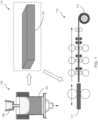
- FIG. 1 depicts a schematic illustration of a DC casting process at 105.
- a continuous casting system can include a pair of moving opposed casting surfaces (e.g., moving opposed belts, rolls or blocks), a casting cavity between the pair of moving opposed casting surfaces, and a molten metal injector.
- the molten metal injector can have an end opening from which molten metal can exit the molten metal injector and be injected into the casting cavity.
- a cast aluminum alloy product such as a cast ingot or other cast product
- the processing steps can be used to prepare sheets.
- Example optional processing steps include, but are not limited to, homogenization, hot rolling, cold rolling, annealing, solution heat treatment, and pre-aging.
- a cast product may be heated to a temperature ranging from about 400 °C to about 600 °C.
- the cast product can be heated to a temperature of about 400 °C, about 410 °C, about 420 °C, about 430 °C, about 440 °C, about 450 °C, about 460 °C, about 470 °C, about 480 °C, about 490 °C, about 500 °C, about 510 °C, about 520 °C, about 530 °C, about 540 °C, about 550 °C, about 560 °C, about 570 °C, about 580 °C, about 590 °C, or about 600 °C.
- the product may then be allowed to soak (i.e., held at the indicated temperature) for a period of time to form a homogenized product.
- the total time for the homogenization step can be up to 24 hours.
- the product can be heated up to 500 °C to 600 °C, and soaked, for a total time of up to 18 hours for the homogenization step.
- the product can be heated to below 490 °C and soaked, for a total time of greater than 18 hours for the homogenization step.
- the homogenization step comprises multiple processes.
- the cold rolling can be performed to result in a final gauge thickness that represents a gauge reduction of up to 85% (e.g., up to 10%, up to 20%, up to 30%, up to 40%, up to 50%, up to 60%, up to 70%, up to 80%, or up to 85% reduction) as compared to a gauge prior to the start of cold rolling.
- an interannealing step can be performed during the cold rolling step, such as where a first cold rolling process is applied, followed by an annealing process (interannealing), followed by a second cold rolling process.
- the cast products described herein can be used to make products in the form of sheets, plates, or other suitable products.
- plates including the products as described herein can be prepared by processing an ingot in a homogenization step or casting a product in a continuous caster followed by a hot rolling step.
- the cast product can be hot rolled to a 200 mm thick gauge or less (e.g., from about 10 mm to about 200 mm).
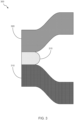
- FIG. 3 provides a schematic illustration of a joined aluminum alloy product 300, where an aluminum alloy product 305 is joined to a second product 310 by an adhesive 315.
- Second product 315 may optionally be another aluminum alloy product similar to or identical to aluminum alloy product 305, though second product 310 may optionally be a different aluminum alloy product or may not be an aluminum alloy product.
- aluminum alloy product 305 and second product 310 are shown in formed configurations in FIG. 3 , one or both of aluminum alloy product 305 and second product 310 may optionally be in an unformed (e.g., planar) configuration.
- Intermetallic particles in the aluminum alloy product 305 may serve as corrosion initiation, crack initiation, or crack propagation sites.
- the presence of the ⁇ -phase particles and ⁇ -phase particles in the aluminum alloy product may thus contribute to the durability, or lack of durability, of the bond or joint between aluminum alloy product 305 and second product 310.
- ⁇ -phase particles that are present in aluminum alloy product 305 may preferentially serve as corrosion initiation sites.
- ⁇ -phase particles are present in low amounts, such as when weight percent ratio of the ⁇ -phase intermetallic particles to the ⁇ -phase intermetallic particles in the aluminum alloy product is greater than 1, the amount or extent of corrosion may be limited such that the durability of a bond or joint the bond or joint between aluminum alloy product 305 and second product 310 may be improved over aluminum alloy products having weight percent ratio of ⁇ -phase intermetallic particles to ⁇ -phase intermetallic particles that is less than 1.
- the comparable aluminum alloy product may correspond to the aluminum alloy product that is not treated to modify the ratio or concentration of ⁇ -phase intermetallic particles to ⁇ -phase intermetallic particles to transform ⁇ -phase intermetallic particles into ⁇ -phase intermetallic particles to achieve a higher amount of ⁇ -phase intermetallic particles than ⁇ -phase intermetallic particles.
- Aspect 13 is the aluminum alloy product of any previous or subsequent aspect, wherein a ratio of the total concentration of ⁇ -phase-stabilizing stabilizing elements to iron in the ⁇ -phase intermetallic particles is greater than 0.5.
- Aspect 23 is the joined aluminum alloy product of any previous or subsequent aspect, wherein at least a portion of a surface of the aluminum alloy product is chemically modified or pretreated.
Landscapes
- Chemical & Material Sciences (AREA)
- Engineering & Computer Science (AREA)
- Mechanical Engineering (AREA)
- Physics & Mathematics (AREA)
- Optics & Photonics (AREA)
- Materials Engineering (AREA)
- Metallurgy (AREA)
- Organic Chemistry (AREA)
- Plasma & Fusion (AREA)
- Crystallography & Structural Chemistry (AREA)
- Thermal Sciences (AREA)
- Chemical Kinetics & Catalysis (AREA)
- General Chemical & Material Sciences (AREA)
- Powder Metallurgy (AREA)
- Other Surface Treatments For Metallic Materials (AREA)
- Metal Rolling (AREA)
- Continuous Casting (AREA)
- Pressure Welding/Diffusion-Bonding (AREA)
- Laminated Bodies (AREA)
- Laser Beam Processing (AREA)
- Chemically Coating (AREA)
- Adhesives Or Adhesive Processes (AREA)
Claims (11)
- Aluminiumlegierungsprodukt, umfassend:eine Aluminiumlegierung der Serie 6xxx umfassendbis zu 1,8 Gew.-% Silizium;bis zu 1,8 Gew.-% Eisen;bis zu 1,5 Gew.-% Kupfer;bis zu 0,5 Gew.-% Mangan;von 0,2 Gew.-% bis 3,0 Gew.-% Magnesium;bis zu 0,25 Gew.-% Titan;bis zu 1,5 Gew.-% Zink;bis zu 1 Gew.-% Nickel;bis zu 0,25 Gew.-% Vanadium;bis zu 0,25 Gew.-% Zirkonium;bis zu 0,5 Gew.-% Chrom;und bis zu 0,15 Gew.-% Verunreinigungen, und der Rest Aluminium,wobei ein Verhältnis der Gesamtkonzentration von α-phasenstabihsierenden Legierungselementen zu einer Menge von überschüssigem Silizium in der Aluminiumlegierung der 6xxx-Serie größer als oder etwa 1,0 ist, wobei die α-phasenstabilisierenden Legierungselemente eines oder mehrere von Kupfer, Chrom, Mangan, Zirkonium oder Vanadium umfassen,wobei die Aluminiumlegierung der Serie 6xxx intermetallische Partikel in der β-Phase und intermetallische Partikel in der α-Phase enthält; undwobei das Gewichtsprozentverhältnis der intermetallischen Partikel der α-Phase zu den intermetallischen Partikeln der β-Phase in dem Aluminiumlegierungsprodukt größer als 2,0 ist.
- Aluminiumlegierungsprodukt nach Anspruch 1, wobei die Aluminiumlegierung der Serie 6xxx bis zu 0,25 Gew.-% Titancarbid enthält.
- Aluminiumlegierungsprodukt nach Anspruch 1 oder 2, wobei die Gesamtkonzentration der a-phasenstabihsierenden Legierungselemente mehr als oder etwa 0,2 Gew.-% und/oder weniger als oder etwa 2 Gew.-% beträgt; und/oder wobei das Verhältnis der Gesamtkonzentration der a-phasenstabihsierenden Legierungselemente zu der Menge an überschüssigem Silizium in der Aluminiumlegierung der 6xxx-Serie weniger als oder etwa 3 beträgt.
- Aluminiumlegierungsprodukt nach einem der Ansprüche 1 bis 3, wobei die Aluminiumlegierung der Serie 6xxx im Wesentlichen frei von Bor ist.
- Aluminiumlegierungsprodukt nach einem der Ansprüche 1-4, wobei die Konzentration eines Karbidkornrefiners in der Aluminiumlegierung der Serie 6xxx bis zu 10 Teile pro Million beträgt.
- Aluminiumlegierungsprodukt nach einem der Ansprüche 1-5, wobei das Verhältnis der Gesamtkonzentration der α-Phasen-stabilisierenden Elemente zu Eisen in den α-Phasen-intermetallischen Partikeln größer als 0,5 ist.
- Aluminiumlegierungsprodukt nach einem der Ansprüche 1 bis 6, wobei die intermetallischen Partikel der β-Phase ein Aspektverhältnis von mehr als 2 aufweisen, und wobei die intermetallischen Partikel der α-Phase ein Aspektverhältnis von 1 bis 1,5 aufweisen; und/oderwobei die β-phasigen intermetallischen Teilchen Aluminium, Eisen und Silicium umfassen, und wobei die α-phasigen intermetallischen Partikel Aluminium, Silicium und eines oder mehrere von Eisen, Mangan oder Chrom umfassen; und/oderwobei das Gewichtsprozentverhältnis der intermetallischen Partikel der α-Phase zu den intermetallischen Partikeln der β-Phase in dem Aluminiumlegierungsprodukt durch ein Verfahren bestimmt wird, das eine Phasencharakterisierung unter Verwendung einer energiedispersiven Röntgenspektroskopie (EDXS)-Zusammensetzungsanalyse umfasst.
- Aluminiumlegierungsprodukt nach einem der Ansprüche 1-7, wobei das Korrosionspotential der intermetallischen Partikel der β-Phase größer ist als das einer Aluminiumlegierungsmatrix, die die intermetallischen Partikel der β-Phase trägt; und/oder wobei das Korrosionspotential der intermetallischen Partikel der β-Phase größer ist als das der intermetallischen Partikel der α-Phase.
- Aluminiumlegierungs-Verbundprodukt, umfassend:das Aluminiumlegierungsprodukt nach einem der Ansprüche 1-8;ein zweites Produkt; undein Haftmittel zwischen dem Aluminiumlegierungsprodukt und dem zweiten Produkt, wobei das Haftmittel das Aluminiumlegierungsprodukt und das zweite Produkt verbindet.
- Aluminiumlegierungs-Verbundprodukt nach Anspruch 9,ferner umfassend einen Haftvermittler auf einer Oberfläche des Aluminiumlegierungsprodukts oder zwischen dem Aluminiumlegierungsprodukt und das Haftmittel; und/oderwobei mindestens ein Teil einer Oberfläche des Aluminiumlegierungsprodukts chemisch modifiziert oder vorbehandelt ist; und/oderwobei mindestens ein Teil einer Oberfläche des Aluminiumlegierungsprodukts eine selbst-assemblierte Monoschicht aus einer oder mehreren phosphorhaltigen organischen Säuren enthält.
- Verfahren zur Herstellung eines Aluminiumlegierungsprodukts nach einem der Ansprüche 1-8, umfassend: Gießen einer Aluminiumlegierung der Serie 6xxx, umfassendbis zu 1,8 Gew.-% Silizium;bis zu 1,8 Gew.-% Eisen;bis zu 1,5 Gew.-% Kupfer;bis zu 0,5 Gew.-% Mangan;von 0,2 Gew.-% bis 3,0 Gew.-% Magnesium;bis zu 0,25 Gew.-% Titan;bis zu 1,5 Gew.-% Zink;bis zu 1 Gew.-% Nickel;bis zu 0,25 Gew.-% Vanadium;bis zu 0,25 Gew.-% Zirkonium;bis zu 0,5 Gew.-% Chrom;und bis zu 0,15 Gew.-% Verunreinigungen, und der Rest Aluminium, um ein gegossenes Aluminiumgusslegierungsprodukt zu bilden,Homogenisieren des gegossenen Aluminiumlegierungsprodukts, um ein homogenisiertes Aluminiumlegierungsprodukt zu bilden, undUnterziehen des homogenisierten Aluminiumlegierungsprodukts einem oder mehreren Warmwalzstichen und/oder einem oder mehreren Kaltwalzstichen, um ein gewalztes Aluminiumlegierungsprodukt zu bilden.
Applications Claiming Priority (4)
| Application Number | Priority Date | Filing Date | Title |
|---|---|---|---|
| US202062978767P | 2020-02-19 | 2020-02-19 | |
| US202062984555P | 2020-03-03 | 2020-03-03 | |
| US202062993365P | 2020-03-23 | 2020-03-23 | |
| PCT/US2021/018496 WO2021168064A1 (en) | 2020-02-19 | 2021-02-18 | Control of aluminum alloy microstructure for improved corrosion resistance and bonding performance |
Publications (2)
| Publication Number | Publication Date |
|---|---|
| EP4107302A1 EP4107302A1 (de) | 2022-12-28 |
| EP4107302B1 true EP4107302B1 (de) | 2024-07-10 |
Family
ID=74860583
Family Applications (3)
| Application Number | Title | Priority Date | Filing Date |
|---|---|---|---|
| EP21711417.2A Pending EP4107301A1 (de) | 2020-02-19 | 2021-02-18 | Verfahren zur oberflächenmodifizierung von metallegierungen und verwandte metallegierungsprodukte mit verbesserter bindungsbeständigkeit |
| EP21711138.4A Active EP4107302B1 (de) | 2020-02-19 | 2021-02-18 | Kontrolle der mikrostruktur einer aluminiumlegierung für verbesserte korrosionsbeständigkeit und bondleistung |
| EP21710843.0A Pending EP4107300A1 (de) | 2020-02-19 | 2021-02-18 | Metallprodukte mit verbesserter bindungsbeständigkeit und zugehörige verfahren |
Family Applications Before (1)
| Application Number | Title | Priority Date | Filing Date |
|---|---|---|---|
| EP21711417.2A Pending EP4107301A1 (de) | 2020-02-19 | 2021-02-18 | Verfahren zur oberflächenmodifizierung von metallegierungen und verwandte metallegierungsprodukte mit verbesserter bindungsbeständigkeit |
Family Applications After (1)
| Application Number | Title | Priority Date | Filing Date |
|---|---|---|---|
| EP21710843.0A Pending EP4107300A1 (de) | 2020-02-19 | 2021-02-18 | Metallprodukte mit verbesserter bindungsbeständigkeit und zugehörige verfahren |
Country Status (10)
| Country | Link |
|---|---|
| US (3) | US20230099830A1 (de) |
| EP (3) | EP4107301A1 (de) |
| JP (5) | JP7480323B2 (de) |
| KR (3) | KR102725534B1 (de) |
| CN (4) | CN115151666A (de) |
| BR (1) | BR112022014106A2 (de) |
| CA (3) | CA3169622A1 (de) |
| ES (1) | ES2992961T3 (de) |
| MX (2) | MX2022010163A (de) |
| WO (3) | WO2021168065A1 (de) |
Families Citing this family (6)
| Publication number | Priority date | Publication date | Assignee | Title |
|---|---|---|---|---|
| US20230099830A1 (en) * | 2020-02-19 | 2023-03-30 | Novelis Inc. | Control of aluminum alloy microstructure for improved corrosion resistance and bonding performance |
| US11833993B2 (en) * | 2020-12-31 | 2023-12-05 | Joyson Safety Systems Acquisition Llc | Postprocessing of seat belts for adding dye |
| CN117403150B (zh) * | 2023-12-13 | 2024-02-23 | 佛山市华满莹铝业有限公司 | 一种抛光隔热铝型材的制备工艺 |
| JP2025151929A (ja) * | 2024-03-28 | 2025-10-09 | 株式会社Uacj | アルミニウム合金板材 |
| WO2025243191A1 (en) * | 2024-05-20 | 2025-11-27 | Callidus Process Solutions Pty Ltd | Metal surface modifications for wear and corrosion resistant applications |
| CN120169868B (zh) * | 2025-05-19 | 2025-08-29 | 浙江摩克激光智能装备有限公司 | 一种采用激光引入中间层制备铜铝层状复合板的方法 |
Citations (6)
| Publication number | Priority date | Publication date | Assignee | Title |
|---|---|---|---|---|
| US6167609B1 (en) | 1997-12-26 | 2001-01-02 | Aluminum Company Of America | Acid pretreatment for adhesive bonding of vehicle assemblies |
| CA2361484A1 (en) | 2000-11-10 | 2002-05-10 | Men Glenn Chu | Production of ultra-fine grain structure in as-cast aluminum alloys |
| US20090116999A1 (en) | 2006-02-17 | 2009-05-07 | Norsk Hydro Asa | Aluminium Alloy With Improved Crush Properties |
| US20160115575A1 (en) | 2014-10-28 | 2016-04-28 | Novelis Inc. | Aluminum alloy products and a method of preparation |
| US20160319440A1 (en) | 2015-05-01 | 2016-11-03 | Novelis Inc. | Continuous coil pretreatment process |
| US20180340244A1 (en) | 2017-05-26 | 2018-11-29 | Novelis Inc. | High-strength corrosion-resistant 6xxx series aluminum alloys and methods of making the same |
Family Cites Families (30)
| Publication number | Priority date | Publication date | Assignee | Title |
|---|---|---|---|---|
| JPH10317114A (ja) * | 1997-05-14 | 1998-12-02 | Nippon Light Metal Co Ltd | 空気焼入れ性が良好な中強度Al−Mg−Si系合金押出し形材の製造方法 |
| US6458224B1 (en) * | 1999-12-23 | 2002-10-01 | Reynolds Metals Company | Aluminum alloys with optimum combinations of formability, corrosion resistance, and hot workability, and methods of use |
| US8083871B2 (en) * | 2005-10-28 | 2011-12-27 | Automotive Casting Technology, Inc. | High crashworthiness Al-Si-Mg alloy and methods for producing automotive casting |
| JP2008223085A (ja) * | 2007-03-13 | 2008-09-25 | Furukawa Sky Kk | 塗膜密着性と接着性に優れたアルミニウム材の製造方法 |
| EP2055473A1 (de) * | 2007-11-05 | 2009-05-06 | Novelis, Inc. | Plattiertes Blechprodukt und Herstellungsverfahren dafür |
| KR20100114892A (ko) * | 2008-02-08 | 2010-10-26 | 가부시키가이샤 엘티티 바이오파마 | 정제를 타정하는 펀치 또는 다이의 타정 표면의 처리 방법과 이 방법으로 표면 처리된 펀치 또는 다이와 이 펀치 또는 다이로 타정된 정제 |
| JP5643479B2 (ja) * | 2008-11-12 | 2014-12-17 | 株式会社神戸製鋼所 | 曲げ性に優れたAl−Mg−Si系アルミニウム合金板 |
| CN101880805B (zh) * | 2010-07-30 | 2012-10-17 | 浙江巨科铝业有限公司 | 汽车车身板用Al-Mg-Si系铝合金制造方法 |
| JP2012092431A (ja) * | 2010-09-30 | 2012-05-17 | Kobe Steel Ltd | ボトル缶用アルミニウム合金冷延板 |
| CN102337434B (zh) * | 2011-08-18 | 2013-09-25 | 苏州有色金属研究院有限公司 | 高强高韧Al-Mg-Si-Cu变形铝合金及其制备方法 |
| JP5825990B2 (ja) * | 2011-11-18 | 2015-12-02 | 三菱アルミニウム株式会社 | Al−Mg−Si系合金押出材 |
| US11590609B2 (en) * | 2012-01-18 | 2023-02-28 | Purdue Research Foundation | Laser shock peening apparatuses and methods |
| EP2664687B1 (de) * | 2012-05-15 | 2015-07-08 | Constellium Extrusions Decin s.r.o. | Verbessertes, frei maschinell bearbeitbares Schmiede-Aluminiumlegierungsprodukt und Herstellungsverfahren davon |
| US8808796B1 (en) * | 2013-01-28 | 2014-08-19 | Ford Global Technologies, Llc | Method of pretreating aluminum assemblies for improved adhesive bonding and corrosion resistance |
| WO2015077880A1 (en) * | 2013-11-27 | 2015-06-04 | Rio Tinto Alcan International Limited | Aluminum alloy combining high strength and extrudability, and low quench sensitivity |
| US20150368772A1 (en) * | 2014-06-19 | 2015-12-24 | Apple Inc. | Aluminum Alloys with Anodization Mirror Quality |
| BR112017009640A2 (pt) * | 2014-11-11 | 2017-12-19 | Novelis Inc | liga de alumínio, forma de chapa estampada, e, processos para fabricar uma liga de alumínio de chapa e uma forma de chapa estampada. |
| PT3245309T (pt) * | 2015-01-12 | 2019-07-17 | Novelis Inc | Chapa de alumínio automotiva altamente formável com estriamento de superfície reduzido ou nenhum e um método de preparação |
| JP5992081B2 (ja) * | 2015-09-11 | 2016-09-14 | 芝浦メカトロニクス株式会社 | レーザ処理装置 |
| US11141809B2 (en) * | 2015-12-04 | 2021-10-12 | Raytheon Company | Electron beam additive manufacturing |
| EP3571329B1 (de) * | 2017-01-18 | 2024-04-17 | Arconic Technologies LLC | Verfahren zur herstellung von 7xxx-aluminiumlegierungen zum verkleben und produkte im zusammenhang damit |
| JP2020526661A (ja) * | 2017-06-28 | 2020-08-31 | アーコニック テクノロジーズ エルエルシーArconic Technologies Llc | 7xxxアルミニウム合金を接着接合するための調製方法、およびそれに関連する製品 |
| CN107385193B (zh) * | 2017-07-05 | 2019-03-01 | 温州大学激光与光电智能制造研究院 | 一种提高金属构件含氯溶液中抗腐蚀性能的组合处理方法 |
| WO2019125594A1 (en) * | 2017-12-21 | 2019-06-27 | Novelis Inc. | Aluminum alloy products exhibiting improved bond durability and/or having phosphorus-containing surfaces and methods of making the same |
| WO2019125595A1 (en) * | 2017-12-21 | 2019-06-27 | Novelis Inc. | Aluminum alloy articles having improved bond durability and inert surface aluminum alloy articles and methods of making and using the same |
| FR3076837B1 (fr) * | 2018-01-16 | 2020-01-03 | Constellium Neuf-Brisach | Procede de fabrication de toles minces en alliage d'aluminium 6xxx a haute qualite de surface |
| US20220048141A1 (en) * | 2018-09-17 | 2022-02-17 | Twb Company, Inc. | Method of preparing an aluminum metal piece for welding |
| CN109136923A (zh) * | 2018-10-25 | 2019-01-04 | 中信戴卡股份有限公司 | 一种铝合金的表面激光重熔处理方法 |
| WO2020123807A1 (en) * | 2018-12-12 | 2020-06-18 | Peter Von Czarnowski | Method and system for heat treatment of metal alloy sheet |
| US20230099830A1 (en) * | 2020-02-19 | 2023-03-30 | Novelis Inc. | Control of aluminum alloy microstructure for improved corrosion resistance and bonding performance |
-
2021
- 2021-02-18 US US17/904,307 patent/US20230099830A1/en active Pending
- 2021-02-18 ES ES21711138T patent/ES2992961T3/es active Active
- 2021-02-18 CN CN202180015373.4A patent/CN115151666A/zh active Pending
- 2021-02-18 CA CA3169622A patent/CA3169622A1/en active Pending
- 2021-02-18 WO PCT/US2021/018501 patent/WO2021168065A1/en not_active Ceased
- 2021-02-18 CA CA3168011A patent/CA3168011A1/en active Pending
- 2021-02-18 JP JP2022549491A patent/JP7480323B2/ja active Active
- 2021-02-18 MX MX2022010163A patent/MX2022010163A/es unknown
- 2021-02-18 CN CN202511225050.4A patent/CN121046693A/zh active Pending
- 2021-02-18 CN CN202180015374.9A patent/CN115135784B/zh active Active
- 2021-02-18 WO PCT/US2021/018496 patent/WO2021168064A1/en not_active Ceased
- 2021-02-18 KR KR1020227027766A patent/KR102725534B1/ko active Active
- 2021-02-18 JP JP2022549374A patent/JP2023524616A/ja active Pending
- 2021-02-18 JP JP2022549490A patent/JP2023514331A/ja active Pending
- 2021-02-18 MX MX2022010162A patent/MX2022010162A/es unknown
- 2021-02-18 CN CN202180015381.9A patent/CN115135785B/zh active Active
- 2021-02-18 EP EP21711417.2A patent/EP4107301A1/de active Pending
- 2021-02-18 BR BR112022014106A patent/BR112022014106A2/pt not_active Application Discontinuation
- 2021-02-18 CA CA3168014A patent/CA3168014A1/en active Pending
- 2021-02-18 US US17/904,303 patent/US20230077017A1/en active Pending
- 2021-02-18 EP EP21711138.4A patent/EP4107302B1/de active Active
- 2021-02-18 EP EP21710843.0A patent/EP4107300A1/de active Pending
- 2021-02-18 KR KR1020227026623A patent/KR102767169B1/ko active Active
- 2021-02-18 US US17/759,424 patent/US20230082861A1/en not_active Abandoned
- 2021-02-18 KR KR1020227027649A patent/KR20220126747A/ko active Pending
- 2021-02-18 WO PCT/US2021/018504 patent/WO2021168068A1/en not_active Ceased
-
2024
- 2024-07-19 JP JP2024115709A patent/JP2024161384A/ja active Pending
- 2024-10-17 JP JP2024182012A patent/JP2025010583A/ja active Pending
Patent Citations (6)
| Publication number | Priority date | Publication date | Assignee | Title |
|---|---|---|---|---|
| US6167609B1 (en) | 1997-12-26 | 2001-01-02 | Aluminum Company Of America | Acid pretreatment for adhesive bonding of vehicle assemblies |
| CA2361484A1 (en) | 2000-11-10 | 2002-05-10 | Men Glenn Chu | Production of ultra-fine grain structure in as-cast aluminum alloys |
| US20090116999A1 (en) | 2006-02-17 | 2009-05-07 | Norsk Hydro Asa | Aluminium Alloy With Improved Crush Properties |
| US20160115575A1 (en) | 2014-10-28 | 2016-04-28 | Novelis Inc. | Aluminum alloy products and a method of preparation |
| US20160319440A1 (en) | 2015-05-01 | 2016-11-03 | Novelis Inc. | Continuous coil pretreatment process |
| US20180340244A1 (en) | 2017-05-26 | 2018-11-29 | Novelis Inc. | High-strength corrosion-resistant 6xxx series aluminum alloys and methods of making the same |
Non-Patent Citations (4)
| Title |
|---|
| ANONYMOUS: "International Alloy Designations and Chemical Composition Limits for Wrought Aluminum and Wrought Aluminum Alloys", THE ALUMINUM ASSOCIATION, 1 February 2009 (2009-02-01), pages 1 - 38, XP093270402 |
| KUIJPERS N.C.W. : "A literature review", INTERMETALLIC PHASE TRANSFORMATIONS DURING HOMOGENISATION OF 6XXX AL ALLOYS, 1 February 2000 (2000-02-01), pages 1 - 37, XP093270407 |
| NIELS C. W. KUIJPERS ET AL: "A Model of the .BETA.-AlFeSi to .ALPHA.-Al(FeMn)Si Transformation in Al-Mg-Si Alloys", MATERIALS TRANSACTIONS, THE JAPANESE INSTITUTE OF METALS AND MATERIALS, JP, vol. 44, no. 7, 1 January 2003 (2003-01-01), JP , pages 1448 - 1456, XP055323345, ISSN: 1345-9678, DOI: 10.2320/matertrans.44.1448 |
| VAN HORN KENT R.: "Preheating and Homogenizing ", ALUMINUM VOL. III. FABRICATION AND FINISHING, AMERICAN SOCIETY FOR METALS, 1 January 1967 (1967-01-01), pages 324 - 326, XP093270396 |
Also Published As
Similar Documents
| Publication | Publication Date | Title |
|---|---|---|
| EP4107302B1 (de) | Kontrolle der mikrostruktur einer aluminiumlegierung für verbesserte korrosionsbeständigkeit und bondleistung | |
| JP7321828B2 (ja) | 高強度6xxxアルミニウム合金及びその作製方法 | |
| EP3265595B1 (de) | Hochfeste 7xxx-aluminiumlegierungen und verfahren zur herstellung davon | |
| KR101456684B1 (ko) | Almgsi 심재 합금 층을 구비하는 알루미늄 복합 재료 | |
| EP2635720B1 (de) | Automobilformteil aus einem aluminiumlegierungsprodukt und verfahren zu seiner herstellung | |
| EP3938554B1 (de) | Aushärtbare und hochverformbare aluminiumlegierungen, daraus hergestelltes monolithisches blech und plattiertes aluminium-legierungsprodukt damit | |
| JP6771456B2 (ja) | アルミニウム合金製品及び調製方法 | |
| EP2219860B1 (de) | Plattiertes blechprodukt und herstellungsverfahren dafür | |
| KR101974624B1 (ko) | Almgsi 알루미늄 스트립 제조 방법 | |
| EP4056364B1 (de) | Plattierte aluminiumlegierungsprodukte und verfahren zur herstellung davon | |
| EP3555332B1 (de) | Hochfeste und hochverformbare aluminiumlegierungen, die gegen natürliche altershärtung resistent sind, und verfahren zur herstellung davon | |
| EP3676410B1 (de) | Hochfeste hochverformbare aluminiumlegierungen und verfahren zu ihrer herstellung | |
| JPH10259464A (ja) | 成形加工用アルミニウム合金板の製造方法 | |
| JP3749627B2 (ja) | プレス成形性に優れたAl合金板 | |
| JP4237326B2 (ja) | 成形性および耐食性に優れたアルミニウム合金板の製造方法 | |
| EP3652356B1 (de) | Hochfeste korrosionsbeständige aluminiumlegierungen und verfahren zur herstellung davon | |
| JPH10216806A (ja) | Al−Mg系合金の熱間圧延方法 | |
| US20240279779A1 (en) | Strip made of 6xxx alloy and manufacturing process | |
| JP2003073764A (ja) | 成形加工用アルミニウム合金板及びその製造方法 | |
| JPH07173585A (ja) | 表面処理特性にすぐれた成形用アルミニウム合金板材の製造方法 |
Legal Events
| Date | Code | Title | Description |
|---|---|---|---|
| STAA | Information on the status of an ep patent application or granted ep patent |
Free format text: STATUS: UNKNOWN |
|
| STAA | Information on the status of an ep patent application or granted ep patent |
Free format text: STATUS: THE INTERNATIONAL PUBLICATION HAS BEEN MADE |
|
| PUAI | Public reference made under article 153(3) epc to a published international application that has entered the european phase |
Free format text: ORIGINAL CODE: 0009012 |
|
| STAA | Information on the status of an ep patent application or granted ep patent |
Free format text: STATUS: REQUEST FOR EXAMINATION WAS MADE |
|
| 17P | Request for examination filed |
Effective date: 20220729 |
|
| AK | Designated contracting states |
Kind code of ref document: A1 Designated state(s): AL AT BE BG CH CY CZ DE DK EE ES FI FR GB GR HR HU IE IS IT LI LT LU LV MC MK MT NL NO PL PT RO RS SE SI SK SM TR |
|
| DAV | Request for validation of the european patent (deleted) | ||
| DAX | Request for extension of the european patent (deleted) | ||
| STAA | Information on the status of an ep patent application or granted ep patent |
Free format text: STATUS: EXAMINATION IS IN PROGRESS |
|
| 17Q | First examination report despatched |
Effective date: 20230912 |
|
| GRAP | Despatch of communication of intention to grant a patent |
Free format text: ORIGINAL CODE: EPIDOSNIGR1 |
|
| STAA | Information on the status of an ep patent application or granted ep patent |
Free format text: STATUS: GRANT OF PATENT IS INTENDED |
|
| INTG | Intention to grant announced |
Effective date: 20240228 |
|
| GRAS | Grant fee paid |
Free format text: ORIGINAL CODE: EPIDOSNIGR3 |
|
| GRAA | (expected) grant |
Free format text: ORIGINAL CODE: 0009210 |
|
| STAA | Information on the status of an ep patent application or granted ep patent |
Free format text: STATUS: THE PATENT HAS BEEN GRANTED |
|
| AK | Designated contracting states |
Kind code of ref document: B1 Designated state(s): AL AT BE BG CH CY CZ DE DK EE ES FI FR GB GR HR HU IE IS IT LI LT LU LV MC MK MT NL NO PL PT RO RS SE SI SK SM TR |
|
| REG | Reference to a national code |
Ref country code: CH Ref legal event code: EP |
|
| REG | Reference to a national code |
Ref country code: DE Ref legal event code: R096 Ref document number: 602021015468 Country of ref document: DE |
|
| REG | Reference to a national code |
Ref country code: NL Ref legal event code: FP |
|
| REG | Reference to a national code |
Ref country code: SE Ref legal event code: TRGR |
|
| P01 | Opt-out of the competence of the unified patent court (upc) registered |
Free format text: CASE NUMBER: APP_48301/2024 Effective date: 20240822 |
|
| REG | Reference to a national code |
Ref country code: LT Ref legal event code: MG9D |
|
| PG25 | Lapsed in a contracting state [announced via postgrant information from national office to epo] |
Ref country code: PT Free format text: LAPSE BECAUSE OF FAILURE TO SUBMIT A TRANSLATION OF THE DESCRIPTION OR TO PAY THE FEE WITHIN THE PRESCRIBED TIME-LIMIT Effective date: 20241111 |
|
| REG | Reference to a national code |
Ref country code: AT Ref legal event code: UEP Ref document number: 1702100 Country of ref document: AT Kind code of ref document: T Effective date: 20240710 |
|
| REG | Reference to a national code |
Ref country code: ES Ref legal event code: FG2A Ref document number: 2992961 Country of ref document: ES Kind code of ref document: T3 Effective date: 20241219 |
|
| PG25 | Lapsed in a contracting state [announced via postgrant information from national office to epo] |
Ref country code: PT Free format text: LAPSE BECAUSE OF FAILURE TO SUBMIT A TRANSLATION OF THE DESCRIPTION OR TO PAY THE FEE WITHIN THE PRESCRIBED TIME-LIMIT Effective date: 20241111 |
|
| PG25 | Lapsed in a contracting state [announced via postgrant information from national office to epo] |
Ref country code: NO Free format text: LAPSE BECAUSE OF FAILURE TO SUBMIT A TRANSLATION OF THE DESCRIPTION OR TO PAY THE FEE WITHIN THE PRESCRIBED TIME-LIMIT Effective date: 20241010 |
|
| PG25 | Lapsed in a contracting state [announced via postgrant information from national office to epo] |
Ref country code: FI Free format text: LAPSE BECAUSE OF FAILURE TO SUBMIT A TRANSLATION OF THE DESCRIPTION OR TO PAY THE FEE WITHIN THE PRESCRIBED TIME-LIMIT Effective date: 20240710 Ref country code: GR Free format text: LAPSE BECAUSE OF FAILURE TO SUBMIT A TRANSLATION OF THE DESCRIPTION OR TO PAY THE FEE WITHIN THE PRESCRIBED TIME-LIMIT Effective date: 20241011 Ref country code: PL Free format text: LAPSE BECAUSE OF FAILURE TO SUBMIT A TRANSLATION OF THE DESCRIPTION OR TO PAY THE FEE WITHIN THE PRESCRIBED TIME-LIMIT Effective date: 20240710 |
|
| PG25 | Lapsed in a contracting state [announced via postgrant information from national office to epo] |
Ref country code: BG Free format text: LAPSE BECAUSE OF FAILURE TO SUBMIT A TRANSLATION OF THE DESCRIPTION OR TO PAY THE FEE WITHIN THE PRESCRIBED TIME-LIMIT Effective date: 20240710 |
|
| PG25 | Lapsed in a contracting state [announced via postgrant information from national office to epo] |
Ref country code: LV Free format text: LAPSE BECAUSE OF FAILURE TO SUBMIT A TRANSLATION OF THE DESCRIPTION OR TO PAY THE FEE WITHIN THE PRESCRIBED TIME-LIMIT Effective date: 20240710 |
|
| PG25 | Lapsed in a contracting state [announced via postgrant information from national office to epo] |
Ref country code: IS Free format text: LAPSE BECAUSE OF FAILURE TO SUBMIT A TRANSLATION OF THE DESCRIPTION OR TO PAY THE FEE WITHIN THE PRESCRIBED TIME-LIMIT Effective date: 20241110 |
|
| PG25 | Lapsed in a contracting state [announced via postgrant information from national office to epo] |
Ref country code: HR Free format text: LAPSE BECAUSE OF FAILURE TO SUBMIT A TRANSLATION OF THE DESCRIPTION OR TO PAY THE FEE WITHIN THE PRESCRIBED TIME-LIMIT Effective date: 20240710 |
|
| PG25 | Lapsed in a contracting state [announced via postgrant information from national office to epo] |
Ref country code: RS Free format text: LAPSE BECAUSE OF FAILURE TO SUBMIT A TRANSLATION OF THE DESCRIPTION OR TO PAY THE FEE WITHIN THE PRESCRIBED TIME-LIMIT Effective date: 20241010 |
|
| PG25 | Lapsed in a contracting state [announced via postgrant information from national office to epo] |
Ref country code: RS Free format text: LAPSE BECAUSE OF FAILURE TO SUBMIT A TRANSLATION OF THE DESCRIPTION OR TO PAY THE FEE WITHIN THE PRESCRIBED TIME-LIMIT Effective date: 20241010 Ref country code: PL Free format text: LAPSE BECAUSE OF FAILURE TO SUBMIT A TRANSLATION OF THE DESCRIPTION OR TO PAY THE FEE WITHIN THE PRESCRIBED TIME-LIMIT Effective date: 20240710 Ref country code: NO Free format text: LAPSE BECAUSE OF FAILURE TO SUBMIT A TRANSLATION OF THE DESCRIPTION OR TO PAY THE FEE WITHIN THE PRESCRIBED TIME-LIMIT Effective date: 20241010 Ref country code: LV Free format text: LAPSE BECAUSE OF FAILURE TO SUBMIT A TRANSLATION OF THE DESCRIPTION OR TO PAY THE FEE WITHIN THE PRESCRIBED TIME-LIMIT Effective date: 20240710 Ref country code: IS Free format text: LAPSE BECAUSE OF FAILURE TO SUBMIT A TRANSLATION OF THE DESCRIPTION OR TO PAY THE FEE WITHIN THE PRESCRIBED TIME-LIMIT Effective date: 20241110 Ref country code: HR Free format text: LAPSE BECAUSE OF FAILURE TO SUBMIT A TRANSLATION OF THE DESCRIPTION OR TO PAY THE FEE WITHIN THE PRESCRIBED TIME-LIMIT Effective date: 20240710 Ref country code: GR Free format text: LAPSE BECAUSE OF FAILURE TO SUBMIT A TRANSLATION OF THE DESCRIPTION OR TO PAY THE FEE WITHIN THE PRESCRIBED TIME-LIMIT Effective date: 20241011 Ref country code: FI Free format text: LAPSE BECAUSE OF FAILURE TO SUBMIT A TRANSLATION OF THE DESCRIPTION OR TO PAY THE FEE WITHIN THE PRESCRIBED TIME-LIMIT Effective date: 20240710 Ref country code: BG Free format text: LAPSE BECAUSE OF FAILURE TO SUBMIT A TRANSLATION OF THE DESCRIPTION OR TO PAY THE FEE WITHIN THE PRESCRIBED TIME-LIMIT Effective date: 20240710 |
|
| PGFP | Annual fee paid to national office [announced via postgrant information from national office to epo] |
Ref country code: NL Payment date: 20250121 Year of fee payment: 5 |
|
| REG | Reference to a national code |
Ref country code: DE Ref legal event code: R026 Ref document number: 602021015468 Country of ref document: DE |
|
| PGFP | Annual fee paid to national office [announced via postgrant information from national office to epo] |
Ref country code: DE Payment date: 20250122 Year of fee payment: 5 |
|
| PG25 | Lapsed in a contracting state [announced via postgrant information from national office to epo] |
Ref country code: RO Free format text: LAPSE BECAUSE OF FAILURE TO SUBMIT A TRANSLATION OF THE DESCRIPTION OR TO PAY THE FEE WITHIN THE PRESCRIBED TIME-LIMIT Effective date: 20240710 Ref country code: SM Free format text: LAPSE BECAUSE OF FAILURE TO SUBMIT A TRANSLATION OF THE DESCRIPTION OR TO PAY THE FEE WITHIN THE PRESCRIBED TIME-LIMIT Effective date: 20240710 Ref country code: DK Free format text: LAPSE BECAUSE OF FAILURE TO SUBMIT A TRANSLATION OF THE DESCRIPTION OR TO PAY THE FEE WITHIN THE PRESCRIBED TIME-LIMIT Effective date: 20240710 |
|
| PGFP | Annual fee paid to national office [announced via postgrant information from national office to epo] |
Ref country code: ES Payment date: 20250303 Year of fee payment: 5 |
|
| PLBI | Opposition filed |
Free format text: ORIGINAL CODE: 0009260 |
|
| PGFP | Annual fee paid to national office [announced via postgrant information from national office to epo] |
Ref country code: SE Payment date: 20250121 Year of fee payment: 5 |
|
| PG25 | Lapsed in a contracting state [announced via postgrant information from national office to epo] |
Ref country code: EE Free format text: LAPSE BECAUSE OF FAILURE TO SUBMIT A TRANSLATION OF THE DESCRIPTION OR TO PAY THE FEE WITHIN THE PRESCRIBED TIME-LIMIT Effective date: 20240710 |
|
| PGFP | Annual fee paid to national office [announced via postgrant information from national office to epo] |
Ref country code: CH Payment date: 20250301 Year of fee payment: 5 Ref country code: BE Payment date: 20250121 Year of fee payment: 5 Ref country code: AT Payment date: 20250417 Year of fee payment: 5 |
|
| PG25 | Lapsed in a contracting state [announced via postgrant information from national office to epo] |
Ref country code: CZ Free format text: LAPSE BECAUSE OF FAILURE TO SUBMIT A TRANSLATION OF THE DESCRIPTION OR TO PAY THE FEE WITHIN THE PRESCRIBED TIME-LIMIT Effective date: 20240710 |
|
| PGFP | Annual fee paid to national office [announced via postgrant information from national office to epo] |
Ref country code: FR Payment date: 20250122 Year of fee payment: 5 |
|
| PLAX | Notice of opposition and request to file observation + time limit sent |
Free format text: ORIGINAL CODE: EPIDOSNOBS2 |
|
| PG25 | Lapsed in a contracting state [announced via postgrant information from national office to epo] |
Ref country code: SK Free format text: LAPSE BECAUSE OF FAILURE TO SUBMIT A TRANSLATION OF THE DESCRIPTION OR TO PAY THE FEE WITHIN THE PRESCRIBED TIME-LIMIT Effective date: 20240710 |
|
| PGFP | Annual fee paid to national office [announced via postgrant information from national office to epo] |
Ref country code: IT Payment date: 20250121 Year of fee payment: 5 Ref country code: GB Payment date: 20250124 Year of fee payment: 5 |
|
| PGFP | Annual fee paid to national office [announced via postgrant information from national office to epo] |
Ref country code: TR Payment date: 20250128 Year of fee payment: 5 |
|
| 26 | Opposition filed |
Opponent name: ARCONIC CORPORATION Effective date: 20250409 |
|
| PG25 | Lapsed in a contracting state [announced via postgrant information from national office to epo] |
Ref country code: MC Free format text: LAPSE BECAUSE OF FAILURE TO SUBMIT A TRANSLATION OF THE DESCRIPTION OR TO PAY THE FEE WITHIN THE PRESCRIBED TIME-LIMIT Effective date: 20240710 |
|
| PG25 | Lapsed in a contracting state [announced via postgrant information from national office to epo] |
Ref country code: LU Free format text: LAPSE BECAUSE OF NON-PAYMENT OF DUE FEES Effective date: 20250218 |