EP4077041B1 - Bedienstand als austauschbare montageeinheit sowie führerhaus mit einem solchen bedienstand - Google Patents
Bedienstand als austauschbare montageeinheit sowie führerhaus mit einem solchen bedienstand Download PDFInfo
- Publication number
- EP4077041B1 EP4077041B1 EP20824184.4A EP20824184A EP4077041B1 EP 4077041 B1 EP4077041 B1 EP 4077041B1 EP 20824184 A EP20824184 A EP 20824184A EP 4077041 B1 EP4077041 B1 EP 4077041B1
- Authority
- EP
- European Patent Office
- Prior art keywords
- guide
- operator platform
- base plate
- platform according
- carriage
- Prior art date
- Legal status (The legal status is an assumption and is not a legal conclusion. Google has not performed a legal analysis and makes no representation as to the accuracy of the status listed.)
- Active
Links
Images


Classifications
-
- B—PERFORMING OPERATIONS; TRANSPORTING
- B60—VEHICLES IN GENERAL
- B60N—SEATS SPECIALLY ADAPTED FOR VEHICLES; VEHICLE PASSENGER ACCOMMODATION NOT OTHERWISE PROVIDED FOR
- B60N2/00—Seats specially adapted for vehicles; Arrangement or mounting of seats in vehicles
- B60N2/02—Seats specially adapted for vehicles; Arrangement or mounting of seats in vehicles the seat or part thereof being movable, e.g. adjustable
- B60N2/04—Seats specially adapted for vehicles; Arrangement or mounting of seats in vehicles the seat or part thereof being movable, e.g. adjustable the whole seat being movable
- B60N2/06—Seats specially adapted for vehicles; Arrangement or mounting of seats in vehicles the seat or part thereof being movable, e.g. adjustable the whole seat being movable slidable
- B60N2/07—Slide construction
- B60N2/0702—Slide construction characterised by its cross-section
- B60N2/0717—Rounded, e.g. circular
-
- B—PERFORMING OPERATIONS; TRANSPORTING
- B60—VEHICLES IN GENERAL
- B60N—SEATS SPECIALLY ADAPTED FOR VEHICLES; VEHICLE PASSENGER ACCOMMODATION NOT OTHERWISE PROVIDED FOR
- B60N2/00—Seats specially adapted for vehicles; Arrangement or mounting of seats in vehicles
- B60N2/02—Seats specially adapted for vehicles; Arrangement or mounting of seats in vehicles the seat or part thereof being movable, e.g. adjustable
- B60N2/04—Seats specially adapted for vehicles; Arrangement or mounting of seats in vehicles the seat or part thereof being movable, e.g. adjustable the whole seat being movable
- B60N2/06—Seats specially adapted for vehicles; Arrangement or mounting of seats in vehicles the seat or part thereof being movable, e.g. adjustable the whole seat being movable slidable
- B60N2/07—Slide construction
- B60N2/0722—Constructive details
- B60N2/0725—Closing members for covering the slide
-
- B—PERFORMING OPERATIONS; TRANSPORTING
- B60—VEHICLES IN GENERAL
- B60N—SEATS SPECIALLY ADAPTED FOR VEHICLES; VEHICLE PASSENGER ACCOMMODATION NOT OTHERWISE PROVIDED FOR
- B60N2/00—Seats specially adapted for vehicles; Arrangement or mounting of seats in vehicles
- B60N2/02—Seats specially adapted for vehicles; Arrangement or mounting of seats in vehicles the seat or part thereof being movable, e.g. adjustable
- B60N2/04—Seats specially adapted for vehicles; Arrangement or mounting of seats in vehicles the seat or part thereof being movable, e.g. adjustable the whole seat being movable
- B60N2/06—Seats specially adapted for vehicles; Arrangement or mounting of seats in vehicles the seat or part thereof being movable, e.g. adjustable the whole seat being movable slidable
- B60N2/08—Seats specially adapted for vehicles; Arrangement or mounting of seats in vehicles the seat or part thereof being movable, e.g. adjustable the whole seat being movable slidable characterised by the locking device
- B60N2/0812—Location of the latch
- B60N2/0825—Location of the latch outside the rail
-
- B—PERFORMING OPERATIONS; TRANSPORTING
- B60—VEHICLES IN GENERAL
- B60N—SEATS SPECIALLY ADAPTED FOR VEHICLES; VEHICLE PASSENGER ACCOMMODATION NOT OTHERWISE PROVIDED FOR
- B60N2/00—Seats specially adapted for vehicles; Arrangement or mounting of seats in vehicles
- B60N2/02—Seats specially adapted for vehicles; Arrangement or mounting of seats in vehicles the seat or part thereof being movable, e.g. adjustable
- B60N2/04—Seats specially adapted for vehicles; Arrangement or mounting of seats in vehicles the seat or part thereof being movable, e.g. adjustable the whole seat being movable
- B60N2/06—Seats specially adapted for vehicles; Arrangement or mounting of seats in vehicles the seat or part thereof being movable, e.g. adjustable the whole seat being movable slidable
- B60N2/08—Seats specially adapted for vehicles; Arrangement or mounting of seats in vehicles the seat or part thereof being movable, e.g. adjustable the whole seat being movable slidable characterised by the locking device
- B60N2/0831—Movement of the latch
- B60N2/0862—Movement of the latch sliding
- B60N2/0875—Movement of the latch sliding in a vertical direction
-
- B—PERFORMING OPERATIONS; TRANSPORTING
- B60—VEHICLES IN GENERAL
- B60N—SEATS SPECIALLY ADAPTED FOR VEHICLES; VEHICLE PASSENGER ACCOMMODATION NOT OTHERWISE PROVIDED FOR
- B60N2/00—Seats specially adapted for vehicles; Arrangement or mounting of seats in vehicles
- B60N2/02—Seats specially adapted for vehicles; Arrangement or mounting of seats in vehicles the seat or part thereof being movable, e.g. adjustable
- B60N2/04—Seats specially adapted for vehicles; Arrangement or mounting of seats in vehicles the seat or part thereof being movable, e.g. adjustable the whole seat being movable
- B60N2/06—Seats specially adapted for vehicles; Arrangement or mounting of seats in vehicles the seat or part thereof being movable, e.g. adjustable the whole seat being movable slidable
- B60N2/08—Seats specially adapted for vehicles; Arrangement or mounting of seats in vehicles the seat or part thereof being movable, e.g. adjustable the whole seat being movable slidable characterised by the locking device
- B60N2/0881—Activation of the latches by the control mechanism
-
- B—PERFORMING OPERATIONS; TRANSPORTING
- B60—VEHICLES IN GENERAL
- B60N—SEATS SPECIALLY ADAPTED FOR VEHICLES; VEHICLE PASSENGER ACCOMMODATION NOT OTHERWISE PROVIDED FOR
- B60N2/00—Seats specially adapted for vehicles; Arrangement or mounting of seats in vehicles
- B60N2/02—Seats specially adapted for vehicles; Arrangement or mounting of seats in vehicles the seat or part thereof being movable, e.g. adjustable
- B60N2/04—Seats specially adapted for vehicles; Arrangement or mounting of seats in vehicles the seat or part thereof being movable, e.g. adjustable the whole seat being movable
- B60N2/14—Seats specially adapted for vehicles; Arrangement or mounting of seats in vehicles the seat or part thereof being movable, e.g. adjustable the whole seat being movable rotatable, e.g. to permit easy access
- B60N2/146—Seats specially adapted for vehicles; Arrangement or mounting of seats in vehicles the seat or part thereof being movable, e.g. adjustable the whole seat being movable rotatable, e.g. to permit easy access characterised by the locking device
-
- B—PERFORMING OPERATIONS; TRANSPORTING
- B60—VEHICLES IN GENERAL
- B60N—SEATS SPECIALLY ADAPTED FOR VEHICLES; VEHICLE PASSENGER ACCOMMODATION NOT OTHERWISE PROVIDED FOR
- B60N2/00—Seats specially adapted for vehicles; Arrangement or mounting of seats in vehicles
- B60N2/24—Seats specially adapted for vehicles; Arrangement or mounting of seats in vehicles for particular purposes or particular vehicles
-
- E—FIXED CONSTRUCTIONS
- E01—CONSTRUCTION OF ROADS, RAILWAYS, OR BRIDGES
- E01C—CONSTRUCTION OF, OR SURFACES FOR, ROADS, SPORTS GROUNDS, OR THE LIKE; MACHINES OR AUXILIARY TOOLS FOR CONSTRUCTION OR REPAIR
- E01C2301/00—Machine characteristics, parts or accessories not otherwise provided for
- E01C2301/30—Cabin details
-
- E—FIXED CONSTRUCTIONS
- E02—HYDRAULIC ENGINEERING; FOUNDATIONS; SOIL SHIFTING
- E02F—DREDGING; SOIL-SHIFTING
- E02F9/00—Component parts of dredgers or soil-shifting machines, not restricted to one of the kinds covered by groups E02F3/00 - E02F7/00
- E02F9/16—Cabins, platforms, or the like, for drivers
- E02F9/163—Structures to protect drivers, e.g. cabins, doors for cabins; Falling object protection structure [FOPS]; Roll over protection structure [ROPS]
-
- E—FIXED CONSTRUCTIONS
- E02—HYDRAULIC ENGINEERING; FOUNDATIONS; SOIL SHIFTING
- E02F—DREDGING; SOIL-SHIFTING
- E02F9/00—Component parts of dredgers or soil-shifting machines, not restricted to one of the kinds covered by groups E02F3/00 - E02F7/00
- E02F9/16—Cabins, platforms, or the like, for drivers
- E02F9/166—Cabins, platforms, or the like, for drivers movable, tiltable or pivoting, e.g. movable seats, dampening arrangements of cabins
Definitions
- the invention relates to an operating station, in particular for a mobile construction machine, with a base plate, a control means and a seat, wherein the seat is adjustable to improve visibility and entry and exit.
- Control stations are already known from the state of the art and have a control device carried on a machine to control the machine.
- Conventional control stations also have a seat for the machine operator. Particularly in the case of machines with a difficult view, the seat can be adjusted depending on the visibility in order to be able to monitor as wide an area around the machine as possible.
- control station must be supported as a complete unit via the rotating device, which places high demands on the stability of the storage concept.
- the control station can be rotated around the rotation axis in a wide angle range, the control device is aligned with the operator's seat in such a way that the operator's line of sight is always directed towards the rotation axis. Longitudinal or transverse adjustment is not possible.
- the clarity is largely determined by the weight of the control station, which prevents the use of a roof or driver's cab.
- the Revelation DE19813474 A1 shows another example from the prior art, which relates to a soil compaction machine with at least one roller unit, a drive motor and a control station, wherein the control station has a seat and a control panel, wherein the control station has guides attached to a frame of the soil compaction machine and a control station carriage which can be moved on the guides in such a way that the control station carriage can be moved transversely to the longitudinal axis of the soil compaction machine.
- the control station is designed as an exchangeable assembly unit. This allows production to be carried out particularly cost-effectively, regardless of the machine to be operated.
- the control station includes all functionally relevant components and therefore only needs to be arranged on the machine to be operated via a mechanical and electrical connection.
- the control station has at least a base plate, a carriage, a seat console, a guide and guide means.
- Other components are conceivable. This list is not intended to be exhaustive.
- the base plate has a first and a second through-hole that connects the area below the base plate with the area above the base plate.
- the base plate has a main extension direction along which a first and a second through-hole are formed in the base plate.
- the main extension direction of the base plate depends on the installation space available on the machine to be operated. For example, the width of an available driver's cab can be decisive for the length of the base plate in the main extension direction.
- the first and second through-holes serve to accommodate guide means that guide the carriage arranged on the guide means above the base plate along a guide arranged below the base plate.
- the guidance is particularly linear.
- the guide means pass through the first and second through-holes, with the end positions of the first and second through-holes in the main extension direction determining a maximum travel path of the guide means within the first and second through-holes.
- the first and second through-holes are particularly advantageously designed in the form of a linear slot opening.
- other designs of the first and second through-holes are also conceivable.
- the base plate is particularly preferably rectangular in shape, which has a particularly favorable effect on the maximum extent of the first and second through-holes and thus the maximum transverse adjustment.
- a different shape of the base plate can also be used. This can be particularly advantageous in the case of a non-linear guide.
- the carriage is arranged above the base plate and guided along a guide arranged below the base plate.
- the load is transferred from the carriage via the guide means and the guide.
- An air gap is formed between the carriage and the base plate, which allows the carriage to slide over the base plate without friction.
- the carriage also serves to transmit the translational movement through the guide to the components of the control station arranged on the carriage.
- a seat console can be arranged above the slide in a detachable manner, in particular via screw connections.
- the seat console is designed in several parts and has a non-rotatable console part arranged on the slide and a console part arranged so that it can rotate relative to the slide and the non-rotatable console part. This allows the seat console to be moved in translation via the slide and rotated relative to the slide via the rotatable console part.
- a stripping device and/or sealing device is arranged in the first and/or second through-hole of the base plate.
- the stripping device can be arranged in and/or on the first and/or second through-hole on the top and/or bottom of the base plate. This allows a connection of the area below the base plate and the area above the base plate without the risk of dirt entering the guide.
- the carriage and/or the guide means can have a scraper device that removes dirt from the base plate along the guided movement. This can prevent dirt from entering through the first and/or second through-hole.
- the lever mechanism is used to adjust a seat and is designed to release and/or block the translational and/or rotational degrees of freedom of movement of the carriage and the seat console.
- the control station can have at least one locking device, in particular several, particularly preferably a translational locking device and a rotational lock. In terms of safety, blocking the degrees of freedom of movement by the at least one locking device in an unactuated position (zero position) of the actuating member is particularly advantageous.
- the seat console comprises a lever mechanism with a bifunctional actuating element, in particular a lever.
- a bifunctional actuating element particularly advantageously enables two functions to be carried out, in particular the control of two devices for locking purposes of freedom of movement of the control station.
- the actuating member extends over at least two, in particular three, sides of the seat console. This enables particularly simple actuation of the Actuating element with the right and/or left hand or with the right and/or left foot.
- the actuating member is designed in the form of a bent tube and/or in the form of a bent sheet metal part.
- the actuating member can form at least two parallel sections, in particular in the form of a bracket, for better operability. This allows a wider handle of the actuating member to be formed without unnecessary additional material and also makes it easier to actuate the actuating member with the foot.
- the lever mechanism is designed to lock and unlock the carriage and/or the seat console.
- a particularly preferred development of the invention is one in which the lever mechanism has a locking device, in particular a toothed segment, particularly preferably a toothed rack, underneath the base plate. This allows the available installation space to be used particularly effectively and the locking device to be effectively protected from contamination.
- a preferred development of the invention is one in which the lever mechanism is designed to unlock the carriage by moving the bifunctional actuating member in the direction of the base plate.
- the bifunctional actuating member in combination with the lever mechanism is designed to release a degree of freedom of movement of the control station, in particular the translational degree of freedom of movement, in a first actuating direction, in particular a downward movement of the actuating member.
- the lever mechanism is designed to unlock the seat console by moving the bifunctional actuating member in a direction away from the base plate.
- the bifunctional actuating member in combination with the lever mechanism is designed to release a freedom of movement, in particular rotational, of the control station, in particular the seat console, in a second actuating direction, in particular an upward movement of the actuating member.
- a further preferred development of the invention is one in which the lever mechanism is designed to lock the seat console when the slide is unlocked and/or to lock the slide when the seat console is unlocked.
- the rotational degree of freedom of movement of the control station can continue to be blocked when the translational degree of freedom of movement is released and the translational degree of freedom of movement of the control station can continue to be blocked when the rotational degree of freedom is released. This makes it particularly easy to prevent unintentional adjustment.
- the guide is designed in several parts.
- the guide can in particular have spatially spaced partial guides that run parallel in its guide direction.
- the partial guides can be designed differently.
- the guide has a rod guide and/or a roller guide, in particular a tapered roller guide. This allows the advantages of different types of guide to be combined particularly effectively.
- a particularly preferred development of the invention is one in which the roller guide has a stripping device arranged on the roller guide and running ahead of and/or behind the roller guide, in particular stripping brushes and/or an elastomer seal. In this way Cleaning of the guide can be carried out particularly advantageously during operation.
- Another preferred embodiment of the invention is one in which the carriage and/or the seat console has a cable feedthrough and electrical control lines of the control station are guided through the first and/or second through-hole, in particular on and/or in a guide means. This makes it possible to cost-effectively avoid a further through-hole in the base plate.
- the first and/or the second through-hole is designed for the passage of a cable.
- the first and/or the second through-hole can have recesses and/or cutouts, in particular on the first and/or second through-hole, in order to guide a cable leadthrough parallel to the guide means through the first and/or second through-hole.
- Another preferred embodiment of the invention is one in which a cable channel, in particular a drag chain, is arranged on the guide means. This allows additional cable to be provided and/or accommodated when the carriage is moved and a collision with moving components of the control station can be prevented.
- the guide means is designed to guide a line, in particular a cable.
- the guide means can have a vertical through-hole from the underside to the top of the base plate.
- the guide means can particularly preferably be designed in two parts within a first and/or second through-hole, in particular in the main extension direction of the first and/or second through-hole, wherein the line is guided between the parts of the guide means through the first and/or second through-hole.
- the guide means is provided with reinforcement in the predominant area of the cable feedthrough. This enables the line, in particular the cable, to be fed through in a particularly protected manner during the movement of the carriage.
- the seat console is designed to be height-adjustable and/or tiltable relative to the carriage.
- the seat console can have a height adjustment and/or a tilt adjustment.
- the height adjustment and/or tilt adjustment can in particular have a locking device with which the height adjustment and/or tilt adjustment is permanently held in a certain position.
- the object of the invention is further achieved by a driver's cab according to patent claim 20.
- the driver's cab according to the invention for a mobile construction machine with a lateral and/or top opening is designed to arrange an assembly unit, in particular according to one of the preceding claims, in the driver's cab by pushing and/or inserting it.
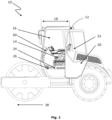
- Fig.1 shows a construction machine 10 with a driver's cab 12 and a control station 14 arranged in the driver's cab 12 in the form of an exchangeable assembly unit.
- the driver's cab 12 has an assembly opening 16 with a clear opening width 18 through which the control station 14 can be inserted, in particular pushed in, as a complete assembly unit for arrangement inside the driver's cab 12.
- a driver's cab door 20, in particular together with the frame structure 22 of the driver's cab door 20 to be arranged on the driver's cab 12 only after the control station 14 has been arranged inside the driver's cab 12 or to be temporarily dismantled for the purpose of arrangement.
- the driver's cab 12 has the mounting opening 16 on the rear and/or the top.
- Another advantage is the particularly simple removal and/or conversion of existing construction machines 10. For example, a defective construction machine 10 and/or a defective control station 14 can be repaired particularly easily by replacing the control station 14.
- the control station 14 has a base plate 24 which, when installed in the interior of the driver's cab 12, is flush with a driver's cab floor 26. This makes it particularly easy to avoid safety-critical unevenness (tripping hazards) in the driver's cab 12 and makes cleaning easier.
- Fig.2 shows the control station 14 from Fig.1 in a vertically sectioned view.
- a carriage 28 is spaced from the base plate 24 by an air gap, arranged above the base plate 24. In other words, the carriage 28 is not in load-bearing contact with the base plate 24.
- a guide 30 is arranged below the base plate 24 of the control station 14.
- the base plate 24 has a first through-hole 32 and a second through-hole 34.
- the through-holes 32, 34 extend according to Fig.2 mainly along an axis directed into the plane of the drawing and are designed in the form of slot openings. In other words, the first through-hole 32 and the second through-hole 34 connect the areas below and above the base plate 24.
- the carriage 28 is guided on the guide 30 via guide means 36.
- the guide means 36 extend through the base plate 24 in a vertical direction, starting from the carriage 28 arranged above the base plate 24, to the guide 30 arranged below the base plate 24.
- the guide means 36 is designed below the first through-hole 32 in the form of a bushing 36' with a cylindrical recess, in particular a through-hole, and encloses a rod guide 30' of the guide 30.
- Below the second through-hole 34 of the base plate 24, the guide means 36 is designed in the form of a tapered roller 36" .
- the guide 30 has a tapered roller guide 30" .
- the guide 30 extends in the form of a linear guide predominantly along an axis directed into the plane of the drawing, or parallel to the extension of the first and second through-holes 32, 34.
- the guide 30 guides the carriage 28 via the guide means 36 along an axis in the main extension direction of the guide 30, or transversely to an orientation of the control station 14, when the control station 14 is installed in the longitudinal direction 38 of the construction machine 10 (see Fig.1 ).
- the guide 30 is arranged on the base plate 24 via a housing 40.
- the slide 28 is guided via the guide 30 only along the guide 30, while the other translational and rotational movements of the slide 28 are prevented by the guide 30.
- the guide 30 has a load-bearing bearing function and, in conjunction with the air gap between the base plate 24 and the slide 28, enables the slide 28 to slide at a distance and without friction over the base plate 24 and the guide means 36 to slide within the first and second through-holes 32, 34.
- the guide means 36 is in the embodiment shown according to Fig.2 constructed in several parts and arranged non-detachably on the slide 28. In general, however, a detachable arrangement on the slide 28 is also possible. In addition, a one-piece design of the guide means 36, in particular in combination with a detachable and/or non-detachable arrangement on the slide 28, is also conceivable.
- the base plate 24 has a stripping device 42 in the form of a brush seal in the first and second through-holes 32, 34.
- the stripping device 42 effectively prevents the entry of dirt through the first and second through-holes 32, 34.
- the stripping device 42 shown in the form of the brush seal is to be understood as an example.
- further embodiments of the stripping device 42 are conceivable, as well as their arrangement in and/or on the through-holes 32, 34 both below and above the base plate 24.
- an arrangement of the stripping device 42 on the carriage 28 or the guide means 36 for example in the form of a brush seal and/or an elastomer sealing lip, is conceivable.
- the housing 40 is designed in the form of a trough that is open at the top and has angles to support the base plate 24 that covers the housing 40.
- the guide 30 and the part of the guide means 36 formed below the base plate 24 are located inside the housing 40. This can effectively prevent contamination of the interior of the housing 40 and the guide 30 and the guide means 36.
- the housing 40 also has an inner wall 44 .
- the carriage 28 has a seat console 46 arranged on the top.
- the seat console 46 is made up of several parts and has a non-rotatable console part 46' and a rotatable console part 46" arranged on the top of the non-rotatable console part 46'.
- the non-rotatable console part 46' is detachably arranged on the carriage 28 via screw connections 48.
- the non-rotatable console part 46' has a vertical cylindrical console recess 50 on a vertical axis through its geometric center for arranging the rotatable console part 46".
- the rotatable console part 46" has a vertical cylindrical projection 52 for arranging in the console recess 50.
- the rotatable console part 46" is rotated in the direction of gravity inserted into the non-rotatable console part 46'.
- Ball bearings 56 are arranged in the radial intermediate region 54 of the console parts 46', 46" and ensure a constant, equal spacing between the non-rotatable console part 46' and the rotatable console part 46" as well as a relative rotational movement that is as friction-free as possible between the non-rotatable console part 46' and the rotatable console part 46" about a common vertical axis of rotation R.
- the rotatable console part 46" forms a radial arm 58 for arranging a control means 60 (see Fig.1 ) in the form of a steering unit.
- a control means 60 see Fig.1
- the control means 60 to follow the rotational movement of the rotatable console part 46" in a particularly advantageous manner.
- a detachable or non-detachable arrangement of the radial arm 58 and/or the control means 60 on the rotatable console part 46" is also conceivable.
- the rotating console part 46" has a platform 62 on the top with a seat 64 detachably arranged thereon.
- the seat 64 is attached to the rotating console part 46" by means of screw connections.
- the seat 64 has a height adjustment 66 and an inclination adjustment 68 .
- the seat 64 and the control means 60 can be moved translationally in a transverse direction in a plane parallel to the base plate 24 and rotated about a vertical axis of rotation R relative to the base plate 24.
- a superimposed movement in the vertical direction or an inclination movement from the plane parallel to the base plate 24 can take place by the height and/or inclination adjustment 66, 68 of the seat 64.
- Fig.3 shows the base plate 24, the carriage 28, the guide 30, the guide means 36 and the housing 40 in a vertical cross section of the control station 14 from Fig.1 and Fig.2 .
- the control station 14 has a locking device 70 with an immovable locking component 70' in the form of a toothed segment extending parallel to the guide 30 and a movable locking component 70" in the form of a bolt.
- the movable locking component 70" engages the immovable locking component 70' and thus prevents a relative movement of the components to one another.
- Fig.4 shows a detailed view of the control station 14 from the Fig.1 and 2 .
- the immovable locking component 70' is arranged non-detachably on the housing 40.
- the movable locking component 70" is arranged on the slide 28 and the console part 46" via a lever mechanism 72.
- the lever mechanism 72 has a displaceable mechanical part 72 ' arranged on the underside of the slide 28 via a first pivot joint 74 and a rotatable mechanical part 72 " arranged on the rotatable console part 46" via a second pivot joint 76 .
- the rotatable mechanical part 72" moves synchronously with the rotatable console part 46" and the displaceable mechanical part 72' moves synchronously with the carriage 28.
- the rotatable mechanical part 72" is arranged on the displaceable mechanical part 72' via a loose vertical push-through connection 78.
- the push-through connection 78 is arranged in the center of rotation of the rotatable console part 46" and enables a translational vertical movement as well as a rotational movement between the displaceable and the rotatable mechanical part 72', 72".
- the lever mechanism 72 In an unloaded state of the lever mechanism 72 - without external influence from a user - the lever mechanism 72 is in a zero position and the locking device 70 is in a locked state. This can prevent an unintentional translational movement of the seat 64.
- the push-through connection 78 is in the zero position in a maximum insertion position. In other words, the displaceable mechanical part 72' can only be moved downwards in the vertical direction along the push-through connection 78 relative to the rotatable mechanical part 72".
- the lever mechanism 72 has an actuating member 80 arranged in the second pivot joint 76 in the form of a lever for transmitting torque to the lever mechanism 72.
- the actuating member 80 forms a lever arm in the longitudinal direction 38 of the construction machine 10. It should be noted, however, that the alignment of the lever is only relevant in relation to operation by the user, since the mechanical coupling of the rotatable mechanical part 72" with the displaceable mechanical part 72' takes place in the center of rotation of the rotatable console part 46" and the mechanical function is therefore independent of any rotation of the seat 64 relative to the base plate 24.
- Fig.4 shows the locking device 70 in an unlocked state.
- a rocker arm 82 of the rotatable mechanical part 72" is rotated, whereby the push-through connection 78 is moved downwards in a vertical direction.
- the downward movement of the push-through connection 78 causes a rocker arm 84 of the displaceable mechanical part 72' to be lowered at one end and, as a result of the rotatable arrangement of the rocker arm 84 on the first pivot joint 74, the movable locking component 70" arranged at the end of the rocker arm 84 to be raised at the other end.
- movable locking component 70" is deflected vertically upwards from its engagement with the immovable locking component 70'.
- the blockage of the movement in the direction of the guide 30 thus no longer exists and the seat 64 can be adjusted in its relative position to the base plate 24 together with the seat console 46 and the slide 28 along the direction determined by the guide 30.
- the seat console 46 has a rotation lock 88 with an immovable rotation locking component 88' in the form of a radially rotating gear ring, which is immovably arranged on the non-rotatable console part 46', and a movable rotation locking component 88" in the form of a latch, which is arranged on the rotatable console part 46" so as to be rotatable about a horizontal axis 90.
- the movable rotation locking component 88" In the locking state of the rotation lock 88, the movable rotation locking component 88" is in engagement with the immovable rotation locking component 88' and blocks the relative movement between the non-rotatable console part 46' and the rotatable console part 46".
- the seat 64 cannot be rotated about a vertical axis.
- the lever mechanism 72 In an unloaded state of the lever mechanism 72 - without external influence from a user - the lever mechanism 72 is in the zero position and the rotation lock 88 is in a locked state.
- the rotatable rotation lock component 88" is loosely arranged on the rotatable mechanical part 72" of the lever mechanism 72 in the zero position of the lever mechanism 72.
- Fig.5 shows the unlocked state of the rotary lock 88 of the control station 14 from the previous figures.
- the push-through connection 78 slides upwards out of the displaceable mechanical part 72' without forcing it into an upward movement.
- the movable locking component 70" remains in engagement with the immovable locking component 70' of the locking device 70 and the blockage of the translational movement along the guide 30 remains. In other words, the seat 64 cannot be moved.
- the lever mechanism 72 If the pulling action on the actuating member 80 is removed, the lever mechanism 72 returns to the zero position and the movable rotation locking component 88" rotates, supported by a reversing device 94 in the form of a return spring, about the horizontal axis 90 back into engagement with the immovable rotation locking component 88'. This reliably prevents uncontrolled rotation of the seat 64.
- the actuating member 80 releases the locking device 70 by a downward movement and enables the seat 64 to be adjusted along the guide 30 without unlocking the rotation lock 88. Furthermore, the rotation lock 88 can be released to rotate the seat by an upward movement of the actuating member 80 without releasing the locking device 70.
- the actuating member 80 in the form of a lever is therefore bifunctional. When the lever mechanism 72 and the actuating member 80 are in a zero position, both the locking device 70 and the rotation lock 88 are in the locked state.
- Fig.6 shows another parallel to the sections from the Fig. 2-5 running vertical section through the control station 14 and serves to explain a cable route 96.
- the cable route 96 represents one or more cables and lines arranged on the control station 14 for data transmission and energy supply between the control station 14 and the construction machine 10.
- the cable route 96 is supported inside the housing 40 by a flexible cable guide 98 in the form of a drag chain arranged on the guide means 36 and can provide and/or accommodate additional cable when the seat 64 is adjusted.
- the guide means 36 has a vertical guide means recess 100.
- the guide means recess 100 extends from a region of the guide means 36 formed below the base plate 24 to a region of the guide means 36 formed above the base plate 24.
- the guide means 36 has a guide means recess 100 through which the cable route 96 extends within the guide means 36 from the underside of the base plate 24 to the top of the base plate 24. This makes it possible to avoid a further through-recess in the base plate 24.
- the cable route 96 takes place along the movable components of the control station 14.
- the cable path 96 extends via a through-hole in the slide 28 and the cylindrical console recess 50 to the upper platform 62 of the rotatable console part 46" and further to the seat 64 and to the control means 60.
- the invention relates to an operating station 14 designed as an exchangeable assembly unit with a slide 28 for the translational adjustment and a rotatable seat console 46 for the rotational adjustment of a seat 64, as well as a driver's cab 12 with such an operating station 14.
Landscapes
- Engineering & Computer Science (AREA)
- Aviation & Aerospace Engineering (AREA)
- Transportation (AREA)
- Mechanical Engineering (AREA)
- Component Parts Of Construction Machinery (AREA)
- Seats For Vehicles (AREA)
Description
- Die Erfindung betrifft einen Bedienstand, insbesondere für eine mobile Baumaschine, mit einer Bodenplatte, einem Steuermittel und einem Sitz, wobei der Sitz zur Verbesserung der Sichtverhältnisse und des Ein- und Ausstiegs verstellbar ausgebildet ist.
- Bedienstände sind aus dem Stand der Technik bereits bekannt geworden und weisen ein an einer Maschine mitgeführtes Steuermittel zum Steuern der Maschine auf. Herkömmliche Bedienstände weisen darüber hinaus eine Sitzmöglichkeit für einen Bediener der Maschine auf. Insbesondere bei unübersichtlichen Maschinen ist dabei die Sitzmöglichkeit in Abhängigkeit der Sichtverhältnisse verstellbar, um ein möglichst weites Umfeld der Maschine überwachen zu können.
- Aus der Patentschrift
DD147381 A1 - Der Bedienstand muss dabei jedoch als gesamte Einheit über die Drehvorrichtung gelagert werden, was hohe Voraussetzungen an die Festigkeit des Lagerkonzepts stellt. Zudem lässt sich zwar der Bedienstand in einem weiten Winkelbereich um die Rotationsachse drehen, jedoch ist das Steuermittel derart zur Sitzmöglichkeit des Bedieners ausgerichtet, dass die Blickrichtung des Bedieners stets zur Rotationsachse gerichtet ist. Eine Längs- oder Querverstellung ist dagegen nicht möglich. Weiterhin wird die Übersichtlichkeit wesentlich durch das Gewicht des Bedienstands bestimmt, was den Einsatz einer Überdachung oder eines Führerhauses verhindert.
- Die Offenbarung
DE19813474 A1 zeigt ein anderes Beispiel aus dem Stand der Technik, welches eine Bodenverdichtungsmaschine mit mindestens einer Walzeneinheit, einem Antriebsmotor und einem Fahrstand betrifft, wobei der Fahrstand einen Sitz und ein Bedienpult aufweist, wobei der Fahrstand an einem Rahmen der Bodenverdichtungsmaschine befestigte Führungen und eine auf den Führungen verschiebliche Fahrstandslafette derart aufweist, dass die Fahrstandslafette quer zur Längsachse der Bodenverdichtungsmaschine verschieblich ist. - Es ist Aufgabe der Erfindung einen Bedienstand bereitzustellen, der eine translatorische und eine rotatorische Verstellung der Sitzmöglichkeit bei mitgeführtem Steuermittel zulässt und dabei auf einfache Weise in einem Führerhaus eingesetzt werden kann.
- Diese Aufgabe wird erfindungsgemäß gelöst durch einen Bedienstand gemäß Patentanspruch 1.
- Der Bedienstand ist als austauschbare Montageeinheit ausgebildet. Hierdurch kann die Fertigung besonders günstig unabhängig von der zu bedienenden Maschine erfolgen. Der Bedienstand umfasst alle funktionsrelevanten Komponenten und muss daher lediglich an der zu bedienenden Maschine über eine mechanische und elektrische Verbindung angeordnet werden.
- Der Bedienstand weist dabei zumindest eine Bodenplatte, einen Schlitten, eine Sitzkonsole, eine Führung sowie Führungsmittel auf. Darüber hinaus sind weitere Komponenten vorstellbar. Die Aufzählung ist nicht abschließend zu verstehen.
- Die Bodenplatte weist eine erste und eine zweite Durchgangsausnehmung auf, die den Bereich unterhalb der Bodenplatte mit dem Bereich oberhalb der Bodenplatte verbindet. Die Bodenplatte weist eine Haupterstreckungsrichtung auf, entlang derer eine erste und eine zweite Durchgangsausnehmung in der Bodenplatte ausgebildet sind. Die Haupterstreckungsrichtung der Bodenplatte richtet sich dabei nach dem an der zu bedienenden Maschine zur Verfügung stehenden Einbauraum. Beispielsweise kann hierbei die Breite eines zur Verfügung stehenden Führerhauses maßgeblich für die Länge der Bodenplatte in Haupterstreckungsrichtung sein.
- Die erste und die zweite Durchgangsausnehmung dienen der Aufnahme von Führungsmitteln, die den an dem Führungsmittel angeordneten sich oberhalb der Bodenplatte befindenden Schlitten entlang einer unterhalb der Bodenplatte angeordneten Führung führen. Die Führung erfolgt dabei insbesondere linear. Die Führungsmittel durchgreifen dabei die erste und die zweite Durchgangsausnehmung, wobei die Endlagen der ersten und zweiten Durchgangsausnehmung in Haupterstreckungsrichtung einen maximalen Verfahrweg der Führungsmittel innerhalb der ersten und zweiten Durchgangsausnehmung bestimmen.
- Für die translatorische Verschiebbarkeit des Schlittens sind mithin nur zwei Durchgangsausnehmungen in der Bodenplatte erforderlich, beziehungsweise angeordnet. Dadurch kann bei kippstabiler Führung des Schlittens Schmutzeintrag in die Führung vermindert und die Herstellung kosteneffizienter realisiert werden.
- Die erste und die zweite Durchgangsausnehmung ist dabei besonders vorteilhaft in Form einer linearen Schlitzöffnung ausgebildet. Darüber hinaus sind jedoch auch andere Ausbildungen der ersten und zweiten Durchgangsausnehmung denkbar.
- Besonders bevorzugt ist die Bodenplatte in Rechteckform ausgebildet, was sich besonders günstig auf eine maximale Erstreckung der ersten und zweiten Durchgangsausnehmung und damit die maximale Querverstellung auswirkt. Generell kann jedoch auch eine andere Form der Bodenplatte ausgebildet werden. Dies kann insbesondere bei nicht linear ausgebildeter Führung vorteilhaft sein.
- Der Schlitten ist oberhalb der Bodenplatte angeordnet und entlang einer unterhalb der Bodenplatte angeordneten Führung geführt. Dabei erfolgt der Lastabtrag des Schlittens über die Führungsmittel und die Führung. Zwischen Schlitten und Bodenplatte ist ein Luftspalt ausgebildet, der ein reibungsfreies Gleiten des Schlittens über die Bodenplatte ermöglicht.
- Der Schlitten dient zudem der Übertragung der translatorischen Bewegung durch die Führung auf die am Schlitten angeordneten Komponenten des Bedienstands.
- Oberhalb des Schlittens kann eine Sitzkonsole lösbar, insbesondere über Schraubverbindungen, angeordnet. Die Sitzkonsole ist mehrteilig ausgebildet und weist einen an dem Schlitten angeordneten undrehbaren Konsolenteil und einen relativ zum Schlitten und dem undrehbaren Konsolenteil drehbar angeordneten Konsolenteil auf. Hierdurch kann die Sitzkonsole über den Schlitten translatorisch bewegt und über den drehbaren Konsolenteil relativ zum Schlitten verdreht werden.
- In einer bevorzugten Ausführungsform der Erfindung ist in der ersten und/oder zweiten Durchgangsausnehmung der Bodenplatte eine Abstreifvorrichtung und/oder Dichtvorrichtung, insbesondere eine Bürstendichtung, angeordnet. Die Abstreifvorrichtung kann in und/oder an der ersten und/oder der zweiten Durchgangsausnehmung an der Oberseite und/oder der Unterseite der Bodenplatte angeordnet sein. Hierdurch kann eine Verbindung des Bereichs unterhalb der Bodenplatte und des Bereichs oberhalb der Bodenplatte ohne die Gefahr des Schmutzeintrags in die Führung erfolgen.
- Darüber hinaus sind andere Arten von Abstreifvorrichtung denkbar. Beispielhaft, jedoch nicht abschließend, sind an dieser Stelle Elastomer-Abstreifvorrichtungen genannt.
- Zudem können der Schlitten und/oder die Führungsmittel eine Abstreifvorrichtung aufweisen, die entlang der geführten Bewegung Verschmutzungen von der Bodenplatte entfernen. Hierdurch kann einem Schmutzeintrag durch die erste und oder zweite Durchgangsausnehmung vorbeugend entgegengetreten werden.
- Die Hebelmechanik dient der Verstellung eines Sitzes und ist dazu ausgebildet, die translatorischen und/oder rotatorischen Bewegungsfreiheitsgrade des Schlittens und der Sitzkonsole freizugeben und/oder zu blockieren. Hierzu kann der Bedienstand zumindest eine Verriegelungsvorrichtung, insbesondere mehrere, besonders bevorzugt eine translatorische Verriegelungsvorrichtung und eine Rotationsverriegelung, aufweisen. Hinsichtlich der Sicherheit ist eine Blockade der Bewegungsfreiheitsgrade durch die zumindest eine Verriegelungsvorrichtung in einer unbetätigten Lage (Nulllage) des Betätigungsglieds besonders günstig.
- Weiterhin bevorzugt ist eine Ausführungsform der Erfindung, bei der die Sitzkonsole eine Hebelmechanik mit einem bifunktionalen Betätigungsglied, insbesondere einem Hebel, umfasst. Ein bifunktionales Betätigungsglied ermöglicht dabei besonders vorteilhaft das Ausführen zweier Funktionen, insbesondere der Steuerung zweier Vorrichtungen zu Verriegelungszwecken von Bewegungsfreiheiten des Bedienstands.
- In einer bevorzugten Weiterbildung der Erfindung ist vorgesehen, dass sich das Betätigungsglied über zumindest zwei, insbesondere drei, Seiten der Sitzkonsole erstreckt. Dies ermöglicht das besonders einfache Betätigen des Betätigungsglieds mit der rechten und/oder der linken Hand beziehungsweise mit dem rechten und/oder dem linken Fuß.
- Weiterhin bevorzugt ist eine Weiterbildung der Erfindung, bei der das Betätigungsglied in Form eines gebogenen Rohrs und/oder in Form eines Blech-Biegeteils ausgebildet ist.
- Besonders bevorzugt kann das Betätigungsglied zumindest zwei parallele Teilabschnitte, insbesondere in Form eines Bügels, zur besseren Bedienbarkeit ausbilden. Hierdurch kann ein breiterer Griff des Betätigungsglieds ohne unnötigen zusätzlichen Materialeintrag ausgebildet werden und erleichtert zudem die Betätigung des Betätigungsglieds mit dem Fuß.
- Bei einer bevorzugten Weiterbildung der Erfindung ist die Hebelmechanik zur Verriegelung und Entriegelung des Schlittens und/oder der Sitzkonsole ausgebildet.
- Besonders bevorzugt ist eine Weiterbildung der Erfindung, bei der die Hebelmechanik unterhalb der Bodenplatte eine Verriegelungsvorrichtung, insbesondere ein Zahnsegment, besonders bevorzugt eine Zahnstange, aufweist. Hierdurch kann der zur Verfügung stehende Bauraum besonders effektiv genutzt und die Verriegelungsvorrichtung effektiv vor Verschmutzung geschützt werden.
- Bevorzugt ist eine Weiterbildung der Erfindung, bei der die Hebelmechanik dazu ausgebildet ist, den Schlitten durch Bewegung des bifunktionalen Betätigungsglieds in Richtung der Bodenplatte zu entriegeln. Mit anderen Worten ist das bifunktionale Betätigungsglied in Kombination mit der Hebelmechanik dazu ausgebildet, in einer ersten Betätigungsrichtung, insbesondere einer Abwärtsbewegung, des Betätigungsglieds einen, insbesondere den translatorischen, Bewegungsfreiheitsgrad des Bedienstands freizugeben.
- Gemäß einer bevorzugten Weiterbildung der Erfindung ist vorgesehen, dass die Hebelmechanik dazu ausgebildet ist, die Sitzkonsole durch Bewegung des bifunktionalen Betätigungsgliedes in einer von der Bodenplatte wegweisenden Richtung zu entriegeln. Mit anderen Worten ist das bifunktionale Betätigungsglied in Kombination mit der Hebelmechanik dazu ausgebildet, in einer zweiten Betätigungsrichtung, insbesondere einer Aufwärtsbewegung, des Betätigungsglieds eine, insbesondere rotatorische, Bewegungsfreiheit des Bedienstands, insbesondere der Sitzkonsole, freizugeben.
- Weiterhin bevorzugt ist eine Weiterbildung der Erfindung, bei der die Hebelmechanik dazu ausgebildet ist, bei Entriegelung des Schlittens die Sitzkonsole zu verriegeln und/oder bei Entriegelung der Sitzkonsole den Schlitten zu verriegeln. Mit anderen Worten kann bei Freigabe des translatorischen Bewegungsfreiheitsgrades der rotatorische Bewegungsfreiheitsgrad und bei Freigabe des rotatorischen Freiheitsgrades der translatorische Bewegungsfreiheitsgrad des Bedienstands weiterhin blockiert werden. Hierdurch kann ein unbeabsichtigtes Verstellen besonders einfach verhindert werden.
- In einer bevorzugten Ausführungsform der Erfindung ist vorgesehen, dass die Führung mehrteilig ausgebildet ist. Die Führung kann dabei insbesondere örtlich beabstandete in ihrer Führungsrichtung parallel verlaufende Teilführungen aufweisen. Die Teilführungen können dabei unterschiedlich ausgebildet sein.
- Eine bevorzugte Weiterbildung der Erfindung sieht vor, dass die Führung eine Stangenführung und/oder eine Rollenführung, insbesondere eine Kegelrollenführung, aufweist. Hierdurch können die Vorteile verschiedener Führungsarten besonders effektiv kombiniert werden.
- Besonders bevorzugt ist eine Weiterbildung der Erfindung, bei der die Rollenführung eine an der Rollenführung angeordnete, der Rollenführung vorlaufende und/oder nachlaufende Abstreifvorrichtung, insbesondere Abstreifbürsten und/oder eine Elastomer-Dichtung, aufweist. Auf diese Weise kann eine Reinigung der Führung besonders vorteilhaft während des Betriebs durchgeführt werden.
- Weiterhin bevorzugt ist eine Ausführungsform der Erfindung, bei der der Schlitten und/oder die Sitzkonsole eine Kabeldurchführung aufweist und elektrische Steuerleitungen des Bedienstands durch die erste und/oder zweite Durchgangsausnehmung, insbesondere an und/oder in einem Führungsmittel, geführt sind. Hierdurch kann eine weitere Durchgangsausnehmung in der Bodenplatte kostengünstig vermieden werden.
- In einer bevorzugten Ausführungsform der Erfindung, ist die erste und/oder die zweite Durchgangsausnehmung zur Durchführung einer Leitung ausgebildet. Hierbei kann die erste und/oder die zweite Durchgangsausnehmung Aussparungen und/oder Ausnehmungen, insbesondere an der ersten und/oder zweiten Durchgangsausnehmung, aufweisen, um eine Kabeldurchführung parallel zum Führungsmittel durch die erste und/oder zweite Durchgangsausnehmung zu führen.
- Weiterhin bevorzugt ist eine Ausführungsform der Erfindung, bei der an dem Führungsmittel ein Kabelkanal, insbesondere eine Schleppkette, angeordnet ist. Hierdurch kann bei Verfahren des Schlittens zusätzliches Kabel bereitgestellt und/oder aufgenommen werden und eine Kollision mit beweglichen Komponenten des Bedienstands verhindert werden.
- Besonders bevorzugt ist eine Ausführungsform der Erfindung, bei der das Führungsmittel zur Durchführung einer Leitung, insbesondere eines Kabels, ausgebildet ist. Hierzu kann das Führungsmittel eine vertikale Durchgangsausnehmung von der Unterseite zur Oberseite der Bodenplatte aufweisen. Besonders bevorzugt kann das Führungsmittel innerhalb einer ersten und/oder zweiten Durchgangsausnehmung zweiteilig, insbesondere in Haupterstreckungsrichtung der ersten und/oder zweiten Durchgangsausnehmung, ausgebildet sein, wobei die Leitung zwischen den Teilen des Führungsmittels durch die erste und/oder zweite Durchgangsausnehmung geführt ist.
- In einer bevorzugten Ausführungsform der Erfindung ist vorgesehen, dass das Führungsmittel eine Armierung im überwiegenden Bereich der Kabeldurchführung aufweist. Dies ermöglicht eine besonders geschützte Durchführung der Leitung, insbesondere des Kabels, während des Verfahrens des Schlittens.
- Weiterhin bevorzugt ist eine Ausführungsform der Erfindung, bei der die Sitzkonsole relativ zum Schlitten höhenverstellbar und/oder neigbar ausgebildet ist. Hierzu kann die Sitzkonsole eine Höhenverstellung und/oder eine Neigungsverstellung aufweisen. Die Höhenverstellung und/oder Neigungsverstellung kann insbesondere eine Verriegelungsvorrichtung aufweisen mit der die Höhenverstellung und/oder Neigungsverstellung in einer bestimmten Lage dauerhaft gehalten wird.
- Die erfindungsgemäße Aufgabe wird weiterhin gelöst durch ein Führerhaus gemäß Patentanspruch 20.
- Das erfindungsgemäße Führerhaus für eine mobile Baumaschine mit einer seitlichen und/oder oberseitigen Öffnung ist dazu ausgebildet, eine Montageeinheit, insbesondere nach einem der vorhergehenden Ansprüche, durch Einschieben und/oder Einsetzen in dem Führerhaus anzuordnen.
- Weitere Merkmale und Vorteile der Erfindung ergeben sich aus der Beschreibung und der Zeichnung. Die vorstehend genannten und die noch weiter ausgeführten Merkmale können erfindungsgemäß jeweils einzeln für sich oder zu mehreren in beliebigen, zweckmäßigen Kombinationen Verwendung finden. Die gezeigten und beschriebenen Ausführungsformen sind nicht als abschließende Aufzählung zu verstehen, sondern haben vielmehr beispielhaften Charakter für die Schilderung der Erfindung.
- Die Erfindung ist in der Zeichnung dargestellt und wird anhand von Ausführungsbeispielen näher erläutert. Es zeigen:
- Fig. 1
- zeigt eine Baumaschine mit einer an der Baumaschine angeordneten Ausführungsform eines erfindungsgemäßen Bedienstands in einer Seitenansicht;
- Fig. 2
- zeigt den Bedienstand aus
Fig. 1 in einer geschnittenen Seitenansicht; - Fig. 3
- zeigt einen Teil des Bedienstands aus
Fig. 1 in einer geschnittenen Seitenansicht mit Schlitten und Führung; - Fig. 4
- zeigt in einem geschnittenen Teilbereich eine Hebelmechanik des Bedienstands aus
Fig. 1 in einer ersten funktionalen Stellung; - Fig. 5
- zeigt in dem geschnittenen Teilbereich aus
Fig. 5 die Hebelmechanik des Bedienstands ausFig. 1 in einer zweiten funktionalen Stellung; - Fig. 6
- zeigt einen weiteren Horizontalschnitt durch den Bedienstand aus
Fig. 1 mit Blick auf eine Kabelführung. -
Fig. 1 zeigt eine Baumaschine 10 mit einem Führerhaus 12 und einen in dem Führerhaus 12 angeordneten Bedienstand 14 in Form einer austauschbaren Montageeinheit. Das Führerhaus 12 weist dabei eine Montageöffnung 16 mit einer lichten Öffnungsweite 18 auf, durch die der Bedienstand 14 als komplette Montageeinheit zur Anordnung im Inneren des Führerhauses 12 eingesetzt, insbesondere eingeschoben, werden kann. Hierzu kann erforderlich sein, dass eine Führerhaustüre 20, insbesondere mitsamt der Rahmenstruktur 22 der Führerhaustüre 20, erst nach Anordnung des Bedienstands 14 im Inneren des Führerhauses 12 an dem Führerhaus 12 angeordnet oder zum Zweck der Anordnung vorübergehend demontiert wird. - Alternativ oder zusätzlich kann vorgesehen sein, dass das Führerhaus 12 die Montageöffnung 16 an der Rückseite und/oder der Oberseite aufweist.
- Dies ermöglicht eine besonders vorteilhafte getrennte Fertigung der Baumaschine 10 und des Bedienstands 14. Weiterhin vorteilhaft ist das besonders einfache Aus- und/oder Umrüsten bereits vorhandener Baumaschinen 10. Beispielsweise kann eine defekte Baumaschine 10 und/oder ein defekter Bedienstand 14 besonders einfach durch Auswechseln des Bedienstands 14 instand gesetzt werden.
- Der Bedienstand 14 weist eine Bodenplatte 24 auf, die in Einbaulage im Innenraum des Führerhauses 12 bündig mit einem Führerhausboden 26 ausgeführt ist. Hierdurch können sicherheitskritische Unebenheiten (Stolperfallen) im Führerhaus 12 besonders gut vermieden werden und die Reinigung ist vereinfacht.
-
Fig. 2 zeigt den Bedienstand 14 ausFig. 1 in einer vertikal geschnittenen Ansicht. Ein Schlitten 28 ist durch einen Luftspalt von der Bodenplatte 24 beabstandet, oberhalb der Bodenplatte 24 angeordnet. Mit anderen Worten steht der Schlitten 28 nicht in lastabtragendem Kontakt mit der Bodenplatte 24. Eine Führung 30 ist unterhalb der Bodenplatte 24 des Bedienstands 14 angeordnet. Die Bodenplatte 24 weist eine erste Durchgangsausnehmung 32 und eine zweite Durchgangsausnehmung 34 auf. Die Durchgangsausnehmungen 32, 34 erstrecken sich gemäßFig. 2 hauptsächlich entlang einer in die Zeichenebene gerichteten Achse und sind in Form von Schlitzöffnungen ausgebildet. Mit anderen Worten verbinden die erste Durchgangsausnehmung 32 und die zweite Durchgangsausnehmung 34 die Bereiche unterhalb und oberhalb der Bodenplatte 24. - Der Schlitten 28 ist über Führungsmittel 36 an der Führung 30 geführt. Die Führungsmittel 36 durchgreifen dabei, ausgehend von dem oberhalb der Bodenplatte 24 angeordneten Schlitten 28, die Bodenplatte 24 in einer vertikalen Richtung bis zur der unterhalb der Bodenplatte 24 angeordneten Führung 30. Das Führungsmittel 36 ist dabei unterhalb der ersten Durchgangsausnehmung 32 in Form einer Buchse 36' mit einer zylindrischen Ausnehmung, insbesondere eine Durchgangsausnehmung, ausgebildet und umschließt eine Stangenführung 30' der Führung 30. Unterhalb der zweiten Durchgangsausnehmung 34 der Bodenplatte 24 ist das Führungsmittel 36 in Form einer Kegelrolle 36" ausgebildet. Komplementär zu dem Führungsmittel 36 in Form der Kegelrolle 36" weist die Führung 30 eine Kegelrollenführung 30" auf. Die Führung 30 erstreckt sich dabei in Form einer Linearführung überwiegend entlang einer in die Zeichenebene gerichteten Achse, beziehungsweise parallel zur Erstreckung der ersten und zweiten Durchgangsausnehmung 32, 34. Mit anderen Worten führt die Führung 30 den Schlitten 28 über die Führungsmittel 36 entlang einer Achse in Haupterstreckungsrichtung der Führung 30, beziehungsweise quer zu einer Ausrichtung des Bedienstands 14, bei Einbaulage des Bedienstands 14 in Längsrichtung 38 der Baumaschine 10 (siehe
Fig. 1 ). - Die Angabe der Einbaulage bezieht sich dabei beispielhaft auf die gezeigte Ausführungsform gemäß
Fig. 1 und kann einsatzbedingt unterschiedlich sein. - Die Führung 30 ist über ein Gehäuse 40 an der Bodenplatte 24 angeordnet. Mit anderen Worten ist der Schlitten 28 über die Führung 30 lediglich entlang der Führung 30 geführt, während die übrigen translatorischen und rotatorischen Bewegungen des Schlittens 28 durch die Führung 30 verhindert werden. Der Führung 30 kommt in der gezeigten Ausführungsform eine lastabtragende Lagerfunktion zu und ermöglicht im Verbund mit dem Luftspalt zwischen Bodenplatte 24 und Schlitten 28 ein beabstandetes, reibungsfreies Gleiten des Schlittens 28 über die Bodenplatte 24 sowie ein Gleiten des Führungsmittels 36 innerhalb der ersten und zweiten Durchgangsausnehmung 32, 34.
- Das Führungsmittel 36 ist in der gezeigten Ausführungsform gemäß
Fig. 2 mehrteilig ausgebildet und unlösbar an dem Schlitten 28 angeordnet. Generell ist jedoch ebenso eine lösbare Anordnung am Schlitten 28 möglich. Darüber hinaus ist ebenso eine einstückige Ausbildung des Führungsmittels 36, insbesondere in Kombination mit einer lösbaren und/oder unlösbaren Anordnung am Schlitten 28, denkbar. - Die Bodenplatte 24 weist in der ersten und der zweiten Durchgangsausnehmung 32, 34 eine Abstreifvorrichtung 42 in Form einer Bürstendichtung auf. Die Abstreifvorrichtung 42 verhindert dabei effektiv den Eintrag von Verschmutzungen durch die erste und die zweite Durchgangsausnehmung 32, 34. Die dargestellte Abstreifvorrichtung 42 in Form der Bürstendichtung ist dabei beispielhaft zu verstehen. Denkbar sind darüber hinaus weitere Ausführungsformen der Abstreifvorrichtung 42 sowie deren Anordnung in und/oder an den Durchgangsausnehmungen 32, 34 sowohl unterhalb als auch oberhalb der Bodenplatte 24. Weiterhin ist eine Anordnung der Abstreifvorrichtung 42 am Schlitten 28 oder dem Führungsmittel 36, beispielsweise in Form einer Bürstendichtung und/oder einer Elastomer-Dichtlippe vorstellbar.
- Das Gehäuse 40 ist in Form einer nach oben geöffneten Wanne ausgebildet und weist Winkel zur Stützung der das Gehäuse 40 deckelnden Bodenplatte 24 auf. Die Führung 30 sowie der unterhalb der Bodenplatte 24 ausgebildete Teil des Führungsmittels 36 befindet sich innerhalb des Gehäuses 40. Hierdurch kann eine Verschmutzung des Innenbereichs des Gehäuses 40 sowie der Führung 30 und des Führungsmittels 36 effektiv verhindert werden. Zur verbesserten Stabilität und Lagerung der Bodenplatte 24, weist das Gehäuse 40 zudem eine Innenwandung 44 auf.
- Der Schlitten 28 weist eine oberseitig angeordnete Sitzkonsole 46 auf. Die Sitzkonsole 46 ist mehrteilig und weist einen undrehbaren Konsolenteil 46' und einen an der Oberseite des undrehbaren Konsolenteils 46' angeordneten drehbaren Konsolenteil 46" auf. Der undrehbare Konsolenteil 46' ist über Schraubverbindungen 48 lösbar an dem Schlitten 28 angeordnet. Der undrehbare Konsolenteil 46' weist auf einer vertikalen Achse durch seinen geometrischen Mittelpunkt eine vertikale zylindrische Konsolenausnehmung 50, zur Anordnung des drehbaren Konsolenteils 46" auf. Komplementär zur Konsolenausnehmung 50, weist der drehbare Konsolenteil 46" einen vertikalen zylindrischen Vorsprung 52 zur Anordnung in der Konsolenausnehmung 50 auf. Mit anderen Worten wird der drehbare Konsolenteil 46" in Schwerkraftrichtung in den undrehbaren Konsolenteil 46' gesteckt. Im radialen Zwischenbereich 54 der Konsolenteile 46', 46" sind Kugellager 56 angeordnet und stellen eine konstante Gleichbeabstandung zwischen dem undrehbaren Konsolenteil 46' und dem drehbaren Konsolenteil 46" sowie eine möglichst reibungsfreie relative Drehbewegung zwischen dem undrehbaren Konsolenteil 46' und dem drehbaren Konsolenteil 46" um eine gemeinsame vertikale Rotationsachse R sicher.
- Gemäß der Ausführungsform in
Fig. 2 , bildet der drehbare Konsolenteil 46" einen radialen Ausleger 58, zur Anordnung eines Steuermittels 60 (sieheFig. 1 ) in Form einer Lenkungseinheit aus. Hierdurch kann das Steuermittel 60 besonders vorteilhaft der Drehbewegung des drehbaren Konsolenteils 46" folgen. Generell ist ebenso eine lösbare oder unlösbare Anordnung des radialen Auslegers 58 und/oder des Steuermittels 60 an dem drehbaren Konsolenteil 46" vorstellbar. - Weiterhin weist der drehbare Konsolenteil 46" eine oberseitige Plattform 62 mit einem daran lösbar angeordneten Sitz 64 auf. Der Sitz 64 ist dabei mittels Schraubverbindungen an dem drehbaren Konsolenteil 46" befestigt. Der Sitz 64 weist eine Höhenverstellung 66 und eine Neigungsverstellung 68 auf.
- In kombinierter Wirkung der Führung 30 und dem daran über Führungsmittel 36 angeordneten Schlitten 28, dem undrehbaren Konsolenteil 46' sowie dem drehbaren Konsolenteil 46" lässt sich der Sitz 64 und das Steuermittel 60 in einer zur Bodenplatte 24 parallelen Ebene in einer Querrichtung translatorisch bewegen und um eine vertikale Rotationsachse R relativ zur Bodenplatte 24 drehen. Alternativ oder zusätzlich kann eine überlagerte Bewegung in vertikaler Richtung oder eine Neigungsbewegung aus der zur Bodenplatte 24 parallelen Ebene durch die Höhen- und/oder Neigungsverstellung 66, 68 des Sitzes 64 erfolgen.
-
Fig. 3 zeigt die Bodenplatte 24, den Schlitten 28, die Führung 30, das Führungsmittel 36 und das Gehäuse 40 in einem vertikalen Querschnitt des Bedienstands 14 ausFig. 1 undFig. 2 . - Unterhalb der Bodenplatte 24 weist der Bedienstand 14 eine Verriegelungsvorrichtung 70 mit einer unbeweglichen Verriegelungskomponente 70' in Form eines sich parallel zur Führung 30 erstreckenden Zahnsegments und einer beweglichen Verriegelungskomponente 70" in Form eines Riegels auf. In einem Verriegelungszustand greift die bewegliche Verriegelungskomponente 70" in die unbewegliche Verriegelungskomponente 70' und verhindert damit eine Relativbewegung der Komponenten zueinander.
-
Fig. 4 zeigt eine Detailansicht des Bedienstands 14 aus denFig. 1 und2 . Die unbewegliche Verriegelungskomponente 70' ist unlösbar an dem Gehäuse 40 angeordnet. Die bewegliche Verriegelungskomponente 70" ist über eine Hebelmechanik 72 an dem Schlitten 28 und dem Konsolenteil 46" angeordnet. Die Hebelmechanik 72 weist einen über ein erstes Drehgelenk 74 an der Unterseite des Schlittens 28 angeordneten verschiebbaren Mechanikteil 72' und einen über ein zweites Drehgelenk 76 an dem drehbaren Konsolenteil 46" angeordneten drehbaren Mechanikteil 72" auf. Der drehbare Mechanikteil 72" bewegt sich dabei synchron zu dem drehbaren Konsolenteil 46" und der verschiebbare Mechanikteil 72' bewegt sich synchron zu dem Schlitten 28. Der drehbare Mechanikteil 72" ist über eine lose vertikale Durchsteckverbindung 78 an dem verschiebbaren Mechanikteil 72' angeordnet. Die Durchsteckverbindung 78 ist im Rotationszentrum des drehbaren Konsolenteils 46" angeordnet und ermöglicht eine translatorische Vertikalbewegung sowie eine Rotationsbewegung zwischen dem verschiebbaren und dem drehbaren Mechanikteil 72', 72". - Im Verriegelungszustand (siehe
Fig. 3 ) wird die unmittelbare translatorische Bewegung des drehbaren Konsolenteils 46" durch die Verriegelungsvorrichtung 70 blockiert und in Folge dessen die translatorische Bewegung des angeordneten undrehbaren Konsolenteils 46', des Schlittens 28 sowie des Führungsmittels 36 entlang der Führung 30 unterbunden. Mit anderen Worten verhindert die Verriegelungsvorrichtung 70 im verriegelten Zustand (sieheFig. 3 ) die translatorische Relativbewegung zwischen Sitz 64 und Bodenplatte 24. - In einem unbelasteten Zustand der Hebelmechanik 72 - ohne äußere Einwirkung durch einen Benutzer - befindet sich die Hebelmechanik 72 in einer Nulllage und die Verriegelungsvorrichtung 70 in einem verriegelten Zustand. Hierdurch kann eine unbeabsichtigte translatorische Bewegung des Sitzes 64 verhindert werden. Die Durchsteckverbindung 78 befindet sich in der Nulllage in einer maximalen Einsteckposition. Mit anderen Worten lässt sich der verschiebbare Mechanikteil 72' relativ zum drehbaren Mechanikteil 72" in vertikaler Richtung entlang der Durchsteckverbindung 78 nur nach unten bewegen.
- Die Hebelmechanik 72 weist ein im zweiten Drehgelenk 76 angeordnetes Betätigungsglied 80 in Form eines Hebels zur Drehmomentübertragung auf die Hebelmechanik 72 auf. Das Betätigungsglied 80 bildet bei Ausrichtung des Sitzes 64 in Längsrichtung 38 der Baumaschine 10 einen Hebelarm in Längsrichtung 38 der Baumaschine 10 aus. Hierbei sei jedoch bemerkt, dass die Ausrichtung des Hebels lediglich in Bezug auf die Bedienung durch den Benutzer relevant ist, da die mechanische Kopplung des drehbaren Mechanikteils 72" mit dem verschiebbaren Mechanikteil 72' im Rotationszentrum des drehbaren Konsolenteils 46" erfolgt und die mechanische Funktion somit unabhängig von einer Verdrehung des Sitzes 64 relativ zur Bodenplatte 24 ist.
-
Fig. 4 zeigt die Verriegelungsvorrichtung 70 in einem unverriegelten Zustand. Durch eine Drehmomentbeaufschlagung auf das zweite Drehgelenk 76 in Folge einer Abwärtsbewegung (in Richtung der Bodenplatte 24) des Betätigungsglieds 80 erfolgt eine Verdrehung eines Kipphebels 82 des drehbaren Mechanikteils 72", wodurch die Durchsteckverbindung 78 in vertikaler Richtung nach unten bewegt wird. Die Abwärtsbewegung der Durchsteckverbindung 78 bewirkt einenends das Absenken eines Kipphebels 84 des verschiebbaren Mechanikteils 72' und in Folge der drehbaren Anordnung des Kipphebels 84 an dem ersten Drehgelenk 74, anderenends das Anheben der an dem Ende des Kipphebels 84 angeordneten beweglichen Verriegelungskomponente 70". Hierdurch wird die bewegliche Verriegelungskomponente 70" aus ihrem Eingriff an der unbeweglichen Verriegelungskomponente 70' vertikal nach oben ausgelenkt. Die Blockade der Bewegung in Richtung der Führung 30 besteht somit nicht mehr und der Sitz 64 lässt sich in seiner Relativposition zur Bodenplatte 24 mitsamt der Sitzkonsole 46 und dem Schlitten 28 entlang der durch die Führung 30 bestimmten Richtung verstellen. Ist die gewünschte Verstellung des Sitzes 64 erfolgt und wird das Drehmoment auf die Hebelmechanik 72 durch Loslassen des Betätigungsglieds 80 aufgehoben, kehrt die Hebelmechanik 72 durch eine Rückstellvorrichtung 86 in Form eines definierten Gewichts an der beweglichen Verriegelungskomponente 70" in die Nulllage zurück und die bewegliche Verriegelungskomponente 70" senkt sich zurück in den Eingriffszustand mit der unbeweglichen Verriegelungskomponente 70'. - Die Sitzkonsole 46 weist eine Rotationsverriegelung 88 mit einer an dem undrehbaren Konsolenteil 46' unbeweglich angeordneten unbeweglichen Rotationsverriegelungskomponente 88' in Form eines radial umlaufenden Zahnkranzes und einer an dem drehbaren Konsolenteil 46" um eine horizontale Achse 90 drehbar angeordneten beweglichen Rotationsverriegelungskomponente 88" in Form eines Riegels. Im Verriegelungszustand der Rotationsverriegelung 88 befindet sich die bewegliche Rotationsverriegelungskomponente 88" im Eingriff mit der unbeweglichen Rotationsverriegelungskomponente 88' und blockiert die Relativbewegung zwischen dem undrehbaren Konsolenteil 46' und dem drehbaren Konsolenteil 46". Mit anderen Worten lässt sich der Sitz 64 im Verriegelungszustand der Rotationsverriegelung 88 nicht um eine vertikale Achse drehen.
- In einem unbelasteten Zustand der Hebelmechanik 72 - ohne äußere Einwirkung durch einen Benutzer - befindet sich die Hebelmechanik 72 in der Nulllage und die Rotationsverriegelung 88 in einem verriegelten Zustand. Die drehbare Rotationsverriegelungskomponente 88" ist in der Nulllage der Hebelmechanik 72 lose an dem drehbaren Mechanikteil 72" der Hebelmechanik 72 angeordnet.
- Bei Drehmomentbeaufschlagung in Folge einer Abwärtsbewegung des Betätigungsglieds 80 auf den drehbaren Mechanikteil 72" zum Zwecke der Entriegelung der Verriegelungsvorrichtung 70, löst sich das der Durchsteckverbindung 78 gegenüberliegende Ende des Kipphebels 82 des drehbaren Mechanikteils 72" in Folge der Abwärtsbewegung des an der Durchsteckverbindung 78 angeordnete Ende des Kipphebels 82 von der beweglichen Rotationsverriegelungskomponente 88" und bildet einen funktionsbedingten Abstand 92 zu der in ihrer Position verharrenden beweglichen Rotationsverriegelungskomponente 88" aus. Somit kann sichergestellt werden, dass bei einer Entriegelung der Verriegelungsvorrichtung 70 keine gleichzeitige Entriegelung der Rotationsverriegelung 88 erfolgt.
-
Fig. 5 zeigt den entriegelten Zustand der Rotationsverriegelung 88 des Bedienstands 14 aus den vorhergehenden Figuren. Durch eine Aufwärtsbewegung (in einer von der Bodenplatte 24 wegweisenden Richtung) des Betätigungsglieds 80 wird das an der Durchsteckverbindung 78 angeordnete Ende des Kipphebels 82 des drehbaren Mechanikteils 72" nach oben bewegt. - Hierdurch gleitet die Durchsteckverbindung 78 nach oben aus dem verschiebbaren Mechanikteil 72', ohne diesen in eine Aufwärtsbewegung zu zwingen. Hierdurch verbleibt die bewegliche Verriegelungskomponente 70" im Eingriff mit der unbeweglichen Verriegelungskomponente 70' der Verriegelungsvorrichtung 70 und die Blockade der translatorischen Bewegung entlang der Führung 30 bleibt bestehen. Mit anderen Worten lässt sich der Sitz 64 nicht verschieben.
- Zugleich bewirkt das Anheben des an der Durchsteckverbindung 78 angeordneten Endes des Kipphebels 82 des drehbaren Mechanikteils 72" zwangsläufig eine Abwärtsbewegung des an der beweglichen Rotationsverriegelungskomponente 88" lose angeordneten und dem der Durchsteckverbindung 78 gegenüberliegenden Endes des Kipphebels 82. Hierdurch wird die Rotationsverriegelungskomponente 88" in Form des Riegels um die horizontale Achse 90 verdreht und aus dem Eingriff an der unbeweglichen Rotationsverriegelungskomponente 88' in Form des Zahnkranzes ausgelenkt. Durch Entfall der Rotationsverriegelung 88 wird der rotatorische Freiheitsgrad des drehbaren Konsolenteils 46" gegenüber dem undrehbaren Konsolenteils 46' freigegeben und der Sitz 64 lässt sich relativ zur Bodenplatte 24 verdrehen.
- Entfällt die Zugwirkung auf das Betätigungsglied 80 kehrt die die Hebelmechanik 72 in die Nulllage zurück und die bewegliche Rotationsverriegelungskomponente 88" dreht sich, gestützt von einer Rückdrehvorrichtung 94 in Form einer Rückstellfeder um die horizontale Achse 90 zurück in den Eingriff mit der unbeweglichen Rotationsverriegelungskomponente 88'. Hierdurch wird ein unkontrolliertes Verdrehen des Sitzes 64 zuverlässig verhindert.
- Zusammenfassend lässt sich erkennen, dass das Betätigungsglied 80 durch eine Abwärtsbewegung die Verriegelungsvorrichtung 70 löst und ein Verstellen des Sitzes 64 entlang der Führung 30, ohne Entriegelung der Rotationsverriegelung 88 ermöglicht. Weiterhin kann durch eine Aufwärtsbewegung des Betätigungsglieds 80 die Rotationsverriegelung 88 zum Verdrehen des Sitzes gelöst werden, ohne dabei die Verriegelungsvorrichtung 70 zu lösen. Das Betätigungsglied 80 in Form eines Hebels ist dementsprechend bifunktional ausgebildet. In einer Nulllage der Hebelmechanik 72 sowie des Betätigungsglieds 80 befinden sich sowohl die Verriegelungsvorrichtung 70 als auch die Rotationsverriegelung 88 in verriegeltem Zustand.
-
Fig. 6 zeigt einen weiteren parallel zu den Schnitten aus denFig. 2-5 verlaufenden vertikalen Schnitt durch den Bedienstand 14 und dient der Erläuterung eines Kabelverlaufs 96. Der Kabelverlauf 96 steht dabei stellvertretend für ein oder mehrere an dem Bedienstand 14 angeordnete Kabel und Leitungen zur Datenübermittlung und Energieversorgung zwischen dem Bedienstands 14 und der Baumaschine 10. Dabei wird der Kabelverlauf 96 im Inneren des Gehäuses 40 durch eine an dem Führungsmittel 36 angeordnete flexible Kabelführung 98 in Form einer Schleppkette gestützt und kann bei Verstellung des Sitzes 64 zusätzliches Kabel bereitstellen und/oder aufnehmen. - Hierdurch wird eine kontrollierte Aufnahme und Abgabe eines Kabels und/oder einer Leitung während des Verstellvorgangs des Sitzes 64 ermöglicht ohne die Gefahr der Kollision des Kabelverlaufs 96 mit beweglichen Komponenten des Bedienstands 14.
- Das Führungsmittel 36 weist eine vertikale Führungsmittelausnehmung 100 auf. Die Führungsmittelausnehmung 100 erstreckt sich aus einem unterhalb der Bodenplatte 24 ausgebildeten Bereich des Führungsmittels 36 bis in einen oberhalb der Bodenplatte 24 ausgebildeten Bereich des Führungsmittels 36. Mit anderen Worten weist das Führungsmittel 36 eine Führungsmittelausnehmung 100 auf, durch die sich der Kabelverlauf 96 innerhalb des Führungsmittels 36 von der Unterseite der Bodenplatte 24 zur Oberseite der Bodenplatte 24 erstreckt. Hierdurch kann eine weitere Durchgangsausnehmung in der Bodenplatte 24 vermieden werden. Der Kabelverlauf 96 findet entlang der beweglichen Komponenten des Bedienstands 14 statt.
- Über eine Durchgangsausnehmung des Schlittens 28 und die zylindrische Konsolenausnehmung 50 erstreckt sich der Kabelverlauf 96 bis in die oberseitige Plattform 62 des drehbaren Konsolenteils 46" und weiter zum Sitz 64 sowie zum Steuermittel 60.
- Unter Vornahme einer Zusammenschau aller Figuren der Zeichnung betrifft die Erfindung einen als austauschbare Montageeinheit ausgebildeten Bedienstand 14 mit einem Schlitten 28 zur translatorischen und einer drehbaren Sitzkonsole 46 zur rotatorischen Verstellung eines Sitzes 64 sowie ein Führerhaus 12 mit einem solchen Bedienstand 14.
-
- Baumaschine 10;
- Führerhaus 12;
- Bedienstand 14 in Form einer austauschbaren Montageeinheit;
- Montageöffnung 16;
- lichte Öffnungsweite 18;
- Führerhaustüre 20;
- Rahmenstruktur 22;
- Bodenplatte 24;
- Führerhausboden 26;
- Schlitten 28;
- Führung 30;
- erste Durchgangsausnehmung 32;
- zweite Durchgangsausnehmung 34;
- Führungsmittel 36;
- Buchse 36';
- Stangenführung 30' der Führung 30;
- Kegelrolle 36";
- Kegelrollenführung 30" der Führung 30;
- Längsrichtung 38 der Baumaschine 10;
- Gehäuse 40;
- Abstreifvorrichtung 42;
- Innenwandung 44;
- Sitzkonsole 46;
- undrehbarer Konsolenteil 46';
- drehbarer Konsolenteil 46";
- Schraubverbindungen 48;
- zylindrische Konsolenausnehmung 50;
- vertikaler zylindrischer Vorsprung 52;
- radialer Zwischenbereich 54 der Konsolenteile 46', 46";
- Kugellager 56;
- radialer Ausleger 58;
- Steuermittel 60;
- oberseitige Plattform 62;
- Sitz 64;
- Höhenverstellung 66;
- Neigungsverstellung 68;
- Verriegelungsvorrichtung 70;
- unbewegliche Verriegelungskomponente 70';
- bewegliche Verriegelungskomponente 70";
- Hebelmechanik 72;
- erstes Drehgelenk 74;
- verschiebbaren Mechanikteil 72';
- zweites Drehgelenk 76;
- drehbaren Mechanikteil 72"
- vertikale Durchsteckverbindung 78;
- Betätigungsglied 80;
- Kipphebel 82 des drehbaren Mechanikteils 72";
- Kipphebel 84 des verschiebbaren Mechanikteils 72';
- Rückstellvorrichtung 86;
- Rotationsverriegelung 88;
- unbeweglichen Rotationsverriegelungskomponente 88';
- horizontale Achse 90;
- beweglichen Rotationsverriegelungskomponente 88";
- funktionsbedingten Abstand 92;
- Rückdrehvorrichtung 94;
- Kabelverlauf 96;
- flexible Kabelführung 98;
- vertikale Führungsmittelausnehmung 100;
- vertikale Rotationsachse R.
Claims (20)
- Bedienstand (14) als austauschbare Montageeinheit ausgebildet, insbesondere für eine mobile Baumaschine (10), mit einer Bodenplatte (24), einem oberhalb der Bodenplatte (24) angeordneten Schlitten (28), einer oberhalb am Schlitten (28) angeordneten Sitzkonsole (46) und einer unterhalb der Bodenplatte (24) angeordneten Führung (30), wobei- die Bodenplatte (24) eine erste und eine zweite Durchgangsausnehmung (32, 34), insbesondere jeweils in Form einer Schlitzöffnung, ausbildet; und wobei- die Führung (30), insbesondere in Form einer Linearführung, ausgebildet ist; und wobei- der Schlitten (28) und die Sitzkonsole (46) oberhalb der Bodenplatte (24) angeordnet sind; und wobei- der Schlitten (28) über Führungsmittel (36), die die erste Durchgangsausnehmung (32) und die zweite Durchgangsausnehmung (34) der Bodenplatte (24) durchgreifen an der Führung (30) geführt ist; und wobei- der Schlitten (28) translatorisch in Richtung der Führung (30) bewegbar ist; und wobei- die Sitzkonsole (46) um eine Rotationsachse (R) drehbar ist;
- Bedienstand nach Anspruch 1, dadurch gekennzeichnet, dass in der ersten und/oder zweiten Durchgangsausnehmung (32, 34) der Bodenplatte (24) eine Abstreifvorrichtung (42), insbesondere eine Bürstendichtung, angeordnet ist.
- Bedienstand nach Anspruch 1 oder 2, wobei die Sitzkonsole (46) eine Hebelmechanik (72) mit einem bifunktionalen Betätigungsglied (80), insbesondere einem Hebel, umfasst.
- Bedienstand nach Anspruch 3, wobei sich das Betätigungsglied (80) über zumindest zwei, insbesondere drei, Seiten der Sitzkonsole (46) erstreckt.
- Bedienstand nach Anspruch 4, wobei das Betätigungsglied (80) in Form eines gebogenen Rohrs und/oder Blech-Biegeteils ausgebildet ist und zumindest zwei parallele Teilabschnitte, insbesondere in Form eines Bügels, zur besseren Bedienbarkeit ausbildet.
- Bedienstand nach einem der Ansprüche 3 bis 5, wobei die Hebelmechanik (72) zur Verriegelung und zur Entriegelung des Schlittens (28) und/oder der Sitzkonsole (46) ausgebildet ist.
- Bedienstand nach Anspruch 6, wobei die Hebelmechanik (72) unterhalb der Bodenplatte (28) eine Verriegelungsvorrichtung (70), insbesondere ein Zahnsegment, aufweist.
- Bedienstand nach Anspruch 6 oder 7, wobei die Hebelmechanik (72) dazu ausgebildet ist, den Schlitten (28) durch Bewegung des bifunktionalen Betätigungsglieds (80) in Richtung der Bodenplatte (24) zu entriegeln.
- Bedienstand nach Anspruch 6, 7 oder 8, wobei die Hebelmechanik (72) dazu ausgebildet ist, die Sitzkonsole (46) durch Bewegung des bifunktionalen Betätigungsgliedes (80) in einer von der Bodenplatte (24) wegweisenden Richtung zu entriegeln.
- Bedienstand nach einem der Ansprüche 6 bis 9, wobei die Hebelmechanik (72) dazu ausgebildet ist, bei Entriegelung des Schlittens (28) die Sitzkonsole (46) zu verriegeln und/oder bei Entriegelung der Sitzkonsole (46) den Schlitten (28) zu verriegeln.
- Bedienstand nach einem der vorhergehenden Ansprüche wobei die Führung (30) mehrteilig ausgebildet ist.
- Bedienstand nach Anspruch 11, wobei die Führung (30) eine Stangenführung (30') und/oder eine Rollenführung, insbesondere eine Kegelrollenführung (30"), aufweist.
- Bedienstand nach Anspruch 12 wobei die Rollenführung eine an der Rollenführung angeordnete, der Rollenführung vorlaufende und nachlaufende Abstreifvorrichtung, insbesondere Elastomer-Dichtlippen und/oder Abstreifbürsten, aufweist.
- Bedienstand nach einem der vorhergehenden Ansprüche, wobei der Schlitten (28) und/oder die Sitzkonsole (46) eine Kabeldurchführung aufweist und elektrische Steuerleitungen des Bedienstands (14) durch die erste und/oder zweite Durchgangsausnehmung (32, 34), insbesondere über eines der Führungsmittel (36), geführt sind.
- Bedienstand nach einem der vorhergehenden Ansprüche, wobei die erste und/oder die zweite Durchgangsausnehmung (32, 34) zur Durchführung einer Leitung ausgebildet ist.
- Bedienstand nach einem der vorhergehenden Ansprüche, wobei an dem Führungsmittel (36) ein Kabelkanal, insbesondere eine Schleppkette, angeordnet ist.
- Bedienstand nach einem der vorhergehenden Ansprüche, wobei Führungsmittel (36) zur Durchführung einer Leitung, insbesondere eines Kabels, ausgebildet ist.
- Bedienstand nach Anspruch 17, wobei das Führungsmittel (36) eine Armierung im überwiegenden Bereich der Kabeldurchführung aufweist.
- Bedienstand nach einem der vorhergehenden Ansprüche, wobei die Sitzkonsole (46) relativ zum Schlitten (28) neigbar ausgebildet ist.
- Führerhaus (12) für eine mobile Baumaschine (10) mit einer seitlichen und/oder oberseitigen Öffnung (16), die dazu ausgebildet ist, eine Montageeinheit nach einem der vorhergehenden Ansprüche durch Einschieben und/oder Einsetzen in dem Führerhaus (12) anzuordnen.
Applications Claiming Priority (2)
| Application Number | Priority Date | Filing Date | Title |
|---|---|---|---|
| DE102019219903.8A DE102019219903B4 (de) | 2019-12-17 | 2019-12-17 | Bedienstand als austauschbare Montageeinheit sowie Führerhaus mit einem solchen Bedienstand |
| PCT/EP2020/085264 WO2021122217A1 (de) | 2019-12-17 | 2020-12-09 | Bedienstand als austauschbare montageeinheit sowie führerhaus mit einem solchen bedienstand |
Publications (3)
| Publication Number | Publication Date |
|---|---|
| EP4077041A1 EP4077041A1 (de) | 2022-10-26 |
| EP4077041B1 true EP4077041B1 (de) | 2024-08-21 |
| EP4077041C0 EP4077041C0 (de) | 2024-08-21 |
Family
ID=73834504
Family Applications (1)
| Application Number | Title | Priority Date | Filing Date |
|---|---|---|---|
| EP20824184.4A Active EP4077041B1 (de) | 2019-12-17 | 2020-12-09 | Bedienstand als austauschbare montageeinheit sowie führerhaus mit einem solchen bedienstand |
Country Status (5)
| Country | Link |
|---|---|
| US (1) | US12304365B2 (de) |
| EP (1) | EP4077041B1 (de) |
| CN (1) | CN114867635B (de) |
| DE (1) | DE102019219903B4 (de) |
| WO (1) | WO2021122217A1 (de) |
Families Citing this family (1)
| Publication number | Priority date | Publication date | Assignee | Title |
|---|---|---|---|---|
| CN118911228B (zh) * | 2024-07-23 | 2026-04-14 | 中联重科土方机械有限公司 | 平台系统的尺寸补偿方法、平台系统和作业机械 |
Citations (1)
| Publication number | Priority date | Publication date | Assignee | Title |
|---|---|---|---|---|
| KR970031679U (ko) * | 1995-12-30 | 1997-07-24 | 대우중공업주식회사 | 산업차량용 시트의 위치조정 장치 |
Family Cites Families (27)
| Publication number | Priority date | Publication date | Assignee | Title |
|---|---|---|---|---|
| DD147381A1 (de) * | 1979-11-26 | 1981-04-01 | Gerhard Hofmann | Bedienstand fuer mobile verdichtungsmaschinen |
| JPH0234442A (ja) * | 1988-07-26 | 1990-02-05 | Oi Seisakusho Co Ltd | 自動車用シートスライド装置の支持構造 |
| US5228659A (en) * | 1992-08-10 | 1993-07-20 | Hoover Universal, Inc. | Vehicle seat assembly with extending seat track trim cover |
| DE19813474A1 (de) * | 1998-03-26 | 1999-10-07 | Vibromax Bodenverdichtungsmasc | Bodenverdichtungsmaschine mit verschieblicher Fahrstandslafette |
| US6629572B2 (en) * | 1998-08-17 | 2003-10-07 | Varco I/P, Inc. | Operator workstation for use on a drilling rig including integrated control and information |
| SE513310C2 (sv) * | 1998-12-22 | 2000-08-21 | Volvo Ab | Sätesarrangemang för ett motorfordon |
| US6679349B1 (en) * | 2002-02-20 | 2004-01-20 | Robert W. Pollish, Jr. | Fork lift apparatus |
| JP2003341399A (ja) * | 2002-05-29 | 2003-12-03 | Nissan Motor Co Ltd | 産業車両のシート装置 |
| US7108324B2 (en) * | 2002-06-28 | 2006-09-19 | Lear Corporation | Vehicle seat adjuster |
| EP1530438A1 (de) | 2002-08-21 | 2005-05-18 | Gerhard Fischer | Stuhlführung für einen hin-und herverfahrbaren stuhl |
| JP4595897B2 (ja) * | 2006-07-24 | 2010-12-08 | 株式会社豊田自動織機 | 車両用回転シート |
| JP2009154562A (ja) * | 2007-12-25 | 2009-07-16 | Tachi S Co Ltd | スライドロック解除レバーの支持構造 |
| USD630268S1 (en) * | 2009-11-25 | 2011-01-04 | John Cunningham | Remote controlled vehicle |
| DE102009038126B4 (de) * | 2009-08-11 | 2018-12-13 | Adient Luxembourg Holding S.À R.L. | Längseinsteller für einen Fahrzeugsitz |
| CN202115379U (zh) * | 2011-01-13 | 2012-01-18 | 青岛科泰重工机械有限公司 | 压路机座椅的滑动机构和旋转机构 |
| FR2977202B1 (fr) * | 2011-06-28 | 2013-06-28 | Antolin Grupo Ing Sa | Siege pour un vehicule |
| JP6160469B2 (ja) * | 2013-12-09 | 2017-07-12 | 住友電装株式会社 | スライドシート用ワイヤハーネスの配索装置 |
| DE102014107814B4 (de) * | 2014-06-03 | 2017-03-30 | Grammer Ag | Nutzfahrzeugsitz |
| CN204369453U (zh) * | 2014-12-23 | 2015-06-03 | 河南新科起重机股份有限公司 | 新型轨道式集装箱门式起重机 |
| US9745719B1 (en) * | 2016-02-29 | 2017-08-29 | Deere & Company | Mechanical control arrangement for work vehicle |
| JP6410403B2 (ja) * | 2016-11-09 | 2018-10-24 | テイ・エス テック株式会社 | 車両用シート |
| CN207481712U (zh) * | 2017-11-28 | 2018-06-12 | 山推工程机械股份有限公司 | 一种双钢轮座椅旋转、滑动及锁紧结构 |
| DE102018202074A1 (de) * | 2018-02-09 | 2019-08-14 | Wirtgen Gmbh | Bodenbearbeitungsmaschine mit steckbarem Bediensitz |
| CN109552209B (zh) * | 2019-01-02 | 2020-05-05 | 延锋安道拓座椅有限公司 | 滑轨内线束快速装配和保护机构 |
| JP2020114081A (ja) * | 2019-01-10 | 2020-07-27 | 矢崎総業株式会社 | シート用給電装置 |
| WO2020203542A1 (ja) * | 2019-03-29 | 2020-10-08 | テイ・エス テック株式会社 | 車両用シート |
| KR102805145B1 (ko) * | 2019-12-10 | 2025-05-08 | 현대자동차주식회사 | 폴드 앤 다이브 시트의 시트쿠션 틸팅 장치 |
-
2019
- 2019-12-17 DE DE102019219903.8A patent/DE102019219903B4/de active Active
-
2020
- 2020-12-09 CN CN202080088277.8A patent/CN114867635B/zh active Active
- 2020-12-09 WO PCT/EP2020/085264 patent/WO2021122217A1/de not_active Ceased
- 2020-12-09 EP EP20824184.4A patent/EP4077041B1/de active Active
-
2022
- 2022-06-14 US US17/806,777 patent/US12304365B2/en active Active
Patent Citations (1)
| Publication number | Priority date | Publication date | Assignee | Title |
|---|---|---|---|---|
| KR970031679U (ko) * | 1995-12-30 | 1997-07-24 | 대우중공업주식회사 | 산업차량용 시트의 위치조정 장치 |
Also Published As
| Publication number | Publication date |
|---|---|
| DE102019219903A1 (de) | 2021-06-17 |
| US20220305964A1 (en) | 2022-09-29 |
| US12304365B2 (en) | 2025-05-20 |
| CN114867635B (zh) | 2024-07-09 |
| WO2021122217A1 (de) | 2021-06-24 |
| EP4077041A1 (de) | 2022-10-26 |
| EP4077041C0 (de) | 2024-08-21 |
| DE102019219903B4 (de) | 2026-01-15 |
| CN114867635A (zh) | 2022-08-05 |
Similar Documents
| Publication | Publication Date | Title |
|---|---|---|
| EP3577001B1 (de) | Spaltüberbrückung für ein schienenfahrzeug | |
| EP2834099B1 (de) | Verstellvorrichtung für ein schwenkbares komfortelement, insbesondere für eine armlehne eines fahrzeugs | |
| DE102004059943B4 (de) | Vortriebs- oder Gewinnungsmaschine mit Ankerbohr- und -setzeinrichtungen | |
| DE19711006A1 (de) | Kopfstütze für Kraftfahrzeugsitz | |
| EP3552874B1 (de) | Fahrzeugsitz mit verstellbarer schaltkonsole | |
| EP4025833A1 (de) | Gargerät mit spezifischer türöffnungsvorrichtung zum automatischen schwenken einer versenkbaren tür des gargeräts, sowie verfahren | |
| DE4316364A1 (de) | Mehrzweck-Arbeits-Fahrzeug | |
| DE69127909T2 (de) | Schiebe-Hebe-Dach-Vorrichtung für Kraftfahrzeug | |
| DE102019201809B4 (de) | Armlehnenanordnung für einen Kraftfahrzeuginnenraum | |
| EP4077041B1 (de) | Bedienstand als austauschbare montageeinheit sowie führerhaus mit einem solchen bedienstand | |
| DE19813474A1 (de) | Bodenverdichtungsmaschine mit verschieblicher Fahrstandslafette | |
| DE102022109666B3 (de) | Vorrichtung und Verfahren zum Einstellen einer Displayanordnung für ein Fahrzeugdach und Fahrzeugdach für ein Kraftfahrzeug | |
| DE10250905A1 (de) | Verstelleinrichtung für ein Lenkrad eines Flurförderzeugs | |
| EP3328670B1 (de) | Belüftungseinrichtung | |
| EP3498526B1 (de) | Fahrzeugsitz mit verstelleinrichtung | |
| DE102018108795B4 (de) | Fahrzeugsitz mit verstellbarer Schaltkonsole | |
| EP4457119B1 (de) | Klappsitz für ein fahrzeug | |
| DE102006043429B4 (de) | Anhängerkupplung | |
| DE3825192C2 (de) | ||
| DE102022122539A1 (de) | Kinematik für eine Schiebetür eines Kraftfahrzeuges, Schiebetür sowie Kraftfahrzeug mit einer solchen Schiebetür | |
| DE102019213935B4 (de) | Fahrzeugsitz mit einer Verriegelungsbaugruppe | |
| DE102017122401A1 (de) | Passagiersitzsystem für ein Transportmittel | |
| DE10228465A1 (de) | Kraftfahrzeug | |
| EP0195886B1 (de) | Lenkradanordnung | |
| EP3741256A1 (de) | Synchronmechanik |
Legal Events
| Date | Code | Title | Description |
|---|---|---|---|
| STAA | Information on the status of an ep patent application or granted ep patent |
Free format text: STATUS: UNKNOWN |
|
| STAA | Information on the status of an ep patent application or granted ep patent |
Free format text: STATUS: THE INTERNATIONAL PUBLICATION HAS BEEN MADE |
|
| PUAI | Public reference made under article 153(3) epc to a published international application that has entered the european phase |
Free format text: ORIGINAL CODE: 0009012 |
|
| STAA | Information on the status of an ep patent application or granted ep patent |
Free format text: STATUS: REQUEST FOR EXAMINATION WAS MADE |
|
| 17P | Request for examination filed |
Effective date: 20220609 |
|
| AK | Designated contracting states |
Kind code of ref document: A1 Designated state(s): AL AT BE BG CH CY CZ DE DK EE ES FI FR GB GR HR HU IE IS IT LI LT LU LV MC MK MT NL NO PL PT RO RS SE SI SK SM TR |
|
| DAV | Request for validation of the european patent (deleted) | ||
| DAX | Request for extension of the european patent (deleted) | ||
| GRAP | Despatch of communication of intention to grant a patent |
Free format text: ORIGINAL CODE: EPIDOSNIGR1 |
|
| STAA | Information on the status of an ep patent application or granted ep patent |
Free format text: STATUS: GRANT OF PATENT IS INTENDED |
|
| INTG | Intention to grant announced |
Effective date: 20240315 |
|
| GRAS | Grant fee paid |
Free format text: ORIGINAL CODE: EPIDOSNIGR3 |
|
| GRAA | (expected) grant |
Free format text: ORIGINAL CODE: 0009210 |
|
| STAA | Information on the status of an ep patent application or granted ep patent |
Free format text: STATUS: THE PATENT HAS BEEN GRANTED |
|
| AK | Designated contracting states |
Kind code of ref document: B1 Designated state(s): AL AT BE BG CH CY CZ DE DK EE ES FI FR GB GR HR HU IE IS IT LI LT LU LV MC MK MT NL NO PL PT RO RS SE SI SK SM TR |
|
| REG | Reference to a national code |
Ref country code: GB Ref legal event code: FG4D Free format text: NOT ENGLISH |
|
| REG | Reference to a national code |
Ref country code: CH Ref legal event code: EP |
|
| REG | Reference to a national code |
Ref country code: IE Ref legal event code: FG4D Free format text: LANGUAGE OF EP DOCUMENT: GERMAN |
|
| REG | Reference to a national code |
Ref country code: DE Ref legal event code: R096 Ref document number: 502020008978 Country of ref document: DE |
|
| U01 | Request for unitary effect filed |
Effective date: 20240821 |
|
| U07 | Unitary effect registered |
Designated state(s): AT BE BG DE DK EE FI FR IT LT LU LV MT NL PT RO SE SI Effective date: 20240902 |
|
| PG25 | Lapsed in a contracting state [announced via postgrant information from national office to epo] |
Ref country code: NO Free format text: LAPSE BECAUSE OF FAILURE TO SUBMIT A TRANSLATION OF THE DESCRIPTION OR TO PAY THE FEE WITHIN THE PRESCRIBED TIME-LIMIT Effective date: 20241121 |
|
| U20 | Renewal fee for the european patent with unitary effect paid |
Year of fee payment: 5 Effective date: 20241211 |
|
| PG25 | Lapsed in a contracting state [announced via postgrant information from national office to epo] |
Ref country code: PL Free format text: LAPSE BECAUSE OF FAILURE TO SUBMIT A TRANSLATION OF THE DESCRIPTION OR TO PAY THE FEE WITHIN THE PRESCRIBED TIME-LIMIT Effective date: 20240821 Ref country code: GR Free format text: LAPSE BECAUSE OF FAILURE TO SUBMIT A TRANSLATION OF THE DESCRIPTION OR TO PAY THE FEE WITHIN THE PRESCRIBED TIME-LIMIT Effective date: 20241122 |
|
| PG25 | Lapsed in a contracting state [announced via postgrant information from national office to epo] |
Ref country code: IS Free format text: LAPSE BECAUSE OF FAILURE TO SUBMIT A TRANSLATION OF THE DESCRIPTION OR TO PAY THE FEE WITHIN THE PRESCRIBED TIME-LIMIT Effective date: 20241221 |
|
| PG25 | Lapsed in a contracting state [announced via postgrant information from national office to epo] |
Ref country code: HR Free format text: LAPSE BECAUSE OF FAILURE TO SUBMIT A TRANSLATION OF THE DESCRIPTION OR TO PAY THE FEE WITHIN THE PRESCRIBED TIME-LIMIT Effective date: 20240821 |
|
| PG25 | Lapsed in a contracting state [announced via postgrant information from national office to epo] |
Ref country code: ES Free format text: LAPSE BECAUSE OF FAILURE TO SUBMIT A TRANSLATION OF THE DESCRIPTION OR TO PAY THE FEE WITHIN THE PRESCRIBED TIME-LIMIT Effective date: 20240821 Ref country code: RS Free format text: LAPSE BECAUSE OF FAILURE TO SUBMIT A TRANSLATION OF THE DESCRIPTION OR TO PAY THE FEE WITHIN THE PRESCRIBED TIME-LIMIT Effective date: 20241121 |
|
| PG25 | Lapsed in a contracting state [announced via postgrant information from national office to epo] |
Ref country code: RS Free format text: LAPSE BECAUSE OF FAILURE TO SUBMIT A TRANSLATION OF THE DESCRIPTION OR TO PAY THE FEE WITHIN THE PRESCRIBED TIME-LIMIT Effective date: 20241121 Ref country code: PL Free format text: LAPSE BECAUSE OF FAILURE TO SUBMIT A TRANSLATION OF THE DESCRIPTION OR TO PAY THE FEE WITHIN THE PRESCRIBED TIME-LIMIT Effective date: 20240821 Ref country code: NO Free format text: LAPSE BECAUSE OF FAILURE TO SUBMIT A TRANSLATION OF THE DESCRIPTION OR TO PAY THE FEE WITHIN THE PRESCRIBED TIME-LIMIT Effective date: 20241121 Ref country code: IS Free format text: LAPSE BECAUSE OF FAILURE TO SUBMIT A TRANSLATION OF THE DESCRIPTION OR TO PAY THE FEE WITHIN THE PRESCRIBED TIME-LIMIT Effective date: 20241221 Ref country code: HR Free format text: LAPSE BECAUSE OF FAILURE TO SUBMIT A TRANSLATION OF THE DESCRIPTION OR TO PAY THE FEE WITHIN THE PRESCRIBED TIME-LIMIT Effective date: 20240821 Ref country code: GR Free format text: LAPSE BECAUSE OF FAILURE TO SUBMIT A TRANSLATION OF THE DESCRIPTION OR TO PAY THE FEE WITHIN THE PRESCRIBED TIME-LIMIT Effective date: 20241122 Ref country code: ES Free format text: LAPSE BECAUSE OF FAILURE TO SUBMIT A TRANSLATION OF THE DESCRIPTION OR TO PAY THE FEE WITHIN THE PRESCRIBED TIME-LIMIT Effective date: 20240821 |
|
| PG25 | Lapsed in a contracting state [announced via postgrant information from national office to epo] |
Ref country code: SM Free format text: LAPSE BECAUSE OF FAILURE TO SUBMIT A TRANSLATION OF THE DESCRIPTION OR TO PAY THE FEE WITHIN THE PRESCRIBED TIME-LIMIT Effective date: 20240821 |
|
| PG25 | Lapsed in a contracting state [announced via postgrant information from national office to epo] |
Ref country code: CZ Free format text: LAPSE BECAUSE OF FAILURE TO SUBMIT A TRANSLATION OF THE DESCRIPTION OR TO PAY THE FEE WITHIN THE PRESCRIBED TIME-LIMIT Effective date: 20240821 |
|
| PG25 | Lapsed in a contracting state [announced via postgrant information from national office to epo] |
Ref country code: SK Free format text: LAPSE BECAUSE OF FAILURE TO SUBMIT A TRANSLATION OF THE DESCRIPTION OR TO PAY THE FEE WITHIN THE PRESCRIBED TIME-LIMIT Effective date: 20240821 |
|
| PLBE | No opposition filed within time limit |
Free format text: ORIGINAL CODE: 0009261 |
|
| STAA | Information on the status of an ep patent application or granted ep patent |
Free format text: STATUS: NO OPPOSITION FILED WITHIN TIME LIMIT |
|
| PG25 | Lapsed in a contracting state [announced via postgrant information from national office to epo] |
Ref country code: MC Free format text: LAPSE BECAUSE OF FAILURE TO SUBMIT A TRANSLATION OF THE DESCRIPTION OR TO PAY THE FEE WITHIN THE PRESCRIBED TIME-LIMIT Effective date: 20240821 |
|
| 26N | No opposition filed |
Effective date: 20250522 |
|
| REG | Reference to a national code |
Ref country code: CH Ref legal event code: PL |
|
| PG25 | Lapsed in a contracting state [announced via postgrant information from national office to epo] |
Ref country code: CH Free format text: LAPSE BECAUSE OF NON-PAYMENT OF DUE FEES Effective date: 20241231 |
|
| PG25 | Lapsed in a contracting state [announced via postgrant information from national office to epo] |
Ref country code: IE Free format text: LAPSE BECAUSE OF NON-PAYMENT OF DUE FEES Effective date: 20241209 |
|
| PGFP | Annual fee paid to national office [announced via postgrant information from national office to epo] |
Ref country code: GB Payment date: 20251218 Year of fee payment: 6 |
|
| U20 | Renewal fee for the european patent with unitary effect paid |
Year of fee payment: 6 Effective date: 20251217 |