EP4063137B1 - Wärmeempfindlicher aufzeichnungskörper - Google Patents
Wärmeempfindlicher aufzeichnungskörper Download PDFInfo
- Publication number
- EP4063137B1 EP4063137B1 EP19954347.1A EP19954347A EP4063137B1 EP 4063137 B1 EP4063137 B1 EP 4063137B1 EP 19954347 A EP19954347 A EP 19954347A EP 4063137 B1 EP4063137 B1 EP 4063137B1
- Authority
- EP
- European Patent Office
- Prior art keywords
- thermal recording
- recording layer
- particle size
- recording medium
- developer
- Prior art date
- Legal status (The legal status is an assumption and is not a legal conclusion. Google has not performed a legal analysis and makes no representation as to the accuracy of the status listed.)
- Active
Links
Images
Classifications
-
- B—PERFORMING OPERATIONS; TRANSPORTING
- B41—PRINTING; LINING MACHINES; TYPEWRITERS; STAMPS
- B41M—PRINTING, DUPLICATING, MARKING, OR COPYING PROCESSES; COLOUR PRINTING
- B41M5/00—Duplicating or marking methods; Sheet materials for use therein
- B41M5/26—Thermography ; Marking by high energetic means, e.g. laser otherwise than by burning, and characterised by the material used
- B41M5/30—Thermography ; Marking by high energetic means, e.g. laser otherwise than by burning, and characterised by the material used using chemical colour formers
- B41M5/337—Additives; Binders
-
- B—PERFORMING OPERATIONS; TRANSPORTING
- B41—PRINTING; LINING MACHINES; TYPEWRITERS; STAMPS
- B41M—PRINTING, DUPLICATING, MARKING, OR COPYING PROCESSES; COLOUR PRINTING
- B41M5/00—Duplicating or marking methods; Sheet materials for use therein
- B41M5/26—Thermography ; Marking by high energetic means, e.g. laser otherwise than by burning, and characterised by the material used
- B41M5/30—Thermography ; Marking by high energetic means, e.g. laser otherwise than by burning, and characterised by the material used using chemical colour formers
- B41M5/323—Organic colour formers, e.g. leuco dyes
-
- B—PERFORMING OPERATIONS; TRANSPORTING
- B41—PRINTING; LINING MACHINES; TYPEWRITERS; STAMPS
- B41M—PRINTING, DUPLICATING, MARKING, OR COPYING PROCESSES; COLOUR PRINTING
- B41M5/00—Duplicating or marking methods; Sheet materials for use therein
- B41M5/26—Thermography ; Marking by high energetic means, e.g. laser otherwise than by burning, and characterised by the material used
- B41M5/30—Thermography ; Marking by high energetic means, e.g. laser otherwise than by burning, and characterised by the material used using chemical colour formers
- B41M5/333—Colour developing components therefor, e.g. acidic compounds
-
- B—PERFORMING OPERATIONS; TRANSPORTING
- B41—PRINTING; LINING MACHINES; TYPEWRITERS; STAMPS
- B41M—PRINTING, DUPLICATING, MARKING, OR COPYING PROCESSES; COLOUR PRINTING
- B41M5/00—Duplicating or marking methods; Sheet materials for use therein
- B41M5/26—Thermography ; Marking by high energetic means, e.g. laser otherwise than by burning, and characterised by the material used
- B41M5/30—Thermography ; Marking by high energetic means, e.g. laser otherwise than by burning, and characterised by the material used using chemical colour formers
- B41M5/337—Additives; Binders
- B41M5/3372—Macromolecular compounds
-
- B—PERFORMING OPERATIONS; TRANSPORTING
- B41—PRINTING; LINING MACHINES; TYPEWRITERS; STAMPS
- B41M—PRINTING, DUPLICATING, MARKING, OR COPYING PROCESSES; COLOUR PRINTING
- B41M5/00—Duplicating or marking methods; Sheet materials for use therein
- B41M5/26—Thermography ; Marking by high energetic means, e.g. laser otherwise than by burning, and characterised by the material used
- B41M5/30—Thermography ; Marking by high energetic means, e.g. laser otherwise than by burning, and characterised by the material used using chemical colour formers
- B41M5/337—Additives; Binders
- B41M5/3375—Non-macromolecular compounds
-
- B—PERFORMING OPERATIONS; TRANSPORTING
- B41—PRINTING; LINING MACHINES; TYPEWRITERS; STAMPS
- B41M—PRINTING, DUPLICATING, MARKING, OR COPYING PROCESSES; COLOUR PRINTING
- B41M5/00—Duplicating or marking methods; Sheet materials for use therein
- B41M5/26—Thermography ; Marking by high energetic means, e.g. laser otherwise than by burning, and characterised by the material used
- B41M5/40—Thermography ; Marking by high energetic means, e.g. laser otherwise than by burning, and characterised by the material used characterised by the base backcoat, intermediate, or covering layers, e.g. for thermal transfer dye-donor or dye-receiver sheets; Heat, radiation filtering or absorbing means or layers; combined with other image registration layers or compositions; Special originals for reproduction by thermography
- B41M5/41—Base layers supports or substrates
-
- B—PERFORMING OPERATIONS; TRANSPORTING
- B41—PRINTING; LINING MACHINES; TYPEWRITERS; STAMPS
- B41M—PRINTING, DUPLICATING, MARKING, OR COPYING PROCESSES; COLOUR PRINTING
- B41M2205/00—Printing methods or features related to printing methods; Location or type of the layers
- B41M2205/04—Direct thermal recording [DTR]
-
- B—PERFORMING OPERATIONS; TRANSPORTING
- B41—PRINTING; LINING MACHINES; TYPEWRITERS; STAMPS
- B41M—PRINTING, DUPLICATING, MARKING, OR COPYING PROCESSES; COLOUR PRINTING
- B41M2205/00—Printing methods or features related to printing methods; Location or type of the layers
- B41M2205/38—Intermediate layers; Layers between substrate and imaging layer
-
- B—PERFORMING OPERATIONS; TRANSPORTING
- B41—PRINTING; LINING MACHINES; TYPEWRITERS; STAMPS
- B41M—PRINTING, DUPLICATING, MARKING, OR COPYING PROCESSES; COLOUR PRINTING
- B41M2205/00—Printing methods or features related to printing methods; Location or type of the layers
- B41M2205/40—Cover layers; Layers separated from substrate by imaging layer; Protective layers; Layers applied before imaging
Definitions
- the present invention relates to a thermal recording medium, and more particularly to a thermal recording medium with excellent transparency.
- Thermal recording media are colored by a chemical reaction caused by heating by a thermal head, for example, so as to provide a recorded image.
- Thermal recording media are widely used not only as recording media for facsimile machines, automatic ticket vending machines, or scientific measuring machines but also as thermal recording labels for POS systems in retail stores, for example.
- thermal recording media are used outdoors in the automatic ticket vending machines or other machines. Those with excellent water resistances and storage stabilities have been proposed. More specifically, a thermal recording medium has been proposed which includes a thermal recording layer containing: a carboxyl group-containing resin such as carboxyl-modified polyvinyl alcohol; epichlorohydrin; and a polyamine/amide-based resin (see, e.g., Patent Document 1).
- a thermal recording layer which includes a thermal recording layer containing: a carboxyl group-containing resin such as carboxyl-modified polyvinyl alcohol; epichlorohydrin; and a polyamine/amide-based resin (see, e.g., Patent Document 1).
- EP 3 219 506 A1 discloses a thermal recording medium having a thermal recording layer on a transparent base material.
- the thermal recording layer contains a chelating agent containing a carboxyl group.
- JP 2002 036725 A discloses a thermal recording medium having a thermal recording layer. This document further discloses a top coating layer containing a cross-linking agent.
- JP 2004 188706 A discloses a thermo sensitive recording medium containing a thermo sensitive recording layer composed mainly of a leuco dye, a developer which develops a color in the leuco dye by thermal reaction and a binding agent sensitive recording layer composed mainly of a binding agent.
- JP 2002 316482 A discloses a heat sensitive recording body having a heat sensitive recording layer including a leuco dye, a colorant and a water-based adhesive and a protective layer.
- JP 2015 030227 A discloses a thermo sensitive paper capable of preventing decrease in density of a printing coloring recording part.
- JP 2008 194843 A discloses a thermal recording material which keeps an undercoat layer, the thermal coloring layer and a protective layer sequentially overlying the surface of the substrate.
- JP 2018 167483 A discloses a heat-sensitive recording body having a heat-sensitive recording layer mainly containing a colorless or pale colored electron-donating leuco dye and an electron-donating developer on a support.
- JP 2009 255309 A discloses a thermal recording body label in which the thermal recording layer including a colorless or light-colored leuco dye and an electron-accepting developer.
- JP 2002 113947 A discloses a thermal recording body useful in the adhesion of an anchor coat layer to a substrate.
- JP H08 11436 A discloses a recording layer containing a basic dye, a specific coupler, an adhesive and a specific dispersant on a support.
- a thermal recording medium is used as a label on a container for various foods or as a packaging film.
- the label or the film hides the content of the container, which makes it difficult for consumers to check the content.
- a transparent label or film made of a thermal recording medium is demanded to allow consumers to check the content of a container.
- the present invention was made in view of the problem. It is an objective of the present invention to provide a thermal recording medium with excellent transparency.
- a first aspect of the present invention is directed to a thermal recording medium having at least a thermal recording layer and an intermediate layer that are stacked on a transparent base material in this order.
- the thermal recording layer contains a dispersant having a carboxyl group and a crosslinking agent containing, as a main component, an epichlorohydrin-modified polyamide polyamine resin or an organic compound containing an oxazoline group.
- the intermediate layer contains a core-shell acrylic resin in which hydrophobic core particles are coated with a water-soluble shell polymer and the dispersant is a styrene acrylic copolymer ammonium salt.
- This configuration provides a thermal recording medium with excellent transparency.
- a second aspect of the present invention is an embodiment of the first aspect.
- the thermal recording layer contains at least one of a particulate color former or a particulate developer, and each of the color former and the developer has a particle size set to be from 0.1 ⁇ m to 1.0 ⁇ m.
- the present invention provides a thermal recording medium with excellent transparency.
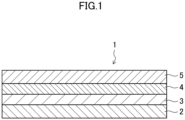
- FIG. 1 is a cross-sectional view illustrating a thermal recording medium according to this embodiment.
- a thermal recording medium 1 has a structure in which a thermal recording layer 3 to be colored by heating, an intermediate layer 4, and a top coat 5 are stacked on a transparent sheet-like base material 2.
- the base material 2 examples include a transparent synthetic resin film, such as a polypropylene film, a polyethylene terephthalate film, a polystyrene film, and a polycarbonate film.
- the thickness of the base material 2 is not particularly limited, but may be in a range of, for example, from about 10 ⁇ m to about 100 ⁇ m in one preferred embodiment to exhibit excellent coating properties and transparency.
- the material of the thermal recording layer 3 includes a color former to be colored by heating, a developer, a binder, and a lubricant, for example.
- each of these materials has a small particle size in one preferred embodiment.
- the materials having small particle sizes can reduce diffuse reflection of the particles.
- examples of a dye serving as the color former include 3-dibutylamino-6-methyl-7-anilinofluoran, for example.
- the particle size may range preferably from 0.1 ⁇ m to 1.0 ⁇ m, more preferably from 0.1 ⁇ m to 0.6 ⁇ m, and particularly preferably from 0.1 ⁇ m to 0.55 ⁇ m.
- the developer examples include 4-hydroxyphenyl(4'-n-propoxyphenyl) sulfone, for example.
- the particle size may range preferably from 0.1 ⁇ m to 1.0 ⁇ m, more preferably from 0.1 ⁇ m to 0.6 ⁇ m, and particularly preferably from 0.1 ⁇ m to 0.55 ⁇ m.
- the particle size refers to a 50% average particle diameter measured by a Microtrac laser-scattering particle size analyzer.
- binder examples include a styrene-butadiene copolymer, for example.
- lubricant examples include polyethylene, zinc stearate, paraffin, etc.
- the particle size of these substances is 0.5 ⁇ m or less in one preferred embodiment.
- paraffin In order to improve transparency, containing paraffin is particularly effective.
- This paraffin has a low melting point lower than the color developing temperature of the thermal recording layer 3, preferably less than 80°C, and more preferably less than 50°C.
- the particle size of the paraffin with a low melting point is preferably 0.5 ⁇ m or less in one preferred embodiment as described above.
- the content of the paraffin is in a range of from 0.1 g/m 2 to 1.0 g/m 2 , for example, at a dry weight in one preferred embodiment.
- a coating liquid for forming the thermal recording layer contains paraffin with a low melting point, the paraffin melts at the application and drying of the coating liquid onto the base material 2, and enters and fills gaps in uneven surfaces of the particles forming the thermal recording layer 3. This enables a reduction in the diffuse reflection on the surfaces of the particles and an improvement in the transparency.
- the intermediate layer 4 with barrier properties against water and oil is mainly made of a resin.
- the resin for the intermediate layer 4 include an emulsion of an acrylic resin, a water-soluble resin such as a polyvinyl alcohol (PVA) resin, an SBR resin, etc.
- the resin can be a resin with a water-soluble part, for example, a polyvinyl alcohol (PVA) resin which is a resin having a hydroxy group as a hydrophilic structural unit.
- PVA polyvinyl alcohol
- a resin with a core-shell structure in which hydrophobic core particles are coated with a water-soluble shell polymer is used.
- This resin is a core-shell acrylic resin.
- the water-soluble polyvinyl alcohol (PVA) and the core-shell acrylic resin have excellent film-forming properties.
- a coating liquid for forming the intermediate layer is applied on the thermal recording layer 3 and dried, the resin with a water-soluble part infiltrates into the thermal recording layer 3 to form a smooth intermediate layer 4. This reduces the diffuse reflection on the thermal recording layer 3 and improves the transparency.
- core-shell resin examples include a core-shell acrylic resin commercially available under the name of Barrier Star (manufactured by Mitsui Chemicals, Inc.).
- the top coat 5 improves the matching properties of the thermal recording medium 1 with a thermal head so that the thermal recording layer 3 is colored smoothly.
- the top coat 5 contains a filler, a lubricant, a crosslinking agent, etc., added into a binder.
- Examples of a resin serving as the binder include an acrylic resin, for example.
- Examples of the lubricant include polyethylene and zinc stearate, for example.
- Examples of the crosslinking agent include zirconium carbonate, for example.
- the filler examples include colloidal silica, calcium carbonate, zirconium carbonate, polymethylmethacrylate (PMMA), polystyrene (PS), etc.
- the particle sizes of these fillers are preferably 1.0 ⁇ m or less.
- the filler may be colloidal silica with a small particle size in one preferred embodiment.
- the thermal recording medium 1 has the following feature: the thermal recording layer 3 contains a dispersant having a carboxyl group, and a crosslinking agent containing, as a main component, an epichlorohydrin-modified polyamide polyamine resin or an organic compound containing an oxazoline group.
- the dispersant containing a carboxyl group is a styrene acrylic copolymer ammonium salt such as a styrene-acrylic polymer.
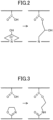
- the azetidinium ring (AZR) in the epichlorohydrin-modified polyamide polyamine resin serving as the crosslinking agent reacts with the carboxyl group of the dispersant to form a crosslinked structure. It is assumed that this crosslinking improves the film-forming properties of the thermal recording layer 3 and fills the voids in the thermal recording layer 3. As a result, the transparency of the thermal recording layer 3 improves, which leads to the thermal recording medium 1 with excellent transparency.
- the oxazoline group of the oxazoline group-containing organic compound serving as the crosslinking agent reacts with the carboxyl group of the dispersant to form a crosslinked structure. It is assumed that this crosslinking improves the film-forming properties of the thermal recording layer 3 and fills the voids in the thermal recording layer 3. As a result, the transparency of the thermal recording layer 3 improves, which leads to the thermal recording medium 1 with excellent transparency.
- the content of the dispersant with respect to the entire thermal recording layer 3 ranges from 5% by mass to 20% by mass in one preferred embodiment.
- the content of the crosslinking agent with respect to the entire thermal recording layer 3 ranges from 0.5% by mass to 10% by mass in one preferred embodiment.
- a styrene acrylic copolymer ammonium salt was used as a dispersant, and an epichlorohydrin-modified polyamide polyamine resin was used as a crosslinking agent.
- 3-dibutylamino-6-methyl-7-anilinofluoran with a particle size of 0.15 ⁇ m was used as a dye; 4-hydroxyphenyl(4'-n-propoxyphenyl) sulfone with a particle size of 0.15 ⁇ m was used as a developer; and SBR with a glass transition temperature Tg of "-3°C" was used as a binder.
- polyethylene (PE) with a melting point of 100°C and a particle size of 0.6 ⁇ m and paraffin with a melting point of 46°C and a particle size of 0.2 ⁇ m were used.
- Kaolin with a particle size of 0.4 ⁇ m was used as a filler.
- a coating liquid made of a core-shell acrylic resin for forming an intermediate layer was prepared.
- the prepared coating liquid for forming an intermediate layer was applied on the thermal recording layer described above in a coating amount at a dry weight of 2.0 g/m 2 . Then, the coating liquid was dried to form the intermediate layer having a thickness of 2.0 ⁇ m on the thermal recording layer.
- a coating liquid for forming a top coat shown in Table 1 was prepared.
- the prepared coating liquid for forming a top coat was applied on the intermediate layer described above in a coating amount at a dry weight of 1.5 g/m 2 . Then, the coating liquid was dried to form the top coat having a thickness of 1.5 ⁇ m on the intermediate layer.
- An acrylic resin was used as a binder, and polyethylene (PE) and zinc stearate (St-Zn) were used as lubricants.
- PE polyethylene
- St-Zn zinc stearate
- Colloidal silica with a particle size of several nanometers and colloidal silica with a particle size of several tens of nanometers were used as fillers, and zirconium carbonate was used as a crosslinking agent.
- a thermal recording medium according to this example was prepared in the manner described above.
- a thermal recording medium was prepared in the same manner as in Example 1 described above, except that the crosslinking agent in the thermal recording layer was replaced with an epichlorohydrin-modified polyamide polyamine resin with a reaction point 10% lower than that of the crosslinking agent described above, a lower degree of cationization, and a lower molecular weight.
- a thermal recording medium was prepared in the same manner as in Example 1 described above, except that the crosslinking agent in the thermal recording layer was replaced with an organic compound containing an oxazoline group.
- a thermal recording medium was prepared in the same manner as in Example 1 described above, except that the developer in the thermal recording layer was replaced with 4-hydroxyphenyl(4'-n-propoxyphenyl) sulfone with a particle size of 0.25 ⁇ m, and that the dye in the thermal recording layer was replaced with 3-dibutylamino-6-methyl-7-anilinofluoran with a particle size of 0.25 ⁇ m.
- a thermal recording medium was prepared in the same manner as in Example 1 described above, except that the crosslinking agent in the thermal recording layer was replaced with an organic compound containing an oxazoline group, that the developer in the thermal recording layer was replaced with 4-hydroxyphenyl(4'-n-propoxyphenyl) sulfone with a particle size of 0.25 ⁇ m, and that the dye in the thermal recording layer was replaced with 3-dibutylamino-6-methyl-7-anilinofluoran with a particle size of 0.25 ⁇ m.
- a thermal recording medium was prepared in the same manner as in Example 1 described above, except that the developer in the thermal recording layer was replaced with 4-hydroxyphenyl(4'-n-propoxyphenyl) sulfone with a particle size of 0.46 ⁇ m, and that the dye in the thermal recording layer was replaced with 3-dibutylamino-6-methyl-7-anilinofluoran with a particle size of 0.46 ⁇ m.
- a thermal recording medium was prepared in the same manner as in Example 1 described above, except that the crosslinking agent in the thermal recording layer was replaced with an organic compound containing an oxazoline group, that the developer in the thermal recording layer was replaced with 4-hydroxyphenyl(4'-n-propoxyphenyl) sulfone with a particle size of 0.46 ⁇ m, and that the dye in the thermal recording layer was replaced with 3-dibutylamino-6-methyl-7-anilinofluoran with a particle size of 0.46 ⁇ m.
- a thermal recording medium was prepared in the same manner as in Example 1 described above, except that the developer in the thermal recording layer was replaced with 4-hydroxyphenyl(4'-n-propoxyphenyl) sulfone with a particle size of 0.55 ⁇ m, and that the dye in the thermal recording layer was replaced with 3-dibutylamino-6-methyl-7-anilinofluoran with a particle size of 0.55 ⁇ m.
- a thermal recording medium was prepared in the same manner as in Example 1 described above, except that the dispersant in the thermal recording layer was replaced with a styrene maleate, that the developer in the thermal recording layer was replaced with 4-hydroxyphenyl(4'-n-propoxyphenyl) sulfone with a particle size of 0.55 ⁇ m, and that the dye in the thermal recording layer was replaced with 3-dibutylamino-6-methyl-7-anilinofluoran with a particle size of 0.55 ⁇ m.
- a thermal recording medium was prepared in the same manner as in Example 1 described above, except that no crosslinking agent was added.
- a thermal recording medium was prepared in the same manner as in Example 1 described above, except that no crosslinking agent was added to the thermal recording layer, that the developer in the thermal recording layer was replaced with 4-hydroxyphenyl(4'-n-propoxyphenyl) sulfone with a particle size of 0.25 ⁇ m, and that the dye in the thermal recording layer was replaced with 3-dibutylamino-6-methyl-7-anilinofluoran with a particle size of 0.25 ⁇ m.
- a thermal recording medium was prepared in the same manner as in Example 1 described above, except that no crosslinking agent was added to the thermal recording layer, that the developer in the thermal recording layer was replaced with 4-hydroxyphenyl(4'-n-propoxyphenyl) sulfone with a particle size of 0.46 ⁇ m, and that the dye in the thermal recording layer was replaced with 3-dibutylamino-6-methyl-7-anilinofluoran with a particle size of 0.46 ⁇ m.
- a thermal recording medium was prepared in the same manner as in Example 1 described above, except that no crosslinking agent was added to the thermal recording layer, that the developer in the thermal recording layer was replaced with 4-hydroxyphenyl(4'-n-propoxyphenyl) sulfone with a particle size of 0.55 ⁇ m, and that the dye in the thermal recording layer was replaced with 3-dibutylamino-6-methyl-7-anilinofluoran with a particle size of 0.55 ⁇ m.
- a thermal recording medium was prepared in the same manner as in Example 1 described above, except that no crosslinking agent was added in the thermal recording layer, that the dispersant in the thermal recording layer was replaced with a styrene maleate, that the developer in the thermal recording layer was replaced with 4-hydroxyphenyl(4'-n-propoxyphenyl) sulfone with a particle size of 0.55 ⁇ m, and that the dye in the thermal recording layer was replaced with 3-dibutylamino-6-methyl-7-anilinofluoran with a particle size of 0.55 ⁇ m.
- a thermal recording medium was prepared in the same manner as in Example 1 described above, except that the dispersant in the thermal recording layer was replaced with polyvinyl alcohol with a degree of polymerization of 500 and a degree of saponification of from 86.5 to 89.0, that the developer in the thermal recording layer was replaced with 4-hydroxyphenyl(4'-n-propoxyphenyl) sulfone with a particle size of 0.55 ⁇ m, and that the dye in the thermal recording layer was replaced with 3-dibutylamino-6-methyl-7-anilinofluoran with a particle size of 0.55 ⁇ m.
- a thermal recording medium was prepared in the same manner as in Example 1 described above, except that no crosslinking agent was added to the thermal recording layer, that the dispersant in the thermal recording layer was replaced with polyvinyl alcohol with a degree of polymerization of 500 and a degree of saponification of from 86.5 to 89.0, that the developer in the thermal recording layer was replaced with 4-hydroxyphenyl(4'-n-propoxyphenyl) sulfone with a particle size of 0.55 ⁇ m, and that the dye in the thermal recording layer was replaced with 3-dibutylamino-6-methyl-7-anilinofluoran with a particle size of 0.55 ⁇ m.
- Table 1 shows that the thermal recording paper according to each of Examples 1 to 3, in which the thermal recording layer contains the dispersant having the carboxyl group and the crosslinking agent (and the particle size of the dye and the developer is 0.15 ⁇ m), has a smaller haze value than that of Comparative Example 1 in which the thermal recording layer contains no crosslinking agent (and the particle size of the dye and the developer is 0.15 ⁇ m). That is, the thermal recording media of Examples 1 to 3 have an improved transparency.
- Table 1 also shows that the thermal recording paper according to each of Examples 4 and 5, in which the thermal recording layer contains the dispersant having the carboxyl group and the crosslinking agent (and the particle size of the dye and the developer is 0.25 ⁇ m), has a smaller haze value than that of Comparative Example 2 in which the thermal recording layer contains no crosslinking agent (and the particle size of the dye and the developer is 0.25 ⁇ m). That is, the thermal recording media of Examples 4 and 5 have an improved transparency.
- Table 1 also shows that the thermal recording paper according to each of Examples 6 and 7, in which the thermal recording layer contains the dispersant having the carboxyl group and the crosslinking agent (and the particle size of the dye and the developer is 0.46 ⁇ m), has a smaller haze value than that of Comparative Example 3 in which the thermal recording layer contains no crosslinking agent (and the particle size of the dye and the developer is 0.46 ⁇ m). That is, the thermal recording media of Examples 6 and 7 have an improved transparency.
- Table 1 also shows that the thermal recording paper according to Example 8, in which the thermal recording layer contains the dispersant having the carboxyl group and the crosslinking agent (and the particle size of the dye and the developer is 0.55 ⁇ m), has a smaller haze value than that of Comparative Example 4 in which the thermal recording layer contains no crosslinking agent (and the particle size of the dye and the developer is 0.55 ⁇ m). That is, the thermal recording medium of Example 8 has an improved transparency.
- Table 1 also shows that the thermal recording paper according to Reference Example 9, in which the thermal recording layer contains the dispersant having the carboxyl group and the crosslinking agent (the dispersant is the styrene maleate, and the particle size of the dye and the developer is 0.55 ⁇ m), has a smaller haze value than that of Comparative Example 5 in which the thermal recording layer contains no crosslinking agent (the dispersant is the styrene maleate, and the particle size of the dye and the developer is 0.55 ⁇ m). That is, the thermal recording medium of Reference Example 9 has an improved transparency.
- thermo recording media of Comparative Examples 6 and 7 using the dispersant (polyvinyl alcohol) having no carboxyl group have lower transparency than the thermal recording media of Example 8 and Reference Example 9 using the dispersant having the carboxyl group (i.e., the styrene acrylic copolymer ammonium salt or the styrene maleate) (the particle size of the dye and the developer is 0.55 ⁇ m), regardless of the presence or absence of the crosslinking agent.
- the present invention is particularly useful for a thermal recording medium used as a label on a container for various foods or a packaging film.
Landscapes
- Physics & Mathematics (AREA)
- Optics & Photonics (AREA)
- Chemical & Material Sciences (AREA)
- Chemical Kinetics & Catalysis (AREA)
- General Chemical & Material Sciences (AREA)
- Heat Sensitive Colour Forming Recording (AREA)
Claims (2)
- Wärmeaufzeichnungsmedium mit mindestens einer Wärmeaufzeichnungsschicht und einer Zwischenschicht, die auf einem transparenten Grundmaterial in dieser Reihenfolge geschichtet sind,wobei die Wärmeaufzeichnungsschicht ein Dispersionsmittel mit einer Carboxylgruppe und ein Vernetzungsmittel, das als einen Hauptbestandteil ein Epichlorhydrin-modifiziertes Polyamid-Polyamin-Harz oder eine eine Oxazolingruppe enthaltende organische Verbindung enthält, enthält,wobei die Zwischenschicht ein Kern-Schale-Acrylharz enthält, bei dem hydrophobe Kernpartikel mit einem wasserlöslichen Schalenpolymer beschichtet sind,wobei das Dispersionsmittel ein Styrol-Acryl-Copolymer-Ammoniumsalz ist.
- Wärmeaufzeichnungsmedium nach Anspruch 1, wobeidie Wärmeaufzeichnungsschicht einen bestimmten Farbbildner und/oder einen bestimmten Entwickler enthält, undder Farbbildner und der Entwickler jeweils eine Partikelgröße von 0,1 µm bis 1,0 µm aufweist.
Applications Claiming Priority (1)
| Application Number | Priority Date | Filing Date | Title |
|---|---|---|---|
| PCT/JP2019/046167 WO2021106076A1 (ja) | 2019-11-26 | 2019-11-26 | 感熱記録体 |
Publications (3)
| Publication Number | Publication Date |
|---|---|
| EP4063137A1 EP4063137A1 (de) | 2022-09-28 |
| EP4063137A4 EP4063137A4 (de) | 2022-12-07 |
| EP4063137B1 true EP4063137B1 (de) | 2025-01-01 |
Family
ID=76129274
Family Applications (1)
| Application Number | Title | Priority Date | Filing Date |
|---|---|---|---|
| EP19954347.1A Active EP4063137B1 (de) | 2019-11-26 | 2019-11-26 | Wärmeempfindlicher aufzeichnungskörper |
Country Status (8)
| Country | Link |
|---|---|
| US (1) | US12454145B2 (de) |
| EP (1) | EP4063137B1 (de) |
| JP (1) | JP7563850B2 (de) |
| KR (1) | KR102893412B1 (de) |
| CN (1) | CN114728529B (de) |
| ES (1) | ES3014726T3 (de) |
| FI (1) | FI4063137T3 (de) |
| WO (1) | WO2021106076A1 (de) |
Families Citing this family (2)
| Publication number | Priority date | Publication date | Assignee | Title |
|---|---|---|---|---|
| NZ823045A (en) * | 2023-01-16 | 2025-10-31 | Osaka Sealing Label Print | Thermal recording material |
| WO2025046993A1 (ja) | 2023-08-29 | 2025-03-06 | 大阪シーリング印刷株式会社 | 感熱記録体 |
Family Cites Families (18)
| Publication number | Priority date | Publication date | Assignee | Title |
|---|---|---|---|---|
| US4756961A (en) * | 1984-05-25 | 1988-07-12 | Canon Kabushiki Kaisha | Recording member and recording method using the same |
| JPH0811436A (ja) * | 1993-12-28 | 1996-01-16 | New Oji Paper Co Ltd | 感熱記録体 |
| JP2002036725A (ja) | 2000-07-31 | 2002-02-06 | Osaka Sealing Printing Co Ltd | 感熱発色ラベル |
| JP2002113947A (ja) * | 2000-10-06 | 2002-04-16 | Oji Paper Co Ltd | 感熱記録体 |
| JP2002316482A (ja) * | 2001-04-20 | 2002-10-29 | Oji Paper Co Ltd | 感熱記録体 |
| JP2004188706A (ja) * | 2002-12-10 | 2004-07-08 | Tomoegawa Paper Co Ltd | 感熱記録媒体 |
| JP5096734B2 (ja) | 2006-11-30 | 2012-12-12 | オリンパスイメージング株式会社 | 投稿画像評価装置、投稿画像評価装置の投稿画像評価方法およびプログラム |
| JP4907374B2 (ja) | 2007-02-08 | 2012-03-28 | 株式会社リコー | 感熱記録材料 |
| EP2145771B1 (de) | 2007-05-10 | 2011-08-31 | Nippon Paper Industries Co., Ltd. | Wärmeempfindliches aufzeichnungsmaterial |
| JP2009255309A (ja) * | 2008-04-14 | 2009-11-05 | Nippon Paper Industries Co Ltd | 感熱記録体ラベル |
| JP2015030227A (ja) * | 2013-08-05 | 2015-02-16 | 大日本印刷株式会社 | 感熱紙 |
| WO2015072410A1 (ja) * | 2013-11-15 | 2015-05-21 | 大阪シーリング印刷株式会社 | 透明感熱包装シート、ならびにこれを用いた透明包装容器および包装方法 |
| ES2875999T3 (es) | 2014-07-14 | 2021-11-11 | Osaka Sealing Label Print | Cuerpo de registro termosensible |
| JP6714945B2 (ja) | 2014-11-14 | 2020-07-01 | 大阪シーリング印刷株式会社 | 包装シート、ならびにこれを用いた包装容器および包装方法 |
| US11346053B2 (en) * | 2016-02-10 | 2022-05-31 | Oji Holdings Corporaton | Sheet |
| EP3219506B1 (de) * | 2016-03-17 | 2019-11-06 | Ricoh Company, Ltd. | Wärmeempfindliche aufzeichnungsmaterialien mit chelatbildnern |
| JP6712243B2 (ja) * | 2017-03-30 | 2020-06-17 | 日本製紙株式会社 | 感熱記録体 |
| JP7327882B2 (ja) | 2018-03-23 | 2023-08-16 | 大阪シーリング印刷株式会社 | 感熱記録体 |
-
2019
- 2019-11-26 KR KR1020227019025A patent/KR102893412B1/ko active Active
- 2019-11-26 CN CN201980102289.9A patent/CN114728529B/zh active Active
- 2019-11-26 ES ES19954347T patent/ES3014726T3/es active Active
- 2019-11-26 US US17/780,007 patent/US12454145B2/en active Active
- 2019-11-26 JP JP2021560802A patent/JP7563850B2/ja active Active
- 2019-11-26 WO PCT/JP2019/046167 patent/WO2021106076A1/ja not_active Ceased
- 2019-11-26 EP EP19954347.1A patent/EP4063137B1/de active Active
- 2019-11-26 FI FIEP19954347.1T patent/FI4063137T3/fi active
Also Published As
| Publication number | Publication date |
|---|---|
| FI4063137T3 (fi) | 2025-04-05 |
| EP4063137A4 (de) | 2022-12-07 |
| ES3014726T3 (en) | 2025-04-24 |
| JPWO2021106076A1 (de) | 2021-06-03 |
| CN114728529A (zh) | 2022-07-08 |
| US12454145B2 (en) | 2025-10-28 |
| US20220410609A1 (en) | 2022-12-29 |
| EP4063137A1 (de) | 2022-09-28 |
| KR20220100615A (ko) | 2022-07-15 |
| WO2021106076A1 (ja) | 2021-06-03 |
| KR102893412B1 (ko) | 2025-12-01 |
| JP7563850B2 (ja) | 2024-10-08 |
| CN114728529B (zh) | 2024-09-27 |
Similar Documents
| Publication | Publication Date | Title |
|---|---|---|
| US11718103B2 (en) | Direct thermal recording media with perforated particles | |
| CN101269593B (zh) | 热敏记录材料 | |
| US20070225164A1 (en) | Fluid dispersion, and thermosensitive recording material and method for preparing the same | |
| EP4063137B1 (de) | Wärmeempfindlicher aufzeichnungskörper | |
| AU2012290938B2 (en) | Thermosensitive recording material | |
| EP3463923B1 (de) | Lösungsmittelbeständige glänzende bedruckbare substrate und deren verfahren zur herstellung und verwendung | |
| JP2017209847A (ja) | 感熱フィルム | |
| KR102165346B1 (ko) | 감열 기록체 | |
| JP6202599B2 (ja) | 感熱記録体 | |
| US7125928B2 (en) | Adhesive composition and thermal transfer sheet | |
| JP7327882B2 (ja) | 感熱記録体 | |
| JP5352958B2 (ja) | 分散液、並びに感熱記録材料及びその製造方法 | |
| JP2017001194A (ja) | 感熱記録体ならびに感熱記録体の製造方法 | |
| JP2020059283A (ja) | 帯封用感熱記録体 | |
| JP7510236B1 (ja) | 感熱記録体 | |
| US20250162340A1 (en) | Thermosensitive recording medium | |
| WO2024154451A1 (ja) | 感熱記録体 | |
| JP2023117811A (ja) | 感熱記録体 | |
| WO2017122312A1 (ja) | 感熱記録体 | |
| JP2016093950A (ja) | 感熱記録体 | |
| NZ615515B2 (en) | Thermosensitive recording material |
Legal Events
| Date | Code | Title | Description |
|---|---|---|---|
| STAA | Information on the status of an ep patent application or granted ep patent |
Free format text: STATUS: THE INTERNATIONAL PUBLICATION HAS BEEN MADE |
|
| PUAI | Public reference made under article 153(3) epc to a published international application that has entered the european phase |
Free format text: ORIGINAL CODE: 0009012 |
|
| STAA | Information on the status of an ep patent application or granted ep patent |
Free format text: STATUS: REQUEST FOR EXAMINATION WAS MADE |
|
| 17P | Request for examination filed |
Effective date: 20220606 |
|
| AK | Designated contracting states |
Kind code of ref document: A1 Designated state(s): AL AT BE BG CH CY CZ DE DK EE ES FI FR GB GR HR HU IE IS IT LI LT LU LV MC MK MT NL NO PL PT RO RS SE SI SK SM TR |
|
| A4 | Supplementary search report drawn up and despatched |
Effective date: 20221104 |
|
| RIC1 | Information provided on ipc code assigned before grant |
Ipc: B41M 5/41 20060101ALI20221028BHEP Ipc: B41M 5/323 20060101ALI20221028BHEP Ipc: B41M 5/337 20060101AFI20221028BHEP |
|
| DAV | Request for validation of the european patent (deleted) | ||
| DAX | Request for extension of the european patent (deleted) | ||
| STAA | Information on the status of an ep patent application or granted ep patent |
Free format text: STATUS: EXAMINATION IS IN PROGRESS |
|
| 17Q | First examination report despatched |
Effective date: 20230726 |
|
| GRAP | Despatch of communication of intention to grant a patent |
Free format text: ORIGINAL CODE: EPIDOSNIGR1 |
|
| STAA | Information on the status of an ep patent application or granted ep patent |
Free format text: STATUS: GRANT OF PATENT IS INTENDED |
|
| INTG | Intention to grant announced |
Effective date: 20240801 |
|
| GRAS | Grant fee paid |
Free format text: ORIGINAL CODE: EPIDOSNIGR3 |
|
| GRAA | (expected) grant |
Free format text: ORIGINAL CODE: 0009210 |
|
| STAA | Information on the status of an ep patent application or granted ep patent |
Free format text: STATUS: THE PATENT HAS BEEN GRANTED |
|
| AK | Designated contracting states |
Kind code of ref document: B1 Designated state(s): AL AT BE BG CH CY CZ DE DK EE ES FI FR GB GR HR HU IE IS IT LI LT LU LV MC MK MT NL NO PL PT RO RS SE SI SK SM TR |
|
| REG | Reference to a national code |
Ref country code: GB Ref legal event code: FG4D |
|
| REG | Reference to a national code |
Ref country code: CH Ref legal event code: EP |
|
| REG | Reference to a national code |
Ref country code: DE Ref legal event code: R096 Ref document number: 602019064489 Country of ref document: DE |
|
| REG | Reference to a national code |
Ref country code: IE Ref legal event code: FG4D |
|
| P01 | Opt-out of the competence of the unified patent court (upc) registered |
Free format text: CASE NUMBER: APP_24/2025 Effective date: 20250102 |
|
| REG | Reference to a national code |
Ref country code: SE Ref legal event code: TRGR |
|
| REG | Reference to a national code |
Ref country code: FI Ref legal event code: FGE |
|
| REG | Reference to a national code |
Ref country code: ES Ref legal event code: FG2A Ref document number: 3014726 Country of ref document: ES Kind code of ref document: T3 Effective date: 20250424 |
|
| REG | Reference to a national code |
Ref country code: LT Ref legal event code: MG9D |
|
| REG | Reference to a national code |
Ref country code: NL Ref legal event code: MP Effective date: 20250101 |
|
| PG25 | Lapsed in a contracting state [announced via postgrant information from national office to epo] |
Ref country code: NL Free format text: LAPSE BECAUSE OF FAILURE TO SUBMIT A TRANSLATION OF THE DESCRIPTION OR TO PAY THE FEE WITHIN THE PRESCRIBED TIME-LIMIT Effective date: 20250101 |
|
| PG25 | Lapsed in a contracting state [announced via postgrant information from national office to epo] |
Ref country code: PL Free format text: LAPSE BECAUSE OF FAILURE TO SUBMIT A TRANSLATION OF THE DESCRIPTION OR TO PAY THE FEE WITHIN THE PRESCRIBED TIME-LIMIT Effective date: 20250101 |
|
| PG25 | Lapsed in a contracting state [announced via postgrant information from national office to epo] |
Ref country code: IS Free format text: LAPSE BECAUSE OF FAILURE TO SUBMIT A TRANSLATION OF THE DESCRIPTION OR TO PAY THE FEE WITHIN THE PRESCRIBED TIME-LIMIT Effective date: 20250501 |
|
| PG25 | Lapsed in a contracting state [announced via postgrant information from national office to epo] |
Ref country code: HR Free format text: LAPSE BECAUSE OF FAILURE TO SUBMIT A TRANSLATION OF THE DESCRIPTION OR TO PAY THE FEE WITHIN THE PRESCRIBED TIME-LIMIT Effective date: 20250101 |
|
| PG25 | Lapsed in a contracting state [announced via postgrant information from national office to epo] |
Ref country code: LV Free format text: LAPSE BECAUSE OF FAILURE TO SUBMIT A TRANSLATION OF THE DESCRIPTION OR TO PAY THE FEE WITHIN THE PRESCRIBED TIME-LIMIT Effective date: 20250101 Ref country code: PT Free format text: LAPSE BECAUSE OF FAILURE TO SUBMIT A TRANSLATION OF THE DESCRIPTION OR TO PAY THE FEE WITHIN THE PRESCRIBED TIME-LIMIT Effective date: 20250502 |
|
| PG25 | Lapsed in a contracting state [announced via postgrant information from national office to epo] |
Ref country code: GR Free format text: LAPSE BECAUSE OF FAILURE TO SUBMIT A TRANSLATION OF THE DESCRIPTION OR TO PAY THE FEE WITHIN THE PRESCRIBED TIME-LIMIT Effective date: 20250402 Ref country code: BG Free format text: LAPSE BECAUSE OF FAILURE TO SUBMIT A TRANSLATION OF THE DESCRIPTION OR TO PAY THE FEE WITHIN THE PRESCRIBED TIME-LIMIT Effective date: 20250101 |
|
| PG25 | Lapsed in a contracting state [announced via postgrant information from national office to epo] |
Ref country code: CZ Free format text: LAPSE BECAUSE OF FAILURE TO SUBMIT A TRANSLATION OF THE DESCRIPTION OR TO PAY THE FEE WITHIN THE PRESCRIBED TIME-LIMIT Effective date: 20250101 |
|
| REG | Reference to a national code |
Ref country code: DE Ref legal event code: R097 Ref document number: 602019064489 Country of ref document: DE |
|
| PG25 | Lapsed in a contracting state [announced via postgrant information from national office to epo] |
Ref country code: SM Free format text: LAPSE BECAUSE OF FAILURE TO SUBMIT A TRANSLATION OF THE DESCRIPTION OR TO PAY THE FEE WITHIN THE PRESCRIBED TIME-LIMIT Effective date: 20250101 |
|
| PG25 | Lapsed in a contracting state [announced via postgrant information from national office to epo] |
Ref country code: DK Free format text: LAPSE BECAUSE OF FAILURE TO SUBMIT A TRANSLATION OF THE DESCRIPTION OR TO PAY THE FEE WITHIN THE PRESCRIBED TIME-LIMIT Effective date: 20250101 |
|
| PG25 | Lapsed in a contracting state [announced via postgrant information from national office to epo] |
Ref country code: EE Free format text: LAPSE BECAUSE OF FAILURE TO SUBMIT A TRANSLATION OF THE DESCRIPTION OR TO PAY THE FEE WITHIN THE PRESCRIBED TIME-LIMIT Effective date: 20250101 |
|
| PG25 | Lapsed in a contracting state [announced via postgrant information from national office to epo] |
Ref country code: RO Free format text: LAPSE BECAUSE OF FAILURE TO SUBMIT A TRANSLATION OF THE DESCRIPTION OR TO PAY THE FEE WITHIN THE PRESCRIBED TIME-LIMIT Effective date: 20250101 |
|
| PG25 | Lapsed in a contracting state [announced via postgrant information from national office to epo] |
Ref country code: SK Free format text: LAPSE BECAUSE OF FAILURE TO SUBMIT A TRANSLATION OF THE DESCRIPTION OR TO PAY THE FEE WITHIN THE PRESCRIBED TIME-LIMIT Effective date: 20250101 |
|
| PLBE | No opposition filed within time limit |
Free format text: ORIGINAL CODE: 0009261 |
|
| STAA | Information on the status of an ep patent application or granted ep patent |
Free format text: STATUS: NO OPPOSITION FILED WITHIN TIME LIMIT |
|
| REG | Reference to a national code |
Ref country code: CH Ref legal event code: L10 Free format text: ST27 STATUS EVENT CODE: U-0-0-L10-L00 (AS PROVIDED BY THE NATIONAL OFFICE) Effective date: 20251112 |
|
| REG | Reference to a national code |
Ref country code: CH Ref legal event code: U11 Free format text: ST27 STATUS EVENT CODE: U-0-0-U10-U11 (AS PROVIDED BY THE NATIONAL OFFICE) Effective date: 20251201 |
|
| 26N | No opposition filed |
Effective date: 20251002 |
|
| PGFP | Annual fee paid to national office [announced via postgrant information from national office to epo] |
Ref country code: DE Payment date: 20251119 Year of fee payment: 7 |
|
| PGFP | Annual fee paid to national office [announced via postgrant information from national office to epo] |
Ref country code: GB Payment date: 20251121 Year of fee payment: 7 |
|
| PGFP | Annual fee paid to national office [announced via postgrant information from national office to epo] |
Ref country code: NO Payment date: 20251125 Year of fee payment: 7 |
|
| PGFP | Annual fee paid to national office [announced via postgrant information from national office to epo] |
Ref country code: AT Payment date: 20251120 Year of fee payment: 7 |
|
| PGFP | Annual fee paid to national office [announced via postgrant information from national office to epo] |
Ref country code: IT Payment date: 20251125 Year of fee payment: 7 Ref country code: FI Payment date: 20251125 Year of fee payment: 7 |
|
| PGFP | Annual fee paid to national office [announced via postgrant information from national office to epo] |
Ref country code: FR Payment date: 20251126 Year of fee payment: 7 |
|
| PGFP | Annual fee paid to national office [announced via postgrant information from national office to epo] |
Ref country code: BE Payment date: 20251119 Year of fee payment: 7 |
|
| PGFP | Annual fee paid to national office [announced via postgrant information from national office to epo] |
Ref country code: SE Payment date: 20251119 Year of fee payment: 7 Ref country code: CH Payment date: 20251201 Year of fee payment: 7 |
|
| PGFP | Annual fee paid to national office [announced via postgrant information from national office to epo] |
Ref country code: ES Payment date: 20251229 Year of fee payment: 7 |
|
| REG | Reference to a national code |
Ref country code: AT Ref legal event code: UEP Ref document number: 1755863 Country of ref document: AT Kind code of ref document: T Effective date: 20250101 |