EP4047727B1 - Batteriepackgehäuse mit hakenkopplungsstruktur - Google Patents
Batteriepackgehäuse mit hakenkopplungsstruktur Download PDFInfo
- Publication number
- EP4047727B1 EP4047727B1 EP22168629.8A EP22168629A EP4047727B1 EP 4047727 B1 EP4047727 B1 EP 4047727B1 EP 22168629 A EP22168629 A EP 22168629A EP 4047727 B1 EP4047727 B1 EP 4047727B1
- Authority
- EP
- European Patent Office
- Prior art keywords
- hook
- battery pack
- hook part
- locking projection
- case
- Prior art date
- Legal status (The legal status is an assumption and is not a legal conclusion. Google has not performed a legal analysis and makes no representation as to the accuracy of the status listed.)
- Active
Links
Images




Classifications
-
- H—ELECTRICITY
- H01—ELECTRIC ELEMENTS
- H01M—PROCESSES OR MEANS, e.g. BATTERIES, FOR THE DIRECT CONVERSION OF CHEMICAL ENERGY INTO ELECTRICAL ENERGY
- H01M50/00—Constructional details or processes of manufacture of the non-active parts of electrochemical cells other than fuel cells, e.g. hybrid cells
- H01M50/20—Mountings; Secondary casings or frames; Racks, modules or packs; Suspension devices; Shock absorbers; Transport or carrying devices; Holders
- H01M50/233—Mountings; Secondary casings or frames; Racks, modules or packs; Suspension devices; Shock absorbers; Transport or carrying devices; Holders characterised by physical properties of casings or racks, e.g. dimensions
- H01M50/242—Mountings; Secondary casings or frames; Racks, modules or packs; Suspension devices; Shock absorbers; Transport or carrying devices; Holders characterised by physical properties of casings or racks, e.g. dimensions adapted for protecting batteries against vibrations, collision impact or swelling
-
- H—ELECTRICITY
- H01—ELECTRIC ELEMENTS
- H01M—PROCESSES OR MEANS, e.g. BATTERIES, FOR THE DIRECT CONVERSION OF CHEMICAL ENERGY INTO ELECTRICAL ENERGY
- H01M50/00—Constructional details or processes of manufacture of the non-active parts of electrochemical cells other than fuel cells, e.g. hybrid cells
- H01M50/20—Mountings; Secondary casings or frames; Racks, modules or packs; Suspension devices; Shock absorbers; Transport or carrying devices; Holders
- H01M50/262—Mountings; Secondary casings or frames; Racks, modules or packs; Suspension devices; Shock absorbers; Transport or carrying devices; Holders with fastening means, e.g. locks
- H01M50/264—Mountings; Secondary casings or frames; Racks, modules or packs; Suspension devices; Shock absorbers; Transport or carrying devices; Holders with fastening means, e.g. locks for cells or batteries, e.g. straps, tie rods or peripheral frames
-
- B—PERFORMING OPERATIONS; TRANSPORTING
- B65—CONVEYING; PACKING; STORING; HANDLING THIN OR FILAMENTARY MATERIAL
- B65D—CONTAINERS FOR STORAGE OR TRANSPORT OF ARTICLES OR MATERIALS, e.g. BAGS, BARRELS, BOTTLES, BOXES, CANS, CARTONS, CRATES, DRUMS, JARS, TANKS, HOPPERS, FORWARDING CONTAINERS; ACCESSORIES, CLOSURES, OR FITTINGS THEREFOR; PACKAGING ELEMENTS; PACKAGES
- B65D45/00—Clamping or other pressure-applying devices for securing or retaining closure members
- B65D45/02—Clamping or other pressure-applying devices for securing or retaining closure members for applying axial pressure to engage closure with sealing surface
- B65D45/16—Clips, hooks, or clamps which are removable, or which remain connected either with the closure or with the container when the container is open, e.g. C-shaped
-
- H—ELECTRICITY
- H01—ELECTRIC ELEMENTS
- H01M—PROCESSES OR MEANS, e.g. BATTERIES, FOR THE DIRECT CONVERSION OF CHEMICAL ENERGY INTO ELECTRICAL ENERGY
- H01M50/00—Constructional details or processes of manufacture of the non-active parts of electrochemical cells other than fuel cells, e.g. hybrid cells
- H01M50/20—Mountings; Secondary casings or frames; Racks, modules or packs; Suspension devices; Shock absorbers; Transport or carrying devices; Holders
- H01M50/258—Modular batteries; Casings provided with means for assembling
-
- H—ELECTRICITY
- H01—ELECTRIC ELEMENTS
- H01M—PROCESSES OR MEANS, e.g. BATTERIES, FOR THE DIRECT CONVERSION OF CHEMICAL ENERGY INTO ELECTRICAL ENERGY
- H01M50/00—Constructional details or processes of manufacture of the non-active parts of electrochemical cells other than fuel cells, e.g. hybrid cells
- H01M50/20—Mountings; Secondary casings or frames; Racks, modules or packs; Suspension devices; Shock absorbers; Transport or carrying devices; Holders
- H01M50/262—Mountings; Secondary casings or frames; Racks, modules or packs; Suspension devices; Shock absorbers; Transport or carrying devices; Holders with fastening means, e.g. locks
-
- Y—GENERAL TAGGING OF NEW TECHNOLOGICAL DEVELOPMENTS; GENERAL TAGGING OF CROSS-SECTIONAL TECHNOLOGIES SPANNING OVER SEVERAL SECTIONS OF THE IPC; TECHNICAL SUBJECTS COVERED BY FORMER USPC CROSS-REFERENCE ART COLLECTIONS [XRACs] AND DIGESTS
- Y02—TECHNOLOGIES OR APPLICATIONS FOR MITIGATION OR ADAPTATION AGAINST CLIMATE CHANGE
- Y02E—REDUCTION OF GREENHOUSE GAS [GHG] EMISSIONS, RELATED TO ENERGY GENERATION, TRANSMISSION OR DISTRIBUTION
- Y02E60/00—Enabling technologies; Technologies with a potential or indirect contribution to GHG emissions mitigation
- Y02E60/10—Energy storage using batteries
Definitions
- the present invention relates to a hook coupling structure and a battery pack case using same, and more particularly, to a hook coupling structure in which a structure body having the hook structure body provided therein is utilized, and a battery pack case using the same.
- components are coupled to each other by using screws, or components are coupled to each other by using hooks and locking protrusions that are integrated with the component themselves.
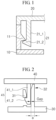
- FIG. 1 is a side view of a hook coupling structure in accordance with the related art.
- the hook coupling structure typically provided in accordance with the related art includes a first structure 10 that is formed by injection molding and disposed as a lower component and a second structure 20 that is disposed above the first structure 10 and has a shape corresponding to the first structure 10.
- the first structure 10 includes a locking projection 11 that protrudes outward from a predetermined area inside a side wall part
- the second structure 20 includes a hook part 21 that includes a body 21_1 and a protrusion part 21_2.
- the body is disposed at a position corresponding to the locking projection 11 and extends downward from the second structure 20, and the protrusion part extends from the body 21_1 and protrudes toward the locking projection 11.
- the hook part 21 is elastically deformable by a predetermined amount.
- the protrusion part 21_2 is locked in the locking projection 11 to couple the first structure 10 and the second structure 20, while the hook part 21 is moved back by the locking projection 11, elastically deformed by a certain amount, then recovered.
- the hook part 21 is moved back and separated from the locking projection 11 when the entire structure is impacted after the first structure 10 and the second structure 20 are coupled to each other. As a result, the first structure 10 and the second structure 20 may be disconnected.
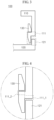
- FIG. 2 is a side view of another hook coupling structure obtained by improving the hook coupling structure in accordance with the related art.
- another hook coupling structure includes a first structure 30 that is disposed as a lower component and a second structure 40 that is disposed above the first structure 30 and has a shape corresponding to the first structure 30.
- the first structure When applied to a battery pack, the first structure may serve as a lower case, and the second structure may serve as an upper case.
- a locking projection 31 protrudes outward from a predetermined area inside a side wall part, and a support 32 extends upward from the first structure 30 and is spaced a predetermined interval from the locking projection 31.
- a hook part 41 includes a body 41_1 that is disposed between the locking projection 31 and the support 32 and extends downward from the second structure 40 and a protrusion part 41_2 that extends from the body 41_1 and protrudes toward the locking projection 31.
- the hook part 41 and the support 32 may be elastically deformed by a predetermined amount, and when the first structure 30 and the second structure 40 are coupled to each other, the hook part 41 is inserted between the locking projection 31 and the support 32. Accordingly, when the hook part 41 is inserted, the protrusion part 41_2 is locked in the locking projection 31 to couple the first structure 30 and the second structure 40, while the hook part 41 and the support 32 are elastically deformed by a certain amount and then recovered.
- the first structure 30 and the second structure 40 may not be disconnected from each other even when the entire structure is impacted after the first structure 30 and the second structure 40 are coupled to each other.
- EP3766792 and EP2207223A1 describe a hook coupling structure for a battery pack.
- the present invention provides a battery pack case according to claim 1, comprising a hook coupling structure for reducing a size of a structure body and a device according to claim 2, comprising said battery pack case.
- a hook coupling structure includes: an upper structure body 110 including a hook part 111 that extends downward from an edge and has an end portion bent to the inside; and a lower structure body 120 including a protrusion part 121 and coupled to the upper structure body, the protrusion part being lifted upward from an edge and disposed inside the hook part 111, wherein the lower structure body includes a locking projection 130 that is formed, at a position corresponding to an upper portion of the hook part 111 of the upper structure body 110, by protruding an inner surface of the lower structure body outward.
- the hook part 111 is inserted between the locking projection 130 and the protrusion part 121 to establish a coupling.
- the hook part may have: a first bent surface 111_1 that is a surface formed through bending and is in contact with the protrusion part 121 of the lower structure body; and a second bent surface 111_2 that is a surface formed through bending and is in contact with the locking projection 130.
- the first bent surface of the hook part may have a thickness greater than or equal to that of the protrusion part.
- the second bent surface of the hook part may have a thickness less than that of the locking projection.
- An insertion-coupling ridge 140 may be defined between the locking projection and the protrusion part of the lower structure body so that a bent portion of the hook part is positioned therein.
- a battery pack case includes: a battery pack lower case 300 having an insertion-coupling ridge defined in a predetermined area of an edge; and a battery pack upper case 200 including a hook part 210 that has an end portion bent at a position corresponding to the insertion-coupling ridge of the battery pack lower case, wherein the insertion-coupling ridge of the lower case and the hook part of the upper case are coupled to each other to establish a hook coupling structure.
- the battery pack lower case may include: a locking projection 310 positioned at a height to be in contact with an upper surface of the hook part and disposed on a plane adjacent to a plane in which the hook part is disposed, the locking projection protruding outward so that the hook part of the battery pack upper case is locked therein; and a protrusion part 320 positioned at a height to be in contact with a lower surface of the hook part and disposed on a plane identical to a plane in which the hook part is disposed, the protrusion part being lifted upward to support the hook part.
- the hook part of the battery pack upper case may have: a first bent surface 211 that is a surface formed through bending and is in contact with the protrusion part 320 of the lower structure body; and a second bent surface 212 that is a surface formed through bending and is in contact with the locking projection 310.
- a hook coupling structure includes: an upper structure body 510 including a hook part 511 that extends from an upper surface and has a protruding end portion; and a lower structure body 520 including a through-hole 530 and a locking projection 540, the through-hole formed by punching a predetermined area of a bottom surface so that a predetermined area of the hook part is disposed inside the bottom surface, the locking projection being formed, at a position corresponding to an upper portion of the hook part 511 of the upper structure body 510, by protruding an inner surface of the lower structure body outward.
- the predetermined area of the hook part is inserted into the through-hole to establish a coupling.
- the bottom surface may include: a first bottom part 521 positioned on one side of the through-hole; and a second bottom part 522 positioned on the other side of the through-hole.
- the bottom part in an area, in which the locking projection is not positioned may support a predetermined area on a non-protruding side of the hook part.
- An insertion-coupling ridge 550 may be defined between the locking projection of the lower structure and the through-hole so that a bent portion of the hook part is positioned to the inside thereof.
- the bent portion of the hook part may have a thickness greater than that of an extension portion of the hook part.
- the through-hole may have a size greater than or equal to the thickness of the bent portion.
- a battery pack case includes: a battery pack lower case 700 having an insertion-coupling ridge defined in a predetermined area on a bottom surface; and a battery pack upper case 600 including a hook part 610 with a bent portion 611 in which an end portion protrudes at a position corresponding to the insertion-coupling ridge of the battery pack lower case.
- the insertion-coupling ridge of the lower case and the hook part of the upper case are coupled to each other to establish a hook coupling structure.
- the battery pack lower case may include: a through-hole 730 formed by punching a predetermined area on the bottom surface of the battery pack lower case so that a predetermined area of the bent portion of the battery pack upper case is disposed to the inside; and a locking projection 740 positioned, while spaced a predetermined height from the through-hole, in a predetermined area that is on a side surface of the battery pack lower case and corresponds to the hook part of the battery pack upper case, wherein the bent portion of the battery pack upper case is locked in the locking projection.
- the battery pack lower case may further include: a side wall part 710 positioned on one side of the through-hole; and a bottom part 720 positioned on the other side of the through-hole.
- the bottom part may support a predetermined area on a non-protruding side of the bent portion of the hook part.
- the insertion-coupling ridge 750 may be defined between the locking projection and the bottom surface so that the bent portion of the hook part is positioned between the locking projection and the through-hole of the bottom surface.
- a device includes the battery pack case.
- a structure body is used instead of the support in accordance with the related art which is separately disposed to prevent the hook from being moved back, and thus the support may be removed to increase the space utilization rate.
- first and second are used herein to describe various elements, these elements should not be limited by these numbers.
- the terms are only used to distinguish one component from other components.
- a first element can be referred to as a second element, and similarly a second element can be referred to as a first element without departing from the scope of the present invention.
- the terms herein are used only for explaining a specific embodiment while not intended to limit the present invention.
- the expression of a singular form includes plural forms unless definitely indicating a particular case in terms of the context.
- a protrusion is formed by lifting an edge of a lower structure body in which the hook coupling structure is provided, and a hook part is supported by the protrusion so that the hook part is not moved back after locked in a locking projection. Therefore, a space utilization rate of the hook coupling structure may increase.
- FIG. 3 is a side view of the hook coupling structure in accordance with example.
- a hook coupling structure 100 includes an upper structure body 110 that includes a hook part 111 that extends downward from an edge and has an end portion bent to the inside, a lower structure body 120 that includes a protrusion part 121 lifted upward from an edge and disposed inside the hook part 111, and a locking projection 130 in which the hook part 111 of the upper structure body 110 is locked.
- the hook part is inserted between the locking projection 130 and the protrusion part 121 to establish a coupling.
- the upper structure body 110 includes the hook part 111 that extends downward from the edge and has the end portion bent to the inside, and is made of a material elastically deformable by a predetermined amount so as to be easily inserted between the locking projection 130 and the protrusion part 121.
- the hook part 111 will be described in detail with reference to FIG. 4 .
- FIG. 4 is an enlarged side view of the hook part in accordance with an example.
- the hook part 111 includes a first bent surface 111_1 that is a surface formed through bending and is in contact with the protrusion part 121 of the lower structure body and a second bent surface 111_2 that is a surface formed through bending and is in contact with the locking projection 130.
- the first bent surface 111_1 is a surface formed by bending once the edge of the upper structure body 110.
- the first bent surface 111_1 has a thickness equal to or greater by a predetermined range than that of an upper surface of the protrusion part 121.
- the first bent surface 111_1 When the thickness of the first bent surface 111_1 is less than that of the upper surface of the protrusion part 121, the end portion of the hook part 111 may not be sufficiently locked in the protrusion part 121. Also, when the thickness of the first bent surface 111_1 is excessively greater by the predetermined range than that of the upper surface of the protrusion part 121, a tight coupling is not established due to a gap between the end portion of the hook part 111 and the protrusion part 121 after the hook coupling. Thus, the first bent surface is provided having an appropriately large thickness.
- the second bent surface 111_2 is a surface that is formed by bending once again after the first bent surface 111_1 is formed by bending once.
- the second bent surface 111_2 has a thickness equal to that of a lower surface of the locking projection 130.
- the thickness of the second bent surface 111_2 is less than that of the lower surface of the locking projection 130, the end portion of the hook part 111 may be separated from the locking projection after the hook coupling due to an impact on an assembly structure.
- the thickness of the second bent surface 111_2 is greater than that of the lower surface of the locking projection 130, the entire thickness of the hook coupling structure may increase.
- the end portion of the hook part 111 has one side having a parallel shape and the other side having a shape gradually narrowed downward, and thus may be easily inserted between the locking projection 130 and the protrusion part 121.
- the one side of the end portion of the hook part 111 has the parallel shape so that a force to be supported by the protrusion part 121 is not dispersed, but the shape of the one side is not limited thereto.
- the lower structure body 120 includes the protrusion part 121 that is lifted upward from the edge and disposed inside the hook part 111, and a height of the lifted protrusion part 121 is equal to a length of the end portion of the hook part 111 or greater than that of the end portion of the hook part.
- a height of the lifted protrusion part 121 is less than the length of the end portion of the hook part 111, a supporting force of the hook part 111 is weak, and the coupling may not be maintained.
- the hook coupling structure in accordance with the related art as illustrated in FIG. 2 includes the first structure 30 that is disposed as the lower component and the second structure 40 that is disposed above the first structure 30 and has the shape corresponding to the first structure 30.
- the locking projection 31 protrudes outward from the predetermined area inside the side wall part, and the support 32 extends upward from the first structure 30 and is spaced the predetermined interval from the locking projection 31.
- the hook part 41 includes the body 41_1 that is disposed between the locking projection 31 and the support 32 and extends downward from the second structure 40 and the protrusion part 41_2 that extends from the body 41_1 and protrudes toward the locking projection 31.
- the support 32 is removed from the hook coupling structure in accordance with the related art so as to improve the space efficiency, and the hook part 111 bent twice and the protrusion part 121 for supporting the hook part 111 are provided as in the present application. As a result, the space utilization of the hook coupling structure increases.
- the locking projection 130 is formed, at a position corresponding to an upper portion of the hook part 111 of the upper structure body 110, by protruding an inner surface of the lower structure body outward. The hook part 111 of the upper structure body 110 is locked in the locking projection 130.
- an insertion-coupling ridge 140 is defined between the locking projection 130 and the protrusion part 121 so that the hook part 111 is positioned therein, which will be described in detail with reference to FIG. 5 .
- FIG. 5 is a side view of the hook coupling structure before the hook part in accordance with an example is inserted.
- a length of the insertion-coupling ridge 140 from a left corner to a right corner that is in contact with an upper surface of the protrusion part 121 is equal to a length from the first bent surface 111_1 to the second bent surface 111_2. Therefore, the hook part 111 may be easily inserted into the insertion-coupling ridge 140.
- the hook coupling structure is applied to various structure bodies of a case in which hook structure bodies are coupled to each other to create a predetermined space, thereby achieving a further improvement in space efficiency for the structure body when compared to the related art.
- the battery pack case is a battery pack case including the hook coupling structure in accordance with the above-described example.
- a hook part provided in a battery pack upper case is bent twice to define a predetermined space, and a protrusion lifted from an edge of a battery pack lower case is disposed inside the predetermined space of the hook part. As a result, the hook part may be supported without being moved back.
- FIG. 6 is a view of an inner structure of the battery pack case in accordance with an example of the present invention.
- FIG. 6 is a view in which a portion of an upper surface is cut to show the inside where a hook coupling structure is provided, but a structure of a battery pack upper case is typically provided in a shape in which the upper surface is fully covered.
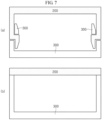
- FIG. 7 is a cross-sectional view taken along line A-A' in an area with the hook coupling structure within the battery pack case and (b) of FIG. 7 is a cross-sectional view taken along line B-B' in an area without the hook coupling structure within the battery pack case.
- FIG. 8 is a side view of the hook coupling structure in the battery pack case in accordance with an example.
- the battery pack case includes a battery pack lower case 300 having an insertion-coupling ridge defined in a predetermined area of an edge and a battery pack upper case 200 including a hook part 210 that has an end portion bent at a position corresponding to the insertion-coupling ridge of the battery pack lower case.
- the insertion-coupling ridge of the lower case and the hook part of the upper case are coupled to each other to establish the hook coupling structure.
- a plurality of hook coupling structures may be provided at corners to increase a coupling force between the upper case and the lower case, or a coupling structure may be provided over the entire edges of the case.
- the hook coupling structure is provided at each of the corners of the battery pack upper case 200, and the hook coupling structure is provided at each of both sides as illustrated in the cross-sectional area taken along line A-A'.
- the hook part 210 extends from the battery pack upper case 200 over a predetermined range and is coupled to the battery pack lower case 300.
- the battery pack upper case 200 in an area taken along line B-B' in which the hook coupling structure is not provided, the battery pack upper case 200 has a height less by a predetermined range than a height in the area of line A-A'.
- This structure with the hook coupling structure and without the hook coupling structure may have a protrusion and recess shape to improve a coupling force for the structure itself.
- the lower case 300 has an insertion-coupling ridge 330 defined in a predetermined area of an edge, and will be described in detail with reference to FIG. 9 .
- FIG. 9 is a side view of the hook coupling structure before the hook part in the battery pack case in accordance with an example is inserted.
- the insertion-coupling ridge 330 is defined between the locking projection and a protrusion part of the battery pack lower case so that the hook part is positioned therein.
- a length of the insertion-coupling ridge 330 from a left corner to a right corner that is in contact with an upper surface of a protrusion part 320 is equal to a length from a first bent surface 211 to a second bent surface 212. Therefore, the hook part 210 may be easily inserted into the insertion-coupling ridge 330.
- the battery pack lower case 300 includes a locking projection 310 positioned at a height to be in contact with an upper surface of the hook part and disposed on a plane adjacent to a plane in which the hook part is disposed, the locking projection protruding outward so that the hook part of the battery pack upper case is locked therein, and the protrusion part 320 positioned at a height to be in contact with a lower surface of the hook part and disposed on a plane identical to a plane in which the hook part is disposed, the protrusion part being lifted upward to support the hook part.
- the locking projection 310 is formed, at a position corresponding to an upper portion of the hook part 111 of the upper structure body 110, by protruding an inner surface of the lower structure body outward.
- the hook part 111 of the upper structure body 110 is locked in the locking projection 130.
- the lower structure body 300 includes the protrusion part 320 that is lifted upward from the edge and disposed inside the hook part 211, and a height of the lifted protrusion part 320 is equal to a length of the end portion of the hook part 210 or greater than that of the end portion of the hook part.
- a height of the lifted protrusion part 320 is less than the length of the end portion of the hook part 210, a supporting force of the hook part 210 is weak, and the coupling may not be maintained.
- the hook coupling structure in accordance with the related art as illustrated in FIG. 2 includes the first structure 30 that is disposed as the lower component and the second structure 40 that is disposed above the first structure 30 and has the shape corresponding to the first structure 30.
- the locking projection 31 protrudes outward from the predetermined area inside the side wall part, and the support 32 extends upward from the first structure 30 and is spaced the predetermined interval from the locking projection 31.
- the hook part 41 includes the body 41_1 that is disposed between the locking projection 31 and the support 32 and extends downward from the second structure 40 and the protrusion part 41_2 that extends from the body 41_1 and protrudes toward the locking projection 31.
- the support 32 is removed from the hook coupling structure in accordance with the related art so as to improve the space efficiency, and the hook part 211 bent twice and the protrusion part 320 for supporting the hook part 211 are provided as in the present application. As a result, the space utilization of the hook coupling structure increases.
- the battery pack upper case 200 includes the hook part 210 that has an end portion bent at a position corresponding to the insertion-coupling ridge of the battery pack lower case.
- the hook part 210 is made of a material elastically deformable by a predetermined amount so as to be easily inserted between the locking projection 310 and the protrusion part 320.
- the hook part 210 includes the first bent surface 211 that is a surface formed through bending and is in contact with the protrusion part 320 of the lower structure body and the second bent surface 212 that is a surface formed through bending and is in contact with the locking projection 310, and will be described in more detail with reference to FIG. 9 .
- FIG. 10 is an enlarged side view of the hook part in the battery pack case in accordance with an example.
- the first bent surface 211 is a surface formed by bending once the edge of the upper case 200.
- the first bent surface 211 has a thickness equal to or greater by a predetermined range than that of an upper surface of the protrusion part 320.
- the end portion of the hook part 210 may not be sufficiently locked in the protrusion part 320. Also, when the thickness of the first bent surface 211 is excessively greater by the predetermined range than that of the upper surface of the protrusion part 320, a tight coupling is not established due to a gap between the end portion of the hook part 210 and the protrusion part 320 after the hook coupling. Thus, the first bent surface is provided having an appropriately large thickness.
- the second bent surface 212 is a surface that is formed by bending once again after the first bent surface 211 is formed by bending once.
- the second bent surface 212 has a thickness equal to that of a lower surface of the locking projection 310.
- the thickness of the second bent surface 212 is less by a predetermined range than that of the lower surface of the locking projection 310, the end portion of the hook part 210 may be separated from the locking projection after the hook coupling due to an impact on an assembly structure.
- the thickness of the second bent surface 212 is greater than that of the lower surface of the locking projection 310, the entire thickness of the hook coupling structure may increase.
- the end portion of the hook part 210 has one side having a parallel shape and the other side having a shape gradually narrowed downward, and thus may be easily inserted between the locking projection 310 and the protrusion part 320.
- the one side of the end portion of the hook part 210 has the parallel shape so that a force to be supported by the protrusion part 320 is not dispersed, but the shape of the one side is not limited thereto.
- the battery pack case increases in space utilization, and thus may have a smaller battery pack case size or be equipped with more battery cells to achieve an enhanced capacity, when compared to the related art.
- a device including the above-described battery pack case may have a smaller size than the related art or a further increased capacity than the related art.
- a through-hole is defined in a predetermined area on a bottom surface of a structure body in which the hook coupling structure is provided.
- a predetermined area of a hook part is disposed within the defined through-hole, and the hook part is supported by the protrusion so that the hook part is not moved back after locked in a locking projection. Therefore, a space utilization rate of the hook coupling structure may increase.
- FIG. 11 is a side view of a hook coupling structure.
- FIG. 12 is a side view of the hook coupling structure before a hook part in accordance with an example is inserted.
- a hook coupling structure 500 includes an upper structure body 510 including a hook part 511 that extends from an upper surface and has a protruding end portion and a lower structure body 520 including a through-hole 530 and a locking projection 540.
- the through-hole is formed by punching a predetermined area of a bottom surface so that a predetermined area of the hook part is disposed inside the bottom surface, and the locking projection is formed, at a position corresponding to an upper portion of the hook part 511 of the upper structure body 510, by protruding an inner surface of the lower structure body outward.
- the predetermined area of the hook part 511 is inserted into the through-hole to establish a coupling.
- the hook part 511 extends from the upper structure body 510 and has the protruding end portion.
- the hook part is made of a material elastically deformable by a predetermined amount so as to be easily inserted between the locking projection 540 and the through-hole 530.
- the hook part 511 has one side having a parallel shape and the other side having a shape gradually narrowed downward, and thus may be easily inserted between the locking projection 540 and the through-hole 530.
- the one side of the hook part 511 has the parallel shape so that a force to be supported by the bottom surface is not dispersed, but the shape of the one side is not limited thereto.
- the hook part has a thickness greater than an extension portion of the upper structure body 510, and thus a force to be retained in the locking projection 540 may increase.
- the bottom surface 520 is a lower surface of a structure body in which the hook coupling structure is provided, and the bottom surface includes a first bottom part 521 and a second bottom part 522.
- the bottom surface 520 includes the first bottom part 521 positioned on one side of the through-hole and the second bottom part 522 positioned on the other side of the through-hole.
- the bottom part in a direction, in which the locking projection is not positioned, supports a predetermined area on a non-protruding side of the hook part.
- the second bottom part supports the hook part 511 so that the hook part is not moved back.
- the predetermined area of the hook part and the second bottom part are disposed with a minimum gap or without a gap.
- the hook coupling structure in accordance with the related art as illustrated in FIG. 2 includes the first structure 30 that is disposed as a lower component and the second structure 40 that is disposed above the first structure 30 and has the shape corresponding to the first structure 30.
- the locking projection 31 protrudes outward from the predetermined area inside the side wall part, and the support 32 extends upward from the first structure 30 and is spaced the predetermined interval from the locking projection 31.
- the hook part 41 includes the body 41_1 that is disposed between the locking projection 31 and the support 32 and extends downward from the second structure 40 and the protrusion part 41_2 that extends from the body 41_1 and protrudes toward the locking projection 31.
- the support 32 is removed from the hook coupling structure in accordance with the related art so as to improve the space efficiency, and the hook part 511 is supported by using the bottom surface 520 as in the present application. As a result, the space utilization of the hook coupling structure increases.
- the through-hole 530 is formed by punching a predetermined area of the bottom surface so that a predetermined area of a bent portion is disposed inside the bottom surface, and the through-hole has a size greater than or equal to a thickness of the bent portion.
- the hook part 511 may be disposed inside the through-hole 530 having the size greater than or equal to the thickness of the hook part 511.
- the locking projection 540 is positioned, while spaced a predetermined height above from the through-hole, and the bent portion of the hook part is locked therein. A distance between the locking projection 540 and the second bottom part 522 is greater than the thickness of the hook part 511 of the hook part.
- an insertion-coupling ridge 550 is defined between the locking projection and the through-hole of the bottom surface so that the bent portion of the hook part is positioned therein.
- the hook coupling structure is applied to various structure bodies of a case in which hook structure bodies are coupled to each other to create a predetermined space, thereby achieving a further improvement in space efficiency for the structure body when compared to the related art.
- the battery pack case in accordance with the present invention is a battery pack case including the hook coupling structure in accordance with the above-described embodiment.
- a hook part is supported by a bottom surface of a battery pack lower case 700 so that the support part is not moved back.
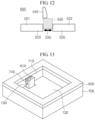
- FIG. 13 is a view of an inner structure of the battery pack case in accordance with the present invention.
- FIG. 13 is a view in which a portion of an upper surface is cut to show the inside where a hook coupling structure is provided, but a structure of a battery pack upper case is typically provided in a shape in which the upper surface is fully covered.
- the battery pack case in accordance with the present invention includes a battery pack lower case 700 equipped with the battery module therein and having an insertion-coupling ridge defined in a predetermined area on a bottom surface and a battery pack upper case 600 including a hook part that has a bent portion in which an end portion protrudes at a position corresponding to the insertion-coupling ridge of the battery pack lower case.
- the insertion-coupling ridge of the lower case and the hook part of the upper case are coupled to each other to establish the hook coupling structure.
- a plurality of hook coupling structures may be provided to increase a coupling force between the lower case and the upper case.
- the lower case 700 is equipped with the battery module therein and has the insertion-coupling ridge 750 defined in the predetermined area on the bottom surface, and will be described in detail with reference to FIG. 14 .
- FIG. 14 is a cut side view of a hook coupling structure in the battery pack case in accordance with the present invention.
- the battery pack lower case includes a through-hole 730 formed by punching a predetermined area on the bottom surface of the battery pack lower case so that a predetermined area of the bent portion of the battery pack upper case is disposed to the inside and a locking projection 740 positioned, while spaced a predetermined height from the through-hole, in a predetermined area that is on a side surface of the battery pack lower case and corresponds to the hook part of the battery pack upper case.
- the bent portion of the battery pack upper case is locked in the locking projection.
- the battery pack lower case further includes a side wall part 710 positioned on one side of the through-hole and a bottom part 720 positioned on the other side of the through-hole.
- the bottom part 720 supports a predetermined area on a non-protruding side of the bent portion of the hook part.
- the through-hole 730 has a size greater than or equal to a thickness of the bent portion so that the bent portion 611 is disposed to the inside.
- the side wall part 710 and the bottom part 720 have a structure in which the hook coupling structure in accordance with the embodiment is applied to the battery pack case.
- the hook part 610 is coupled to the locking projection 740 and supported by the bottom part 720 so that the hook part is not moved back.
- the predetermined area of the bent portion and the bottom part are disposed with a minimum gap or without a gap.
- the locking projection 740 protrudes from the side surface of the battery pack lower case to a predetermined area, and has a shape corresponding to the hook part 610.
- a hook coupling force increases as the surface area in contact with the hook part 610 increases.
- the locking projection has a thickness that is equal to a thickness of an extension portion of the hook part 610 in the upper case 600 and sufficient not to cause a reduction in a space utilization rate of the battery pack case.
- the battery pack upper case 600 includes the hook part 610 having the bent portion 611 in which an end portion protrudes at a position corresponding to the insertion-coupling ridge of the battery pack lower case.
- the hook part 610 includes the bent portion 611 that extends from an upper surface of the structure body and has the protruding end portion, and the hook part is made of a material elastically deformable by a predetermined amount so as to be easily inserted between the locking projection 740 and the through-hole 730.
- the bent portion 611 has one side having a parallel shape and the other side having a shape gradually narrowed downward, and thus may be easily inserted between the locking projection 740 and the through-hole 730.
- the one side of the hook part 611 has the parallel shape so that a force to be supported by the bottom surface is not dispersed, but the shape of the one side is not limited thereto.
- the bent portion 611 of the hook part has a thickness greater than an extension portion of the hook part, and thus a force to be retained in the locking projection 740 may increase.
- the insertion-coupling ridge 750 is defined between the locking projection and the through-hole of the bottom surface so that the bent portion is positioned therein, and will be described in detail with reference to FIG. 15 .
- FIG. 15 is a cut side view of the hook coupling structure in the battery pack case before the hook part in accordance with the present invention is inserted.
- the insertion-coupling ridge 750 is a space which is defined between the locking projection 740 and the through-hole 730 and in which the bent portion 611 of the hook part is positioned, and a distance to the bottom part 720 is greater than a diagonal length of the bent portion 611 of the hook part. This configuration enables the bent portion 611 to be easily inserted into the insertion-coupling ridge 750 when the upper case 600 and the lower case 700 are coupled to each other.
- the battery pack case in accordance with the present invention increases in space utilization, and thus may have a smaller battery pack case size or be equipped with more battery cells to achieve an enhanced capacity, when compared to the related art.
- a device including the above-described battery pack case may have a smaller size than the related art or a further increased capacity than the related art.
Landscapes
- Chemical & Material Sciences (AREA)
- Chemical Kinetics & Catalysis (AREA)
- Electrochemistry (AREA)
- General Chemical & Material Sciences (AREA)
- Engineering & Computer Science (AREA)
- Mechanical Engineering (AREA)
- Battery Mounting, Suspending (AREA)
- Rigid Containers With Two Or More Constituent Elements (AREA)
- Connection Of Plates (AREA)
Claims (2)
- Batteriepackgehäuse, umfassend:ein unteres Batteriepackgehäuse (700), welches eine Einführung-Kopplungsleiste (750) aufweist, welche in einem vorbestimmten Bereich an einer Bodenfläche definiert ist; undein oberes Batteriepackgehäuse (600), welches einen Hakenteil (610) mit einem gebogenen Abschnitt (611) umfasst, in welchem ein Endabschnitt an einer Position hervorsteht, welche der Einführung-Kopplungsleiste des unteren Batteriepackgehäuses entspricht,wobei die Einführung-Kopplungsleiste des unteren Gehäuses und der Hakenteil des oberen Gehäuses miteinander gekoppelt sind, um eine Haken-Kopplungsstruktur zu begründen, undwobei das untere Batteriepackgehäuse umfasst:ein Durchgangsloch (730), welches durch Lochen eines vorbestimmten Bereichs an der Bodenfläche des unteren Batteriepackgehäuses gebildet ist, sodass ein vorbestimmter Bereich des gebogenen Abschnitts des oberen Batteriepackgehäuse nach innen angeordnet ist; undeinen Sperrvorsprung (740), welcher, während er um eine vorbestimmte Höhe von dem Durchgangsloch beabstandet ist, in einem vorbestimmten Bereich positioniert ist, welcher an einer Seitenfläche des unteren Batteriepackgehäuses ist, und welcher dem Hakenteil des oberen Batteriepackgehäuses entspricht, wobei der gebogene Abschnitt des oberen Batteriepackgehäuses in dem Sperrvorsprung gesperrt ist,wobei das untere Batteriepackgehäuse ferner umfasst:einen Seitenwandteil (710), welcher an einer Seite des Durchgangslochs positioniert ist; undeinen Bodenteil (720), welcher an der anderen Seite des Durchgangslochs positioniert ist,wobei der Bodenteil einen vorbestimmten Bereich an einer nichthervorstehenden Seite des gebogenen Abschnitts des Hakenteils haltert; undwobei die Einführung-Kopplungsleiste (750) ein Raum ist, welcher zwischen dem Sperrvorsprung (740) und dem Durchgangsloch (730) definiert ist und in welchem der gebogene Abschnitt (611) des Hakenteils (610) positioniert ist.
- Vorrichtung, umfassend das Batteriepackgehäuse nach Anspruch 1.
Applications Claiming Priority (4)
| Application Number | Priority Date | Filing Date | Title |
|---|---|---|---|
| KR1020180140721A KR102700490B1 (ko) | 2018-11-15 | 2018-11-15 | 후크 결합구조 및 이를 사용한 배터리 팩 케이스 |
| KR1020180140720A KR102516125B1 (ko) | 2018-11-15 | 2018-11-15 | 후크 결합구조 및 이를 사용한 배터리 팩 케이스 |
| EP19883712.2A EP3766792A4 (de) | 2018-11-15 | 2019-11-11 | Hakenkopplungsstruktur und batteriepackgehäuse damit |
| PCT/KR2019/015286 WO2020101308A1 (ko) | 2018-11-15 | 2019-11-11 | 후크 결합구조 및 이를 사용한 배터리 팩 케이스 |
Related Parent Applications (1)
| Application Number | Title | Priority Date | Filing Date |
|---|---|---|---|
| EP19883712.2A Division EP3766792A4 (de) | 2018-11-15 | 2019-11-11 | Hakenkopplungsstruktur und batteriepackgehäuse damit |
Publications (2)
| Publication Number | Publication Date |
|---|---|
| EP4047727A1 EP4047727A1 (de) | 2022-08-24 |
| EP4047727B1 true EP4047727B1 (de) | 2025-04-02 |
Family
ID=70730333
Family Applications (2)
| Application Number | Title | Priority Date | Filing Date |
|---|---|---|---|
| EP22168629.8A Active EP4047727B1 (de) | 2018-11-15 | 2019-11-11 | Batteriepackgehäuse mit hakenkopplungsstruktur |
| EP19883712.2A Pending EP3766792A4 (de) | 2018-11-15 | 2019-11-11 | Hakenkopplungsstruktur und batteriepackgehäuse damit |
Family Applications After (1)
| Application Number | Title | Priority Date | Filing Date |
|---|---|---|---|
| EP19883712.2A Pending EP3766792A4 (de) | 2018-11-15 | 2019-11-11 | Hakenkopplungsstruktur und batteriepackgehäuse damit |
Country Status (7)
| Country | Link |
|---|---|
| US (1) | US20210159568A1 (de) |
| EP (2) | EP4047727B1 (de) |
| JP (1) | JP7258042B2 (de) |
| CN (1) | CN111936392B (de) |
| ES (1) | ES3026222T3 (de) |
| HU (1) | HUE071119T2 (de) |
| WO (1) | WO2020101308A1 (de) |
Families Citing this family (3)
| Publication number | Priority date | Publication date | Assignee | Title |
|---|---|---|---|---|
| EP4007464A4 (de) * | 2019-08-22 | 2022-08-17 | Bitmain Technologies Inc. | Gehäuseanordnung für server und server damit |
| DE102022107399A1 (de) | 2022-03-29 | 2023-10-05 | Bayerische Motoren Werke Aktiengesellschaft | Antriebsbatterie mit hängend getragenem Zwischenboden sowie Kraftfahrzeug mit solch einer Antriebsbatterie |
| EP4687188A1 (de) * | 2024-07-31 | 2026-02-04 | Samsung Sdi Co., Ltd. | Batteriegehäuse, batteriepack und verfahren zur herstellung eines batteriegehäuses |
Family Cites Families (19)
| Publication number | Priority date | Publication date | Assignee | Title |
|---|---|---|---|---|
| JPS5861826A (ja) | 1981-10-09 | 1983-04-13 | Electric Power Dev Co Ltd | 多列水中造粒装置 |
| JPH0828209B2 (ja) | 1988-10-17 | 1996-03-21 | 松下電器産業株式会社 | 鉛蓄電池のパック構造 |
| GB9023278D0 (en) * | 1990-10-25 | 1990-12-05 | Lucas Ind Plc | Non-reusable container |
| JPH0684762B2 (ja) * | 1992-04-01 | 1994-10-26 | 株式会社川辺金属商会 | 板状体相互の連結装置 |
| JP3690022B2 (ja) * | 1996-12-05 | 2005-08-31 | オムロン株式会社 | 制御機器の取付構造 |
| US6227913B1 (en) * | 1998-06-22 | 2001-05-08 | Cooper Technologies Company | Fuse bus member and connector assembly |
| JP2002343320A (ja) * | 2001-05-10 | 2002-11-29 | Sony Corp | 収納ケース |
| JP2005064442A (ja) * | 2003-07-30 | 2005-03-10 | Orion Denki Kk | キャビネットを備えた電子機器 |
| EP1909547A4 (de) * | 2005-07-27 | 2010-10-27 | Nec Corp | Elektronisches gerät und dafür verwendete hülle |
| KR100933424B1 (ko) * | 2005-11-23 | 2009-12-23 | 주식회사 엘지화학 | 노트북 컴퓨터에서의 전지팩 락커 구조 |
| KR20100076528A (ko) * | 2008-12-26 | 2010-07-06 | 권석웅 | 음식물 고정구 |
| US9184425B2 (en) * | 2009-01-13 | 2015-11-10 | Samsung Sdi Co., Ltd. | Battery pack |
| JP2011124085A (ja) * | 2009-12-10 | 2011-06-23 | Sanyo Electric Co Ltd | 電池パック |
| JP5480043B2 (ja) * | 2010-07-08 | 2014-04-23 | 株式会社東海理化電機製作所 | 携帯機 |
| JP2012102814A (ja) * | 2010-11-10 | 2012-05-31 | Kanto Auto Works Ltd | リテーナ及びリテーナを用いた取付構造 |
| JP5398032B2 (ja) * | 2011-07-15 | 2014-01-29 | Necインフロンティア株式会社 | 筐体 |
| KR101996421B1 (ko) * | 2013-07-04 | 2019-07-04 | 에스케이이노베이션 주식회사 | 배터리 모듈 |
| WO2015187003A1 (en) * | 2014-06-05 | 2015-12-10 | N.V. Nutricia | Lid structure for container |
| KR20170114606A (ko) * | 2016-04-05 | 2017-10-16 | (주)라도 | 차량용 에어 덕트 조립체 |
-
2019
- 2019-11-11 EP EP22168629.8A patent/EP4047727B1/de active Active
- 2019-11-11 JP JP2020557235A patent/JP7258042B2/ja active Active
- 2019-11-11 ES ES22168629T patent/ES3026222T3/es active Active
- 2019-11-11 WO PCT/KR2019/015286 patent/WO2020101308A1/ko not_active Ceased
- 2019-11-11 EP EP19883712.2A patent/EP3766792A4/de active Pending
- 2019-11-11 US US17/058,205 patent/US20210159568A1/en active Pending
- 2019-11-11 HU HUE22168629A patent/HUE071119T2/hu unknown
- 2019-11-11 CN CN201980023145.4A patent/CN111936392B/zh active Active
Also Published As
| Publication number | Publication date |
|---|---|
| EP3766792A4 (de) | 2021-10-13 |
| EP3766792A1 (de) | 2021-01-20 |
| EP4047727A1 (de) | 2022-08-24 |
| HUE071119T2 (hu) | 2025-08-28 |
| WO2020101308A1 (ko) | 2020-05-22 |
| CN111936392A (zh) | 2020-11-13 |
| JP2021519898A (ja) | 2021-08-12 |
| CN111936392B (zh) | 2023-01-10 |
| JP7258042B2 (ja) | 2023-04-14 |
| ES3026222T3 (en) | 2025-06-10 |
| US20210159568A1 (en) | 2021-05-27 |
Similar Documents
| Publication | Publication Date | Title |
|---|---|---|
| EP4047727B1 (de) | Batteriepackgehäuse mit hakenkopplungsstruktur | |
| EP4366160A1 (de) | Profilanordnung, profil, profilverstärkungselement, photovoltaikmodulrahmen und photovoltaikanlage | |
| CN101639083B (zh) | 离心散热风扇及其扇框 | |
| JP2013064492A (ja) | クリップ | |
| US9041867B2 (en) | Display casing and cover structure thereof | |
| US20140034588A1 (en) | Frame with connection member for connecting flanges of the frame | |
| US9563230B2 (en) | Display assembly | |
| US10522867B2 (en) | End plate for a fuel cell | |
| KR102700490B1 (ko) | 후크 결합구조 및 이를 사용한 배터리 팩 케이스 | |
| CN210629412U (zh) | 光伏组件及其边框 | |
| CN109579424B (zh) | 冰箱内的搁架组件和冰箱 | |
| CN209947305U (zh) | 卡扣结构及具有卡扣结构的显示面板 | |
| US20120134127A1 (en) | Electronic device with clip card installation assembly | |
| US12206202B2 (en) | Holding frame, plug-in connector and electronic device | |
| US12224408B2 (en) | Battery pack having BMU component damage prevention structure | |
| KR101934963B1 (ko) | 판형 부품용 트레이 | |
| CN107304514A (zh) | 一种洗衣机上盖及洗衣机 | |
| US8324514B2 (en) | Mounting device for electronic component and electronic apparatus using the same | |
| CN205610708U (zh) | 用于安装电话卡的卡托装置及移动设备 | |
| CN107069276B (zh) | 一种连接器 | |
| KR102516125B1 (ko) | 후크 결합구조 및 이를 사용한 배터리 팩 케이스 | |
| CN222602886U (zh) | 屏蔽罩和显示装置 | |
| CN219351151U (zh) | 一种灌胶风扇出线结构 | |
| CN111664620A (zh) | 一种层架固定组件及智能冰箱 | |
| CN218498515U (zh) | 连接器 |
Legal Events
| Date | Code | Title | Description |
|---|---|---|---|
| PUAI | Public reference made under article 153(3) epc to a published international application that has entered the european phase |
Free format text: ORIGINAL CODE: 0009012 |
|
| STAA | Information on the status of an ep patent application or granted ep patent |
Free format text: STATUS: REQUEST FOR EXAMINATION WAS MADE |
|
| 17P | Request for examination filed |
Effective date: 20220415 |
|
| AC | Divisional application: reference to earlier application |
Ref document number: 3766792 Country of ref document: EP Kind code of ref document: P |
|
| AK | Designated contracting states |
Kind code of ref document: A1 Designated state(s): AL AT BE BG CH CY CZ DE DK EE ES FI FR GB GR HR HU IE IS IT LI LT LU LV MC MK MT NL NO PL PT RO RS SE SI SK SM TR |
|
| GRAP | Despatch of communication of intention to grant a patent |
Free format text: ORIGINAL CODE: EPIDOSNIGR1 |
|
| STAA | Information on the status of an ep patent application or granted ep patent |
Free format text: STATUS: GRANT OF PATENT IS INTENDED |
|
| RIC1 | Information provided on ipc code assigned before grant |
Ipc: B65D 45/16 20060101ALI20241210BHEP Ipc: H01M 50/262 20210101ALI20241210BHEP Ipc: H01M 50/242 20210101ALI20241210BHEP Ipc: H01M 50/258 20210101ALI20241210BHEP Ipc: H01M 50/20 20210101AFI20241210BHEP |
|
| INTG | Intention to grant announced |
Effective date: 20250114 |
|
| RIN1 | Information on inventor provided before grant (corrected) |
Inventor name: LEE, YOUNG KYU Inventor name: SON, YOUNG SU Inventor name: JANG, JAE YOUNG Inventor name: KIM, SANG JIN |
|
| GRAS | Grant fee paid |
Free format text: ORIGINAL CODE: EPIDOSNIGR3 |
|
| GRAA | (expected) grant |
Free format text: ORIGINAL CODE: 0009210 |
|
| STAA | Information on the status of an ep patent application or granted ep patent |
Free format text: STATUS: THE PATENT HAS BEEN GRANTED |
|
| P01 | Opt-out of the competence of the unified patent court (upc) registered |
Free format text: CASE NUMBER: APP_6049/2025 Effective date: 20250205 |
|
| AC | Divisional application: reference to earlier application |
Ref document number: 3766792 Country of ref document: EP Kind code of ref document: P |
|
| AK | Designated contracting states |
Kind code of ref document: B1 Designated state(s): AL AT BE BG CH CY CZ DE DK EE ES FI FR GB GR HR HU IE IS IT LI LT LU LV MC MK MT NL NO PL PT RO RS SE SI SK SM TR |
|
| REG | Reference to a national code |
Ref country code: GB Ref legal event code: FG4D |
|
| REG | Reference to a national code |
Ref country code: CH Ref legal event code: EP |
|
| REG | Reference to a national code |
Ref country code: IE Ref legal event code: FG4D |
|
| REG | Reference to a national code |
Ref country code: DE Ref legal event code: R096 Ref document number: 602019068307 Country of ref document: DE |
|
| REG | Reference to a national code |
Ref country code: ES Ref legal event code: FG2A Ref document number: 3026222 Country of ref document: ES Kind code of ref document: T3 Effective date: 20250610 |
|
| REG | Reference to a national code |
Ref country code: NL Ref legal event code: MP Effective date: 20250402 |
|
| REG | Reference to a national code |
Ref country code: HU Ref legal event code: AG4A Ref document number: E071119 Country of ref document: HU |
|
| PG25 | Lapsed in a contracting state [announced via postgrant information from national office to epo] |
Ref country code: NL Free format text: LAPSE BECAUSE OF FAILURE TO SUBMIT A TRANSLATION OF THE DESCRIPTION OR TO PAY THE FEE WITHIN THE PRESCRIBED TIME-LIMIT Effective date: 20250402 |
|
| REG | Reference to a national code |
Ref country code: AT Ref legal event code: MK05 Ref document number: 1782236 Country of ref document: AT Kind code of ref document: T Effective date: 20250402 |
|
| PG25 | Lapsed in a contracting state [announced via postgrant information from national office to epo] |
Ref country code: PT Free format text: LAPSE BECAUSE OF FAILURE TO SUBMIT A TRANSLATION OF THE DESCRIPTION OR TO PAY THE FEE WITHIN THE PRESCRIBED TIME-LIMIT Effective date: 20250804 Ref country code: FI Free format text: LAPSE BECAUSE OF FAILURE TO SUBMIT A TRANSLATION OF THE DESCRIPTION OR TO PAY THE FEE WITHIN THE PRESCRIBED TIME-LIMIT Effective date: 20250402 |
|
| REG | Reference to a national code |
Ref country code: LT Ref legal event code: MG9D |
|
| PG25 | Lapsed in a contracting state [announced via postgrant information from national office to epo] |
Ref country code: NO Free format text: LAPSE BECAUSE OF FAILURE TO SUBMIT A TRANSLATION OF THE DESCRIPTION OR TO PAY THE FEE WITHIN THE PRESCRIBED TIME-LIMIT Effective date: 20250702 Ref country code: GR Free format text: LAPSE BECAUSE OF FAILURE TO SUBMIT A TRANSLATION OF THE DESCRIPTION OR TO PAY THE FEE WITHIN THE PRESCRIBED TIME-LIMIT Effective date: 20250703 |
|
| PG25 | Lapsed in a contracting state [announced via postgrant information from national office to epo] |
Ref country code: PL Free format text: LAPSE BECAUSE OF FAILURE TO SUBMIT A TRANSLATION OF THE DESCRIPTION OR TO PAY THE FEE WITHIN THE PRESCRIBED TIME-LIMIT Effective date: 20250402 |
|
| PG25 | Lapsed in a contracting state [announced via postgrant information from national office to epo] |
Ref country code: BG Free format text: LAPSE BECAUSE OF FAILURE TO SUBMIT A TRANSLATION OF THE DESCRIPTION OR TO PAY THE FEE WITHIN THE PRESCRIBED TIME-LIMIT Effective date: 20250402 |
|
| PG25 | Lapsed in a contracting state [announced via postgrant information from national office to epo] |
Ref country code: HR Free format text: LAPSE BECAUSE OF FAILURE TO SUBMIT A TRANSLATION OF THE DESCRIPTION OR TO PAY THE FEE WITHIN THE PRESCRIBED TIME-LIMIT Effective date: 20250402 |
|
| PG25 | Lapsed in a contracting state [announced via postgrant information from national office to epo] |
Ref country code: AT Free format text: LAPSE BECAUSE OF FAILURE TO SUBMIT A TRANSLATION OF THE DESCRIPTION OR TO PAY THE FEE WITHIN THE PRESCRIBED TIME-LIMIT Effective date: 20250402 |
|
| PG25 | Lapsed in a contracting state [announced via postgrant information from national office to epo] |
Ref country code: RS Free format text: LAPSE BECAUSE OF FAILURE TO SUBMIT A TRANSLATION OF THE DESCRIPTION OR TO PAY THE FEE WITHIN THE PRESCRIBED TIME-LIMIT Effective date: 20250702 |
|
| PG25 | Lapsed in a contracting state [announced via postgrant information from national office to epo] |
Ref country code: IS Free format text: LAPSE BECAUSE OF FAILURE TO SUBMIT A TRANSLATION OF THE DESCRIPTION OR TO PAY THE FEE WITHIN THE PRESCRIBED TIME-LIMIT Effective date: 20250802 |
|
| PG25 | Lapsed in a contracting state [announced via postgrant information from national office to epo] |
Ref country code: LV Free format text: LAPSE BECAUSE OF FAILURE TO SUBMIT A TRANSLATION OF THE DESCRIPTION OR TO PAY THE FEE WITHIN THE PRESCRIBED TIME-LIMIT Effective date: 20250402 |
|
| PGFP | Annual fee paid to national office [announced via postgrant information from national office to epo] |
Ref country code: HU Payment date: 20251127 Year of fee payment: 7 |
|
| PGFP | Annual fee paid to national office [announced via postgrant information from national office to epo] |
Ref country code: DE Payment date: 20251020 Year of fee payment: 7 |
|
| PGFP | Annual fee paid to national office [announced via postgrant information from national office to epo] |
Ref country code: GB Payment date: 20251023 Year of fee payment: 7 |
|
| PG25 | Lapsed in a contracting state [announced via postgrant information from national office to epo] |
Ref country code: SM Free format text: LAPSE BECAUSE OF FAILURE TO SUBMIT A TRANSLATION OF THE DESCRIPTION OR TO PAY THE FEE WITHIN THE PRESCRIBED TIME-LIMIT Effective date: 20250402 Ref country code: DK Free format text: LAPSE BECAUSE OF FAILURE TO SUBMIT A TRANSLATION OF THE DESCRIPTION OR TO PAY THE FEE WITHIN THE PRESCRIBED TIME-LIMIT Effective date: 20250402 |
|
| PGFP | Annual fee paid to national office [announced via postgrant information from national office to epo] |
Ref country code: FR Payment date: 20251021 Year of fee payment: 7 |
|
| PGFP | Annual fee paid to national office [announced via postgrant information from national office to epo] |
Ref country code: BE Payment date: 20251020 Year of fee payment: 7 |
|
| PG25 | Lapsed in a contracting state [announced via postgrant information from national office to epo] |
Ref country code: CZ Free format text: LAPSE BECAUSE OF FAILURE TO SUBMIT A TRANSLATION OF THE DESCRIPTION OR TO PAY THE FEE WITHIN THE PRESCRIBED TIME-LIMIT Effective date: 20250402 |
|
| PG25 | Lapsed in a contracting state [announced via postgrant information from national office to epo] |
Ref country code: EE Free format text: LAPSE BECAUSE OF FAILURE TO SUBMIT A TRANSLATION OF THE DESCRIPTION OR TO PAY THE FEE WITHIN THE PRESCRIBED TIME-LIMIT Effective date: 20250402 |
|
| PG25 | Lapsed in a contracting state [announced via postgrant information from national office to epo] |
Ref country code: SK Free format text: LAPSE BECAUSE OF FAILURE TO SUBMIT A TRANSLATION OF THE DESCRIPTION OR TO PAY THE FEE WITHIN THE PRESCRIBED TIME-LIMIT Effective date: 20250402 |
|
| PG25 | Lapsed in a contracting state [announced via postgrant information from national office to epo] |
Ref country code: IT Free format text: LAPSE BECAUSE OF FAILURE TO SUBMIT A TRANSLATION OF THE DESCRIPTION OR TO PAY THE FEE WITHIN THE PRESCRIBED TIME-LIMIT Effective date: 20250402 |
|
| PGFP | Annual fee paid to national office [announced via postgrant information from national office to epo] |
Ref country code: ES Payment date: 20251215 Year of fee payment: 7 |
|
| PLBE | No opposition filed within time limit |
Free format text: ORIGINAL CODE: 0009261 |
|
| STAA | Information on the status of an ep patent application or granted ep patent |
Free format text: STATUS: NO OPPOSITION FILED WITHIN TIME LIMIT |
|
| PG25 | Lapsed in a contracting state [announced via postgrant information from national office to epo] |
Ref country code: RO Free format text: LAPSE BECAUSE OF FAILURE TO SUBMIT A TRANSLATION OF THE DESCRIPTION OR TO PAY THE FEE WITHIN THE PRESCRIBED TIME-LIMIT Effective date: 20250402 |
|
| REG | Reference to a national code |
Ref country code: CH Ref legal event code: L10 Free format text: ST27 STATUS EVENT CODE: U-0-0-L10-L00 (AS PROVIDED BY THE NATIONAL OFFICE) Effective date: 20260211 |