EP4034005B1 - Läsionskreuzender stosswellenkatheter - Google Patents
Läsionskreuzender stosswellenkatheter Download PDFInfo
- Publication number
- EP4034005B1 EP4034005B1 EP20786114.7A EP20786114A EP4034005B1 EP 4034005 B1 EP4034005 B1 EP 4034005B1 EP 20786114 A EP20786114 A EP 20786114A EP 4034005 B1 EP4034005 B1 EP 4034005B1
- Authority
- EP
- European Patent Office
- Prior art keywords
- wire
- catheter
- sheath
- electrode pair
- conductive
- Prior art date
- Legal status (The legal status is an assumption and is not a legal conclusion. Google has not performed a legal analysis and makes no representation as to the accuracy of the status listed.)
- Active
Links
Images



Classifications
-
- A—HUMAN NECESSITIES
- A61—MEDICAL OR VETERINARY SCIENCE; HYGIENE
- A61B—DIAGNOSIS; SURGERY; IDENTIFICATION
- A61B17/00—Surgical instruments, devices or methods
- A61B17/22—Implements for squeezing-off ulcers or the like on inner organs of the body; Implements for scraping-out cavities of body organs, e.g. bones; for invasive removal or destruction of calculus using mechanical vibrations; for removing obstructions in blood vessels, not otherwise provided for
- A61B17/22004—Implements for squeezing-off ulcers or the like on inner organs of the body; Implements for scraping-out cavities of body organs, e.g. bones; for invasive removal or destruction of calculus using mechanical vibrations; for removing obstructions in blood vessels, not otherwise provided for using mechanical vibrations, e.g. ultrasonic shock waves
- A61B17/22012—Implements for squeezing-off ulcers or the like on inner organs of the body; Implements for scraping-out cavities of body organs, e.g. bones; for invasive removal or destruction of calculus using mechanical vibrations; for removing obstructions in blood vessels, not otherwise provided for using mechanical vibrations, e.g. ultrasonic shock waves in direct contact with, or very close to, the obstruction or concrement
-
- A—HUMAN NECESSITIES
- A61—MEDICAL OR VETERINARY SCIENCE; HYGIENE
- A61B—DIAGNOSIS; SURGERY; IDENTIFICATION
- A61B17/00—Surgical instruments, devices or methods
- A61B17/22—Implements for squeezing-off ulcers or the like on inner organs of the body; Implements for scraping-out cavities of body organs, e.g. bones; for invasive removal or destruction of calculus using mechanical vibrations; for removing obstructions in blood vessels, not otherwise provided for
- A61B17/22004—Implements for squeezing-off ulcers or the like on inner organs of the body; Implements for scraping-out cavities of body organs, e.g. bones; for invasive removal or destruction of calculus using mechanical vibrations; for removing obstructions in blood vessels, not otherwise provided for using mechanical vibrations, e.g. ultrasonic shock waves
-
- A—HUMAN NECESSITIES
- A61—MEDICAL OR VETERINARY SCIENCE; HYGIENE
- A61B—DIAGNOSIS; SURGERY; IDENTIFICATION
- A61B17/00—Surgical instruments, devices or methods
- A61B17/22—Implements for squeezing-off ulcers or the like on inner organs of the body; Implements for scraping-out cavities of body organs, e.g. bones; for invasive removal or destruction of calculus using mechanical vibrations; for removing obstructions in blood vessels, not otherwise provided for
- A61B17/22004—Implements for squeezing-off ulcers or the like on inner organs of the body; Implements for scraping-out cavities of body organs, e.g. bones; for invasive removal or destruction of calculus using mechanical vibrations; for removing obstructions in blood vessels, not otherwise provided for using mechanical vibrations, e.g. ultrasonic shock waves
- A61B17/22012—Implements for squeezing-off ulcers or the like on inner organs of the body; Implements for scraping-out cavities of body organs, e.g. bones; for invasive removal or destruction of calculus using mechanical vibrations; for removing obstructions in blood vessels, not otherwise provided for using mechanical vibrations, e.g. ultrasonic shock waves in direct contact with, or very close to, the obstruction or concrement
- A61B17/2202—Implements for squeezing-off ulcers or the like on inner organs of the body; Implements for scraping-out cavities of body organs, e.g. bones; for invasive removal or destruction of calculus using mechanical vibrations; for removing obstructions in blood vessels, not otherwise provided for using mechanical vibrations, e.g. ultrasonic shock waves in direct contact with, or very close to, the obstruction or concrement the ultrasound transducer being inside patient's body at the distal end of the catheter
-
- A—HUMAN NECESSITIES
- A61—MEDICAL OR VETERINARY SCIENCE; HYGIENE
- A61B—DIAGNOSIS; SURGERY; IDENTIFICATION
- A61B17/00—Surgical instruments, devices or methods
- A61B17/22—Implements for squeezing-off ulcers or the like on inner organs of the body; Implements for scraping-out cavities of body organs, e.g. bones; for invasive removal or destruction of calculus using mechanical vibrations; for removing obstructions in blood vessels, not otherwise provided for
- A61B17/22004—Implements for squeezing-off ulcers or the like on inner organs of the body; Implements for scraping-out cavities of body organs, e.g. bones; for invasive removal or destruction of calculus using mechanical vibrations; for removing obstructions in blood vessels, not otherwise provided for using mechanical vibrations, e.g. ultrasonic shock waves
- A61B17/22012—Implements for squeezing-off ulcers or the like on inner organs of the body; Implements for scraping-out cavities of body organs, e.g. bones; for invasive removal or destruction of calculus using mechanical vibrations; for removing obstructions in blood vessels, not otherwise provided for using mechanical vibrations, e.g. ultrasonic shock waves in direct contact with, or very close to, the obstruction or concrement
- A61B17/22022—Implements for squeezing-off ulcers or the like on inner organs of the body; Implements for scraping-out cavities of body organs, e.g. bones; for invasive removal or destruction of calculus using mechanical vibrations; for removing obstructions in blood vessels, not otherwise provided for using mechanical vibrations, e.g. ultrasonic shock waves in direct contact with, or very close to, the obstruction or concrement using electric discharge
-
- A—HUMAN NECESSITIES
- A61—MEDICAL OR VETERINARY SCIENCE; HYGIENE
- A61B—DIAGNOSIS; SURGERY; IDENTIFICATION
- A61B17/00—Surgical instruments, devices or methods
- A61B17/22—Implements for squeezing-off ulcers or the like on inner organs of the body; Implements for scraping-out cavities of body organs, e.g. bones; for invasive removal or destruction of calculus using mechanical vibrations; for removing obstructions in blood vessels, not otherwise provided for
- A61B2017/22001—Angioplasty, e.g. PCTA
-
- A—HUMAN NECESSITIES
- A61—MEDICAL OR VETERINARY SCIENCE; HYGIENE
- A61B—DIAGNOSIS; SURGERY; IDENTIFICATION
- A61B17/00—Surgical instruments, devices or methods
- A61B17/22—Implements for squeezing-off ulcers or the like on inner organs of the body; Implements for scraping-out cavities of body organs, e.g. bones; for invasive removal or destruction of calculus using mechanical vibrations; for removing obstructions in blood vessels, not otherwise provided for
- A61B17/22004—Implements for squeezing-off ulcers or the like on inner organs of the body; Implements for scraping-out cavities of body organs, e.g. bones; for invasive removal or destruction of calculus using mechanical vibrations; for removing obstructions in blood vessels, not otherwise provided for using mechanical vibrations, e.g. ultrasonic shock waves
- A61B17/22012—Implements for squeezing-off ulcers or the like on inner organs of the body; Implements for scraping-out cavities of body organs, e.g. bones; for invasive removal or destruction of calculus using mechanical vibrations; for removing obstructions in blood vessels, not otherwise provided for using mechanical vibrations, e.g. ultrasonic shock waves in direct contact with, or very close to, the obstruction or concrement
- A61B17/2202—Implements for squeezing-off ulcers or the like on inner organs of the body; Implements for scraping-out cavities of body organs, e.g. bones; for invasive removal or destruction of calculus using mechanical vibrations; for removing obstructions in blood vessels, not otherwise provided for using mechanical vibrations, e.g. ultrasonic shock waves in direct contact with, or very close to, the obstruction or concrement the ultrasound transducer being inside patient's body at the distal end of the catheter
- A61B2017/22021—Implements for squeezing-off ulcers or the like on inner organs of the body; Implements for scraping-out cavities of body organs, e.g. bones; for invasive removal or destruction of calculus using mechanical vibrations; for removing obstructions in blood vessels, not otherwise provided for using mechanical vibrations, e.g. ultrasonic shock waves in direct contact with, or very close to, the obstruction or concrement the ultrasound transducer being inside patient's body at the distal end of the catheter electric leads passing through the catheter
-
- A—HUMAN NECESSITIES
- A61—MEDICAL OR VETERINARY SCIENCE; HYGIENE
- A61B—DIAGNOSIS; SURGERY; IDENTIFICATION
- A61B17/00—Surgical instruments, devices or methods
- A61B17/22—Implements for squeezing-off ulcers or the like on inner organs of the body; Implements for scraping-out cavities of body organs, e.g. bones; for invasive removal or destruction of calculus using mechanical vibrations; for removing obstructions in blood vessels, not otherwise provided for
- A61B17/22004—Implements for squeezing-off ulcers or the like on inner organs of the body; Implements for scraping-out cavities of body organs, e.g. bones; for invasive removal or destruction of calculus using mechanical vibrations; for removing obstructions in blood vessels, not otherwise provided for using mechanical vibrations, e.g. ultrasonic shock waves
- A61B17/22012—Implements for squeezing-off ulcers or the like on inner organs of the body; Implements for scraping-out cavities of body organs, e.g. bones; for invasive removal or destruction of calculus using mechanical vibrations; for removing obstructions in blood vessels, not otherwise provided for using mechanical vibrations, e.g. ultrasonic shock waves in direct contact with, or very close to, the obstruction or concrement
- A61B2017/22025—Implements for squeezing-off ulcers or the like on inner organs of the body; Implements for scraping-out cavities of body organs, e.g. bones; for invasive removal or destruction of calculus using mechanical vibrations; for removing obstructions in blood vessels, not otherwise provided for using mechanical vibrations, e.g. ultrasonic shock waves in direct contact with, or very close to, the obstruction or concrement applying a shock wave
-
- A—HUMAN NECESSITIES
- A61—MEDICAL OR VETERINARY SCIENCE; HYGIENE
- A61B—DIAGNOSIS; SURGERY; IDENTIFICATION
- A61B17/00—Surgical instruments, devices or methods
- A61B17/22—Implements for squeezing-off ulcers or the like on inner organs of the body; Implements for scraping-out cavities of body organs, e.g. bones; for invasive removal or destruction of calculus using mechanical vibrations; for removing obstructions in blood vessels, not otherwise provided for
- A61B2017/22038—Implements for squeezing-off ulcers or the like on inner organs of the body; Implements for scraping-out cavities of body organs, e.g. bones; for invasive removal or destruction of calculus using mechanical vibrations; for removing obstructions in blood vessels, not otherwise provided for with a guide wire
- A61B2017/22042—Details of the tip of the guide wire
- A61B2017/22044—Details of the tip of the guide wire with a pointed tip
-
- A—HUMAN NECESSITIES
- A61—MEDICAL OR VETERINARY SCIENCE; HYGIENE
- A61B—DIAGNOSIS; SURGERY; IDENTIFICATION
- A61B17/00—Surgical instruments, devices or methods
- A61B17/22—Implements for squeezing-off ulcers or the like on inner organs of the body; Implements for scraping-out cavities of body organs, e.g. bones; for invasive removal or destruction of calculus using mechanical vibrations; for removing obstructions in blood vessels, not otherwise provided for
- A61B2017/22038—Implements for squeezing-off ulcers or the like on inner organs of the body; Implements for scraping-out cavities of body organs, e.g. bones; for invasive removal or destruction of calculus using mechanical vibrations; for removing obstructions in blood vessels, not otherwise provided for with a guide wire
- A61B2017/22045—Implements for squeezing-off ulcers or the like on inner organs of the body; Implements for scraping-out cavities of body organs, e.g. bones; for invasive removal or destruction of calculus using mechanical vibrations; for removing obstructions in blood vessels, not otherwise provided for with a guide wire fixed to the catheter; guiding tip
-
- A—HUMAN NECESSITIES
- A61—MEDICAL OR VETERINARY SCIENCE; HYGIENE
- A61B—DIAGNOSIS; SURGERY; IDENTIFICATION
- A61B17/00—Surgical instruments, devices or methods
- A61B17/22—Implements for squeezing-off ulcers or the like on inner organs of the body; Implements for scraping-out cavities of body organs, e.g. bones; for invasive removal or destruction of calculus using mechanical vibrations; for removing obstructions in blood vessels, not otherwise provided for
- A61B2017/22051—Implements for squeezing-off ulcers or the like on inner organs of the body; Implements for scraping-out cavities of body organs, e.g. bones; for invasive removal or destruction of calculus using mechanical vibrations; for removing obstructions in blood vessels, not otherwise provided for with an inflatable part, e.g. balloon, for positioning, blocking, or immobilisation
- A61B2017/22062—Implements for squeezing-off ulcers or the like on inner organs of the body; Implements for scraping-out cavities of body organs, e.g. bones; for invasive removal or destruction of calculus using mechanical vibrations; for removing obstructions in blood vessels, not otherwise provided for with an inflatable part, e.g. balloon, for positioning, blocking, or immobilisation to be filled with liquid
-
- A—HUMAN NECESSITIES
- A61—MEDICAL OR VETERINARY SCIENCE; HYGIENE
- A61B—DIAGNOSIS; SURGERY; IDENTIFICATION
- A61B17/00—Surgical instruments, devices or methods
- A61B17/22—Implements for squeezing-off ulcers or the like on inner organs of the body; Implements for scraping-out cavities of body organs, e.g. bones; for invasive removal or destruction of calculus using mechanical vibrations; for removing obstructions in blood vessels, not otherwise provided for
- A61B2017/22051—Implements for squeezing-off ulcers or the like on inner organs of the body; Implements for scraping-out cavities of body organs, e.g. bones; for invasive removal or destruction of calculus using mechanical vibrations; for removing obstructions in blood vessels, not otherwise provided for with an inflatable part, e.g. balloon, for positioning, blocking, or immobilisation
- A61B2017/22065—Functions of balloons
- A61B2017/22067—Blocking; Occlusion
-
- A—HUMAN NECESSITIES
- A61—MEDICAL OR VETERINARY SCIENCE; HYGIENE
- A61B—DIAGNOSIS; SURGERY; IDENTIFICATION
- A61B17/00—Surgical instruments, devices or methods
- A61B17/22—Implements for squeezing-off ulcers or the like on inner organs of the body; Implements for scraping-out cavities of body organs, e.g. bones; for invasive removal or destruction of calculus using mechanical vibrations; for removing obstructions in blood vessels, not otherwise provided for
- A61B2017/22051—Implements for squeezing-off ulcers or the like on inner organs of the body; Implements for scraping-out cavities of body organs, e.g. bones; for invasive removal or destruction of calculus using mechanical vibrations; for removing obstructions in blood vessels, not otherwise provided for with an inflatable part, e.g. balloon, for positioning, blocking, or immobilisation
- A61B2017/22065—Functions of balloons
- A61B2017/22071—Steering
-
- A—HUMAN NECESSITIES
- A61—MEDICAL OR VETERINARY SCIENCE; HYGIENE
- A61B—DIAGNOSIS; SURGERY; IDENTIFICATION
- A61B17/00—Surgical instruments, devices or methods
- A61B17/22—Implements for squeezing-off ulcers or the like on inner organs of the body; Implements for scraping-out cavities of body organs, e.g. bones; for invasive removal or destruction of calculus using mechanical vibrations; for removing obstructions in blood vessels, not otherwise provided for
- A61B2017/22094—Implements for squeezing-off ulcers or the like on inner organs of the body; Implements for scraping-out cavities of body organs, e.g. bones; for invasive removal or destruction of calculus using mechanical vibrations; for removing obstructions in blood vessels, not otherwise provided for for crossing total occlusions, i.e. piercing
Definitions
- the present disclosure relates generally to catheter devices that can be used to cross a calcified lesion.
- the catheter includes a distal shock wave generator configured with a very low profile to permit advancement through narrow vascular structures.
- angioplasty balloons to dilate a lesion (e.g., a calcified lesion) and restore normal blood flow in an artery.
- a catheter carrying a balloon is advanced into the vasculature along a guidewire until the balloon is aligned with calcified plaques.
- the balloon is then pressurized to reduce or break the calcified plaques and push them back into the vessel wall.
- the balloon can have smooth walls or be provided with structures that physically score the lesions in the vessel.
- Other catheters, known as atherectomy devices have rotating members for drilling out the lesion.
- catheters have been developed that include one or more electrode pairs positioned inside an angioplasty balloon.
- the catheter is advanced over a guidewire in a patient's vasculature until it is proximal to a lesion.
- the balloon is inflated with conductive fluid to contact the lesion and then shock wave generators are fired to produce shock waves that direct acoustic waves into the lesion.
- shock wave devices are particularly effective for treating calcified lesions because the acoustic waves can crack the lesions without harming the surrounding vasculature. Once the lesions are cracked, the balloon can be expanded further in the vessel to create an improved blood flow lumen.
- the shock wave generators are typically electrode pairs excited by the application of high voltage pulses. Efforts have been made to reduce the size of the electrode pairs to allow access to tighter and harder-to-cross calcified lesions. Examples of such low profile designs can be found in U.S Patent Nos. 8,747,416 and 10,555,744 , and U.S. Publication No. 2019/0150960 .
- the guidewire necessarily has a soft tip which cannot be easily pushed through a blockage.
- the guidewire design is unipolar, with one electrode at the tip of the guidewire and the second electrode defined by a pad affixed to the patient's body. This means that the patient is part of the electrical circuit.
- the guidewire design does not have a balloon at the tip.
- a balloon is advantageous in that it can shield the tissue from direct contact with the plasma that is generated during shock wave creation.
- a balloon also ensures that the conductive fluid surrounds the electrodes during shock wave generation.
- EP3434209 discloses a device for treating calcified lesions in blood vessels by way of shockwaves.
- the device comprises: a balloon, which is fillable with conductive fluid; an electrode assembly arranged within the balloon.
- the electrode assembly comprises: an inner elongate member extending through the balloon; a first conductive layer extending through the balloon; and a second conductive layer extending through the balloon; and an insulating layer arranged between the first and second conductive layers.
- the device further comprises means for propagating shock waves generated by a shockwave generator, in the conductive fluid in the balloon, the means comprising at least one aperture through at least the insulating layer and the second conductive layer.
- a catheter for treating occlusions in blood vessels that has at least one electrode pair inside of a flexible angioplasty balloon at the distal end of the catheter.
- the electrodes are coplanar reducing the diameter of the device.
- a low profile balloon is used that does need to be folded before insertion into the cardiovascular system.
- Such a balloon can be expanded a relatively small amount sufficient to immerse the electrodes in a conductive fluid before generating shock waves at the electrodes to treat an occlusion.
- the balloon can be made of material having elastomeric properties such that it returns to its original low profile configuration when it is deflated following treatment.
- the invention provides a catheter for treating occlusions in blood vessels.
- An exemplary catheter for treating occlusions in blood vessels comprises a tubular guidewire sheath defining a plurality of lumens, the plurality of lumens comprising a first lumen for carrying a guidewire; a shock wave generator located near a distal end of the catheter, said shock wave generator including at least one distal electrode pair, with electrodes of each pair being spaced apart to define at least one gap; a first wire and a second wire, wherein proximal ends of the first wire and the second wire are connectable to a pulsed voltage source, and wherein distal ends of the first wire and the second wire are connected to the at least one distal electrode pair such that when high voltage pulses are applied across the first wire and the second wire, current flows across the at least one gap creating shock waves for treating an occlusion; and a flexible cap formed from a material having elastomeric properties and sealably attached to the distal end of the
- the assignee herein has developed a number of low-profile shock wave electrodes that may be suitable for use in angioplasty and/or valvuloplasty procedures.
- a low-profile electrode assembly in which an outer electrode is formed by a conductive sheath, and an inner electrode is formed by removing a portion of an insulated wire (e.g., cutting a hole in the insulating layer near the end of the wire) to expose an electrically conductive portion of the insulated wire.
- the inner electrode is placed a controlled distance apart from the side edge of the conductive sheath to allow for a reproducible arc for a given current and voltage.
- lithotripsy IVL
- the present invention is similar to existing IVL systems in that it can comprise an array of lithotripsy emitters (e.g., electrode pairs) on a catheter that is entered into a patient's vasculature to deliver shock waves to an occlusion.
- lithotripsy emitters e.g., electrode pairs
- the present invention additionally includes a low-profile angioplasty balloon attached to the distal end of the catheter that can be positioned in a patient's vasculature without folding.
- the surface area of the balloon is small enough that the balloon does not need to be folded while advancing the catheter through a blood vessel.
- the low profile of the no-fold balloon advantageously allows the catheter to advance into even tighter regions of vasculature, such as those that are partially or totally occluded.
- the catheters described herein include additional low-profile elements, such as coplanar electrodes, which further reduce the diameter of the distal end of the catheter.
- the catheters may provide an electrical connection to the electrodes by way of a reinforced wire sheath wrapped circumferentially around the catheter shaft.
- the reinforced wire sheath provides improved kink resistence, torqueability, and pushability to the catheter for more easily maneuvering the device within a patient's vasculature.
- Including at least one electrical connection integrated into the reinforced wire sheath also improves the low-profile aspects of the device by reducing the number of wires or other conductors that must be carried elsewhere in the catheter.
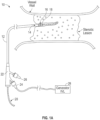
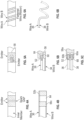
- FIG. 1A illustrates an exemplary catheter 10 for treating occlusions in blood vessels according to an embodiment of the subject invention.
- the catheter 10 is advanced into an occlusion in a patient's vasculature, such as the stenotic lesion depicted in FIG. 1A , over a guidewire 20 carried in a guidewire sheath.
- a distal end 14 of the catheter 10 includes a shock wave generator 16 that produces shock waves at a plurality of emitters (e.g., electrode pairs) to break up calcified lesions.
- the plurality of emitters include electrode pairs having first and second electrode separated by a gap, at which shock waves are formed when a current flows across the gap between the electrodes of the pair (i.e., when a voltage is applied across the first and second electrodes).
- the electrodes pairs are arranged in a low-profile configuration that reduces the diameter of the distal end 14 of the catheter 10 and permits the treatment of tight, hard-to-cross lesions.
- the shock wave generator 16 includes one or more coplanar electrode pairs, or includes one or more electrodes at least partially recessed into the catheter 10.
- a flexible cap 18 (e.g., a low-profile flexible angioplasty balloon) is sealably attached to the distal end 14 of the catheter 10, forming an annular channel around the shaft 12 of the catheter.
- the flexible cap 18 surrounds the shock wave generator 16, such that the shock waves are produced in a closed system defined by the walls of the cap.
- the cap 18 is filled with a conductive fluid, such as saline.
- the conductive fluid allows the acoustic shock waves to propagate from the electrode pairs of the shock wave generator 16 through the walls of the cap 18 and then into the target lesion.
- the conductive fluid may also contain an x-ray contrast to permit fluoroscopic viewing of the catheter 10 during use.
- the cap is rigid and not flexible.
- FIGS. 1B-1C provide more detailed views of the distal end 14 of the catheter 10 of FIG. 1A , including an exemplary no-fold angioplasty balloon forming the flexible cap 18 over the shock wave generator 16.
- the balloon 18 has a small enough diameter and surface area that it does not need to be folded like a conventional angioplasty balloon when advanced through a patient's vasculature.
- the extremely low profile of the balloon 18 allows the distal end 14 of the catheter to access tightly occluded regions of vasculature.
- the diameter of the catheter's distal end 14 in the region of the balloon 18 is one millimeter or less.
- the balloon 18 is preferably formed of a material having elastomeric properties such that the balloon can be inflated during treatment of an occlusion, and then returns to a low profile state when deflated after treatment.
- the flexible cap 18 is an extruded polymer tube having semi-compliant material properties such that the polymer tube can be inflated and deflated similarly to an angioplasty balloon.
- flexible cap and balloon are used interchangeably to describe the flexible annular structure that surrounds the electrode pairs and is inflated with conductive fluid during treatment.
- FIG. 1B shows an exemplary flexible balloon 18 in a deflated state, for instance, during entry, advancing, and positioning of the balloon in a blood vessel.
- the surface area of the balloon is small enough that the balloon is not folded when the catheter 10 is advanced through a blood vessel.
- the surface area of the deflated balloon is small enough that the balloon is not folded inside of the guide catheter or outer jacket.
- the diameter of the balloon is smaller than the diameter of the guide catheter or outer jacket.
- FIG. 1C shows the same balloon 18 in an inflated state.
- the balloon 18 is formed of a material having elastomeric properties such that the balloon can accept inflation pressures of between approximately one atmosphere and approximately six atmospheres.
- the balloon 18 is configured to expand only slightly when inflated with conductive fluid during treatment. For example, the maximum inflated diameter of the balloon 18 may be no more than 10%-15% greater than the original diameter of the balloon (i.e., the diameter of the balloon in a deflated state).
- the maximum diameter of the balloon in an inflated state can be determined by the material durometer of the balloon 18, its wall thickness, and/or the inflation pressure inside the balloon.
- the balloon 18 expands to provide a space between the inner surface of the balloon and the electrode pairs 16.
- the outer diameter of the guidewire sheath is approximately 0.028 inches (applicable to the whole description: 1 inch ⁇ 25,4 mm) and the inner diameter of the inflated balloon 18 is approximately 0.039 inches, providing a space of about 0.011 inches between the guidewire sheath and the inner surface of the balloon.
- the space ensures that the electrode pairs 16 are immersed in conductive fluid during shock wave generation and that the inner surface of the balloon 18 is sufficiently far from the electrode pairs that the balloon material is not damaged by the shock waves.
- the diameter of the inflated balloon 18 is one millimeter or less.
- the outer surface of the balloon 18 includes a hydrophilic coating to facilitate contact between the balloon and the target lesion.
- the balloon 18 can be deflated to its original low profile deflated configuration.
- the balloon 18 returns to a deflated state after being inflated, the balloon should return to its original low profile configuration (i.e., a configuration having a small surface area and diameter) such that that the balloon is not folded when removing the catheter 10 from the patient's vasculature.
- an exemplary catheter 10 also includes a proximal end or handle 22 that remains outside of a patient's vasculature during treatment.
- the proximal end 22 includes an entry port for receiving the guidewire 20.
- the proximal end 22 also includes a fluid port 26 for receiving a conductive fluid for inflating and deflating the flexible cap 18 during treatment.
- An electrical connection port 24 is also located on the proximal end 22 to provide an electrical connection between the distal shock wave generator 16 and an external pulsed high voltage source 28, such as the intravascular lithotripsy (IVL) generator shown in FIG. 1A .
- IVL intravascular lithotripsy
- the catheter 10 also includes a flexible shaft 12 that extends from the proximal handle 22 to the distal end 14 of the catheter.
- the shaft 12 provides various internal conduits connecting elements of the distal end 14 with the handle 22 of the catheter (see, e.g., FIGS. 2E-2F and FIG 3E-3F for cross-sections of a region of an example shaft).
- the shaft 12 includes a guidewire sheath that includes a lumen for receiving the guidewire 20.
- the guidewire sheath also defines a number of further lumens extending longitudinally through the shaft 12. For instance, one or more wire lumens can be included for carrying conductive wires that electrically connect the pulsed voltage source 28 with electrodes of the distal shock wave generator 16.
- one or more fluid lumens are provided in the guidewire sheath for carrying conductive fluid from the fluid port 26 into the cap 18.
- the flexible shaft 12 includes a reinforced wire sheath wrapped circumferentially around the guidewire sheath. The reinforced wire sheath provides mechanical support to the flexible shaft 12 to facilitate torqueing, pushing, and maneuvering of the catheter 10 through a patient's blood vessel.
- the reinforced wire sheath is also configured for carrying a current, such that the reinforced wire sheath can be used to connect one or more of the distal electrode pairs of the shock wave generator 16 with the pulsed voltage source 28 (i.e., in lieu of one or more of the conductive wires).
- a tubular outer jacket covers the guidewire sheath and the reinforced wire sheath to provide a barrier between active elements of the catheter 10 and the in situ environment.
- the catheter 10 can be used to treat occlusions in vasculature, for example, stenotic lesions, calcified portions of an artery, or some other occlusion in a blood vessel.
- a physician advances the guidewire 20 from an entry site on a patient (e.g., an artery in the groin area of the leg) to the target region of a vessel (e.g., a region having an occlusion that needs to be broken up).
- the catheter 10 is then advanced over the guidewire 20 to the target region of the vessel.
- the flexible cap 18 sealed to the distal end 14 is a no-fold balloon having a low profile when deflated, such that the balloon does not need to be folded while the device is advanced through the vasculature.
- a guide catheter or outer jacket may be used to aid the entry and maneuvering of the catheter 10 within the vasculature.
- the outer jacket provides tubular linear support to the catheter shaft 12 and retains the deflated state of the flexible cap 18 during pushing, crossing, and placement of the catheter 10.
- the in situ location of the distal end 14 of the catheter 10 may be determined by x-ray imaging and/or fluoroscopy.
- the distal end 14 of the catheter 10 is advanced as far as possible inside the tight lesion.
- the flexible cap 18 is then inflated by a conductive fluid (e.g., saline and/or saline mixed with an image contrast agent) introduced via the fluid port 26, allowing conductive fluid to expand the cap so that the outer surface of the cap contacts the target lesion.
- a conductive fluid e.g., saline and/or saline mixed with an image contrast agent
- IVL pressure which is between approximately one atmosphere and approximately six atmospheres.
- the diameter of the flexible cap in an inflated state is about 10-15% greater than the diameter of the flexible cap in a deflated state. However, in some examples the diameter of the cap in an inflated state is even less than 10% greater than the diameter of the cap in a deflated state.
- a voltage pulse is then applied by the pulsed high voltage source 28 across one or more electrode pairs (i.e., emitters of the shockwave generator 16 ).
- Each pulse initially ionizes the conducive fluid in the flexible cap 18 to create small gas bubbles around the shock wave generator 16 that insulate the electrodes.
- Fluid can be continuously flowed through the cap 18 during treatment at a constant rate to clear the bubbles and debris from the electrodes.
- the fluid flow rate may be controlled throughout treatment, but is generally in the range of approximately 1 ml/min to approximately 3 ml/min.
- a plasma arc forms across the electrode pairs, creating a low impedance path where current flows freely.
- the heat from the plasma arc heats the conductive fluid creating a rapidly expanding vapor bubble.
- the expansion of the vapor bubble creates a shock wave that is conducted through the fluid, through walls of the flexible cap 18, and into an occlusion where the energy breaks up the hardened lesion.
- the voltage pulse applied by the voltage pulse generator 28 is typically in the range of approximately 2000 volts to approximately 3000 volts and preferably between 2300 and 3000 volts.
- the pulse width of the applied voltage pulses ranges between 2 microseconds and 6 microseconds.
- the repetition rate or frequency of the applied voltage pulses may be between approximately 1 Hz and approximately 10 Hz.
- the preferred voltage and repetition rate may vary depending on, e.g., the size of the lesion, the extent of calcification, the size of the blood vessel, the attributes of the patient, or the stage of treatment. For instance, a physician may start with low energy shock waves and increase the energy as needed during the procedure.
- the magnitude of the shock waves can be controlled by controlling the voltage, current, duration, and repetition rate of the pulsed voltage from the pulsed voltage source 28. More information about the physics of shock wave generation and their control can be found in U.S. Patent Nos. 8,956,371 ; 8,728,091 ; 9,522,012 ; and 10,226,265 .
- one or more cycles of shock waves can be applied to create a more compliant vessel.
- the flexible cap 18 can be deflated and the distal end 14 of the catheter 10 can be advanced further into the occlusion.
- the flexible cap 18 is then re-inflated and another cycle of shock waves can be applied. Further advancement of the cap 18 can be attempted after the completion of successive cycles.
- the placement and spacing of the electrode pairs can be controlled to provide a more effective shock wave treatment.
- the electrode pairs of the shockwave generator 16 may be spaced circumferentially around the distal end 14 of the catheter 10 in consistent increments, e.g., 180 degrees apart or 90 degrees apart, to generate shock waves more evenly around the catheter.
- the shock wave generator 16 includes electrode pairs positioned in various groupings spaced longitudinally along the catheter 10 within the flexible cap 18.
- the shock wave generator 16 may include at least one distal electrode pair and at least one proximal electrode pair.
- the pulsed voltage source 28 can be controlled to selectively generate high voltage pulses at either the proximal or distal electrode pairs, e.g., by applying voltage pulses across differing set of wires or other conductors leading to the respective pairs.
- a first stage of treatment i.e., during initial treatment of the tight or totally-occluding lesion
- only the distal electrode pairs are activated to generate shock waves.
- the cap is again inflated and more proximal electrode pairs are activated to generate more proximal shock waves.
- the progress of the procedure may be monitored by x-ray and/or fluoroscopy. Shock wave cycles can be repeated until the occlusion has been cleared, or until a channel is formed in the lesion having a diameter sufficient to receive a second treatment device having a larger profile. For example, the enlarged channel can receive a different catheter having a more conventional angioplasty balloon or differently oriented shock wave sources. Catheters of this type are described in U.S Patent No. 8,747,416 and U.S. Publication No. 2019/0150960 , cited above.
- the flexible cap 18 may be inflated further, then deflated, and catheter 10 and guidewire 20 can be withdrawn from the patient.
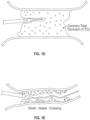
- FIG. 1D depicts the catheter 10 being used to treat a total occlusion in a blood vessel, for instance, a coronary total occlusion (CTO).
- CTO coronary total occlusion
- the guidewire is advanced at least partially into the stenotic lesion.
- the catheter is then advanced through the patient's vasculature over the guidewire and at least partially into the lesion.
- the flexible cap is then inflated with a conductive fluid until the cap gently contacts the lesion.
- Voltage pulses are then supplied by a pulsed voltage source to electrode pairs at the tip of the catheter to generate shock waves that break up or loosen the lesion.
- the guidewire and the catheter can then be advanced further into the lesion and the shock wave treatment can be repeated until the total occlusion is cleared or until the diameter of the vessel permits the placement of a larger more conventional angioplasty device.
- FIG 1E illustrates the use of the inventive catheter 10 in a small vessel that is partially blocked by a stenotic lesion.
- the guidewire can be advanced much further into the lesion and, in some cases, all the way through the lesion.
- the catheter is advanced through the lesion in incremental stages.
- the flexible cap is inflated and shock waves are generated to break up the occlusion and increase the diameter of the blood vessel.
- a larger-diameter catheter may be advanced through the vessel to complete the treatment.
- FIGS. 2A-2G and 3A-3H provide more detailed views of the distal ends of catheters that can be included in a shock wave angioplasty device, such as any of the catheters of FIGS. 1A-1E and described herein.
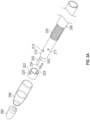
- FIG. 2A illustrates an exploded perspective view of a distal section of an exemplary catheter including two low-profile electrode pairs formed from a conductive sheath (the "emitter band", e.g., a ring electrode) wrapped circumferentially around a guidewire sheath (the "multilumen inner member").
- the emitter band e.g., a ring electrode
- the electrode pairs are electrically connected to an external pulsed voltage source by way of a conductive wire (for example, the polyimide-insulated copper wire) and a conductive reinforced wire sheath (the "flat wire braid") wrapped circumferentially around the guidewire sheath.
- a cap e.g., a low-profile angioplasty balloon or a tubular polymer
- the catheter also includes an outer jacket having a diameter greater than the diameter of the distal section of the catheter. The outer jacket aids the entry and positioning of the catheter by providing circumferential protection and mechanical support to the device.
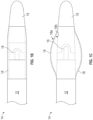
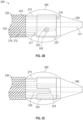
- FIG. 2B depicts a first side view of the distal end 200 of the exemplary catheter showing a first electrode pair in a dot-circle configuration.
- FIG. 2C provides a second view of the distal end 200 of the catheter of FIG. 2B rotated by 180 degrees to show a second electrode pair opposite the first electrode pair, the second electrode pair having a tongue-and-groove configuration.
- the distal end 200 of the catheter includes a guidewire sheath 210, a shockwave generator including a first electrode pair and a second electrode pair, and a flexible cap 280 surrounding the electrode pairs.
- the flexible cap 280 is wrapped circumferentially around the guidewire sheath 210 and sealed to the distal end 200 of the catheter using, e.g., an adhesive seal or a thermal bond to form a closed annular channel around a portion of the guidewire sheath 210.
- the flexible cap 280 is a no-fold angioplasty balloon (i.e. a low-profile angioplasty balloon) that can be positioned in a patient's vasculature without folding.
- the surface area of the balloon is small enough that the balloon is not folded when the catheter is advanced into a blood vessel.
- the flexible cap 280 is an extruded tubular structure formed of a semi-compliant polymer material (i.e., an extruded polymer tube).
- the semi-compliant polymer material allows the flexible cap 280 to inflate slightly responsive to fluid pressure inside the flexible cap, and then return to its original size when under no pressure.
- the flexible cap 280 is inflatable with a conductive fluid, for example, saline, such that the cap expands to provide a space between the inner wall of the cap and the electrode pairs (see, e.g., FIG. 1C ).
- the flexible cap 280 expands a relatively small amount such that the cap retains a low profile (e.g., has a diameter less than 1 millimeter) when it is in an inflated state.
- the maximum inflated diameter of the flexible cap 280 is no more than 10%-15% greater than the original diameter of the cap, such that the diameter of the flexible cap in an inflated state is 10-15% greater than the diameter of the cap in a deflated state.
- the flexible cap 280 when inflated, should provide a space sufficient to allow the conductive fluid to surround and immerse the electrode pairs to avoid damage to the cap during shock wave generation.
- the conductive fluid allows the acoustic shock waves from the electrode pairs to propagate through the walls of the cap 280 and into a lesion in contact with the outer surface of the cap.
- the conductive fluid also contains an x-ray contrast agent to permit fluoroscopic viewing of the catheter during IVL treatment.
- the conductive fluid is admitted into the cap 280 via a fluid inlet 217 in the guidewire sheath 210, and removed from the cap via a fluid outlet 219 in the guidewire sheath.
- the fluid inlet 217 and fluid outlet 219 provide channels extending from the surface of the guidewire sheath 210 to a respective fluid inlet lumen 216 and fluid outlet lumen 218 in the guidewire sheath (and, more proximally, allow the cap to access fluid supplied by the fluid port shown in FIG 1A ). While treating an occlusion, fluid can be continually flushed through the flexible cap 280 via the inlet 217 and the outlet 219 to clear bubbles and debris produced when high voltage pulses across the electrodes create shock waves in the cap 280.
- the fluid inlet 217 and fluid outlet 219 are positioned to maximize fluid flow across the electrode pairs, such that fluid flowed through the cap 280 via the inlet and outlet flows across at least one of the electrode pairs.
- the fluid inlet 217 and the fluid outlet 219 can be positioned diagonally across the conductive sheath 220, such that one or more of the electrode pairs are positioned between the fluid inlet and the fluid outlet.
- FIG. 2D provides an exploded perspective view of an IVL catheter embodiment, having a fluid inlet and fluid outlet positioned to flow fluid across an electrode pair.
- the guidewire sheath 210 provides various internal conduits connecting elements of the distal end 200 with the proximal end of the catheter (not pictured), including a guidewire lumen 211 for receiving a guidewire; a wire lumen 212 for carrying an insulated wire 242, and one or more fluid lumens 216, 218 for carrying a fluid, e.g., the conductive fluid, from a proximal end of the catheter to the cap 280.
- the internal structure of the guidewire sheath 210 is shown more clearly in FIGS. 2E-2F .
- FIG. 2E provides a cross-section of a more proximal section of the shaft of the catheter of FIGS. 2B-2C .
- FIG. 2F provides a perspective view of the cross-section of FIG. 2E inside of an outer jacket of the catheter 200.
- the catheter includes a central, tubular guidewire sheath 210 defining a plurality of lumens.
- the plurality includes a first lumen (i.e., the guidewire lumen 211 ) for receiving a guidewire and a second lumen (i.e., the wire lumen 212 ) for carrying a conductive wire 242.
- the guidewire lumen 211 may extend through the center of the guidewire sheath 210, or may be slightly offset from the center as shown in FIG. 2E .
- the guidewire lumen 211 is shaped to loosely receive a guidewire having a diameter between approximately 0.014 inches and approximately 0.035 inches.
- the wire lumen 212 is shaped to carry at least one wire 242 for flowing current from the pulsed voltage source (such as the pulsed voltage source of FIG. 1A ) to the electrode pairs at the distal end 200 of the catheter.
- the wire is a polyimide insulated copper wire having a diameter between approximately 0.003 inches and approximately 0.007 inches.
- the wires may be flattened to reduce the profile of the catheter, with the flattened wires having a cross-section that is approximately 0.003 inches thick and approximately 0.010 inches wide.
- the plurality of lumens also includes a fluid inlet lumen 216 for flowing fluid into the cap 280 and a fluid outlet lumen 218 for flowing fluid out of the cap 280. While the lumens are pictured in FIG.
- lumens in the guidewire sheath 210 may have any desired shape.
- the wire 242 could have a flattened shape and the second lumen 212 could have a flattened or oblong shape to accommodate the flattened wire.
- the fluid inlet lumen 216 or the fluid outlet lumen 218 could be arranged around the circumference of the guidewire sheath (e.g., in an annular space between the sheath and the reinforced wire sheath 230 ).
- the location, size, and shape of any of the lumens can be modified to reduce the profile of the catheter or to provide some other benefit.
- the various lumens may be combined (e.g. by providing two or more insulated wires in the same lumen) or eliminated without departing from the scope of the present disclosure.
- a tubular reinforced wire sheath 230 formed from at least one conductive reinforced wire material (e.g., a wire that is braided, coiled or both), for example, reinforced copper or stainless steel.
- the reinforced wire sheath 230 can be used to carry current from a pulsed voltage source at the proximal end of the catheter to the distal end 200 of the catheter to provide current to one or more electrode pairs.
- a proximal end of the reinforced wire sheath 230 is connectable to a pulsed voltage source, while the distal end of the reinforced wire sheath is connected to one or more of the electrode pairs.
- the reinforced wire sheath 230 is connected to an electrode pair via a conductive piece of metal shaped to form an electrode (e.g., the conductive emitter portion 234 depicted in FIG. 2C ).
- the reinforced wire sheath 230 may also provide favorable mechanical properties to the shaft of the catheter. For instance, the material composition of the reinforced wire sheath 230 could provide increased torqueability, pushability, or enhanced rigidity to the catheter shaft to facilitate maneuvering the catheter through a patient's vasculature.
- the reinforced sheath 230 includes one or more braided or coiled metals (e.g., metal wires) encapsulated at least partially in a polymer.
- Polymer encapsulation insulates the conductive metal elements of the sheath 230 and/or to provides improved mechanical properties.
- the reinforced metal of the sheath 230 may be flattened to reduce the profile of the sheath 230 and allow the catheter to more easily fit into tightly occluded vessels.
- the distal end 200 of the catheter also includes a soft tip 290 that tapers toward the distal tip of the catheter.
- the soft tip 290 can be formed from a polymer or any other suitable biocompatible material.
- the tip 290 is formed at least partially from a radiopaque material such as platinum, iridium, or stainless steel to permit fluoroscopic viewing of the catheter during use.
- the soft tip also includes a guidewire lumen such that, during operation, the catheter is advanced through a patient's vasculature along a guidewire with the soft tip leading. Providing a soft tip 290 may prevent physical damage to blood vessel walls while facilitating contact with and entry into tight lesions in the vasculature.
- the distal end 200 also includes the shock wave generator of the catheter, which includes a first electrode pair, shown in FIG. 2B and a second electrode pair shown in FIG. 2C .
- the electrode pairs have low-profile configurations (e.g., are coplanar or at least partially recessed into the guidewire sheath 210 ) to reduce the diameter of the distal end 200.
- the first electrode pair and the second electrode pair are located approximately 180 degrees apart circumferentially around the guidewire sheath 210.
- the electrodes of each pair are spaced apart to define gaps where current can flow to produce shock waves in the conductive fluid inside the flexible cap 280.
- An electrode pair can be formed by a side edge of a conductive sheath (e.g., a ring electrode) and a conductive portion of a wire, as described in assignee's prior filing U.S. Pub. No. 2019/0150960 .
- the conductive portion of the wire can be formed by removing a portion of the insulating layer of an insulated wire near the distal end of the wire to expose an electrically conductive portion of the wire.
- the location, size, and shape of the removed portion may vary to control the location, direction, and/or magnitude of the shock wave.
- an electrode may be formed by cutting the end of an insulated wire to expose an electrically conductive cross-section.
- flat wires rather than round wires are used to further reduce the crossing profile of the electrode assembly.
- the first electrode pair includes a first electrode formed from an insulation removed portion 243 of a wire extending through a lumen 212 of the guidewire sheath 210, for instance, conductive wire 242.
- the first electrode pair also includes a second electrode formed from a cut out 222 in a conductive sheath 220 wrapped circumferentially around the guidewire sheath.
- the cut out 222 in the conductive sheath 220 is defined by an approximately circular hole in the conductive sheath.
- the location, size, and shape of the cut out 222 can be varied to control the location, direction, and/or magnitude of the shock wave.
- the conductive sheath 220 is at least partially recessed into the guidewire sheath 210 to reduce the profile of the electrode assembly and the diameter of distal end 200 of the catheter.
- the insulation removed portion 243 of the wire 242 and the cut out 222 of the conductive sheath 220 are spaced apart to define a gap between the first electrode and the second electrode of the first electrode pair.
- the spacing of the gap can be controlled to generate reproducible electrical arcs in the conductive fluid between the electrodes.
- the spacing of the electrodes may be modified to produce shock waves having a desired magnitude for a given voltage and current output from a pulsed voltage source.
- the guidewire sheath 210 includes an aperture extending between the outer surface of the guidewire sheath and the wire lumen 212.
- the aperture is positioned over the insulation removed portion 243 of the wire 242 and under the cut out 222 such that current flows through the aperture when high voltage pulses are applied across the reinforced wire sheath 230 and the wire 242.
- the size of the aperture may correspond to the size of the insulation removed portion 243 of the wire 242, the size of the cut out 222 in the conductive sheath 220, or some other desired size or shape.
- FIG. 2C provides a cross section of the distal end 200 of the catheter of FIG. 2B rotated by 180 degrees to show a second electrode pair of the shock wave generator.
- the second electrode pair includes a first electrode formed from an edge 224 of the conductive sheath 220, and a second electrode formed from a conductive emitter portion 234 coplanar with the conductive sheath 220.
- the first and second electrode of the second electrode pair are formed in a tongue-and-groove configuration.
- the edge 224 of the conductive sheath 220 is defined by a longitudinal cut in the side of the conductive sheath and forms the "groove".
- the "tongue” is formed from the conductive emitter portion 234, which extends into the groove such that the tongue and groove define a U-shaped gap between the emitter portion 234 and the edge 224 of the conductive sheath 220.
- the shape of the gap can be controlled to generate reproducible electrical arcs in the conductive fluid between the electrodes of the pair and to produce shock waves having a desired magnitude.
- the conductive sheath 220 and the emitter portion 234 are coplanar to reduce the profile of the electrode pair and the diameter of the distal end 200 of the catheter.
- the conductive emitter portion 234 additionally includes PET heat shrink tubing. More information about tongue-and-groove electrode configurations is included in applicant's U.S. Patent No. 10,555,744 .
- the emitter portion 234 is coupled to the distal end of the reinforced wire sheath 230, which electrically connects the second electrode pair with a pulsed voltage source (not pictured).
- the emitter portion 234 could be coupled to, e.g., a further wire extending along the catheter, which electrically connects the second electrode pair with the pulsed voltage source.
- the first electrode pair is electrically connected to the pulsed voltage source via the wire 242 extending within the lumen 212 of the guidewire sheath 210.
- the proximal end of the wire 242 is connectable to the pulsed voltage source, while the distal end of the wire 242 is connected to (i.e., forms a part of or is otherwise electrically connected with) the first electrode pair.
- FIG. 2G shows show an exemplary current flow through a catheter having one tongue-and-groove electrode pair and one dot-circle electrode pair connected to a voltage source by way of a polyimide-insulated copper wire and a reinforced wire sheath formed of flat copper clad stainless steel wire.
- a physician may simultaneously connect the wire 242 to a positive lead of the voltage pulse generator, and connect the reinforced wire sheath 230 (or a wire electrically connected to a proximal end of the sheath) to a negative lead or the ground.
- current will flow from the voltage source, down the wire 242, across the first gap between the insulation removed portion 243 of the wire and the cut out 222 in the conductive sheath 220, creating a plasma arc that generates a shock wave at the first electrode pair.
- the current then flows across the conductive sheath 220 and across the second gap between the edge 224 of the conductive sheath 220 and the conductive emitter portion 234, creating another plasma arc that generates a shock wave at the second electrode pair.
- the current then flows from the conductive emitter portion 234 to the reinforced wire sheath 230, and down the reinforced wire sheath to reach the negative lead or ground.
- the physician may connect the reinforced wire sheath 230 (or a wire electrically connected to the reinforced wire sheath) to a positive lead of the pulse generator and connect the wire 242 to the negative lead or ground, such that the current travels the opposite path across the first and second electrode pairs.
- FIGS. 3A-3H provide detailed views of the distal end of an alternative catheter that can be included in a shock wave angioplasty device, such as any of the catheters of FIGS. 1A-1E and described herein.
- the distal end 300 shock wave generator of catheter of FIGS. 3A-3H includes at least one distal emitter (e.g., one or more distal electrode pairs) and at least one proximal emitter (e.g., one or more proximal electrode pairs).
- FIG. 3A provides a perspective view of an exemplary catheter including a distal emitter and a proximal emitter. As illustrated in FIG.
- the distal emitter and the proximal emitter are formed from a respective proximal conductive sheath (e.g., a proximal electrode ring) and distal conductive sheath (e.g., a distal electrode ring) wrapped circumferentially around a guidewire sheath.
- the distal emitter includes one or more distal electrode pairs, while the proximal emitter includes one or more proximal electrode pairs.
- the electrode pairs have a low profile-configuration and are electrically connected to an external pulsed voltage source by way of a number of conductive wires extending through lumens of the guidewire sheath.
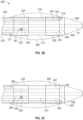
- FIG. 3B depicts a first side of the distal end 300 of an exemplary catheter showing a first distal electrode pair and a first proximal electrode pair.
- FIG 3C provides a second view of the distal end 300 of the catheter of FIG. 3B rotated 180 degrees to show a second distal electrode pair and a second proximal electrode pair.
- the distal end 300 of the catheter includes a guidewire sheath 310, a shockwave generator including two distal electrode pairs and two proximal electrode pairs, and a flexible cap 380 surrounding the electrode pairs.
- the flexible cap 380 is wrapped circumferentially around the guidewire sheath 310 and sealed to the distal end 300 of the catheter using, e.g., an adhesive seal or a thermal seal to form a closed annular channel around the guidewire sheath 310.
- the flexible cap 380 is a no-fold angioplasty balloon (i.e. a low-profile angioplasty balloon) that can be positioned in a patient's vasculature without folding.
- the surface area of the balloon is small enough that the balloon is not folded when the catheter is advanced into a blood vessel.
- the flexible cap 380 is an extruded tubular structure formed of a semi-compliant polymer material (i.e., an extruded polymer tube).
- the semi-compliant polymer material allows the flexible cap 380 to inflate slightly responsive to fluid pressure inside the flexible cap, and then return to its original size when under no pressure.
- the flexible cap 380 is inflatable with a conductive fluid, for example, saline, such that the cap expands to provide a space between the inner wall of the cap and the proximal and distal electrode pairs (see, e.g., FIG. 1C ).
- a conductive fluid for example, saline
- the flexible cap 380 expands a relatively small amount such that the inflated cap retains a low profile (e.g., has a diameter less than 1 millimeter).
- the maximum inflated diameter of the flexible cap 380 may be no more than 10%-15% greater than the original (i.e., deflated) diameter of the cap.
- the flexible cap 380 when inflated, should provide a space sufficient to allow the conductive fluid to surround and immerse the electrode pairs to avoid damage to the cap during shock wave generation.
- the conductive fluid allows the acoustic shock waves from the proximal and distal electrode pairs to propagate through the walls of the flexible cap 380 and into a lesion in contact with the outer surface of the cap.
- the conductive fluid also contains an x-ray contrast agent to permit fluoroscopic viewing of the catheter during IVL treatment.
- the conductive fluid is admitted into the cap 380 via a fluid inlet 317 in the guidewire sheath 310, and removed from the cap via a fluid outlet 319 in the guidewire sheath.
- the fluid inlet 317 and fluid outlet 319 provide channels extending from the surface of the guidewire sheath 310 to a respective fluid inlet lumen 316 and fluid outlet lumen 318 in the guidewire sheath (and, more proximally, allow the flexible cap to access fluid supplied by the fluid port shown in FIG 1A ). While treating an occlusion, fluid can be continually flushed through the cap 380 via the inlet 317 and the outlet 319 to clear bubbles and debris produced when high voltage pulses across the electrodes create shock waves in the cap.
- the fluid inlet 317 and fluid outlet 3219 are positioned to maximize fluid flow across the electrode pairs, such that fluid flowed through the cap 380 via the inlet and outlet flows across at least one of the electrode pairs.
- the fluid inlet 317 and the fluid outlet 319 can be positioned diagonally across one or more of the conductive sheaths 330, 336, such that one or more of the electrode pairs are positioned between the fluid inlet and the fluid outlet.
- FIG. 3D provides a cross-sectional view of a distal section of an exemplary catheter depicting the flow of fluid through internal lumens and the flexible cap of the catheter via a fluid inlet and a fluid outlet in the guidewire sheath.
- the guidewire sheath 310 provides various internal conduits connecting elements of the distal end with the proximal end of the catheter, including a guidewire lumen, lumens for carrying conductive wires, and one or more fluid lumens.
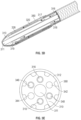
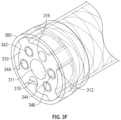
- the internal structure of the guidewire sheath 310 is shown more clearly in FIGS. 3E , which provides a cross-section of a more proximal section of the shaft of the catheter.
- FIG. 3F provides a perspective view of the cross-section of FIG. 3E inside of the flexible cap 380 the catheter 300.
- the catheter includes a central, tubular guidewire sheath 310 defining a plurality of lumens.
- the plurality of lumens includes a guidewire lumen 311 for receiving a guidewire.
- the guidewire lumen 311 may extend through the center of the guidewire sheath 310, as shown in FIGS. 3E-3F , or may be slightly offset from the center.
- the guidewire lumen 311 is shaped to loosely receive a guidewire having a diameter between approximately 0.014 inches and approximately 0.035 inches.
- the guidewire sheath 310 also includes four wire lumens for carrying respective conductive wires 342, 344, 346, 348 for flowing current from a pulsed voltage source (such as the pulsed voltage source of FIG.
- the wires 342, 344, 346, 348 are polyimide insulated copper wires having a diameter between approximately 0.003 inches and approximately 0.007 inches.
- the wires 342, 344, 346, 348 may be flattened to reduce the profile of the catheter, with the flattened wires having a cross-section that is approximately 0.003 inches thick and approximately 0.010 inches wide.
- the plurality of lumens also includes a fluid inlet lumen 316 for flowing fluid into the cap 380 and a fluid outlet lumen 318 for flowing fluid out of the cap 380. While the lumens are pictured in FIGS.
- lumens in the guidewire sheath 310 may have any desired shape.
- one or more of the wires 342, 344, 346, 348 could have a flattened shape and the associated lumen could have a flattened or oblong shape to accommodate the flattened wire.
- the fluid inlet lumen 316 or the fluid outlet lumen 318 could be arranged around the circumference of the guidewire sheath 310 (e.g., in an annular space between the sheath and the reinforced wire sheath 330 ).
- the location, size, and shape of any of the lumens can be modified to reduce the profile of the catheter or to provide some other benefit.
- the various lumens may be combined (e.g. by providing two or more insulated wires in the same lumen) or eliminated without departing from the scope of the present disclosure.
- the guidewire sheath 310 includes spacing features 312 that protrude from an outer surface of the guidewire sheath.
- the spacing features 312 are configured to maintain the inner surface of the cap 380 a controlled distance away from the outer surface of the guidewire sheath 310, e.g., in order to prevent damage to the cap caused by the shock waves produced at the electrode pairs.
- the spacing features 312 surround one or more of the conductive sheaths 320, 326, or extend between the respective proximal conductive sheath 320 and the distal conductive sheath 326
- the distal end 300 of the catheter also includes a soft tip 390 that tapers toward the distal tip of the catheter.
- the soft tip 390 can be formed from a polymer or any other suitable biocompatible material.
- the tip 390 is formed at least partially from a radiopaque material such as platinum, iridium, or stainless steel to permit fluoroscopic viewing of the catheter during use.
- the soft tip also includes a guidewire lumen such that, during operation, the catheter is advanced through a patient's vasculature along a guidewire with the soft tip leading. Providing a soft tip 390 may prevent physical damage to blood vessel walls while facilitating contact with and entry into tight lesions in the vasculature.
- the distal end 300 also includes the shock wave generator of the catheter, which includes a first distal electrode pair and a first proximal electrode pair, shown in FIG. 3B and a second distal electrode pair and a second proximal electrode shown in FIG. 3C .
- the first and second distal electrodes are formed from respective conductive portions 343, 355 of a first wire 342 and a second wire 344 and a distal conductive sheath 326 (e.g., a distal ring electrode), while the first and second proximal electrode pairs are dot-circle electrode pairs formed from insulation removed portions of a third wire 346 and fourth wire 348 and a proximal conductive sheath 320.
- the electrode pairs have low-profile configurations to reduce the diameter of the distal end 300.
- the proximal conductive sheath 320 and/or the distal conductive sheath 326 may be at least partially recessed into the guidewire sheath 310 to reduce the diameter of the distal end 300 of the catheter.
- an electrode pair can be formed by a side edge of a conductive sheath and a portion of a wire.
- the portion of wire can be formed by removing a portion of the insulating layer of a wire near the distal end of the wire to expose an electrically conductive portion of the wire.
- the location, size, and shape of the removed portion may vary to control the location, direction, and/or magnitude of the shock wave.
- an electrode may be formed by cutting the end of an insulated wire to expose an electrically conductive cross-section.
- flat wires rather than round wires are used to further reduce the crossing profile of the electrode assembly.
- the first distal electrode pair includes a first electrode formed from a conductive portion 343 of a first wire 342 extending through a lumen of the guidewire sheath 310.
- the first distal electrode pair also includes a second electrode formed from a side edge 328 of a distal conductive sheath 326 wrapped circumferentially around the guidewire sheath 310.
- the second distal electrode pair includes a first electrode formed from the side edge 328 of the distal conductive sheath 326.
- the second distal electrode pair also includes a second electrode formed from a conductive portion 345 of a second wire 344 extending through a lumen of the guidewire sheath 310.
- the first distal electrode pair and the second distal electrode pair are located approximately 180 degrees apart circumferentially around the distal conductive sheath 326.
- the conductive portion 343 of the first wire 342 is spaced apart from the side edge 328 of the distal conductive sheath 326 to define a first gap between the electrodes of the first distal pair.
- the conductive portion 345 of the second wire 344 is spaced apart from the side edge 328 of the distal conductive sheath 326 to define a second gap between the electrodes of the second distal pair.
- the spacing of the gaps can be controlled to generate reproducible electrical arcs in the conductive fluid between the electrodes of the respective pairs and to produce shock waves having a desired magnitude for a given voltage and current output from the pulsed voltage source.
- the guidewire sheath 310 includes distal apertures extending between the outer surface of the guidewire sheath 310 and the lumens containing the first wire 342 and the second wire 344.
- the apertures are positioned between the conductive portions 343, 345 of the wires 342, 344 and the side edge 328 of the distal conductive sheath 326 such that current flows through the respective apertures when high voltage pulses are applied across the first wire 342 and the second wire 344.
- the first proximal electrode pair includes a first electrode formed from an insulation removed portion 347 of a third wire 346 extending through a lumen of the guidewire sheath 310.
- the first proximal electrode pair also includes a second electrode formed from a first cut out 322 in the proximal conductive sheath 320.
- the second proximal electrode pair includes a first electrode formed from an insulation removed portion 349 of a fourth wire 348 extending through a lumen of the guidewire sheath 310.
- the second proximal electrode pair also includes a second electrode formed from a second cut out 324 in the proximal conductive sheath 320.
- the first proximal electrode pair and the second proximal electrode pair are located approximately 180 degrees apart circumferentially around the proximal conductive sheath 320.
- the insulation removed portion 347 of the third wire 346 is spaced apart from the first cut out 322 of the proximal conductive sheath 320 to define a first gap between the electrodes of the first proximal pair.
- the insulation removed portion 349 of the fourth wire 348 is spaced apart from the second cut out 324 of the proximal conductive sheath 320 to define a second gap between the electrodes of the second proximal pair.
- the spacing of the gaps can be controlled to generate reproducible electrical arcs in the conductive fluid between the electrodes of the respective pairs and to produce shock waves having a desired magnitude for a given voltage and current output from the pulsed voltage source.
- the guidewire sheath 310 includes proximal apertures extending between the outer surface of the guidewire sheath 310 and the lumens containing the third wire 346 and the fourth wire 348.
- the apertures are positioned between the insulation removed portions 347, 349 of the wires 346, 348 and the cut outs 322, 324 in the proximal conductive sheath 320 such that current flows through the respective apertures when high voltage pulses are applied across the third wire 346 and the fourth wire 348.
- the distal ends of the first wire 342 and the second wire 344 are connected to (i.e., form a part of or are electrically connected with) the distal electrode pairs and the proximal ends of the first wire 342 and the second wire 344 (not shown) are connectable to a pulsed voltage source, such that when high voltage pulses are applied across the first wire 342 and the second wire 344, current flows across the first gap and the second gap creating shock waves for treating occlusions near the distal electrodes.
- the distal ends of the third wire 346 and the fourth wire 348 are connected to the proximal electrode pairs and the proximal ends of the third wire 346 and the fourth wire 348 are connectable to the pulsed voltage source, such that when high voltage pulses are applied across the third wire 346 and the fourth wire 348, current flows across the first gap and the second gap creating shock waves for treating occlusions near the proximal electrodes.
- FIG. 3G illustrates the selective firing of the proximal emitters by applying a current to the proximal emitter wires.
- FIG. 3H illustrates the selective firing of the distal emitters by applying a current to the distal emitter wires.
- the separate wiring of the proximal and distal electrode pairs advantageously allows for generation of either distal or proximal shock waves by applying high voltage pulses across only the wires corresponding to the proximal or distal electrodes.
- the pulsed voltage source can be controllable to apply high voltage pulses across either the first wire 342 and the second wire 344 to create shock waves at the distal electrode pairs or the third wire 346 and the fourth wire 348 to create shock waves at the proximal electrode pairs.
- FIGS. 2A-2G and FIG 3A-3H may be rearranged, recombined, and modified without departing from the present invention.
- FIGS. 2A-2G provide a catheter including a reinforced wire sheath
- the reinforced wire sheath may be replaced by one or more conductive wires, as seen in the catheter of FIGS 3A-3H .
- one or more of the wires in FIGS 3A-3H could be replaced by a reinforced wire sheath.
- FIGS 3A-3H features of the embodiment of FIGS 3A-3H , e.g., the spacing features, a further proximal conductive sheath, additional electrode pairs and/or independently controlled distal and proximal electrode pairs, may be combined with the catheter of FIGS 2A-2G without departing from the subject invention.
- FIGS 2A-2G and 3A-3H illustrate two examples of shock wave generators
- the subject invention is intended to include catheters having a variety of electrode configurations.
- a shock wave generator of an exemplary catheter could include two tongue-and-groove electrode pairs (see FIGS. 2B and 5A-5C ), two dot and circle electrode pairs (see FIG 2C and the proximal electrode pairs of FIGS. 3B-3C ), or two electrode pairs formed from distal conductive portions of wires and a conductive sheath (see, e.g., the distal electrode pairs of FIGS. 3B-3C ), or any other desired configuration.
- the placement and spacing of the electrode pairs can modified without departing from the subject invention.
- the electrode pairs may be spaced circumferentially around the catheter in consistent increments, e.g., 180 degrees apart, 90 degrees apart, or 60 degrees apart to generate shock waves more evenly around the catheter.
- the shock wave generator includes electrode pairs positioned in various groupings spaced longitudinally along the catheter.
- the shock wave generator could include a plurality of electrode pairs defined by a plurality of conductive sheaths spaced longitudinally along the catheter.
- FIGS. 4A-4B, 5A-5C, and 6A-6B depict several exemplary shock wave electrode assemblies that could be included in a shock wave angioplasty device, such as any of the catheters illustrated in FIGS. 1A-1C , 2A-2G , and 3A-3H and described herein.
- FIGS. 4A and 4B illustrate one exemplary variation of an electrode pair.
- This embodiment includes a pair of spaced apart ring electrodes provided as a first conductive sheath 52b and a second conductive sheath 58c wrapped circumferentially around the shaft of a catheter.
- One or more of the sheaths 58c, 52b may be recessed into the shaft to reduce the diameter of shock wave generator and to permit entry of the catheter into tighter lesions.
- an electrode pair is formed from respective side edges of the first conductive sheath 52b and the second conductive sheath 58c. The spacing between the side edges of the two conductive sheaths defines a spark gap 64 between the electrodes.
- FIG 4B illustrates a different view of the electrodes of FIG 4A , with the gap 64 shown larger for clarity.
- a first wire “A” 36 is connected to the first conductive sheath 52b and the second wire “B” is connected to ring electrode 58c.
- a plasma arc is created across the spark gap 64 between the ring electrodes.
- the plasma arc creates a shock wave for treating an occlusion.
- FIGS 5A, 5B, and 5C illustrate exemplary tongue-and-groove electrode pair configurations formed a conductive sheaths (e.g., ring electrodes) and conductive emitter portions extending into the conductive sheaths.
- a first electrode of the pair is formed from an edge of the conductive sheath that is defined by a groove cut into a side of the conductive sheath.
- the second electrode of the pair is formed from a conductive tongue-shaped emitter portion extending into the groove.
- the conductive emitter portion "tongue" may be formed from a conductive portion of a wire (for instance, an insulation removed portion or a conductive end of wire) or some other conductive metal portion shaped to fit within the groove.
- the tongue and groove define a U-shaped spark gap between the electrodes of the pair.
- a first wire 36 is connected to the conductive emitter portion "tongue" 52 and a second wire 38 is connected to the ring electrode conductive sheath 58.
- a plasma arc is created across the spark gap 64 between the tongue 52 and groove 60.
- the plasma arc creates a shock wave for treating the stenosis.
- FIG. 5C illustrates a related exemplary tongue-and-groove electrode embodiment providing two electrode pairs formed from a single conductive sheath 58a (e.g., a single ring electrode) wrapped circumferentially around the guidewire sheath.
- a first groove 60a and a second groove 60b are cut into edges the same conductive sheath 58a.
- the first and second groove may be located 180 degrees circumferentially apart around the conductive sheath.
- Corresponding conductive tongue-shaped emitter portions extend into the first groove and second groove to create first and second electrode pairs.
- a first electrode pair is formed from the edge of the conductive sheath defined by the first groove 60a and the first tongue-shaped emitter portion 68 extending into the first groove.
- the second electrode pair is formed from the edge of the conductive sheath defined by the second groove 60b and the second tongue-shaped emitter portion 52 extending into the second groove.
- Each electrode pair defines a U-shaped gap between the respective tongues and grooves of the first and second electrode pairs.
- a first wire 38 is connected to the first emitter portion "tongue" 68 and a second wire 36 is connected to the second emitter portion "tongue" 52.
- a high voltage pulse is applied across the first wire 38 and the second wire 36, current flows down the first wire 38 and jumps the first U-shaped gap, creating a first plasma arc.
- the current then travels along the conductive sheath 58a and jumps the second U-shaped gap, creating a second plasma arc, before traveling back to the voltage source along the second wire 36.
- the first and second plasma arcs create shock waves at two locations around the guidewire sheath, providing more complete circumferential treatment of a lesion in vasculature. More information and examples of tongue-and-groove electrode configurations can be found in U.S. Patent No. 10,555,744 .
- FIGS 6A and 6B illustrate another variation of an electrode pair of the subject invention.
- the first wire 36 and the second wires 38 are helically wrapped around the shaft of a catheter.
- One or more electrode pairs are created by selectively removing insulation from the wires to define electrodes.
- a first electrode pair comprises a first insulation removed portion of the first wire 36 and a first insulation removed portion of the second wire 38.
- Further electrode pairs can be created by removing additional portions of insulation from the wires (i.e., such that a second electrode pair comprises a second insulation removed portion of the first wire and a second insulation removed portion of the second wire, etc.)
- the helically wrapped first wire 36 and second wire 38 are spaced sufficiently close to allow spark formation between the insulation removed portions of the two wires.
- the electrodes are arranged in the same plane (i.e., coplanar), thereby minimizing the diameter of the distal end of the catheter.
- coplanar electrode designs are described in U.S. 2017/0135709 .
Landscapes
- Health & Medical Sciences (AREA)
- Surgery (AREA)
- Engineering & Computer Science (AREA)
- Life Sciences & Earth Sciences (AREA)
- Biomedical Technology (AREA)
- Molecular Biology (AREA)
- Vascular Medicine (AREA)
- Orthopedic Medicine & Surgery (AREA)
- Mechanical Engineering (AREA)
- Heart & Thoracic Surgery (AREA)
- Medical Informatics (AREA)
- Nuclear Medicine, Radiotherapy & Molecular Imaging (AREA)
- Animal Behavior & Ethology (AREA)
- General Health & Medical Sciences (AREA)
- Public Health (AREA)
- Veterinary Medicine (AREA)
- Media Introduction/Drainage Providing Device (AREA)
- Surgical Instruments (AREA)
Claims (10)
- Katheter (10) zur Behandlung von Okklusionen in Blutgefäßen, der aufweist:eine röhrenförmige Führungsdrahthülse (210), die eine Vielzahl von Lumen definiert, wobei die Vielzahl von Lumen ein erstes Lumen (211) zum Tragen eines Führungsdrahts aufweist;einen Stoßwellenerzeuger (16), der sich in der Nähe eines distalen Endes (14) des Katheters (10) befindet, wobei der genannte Stoßstellenerzeuger (16) mindestens ein distales Elektrodenpaar umfasst, bei dem Elektroden jedes Paars voneinander beabstandet sind, um mindestens einen Spalt zu definieren;einen ersten Draht (342) und einen zweiten Draht (344), wobei proximale Enden des ersten Drahts (342) und des zweiten Drahts (344) mit einer gepulsten Spannungsquelle verbindbar sind und wobei distale Enden des ersten Drahts (342) und des zweiten Drahts (344) mit dem mindestens einen distalen Elektrodenpaar verbunden sind, so dass, wenn Impulse hoher Spannung über den ersten Draht (342) und den zweiten Draht (344) angelegt werden, Strom über den wenigstens einen Spalt fließt, wodurch Stoßwellen zur Behandlung einer Okklusion entstehen; undeine flexible Kappe (18, 280, 380), die aus einem Material mit elastomeren Eigenschaften hergestellt ist und abdichtbar an dem distalen Ende (14) des Katheters (10) angebracht ist und das mindestens eine Elektrodenpaar umgibt, wobei die genannte flexible Kappe (18, 280, 380) mit leitfähigem Fluid aufblähbar ist, so dass die flexible Kappe (18, 280, 380) sich ausdehnt, um einen Zwischenraum zwischen einer Innenwand der flexiblen Kappe (18, 280, 380) und dem mindestens einen Elektrodenpaar bereitzustellen, und wobei, wenn die flexible Kappe (18, 280, 380) in einem entleerten Zustand ist, ein Oberflächeninhalt der flexiblen Kappe (18, 380) klein genug ist, dass die flexible Kappe (18, 280, 380) nicht gefaltet ist, wenn der Katheter (10) in ein Blutgefäß vorbewegt wird, und, wenn die flexible Kappe (18, 280, 380) in einem aufgeblähten Zustand ist, ein maximaler Durchmesser der flexiblen Kappe (18, 280, 380) höchstens 15 % größer als ein Durchmesser der flexiblen Kappe (18, 280, 380) in einem entleerten Zustand ist und wobei die flexible Kappe (18, 280, 380) so gestaltet ist, dass sie nach dem Entleeren in eine Konfiguration mit niedrigem Profil zurückkehrt, so dass die flexible Kappe beim Entfernen des Katheters aus dem Blutgefäß nicht gefaltet wird.
- Katheter (10) nach Anspruch 1, wobei die flexible Kappe (18, 280, 380) einen Angioplastieballon (18) aufweist.
- Katheter (10) nach Anspruch 1, wobei die flexible Kappe (18, 280, 380) eine extrudierte Polymerröhre aufweist.
- Katheter nach Anspruch 1, wobei das mindestens eine distale Elektrodenpaar ein erstes Elektrodenpaar und ein zweites Elektrodenpaar aufweist, wobei das erste Elektrodenpaar aufweist:einen leitfähigen (343) Teil des ersten Drahts (342); undeine leitfähige Hülse (326), die am Umfang um die Führungsdrahthülse (210) gewickelt ist; undwobei das zweite Elektrodenpaar aufweist:die leitfähige Hülse (326); undeinen leitfähigen Teil (355) des zweiten Drahts (344).
- Katheter nach Anspruch 1, der ferner einen dritten Draht (346) und einen vierten Draht (348) aufweist, die sich in einem oder mehr Lumen der röhrenförmigen Führungsdrahthülse (210) erstrecken, wobei proximale Enden des dritten Drahts (346) und des vierten Drahts (348) mit der gepulsten Spannungsquelle verbindbar sind und wobei distale Enden des dritten Drahts (346) und des vierten Drahts (348) mit mindestens einem proximalen Elektrodenpaar verbunden sind.
- Katheter nach Anspruch 5, wobei das mindestens eine proximale Elektrodenpaar ein drittes Elektrodenpaar und ein viertes Elektrodenpaar aufweist, wobei das dritte Elektrodenpaar aufweist:einen abisolierten Teil des dritten Drahts (346); undeine weitere leitfähige Hülse, die am Umfang um die Führungsdrahthülse gewickelt ist; undwobei das vierte Elektrodenpaar aufweist:die weitere leitfähige Hülse; undeinen abisolierten Teil des vierten Drahts (348).
- Katheter nach Anspruch 5, wobei die gepulste Spannungsquelle zum Anlegen von Impulsen hoher Spannung über entweder den ersten Draht (342) und den zweiten Draht (344) oder den dritten Draht (346) und den vierten Draht (348) steuerbar ist, um Stoßwellen an entweder dem mindestens einen distalen Elektrodenpaar oder dem mindestens einen proximalen Elektrodenpaar zu erzeugen.
- Katheter nach Anspruch 1, wobei die röhrenförmige Führungsdrahthülse (210) ein oder mehrere Fluidlumen zum Führen von leitfähigem Fluid zwischen einem proximalen Ende des Katheters (10) und dem Ballon (18) definiert.
- Katheter nach Anspruch 1, wobei mindestens ein Teil der röhrenförmigen Führungsdrahthülse (210) Beabstandungsmerkmale aufweist, die von einer Außenfläche der Führungsdrahthülse (210) vorstehen, wobei die Beabstandungsmerkmale so gestaltet sind, dass sie die Innenwand der flexiblen Kappe in einer geregelten Entfernung von der Außenfläche der Führungsdrahthülse (210) halten.
- Katheter nach Anspruch 1, wobei, wenn die flexible Kappe (18, 280, 380) in einem aufgeblähten Zustand ist, der maximale Durchmesser der flexiblen Kappe (18, 280, 380) höchstens 10 % größer als der Durchmesser der flexiblen Kappe (18, 280, 380) in einem entleerten Zustand ist.
Priority Applications (1)
| Application Number | Priority Date | Filing Date | Title |
|---|---|---|---|
| EP24199502.6A EP4454575B1 (de) | 2019-09-24 | 2020-09-15 | Schockwellenkatheter mit läsionsüberquerender schockwelle |
Applications Claiming Priority (2)
| Application Number | Priority Date | Filing Date | Title |
|---|---|---|---|
| US201962904847P | 2019-09-24 | 2019-09-24 | |
| PCT/US2020/050899 WO2021061451A1 (en) | 2019-09-24 | 2020-09-15 | Lesion crossing shock wave catheter |
Related Child Applications (2)
| Application Number | Title | Priority Date | Filing Date |
|---|---|---|---|
| EP24199502.6A Division EP4454575B1 (de) | 2019-09-24 | 2020-09-15 | Schockwellenkatheter mit läsionsüberquerender schockwelle |
| EP24199502.6A Division-Into EP4454575B1 (de) | 2019-09-24 | 2020-09-15 | Schockwellenkatheter mit läsionsüberquerender schockwelle |
Publications (3)
| Publication Number | Publication Date |
|---|---|
| EP4034005A1 EP4034005A1 (de) | 2022-08-03 |
| EP4034005B1 true EP4034005B1 (de) | 2024-12-18 |
| EP4034005C0 EP4034005C0 (de) | 2024-12-18 |
Family
ID=72744844
Family Applications (2)
| Application Number | Title | Priority Date | Filing Date |
|---|---|---|---|
| EP20786114.7A Active EP4034005B1 (de) | 2019-09-24 | 2020-09-15 | Läsionskreuzender stosswellenkatheter |
| EP24199502.6A Active EP4454575B1 (de) | 2019-09-24 | 2020-09-15 | Schockwellenkatheter mit läsionsüberquerender schockwelle |
Family Applications After (1)
| Application Number | Title | Priority Date | Filing Date |
|---|---|---|---|
| EP24199502.6A Active EP4454575B1 (de) | 2019-09-24 | 2020-09-15 | Schockwellenkatheter mit läsionsüberquerender schockwelle |
Country Status (7)
| Country | Link |
|---|---|
| US (2) | US12274460B2 (de) |
| EP (2) | EP4034005B1 (de) |
| JP (3) | JP7637671B2 (de) |
| CN (2) | CN114760940B (de) |
| AU (2) | AU2020354360B2 (de) |
| ES (1) | ES3009524T3 (de) |
| WO (1) | WO2021061451A1 (de) |
Families Citing this family (72)
| Publication number | Priority date | Publication date | Assignee | Title |
|---|---|---|---|---|
| US10966737B2 (en) | 2017-06-19 | 2021-04-06 | Shockwave Medical, Inc. | Device and method for generating forward directed shock waves |
| WO2020256898A1 (en) | 2019-06-19 | 2020-12-24 | Boston Scientific Scimed, Inc. | Balloon surface photoacoustic pressure wave generation to disrupt vascular lesions |
| US11717139B2 (en) | 2019-06-19 | 2023-08-08 | Bolt Medical, Inc. | Plasma creation via nonaqueous optical breakdown of laser pulse energy for breakup of vascular calcium |
| US12402946B2 (en) | 2019-06-19 | 2025-09-02 | Boston Scientific Scimed, Inc. | Breakdown of laser pulse energy for breakup of vascular calcium |
| US11660427B2 (en) | 2019-06-24 | 2023-05-30 | Boston Scientific Scimed, Inc. | Superheating system for inertial impulse generation to disrupt vascular lesions |
| US20200406010A1 (en) | 2019-06-26 | 2020-12-31 | Boston Scientific Scimed, Inc. | Side light direction plasma system to disrupt vascular lesions |
| CN114760940B (zh) * | 2019-09-24 | 2025-05-27 | 冲击波医疗公司 | 病灶穿过式冲击波导管 |
| US11583339B2 (en) | 2019-10-31 | 2023-02-21 | Bolt Medical, Inc. | Asymmetrical balloon for intravascular lithotripsy device and method |
| US12102384B2 (en) | 2019-11-13 | 2024-10-01 | Bolt Medical, Inc. | Dynamic intravascular lithotripsy device with movable energy guide |
| US12274497B2 (en) | 2019-12-18 | 2025-04-15 | Bolt Medical, Inc. | Multiplexer for laser-driven intravascular lithotripsy device |
| US12446961B2 (en) | 2020-02-10 | 2025-10-21 | Bolt Medical, Inc. | System and method for pressure monitoring within a catheter system |
| US11672599B2 (en) | 2020-03-09 | 2023-06-13 | Bolt Medical, Inc. | Acoustic performance monitoring system and method within intravascular lithotripsy device |
| US12611253B2 (en) | 2020-03-18 | 2026-04-28 | Boston Scientific Scimed, Inc. | Optical analyzer assembly and method for intravascular lithotripsy device |
| US11707323B2 (en) | 2020-04-03 | 2023-07-25 | Bolt Medical, Inc. | Electrical analyzer assembly for intravascular lithotripsy device |
| US20210353359A1 (en) | 2020-05-12 | 2021-11-18 | Bolt Medical, Inc. | Active alignment system and method for optimizing optical coupling of multiplexer for laser-driven intravascular lithotripsy device |
| US12295654B2 (en) | 2020-06-03 | 2025-05-13 | Boston Scientific Scimed, Inc. | System and method for maintaining balloon integrity within intravascular lithotripsy device with plasma generator |
| US12207870B2 (en) | 2020-06-15 | 2025-01-28 | Boston Scientific Scimed, Inc. | Spectroscopic tissue identification for balloon intravascular lithotripsy guidance |
| US12016610B2 (en) | 2020-12-11 | 2024-06-25 | Bolt Medical, Inc. | Catheter system for valvuloplasty procedure |
| US12232755B2 (en) | 2020-12-11 | 2025-02-25 | Shockwave Medical, Inc. | Lesion crossing shock wave catheter |
| JP7814391B2 (ja) * | 2020-12-11 | 2026-02-16 | ショックウェーブ メディカル, インコーポレイテッド | 病変横断衝撃波カテーテル |
| US11672585B2 (en) | 2021-01-12 | 2023-06-13 | Bolt Medical, Inc. | Balloon assembly for valvuloplasty catheter system |
| EP4277548B1 (de) | 2021-01-12 | 2025-06-04 | Bolt Medical, Inc. | Ballonanordnung für ein valvuloplastie-kathetersystem |
| US11911056B2 (en) | 2021-02-26 | 2024-02-27 | Fastwave Medical Inc. | Intravascular lithotripsy |
| US11484327B2 (en) | 2021-02-26 | 2022-11-01 | Fastwave Medical Inc. | Intravascular lithotripsy |
| US11944331B2 (en) | 2021-02-26 | 2024-04-02 | Fastwave Medical Inc. | Intravascular lithotripsy |
| US11648057B2 (en) | 2021-05-10 | 2023-05-16 | Bolt Medical, Inc. | Optical analyzer assembly with safety shutdown system for intravascular lithotripsy device |
| US11806075B2 (en) | 2021-06-07 | 2023-11-07 | Bolt Medical, Inc. | Active alignment system and method for laser optical coupling |
| US11877761B2 (en) | 2021-08-05 | 2024-01-23 | Nextern Innovation, Llc | Systems, devices and methods for monitoring voltage and current and controlling voltage of voltage pulse generators |
| US12622716B2 (en) | 2021-08-05 | 2026-05-12 | Cardiovascular Systems, Inc. | Systems, devices and methods for generating patterns of voltage pulses and electrical arcs between spaced-apart electrode pairs in intravascular lithotripsy |
| US12089861B2 (en) | 2021-08-05 | 2024-09-17 | Nextern Innovation, Llc | Intravascular lithotripsy system and device |
| US11801066B2 (en) | 2021-08-05 | 2023-10-31 | Nextern Innovation, Llc | Systems, devices and methods for selection of arc location within a lithoplasty balloon spark gap |
| DE112022003817T5 (de) | 2021-08-05 | 2024-05-16 | Nextern Innovation, Llc | Intravaskuläre Lithoplastie-Ballon-Systeme, -Vorrichtungen und -Methoden |
| US11957369B2 (en) | 2021-08-05 | 2024-04-16 | Nextern Innovation, Llc | Intravascular lithotripsy systems and methods |
| US11896248B2 (en) | 2021-08-05 | 2024-02-13 | Nextern Innovation, Llc | Systems, devices and methods for generating subsonic pressure waves in intravascular lithotripsy |
| CN113598878B (zh) * | 2021-08-13 | 2025-02-25 | 苏州中荟医疗科技有限公司 | 一种导管及冲击波发生系统 |
| WO2023034023A1 (en) | 2021-08-30 | 2023-03-09 | Amplitude Vascular Systems, Inc. | Microcatheter systems and methods for crossing total occlusions |
| US12023098B2 (en) * | 2021-10-05 | 2024-07-02 | Shockwave Medical, Inc. | Lesion crossing shock wave catheter |
| AU2022371178B2 (en) * | 2021-10-19 | 2024-08-29 | Shockwave Medical, Inc. | Intravascular lithotripsy catheter with interfering shock waves |
| CN113877044A (zh) * | 2021-11-03 | 2022-01-04 | 上海微创旋律医疗科技有限公司 | 医疗装置 |
| WO2023087198A1 (zh) * | 2021-11-18 | 2023-05-25 | 科塞尔医疗科技(苏州)有限公司 | 球囊导管 |
| DE112022005708T5 (de) * | 2021-11-30 | 2024-11-14 | Shockwave Medical, Inc. | Elektrodenbauart für gerichtete lithotripsiekatheter |
| CN114305652A (zh) * | 2021-12-09 | 2022-04-12 | 深圳先进技术研究院 | 一种用于血管钙化破碎治疗的微孔电极 |
| US11839391B2 (en) | 2021-12-14 | 2023-12-12 | Bolt Medical, Inc. | Optical emitter housing assembly for intravascular lithotripsy device |
| WO2023146878A1 (en) * | 2022-01-27 | 2023-08-03 | Bolt Medical, Inc. | Energy source for preconditioning an energy guide in a catheter system |
| US12551658B2 (en) | 2022-03-25 | 2026-02-17 | St. Jude Medical, Cardiology Division, Inc. | Steerable introducer with slide block divider |
| US12533184B2 (en) | 2022-04-02 | 2026-01-27 | Boston Scientific Scimed, Inc. | Optical connector assembly for intravascular lithotripsy device |
| US12193738B2 (en) | 2022-06-01 | 2025-01-14 | Fastwave Medical Inc. | Intravascular lithotripsy |
| CA3254367A1 (en) | 2022-06-01 | 2023-12-07 | Fastwave Medical Inc. | INTRAVASCULAR LITHOTRIPSY |
| CN115245373B (zh) * | 2022-09-26 | 2023-06-23 | 上海百心安生物技术股份有限公司 | 一种均匀碎化的脉冲球囊扩张导管 |
| US12551279B2 (en) | 2022-09-28 | 2026-02-17 | Acotec Technologies Limited | Lithotripsy balloon catheter |
| EP4601559A1 (de) * | 2022-10-14 | 2025-08-20 | Cardiovascular Systems, Inc. | Intravaskuläre lithotripsievorrichtungen und systeme mit nach vorne gerichteten elektroden und flexiblen schaltungsanordnungen |
| CN115737061A (zh) * | 2022-11-14 | 2023-03-07 | 杭州诺纳生物医疗科技有限公司 | 冲击波装置 |
| CN120282755A (zh) * | 2022-12-05 | 2025-07-08 | 美敦力瓦斯科尔勒公司 | 用于治疗钙化斑块的导管 |
| CN116138840B (zh) * | 2023-01-19 | 2025-12-02 | 上海科亚方舟医疗科技有限公司 | 电极组件、球囊导管和球囊震波设备 |
| CN120152672A (zh) * | 2023-02-09 | 2025-06-13 | 振幅血管系统公司 | 用于斑块切除术和脉冲血管内碎石术的系统及其使用方法 |
| JP2026513262A (ja) * | 2023-03-30 | 2026-04-23 | カーディオバスキュラー システムズ, インコーポレイテッド | 電流障害検出を行う血管内破砕装置およびシステム |
| US12290268B2 (en) | 2023-03-31 | 2025-05-06 | Shockwave Medical, Inc. | Shockwave catheters for treating rhinosinusitis |
| US12035932B1 (en) | 2023-04-21 | 2024-07-16 | Shockwave Medical, Inc. | Intravascular lithotripsy catheter with slotted emitter bands |
| US12220141B2 (en) | 2023-06-29 | 2025-02-11 | Shockwave Medical, Inc. | Catheter system with independently controllable bubble and arc generation |
| CN116793869B (zh) * | 2023-08-29 | 2023-10-20 | 苏州心岭迈德医疗科技有限公司 | 一种冲击波球囊导管的冲击强度检测装置 |
| US20250160862A1 (en) * | 2023-11-16 | 2025-05-22 | Shockwave Medical, Inc. | Low-profile shock wave catheters |
| US12426904B2 (en) * | 2023-11-17 | 2025-09-30 | Shockwave Medical, Inc. | Intravascular lithotripsy catheter with oscillating impactor |
| WO2025106089A1 (en) * | 2023-11-17 | 2025-05-22 | Shockwave Medical, Inc. | Intravascular lithotripsy catheter with oscillating impactor |
| US12402901B2 (en) | 2024-02-08 | 2025-09-02 | IV-X Medical, LLC | Intravascular lithotripsy catheter |
| US12433620B2 (en) * | 2024-02-23 | 2025-10-07 | Shockwave Medical, Inc. | Locus emitter shock wave catheter devices with increased longevity and higher sonic output |
| CN117942131B (zh) * | 2024-03-27 | 2024-05-31 | 苏州中荟医疗科技有限公司 | 一种冲击波导管及系统 |
| US20250339163A1 (en) * | 2024-05-02 | 2025-11-06 | Shockwave Medical, Inc. | Intravascular lithotripsy catheter with oscillating tip |
| US12178458B1 (en) | 2024-05-16 | 2024-12-31 | Shockwave Medical, Inc. | Guidewireless shock wave catheters |
| US12502188B2 (en) | 2024-05-31 | 2025-12-23 | Shockwave Medical, Inc. | Systems, devices, and methods for shock wave generation utilizing catheters with multi-metal joints |
| US20260069297A1 (en) * | 2024-09-06 | 2026-03-12 | Shockwave Medical, Inc. | Shock wave catheter and shock wave catheter system |
| US20260108728A1 (en) * | 2024-10-22 | 2026-04-23 | Shockwave Medical, Inc. | Systems, devices, and methods for directing shock waves using a nozzle |
| US12453565B1 (en) | 2024-11-18 | 2025-10-28 | Shockwave Medical, Inc. | Shock wave catheters and methods of use thereof for treating, imaging, and characterizing body lumens |
Citations (1)
| Publication number | Priority date | Publication date | Assignee | Title |
|---|---|---|---|---|
| EP1596746B1 (de) * | 2003-02-20 | 2016-10-19 | ReCor Medical, Inc. | Ultraschallablationsvorrichtungen |
Family Cites Families (267)
| Publication number | Priority date | Publication date | Assignee | Title |
|---|---|---|---|---|
| US2916647A (en) | 1959-03-18 | 1959-12-08 | Roscoe H George | Spark gap impulse generator |
| US3413976A (en) | 1963-07-29 | 1968-12-03 | G Elektrotekhnichesky Zd Vef | Arrangement for removal of concretions from urinary tract |
| BE654594A (de) | 1963-10-28 | 1965-04-20 | ||
| US3412288A (en) | 1965-01-25 | 1968-11-19 | Gen Motors Corp | Arc suppression circuit for inductive loads |
| US3583766A (en) | 1969-05-22 | 1971-06-08 | Louis R Padberg Jr | Apparatus for facilitating the extraction of minerals from the ocean floor |
| AT309663B (de) | 1971-05-14 | 1973-08-27 | Phil Heinz Schmidt Kloiber Dr | Einrichtung zum Zerstören von Steinen in der Harnblase, im Harnleiter, in der Niere u. dgl. |
| CH574734A5 (de) | 1973-10-12 | 1976-04-30 | Dornier System Gmbh | |
| US3902499A (en) | 1974-01-02 | 1975-09-02 | Hoffman Saul | Stone disintegrator |
| US4027674A (en) | 1975-06-06 | 1977-06-07 | Tessler Arthur N | Method and device for removing concretions within human ducts |
| US4030505A (en) | 1975-11-28 | 1977-06-21 | Calculus Instruments Ltd. | Method and device for disintegrating stones in human ducts |
| US4900303A (en) | 1978-03-10 | 1990-02-13 | Lemelson Jerome H | Dispensing catheter and method |
| DE3038445A1 (de) | 1980-10-11 | 1982-05-27 | Dornier Gmbh, 7990 Friedrichshafen | Stosswellengenerator fuer medizinische anwendungsfaelle |
| US4445509A (en) | 1982-02-04 | 1984-05-01 | Auth David C | Method and apparatus for removal of enclosed abnormal deposits |
| US4685458A (en) | 1984-03-01 | 1987-08-11 | Vaser, Inc. | Angioplasty catheter and method for use thereof |
| JPS60191353U (ja) | 1984-05-25 | 1985-12-18 | 日立工機株式会社 | インクリボンの送行制御装置 |
| JPS61135648A (ja) | 1984-12-05 | 1986-06-23 | オリンパス光学工業株式会社 | 放電砕石プロ−ブ |
| US4671254A (en) | 1985-03-01 | 1987-06-09 | Memorial Hospital For Cancer And Allied Diseases | Non-surgical method for suppression of tumor growth |
| EP0196353A3 (de) | 1985-04-04 | 1987-02-04 | DORNIER SYSTEM GmbH | Vorrichtung zur Vermeidung oder Minderung von Schmerzen bei der extracorporalen Lithotripsie |
| US5176675A (en) | 1985-04-24 | 1993-01-05 | The General Hospital Corporation | Use of lasers to break down objects for removal from within the body |
| JPS6299210U (de) | 1985-12-12 | 1987-06-24 | ||
| DE3543881C1 (de) | 1985-12-12 | 1987-03-26 | Dornier Medizintechnik | Unterwasser-Elektrode fuer die beruehrungsfreie Lithotripsie |
| CA1293663C (en) | 1986-01-06 | 1991-12-31 | David Christopher Auth | Transluminal microdissection device |
| JPS62275446A (ja) | 1986-05-21 | 1987-11-30 | オリンパス光学工業株式会社 | 放電砕石装置 |
| US4662126A (en) | 1986-05-23 | 1987-05-05 | Fike Corporation | Vibration resistant explosion control vent |
| US4741405A (en) | 1987-01-06 | 1988-05-03 | Tetra Corporation | Focused shock spark discharge drill using multiple electrodes |
| US4878495A (en) | 1987-05-15 | 1989-11-07 | Joseph Grayzel | Valvuloplasty device with satellite expansion means |
| US4813934A (en) | 1987-08-07 | 1989-03-21 | Target Therapeutics | Valved catheter device and method |
| US4890603A (en) | 1987-11-09 | 1990-01-02 | Filler William S | Extracorporeal shock wave lithotripsy employing non-focused, spherical-sector shock waves |
| JPH01145074A (ja) | 1987-12-01 | 1989-06-07 | Terumo Corp | バルーンカテーテル |
| US5154722A (en) * | 1988-05-05 | 1992-10-13 | Circon Corporation | Electrohydraulic probe having a controlled discharge path |
| WO1989011311A1 (en) | 1988-05-18 | 1989-11-30 | Kasevich Associates, Inc. | Microwave balloon angioplasty |
| US4909252A (en) | 1988-05-26 | 1990-03-20 | The Regents Of The Univ. Of California | Perfusion balloon catheter |
| EP0355177A1 (de) | 1988-08-17 | 1990-02-28 | Siemens Aktiengesellschaft | Einrichtung zum berührungslosen Zertrümmern von Konkrementen im Körper eines Lebewesens |
| US4955377A (en) | 1988-10-28 | 1990-09-11 | Lennox Charles D | Device and method for heating tissue in a patient's body |
| WO1990007303A1 (en) | 1989-01-06 | 1990-07-12 | Angioplasty Systems, Inc. | Electrosurgical catheter for resolving atherosclerotic plaque |
| US5246447A (en) | 1989-02-22 | 1993-09-21 | Physical Sciences, Inc. | Impact lithotripsy |
| US5425735A (en) | 1989-02-22 | 1995-06-20 | Psi Medical Products, Inc. | Shielded tip catheter for lithotripsy |
| US5281231A (en) | 1989-02-22 | 1994-01-25 | Physical Sciences, Inc. | Impact lithotrypsy |
| US6146358A (en) | 1989-03-14 | 2000-11-14 | Cordis Corporation | Method and apparatus for delivery of therapeutic agent |
| SE465600B (sv) | 1989-03-21 | 1991-10-07 | Hans Wiksell | Trigganordning foer utloesande av chockvaag |
| US5078717A (en) | 1989-04-13 | 1992-01-07 | Everest Medical Corporation | Ablation catheter with selectively deployable electrodes |
| US5046503A (en) | 1989-04-26 | 1991-09-10 | Advanced Cardiovascular Systems, Inc. | Angioplasty autoperfusion catheter flow measurement method and apparatus |
| DE3937904C2 (de) | 1989-11-15 | 1994-05-11 | Dornier Medizintechnik | Verbesserung des Zündverhaltens an einer Unterwasser-Funkenstrecke |
| US5002085A (en) | 1990-02-12 | 1991-03-26 | Bs&B Safety Systems, Inc. | Low pressure non-fragmenting rupture disks |
| US5709676A (en) | 1990-02-14 | 1998-01-20 | Alt; Eckhard | Synergistic treatment of stenosed blood vessels using shock waves and dissolving medication |
| US5061240A (en) | 1990-04-02 | 1991-10-29 | George Cherian | Balloon tip catheter for venous valve ablation |
| US5057103A (en) | 1990-05-01 | 1991-10-15 | Davis Emsley A | Compressive intramedullary nail |
| DE4016054A1 (de) | 1990-05-18 | 1991-11-21 | Dornier Medizintechnik | Funkenstrecke fuer die lithotripsie |
| US5364393A (en) | 1990-07-02 | 1994-11-15 | Heart Technology, Inc. | Tissue dissipative recanalization catheter |
| US5103804A (en) | 1990-07-03 | 1992-04-14 | Boston Scientific Corporation | Expandable tip hemostatic probes and the like |
| FR2666231A1 (fr) | 1990-09-04 | 1992-03-06 | Cannon Robert | Catheter et appareil pour le traitement notamment des embolies pulmonaires. |
| US5152767A (en) | 1990-11-23 | 1992-10-06 | Northgate Technologies, Inc. | Invasive lithotripter with focused shockwave |
| US6524274B1 (en) | 1990-12-28 | 2003-02-25 | Scimed Life Systems, Inc. | Triggered release hydrogel drug delivery system |
| US5102402A (en) | 1991-01-04 | 1992-04-07 | Medtronic, Inc. | Releasable coatings on balloon catheters |
| US5893840A (en) | 1991-01-04 | 1999-04-13 | Medtronic, Inc. | Releasable microcapsules on balloon catheters |
| US5324255A (en) | 1991-01-11 | 1994-06-28 | Baxter International Inc. | Angioplasty and ablative devices having onboard ultrasound components and devices and methods for utilizing ultrasound to treat or prevent vasopasm |
| US5152768A (en) | 1991-02-26 | 1992-10-06 | Bhatta Krishna M | Electrohydraulic lithotripsy |
| US5116227A (en) | 1991-03-01 | 1992-05-26 | Endo Technic Corporation | Process for cleaning and enlarging passages |
| US5295958A (en) | 1991-04-04 | 1994-03-22 | Shturman Cardiology Systems, Inc. | Method and apparatus for in vivo heart valve decalcification |
| US5395335A (en) | 1991-05-24 | 1995-03-07 | Jang; G. David | Universal mode vascular catheter system |
| US5431173A (en) | 1991-05-29 | 1995-07-11 | Origin Medsystems, Inc. | Method and apparatus for body structure manipulation and dissection |
| JPH07502423A (ja) | 1991-10-03 | 1995-03-16 | ザ ゼネラル ホスピタル コーポレーション | 血管拡張のための装置および方法 |
| US6406486B1 (en) | 1991-10-03 | 2002-06-18 | The General Hospital Corporation | Apparatus and method for vasodilation |
| US6179824B1 (en) | 1993-05-10 | 2001-01-30 | Arthrocare Corporation | System and methods for electrosurgical restenosis of body lumens |
| US5304134A (en) | 1992-01-17 | 1994-04-19 | Danforth Biomedical, Inc. | Lubricious yet bondable catheter channel sleeve for over-the-wire catheters |
| US5254121A (en) | 1992-05-22 | 1993-10-19 | Meditron Devices, Inc. | Method and device for removing concretions within human ducts |
| EP0571306A1 (de) | 1992-05-22 | 1993-11-24 | LASER MEDICAL TECHNOLOGY, Inc. | Vorrichtung und Verfahren zur Entfernung von Ablagerungen auf Wänden von Körpergefässen |
| US5362309A (en) | 1992-09-14 | 1994-11-08 | Coraje, Inc. | Apparatus and method for enhanced intravascular phonophoresis including dissolution of intravascular blockage and concomitant inhibition of restenosis |
| JPH06125915A (ja) | 1992-10-21 | 1994-05-10 | Inter Noba Kk | カテーテル式医療機器 |
| ATE178218T1 (de) | 1993-02-05 | 1999-04-15 | Joe W And Dorothy Dorsett Brow | Ultraschallballonkatheter für angioplastik |
| US5321715A (en) | 1993-05-04 | 1994-06-14 | Coherent, Inc. | Laser pulse format for penetrating an absorbing fluid |
| CA2118886C (en) | 1993-05-07 | 1998-12-08 | Dennis Vigil | Method and apparatus for dilatation of a stenotic vessel |
| CA2104414A1 (en) | 1993-08-19 | 1995-02-20 | Krishna M. Bhatta | Electrohydraulic lithotripsy |
| US5417208A (en) | 1993-10-12 | 1995-05-23 | Arrow International Investment Corp. | Electrode-carrying catheter and method of making same |
| IL109669A (en) | 1994-05-17 | 1997-09-30 | Hadasit Med Res Service | System and method for coronary angioplasty |
| US8025661B2 (en) | 1994-09-09 | 2011-09-27 | Cardiofocus, Inc. | Coaxial catheter instruments for ablation with radiant energy |
| EP0781447B1 (de) | 1994-09-21 | 1999-06-02 | Hmt High Medical Technologies Entwicklungs- Und Vertriebs Ag | Vorrichtung zur erzeugung von stosswellen für die medizinische therapie, insbesondere für die elektro-hydraulische lithotripsie |
| US5603731A (en) | 1994-11-21 | 1997-02-18 | Whitney; Douglass G. | Method and apparatus for thwarting thrombosis |
| US5584843A (en) | 1994-12-20 | 1996-12-17 | Boston Scientific Corporation | Shaped wire multi-burr rotational ablation device |
| DE19504261A1 (de) | 1995-02-09 | 1996-09-12 | Krieg Gunther | Angioplastie-Katheter zum Erweitern und/oder Eröffnen von Blutgefäßen |
| US6090104A (en) | 1995-06-07 | 2000-07-18 | Cordis Webster, Inc. | Catheter with a spirally wound flat ribbon electrode |
| US5582578A (en) | 1995-08-01 | 1996-12-10 | Duke University | Method for the comminution of concretions |
| CN1204242A (zh) | 1995-10-13 | 1999-01-06 | 血管转换公司 | 为动脉阻塞物加设旁路和/或其他经血管操作的方法和装置 |
| US20020045890A1 (en) | 1996-04-24 | 2002-04-18 | The Regents Of The University O F California | Opto-acoustic thrombolysis |
| US6544276B1 (en) | 1996-05-20 | 2003-04-08 | Medtronic Ave. Inc. | Exchange method for emboli containment |
| EP1013142A4 (de) | 1996-08-05 | 2002-06-05 | Tetra Corp | Elektrohydraulische druckwellenprojektoren |
| US6024718A (en) | 1996-09-04 | 2000-02-15 | The Regents Of The University Of California | Intraluminal directed ultrasound delivery device |
| US5846218A (en) | 1996-09-05 | 1998-12-08 | Pharmasonics, Inc. | Balloon catheters having ultrasonically driven interface surfaces and methods for their use |
| US6352535B1 (en) | 1997-09-25 | 2002-03-05 | Nanoptics, Inc. | Method and a device for electro microsurgery in a physiological liquid environment |
| US6083232A (en) | 1996-09-27 | 2000-07-04 | Advanced Cardivascular Systems, Inc. | Vibrating stent for opening calcified lesions |
| DE19717790A1 (de) | 1997-04-26 | 1998-10-29 | Convergenza Ag | Vorrichtung mit einem therapeutischen Katheter |
| DE19718513C5 (de) | 1997-05-02 | 2010-06-02 | Sanuwave, Inc., | Vorrichtung zur Erzeugung akustischer Stoßwellen, insbesondere für die medizinische Anwendung |
| DE19718512C1 (de) | 1997-05-02 | 1998-06-25 | Hmt Ag | Verfahren und Vorrichtung zum Erzeugen von Stoßwellen für medizinische Anwendungen |
| US6024740A (en) | 1997-07-08 | 2000-02-15 | The Regents Of The University Of California | Circumferential ablation device assembly |
| US5931805A (en) | 1997-06-02 | 1999-08-03 | Pharmasonics, Inc. | Catheters comprising bending transducers and methods for their use |
| WO1999000060A1 (en) | 1997-06-26 | 1999-01-07 | Advanced Coronary Intervention | Electrosurgical catheter for resolving obstructions by radio frequency ablation |
| US6500174B1 (en) | 1997-07-08 | 2002-12-31 | Atrionix, Inc. | Circumferential ablation device assembly and methods of use and manufacture providing an ablative circumferential band along an expandable member |
| BR9811101A (pt) | 1997-07-08 | 2001-12-26 | Univ California | Montagem de dispositivo e método de ablaçãocircunferencial |
| US6494890B1 (en) | 1997-08-14 | 2002-12-17 | Shturman Cardiology Systems, Inc. | Eccentric rotational atherectomy device |
| US6132444A (en) | 1997-08-14 | 2000-10-17 | Shturman Cardiology Systems, Inc. | Eccentric drive shaft for atherectomy device and method for manufacture |
| US6056722A (en) | 1997-09-18 | 2000-05-02 | Iowa-India Investments Company Limited Of Douglas | Delivery mechanism for balloons, drugs, stents and other physical/mechanical agents and methods of use |
| CN1282230A (zh) | 1997-10-21 | 2001-01-31 | 加利福尼亚大学董事会 | 血管中堵塞物的光声去除 |
| CZ297145B6 (cs) | 1997-10-24 | 2006-09-13 | Medipool Treuhand- Und Beteiligungsgesellschaft Für Medizintechnik Gmbh | Zpusob prizpusobení vzdálenosti elektrod jiskriste v elektrohydraulických systémech s rázovou vlnou |
| US6267747B1 (en) | 1998-05-11 | 2001-07-31 | Cardeon Corporation | Aortic catheter with porous aortic root balloon and methods for inducing cardioplegic arrest |
| US6206283B1 (en) | 1998-12-23 | 2001-03-27 | At&T Corp. | Method and apparatus for transferring money via a telephone call |
| US6440124B1 (en) | 1998-07-22 | 2002-08-27 | Endovasix, Inc. | Flexible flow apparatus and method for the disruption of occlusions |
| US6755821B1 (en) | 1998-12-08 | 2004-06-29 | Cardiocavitational Systems, Inc. | System and method for stimulation and/or enhancement of myocardial angiogenesis |
| US6210408B1 (en) | 1999-02-24 | 2001-04-03 | Scimed Life Systems, Inc. | Guide wire system for RF recanalization of vascular blockages |
| US6277138B1 (en) | 1999-08-17 | 2001-08-21 | Scion Cardio-Vascular, Inc. | Filter for embolic material mounted on expandable frame |
| US6398792B1 (en) | 1999-06-21 | 2002-06-04 | O'connor Lawrence | Angioplasty catheter with transducer using balloon for focusing of ultrasonic energy and method for use |
| DE19929112A1 (de) | 1999-06-24 | 2001-01-11 | Ferton Holding Sa | Medizinisches Instrument zur Behandlung von biologischem Gewebe sowie Verfahren zum Übertragen von Druckwellen |
| US6524251B2 (en) | 1999-10-05 | 2003-02-25 | Omnisonics Medical Technologies, Inc. | Ultrasonic device for tissue ablation and sheath for use therewith |
| US20040097996A1 (en) | 1999-10-05 | 2004-05-20 | Omnisonics Medical Technologies, Inc. | Apparatus and method of removing occlusions using an ultrasonic medical device operating in a transverse mode |
| US20040249401A1 (en) | 1999-10-05 | 2004-12-09 | Omnisonics Medical Technologies, Inc. | Apparatus and method for an ultrasonic medical device with a non-compliant balloon |
| US6652547B2 (en) | 1999-10-05 | 2003-11-25 | Omnisonics Medical Technologies, Inc. | Apparatus and method of removing occlusions using ultrasonic medical device operating in a transverse mode |
| US6371971B1 (en) | 1999-11-15 | 2002-04-16 | Scimed Life Systems, Inc. | Guidewire filter and methods of use |
| US6589253B1 (en) | 1999-12-30 | 2003-07-08 | Advanced Cardiovascular Systems, Inc. | Ultrasonic angioplasty transmission wire |
| US20010044596A1 (en) | 2000-05-10 | 2001-11-22 | Ali Jaafar | Apparatus and method for treatment of vascular restenosis by electroporation |
| US6364894B1 (en) | 2000-06-12 | 2002-04-02 | Cordis Corporation | Method of making an angioplasty balloon catheter |
| US6413256B1 (en) | 2000-08-01 | 2002-07-02 | Csaba Truckai | Voltage threshold ablation method and apparatus |
| US7744595B2 (en) | 2000-08-01 | 2010-06-29 | Arqos Surgical, Inc. | Voltage threshold ablation apparatus |
| US6367203B1 (en) | 2000-09-11 | 2002-04-09 | Oklahoma Safety Equipment Co., Inc. | Rupture panel |
| US6638246B1 (en) | 2000-11-28 | 2003-10-28 | Scimed Life Systems, Inc. | Medical device for delivery of a biologically active material to a lumen |
| US20020082553A1 (en) | 2000-12-22 | 2002-06-27 | Advanced Cardiovascular Systems, Inc. | Balloon designs for angioplasty |
| DE10100974B4 (de) | 2001-01-11 | 2004-07-08 | Hmt High Medical Technologies Ag | Vorrichtung zur Erzeugung von Stoßwellen |
| US6514203B2 (en) | 2001-02-12 | 2003-02-04 | Sonata Technologies Ltd. | Method for ultrasonic coronary thrombolysis |
| US6607003B1 (en) | 2001-04-23 | 2003-08-19 | Oklahoma Safety Equipment Co, | Gasket-lined rupture panel |
| US6666828B2 (en) | 2001-06-29 | 2003-12-23 | Medtronic, Inc. | Catheter system having disposable balloon |
| US20030060813A1 (en) | 2001-09-22 | 2003-03-27 | Loeb Marvin P. | Devices and methods for safely shrinking tissues surrounding a duct, hollow organ or body cavity |
| US7674258B2 (en) | 2002-09-24 | 2010-03-09 | Endoscopic Technologies, Inc. (ESTECH, Inc.) | Electrophysiology electrode having multiple power connections and electrophysiology devices including the same |
| US6740081B2 (en) | 2002-01-25 | 2004-05-25 | Applied Medical Resources Corporation | Electrosurgery with improved control apparatus and method |
| US7087061B2 (en) | 2002-03-12 | 2006-08-08 | Lithotech Medical Ltd | Method for intracorporeal lithotripsy fragmentation and apparatus for its implementation |
| US6989009B2 (en) | 2002-04-19 | 2006-01-24 | Scimed Life Systems, Inc. | Cryo balloon |
| US7829029B2 (en) | 2002-05-29 | 2010-11-09 | NanoVibronix, Inv. | Acoustic add-on device for biofilm prevention in urinary catheter |
| US7153315B2 (en) | 2002-06-11 | 2006-12-26 | Boston Scientific Scimed, Inc. | Catheter balloon with ultrasonic microscalpel blades |
| US6866662B2 (en) | 2002-07-23 | 2005-03-15 | Biosense Webster, Inc. | Ablation catheter having stabilizing array |
| JP2004081374A (ja) | 2002-08-26 | 2004-03-18 | Dairin Kk | 管状器官内の堆積物解除装置 |
| US20040097963A1 (en) | 2002-11-19 | 2004-05-20 | Seddon J. Michael | Method and apparatus for disintegrating urinary tract stones |
| US20040162508A1 (en) | 2003-02-19 | 2004-08-19 | Walter Uebelacker | Shock wave therapy method and device |
| DE10311659B4 (de) | 2003-03-14 | 2006-12-21 | Sws Shock Wave Systems Ag | Vorrichtung und Verfahren zur optimierten elektrohydraulischen Druckpulserzeugung |
| JP2004357792A (ja) | 2003-06-02 | 2004-12-24 | Keio Gijuku | 高強度パルス光照射により誘起される音圧波による血管再狭窄予防治療用装置 |
| US7628785B2 (en) | 2003-06-13 | 2009-12-08 | Piezo Technologies | Endoscopic medical treatment involving acoustic ablation |
| US7744620B2 (en) | 2003-07-18 | 2010-06-29 | Intervalve, Inc. | Valvuloplasty catheter |
| US7247269B2 (en) | 2003-07-21 | 2007-07-24 | Biosense Webster, Inc. | Method for making a spiral array ultrasound transducer |
| US7736362B2 (en) | 2003-09-15 | 2010-06-15 | Boston Scientific Scimed, Inc. | Catheter balloons |
| JP4072580B2 (ja) | 2003-09-25 | 2008-04-09 | ケイセイ医科工業株式会社 | 血栓除去用カテーテル |
| US20050090888A1 (en) | 2003-10-28 | 2005-04-28 | Hines Richard A. | Pleated stent assembly |
| AU2004312077A1 (en) | 2003-12-31 | 2005-07-21 | Biosense Webster, Inc. | Circumferential ablation device assembly with an expandable member |
| WO2005081633A2 (en) | 2004-02-26 | 2005-09-09 | Segalescu Victor A | Dilatation balloon catheter including external means for endoluminal therapy and for drug activation |
| US7754047B2 (en) | 2004-04-08 | 2010-07-13 | Boston Scientific Scimed, Inc. | Cutting balloon catheter and method for blade mounting |
| CN1942145A (zh) | 2004-04-19 | 2007-04-04 | 普罗里森姆股份有限公司 | 带传感器结构的消融装置 |
| US7720521B2 (en) | 2004-04-21 | 2010-05-18 | Acclarent, Inc. | Methods and devices for performing procedures within the ear, nose, throat and paranasal sinuses |
| US7959608B2 (en) | 2004-04-27 | 2011-06-14 | The Spectranetics Corporation | Thrombectomy and soft debris removal device |
| US7389148B1 (en) | 2004-05-05 | 2008-06-17 | Pacesetter, Inc. | Electrode design for defibrillation and/or sensing capabilities |
| CN101043914A (zh) | 2004-07-14 | 2007-09-26 | 旁路公司 | 材料输送系统 |
| US20070299392A1 (en) | 2004-07-14 | 2007-12-27 | By-Pass, Inc. | Material Delivery System |
| US8750983B2 (en) | 2004-09-20 | 2014-06-10 | P Tech, Llc | Therapeutic system |
| US20060069424A1 (en) | 2004-09-27 | 2006-03-30 | Xtent, Inc. | Self-constrained segmented stents and methods for their deployment |
| CA3050938C (en) | 2004-10-02 | 2021-10-19 | Edwards Lifesciences Cardiaq Llc | Methods and devices for repair or replacement of heart valves or adjacent tissue without the need for full cardiopulmonary support |
| US7309324B2 (en) | 2004-10-15 | 2007-12-18 | Futuremed Interventional, Inc. | Non-compliant medical balloon having an integral woven fabric layer |
| WO2006060492A2 (en) | 2004-12-01 | 2006-06-08 | Ethicon Endo-Surgery, Inc. | Ultrasonic device and method for treating stones within the body |
| US8007440B2 (en) * | 2005-02-08 | 2011-08-30 | Volcano Corporation | Apparatus and methods for low-cost intravascular ultrasound imaging and for crossing severe vascular occlusions |
| US20060241524A1 (en) | 2005-03-11 | 2006-10-26 | Qi Yu | Intravascular ultrasound catheter device and method for ablating atheroma |
| US7595615B2 (en) | 2005-04-05 | 2009-09-29 | Texas Instruments Incorporated | Systems and methods for providing over-current protection in a switching power supply |
| EP1714642A1 (de) | 2005-04-18 | 2006-10-25 | Bracco Research S.A. | Pharmazeutische Formulierung mit gasgefüllten Mikrokapseln zur ultraschallgesteuerten Freisetzung |
| US7853332B2 (en) | 2005-04-29 | 2010-12-14 | Medtronic, Inc. | Lead electrode for use in an MRI-safe implantable medical device |
| GB2426456B (en) | 2005-05-26 | 2010-10-27 | Leonid Shturman | Rotational device with eccentric abrasive element and method of use |
| US8162859B2 (en) | 2005-06-09 | 2012-04-24 | General Patent , LLC | Shock wave treatment device and method of use |
| EP1895927A4 (de) | 2005-06-20 | 2011-03-09 | Medtronic Ablation Frontiers | Ablationskatheter |
| WO2007005641A2 (en) | 2005-07-01 | 2007-01-11 | Proteus Biomedical, Inc. | Deployable epicardial electrode and sensor array |
| US20070088380A1 (en) | 2005-10-14 | 2007-04-19 | Endocross Ltd. | Balloon catheter system for treating vascular occlusions |
| US8696656B2 (en) | 2005-11-18 | 2014-04-15 | Medtronic Cryocath Lp | System and method for monitoring bioimpedance and respiration |
| ES2342790T3 (es) | 2006-01-03 | 2010-07-14 | Alcon, Inc. | Sistema para la disociacion y retirada de tejido proteinico. |
| US20070239082A1 (en) | 2006-01-27 | 2007-10-11 | General Patent, Llc | Shock Wave Treatment Device |
| JP2009525121A (ja) | 2006-02-02 | 2009-07-09 | レリーフ メディカル リミテッド | 石灰沈着性大動脈狭窄の治療等のための衝撃波発生装置及びその使用方法 |
| US20070239253A1 (en) | 2006-04-06 | 2007-10-11 | Jagger Karl A | Oscillation assisted drug elution apparatus and method |
| US7651492B2 (en) | 2006-04-24 | 2010-01-26 | Covidien Ag | Arc based adaptive control system for an electrosurgical unit |
| US20070255270A1 (en) | 2006-04-27 | 2007-11-01 | Medtronic Vascular, Inc. | Intraluminal guidance system using bioelectric impedance |
| US20080097251A1 (en) | 2006-06-15 | 2008-04-24 | Eilaz Babaev | Method and apparatus for treating vascular obstructions |
| WO2007149905A2 (en) | 2006-06-20 | 2007-12-27 | Aortx, Inc. | Prosthetic valve implant site preparation techniques |
| US7920921B2 (en) | 2006-06-21 | 2011-04-05 | Intrapace, Inc. | Endoscopic device delivery system |
| DE202006014285U1 (de) | 2006-09-13 | 2006-12-28 | Walz Elektronik Gmbh | Sonde zur Erzeugung einer elektrohydraulischen Druckwelle zum Einwirken auf ein Objekt |
| AU2007310986B2 (en) | 2006-10-18 | 2013-07-04 | Boston Scientific Scimed, Inc. | Inducing desirable temperature effects on body tissue |
| US10220187B2 (en) | 2010-06-16 | 2019-03-05 | St. Jude Medical, Llc | Ablation catheter having flexible tip with multiple flexible electrode segments |
| CA2687876A1 (en) | 2007-05-23 | 2009-03-05 | Oscillon Ltd. | Apparatus and method for guided chronic total occlusion penetration |
| WO2009053839A2 (en) | 2007-10-22 | 2009-04-30 | Endocross Ltd. | Balloons and balloon catheter systems for treating vascular occlusions |
| IL188067A (en) | 2007-12-12 | 2011-12-29 | Lithotech Medical Ltd | Device for fragmenting and removing concretions from body ducts and cavities |
| US8466605B2 (en) | 2008-03-13 | 2013-06-18 | Ultrashape Ltd. | Patterned ultrasonic transducers |
| CN101532662B (zh) | 2008-03-14 | 2013-01-02 | 烟台龙源电力技术股份有限公司 | 一种采用内燃式燃烧器的煤粉锅炉降低氮氧化物的方法 |
| US20090234282A1 (en) * | 2008-03-17 | 2009-09-17 | Medtronic Vascular, Inc. | Outer Catheter Shaft to Balloon Joint |
| WO2009121009A2 (en) | 2008-03-27 | 2009-10-01 | The Regents Of The University Of California | Irreversible electroporation device for use in attenuating neointimal |
| US8685201B2 (en) | 2008-04-08 | 2014-04-01 | Arizona Board Of Regents, A Body Corporate Of The State Of Arizona, Acting For And On Behalf Of Arizona State University | Assemblies and methods for reducing warp and bow of a flexible substrate during semiconductor processing |
| US8900166B2 (en) | 2008-04-14 | 2014-12-02 | Avner Spector | Automatic adjustable voltage to stabilize pressure for shockwave medical therapy device |
| US8177801B2 (en) | 2008-04-18 | 2012-05-15 | Cardiovascular Systems, Inc. | Method and apparatus for increasing rotational amplitude of abrasive element on high-speed rotational atherectomy device |
| US20100036294A1 (en) | 2008-05-07 | 2010-02-11 | Robert Mantell | Radially-Firing Electrohydraulic Lithotripsy Probe |
| US7873404B1 (en) | 2008-05-29 | 2011-01-18 | Seth Caplan | Method for performing angioplasty and angiography with a single catheter |
| US20130030431A1 (en) | 2008-06-13 | 2013-01-31 | Adams John M | Shock wave balloon catheter system with off center shock wave generator |
| US10702293B2 (en) | 2008-06-13 | 2020-07-07 | Shockwave Medical, Inc. | Two-stage method for treating calcified lesions within the wall of a blood vessel |
| US9072534B2 (en) | 2008-06-13 | 2015-07-07 | Shockwave Medical, Inc. | Non-cavitation shockwave balloon catheter system |
| AU2009257368B2 (en) | 2008-06-13 | 2014-09-11 | Djt, Llc | Shockwave balloon catheter system |
| US20100016862A1 (en) | 2008-07-16 | 2010-01-21 | Daniel Hawkins | Method of providing embolic protection and shockwave angioplasty therapy to a vessel |
| US8734437B2 (en) | 2008-07-23 | 2014-05-27 | Boston Scientific Scimed, Inc. | Catheter having electrically conductive pathways |
| ES2659322T3 (es) | 2008-07-27 | 2018-03-14 | Pi-R-Squared Ltd. | Fracturación de calcificaciones en válvulas cardíacas |
| CA2739326A1 (en) | 2008-10-10 | 2010-04-15 | Intervalve, Inc. | Valvuloplasty catheter and methods |
| US9180280B2 (en) | 2008-11-04 | 2015-11-10 | Shockwave Medical, Inc. | Drug delivery shockwave balloon catheter system |
| US9044618B2 (en) | 2008-11-05 | 2015-06-02 | Shockwave Medical, Inc. | Shockwave valvuloplasty catheter system |
| US8021330B2 (en) * | 2008-11-14 | 2011-09-20 | Medtronic Vascular, Inc. | Balloon catheter for crossing a chronic total occlusion |
| WO2010080886A1 (en) | 2009-01-09 | 2010-07-15 | Recor Medical, Inc. | Methods and apparatus for treatment of mitral valve in insufficiency |
| US20100274189A1 (en) | 2009-04-22 | 2010-10-28 | Pressure Products Medical Supplies Inc. | Balloon catheter and method of manufacture of the same |
| EP2451422B1 (de) | 2009-07-08 | 2016-10-12 | Sanuwave, Inc. | Verwendung extrakorporaler und intrakorporaler druckschockwellen in der medizin |
| US9554816B2 (en) | 2009-12-05 | 2017-01-31 | Pi-Cardia Ltd. | Fracturing calcifications in heart valves |
| US9005198B2 (en) | 2010-01-29 | 2015-04-14 | Ethicon Endo-Surgery, Inc. | Surgical instrument comprising an electrode |
| US9743980B2 (en) | 2010-02-24 | 2017-08-29 | Safepass Vascular Ltd | Method and system for assisting a wire guide to cross occluded ducts |
| CA2795229A1 (en) | 2010-04-09 | 2011-10-13 | Vessix Vascular, Inc. | Power generating and control apparatus for the treatment of tissue |
| US9192790B2 (en) | 2010-04-14 | 2015-11-24 | Boston Scientific Scimed, Inc. | Focused ultrasonic renal denervation |
| CA2797130A1 (en) | 2010-05-12 | 2011-11-17 | Shifamed Holdings, Llc | Low profile electrode assembly |
| CA2809746C (en) | 2010-08-27 | 2019-02-12 | Socpra Sciences Et Genie S.E.C. | Mechanical wave generator and method thereof |
| US20130123694A1 (en) | 2010-09-17 | 2013-05-16 | Angiometrix Corporation | Diagnostic kit and method for measuring balloon dimension in vivo |
| US20120116289A1 (en) | 2010-11-09 | 2012-05-10 | Daniel Hawkins | Shockwave valvuloplasty device with guidewire and debris basket |
| WO2012075112A1 (en) | 2010-12-01 | 2012-06-07 | Enable Urology, Llc | Method and apparatus for remodeling/profiling a tissue lumen, particularly in the urethral lumen in the prostate gland |
| US11246653B2 (en) | 2010-12-07 | 2022-02-15 | Boaz Avitall | Catheter systems for cardiac arrhythmia ablation |
| US8979840B2 (en) | 2010-12-17 | 2015-03-17 | St. Jude Medical, Atrial Fibrillation Division, Inc. | Irrigant distribution system for flexible electrodes |
| US20120203255A1 (en) | 2011-02-04 | 2012-08-09 | Daniel Hawkins | High pressure balloon shockwave catheter and method |
| US8873900B2 (en) * | 2011-04-21 | 2014-10-28 | Medtronic Vascular, Inc. | Balloon catheter with integrated optical sensor for determining balloon diameter |
| US11458290B2 (en) | 2011-05-11 | 2022-10-04 | Ekos Corporation | Ultrasound system |
| US20130041355A1 (en) | 2011-08-11 | 2013-02-14 | Tammo Heeren | Reducing Damage From A Dielectric Breakdown in Surgical Applications |
| EP2768514B8 (de) | 2011-10-19 | 2019-06-19 | Mercator Medsystems, Inc. | Lokalisierte modulation von gewebe und zellen zur verbesserung der therapeutischen wirkung einschliesslich nierendenervierung |
| US8574247B2 (en) | 2011-11-08 | 2013-11-05 | Shockwave Medical, Inc. | Shock wave valvuloplasty device with moveable shock wave generator |
| US8574248B2 (en) | 2011-12-12 | 2013-11-05 | Kassab Kughn Endovascular Devices | Catheter system with balloon-mounted plaque-modifying elements |
| WO2013169807A1 (en) | 2012-05-07 | 2013-11-14 | Djt, Llc. | Non-cavitation shockwave balloon catheter system |
| US9198825B2 (en) | 2012-06-22 | 2015-12-01 | Sanuwave, Inc. | Increase electrode life in devices used for extracorporeal shockwave therapy (ESWT) |
| US9642673B2 (en) | 2012-06-27 | 2017-05-09 | Shockwave Medical, Inc. | Shock wave balloon catheter with multiple shock wave sources |
| US20140350401A1 (en) * | 2012-06-30 | 2014-11-27 | Yegor D. Sinelnikov | Carotid body ablation via directed energy |
| CN102765785A (zh) | 2012-07-16 | 2012-11-07 | 广州埔玛电气有限公司 | 一种脉冲液相放电等离子污水灭菌消毒的装置和方法 |
| WO2014025397A1 (en) | 2012-08-06 | 2014-02-13 | Shockwave Medical, Inc. | Low profile electrodes for an angioplasty shock wave catheter |
| JP6164705B2 (ja) | 2012-08-06 | 2017-07-19 | ショックウェーブ メディカル, インコーポレイテッド | 衝撃波カテーテル |
| US9237984B2 (en) | 2012-08-10 | 2016-01-19 | Shockwave Medical, Inc. | Shockwave nerve therapy system and method |
| US9138249B2 (en) | 2012-08-17 | 2015-09-22 | Shockwave Medical, Inc. | Shock wave catheter system with arc preconditioning |
| US9522012B2 (en) | 2012-09-13 | 2016-12-20 | Shockwave Medical, Inc. | Shockwave catheter system with energy control |
| US9333000B2 (en) | 2012-09-13 | 2016-05-10 | Shockwave Medical, Inc. | Shockwave catheter system with energy control |
| US20160184022A1 (en) | 2013-03-13 | 2016-06-30 | The Spectranetics Corporation | Laser-induced pressure wave emitting catheter sheath |
| US10456605B2 (en) * | 2013-03-14 | 2019-10-29 | Recor Medical, Inc. | Ultrasound-based neuromodulation system |
| CN203564304U (zh) | 2013-07-08 | 2014-04-30 | 刘京山 | 体内液电碎石电极的冲击波导向管 |
| US9867629B2 (en) | 2013-07-31 | 2018-01-16 | Shockwave Medical, Inc. | Angioplasty balloon |
| US9730715B2 (en) | 2014-05-08 | 2017-08-15 | Shockwave Medical, Inc. | Shock wave guide wire |
| EP3189872B1 (de) * | 2014-09-04 | 2019-05-08 | Terumo Kabushiki Kaisha | Katheter |
| ES2707710T3 (es) | 2014-09-10 | 2019-04-04 | Teleflex Innovations S A R L | Catéteres de perfusión |
| US20160135828A1 (en) | 2014-11-14 | 2016-05-19 | Shockwave Medical, Inc. | Shock wave valvuloplasty device and methods |
| US10258354B2 (en) * | 2014-12-22 | 2019-04-16 | Cognition Medical Corp | Post-conditioning suction catheter apparatus and methods |
| US10898213B2 (en) | 2014-12-30 | 2021-01-26 | The Spectranetics Corporation | Electrically-induced pressure wave emitting catheter sheath |
| WO2017087195A1 (en) | 2015-11-18 | 2017-05-26 | Shockwave Medical, Inc. | Shock wave electrodes |
| US10226265B2 (en) | 2016-04-25 | 2019-03-12 | Shockwave Medical, Inc. | Shock wave device with polarity switching |
| JP6968146B2 (ja) | 2016-07-25 | 2021-11-17 | ザ スペクトラネティックス コーポレイション | 液体レーザ誘起圧力波を放射するカテーテルシース |
| CN109890300B (zh) | 2016-08-12 | 2023-02-28 | 艾鲁森特医疗股份有限公司 | 外科装置导引及监测装置、系统和方法 |
| EP4309608A3 (de) | 2016-10-06 | 2024-04-17 | Shockwave Medical, Inc. | Aortensegelreparatur mithilfe von stosswellenapplikatoren |
| KR20190073371A (ko) | 2016-10-20 | 2019-06-26 | 레트로배스큘러, 아이엔씨. | 증대된 조성물 전달을 위한 방법 및 디바이스 |
| US12029475B2 (en) * | 2017-03-22 | 2024-07-09 | Magneto Thrombectomy Solutions Ltd. | Thrombectomy using both electrostatic and suction forces |
| US10966737B2 (en) | 2017-06-19 | 2021-04-06 | Shockwave Medical, Inc. | Device and method for generating forward directed shock waves |
| NL2019807B1 (en) * | 2017-10-26 | 2019-05-06 | Boston Scient Scimed Inc | Shockwave generating device |
| US11071557B2 (en) | 2017-10-19 | 2021-07-27 | Medtronic Vascular, Inc. | Catheter for creating pulse wave within vasculature |
| US10709462B2 (en) | 2017-11-17 | 2020-07-14 | Shockwave Medical, Inc. | Low profile electrodes for a shock wave catheter |
| JP7619937B2 (ja) * | 2018-09-20 | 2025-01-22 | ボストン サイエンティフィック サイムド,インコーポレイテッド | 心内膜組織へのパルス電界アブレーションエネルギーの送達のためのシステム、装置、および方法 |
| CN111067591A (zh) | 2019-06-14 | 2020-04-28 | 谱创医疗科技(上海)有限公司 | 用于穿过病变位点的冲击波发生系统 |
| CN110604607A (zh) * | 2019-08-06 | 2019-12-24 | 沛嘉医疗科技(苏州)有限公司 | 一种治疗心脏瓣膜钙化的冲击波装置 |
| EP4295788B1 (de) | 2019-09-24 | 2025-03-12 | Shockwave Medical, Inc. | Niedrigprofilelektroden für einen stosswellenkatheter |
| CN114760940B (zh) | 2019-09-24 | 2025-05-27 | 冲击波医疗公司 | 病灶穿过式冲击波导管 |
| US12232755B2 (en) | 2020-12-11 | 2025-02-25 | Shockwave Medical, Inc. | Lesion crossing shock wave catheter |
-
2020
- 2020-09-15 CN CN202080081317.6A patent/CN114760940B/zh active Active
- 2020-09-15 AU AU2020354360A patent/AU2020354360B2/en active Active
- 2020-09-15 ES ES20786114T patent/ES3009524T3/es active Active
- 2020-09-15 WO PCT/US2020/050899 patent/WO2021061451A1/en not_active Ceased
- 2020-09-15 JP JP2022518253A patent/JP7637671B2/ja active Active
- 2020-09-15 EP EP20786114.7A patent/EP4034005B1/de active Active
- 2020-09-15 EP EP24199502.6A patent/EP4454575B1/de active Active
- 2020-09-15 CN CN202510656816.8A patent/CN120549571A/zh active Pending
- 2020-09-15 US US17/021,905 patent/US12274460B2/en active Active
-
2024
- 2024-04-11 US US18/632,713 patent/US20240268842A1/en active Pending
- 2024-07-01 JP JP2024106084A patent/JP7795587B2/ja active Active
-
2025
- 2025-11-18 JP JP2025197320A patent/JP2026020252A/ja active Pending
-
2026
- 2026-02-13 AU AU2026201075A patent/AU2026201075A1/en active Pending
Patent Citations (1)
| Publication number | Priority date | Publication date | Assignee | Title |
|---|---|---|---|---|
| EP1596746B1 (de) * | 2003-02-20 | 2016-10-19 | ReCor Medical, Inc. | Ultraschallablationsvorrichtungen |
Also Published As
| Publication number | Publication date |
|---|---|
| EP4454575A2 (de) | 2024-10-30 |
| CN114760940A (zh) | 2022-07-15 |
| JP2024114954A (ja) | 2024-08-23 |
| CN120549571A (zh) | 2025-08-29 |
| CN114760940B (zh) | 2025-05-27 |
| EP4454575B1 (de) | 2026-04-08 |
| EP4454575A3 (de) | 2025-01-15 |
| JP7795587B2 (ja) | 2026-01-07 |
| AU2020354360A1 (en) | 2022-04-07 |
| WO2021061451A1 (en) | 2021-04-01 |
| US12274460B2 (en) | 2025-04-15 |
| US20210085347A1 (en) | 2021-03-25 |
| US20240268842A1 (en) | 2024-08-15 |
| AU2020354360B2 (en) | 2026-03-05 |
| JP7637671B2 (ja) | 2025-02-28 |
| JP2022548977A (ja) | 2022-11-22 |
| EP4454575C0 (de) | 2026-04-08 |
| JP2026020252A (ja) | 2026-02-06 |
| ES3009524T3 (en) | 2025-03-27 |
| EP4034005C0 (de) | 2024-12-18 |
| AU2026201075A1 (en) | 2026-03-05 |
| EP4034005A1 (de) | 2022-08-03 |
Similar Documents
| Publication | Publication Date | Title |
|---|---|---|
| EP4454575B1 (de) | Schockwellenkatheter mit läsionsüberquerender schockwelle | |
| US12232755B2 (en) | Lesion crossing shock wave catheter | |
| AU2020354885B2 (en) | Low profile electrodes for a shock wave catheter | |
| US20230107690A1 (en) | Lesion crossing shock wave catheter | |
| EP4698080A1 (de) | Intravaskulärer lithotripsiekatheter mit geschlitzten emitterbändern | |
| US20250186074A1 (en) | Lesion crossing shock wave catheter | |
| AU2026203378A1 (en) | Lesion crossing shock wave catheter | |
| CN116867445A (zh) | 病灶穿过式冲击波导管 |
Legal Events
| Date | Code | Title | Description |
|---|---|---|---|
| STAA | Information on the status of an ep patent application or granted ep patent |
Free format text: STATUS: UNKNOWN |
|
| STAA | Information on the status of an ep patent application or granted ep patent |
Free format text: STATUS: THE INTERNATIONAL PUBLICATION HAS BEEN MADE |
|
| PUAI | Public reference made under article 153(3) epc to a published international application that has entered the european phase |
Free format text: ORIGINAL CODE: 0009012 |
|
| STAA | Information on the status of an ep patent application or granted ep patent |
Free format text: STATUS: REQUEST FOR EXAMINATION WAS MADE |
|
| 17P | Request for examination filed |
Effective date: 20220323 |
|
| AK | Designated contracting states |
Kind code of ref document: A1 Designated state(s): AL AT BE BG CH CY CZ DE DK EE ES FI FR GB GR HR HU IE IS IT LI LT LU LV MC MK MT NL NO PL PT RO RS SE SI SK SM TR |
|
| DAV | Request for validation of the european patent (deleted) | ||
| DAX | Request for extension of the european patent (deleted) | ||
| STAA | Information on the status of an ep patent application or granted ep patent |
Free format text: STATUS: EXAMINATION IS IN PROGRESS |
|
| 17Q | First examination report despatched |
Effective date: 20231113 |
|
| GRAP | Despatch of communication of intention to grant a patent |
Free format text: ORIGINAL CODE: EPIDOSNIGR1 |
|
| STAA | Information on the status of an ep patent application or granted ep patent |
Free format text: STATUS: GRANT OF PATENT IS INTENDED |
|
| INTG | Intention to grant announced |
Effective date: 20240716 |
|
| GRAS | Grant fee paid |
Free format text: ORIGINAL CODE: EPIDOSNIGR3 |
|
| GRAA | (expected) grant |
Free format text: ORIGINAL CODE: 0009210 |
|
| STAA | Information on the status of an ep patent application or granted ep patent |
Free format text: STATUS: THE PATENT HAS BEEN GRANTED |
|
| AK | Designated contracting states |
Kind code of ref document: B1 Designated state(s): AL AT BE BG CH CY CZ DE DK EE ES FI FR GB GR HR HU IE IS IT LI LT LU LV MC MK MT NL NO PL PT RO RS SE SI SK SM TR |
|
| REG | Reference to a national code |
Ref country code: CH Ref legal event code: EP |
|
| REG | Reference to a national code |
Ref country code: DE Ref legal event code: R096 Ref document number: 602020043414 Country of ref document: DE |
|
| REG | Reference to a national code |
Ref country code: IE Ref legal event code: FG4D |
|
| U01 | Request for unitary effect filed |
Effective date: 20250116 |
|
| U07 | Unitary effect registered |
Designated state(s): AT BE BG DE DK EE FI FR IT LT LU LV MT NL PT RO SE SI Effective date: 20250123 |
|
| REG | Reference to a national code |
Ref country code: ES Ref legal event code: FG2A Ref document number: 3009524 Country of ref document: ES Kind code of ref document: T3 Effective date: 20250327 |
|
| PG25 | Lapsed in a contracting state [announced via postgrant information from national office to epo] |
Ref country code: HR Free format text: LAPSE BECAUSE OF FAILURE TO SUBMIT A TRANSLATION OF THE DESCRIPTION OR TO PAY THE FEE WITHIN THE PRESCRIBED TIME-LIMIT Effective date: 20241218 |
|
| PG25 | Lapsed in a contracting state [announced via postgrant information from national office to epo] |
Ref country code: NO Free format text: LAPSE BECAUSE OF FAILURE TO SUBMIT A TRANSLATION OF THE DESCRIPTION OR TO PAY THE FEE WITHIN THE PRESCRIBED TIME-LIMIT Effective date: 20250318 |
|
| PG25 | Lapsed in a contracting state [announced via postgrant information from national office to epo] |
Ref country code: GR Free format text: LAPSE BECAUSE OF FAILURE TO SUBMIT A TRANSLATION OF THE DESCRIPTION OR TO PAY THE FEE WITHIN THE PRESCRIBED TIME-LIMIT Effective date: 20250319 |
|
| PG25 | Lapsed in a contracting state [announced via postgrant information from national office to epo] |
Ref country code: RS Free format text: LAPSE BECAUSE OF FAILURE TO SUBMIT A TRANSLATION OF THE DESCRIPTION OR TO PAY THE FEE WITHIN THE PRESCRIBED TIME-LIMIT Effective date: 20250318 |
|
| PG25 | Lapsed in a contracting state [announced via postgrant information from national office to epo] |
Ref country code: SM Free format text: LAPSE BECAUSE OF FAILURE TO SUBMIT A TRANSLATION OF THE DESCRIPTION OR TO PAY THE FEE WITHIN THE PRESCRIBED TIME-LIMIT Effective date: 20241218 |
|
| PG25 | Lapsed in a contracting state [announced via postgrant information from national office to epo] |
Ref country code: PL Free format text: LAPSE BECAUSE OF FAILURE TO SUBMIT A TRANSLATION OF THE DESCRIPTION OR TO PAY THE FEE WITHIN THE PRESCRIBED TIME-LIMIT Effective date: 20241218 |
|
| PG25 | Lapsed in a contracting state [announced via postgrant information from national office to epo] |
Ref country code: IS Free format text: LAPSE BECAUSE OF FAILURE TO SUBMIT A TRANSLATION OF THE DESCRIPTION OR TO PAY THE FEE WITHIN THE PRESCRIBED TIME-LIMIT Effective date: 20250418 |
|
| PG25 | Lapsed in a contracting state [announced via postgrant information from national office to epo] |
Ref country code: SK Free format text: LAPSE BECAUSE OF FAILURE TO SUBMIT A TRANSLATION OF THE DESCRIPTION OR TO PAY THE FEE WITHIN THE PRESCRIBED TIME-LIMIT Effective date: 20241218 |
|
| PG25 | Lapsed in a contracting state [announced via postgrant information from national office to epo] |
Ref country code: CZ Free format text: LAPSE BECAUSE OF FAILURE TO SUBMIT A TRANSLATION OF THE DESCRIPTION OR TO PAY THE FEE WITHIN THE PRESCRIBED TIME-LIMIT Effective date: 20241218 |
|
| PGFP | Annual fee paid to national office [announced via postgrant information from national office to epo] |
Ref country code: IE Payment date: 20250522 Year of fee payment: 6 |
|
| U20 | Renewal fee for the european patent with unitary effect paid |
Year of fee payment: 6 Effective date: 20250812 |
|
| REG | Reference to a national code |
Ref country code: CH Ref legal event code: U11 Free format text: ST27 STATUS EVENT CODE: U-0-0-U10-U11 (AS PROVIDED BY THE NATIONAL OFFICE) Effective date: 20251001 |
|
| PGFP | Annual fee paid to national office [announced via postgrant information from national office to epo] |
Ref country code: GB Payment date: 20250703 Year of fee payment: 6 |
|
| PLBE | No opposition filed within time limit |
Free format text: ORIGINAL CODE: 0009261 |
|
| STAA | Information on the status of an ep patent application or granted ep patent |
Free format text: STATUS: NO OPPOSITION FILED WITHIN TIME LIMIT |
|
| 26N | No opposition filed |
Effective date: 20250919 |
|
| PGFP | Annual fee paid to national office [announced via postgrant information from national office to epo] |
Ref country code: CH Payment date: 20251001 Year of fee payment: 6 |
|
| PGFP | Annual fee paid to national office [announced via postgrant information from national office to epo] |
Ref country code: ES Payment date: 20251001 Year of fee payment: 6 |