EP3974392A1 - Procédé de préparation d'un matériau actif d'électrode positive du type oxyde métallique lithié comprenant du titane - Google Patents
Procédé de préparation d'un matériau actif d'électrode positive du type oxyde métallique lithié comprenant du titane Download PDFInfo
- Publication number
- EP3974392A1 EP3974392A1 EP21199493.4A EP21199493A EP3974392A1 EP 3974392 A1 EP3974392 A1 EP 3974392A1 EP 21199493 A EP21199493 A EP 21199493A EP 3974392 A1 EP3974392 A1 EP 3974392A1
- Authority
- EP
- European Patent Office
- Prior art keywords
- titanium
- precipitate
- lithium
- solution
- metallic
- Prior art date
- Legal status (The legal status is an assumption and is not a legal conclusion. Google has not performed a legal analysis and makes no representation as to the accuracy of the status listed.)
- Pending
Links
- 239000010936 titanium Substances 0.000 title claims abstract description 166
- RTAQQCXQSZGOHL-UHFFFAOYSA-N Titanium Chemical compound [Ti] RTAQQCXQSZGOHL-UHFFFAOYSA-N 0.000 title claims abstract description 119
- 229910052719 titanium Inorganic materials 0.000 title claims abstract description 118
- 238000000034 method Methods 0.000 title claims abstract description 23
- 239000011149 active material Substances 0.000 title description 8
- 229910021450 lithium metal oxide Inorganic materials 0.000 title 1
- 229910052751 metal Inorganic materials 0.000 claims abstract description 38
- 239000002244 precipitate Substances 0.000 claims abstract description 38
- 229910052744 lithium Inorganic materials 0.000 claims abstract description 22
- -1 titanium coordination complex Chemical class 0.000 claims abstract description 18
- WHXSMMKQMYFTQS-UHFFFAOYSA-N Lithium Chemical compound [Li] WHXSMMKQMYFTQS-UHFFFAOYSA-N 0.000 claims abstract description 15
- 150000003839 salts Chemical class 0.000 claims abstract description 13
- 238000001354 calcination Methods 0.000 claims abstract description 10
- 239000007774 positive electrode material Substances 0.000 claims abstract description 9
- 239000012736 aqueous medium Substances 0.000 claims abstract description 7
- PXHVJJICTQNCMI-UHFFFAOYSA-N Nickel Chemical compound [Ni] PXHVJJICTQNCMI-UHFFFAOYSA-N 0.000 claims description 47
- 239000011572 manganese Substances 0.000 claims description 39
- 239000000203 mixture Substances 0.000 claims description 37
- 229910052759 nickel Inorganic materials 0.000 claims description 25
- 239000003446 ligand Substances 0.000 claims description 23
- 229910052748 manganese Inorganic materials 0.000 claims description 19
- 229910052782 aluminium Inorganic materials 0.000 claims description 13
- WMFOQBRAJBCJND-UHFFFAOYSA-M Lithium hydroxide Chemical compound [Li+].[OH-] WMFOQBRAJBCJND-UHFFFAOYSA-M 0.000 claims description 12
- 238000002360 preparation method Methods 0.000 claims description 12
- 230000008569 process Effects 0.000 claims description 11
- XGZVUEUWXADBQD-UHFFFAOYSA-L lithium carbonate Chemical group [Li+].[Li+].[O-]C([O-])=O XGZVUEUWXADBQD-UHFFFAOYSA-L 0.000 claims description 9
- 229910052808 lithium carbonate Inorganic materials 0.000 claims description 9
- 239000011261 inert gas Substances 0.000 claims description 8
- 229910017052 cobalt Inorganic materials 0.000 claims description 7
- 239000010941 cobalt Substances 0.000 claims description 7
- GUTLYIVDDKVIGB-UHFFFAOYSA-N cobalt atom Chemical compound [Co] GUTLYIVDDKVIGB-UHFFFAOYSA-N 0.000 claims description 7
- 239000010949 copper Substances 0.000 claims description 7
- 229910052802 copper Inorganic materials 0.000 claims description 7
- 229910052742 iron Inorganic materials 0.000 claims description 7
- 150000004703 alkoxides Chemical group 0.000 claims description 6
- 150000007942 carboxylates Chemical group 0.000 claims description 6
- 150000001768 cations Chemical class 0.000 claims description 5
- 238000004519 manufacturing process Methods 0.000 claims description 5
- 150000004696 coordination complex Chemical class 0.000 claims description 4
- WPBNNNQJVZRUHP-UHFFFAOYSA-L manganese(2+);methyl n-[[2-(methoxycarbonylcarbamothioylamino)phenyl]carbamothioyl]carbamate;n-[2-(sulfidocarbothioylamino)ethyl]carbamodithioate Chemical compound [Mn+2].[S-]C(=S)NCCNC([S-])=S.COC(=O)NC(=S)NC1=CC=CC=C1NC(=S)NC(=O)OC WPBNNNQJVZRUHP-UHFFFAOYSA-L 0.000 claims description 3
- 150000003467 sulfuric acid derivatives Chemical class 0.000 claims description 3
- 150000004649 carbonic acid derivatives Chemical class 0.000 claims description 2
- 150000003841 chloride salts Chemical class 0.000 claims description 2
- XIXADJRWDQXREU-UHFFFAOYSA-M lithium acetate Chemical compound [Li+].CC([O-])=O XIXADJRWDQXREU-UHFFFAOYSA-M 0.000 claims description 2
- 150000002823 nitrates Chemical class 0.000 claims description 2
- 230000007704 transition Effects 0.000 claims description 2
- 239000000463 material Substances 0.000 description 114
- 239000000243 solution Substances 0.000 description 92
- SECXISVLQFMRJM-UHFFFAOYSA-N N-Methylpyrrolidone Chemical compound CN1CCCC1=O SECXISVLQFMRJM-UHFFFAOYSA-N 0.000 description 36
- QGZKDVFQNNGYKY-UHFFFAOYSA-N Ammonia Chemical compound N QGZKDVFQNNGYKY-UHFFFAOYSA-N 0.000 description 34
- 238000012360 testing method Methods 0.000 description 26
- XLYOFNOQVPJJNP-UHFFFAOYSA-N water Substances O XLYOFNOQVPJJNP-UHFFFAOYSA-N 0.000 description 26
- 229910013716 LiNi Inorganic materials 0.000 description 23
- HEMHJVSKTPXQMS-UHFFFAOYSA-M Sodium hydroxide Chemical compound [OH-].[Na+] HEMHJVSKTPXQMS-UHFFFAOYSA-M 0.000 description 18
- IEJIGPNLZYLLBP-UHFFFAOYSA-N dimethyl carbonate Chemical compound COC(=O)OC IEJIGPNLZYLLBP-UHFFFAOYSA-N 0.000 description 18
- 229910021529 ammonia Inorganic materials 0.000 description 17
- XKRFYHLGVUSROY-UHFFFAOYSA-N Argon Chemical compound [Ar] XKRFYHLGVUSROY-UHFFFAOYSA-N 0.000 description 14
- IJGRMHOSHXDMSA-UHFFFAOYSA-N Atomic nitrogen Chemical compound N#N IJGRMHOSHXDMSA-UHFFFAOYSA-N 0.000 description 14
- 229910052757 nitrogen Inorganic materials 0.000 description 14
- BVKZGUZCCUSVTD-UHFFFAOYSA-L Carbonate Chemical compound [O-]C([O-])=O BVKZGUZCCUSVTD-UHFFFAOYSA-L 0.000 description 13
- CDBYLPFSWZWCQE-UHFFFAOYSA-L Sodium Carbonate Chemical compound [Na+].[Na+].[O-]C([O-])=O CDBYLPFSWZWCQE-UHFFFAOYSA-L 0.000 description 13
- 230000001351 cycling effect Effects 0.000 description 13
- 238000003756 stirring Methods 0.000 description 13
- OKTJSMMVPCPJKN-UHFFFAOYSA-N Carbon Chemical compound [C] OKTJSMMVPCPJKN-UHFFFAOYSA-N 0.000 description 12
- 239000002033 PVDF binder Substances 0.000 description 12
- 230000015572 biosynthetic process Effects 0.000 description 12
- 229910052799 carbon Inorganic materials 0.000 description 12
- 229920002981 polyvinylidene fluoride Polymers 0.000 description 12
- 238000000975 co-precipitation Methods 0.000 description 10
- 238000002347 injection Methods 0.000 description 9
- 239000007924 injection Substances 0.000 description 9
- 150000001875 compounds Chemical class 0.000 description 8
- 230000005518 electrochemistry Effects 0.000 description 8
- PWHULOQIROXLJO-UHFFFAOYSA-N Manganese Chemical compound [Mn] PWHULOQIROXLJO-UHFFFAOYSA-N 0.000 description 7
- 238000002441 X-ray diffraction Methods 0.000 description 7
- XAGFODPZIPBFFR-UHFFFAOYSA-N aluminium Chemical compound [Al] XAGFODPZIPBFFR-UHFFFAOYSA-N 0.000 description 7
- 229910052786 argon Inorganic materials 0.000 description 7
- 239000003792 electrolyte Substances 0.000 description 7
- XLYOFNOQVPJJNP-UHFFFAOYSA-M hydroxide Chemical compound [OH-] XLYOFNOQVPJJNP-UHFFFAOYSA-M 0.000 description 7
- 239000000843 powder Substances 0.000 description 7
- KMTRUDSVKNLOMY-UHFFFAOYSA-N Ethylene carbonate Chemical compound O=C1OCCO1 KMTRUDSVKNLOMY-UHFFFAOYSA-N 0.000 description 6
- XEEYBQQBJWHFJM-UHFFFAOYSA-N Iron Chemical compound [Fe] XEEYBQQBJWHFJM-UHFFFAOYSA-N 0.000 description 6
- QAOWNCQODCNURD-UHFFFAOYSA-L Sulfate Chemical compound [O-]S([O-])(=O)=O QAOWNCQODCNURD-UHFFFAOYSA-L 0.000 description 6
- 230000001747 exhibiting effect Effects 0.000 description 6
- 239000011888 foil Substances 0.000 description 6
- LGQLOGILCSXPEA-UHFFFAOYSA-L nickel sulfate Chemical compound [Ni+2].[O-]S([O-])(=O)=O LGQLOGILCSXPEA-UHFFFAOYSA-L 0.000 description 6
- RUOJZAUFBMNUDX-UHFFFAOYSA-N propylene carbonate Chemical compound CC1COC(=O)O1 RUOJZAUFBMNUDX-UHFFFAOYSA-N 0.000 description 6
- 229910000029 sodium carbonate Inorganic materials 0.000 description 6
- 229910001415 sodium ion Inorganic materials 0.000 description 6
- 239000002904 solvent Substances 0.000 description 6
- 229910021653 sulphate ion Inorganic materials 0.000 description 6
- NLXLAEXVIDQMFP-UHFFFAOYSA-N Ammonium chloride Substances [NH4+].[Cl-] NLXLAEXVIDQMFP-UHFFFAOYSA-N 0.000 description 5
- VHUUQVKOLVNVRT-UHFFFAOYSA-N Ammonium hydroxide Chemical compound [NH4+].[OH-] VHUUQVKOLVNVRT-UHFFFAOYSA-N 0.000 description 5
- HBBGRARXTFLTSG-UHFFFAOYSA-N Lithium ion Chemical compound [Li+] HBBGRARXTFLTSG-UHFFFAOYSA-N 0.000 description 5
- 235000011114 ammonium hydroxide Nutrition 0.000 description 5
- QVGXLLKOCUKJST-UHFFFAOYSA-N atomic oxygen Chemical compound [O] QVGXLLKOCUKJST-UHFFFAOYSA-N 0.000 description 5
- 238000007599 discharging Methods 0.000 description 5
- 229910001416 lithium ion Inorganic materials 0.000 description 5
- 239000001301 oxygen Substances 0.000 description 5
- 229910052760 oxygen Inorganic materials 0.000 description 5
- GWEVSGVZZGPLCZ-UHFFFAOYSA-N Titan oxide Chemical compound O=[Ti]=O GWEVSGVZZGPLCZ-UHFFFAOYSA-N 0.000 description 4
- 239000002019 doping agent Substances 0.000 description 4
- 230000000694 effects Effects 0.000 description 4
- 239000011702 manganese sulphate Substances 0.000 description 4
- 235000007079 manganese sulphate Nutrition 0.000 description 4
- SQQMAOCOWKFBNP-UHFFFAOYSA-L manganese(II) sulfate Chemical compound [Mn+2].[O-]S([O-])(=O)=O SQQMAOCOWKFBNP-UHFFFAOYSA-L 0.000 description 4
- 239000007787 solid Substances 0.000 description 4
- 229910002099 LiNi0.5Mn1.5O4 Inorganic materials 0.000 description 3
- 229910013870 LiPF 6 Inorganic materials 0.000 description 3
- 229910001290 LiPF6 Inorganic materials 0.000 description 3
- 229910010413 TiO 2 Inorganic materials 0.000 description 3
- 238000012512 characterization method Methods 0.000 description 3
- 238000006243 chemical reaction Methods 0.000 description 3
- KTVIXTQDYHMGHF-UHFFFAOYSA-L cobalt(2+) sulfate Chemical compound [Co+2].[O-]S([O-])(=O)=O KTVIXTQDYHMGHF-UHFFFAOYSA-L 0.000 description 3
- 238000005259 measurement Methods 0.000 description 3
- 238000001556 precipitation Methods 0.000 description 3
- 239000002243 precursor Substances 0.000 description 3
- 229910052596 spinel Inorganic materials 0.000 description 3
- 239000011029 spinel Substances 0.000 description 3
- 239000000126 substance Substances 0.000 description 3
- 229910012936 LiNi0.5Mn1.1Ti0.4O4 Inorganic materials 0.000 description 2
- 229910012989 LiNi0.5Mn1.48Ti0.02O4 Inorganic materials 0.000 description 2
- 150000001450 anions Chemical class 0.000 description 2
- 239000003637 basic solution Substances 0.000 description 2
- 230000008901 benefit Effects 0.000 description 2
- 230000008859 change Effects 0.000 description 2
- 239000007788 liquid Substances 0.000 description 2
- 239000002609 medium Substances 0.000 description 2
- 238000003746 solid phase reaction Methods 0.000 description 2
- 238000010671 solid-state reaction Methods 0.000 description 2
- RYGMFSIKBFXOCR-UHFFFAOYSA-N Copper Chemical compound [Cu] RYGMFSIKBFXOCR-UHFFFAOYSA-N 0.000 description 1
- 229910013004 LiNi0.5Mn1.504 Inorganic materials 0.000 description 1
- 229910015965 LiNi0.8Mn0.1Co0.1O2 Inorganic materials 0.000 description 1
- 229910014136 LiNi1-xTixO2 Inorganic materials 0.000 description 1
- 229910014144 LiNi1-y Inorganic materials 0.000 description 1
- 229910018661 Ni(OH) Inorganic materials 0.000 description 1
- 230000032683 aging Effects 0.000 description 1
- 238000013019 agitation Methods 0.000 description 1
- 125000002091 cationic group Chemical group 0.000 description 1
- 229910052729 chemical element Inorganic materials 0.000 description 1
- 239000000470 constituent Substances 0.000 description 1
- 125000004122 cyclic group Chemical group 0.000 description 1
- 238000009831 deintercalation Methods 0.000 description 1
- 238000001914 filtration Methods 0.000 description 1
- 230000006872 improvement Effects 0.000 description 1
- 229910052500 inorganic mineral Inorganic materials 0.000 description 1
- 150000002500 ions Chemical class 0.000 description 1
- 238000006138 lithiation reaction Methods 0.000 description 1
- 229910003002 lithium salt Inorganic materials 0.000 description 1
- 159000000002 lithium salts Chemical class 0.000 description 1
- 230000007246 mechanism Effects 0.000 description 1
- 229910044991 metal oxide Inorganic materials 0.000 description 1
- 150000004706 metal oxides Chemical class 0.000 description 1
- 238000005272 metallurgy Methods 0.000 description 1
- 238000004377 microelectronic Methods 0.000 description 1
- 239000011707 mineral Substances 0.000 description 1
- 235000010755 mineral Nutrition 0.000 description 1
- 230000007935 neutral effect Effects 0.000 description 1
- 229910021508 nickel(II) hydroxide Inorganic materials 0.000 description 1
- 230000003647 oxidation Effects 0.000 description 1
- 238000007254 oxidation reaction Methods 0.000 description 1
- 239000002245 particle Substances 0.000 description 1
- 230000001376 precipitating effect Effects 0.000 description 1
- 239000011164 primary particle Substances 0.000 description 1
- 239000000047 product Substances 0.000 description 1
- 239000011163 secondary particle Substances 0.000 description 1
- 229910052566 spinel group Inorganic materials 0.000 description 1
- 238000006467 substitution reaction Methods 0.000 description 1
- 238000003786 synthesis reaction Methods 0.000 description 1
- 238000012546 transfer Methods 0.000 description 1
- 150000003624 transition metals Chemical group 0.000 description 1
- 238000002604 ultrasonography Methods 0.000 description 1
- 238000005406 washing Methods 0.000 description 1
Images


Classifications
-
- H—ELECTRICITY
- H01—ELECTRIC ELEMENTS
- H01M—PROCESSES OR MEANS, e.g. BATTERIES, FOR THE DIRECT CONVERSION OF CHEMICAL ENERGY INTO ELECTRICAL ENERGY
- H01M4/00—Electrodes
- H01M4/02—Electrodes composed of, or comprising, active material
- H01M4/36—Selection of substances as active materials, active masses, active liquids
- H01M4/48—Selection of substances as active materials, active masses, active liquids of inorganic oxides or hydroxides
- H01M4/52—Selection of substances as active materials, active masses, active liquids of inorganic oxides or hydroxides of nickel, cobalt or iron
- H01M4/525—Selection of substances as active materials, active masses, active liquids of inorganic oxides or hydroxides of nickel, cobalt or iron of mixed oxides or hydroxides containing iron, cobalt or nickel for inserting or intercalating light metals, e.g. LiNiO2, LiCoO2 or LiCoOxFy
-
- C—CHEMISTRY; METALLURGY
- C01—INORGANIC CHEMISTRY
- C01G—COMPOUNDS CONTAINING METALS NOT COVERED BY SUBCLASSES C01D OR C01F
- C01G53/00—Compounds of nickel
- C01G53/40—Complex oxides containing nickel and at least one other metal element
- C01G53/42—Complex oxides containing nickel and at least one other metal element containing alkali metals, e.g. LiNiO2
-
- C—CHEMISTRY; METALLURGY
- C01—INORGANIC CHEMISTRY
- C01G—COMPOUNDS CONTAINING METALS NOT COVERED BY SUBCLASSES C01D OR C01F
- C01G53/00—Compounds of nickel
- C01G53/40—Complex oxides containing nickel and at least one other metal element
- C01G53/42—Complex oxides containing nickel and at least one other metal element containing alkali metals, e.g. LiNiO2
- C01G53/44—Complex oxides containing nickel and at least one other metal element containing alkali metals, e.g. LiNiO2 containing manganese
- C01G53/50—Complex oxides containing nickel and at least one other metal element containing alkali metals, e.g. LiNiO2 containing manganese of the type (MnO2)n-, e.g. Li(NixMn1-x)O2 or Li(MyNixMn1-x-y)O2
-
- C—CHEMISTRY; METALLURGY
- C01—INORGANIC CHEMISTRY
- C01G—COMPOUNDS CONTAINING METALS NOT COVERED BY SUBCLASSES C01D OR C01F
- C01G53/00—Compounds of nickel
- C01G53/40—Complex oxides containing nickel and at least one other metal element
- C01G53/42—Complex oxides containing nickel and at least one other metal element containing alkali metals, e.g. LiNiO2
- C01G53/44—Complex oxides containing nickel and at least one other metal element containing alkali metals, e.g. LiNiO2 containing manganese
- C01G53/54—Complex oxides containing nickel and at least one other metal element containing alkali metals, e.g. LiNiO2 containing manganese of the type (Mn2O4)-, e.g. Li(NixMn2-x)O4 or Li(MyNixMn2-x-y)O4
-
- H—ELECTRICITY
- H01—ELECTRIC ELEMENTS
- H01M—PROCESSES OR MEANS, e.g. BATTERIES, FOR THE DIRECT CONVERSION OF CHEMICAL ENERGY INTO ELECTRICAL ENERGY
- H01M10/00—Secondary cells; Manufacture thereof
- H01M10/05—Accumulators with non-aqueous electrolyte
- H01M10/052—Li-accumulators
- H01M10/0525—Rocking-chair batteries, i.e. batteries with lithium insertion or intercalation in both electrodes; Lithium-ion batteries
-
- H—ELECTRICITY
- H01—ELECTRIC ELEMENTS
- H01M—PROCESSES OR MEANS, e.g. BATTERIES, FOR THE DIRECT CONVERSION OF CHEMICAL ENERGY INTO ELECTRICAL ENERGY
- H01M4/00—Electrodes
- H01M4/02—Electrodes composed of, or comprising, active material
- H01M4/36—Selection of substances as active materials, active masses, active liquids
- H01M4/48—Selection of substances as active materials, active masses, active liquids of inorganic oxides or hydroxides
- H01M4/485—Selection of substances as active materials, active masses, active liquids of inorganic oxides or hydroxides of mixed oxides or hydroxides for inserting or intercalating light metals, e.g. LiTi2O4 or LiTi2OxFy
-
- H—ELECTRICITY
- H01—ELECTRIC ELEMENTS
- H01M—PROCESSES OR MEANS, e.g. BATTERIES, FOR THE DIRECT CONVERSION OF CHEMICAL ENERGY INTO ELECTRICAL ENERGY
- H01M4/00—Electrodes
- H01M4/02—Electrodes composed of, or comprising, active material
- H01M4/36—Selection of substances as active materials, active masses, active liquids
- H01M4/48—Selection of substances as active materials, active masses, active liquids of inorganic oxides or hydroxides
- H01M4/50—Selection of substances as active materials, active masses, active liquids of inorganic oxides or hydroxides of manganese
- H01M4/505—Selection of substances as active materials, active masses, active liquids of inorganic oxides or hydroxides of manganese of mixed oxides or hydroxides containing manganese for inserting or intercalating light metals, e.g. LiMn2O4 or LiMn2OxFy
-
- C—CHEMISTRY; METALLURGY
- C01—INORGANIC CHEMISTRY
- C01P—INDEXING SCHEME RELATING TO STRUCTURAL AND PHYSICAL ASPECTS OF SOLID INORGANIC COMPOUNDS
- C01P2002/00—Crystal-structural characteristics
- C01P2002/20—Two-dimensional structures
-
- C—CHEMISTRY; METALLURGY
- C01—INORGANIC CHEMISTRY
- C01P—INDEXING SCHEME RELATING TO STRUCTURAL AND PHYSICAL ASPECTS OF SOLID INORGANIC COMPOUNDS
- C01P2002/00—Crystal-structural characteristics
- C01P2002/30—Three-dimensional structures
- C01P2002/32—Three-dimensional structures spinel-type (AB2O4)
-
- C—CHEMISTRY; METALLURGY
- C01—INORGANIC CHEMISTRY
- C01P—INDEXING SCHEME RELATING TO STRUCTURAL AND PHYSICAL ASPECTS OF SOLID INORGANIC COMPOUNDS
- C01P2002/00—Crystal-structural characteristics
- C01P2002/50—Solid solutions
- C01P2002/52—Solid solutions containing elements as dopants
-
- C—CHEMISTRY; METALLURGY
- C01—INORGANIC CHEMISTRY
- C01P—INDEXING SCHEME RELATING TO STRUCTURAL AND PHYSICAL ASPECTS OF SOLID INORGANIC COMPOUNDS
- C01P2006/00—Physical properties of inorganic compounds
- C01P2006/40—Electric properties
-
- H—ELECTRICITY
- H01—ELECTRIC ELEMENTS
- H01M—PROCESSES OR MEANS, e.g. BATTERIES, FOR THE DIRECT CONVERSION OF CHEMICAL ENERGY INTO ELECTRICAL ENERGY
- H01M4/00—Electrodes
- H01M4/02—Electrodes composed of, or comprising, active material
- H01M2004/026—Electrodes composed of, or comprising, active material characterised by the polarity
- H01M2004/028—Positive electrodes
-
- Y—GENERAL TAGGING OF NEW TECHNOLOGICAL DEVELOPMENTS; GENERAL TAGGING OF CROSS-SECTIONAL TECHNOLOGIES SPANNING OVER SEVERAL SECTIONS OF THE IPC; TECHNICAL SUBJECTS COVERED BY FORMER USPC CROSS-REFERENCE ART COLLECTIONS [XRACs] AND DIGESTS
- Y02—TECHNOLOGIES OR APPLICATIONS FOR MITIGATION OR ADAPTATION AGAINST CLIMATE CHANGE
- Y02E—REDUCTION OF GREENHOUSE GAS [GHG] EMISSIONS, RELATED TO ENERGY GENERATION, TRANSMISSION OR DISTRIBUTION
- Y02E60/00—Enabling technologies; Technologies with a potential or indirect contribution to GHG emissions mitigation
- Y02E60/10—Energy storage using batteries
Definitions
- the present invention relates to a process for preparing a positive electrode active material for a lithium battery (and more specifically, a lithium-ion battery) consisting of a lithiated metal oxide comprising titanium.
- Lithium-ion batteries are particularly interesting for fields where autonomy is an essential criterion, such as the field of nomadic devices (such as mobile phones, laptop computers) or the field of transport such as electric vehicles, hybrid vehicles, or medical, space or microelectronics fields.
- nomadic devices such as mobile phones, laptop computers
- the field of transport such as electric vehicles, hybrid vehicles, or medical, space or microelectronics fields.
- lithium-ion batteries are based on the principle of the intercalation-deintercalation of lithium within the constituent materials of the electrodes of the electrochemical cells of the battery, which materials can be qualified as active materials.
- the reaction at the origin of the current production involves the transfer, via a conductive electrolyte of lithium ions , lithium cations coming from a negative electrode which are inserted into the acceptor network of the positive electrode, while electrons coming from the reaction at the negative electrode will supply the external circuit, to which the positive electrodes are connected and negative.
- the most critical and limiting element turns out to be the positive electrode and, more specifically, the active material of the positive electrode, the successive lithiation/delithiation of which can cause ageing. More specifically, transition metal atoms present in the active material can migrate from one crystallographic site to another and can ultimately slow down and block access to certain lithium sites, which contributes to reducing the performance of the material. , and consequently those of the battery, during the cycles.
- These oxides can be prepared by different routes.
- titanium coordination complex means a compound comprising titanium in the form of a cation (more specifically, titanium in oxidation state +IV), titanium being linked to molecules via coordination bonds, these molecules being qualified as ligands. More specifically, the valence electrons serving for the formation of the coordination bonds come only from atoms belonging to the ligands, for example, via their free pairs and/or their negative charges.
- salt means, in the foregoing and the following, a compound comprising a metallic element in cationic form combined with one or more anions to form a neutral and chargeless product, the bonds established between the metallic element and the anion(s) being ionic bonds.
- positive electrode By positive electrode, it means, in what precedes and what follows, the electrode which acts as cathode, when the battery delivers current (that is to say when it is in the process of discharging) and which acts as an anode when the battery is in charging process.
- the optional other metallic element(s) (it being understood, other than titanium) of the material in accordance with the process of the invention can be chosen from transition metallic elements (such as manganese, cobalt, nickel, iron, copper and mixtures thereof), post-transition metallic elements (such as aluminum) and mixtures thereof. More specifically, the metallic element(s) can be chosen from manganese, cobalt, nickel and mixtures thereof.
- the method of the invention comprises a step of forming a precipitate comprising titanium and the optional other metallic element(s) by bringing into contact a titanium coordination complex and, where appropriate, at least one salt of the other metallic element(s) with an aqueous medium, advantageously basic.
- aqueous medium advantageously basic. It is specified that by basic aqueous medium, it is conventionally meant a medium whose pH is strictly greater than 7 and, preferably, greater than or equal to 7.5.
- the titanium coordination complex advantageously comprises at least one ligand comprising at least two groups establishing coordination bonds with the titanium, the coordination bonds being established, conventionally, between free doublets and/or negative charges carried by these groups, this or these ligands being able to be qualified as polydentate ligands (due to the fact that they comprise several groups establishing coordination bonds with titanium and more specifically, of bidentate ligands, when they comprise only two of these groups).
- a bidentate ligand comprising a carboxylate group and an alkoxide (or alkoxide) group, which groups ensure the coordination with the titanium.
- the titanium coordination complex may comprise at least one bidentate ligand comprising a carboxylate group and an alkoxide group
- the titanium coordination complex may comprise at least one ligand comprising a single group establishing a coordination bond with titanium, for example, an -OH group.
- the coordination complex of titanium is a complex comprising two bidentate ligands each comprising two groups establishing coordination bonds with titanium and, more specifically comprising two groups, such as a carboxylate group and an alkoxide group and comprising two ligands each comprising a single group establishing a coordination bond with titanium, such as an -OH group.
- the coordination complex may comprise one or more cations to neutralize, where appropriate, the structure formed by the titanium and its ligands, this or these cations possibly being ammonium cations.
- An effective titanium coordination complex for implementing the method of the invention is a complex corresponding to the following formula (I):
- This type of complex has the particularity of being easily soluble in an aqueous medium.
- the salt(s) of the other metallic element(s) may be nitrates, carbonates, chlorides, or sulphates of the other metallic element(s) and, more specifically, sulphates.
- Precipitation or coprecipitation allows, after calcination of the precipitate with the lithium source, the production of materials having primary particles (crystallites) agglomerated into secondary particles having a spherical shape (approximately 6-10 ⁇ m).
- One of the advantages of such a morphology resides in the improvement of these particles to form a compact assembly.
- the volume of a battery being a fixed volume, the energy carried by the battery will necessarily depend on the quantity of active materials contained in the battery. By increasing the density of the powders of active material, it is therefore possible to maximize the quantity of material in the cells and thus to increase the energy on board the battery.
- synthesis by (co)precipitation allows an ideal mixture of all the chemical elements of a material, and in particular titanium, in our case, because all the elements are previously dissolved and mixed in the liquid process.
- the method may comprise, before the step of forming the precipitate as such, a step of preparing a solution comprising the salt or salts of the other metallic element(s), for example, by dissolving the said salt(s) in water.
- the precipitate formation step is carried out by bringing the solution comprising the salt or salts of the metallic elements and the titanium coordination complex into contact with an aqueous precipitating medium, preferably basic.
- the aqueous medium can be obtained by adding at least one basic solution, for example, a soda solution, an ammonia solution or a mixture of these.
- the precipitate formation step can be carried out under an inert gas (for example, nitrogen or argon).
- an inert gas for example, nitrogen or argon.
- This temperature and this appropriate duration can be determined, by preliminary tests making it possible to fix, for a given quantity of complex and, if necessary, of salt(s) and of pH, the couple of temperature and duration necessary for the formation full of the precipitate.
- the solution comprising the titanium coordination complex and the solution comprising the other metallic element(s) can be separated before introduction into the reactor and can be injected into the latter via separate injection circuits.
- the precipitate formed at the end of this step is a mixed hydroxide or carbonate comprising titanium and, where appropriate, the other metallic element(s).
- the precipitate is recovered, for example, by filtration.
- the precipitate thus recovered can then be subjected to washing with water, in particular to remove the ions adsorbed on the surface of the precipitate and/or dried, for example, under vacuum.
- the precipitate is subjected to a calcination step in the presence of a lithium source, so as to form the desired active material.
- a lithium source can be a lithium salt, such as lithium carbonate, lithium hydroxide or lithium acetate.
- the lithium source is advantageously used in excess, for example an excess of up to 3% molar with respect to the stoichiometric quantity.
- the temperature and duration of calcination will be chosen by those skilled in the art so as to obtain the oxide phase in the desired crystallized form, this temperature and duration being able to be easily determined by those skilled in the art by tests prerequisites consisting in determining, as a function of the phase sought (the latter being detectable by X-ray diffractometry), the pair of appropriate temperature and duration.
- the calcination step can be carried out at a temperature ranging from 700° C. to 1000° C., and preferably from 800° C. to 1000° C. for a period ranging from 4 hours to 24 hours.
- this calcination step is carried out in the open air or under a controlled oxygen atmosphere.
- This example relates to the preparation of a lamellar oxide of formula LiNi 0.8 Mn 0.08 Co 0.1 Ti 0.02 O 2 .
- a solution is prepared by dissolving nickel sulphate (169.9 g), manganese sulphate (10.9 g), cobalt sulphate (22.7 g) in water ( 392.3g).
- a 5 M sodium hydroxide solution is prepared separately as well as a dilute ammonia solution (150.2 g of ammonia at 28% by weight diluted with 233.1 g of water).
- the three solutions have separate injection circuits allowing the solutions to be pumped into a 5L coprecipitation reactor, into which 1L of water and 150 g of 28% ammonia have been introduced beforehand.
- the temperature is brought to 50° C. and the contents of the reactor are kept under stirring at 1000 revolutions/minute.
- An additional circuit of inert gas (argon or nitrogen) makes it possible to deoxygenate the solution while maintaining the reactor under an inert atmosphere.
- the solution containing the metallic elements is pumped into the reactor in the amount of 360 mL.
- the ammonia and sodium hydroxide solution are injected in parallel in order to maintain a constant pH at 11.
- the solution is kept under stirring for 3 hours.
- the solution is then filtered and the precipitate washed with hot water in order to eliminate the sulphate and sodium ions potentially adsorbed on the surface of the material.
- the mixed hydroxide precipitate of formula Ni 0.8 Mn 0.08 Co 0.1 Ti 0.02 (OH) 2 is then dried under vacuum at 80° C. overnight.
- the hydroxide of formula Ni 0.8 Mn 0.08 Co 0.1 Ti 0.02 (OH) 2 is then mixed with lithium carbonate (3% molar excess with respect to stoichiometry) then is calcined under oxygen at 850 °C for 12 hours to form the compound LiNi 0.8 Mn 0.08 Co 0.1 Ti 0.02 O 2 .
- the material is then characterized by X-ray diffraction.
- the diffractogram obtained is characteristic of a lamellar oxide exhibiting the space group R -3 m.
- the material was then characterized in button cell electrochemistry.
- the synthesized powder is mixed with a carbon source (SuperP ® ), PVDF 5130 in N-methyl-2-pyrrolidone (NMP).
- the composition of the mixture by mass represents the following ratio 80/10/10 (material/PVDF/Carbon).
- the mixture thus formed is coated on aluminum foil and then left to dry for 24 hours at 60° C. to evaporate the NMP. From this sheet thus coated, a 14mm disc is then cut and then dried under vacuum for 48 hours at 80°C.
- the electrode thus formed is then returned to a glove box and a button cell is then assembled using lithium metal as anode, Celgard 2400 ® as separator and an electrolyte (LiPF 6 1M in a mixture of carbonate solvents EC/PC/ DMC, EC corresponding to ethylene carbonate, PC to propylene carbonate and DMC corresponding to dimethyl carbonate).
- an electrolyte LiPF 6 1M in a mixture of carbonate solvents EC/PC/ DMC, EC corresponding to ethylene carbonate, PC to propylene carbonate and DMC corresponding to dimethyl carbonate.
- a button cell was made in the same way as above, except that the positive electrode active material is not doped with titanium, this material having the formula LiNi 0.8 Mn 0.1 Co 0.1 O 2 .
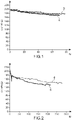
- a comparison of the performance between the button cell comprising the material doped with titanium and the button cell comprising the material not doped with titanium cycled at C/10 between 4.3 V and 2.7 V is presented at figure 1 appended, which is a graph illustrating the evolution of the capacity C (in mAg/h) as a function of the number of cycles N, the curve a) corresponding to that obtained with the button battery comprising the material not doped with titanium and the curve b) corresponding to that obtained with the button battery comprising the material doped with titanium.
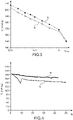
- the titanium-doped material is then evaluated for power still in the same coin cell, with the performance results achieved at 4.3V and 4.4V at 1C shown in the figure 2 appended, which illustrates the change in capacity C (in mAh/g) as a function of the number of cycles N, curve a) corresponding to the test at 4.3 V and curve b) corresponding to the test at 4.4 V.
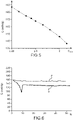
- a power signature was also determined which shows the performance of the material as a function of the charge/discharge rate applied, the results being represented on the picture 3 attached in the appendix, which illustrates the evolution of the capacity C (in mAh/g) as a function of the charging/discharging rate applied (indicated by the ordinate C rate ), the curve a) corresponding to the 4.3V-2 test .7V and curve b) corresponding to the 4.4V-2.7V test.
- the performance achieved by the material is excellent.
- This example relates to the preparation of a lamellar oxide of formula LiNi 0.9 Co 0.05 Ti 0.05 O 2 .
- a solution is prepared by dissolving nickel sulphate (191.2 g), cobalt sulphate (11.4 g) in water (380.7 g). To this solution is added a solution of diammonium bis (lactalo)dihydroxide titanate (23.5 g at 50% by weight) of the following formula: whereby the resulting solution is a 2 M equimolar solution (having a volume of about 400 mL).
- a 5M sodium hydroxide solution is prepared separately as well as a dilute ammonia solution (150.2 g of ammonia at 28% by mass diluted with 233.1 g of water).
- the three solutions have separate injection circuits allowing the solutions to be pumped into a 5L coprecipitation reactor, into which 1L of water and 150 g of 28% ammonia have been introduced beforehand.
- the temperature is brought to 50° C. and the contents of the reactor are kept under stirring at 1000 revolutions/minute.
- An additional circuit of inert gas (argon or nitrogen) makes it possible to deoxygenate the solution while maintaining the reactor under an inert atmosphere.
- the solution containing the metallic elements is pumped into the reactor in the amount of 360 mL.
- the ammonia and sodium hydroxide solution are injected in parallel in order to maintain a constant pH at 11.
- the solution is kept under stirring for 3 hours.
- the solution is then filtered and the precipitate washed with hot water in order to eliminate the sulphate and sodium ions potentially adsorbed on the surface of the material.
- the mixed hydroxide precipitate of formula Ni 0.9 Co 0.05 Ti 0.05 (OH) 2 is then dried under vacuum at 80° C. overnight.
- the hydroxide of formula Ni 0.9 Co 0.05 Ti 0.05 (OH) 2 is then mixed with lithium carbonate (3% molar excess with respect to stoichiometry) then is calcined at 850°C for 12 hours under oxygen to form the compound LiNi 0.9 Co 0.05 Ti 0.05 O 2 .
- the material is then characterized by X-ray diffraction.
- the diffractogram obtained is characteristic of a lamellar oxide exhibiting the space group R -3 m.
- the material was then characterized in button cell electrochemistry.
- the synthesized powder is mixed with a carbon source (SuperP ® ), PVDF 5130 in N-methyl-2-pyrrolidone (NMP).
- the composition of the mixture by mass represents the following ratio 80/10/10 (material/PVDF/Carbon).
- the mixture thus formed is coated on aluminum foil and then left to dry for 24 hours at 60° C. to evaporate the NMP. From this sheet thus coated, a 14mm disc is then cut and then dried under vacuum for 48 hours at 80°C.
- the electrode thus formed is then returned to a glove box and a button cell is then assembled using lithium metal as anode, Celgard 2400 ® as separator and an electrolyte (LiPF 6 1M in a mixture of carbonate solvents EC/PC/ DMC, EC corresponding to ethylene carbonate, PC to propylene carbonate and DMC corresponding to dimethyl carbonate).
- an electrolyte LiPF 6 1M in a mixture of carbonate solvents EC/PC/ DMC, EC corresponding to ethylene carbonate, PC to propylene carbonate and DMC corresponding to dimethyl carbonate.
- the performance of the button cell comprising the titanium-doped material is measured by cycling at C/10 and at 1C, the results being represented on the figure 4 , which is a graph illustrating the evolution of the capacity C (in mAg/h) as a function of the number of cycles N, curve a) corresponding to that obtained for cycling at C/10 and curve b) corresponding to that obtained for cycling at 1C.
- a power signature has also been determined which shows the performance of the material as a function of the charge/discharge regime applied, the results being represented on the figure 5 attached in the appendix, which illustrates the evolution of the capacity C (in mAh/g) as a function of the charging/discharging rate applied (indicated by the ordinate C rate ).
- This example relates to the preparation of a lamellar oxide of formula LiNi 0.8 Co 0.1 Ti 0.1 O 2 .
- a solution is prepared by dissolving nickel sulphate (169.9 g), cobalt sulphate (22.7 g) in water (361.5 g). To this solution is added a solution of diammonium bis (lactalo)dihydroxide titanate (47.1 g at 50% by weight) of the following formula: whereby the resulting solution is a 2 M equimolar solution (having a volume of about 400 mL).
- a 5M sodium hydroxide solution is prepared separately as well as a dilute ammonia solution (150.2 g of ammonia at 28% by weight diluted with 233.1 g of water).
- the three solutions have separate injection circuits allowing the solutions to be pumped into a 5L coprecipitation reactor, into which 1L of water and 150 g of a 28% ammonia solution have been introduced beforehand.
- the temperature is brought to 50° C. and the contents of the reactor are kept under stirring at 1000 revolutions/minute.
- An additional circuit of inert gas (argon or nitrogen) makes it possible to deoxygenate the solution while maintaining the reactor under an inert atmosphere.
- the solution containing the metallic elements is pumped into the reactor in the amount of 360 mL.
- the ammonia and sodium hydroxide solution are injected in parallel in order to maintain a constant pH at 11.
- the solution is kept under stirring for 3 hours.
- the solution is then filtered and the precipitate washed with hot water in order to eliminate the sulphate and sodium ions potentially adsorbed on the surface of the material.
- the precipitate of mixed hydroxide of formula Ni 0.8 Co 0.1 Ti 0.1 (OH) 2 is then dried under vacuum at 80° C. overnight.
- the hydroxide of formula Ni 0.8 Co 0.1 Ti 0.1 (OH) 2 is then mixed with lithium carbonate (3% molar excess with respect to stoichiometry) then is calcined under oxygen at 850°C for 12 hours to form the compound LiNi 0.8 Co 0.1 Ti 0.1 O 2 .
- the material is then characterized by X-ray diffraction.
- the diffractogram obtained is characteristic of a lamellar oxide exhibiting the space group R -3 m.
- the material was then characterized in button cell electrochemistry.
- the synthesized powder is mixed with a carbon source (SuperP ® ), PVDF 5130 in N-methyl-2-pyrrolidone (NMP).
- the composition of the mixture by mass represents the following ratio 80/10/10 (material/PVDF/Carbon).
- the mixture thus formed is coated on aluminum foil and then left to dry for 24 hours at 60° C. to evaporate the NMP. From this sheet thus coated, a 14mm disc is then cut and then dried under vacuum for 48 hours at 80°C.
- the electrode thus formed is then returned to a glove box and a button cell is then assembled using lithium metal as anode, Celgard 2400 ® as separator and an electrolyte (LiPF 6 1M in a mixture of carbonate solvents EC/PC/ DMC, EC corresponding to ethylene carbonate, PC to propylene carbonate and DMC corresponding to dimethyl carbonate).
- an electrolyte LiPF 6 1M in a mixture of carbonate solvents EC/PC/ DMC, EC corresponding to ethylene carbonate, PC to propylene carbonate and DMC corresponding to dimethyl carbonate.
- the performance of the button cell comprising the titanium-doped material is measured by cycling at C/10 and at 1C, the results being represented on the figure 6 , which is a graph illustrating the evolution of the capacity C (in mAg/h) in as a function of the number of cycles N, curve a) corresponding to that obtained for cycling at C/10 and curve b) corresponding to that obtained for cycling at 1C.
- a power signature has also been determined which shows the performance of the material as a function of the charge/discharge regime applied, the results being represented on the figure 7 appended, which illustrates the evolution of the capacity C (in mAh/g) according to different charge/discharge rates (indicated by the ordinate C rate ).
- This example relates to the preparation of a lithiated oxide of spinel structure corresponding to the formula LiNi 0.5 Mn 1.48 Ti 0.02 O 4 .
- a solution is prepared by dissolving nickel sulphate (53.1 g), manganese sulphate (101.1 g) in water (396.1 g). To this solution is added a solution of diammonium bis(lactalo)dihydroxide titanate (4.7 g at 50% by weight) of the following formula: whereby the resulting solution is a 2 M equimolar solution (having a volume of about 400 mL).
- a solution composed of 134.2 g of sodium carbonate and ammonia (31.5 g of ammonia at 28% by weight) diluted in water (565 g) is prepared separately.
- the two solutions have separate injection circuits allowing the solutions to be pumped into a 5L coprecipitation reactor, into which 1L of water has been introduced beforehand.
- the temperature is brought to 50° C. and the contents of the reactor are kept under stirring at 1000 revolutions/minute.
- An additional circuit of inert gas (argon or nitrogen) makes it possible to deoxygenate the solution while maintaining the reactor under inert atmosphere.
- the solution containing the metallic elements is pumped into the reactor in the amount of 360 mL.
- the solution composed of sodium carbonate and ammonia is injected in parallel in order to maintain a constant pH at 7.5.
- the solution is kept under stirring for 1 night.
- the solution is then filtered and the precipitate washed with hot water in order to eliminate the sulphate and sodium ions potentially adsorbed on the surface of the material.
- the precipitate of carbonate of formula Ni 0.25 Mn 0.74 Ti 0.01 CO 3 is then dried under vacuum at 80° C. overnight.
- the carbonate of formula Ni 0.25 Mn 0.74 Ti 0.01 CO 3 is then mixed with lithium carbonate (3% molar excess relative to the stoichiometry) then is calcined in air at 950° C. for 6 hours to form the compound LiNi 0.5 Mn 1.48 Ti 0.02 O 4 .
- the material is then characterized by X-ray diffraction.
- the diffractogram obtained is characteristic of a spinel-type material exhibiting the space group Fd-3m.
- the material was then characterized in button cell electrochemistry.
- the synthesized powder is mixed with a carbon source (SuperP ® ), PVDF 8130 in N-methyl-2-pyrrolidone (NMP).
- the composition of the mixture by mass represents the following ratio 90/5/5 (material/PVDF/Carbon).
- the mixture thus formed is coated on aluminum foil and then left to dry for 24 hours at 60° C. to evaporate the NMP. From this sheet thus coated, a 14mm disc is then cut and then dried under vacuum for 48 hours at 80°C.
- the electrode thus formed is then returned to a glove box and a button cell is then assembled using lithium metal as anode, Celgard 2400 ® as separator and an electrolyte (LiPF6 1M in a mixture of EC/PC/DMC carbonate solvents , EC corresponding to ethylene carbonate, PC to propylene carbonate and DMC corresponding to dimethyl carbonate).
- an electrolyte LiPF6 1M in a mixture of EC/PC/DMC carbonate solvents , EC corresponding to ethylene carbonate, PC to propylene carbonate and DMC corresponding to dimethyl carbonate.
- a button cell was made in the same way as above, except that the positive electrode active material is not doped with titanium, this material having the formula LiNi 0.5 Mn 1.5 O 4 .
- a performance comparison between the button cell comprising the titanium-doped material and the button cell comprising the non-titanium doped material is presented at figure 8 appended, which is a graph illustrating the evolution of the capacity C (in mAh/g) as a function of the number of cycles N, the curve a) corresponding to that obtained with the button cell comprising the material doped with titanium and the curve b) corresponding to that obtained with the button battery comprising the material not doped with titanium.
- a power signature of the material is first produced from C/10 to 15C over the first 35 cycles (3 cycles at C/10, 5 cycles at C/3, 5 cycles at C, 5 cycles at 3C, 5 cycles at 5C, 5 cycles at 10C, 5 cycles at 15C between 4.9 V and 3 V followed by cycling at 1C over a hundred cycles It appears that the material with 1.3% titanium is more stable than the undoped material
- This power signature shows the performance of the material as a function of the applied charge/discharge regime.
- the power behavior is more clearly represented on the figure 9 attached in the appendix, which illustrates the evolution of the capacity C (in mAh/g) as a function of the charge/discharge rate applied (indicated by the ordinate C rate ), the curve a) corresponding to the 4.9V-3V test of the material doped with titanium and the curve b) corresponding to the 4.9V-3V test of the material not doped with titanium.
- the performance achieved by the material is excellent.
- This example relates to the preparation of a spinel of formula LiNi 0.5 Mn 1.46 Ti 0.04 O 4 .
- a solution is prepared by dissolving nickel sulphate (53.1 g), manganese sulphate (99.7 g) in water (392.3 g). AT to this solution is added a solution of diammonium bis(lactalo)dihydroxide titanate (9.4 g at 50% by mass) of the following formula: whereby the resulting solution is a 2 M equimolar solution (having a volume of about 400 mL).
- a solution composed of 134.2 g of sodium carbonate and ammonia (31.5 g of ammonia at 28% by weight) diluted in water (565 g) is prepared separately.
- the two solutions have separate injection circuits allowing the solutions to be pumped into a 5L coprecipitation reactor, into which 1L of water has been introduced beforehand.
- the temperature is brought to 50° C. and the contents of the reactor are kept under stirring at 1000 revolutions/minute.
- An additional circuit of inert gas (argon or nitrogen) makes it possible to deoxygenate the solution while maintaining the reactor under an inert atmosphere.
- the solution containing the metallic elements is pumped into the reactor in the amount of 360 mL.
- the solution composed of sodium carbonate and ammonia is injected in parallel in order to maintain a constant pH at 7.5.
- the solution is kept under stirring for 1 night.
- the solution is then filtered and the precipitate washed with hot water in order to eliminate the sulphate and sodium ions potentially adsorbed on the surface of the material.
- the precipitate of carbonate of formula Ni 0.25 Mn 0.73 Ti 0.02 CO 3 is then dried under vacuum at 80° C. overnight.
- the carbonate of formula Ni 0.25 Mn 0.73 Ti 0.02 CO 3 is then mixed with lithium carbonate (3% molar excess relative to the stoichiometry) then is calcined in air at 950° C. for 6 hours to form the compound of formula LiNi 0.5 Mn 1.46 Ti 0.04 O 4 .
- the material is then characterized by X-ray diffraction.
- the diffractogram obtained is characteristic of a spinel-type material exhibiting the space group Fd-3m.
- the material was then characterized in button cell electrochemistry.
- the synthesized powder is mixed with a carbon source (SuperP ® ), PVDF 8130 in N-methyl-2-pyrrolidone (NMP).
- the composition of the mixture by mass represents the following ratio 90/5/5 (material/PVDF/Carbon).
- the mixture thus formed is coated on aluminum foil and then left to dry for 24 hours at 60° C. to evaporate the NMP. From this sheet thus coated, a 14mm disc is then cut and then dried under vacuum for 48 hours at 80°C.
- the electrode thus formed is then returned to a glove box and a button cell is then assembled using lithium metal as anode, Celgard 2400 ® as separator and an electrolyte (LiPF6 1M in a mixture of EC/PC/DMC carbonate solvents , EC corresponding to ethylene carbonate, PC to propylene carbonate and DMC corresponding to dimethyl carbonate).
- an electrolyte LiPF6 1M in a mixture of EC/PC/DMC carbonate solvents , EC corresponding to ethylene carbonate, PC to propylene carbonate and DMC corresponding to dimethyl carbonate.
- a button cell was made in the same way as above, except that the positive electrode active material is not doped with titanium, this material having the formula LiNi 0.5 Mn 1 .5 O 4 .
- a performance comparison between the button cell comprising the titanium-doped material and the button cell comprising the non-titanium doped material is presented at figure 11 appended, which is a graph illustrating the evolution of the capacity C (in mAh/g) as a function of the number of cycles N, the curve a) corresponding to that obtained with the button cell comprising the material doped with titanium and the curve b) corresponding to that obtained with the button battery comprising the material not doped with titanium.
- a power signature of the material is first produced from C/10 to 15C over the first 35 cycles (3 cycles at C/10, 5 cycles at C/3, 5 cycles at C, 5 cycles at 3C, 5 cycles at 5C, 5 cycles at 10C, 5 cycles at 15C between 4.9 V and 3 V followed by cycling at 1C over a hundred cycles It appears that the material with 2.7% titanium is more stable than the undoped material
- This power signature shows the performance of the material as a function of the applied charge/discharge regime.
- the power behavior is more clearly represented on the figure 12 attached in the appendix, which illustrates the evolution of the capacity C (in mAh/g) as a function of the charge/discharge rate applied (indicated by the ordinate C rate ), the curve a) corresponding to the 4.9V-3V test of the material doped with titanium and curve b) corresponding to the 4.9V-3V test of the material not doped with titanium.
- the performance achieved by the material is excellent.
- This example relates to the preparation of a spinel of formula LiNi 0.5 Mn 1.1 Ti 0.4 O 4 .
- a solution is prepared by dissolving nickel sulphate (53.1 g), manganese sulphate (75.1 g) in water (323.0 g). To this solution is added a solution of diammonium bis(lactalo)dihydroxide titanate (94.1 g at 50% by weight) of the following formula: whereby the resulting solution is a 2 M equimolar solution (having a volume of about 400 mL).
- a solution composed of 134.2 g of sodium carbonate and ammonia (31.5 g of ammonia at 28% by mass) diluted in water (565 g) is prepared separately.
- the two solutions have separate injection circuits allowing the solutions to be pumped into a 5L coprecipitation reactor, into which 1L of water has been introduced beforehand.
- the temperature is brought to 50°C and the contents of the reactor are maintained under stirring at 1000 rpm.
- An additional circuit of inert gas (argon or nitrogen) makes it possible to deoxygenate the solution while maintaining the reactor under an inert atmosphere.
- the solution containing the metallic elements is pumped into the reactor in the amount of 360 mL.
- the solution composed of sodium carbonate and ammonia is injected in parallel in order to maintain a constant pH at 7.5.
- the solution is kept under stirring for 1 night.
- the solution is then filtered and the precipitate washed with hot water in order to eliminate the sulphate and sodium ions potentially adsorbed on the surface of the material.
- the precipitate of carbonate of formula Ni 0.25 Mn 0.55 Ti 0.2 CO 3 is then dried under vacuum at 80° C. overnight.
- the carbonate of formula Ni 0.25 Mn 0.55 Ti 0.2 CO 3 is then mixed with lithium carbonate (3% molar excess relative to the stoichiometry) then is calcined in air at 950° C. for 6 hours to form the compound of formula LiNi 0.5 Mn 1.1 Ti 0.4 O 4 .
- the material is then characterized by X-ray diffraction.
- the diffractogram obtained is characteristic of a spinel-type material exhibiting the space group Fd-3m.
- the material was then characterized in button cell electrochemistry.
- the synthesized powder is mixed with a carbon source (SuperP ® ), PVDF 8130 in N-methyl-2-pyrrolidone (NMP).
- the composition of the mixture by mass represents the following ratio 90/5/5 (material/PVDF/Carbon).
- the mixture thus formed is coated on aluminum foil and then left to dry for 24 hours at 60° C. to evaporate the NMP. From this sheet thus coated, a 14mm disc is then cut and then dried under vacuum for 48 hours at 80°C.
- the electrode thus formed is then returned to a glove box and a button cell is then assembled using lithium metal as anode, Celgard 2400 ® as separator and an electrolyte (LiPF6 1M in a mixture of EC/PC/DMC carbonate solvents , EC corresponding to ethylene carbonate, PC to propylene carbonate and DMC corresponding to dimethyl carbonate).
- an electrolyte LiPF6 1M in a mixture of EC/PC/DMC carbonate solvents , EC corresponding to ethylene carbonate, PC to propylene carbonate and DMC corresponding to dimethyl carbonate.
- a button cell was made in the same way as above, except that the positive electrode active material without the presence of titanium, this material having the formula LiNi 0.5 Mn 1.5 O 4 .
- a comparison of the performance between the button cell comprising the material substituted by titanium and the button cell comprising the material without the presence of titanium is presented at the figure 14 appended, which is a graph illustrating the evolution of the capacity C (in mAh/g) as a function of the number of cycles N, the curve a) corresponding to that obtained with the button battery comprising the material substituted by titanium and curve b) corresponding to that obtained with the button battery comprising the material without the presence of titanium.
- a power signature of the material is first produced from C/10 to 15C over the first 35 cycles (3 cycles at C/10, 5 cycles at C/3, 5 cycles at C, 5 cycles at 3C, 5 cycles at 5C, 5 cycles at 10C, 5 cycles at 15C between 4.9 V and 3 V followed by cycling at 1C over a hundred cycles It appears that the material with 36% titanium is more stable than the material without titanium.
Landscapes
- Chemical & Material Sciences (AREA)
- Organic Chemistry (AREA)
- Inorganic Chemistry (AREA)
- Chemical Kinetics & Catalysis (AREA)
- Electrochemistry (AREA)
- General Chemical & Material Sciences (AREA)
- Engineering & Computer Science (AREA)
- Materials Engineering (AREA)
- Manufacturing & Machinery (AREA)
- Battery Electrode And Active Subsutance (AREA)
- Inorganic Compounds Of Heavy Metals (AREA)
Abstract
L'invention a trait à un procédé de préparation d'un matériau actif d'électrode positive pour batterie au lithium consistant en un oxyde lithié comprenant du titane et éventuellement un ou plusieurs autres éléments métalliques comprenant les étapes successives suivantes :
a) une étape de formation d'un précipité comprenant du titane et le ou les éventuels autres éléments métalliques par mise en contact d'un complexe de coordination du titane et, le cas échéant, d'au moins un sel du ou des autres éléments métalliques avec un milieu aqueux ;
b) une étape de récupération du précipité ainsi formé ;
c) une étape de calcination du précipité en présence d'une source de lithium.
a) une étape de formation d'un précipité comprenant du titane et le ou les éventuels autres éléments métalliques par mise en contact d'un complexe de coordination du titane et, le cas échéant, d'au moins un sel du ou des autres éléments métalliques avec un milieu aqueux ;
b) une étape de récupération du précipité ainsi formé ;
c) une étape de calcination du précipité en présence d'une source de lithium.
Description
- La présente invention se rapporte à un procédé de préparation d'un matériau actif d'électrode positive pour batterie au lithium (et plus spécifiquement, une batterie lithium-ion) consistant en un oxyde métallique lithié comprenant du titane.
- Les batteries lithium-ion sont particulièrement intéressantes pour les domaines où l'autonomie est un critère primordial, tels que cela est le cas du domaine des appareils nomades (tels que les téléphones portables, les ordinateurs portables) ou du domaine des transports tels que les véhicules électriques, les véhicules hybrides, ou encore des domaines médicaux, spatiaux ou de la microélectronique.
- D'un point de vue fonctionnel, les batteries lithium-ion reposent sur le principe de l'intercalation-désintercalation du lithium au sein des matériaux constitutifs des électrodes des cellules électrochimiques de la batterie, lesquels matériaux peuvent être qualifiés de matériaux actifs.
- Plus précisément, la réaction à l'origine de la production de courant (c'est-à-dire lorsque la batterie est en mode de décharge) met en jeu le transfert, par l'intermédiaire d'un électrolyte conducteur d'ions lithium, de cations lithium provenant d'une électrode négative qui viennent s'intercaler dans le réseau accepteur de l'électrode positive, tandis que des électrons issus de la réaction à l'électrode négative vont alimenter le circuit extérieur, auquel sont reliées les électrodes positive et négative.
- Dans les batteries lithium-ion, l'élément le plus critique et le plus limitatif s'avère être l'électrode positive et, plus spécifiquement, le matériau actif de l'électrode positive, dont les lithiation/délithiation successives peuvent engendrer un vieillissement. Plus spécifiquement, des atomes de métaux de transition présents dans le matériau actif peuvent migrer d'un site cristallographique à l'autre et peuvent à terme ralentir et bloquer l'accès à certains sites du lithium, ce qui contribue à diminuer les performances du matériau, et par conséquent celles de la batterie, au cours des cycles.
- Pour stabiliser ces matériaux, des dopants destinés à stabiliser la structure peuvent être introduits dans ceux-ci, tels que le titane, qui entre efficacement dans la constitution de matériaux actifs d'électrode positive couramment utilisés et, plus particulièrement :
- les oxydes lamellaires de formule Li(Ni, Co, Mn, Ti)O2, dans lesquels le titane peut être présent à hauteur de quelques pourcents, le titane assurant ainsi un rôle de dopant ou dans lesquels le titane peut remplacer le manganèse et/ou le nickel et/ou le cobalt dans la formule ci-dessus ;
- les oxydes de type spinelle de formule Li(Ni, Co, Mn, Ti)O4, dans lesquels le titane peut être présent à hauteur de quelques pourcents, le titane assurant ainsi un rôle de dopant ou dans lesquels le titane peut remplacer le manganèse et/ou le nickel et/ou le cobalt dans la formule ci-dessus.
- Ces oxydes peuvent être préparés par différentes voies.
- Par exemple, il peut être envisagé un procédé dit « tout solide », dans lequel des précurseurs comprenant les éléments métalliques destinés à entrer dans l'oxyde souhaité sont mis à réagir par voie solide, tels que :
- dans Electrochemistry Communications, Vol. 3, Issue 2, February 2001, p. 52-55 , qui décrit la préparation d'oxydes lamellaires de formule LiNi1-xTixO2 (0,025≤x≤0,2) par réaction en voie solide à 750°C sous courant d'oxygène des précurseurs LiOH, Ni(OH)2 et TiO2;
- dans Solid State Ionics, Vol. 86-88, Part 1, July 1996, p. 171-175 , qui décrit la préparation d'oxydes lamellaires de formule LiNi1-yTiyO2 (0,1≤y≤0,5) par réaction par voie solide de Li2CO3, NiO et de TiO2.
- A titre alternatif, il peut être envisagé également un procédé impliquant une coprécipitation, tel que dans International Journal of Minerals, Metallurgy and Materials, Vol. 16, Issue 4, August 2009, p.452-457 , qui décrit la préparation d'un oxyde de formule LiNi0,8Al0,2-xTixO2 (x=0,0-0,20) par réaction de coprécipitation assistée par ultrasons des précurseurs Ni(NO3)2, Al(NO3)3, LiOH.H2O et TiO2.
- Aussi, au vu de ce qui existe déjà, les auteurs de la présente invention se sont fixé pour objectif de proposer un procédé de préparation d'un matériau actif d'électrode positive consistant en un oxyde lithié comprenant du titane qui puisse se dérouler en voie liquide et soit de mise en œuvre simple et ne nécessite pas d'équipements complexes et coûteux.
- Cet objectif est atteint par un procédé de préparation d'un matériau actif d'électrode positive pour batterie au lithium consistant en un oxyde lithié comprenant du titane et éventuellement un ou plusieurs autres éléments métalliques comprenant les étapes successives suivantes :
- a) une étape de formation d'un précipité comprenant du titane et le ou les éventuels autres éléments métalliques par mise en contact d'un complexe de coordination du titane et, le cas échéant, d'au moins un sel du ou des autres éléments métalliques avec un milieu aqueux, avantageusement, basique ;
- b) une étape de récupération du précipité ainsi formé ;
- c) une étape de calcination du précipité en présence d'une source de lithium.
- Dans ce qui précède et ce qui suit, il s'entend, par complexe de coordination du titane, un composé comprenant du titane sous forme d'un cation (plus spécifiquement, du titane au degré d'oxydation +IV), le titane étant lié à des molécules via des liaisons de coordination, ces molécules pouvant être qualifiées de ligands. Plus spécifiquement, les électrons de valence servant à la formation des liaisons de coordination proviennent uniquement d'atomes appartenant aux ligands, par exemple, via leurs doublets libres et/ou leurs charges négatives.
- Par sel, il s'entend, dans ce qui précède et ce qui suit, un composé comprenant un élément métallique sous forme cationique combiné avec un ou plusieurs anions pour former un produit neutre et sans charge, les liaisons établies entre l'élément métallique et le ou les anions étant des liaisons ioniques.
- Par électrode positive, il s'entend, dans ce qui précède et ce qui suit, l'électrode qui fait office de cathode, quand la batterie débite du courant (c'est-à-dire lorsqu'elle est en processus de décharge) et qui fait office d'anode lorsque la batterie est en processus de charge.
- Le ou les éventuels autres éléments métalliques (étant entendu, autres que le titane) du matériau conformément au procédé de l'invention peuvent être choisis parmi les éléments métalliques de transition (tels que le manganèse, le cobalt, le nickel, le fer, le cuivre et les mélanges de ceux-ci), les éléments métalliques de post-transition (tel que l'aluminium) et les mélanges de ceux-ci. Plus spécifiquement, le ou les éléments métalliques peuvent être choisis parmi le manganèse, le cobalt, le nickel et les mélanges de ceux-ci.
- Spécifiquement, les oxydes lithiés comprenant du titane susceptibles d'être obtenus à l'issue du procédé de l'invention peuvent être :
- des oxydes lamellaires de formule LiTiMO2, dans laquelle M peut désigner Co, Ni, Mn, Al, Cu, Fe et des mélanges de ceux-ci, tels que Li(Ni,Mn,Co,Ti)O2 comme LiNi0,8Mn0,08Co0,1Ti0,02O2, Li(Ni, Ti)O2 comme LiNi0,9Ti0,1O2, Li(Ni, Co, Ti)O2 comme LiNi0,8Co0,1Ti0,1O2, LiNi0,9Co0,05Ti0,05O2 ;
- des oxydes de type spinelle de formule LiTiMO4, dans laquelle M peut être Ni, Mn, Co, Cu, Al, Fe et des mélanges de ceux-ci, tels que Li (Ni, Mn, Ti)O4 comme LiNi0,5Mn1,3Ti0,2O4, Li(Ni, Ti)O4 comme LiNi0,5Ti1,5O4.
- En premier lieu, le procédé de l'invention comprend une étape de formation d'un précipité comprenant du titane et le ou les éventuels autres éléments métalliques par mise en contact d'un complexe de coordination du titane et, le cas échéant, d'au moins un sel du ou des autres éléments métalliques avec un milieu aqueux, avantageusement, basique. Il est précisé que par milieu aqueux basique, il s'entend classiquement un milieu dont le pH est strictement supérieur à 7 et, de préférence, supérieur ou égal à 7,5.
- Le complexe de coordination du titane comprend, avantageusement, au moins un ligand comprenant au moins deux groupes établissant des liaisons de coordination avec le titane, les liaisons de coordination s'établissant, classiquement, entre des doublets libres et/ou charges négatives portées par ces groupes, ce ou ces ligands pouvant être qualifiés de ligands polydentés (du fait qu'ils comprennent plusieurs groupes établissant des liaisons de coordination avec le titane et plus spécifiquement, de ligands bidentés, lorsqu'ils comprennent uniquement deux de ces groupes).
- Parmi les ligands avantageux, il peut être cité, plus spécifiquement, un ligand bidenté comprenant un groupe carboxylate et un groupe alcoolate (ou alcoxyde), lesquels groupes assurent la coordination avec le titane.
- Ainsi, le complexe de coordination du titane peut comprendre au moins un ligand bidenté comprenant un groupe carboxylate et un groupe alcoolate
- En outre, le complexe de coordination du titane peut comprendre au moins un ligand comprenant un seul groupe établissant une liaison de coordination avec le titane, par exemple, un groupe -OH.
- Plus particulièrement, le complexe de coordination du titane est un complexe comprenant :
- au moins un ligand bidenté comprenant au moins deux groupes établissant des liaisons de coordination avec le titane et, plus spécifiquement comprenant deux groupes, tels qu'un groupe carboxylate et un groupe alcoolate ; et
- au moins un ligand comprenant un seul groupe établissant une liaison de coordination avec le titane, tel qu'un groupe -OH.
- Encore plus particulièrement, le complexe de coordination du titane est un complexe comprenant deux ligands bidentés comprenant chacun deux groupes établissant des liaisons de coordination avec le titane et, plus spécifiquement comprenant deux groupes, tels qu'un groupe carboxylate et un groupe alcoolate et comprenant deux ligands comprenant chacun un seul groupe établissant une liaison de coordination avec le titane, tel qu'un groupe -OH.
- Par ailleurs, le complexe de coordination peut comprendre un ou plusieurs cations pour neutraliser, le cas échéant, l'édifice constitué par le titane et ses ligands, ce ou ces cations pouvant être des cations ammonium.
- Un complexe de coordination du titane efficace pour la mise en œuvre du procédé de l'invention est un complexe répondant à la formule (I) suivante :

- Ce type de complexe a pour particularité d'être facilement soluble en milieu aqueux.
- Le cas échéant, le ou les sels du ou des autres éléments métalliques peuvent être des nitrates, des carbonates, des chlorures, ou des sulfates du ou des autres éléments métalliques et, plus spécifiquement, des sulfates.
- Il est précisé, que lorsque la formation du précipité implique à la fois du titane et un ou plusieurs autres éléments métalliques, cette formation peut être qualifiée de coprécipitation.
- La précipitation ou coprécipitation permet, après calcination du précipité avec la source de lithium, la production de matériaux possédant des particules primaires (cristallites) agglomérées en particules secondaires ayant une forme sphérique (environ 6-10 µm). Un des avantages d'une telle morphologie réside dans l'amélioration de ces particules à former un ensemble compact. Le volume d'une batterie étant un volume fixe, l'énergie embarquée par la batterie dépendra forcement de la quantité de matériaux actifs contenue dans la batterie. En augmentant la densité des poudres de matériau actif, il est donc possible de maximiser la quantité de matériau dans les cellules et ainsi d'augmenter l'énergie embarquée dans la batterie. Comme autre avantage notable, la synthèse par (co)précipitation permet un mélange idéal de tous les éléments chimiques d'un matériau, et notamment le titane, dans notre cas, car tous les éléments sont préalablement dissous et mélangés en voie liquide.
- Lorsque la formation du précipité implique à la fois du titane et un ou plusieurs autres éléments métalliques, le procédé peut comprendre, avant l'étape de formation du précipité en tant que telle, une étape de préparation d'une solution comprenant le ou les sels du ou des autres éléments métalliques, par exemple, par dissolution du ou desdits sels dans de l'eau.
- Dans ce cas, l'étape de formation du précipité s'effectue par mise en contact de la solution comprenant le ou les sels des éléments métalliques et le complexe de coordination du titane avec un milieu aqueux précipitant, de préférence, basique.
- Quel que soit le mode de réalisation, le milieu aqueux peut être obtenu par addition d'au moins une solution basique, par exemple, une solution de soude, une solution d'ammoniaque ou un mélange de celles-ci.
- Quel que soit le mode de réalisation, l'étape de formation du précipité peut être réalisée sous gaz inerte (par exemple, de l'azote ou de l'argon).
- Cette étape de formation d'un précipité peut être mise en œuvre dans un réacteur de précipitation, dans lequel les opérations successives suivantes peuvent, en particulier, être mises en œuvre :
- une opération d'injection dans le réacteur d'une solution comprenant le complexe de coordination du titane et, le cas échéant, le ou les éventuels autres éléments métalliques ;
- une opération d'injection dans le réacteur d'au moins une solution basique, cette opération pouvant être continue pendant toute la durée de l'étape pour maintenir un pH basique ;
- une opération d'agitation du mélange résultant pendant une température et une durée appropriées et sous atmosphère inerte, jusqu'à formation complète du précipité.
- Cette température et cette durée appropriées peuvent être déterminées, par des tests préalables permettant de fixer, pour une quantité donnée de complexe et, le cas échéant, de sel(s) et de pH, le couple de température et de durée nécessaire à la formation complète du précipité.
- En variante, la solution comprenant le complexe de coordination du titane et la solution comprenant le ou les autres éléments métalliques peuvent être séparées avant l'introduction dans le réacteur et peuvent être injectés dans celui-ci via des circuits d'injection séparés.
- Le précipité formé à l'issue de cette étape est un hydroxyde ou carbonate mixte comprenant du titane et, le cas échéant, le ou les autres éléments métalliques.
- Une fois l'étape de formation du précipité achevée, le précipité est récupéré, par exemple, par filtration.
- Le précipité ainsi récupéré peut ensuite être soumis à un lavage à l'eau, notamment pour supprimer les ions adsorbés à la surface du précipité et/ou séché, par exemple, sous vide.
- Enfin, le précipité est soumis à une étape de calcination en présence d'une source de lithium, de sorte à former le matériau actif recherché. En particulier, la source de lithium peut être un sel de lithium, tel que du carbonate de lithium, de l'hydroxyde de lithium ou de l'acétate de lithium. La source de lithium est utilisée, avantageusement, en excès, par exemple, un excès allant jusqu'à 3% molaire par rapport à la quantité stœchiométrique.
- Il s'entend que la température et la durée de calcination seront choisies par l'homme du métier de sorte à obtenir la phase oxyde sous la forme cristallisée souhaitée, cette température et durée pouvant être aisément déterminées par l'homme du métier par des essais préalables consistant à déterminer en fonction de la phase recherchée (celle-ci étant détectable par diffractométrie de rayons X) le couple de température et de durée appropriées.
- A titre d'exemple, l'étape de calcination peut être réalisée à une température allant de 700°C à 1000°C, et de préférence de 800°C à 1000°C pendant une durée allant de 4 heures à 24 heures. De préférence, cette étape de calcination est effectuée à l'air libre ou sous atmosphère contrôlée d'oxygène.
- L'invention va maintenant être décrite par rapport aux exemples suivants donnés à titre illustratif et non limitatif.
- La présente invention sera mieux comprise sur la base de la description qui va suivre et des dessins en annexe sur lesquels:
- La
figure 1 est un graphique illustrant, pour l'exemple 1, l'évolution de la capacité C (en mAg/h) en fonction du nombre de cycles N, la courbe a) correspondant à celle obtenue avec la pile bouton comprenant le matériau non dopé au titane et la courbe b) correspondant à celle obtenue avec la pile bouton comprenant le matériau dopé au titane ; - La
figure 2 est un graphique illustrant, pour l'exemple 1, l'évolution la capacité C (en mAh/g) en fonction du nombre de cycles N, la courbe a) correspondant à l'essai à 4,3 V et la courbe b) correspondant à l'essai à 4,4 V ; - La
figure 3 est un graphique illustrant, pour l'exemple 1, l'évolution de la capacité C (en mAh/g) en fonction du régime de charge/décharge appliqué (indiqué par Crate en ordonnée) ; - La
figure 4 est un graphique illustrant, pour l'exemple 2, l'évolution de la capacité C (en mAg/h) en fonction du nombre de cycles N, la courbe a) correspondant à celle obtenue pour le cyclage à C/10 et la courbe b) correspondant à celle obtenue pour le cyclage à 1C ; - La
figure 5 est un graphique illustrant, pour l'exemple 2, l'évolution de la capacité C (en mAh/g) en fonction du régime de charge/décharge appliqué (indiqué par Crate en ordonnée) ; - La
figure 6 est un graphique illustrant, pour l'exemple 3, l'évolution de la capacité C (en mAg/h) en fonction du nombre de cycles N, la courbe a) correspondant à celle obtenue pour le cyclage à C/10 et la courbe b) correspondant à celle obtenue pour le cyclage à 1C ; - La
figure 7 est un graphique illustrant, pour l'exemple 3, l'évolution de la capacité C (en mAh/g) en fonction du régime de charge/décharge appliqué (indiqué par Crate en ordonnée). - La
figure 8 illustre, pour l'exemple 4, un graphique représentant l'évolution de la capacité C (en mAh/g) en fonction du nombre de cycles N, la courbe a) correspondant à celle obtenue avec la pile bouton comprenant le matériau dopé au titane et la courbe b) correspondant à celle obtenue avec la pile bouton comprenant le matériau non dopé au titane. - La
figure 9 est un graphique illustrant, pour l'exemple 4, l'évolution de la capacité C (en mAh/g) en fonction du régime de charge/décharge appliqué (indiqué par l'ordonnée Crate), la courbe a) correspondant au test 4,9V-3V du matériau dopé au titane et la courbe b) correspondant au test 4,9V-3V du matériau non dopé au titane. - La
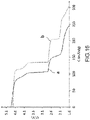
figure 10 est un graphique illustrant pour l'exemple 4, l'évolution de la tension U (en V) en fonction de la capacité C (en mAh/g). - La
figure 11 est un graphique illustrant, pour l'exemple 5, l'évolution de la capacité C (en mAh/g) en fonction du nombre de cycles N, la courbe a) correspondant à celle obtenue avec la pile bouton comprenant le matériau dopé au titane et la courbe b) correspondant à celle obtenue avec la pile bouton comprenant le matériau non dopé au titane. - La
figure 12 est un graphique illustrant, pour l'exemple 5, l'évolution de la capacité C (en mAh/g) en fonction du régime de charge/décharge appliqué (indiqué par l'ordonné Crate), la courbe a) correspondant au test 4,9V-3V du matériau dopé au titane et la courbe b) correspondant au test 4,9V-3V du matériau non-dopé au titane. - La
figure 13 est un graphique illustrant pour l'exemple 5, l'évolution de la tension U (en V) en fonction de la capacité C (en mAh/g). - La
figure 14 illustre, pour l'exemple 6, un graphique représentant l'évolution de la capacité C (en mAh/g) en fonction du nombre de cycles N, la courbe a) correspondant à celle obtenue avec la pile bouton comprenant le matériau substitué par du titane et la courbe b) correspondant à celle obtenue avec la pile bouton comprenant le matériau sans présence de titane. - La
figure 15 illustre, pour l'exemple 6, un graphique représentant l'évolution de la capacité C (en mAh/g) en fonction du régime de charge/décharge appliqué (indiqué par l'ordonné Crate), la courbe a) correspondant au test 4,9V-3V du matériau substitué par du titane et la courbe b) correspondant au test 4,9V-3V du matériau sans présence de titane. - La
figure 16 un graphique illustrant pour l'exemple 6, l'évolution de la tension U (en V) en fonction de la capacité C (en mAh/g). - Le présent exemple a trait à la préparation d'un oxyde lamellaire de formule LiNi0,8Mn0,08Co0,1Ti0,02O2.
- Dans un premier temps, il est préparé une solution par dissolution de sulfate de nickel (169,9 g), de sulfate de manganèse (10,9 g), de sulfate de cobalt (22,7 g) dans de l'eau (392,3 g). A cette solution est ajoutée une solution de bis(lactalo)dihydroxyde titanate de diammonium (9,4 g à 50% massique) de formule suivante :

- Les trois solutions ont des circuits d'injection séparés permettant de pomper les solutions dans un réacteur de coprécipitation de 5L, dans lequel 1L d'eau et 150 g d'ammoniaque à 28% ont été introduits au préalable. La température est portée à 50°C et le contenu du réacteur est maintenu sous une agitation de 1000 tours/minute. Un circuit annexe de gaz inerte (argon ou azote) permet de désoxygéner la solution tout en maintenant le réacteur sous atmosphère inerte. La solution contenant les éléments métalliques est pompée dans le réacteur à hauteur de 360 mL.
- Durant toute l'opération, la solution d'ammoniaque et de soude sont injectées en parallèle afin de maintenir un pH constant à 11. Une fois la solution métallique introduite, la solution est maintenue sous agitation pendant 3 heures. La solution est ensuite filtrée et le précipité lavé à l'eau chaude afin d'éliminer les ions sulfates et sodium potentiellement adsorbés à la surface du matériau. Le précipité d'hydroxyde mixte de formule Ni0.8Mn0.08Co0.1Ti0.02(OH)2 est ensuite séché sous vide à 80°C pendant une nuit.
- Dans un second temps, l'hydroxyde de formule Ni0.8Mn0.08Co0.1Ti0.02(OH)2 est ensuite mélangé à du carbonate de lithium (3% d'excès molaire par rapport à la stoechiométrie) puis est calciné sous oxygène à 850°C pendant 12 heures pour former le composé LiNi0.8Mn0.08Co0.1Ti0.02O2.
- Le matériau est ensuite caractérisé par diffraction des rayons X. Le diffractogramme obtenu est caractéristique d'un oxyde lamellaire présentant le groupe d'espace R -3 m.
- Des analyses élémentaires par ICP et XRF ont été effectuées sur le matériau, les caractérisations permettant d'accéder aux formules chimiques suivantes du matériau synthétisé :
- LiNi0,79Mn0,08Co0,10Ti0,02O2 dans le cas de l'ICP ;
- LiNi0,8Mn0,07Co0,10Ti0,02O2 dans le cas de l'XRF.
- Le matériau a ensuite été caractérisé en électrochimie en pile bouton. Pour ce faire, la poudre synthétisée est mélangée à une source de carbone (SuperP®), du PVDF 5130 dans de la N-méthyl-2-pyrrolidone (NMP). La composition du mélange en masse représente le ratio suivant 80/10/10 (matériau/PVDF/Carbone). Le mélange ainsi formé est enduit sur une feuille d'aluminium puis laissé sécher pendant 24 heures à 60°C pour évaporer la NMP. A partir de cette feuille ainsi enduite, un disque de 14mm est alors découpé puis séché sous vide pendant 48 heures à 80°C. L'électrode ainsi formée est ensuite rentrée en boite à gant et une pile bouton est alors assemblée en utilisant du lithium métal comme anode, du Celgard 2400 ® comme séparateur et un électrolyte (LiPF6 1M dans un mélange de solvants carbonates EC/PC/DMC, EC correspondant au carbonate d'éthylène, PC au carbonate de propylène et DMC correspondant au carbonate de diméthyle).
- En parallèle, une pile bouton a été réalisée de la même manière que ci-dessus, si ce n'est que le matériau actif d'électrode positive n'est pas dopé au titane, ce matériau ayant pour formule LiNi0,8Mn0,1Co0,1O2. Une comparaison des performances entre la pile bouton comprenant le matériau dopé au titane et la pile bouton comprenant le matériau non dopé au titane cyclés à C/10 entre 4,3 V et 2,7 V est présenté à la
figure 1 jointe en annexe, qui est un graphique illustrant l'évolution de la capacité C (en mAg/h) en fonction du nombre de cycles N, la courbe a) correspondant à celle obtenue avec la pile bouton comprenant le matériau non dopé au titane et la courbe b) correspondant à celle obtenue avec la pile bouton comprenant le matériau dopé au titane. - Il apparait que le matériau possédant 2% de titane est plus stable que le matériau non dopé.
- Le matériau dopé au titane est ensuite évalué en termes de puissance toujours dans la même pile bouton, les résultats des performances obtenues à 4,3 V et à 4,4 V à 1C étant illustrés sur la
figure 2 jointe en annexe, qui illustre l'évolution la capacité C (en mAh/g) en fonction du nombre de cycles N, la courbe a) correspondant à l'essai à 4,3 V et la courbe b) correspondant à l'essai à 4,4 V. Il a été également déterminé une signature en puissance qui montre les performances du matériau en fonction du régime de charge/décharge appliqué, les résultats étant représentés sur lafigure 3 jointe en annexe, qui illustre l'évolution de la capacité C (en mAh/g) en fonction du régime de charge/décharge appliqué (indiqué par l'ordonné Crate), la courbe a) correspondant au test 4,3V-2,7V et la courbe b) correspondant au test 4,4V-2,7 V. - Les performances atteintes par le matériau sont excellentes.
- Le présent exemple a trait à la préparation d'un oxyde lamellaire de formule LiNi0,9Co0,05Ti0,05O2.
- Dans un premier temps, il est préparé une solution par dissolution de sulfate de nickel (191,2 g), de sulfate de cobalt (11,4 g) dans de l'eau (380,7 g). A cette solution est ajoutée une solution de bis(lactalo)dihydroxyde titanate de diammonium (23,5 g à 50% massique) de formule suivante :

- Les trois solutions ont des circuits d'injection séparés permettant de pomper les solutions dans un réacteur de coprécipitation de 5L, dans lequel 1L d'eau et 150 g d'ammoniaque à 28% ont été introduits au préalable. La température est portée à 50°C et le contenu du réacteur est maintenu sous une agitation de 1000 tours/minute. Un circuit annexe de gaz inerte (argon ou azote) permet de désoxygéner la solution tout en maintenant le réacteur sous atmosphère inerte. La solution contenant les éléments métalliques est pompée dans le réacteur à hauteur de 360 mL.
- Durant toute l'opération, la solution d'ammoniaque et de soude sont injectées en parallèle afin de maintenir un pH constant à 11. Une fois la solution métallique introduite, la solution est maintenue sous agitation pendant 3 heures. La solution est ensuite filtrée et le précipité lavé à l'eau chaude afin d'éliminer les ions sulfates et sodium potentiellement adsorbés à la surface du matériau. Le précipité d'hydroxyde mixte de formule Ni0.9Co0.05Ti0.05(OH)2 est ensuite séché sous vide à 80°C pendant une nuit.
- Dans un second temps, l'hydroxyde de formule Ni0.9Co0.05Ti0.05(OH)2 est ensuite mélangé à du carbonate de lithium (3% d'excès molaire par rapport à la stoechiométrie) puis est calciné à 850°C pendant 12 heures sous oxygène pour former le composé LiNi0,9Co0,05Ti0,05O2.
- Le matériau est ensuite caractérisé par diffraction des rayons X. Le diffractogramme obtenu est caractéristique d'un oxyde lamellaire présentant le groupe d'espace R -3 m.
- Des analyses élémentaires par ICP et XRF ont été effectuées sur le matériau, les caractérisations permettant d'accéder aux formules chimiques suivantes du matériau synthétisé :
- LiNi0,88Co0,06Ti0,06O2 dans le cas de l'ICP ; et
- LiNi0,88Co0,06Ti0,06O2 dans le cas de l'XRF.
- Le matériau a ensuite été caractérisé en électrochimie en pile bouton. Pour ce faire, la poudre synthétisée est mélangée à une source de carbone (SuperP®), du PVDF 5130 dans de la N-méthyl-2-pyrrolidone (NMP). La composition du mélange en masse représente le ratio suivant 80/10/10 (matériau/PVDF/Carbone). Le mélange ainsi formé est enduit sur une feuille d'aluminium puis laissé sécher pendant 24 heures à 60°C pour évaporer la NMP. A partir de cette feuille ainsi enduite, un disque de 14mm est alors découpé puis séché sous vide pendant 48 heures à 80°C. L'électrode ainsi formée est ensuite rentrée en boite à gant et une pile bouton est alors assemblée en utilisant du lithium métal comme anode, du Celgard 2400 ® comme séparateur et un électrolyte (LiPF6 1M dans un mélange de solvants carbonates EC/PC/DMC, EC correspondant au carbonate d'éthylène, PC au carbonate de propylène et DMC correspondant au carbonate de diméthyle).
- Les performances de la pile bouton comprenant le matériau dopé au titane sont mesurées par cyclage à C/10 et à 1C, les résultats étant représentés sur la
figure 4 , qui est un graphique illustrant l'évolution de la capacité C (en mAg/h) en fonction du nombre de cycles N, la courbe a) correspondant à celle obtenue pour le cyclage à C/10 et la courbe b) correspondant à celle obtenue pour le cyclage à 1C. - Il a été également déterminé une signature en puissance qui montre les performances du matériau en fonction du régime de charge/décharge appliqué, les résultats étant représentés sur la
figure 5 jointe en annexe, qui illustre l'évolution de la capacité C (en mAh/g) en fonction du régime de charge/décharge appliqué (indiqué par l'ordonné Crate). - Il ressort de ces résultats des performances engageantes.
- Le présent exemple a trait à la préparation d'un oxyde lamellaire de formule LiNi0,8Co0,1Ti0,1O2.
- Dans un premier temps, il est préparé une solution par dissolution de sulfate de nickel (169,9 g), de sulfate de cobalt (22,7 g) dans de l'eau (361,5 g). A cette solution est ajoutée une solution de bis(lactalo)dihydroxyde titanate de diammonium (47,1 g à 50% massique) de formule suivante :

- Les trois solutions ont des circuits d'injection séparés permettant de pomper les solutions dans un réacteur de coprécipitation de 5L, dans lequel 1L d'eau et 150 g d'une solution d'ammoniaque à 28% ont été introduits au préalable. La température est portée à 50°C et le contenu du réacteur est maintenu sous une agitation de 1000 tours/minute. Un circuit annexe de gaz inerte (argon ou azote) permet de désoxygéner la solution tout en maintenant le réacteur sous atmosphère inerte. La solution contenant les éléments métalliques est pompée dans le réacteur à hauteur de 360 mL.
- Durant toute l'opération, la solution d'ammoniaque et de soude sont injectées en parallèle afin de maintenir un pH constant à 11. Une fois la solution métallique introduite, la solution est maintenue sous agitation pendant 3 heures. La solution est ensuite filtrée et le précipité lavé à l'eau chaude afin d'éliminer les ions sulfates et sodium potentiellement adsorbés à la surface du matériau. Le précipité d'hydroxyde mixte de formule Ni0.8Co0.1Ti0.1(OH)2 est ensuite séché sous vide à 80°C pendant une nuit.
- Dans un second temps, l'hydroxyde de formule Ni0.8Co0.1Ti0.1(OH)2 est ensuite mélangé à du carbonate de lithium (3% d'excès molaire par rapport à la stoechiométrie) puis est calciné sous oxygène à 850°C pendant 12 heures pour former le composé LiNi0,8Co0,1Ti0,1O2.
- Le matériau est ensuite caractérisé par diffraction des rayons X. Le diffractogramme obtenu est caractéristique d'un oxyde lamellaire présentant le groupe d'espace R -3 m.
- Des analyses élémentaires par ICP et XRF ont été effectuées sur le matériau, les caractérisations permettant d'accéder aux formules chimiques suivantes du matériau synthétisé :
- LiNi0,73Co0,14Ti0,13O2 dans le cas de l'ICP ; et
- LiNi0,73Co0,14Ti0,013O2 dans le cas de l'XRF.
- Le matériau a ensuite été caractérisé en électrochimie en pile bouton. Pour ce faire, la poudre synthétisée est mélangée à une source de carbone (SuperP®), du PVDF 5130 dans de la N-méthyl-2-pyrrolidone (NMP). La composition du mélange en masse représente le ratio suivant 80/10/10 (matériau/PVDF/Carbone). Le mélange ainsi formé est enduit sur une feuille d'aluminium puis laissé sécher pendant 24 heures à 60°C pour évaporer la NMP. A partir de cette feuille ainsi enduite, un disque de 14mm est alors découpé puis séché sous vide pendant 48 heures à 80°C. L'électrode ainsi formée est ensuite rentrée en boite à gant et une pile bouton est alors assemblée en utilisant du lithium métal comme anode, du Celgard 2400 ® comme séparateur et un électrolyte (LiPF6 1M dans un mélange de solvants carbonates EC/PC/DMC, EC correspondant au carbonate d'éthylène, PC au carbonate de propylène et DMC correspondant au carbonate de diméthyle).
- Les performances de la pile bouton comprenant le matériau dopé au titane sont mesurées par cyclage à C/10 et à 1C, les résultats étant représentés sur la
figure 6 , qui est un graphique illustrant l'évolution de la capacité C (en mAg/h) en fonction du nombre de cycles N, la courbe a) correspondant à celle obtenue pour le cyclage à C/10 et la courbe b) correspondant à celle obtenue pour le cyclage à 1C. - Il a été également déterminé une signature en puissance qui montre les performances du matériau en fonction du régime de charge/décharge appliqué, les résultats étant représentés sur la
figure 7 jointe en annexe, qui illustre l'évolution de la capacité C (en mAh/g) en fonction de différents régimes de charge/décharge (indiqué par l'ordonnée Crate). - Il ressort de ces résultats des performances engageantes.
- Le présent exemple a trait à la préparation d'un oxyde lithié de structure spinelle répondant à la formule LiNi0,5Mn1,48Ti0,02O4.
- Dans un premier temps, il est préparé une solution par dissolution de sulfate de nickel (53,1 g), de sulfate de manganèse (101,1 g) dans de l'eau (396,1 g). A cette solution est ajoutée une solution de bis(lactalo)dihydroxyde titanate de diammonium (4,7 g à 50% massique) de formule suivante :

- Les deux solutions ont des circuits d'injection séparés permettant de pomper les solutions dans un réacteur de coprécipitation de 5L, dans lequel 1L d'eau a été introduit au préalable. La température est portée à 50°C et le contenu du réacteur est maintenu sous une agitation de 1000 tours/minute. Un circuit annexe de gaz inerte (argon ou azote) permet de désoxygéner la solution tout en maintenant le réacteur sous atmosphère inerte. La solution contenant les éléments métalliques est pompée dans le réacteur à hauteur de 360 mL.
- Durant toute l'opération, la solution composée de carbonate de sodium et d'ammoniaque est injectée en parallèle afin de maintenir un pH constant à 7,5. Une fois la solution métallique introduite, la solution est maintenue sous agitation pendant 1 nuit. La solution est ensuite filtrée et le précipité lavé à l'eau chaude afin d'éliminer les ions sulfates et sodium potentiellement adsorbés à la surface du matériau. Le précipité de carbonate de formule Ni0,25Mn0,74Ti0,01CO3 est ensuite séché sous vide à 80°C pendant une nuit.
- Dans un second temps, le carbonate de formule Ni0,25Mn0,74Ti0,01CO3 est ensuite mélangé à du carbonate de lithium (3% d'excès molaire par rapport à la stoechiométrie) puis est calciné sous air à 950°C pendant 6 heures pour former le composé LiNi0,5Mn1,48Ti0,02O4.
- Le matériau est ensuite caractérisé par diffraction des rayons X. Le diffractogramme obtenu est caractéristique d'un matériau de type spinelle présentant le groupe d'espace Fd-3m.
- Le matériau a ensuite été caractérisé en électrochimie en pile bouton. Pour ce faire, la poudre synthétisée est mélangée à une source de carbone (SuperP®), du PVDF 8130 dans de la N-méthyl-2-pyrrolidone (NMP). La composition du mélange en masse représente le ratio suivant 90/5/5 (matériau/PVDF/Carbone). Le mélange ainsi formé est enduit sur une feuille d'aluminium puis laissé sécher pendant 24 heures à 60°C pour évaporer la NMP. A partir de cette feuille ainsi enduite, un disque de 14mm est alors découpé puis séché sous vide pendant 48 heures à 80°C. L'électrode ainsi formée est ensuite rentrée en boite à gant et une pile bouton est alors assemblée en utilisant du lithium métal comme anode, du Celgard 2400 ® comme séparateur et un électrolyte (LiPF6 1M dans un mélange de solvants carbonates EC/PC/DMC, EC correspondant au carbonate d'éthylène, PC au carbonate de propylène et DMC correspondant au carbonate de diméthyle).
- En parallèle, une pile bouton a été réalisée de la même manière que ci-dessus, si ce n'est que le matériau actif d'électrode positive n'est pas dopé au titane, ce matériau ayant pour formule LiNi0,5Mn1,5O4. Une comparaison des performances entre la pile bouton comprenant le matériau dopé au titane et la pile bouton comprenant le matériau non dopé au titane est présenté à la
figure 8 jointe en annexe, qui est un graphique illustrant l'évolution de la capacité C (en mAh/g) en fonction du nombre de cycles N, la courbe a) correspondant à celle obtenue avec la pile bouton comprenant le matériau dopé au titane et la courbe b) correspondant à celle obtenue avec la pile bouton comprenant le matériau non dopé au titane. Une signature en puissance du matériau est premièrement réalisée de C/10 à 15C sur les 35 premiers cycles (3 cycles à C/10, 5 cycles à C/3, 5 cycles à C, 5 cycles à 3C, 5 cycles à 5C, 5 cycles à 10C, 5 cycles à 15C entre 4,9 V et 3 V suivi d'un cyclage à 1C sur une centaine de cycles. Il apparait que le matériau possédant 1,3% de titane est plus stable que le matériau non dopé. Cette signature en puissance montre les performances du matériau en fonction du régime de charge/décharge appliqué. Le comportement en puissance est plus clairement représenté sur lafigure 9 jointe en annexe, qui illustre l'évolution de la capacité C (en mAh/g) en fonction du régime de charge/décharge appliqué (indiqué par l'ordonnée Crate), la courbe a) correspondant au test 4,9V-3V du matériau dopé au titane et la courbe b) correspondant au test 4,9V-3V du matériau non dopé au titane. - D'autres piles boutons ont été réalisées de la même manière que les précédentes et cyclées à C/10 sur une gamme de 5,1V-1,6V pour évaluer l'effet du dopage du titane sur le comportement du manganèse. Les résultats sont présentés en
figure 10 qui illustre la décharge du matériau en fonction du potentiel de mesure (courbe a) pour le matériau dopé et courbe b) pour le matériau non dopé). - Les performances atteintes par le matériau sont excellentes.
- Le présent exemple a trait à la préparation d'une spinelle de formule LiNi0,5Mn1,46Ti0,04O4.
- Dans un premier temps, il est préparé une solution par dissolution de sulfate de nickel (53,1 g), de sulfate de manganèse (99,7 g) dans de l'eau (392,3 g). A cette solution est ajoutée une solution de bis(lactalo)dihydroxyde titanate de diammonium (9,4 g à 50% massique) de formule suivante :

- Les deux solutions ont des circuits d'injection séparés permettant de pomper les solutions dans un réacteur de coprécipitation de 5L, dans lequel 1L d'eau a été introduit au préalable. La température est portée à 50°C et le contenu du réacteur est maintenu sous une agitation de 1000 tours/minute. Un circuit annexe de gaz inerte (argon ou azote) permet de désoxygéner la solution tout en maintenant le réacteur sous atmosphère inerte. La solution contenant les éléments métalliques est pompée dans le réacteur à hauteur de 360 mL.
- Durant toute l'opération, la solution composée de carbonate de sodium et d'ammoniaque est injectée en parallèle afin de maintenir un pH constant à 7,5. Une fois la solution métallique introduite, la solution est maintenue sous agitation pendant 1 nuit. La solution est ensuite filtrée et le précipité lavé à l'eau chaude afin d'éliminer les ions sulfates et sodium potentiellement adsorbés à la surface du matériau. Le précipité de carbonate de formule Ni0,25Mn0,73Ti0,02CO3 est ensuite séché sous vide à 80°C pendant une nuit.
- Dans un second temps, le carbonate de formule Ni0,25Mn0,73Ti0,02CO3 est ensuite mélangé à du carbonate de lithium (3% d'excès molaire par rapport à la stoechiométrie) puis est calciné sous air à 950°C pendant 6 heures pour former le composé de formule LiNi0,5Mn1,46Ti0,04O4.
- Le matériau est ensuite caractérisé par diffraction des rayons X. Le diffractogramme obtenu est caractéristique d'un matériau de type spinelle présentant le groupe d'espace Fd-3m.
- Le matériau a ensuite été caractérisé en électrochimie en pile bouton. Pour ce faire, la poudre synthétisée est mélangée à une source de carbone (SuperP®), du PVDF 8130 dans de la N-méthyl-2-pyrrolidone (NMP). La composition du mélange en masse représente le ratio suivant 90/5/5 (matériau/PVDF/Carbone). Le mélange ainsi formé est enduit sur une feuille d'aluminium puis laissé sécher pendant 24 heures à 60°C pour évaporer la NMP. A partir de cette feuille ainsi enduite, un disque de 14mm est alors découpé puis séché sous vide pendant 48 heures à 80°C. L'électrode ainsi formée est ensuite rentrée en boite à gant et une pile bouton est alors assemblée en utilisant du lithium métal comme anode, du Celgard 2400 ® comme séparateur et un électrolyte (LiPF6 1M dans un mélange de solvants carbonates EC/PC/DMC, EC correspondant au carbonate d'éthylène, PC au carbonate de propylène et DMC correspondant au carbonate de diméthyle).
- En parallèle, une pile bouton a été réalisée de la même manière que ci-dessus, si ce n'est que le matériau actif d'électrode positive n'est pas dopé au titane, ce matériau ayant pour formule LiNi0,5Mn1,5O4. Une comparaison des performances entre la pile bouton comprenant le matériau dopé au titane et la pile bouton comprenant le matériau non dopé au titane est présenté à la
figure 11 jointe en annexe, qui est un graphique illustrant l'évolution de la capacité C (en mAh/g) en fonction du nombre de cycles N, la courbe a) correspondant à celle obtenue avec la pile bouton comprenant le matériau dopé au titane et la courbe b) correspondant à celle obtenue avec la pile bouton comprenant le matériau non-dopé au titane. Une signature en puissance du matériau est premièrement réalisée de C/10 à 15C sur les 35 premiers cycles (3 cycles à C/10, 5 cycles à C/3, 5 cycles à C, 5 cycles à 3C, 5 cycles à 5C, 5 cycles à 10C, 5 cycles à 15C entre 4,9 V et 3 V suivi d'un cyclage à 1C sur une centaine de cycles. Il apparait que le matériau possédant 2,7% de titane est plus stable que le matériau non dopé. Cette signature en puissance montre les performances du matériau en fonction du régime de charge/décharge appliqué. Le comportement en puissance est plus clairement représenté sur lafigure 12 jointe en annexe, qui illustre l'évolution de la capacité C (en mAh/g) en fonction du régime de charge/décharge appliqué (indiqué par l'ordonné Crate), la courbe a) correspondant au test 4,9V-3V du matériau dopé au titane et la courbe b) correspondant au test 4,9V-3V du matériau non-dopé au titane. - D'autres piles boutons ont été réalisées de la même manière que les précédentes et cyclées à C/10 sur une gamme de 5,1V-1,6V pour évaluer l'effet du dopage du titane sur le comportement du manganèse. Les résultats sont présentés en
figure 13 de l'annexe qui illustre la décharge du matériau en fonction du potentiel de mesure. - Les performances atteintes par le matériau sont excellentes.
- Le présent exemple a trait à la préparation d'une spinelle de formule LiNi0,5Mn1,1Ti0,4O4.
- Dans un premier temps, il est préparé une solution par dissolution de sulfate de nickel (53,1 g), de sulfate de manganèse (75,1 g) dans de l'eau (323,0 g). A cette solution est ajoutée une solution de bis(lactalo)dihydroxyde titanate de diammonium (94,1 g à 50% massique) de formule suivante :

- Les deux solutions ont des circuits d'injection séparés permettant de pomper les solutions dans un réacteur de coprécipitation de 5L, dans lequel 1L d'eau a été introduit au préalable. La température est portée à 50°C et le contenu du réacteur est maintenu sous une agitation de 1000 tours/minute. Un circuit annexe de gaz inerte (argon ou azote) permet de désoxygéner la solution tout en maintenant le réacteur sous atmosphère inerte. La solution contenant les éléments métalliques est pompée dans le réacteur à hauteur de 360 mL.
- Durant toute l'opération, la solution composée de carbonate de sodium et d'ammoniaque est injectée en parallèle afin de maintenir un pH constant à 7,5. Une fois la solution métallique introduite, la solution est maintenue sous agitation pendant 1 nuit. La solution est ensuite filtrée et le précipité lavé à l'eau chaude afin d'éliminer les ions sulfates et sodium potentiellement adsorbés à la surface du matériau. Le précipité de carbonate de formule Ni0,25Mn0,55Ti0,2CO3 est ensuite séché sous vide à 80°C pendant une nuit.
- Dans un second temps, le carbonate de formule Ni0,25Mn0,55Ti0,2CO3 est ensuite mélangé à du carbonate de lithium (3% d'excès molaire par rapport à la stoechiométrie) puis est calciné sous air à 950°C pendant 6 heures pour former le composé de formule LiNi0,5Mn1,1Ti0,4O4.
- Le matériau est ensuite caractérisé par diffraction des rayons X. Le diffractogramme obtenu est caractéristique d'un matériau de type spinelle présentant le groupe d'espace Fd-3m.
- Le matériau a ensuite été caractérisé en électrochimie en pile bouton. Pour ce faire, la poudre synthétisée est mélangée à une source de carbone (SuperP®), du PVDF 8130 dans de la N-méthyl-2-pyrrolidone (NMP). La composition du mélange en masse représente le ratio suivant 90/5/5 (matériau/PVDF/Carbone). Le mélange ainsi formé est enduit sur une feuille d'aluminium puis laissé sécher pendant 24 heures à 60°C pour évaporer la NMP. A partir de cette feuille ainsi enduite, un disque de 14mm est alors découpé puis séché sous vide pendant 48 heures à 80°C. L'électrode ainsi formée est ensuite rentrée en boite à gant et une pile bouton est alors assemblée en utilisant du lithium métal comme anode, du Celgard 2400 ® comme séparateur et un électrolyte (LiPF6 1M dans un mélange de solvants carbonates EC/PC/DMC, EC correspondant au carbonate d'éthylène, PC au carbonate de propylène et DMC correspondant au carbonate de diméthyle).
- En parallèle, une pile bouton a été réalisée de la même manière que ci-dessus, si ce n'est que le matériau actif d'électrode positive sans présence de titane, ce matériau ayant pour formule LiNi0,5Mn1,5O4. Une comparaison des performances entre la pile bouton comprenant le matériau substitué par du titane et la pile bouton comprenant le matériau sans présence de titane est présenté à la
figure 14 jointe en annexe, qui est un graphique illustrant l'évolution de la capacité C (en mAh/g) en fonction du nombre de cycles N, la courbe a) correspondant à celle obtenue avec la pile bouton comprenant le matériau substitué par du titane et la courbe b) correspondant à celle obtenue avec la pile bouton comprenant le matériau sans présence de titane. Une signature en puissance du matériau est premièrement réalisée de C/10 à 15C sur les 35 premiers cycles (3 cycles à C/10, 5 cycles à C/3, 5 cycles à C, 5 cycles à 3C, 5 cycles à 5C, 5 cycles à 10C, 5 cycles à 15C entre 4,9 V et 3 V suivi d'un cyclage à 1C sur une centaine de cycles. Il apparait que le matériau possédant 36% de titane est plus stable que le matériau sans titane. Cette signature en puissance montre les performances du matériau en fonction du régime de charge/décharge appliqué. Le comportement en puissance est plus clairement représenté sur lafigure 15 jointe en annexe, qui illustre l'évolution de la capacité C (en mAh/g) en fonction du régime de charge/décharge appliqué (indiqué par l'ordonné Crate), la courbe a) correspondant au test 4,9V-3V du matériau substitué par du titane et la courbe b) correspondant au test 4,9V-3V du matériau sans présence de titane. - D'autres piles boutons ont été réalisées de la même manière que les précédentes et cyclées à C/10 sur une gamme de 5,1V-1,6V pour évaluer l'effet de la substitution du manganèse par le titane sur le comportement du matériau. Les résultats sont présentés en
figure 16 de l'annexe qui illustre la décharge du matériau en fonction du potentiel de mesure. - Les performances atteintes par le matériau sont plus faibles que celles du matériau non substitué mais dans les mêmes ordres de grandeur que de matériaux décrits dans des journaux scientifiques, comme dans P. Strobel et al, « Effect of tetravalent cation on 5V redox mechanism in LiNi0.5M1.5O4 spinels », Meet. Abstr. MA2010-03 572, 2010.et M. Lin et al, « A strategy to improve cyclic performance of LiNi0.5Mn1.504 in a wide voltage region by Ti-doping », Journal of the Electrochemical Society, 160 (5) A3036-A3040 (2013).
Claims (14)
- Procédé de préparation d'un matériau actif d'électrode positive pour batterie au lithium consistant en un oxyde lithié comprenant du titane et éventuellement un ou plusieurs autres éléments métalliques comprenant les étapes successives suivantes :a) une étape de formation d'un précipité comprenant du titane et le ou les éventuels autres éléments métalliques par mise en contact d'un complexe de coordination du titane et, le cas échéant, d'au moins un sel du ou des autres éléments métalliques avec un milieu aqueux basique ;b) une étape de récupération du précipité ainsi formé ;c) une étape de calcination du précipité en présence d'une source de lithium.
- Procédé de préparation selon la revendication 1, dans lequel le ou les éventuels autres éléments métalliques sont choisis parmi les éléments métalliques de transition, les éléments métalliques de post-transition et les mélanges de ceux-ci.
- Procédé de préparation selon la revendication 1 ou 2, dans lequel le ou les éventuels autres éléments métalliques sont choisis parmi le manganèse, le cobalt, le nickel et les mélanges de ceux-ci.
- Procédé de préparation selon la revendication 1 ou 2, dans lequel l'oxyde lithié comprenant du titane est choisi parmi :- les oxydes lamellaires de formule LiTiMO2, dans laquelle M désigne Co, Ni, Mn, Al, Cu, Fe et des mélanges de ceux-ci ;- les oxydes de type spinelle de formule LiTiMO4, dans laquelle M désigne Ni, Mn, Co, Cu, Al, Fe et des mélanges de ceux-ci.
- Procédé selon l'une quelconque des revendications précédentes, dans lequel le complexe de coordination du titane comprend au moins un ligand comprenant au moins deux groupes établissant des liaisons de coordination avec le titane.
- Procédé selon l'une quelconque des revendications précédentes, dans lequel le complexe de coordination du titane comprend au moins un ligand bidenté comprenant un groupe carboxylate et un groupe alcoolate.
- Procédé selon la revendication 5 ou 6, dans lequel le complexe de coordination du titane comprend, en outre, au moins un ligand comprenant un seul groupe établissant une liaison de coordination avec le titane.
- Procédé selon la revendication 7, dans lequel le ligand comprenant un seul groupe établissant une liaison de coordination avec le titane est un ligand comprenant, comme seul groupe établissant une liaison de coordination avec le titane, un groupe -OH.
- Procédé selon l'une quelconque des revendications précédentes, dans lequel le complexe de coordination comprend un ou plusieurs cations pour neutraliser, le cas échéant, l'édifice constitué par le titane et ses ligands.
- Procédé selon l'une quelconque des revendications précédentes, dans lequel le complexe de coordination est un complexe répondant à la formule (I) suivante :

- Procédé selon l'une quelconque des revendications précédentes, dans lequel le ou les sels du ou des autres éléments métalliques sont des nitrates, des carbonates, des chlorures, ou des sulfates du ou des autres éléments métalliques.
- Procédé selon l'une quelconque des revendications précédentes, dans lequel l'étape de formation du précipité est réalisée sous gaz inerte.
- Procédé selon l'une quelconque des revendications précédentes, dans lequel la source de lithium est du carbonate de lithium, de l'hydroxyde de lithium ou de l'acétate de lithium.
- Procédé selon l'une quelconque des revendications précédentes, dans lequel l'étape de calcination est réalisée à une température allant de 700°C à 1000°C pendant une durée allant de 4 heures à 24 heures.
Applications Claiming Priority (1)
| Application Number | Priority Date | Filing Date | Title |
|---|---|---|---|
| FR2009897A FR3114691B1 (fr) | 2020-09-29 | 2020-09-29 | Procédé de préparation d’un matériau actif d’électrode positive du type oxyde métallique lithié comprenant du titane |
Publications (1)
| Publication Number | Publication Date |
|---|---|
| EP3974392A1 true EP3974392A1 (fr) | 2022-03-30 |
Family
ID=74347202
Family Applications (1)
| Application Number | Title | Priority Date | Filing Date |
|---|---|---|---|
| EP21199493.4A Pending EP3974392A1 (fr) | 2020-09-29 | 2021-09-28 | Procédé de préparation d'un matériau actif d'électrode positive du type oxyde métallique lithié comprenant du titane |
Country Status (3)
| Country | Link |
|---|---|
| US (1) | US12191486B2 (fr) |
| EP (1) | EP3974392A1 (fr) |
| FR (1) | FR3114691B1 (fr) |
Families Citing this family (1)
| Publication number | Priority date | Publication date | Assignee | Title |
|---|---|---|---|---|
| WO2025107248A1 (fr) * | 2023-11-23 | 2025-05-30 | 青美邦新能源材料有限公司 | Matériau d'électrode positive de batterie au sodium à base de cuivre-fer-manganèse, son procédé de préparation et son utilisation |
Citations (3)
| Publication number | Priority date | Publication date | Assignee | Title |
|---|---|---|---|---|
| EP1927581A2 (fr) * | 2006-11-20 | 2008-06-04 | National Institute of Advanced Industrial Science and Technology | Oxyde composite à base de lithium et de manganèse contenant du titane et du nickel |
| US20110226985A1 (en) * | 2010-03-19 | 2011-09-22 | Samsung Electronics Co., Ltd. | Cathode active material, cathode including the same, and lithium battery including cathode |
| EP3246973A1 (fr) * | 2015-11-13 | 2017-11-22 | Hitachi Metals, Ltd. | Matériau d'électrode positive pour pile rechargeable lithium-ion, son procédé de préparation, et pile rechargeable lithium-ion |
Family Cites Families (3)
| Publication number | Priority date | Publication date | Assignee | Title |
|---|---|---|---|---|
| FR3061992B1 (fr) | 2017-01-19 | 2021-12-17 | Commissariat Energie Atomique | Materiau d'electrode positive a base d'un oxyde lamellaire lithie recouvert, en tout ou partie, par un autre oxyde a base de manganese et procede de preparation de ce materiau |
| FR3082513B1 (fr) | 2018-06-18 | 2020-09-25 | Commissariat Energie Atomique | Procede de preparation d'un oxyde metallique lithie pouvant etre utilise comme materiau actif d'electrode positive |
| FR3106020B1 (fr) | 2020-01-07 | 2022-07-08 | Commissariat Energie Atomique | Cellule électrochimique spécifique pour accumulateur fonctionnant selon le principe de formation d’un alliage avec le matériau actif de l’électrode negative comprenant un couple d’électrodes spécifique |
-
2020
- 2020-09-29 FR FR2009897A patent/FR3114691B1/fr active Active
-
2021
- 2021-09-28 EP EP21199493.4A patent/EP3974392A1/fr active Pending
- 2021-09-29 US US17/488,607 patent/US12191486B2/en active Active
Patent Citations (3)
| Publication number | Priority date | Publication date | Assignee | Title |
|---|---|---|---|---|
| EP1927581A2 (fr) * | 2006-11-20 | 2008-06-04 | National Institute of Advanced Industrial Science and Technology | Oxyde composite à base de lithium et de manganèse contenant du titane et du nickel |
| US20110226985A1 (en) * | 2010-03-19 | 2011-09-22 | Samsung Electronics Co., Ltd. | Cathode active material, cathode including the same, and lithium battery including cathode |
| EP3246973A1 (fr) * | 2015-11-13 | 2017-11-22 | Hitachi Metals, Ltd. | Matériau d'électrode positive pour pile rechargeable lithium-ion, son procédé de préparation, et pile rechargeable lithium-ion |
Non-Patent Citations (5)
| Title |
|---|
| ELECTROCHEMISTRY COMMUNICATIONS, vol. 3, February 2001 (2001-02-01), pages 52 - 55 |
| INTERNATIONAL JOURNAL OF MINERAIS, METALLURGY AND MATERIALS, vol. 16, August 2009 (2009-08-01), pages 452 - 457 |
| M. LIN ET AL.: "A strategy to improve cyclic performance of LiNi0.5Mn1.504 in a wide voltage region by Ti-doping", JOURNAL OF THE ELECTROCHEMICAL SOCIETY, vol. 160, no. 5, 2013, pages A3036 - A3040 |
| P. STROBEL ET AL.: "Effect of tetravalent cation on 5V redox mechanism in LiNi0.5M1.504 spinels", MEET. ABSTR., vol. 572, 2010 |
| SOLID STATE LONICS, vol. 86-88, 1 July 1996 (1996-07-01), pages 171 - 175 |
Also Published As
| Publication number | Publication date |
|---|---|
| US20220102720A1 (en) | 2022-03-31 |
| US12191486B2 (en) | 2025-01-07 |
| FR3114691B1 (fr) | 2023-02-17 |
| FR3114691A1 (fr) | 2022-04-01 |
Similar Documents
| Publication | Publication Date | Title |
|---|---|---|
| Huang et al. | Suppressing oxygen redox in layered oxide cathode of sodium-ion batteries with ribbon superstructure and solid-solution behavior | |
| US7341805B2 (en) | Lithium-containing complex oxide, non-aqueous secondary battery using the lithium-containing complex oxide, and method for producing the lithium-containing complex oxide | |
| KR102228109B1 (ko) | 리튬 이차 전지용 정극 활물질, 리튬 이차 전지용 정극, 및 리튬 이차 전지 | |
| US9012096B2 (en) | Long life lithium batteries with stabilized electrodes | |
| JP4523807B2 (ja) | リチウム二次電池用正極活物質、その製造方法及びそれを含むリチウム二次電池 | |
| JP4975526B2 (ja) | リチウム2次電池用負極活物質、その製造方法、及びそれを含むリチウム2次電池 | |
| Lee et al. | Superior electrochemical properties of porous Mn2O3-coated LiMn2O4 thin-film cathodes for Li-ion microbatteries | |
| JP4086654B2 (ja) | リチウム含有複合酸化物およびその製造方法、並びに非水二次電池 | |
| JP7369005B2 (ja) | ニオブ酸リチウムの前駆体水溶液およびその製造方法 | |
| JP5724269B2 (ja) | 複合酸化物の製造方法 | |
| JP5733571B2 (ja) | リチウム含有複合酸化物の製造方法、正極活物質および二次電池 | |
| JP5569645B2 (ja) | リチウムイオン二次電池 | |
| JP4077646B2 (ja) | 非水電解質二次電池用正極活物質及びその製造方法 | |
| JP4813453B2 (ja) | リチウム含有複合酸化物および非水二次電池 | |
| WO2012124242A1 (fr) | Matière active de cathode pour une batterie secondaire à électrolyte non-aqueux, son procédé de fabrication et batterie secondaire à électrolyte non-aqueux l'utilisant | |
| EP3571734A1 (fr) | Matériau d'électrode positive a base d'un oxyde lamellaire lithie recouvert, en tout ou partie, par un autre oxyde a base de manganèse et procédé de préparation de ce matériau | |
| JP2008120679A5 (fr) | ||
| JP4770113B2 (ja) | 二次電池用正極活物質、二次電池用正極、および二次電池 | |
| JP5447452B2 (ja) | リチウムイオン二次電池用正極活物質、その正極活物質を用いたリチウムイオン二次電池及びリチウムマンガン銀複合酸化物の製造方法 | |
| US9039926B2 (en) | Production process for composite oxide, positive-electrode active material for lithium-ion secondary battery and lithium-ion secondary battery | |
| EP3974392A1 (fr) | Procédé de préparation d'un matériau actif d'électrode positive du type oxyde métallique lithié comprenant du titane | |
| JP3625629B2 (ja) | ニッケル酸化物正極材料の製造方法、及びその方法により製造したニッケル酸化物を用いる電池 | |
| JP5338074B2 (ja) | 非水電解質電池の使用方法 | |
| JP2013016303A (ja) | 電解液及びリチウムイオン二次電池 | |
| KR100784637B1 (ko) | 리튬계 용융염을 이용한 티탄산 리튬 스피넬 분말의제조방법 |
Legal Events
| Date | Code | Title | Description |
|---|---|---|---|
| PUAI | Public reference made under article 153(3) epc to a published international application that has entered the european phase |
Free format text: ORIGINAL CODE: 0009012 |
|
| STAA | Information on the status of an ep patent application or granted ep patent |
Free format text: STATUS: REQUEST FOR EXAMINATION WAS MADE |
|
| 17P | Request for examination filed |
Effective date: 20210928 |
|
| AK | Designated contracting states |
Kind code of ref document: A1 Designated state(s): AL AT BE BG CH CY CZ DE DK EE ES FI FR GB GR HR HU IE IS IT LI LT LU LV MC MK MT NL NO PL PT RO RS SE SI SK SM TR |
|
| RAP3 | Party data changed (applicant data changed or rights of an application transferred) |
Owner name: CENTRE NATIONAL DE LA RECHERCHE SCIENTIFIQUE Owner name: COMMISSARIAT A L'ENERGIE ATOMIQUE ET AUX ENERGIESALTERNATIVES |