EP3950076A1 - Method for controlling man-machine interaction and application thereof - Google Patents
Method for controlling man-machine interaction and application thereof Download PDFInfo
- Publication number
- EP3950076A1 EP3950076A1 EP21188983.7A EP21188983A EP3950076A1 EP 3950076 A1 EP3950076 A1 EP 3950076A1 EP 21188983 A EP21188983 A EP 21188983A EP 3950076 A1 EP3950076 A1 EP 3950076A1
- Authority
- EP
- European Patent Office
- Prior art keywords
- virtual
- user
- action
- parts
- subject user
- Prior art date
- Legal status (The legal status is an assumption and is not a legal conclusion. Google has not performed a legal analysis and makes no representation as to the accuracy of the status listed.)
- Ceased
Links
Images


Classifications
-
- A—HUMAN NECESSITIES
- A63—SPORTS; GAMES; AMUSEMENTS
- A63F—CARD, BOARD, OR ROULETTE GAMES; INDOOR GAMES USING SMALL MOVING PLAYING BODIES; VIDEO GAMES; GAMES NOT OTHERWISE PROVIDED FOR
- A63F13/00—Video games, i.e. games using an electronically generated display having two or more dimensions
- A63F13/20—Input arrangements for video game devices
- A63F13/21—Input arrangements for video game devices characterised by their sensors, purposes or types
- A63F13/212—Input arrangements for video game devices characterised by their sensors, purposes or types using sensors worn by the player, e.g. for measuring heart beat or leg activity
-
- A—HUMAN NECESSITIES
- A63—SPORTS; GAMES; AMUSEMENTS
- A63F—CARD, BOARD, OR ROULETTE GAMES; INDOOR GAMES USING SMALL MOVING PLAYING BODIES; VIDEO GAMES; GAMES NOT OTHERWISE PROVIDED FOR
- A63F13/00—Video games, i.e. games using an electronically generated display having two or more dimensions
- A63F13/20—Input arrangements for video game devices
- A63F13/23—Input arrangements for video game devices for interfacing with the game device, e.g. specific interfaces between game controller and console
-
- A—HUMAN NECESSITIES
- A63—SPORTS; GAMES; AMUSEMENTS
- A63F—CARD, BOARD, OR ROULETTE GAMES; INDOOR GAMES USING SMALL MOVING PLAYING BODIES; VIDEO GAMES; GAMES NOT OTHERWISE PROVIDED FOR
- A63F13/00—Video games, i.e. games using an electronically generated display having two or more dimensions
- A63F13/55—Controlling game characters or game objects based on the game progress
-
- A—HUMAN NECESSITIES
- A63—SPORTS; GAMES; AMUSEMENTS
- A63F—CARD, BOARD, OR ROULETTE GAMES; INDOOR GAMES USING SMALL MOVING PLAYING BODIES; VIDEO GAMES; GAMES NOT OTHERWISE PROVIDED FOR
- A63F13/00—Video games, i.e. games using an electronically generated display having two or more dimensions
- A63F13/20—Input arrangements for video game devices
-
- A—HUMAN NECESSITIES
- A63—SPORTS; GAMES; AMUSEMENTS
- A63F—CARD, BOARD, OR ROULETTE GAMES; INDOOR GAMES USING SMALL MOVING PLAYING BODIES; VIDEO GAMES; GAMES NOT OTHERWISE PROVIDED FOR
- A63F13/00—Video games, i.e. games using an electronically generated display having two or more dimensions
- A63F13/40—Processing input control signals of video game devices, e.g. signals generated by the player or derived from the environment
- A63F13/42—Processing input control signals of video game devices, e.g. signals generated by the player or derived from the environment by mapping the input signals into game commands, e.g. mapping the displacement of a stylus on a touch screen to the steering angle of a virtual vehicle
- A63F13/422—Processing input control signals of video game devices, e.g. signals generated by the player or derived from the environment by mapping the input signals into game commands, e.g. mapping the displacement of a stylus on a touch screen to the steering angle of a virtual vehicle automatically for the purpose of assisting the player, e.g. automatic braking in a driving game
-
- A—HUMAN NECESSITIES
- A63—SPORTS; GAMES; AMUSEMENTS
- A63F—CARD, BOARD, OR ROULETTE GAMES; INDOOR GAMES USING SMALL MOVING PLAYING BODIES; VIDEO GAMES; GAMES NOT OTHERWISE PROVIDED FOR
- A63F13/00—Video games, i.e. games using an electronically generated display having two or more dimensions
- A63F13/40—Processing input control signals of video game devices, e.g. signals generated by the player or derived from the environment
- A63F13/42—Processing input control signals of video game devices, e.g. signals generated by the player or derived from the environment by mapping the input signals into game commands, e.g. mapping the displacement of a stylus on a touch screen to the steering angle of a virtual vehicle
- A63F13/428—Processing input control signals of video game devices, e.g. signals generated by the player or derived from the environment by mapping the input signals into game commands, e.g. mapping the displacement of a stylus on a touch screen to the steering angle of a virtual vehicle involving motion or position input signals, e.g. signals representing the rotation of an input controller or a player's arm motions sensed by accelerometers or gyroscopes
-
- A—HUMAN NECESSITIES
- A63—SPORTS; GAMES; AMUSEMENTS
- A63F—CARD, BOARD, OR ROULETTE GAMES; INDOOR GAMES USING SMALL MOVING PLAYING BODIES; VIDEO GAMES; GAMES NOT OTHERWISE PROVIDED FOR
- A63F13/00—Video games, i.e. games using an electronically generated display having two or more dimensions
- A63F13/80—Special adaptations for executing a specific game genre or game mode
- A63F13/803—Driving vehicles or craft, e.g. cars, airplanes, ships, robots or tanks
-
- G—PHYSICS
- G06—COMPUTING OR CALCULATING; COUNTING
- G06F—ELECTRIC DIGITAL DATA PROCESSING
- G06F3/00—Input arrangements for transferring data to be processed into a form capable of being handled by the computer; Output arrangements for transferring data from processing unit to output unit, e.g. interface arrangements
- G06F3/002—Specific input/output arrangements not covered by G06F3/01 - G06F3/16
-
- G—PHYSICS
- G06—COMPUTING OR CALCULATING; COUNTING
- G06F—ELECTRIC DIGITAL DATA PROCESSING
- G06F3/00—Input arrangements for transferring data to be processed into a form capable of being handled by the computer; Output arrangements for transferring data from processing unit to output unit, e.g. interface arrangements
- G06F3/01—Input arrangements or combined input and output arrangements for interaction between user and computer
-
- G—PHYSICS
- G06—COMPUTING OR CALCULATING; COUNTING
- G06F—ELECTRIC DIGITAL DATA PROCESSING
- G06F3/00—Input arrangements for transferring data to be processed into a form capable of being handled by the computer; Output arrangements for transferring data from processing unit to output unit, e.g. interface arrangements
- G06F3/01—Input arrangements or combined input and output arrangements for interaction between user and computer
- G06F3/011—Arrangements for interaction with the human body, e.g. for user immersion in virtual reality
-
- G—PHYSICS
- G06—COMPUTING OR CALCULATING; COUNTING
- G06F—ELECTRIC DIGITAL DATA PROCESSING
- G06F3/00—Input arrangements for transferring data to be processed into a form capable of being handled by the computer; Output arrangements for transferring data from processing unit to output unit, e.g. interface arrangements
- G06F3/01—Input arrangements or combined input and output arrangements for interaction between user and computer
- G06F3/048—Interaction techniques based on graphical user interfaces [GUI]
- G06F3/0481—Interaction techniques based on graphical user interfaces [GUI] based on specific properties of the displayed interaction object or a metaphor-based environment, e.g. interaction with desktop elements like windows or icons, or assisted by a cursor's changing behaviour or appearance
-
- G—PHYSICS
- G06—COMPUTING OR CALCULATING; COUNTING
- G06F—ELECTRIC DIGITAL DATA PROCESSING
- G06F3/00—Input arrangements for transferring data to be processed into a form capable of being handled by the computer; Output arrangements for transferring data from processing unit to output unit, e.g. interface arrangements
- G06F3/01—Input arrangements or combined input and output arrangements for interaction between user and computer
- G06F3/048—Interaction techniques based on graphical user interfaces [GUI]
- G06F3/0481—Interaction techniques based on graphical user interfaces [GUI] based on specific properties of the displayed interaction object or a metaphor-based environment, e.g. interaction with desktop elements like windows or icons, or assisted by a cursor's changing behaviour or appearance
- G06F3/04815—Interaction with a metaphor-based environment or interaction object displayed as three-dimensional [3D], e.g. changing the user viewpoint with respect to the environment or object
-
- A—HUMAN NECESSITIES
- A63—SPORTS; GAMES; AMUSEMENTS
- A63F—CARD, BOARD, OR ROULETTE GAMES; INDOOR GAMES USING SMALL MOVING PLAYING BODIES; VIDEO GAMES; GAMES NOT OTHERWISE PROVIDED FOR
- A63F13/00—Video games, i.e. games using an electronically generated display having two or more dimensions
- A63F13/20—Input arrangements for video game devices
- A63F13/21—Input arrangements for video game devices characterised by their sensors, purposes or types
-
- A—HUMAN NECESSITIES
- A63—SPORTS; GAMES; AMUSEMENTS
- A63F—CARD, BOARD, OR ROULETTE GAMES; INDOOR GAMES USING SMALL MOVING PLAYING BODIES; VIDEO GAMES; GAMES NOT OTHERWISE PROVIDED FOR
- A63F2300/00—Features of games using an electronically generated display having two or more dimensions, e.g. on a television screen, showing representations related to the game
- A63F2300/10—Features of games using an electronically generated display having two or more dimensions, e.g. on a television screen, showing representations related to the game characterized by input arrangements for converting player-generated signals into game device control signals
- A63F2300/1087—Features of games using an electronically generated display having two or more dimensions, e.g. on a television screen, showing representations related to the game characterized by input arrangements for converting player-generated signals into game device control signals comprising photodetecting means, e.g. a camera
-
- A—HUMAN NECESSITIES
- A63—SPORTS; GAMES; AMUSEMENTS
- A63F—CARD, BOARD, OR ROULETTE GAMES; INDOOR GAMES USING SMALL MOVING PLAYING BODIES; VIDEO GAMES; GAMES NOT OTHERWISE PROVIDED FOR
- A63F2300/00—Features of games using an electronically generated display having two or more dimensions, e.g. on a television screen, showing representations related to the game
- A63F2300/50—Features of games using an electronically generated display having two or more dimensions, e.g. on a television screen, showing representations related to the game characterized by details of game servers
- A63F2300/55—Details of game data or player data management
- A63F2300/5546—Details of game data or player data management using player registration data, e.g. identification, account, preferences, game history
- A63F2300/5553—Details of game data or player data management using player registration data, e.g. identification, account, preferences, game history user representation in the game field, e.g. avatar
-
- A—HUMAN NECESSITIES
- A63—SPORTS; GAMES; AMUSEMENTS
- A63F—CARD, BOARD, OR ROULETTE GAMES; INDOOR GAMES USING SMALL MOVING PLAYING BODIES; VIDEO GAMES; GAMES NOT OTHERWISE PROVIDED FOR
- A63F2300/00—Features of games using an electronically generated display having two or more dimensions, e.g. on a television screen, showing representations related to the game
- A63F2300/60—Methods for processing data by generating or executing the game program
- A63F2300/6045—Methods for processing data by generating or executing the game program for mapping control signals received from the input arrangement into game commands
-
- A—HUMAN NECESSITIES
- A63—SPORTS; GAMES; AMUSEMENTS
- A63F—CARD, BOARD, OR ROULETTE GAMES; INDOOR GAMES USING SMALL MOVING PLAYING BODIES; VIDEO GAMES; GAMES NOT OTHERWISE PROVIDED FOR
- A63F2300/00—Features of games using an electronically generated display having two or more dimensions, e.g. on a television screen, showing representations related to the game
- A63F2300/60—Methods for processing data by generating or executing the game program
- A63F2300/6045—Methods for processing data by generating or executing the game program for mapping control signals received from the input arrangement into game commands
- A63F2300/6054—Methods for processing data by generating or executing the game program for mapping control signals received from the input arrangement into game commands by generating automatically game commands to assist the player, e.g. automatic braking in a driving game
-
- A—HUMAN NECESSITIES
- A63—SPORTS; GAMES; AMUSEMENTS
- A63F—CARD, BOARD, OR ROULETTE GAMES; INDOOR GAMES USING SMALL MOVING PLAYING BODIES; VIDEO GAMES; GAMES NOT OTHERWISE PROVIDED FOR
- A63F2300/00—Features of games using an electronically generated display having two or more dimensions, e.g. on a television screen, showing representations related to the game
- A63F2300/60—Methods for processing data by generating or executing the game program
- A63F2300/66—Methods for processing data by generating or executing the game program for rendering three dimensional images
- A63F2300/6607—Methods for processing data by generating or executing the game program for rendering three dimensional images for animating game characters, e.g. skeleton kinematics
-
- G—PHYSICS
- G06—COMPUTING OR CALCULATING; COUNTING
- G06F—ELECTRIC DIGITAL DATA PROCESSING
- G06F2203/00—Indexing scheme relating to G06F3/00 - G06F3/048
- G06F2203/01—Indexing scheme relating to G06F3/01
- G06F2203/012—Walk-in-place systems for allowing a user to walk in a virtual environment while constraining him to a given position in the physical environment
-
- G—PHYSICS
- G06—COMPUTING OR CALCULATING; COUNTING
- G06F—ELECTRIC DIGITAL DATA PROCESSING
- G06F30/00—Computer-aided design [CAD]
- G06F30/20—Design optimisation, verification or simulation
Definitions
- the present invention relates to a method for controlling a bionic virtual environment that can enable a man-machine interaction and applications thereof.
- the known technology for minifying the motion space of the Virtual Character further includes operating moving tools, such as a chariot.
- the Virtual Character in a virtual environment operates all the process and can only perform the actions for operating the chariot or other similar type of motor device, and can not leave away from the chariot to perform the actions, and limit the body movement of Virtual Character to the limitation of action morphology or action-range.
- each control on virtual chain is generally required to be associated with a real control, obviously, the traditional way further includes defects of too many controlling elements, high cost, and inconveniently carrying.
- the object of the present invention is for providing a method and device to enable the subject user to enter into the virtual environment as if the subject user is personally on a scene of the virtual environment.
- the Virtual Character can perform any action that the subject user want to perform, and the system need not limit the action gesture and action morphology of the actions permitted by the Virtual Character. Simultaneously, the other problems referred in the background are also overcome.
- Virtual Character refers Virtual Characters, controlled by the subject user and taken as the subject user in the virtual environment, is person or any object capable moving.
- Smaller-action-plan can give a command to a computer when the subject user performs one or a set of satisfied smaller-actions.
- the smaller-action refers the action with small range, such as the moving displacement of any kinetic part/body-parts less than 20 mm within 1 second, for example micro movement of the arm, micro bend of the foot.
- the above condition especially includes the subject user-body-part do not control or do not completely control the associated Virtual Body-Part of the Virtual Character.
- Virtual Action Plan the virtual environment defines the actions or action plan for the Virtual Character or the prop in the virtual environment, the action plan includes the continuous action combination, the action strength, the action speed, and so on.
- kinetic part/body-parts of user Not all the subject user-body-part can be used to control the Virtual Body-Part of the Virtual Character especially if the Virtual Character is nonhuman, they do not have some user-body-parts, so the kinetic part/body-parts in the present invention refers some parts on the subject user's body corresponding to the Virtual Body-Part of Virtual Character which defined by the virtual environment.
- the number of the Virtual Body-Part of the Virtual Character is larger than the subject user-body-part, other method described in the present invention can be used.
- the kinetic part/body-parts in the present disclosure are not limited to the junction between the two adjacent bones, any parts such as any point on the upper arm, that can be moved can be taken as the kinetic part/body-parts, such as all upper arm or any point of the upper arm.
- Reverse actions the virtual environment where the Virtual Character is in performs vector actions which have same vector value and reverse direction with the command given by the subject user, the vector action especially refers to the displacement change and volume change in any time point of the present invention.
- the virtual character can be controlled to forward 5 meters toward northwest direction during the period t1 to t2.
- the subject user intends his/her body to be enlarged twice proportionally, the scene where the Virtual Character is in is reduced twice.
- the subject user's command is preferably associating the movement vector and vision vector of the head of the Virtual Character wherein, the movement vector can be speed and displacement, the vision vector can be the volume change of the Virtual Character.
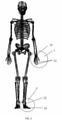
- Palm as shown in FIG. 2 , the palm 1 includes the wrist 11 and all the joints of the palm 1, such as fingers 12.
- the sole 2 includes the ankle 11 and all the joints of the sole 2, such as toes 22.
- the action-range evaluating indicator is for evaluating a movement indicator of the traced parts at a certain time point, or a total movement indicator until the certain time point.
- the indicator can be the speed of the traced part at the certain time point, and also can be the indicator of the change of the relative position of the traced parts and the other parts at the certain time point, and also can be the total indicator of the change of the relative position of the traced parts and the other parts until the certain time point, such as the changed speed of the angle between the traced part and the adjacent part of the traced part at the certain time point or the angle difference value between he angle between the traced part and the adjacent part of the traced part at the certain time point and a default angle, and further can be the displacement and direction of the tracing part, the angle between the tracing parts in two different time points.
- the action-range evaluating indicators are not limited the above described examples.
- Action enlargement in order to simulate the real feeling of the subject user and the synchronization requirement during the interaction process, the following two rules are set (the following two rules are not the necessary rules to achieve the object of the present invention):
- the Virtual Character can perform any actions which the subject user requires and the system need not limit the gesture and type of the action permitted by the Virtual Character.
- the technology scheme of the present invention includes the following steps of:
- the enlarging proportions that the smaller-action of the different parts of the subject user is enlarged can be different, especially to the two different parts whose enlarging proportion is not 1, the enlarging proportions of them can be different, for example, the enlarging proportions of the fingers is 3 at a certain time, but the enlarging proportions of the upper arm is 20 at the same time.
- the enlarging proportions of the same kinetic part/body-parts at different times can also be different.
- a maximum range value M is set for each of the smaller-actions which are performed by of the subject user or a prop
- a maximum range value N is set for the virtual-actions which are performed by the Virtual Character the N is less than a movement limit of the corresponding kinetic part/body-part of the subject user
- supposing the action-range of the smaller-action permitted by the subject user in time t is Mt
- the Virtual Character lift the arm completely
- the Virtual Character also lift the arm completely, so the 5 degree is taken as the maximum range value to lift the arm, obviously, the subject user's arm can lift more than 5 degrees.
- the actual movement limitation of the user is larger than the maximum range of the smaller-action.
- the virtual environment uses the action enlarging system, it is better to limit the limbs of the subject user perform smaller-actions.
- the subject user permitted smaller-action-plan satisfies: when the subject user finishes one smaller-action with the maximum range M, the angle change of any two adjacent parts of user' s body, excepting palm and sole, is less than 30°.
- one smaller-action-plan relates to the angle of the upper arm and the lower arm, the angle before performing the action is 120°, and the angle after performing the action is 140°, then the angle change of the upper arm and the lower arm is +20°.
- the action morphology (or gesture) of the subject user and the Virtual Character is not required to be the same or similar (the same gesture refers the Virtual Character and the subject user have same gestures at a certain time; the similar gesture: the Virtual Character and the subject user have different gestures at a certain time, the gestures include at least sitting or stand, the action morphology refers to moving while lying, moving while sitting, moving while walking; the moving morphology of the subject user and the Virtual Character are not similar refers that the subject user is moving while lying but the Virtual Character is moving while walking).
- the present invention provides continuous action commands, when the subject user acts to an elastic device continuously, the subject user can keep the actions such as turning around. Therefore, the subject user can control the Virtual Character to do any action under any gesture.
- the maximum action-range M of the present invention is preferably within negative and positive 5 o .
- the enlarging proportions that the smaller-action of the different body-parts of the subject user is enlarged can be different, especially to the two different body-parts whose enlarging proportion is not 1, the enlarging proportions of them can be different, the enlarging proportions of the same kinetic part/body-parts at different times can also be different.
- a positioning system, a panoramic system, and a scene moving system are used together to achieve the method.
- the invention can control the Virtual Character to enlarge the smaller-action, and the enlarging proportion can be different, namely the instantaneous gesture of the subject user is different from that of the Virtual Character, and the gesture change situations of the subject user and the Virtual Character are also not quite equivalent.
- the operation space requirement of the subject user namely, "the contact parts of the Virtual Character and the virtual environment” and the “contact parts of the subject user and the operation space” can be different.
- the "the subject user's parts supported by the operation position" and “the Virtual Character's parts supported by the virtual environment” can be different, for example, when the subject user sits on the operation position to control the Virtual Character to perform the step action, "the subject user's parts supported by the operation position” is a buttock of the subject user, but the "the Virtual Character's parts supported by the virtual environment” is a sole of the Virtual Character.
- the force that the subject user acts to the operation position can be different from “the force that the Virtual Character acts to the virtual environment”.
- the Virtual Character perform one action to act force to the virtual environment, thereby to make the Virtual Character generates displacement
- the subject user does not act the force to the environment where the subject user stays, or the operation force for controlling the operation platform is not enough to overcome the limitation of the operation platform to the subject user's body. Therefore, no matter how many displacements the Virtual Character generates, the subject user can control the Virtual Character while not leaving away the operation platform. For example, if the subject user sits on the bed to control the Virtual Character to step, the subject user only needs to slightly incline the upper body and swing the two feet on the bed, these actions cannot change the position of the subject user on the bed.
- the system need not limit the movement space and movement form to satisfy the requirement of operation space to the subject user's body (supposing the system opens the limitation to the movement space and movement form of the Virtual Character the situation that the subject user leaves away from the platform or impacts the wall is easy to happen if the traditional technology is used, the situation that the subject user leaves away from the platform or impacts the wall will not happen if the technology of the present technology is used).
- the system can control the Virtual Character to perform any actions while need not limit the type, number, and range of the action. Further, during the operation process, the subject user can lying or sitting, therefore, the subject user can freely operate the Virtual Character for a long time, and the operation can not be stopped because of fatigue.
- the system of the invention fit for different types of people, any people capable of moving can perform the man-machine interaction by the technology disclosed in the present invention.
- the Virtual Character can perform the actions which can not be performed in the really environment, for example, the subject user can control the Virtual Character perform a back bend action as shown in FIG. 3 while performing a punch action.
- the "action enlarging system" disclosed in the present invention enable the subject user control the Virtual Character in the virtual environment to do any actions while the subject user need not leave away from the control platform or move a little distance, further enables the subject user does the operation in the same operation platform during the operation process and easy to achieve that the subject user-body-parts keep identical with the Virtual Body-Parts of the Virtual Character in the virtual environment, thereby the subject user is easy to operate.
- the "selecting method” and “combination method” of the present invention can achieve the number of Virtual Body-Parts of Virtual Character is bigger than the number of the position sensing points, for example, the disabled person can control the parts of Virtual Character which the disabled person lost to move freely.
- the method for controlling man-machine interaction establishes a user smaller-action database and a Virtual Character virtual action database, and provides action enlarging rules and man-machine interaction rules.
- the user-smaller-action database further includes a user-smaller-action-plan database.
- the embodiment further provides a man-machine synchronization system.
- the man-machine synchronization system includes a user smaller-action recognizing system and a smaller-action matching commands ruling system.
- the user smaller-action recognizing system rules the kinetic part/body-parts and un-kinetic part/un-body-parts on the subject user body or props and setting position sensing elements including distinct characters on the different kinetic part/body-parts respectively, establishing a virtual three-dimensional coordinates, and fixes a distance measurement device on three or more than three known coordinate points which are not on the same straight line, the three or more than three known coordinate points fixed distance measurement device are distance measurement points.
- the particular method refers to the following description:
- the smaller-action recognizing system of the embodiment is aimed at tracing the movements of the limbs , torso and head of the subject user in a real time point and also can set two or more than two position sensing elements on any user-body-part, wherein the coordinates of at least two points set position sensing element on the x, y, and z axis are all different, and thus the horizontal rotation angle and vertical rotation angel of user-body-parts in a certain period can be determined.
- the smaller-action matching commands ruling system makes the sensing positioning point on the body generate a displacement change which based on a predetermined rule by controlling body action of the subject user, and thereby matching the Virtual Action Plan of the Virtual Character it includes
- the rule 1 includes "a method for controlling a Virtual Character to act by position change of position sensing elements” and " a method for positioning sensor or its change corresponding to virtual body-part or virtual-action of the Virtual Character"
- a rule 1.1 a method for controlling a Virtual Character to act by position change of position sensing elements.
- N separating kinetic Virtual Body-parts such as A1, A2, ...An, for the Virtual Character in the virtual environment
- m types of virtual- action such as Ax1, Ax2, Axn, for any one, such as Ax, of the N separating kinetic Virtual Body-parts
- Axx is any one of the m types of virtual-action and can be controlled according the two situations described below.
- the first situation namely each of the N kinetic Virtual Body-parts of the Virtual Character can correspond to one kinetic user-body-part on the subject user.
- n sensing positioning point A' such as A1', A2', ...An'
- n sensing positioning point A' corresponding to n sensing positioning point A', such as A1', A2', ...An', to n separating user-body-parts, tracing the 3-D position change of any one, such as Ax', of the n sensing positioning point A' in any time point t, and matching one of smaller-motion plans Ax1' Ax2', ...Axm', wherein Axm is any motion plan of m Virtual Action Plans.
- the Virtual Action Plan Axx of any one of the separating Virtual Body-part Ax is started only when the sensing positioning point Ax' on the user- body-part acts by the smaller-action plan Axx', for example, the displacement change of the Ax changing with the time point change corresponds to the displacement change of the Ax' changing with the time point change, for another example, the strength of the Ax corresponds to the bending degree and jiggling frequency of the joints, the condition for the strength of the Ax reaching to the maximal value is that the range of the Ax' of the subject user reaches to a maximal value; in addition, the Ax further should consider the tension degree, movement rapid, and performing time point of the corresponding Ax' to realize to operate the virtual environment more naturally and make the movement of the Virtual Character comply the law of nature.
- the user-body-part of the present embodiment are aimed at determining the position and gesture of the subject user in any time point according to the sensing positioning points setting on the subject user's body.
- the user-body-part satisfy this aim are taken as example, such as three joints of each fingers, joints of wrists, joints of elbows, joints of shoulders, any three points on the head which are not on one straight line, one joint of each toe, joints of ankles, and center of calf, thighs, and a spine.
- the second situation namely when not all the N kinetic Virtual Body-parts can find the corresponding kinetic user-body-part.
- Supposing there are several Virtual Body-parts Ay can not find corresponding user-body-part, first, enabling the user-body-part Ay' to control s Virtual Body-parts such as Ay1, Ay2, Ays, and further selects the controlled kinetic Virtual Body-part Ay through one of a selecting method and a combination method.
- the selecting method refers to after the kinetic user-body-parts Ay' determines the corresponding Virtual Body-Parts Ay, the kinetic user-body-parts Ay' can control the Virtual Body-Parts Ay separately.
- the combination method refers selecting the different user-body-part to control using one command or other user-body-part when the Virtual Body-part needs to be changed, for example, the arms of the subject user can select the arms and wings of the Virtual Character to control, if the user-body-part is the joint of toe, when the toe is curled, the wing is controlled, the one command refers to when the subject users gives a command satisfy the requirement, the system will pops up a selecting window and user can displace or determine the corresponding Virtual Body-Parts.
- the method for controlling a Virtual Character to act by position change of position sensing elements further includes dividing the parts of the subject user's body and the prop to kinetic parts and stationary parts, and setting position sensing elements to the kinetic parts respectively, wherein, the props correspond to the objects or tools in the virtual environment, and thereby, when the props is operated, the objects or tools in the virtual environment can also be operated, that is to say, the position sensing elements are used to control the things (persons or objects) in the virtual environment.
- a rule 1.2 a method for positioning sensor or its change corresponding to virtual body-part or virtual-action of the Virtual Character:
- a rule 2 a rule for not giving command
- the rule in the present embodiment is preferably the rule for not giving command, but the rule for giving command is also included in the embodiment.
- the sensing position points of the embodiment adapted to the following two method.
- the wearable controlling device can shortage the preparing time point before the subject user enters into the virtual environment and simplify the preparing process, and therefore the subject user can enter into the virtual environment more conveniently.
- the above two methods are not limited to applied to an action enlarging system, and especially adapted to the virtual environment play which does not requiring displacement of the subject user's body, such as car racing virtual environment.
- the wearable controlling device further can be implanted a controller to make an operating unit including in the wearable controlling device sense the vector change (e.g. displacement, speed, direction) generated by the sensing position points.
- the wearable controlling device can be simplified, and only needs mechanism construction and does not need to be provided with the electronic system. Because the subject user's body only performs the smaller-actions in the virtual environment, the wearable device almost no damage, thus extends the service life of the device while avoiding to the use's body hurt caused by the short-circuit of the electronic system.
- the wearable controlling device includes palm sets, arm sets, head sets, sole sets, leg sets, buttock sets, and waist set. Each of the above sets one or more than one sensing positioning points.
- the device further needs to satisfy the following requirements: setting one or more than one sensing positioning points on the three joints of each fingers, the joints of wrists, the joints of elbows, the joints of shoulders, any three points on the head which are not on one straight line, one joint of each toe, joints of ankles, and center of calf, thigh, and a spine.
- the device aims at determining the position and gesture of the subject user at any time point according to the position of the sensing position points setting on the user-body-parts(the subject user's body).
- the arrangement of the sensing position point of the device is not limited to the above described arrangement.
- the embodiment further provides a man-machine interaction system.
- the system includes a reaction sensing device and an action sensing device.
- the system is mainly used to correct a ratio Mm/Nm of a user's maximum permitted smaller-action-range Mm to the Virtual Character's maximum permitted smaller-action-range Nm, and make the ratio Mm/Nm is bigger than a default value, namely when the reaction sensing device and the action sensing device is working, Virtual Character's maximum permitted smaller-action-range Nm is reduced proportionally according to the following reasons.
- the eyes positioning device uses a user's eyes positioning device to focus the object which the subject user intents to operate, specifically, when the gaze direction of the user passes through an object and the action direction of the limb or prop directs to the object, the eyes positioning device gives a command that the limb or prop will act to the object, and then the system sends the command to the Virtual Character to focus on the object.
- the technology for tracing user's gaze can use the technology disclosed in a patent application file numbered CN 201110411809.X and titled "method for recognizing the gaze direction during user looking an object", or any other known technology, such as a patent file numbered CN 02829315.0 and titled " tracing the direction and position of rolling eyes”.
- an eyes image capturing device to determine the main object which the subject user focuses on, wherein the eyes image capturing device can use the known technology such as a patent file numbered CN 200610072961.9 and titled "eyes image capturing device".
- the movement speed and movement range of the Virtual Character must be changed because of the reaction acting on the Virtual Character
- the system adjusts the acted loads by the reaction sensing device, or changes the virtual maximum range of the corresponding parts, or changes the enlarging proportions of the actions of the Virtual Body-Parts to the user-body-parts to make the subject user to feel the change of the "action speed" and "action-range” after the Virtual Character acts to one object.
- the morphology change includes a shape change (e.g. gesture change, shape change that can not be recovered, especially refers to damage), and a kinetic energy change (kinetic energy value + kinetic energy direction).
- shape change e.g. gesture change, shape change that can not be recovered, especially refers to damage
- kinetic energy change kinetic energy value + kinetic energy direction
- the Virtual Character is acted to generate an action effect refers to the morphology change of the Virtual Character after the action is acted to the Virtual Character the action effect is feed back to the subject user by the reaction sensing device, or changes the virtual maximum range of the corresponding parts to make the subject user to see the effect of the Virtual Character and thereby generates illusions alike or similar to the reaction sensing device by the vision.
- the Virtual Character intends to attack a game character
- the attacked object should be focused, when the Virtual Character gives a punch to the moving arm of the attacked object, the reaction of the arms of the attacked object is received.
- the Virtual Character certainly receives the reaction. If the attacked object blocks, the Virtual Character receives the action of the blocking arms of the attacked object, and then the effect of the reaction sensing device is added.
- the subject user After ready, the subject user will find the position where he/she exit the virtual environment last time and this position is taken as the start position for the scene change caused by the following actions.
- the virtual environment permits the Virtual Character has deformation ability. After the Virtual Character is deformed, if the number of the controlled parts of the Virtual Character is greater than the number of the user-body-parts, the "selecting method" can be used. When a selecting commands action is acted, a certain user-body-part is selected to control the kinetic Virtual Body-parts of the Virtual Character in the virtual environment. Further, the "combination method” also can be used, namely, when the two or more than two user-body-parts performs a particular action simultaneously, the same effect can be achieved.
- the virtual environment further permits the subject user has super abilities such as telekinesis.
- the starting condition for giving such command is the sensing positioning points on user's arm are all on a straight line, the sensing positioning points on the palm are forms a ungual shape and extend toward the object, determining the attraction power in the virtual environment needs to predefine the maximum value of the attraction power of the Virtual Character first.
- the condition for predefining the maximum value of the attraction power is the jiggling frequency of the fingers. The attraction power is reduced with the reduction of the jiggling frequency.
- the virtual environment When receiving the intend of the subject user, the virtual environment will computing attraction power and comparing the difficulty to attract the object, if the gravity of the object is too great or the attraction power between the object and the place where the object place is too great, the strength of the clutch action should be added, thereby the curved degree of the finger is more greater, and the jiggling of the fingers is strengthened, thus causes the jiggling of the sensing positioning point on the fingers are strengthened, thereby the computer can receive the information about that the attraction power of the subject user is strengthened, and further can determine whether the attraction of the object is completed.
- the invention provides the wearable controlling device. Only needing wears the gloves, foot sets, supporter sets and headset, the subject user can controls the sensing position points covered on each of the joint, therefore, the wearable controlling device is more practice.
- the body of the subject user does not corresponds to the limbs position and gesture of the Virtual Character therefore, it can not be determined by the position of the sensing positioning points alone, but the position and direction of the head (especially the eyes) of the subject user and the virtual character is the same. Then how to explain the coordinates of the subject user can be determined in the virtual environment? First, the vision of the subject user is obtained by the glasses, so the coordinates of the glasses in the virtual environment can be determined. Because the relative position between the eyeball and the glasses is invariable, the coordinates of the eyeball of the subject user in the virtual environment can be determined..
- the virtual device includes a positioning system, a panoramic system, a scene moving system, action concluding system, and action enlarging system.
- the panoramic system refers to in the virtual environment, the images of the virtual environment cover all the vision range of the subject user, and the subject user only can see the scene of the virtual environment and can not see the scene in the real world.
- the system refers that the subject user wears a 3D glasses, and the screen of the glasses and the images of the virtual environment cover all the vision range of the subject user.
- This technology can refer to the known technologies, such as a Chinese patent file numbered CN 200810066897.2 and titled "mobile video glasses integrated CMMB receiving module".
- the positioning system satisfies that the imaging position of the Virtual Character in the subject user's eyes is the same as the position where the subject user stays, and the movement of the subject user's body is synchronizing with the movement of the Virtual Character thereby, when seeing the body of the Virtual Character the subject user may have an illusion that the body of the Virtual Character is the real body of himself/or herself.
- the method for synchronizing the movement of the subject user's body and the movement of the Virtual Character's body determines the action of the subject user by the action recognizing system, determines the content of command given by the subject user, and then controls the movement of the kinetic part/body-parts of the Virtual Character.
- the scene moving system using the reversible actions of the scene where the Virtual Character of the virtual environment is in to make the subject user has an illusion that his/her body is moving or changing (enlarging/reducing the body or varying shape of body).
- the method for determining the scene wherein the Virtual Character is in includes:
- the fixed position of the positioning element on the head should satisfy the requirement that the positioning element must move simultaneously with the movement of the head, further, the positioning element also can fixed on the tools wear on user's head.
- the synchronization relation used in the face of the subject user and the Virtual Character can also use the action enlargement system.
- the device in order to make the virtual environment more lifelike, the device further includes one or more of a olfactory system, a tactile system, a physical fatigue random obstacle system .
- the physical fatigue random obstacle system can combine with wearable controlling device, such as connecting a push mechanism to the sole set, or placing a hand-held tool inside the palm set.
- the obstacle system includes a reaction sensing device and an action sensing device.
- the action sensing device is required: when any object in the virtual environment acts to one or some parts of the Virtual Character the obstacle system acts to the corresponding parts of the subject user according to the characters of the action of the object.
- the reaction sensing device is required: when the Virtual Character acts to any object of the virtual environment, the obstacle system concludes the reaction parts and reaction effect to the Virtual Character according to the action characters and the state at that time of the object, and the obstacle system acts to the corresponding parts of the subject user proportionally.
- the obstacle system changes the load which the reaction sensing device and the action sensing device put on the subject user according to the physical fatigue degree or the biggest motion ability of the Virtual Character.
- the subject user Before simulating the virtual environment, the subject user should be fixed on a operation position (e.g. bed), when user move any limb on the body, the Virtual Character in the virtual environment performs an action.
- a operation position e.g. bed
- the Virtual Character in the virtual environment performs an action.
- user can operate the Virtual Character in the virtual environment at the same operation position when acting any action. After acting, the position where the body stays does not change, thereby reducing movement space of the subject user.
- the obstacle system limits the biggest movement range of the limbs of the use's body, such as a sole device elastically contacting the foot of the subject user, an arm limited device is put around the arm of the subject user by the way of interference fit.
- the obstacle mechanism is place on the parts of the body of the action permitted by the subject user, in the common situation, the obstacle mechanism keeps a certain distance (called free space) from the subject user's body to enable the parts of the subject user's body to do any smaller-action without effect of the obstacle mechanism in the situation that the parts of user's body do not contact the obstacle mechanism.
- the obstacle mechanism defines an elastic load moving area (called load space). When the subject user's body contacts the obstacle mechanism and goes on moving to the direction of the elastic force, the corresponding parts of the body work by overcoming the elastic force.
- the functions of the obstacle mechanism are:
- the video device of the invention is not limited to the device obtained image by the eyes, the patent file numbered CN 00820024.6 and titled " implanting element implanted to the human body and a manual optical system discloses a method for enabling the brain to obtain the images not by the eyes.
- the morphology angel of the Virtual Character includes position, shape, state, and matter, wherein the shape includes shape change, change between the liquid state and the granulation state, state change includes: change among the gas state, liquid state, and solid state, and position change includes: change of displacement, movement speed, and acceleration.
- the virtual environment of the present invention at least includes one or more of a future environment, a past environment, and dream environment.
- the present invention opens the authority to the subject user to reset the parameters of the object in the virtual environment, thus enables the subject user to establish, adjust, delete the virtual environment, and thereby, the subject user can easily realize the virtual object.
- the present invention far surpasses the traditionally tools.
- the fourth embodiment a man-machine controlling method which is applied to the exhibition and communication of the space design and space sample, includes the steps of:
- a man-machine controlling method which is applied to shoot a movie, includes the steps of:
- the sixth embodiment a man-machine controlling method, which is applied to simulate an experiment, includes the steps of:
- the steps 2)-4) are performed according the requirement.
- the experiment method has no the risk of hurting the subject user while has zero cost and high experiment precision.
- a man-machine controlling method which is applied to travel, includes the steps of:
- the present invention provides a method for controlling man-machine interaction, wherein, a subject user performs smaller-actions to control a Virtual Character in a virtual environment to perform virtual-actions, the method comprises steps of :
- the present preferred embodiment further limits the amplitude of the user's limb activity, so that the restricted corresponding parts can fully perform smaller-actions without the body leaving its position.
- the user's permitted smaller-action plan set up a maximum range value M for each of the smaller-actions which are performed by the user or a prop
- a maximum range value N is set for the virtual-actions which are performed by the Virtual Character
- supposing the action-range of the smaller-action permitted by the user at time t is Mt
- the angle change value of any adjacent two parts on the torso except the palms and feet is less than 30 degrees.
- the present preferred embodiment further, enable the virtual character to perform the same range of motion as the user in one or more parts of the head, including the palm of the wrist, including the foot of the ankle.
- the selection method and/or combination method are also used in the present preferred embodiment; the selection method is to allow the user to choose other activity parts to replace when the user does not have the corresponding activity part of the Virtual Character; the combination method is that when the number of user activity parts is less than the number of activity parts of the Virtual Character, a shared activity bit is set on the user-body-parts to control more than one active part of the Virtual Character.
- the combination method also includes one or more of the following steps characteristics in the present Preferred Embodiment:
- the present Preferred Embodiment includes at least one or more methods of tracking the user's smaller-actions method, the determination method of the scene in which the Virtual Character is located, and the method of reverse motion control;
- the present invention further provides a man-machine interaction controlling system, a user performs a user permitted smaller-action to control a Virtual Character in a virtual environment to perform virtual-actions, wherein the system comprises an imaging device, an operation platform, a recognizing and capturing device for recognizing and capturing the smaller-action-plan, and a synchronization controlling system for controlling the synchronization of the actions of the subject user and Virtual Character.
- a man-machine interaction controlling system a user performs a user permitted smaller-action to control a Virtual Character in a virtual environment to perform virtual-actions
- the system comprises an imaging device, an operation platform, a recognizing and capturing device for recognizing and capturing the smaller-action-plan, and a synchronization controlling system for controlling the synchronization of the actions of the subject user and Virtual Character.
- the recognizing and capturing device sets one or more position sensing element with different distinctive characters on the user-body-parts, to enable the system could capture the gesture or action change of the user -body-part corresponding to the sensing positioning points.
- the wearable controlling device includes palm sets, arm sets, head sets, sole sets, leg sets, buttock sets, and waist set. Each of the above sets one or more than one sensing positioning points.
- the system sets one obstacle system,the obstacle system sets limit mechanism,
- the limit mechanism limit the range of movement of the user's body, and enabling the limited parts can perform the smaller-action at a maximum range M and need not leave away from the operation position.
- the obstacle system includes a reaction sensing device and an action sensing device.
- the action sensing device when any object in the virtual environment acts to one or some parts of the Virtual Character the obstacle system acts to the corresponding parts of the subject user according to the characters of the action of the object.
- the reaction sensing device is required: when the Virtual Character acts to any object of the virtual environment, the obstacle system concludes the reaction parts and reaction effect to the Virtual Character according to the action characters and the state at that time of the object, and the obstacle system acts to the corresponding parts of the subject user proportionally.
- the obstacle system changes the load which the reaction sensing device and the action sensing device put on the subject user according to the physical fatigue degree or the biggest motion ability of the Virtual Character.
- the present invention further provides a man-machine controlling method which is applied to a Game Software
- the virtual environment as claimed in the Preferred Embodiment 1 at least includes one or more of a future environment, a past environment, and dream environment.
- the present invention opens the authority to the subject user to reset the parameters of the object in the virtual environment, thus enables the subject user to establish, adjust, delete the virtual environment, and thereby, the subject user can easily realize the virtual object.
- the present invention far surpasses the traditionally tools.
- the present invention further provides a man-machine controlling method which is applied to the exhibition and communication of the space design and space sample, includes the steps of:
- the present invention further provides a man-machine controlling method, which is applied to shoot a movie, includes the steps of:
- the present invention further provides a man-machine controlling method, which is applied to simulate an experiment, includes the steps of:
- the present invention further provides a man-machine controlling method, which is applied to travel, includes the steps of:
Landscapes
- Engineering & Computer Science (AREA)
- Multimedia (AREA)
- Human Computer Interaction (AREA)
- Theoretical Computer Science (AREA)
- General Engineering & Computer Science (AREA)
- Physics & Mathematics (AREA)
- General Physics & Mathematics (AREA)
- Health & Medical Sciences (AREA)
- Life Sciences & Earth Sciences (AREA)
- Biophysics (AREA)
- Cardiology (AREA)
- General Health & Medical Sciences (AREA)
- Heart & Thoracic Surgery (AREA)
- Processing Or Creating Images (AREA)
- User Interface Of Digital Computer (AREA)
Applications Claiming Priority (4)
| Application Number | Priority Date | Filing Date | Title |
|---|---|---|---|
| CN201110036356 | 2011-02-11 | ||
| CN2011104581683A CN102541260B (zh) | 2011-02-11 | 2011-12-30 | 一种人机互动的控制方法及其运用 |
| EP12745158.1A EP2674204A4 (en) | 2011-02-11 | 2012-01-20 | METHOD FOR CONTROLLING HUMAN-MACHINE INTERACTION AND APPLYING THEREOF |
| PCT/CN2012/000108 WO2012106978A1 (zh) | 2011-02-11 | 2012-01-20 | 一种人机互动的控制方法及其运用 |
Related Parent Applications (1)
| Application Number | Title | Priority Date | Filing Date |
|---|---|---|---|
| EP12745158.1A Division EP2674204A4 (en) | 2011-02-11 | 2012-01-20 | METHOD FOR CONTROLLING HUMAN-MACHINE INTERACTION AND APPLYING THEREOF |
Publications (1)
| Publication Number | Publication Date |
|---|---|
| EP3950076A1 true EP3950076A1 (en) | 2022-02-09 |
Family
ID=46348299
Family Applications (2)
| Application Number | Title | Priority Date | Filing Date |
|---|---|---|---|
| EP21188983.7A Ceased EP3950076A1 (en) | 2011-02-11 | 2012-01-20 | Method for controlling man-machine interaction and application thereof |
| EP12745158.1A Ceased EP2674204A4 (en) | 2011-02-11 | 2012-01-20 | METHOD FOR CONTROLLING HUMAN-MACHINE INTERACTION AND APPLYING THEREOF |
Family Applications After (1)
| Application Number | Title | Priority Date | Filing Date |
|---|---|---|---|
| EP12745158.1A Ceased EP2674204A4 (en) | 2011-02-11 | 2012-01-20 | METHOD FOR CONTROLLING HUMAN-MACHINE INTERACTION AND APPLYING THEREOF |
Country Status (6)
| Country | Link |
|---|---|
| US (1) | US10058773B2 (https=) |
| EP (2) | EP3950076A1 (https=) |
| JP (3) | JP6193764B2 (https=) |
| KR (1) | KR101679805B1 (https=) |
| CN (8) | CN107050852A (https=) |
| WO (1) | WO2012106978A1 (https=) |
Families Citing this family (28)
| Publication number | Priority date | Publication date | Assignee | Title |
|---|---|---|---|---|
| CN107050852A (zh) * | 2011-02-11 | 2017-08-18 | 漳州市爵晟电子科技有限公司 | 一种游戏系统及其穿套式定点控制设备 |
| CN103207667B (zh) * | 2011-12-24 | 2018-10-23 | 漳州市科达企业咨询有限公司 | 一种人机互动的控制方法及其运用 |
| CN103544636A (zh) * | 2013-11-08 | 2014-01-29 | 梁涛 | 基于虚拟商场的互动方法及设备 |
| CN105979855B (zh) | 2014-02-11 | 2019-05-28 | 苹果公司 | 检测正在穿戴可穿戴电子设备的肢体 |
| US10827268B2 (en) | 2014-02-11 | 2020-11-03 | Apple Inc. | Detecting an installation position of a wearable electronic device |
| CN108776541A (zh) * | 2014-04-11 | 2018-11-09 | 黄得锋 | 一种人机互动的控制方法 |
| CN108139804A (zh) * | 2015-10-15 | 2018-06-08 | 索尼公司 | 信息处理装置与信息处理方法 |
| CN105867600A (zh) * | 2015-11-06 | 2016-08-17 | 乐视移动智能信息技术(北京)有限公司 | 一种交互方法和设备 |
| CN105488834B (zh) * | 2015-12-01 | 2019-03-19 | 网易(杭州)网络有限公司 | 角色面部朝向的调整方法及装置 |
| CN105892754A (zh) * | 2016-05-27 | 2016-08-24 | 北京小鸟看看科技有限公司 | 一种手指动作识别方法和系统 |
| JP6756236B2 (ja) | 2016-10-31 | 2020-09-16 | 富士通株式会社 | アクション指示プログラム、アクション指示方法及び画像生成装置 |
| US10901494B2 (en) | 2017-03-28 | 2021-01-26 | Wipro Limited | Method and a system for providing gesture-based interaction with a virtual product |
| JP7078035B2 (ja) * | 2017-03-31 | 2022-05-31 | ソニーグループ株式会社 | 情報処理装置、情報処理方法、およびプログラム |
| CN107158709A (zh) * | 2017-05-16 | 2017-09-15 | 杭州乐见科技有限公司 | 一种基于游戏引导运动的方法和设备 |
| ES2963483T3 (es) | 2017-09-05 | 2024-03-27 | Apple Inc | Dispositivo electrónico usable con electrodos para detectar parámetros biológicos |
| EP4470456A3 (en) | 2017-09-26 | 2025-02-26 | Apple Inc. | Optical sensor subsystem adjacent a cover of an electronic device housing |
| DE102017009169A1 (de) | 2017-10-02 | 2019-04-04 | Holger Wild | Interaktives Oberkörperabbildgerät |
| KR101967072B1 (ko) * | 2017-12-14 | 2019-04-08 | 김민철 | 사용자 활동 기반 가상 객체 관리 방법, 이를 수행하는 가상 객체 관리 장치 및 이를 기록한 기록매체 |
| CN108553893B (zh) * | 2018-04-28 | 2021-11-16 | 网易(杭州)网络有限公司 | 赛车游戏中车辆转向的控制方法和装置 |
| CN110908568B (zh) * | 2018-09-18 | 2022-11-04 | 网易(杭州)网络有限公司 | 一种虚拟对象的控制方法和装置 |
| CN111221416B (zh) * | 2020-01-06 | 2021-12-07 | 腾讯科技(深圳)有限公司 | 一种虚拟道具分配的方法、服务器及终端设备 |
| US11055891B1 (en) | 2020-03-10 | 2021-07-06 | Microsoft Technology Licensing, Llc | Real time styling of motion for virtual environments |
| CN112527109B (zh) * | 2020-12-04 | 2022-05-17 | 上海交通大学 | 基于坐姿的vr全身动作控制方法、系统及计算机可读介质 |
| US12396686B2 (en) | 2021-08-31 | 2025-08-26 | Apple Inc. | Sensing health parameters in wearable devices |
| US20240085987A1 (en) * | 2022-09-12 | 2024-03-14 | Apple Inc. | Environmentally Aware Gestures |
| JP7372717B1 (ja) | 2023-03-30 | 2023-11-01 | mirrorX株式会社 | プログラム、情報処理装置及び方法 |
| JP2026052898A (ja) * | 2024-09-12 | 2026-03-25 | 株式会社Jvcケンウッド | 操作装置、操作システム、及び操作方法 |
| CN119556803A (zh) * | 2025-02-05 | 2025-03-04 | 广州美术学院 | 一种基于虚拟环境的虚拟体验交互控制方法及相关装置 |
Citations (4)
| Publication number | Priority date | Publication date | Assignee | Title |
|---|---|---|---|---|
| US20090221368A1 (en) * | 2007-11-28 | 2009-09-03 | Ailive Inc., | Method and system for creating a shared game space for a networked game |
| US20100149341A1 (en) * | 2008-12-17 | 2010-06-17 | Richard Lee Marks | Correcting angle error in a tracking system |
| US20110007079A1 (en) * | 2009-07-13 | 2011-01-13 | Microsoft Corporation | Bringing a visual representation to life via learned input from the user |
| US20110009241A1 (en) * | 2009-04-10 | 2011-01-13 | Sovoz, Inc. | Virtual locomotion controller apparatus and methods |
Family Cites Families (59)
| Publication number | Priority date | Publication date | Assignee | Title |
|---|---|---|---|---|
| US4988981B1 (en) * | 1987-03-17 | 1999-05-18 | Vpl Newco Inc | Computer data entry and manipulation apparatus and method |
| US6408289B1 (en) * | 1993-06-11 | 2002-06-18 | Mri Devices Daum Gmbh | Shapeable elastic body with master unit and method of controlling |
| US5577981A (en) * | 1994-01-19 | 1996-11-26 | Jarvik; Robert | Virtual reality exercise machine and computer controlled video system |
| JP2840923B2 (ja) * | 1994-11-11 | 1998-12-24 | 富士通株式会社 | プロダクションシステム |
| EP0761265A4 (en) * | 1994-12-30 | 2005-03-16 | Sega Corp | VIDEO GAME SYSTEM FOR GAME SIMULATION OF A COMICHEFT |
| US5913727A (en) * | 1995-06-02 | 1999-06-22 | Ahdoot; Ned | Interactive movement and contact simulation game |
| GB9525047D0 (en) * | 1995-12-07 | 1996-02-07 | Philips Electronics Nv | Virtual body control device |
| CN1168057C (zh) * | 1996-08-14 | 2004-09-22 | 挪拉赫梅特·挪利斯拉莫维奇·拉都包夫 | 追踪并显示使用者在空间的位置与取向的方法,向使用者展示虚拟环境的方法以及实现这些方法的系统 |
| JPH10302083A (ja) * | 1997-04-30 | 1998-11-13 | Yamaha Corp | Cgモデルの動作制御システム |
| US6522312B2 (en) * | 1997-09-01 | 2003-02-18 | Canon Kabushiki Kaisha | Apparatus for presenting mixed reality shared among operators |
| JP4332254B2 (ja) * | 1999-04-28 | 2009-09-16 | 株式会社アミテック | インテリジェント型手袋型手形入力装置 |
| EP1060772B1 (en) * | 1999-06-11 | 2012-02-01 | Canon Kabushiki Kaisha | Apparatus and method to represent mixed reality space shared by plural operators, game apparatus using mixed reality apparatus and interface method thereof |
| US6377281B1 (en) * | 2000-02-17 | 2002-04-23 | The Jim Henson Company | Live performance control of computer graphic characters |
| JP2002032788A (ja) * | 2000-07-14 | 2002-01-31 | Nippon Telegr & Teleph Corp <Ntt> | 仮想現実提供方法、仮想現実提供装置及び仮想現実提供プログラムを記録した記録媒体 |
| JP2002123840A (ja) * | 2000-10-17 | 2002-04-26 | Nippon Telegr & Teleph Corp <Ntt> | 臨場感型仮想現実提供処理方法および装置 |
| US9682319B2 (en) * | 2002-07-31 | 2017-06-20 | Sony Interactive Entertainment Inc. | Combiner method for altering game gearing |
| JP2004129180A (ja) * | 2002-09-30 | 2004-04-22 | Atsusato Fujii | 仮想空間体験のためのシステム |
| US9177387B2 (en) * | 2003-02-11 | 2015-11-03 | Sony Computer Entertainment Inc. | Method and apparatus for real time motion capture |
| GB0306875D0 (en) * | 2003-03-25 | 2003-04-30 | British Telecomm | Apparatus and method for generating behavior in an object |
| JP4048999B2 (ja) * | 2003-04-15 | 2008-02-20 | セイコーエプソン株式会社 | 画像処理装置及び画像処理方法 |
| US9274598B2 (en) * | 2003-08-25 | 2016-03-01 | International Business Machines Corporation | System and method for selecting and activating a target object using a combination of eye gaze and key presses |
| WO2006023153A1 (en) * | 2004-08-23 | 2006-03-02 | Gamecaster, Inc. | Apparatus, methods and systems for viewing and manipulating a virtual environment |
| JP2006163886A (ja) * | 2004-12-08 | 2006-06-22 | Canon Inc | 情報入力方法及び情報入力装置 |
| JP4406693B2 (ja) * | 2005-01-28 | 2010-02-03 | 学校法人立命館 | バルーンアクチュエータ、エンドエフェクタ、及び医療用器具 |
| CN102989174B (zh) * | 2006-05-04 | 2016-06-29 | 美国索尼电脑娱乐公司 | 获得用于控制游戏程序的运行的输入 |
| JP4848515B2 (ja) * | 2006-06-12 | 2011-12-28 | 国立大学法人九州工業大学 | アバター動作制御システム、そのプログラム及び方法 |
| JP4148281B2 (ja) * | 2006-06-19 | 2008-09-10 | ソニー株式会社 | モーションキャプチャ装置及びモーションキャプチャ方法、並びにモーションキャプチャプログラム |
| US8336078B2 (en) * | 2006-07-11 | 2012-12-18 | Fmr Corp. | Role-based access in a multi-customer computing environment |
| CN101110102A (zh) * | 2006-07-20 | 2008-01-23 | 中国科学院自动化研究所 | 基于玩家拳头的游戏场景和角色控制方法 |
| EP2059315A4 (en) * | 2006-08-24 | 2011-10-26 | Howard W Lutnick | COMPUTER TERMINAL SYSTEM WITH MULTIPLE DISPLAY SCREENS |
| US8926534B2 (en) * | 2006-09-19 | 2015-01-06 | Myomo, Inc. | Powered orthotic device and method of using same |
| EP2132650A4 (en) * | 2007-03-01 | 2010-10-27 | Sony Comp Entertainment Us | SYSTEM AND METHOD FOR COMMUNICATING WITH A VIRTUAL WORLD |
| US8706914B2 (en) * | 2007-04-23 | 2014-04-22 | David D. Duchesneau | Computing infrastructure |
| US8726194B2 (en) * | 2007-07-27 | 2014-05-13 | Qualcomm Incorporated | Item selection using enhanced control |
| US8419545B2 (en) * | 2007-11-28 | 2013-04-16 | Ailive, Inc. | Method and system for controlling movements of objects in a videogame |
| CN102124423A (zh) * | 2008-01-22 | 2011-07-13 | 新世代株式会社 | 摄像装置、在线游戏系统、操作物、输入方法、图像解析装置、图像解析方法以及记录媒体 |
| CN101256673A (zh) * | 2008-03-18 | 2008-09-03 | 中国计量学院 | 用于在实时视频跟踪系统中跟踪手臂运动的方法 |
| JP2009276996A (ja) * | 2008-05-14 | 2009-11-26 | Canon Inc | 情報処理装置、情報処理方法 |
| US8130207B2 (en) * | 2008-06-18 | 2012-03-06 | Nokia Corporation | Apparatus, method and computer program product for manipulating a device using dual side input devices |
| US8793498B2 (en) * | 2008-08-11 | 2014-07-29 | Nbcuniversal Media, Llc | System and method for forensic analysis of media works |
| CN102176888B (zh) * | 2008-08-25 | 2015-11-25 | 苏黎世大学数学和自然科学部 | 可调整的虚拟现实系统 |
| TWI373361B (en) * | 2008-10-09 | 2012-10-01 | Univ Nat Chiao Tung | Glove puppet manipulation system |
| CN101732858B (zh) * | 2008-11-11 | 2013-10-30 | 盛乐信息技术(上海)有限公司 | 现实与虚拟结合的联网游戏系统及实现方法 |
| US9256282B2 (en) * | 2009-03-20 | 2016-02-09 | Microsoft Technology Licensing, Llc | Virtual object manipulation |
| JP2010231290A (ja) * | 2009-03-26 | 2010-10-14 | National Institute Of Advanced Industrial Science & Technology | 頭部運動による入力装置及び方法 |
| US20100302253A1 (en) * | 2009-05-29 | 2010-12-02 | Microsoft Corporation | Real time retargeting of skeletal data to game avatar |
| US9400559B2 (en) * | 2009-05-29 | 2016-07-26 | Microsoft Technology Licensing, Llc | Gesture shortcuts |
| US20100302138A1 (en) * | 2009-05-29 | 2010-12-02 | Microsoft Corporation | Methods and systems for defining or modifying a visual representation |
| KR20100138700A (ko) * | 2009-06-25 | 2010-12-31 | 삼성전자주식회사 | 가상 세계 처리 장치 및 방법 |
| TW201104494A (en) * | 2009-07-20 | 2011-02-01 | J Touch Corp | Stereoscopic image interactive system |
| KR101993848B1 (ko) * | 2009-07-22 | 2019-06-28 | 임머숀 코퍼레이션 | 플랫폼에 걸쳐 햅틱 피드백을 갖는 상호작용 터치 스크린 게임 메타포 |
| CN102141685B (zh) * | 2009-11-29 | 2016-02-24 | 黄得锋 | 一种3d成像装置 |
| US8284157B2 (en) * | 2010-01-15 | 2012-10-09 | Microsoft Corporation | Directed performance in motion capture system |
| US20110221755A1 (en) * | 2010-03-12 | 2011-09-15 | Kevin Geisner | Bionic motion |
| US20110289455A1 (en) * | 2010-05-18 | 2011-11-24 | Microsoft Corporation | Gestures And Gesture Recognition For Manipulating A User-Interface |
| CN101890237A (zh) * | 2010-07-16 | 2010-11-24 | 叶尔肯·拜山 | 游戏控制器及其控制方法 |
| CN107050852A (zh) * | 2011-02-11 | 2017-08-18 | 漳州市爵晟电子科技有限公司 | 一种游戏系统及其穿套式定点控制设备 |
| CN202120199U (zh) * | 2011-06-13 | 2012-01-18 | 深圳市远望落星山科技有限公司 | 一种光影跟踪系统 |
| CN102253713B (zh) * | 2011-06-23 | 2016-10-12 | 康佳集团股份有限公司 | 面向三维立体影像显示系统 |
-
2011
- 2011-12-09 CN CN201710113698.1A patent/CN107050852A/zh active Pending
- 2011-12-09 CN CN201710112620.8A patent/CN106943742B/zh active Active
- 2011-12-09 CN CN201110408355.0A patent/CN102631781B/zh active Active
- 2011-12-09 CN CN201710113697.7A patent/CN106984041B/zh active Active
- 2011-12-09 CN CN201710112619.5A patent/CN106964150B/zh active Active
- 2011-12-09 CN CN201710112621.2A patent/CN106943743B/zh active Active
- 2011-12-15 CN CN201110420386.8A patent/CN102681655B/zh not_active Expired - Fee Related
- 2011-12-30 CN CN2011104581683A patent/CN102541260B/zh not_active Expired - Fee Related
-
2012
- 2012-01-20 EP EP21188983.7A patent/EP3950076A1/en not_active Ceased
- 2012-01-20 EP EP12745158.1A patent/EP2674204A4/en not_active Ceased
- 2012-01-20 JP JP2013552821A patent/JP6193764B2/ja active Active
- 2012-01-20 WO PCT/CN2012/000108 patent/WO2012106978A1/zh not_active Ceased
- 2012-01-20 KR KR1020137023483A patent/KR101679805B1/ko active Active
-
2013
- 2013-08-09 US US13/963,666 patent/US10058773B2/en active Active
-
2017
- 2017-08-10 JP JP2017156017A patent/JP6722624B2/ja active Active
-
2018
- 2018-12-03 JP JP2018226182A patent/JP6749384B2/ja active Active
Patent Citations (4)
| Publication number | Priority date | Publication date | Assignee | Title |
|---|---|---|---|---|
| US20090221368A1 (en) * | 2007-11-28 | 2009-09-03 | Ailive Inc., | Method and system for creating a shared game space for a networked game |
| US20100149341A1 (en) * | 2008-12-17 | 2010-06-17 | Richard Lee Marks | Correcting angle error in a tracking system |
| US20110009241A1 (en) * | 2009-04-10 | 2011-01-13 | Sovoz, Inc. | Virtual locomotion controller apparatus and methods |
| US20110007079A1 (en) * | 2009-07-13 | 2011-01-13 | Microsoft Corporation | Bringing a visual representation to life via learned input from the user |
Also Published As
| Publication number | Publication date |
|---|---|
| JP6722624B2 (ja) | 2020-07-15 |
| US10058773B2 (en) | 2018-08-28 |
| JP2019061707A (ja) | 2019-04-18 |
| CN106984041B (zh) | 2021-07-06 |
| CN102631781A (zh) | 2012-08-15 |
| CN106943743B (zh) | 2024-04-26 |
| CN106943743A (zh) | 2017-07-14 |
| CN106964150A (zh) | 2017-07-21 |
| KR20140049503A (ko) | 2014-04-25 |
| JP2018022498A (ja) | 2018-02-08 |
| JP6193764B2 (ja) | 2017-09-06 |
| CN102631781B (zh) | 2017-04-05 |
| US20130331964A1 (en) | 2013-12-12 |
| EP2674204A1 (en) | 2013-12-18 |
| EP2674204A4 (en) | 2015-01-28 |
| CN102681655B (zh) | 2017-07-07 |
| CN106943742A (zh) | 2017-07-14 |
| CN102541260B (zh) | 2013-04-03 |
| CN106984041A (zh) | 2017-07-28 |
| CN106964150B (zh) | 2021-03-02 |
| JP6749384B2 (ja) | 2020-09-02 |
| WO2012106978A1 (zh) | 2012-08-16 |
| JP2014510336A (ja) | 2014-04-24 |
| CN102681655A (zh) | 2012-09-19 |
| KR101679805B1 (ko) | 2016-11-25 |
| CN106943742B (zh) | 2024-04-26 |
| CN102541260A (zh) | 2012-07-04 |
| CN107050852A (zh) | 2017-08-18 |
Similar Documents
| Publication | Publication Date | Title |
|---|---|---|
| EP3950076A1 (en) | Method for controlling man-machine interaction and application thereof | |
| Avola et al. | An interactive and low-cost full body rehabilitation framework based on 3D immersive serious games | |
| Caserman et al. | A survey of full-body motion reconstruction in immersive virtual reality applications | |
| Hansberger et al. | Dispelling the gorilla arm syndrome: the viability of prolonged gesture interactions | |
| CN108815804B (zh) | 基于myo臂环和移动端的vr上肢康复训练平台及方法 | |
| CN109453509A (zh) | 一种基于肌电和运动捕捉的虚拟上肢控制系统及其方法 | |
| CN105118023B (zh) | 基于人脸特征点的实时视频人脸卡通化生成方法 | |
| CN103207667B (zh) | 一种人机互动的控制方法及其运用 | |
| CN109799900A (zh) | 用于三维成像、映射、建网和界面连接的无线腕式计算和控制设备和方法 | |
| JP2014510336A5 (https=) | ||
| KR20130039585A (ko) | 로봇을 이용한 인지 능력 훈련 장치 및 그 방법 | |
| CN112827162A (zh) | 一种三维演示动画交互式体验方法及装置 | |
| Du et al. | A mobile gesture interaction method for augmented reality games using hybrid filters | |
| Cho et al. | Motion recognition with smart phone embedded 3-axis accelerometer sensor | |
| JP4848515B2 (ja) | アバター動作制御システム、そのプログラム及び方法 | |
| CN107168538A (zh) | 一种基于肢体动作进行情感运算的3d校园导览方法及系统 | |
| Cloud et al. | Experiments with a camera-based human-computer interface system | |
| CN102456092A (zh) | 一种基于计算机的虚拟滑雪实现方法及系统 | |
| Dubey et al. | Design of a game-based rehabilitation system using kinect sensor | |
| Yang et al. | Bimanual natural user interaction for 3D modelling application using stereo computer vision | |
| Chen et al. | Design and Implementation of Multi-mode Natural Interaction of Game Animation Characters in Mixed Reality: A Novel User Experience Method | |
| CN110032958B (zh) | 一种人体肢体语言识别方法及系统 | |
| NAN | DEVELOPMENT OF A COMPUTER PROGRAM TO ASSIST UPPER LIMB REHABILITATION USING KINECT | |
| Smit et al. | Mirrored Motion: Pervasive Body Motion Capture using Wireless Sensors | |
| Smit et al. | Mirrored motion: Augmenting reality and implementing whole body gestural control using pervasive body motion capture based on wireless sensors |
Legal Events
| Date | Code | Title | Description |
|---|---|---|---|
| PUAI | Public reference made under article 153(3) epc to a published international application that has entered the european phase |
Free format text: ORIGINAL CODE: 0009012 |
|
| STAA | Information on the status of an ep patent application or granted ep patent |
Free format text: STATUS: REQUEST FOR EXAMINATION WAS MADE |
|
| 17P | Request for examination filed |
Effective date: 20210801 |
|
| AC | Divisional application: reference to earlier application |
Ref document number: 2674204 Country of ref document: EP Kind code of ref document: P |
|
| AK | Designated contracting states |
Kind code of ref document: A1 Designated state(s): AL AT BE BG CH CY CZ DE DK EE ES FI FR GB GR HR HU IE IS IT LI LT LU LV MC MK MT NL NO PL PT RO RS SE SI SK SM TR |
|
| STAA | Information on the status of an ep patent application or granted ep patent |
Free format text: STATUS: THE APPLICATION HAS BEEN REFUSED |
|
| 18R | Application refused |
Effective date: 20241206 |