EP3929153B1 - Aktivkohle und verfahren zur herstellung davon - Google Patents
Aktivkohle und verfahren zur herstellung davon Download PDFInfo
- Publication number
- EP3929153B1 EP3929153B1 EP20759462.3A EP20759462A EP3929153B1 EP 3929153 B1 EP3929153 B1 EP 3929153B1 EP 20759462 A EP20759462 A EP 20759462A EP 3929153 B1 EP3929153 B1 EP 3929153B1
- Authority
- EP
- European Patent Office
- Prior art keywords
- activated carbon
- raw material
- calcium
- elemental
- precursor
- Prior art date
- Legal status (The legal status is an assumption and is not a legal conclusion. Google has not performed a legal analysis and makes no representation as to the accuracy of the status listed.)
- Active
Links
Images

Classifications
-
- C—CHEMISTRY; METALLURGY
- C01—INORGANIC CHEMISTRY
- C01B—NON-METALLIC ELEMENTS; COMPOUNDS THEREOF; METALLOIDS OR COMPOUNDS THEREOF NOT COVERED BY SUBCLASS C01C
- C01B32/00—Carbon; Compounds thereof
- C01B32/30—Active carbon
- C01B32/312—Preparation
- C01B32/336—Preparation characterised by gaseous activating agents
-
- B—PERFORMING OPERATIONS; TRANSPORTING
- B01—PHYSICAL OR CHEMICAL PROCESSES OR APPARATUS IN GENERAL
- B01J—CHEMICAL OR PHYSICAL PROCESSES, e.g. CATALYSIS OR COLLOID CHEMISTRY; THEIR RELEVANT APPARATUS
- B01J20/00—Solid sorbent compositions or filter aid compositions; Sorbents for chromatography; Processes for preparing, regenerating or reactivating thereof
- B01J20/02—Solid sorbent compositions or filter aid compositions; Sorbents for chromatography; Processes for preparing, regenerating or reactivating thereof comprising inorganic material
- B01J20/20—Solid sorbent compositions or filter aid compositions; Sorbents for chromatography; Processes for preparing, regenerating or reactivating thereof comprising inorganic material comprising free carbon; comprising carbon obtained by carbonising processes
-
- B—PERFORMING OPERATIONS; TRANSPORTING
- B01—PHYSICAL OR CHEMICAL PROCESSES OR APPARATUS IN GENERAL
- B01J—CHEMICAL OR PHYSICAL PROCESSES, e.g. CATALYSIS OR COLLOID CHEMISTRY; THEIR RELEVANT APPARATUS
- B01J20/00—Solid sorbent compositions or filter aid compositions; Sorbents for chromatography; Processes for preparing, regenerating or reactivating thereof
- B01J20/28—Solid sorbent compositions or filter aid compositions; Sorbents for chromatography; Processes for preparing, regenerating or reactivating thereof characterised by their form or physical properties
- B01J20/28054—Solid sorbent compositions or filter aid compositions; Sorbents for chromatography; Processes for preparing, regenerating or reactivating thereof characterised by their form or physical properties characterised by their surface properties or porosity
- B01J20/28069—Pore volume, e.g. total pore volume, mesopore volume, micropore volume
-
- B—PERFORMING OPERATIONS; TRANSPORTING
- B01—PHYSICAL OR CHEMICAL PROCESSES OR APPARATUS IN GENERAL
- B01J—CHEMICAL OR PHYSICAL PROCESSES, e.g. CATALYSIS OR COLLOID CHEMISTRY; THEIR RELEVANT APPARATUS
- B01J20/00—Solid sorbent compositions or filter aid compositions; Sorbents for chromatography; Processes for preparing, regenerating or reactivating thereof
- B01J20/28—Solid sorbent compositions or filter aid compositions; Sorbents for chromatography; Processes for preparing, regenerating or reactivating thereof characterised by their form or physical properties
- B01J20/28054—Solid sorbent compositions or filter aid compositions; Sorbents for chromatography; Processes for preparing, regenerating or reactivating thereof characterised by their form or physical properties characterised by their surface properties or porosity
- B01J20/28069—Pore volume, e.g. total pore volume, mesopore volume, micropore volume
- B01J20/28071—Pore volume, e.g. total pore volume, mesopore volume, micropore volume being less than 0.5 ml/g
-
- B—PERFORMING OPERATIONS; TRANSPORTING
- B01—PHYSICAL OR CHEMICAL PROCESSES OR APPARATUS IN GENERAL
- B01J—CHEMICAL OR PHYSICAL PROCESSES, e.g. CATALYSIS OR COLLOID CHEMISTRY; THEIR RELEVANT APPARATUS
- B01J20/00—Solid sorbent compositions or filter aid compositions; Sorbents for chromatography; Processes for preparing, regenerating or reactivating thereof
- B01J20/28—Solid sorbent compositions or filter aid compositions; Sorbents for chromatography; Processes for preparing, regenerating or reactivating thereof characterised by their form or physical properties
- B01J20/28054—Solid sorbent compositions or filter aid compositions; Sorbents for chromatography; Processes for preparing, regenerating or reactivating thereof characterised by their form or physical properties characterised by their surface properties or porosity
- B01J20/28069—Pore volume, e.g. total pore volume, mesopore volume, micropore volume
- B01J20/28073—Pore volume, e.g. total pore volume, mesopore volume, micropore volume being in the range 0.5-1.0 ml/g
-
- B—PERFORMING OPERATIONS; TRANSPORTING
- B01—PHYSICAL OR CHEMICAL PROCESSES OR APPARATUS IN GENERAL
- B01J—CHEMICAL OR PHYSICAL PROCESSES, e.g. CATALYSIS OR COLLOID CHEMISTRY; THEIR RELEVANT APPARATUS
- B01J20/00—Solid sorbent compositions or filter aid compositions; Sorbents for chromatography; Processes for preparing, regenerating or reactivating thereof
- B01J20/28—Solid sorbent compositions or filter aid compositions; Sorbents for chromatography; Processes for preparing, regenerating or reactivating thereof characterised by their form or physical properties
- B01J20/28054—Solid sorbent compositions or filter aid compositions; Sorbents for chromatography; Processes for preparing, regenerating or reactivating thereof characterised by their form or physical properties characterised by their surface properties or porosity
- B01J20/28078—Pore diameter
-
- B—PERFORMING OPERATIONS; TRANSPORTING
- B01—PHYSICAL OR CHEMICAL PROCESSES OR APPARATUS IN GENERAL
- B01J—CHEMICAL OR PHYSICAL PROCESSES, e.g. CATALYSIS OR COLLOID CHEMISTRY; THEIR RELEVANT APPARATUS
- B01J20/00—Solid sorbent compositions or filter aid compositions; Sorbents for chromatography; Processes for preparing, regenerating or reactivating thereof
- B01J20/28—Solid sorbent compositions or filter aid compositions; Sorbents for chromatography; Processes for preparing, regenerating or reactivating thereof characterised by their form or physical properties
- B01J20/28054—Solid sorbent compositions or filter aid compositions; Sorbents for chromatography; Processes for preparing, regenerating or reactivating thereof characterised by their form or physical properties characterised by their surface properties or porosity
- B01J20/28078—Pore diameter
- B01J20/28083—Pore diameter being in the range 2-50 nm, i.e. mesopores
-
- B—PERFORMING OPERATIONS; TRANSPORTING
- B01—PHYSICAL OR CHEMICAL PROCESSES OR APPARATUS IN GENERAL
- B01J—CHEMICAL OR PHYSICAL PROCESSES, e.g. CATALYSIS OR COLLOID CHEMISTRY; THEIR RELEVANT APPARATUS
- B01J20/00—Solid sorbent compositions or filter aid compositions; Sorbents for chromatography; Processes for preparing, regenerating or reactivating thereof
- B01J20/28—Solid sorbent compositions or filter aid compositions; Sorbents for chromatography; Processes for preparing, regenerating or reactivating thereof characterised by their form or physical properties
- B01J20/28054—Solid sorbent compositions or filter aid compositions; Sorbents for chromatography; Processes for preparing, regenerating or reactivating thereof characterised by their form or physical properties characterised by their surface properties or porosity
- B01J20/28078—Pore diameter
- B01J20/28085—Pore diameter being more than 50 nm, i.e. macropores
-
- B—PERFORMING OPERATIONS; TRANSPORTING
- B01—PHYSICAL OR CHEMICAL PROCESSES OR APPARATUS IN GENERAL
- B01J—CHEMICAL OR PHYSICAL PROCESSES, e.g. CATALYSIS OR COLLOID CHEMISTRY; THEIR RELEVANT APPARATUS
- B01J20/00—Solid sorbent compositions or filter aid compositions; Sorbents for chromatography; Processes for preparing, regenerating or reactivating thereof
- B01J20/28—Solid sorbent compositions or filter aid compositions; Sorbents for chromatography; Processes for preparing, regenerating or reactivating thereof characterised by their form or physical properties
- B01J20/28054—Solid sorbent compositions or filter aid compositions; Sorbents for chromatography; Processes for preparing, regenerating or reactivating thereof characterised by their form or physical properties characterised by their surface properties or porosity
- B01J20/28088—Pore-size distribution
- B01J20/28092—Bimodal, polymodal, different types of pores or different pore size distributions in different parts of the sorbent
-
- B—PERFORMING OPERATIONS; TRANSPORTING
- B01—PHYSICAL OR CHEMICAL PROCESSES OR APPARATUS IN GENERAL
- B01J—CHEMICAL OR PHYSICAL PROCESSES, e.g. CATALYSIS OR COLLOID CHEMISTRY; THEIR RELEVANT APPARATUS
- B01J20/00—Solid sorbent compositions or filter aid compositions; Sorbents for chromatography; Processes for preparing, regenerating or reactivating thereof
- B01J20/30—Processes for preparing, regenerating, or reactivating
- B01J20/3078—Thermal treatment, e.g. calcining or pyrolizing
-
- B—PERFORMING OPERATIONS; TRANSPORTING
- B01—PHYSICAL OR CHEMICAL PROCESSES OR APPARATUS IN GENERAL
- B01J—CHEMICAL OR PHYSICAL PROCESSES, e.g. CATALYSIS OR COLLOID CHEMISTRY; THEIR RELEVANT APPARATUS
- B01J20/00—Solid sorbent compositions or filter aid compositions; Sorbents for chromatography; Processes for preparing, regenerating or reactivating thereof
- B01J20/30—Processes for preparing, regenerating, or reactivating
- B01J20/3085—Chemical treatments not covered by groups B01J20/3007 - B01J20/3078
-
- C—CHEMISTRY; METALLURGY
- C01—INORGANIC CHEMISTRY
- C01B—NON-METALLIC ELEMENTS; COMPOUNDS THEREOF; METALLOIDS OR COMPOUNDS THEREOF NOT COVERED BY SUBCLASS C01C
- C01B32/00—Carbon; Compounds thereof
- C01B32/30—Active carbon
- C01B32/312—Preparation
- C01B32/318—Preparation characterised by the starting materials
-
- C—CHEMISTRY; METALLURGY
- C01—INORGANIC CHEMISTRY
- C01B—NON-METALLIC ELEMENTS; COMPOUNDS THEREOF; METALLOIDS OR COMPOUNDS THEREOF NOT COVERED BY SUBCLASS C01C
- C01B32/00—Carbon; Compounds thereof
- C01B32/30—Active carbon
- C01B32/312—Preparation
- C01B32/342—Preparation characterised by non-gaseous activating agents
-
- C—CHEMISTRY; METALLURGY
- C01—INORGANIC CHEMISTRY
- C01B—NON-METALLIC ELEMENTS; COMPOUNDS THEREOF; METALLOIDS OR COMPOUNDS THEREOF NOT COVERED BY SUBCLASS C01C
- C01B32/00—Carbon; Compounds thereof
- C01B32/30—Active carbon
- C01B32/312—Preparation
- C01B32/342—Preparation characterised by non-gaseous activating agents
- C01B32/348—Metallic compounds
-
- C—CHEMISTRY; METALLURGY
- C01—INORGANIC CHEMISTRY
- C01B—NON-METALLIC ELEMENTS; COMPOUNDS THEREOF; METALLOIDS OR COMPOUNDS THEREOF NOT COVERED BY SUBCLASS C01C
- C01B32/00—Carbon; Compounds thereof
- C01B32/30—Active carbon
- C01B32/354—After-treatment
-
- B—PERFORMING OPERATIONS; TRANSPORTING
- B01—PHYSICAL OR CHEMICAL PROCESSES OR APPARATUS IN GENERAL
- B01J—CHEMICAL OR PHYSICAL PROCESSES, e.g. CATALYSIS OR COLLOID CHEMISTRY; THEIR RELEVANT APPARATUS
- B01J2220/00—Aspects relating to sorbent materials
- B01J2220/40—Aspects relating to the composition of sorbent or filter aid materials
- B01J2220/48—Sorbents characterised by the starting material used for their preparation
- B01J2220/4812—Sorbents characterised by the starting material used for their preparation the starting material being of organic character
- B01J2220/485—Plants or land vegetals, e.g. cereals, wheat, corn, rice, sphagnum, peat moss
-
- C—CHEMISTRY; METALLURGY
- C01—INORGANIC CHEMISTRY
- C01P—INDEXING SCHEME RELATING TO STRUCTURAL AND PHYSICAL ASPECTS OF SOLID INORGANIC COMPOUNDS
- C01P2002/00—Crystal-structural characteristics
- C01P2002/70—Crystal-structural characteristics defined by measured X-ray, neutron or electron diffraction data
- C01P2002/72—Crystal-structural characteristics defined by measured X-ray, neutron or electron diffraction data by d-values or two theta-values, e.g. as X-ray diagram
-
- C—CHEMISTRY; METALLURGY
- C01—INORGANIC CHEMISTRY
- C01P—INDEXING SCHEME RELATING TO STRUCTURAL AND PHYSICAL ASPECTS OF SOLID INORGANIC COMPOUNDS
- C01P2006/00—Physical properties of inorganic compounds
- C01P2006/14—Pore volume
-
- C—CHEMISTRY; METALLURGY
- C01—INORGANIC CHEMISTRY
- C01P—INDEXING SCHEME RELATING TO STRUCTURAL AND PHYSICAL ASPECTS OF SOLID INORGANIC COMPOUNDS
- C01P2006/00—Physical properties of inorganic compounds
- C01P2006/16—Pore diameter
- C01P2006/17—Pore diameter distribution
Definitions
- the present invention relates to an activated carbon and a method of producing the same.
- Activated carbons have an excellent adsorption capacity and are thus widely used in liquid-phase treatments, such as removal of impurities from a liquid phase and concentration adjustment of dissolved components in a liquid phase.
- the adsorption capacity of an activated carbon in a liquid-phase treatment is greatly affected by the compatibility between the properties of the activated carbon itself to be used, such as pore volume and pore distribution, and the properties of an adsorptive substance to be treated.
- Patent Document 1 discloses an activated carbon for decolorization in which pores in macropore ranges of 200 to 1,000 nm and 600 to 1,000 nm are developed, and it is disclosed that this activated carbon is produced by mixing and pulverizing two kinds of coal-based carbonaceous materials, press-molding and then crushing the resulting mixed powder, and heat-treating and subsequently activating the resultant.
- Patent Document 2 discloses an adsorbent for water treatment or medical use in which the volume of 0.02 to 10- ⁇ m pores is adjusted, and it is disclosed that this adsorbent is produced by carbonizing a phenolic resin as a raw material under specific temperature conditions and subsequently activating the resultant.
- Patent Document 3 discloses an activated carbon for solution adsorption treatment in which the pore volume of pores with a diameter of 2 to 30 nm, which is calculated from a nitrogen adsorption isotherm by the Cranston-Inkley method, is increased, and it is disclosed that this activated carbon is produced by impregnating a coconut shell-based activated carbon with a calcium component and activating the resultant.
- the activated carbon obtained in Patent Document 1 may be demanded to have a superior performance (e.g., higher decolorization performance) from the viewpoint of practical use.
- the disclosure is limited to that this activated carbon has an excellent rate of adsorbing DL- ⁇ -aminoisobutyric acid and an excellent methylene blue decolorization performance, and there is no mention with regard to the decolorization performance in a liquid phase for a color matter having a larger molecular size.
- the activated carbon obtained in Patent Document 3 may be demanded to have a higher hardness from the viewpoint of practical use.
- the present invention was made in view of the above-described circumstances, and an object of the present invention is to provide: an activated carbon which has an excellent decolorization performance in a liquid phase while maintaining a high hardness; and a method of producing the same.
- the present inventors intensively studied to find that the above-described problems can be solved by an activated carbon which has specific values for the pore volumes at specific pore diameters and the specific pore volume ratio, thereby completing the present invention.
- an activated carbon which has an excellent decolorization performance in a liquid phase while maintaining a high hardness, and a method of producing the same can be provided.
- the present inventors thought that, in order to achieve both satisfactory hardness and satisfactory decolorization performance, it is effective to increase the volume of mesopores regarded as adsorption sites and reduce the volume of macropores causing a low hardness at the same time, and the present inventors thus intensively studied the control of pore structure so as to realize this.
- an increase in the volume of mesopores to a desired amount leads to an increase in the volume of macropores, and this causes a reduction in the hardness; therefore, it is extremely difficult to achieve both satisfactory hardness and satisfactory decolorization performance.
- an activated carbon having both an increased mesopore volume and a reduced macropore volume can be obtained by activating a precursor activated carbon which has specific values of elemental potassium content and elemental calcium content and in which a calcium compound serving as an elemental calcium source exists on the surface or in the pores at a crystallite size large enough to give the specific pore structure of the present invention.
- the activated carbon of the present invention has a pore structure with both an increased mesopore volume and a reduced macropore volume. That is, in the activated carbon of the present invention: a pore volume (A) at a pore diameter of 6.5 to 50 nm is 0.3 to 0.7 ml/g as determined by mercury intrusion porosimetry; a pore volume (B) at a pore diameter of 750 to 4,000 nm is 0.23 mL/g or less as determined by mercury intrusion porosimetry; and a pore volume ratio (A)/(B) is 1.7 or higher.
- Pores having a diameter of 6.5 to 50 nm mainly function as adsorption sites. Accordingly, when the pore volume (A) at a pore diameter of 6.5 to 50 nm is less than 0.3 mL/g, it is difficult to obtain desired adsorption characteristics (decolorization performance). Meanwhile, when the pore volume (A) is larger than 0.7 mL/g, since the volume of macropores causing a reduction in the hardness tends to be increased as well, it is difficult to obtain a desired hardness.
- the pore volume (A) is preferably 0.4 to 0.7 mL/g, more preferably 0.5 to 0.6 mL/g.
- the pore volume (B) at a pore diameter of 750 to 4,000 nm is likely to affect the hardness of the activated carbon.
- this pore volume (B) is larger than 0.23 mL/g, it is difficult to obtain a desired hardness.
- the pore volume (B) is preferably 0.22 mL/g or less, more preferably 0.21 mL/g or less.
- a lower limit value of the pore volume (B) is not particularly restricted.
- the pore volume (B) is usually 0.08 mL/g or larger.
- the pore volume ratio (A)/(B) is 1.7 or higher.
- the ratio (A)/(B) is preferably 2.0 or higher, more preferably 2.1 or higher, still more preferably 2.2 or higher, yet still more preferably 2.3 or higher, particularly preferably 2.5 or higher.
- An upper limit value of the ratio (A)/(B) is not particularly restricted.
- the ratio (A)/(B) is usually 3.5 or lower.
- the activated carbon of the present invention can have both a high hardness and an excellent decolorization performance since the specific pore volumes (A) and (B) are specific values and their ratio (A)/(B) is a specific value.
- the pore volumes (A) and (B) as well as their ratio (A)/(B) can be adjusted by activating the above-described specific precursor activated carbon at an appropriate activation yield.
- the pore volumes (A) and (B) and the below-described pore volume (C) can be measured by the method in the section of Examples described below.
- the pore volume (C) at a pore diameter of 300 to 750 nm is preferably 0.18 mL/g or less, more preferably 0.16 mL/g or less, particularly preferably 0.15 mL/g or less.
- a ratio of the pore volume (A) with respect to the pore volume (C), (A)/(C), is preferably 2.5 or higher, more preferably 3.0 or higher, particularly preferably 3.3 or higher.
- the pore volume (C) at a pore diameter of 300 to 750 nm is 0.18 mL/g or less as determined by mercury intrusion porosimetry, and the pore volume ratio (A)/(C) is 2.5 or higher.
- a lower limit value of the pore volume (C) and an upper limit value of the ratio (A)/(C) are not particularly restricted.
- the pore volume (C) is 0.02 mL/g or larger, and the ratio (A)/(C) is 4.7 or lower.
- the pore volume (C) as well as the ratio of the pore volume (A) with respect to the pore volume (C), (A)/(C), can be adjusted by activating the above-described precursor activated carbon at an appropriate activation yield.
- the activated carbon of the present invention has the above-described pore volumes (A) and (B) at specific pore diameters as well as a specific pore volume ratio (A)/(B) and is, therefore, suitable for the use in a liquid-phase treatment. Accordingly, in one embodiment of the present invention, the activated carbon of the present invention is an activated carbon for a liquid-phase treatment. Further, the activated carbon of the present invention which has a high hardness is useful for a liquid-phase treatment in which an adsorption column, an adsorption tower or the like is used.
- a liquid phase may be any material which exists as a liquid phase under ordinary treatment conditions.
- the liquid phase include solutions, dispersions, emulsions, microemulsions, suspensions, oils, and alcohols.
- the liquid-phase treatment examples include treatments for removing impurities from a liquid phase, and treatments for adjusting the concentration of dissolved components in a liquid phase.
- the liquid-phase treatment is a treatment of removing a coloring component from a liquid phase (decolorization treatment).
- the decolorization performance of the activated carbon of the present invention can be evaluated by, for example, using a dye Solophenyl RED 3BL (hereinafter, may be referred to as "SPR") in accordance with the method in the section of Examples described below.
- SPR decolorization performance (adsorption amount) is preferably 170 mg/g or higher, more preferably 250 mg/g or higher, particularly preferably 300 mg/g or higher.
- the hardness of the activated carbon of the present invention can be evaluated in terms of microstrength hardness (hereinafter, may be referred to as "MS hardness").
- the MS hardness is preferably 68.0% or higher, more preferably 69.0% or higher, particularly preferably 70.0% or higher.
- the MS hardness is an index of the resistance against a weight load and can be measured by the method in the section of Examples described below.
- the activated carbon has an MS hardness of the above-described value or higher, the dust generation caused by the self-weight of the activated carbon can be likely to be reduced in the case of using the activated carbon by filling it into an adsorption column, an adsorption tower or the like.
- the hardness of the activated carbon of the present invention can also be evaluated in terms of the hardness measured in accordance with JIS K1474 (hereinafter, may be referred to as "JIS hardness").
- JIS hardness is preferably 80.0% or higher, more preferably 82.0% or higher, particularly preferably 85.0% or higher.
- the above-described decolorization performance, MS hardness and JIS hardness can each be adjusted to be a desired value by activating the above-described precursor activated carbon at an appropriate activation yield.
- the activated carbon of the present invention can be obtained by, for example, a production method (hereinafter, may be referred to as "Production Method 1”) which comprises the step (hereinafter, may be referred to as “secondary activation step") of activating a precursor activated carbon (hereinafter, may be referred to as "precursor activated carbon (Y)”) having an elemental potassium content of 0.5% by mass or less and an elemental calcium content of 0.4 to 4% by mass.
- a production method hereinafter, may be referred to as "Production Method 1” which comprises the step (hereinafter, may be referred to as “secondary activation step") of activating a precursor activated carbon (hereinafter, may be referred to as "precursor activated carbon (Y)”) having an elemental potassium content of 0.5% by mass or less and an elemental calcium content of 0.4 to 4% by mass.
- the present inventors found that, by activating the precursor activated carbon (Y) which has a specific elemental potassium content and a specific elemental calcium content and in which a calcium compound serving as an elemental calcium source exists on the surface or in the pores at a crystallite size large enough to give the specific pore structure of the present invention, an excessive increase in the macropore volume can be inhibited while allowing the mesopore volume to increase and, therefore, the activated carbon of the present invention which has specific pore volumes (A) and (B) as well as a specific ratio (A)/(B) can be produced. The reason for this can be presumed to be the following action mechanism.
- macropores are developed during the secondary activation step of the precursor activated carbon (Y) due to aggregation of overly fine crystallites of the calcium compound; however, in the production method of the present invention, it can be considered that such development of macropores is inhibited while crystallites of the calcium compound that are large enough to give a specific pore structure contribute to an increase in the mesopore volume of the precursor activated carbon (Y) having a specific elemental potassium content and a specific elemental calcium content in the secondary activation step.
- the calcium compound in the state of crystallites large enough to give the specific pore structure of the present invention can be allowed to exist on the surface or in the pores of the precursor activated carbon (Y) by, for example, adhering the calcium compound in the state of crystallites large enough to give the specific pore structure to a raw material activated carbon in the below-described calcium contact step, or performing the below-described preheating step on a raw material activated carbon having a specific elemental potassium content and a specific elemental calcium content.
- the activated carbon of the present invention can be obtained by a production method which comprises the steps of: preheating an elemental calcium-containing raw material activated carbon having an elemental potassium content of 0.5% by mass or less and an elemental calcium content of 0.4 to 4% by mass to obtain a precursor activated carbon (Y); and activating the thus obtained precursor activated carbon (Y).
- the calcium compound (calcium oxide in one embodiment) in the state of crystallites large enough to give a specific pore structure, which exists on the precursor activated carbon (Y), can be confirmed by, for example, X-ray diffractometry or Raman spectroscopy.
- the activated carbon of the present invention can also be obtained by a production method (hereinafter, may be referred to as "Production Method 2") in which the precursor activated carbon (Y) has a diffraction peak at a diffraction angle 2 ⁇ of 37.6 ⁇ 0.3° in an X-ray diffraction pattern.
- the expression "have a diffraction peak” used in the present invention means that, when a baseline is taken near a peak in an X-ray diffraction pattern, the intensity of the peak from the baseline is 100 or higher. Further, the position of the diffraction peak means a peak top.
- the diffraction peak at a diffraction angle 2 ⁇ of 37.6 ⁇ 0.3° is derived from calcium oxide. Accordingly, the activated carbon of the present invention can also be obtained by a production method (hereinafter, may be referred to as "Production Method 3") in which the precursor activated carbon (Y) has a diffraction peak derived from calcium oxide in an X-ray diffraction pattern.
- the term "crystallites large enough to give the specific pore structure of the present invention” means, for example, crystallites that are large enough to be confirmed by X-ray diffractometry, Raman spectroscopy or the like.
- X-ray diffractometry is employed in such an embodiment, the presence of "crystallites large enough to give the specific pore structure of the present invention” can be confirmed by that the precursor activated carbon (Y) "has a specific diffraction peak" and, usually, the intensity of the peak can be affected by a sample preparation technique, a measurement instrument, measurement conditions and the like.
- the intensity of the peak can be affected by the amount of the calcium compound brought into contact, as well as the below-described preheating temperature, temperature increase rate, retention time of preheating temperature and the like.
- a measurement sample is the precursor activated carbon (Y); therefore, in another embodiment, there is a case where a diffraction peak does not appear clearly [i.e. the precursor activated carbon (Y) is not necessarily considered to "have a diffraction peak"] as in the case where the measurement sample is the calcium compound alone.
- a particular diffraction peak in an X-ray diffraction pattern may not be large enough to consider the precursor activated carbon (Y) to "have a diffraction peak" as in the present invention when, for example, the calcium content is a lower limit value of 0.4% by mass or close to this value, or the below-described retention time of preheating temperature is a lower limit value of 0 minutes or close to this value.
- the activated carbon of the present invention can be obtained by a production method which comprises the step of performing secondary activation of the precursor activated carbon (Y).
- the value of the diffraction angle 2 ⁇ can also be affected by a sample preparation technique, a measurement instrument, measurement conditions and the like. Accordingly, as defined in an arbitrary embodiment described in the present specification, the diffraction angle 2 ⁇ may vary by an amount of, for example, ⁇ 0.3°. Taking into consideration this error, in the present specification, the value of the diffraction angle 2 ⁇ is indicated as "measured value ⁇ 0.3°".
- An X-ray diffraction pattern can be measured by the method in the section of Examples described below.
- the elemental potassium content and the elemental calcium content can be adjusted to be prescribed values by the below-described “potassium reduction step” and “calcium contact step”, respectively.
- the activated carbon of the present invention can be obtained by a production method which comprises:
- An activated carbon is obtained by acid-washing the precursor activated carbon (Y) after the secondary activation step (hereinafter, may be referred to as "acid-washing step").
- activated carbon used herein refers to an activated carbon obtained after the acid-washing.
- raw material activated carbon used herein refers to an activated carbon which is obtained by an activation treatment (primary activation treatment) of an activated carbon precursor (X) and used as a raw material of the activated carbon of the present invention, and this activated carbon is in a stage prior to being subjected to the preheating step (including an activated carbon in the middle of the preheating step before completion).
- the raw material activated carbon is preferably a coconut shell-derived activated carbon. Accordingly, in a preferred embodiment of the present invention, the raw material of the activated carbon of the present invention is a coconut shell-derived activated carbon.
- every particle of the raw material activated carbon has tissue pores "sieve tubes” and “vessels” that are unique to the coconut shell; therefore, an elemental calcium source can be readily diffused inside the particles of the raw material activated carbon, so that the development of pores can be likely to be facilitated during the activation step.
- tissue pores sieve tubes” and “vessels” that are unique to the coconut shell; therefore, an elemental calcium source can be readily diffused inside the particles of the raw material activated carbon, so that the development of pores can be likely to be facilitated during the activation step.
- such a raw material activated carbon is available in a large amount and thus commercially advantageous as well.
- a palm used as a raw material of the coconut shell is not particularly restricted. Examples thereof include oil palm, coconut palm, Salak, and double coconut.
- Coconut shells obtained from these palms may be used singly, or in combination of two or more kinds thereof.
- coconut shells those obtained from coconut palm or oil palm, which are biomass waste generated in large amounts when coconut palm or oil palm is used as a food, a detergent raw material, a biodiesel oil raw material or the like, are readily available at a low price and thus particularly preferred.
- a coconut shell can be obtained in the form of a pre-calcined char (coconut shell char), and this is preferably used as the activated carbon precursor (X).
- a char may be produced from a coconut shell and used as the activated carbon precursor (X).
- a method of producing the char is not particularly restricted, and the char can be produced by any method known in the art.
- a coconut shell used as a raw material is calcined (carbonization treatment) at a temperature of about 400 to 800°C under an atmosphere of a gas, such as nitrogen, carbon dioxide, helium, argon, carbon monoxide or a fuel-combustion gas, a mixture of these gases, or a mixed gas of the above-described gas and other gas which contains the above-described gas as a main component, whereby a coconut shell char can be produced.
- a gas such as nitrogen, carbon dioxide, helium, argon, carbon monoxide or a fuel-combustion gas, a mixture of these gases, or a mixed gas of the above-described gas and other gas which contains the above-described gas as a main component, whereby a coconut shell char can be produced.
- the raw material activated carbon used in the present invention can be obtained by, for example, an activation treatment (primary activation treatment) of the above-described activated carbon precursor (X) (coconut shell char).
- This activation treatment is a treatment for forming pores on the surface of the activated carbon precursor (X) and thereby converting the activated carbon precursor (X) into a porous carbonaceous material, and this treatment can yield an activated carbon (raw material activated carbon) having larger specific surface area and pore volume.
- the activated carbon precursor (X) is used as a raw material activated carbon without the primary activation treatment
- the resulting carbonaceous material does not have adequate specific surface area and pore volume, and this makes it difficult to obtain a sufficient effect in, for example, the removal of impurities from a liquid phase or the concentration adjustment of dissolved components in a liquid phase when the carbonaceous material is used in a liquid-phase treatment.
- the primary activation treatment can be performed by heating the activated carbon precursor (X) at a temperature of 800°C or higher, preferably 830 to 1,000°C, under a mixed gas atmosphere of two or more gases selected from the group consisting of propane combustion gas, water vapor, nitrogen, and carbon dioxide using a general furnace such as a fluidized furnace, a multistage furnace, or a rotary furnace (e.g., a rotary kiln).
- a general furnace such as a fluidized furnace, a multistage furnace, or a rotary furnace (e.g., a rotary kiln).
- Gas partial pressures in this process are not particularly restricted; however, the water vapor partial pressure, the carbon dioxide partial pressure, and the nitrogen partial pressure are preferably 7.5 to 50%, 10 to 50% and 30 to 80%, respectively. It is noted here that a total pressure of the gases is usually 1 atm (about 0.1 MPa).
- a total amount of the mixed gas to be supplied during the primary activation is about 1 to 50 L/min with respect to 100 g of a sample to be activated.
- the total amount of an activation gas to be supplied is in this range, an activation reaction can be likely to proceed more efficiently.
- the specific surface area of the raw material activated carbon calculated by the BET method (hereinafter, may be referred to as "BET specific surface area”) is preferably 900 m 2 /g to 1,500 m 2 /g.
- BET specific surface area is preferably 900 m 2 /g to 1,500 m 2 /g.
- elemental potassium contained in the raw material activated carbon is reduced to 0.5% by mass or less.
- the reason for this is because, when elemental potassium exists in abundance, an increase in the micropore volume rather than an increase in the volume of meso- to macro-pores suitable for a liquid-phase treatment can be likely to be facilitated in the secondary activation step performed after a contact with an elemental calcium source. Therefore, when the amount of elemental potassium contained in the raw material activated carbon is higher than 0.5% by mass, it is difficult to obtain the pore volumes (A) and (B) at specific pore diameters and the specific pore volume ratio (A)/(B) according to the activated carbon of the present invention.
- the elemental potassium content of the raw material activated carbon is preferably 0.4% by mass or less, more preferably 0.3% by mass or less. When the elemental potassium content is equal to or less than the above value, a desired pore structure can be likely to be obtained.
- the elemental potassium content can be measured by the method in the section of Examples described below. A lower limit value of the elemental potassium content is 0.0% by mass, which is the detection limit of the measurement method.
- a method of reducing elemental potassium is not particularly restricted, and examples thereof include washing with an acid-containing washing liquid, and replacement of a potassium component with other component (e.g., calcium component) by an ion-exchange action.
- a potassium component e.g., calcium component
- An elemental calcium source is brought into contact with the raw material activated carbon in which the amount of potassium has been reduced by the above-described potassium reduction step. By this step, the elemental calcium source is adhered to the surface and pores of the raw material activated carbon.
- the elemental calcium content in the raw material activated carbon after the contact is 0.4 to 4% by mass. When the elemental calcium content is outside of this range, it is difficult to obtain the pore volumes (A) and (B) at specific pore diameters and the specific pore volume ratio (A)/(B) according to the activated carbon of the present invention, even with the subsequent secondary activation step and acid treatment step.
- the elemental calcium content in the raw material activated carbon after the contact is preferably 0.5 to 3.5% by mass, more preferably 0.9 to 3.5% by mass, particularly preferably 1.0 to 3.5% by mass. When the elemental calcium content is in this range, a desired pore structure can be likely to be obtained.
- the elemental calcium content can be measured by the method in the section of Examples described below.
- the elemental calcium source is not particularly restricted and, for example, a water-insoluble calcium compound or a water-soluble calcium compound can be used. Such a calcium compound may be used singly, or in combination of two or more kinds thereof.
- water-insoluble calcium compound examples include calcium carbonate and calcium hydroxide. From the viewpoint of the safety in handling, it is preferred to use calcium carbonate.
- a water-soluble calcium compound From the viewpoint of more easily enabling uniform adhesion of the elemental calcium source by contact in the form of an aqueous solution, it is preferred to use a water-soluble calcium compound.
- the water-soluble calcium compound include calcium chloride, calcium nitrate, and calcium acetate.
- calcium nitrate is preferred since it has a high solubility and is readily available at a low price.
- any method may be employed as long as the elemental calcium source can be adhered to the raw material activated carbon.
- Examples of such a method include a method of spraying an aqueous solution of the elemental calcium source to the raw material activated carbon, a method of immersing the raw material activated carbon into a solution of the elemental calcium source, and a method of mixing the raw material activated carbon with the elemental calcium source in a powder form.
- a method of bringing the elemental calcium source as an aqueous solution into contact with the raw material activated carbon by spraying, immersion or the like is preferred since it can be likely to allow the elemental calcium source to uniformly adhere to the surface and pores of the raw material activated carbon.
- the aqueous solution may have any concentration that gives a desired elemental calcium content. This concentration is, for example, 1 to 25% by mass.
- the potassium component in the raw material activated carbon can be discharged into the aqueous solution by ion-exchange with the calcium component, the potassium reduction step and the calcium contact step can both be performed simultaneously.
- the raw material activated carbon after the contact with the elemental calcium source is usually dried before the subsequent preheating step; however, the raw material activated carbon after sufficient removal of water may be directly subjected to a preheating treatment.
- the raw material activated carbon after the adjustments of the elemental potassium content and the elemental calcium content is subjected to a preheating treatment to obtain a precursor activated carbon (Y).
- a diffraction peak considered to be derived from calcium oxide can be detected when X-ray diffractometry is performed for the thus obtained precursor activated carbon (Y).
- Y precursor activated carbon
- the sizes of the crystallites are large enough that the precursor activated carbon (Y) is considered to "have a diffraction peak" in the X-ray diffractometry.
- the preheating step calcium oxide is developed into large crystallites to a certain extent and efficiently consumes carbon of the precursor activated carbon (Y) through catalytic reaction in the subsequent secondary activation step; therefore, while an increase in the mesopore volume is facilitated, the development of macropores by activation performed in a state where overly fine crystallites of a calcium compound are highly dispersed or in a state where overly fine crystallites of a calcium compound are aggregated is inhibited, so that the specific pore structure according to the present invention can be realized.
- the preheating step is usually not performed in the prior art since, for example, it increases the number of production steps (i.e.
- the preheating step leads to the formation of calcium oxide in the state of large crystallites and affects the crystallite size of calcium oxide, and the crystallite size affects the pore structure, resulting in the formation of controlled pores.
- the preheating treatment can be performed by, in an apparatus capable of applying a mild thermal history to the elemental calcium source (e.g., a fluidized furnace, a multistage furnace, or a rotary furnace such as a rotary kiln), heating the raw material activated carbon under an inert gas atmosphere (e.g., under an atmosphere of nitrogen, helium, argon, or a mixed gas thereof), for example, from a temperature of 400 to 600°C to a temperature of 880 to 980°C, preferably from a temperature of 450 to 550°C to a temperature of 900 to 950°C, at a temperature increase rate of, for example, 8 to 20°C/min, preferably 10 to 18°C/min, and subsequently maintaining the temperature for a period of, for example, 0 to 180 minutes, preferably 0 to 60 minutes.
- an inert gas atmosphere e.g., under an atmosphere of nitrogen, helium, argon, or a mixed gas thereof
- the preheating step does not have to be performed.
- This embodiment is of a case where an elemental calcium source having a crystallite size large enough to give a specific pore structure has been adhered to the raw material activated carbon in the calcium contact step.
- a precursor activated carbon (Y) in which a calcium compound exits on the surface or in the pores at a crystallite size large enough to a specific pore structure can be obtained even without performing the preheating step after the calcium contact step.
- a secondary activation treatment is performed on the precursor activated carbon (Y).
- This secondary activation treatment is the same as the above-described "primary activation treatment", except that the precursor activated carbon (Y) is used as a material to be activated in place of the activated carbon precursor (X).
- the precursor activated carbon (Y) is washed with an acid-containing washing liquid to remove impurities such as metal components contained in the precursor activated carbon (Y).
- the acid-washing can be performed by, for example, immersing the precursor activated carbon (Y) after the secondary activation step into the acid-containing washing liquid.
- the precursor activated carbon (Y) after the secondary activation may be washed with water after acid-washing, or acid-washing and water-washing may be combined as appropriate by, for example, repeating acid-washing and water-washing. Further, the acid component may be removed by heating.
- an inorganic acid such as hydrochloric acid, sulfuric acid or nitric acid, or an organic acid, for example, a saturated carboxylic acids such as formic acid, acetic acid, propionic acid, oxalic acid, tartaric acid or citric acid, or an aromatic carboxylic acid such as benzoic acid or terephthalic acid.
- a saturated carboxylic acids such as formic acid, acetic acid, propionic acid, oxalic acid, tartaric acid or citric acid, or an aromatic carboxylic acid such as benzoic acid or terephthalic acid.
- hydrochloric acid which hardly oxidizes the precursor activated carbon (Y) after the secondary activation step.
- the concentration of hydrochloric acid is preferably 0.1 to 10.0% by mass, more preferably 0.3 to 6.0% by mass.
- the acid-washing step can be efficiently performed by controlling the concentration to be in the above-described range, which is preferred from the viewpoint of productivity.
- the liquid temperature during the acid-washing and the water-washing is not particularly restricted; however, it is preferably 0 to 100°C, more preferably 10 to 100°C, still more preferably 15 to 95°C.
- the temperature of the washing liquid during immersion of the precursor activated carbon (Y) after the secondary activation step is preferably in the above-described range since this enables to perform the washing in a practical time while reducing the load on an apparatus.
- the activated carbon of the present invention can be obtained by drying the thus acid-washed activated carbon.
- a drying method is not particularly restricted, and any known drying method may be employed.
- the drying may be performed by using, for example, a natural convection constant-temperature dryer, a forced convection constant-temperature dryer, or a vibration fluidized bed dryer.
- the drying temperature is preferably 80 to 150°C.
- a weight loss of the activated carbon after the drying is preferably 5% by mass or less.
- the activated carbon of the present invention produced in the above-described manner has the pore volumes (A) and (B) at specific pore diameters as well as a specific pore volume ratio (A)/(B), and is thereby capable of having a high hardness and exhibiting an excellent decolorization performance in a liquid-phase treatment.
- the BET specific surface area, the average particle size and the elemental metal content of a raw material activated carbon, the X-ray diffraction pattern of a precursor activated carbon (Y), as well as the average particle size and the pore volume of an activated carbon were determined in accordance with the below-described methods. Further, the SPR adsorption amount, the MS hardness and the JIS hardness of each activated carbon obtained in Examples and Comparative Examples were evaluated in accordance with the below-described methods.
- the average particle size was measured for the thus pulverized raw material activated carbon or activated carbon by a laser diffraction method.
- a dispersion which was obtained by mixing the powder-form raw material activated carbon or activated carbon to be measured with a surfactant and ion-exchanged water was measured by a transmission method using a laser diffraction-scattering particle size distribution analyzer ("MT3300II” manufactured by MicrotracBEL Corporation). It is noted here that the concentration of the powder-form activated carbon in the dispersion was adjusted to be in the measurement concentration range indicated on the analyzer.
- the surfactant used in the preparation of the dispersion "polyoxyethylene (10) octylphenyl ether” manufactured by Wako Pure Chemical Industries, Ltd. was added in an appropriate amount such that bubbles and the like affecting the measurement were not generated. The analysis conditions are shown below.
- a raw material activated carbon pulverized to have an average particle size of 20 ⁇ m or smaller was dried at 115 ⁇ 5°C for 3 hours, and 0.1 g of the thus dried raw material activated carbon was placed in a prescribed container.
- 10 mL of nitric acid (60.0 to 62.0% by mass) was further added and, after mixing, a pretreatment was performed at a temperature of 210°C for 1 hour using a microwave sample pretreatment apparatus ("MARS 6" manufactured by CEM Japan Corporation) to degrade the raw material activated carbon.
- Elemental metal content % by mass Elemental metal concentration mg / L ⁇ 10 ⁇ 3 ⁇ 0.2 L Mass of raw material activated carbon g ⁇ 100
- the X-ray diffraction pattern of a precursor activated carbon (Y) was measured using an X-ray diffractometer ("RINT 2200" manufactured by Rigaku Corporation). The measurement conditions were as follows.
- the pore volume per mass of an activated carbon was measured using a mercury intrusion porosimetry pore volume analyzer ("MicroActive AutoPore V9600" manufactured by Micromeritics Instrument Corporation).
- the mercury pressure was set to be from 0.10 psia (about 0.69 kPa) to 61000.00 psia (about 420580.19 kPa).
- each activated carbon was pulverized to an average particle size of 5 to 20 ⁇ m. Then, for each activated carbon of Examples and Comparative Examples, the SPR adsorption amount was measured by the following procedure.
- a 0.1%-by-mass aqueous SPR solution was prepared using SPR and ion-exchanged water. Then, 20 mL of the thus prepared aqueous SPR solution was added to 0.05 g of powder-form activated carbon dried at 115 ⁇ 5°C, and the resultant was shaken for 30 minutes at an amplitude of 160 times/min in a water bath set at 25 ⁇ 1°C. Subsequently, the resultant was suction-filtered, and the thus obtained filtrate was used as a measurement sample. Further, the above-described operations were performed without the activated carbon, and the thus obtained filtrate was used as a blank solution.
- the absorbance at a wavelength of 520 nm was measured.
- an UV-visible spectrophotometer (“UV-MINI 1240" manufactured by Shimadzu Corporation) was used along with a quartz cell (optical path length: 10 mm).
- the JIS hardness of each activated carbon was measured in accordance with JIS K1474.
- a char produced from a coconut shell made in Philippines (specific surface area: 370 m 2 /g) was subjected to primary activation at 850°C with a mixed gas of propane combustion gas and water vapor (total water vapor partial pressure: 35%) in a rotary kiln, whereby a raw material activated carbon having a specific surface area of 1,141 m 2 /g and controlled grain size of 10 to 30-mesh sieve (JIS Standard) was obtained.
- the thus obtained raw material activated carbon in an amount of 1,000 g was immersed into an aqueous calcium nitrate solution (calcium nitrate tetrahydrate: 554.2 g, ion-exchanged water: 2,250 g), stirred at room temperature for 6 hours, filtered, and then dried for 5 to 7 hours in a natural convection constant-temperature dryer set at 115 ⁇ 5°C, whereby the elemental potassium content and the elemental calcium content were adjusted to be 0.2% by mass and 3.5% by mass, respectively.
- aqueous calcium nitrate solution calcium nitrate tetrahydrate: 554.2 g, ion-exchanged water: 2,250 g
- a mixed gas having a water vapor partial pressure of 40% and a nitrogen partial pressure of 60% was supplied into the rotary kiln at a total gas pressure of 1 atm and a flow rate of 5.0 L/min to perform activation so as to achieve an activation yield of 30%.
- the packing density was measured in accordance with JIS K1474, and 1,800 mL of hydrochloric acid (1 N) was added to 410 mL (in terms of volume) of the activated product, followed by washing with heating for 1 hour, after which the resultant was thoroughly washed with ion-exchanged water to a pH of 5 to 7 and then dried at 115 ⁇ 5°C for 4 hours to obtain an activated carbon.
- the physical properties of the thus obtained activated carbon are shown in Table 1.
- An elemental calcium-containing raw material activated carbon was obtained in the same manner as in Example 1, except that, as the aqueous calcium nitrate solution into which the raw material activated carbon was immersed, an aqueous calcium nitrate solution (calcium nitrate tetrahydrate: 110.1 g, ion-exchanged water: 2,250 g) was used in place of the aqueous calcium nitrate solution (calcium nitrate tetrahydrate: 554.2 g, ion-exchanged water: 2,250 g).
- the thus obtained elemental calcium-containing raw material activated carbon had an elemental potassium content of 0.4% by mass and an elemental calcium content of 1.4% by mass.
- a precursor activated carbon (Y) was obtained by performing a preheating treatment on the thus obtained elemental calcium-containing raw material activated carbon in the same manner as in Example 1.
- this precursor activated carbon (Y) had a diffraction peak at a diffraction angle 2 ⁇ of 37.6 ⁇ 0.3° in its X-ray diffraction pattern. Further, this diffraction peak was derived from calcium oxide.
- an activated carbon was obtained in the same manner as in Example 1, except that the above-described precursor activated carbon (Y) was used in place of the precursor activated carbon (Y) used in Example 1, and the activation yield was changed from 30% to 31%.
- the physical properties of the thus obtained activated carbon are shown in Table 1.
- An elemental calcium-containing raw material activated carbon was obtained in the same manner as in Example 1, except that, as the aqueous calcium nitrate solution into which the raw material activated carbon was immersed, an aqueous calcium nitrate solution (calcium nitrate tetrahydrate: 55.4 g, ion-exchanged water: 2,250 g) was used in place of the aqueous calcium nitrate solution (calcium nitrate tetrahydrate: 554.2 g, ion-exchanged water: 2,250 g).
- the thus obtained elemental calcium-containing raw material activated carbon had an elemental potassium content of 0.4% by mass and an elemental calcium content of 0.9% by mass. Further, this elemental calcium-containing raw material activated carbon contained a calcium compound (calcium oxide) having a size large enough to give the specific pore structure of the present invention.
- An activated carbon was obtained in the same manner as in Example 1, except that the above-described elemental calcium-containing raw material activated carbon was used in place of the elemental calcium-containing raw material activated carbon used in Example 1.
- the physical properties of the thus obtained activated carbon are shown in Table 1.
- An activated carbon was obtained in the same manner as in Example 2, except that the activation yield was changed from 31% to 36%.
- the physical properties of the thus obtained activated carbon are shown in Table 1.
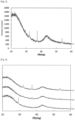
- a precursor activated carbon (Y) was obtained in the same manner as in Example 2, except that the retention time of the preheating temperature was changed from 0 minute to 60 minutes. As shown in FIG. 3 , this precursor activated carbon (Y) had a diffraction peak at a diffraction angle 2 ⁇ of 37.6 ⁇ 0.3° in its X-ray diffraction pattern. Further, this diffraction peak was derived from calcium oxide.
- An activated carbon was obtained in the same manner as in Example 1, except that the preheating step was not performed, a fluidized furnace was used for the secondary activation step in place of the batch-type rotary kiln, and the activation yield was changed from 30% to 34%.
- the physical properties of the thus obtained activated carbon are shown in Table 1. It is noted here that the activation in the fluidized furnace was performed at an activation temperature of 920°C by supplying a mixed gas having a water vapor partial pressure of 16%, a carbon dioxide partial pressure of 12% and a nitrogen partial pressure of 72% into the fluidized furnace at a total gas pressure of 1 atm and a flow rate of 108.4 L/min.
- the raw material activated carbon prior to the secondary activation step did not contain a calcium compound (calcium oxide) having a size large enough to give the specific pore structure of the present invention, and did not have a diffraction peak at a diffraction angle 2 ⁇ of 37.6 ⁇ 0.3°. In Table 1, this is indicated as “absent” for "Diffraction peak derived from Ca oxide”.
- An activated carbon was obtained in the same manner as in Example 2, except that the preheating step was not performed, a fluidized furnace was used for the secondary activation step in place of the batch-type rotary kiln, and the activation yield was changed from 31% to 26%. It is noted here that the activation in the fluidized furnace was performed at an activation temperature of 920°C by supplying a mixed gas having a water vapor partial pressure of 16%, a carbon dioxide partial pressure of 12% and a nitrogen partial pressure of 72% into the fluidized furnace at a total gas pressure of 1 atm and a flow rate of 108.4 L/min.
- the raw material activated carbon prior to the secondary activation step did not contain a calcium compound (calcium oxide) having a size large enough to give the specific pore structure of the present invention, and did not have a diffraction peak at a diffraction angle 2 ⁇ of 37.6 ⁇ 0.3° as shown in FIG. 2 .
- the physical properties of the thus obtained activated carbon are shown in Table 1.
- the diffraction peak at a diffraction angle 2 ⁇ of 29.8 ⁇ 0.3°, which is seen in FIG. 2 is a diffraction peak derived from calcium nitrate tetrahydrate.
- Example 1 described in Patent Document 3 the same raw material activated carbon as the one obtained in (1) of Example 1 was sprayed with an aqueous calcium chloride solution (calcium chloride: 10 g, ion-exchanged water: 350 g), and dried for 5 to 7 hours in a natural convection constant-temperature dryer set at 115 ⁇ 5°C.
- An activated carbon was obtained in the same manner as in Example 1, except that the preheating step was not performed, an activation temperature of 900°C was used in place of 920°C, and the activation yield was changed from 30% to 33%.
- the physical properties of the thus obtained activated carbon are shown in Table 1.
- an activated carbon was obtained in the same manner as in Comparative Example 6, except that, as the aqueous calcium chloride solution sprayed to the raw material activated carbon, an aqueous calcium chloride solution (calcium chloride: 15 g, ion-exchanged water: 350 g) was used in place of the aqueous calcium chloride solution (calcium chloride: 10 g, ion-exchanged water: 350 g), and the activation yield was changed from 33% to 24%.
- the physical properties of the thus obtained activated carbon are shown in Table 1.
- An activated carbon was obtained in the same manner as in Comparative Example 1, except that the step of adjusting the elemental potassium content and the elemental calcium content in the raw material activated carbon was not performed, and the activation yield was changed from 34% to 37%.
- the physical properties of the thus obtained activated carbon are shown in Table 1.
- Example 1 Elemental K content [% by mass] Elemental Ca content [% by mass] Diffraction peak derived from Ca oxide Activation yield [%] 6.5-50 nm pore volume (A) [mL/g] 750-4,000 nm pore volume (B) [mL/g] Pore volume ratio (A)/(B) [-] 300-750 nm pore volume (C) [mL/g] Pore volume ratio (A)/(C) [-] SPR adsorption amount [mg/g] MS hardness [%] JIS hardness [%]
- Example 1 0.2 3.5 present 30 0.54 0.21 2.6 0.14 3.8 490 69.9 82.5
- Example 2 0.4 1.4 present 31 0.43 0.21 2.1 0.15 2.9 250 70.3 88.6
- Example 3 0.4 0.9 present 30 0.44 0.20 2.2 0.14 3.1 190 73.1 87.6
- Example 4 0.4 1.4 present 36 0.34 0.20 1.7 0.10 3.5 300 70.3 89.
- the activated carbons obtained in Comparative Examples 1, 2 and 4 to 7, in which the pore volume (B) at a pore diameter of 750 to 4,000 nm was excessively increased had a lower MS hardness than the activated carbons of Examples.
- the activated carbons of Comparative Examples 3 and 8 exhibited a lower SPR decolorization performance than the activated carbons of Examples.
- the activated carbon of the present invention has a high hardness and, therefore, can be suitably used for a liquid-phase treatment in an adsorption tower or the like where such a property is required.
- the activated carbon of the present invention exhibits an excellent SPR decolorization performance, it can be suitably used as an activated carbon for removing relatively large molecules from a liquid phase.
- the activated carbon of the present invention can be produced by a method which does not additionally require a special apparatus, a special production process or the like, wherein the content balance of two metal elements are changed and activation after a preheating treatment is performed in the production process; therefore, the activated carbon of the present invention is industrially useful in this respect as well.
Landscapes
- Chemical & Material Sciences (AREA)
- Organic Chemistry (AREA)
- Analytical Chemistry (AREA)
- Chemical Kinetics & Catalysis (AREA)
- Inorganic Chemistry (AREA)
- Engineering & Computer Science (AREA)
- Nanotechnology (AREA)
- Physics & Mathematics (AREA)
- Thermal Sciences (AREA)
- Materials Engineering (AREA)
- Carbon And Carbon Compounds (AREA)
- Solid-Sorbent Or Filter-Aiding Compositions (AREA)
Claims (7)
- Aktivkohle mit einem Porenvolumen (A) von 0,3 bis 0,7 mL/g bei einem Porendurchmesser von 6,5 bis 50 nm, bestimmt durch Quecksilber-Intrusionsporosimetrie, einem Porenvolumen (B) von 0,23 mL/g oder weniger bei einem Porendurchmesser von 750 bis 4.000 nm, bestimmt durch Quecksilber-Intrusionsporosimetrie, und einem Porenvolumenverhältnis (A)/(B) von 1,7 oder höher.
- Aktivkohle nach Anspruch 1 mit einem Porenvolumen (C) von 0,18 mL/g oder weniger bei einem Porendurchmesser von 300 bis 750 nm, bestimmt durch Quecksilber-Intrusionsporosimetrie, und einem Porenvolumenverhältnis (A)/(C) von 2,5 oder höher.
- Aktivkohle nach Anspruch 1 oder 2, die eine Aktivkohle für eine Flüssigphasenbehandlung ist.
- Verfahren zur Herstellung der Aktivkohle nach einem der Ansprüche 1 bis 3, umfassend den Schritt des Aktivierens einer Vorläufer-Aktivkohle mit einem Elementarkaliumgehalt von 0,5 Massen-% oder weniger und einem Elementarcalciumgehalt von 0,4 bis 4 Massen-% durch Erwärmen der Vorläufer-Aktivkohle bei einer Temperatur von 800°C oder höher unter einer Mischgasatmosphäre von zwei oder mehr Gasen, ausgewählt aus der Gruppe, bestehend aus Propan-Verbrennungsgas, Wasserdampf, Stickstoff und Kohlendioxid.
- Verfahren nach Anspruch 4, wobei die Vorläufer-Aktivkohle in einem Röntgenbeugungsdiagramm einen Beugungspeak bei einem Beugungswinkel 2θ von 37,6 ± 0,3° aufweist.
- Verfahren nach Anspruch 4 oder 5, wobei die Vorläufer-Aktivkohle in einem Röntgenbeugungsdiagramm einen von Calciumoxid abgeleiteten Beugungspeak aufweist.
- Verfahren nach einem der Ansprüche 4 bis 6, umfassend die Schritte:das Einstellen einer Rohmaterial-Aktivkohle auf einen Elementarkaliumgehalt von 0,5 Massen-% oder weniger durch Waschen mit einer säurehaltigen Waschflüssigkeit oder durch Ersetzen einer Kaliumkomponente durch eine andere Komponente durch ein Ionenaustauschverfahren;das Einstellen der Rohmaterial-Aktivkohle auf einen Elementarcalciumgehalt von 0,4 bis 4 Massen-% durch Inkontaktbringen der Rohmaterial-Aktivkohle mit einer Elementarcalciumquelle;das Vorwärmen der so eingestellten Rohmaterial-Aktivkohle, um die Vorläufer-Aktivkohle zu erhalten durch Erwärmen der Rohmaterial-Aktivkohle unter einer Inertgasatmosphäre von einer Temperatur von 400 bis 600°C auf eine Temperatur von 880 bis 980°C bei einer Temperaturanstiegsrate von 8 bis 20°C/min und anschließendes Halten der Temperatur für einen Zeitraum von 0 bis 180 min; unddas Aktivieren der Vorläufer-Aktivkohle.
Applications Claiming Priority (2)
| Application Number | Priority Date | Filing Date | Title |
|---|---|---|---|
| JP2019026791 | 2019-02-18 | ||
| PCT/JP2020/005866 WO2020170985A1 (ja) | 2019-02-18 | 2020-02-14 | 活性炭およびその製造方法 |
Publications (3)
| Publication Number | Publication Date |
|---|---|
| EP3929153A1 EP3929153A1 (de) | 2021-12-29 |
| EP3929153A4 EP3929153A4 (de) | 2022-11-23 |
| EP3929153B1 true EP3929153B1 (de) | 2025-05-28 |
Family
ID=72144910
Family Applications (1)
| Application Number | Title | Priority Date | Filing Date |
|---|---|---|---|
| EP20759462.3A Active EP3929153B1 (de) | 2019-02-18 | 2020-02-14 | Aktivkohle und verfahren zur herstellung davon |
Country Status (6)
| Country | Link |
|---|---|
| US (1) | US12161991B2 (de) |
| EP (1) | EP3929153B1 (de) |
| JP (1) | JP7373549B2 (de) |
| CN (1) | CN113412236B (de) |
| TW (1) | TWI825275B (de) |
| WO (1) | WO2020170985A1 (de) |
Family Cites Families (21)
| Publication number | Priority date | Publication date | Assignee | Title |
|---|---|---|---|---|
| US7759289B2 (en) | 2002-07-30 | 2010-07-20 | Kuraray Chemical Co., Ltd. | Activated carbon, method for production thereof, polarizing electrode and electrical double layer capacitor |
| JP4096653B2 (ja) * | 2002-07-30 | 2008-06-04 | クラレケミカル株式会社 | 活性炭の製造方法、分極性電極及び電気二重層キャパシタ |
| JP4391198B2 (ja) | 2003-10-31 | 2009-12-24 | オルガノ株式会社 | 活性炭前駆体、活性炭、活性炭の製造方法及び電気二重層キャパシタ用分極性電極 |
| EP1707266A4 (de) | 2003-12-05 | 2008-03-05 | Nippon Shokusei Kk | Anionenadsorbierendes kohlenstoffmaterial und verfahren und vorrichtung zur herstellung davon |
| JP3790540B2 (ja) * | 2003-12-05 | 2006-06-28 | 日本植生株式会社 | 中毒防止材 |
| JP2006015334A (ja) | 2004-05-31 | 2006-01-19 | Japan Enviro Chemicals Ltd | 吸着剤およびその製造法 |
| US20070270307A1 (en) | 2004-05-31 | 2007-11-22 | Isao Hamasaki | Adsorbent And Process For Producing The Same |
| JP4704001B2 (ja) | 2004-10-04 | 2011-06-15 | クラレケミカル株式会社 | 活性炭及びその製造方法 |
| GB0506278D0 (en) * | 2005-03-29 | 2005-05-04 | British American Tobacco Co | Porous carbon materials and smoking articles and smoke filters therefor incorporating such materials |
| JP4533876B2 (ja) | 2005-09-29 | 2010-09-01 | 昭和電工株式会社 | 活性炭およびその製造方法並びに用途 |
| KR100932158B1 (ko) | 2005-09-29 | 2009-12-16 | 쇼와 덴코 가부시키가이샤 | 활성탄 및 그것의 제조방법 |
| CN102822093B (zh) * | 2010-03-31 | 2015-02-25 | 可乐丽化学株式会社 | 活性炭及其用途 |
| US9670066B2 (en) * | 2011-03-15 | 2017-06-06 | University Of Kentucky Research Foundation | Carbon particles |
| JP5159970B1 (ja) * | 2012-05-16 | 2013-03-13 | 株式会社アルメディオ | 活性炭及びその製造方法 |
| JP6033395B2 (ja) * | 2013-02-20 | 2016-11-30 | 大阪ガスケミカル株式会社 | 粒状活性炭およびその製造方法 |
| US9737871B2 (en) | 2013-02-20 | 2017-08-22 | Osaka Gas Chemicals Co., Ltd. | Granular activated carbon having many mesopores, and manufacturing method for same |
| CN106794989B (zh) * | 2014-09-02 | 2020-03-31 | 株式会社可乐丽 | 源自植物的碳前体的纯化方法 |
| JP6831208B2 (ja) * | 2015-12-25 | 2021-02-17 | 株式会社ダイヘン | ロボット制御装置 |
| US11707727B2 (en) * | 2016-02-23 | 2023-07-25 | Sony Corporation | Solidified porous carbon material and method of manufacturing the same |
| JP6719329B2 (ja) * | 2016-08-16 | 2020-07-08 | 株式会社クラレ | 炭素質材料の製造方法 |
| WO2018116859A1 (ja) * | 2016-12-19 | 2018-06-28 | 株式会社アドール | 活性炭及びその製造方法 |
-
2020
- 2020-02-14 EP EP20759462.3A patent/EP3929153B1/de active Active
- 2020-02-14 WO PCT/JP2020/005866 patent/WO2020170985A1/ja not_active Ceased
- 2020-02-14 CN CN202080014905.8A patent/CN113412236B/zh active Active
- 2020-02-14 JP JP2021501951A patent/JP7373549B2/ja active Active
- 2020-02-14 US US17/429,361 patent/US12161991B2/en active Active
- 2020-02-17 TW TW109104946A patent/TWI825275B/zh active
Also Published As
| Publication number | Publication date |
|---|---|
| JP7373549B2 (ja) | 2023-11-02 |
| WO2020170985A1 (ja) | 2020-08-27 |
| US20220143572A1 (en) | 2022-05-12 |
| EP3929153A4 (de) | 2022-11-23 |
| CN113412236A (zh) | 2021-09-17 |
| TW202041458A (zh) | 2020-11-16 |
| US12161991B2 (en) | 2024-12-10 |
| TWI825275B (zh) | 2023-12-11 |
| JPWO2020170985A1 (ja) | 2021-12-16 |
| EP3929153A1 (de) | 2021-12-29 |
| CN113412236B (zh) | 2024-08-16 |
Similar Documents
| Publication | Publication Date | Title |
|---|---|---|
| CN114272892B (zh) | 一种co2捕集吸附剂及其制备方法和应用 | |
| WO2003104148A1 (ja) | メソ細孔性ゼオライトの合成方法 | |
| EP3662995A1 (de) | Poröse materialien auf basis von oxiden des titans und/oder des vanadiums sowie deren herstellung und verwendung | |
| CN111377443B (zh) | 一种铜掺杂活性炭复合材料及其制备方法 | |
| CN107344720B (zh) | 一种y型分子筛及其制备方法 | |
| JPH07155589A (ja) | 高比表面積炭素材料の製造方法 | |
| EP3733601B1 (de) | Aktivkohle und herstellungsverfahren dafür | |
| Pavel et al. | Generation of hierarchical pore systems in the titanosilicate ETS-10 by hydrogen peroxide treatment under microwave irradiation | |
| EP3929153B1 (de) | Aktivkohle und verfahren zur herstellung davon | |
| CN116550284B (zh) | 金属掺杂碳材料及其制备方法和应用、吸附材料及其应用 | |
| JPH07155587A (ja) | 高吸着性炭素材料およびその製造方法 | |
| KR102255171B1 (ko) | 과산화수소 제조용 세슘-팔라듐 촉매의 제조방법 및 이를 이용한 과산화수소의 제조방법 | |
| CN107344102B (zh) | 一种加氢裂化催化剂及其制法 | |
| CN107344105B (zh) | 加氢裂化催化剂及其制备方法 | |
| Yanti et al. | Impregnation effect of Iron (Fe) and Cobalt (Co) on ZSM-5 zeolite catalyst from rice husk ash and coal fly ash for methanol synthesis | |
| Venugopal et al. | Maximizing methanol selectivity over the microporous FeS-1 catalyst via aqueous-phase partial oxidation of methane with H 2 O 2 | |
| JP2004091276A (ja) | ヒ素吸着用活性炭およびその製造方法 | |
| CN121288850B (zh) | 一种磷掺杂氧化硅材料的制备方法及应用 | |
| CN115155540B (zh) | 树脂吸附模板-气热催化制备多孔纳米钛酸盐微球方法 | |
| CN119500094B (zh) | 钠改性介孔铝及其制备方法和应用 | |
| EP3733600B1 (de) | Aktivkohle und herstellungsverfahren dafür | |
| WO2026033167A1 (en) | Method for producing activated carbon | |
| KR20250076815A (ko) | 이종기공을 포함하는 다공성 탄소구조체 제조방법 | |
| CN121648917A (zh) | 一种生物炭负载纳米零价铁的催化剂及其制备方法 | |
| CN121004038A (zh) | 一种多孔石墨烯活性锰复合颗粒的制备方法及应用 |
Legal Events
| Date | Code | Title | Description |
|---|---|---|---|
| STAA | Information on the status of an ep patent application or granted ep patent |
Free format text: STATUS: THE INTERNATIONAL PUBLICATION HAS BEEN MADE |
|
| PUAI | Public reference made under article 153(3) epc to a published international application that has entered the european phase |
Free format text: ORIGINAL CODE: 0009012 |
|
| STAA | Information on the status of an ep patent application or granted ep patent |
Free format text: STATUS: REQUEST FOR EXAMINATION WAS MADE |
|
| 17P | Request for examination filed |
Effective date: 20210812 |
|
| AK | Designated contracting states |
Kind code of ref document: A1 Designated state(s): AL AT BE BG CH CY CZ DE DK EE ES FI FR GB GR HR HU IE IS IT LI LT LU LV MC MK MT NL NO PL PT RO RS SE SI SK SM TR |
|
| DAV | Request for validation of the european patent (deleted) | ||
| DAX | Request for extension of the european patent (deleted) | ||
| A4 | Supplementary search report drawn up and despatched |
Effective date: 20221020 |
|
| RIC1 | Information provided on ipc code assigned before grant |
Ipc: C01B 32/342 20170101ALI20221014BHEP Ipc: C01B 32/336 20170101ALI20221014BHEP Ipc: B01J 20/30 20060101ALI20221014BHEP Ipc: B01J 20/32 20060101ALI20221014BHEP Ipc: B01J 20/28 20060101ALI20221014BHEP Ipc: B01J 20/20 20060101ALI20221014BHEP Ipc: C01B 32/348 20170101AFI20221014BHEP |
|
| P01 | Opt-out of the competence of the unified patent court (upc) registered |
Effective date: 20230520 |
|
| GRAP | Despatch of communication of intention to grant a patent |
Free format text: ORIGINAL CODE: EPIDOSNIGR1 |
|
| STAA | Information on the status of an ep patent application or granted ep patent |
Free format text: STATUS: GRANT OF PATENT IS INTENDED |
|
| RIC1 | Information provided on ipc code assigned before grant |
Ipc: C01B 32/342 20170101ALI20241129BHEP Ipc: C01B 32/336 20170101ALI20241129BHEP Ipc: B01J 20/30 20060101ALI20241129BHEP Ipc: B01J 20/32 20060101ALI20241129BHEP Ipc: B01J 20/28 20060101ALI20241129BHEP Ipc: B01J 20/20 20060101ALI20241129BHEP Ipc: C01B 32/348 20170101AFI20241129BHEP |
|
| INTG | Intention to grant announced |
Effective date: 20241223 |
|
| GRAS | Grant fee paid |
Free format text: ORIGINAL CODE: EPIDOSNIGR3 |
|
| GRAA | (expected) grant |
Free format text: ORIGINAL CODE: 0009210 |
|
| STAA | Information on the status of an ep patent application or granted ep patent |
Free format text: STATUS: THE PATENT HAS BEEN GRANTED |
|
| AK | Designated contracting states |
Kind code of ref document: B1 Designated state(s): AL AT BE BG CH CY CZ DE DK EE ES FI FR GB GR HR HU IE IS IT LI LT LU LV MC MK MT NL NO PL PT RO RS SE SI SK SM TR |
|
| REG | Reference to a national code |
Ref country code: GB Ref legal event code: FG4D |
|
| REG | Reference to a national code |
Ref country code: CH Ref legal event code: EP |
|
| REG | Reference to a national code |
Ref country code: DE Ref legal event code: R096 Ref document number: 602020052017 Country of ref document: DE |
|
| REG | Reference to a national code |
Ref country code: IE Ref legal event code: FG4D |
|
| REG | Reference to a national code |
Ref country code: NL Ref legal event code: MP Effective date: 20250528 |
|
| PG25 | Lapsed in a contracting state [announced via postgrant information from national office to epo] |
Ref country code: FI Free format text: LAPSE BECAUSE OF FAILURE TO SUBMIT A TRANSLATION OF THE DESCRIPTION OR TO PAY THE FEE WITHIN THE PRESCRIBED TIME-LIMIT Effective date: 20250528 Ref country code: ES Free format text: LAPSE BECAUSE OF FAILURE TO SUBMIT A TRANSLATION OF THE DESCRIPTION OR TO PAY THE FEE WITHIN THE PRESCRIBED TIME-LIMIT Effective date: 20250528 |
|
| REG | Reference to a national code |
Ref country code: LT Ref legal event code: MG9D |
|
| PG25 | Lapsed in a contracting state [announced via postgrant information from national office to epo] |
Ref country code: GR Free format text: LAPSE BECAUSE OF FAILURE TO SUBMIT A TRANSLATION OF THE DESCRIPTION OR TO PAY THE FEE WITHIN THE PRESCRIBED TIME-LIMIT Effective date: 20250829 Ref country code: NO Free format text: LAPSE BECAUSE OF FAILURE TO SUBMIT A TRANSLATION OF THE DESCRIPTION OR TO PAY THE FEE WITHIN THE PRESCRIBED TIME-LIMIT Effective date: 20250828 |
|
| PG25 | Lapsed in a contracting state [announced via postgrant information from national office to epo] |
Ref country code: NL Free format text: LAPSE BECAUSE OF FAILURE TO SUBMIT A TRANSLATION OF THE DESCRIPTION OR TO PAY THE FEE WITHIN THE PRESCRIBED TIME-LIMIT Effective date: 20250528 Ref country code: PL Free format text: LAPSE BECAUSE OF FAILURE TO SUBMIT A TRANSLATION OF THE DESCRIPTION OR TO PAY THE FEE WITHIN THE PRESCRIBED TIME-LIMIT Effective date: 20250528 |
|
| PG25 | Lapsed in a contracting state [announced via postgrant information from national office to epo] |
Ref country code: BG Free format text: LAPSE BECAUSE OF FAILURE TO SUBMIT A TRANSLATION OF THE DESCRIPTION OR TO PAY THE FEE WITHIN THE PRESCRIBED TIME-LIMIT Effective date: 20250528 |
|
| PG25 | Lapsed in a contracting state [announced via postgrant information from national office to epo] |
Ref country code: HR Free format text: LAPSE BECAUSE OF FAILURE TO SUBMIT A TRANSLATION OF THE DESCRIPTION OR TO PAY THE FEE WITHIN THE PRESCRIBED TIME-LIMIT Effective date: 20250528 |
|
| PG25 | Lapsed in a contracting state [announced via postgrant information from national office to epo] |
Ref country code: RS Free format text: LAPSE BECAUSE OF FAILURE TO SUBMIT A TRANSLATION OF THE DESCRIPTION OR TO PAY THE FEE WITHIN THE PRESCRIBED TIME-LIMIT Effective date: 20250828 |
|
| PG25 | Lapsed in a contracting state [announced via postgrant information from national office to epo] |
Ref country code: IS Free format text: LAPSE BECAUSE OF FAILURE TO SUBMIT A TRANSLATION OF THE DESCRIPTION OR TO PAY THE FEE WITHIN THE PRESCRIBED TIME-LIMIT Effective date: 20250928 |
|
| PG25 | Lapsed in a contracting state [announced via postgrant information from national office to epo] |
Ref country code: LV Free format text: LAPSE BECAUSE OF FAILURE TO SUBMIT A TRANSLATION OF THE DESCRIPTION OR TO PAY THE FEE WITHIN THE PRESCRIBED TIME-LIMIT Effective date: 20250528 |
|
| REG | Reference to a national code |
Ref country code: AT Ref legal event code: MK05 Ref document number: 1798553 Country of ref document: AT Kind code of ref document: T Effective date: 20250528 |
|
| PG25 | Lapsed in a contracting state [announced via postgrant information from national office to epo] |
Ref country code: SM Free format text: LAPSE BECAUSE OF FAILURE TO SUBMIT A TRANSLATION OF THE DESCRIPTION OR TO PAY THE FEE WITHIN THE PRESCRIBED TIME-LIMIT Effective date: 20250528 Ref country code: AT Free format text: LAPSE BECAUSE OF FAILURE TO SUBMIT A TRANSLATION OF THE DESCRIPTION OR TO PAY THE FEE WITHIN THE PRESCRIBED TIME-LIMIT Effective date: 20250528 Ref country code: DK Free format text: LAPSE BECAUSE OF FAILURE TO SUBMIT A TRANSLATION OF THE DESCRIPTION OR TO PAY THE FEE WITHIN THE PRESCRIBED TIME-LIMIT Effective date: 20250528 |
|
| PG25 | Lapsed in a contracting state [announced via postgrant information from national office to epo] |
Ref country code: CZ Free format text: LAPSE BECAUSE OF FAILURE TO SUBMIT A TRANSLATION OF THE DESCRIPTION OR TO PAY THE FEE WITHIN THE PRESCRIBED TIME-LIMIT Effective date: 20250528 |
|
| PG25 | Lapsed in a contracting state [announced via postgrant information from national office to epo] |
Ref country code: EE Free format text: LAPSE BECAUSE OF FAILURE TO SUBMIT A TRANSLATION OF THE DESCRIPTION OR TO PAY THE FEE WITHIN THE PRESCRIBED TIME-LIMIT Effective date: 20250528 |
|
| PG25 | Lapsed in a contracting state [announced via postgrant information from national office to epo] |
Ref country code: SK Free format text: LAPSE BECAUSE OF FAILURE TO SUBMIT A TRANSLATION OF THE DESCRIPTION OR TO PAY THE FEE WITHIN THE PRESCRIBED TIME-LIMIT Effective date: 20250528 |
|
| PG25 | Lapsed in a contracting state [announced via postgrant information from national office to epo] |
Ref country code: IT Free format text: LAPSE BECAUSE OF FAILURE TO SUBMIT A TRANSLATION OF THE DESCRIPTION OR TO PAY THE FEE WITHIN THE PRESCRIBED TIME-LIMIT Effective date: 20250528 |