EP3904391B1 - Monoclonal antibodies against c-met - Google Patents
Monoclonal antibodies against c-met Download PDFInfo
- Publication number
- EP3904391B1 EP3904391B1 EP21171029.8A EP21171029A EP3904391B1 EP 3904391 B1 EP3904391 B1 EP 3904391B1 EP 21171029 A EP21171029 A EP 21171029A EP 3904391 B1 EP3904391 B1 EP 3904391B1
- Authority
- EP
- European Patent Office
- Prior art keywords
- antibody
- seq
- met
- region
- antibodies
- Prior art date
- Legal status (The legal status is an assumption and is not a legal conclusion. Google has not performed a legal analysis and makes no representation as to the accuracy of the status listed.)
- Active
Links
Images





Classifications
-
- A—HUMAN NECESSITIES
- A61—MEDICAL OR VETERINARY SCIENCE; HYGIENE
- A61K—PREPARATIONS FOR MEDICAL, DENTAL OR TOILETRY PURPOSES
- A61K38/00—Medicinal preparations containing peptides
- A61K38/16—Peptides having more than 20 amino acids; Gastrins; Somatostatins; Melanotropins; Derivatives thereof
- A61K38/17—Peptides having more than 20 amino acids; Gastrins; Somatostatins; Melanotropins; Derivatives thereof from animals; from humans
-
- A—HUMAN NECESSITIES
- A61—MEDICAL OR VETERINARY SCIENCE; HYGIENE
- A61K—PREPARATIONS FOR MEDICAL, DENTAL OR TOILETRY PURPOSES
- A61K38/00—Medicinal preparations containing peptides
- A61K38/16—Peptides having more than 20 amino acids; Gastrins; Somatostatins; Melanotropins; Derivatives thereof
- A61K38/17—Peptides having more than 20 amino acids; Gastrins; Somatostatins; Melanotropins; Derivatives thereof from animals; from humans
- A61K38/18—Growth factors; Growth regulators
-
- A—HUMAN NECESSITIES
- A61—MEDICAL OR VETERINARY SCIENCE; HYGIENE
- A61K—PREPARATIONS FOR MEDICAL, DENTAL OR TOILETRY PURPOSES
- A61K39/00—Medicinal preparations containing antigens or antibodies
- A61K39/395—Antibodies; Immunoglobulins; Immune serum, e.g. antilymphocytic serum
-
- A—HUMAN NECESSITIES
- A61—MEDICAL OR VETERINARY SCIENCE; HYGIENE
- A61K—PREPARATIONS FOR MEDICAL, DENTAL OR TOILETRY PURPOSES
- A61K39/00—Medicinal preparations containing antigens or antibodies
- A61K39/395—Antibodies; Immunoglobulins; Immune serum, e.g. antilymphocytic serum
- A61K39/39533—Antibodies; Immunoglobulins; Immune serum, e.g. antilymphocytic serum against materials from animals
- A61K39/3955—Antibodies; Immunoglobulins; Immune serum, e.g. antilymphocytic serum against materials from animals against proteinaceous materials, e.g. enzymes, hormones, lymphokines
-
- A—HUMAN NECESSITIES
- A61—MEDICAL OR VETERINARY SCIENCE; HYGIENE
- A61K—PREPARATIONS FOR MEDICAL, DENTAL OR TOILETRY PURPOSES
- A61K45/00—Medicinal preparations containing active ingredients not provided for in groups A61K31/00 - A61K41/00
- A61K45/06—Mixtures of active ingredients without chemical characterisation, e.g. antiphlogistics and cardiaca
-
- A—HUMAN NECESSITIES
- A61—MEDICAL OR VETERINARY SCIENCE; HYGIENE
- A61K—PREPARATIONS FOR MEDICAL, DENTAL OR TOILETRY PURPOSES
- A61K47/00—Medicinal preparations characterised by the non-active ingredients used, e.g. carriers or inert additives; Targeting or modifying agents chemically bound to the active ingredient
- A61K47/30—Macromolecular organic or inorganic compounds, e.g. inorganic polyphosphates
- A61K47/42—Proteins; Polypeptides; Degradation products thereof; Derivatives thereof, e.g. albumin, gelatin or zein
-
- A—HUMAN NECESSITIES
- A61—MEDICAL OR VETERINARY SCIENCE; HYGIENE
- A61K—PREPARATIONS FOR MEDICAL, DENTAL OR TOILETRY PURPOSES
- A61K48/00—Medicinal preparations containing genetic material which is inserted into cells of the living body to treat genetic diseases; Gene therapy
-
- A—HUMAN NECESSITIES
- A61—MEDICAL OR VETERINARY SCIENCE; HYGIENE
- A61P—SPECIFIC THERAPEUTIC ACTIVITY OF CHEMICAL COMPOUNDS OR MEDICINAL PREPARATIONS
- A61P35/00—Antineoplastic agents
-
- C—CHEMISTRY; METALLURGY
- C07—ORGANIC CHEMISTRY
- C07K—PEPTIDES
- C07K14/00—Peptides having more than 20 amino acids; Gastrins; Somatostatins; Melanotropins; Derivatives thereof
- C07K14/435—Peptides having more than 20 amino acids; Gastrins; Somatostatins; Melanotropins; Derivatives thereof from animals; from humans
-
- C—CHEMISTRY; METALLURGY
- C07—ORGANIC CHEMISTRY
- C07K—PEPTIDES
- C07K14/00—Peptides having more than 20 amino acids; Gastrins; Somatostatins; Melanotropins; Derivatives thereof
- C07K14/435—Peptides having more than 20 amino acids; Gastrins; Somatostatins; Melanotropins; Derivatives thereof from animals; from humans
- C07K14/475—Growth factors; Growth regulators
-
- C—CHEMISTRY; METALLURGY
- C07—ORGANIC CHEMISTRY
- C07K—PEPTIDES
- C07K16/00—Immunoglobulins [IG], e.g. monoclonal or polyclonal antibodies
- C07K16/18—Immunoglobulins [IG], e.g. monoclonal or polyclonal antibodies against material from animals or humans
-
- C—CHEMISTRY; METALLURGY
- C07—ORGANIC CHEMISTRY
- C07K—PEPTIDES
- C07K16/00—Immunoglobulins [IG], e.g. monoclonal or polyclonal antibodies
- C07K16/18—Immunoglobulins [IG], e.g. monoclonal or polyclonal antibodies against material from animals or humans
- C07K16/22—Immunoglobulins [IG], e.g. monoclonal or polyclonal antibodies against material from animals or humans against growth factors ; against growth regulators
-
- C—CHEMISTRY; METALLURGY
- C07—ORGANIC CHEMISTRY
- C07K—PEPTIDES
- C07K16/00—Immunoglobulins [IG], e.g. monoclonal or polyclonal antibodies
- C07K16/18—Immunoglobulins [IG], e.g. monoclonal or polyclonal antibodies against material from animals or humans
- C07K16/28—Immunoglobulins [IG], e.g. monoclonal or polyclonal antibodies against material from animals or humans against receptors, cell surface antigens or cell surface determinants
-
- C—CHEMISTRY; METALLURGY
- C07—ORGANIC CHEMISTRY
- C07K—PEPTIDES
- C07K16/00—Immunoglobulins [IG], e.g. monoclonal or polyclonal antibodies
- C07K16/18—Immunoglobulins [IG], e.g. monoclonal or polyclonal antibodies against material from animals or humans
- C07K16/28—Immunoglobulins [IG], e.g. monoclonal or polyclonal antibodies against material from animals or humans against receptors, cell surface antigens or cell surface determinants
- C07K16/2863—Immunoglobulins [IG], e.g. monoclonal or polyclonal antibodies against material from animals or humans against receptors, cell surface antigens or cell surface determinants against receptors for growth factors, growth regulators
-
- C—CHEMISTRY; METALLURGY
- C07—ORGANIC CHEMISTRY
- C07K—PEPTIDES
- C07K16/00—Immunoglobulins [IG], e.g. monoclonal or polyclonal antibodies
- C07K16/18—Immunoglobulins [IG], e.g. monoclonal or polyclonal antibodies against material from animals or humans
- C07K16/28—Immunoglobulins [IG], e.g. monoclonal or polyclonal antibodies against material from animals or humans against receptors, cell surface antigens or cell surface determinants
- C07K16/30—Immunoglobulins [IG], e.g. monoclonal or polyclonal antibodies against material from animals or humans against receptors, cell surface antigens or cell surface determinants from tumour cells
-
- C—CHEMISTRY; METALLURGY
- C07—ORGANIC CHEMISTRY
- C07K—PEPTIDES
- C07K16/00—Immunoglobulins [IG], e.g. monoclonal or polyclonal antibodies
- C07K16/18—Immunoglobulins [IG], e.g. monoclonal or polyclonal antibodies against material from animals or humans
- C07K16/28—Immunoglobulins [IG], e.g. monoclonal or polyclonal antibodies against material from animals or humans against receptors, cell surface antigens or cell surface determinants
- C07K16/30—Immunoglobulins [IG], e.g. monoclonal or polyclonal antibodies against material from animals or humans against receptors, cell surface antigens or cell surface determinants from tumour cells
- C07K16/3076—Immunoglobulins [IG], e.g. monoclonal or polyclonal antibodies against material from animals or humans against receptors, cell surface antigens or cell surface determinants from tumour cells against structure-related tumour-associated moieties
-
- C—CHEMISTRY; METALLURGY
- C07—ORGANIC CHEMISTRY
- C07K—PEPTIDES
- C07K16/00—Immunoglobulins [IG], e.g. monoclonal or polyclonal antibodies
- C07K16/40—Immunoglobulins [IG], e.g. monoclonal or polyclonal antibodies against enzymes
-
- G—PHYSICS
- G01—MEASURING; TESTING
- G01N—INVESTIGATING OR ANALYSING MATERIALS BY DETERMINING THEIR CHEMICAL OR PHYSICAL PROPERTIES
- G01N33/00—Investigating or analysing materials by specific methods not covered by groups G01N1/00 - G01N31/00
- G01N33/48—Biological material, e.g. blood, urine; Haemocytometers
- G01N33/50—Chemical analysis of biological material, e.g. blood, urine; Testing involving biospecific ligand binding methods; Immunological testing
- G01N33/53—Immunoassay; Biospecific binding assay; Materials therefor
- G01N33/575—Immunoassay; Biospecific binding assay; Materials therefor for cancer
- G01N33/57575—Immunoassay; Biospecific binding assay; Materials therefor for cancer involving oncogenic proteins
-
- A—HUMAN NECESSITIES
- A61—MEDICAL OR VETERINARY SCIENCE; HYGIENE
- A61K—PREPARATIONS FOR MEDICAL, DENTAL OR TOILETRY PURPOSES
- A61K39/00—Medicinal preparations containing antigens or antibodies
- A61K2039/505—Medicinal preparations containing antigens or antibodies comprising antibodies
-
- C—CHEMISTRY; METALLURGY
- C07—ORGANIC CHEMISTRY
- C07K—PEPTIDES
- C07K2317/00—Immunoglobulins specific features
- C07K2317/20—Immunoglobulins specific features characterized by taxonomic origin
- C07K2317/21—Immunoglobulins specific features characterized by taxonomic origin from primates, e.g. man
-
- C—CHEMISTRY; METALLURGY
- C07—ORGANIC CHEMISTRY
- C07K—PEPTIDES
- C07K2317/00—Immunoglobulins specific features
- C07K2317/30—Immunoglobulins specific features characterized by aspects of specificity or valency
- C07K2317/31—Immunoglobulins specific features characterized by aspects of specificity or valency multispecific
-
- C—CHEMISTRY; METALLURGY
- C07—ORGANIC CHEMISTRY
- C07K—PEPTIDES
- C07K2317/00—Immunoglobulins specific features
- C07K2317/30—Immunoglobulins specific features characterized by aspects of specificity or valency
- C07K2317/35—Valency
-
- C—CHEMISTRY; METALLURGY
- C07—ORGANIC CHEMISTRY
- C07K—PEPTIDES
- C07K2317/00—Immunoglobulins specific features
- C07K2317/50—Immunoglobulins specific features characterized by immunoglobulin fragments
- C07K2317/52—Constant or Fc region; Isotype
- C07K2317/524—CH2 domain
-
- C—CHEMISTRY; METALLURGY
- C07—ORGANIC CHEMISTRY
- C07K—PEPTIDES
- C07K2317/00—Immunoglobulins specific features
- C07K2317/50—Immunoglobulins specific features characterized by immunoglobulin fragments
- C07K2317/52—Constant or Fc region; Isotype
- C07K2317/526—CH3 domain
-
- C—CHEMISTRY; METALLURGY
- C07—ORGANIC CHEMISTRY
- C07K—PEPTIDES
- C07K2317/00—Immunoglobulins specific features
- C07K2317/50—Immunoglobulins specific features characterized by immunoglobulin fragments
- C07K2317/52—Constant or Fc region; Isotype
- C07K2317/53—Hinge
-
- C—CHEMISTRY; METALLURGY
- C07—ORGANIC CHEMISTRY
- C07K—PEPTIDES
- C07K2317/00—Immunoglobulins specific features
- C07K2317/50—Immunoglobulins specific features characterized by immunoglobulin fragments
- C07K2317/56—Immunoglobulins specific features characterized by immunoglobulin fragments variable (Fv) region, i.e. VH and/or VL
- C07K2317/565—Complementarity determining region [CDR]
-
- C—CHEMISTRY; METALLURGY
- C07—ORGANIC CHEMISTRY
- C07K—PEPTIDES
- C07K2317/00—Immunoglobulins specific features
- C07K2317/70—Immunoglobulins specific features characterized by effect upon binding to a cell or to an antigen
- C07K2317/71—Decreased effector function due to an Fc-modification
-
- C—CHEMISTRY; METALLURGY
- C07—ORGANIC CHEMISTRY
- C07K—PEPTIDES
- C07K2317/00—Immunoglobulins specific features
- C07K2317/70—Immunoglobulins specific features characterized by effect upon binding to a cell or to an antigen
- C07K2317/74—Inducing cell proliferation
-
- C—CHEMISTRY; METALLURGY
- C07—ORGANIC CHEMISTRY
- C07K—PEPTIDES
- C07K2317/00—Immunoglobulins specific features
- C07K2317/70—Immunoglobulins specific features characterized by effect upon binding to a cell or to an antigen
- C07K2317/76—Antagonist effect on antigen, e.g. neutralization or inhibition of binding
-
- C—CHEMISTRY; METALLURGY
- C07—ORGANIC CHEMISTRY
- C07K—PEPTIDES
- C07K2317/00—Immunoglobulins specific features
- C07K2317/90—Immunoglobulins specific features characterized by (pharmaco)kinetic aspects or by stability of the immunoglobulin
- C07K2317/92—Affinity (KD), association rate (Ka), dissociation rate (Kd) or EC50 value
-
- G—PHYSICS
- G01—MEASURING; TESTING
- G01N—INVESTIGATING OR ANALYSING MATERIALS BY DETERMINING THEIR CHEMICAL OR PHYSICAL PROPERTIES
- G01N2333/00—Assays involving biological materials from specific organisms or of a specific nature
- G01N2333/90—Enzymes; Proenzymes
- G01N2333/91—Transferases (2.)
- G01N2333/912—Transferases (2.) transferring phosphorus containing groups, e.g. kinases (2.7)
Definitions
- HGF is thought to bind c-Met as a dimer ( Chirgadze et al. 1999. Nat Struct Biol 6:72 ).
- the HGF-a chain binds with high affinity to the Ig-like domain in c-Met, whereas the HGF- ⁇ chain binds with low affinity to the c-Met SEMA domain ( Basilico et al. 2008. J Biol Chem 283:21267 ).
- the latter interaction is responsible for c-Met dimerization and receptor tyrosine kinase activation upon binding of the active HGF heterodimer.
- c-Met is expressed on the surface of epithelial and endothelial cells of many organs during embryogenesis and in adulthood, including the liver, pancreas, prostate, kidney, muscle, and bone marrow.
- c-Met activation plays an essential role in the so-called "invasive growth" programme that consists of a series of processes, including proliferation, motility, angiogenesis and protection from apoptosis ( Boccaccio and Comoglio 2006. Nat Rev Cancer 6:637 ).
- These c-Met-regulated processes occur under normal physiological conditions during embryonic development, hepatic and cardiac injury repair, and pathologically during oncogenesis ( Eder et al. 2009. Clin Cancer Res 15:2207 ).
- c-Met signaling occurs in virtually all types of solid tumors, such as bladder, breast, cervical, colorectal, gastric, head and neck, liver, lung, ovarian, pancreatic, prostate, renal, and thyroid cancers, as well as in various sarcomas, hematopoietic malignancies, and melanoma ( Birchmeier et al. 2003. Nat Rev Mol Cell Biol 4:915 ; Comoglio et al. 2008. Nat Rev Drug Discov 7:504 ; Peruzzi and Bottaro 2006. Clin Cancer Res 12:3657 ).
- the underlying mechanisms for tumorigenicity of c-Met are typically achieved in three different ways:
- bispecific antibodies for medical use wherein the bispecific antibodies have a second antigen binding site specific to epidermal growth factor receptor.
- the bispecific antibodies of the invention exhibit c-Met binding characteristics that differ from the antibodies described in the art.
- the bispecific antibodies of the invention have a high affinity towards human c-Met, are antagonistic and have a favorable pharmacokinetic profile for use in human patients.
- the invention relates to a bispecific antibody comprising a first antigen binding site from an anti-c-Met antibody and a second antigen binding site specific to epidermal growth factor receptor, wherein the first antigen binding site comprises a VH region comprising the CDR1, 2 and 3 sequences of SEQ ID NO: 98, 99 and 100 and a VL region comprising the CDR1, 2 and 3 sequences of SEQ ID NO: 102, 103 and 104.
- the invention further relates to nucleic acid sequences encoding heavy and light chains of the antibody.
- the invention provides a pharmaceutical composition comprising the antibody of the invention.
- the invention also relates to the antibody of the invention for use as a medicament which may be used in the treatment of cancer.
- the bispecific antibody of the invention binds c-Met and EGFR.
- the term antibody herein unless otherwise stated or clearly contradicted by context, includes fragments of an antibody that retain the ability to specifically bind to the antigen. It has been shown that the antigen-binding function of an antibody may be performed by fragments of a full-length antibody.
- human antibody is intended to include antibodies having variable and constant regions derived from human germline immunoglobulin sequences.
- the human antibodies of the invention may include amino acid residues not encoded by human germline immunoglobulin sequences ( e . g ., mutations introduced by random or site-specific mutagenesis in vitro or by somatic mutation in vivo ) .
- human antibody as used herein, is not intended to include antibodies in which CDR sequences derived from the germline of another mammalian species, such as a mouse, have been grafted onto human framework sequences.
- binding in the context of the binding of an antibody to a predetermined antigen typically is a binding with an affinity corresponding to a K D of about 10 -7 M or less, such as about 10 -8 M or less, such as about 10 -9 M or less, about 10 -10 M or less, or about 10 -11 M or even less when determined by for instance surface plasmon resonance (SPR) technology in a BIAcore 3000 instrument using the antigen as the ligand and the antibody as the analyte, and binds to the predetermined antigen with an affinity corresponding to a K D that is at least ten-fold lower, such as at least 100 fold lower, for instance at least 1,000 fold lower, such as at least 10,000 fold lower, for instance at least 100,000 fold lower than its affinity for binding to a non-specific antigen (e.g., BSA, casein) other than the predetermined antigen or a closely-related antigen.
- a non-specific antigen e.g., BSA, casein
- the amount with which the affinity is lower is dependent on the K D of the antibody, so that when the K D of the antibody is very low (that is, the antibody is highly specific), then the amount with which the affinity for the antigen is lower than the affinity for a non-specific antigen may be at least 10,000 fold.
- k d (sec -1 ), as used herein, refers to the dissociation rate constant of a particular antibody-antigen interaction. Said value is also referred to as the k off value.
- K D (M), as used herein, refers to the dissociation equilibrium constant of a particular antibody-antigen interaction.
- K A (M -1 ), as used herein, refers to the association equilibrium constant of a particular antibody-antigen interaction and is obtained by dividing the k a by the k d .
- the term "inhibits growth" is intended to include any measurable decrease in the cell growth when contacted with an anti-c-Met antibody as compared to the growth of the same cells not in contact with an anti-c-Met antibody, e.g., the inhibition of growth of a cell culture by at least about 10%, 20%, 30%, 40%, 50%, 60%, 70%, 80%, 90%, 99%, or 100%.
- Such a decrease in cell growth can occur by a variety of mechanisms, e.g., effector cell phagocytosis, ADCC, CDC, and/or apoptosis.
- the present disclosure also provides antibodies comprising functional variants of the V L region, V H region, or one or more CDRs of the antibodies of the examples.
- a functional variant of a V L , V H , or CDR used in the context of an anti-c-Met antibody still allows the antibody to retain at least a substantial proportion (at least about 50%, 60%, 70%, 80%, 90%, 95% or more) of the affinity/avidity and/or the specificity/selectivity of the parent antibody and in some cases such an anti-c-Met antibody may be associated with greater affinity, selectivity and/or specificity than the parent antibody.
- the percent identity between two nucleotide or amino acid sequences may e.g. be determined using the algorithm of E. Meyers and W. Miller, Comput. Appl. Biosci 4, 11-17 (1988 ) which has been incorporated into the ALIGN program (version 2.0), using a PAM120 weight residue table, a gap length penalty of 12 and a gap penalty of 4.
- the percent identity between two amino acid sequences may be determined using the Needleman and Wunsch, J. Mol. Biol. 48, 444-453 (1970 ) algorithm.
- Furter disclosed herein is an antibody which comprises:
- the anti-c-Met antibody of the invention is an effector-function-deficient antibody.
- an effector-function-deficient anti-c-Met antibody which is a stabilized IgG4 antibody, which has been modified to prevent Fab-arm exchange ( van der Neut Kolfschoten et al. (2007) Science 317(5844):1554-7 ).
- a stabilized IgG4 anti-c-Met antibody which is an IgG4 antibody comprising a heavy chain and a light chain, wherein said heavy chain comprises a human IgG4 constant region having a residue selected from the group consisting of: Lys, Ala, Thr, Met and Leu at the position corresponding to 409 and/or a residue selected from the group consisting of: Ala, Val, Gly, Ile and Leu at the position corresponding to 405, and wherein said antibody optionally comprises one or more further substitutions, deletions and/or insertions, but does not comprise a Cys-Pro-Pro-Cys sequence in the hinge region.
- a stabilized IgG4 anti-c-Met antibody is an IgG4 antibody comprising a heavy chain and a light chain, wherein said heavy chain comprises a human IgG4 constant region having a residue selected from the group consisting of: Lys, Ala, Thr, Met and Leu at the position corresponding to 409 and/or a residue selected from the group consisting of: Ala, Val, Gly, Ile and Leu at the position corresponding to 405, and wherein said antibody optionally comprises one or more further substitutions, deletions and/or insertions and wherein said antibody comprises a Cys-Pro-Pro-Cys sequence in the hinge region.
- said antibody comprises a Lys or Ala residue at the position corresponding to 409 or the CH3 region of the antibody has been replaced by the CH3 region of human IgG1, of human IgG2 or of human IgG3.
- the present invention provides an anti-c-Met antibody conjugated to a therapeutic moiety, such as a cytotoxin, a chemotherapeutic drug, an immunosuppressant, or a radioisotope.
- a therapeutic moiety such as a cytotoxin, a chemotherapeutic drug, an immunosuppressant, or a radioisotope.
- conjugates are referred to herein as “immunoconjugates”.
- Immunoconjugates which include one or more cytotoxins are referred to as "immunotoxins”.
- conjugated molecules include ribonuclease (RNase), DNase I, Staphylococcal enterotoxin-A, pokeweed antiviral protein, diphtherin toxin, and Pseudomonas endotoxin. See, for example, Pastan et al., Cell 47, 641 (1986 ) and Goldenberg, Calif. A Cancer Journal for Clinicians 44, 43 (1994 ).
- Therapeutic agents which may be administered in combination with an anti-c-Met antibody of the present invention as described elsewhere herein, may also be candidates for therapeutic moieties useful for conjugation to an antibody of the present invention.
- any method known in the art for conjugating the anti-c-Met antibody to the conjugated molecule(s), such as those described above, may be employed, including the methods described by Hunter et al., Nature 144, 945 (1962 ), David et al., Biochemistry 13, 1014 (1974 ), Pain et al., J. Immunol. Meth. 40, 219 (1981 ) and Nygren, J. Histochem. and Cytochem. 30, 407 (1982 ).
- Such antibodies may be produced by chemically conjugating the other moiety to the N-terminal side or C-terminal side of the anti-c-Met antibody or fragment thereof (e.g., an anti-c-Met antibody H or L chain) (see, e.g., Antibody Engineering Handbook, edited by Osamu Kanemitsu, published by Chijin Shokan (1994 )). Such conjugated antibody derivatives may also be generated by conjugation at internal residues or sugars, where appropriate.
- the agents may be coupled either directly or indirectly to an anti-c-Met antibody of the present invention.
- One example of indirect coupling of a second agent is coupling by a spacer moiety.
- the anti-c-Met antibody of the present invention is attached to a chelator linker, e.g. tiuxetan, which allows for the antibody to be conjugated to a radioisotope.
- bispecific molecules comprising a first antigen binding site from an anti-c-Met antibody of the invention as described herein above and a second antigen binding site with a different binding specificity, such as a binding specificity for a human effector cell, a human Fc receptor, a T cell receptor, a B cell receptor or a binding specificity for a non-overlapping epitope of c-Met, i.e. a bispecific antibody wherein the first and second antigen binding sites do not compete for binding to c-Met, e.g. when tested as described in Example 17.
- the invention relates to nucleic acid sequences, such as DNA sequences, encoding heavy and light chains of an antibody of the invention.
- the nucleic acid sequence encodes the amino acid sequence of SEQ ID NO: 97 and/or SEQ ID NO: 101.
- the nucleic acid sequence encodes a VH amino acid sequence of SEQ ID NO: 97.
- the nucleic acid sequence encodes a VL amino acid sequence of SEQ ID NO: 101.
- nucleic acid sequences encoding an amino acid sequence selected from the group consisting of: SEQ ID NO: 1, 5, 9, 13, 17, 21, 25, 29, 33, 37, 41, 45, 49, 53, 57, 61, 65, 69, 73, 77, 81, 85, 89, 93, 97, 101, 105, 109, 113, 117, 121, 125, 129, 133, 137, 138, 139, 140, 141, 142, 143, 144, 145, 146, 147, 148, 149, 150, 151, 152, 153, 154, 155, 156, 157, 158, 159, 160, 161, 162, 163, 164, 165, 166, 167, 168, 169, 170, 171, 172, 173, 174, 175, 176, 177 and 178.
- nucleic acid sequences encoding a VH amino acid sequence selected from the group consisting of: SEQ ID NO: 1, 9, 17, 25, 33, 41, 49, 57, 65, 73, 81, 89, 97, 105, 113, 121, 129, 137, 139, 141, 143, 145, 147, 149, 151, 153, 155, 157, 159, 161, 163, 165, 167, 169, 171, 173, 175 and 177.
- nucleic acid sequences encodinga VL amino acid sequence selected from the group consisting: SEQ ID NO: 5, 13, 21, 29, 37, 45, 53, 61, 69, 77, 85, 93, 101, 109, 117, 125, 133, 138, 140, 142, 144, 146, 148, 150, 152, 154, 156, 158, 160, 162, 164, 166, 168, 170, 172, 174, 176 and 178.
- the invention relates to an expression vector, or a set of expression vectors, encoding an antibody of the invention.
- the heavy and light chain of the antibody may be encoded by the same vector or by different vector.
- Such expression vectors may be used for recombinant production of antibodies of the invention.
- the expression vector of the invention comprises a nucleotide sequence encoding one or both of the amino acid sequences SEQ ID NOs: 97 and 101. In another particular embodiment, the expression vector of the invention comprises a nucleotide sequence encoding the VH amino acid sequences of SEQ ID NO: 97. In yet another embodiment, the expression vector of the invention comprises a nucleotide sequence encoding the VL amino acid sequences of SEQ ID NO: 101.
- the expression vector comprises a nucleotide sequence encoding one or more of the amino acid sequences selected from the group consisting of: SEQ ID NO: 1, 5, 9, 13, 17, 21, 25, 29, 33, 37, 41, 45, 49, 53, 57, 61, 65, 69, 73, 77, 81, 85, 89, 93, 97, 101, 105, 109, 113, 117, 121, 125, 129, 133, 137, 138, 139, 140, 141, 142, 143, 144, 145, 146, 147, 148, 149, 150, 151, 152, 153, 154, 155, 156, 157, 158, 159, 160, 161, 162, 163, 164, 165, 166, 167, 168, 169, 170, 171, 172, 173, 174, 175, 176, 177 and 178.
- the expression vector comprises a nucleotide sequence encoding one or more of the VH amino acid sequences selected from the group consisting of: SEQ ID NO: 1, 9, 17, 25, 33, 41, 49, 57, 65, 73, 81, 89, 97, 105, 113, 121, 129, 137, 139, 141, 143, 145, 147, 149, 151, 153, 155, 157, 159, 161, 163, 165, 167, 169, 171, 173, 175 and 177.
- the expression vector comprises a nucleotide sequence encoding one or more of the VL amino acid sequences selected from the group consisting of: SEQ ID NO: 5, 13, 21, 29, 37, 45, 53, 61, 69, 77, 85, 93, 101, 109, 117, 125, 133, 138, 140, 142, 144, 146, 148, 150, 152, 154, 156, 158, 160, 162, 164, 166, 168, 170, 172, 174, 176 and 178.
- the expression vector further comprises a nucleotide sequence encoding the constant region of a light chain, a heavy chain or both light and heavy chains of an antibody, e.g. a human antibody.
- An expression vector in the context of the present invention may be any suitable vector, including chromosomal, non-chromosomal, and synthetic nucleic acid vectors (a nucleic acid sequence comprising a suitable set of expression control elements).
- suitable vectors include derivatives of SV40, bacterial plasmids, phage DNA, baculovirus, yeast plasmids, vectors derived from combinations of plasmids and phage DNA, and viral nucleic acid (RNA or DNA) vectors.
- an anti-c-Met antibody-encoding nucleic acid is comprised in a naked DNA or RNA vector, including, for example, a linear expression element (as described in for instance Sykes and Johnston, Nat Biotech 17, 355-59 (1997 )), a compacted nucleic acid vector (as described in for instance US 6,077 , 835 and/or WO 00/70087 ), a plasmid vector such as pBR322, pUC 19/18, or pUC 118/119, a "midge" minimally-sized nucleic acid vector (as described in for instance Schakowski et al., Mol Ther 3, 793-800 (2001 )), or as a precipitated nucleic acid vector construct, such as a CaP04-precipitated construct (as described in for instance WO 00/46147 , Benvenisty and Reshef, PNAS USA 83, 9551-55 (1986 ), Wigler et al., Cell 14, 725 (1978
- the vector is suitable for expression of the anti-c-Met antibody in a bacterial cell.
- expression vectors such as BlueScript (Stratagene), pIN vectors ( Van Heeke & Schuster, J Biol Chem 264, 5503-5509 (1989 ), pET vectors (Novagen, Madison WI) and the like).
- An expression vector may also or alternatively be a vector suitable for expression in a yeast system. Any vector suitable for expression in a yeast system may be employed. Suitable vectors include, for example, vectors comprising constitutive or inducible promoters such as alpha factor, alcohol oxidase and PGH (reviewed in: F. Ausubel et al., ed. Current Protocols in Molecular Biology, Greene Publishing and Wiley InterScience New York (1987 ), and Grant et al., Methods in Enzymol 153, 516-544 (1987 )).
- constitutive or inducible promoters such as alpha factor, alcohol oxidase and PGH
- An expression vector may also or alternatively be a vector suitable for expression in mammalian cells, e.g. a vector comprising glutamine synthetase as a selectable markers, such as the vectors described in ( Bebbington (1992) Biotechnology (NY) 10:169-175 ).
- a nucleic acid and/or vector may also comprise a nucleic acid sequence encoding a secretion/localization sequence, which can target a polypeptide, such as a nascent polypeptide chain, to the periplasmic space or into cell culture media.
- a secretion/localization sequence which can target a polypeptide, such as a nascent polypeptide chain, to the periplasmic space or into cell culture media.
- sequences are known in the art and include secretion leader or signal peptides.
- anti-c-Met antibody-encoding nucleic acids may comprise or be associated with any suitable promoter, enhancer, and other expression-facilitating elements.
- suitable promoter, enhancer, and other expression-facilitating elements include strong expression promoters (e. g., human CMV IE promoter/enhancer as well as RSV, SV40, SL3-3, MMTV, and HIV LTR promoters), effective poly (A) termination sequences, an origin of replication for plasmid product in E. coli, an antibiotic resistance gene as selectable marker, and/or a convenient cloning site (e.g., a polylinker).
- Nucleic acids may also comprise an inducible promoter as opposed to a constitutive promoter such as CMV IE.
- the anti-c-Met-antibody-encoding expression vector may be positioned in and/or delivered to the host cell or host animal via a viral vector.
- the invention relates to a recombinant eukaryotic or prokaryotic host cell, such as a transfectoma, which produces an antibody of the invention as defined herein.
- host cells include yeast, bacterial, and mammalian cells, such as CHO or HEK cells.
- the present invention provides a cell comprising a nucleic acid stably integrated into the cellular genome that comprises a sequence coding for expression of an anti-c-Met antibody of the present invention.
- the present invention provides a cell comprising a non-integrated nucleic acid, such as a plasmid, cosmid, phagemid, or linear expression element, which comprises a sequence coding for expression of an anti-c-Met antibody of the invention.
- a non-integrated nucleic acid such as a plasmid, cosmid, phagemid, or linear expression element, which comprises a sequence coding for expression of an anti-c-Met antibody of the invention.
- the invention relates to a hybridoma which produces an antibody of the invention as defined herein.
- the invention relates to a transgenic non-human animal or plant comprising nucleic acids encoding a human heavy chain and a human light chain, wherein the animal or plant produces an antibody of the invention of the invention.
- the invention relates to a method for producing an anti-c-Met antibody of the invention, said method comprising the steps of
- the invention relates to a pharmaceutical composition
- a pharmaceutical composition comprising:
- the pharmaceutical composition of the present invention may contain one antibody of the present invention.
- compositions may be formulated in accordance with conventional techniques such as those disclosed in Remington: The Science and Practice of Pharmacy, 19th Edition, Gennaro, Ed., Mack Publishing Co., Easton, PA, 1995 .
- a pharmaceutical composition of the present invention may e.g. include diluents, fillers, salts, buffers, detergents (e. g., a nonionic detergent, such as Tween-20 or Tween-80), stabilizers (e. g., sugars or protein-free amino acids), preservatives, tissue fixatives, solubilizers, and/or other materials suitable for inclusion in a pharmaceutical composition.
- detergents e. g., a nonionic detergent, such as Tween-20 or Tween-80
- stabilizers e. g., sugars or protein-free amino acids
- preservatives e. g., tissue fixatives, solubilizers, and/or other materials suitable for inclusion in a pharmaceutical composition.
- Pharmaceutically acceptable carriers include any and all suitable solvents, dispersion media, coatings, antibacterial and antifungal agents, isotonicity agents, antioxidants and absorption delaying agents, and the like that are physiologically compatible with a compound of the present invention.
- suitable aqueous and nonaqueous carriers which may be employed in the pharmaceutical compositions of the present invention include water, saline, phosphate buffered saline, ethanol, dextrose, polyols (such as glycerol, propylene glycol, polyethylene glycol, and the like), and suitable mixtures thereof, vegetable oils, carboxymethyl cellulose colloidal solutions, tragacanth gum and injectable organic esters, such as ethyl oleate, and/or various buffers.
- Pharmaceutically acceptable carriers include sterile aqueous solutions or dispersions and sterile powders for the extemporaneous preparation of sterile injectable solutions or dispersion.
- Proper fluidity may be maintained, for example, by the use of coating materials, such as lecithin, by the maintenance of the required particle size in the case of dispersions, and by the use of surfactants.
- compositions of the present invention may also comprise pharmaceutically acceptable antioxidants for instance (1) water soluble antioxidants, such as ascorbic acid, cysteine hydrochloride, sodium bisulfate, sodium metabisulfite, sodium sulfite and the like; (2) oil-soluble antioxidants, such as ascorbyl palmitate, butylated hydroxyanisole, butylated hydroxytoluene, lecithin, propyl gallate, alpha-tocopherol, and the like; and (3) metal chelating agents, such as citric acid, ethylenediamine tetraacetic acid (EDTA), sorbitol, tartaric acid, phosphoric acid, and the like.
- water soluble antioxidants such as ascorbic acid, cysteine hydrochloride, sodium bisulfate, sodium metabisulfite, sodium sulfite and the like
- oil-soluble antioxidants such as ascorbyl palmitate, butylated hydroxyanisole, butylated hydroxytoluene, lec
- compositions of the present invention may also comprise isotonicity agents, such as sugars, polyalcohols, such as mannitol, sorbitol, glycerol or sodium chloride in the compositions.
- isotonicity agents such as sugars, polyalcohols, such as mannitol, sorbitol, glycerol or sodium chloride in the compositions.
- compositions of the present invention may also contain one or more adjuvants appropriate for the chosen route of administration such as preservatives, wetting agents, emulsifying agents, dispersing agents, preservatives or buffers, which may enhance the shelf life or effectiveness of the pharmaceutical composition.
- adjuvants appropriate for the chosen route of administration such as preservatives, wetting agents, emulsifying agents, dispersing agents, preservatives or buffers, which may enhance the shelf life or effectiveness of the pharmaceutical composition.
- the compounds of the present invention may be prepared with carriers that will protect the compound against rapid release, such as a controlled release formulation, including implants, transdermal patches, and microencapsulated delivery systems.
- Such carriers may include gelatin, glyceryl monostearate, glyceryl distearate, biodegradable, biocompatible polymers such as ethylene vinyl acetate, polyanhydrides, polyglycolic acid, collagen, polyorthoesters, and polylactic acid alone or with a wax, or other materials well known in the art. Methods for the preparation of such formulations are generally known to those skilled in the art.
- Sterile injectable solutions may be prepared by incorporating the active compound in the required amount in an appropriate solvent with one or a combination of ingredients e.g. as enumerated above, as required, followed by sterilization microfiltration.
- dispersions are prepared by incorporating the active compound into a sterile vehicle that contains a basic dispersion medium and the required other ingredients e.g. from those enumerated above.
- examples of methods of preparation are vacuum drying and freeze-drying (lyophilization) that yield a powder of the active ingredient plus any additional desired ingredient from a previously sterile-filtered solution thereof.
- the actual dosage levels of the active ingredients in the pharmaceutical compositions may be varied so as to obtain an amount of the active ingredient which is effective to achieve the desired therapeutic response for a particular patient, composition, and mode of administration, without being toxic to the patient.
- the selected dosage level will depend upon a variety of pharmacokinetic factors including the activity of the particular compositions of the present invention employed, or the amide thereof, the route of administration, the time of administration, the rate of excretion of the particular compound being employed, the duration of the treatment, other drugs, compounds and/or materials used in combination with the particular compositions employed, the age, sex, weight, condition, general health and prior medical history of the patient being treated, and like factors well known in the medical arts.
- the pharmaceutical composition may be for administration by any suitable route and mode.
- a pharmaceutical composition of the present invention is for parenteral administration.
- "Administered parenterally" as used herein means modes of administration other than enteral and topical administration, usually by injection, and include epidermal, intravenous, intramuscular, intraarterial, intrathecal, intracapsular, intraorbital, intracardiac, intradermal, intraperitoneal, intratendinous, transtracheal, subcutaneous, subcuticular, intraarticular, subcapsular, subarachnoid, intraspinal, intracranial, intrathoracic, epidural and intrasternal injection and infusion.
- composition is for administration by intravenous or subcutaneous injection or infusion.
- references in the description to methods of treatment refer to the antibody, pharmaceutical compositions, and medicaments of the present invention for use in a method for treatment of the human body by therapy.
- the invention relates to an anti-c-Met antibody of the invention for use as a medicament.
- the anti-c-Met antibodies of the invention may be for use for a number of purposes.
- the antibodies of the invention may be for use in the treatment of various forms of cancer, including metastatic cancer and refractory cancer.
- cancer may be HGF-dependent or HGF-independent.
- the anti-c-Met antibodies of the invention are for use in the treatment of a form of cancer selected from the group consisting of: bladder cancer, breast cancer, cervical cancer, cholangiocarcinoma, colorectal cancer, endometrial cancer, esophogeal cancer, gastric cancer, head and neck cancer, kidney cancer, liver cancer, lung cancer (such as non-small cell lung cancer (NSCLC)), nasopharyngeal cancer, ovarian cancer, pancreatic cancer, gall bladder cancer, prostate cancer and thyroid cancer.
- a form of cancer selected from the group consisting of: bladder cancer, breast cancer, cervical cancer, cholangiocarcinoma, colorectal cancer, endometrial cancer, esophogeal cancer, gastric cancer, head and neck cancer, kidney cancer, liver cancer, lung cancer (such as non-small cell lung cancer (NSCLC)), nasopharyngeal cancer, ovarian cancer, pancreatic cancer, gall bladder cancer, prostate cancer and thyroid cancer.
- the anti-c-Met antibodies of the invention are for use in the treatment of a form of cancer selected from the group consisting of: osteosarcoma, rhabdomyosarcoma and synovial sarcoma.
- the anti-c-Met antibodies of the invention are for use in the treatment of hematopoietic malignancies, such as a malignancy selected from the group consisting of: acute myelogenous leukemia, adult T cell leukemia, chronic myeloid leukemia, lymphoma and multiple myeloma.
- the anti-c-Met antibodies of the invention are for use in the treatment of a neoplasm selected from the group consisting of: glioblastoma, astrocytoma, melanoma, mesothelioma and Wilm's tumor.
- the anti-c-Met antibodies of the invention are for use in the treatment of MiT tumors, including clear cell sarcoma (CCS), alveolar soft part sarcoma (ASPS) and translocation-associated renal cell carcinoma.
- CCS clear cell sarcoma
- AFS alveolar soft part sarcoma
- translocation-associated renal cell carcinoma including translocation-associated renal cell carcinoma.
- agonistic anti-c-Met antibodies for use in inhibiting or improving chronic renal failure ( Mizuno et al. (2008) Front Biosci. 13:7072 ).
- the invention relates to a method for inhibiting growth and/or proliferation of a tumor cell expressing c-Met, comprising administration, to an individual in need thereof, of an effective amount of an antibody of the invention.
- said tumor cell is involved in a form of cancer selected from the group consisting of: bladder cancer, breast cancer, cervical cancer, cholangiocarcinoma, colorectal cancer, endometrial cancer, esophageal cancer, gastric cancer, head and neck cancer, kidney cancer, liver cancer, lung cancer, nasopharyngeal cancer, ovarian cancer, pancreatic cancer, gall bladder cancer, prostate cancer, thyroid cancer, osteosarcoma, rhabdomyosarcoma, synovial sarcoma, Kaposi's sarcoma, leiomyosarcoma, malignant fibrous histiocytoma, fibrosarcoma, acute myelogenous leukemia, adult T cell leukemia, chronic myeloid leukemia, lymphoma, multiple myeloma, glioblastoma, astrocytoma, melanoma, mesothelioma and Wilm's tumor.
- bladder cancer breast cancer, cervical cancer,
- the disclosure relates to the use of a monoclonal antibody that binds to human c-Met for the preparation of a medicament for the treatment of cancer, such as one of the specific cancer indications mentioned above.
- selection of patients to be treated with an anti-c-Met antibody is based on the level of (over)expression of c-Met and/or HGF on the relevant tumor cells of said patients.
- the efficacy of the treatment is being monitored during the therapy, e.g. at predefined points in time, by determining c-Met expression levels on the relevant tumor cells.
- Dosage regimens in the above methods of treatment and uses are adjusted to provide the optimum desired response (e.g., a therapeutic response). For example, a single bolus may be administered, several divided doses may be administered over time, or the dose may be proportionally reduced or increased as indicated by the exigencies of the therapeutic situation.
- Parenteral compositions may be formulated in dosage unit form for ease of administration and uniformity of dosage.
- the efficient dosages and the dosage regimens for the anti-c-Met antibodies depend on the disease or condition to be treated and may be determined by the persons skilled in the art.
- An exemplary, non-limiting range for a therapeutically effective amount of a compound of the present invention is about 0.1-100 mg/kg, such as about 0.1-50 mg/kg, for example about 0.1-20 mg/kg, such as about 0.1-10 mg/kg, for instance about 0.5, about such as 0.3, about 1, about 3, about 5, or about 8 mg/kg.
- a physician or veterinarian having ordinary skill in the art may readily determine and prescribe the effective amount of the pharmaceutical composition required.
- the physician or veterinarian could start doses of the anti-c-Met antibody employed in the pharmaceutical composition at levels lower than that required in order to achieve the desired therapeutic effect and gradually increase the dosage until the desired effect is achieved.
- a suitable daily dose of a composition of the present invention will be that amount of the compound which is the lowest dose effective to produce a therapeutic effect.
- Administration may e.g. be parenteral, such as intravenous, intramuscular or subcutaneous.
- the anti-c-Met antibodies may be for administration by infusion in a weekly dosage of from 10 to 500 mg/m 2 , such as of from 200 to 400 mg/m 2 .
- Such administration may be repeated, e.g., 1 to 8 times, such as 3 to 5 times.
- the administration may be performed by continuous infusion over a period of from 2 to 24 hours, such as of from 2 to 12 hours.
- the anti-c-Met antibodies may be for administration by slow continuous infusion over a long period, such as more than 24 hours, in order to reduce toxic side effects.
- such an additional therapeutic agent may be selected from a growth factor inhibitor, such as an inhibitor of ErbB1 (EGFR) (such as an anti-EGFR antibody, e.g. zalutumumab, cetuximab, panitumumab or nimotuzumab or other EGFR inhibitors, such as gefitinib or erlotinib), an inhibitor of ErbB2 (Her2/neu) (such as an anti-HER2 antibody, e.g. trastuzumab, trastuzumab-DM1 or pertuzumab) or an inhibitor of both EGFR and HER2, such as lapatinib).
- EGFR ErbB1
- an anti-EGFR antibody e.g. zalutumumab, cetuximab, panitumumab or nimotuzumab or other EGFR inhibitors, such as gefitinib or erlotinib
- an inhibitor of ErbB2 Her2/
- inhibitors of angiogenesis, neovascularization, and/or other vascularization are anti-angiogenic heparin derivatives (e.g., eparinase III), temozolomide, NK4, macrophage migration inhibitory factor, cyclooxygenase-2 inhibitors, inhibitors of hypoxia-inducible factor 1, anti-angiogenic soy isoflavones, oltipraz, fumagillin and analogs thereof, somatostatin analogues, pentosan polysulfate, tecogalan sodium, dalteparin, tumstatin, thrombospondin, NM-3, combrestatin, canstatin, avastatin, antibodies against other targets, such as anti-alpha-v/beta-3 integrin and anti-kininostatin antibodies.
- anti-angiogenic heparin derivatives e.g., eparinase III
- temozolomide e.g.,
- anti-cancer agents which may be relevant as therapeutic agents for use in combination with an anti-c-Met antibody for treating the disorders as described above are differentiation inducing agents, retinoic acid analogues (such as all trans retinoic acid, 13-cis retinoic acid and similar agents), vitamin D analogues (such as seocalcitol and similar agents), inhibitors of ErbB3, ErbB4, IGF-IR, insulin receptor, PDGFRa, PDGFRbeta, Flk2, Flt4, FGFR1, FGFR2, FGFR3, FGFR4, TRKA, TRKC, RON (such as an anti-RON antibody), Sea, Tie, Tie2, Eph, Ret, Ros, Alk, LTK, PTK7 and similar agents.
- differentiation inducing agents such as all trans retinoic acid, 13-cis retinoic acid and similar agents
- vitamin D analogues such as seocalcitol and similar agents
- anti-c-Met antibodies that bind to other regions of c-Met, such as the antibodies described in WO2005016382 , WO2006015371 , WO2007090807 , WO2007126799 or WO2009007427 .
- the present invention provides an anti-c-Met antibody of the present invention for use in a method of treating a disorder involving cells expressing c-Met in a subject, which method comprises administration of a therapeutically effective amount of the anti-c-Met antibody, and radiotherapy to a subject in need thereof.
- the anti-c-Met antibodies of the present invention may be used in vitro for diagnosing diseases wherein activated cells expressing c-Met play an active role in the pathogenesis, by detecting levels of c-Met, or levels of cells which contain c-Met on their membrane surface. This may be achieved, for example, by contacting a sample to be tested, optionally along with a control sample, with the anti-c-Met antibody under conditions that allow for formation of a complex between the antibody and c-Met.
- the anti-c-Met antibodies of the present invention may be for use in in vivo diagnostic methods.
- the invention relates to an in vitro method for detecting the presence of c-Met antigen, or a cell expressing c-Met, in a sample comprising:
- An anti-Id antibody may also be used as an "immunogen" to induce an immune response in yet another animal, producing a so-called anti-anti-Id antibody.
- An anti-anti-Id may be epitopically identical to the original mAb, which induced the anti-Id.
- HC constant region of IgG4 missing the hinge region (Ch) (amino acids E99-P110) and containing the 2 mutations F405T and Y407E in the CH3 region
- pcDNA3.3 Invitrogen
- pKappa a codon optimized construct in mammalian expression vector
- Antibodies 031, 035, 087 and 089 were expanded and cultured based upon standard protocols (e.g. as described in Coligan J.E., Bierer, B.E., Margulies, D.H., Shevach, E.M. and Strober, W., eds. Current Protocols in Immunology, John Wiley & Sons, Inc., 2006 ).
- RNA of the anti-c-Met HuMabs was prepared from 5 ⁇ 10 6 hybridoma cells and 5'-RACE-Complementary DNA (cDNA) was prepared from 100 ng total RNA, using the SMART RACE cDNA Amplification kit (Clontech), according to the manufacturer's instructions.
- VH (variable region of heavy chain) and VL (variable region of light chain) coding regions were amplified by PCR and in frame cloned into the constant region vectors pG1f (Containing the codon optimized, fully synthetic, constant region of the heavy chain of human IgG1 (allotype f) in the mammalian expression vector pEE6.4 (Lonza Biologics, Slough, UK ( Bebbington et al.
- Example 13 Binding of anti-c-Met clones to tumor cells expressing membrane-bound c-Met measured by means of FACS analysis
- the difference in reflection of light ( ⁇ , nm) of the biosensor surface due to the binding of cMetECDHis was measured in real time during approximately 10 minutes and was used by the Octet software (V4.0, Fortebio) to calculate the association constant (k a [ 1/M ⁇ s]).
- the loaded biosensor was placed into a well containing only kinetics buffer (10 times diluted in PBS) to determine the dissociation constant ( k d [ 1/s]).
- Kinetics analysis was performed to determine the affinity ( K D [M]) using model 1:1 (langmuir).
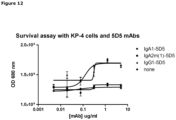
- As a positive control 0.2 ⁇ g/mL 5D5 IgG1 produced in HEK293 cells, was used.
- Example 16 Blocking of HGF binding to the extracellular domain of c-Met determined with Enzyme-Linked Immuno Sorbent Assay (ELISA)
- HGF hepatocyte growth factor
- Mean fluorescence intensity at 615 nm was measured using the EnVision 2101 Multilabel reader (PerkinElmer) applying the following settings: Lance/Delfia dual mirror, emission filter 615, excitation filter 340 nm, delay time 400 ⁇ s, window 400 ⁇ s, 100 flashes, 2000 ⁇ s per cycle and bidirectional row-by-row reading.
- the binding curves were analyzed with non-linear regression (sigmoidal dose-response with variable slope, top-values constrained to a shared value for all data-sets) using GraphPad Prism V4.03 software (GraphPad Software, San Diego, CA, USA).
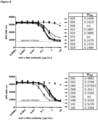
- Figure 5 depicts representative examples of HGF binding inhibition curves of anti-c-Met antibodies for binding to the extracellular domain of recombinant human c-Met.
- 5D5 was used as positive control antibody. All anti-c-Met antibodies in the experiment shown were able to compete with Europium 3+ -conjugated HGF for binding to recombinant c-Met.
- IC 50 values varied between 0.0011-0.0794 ⁇ g/mL. Without adding Europium 3+ -conjugated HGF, roughly ⁇ 600 relative fluorescent units (RFU) were detected, indicating the signal when maximal inhibition is accomplished. When binding of Europium 3+ -conjugated HGF was not inhibited, approximately ⁇ 66,000 RFU were detected.
- RFU relative fluorescent units
- Antibodies 005, 006, 058, 101 and the positive control antibody 5D5 were able to inhibit 84.5-92.1% of HGF binding to the c-Met receptor. All other antibodies were able to inhibit at least 55% of HGF binding to c-Met. Since HGF can bind the c-Met receptor at both the SEMA domain and the Ig region, some antibodies may inhibit only one of these interactions. To determine which interaction was inhibited, a cMetSEMAHis-based inhibition of time-resolved fluorescence resonance energy transfer (TR-FRET) assay was performed.
- TR-FRET time-resolved fluorescence resonance energy transfer
- Example 17 Competition of anti-c-Met antibodies for binding to soluble cMetECDHis measured with sandwich-ELISA
- biotinylated cMetECDHis serially diluted in PBSTC (1 ⁇ g/mL in 2-fold dilutions). Unbound biotinylated cMetECDHis was washed away with PBST, and bound biotinylated cMetECDHis was incubated for one hour at RT with 0.1 ⁇ g/mL Streptavidin-poly-HRP (Sanquin, Amsterdam, The Netherlands) diluted in PBST.
- Example 18 Blocking of HGF binding to cMetSEMA-567His8 determined by means of time resolved-fluorescent resonance energy transfer (TR-FRET)
- Figure 6 shows HGF binding inhibition curves of the various anti-c-Met antibodies for binding to cMetSEMA_567His8 tested with TR-FRET. Except for antibodies 008, 035 and 096, all antibodies were able to compete with AlexaFluor-647-conjugated HGF for binding to cMetSEMA-567His8.
- Antibody 022 was able to inhibit ⁇ 80% binding of HGF, whereas antibodies 005, 006, 024, 045, 058, 061, 062, 064, 068, 069, 098, 101, 181 and the positive control antibody 5D5 were able to inhibit > 90% of HGF binding to cMetSEMA-567His8.
- IC 50 values ranging from 0.082-0.623 ⁇ g/mL were determined.
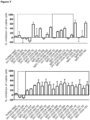
- Figure 7 depicts the percentage inhibition of viable KP4 cells after anti-c-Met antibody treatment compared to untreated cells (0%).
- the boxed clones are antibodies that cross compete with each other as described in Example 17.
- antibodies 024, 062, 064, 068, 069, 098, 101 and 181, which belong to the same cross-block group, were all able to inhibit KP4 viability (18-46%), both as IgG1 and as UniBody molecule.
- IgG1 molecules of antibodies 008, 061 and 096 were able to inhibit KP4 viability.
- antibody 045 did not inhibit KP4 viability as IgG1 nor as UniBody molecule.
- Uni-1016-045-TE this may be due to its low apparent affinity for membrane bound c-Met, as measured by FACS analysis (Example 13).
- the IgG1 antibodies of clones 005, 006, 022 and 058 did not inhibit KP4 viability significant, while Uni-1016-022-TE, Uni-1016-058-TE and IgG1-1016-058-wtFab did inhibit 57, 38 and 44% of KP4 viability, respectively.
- Uni-1016-005 and Uni-1016-006 also cross compete with clones 022 and 058 but did not inhibit KP4 viability significant. This may be due to their low apparent affinities as measured by FACS analysis (Example 13).
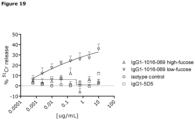
- IgG4-1016-058 demonstrated some inhibition of KP4 viability. This was not observed with IgG4-5D5).
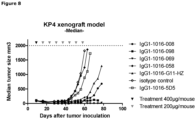
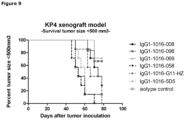
- a KP4 xenograft tumor model in SCID mice was performed to determine the efficacy of anti-c-Met HuMabs to inhibit tumor growth in vivo.
- Microchips PLEXX BV, Elst, The Netherlands
- mice were inoculated subcutaneously in 200 ⁇ l PBS on the right flank. Mice were examined at least twice per week for clinical signs of illness. Tumor size was determined at least once a week. Volumes (mm3) are calculated from caliper (PLEXX) measurements as 0.52 ⁇ (length) ⁇ (width)2, starting on day 16. On day 9, average tumor sizes were measured and mice were divided in 8 groups of 7 mice each. Anti-c-Met antibodies (008, 058, 069 and 098) were injected intraperitoneally. Antibody G11-HZ was used as a positive control antibody, whereas 5D5 and isotype-control antibodies were used as negative control antibodies. Mice received a loading dose of 400 ⁇ g/mouse followed weekly with a maintenance dose of 200 ⁇ g/mouse, for the duration of 7 weeks.
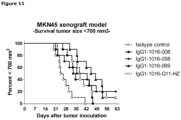
- MKN45 cells were inoculated subcutaneously in 200 ⁇ l 50% matrigel in PBS in the flank of each mouse.
- Anti-c-Met antibodies (008, 058, 069) were injected in the tail vein (iv).
- Antibody G11-HZ was used as a positive control antibody and an isotype control antibody was used as a negative control antibody. All mice received 40 mg/kg antibody on day 7 and 20 mg/kg antibody on days 14, 21, and 28.
- Example 22 Decreasing residual agonistic activity of IgG1 c-Met antibodies by reducing conformational flexibility
- HGF The natural ligand of c-Met, HGF, is a functional dimer that induces dimerization of two c-Met molecules.
- the subsequent intracellular phosphorylation of the intracellular domain of c-Met results in the activation of several signaling pathways which are involved in proliferation, invasion and survival of cells.
- Most bivalent antibodies raised against c-Met show comparable effects as HGF on cell fate, especially when the binding epitopes of the antibody are located near or in the SEMA domain of c-Met.
- One way to reduce Fab-arm flexibility in immunoglobulins is to prevent the formation of disulphide bonds between the light and the heavy chain by means of genetic modification.
- the light chain is connected covalently with the heavy chain via a disulphide bond, connecting the C-terminal cysteine of the light chain to the cysteine at position 220 (C220 EU numbering) in the hinge of the Fc of the heavy chain.
- Example 27 Lack of binding of c-Met antibodies to human peripheral blood cells
Landscapes
- Health & Medical Sciences (AREA)
- Chemical & Material Sciences (AREA)
- Life Sciences & Earth Sciences (AREA)
- Medicinal Chemistry (AREA)
- Organic Chemistry (AREA)
- Immunology (AREA)
- General Health & Medical Sciences (AREA)
- Proteomics, Peptides & Aminoacids (AREA)
- Molecular Biology (AREA)
- Biochemistry (AREA)
- Genetics & Genomics (AREA)
- Biophysics (AREA)
- Veterinary Medicine (AREA)
- Public Health (AREA)
- Animal Behavior & Ethology (AREA)
- Pharmacology & Pharmacy (AREA)
- Engineering & Computer Science (AREA)
- Epidemiology (AREA)
- Bioinformatics & Cheminformatics (AREA)
- Gastroenterology & Hepatology (AREA)
- Zoology (AREA)
- Cell Biology (AREA)
- Microbiology (AREA)
- Urology & Nephrology (AREA)
- Hematology (AREA)
- Biomedical Technology (AREA)
- Mycology (AREA)
- Toxicology (AREA)
- Nuclear Medicine, Radiotherapy & Molecular Imaging (AREA)
- General Chemical & Material Sciences (AREA)
- Chemical Kinetics & Catalysis (AREA)
- Biotechnology (AREA)
- Inorganic Chemistry (AREA)
- Pathology (AREA)
- General Physics & Mathematics (AREA)
- Analytical Chemistry (AREA)
- Physics & Mathematics (AREA)
- Food Science & Technology (AREA)
- Endocrinology (AREA)
- Peptides Or Proteins (AREA)
Priority Applications (5)
| Application Number | Priority Date | Filing Date | Title |
|---|---|---|---|
| SM20240403T SMT202400403T1 (it) | 2010-03-10 | 2011-03-10 | Anticorpi monoclonali contro c-met |
| SI201132115T SI3904391T1 (sl) | 2010-03-10 | 2011-03-10 | Monoklonska protitelesa proti c-MET |
| HRP20241246TT HRP20241246T1 (hr) | 2010-03-10 | 2011-03-10 | Monoklonska protutijela protiv c-met |
| EP24187069.0A EP4483963A3 (en) | 2010-03-10 | 2011-03-10 | Monoclonal antibodies against c-met |
| RS20241085A RS66008B1 (sr) | 2010-03-10 | 2011-03-10 | Monoklonska antitela protiv c-met |
Applications Claiming Priority (6)
| Application Number | Priority Date | Filing Date | Title |
|---|---|---|---|
| US31262210P | 2010-03-10 | 2010-03-10 | |
| DKPA201000191 | 2010-03-10 | ||
| DKPA201000862 | 2010-09-24 | ||
| EP11711490.0A EP2545077B1 (en) | 2010-03-10 | 2011-03-10 | Monoclonal antibodies against c-met |
| PCT/EP2011/053646 WO2011110642A2 (en) | 2010-03-10 | 2011-03-10 | Monoclonal antibodies against c-met |
| EP18203140.1A EP3511342B1 (en) | 2010-03-10 | 2011-03-10 | Monoclonal antibodies against c-met |
Related Parent Applications (3)
| Application Number | Title | Priority Date | Filing Date |
|---|---|---|---|
| EP11711490.0A Division EP2545077B1 (en) | 2010-03-10 | 2011-03-10 | Monoclonal antibodies against c-met |
| EP18203140.1A Division EP3511342B1 (en) | 2010-03-10 | 2011-03-10 | Monoclonal antibodies against c-met |
| EP18203140.1A Division-Into EP3511342B1 (en) | 2010-03-10 | 2011-03-10 | Monoclonal antibodies against c-met |
Related Child Applications (1)
| Application Number | Title | Priority Date | Filing Date |
|---|---|---|---|
| EP24187069.0A Division EP4483963A3 (en) | 2010-03-10 | 2011-03-10 | Monoclonal antibodies against c-met |
Publications (2)
| Publication Number | Publication Date |
|---|---|
| EP3904391A1 EP3904391A1 (en) | 2021-11-03 |
| EP3904391B1 true EP3904391B1 (en) | 2024-07-10 |
Family
ID=44342987
Family Applications (4)
| Application Number | Title | Priority Date | Filing Date |
|---|---|---|---|
| EP21171029.8A Active EP3904391B1 (en) | 2010-03-10 | 2011-03-10 | Monoclonal antibodies against c-met |
| EP11711490.0A Active EP2545077B1 (en) | 2010-03-10 | 2011-03-10 | Monoclonal antibodies against c-met |
| EP18203140.1A Active EP3511342B1 (en) | 2010-03-10 | 2011-03-10 | Monoclonal antibodies against c-met |
| EP24187069.0A Pending EP4483963A3 (en) | 2010-03-10 | 2011-03-10 | Monoclonal antibodies against c-met |
Family Applications After (3)
| Application Number | Title | Priority Date | Filing Date |
|---|---|---|---|
| EP11711490.0A Active EP2545077B1 (en) | 2010-03-10 | 2011-03-10 | Monoclonal antibodies against c-met |
| EP18203140.1A Active EP3511342B1 (en) | 2010-03-10 | 2011-03-10 | Monoclonal antibodies against c-met |
| EP24187069.0A Pending EP4483963A3 (en) | 2010-03-10 | 2011-03-10 | Monoclonal antibodies against c-met |
Country Status (26)
| Country | Link |
|---|---|
| US (6) | US9068011B2 (enExample) |
| EP (4) | EP3904391B1 (enExample) |
| JP (4) | JP6055312B2 (enExample) |
| KR (2) | KR102059663B1 (enExample) |
| CN (2) | CN103003307B (enExample) |
| AU (4) | AU2011226103C1 (enExample) |
| BR (1) | BR112012022672B1 (enExample) |
| CA (3) | CA2791863C (enExample) |
| DK (1) | DK3904391T3 (enExample) |
| EA (1) | EA201201273A1 (enExample) |
| ES (1) | ES2993335T3 (enExample) |
| FI (1) | FI3904391T3 (enExample) |
| HR (1) | HRP20241246T1 (enExample) |
| HU (1) | HUE068433T2 (enExample) |
| IL (1) | IL221408B (enExample) |
| LT (1) | LT3904391T (enExample) |
| MX (1) | MX340295B (enExample) |
| NZ (1) | NZ602294A (enExample) |
| PH (1) | PH12012501793B1 (enExample) |
| PL (1) | PL3904391T3 (enExample) |
| PT (1) | PT3904391T (enExample) |
| RS (1) | RS66008B1 (enExample) |
| SG (2) | SG183190A1 (enExample) |
| SI (1) | SI3904391T1 (enExample) |
| SM (1) | SMT202400403T1 (enExample) |
| WO (1) | WO2011110642A2 (enExample) |
Families Citing this family (108)
| Publication number | Priority date | Publication date | Assignee | Title |
|---|---|---|---|---|
| EP3904391B1 (en) | 2010-03-10 | 2024-07-10 | Genmab A/S | Monoclonal antibodies against c-met |
| US11644471B2 (en) | 2010-09-30 | 2023-05-09 | Ablynx N.V. | Techniques for predicting, detecting and reducing aspecific protein interference in assays involving immunoglobulin single variable domains |
| WO2012042026A1 (en) | 2010-09-30 | 2012-04-05 | Ablynx Nv | Biological materials related to c-met |
| LT3466972T (lt) | 2011-06-23 | 2026-06-25 | Ablynx Nv | Serumo albuminą surišantys baltymai |
| CA3141978A1 (en) | 2011-06-23 | 2012-12-27 | Ablynx Nv | Techniques for predicting, detecting and reducing aspecific protein interference in assays involving immunoglobulin single variable domains |
| UA117901C2 (uk) | 2011-07-06 | 2018-10-25 | Ґенмаб Б.В. | Спосіб посилення ефекторної функції вихідного поліпептиду, його варіанти та їх застосування |
| EP2758430A4 (en) | 2011-09-20 | 2015-06-03 | Lilly Co Eli | ANTI-C-MET ANTIBODY |
| CN106046161B (zh) * | 2011-09-30 | 2019-09-13 | 埃博灵克斯股份有限公司 | 与C-Met相关的生物物质 |
| US9346884B2 (en) * | 2011-09-30 | 2016-05-24 | Ablynx N.V. | Biological materials related to c-Met |
| KR20130037153A (ko) * | 2011-10-05 | 2013-04-15 | 삼성전자주식회사 | 항 c-Met 항체 및 그의 용도 |
| CN103906533A (zh) * | 2011-11-07 | 2014-07-02 | 米迪缪尼有限公司 | 多特异性和多价结合蛋白及其用途 |
| SG11201402485UA (en) | 2011-11-21 | 2014-06-27 | Genentech Inc | Purification of anti-c-met antibodies |
| WO2013079973A1 (en) * | 2011-12-02 | 2013-06-06 | Di Cara Danielle Marie | Antibodies against hgf - receptor and uses |
| GB201121914D0 (en) | 2011-12-20 | 2012-02-01 | Ge Healthcare Ltd | Method for patient selection |
| US10704021B2 (en) | 2012-03-15 | 2020-07-07 | Flodesign Sonics, Inc. | Acoustic perfusion devices |
| US9708601B2 (en) | 2012-04-26 | 2017-07-18 | Vaccinex, Inc. | Fusion proteins to facilitate selection of cells infected with specific immunoglobulin gene recombinant vaccinia virus |
| HK1208181A1 (en) * | 2012-06-21 | 2016-02-26 | Sorrento Therapeutics, Inc. | Antigen binding proteins that bind c-met |
| WO2014006217A1 (en) | 2012-07-06 | 2014-01-09 | Genmab B.V. | Dimeric protein with triple mutations |
| EP3632462A1 (en) | 2012-07-06 | 2020-04-08 | Genmab B.V. | Dimeric protein with triple mutations |
| US9695228B2 (en) | 2012-11-21 | 2017-07-04 | Janssen Biotech, Inc. | EGFR and c-Met fibronectin type III domain binding molecules |
| US20170275367A1 (en) | 2012-11-21 | 2017-09-28 | Janssen Biotech, Inc. | Bispecific EGFR/C-Met Antibodies |
| KR102373193B1 (ko) * | 2012-11-21 | 2022-03-10 | 얀센 바이오테크 인코포레이티드 | 이중특이성 EGFR/c-Met 항체 |
| MX387324B (es) | 2013-01-10 | 2025-03-18 | Genmab Bv | Variantes de regiones fc de igg1 de humano y usos de las mismas. |
| JP2014157056A (ja) * | 2013-02-15 | 2014-08-28 | Fujirebio Inc | c−MET遺伝子増幅細胞の検出方法 |
| SG11201506451UA (en) | 2013-03-06 | 2015-09-29 | Merrimack Pharmaceuticals Inc | Anti-c-met tandem fc bispecific antibodies |
| US9168300B2 (en) | 2013-03-14 | 2015-10-27 | Oncomed Pharmaceuticals, Inc. | MET-binding agents and uses thereof |
| US10214593B2 (en) | 2013-04-02 | 2019-02-26 | Samsung Electronics Co., Ltd. | Anti-idiotype antibody against anti-c-MET antibody |
| KR102277813B1 (ko) * | 2013-04-02 | 2021-07-16 | 삼성전자주식회사 | 항 c-Met 항체의 항-이디오타입 항체 |
| US10196446B2 (en) | 2013-10-14 | 2019-02-05 | Janssen Biotech, Inc. | Cysteine engineered fibronectin type III domain binding molecules |
| EA039356B1 (ru) * | 2013-10-18 | 2022-01-18 | Янссен Байотек, Инк. | БИСПЕЦИФИЧЕСКИЕ К EGFR/c-Met АНТИТЕЛА |
| US9717715B2 (en) | 2013-11-15 | 2017-08-01 | Samsung Electronics Co., Ltd. | Method of combination therapy using an anti-C-Met antibody |
| SI3071237T1 (sl) | 2013-11-21 | 2024-11-29 | Genmab A/S | Liofilizirana formulacija konjugata protitelo-zdravilo |
| CN105085680A (zh) * | 2014-05-23 | 2015-11-25 | 复旦大学 | 人源化抗PD-1及c-MET双特异性抗体及其制备方法和应用 |
| KR101615619B1 (ko) | 2014-08-07 | 2016-04-26 | 주식회사 파멥신 | c-Met 특이적 인간 항체 및 그 제조방법 |
| MX378108B (es) | 2014-09-16 | 2025-03-10 | Servier Lab | Anticuerpos anti-met y composiciones. |
| WO2016073853A1 (en) | 2014-11-06 | 2016-05-12 | Scholar Rock, Inc. | Anti-pro/latent-myostatin antibodies and uses thereof |
| US11000548B2 (en) | 2015-02-18 | 2021-05-11 | Enlivex Therapeutics Ltd | Combination immune therapy and cytokine control therapy for cancer treatment |
| US11596652B2 (en) | 2015-02-18 | 2023-03-07 | Enlivex Therapeutics R&D Ltd | Early apoptotic cells for use in treating sepsis |
| US11304976B2 (en) | 2015-02-18 | 2022-04-19 | Enlivex Therapeutics Ltd | Combination immune therapy and cytokine control therapy for cancer treatment |
| US11318163B2 (en) | 2015-02-18 | 2022-05-03 | Enlivex Therapeutics Ltd | Combination immune therapy and cytokine control therapy for cancer treatment |
| US11512289B2 (en) | 2015-02-18 | 2022-11-29 | Enlivex Therapeutics Rdo Ltd | Combination immune therapy and cytokine control therapy for cancer treatment |
| US11497767B2 (en) | 2015-02-18 | 2022-11-15 | Enlivex Therapeutics R&D Ltd | Combination immune therapy and cytokine control therapy for cancer treatment |
| JP6803339B2 (ja) | 2015-04-21 | 2020-12-23 | エンリヴェックス セラピューティクス リミテッド | 治療用のプールされた血液アポトーシス細胞調製物及びそれらの使用 |
| US11708572B2 (en) | 2015-04-29 | 2023-07-25 | Flodesign Sonics, Inc. | Acoustic cell separation techniques and processes |
| FI3322727T3 (fi) | 2015-07-15 | 2026-03-17 | Genmab As | Humanisoituja tai kimeerisiä CD3-vasta-aineita |
| JP2018527903A (ja) * | 2015-07-22 | 2018-09-27 | スカラー ロック インコーポレイテッドScholar Rock,Inc. | Gdf11結合タンパク質およびその使用 |
| EA038146B1 (ru) | 2015-09-15 | 2021-07-13 | Сколар Рок, Инк. | Антитела к про-/латентному миостатину и их применения |
| JP2019500011A (ja) * | 2015-11-03 | 2019-01-10 | メルク パテント ゲゼルシャフト ミット ベシュレンクテル ハフツングMerck Patent Gesellschaft mit beschraenkter Haftung | 腫瘍選択性及び阻害性が増強された二重特異性抗体及びその使用 |
| CN115814077A (zh) | 2016-01-08 | 2023-03-21 | 供石公司 | 抗-原肌生长抑制素/潜伏肌生长抑制素抗体及其使用方法 |
| JP6884155B2 (ja) | 2016-02-18 | 2021-06-09 | エンリヴェックス セラピューティクス リミテッド | 癌治療のための併用免疫療法及びサイトカイン制御療法 |
| US11214789B2 (en) | 2016-05-03 | 2022-01-04 | Flodesign Sonics, Inc. | Concentration and washing of particles with acoustics |
| PL4218804T3 (pl) | 2016-06-13 | 2026-05-25 | Scholar Rock, Inc. | Stosowanie inhibitorów miostatyny i terapii skojarzonych |
| WO2017223180A2 (en) | 2016-06-21 | 2017-12-28 | Janssen Biotech, Inc. | Cysteine engineered fibronectin type iii domain binding molecules |
| SG11201900595YA (en) | 2016-08-02 | 2019-02-27 | Vaccinex Inc | Improved methods for producing polynucleotide libraries in vaccinia virus/eukaryotic cells |
| EP3519440A4 (en) * | 2016-09-29 | 2020-03-25 | Mitsubishi Tanabe Pharma Corporation | MONOCLONAL CMET BINDERS, ACTIVE SUBSTANCE CONJUGATES AND USES THEREOF |
| TWI782930B (zh) * | 2016-11-16 | 2022-11-11 | 美商再生元醫藥公司 | 抗met抗體,結合met之雙特異性抗原結合分子及其使用方法 |
| WO2018111976A1 (en) | 2016-12-14 | 2018-06-21 | Janssen Biotech, Inc. | Pd-l1 binding fibronectin type iii domains |
| KR102568559B1 (ko) | 2016-12-14 | 2023-08-18 | 얀센 바이오테크 인코포레이티드 | Cd8a-결합 섬유결합소 iii형 도메인 |
| WO2018111978A1 (en) | 2016-12-14 | 2018-06-21 | Janssen Biotech, Inc. | Cd137 binding fibronectin type iii domains |
| TW201825515A (zh) * | 2017-01-04 | 2018-07-16 | 美商伊繆諾金公司 | Met抗體以及其免疫結合物及用途 |
| HRP20230308T1 (hr) | 2017-01-06 | 2023-05-12 | Scholar Rock, Inc. | Liječenje metaboličkih bolesti putem inhibiranja aktivacije miostatina |
| CN114989305A (zh) * | 2017-03-31 | 2022-09-02 | 北京智仁美博生物科技有限公司 | 新型双特异性抗体及其用途 |
| AU2018273914A1 (en) | 2017-05-24 | 2019-11-14 | Pandion Operations, Inc. | Targeted immunotolerance |
| EP3630844A4 (en) * | 2017-05-30 | 2021-03-03 | Chong Kun Dang Pharmaceutical Corp. | NOVEL ANTI-C-MET ANTIBODY AND USE OF IT |
| EP3694545A4 (en) * | 2017-10-11 | 2021-12-01 | Board Of Regents, The University Of Texas System | HUMAN PD-L1 ANTIBODIES AND METHOD OF USING THEM |
| US10946068B2 (en) | 2017-12-06 | 2021-03-16 | Pandion Operations, Inc. | IL-2 muteins and uses thereof |
| US10174091B1 (en) | 2017-12-06 | 2019-01-08 | Pandion Therapeutics, Inc. | IL-2 muteins |
| TWI841554B (zh) | 2018-03-21 | 2024-05-11 | 丹麥商珍美寶股份有限公司 | 以鉑為主之劑與抗組織因子抗體-藥物共軛物的組合治療癌症之方法 |
| EP4501355A3 (en) | 2018-03-23 | 2025-04-30 | Board Of Regents, The University Of Texas System | Dual specificity antibodies to pd-l1 and pd-l2 and methods of use therefor |
| EP3768723A4 (en) | 2018-03-23 | 2021-12-29 | Board of Regents, The University of Texas System | Dual specificity antibodies to human pd-l1 and pd-l2 and methods of use therefor |
| US11976128B2 (en) | 2018-03-23 | 2024-05-07 | Board Of Regents, The University Of Texas System | Human PD-L2 antibodies and methods of use therefor |
| JP7460608B2 (ja) | 2018-05-07 | 2024-04-02 | ジェンマブ エー/エス | 抗pd-1抗体と抗組織因子抗体-薬物コンジュゲートとの組み合わせを用いるがんの治療方法 |
| CA3106093C (en) | 2018-07-10 | 2024-10-08 | Genemedicine Co., Ltd. | ANTI-TUMOR COMPOSITION |
| TWI844571B (zh) | 2018-10-30 | 2024-06-11 | 丹麥商珍美寶股份有限公司 | 使用抗血管內皮生長因子(vegf)抗體與抗組織因子(tf)抗體-藥物共軛體之組合以治療癌症之方法 |
| KR102433184B1 (ko) * | 2018-12-07 | 2022-08-17 | 서울대학교 산학협력단 | 항 c-Met 아고니스트 항체 및 이의 용도 |
| KR102396194B1 (ko) * | 2018-12-07 | 2022-05-10 | 서울대학교 산학협력단 | 항 c-Met 아고니스트 항체 및 이의 용도 |
| AU2020279240A1 (en) | 2019-05-20 | 2021-12-23 | Pandion Operations, Inc. | MAdCAM targeted immunotolerance |
| EP3999544A4 (en) * | 2019-07-19 | 2023-08-09 | Wuxi Xdc Singapore Private Limited | POLYPEPTIDE COMPLEX FOR CONJUGATION AND ITS USE |
| CN120842421A (zh) | 2019-07-30 | 2025-10-28 | 魁尔斯弗生物治疗股份有限公司 | 双特异性抗LRRC15和CD3ε抗体 |
| CN114340684B (zh) | 2019-09-16 | 2025-09-12 | 瑞泽恩制药公司 | 用于免疫pet成像的放射性标记的met结合蛋白 |
| WO2021076543A1 (en) | 2019-10-14 | 2021-04-22 | Aro Biotherapeutics Company | Epcam binding fibronectin type iii domains |
| US11781138B2 (en) | 2019-10-14 | 2023-10-10 | Aro Biotherapeutics Company | FN3 domain-siRNA conjugates and uses thereof |
| CN114786682B (zh) | 2019-10-14 | 2024-07-16 | Aro生物疗法公司 | 结合cd71的纤维粘连蛋白iii型结构域 |
| CN111171147B (zh) * | 2020-02-11 | 2021-07-20 | 北京康普美特创新医药科技有限责任公司 | 一种抗补体c3分子的全人源单克隆抗体及应用 |
| US11981715B2 (en) | 2020-02-21 | 2024-05-14 | Pandion Operations, Inc. | Tissue targeted immunotolerance with a CD39 effector |
| CN111620944B (zh) * | 2020-06-01 | 2023-03-21 | 长春师范大学 | 一种全人源化抗乙肝病毒单克隆抗体、制备方法及其应用 |
| CN112521507B (zh) * | 2020-08-10 | 2021-06-08 | 北京鼎成肽源生物技术有限公司 | 抗人c-Met人鼠嵌合单克隆抗体及其应用 |
| EP4204455A4 (en) | 2020-08-25 | 2024-10-16 | Janssen Biotech, Inc. | Treatment of non-small cell lung cancer with egfr mutations |
| CN118221804B (zh) * | 2021-01-18 | 2025-02-07 | 上海药明合联生物技术有限公司 | 工程化抗体和包含工程化抗体的抗体-药物偶联物 |
| JP2024517610A (ja) | 2021-04-14 | 2024-04-23 | アロ・バイオセラピューティクス・カンパニー | Cd71に結合するフィブロネクチンiii型ドメイン |
| KR20240031947A (ko) | 2021-04-14 | 2024-03-08 | 에이알오 바이오테라퓨틱스 컴패니 | Fn3 도메인-시르나 접합체 및 이의 용도 |
| KR20240026985A (ko) * | 2021-06-25 | 2024-02-29 | 아카데미아 시니카 | 상피 세포 부착 분자(epcam) 억제제 및 간세포 성장 인자 수용체(hgfr) 억제제와의 조합된 암 요법 |
| CN113621058B (zh) * | 2021-08-19 | 2023-05-23 | 中国科学院微生物研究所 | 黄热病毒抗体及其应用 |
| WO2023034569A1 (en) * | 2021-09-03 | 2023-03-09 | Go Therapeutics, Inc. | Anti-glyco-cmet antibodies and their uses |
| CN116178530A (zh) * | 2021-09-26 | 2023-05-30 | 上海君实生物医药科技股份有限公司 | 抗体在治疗SARS-CoV-2感染的用途 |
| CN116725960A (zh) * | 2022-03-11 | 2023-09-12 | 上海君实生物医药科技股份有限公司 | 新型冠状病毒抗体药物组合物及其用途 |
| IL315960A (en) | 2022-03-30 | 2024-11-01 | Pinetree Therapeutics Inc | Bispecific antibodies comprising an nrp1 binding domain and methods of use thereof |
| WO2023192976A1 (en) | 2022-04-01 | 2023-10-05 | Board Of Regents, The University Of Texas System | Dual specificity antibodies to human pd-l1 and pd-l2 and methods of use therefor |
| CN119013296A (zh) | 2022-04-02 | 2024-11-22 | 普米斯生物技术(珠海)有限公司 | 针对c-Met的单克隆抗体以及双特异性抗体 |
| AU2023317484A1 (en) | 2022-07-30 | 2025-03-13 | Pinetree Therapeutics, Inc. | Compositions for targeted lysosomal degradaton and methods of use thereof |
| CN120677175A (zh) | 2022-12-22 | 2025-09-19 | 供石公司 | 肌生成抑制蛋白活化的选择性和强效抑制剂 |
| CN120603850A (zh) * | 2023-01-19 | 2025-09-05 | 广州百济神州生物制药有限公司 | 抗cmet抗体及使用方法 |
| JP2026513451A (ja) | 2023-04-24 | 2026-04-27 | 正大天晴▲藥▼▲業▼集▲団▼股▲フン▼有限公司 | c-Metを標的とする多重特異性抗体 |
| CN121399157A (zh) | 2023-06-12 | 2026-01-23 | 美国安进公司 | 淋巴毒素β受体激动剂结合蛋白 |
| WO2025180462A1 (zh) * | 2024-03-01 | 2025-09-04 | 苏州康宁杰瑞生物科技有限公司 | 双功能融合蛋白 |
| WO2026086740A1 (en) | 2024-10-21 | 2026-04-30 | Sichuan Kelun-Biotech Biopharmaceutical Co., Ltd. | Use and method of bispecific antibody-drug conjugates for treating tumor diseases |
| WO2026086737A1 (en) | 2024-10-21 | 2026-04-30 | Sichuan Kelun-Biotech Biopharmaceutical Co., Ltd. | Uses and methods of bispecific antibody-drug conjugates for treating tumor diseases |
| WO2026145588A1 (en) | 2024-12-31 | 2026-07-09 | Sichuan Kelun-Biotech Biopharmaceutical Co., Ltd. | Use of egfr/c-met bispecific binding protein |
Family Cites Families (86)
| Publication number | Priority date | Publication date | Assignee | Title |
|---|---|---|---|---|
| US6077A (en) | 1849-01-30 | Improved hinged claw-wrench | ||
| US835A (en) | 1838-07-12 | X i i i x | ||
| US4179337A (en) | 1973-07-20 | 1979-12-18 | Davis Frank F | Non-immunogenic polypeptides |
| JPS5896026A (ja) | 1981-10-30 | 1983-06-07 | Nippon Chemiphar Co Ltd | 新規ウロキナ−ゼ誘導体およびその製造法ならびにそれを含有する血栓溶解剤 |
| US4609546A (en) | 1982-06-24 | 1986-09-02 | Japan Chemical Research Co., Ltd. | Long-acting composition |
| US4766106A (en) | 1985-06-26 | 1988-08-23 | Cetus Corporation | Solubilization of proteins for pharmaceutical compositions using polymer conjugation |
| US4946778A (en) | 1987-09-21 | 1990-08-07 | Genex Corporation | Single polypeptide chain binding molecules |
| GB8823869D0 (en) | 1988-10-12 | 1988-11-16 | Medical Res Council | Production of antibodies |
| US5703055A (en) | 1989-03-21 | 1997-12-30 | Wisconsin Alumni Research Foundation | Generation of antibodies through lipid mediated DNA delivery |
| WO1991009974A1 (en) | 1989-12-27 | 1991-07-11 | The United States Of America, As Represented By The Secretary, U.S. Department Of Commerce | Diagnostic probe for detecting human stomach cancer |
| US5362716A (en) | 1989-12-27 | 1994-11-08 | The United States Of America As Represented By The Department Of Health And Human Services | Methods for stimulating hematopoietic progenitors using hepatocyte growth factor and lymphokines |
| US5648273A (en) | 1989-12-27 | 1997-07-15 | The United States Of America, As Represented By The Department Of Health And Human Services | Hepatic growth factor receptor is the MET proto-oncogene |
| US5770429A (en) | 1990-08-29 | 1998-06-23 | Genpharm International, Inc. | Transgenic non-human animals capable of producing heterologous antibodies |
| US5625126A (en) | 1990-08-29 | 1997-04-29 | Genpharm International, Inc. | Transgenic non-human animals for producing heterologous antibodies |
| US5633425A (en) | 1990-08-29 | 1997-05-27 | Genpharm International, Inc. | Transgenic non-human animals capable of producing heterologous antibodies |
| US5545806A (en) | 1990-08-29 | 1996-08-13 | Genpharm International, Inc. | Ransgenic non-human animals for producing heterologous antibodies |
| US5661016A (en) | 1990-08-29 | 1997-08-26 | Genpharm International Inc. | Transgenic non-human animals capable of producing heterologous antibodies of various isotypes |
| US6300129B1 (en) | 1990-08-29 | 2001-10-09 | Genpharm International | Transgenic non-human animals for producing heterologous antibodies |
| US5877397A (en) | 1990-08-29 | 1999-03-02 | Genpharm International Inc. | Transgenic non-human animals capable of producing heterologous antibodies of various isotypes |
| ES2246502T3 (es) | 1990-08-29 | 2006-02-16 | Genpharm International, Inc. | Animales no humanos transgenicos capaces de producir anticuerpos heterologos. |
| US5789650A (en) | 1990-08-29 | 1998-08-04 | Genpharm International, Inc. | Transgenic non-human animals for producing heterologous antibodies |
| US5814318A (en) | 1990-08-29 | 1998-09-29 | Genpharm International Inc. | Transgenic non-human animals for producing heterologous antibodies |
| US5874299A (en) | 1990-08-29 | 1999-02-23 | Genpharm International, Inc. | Transgenic non-human animals capable of producing heterologous antibodies |
| WO1992005184A1 (en) | 1990-09-14 | 1992-04-02 | The United States Of America, As Represented By The Secretary, U.S. Department Of Commerce | A non-mitogenic competitive hgf antagonist |
| US6566098B1 (en) | 1990-09-14 | 2003-05-20 | The United States Of America As Represented By The Department Of Health And Human Services | DNA encoding truncated hepatocyte growth factor variants |
| AU2235992A (en) | 1991-06-14 | 1993-01-12 | Genpharm International, Inc. | Transgenic immunodeficient non-human animals |
| EP0593592B1 (en) | 1991-07-08 | 1998-03-25 | The University Of Massachusetts At Amherst | Thermotropic liquid crystal segmented block copolymer |
| US5733743A (en) | 1992-03-24 | 1998-03-31 | Cambridge Antibody Technology Limited | Methods for producing members of specific binding pairs |
| AU4645293A (en) | 1992-06-26 | 1994-01-24 | United States Of America, Represented By The Secretary, Department Of Health And Human Services, The | The met proto-oncogene and a method for predicting breast cancer progression |
| EP0662130B1 (en) | 1992-09-18 | 1997-11-26 | THE GOVERNMENT OF THE UNITED STATES OF AMERICA as represented by THE SECRETARY OF THE DEPARTMENT OF HEALTH AND HUMAN SERVICES | A method of producing hepatocyte growth factor and a cell line |
| US5361922A (en) | 1993-04-02 | 1994-11-08 | Beckman Instruments, Inc. | Centrifuge tubes with snap plugs |
| AU6819494A (en) | 1993-04-26 | 1994-11-21 | Genpharm International, Inc. | Transgenic non-human animals capable of producing heterologous antibodies |
| US6077835A (en) | 1994-03-23 | 2000-06-20 | Case Western Reserve University | Delivery of compacted nucleic acid to cells |
| US5646036A (en) | 1995-06-02 | 1997-07-08 | Genentech, Inc. | Nucleic acids encoding hepatocyte growth factor receptor antagonist antibodies |
| US6214344B1 (en) | 1995-06-02 | 2001-04-10 | Genetech, Inc. | Hepatocyte growth factor receptor antagonists and uses thereof |
| US5686292A (en) | 1995-06-02 | 1997-11-11 | Genentech, Inc. | Hepatocyte growth factor receptor antagonist antibodies and uses thereof |
| KR970029803A (ko) | 1995-11-03 | 1997-06-26 | 김광호 | 반도체 메모리장치의 프리차지 회로 |
| AU3456099A (en) | 1998-03-31 | 1999-10-18 | Geron Corporation | Methods and compositions for eliciting an immune response to a telomerase antigen |
| US6355271B1 (en) | 1999-02-03 | 2002-03-12 | Biosante Pharmaceuticals, Inc. | Therapeutic calcium phosphate particles and methods of manufacture and use |
| US6281005B1 (en) | 1999-05-14 | 2001-08-28 | Copernicus Therapeutics, Inc. | Automated nucleic acid compaction device |
| CN1399645A (zh) | 1999-07-29 | 2003-02-26 | 米德列斯公司 | Her2/neu的人单克隆抗体 |
| NZ517202A (en) | 1999-08-24 | 2004-05-28 | Medarex Inc | Human CTLA-4 antibodies and their uses |
| JP4993834B2 (ja) | 2000-06-29 | 2012-08-08 | ノース ショア−ロング アイランド ジューイッシュ ヘルス システム | 細胞増殖および血管形成の調節物質、その使用方法および特定方法 |
| WO2002042468A2 (en) | 2000-11-27 | 2002-05-30 | Geron Corporation | Glycosyltransferase vectors for treating cancer |
| DE60131456T2 (de) | 2000-11-30 | 2008-07-10 | Medarex, Inc., Milpitas | Transchromosomale transgen-nagetiere zur herstellung von humanen antikörpern |
| IL159177A0 (en) | 2001-06-20 | 2004-06-01 | Prochon Biotech Ltd | Antibodies that block receptor protein tyrosine kinase activation, methods of screening for and uses thereof |
| AU2002351208A1 (en) | 2001-12-03 | 2003-06-17 | Abgenix, Inc. | Antibodies against carbonic anhydrase IX (CA IX) tumor antigen |
| WO2003057155A2 (en) | 2001-12-27 | 2003-07-17 | Van Andel Research Institute | Monoclonal antibody imaging and therapy of tumors that express met and bind hepatocyte growth factor |
| AU2003216341A1 (en) | 2002-02-20 | 2003-09-09 | Dyax Corporation | Mhc-peptide complex binding ligands |
| MXPA05008521A (es) | 2003-02-13 | 2005-10-20 | Pharmacia Corp | Anticuerpos a c-met para el tratamiento de canceres. |
| ITMI20031127A1 (it) | 2003-06-05 | 2004-12-06 | Uni Degli Studi Del Piemont E Orientale Am | Anticorpi anti-hgf-r e loro uso |
| WO2005001486A1 (en) | 2003-06-06 | 2005-01-06 | Genentech, Inc. | Modulating the interaction between hgf beta chain and c-met |
| HN2004000285A (es) * | 2003-08-04 | 2006-04-27 | Pfizer Prod Inc | ANTICUERPOS DIRIGIDOS A c-MET |
| KR100556660B1 (ko) | 2003-11-11 | 2006-03-10 | 국립암센터 | Hgf의 중화가능 에피토프 및 이에 결합하는 중화 항체 |
| DK2383295T3 (en) | 2003-12-10 | 2015-06-15 | Squibb & Sons Llc | Ip-10 antibodies and uses thereof |
| CN1922208A (zh) | 2003-12-11 | 2007-02-28 | 健泰科生物技术公司 | 用于抑制c-met二聚化及活化的方法和组合物 |
| PT1718677E (pt) | 2003-12-19 | 2012-07-18 | Genentech Inc | Fragmentos de anticorpo monovalentes úteis como agentes terapêuticos |
| PL2314621T3 (pl) | 2004-05-27 | 2014-08-29 | Crucell Holland Bv | Cząsteczki wiążące zdolne do neutralizowania wirusa wścieklizny i ich zastosowania |
| ME01803B (me) | 2004-08-05 | 2010-12-31 | Genentech Inc | Humanizovani anti-cmet antagonisti |
| JP4958555B2 (ja) | 2004-09-22 | 2012-06-20 | 協和発酵キリン株式会社 | 安定化されたヒトIgG4抗体 |
| US7615529B2 (en) | 2005-03-25 | 2009-11-10 | Genentech, Inc. | Methods and compositions for modulating hyperstabilized c-met |
| CN101189023B (zh) | 2005-03-31 | 2013-01-30 | 通用医疗公司 | 监测和调制hgf/hgfr活性 |
| AR056142A1 (es) | 2005-10-21 | 2007-09-19 | Amgen Inc | Metodos para generar el anticuerpo igg monovalente |
| KR101866623B1 (ko) | 2005-11-28 | 2018-07-04 | 젠맵 에이/에스 | 재조합 1가 항체 및 그의 제조 방법 |
| ES2368864T3 (es) | 2006-02-06 | 2011-11-23 | Metheresis Translational Research Sa | Anticuerpos monoclonales anti-met, sus fragmentos y vectores para el tratamiento de tumores y productos correspondientes. |
| BRPI0709917A2 (pt) * | 2006-03-30 | 2011-07-05 | Novartis Ag | composições e métodos de uso para anticorpos de c-met |
| AR059922A1 (es) | 2006-04-01 | 2008-05-07 | Galaxy Biotech Llc | Anticuerpos monoclonales humanizados para el factor de crecimiento de hepatocitos |
| PL2457928T3 (pl) * | 2007-03-13 | 2017-10-31 | Univ Zuerich | Monoklonalne ludzkie przeciwciało swoiste względem nowotworu |
| CA2689895A1 (en) * | 2007-05-31 | 2008-12-04 | Genmab A/S | Non-glycosylated recombinant monovalent antibodies |
| AU2008255352B2 (en) | 2007-05-31 | 2014-05-22 | Genmab A/S | Stable IgG4 antibodies |
| US20080300108A1 (en) | 2007-05-31 | 2008-12-04 | Eybergen William N | Torque transfer device and system |
| EP2014681A1 (en) | 2007-07-12 | 2009-01-14 | Pierre Fabre Medicament | Novel antibodies inhibiting c-met dimerization, and uses thereof |
| JP5588866B2 (ja) | 2007-08-10 | 2014-09-10 | メダレックス エル.エル.シー. | Hco32およびhco27、ならびに関連実施例 |
| EP2234641B1 (en) * | 2008-01-03 | 2015-08-19 | Genmab A/S | Monoclonal antibodies against cd32b |
| SG188802A1 (en) * | 2008-03-06 | 2013-04-30 | Genentech Inc | Combination therapy with c-met and egfr antagonists |
| PL2282773T3 (pl) | 2008-05-02 | 2014-08-29 | Seattle Genetics Inc | Sposoby i kompozycje do wytwarzania przeciwciał i pochodnych przeciwciał o obniżonej fukozylacji rdzeniowej |
| WO2009142738A2 (en) | 2008-05-21 | 2009-11-26 | Oncomed Pharmaceuticals, Inc. | Compositions and methods for diagnosing and treating cancer |
| KR101837053B1 (ko) | 2008-10-01 | 2018-03-12 | 암젠 리서치 (뮌헨) 게엠베하 | 종간 특이적 PSCAxCD3, CD19xCD3, c-METxCD3, 엔도시알린xCD3, EpCAMxCD3, IGF-1RxCD3 또는 FAPαxCD3 이중특이적 단일쇄 항체 |
| PA8849001A1 (es) | 2008-11-21 | 2010-06-28 | Lilly Co Eli | Anticuerpos de c-met |
| WO2010064090A1 (en) | 2008-12-02 | 2010-06-10 | Pierre Fabre Medicament | Process for the modulation of the antagonistic activity of a monoclonal antibody |
| AR074438A1 (es) | 2008-12-02 | 2011-01-19 | Pf Medicament | Proceso para la modulacion de la actividad antagonista de un anticuerpo monoclonal |
| AR074439A1 (es) | 2008-12-02 | 2011-01-19 | Pf Medicament | Anticuerpo anti-cmet (receptor c-met) |
| WO2010064089A1 (en) | 2008-12-02 | 2010-06-10 | Pierre Fabre Medicament | Novel anti-cmet antibody |
| EP3904391B1 (en) | 2010-03-10 | 2024-07-10 | Genmab A/S | Monoclonal antibodies against c-met |
| US20170275367A1 (en) | 2012-11-21 | 2017-09-28 | Janssen Biotech, Inc. | Bispecific EGFR/C-Met Antibodies |
| KR102373193B1 (ko) * | 2012-11-21 | 2022-03-10 | 얀센 바이오테크 인코포레이티드 | 이중특이성 EGFR/c-Met 항체 |
-
2011
- 2011-03-10 EP EP21171029.8A patent/EP3904391B1/en active Active
- 2011-03-10 JP JP2012556526A patent/JP6055312B2/ja active Active
- 2011-03-10 NZ NZ602294A patent/NZ602294A/en unknown
- 2011-03-10 EP EP11711490.0A patent/EP2545077B1/en active Active
- 2011-03-10 PH PH1/2012/501793A patent/PH12012501793B1/en unknown
- 2011-03-10 LT LTEP21171029.8T patent/LT3904391T/lt unknown
- 2011-03-10 HU HUE21171029A patent/HUE068433T2/hu unknown
- 2011-03-10 HR HRP20241246TT patent/HRP20241246T1/hr unknown
- 2011-03-10 CA CA2791863A patent/CA2791863C/en active Active
- 2011-03-10 FI FIEP21171029.8T patent/FI3904391T3/fi active
- 2011-03-10 SM SM20240403T patent/SMT202400403T1/it unknown
- 2011-03-10 MX MX2012009987A patent/MX340295B/es active IP Right Grant
- 2011-03-10 CN CN201180027522.5A patent/CN103003307B/zh active Active
- 2011-03-10 US US13/583,743 patent/US9068011B2/en active Active
- 2011-03-10 ES ES21171029T patent/ES2993335T3/es active Active
- 2011-03-10 KR KR1020177037258A patent/KR102059663B1/ko active Active
- 2011-03-10 RS RS20241085A patent/RS66008B1/sr unknown
- 2011-03-10 EA EA201201273A patent/EA201201273A1/ru unknown
- 2011-03-10 EP EP18203140.1A patent/EP3511342B1/en active Active
- 2011-03-10 SG SG2012058129A patent/SG183190A1/en unknown
- 2011-03-10 PT PT211710298T patent/PT3904391T/pt unknown
- 2011-03-10 CN CN201710654055.8A patent/CN107739407B/zh active Active
- 2011-03-10 DK DK21171029.8T patent/DK3904391T3/da active
- 2011-03-10 CA CA3157780A patent/CA3157780C/en active Active
- 2011-03-10 KR KR1020127026370A patent/KR101814571B1/ko active Active
- 2011-03-10 SG SG10201501767VA patent/SG10201501767VA/en unknown
- 2011-03-10 AU AU2011226103A patent/AU2011226103C1/en active Active
- 2011-03-10 BR BR112012022672-0A patent/BR112012022672B1/pt active IP Right Grant
- 2011-03-10 SI SI201132115T patent/SI3904391T1/sl unknown
- 2011-03-10 CA CA3254586A patent/CA3254586A1/en active Pending
- 2011-03-10 WO PCT/EP2011/053646 patent/WO2011110642A2/en not_active Ceased
- 2011-03-10 EP EP24187069.0A patent/EP4483963A3/en active Pending
- 2011-03-10 PL PL21171029.8T patent/PL3904391T3/pl unknown
-
2012
- 2012-08-12 IL IL221408A patent/IL221408B/en active IP Right Grant
-
2015
- 2015-05-26 US US14/721,709 patent/US9657107B2/en active Active
-
2016
- 2016-01-07 AU AU2016200093A patent/AU2016200093A1/en not_active Abandoned
- 2016-06-20 JP JP2016121630A patent/JP6348541B2/ja active Active
-
2017
- 2017-04-11 US US15/484,583 patent/US20170313782A1/en not_active Abandoned
- 2017-04-19 US US15/491,378 patent/US20170320962A1/en not_active Abandoned
- 2017-11-22 AU AU2017265061A patent/AU2017265061B2/en active Active
-
2018
- 2018-05-31 JP JP2018104445A patent/JP6697027B2/ja active Active
-
2019
- 2019-08-23 US US16/548,883 patent/US11512140B2/en active Active
- 2019-12-19 AU AU2019283925A patent/AU2019283925B2/en active Active
-
2020
- 2020-04-23 JP JP2020076411A patent/JP7034204B2/ja active Active
-
2022
- 2022-10-25 US US17/972,867 patent/US20240084036A1/en active Pending
Also Published As
Similar Documents
| Publication | Publication Date | Title |
|---|---|---|
| US20240084036A1 (en) | Monoclonal antibodies against c-met | |
| HK40063966B (en) | Monoclonal antibodies against c-met | |
| HK40063966A (en) | Monoclonal antibodies against c-met | |
| DK2545077T3 (en) | Monoclonal antibodies to c-Met | |
| HK40011497B (en) | Monoclonal antibodies against c-met | |
| HK40011497A (en) | Monoclonal antibodies against c-met | |
| HK1180698A (en) | Monoclonal antibodies against c-met | |
| HK1180698B (en) | Monoclonal antibodies against c-met | |
| EA045516B1 (ru) | Моноклональные антитела к с-мет |
Legal Events
| Date | Code | Title | Description |
|---|---|---|---|
| REG | Reference to a national code |
Ref country code: HR Ref legal event code: TUEP Ref document number: P20241246T Country of ref document: HR |
|
| PUAI | Public reference made under article 153(3) epc to a published international application that has entered the european phase |
Free format text: ORIGINAL CODE: 0009012 |
|
| STAA | Information on the status of an ep patent application or granted ep patent |
Free format text: STATUS: REQUEST FOR EXAMINATION WAS MADE |
|
| 17P | Request for examination filed |
Effective date: 20210428 |
|
| AC | Divisional application: reference to earlier application |
Ref document number: 2545077 Country of ref document: EP Kind code of ref document: P Ref document number: 3511342 Country of ref document: EP Kind code of ref document: P |
|
| AK | Designated contracting states |
Kind code of ref document: A1 Designated state(s): AL AT BE BG CH CY CZ DE DK EE ES FI FR GB GR HR HU IE IS IT LI LT LU LV MC MK MT NL NO PL PT RO RS SE SI SK SM TR |
|
| B565 | Issuance of search results under rule 164(2) epc |
Effective date: 20211001 |
|
| REG | Reference to a national code |
Ref country code: HK Ref legal event code: DE Ref document number: 40063966 Country of ref document: HK |
|
| STAA | Information on the status of an ep patent application or granted ep patent |
Free format text: STATUS: EXAMINATION IS IN PROGRESS |
|
| 17Q | First examination report despatched |
Effective date: 20230706 |
|
| RAP3 | Party data changed (applicant data changed or rights of an application transferred) |
Owner name: GENMAB A/S |
|
| GRAP | Despatch of communication of intention to grant a patent |
Free format text: ORIGINAL CODE: EPIDOSNIGR1 |
|
| STAA | Information on the status of an ep patent application or granted ep patent |
Free format text: STATUS: GRANT OF PATENT IS INTENDED |
|
| INTG | Intention to grant announced |
Effective date: 20240205 |
|
| RIN1 | Information on inventor provided before grant (corrected) |
Inventor name: VAN DE WINKEL, JAN Inventor name: PARREN, PAUL Inventor name: SCHUURMAN, JANINE Inventor name: HOET, RENE, M. A. Inventor name: LABRIJN, ARAN, F. Inventor name: VAN DEN BRINK, EDWARD Inventor name: DE GOEIJ, BART Inventor name: NEIJSSEN, JOOST, J. |
|
| GRAS | Grant fee paid |
Free format text: ORIGINAL CODE: EPIDOSNIGR3 |
|
| GRAA | (expected) grant |
Free format text: ORIGINAL CODE: 0009210 |
|
| STAA | Information on the status of an ep patent application or granted ep patent |
Free format text: STATUS: THE PATENT HAS BEEN GRANTED |
|
| P01 | Opt-out of the competence of the unified patent court (upc) registered |
Effective date: 20240524 |
|
| AC | Divisional application: reference to earlier application |
Ref document number: 2545077 Country of ref document: EP Kind code of ref document: P Ref document number: 3511342 Country of ref document: EP Kind code of ref document: P |
|
| AK | Designated contracting states |
Kind code of ref document: B1 Designated state(s): AL AT BE BG CH CY CZ DE DK EE ES FI FR GB GR HR HU IE IS IT LI LT LU LV MC MK MT NL NO PL PT RO RS SE SI SK SM TR |
|
| REG | Reference to a national code |
Ref country code: CH Ref legal event code: EP |
|
| REG | Reference to a national code |
Ref country code: DE Ref legal event code: R096 Ref document number: 602011074881 Country of ref document: DE |
|
| REG | Reference to a national code |
Ref country code: NL Ref legal event code: FP |
|
| REG | Reference to a national code |
Ref country code: FI Ref legal event code: FGE |
|
| REG | Reference to a national code |
Ref country code: PT Ref legal event code: SC4A Ref document number: 3904391 Country of ref document: PT Date of ref document: 20241014 Kind code of ref document: T Free format text: AVAILABILITY OF NATIONAL TRANSLATION Effective date: 20241008 Ref country code: DK Ref legal event code: T3 Effective date: 20241009 |
|
| REG | Reference to a national code |
Ref country code: SE Ref legal event code: TRGR |
|
| REG | Reference to a national code |
Ref country code: GR Ref legal event code: EP Ref document number: 20240402291 Country of ref document: GR Effective date: 20241111 |
|
| REG | Reference to a national code |
Ref country code: SK Ref legal event code: T3 Ref document number: E 45128 Country of ref document: SK |
|
| REG | Reference to a national code |
Ref country code: HR Ref legal event code: T1PR Ref document number: P20241246 Country of ref document: HR |
|
| REG | Reference to a national code |
Ref country code: EE Ref legal event code: FG4A Ref document number: E024701 Country of ref document: EE Effective date: 20241008 |
|
| REG | Reference to a national code |
Ref country code: ES Ref legal event code: FG2A Ref document number: 2993335 Country of ref document: ES Kind code of ref document: T3 Effective date: 20241227 |
|
| REG | Reference to a national code |
Ref country code: HU Ref legal event code: AG4A Ref document number: E068433 Country of ref document: HU |
|
| REG | Reference to a national code |
Ref country code: HR Ref legal event code: ODRP Ref document number: P20241246 Country of ref document: HR Payment date: 20250207 Year of fee payment: 15 |
|
| REG | Reference to a national code |
Ref country code: DE Ref legal event code: R097 Ref document number: 602011074881 Country of ref document: DE |
|
| PLBE | No opposition filed within time limit |
Free format text: ORIGINAL CODE: 0009261 |
|
| STAA | Information on the status of an ep patent application or granted ep patent |
Free format text: STATUS: NO OPPOSITION FILED WITHIN TIME LIMIT |
|
| 26N | No opposition filed |
Effective date: 20250411 |
|
| REG | Reference to a national code |
Ref country code: AT Ref legal event code: UEP Ref document number: 1702006 Country of ref document: AT Kind code of ref document: T Effective date: 20240710 |
|
| REG | Reference to a national code |
Ref country code: NL Ref legal event code: RC Free format text: DETAILS LICENCE OR PLEDGE: RIGHT OF PLEDGE, ESTABLISHED Name of requester: MORGAN STANLEY SENIOR FUNDING, INC. Effective date: 20251224 |
|
| REG | Reference to a national code |
Ref country code: HR Ref legal event code: ODRP Ref document number: P20241246 Country of ref document: HR Payment date: 20260205 Year of fee payment: 16 |
|
| PGFP | Annual fee paid to national office [announced via postgrant information from national office to epo] |
Ref country code: NL Payment date: 20260213 Year of fee payment: 16 Ref country code: LU Payment date: 20260227 Year of fee payment: 16 |
|
| REG | Reference to a national code |
Ref country code: CH Ref legal event code: U11 Free format text: ST27 STATUS EVENT CODE: U-0-0-U10-U11 (AS PROVIDED BY THE NATIONAL OFFICE) Effective date: 20260401 |
|
| PGFP | Annual fee paid to national office [announced via postgrant information from national office to epo] |
Ref country code: SM Payment date: 20260225 Year of fee payment: 16 |
|
| PGFP | Annual fee paid to national office [announced via postgrant information from national office to epo] |
Ref country code: SE Payment date: 20260211 Year of fee payment: 16 |
|
| PGFP | Annual fee paid to national office [announced via postgrant information from national office to epo] |
Ref country code: GB Payment date: 20260202 Year of fee payment: 16 Ref country code: LT Payment date: 20260213 Year of fee payment: 16 |
|
| PGFP | Annual fee paid to national office [announced via postgrant information from national office to epo] |
Ref country code: MC Payment date: 20260226 Year of fee payment: 16 |
|
| PGFP | Annual fee paid to national office [announced via postgrant information from national office to epo] |
Ref country code: NO Payment date: 20260310 Year of fee payment: 16 Ref country code: DK Payment date: 20260313 Year of fee payment: 16 Ref country code: IE Payment date: 20260211 Year of fee payment: 16 Ref country code: DE Payment date: 20260204 Year of fee payment: 16 |
|
| PGFP | Annual fee paid to national office [announced via postgrant information from national office to epo] |
Ref country code: HR Payment date: 20260205 Year of fee payment: 16 Ref country code: AT Payment date: 20260225 Year of fee payment: 16 |
|
| PGFP | Annual fee paid to national office [announced via postgrant information from national office to epo] |
Ref country code: FI Payment date: 20260312 Year of fee payment: 16 Ref country code: RO Payment date: 20260213 Year of fee payment: 16 Ref country code: BE Payment date: 20260216 Year of fee payment: 16 Ref country code: IT Payment date: 20260220 Year of fee payment: 16 |
|
| PGFP | Annual fee paid to national office [announced via postgrant information from national office to epo] |
Ref country code: HU Payment date: 20260303 Year of fee payment: 16 |
|
| PGFP | Annual fee paid to national office [announced via postgrant information from national office to epo] |
Ref country code: RS Payment date: 20260213 Year of fee payment: 16 |
|
| PGFP | Annual fee paid to national office [announced via postgrant information from national office to epo] |
Ref country code: IS Payment date: 20260305 Year of fee payment: 16 Ref country code: FR Payment date: 20260209 Year of fee payment: 16 |
|
| PGFP | Annual fee paid to national office [announced via postgrant information from national office to epo] |
Ref country code: TR Payment date: 20260306 Year of fee payment: 16 |
|
| PGFP | Annual fee paid to national office [announced via postgrant information from national office to epo] |
Ref country code: CZ Payment date: 20260219 Year of fee payment: 16 Ref country code: PT Payment date: 20260309 Year of fee payment: 16 |
|
| PGFP | Annual fee paid to national office [announced via postgrant information from national office to epo] |
Ref country code: GR Payment date: 20260211 Year of fee payment: 16 Ref country code: PL Payment date: 20260220 Year of fee payment: 16 Ref country code: CY Payment date: 20260302 Year of fee payment: 16 Ref country code: MT Payment date: 20260325 Year of fee payment: 16 |
|
| PGFP | Annual fee paid to national office [announced via postgrant information from national office to epo] |
Ref country code: EE Payment date: 20260213 Year of fee payment: 16 Ref country code: SK Payment date: 20260212 Year of fee payment: 16 Ref country code: LV Payment date: 20260204 Year of fee payment: 16 |
|
| PGFP | Annual fee paid to national office [announced via postgrant information from national office to epo] |
Ref country code: SI Payment date: 20260213 Year of fee payment: 16 |
|
| PGFP | Annual fee paid to national office [announced via postgrant information from national office to epo] |
Ref country code: BG Payment date: 20260218 Year of fee payment: 16 |
|
| PGFP | Annual fee paid to national office [announced via postgrant information from national office to epo] |
Ref country code: MK Payment date: 20260209 Year of fee payment: 16 |
|
| PGFP | Annual fee paid to national office [announced via postgrant information from national office to epo] |
Ref country code: AL Payment date: 20260311 Year of fee payment: 16 |
|
| PGFP | Annual fee paid to national office [announced via postgrant information from national office to epo] |
Ref country code: ES Payment date: 20260406 Year of fee payment: 16 |
|
| PGFP | Annual fee paid to national office [announced via postgrant information from national office to epo] |
Ref country code: CH Payment date: 20260401 Year of fee payment: 16 |