EP3892659A1 - Mit aus cashewnuss-schalenöl erhältlichen phenolen blockierte, niedrigviskose isocyanat-prepolymere, verfahren zur deren herstellung und deren verwendung - Google Patents
Mit aus cashewnuss-schalenöl erhältlichen phenolen blockierte, niedrigviskose isocyanat-prepolymere, verfahren zur deren herstellung und deren verwendung Download PDFInfo
- Publication number
- EP3892659A1 EP3892659A1 EP20168769.6A EP20168769A EP3892659A1 EP 3892659 A1 EP3892659 A1 EP 3892659A1 EP 20168769 A EP20168769 A EP 20168769A EP 3892659 A1 EP3892659 A1 EP 3892659A1
- Authority
- EP
- European Patent Office
- Prior art keywords
- weight
- reaction
- blocked isocyanate
- blocking agent
- component
- Prior art date
- Legal status (The legal status is an assumption and is not a legal conclusion. Google has not performed a legal analysis and makes no representation as to the accuracy of the status listed.)
- Ceased
Links
- 0 *c1cccc([N+]([O-])=O)c1 Chemical compound *c1cccc([N+]([O-])=O)c1 0.000 description 1
Classifications
-
- C—CHEMISTRY; METALLURGY
- C08—ORGANIC MACROMOLECULAR COMPOUNDS; THEIR PREPARATION OR CHEMICAL WORKING-UP; COMPOSITIONS BASED THEREON
- C08G—MACROMOLECULAR COMPOUNDS OBTAINED OTHERWISE THAN BY REACTIONS ONLY INVOLVING UNSATURATED CARBON-TO-CARBON BONDS
- C08G18/00—Polymeric products of isocyanates or isothiocyanates
- C08G18/06—Polymeric products of isocyanates or isothiocyanates with compounds having active hydrogen
- C08G18/08—Processes
- C08G18/10—Prepolymer processes involving reaction of isocyanates or isothiocyanates with compounds having active hydrogen in a first reaction step
- C08G18/12—Prepolymer processes involving reaction of isocyanates or isothiocyanates with compounds having active hydrogen in a first reaction step using two or more compounds having active hydrogen in the first polymerisation step
-
- C—CHEMISTRY; METALLURGY
- C08—ORGANIC MACROMOLECULAR COMPOUNDS; THEIR PREPARATION OR CHEMICAL WORKING-UP; COMPOSITIONS BASED THEREON
- C08G—MACROMOLECULAR COMPOUNDS OBTAINED OTHERWISE THAN BY REACTIONS ONLY INVOLVING UNSATURATED CARBON-TO-CARBON BONDS
- C08G18/00—Polymeric products of isocyanates or isothiocyanates
- C08G18/003—Polymeric products of isocyanates or isothiocyanates with epoxy compounds having no active hydrogen
-
- C—CHEMISTRY; METALLURGY
- C08—ORGANIC MACROMOLECULAR COMPOUNDS; THEIR PREPARATION OR CHEMICAL WORKING-UP; COMPOSITIONS BASED THEREON
- C08G—MACROMOLECULAR COMPOUNDS OBTAINED OTHERWISE THAN BY REACTIONS ONLY INVOLVING UNSATURATED CARBON-TO-CARBON BONDS
- C08G18/00—Polymeric products of isocyanates or isothiocyanates
- C08G18/06—Polymeric products of isocyanates or isothiocyanates with compounds having active hydrogen
- C08G18/08—Processes
- C08G18/10—Prepolymer processes involving reaction of isocyanates or isothiocyanates with compounds having active hydrogen in a first reaction step
-
- C—CHEMISTRY; METALLURGY
- C08—ORGANIC MACROMOLECULAR COMPOUNDS; THEIR PREPARATION OR CHEMICAL WORKING-UP; COMPOSITIONS BASED THEREON
- C08G—MACROMOLECULAR COMPOUNDS OBTAINED OTHERWISE THAN BY REACTIONS ONLY INVOLVING UNSATURATED CARBON-TO-CARBON BONDS
- C08G18/00—Polymeric products of isocyanates or isothiocyanates
- C08G18/06—Polymeric products of isocyanates or isothiocyanates with compounds having active hydrogen
- C08G18/08—Processes
- C08G18/16—Catalysts
- C08G18/22—Catalysts containing metal compounds
- C08G18/24—Catalysts containing metal compounds of tin
- C08G18/244—Catalysts containing metal compounds of tin tin salts of carboxylic acids
-
- C—CHEMISTRY; METALLURGY
- C08—ORGANIC MACROMOLECULAR COMPOUNDS; THEIR PREPARATION OR CHEMICAL WORKING-UP; COMPOSITIONS BASED THEREON
- C08G—MACROMOLECULAR COMPOUNDS OBTAINED OTHERWISE THAN BY REACTIONS ONLY INVOLVING UNSATURATED CARBON-TO-CARBON BONDS
- C08G18/00—Polymeric products of isocyanates or isothiocyanates
- C08G18/06—Polymeric products of isocyanates or isothiocyanates with compounds having active hydrogen
- C08G18/28—Polymeric products of isocyanates or isothiocyanates with compounds having active hydrogen characterised by the compounds used containing active hydrogen
- C08G18/2805—Compounds having only one group containing active hydrogen
- C08G18/281—Monocarboxylic acid compounds
-
- C—CHEMISTRY; METALLURGY
- C08—ORGANIC MACROMOLECULAR COMPOUNDS; THEIR PREPARATION OR CHEMICAL WORKING-UP; COMPOSITIONS BASED THEREON
- C08G—MACROMOLECULAR COMPOUNDS OBTAINED OTHERWISE THAN BY REACTIONS ONLY INVOLVING UNSATURATED CARBON-TO-CARBON BONDS
- C08G18/00—Polymeric products of isocyanates or isothiocyanates
- C08G18/06—Polymeric products of isocyanates or isothiocyanates with compounds having active hydrogen
- C08G18/28—Polymeric products of isocyanates or isothiocyanates with compounds having active hydrogen characterised by the compounds used containing active hydrogen
- C08G18/2805—Compounds having only one group containing active hydrogen
- C08G18/2815—Monohydroxy compounds
- C08G18/282—Alkanols, cycloalkanols or arylalkanols including terpenealcohols
- C08G18/2825—Alkanols, cycloalkanols or arylalkanols including terpenealcohols having at least 6 carbon atoms
-
- C—CHEMISTRY; METALLURGY
- C08—ORGANIC MACROMOLECULAR COMPOUNDS; THEIR PREPARATION OR CHEMICAL WORKING-UP; COMPOSITIONS BASED THEREON
- C08G—MACROMOLECULAR COMPOUNDS OBTAINED OTHERWISE THAN BY REACTIONS ONLY INVOLVING UNSATURATED CARBON-TO-CARBON BONDS
- C08G18/00—Polymeric products of isocyanates or isothiocyanates
- C08G18/06—Polymeric products of isocyanates or isothiocyanates with compounds having active hydrogen
- C08G18/28—Polymeric products of isocyanates or isothiocyanates with compounds having active hydrogen characterised by the compounds used containing active hydrogen
- C08G18/30—Low-molecular-weight compounds
- C08G18/32—Polyhydroxy compounds; Polyamines; Hydroxyamines
- C08G18/3225—Polyamines
- C08G18/3234—Polyamines cycloaliphatic
-
- C—CHEMISTRY; METALLURGY
- C08—ORGANIC MACROMOLECULAR COMPOUNDS; THEIR PREPARATION OR CHEMICAL WORKING-UP; COMPOSITIONS BASED THEREON
- C08G—MACROMOLECULAR COMPOUNDS OBTAINED OTHERWISE THAN BY REACTIONS ONLY INVOLVING UNSATURATED CARBON-TO-CARBON BONDS
- C08G18/00—Polymeric products of isocyanates or isothiocyanates
- C08G18/06—Polymeric products of isocyanates or isothiocyanates with compounds having active hydrogen
- C08G18/28—Polymeric products of isocyanates or isothiocyanates with compounds having active hydrogen characterised by the compounds used containing active hydrogen
- C08G18/40—High-molecular-weight compounds
- C08G18/48—Polyethers
- C08G18/4825—Polyethers containing two hydroxy groups
-
- C—CHEMISTRY; METALLURGY
- C08—ORGANIC MACROMOLECULAR COMPOUNDS; THEIR PREPARATION OR CHEMICAL WORKING-UP; COMPOSITIONS BASED THEREON
- C08G—MACROMOLECULAR COMPOUNDS OBTAINED OTHERWISE THAN BY REACTIONS ONLY INVOLVING UNSATURATED CARBON-TO-CARBON BONDS
- C08G18/00—Polymeric products of isocyanates or isothiocyanates
- C08G18/06—Polymeric products of isocyanates or isothiocyanates with compounds having active hydrogen
- C08G18/70—Polymeric products of isocyanates or isothiocyanates with compounds having active hydrogen characterised by the isocyanates or isothiocyanates used
- C08G18/72—Polyisocyanates or polyisothiocyanates
- C08G18/74—Polyisocyanates or polyisothiocyanates cyclic
- C08G18/76—Polyisocyanates or polyisothiocyanates cyclic aromatic
- C08G18/7657—Polyisocyanates or polyisothiocyanates cyclic aromatic containing two or more aromatic rings
- C08G18/7664—Polyisocyanates or polyisothiocyanates cyclic aromatic containing two or more aromatic rings containing alkylene polyphenyl groups
- C08G18/7671—Polyisocyanates or polyisothiocyanates cyclic aromatic containing two or more aromatic rings containing alkylene polyphenyl groups containing only one alkylene bisphenyl group
-
- C—CHEMISTRY; METALLURGY
- C09—DYES; PAINTS; POLISHES; NATURAL RESINS; ADHESIVES; COMPOSITIONS NOT OTHERWISE PROVIDED FOR; APPLICATIONS OF MATERIALS NOT OTHERWISE PROVIDED FOR
- C09D—COATING COMPOSITIONS, e.g. PAINTS, VARNISHES OR LACQUERS; FILLING PASTES; CHEMICAL PAINT OR INK REMOVERS; INKS; CORRECTING FLUIDS; WOODSTAINS; PASTES OR SOLIDS FOR COLOURING OR PRINTING; USE OF MATERIALS THEREFOR
- C09D175/00—Coating compositions based on polyureas or polyurethanes; Coating compositions based on derivatives of such polymers
- C09D175/04—Polyurethanes
Definitions
- the present invention relates to new, solvent-free, blocked isocyanate prepolymers which cure at room temperature and a process for their preparation.
- the present invention also relates to the use of these blocked isocyanate prepolymers for the production of solvent-free reactive systems and their use in turn for the production of adhesives, sealing compounds, potting compounds, molded parts or coatings which cure at room temperature.
- polyurethanes enables a good and permanent elasticization of epoxy resins to be achieved.
- high molecular weight, amine-terminated polyether urethane ureas were prepared by reacting prepolymers containing free isocyanate groups with amines in highly dilute solutions and then cured with epoxy resins.
- the use of the solvents required for this is disadvantageous from both a technical and a physiological standpoint.
- the viscosity of the solvent-free reaction products produced is too high for practical applications.
- a method for producing elasticized molded parts and sheet-like structures is disclosed in DE 24 18 041 A1 described.
- An epoxide is reacted with an amine compound which is obtained by hydrolysis of prepolymeric ketimines or enamines. With this process, chemical-resistant, well-adhering thermosets with improved properties can be produced.
- the disadvantage of the method described is the high level of procedural complexity.
- the DE 21 52 606 A1 describes reactive systems based on alkylphenol-blocked polyisocyanates and polyamines, which can optionally also be cured in combination with epoxy resins. These reactive systems also have a number of application disadvantages, e.g. the reactive systems have a relatively high viscosity and the blocking agent released has a comparatively low molecular weight, which means that it migrates out of the coating over time and the coating no longer adheres to the substrate is sufficient.
- secondary amines with preferably low boiling points are used as blocking agents. If these amines remain in the reaction mixture after deblocking, an unpleasant odor can easily occur.
- the secondary amine can in principle be incorporated into the system, but this reaction takes place relatively slowly, especially at low temperatures (eg room temperature), as a result of which some of the amines leave the coating.
- the amine blocking agent is distilled off from the reaction mixture after deblocking. Although this procedure leads to products without odor nuisance, it is very complex and therefore expensive.
- reactive compositions consist of reversibly blocked organic polyisocyanates and at least one polyamine with at least two primary amino groups and optionally also contain a compound containing oxirane groups.
- Hydrocarbon resins with phenolic OH groups are used as blocking agents for the organic polyisocyanates.
- Such blocked polyisocyanates are distinguished by a significantly reduced reactivity towards polyamines compared to alkylphenol-blocked polyisocyanates.
- the organic polyisocyanates used can be prepolymers which are obtained by reacting polyhydroxy compounds with an excess of di- or polyisocyanates.
- Polyether polyols for example, which can be obtained by alkoxylation of suitable starter molecules (for example monomeric polyols), can be used as polyhydroxy compounds.
- WO 2006/037453 A2 describes a process for the preparation of blocked polyisocyanates, at least 50 mol% of the NCO groups being blocked with a sterically hindered phenol. Describes an analogous procedure EP 1 650 243 A1 .
- EP 1 204 691 B1 describes room temperature curing, solvent-free reactive systems based on blocked isocyanates and organic amines.
- EP 1 578 836 B1 describes a process for the production of polyurethane prepolymers with low viscosity for reactive systems which cure at room temperature.
- WO 2015/153399 A1 describes a natural oil derived blocked prepolymer made from an isocyanate terminated prepolymer and a natural oil derived blocking agent such as cashew nut shell liquid containing 94% cardanol.
- a natural oil derived blocking agent such as cashew nut shell liquid containing 94% cardanol.
- the high viscosity is a disadvantage. This is in the range from 50,000 Pas to 300,000 Pas. Describes an analogous procedure WO 2017/044402 A1 .
- the object of the present invention was therefore to produce new blocked isocyanate prepolymers which, owing to their low viscosity, can be processed without problems into corresponding reactive systems with polyamines and, if appropriate, epoxides, which are solvent-free and harden at room temperature.
- the new blocked isocyanate prepolymers are to be used in the production of adhesives, sealing compounds, casting compounds, composites (fiber composite materials), molded parts and coatings. Possible areas of application are in particular corrosion protection coatings in hydraulic steel construction, shipbuilding (e.g. ballast tanks) and for pipelines and floor coatings.
- the coatings produced from these reactive systems should have good adhesion, in particular wet adhesion, chemical resistance, impact and shock resistance with simultaneous flexibility and elasticity.
- the sulfur content of the blocking agent is preferably less than 15 mg / kg, particularly preferably less than 12 mg / kg.
- the present invention also provides blocked isocyanate prepolymers obtainable by the process described above.
- Starting compounds A for the process according to the invention are any diisocyanates and / or polyisocyanates with aliphatically, cycloaliphatically, araliphatically and / or aromatically bound isocyanate groups.
- Suitable diisocyanates A are any, in various ways, for example by phosgenation in the liquid or gas phase or by the phosgene-free route, such as. B. by thermal urethane cleavage, accessible diisocyanates.
- Preferred diisocyanates are those of the molecular weight range 140 to 400 with aliphatically, cycloaliphatically, araliphatically and / or aromatically bound isocyanate groups, such as. B.
- 1,4-diisocyanatobutane 1,5-diisocyanatopentane (PDI), 1,6-diisocyanatohexane (HDI), 2-methyl-1,5-diisocyanatopentane, 1,5-diisocyanato-2,2-dimethylpentane, 2, 2,4- or 2,4,4-trimethyl-1,6-diisocyanatohexane, 1,10-diisocyanatodecane, 1,3- and 1,4-diisocyanatocyclohexane, 1,3- and 1,4-bis- (isocyanatomethyl) cyclohexane, 1-isocyanato-3,3,5-trimethyl-5-isocyanatomethylcyclohexane (isophorone diisocyanate, IPDI), 4,4'-diisocyanatodicyclohexylmethane, 1-isocyanato-1-methyl-4 (3) isocyanatomethylcyclo
- Aromatic polyisocyanates such as 1,5-naphthalene diisocyanate (NDI), diisocyanatodiphenylmethane (MDI), poly (methylene phenyl isocyanate) (pMDI, polymeric MDI, crude MDI), diisocyanatomethylbenzene (2,4- and 2,6-tolylene diisocyanate, TDI) are particularly suitable. , especially the 2,4- and 2,6-isomers and technical mixtures of the two isomers.
- a particularly suitable aromatic diisocyanate is 2,4-tolylene diisocyanate and its technical mixture of 70 to 90% 2,4-tolylene diisocyanate and 30 to 10% 2,6-tolylene diisocyanate.
- Suitable polyisocyanates A are any polyisocyanates with uretdione, isocyanurate, allophanate, biuret, iminooxadiazinedione and / or oxadiazinetrione structure produced by modifying simple aliphatic, cycloaliphatic, araliphatic and / or aromatic diisocyanates, for example those of the type mentioned above, such as for example in J. Pract. Chem.
- the actual modification reaction is generally followed by a further process step for separating off the unreacted excess monomeric diisocyanates.
- This separation of monomers is carried out by processes known per se, preferably by thin-film distillation in vacuo or by extraction with suitable solvents which are inert towards isocyanate groups, for example aliphatic or cycloaliphatic hydrocarbons such as pentane, hexane, heptane, cyclopentane or cyclohexane.
- polyisocyanates of the type mentioned are preferably used as starting component A, which have a monomeric diisocyanate content of less than 1% by weight, preferably less than 0.5% by weight, particularly preferably less than 0.3% by weight .-% exhibit.
- Particularly preferred polyisocyanates A for the process according to the invention are those of the type mentioned with exclusively aromatically bound isocyanate groups.
- Very particularly preferred polyisocyanates A are those based on 2,4- and 2,6-diisocyanatotoluene (TDI) and its technical mixture of 70% to 90% 2,4-toluene diisocyanate and 30% to 10% 2,6-toluene diisocyanate .
- TDI 2,4- and 2,6-diisocyanatotoluene
- the polyhydroxy compounds B used in the process according to the invention are any polyols, for example the polymeric polyether polyols, polyester polyols, polycarbonate polyols, polyurethane polyols and / or polyacrylate polyols known from polyurethane chemistry. Preference is given to using polyether polyols or mixtures of the polymeric polyols mentioned, comprising at least one polyether polyol. It is particularly preferred to use exclusively polyether polyols.
- the number average molecular weight (determined according to DIN 55672-I: 2016-03) of these polyols is generally from 1000 to 10000 g / mol, preferably from 1000 to 4000 g / mol, particularly preferably from 1000 to 2000 g / mol. Any mixtures of such polyols can also be used.
- Suitable polyhydroxy compounds B for the process according to the invention are polyether polyols, for example those in the DE 26 22 951 B , Column 6, line 65 to column 7, line 26, the EP-A-0 978 523 Page 4, line 45 to page 5, line 14 or the WO 2011/069966 , Page 4, line 20 to page 5, line 23, provided that they comply with the information given above in terms of functionality and molecular weight.
- Polyether polyols particularly preferred as polyether polyols B are adducts of ethylene oxide and / or propylene oxide with 1,2-propanediol, 1,3-propanetriol, glycerol, trimethylolpropane, ethylenediamine and / or pentaerythritol or those according to, for example Angew. Chem. 72, 927 (1960 ) Polytetramethylene ether glycols of the above molecular weight range obtainable by polymerization of tetrahydrofuran.
- Addition products of ethylene oxide and / or propylene oxide with 1,2-propanediol (propylene glycol) are very particularly preferred, the polyether polyol containing 80% by weight propylene glycol, more preferably 90% by weight propylene glycol, most preferably 100% by weight propylene glycol .
- component C suitable blocking agents with phenolic compounds are used.
- the phenolic blocking agent containing cardanol and cardol can be obtained from cashew nut shell oil (CNSL), a waste product from the cultivation of cashew nuts.
- CNSL cashew nut shell oil
- the cardanol content in CNSL is at least 90% by weight, based on the total weight, with the secondary components cardol, methylcardol and / or anarcadic acid also being present as secondary components.
- the CNSL is purified under thermal treatment such as: distillation.
- the general composition of the raw material of cashew nut shell oil is described in detail in WO 2017/207346 .
- compositions of cardanol and cardol in a weight ratio of 92: 8 to 100: 0, preferably 95: 5 to 100: 0, particularly preferably 97: 3 to 100: 0, are suitable.
- the blocking agent C additionally contains at least one compound of the general formula (1) in a total amount of 0.1 to 3.0% by weight, preferably 1.0 to 3.0% by weight, particularly preferably 1.2 to 2 , 8% by weight, based in each case on the total weight of the blocking agent.
- the blocking agent C optionally contains at least one compound of the general formula (2) in a total amount of a maximum of 1.8% by weight, preferably a maximum of 1.5% by weight, particularly preferably a maximum of 0.5% by weight, very particularly preferably a maximum of 0.1% by weight, based in each case on the total weight of the blocking agent. Most preferably the blocking agent is free from compounds of formula (2).
- the blocking agent C preferably has an OH number from 184 to 206, particularly preferably from 184 to 200 and very particularly preferably from 186 to 192.
- the blocking reaction can be carried out with or without catalysts (D1) known per se from polyurethane chemistry, such as, for example, organometallic compounds such as tin (II) octoate, dibutyltin (II) diacetate, dibutyltin (II) laurate, 2,3-dimethyl-3, 4,5,6-tetrahydropyrimidine or tertiary amines such as triethylamine or diazabicyclooctane or 1,8-diazabicylo [5.4.0] -undec-7-ene can be carried out.
- the blocking reaction is preferably carried out using at least one of these catalysts.
- the blocking reaction can be carried out using a suitable solvent which is inert towards the reactive groups of the starting components.
- suitable solvents are, for example, the customary paint solvents known per se, such as ethyl acetate, butyl acetate, ethylene glycol monomethyl or ethyl ether acetate, 1-methoxypropyl-2-acetate (MPA), 3-methoxy-n-butyl acetate, acetone, 2-butanone, 4-methyl -2-pentanone, cyclohexanone, toluene, xylene, chlorobenzene, white spirit, highly substituted aromatics, such as those used, for example, under the names Solventnaphtha, Solvesso, Isopar, Nappar (ExxonMobil Chemical Central Europe, Cologne, DE) and Shellsol (Shelltechnik Oil GmbH, Hamburg, DE) are commercially available, but also solvents such as propylene glycol diacetate, diethylene glycol dimethyl ether
- the content of free NCO groups in the blocked isocyanate prepolymers according to the invention is preferably ⁇ 0.5% by weight, particularly preferably ⁇ 0.2% by weight, very particularly preferably ⁇ 0.1% by weight.
- component B is reacted with excess amounts of isocyanate component A, if appropriate in the presence of a catalyst D2. Any unreacted di- or polyisocyanate is then removed again by distillation, e.g. by thin-film distillation.
- the molar ratio of the OH groups of the polyether polyol component to the NCO groups of the di- or polyisocyanate is preferably between 1: 1.5 and 1:20, particularly preferably between 1: 1.8 and 1: 5 and particularly preferably between 1: 1 , 95 and 1: 2.05.
- Components B and A are generally reacted at from 0 to 250 ° C., preferably from 20 to 140 ° C. and particularly preferably from 40 to 100 ° C., optionally using a catalyst component D2.
- Suitable catalysts for prepolymer formation (D2) are, for example, the catalysts already described above for component D1. If component A comprises aromatic diisocyanates or polyisocyanates with aromatically bound isocyanate groups, the prepolymerization reaction is preferably carried out without a catalyst.
- catalysts are used for the prepolymerization reaction as well as for the blocking reaction, the same catalysts or catalyst mixtures are preferably used for both reactions.
- the prepolymerization reaction can be carried out using a solvent.
- Suitable solvents are, for example, the solvents already described above for the blocking reaction. It is preferred to work solvent-free.
- the prepolymers containing isocyanate groups obtained from component A and component B, optionally using catalyst component D2 are mixed in a further step with blocking agent C at temperatures of 40 to 100 ° C, preferably 50 to 90 ° C and particularly preferably converted from 60 to 80 ° C., optionally using a suitable catalyst component D1.
- the amount of component C used in the blocking reaction should correspond to at least 30 mol%, preferably 50 mol%, particularly preferably more than 95 mol%, of the amount of isocyanate groups to be blocked. A small excess of blocking agent can be useful in order to ensure complete reaction of all isocyanate groups.
- the excess is not more than 20 mol%, preferably not more than 15 mol% and particularly preferably not more than 10 mol%, based on the isocyanate groups to be blocked.
- the amount of component C used in the blocking reaction is therefore very particularly preferably 95 mol% to 110 mol%, based on the amount of isocyanate groups to be blocked in the isocyanate prepolymer.
- the components can be added in any order both during the preparation of the prepolymers containing isocyanate groups and during the blocking thereof.
- the polyether polyol B is initially introduced into a suitable reaction vessel and, if necessary, with stirring in the above-mentioned temperature range (max. 250 ° C., preferably 20 to 140 ° C and particularly preferably 40 to 100 ° C) heated. After the desired temperature has been reached, the di- or polyisocyanate A is then added with stirring. To accelerate the reaction, a catalyst D2 can be added at any point in time before, during or after the steps described above.
- the reaction mixture is then stirred until the theoretical NCO content of the isocyanate prepolymer to be expected according to the chosen stoichiometry is reached or is slightly below it.
- the isocyanate prepolymer obtained in this way can be subjected to purification by distillation.
- the temperature of the reaction mixture is set to a value between 40 and 100 ° C. for the subsequent blocking reaction.
- the blocking agent C is added.
- a suitable catalyst D1 such as dibutyltin (II) dilaurate, can be added to accelerate the blocking reaction. This can be done before or after the temperature has been set and before or after the addition of the blocking agent.
- the reaction mixture is then stirred until the content of free isocyanate groups is less than 0.5% by weight, preferably less than 0.2% by weight, particularly preferably less than 0.1% by weight.
- the reaction mixture is then cooled and, if necessary, provided with a reaction stopper such as benzoyl chloride.
- the di- or polyisocyanate A is placed in a suitable reaction vessel and optionally heated to 40 to 100 ° C. with stirring. After the desired temperature has been reached, the polyether polyol B is then added with stirring. To accelerate the reaction, a catalyst D2 can be added at any point in time before, during or after the steps described above. The reaction mixture is stirred until the theoretical NCO content of the isocyanate prepolymer to be expected according to the chosen stoichiometry is reached or is slightly below it. The further implementation then takes place as already described.
- the present invention also provides the blocked isocyanate prepolymers described above with a viscosity, measured according to DIN EN ISO 3219: 1994-10 at 23 ° C., of less than 40,000 mPas, preferably less than 35,000 mPas, particularly preferably less than 30,000 mPas.
- the amines of component b are polyamines which have at least two primary amino groups per molecule and optionally also secondary amino groups and preferably have an average molecular weight of 60 to 500.
- ethylenediamine, 1,2- and 1,3-diaminopropane, 1,4-diaminobutane, 2,2,4- and / or 2,4,4-trimethylhexamethylenediamine the isomeric xylenediamines, 1,4-diaminocyclohexane, 4 , 4'-diaminodicyclohexylmethane, 1,3-diaminocyclopentane, 4,4'-diaminodicyclohexylsulfone, 4,4'-diaminodicyclohexylpropane-1,3, 4,4'-diaminodicyclohexylpropane-2,2, 3,3'-dimethyl-4, 4'-diaminodicyclohexyl
- Polyamines in particular diamines of the above, are particularly preferred.
- Molecular weight range containing one or more cycloaliphatic rings include, for example, 1,4-diaminocyclohexane, 4,4'-diaminodicyclohexylmethane, 1,3-diaminocyclopentane, 4,4'-diaminodicyclohexylsulfone, 4,4'-diaminodicyclohexylpropane-1,3, 4,4'-diaminodicyclohexylpropane-2,2 , 3,3'-dimethyl-4,4'-diaminodicyclohexylmethane, 3-aminomethyl-3,3,5-trimethylcyclohexylamine (isophoronediamine), 3- and 4-aminomethyl-1-methylcyclohexylamine or technical bisaminomethyltricyclodecane.
- Adducts which are prepared by reacting an excess of the polyamines mentioned with epoxy resins of the type mentioned below can also be used as constituents of the amine component.
- component b Also usable in component b are polyetheramines which are prepared by reacting polyether polyols with ammonia and are sold, for example, by Huntsman under the trade name Jeffamin®.
- polyamide resins are also suitable as a constituent of component b.
- Such polyamide resins which include the polyaminoamides and the polyaminoimidazolines, are sold by, among others, Henkel KGaA under the trade name "Versamid®”.
- Compounds of component c are compounds containing oxirane groups.
- Suitable compounds containing oxirane groups are epoxy resins which contain on average more than one epoxy group per molecule.
- suitable epoxy resins are glycidyl ethers of polyhydric alcohols such as butanediol, hexanediol, glycerine, hydrogenated diphenylolpropane or polyhydric phenols such as resorcinol, diphenylolpropane-2,2 (bisphenol A), diphenylolmethane (bisphenol F) or phenol-aldehyde condensates.
- Glycidyl esters of polybasic carboxylic acids can also be used; such as hexahydrophthalic acid or dimerized fatty acid can be used.
- liquid epoxy resins based on epichlorohydrin and diphenylolpropane-2,2 (bisphenol A) or diphenylolmethane (bisphenol F) or mixtures thereof is particularly preferred.
- monofunctional epoxy compounds can be used to lower the viscosity of the mixtures, thereby improving processing. Examples of these are aliphatic and aromatic glycidyl ethers such as butyl glycidyl ether, phenyl glycidyl ether or glycidyl esters such as glycidyl versatic acid or epoxides such as styrene oxide or 1,2-epoxidodecane.
- the reactive systems according to the invention can be incorporated into the customary catalysts, auxiliaries and additives, such as fillers, solvents, leveling aids, pigments, reaction accelerators or viscosity regulators.
- Reaction accelerators such as salicylic acid, bis- (dimethylamino-methyl) -phenol or tris- (dimethylaminomethyl) -phenol
- fillers such as sands, rock flour, silica, asbestos flour, kaolin, talc, metal powder, tar, tar pitch, asphalt, cork meal, polyamides may be mentioned as examples ,
- Plasticizers such as phthalic acid esters or other viscosity regulators such as benzyl alcohol.
- a solvent or paint solvent of the type already described above can be added to the ready-to-use mixture for application purposes. If solvents are used at this point, the removal of the solvent can be dispensed with even if solvents are used during the synthesis of the polyurethane prepolymers according to the invention.
- component a is mixed with component b in any order, preferably with stirring.
- components c and d can also be added, likewise in any order and again if necessary with stirring.
- the reactive systems according to the invention from a and b and, if appropriate, c and / or d are prepared preferably at temperatures from -20.degree. C. to 50.degree. C., particularly preferably from 0.degree. C. to 40.degree.
- the polyisocyanates according to the invention are suitable for the production of coatings, adhesives, sealing compounds, casting compounds or molded parts in all areas of application where good adhesion, chemical resistance, and high impact and shock resistance, combined with good flexibility and elasticity are required.
- the systems according to the invention are particularly suitable as anti-corrosion coatings. Particularly when exposed to aggressive media, such as the ballast tank coating, the systems are characterized by good wet adhesion and good adhesion under decodal protection conditions.
- Another object of the present invention is the use of the blocked isocyanate prepolymers in the production of polyurethane plastics.
- the present invention furthermore relates to the use of the reactive systems according to the invention for producing coatings, in particular anti-corrosion coatings, adhesives, sealing compounds, potting compounds, primers or molded parts.
- objects of the present invention are coatings, in particular anti-corrosion coatings, adhesives, sealing compounds, casting compounds, primers and molded parts containing the blocked isocyanate prepolymers as described above, and substrates coated with these coatings, in particular such an anti-corrosion coating.
- the reactive systems according to the invention can be used on a wide variety of substrates.
- substrates include mineral substrates, for example made of concrete and / or stone, metallic substrates, for example made of iron, steel, copper, brass, bronze, aluminum or titanium, and alloys of the metals mentioned, and plastics, for example in the form of existing coatings for example the mentioned metallic or mineral substrates.
- the blocked isocyanate prepolymers according to the invention show excellent compatibility with components b and c, since the reaction of epoxy resin / amine and blocked isocyanate / amine can be adjusted so that the reactive systems result in a compatible blend at room temperature.
- the reactive systems according to the invention can be applied to the surface to be coated, for example by pouring, brushing, dipping, spraying, flooding, knife coating or rolling.
- layer thicknesses of 10 ⁇ m e.g. for thin corrosion protection coatings
- centimeters e.g. for crack-bridging potting compounds
- compositions of the reactive systems according to the invention cure within a few minutes to a few days under ambient conditions, i.e. at temperatures of preferably -30 ° C to 50 ° C and a relative humidity of preferably 10% to 90%. Curing can also be accelerated by increased temperatures, i.e. above the mentioned 50 ° C, which can also be desirable in practice.
- the composition of the phenolic blocking agent was determined by gas chromatography. The measurement was carried out on a GC 6890 from Agilent using an Optima-1-MS-Accent column (30 m ⁇ 0.25 mm ⁇ 0.5 ⁇ m) and a mass spectrometer detector MSD 5973 mL / min used. The column temperature was 80 ° C. and was then increased at 6 ° C./min to 320 ° C. and held for 20 min when the target temperature was reached. The ionization energy for GC / MS detection was 70 eV. Injection temperature was 270 ° C with a split ratio of 20: 1.
- the sulfur content of the phenolic blocking agent was determined by means of optical emission spectrometry with inductively coupled plasma (ICP-OES).
- ICP-OES inductively coupled plasma
- the sample was first brought into solution by means of microwave digestion.
- the optical spectroscopy was carried out with an ICP-OES device from Spectro (Arcos II) against certified standards.
- the line 180,731 nm was used as the main detection line for sulfur.
- a second line (182.034 nm) was also observed.
- the NCO contents were determined titrimetrically in accordance with DIN EN ISO 11909: 2007-05.
- the OH numbers were determined titrimetrically based on DIN 53240 part 2.
- the tensile strength and elongation at break were determined based on DIN EN ISO 527-2: 2012-06.
- the further tear strength was determined according to ISO 34-1: 2016-06.
- the Shore A and Shore D hardness test was carried out in accordance with DIN 53505: 2000-08.
- the Epilox T19-34 / 700 is a liquid epoxy resin based on bisphenol A and bisphenol F with an epoxy equivalent of 165-180 and a corresponding epoxy content of 23.9-26.1% (both values according to DIN 16945: 1989 -03), available from Overlack GmbH, Germany.
- Efka® SI 2008 is an additive for deaeration and defoaming, available from BASF AG, Ludwigshafen, DE, and TCD Diamin, octahydro-4,7-methano-1H-indene-dimethylamine, Oxea, Marl, DE.
- phenolic blocking agent 1 (NX 2026, commercial product from Cardolite Specialty Chemicals Europe NV) with OH number 191, containing cardanol and cardol in a weight ratio of 100: 0, 1.7% of the compound of the general formula (I), 0% of the compound of the general formula (II) and a sulfur content of less than 10 ppm, catalysed with 1.6 g of tin (II) octoate, and stirred at 65 ° C. until the NCO content was below 0.4%. Then 2.1 g of benzoyl chloride were added and stirring was continued for 30 minutes.
- NX 2026 commercial product from Cardolite Specialty Chemicals Europe NV
- OH number 191 containing cardanol and cardol in a weight ratio of 100: 0, 1.7% of the compound of the general formula (I), 0% of the compound of the general formula (II) and a sulfur content of less than 10 ppm
- the blocked isocyanate prepolymer obtained in this way is characterized by the following characteristics: Viscosity (23 ° C) 27500 mPas Free NCO content 0.22% b) 40 g of the blocked isocyanate prepolymer from a) were added with 40 g of Epilox T19-34 / 700, 0.8 g of oleic acid, 0.4 g of Efka® SI 2008, 0.4 g of benzyl alcohol and stirred until homogeneous Mixture emerged. Then the hardener TCD diamine was added and mixed again homogeneously. The mixture was poured out in a layer about 1.5 mm thick. After a few hours a transparent, Highly elastic plastic with the following mechanical characteristics: Breaking stress: 15.5 N / mm 2 Elongation at break: 40.0% Further tear resistance: 51.9 N / mm Shore A: 95 Shore D: 63
Landscapes
- Chemical & Material Sciences (AREA)
- Organic Chemistry (AREA)
- Health & Medical Sciences (AREA)
- Chemical Kinetics & Catalysis (AREA)
- Medicinal Chemistry (AREA)
- Polymers & Plastics (AREA)
- Life Sciences & Earth Sciences (AREA)
- Engineering & Computer Science (AREA)
- Materials Engineering (AREA)
- Wood Science & Technology (AREA)
- Polyurethanes Or Polyureas (AREA)
Abstract
Die vorliegende Erfindung betrifft neue, lösemittelfreie, bei Raumtemperatur härtende, blockierte Isocyanat-Prepolymere und ein Verfahren zu deren Herstellung. Außerdem betrifft die vorliegende Erfindung die Verwendung dieser blockierten Isocyanat-Prepolymere zur Herstellung von lösemittelfreien Reaktivsystemen und deren Verwendung wiederum zur Herstellung von bei Raumtemperatur härtenden Klebstoffen, Dichtungsmassen, Vergussmassen, Formteilen oder Beschichtungen.
Description
- Die vorliegende Erfindung betrifft neue, lösemittelfreie, bei Raumtemperatur härtende, blockierte Isocyanat-Prepolymere und ein Verfahren zu deren Herstellung. Außerdem betrifft die vorliegende Erfindung die Verwendung dieser blockierten Isocyanat-Prepolymere zur Herstellung von lösemittelfreien Reaktivsystemen und deren Verwendung wiederum zur Herstellung von bei Raumtemperatur härtenden Klebstoffen, Dichtungsmassen, Vergussmassen, Formteilen oder Beschichtungen.
- Durch die Kombination von Polyurethanen lässt sich eine gute und dauerhafte Elastifizierung von Epoxidharzen erreichen. In der
DE 23 38 256 A1 z.B. wurden hochmolekulare, aminterminierte Polyetherurethanharnstoffe durch Reaktion von freien Isocyanatgruppen enthaltenden Prepolymeren mit Aminen in stark verdünnten Lösungen hergestellt und anschließend mit Epoxidharzen ausgehärtet. Der Einsatz der hierzu erforderlichen Lösemittel ist in der Praxis sowohl vom technischen als auch physiologischen Standpunkt jedoch nachteilig. Andererseits ist die Viskosität der hergestellten, lösemittelfreien Reaktionsprodukte, für die Anwendungen in der Praxis zu hoch. - Ein Verfahren zur Herstellung von elastifizierten Formteilen und Flächengebilden wird in der
DE 24 18 041 A1 beschrieben. Dabei wird ein Epoxid mit einer Aminverbindungen umgesetzt, die durch Hydrolyse prepolymerer Ketimine bzw. Enamine erhalten werden. Mit diesem Verfahren sind chemikalienfeste, gut haftende Duromere mit verbesserten Eigenschaften herstellbar. Nachteilig an dem beschriebenen Verfahren ist der hohe verfahrenstechnische Aufwand. - Die
DE 21 52 606 A1 beschreibt Reaktivsysteme auf Basis Alkylphenol-blockierter Polyisocyanate und Polyamine, die gegebenenfalls auch in Kombination mit Epoxidharzen ausgehärtet werden können. Auch diese Reaktivsysteme sind mit einigen anwendungstechnischen Nachteilen behaftet, z.B. haben die Reaktivsysteme eine relativ hohe Viskosität und das freiwerdende Blockierungsmittel ist von vergleichsweise niedrigem Molekulargewicht, was dazu führt, dass es mit der Zeit aus der Beschichtung auswandert und die Haftung der Beschichtung zum Substrat nicht mehr ausreichend ist. - Um eine gezielte Reaktion von Polyisocyanat-Prepolymeren mit überschüssigen Mengen Diamin zu ermöglichen, wurde daher vielfach vorgeschlagen, die Polyisocyanate in blockierter Form einzusetzen, so z.B. beschrieben in
DE 31 51 592 A1 ,EP 293 110 A2 EP 082 983 A1 - In der
EP 0 457 089 A2 werden dagegen sekundäre Amine mit vorzugsweise niedrigem Siedepunkt als Blockierungsmittel eingesetzt. Verbleiben diese Amine nach der Deblockierung in der Reaktionsmischung, kommt es leicht zu einer Geruchsbelästigung. Nach dem Einsatz in Epoxid-Systemen kann das sekundäre Amin zwar prinzipiell in das System eingebaut werden, diese Reaktion verläuft jedoch gerade bei tiefen Temperaturen (z.B. Raumtemperatur) relativ langsam, wodurch ein Teil der Amine die Beschichtung verlassen wird. In einer besonders bevorzugten Anwendung wird das aminische Blockierungsmittel nach der Deblockierung aus dem Reaktionsgemisch abdestilliert. Diese Verfahrensweise führt zwar zu Produkten ohne Geruchsbelästigung, ist aber sehr aufwendig und somit teuer. - Aus der
US 6,060,574 A sind darüber hinaus reaktive Zusammensetzungen bekannt, welche aus reversibel blockierten organischen Polyisocyanaten und mindestens einem Polyamin mit mindestens zwei primären Aminogruppen bestehen und gegebenenfalls zusätzlich noch eine Oxirangruppen-haltige Verbindung enthalten. Als Blockierungsmittel für die organischen Polyisocyanate werden Kohlenwasserstoff-Harze mit phenolischen OH-Gruppen eingesetzt. Derart blockierte Polyisocyanate zeichnen sich durch eine deutlich reduzierte Reaktivität gegenüber Polyaminen aus, verglichen mit Alkylphenol-blockierten Polyisocyanaten. Als organische Polyisocyanate können Prepolymere eingesetzt werden, die durch Umsetzung von Polyhydroxy-Verbindungen mit einem Überschuss von Di- oder Polyisocyanaten erhalten werden. Als Polyhydroxy-Verbindungen können z.B. Polyetherpolyole eingesetzt werden, die durch Alkoxylierung geeigneter Starter-Moleküle (z.B. monomere Polyole) zugänglich sind. -
WO 2006/037453 A2 beschreibt ein Verfahren zur Herstellung von blockierten Polyisocyanaten, wobei mind. 50 mol-% der NCO-Gruppen mit einem sterisch gehinderten Phenol blockiert wurden. Ein analoges Verfahren beschreibtEP 1 650 243 A1 . -
EP 1 204 691 B1 beschreibt raumtemperaturhärtenden, lösemittelfreien Reaktivsystemen auf Basis von blockierten Isocyanaten und organischen Aminen. -
EP 1 578 836 B1 beschreibt ein Verfahren zur Herstellung von Polyurethan-Prepolymeren mit niedriger Viskosität für raumtemperaturhärtende Reaktivsysteme. -
WO 2015/153399 A1 beschreibt ein von natürlichem Öl abgeleitetes blockiertes Prepolymer, hergestellt aus einem Isocyanat-terminierten Prepolymer und einem von einem natürlichen Öl abgeleiteten Blockierungsmittel, wie z.B. Cashew-Nussschalen-Flüssigkeit mit einem Gehalt an 94% Cardanol. Bei der Verarbeitung des blockierten Prepolymeren ist die hohe Viskosität von Nachteil. Diese liegt im Bereich von 50,000 Pas bis 300,000 Pas. Ein analoges Verfahren beschreibtWO 2017/044402 A1 . - Alle im Stand der Technik beschriebenen, reversibel, blockierten Isocyanat-Prepolymere, hergestellt durch die Umsetzung eines Isocyanatgruppen-haltigen Isocyanat-Prepolymers mit einem Blockierungsmittel weisen bislang durch intermolekulare Wasserstoffbrückenbindung der Urethangruppe eine hohe Viskosität auf, was für die Verarbeitung entsprechender Reaktivsysteme mit Polyaminen und gegebenenfalls Epoxiden von großem Nachteil ist. Eine Sprühapplikation ist auf Grund der hohen Viskosität solcher Systeme meist nicht möglich.
- Die Aufgabe der vorliegenden Erfindung bestand daher in der Herstellung von neuen blockierten Isocyanat-Prepolymeren, die sich auf Grund niedriger Viskosität problemlos zu entsprechenden Reaktivsystemen mit Polyaminen und gegebenenfalls Epoxiden verarbeiten lassen, die lösemittelfrei und raumtemperaturhärtend ist.
- Die neuen blockierten Isocyanat-Prepolymere sollen Verwendung finden bei der Herstellung von Klebstoffen, Dichtungsmassen, Vergussmassen, Kompositen (Faserverbundwerkstoffe), Formteilen und Beschichtungen. Mögliche Anwendungsgebiete sind dabei insbesondere Korrosionsschutzbeschichtungen im Stahlwasserbau, Schiffsbau (z.B. Ballasttanks) und für Pipelines sowie Fußbodenbeschichtungen.
- Die aus diesen Reaktivsystemen hergestellten Beschichtungen sollten eine gute Haftung, insbesondere Nasshaftung, Chemikalienbeständigkeit, Schlag- und Stoßfestigkeit bei gleichzeitiger Flexibilität und Elastizität aufweisen.
- Es wurde überraschenderweise gefunden, dass insbesondere Isocyanat-Prepolymere, die mit Mischungen phenolischer Blockierungsmittel, gemäß nachstehender Beschreibung, blockiert sind, eine erheblich niedrigere Viskosität als entsprechend dem Stand der Technik blockierte Isocyanat-Prepolymere aufweisen und sich somit besonders gut zu Reaktivsystemen verarbeiten lassen. Gegenstand der vorliegenden Erfindung sind Blockierungsmittel enthaltend oder bestehend aus Cardanol und Cardol in einem Gewichtsverhältnis von 92 : 8 bis 100 : 0, sowie mindestens eine/r Verbindung der allgemeinen Formel 1

- in welcher R für C17H33-n mit n = 0, 2 oder 4 steht,
- wobei die Verbindungen der Formel 1 in einer Gesamtmenge von 0,1 bis 3,0
- Gew.-%, bezogen auf das Gesamtgewicht des Blockierungsmittels, vorliegen, und
- in welchen R für C15H31-n, mit n = 4 oder 6 steht,
- wobei die Verbindungen der Formel 2, falls vorhanden, in einer Gesamtmenge von maximal 1,8 Gew.-%, bezogen auf das Gesamtgewicht des Blockierungsmittels, vorliegen.
- Bevorzugt beträgt der Schwefelgehalt des Blockierungsmittels weniger als 15 mg/kg, besonders bevorzugt weniger als 12 mg/kg.
- Gegenstand der vorliegenden Erfindung ist auch ein Verfahren zur Herstellung von blockierten Isocyanat-Prepolymeren, umfassend die oder bestehend aus der Umsetzung von
mindestens einem Isocyanat-Gruppen tragenden Prepolymeren, erhältlich aus der Umsetzung einer Zusammensetzung, umfassend oder bestehend aus - A. mindestens ein/einem aliphatisches/en, cycloaliphatisches/en, araliphatisches/en und/oder aromatisches/en Di- und/oder Polyisocyanat und
- B. mindestens eine/einer Polyhydroxyverbindung
mit einem Blockierungsmittel C, entsprechend obiger Beschreibung. - Ebenfalls Gegenstand der vorliegenden Erfindung sind blockierte Isocyanat-Prepolymere erhältlich nach dem oben beschriebenen Verfahren.
- Ausgangsverbindungen A für das erfindungsgemäße Verfahren sind beliebige Diisocyanate und/oder Polyisocyanate mit aliphatisch, cycloaliphatisch, araliphatisch und/oder aromatisch gebundenen Isocyanatgruppen.
- Geeignete Diisocyanate A sind beliebige, auf verschiedene Weise, beispielsweise durch Phosgenierung in der Flüssig- oder Gasphase oder auf phosgenfreien Weg, wie z. B. durch thermische Urethanspaltung, zugängliche Diisocyanate. Bevorzugte Diisocyanate sind solche des Molekulargewichtsbereichs 140 bis 400 mit aliphatisch, cycloaliphatisch, araliphatisch und/oder aromatisch gebundenen Isocyanatgruppen, wie z. B. 1,4-Diisocyanatobutan, 1,5-Diisocyanatopentan (PDI), 1,6-Diisocyanatohexan (HDI), 2-Methyl-1,5-diisocyanatopentan, 1,5-Diisocyanato-2,2-dimethylpentan, 2,2,4- bzw. 2,4,4-Trimethyl-1,6-diisocyanatohexan, 1,10-Diiso-cyanatodecan, 1,3- und 1,4-Diisocyanatocyclohexan, 1,3- und 1,4-Bis-(isocyanatomethyl)-cyclohexan, 1-Isocyanato-3,3,5-trimethyl-5-isocyanatomethylcyclohexan (Isophorondiisocyanat, IPDI), 4,4'-Diisocyanatodicyclohexylmethan, 1-Isocyanato-1-methyl-4(3)isocyanatomethylcyclohexan, Bis-(isocyanatomethyl)-norbornan, 1,3- und 1,4-Bis-(2-isocyanato-prop-2-yl)-benzol (TMXDI), 2,4- und 2,6-Diisocyanatotoluol (TDI), 2,4'- und 4,4'-Diisocyanatodiphenylmethan (MDI), 1,5-Diisocyanatonaphthalin (NDI), Norbornandiisocyanat (NBDI)oder beliebige Gemische solcher Diisocyanate. Bevorzugt geeignet sind aromatische Polyisocyanate wie z.B. 1,5-Naphthalendiisocyanat (NDI), Diisocyanatodiphenylmethan (MDI), Poly(methylenphenylisocyanat) (pMDI, polymeres MDI, rohes MDI), Diisocyanatomethylbenzol (2,4- und 2,6-Toluylendiisocyanat, TDI), insbesondere das 2,4- und das 2,6-Isomere und technische Gemische der beiden Isomeren. Ein ganz besonders geeignetes aromatisches Diisocyanat ist 2,4-Toluylendiisocyanat sowie dessen technisches Gemisch aus 70 bis 90 % 2,4-Toluylendiisocyanat und 30 bis 10 % 2,6-Toluylendiisocyanat.
- Geeignete Polyisocyanate A sind beliebige, durch Modifizierung einfacher aliphatischer, cycloaliphatischer, araliphatischer und/oder aromatischer Diisocyanate, beispielsweise solcher der vorstehend genannten Art, hergestellte Polyisocyanate mit Uretdion-, Isocyanurat-, Allophanat-, Biuret-, Iminooxadiazindion- und/oder Oxadiazintrionstruktur, wie sie beispielsweise in J. Prakt. Chem. 336 (1994) 185 - 200, in
DE-A 1 670 666 ,DE-A 1 954 093 ,DE-A 2 414 413 ,DE-A 2 452 532 ,DE-A 2 641 380 ,DE-A 3 700 209 ,DE-A 3 900 053 undDE-A 3 928 503 oder inEP-A 0 336 205 ,EP-A 0 339 396 undEP-A 0 798 299 beispielhaft beschrieben sind oder um beliebige Gemische solcher Polyisocyanate. - Bei der Herstellung dieser Polyisocyate schließt sich an die eigentliche Modifizierungsreaktion in der Regel ein weiterer Verfahrenschritt zur Abtrennung der nicht umgesetzten überschüssigen monomeren Diisocyanate an. Diese Monomerenabtrennung erfolgt nach an sich bekannten Verfahren vorzugsweise durch Dünnschichtdestillation im Vakuum oder durch Extraktion mit geeigneten gegenüber Isocyanatgruppen inerten Lösungsmitteln, beispielsweise aliphatischen oder cycloaliphatischen Kohlenwasserstoffen wie Pentan, Hexan, Heptan, Cyclopentan oder Cyclohexan.
- Bevorzugt kommen beim erfindungsgemäßen Verfahren als Ausgangskomponente A Polyisocyanate der genannten Art zum Einsatz, die einen Gehalt an monomeren Diisocyanaten von weniger als 1 Gew.-%, vorzugsweise weniger als 0,5 Gew.-%, besonders bevorzugt von weniger als 0,3 Gew.-% aufweisen.
- Besonders bevorzugte Polyisocyanate A für das erfindungsgemäße Verfahren sind solche der genannten Art mit ausschließlich aromatisch gebundenen Isocyanatgruppen.
- Ganz besonders bevorzugte Polyisocyanate A sind solche auf Basis von 2,4- und 2,6-Diisocyanatotoluol (TDI), sowie dessen technisches Gemisch aus 70% bis 90% 2,4-Toluylendiisocyanat und 30% bis 10% 2,6-Toluyendiisocyanat.
- Bei den beim erfindungsgemäßen Verfahren eingesetzten Polyhydroxyverbindungen B handelt es sich um beliebige Polyole, beispielsweise die aus der Polyurethanchemie bekannten polymeren Polyetherpolyole, Polyesterpolyole, Polycarbonatpolyole, Polyurethanpolyole und/oder Polyacrylatpolyole. Bevorzugt werden Polyetherpolyole oder Mischungen der genannten polymeren Polyole, enthaltend mindestens ein Polyetherpolyol, eingesetzt. Besonders bevorzugt werden ausschließlich Polyetherpolyole eingesetzt.
- Diese haben in der Regel eine mittlere Funktionalität von 1,8 bis 6,0, bevorzugt 1,8 bis 4,0, besonders bevorzugt von 1,9 bis 2,2. Das zahlenmittlere Molekulargewicht (nach DIN 55672-I:2016-03 bestimmt) dieser Polyole beträgt in der Regel von 1000 bis 10000 g/mol, vorzugsweise von 1000 bis 4000 g/mol, besonders bevorzugt von 1000 bis 2000 g/mol. Es können auch beliebige Gemische solcher Polyole eingesetzt werden.
- Geeignete Polyhydroxyverbindungen B für das erfindungsgemäße Verfahren sind Polyetherpolyole, beispielsweise solche der in der
DE 26 22 951 B , Spalte 6, Zeile 65 bis Spalte 7, Zeile 26, derEP-A 0 978 523 Seite 4, Zeile 45 bis Seite 5, Zeile 14 oder derWO 2011/069966 , Seite 4, Zeile 20 bis Seite 5, Zeile 23 genannten Art, sofern sie den oben gemachten Angaben hinsichtlich Funktionalität und Molekulargewicht entsprechen. Als Polyetherpolyole B besonders bevorzugte Polyetherpolyole sind Anlagerungsproduckte von Ethylenoxid und/oder Propylenoxid an 1,2-Propandiol, 1,3-Propantriol, Glycerin, Trimethylolpropan, Ethylendiamin und/oder Pentaerythrit oder die beispielsweise gemäß Angew. Chem. 72, 927 (1960) durch Polymerisation von Tetrahydrofuran erhältlichen Poyltetramethylenetherglykole des oben genannten Molekulargewichtsbereichs. Ganz besonders bevorzugt sind Anlagerungsprodukte von Ethylenoxid und/oder Propylenoxid an 1,2-Propandiol (Propylenglykol), wobei das Polyetherpolyol 80 Gew.-% Propylenglykol, mehr bevorzugt 90 Gew.-% Propylenglykol, am meisten bevorzugt 100 Gew.-% Propylenglykol enthält. - In Komponente C werden geeignete Blockierungsmittel mit phenolischen Verbindungen eingesetzt.
- Das eingesetzte Blockierungsmittel C enthält Cardanol mit der allgemeinen Formel (3)

und Cardol mit der allgemeinen Formel (4)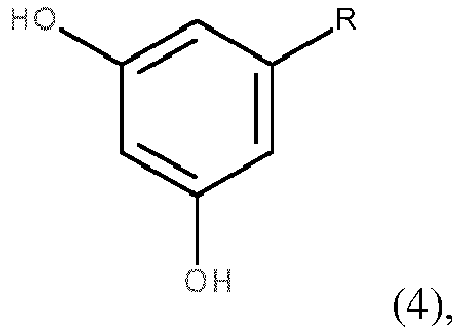
- Das Cardanol und Cardol enthaltende phenolische Blockierungsmittel kann dabei aus Cashewnuss-Schalenöl (CNSL), ein Abfallprodukt beim Anbau von Cashewnüssen, gewonnen werden.
- Der Cardanolgehalt in CNSL beträgt mindestens 90 Gew.-%, bezogen auf das Gesamtgewicht, wobei zusätzlich die Nebenkomponenten Cardol, Methylcardol und/oder Anarcadic acid als Nebenkomponenten vorliegen. Das CNSL wird unter thermischer Behandlung wie z.B: Destillation aufgereinigt. Die allgemeine Zusammensetzung des Rohstoffs des Cashewnuss-Schalenöls ist ausführlich beschrieben in
WO 2017/207346 . - Geeignet sind Zusammensetzung von Cardanol und Cardol in einem Gewichtsverhältnis 92 : 8 bis 100 : 0, bevorzugt 95 : 5 bis 100 : 0, besonders bevorzugt 97 : 3 bis 100 : 0.
- Das Blockierungsmittel C enthält zusätzlich mindestens eine Verbindung der allgemeinen Formel (1) in einer Gesamtmenge von 0,1 bis 3,0 Gew.-%, bevorzugt 1,0 bis 3,0 Gew.-%, besonders bevorzugt 1,2 bis 2,8 Gew.-%, jeweils bezogen auf das Gesamtgewicht des Blockierungsmittels .
- Gegebenenfalls enthält das Blockierungsmittel C mindestens eine Verbindungen der allgemeinen Formel (2) in einer Gesamtmenge von maximal 1,8 Gew.-%, bevorzugt maximal 1,5 Gew.-%, besonders bevorzugt maximal 0,5 Gew.-%, ganz besonders bevorzugt maximal 0,1 Gew.-%, jeweils bezogen auf das Gesamtgewicht des Blockierungsmittels. Am meisten bevorzugt ist das Blockierungsmittel frei von Verbindungen der Formel (2).
- Das Blockierungsmittel C weist bevorzugt eine OH-Zahl von 184 bis 206, besonders bevorzugt von 184 bis 200 und ganz besonders bevorzugt von 186 bis 192 auf.
- Die Blockierungsreaktion kann mit oder ohne von aus der Polyurethanchemie an sich bekannten Katalysatoren (D1), wie beispielsweise metallorganischen Verbindungen wie Zinn(II)-octoat, Dibutylzinn(II)diacetat, Dibutylzinn(II)laurat, 2,3-Dimethyl-3,4,5,6-tetrahydropyrimidin oder tertiären Aminen wie Triethylamin oder Diazabicyclooctan oder 1,8-Diazabicylo[5.4.0]-undec-7-en durchgeführt werden. Bevorzugt wird die Blockierungsreaktion unter Mitverwendung mindestens eines dieser Katalysatoren durchgeführt.
- Die Blockierungsreaktion kann unter Verwendung eines geeigneten, gegenüber den reaktiven Gruppen der Ausgangskomponenten inerten Lösemittels erfolgen. Geeignete Lösemittel sind beispielsweise die an sich bekannten üblichen Lacklösemittel, wie z.B. Ethylacetat, Butylacetat, Ethylenglykolmonomethyl- oder ethyletheracetat, 1-Methoxypropyl-2-acetat (MPA), 3-Methoxy-n-butylacetat, Aceton, 2-Butanon, 4-Methyl-2-pentanon, Cyclohexanon, Toluol, Xylol, Chlorbenzol, Testbenzin, hoher substituierte Aromaten, wie sie beispielsweise unter den Bezeichnungen Solventnaphtha, Solvesso, Isopar, Nappar (ExxonMobil Chemical Central Europe, Köln, DE) und Shellsol (Shell Deutschland Oil GmbH, Hamburg, DE) im Handel sind, aber auch Lösemittel wie Propylenglykoldiacetat, Diethylenglykoldimethylether, Dipropylenglykoldimethylether, Diethylenglykolethyl- und butyletheracetat, N-Methylpyrrolidon und N-Methylcaprolactam, oder beliebige Gemische solcher Lösemittel. Bevorzugt wird Lösemittel-frei gearbeitet.
- Der Gehalt freier NCO-Gruppen in den erfindungsgemäßen blockierten Isocyanat-Prepolymeren ist bevorzugt < 0,5 Gew.-%, besonders bevorzugt < 0,2 Gew.-%, ganz besonders bevorzugt < 0,1 Gew.-%.
- Beim erfindungsgemäßen Verfahren wird Komponente B mit überschüssigen Mengen der Isocyanatkomponente A gegebenenfalls in Anwesenheit eines Katalysators D2 umgesetzt. Anschließend wird gegebenenfalls unreagiertes Di- bzw. Polyisocyanat destillativ, z.B. durch Dünnschichtdestillation, wieder entfernt. Bevorzugt liegt das Molverhältnis der OH-Gruppen der Polyetherpolyolkomponente zu der NCO-Gruppen des Di- oder Polyisocyanats zwischen 1: 1,5 und 1:20, besonders bevorzugt zwischen 1:1,8 und 1:5 und besonders bevorzugt zwischen 1:1,95 und 1:2,05.
- Die Umsetzung von Komponente B und A erfolgt im allgemeinen bei einer Temperatur von 0 bis 250 °C, bevorzugt von 20 bis 140 °C und besonders bevorzugt von 40 bis 100 °C, gegebenenfalls unter Verwendung einer Katalysatorkomponente D2. Als Katalysatoren für die Prepolymerbildung (D2) eignen sich beispielsweise die bereits oben für Komponente D1 beschriebenen Katalysatoren. Sofern Komponente A aromatische Diisocyanate oder Polyisocyanaten mit aromatisch gebundenen Isocyanatgruppen umfasst, erfolgt die Prepolymerisierungsreaktion bevorzugt katalysatorfrei.
- Sofern für die Prepolymerisierungsreaktion als auch für die Blockierungsreaktion Katalysatoren eingesetzt werden, werden für beide Reaktionen bevorzugt die gleichen Katalysatoren bzw. Katalysatorenmischungen eingesetzt.
- Die Prepolymerisierungsreaktion kann unter Verwendung eines Lösemittels erfolgen. Als Lösemittel eignen sich beispielsweise die bereits oben für die Blockierungsreaktion beschriebenen Lösemittel. Bevorzugt wird Lösemittel-frei gearbeitet.
- Zur Herstellung der erfindungsgemäßen Produkte, werden die aus Komponente A und Komponente B, gegebenenfalls unter Verwendung von Katalysatorkomponente D2 erhaltenen Isocyanatgruppen-haltigen Prepolymere in einem weiteren Schritt mit dem Blockierungsmittel C bei Temperaturen von 40 bis 100 °C, bevorzugt von 50 bis 90 °C und besonders bevorzugt von 60 bis 80 °C umgesetzt, gegebenenfalls unter Verwendung einer geeigneten Katalysatorkomponente D1. Die Menge der bei der Blockierungsreaktion eingesetzten Komponente C sollte zumindest 30 Mol-%, bevorzugt 50 Mol-%, besonders bevorzugt mehr als 95 Mol-%, der Menge der zu blockierenden Isocyanatgruppen entsprechen. Ein geringer Überschuss an Blockierungsmittel kann zweckmäßig sein, um ein vollständige Reaktion aller Isocyanatgruppen zu gewährleisten. In der Regel beträgt der Überschuss nicht mehr als 20 Mol-%, bevorzugt nicht mehr als 15 Mol-% und besonders bevorzugt nicht mehr als 10 Mol-%, bezogen auf die zu blockierenden Isocyanatgruppen. Ganz besonders bevorzugt liegt die Menge der bei der Blockierungsreaktion eingesetzten Komponente C daher bei 95 Mol-% bis 110 Mol-%, bezogen auf die Menge der zu blockierenden Isocyanatgruppen des Isocyanat-Prepolymers.
- Die Zugabe der Komponenten kann sowohl bei der Herstellung der Isocyanatgruppen-haltigen Prepolymere als auch bei der Blockierung derselben in beliebiger Reihenfolge erfolgen.
- Bevorzugt ist jedoch die Zugabe des Polyisocyanats A zum vorgelegten Polyetherpolyol B und schließlich die Zugabe der Blockierungs-Komponente C. Dazu wird das Polyetherpolyol B in einem geeigneten Reaktionsgefäß vorgelegt und gegebenenfalls unter Rühren im oben genannten Temperaturbereich (max. 250°C, bevorzugt 20 bis 140 °C und besonders bevorzugt 40 bis 100 °C) erwärmt. Nach Erreichen der gewünschten Temperatur wird dann unter Rühren das Di- oder Polyisocyanat A zugegeben. Zur Beschleunigung der Reaktion kann ein Katalysator D2 zugegeben werden und zwar zu jedem Zeitpunkt vor, während oder nach den vorangehend beschriebenen Schritten. Das Reaktionsgemisch wird nun solange gerührt, bis der theoretische NCO-Gehalt des nach der gewählten Stöchiometrie zu erwartenden Isocyanat-Prepolymers erreicht oder geringfügig unterschritten ist. Das so erhaltene Isocyanat-Prepolymer kann einer destillativen Aufreinigung unterzogen werden.
- Für die sich anschließende Blockierungsreaktion wird die Temperatur der Reaktionsmischung auf einen Wert zwischen 40 und 100°C eingestellt. Nach dem Erreichen der gewünschten Temperatur wird das Blockierungsmittel C zugegeben. Zur Beschleunigung der Blockierungsreaktion kann ein geeigneter Katalysator D1, wie z.B. Dibutylzinn(II)dilaurat, zugegeben werden. Dies kann vor oder nach Einstellung der Temperatur und vor oder nach der Zugabe des Blockierungsmittels erfolgen. Die Reaktionsmischung wird dann solange gerührt, bis der Gehalt an freien Isocyanatgruppen kleiner als 0,5 Gew.-%, bevorzugt kleiner als 0,2 Gew.-%, besonders bevorzugt kleiner als 0,1 Gew.-%, ist. Danach wird das Reaktionsgemisch abgekühlt und gegebenenfalls noch mit einem Reaktionsstopper, wie z.B. Benzoylchlorid versehen.
- In einer weiteren Ausführungsform des erfindungsgemäßen Verfahrens wird das Di- oder Polyisocyanat A in einem geeigneten Reaktionsgefäß vorgelegt und gegebenenfalls unter Rühren auf 40 bis 100°C erwärmt. Nach Erreichen der gewünschten Temperatur wird unter Rühren dann das Polyetherpolyol B zugegeben. Zur Beschleunigung der Reaktion kann ein Katalysator D2 zugegeben werden und zwar zu jedem Zeitpunkt vor, während oder nach den vorangehend beschriebenen Schritten. Das Reaktionsgemisch wird solange gerührt, bis der theoretische NCO-Gehalt des nach der gewählten Stöchiometrie zu erwartenden Isocyanat-Prepolymers erreicht oder geringfügig unterschritten ist. Die weitere Umsetzung erfolgt dann wie bereits beschrieben.
- Ein weiterer Gegenstand der vorliegenden Erfindung sind die vorstehend beschriebenen, blockierten Isocyanat-Prepolymere mit einer Viskosität, gemessen nach DIN EN ISO 3219:1994-10 bei 23 °C, kleiner 40000 mPas, bevorzugt kleiner 35000 mPas, besonders bevorzugt kleiner 30000 mPas.
- Darüber hinaus ist ein Gegenstand der Erfindung Reaktivsysteme enthaltend oder bestehend aus
- a) mindestens ein/einem erfindungsgemäßes/en, blockiertes/en Isocyanat-Prepolymer
- b) mindestens eine/einer organische/n Verbindungen mit mindestens 2 primären Aminogruppen,
- c) gegebenenfalls mindestens eine/einer Oxirangruppen-aufweisende/n Verbindung einer durchschnittlichen Oxiranfunktionalität > 1, sowie
- d) gegebenenfalls Produkte aus Reaktionen der Komponente a bis c untereinander,
- e) gegebenenfalls Katalysatoren und/oder Hilfs- und oder Zusatzstoffe.
- Bei den Aminen der Komponente b handelt es sich um Polyamine, die mindestens zwei primäre Aminogruppen pro Molekül und gegebenenfalls noch sekundäre Aminogruppen aufweisen und vorzugsweise ein mittleres Molekulargewicht von 60 bis 500 besitzen. Geeignet sind beispielsweise Ethylendiamin, 1,2- und 1,3-Diaminopropan, 1,4-Diaminobutan, 2,2,4-und/oder 2,4,4-Trimethylhexamethylendiamin, die isomeren Xylolendiamine, 1,4-Diaminocyclohexan, 4,4'-Diaminodicyclohexylmethan, 1,3-Diaminocyclopentan, 4,4'-Diaminodicyclohexylsulfon, 4,4'-Diaminodicyclohexylpropan-1,3, 4,4'-Diaminodicyclohexylpropan-2,2, 3,3'-Dimethyl-4,4'-diaminodicyclohexylmethan, 3-Aminomethyl-3,3,5 -trimethylcyclohexylamin (Isophorondiamin), 3(4)-Aminomethyl-1-methylcycloliexylamin, technisches Bisaminomethyltricyclodecan, Octahydro-4.7-methanoinden-1.5-dimethanamin oder auch solche Polyamine, die neben mindestens zwei primären Aminogruppen noch sekundäre Aminogruppen aufweisen wie beispielsweise Diethylentriamin oder Triethylentetramin.
- Besonders bevorzugt sind Polyamine, insbesondere Diamine des genannten. Molekulargewichtsbereichs, die einen oder mehrere cycloaliphatische Ringe aufweisen. Hierzu gehören beispielsweise 1,4-Diaminocyclohexan, 4,4'-Diaminodicyclohexylmethan, 1,3-Diaminocyclopentan, 4,4'-Diaminodicyclohexylsulfon, 4,4'-Diaminodicyclohexylpropan-1,3, 4,4'-Diaminodicyclohexylpropan-2,2, 3,3'-Dimethyl-4,4'-diaminodicyclohexylmethan, 3-Aminomethyl-3,3,5-trimethylcyclohexylamin(Isophorondiamin), 3- und 4-Aminomethyl-1-methylcyclohexylamin oder technisches Bisaminomethyltricyclodecan.
- Ebenfalls als Bestandteil der Aminkomponente einsetzbar sind Addukte, die durch Umsetzung eines Überschusses der genannten Polyamine mit Epoxidharzen der nachstehend genannten Art hergestellt werden.
- Weiterhin in Komponente b einsetzbar sind Polyetheramine, die durch Umsetzung von Polyetherpolyolen mit Ammoniak hergestellt werden und beispielsweise von Huntsman unter dem Handelsnamen Jeffamin® vertrieben werden.
- Des Weiteren sind auch Polyamidharze als Bestandteil von Komponente b geeignet. Derartige Polyamidharze, zu denen die Polyaminoamide und die Polyaminoimidazoline gehören, werden u.a. von Henkel KGaA unter dem Handelsnamen "Versamid®" vertrieben.
- Selbstverständlich ist es auch möglich Gemische der genannten Polyamine als Aminkomponente b einzusetzen.
- Verbindungen der Komponente c sind Oxirangruppen-aufweisende Verbindungen. Geeignete Oxirangruppen-aufweisende Verbindungen sind Epoxidharze, die im Durchschnitt mehr als eine Epoxidgruppe pro Molekül enthalten. Beispiele für geeignete Epoxidharze sind Glycidylether von mehrwertigen Alkoholen wie z.B. Butandiol, Hexandiol, Glycerin, hydriertem Diphenylolpropan oder mehrwertigen Phenolen wie z.B. Resorcin, Diphenylolpropan-2,2 (Bisphenol A) Diphenylolmethan (Bisphenol F) oder Phenol-Aldehyd-Kondensaten. Es können auch Glycidylester mehrwertiger Carbonsäuren; wie Hexahydrophtalsäure oder dimerisierte Fettsäure verwendet werden.
- Besonders bevorzugt ist der Einsatz von flüssigen Epoxidharzen auf Basis von Epichlorhydrin und Diphenylolpropan-2,2 (Bisphenol A) oder Diphenylolmethan (Bisphenol F) bzw. deren Mischungen. Gewünschtenfalls kann mit monofunktionellen Epoxidverbindungen die Viskosität der Mischungen gesenkt werden und dadurch die Verarbeitung verbessert werden. Beispiele hierfür sind aliphatische und aromatische Glycidylether wie Butylglycidylether, Phenylglycidylether oder Glycidylester wie Versaticsäureglycidylester oder Epoxide wie Styroloxid oder 1,2-Epoxidodecan.
- In den erfindungsgemäßen, bevorzugt lösemittelfreien, raumtemperaturhärtenden Reaktivsystemen liegen im Allgemeinen pro Epoxidgruppe der Komponente c 0,4 bis 0,9, vorzugsweise 0,5 bis 0,8 primäre Aminogruppen der Komponente b und 0,02 bis 0,6, vorzugsweise 0,03 bis 0,5 blockierte Isocyanatgruppen der Komponente a vor.
- Zur Herstellung von gebrauchsfertigen Mischungen können den erfindungsgemäßen Reaktivsystemen die üblichen Katalysatoren, Hilfs- und Zusatzmittel wie beispielsweise Füllstoffe, Lösungsmittel, Verlaufshilfsmittel, Pigmente, Reaktionsbeschleuniger oder Viskositätsregulatoren einverleibt werden. Beispielhaft genannt seien Reaktionsbeschleuniger wie Salicylsäure, Bis-(dimethylamino-methyl)-phenol oder Tris-(dimethylaminomethyl)-phenol, Füllstoffe wie Sande, Gesteinsmehl, Kieselsäure, Asbestmehl, Kaolin, Talkum, Metallpulver, Teer, Teerpech, Asphalte, Korkschrote, Polyamide, Weichmacher wie beispielsweise Phthalsäureester oder andere Viskositätsregulatoren wie beispielsweise Benzylalkohol.
- Selbstverständlich kann der gebrauchsfertigen Mischung gegebenenfalls bis zu 20 Gew.-%, vorzugsweise bis zu 10 Gew.-%, besonders bevorzugt bis zu 5 Gew.-% eines Lösemittels bzw. Lacklösemittels der zuvor bereits beschriebenen Art für applikationstechnische Zwecke zugefügt werden. Sollte an dieser Stelle Lösemittel eingesetzt werden, kann auch bei einem eventuellen Einsatz von Lösemitteln während der Synthese der erfindungsgemäßen Polyurethan-Prepolymere auf das Entfernen des Lösemittels verzichtet werden.
- Ganz besonders bevorzugt im Sinne dieser Erfindung sind allerdings lösemittelfreie gebrauchsfertige Reaktivsysteme.
- Die Komponente a wird beim erfindungsgemäßen Verfahren zur Herstellung der Reaktivsysteme in beliebiger Reihenfolge mit der Komponente b vermischt, bevorzugt unter Rühren. Danach können, ebenfalls in beliebiger Reihenfolge und wiederum gegebenenfalls unter Rühren, noch die Komponenten c und d zugegeben werden.
- Die Herstellung der erfindungsgemäßen Reaktivsysteme aus a und b und gegebenenfalls c und/oder d erfolgt bevorzugt bei Temperaturen von -20°C bis 50°C, besonders bevorzugt bei 0°C bis 40°C.
- Die erfindungsgemäßen Polyisocyanate, wie auch die Reaktivsysteme eignen sich zur Herstellung von Beschichtungen, Klebstoffen, Dichtungsmassen, Vergussmassen oder Formteilen in allen Anwendungsgebieten, wo gute Haftung, Chemikalienfestigkeit, sowie hohe Schlag- und Stoßfestigkeit, verbunden mit guter Flexibilität und Elastizität gefordert werden. Besonders gut geeignet sind die erfindungsgemäßen Systeme als Korrosionsschutzbeschichtungen. Insbesondere bei Belastung mit aggressiven Medien, wie beispielsweise bei der Ballasttank-Beschichtung zeichnen sich die Systeme durch eine gute Nasshaftung und eine gute Haftung unter Kothodenschutzbedingungen aus.
- Ein weiterer Gegenstand der vorliegenden Erfindung ist die Verwendung der blockierten Isocyanat-Prepolymere bei der Herstellung von Polyurethankunststoffen.
- Ein weiterer Gegenstand der vorliegenden Erfindung ist darüber hinaus die Verwendung der erfindungsgemäßen Reaktivsysteme zur Herstellung von Beschichtungen, im Besonderen Korrosionsschutzbeschichtungen, Klebstoffen, Dichtungsmassen, Vergussmassen, Primern oder Formteilen.
- Ebenso sind Gegenstände der vorliegenden Erfindung Beschichtungen, im Besonderen Korrosionsschutzbeschichtungen, Klebstoffe, Dichtungsmassen, Vergussmassen, Primer und Formteile, enthaltend die blockierten Isocyanat-Prepolymere gemäß vorstehender Beschreibung, sowie Substrate beschichtet mit diesen Beschichtungen, im Besonderen einer solchen Korrosionsschutzbeschichtung.
- Die erfindungsgemäßen Reaktivsysteme können auf den unterschiedlichsten Untergründen eingesetzt werden. Als Beispiele seien genannt mineralische Untergründe, z.B. aus Beton und/oder Stein, metallische Untergründe, z.B. aus Eisen, Stahl, Kupfer, Messing, Bronze, Aluminium oder Titan sowie aus Legierungen der genannten Metalle, und Kunststoffe, z.B. in Form bereits bestehender Beschichtungen auf beispielsweise den genannten metallischen oder mineralischen Untergründen.
- Darüber hinaus zeigen die erfindungsgemäßen blockierten Isocyanat-Prepolymere eine hervorragende Verträglichkeit mit den Komponenten b und c, da die Reaktion von Epoxidharz/Amin und blockiertem Isocyanat/Amin so eingestellt werden kann, dass die Reaktivsysteme einen verträglichen Blend bei Raumtemperatur ergeben.
- Die erfindungsgemäßen Reaktivsysteme können beispielsweise durch Gießen, Streichen, Tauchen, Spritzen, Fluten, Rakeln oder Walzen auf die zu beschichtende Oberfläche applizierte werden. Je nach Anwendungsgebiet können somit Schichtdicken von 10 Pm (z.B. für dünne Korrosionsschutzbeschichtungen) bis zu mehreren Zentimetern (z.B. für rissüberbrückende Vergussmassen) erzielt werden.
- Je nach gewählter Zusammensetzung der erfindungsgemäßen Reaktivsysteme, härten diese bei Umgebungsbedingungen, d.h. bei Temperaturen von vorzugsweise -30°C bis 50°C und einer relative Feuchte von vorzugsweise 10 % bis 90 % innerhalb von wenigen Minuten bis zu einigen Tagen. Durch erhöhte Temperaturen, d.h. oberhalb der genannten 50°C, kann die Aushärtung zusätzlich forciert werden, was in der Praxis ebenfalls gewünscht sein kann.
- Die vorliegende Erfindung wird im Folgenden anhand von Beispielen und Vergleichsbeispielen näher erläutert, ohne sie jedoch auf diese einzuschränken.
- Alle Prozentangaben beziehen sich, soweit nichts anders vermerkt, auf das Gewicht.
- Die Zusammensetzung des phenolischen Blockierungsmittels wurde gaschromatographisch bestimmt. Die Messung erfolgte auf einem GC 6890 von Agilent unter Verwendung einer Optima-1-MS-Accent Säule (30 m x 0,25 mm x 0,5 µm) und einem Massenspektrometer-Detektor MSD 5973. Als Trägergas wurde Helium mit einer Flussrate von 3 mL/min eingesetzt. Die Säulentemperatur betrug 80 °C und wurde im Anschluss mit 6 °C/min auf 320 °C erhöht und bei Erreichen der Zieltemperatur für 20 min gehalten. Für die GC/MS Detektion betrug die Ionisierungsenergie 70 eV. Injektionstemperatur betrug 270 °C mit einem Splitverhältnis von 20:1.
- Der Schwefelgehalt des phenolischen Blockierungsmittels wurde mittels optischer Emissionsspektrometrie mit induktiv gekoppeltem Plasma (ICP-OES) bestimmt. Dazu wurde die Probe vorerst mittels Mikrowellenaufschluss in Lösung gebracht. Die optische Spektroskopie erfolgte mit einem ICP-OES Gerät der Firma Spectro (Arcos II) gegen zertifizierte Standards. Als Hauptnachweislinie für Schwefel wurde die Linie 180.731 nm verwendet. Um mögliche Interferenzen auszuschließen wurde eine zweite Linie (182,034 nm) mitbeobachtet.
- Sämtliche Viskositätsmessungen erfolgten mit einem Physica MCR 51 Rheometer der Fa. Anton Paar Germany GmbH (DE) nach DIN EN ISO 3219:1994-10 bei einer Scherrate von 250 s-1.
- Die Bestimmung der NCO-Gehalte erfolgte titrimetrisch nach DIN EN ISO 11909:2007-05.
- Die OH-Zahlen wurden titrimetrisch in Anlehnung an DIN 53240 T.2 bestimmt.
- Die Bestimmung der Bruchspannung und -dehnung erfolgte in Anlehnung an DIN EN ISO 527-2:2012-06.
- Die Weitereißfestigkeit wurde nach ISO 34-1:2016-06 bestimmt.
- Die Härteprüfung nach Shore A und Shore D erfolgte nach DIN 53505:2000-08.
- Das Epilox T19-34/700 ist ein flüssiges Epoxidharz auf Basis Bisphenol A und Bisphenol F mit einem Epoxid-Äquivalent von 165-180 und einem entsprechenden Epoxid-Gehalt von 23,9 - 26,1 % (beide Werte nach DIN 16945:1989-03), erhältlich von der Fa. Overlack GmbH, Deutschland. Efka® SI 2008 ist ein Additiv zur Entlüftung und Entschäumung, erhältlich von BASF AG, Ludwigshafen, DE, und TCD Diamin, octahydro-4,7-methano-1H-indene-dimethylamine, Oxea, Marl, DE.
- a) 908,0 g eines Polyetherpolyols mit der Funktionalität 2 und der OH-Zahl 56, hergestellt durch Propoxylierung von Propylenglykol, wurden mit 158,0 g 2,4-Diisocyanatotoluol/2,6-Diisocyanatotoluol (Verhältnis = 80/20) 3 Stunden bei 90 °C prepolymerisiert bis der theoretische NCO-Gehalt von 3,6 % erreicht war. Anschließend setzte man 324,0 g phenolisches Blockierungsmittel 1 (NX 2026, Handelsprodukt der Firma Cardolite Specialty Chemicals Europe N.V.) der OH Zahl 191 zu, enthaltend Cardanol und Cardol in einem Gew.-Verhältnis von 100 : 0, 1,7 % der Verbindung der allgemeinen Formel (I), 0 % der Verbindung der allgemeinen Formel (II) und einen Schwefel-Gehalt von kleiner 10 ppm, katalysiert mit 1,6 g Zinn(II)octoat, und rührte bei 65 °C bis der NCO-Gehalt unterhalb 0,4 % lag.
Danach gab man 2,1g Benzoylchlorid zu und rührte 30 Minuten nach.
Das so erhaltene blockierte Isocyanatprepolymer ist durch folgende Kenndaten gekennzeichnet:Viskosität (23 °C) 27500 mPas Gehalt an freiem NCO 0,22%
hochelastischer Kunststoff mit folgenden mechanischen Kennwerten erhalten:Bruchspannung: 15,5 N/mm2 Bruchdehnung: 40,0 % Weitereißfestigkeit: 51,9 N/mm Shore A: 95 Shore D: 63 - Nach dem in Beispiel 1 beschriebenen Verfahren wurden weitere blockierte Isocyanat-Prepolymere unter Verwendung diverser phenolischer Blockierungsmittel hergestellt. Die resultierten Kenndaten der blockierten Isocyanat-Prepolymere und die aus den entsprechenden Reaktivsystemen resultierenden mechanischen Kennwerte sind in der nachfolgenden Tabelle zusammengefasst.
Tabelle 1: Übersicht der durchgeführten Beispiele 1 bis 9: Beispiel Erfindungsgemäß Vergleich 1 2 3 4 5 6 7 8 9 Blockierungsmittel: NX-2026 (Cardolite Specialty Chemicals Europe N.V) x x x x NX-2025 (Cardolite Specialty Chemicals Europe N.V) x x GP-502 (Golden Cashew Products Pvt. Ltd) x Cardanol (Klaus F. Meyer GmbH) x x Cardanol : Cardol 100 : 0 100 : 0 100 : 0 100 : 0 97 : 3 98 : 2 95 : 5 90 : 10 89 : 11 Verbindung 1 [%] 1,7 1,1 1,2 1,2 2,8 2,6 2,1 2,8 2,8 Verbindung 2 [%] 0,0 0,0 0,1 0,0 1,8 1,5 0,8 1,9 2,1 OHZ 191 191 189 189 200 194 198 209 215 Schwefel [mg/kg] < 12 < 12 < 12 < 12 < 12 < 12 < 12 18 31 Blockiertes Isocyanat-Prepolymer: Viskosität [mPas] 27500 30300 26000 24100 25800 27300 33500 43000 52700 Gehalt an freiem NCO [%] 0,22 0,29 0,27 0,25 0,27 0,35 0,24 0,33 0,27 Reaktivsystem: Bruchspannung [N/mm2] 15,5 20,2 20,7 18,3 16,8 19,7 19,7 20,6 21,9 Bruchdehnung [%] 40 23,2 33,5 26,8 19,4 29,5 22,8 25,1 29,6 Weitereißfestigkeit [N/mm] 51,9 69,0 66,0 64,7 63,9 53,2 68,9 70,5 64,3 Shore A 95 93 93 98 97 95 92 94 89 Shore D 63 65 57 58 57 58 52 56 57

Claims (15)
- Blockierungsmittel, enthaltend oder bestehend aus
Cardanol und Cardol in einem Gewichtsverhältnis von 92 : 8 bis 100 : 0,
sowie mindestens eine/r Verbindung der allgemeinen Formel 1 in welcher R für C17H33-n mit n = 0, 2 oder 4 steht,wobei die Verbindungen der Formel 1 in einer Gesamtmenge von 0,1 bis 3,0 Gew.-%, bevorzugt 1,0 bis 3,0 Gew.-%, besonders bevorzugt 1,2 bis 2,8 Gew.-%, bezogen auf das Gesamtgewicht des Blockierungsmittels, vorliegen,und
gegebenenfalls mindestens eine/r Verbindung der allgemeinen Formel 2 in welchen R für C15H31-n, mit n = 4 oder 6 steht,wobei die Verbindungen der Formel 2, falls vorhanden, in einer Gesamtmenge von maximal 1,8 Gew.-%, bevorzugt maximal 1,5 Gew.-%, besonders bevorzugt maximal 0,5 Gew.-%, ganz besonders bevorzugt maximal 0,1 Gew.-%, bezogen auf das Gesamtgewicht des Blockierungsmittels, vorliegen.
 - Blockierungsmittel gemäß Anspruch 1, wobei das Blockierungsmittel eine OH-Zahl von 184 bis 206, besonders bevorzugt von 184 bis 200 und ganz besonders bevorzugt von 186 bis 192 aufweist.
- Blockierungsmittel gemäß Anspruch 1 oder 2 mit einem Schwefelgehalt von weniger als 15 mg/kg, bevorzugt von weniger als 12 mg/kg.
- Verfahren zur Herstellung von blockierten Isocyanat-Prepolymeren, umfassend die oder bestehend aus der Umsetzung von
mindestens einem Isocyanat-Gruppen tragenden Prepolymeren, erhältlich aus der Umsetzung einer Zusammensetzung, umfassend oder bestehend ausA. mindestens ein/einem aliphatisches/en, cycloaliphatisches/en, araliphatisches/en und/oder aromatisches/en Di- und/oder Polyisocyanat undB. mindestens eine/einer Polyhydroxyverbindungmit
einem Blockierungsmittel C gemäß einem der Ansprüche 1 bis 3. - Verfahren gemäß Anspruch 4, wobei als Komponente A mindestens ein Di- und/oder Polyisocyanat auf Basis von 1,5-Naphthalendiisocyanat (NDI), Diisocyanatodiphenylmethan (MDI), Poly(methylenphenylisocyanat) (pMDI), Diisocyanatomethylbenzol (2,4- und 2,6-Toluylendiisocyanat, TDI) eingesetzt wird.
- Verfahren gemäß Anspruch 4 oder 5, wobei als Komponente B mindestens eine Polyhydroxyvebindung, bevorzugt mindestens ein Poyetherpolyol, mit einer OH-Funktionalität von 1,8 bis 6,0 und einem zahlenmittleren Molekulargewicht von 1.000 g/mol bis 10.000 g/mol eingesetzt wird.
- Verfahren gemäß einem der Ansprüche 4 bis 6, wobei als Komponente B mindestens ein Polyetherpolyol eingesetzt wird, welches ein Anlagerungsprodukt von Ethylenoxid und/oder Propylenoxid an 1,2-Propandiol (Propylenglykol), 1,3-Propandiol, Glycerin, Trimethylolpropan, Ethylendiamin und/oder Pentaerythrit ist, oder welches ein durch Polymerisation von Tetrahydrofuran erhältliches Polytetramethylenetherglykol ist.
- Verfahren gemäß einem der Ansprüche 4 bis 7, wobei das mindestens eine Isocyanat-Gruppen tragende Prepolymer, welches erhältlich ist aus der Umsetzung der Zusammensetzung, umfassend oder bestehend aus den Komponenten A und B, vor der Umsetzung mit Komponente C destillativ von unreagiertem Di- und oder Polyisocanat der Komponente A zumindest teilweise befreit wird.
- Verfahren gemäß einem der Ansprüche 4 bis 8, wobei die Umsetzung der Zusammensetzung, umfassend oder bestehend aus den Komponenten A und B, mit Komponente C in Gegenwart eines Katalysators D1 erfolgt.
- Blockierte Isocyanat-Prepolymere erhältlich nach einem Verfahren gemäß einem der Ansprüche 4 bis 9.
- Blockierte Isocyanat-Prepolymere gemäß Anspruch 10 mit einer Viskosität, gemessen nach DIN EN ISO 3219:1994-10 bei 23 °C, kleiner 40000 mPas, bevorzugt kleiner 35000 mPas, besonders bevorzugt kleiner 30000 mPas.
- Reaktivsysteme enthaltend oder bestehend ausa) mindestens ein/einem erfindungsgemäßes/en, blockiertes/en Isocyanat-Prepolymer gemäß einem der Ansprüche 10 oder 11,b) mindestens eine/einer organische/n Verbindungen mit mindestens 2 primären Aminogruppen,c) gegebenenfalls mindestens eine/einer Oxirangruppen-aufweisende/n Verbindung einer durchschnittlichen Oxiranfunktionalität > 1, sowied) gegebenenfalls Produkte aus Reaktionen der Komponente a bis c untereinander,e) gegebenenfalls Katalysatoren, Hilfs- und Zusatzmittel.
- Verwendung der blockierten Isocyanat-Prepolymere gemäß Anspruch 10 oder 11 bei der Herstellung von Polyurethankunststoffen.
- Verwendung der Reaktivsysteme gemäß Anspruch 12 zur Herstellung von Beschichtungen, im Besonderen Korrosionsschutzbeschichtungen, von Klebstoffen, Dichtungsmassen, Vergussmassen, Primern oder Formteilen.
- Beschichtungen, im Besonderen Korrosionsschutzbeschichtungen, Klebstoffe, Dichtungsmassen, Vergussmassen, Primer und Formteile, enthaltend die blockierten Isocyanat-Prepolymere gemäß Anspruch 10 oder 11, sowie Substrate beschichtet mit Beschichtungen, im Besonderen einer solchen Korrosionsschutzbeschichtung, enthaltend die blockierten Isocyanat-Prepolymere gemäß Anspruch 10 oder 11.
Priority Applications (8)
| Application Number | Priority Date | Filing Date | Title |
|---|---|---|---|
| EP20168769.6A EP3892659A1 (de) | 2020-04-08 | 2020-04-08 | Mit aus cashewnuss-schalenöl erhältlichen phenolen blockierte, niedrigviskose isocyanat-prepolymere, verfahren zur deren herstellung und deren verwendung |
| PCT/EP2021/058835 WO2021204741A1 (de) | 2020-04-08 | 2021-04-06 | Mit aus cashewnuss-schalenöl erhältlichen phenolen blockierte, niedrigviskose isocyanat-prepolymere, verfahren zur deren herstellung und deren verwendung |
| JP2022561059A JP2023521346A (ja) | 2020-04-08 | 2021-04-06 | カシューナッツ殻油から得られるフェノールでブロックされた低粘度イソシアネートプレポリマー、その製造方法及びその使用 |
| US17/907,694 US20230127025A1 (en) | 2020-04-08 | 2021-04-06 | Low-viscous isocyanate prepolymers blocked with phenols obtainable from cashew nutshell oil, method for the production thereof and use thereof |
| CN202180026365.XA CN115427472A (zh) | 2020-04-08 | 2021-04-06 | 用可获自腰果壳油的酚封闭的低粘度异氰酸酯预聚物、其生产方法及其用途 |
| EP21715921.9A EP4132984B1 (de) | 2020-04-08 | 2021-04-06 | Mit aus cashewnuss-schalenöl erhältlichen phenolen blockierte, niedrigviskose isocyanat-prepolymere, verfahren zur deren herstellung und deren verwendung |
| ES21715921T ES2973411T3 (es) | 2020-04-08 | 2021-04-06 | Prepolímeros de isocianato de baja viscosidad bloqueados con fenoles obtenibles a partir de aceite de cáscara de anacardo, procedimiento para su preparación y uso de los mismos |
| KR1020227034547A KR20220166799A (ko) | 2020-04-08 | 2021-04-06 | 캐슈넛 껍질 오일로부터 수득가능한 페놀로 블로킹된 저점도 이소시아네이트 예비중합체, 그의 생산 방법 및 그의 용도 |
Applications Claiming Priority (1)
| Application Number | Priority Date | Filing Date | Title |
|---|---|---|---|
| EP20168769.6A EP3892659A1 (de) | 2020-04-08 | 2020-04-08 | Mit aus cashewnuss-schalenöl erhältlichen phenolen blockierte, niedrigviskose isocyanat-prepolymere, verfahren zur deren herstellung und deren verwendung |
Publications (1)
| Publication Number | Publication Date |
|---|---|
| EP3892659A1 true EP3892659A1 (de) | 2021-10-13 |
Family
ID=70277221
Family Applications (2)
| Application Number | Title | Priority Date | Filing Date |
|---|---|---|---|
| EP20168769.6A Ceased EP3892659A1 (de) | 2020-04-08 | 2020-04-08 | Mit aus cashewnuss-schalenöl erhältlichen phenolen blockierte, niedrigviskose isocyanat-prepolymere, verfahren zur deren herstellung und deren verwendung |
| EP21715921.9A Revoked EP4132984B1 (de) | 2020-04-08 | 2021-04-06 | Mit aus cashewnuss-schalenöl erhältlichen phenolen blockierte, niedrigviskose isocyanat-prepolymere, verfahren zur deren herstellung und deren verwendung |
Family Applications After (1)
| Application Number | Title | Priority Date | Filing Date |
|---|---|---|---|
| EP21715921.9A Revoked EP4132984B1 (de) | 2020-04-08 | 2021-04-06 | Mit aus cashewnuss-schalenöl erhältlichen phenolen blockierte, niedrigviskose isocyanat-prepolymere, verfahren zur deren herstellung und deren verwendung |
Country Status (7)
| Country | Link |
|---|---|
| US (1) | US20230127025A1 (de) |
| EP (2) | EP3892659A1 (de) |
| JP (1) | JP2023521346A (de) |
| KR (1) | KR20220166799A (de) |
| CN (1) | CN115427472A (de) |
| ES (1) | ES2973411T3 (de) |
| WO (1) | WO2021204741A1 (de) |
Cited By (2)
| Publication number | Priority date | Publication date | Assignee | Title |
|---|---|---|---|---|
| CN114106280A (zh) * | 2021-12-14 | 2022-03-01 | 上海华峰新材料研发科技有限公司 | 一种脂肪族聚氨酯树脂及其制备方法和用途 |
| CN114133529A (zh) * | 2021-12-14 | 2022-03-04 | 上海华峰新材料研发科技有限公司 | 一种芳香族聚氨酯树脂及其制备方法和用途 |
Families Citing this family (7)
| Publication number | Priority date | Publication date | Assignee | Title |
|---|---|---|---|---|
| WO2023107270A1 (en) * | 2021-12-07 | 2023-06-15 | Dow Global Technologies Llc | Blocked prepolymer compositions with improved storage stability |
| CN114889291B (zh) * | 2022-03-28 | 2024-01-02 | 珠海市赛纬电子材料股份有限公司 | 一种铝塑膜及其制备方法 |
| CN115894839B (zh) * | 2022-11-14 | 2025-06-10 | 东莞澳中新材料科技股份有限公司 | 一种低温热固化的封闭型固化剂及应用其的单组分低温热固化的聚氨酯结构胶 |
| CN117186280B (zh) * | 2023-11-02 | 2024-01-26 | 广东创新精细化工实业有限公司 | 一种内嵌腰果酚多异氰酸酯封闭物的防水剂及其制备方法、应用 |
| WO2025108924A1 (en) | 2023-11-21 | 2025-05-30 | Covestro Deutschland Ag | Water-dispersible blocked isocyanate prepolymer system, method for preparing the same, and application thereof |
| EP4574860A1 (de) | 2023-12-19 | 2025-06-25 | Covestro Deutschland AG | Verwendung von epoxidgruppen enthaltenden oxazolidinonen zur herstellung von klebern, vergussmassen, verbund |
| CN118064049B (zh) * | 2024-02-21 | 2024-09-20 | 山东交通学院 | 一种可水中快速固化的防腐涂层及其制备方法 |
Citations (31)
| Publication number | Priority date | Publication date | Assignee | Title |
|---|---|---|---|---|
| DE1954093A1 (de) | 1968-11-15 | 1970-06-18 | Mobay Chemical Corp | Verfahren zur Herstellung von polymeren organischen Isocyanaten |
| DE1670666A1 (de) | 1966-02-02 | 1971-07-01 | Bayer Ag | Verfahren zur Herstellung von Oxadiazinonen mit NCO-Gruppen |
| DE2152606A1 (de) | 1971-10-22 | 1973-04-26 | Bayer Ag | Elastifizierte kunststoffe |
| DE2338256A1 (de) | 1972-08-14 | 1974-02-28 | Witco Chemical Corp | Aus zwei komponenten bestehende polymerbildende massen |
| DE2414413A1 (de) | 1974-03-26 | 1975-10-02 | Bayer Ag | Verfahren zur herstellung von loesungen von polyisocyanaten |
| DE2418041A1 (de) | 1974-04-13 | 1975-11-06 | Schering Ag | Elastifizierte epoxidharze |
| DE2452532A1 (de) | 1974-11-06 | 1976-05-13 | Bayer Ag | Verfahren zur herstellung von polyisocyanaten mit isocyanurat-struktur |
| DE2622951A1 (de) | 1976-05-21 | 1977-11-24 | Bayer Ag | Verfahren zur herstellung von elastischen formkoerpern |
| DE2641380A1 (de) | 1976-09-15 | 1978-03-16 | Bayer Ag | Verfahren zur herstellung von polyisocyanaten mit isocyanuratstruktur sowie ihre verwendung |
| EP0082983A1 (de) | 1981-12-28 | 1983-07-06 | Schering Aktiengesellschaft | Härtbare Kunstharzmischungen und Mittel für härtbare Kunstharzmischungen auf Basis von präpolymeren Polyätherurethanharnstoffaminen und Epoxidharzen und/oder aromatischen Carbamidsäurearylestern |
| DE3151592A1 (de) | 1981-12-28 | 1983-07-07 | Schering Ag, 1000 Berlin Und 4619 Bergkamen | Haertbare kunstharzmischungen und mittel fuer haertbare kunstharzmischungen auf basis von praepolymeren polyaetherurethanharnstoffaminen und epoxidharzen |
| DE3700209A1 (de) | 1987-01-07 | 1988-07-21 | Bayer Ag | Verfahren zur herstellung von polyisocyanaten mit biuretstruktur |
| EP0293110A2 (de) | 1987-05-15 | 1988-11-30 | Interez, Inc. | Polyamin-Polyisocyanatreaktionsprodukte, verwendbar als Härtungsmittel für Epoxydharze |
| EP0336205A2 (de) | 1988-04-02 | 1989-10-11 | Bayer Ag | Verfahren zur Herstellung von Isocyanuratpolyisocyanaten, die nach diesem Verfahren erhaltenen Verbindungen und ihre Verwendung |
| EP0339396A1 (de) | 1988-04-27 | 1989-11-02 | Bayer Ag | Verfahren zur Herstellung von Isocyanuratgruppen aufweisenden Polyisocyanaten |
| DE3900053A1 (de) | 1989-01-03 | 1990-07-12 | Bayer Ag | Verfahren zur herstellung von uretdion- und isocyanuratgruppen aufweisenden polyisocyanaten, die nach diesem verfahren erhaeltlichen polyisocyanate und ihre verwendung in zweikomponenten-polyurethanlacken |
| DE3928503A1 (de) | 1989-08-29 | 1991-03-07 | Bayer Ag | Verfahren zur herstellung von loesungen von isocyanuratgruppen aufweisenden polyisocyanaten in lackloesungsmitteln und ihre verwendung |
| EP0457089A2 (de) | 1990-05-12 | 1991-11-21 | Bayer Ag | Verfahren zur Herstellung von Aminen und ihre Verwendung als Härter für Epoxidharze |
| US5510432A (en) * | 1994-06-22 | 1996-04-23 | Bayer Aktiengesellschaft | Mixed blocked isocyanate prepolymers, a process for their production and their use for the production of flexible epoxy resin systems |
| EP0798299A1 (de) | 1996-03-26 | 1997-10-01 | Bayer Ag | Isocyanattrimerisate und Isocyanattrimerisatmischungen, deren Herstellung und Verwendung |
| EP0978523A1 (de) | 1998-08-04 | 2000-02-09 | Basf Aktiengesellschaft | Verfahren zur Herstellung von kompakten, transparenten Polyisocyanat-Polyadditionsprodukten |
| US6060574A (en) | 1998-04-15 | 2000-05-09 | Bayer Aktiengesellschaft | Reactive compositions containing blocked polyisocyanates and amine-functional resins |
| EP1204691B1 (de) | 1999-07-28 | 2003-10-01 | Bayer Aktiengesellschaft | Lösemittelfreie, raumtemperaturhärtende reaktivsysteme und ihre verwendung zur herstellung von klebstoffen, dichtungsmassen, vergussmassen, formteilen oder beschichtungen |
| WO2006037453A2 (de) | 2004-10-01 | 2006-04-13 | Bayer Materialscience Ag | Polyisocyanate mit sterisch anspruchsvollen phenolen blockiert |
| EP1650243A1 (de) | 2004-10-21 | 2006-04-26 | Bayer MaterialScience LLC | Biuretisierte Polyisocyanate und blockierte, biuretisierte Polyisocyanate |
| EP1578836B1 (de) | 2002-12-20 | 2008-02-27 | Bayer MaterialScience AG | Mit ch-aciden cyclischen ketonen blockierte polyurethan prepolymere, daraus hergestellte reaktivsysteme, deren herstellung und verwendung |
| WO2011069966A1 (de) | 2009-12-09 | 2011-06-16 | Bayer Materialscience Ag | Mit alkoxysilangruppen modifizierte polyurethane |
| WO2015153399A1 (en) | 2014-03-31 | 2015-10-08 | Dow Global Technologies Llc | Natural oil derived blocked prepolymers and acrylic plastisol compositions having the blocked prepolymers |
| US20160264714A1 (en) * | 2013-11-27 | 2016-09-15 | Dow Global Technologies Llc | Cardanol modified epoxy polyol |
| WO2017044402A1 (en) | 2015-09-10 | 2017-03-16 | Dow Global Technologies Llc | Blocked polyurethane tougheners for epoxy adhesives |
| WO2017207346A1 (en) | 2016-05-31 | 2017-12-07 | Evonik Degussa Gmbh | Membrane-based processes for purification of cashew nut shell liquid |
Family Cites Families (8)
| Publication number | Priority date | Publication date | Assignee | Title |
|---|---|---|---|---|
| CA1219986A (en) * | 1982-12-15 | 1987-03-31 | Christian Burba | Hardenable urethane-epoxy resin mixtures |
| US5703193A (en) | 1996-06-03 | 1997-12-30 | Uniroyal Chemical Company, Inc. | Removal of unreacted diisocyanate monomer from polyurethane prepolymers |
| DE10316396A1 (de) * | 2003-04-10 | 2004-11-04 | Bayer Materialscience Ag | Phenolisch-blockierte Polyurethan-Prepolymere |
| DE102006037288B4 (de) * | 2006-08-09 | 2019-06-13 | Ask Chemicals Gmbh | Formstoffmischung enthaltend Cardol und/oder Cardanol in Gießereibindemitteln auf Polyurethanbasis, Verfahren zur Herstellung eines Formkörpers sowie Verwendung desselben |
| CN101711262A (zh) * | 2007-05-29 | 2010-05-19 | 陶氏环球技术公司 | 用于改进固化控制的异氰酸酯-环氧配方 |
| WO2015077944A1 (en) * | 2013-11-27 | 2015-06-04 | Dow Global Technologies Llc | Cardanol modified epoxy polyol |
| KR102255314B1 (ko) * | 2014-09-22 | 2021-05-25 | 다우 글로벌 테크놀로지스 엘엘씨 | 분무가능한 폴리우레탄 코팅 |
| JP7566788B2 (ja) | 2019-05-21 | 2024-10-15 | ディディピー スペシャルティ エレクトロニック マテリアルズ ユーエス,エルエルシー | 二成分型界面材料、界面材料を含む系、及びその方法 |
-
2020
- 2020-04-08 EP EP20168769.6A patent/EP3892659A1/de not_active Ceased
-
2021
- 2021-04-06 KR KR1020227034547A patent/KR20220166799A/ko not_active Withdrawn
- 2021-04-06 ES ES21715921T patent/ES2973411T3/es active Active
- 2021-04-06 JP JP2022561059A patent/JP2023521346A/ja not_active Withdrawn
- 2021-04-06 EP EP21715921.9A patent/EP4132984B1/de not_active Revoked
- 2021-04-06 CN CN202180026365.XA patent/CN115427472A/zh active Pending
- 2021-04-06 WO PCT/EP2021/058835 patent/WO2021204741A1/de not_active Ceased
- 2021-04-06 US US17/907,694 patent/US20230127025A1/en not_active Abandoned
Patent Citations (32)
| Publication number | Priority date | Publication date | Assignee | Title |
|---|---|---|---|---|
| DE1670666A1 (de) | 1966-02-02 | 1971-07-01 | Bayer Ag | Verfahren zur Herstellung von Oxadiazinonen mit NCO-Gruppen |
| DE1954093A1 (de) | 1968-11-15 | 1970-06-18 | Mobay Chemical Corp | Verfahren zur Herstellung von polymeren organischen Isocyanaten |
| DE2152606A1 (de) | 1971-10-22 | 1973-04-26 | Bayer Ag | Elastifizierte kunststoffe |
| DE2338256A1 (de) | 1972-08-14 | 1974-02-28 | Witco Chemical Corp | Aus zwei komponenten bestehende polymerbildende massen |
| DE2414413A1 (de) | 1974-03-26 | 1975-10-02 | Bayer Ag | Verfahren zur herstellung von loesungen von polyisocyanaten |
| DE2418041A1 (de) | 1974-04-13 | 1975-11-06 | Schering Ag | Elastifizierte epoxidharze |
| DE2452532A1 (de) | 1974-11-06 | 1976-05-13 | Bayer Ag | Verfahren zur herstellung von polyisocyanaten mit isocyanurat-struktur |
| DE2622951A1 (de) | 1976-05-21 | 1977-11-24 | Bayer Ag | Verfahren zur herstellung von elastischen formkoerpern |
| DE2641380A1 (de) | 1976-09-15 | 1978-03-16 | Bayer Ag | Verfahren zur herstellung von polyisocyanaten mit isocyanuratstruktur sowie ihre verwendung |
| EP0082983A1 (de) | 1981-12-28 | 1983-07-06 | Schering Aktiengesellschaft | Härtbare Kunstharzmischungen und Mittel für härtbare Kunstharzmischungen auf Basis von präpolymeren Polyätherurethanharnstoffaminen und Epoxidharzen und/oder aromatischen Carbamidsäurearylestern |
| DE3151592A1 (de) | 1981-12-28 | 1983-07-07 | Schering Ag, 1000 Berlin Und 4619 Bergkamen | Haertbare kunstharzmischungen und mittel fuer haertbare kunstharzmischungen auf basis von praepolymeren polyaetherurethanharnstoffaminen und epoxidharzen |
| DE3700209A1 (de) | 1987-01-07 | 1988-07-21 | Bayer Ag | Verfahren zur herstellung von polyisocyanaten mit biuretstruktur |
| EP0293110A2 (de) | 1987-05-15 | 1988-11-30 | Interez, Inc. | Polyamin-Polyisocyanatreaktionsprodukte, verwendbar als Härtungsmittel für Epoxydharze |
| EP0336205A2 (de) | 1988-04-02 | 1989-10-11 | Bayer Ag | Verfahren zur Herstellung von Isocyanuratpolyisocyanaten, die nach diesem Verfahren erhaltenen Verbindungen und ihre Verwendung |
| EP0339396A1 (de) | 1988-04-27 | 1989-11-02 | Bayer Ag | Verfahren zur Herstellung von Isocyanuratgruppen aufweisenden Polyisocyanaten |
| DE3900053A1 (de) | 1989-01-03 | 1990-07-12 | Bayer Ag | Verfahren zur herstellung von uretdion- und isocyanuratgruppen aufweisenden polyisocyanaten, die nach diesem verfahren erhaeltlichen polyisocyanate und ihre verwendung in zweikomponenten-polyurethanlacken |
| DE3928503A1 (de) | 1989-08-29 | 1991-03-07 | Bayer Ag | Verfahren zur herstellung von loesungen von isocyanuratgruppen aufweisenden polyisocyanaten in lackloesungsmitteln und ihre verwendung |
| EP0457089A2 (de) | 1990-05-12 | 1991-11-21 | Bayer Ag | Verfahren zur Herstellung von Aminen und ihre Verwendung als Härter für Epoxidharze |
| US5510432A (en) * | 1994-06-22 | 1996-04-23 | Bayer Aktiengesellschaft | Mixed blocked isocyanate prepolymers, a process for their production and their use for the production of flexible epoxy resin systems |
| EP0798299A1 (de) | 1996-03-26 | 1997-10-01 | Bayer Ag | Isocyanattrimerisate und Isocyanattrimerisatmischungen, deren Herstellung und Verwendung |
| US6060574A (en) | 1998-04-15 | 2000-05-09 | Bayer Aktiengesellschaft | Reactive compositions containing blocked polyisocyanates and amine-functional resins |
| EP0978523A1 (de) | 1998-08-04 | 2000-02-09 | Basf Aktiengesellschaft | Verfahren zur Herstellung von kompakten, transparenten Polyisocyanat-Polyadditionsprodukten |
| EP1204691B1 (de) | 1999-07-28 | 2003-10-01 | Bayer Aktiengesellschaft | Lösemittelfreie, raumtemperaturhärtende reaktivsysteme und ihre verwendung zur herstellung von klebstoffen, dichtungsmassen, vergussmassen, formteilen oder beschichtungen |
| EP1578836B1 (de) | 2002-12-20 | 2008-02-27 | Bayer MaterialScience AG | Mit ch-aciden cyclischen ketonen blockierte polyurethan prepolymere, daraus hergestellte reaktivsysteme, deren herstellung und verwendung |
| WO2006037453A2 (de) | 2004-10-01 | 2006-04-13 | Bayer Materialscience Ag | Polyisocyanate mit sterisch anspruchsvollen phenolen blockiert |
| EP1650243A1 (de) | 2004-10-21 | 2006-04-26 | Bayer MaterialScience LLC | Biuretisierte Polyisocyanate und blockierte, biuretisierte Polyisocyanate |
| WO2011069966A1 (de) | 2009-12-09 | 2011-06-16 | Bayer Materialscience Ag | Mit alkoxysilangruppen modifizierte polyurethane |
| US20160264714A1 (en) * | 2013-11-27 | 2016-09-15 | Dow Global Technologies Llc | Cardanol modified epoxy polyol |
| WO2015153399A1 (en) | 2014-03-31 | 2015-10-08 | Dow Global Technologies Llc | Natural oil derived blocked prepolymers and acrylic plastisol compositions having the blocked prepolymers |
| US20170022317A1 (en) * | 2014-03-31 | 2017-01-26 | Dow Global Technologies Llc | Natural oil derived blocked prepolymers and acrylic plastisol compositions having the blocked prepolymers |
| WO2017044402A1 (en) | 2015-09-10 | 2017-03-16 | Dow Global Technologies Llc | Blocked polyurethane tougheners for epoxy adhesives |
| WO2017207346A1 (en) | 2016-05-31 | 2017-12-07 | Evonik Degussa Gmbh | Membrane-based processes for purification of cashew nut shell liquid |
Non-Patent Citations (3)
| Title |
|---|
| ANGEW. CHEM., vol. 72, 1960, pages 927 |
| J. PRAKT. CHEM., vol. 336, 1994, pages 185 - 200 |
| YUN MI KIM ET AL: "An Eco-friendly Isocyanate Blocking Agent Cardanol", 1 February 2019 (2019-02-01), pages 1 - 18, XP055725748, Retrieved from the Internet <URL:https://www.coatingsworld.com/issues/2019-02-01/view_technical-papers/cardanol---an-eco-friendly-isocyanate-blocking-agent/> [retrieved on 20200828] * |
Cited By (2)
| Publication number | Priority date | Publication date | Assignee | Title |
|---|---|---|---|---|
| CN114106280A (zh) * | 2021-12-14 | 2022-03-01 | 上海华峰新材料研发科技有限公司 | 一种脂肪族聚氨酯树脂及其制备方法和用途 |
| CN114133529A (zh) * | 2021-12-14 | 2022-03-04 | 上海华峰新材料研发科技有限公司 | 一种芳香族聚氨酯树脂及其制备方法和用途 |
Also Published As
| Publication number | Publication date |
|---|---|
| WO2021204741A1 (de) | 2021-10-14 |
| JP2023521346A (ja) | 2023-05-24 |
| ES2973411T3 (es) | 2024-06-20 |
| US20230127025A1 (en) | 2023-04-27 |
| KR20220166799A (ko) | 2022-12-19 |
| EP4132984B1 (de) | 2023-12-13 |
| EP4132984C0 (de) | 2023-12-13 |
| EP4132984A1 (de) | 2023-02-15 |
| CN115427472A (zh) | 2022-12-02 |
Similar Documents
| Publication | Publication Date | Title |
|---|---|---|
| EP4132984B1 (de) | Mit aus cashewnuss-schalenöl erhältlichen phenolen blockierte, niedrigviskose isocyanat-prepolymere, verfahren zur deren herstellung und deren verwendung | |
| EP0950675B1 (de) | Reaktivsysteme und ihre Verwendung zur Herstellung von Beschichtungen, Klebstoffen, Dichtungsmassen, Vergussmassen oder Formteilen | |
| EP1578836B1 (de) | Mit ch-aciden cyclischen ketonen blockierte polyurethan prepolymere, daraus hergestellte reaktivsysteme, deren herstellung und verwendung | |
| EP0688803B1 (de) | Mischblockierte Isocyanatprepolymere, ein Verfahren zu ihrer Herstellung und ihre Verwendung zur Herstellung flexibilisierter Epoxidharz-Systeme | |
| EP0457089B1 (de) | Verfahren zur Herstellung von Aminen und ihre Verwendung als Härter für Epoxidharze | |
| EP0477488A1 (de) | Kalthärtende, lösemittelfreie, duroplastische Polyurethan-Polyharnstoff-Massen | |
| EP1208128B1 (de) | Harnstoffgruppen aufweisende polyamine, verfahren zu ihrer herstellung sowie ihre verwendung als härter für epoxidharze | |
| EP1578833B1 (de) | Raumtemperaturhärtende reaktivsysteme | |
| EP1204691B1 (de) | Lösemittelfreie, raumtemperaturhärtende reaktivsysteme und ihre verwendung zur herstellung von klebstoffen, dichtungsmassen, vergussmassen, formteilen oder beschichtungen | |
| EP0650988B1 (de) | Kalthärtende, lösungsmittelarme oder lösungsmittelfreie 2K-Polyurethan-Polyharnstoff-Massen | |
| EP0082983B1 (de) | Härtbare Kunstharzmischungen und Mittel für härtbare Kunstharzmischungen auf Basis von präpolymeren Polyätherurethanharnstoffaminen und Epoxidharzen und/oder aromatischen Carbamidsäurearylestern | |
| EP1615964B1 (de) | Verfahren zur herstellung von phenolisch-blockierten polyurethan-prepolymeren | |
| EP1765899A1 (de) | Verfahren zur herstellung aminofunktioneller polyurethan-prepolymere | |
| DE19755032B4 (de) | Kalthärtende, lösemittelfreie, duroplastische Polyurethan-Polyharnstoff-Massen | |
| EP1817385A1 (de) | Hydrolysestabile, hydrophobe, lösemittelfreie polyole |
Legal Events
| Date | Code | Title | Description |
|---|---|---|---|
| PUAI | Public reference made under article 153(3) epc to a published international application that has entered the european phase |
Free format text: ORIGINAL CODE: 0009012 |
|
| STAA | Information on the status of an ep patent application or granted ep patent |
Free format text: STATUS: THE APPLICATION HAS BEEN PUBLISHED |
|
| AK | Designated contracting states |
Kind code of ref document: A1 Designated state(s): AL AT BE BG CH CY CZ DE DK EE ES FI FR GB GR HR HU IE IS IT LI LT LU LV MC MK MT NL NO PL PT RO RS SE SI SK SM TR |
|
| STAA | Information on the status of an ep patent application or granted ep patent |
Free format text: STATUS: THE APPLICATION HAS BEEN REFUSED |
|
| 18R | Application refused |
Effective date: 20211102 |