EP3830818B1 - Verfahren und vorrichtung zum künstlichen einspielen einer musikinstrumentensaite und verfahren und vorrichtung zur herstellung einer musikinstrumentensaite - Google Patents
Verfahren und vorrichtung zum künstlichen einspielen einer musikinstrumentensaite und verfahren und vorrichtung zur herstellung einer musikinstrumentensaite Download PDFInfo
- Publication number
- EP3830818B1 EP3830818B1 EP18789126.2A EP18789126A EP3830818B1 EP 3830818 B1 EP3830818 B1 EP 3830818B1 EP 18789126 A EP18789126 A EP 18789126A EP 3830818 B1 EP3830818 B1 EP 3830818B1
- Authority
- EP
- European Patent Office
- Prior art keywords
- musical instrument
- instrument string
- flexing
- string
- rollers
- Prior art date
- Legal status (The legal status is an assumption and is not a legal conclusion. Google has not performed a legal analysis and makes no representation as to the accuracy of the status listed.)
- Active
Links
Images










Classifications
-
- G—PHYSICS
- G10—MUSICAL INSTRUMENTS; ACOUSTICS
- G10D—STRINGED MUSICAL INSTRUMENTS; WIND MUSICAL INSTRUMENTS; ACCORDIONS OR CONCERTINAS; PERCUSSION MUSICAL INSTRUMENTS; AEOLIAN HARPS; SINGING-FLAME MUSICAL INSTRUMENTS; MUSICAL INSTRUMENTS NOT OTHERWISE PROVIDED FOR
- G10D3/00—Details of, or accessories for, stringed musical instruments, e.g. slide-bars
- G10D3/10—Strings
-
- B—PERFORMING OPERATIONS; TRANSPORTING
- B21—MECHANICAL METAL-WORKING WITHOUT ESSENTIALLY REMOVING MATERIAL; PUNCHING METAL
- B21F—WORKING OR PROCESSING OF METAL WIRE
- B21F45/00—Wire-working in the manufacture of other particular articles
-
- G—PHYSICS
- G10—MUSICAL INSTRUMENTS; ACOUSTICS
- G10D—STRINGED MUSICAL INSTRUMENTS; WIND MUSICAL INSTRUMENTS; ACCORDIONS OR CONCERTINAS; PERCUSSION MUSICAL INSTRUMENTS; AEOLIAN HARPS; SINGING-FLAME MUSICAL INSTRUMENTS; MUSICAL INSTRUMENTS NOT OTHERWISE PROVIDED FOR
- G10D3/00—Details of, or accessories for, stringed musical instruments, e.g. slide-bars
- G10D3/22—Material for manufacturing stringed musical instruments; Treatment of the material
Definitions
- the present invention relates to a method and an apparatus for artificial playing-in a musical instrument string, and a method and an apparatus for producing a musical instrument string.
- a musical instrument string comprising one or more layers of plastic or metal wires and/or bands wound around a core with single or multi thread(s) is played-in ("playing-in” is a commissioning process, well known by musicians playing musical string instruments) over some time from the fixing and tuning on the instrument and subsequent use of the musical instrument string during a period of time, which causes the wire(s) and/or band(s) wound around the core and/or the different layers of the musical instrument string to be seated in a stable condition, where the wanted musical quality, string response and sound is achieved. This is time consuming.
- US 2017/061939 A1 and DE 27 36 467 A1 disclose a method for producing a musical instrument string comprising one or more layers of wire wound around a core, in which the the musical instrument string is clamped between two fixed points with a predefined constant pull force or a variable pull force in the longitudinal direction of the musical instrument string to keep the string taut.
- this aim is achieved by a method according to claim 1.
- this aim is further achieved by an apparatus for producing a musical instrument string according to claim 16.
- the present invention is based on the surprising knowledge that by using a so-called flexing process a stable condition with the wanted musical quality, response and sound, can be achieved.
- the flexing process is used for exercising and flexibly aligning the wire(s) and/or band(s) wound around musical instrument strings with one layer or with more layers wound upon each other. Use of the flexing process will accelerate achieving the wanted musical quality, response and sound.
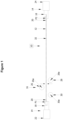
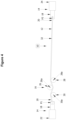
- the apparatus 10 shown in figures 1 to 4 could be an apparatus for artificial playing in a musical instrument string 12 comprising one or more wire(s) and/or band(s) wound around a core according to a special embodiment of the present invention or an apparatus for producing a musical instrument string 12 comprising one or more layers of wire(s) and/or band(s) wound around a core according to a special embodiment of the invention or part thereof.
- Said apparatus 10 comprises a string tensioning device 14 for clamping the musical instrument string 12 between two points P1 and P2 with a pull force fixed or variable in its longitudinal direction (in figure 1 corresponding to the horizontal direction) to keep it taut and a flexing device 16.
- the string tensioning device 14 comprises two fastening points e.q.
- the longitudinal ends 20 of the musical instrument string 12 are attached to said hooks 18.
- Said hooks 18 are connected to two motors, in this example two servomotors 22, 24, for turning said hooks 18, 18 in such a way that the musical instrument string 12 can be rotated around its longitudinal axis.
- Said servomotors 22 and 24 are configured to run synchronously, and in this example servomotor 22 is the master and servomotor 24 is the slave.
- the apparatus 10 also comprises a control device (not shown) for controlling the operation of the servomotors 22 and 24.
- the flexing device 16 comprises three rollers 26, 28 and 30 for flexing the musical instrument string 12 clamped between the two points P1 and P2.
- Said flexing device 16 is positioned in such a way that the axes 26a, 28a and 30a and thus the rollers 26, 28 and 30 are spaced laterally and longitudinally with reference to a line 32 collinear to the longitudinal direction of the musical instrument string 12 in its original position (as shown in figure 1 ) and the middle of the rollers 26,28 and 30 is positioned on the level with the musical instrument string 12.
- the axes 26a, 28a and 30a and thus the rollers 26, 28 and 30 are then moved in the transversal direction of the musical instrument string 12 towards the musical instrument string 12 so that the rollers touch the musical instrument string 12 and press against its surface, and at the same time give the musical instrument string 12 a defined deflection.
- This can be achieved, because the rollers 26, 28 and 30 are configured to be positioned in such a way that the musical instrument string 12 is stretched alternately to one side and to the other side of the line 32.
- the rollers 26, 28 and 30 are closed around the musical instrument string 12 with a defined movement of said 26, 28 and 30.
- the pull force in the longitudinal direction of the musical instrument string 12 may be readjusted to a defined pull force or during the process running adjusted to a defined pull force by a corresponding device or means (not shown).
- the flexing device 16 is now ready for the flexing process.
- the flexing rollers 26, 28 and 30 can be moved forth and back simultaneously in the direction of the line 32.
- the flexing device is moved a defined stroke in the longitudinal direction of the musical instrument string and in a defined area of the musical instrument string.
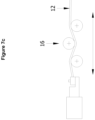
- the flexing device is moved a defined number of times in a forwarding and reciprocating movement in the longitudinal direction of the musical instrument string, while the closing position of the flexing apparatus is kept constant and the pull force in the longitudinal direction of the musical instrument string is kept constant or readjusted (see figure 3 ).
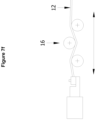
- the musical instrument string 12 can be rotated by for example 90° around the line 32 by way of simultaneously rotating the hooks 18, 18 through the servomotors 22 and 24. Said rotation can for example be done after a single pass of moving the rollers 26, 28 and 30 in one direction along the line 32 or after a multi pass.
- the rollers can be kept in closed position and thus in contact with the musical instrument string or opened, so there is no contact with the musical instrument string during the rotation.
- the servomotors 22 and 24 rotate the hooks 18, and the musical instrument string 12 for example 90°, and the musical instrument string 12 is then ready for the next step in the flexing process with a defined number of forwarding and reciprocating movements (see figure 4 ).
- the flexing process is carried out on the surface of the musical instrument string 12 and can be carried out in the whole or part of the length of the musical instrument string 12. It can be carried out on each of the different wound layers on the musical instrument string 12 or only on the last layer.
- the flexing process is carried out with the flexing device 16 with forwarding and reciprocating movements in the longitudinal direction of the musical instrument string 12 and from one or more sides.
- the flexing process can be carried out in the production of musical instrument strings with one or multiple core threads, (rope) core with an arbitrary number of for example metal or plastic threads/wires or for example multifilament core with an arbitrary number of for example synthetic fibers with wound arbitrary material in one to six layers upon each other.
- threads for example metal or plastic threads/wires or for example multifilament core with an arbitrary number of for example synthetic fibers with wound arbitrary material in one to six layers upon each other.
- the flexing process can be carried out on an arbitrary layer of wire and/or band wound around a musical instrument string core or wound on top of earlier wound layer(s) or primarily on the last wound layer.
- the musical instrument string is preferably held between two hooks with a defined pull force while the flexing rollers 26, 28, 30 are making forwarding and reciprocating movements controlled by the flexing apparatus/control device.
- the flexing process may be carried out with more movements forwarding and reciprocating on the surface of the musical instrument string and in more positions of the musical instrument string rotated around its longitudinal axis, either with a consecutive rotation or rotation of the musical instrument string in steps between one or more flexing movements (see also figure 3 ).
- the flexing process may be carried out with a variable adjusted flexing force (pressure from the flexing device 16), which is fixed during the whole flexing process or is carried out with a variable adjusted force, which moreover can be varied during the flexing process itself.
- the flexing process may be carried out arbitrarily chosen one or more times forwarding and reciprocating on the musical instrument string.
- the flexing process should be carried out in the whole length of the musical instrument string, in the playable area of the musical instrument string or just in one or more small arbitrary area(s) of the string.
- the flexing process may be carried out while the musical instrument string is kept still (no rotation). However, the flexing process can also be carried out while the musical instrument string rotates around its longitudinal axis, or the flexing process can be carried out in turn from more sides of the musical instrument string arbitrarily rotated in the positions for example 0°-90°-180°-270° between the flexing movements, preferably 90° at a time.
- the flexing process may be carried out with a flexing apparatus, which is working either manually or automatically.
- the transversal force from the rollers is defined by the number of the rollers and the position of the rollers.
- the transversal force on the surface of the musical instrument string can be varied by adjusting the position of the rollers between each other around the musical instrument string, the bending of the musical instrument string around the rollers on the flexing device and the pull force in the longitudinal direction of the musical instrument string.
- the longitudinal force on the string, the transversal force on the string, the bending around the rollers, the number of rollers, the number of flexing movements and the flexed area on the string define how effective the process of alignment and seating of the wire(s) and/or band(s) is carried out.
- the longitudinal force on the musical instrument string can be between 20 N to 200 N, preferably between 30 N to 100 N.
- the flexing process is carried out with two or more flexing rollers that roll on the surface of the musical instrument string and in that way exercise the musical instrument string.
- the number of the rollers can be chosen from 2 rollers to 8 rollers, preferably 2 rollers to 4 rollers.
- the diameter of the rollers and the longitudinal distance between the rollers as well as the overlap of the rollers perpendicularly to the longitudinal direction of the musical instrument string determine the bending of the musical instrument string and in that way how much the musical instrument string is flexed at each flexing movement (pass).
- the diameter of the rollers can vary from about 10 mm to about 50 mm, preferably 10 mm to 25 mm.
- the diameter of the different rollers in the flexing apparatus may be the same or different.
- the longitudinal distance A between the rollers center to center as for example the rollers 28 and 30 shown in figure 5a , and where A can be between 10 to 100 mm (depending of the diameter of the rollers), preferably between 20 to 60 mm.
- the overlap of the rollers perpendicularly to the longitudinal direction of the musical instrument string is defined by the transversal distance B between the rollers center to center, as for example the rollers 26 versus 28 and 30 shown in figure 5a , and where B can be between 0 mm to 25 mm (depending of the diameter of the rollers), preferably between 5 mm to 15 mm.
- the distance C between the opposite rollers on each side of the musical instrument string as for example the rollers 26 and 28 or 26 and 30 shown in figure 5a , and where C can be between 0 mm to 80 mm (depending of the diameter of the rollers), preferably between 0,5 mm to 20 mm.
- the rollers 26, 28 and 30 on the flexing apparatus may be designed for example with a smooth surface, with a V-shaped track, a half-round track or a square track in the surface (shown from left to right in figure 5b ).
- the roller surface can be coated or hardened.
- the flexing process may be carried out simultaneously from more sides on the musical instrument string with the flexing rollers placed at arbitrarily chosen angles in proportion to one another and still rolling on the string surface or for example in the positions 6 ⁇ 60°, 4 ⁇ 90°, 3 ⁇ 120° or 2 ⁇ 180° between the rollers 26, 28, 30, 31 as exemplarily shown in figure 6 , preferably 3 ⁇ 120° or 2 ⁇ 180°.
- the flexing process may be carried out in extension of the winding processes for each of the wound layers or as a flexing process on the surface of the finished musical instrument string, before any grinding of the surface of the musical instrument string is taking place.
- the flexing process can be carried out during the grinding of the musical instrument string.
- the musical instrument string is wound with one or more layers of wire and/or band wound upon previous layers, and then the mentioned flexing process is repeated for each layer.
- the finished musical instrument string is then grinded.
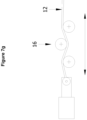
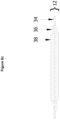
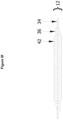
- Figures 7a to 7j show several steps of a method for producing a musical instrument string comprising one or more layers of wire(s) and/or band(s) wound around a core according to a special embodiment of the present invention.
- the apparatus shown in figures 1 to 4 can be used for carrying out said method.
- step 1 a core 34 is set up between two hooks, for example the hooks 18, 18 shown in figures 1 to 4 .
- a first layer 36 with for example round wire is helically wound on the core 34, clockwise or counter-clockwise (see figure 7b ).
- step 3 see figure 7c
- the musical instrument string 12 with said first layer 36 is flexed by way of for example the apparatus shown in figures 1 to 4 .
- step 4 the musical instrument string 12 is turned for example 90° and the flexing process is repeated on the first layer 36.
- step 5 a second layer 38 with wire or band is helically wound on the first layer 36.
- step 6 the flexing process is carried out on the second layer 38.
- step 7 the musical instrument string 12 is turned for example by 90° and the flexing process is repeated on the second layer 38.
- step X - (where X can be 8, 11 or 14) (see figure 7h ) a further layer 40 wire or band can be wound on the musical instrument string 12.
- step X+1 (see figure 7i ) the flexing process is carried out on the further layer 40.
- step X+2 (see figure 7j ) the musical instrument string 12 is turned for example 90°, and the flexing process is repeated on the further layer 40.
- the number of layers can be from 2 to 6 layers.
- a last layer 42 (which for example could be layer 40) is wound with a metal band, flexed on two sides and then grinded.
- Figures 8a to 8f show an alternative to the method shown in figures 7a to 7k . They show the production of a musical instrument string 12 with two layers of wire(s) and/or band(s) and flexing on only the last wound layer.
- a core 34 is setup between hooks, for example the hooks 18, 18 of the apparatus shown in figures 1 to 4 .
- step 2 a first layer 36 with wire or band is wound around the core 34.
- step 3 a second and last layer 38 with metal band is wound around the musical instrument string 12.
- step 4 the flexing process is carried out on the last layer 42.
- step 5 the musical instrument string 12 is turned for example 90°, and the flexing process is repeated on the last layer 42.
- the flexing process can be carried out in any combination of the two described examples on every wound layer, on selected wound layers or only on the last wound layer.
Landscapes
- Engineering & Computer Science (AREA)
- Physics & Mathematics (AREA)
- Acoustics & Sound (AREA)
- Multimedia (AREA)
- Manufacturing & Machinery (AREA)
- Mechanical Engineering (AREA)
- Toys (AREA)
- Wire Processing (AREA)
- Stringed Musical Instruments (AREA)
Claims (19)
- Verfahren zur Herstellung einer Musikinstrumentensaite (12), umfassend eine oder mehrere Schichten (36, 38, 40, 42) aus Draht/Drähten und/oder Band/Bändern, die um einen Kern (34) gewickelt ist/sind, wobei das Verfahren Durchführen eines Walkprozesses an der Musikinstrumentensaite (12), während die Musikinstrumentensaite (12) zwischen zwei Fixpunkte (P1, P2) geklemmt ist, mit einer vordefinierten konstanten Zugkraft oder einer variablen Zugkraft in der Längsrichtung der Musikinstrumentensaite, um die Saite straff zu halten, während der Herstellung als integrierten Teil der Herstellung an dem Wickelprozess oder nach dem Wickeln der letzten Schicht auf die Musikinstrumentensaite (12) umfasst,
dadurch gekennzeichnet, dass der Walkprozess vor dem Schleifen der Oberfläche der Musikinstrumentensaite (12) stattfindet, wobei der Walkprozess Anwenden einer definierten Kraft auf die Musikinstrumentensaite (12) in einer Richtung quer zu der Musikinstrumentensaite (12) mit einer Walkvorrichtung (16) umfasst, die mindestens zwei beabstandete Walkelemente umfasst, in denen die mindestens zwei Walkelemente Walzen (26, 28, 30) sind; und wobei der Walkprozess Biegen der Musiksaite um einen Teil einer Walze simultan zu sowohl einer Seite als auch der anderen Seite einer Linie (32) umfasst, die die ursprüngliche Position der Musikinstrumentensaite (12) umfasst, wenn sie zwischen die zwei Punkte (P1, P2) geklemmt ist. - Verfahren nach Anspruch 1, wobei der Walkprozess an der gesamten Länge der Musikinstrumentensaite (12) oder in dem spielbaren Bereich der Musikinstrumentensaite (12) oder nur einem oder mehreren willkürlichen Bereichen des spielbaren Bereichs der Musikinstrumentensaite durchgeführt wird.
- Verfahren nach Anspruch 1 oder 2, wobei der Walkprozess in einem einzigen Durchgang oder einem Mehrfachdurchgang nach dem Wickeln der letzten Schicht (42) auf die Musikinstrumentensaite (12) durchgeführt wird, wobei ein Einzeldurchgang eine Bewegung entlang der Saite in eine Richtung ist, und ein Mehrfachdurchgang mindestens eine Vorwärtsbewegung und eine Rückwärtsberegung entlang der Saite ist.
- Verfahren nach Anspruch 1 oder 2, wobei der Walkprozess in einem Einzeldurchgang oder einem Mehrfachdurchgang während der Herstellung der Musikinstrumentensaite (12), vorzugsweise an der letzten Schicht oder an jeder Schicht (36, 38, 40, 42) nach dem Wickeln von einer oder mehreren Schichten aus Draht/Drähten und/oder Band/Bändern um den Kern durchgeführt wird.
- Verfahren nach Anspruch 1 oder 2, wobei der Walkprozess in einem Mehrfachdurchgang bei der Herstellung einer Musikinstrumentensaite verwendet wird, wobei kurze Durchgänge in einem willkürlichen Bereich der Saite beginnen und sich dann in einem kurzen Bereich von diesem Ort aus oder alternativ breiteren und breiteren Durchgängen von dem Ausgangsort auf der Saite in einem breiteren und breiteren Bereich entlang der Saite bewegen.
- Verfahren nach einem der vorhergehenden Ansprüche, wobei die Musikinstrumentensaite (12) während des Walkens kontinuierlich oder diskontinuierlich in mehreren 90° Schritten um ihre Längsachse rotiert wird.
- Verfahren nach Anspruch 6, wobei die Musikinstrumentensaite (12) nach mindestens einem Durchgang von mehreren Durchgängen oder nach mehreren Durchgängen des Walkens um ihre Längsachse rotiert wird.
- Verfahren nach einem der vorhergehenden Ansprüche, wobei der Walkprozess Biegen der Musikinstrumentensaite (12) zu einer Seite und zu der anderen Seite einer Linie (32), die die ursprüngliche Position der Musikinstrumentensaite (12) repräsentiert, wenn sie zwischen zwei Punkte (P1, P2) geklemmt ist, durch mindestens zwei Walkelemente (16), die lateral und in Längsrichtung in Bezug zu der Linie (32) platziert sind, und gleichzeitiges Bewegen von mindestens den zwei Walkelementen relativ zu der Musikinstrumentensaite (12) über mindestens einen Bereich der Länge der Musikinstrumentensaite (12), vorzugsweise in einer hin und her gehenden Weise, umfasst.
- Verfahren nach Anspruch 8, wobei die relative Bewegung der Walkelemente mit einem manuell oder automatisch angetriebenen Apparat (16) oder mit einem handgeführten Apparat durchgeführt wird.
- Verfahren nach einem der Ansprüche 8 bis 9, wobei die Musikinstrumentensaite (12) um einen Teil einer Walze mit einer vordefinierten Kraft quer zu der Musikinstrumentensaite (12) gebogen wird.
- Verfahren nach einem der Ansprüche 8 bis 10, wobei die mindestens zwei Walkelemente Walzen (26, 28, 30) sind, vorzugsweise mit jeweiligen ausgerichteten ringförmigen Rillen darin, vorzugsweise rechtwinklig zu der Rotationsachse (26a, 28a, 30a) der Walzen (26, 28, 30), und wobei die Walzen (26, 28, 30) in einer solchen Weise angeordnet sind, dass sie während der Herstellung oder nach dem Spinnen der letzten Schicht auf der Oberfläche der Musikinstrumentensaite (12) laufen.
- Verfahren nach Anspruch 11, wobei der/die Durchmesser der Walzen (26, 28, 30) in einem Bereich von etwa 10 mm bis etwa 50 mm, vorzugsweise 10 mm bis 25 mm liegt/liegen.
- Verfahren nach Anspruch 12, wobei mindestens zwei Durchmesser der Walzen (26, 28, 30) identisch sind.
- Verfahren nach Anspruch 1, wobei das Verfahren umfasst:- Platzieren eines Kerns (34) entlang eines Weges,- Rotieren des Kerns (34) um seine Mittelachse, und spiraliges Wickeln von einer oder mehreren Schichten (36, 38, 40, 42) des Drahts/der Drähte und/oder des Bands/der Bänder darüber, und- während der Herstellung Walken des Produkts nach jeder Wicklung der einen oder mehreren Schichten (36, 38, 40, 42) aus Draht/Drähten und/oder Band/Bändern, wobei das Walken Anwenden einer definierten Kraft auf die Musikinstrumentensaite (12) in einer Richtung quer zu der Musikinstrumentensaite (12) umfasst.
- Verfahren nach Anspruch 14, wobei das Walken in einem jeweiligen Einzeldurchgang- oder Mehrfachdurchgangprozess durchgeführt wird.
- Apparat (10) zum Herstellen einer Musikinstrumentensaite (12), umfassend eine oder mehrere Schichten (36, 38, 40, 42) von Draht/Drähten und/oder Band/Bändern, die um einen Kern (34) gewickelt ist/sind, zum Durchführen eines Verfahrens gemäß einem der vorhergehenden Ansprüche, wobei der Apparat eine Saitenspannvorrichtung (14) zum Klemmen einer Musikinstrumentensaite (12) zwischen zwei Punkte (P1, P2) mit einer vordefinierten fixen oder variablen Zugkraft in der Längsrichtung der Saite, um sie straff zu halten, und eine Walkvorrichtung (16) umfasst, wobei die Walkvorrichtung (16) mindestens zwei beabstandete Walkelemente umfasst, die ausgestaltet sind, um in einer solchen Weise positioniert zu werden, dass die Musikinstrumentensaite (12) um einen Teil einer Walze gleichzeitig zu sowohl einer Seite als auch der anderen Seite einer Linie (32), die die ursprüngliche Position der Musikinstrumentensaite (12) repräsentiert, wenn sie zwischen zwei Punkte (P1, P2) geklemmt wird, gebogen wird.
- Apparat (10) nach Anspruch 16, wobei mindestens die zwei Walkelemente zwei bis acht Walzen (26, 28, 30), vorzugsweise zwei bis vier Walzen sind, die zur Rotation an jeweiligen Achsen (26a, 28a, 30a) rechtwinklig zu der Linie (32) angebracht sind.
- Apparat (10) nach Anspruch 16 zum Durchführen des Verfahrens nach Anspruch 14 oder 15, wobei der Apparat umfasst:- Mittel zum Klemmen eines fixierten Kerns (34) einer Musikinstrumentensaite (12), der fixiert ist, und zum spiraligen Wickeln von einer oder mehreren Schichten (36, 38, 40, 42) von Draht/Drähten und/oder Band/Bändern um den Kern, wenn der Kern (34) rotiert.
- Apparat nach Anspruch 18, wobei mindestens die zwei Walkelemente Walzen (26, 28, 30) sind, die zum Rollen auf jeweiligen Achsen (26a, 28a, 30a) rechtwinklig zu der Linie (32) angebracht sind, wobei insbesondere die Achsen (26a, 28a, 30a) parallel zueinander sind.
Applications Claiming Priority (1)
| Application Number | Priority Date | Filing Date | Title |
|---|---|---|---|
| PCT/EP2018/078379 WO2020078544A1 (en) | 2018-10-17 | 2018-10-17 | Method and apparatus for artificial playing-in a musical instrument string and method and apparatus for producing a musical instrument string |
Publications (2)
| Publication Number | Publication Date |
|---|---|
| EP3830818A1 EP3830818A1 (de) | 2021-06-09 |
| EP3830818B1 true EP3830818B1 (de) | 2024-12-04 |
Family
ID=63896190
Family Applications (1)
| Application Number | Title | Priority Date | Filing Date |
|---|---|---|---|
| EP18789126.2A Active EP3830818B1 (de) | 2018-10-17 | 2018-10-17 | Verfahren und vorrichtung zum künstlichen einspielen einer musikinstrumentensaite und verfahren und vorrichtung zur herstellung einer musikinstrumentensaite |
Country Status (6)
| Country | Link |
|---|---|
| US (1) | US11361738B2 (de) |
| EP (1) | EP3830818B1 (de) |
| CN (1) | CN112912950B (de) |
| DK (1) | DK3830818T3 (de) |
| ES (1) | ES3007661T3 (de) |
| WO (1) | WO2020078544A1 (de) |
Families Citing this family (3)
| Publication number | Priority date | Publication date | Assignee | Title |
|---|---|---|---|---|
| EP3830818B1 (de) | 2018-10-17 | 2024-12-04 | Larsen Strings A/S | Verfahren und vorrichtung zum künstlichen einspielen einer musikinstrumentensaite und verfahren und vorrichtung zur herstellung einer musikinstrumentensaite |
| CN113198953B (zh) * | 2021-03-31 | 2023-03-17 | 杭州晨龙智能科技有限公司 | 琴弦自动头拧系统及方法 |
| AT528480A1 (de) * | 2024-06-26 | 2026-01-15 | Zdenka Infeld Asset Man Gmbh | Maschine zur Herstellung einer Musiksaite |
Citations (1)
| Publication number | Priority date | Publication date | Assignee | Title |
|---|---|---|---|---|
| DE2736467A1 (de) * | 1977-08-12 | 1979-02-22 | Baldwin Co D H | Vorrichtung zum umwickeln von saiten fuer musikinstrumente |
Family Cites Families (24)
| Publication number | Priority date | Publication date | Assignee | Title |
|---|---|---|---|---|
| US1474778A (en) | 1920-04-10 | 1923-11-20 | Worcester Wire Works Inc | Method of and means for reducing, straightening, and winding wire |
| US1954525A (en) | 1931-02-17 | 1934-04-10 | Karl W Hallden | Wire straightening |
| US2049769A (en) | 1933-09-21 | 1936-08-04 | Charles B Gray | Musical instrument string |
| US2049770A (en) | 1935-10-16 | 1936-08-04 | Charles B Gray | Musical instrument string |
| US2641949A (en) | 1948-04-24 | 1953-06-16 | Jensen Povl Emanuel | Metal string for musical instruments |
| DE851450C (de) | 1949-11-29 | 1952-10-06 | Emil Kroo | Saite |
| DE963830C (de) | 1953-09-22 | 1957-05-16 | Karl Weidler | Metallsaite fuer Musikinstrumente |
| AT309188B (de) | 1968-08-28 | 1973-08-10 | Aristona Musiksaiten Fabrikati | Verfahren zur Herstellung einer Saite für Streichinstrumente |
| JPS5519107A (en) * | 1978-07-27 | 1980-02-09 | Kureha Chemical Ind Co Ltd | Gut and its preparation |
| US4338772A (en) | 1980-03-11 | 1982-07-13 | Sterlingworth Music, Inc. | Musical instrument string modifying device |
| US4326444A (en) | 1980-05-19 | 1982-04-27 | Markley Donald D | Musical instrument string |
| DE3226665A1 (de) | 1981-08-21 | 1983-03-17 | Barmag Barmer Maschinenfabrik Ag, 5630 Remscheid | Drahtrichtwerk |
| DE4211735A1 (de) | 1992-04-03 | 1993-10-07 | Thaelmann Schwermaschbau Veb | Verfahren und Vorrichtung zur Herstellung hochfester Stahldrahtlitzen |
| LT4453B (lt) | 1997-04-30 | 1999-01-25 | Julius Kurauskas | Muzikos instrumentų styga, stygų rinkinys klasikinei gitarai ir tokių stygų gamybos būdas |
| US6057498A (en) | 1999-01-28 | 2000-05-02 | Barney; Jonathan A. | Vibratory string for musical instrument |
| JP2003033801A (ja) * | 2001-07-19 | 2003-02-04 | Yanagawa Seisakusho:Kk | ギター等弦楽器用のステンレススチール製フレットワイヤーの製造方法 |
| US20070006712A1 (en) * | 2005-07-11 | 2007-01-11 | Lyles Cosmos M | Stringed instrument that maintains relative tune |
| CN101276578B (zh) * | 2007-03-26 | 2011-04-13 | 雅马哈株式会社 | 乐器用的弦及其制造方法 |
| EP2131352A1 (de) | 2008-05-30 | 2009-12-09 | Thomastik-Infeld Gesellschaft m.b.H. | Musiksaite |
| US20100071529A1 (en) * | 2008-07-11 | 2010-03-25 | Thomastik-Infeld Gesellschaft M.B.H. | Musical string |
| EP2704136A1 (de) * | 2012-09-04 | 2014-03-05 | Larsen Strings A/S | Dämpfungs- und Bindemittel für Musiksaiten |
| CA3032776A1 (en) | 2015-08-03 | 2017-02-09 | Hard Hat Ventures, Llc | Method and apparatus for repair of radial deformation of multi-strand wire |
| US9812098B2 (en) * | 2015-08-27 | 2017-11-07 | Dunlop Manufacturing, Inc. | Nano-polymer bonded musical instrument string |
| EP3830818B1 (de) | 2018-10-17 | 2024-12-04 | Larsen Strings A/S | Verfahren und vorrichtung zum künstlichen einspielen einer musikinstrumentensaite und verfahren und vorrichtung zur herstellung einer musikinstrumentensaite |
-
2018
- 2018-10-17 EP EP18789126.2A patent/EP3830818B1/de active Active
- 2018-10-17 CN CN201880098812.0A patent/CN112912950B/zh active Active
- 2018-10-17 ES ES18789126T patent/ES3007661T3/es active Active
- 2018-10-17 WO PCT/EP2018/078379 patent/WO2020078544A1/en not_active Ceased
- 2018-10-17 DK DK18789126.2T patent/DK3830818T3/da active
- 2018-10-17 US US17/286,436 patent/US11361738B2/en active Active
Patent Citations (1)
| Publication number | Priority date | Publication date | Assignee | Title |
|---|---|---|---|---|
| DE2736467A1 (de) * | 1977-08-12 | 1979-02-22 | Baldwin Co D H | Vorrichtung zum umwickeln von saiten fuer musikinstrumente |
Also Published As
| Publication number | Publication date |
|---|---|
| ES3007661T3 (en) | 2025-03-20 |
| WO2020078544A1 (en) | 2020-04-23 |
| DK3830818T3 (da) | 2025-03-03 |
| US11361738B2 (en) | 2022-06-14 |
| CN112912950A (zh) | 2021-06-04 |
| EP3830818A1 (de) | 2021-06-09 |
| CN112912950B (zh) | 2024-02-23 |
| US20210390929A1 (en) | 2021-12-16 |
Similar Documents
| Publication | Publication Date | Title |
|---|---|---|
| US11361738B2 (en) | Method and apparatus for artificial playing-in of a musical instrument string and method and apparatus for producing a musical instrument string | |
| US20220290343A1 (en) | System for in-line treatment of thread | |
| KR940003244B1 (ko) | 스키용 랩코어, 그 제조방법 및 그 제조장치와 상기 랩코어로 된 스키 | |
| JP2005508776A5 (de) | ||
| KR100391186B1 (ko) | 지지체상에실을적용하는방법및장치 | |
| WO2019039040A1 (ja) | ゴム被覆撚線コードの製造方法および装置 | |
| JP4314101B2 (ja) | フィラメントワインディング装置の給糸ユニット及びフィラメントワインディング装置並びに構造体の製造方法 | |
| US4089719A (en) | Method and apparatus for feeding reinforcing strand when making a tubular product | |
| KR20060097054A (ko) | 나란한 섬유들을 동일한 장력으로 뽑아내는 방법과 장치 | |
| US4602973A (en) | Manufacture of non-woven fabric | |
| US20190214891A1 (en) | Wire outlet nozzle arrangement | |
| CN111699527B (zh) | 用于制作弦的方法以及弦制作设备 | |
| FI82718B (fi) | Foerfarande foer framstaellning av staollinor och en maskin foer tvinning av staolling foer genomfoerande av foerfarandet. | |
| CN1666944A (zh) | 将线状物缠绕在成形辊上的方法和装置 | |
| US6688141B1 (en) | Method and device for braiding cables, cable leads, and sheathings | |
| EP1902440A1 (de) | Saiteninstrument, das seine relative stimmung behält | |
| KR102305269B1 (ko) | 다중 섬유 필라멘트 권선장치 및 이를 이용한 다중 섬유 필라멘트 권선방법 | |
| US11820705B2 (en) | Apparatus and method for controlling a quantity of binder resin that follows a thread | |
| JPH04263926A (ja) | タイヤカーカス製造方法およびその装置 | |
| JPS6314100B2 (de) | ||
| JPS61230929A (ja) | 繊維強化有機マトリクスからなる物体を支持体上への前記繊維の巻装によつて形成する方法及び該方法を実施するための装置 | |
| KR101907796B1 (ko) | 소프트 액츄에이터 제조장치 및 이를 이용한 소프트 액츄에이터 제조방법 | |
| JP7197293B2 (ja) | 繊維束を延展する装置および方法 | |
| US5393364A (en) | Method and device for applying a plurality of threads to a support with the aid of flexible teeth | |
| AU2019100209A4 (en) | Device and method for the continuous production of a multilayer strand from a fibre material |
Legal Events
| Date | Code | Title | Description |
|---|---|---|---|
| STAA | Information on the status of an ep patent application or granted ep patent |
Free format text: STATUS: UNKNOWN |
|
| STAA | Information on the status of an ep patent application or granted ep patent |
Free format text: STATUS: THE INTERNATIONAL PUBLICATION HAS BEEN MADE |
|
| PUAI | Public reference made under article 153(3) epc to a published international application that has entered the european phase |
Free format text: ORIGINAL CODE: 0009012 |
|
| STAA | Information on the status of an ep patent application or granted ep patent |
Free format text: STATUS: REQUEST FOR EXAMINATION WAS MADE |
|
| 17P | Request for examination filed |
Effective date: 20210226 |
|
| AK | Designated contracting states |
Kind code of ref document: A1 Designated state(s): AL AT BE BG CH CY CZ DE DK EE ES FI FR GB GR HR HU IE IS IT LI LT LU LV MC MK MT NL NO PL PT RO RS SE SI SK SM TR |
|
| DAV | Request for validation of the european patent (deleted) | ||
| DAX | Request for extension of the european patent (deleted) | ||
| TPAC | Observations filed by third parties |
Free format text: ORIGINAL CODE: EPIDOSNTIPA |
|
| TPAC | Observations filed by third parties |
Free format text: ORIGINAL CODE: EPIDOSNTIPA |
|
| TPAC | Observations filed by third parties |
Free format text: ORIGINAL CODE: EPIDOSNTIPA |
|
| STAA | Information on the status of an ep patent application or granted ep patent |
Free format text: STATUS: EXAMINATION IS IN PROGRESS |
|
| 17Q | First examination report despatched |
Effective date: 20221116 |
|
| TPAC | Observations filed by third parties |
Free format text: ORIGINAL CODE: EPIDOSNTIPA |
|
| GRAP | Despatch of communication of intention to grant a patent |
Free format text: ORIGINAL CODE: EPIDOSNIGR1 |
|
| STAA | Information on the status of an ep patent application or granted ep patent |
Free format text: STATUS: GRANT OF PATENT IS INTENDED |
|
| INTG | Intention to grant announced |
Effective date: 20240523 |
|
| GRAS | Grant fee paid |
Free format text: ORIGINAL CODE: EPIDOSNIGR3 |
|
| GRAA | (expected) grant |
Free format text: ORIGINAL CODE: 0009210 |
|
| STAA | Information on the status of an ep patent application or granted ep patent |
Free format text: STATUS: THE PATENT HAS BEEN GRANTED |
|
| AK | Designated contracting states |
Kind code of ref document: B1 Designated state(s): AL AT BE BG CH CY CZ DE DK EE ES FI FR GB GR HR HU IE IS IT LI LT LU LV MC MK MT NL NO PL PT RO RS SE SI SK SM TR |
|
| REG | Reference to a national code |
Ref country code: GB Ref legal event code: FG4D |
|
| REG | Reference to a national code |
Ref country code: CH Ref legal event code: EP |
|
| REG | Reference to a national code |
Ref country code: DE Ref legal event code: R096 Ref document number: 602018077266 Country of ref document: DE |
|
| REG | Reference to a national code |
Ref country code: IE Ref legal event code: FG4D |
|
| REG | Reference to a national code |
Ref country code: DK Ref legal event code: T3 Effective date: 20250225 |
|
| REG | Reference to a national code |
Ref country code: NL Ref legal event code: FP |
|
| REG | Reference to a national code |
Ref country code: ES Ref legal event code: FG2A Ref document number: 3007661 Country of ref document: ES Kind code of ref document: T3 Effective date: 20250320 |
|
| REG | Reference to a national code |
Ref country code: LT Ref legal event code: MG9D |
|
| PG25 | Lapsed in a contracting state [announced via postgrant information from national office to epo] |
Ref country code: HR Free format text: LAPSE BECAUSE OF FAILURE TO SUBMIT A TRANSLATION OF THE DESCRIPTION OR TO PAY THE FEE WITHIN THE PRESCRIBED TIME-LIMIT Effective date: 20241204 |
|
| PG25 | Lapsed in a contracting state [announced via postgrant information from national office to epo] |
Ref country code: FI Free format text: LAPSE BECAUSE OF FAILURE TO SUBMIT A TRANSLATION OF THE DESCRIPTION OR TO PAY THE FEE WITHIN THE PRESCRIBED TIME-LIMIT Effective date: 20241204 |
|
| PG25 | Lapsed in a contracting state [announced via postgrant information from national office to epo] |
Ref country code: BG Free format text: LAPSE BECAUSE OF FAILURE TO SUBMIT A TRANSLATION OF THE DESCRIPTION OR TO PAY THE FEE WITHIN THE PRESCRIBED TIME-LIMIT Effective date: 20241204 |
|
| PG25 | Lapsed in a contracting state [announced via postgrant information from national office to epo] |
Ref country code: NO Free format text: LAPSE BECAUSE OF FAILURE TO SUBMIT A TRANSLATION OF THE DESCRIPTION OR TO PAY THE FEE WITHIN THE PRESCRIBED TIME-LIMIT Effective date: 20250304 |
|
| PG25 | Lapsed in a contracting state [announced via postgrant information from national office to epo] |
Ref country code: LV Free format text: LAPSE BECAUSE OF FAILURE TO SUBMIT A TRANSLATION OF THE DESCRIPTION OR TO PAY THE FEE WITHIN THE PRESCRIBED TIME-LIMIT Effective date: 20241204 Ref country code: GR Free format text: LAPSE BECAUSE OF FAILURE TO SUBMIT A TRANSLATION OF THE DESCRIPTION OR TO PAY THE FEE WITHIN THE PRESCRIBED TIME-LIMIT Effective date: 20250305 |
|
| PG25 | Lapsed in a contracting state [announced via postgrant information from national office to epo] |
Ref country code: RS Free format text: LAPSE BECAUSE OF FAILURE TO SUBMIT A TRANSLATION OF THE DESCRIPTION OR TO PAY THE FEE WITHIN THE PRESCRIBED TIME-LIMIT Effective date: 20250304 |
|
| PG25 | Lapsed in a contracting state [announced via postgrant information from national office to epo] |
Ref country code: SM Free format text: LAPSE BECAUSE OF FAILURE TO SUBMIT A TRANSLATION OF THE DESCRIPTION OR TO PAY THE FEE WITHIN THE PRESCRIBED TIME-LIMIT Effective date: 20241204 |
|
| PG25 | Lapsed in a contracting state [announced via postgrant information from national office to epo] |
Ref country code: PL Free format text: LAPSE BECAUSE OF FAILURE TO SUBMIT A TRANSLATION OF THE DESCRIPTION OR TO PAY THE FEE WITHIN THE PRESCRIBED TIME-LIMIT Effective date: 20241204 |
|
| PG25 | Lapsed in a contracting state [announced via postgrant information from national office to epo] |
Ref country code: IS Free format text: LAPSE BECAUSE OF FAILURE TO SUBMIT A TRANSLATION OF THE DESCRIPTION OR TO PAY THE FEE WITHIN THE PRESCRIBED TIME-LIMIT Effective date: 20250404 |
|
| PG25 | Lapsed in a contracting state [announced via postgrant information from national office to epo] |
Ref country code: PT Free format text: LAPSE BECAUSE OF FAILURE TO SUBMIT A TRANSLATION OF THE DESCRIPTION OR TO PAY THE FEE WITHIN THE PRESCRIBED TIME-LIMIT Effective date: 20250404 |
|
| PG25 | Lapsed in a contracting state [announced via postgrant information from national office to epo] |
Ref country code: EE Free format text: LAPSE BECAUSE OF FAILURE TO SUBMIT A TRANSLATION OF THE DESCRIPTION OR TO PAY THE FEE WITHIN THE PRESCRIBED TIME-LIMIT Effective date: 20241204 |
|
| PG25 | Lapsed in a contracting state [announced via postgrant information from national office to epo] |
Ref country code: RO Free format text: LAPSE BECAUSE OF FAILURE TO SUBMIT A TRANSLATION OF THE DESCRIPTION OR TO PAY THE FEE WITHIN THE PRESCRIBED TIME-LIMIT Effective date: 20241204 |
|
| PG25 | Lapsed in a contracting state [announced via postgrant information from national office to epo] |
Ref country code: SK Free format text: LAPSE BECAUSE OF FAILURE TO SUBMIT A TRANSLATION OF THE DESCRIPTION OR TO PAY THE FEE WITHIN THE PRESCRIBED TIME-LIMIT Effective date: 20241204 |
|
| PG25 | Lapsed in a contracting state [announced via postgrant information from national office to epo] |
Ref country code: CZ Free format text: LAPSE BECAUSE OF FAILURE TO SUBMIT A TRANSLATION OF THE DESCRIPTION OR TO PAY THE FEE WITHIN THE PRESCRIBED TIME-LIMIT Effective date: 20241204 |
|
| PG25 | Lapsed in a contracting state [announced via postgrant information from national office to epo] |
Ref country code: IT Free format text: LAPSE BECAUSE OF FAILURE TO SUBMIT A TRANSLATION OF THE DESCRIPTION OR TO PAY THE FEE WITHIN THE PRESCRIBED TIME-LIMIT Effective date: 20241204 |
|
| REG | Reference to a national code |
Ref country code: DE Ref legal event code: R097 Ref document number: 602018077266 Country of ref document: DE |
|
| PG25 | Lapsed in a contracting state [announced via postgrant information from national office to epo] |
Ref country code: SE Free format text: LAPSE BECAUSE OF FAILURE TO SUBMIT A TRANSLATION OF THE DESCRIPTION OR TO PAY THE FEE WITHIN THE PRESCRIBED TIME-LIMIT Effective date: 20241204 |
|
| PLBE | No opposition filed within time limit |
Free format text: ORIGINAL CODE: 0009261 |
|
| STAA | Information on the status of an ep patent application or granted ep patent |
Free format text: STATUS: NO OPPOSITION FILED WITHIN TIME LIMIT |
|
| 26N | No opposition filed |
Effective date: 20250905 |
|
| PGFP | Annual fee paid to national office [announced via postgrant information from national office to epo] |
Ref country code: NL Payment date: 20251024 Year of fee payment: 8 |
|
| PGFP | Annual fee paid to national office [announced via postgrant information from national office to epo] |
Ref country code: DE Payment date: 20251028 Year of fee payment: 8 |
|
| PGFP | Annual fee paid to national office [announced via postgrant information from national office to epo] |
Ref country code: GB Payment date: 20251023 Year of fee payment: 8 |
|
| PGFP | Annual fee paid to national office [announced via postgrant information from national office to epo] |
Ref country code: AT Payment date: 20251020 Year of fee payment: 8 |
|
| PGFP | Annual fee paid to national office [announced via postgrant information from national office to epo] |
Ref country code: DK Payment date: 20251024 Year of fee payment: 8 |
|
| PGFP | Annual fee paid to national office [announced via postgrant information from national office to epo] |
Ref country code: FR Payment date: 20251027 Year of fee payment: 8 |
|
| PGFP | Annual fee paid to national office [announced via postgrant information from national office to epo] |
Ref country code: ES Payment date: 20251118 Year of fee payment: 8 |
|
| REG | Reference to a national code |
Ref country code: AT Ref legal event code: UEP Ref document number: 1749026 Country of ref document: AT Kind code of ref document: T Effective date: 20241204 |