EP3825302B1 - Fatty acid derivative labeled with positron-emitting radionuclide - Google Patents
Fatty acid derivative labeled with positron-emitting radionuclide Download PDFInfo
- Publication number
- EP3825302B1 EP3825302B1 EP19837826.7A EP19837826A EP3825302B1 EP 3825302 B1 EP3825302 B1 EP 3825302B1 EP 19837826 A EP19837826 A EP 19837826A EP 3825302 B1 EP3825302 B1 EP 3825302B1
- Authority
- EP
- European Patent Office
- Prior art keywords
- fatty acid
- salt
- compound
- acid derivative
- fto
- Prior art date
- Legal status (The legal status is an assumption and is not a legal conclusion. Google has not performed a legal analysis and makes no representation as to the accuracy of the status listed.)
- Active
Links
Images

Classifications
-
- C—CHEMISTRY; METALLURGY
- C07—ORGANIC CHEMISTRY
- C07C—ACYCLIC OR CARBOCYCLIC COMPOUNDS
- C07C323/00—Thiols, sulfides, hydropolysulfides or polysulfides substituted by halogen, oxygen or nitrogen atoms, or by sulfur atoms not being part of thio groups
- C07C323/50—Thiols, sulfides, hydropolysulfides or polysulfides substituted by halogen, oxygen or nitrogen atoms, or by sulfur atoms not being part of thio groups containing thio groups and carboxyl groups bound to the same carbon skeleton
- C07C323/51—Thiols, sulfides, hydropolysulfides or polysulfides substituted by halogen, oxygen or nitrogen atoms, or by sulfur atoms not being part of thio groups containing thio groups and carboxyl groups bound to the same carbon skeleton having the sulfur atoms of the thio groups bound to acyclic carbon atoms of the carbon skeleton
- C07C323/54—Thiols, sulfides, hydropolysulfides or polysulfides substituted by halogen, oxygen or nitrogen atoms, or by sulfur atoms not being part of thio groups containing thio groups and carboxyl groups bound to the same carbon skeleton having the sulfur atoms of the thio groups bound to acyclic carbon atoms of the carbon skeleton the carbon skeleton being acyclic and unsaturated
-
- A—HUMAN NECESSITIES
- A61—MEDICAL OR VETERINARY SCIENCE; HYGIENE
- A61K—PREPARATIONS FOR MEDICAL, DENTAL OR TOILETRY PURPOSES
- A61K51/00—Preparations containing radioactive substances for use in therapy or testing in vivo
- A61K51/02—Preparations containing radioactive substances for use in therapy or testing in vivo characterised by the carrier, i.e. characterised by the agent or material covalently linked or complexing the radioactive nucleus
- A61K51/04—Organic compounds
- A61K51/0402—Organic compounds carboxylic acid carriers, fatty acids
-
- C—CHEMISTRY; METALLURGY
- C07—ORGANIC CHEMISTRY
- C07B—GENERAL METHODS OF ORGANIC CHEMISTRY; APPARATUS THEREFOR
- C07B59/00—Introduction of isotopes of elements into organic compounds ; Labelled organic compounds per se
- C07B59/001—Acyclic or carbocyclic compounds
-
- C—CHEMISTRY; METALLURGY
- C07—ORGANIC CHEMISTRY
- C07C—ACYCLIC OR CARBOCYCLIC COMPOUNDS
- C07C323/00—Thiols, sulfides, hydropolysulfides or polysulfides substituted by halogen, oxygen or nitrogen atoms, or by sulfur atoms not being part of thio groups
- C07C323/50—Thiols, sulfides, hydropolysulfides or polysulfides substituted by halogen, oxygen or nitrogen atoms, or by sulfur atoms not being part of thio groups containing thio groups and carboxyl groups bound to the same carbon skeleton
- C07C323/51—Thiols, sulfides, hydropolysulfides or polysulfides substituted by halogen, oxygen or nitrogen atoms, or by sulfur atoms not being part of thio groups containing thio groups and carboxyl groups bound to the same carbon skeleton having the sulfur atoms of the thio groups bound to acyclic carbon atoms of the carbon skeleton
- C07C323/52—Thiols, sulfides, hydropolysulfides or polysulfides substituted by halogen, oxygen or nitrogen atoms, or by sulfur atoms not being part of thio groups containing thio groups and carboxyl groups bound to the same carbon skeleton having the sulfur atoms of the thio groups bound to acyclic carbon atoms of the carbon skeleton the carbon skeleton being acyclic and saturated
-
- G—PHYSICS
- G01—MEASURING; TESTING
- G01T—MEASUREMENT OF NUCLEAR OR X-RADIATION
- G01T1/00—Measuring X-radiation, gamma radiation, corpuscular radiation, or cosmic radiation
- G01T1/16—Measuring radiation intensity
- G01T1/161—Applications in the field of nuclear medicine, e.g. in vivo counting
-
- A—HUMAN NECESSITIES
- A61—MEDICAL OR VETERINARY SCIENCE; HYGIENE
- A61K—PREPARATIONS FOR MEDICAL, DENTAL OR TOILETRY PURPOSES
- A61K2123/00—Preparations for testing in vivo
-
- C—CHEMISTRY; METALLURGY
- C07—ORGANIC CHEMISTRY
- C07B—GENERAL METHODS OF ORGANIC CHEMISTRY; APPARATUS THEREFOR
- C07B2200/00—Indexing scheme relating to specific properties of organic compounds
- C07B2200/05—Isotopically modified compounds, e.g. labelled
Definitions
- the present invention relates to a fatty acid derivative labeled with a positron-emitting radionuclide or a salt thereof, to the labeled fatty acid derivative for use as a diagnostic agent, and a method for producing the labeled fatty acid derivative. Further, the present invention relates to a composition for use in a method for diagnostic imaging containing the labeled fatty acid derivative or a salt thereof, and a kit for preparing the same.
- the heart requires a large amount of adenosine triphosphate (ATP) to pump blood throughout the body, most of which is produced by oxidative metabolism in mitochondria.
- ATP adenosine triphosphate
- Various substrates such as fatty acids, glucose, and the like are metabolized in the heart muscle, but in a state in which oxygen is distributed to the heart muscle, about 60% to 90% of the required ATP is produced by ⁇ -oxidation of fatty acids.
- ATP adenosine triphosphate
- This quantification of fatty acid metabolic activity is carried out by positron emission tomography (PET) or single photon emission computed tomography (SPECT) using a labeled long-chain fatty acid derivative as a radiolabeled tracer.
- PET positron emission tomography
- SPECT single photon emission computed tomography
- a radiolabeled tracer used for SPECT 15-(p-[ 123 I]iodophenyl)-3(R,S)-methylpentadecanoic acid (hereinafter, abbreviated as [ 123 I]BMIPP) represented by the following formula has been reported (Non-Patent Document 1), and has been actually used in clinical practice for diagnosing heart disease.
- Me represents a methyl group. The same shall apply hereinafter.
- [ 123 I]BMIPP used as a tracer for diagnostic imaging by SPECT has a problem of low sensitivity and resolution, and although [ 18 F]FTP and [ 18 F]FTO as the tracer used for diagnostic imaging by PET are superior in SPECT using the [ 123 I]BMIPP, further improvement in sensitivity and resolution is required for more accurate diagnosis.
- CN 105 523 977 A discloses 11 C radiolabeled omega-mercaptomethyl fatty acids as myocardial metabolism imaging agents.
- Patent Document 1 International Publication No. 2000/063216
- ⁇ -oxidation and ⁇ -oxidation are present in the oxidative metabolism pathway of long-chain fatty acids.
- fatty acids are metabolized from the terminal side away from the carboxyl group to generate [ 18 F]fluoride ions in the process of metabolism, and [ 18 F]sodium fluoride has accumulation to the bone. Therefore, it is assumed that the [ 18 F]fluoride ions generated in the process of metabolism of [ 18 F]FTO may be the cause of non-specific accumulation to the bone.
- a labeled fatty acid derivative represented by the formula (I) in which [ 18 F]fluorine is substituted on the carbon atom between the sulfur atom and the double bond of 3- ⁇ [(5Z)-tetradeca-5-en-1-yl]sulfanyl ⁇ propanoic acid can be used as a radiolabeled tracer which has low accumulation of [ 18 F]fluorine to the bone compared to the conventional [ 18 F]FTO, is selectively accumulated in the heart, and enables imaging of fatty acid metabolism in the heart muscle with high sensitivity, and thus have completed the present invention.
- the present invention relates to
- any one of R 1 to R 3 is 18 F, and the other two are H, and Me is a methyl group.
- the labeled fatty acid derivative represented by the formula (I) according to the present invention or a salt thereof does not cause an increase in background value due to accumulation in the bone compared to [ 18 F]FTO which is a known labeled fatty acid, has excellent accumulation to the heart muscle and enables imaging of fatty acid metabolic activity by PET. Therefore, the labeled fatty acid derivative represented by the formula (I) according to the present invention or a salt thereof can be used as a radiolabeled tracer in a method for sorting heart disease patients, and a method of diagnostic imaging of the therapeutic effect of a therapeutic drug for heart disease.
- An embodiment of a labeled fatty acid derivative represented by the formula (I) according to the present invention or a salt thereof is a labeled fatty acid derivative in which R 1 is H, or a salt thereof.
- An embodiment of the labeled fatty acid derivative represented by the formula (I) of the present invention or a salt thereof is a labeled fatty acid derivative selected from the following group or a salt thereof.
- the labeled fatty acid derivative represented by the formula (I) of the present invention or a salt thereof is used as a radiolabeled tracer in a method for diagnostic imaging such as PET.
- the labeled fatty acid derivative of the present invention has accumulation in the heart muscle in a biological body, enables imaging of fatty acid metabolic activity by PET and a similar imaging method, and is used in a method for diagnostic imaging of heart disease, particularly, ischemic heart disease.
- a planar positron imaging system PPIS which a device that acquires planar accumulated images instead of tomographic images can be used in addition to a PET system for small animals.
- the labeled fatty acid derivative can be used in a diagnostic autoradiography method, which is image analysis means for a sections of extracted organs, and in a diagnostic method for evaluation of accumulation in extracted organs using a gamma counter.
- the positron-emitting radionuclide used in the labeled fatty acid derivative of the present invention is 18 F.
- 18 F is produced by a device called a cyclotron.
- the 18 F produced can be used to label the compound represented by the formula (I).
- a desired nuclide is obtained from a (ultra) small cyclotron installed in a facility to be used, the labeled fatty acid derivative represented by the formula (I) of the present invention or a salt thereof is produced by a method known in the art, and thus a composition for diagnostic imaging can be prepared.
- the labeled fatty acid derivative represented by the formula (I) of the present invention or a salt thereof may have an asymmetric center, and an enantiomer (optical isomer) based on the asymmetric center may be present.
- the compound represented by the formula (I) or a salt thereof includes any of isolated individual enantiomers such as an (R) body and an (S) body, and mixtures thereof (including a racemic mixture or a non-racemic mixture).
- the labeled fatty acid derivative represented by the formula (I) of the present invention may form salts depending on conditions, and these salts are also included in the present invention.
- the salts include salts with inorganic bases such as sodium, potassium, magnesium, calcium, aluminum, and the like, salts with organic bases such as methylamine, ethylamine, ethanolamine, lysine, ornithine, and the like, salts with various amino acids and amino acid derivatives such as acetylleucine, ammonium salts, and the like.
- the labeled fatty acid derivative represented by the formula (I) of the present invention or a salt thereof may be provided as a hydrate, a solvate, or a crystal polymorphic substance, and the present invention includes these forms.
- the present invention includes an intermediate compound, which can be converted into the labeled fatty acid derivative represented by the formula (I) or a salt thereof, or a salt thereof.
- Examples of the "intermediate compound which can be converted into the labeled fatty acid derivative represented by the formula (I) or a salt thereof" include a compound represented by the formula (1i).
- Another embodiment includes a compound represented by the formula (1h), which is a precursor of the compound represented by the formula (1i).
- any one of Y 1 to Y 3 is OH, and the other two are H.
- Any one of R 11 to R 31 is a leaving group, and the other two are H.
- R' is H or a lower alkyl group which may be substituted. The same shall apply hereinafter.
- the present invention also includes a method for producing the labeled fatty acid derivative represented by the formula (I) or a salt thereof including a step of allowing a [ 18 F]fluoride ion to react with the intermediate compound, which can be converted into the labeled fatty acid derivative represented by the formula (I) or a salt thereof, or a salt thereof.
- the present invention includes at least a kit for preparing a composition for use in a method of diagnostic imaging containing the intermediate compound, which can be converted into the labeled fatty acid derivative represented by formula (I) or a salt thereof, or a salt thereof.
- An embodiment of the kit of the present invention is a kit for rapid synthesis of the labeled fatty acid derivative of the present invention.
- the kit includes a kit for preparing a composition for use in a method of diagnostic imaging containing the intermediate compound, which can be converted into the labeled fatty acid derivative represented by the formula (I) or a salt thereof, or a salt thereof, and a reagent for labeling 18 F, and is a kit containing other reagents, solvents, and the like if desired.
- the kit can be used for preparing the composition for use in a method of diagnostic imaging of the present invention as required.
- the kit can also include instruments such as a reaction vessel, a device for transferring isotopic material to the reaction vessel, a prepacked separation column for separating a product from excess reactants, a shield, and the like as known in the art.
- the "reagent for labeling 18 F” is a reagent containing [ 18 F]fluoride ions, and examples thereof include [ 18 F]TBAF, [ 18 F]KF, and the like.
- the "lower alkyl” is a linear or branched alkyl having 1 to 6 carbon atoms (hereinafter, also referred to as C 1-6 ), and examples thereof include methyl, ethyl, n-propyl, isopropyl, n-butyl, isobutyl, s-butyl, t-butyl, n-pentyl, n-hexyl, and the like.
- the lower alkyl is C 1-4 alkyl, as another embodiment, methyl, ethyl or t-butyl, and as still another embodiment, methyl.
- the "leaving group” means a substituent that is eliminated by a nucleophilic substitution reaction, and is selected from a sulfonyl group and halogen.
- the sulfonyl group include a p-toluenesulfonyloxy group, a p-nitrobenzenesulfonyloxy group, a methanesulfonyloxy group, a trifluoromethanesulfonyloxy group and the like, and as one embodiment, the sulfonyl group is a p-toluenesulfonyloxy group or a p-nitrobenzenesulfonyloxy group.
- the halogen include Cl, Br, and I, , and as one embodiment, the halogen is Br.
- composition for use in a method of diagnostic imaging including the labeled fatty acid derivative or a salt thereof according to any one of (1-1) to (1-4), and a pharmaceutically acceptable carrier.
- (6-1) A compound represented by formula (1i) or a salt thereof.
- (6-6) The compound or a salt thereof according to any one of (6-2) to (6-5), in which the leaving group is a p-toluenesulfonyloxy group, a p-nitrobenzenesulfonyloxy group, or a bromo group.
- the labeled fatty acid derivative represented by the formula (I) or a salt thereof can be produced by applying various known synthetic methods using its basic structure or properties based on the type of substituent. At that time, depending on the type of functional group, in terms of production technology, it is effective to replace the functional group with an appropriate protective group (a group that can be easily converted to the functional group) at the stage from the starting material to the intermediate in some cases.
- an appropriate protective group a group that can be easily converted to the functional group
- protective groups include the protective groups described in "Greene's Protective Groups in Organic Synthesis (5th Edition, 2014)" by P.G.M. Wuts, and the like, and depending on the reaction conditions thereof, the protective group may be appropriately selected and used. In such a method, a desired compound can be obtained by introducing the protective group to carry out the reaction, and then removing the protective group as required.
- AlkylFluor 1,3-bis(2,6-diisopropylphenyl)-2-fluoroimidazolium tetrafluoroborate
- DBU 1,8-diazabicyclo[5.4.0]-7-undecene
- EtOAc ethyl acetate
- HMPA hexamethylphosphoric acid triamide
- MeCN acetonitrile
- MeOH methanol
- Nos p-nitrobenzenesulfonyl
- Ph phenyl
- TBAF tetra-n-butylammonium fluoride
- TBDMS t-butyldimethylsilyl
- TBDPS t-butyldiphenylsilyl
- TFA trifluoroacetic acid
- THF tetrahydrofuran
- THP tetrahydropyran-2-yl
- Ts p-toluenesulfonyl
- any one of X 1 , X 2 , and X 3 is OPg 2 , and the other two are H.
- Pg 1 and Pg 2 each represent a protective group.
- the protective group include TBDMS, TBDPS, trimethylsilyl, triethylsilyl, triisopropylsilyl, methoxymethyl, 1-ethoxyethyl, [2-(trimethylsilyl)ethoxy]methyl, THP, and p-methoxybenzyl, and as one embodiment, the protective group is TBDMS, TBDPS, or THP. The same shall apply hereinafter.
- Compound (1c) can be produced from compound (1a) and compound (1b).
- the reaction is carried out by performing stirring in a solvent inert to the reaction in the presence of a base at -78°C to room temperature usually for 0.1 hours to 3 days.
- a solvent include THF, 1,4-dioxane, HMPA, and the like, and a mixture thereof.
- the base include potassium hexamethyldisilazide, potassium-t-butoxide, and the like.
- Compound (1d) can be produced by deprotecting a protective group Pg 1 of compound (1c).
- Deprotection can be carried out using a method well known to those of skill in the art, and for example, deprotection can be carried out by performing stirring in a solvent inert to the reaction in the presence of a fluorine reagent or acid at -78°C to room temperature usually for 0.1 hours to 3 days.
- fluorine reagent include TBAF, pyridine hydrofluoric acid, and the like, and acetic acid may be added at this time.
- the acid include hydrochloric acid, p-toluenesulfonic acid, and the like.
- Compound (1e) can be produced by converting the hydroxyl group of compound (1d) into iodine by an iodination reaction.
- the iodination reaction is carried out by stirring compound (1d) and iodine in a solvent inert to the reaction in the presence of triphenylphosphine and a base at room temperature under ice cooling usually for 0.1 hours to 3 days.
- the base include imidazole, trimethylamine, and the like.
- the solvent include dichloromethane, THF, and the like.
- R' represents H or a lower alkyl group which may be substituted. The same shall apply hereinafter.
- Compound (1g) can be produced from compound (1e) and compound (1f).
- the reaction is carried out by performing stirring compound (1e) and compound (1f) in a solvent inert to the reaction in the presence of a base at ice cooling to room temperature usually for 0.1 hours to 3 days.
- a solvent include THF, 1,4-dioxane, and the like.
- the base include sodium hydride, potassium-t-butoxide, and the like.
- Compound (1h) can be produced by deprotecting a protective group Pg 2 of compound (1g). Deprotection can be carried out in the same manner as in the second step.
- Compound (1i) can be produced by converting the hydroxyl group of compound (1h) into a leaving group as defined above.
- the leaving group is a sulfonyl group
- compound (1h) and a sulfonylating agent are stirred in a solvent inert to the reaction in the presence of a base at ice cooling to room temperature usually for 0.1 hours to 3 days.
- the sulfonylating agent include chloride (p-toluenesulfonyl), chloride (p-nitrobenzenesulfonyl), chloride (methanesulfonyl), trifluoromethanesulfonic anhydride, and the like.
- the solvent include dichloromethane, THF, and the like.
- the base include triethylamine, diisopropylethylamine, and the like. At this time, trimethylamine hydrochloride may be added.
- compound (1h) and a halogenating agent are stirred in a solvent inert to the reaction in the presence of triphenylphosphine at ice cooling to room temperature usually for 0.1 hours to 3 hours.
- the halogenating agent include carbon tetrabromide, iodine, and the like.
- the solvent include carbon tetrachloride, dichloromethane, THF, and the like.
- a base such as imidazole, trimethylamine, or the like may be added.
- R 11 is a leaving group as defined above
- R 1 is 18 F
- R 11 is H
- R 1 is H
- R 21 is a leaving group as defined above
- R 2 is 18 F
- R 21 is H
- R 2 is H
- R 31 is a leaving group as defined above
- R 3 is 18 F
- R 31 is H, R 3 is H.
- Compound (1j) can be produced by, for example, causing a reaction of compound (1i) and a [ 18 F]fluoride ion aqueous solution, [ 18 F]tetra-n-butylammonium fluoride ([ 18 F]TBAF), [ 18 F]KF, or the like, which is a reagent containing a positron-emitting radionuclide 18 F produced by a cyclotron by a method well known to those skilled in the art, under heating.
- a reaction of compound (1i) and a [ 18 F]fluoride ion aqueous solution, [ 18 F]tetra-n-butylammonium fluoride ([ 18 F]TBAF), [ 18 F]KF, or the like which is a reagent containing a positron-emitting radionuclide 18 F produced by a cyclotron by a method well known to those skilled in the art, under heating.
- Compound (I) can be produced from compound (1j) by a method well known to those skilled in the art, and can be produced by, for example, performing stirring in a solvent inert to the reaction in the presence of an aqueous base solution at ice cooling to 110°C usually for 0.1 hours to 3 days.
- the base include sodium hydroxide, potassium hydroxide, and the like.
- the isolation and purification of the compound represented by the formula (I) or a salt thereof produced in this manner are performed by applying ordinary chemical operations such as extraction, concentration, evaporation, crystallization, filtration, recrystallization, various types of chromatography, and the like.
- optical isomers can be produced by selecting an appropriate starting compound, or can be separated by using a difference in physicochemical properties between the isomers.
- optical isomers can be obtained by a general optical resolution method of a racemic body (for example, fractional crystallization leading to a diastereomeric salt with an optically active base or acid, chromatography using a chiral column and the like, and the like), and can be produced from an appropriate optically active starting compound.
- a composition for use in a method of diagnostic imaging according to the present invention can be produced by combining the labeled fatty acid derivative with at least one pharmaceutically acceptable carrier.
- the composition for use in a method of diagnostic imaging of the present invention preferably has a dosage form suitable for intravenous administration, and is, for example, an injection for intravenous administration.
- the injection include those containing a sterile aqueous or non-aqueous solution, suspension, and emulsion.
- the aqueous solvent for example, distilled water for injection or physiological saline is included.
- the non-aqueous solvent include propylene glycol, polyethylene glycol, vegetable oils such as olive oil, alcohols such as ethanol, Polysorbate 80 (trade name), and the like.
- Such a composition may further contain a tonicity agent, a preservative, a wetting agent, an emulsifying agent, a dispersing agent, a stabilizing agent, or a solubilizing agent.
- a tonicity agent e.g., a preservative, a wetting agent, an emulsifying agent, a dispersing agent, a stabilizing agent, or a solubilizing agent.
- these are sterilized by, for example, filtering in which these are filtered through a bacteria retentive filter, by being mixed with a germicide, or by irradiation.
- these can be used by being prepared as a sterile solid composition and dissolved or suspended in sterile water or a sterile solvent for injection before use.
- the composition for use in a method of diagnostic imaging of the present invention is an injection for intravenous administration.
- said composition is an aqueous solution.
- composition for use in a method of diagnostic imaging of the present invention can be used by adjusting the dose according to the imaging method (such as PET and the like) used, the type of disease, the age and state of the patient, the examination site, and the purpose of imaging.
- the composition for use in a method of diagnostic imaging of the present invention is required to contain a detectable amount of the labeled fatty acid derivative, it is required to pay sufficient attention to the exposure dose of the patient.
- the amount of the radioactivity of the composition for use in a method of diagnostic imaging of the present invention labeled with 18 F is about 1.85 to 740 megabecquerels (MBq), as one embodiment, the radioactivity is about 1.85 to 37 MBq, and as another embodiment, the radioactivity is about 37 to 740 MBq.
- the composition is administered once or in multiple time in a divided manner, or persistently instilled. Examples
- Example number (The branch number indicates the step number in which the compound is obtained as a result in the example.
- the compound whose Example number is Ex1-3 means that the compound is a compound obtained in the third step of Example 1)
- Ref Reference example number
- Str Chemical structural formula
- DAT Physicochemical data
- ESI+ m/z value in mass spectrometry
- ESI- m/z value in mass spectrometry
- APCI/ESI+ Ionization methods APCI and ESI are performed at the same time, representing [M + H] + unless otherwise specified)
- CI+ m/z value in mass spectrometry
- NMR ⁇ value (ppm) of signal in 1H
- concentration mol/L is represented by M.
- a 1 M aqueous sodium hydroxide solution means a 1 mol/L aqueous sodium hydroxide solution.
- Nonyltriphenylphosphonium bromide (7.39 g) was dissolved in a mixture of THF (190 mL) and HMPA (7.4 mL) under a nitrogen gas stream and the mixture was cooled to -78°C. After potassium hexamethyldisilazide (1 M THF solution, 15.7 mL) was added dropwise, the mixture was stirred under ice cooling for 1 hour.
- Second step 2,2,9,9,10,10-hexamethyl-3,3-diphenyl-5-[(2Z)-undeca-2-en-1-yl]-4,8-dioxa-3,9-disilaundecane (2.94 g) was dissolved in a mixture of THF (30 mL) and water (1.5 mL), p-toluenesulfonic acid monohydrate (96 mg) was added at room temperature, and the mixture was stirred at the same temperature for 20 hours. Aqueous sodium bicarbonate and ethyl acetate were added, and the organic layer was separated, washed with saturated brine, then dried over magnesium sulfate, and concentrated under reduced pressure.
- Reference Example 3 shows a method for synthesizing 5- ⁇ [t-butyl(dimethyl)silyl]oxy ⁇ -4- ⁇ [t-butyl(diphenyl)silyl]oxy ⁇ pentanal, which is the starting material in the first step.
- Second step (5Z)-2- ⁇ [t-butyl(diphenyl)silyl]oxy ⁇ tetradeca-5-en-1-ol was obtained in the same manner as in the second step of Example 1 except that 5-[(3Z)-dodeca-3-en-1-yl]-2,2,8,8,9,9-hexamethyl-3,3-diphenyl-4,7-dioxa-3,8-disiladecane was used as a starting material.
- Methyl 3- ⁇ [(5Z)-2-hydroxytetradeca-5-en-1-yl]sulfanyl ⁇ propanoate was obtained in the same manner as in the fifth step of Example 1 except that methyl 3- ⁇ [(5Z)-2- ⁇ [t-butyl(diphenyl)silyl]oxy ⁇ tetradeca-5-en-1-yl]sulfanyl ⁇ propanoate was used as a starting material.
- 7-[ 18 F]FTO can also be obtained by using methyl 3- ⁇ [(5Z)-3-bromotetradeca-5-en-1-yl]sulfanyl ⁇ propanoate as an intermediate. The steps are shown below.
- Second step 7-[ 18 F]FTO was obtained in the same manner as in the seventh step of Example 1 except that methyl 3- ⁇ [(5Z)-3-bromotetradeca-5-en-1-yl]sulfanyl ⁇ propanoate was used as a starting material.
- 7-[ 18 F]FTO can be obtained by using methyl 3-( ⁇ (5Z)-3-[(4-nitrobenzene-1-sulfonyl)oxy]tetradeca-5-en-1-yl ⁇ sulfanyl)propanoate as an intermediate. The steps are shown below.
- Second step 7-[ 18 F]FTO was obtained in the same manner as in the seventh step of Example 1 except that methyl 3-( ⁇ (5Z)-3-[(4-nitrobenzene-1-sulfonyl)oxy]tetradeca-5-en-1-yl ⁇ sulfanyl)propanoate was used as a starting material.
- Example 1 3- ⁇ [(5Z)-3-fluorotetradeca-5-en-1-yl]sulfanyl ⁇ propanoic acid used as a sample of Example 1 was synthesized. The steps are shown below.
- Cesium fluoride (69 mg) was heated to 150°C under reduced pressure, allowed to stand for 2 hours and then allowed to cool.
- the reaction vessel was purged with nitrogen.
- AlkylFluor (trademark) (55 mg) was added, and the mixture was allowed to stand at 120°C under reduced pressure for 1 hour.
- toluene (1 mL) was added, and the mixture was stirred at 100°C for 2 hours.
- a toluene (0.8 mL) solution of methyl 3- ⁇ [(5Z)-3-hydroxytetradeca-5-en-1-yl]sulfanyl ⁇ propanoate (30 mg) was added and the mixture was stirred at 80°C for 12 hours.
- the obtained reaction mixture was filtered through celite, the solid was washed with chloroform, and the combined filtrate was concentrated under reduced pressure. The residue was purified by silica gel column chromatography (EtOAc/n-hexane).
- Example 2 3- ⁇ [(5Z)-2-fluorotetradeca-5-en-1-yl]sulfanyl ⁇ propanoic acid used as a sample of Example 2 was synthesized. The steps are shown below.
- [ 18 F]FTO was obtained using the same method as the method described in J. Nucl. Med., 2010, 51 (8), 1310-1317 , and the solution was prepared in the same manner as in the seventh step of Example 1.
- Example 7 A solution of 15-[ 18 F]FTO was obtained in the same manner as in the seventh step of Example 1. The generation of the compound was confirmed by comparison with the corresponding non-radiative labeled material (Reference Example 7) as in Example 1.
- 3- ⁇ [(5Z)-13-fluorotetradeca-5-en-1-yl]sulfanyl ⁇ propanoic acid was obtained using the same method as the method described in J. Nucl. Med., 2010, 51 (8), 1310-1317 except that methyl 3-( ⁇ (5Z)-13-[(4-methylbenzene-1-sulfonyl)oxy]tetradeca-5-en-1-yl ⁇ sulfanyl)propanoate was used as a starting material.
- Example 1 Solutions containing each compound prepared in Example 1 (7-[ 18 F]FTO), Example 2 (6-[ 18 F]FTO), Reference Example 4 ([ 18 F]FTO), Reference Example 5 (15-[ 18 F]FTO), and Reference Example 6 (17-[ 18 F]FTO) were used to perform a heart contrast PET test using normal cynomolgus monkeys.
- the region of interest was set in the heart muscle region or bone (near the spine), and the accumulation (standardized uptake value (SUV)) of each compound was calculated as ⁇ radioactivity count in the ROI (MBq/cc)/[dose (MBq)/body weight (g)] ⁇ .
- the SUV values quantified by setting the ROI for the heart muscle and the bone of each compound are shown in Tables 6 and 7 as SUV (heart muscle) and SUV (bone).
- Example 1 shows the average of 2 cases
- Reference Example 4 shows the average ⁇ standard error of 3 cases
- Example 2 shows the value of 1 case, respectively.
- a case where the target organ cannot be confirmed in the image and the ROI cannot be set is denoted as n.d
- a case where measurement is not performed is denoted as n.t.
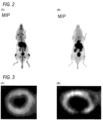
- MIP Maximum Intensity Projection
- a whole body contrast PET test was performed using the solution containing the compound of Example 1 (7-[ 18 F]FTO) or Reference Example 4 ([ 18 F]FTO) using a DBA2 mouse.
- FIG. 2 Whole body PET images 90 minutes after the administration are shown in FIG. 2 .
- Table 8 shows the SUV values (average value ⁇ standard error) in each of 5 cases in which the amount of radioactivity in the target organ is quantified 120 minutes after the administration.
- SUV Reference Example 4 [ 18 F]FTO Example 1 7-[ 18 F]FTO Heart 1.52 ⁇ 0.25 3.53 ⁇ 0.77 Femur 2.03 ⁇ 0.32 0.48 ⁇ 0.04
- a myocardial infarction model was prepared by coronary artery ligation using SD rats, and a thoracic contrast PET test was performed using the solution containing the compound of Example 1 (7-[ 18 F]FTO).
- FIG. 3 shows coronal section PET images of the compound near the center of the heart in the untreated rat or the model rat with myocardial infarction.
- FIG. 3 it was confirmed that while an elliptical heart was visualized in the coronal section image of the untreated rat (A), the signal was deleted in a part of the elliptical heart in the coronal section image of the myocardial infarction model rat (B). It was considered that the deletion of this signal indicated that myocardial infarction by coronary artery ligation was caused myocardial metabolic insufficiency and it was suggested that this compound was effective in diagnosing heart disease typified by myocardial infarction.
- the labeled fatty acid derivative of the present invention can be used as a radiolabeled tracer in a method for rapid and non-invasive sorting of heart disease patients, a and a method of diagnosis of the therapeutic effect of a therapeutic drug for heart disease.
Landscapes
- Chemical & Material Sciences (AREA)
- Organic Chemistry (AREA)
- Health & Medical Sciences (AREA)
- Life Sciences & Earth Sciences (AREA)
- Physics & Mathematics (AREA)
- Optics & Photonics (AREA)
- General Health & Medical Sciences (AREA)
- Public Health (AREA)
- Pharmacology & Pharmacy (AREA)
- Epidemiology (AREA)
- Animal Behavior & Ethology (AREA)
- Medicinal Chemistry (AREA)
- Proteomics, Peptides & Aminoacids (AREA)
- Veterinary Medicine (AREA)
- Medical Informatics (AREA)
- Biomedical Technology (AREA)
- Engineering & Computer Science (AREA)
- Nuclear Medicine, Radiotherapy & Molecular Imaging (AREA)
- General Physics & Mathematics (AREA)
- High Energy & Nuclear Physics (AREA)
- Molecular Biology (AREA)
- Spectroscopy & Molecular Physics (AREA)
- Medicines Containing Antibodies Or Antigens For Use As Internal Diagnostic Agents (AREA)
- Organic Low-Molecular-Weight Compounds And Preparation Thereof (AREA)
- Nuclear Medicine (AREA)
Applications Claiming Priority (2)
| Application Number | Priority Date | Filing Date | Title |
|---|---|---|---|
| JP2018136483 | 2018-07-20 | ||
| PCT/JP2019/028380 WO2020017620A1 (ja) | 2018-07-20 | 2019-07-19 | 陽電子放出核種で標識された脂肪酸誘導体 |
Publications (3)
| Publication Number | Publication Date |
|---|---|
| EP3825302A1 EP3825302A1 (en) | 2021-05-26 |
| EP3825302A4 EP3825302A4 (en) | 2022-05-04 |
| EP3825302B1 true EP3825302B1 (en) | 2025-01-08 |
Family
ID=69164918
Family Applications (1)
| Application Number | Title | Priority Date | Filing Date |
|---|---|---|---|
| EP19837826.7A Active EP3825302B1 (en) | 2018-07-20 | 2019-07-19 | Fatty acid derivative labeled with positron-emitting radionuclide |
Country Status (9)
| Country | Link |
|---|---|
| US (1) | US12029797B2 (https=) |
| EP (1) | EP3825302B1 (https=) |
| JP (1) | JP7375755B2 (https=) |
| KR (1) | KR102718221B1 (https=) |
| CN (1) | CN112638868B (https=) |
| AU (1) | AU2019304781B2 (https=) |
| CA (1) | CA3106903A1 (https=) |
| ES (1) | ES3009015T3 (https=) |
| WO (1) | WO2020017620A1 (https=) |
Families Citing this family (2)
| Publication number | Priority date | Publication date | Assignee | Title |
|---|---|---|---|---|
| KR102718221B1 (ko) | 2018-07-20 | 2024-10-15 | 아스텔라스세이야쿠 가부시키가이샤 | 양전자 방출 핵종으로 표지된 지방산 유도체 |
| JP7652084B2 (ja) | 2020-01-17 | 2025-03-27 | アステラス製薬株式会社 | 陽電子放出核種で標識された脂肪酸誘導体 |
Family Cites Families (10)
| Publication number | Priority date | Publication date | Assignee | Title |
|---|---|---|---|---|
| DE2828623C2 (de) * | 1978-06-29 | 1983-11-17 | Kernforschungsanlage Jülich GmbH, 5170 Jülich | Mit radioaktivem Flour markierte C↓1↓↓6↓-bis C↓1↓↓8↓- Fettsäuren, ein Verfahren zu ihrer Herstellung sowie deren Verwendung |
| WO2000063216A1 (en) | 1999-04-19 | 2000-10-26 | Duke University | F-18-labeled thia fatty acids and methods of making and using the same |
| WO2004093650A2 (en) | 2003-04-17 | 2004-11-04 | The General Hospital Corporation | Method for monitoring blood flow and metabolic uptake in tissue with radiolabeled alkanoic acid |
| CN1217924C (zh) | 2003-10-17 | 2005-09-07 | 江苏省原子医学研究所 | 一种氟标记脂肪酸心肌代谢显像剂14(r,s)-氟[18f]-6-硫十七烷酸的纯化方法 |
| AU2010246010A1 (en) | 2009-05-04 | 2011-11-17 | Washington University | PET radiotracers for imaging fatty acid metablolism and storage |
| WO2014179341A1 (en) * | 2013-04-29 | 2014-11-06 | Matinas Biopharma, Inc. | Treatment with omega-3 fatty acid compositions |
| WO2015023631A2 (en) | 2013-08-12 | 2015-02-19 | Carolyn Anderson | Fatty acid analogs and their use |
| CN105523977B (zh) | 2016-02-04 | 2017-05-24 | 河南中医学院 | [11c]‑巯甲基脂肪酸的制备方法与应用 |
| KR102718221B1 (ko) | 2018-07-20 | 2024-10-15 | 아스텔라스세이야쿠 가부시키가이샤 | 양전자 방출 핵종으로 표지된 지방산 유도체 |
| JP7652084B2 (ja) | 2020-01-17 | 2025-03-27 | アステラス製薬株式会社 | 陽電子放出核種で標識された脂肪酸誘導体 |
-
2019
- 2019-07-19 KR KR1020217001389A patent/KR102718221B1/ko active Active
- 2019-07-19 JP JP2020531374A patent/JP7375755B2/ja active Active
- 2019-07-19 EP EP19837826.7A patent/EP3825302B1/en active Active
- 2019-07-19 CN CN201980048149.8A patent/CN112638868B/zh active Active
- 2019-07-19 CA CA3106903A patent/CA3106903A1/en active Pending
- 2019-07-19 WO PCT/JP2019/028380 patent/WO2020017620A1/ja not_active Ceased
- 2019-07-19 US US17/261,328 patent/US12029797B2/en active Active
- 2019-07-19 ES ES19837826T patent/ES3009015T3/es active Active
- 2019-07-19 AU AU2019304781A patent/AU2019304781B2/en active Active
Also Published As
| Publication number | Publication date |
|---|---|
| CN112638868A (zh) | 2021-04-09 |
| WO2020017620A1 (ja) | 2020-01-23 |
| CN112638868B (zh) | 2023-06-20 |
| KR20210032392A (ko) | 2021-03-24 |
| US12029797B2 (en) | 2024-07-09 |
| EP3825302A4 (en) | 2022-05-04 |
| CA3106903A1 (en) | 2020-01-23 |
| JP7375755B2 (ja) | 2023-11-08 |
| US20210338845A1 (en) | 2021-11-04 |
| EP3825302A1 (en) | 2021-05-26 |
| ES3009015T3 (en) | 2025-03-25 |
| KR102718221B1 (ko) | 2024-10-15 |
| AU2019304781A1 (en) | 2021-02-11 |
| JPWO2020017620A1 (ja) | 2021-08-02 |
| AU2019304781B2 (en) | 2023-12-21 |
Similar Documents
| Publication | Publication Date | Title |
|---|---|---|
| JP5847065B2 (ja) | 心筋灌流イメージングのための造影剤 | |
| EP3825302B1 (en) | Fatty acid derivative labeled with positron-emitting radionuclide | |
| WO2010129572A2 (en) | Pet radiotracers for imaging fatty acid metablolism and storage | |
| DE19536781A1 (de) | Bifunktionelle sulfidhaltige Sulfonamid-Chelatbildner vom Typ XSNS für radioaktive Isotope | |
| EP4095126A1 (en) | Fatty acid derivative labeled by positron-emitting nuclide | |
| Gonzalez et al. | The 4-N-acyl and 4-N-alkyl gemcitabine analogues with silicon-fluoride-acceptor: application to 18F-radiolabeling | |
| FR3068695B1 (fr) | Composes utiles comme agent d'imagerie de l'hypoxie | |
| WO2013026765A1 (en) | New ligands for targeting of s1p receptors for in vivo imaging and treatment of diseases | |
| Mukhopadhyay et al. | N3-Substituted thymidine analogues V: Synthesis and preliminary PET imaging of N3-[18F] fluoroethyl thymidine and N3-[18F] fluoropropyl thymidine | |
| US6362352B1 (en) | F18-labeled thia fatty acids and methods of making and using the same | |
| Moon et al. | Synthesis of O-(3-[18F] fluoropropyl)-L-tyrosine (L-[18F] FPT) and its biological evaluation in 9L tumor bearing rat | |
| JP2015110563A (ja) | アルドステロン合成酵素阻害剤 | |
| WO2025142589A1 (ja) | 化合物またはその塩もしくは溶媒和物、それらの利用およびそれらの製造方法 | |
| JP2019085344A (ja) | 放射性フッ素標識化合物 | |
| WO2026029180A1 (ja) | 放射性トリフェニルピラゾール化合物 | |
| JP3882027B2 (ja) | 20−エピ−22−エチル−23,24−デヒドロ−24,24−ジホモビタミンd誘導体及びその合成中間体 | |
| JP2015093833A (ja) | 放射性ハロゲン標識化合物又はその塩、これを含む医薬 | |
| HK1163649A (en) | Radioisotope-labeled lysine and ornithine derivatives, their use and processes for their preparation |
Legal Events
| Date | Code | Title | Description |
|---|---|---|---|
| STAA | Information on the status of an ep patent application or granted ep patent |
Free format text: STATUS: THE INTERNATIONAL PUBLICATION HAS BEEN MADE |
|
| PUAI | Public reference made under article 153(3) epc to a published international application that has entered the european phase |
Free format text: ORIGINAL CODE: 0009012 |
|
| STAA | Information on the status of an ep patent application or granted ep patent |
Free format text: STATUS: REQUEST FOR EXAMINATION WAS MADE |
|
| 17P | Request for examination filed |
Effective date: 20210115 |
|
| AK | Designated contracting states |
Kind code of ref document: A1 Designated state(s): AL AT BE BG CH CY CZ DE DK EE ES FI FR GB GR HR HU IE IS IT LI LT LU LV MC MK MT NL NO PL PT RO RS SE SI SK SM TR |
|
| DAV | Request for validation of the european patent (deleted) | ||
| DAX | Request for extension of the european patent (deleted) | ||
| A4 | Supplementary search report drawn up and despatched |
Effective date: 20220331 |
|
| RIC1 | Information provided on ipc code assigned before grant |
Ipc: C07B 59/00 20060101ALI20220325BHEP Ipc: G01T 1/161 20060101ALI20220325BHEP Ipc: C07C 323/52 20060101AFI20220325BHEP |
|
| GRAP | Despatch of communication of intention to grant a patent |
Free format text: ORIGINAL CODE: EPIDOSNIGR1 |
|
| STAA | Information on the status of an ep patent application or granted ep patent |
Free format text: STATUS: GRANT OF PATENT IS INTENDED |
|
| INTG | Intention to grant announced |
Effective date: 20240918 |
|
| GRAS | Grant fee paid |
Free format text: ORIGINAL CODE: EPIDOSNIGR3 |
|
| GRAA | (expected) grant |
Free format text: ORIGINAL CODE: 0009210 |
|
| STAA | Information on the status of an ep patent application or granted ep patent |
Free format text: STATUS: THE PATENT HAS BEEN GRANTED |
|
| AK | Designated contracting states |
Kind code of ref document: B1 Designated state(s): AL AT BE BG CH CY CZ DE DK EE ES FI FR GB GR HR HU IE IS IT LI LT LU LV MC MK MT NL NO PL PT RO RS SE SI SK SM TR |
|
| REG | Reference to a national code |
Ref country code: GB Ref legal event code: FG4D |
|
| REG | Reference to a national code |
Ref country code: CH Ref legal event code: EP |
|
| REG | Reference to a national code |
Ref country code: DE Ref legal event code: R096 Ref document number: 602019064701 Country of ref document: DE |
|
| REG | Reference to a national code |
Ref country code: IE Ref legal event code: FG4D |
|
| REG | Reference to a national code |
Ref country code: NL Ref legal event code: FP |
|
| P01 | Opt-out of the competence of the unified patent court (upc) registered |
Free format text: CASE NUMBER: APP_6829/2025 Effective date: 20250210 |
|
| REG | Reference to a national code |
Ref country code: ES Ref legal event code: FG2A Ref document number: 3009015 Country of ref document: ES Kind code of ref document: T3 Effective date: 20250325 |
|
| REG | Reference to a national code |
Ref country code: LT Ref legal event code: MG9D |
|
| REG | Reference to a national code |
Ref country code: AT Ref legal event code: MK05 Ref document number: 1758248 Country of ref document: AT Kind code of ref document: T Effective date: 20250108 |
|
| PG25 | Lapsed in a contracting state [announced via postgrant information from national office to epo] |
Ref country code: RS Free format text: LAPSE BECAUSE OF FAILURE TO SUBMIT A TRANSLATION OF THE DESCRIPTION OR TO PAY THE FEE WITHIN THE PRESCRIBED TIME-LIMIT Effective date: 20250408 |
|
| PG25 | Lapsed in a contracting state [announced via postgrant information from national office to epo] |
Ref country code: FI Free format text: LAPSE BECAUSE OF FAILURE TO SUBMIT A TRANSLATION OF THE DESCRIPTION OR TO PAY THE FEE WITHIN THE PRESCRIBED TIME-LIMIT Effective date: 20250108 |
|
| PG25 | Lapsed in a contracting state [announced via postgrant information from national office to epo] |
Ref country code: PL Free format text: LAPSE BECAUSE OF FAILURE TO SUBMIT A TRANSLATION OF THE DESCRIPTION OR TO PAY THE FEE WITHIN THE PRESCRIBED TIME-LIMIT Effective date: 20250108 |
|
| PG25 | Lapsed in a contracting state [announced via postgrant information from national office to epo] |
Ref country code: NO Free format text: LAPSE BECAUSE OF FAILURE TO SUBMIT A TRANSLATION OF THE DESCRIPTION OR TO PAY THE FEE WITHIN THE PRESCRIBED TIME-LIMIT Effective date: 20250408 Ref country code: IS Free format text: LAPSE BECAUSE OF FAILURE TO SUBMIT A TRANSLATION OF THE DESCRIPTION OR TO PAY THE FEE WITHIN THE PRESCRIBED TIME-LIMIT Effective date: 20250508 |
|
| PG25 | Lapsed in a contracting state [announced via postgrant information from national office to epo] |
Ref country code: HR Free format text: LAPSE BECAUSE OF FAILURE TO SUBMIT A TRANSLATION OF THE DESCRIPTION OR TO PAY THE FEE WITHIN THE PRESCRIBED TIME-LIMIT Effective date: 20250108 |
|
| PG25 | Lapsed in a contracting state [announced via postgrant information from national office to epo] |
Ref country code: PT Free format text: LAPSE BECAUSE OF FAILURE TO SUBMIT A TRANSLATION OF THE DESCRIPTION OR TO PAY THE FEE WITHIN THE PRESCRIBED TIME-LIMIT Effective date: 20250508 Ref country code: LV Free format text: LAPSE BECAUSE OF FAILURE TO SUBMIT A TRANSLATION OF THE DESCRIPTION OR TO PAY THE FEE WITHIN THE PRESCRIBED TIME-LIMIT Effective date: 20250108 |
|
| PG25 | Lapsed in a contracting state [announced via postgrant information from national office to epo] |
Ref country code: BG Free format text: LAPSE BECAUSE OF FAILURE TO SUBMIT A TRANSLATION OF THE DESCRIPTION OR TO PAY THE FEE WITHIN THE PRESCRIBED TIME-LIMIT Effective date: 20250108 Ref country code: GR Free format text: LAPSE BECAUSE OF FAILURE TO SUBMIT A TRANSLATION OF THE DESCRIPTION OR TO PAY THE FEE WITHIN THE PRESCRIBED TIME-LIMIT Effective date: 20250409 |
|
| PG25 | Lapsed in a contracting state [announced via postgrant information from national office to epo] |
Ref country code: AT Free format text: LAPSE BECAUSE OF FAILURE TO SUBMIT A TRANSLATION OF THE DESCRIPTION OR TO PAY THE FEE WITHIN THE PRESCRIBED TIME-LIMIT Effective date: 20250108 |
|
| PGFP | Annual fee paid to national office [announced via postgrant information from national office to epo] |
Ref country code: NL Payment date: 20250726 Year of fee payment: 7 |
|
| PG25 | Lapsed in a contracting state [announced via postgrant information from national office to epo] |
Ref country code: SE Free format text: LAPSE BECAUSE OF FAILURE TO SUBMIT A TRANSLATION OF THE DESCRIPTION OR TO PAY THE FEE WITHIN THE PRESCRIBED TIME-LIMIT Effective date: 20250108 |
|
| PG25 | Lapsed in a contracting state [announced via postgrant information from national office to epo] |
Ref country code: SM Free format text: LAPSE BECAUSE OF FAILURE TO SUBMIT A TRANSLATION OF THE DESCRIPTION OR TO PAY THE FEE WITHIN THE PRESCRIBED TIME-LIMIT Effective date: 20250108 |
|
| PGFP | Annual fee paid to national office [announced via postgrant information from national office to epo] |
Ref country code: ES Payment date: 20250801 Year of fee payment: 7 |
|
| REG | Reference to a national code |
Ref country code: DE Ref legal event code: R097 Ref document number: 602019064701 Country of ref document: DE |
|
| PG25 | Lapsed in a contracting state [announced via postgrant information from national office to epo] |
Ref country code: DK Free format text: LAPSE BECAUSE OF FAILURE TO SUBMIT A TRANSLATION OF THE DESCRIPTION OR TO PAY THE FEE WITHIN THE PRESCRIBED TIME-LIMIT Effective date: 20250108 |
|
| PGFP | Annual fee paid to national office [announced via postgrant information from national office to epo] |
Ref country code: DE Payment date: 20250729 Year of fee payment: 7 |
|
| PGFP | Annual fee paid to national office [announced via postgrant information from national office to epo] |
Ref country code: GB Payment date: 20250728 Year of fee payment: 7 |
|
| PGFP | Annual fee paid to national office [announced via postgrant information from national office to epo] |
Ref country code: FR Payment date: 20250725 Year of fee payment: 7 |
|
| PG25 | Lapsed in a contracting state [announced via postgrant information from national office to epo] |
Ref country code: CZ Free format text: LAPSE BECAUSE OF FAILURE TO SUBMIT A TRANSLATION OF THE DESCRIPTION OR TO PAY THE FEE WITHIN THE PRESCRIBED TIME-LIMIT Effective date: 20250108 Ref country code: EE Free format text: LAPSE BECAUSE OF FAILURE TO SUBMIT A TRANSLATION OF THE DESCRIPTION OR TO PAY THE FEE WITHIN THE PRESCRIBED TIME-LIMIT Effective date: 20250108 |
|
| PG25 | Lapsed in a contracting state [announced via postgrant information from national office to epo] |
Ref country code: RO Free format text: LAPSE BECAUSE OF FAILURE TO SUBMIT A TRANSLATION OF THE DESCRIPTION OR TO PAY THE FEE WITHIN THE PRESCRIBED TIME-LIMIT Effective date: 20250108 |
|
| PG25 | Lapsed in a contracting state [announced via postgrant information from national office to epo] |
Ref country code: SK Free format text: LAPSE BECAUSE OF FAILURE TO SUBMIT A TRANSLATION OF THE DESCRIPTION OR TO PAY THE FEE WITHIN THE PRESCRIBED TIME-LIMIT Effective date: 20250108 |
|
| PLBE | No opposition filed within time limit |
Free format text: ORIGINAL CODE: 0009261 |
|
| STAA | Information on the status of an ep patent application or granted ep patent |
Free format text: STATUS: NO OPPOSITION FILED WITHIN TIME LIMIT |
|
| REG | Reference to a national code |
Ref country code: CH Ref legal event code: L10 Free format text: ST27 STATUS EVENT CODE: U-0-0-L10-L00 (AS PROVIDED BY THE NATIONAL OFFICE) Effective date: 20251119 |
|
| 26N | No opposition filed |
Effective date: 20251009 |
|
| REG | Reference to a national code |
Ref country code: CH Ref legal event code: H13 Free format text: ST27 STATUS EVENT CODE: U-0-0-H10-H13 (AS PROVIDED BY THE NATIONAL OFFICE) Effective date: 20260224 |
|
| PG25 | Lapsed in a contracting state [announced via postgrant information from national office to epo] |
Ref country code: LU Free format text: LAPSE BECAUSE OF NON-PAYMENT OF DUE FEES Effective date: 20250719 |
|
| REG | Reference to a national code |
Ref country code: BE Ref legal event code: MM Effective date: 20250731 |
|
| PG25 | Lapsed in a contracting state [announced via postgrant information from national office to epo] |
Ref country code: BE Free format text: LAPSE BECAUSE OF NON-PAYMENT OF DUE FEES Effective date: 20250731 |
|
| PG25 | Lapsed in a contracting state [announced via postgrant information from national office to epo] |
Ref country code: CH Free format text: LAPSE BECAUSE OF NON-PAYMENT OF DUE FEES Effective date: 20250731 |