EP3820524B1 - Hypericin-pvp komplex mit hohem hypericinanteil - Google Patents
Hypericin-pvp komplex mit hohem hypericinanteil Download PDFInfo
- Publication number
- EP3820524B1 EP3820524B1 EP19736763.4A EP19736763A EP3820524B1 EP 3820524 B1 EP3820524 B1 EP 3820524B1 EP 19736763 A EP19736763 A EP 19736763A EP 3820524 B1 EP3820524 B1 EP 3820524B1
- Authority
- EP
- European Patent Office
- Prior art keywords
- hypericin
- pvp
- complex
- mixture
- weight
- Prior art date
- Legal status (The legal status is an assumption and is not a legal conclusion. Google has not performed a legal analysis and makes no representation as to the accuracy of the status listed.)
- Active
Links
Images
Classifications
-
- A—HUMAN NECESSITIES
- A61—MEDICAL OR VETERINARY SCIENCE; HYGIENE
- A61K—PREPARATIONS FOR MEDICAL, DENTAL OR TOILETRY PURPOSES
- A61K41/00—Medicinal preparations obtained by treating materials with wave energy or particle radiation ; Therapies using these preparations
- A61K41/0057—Photodynamic therapy with a photosensitizer, i.e. agent able to produce reactive oxygen species upon exposure to light or radiation, e.g. UV or visible light; photocleavage of nucleic acids with an agent
-
- A—HUMAN NECESSITIES
- A61—MEDICAL OR VETERINARY SCIENCE; HYGIENE
- A61K—PREPARATIONS FOR MEDICAL, DENTAL OR TOILETRY PURPOSES
- A61K47/00—Medicinal preparations characterised by the non-active ingredients used, e.g. carriers or inert additives; Targeting or modifying agents chemically bound to the active ingredient
- A61K47/50—Medicinal preparations characterised by the non-active ingredients used, e.g. carriers or inert additives; Targeting or modifying agents chemically bound to the active ingredient the non-active ingredient being chemically bound to the active ingredient, e.g. polymer-drug conjugates
- A61K47/51—Medicinal preparations characterised by the non-active ingredients used, e.g. carriers or inert additives; Targeting or modifying agents chemically bound to the active ingredient the non-active ingredient being chemically bound to the active ingredient, e.g. polymer-drug conjugates the non-active ingredient being a modifying agent
- A61K47/56—Medicinal preparations characterised by the non-active ingredients used, e.g. carriers or inert additives; Targeting or modifying agents chemically bound to the active ingredient the non-active ingredient being chemically bound to the active ingredient, e.g. polymer-drug conjugates the non-active ingredient being a modifying agent the modifying agent being an organic macromolecular compound, e.g. an oligomeric, polymeric or dendrimeric molecule
- A61K47/58—Medicinal preparations characterised by the non-active ingredients used, e.g. carriers or inert additives; Targeting or modifying agents chemically bound to the active ingredient the non-active ingredient being chemically bound to the active ingredient, e.g. polymer-drug conjugates the non-active ingredient being a modifying agent the modifying agent being an organic macromolecular compound, e.g. an oligomeric, polymeric or dendrimeric molecule obtained by reactions only involving carbon-to-carbon unsaturated bonds, e.g. poly[meth]acrylate, polyacrylamide, polystyrene, polyvinylpyrrolidone, polyvinylalcohol or polystyrene sulfonic acid resin
-
- A—HUMAN NECESSITIES
- A01—AGRICULTURE; FORESTRY; ANIMAL HUSBANDRY; HUNTING; TRAPPING; FISHING
- A01N—PRESERVATION OF BODIES OF HUMANS OR ANIMALS OR PLANTS OR PARTS THEREOF; BIOCIDES, e.g. AS DISINFECTANTS, AS PESTICIDES OR AS HERBICIDES; PEST REPELLANTS OR ATTRACTANTS; PLANT GROWTH REGULATORS
- A01N25/00—Biocides, pest repellants or attractants, or plant growth regulators, characterised by their forms, or by their non-active ingredients or by their methods of application, e.g. seed treatment or sequential application; Substances for reducing the noxious effect of the active ingredients to organisms other than pests
- A01N25/08—Biocides, pest repellants or attractants, or plant growth regulators, characterised by their forms, or by their non-active ingredients or by their methods of application, e.g. seed treatment or sequential application; Substances for reducing the noxious effect of the active ingredients to organisms other than pests containing solids as carriers or diluents
- A01N25/10—Macromolecular compounds
-
- A—HUMAN NECESSITIES
- A01—AGRICULTURE; FORESTRY; ANIMAL HUSBANDRY; HUNTING; TRAPPING; FISHING
- A01N—PRESERVATION OF BODIES OF HUMANS OR ANIMALS OR PLANTS OR PARTS THEREOF; BIOCIDES, e.g. AS DISINFECTANTS, AS PESTICIDES OR AS HERBICIDES; PEST REPELLANTS OR ATTRACTANTS; PLANT GROWTH REGULATORS
- A01N35/00—Biocides, pest repellants or attractants, or plant growth regulators containing organic compounds containing a carbon atom having two bonds to hetero atoms with at the most one bond to halogen, e.g. aldehyde radical
- A01N35/04—Biocides, pest repellants or attractants, or plant growth regulators containing organic compounds containing a carbon atom having two bonds to hetero atoms with at the most one bond to halogen, e.g. aldehyde radical containing aldehyde or keto groups, or thio analogues thereof, directly attached to an aromatic ring system, e.g. acetophenone; Derivatives thereof, e.g. acetals
-
- A—HUMAN NECESSITIES
- A01—AGRICULTURE; FORESTRY; ANIMAL HUSBANDRY; HUNTING; TRAPPING; FISHING
- A01N—PRESERVATION OF BODIES OF HUMANS OR ANIMALS OR PLANTS OR PARTS THEREOF; BIOCIDES, e.g. AS DISINFECTANTS, AS PESTICIDES OR AS HERBICIDES; PEST REPELLANTS OR ATTRACTANTS; PLANT GROWTH REGULATORS
- A01N35/00—Biocides, pest repellants or attractants, or plant growth regulators containing organic compounds containing a carbon atom having two bonds to hetero atoms with at the most one bond to halogen, e.g. aldehyde radical
- A01N35/06—Biocides, pest repellants or attractants, or plant growth regulators containing organic compounds containing a carbon atom having two bonds to hetero atoms with at the most one bond to halogen, e.g. aldehyde radical containing keto or thioketo groups as part of a ring, e.g. cyclohexanone, quinone; Derivatives thereof, e.g. ketals
-
- A—HUMAN NECESSITIES
- A01—AGRICULTURE; FORESTRY; ANIMAL HUSBANDRY; HUNTING; TRAPPING; FISHING
- A01N—PRESERVATION OF BODIES OF HUMANS OR ANIMALS OR PLANTS OR PARTS THEREOF; BIOCIDES, e.g. AS DISINFECTANTS, AS PESTICIDES OR AS HERBICIDES; PEST REPELLANTS OR ATTRACTANTS; PLANT GROWTH REGULATORS
- A01N43/00—Biocides, pest repellants or attractants, or plant growth regulators containing heterocyclic compounds
- A01N43/34—Biocides, pest repellants or attractants, or plant growth regulators containing heterocyclic compounds having rings with one nitrogen atom as the only ring hetero atom
- A01N43/36—Biocides, pest repellants or attractants, or plant growth regulators containing heterocyclic compounds having rings with one nitrogen atom as the only ring hetero atom five-membered rings
-
- A—HUMAN NECESSITIES
- A61—MEDICAL OR VETERINARY SCIENCE; HYGIENE
- A61P—SPECIFIC THERAPEUTIC ACTIVITY OF CHEMICAL COMPOUNDS OR MEDICINAL PREPARATIONS
- A61P35/00—Antineoplastic agents
Definitions
- the present invention relates to a complex of hypericin or a hypericin salt and polyvinylpyrrolidone (PVP), which complex has a particularly high proportion of hypericin as defined in the claims.
- PVP polyvinylpyrrolidone
- Hypericin is found as an ingredient in various plants, especially Hypericum sp. and found as a pigment in protozoa, in some Australian insects, and with side chains as fagopyrin in buckwheat.
- Photodynamic therapy (PDT) of tumors has developed in the last 50 years as a marginal area of oncology.
- the mechanisms of PDT have been largely elucidated and the methods defined.
- the photosensitizer After systemic or local application of a photosensitizer, the photosensitizer accumulates in the malignant tissue. When excited by light of a suitable wavelength, the photosensitizer can transfer energy to a reactant, such as molecular oxygen. The reactive oxygen molecules generated in this way can in turn damage the cellular structures of the tumor tissue.
- hypericin as a photosensitizer
- this plant ingredient accumulates in tumor cells.
- these are the optimal prerequisites for using a sensitizer in PDT.
- the effectiveness of hypericin in PDT has already been demonstrated in a number of cell lines by in vitro studies, and in vivo animal studies also confirm the potential of hypericin in PDT.
- Hypericin is a hydrophobic substance that is completely insoluble in water and requires a variety of formulations to be used for medicinal purposes. Such formulations then contain different solvents, which are often not well tolerated and show side effects (e.g. alcohol, DMSO etc.) or solubilizers, liposomes, micelles or nanoparticles.
- the WO 01/89576 A2 describes for the first time a practicable approach to making hypericin water-soluble and thus application-ready by complexing it with polyvinylpyrrolidone (PVP).
- PVP polyvinylpyrrolidone
- Complexes are disclosed therein having a molar ratio of hypericin to PVP of about 1:1.
- Page 3 discloses that hypericin and PVP can both be present at a concentration of 1 ⁇ mol/L. According to the preferred molar mass range of PVP (10,000 - 90,000 g/mol) and the molar mass of hypericin (504.44 g/mol) according to the application, this would correspond to a mass fraction of hypericin in the hypericin-PVP complex of between 0.6 and 5 wt. -%.
- the molar ratios can be converted into mass fractions. A value of about 2.5% by weight is obtained for the complex with PVP 10, a value of about 1% by weight for PVP 25 and a value of about 0.6% by weight for PVP 40.
- hypericin had a mass fraction of 1% by weight of the hypericin-PVP complex.
- the WO 2014/079972 A1 describes devices for PDT in hollow organs such as the bladder and mentions, among other things, the use of hypericin-PVP.
- the total amount given is 0.25 mg hypericin bound to 25 mg PVP.
- the mass fraction of hypericin in the hypericin-PVP complex is therefore also at most 1% by weight.
- the WO 2017/054017 A1 describes formulations of hypericin in the form of a salt for photodynamic therapy.
- 250.0 g of a phosphate buffer solution is prepared containing a total of 1875 mg of PVP k25 and 0.0225 mg of hypericin per gram of solution.
- the mass fraction of hypericin in the hypericin-PVP complex is therefore 0.3% by weight.
- the WO 2017/054018 A1 describes formulations of hypericin in the form of a salt for photodynamic diagnosis.
- 250.0 g of a phosphate buffer solution is prepared containing a total of 562.5 mg of PVP k25 and 0.0225 mg of hypericin per gram of solution.
- the mass fraction of hypericin in the hypericin-PVP complex is 1% by weight here.
- Photodynamic diagnosis using hypericin-PVP in conjunction with fluorescence endoscopy is a very sensitive method and can be carried out with very little material input.
- hypericin a total of 25 mg of hypericin-PVP complex containing 1% by weight of hypericin
- This amount is sufficient to stain the tumors and lesions sufficiently for the urologist to identify and remove them.
- the low mass fraction of hypericin in the hypericin-PVP complex and the associated high proportion of PVP does not pose a problem for photodynamic diagnosis due to the low material input.
- hypericin-PVP complexes which contain a higher proportion of hypericin. It is therefore an object of the present invention to provide such complexes.
- This object is achieved by a complex of hypericin or a hypericin salt and polyvinylpyrrolidone (PVP), the average mass fraction of hypericin or the hypericin salt in the overall complex being greater than 6% by weight.
- PVP polyvinylpyrrolidone
- hypericin when “hypericin” is mentioned below, this term should be understood to include both the free acid and the salts of hypericin, preferably the alkali metal salts, particularly preferably the sodium or potassium salt.
- hypericin-PVP complex water-soluble compositions can be provided which contain large amounts of hypericin without an unfavorably large amount of PVP accompanying them. Formulations can also be put together using less material than before. By avoiding large amounts of adjuvants (PVP) and associated side effects, the present invention facilitates applications that require larger amounts of hypericin. This applies in particular to therapy methods such as photodynamic therapy (PDT) for the treatment of tumor diseases.
- PDT photodynamic therapy
- the present invention therefore also provides pharmaceutical compositions comprising the hypericin-PVP complex according to the invention.
- the present invention therefore also provides a method for producing the complex according to the invention, which is characterized in that a mixture of hypericin and PVP is heated to a temperature which is above the glass transition temperature of the PVP used.
- hypericin-PVP complexes which contain more than 6% by weight, in particular more than 10% by weight, preferably more than 15% by weight, particularly preferably more than 20% by weight and most preferably more than 35% by weight of hypericin.
- the hypericin content of the complexes according to the invention thus clearly exceeds the hypericin content of the hypericin-PVP complexes known in the prior art and thereby enables new and more advantageous applications of hypericin-PVP.
- hypericin-PVP complexes according to the invention in photodynamic therapy (PDT) for the treatment of tumor diseases is particularly advantageous.
- hypericin in combination with light has an antiviral and antibacterial effect.
- the hypericin-PVP complex according to the invention can thus be used for the sterilization and/or disinfection of surfaces or liquids. When used in this way, the PVP share remains manageably low.
- Hypericin may also be referred to as 1,3,4,6,8,13-hexahydroxy-10,11-dimethylphenanthro[1,10,9,8-opqra]perylene-7,14-dione.
- Hypericin can be represented by the following structural formula (here in the free acid form):
- Hypericin can also exist in forms other than the free acid, such as in the form of salts, eg alkali metal salts such as sodium or potassium salts.
- alkali metal salts such as sodium or potassium salts.
- the term "hypericin" designates all possible such forms.
- Polyvinylpyrrolidone also polyvidone or povidone, is a polymer of the compound vinylpyrrolidone.
- PVP is commercially available in different degrees of polymerization. The degree of polymerization determines the mean molar mass of the polymer.
- the present invention relates to a complex of hypericin or a hypericin salt and polyvinylpyrrolidone (PVP), characterized in that the average mass fraction of hypericin or hypericin salt in the overall complex is greater than 6% by weight, preferably greater than 8% by weight. %, 10% by weight, 15% by weight, 20% by weight, 25% by weight, or as 30% by weight.
- PVP polyvinylpyrrolidone
- Percentages (%) in the present invention relate in each case to percentages by weight (% by weight) unless otherwise stated.
- the mass fraction here reflects the relative fraction of the mass of hypericin in the mass of the overall complex (hypericin+PVP).
- the proportion of hypericin in the hypericin-PVP complex can also be expressed as a molar ratio.
- a hypericin-PVP complex which consists of hypericin in the form of the free acid (molar mass: 504.44 g/mol) and PVP with an average molar mass of 25 kD, and which has an average mass fraction of hypericin in the total complex of 10% by weight, an average molar ratio of hypericin to PVP in the complex of 5.5.
- the mean mole fraction here reflects the ratio of the mole amount of hypericin to the mole amount of PVP.
- the present invention therefore also relates to a complex of hypericin and PVP, characterized in that the average molar ratio of hypericin to PVP in the complex is greater than 2.5, preferably greater than 3, 4, 5, 7, 10 or 15 .
- the proportion (mass proportion as well as molar ratio) of hypericin in the overall complex is always to be understood here as the average proportion.
- a suitable method to share the middle to determine hypericin in the whole complex is high performance liquid chromatography (HPLC).
- HPLC high performance liquid chromatography
- the person skilled in the art is familiar with carrying out such a determination as described in Freytag WE (Deutsche maschinerzeitung 124 No. 46 (1984) 2383-2386 ), trusted.
- the person skilled in the art knows how to weigh out an exact amount of the hypericin-PVP complex, how to determine the concentration of hypericin using a calibration line and an HPLC measurement, and how to use this to calculate the mass fraction of hypericin in the total complex. An example of how such a determination can be made is described in Example 5.
- PVP polyvinyl urethane
- the hypericin-PVP complex is therefore characterized in that the PVP has an average molar mass of 10 to 40 kD, preferably 12 to 25 kD.
- the hypericin-PVP complexes previously described in the prior art are not well suited as ingredients of pharmaceutical compositions due to the low proportion of hypericin.
- large amounts of the hypericin-PVP complex would have to be used. This would result in an unfavorably high material consumption or accumulation of PVP in the patient.
- This problem is solved with the present invention. Due to the greatly reduced proportion of adjuvants (PVP), higher dosages of water-soluble hypericin, which are required for tumor therapy, are possible. Higher side effects of PVP can thereby be prevented become.
- the new invention thus enables, among other things, the use of hypericin in photodynamic tumor therapy.
- the present invention therefore also relates to a pharmaceutical composition comprising the hypericin-PVP complex according to the invention.
- the pharmaceutical composition is characterized in that the composition contains the hypericin-PVP complex according to the invention with hypericin in a concentration of at least 25 mg/L, preferably at least 50 mg/L, 75 mg/L, 100 mg/L , 150 mg/L, or at least 250 mg/L.
- compositions according to the present invention can be administered locally, for example for the treatment of tumors. Because pharmaceutical compositions can be produced for the first time by the present invention that contain high concentrations of hypericin without having to use large amounts of PVP, the present invention also enables pharmaceutical compositions that can be administered intravenously. Large amounts of hypericin, which subsequently accumulates in tumor cells, can also be administered systemically.
- the present invention therefore relates to a pharmaceutical composition containing the hypericin-PVP complex according to the invention, characterized in that the composition is intended for intravenous administration.
- the present invention relates to a pharmaceutical composition containing the hypericin-PVP complex according to the invention, characterized in that the composition is intended for intravenous administration and that the composition contains hypericin in a concentration of at least 25 mg/L, preferably contains at least 50 mg/L, 60 mg/L, 80 mg/L, 100 mg/L, 150 mg/L or at least 250 mg/L.
- PVP does not have a melting point, but rather shows a so-called glass transition temperature.
- the glass transition temperature depends, among other things, on the degree of polymerization, ie on the mean molar mass, of PVP (see Table 1).
- hypericin-PVP complex a particularly high mass fraction of hypericin in the hypericin-PVP complex can be achieved by heating a mixture of hypericin and PVP to a temperature above the glass transition temperature of the deployed PVPs.
- Hypericin is stable up to about 300°C and can therefore be complexed to PVP as an intact molecule. This method thus enables the production of the hypericin-PVP complex according to the invention.
- the present invention therefore also relates to a method for producing the hypericin-PVP complex according to the invention, characterized in that a mixture of hypericin and PVP is heated to a temperature which is above the glass transition temperature of the PVP used.
- the “glass transition temperature of the PVP used” is to be understood as the temperature at which the glass transition of PVP in the present mixture with hypericin takes place.
- the glass transition temperature of the PVP used can are influenced by the composition of the mixture, for example if solvents or water are added to the mixture. Methods for determining the glass transition temperature are known to those skilled in the art. Preferably, the glass transition temperature can be determined following the procedure of the relevant DIN standard.
- a preferred embodiment of the method according to the invention for producing the hypericin-PVP complex is characterized in that the molar mass of the PVP used is at least 12 kD and the mixture is heated to a temperature of at least 93°C.
- a particularly preferred embodiment is characterized in that the molar mass of the PVP used is at least 17 kD and the mixture is heated to a temperature of at least 130°C.
- Another particularly preferred embodiment is characterized in that the molar mass of the PVP used is at least 25 kD and the mixture is heated to a temperature of at least 155°C.
- Another particularly preferred embodiment is characterized in that the molar mass of the PVP used is at least 35 kD and the mixture is heated to a temperature of at least 175°C.
- the mixture of hypericin and PVP is preferably stirred into a paste in a little solvent. Additional solvents can help ensure that the components are distributed homogeneously and larger amounts of hypericin can attach to PVP.
- suitable solvents are water, ethanol, methanol, pyridine, acetone, ethyl methyl ketone and pyridine, or mixtures thereof. Water, ethanol, methanol and pyridine are particularly preferred, especially water and ethanol.
- a preferred embodiment of the production method of the hypericin-PVP complex according to the invention is characterized in that the mixture of hypericin and PVP is a solvent or a mixture of solvents, preferably water, ethanol, methanol, pyridine, acetone, ethyl methyl ketone, and / or ethyl acetate more preferably water, ethanol, methanol, and/or pyridine, even more preferably water and/or ethanol is added.
- the mixture of hypericin and PVP is a solvent or a mixture of solvents, preferably water, ethanol, methanol, pyridine, acetone, ethyl methyl ketone, and / or ethyl acetate more preferably water, ethanol, methanol, and/or pyridine, even more preferably water and/or ethanol is added.
- a further preferred embodiment of the method for producing the hypericin-PVP complex according to the invention is characterized in that the mixture is kept at a temperature above the glass transition temperature of the PVP used for at least 5 minutes.
- the photodynamic therapy (PDT) of tumor diseases has developed in the last 50 years as a marginal area of oncology.
- PDT photodynamic therapy
- the mechanisms of PDT have been largely elucidated and the methods are known in the prior art. So far, however, there has been a lack of suitable photosensitizers that accumulate in tumor cells, are well tolerated and meet the physical and chemical requirements of PDT.
- the present invention provides hypericin-PVP complexes which meet these requirements and which are outstandingly suitable for therapeutic applications due to the high proportion of hypericin.
- the hypericin-PVP complexes according to the invention can be administered either locally or systemically.
- the present invention therefore also relates to pharmaceutical compositions containing a hypericin PVP according to the invention Complex for use in a therapy method, preferably for use in photodynamic therapy (PDT) for the treatment of tumor diseases.
- a hypericin PVP according to the invention Complex for use in a therapy method, preferably for use in photodynamic therapy (PDT) for the treatment of tumor diseases.
- the present invention also relates to a method for treating cancer diseases, characterized in that a hypericin-PVP complex according to the invention is administered, preferably in the course of photodynamic therapy (PDT).
- a hypericin-PVP complex according to the invention is administered, preferably in the course of photodynamic therapy (PDT).
- the method of treating cancer includes the additional step of exposing the subject to light.
- the light preferably has a wavelength between 400 nm and 800 nm, in particular between 500 nm and 700 nm, most preferably between 550 nm and 650 nm.
- the light preferably has an intensity between 1 mW/cm 2 and 250 mW/cm 2 , more preferably between 2 mW/cm 2 and 100 mW/cm 2 , even more preferably between 3 mW/cm 2 and 50 mW/cm 2 , most preferably between 5 mW/cm 2 and 25 mW/cm 2 .
- hypericin In combination with light, hypericin has an antiviral and antibacterial effect.
- the complex according to the invention can also be used for the sterilization and/or disinfection of surfaces or liquids.
- the high proportion of hypericin in the hypericin-PVP complex is a significant advantage because it minimizes the consumption of PVP.
- the present invention therefore also relates to the use of a hypericin-PVP complex according to the invention for the sterilization and/or disinfection of surfaces or liquids.
- Hypericin-PVP or “hypericin-PVP complex” herein refers to a product containing hypericin and PVP and wherein there is an association between hypericin and PVP molecules.
- the word “complex” in no way restricts the nature of the association, it merely means that there is an association between one or more hypericin molecules and one or more PVP molecules.
- the linkage may be a non-covalent attachment of hypericin to PVP.
- “Hypericin-PVP” or “hypericin-PVP complex” should be understood to mean the product as a whole and not an individual hypericin-PVP complex at the molecular level.
- fraction in the complex means values. They do not relate to each individual complex at the molecular level, but relate to an average value for the entire product.
- polyvinylpyrrolidone (PVP 25 kD) was dry mixed with 15 mg hypericin (99% HPLC). To the mixture was added 200 ⁇ L (200 microliters equals 0.2 mL) ethanol and 100 ⁇ L water (100 microliters equals 0.1 mL). Then the mixture was stirred and allowed to stand for 20 minutes. The mixture was then slowly heated to 180° C. in a drying cabinet. The temperature control from room temperature to 180° C. was carried out over a period of about 20 minutes. The mixture was held at a temperature of 180°C for about 8 minutes. Thereafter, the mixture was cooled to room temperature. Then about 3-6 mL of water were added and stirred for 1 hour. The soluble components, the hypericin-PVP complex, went into solution. The insoluble components and the non-complexed hypericin were filtered off (pore diameter 0.2-0.4 ⁇ m). The filtrate was dried and stored dry until further use.
- PVP 25 kD polyvinylpyrrolidone
- Example 2 Preparation of a hypericin-PVP complex according to the invention containing hypericin in the form of the sodium salt
- Example 1 As Example 1, but the sodium salt was used instead of hypericin used: sodium hypericinate.
- Na hypericinate was according to the instructions of Kapinus et al. (Monthly journals for chemistry 130 (1999) 436-441 ) manufactured.
- a conventional hypericin-PVP complex was prepared as described in Kubin et. al. "How to make hypericin water-soluble", Die Pharmazie 63 (2008) 263-269 .
- 10 mg of hypericin were dissolved in 2.5 mL of ethanol under ultrasound, after which 1000 mg of PVP 25 kD and 8 mL of distilled water were added.
- the mixture was heated to 70°C for about 5 minutes. Thereafter, 5 mL of water were added and the mixture was stirred for a further 10 minutes.
- the solution was then dried in a rotary evaporator and the hypericin-PVP complex obtained was stored dry until further use.
- Hypericin-PVP complexes were prepared according to the procedures described in Examples 1-3.
- the mass fraction of hypericin in the hypericin-PVP complexes was determined using HPLC and the corresponding calibration of hypericin. Standardized hypericin (> 99%, Planta Naturtechnikmaschines GmbH) was used as reference material. The determination of the mass fraction of hypericin in the total complex was carried out as described in example 5.
- the mass fraction of hypericin in the hypericin-PVP complexes was determined using HPLC and the corresponding calibration with hypericin.
- the HPLC method was essentially carried out as described in Freytag WE (Deutsche maschinerzeitung 124 No. 46 (1984) 2383-2386 ).
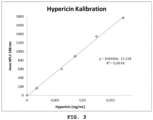
- Standardized hypericin > 99%, Planta Naturstoffemaschines GmbH was used as reference material for the calibration. HPLC runs with different amounts of the reference material dissolved in the HPLC solvent were carried out and the area of the hypericin absorption peaks at 588 nm was determined. A calibration line was created from the measured values using linear regression (see Fig figure 3 ).
- hypericin content of a hypericin-PVP complex according to the invention produced according to example 1 5 mg of the dried hypericin-PVP complex (powder) were weighed out exactly and dissolved in the HPLC eluent. An HPLC run was carried out as described above, and the proportion of hypericin in the total complex was determined from the absorption signal obtained at 588 nm using the previously created calibration line certainly. The result was 40% by weight (ie 40 mg hypericin and 60 mg PVP were contained in 100 mg hypericin-PVP complex, for example).
Landscapes
- Health & Medical Sciences (AREA)
- Life Sciences & Earth Sciences (AREA)
- General Health & Medical Sciences (AREA)
- Chemical & Material Sciences (AREA)
- Veterinary Medicine (AREA)
- Medicinal Chemistry (AREA)
- Pharmacology & Pharmacy (AREA)
- Animal Behavior & Ethology (AREA)
- Public Health (AREA)
- Engineering & Computer Science (AREA)
- Epidemiology (AREA)
- Dentistry (AREA)
- Agronomy & Crop Science (AREA)
- Plant Pathology (AREA)
- Wood Science & Technology (AREA)
- Zoology (AREA)
- Environmental Sciences (AREA)
- Biochemistry (AREA)
- Molecular Biology (AREA)
- Bioinformatics & Cheminformatics (AREA)
- Pest Control & Pesticides (AREA)
- Chemical Kinetics & Catalysis (AREA)
- General Chemical & Material Sciences (AREA)
- Nuclear Medicine, Radiotherapy & Molecular Imaging (AREA)
- Organic Chemistry (AREA)
- Toxicology (AREA)
- Pharmaceuticals Containing Other Organic And Inorganic Compounds (AREA)
- Acyclic And Carbocyclic Compounds In Medicinal Compositions (AREA)
- Medicinal Preparation (AREA)
- Medicines That Contain Protein Lipid Enzymes And Other Medicines (AREA)
- Organic Low-Molecular-Weight Compounds And Preparation Thereof (AREA)
- Cephalosporin Compounds (AREA)
Description
- Die vorliegende Erfindung betrifft einen Komplex aus Hypericin bzw. einem Hypericinsalz und Polyvinylpyrrolidon (PVP), welcher Komplex einen besonders hohen Anteil an Hypericin aufweist wie in den Ansprüchen definiert.
- Hypericin ist als Inhaltsstoff in verschiedenen Pflanzen, besonders in Hypericum sp. und als Pigment in Protozen, in einigen australischen Insekten und mit Seitenketten als Fagopyrin im Buchweizen zu finden.
- Wegen der photodynamischen und photochemischen Eigenschaften steht Hypericin immer wieder im Mittelpunkt verschiedener Forschungsprojekte, welche die Anwendung des Photosensitizers in der Tumordiagnostik und Tumortherapie untersuchen.
- Die photodynamische Therapie (PDT) von Tumoren hat sich in den letzten 50 Jahre eher als Randgebiet der Onkologie entwickelt. Die Mechanismen der PDT sind jedoch weitgehend aufgeklärt und die Methoden definiert. Nach systemischer oder lokalen Applikation eines Photosensitizers erfolgt eine Akkumulation des Photosensitizers im malignen Gewebe. Wenn der Photosensitizer mithilfe von Licht geeigneter Wellenlänge angeregt wird, kann er Energie auf einen Reaktionspartner übertragen, z.B. auf molekularen Sauerstoff. Die dabei generierten reaktiven Sauerstoffmoleküle können wiederum die zellulären Strukturen des Tumorgewebes schädigen.
- Bislang fehlt es aber an wirklich geeigneten Photosensitizern, die sich in Tumorzellen anreichern, gut verträglich sind und den physikalischen und chemischen Anforderungen der PDT entsprechen. Vor allem die Methode mittels Delta-Aminolävulinsäure (5-ALA) als "Prodrug" für Protoporphyrin IX in Hohlorganen (Magen, Darm, Blase, Lunge etc.) ist noch am ehesten forciert worden. Der Nachteil von 5-ALA bzw. Protoporphyrin IX, ist die Instabilität: die Porphyrine sind lichtempfindlich und bleichen während der Therapie aus, verlieren an Konzentration im Gewebe und sind bezüglich der Dosierung schwer kalkulierbar.
- Die Stabilität von Hypericin als Photosensitizer ist bekannt, auch dass sich dieser Pflanzeninhaltsstoff in Tumorzellen anreichert. Das sind neben den chemischen und physikalischen Eigenschaften die optimalen Voraussetzungen für den Einsatz eines Sensitizers in der PDT. Durch in vitro Untersuchungen konnte die Wirksamkeit von Hypericin in der PDT in einer Reihe von Zelllinien bereits gezeigt werden und auch in vivo Tierstudien bestätigen das Potential von Hypericin in der PDT.
- Hypericin ist eine hydrophobe Substanz, die in Wasser völlig unlöslich ist und verschiedenste Formulierungen braucht, um für medizinische Zwecke eingesetzt werden zu können. Solche Formulierungen enthalten dann verschiedene Lösungsmittel, die aber oft nicht gut verträglich sind und Nebenwirkungen zeigen (zB. Alkohol, DMSO etc.) oder Lösungsvermittler, Liposome, Mizellen oder Nanopartikel.
- Die
WO 01/89576 A2 - Kubin et. al. (Pharmazie 63 (2008) 263-269) beschreiben ein auf der
WO 01/89576 A2 - Kubin et. al. (Photochemistry Photobiology 84 (2008) 1560-1563) beschreiben eine klinische Studie, in der Hypericin-PVP verwendet wurde. Hypericin hatte hier ebenfalls einen Masseanteil von 1 Gew.-% am Hypericin-PVP Komplex.
- Die
WO 2014/079972 A1 beschreibt Vorrichtungen für die PDT in Hohlorganen wie der Blase und erwähnt unter anderem die Verwendung von Hypericin-PVP. Als Gesamtmenge werden 0,25 mg Hypericin gebunden an 25 mg PVP angegeben. Der Masseanteil von Hypericin am Hypericin-PVP Komplex beträgt somit ebenfalls höchstens 1 Gew.-%. - Die
WO 2017/054017 A1 beschreibt Formulierungen von Hypericin in der Form eines Salzes zur photodynamischen Therapie. In dem in Beispiel 1 beschriebenen Herstellungsverfahren von Hypericin-PVP werden 250,0 g einer Phosphatpufferlösung hergestellt, die insgesamt 1875 mg PVP k25 und 0,0225 mg Hypericin pro Gramm Lösung enthält. Der Masseanteil von Hypericin am Hypericin-PVP Komplex beträgt also 0,3 Gew.-%. - Die
WO 2017/054018 A1 beschreibt Formulierungen von Hypericin in der Form eines Salzes zur photodynamischen Diagnose. In dem in Beispiel 1 beschriebenen Herstellungsverfahren von Hypericin-PVP werden 250,0 g einer Phosphatpufferlösung hergestellt, die insgesamt 562,5 mg PVP k25 und 0,0225 mg Hypericin pro Gramm Lösung enthält. Der Masseanteil von Hypericin am Hypericin-PVP Komplex beträgt hier also 1 Gew.-%. - Feinweber et al. (Photochemical & Photobiological Sciences 13.11 (2014): 1607-1620) beschreiben Konjugate bestehend aus Hypericin und hydrolytisch degradierbaren Polyphosphazenen. Zur Herstellung nicht-kovalenter Konjugate aus Hypericin und polydi[2-(2-oxo-1-pyrrolidinyl)ethoxy]-phosphazen (PYRP) wird Hypericin (2,4 mg) in 2 mL Ethanol gelöst und zu PYRP (200 mg) zugegeben, worauf das Lösungsmittel unter Vakuum entfernt wird. Zum Vergleich wird Hypericin-PVP herangezogen, wobei dieser Hypericin-PVP Komplex unter Verwendung von PVP40 "auf analoge Weise" hergestellt. Der Masseanteil von Hypericin am Hypericin-PVP Komplex beträgt demnach höchstens 1,2 Gew.-%.
- Die photodynamische Diagnose mithilfe von Hypericin-PVP in Verbindung mit Fluoreszenzendoskopie wie aus dem Stand der Technik bekannt ist eine sehr empfindliche Methode und kann mit sehr geringem Materialeinsatz durchgeführt werden. Wie mehrfach bereits veröffentlicht, werden beispielsweise in die Blase lediglich 0,25 mg Hypericin (gesamt 25 mg Hypericin-PVP Komplex enthaltend 1 Gew.-% Hypericin) in gelöster Form eingebracht. Diese Menge reicht aus, um die Tumore und Läsionen soweit anzufärben, dass sie vom Urologen identifiziert und entfernt werden können. Der geringe Masseanteil von Hypericin am Hypericin-PVP Komplex und der damit einhergehende hohe Anteil von PVP stellt aufgrund des niedrigen Materialeinsatzes daher kein Problem für die photodynamische Diagnose dar.
- Dies gilt jedoch nicht für Anwendungen, die höhere Mengen von Hypericin benötigen, wie z.B. die photodynamische Therapie. Die höhere Dosierung von Hypericin bringt in diesem Fall eine hohe Menge von PVP mit sich. Es besteht daher ein Bedarf an Hypericin-PVP Komplexen, die einen höheren Anteil an Hypericin enthalten. Eine Aufgabe der vorliegenden Erfindung ist es daher, solche Komplexe zur Verfügung zu stellen.
- Gelöst wird diese Aufgabe durch einen Komplex aus Hypericin bzw. einem Hypericinsalz und Polyvinylpyrrolidon (PVP), wobei der mittlere Masseanteil von Hypericin bzw. vom Hypericinsalz am Gesamtkomplex größer ist als 6 Gew.-%.
- Wenn in der Folge die Rede von "Hypericin" ist, soll dieser Begriff sowohl die freie Säure als auch die Salze von Hypericin, vorzugsweise die Alkalisalze, besonders bevorzugt das Natriumoder Kaliumsalz, mit einschließend verstanden werden.
- Mit dem erfindungsgemäßen Hypericin-PVP Komplex können wasserlösliche Zusammensetzungen bereitgestellt werden, die große Mengen an Hypericin enthalten, ohne dass damit eine unvorteilhaft große Menge an PVP mit einhergeht. Formulierungen können damit auch materialsparender als bisher zusammengestellt werden. Dadurch, dass große Mengen an Adjuvantien (PVP) und damit einhergehende Nebenwirkungen vermieden werden können, erleichtert die vorliegende Erfindung Anwendungen, die größere Mengen an Hypericin benötigen. Dies betrifft insbesondere Therapieverfahren, wie photodynamischen Therapie (PDT) zur Behandlung von Tumorerkrankungen.
- Die vorliegende Erfindung stellt daher auch pharmazeutische Zusammensetzungen umfassend den erfindungsgemäßen Hypericin-PVP Komplex zur Verfügung.
- Bei den durchgeführten experimentellen Studien im Zuge der vorliegenden Erfindung hat sich unerwartet gezeigt, dass ein besonders hoher Masseanteil von Hypericin am Hypericin-PVP Komplex dadurch erreicht werden kann, dass ein Gemisch von Hypericin und PVP auf eine Temperatur erhitzt wird, die über der Glasübergangstemperatur des eingesetzten PVPs liegt.
- Die vorliegende Erfindung stellt daher auch ein Verfahren zur Herstellung des erfindungsgemäßen Komplexes zur Verfügung, dass dadurch gekennzeichnet ist, dass ein Gemisch von Hypericin und PVP auf eine Temperatur erhitzt wird, die über der Glasübergangstemperatur des eingesetzten PVPs liegt.
- Durch Anwendung dieses Verfahrens konnten die Erfinder Hypericin-PVP Komplexe herstellen, die mehr als 6 Gew.-%, insbesondere mehr als 10 Gew.-%, bevorzugt mehr als 15 Gew.-%, besonders bevorzugt mehr als 20 Gew.-% und am meisten bevorzugt mehr als 35 Gew.% Hypericin enthielten. Der Hypericinanteil der erfindungsgemäßen Komplexe übersteigt damit deutlich den Hypericinanteil der im Stand der Technik bekannten Hypericin-PVP Komplexe und ermöglicht dadurch neue und vorteilhaftere Anwendungen von Hypericin-PVP.
- Besonders vorteilhaft ist die Anwendung der erfindungsgemäßen Hypericin-PVP Komplexe in der photodynamischen Therapie (PDT) zur Behandlung von Tumorerkrankungen.
- Auch weitere Anwendungen, die größere Mengen an Hypericin verlangen, werden durch die vorliegende Erfindung erheblich erleichtert. Z.B, hat Hypericin in Verbindung mit Licht eine antivirale und antibakterielle Wirkung. Der erfindungsgemäße Hypericin-PVP Komplex kann somit für die Sterilisation und/oder Desinfektion von Oberflächen oder Flüssigkeiten verwendet werden. Der PVP Anteil bleibt bei einer Anwendung in diesem Sinne überschaubar gering.
- Hypericin kann auch bezeichnet werden als 1,3,4,6,8,13-Hexahydroxy-10,11-dimethylphenanthro[1,10,9,8-opqra]perylen-7,14-dion. Hypericin kann durch die folgende Strukturformel dargestellt werden (hier in der Form der freien Säure):

- Hypericin kann neben der freien Säure auch in anderen Formen vorliegen, wie in der Form von Salzen, z.B. Alkalimetallsalzen wie Natrium- oder Kaliumsalzen. Der Begriff "Hypericin" bezeichnet im Rahmen der vorliegenden Erfindung alle möglichen solche Formen.
- Polyvinylpyrrolidon (PVP), auch Polyvidon oder Povidon, ist ein Polymer der Verbindung Vinylpyrrolidon. Handelsüblich ist PVP in unterschiedlichen Polymerisationsgraden erhältlich. Der Polymerisierungsgrad bestimmt die mittlere molare Masse des Polymers.
- Die vorliegende Erfindung betrifft einen Komplex aus Hypericin bzw. einem Hypericinsalz und Polyvinylpyrrolidon (PVP), dadurch gekennzeichnet, dass der mittlere Masseanteil von Hypericin bzw. vom Hypericinsalz am Gesamtkomplex größer ist als 6 Gew.-%, vorzugsweise größer ist als 8 Gew.-%, 10 Gew.-%, 15 Gew.-%, 20 Gew.-%, 25 Gew.-%, bzw. als 30 Gew.-%.
- Prozentangaben (%) beziehen sich in der vorliegenden Erfindung wenn nicht anders angegeben jeweils auf Gewichtsprozent (Gew.-%). Der Masseanteil gibt hier den relativen Anteil der Masse von Hypericin an der Masse des Gesamtkomplexes (Hypericin + PVP) wieder.
- Der Anteil von Hypericin am Hypericin-PVP Komplex kann auch als Stoffmengenverhältnis ausgedrückt werden. Beispielsweise hat ein Hypericin-PVP Komplex, der aus Hypericin in der Form der freien Säure (molare Masse: 504,44 g/mol) und PVP mit einer mittleren molaren Masse von 25 kD besteht, und der einen mittleren Masseanteil von Hypericin am Gesamtkomplex von 10 Gew.-% aufweist, ein mittleres Stoffmengenverhältnis von Hypericin zu PVP im Komplex von 5,5. Der mittlere Stoffmengenanteil gibt hier das Verhältnis der Stoffmenge von Hypericin zur Stoffmenge von PVP wieder.
- Die vorliegende Erfindung betrifft daher auch einen Komplex aus Hypericin und PVP, dadurch gekennzeichnet, dass das mittlere Stoffmengenverhältnis von Hypericin zu PVP im Komplex größer ist als 2,5, vorzugsweise größer ist als 3, 4, 5, 7, 10, bzw. 15.
- Der Anteil (Masseanteil wie auch Stoffmengenverhältnis) von Hypericin am Gesamtkomplex ist hierin stets als mittlerer Anteil zu verstehen. Eine geeignete Methode, um den mittleren Anteil von Hypericin am Gesamtkomplex zu bestimmen, ist die Hochleistungsflüssigkeitschromatographie (englisch high performance liquid chromatography, HPLC). Der Fachmann ist mit der Durchführung einer solchen Bestimmung, wie beschrieben in Freytag W.E. (Deutsche Apothekerzeitung 124 Nr. 46 (1984) 2383-2386), vertraut. Dem Fachmann ist bekannt, wie er eine genaue Menge des Hypericin-PVP Komplexes einwiegen kann, wie er mittels einer Kalibrationsgerade und einer HPLC-Messung die Konzentration von Hypericin bestimmen kann und wie er daraus den Masseanteil von Hypericin am Gesamtkomplex errechnen kann. Ein Beispiel, wie eine solche Bestimmung durchgeführt werden kann, ist in Beispiel 5 beschrieben.
- Handelsübliches PVP ist in einer Vielzahl unterschiedlicher Polymerisierungsgrade und damit mittlerer molarer Massen erhältlich. Bevorzugt werden im Rahmen der vorliegenden Erfindung vor allem molare Massen im Bereich von 10 kD bis 40 kD, weil Moleküle in dieser Größe noch gut und unmetabolisiert von der Niere ausgeschieden werden können (Clearance).
- In einer bevorzugten Ausführungsform der vorliegenden Erfindung ist der Hypericin-PVP Komplex daher dadurch gekennzeichnet, dass das PVP eine mittlere molare Masse von 10 bis 40 kD, vorzugsweise von 12 bis 25 kD, hat.
- Die bisher im Stand der Technik beschriebenen Hypericin-PVP Komplexe eignen sich aufgrund des niedrigen Anteils von Hypericin nicht gut als Inhaltsstoffe pharmazeutischer Zusammensetzungen. Um ausreichend große Mengen von Hypericin für pharmazeutische Anwendungen zu erreichen, müssten große Mengen des Hypericin-PVP Komplexes eingesetzt werden. Dies würde einen unvorteilhaft hohen Materialverbrauch bzw. Akkumulierung von PVP im Patienten zur Folge haben. Mit der vorliegenden Erfindung wird dieses Problem gelöst. Durch den stark reduzierten Anteil an Adjuvantien (PVP), sind höhere Dosierungen von wasserlöslichem Hypericin möglich, die für die Tumortherapie erforderlich sind. Höhere Nebenwirkungen von PVP können dadurch verhindert werden. Die neue Erfindung ermöglicht somit unter anderem den Einsatz von Hypericin in der photodynamischen Tumortherapie.
- Die vorliegende Erfindung betrifft daher auch eine pharmazeutische Zusammensetzung umfassend den erfindungsgemäßen Hypericin-PVP Komplex.
- In einer bevorzugten Ausführungsform der Erfindung ist die pharmazeutische Zusammensetzung dadurch gekennzeichnet, dass die Zusammensetzung den erfindungsgemäßen Hypericin-PVP Komplex mit Hypericin in einer Konzentration von mindestens 25 mg/L, vorzugsweise mindestens 50 mg/L, 75 mg/L, 100 mg/L, 150 mg/L, bzw. mindestens 250 mg/L enthält.
- Die pharmazeutischen Zusammensetzungen im Sinne der vorliegenden Erfindung können beispielsweise zur Behandlung von Tumoren lokal verabreicht werden. Dadurch, dass durch die vorliegende Erfindungen erstmals pharmazeutische Zusammensetzungen hergestellt werden können, die hohe Konzentrationen von Hypericin enthalten, ohne dass große Mengen an PVP eingesetzt werden müssen, ermöglicht die vorliegende Erfindung auch pharmazeutische Zusammensetzungen, die intravenös verabreicht werden können. So können große Mengen an Hypericin, das sich in der Folge in Tumorzellen anreichert, auch systemisch verabreicht werden.
- In einer weiteren bevorzugten Ausführungsform betrifft die vorliegende Erfindung daher eine pharmazeutische Zusammensetzung enthaltend den erfindungsgemäßen Hypericin-PVP Komplex, dadurch gekennzeichnet, dass die Zusammensetzung zur intravenösen Verabreichung vorgesehen ist.
- In einer besonders bevorzugen Ausführungsform betrifft die vorliegende Erfindung eine pharmazeutische Zusammensetzung enthaltend den erfindungsgemäßen Hypericin-PVP Komplex, dadurch gekennzeichnet, dass die Zusammensetzung zur intravenösen Verabreichung vorgesehen ist und dass die Zusammensetzung Hypericin in einer Konzentration von mindestens 25 mg/L, vorzugsweise mindestens 50 mg/L, 60 mg/L, 80 mg/L, 100 mg/L, 150 mg/L bzw. mindestens 250 mg/L enthält.
- PVP hat als amorphe Substanz keinen Schmelzpunkt, sondern zeigt eine sogenannte Glasübergangstemperatur. Die Glasübergangstemperatur ist unter anderem vom Polymerisierungsgrad, also von der mittleren molaren Masse, von PVP abhängig (siehe Tabelle 1) .
Tabelle 1: Beispiele für die Glasübergangstemperatur von PVP molare Masse Glasübergangstemperatur 12 kD 93 °C 17 kD 130 °C 25 kD 155 °C 30 kD 175 °C - PVP in Abhängigkeit der molaren Masse.
- Bei den im Zuge der vorliegenden Erfindung angestellten experimentellen Studien hat sich unerwartet gezeigt, dass ein besonders hoher Masseanteil von Hypericin am Hypericin-PVP Komplex dadurch erreicht werden kann, dass ein Gemisch von Hypericin und PVP auf eine Temperatur erhitzt wird, die über der Glasübergangstemperatur des eingesetzten PVPs liegt. Hypericin ist bis etwa 300°C stabil und kann somit als intaktes Molekül an PVP komplexiert werden. Diese Methode ermöglicht somit die Herstellung des erfindungsgemäßen Hypericin-PVP Komplexes.
- Die vorliegende Erfindung betrifft daher auch ein Verfahren zur Herstellung des erfindungsgemäßen Hypericin-PVP Komplexes, dadurch gekennzeichnet, dass ein Gemisch von Hypericin und PVP auf eine Temperatur erhitzt wird, die über der Glasübergangstemperatur des eingesetzten PVPs liegt.
- Als "Glasübergangstemperatur des eingesetzten PVPs" soll in diesem Zusammenhang die Temperatur verstanden werden, bei der der Glasübergang von PVP im vorliegenden Gemisch mit Hypericin erfolgt. Die Glasübergangstemperatur des eingesetzten PVPs kann von der Zusammensetzung des Gemisches beeinflusst werden, beispielsweise wenn der Mischung Lösungsmittel oder Wasser zugesetzt werden. Methoden zur Bestimmung der Glasübergangstemperatur sind dem Fachmann bekannt. Vorzugsweise kann die Glasübergangstemperatur dem Verfahren der entsprechenden DIN-Norm folgend bestimmt werden.
- Eine bevorzugte Ausführungsform des erfindungsgemäßen Verfahrens zur Herstellung des Hypericin-PVP Komplexes ist dadurch gekennzeichnet, dass die molare Masse des eingesetzten PVPs bei mindestens 12 kD liegt und die Mischung auf eine Temperatur von mindestens 93°C erhitzt wird.
- Eine besonders bevorzugte Ausführungsform ist dadurch gekennzeichnet, dass die molare Masse des eingesetzten PVPs bei mindestens 17 kD liegt und die Mischung auf eine Temperatur von mindestens 130°C erhitzt wird.
- Eine weitere besonders bevorzugte Ausführungsform ist dadurch gekennzeichnet, dass die molare Masse des eingesetzten PVPs bei mindestens 25 kD liegt und die Mischung auf eine Temperatur von mindestens 155°C erhitzt wird.
- Eine weitere besonders bevorzugte Ausführungsform ist dadurch gekennzeichnet, dass die molare Masse des eingesetzten PVPs bei mindestens 35 kD liegt und die Mischung auf eine Temperatur von mindestens 175°C erhitzt wird.
- Es hat sich als vorteilhaft erwiesen, dem Gemisch von Hypericin und PVP ein Lösungsmittel oder ein Gemisch von Lösungesmitteln zuzufügen. Bevorzugterweise wird das Gemisch von Hypericin und PVP in wenig Lösungsmittel pastös verrührt. Zusätzliche Lösungsmittel können dazu beitragen, dass sich die Komponenten homogen verteilen und sich größere Mengen an Hypericin an PVP anlagern können. Als Lösungsmittel eignen sich z.B. Wasser, Ethanol, Methanol, Pyridin, Aceton, Ethylmethylketon und Pyridin, bzw. Mischungen davon. Besonders bevorzugt werden Wasser, Ethanol, Methanol und Pyridin, vor allem Wasser und Ethanol.
- Demgemäß ist eine bevorzugte Ausführungsform des erfindungsgemäßen Herstellungsverfahren des Hypericin-PVP Komplexes dadurch gekennzeichnet, dass dem Gemisch von Hypericin und PVP ein Lösungsmittel oder ein Gemisch von Lösungsmitteln, vorzugsweise Wasser, Ethanol, Methanol, Pyridin, Aceton, Ethylmethylketon, und/oder Ethylacetat, noch mehr bevorzugt Wasser, Ethanol, Methanol, und/oder Pyridin, noch mehr bevorzugt Wasser und/oder Ethanol, zugefügt wird.
- Es hat sich im Herstellungsverfahren als zweckmäßig erwiesen, das Gemisch von Hypericin und PVP für einen bestimmten Zeitraum auf einer Temperatur, die über der Glasübergangstemperatur des eingesetzten PVPs liegt, zu halten. Gute Resultate wurden erzielt, wenn die Mischung für mindestens 5 Minuten über der Glasübergangstemperatur gehalten wurde.
- Demgemäß ist eine weitere bevorzugte Ausführungsform des erfindungsgemäßen Herstellungsverfahren des Hypericin-PVP Komplexes dadurch gekennzeichnet, dass die Mischung für mindestens 5 Minuten auf einer Temperatur, die über der Glasübergangstemperatur des eingesetzten PVPs liegt, gehalten wird.
- Die photodynamische Therapie (PDT) von Tumorerkrankungen hat sich in den letzten 50 Jahren eher als Randgebiet der Onkologie entwickelt. Die Mechanismen der PDT sind jedoch weitgehend aufgeklärt und die Methoden im Stand der Technik bekannt. Bislang fehlt es aber an gut geeigneten Photosensitizern, die sich in Tumorzellen anreichern, gut verträglich sind und den physikalischen und chemischen Anforderungen der PDT entsprechen. Die vorliegende Erfindung stellt Hypericin-PVP Komplexe zur Verfügung, die diesen Anforderungen entsprechen und die sich aufgrund des hohen Anteils von Hypericin hervorragend für therapeutische Anwendungen eignen. Die erfindungsgemäßen Hypericin-PVP Komplexe können dabei entweder lokal oder systemisch verabreicht werden.
- Die vorliegende Erfindung betrifft daher auch pharmazeutische Zusammensetzungen enthaltend einen erfindungsgemäßen Hypericin-PVP Komplex zur Verwendung in einem Therapieverfahren, vorzugsweise zur Anwendung in der photodynamischen Therapie (PDT) zur Behandlung von Tumorerkrankungen.
- Die vorliegende Erfindung betrifft auch ein Verfahren zur Behandlung von Krebserkrankungen, dadurch gekennzeichnet, dass ein erfindungsgemäßer Hypericin-PVP Komplex verabreicht wird, vorzugsweise im Zuge einer photodynamischen Therapie (PDT).
- In einer bevorzugten Ausführungsform stellt die vorliegende Erfindung ein Verfahren zur Behandlung von Krebserkrankungen zur Verfügung, umfassend die Schritte:
- Bereitstellen einer pharmazeutisch annehmbaren Formulierung enthaltend einen erfindungsgemäßen Hypericin-PVP Komplex; und
- Verabreichen einer wirksamen Menge dieser Zusammensetzung an eine Person, die Krebs hat.
- Vorzugsweise weist das Verfahren zur Behandlung von Krebserkrankungen als zusätzlichen Schritt das Bestrahlen der Person mit Licht. Das Licht hat vorzugsweise eine Wellenlänge zwischen 400 nm und 800 nm, insbesondere zwischen 500 nm und 700 nm, am meisten bevorzugt zwischen 550 nm und 650 nm. Das Licht hat vorzugsweise eine Intensität zwischen 1 mW/cm2 und 250 mW/cm2, besonders bevorzugt zwischen 2 mW/cm2 und 100 mW/cm2, noch mehr bevorzugt zwischen 3 mW/cm2 und 50 mW/cm2, am meisten bevorzugt zwischen 5 mW/cm2 und 25 mW/cm2.
- Hypericin hat in Verbindung mit Licht eine antivirale und antibakterielle Wirkung. Somit kann der erfindungsgemäße Komplex auch für die Sterilisation und/oder Desinfektion von Oberflächen oder Flüssigkeiten eingesetzt werden. Der hohe Anteil von Hypericin am Hypericin-PVP Komplex ist dabei ein erheblicher Vorteil, weil somit der Verbrauch von PVP minimiert wird.
- Die vorliegende Erfindung betrifft daher auch die Verwendung eines erfindungsgemäßen Hypericin-PVP Komplexes zur Sterilisation und/oder Desinfektion von Oberflächen oder Flüssigkeiten.
- "Hypericin-PVP" bzw. "Hypericin-PVP Komplex" hierin bezieht sich auf ein Erzeugnis, das Hypericin und PVP enthält, und worin eine Verbindung zwischen Hypericin und PVP Molekülen besteht. Das Wort "Komplex" schränkt die Art der Verbindung in keiner Weise ein, sondern bedeutet lediglich, dass eine Verbindung zwischen einem oder mehreren Hypericin Molekülen und einem oder mehreren PVP Molekülen besteht. Die Verbindung kann z.B. eine nicht-kovalente Anlagerung von Hypericin an PVP sein. Als "Hypericin-PVP" bzw. "Hypericin-PVP Komplex" soll das Erzeugnis insgesamt und nicht ein einzelner Hypericin-PVP Komplex auf molekularer Ebene verstanden werden.
- Die Bezeichnungen "Anteil am Komplex", "Masseanteil", "Stoffmengenverhältnis" hierin sind immer als mittlere Werte zu verstehen. Sie beziehen sich nicht auf jeden einzelnen Komplex auf molekularer Ebene sondern beziehen sich auf einen mittleren Wert des gesamten Erzeugnisses.
- Die vorliegende Erfindung wird durch die folgenden Beispiele und die Figuren illustriert.
- In den Figuren zeigen:
-
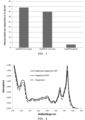
Figur 1 : Masseanteil von Hypericin am Gesamtkomplex in zwei erfindungsgemäßen Hypericin-PVP Komplexen im Vergleich zu einem herkömmlichen Hypericin-PVP Komplex. Beim für die erfindungsgemäßen Komplexe eingesetzten PVP handelt es sich um PVP mit einer mittleren molaren Masse von entweder 12 kD ("HypPVP12 Schmelze) oder 25 kD ("HypPVP25 Schmelze"). Beim für die Herstellung des herkömmlichen Komplexes eingesetzten PVP handelt es sich um PVP mit einer mittleren molaren Masse von 25 kD ("HypPVP25 gelöst"). Die erfindungsgemäßen Komplexe wurden hergestellt wie beschrieben in Beispiel 1. Der herkömmliche Komplex wurde hergestellt wie beschrieben in Beispiel 3. -
Figur 2 : Vergleich der Absorptionsspektren von Natrium-Hypericinat-PVP, Hypericin-PVP und Hypericin. Die photophysikalischen Eigenschaften von Hypericin bleiben im PVP-Komplex erhalten, unabhängig davon, ob die freie Säure oder das Natriumsalz von Hypericin eingesetzt wird, oder Hypericin in komplexierter Form vorliegt. Das heißt, dass Hypericin in durch PVP komplexierter Form seine photophysikalischen Eigenschaften nicht verliert. -
Figur 3 : Kalibrationsgerade zur Bestimmung des Masseanteils von Hypericin am Hypericin-PVP Komplex mittels HPLC. HPLC-Läufe wurde wie in Beispiel 5 beschrieben mit unterschiedlichen Mengen von Hypericin durchgeführt. Die Konzentration des eingewogenen Hypericins (x-Achse) wurde gegen die Fläche der Absorptionspeaks bei 588 nm aufgetragen und eine lineare Regression wurde erstellt. - 30 mg Polyvinylpyrrolidon (PVP 25 kD) wurde mit 15 mg Hypericin (99 % HPLC) trocken vermischt. Zu dem Gemisch wurden 200 µL (200 Mikroliter sind gleich 0,2 mL) Ethanol zugefügt und 100 µL Wasser (100 Mikroliter sind gleich 0,1 mL). Dann wurde die Mischung verrührt und für 20 Minuten stehen gelassen. Danach wurde das Gemisch langsam im Trockenschrank auf 180°C erhitzt. Die Temperaturführung von Raumtemperatur auf 180°C wurde in einem Zeitraum von etwa 20 Minuten durchgeführt. Das Gemisch wurde für etwa 8 Minuten bei einer Temperatur von 180°C gehalten. Danach wurde das Gemisch auf Raumtemperatur abgekühlt. Anschließend wurden etwa 3-6 mL Wasser zugefügt und für 1 Stunde gerührt. Dabei gingen die löslichen Bestandteile, der Hypericin-PVP Komplex, in Lösung. Die unlöslichen Bestandteile und das nicht komplexierte Hypericin wurde abfiltriert (Porendurchmesser 0,2 - 0,4 µm) . Das Filtrat wurde getrocknet und trocken bis zur Weiterverwendung gelagert.
- Wie Beispiel 1, jedoch wurde statt Hypericin das Natriumsalz verwendet: Na-Hypericinat. Na-Hypericinat wurde nach der Vorschrift von Kapinus et al. (Monatshefte für Chemie 130 (1999) 436-441) hergestellt.
- Ein herkömmlicher Hypericin-PVP Komplex wurde hergestellt wie beschrieben in Kubin et. al. "How to make hypericin water-soluble", Die Pharmazie 63 (2008) 263-269. Dazu wurden 10 mg Hypericin in 2,5 mL Ethanol unter Ultraschall gelöst, danach wurden 1000 mg PVP 25 kD und 8 mL destilliertes Wasser zugegeben. Das Gemisch wurde für ca. 5 Minuten auf 70 °C erhitzt. Danach wurden 5 mL Wasser zugegeben und das Gemisch für weitere 10 Minuten gerührt. Die Lösung wurde anschließen im Rotavapor getrocknet und der erhaltene Hypericin-PVP Komplex trocken bis zur Weiterverwendung gelagert.
- Beim Versuch mehr Hypericin zu der Komplexierung hinzuzufügen ergab sich ein Niederschlag, da unter diesen Bedingungen keine Komplexierung von wesentlich größeren Mengen Hypericin durch PVP möglich ist.
- Hypericin-PVP Komplexe wurden gemäß den in Beispielen 1 bis 3 beschriebenen Verfahren hergestellt.
- Der Masseanteil von Hypericin an den Hypericin-PVP Komplexen wurde mittels HPLC und der entsprechenden Kalibration von Hypericin bestimmt. Als Referenzmaterial wurde standardisiertes Hypericin (> 99 %, Firma Planta Naturstoffe VertriebsGmbH) verwendet. Die Bestimmung des Masseanteils von Hypericin am Gesamtkomplex wurde durchgeführt wie beschrieben in Beispiel 5.
- Bei den erfindungsgemäßen Komplexen wurden Masseanteile von bis zu 40 Gew.-% (Hypericin freie Säure; Herstellung gern. Beispiel 1) bzw. 41 Gew.-% (Natriumhypericinat; Herstellung gern. Beispiel 2) gemessen, während der Masseanteil des herkömmlichen Komplexes bei 1 Gew.-% lag (Herstellung gern. Kubin et. al., Die Pharmazie 63 (2008) 263-269 wie beschrieben in Beispiel 3). Durch Einsatz des erfindungsgemäßen Verfahrens konnte PVP also mit der nahezu 40-fachen Menge an Hypericin beladen werden.
- Der Masseanteil von Hypericin an den Hypericin-PVP Komplexen wurde mittels HPLC und der entsprechenden Kalibration mit Hypericin bestimmt. Die HPLC Methode wurde im Wesentlichen durchgeführt wie beschrieben in Freytag W.E. (Deutsche Apothekerzeitung 124 Nr. 46 (1984) 2383-2386).
- Im Detail wurde die HPLC Methode durchgeführt mit:
- Laufmittel: 568,0 g Methanol, 157,8 g Ethylacetat, 185,5 g Puffer (13,8 g NaH2PO4H2O in 1000 ml aqua dest. mit 85% Orthophosphorsäure auf pH = 2,1)
- Säule: Nucleosil 120 3C18 (120 mm Länge, 4 mm Innendurchmesser)
- Flußrate: 0,6 mL/min
- Detektion: UV-Vis bei 588 nm
- Für die Kalibration wurde standardisiertes Hypericin (> 99 %, Firma Planta Naturstoffe Vertriebs GmbH) als Referenzmaterial verwendet. HPLC-Läufe mit unterschiedliche Mengen des Referenzmaterials gelöst im HPLC Laufmittel wurden durchgeführt und die Fläche der Hypericin-Absorptionspeaks bei 588 nm wurde bestimmt. Aus den gemessenen Werten wurde durch lineare Regression eine Kalibrationsgerade erstellt (siehe
Figur 3 ). - Zur Bestimmung des Hypericin-Anteils eines gemäß Beispiel 1 hergestellten erfindungsgemäßen Hypericin-PVP Komplexes wurden aus dem getrockneten Hypericin-PVP Komplex (Pulver) genau 5 mg eingewogen und im HPLC Laufmittel gelöst. Ein HPLC-Lauf wurde wie oben beschrieben durchgeführt und aus dem erhaltenen Absorptionssignal bei 588 nm wurde anhand der zuvor erstellten Kalibrationsgerade der Anteil von Hypericin am Gesamtkomplex bestimmt. Als Resultat wurde 40 Gew.-% erhalten (d.h. in 100 mg Hypericin-PVP Komplex waren beispielsweise 40 mg Hypericin enthalten und 60 mg PVP).
Claims (10)
- Komplex aus Hypericin bzw. einem Hypericinsalz und Polyvinylpyrrolidon (PVP), dadurch gekennzeichnet, dass der mittlere Masseanteil von Hypericin bzw. vom Hypericinsalz am Gesamtkomplex größer ist als 6 Gew.-%.
- Komplex gemäß Anspruch 1, dadurch gekennzeichnet, dass das mittlere Stoffmengenverhältnis von Hypericin zu PVP im Komplex größer ist als 2,5.
- Komplex gemäß Anspruch 1 oder 2, dadurch gekennzeichnet, dass das PVP eine mittlere molare Masse von 10 bis 40 kD, vorzugsweise von 12 bis 25 kD, hat.
- Pharmazeutische Zusammensetzung enthaltend einen Komplex gemäß einem der Ansprüche 1 bis 3.
- Pharmazeutische Zusammensetzung gemäß Anspruch 4, dadurch gekennzeichnet, dass die Zusammensetzung zur intravenösen Verabreichung vorgesehen ist und dass die Zusammensetzung Hypericin in einer Konzentration von mindestens 25 mg/L enthält.
- Verfahren zur Herstellung eines Komplexes gemäß einem der Ansprüche 1 bis 3, dadurch gekennzeichnet, dass ein Gemisch von Hypericin und PVP auf eine Temperatur erhitzt wird, die über der Glasübergangstemperatur des eingesetzten PVPs liegt.
- Verfahren gemäß Anspruch 6, dadurch gekennzeichnet, dass dem Gemisch von Hypericin und PVP ein Lösungsmittel oder ein Gemisch von Lösungsmitteln, vorzugsweise Wasser, Ethanol, Methanol, Pyridin, Aceton, Ethylmethylketon, und/oder Ethylacetat, noch mehr bevorzugt Wasser, Ethanol, Methanol, und/oder Pyridin, noch mehr bevorzugt Wasser und/oder Ethanol, zugefügt wird.
- Verfahren gemäß Anspruch 6 oder 7, dadurch gekennzeichnet, dass die Mischung für mindestens 5 Minuten auf einer Temperatur, die über der Glasübergangstemperatur des eingesetzten PVPs liegt, gehalten wird.
- Pharmazeutische Zusammensetzung gemäß Anspruch 4 oder 5 zur Verwendung in einem Therapieverfahren, vorzugsweise zur Anwendung in der photodynamischen Therapie (PDT) zur Behandlung von Tumorerkrankungen.
- Verwendung eines Komplexes gemäß einem der Ansprüche 1 bis 3 zur Sterilisation und/oder Desinfektion von Oberflächen oder Flüssigkeiten.
Applications Claiming Priority (2)
| Application Number | Priority Date | Filing Date | Title |
|---|---|---|---|
| EP18183435.9A EP3593815A1 (de) | 2018-07-13 | 2018-07-13 | Hypericin-pvp komplex mit hohem hypericinanteil |
| PCT/EP2019/068775 WO2020011960A1 (de) | 2018-07-13 | 2019-07-12 | Hypericin-pvp komplex mit hohem hypericinanteil |
Publications (3)
| Publication Number | Publication Date |
|---|---|
| EP3820524A1 EP3820524A1 (de) | 2021-05-19 |
| EP3820524C0 EP3820524C0 (de) | 2023-09-06 |
| EP3820524B1 true EP3820524B1 (de) | 2023-09-06 |
Family
ID=63079731
Family Applications (2)
| Application Number | Title | Priority Date | Filing Date |
|---|---|---|---|
| EP18183435.9A Withdrawn EP3593815A1 (de) | 2018-07-13 | 2018-07-13 | Hypericin-pvp komplex mit hohem hypericinanteil |
| EP19736763.4A Active EP3820524B1 (de) | 2018-07-13 | 2019-07-12 | Hypericin-pvp komplex mit hohem hypericinanteil |
Family Applications Before (1)
| Application Number | Title | Priority Date | Filing Date |
|---|---|---|---|
| EP18183435.9A Withdrawn EP3593815A1 (de) | 2018-07-13 | 2018-07-13 | Hypericin-pvp komplex mit hohem hypericinanteil |
Country Status (15)
| Country | Link |
|---|---|
| US (2) | US12150993B2 (de) |
| EP (2) | EP3593815A1 (de) |
| JP (1) | JP7323259B2 (de) |
| KR (1) | KR102696348B1 (de) |
| CN (1) | CN112533634B (de) |
| AU (1) | AU2019300351B2 (de) |
| BR (1) | BR112021000404A2 (de) |
| ES (1) | ES2964390T3 (de) |
| IL (1) | IL279753B2 (de) |
| MX (1) | MX2020013925A (de) |
| PE (1) | PE20210925A1 (de) |
| PL (1) | PL3820524T3 (de) |
| SG (1) | SG11202012794VA (de) |
| WO (1) | WO2020011960A1 (de) |
| ZA (1) | ZA202007995B (de) |
Family Cites Families (5)
| Publication number | Priority date | Publication date | Assignee | Title |
|---|---|---|---|---|
| AT408835B8 (de) * | 2000-05-23 | 2002-07-25 | Andreas Dipl Ing Dr Kubin | Präparation von hypericin gebunden an polyvinylpyrrolidon (pvp) verschiedenen polymerisations- und vernetzungsgrades |
| JP2013035819A (ja) * | 2011-08-09 | 2013-02-21 | Norimichi Kawashima | 薬剤およびその使用方法 |
| GB201221123D0 (en) | 2012-11-23 | 2013-01-09 | Photocure As | Device for photodynamic treatment |
| US10143751B2 (en) | 2015-09-28 | 2018-12-04 | Sanochemia Pharmazeutika Ag | Photodynamic therapy, formulation usable for this purpose, and method for the production and use thereof |
| US9629932B2 (en) | 2015-09-28 | 2017-04-25 | Sanochemia Pharmazeutika Ag | Photodynamic diagnosis, formulations usable as photosensitizers for this purpose, method for the production and use thereof |
-
2018
- 2018-07-13 EP EP18183435.9A patent/EP3593815A1/de not_active Withdrawn
-
2019
- 2019-07-12 US US17/255,349 patent/US12150993B2/en active Active
- 2019-07-12 CN CN201980039081.7A patent/CN112533634B/zh active Active
- 2019-07-12 EP EP19736763.4A patent/EP3820524B1/de active Active
- 2019-07-12 MX MX2020013925A patent/MX2020013925A/es unknown
- 2019-07-12 SG SG11202012794VA patent/SG11202012794VA/en unknown
- 2019-07-12 PL PL19736763.4T patent/PL3820524T3/pl unknown
- 2019-07-12 IL IL279753A patent/IL279753B2/en unknown
- 2019-07-12 WO PCT/EP2019/068775 patent/WO2020011960A1/de not_active Ceased
- 2019-07-12 PE PE2020002167A patent/PE20210925A1/es unknown
- 2019-07-12 BR BR112021000404-1A patent/BR112021000404A2/pt unknown
- 2019-07-12 AU AU2019300351A patent/AU2019300351B2/en active Active
- 2019-07-12 ES ES19736763T patent/ES2964390T3/es active Active
- 2019-07-12 JP JP2021502850A patent/JP7323259B2/ja active Active
- 2019-07-12 KR KR1020217000561A patent/KR102696348B1/ko active Active
-
2020
- 2020-12-21 ZA ZA2020/07995A patent/ZA202007995B/en unknown
-
2024
- 2024-09-10 US US18/829,816 patent/US20240424102A1/en active Pending
Also Published As
| Publication number | Publication date |
|---|---|
| IL279753A (en) | 2021-03-01 |
| KR20210031897A (ko) | 2021-03-23 |
| EP3820524C0 (de) | 2023-09-06 |
| IL279753B1 (en) | 2024-09-01 |
| CN112533634B (zh) | 2023-02-24 |
| EP3820524A1 (de) | 2021-05-19 |
| EP3593815A1 (de) | 2020-01-15 |
| AU2019300351B2 (en) | 2024-05-02 |
| KR102696348B1 (ko) | 2024-08-19 |
| PE20210925A1 (es) | 2021-05-19 |
| JP7323259B2 (ja) | 2023-08-08 |
| US20240424102A1 (en) | 2024-12-26 |
| US12150993B2 (en) | 2024-11-26 |
| JP2021531285A (ja) | 2021-11-18 |
| IL279753B2 (en) | 2025-01-01 |
| PL3820524T3 (pl) | 2024-02-26 |
| CN112533634A (zh) | 2021-03-19 |
| CA3104404A1 (en) | 2020-01-16 |
| ES2964390T3 (es) | 2024-04-05 |
| WO2020011960A1 (de) | 2020-01-16 |
| SG11202012794VA (en) | 2021-01-28 |
| ZA202007995B (en) | 2022-06-29 |
| BR112021000404A2 (pt) | 2021-04-06 |
| MX2020013925A (es) | 2021-03-29 |
| AU2019300351A1 (en) | 2021-01-21 |
| US20210260192A1 (en) | 2021-08-26 |
Similar Documents
| Publication | Publication Date | Title |
|---|---|---|
| DE60209145T2 (de) | Pharmazeutische formulierungen mit platinderivaten | |
| DE60213996T2 (de) | Wasserlösliche porphyrinderivate für die photodynamische therapie, ihre verwendung und herstellung | |
| DE69723298T2 (de) | Iminochlorinasparaginsaeure-derivate | |
| DE102014004512A1 (de) | Anorganisch-organische Hybridverbindung | |
| DE3688721T2 (de) | Verwendung von Porphyrinderivaten bei der Entdeckung und Behandlung von Tumoren. | |
| DE2129654B2 (de) | Medikament zur Verminderung der Kapillarpermeabilität und Erhöhung der Kapillarstabilität aus der Extraktion der Flavanole enthaltenden Früchte von Vitis vinifera | |
| DE69426865T2 (de) | Pharmazeutische Zusammensetzungen enthaltend Pyryliumverbindungen, Pyryliumsalze und Verfahren zur Herstellung eines Medikaments enthaltend diese Verbindungen | |
| DE3033895C2 (de) | ||
| DE10003620A1 (de) | 5-Aminolävulinsäure-Formulierung in nichtwässrigen Lösungsmitteln | |
| EP0313942A1 (de) | Verwendung von Fluoronderivaten und Mittel zur Kontrastierung von bösartigen Neubildungen bei deren Diagnostik | |
| DE3033896A1 (de) | 4'-substituierte-4,5',8-triniedrigalkylpsoralene und verfahren zu ihrer herstellung | |
| DE3613447A1 (de) | 5-pyrimidincarboxamide und ihre verwendung zur behandlung von leukaemie und tumoren | |
| DE2837295A1 (de) | Monofunktionelle psoralenderivate und sie enthaltende arzneimittel | |
| DE10065482A1 (de) | Mit schwereren Halogenatomen substituierte Farbstoffe auf Squarain-Basis, Verfahren zu ihrer Herstellung und ihre Verwendung als Sensibilisatoren für photodynamische, therapeutische und industrielle Anwendungen | |
| EP2072584B1 (de) | Phthalocyanin-Farbstoffe, ihre Herstellung und Verwendung | |
| EP3237019B1 (de) | Formulierung von hypericin zur photodynamischen diagnose | |
| EP0817623B1 (de) | Arzneistoffe zur selektiven bekämpfung von tumorgewebe | |
| DE2322699C2 (de) | Quecksilberfreie Diuretika | |
| WO2020011960A1 (de) | Hypericin-pvp komplex mit hohem hypericinanteil | |
| DE1936723C2 (de) | Salze von Chinarindenalkoloiden und Verfahren zu ihrer Herstellung | |
| WO2017054017A1 (de) | Formulierung von hypericin zur photodynamischen therapie | |
| DE3122689C2 (de) | N-Trifluoracetyl-adriamycin-14-0-hemiglutarat und -hemiadipat und diese Verbindungen enthaltende pharmazeutische Zubereitungen | |
| DE69317803T2 (de) | Phorphyrinderivate für Diagnose und photodynamischer Therapie | |
| DE2655130B2 (de) | Eine praktisch lösungsmittelfreie Kristallform des Cefacetril-Natriumsalzes | |
| CA3104404C (en) | Hypericin-pvp complex with high hypericin content |
Legal Events
| Date | Code | Title | Description |
|---|---|---|---|
| STAA | Information on the status of an ep patent application or granted ep patent |
Free format text: STATUS: UNKNOWN |
|
| STAA | Information on the status of an ep patent application or granted ep patent |
Free format text: STATUS: THE INTERNATIONAL PUBLICATION HAS BEEN MADE |
|
| PUAI | Public reference made under article 153(3) epc to a published international application that has entered the european phase |
Free format text: ORIGINAL CODE: 0009012 |
|
| STAA | Information on the status of an ep patent application or granted ep patent |
Free format text: STATUS: REQUEST FOR EXAMINATION WAS MADE |
|
| 17P | Request for examination filed |
Effective date: 20210113 |
|
| AK | Designated contracting states |
Kind code of ref document: A1 Designated state(s): AL AT BE BG CH CY CZ DE DK EE ES FI FR GB GR HR HU IE IS IT LI LT LU LV MC MK MT NL NO PL PT RO RS SE SI SK SM TR |
|
| DAV | Request for validation of the european patent (deleted) | ||
| DAX | Request for extension of the european patent (deleted) | ||
| STAA | Information on the status of an ep patent application or granted ep patent |
Free format text: STATUS: EXAMINATION IS IN PROGRESS |
|
| 17Q | First examination report despatched |
Effective date: 20220915 |
|
| REG | Reference to a national code |
Free format text: PREVIOUS MAIN CLASS: A61K0041000000 Ipc: A61K0047580000 Ref country code: DE Ref legal event code: R079 Ref document number: 502019009268 Country of ref document: DE Free format text: PREVIOUS MAIN CLASS: A61K0041000000 Ipc: A61K0047580000 |
|
| RIC1 | Information provided on ipc code assigned before grant |
Ipc: A61P 35/00 20060101ALI20230207BHEP Ipc: A61K 41/00 20060101ALI20230207BHEP Ipc: A61K 47/58 20170101AFI20230207BHEP |
|
| GRAP | Despatch of communication of intention to grant a patent |
Free format text: ORIGINAL CODE: EPIDOSNIGR1 |
|
| STAA | Information on the status of an ep patent application or granted ep patent |
Free format text: STATUS: GRANT OF PATENT IS INTENDED |
|
| INTG | Intention to grant announced |
Effective date: 20230420 |
|
| GRAS | Grant fee paid |
Free format text: ORIGINAL CODE: EPIDOSNIGR3 |
|
| GRAA | (expected) grant |
Free format text: ORIGINAL CODE: 0009210 |
|
| STAA | Information on the status of an ep patent application or granted ep patent |
Free format text: STATUS: THE PATENT HAS BEEN GRANTED |
|
| AK | Designated contracting states |
Kind code of ref document: B1 Designated state(s): AL AT BE BG CH CY CZ DE DK EE ES FI FR GB GR HR HU IE IS IT LI LT LU LV MC MK MT NL NO PL PT RO RS SE SI SK SM TR |
|
| REG | Reference to a national code |
Ref country code: GB Ref legal event code: FG4D Free format text: NOT ENGLISH |
|
| REG | Reference to a national code |
Ref country code: CH Ref legal event code: EP |
|
| REG | Reference to a national code |
Ref country code: DE Ref legal event code: R096 Ref document number: 502019009268 Country of ref document: DE |
|
| REG | Reference to a national code |
Ref country code: IE Ref legal event code: FG4D Free format text: LANGUAGE OF EP DOCUMENT: GERMAN |
|
| U01 | Request for unitary effect filed |
Effective date: 20230914 |
|
| U07 | Unitary effect registered |
Designated state(s): AT BE BG DE DK EE FI FR IT LT LU LV MT NL PT SE SI Effective date: 20230921 |
|
| REG | Reference to a national code |
Ref country code: NO Ref legal event code: T2 Effective date: 20230906 |
|
| REG | Reference to a national code |
Ref country code: GR Ref legal event code: EP Ref document number: 20230402384 Country of ref document: GR Effective date: 20240110 |
|
| PG25 | Lapsed in a contracting state [announced via postgrant information from national office to epo] |
Ref country code: RS Free format text: LAPSE BECAUSE OF FAILURE TO SUBMIT A TRANSLATION OF THE DESCRIPTION OR TO PAY THE FEE WITHIN THE PRESCRIBED TIME-LIMIT Effective date: 20230906 Ref country code: HR Free format text: LAPSE BECAUSE OF FAILURE TO SUBMIT A TRANSLATION OF THE DESCRIPTION OR TO PAY THE FEE WITHIN THE PRESCRIBED TIME-LIMIT Effective date: 20230906 |
|
| REG | Reference to a national code |
Ref country code: ES Ref legal event code: FG2A Ref document number: 2964390 Country of ref document: ES Kind code of ref document: T3 Effective date: 20240405 |
|
| PG25 | Lapsed in a contracting state [announced via postgrant information from national office to epo] |
Ref country code: IS Free format text: LAPSE BECAUSE OF FAILURE TO SUBMIT A TRANSLATION OF THE DESCRIPTION OR TO PAY THE FEE WITHIN THE PRESCRIBED TIME-LIMIT Effective date: 20240106 |
|
| PG25 | Lapsed in a contracting state [announced via postgrant information from national office to epo] |
Ref country code: SM Free format text: LAPSE BECAUSE OF FAILURE TO SUBMIT A TRANSLATION OF THE DESCRIPTION OR TO PAY THE FEE WITHIN THE PRESCRIBED TIME-LIMIT Effective date: 20230906 Ref country code: RO Free format text: LAPSE BECAUSE OF FAILURE TO SUBMIT A TRANSLATION OF THE DESCRIPTION OR TO PAY THE FEE WITHIN THE PRESCRIBED TIME-LIMIT Effective date: 20230906 Ref country code: IS Free format text: LAPSE BECAUSE OF FAILURE TO SUBMIT A TRANSLATION OF THE DESCRIPTION OR TO PAY THE FEE WITHIN THE PRESCRIBED TIME-LIMIT Effective date: 20240106 Ref country code: CZ Free format text: LAPSE BECAUSE OF FAILURE TO SUBMIT A TRANSLATION OF THE DESCRIPTION OR TO PAY THE FEE WITHIN THE PRESCRIBED TIME-LIMIT Effective date: 20230906 Ref country code: SK Free format text: LAPSE BECAUSE OF FAILURE TO SUBMIT A TRANSLATION OF THE DESCRIPTION OR TO PAY THE FEE WITHIN THE PRESCRIBED TIME-LIMIT Effective date: 20230906 |
|
| REG | Reference to a national code |
Ref country code: DE Ref legal event code: R097 Ref document number: 502019009268 Country of ref document: DE |
|
| PLBE | No opposition filed within time limit |
Free format text: ORIGINAL CODE: 0009261 |
|
| STAA | Information on the status of an ep patent application or granted ep patent |
Free format text: STATUS: NO OPPOSITION FILED WITHIN TIME LIMIT |
|
| 26N | No opposition filed |
Effective date: 20240607 |
|
| U20 | Renewal fee for the european patent with unitary effect paid |
Year of fee payment: 6 Effective date: 20240708 |
|
| PG25 | Lapsed in a contracting state [announced via postgrant information from national office to epo] |
Ref country code: MC Free format text: LAPSE BECAUSE OF FAILURE TO SUBMIT A TRANSLATION OF THE DESCRIPTION OR TO PAY THE FEE WITHIN THE PRESCRIBED TIME-LIMIT Effective date: 20230906 |
|
| U20 | Renewal fee for the european patent with unitary effect paid |
Year of fee payment: 7 Effective date: 20250708 |
|
| PGFP | Annual fee paid to national office [announced via postgrant information from national office to epo] |
Ref country code: ES Payment date: 20250915 Year of fee payment: 7 |
|
| PGFP | Annual fee paid to national office [announced via postgrant information from national office to epo] |
Ref country code: NO Payment date: 20250722 Year of fee payment: 7 |
|
| PGFP | Annual fee paid to national office [announced via postgrant information from national office to epo] |
Ref country code: CH Payment date: 20250801 Year of fee payment: 7 |
|
| PG25 | Lapsed in a contracting state [announced via postgrant information from national office to epo] |
Ref country code: CY Free format text: LAPSE BECAUSE OF FAILURE TO SUBMIT A TRANSLATION OF THE DESCRIPTION OR TO PAY THE FEE WITHIN THE PRESCRIBED TIME-LIMIT; INVALID AB INITIO Effective date: 20190712 |
|
| PG25 | Lapsed in a contracting state [announced via postgrant information from national office to epo] |
Ref country code: HU Free format text: LAPSE BECAUSE OF FAILURE TO SUBMIT A TRANSLATION OF THE DESCRIPTION OR TO PAY THE FEE WITHIN THE PRESCRIBED TIME-LIMIT; INVALID AB INITIO Effective date: 20190712 |
|
| PG25 | Lapsed in a contracting state [announced via postgrant information from national office to epo] |
Ref country code: TR Free format text: LAPSE BECAUSE OF FAILURE TO SUBMIT A TRANSLATION OF THE DESCRIPTION OR TO PAY THE FEE WITHIN THE PRESCRIBED TIME-LIMIT Effective date: 20230906 |
|
| PGFP | Annual fee paid to national office [announced via postgrant information from national office to epo] |
Ref country code: GB Payment date: 20260615 Year of fee payment: 8 Ref country code: PL Payment date: 20260428 Year of fee payment: 8 |
|
| PGFP | Annual fee paid to national office [announced via postgrant information from national office to epo] |
Ref country code: GR Payment date: 20260429 Year of fee payment: 8 |
|
| PGFP | Annual fee paid to national office [announced via postgrant information from national office to epo] |
Ref country code: IE Payment date: 20260428 Year of fee payment: 8 |
|
| REG | Reference to a national code |
Ref country code: CH Ref legal event code: U11 Free format text: ST27 STATUS EVENT CODE: U-0-0-U10-U11 (AS PROVIDED BY THE NATIONAL OFFICE) Effective date: 20260801 |
|
| U20 | Renewal fee for the european patent with unitary effect paid |
Year of fee payment: 8 Effective date: 20260708 |