EP3780222A2 - Verfahren zur herstellung eines keramischen festelektrolyten für lithiumsekundärbatterie - Google Patents
Verfahren zur herstellung eines keramischen festelektrolyten für lithiumsekundärbatterie Download PDFInfo
- Publication number
- EP3780222A2 EP3780222A2 EP19781886.7A EP19781886A EP3780222A2 EP 3780222 A2 EP3780222 A2 EP 3780222A2 EP 19781886 A EP19781886 A EP 19781886A EP 3780222 A2 EP3780222 A2 EP 3780222A2
- Authority
- EP
- European Patent Office
- Prior art keywords
- solid electrolyte
- ceramic
- preparing
- ceramic solid
- hours
- Prior art date
- Legal status (The legal status is an assumption and is not a legal conclusion. Google has not performed a legal analysis and makes no representation as to the accuracy of the status listed.)
- Granted
Links
Images



Classifications
-
- H—ELECTRICITY
- H01—ELECTRIC ELEMENTS
- H01M—PROCESSES OR MEANS, e.g. BATTERIES, FOR THE DIRECT CONVERSION OF CHEMICAL ENERGY INTO ELECTRICAL ENERGY
- H01M10/00—Secondary cells; Manufacture thereof
- H01M10/05—Accumulators with non-aqueous electrolyte
- H01M10/052—Li-accumulators
- H01M10/0525—Rocking-chair batteries, i.e. batteries with lithium insertion or intercalation in both electrodes; Lithium-ion batteries
-
- C—CHEMISTRY; METALLURGY
- C01—INORGANIC CHEMISTRY
- C01B—NON-METALLIC ELEMENTS; COMPOUNDS THEREOF; METALLOIDS OR COMPOUNDS THEREOF NOT COVERED BY SUBCLASS C01C
- C01B25/00—Phosphorus; Compounds thereof
- C01B25/16—Oxyacids of phosphorus; Salts thereof
- C01B25/26—Phosphates
- C01B25/45—Phosphates containing plural metal, or metal and ammonium
-
- H—ELECTRICITY
- H01—ELECTRIC ELEMENTS
- H01M—PROCESSES OR MEANS, e.g. BATTERIES, FOR THE DIRECT CONVERSION OF CHEMICAL ENERGY INTO ELECTRICAL ENERGY
- H01M10/00—Secondary cells; Manufacture thereof
- H01M10/05—Accumulators with non-aqueous electrolyte
- H01M10/052—Li-accumulators
-
- H—ELECTRICITY
- H01—ELECTRIC ELEMENTS
- H01M—PROCESSES OR MEANS, e.g. BATTERIES, FOR THE DIRECT CONVERSION OF CHEMICAL ENERGY INTO ELECTRICAL ENERGY
- H01M10/00—Secondary cells; Manufacture thereof
- H01M10/05—Accumulators with non-aqueous electrolyte
- H01M10/056—Accumulators with non-aqueous electrolyte characterised by the materials used as electrolytes, e.g. mixed inorganic/organic electrolytes
- H01M10/0561—Accumulators with non-aqueous electrolyte characterised by the materials used as electrolytes, e.g. mixed inorganic/organic electrolytes the electrolyte being constituted of inorganic materials only
- H01M10/0562—Solid materials
-
- C—CHEMISTRY; METALLURGY
- C01—INORGANIC CHEMISTRY
- C01P—INDEXING SCHEME RELATING TO STRUCTURAL AND PHYSICAL ASPECTS OF SOLID INORGANIC COMPOUNDS
- C01P2002/00—Crystal-structural characteristics
- C01P2002/70—Crystal-structural characteristics defined by measured X-ray, neutron or electron diffraction data
- C01P2002/72—Crystal-structural characteristics defined by measured X-ray, neutron or electron diffraction data by d-values or two theta-values, e.g. as X-ray diagram
-
- C—CHEMISTRY; METALLURGY
- C01—INORGANIC CHEMISTRY
- C01P—INDEXING SCHEME RELATING TO STRUCTURAL AND PHYSICAL ASPECTS OF SOLID INORGANIC COMPOUNDS
- C01P2004/00—Particle morphology
- C01P2004/01—Particle morphology depicted by an image
- C01P2004/03—Particle morphology depicted by an image obtained by SEM
-
- C—CHEMISTRY; METALLURGY
- C01—INORGANIC CHEMISTRY
- C01P—INDEXING SCHEME RELATING TO STRUCTURAL AND PHYSICAL ASPECTS OF SOLID INORGANIC COMPOUNDS
- C01P2006/00—Physical properties of inorganic compounds
- C01P2006/40—Electric properties
-
- H—ELECTRICITY
- H01—ELECTRIC ELEMENTS
- H01M—PROCESSES OR MEANS, e.g. BATTERIES, FOR THE DIRECT CONVERSION OF CHEMICAL ENERGY INTO ELECTRICAL ENERGY
- H01M2300/00—Electrolytes
- H01M2300/0017—Non-aqueous electrolytes
- H01M2300/0065—Solid electrolytes
- H01M2300/0068—Solid electrolytes inorganic
- H01M2300/0071—Oxides
-
- Y—GENERAL TAGGING OF NEW TECHNOLOGICAL DEVELOPMENTS; GENERAL TAGGING OF CROSS-SECTIONAL TECHNOLOGIES SPANNING OVER SEVERAL SECTIONS OF THE IPC; TECHNICAL SUBJECTS COVERED BY FORMER USPC CROSS-REFERENCE ART COLLECTIONS [XRACs] AND DIGESTS
- Y02—TECHNOLOGIES OR APPLICATIONS FOR MITIGATION OR ADAPTATION AGAINST CLIMATE CHANGE
- Y02E—REDUCTION OF GREENHOUSE GAS [GHG] EMISSIONS, RELATED TO ENERGY GENERATION, TRANSMISSION OR DISTRIBUTION
- Y02E60/00—Enabling technologies; Technologies with a potential or indirect contribution to GHG emissions mitigation
- Y02E60/10—Energy storage using batteries
Definitions
- the present invention relates to a method for preparing a ceramic solid electrolyte used for a solid lithium secondary battery.
- the present invention relates to a method for preparing a ceramic solid electrolyte having even particle distribution, excellent crystallinity, and high ionic conductivity.
- the ceramic solid electrolyte of the present invention may comprise oxide-based, phosphate-based, and sulfide-based electrolytes.
- the lithium secondary battery market has been extended not only to small-sized IT devices, but also to medium/large-sized markets such as electric vehicles and ESS systems.
- Such a lithium secondary battery is required to have high instantaneous output, excellent reversibility during charging and discharging, high energy density, and excellent reproducibility and stability. Flexibility in shape and processing also plays an important role in order to cope with the trend to be more compact and thinner.
- the lithium secondary battery market becomes gradually medium/large-sized, there is a growing need to manufacture a secondary battery by packaging or modularizing plural cells rather than to manufacture a secondary battery with one cell.
- Lithium ion conductive ceramics which may be called a starting point of developing a solid electrolyte, may be largely divided into sulfide-based and oxide-based ceramics.
- the sulfide-based solid electrolyte is relatively easy to synthesize and has ductility compared to the oxide-based solid electrolyte and thus, does not require high heat treatment during processing.
- the sulfide-based solid electrolyte also exhibits high conductivity.
- thio-LISICON(Li 3.25 Ge 0.25 P 0.75 S 4 ) shows the conductivity of 2.2 mS/cm
- LGPS(Li 10 GeP 2 Si 12 ) shows the conductivity of 12 mS/cm.
- oxide-based solid electrolytes include LATP(Li 1+x Al x Ti 2-x (PO 4 ) 3 ) (0 ⁇ x ⁇ 2), LAGP (Li 1+x Al x Ge 2-x (PO 4 ) 3 ) (0 ⁇ x ⁇ 2), Li 7 La 3 Zr 2 O 12 (LLZO), etc.
- LATP Li 1+x Al x Ti 2-x (PO 4 ) 3
- LAGP Li 1+x Al x Ge 2-x (PO 4 ) 3
- Li 7 La 3 Zr 2 O 12 (LLZO) Li 7 La 3 Zr 2 O 12
- the LATP and the LAGP are good for commercialization because they have excellent ionic conductivity and are stable in the atmosphere.
- Most of these oxide-based solid electrolytes are prepared by a solid phase method, so the particles are uneven and the crystallinity varies greatly depending on the heat treatment temperature.
- Patent Document 0001 Korean Patent Unexamined Publication No. 10-2012-0039447
- the ceramic solid electrolyte is prepared by mixing raw material particles by a solid phase method, mixing the mixture by ball-milling in a dry state, and then heating the mixture.
- the ceramic solid electrolyte prepared by this way has low ionic conductivity because it has uneven particle distribution and various shapes of particles.
- An object of the present invention is to prepare a ceramic solid electrolyte having even particle distribution, even particle shape, and excellent crystallinity by improving the conventional method for synthesizing the ceramic solid electrolyte.
- the present invention provides ceramic solid electrolyte particles having spherical shapes and even distribution by mixing raw materials using water as a solvent and applying a rotary concentration method or a spray method.
- the ceramic particles prepared above are made into an electrolyte and applied to a battery, it is possible to exhibit excellent electrochemical properties.
- the oxide-based conductive ceramic electrolyte may be prepared by mixing raw materials of the ceramic solid electrolyte in an equivalent ratio using distilled water as a solvent, mixing the mixture in a solution state for 24 hours by ball-milling, drying first by adding a rotary concentration method or a spray method, drying second at 80°C, heating first at 400°C for 4 hours, and heating second at 1000°C for 4 hours.
- the solid electrolyte LATP may be represented by the following Chemical Formula 1. [Chemical Formula 1] Li 1+x Al x Ti 2-x (PO 4 ) 3 (0 ⁇ x ⁇ 2)
- Li 1.3 Al 0.3 Ti 1.7 (PO 4 ) 3 is preferable.
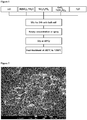
- Step 1 for preparing the LATP ceramic solid electrolyte may be a step of preparing a solid electrolyte precursor by adding and mixing lithium chloride, aluminum nitrate, ammonium phosphate, and titanium butoxide in distilled water.
- the lithium chloride is LiCl
- the aluminum nitrate is Al(NO 3 ) 3 ⁇ 9H 2 O
- the ammonium phosphate is NH 4 H 2 PO 4
- the titanium butoxide is Ti(OC 4 H 9 ) 4 .
- Step 2 may be a step for mixing the solid electrolyte precursor with a ball-mill.
- the speed of the ball-mill may be 150 RPM to 400 RPM, preferably 200 to 300 RPM.
- Step 3 may be a step for drying first by a rotary concentration method or a spray method.
- the temperature of the rotary concentration method may be 60°C to 100°C, preferably 70°C to 80°C.
- the temperature of the spray method may be 80°C to 300°C, preferably 100°C to 200°C.
- Step 4 may be a step for drying second in a dryer at 80°C for at least 24 hours to completely remove the distilled water solvent.
- Step 5 may be a step for calcining first ceramic particles in a heat treatment device and firing second the ceramic particles.
- the first calcining temperature may be 300°C to 500°C, preferably 350°C to 450°C.
- the second firing temperature may be 900°C to 1200°C, preferably 1000°C to 1100°C.
- the calcining and firing time may be 2 to 10 hours, preferably 3 to 5 hours.
- the ceramic particles may be calcined at 400°C for 4 hours and then fired at 1000°C for 4 hours.
- the heat treatment may be performed by starting from room temperature.
- the solid electrolyte ceramic particles may be made into a powder form with a mortar.
- the solid electrolyte LAGP may be represented by the following Chemical Formula 2.
- Chemical Formula 2 Li 1+x Al x Ge 2-x (PO 4 ) 3 (0 ⁇ x ⁇ 2)
- Li 1.3 Al 0.3 Ge 1 . 7 (PO 4 ) 3 is preferable.
- Step 1 for preparing the LAGP ceramic solid electrolyte particles may be a step of preparing a solid electrolyte precursor by adding and mixing lithium chloride, aluminum nitrate, ammonium phosphate, and germanium oxide in distilled water.
- the lithium chloride is LiCl
- the aluminum nitrate is Al(NO 3 ) 3 ⁇ 9H 2 O
- the ammonium phosphate is NH 4 H 2 PO 4
- the germanium oxide is GeO 2 .
- Step 2 may be a step for mixing the solid electrolyte precursor with a ball-mill.
- the speed of the ball-mill may be 150 RPM to 400 RPM, preferably 200 to 300 RPM.
- Step 3 may be a step for drying first by a rotary concentration method or a spray method.
- the temperature of the rotary concentration method may be 60°C to 100°C, preferably 70°C to 80°C.
- the temperature of the spray method may be 80°C to 300°C, preferably 100°C to 200°C.
- Step 4 may be a step for drying second in a dryer at 80°C for at least 24 hours to completely remove the distilled water solvent.
- Step 5 may be a step for calcining first ceramic particles in a heat treatment device and firing second the ceramic particles.
- the first calcining temperature may be 300°C to 500°C, preferably 350°C to 450°C.
- the second firing temperature may be 900°C to 1200°C, preferably 1000°C to 1100°C.
- the calcining and firing time may be 2 to 10 hours, preferably 3 to 5 hours.
- the ceramic particles may be calcined at 400°C for 4 hours and then fired at 1000°C for 4 hours.
- zirconia balls of 5 mm and 10 mm in diameter were prepared in a ratio of 2:1, and then added in a 500 ml container prepared so that a volume ratio of the mixed sample and the zirconia balls was 1:1.
- the rotary speed of the ball milling was 200 to 300 RPM, and the ball milling was performed for 24 hours.
- the zirconia balls were removed from the sample.
- the sample was dried first by a rotary concentration method or a spray method, put in an evaporation dish and then sufficiently dried second at 80°C for 24 hours. Then, the dried sample was pulverized in a mortar to form a powder form. Then, the sample was heat treated as follows. The temperature was raised from room temperature to 400°C.
- the sample was heat treated for 4 hours to calcine the sample and cooled naturally until 100°C or less. Thereafter, the sample was heat treated at 1000°C for 4 hours to fire the sample and then pulverized to prepare a powdered LATP solid electrolyte.
- FIG. 1 A method of preparing the LATP solid electrolyte was illustrated in FIG. 1 .
- Sample 1 a sample obtained by ball-milling and mixing without using a distilled water solvent and then heat-treating
- Sample 2 a sample obtained by ball-milling and mixing using a distilled water solvent, drying the solvent, and then heat-treating
- Sample 3 a sample obtained by ball-milling and mixing using a distilled water solvent, drying first the solvent by spraying, drying second the solvent in an oven, and then heat-treating is referred to as Sample 4.
- Samples 1 to 4 are summarized in Table 1 below.
- Table 1 Synthesis condition Using distilled water solvent Ball-milling and mixing Process added Heat treatment Sample 1 x 24 h x 400°C, 4h 1000°C, 4h Sample 2 ⁇ 24 h x 400°C, 4h 1000°C, 4h Sample 3 ⁇ 24 h Rotary 400°C, 4h concentrating 1000°C, 4h Sample 4 ⁇ 24 h Spraying 400°C, 4h 1000°C, 4h
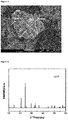
- FIGS. 2 to 5 are SEM photographs of LATP ceramic particles according to the above process.
- Sample 1 FIG. 2
- Sample 2 FIG. 3
- Sample 3 FIG. 4
- Sample 4 FIG. 5
- Sample 4 FIG. 5
- FIG. 5 has a very even particle shape and has a particle distribution of 0.6 to 3 micrometers.
- the synthesized Li 1.3 Al 0.3 Ti 1.7 (PO 4 ) 3 was analyzed at a scanning speed of 4°/min for an XRD analysis 2 theta section of 10° to 90°. The analyzed results were shown in FIG. 6 . It can be seen that the LATP is synthesized in a NASICON structure.
- the ionic conductivity is increased.
- zirconia balls of 5 mm and 10 mm in diameter were prepared in a ratio of 2:1, and then added in a 500 ml container prepared so that a volume ratio of the mixed sample and the zirconia balls was 1:1.
- the rotary speed of the ball milling was 200 to 300 RPM, and the ball milling was performed for 24 hours.
- the zirconia balls were removed from the sample.
- the sample was dried first by a rotary concentration method or a spray method, put in an evaporation dish and then sufficiently dried second at 80°C for 24 hours. Then, the dried sample was pulverized in a mortar to form a powder form. Then, the sample was heat treated as follows. The temperature was raised from room temperature to 400°C.
- the sample was heat treated for 4 hours to calcine the sample and cooled naturally until 100°C or less. Thereafter, the sample was heat treated at 1000°C for 4 hours to fire the sample and then pulverized to prepare a powdered LATP solid electrolyte.
- FIGS. 7 to 9 are SEM photographs of particles of LAGP synthesized by methods of Samples 1 to 3.
- the particles synthesized through first solvent drying by adding rotary concentration method (Sample 3) shows the best particle characteristic.
- the synthesized Li 1.3 Al 0.3 Ge 1.7 (PO 4 ) 3 was analyzed at a scanning speed of 4°/min for an XRD analysis 2 theta section of 10° to 90°. The analyzed results were shown in FIG. 10 . It can be seen that the LAGP is synthesized in a NASICON structure.
Landscapes
- Chemical & Material Sciences (AREA)
- Organic Chemistry (AREA)
- Inorganic Chemistry (AREA)
- Engineering & Computer Science (AREA)
- Manufacturing & Machinery (AREA)
- Chemical Kinetics & Catalysis (AREA)
- Electrochemistry (AREA)
- General Chemical & Material Sciences (AREA)
- General Physics & Mathematics (AREA)
- Physics & Mathematics (AREA)
- Condensed Matter Physics & Semiconductors (AREA)
- Materials Engineering (AREA)
- Secondary Cells (AREA)
- Conductive Materials (AREA)
Applications Claiming Priority (2)
| Application Number | Priority Date | Filing Date | Title |
|---|---|---|---|
| KR1020180039464A KR102224126B1 (ko) | 2018-04-05 | 2018-04-05 | 리튬 이차전지를 위한 세라믹 고체 전해질의 제조 방법 |
| PCT/KR2019/003528 WO2019194454A2 (ko) | 2018-04-05 | 2019-03-27 | 리튬 이차 전지를 위한 세라믹 고체 전해질의 제조 방법 |
Publications (4)
| Publication Number | Publication Date |
|---|---|
| EP3780222A2 true EP3780222A2 (de) | 2021-02-17 |
| EP3780222A4 EP3780222A4 (de) | 2021-10-27 |
| EP3780222C0 EP3780222C0 (de) | 2025-01-22 |
| EP3780222B1 EP3780222B1 (de) | 2025-01-22 |
Family
ID=68100838
Family Applications (1)
| Application Number | Title | Priority Date | Filing Date |
|---|---|---|---|
| EP19781886.7A Active EP3780222B1 (de) | 2018-04-05 | 2019-03-27 | Verfahren zur herstellung eines keramischen festelektrolyten für lithiumsekundärbatterie |
Country Status (6)
| Country | Link |
|---|---|
| US (1) | US12330936B2 (de) |
| EP (1) | EP3780222B1 (de) |
| JP (1) | JP7030207B2 (de) |
| KR (1) | KR102224126B1 (de) |
| CN (1) | CN111937213A (de) |
| WO (1) | WO2019194454A2 (de) |
Families Citing this family (7)
| Publication number | Priority date | Publication date | Assignee | Title |
|---|---|---|---|---|
| KR102427454B1 (ko) * | 2019-11-26 | 2022-08-01 | 주식회사 세븐킹에너지 | 이온 전도성 세라믹 및 그의 제조 방법 |
| JP7644594B2 (ja) * | 2019-12-20 | 2025-03-12 | Dowaエレクトロニクス株式会社 | 非晶質リチウムイオン伝導酸化物粉末およびその製造方法、並びに、nasicon型結晶構造を有するリチウムイオン伝導酸化物粉末の製造方法 |
| KR102546049B1 (ko) * | 2021-04-01 | 2023-06-22 | 주식회사 신한세라믹 | 성형물에 의한 이차전지용 고체전해질 제조방법 |
| CN113889660A (zh) * | 2021-09-04 | 2022-01-04 | 浙江锋锂新能源科技有限公司 | 一种球形含锂氧化物电解质粉体材料及制备方法 |
| CN117080538A (zh) * | 2022-05-09 | 2023-11-17 | 天津国安盟固利新材料科技股份有限公司 | 一种纳米磷酸铝钛锂电解质材料的制备方法及其应用 |
| KR20240058429A (ko) * | 2022-10-26 | 2024-05-03 | 주식회사 레몬 | 이온전도성 latp 나노섬유웹의 제조방법 |
| WO2024138590A1 (zh) * | 2022-12-30 | 2024-07-04 | 昆明理工大学 | 一种低维析晶制备钠超离子导体型固体电解质的方法 |
Family Cites Families (22)
| Publication number | Priority date | Publication date | Assignee | Title |
|---|---|---|---|---|
| ES2020104A6 (es) * | 1990-01-23 | 1991-07-16 | Ercros Sa | Materiales ceramicos composites para aplicaciones ingenieriles de alta temperatura y severas condiciones de choque termico y su procedimiento de fabricacion. |
| JP3706054B2 (ja) * | 2000-12-11 | 2005-10-12 | 日本碍子株式会社 | ベータアルミナ固体電解質の製造方法 |
| JP5495472B2 (ja) | 2003-05-30 | 2014-05-21 | 日本化学工業株式会社 | 硫化リチウム粉体および無機固体電解質 |
| JP2006008498A (ja) * | 2004-05-21 | 2006-01-12 | Tdk Corp | セラミック原料粉体、その製造方法、誘電体磁器組成物、電子部品及び積層セラミックコンデンサ |
| JP2008110899A (ja) * | 2006-10-31 | 2008-05-15 | Ohara Inc | リチウムイオン伝導性無機粒子およびその製造方法 |
| CN101234257B (zh) | 2007-02-01 | 2011-07-27 | 发泰(天津)科技有限公司 | 微波旋转薄膜浓缩器 |
| US8304115B1 (en) * | 2009-08-28 | 2012-11-06 | Cermacell, LLC | Multi layer ceramic battery |
| KR101319380B1 (ko) | 2010-10-15 | 2013-10-17 | 삼성에스디아이 주식회사 | 고체 전해질, 상기 고체 전해질을 포함하는 리튬 이차 전지, 상기 고체 전해질용 입자의 제조방법 및 고체 전해질용 입자 |
| KR20130103096A (ko) | 2012-03-09 | 2013-09-23 | 삼성전자주식회사 | 무기 이온 전도체, 그 제조방법 및 이를 채용한 연료전지 |
| DE102012103409B3 (de) * | 2012-04-19 | 2012-11-22 | Karlsruher Institut für Technologie | Verfahren zur Herstellung Li-Ionenleitender Lithiumaluminiumtitanphosphate und deren Verwendung als Festkörperelektrolyte |
| KR101383356B1 (ko) * | 2012-08-07 | 2014-04-14 | 한국전기연구원 | 고유전율을 갖는 복합 세라믹 유전체 조성물 및 그 제조방법 |
| US10388975B2 (en) * | 2013-01-31 | 2019-08-20 | Board Of Trustees Of Michigan State University | Template-based methods of making and using ceramic solids |
| KR20140131441A (ko) | 2013-05-03 | 2014-11-13 | 한국생산기술연구원 | 고체산화물 연료전지용 고체전해질의 제조방법 및 단위셀의 제조방법 |
| EP2903073B1 (de) | 2013-10-24 | 2018-08-29 | LG Chem, Ltd. | Feste elektrolytpartikel, verfahren zur herstellung davon und lithiumsekundärbatterie damit |
| JP6393974B2 (ja) * | 2013-11-01 | 2018-09-26 | セントラル硝子株式会社 | 固体電解質前駆体、その製造方法、固体電解質の製造方法、及び固体電解質−電極活物質複合体の製造方法 |
| JP6341480B2 (ja) * | 2014-04-16 | 2018-06-13 | 株式会社豊田自動織機 | ガーネット型酸化物及びその製造方法、並びにこれらを用いた二次電池用固体電解質及び二次電池 |
| US9660270B2 (en) | 2014-04-24 | 2017-05-23 | Daiichi Kigenso Kagaku Kogyo Co., Ltd. | Method for producing garnet-type compound, garnet-type compound, and all-solid lithium secondary cell containing said garnet-type compound |
| CN104466238A (zh) * | 2014-11-28 | 2015-03-25 | 深圳华中科技大学研究院 | 一种掺杂型固体陶瓷电解质、其制备方法及应用 |
| JP2016207354A (ja) | 2015-04-17 | 2016-12-08 | 出光興産株式会社 | 硫化物固体電解質の製造方法 |
| WO2017018488A1 (ja) | 2015-07-30 | 2017-02-02 | セントラル硝子株式会社 | チタン酸リチウムとチタン酸リチウムランタンとを含む焼結体、その製造方法、及びリチウム電池 |
| CN105609881B (zh) | 2015-12-18 | 2019-10-11 | 中国科学院青岛生物能源与过程研究所 | 无机固态电解质材料及其制备方法 |
| CN105406118A (zh) * | 2015-12-30 | 2016-03-16 | 哈尔滨工业大学 | 一种陶瓷固态电解质及其制备方法 |
-
2018
- 2018-04-05 KR KR1020180039464A patent/KR102224126B1/ko active Active
-
2019
- 2019-03-27 JP JP2020554217A patent/JP7030207B2/ja active Active
- 2019-03-27 CN CN201980024758.XA patent/CN111937213A/zh active Pending
- 2019-03-27 EP EP19781886.7A patent/EP3780222B1/de active Active
- 2019-03-27 WO PCT/KR2019/003528 patent/WO2019194454A2/ko not_active Ceased
- 2019-03-27 US US17/045,487 patent/US12330936B2/en active Active
Also Published As
| Publication number | Publication date |
|---|---|
| EP3780222C0 (de) | 2025-01-22 |
| JP7030207B2 (ja) | 2022-03-04 |
| JP2021514107A (ja) | 2021-06-03 |
| US12330936B2 (en) | 2025-06-17 |
| KR20190116615A (ko) | 2019-10-15 |
| EP3780222B1 (de) | 2025-01-22 |
| KR102224126B1 (ko) | 2021-03-08 |
| EP3780222A4 (de) | 2021-10-27 |
| US20210155480A1 (en) | 2021-05-27 |
| WO2019194454A3 (ko) | 2019-12-12 |
| WO2019194454A2 (ko) | 2019-10-10 |
| CN111937213A (zh) | 2020-11-13 |
Similar Documents
| Publication | Publication Date | Title |
|---|---|---|
| EP3780222B1 (de) | Verfahren zur herstellung eines keramischen festelektrolyten für lithiumsekundärbatterie | |
| JP7767501B2 (ja) | 少なくとも1つのポリマーとリチウムイオン伝導性粒子とを含むリチウムイオン伝導性複合材料、および前記複合材料からのリチウムイオン伝導体の製造方法 | |
| CN110265708B (zh) | 在季铵碱协同作用下合成石榴石结构的锂镧锆氧系固体电解质材料的固相合成方法 | |
| CN104591231A (zh) | 含氟石榴石结构锂离子氧化物陶瓷 | |
| CN107848894A (zh) | 石榴石型氧化物烧结体和其制造方法 | |
| KR100398744B1 (ko) | 전기화학적 성능이 향상된 리튬망간 스피넬 복합산화물의 제조방법 | |
| CN113526560B (zh) | 一种钠钾共嵌金属氧化物正极材料及其制备方法 | |
| KR20010056565A (ko) | 전기화학적 성능이 향상된 리튬망간 스피넬 산화물의제조방법 | |
| WO2014038521A1 (ja) | 固体電解質セラミックス材料 | |
| JP2019046559A (ja) | 固体電解質の製造方法、全固体電池用電極材料の製造方法、および全固体電池の製造方法 | |
| KR20200040704A (ko) | 리튬 이차전지를 위한 세라믹 고체 전해질의 제조 방법 | |
| KR102427454B1 (ko) | 이온 전도성 세라믹 및 그의 제조 방법 | |
| KR101661523B1 (ko) | 고체 전해질, 이의 제조 방법, 및 이를 포함하는 리튬 이차 전지 | |
| JP7687566B2 (ja) | 固体電解質及びその製造方法 | |
| CN113061026A (zh) | 氧化物固体电解质及其制备方法 | |
| KR20050082148A (ko) | 망간산 리튬의 제조방법 | |
| EP4679552A1 (de) | Anordnungsstruktur eines festelektrolyts in einer festkörperzelle und batterie | |
| EP4362160A1 (de) | Festelektrolyt und herstellungsverfahren dafür | |
| JP7125227B2 (ja) | スピネル型結晶相を有するリチウム含有コバルト酸化物の製造方法 | |
| JPH11195417A (ja) | リチウムイオン二次電池の正極活物質として用いるのに適した高純度正方晶マンガン酸リチウム粉末の製造法 | |
| JP2001048544A (ja) | 非水リチウム二次電池用のリチウムマンガン複合酸化物の製造方法及びその用途 |
Legal Events
| Date | Code | Title | Description |
|---|---|---|---|
| STAA | Information on the status of an ep patent application or granted ep patent |
Free format text: STATUS: THE INTERNATIONAL PUBLICATION HAS BEEN MADE |
|
| PUAI | Public reference made under article 153(3) epc to a published international application that has entered the european phase |
Free format text: ORIGINAL CODE: 0009012 |
|
| STAA | Information on the status of an ep patent application or granted ep patent |
Free format text: STATUS: REQUEST FOR EXAMINATION WAS MADE |
|
| 17P | Request for examination filed |
Effective date: 20201001 |
|
| AK | Designated contracting states |
Kind code of ref document: A2 Designated state(s): AL AT BE BG CH CY CZ DE DK EE ES FI FR GB GR HR HU IE IS IT LI LT LU LV MC MK MT NL NO PL PT RO RS SE SI SK SM TR |
|
| AX | Request for extension of the european patent |
Extension state: BA ME |
|
| DAV | Request for validation of the european patent (deleted) | ||
| DAX | Request for extension of the european patent (deleted) | ||
| A4 | Supplementary search report drawn up and despatched |
Effective date: 20210927 |
|
| RIC1 | Information provided on ipc code assigned before grant |
Ipc: C01B 25/45 20060101ALI20210921BHEP Ipc: H01M 10/052 20100101ALI20210921BHEP Ipc: H01M 10/0562 20100101AFI20210921BHEP |
|
| STAA | Information on the status of an ep patent application or granted ep patent |
Free format text: STATUS: EXAMINATION IS IN PROGRESS |
|
| 17Q | First examination report despatched |
Effective date: 20220614 |
|
| GRAP | Despatch of communication of intention to grant a patent |
Free format text: ORIGINAL CODE: EPIDOSNIGR1 |
|
| STAA | Information on the status of an ep patent application or granted ep patent |
Free format text: STATUS: GRANT OF PATENT IS INTENDED |
|
| INTG | Intention to grant announced |
Effective date: 20240930 |
|
| GRAS | Grant fee paid |
Free format text: ORIGINAL CODE: EPIDOSNIGR3 |
|
| GRAA | (expected) grant |
Free format text: ORIGINAL CODE: 0009210 |
|
| STAA | Information on the status of an ep patent application or granted ep patent |
Free format text: STATUS: THE PATENT HAS BEEN GRANTED |
|
| RAP3 | Party data changed (applicant data changed or rights of an application transferred) |
Owner name: DUKSAN FUTURECELL CO., LTD. |
|
| AK | Designated contracting states |
Kind code of ref document: B1 Designated state(s): AL AT BE BG CH CY CZ DE DK EE ES FI FR GB GR HR HU IE IS IT LI LT LU LV MC MK MT NL NO PL PT RO RS SE SI SK SM TR |
|
| REG | Reference to a national code |
Ref country code: GB Ref legal event code: FG4D |
|
| REG | Reference to a national code |
Ref country code: CH Ref legal event code: EP |
|
| REG | Reference to a national code |
Ref country code: IE Ref legal event code: FG4D |
|
| REG | Reference to a national code |
Ref country code: DE Ref legal event code: R096 Ref document number: 602019065133 Country of ref document: DE |
|
| U01 | Request for unitary effect filed |
Effective date: 20250122 |
|
| U07 | Unitary effect registered |
Designated state(s): AT BE BG DE DK EE FI FR IT LT LU LV MT NL PT RO SE SI Effective date: 20250203 |
|
| U20 | Renewal fee for the european patent with unitary effect paid |
Year of fee payment: 7 Effective date: 20250221 |
|
| PG25 | Lapsed in a contracting state [announced via postgrant information from national office to epo] |
Ref country code: RS Free format text: LAPSE BECAUSE OF FAILURE TO SUBMIT A TRANSLATION OF THE DESCRIPTION OR TO PAY THE FEE WITHIN THE PRESCRIBED TIME-LIMIT Effective date: 20250422 |
|
| PG25 | Lapsed in a contracting state [announced via postgrant information from national office to epo] |
Ref country code: PL Free format text: LAPSE BECAUSE OF FAILURE TO SUBMIT A TRANSLATION OF THE DESCRIPTION OR TO PAY THE FEE WITHIN THE PRESCRIBED TIME-LIMIT Effective date: 20250122 |
|
| PG25 | Lapsed in a contracting state [announced via postgrant information from national office to epo] |
Ref country code: ES Free format text: LAPSE BECAUSE OF FAILURE TO SUBMIT A TRANSLATION OF THE DESCRIPTION OR TO PAY THE FEE WITHIN THE PRESCRIBED TIME-LIMIT Effective date: 20250122 |
|
| PG25 | Lapsed in a contracting state [announced via postgrant information from national office to epo] |
Ref country code: NO Free format text: LAPSE BECAUSE OF FAILURE TO SUBMIT A TRANSLATION OF THE DESCRIPTION OR TO PAY THE FEE WITHIN THE PRESCRIBED TIME-LIMIT Effective date: 20250422 Ref country code: IS Free format text: LAPSE BECAUSE OF FAILURE TO SUBMIT A TRANSLATION OF THE DESCRIPTION OR TO PAY THE FEE WITHIN THE PRESCRIBED TIME-LIMIT Effective date: 20250522 |
|
| PG25 | Lapsed in a contracting state [announced via postgrant information from national office to epo] |
Ref country code: HR Free format text: LAPSE BECAUSE OF FAILURE TO SUBMIT A TRANSLATION OF THE DESCRIPTION OR TO PAY THE FEE WITHIN THE PRESCRIBED TIME-LIMIT Effective date: 20250122 |
|
| PG25 | Lapsed in a contracting state [announced via postgrant information from national office to epo] |
Ref country code: GR Free format text: LAPSE BECAUSE OF FAILURE TO SUBMIT A TRANSLATION OF THE DESCRIPTION OR TO PAY THE FEE WITHIN THE PRESCRIBED TIME-LIMIT Effective date: 20250423 |
|
| PG25 | Lapsed in a contracting state [announced via postgrant information from national office to epo] |
Ref country code: SM Free format text: LAPSE BECAUSE OF FAILURE TO SUBMIT A TRANSLATION OF THE DESCRIPTION OR TO PAY THE FEE WITHIN THE PRESCRIBED TIME-LIMIT Effective date: 20250122 |
|
| PG25 | Lapsed in a contracting state [announced via postgrant information from national office to epo] |
Ref country code: MC Free format text: LAPSE BECAUSE OF FAILURE TO SUBMIT A TRANSLATION OF THE DESCRIPTION OR TO PAY THE FEE WITHIN THE PRESCRIBED TIME-LIMIT Effective date: 20250122 |
|
| PG25 | Lapsed in a contracting state [announced via postgrant information from national office to epo] |
Ref country code: CZ Free format text: LAPSE BECAUSE OF FAILURE TO SUBMIT A TRANSLATION OF THE DESCRIPTION OR TO PAY THE FEE WITHIN THE PRESCRIBED TIME-LIMIT Effective date: 20250122 |
|
| REG | Reference to a national code |
Ref country code: CH Ref legal event code: H13 Free format text: ST27 STATUS EVENT CODE: U-0-0-H10-H13 (AS PROVIDED BY THE NATIONAL OFFICE) Effective date: 20251023 |
|
| PG25 | Lapsed in a contracting state [announced via postgrant information from national office to epo] |
Ref country code: SK Free format text: LAPSE BECAUSE OF FAILURE TO SUBMIT A TRANSLATION OF THE DESCRIPTION OR TO PAY THE FEE WITHIN THE PRESCRIBED TIME-LIMIT Effective date: 20250122 |
|
| PLBE | No opposition filed within time limit |
Free format text: ORIGINAL CODE: 0009261 |
|
| STAA | Information on the status of an ep patent application or granted ep patent |
Free format text: STATUS: NO OPPOSITION FILED WITHIN TIME LIMIT |
|
| GBPC | Gb: european patent ceased through non-payment of renewal fee |
Effective date: 20250422 |
|
| 26N | No opposition filed |
Effective date: 20251023 |
|
| PG25 | Lapsed in a contracting state [announced via postgrant information from national office to epo] |
Ref country code: GB Free format text: LAPSE BECAUSE OF NON-PAYMENT OF DUE FEES Effective date: 20250422 |
|
| PG25 | Lapsed in a contracting state [announced via postgrant information from national office to epo] |
Ref country code: CH Free format text: LAPSE BECAUSE OF NON-PAYMENT OF DUE FEES Effective date: 20250331 |
|
| PG25 | Lapsed in a contracting state [announced via postgrant information from national office to epo] |
Ref country code: IE Free format text: LAPSE BECAUSE OF NON-PAYMENT OF DUE FEES Effective date: 20250327 |