EP3761484A1 - Dauermagnetmotor - Google Patents
Dauermagnetmotor Download PDFInfo
- Publication number
- EP3761484A1 EP3761484A1 EP18908031.0A EP18908031A EP3761484A1 EP 3761484 A1 EP3761484 A1 EP 3761484A1 EP 18908031 A EP18908031 A EP 18908031A EP 3761484 A1 EP3761484 A1 EP 3761484A1
- Authority
- EP
- European Patent Office
- Prior art keywords
- slit
- slits
- permanent magnet
- disposed
- rotor
- Prior art date
- Legal status (The legal status is an assumption and is not a legal conclusion. Google has not performed a legal analysis and makes no representation as to the accuracy of the status listed.)
- Pending
Links
Images






Classifications
-
- H—ELECTRICITY
- H02—GENERATION; CONVERSION OR DISTRIBUTION OF ELECTRIC POWER
- H02K—DYNAMO-ELECTRIC MACHINES
- H02K29/00—Motors or generators having non-mechanical commutating devices, e.g. discharge tubes or semiconductor devices
- H02K29/03—Motors or generators having non-mechanical commutating devices, e.g. discharge tubes or semiconductor devices with a magnetic circuit specially adapted for avoiding torque ripples or self-starting problems
-
- H—ELECTRICITY
- H02—GENERATION; CONVERSION OR DISTRIBUTION OF ELECTRIC POWER
- H02K—DYNAMO-ELECTRIC MACHINES
- H02K1/00—Details of the magnetic circuit
- H02K1/06—Details of the magnetic circuit characterised by the shape, form or construction
- H02K1/22—Rotating parts of the magnetic circuit
- H02K1/27—Rotor cores with permanent magnets
- H02K1/2706—Inner rotors
- H02K1/272—Inner rotors the magnetisation axis of the magnets being perpendicular to the rotor axis
- H02K1/274—Inner rotors the magnetisation axis of the magnets being perpendicular to the rotor axis the rotor consisting of two or more circumferentially positioned magnets
- H02K1/2753—Inner rotors the magnetisation axis of the magnets being perpendicular to the rotor axis the rotor consisting of two or more circumferentially positioned magnets the rotor consisting of magnets or groups of magnets arranged with alternating polarity
- H02K1/276—Magnets embedded in the magnetic core, e.g. interior permanent magnets [IPM]
-
- H—ELECTRICITY
- H02—GENERATION; CONVERSION OR DISTRIBUTION OF ELECTRIC POWER
- H02K—DYNAMO-ELECTRIC MACHINES
- H02K21/00—Synchronous motors having permanent magnets; Synchronous generators having permanent magnets
- H02K21/12—Synchronous motors having permanent magnets; Synchronous generators having permanent magnets with stationary armatures and rotating magnets
- H02K21/14—Synchronous motors having permanent magnets; Synchronous generators having permanent magnets with stationary armatures and rotating magnets with magnets rotating within the armatures
Definitions
- the present application relates to a permanent magnet motor.
- slits inclined in one direction of rotation are provided in a rotor core surface of an IPM motor in order to reduce torque ripple (for example, refer to Patent Literature 2).
- an IPM has greater demagnetization resistance than a surface permanent magnet (SPM), and reluctance torque can be utilized, because of which a small motor with a high output can be realized by increasing an amount of current, thereby increasing torque density.
- SPM surface permanent magnet
- an IPM is such that a face opposing a stator inner diameter forms a rotor core with high magnetic permeability, because of which a magnetic flux that crosses a magnetic pole surface in a circumferential direction increases, and an air gap magnetic flux density is more liable to become locally excessive compared with an SPM.
- An existing permanent magnet motor is such that due to a local increase in magnetic flux density in an air gap, an electromagnetic excitation force proportional to two times the magnetic flux density acts, attempting to cause a stator to transform, because of which there is a problem in that motor vibration noise worsens.
- an electromagnetic excitation force proportional to two times the magnetic flux density acts, attempting to cause a stator to transform, because of which there is a problem in that motor vibration noise worsens.
- the application discloses technology for resolving the heretofore described kind of problem, and has an object of providing a permanent magnet motor such that a worsening of motor vibration noise can be restricted while securing a reduction in size and an increase in output, which are advantages of an IPM.
- a permanent magnet motor disclosed in the present application includes a stator, and a rotor disposed opposing an inner side of the stator and having a field pole of a rotor core in which a permanent magnet is embedded, wherein the field pole has a radius smaller than an arc centered on a shaft of the rotor, a multiple of slits are formed in the field pole, the multiple of slits are disposed so that an interval between a first central line positioned between a multiple of the slits and a second central line positioned between a neighboring multiple of the slits increases as the first central line and the second central line head toward an outer peripheral side of the rotor core, and of the multiple of slits of the field pole, a first slit disposed in a central position of the field pole, and a second slit and a third slit disposed on either side of the first slit, are disposed within 20% of a circumferential direction width of the permanent magnet.
- a permanent magnet motor such that a worsening of vibration noise of a motor can be restricted, while securing a reduction in size and an increase in output, which are advantages of an IPM, is obtained.
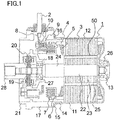
- Fig. 1 is an axial direction sectional view of a permanent magnet motor according to the first embodiment.
- the permanent magnet motor according to the first embodiment is used in, for example, an electric power steering system.
- a permanent magnet motor (hereafter referred to simply as "motor") 1 includes a rotor 22 having a rotor core 23 in whose interior a multiple of permanent magnets 25 are disposed, and supported so as to rotate freely, and a stator 12 provided across an air gap 50 on an outer side of the rotor 22. Also, the stator 12 includes a stator core 3 and a stator winding 5.
- the stator core 3 is formed by, for example, plate-form electromagnetic steel sheets being stacked, and the three-phase stator winding 5 is wound around the stator core 3 across an insulator 4 made of resin.
- the stator windings 5 of each phase are delta-connected by a winding terminal 7 housed in a terminal holder 6 made of resin.
- a connection terminal 8 for connecting to a lead wire 2 is attached to the winding terminal 7 of each phase.
- the connection terminal 8 is attached to a connection terminal base portion 9, and a nut 10 for attaching the lead wire 2 to the connection terminal 8 is housed in an interior of the connection terminal base portion 9.
- the stator core 3 is press-fitted into a frame 11 made of iron, forming the stator 12 of the motor 1.
- a frame 11 made of iron, forming the stator 12 of the motor 1.
- Another end portion of the frame 11 is opened, and a spigot joint portion 14 for linking to a housing 17 of the motor 1 is formed.
- a flange portion 15 having a screw clamping portion for screwing the stator 12 to the housing 17 of the motor 1 is formed on an outer periphery of the spigot joint portion 14 of the frame 11.
- An O-ring-form frame grommet 16 for waterproofing is provided between the housing 17 of the motor 1 and the flange portion 15 of the stator 12.
- the housing 17 of the motor 1 is formed by a die casting of an aluminum alloy, and a front bearing box 18 that houses a front bearing 27 for supporting one end of the rotor 22 is formed in a central portion. Also, a resolver mounting portion 20 for attaching a resolver 19, which is a rotation sensor for detecting an angle of rotation of the rotor 22, is formed in a vicinity of the front bearing box 18 of the housing 17.
- a mounting spigot joint portion 21 for attaching the motor 1 to a mating instrument is provided in an end portion of the housing 17 on a side opposite to a side on which the stator 12 is attached.
- the rotor 22 includes the rotor core 23, which is formed by electromagnetic steel sheets attached to an iron shaft 24 being stacked. Further, either end of the shaft 24 is supported by the rear bearing 26 and the front bearing 27 so as to rotate freely. A boss 28, which is coupling for linking to a mating instrument, is attached to a front side end portion of the shaft 24.
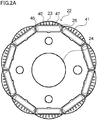
- Fig. 2A and Fig. 2B are front views of a rotor of a permanent magnet motor according to the first embodiment. Also, Fig. 2B is an enlarged view of Fig. 2A . As shown in Fig. 2A and Fig. 2B , the multiple of permanent magnets 25 are embedded in a circumferential direction in the rotor core 23 of the rotor 22. The multiple of permanent magnets 25 are housed and fixed in a multiple of permanent magnet mounting holes 47 disposed at equal intervals in the circumferential direction in the rotor core 23, and a gap portion 45 is formed on either side of the permanent magnet 25. Fig. 2A and Fig. 2B are centered on the rotor 22.
- the stator 12 has the stator core 3, which has a multiple of teeth 48 and a multiple of slots (not shown), and an armature winding (not shown) wound around the teeth 48 and housed in the slots.
- the rotor core 23 in the first embodiment has a floral form, and a multiple of slits 41 are formed in a field pole 40 of the rotor core 23 in which the permanent magnet 25 is embedded.
- the field pole 40 has a radius smaller than an arc centered on the shaft 24, which is attached on an inner side of the rotor 22.
- a central slit B in a center of the field pole 40 is such that a longitudinal axial direction (longitudinal direction) thereof is disposed in a radial direction of the rotor core 23 or a radial direction of an outer periphery of the floral form field pole 40.
- an odd number of slits 41 are disposed axisymmetrically sandwiching the central slit B disposed in the center of the field pole 40, and lengths of the slits 41 are axisymmetrically the same.
- a circumferential direction width of the permanent magnet 25 is greater than a radial direction width, and the permanent magnet 25 is of a flat plate magnet form.
- connection portion 44 is provided in order to integrate the field pole 40 divided by the slits 41.
- the field pole 40 divided by the slits 41 is integrated by the connection portion 44.
- the connection portion 44 is configured of a connection portion (field pole upper side) 44a or a connection portion (field pole lower side) 44b.
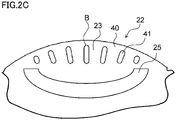
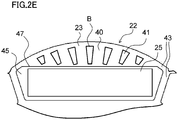
- Fig. 2C to Fig. 2E are front views of a rotor of a permanent magnet motor that is another example according to the first embodiment.
- a form of the permanent magnet 25 is a curved form, but structures excepting the permanent magnet 25 and a form of a permanent magnet mounting hole are the same as the structures in Fig. 2A .
- a form of the rotor core 23 opposing a bridge portion 43 is a perfectly circular form 46, but structures excepting this form are the same as the structures in Fig. 2A .
- a form of the slit 41 is trapezoidal, but structures excepting the form of the slit 41 are the same as the structures in Fig. 2A .
- Fig. 3 to Fig. 5 are front views of a permanent magnet motor in a comparative example.
- Fig. 3 to Fig. 5 show the teeth 48 of the stator 12 provided across the air gap 50 on the outer side of the rotor 22.
- the external form of the rotor 22 is the perfectly circular form 46, because of which torque ripple increases.
- no slit 41 is provided in the rotor core 23, because of which a magnetic flux 49 crossing the field pole 40 of the rotor core 23 flows, and magnetic flux density in a region A of the air gap 50 increases.
- the intervals between the slits 41 become smaller the nearer to the outer peripheral side of the rotor core 23, and there is no longer an advantage of the magnetic flux density of the air gap 50 being dispersed because of the slits 41.
- poles and slots such as 10 poles and 12 slots, 14 poles and 12 slots, or 14 poles and 18 slots, wherein a mode such that a low order electromagnetic excitation force mode is small and vibration noise is liable to increase, for example, a secondary mode all round, occurs.
- One of the slits 41 is in the center of the field pole 40.
- the center of the field pole 40 is the place in which a sectional area of the field pole 40 with respect to the crossing magnetic flux 49 is greatest and the magnetic flux 49 flows most easily, and an advantage in that the magnetic flux 49 is interrupted by the slit 41 is obtained.
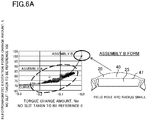
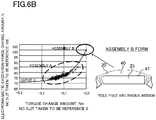
- Fig. 6A to Fig. 6C are drawings wherein amounts of change in electromagnetic excitation force and torque in a structure when slits are provided in a field pole and amounts of change in electromagnetic excitation force and torque in a structure (an assembly B) wherein slits are not provided in a field pole are plotted.
- a graph on which the amounts of change in electromagnetic excitation force and torque are plotted is shown on the left side, and a front view of a form of the assembly B, wherein slits are not provided in the field pole, is shown on the right side.
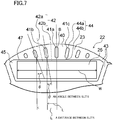
- Fig. 7 is a front view of a rotor of a permanent magnet motor according to the first embodiment.
- an assembly A with specifications designed using an optimum design tool of electromagnetic field analysis wherein five or seven slits 41 are disposed in the 10 pole, 12 slot motor 1 shown in Fig. 7 , and a position (a distance L between slits) and an angle ⁇ of the slits 41 are caused to change, so that a secondary component (a component causing transformation to an ellipse), which is a main component of electromagnetic excitation force that causes vibration noise in the stator core 3 or the frame 11, is minimal, and the assembly B with specifications such that the slit 41 is not disposed in the field pole 40, which is the reference for slit design, are plotted in Fig. 6A to Fig. 6C .
- a vertical axis shows an electromagnetic excitation force change rate
- a horizontal axis shows an amount of torque change.
- the vertical axis shows as a percentage (%) to what level the electromagnetic excitation force can decrease with respect to 100 owing to slit design.
- the horizontal axis shows to what extent the torque amount changes owing to slit design.
- the assembly B with the specifications that are the reference for slit design, is such that some forms of the rotor 22 from an almost perfectly circular form to a practically floral form are selected by changing the arc radius of the field pole 40, and taken to be proof showing that a tendency to be described below has universality, regardless of the design of the assembly B.
- the form of the assembly B shown on the right side of Fig. 6A corresponds to, for example, the floral form rotor 22 wherein the arc radius of the field pole 40 is small.
- the form of the assembly B shown on the right side of Fig. 6C corresponds to, for example, the rotor 22 with the almost perfectly circular form wherein the arc radius of the field pole 40 is large.
- the form of the assembly B shown on the right side of Fig. 6B corresponds to the rotor 22 having an arc radius of the field pole 40 midway between the form of the assembly B shown on the right side of Fig. 6A and the form of the assembly B shown on the right side of Fig. 6C .
- Fig. 6A to Fig. 6C are drawings wherein torque-electromagnetic excitation force curves C joining the assemblies B shown in Fig. 6A to Fig. 6C and assemblies A designed with slits based on each assembly B are plotted as exponential functions using the least squares method.
- Each curve C is a curve that gradually approaches 71%, and shows that electromagnetic excitation force can be considerably reduced by slit design to a maximum of a 71% level.
- an electromagnetic excitation force corresponding to a general time constant that is an index indicating a convergence speed from the assembly B that is the reference to 71% is taken to be 81% or less, it can be said that the electromagnetic excitation force can converge to a sufficiently small value in the assembly A owing to slit design.
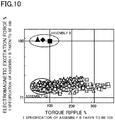
- Fig. 8 is a drawing wherein analysis values obtained using the specifications of each of Fig. 6A to Fig. 6C are plotted, with a vertical axis as electromagnetic excitation force and a horizontal axis as a torque ripple value.
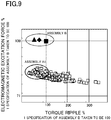
- triangular, diamond, and square plotting forms shown in assembly B are the form of one of the assemblies B, in which no slit is provided in the field pole 40, shown on the right side in Fig. 6A to Fig. 6C , but no particular correspondence relation between the plotting form and the form of the assembly B is specified here. The same applies to the assembly A.
- the assembly A is an assembly such that torque ripple decreases and also, conversely, worsens with respect to the assembly B, in which no slit 41 is provided in the field pole 40, as shown in Fig. 8 .
- Torque ripple worsening in comparison with the assembly B, which is the reference, due to slit design is because no balance is achieved between electromagnetic excitation force and torque ripple, and vibration noise caused by frame vibration and shaft vibration cannot be restricted, and it goes without saying that specifications such that torque ripple is equal to or less than that of the assembly B are specifications such that a clear advantage of achieving a balance between electromagnetic excitation force and torque ripple is obtained.
- the plotted data are divided into an assembly A1, wherein the electromagnetic excitation force value is somewhat high, and an assembly A2.
- Fig. 9 is a drawing wherein data corresponding to a second slit 41b and a third slit 41c neighboring a first slit 41a in the rotor 22 shown in Fig. 7 being disposed in positions greater than 20% with respect to a circumferential direction width W of the permanent magnet 25 are separated from the data plotted in Fig. 8 and replotted.
- Fig. 10 is a drawing wherein data corresponding to the second slit 41b and the third slit 41c neighboring the first slit 41a in the rotor 22 shown in Fig. 7 being disposed in positions within 20% with respect to the circumferential direction width W of the permanent magnet 25 are separated from the data plotted in Fig. 8 and replotted.
- the previously undifferentiated assembly A1 and assembly A2 can be differentiated between by focusing on achieving a balance between electromagnetic excitation force and torque ripple, and specifications such that electromagnetic excitation force can be further reduced can be selected.
- the first embodiment is such that, taking 20% with respect to the circumferential direction width W of the permanent magnet 25 as a threshold, torque ripple is reduced, and a form of the rotor 22 that reduces electromagnetic excitation force can be adopted, by the first slit 41a disposed in a central position of the field pole 40, and the second slit 41b and the third slit 41c disposed on either side of the first slit 41a, being disposed within 20% of the circumferential direction width of the permanent magnet 25.
- the motor 1 according to the first embodiment is such that a worsening of vibration noise can be reduced.
- the multiple of slits 41 are disposed so that electromagnetic excitation force, which forms a main component when a spatial order is a minimum order of two or more, decreases to 81% or less with respect to a case where a rotor core with no slit is adopted as a reference. Further still, the multiple of slits 41 are disposed in a state such that torque ripple is equal to or less than the torque ripple of a rotor core with no slit with respect to a case where the rotor core with no slit is adopted as a reference.
- Embodiments can be combined, and each embodiment can be modified or eliminated as appropriate.
Landscapes
- Engineering & Computer Science (AREA)
- Power Engineering (AREA)
- Permanent Field Magnets Of Synchronous Machinery (AREA)
- Iron Core Of Rotating Electric Machines (AREA)
Applications Claiming Priority (1)
| Application Number | Priority Date | Filing Date | Title |
|---|---|---|---|
| PCT/JP2018/007450 WO2019167160A1 (ja) | 2018-02-28 | 2018-02-28 | 永久磁石型モータ |
Publications (2)
| Publication Number | Publication Date |
|---|---|
| EP3761484A1 true EP3761484A1 (de) | 2021-01-06 |
| EP3761484A4 EP3761484A4 (de) | 2021-03-03 |
Family
ID=67805300
Family Applications (1)
| Application Number | Title | Priority Date | Filing Date |
|---|---|---|---|
| EP18908031.0A Pending EP3761484A4 (de) | 2018-02-28 | 2018-02-28 | Dauermagnetmotor |
Country Status (5)
| Country | Link |
|---|---|
| US (1) | US11264880B2 (de) |
| EP (1) | EP3761484A4 (de) |
| JP (1) | JP7005741B2 (de) |
| CN (1) | CN111742466A (de) |
| WO (1) | WO2019167160A1 (de) |
Families Citing this family (2)
| Publication number | Priority date | Publication date | Assignee | Title |
|---|---|---|---|---|
| JP7590905B2 (ja) * | 2021-03-31 | 2024-11-27 | 本田技研工業株式会社 | 回転電機のロータ |
| CN115549332B (zh) * | 2021-06-29 | 2025-04-08 | 比亚迪股份有限公司 | 电机及压缩机 |
Family Cites Families (13)
| Publication number | Priority date | Publication date | Assignee | Title |
|---|---|---|---|---|
| JP2003023740A (ja) | 2001-07-05 | 2003-01-24 | Mitsubishi Electric Corp | 永久磁石型電動機の永久磁石型回転子 |
| JP4127683B2 (ja) | 2004-06-24 | 2008-07-30 | 三菱電機株式会社 | 磁石埋め込み型ロータ |
| JP4091933B2 (ja) | 2004-09-01 | 2008-05-28 | 三菱電機株式会社 | 永久磁石形モータ |
| JP2006081336A (ja) | 2004-09-10 | 2006-03-23 | Nissan Motor Co Ltd | 回転電機の凸極性変更ロータ |
| JP6095263B2 (ja) * | 2011-11-10 | 2017-03-15 | 信越化学工業株式会社 | 埋込磁石型モータおよび圧縮機 |
| EP2602912A2 (de) | 2011-12-05 | 2013-06-12 | Samsung Electronics Co., Ltd | Bürstenloser Motor |
| JP2013118788A (ja) * | 2011-12-05 | 2013-06-13 | Samsung Electronics Co Ltd | ブラシレスモータ |
| JP2013126291A (ja) | 2011-12-14 | 2013-06-24 | Mitsuba Corp | ブラシレスモータおよび電動パワーステアリング装置 |
| EP2916434B1 (de) * | 2012-11-01 | 2017-07-19 | Mitsubishi Electric Corporation | Elektromotor mit eingebettetem dauermagnet, verdichter sowie kühl- und klimaanlage |
| JP5985358B2 (ja) | 2012-11-02 | 2016-09-06 | 株式会社クボタ | 永久磁石式同期モータ |
| US9634531B2 (en) * | 2013-09-25 | 2017-04-25 | Mitsubishi Electric Corporation | Electric motor with embedded permanent magnet, compressor, and refrigeration/air-conditioning device |
| CN105594099B (zh) * | 2013-09-25 | 2018-06-08 | 三菱电机株式会社 | 永磁铁埋入型电动机、压缩机以及制冷空调装置 |
| WO2016203563A1 (ja) * | 2015-06-17 | 2016-12-22 | 三菱電機株式会社 | 圧縮機用永久磁石埋込型電動機、圧縮機、および冷凍サイクル装置 |
-
2018
- 2018-02-28 EP EP18908031.0A patent/EP3761484A4/de active Pending
- 2018-02-28 JP JP2020503154A patent/JP7005741B2/ja active Active
- 2018-02-28 WO PCT/JP2018/007450 patent/WO2019167160A1/ja not_active Ceased
- 2018-02-28 US US16/961,959 patent/US11264880B2/en active Active
- 2018-02-28 CN CN201880089934.3A patent/CN111742466A/zh active Pending
Also Published As
| Publication number | Publication date |
|---|---|
| CN111742466A (zh) | 2020-10-02 |
| WO2019167160A1 (ja) | 2019-09-06 |
| EP3761484A4 (de) | 2021-03-03 |
| US20210075305A1 (en) | 2021-03-11 |
| JPWO2019167160A1 (ja) | 2020-12-03 |
| JP7005741B2 (ja) | 2022-01-24 |
| US11264880B2 (en) | 2022-03-01 |
Similar Documents
| Publication | Publication Date | Title |
|---|---|---|
| US9525313B2 (en) | Coil tooth assembly | |
| US8766506B2 (en) | Stator core | |
| US10680475B2 (en) | Rotor for rotary electric machine | |
| JP2021016205A (ja) | シンクロナスリラクタンスモータ | |
| JP4709132B2 (ja) | 永久磁石埋込型モータの回転子及び送風機用電動機及び圧縮機用電動機 | |
| JP6507956B2 (ja) | 永久磁石式回転電機 | |
| JP5242720B2 (ja) | 永久磁石埋込型モータの回転子 | |
| CN113597725B (zh) | 同步磁阻马达 | |
| JP3703907B2 (ja) | ブラシレスdcモータ | |
| US11264880B2 (en) | Permanent magnet motor | |
| WO2018128043A1 (ja) | 回転電機、および、それを用いた自動車用電動補機システム | |
| US8896164B2 (en) | Permanent-magnet stepping motor | |
| WO2022180724A1 (ja) | 電動機 | |
| JPH0847185A (ja) | モータの鉄心 | |
| JPWO2020054469A1 (ja) | ステータ及びそれを用いたモータ | |
| EP3618233B1 (de) | Permanentmagnetmotor | |
| JP6695241B2 (ja) | ブラシレスモータ | |
| JP7401380B2 (ja) | 永久磁石電動機 | |
| US9800106B2 (en) | Rotor | |
| JP2003102135A (ja) | ギャップワインディングモータ | |
| CN114270663B (zh) | 转子 | |
| JP7401381B2 (ja) | 永久磁石電動機 | |
| JP2003319585A (ja) | 永久磁石型モータ及び極異方性磁石の形成方法 | |
| JP6570456B2 (ja) | 固定子、回転電機、および、固定子の製造方法 |
Legal Events
| Date | Code | Title | Description |
|---|---|---|---|
| STAA | Information on the status of an ep patent application or granted ep patent |
Free format text: STATUS: THE INTERNATIONAL PUBLICATION HAS BEEN MADE |
|
| PUAI | Public reference made under article 153(3) epc to a published international application that has entered the european phase |
Free format text: ORIGINAL CODE: 0009012 |
|
| STAA | Information on the status of an ep patent application or granted ep patent |
Free format text: STATUS: REQUEST FOR EXAMINATION WAS MADE |
|
| 17P | Request for examination filed |
Effective date: 20200713 |
|
| AK | Designated contracting states |
Kind code of ref document: A1 Designated state(s): AL AT BE BG CH CY CZ DE DK EE ES FI FR GB GR HR HU IE IS IT LI LT LU LV MC MK MT NL NO PL PT RO RS SE SI SK SM TR |
|
| AX | Request for extension of the european patent |
Extension state: BA ME |
|
| A4 | Supplementary search report drawn up and despatched |
Effective date: 20210201 |
|
| RIC1 | Information provided on ipc code assigned before grant |
Ipc: H02K 1/27 20060101AFI20210126BHEP |
|
| DAV | Request for validation of the european patent (deleted) | ||
| DAX | Request for extension of the european patent (deleted) | ||
| STAA | Information on the status of an ep patent application or granted ep patent |
Free format text: STATUS: EXAMINATION IS IN PROGRESS |
|
| 17Q | First examination report despatched |
Effective date: 20250626 |