EP3702175B1 - Reifen - Google Patents
Reifen Download PDFInfo
- Publication number
- EP3702175B1 EP3702175B1 EP18870821.8A EP18870821A EP3702175B1 EP 3702175 B1 EP3702175 B1 EP 3702175B1 EP 18870821 A EP18870821 A EP 18870821A EP 3702175 B1 EP3702175 B1 EP 3702175B1
- Authority
- EP
- European Patent Office
- Prior art keywords
- resin
- cord
- steel
- resin material
- filament
- Prior art date
- Legal status (The legal status is an assumption and is not a legal conclusion. Google has not performed a legal analysis and makes no representation as to the accuracy of the status listed.)
- Active
Links
Images

Classifications
-
- D—TEXTILES; PAPER
- D07—ROPES; CABLES OTHER THAN ELECTRIC
- D07B—ROPES OR CABLES IN GENERAL
- D07B1/00—Constructional features of ropes or cables
- D07B1/06—Ropes or cables built-up from metal wires, e.g. of section wires around a hemp core
- D07B1/0606—Reinforcing cords for rubber or plastic articles
- D07B1/062—Reinforcing cords for rubber or plastic articles the reinforcing cords being characterised by the strand configuration
-
- B—PERFORMING OPERATIONS; TRANSPORTING
- B60—VEHICLES IN GENERAL
- B60C—VEHICLE TYRES; TYRE INFLATION; TYRE CHANGING; CONNECTING VALVES TO INFLATABLE ELASTIC BODIES IN GENERAL; DEVICES OR ARRANGEMENTS RELATED TO TYRES
- B60C9/00—Reinforcements or ply arrangement of pneumatic tyres
-
- B—PERFORMING OPERATIONS; TRANSPORTING
- B60—VEHICLES IN GENERAL
- B60C—VEHICLE TYRES; TYRE INFLATION; TYRE CHANGING; CONNECTING VALVES TO INFLATABLE ELASTIC BODIES IN GENERAL; DEVICES OR ARRANGEMENTS RELATED TO TYRES
- B60C9/00—Reinforcements or ply arrangement of pneumatic tyres
- B60C9/02—Carcasses
- B60C9/04—Carcasses the reinforcing cords of each carcass ply arranged in a substantially parallel relationship
-
- C—CHEMISTRY; METALLURGY
- C08—ORGANIC MACROMOLECULAR COMPOUNDS; THEIR PREPARATION OR CHEMICAL WORKING-UP; COMPOSITIONS BASED THEREON
- C08K—Use of inorganic or non-macromolecular organic substances as compounding ingredients
- C08K3/00—Use of inorganic substances as compounding ingredients
-
- C—CHEMISTRY; METALLURGY
- C08—ORGANIC MACROMOLECULAR COMPOUNDS; THEIR PREPARATION OR CHEMICAL WORKING-UP; COMPOSITIONS BASED THEREON
- C08L—COMPOSITIONS OF MACROMOLECULAR COMPOUNDS
- C08L23/00—Compositions of homopolymers or copolymers of unsaturated aliphatic hydrocarbons having only one carbon-to-carbon double bond; Compositions of derivatives of such polymers
- C08L23/02—Compositions of homopolymers or copolymers of unsaturated aliphatic hydrocarbons having only one carbon-to-carbon double bond; Compositions of derivatives of such polymers not modified by chemical after-treatment
- C08L23/04—Homopolymers or copolymers of ethene
- C08L23/06—Polyethylene
-
- C—CHEMISTRY; METALLURGY
- C08—ORGANIC MACROMOLECULAR COMPOUNDS; THEIR PREPARATION OR CHEMICAL WORKING-UP; COMPOSITIONS BASED THEREON
- C08L—COMPOSITIONS OF MACROMOLECULAR COMPOUNDS
- C08L23/00—Compositions of homopolymers or copolymers of unsaturated aliphatic hydrocarbons having only one carbon-to-carbon double bond; Compositions of derivatives of such polymers
- C08L23/02—Compositions of homopolymers or copolymers of unsaturated aliphatic hydrocarbons having only one carbon-to-carbon double bond; Compositions of derivatives of such polymers not modified by chemical after-treatment
- C08L23/16—Ethylene-propylene or ethylene-propylene-diene copolymers
-
- C—CHEMISTRY; METALLURGY
- C08—ORGANIC MACROMOLECULAR COMPOUNDS; THEIR PREPARATION OR CHEMICAL WORKING-UP; COMPOSITIONS BASED THEREON
- C08L—COMPOSITIONS OF MACROMOLECULAR COMPOUNDS
- C08L23/00—Compositions of homopolymers or copolymers of unsaturated aliphatic hydrocarbons having only one carbon-to-carbon double bond; Compositions of derivatives of such polymers
- C08L23/02—Compositions of homopolymers or copolymers of unsaturated aliphatic hydrocarbons having only one carbon-to-carbon double bond; Compositions of derivatives of such polymers not modified by chemical after-treatment
- C08L23/18—Homopolymers or copolymers of hydrocarbons having four or more carbon atoms
- C08L23/20—Homopolymers or copolymers of hydrocarbons having four or more carbon atoms having four to nine carbon atoms
-
- C—CHEMISTRY; METALLURGY
- C08—ORGANIC MACROMOLECULAR COMPOUNDS; THEIR PREPARATION OR CHEMICAL WORKING-UP; COMPOSITIONS BASED THEREON
- C08L—COMPOSITIONS OF MACROMOLECULAR COMPOUNDS
- C08L23/00—Compositions of homopolymers or copolymers of unsaturated aliphatic hydrocarbons having only one carbon-to-carbon double bond; Compositions of derivatives of such polymers
- C08L23/26—Compositions of homopolymers or copolymers of unsaturated aliphatic hydrocarbons having only one carbon-to-carbon double bond; Compositions of derivatives of such polymers modified by chemical after-treatment
-
- C—CHEMISTRY; METALLURGY
- C08—ORGANIC MACROMOLECULAR COMPOUNDS; THEIR PREPARATION OR CHEMICAL WORKING-UP; COMPOSITIONS BASED THEREON
- C08L—COMPOSITIONS OF MACROMOLECULAR COMPOUNDS
- C08L9/00—Compositions of homopolymers or copolymers of conjugated diene hydrocarbons
- C08L9/06—Copolymers with styrene
-
- D—TEXTILES; PAPER
- D02—YARNS; MECHANICAL FINISHING OF YARNS OR ROPES; WARPING OR BEAMING
- D02G—CRIMPING OR CURLING FIBRES, FILAMENTS, THREADS, OR YARNS; YARNS OR THREADS
- D02G3/00—Yarns or threads, e.g. fancy yarns; Processes or apparatus for the production thereof, not otherwise provided for
- D02G3/44—Yarns or threads characterised by the purpose for which they are designed
- D02G3/48—Tyre cords
-
- D—TEXTILES; PAPER
- D07—ROPES; CABLES OTHER THAN ELECTRIC
- D07B—ROPES OR CABLES IN GENERAL
- D07B1/00—Constructional features of ropes or cables
- D07B1/06—Ropes or cables built-up from metal wires, e.g. of section wires around a hemp core
-
- D—TEXTILES; PAPER
- D07—ROPES; CABLES OTHER THAN ELECTRIC
- D07B—ROPES OR CABLES IN GENERAL
- D07B1/00—Constructional features of ropes or cables
- D07B1/16—Ropes or cables with an enveloping sheathing or inlays of rubber or plastics
- D07B1/165—Ropes or cables with an enveloping sheathing or inlays of rubber or plastics characterised by a plastic or rubber inlay
- D07B1/167—Ropes or cables with an enveloping sheathing or inlays of rubber or plastics characterised by a plastic or rubber inlay having a predetermined shape
-
- B—PERFORMING OPERATIONS; TRANSPORTING
- B60—VEHICLES IN GENERAL
- B60C—VEHICLE TYRES; TYRE INFLATION; TYRE CHANGING; CONNECTING VALVES TO INFLATABLE ELASTIC BODIES IN GENERAL; DEVICES OR ARRANGEMENTS RELATED TO TYRES
- B60C9/00—Reinforcements or ply arrangement of pneumatic tyres
- B60C9/02—Carcasses
- B60C9/04—Carcasses the reinforcing cords of each carcass ply arranged in a substantially parallel relationship
- B60C2009/0475—Particular materials of the carcass cords
-
- C—CHEMISTRY; METALLURGY
- C08—ORGANIC MACROMOLECULAR COMPOUNDS; THEIR PREPARATION OR CHEMICAL WORKING-UP; COMPOSITIONS BASED THEREON
- C08K—Use of inorganic or non-macromolecular organic substances as compounding ingredients
- C08K3/00—Use of inorganic substances as compounding ingredients
- C08K3/02—Elements
- C08K3/04—Carbon
-
- D—TEXTILES; PAPER
- D07—ROPES; CABLES OTHER THAN ELECTRIC
- D07B—ROPES OR CABLES IN GENERAL
- D07B1/00—Constructional features of ropes or cables
- D07B1/06—Ropes or cables built-up from metal wires, e.g. of section wires around a hemp core
- D07B1/0606—Reinforcing cords for rubber or plastic articles
- D07B1/062—Reinforcing cords for rubber or plastic articles the reinforcing cords being characterised by the strand configuration
- D07B1/0626—Reinforcing cords for rubber or plastic articles the reinforcing cords being characterised by the strand configuration the reinforcing cords consisting of three core wires or filaments and at least one layer of outer wires or filaments, i.e. a 3+N configuration
-
- D—TEXTILES; PAPER
- D07—ROPES; CABLES OTHER THAN ELECTRIC
- D07B—ROPES OR CABLES IN GENERAL
- D07B1/00—Constructional features of ropes or cables
- D07B1/06—Ropes or cables built-up from metal wires, e.g. of section wires around a hemp core
- D07B1/0606—Reinforcing cords for rubber or plastic articles
- D07B1/062—Reinforcing cords for rubber or plastic articles the reinforcing cords being characterised by the strand configuration
- D07B1/0633—Reinforcing cords for rubber or plastic articles the reinforcing cords being characterised by the strand configuration having a multiple-layer configuration
-
- D—TEXTILES; PAPER
- D07—ROPES; CABLES OTHER THAN ELECTRIC
- D07B—ROPES OR CABLES IN GENERAL
- D07B2201/00—Ropes or cables
- D07B2201/20—Rope or cable components
- D07B2201/2015—Strands
- D07B2201/2024—Strands twisted
- D07B2201/2029—Open winding
-
- D—TEXTILES; PAPER
- D07—ROPES; CABLES OTHER THAN ELECTRIC
- D07B—ROPES OR CABLES IN GENERAL
- D07B2201/00—Ropes or cables
- D07B2201/20—Rope or cable components
- D07B2201/2015—Strands
- D07B2201/2046—Strands comprising fillers
-
- D—TEXTILES; PAPER
- D07—ROPES; CABLES OTHER THAN ELECTRIC
- D07B—ROPES OR CABLES IN GENERAL
- D07B2201/00—Ropes or cables
- D07B2201/20—Rope or cable components
- D07B2201/2047—Cores
- D07B2201/2052—Cores characterised by their structure
- D07B2201/2059—Cores characterised by their structure comprising wires
- D07B2201/2062—Cores characterised by their structure comprising wires comprising fillers
-
- D—TEXTILES; PAPER
- D07—ROPES; CABLES OTHER THAN ELECTRIC
- D07B—ROPES OR CABLES IN GENERAL
- D07B2201/00—Ropes or cables
- D07B2201/20—Rope or cable components
- D07B2201/2071—Spacers
- D07B2201/2073—Spacers in circumferencial direction
-
- D—TEXTILES; PAPER
- D07—ROPES; CABLES OTHER THAN ELECTRIC
- D07B—ROPES OR CABLES IN GENERAL
- D07B2201/00—Ropes or cables
- D07B2201/20—Rope or cable components
- D07B2201/2075—Fillers
- D07B2201/2082—Fillers characterised by the materials used
-
- D—TEXTILES; PAPER
- D07—ROPES; CABLES OTHER THAN ELECTRIC
- D07B—ROPES OR CABLES IN GENERAL
- D07B2207/00—Rope or cable making machines
- D07B2207/40—Machine components
- D07B2207/404—Heat treating devices; Corresponding methods
- D07B2207/4059—Heat treating devices; Corresponding methods to soften the filler material
-
- D—TEXTILES; PAPER
- D07—ROPES; CABLES OTHER THAN ELECTRIC
- D07B—ROPES OR CABLES IN GENERAL
- D07B2401/00—Aspects related to the problem to be solved or advantage
- D07B2401/20—Aspects related to the problem to be solved or advantage related to ropes or cables
- D07B2401/202—Environmental resistance
- D07B2401/2025—Environmental resistance avoiding corrosion
-
- D—TEXTILES; PAPER
- D07—ROPES; CABLES OTHER THAN ELECTRIC
- D07B—ROPES OR CABLES IN GENERAL
- D07B2401/00—Aspects related to the problem to be solved or advantage
- D07B2401/20—Aspects related to the problem to be solved or advantage related to ropes or cables
- D07B2401/202—Environmental resistance
- D07B2401/204—Moisture handling
Definitions
- the present invention relates to a tire, and more particularly, to a tire whose carcass ply is improved.
- steel cords are used for carcass plies of medium and large tires.
- the carcass ply is an important member that maintains the internal pressure of a tire as a pressure vessel and ensures the durability of the tire.
- a steel cord for use in a carcass ply a cord having a compact structure (closest-packed structure) such as a 12 cc structure, in which steel filaments are arranged in such a manner to be closest-packed in a cross section of the cord, is mainly used.
- a wrapping filament also referred to as a spiral filament or the like
- a secondary effect of the wrapping filament also include an effect of preventing a flared cord-end (an untwisted cord-end).
- Patent Document 1 discloses a technique in which, by making the tensile strength of all filaments in a steel cord of 3+ from 7 to 8 structure equal to or more than a predetermined value and making the core filament diameter equal to or larger than the sheath filament diameter, the rubber penetration is improved, and a twist of the cord is prevented from being loosened with the holding force of a sheath using the adhesive force between the sheath and the rubber,.
- Patent Document 1 JPH07-109685A (Claims, paragraphs [0002] to [0006], and the like)
- JP H01 98194 U describes a steel cord used for tire reinforcement and comprising a core part that consists of four strands and a structure that includes eight strands around the periphery of the core part, wherein a center void formed by the four core strands is filled with a core material made of organic fibers having a melting temperature below the vulcanization temperature of a reinforcing rubber.
- BE 900 175 A relates to a steel cord that is pre-embedded in a rubber product to be vulcanized, wherein core material consisting of synthetic fibers or a high molecular weight polymer occupies at least the core space.
- 54(3) EPC discloses an elastomer reinforcement cord having a core-sheath structure, wherein the cord includes metallic filaments and resin filaments twisted together, wherein the resin filaments are made from a polymeric material having a melting point or softening point of 80 to 160°C.
- EPC discloses a method for manufacturing a tire comprising a vulcanization step of vulcanizing a green tire provided with a belt having at least one belt layer, wherein the belt layer includes a steel cord formed by twisting a steel filament together with a resin filament having a softening point of 125°C or lower, and wherein the resin filament includes at least an ionomer.
- EP 3 730 692 A1 to be considered under Art.
- EPC discloses an elastomer reinforcement cord having a core-sheath structure with metal filaments and a resin filament twisted together, in which gaps between the metal filaments are filled with resin, and the diameter of the cord is set within a predetermined range of a geometrically calculated value of a diameter of the cord including only the metal filaments.
- problems with a cord having the above-described compact structure include: a possibility of progress of corrosion to the entire carcass ply when water infiltrates from outside due to an external damage such as tire cut since there are voids between filaments, which may reduce the tire strength; and a possibility of fretting between the cord body and the wrapping filament due to repeated input by rolling the tire.
- the above-described compact structure involves an additional step of winding a wrapping filament around a cord body and thus has a problem that causes a cost increase.
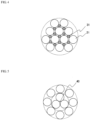
- a cord structure such as a 3+8 structure (rubber penetration structure) is also used that provides a gap between filaments in a cord cross section so that the rubber can infiltrate into the cord cross section during vulcanization.
- this structure can also suppress water flow at the time of external damage, as shown in FIG. 5 , for example, even in a case using a cord having a 3+8 structure, there is still a gap in a 1 ⁇ 3 core inside 40 and therefore a possibility of water penetration corrosion in the longitudinal direction of the cord still remains.
- the gauge pressure in such a tire increases compared with a case of a closest-packed structure, and that such a tire has to be designed in consideration of the end count of plies.
- Patent Document 1 Although there is a technology described in Patent Document 1 that addresses these problems, in particular, the realization of a technique that can further improve the corrosion resistance to water penetration, the fretting resistance, and the cord untwisting resistance of a steel cord applied to carcass plies has been desired with the recent increase in required performance for tires.
- an object of the present invention is to provide a tire in which the corrosion resistance to water penetration, the fretting resistance, and the cord untwisting resistance of a steel cord applied to a carcass ply is improved.
- the present inventor intensively studied and found that the following structure can solve the above-described problems, thereby completing the present invention.
- the present invention relates to a tire including a carcass ply as a skeleton, wherein the carcass ply is reinforced by a steel cord including no wrapping filament, the steel cord is composed of a plurality of steel filaments including 3 or more core filaments, at least a part of a surface of each of the plurality of steel filaments is coated with a resin material containing at least an ionomer, and when a resin component contained in the resin material is composed of a single resin, a melting point of the resin material is 150°C or less, and when the resin component is composed of a composition containing two or more resins, a softening point of the resin material is 150°C or less.
- thermoplastic resin including a thermoplastic elastomer and a thermosetting resin including a thermosetting elastomer, and does not include a vulcanized rubber.
- the steel cord includes a core portion composed of the core filaments and at least one sheath layer arranged on an outer periphery of the core portion.
- a region occupied by portions other than the steel filaments in a region surrounded by a line connecting centers of respective sheath filaments constituting an outermost sheath layer in a cord cross section orthogonal to a cord longitudinal direction is defined as a gap region
- a filling rate indicating a ratio of the resin material to the gap region is preferably from 52% to 120%.
- the resin material preferably contains an inorganic filler in an amount of from 0.1 parts by mass to 30 parts by mass based on 100 parts by mass of a resin component, and more preferably, the inorganic filler is carbon black, and suitably, the grade of the carbon black is GPF.
- the resin material further includes a maleic acid-modified resin and the mass ratio of the maleic acid-modified resin to the ionomer is from 4:6 to 6:4.
- a tire in which the corrosion resistance to water penetration, the fretting resistance, and the cord untwisting resistance of a steel cord applied to a carcass ply is improved can be provided.
- FIG. 1 is a cross-sectional view in the width direction showing an example of a tire of the present invention.
- a tire 10 of the present invention includes a tread portion 11 forming a ground contact portion, a pair of sidewall portions 12 extending continuously inward in the tire radial direction from both sides thereof, and a pair of bead portions 13 each continuous from the inner peripheral side of each of the sidewall portions 12.
- the tread portion 11, the sidewall portions 12, and the bead portions 13 are reinforced by a carcass ply 1 toroidally extending between the pair of bead portions 13.
- the carcass ply 1 is a member forming a skeleton of a tire, and at least one, for example, from one to six carcass plies are arranged.
- a bead core 2 is embedded in each of the pair of bead portions 13, and the carcass ply 1 is folded around the bead core 2 from the inside to the outside in the tire radial direction and is locked, however the method of locking the carcass ply 1 is not limited thereto.
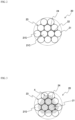
- FIG. 2 shows a cross-sectional view in the width direction of an example of the steel cord according to the present invention.
- a steel cord 20 has a compact structure (closest-packed structure) of a 12 cc structure, and has twelve steel filaments 21 arranged without gaps in the cord cross section.
- the steel cord 20 includes a core portion 22 composed of three core filaments 21C, and a single sheath layer 23 composed of nine sheath filaments 21S arranged on the outer periphery thereof.
- the steel cord 20 as the ply cord according to the present invention does not include a wrapping filament conventionally wound around the outer periphery of the cord body.
- the shape of the steel filaments in the tire is maintained without a wrapping filament, which can suppress disarrangement of the cord cross section and loosening of twists of the cord, and since the steel cord does not include a wrapping filament, a fretting problem can be solved and manufacturing costs can be reduced due to the reduction of manufacturing steps.
- the resin material 24 is a resin material containing at least an ionomer and having a melting point of 150°C or less when a resin component contained is composed of a single resin or a softening point of 150°C or less when the resin component contained is composed of a composition containing two or more resins.
- the steel cord is formed by melting a resin material at the time of tire vulcanization and coating a steel filament with the melted resin material, and when the softening point or melting point of the resin material exceeds 150°C, the resin material is hardly softened at the time of vulcanization of the tire, and the molding workability deteriorates.
- the softening point or melting point of the resin material needs to be 150°C or lower, and suitably 140°C or lower, and more suitably 120°C or lower, and suitably 80°C or higher, and more suitably 90°C or higher.
- the softening point or melting point of the resin material is too low, the resin material is likely to soften due to heat generation during traveling, and a steel filament may be easily loosened, which is not preferable.
- the softening point refers to a value measured using a softening point test method described in JIS K 7206 (1999).
- the resin material is twisted with a steel filament in a state of a resin filament and embedded in a green tire. Therefore, when twisting a steel filament and a resin filament having completely different characteristics from each other, it is necessary to prevent the resin filament from being broken.
- the resin filament must be made of a resin material that has favorable adhesion to the surface of a steel filament after softening and is capable of preventing an interface with the steel filament from peeling off to form a water infiltration path, and that can prevent an interface with rubber or the like that coats a steel cord from peeling off and forming a water infiltration path.
- a thermoplastic resin as a resin component of a resin material
- a resin material containing at least an ionomer is used as the resin component.
- the surface of a resin filament can be smoothed, and when twisted with a steel filament, the slip property between the steel filament and the resin filament can be improved.
- breakage of the resin filament can be prevented, the waterproofness of the steel cord can be improved, and at the same time, the slip property of the resin filament in a twisting machine can be improved.
- the resin material only needs to contain at least an ionomer.
- the resin component of the resin material may be a resin filament composed of only an ionomer.
- the ionomer is a thermoplastic resin containing an olefin (covalent bond) as a main component and an ionic bond (crosslinking) between long chains, which is characterized by having a low density, a high toughness and a high resilience, and being excellent in grease resistance and solvent resistance.
- a carboxyl group is used as the anion portion of the ion bridge, and a metal ion such as sodium ion, potassium ion, magnesium ion, or zinc ion is used as the cation portion.
- the ionomer resin can be obtained, for example, by cross-linking between molecular chains (between carboxyl groups in the molecular chain) of a copolymer of ethylene and methacrylic acid with a metal ion as described above.
- the ionomer examples include a zinc ion neutralized ionomer such as Himilan 1554, Himilan 1557, Himilan 1650, Himilan 1652, Himilan 1702, Himilan 1706, or Himilan 1855 manufactured by Du Pont-Mitsui Polychemicals Co., Ltd. and a sodium ion neutralized ionomer such as Himilan 1555, Himilan 1601, Himilan 1605, Himilan 1707, Himilan 1856, or AM7331. Further examples thereof include a lithium ion neutralized ionomer such as Surlyn 7930 and a sodium ion neutralized ionomer such as Surlyn 8120 manufactured by DuPont. These may be used singly or in combination of two or more kinds thereof.
- the resin material preferably contains an inorganic filler.
- an inorganic filler As described above, since the resin material needs to be easily melted at the vulcanization temperature of a tire, a resin material having a softening point or melting point of 150°C or less needs to be used, and when the softening point or the melting point of the resin material is low, the strength of a resin filament is reduced, and therefore, at the time of twisting a cord, the resin filament may be broken and productivity may be deteriorated. Therefore, in the present invention, it is preferable to add an inorganic filler to a resin material to improve the strength of a resin filament. By adding the inorganic filler to a resin material, the tackiness on the surface of a resin filament is reduced, so that there is an advantage that the slip property of the resin filament is further improved and the twisting of a steel cord is facilitated.
- the addition amount of an inorganic filler based on 100 parts by mass of a resin component contained in a resin material is preferably 0.1 parts by mass or more, more preferably 0.5 parts by mass or more, further preferably 5 parts by mass or more, and particularly preferably 10 parts by mass or more, and preferably 30 parts by mass or less, and particularly preferably 20 parts by mass or less.
- the addition amount of the inorganic filler based on 100 parts by mass of the resin component is less than 0.1 parts by mass, the reinforcing effect of a resin filament is not sufficiently obtained, whereas when the addition amount exceeds 30 parts by mass, the reinforcing effect of the resin filament is saturated, which is not preferable in terms of manufacturing costs, and at the same time, when the dispersibility of the inorganic filler decreases, the durability of the resin filament may be adversely affected.
- examples of the inorganic filler include carbon black, silica, aluminum hydroxide, clay, alumina, talc, mica, kaolin, glass balloon, glass bead, calcium carbonate, magnesium carbonate, magnesium hydroxide, magnesium oxide, titanium oxide, potassium titanate, and barium sulfate. These may be used singly or in combination of two or more kinds thereof.
- carbon black is preferred from the viewpoint of reinforcing a resin filament. Since a rubber composition that constitutes a tire also usually contains carbon black, by using carbon black as the inorganic filler, the compatibility between the resin filament according to the present invention and the rubber composition constituting a tire is improved, and an improvement in the adhesiveness between the rubber and the resin can be expected.
- the grade of carbon black is not particularly limited, and any grade can be appropriately selected and used.
- SRF, GPF, FEF, HAF, ISAF, SAF, or the like used and particularly preferred examples include GPF, FEF, HAF, ISAF, and SAF, which are excellent in bending resistance and fracture resistance.
- the nitrogen adsorption specific surface area N 2 SA (based on JIS K 6217-2: 2001) is preferably 20 m 2 /g or more, and more preferably 25 m 2 /g or more, and preferably 150 m 2 /g or less, and more preferably 130 m 2 /g or less.
- the resin material further contains a maleic acid-modified resin, since such a resin can improve the adhesiveness to steel filaments.
- a maleic acid-modified resin in order to obtain a favorable balance between an effect of a maleic acid-modified resin and an effect of an ionomer, and in consideration of the balance of various performances, the mass ratio is from 4:6 to 6:4.
- the ionomer satisfies the lower limit of the above-described mass ratio or more, the slip property of a resin filament at the time of manufacturing is improved.
- the degree of neutralization of an ionomer is preferable to be high, and to prepare a blend that does not cause vulcanization inhibition on the alkali side.
- maleic acid-modified resin examples include maleic anhydride-modified styrene-ethylene-butadiene-styrene block copolymer (SEBS), maleic anhydride-modified ultra-low density polyethylene, maleic anhydride-modified ethylene-butene-1 copolymer, maleic anhydride-modified ethylene-propylene copolymer, maleic anhydride-modified ethylene-octene, and maleic anhydride-modified propylene.
- SEBS maleic anhydride-modified styrene-ethylene-butadiene-styrene block copolymer
- SEBS maleic anhydride-modified ultra-low density polyethylene
- maleic anhydride-modified ethylene-butene-1 copolymer maleic anhydride-modified ethylene-propylene copolymer
- maleic anhydride-modified ethylene-octene maleic anhydride-modified propylene.
- Admer LB548, NF518, QF551, QF500, and QE060 High wax 4051E, 4252E, and 1105A, and Tuffmer MH7010 and MH7020 manufactured by Mitsui Chemicals, Inc. These may be used singly or in combination of two or more kinds thereof.
- the resin material according to the present invention may contain a thermoplastic resin or a thermoplastic elastomer other than the ionomer and the acid-modified resin to such an extent that the above-described effects are not impaired.
- various additives such as an antioxidant, an oil, a plasticizer, a color former, and a weathering agent may be contained (blended).
- the steel cord 20 according to the present invention is constituted by the plurality of steel filaments 21, and the structure is not particularly limited as long as at least a part thereof is coated with the resin material.
- Specific examples thereof include a cord having a compact structure in which steel filaments are closest-packed in the cord cross section as shown in FIG. 2 and a cord having a layer-twisted structure such as 3+9+16 structure.
- a compact structure is preferable from the viewpoint of improving strength.
- the present invention is particularly useful when a steel cord having three or more core filaments, for example, three core filaments is used as a ply cord.
- a desired effect can be obtained as long as at least a part of steel filaments constituting a steel cord is coated with a resin material.
- a filling rate indicating a ratio of the resin material 24 to the gap region is 52% or more, and particularly 60% or more, and preferably 120% or less, and more preferably 100% or less.
- the filling rate of the resin material 24 is 52% or more, it is preferable because the cord untwisting resistance and the corrosion resistance to water penetration are further improved. It is noted that the filling rate of the resin material 24 is 100% or more means that the resin material 24 is filled to the outside of the region X, namely, that a portion corresponding to the outer periphery portion of a cord on the surface of each sheath filament 21S constituting the outermost sheath layer is coated with the resin material 24.
- the filling rate of the resin material 24 is preferably 120% or less.
- the filling rate of the resin material 24 may exceed 120%, and for example, the entire sheath filament 21S may be coated with the resin material 24.
- any conventionally used steel filament can be used, and in order to secure the ply strength, it is preferable to use a steel filament having a tensile strength of 2,700 N/mm 2 or more.
- a steel filament having high tensile strength a steel filament containing at least 0.72% by mass, particularly at least 0.82% by mass of carbon can be suitably used.
- the surface of a steel filament may be plated.
- the composition of the plating on the surface of the steel filament is not particularly limited, and is preferably brass plating made of copper and zinc, and more preferably has a copper content of 60% by mass or more. As a result, the adhesiveness between a steel filament and a coating material such as rubber can be improved.
- the wire diameter of a steel filament and a resin filament and the cord diameter are not particularly limited, and can be appropriately selected according to the type, the size, and the like of a tire.
- the conditions such as the twist direction and twist pitch of a steel cord and the end count of the steel cord in a carcass ply are not particularly limited, and can be appropriately designed according to a conventional method.
- the material for coating a steel cord is not particularly limited, and a commonly used material for coating a steel cord such as a thermoplastic resin, a thermosetting resin, a thermoplastic elastomer, a thermosetting elastomer, or a rubber can be appropriately used.
- the above-described steel cord as a ply cord in the present invention is obtained by twisting a steel filament and a resin filament made of the above-described resin material, heating the resin filament to a flowable state, and filling a gap between the steel filaments with the resin material.
- a resin filament made of the resin material is manufactured.
- the resin filament can be manufactured by a known method, and the manufacturing method is not particularly limited.
- the resin filament can be manufactured by kneading a resin component, such as the ionomer, and the inorganic filler and drawing the obtained resin composition.
- the resin filament can also be produced by preparing a masterbatch in which a large amount of an inorganic filler is added to a resin component in advance, adding the masterbatch to the resin component to prepare a resin composition containing a predetermined content of an inorganic filler, and stretching the resin composition.
- the position of a resin filament when twisting a steel filament and the resin filament is not particularly limited as long as the resin material of the resin filament can be filled in a gap between the steel filaments by heating.
- the position of the resin filament is preferably inside the outermost sheath filament
- the position of the resin filament is preferably inside the outermost sheath strand or inside the outermost sheath filament of each strand.
- the steel cord according to the present invention can be manufactured, using a twisting machine generally used for producing steel cords for tires, by twisting together with the resin filament at the time of twisting the steel cord. Therefore, the number of working processes is not increased, and the productivity is not reduced.
- a resin material having as high a strength as possible it is preferable to use a resin material having as high a strength as possible.
- the strength of a resin filament can be increased by increasing the drawing magnification during the manufacturing of the resin filament. It is preferable that a resin filament in a twisting machine has good slippage.
- all resin filaments and steel filaments may be twisted in one process, or a part thereof may be twisted in a separate process.
- straightening may be performed on a twisted cord with a straightener.
- the stability of the shape as a steel cord can be secured, which is preferable.
- the tire of the present invention is obtained by using the above-described twisted cord as a ply cord of a carcass ply.
- heating during the vulcanization softens a resin filament to a flowable state and fills a gap between steel filaments, whereby at least a part of the steel filaments is covered with a resin material constituting the resin filament.
- the steel filaments are not in a closest-packed state, when tension is applied to the carcass ply during the vulcanization, the steel filaments are arranged in a close-packed state as the resin material flows.
- vulcanization conditions such as vulcanization time, temperature, and pressure in the vulcanization process when manufacturing a tire are not particularly limited, and known conditions can be adopted.
- a process other than the vulcanization process at the time of manufacturing a tire a normal tire manufacturing process can be adopted, and there is no particular limitation.
- members needed for forming a tire with a belt layer, a carcass, a bead core, and the like may be prepared, and then these members may be assembled into a single tire using a molding machine to form a green tire, and then vulcanization may be performed.
- the present invention in which a steel cord is used as a ply cord, is usually applied to medium or large tires, and specifically, is useful for heavy load tires such as trucks or buses.
- the tire of the present invention is not particularly limited except that the above-described steel cord is applied to a carcass ply, and may have a known structure.
- a belt 3 composed of at least four layers inclined in the tire circumferential direction, four layers of a first belt layer 3a, a second belt layer 3b, a third belt layer 3c, and a fourth belt layer 3d in the illustrated example, is arranged.
- a bead filler having a tapered cross section is usually arranged outside the bead core in the tire radial direction.
- an inert gas such as nitrogen, argon, or helium can be used.
- a steel cord having a 12 cc structure as shown in FIG. 4 is produced.
- the obtained steel cord is coated with a coating rubber to produce a steel cord-rubber composite.
- the resin filament is prepared by drawing a resin composition A obtained by kneading Tuftec M1943 (softening point: 39°C) manufactured by Asahi Kasei Corporation as the maleic anhydride-modified SEBS, Himilan 1702 manufactured by Du Pont-Mitsui Polychemicals Co., Ltd.
- Resin composition A Resin composition B Compounded amount (parts by mass) Anhydrous maleic acid-modified SEBS *1 50 Ionomer *2 50 100 Carbon black *3 20 15 Softening point or melting point (°C) 90 or less 90 *1) Manufactured by Asahi Kasei Corporation, Tuftec M1943 (Softening point: 39°C) *2) Manufactured by Du Pont-Mitsui Polychemicals Co., Ltd., Himilan 1702 (Melting point: 90°C) *3) Manufactured by Asahi Carbon Co., Ltd., Asahi #55 (GPF) [Table 2] Compounded amount (parts by mass) Natural rubber * 4 100 Carbon black * 5 60 Cobalt salt * 6 1 Oxidation zinc 7.5 Vulcanization accelerator * 7 1 Sulfur * 8 6 Antioxidant * 9 3.5 *4) Natural rubber: RSS #3 *5) Carbon black: N326 manufactured by Asahi Carbon Co., Ltd., "As
- Steel cord-rubber composites of Examples and Comparative Examples are produced under the conditions shown in Table 3 below.
- Examples 2 and 3 and Comparative Example 4 a steel cord is produced using a steel filament and a resin filament in the same manner as in Example 1, and the obtained steel cord is coated with a coating rubber to produce a steel cord-rubber composite.
- Comparative Examples 1 to 3 a steel cord was produced using a steel filament, and the obtained steel cord is coated with a coating rubber to produce a steel cord-rubber composite.
- Each obtained steel cord-rubber composite is vulcanized at 145°C for 15 minutes, and the vulcanized steel cord-rubber composite is evaluated as described below. After the vulcanization, a steel filament constituting a steel cord of each Example is at least partially coated with a resin material.
- a cord end of a vulcanized steel cord-rubber composite is exposed by polishing, immersed in a 5% by mass saline solution for 2 weeks, and a static corrosion test is performed to measure the length of rust development inside the cord.
- the test results are described in a table, with the case of rust development of less than 5 mm denoted by ⁇ , the case of rust development of 5 mm or more and less than 50 mm denoted by ⁇ , and the case of rust development of 50 mm or more denoted by ⁇ .
- a steel cord-rubber composite after vulcanization is cut with a shearing cutter, and a cord untwisting resistance test is carried out by holding the position about 10 cm from an end of a cord by hand and hitting the end of the cord three times on a desk.
- the test results are described in a table, with the case of no filaments unraveled denoted by ⁇ , the case of less than half of the outermost sheath filaments unraveled denoted by ⁇ , and the case of all of the outermost sheath filaments unraveled denoted by ⁇ .
- ⁇ indicates that the composite has sufficient durability when used as a tire member, and ⁇ indicates that the composite has further durability.
- the test results are described in a table, with the case of no fretting damage between a wrapping filament and the outermost sheath after fatigue or fracture denoted by ⁇ , the case of fretting damage denoted by ⁇ .
- the peeling force when a cord end is peeled from the rubber is measured.
- the peel strength of Comparative Example 1 having the same structure and serving as a reference is set to 100, the peeling force in Examples is indexed with respect to the strength, and 90 or more is determined as an adhesive strength that can be used.
- Examples 4 to 6 and Comparative Example 5 a steel cord is produced using a steel filament and a resin filament in the same manner as in Example 1, and the obtained steel cord is coated with a coating rubber to produce a steel cord-rubber composite.
- each of the obtained steel cord-rubber composites is vulcanized at 145°C for 15 minutes, and the vulcanized steel cord-rubber composites are evaluated in the same manner as in Example 1.
- the peel strength in Comparative Example 5 is set to 100, the peeling force in Examples is indexed, and 90 or more is determined as an adhesive strength that can be used.
- a steel filament constituting a steel cord of each Example is at least partially coated with a resin material.
Landscapes
- Chemical & Material Sciences (AREA)
- Medicinal Chemistry (AREA)
- Health & Medical Sciences (AREA)
- Chemical Kinetics & Catalysis (AREA)
- Polymers & Plastics (AREA)
- Organic Chemistry (AREA)
- Engineering & Computer Science (AREA)
- Mechanical Engineering (AREA)
- Textile Engineering (AREA)
- General Chemical & Material Sciences (AREA)
- Ropes Or Cables (AREA)
- Tires In General (AREA)
- Compositions Of Macromolecular Compounds (AREA)
Claims (5)
- Reifen, umfassend eine Karkassenkordlage (1) als Skelett, wobeidie Karkassenkordlage (1) durch ein Stahlseil (20) verstärkt ist, das keine Umwicklungsfilamente einschließt, das Stahlseil (20) aus einer Vielzahl von Stahlfilamenten (21) gebildet ist, die 3 oder mehr Kernfilamente aufweisen, mindestens ein Teil einer Oberfläche jedes der Vielzahl von Stahlfilamenten (21) mit einem Harzmaterial (24) beschichtet ist, das mindestens ein lonomer enthält, und wenn eine in dem Harzmaterial enthaltene Harzkomponente aus einem einzigen Harz gebildet ist, ein Schmelzpunkt des Harzmaterials 150 °C oder weniger beträgt, und wenn die Harzkomponente aus einer Zusammensetzung gebildet ist, die zwei oder mehr Harze enthält, ein Erweichungspunkt des Harzmaterials 150 °C oder weniger beträgt, wobei sich der Erweichungspunkt auf einen Wert bezieht, der unter Verwendung eines in JIS K 7206 (1999) beschriebenen Erweichungspunktprüfverfahrens gemessen wird; und wobei das Stahlseil (20) einen aus den Kernfilamenten gebildeten Kernabschnitt und mindestens eine an einem Außenumfang des Kernabschnitts angeordnete Mantelschicht einschließt; undwobei das Harzmaterial (24) ferner ein mit Maleinsäure modifiziertes Harz enthält und ein Massenverhältnis des mit Maleinsäure modifizierten Harzes zu dem lonomer von 4:6 bis 6:4 beträgt.
- Reifen nach Anspruch 1, wobei, wenn eine Region, die durch andere Abschnitte als den Stahlfilamenten (21) beansprucht wird, in einer Region (X), die durch eine Linie umgeben ist, die die Mittelpunkte jeweiliger Mantelfilamente verbindet, die eine äußerste Mantelschicht in einem Seilquerschnitt senkrecht zu einer Seillängsrichtung ausbilden, als Lückenregion definiert ist, eine Füllrate, die ein Verhältnis des Harzmaterials (24) zu der Lückenregion angibt, 52 % bis 120 % beträgt, wobei eine Füllrate des Harzmaterials (24) von 100 % oder mehr bedeutet, dass das Harzmaterial (24) bis zu der Außenseite der Region (X) eingefüllt ist.
- Reifen nach Anspruch 1 oder 2, wobei das Harzmaterial (24) einen anorganischen Füllstoff in einer Menge von 0,1 Masseteilen bis 30 Masseteilen, bezogen auf 100 Masseteile einer Harzkomponente, enthält.
- Reifen nach Anspruch 3, wobei der anorganische Füllstoff Ruß ist.
- Reifen nach Anspruch 4, wobei ein Grad des Rußes GPF ist.
Applications Claiming Priority (2)
| Application Number | Priority Date | Filing Date | Title |
|---|---|---|---|
| JP2017206508 | 2017-10-25 | ||
| PCT/JP2018/039534 WO2019082939A1 (ja) | 2017-10-25 | 2018-10-24 | タイヤ |
Publications (3)
| Publication Number | Publication Date |
|---|---|
| EP3702175A1 EP3702175A1 (de) | 2020-09-02 |
| EP3702175A4 EP3702175A4 (de) | 2021-07-14 |
| EP3702175B1 true EP3702175B1 (de) | 2024-08-07 |
Family
ID=66247510
Family Applications (1)
| Application Number | Title | Priority Date | Filing Date |
|---|---|---|---|
| EP18870821.8A Active EP3702175B1 (de) | 2017-10-25 | 2018-10-24 | Reifen |
Country Status (5)
| Country | Link |
|---|---|
| US (1) | US11760129B2 (de) |
| EP (1) | EP3702175B1 (de) |
| JP (1) | JP7128834B2 (de) |
| CN (1) | CN111315588B (de) |
| WO (1) | WO2019082939A1 (de) |
Families Citing this family (1)
| Publication number | Priority date | Publication date | Assignee | Title |
|---|---|---|---|---|
| JP2021088789A (ja) * | 2019-12-05 | 2021-06-10 | 株式会社ブリヂストン | 繊維、樹脂被覆コードの製造方法、空気入りタイヤの製造方法 |
Family Cites Families (26)
| Publication number | Priority date | Publication date | Assignee | Title |
|---|---|---|---|---|
| DE1027539B (de) | 1954-11-29 | 1958-04-03 | Dunlop Gummi Cie Ag Deutsche | Stahldrahteinlage fuer Fahrzeugreifen |
| JPS60105698U (ja) | 1983-12-24 | 1985-07-18 | 半田 有正 | 複合線材 |
| JPS60231884A (ja) * | 1984-04-28 | 1985-11-18 | 興国鋼線索株式会社 | スチ−ルコ−ド |
| JPS60246886A (ja) | 1984-05-18 | 1985-12-06 | 興国鋼線索株式会社 | スチ−ルコ−ド |
| JPH0640626Y2 (ja) | 1987-12-21 | 1994-10-26 | 金井 宏之 | スチールコード |
| US5139874A (en) | 1991-09-05 | 1992-08-18 | The Goodyear Tire & Rubber Company | Cable for reinforcing rubber articles |
| JP3204579B2 (ja) | 1993-10-14 | 2001-09-04 | 株式会社ブリヂストン | スチールコードおよび空気入りラジアルタイヤ |
| JP2934664B2 (ja) | 1993-12-27 | 1999-08-16 | ヒエン電工株式会社 | 遮水性及びガスバリア性に優れた防錆被覆のアンボンドpcストランド |
| JP3568323B2 (ja) * | 1996-07-23 | 2004-09-22 | 横浜ゴム株式会社 | 空気入りラジアルタイヤ |
| JP3708678B2 (ja) | 1997-05-15 | 2005-10-19 | 株式会社ブリヂストン | 空気入りラジアルタイヤ |
| EP1033435A1 (de) * | 1999-03-04 | 2000-09-06 | N.V. Bekaert S.A. | Stahlseil mit einem polymeren Kern |
| JP4315561B2 (ja) | 2000-02-01 | 2009-08-19 | 住友ゴム工業株式会社 | 複合コードを用いた空気入りタイヤ |
| JP2001234444A (ja) | 2000-02-18 | 2001-08-31 | Sumitomo Rubber Ind Ltd | 複合コードおよびそれを用いた空気入りタイヤ |
| KR100437321B1 (ko) * | 2001-06-04 | 2004-06-25 | 한국타이어 주식회사 | 모듈러스가 향상된 스틸코드 코팅용 고무조성물 |
| JP2010053495A (ja) * | 2008-08-29 | 2010-03-11 | Yokohama Rubber Co Ltd:The | タイヤ補強用スチールコード及びこれを使用した空気入りタイヤ |
| WO2012026548A1 (ja) * | 2010-08-25 | 2012-03-01 | 株式会社ブリヂストン | タイヤ及びその製造方法 |
| FR2982884B1 (fr) | 2011-11-23 | 2014-06-06 | Michelin Soc Tech | Cable metallique a deux couches, gomme in situ par un elastomere thermoplastique insature |
| US10821778B2 (en) | 2012-02-29 | 2020-11-03 | Bridgestone Corporation | Tire |
| JP5835165B2 (ja) | 2012-09-07 | 2015-12-24 | 横浜ゴム株式会社 | スチールコードおよびゴム製品の製造方法 |
| JP6275387B2 (ja) * | 2013-02-15 | 2018-02-07 | 株式会社ブリヂストン | スチールコード−ゴム複合体 |
| WO2015173143A1 (en) | 2014-05-14 | 2015-11-19 | Nv Bekaert Sa | Multi-strand steel cord |
| JP6869108B2 (ja) | 2016-06-24 | 2021-05-12 | 株式会社ブリヂストン | タイヤの製造方法 |
| WO2017222046A1 (ja) * | 2016-06-24 | 2017-12-28 | 株式会社ブリヂストン | タイヤの製造方法 |
| JP6785152B2 (ja) | 2016-12-27 | 2020-11-18 | 株式会社ブリヂストン | スチールコードの製造方法 |
| EP3617398B1 (de) | 2017-04-27 | 2025-06-25 | Bridgestone Corporation | Seil zur verstärkung von elastomeren |
| EP3730692A4 (de) | 2017-12-22 | 2022-01-19 | Bridgestone Corporation | Elastomerverstärkungscord |
-
2018
- 2018-10-24 EP EP18870821.8A patent/EP3702175B1/de active Active
- 2018-10-24 US US16/757,785 patent/US11760129B2/en active Active
- 2018-10-24 JP JP2019551210A patent/JP7128834B2/ja active Active
- 2018-10-24 CN CN201880068935.XA patent/CN111315588B/zh active Active
- 2018-10-24 WO PCT/JP2018/039534 patent/WO2019082939A1/ja not_active Ceased
Also Published As
| Publication number | Publication date |
|---|---|
| JP7128834B2 (ja) | 2022-08-31 |
| CN111315588A (zh) | 2020-06-19 |
| JPWO2019082939A1 (ja) | 2020-12-17 |
| US20200290403A1 (en) | 2020-09-17 |
| CN111315588B (zh) | 2022-03-29 |
| US11760129B2 (en) | 2023-09-19 |
| WO2019082939A1 (ja) | 2019-05-02 |
| EP3702175A1 (de) | 2020-09-02 |
| EP3702175A4 (de) | 2021-07-14 |
Similar Documents
| Publication | Publication Date | Title |
|---|---|---|
| JP5840608B2 (ja) | 基本ストランドが現場ゴム引き二重層コードであるマルチストランドコード | |
| EP2423381B1 (de) | Kautschuk/stahlseilzusammensetzung und radialer luftreifen | |
| EP3476623B1 (de) | Verfahren zur herstellung eines reifens | |
| JP2012531541A (ja) | 基本ストランドが現場ゴム引き二重層コードであるマルチストランドコード | |
| JP2012531538A (ja) | 現場ゴム引きされると共に2+m+n構造を有する3層スチールコード | |
| WO2017222046A1 (ja) | タイヤの製造方法 | |
| EP3875678B1 (de) | Elastomerverstärkungscord | |
| EP3196353B1 (de) | Stahlseil zur verstärkung eines gummiartikels | |
| EP3875676B1 (de) | Kord zur verwendung als elastomerverstärkung | |
| EP3868570B1 (de) | Reifen | |
| EP3730692A1 (de) | Elastomerverstärkungscord | |
| US11760129B2 (en) | Tire | |
| EP3875677B1 (de) | Elastomerverstärkungscord | |
| EP3617398B1 (de) | Seil zur verstärkung von elastomeren | |
| WO2020080438A1 (ja) | エラストマー-金属コード複合体およびこれを用いたタイヤ | |
| JP2014019303A (ja) | 自動二輪車用タイヤ | |
| JPH10131068A (ja) | ゴム物品補強用スチールコードおよび空気入りラジアルタイヤ |
Legal Events
| Date | Code | Title | Description |
|---|---|---|---|
| STAA | Information on the status of an ep patent application or granted ep patent |
Free format text: STATUS: THE INTERNATIONAL PUBLICATION HAS BEEN MADE |
|
| PUAI | Public reference made under article 153(3) epc to a published international application that has entered the european phase |
Free format text: ORIGINAL CODE: 0009012 |
|
| STAA | Information on the status of an ep patent application or granted ep patent |
Free format text: STATUS: REQUEST FOR EXAMINATION WAS MADE |
|
| 17P | Request for examination filed |
Effective date: 20200423 |
|
| AK | Designated contracting states |
Kind code of ref document: A1 Designated state(s): AL AT BE BG CH CY CZ DE DK EE ES FI FR GB GR HR HU IE IS IT LI LT LU LV MC MK MT NL NO PL PT RO RS SE SI SK SM TR |
|
| AX | Request for extension of the european patent |
Extension state: BA ME |
|
| DAV | Request for validation of the european patent (deleted) | ||
| DAX | Request for extension of the european patent (deleted) | ||
| A4 | Supplementary search report drawn up and despatched |
Effective date: 20210610 |
|
| RIC1 | Information provided on ipc code assigned before grant |
Ipc: B60C 9/00 20060101AFI20210604BHEP Ipc: B60C 9/04 20060101ALI20210604BHEP Ipc: C08K 3/00 20180101ALI20210604BHEP Ipc: C08L 23/26 20060101ALI20210604BHEP Ipc: D07B 1/06 20060101ALI20210604BHEP |
|
| STAA | Information on the status of an ep patent application or granted ep patent |
Free format text: STATUS: EXAMINATION IS IN PROGRESS |
|
| 17Q | First examination report despatched |
Effective date: 20230306 |
|
| GRAP | Despatch of communication of intention to grant a patent |
Free format text: ORIGINAL CODE: EPIDOSNIGR1 |
|
| STAA | Information on the status of an ep patent application or granted ep patent |
Free format text: STATUS: GRANT OF PATENT IS INTENDED |
|
| INTG | Intention to grant announced |
Effective date: 20240423 |
|
| GRAS | Grant fee paid |
Free format text: ORIGINAL CODE: EPIDOSNIGR3 |
|
| GRAA | (expected) grant |
Free format text: ORIGINAL CODE: 0009210 |
|
| STAA | Information on the status of an ep patent application or granted ep patent |
Free format text: STATUS: THE PATENT HAS BEEN GRANTED |
|
| P01 | Opt-out of the competence of the unified patent court (upc) registered |
Free format text: CASE NUMBER: APP_34002/2024 Effective date: 20240606 |
|
| AK | Designated contracting states |
Kind code of ref document: B1 Designated state(s): AL AT BE BG CH CY CZ DE DK EE ES FI FR GB GR HR HU IE IS IT LI LT LU LV MC MK MT NL NO PL PT RO RS SE SI SK SM TR |
|
| REG | Reference to a national code |
Ref country code: GB Ref legal event code: FG4D |
|
| REG | Reference to a national code |
Ref country code: CH Ref legal event code: EP |
|
| REG | Reference to a national code |
Ref country code: DE Ref legal event code: R096 Ref document number: 602018072914 Country of ref document: DE |
|
| REG | Reference to a national code |
Ref country code: IE Ref legal event code: FG4D |
|
| REG | Reference to a national code |
Ref country code: LT Ref legal event code: MG9D |
|
| REG | Reference to a national code |
Ref country code: NL Ref legal event code: MP Effective date: 20240807 |
|
| PG25 | Lapsed in a contracting state [announced via postgrant information from national office to epo] |
Ref country code: NO Free format text: LAPSE BECAUSE OF FAILURE TO SUBMIT A TRANSLATION OF THE DESCRIPTION OR TO PAY THE FEE WITHIN THE PRESCRIBED TIME-LIMIT Effective date: 20241107 |
|
| REG | Reference to a national code |
Ref country code: AT Ref legal event code: MK05 Ref document number: 1710550 Country of ref document: AT Kind code of ref document: T Effective date: 20240807 |
|
| PG25 | Lapsed in a contracting state [announced via postgrant information from national office to epo] |
Ref country code: PT Free format text: LAPSE BECAUSE OF FAILURE TO SUBMIT A TRANSLATION OF THE DESCRIPTION OR TO PAY THE FEE WITHIN THE PRESCRIBED TIME-LIMIT Effective date: 20241209 Ref country code: NL Free format text: LAPSE BECAUSE OF FAILURE TO SUBMIT A TRANSLATION OF THE DESCRIPTION OR TO PAY THE FEE WITHIN THE PRESCRIBED TIME-LIMIT Effective date: 20240807 Ref country code: FI Free format text: LAPSE BECAUSE OF FAILURE TO SUBMIT A TRANSLATION OF THE DESCRIPTION OR TO PAY THE FEE WITHIN THE PRESCRIBED TIME-LIMIT Effective date: 20240807 Ref country code: GR Free format text: LAPSE BECAUSE OF FAILURE TO SUBMIT A TRANSLATION OF THE DESCRIPTION OR TO PAY THE FEE WITHIN THE PRESCRIBED TIME-LIMIT Effective date: 20241108 Ref country code: PL Free format text: LAPSE BECAUSE OF FAILURE TO SUBMIT A TRANSLATION OF THE DESCRIPTION OR TO PAY THE FEE WITHIN THE PRESCRIBED TIME-LIMIT Effective date: 20240807 |
|
| PG25 | Lapsed in a contracting state [announced via postgrant information from national office to epo] |
Ref country code: BG Free format text: LAPSE BECAUSE OF FAILURE TO SUBMIT A TRANSLATION OF THE DESCRIPTION OR TO PAY THE FEE WITHIN THE PRESCRIBED TIME-LIMIT Effective date: 20240807 |
|
| PG25 | Lapsed in a contracting state [announced via postgrant information from national office to epo] |
Ref country code: LV Free format text: LAPSE BECAUSE OF FAILURE TO SUBMIT A TRANSLATION OF THE DESCRIPTION OR TO PAY THE FEE WITHIN THE PRESCRIBED TIME-LIMIT Effective date: 20240807 |
|
| PG25 | Lapsed in a contracting state [announced via postgrant information from national office to epo] |
Ref country code: AT Free format text: LAPSE BECAUSE OF FAILURE TO SUBMIT A TRANSLATION OF THE DESCRIPTION OR TO PAY THE FEE WITHIN THE PRESCRIBED TIME-LIMIT Effective date: 20240807 Ref country code: IS Free format text: LAPSE BECAUSE OF FAILURE TO SUBMIT A TRANSLATION OF THE DESCRIPTION OR TO PAY THE FEE WITHIN THE PRESCRIBED TIME-LIMIT Effective date: 20241207 |
|
| PG25 | Lapsed in a contracting state [announced via postgrant information from national office to epo] |
Ref country code: HR Free format text: LAPSE BECAUSE OF FAILURE TO SUBMIT A TRANSLATION OF THE DESCRIPTION OR TO PAY THE FEE WITHIN THE PRESCRIBED TIME-LIMIT Effective date: 20240807 |
|
| PG25 | Lapsed in a contracting state [announced via postgrant information from national office to epo] |
Ref country code: ES Free format text: LAPSE BECAUSE OF FAILURE TO SUBMIT A TRANSLATION OF THE DESCRIPTION OR TO PAY THE FEE WITHIN THE PRESCRIBED TIME-LIMIT Effective date: 20240807 Ref country code: RS Free format text: LAPSE BECAUSE OF FAILURE TO SUBMIT A TRANSLATION OF THE DESCRIPTION OR TO PAY THE FEE WITHIN THE PRESCRIBED TIME-LIMIT Effective date: 20241107 |
|
| PG25 | Lapsed in a contracting state [announced via postgrant information from national office to epo] |
Ref country code: RS Free format text: LAPSE BECAUSE OF FAILURE TO SUBMIT A TRANSLATION OF THE DESCRIPTION OR TO PAY THE FEE WITHIN THE PRESCRIBED TIME-LIMIT Effective date: 20241107 Ref country code: PT Free format text: LAPSE BECAUSE OF FAILURE TO SUBMIT A TRANSLATION OF THE DESCRIPTION OR TO PAY THE FEE WITHIN THE PRESCRIBED TIME-LIMIT Effective date: 20241209 Ref country code: PL Free format text: LAPSE BECAUSE OF FAILURE TO SUBMIT A TRANSLATION OF THE DESCRIPTION OR TO PAY THE FEE WITHIN THE PRESCRIBED TIME-LIMIT Effective date: 20240807 Ref country code: NO Free format text: LAPSE BECAUSE OF FAILURE TO SUBMIT A TRANSLATION OF THE DESCRIPTION OR TO PAY THE FEE WITHIN THE PRESCRIBED TIME-LIMIT Effective date: 20241107 Ref country code: NL Free format text: LAPSE BECAUSE OF FAILURE TO SUBMIT A TRANSLATION OF THE DESCRIPTION OR TO PAY THE FEE WITHIN THE PRESCRIBED TIME-LIMIT Effective date: 20240807 Ref country code: LV Free format text: LAPSE BECAUSE OF FAILURE TO SUBMIT A TRANSLATION OF THE DESCRIPTION OR TO PAY THE FEE WITHIN THE PRESCRIBED TIME-LIMIT Effective date: 20240807 Ref country code: IS Free format text: LAPSE BECAUSE OF FAILURE TO SUBMIT A TRANSLATION OF THE DESCRIPTION OR TO PAY THE FEE WITHIN THE PRESCRIBED TIME-LIMIT Effective date: 20241207 Ref country code: HR Free format text: LAPSE BECAUSE OF FAILURE TO SUBMIT A TRANSLATION OF THE DESCRIPTION OR TO PAY THE FEE WITHIN THE PRESCRIBED TIME-LIMIT Effective date: 20240807 Ref country code: GR Free format text: LAPSE BECAUSE OF FAILURE TO SUBMIT A TRANSLATION OF THE DESCRIPTION OR TO PAY THE FEE WITHIN THE PRESCRIBED TIME-LIMIT Effective date: 20241108 Ref country code: FI Free format text: LAPSE BECAUSE OF FAILURE TO SUBMIT A TRANSLATION OF THE DESCRIPTION OR TO PAY THE FEE WITHIN THE PRESCRIBED TIME-LIMIT Effective date: 20240807 Ref country code: ES Free format text: LAPSE BECAUSE OF FAILURE TO SUBMIT A TRANSLATION OF THE DESCRIPTION OR TO PAY THE FEE WITHIN THE PRESCRIBED TIME-LIMIT Effective date: 20240807 Ref country code: BG Free format text: LAPSE BECAUSE OF FAILURE TO SUBMIT A TRANSLATION OF THE DESCRIPTION OR TO PAY THE FEE WITHIN THE PRESCRIBED TIME-LIMIT Effective date: 20240807 Ref country code: AT Free format text: LAPSE BECAUSE OF FAILURE TO SUBMIT A TRANSLATION OF THE DESCRIPTION OR TO PAY THE FEE WITHIN THE PRESCRIBED TIME-LIMIT Effective date: 20240807 |
|
| PG25 | Lapsed in a contracting state [announced via postgrant information from national office to epo] |
Ref country code: SM Free format text: LAPSE BECAUSE OF FAILURE TO SUBMIT A TRANSLATION OF THE DESCRIPTION OR TO PAY THE FEE WITHIN THE PRESCRIBED TIME-LIMIT Effective date: 20240807 Ref country code: RO Free format text: LAPSE BECAUSE OF FAILURE TO SUBMIT A TRANSLATION OF THE DESCRIPTION OR TO PAY THE FEE WITHIN THE PRESCRIBED TIME-LIMIT Effective date: 20240807 Ref country code: DK Free format text: LAPSE BECAUSE OF FAILURE TO SUBMIT A TRANSLATION OF THE DESCRIPTION OR TO PAY THE FEE WITHIN THE PRESCRIBED TIME-LIMIT Effective date: 20240807 |
|
| PG25 | Lapsed in a contracting state [announced via postgrant information from national office to epo] |
Ref country code: EE Free format text: LAPSE BECAUSE OF FAILURE TO SUBMIT A TRANSLATION OF THE DESCRIPTION OR TO PAY THE FEE WITHIN THE PRESCRIBED TIME-LIMIT Effective date: 20240807 |
|
| PG25 | Lapsed in a contracting state [announced via postgrant information from national office to epo] |
Ref country code: CZ Free format text: LAPSE BECAUSE OF FAILURE TO SUBMIT A TRANSLATION OF THE DESCRIPTION OR TO PAY THE FEE WITHIN THE PRESCRIBED TIME-LIMIT Effective date: 20240807 |
|
| PG25 | Lapsed in a contracting state [announced via postgrant information from national office to epo] |
Ref country code: SK Free format text: LAPSE BECAUSE OF FAILURE TO SUBMIT A TRANSLATION OF THE DESCRIPTION OR TO PAY THE FEE WITHIN THE PRESCRIBED TIME-LIMIT Effective date: 20240807 |
|
| REG | Reference to a national code |
Ref country code: DE Ref legal event code: R097 Ref document number: 602018072914 Country of ref document: DE |
|
| REG | Reference to a national code |
Ref country code: CH Ref legal event code: PL |
|
| PLBE | No opposition filed within time limit |
Free format text: ORIGINAL CODE: 0009261 |
|
| STAA | Information on the status of an ep patent application or granted ep patent |
Free format text: STATUS: NO OPPOSITION FILED WITHIN TIME LIMIT |
|
| PG25 | Lapsed in a contracting state [announced via postgrant information from national office to epo] |
Ref country code: MC Free format text: LAPSE BECAUSE OF FAILURE TO SUBMIT A TRANSLATION OF THE DESCRIPTION OR TO PAY THE FEE WITHIN THE PRESCRIBED TIME-LIMIT Effective date: 20240807 |
|
| PG25 | Lapsed in a contracting state [announced via postgrant information from national office to epo] |
Ref country code: LU Free format text: LAPSE BECAUSE OF NON-PAYMENT OF DUE FEES Effective date: 20241024 Ref country code: BE Free format text: LAPSE BECAUSE OF NON-PAYMENT OF DUE FEES Effective date: 20241031 |
|
| 26N | No opposition filed |
Effective date: 20250508 |
|
| GBPC | Gb: european patent ceased through non-payment of renewal fee |
Effective date: 20241107 |
|
| PG25 | Lapsed in a contracting state [announced via postgrant information from national office to epo] |
Ref country code: CH Free format text: LAPSE BECAUSE OF NON-PAYMENT OF DUE FEES Effective date: 20241031 |
|
| REG | Reference to a national code |
Ref country code: BE Ref legal event code: MM Effective date: 20241031 |
|
| PG25 | Lapsed in a contracting state [announced via postgrant information from national office to epo] |
Ref country code: SE Free format text: LAPSE BECAUSE OF FAILURE TO SUBMIT A TRANSLATION OF THE DESCRIPTION OR TO PAY THE FEE WITHIN THE PRESCRIBED TIME-LIMIT Effective date: 20240807 |
|
| PG25 | Lapsed in a contracting state [announced via postgrant information from national office to epo] |
Ref country code: GB Free format text: LAPSE BECAUSE OF NON-PAYMENT OF DUE FEES Effective date: 20241107 |
|
| PG25 | Lapsed in a contracting state [announced via postgrant information from national office to epo] |
Ref country code: IE Free format text: LAPSE BECAUSE OF NON-PAYMENT OF DUE FEES Effective date: 20241024 |
|
| PGFP | Annual fee paid to national office [announced via postgrant information from national office to epo] |
Ref country code: DE Payment date: 20251021 Year of fee payment: 8 |
|
| PGFP | Annual fee paid to national office [announced via postgrant information from national office to epo] |
Ref country code: FR Payment date: 20251030 Year of fee payment: 8 |
|
| PG25 | Lapsed in a contracting state [announced via postgrant information from national office to epo] |
Ref country code: IT Free format text: LAPSE BECAUSE OF FAILURE TO SUBMIT A TRANSLATION OF THE DESCRIPTION OR TO PAY THE FEE WITHIN THE PRESCRIBED TIME-LIMIT Effective date: 20240807 Ref country code: CY Free format text: LAPSE BECAUSE OF FAILURE TO SUBMIT A TRANSLATION OF THE DESCRIPTION OR TO PAY THE FEE WITHIN THE PRESCRIBED TIME-LIMIT; INVALID AB INITIO Effective date: 20181024 |
|
| PG25 | Lapsed in a contracting state [announced via postgrant information from national office to epo] |
Ref country code: HU Free format text: LAPSE BECAUSE OF FAILURE TO SUBMIT A TRANSLATION OF THE DESCRIPTION OR TO PAY THE FEE WITHIN THE PRESCRIBED TIME-LIMIT; INVALID AB INITIO Effective date: 20181024 |
|
| PG25 | Lapsed in a contracting state [announced via postgrant information from national office to epo] |
Ref country code: TR Free format text: LAPSE BECAUSE OF FAILURE TO SUBMIT A TRANSLATION OF THE DESCRIPTION OR TO PAY THE FEE WITHIN THE PRESCRIBED TIME-LIMIT Effective date: 20240807 |
|
| PG25 | Lapsed in a contracting state [announced via postgrant information from national office to epo] |
Ref country code: SI Free format text: LAPSE BECAUSE OF FAILURE TO SUBMIT A TRANSLATION OF THE DESCRIPTION OR TO PAY THE FEE WITHIN THE PRESCRIBED TIME-LIMIT Effective date: 20240807 |
|
| PG25 | Lapsed in a contracting state [announced via postgrant information from national office to epo] |
Ref country code: LT Free format text: LAPSE BECAUSE OF FAILURE TO SUBMIT A TRANSLATION OF THE DESCRIPTION OR TO PAY THE FEE WITHIN THE PRESCRIBED TIME-LIMIT Effective date: 20240807 |