EP3690504B1 - Optische folie und optische komponente - Google Patents
Optische folie und optische komponente Download PDFInfo
- Publication number
- EP3690504B1 EP3690504B1 EP18863086.7A EP18863086A EP3690504B1 EP 3690504 B1 EP3690504 B1 EP 3690504B1 EP 18863086 A EP18863086 A EP 18863086A EP 3690504 B1 EP3690504 B1 EP 3690504B1
- Authority
- EP
- European Patent Office
- Prior art keywords
- optical sheet
- absorbing agent
- polycarbonate
- light
- specific wavelength
- Prior art date
- Legal status (The legal status is an assumption and is not a legal conclusion. Google has not performed a legal analysis and makes no representation as to the accuracy of the status listed.)
- Active
Links
Images


Classifications
-
- G—PHYSICS
- G02—OPTICS
- G02B—OPTICAL ELEMENTS, SYSTEMS OR APPARATUS
- G02B5/00—Optical elements other than lenses
- G02B5/20—Filters
- G02B5/208—Filters for use with infrared or ultraviolet radiation, e.g. for separating visible light from infrared and/or ultraviolet radiation
-
- G—PHYSICS
- G02—OPTICS
- G02C—SPECTACLES; SUNGLASSES OR GOGGLES INSOFAR AS THEY HAVE THE SAME FEATURES AS SPECTACLES; CONTACT LENSES
- G02C7/00—Optical parts
- G02C7/12—Polarisers
-
- G—PHYSICS
- G02—OPTICS
- G02B—OPTICAL ELEMENTS, SYSTEMS OR APPARATUS
- G02B5/00—Optical elements other than lenses
- G02B5/20—Filters
- G02B5/22—Absorbing filters
- G02B5/223—Absorbing filters containing organic substances, e.g. dyes, inks or pigments
-
- G—PHYSICS
- G02—OPTICS
- G02B—OPTICAL ELEMENTS, SYSTEMS OR APPARATUS
- G02B5/00—Optical elements other than lenses
- G02B5/30—Polarising elements
-
- G—PHYSICS
- G02—OPTICS
- G02C—SPECTACLES; SUNGLASSES OR GOGGLES INSOFAR AS THEY HAVE THE SAME FEATURES AS SPECTACLES; CONTACT LENSES
- G02C7/00—Optical parts
- G02C7/10—Filters, e.g. for facilitating adaptation of the eyes to the dark; Sunglasses
-
- G—PHYSICS
- G02—OPTICS
- G02C—SPECTACLES; SUNGLASSES OR GOGGLES INSOFAR AS THEY HAVE THE SAME FEATURES AS SPECTACLES; CONTACT LENSES
- G02C2202/00—Generic optical aspects applicable to one or more of the subgroups of G02C7/00
- G02C2202/16—Laminated or compound lenses
Definitions
- the present invention relates to an optical sheet and an optical component.
- an optical sheet that absorbs a specific wavelength range from incident light for the purpose of enhancing the contrast of a visual field or preventing glare (for example, refer to PTL 1).
- This optical sheet is used by being attached to eyeglasses, sunglasses, sun visors, and the like.
- the optical sheet disclosed in PTL 1 includes a resin material and a dye (light absorbing agent) that is contained in the resin material and absorbs light of a specific wavelength out of light in a visible light region, for example.
- This optical sheet is mold into a sheet shape by mixing a dye in a molten resin material, performing extrusion molding in the state, and then cooling thereof, for example.
- the dye may be changed in quality by heat transmitted directly from the mold.
- An object of the present invention is to provide an optical sheet and an optical component excellent in moldability and optical characteristics.
- an optical sheet and an optical component that can provide an optical sheet and an optical component excellent in moldability and optical characteristics.
- FIG. 1 is a perspective view of a sunglass including the optical sheet (first embodiment) of the present invention.
- FIG. 2 is a perspective view of a sun visor including the optical sheet (first embodiment) of the present invention.
- FIG. 5 is a sectional view of the optical component shown in FIG. 1 .
- FIGS. 1, 2 , and 5 the same also applies to FIG. 6
- the upper side is referred to as “upper direction” or “upper”
- the lower side is referred to as “lower direction” or “lower”.
- dimensions in a thickness direction are exaggeratedly illustrated, and are significantly different from actual dimensions.
- the optical sheet 1 of the present invention shown in FIGS. 1, 2 , and 5 is an optical sheet having flexibility and used in a curved state of being curved in one direction, and the optical sheet includes a polarized layer for polarized incident light and a specific wavelength absorption layer which is provided in a curved concave side from the polarized layer and contains a resin material, and a light absorbing agent that absorbs light in a specific wavelength range out of light in a wavelength range of 350 nm to 740 nm.
- the optical sheet 1 has a polarizing function and can absorb light of a specific wavelength.
- the optical sheet 1 is placed on a mold, and a resin material to be the lens 4 is supplied thereon to form a lens with an optical sheet (optical component 10) in which the lens 4 and the optical sheet 1 are integrated, it is possible to prevent the mold and the specific wavelength absorption layer from being brought into contact with each other. Therefore, it is possible to prevent the specific wavelength absorption layer from being changed in quality by the heat directly transmitted from the mold.
- the optical sheet 1 is excellent in moldability and optical characteristics.
- Such optical sheet 1 is used for a sunglass (optical component 10) shown in FIG. 1 and a sun visor (optical component 10') shown in FIG. 2 .
- the sunglass (optical component 10) includes a frame 2 mounted on a user's head, and a lens 3 with an optical sheet (optical component) fixed to the frame 2.
- the term "lens” includes both of a lens having a light collecting function and a lens not having a light collecting function.
- the frame 2 is mounted on the head of the user, and includes a rim portion 21, a bridge portion 22, a temple portion 23 that can be hung on the user's ear, and a nose pad portion 24.
- Each rim portion 21 has a ring shape, and is a portion where the lens 3 with an optical sheet is mounted inside.
- the bridge portion 22 is a portion that connects each rim portion 21.
- the temple portion 23 has a vine shape and is connected to an edge of each rim portion 21.
- the temple portion 23 is a portion that can be hung on the user's ear.
- the nose pad portion 24 is a portion that comes into contact with the user's nose in a mounting state in which the sunglass (optical component 10) is mounted on the user's head. With this, it is possible to reliably maintain the mounting state.
- a shape of the frame 2 is not limited to the illustrated one as long as the frame 2 can be mounted on a user's head.
- the optical component of the present invention includes a lens 4 (substrate) and an optical sheet 1 laminated on a surface of the lens 4 on the front side (side opposite to human eyes in a mounted state) . With this, it is possible to exhibit a function as a sunglass while enjoying advantages of the optical sheet 1 described above.
- the sun visor (optical component 10') includes a ring-shaped mounting portion 5 mounted on a user's head and a collar 6 provided in front of the mounting portion 5.
- the collar 6 includes a light transmitting member 7 (substrate) and the optical sheet 1 provided on an upper surface of the light transmitting member 7.
- Constituent materials of the lens 4 and the light transmitting member 7 are not particularly limited as long as the materials have light transmitting properties, and include various resin materials or various glasses.
- the material is preferably the same polycarbonate as the polycarbonate of the optical sheet 1. With this, it is possible to enhance adhesion between the lens 4 or the light transmitting member 7 and the optical sheet 1.
- the optical sheet 1 will be described in detail.
- a case of being laminated on the lens 4 (substrate) will be representatively described.
- the optical sheet 1 includes a specific wavelength absorption layer 11, a polarized layer 12, and an adhesive layer 13 provided therebetween. These are arranged in order of the specific wavelength absorption layer 11, the adhesive layer 13, and the polarized layer 12 from the lens 4 side.
- FIG. 5 illustrates a surface of the lens 4 as a plane, the upper surface of the lens 4 is actually a curved convex surface that is curved upward.
- the specific wavelength absorption layer 11 includes a resin material, a light absorbing agent, and an ultraviolet absorbing agent.
- the resin material includes polycarbonate.
- the polycarbonate is not particularly limited, and various types can be used. Among these, aromatic polycarbonates are preferable.
- the aromatic polycarbonate includes an aromatic ring in the main chain, and with this, strength of the optical sheet 1 can be further improved.
- the aromatic polycarbonate is synthesized by an interfacial polycondensation reaction between bisphenol and phosgene, an ester exchange reaction between bisphenol and diphenyl carbonate, and the like, for example.
- bisphenol examples include bisphenol A, bisphenol (modified bisphenol) which is a source of a repeating unit of the polycarbonate represented by the following formula (1), or the like, for example.
- X is an alkyl group having 1 to 18 carbon atoms, an aromatic group, or a cycloaliphatic group
- Ra and Rb each independently are an alkyl group having 1 to 12 carbon atoms
- m and n each independently are an integer of 0 to 4
- p is the number of repeating units.
- the polycarbonate bisphenol type polycarbonate having a skeleton derived from bisphenol is preferable as a main component.
- the optical sheet 1 exhibits further excellent strength.
- a viscosity average molecular weight Mv of such polycarbonate is 23,000 to 28,000. With this, it is possible to sufficiently enhance the strength of the optical sheet 1. In addition, in a molten state of the polycarbonate, it is possible to sufficiently enhance the fluidity. Accordingly, in a case where the optical sheet 1 is manufactured by extrusion molding, for example, it is possible to perform extrusion molding in a state where the polycarbonate in the molten state and the light absorbing agent are sufficiently mixed with each other. Therefore, it is possible to prevent a state where the light absorbing agent is excessively aggregated after molding. In addition, by setting the viscosity average molecular weight Mv of the polycarbonate within the above numerical value range, sufficient strength is obtained. As a result, aggregation of the light absorbing agent is prevented and sufficient strength is obtained.
- polycarbonate preferably has a melt flow rate (MFR) of 3 g/10 min to 30 g/10 min, and more preferably 15 g/10 min to 25 g/10 min measured in accordance with JIS K7210.
- MFR melt flow rate
- polycarbonate has a water absorption rate 0.04% to 0.15%.
- the water absorption rate in the present specification is a value measured by Aquatrac 3E (manufactured by Brabender Corporation).
- a content of polycarbonate in the specific wavelength absorption layer 11 is preferably 87 wt% to 99.949 wt%, and more preferably 90 wt% to 99.87 wt%. With this, it is possible to reliably exhibit the effect of the present invention.
- the resin material is not limited to the polycarbonate, and for example, polyamide and the like can be used.
- the light absorbing agent absorbs light of a specific wavelength.
- a value of a maximum absorption wavelength in a visible light region of 420 nm to 780 nm is denoted by ⁇ 1
- a value on a side in a wavelength of 20 nm lower than ⁇ 1 is denoted by ⁇ 2
- a value on a side in a wavelength of 20 nm higher than ⁇ 1 is denoted by ⁇ 3
- the expression "absorb light” means that the absorbance ⁇ 1/ ⁇ 2 or the absorbance ⁇ 1/ ⁇ 3 is 1.0 or more.
- the light absorbing agent is not particularly limited as long as the light absorbing agent absorbs light of a specific wavelength out of light in a wavelength range of 350 nm to 780 nm, and examples thereof include a quinoline-based coloring agent, an anthraquinone-based coloring agent, and a perylene-based coloring agent. Among these, one or two or more can be used in combination.
- Examples of the quinoline-based coloring agent include alkyl-substituted quinoline compounds such as 2-methylquinoline, 3-methylquinoline, 4-methylquinoline, 6-methylquinoline, 7-methylquinoline, 8-methylquinoline, 6-isopropylquinoline, 2,4-dimethylquinoline, 2,6-dimethylquinoline, and 4,6,8-trimethylquinoline, amine group-substituted quinoline compounds such as 2-aminoquinoline, 3-aminoquinoline, 5-aminoquinoline, 6-aminoquinoline, 8-aminoquinoline, and 6-amino-2-methylquinoline, alkoxy-substituted quinoline compounds such as 6-methoxy-2-methylquinoline and 6,8-dimethoxy-4-methylquinoline, and halogen-substituted quinoline compounds such as 6-chloroquinoline; 4,7-dichloroquinoline, 3-bromoquinoline, and 7-chloro-2-methylquinoline.
- a quinoline-based coloring agent By blending such a quinoline-based coloring agent, it is possible to absorb light in a wavelength range of 350 nm to 550 nm out of light incident on the specific wavelength absorption layer 11. It is preferable to have an absorption peak in a wavelength range of 400 nm to 550 nm.
- anthraquinone-based coloring agent examples include (1) 2-anilino-1,3,4-trifluoroanthraquinone, (2) 2-(o-ethoxycarbonylanilino)-1,3,4-trifluoroanthraquinone, (3) 2-(p-ethoxycarbonylanilino)-1,3,4-trifluoroanthraquinone, (4) 2-(m-ethoxycarbonylanilino)-1,3,4-trifluoroanthraquinone, (5) 2-(o-cyanoanilino)-1,3,4-trifluoroanthraquinone, (6) 2-(p-cyanoanilino)-1,3,4-trifluoroanthraquinone, (7) 2-(m-cyanoanilino)-1,3,4-trifluoroanthraquinone, (8) 2-(o-nitroanilino)-1,3,4-trifluoroanthraquinone, (
- anthraquinone-based coloring agent By blending such an anthraquinone-based coloring agent, it is possible to absorb light in a wavelength range of 450 nm to 600 nm out of light incident on the specific wavelength absorption layer 11. It is preferable to have an absorption peak in a wavelength range of 500 nm to 600 nm.
- perylene-based coloring agent examples include N,N'-dimethylperylene-3,4,9,10-tetracarboxylic diimide, N,N'-diethylperylene-3,4,9,10-tetracarboxylic diimide, N,N'-bis(4-methoxyphenyl)-perylene-3,4,9,10-tetracarboxylic diimide, N,N'-bis(4-ethoxyphenyl)-perylene-3,4,9,10-tetracarboxylic diimide, N,N'-bis(4-chlorophenyl)-perylene-3,4,9,10-tetracarboxylic diimide, and the like, and particularly preferable examples thereof include N,N'-bis(3,5-dimethylphenyl)-perylene-3,4,9,10-tetracarboxyli c diimide and the like.
- the light absorbing agent By blending the light absorbing agent as described above, it is possible to absorb light in a specific wavelength range. Therefore, for example, the user can clearly recognize the outline of an object or a person in a mounted state, and can enhance safety.
- a content of the light absorbing agent (total of each light absorbing agent) in the specific wavelength absorption layer 11 is preferably 0.001 wt% to 5 wt%, and more preferably 0.003 wt% to 4 wt%. With this, it is possible to reliably exhibit the above effect. In a case where the content is too small, the effect as a light absorbing agent may not be sufficiently obtained. On the other hand, in a case where the content is too large, the light absorbing agent tends to be easily aggregated.
- the ultraviolet absorbing agent absorbs ultraviolet rays (light in a wavelength range of 100 nm to 420 nm).
- the ultraviolet absorbing agent is not particularly limited, but examples thereof include a triazine-based compound, a benzophenone-based compound, a benzotriazole-based compound, and a cyanoacrylate-based compound, and one or two or more of these can be used in combination. Among these, a triazine-based compound is particularly preferably used. With this, it is possible to prevent or suppress deterioration of the specific wavelength absorption layer 11 (polycarbonate and light absorbing agent) due to ultraviolet rays and to enhance weather resistance of the optical sheet 1.
- triazine-based compound examples include 2-mono (hydroxyphenyl)-1,3,5-triazine compound, 2,4-bis(hydroxyphenyl)-1,3,5-triazine compound, and 2,4,6-tris(hydroxyphenyl)-1,3,5-triazine compound, and specific examples thereof include 2,4-diphenyl-6-(2-hydroxy-4-methoxyphenyl)-1,3,5-triazine, 2,4-diphenyl-6-(2-hydroxy-4-ethoxyphenyl)-1,3,5-triazine, 2,4-diphenyl-(2-hydroxy-4-propoxyphenyl)-1,3,5-triazine, 2,4-diphenyl-(2-hydroxy-4-butoxyphenyl)-1,3,5-triazine, 2,4-diphenyl-6-(2-hydroxy-4-butoxyphenyl)-1,3,5-triazine, 2,4-diphenyl-6-(2-hydroxy-4-butoxyphenyl)-1,3,5-
- Examples of commercially available products of triazine-based ultraviolet absorbing agents include “Tinuvin 1577”, “Tinuvin 460", “Tinuvin 477” (manufactured by BASF Japan), “ADEKA STAB LA-F70” (manufactured by ADEKA), and the like.
- the specific wavelength absorption layer 11 further includes an ultraviolet absorbing agent that absorbs light in the wavelength range of 100 nm to 420 nm or less as described above, and thus it is possible to absorb light in a wavelength range of 100 nm to 420 nm out of light incident on the specific wavelength absorption layer 11. With this, it is possible to prevent or suppress deterioration of the specific wavelength absorption layer 11 (polycarbonate and light absorbing agent) due to ultraviolet rays and to enhance weather resistance of the optical sheet 1.
- an ultraviolet absorbing agent that absorbs light in the wavelength range of 100 nm to 420 nm or less as described above, and thus it is possible to absorb light in a wavelength range of 100 nm to 420 nm out of light incident on the specific wavelength absorption layer 11. With this, it is possible to prevent or suppress deterioration of the specific wavelength absorption layer 11 (polycarbonate and light absorbing agent) due to ultraviolet rays and to enhance weather resistance of the optical sheet 1.
- a content of the ultraviolet absorbing agent in the specific wavelength absorption layer 11 is preferably 0.05 wt% to 8 wt%, and more preferably 0.07 wt% to 6 wt%. With this, it is possible to reliably exhibit the above effect. In a case where the content is too small, the effect as an ultraviolet absorbing agent may not be sufficiently obtained. On the other hand, in a case where the content is too large, the ultraviolet absorbing agent tends to be easily aggregated.
- the content of the ultraviolet absorbing agent in the specific wavelength absorption layer 11 is larger than the content of the light absorbing agent in the specific wavelength absorption layer 11.
- the optical sheet 1 can absorb light in a specific wavelength range out of visible light, and can also absorb ultraviolet rays.
- the light absorbing agent is relatively easily deteriorated by ultraviolet rays, but this deterioration can be prevented.
- the content of the ultraviolet absorbing agent in the specific wavelength absorption layer 11 is larger than the content of the light absorbing agent in the specific wavelength absorption layer 11, it is possible to prevent the light absorbing agent from being deteriorated by ultraviolet rays.
- a ratio A/B of the content A of the light absorbing agent in the specific wavelength absorption layer 11 to the content B of the ultraviolet absorbing agent in the specific wavelength absorption layer 11 is preferably 0.000125 to 0.625, and more preferably 0.00015 to 0.4. With this, the effect of the present invention is more remarkably obtained.
- a thickness of the specific wavelength absorption layer 11 is not particularly limited, but is preferably 0.05 mm to 1.5 mm, and more preferably 0.3 mm to 0.7 mm. With this, it is possible to enhance handleability and to prevent the optical component as a whole from being unnecessarily thick.
- the specific wavelength absorption layer 11 may be manufactured by stretching or may be manufactured without stretching, but the stretching degree is preferably 10% or less, and more preferably 5% or less. With this, it is possible to prevent or suppress occurrence of color unevenness, unevenness of a light absorbing agent, and unevenness of an ultraviolet absorbing agent during stretching.
- T1 a melting point of polycarbonate
- T2 a melting point of a light absorbing agent
- T1 melting point of polycarbonate
- T3 melting point of the ultraviolet absorbing agent
- the melting point T1 of the polycarbonate is preferably 250°C to 400°C, and more preferably 270°C to 350°C.
- the melting point T2 of the light absorbing agent is preferably 300°C to 400°C, and more preferably 330°C to 360°C.
- the melting point T3 of the ultraviolet absorbing agent is preferably 310°C to 370°C, and more preferably 340°C to 360°C.
- the light absorbing agent may be a coloring agent different from the coloring agents exemplified above.
- the coloring agent is not particularly limited, and examples thereof include a pigment, a dye, and the like, and these can be used alone or used by being mixed together. In addition, it is possible to use the coloring agent by being mixed with those described above.
- the pigment is not particularly limited, and examples thereof include phthalocyanine-based pigments such as phthalocyanine green and phthalocyanine blue, azo-based pigments such as fast yellow, disazo yellow, condensed azo yellow, penzoimidazolone yellow, dinitroaniline orange, penzimidazolone orange, toluidine red, permanent carmine, permanent red, naphthol red, condensed azo red, benzimidazolone carmine, and benzimidazolone brown, anthraquinone-based pigments such as anthrapyrimidine yellow and anthraquinonyl red, azomethine-based pigments such as copper azomethine yellow, quinophthalone-based pigments such as quinophthalone yellow, isoindoline-based pigments such as isoindoline yellow, nitroso-based pigments such as nickel dioxime yellow, perinone-based pigments such as perinone orange, quinacridone-based pigments such as qui
- the dye is not particularly limited, and examples thereof include metal complex coloring agent, cyan-based coloring agent, xanthene-based coloring agent, azo-based coloring agent, hibiscus coloring agent, blackberry coloring agent, raspberry coloring agent, pomegranate juice coloring agent, chlorophyll coloring agent, porphyrin-based compounds such as tetraazoporphyrin compound, merocyanine dye, and the like, and one or two or more of these can be used in combination.
- the light absorbing agent preferably contains at least one selected from the group consisting of a phthalocyanine-based pigment, a porphyrin compound, and a merocyanine dye.
- the polarized layer 12 has a function of extracting linearly polarized light having a polarization plane in a predetermined direction from incident light (natural light that is not polarized). With this, the incident light incident on the eye via the optical sheet 1 is polarized.
- a polarization degree of the polarized layer 12 is not particularly limited, but is preferably 50% to 100%, and more preferably 80% to 100%, for example.
- the visible light transmittance of the polarized layer 12 is not particularly limited, but is preferably 10% to 80%, and more preferably 20% to 50%, for example.
- the constituent material of such a polarized layer 12 is not particularly limited as long as the material has the above function, but examples thereof include a material obtained by adsorbing and dyeing a dichroic substance such as iodine and dichroic dye onto a polymer film formed of polyvinyl alcohol (PVA), partially formalized polyvinyl alcohol, polyethylene vinyl alcohol, polyvinyl butyral, polycarbonate, a partially saponified product ethylene-vinyl acetate copolymer, and the like, and performing uniaxial stretching, a polyene-based oriented film of a dehydrated product of polyvinyl alcohol and a dechlorinated product of polyvinyl chloride, and the like.
- PVA polyvinyl alcohol
- partially formalized polyvinyl alcohol polyethylene vinyl alcohol
- polyvinyl butyral polycarbonate
- a partially saponified product ethylene-vinyl acetate copolymer and the like
- the polarized layer 12 is those obtained by adsorbing and dyeing iodine or a dichroic dye onto a polymer film containing polyvinyl alcohol (PVA) as a main material and performing uniaxial stretching.
- Polyvinyl alcohol (PVA) is a material that is excellent in transparency, heat resistance, affinity for iodine or a dichroic dye which is a dyeing agent, and orientation during stretching. Therefore, the polarized layer 12 mainly formed of PVA is excellent in heat resistance and excellent in polarizing function.
- dichroic dye examples include chloratin fast red, congo red, brilliant blue 6B, benzoperpurine, chlorazole black BH, direct blue 2B, diamine green, chrysophenone, sirius yellow, direct fast red, acid black, and the like.
- a thickness of the polarized layer 12 is not particularly limited, and is preferably 5 ⁇ m to 60, and more preferably 10 ⁇ m to 40 ⁇ m.
- the adhesive (or pressure-sensitive adhesive) constituting the adhesive layer 13 is not particularly limited, and examples thereof include an acrylic adhesive, a urethane adhesive, an epoxy adhesive, a silicone adhesive, and the like.
- the urethane-based adhesive is preferable. With this, it is possible to make transparency, adhesion strength, and durability of the adhesive layer 13 further excellent, and to make properties of following a change in shape particularly excellent.
- the present embodiment has a polarization function.
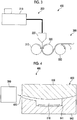
- FIG. 3 is a side view schematically showing an optical sheet manufacturing apparatus for manufacturing the optical sheet shown in FIG. 1 .
- FIG. 4 is a sectional view schematically showing an optical component manufacturing apparatus for manufacturing the optical sheet optical component shown in FIG. 1 .
- the upper side in FIG. 4 is referred to as “upper”, and the lower side is referred to as “lower”.
- the optical sheet manufacturing apparatus 100 shown in FIG. 3 includes a sheet supply unit 200 and a sheet molding unit 300.
- the sheet supply unit 200 includes an extruder 210 and a T-die 220 connected to a molten resin discharge unit of the extruder 210 via a pipe.
- a belt-shaped sheet 1' in a molten state or a softened state is supplied to the sheet molding unit 300 by the T-die 220.
- the T-die 220 is an extrusion forming unit that extrudes the sheet 1' in a molten state or a softened state by an extrusion method in a state of a belt-shaped sheet.
- a constituent material constituting the optical sheet 1 described above is loaded in the T-die 220 in a molten state, and by extruding the material in the molten state from the T-die 220, the belt-shaped sheet 1' is continuously fed.
- the sheet molding unit 300 includes a touch roll 310, a cooling roll 320, and a post-stage cooling roll 330. Each of these rolls is configured to rotate independently by a motor (driving means) (not illustrated), and is continuously fed by being cooled by the rotation of these rolls .
- a motor driving means
- the optical sheet of the present embodiment is manufactured by the optical sheet manufacturing method using the optical sheet manufacturing apparatus 100 as described above.
- Manufacturing of the optical sheet includes an extrusion step, a molding step, and a cooling step.
- a belt-shaped sheet 1' in a molten state or a softened state is extruded (an extrusion step).
- the constituent material of the optical sheet 1 polycarbonate, light absorbing agent, ultraviolet absorbing agent, and the like
- the constituent material of the optical sheet 1 is in a molten or softened state in the extruder 210, and is in a state in which the polycarbonate, the light absorbing agent, and the ultraviolet absorbing agent are sufficiently mixed with one another.
- the surface of the sheet 1' is flattened, and the sheet 1' is set to a predetermined thickness (molding step) .
- the present step is performed between the touch roll 310 and the cooling roll 320.
- the surface of the sheet 1' is cooled (cooling step).
- the present step is performed between the cooling roll 320 and the post-stage cooling roll 330.
- a polyvinyl alcohol sheet containing the dye described above or the like is prepared and stretched in one direction to obtain the polarized layer 12.
- an adhesive 13 is applied on the cut sheet 1' (specific wavelength absorption layer 11), the polarized layer 12 is laminated on the adhesive layer 13, and the adhesive 13 is cured to obtain the optical sheet 1.
- the optical component manufacturing apparatus 400 shown in FIG. 4 includes a resin supply unit 500 and a mold 600.
- the resin supply unit 500 is filled with the above-described polycarbonate.
- the mold 600 has a cavity 610 and a supply port 620 communicating inside and outside the cavity 610.
- the mold 600 includes an upper member 630 and a lower member 640, and in a state where these components are assembled, the mold 600 that defines the optical component manufacturing apparatus 400 is configured.
- the optical component manufacturing apparatus of the present embodiment is manufactured by a manufacturing method of the optical sheet manufacturing apparatus using the optical component manufacturing apparatus 400 as described above.
- the method for manufacturing an optical component includes an optical sheet arranging step and a lens material supplying step.
- the optical sheet 1 is arranged on a bottom surface 641 of the lower member 640 (optical sheet arranging step).
- the bottom surface 641 is a curved concave surface, and with this, it is possible to form a curved surface on the lens 4.
- the optical sheet 1 has flexibility, and thus is arranged according to the shape of the bottom surface 641.
- the polarized sheet 12 is arranged so as to be in contact with the bottom surface 641.
- the optical sheet 1 is excellent in moldability and optical characteristics.
- the upper member 630 and the lower member 640 are in an assembled state, and a lens material in a molten state or a softened state is poured through the supply port 620 (lens material supply step).
- a lens material in a molten state or a softened state is poured through the supply port 620 (lens material supply step).
- each unit constituting the optical sheet of the present invention can be replaced with an arbitrary constituent element exhibiting the same function.
- optical sheet of the present invention may have an arbitrary constituent components in addition to the above-described configuration.
- the optical sheet of the present invention may include a protective layer for protecting a surface, an intermediate layer, a power adjustment layer for adjusting the power as a lens, and the like.
- the specific wavelength absorption layer forming material was accommodated in the extruder 210 of the optical sheet manufacturing apparatus 100 shown in FIG. 3 , melted, and extruded from the T-die 220 to obtain a sheet material.
- the sheet material was cooled and molded in a sheet molding unit 300, and cut into a rectangular shape having an average thickness of 0.3 mm and a size of 500 mm ⁇ 500 mm in plan view to prepare a specific wavelength absorption layer.
- VF-PS polyvinyl alcohol
- a two-pack moisture-curable type polyurethane adhesive (main agent: Takelac A-520, manufactured by Mitsui Chemicals, Inc., curing agent: Takenate A-50, manufactured by Mitsui Chemicals, Inc.) was applied onto a surface of the specific wavelength absorption layer so that the thickness after curing became 20 ⁇ m, and a polarized layer was laminated thereon and cured to obtain an optical sheet 1.
- the viscosity average molecular weight Mv of the polycarbonate is 27,000, the melting point T1 is 250°C, the melt flow rate measured in accordance with JISK7210 is 5.3 g/10 min, and the water absorption rate measured by Aquatrac 3E (manufactured by Brabender Corporation) was 0.05%.
- the melting point T2 of the light absorbing agent was 440°C.
- the melting point T3 of the ultraviolet absorbing agent was 200°C.
- An optical sheet of Example 2 was obtained in the same manner as in Example 1 except that the configuration of the optical sheet was changed as shown in Table 1.
- An optical sheet of Example 3 was obtained in the same manner as in Example 1 except that the configuration of the optical sheet was changed as shown in Table 1.
- An optical sheet of Example 4 was obtained in the same manner as in Example 1 except that the configuration of the optical sheet was changed as shown in Table 1.
- An optical sheet of Example 5 was obtained in the same manner as in Example 1 except that the configuration of the optical sheet was changed as shown in Table 1.
- An optical sheet of Example 6 was obtained in the same manner as in Example 1 except that the configuration of the optical sheet was changed as shown in Table 1.
- An optical sheet of Example 7 was obtained in the same manner as in Example 1 except that the configuration of the optical sheet was changed as shown in Table 1.
- An optical sheet of Example 8 was obtained in the same manner as in Example 1 except that the configuration of the optical sheet was changed as shown in Table 1.
- An optical sheet of Example 9 was obtained in the same manner as in Example 1 except that the configuration of the optical sheet was changed as shown in Table 1.
- An optical sheet of Example 10 was obtained in the same manner as in Example 1 except that the configuration of the optical sheet was changed as shown in Table 1.
- Example 11 An optical sheet of Example 11 was obtained in the same manner as in Example 1 except that the configuration of the optical sheet was changed as shown in Table 1.
- a1 represents polycarbonate ("E2000FN E5100” manufactured by Mitsubishi Gas Chemical Company)
- a2 represents polycarbonate ("H3000” manufactured by Mitsubishi Gas Chemical Company)
- a3 represents polycarbonate ("200-3NAT” manufactured by Sumika Polycarbonate Limited)
- a4 represents polycarbonate ("S2000” manufactured by Mitsubishi Gas Chemical Co., Ltd.).
- b1 represents a light absorbing agent ("FDG-005" manufactured by Yamada Chemical Industry Co., Ltd.)
- b2 represents a light absorbing agent
- b3 represents a light absorbing agent
- FDB-001 manufactured by Yamada Chemical Industry Co., Ltd.
- b4 represents a light absorbing agent
- FDR-002 manufactured by Yamada Chemical Industry Co., Ltd.
- b5 represents a light absorbing agent (“FDR-005" manufactured by Yamada Chemical Industry Co., Ltd.) .
- c represents an ultraviolet absorbing agent ("ADEKA STAB LA-31G” manufactured by ADEKA Corporation).
- optical sheet of each example was evaluated by the following method.
- Charpy impact strength was measured in accordance with ISO179-1 and ISO179-2, and evaluated as follows.
- a xenon lamp (7.5 kw, output: 1.728 MJ/m 2 ) (light source filter: daylight filter, irradiance: broadband (300 to 400 nm), 60 ⁇ 2 W/ m 2 ) was irradiated for 8 hours, and a yellowing degree ( ⁇ YI) was evaluated as follows.
- Example 1 Example 2
- Example 3 Example 4
- Example 5 Example 6
- Example 7 Example 8
- Example 10 Example 11 Specific wavelength absorption layer Polycarbonate Type a1 a2 a3 a4 a1 a1 a1 a1 a1 a1 a1 Content (%) 100 100 100 100 100 100 100 100 100 100 100 100 100 100 100 100 100 100 100 100 100 100 100 100 100 100 100 100 100 100 100 100 100 100 100 100 100 100 100 Viscosity average molecular weight 27000 20000 30000 23000 27000 27000 27000 27000 27000 27000 27000 27000 27000 27000 27000 Water absorption rate 0.05 0.05 0.05 0.05 0.02 0.05 0.05 0.05 0.05 0.05 0.05 0.02
- Melt flow rate (g/10 min) 5.3 28 3 9 5.3 5.3 5.3 5.3 5.3 5.3 5.3 5.3 5.3 Melting point T1 (°C) 250 250 250 250 250 250 250 250 250 250 250 250 250 250 250 250 250 250 250 250 250 250 250 250 250 250 250 250 250 250 250 250
- the optical sheet of the present invention is an optical sheet that has flexibility and is used in a curved state of being curved in one direction, and the optical sheet includes a polarized layer for polarizing incident light and a specific wavelength absorption layer provided in a curved concave side from the polarized layer and containing a resin material and a light absorbing agent that absorbs light in a specific wavelength range out of light in a wavelength range of 350 nm to 740 nm. Accordingly, the optical sheet has a polarizing function and can absorb light of a specific wavelength.
- the optical sheet 1 is placed on a mold, and a resin material to be a lens is supplied thereon to form a lens with an optical sheet (optical component) in which the lens and the optical sheet are integrated, it is possible to prevent the mold and the specific wavelength absorption layer from being brought into contact with each other. Therefore, it is possible to prevent the specific wavelength absorption layer from being changed in quality by the heat directly transmitted from the mold.
- the optical sheet is excellent in moldability and optical characteristics.
Landscapes
- Physics & Mathematics (AREA)
- Health & Medical Sciences (AREA)
- General Physics & Mathematics (AREA)
- Optics & Photonics (AREA)
- Ophthalmology & Optometry (AREA)
- General Health & Medical Sciences (AREA)
- Toxicology (AREA)
- Optical Filters (AREA)
- Laminated Bodies (AREA)
- Polarising Elements (AREA)
- Eyeglasses (AREA)
Claims (7)
- Optische Folie mit Flexibilität, die in einem gekrümmten Zustand verwendet wird, wobei die optische Folie umfasst:eine polarisierte Schicht, die einfallendes Licht polarisiert; undeine Absorptionsschicht mit spezifischer Wellenlänge, die auf einer gekrümmten konkaven Seite der polarisierten Schicht bereitgestellt ist und ein Polycarbonat und ein lichtabsorbierendes Mittel umfasst, das Licht in einem spezifischen Wellenlängenbereich aus Licht in einem Wellenlängenbereich von 350 nm bis 740 nm absorbiert,dadurch gekennzeichnet, dass das Polycarbonat ein viskositätsmittleres Molekulargewicht Mv von 23.000 bis 28.000 aufweist,
unddas Polycarbonat eine Wasserabsorptionsrate von 0,04 % bis 0,15% aufweist. - Optische Folie nach Anspruch 1,
wobei das Polycarbonat eine Schmelzflussrate von 3 g/10 min bis 30 g/10 min, gemessen gemäß JIS K7210, aufweist. - Optische Folie nach Anspruch 1 oder 2,
wobei in einem Fall, in dem ein Schmelzpunkt des Polycarbonats mit T1 bezeichnet wird und ein Schmelzpunkt des lichtabsorbierenden Mittels mit T2 bezeichnet wird, T1 < T2 erfüllt ist. - Optische Folie nach einem der Ansprüche 1 bis 3,
wobei die Absorptionsschicht mit spezifischer Wellenlänge einen Dehnungsgrad von 10% oder weniger aufweist. - Optische Folie nach einem der Ansprüche 1 bis 4, wobei die Absorptionsschicht mit spezifischer Wellenlänge ferner ein Ultraviolett-absorbierendes Mittel enthält, das Licht in einem Wellenlängenbereich von 100 nm bis 420 nm absorbiert.
- Optische Folie nach einem der Ansprüche 1 bis 5,
wobei das lichtabsorbierende Mittel mindestens eines, ausgewählt aus der Gruppe bestehend aus einem Phthalocyanin-basierten Pigment, einer Porphyrin-basierten Verbindung und einem Merocyanin-Farbstoff, enthält. - Optische Komponente, umfassend:ein Substrat; unddie optische Folie nach einem der Ansprüche 1 bis 6, die auf das Substrat laminiert ist.
Applications Claiming Priority (2)
| Application Number | Priority Date | Filing Date | Title |
|---|---|---|---|
| JP2017192233A JP6539880B2 (ja) | 2017-09-29 | 2017-09-29 | 光学シートおよび光学部品 |
| PCT/JP2018/036150 WO2019065927A1 (ja) | 2017-09-29 | 2018-09-27 | 光学シートおよび光学部品 |
Publications (3)
| Publication Number | Publication Date |
|---|---|
| EP3690504A1 EP3690504A1 (de) | 2020-08-05 |
| EP3690504A4 EP3690504A4 (de) | 2020-11-11 |
| EP3690504B1 true EP3690504B1 (de) | 2022-01-12 |
Family
ID=65902917
Family Applications (1)
| Application Number | Title | Priority Date | Filing Date |
|---|---|---|---|
| EP18863086.7A Active EP3690504B1 (de) | 2017-09-29 | 2018-09-27 | Optische folie und optische komponente |
Country Status (4)
| Country | Link |
|---|---|
| US (1) | US11119260B2 (de) |
| EP (1) | EP3690504B1 (de) |
| JP (1) | JP6539880B2 (de) |
| WO (1) | WO2019065927A1 (de) |
Families Citing this family (1)
| Publication number | Priority date | Publication date | Assignee | Title |
|---|---|---|---|---|
| KR102919353B1 (ko) * | 2022-02-23 | 2026-01-29 | 우시 헝신 옵토일렉트로닉 매터리얼스 컴퍼니 리미티드 | 편광판 및 이를 포함하는 광학표시장치 |
Family Cites Families (23)
| Publication number | Priority date | Publication date | Assignee | Title |
|---|---|---|---|---|
| JP2838514B2 (ja) | 1996-05-28 | 1998-12-16 | 筒中プラスチック工業株式会社 | メガネ用凸レンズ状偏光板の製造方法 |
| JPH11199683A (ja) * | 1998-01-16 | 1999-07-27 | Nippon Polyester Co Ltd | ポリカーボネート板および赤外線カットフィルター |
| US6367930B1 (en) * | 1999-12-30 | 2002-04-09 | Bayer Corporation | Process for preparing a photochromic lens |
| JP2003149605A (ja) * | 2001-11-16 | 2003-05-21 | Nippon Sheet Glass Co Ltd | 防眩用光学物品 |
| JP4080966B2 (ja) * | 2003-07-18 | 2008-04-23 | 出光興産株式会社 | 光反射シート及びその成形品 |
| JP4819460B2 (ja) | 2005-09-28 | 2011-11-24 | 山本光学株式会社 | 光学物品 |
| CN101790565B (zh) | 2007-07-24 | 2012-01-25 | 帝人化成株式会社 | 阻燃性树脂组合物 |
| KR102114534B1 (ko) * | 2009-10-21 | 2020-05-22 | 미츠비시 가스 가가쿠 가부시키가이샤 | 기능성 시트 및 그것을 이용한 렌즈 |
| JP2016053724A (ja) * | 2010-02-23 | 2016-04-14 | 山本光学株式会社 | 円偏光板および円偏光レンズ、および円偏光眼鏡 |
| EP3336145B1 (de) | 2010-05-27 | 2023-11-01 | Idemitsu Kosan Co., Ltd | Polycarbonatharzzusammensetzung und polycarbonatharzformartikel |
| JP5626081B2 (ja) * | 2011-04-07 | 2014-11-19 | 三菱エンジニアリングプラスチックス株式会社 | 眼鏡レンズ用熱可塑性樹脂組成物及び眼鏡レンズ |
| JP2012226078A (ja) * | 2011-04-19 | 2012-11-15 | Daicel Corp | 偏光フィルム及びその製造方法並びに表示装置 |
| TWI570472B (zh) | 2011-10-03 | 2017-02-11 | 三菱瓦斯化學股份有限公司 | 芳香族聚碳酸酯製偏光透鏡 |
| WO2014073021A1 (ja) * | 2012-11-06 | 2014-05-15 | コニカミノルタ株式会社 | 長尺延伸フィルムの製造方法 |
| JP5333698B1 (ja) * | 2012-11-06 | 2013-11-06 | コニカミノルタ株式会社 | 長尺斜め延伸フィルム、該長尺斜め延伸フィルムを用いた円偏光板および有機elディスプレイ |
| JP2014197163A (ja) * | 2013-01-17 | 2014-10-16 | 株式会社ダイセル | 半透明拡散型偏光積層体及びその用途 |
| EP2950122B1 (de) | 2013-01-25 | 2023-04-26 | Mitsubishi Gas Chemical Company, Inc. | Gefärbter film mit geringer polarisierung, gefärbte folie mit geringer polarisierung, linse und verfahren zur herstellung davon |
| WO2014197034A2 (en) * | 2013-03-11 | 2014-12-11 | Bayer Materialscience Llc | Compositions containing polycarbonate and infrared reflective additives |
| AU2013409186B2 (en) * | 2013-12-23 | 2019-10-24 | Essilor International | Transparent optical article having a reduced yellowness appearance |
| JP2016104839A (ja) * | 2014-12-01 | 2016-06-09 | 三菱化学株式会社 | 赤外線吸収色素組成物、赤外線吸収膜及び積層体 |
| JP6617494B2 (ja) * | 2015-09-18 | 2019-12-11 | コニカミノルタ株式会社 | 斜め延伸フィルムの製造方法 |
| WO2017073220A1 (ja) * | 2015-10-26 | 2017-05-04 | 住友ベークライト株式会社 | 眼鏡レンズ用積層体、積層体付眼鏡レンズおよびマーキング方法 |
| DE112016005898T5 (de) * | 2015-12-22 | 2018-09-13 | Idemitsu Kosan Co., Ltd. | Polycarbonat-Harzzusammensetzung |
-
2017
- 2017-09-29 JP JP2017192233A patent/JP6539880B2/ja active Active
-
2018
- 2018-09-27 US US16/651,818 patent/US11119260B2/en active Active
- 2018-09-27 EP EP18863086.7A patent/EP3690504B1/de active Active
- 2018-09-27 WO PCT/JP2018/036150 patent/WO2019065927A1/ja not_active Ceased
Also Published As
| Publication number | Publication date |
|---|---|
| US20200249378A1 (en) | 2020-08-06 |
| JP6539880B2 (ja) | 2019-07-10 |
| US11119260B2 (en) | 2021-09-14 |
| WO2019065927A1 (ja) | 2019-04-04 |
| EP3690504A4 (de) | 2020-11-11 |
| EP3690504A1 (de) | 2020-08-05 |
| JP2019066672A (ja) | 2019-04-25 |
Similar Documents
| Publication | Publication Date | Title |
|---|---|---|
| JP2019095492A (ja) | 光学シートおよび光学部品 | |
| EP3907554B1 (de) | Optische folie und optische komponente | |
| EP3916437A1 (de) | Optische folie und optische komponente | |
| JP6897714B2 (ja) | 光学シートおよび光学部品 | |
| US11119260B2 (en) | Optical sheet and optical component | |
| EP3982170B1 (de) | Optische folie und optische komponente | |
| JP7358035B2 (ja) | 光学シートおよび光学部品 | |
| JP6516059B1 (ja) | 光学シートおよび光学部品 | |
| EP3690502B1 (de) | Optische folie und optische komponente | |
| JP6992739B2 (ja) | 光学部品の製造方法 | |
| JP7417349B2 (ja) | 光学シートおよび光学部品 | |
| JP7107348B2 (ja) | 光学シートおよび光学部品 | |
| JP6852746B2 (ja) | 光学シートおよび光学部品 | |
| JP6536712B2 (ja) | 光学シートおよび光学部品 | |
| JP6508279B2 (ja) | 光学シートおよび光学部品 | |
| JP2023111781A (ja) | 光学シートおよび光学部品 | |
| JP2020122756A (ja) | 検出装置、検出方法および光学シート母材 | |
| KR20200008594A (ko) | 다층 김서림-방지 구성물 및 이의 제조 방법 | |
| WO2021085357A1 (ja) | 光学シートおよび光学部品 | |
| JP2021149004A (ja) | 光学シート母材 |
Legal Events
| Date | Code | Title | Description |
|---|---|---|---|
| STAA | Information on the status of an ep patent application or granted ep patent |
Free format text: STATUS: THE INTERNATIONAL PUBLICATION HAS BEEN MADE |
|
| PUAI | Public reference made under article 153(3) epc to a published international application that has entered the european phase |
Free format text: ORIGINAL CODE: 0009012 |
|
| STAA | Information on the status of an ep patent application or granted ep patent |
Free format text: STATUS: REQUEST FOR EXAMINATION WAS MADE |
|
| 17P | Request for examination filed |
Effective date: 20200422 |
|
| AK | Designated contracting states |
Kind code of ref document: A1 Designated state(s): AL AT BE BG CH CY CZ DE DK EE ES FI FR GB GR HR HU IE IS IT LI LT LU LV MC MK MT NL NO PL PT RO RS SE SI SK SM TR |
|
| AX | Request for extension of the european patent |
Extension state: BA ME |
|
| A4 | Supplementary search report drawn up and despatched |
Effective date: 20201008 |
|
| RIC1 | Information provided on ipc code assigned before grant |
Ipc: G02C 7/10 20060101ALI20201002BHEP Ipc: G02B 5/22 20060101AFI20201002BHEP Ipc: G02B 5/30 20060101ALI20201002BHEP |
|
| DAV | Request for validation of the european patent (deleted) | ||
| DAX | Request for extension of the european patent (deleted) | ||
| GRAP | Despatch of communication of intention to grant a patent |
Free format text: ORIGINAL CODE: EPIDOSNIGR1 |
|
| STAA | Information on the status of an ep patent application or granted ep patent |
Free format text: STATUS: GRANT OF PATENT IS INTENDED |
|
| INTG | Intention to grant announced |
Effective date: 20210818 |
|
| RIN1 | Information on inventor provided before grant (corrected) |
Inventor name: ISHIKAWA, TETSUYA Inventor name: OYAMA, TAKUYA |
|
| GRAS | Grant fee paid |
Free format text: ORIGINAL CODE: EPIDOSNIGR3 |
|
| GRAA | (expected) grant |
Free format text: ORIGINAL CODE: 0009210 |
|
| STAA | Information on the status of an ep patent application or granted ep patent |
Free format text: STATUS: THE PATENT HAS BEEN GRANTED |
|
| AK | Designated contracting states |
Kind code of ref document: B1 Designated state(s): AL AT BE BG CH CY CZ DE DK EE ES FI FR GB GR HR HU IE IS IT LI LT LU LV MC MK MT NL NO PL PT RO RS SE SI SK SM TR |
|
| REG | Reference to a national code |
Ref country code: GB Ref legal event code: FG4D |
|
| REG | Reference to a national code |
Ref country code: CH Ref legal event code: EP |
|
| REG | Reference to a national code |
Ref country code: DE Ref legal event code: R096 Ref document number: 602018029653 Country of ref document: DE |
|
| REG | Reference to a national code |
Ref country code: IE Ref legal event code: FG4D |
|
| REG | Reference to a national code |
Ref country code: AT Ref legal event code: REF Ref document number: 1462758 Country of ref document: AT Kind code of ref document: T Effective date: 20220215 |
|
| REG | Reference to a national code |
Ref country code: LT Ref legal event code: MG9D |
|
| REG | Reference to a national code |
Ref country code: NL Ref legal event code: MP Effective date: 20220112 |
|
| REG | Reference to a national code |
Ref country code: AT Ref legal event code: MK05 Ref document number: 1462758 Country of ref document: AT Kind code of ref document: T Effective date: 20220112 |
|
| PG25 | Lapsed in a contracting state [announced via postgrant information from national office to epo] |
Ref country code: NL Free format text: LAPSE BECAUSE OF FAILURE TO SUBMIT A TRANSLATION OF THE DESCRIPTION OR TO PAY THE FEE WITHIN THE PRESCRIBED TIME-LIMIT Effective date: 20220112 |
|
| PG25 | Lapsed in a contracting state [announced via postgrant information from national office to epo] |
Ref country code: SE Free format text: LAPSE BECAUSE OF FAILURE TO SUBMIT A TRANSLATION OF THE DESCRIPTION OR TO PAY THE FEE WITHIN THE PRESCRIBED TIME-LIMIT Effective date: 20220112 Ref country code: RS Free format text: LAPSE BECAUSE OF FAILURE TO SUBMIT A TRANSLATION OF THE DESCRIPTION OR TO PAY THE FEE WITHIN THE PRESCRIBED TIME-LIMIT Effective date: 20220112 Ref country code: PT Free format text: LAPSE BECAUSE OF FAILURE TO SUBMIT A TRANSLATION OF THE DESCRIPTION OR TO PAY THE FEE WITHIN THE PRESCRIBED TIME-LIMIT Effective date: 20220512 Ref country code: NO Free format text: LAPSE BECAUSE OF FAILURE TO SUBMIT A TRANSLATION OF THE DESCRIPTION OR TO PAY THE FEE WITHIN THE PRESCRIBED TIME-LIMIT Effective date: 20220412 Ref country code: LT Free format text: LAPSE BECAUSE OF FAILURE TO SUBMIT A TRANSLATION OF THE DESCRIPTION OR TO PAY THE FEE WITHIN THE PRESCRIBED TIME-LIMIT Effective date: 20220112 Ref country code: HR Free format text: LAPSE BECAUSE OF FAILURE TO SUBMIT A TRANSLATION OF THE DESCRIPTION OR TO PAY THE FEE WITHIN THE PRESCRIBED TIME-LIMIT Effective date: 20220112 Ref country code: ES Free format text: LAPSE BECAUSE OF FAILURE TO SUBMIT A TRANSLATION OF THE DESCRIPTION OR TO PAY THE FEE WITHIN THE PRESCRIBED TIME-LIMIT Effective date: 20220112 Ref country code: BG Free format text: LAPSE BECAUSE OF FAILURE TO SUBMIT A TRANSLATION OF THE DESCRIPTION OR TO PAY THE FEE WITHIN THE PRESCRIBED TIME-LIMIT Effective date: 20220412 |
|
| PG25 | Lapsed in a contracting state [announced via postgrant information from national office to epo] |
Ref country code: PL Free format text: LAPSE BECAUSE OF FAILURE TO SUBMIT A TRANSLATION OF THE DESCRIPTION OR TO PAY THE FEE WITHIN THE PRESCRIBED TIME-LIMIT Effective date: 20220112 Ref country code: LV Free format text: LAPSE BECAUSE OF FAILURE TO SUBMIT A TRANSLATION OF THE DESCRIPTION OR TO PAY THE FEE WITHIN THE PRESCRIBED TIME-LIMIT Effective date: 20220112 Ref country code: GR Free format text: LAPSE BECAUSE OF FAILURE TO SUBMIT A TRANSLATION OF THE DESCRIPTION OR TO PAY THE FEE WITHIN THE PRESCRIBED TIME-LIMIT Effective date: 20220413 Ref country code: FI Free format text: LAPSE BECAUSE OF FAILURE TO SUBMIT A TRANSLATION OF THE DESCRIPTION OR TO PAY THE FEE WITHIN THE PRESCRIBED TIME-LIMIT Effective date: 20220112 Ref country code: AT Free format text: LAPSE BECAUSE OF FAILURE TO SUBMIT A TRANSLATION OF THE DESCRIPTION OR TO PAY THE FEE WITHIN THE PRESCRIBED TIME-LIMIT Effective date: 20220112 |
|
| PG25 | Lapsed in a contracting state [announced via postgrant information from national office to epo] |
Ref country code: IS Free format text: LAPSE BECAUSE OF FAILURE TO SUBMIT A TRANSLATION OF THE DESCRIPTION OR TO PAY THE FEE WITHIN THE PRESCRIBED TIME-LIMIT Effective date: 20220512 |
|
| REG | Reference to a national code |
Ref country code: DE Ref legal event code: R097 Ref document number: 602018029653 Country of ref document: DE |
|
| PG25 | Lapsed in a contracting state [announced via postgrant information from national office to epo] |
Ref country code: SM Free format text: LAPSE BECAUSE OF FAILURE TO SUBMIT A TRANSLATION OF THE DESCRIPTION OR TO PAY THE FEE WITHIN THE PRESCRIBED TIME-LIMIT Effective date: 20220112 Ref country code: SK Free format text: LAPSE BECAUSE OF FAILURE TO SUBMIT A TRANSLATION OF THE DESCRIPTION OR TO PAY THE FEE WITHIN THE PRESCRIBED TIME-LIMIT Effective date: 20220112 Ref country code: RO Free format text: LAPSE BECAUSE OF FAILURE TO SUBMIT A TRANSLATION OF THE DESCRIPTION OR TO PAY THE FEE WITHIN THE PRESCRIBED TIME-LIMIT Effective date: 20220112 Ref country code: EE Free format text: LAPSE BECAUSE OF FAILURE TO SUBMIT A TRANSLATION OF THE DESCRIPTION OR TO PAY THE FEE WITHIN THE PRESCRIBED TIME-LIMIT Effective date: 20220112 Ref country code: DK Free format text: LAPSE BECAUSE OF FAILURE TO SUBMIT A TRANSLATION OF THE DESCRIPTION OR TO PAY THE FEE WITHIN THE PRESCRIBED TIME-LIMIT Effective date: 20220112 Ref country code: CZ Free format text: LAPSE BECAUSE OF FAILURE TO SUBMIT A TRANSLATION OF THE DESCRIPTION OR TO PAY THE FEE WITHIN THE PRESCRIBED TIME-LIMIT Effective date: 20220112 |
|
| PLBE | No opposition filed within time limit |
Free format text: ORIGINAL CODE: 0009261 |
|
| STAA | Information on the status of an ep patent application or granted ep patent |
Free format text: STATUS: NO OPPOSITION FILED WITHIN TIME LIMIT |
|
| PG25 | Lapsed in a contracting state [announced via postgrant information from national office to epo] |
Ref country code: AL Free format text: LAPSE BECAUSE OF FAILURE TO SUBMIT A TRANSLATION OF THE DESCRIPTION OR TO PAY THE FEE WITHIN THE PRESCRIBED TIME-LIMIT Effective date: 20220112 |
|
| 26N | No opposition filed |
Effective date: 20221013 |
|
| PG25 | Lapsed in a contracting state [announced via postgrant information from national office to epo] |
Ref country code: SI Free format text: LAPSE BECAUSE OF FAILURE TO SUBMIT A TRANSLATION OF THE DESCRIPTION OR TO PAY THE FEE WITHIN THE PRESCRIBED TIME-LIMIT Effective date: 20220112 |
|
| PG25 | Lapsed in a contracting state [announced via postgrant information from national office to epo] |
Ref country code: MC Free format text: LAPSE BECAUSE OF FAILURE TO SUBMIT A TRANSLATION OF THE DESCRIPTION OR TO PAY THE FEE WITHIN THE PRESCRIBED TIME-LIMIT Effective date: 20220112 |
|
| REG | Reference to a national code |
Ref country code: CH Ref legal event code: PL |
|
| GBPC | Gb: european patent ceased through non-payment of renewal fee |
Effective date: 20220927 |
|
| REG | Reference to a national code |
Ref country code: BE Ref legal event code: MM Effective date: 20220930 |
|
| P01 | Opt-out of the competence of the unified patent court (upc) registered |
Effective date: 20230509 |
|
| PG25 | Lapsed in a contracting state [announced via postgrant information from national office to epo] |
Ref country code: LU Free format text: LAPSE BECAUSE OF NON-PAYMENT OF DUE FEES Effective date: 20220927 |
|
| PG25 | Lapsed in a contracting state [announced via postgrant information from national office to epo] |
Ref country code: LI Free format text: LAPSE BECAUSE OF NON-PAYMENT OF DUE FEES Effective date: 20220930 Ref country code: IE Free format text: LAPSE BECAUSE OF NON-PAYMENT OF DUE FEES Effective date: 20220927 Ref country code: CH Free format text: LAPSE BECAUSE OF NON-PAYMENT OF DUE FEES Effective date: 20220930 |
|
| PG25 | Lapsed in a contracting state [announced via postgrant information from national office to epo] |
Ref country code: BE Free format text: LAPSE BECAUSE OF NON-PAYMENT OF DUE FEES Effective date: 20220930 |
|
| PG25 | Lapsed in a contracting state [announced via postgrant information from national office to epo] |
Ref country code: GB Free format text: LAPSE BECAUSE OF NON-PAYMENT OF DUE FEES Effective date: 20220927 |
|
| PG25 | Lapsed in a contracting state [announced via postgrant information from national office to epo] |
Ref country code: CY Free format text: LAPSE BECAUSE OF FAILURE TO SUBMIT A TRANSLATION OF THE DESCRIPTION OR TO PAY THE FEE WITHIN THE PRESCRIBED TIME-LIMIT Effective date: 20220112 |
|
| PG25 | Lapsed in a contracting state [announced via postgrant information from national office to epo] |
Ref country code: MK Free format text: LAPSE BECAUSE OF FAILURE TO SUBMIT A TRANSLATION OF THE DESCRIPTION OR TO PAY THE FEE WITHIN THE PRESCRIBED TIME-LIMIT Effective date: 20220112 Ref country code: HU Free format text: LAPSE BECAUSE OF FAILURE TO SUBMIT A TRANSLATION OF THE DESCRIPTION OR TO PAY THE FEE WITHIN THE PRESCRIBED TIME-LIMIT; INVALID AB INITIO Effective date: 20180927 |
|
| PG25 | Lapsed in a contracting state [announced via postgrant information from national office to epo] |
Ref country code: TR Free format text: LAPSE BECAUSE OF FAILURE TO SUBMIT A TRANSLATION OF THE DESCRIPTION OR TO PAY THE FEE WITHIN THE PRESCRIBED TIME-LIMIT Effective date: 20220112 |
|
| PG25 | Lapsed in a contracting state [announced via postgrant information from national office to epo] |
Ref country code: MT Free format text: LAPSE BECAUSE OF FAILURE TO SUBMIT A TRANSLATION OF THE DESCRIPTION OR TO PAY THE FEE WITHIN THE PRESCRIBED TIME-LIMIT Effective date: 20220112 |
|
| PGFP | Annual fee paid to national office [announced via postgrant information from national office to epo] |
Ref country code: DE Payment date: 20250805 Year of fee payment: 8 |
|
| PGFP | Annual fee paid to national office [announced via postgrant information from national office to epo] |
Ref country code: IT Payment date: 20250825 Year of fee payment: 8 |
|
| PGFP | Annual fee paid to national office [announced via postgrant information from national office to epo] |
Ref country code: FR Payment date: 20250808 Year of fee payment: 8 |