EP3674396B1 - Systeme und verfahren zur gewebeverarbeitung und herstellung von zellsuspensionen daraus - Google Patents
Systeme und verfahren zur gewebeverarbeitung und herstellung von zellsuspensionen daraus Download PDFInfo
- Publication number
- EP3674396B1 EP3674396B1 EP19208169.3A EP19208169A EP3674396B1 EP 3674396 B1 EP3674396 B1 EP 3674396B1 EP 19208169 A EP19208169 A EP 19208169A EP 3674396 B1 EP3674396 B1 EP 3674396B1
- Authority
- EP
- European Patent Office
- Prior art keywords
- tissue
- cartridge
- cell suspension
- processing chamber
- applicator
- Prior art date
- Legal status (The legal status is an assumption and is not a legal conclusion. Google has not performed a legal analysis and makes no representation as to the accuracy of the status listed.)
- Active
Links
Images





Classifications
-
- C—CHEMISTRY; METALLURGY
- C12—BIOCHEMISTRY; BEER; SPIRITS; WINE; VINEGAR; MICROBIOLOGY; ENZYMOLOGY; MUTATION OR GENETIC ENGINEERING
- C12M—APPARATUS FOR ENZYMOLOGY OR MICROBIOLOGY; APPARATUS FOR CULTURING MICROORGANISMS FOR PRODUCING BIOMASS, FOR GROWING CELLS OR FOR OBTAINING FERMENTATION OR METABOLIC PRODUCTS, i.e. BIOREACTORS OR FERMENTERS
- C12M21/00—Bioreactors or fermenters specially adapted for specific uses
- C12M21/08—Bioreactors or fermenters specially adapted for specific uses for producing artificial tissue or for ex-vivo cultivation of tissue
-
- C—CHEMISTRY; METALLURGY
- C12—BIOCHEMISTRY; BEER; SPIRITS; WINE; VINEGAR; MICROBIOLOGY; ENZYMOLOGY; MUTATION OR GENETIC ENGINEERING
- C12M—APPARATUS FOR ENZYMOLOGY OR MICROBIOLOGY; APPARATUS FOR CULTURING MICROORGANISMS FOR PRODUCING BIOMASS, FOR GROWING CELLS OR FOR OBTAINING FERMENTATION OR METABOLIC PRODUCTS, i.e. BIOREACTORS OR FERMENTERS
- C12M45/00—Means for pre-treatment of biological substances
- C12M45/02—Means for pre-treatment of biological substances by mechanical forces; Stirring; Trituration; Comminuting
-
- C—CHEMISTRY; METALLURGY
- C12—BIOCHEMISTRY; BEER; SPIRITS; WINE; VINEGAR; MICROBIOLOGY; ENZYMOLOGY; MUTATION OR GENETIC ENGINEERING
- C12M—APPARATUS FOR ENZYMOLOGY OR MICROBIOLOGY; APPARATUS FOR CULTURING MICROORGANISMS FOR PRODUCING BIOMASS, FOR GROWING CELLS OR FOR OBTAINING FERMENTATION OR METABOLIC PRODUCTS, i.e. BIOREACTORS OR FERMENTERS
- C12M45/00—Means for pre-treatment of biological substances
- C12M45/06—Means for pre-treatment of biological substances by chemical means or hydrolysis
-
- C—CHEMISTRY; METALLURGY
- C12—BIOCHEMISTRY; BEER; SPIRITS; WINE; VINEGAR; MICROBIOLOGY; ENZYMOLOGY; MUTATION OR GENETIC ENGINEERING
- C12M—APPARATUS FOR ENZYMOLOGY OR MICROBIOLOGY; APPARATUS FOR CULTURING MICROORGANISMS FOR PRODUCING BIOMASS, FOR GROWING CELLS OR FOR OBTAINING FERMENTATION OR METABOLIC PRODUCTS, i.e. BIOREACTORS OR FERMENTERS
- C12M45/00—Means for pre-treatment of biological substances
- C12M45/09—Means for pre-treatment of biological substances by enzymatic treatment
-
- A—HUMAN NECESSITIES
- A61—MEDICAL OR VETERINARY SCIENCE; HYGIENE
- A61B—DIAGNOSIS; SURGERY; IDENTIFICATION
- A61B17/00—Surgical instruments, devices or methods
- A61B2017/00969—Surgical instruments, devices or methods used for transplantation
-
- C—CHEMISTRY; METALLURGY
- C12—BIOCHEMISTRY; BEER; SPIRITS; WINE; VINEGAR; MICROBIOLOGY; ENZYMOLOGY; MUTATION OR GENETIC ENGINEERING
- C12M—APPARATUS FOR ENZYMOLOGY OR MICROBIOLOGY; APPARATUS FOR CULTURING MICROORGANISMS FOR PRODUCING BIOMASS, FOR GROWING CELLS OR FOR OBTAINING FERMENTATION OR METABOLIC PRODUCTS, i.e. BIOREACTORS OR FERMENTERS
- C12M41/00—Means for regulation, monitoring, measurement or control, e.g. flow regulation
- C12M41/48—Automatic or computerized control
Definitions
- This invention relates to an at least partially automated device and its use for preparing a cell suspension, particularly a suspension comprising viable epithelial cells useful in tissue regeneration.
- Tissue regeneration in humans is extremely limited and constitutes a major challenge to the repair of damaged organ function.
- Wound treatment is a typical area where tissue regeneration is required.
- Wounds (lacerations or openings) in mammalian tissue can result in tissue disruption and coagulation of the microvasculature at the wound face. Repair of such tissue represents an orderly, controlled cellular response to injury. All soft tissue wounds, regardless of size, heal in a similar manner.
- the mechanisms of tissue growth and repair are biologic systems wherein cellular proliferation and angiogenesis occur in the presence of an oxygen gradient. The sequential morphological and structural changes, which occur during tissue repair have been characterized in great detail and have, in some instances, been quantified. See Hunt, T.
- EP 2 502 986 describes an automated or semi-automated module-based cartilage cell processing device for preparing a cell seeded carrier form a biological material.
- Tissue regeneration in various organs depends on connective tissue restoring blood supply and enabling residual organ-specific cells such as keratinocytes or muscle cells to reestablish organ integrity.
- organ-specific cells such as keratinocytes or muscle cells
- a relevant function of the mesenchymal cells e.g., the fibroblasts or, in addition, the endothelial cells of vasculature, is secretion of factors enhancing the healing process, e.g., factors promoting formation of new blood vessels (angiogenesis) or factors promoting re-epithelialization by proliferating and migrating keratinocytes.
- the cellular morphology of a wound consists of three distinct zones.
- the central avascular wound space is oxygen deficient, acidotic and hypercarbic, and has high lactate levels.
- Adjacent to the wound mandate is a gradient zone of local ischemia, which is populated by dividing fibroblasts.
- Behind the leading zone is an area of active collagen synthesis characterized by mature fibroblasts and numerous newly formed capillaries (i.e., neovascularization).
- new blood vessel growth angiogenesis
- angiogenic agents generally are unable to fulfill the long-felt need of providing the additional biosynthetic effects of tissue repair.
- Open cutaneous wounds represent one major category of wounds. This category includes acute surgical and traumatic, e.g., chronic ulcers, burn wounds, as well as chronic wounds such as neuropathic ulcers, pressure sores, arterial and venous (stasis) or mixed arterio-venous ulcers, and diabetic ulcers. Open cutaneous wounds routinely heal by a process comprising six major components: i) inflammation, ii) fibroblast proliferation, iii) blood vessel proliferation, iv) connective tissue synthesis, v) epithelialization, and vi) wound contraction. Wound healing is impaired when these components, either individually or as a whole, do not function properly.
- Skin wounds that do not readily heal can cause the subject considerable physical, emotional, and social distress as well as great financial expense. See, e.g., Richey et al., Annals of Plastic Surgery 23(2): 159-65 (1989 ). Indeed, wounds that fail to heal properly finally may require aggressive surgical treatments such as autologous skin grafting (where sheets of skin are grafted) or cultured dermis grafting.
- autologous skin grafting where sheets of skin are grafted
- cultured dermis grafting For example, cultured epithelial autograft (CEA) procedures take skin cells from the patient to grow new skin cells in sheets in a laboratory. The new sheets are used as grafts. However, the take rate of these grafts is not satisfactory.
- Newer grafting procedures combine CEA with a matrix for more support.
- cultured or engineered dermis are products having different matrices into which fibroblasts are incorporated, such as TransCyte ® and Dermagraft ® .
- TransCyte ® and Dermagraft ® are products having different matrices into which fibroblasts are incorporated.
- these products are not efficient in inducing epithelialization in large wounds.
- Cultured/engineered skin incorporating epidermal cells and fibroblasts are available as Apligraf ® (NOVARTIS Pharma) and VivoDerm ® (Bristol-Myers Squibb).
- Apligraf ® NOVARTIS Pharma
- VivoDerm ® Bristol-Myers Squibb
- the present invention provides an autologous cellular suspension suitable for application on various recipient sites, which can be used without regard to the type or tissue of the wound or the nature of the patient population. Automated devices and use thereof for preparing said suspension are also provided.
- the cartridge is sealed in a sterile packaging before use.
- the disintegrator can be a mesh, screen, grid, blade, or any combination thereof.
- the cartridge further comprises a cap removably placed on or hinged to the tissue processing chamber for engaging the actuating mechanism, wherein the cap has a seal for sealing the tissue processing chamber.
- the seal on a first side facing the tissue processing chamber can have a working surface, wherein when the disintegrating member is actuated and placed upon a second side of the seal facing the disintegrating member, the working surface is in contact with the tissue placed in the tissue processing chamber.
- the cartridge can further comprise a locking mechanism for securing the cap once placed on the tissue processing chamber, such that the cap remains placed when the system is in use.
- the cartridge further comprises a first packet for providing an enzyme solution and a second packet for providing a buffer solution, both packets in fluid communication with the tissue processing chamber, wherein the enzyme solution breaks down extracellular matrix in the tissue thereby chemically dissociating the tissue, and wherein the buffer solution washes the dissociated tissue and suspends cells in the cell suspension.
- the first packet can have a first and a second container separated by a breakable seal, the first container containing sterile water and the second container containing lyophilized enzyme powder, wherein when the seal is broken, the lyophilized enzyme powder meets the sterile water and dissolves therein.
- Such first or second container can be a pouch, a vial or a syringe.
- the console can further comprise a first pressurizing mechanism for driving the enzyme solution and a second pressurizing mechanism for driving the buffer solution out of the first packet and the second packet, respectively, into the tissue processing chamber.
- the first packet further collects waste enzyme solution after use and the second packet further collects waste buffer solution after use. All waste can be collected in one packet as well.
- the first packet can be in fluid communication with a first pump for pumping the enzyme solution and the waste enzyme solution.
- the second packet can also be in fluid communication with a second pump for pumping the buffer solution and the waste buffer solution.
- the cartridge further comprises a pump for drawing the cell suspension from the cell collection chamber, and subsequently after filled, pumping the cell suspension into the applicator, the third pump in fluid communication with the cell collection chamber and the applicator.
- Two or all of the first, second and third pumps can be the same pump.
- the first, second, or third pump may be peristaltic, syringe, or other type of pump and may be disposable or reusable.
- the cartridge further comprises a first syringe for collecting waste enzyme solution and a second syringe for collecting waste buffer solution, both syringes in fluid communication with the cell collection chamber.
- the cartridge can also further comprise a third syringe for drawing the cell suspension from the cell collection chamber, and subsequently after filled, pumping the cell suspension into the applicator, the third syringe in fluid communication with the cell collection chamber and the applicator.
- the cartridge further comprises a fluid detector for controlled metering of the enzyme solution and the buffer solution.
- the cartridge can include three containers for providing an enzyme solution, sterile water and lyophilized enzyme powder, respectively.
- small amounts of the enzyme solution can be pumped in and out of the chamber during incubation (e.g., at fixed intervals or frequency), to help agitate the enzyme solution and accelerate tissue processing/disintegration.
- the cartridge may further comprise at least one supplying container for providing an exogenous agent.
- the supplying container can be the same packet for providing the buffer solution (e.g., the buffer solution can include the exogenous agent or be replaced with a solution of the exogenous agent after release of the buffer solution from the packet).
- the exogenous agent can be, for example, a heat shock protein or a fragment thereof, hyaluronic acid, platelet-enriched plasma, a growth factor, adipose stem cells, or any combination of the foregoing.
- the cartridge further comprises a filter situated between the disintegrator and the cell collection chamber, for filtering the processed tissue to remove large aggregates.
- a filter can be alternatively or additionally situated between the cell collection chamber and the applicator, for filtering the cell suspension to remove large aggregates.
- the cartridge further comprises a mechanism for balancing pressure during fluid movement, which may be an antimicrobial filter or a bore tortuous path.
- one or more components of the cartridge in contact with a biological material is removably assembled therein so that such component can be removed from the cartridge for biohazard disposal allowing the rest of the cartridge to be recycled.
- the applicator can be a part of the system or a stand-alone device. An outer surface of the applicator can be sealed in a sterile packaging before transport to a sterile field for cell transplant.
- the applicator is capable of dispensing, spraying or dripping the cell suspension therein onto a recipient site or a support.
- the applicator may be pressurized or spring-loaded.
- the applicator may have a pivoting head for axial application of the cell suspension.
- the system can include a support or substrate for receiving the cell suspension, wherein the support, after receiving the cell suspension, is presented for transplant or culturing.
- the support may be a matrix, a scaffold, a dressing, or any combination thereof; the support may be solid, semi-solid, porous or fragmented.
- the disintegrating member may be part of the console (e.g., connected to the actuating mechanism) or part of the cartridge (e.g., situated in the tissue processing chamber and, e.g., connected to the cap).
- the disintegrating member comprises a pestle.
- the pestle may cycle up and down and/or rotate to promote tissue processing.
- the pestle can also have one or more fins.
- the console further comprises one or more of: a mechanism for drawing and ejecting the cartridge into or out of the console; an interlock to prevent removal of the cartridge during processing; an operator interface to control processing time, suspension volume needed, and activation of tissue processing; a display panel showing status of tissue processing; and an ejecting mechanism for ejecting the applicator when filled.
- the system may include a custom control software for directing a processor or computer chip in the console to control the automated process.
- the system may also be connected to an external computer for collecting and processing data.
- the cartridge may also have a mechanism for providing power (e.g., heat) so as to supply a mechanical force and/or a chemical reagent to the tissue.
- power e.g., heat
- the tissue can be an at least partially processed tissue sample prior to being placed in the cartridge.
- the at least partially processed tissue sample has been subject to incubation with an enzyme so as to break down extracellular matrix in the tissue thereby chemically dissociating the tissue.
- the cartridge can further comprise a container for providing a solution comprising the chemical reagent, wherein the chemical reagent is capable of breaking down extracellular matrix in the tissue.
- the console further comprises a pressurizing mechanism for driving the solution out of the container and into the tissue processing chamber, thereby chemically dissociating the tissue therein.
- the cartridge can be sealed in a sterile packaging before use.
- the cartridge can further comprise a cap removably placed on or hinged to the tissue processing chamber for engaging the actuating mechanism, wherein the cap has a seal for sealing the tissue processing chamber.
- the seal on a first side facing the tissue processing chamber has a working surface, wherein when the disintegrating member is actuated and placed upon a second side of the seal facing the disintegrating member, the working surface is in contact with the tissue placed in the tissue processing chamber.
- the cartridge further comprises a locking mechanism for securing the cap once placed on the tissue processing chamber, such that the cap remains placed when the system is in use.
- the cartridge further comprises at least one supplying container for providing an exogenous agent, which can be a heat shock protein or a fragment thereof, hyaluronic acid, platelet-enriched plasma, a growth factor, adipose stem cells, or any combination of the foregoing.
- an exogenous agent which can be a heat shock protein or a fragment thereof, hyaluronic acid, platelet-enriched plasma, a growth factor, adipose stem cells, or any combination of the foregoing.
- the console further comprises a disintegrating member and an actuating mechanism therefor, wherein when actuated, the disintegrating member engages with the tissue processing chamber and exerts the mechanical force on the tissue placed therein, thereby mechanically dissociating the tissue.
- the cartridge further comprises a disintegrating member situated in the tissue processing chamber.
- the disintegrating member comprises a pestle, and the disintegrator (in the cartridge) can be a mesh, screen, grid, blade, or any combination thereof.
- the console can further comprise a magnetic source for driving movement of a magnet placed in the tissue processing chamber, wherein movement of the magnet exerts the mechanical force on the tissue placed therein, thereby mechanically dissociating the tissue.
- the system optionally further comprises a disposable applicator removably in fluid communication, directly or indirectly, with the cell collection chamber and capable of receiving the cell suspension therefrom.
- the applicator is capable of dispensing, spraying or dripping the cell suspension therein onto a recipient site or a support.
- the system can include a support for receiving the cell suspension, wherein the support, after receiving the cell suspension, is presented for transplant or culturing.
- the support may be a matrix, a scaffold, a dressing, or any combination thereof; the support may be solid, semi-solid, porous or fragmented.
- the system can further include a filter situated between the disintegrator and the cell collection chamber, for filtering the processed tissue to remove large aggregates.
- a filter can also be situated after the cell collection chamber, for filtering the cell suspension to remove large aggregates.
- one or more components of the cartridge in contact with a biological material can be removably assembled therein so that such component can be removed from the cartridge for biohazard disposal allowing the rest of the cartridge to be recycled.
- the system may include a custom control software for directing a processor or computer chip in the console to control the automated process.
- the system may also be connected to an external computer for collecting and processing data.
- the cartridge may also have a mechanism for providing motive power (e.g., heat) so as to supply a mechanical force and/or a chemical reagent to the tissue.
- motive power e.g., heat
- this invention provides a unique device suitable for producing a cellular suspension of living tissue suitable for application to a patient in an epithelium- related procedure.
- a donor tissue e.g., skin epithelium such as glabrous epithelium, respiratory epithelium, vascular epithelium, corneal epithelium, and glandular epithelium
- a tissue dissociating means e.g., skin epithelium such as glabrous epithelium, respiratory epithelium, vascular epithelium, corneal epithelium, and glandular epithelium
- cells suitable for applying back to a recipient site of the same patient are collected.
- the cells so collected can be cultured and expanded in vitro before applying to a recipient site.
- the cells can also be seeded to a scaffold or matrix where the cells can grow and/or proliferate into an artificial tissue or organ.
- the cells may be presented in the form of a cell suspension (used interchangeably with "cellular suspension” herein) in a solution that is suitable for immediate dispersion (e.g., immediately after harvesting and/or filtering without in vitro culturing of the cells) over the recipient site.
- the cell suspension can be dispersed (immediately after harvesting or after in vitro culturing) to the recipient site alone or in combination with additional factor(s) such as heat shock protein(s), hyaluronic acid, platelet-enriched plasma, growth factor(s), and/or adipose stem cells, to facilitate, for example, wound healing, skin re-surfacing, or other epithelial treatments.
- the cell suspension can be dispersed via spraying, dripping, or any other application process.
- the cell suspension can also be injected directly into a tissue.
- aspects of the present invention include a system for cell harvesting and transplant, which can include: a cartridge for processing a tissue, comprising a tissue processing chamber, a disintegrator situated therein and a cell collection chamber separated from the tissue processing chamber by the disintegrator, wherein after dissociating the tissue placed in the tissue processing chamber mechanically and/or chemically and passing the dissociated tissue through the disintegrator, a cell suspension is collected in the cell collection chamber; and a programmable console for housing the cartridge and for providing motive power to supply a mechanical force and/or a chemical reagent to the tissue, wherein the console comprises a processor for controlling the console to supply the mechanical force and/or chemical reagent.
- the system of the present invention can be ReCell Next Generation (NG) product system.
- the system can include a re-usable Console, a disposable Cartridge (used herein interchangeably with "cassette") and optionally, a disposable Applicator.
- the applicator may reside in the cartridge until use.
- the cartridge with applicator can be a sterile packaged disposable.
- the cartridge carries the tissue processing chamber and the required materials (fluids and or solids) to treat and process the skin sample.
- the cartridge and applicator are passive devices which are acted upon mechanically by the console (after the cartridge is inserted into it) to achieve the required mechanical tissue working and fluid movements. All power sources and controls can reside in the console.
- the basic functions of the process are to 1) pre-treat the skin sample by soaking in heated enzyme, 2) rinse it with buffer, 3) mechanically grind it while submerged in additional buffer solution to disassociate the required cells, 4) suspend the cells in buffer, then 5) to convey the product suspension to the applicator so that the applicator can be used manually by an operator to apply the cell suspension to the patient's prepared wound bed.
- Tissue processing may be accomplished by a number of methods or combination of methods.
- the grinding process involves exerting a compression and/or rotational force on the skin sample through a specially designed member ("Pestle Surface") while applying a partial rotational motion to the member.
- the fluid handling process involves automatic reconstitution of an enzyme powder with sterile water before introduction of the enzyme solution to the processing chamber, then removal of the enzyme to a waste container followed by one or multiple introductions of buffer or other solution to the chamber during the remainder of the process. Finally, the product fluid, a suspension of skin cells, is pumped to an applicator or other vessel or matrix for introduction to a wound.
- ReCell ® NG one possible embodiment of the invention.
- the system is designed, developed and manufactured in order to provide users a new and improved, automated, safe, efficient, predictable, reliable, and easy-to-use device for the treatment of areas larger than the manual ReCell kit ( Figure 1 , described in detail below).
- the ReCell NG system is an autologous cell harvesting and transplant system used to treat a variety of skin or other epithelium-related conditions by application of a liquid suspension of harvested cells to the treatment area.
- This cell suspension is prepared from a sample of the patient's own skin or other epithelial tissue in an automated, autologous process.
- the process employs enzyme and/or mechanical action to dissociate cells from the tissue sample, and put them into suspension in a buffer solution.
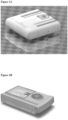
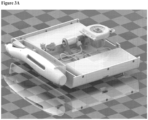
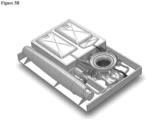
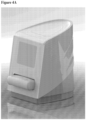
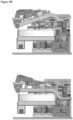
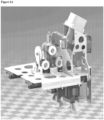
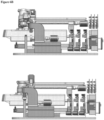
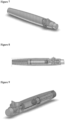
- the system includes a disposable Cartridge or Cassette ( Figures 2A-3B , two different designs shown); a reusable Console ( Figures 4A-6B , two different designs shown) into which the Cassette is inserted; and optionally, a disposable Applicator ( Figures 7-9 ) which is housed in the Cassette until ready for use.
- the Cassette can be provided sterile and contain the process materials and a chamber that holds the tissue sample. It is sealed against microbial penetration.
- the Applicator is filled with the cell suspension while housed in the Cassette during the process, and is then removed for use after the Cassette is removed from the Console.
- the Console provides some or all of the motive power and control.
- the cartridge may also have a mechanism for providing motive power (e.g., heat) so as to supply a mechanical force and/or a chemical reagent to the tissue.
- the Applicator is capable of dispensing, spraying or dripping the cell suspension therein onto a recipient site or a support.
- the Applicator can either spray or drip the cell suspension fluid on the treatment area or allow application beneath a contact layer dressing already in place, at the option of the physician.
- the system can include a support for receiving the cell suspension, wherein the support, after receiving the cell suspension, is presented for transplant or culturing.
- the support may be a matrix, a scaffold, a dressing, or any combination thereof; the support may be solid, semi-solid, porous or fragmented.
- the ReCell NG system is an at least partially automated version of the previously developed ReCell manual process.
- the manual process employs a ReCell Kit ( Figure 1 ) which is delivered with sterile and non-sterile components.
- the ReCell Kit contains one vial each of Sterile Water, lyophilized enzyme (powder) and compound sodium lactate buffer ("Buffer").
- the enzyme is reconstituted by introducing 10ml of sterile water in the enzyme vial.
- the enzyme solution is then placed in a heated well in the kit to bring the solution to 37 degrees C.
- the skin sample is then placed into the heated enzyme for a period of time to break down extracellular matrix and reduce the attachment between the epidemial and dermal layer. Buffer is taken from its vial and placed in a rinsing well in the ReCell processing unit.
- the required amount of Buffer to create the cell suspension is drawn into a 5ml syringe.
- Increasing amounts of cell suspension volume allow treatment of larger surface areas.
- the skin sample can be a split-thickness biopsy (includes Epidermis, the dermal-epidermal junction and some Dermis) obtained by use of a dermatome or other similar standard device. Biopsies of 1-4 square cm may be used to create, for example, 1-4 ml of cell suspension.
- the cell suspension can be diluted or concentrated to increase or reduce its volume, as needed.
- the skin sample Once the skin sample has completed treatment in the enzyme, it is rinsed in buffer by dipping in the rinsing well. The sample is then set out on the kit "tray", epidermal side up. A scalpel is used to manually scrape off the epidermal and junction cell layers, to collect the cells in a small pool of buffer solution. While scraping, the sample is moistened with drops of Buffer solution to carry off the disaggregated cells into suspension. The correct total amount of Buffer solution is used in order to create the desired cell suspension volume.
- the tray is manually tilted to move the cell suspension into a corner, from where it is drawn off with a syringe.
- the cell suspension is aspirated several times to rinse the tray and collect the maximum number of cells.
- the cell suspension is then dispensed from the syringe into a cell strainer basket (e.g., 40, 80, 100 or 200 micron size mesh, or any other size depending on the desired filtering application) sitting in a third well in the ReCell processing unit.
- the strainer is removed and the filtered cell suspension is then aspirated and drawn from the well with a new, sterile syringe.
- a spray head is then fitted to this syringe, thus creating an applicator which is used to spray or drip the cell suspension onto the treatment area.
- a blunt needle is used to introduce suspension beneath a dressing.
- the ReCell NG automated process includes three sub-systems: Fluid Handling (optional), Tissue Processing and Application.
- the Fluid Handling and Tissue Processing Systems have components that enclose and contact the tissue sample and fluids within the Cassette. These components form a sealed system. Magnetic and/or mechanical components of the Console exert forces on components of the sealed system, causing movements within the sealed system without mechanically breaching the system seal. This achieves the mechanical working of the tissue sample and fluid movements, while maintaining a microbial barrier.
- the system is sealed against microbes.
- the Tissue Processing chamber may be vented with a "Tortuous Path” vent or anti-microbial filter within the system to allow air to leave and to enter without carrying microbes into the system. This is necessary to accommodate volume and pressure changes as the fluid moves through the system.
- the basic mechanical working of the tissue sample can be achieved using a disintegrating member.
- the disintegrating member may be part of the console (e.g., connected to the actuating mechanism) or part of the cartridge (e.g., situated in the tissue processing chamber and, e.g., connected to the cap).
- the disintegrating member can be a pestle or grinder.
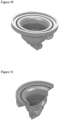
- mechanical working is achieved by a reciprocating -- rotating member, the "Pestle” ( Figures 13-14 ), which applies linear and torsional force, and repeated impact to the tissue sample through a flexible seal.
- the actuating portion of the Pestle (“Pestle Actuator Cylinder”) is part of the Console and does not touch the tissue sample.
- the tissue sample is worked by a component mounted to the inside of a flexible seal ("Pestle Surface") through which force is transmitted from the actuating member in the Console.
- Pestle Surface a component mounted to the inside of a flexible seal
- These forces are applied against the tissue as it sits on a coarse metal mesh or any suitable tissue disintegrator (e.g., a sheet with holes, blade, grid, screen, etc.), which helps concentrate the force and allow liquid and cells to drop therethrough.
- the Pestle Surface may have multiple radial ridges to also help concentrate forces, mimicking the action of the scalpel used in the current ReCell kit as the Pestle rotates.
- the number of ridges, their shape and the motion, force and time required to effect disaggregation can be adjusted and optimized.
- Other disintegrating member such as a grinder can also be used.
- tissue sample which is placed in a bath of buffer (e.g., a compound sodium lactate buffer).
- buffer e.g., a compound sodium lactate buffer
- the tissue sample may be placed in a bath of buffer together with a sterile magnetic stirrer in the Cassette.
- the Console can provide a magnetic force to drive movement (e.g., rotation) of the magnetic stirrer, thereby physically disrupting the cellular stratum and disassociating the cells.
- An outer surface of the Applicator can be sealed in a sterile packaging before transport to a sterile field for cell transplant.
- the Applicator can be housed in a compartment in the Cassette, which is sealed with a peel-off film or any other sterile packaging, such that the exterior of the Applicator is maintained within a microbial barrier.
- the applicator can be a part of the system or a stand-alone device.
- the Applicator may be pressurized or spring-loaded.
- the Applicator may have a pivoting head for axial application of the cell suspension.
- the Applicator can be filled with cell suspension through a sealed path from the Fluid Handling System during the process, so that the cell suspension is not exposed until it is sprayed on the treatment area by the physician in the sterile field.
- the system can include a support for receiving the cell suspension, wherein the support, after receiving the cell suspension, is presented for transplant or culturing.
- the support may be a matrix, a scaffold, a dressing, or any combination thereof; the support may be solid, semi-solid, porous or fragmented.
- the Fluid Handling System is optional. For example, if the tissue sample has been partially processed (e.g., incubated with an enzyme such as trypsin solution and washed and placed in a buffer) before being placed in the Cassette, the Fluid Handling System can be eliminated.
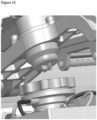
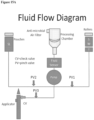
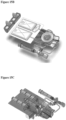
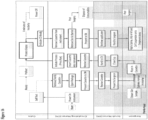
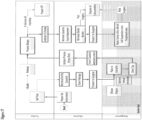
- An exemplary Fluid Handling System is shown in Figures I5A-15C.
- Figure 15A is a schematic of its operation.
- Figures 15B and 15C are exemplary hardware in the Cartridge handling the fluids. This includes the following items, which are part of the Cassette unless otherwise noted.
- the cartridge comprises a first packet for providing an enzyme solution and a second packet for providing a buffer solution, both packets in fluid communication with the tissue processing chamber, wherein the enzyme solution breaks down extracellular matrix in the tissue thereby chemically dissociating the tissue, and wherein the buffer solution washes the dissociated tissue and suspends cells in the cell suspension.
- the first packet can have a first and a second container separated by a breakable seal, the first container containing sterile water and the second container containing lyophilized enzyme powder, wherein when the seal is broken, the lyophilized enzyme powder meets the sterile water and dissolves therein.
- Such first or second container can be a pouch, a vial or a syringe.
- the console can further comprise a first pressurizing mechanism for driving the enzyme solution and a second pressurizing mechanism for driving the buffer solution out of the first packet and the second packet, respectively, into the tissue processing chamber.
- the first packet further collects waste enzyme solution after use and the second packet further collects waste buffer solution after use.
- the first packet can be in fluid communication with a first pump for pumping the enzyme solution and the waste enzyme solution.
- the second packet can also be in fluid communication with a second pump for pumping the buffer solution and the waste buffer solution.
- the cartridge further comprises a pump for drawing the cell suspension from the cell collection chamber, and subsequently after filled, pumping the cell suspension into the applicator, the third pump in fluid communication with the cell collection chamber and the applicator.
- Two or all of the first, second and third pumps can be the same pump.
- the first, second or third pump may be peristaltic, syringe, or other type of pump and may be disposable or reusable.
- the cartridge further comprises a first syringe for collecting waste enzyme solution and a second syringe for collecting waste buffer solution, both syringes in fluid communication with the cell collection chamber.
- the cartridge can also further comprise a third syringe for drawing the cell suspension from the cell collection chamber, and subsequently after filled, pumping the cell suspension into the applicator, the third syringe in fluid communication with the cell collection chamber and the applicator.
- the cartridge further comprises a fluid detector for controlled metering of the enzyme solution and the buffer solution.
- the cartridge can include three containers for providing an enzyme solution, sterile water and lyophilized enzyme powder, respectively.
- An exemplary Fluid Handling System includes:
- one or more components of the cartridge or the fluid handling system in contact with a biological material is removably assembled therein so that such component can be removed from the cartridge for biohazard disposal allowing the rest of the cartridge to be recycled.
- the pump can be peristaltic, syringe, or other type of pump and may be disposable or reusable.
- the pump can be part of the console and be reusable, or can be part of the cassette and be disposable.
- a peristaltic pump motor and actuators can be incorporated into the durable console and interface with a length of tubing.
- the peristaltic pump motor can have rollers attached to it in either a rotary or linear configuration. These rollers can contact the tubing, squeezing the tubing to occlude it and drive fluid along the tubing path.
- a disposable pump e.g., peristaltic pump
- the disposable pump can be advantageous as a complete, simple, inexpensive pump that is entirely enclosed within the consumable cassette part of the system.
- the disposable pump can mate via a simple, physical interface to a motor that is part of the durable console.
- An exemplary disposable pump is Quantex Pump available from Quantex Arc Ltd (London, UK).
- Fluid handling can be omitted if the tissue sample has been at least partially processed before entering in the Cassette.
- Partial processing includes incubating the tissue sample with an enzyme such as trypsin solution and washing and placing it in a buffer before placing the tissue sample in the Cassette.
- First Roller stops to give Enzyme a delay period to dissolve in water Roller could either have a set percentage advance before pausing or be controlled by a pressure switch.
- a First Valve opens (on "Enzyme Feed Tube”). First Roller then continues to advance, breaking second seal between the combined Sterile Water / Enzyme packet and the "Enzyme Feed Tube” which leads to the Tissue Processing Chamber.
- First Roller resumes advancing to move enzyme solution out of the packet.
- a peristaltic pump (or any other pump) moves the solution into the combined Tissue Processing Chamber and Cell Collection chamber to fill it and cover the tissue.
- First Valve closes.
- a variable/settable delay while tissue sample soaks in Enzyme solution. can be maintained with a sensor and coil in the wall of the Tissue Processing Chamber or through a thermal pin extending up from the Console. During this period, Pestle may cycle up and down to help agitate Enzyme solution and promote tissue treatment. This may allow shorter soak period.
- Other means to move the fluid employed can also be used, such as rotating the pestle, with or without adding fins, and pumping small amounts of the solution in and out of the chamber.
- the First Valve reopens and the peristaltic pump (or any other pump) draws Enzyme solution out of the combined Tissue Processing & Cell Collection Chamber through the Enzyme Drain Tube and stores it in packet #1 (the now empty enzyme pouch) for storage as waste.
- the First Valve closes.
- a Second Valve opens (on "Buffer Feed Tube”).
- Second Roller (“Buffer Roller”) advances partially, breaking seal.
- the peristaltic pump (or any other pump) both meters the volume and pumps Buffer solution through Buffer Feed Tube to rinse the tissue sample in the Tissue Processing Chamber. (Buffer may enter through multiple ports for surface coverage.) Sufficient Buffer is pumped in to completely fill the Tissue Processing / Cell Collection chamber combination. The Valve then closes.
- the First Valve opens again.
- the peristaltic pump (or any other pump) draws all rinse Buffer out of the processing chamber and into packet # 1 for storage as waste.
- the volume of the Cell Collection Chamber can be adjusted for the tissue sample size and Buffer volume to be used.
- the disaggregation process then begins (See Tissue Processing Section below).
- the Second Valve opens, the Second Roller continues to advance, and the peristaltic pump (or any other pump) moves Buffer solution into the chamber once or several times during the Pestle movements to repeatedly douse the tissue sample with drops of Buffer solution, pausing in between in a fashion coordinated with the movements of the Pestle.
- the Valve closes between aliquots.
- the Buffer packet may be designed with stepped width to increase volumetric accuracy in the small volume applications.
- the Roller can be controlled with a flow control meter.
- the Buffer picks up the cells being liberated from the tissue sample, and the Cell Suspension thus created drains by gravity into the Cell Collection chamber, passing through the 100 micron filter (or 40, 80, 150 or 200 micron size mesh, or any other size depending on the desired filtering application) mounted in the Cell Collection chamber. (See Section on Tissue Processing and Figures 10-12 on the Tissue Processing and Cell Collection Chamber Assembly.)
- additional Buffer is added to the chamber to rinse it and collect all the disaggregated cells and to make up the volume of Cell Suspension needed. This may occur multiple times in order to completely capture all cells and achieve desired volume.
- the Second Valve then closes and remains closed.
- a Valve opens (on "Cell Collection Tube”).
- the pump draws Cell Suspension out of Collection Chamber (through a filter) and into the applicator.
- the pump then reverses and pumps the Cell Suspension abruptly back into the Tissue Processing / Cell Collection chamber to wash cells off the Chamber and Pestle surfaces and further activate cells. This may be repeated. After this process the Suspension remains in the Applicator.
- the Valve then closes.
- Additional Buffer may be drawn from the Buffer packet and pumped to the chamber (as described above) to rinse it and collect additional disaggregated cells and to make up the volume of Cell Suspension needed. This may occur multiple times in order to completely capture all cells and achieve desired volume. This additional suspension is pumped to the applicator and the pump then reverses and pumps the Cell Suspension abruptly back into the Tissue Processing / Cell Collection chamber to wash cells off the Chamber and Pestle surfaces and further activate cells.
- the Tissue Processing System is a combination of elements of the Cartridge and Console, shown in Figures 2A-3B (two different Cartridge Designs, # 1 and #2), 4A-6B (two different Console Designs, # 1 and #2), and 10-12 (Tissue Processing and Cell Collection Chambers).
- Tissue Processing Chamber A vessel constructed of engineering resin (or any other suitable materials) with a steel mesh (or any other suitable disintegrator) over an opening at the bottom ("Tissue Processing Mesh"), supported by a strong rib structure or circumferentially. The top of the chamber is closed with a cap ("Chamber Cap"). One combined port or two separate ports in this chamber allow Enzyme Solution and Buffer Solution to be pumped in. (Buffer may enter through one or two or multiple ports for surface coverage.)
- a cap removably placed on or hinged to the Tissue Processing Chamber can be used to seal the top opening thereof, e.g., through a bayonet fitting. Once closed, the cap can be locked in place by a locking mechanism, such that the cap remains closed during processing and cannot be reopened or reused after first use.
- the body of the cap includes a flexible elastomer (e.g., polyurethane) seal, with a raised Pestle surface (spherical convex) fastened on the chamber side of the Cap, and a spline indentation on top.
- the Cap can also be substantially rigid with a form of vertical axil with o-ring or quad-seals or other sealing device.
- Tissue Processing Mesh A stainless steel mesh with a concave spherical shape, covering an opening at the bottom of the Tissue Processing Chamber, separating it from the Cell Collection Chamber below. When the tissue sample is placed in the processing chamber it sits on the Tissue Processing Mesh. Any suitable tissue disintegrator (e.g., a sheet with holes, blade, grid, screen, etc.) can also be used.
- tissue disintegrator e.g., a sheet with holes, blade, grid, screen, etc.
- the cartridge further comprises a filter situated between the disintegrator and the cell collection chamber, for filtering the processed tissue to remove large aggregates.
- a filter can be alternatively or additionally situated between the cell collection chamber and the applicator, for filtering the cell suspension to remove large aggregates.
- Actuating Mechanism A member that allows forces to be passed through the cap to the tissue sample.
- the Actuating Mechanism will have a key that allows mating with the Chamber Cap to allow disaggregation.
- the seal on a first side facing the tissue processing chamber can have a working surface, wherein when the disintegrating member is actuated and placed upon a second side of the seal facing the disintegrating member, the working surface is in contact with the tissue placed in the tissue processing chamber.
- the disintegrating member can be a part of the cartridge (e.g., connected to Chamber Cap or Tissue Processing Chamber), such that upon mating with Actuating Mechanism, the disintegrating member can be worked by the Actuating Mechanism to exert force to the tissue.
- the Actuating Mechanism can be rotated in an oscillation through an arc. This allows application of torsion to the tissue sample.
- Cyclic lifting and dropping of the Actuating Mechanism allows impact or varying forces to be applied to the tissue sample.
- An alternative or additional design to the above Chamber Cap and Actuating Mechanism module is to provide a magnetic stirrer in the Tissue Processing Chamber, and to drive the magnetic stirrer by a magnetic force provided by the Console.
- the magnetic stirrer upon sufficiently vigorous stirring, breaks down the tissue sample into a plume of cells which can then be filtered and collected in the Cell Collection Chamber.
- This process seeks to somewhat mimic the scraping action of the scalpel on the tray surface in the manual ReCell kit, with the added working elements of a metal mesh and impact from the Pestle. These additional working elements seek to provide enough action to disassociate the required cells regardless of the orientation of the sample.
- the Actuating Mechanism moves toward the cap to mate with the keyed Chamber Cap surface and apply force (directly or to the Pestle Surface) against the tissue sample. (See Figure 14 .)
- a mechanism to cyclically raise and drop and/or rotate the Actuating Mechanism at a proscribed frequency can be applied to provide a cyclic impact or variable force of the Pestle Surface on the tissue sample.
- a linkage mounted on the Actuating Mechanism provides the ability to rotate the Pestle actuator. With the multiple ridges on the Pestle Surface, an oscillating motion at this arc can sweep the ridges to cover the whole sample surface.
- the Console can provide a magnetic force which drives the movement of a magnetic stirrer previously placed in the Tissue Processing Chamber.
- the movement of a magnetic stirrer can break down the tissue sample into a plume of cells.
- the Applicator contains a spring-loaded syringe, with the spring oriented to resist filling of the syringe.
- An operating valve on the Applicator is positioned and set to allow the Applicator Syringe to fill, but to stop the fluid from exiting the spray nozzle on the Applicator.
- the applicator may include a septum or e.g., silicone rubber. This septum would be positioned adjacent to a fellow septum in the cartridge.
- the cartridge When the cartridge is inserted into the console it mates with a boss that is stationary. This forces a spring-loaded needle through both septa opening a fluid path from the cartridge plumbing to the applicator allowing it to be filled.
- the spring-loaded needle retracts resealing both septa and ensuring sterility.
- the spring compression maintains pressure on the fluid while it is in the Applicator and as it is later emptied onto the treatment surface.
- the Cassette is removed from the Console and the Cassette is carried to the Sterile Field, the circulating nurse opens the still sterile applicator chamber in the cartridge and presents it to the scrubbed-in nurse or physician, who aseptically retrieves it for application to the patient.
- the physician points the Applicator nozzle at the treatment area and opens the operating valve partially or fully to achieve the strength of flow desired, from a drip to a spray.
- the operating valve may be any suitable valve.
- the applicator may have a pivoting head for axial application of the cell suspension.
- the system can include a support for receiving the cell suspension, wherein the support, after receiving the cell suspension, is presented for transplant or culturing.
- the support may be a matrix, a scaffold, a dressing, or any combination thereof; the support may be solid, semi-solid, porous or fragmented.
- console internal layout is shown in Figures 5A-6B as two different designs (Console Design # 1 and # 2).
- the Console can have devices or means of recognizing that a Cassette is genuine and not previously used based on a passive signature device in the Cassette (authenticating, e.g., through a barcode or ID chip).
- the cartridge may also have some active components, such as a mechanism for providing motive power (e.g., heat) so as to supply a mechanical force and/or a chemical reagent to the tissue.
- the console further comprises one or more of: a mechanism for drawing and ejecting the cartridge into or out of the console; an interlock to prevent removal of the cartridge during processing; an operator interface to control processing time, suspension volume needed, and activation of tissue processing; a display panel showing status of tissue processing; and an ejecting mechanism for ejecting the applicator when filled.
- the system may include a custom control software for directing a processor or computer chip in the console to control the automated process.
- the system may also be connected to an external computer for collecting and processing data.
- Control Electronics are also included to achieve the following:
- An exemplary operator interface can be a control panel.
- the interface can also be a touchscreen.
- the following functions can be included:
- the system may include a custom control software for directing a processor or computer chip in the console to control the automated process.
- the system may also be connected to an external computer for collecting and processing data.
- ReCell NG can be used to disaggregate cells from a patient's split-thickness skin sample and to collect these cells for reintroduction to a prepared wound bed of the patient.
- workflow can include the following steps:
- the system can include a data storage unit, sufficient to maintain operational logs.
- the Console can contain provision for logging activity for reporting, troubleshooting and continual improvement.
- the Console can also be provided with ability to record self-test, ready mode, input parameters, time of cartridge insertion, time of start events, and temperature/time data for at least four procedures of maximum output size for console.
- time-stamped data with resolution of e.g., one-second, as well as means of accessing or displaying Log can also be included.
- tissue sample can have maximum dimensions that fits into the tissue processing chamber (e.g., about 4cm x 4cm), and can be as small as desirable (e.g., 1.0cm 2 ).
- Recommended thickness range is about 0.006 - 0.008" (0.15-0.20mm) and can be thinner or thicker (e.g., 0.1" (2.54mm)).
- the following is several exemplary sizes suitable to be processed by the system of the present invention:
- the sample is likely to be irregularly shaped, not rectangular and may potentially be thicker.
- device can maintain temperature at a minimum of 35°C and a maximum of 42°C. (Ambient temperature in burn operating rooms may be as high as 42°C.) After incubation, elevated temperature not required and chamber may be allowed to move to ambient temperature. (Note that since OR temperature for bum procedures is often greater than 37°C, ambient may be greater than 37°C. There is no requirement for cooling below ambient.)
- Process timing entire process can be complete in 20 minutes for standard process. Time may vary depending on the size and thickness of the sample.
- the resulting cell suspension includes various viable and functioning skin cells, including differentiated, differentiating and undifferentiated cells. Some cells are capable of dividing. Some are capable of providing normal functions. Keratinocytes, Langerhans cells, fibroblasts and melanocytes can be included. In some embodiments, 4ml of CS can be used for maximum treatment areas up to 320 cm 2 and 16 ml of CS for maximum treatment areas up to 1280 cm 2 .
- the output of cell disaggregation process can be filtered using a 100pm or other size filter to remove larger particles.
- the resulting cell suspension (CS) fluid is transferred to Applicator.
- the volume of the output can be set by the operator.
- Waste from the process shall be contained within the consumable for disposal in line with guidance and practice for biologic materials for the region of use. Both expended cartridge and used applicator, or any components therein can be treated as biologic waste.
- the ReCell NG System shall operate according to its defined specifications under the following operating conditions: Temperature: 10°C - 42°C Relative Humidity: 5% - 95%, non-condensing Atmospheric Pressure: From 1500 ft below sea level to 6500 ft above sea level (15.51 psiA - 11.56 psiA or 106.9 kPa TM 79.7 kPa)
- the ReCell NG System shall operate according to its defined specifications after being exposed to the following transport conditions: Temperature Console: -2O°C TM 6O°C Cartridges: -4°C TM 30°C Relative Humidity: up to 95%, non-condensing Atmospheric Pressure: From 1500 ft below sea level to 19000 ft above sea level (15.51 psiA-7.04 psiA or 106.9 kPa-48.5 kPa)
- the ReCell NG System shall operate according to its defined specifications after being exposed to the following storage conditions: Temperature Console: -20°C - 60°C Cartridges: 2°C - 30°C Relative Humidity: up to 95%, non-condensing Atmospheric Pressure: From 1500 ft below sea level to 19000 ft above sea level (15.51 psiA - 7.04 psiA or 106.9 kPa - 48.5 kPa)
- the ReCell NG System shall operate according to its defined specifications after being exposed to the ASTM D 4728 Standard Test Method for Random Vibration Testing of Shipping Containers.
Landscapes
- Health & Medical Sciences (AREA)
- Life Sciences & Earth Sciences (AREA)
- Engineering & Computer Science (AREA)
- Wood Science & Technology (AREA)
- Organic Chemistry (AREA)
- Bioinformatics & Cheminformatics (AREA)
- Chemical & Material Sciences (AREA)
- Zoology (AREA)
- Biomedical Technology (AREA)
- Genetics & Genomics (AREA)
- Sustainable Development (AREA)
- Microbiology (AREA)
- Biotechnology (AREA)
- Biochemistry (AREA)
- General Engineering & Computer Science (AREA)
- General Health & Medical Sciences (AREA)
- Molecular Biology (AREA)
- Mechanical Engineering (AREA)
- Apparatus Associated With Microorganisms And Enzymes (AREA)
- Materials For Medical Uses (AREA)
Claims (16)
- System zur Zellgewinnung zur Transplantation in einem automatisierten Prozess, wobei das System dazu konfiguriert ist, eine Zellsuspension lebenden Gewebes herzustellen, das zur Anwendung an einem Patienten in einer Epithel-bezogenen Prozedur geeignet ist, wobei das System umfasst:
eine Einwegpatrone, beinhaltend:eine Gewebeverarbeitungskammer, die dazu konfiguriert ist, ein Gewebe und ein chemisches Reagens aufzunehmen, wobei das chemische Reagens das Gewebe chemisch zerteilt;ein zerfallendes Teil, das einen Stößel in der Gewebeverarbeitungskammer umfasst, wobei das zerfallende Teil betätigbar ist, um eine Kraft auf das Gewebe auszuüben, wobei die Kraft das Gewebe mechanisch zerteilt; undeine Zellentnahmekammer, die dazu konfiguriert ist, eine Zellsuspension zu entnehmen, die das chemisch und mechanisch zerteilte Gewebe aus der Gewebeverarbeitungskammer umfasst;einen Desintegrator, der die Gewebeverarbeitungskammer von der Zellentnahmekammer trennt, undeine programmierbare und wiederverwendbare Konsole, wobei die Patrone in die programmierbare und wiederverwendbare Konsole einsetzbar ist, wobei die programmierbare und wiederverwendbare Konsole weiter einen Betätigungsmechanismus umfasst, der dazu konfiguriert ist, das zerfallende Element zu betätigen. - System nach Anspruch 1, wobei der Desintegrator ein Netz, ein Sieb, ein Gitter, eine Lamelle oder eine Kombination davon umfasst.
- System nach Anspruch 1, weiter umfassend einen Filter, der zwischen dem Desintegrator und der Zellentnahmekammer angeordnet ist.
- System nach Anspruch 1, weiter umfassend einen abnehmbaren Deckel, der abnehmbar auf oder aufklappbar an der Gewebeverarbeitungskammer gelagert ist.
- System nach Anspruch 4, wobei das zerfallende Teil mit dem Deckel verbunden ist.
- System nach Anspruch 1, wobei die von dem zerfallenden Teil ausgeübte Kraft Kompression, eine Drehkraft oder beides auf das Gewebe umfasst.
- System nach Anspruch 1, weiter umfassend einen Einweg-Applikator in Fluidverbindung mit der Zellentnahmekammer und dazu konfiguriert, die Zellsuspension aufzunehmen.
- System nach Anspruch 7, weiter umfassend mindestens eine Pumpe, die dazu konfiguriert ist, die Zellsuspension von der Zellentnahmekammer zu dem Applikator zu treiben.
- System nach Anspruch 7, wobei der Applikator dazu im Stande ist, die Zellsuspension abzugeben, zu sprühen oder zu tropfen.
- System nach Anspruch 1, weiter umfassend einen Träger, der dazu konfiguriert ist, die Zellsuspension aufzunehmen, wobei der Träger eine Matrix, ein Gerüst, einen Verband oder eine Kombination daraus umfasst.
- System nach Anspruch 1, wobei die Patrone weiter ein erstes Paket, das eine Enzymlösung umfasst, und ein zweites Paket umfasst, das eine Pufferlösung umfasst, wobei das erste Paket und das zweite Paket in Fluidverbindung mit der Gewebeverarbeitungskammer stehen.
- System nach Anspruch 11, wobei das erste Paket weiter einen ersten Behälter, der steriles Wasser umfasst, und einen zweiten Behälter umfasst, der lyophilisiertes Enzympulver umfasst, wobei der erste und der zweite Behälter durch eine aufbrechbare Versiegelung getrennt sind.
- System nach Anspruch 1, weiter umfassend einen Behälter, der ein exogenes Mittel umfasst, wobei der Behälter in Fluidverbindung mit der Gewebeverarbeitungskammer steht, und wobei das exogene Mittel ein Hitzeschockprotein oder ein Fragment davon, Hyaluronsäure, mit Thrombozyten angereichertes Plasma, einen Wachstumsfaktor, Stammzellen aus Fettgewebe oder eine Kombination davon umfasst.
- System nach Anspruch 11, wobei der Stößel nach oben und unten geht und/oder rotiert.
- System nach Anspruch 14, wobei der Stößel mehrere radiale Erhebungen aufweist.
- System nach Anspruch 11, wobei die programmierbare und wiederverwendbare Konsole weiter umfasst:einen ersten Druckbeaufschlagungsmechanismus, der dazu konfiguriert ist, die Enzymlösung aus dem ersten Paket in die Gewebeverarbeitungskammer zu treiben; undeinen zweiten Druckbeaufschlagungsmechanismus, der dazu konfiguriert ist, die Pufferlösung aus dem zweiten Paket in die Gewebeverarbeitungskammer zu treiben.
Priority Applications (1)
| Application Number | Priority Date | Filing Date | Title |
|---|---|---|---|
| EP24199321.1A EP4455258A3 (de) | 2013-03-14 | 2014-03-14 | Systeme und verfahren zur gewebeverarbeitung und herstellung einer zellsuspension daraus |
Applications Claiming Priority (4)
| Application Number | Priority Date | Filing Date | Title |
|---|---|---|---|
| US201361783422P | 2013-03-14 | 2013-03-14 | |
| AU2013205148A AU2013205148B2 (en) | 2013-03-14 | 2013-04-13 | Systems and methods for tissue processing and preparation of cell suspension therefrom |
| PCT/US2014/028944 WO2014153072A1 (en) | 2013-03-14 | 2014-03-14 | Systems and methods for tissue processing and preparation of cell suspension therefrom |
| EP14770177.5A EP2970856B1 (de) | 2013-03-14 | 2014-03-14 | Systeme und verfahren zur gewebeverarbeitung und herstellung von zellsuspensionen daraus |
Related Parent Applications (1)
| Application Number | Title | Priority Date | Filing Date |
|---|---|---|---|
| EP14770177.5A Division EP2970856B1 (de) | 2013-03-14 | 2014-03-14 | Systeme und verfahren zur gewebeverarbeitung und herstellung von zellsuspensionen daraus |
Related Child Applications (2)
| Application Number | Title | Priority Date | Filing Date |
|---|---|---|---|
| EP24199321.1A Division EP4455258A3 (de) | 2013-03-14 | 2014-03-14 | Systeme und verfahren zur gewebeverarbeitung und herstellung einer zellsuspension daraus |
| EP24199321.1A Division-Into EP4455258A3 (de) | 2013-03-14 | 2014-03-14 | Systeme und verfahren zur gewebeverarbeitung und herstellung einer zellsuspension daraus |
Publications (3)
| Publication Number | Publication Date |
|---|---|
| EP3674396A1 EP3674396A1 (de) | 2020-07-01 |
| EP3674396B1 true EP3674396B1 (de) | 2024-10-16 |
| EP3674396C0 EP3674396C0 (de) | 2024-10-16 |
Family
ID=51628587
Family Applications (3)
| Application Number | Title | Priority Date | Filing Date |
|---|---|---|---|
| EP24199321.1A Pending EP4455258A3 (de) | 2013-03-14 | 2014-03-14 | Systeme und verfahren zur gewebeverarbeitung und herstellung einer zellsuspension daraus |
| EP14770177.5A Active EP2970856B1 (de) | 2013-03-14 | 2014-03-14 | Systeme und verfahren zur gewebeverarbeitung und herstellung von zellsuspensionen daraus |
| EP19208169.3A Active EP3674396B1 (de) | 2013-03-14 | 2014-03-14 | Systeme und verfahren zur gewebeverarbeitung und herstellung von zellsuspensionen daraus |
Family Applications Before (2)
| Application Number | Title | Priority Date | Filing Date |
|---|---|---|---|
| EP24199321.1A Pending EP4455258A3 (de) | 2013-03-14 | 2014-03-14 | Systeme und verfahren zur gewebeverarbeitung und herstellung einer zellsuspension daraus |
| EP14770177.5A Active EP2970856B1 (de) | 2013-03-14 | 2014-03-14 | Systeme und verfahren zur gewebeverarbeitung und herstellung von zellsuspensionen daraus |
Country Status (8)
| Country | Link |
|---|---|
| US (2) | US10626358B2 (de) |
| EP (3) | EP4455258A3 (de) |
| JP (1) | JP6479757B2 (de) |
| CN (2) | CN111304081A (de) |
| AU (1) | AU2013205148B2 (de) |
| CA (1) | CA2906088A1 (de) |
| ES (2) | ES2996344T3 (de) |
| WO (1) | WO2014153072A1 (de) |
Families Citing this family (20)
| Publication number | Priority date | Publication date | Assignee | Title |
|---|---|---|---|---|
| AUPR298901A0 (en) | 2001-02-07 | 2001-03-08 | McComb Foundation, Inc., The | Cell suspension preparation technique and device |
| AU2013205148B2 (en) | 2013-03-14 | 2014-10-30 | AVITA Medical Americas, LLC | Systems and methods for tissue processing and preparation of cell suspension therefrom |
| LT3233289T (lt) | 2014-12-15 | 2020-07-10 | Human Brain Wave S.R.L. | Biologinės medžiagos išskaidymo įrenginys, atitinkamas jo gamybos būdas ir ląstelių suspensijų bei audinių mikrotransplantantų paruošimo būdas |
| GB201522097D0 (en) | 2015-12-15 | 2016-01-27 | Cellular Therapeutics Ltd | Cells |
| DK3430122T3 (da) * | 2016-03-17 | 2021-08-23 | Synova Life Sciences Inc | Separering, adskillelse og/eller opdeling af celler ved hjælp af mekaniske stød |
| WO2018102471A1 (en) | 2016-11-29 | 2018-06-07 | S2 Genomics, Inc. | Method and apparatus for processing tissue samples |
| GB201700621D0 (en) | 2017-01-13 | 2017-03-01 | Guest Ryan Dominic | Method,device and kit for the aseptic isolation,enrichment and stabilsation of cells from mammalian solid tissue |
| EP3631407B1 (de) * | 2017-06-01 | 2024-02-14 | Becton, Dickinson and Company | Vorrichtungen zur dissoziation einer biologischen gewebeprobe und verwendungsverfahren dafür |
| SG11202009572WA (en) * | 2018-03-28 | 2020-10-29 | College Of Engineering Pune | An epidermal suspension spray device |
| CN112997061A (zh) | 2018-06-01 | 2021-06-18 | 艾斯图基因组学公司 | 用于处理组织样品的方法和装置 |
| US11033295B2 (en) * | 2019-05-06 | 2021-06-15 | Tissuemill Technologies Llc | Atraumatically formed tissue composition, devices and methods of preparation and treatment |
| CA3146532A1 (en) * | 2019-08-06 | 2021-02-11 | Franciscus Hermannus FEIJEN | Disposable device for venting a sealed container and aliquoting therefrom |
| CN110639099B (zh) * | 2019-09-29 | 2024-05-17 | 中国科学院苏州生物医学工程技术研究所 | 细胞悬液雾化装置 |
| CN110643495A (zh) * | 2019-10-31 | 2020-01-03 | 北京伟力新世纪科技发展股份有限公司 | 一种细胞悬浮液制备装置 |
| AU2020408017A1 (en) | 2019-12-20 | 2022-07-14 | Instil Bio (Uk) Limited | Devices and methods for isolating tumor infiltrating lymphocytes and uses thereof |
| US11987787B2 (en) * | 2020-07-22 | 2024-05-21 | AVITA Medical Americas, LLC | Devices, methods, and kits for preparing a cell suspension |
| IL303226A (en) | 2020-12-01 | 2023-07-01 | Cutiss Ag | Device and method for preparing a cell suspension |
| US11879121B2 (en) | 2021-04-20 | 2024-01-23 | CisNovo | Tissue disaggregation system and methods |
| AU2023415952A1 (en) | 2022-12-27 | 2025-07-24 | AVITA Medical Americas, LLC | System for automated preparation of a regenerative epidermal suspension and related methods of use |
| US20250290025A1 (en) * | 2022-12-27 | 2025-09-18 | AVITA Medical Americas, LLC | Systems and devices for wound therapy and related methods of use |
Citations (1)
| Publication number | Priority date | Publication date | Assignee | Title |
|---|---|---|---|---|
| EP2828378B1 (de) * | 2012-03-22 | 2021-02-17 | Avita Medical Ltd | Zellsuspension und verwendung davon |
Family Cites Families (99)
| Publication number | Priority date | Publication date | Assignee | Title |
|---|---|---|---|---|
| US1356794A (en) | 1919-12-27 | 1920-10-26 | Smith John Thomas | Skid-oiler |
| US3647632A (en) | 1968-04-11 | 1972-03-07 | Little Inc A | Apparatus for cell culture |
| US3608553A (en) | 1969-09-04 | 1971-09-28 | Ultrasonic Systems | Ultrasonic method and apparatus for tissue grafting |
| JPS497414A (de) | 1972-05-24 | 1974-01-23 | ||
| US4059486A (en) | 1976-11-03 | 1977-11-22 | Monsanto Company | Cell culture process |
| US4377010A (en) | 1978-11-08 | 1983-03-22 | The Secretary Of State For Defence In Her Britannic Majesty's Government Of The United Kingdom Of Great Britain And Northern Ireland | Biocompatible material comprising a base polymer bulk graft polymerized with an ethylenically unsaturated carboxylic acid |
| FR2461002A1 (fr) | 1979-07-13 | 1981-01-30 | Inst Nat Sante Rech Med | Procede pour stimuler la croissance des cellules d'epiderme humain et produits faisant application dudit procede |
| US4254226A (en) | 1979-09-13 | 1981-03-03 | Sloan Kettering Institute For Cancer Research | Process for growing human epidermal cells in tissue culture |
| US4304866A (en) | 1979-11-14 | 1981-12-08 | Massachusetts Institute Of Technology | Transplantable sheets of living keratinous tissue |
| US4350768A (en) | 1980-09-19 | 1982-09-21 | Bristol Myers Company | Method for preparing single cell suspension |
| US4510144A (en) | 1981-08-26 | 1985-04-09 | Newport Pharmaceuticals International | Methods of imparting immunomodulating activity with dihydrothiazolo purine derivatives |
| US4458678A (en) | 1981-10-26 | 1984-07-10 | Massachusetts Institute Of Technology | Cell-seeding procedures involving fibrous lattices |
| US4418691A (en) | 1981-10-26 | 1983-12-06 | Massachusetts Institute Of Technology | Method of promoting the regeneration of tissue at a wound |
| US5328695A (en) | 1983-03-22 | 1994-07-12 | Massachusetts Institute Of Technology | Muscle morphogenic protein and use thereof |
| US4649115A (en) | 1983-03-31 | 1987-03-10 | Sloan-Kettering Institute | Monoclonal antibodies to skin cells |
| US5000963A (en) | 1983-06-14 | 1991-03-19 | Hefton John M | Method of treating the skin using human epidermal sheets |
| US4769317A (en) | 1983-06-14 | 1988-09-06 | Hefton John M | Process for growing human epidermis, product thereof |
| US5035708A (en) | 1985-06-06 | 1991-07-30 | Thomas Jefferson University | Endothelial cell procurement and deposition kit |
| US5441539A (en) | 1985-06-06 | 1995-08-15 | Thomas Jefferson University | Endothelial cell deposition device |
| US5460939A (en) | 1986-04-18 | 1995-10-24 | Advanced Tissue Sciences, Inc. | Temporary living skin replacement |
| US5079160A (en) | 1987-06-08 | 1992-01-07 | Lacy Paul E | Method to isolate clusters of cell subtypes from organs |
| US5015584A (en) | 1987-10-14 | 1991-05-14 | Board Of Regents, The University Of Texas System | Epidermal graft system |
| JPH0372872A (ja) | 1988-07-12 | 1991-03-28 | Bio Kagaku Kenkyusho:Kk | 無血清培地及びそれを用いた哺乳類細胞の培養法 |
| GB8816516D0 (en) | 1988-07-12 | 1988-08-17 | Welsh Water Authority | Portable incubator and incubating kit |
| US5292655A (en) | 1990-01-29 | 1994-03-08 | Wille Jr John J | Method for the formation of a histologically-complete skin substitute |
| EP0444270A1 (de) | 1990-02-26 | 1991-09-04 | Thomas Jefferson University | Vorrichtung zur Abscheidung von Endothelzellen |
| US5145770A (en) | 1990-06-04 | 1992-09-08 | Biosurface Technology, Inc. | Cryopreservation of cultured epithelial sheets |
| EP0579742A4 (en) | 1991-03-26 | 1994-07-13 | Oregon State | Product and method for improving keratinocyte adhesion to the dermis |
| US5556783A (en) | 1991-03-27 | 1996-09-17 | Trustees Of Univ. Of Penna | Methods of culturing and modulating the growth of hair follicular stem cells |
| ES2252893T3 (es) | 1991-11-20 | 2006-05-16 | Innogenetics N.V. | Granulos derivados de queratinocitos para el uso como sustancias para la curacion de heridas. |
| US5352806A (en) | 1992-04-17 | 1994-10-04 | Abbott Laboratories | Taxol derivatives |
| US5955343A (en) | 1992-12-28 | 1999-09-21 | Massachusetts Institute Of Technology | Stable macroscopic membranes formed by self-assembly of amphiphilic peptides and uses therefor |
| WO1994025785A1 (en) | 1993-05-05 | 1994-11-10 | Negrotti David F | Modular laboratory equipment and coupling system |
| US5507385A (en) | 1994-08-12 | 1996-04-16 | Rubbermaid Incorporated | Multipurpose storage bin |
| US5518612A (en) | 1994-08-30 | 1996-05-21 | Becton, Dickinson And Company | Cell strainer assembly and method of use |
| US5650317A (en) | 1994-09-16 | 1997-07-22 | Michigan State University | Human breast epithelial cell type with stem cell and luminal epithelial cell characteristics |
| US5851522A (en) | 1995-06-07 | 1998-12-22 | Trustees Of Tufts College | Enhancing keratinocyte migration |
| US6238908B1 (en) | 1995-06-07 | 2001-05-29 | Aastrom Biosciences, Inc. | Apparatus and method for maintaining and growth biological cells |
| HU226195B1 (hu) | 1995-12-21 | 2008-06-30 | Nestle Sa | Javított immortalizált humán bõrsejtvonalak és szérrummentes tápközeg elõállításukra |
| ATE332372T1 (de) | 1996-05-29 | 2006-07-15 | Derek Nigel John Hart | Rezeptor von dendritischen zellen. |
| AU3990197A (en) | 1996-10-04 | 1998-04-09 | Metropolitan Health Service Board | Method of engraftment of cultured cells |
| IL120909A0 (en) | 1997-05-26 | 1997-09-30 | Lrr & D Ltd | Compositions and means for the treatment of burns and other cutaneous traumas |
| US5786207A (en) | 1997-05-28 | 1998-07-28 | University Of Pittsburgh | Tissue dissociating system and method |
| IT1293484B1 (it) | 1997-06-11 | 1999-03-01 | Fidia Advanced Biopolymers Srl | Materiale biologico comprendente una efficiente coltura di cellule e una matrice tridimensionale biocompatibile e biodegradabile |
| AU740913B2 (en) | 1997-09-11 | 2001-11-15 | Purdue Research Foundation | Galactosidase modified submucosal tissue |
| AU1664299A (en) | 1997-10-25 | 1999-05-17 | Roche Diagnostics Gmbh | Autodegradable microcarriers and their use |
| WO1999023199A1 (en) * | 1997-10-31 | 1999-05-14 | Baxter International Inc. | Closed system for processing primary tissue |
| US20010048917A1 (en) | 1998-03-09 | 2001-12-06 | Warren Hoeffler | Skin equivalent and methods of forming and using same |
| US6080581A (en) | 1998-07-02 | 2000-06-27 | Charles Daniel Anderson | Culture vessel for growing or culturing cells, cellular aggregates, tissues and organoids and methods for using same |
| US6207451B1 (en) | 1998-09-15 | 2001-03-27 | The Regents Of The University Of Michigan | Mammalian muscle construct and method for producing same |
| ATE318608T1 (de) | 1998-12-02 | 2006-03-15 | Bristol Myers Squibb Co | Spray verabreichung von zellen |
| JP2002537851A (ja) | 1999-03-09 | 2002-11-12 | アコルディス インダストリアル ファイバース ゲゼルシャフト ミット ベシュレンクテル ハフツング | 作用物質のインビトロテスト法、その装置および使用 |
| CA2374423C (en) * | 1999-05-28 | 2013-04-09 | Cepheid | Apparatus and method for analyzing a liquid sample |
| US7081240B1 (en) | 2000-06-28 | 2006-07-25 | Zimmer Orthobiologics, Inc. | Protein mixtures for wound healing |
| US6673603B2 (en) | 2000-09-01 | 2004-01-06 | Modex Therapeutiques, S.A. | Cell paste comprising keratinocytes and fibroblasts |
| US6660853B2 (en) | 2000-12-15 | 2003-12-09 | Al Prescott | Method for purifying high molecular weight hyaluronic acid |
| PT1357922E (pt) * | 2001-02-07 | 2011-09-01 | Mccomb Foundation Inc | Técnica de preparação e uso de suspensão celular |
| AUPR298901A0 (en) | 2001-02-07 | 2001-03-08 | McComb Foundation, Inc., The | Cell suspension preparation technique and device |
| WO2002066598A1 (de) * | 2001-02-20 | 2002-08-29 | Max-Delbrück-Centrum für Molekulare Medizin | System zur automatischen isolierung von lebenden zellen aus tierischen geweben |
| US7585670B2 (en) * | 2001-12-07 | 2009-09-08 | Cytori Therapeutics, Inc. | Automated methods for isolating and using clinically safe adipose derived regenerative cells |
| FI20020197A0 (fi) | 2002-02-01 | 2002-02-01 | Orion Corp | Yhdistelmä akuutin myokardiilisen infarktin hoitoon |
| AU2752P (en) | 2002-03-01 | 2005-06-02 | Vletter & Den Haan Beheer B V | WINDSOR Lilium hybrid |
| ITPD20020064A1 (it) | 2002-03-12 | 2003-09-12 | Fidia Advanced Biopolymers Srl | Derivati esterei dell'acido ialuronico per la preparazione di idrogelda utilizzare in campo biomedico, sanitario e chirurgico e come sistem |
| US9144583B2 (en) | 2002-03-29 | 2015-09-29 | Tissue Genesis, Inc. | Cell separation apparatus and methods of use |
| US20050026275A1 (en) * | 2003-06-23 | 2005-02-03 | Andrej Bahoric | Device, system and method for receiving, processing and dispersing cells |
| JP2005043617A (ja) * | 2003-07-28 | 2005-02-17 | Konica Minolta Business Technologies Inc | 画像形成装置 |
| DK2348103T3 (da) | 2003-09-17 | 2019-09-30 | Lorem Vascular Pte Ltd | Fremgangsmåder til anvendelse af regenerative celler til behandling af perifer karsygdom og beslægtede sygdomme |
| EP2824175B2 (de) | 2004-03-22 | 2020-10-28 | Mesoblast International Sàrl | Mesenchymale Stammzellen und Verwendungen dafür |
| US7655465B2 (en) | 2004-06-07 | 2010-02-02 | Massachusetts Institute Of Technology | Methods for ex vivo propagation of somatic hair follicle stem cells |
| WO2006014159A2 (en) * | 2004-07-01 | 2006-02-09 | Macropore Biosurgery Inc. | Methods of using regenerative cells in the treatment of musculoskeletal disorders |
| JP4731556B2 (ja) * | 2004-07-02 | 2011-07-27 | サイトリ セラピューティクス インコーポレイテッド | 臨床的に安全な脂肪組織由来再生細胞を単離し、使用するためのシステムおよび方法 |
| US8568761B2 (en) | 2005-07-15 | 2013-10-29 | Cormatrix Cardiovascular, Inc. | Compositions for regenerating defective or absent myocardium |
| US8216528B2 (en) * | 2005-09-29 | 2012-07-10 | Sysmex Corporation | Sample preparation kit, sample preparation container, and sample processing device |
| GB0520757D0 (en) * | 2005-10-12 | 2005-11-23 | Vuppalapati Gunasekar | Delivery device |
| WO2007092801A2 (en) | 2006-02-07 | 2007-08-16 | Spinalcyte, Llc | Methods and compositions for repair of cartilage using an in vivo bioreactor |
| US9259445B2 (en) | 2006-06-07 | 2016-02-16 | Universidad Tecnica Federico Santa Maria | Integrated implant system (IIS) biocompatible, biodegradable and bioactive, comprising a biocompatible sterile porous polymeric matrix and a gel, integrating in situ the tridimensional matrix structure |
| US20070286880A1 (en) | 2006-06-08 | 2007-12-13 | Andrey Vasiliev | Inoculated spongiform scaffold for transplantation and tissue regeneration |
| US8022037B2 (en) | 2007-01-08 | 2011-09-20 | University Of Southern California | Skin wound healing compositions and methods of use thereof |
| EP2222234B1 (de) * | 2007-12-04 | 2018-01-24 | Ingeneron, Inc. | Gerät und verfahren zur zellisolation |
| WO2009136173A2 (en) | 2008-05-07 | 2009-11-12 | Ucl Business Plc | Biomimetic cell scaffolds |
| US20100159507A1 (en) * | 2008-09-17 | 2010-06-24 | Ting Edmund Y | Shredder for mechanical disruption by gentle controlled compressive rotation |
| CN101423820B (zh) * | 2008-11-28 | 2012-02-01 | 浙江大学 | 基于骨髓间充质干细胞的骨组织分阶段灌流培养方法 |
| AU2009331840B2 (en) * | 2008-12-24 | 2015-03-12 | Augustinus Bader | Rapid preparation and use of engineered tissue and scaffolds as individual implants |
| US9057064B1 (en) * | 2009-02-25 | 2015-06-16 | Ag-Defense Systems, Inc. | Method and apparatus for extracting DNA from a biological sample |
| ES2625893T3 (es) * | 2009-05-01 | 2017-07-20 | Bimini Technologies Llc | Sistemas, procedimientos y composiciones para optimizar injertos enriquecidos con tejido y células |
| US8207118B2 (en) | 2009-07-17 | 2012-06-26 | University Of Southern California | Skin wound healing compositions and methods of use thereof |
| US8921103B2 (en) | 2009-08-28 | 2014-12-30 | Board Of Regents, The University Of Texas System | Laminar construct for tissue-engineered dermal equivalent |
| FR2950074B1 (fr) | 2009-09-16 | 2017-10-06 | Oreal | Equivalent de peau in vitro et procede de preparation |
| CN102781463A (zh) | 2009-10-07 | 2012-11-14 | 戈诺珍公司 | 用于皮肤再生的方法和组合物 |
| CN101914495A (zh) | 2010-07-22 | 2010-12-15 | 吉林大学 | 用于体外大量扩增毛囊干细胞的培养方法 |
| US8162247B2 (en) * | 2010-08-17 | 2012-04-24 | Biomedical Polymers, Inc. | Grinding system |
| US9150826B2 (en) * | 2011-03-14 | 2015-10-06 | Zymo Research Corporation | Portable sample disruptor apparatus, kits, and methods |
| PL3557251T3 (pl) * | 2011-03-22 | 2024-02-05 | Cartiregen B.V. | Układ do przetwarzania komórek chrząstki |
| US10934519B2 (en) * | 2011-07-29 | 2021-03-02 | Global Life Sciences Solutions Usa Llc | Systems, methods and control laws for cell harvesting |
| AU2012303719B2 (en) * | 2011-08-29 | 2016-05-26 | Stempeutics Research Private Limited | A system for isolating stromal vascular fraction (SVF) cells from the adipose tissue and a method thereof |
| KR102001701B1 (ko) * | 2011-11-08 | 2019-10-01 | 악소셀 래버러토리스 인코포레이티드 | 세포 프로세싱을 위한 시스템 및 방법 |
| FR2991690B1 (fr) | 2012-06-07 | 2020-02-28 | Laboratoires Genevrier | Utilisation d'une chaufferette pour favoriser une reaction biologique |
| AU2013205148B2 (en) | 2013-03-14 | 2014-10-30 | AVITA Medical Americas, LLC | Systems and methods for tissue processing and preparation of cell suspension therefrom |
| US10436680B2 (en) * | 2013-10-15 | 2019-10-08 | Kianoosh Peyvan | Capture, disruption, and extraction apparatus and method |
-
2013
- 2013-04-13 AU AU2013205148A patent/AU2013205148B2/en active Active
-
2014
- 2014-03-14 CN CN201911343417.7A patent/CN111304081A/zh active Pending
- 2014-03-14 ES ES19208169T patent/ES2996344T3/es active Active
- 2014-03-14 EP EP24199321.1A patent/EP4455258A3/de active Pending
- 2014-03-14 JP JP2016502942A patent/JP6479757B2/ja active Active
- 2014-03-14 WO PCT/US2014/028944 patent/WO2014153072A1/en not_active Ceased
- 2014-03-14 ES ES14770177T patent/ES2759063T3/es active Active
- 2014-03-14 CA CA2906088A patent/CA2906088A1/en active Pending
- 2014-03-14 US US14/776,038 patent/US10626358B2/en active Active
- 2014-03-14 EP EP14770177.5A patent/EP2970856B1/de active Active
- 2014-03-14 CN CN201480025699.5A patent/CN105189729B/zh active Active
- 2014-03-14 EP EP19208169.3A patent/EP3674396B1/de active Active
-
2020
- 2020-02-11 US US16/787,882 patent/US11124752B2/en active Active
Patent Citations (1)
| Publication number | Priority date | Publication date | Assignee | Title |
|---|---|---|---|---|
| EP2828378B1 (de) * | 2012-03-22 | 2021-02-17 | Avita Medical Ltd | Zellsuspension und verwendung davon |
Also Published As
| Publication number | Publication date |
|---|---|
| EP4455258A2 (de) | 2024-10-30 |
| CN105189729A (zh) | 2015-12-23 |
| US10626358B2 (en) | 2020-04-21 |
| CA2906088A1 (en) | 2014-09-25 |
| EP2970856A4 (de) | 2016-10-26 |
| ES2996344T3 (en) | 2025-02-12 |
| CN105189729B (zh) | 2020-01-10 |
| US20200208086A1 (en) | 2020-07-02 |
| EP2970856A1 (de) | 2016-01-20 |
| AU2013205148B2 (en) | 2014-10-30 |
| JP2016512689A (ja) | 2016-05-09 |
| WO2014153072A1 (en) | 2014-09-25 |
| EP2970856B1 (de) | 2019-11-13 |
| CN111304081A (zh) | 2020-06-19 |
| HK1219291A1 (zh) | 2017-03-31 |
| EP3674396C0 (de) | 2024-10-16 |
| EP4455258A3 (de) | 2025-01-15 |
| US11124752B2 (en) | 2021-09-21 |
| ES2759063T3 (es) | 2020-05-07 |
| AU2013205148A1 (en) | 2014-10-02 |
| JP6479757B2 (ja) | 2019-03-06 |
| EP3674396A1 (de) | 2020-07-01 |
| US20160024450A1 (en) | 2016-01-28 |
Similar Documents
| Publication | Publication Date | Title |
|---|---|---|
| US11124752B2 (en) | Systems and methods for tissue processing and preparation of cell suspension therefrom | |
| US20160361476A1 (en) | System for tissue manipulation | |
| EP2957288B1 (de) | Zellsuspensionherstellungsvorrichtung | |
| JP6042377B2 (ja) | 細胞懸濁液の作製方法及び細胞懸濁液 | |
| HK40032292A (en) | Systems and methods for tissue processing and preparation of cell suspension therefrom | |
| CN108079363A (zh) | 一种用于动物组织脱细胞处理的试剂盒及其应用 | |
| HK1219291B (zh) | 用於組織處理以及由其製備細胞懸液的系統和方法 | |
| US20250288721A1 (en) | Tissue structure isolation using a micro-cutting device and uses of resulting micro-cubes of tissue | |
| CN112961820A (zh) | 一种皮肤组织采集、提取并制备细胞悬液的方法和装置 | |
| CN110553984A (zh) | 一种自动化肝脏检验设备 | |
| HK40018126A (en) | Cell suspension preparation method | |
| HK1230096A1 (en) | A system for tissue manipulation | |
| HK1212885B (en) | Cell suspension preparation device |
Legal Events
| Date | Code | Title | Description |
|---|---|---|---|
| PUAI | Public reference made under article 153(3) epc to a published international application that has entered the european phase |
Free format text: ORIGINAL CODE: 0009012 |
|
| STAA | Information on the status of an ep patent application or granted ep patent |
Free format text: STATUS: THE APPLICATION HAS BEEN PUBLISHED |
|
| AC | Divisional application: reference to earlier application |
Ref document number: 2970856 Country of ref document: EP Kind code of ref document: P |
|
| AK | Designated contracting states |
Kind code of ref document: A1 Designated state(s): AL AT BE BG CH CY CZ DE DK EE ES FI FR GB GR HR HU IE IS IT LI LT LU LV MC MK MT NL NO PL PT RO RS SE SI SK SM TR |
|
| RAP1 | Party data changed (applicant data changed or rights of an application transferred) |
Owner name: AVITA MEDICAL EUROPE LTD. Owner name: AVITA MEDICAL LTD |
|
| STAA | Information on the status of an ep patent application or granted ep patent |
Free format text: STATUS: REQUEST FOR EXAMINATION WAS MADE |
|
| RAP1 | Party data changed (applicant data changed or rights of an application transferred) |
Owner name: AVITA MEDICAL LTD |
|
| 17P | Request for examination filed |
Effective date: 20210110 |
|
| RBV | Designated contracting states (corrected) |
Designated state(s): AL AT BE BG CH CY CZ DE DK EE ES FI FR GB GR HR HU IE IS IT LI LT LU LV MC MK MT NL NO PL PT RO RS SE SI SK SM TR |
|
| STAA | Information on the status of an ep patent application or granted ep patent |
Free format text: STATUS: EXAMINATION IS IN PROGRESS |
|
| 17Q | First examination report despatched |
Effective date: 20210611 |
|
| RAP1 | Party data changed (applicant data changed or rights of an application transferred) |
Owner name: AVITA MEDICAL AMERICAS, LLC |
|
| GRAP | Despatch of communication of intention to grant a patent |
Free format text: ORIGINAL CODE: EPIDOSNIGR1 |
|
| STAA | Information on the status of an ep patent application or granted ep patent |
Free format text: STATUS: GRANT OF PATENT IS INTENDED |
|
| INTG | Intention to grant announced |
Effective date: 20240507 |
|
| GRAS | Grant fee paid |
Free format text: ORIGINAL CODE: EPIDOSNIGR3 |
|
| GRAA | (expected) grant |
Free format text: ORIGINAL CODE: 0009210 |
|
| STAA | Information on the status of an ep patent application or granted ep patent |
Free format text: STATUS: THE PATENT HAS BEEN GRANTED |
|
| AC | Divisional application: reference to earlier application |
Ref document number: 2970856 Country of ref document: EP Kind code of ref document: P |
|
| AK | Designated contracting states |
Kind code of ref document: B1 Designated state(s): AL AT BE BG CH CY CZ DE DK EE ES FI FR GB GR HR HU IE IS IT LI LT LU LV MC MK MT NL NO PL PT RO RS SE SI SK SM TR |
|
| REG | Reference to a national code |
Ref country code: GB Ref legal event code: FG4D |
|
| REG | Reference to a national code |
Ref country code: CH Ref legal event code: EP |
|
| REG | Reference to a national code |
Ref country code: IE Ref legal event code: FG4D |
|
| REG | Reference to a national code |
Ref country code: DE Ref legal event code: R096 Ref document number: 602014091043 Country of ref document: DE |
|
| U01 | Request for unitary effect filed |
Effective date: 20241104 |
|
| U07 | Unitary effect registered |
Designated state(s): AT BE BG DE DK EE FI FR IT LT LU LV MT NL PT RO SE SI Effective date: 20241113 |
|
| REG | Reference to a national code |
Ref country code: ES Ref legal event code: FG2A Ref document number: 2996344 Country of ref document: ES Kind code of ref document: T3 Effective date: 20250212 |
|
| PG25 | Lapsed in a contracting state [announced via postgrant information from national office to epo] |
Ref country code: HR Free format text: LAPSE BECAUSE OF FAILURE TO SUBMIT A TRANSLATION OF THE DESCRIPTION OR TO PAY THE FEE WITHIN THE PRESCRIBED TIME-LIMIT Effective date: 20241016 Ref country code: IS Free format text: LAPSE BECAUSE OF FAILURE TO SUBMIT A TRANSLATION OF THE DESCRIPTION OR TO PAY THE FEE WITHIN THE PRESCRIBED TIME-LIMIT Effective date: 20250216 |
|
| PGFP | Annual fee paid to national office [announced via postgrant information from national office to epo] |
Ref country code: NO Payment date: 20250321 Year of fee payment: 12 |
|
| PG25 | Lapsed in a contracting state [announced via postgrant information from national office to epo] |
Ref country code: GR Free format text: LAPSE BECAUSE OF FAILURE TO SUBMIT A TRANSLATION OF THE DESCRIPTION OR TO PAY THE FEE WITHIN THE PRESCRIBED TIME-LIMIT Effective date: 20250117 |
|
| PG25 | Lapsed in a contracting state [announced via postgrant information from national office to epo] |
Ref country code: PL Free format text: LAPSE BECAUSE OF FAILURE TO SUBMIT A TRANSLATION OF THE DESCRIPTION OR TO PAY THE FEE WITHIN THE PRESCRIBED TIME-LIMIT Effective date: 20241016 |
|
| PGFP | Annual fee paid to national office [announced via postgrant information from national office to epo] |
Ref country code: GB Payment date: 20250324 Year of fee payment: 12 |
|
| PG25 | Lapsed in a contracting state [announced via postgrant information from national office to epo] |
Ref country code: RS Free format text: LAPSE BECAUSE OF FAILURE TO SUBMIT A TRANSLATION OF THE DESCRIPTION OR TO PAY THE FEE WITHIN THE PRESCRIBED TIME-LIMIT Effective date: 20250116 |
|
| U20 | Renewal fee for the european patent with unitary effect paid |
Year of fee payment: 12 Effective date: 20250325 |
|
| PG25 | Lapsed in a contracting state [announced via postgrant information from national office to epo] |
Ref country code: SM Free format text: LAPSE BECAUSE OF FAILURE TO SUBMIT A TRANSLATION OF THE DESCRIPTION OR TO PAY THE FEE WITHIN THE PRESCRIBED TIME-LIMIT Effective date: 20241016 |
|
| PGFP | Annual fee paid to national office [announced via postgrant information from national office to epo] |
Ref country code: ES Payment date: 20250429 Year of fee payment: 12 |
|
| PGFP | Annual fee paid to national office [announced via postgrant information from national office to epo] |
Ref country code: CH Payment date: 20250401 Year of fee payment: 12 |
|
| PG25 | Lapsed in a contracting state [announced via postgrant information from national office to epo] |
Ref country code: SK Free format text: LAPSE BECAUSE OF FAILURE TO SUBMIT A TRANSLATION OF THE DESCRIPTION OR TO PAY THE FEE WITHIN THE PRESCRIBED TIME-LIMIT Effective date: 20241016 |
|
| PG25 | Lapsed in a contracting state [announced via postgrant information from national office to epo] |
Ref country code: CZ Free format text: LAPSE BECAUSE OF FAILURE TO SUBMIT A TRANSLATION OF THE DESCRIPTION OR TO PAY THE FEE WITHIN THE PRESCRIBED TIME-LIMIT Effective date: 20241016 |
|
| PLBE | No opposition filed within time limit |
Free format text: ORIGINAL CODE: 0009261 |
|
| STAA | Information on the status of an ep patent application or granted ep patent |
Free format text: STATUS: NO OPPOSITION FILED WITHIN TIME LIMIT |
|
| 26N | No opposition filed |
Effective date: 20250717 |
|
| PG25 | Lapsed in a contracting state [announced via postgrant information from national office to epo] |
Ref country code: MC Free format text: LAPSE BECAUSE OF FAILURE TO SUBMIT A TRANSLATION OF THE DESCRIPTION OR TO PAY THE FEE WITHIN THE PRESCRIBED TIME-LIMIT Effective date: 20241016 |