EP3640287A1 - Polyetherblockamid-poly(meth)acrylat-schäume - Google Patents
Polyetherblockamid-poly(meth)acrylat-schäume Download PDFInfo
- Publication number
- EP3640287A1 EP3640287A1 EP18200738.5A EP18200738A EP3640287A1 EP 3640287 A1 EP3640287 A1 EP 3640287A1 EP 18200738 A EP18200738 A EP 18200738A EP 3640287 A1 EP3640287 A1 EP 3640287A1
- Authority
- EP
- European Patent Office
- Prior art keywords
- meth
- weight
- acrylate
- poly
- peba
- Prior art date
- Legal status (The legal status is an assumption and is not a legal conclusion. Google has not performed a legal analysis and makes no representation as to the accuracy of the status listed.)
- Withdrawn
Links
- 0 CC*(CC)*(CC(*)(CC(C)(CC)CC)C(N1*)=O)C1=O Chemical compound CC*(CC)*(CC(*)(CC(C)(CC)CC)C(N1*)=O)C1=O 0.000 description 1
Images

Classifications
-
- C—CHEMISTRY; METALLURGY
- C08—ORGANIC MACROMOLECULAR COMPOUNDS; THEIR PREPARATION OR CHEMICAL WORKING-UP; COMPOSITIONS BASED THEREON
- C08L—COMPOSITIONS OF MACROMOLECULAR COMPOUNDS
- C08L77/00—Compositions of polyamides obtained by reactions forming a carboxylic amide link in the main chain; Compositions of derivatives of such polymers
- C08L77/06—Polyamides derived from polyamines and polycarboxylic acids
-
- C—CHEMISTRY; METALLURGY
- C08—ORGANIC MACROMOLECULAR COMPOUNDS; THEIR PREPARATION OR CHEMICAL WORKING-UP; COMPOSITIONS BASED THEREON
- C08J—WORKING-UP; GENERAL PROCESSES OF COMPOUNDING; AFTER-TREATMENT NOT COVERED BY SUBCLASSES C08B, C08C, C08F, C08G or C08H
- C08J9/00—Working-up of macromolecular substances to porous or cellular articles or materials; After-treatment thereof
-
- B—PERFORMING OPERATIONS; TRANSPORTING
- B29—WORKING OF PLASTICS; WORKING OF SUBSTANCES IN A PLASTIC STATE IN GENERAL
- B29C—SHAPING OR JOINING OF PLASTICS; SHAPING OF MATERIAL IN A PLASTIC STATE, NOT OTHERWISE PROVIDED FOR; AFTER-TREATMENT OF THE SHAPED PRODUCTS, e.g. REPAIRING
- B29C48/00—Extrusion moulding, i.e. expressing the moulding material through a die or nozzle which imparts the desired form; Apparatus therefor
- B29C48/001—Combinations of extrusion moulding with other shaping operations
- B29C48/0012—Combinations of extrusion moulding with other shaping operations combined with shaping by internal pressure generated in the material, e.g. foaming
-
- C—CHEMISTRY; METALLURGY
- C08—ORGANIC MACROMOLECULAR COMPOUNDS; THEIR PREPARATION OR CHEMICAL WORKING-UP; COMPOSITIONS BASED THEREON
- C08F—MACROMOLECULAR COMPOUNDS OBTAINED BY REACTIONS ONLY INVOLVING CARBON-TO-CARBON UNSATURATED BONDS
- C08F220/00—Copolymers of compounds having one or more unsaturated aliphatic radicals, each having only one carbon-to-carbon double bond, and only one being terminated by only one carboxyl radical or a salt, anhydride ester, amide, imide or nitrile thereof
- C08F220/02—Monocarboxylic acids having less than ten carbon atoms; Derivatives thereof
- C08F220/10—Esters
- C08F220/12—Esters of monohydric alcohols or phenols
- C08F220/14—Methyl esters, e.g. methyl (meth)acrylate
-
- C—CHEMISTRY; METALLURGY
- C08—ORGANIC MACROMOLECULAR COMPOUNDS; THEIR PREPARATION OR CHEMICAL WORKING-UP; COMPOSITIONS BASED THEREON
- C08F—MACROMOLECULAR COMPOUNDS OBTAINED BY REACTIONS ONLY INVOLVING CARBON-TO-CARBON UNSATURATED BONDS
- C08F220/00—Copolymers of compounds having one or more unsaturated aliphatic radicals, each having only one carbon-to-carbon double bond, and only one being terminated by only one carboxyl radical or a salt, anhydride ester, amide, imide or nitrile thereof
- C08F220/02—Monocarboxylic acids having less than ten carbon atoms; Derivatives thereof
- C08F220/52—Amides or imides
-
- C—CHEMISTRY; METALLURGY
- C08—ORGANIC MACROMOLECULAR COMPOUNDS; THEIR PREPARATION OR CHEMICAL WORKING-UP; COMPOSITIONS BASED THEREON
- C08G—MACROMOLECULAR COMPOUNDS OBTAINED OTHERWISE THAN BY REACTIONS ONLY INVOLVING UNSATURATED CARBON-TO-CARBON BONDS
- C08G69/00—Macromolecular compounds obtained by reactions forming a carboxylic amide link in the main chain of the macromolecule
- C08G69/40—Polyamides containing oxygen in the form of ether groups
-
- C—CHEMISTRY; METALLURGY
- C08—ORGANIC MACROMOLECULAR COMPOUNDS; THEIR PREPARATION OR CHEMICAL WORKING-UP; COMPOSITIONS BASED THEREON
- C08J—WORKING-UP; GENERAL PROCESSES OF COMPOUNDING; AFTER-TREATMENT NOT COVERED BY SUBCLASSES C08B, C08C, C08F, C08G or C08H
- C08J3/00—Processes of treating or compounding macromolecular substances
- C08J3/12—Powdering or granulating
-
- C—CHEMISTRY; METALLURGY
- C08—ORGANIC MACROMOLECULAR COMPOUNDS; THEIR PREPARATION OR CHEMICAL WORKING-UP; COMPOSITIONS BASED THEREON
- C08J—WORKING-UP; GENERAL PROCESSES OF COMPOUNDING; AFTER-TREATMENT NOT COVERED BY SUBCLASSES C08B, C08C, C08F, C08G or C08H
- C08J5/00—Manufacture of articles or shaped materials containing macromolecular substances
- C08J5/18—Manufacture of films or sheets
-
- C—CHEMISTRY; METALLURGY
- C08—ORGANIC MACROMOLECULAR COMPOUNDS; THEIR PREPARATION OR CHEMICAL WORKING-UP; COMPOSITIONS BASED THEREON
- C08J—WORKING-UP; GENERAL PROCESSES OF COMPOUNDING; AFTER-TREATMENT NOT COVERED BY SUBCLASSES C08B, C08C, C08F, C08G or C08H
- C08J9/00—Working-up of macromolecular substances to porous or cellular articles or materials; After-treatment thereof
- C08J9/0014—Use of organic additives
-
- C—CHEMISTRY; METALLURGY
- C08—ORGANIC MACROMOLECULAR COMPOUNDS; THEIR PREPARATION OR CHEMICAL WORKING-UP; COMPOSITIONS BASED THEREON
- C08J—WORKING-UP; GENERAL PROCESSES OF COMPOUNDING; AFTER-TREATMENT NOT COVERED BY SUBCLASSES C08B, C08C, C08F, C08G or C08H
- C08J9/00—Working-up of macromolecular substances to porous or cellular articles or materials; After-treatment thereof
- C08J9/0061—Working-up of macromolecular substances to porous or cellular articles or materials; After-treatment thereof characterized by the use of several polymeric components
-
- C—CHEMISTRY; METALLURGY
- C08—ORGANIC MACROMOLECULAR COMPOUNDS; THEIR PREPARATION OR CHEMICAL WORKING-UP; COMPOSITIONS BASED THEREON
- C08J—WORKING-UP; GENERAL PROCESSES OF COMPOUNDING; AFTER-TREATMENT NOT COVERED BY SUBCLASSES C08B, C08C, C08F, C08G or C08H
- C08J9/00—Working-up of macromolecular substances to porous or cellular articles or materials; After-treatment thereof
- C08J9/04—Working-up of macromolecular substances to porous or cellular articles or materials; After-treatment thereof using blowing gases generated by a previously added blowing agent
- C08J9/12—Working-up of macromolecular substances to porous or cellular articles or materials; After-treatment thereof using blowing gases generated by a previously added blowing agent by a physical blowing agent
-
- C—CHEMISTRY; METALLURGY
- C08—ORGANIC MACROMOLECULAR COMPOUNDS; THEIR PREPARATION OR CHEMICAL WORKING-UP; COMPOSITIONS BASED THEREON
- C08J—WORKING-UP; GENERAL PROCESSES OF COMPOUNDING; AFTER-TREATMENT NOT COVERED BY SUBCLASSES C08B, C08C, C08F, C08G or C08H
- C08J9/00—Working-up of macromolecular substances to porous or cellular articles or materials; After-treatment thereof
- C08J9/04—Working-up of macromolecular substances to porous or cellular articles or materials; After-treatment thereof using blowing gases generated by a previously added blowing agent
- C08J9/12—Working-up of macromolecular substances to porous or cellular articles or materials; After-treatment thereof using blowing gases generated by a previously added blowing agent by a physical blowing agent
- C08J9/122—Hydrogen, oxygen, CO2, nitrogen or noble gases
-
- C—CHEMISTRY; METALLURGY
- C08—ORGANIC MACROMOLECULAR COMPOUNDS; THEIR PREPARATION OR CHEMICAL WORKING-UP; COMPOSITIONS BASED THEREON
- C08L—COMPOSITIONS OF MACROMOLECULAR COMPOUNDS
- C08L33/00—Compositions of homopolymers or copolymers of compounds having one or more unsaturated aliphatic radicals, each having only one carbon-to-carbon double bond, and only one being terminated by only one carboxyl radical, or of salts, anhydrides, esters, amides, imides or nitriles thereof; Compositions of derivatives of such polymers
- C08L33/04—Homopolymers or copolymers of esters
- C08L33/06—Homopolymers or copolymers of esters of esters containing only carbon, hydrogen and oxygen, which oxygen atoms are present only as part of the carboxyl radical
- C08L33/10—Homopolymers or copolymers of methacrylic acid esters
- C08L33/12—Homopolymers or copolymers of methyl methacrylate
-
- C—CHEMISTRY; METALLURGY
- C08—ORGANIC MACROMOLECULAR COMPOUNDS; THEIR PREPARATION OR CHEMICAL WORKING-UP; COMPOSITIONS BASED THEREON
- C08L—COMPOSITIONS OF MACROMOLECULAR COMPOUNDS
- C08L33/00—Compositions of homopolymers or copolymers of compounds having one or more unsaturated aliphatic radicals, each having only one carbon-to-carbon double bond, and only one being terminated by only one carboxyl radical, or of salts, anhydrides, esters, amides, imides or nitriles thereof; Compositions of derivatives of such polymers
- C08L33/24—Homopolymers or copolymers of amides or imides
-
- C—CHEMISTRY; METALLURGY
- C08—ORGANIC MACROMOLECULAR COMPOUNDS; THEIR PREPARATION OR CHEMICAL WORKING-UP; COMPOSITIONS BASED THEREON
- C08L—COMPOSITIONS OF MACROMOLECULAR COMPOUNDS
- C08L51/00—Compositions of graft polymers in which the grafted component is obtained by reactions only involving carbon-to-carbon unsaturated bonds; Compositions of derivatives of such polymers
- C08L51/003—Compositions of graft polymers in which the grafted component is obtained by reactions only involving carbon-to-carbon unsaturated bonds; Compositions of derivatives of such polymers grafted on to macromolecular compounds obtained by reactions only involving unsaturated carbon-to-carbon bonds
-
- C—CHEMISTRY; METALLURGY
- C08—ORGANIC MACROMOLECULAR COMPOUNDS; THEIR PREPARATION OR CHEMICAL WORKING-UP; COMPOSITIONS BASED THEREON
- C08L—COMPOSITIONS OF MACROMOLECULAR COMPOUNDS
- C08L71/00—Compositions of polyethers obtained by reactions forming an ether link in the main chain; Compositions of derivatives of such polymers
- C08L71/02—Polyalkylene oxides
-
- C—CHEMISTRY; METALLURGY
- C08—ORGANIC MACROMOLECULAR COMPOUNDS; THEIR PREPARATION OR CHEMICAL WORKING-UP; COMPOSITIONS BASED THEREON
- C08L—COMPOSITIONS OF MACROMOLECULAR COMPOUNDS
- C08L87/00—Compositions of unspecified macromolecular compounds, obtained otherwise than by polymerisation reactions only involving unsaturated carbon-to-carbon bonds
- C08L87/005—Block or graft polymers not provided for in groups C08L1/00 - C08L85/04
-
- C—CHEMISTRY; METALLURGY
- C08—ORGANIC MACROMOLECULAR COMPOUNDS; THEIR PREPARATION OR CHEMICAL WORKING-UP; COMPOSITIONS BASED THEREON
- C08G—MACROMOLECULAR COMPOUNDS OBTAINED OTHERWISE THAN BY REACTIONS ONLY INVOLVING UNSATURATED CARBON-TO-CARBON BONDS
- C08G2101/00—Manufacture of cellular products
-
- C—CHEMISTRY; METALLURGY
- C08—ORGANIC MACROMOLECULAR COMPOUNDS; THEIR PREPARATION OR CHEMICAL WORKING-UP; COMPOSITIONS BASED THEREON
- C08J—WORKING-UP; GENERAL PROCESSES OF COMPOUNDING; AFTER-TREATMENT NOT COVERED BY SUBCLASSES C08B, C08C, C08F, C08G or C08H
- C08J2201/00—Foams characterised by the foaming process
- C08J2201/02—Foams characterised by the foaming process characterised by mechanical pre- or post-treatments
- C08J2201/03—Extrusion of the foamable blend
-
- C—CHEMISTRY; METALLURGY
- C08—ORGANIC MACROMOLECULAR COMPOUNDS; THEIR PREPARATION OR CHEMICAL WORKING-UP; COMPOSITIONS BASED THEREON
- C08J—WORKING-UP; GENERAL PROCESSES OF COMPOUNDING; AFTER-TREATMENT NOT COVERED BY SUBCLASSES C08B, C08C, C08F, C08G or C08H
- C08J2203/00—Foams characterized by the expanding agent
- C08J2203/06—CO2, N2 or noble gases
-
- C—CHEMISTRY; METALLURGY
- C08—ORGANIC MACROMOLECULAR COMPOUNDS; THEIR PREPARATION OR CHEMICAL WORKING-UP; COMPOSITIONS BASED THEREON
- C08J—WORKING-UP; GENERAL PROCESSES OF COMPOUNDING; AFTER-TREATMENT NOT COVERED BY SUBCLASSES C08B, C08C, C08F, C08G or C08H
- C08J2371/00—Characterised by the use of polyethers obtained by reactions forming an ether link in the main chain; Derivatives of such polymers
- C08J2371/02—Polyalkylene oxides
-
- C—CHEMISTRY; METALLURGY
- C08—ORGANIC MACROMOLECULAR COMPOUNDS; THEIR PREPARATION OR CHEMICAL WORKING-UP; COMPOSITIONS BASED THEREON
- C08J—WORKING-UP; GENERAL PROCESSES OF COMPOUNDING; AFTER-TREATMENT NOT COVERED BY SUBCLASSES C08B, C08C, C08F, C08G or C08H
- C08J2377/00—Characterised by the use of polyamides obtained by reactions forming a carboxylic amide link in the main chain; Derivatives of such polymers
-
- C—CHEMISTRY; METALLURGY
- C08—ORGANIC MACROMOLECULAR COMPOUNDS; THEIR PREPARATION OR CHEMICAL WORKING-UP; COMPOSITIONS BASED THEREON
- C08J—WORKING-UP; GENERAL PROCESSES OF COMPOUNDING; AFTER-TREATMENT NOT COVERED BY SUBCLASSES C08B, C08C, C08F, C08G or C08H
- C08J2377/00—Characterised by the use of polyamides obtained by reactions forming a carboxylic amide link in the main chain; Derivatives of such polymers
- C08J2377/06—Polyamides derived from polyamines and polycarboxylic acids
-
- C—CHEMISTRY; METALLURGY
- C08—ORGANIC MACROMOLECULAR COMPOUNDS; THEIR PREPARATION OR CHEMICAL WORKING-UP; COMPOSITIONS BASED THEREON
- C08J—WORKING-UP; GENERAL PROCESSES OF COMPOUNDING; AFTER-TREATMENT NOT COVERED BY SUBCLASSES C08B, C08C, C08F, C08G or C08H
- C08J2387/00—Characterised by the use of unspecified macromolecular compounds, obtained otherwise than by polymerisation reactions only involving unsaturated carbon-to-carbon bonds
-
- C—CHEMISTRY; METALLURGY
- C08—ORGANIC MACROMOLECULAR COMPOUNDS; THEIR PREPARATION OR CHEMICAL WORKING-UP; COMPOSITIONS BASED THEREON
- C08J—WORKING-UP; GENERAL PROCESSES OF COMPOUNDING; AFTER-TREATMENT NOT COVERED BY SUBCLASSES C08B, C08C, C08F, C08G or C08H
- C08J2433/00—Characterised by the use of homopolymers or copolymers of compounds having one or more unsaturated aliphatic radicals, each having only one carbon-to-carbon double bond, and only one being terminated by only one carboxyl radical, or of salts, anhydrides, esters, amides, imides, or nitriles thereof; Derivatives of such polymers
- C08J2433/04—Characterised by the use of homopolymers or copolymers of compounds having one or more unsaturated aliphatic radicals, each having only one carbon-to-carbon double bond, and only one being terminated by only one carboxyl radical, or of salts, anhydrides, esters, amides, imides, or nitriles thereof; Derivatives of such polymers esters
- C08J2433/06—Characterised by the use of homopolymers or copolymers of compounds having one or more unsaturated aliphatic radicals, each having only one carbon-to-carbon double bond, and only one being terminated by only one carboxyl radical, or of salts, anhydrides, esters, amides, imides, or nitriles thereof; Derivatives of such polymers esters of esters containing only carbon, hydrogen, and oxygen, the oxygen atom being present only as part of the carboxyl radical
- C08J2433/10—Homopolymers or copolymers of methacrylic acid esters
- C08J2433/12—Homopolymers or copolymers of methyl methacrylate
-
- C—CHEMISTRY; METALLURGY
- C08—ORGANIC MACROMOLECULAR COMPOUNDS; THEIR PREPARATION OR CHEMICAL WORKING-UP; COMPOSITIONS BASED THEREON
- C08J—WORKING-UP; GENERAL PROCESSES OF COMPOUNDING; AFTER-TREATMENT NOT COVERED BY SUBCLASSES C08B, C08C, C08F, C08G or C08H
- C08J2433/00—Characterised by the use of homopolymers or copolymers of compounds having one or more unsaturated aliphatic radicals, each having only one carbon-to-carbon double bond, and only one being terminated by only one carboxyl radical, or of salts, anhydrides, esters, amides, imides, or nitriles thereof; Derivatives of such polymers
- C08J2433/24—Homopolymers or copolymers of amides or imides
- C08J2433/26—Homopolymers or copolymers of acrylamide or methacrylamide
-
- C—CHEMISTRY; METALLURGY
- C08—ORGANIC MACROMOLECULAR COMPOUNDS; THEIR PREPARATION OR CHEMICAL WORKING-UP; COMPOSITIONS BASED THEREON
- C08J—WORKING-UP; GENERAL PROCESSES OF COMPOUNDING; AFTER-TREATMENT NOT COVERED BY SUBCLASSES C08B, C08C, C08F, C08G or C08H
- C08J2451/00—Characterised by the use of graft polymers in which the grafted component is obtained by reactions only involving carbon-to-carbon unsaturated bonds; Derivatives of such polymers
- C08J2451/04—Characterised by the use of graft polymers in which the grafted component is obtained by reactions only involving carbon-to-carbon unsaturated bonds; Derivatives of such polymers grafted on to rubbers
-
- C—CHEMISTRY; METALLURGY
- C08—ORGANIC MACROMOLECULAR COMPOUNDS; THEIR PREPARATION OR CHEMICAL WORKING-UP; COMPOSITIONS BASED THEREON
- C08L—COMPOSITIONS OF MACROMOLECULAR COMPOUNDS
- C08L2203/00—Applications
- C08L2203/14—Applications used for foams
Definitions
- the present invention relates to mixtures of amino-regulated polyether block amide and poly (meth) acrylates, a foamed molded part of these mixtures, a process for the production of these molded parts and their use.
- Polymer foams are used on an industrial scale.
- Polyether block amides (PEBA) as a component in foam material are already known. However, if PEBA is foamed without additives, no stable foam is obtained: the foamed molded body collapses.
- Polyether block amides are block copolymers which are obtained by polycondensation of (oligo) polyamides, in particular acid-regulated polyamides, with alcohol- or amino-terminated polyethers. Acid-regulated polyamides have excess carboxylic acid groups. Those skilled in the art refer to the polyamide blocks as hard blocks and the polyester blocks as soft blocks.
- the density should be so low that a significant weight reduction in the component can be achieved.
- a soft foam should be obtained that shows a certain flexibility and rebounce or reset behavior.
- the foamed molding obtained should have a high mechanical strength and a high foam stability.
- the foam should have a homogeneous cell distribution and a uniform cell size.
- This problem could be solved by a mixture containing amino-regulated PEBA and at least one poly (meth) acrylate, the mass ratio of PEBA to poly (meth) acrylate being 95: 5 to 60:40.
- the poly (meth) acrylate is selected from poly (meth) acrylimides, polyalkyl (meth) acrylates and mixtures thereof.
- PEBA can be obtained, for example, from the reaction of polyamides with polyethers such as polyether diols or polyether diamines.
- the production of PEBA is, for example, in EP-A-1518901 ( US 2005/014842 ) described.
- Suitable polyamides are, for example, PA6, PA11, PA12, PA613, PA1012, PA612, PA109, PA1013, PA1010 and PA69. They can be prepared from lactams or ⁇ -aminocarboxylic acids or from the reaction of diamines with dicarboxylic acids.
- Suitable polyether diols are, for example, 1,4-butanediol, 1,3-butanediol, 1,3-propanediol, ethylene glycol or polytetrahydrofuran.
- Mixed polyether diol blocks with statistical or block-wise distribution can also be used. They usually have a number average molecular weight of approximately 230 to 4000.
- Suitable polyether diamines can be obtained by converting the corresponding polyether diols by reductive amination or coupling to acrylonitrile with subsequent hydrogenation (e.g. EP-A-0434244 ; EP-A-0296852 ). They generally have a number-average molecular weight of approximately 230 to 4000.
- Commercially available polyether diamines based on propylene glycol are commercially available as JEFFAMIN D types from Huntsman.
- the proportion of polyether in the PEBA is preferably 10 to 50% by weight, preferably 20 to 40% by weight, in each case based on the total weight of PEBA.
- Suitable PEBA can have a Shore hardness D of 30 to 70, preferably 35 to 65.
- the Shore hardness D is measured in accordance with ISO 868.
- the PEBA is regulated by amino acids. This therefore has an excess of amino end groups.
- the amino-regulated PEBA preferably has an excess of 20 to 60 mmol of amino end groups per kg of PEBA, preferably 30 to 50 mmol / kg.
- the mixtures also contain poly (meth) acrylates which comprise poly (meth) acrylimides, polyalkyl (meth) acrylates or mixtures thereof.
- the notation (meth) acrylate here means both methacrylate, such as. As methyl methacrylate, ethyl methacrylate, etc., as well as acrylate, such as. B. methyl acrylate, ethyl acrylate, etc., and mixtures thereof.
- Poly (meth) acrylimides preferably have recurring units which can be represented by formula (IV), wherein R 1 and R 2 are the same or different hydrogen or a methyl group and R 3 is hydrogen, an alkyl radical with 1 to 20 carbon atoms or an aryl radical with 2 to 20 carbon atoms.
- R 1 and R 2 are the same or different hydrogen or a methyl group
- R 3 is hydrogen, an alkyl radical with 1 to 20 carbon atoms or an aryl radical with 2 to 20 carbon atoms.
- a compound (IV) in which the three radicals R 1 , R 2 and R 3 are each a methyl group is preferred.
- Preferred poly (meth) acrylimides include the following groups a) N-acrylic alkyl imide according to formula (IV), b) (meth) acrylic acid, c) (meth) acrylic anhydride, d) (meth) acrylate, where groups a) - d) each contain at least 1% by weight, based on the total weight of poly (meth) acrylimide.
- the poly (meth) acrylimide preferably contains 10-95% by weight, preferably 20-70% by weight and particularly preferably 25-40% by weight of N-acrylic alkylimide of the formula (IV).
- the sum of groups b) and c) is preferably in the range from 5 to 20% by weight, preferably in the range from 8 to 17% by weight and particularly preferably in the range from 10 to 15% by weight.
- the poly (meth) acrylimides can e) further monomers contain. Their proportion is usually ⁇ 10% by weight. The proportions relate to the total weight of poly (meth) acrylimide. They can be determined by means of NMR or IR spectroscopy.
- Typical molecular weights M w of the poly (meth) acrylimide are in the range from 50,000 to 150,000 g / mol and preferably from 90,000 to 110,000 g / mol (determined by GPC against PMMA standard).
- a suitable preferred poly (meth) acrylimide is poly (N-methyl) methacrylimide (PMMI).
- a poly (meth) acrylimide has 25-35% by weight of N-acrylalkylimide of the formula (IV), in which the three radicals R 1 , R 2 and R 3 are each a methyl group, 1 to 5 % By weight of methacrylic acid groups, 5 to 20% by weight of methacrylic acid anhydride groups and 40 to 65% by weight of methyl methacrylate groups.
- these polymers can contain further monomer units which result, for example, from esters of acrylic or methacrylic acid, in particular with lower alcohols having 1-4 carbon atoms, styrene, maleic acid or their anhydride, itaconic acid or their anhydride, vinylpyrrolidone, vinyl chloride or vinylidene chloride .
- the proportion of the comonomers which are difficult or difficult to cyclize should not exceed 30% by weight, preferably 20% by weight and particularly preferably 10% by weight, based on the weight of the monomers.
- the polyalkyl (meth) acrylate can be used individually or as a mixture of several different polyalkyl (meth) acrylates. Furthermore, the polyalkyl (meth) acrylate can also be in the form of a copolymer.
- homopolymers and copolymers of C1-C18-alkyl (meth) acrylates expediently of C1-C10-alkyl (meth) acrylates, in particular of C1-C4-alkyl (meth) acrylate polymers, which may still contain different monomer units, particularly preferred.
- Preferred polyalkyl (meth) acrylates contain 80% by weight to 99% by weight of methyl methacrylate (MMA) units and 1% by weight to 20% by weight, preferably 1% by weight to 5% by weight, C1-C10 alkyl acrylate units, based on the total weight of polyalkyl (meth) acrylate.
- Particularly preferred C1-C10-acrylate units are methyl acrylate, ethyl acrylate and butyl acrylate units and their mixtures.
- copolymers which contain 70% by weight to 99% by weight, in particular 70% by weight to 90% by weight, of C1-C10-alkyl methacrylates, based on the total weight of copolymers has proven itself particularly well.
- Preferred C1-C10-alkyl methacrylates include methyl methacrylate, ethyl methacrylate, propyl methacrylate, isopropyl methacrylate, n-butyl methacrylate, isobutyl methacrylate, tert-butyl methacrylate, pentyl methacrylate, hexyl methacrylate, heptyl methacrylate, octyl methacrylate, isooctyl methacrylate, and ethyl methyl methacrylate, and ethyl methyl methacrylate and ethyl methyl methacrylate and ethyl methyl methacrylate and ethyl methyl meth
- Very particularly preferred copolymers comprise 70% by weight to 99% by weight of methyl methacrylate (MMA) units and 1% by weight to 20% by weight, preferably 1% by weight to 5% by weight, C1- C10-alkyl acrylate units, based on the total weight of copolymers, in particular methyl acrylate, ethyl acrylate and / or butyl acrylate units.
- MMA methyl methacrylate
- C1- C10-alkyl acrylate units based on the total weight of copolymers, in particular methyl acrylate, ethyl acrylate and / or butyl acrylate units.
- Another preferred comonomer is styrene.
- Polymethyl methacrylate is a particularly preferred polyacryl (meth) acrylate.
- a proven polymethyl methacrylate contains 1% by weight - 18% by weight of methyl acrylate and 82% by weight - 99% by weight of methyl methacrylate, particularly preferably 2% by weight - 10% by weight of methyl acrylate and 90% by weight 98% by weight of methyl methacrylate and very particularly preferably 3% by weight - 6% by weight of methyl acrylate and 94% by weight - 97% by weight of methyl methacrylate, in each case based on the total weight of methacrylate and methyl methacrylate.
- the molecular weight Mw is preferably between 70,000 g / mol and 240,000 g / mol, particularly preferably between 80,000 g / mol and 220,000 g / mol and very particularly preferably between 90,000 g / mol and 200,000 g / mol.
- these polymers can contain further monomer units which result, for example, from esters of acrylic or methacrylic acid, in particular with lower alcohols having 1-4 C atoms, maleic acid or its anhydride, itaconic acid or its anhydride, vinylpyrrolidone, vinyl chloride or vinylidene chloride.
- the proportion of the comonomers which are difficult or difficult to cyclize should not exceed 30% by weight, preferably 20% by weight and particularly preferably 10% by weight, based on the weight of the monomers.
- Monomers which cannot be cyclized but can be polymerized in vinyl form are not included here, examples being ⁇ -methylstyrene, styrene, vinyl acetate, vinyl pyrolidone, ethylene, propylene etc., vinyl chloride, vinylidene chloride, isoprene, butadiene, vinyl ether or isobutylene.
- Impact-modified polymers can also be used.
- a preferred impact modified polymer has a core / shell structure.
- Polybutadiene-based cores which are grafted onto a shell are particularly preferred.
- the shell can be selected from methyl methacrylate, methyl acrylate, ethyl (meth) acrylate, styrene, acrylonitrile and mixtures thereof.
- Such polymers are exemplified in WO 2002/062890 A1 described.
- the polyalkyl (meth) acrylate can be prepared by polymerization processes known per se, radical polymerization processes, in particular substance, solution, suspension and Emulsion polymerization processes are particularly preferred.
- Initiators particularly suitable for these purposes include, in particular, azo compounds such as 2,2'-azobis (isobutyronitrile) or 2,2'-azobis (2,4-dimethylvaleronitrile), redox systems, such as the combination of tertiary amines with Peroxides or sodium disulfite and persulfates of potassium, sodium or ammonium or preferably peroxides (see, for example, this H. Rauch-Puntigam, Th.
- peroxide polymerization initiators are dilauroyl peroxide, tert-butyl peroctoate, tert-butyl perisononanoate, dicyclohexyl peroxidicarbonate, dibenzoyl peroxide and 2,2-bis (tert-butyl peroxy) butane.
- the polymerization can also preferably be carried out using a mixture of different polymerization initiators with different half-lives, for example dilauroyl peroxide and 2,2-bis (tert-butylperoxy) butane, in order to keep the radical stream constant during the course of the polymerization and at different polymerization temperatures.
- the amounts of polymerization initiator used are generally from 0.01% by weight to 2% by weight, based on the monomer mixture.
- the polymerization can be carried out either continuously or in batches. After polymerization, the polymer is removed via conventional isolation and separation steps such as e.g. B. Filtration, coagulation, spray drying or degassing extrusion. In the case of plate polymers (substance), there is generally no further processing in the above sense.
- the chain lengths of the polymers or copolymers can be adjusted by polymerizing the monomer or monomer mixture in the presence of molecular weight regulators, such as, in particular, the mercaptans known therefor, such as, for example, n-butyl mercaptan, n-dodecyl mercaptan, 2-mercaptoethanol or 2-ethylhexylthioglycolate, pentaerythritol tetrathi; the molecular weight regulators generally in amounts of 0.05% by weight to 5% by weight, based on the monomer or monomer mixture, preferably in amounts of 0.1% by weight to 2% by weight and particularly preferably in amounts from 0.2% by weight to 1% by weight, based on the monomer or monomer mixture (cf.
- molecular weight regulators such as, in particular, the mercaptans known therefor, such as, for example, n-butyl mercaptan, n-dodecyl
- N-Dodecyl mercaptan is particularly preferably used as the molecular weight regulator.
- indices used in the formulas are to be regarded as statistical averages (number averages).
- the polyester residues can be made up of the same or different starting molecules.
- the polyester residues are preferably built up from the same starting molecules.
- Preferred polyester residues are those which are obtained by, preferably ring-opening, (poly) esterification of lactones.
- the polyester radicals are particularly preferred those which are obtained by (poly) esterification of caprolactone or valerolactone, in particular ⁇ -caprolactone, 3,5,5-trimethyl-caprolactone or ⁇ -valerolactone and particularly preferably of ⁇ -caprolactone.
- Preferred compounds of the formula (I) in which R 1 is polyester are those in which the polyester is composed of 3 to 30, preferably 8 to 25 and particularly preferably 15 to 22 ⁇ -caprotactone units.
- the R1 radicals are preferably identical polyester radicals.
- R 1 are all R, with R preferably methyl
- R 2 is preferably a hydrocarbon radical having 12 to 36 carbon atoms, preferably 14 to 30 carbon atoms, preferably 16 to 26 carbon atoms
- N is preferably greater than or equal to 30, preferably from 40 to 50.
- p is preferably 0 in the case mentioned and m is preferably from 30 to 48.
- N is preferably 10 to 45, preferably 18 to 35 and particularly preferably 20 to 30.
- Suitable compounds of formula (I) are e.g. TEGOMER® H-Si 6440 P and TEGOPREN 6846, which can be obtained from Evonik.
- the compounds of the formula (I) can be obtained by the known processes by reacting corresponding hydrogen siloxanes with unsaturated hydrocarbons or unsaturated alcohols and subsequent (poly) esterification or by directly reacting unsaturated polyesters with hydrogen siloxanes.
- the implementation can be done as in EP 1 640 418 described by hydrosilylation or by dehydrogenative hydrosilylation.
- the production of polyester residues containing polysiloxanes can e.g. B. EP 0 208 734 be removed.
- the at least one compound of the formula (I) is preferably in a proportion of 0.1 to 10% by weight, based on the total weight of the homogeneous mixture (including the at least one compound of the formula (I) and the at least one compound of the formula (II)) included.
- the proportion of polyester siloxanes is preferably in the range from 0.5 to 8% by weight, particularly preferably in the range from 0.9 up to 5% by weight.
- the proportion of alkylsiloxanes is preferably in the range from 0.4 to 9% by weight, particularly preferably in the range from 0.9 to 6% by weight.
- fatty alcohol polyglycol ethers are substances which are produced industrially, in particular by addition of ethylene oxide and / or propylene oxide in the presence of acidic or basic catalysts corresponding to the prior art, preferably under pressure and at elevated temperature. Depending on the nature of the catalyst used, the products may have a more or less narrow homolog distribution.
- the hydroxyl-terminated polyalkylene oxides formed in this way can also be esterified with carboxylic acids and / or their anhydrides in order to achieve closure of the OH group.
- the esterification reaction can be carried out using aliphatic or aromatic carboxylic acids which have 2 to 18 carbon atoms.
- the esterification can be carried out in a manner known per se under acid catalysis.
- etherification can also be chosen as the end group closing reaction.
- the connections are made under the terms of the Williamschen Ether synthesis, implemented according to the prior art with aromatic or aliphatic, straight-chain or branched alkyl halides.
- the reaction with methyl chloride is particularly preferred. In this way, the hydroxyl end groups can be partially or completely etherified.
- the at least one compound of the formula (III) is preferably in a proportion of 0.1 to 20% by weight, based on the total weight of the homogeneous mixture (including the at least one compound of the formula (I) and the at least one compound of the formula (III)) included.
- the proportion of styrene oxide polyether is preferably in the range from 0.9 to 15% by weight, particularly preferably in the range from 2 to 12% by weight.
- the mixture according to the invention can contain both at least one compound of the formula (I) and at least one compound of the formula (III).
- the mixtures according to the invention preferably contain additives such as colorants, pigments, organic dyes, light stabilizers, UV stabilizers, UV absorbers, IR absorbers, antimicrobial active substances, flame retardants, thermal stabilizers, antioxidants, crosslinking polymers, fiber-reinforcing additives of an organic or inorganic type, impact modifiers and their Mixtures.
- additives such as colorants, pigments, organic dyes, light stabilizers, UV stabilizers, UV absorbers, IR absorbers, antimicrobial active substances, flame retardants, thermal stabilizers, antioxidants, crosslinking polymers, fiber-reinforcing additives of an organic or inorganic type, impact modifiers and their Mixtures.
- Preferred in the mixtures according to the invention are not more than 10% by weight, particularly preferably not more than 5% by weight and in particular not more than 2% by weight of auxiliaries and fillers, in each case based on the total weight of the mixture and Additive included.
- the molded parts preferably have a density of at most 350 kg / m 3 , preferably at most 130 kg / cm 3 .
- Process 1 can be carried out, for example, as follows: Granules made of PEBA and poly (meth) acrylate are mixed as dry premixes or individually via gravimetric or volumetric weighers in a compounder preheated to the appropriate temperature (e.g. twin-screw compounders from Coperion or Berstorff or Single-screw compounder from Buss or other common models) dosed. The granulate is heated to a melt in the corresponding screw at the appropriate speed. In the compounder, the mixture is heated to a melt at a suitable screw speed. The melt is pressed into melt strands through a die plate. These melt strands can be in a water bath be cooled, for example to room temperature.
- a compounder preheated to the appropriate temperature
- twin-screw compounders from Coperion or Berstorff or Single-screw compounder from Buss or other common models
- the granulate is heated to a melt in the corresponding screw at the appropriate speed.
- the compounder the mixture
- the cooled and hardened strands are cut into granules in a strand pelletizer.
- they can be cut into granules by means of underwater granulation (for example, available from Econ, BKG, Gala) and cooled.
- the resulting granulate is dried in dry air dryers for several hours at, for example, 50 to 95 ° C. to a reduced water content, for example 0.001 to 0.1%.
- the dried granules are processed, for example, on an injection molding machine multi-zone screw at a cylinder temperature of 150 to 300 ° C to plates.
- the injection mold is then cooled. Cube-shaped test specimens can be sawn from the resulting injection molded plates.
- the sample bodies can subsequently in a standard autoclave over a period of several hours, with CO 2 at a pressure of 100 to 400 bar and a temperature of 80 to 180 ° C saturated with CO 2. Foaming takes place under spontaneous pressure relief.
- Process 2 can be carried out, for example, as follows: Granules made of PEBA and poly (meth) acrylate are mixed as dry premixes or individually using gravimetric or volumetric weighers in a compounder preheated to the appropriate temperature (e.g. twin-screw compounders from Coperion or Berstorff or Single-screw compounder from Buss or other common models) dosed. The granulate is heated to a melt in the corresponding screw at the appropriate speed. The blowing agent, for example CO 2 , is added to the melt and distributed there. The melt is cooled in a second screw, partly because the blowing agent has a viscosity-reducing effect.
- a compounder preheated to the appropriate temperature (e.g. twin-screw compounders from Coperion or Berstorff or Single-screw compounder from Buss or other common models) dosed.
- the granulate is heated to a melt in the corresponding screw at the appropriate speed.
- the blowing agent for example CO 2
- a slot die is selected as the nozzle plate in accordance with the desired geometry in thickness and width.
- the melt will expand (foam) spontaneously as it exits and cool to a foamed extrudate.
- the foamed extrudate can be drawn off and cooled either with the aid of a calender as a sheet or with the aid of other continuous take-off devices (known from profile extrusion). After a successful cooling process, the foamed extrudate is cut to the desired length.
- Process 2 is a continuous process and is therefore preferred over process 1.
- the foamed component can be used as a shoe sole, cleat material, insulating material, insulation material, damping component, lightweight component or in a sandwich structure.
- Dry premixes containing PEBA and poly (meth) acrylate were produced from granules. These mixtures were dosed via gravimetric dosing scales in the Coperion ZSK25 WLE twin-screw compounder preheated to 240 ° C. at a throughput of 20 kg / h. A standard screw, such as for the production of polyamide compounds, was used as the screw configuration. In the twin-screw compounder, the mixture was heated to a melt at a screw speed of 250 rpm. The melt was pressed through a 3-hole nozzle plate, each with a diameter of 4 mm, to form melt strands. These melt strands were cooled in a water bath at room temperature.
- the cooled and hardened strands were cut into granules in a standard strand pelletizer.
- the resulting granules were dried in dry air dryers for 12 h at 80 ° C. to a water content ⁇ 0.02%.
- the dried granules were processed into plates on a standard injection molding machine (Engel Victory 650/200) with a standard 3-zone screw at a cylinder temperature of 240 ° C.
- the injection mold was cooled to 40 ° C. Cube-shaped test specimens with optional edge lengths of 30x10x5 mm or edge lengths of 40x30x10 mm were sawn from the resulting injection molded plates.
- test specimens were in a standard autoclave over a period of 4.5 hours (small test sample) or 95 h (large specimen) with CO 2 at a pressure of 300 bar and a temperature of 140 ° C with CO 2 saturated.
- the foaming was carried out under spontaneous pressure relief.
- PA12 carboxyl-terminated polyamide 12 (VESTAMID® L1901) Table 1: Compositions used # 1 to # 9. polyamide Poly (meth) acrylate Density in kg / cm 3 (non-foamed) #1* 99% by weight of PEBA 1 1% by weight (meth) acrylate 1 1042/1030 # 2 90% by weight of PEBA 1 10% by weight (meth) acrylate 1 1045 # 3 80% by weight of PEBA 1 20% by weight (meth) acrylate 1 1062 # 4 70% by weight of PEBA 1 30% by weight (meth) acrylate 1 1079 # 5 * 70% by weight PEBA 2 30% by weight (meth) acrylate 1 1069 # 6 * 70% by weight PA12 30% by weight (meth) acrylate 1 1065 # 7 70% by weight PEBA 1 30% by weight (meth) acrylate 2 1032/1049 #8th 70% by weight PEBA 1 30% by weight (meth) acrylate 3 1005/1047 # 9 * 100% by weight PEBA 1 ---
- the foams of the compositions # 2 to 4 and # 7 and # 8 according to the invention showed, compared to the compositions of the prior art, a high cell diameter d cell of 21 to 25 ⁇ m and a reduced number of cells per cubic centimeter N cell .
- the density ranged from 90 to 260 kg / cm 3 and could be reduced by 76% to 91% compared to the starting material.
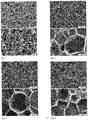
- the foams of the composition according to the invention show a homogeneous cell distribution with cells of approximately the same size (cf. 2 to 4 , 7 and 8 ).
- the materials of the prior art showed significantly lower density reductions of 15% to 55% (# 1, # 5, # 6); likewise the mean diameters of the cells were below the values of the compositions according to the invention (# 1, # 5).
- Mix # 6 showed such a high density that the diameter and the number of cells could not be determined.
- the foam of Mix # 9 collapsed.
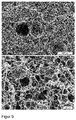
- the foam structures had an inhomogeneous cell distribution with cells of different sizes (cf. Fig. 1 , 5 , 6 and 9 ).
- compositions according to the invention # 1 (PEBA content 99% by weight), # 5 (carboxyl-terminated PEBA), # 6 (polyamide 12 instead of PEBA) and # 9 (PEBA without acrylate) proved to be unsuitable foam materials.
- Mixtures # 2 to # 4 and # 6 and # 7 according to the invention of amino-terminated PEBA with higher poly (meth) acrylate contents compared to mixture # 1 showed homogeneous, regular cells.
Landscapes
- Chemical & Material Sciences (AREA)
- Health & Medical Sciences (AREA)
- Chemical Kinetics & Catalysis (AREA)
- Medicinal Chemistry (AREA)
- Polymers & Plastics (AREA)
- Organic Chemistry (AREA)
- Engineering & Computer Science (AREA)
- Materials Engineering (AREA)
- Manufacturing & Machinery (AREA)
- Mechanical Engineering (AREA)
- Compositions Of Macromolecular Compounds (AREA)
- Addition Polymer Or Copolymer, Post-Treatments, Or Chemical Modifications (AREA)
- Manufacture Of Porous Articles, And Recovery And Treatment Of Waste Products (AREA)
Abstract
Description
- Die vorliegende Erfindung betrifft Gemische aus aminogeregeltem Polyetherblockamid und Poly(meth)acrylaten, ein geschäumtes Formteil dieser Gemische, ein Verfahren zur Herstellung dieser Formteile sowie ihre Verwendung.
- Polymerschäume werden industriell in großen Maßstäben eingesetzt. Polyetherblockamide (PEBA) als Bestandteil in Schaummaterial sind bereits bekannt. Wird jedoch PEBA ohne Zusätze aufgeschäumt, wird kein stabiler Schaum erhalten: Der geschäumte Formkörper fällt in sich zusammen.
- Polyetherblockamide (PEBA) sind Blockcopolymere, welche durch Polykondensation von (Oligo-)Polyamiden, insbesondere säuregeregelten Polyamiden, mit alkohol- oder aminoterminierten Polyethern erhalten werden. Säuregeregelte Polyamide weisen Carbonsäureendgruppen im Überschuss auf. Die Polyamidblöcke bezeichnet der Fachmann als Hartblöcke und die Polyesterblöcke als Weichblöcke.
- Insofern war es Aufgabe der vorliegenden Erfindung, geeignete Mischungen auf Basis von PEBA zu finden, welche einen stabilen und leichten Schaum aufweisen. Die Dichte sollte derart gering sein, dass eine signifikante Gewichtsreduzierung im Bauteil erreicht werden kann. Darüber hinaus sollte ein Weichschaum erhalten werden, der eine gewissen Flexibilität sowie Rebounce- bzw. Rückstellverhalten zeigt. Das erhaltene geschäumte Formteil sollte einer hohen mechanischen Belastbarkeit und eine hohe Schaumstabilität aufweisen. Der Schaum sollte eine homogene Zellverteilung und eine einheitliche Zellgröße aufweisen.
- Gelöst werden konnte diese Aufgabe durch ein Gemisch enthaltend aminogeregeltes PEBA und mindestens ein Poly(meth)acrylat, wobei das Massenverhältnis PEBA zu Poly(meth)acrylat 95:5 bis 60:40 beträgt. Das Poly(meth)acrylat ist ausgewählt aus Poly(meth)acrylimiden, Polyalkyl(meth)acrylaten sowie Mischungen daraus.
- PEBA kann beispielsweise aus der Reaktion von Polyamiden mit Polyethern wie Polyetherdiolen oder Polyetherdiaminen erhalten werden. Die Herstellung von PEBA wird beispielsweise in
EP-A-1518901 (US 2005/014842 ) beschrieben. - Geeignete Polyamide (PA) sind beispielsweise PA6, PA11, PA12, PA613, PA1012, PA612, PA109, PA1013, PA1010 und PA69. Sie können aus Lactamen bzw. ω-Aminocarbonsäuren oder aus der Reaktion von Diaminen mit Dicarbonsäuren hergestellt werden.
- Geeignete Polyetherdiole sind beispielsweise 1,4-Butandiol, 1,3-Butandiol, 1,3-Propandiol, Ethylenglycol oder Polytetrahydrofuran. Auch Mischpolyetherdiolblöcke mit statistischer oder mit blockweiser Verteilung können eingesetzt werden. Sie besitzen in der Regel eine zahlenmittlere Molmasse von ca. 230 bis 4000.
- Geeignete Polyetherdiamine sind durch Konversion der entsprechenden Polyetherdiole durch reduktive Aminierung oder Kupplung an Acrylnitril mit nachfolgender Hydrierung zugänglich (z. B.
EP-A-0434244 ;EP-A-0296852 ). Sie besitzen in der Regel eine zahlenmittlere Molmasse von ca. 230 bis 4000. Kommerziell verfügbare Polyetherdiamine ausgehend von Propylenglykol sind als JEFFAMIN D-Typen bei der Fa. Huntsman kommerziell erhältlich. - Der Anteil an Polyether im PEBA beträgt vorzugsweise 10 bis 50 Gew-%, bevorzugt 20 bis 40 Gew.-%, jeweils bezogen auf das Gesamtgewicht an PEBA.
- Geeignete PEBA können eine Shore-Härte D von 30 bis 70 aufweisen, vorzugsweise von 35 bis 65. Die Shore-Härte D wird gemessen nach ISO 868.
- Das PEBA ist aminogeregelt. Dieses weist somit einen Überschuss an Aminoendgruppen auf. Vorzugsweise weist das aminogeregelte PEBA einen Überschuss von 20 bis 60 mmol Aminoendgruppen pro kg PEBA auf, bevorzugt 30 bis 50 mmol / kg.
- Die Gemische enthalten neben PEBA weiterhin Poly(meth)acrylate, die Poly(meth)acrylimide, Polyalkyl(meth)acrylate oder Mischungen daraus umfassen. Die Schreibweise (Meth)acrylat bedeutet hier sowohl Methacrylat, wie z. B. Methylmethacrylat, Ethylmethacrylat usw., als auch Acrylat, wie z. B. Methylacrylat, Ethylacrylat usw., sowie deren Mischungen.
- Poly(meth)acrylimide weisen vorzugsweise wiederkehrende Einheiten auf, die durch Formel (IV) darstellbar sind,

- Typische Molekulargewichte Mw des Poly(meth)acrylimids liegen im Bereich von 50000 - 150000 g/mol und bevorzugt bei 90000 - 110000 g/mol (ermittelt durch GPC gegen PMMA-Standard).
- Ein geeignetes bevorzugtes Poly(meth)acrylimid ist Poly(N-methyl)methacrylimid (PMMI). In einer besonders bevorzugten Ausführungsform der Erfindung weist ein Poly(meth)acrylimid 25 - 35 Gew.% N-Acrylalkylimid der Formel (IV) auf, worin die drei Reste R1, R2 und R3 je eine Methylgruppe sind, 1 bis 5 Gew.-% Methacrylsäure-Gruppen, 5 bis 20 Gew.-% Methacrylsäureanyhdrid-Gruppen und 40 bis 65 Gew.-% Methylmethacylat-Gruppen auf.
- Die Herstellung von Poly(meth)acrylimiden ist an sich bekannt und beispielsweise in GB-PS
1 078 425 1 045 229 1 817 156 (= US-PS3 627 711 ) oder DE-PS27 26 259 (= US-PS4 139 685 ) oderDE-A-10 2008 001 695 (=US 2011/015317 A1 ) offenbart. - Darüber hinaus können diese Polymere weitere Monomereinheiten enthalten, die sich beispielsweise aus Estern der Acryl- oder Methacrylsäure, insbesondere mit niedrigen Alkoholen mit 1 - 4 C-Atomen, Styrol, Maleinsäure oder deren Anhydrid, Itakonsäure oder deren Anhydrid, Vinylpyrrolidon, Vinylchlorid oder Vinylidenchlorid ergeben. Der Anteil der Comonomeren, die sich nicht oder nur sehr schwer cyclisieren lassen, soll 30 Gew.-%, vorzugsweise 20 Gew.-% und besonders bevorzugt 10 Gew.-%, bezogen auf das Gewicht der Monomeren, nicht übersteigen.
- Das Polyalkyl(meth)acrylat kann einzeln oder auch in Mischung von mehreren verschiedenen Polyalkyl(meth)acrylaten eingesetzt werden. Des Weiteren kann das Polyalkyl(meth)acrylat auch in Form eines Copolymers vorliegen.
- Im Rahmen der vorliegenden Erfindung werden Homo- und Copolymere von C1-C18-Alkyl(meth)acrylaten, zweckmäßigerweise von C1-C10-Alkyl(meth)acrylaten, insbesondere von C1-C4-Alkyl(meth)acrylat-polymeren, die ggf. noch davon verschiedene Monomereinheiten enthalten können, besonders bevorzugt.
- Bevorzugte Polyalkyl(meth)acrylate enthalten 80 Gew.-% bis 99 Gew.-% Methylmethacrylat (MMA)-Einheiten und 1 Gew.-% bis 20 Gew.-%, vorzugsweise 1 Gew.-% bis 5 Gew.-%, C1-C10-Alkylacrylat-Einheiten, bezogen auf das Gesamtgewicht an Polyalkyl(meth)acrylat. Besonders bevorzugte C1-C10-Akylac-rylat-Einheiten sind Methylacrylat-, Ethylacrylat- und Butylacrylat-Einheiten sowie ihre Mischungen.
- Die Produkte sowie ihre Herstellung sind bekannt (Hans R. Kricheldorf, Handbook of Polymer Synthesis, Part A, Verlag Marcel Dekker Inc. New York - Basel - Hongkong, S. 223 f.; H. G. Elias, Makromoleküle, Hüthig und Wepf Verlag Basel - Heidelberg - New York;
US 2 146 209 ,US 4 246 374 ). - Die Verwendung von Copolymeren, die 70 Gew.-% bis 99 Gew.-%, insbesondere 70 Gew.-% bis 90 Gew.-%, C1-C10-Alkylmethacrylate, enthalten, bezogen auf das Gesamtgewicht an Copolymeren, hat sich ganz besonders bewährt. Bevorzugte C1-C10-Alkylmethacrylate umfassen Methylmethacrylat, Ethylmethacrylat, Propylmethacrylat, Isopropylmethacrylat, n-Butylmethacrylat, Isobutylmethacrylat, tert.-Butylmethacrylat, Pentylmethacrylat, Hexylmethacrylat, Heptylmethacrylat, Oktylmethacrylat, Isooctylmethacrylat und Ethylhexylmethacrylat, Nonylmethacrylat, Decylmethcrylat sowie Cycloalkylmethacrylate, wie beispielsweise Cyclohexylmethacrylat, Isobornylmethacrylat oder Ethylcyclohexylmethacrylat.
- Ganz besonders bevorzugte Copolymere umfassen 70 Gew.-% bis 99 Gew.-% Methylmethacrylat (MMA)-Einheiten und 1 Gew.-% bis 20 Gew.-%, vorzugsweise 1 Gew.-% bis 5 Gew.-%, C1-C10-Alkylacrylat-Einheiten, bezogen auf das Gesamtgewicht an Copolymeren, insbesondere Methylacrylat-, Ethylacrylat- und/oder Butylacrylat-Einheiten. Ein weiteres bevorzugtes Comonomer ist Styrol.
- Polymethylmethacrylat (PMMA) ist ein besonders bevorzugtes Polyacryl(meth)acrylat. Ein bewährtes Polymethylmethacrylat enthält 1 Gew.-% - 18 Gew.-% Methylacrylat und 82 Gew.-% - 99 Gew.-% Methylmethacrylat, besonders bevorzugt 2 Gew.-% - 10 Gew.-% Methylacrylat und 90 Gew.-% - 98 Gew.-% Methylmethacrylat und ganz besonders bevorzugt 3 Gew.-% - 6 Gew.-% Methylacrylat und 94 Gew.-% - 97 Gew.-% Methylmethacrylat, jeweils bezogen auf das Gesamtgewicht aus Methacrylat und Methylmethacrylat. Das Molekulargewicht Mw liegt bevorzugt zwischen 70000 g/mol und 240000 g/mol, besonders bevorzugt zwischen 80000 g/mol und 220000 g/mol und ganz besonders bevorzugt zwischen 90000 g/mol und 200000 g/mol. Darüber hinaus können diese Polymere weitere Monomereinheiten enthalten, die sich beispielsweise aus Estern der Acryl- oder Methacrylsäure, insbesondere mit niedrigen Alkoholen mit 1 - 4 C-Atomen, Maleinsäure oder deren Anhydrid, Itakonsäure oder deren Anhydrid, Vinylpyrrolidon, Vinylchlorid oder Vinylidenchlorid ergeben. Der Anteil der Comonomeren, die sich nicht oder nur sehr schwer cyclisieren lassen, soll 30 Gew.-%, vorzugsweise 20 Gew.-% und besonders bevorzugt 10 Gew.-%, bezogen auf das Gewicht der Monomeren, nicht übersteigen. Unter cyclisierbaren Monomeren werden α-, β- ungesättigte, funktionalisierte Systeme verstanden, die am vinylischen Rest eine in der Literatur als EWG (= eletron withdrawing group) beschriebene Funktionalität tragen. Exemplarisch für Systeme mit EWG-Funktionalität seien genannt Moleküle mit Nitrilgruppe oder Carbonsäuren sowie deren Ester. Nicht cyclisierbare, aber vinylisch polymerisierbare Monomere fallen nicht hierunter, beispielhaft seien hier genannt α-Methylstyrol, Styrol, Vinylacetat, Vinylpyrolidon, Ethylen, Propylenetc, Vinylclorid, Vinylidenchlorid, Isopren, Butadien, Vinylether oder Isobutylen.
- Ebenso können schlagzähmodifizierte Polymere eingesetzt werden. Ein bevorzugtes schlagzähmodifiziertes Polymer weist eine Kern-/Schale-Struktur auf. Besonders bevorzugt sind Polybutadien-basierte Kerne, die mit einer Schale gepfropft sind. Die Schale kann ausgewählt werden aus Methylmethacrylat, Methylacrylat, Ethyl(meth)acrylat, Styrol, Acrylnitril sowie Mischungen hieraus. Derartige Polymere sind beispielhaft in
WO 2002/062890 A1 beschrieben. - Das Polyalkyl(meth)acrylat kann durch an sich bekannte Polymerisationsverfahren hergestellt werden, wobei radikalische Polymerisationsverfahren, insbesondere Substanz-, Lösungs-, Suspensions- und Emulsionspolymerisationsverfahren besonders bevorzugt werden. Für diese Zwecke besonders geeignete Initiatoren umfassen insbesondere Azoverbindungen, wie 2,2'-Azobis-(isobutyronitril) oder 2,2'-Azo-bis(2,4-dimethylvaleronitril), Redox-Systeme, wie beispielsweise die Kombination von tertiären Aminen mit Peroxiden oder Natriumdisulfit und Persulfate von Kalium, Natrium oder Ammonium oder bevorzugt Peroxide (vgl. hierzu beispielsweise H. Rauch-Puntigam, Th. Völker, "Acryl- und Methacrylverbindungen", Springer, Heidelberg, 1967 oder Kirk-Othmer, Encyclopedia of Chemical Technology, Vol. 1, Seiten 386ff, J. Wiley, New York, 1978). Beispiele besonders geeigneter Peroxid-Polymerisationsinitiatoren sind Dilauroylperoxid, tert.-Butylperoctoat, tert.-Butylperisononanoat, Dicyclohexylperoxidicarbonat, Dibenzoylperoxid und 2,2-Bis-(tert.-butylperoxy)-butan. Man kann auch bevorzugt die Polymerisation mit einem Gemisch verschiedener Polymerisationsinitiatoren unterschiedlicher Halbwertzeit durchführen, beispielsweise Dilauroylperoxid und 2,2-Bis-(tert.-butylperoxy)-butan, um den Radikalstrom im Verlauf der Polymerisation sowie bei verschiedenen Polymerisationstemperaturen konstant zu halten. Die eingesetzten Mengen an Polymerisationsinitiator liegen im Allgemeinen bei 0,01 Gew.-% bis 2 Gew.-% bezogen auf das Monomerengemisch.
- Die Polymerisation kann sowohl kontinuierlich als auch chargenweise durchgeführt werden. Nach der Polymerisation wird das Polymer über herkömmliche Isolier- und Trennschritte, wie z. B. Filtration, Koagulation, Sprühtrocknung oder Entgasungsextrusion gewonnen. Bei Plattenpolymerisaten (Substanz) erfolgt in der Regel keine weitere Aufarbeitung im obigen Sinne.
- Die Einstellung der Kettenlängen der Polymerisate oder Copolymerisate kann durch Polymerisation des Monomers oder Monomerengemisches in Gegenwart von Molekulargewichtsreglern erfolgen, wie insbesondere von den dafür bekannten Mercaptanen, wie beispielsweise n-Butylmercaptan, n-Dodecylmercaptan, 2-Mercaptoethanol oder 2-Ethylhexylthioglycolat, Pentaerythrittetrathioglycolat; wobei die Molekulargewichtsregler im Allgemeinen in Mengen von 0,05 Gew.-% bis 5 Gew.-% bezogen auf das Monomer oder Monomerengemisch, bevorzugt in Mengen von 0,1 Gew.-% bis 2 Gew.-% und besonders bevorzugt in Mengen von 0,2 Gew.-% bis 1 Gew.-%, bezogen auf das Monomer oder Monomerengemisch, eingesetzt werden (vgl. beispielsweise H. Rauch-Puntigam, Th. Völker, "Acryl- und Methacrylverbindungen", Springer, Heidelberg, 1967; Houben-Weyl, Methoden der organischen Chemie, Bd. XIV/1, Seite 66, Georg Thieme, Heidelberg, 1961 oder Kirk-Othmer, Encyclopedia of Chemical Technology, Vol. 1, Seiten 296ff, J. Wiley, New York, 1978). Besonders bevorzugt wird als Molekulargewichtsregler n-Dodecylmercaptan eingesetzt.
- Vorzugsweise enthält das erfindungsgemäße Gemisch mindestens eine Verbindung der Formel (I)

- R unabhängig voneinander ein Alkylrest mit 1 bis 11, bevorzugt 1 bis 4 Kohlenstoffatomen, vorzugsweise ein Methylrest,
- R1 unabhängig voneinander gleich R oder ein Polyesterrest,
- R2 unabhängig voneinander gleich R oder ein Kohlenwasserstoffrest mit 12 bis 36 Kohlenstoffatomen, vorzugsweise von 14 bis 30 Kohlenstoffatomen, bevorzugt von 16 bis 26 Kohlenstoffatomen,
- n, m und p unabhängig voneinander von 0 bis 58,
- mit der Maßgabe,
- dass N = n + m + p + 2 von 10 bis 100, vorzugsweise 15 bis 60 ist
- und
- dass alle R1 ungleich R sind wenn alle R2 gleich R sind und wenigstens ein R2 ungleich R ist wenn alle R1 gleich R sind
- und/oder
- dass alle Reste R1 ungleich R sind, wenn m und p null sind und dass m oder p, vorzugsweise m, ungleich 0 ist, wenn alle Reste R1 gleich R sind.
- als Phasentransferreagenz. Es handelt sich um Polyestersiloxane oder Alkylsiloxane.
- Die in den Formeln verwendeten Indices sind als statistische Mittelwerte (Zahlenmittel) zu betrachten. Vorzugsweise sind solche Verbindungen der Formel (I) vorhanden, bei denen p = 0 ist.
- Handelt es sich bei den Resten R1 um Polyesterreste, so sind diese vorzugsweise aus 3 bis 30, bevorzugt aus 8 bis 25 und besonders bevorzugt aus 15 bis 22 Estereinheiten aufgebaut. Als Startalkohole können die Polyesterreste solche Alkoholreste aufweisen, die sich von primären ungesättigten Alkoholen ableiten (siehe Herstellverfahren). Die Polyesterreste weisen vorzugsweise eine Struktur gemäß Formel (II) auf:
-Rq-(Rr)zH (II)
mit - Rq = -(CH2)x-O-,
- Rr = C(O)-(CH2)y-O-
- x = 2 bis 10, vorzugsweise 3 bis 7, insbesondere 6 und
- y = 2 bis 10, vorzugsweise 3 bis 8 und bevorzugt 4 oder 5.
- Z = 3 bis 30, bevorzugt aus 8 bis 25 und besonders bevorzugt aus 15 bis 22.
- Die Bezeichnungen "q" und "r" dienen lediglich der Unterscheidung der Reste von den anderen "R"-Resten und stellen keine Indizes dar, die mit irgendeinem Zahlenwert hinterlegt sind.
- Die Polyesterreste können aus gleichen oder unterschiedlichen Ausgangsmolekülen aufgebaut sein. Vorzugsweise sind die Polyesterreste aus gleichen Ausgangsmolekülen aufgebaut. Bevorzugte Polyesterreste sind solche, die durch, vorzugsweise ringöffnende, (Poly-)Veresterung von Lactonen erhalten werden. Besonders bevorzugt sind die Polyesterreste solche, die durch (Poly-)veresterung von Caprolacton oder Valerolacton, insbesondere von ε-Caprolacton, 3,5,5-Trimethyl-Caprolacton oder δ-Valerolacton und besonders bevorzugt von ε-Caprolacton erhalten werden. Bevorzugte Verbindungen der Formel (I) bei denen R1 Polyesterreste sind solche, bei denen der Polyesterrest aus 3 bis 30, bevorzugt aus 8 bis 25 und besonders bevorzugt aus 15 bis 22 ε-Caprotacton-Einheiten aufgebaut ist. Vorzugsweise sind die Reste R1 identische Polyesterreste.
- Sind die Reste R1 alle gleich R, mit R vorzugsweise Methylrest, ist R2 bevorzugt ein Kohlenwasserstoffrest mit 12 bis 36 Kohlenstoffatomen, vorzugsweise von 14 bis 30 Kohlenstoffatomen, bevorzugt von 16 bis 26 Kohlenstoffatomen, so ist N bevorzugt größer-gleich 30, vorzugsweise von 40 bis 50. p ist im genannten Fall vorzugsweise 0 und m beträgt bevorzugt von 30 bis 48.
- Sind einer oder mehrere der Reste R1 ein Polyesterrest, so ist N bevorzugt 10 bis 45, bevorzugt 18 bis 35 und besonders bevorzugt 20 bis 30.
- Geeignete Verbindungen der Formel (I) sind z.B. TEGOMER® H-Si 6440 P und TEGOPREN 6846, welche von Evonik erhalten werden können.
- Die Verbindungen der Formel (I) können nach den bekannten Verfahren durch Umsetzung von entsprechenden Wasserstoffsiloxanen mit ungesättigten Kohlenwasserstoffen oder ungesättigten Alkoholen und anschließender (Poly-)-Veresterung oder durch direkte Umsetzung von ungesättigten Polyestern mit Wasserstoffsiloxanen erhalten werden. Die Umsetzung kann wie in
EP 1 640 418 beschrieben durch Hydrosilylierung bzw. durch dehydrogenative Hydrosilylierung erfolgen. Die Herstellung Polyesterreste aufweisender Polysiloxane kann z. B.EP 0 208 734 entnommen werden. - Die mindestens eine Verbindung der Formel (I) ist vorzugsweise in einem Anteil von 0,1 bis 10 Gew.-%, bezogen auf das Gesamtgewicht des homogenen Gemischs (einschließlich der mindestens einen Verbindung der Formel (I) und der mindestens einen Verbindung der Formel (II)), enthalten. Bevorzugt liegt der Anteil an Polyestersiloxanen im Bereich von 0,5 bis 8 Gew.-%, besonders bevorzugt im Bereich von 0,9 bis 5 Gew.-%. Bevorzugt liegt der Anteil an Alkylsiloxanen im Bereich von 0,4 bis 9 Gew.-%, besonders bevorzugt im Bereich von 0,9 bis 6 Gew.-%.
- Weiterhin ist im erfindungsgemäßen Gemisch vorzugsweise mindestens eine Verbindung der Formel (III)
R3O(SO)a(EO)b(PO)c(BO)dR4, (III)
wobei - R3 = ein geradkettiger oder verzweigter oder cycloaliphatischer Rest mit 2 bis 30 Kohlenstoffatomen,
- R4 = Wasserstoff, ein Acylrest, Alkylrest oder Carbonsäurerest mit jeweils 1 bis 8 C-Atomen,
- SO = Styrenoxid,
- EO = Ethylenoxid,
- PO = Propylenoxid,
- BO Butylenoxid und
- a = 1 bis 5,
- b = 3 bis 50,
- c = 0 bis 10,
- d = 0 bis 10 sind,
- wobei a, c oder d von 0 verschieden, b > = a+c+d ist,
- als Phasentransferreagenz enthalten. Es handelt sich um Styrenoxid-Polyether.
- Durch die verschiedenen Alkylenoxidmonomere und deren Anteil am Gesamtpolymer lässt sich spezifisch die Hydrophobie/Hydrophilie-Balance steuern. Besonders bevorzugt sind blockweise Anordnungen mit endständigen, eher hydrophoben Gruppierungen wie Propylenoxid oder insbesondere Butylenoxid.
- Fettalkoholpolyglycolether stellen bekanntermaßen Stoffe dar, die großtechnisch vor allem durch Anlagerung von Ethylenoxid- und/oder Propylenoxid in Gegenwart von dem Stand der Technik entsprechenden sauren oder basischen Katalysatoren vorzugsweise unter Druck und erhöhter Tempera-tur hergestellt werden. In Abhängigkeit von der Natur des verwendeten Katalysators können die Pro-dukte eine mehr oder weniger eingeengte Homologenverteilung aufweisen.
- Die derart entstandenen hydroxylterminierten Polyalkylenoxide können jedoch auch mit Carbonsäu-ren und/oder deren Anhydriden verestert werden, um einen Verschluss der OH-Gruppe zu erreichen. Die Veresterungsreaktion kann mit aliphatischen oder aromatischen Carbonsäuren, die 2 bis 18 C-Atome aufweisen, durchgeführt werden. Die Veresterung kann dabei in an sich bekannter Weise un-ter saurer Katalyse erfolgen. Anstatt der Veresterung kann als endgruppenverschließende Reaktion auch die Veretherung gewählt werden. Hierzu werden die Verbindungen unter den Konditionen der Williamschen Ethersynthese, dem Stand der Technik entsprechend mit aromatischen oder aliphati-schen, geradkettigen oder verzweigten Alkylhalogeniden umgesetzt. Besonders bevorzugt ist die Reaktion mit Methylchlorid. Auf diese Weise lassen sich die Hydroxylendgruppen sowohl teilweise als auch vollständig verethern.
- Die mindestens eine Verbindung der Formel (III) ist vorzugsweise in einem Anteil von 0,1 bis 20 Gew.-%, bezogen auf das Gesamtgewicht des homogenen Gemischs (einschließlich der mindestens einen Verbindung der Formel (I) und der mindestens einen Verbindung der Formel (III)), enthalten. Bevorzugt liegt der Anteil an Styrenoxid-Polyether im Bereich von 0,9 bis 15 Gew.-%, besonders bevorzugt im Bereich von 2 bis 12 Gew.-%.
- Das erfindungsgemäße Gemisch kann sowohl mindestens eine Verbindung der Formel (I) als auch mindestens eine Verbindung der Formel (III) enthalten.
- Die erfindungsgemäßen Gemische enthalten bevorzugt Additive wie Farbmittel, Pigmente, organische Farbstoffe, Lichtstabilisatoren, UV-Stabilisatoren, UV-Absorber, IR-Absorber, antimikrobielle Wirkstoffe, Flammschutzmittel, Thermostabilisatoren, Antioxidantien, vernetzende Polymere, faserverstärkende Zusatzstoffe organischer oder anorganischer Art, Schlagzähmodifizierer und ihre Mischungen. Bevorzugt sind in den erfindungsgemäßen Gemischen nicht mehr als 10 Gew.-%, besonders bevorzugt nicht mehr als 5 Gew.-% und insbesondere nicht mehr als 2 Gew.-% Hilfs- und Füllstoffe, jeweils bezogen auf das Gesamt-gewicht aus Gemisch und Additiv, enthalten.
- Ein weiterer Gegenstand sind geschäumte Formteile, die aus dem erfindungsgemäßen Gemisch erhältlich sind. Die Formteile weisen vorzugsweise eine Dichte von maximal 350 kg/m3, bevorzugt von maximal 130 kg / cm3 auf.
- Ein Verfahren 1 zur Herstellung eines erfindungsgemäßen geschäumten Formteils umfasst die Schritte
- a. Schmelzen einer erfindungsgemäßen Mischung,
- b. Extrudieren der geschmolzenen Mischung unter Erhalt von Granulat,
- c. Spritzgießen des Granulats unter Erhalt eines Formteils oder einer extrudierten Platte und
- d. Einbringen des Formteils oder der extrudierten Platte in einen Autoklaven und Beaufschlagung mit einem physikalischen Treibmittel unter Erhalt eines geschäumten Formteils.
- Das Verfahren 1 kann beispielsweise folgendermaßen durchgeführt werden: Granulate aus PEBA und Poly(meth)acrylat werden als Trockenvormischung oder einzeln über gravimetrische oder volumetrische Dosierwaagen in einen auf die entsprechende Temperatur vorgeheizten Compounder (z. B. Doppelschnecken-Compounder der Firmen Coperion oder Berstorff oder Einschnecken Compounder der Firma Buss oder andere gängige Modelle) dosiert. In der entsprechenden Schnecke wird bei der entsprechenden Drehzahl das Granulat zu einer Schmelze erhitzt. In dem Compounder wird die Mischung bei einer geeigneten Schneckendrehzahl zu einer Schmelze erhitzt. Die Schmelze wird durch Düsenplatte zu Schmelze-Strängen gepresst. Diese Schmelze-Stränge können in einem Wasserbad abgekühlt werden, beispielsweise auf Raumtemperatur. Die abgekühlten und ausgehärteten Stränge werden in einem Strang-Granulierer zu Granulat geschnitten. Alternativ können sie mittels Unterwassergranulierung (z. B. erhältlich von den Fa. Econ, BKG, Gala) zu Granulat geschnitten und abgekühlt werden. Das entstandene Granulat wird in Trockenluft-Trocknern für mehrere Stunden bei beispielsweise 50 bis 95 °C zu einem reduzierten Wassergehalt bspw. 0,001 bis 0,1 %, getrocknet. Die getrockneten Granulate werden bspw. auf einer Spritzgussmaschine Mehrfach-Zonen-Schnecke bei einer Zylindertemperatur von 150 bis 300 °C zu Platten verarbeitet. Die Spritzgussform wird anschließend gekühlt. Aus den entstandenen Spritzgussplatten können würfelförmige Probekörper gesägt werden. Die Probekörper können anschließend in einem Standard-Autoklaven über einen Zeitraum von mehreren Stunden mit CO2 bei einem Druck von 100 bis 400 bar und einer Temperatur von 80 bis 180 °C mit CO2 gesättigt. Das Schäumen erfolgt unter spontaner Druckentlastung.
- Ein weiteres Verfahren 2 umfasst die Schritte
- a. Schmelzen einer erfindungsgemäßen Mischung und
- b. Beaufschlagung der geschmolzenen Mischung mit einem physikalischen Treibmittel und Extrudieren der geschmolzenen Mischung mittels Lochplatte oder geeigneter Düsen unter Erhalt eines geschäumten Formteils.
- Das Verfahren 2 kann beispielsweise folgendermaßen durchgeführt werden: Granulate aus PEBA und Poly(meth)acrylat werden als Trockenvormischung oder einzeln über gravimetrische oder volumetrische Dosierwaagen in einen auf die entsprechende Temperatur vorgeheizten Compounder (z. B. Doppelschnecken-Compounder der Firmen Coperion oder Berstorff oder Einschnecken Compounder der Firma Buss oder andere gängige Modelle) dosiert. In der entsprechenden Schnecke wird bei der entsprechenden Drehzahl das Granulat zu einer Schmelze erhitzt. Das Treibmittel, z.B. CO2, wird in die Schmelze gegeben und dort verteilt. In einer zweiten Schnecke wird die Schmelze abgekühlt, u.a. weil das Treibmittel eine viskositätsmindernde Wirkung hat. Als Düsenplatte wird hier z.B. eine Breitschlitzdüse entsprechend der Wunschgeometrie in Dicke und Breite gewählt. An dieser Düse wird die Schmelze spontan bei Austritt expandieren (aufschäumen) und abkühlen zu einem geschäumten Extrudat. Entsprechend der Wunschgeometrie kann das geschäumte Extrudat entweder mit Hilfe eines Kalanders als Sheet oder mit Hilfe anderer kontinuierlicher Abzugsvorrichtungen (aus der Profilextrusion bekannt) abgezogen und abgekühlt werden. Nach erfolgreichem Abkühlprozess wird das geschäumte Extrudat auf die entsprechende Wunschlänge geschnitten.
- Das Verfahren 2 stellt ein kontinuierliches Verfahren dar und ist daher gegenüber Verfahren 1 bevorzugt.
- Das geschäumte Bauteil kann als Schuhsohle, Stollenmaterial, Isoliermaterial, Dämmstoff, Dämpfungsbauteil, Leichtbauteil oder in einer Sandwichstruktur verwendet werden.
- Es wurden Trockenvormischungen enthaltend PEBA und Poly(meth)acrylat aus Granulaten hergestellt. Diese Mischungen wurden über gravimetrische Dosierwaagen in den auf 240 °C vorgeheizten Doppelschnecken-Compounder Coperion ZSK25 WLE mit einem Durchsatz von 20 kg/h dosiert. Als Schneckenkonfiguration wurde eine Standardschnecke wie z.B. für die Produktion von Polyamidcompounds eingesetzt. In dem Doppelschnecken-Compounder wurde die Mischung bei einer Schneckendrehzahl von 250 U/min zu einer Schmelze erhitzt. Die Schmelze wurde durch eine 3-Loch-Düsenplatte mit je 4 mm Durchmesser zu Schmelze-Strängen gepresst. Diese Schmelze-Stränge wurden in einem Wasserbad bei Raumtemperatur abgekühlt. Die abgekühlten und ausgehärteten Stränge wurden in einem Standard-Strang-Granulierer zu Granulat geschnitten. Das entstandene Granulat wurde in Trockenluft-Trocknern für 12 h bei 80 °C zu einem Wassergehalt <0,02 % getrocknet. Die getrockneten Granulate wurden auf einer Standard-Spritzgussmaschine (Engel Victory 650/200) mit einer Standard-3-Zonen-Schnecke bei einer Zylindertemperatur von 240 °C zu Platten verarbeitet. Die Spritzgussform wurde auf 40 °C gekühlt. Aus den entstandenen Spritzgussplatten wurden würfelförmige Probekörper mit wahlweise Kantenlängen von 30x10x5 mm oder Kantenlängen von 40x30x10 mm gesägt. Die Probekörper wurden in einem Standard-Autoklaven über einen Zeitraum von 4,5 h (kleine Probekörper) oder 95 h (große Probekörper) mit CO2 bei einem Druck von 300 bar und einer Temperatur von 140 °C mit CO2 gesättigt. Das Schäumen erfolgte unter spontaner Druckentlastung.
- Folgende Substanzen wurden eingesetzt:
- PEBA 1: Aminoterminiertes PEBA enthaltend 30 Gew.-% an Polyether-Blöcken (VESTAMID® E58-S4)
- PEBA 2: Carboxylterminiertes PEBA enthaltend 20 Gew.-% an Polyether-Blöcken (VESTAMID® E62-S3)
- (Meth)acrylat 1: Polymethylmethacrylimid, wie in
EP 1 755 890 B1 beschrieben, mit einem Molekulargewicht von 100000 g/mol (ermittelt durch GPC gegen PMMA-Standard), bestehend aus 30 Gew.-% Einheiten nach Formel IV, wobei R1, R2 und R3 jeweils eine Methylgruppe sind, aus 57 Gew.-% Methylmethacrylat (MMA)-Einheiten, aus 10 Gew.-% Methacrylsäureanhydrid (MSA)-Einheiten und aus 3 Gew.-% Methacrylsäure (MAS)-Einheiten (ermittelt durch IR-Spektroskopie). - (Meth)acrylat 2: Schlagzähmodifiziertes Poly(meth)acrylat, mit einem Molekulargewicht von 200000 g/mol (ermittelt durch GPC gegen PMMA-Standard), bestehend aus 55 Gew.-% Methylmethacrylat (MMA)-Einheiten, 20 Gew.-% Styrol-Einheiten, 2 Gew.-% Ethylacrylat (EA)-Einheiten sowie 23 Gew.-% Kautschuk. Bei dem Kautschuk handelt es sich um Polybutadien, gegrafted mit einer Schale aus MMA- und Styrol-Einheiten und einem Wirkdurchmesser für die Schlagzähigkeit (entspricht einem mittleren Agglomeratsdurchmesser) von 300 nm (ermittelt durch Transmissionselektronenmikroskop).
- (Meth)acrylat 3: Schlagzähmodifiziertes Poly(meth)acrylate, wie (Meth)acrylat 2, hier mit einem Molekulargewicht von 140000 g/mol (ermittelt durch GPC gegen PMMA-Standard).
- (Meth)acrylat 1: Polymethylmethacrylimid, wie in
- PA12: carboxylterminiertes Polyamid 12 (VESTAMID® L1901)
Tabelle 1: Eingesetzte Zusammensetzungen #1 bis #9. Polyamid Poly(meth)acrylat Dichte in kg/cm3 (ungeschäumt) #1* 99 Gew.-% PEBA 1 1 Gew.-% (Meth)acrylat 1 1042 / 1030 #2 90 Gew.-% PEBA 1 10 Gew.-% (Meth)acrylat 1 1045 #3 80 Gew.-% PEBA 1 20 Gew.-% (Meth)acrylat 1 1062 #4 70 Gew.-% PEBA 1 30 Gew.-% (Meth)acrylat 1 1079 #5* 70 Gew.-% PEBA 2 30 Gew.-% (Meth)acrylat 1 1069 #6* 70 Gew-% PA12 30 Gew.-% (Meth)acrylat 1 1065 #7 70 Gew-% PEBA 1 30 Gew.-% (Meth)acrylat 2 1032 / 1049 #8 70 Gew-% PEBA 1 30 Gew.-% (Meth)acrylat 3 1005 / 1047 #9* 100 Gew.-% PEBA 1 --- 1010 * nicht erfindungsgemäß - Im Anschluss wurden die geschäumten Zusammensetzungen unter dem Rasterelektronenmikroskop optisch untersucht und folgende Eigenschaften ermittelt bzw. errechnet:
- dcell: Mittlerer Durchmesser der Zellen in µm
- tcell: Mittlere Dicke der Zellwände in µm
- Ncell: Anzahl der Zellen pro cm3
- p: Dichte des geschäumten Materials in kg/cm3
- Δρ: Dichteänderung gegenüber nichtgeschäumtem Material
- Schaumqualität: Optische Bewertung der Schäume anhand der Abbildungen 1 bis 9 mit bei unterschiedlichen Auflösungen
- 1: inhomogene Zellverteilung, uneinheitliche Zellen
- 2: homogene Zellverteilung, einheitliche Zellgröße
- Die Schäume der erfindungsgemäßen Zusammensetzungen #2 bis 4 sowie #7 und #8 zeigten gegenüber den Zusammensetzungen des Standes der Technik einen hohen Zellendurchmesser dcell von 21 bis 25 µm sowie eine verringerte Anzahl an Zellen pro Kubikzentimeter Ncell. Die Dichte lag im Bereich von 90 bis 260 kg/cm3 und konnte gegenüber dem Ausgangsmaterial um 76 % bis 91 % reduziert werden. Darüber hinaus zeigen die Schäume der erfindungsgemäßen Zusammensetzung eine homogene Zellverteilung mit annähernd gleichgroßen Zellen (vgl.
Fig. 2 bis 4 ,7 und 8 ). - Bei den Materialien des Standes der Technik wurden deutlich geringere Dichtereduzierungen von 15 % bis 55 % verzeichnet (#1, #5, #6); ebenso lagen die die mittlere Durchmesser der Zellen unter den Werten der erfindungsgemäßen Zusammensetzungen (#1, #5). Mischung #6 zeigte eine derart hohe Dichte, dass Durchmesser und die Anzahl der Zellen nicht bestimmt werden konnten. Der Schaum der Mischung #9 fiel in sich zusammen. Die Schaumstrukturen wiesen eine inhomogene Zellverteilung mit unterschiedlich großen Zellen auf (vgl.
Fig. 1 ,5 ,6 und9 ). - Die nicht-erfindungsgemäßen Zusammensetzungen #1 (PEBA-Anteil 99 Gew.-%), #5 (carboxylterminiertes PEBA), #6 (Polyamid 12 statt PEBA) und #9 (PEBA ohne Acrylat) erwiesen sich als nicht geeignete Schaummaterialien. Erfindungsgemäße Mischungen #2 bis #4 sowie #6 und #7 aus aminoterminiertem PEBA mit höherem Poly(meth)acrylatanteilen gegenüber Mischung #1 zeigten homogene, regelmäßige Zellen.
| T in °C | dcell | tcell | Ncell | ρ | Δρ | Schaumqualität | |
| #1* | 140 | 6 | 0,5 | 48·109 | 460 | 55 % | 1 |
| #2 | 140 | 25 | 0,9 | 0,11·109 | 110 | 89 % | 2 |
| #3 | 140 | 24 | 0,9 | 0,14·109 | 110 | 90 % | 2 |
| #4 | 140 | 23 | 1,2 | 0,14·109 | 260 | 76 % | 2 |
| #5* | 140 | 0,7 | < 0,5 | 7500·109 | 640 | 40 % | 1 |
| #6* | 140 | *** | *** | *** | 900 | 15 % | 1 |
| #7 | 140 | 21 | 0,2 | 0,33·109 | 100 | 90 % | 2 |
| #8 | 140 | 23 | < 0,5 | 0,12·109 | 90 | 91 % | 2 |
| #9* | 140 | ** | ** | ** | ** | ** | 1 |
| * nicht erfindungsgemäß ** Schaum fiel zusammen *** nicht bestimmt, da Dichte zu hoch |
Claims (15)
- Gemisch enthaltenda. mindestens ein aminogeregeltes Polyetherblockamid (PEBA),b. mindestens ein Poly(meth)acrylat ausgewählt aus Poly(meth)acrylimiden, Polyalkyl(meth)acrylaten und Mischungen daraus,wobei das Massenverhältnis PEBA zu Poly(meth)acrylat 95:5 bis 60:40 beträgt.
- Gemisch nach Anspruch 1, dadurch gekennzeichnet, dass das PEBA 20 bis 60 mmol/kg Aminoendgruppen, vorzugsweise 30 bis 50 mmol/kg Aminoendgruppen, enthält.
- Gemisch nach einem der vorherigen Ansprüche, dadurch gekennzeichnet, dass der Anteil an Polyether im PEBA 10 bis 50 Gew.-%, bezogen auf das Gesamtgewicht an PEBA, enthält.
- Gemisch nach einem der vorherigen Ansprüche, dadurch gekennzeichnet, dass das PEBA eine Shore-Härte D von 30 bis 70, vorzugsweise von 35 bis 65, aufweist, gemessen nach ISO 868.
- Gemisch nach einem der vorherigen Ansprüche, dadurch gekennzeichnet, dass das Poly(meth)acry-limid die folgenden Gruppen umfasst:a. N-Acrylalkylimid der Formel (IV),
 b. (Meth)acrylsäure,c. (Meth)acrylsäureanhydrid, undd. (Meth)acrylat,wobei die Gruppen a. bis d. zu jeweils mindestens 1 Gew-%, bezogen auf das Gesamtgewicht an Poly(meth)acrylimid, enthalten sind.
 - Gemisch nach Anspruch 5, dadurch gekennzeichnet, dass das Poly(meth)acrylimid 10 - 95 Gew.-% Einheiten, bevorzugt 20 - 70 Gew.-% und besonders bevorzugt 25 - 40 Gew.-% der Formel (IV) enthält.
- Gemisch nach einem der vorherigen Ansprüche, dadurch gekennzeichnet, dass das Molekulargewicht Mw im Bereich von 50000 bis 150000 g/mol liegt.
- Gemisch nach einem der vorherigen Ansprüche, dadurch gekennzeichnet, dass das Polyalkyl(meth)acrylat 80 Gew.-% bis 99 Gew.-% Methylmethacrylat (MMA)-Einheiten und 1 Gew.-% bis 20 Gew.-%, C1-C10-Alkylacrylat-Einheiten, bezogen auf das Gesamtgewicht an Polyalkyl(meth)acrylat, enthält.
- Gemisch nach einem der vorherigen Ansprüche, dadurch gekennzeichnet, dass Polyalkyl(meth)acrylat Styrol als Comonomer enthält.
- Gemisch nach einem der vorherigen Ansprüche, dadurch gekennzeichnet, dass das Polyalkyl(meth)acrylat ein schlagzähmodifiziertes Polymer ist.
- Gemisch nach einen der vorherigen Ansprüche, dadurch gekennzeichnet, dass das Gemisch mindestens eine der Komponenten ausgewählt aus Farbmittel, Pigmente, organische Farbstoffe, Lichtstabilisatoren, UV-Stabilisatoren, UV-Absorber, IR-Absorber, antimikrobielle Wirkstoffe, Flammschutzmittel, Thermostabilisatoren, Antioxidantien, vernetzende Polymere, faserverstärkende Zusatzstoffe organischer oder anorganischer Art, Schlagzähmodifier und Mischungen davon enthält.
- Geschäumtes Formteil, erhältlich aus einem Gemisch nach einem der Ansprüche 1 bis 11.
- Verfahren zur Herstellung eines geschäumten Formteils, umfassend die Schrittea. Schmelzen einer Mischung gemäß einem der Ansprüche 1 bis 11,b. Extrudieren der geschmolzenen Mischung unter Erhalt von Granulat,c. Spritzgießen des Granulats unter Erhalt eines Formteils oder einer extrudierten Platte undd. Einbringen des Formteils oder der extrudierten Platte in einen Autoklaven und Beaufschlagung mit einem physikalischen Treibmittel unter Erhalt eines geschäumten Formteils.
- Verfahren zur Herstellung eines geschäumten Formteils, umfassend die Schrittea. Schmelzen einer Mischung gemäß einem der Ansprüche 1 bis 11 undb. Beaufschlagung der geschmolzenen Mischung mit einem physikalischen Treibmittel und Extrudieren der geschmolzenen Mischung mittels Lochplatte oder Düse unter Erhalt eines geschäumten Formteils.
- Verwendung eines geschäumten Formteils nach Anspruch 11 als Schuhsohle, Stollenmaterial, Isoliermaterial, Dämmstoff, Dämpfungsbauteil, Leichtbauteil oder in einer Sandwichstruktur.
Priority Applications (16)
| Application Number | Priority Date | Filing Date | Title |
|---|---|---|---|
| EP18200738.5A EP3640287A1 (de) | 2018-10-16 | 2018-10-16 | Polyetherblockamid-poly(meth)acrylat-schäume |
| PCT/EP2019/077636 WO2020078856A1 (de) | 2018-10-16 | 2019-10-11 | Polyetherblockamid-poly(meth)acrylat-schäume |
| KR1020217014372A KR102541676B1 (ko) | 2018-10-16 | 2019-10-11 | 폴리에테르 블록 아미드-폴리(메트)아크릴레이트 발포체 |
| JP2021520994A JP7438206B2 (ja) | 2018-10-16 | 2019-10-11 | ポリエーテルブロックアミドポリ(メタ)アクリレート発泡体 |
| US17/285,373 US12600857B2 (en) | 2018-10-16 | 2019-10-11 | Polyether block amide-poly(meth)acrylate foams |
| CN201980068339.6A CN113330059B (zh) | 2018-10-16 | 2019-10-11 | 聚醚嵌段酰胺-聚(甲基)丙烯酸系物泡沫 |
| MX2021004072A MX2021004072A (es) | 2018-10-16 | 2019-10-11 | Espumas de amida de bloque de polieter-poli(met)acrilato. |
| EP19783078.9A EP3688080B1 (de) | 2018-10-16 | 2019-10-11 | Polyetherblockamid-poly(meth)acrylat-schäume |
| JP2021520993A JP7431818B2 (ja) | 2018-10-16 | 2019-10-16 | ポリエーテルブロックアミドポリ(メタ)アクリレート発泡体 |
| PCT/EP2019/078086 WO2020079081A1 (de) | 2018-10-16 | 2019-10-16 | Polyetherblockamid-poly(meth)acrylat-schäume |
| CN202311698121.3A CN117683341A (zh) | 2018-10-16 | 2019-10-16 | 聚醚嵌段酰胺-聚(甲基)丙烯酸系物泡沫 |
| MX2021004066A MX2021004066A (es) | 2018-10-16 | 2019-10-16 | Espumas de amida de bloque de polieter-poli(met)acrilato. |
| CN201980068004.4A CN112867755B (zh) | 2018-10-16 | 2019-10-16 | 聚醚嵌段酰胺-聚(甲基)丙烯酸系物泡沫 |
| KR1020217014373A KR102606397B1 (ko) | 2018-10-16 | 2019-10-16 | 폴리에테르 블록 아미드-폴리(메트)아크릴레이트 발포체 |
| EP19787261.7A EP3867304A1 (de) | 2018-10-16 | 2019-10-16 | Polyetherblockamid-poly(meth)acrylat-schäume |
| US17/285,354 US12139605B2 (en) | 2018-10-16 | 2019-10-16 | Polyether block amide-poly(meth)acrylate foams |
Applications Claiming Priority (1)
| Application Number | Priority Date | Filing Date | Title |
|---|---|---|---|
| EP18200738.5A EP3640287A1 (de) | 2018-10-16 | 2018-10-16 | Polyetherblockamid-poly(meth)acrylat-schäume |
Publications (1)
| Publication Number | Publication Date |
|---|---|
| EP3640287A1 true EP3640287A1 (de) | 2020-04-22 |
Family
ID=63878416
Family Applications (3)
| Application Number | Title | Priority Date | Filing Date |
|---|---|---|---|
| EP18200738.5A Withdrawn EP3640287A1 (de) | 2018-10-16 | 2018-10-16 | Polyetherblockamid-poly(meth)acrylat-schäume |
| EP19783078.9A Active EP3688080B1 (de) | 2018-10-16 | 2019-10-11 | Polyetherblockamid-poly(meth)acrylat-schäume |
| EP19787261.7A Pending EP3867304A1 (de) | 2018-10-16 | 2019-10-16 | Polyetherblockamid-poly(meth)acrylat-schäume |
Family Applications After (2)
| Application Number | Title | Priority Date | Filing Date |
|---|---|---|---|
| EP19783078.9A Active EP3688080B1 (de) | 2018-10-16 | 2019-10-11 | Polyetherblockamid-poly(meth)acrylat-schäume |
| EP19787261.7A Pending EP3867304A1 (de) | 2018-10-16 | 2019-10-16 | Polyetherblockamid-poly(meth)acrylat-schäume |
Country Status (7)
| Country | Link |
|---|---|
| US (2) | US12600857B2 (de) |
| EP (3) | EP3640287A1 (de) |
| JP (2) | JP7438206B2 (de) |
| KR (2) | KR102541676B1 (de) |
| CN (3) | CN113330059B (de) |
| MX (2) | MX2021004072A (de) |
| WO (2) | WO2020078856A1 (de) |
Cited By (2)
| Publication number | Priority date | Publication date | Assignee | Title |
|---|---|---|---|---|
| WO2023082250A1 (en) * | 2021-11-15 | 2023-05-19 | Evonik Operations Gmbh | Foamed article and method for preparing the same |
| EP4214265A1 (de) * | 2020-09-15 | 2023-07-26 | Arkema France | Zusammensetzung mit einem copolymer mit polyamidblöcken und polyetherblöcken |
Families Citing this family (7)
| Publication number | Priority date | Publication date | Assignee | Title |
|---|---|---|---|---|
| EP3640287A1 (de) | 2018-10-16 | 2020-04-22 | Röhm GmbH | Polyetherblockamid-poly(meth)acrylat-schäume |
| KR102567593B1 (ko) | 2018-12-19 | 2023-08-16 | 에보닉 오퍼레이션스 게엠베하 | 폴리에테르 블록 아미드 (peba) 를 함유하는 성형 화합물 |
| WO2020227847A1 (en) | 2019-05-10 | 2020-11-19 | Evonik Operations Gmbh | Polyamide composition |
| WO2023082091A1 (en) * | 2021-11-10 | 2023-05-19 | Evonik Operations Gmbh | Polymeric composition and method for preparing the same |
| WO2023139195A1 (en) | 2022-01-24 | 2023-07-27 | Röhm Gmbh | Polymer foams based on poly(meth)acrylimide |
| EP4469507A1 (de) | 2022-01-24 | 2024-12-04 | Röhm GmbH | Polymerschaumstoffe auf basis von blends aus polyvinylidenfluorid und poly(meth)acrylimid |
| CN120118255B (zh) * | 2025-05-12 | 2025-07-18 | 湖南兆恒材料科技有限公司 | 一种高强度的聚(甲基)丙烯酰亚胺泡沫塑料及其制备方法和应用 |
Citations (16)
| Publication number | Priority date | Publication date | Assignee | Title |
|---|---|---|---|---|
| US2146209A (en) | 1936-07-31 | 1939-02-07 | Du Pont | Preparation of resinous imides of substituted acrylic acids |
| GB1045229A (en) | 1964-09-19 | 1966-10-12 | Roehm & Haas Gmbh | Foamable thermoplastic synthetic resins |
| GB1078425A (en) | 1964-03-23 | 1967-08-09 | Sekisui Kagaku Gogyo Kabushiki | Process for producing a multicellular synthetic resin structure |
| DE1817156A1 (de) | 1968-12-27 | 1970-07-16 | Roehm & Haas Gmbh | Schaeumbarer Kunststoff |
| DE2726259A1 (de) | 1977-06-10 | 1978-12-21 | Roehm Gmbh | Verfahren zur herstellung von polyacryl- und/oder polymethacrylimid-schaumstoffen |
| US4246374A (en) | 1979-04-23 | 1981-01-20 | Rohm And Haas Company | Imidized acrylic polymers |
| EP0208734A1 (de) | 1985-01-04 | 1987-01-21 | Thoratec Lab Corp | Polysiloxan-polylakton-blockcopolymere. |
| EP0296852A2 (de) | 1987-06-26 | 1988-12-28 | Minnesota Mining And Manufacturing Company | Verfahren zur Herstellung reiner primärer Diamine |
| EP0434244A2 (de) | 1989-12-18 | 1991-06-26 | Huntsman Corporation | Katalytisches Verfahren zur reduktiven Aminierung von Polytetramethylenglycolen |
| WO2002062890A1 (en) | 2001-02-06 | 2002-08-15 | Cyro Industries | Polymethylmethacrylate compositions of enhanced optics and low temperature impact strength |
| US20050014842A1 (en) | 2003-07-18 | 2005-01-20 | Degussa Ag | Molding composition based on polyetheramides |
| EP1640418A1 (de) | 2004-09-16 | 2006-03-29 | Goldschmidt GmbH | Verwendung organomodifizierter Siloxane zur Behandlung von Oberflächen thermoplastischer Elastomere |
| EP1755890B1 (de) | 2004-06-16 | 2008-09-10 | Evonik Degussa GmbH | Mehrschichtfolie |
| DE102008001695A1 (de) | 2008-05-09 | 2009-11-12 | Evonik Röhm Gmbh | Poly(meth)acrylimide mit verbesserten optischen und Farbeigenschaften, insbesondere bei thermischer Belastung |
| DE102014216992A1 (de) * | 2014-08-26 | 2016-03-03 | Adidas Ag | Expandierte Polymerpellets |
| WO2017167197A1 (en) * | 2016-03-30 | 2017-10-05 | Evonik Specialty Chemicals (Shanghai) Co., Ltd. | Polymer compounds comprising poly (meth) acrylimide foam particles |
Family Cites Families (27)
| Publication number | Priority date | Publication date | Assignee | Title |
|---|---|---|---|---|
| JPH02242806A (ja) * | 1988-12-29 | 1990-09-27 | Mitsubishi Rayon Co Ltd | メタクリルイミド含有重合体 |
| US5342918A (en) | 1993-04-30 | 1994-08-30 | Texaco Chemical Company | Carboxyl-terminated polyetheramines |
| JPH08231770A (ja) * | 1995-02-23 | 1996-09-10 | Nippon Zeon Co Ltd | 熱可塑性エラストマー組成物 |
| US6852405B2 (en) * | 2000-07-17 | 2005-02-08 | Atofina | Acrylic polymer capstock with improved adhesion to structural plastics |
| DE10201903A1 (de) * | 2002-01-19 | 2003-07-31 | Degussa | Formmasse auf Basis von Polyetheramiden |
| EP1568487B8 (de) | 2002-12-02 | 2012-02-29 | Daicel-Evonik Ltd. | Aus verbundwerkstoff geformter körper und herstellungsverfahren desselben |
| DE10311437A1 (de) * | 2003-03-15 | 2004-09-23 | Degussa Ag | Laser-Sinter-Pulver mit PMMI, PMMA und/oder PMMI-PMMA-Copolymeren, Verfahren zu dessen Herstellung und Formkörper, hergestellt aus diesem Laser-Sinterpulver |
| EP1650255A1 (de) * | 2004-10-19 | 2006-04-26 | Arkema | Polyether-block-amid-schaum |
| DE102005008044A1 (de) * | 2005-02-19 | 2006-08-31 | Degussa Ag | Polymerpulver mit Blockpolyetheramid, Verwendung in einem formgebenden Verfahren und Formkörper, hergestellt aus diesem Polymerpulver |
| JP2008255215A (ja) * | 2007-04-04 | 2008-10-23 | Mitsubishi Rayon Co Ltd | ポリアミド系樹脂組成物及び成形品 |
| JP5356370B2 (ja) * | 2007-05-08 | 2013-12-04 | ビーエーエスエフ ソシエタス・ヨーロピア | 成形されたフォーム部分のコーティング方法 |
| DE102008044224A1 (de) | 2008-12-01 | 2010-06-02 | Evonik Degussa Gmbh | Verwendung einer Zusammensetzung für den Kontakt mit überkritischen Medien |
| DE102011108744B4 (de) * | 2011-07-28 | 2014-03-13 | Puma SE | Verfahren zur Herstellung einer Sohle oder eines Sohlenteils eines Schuhs |
| CN104995243A (zh) | 2013-02-15 | 2015-10-21 | 赢创罗姆有限公司 | 用于制备pmi泡沫的珠状聚合物 |
| FR3004719B1 (fr) * | 2013-04-22 | 2015-04-10 | Arkema France | Materiaux thermodurs a tenacite a la rupture amelioree |
| JP2015196809A (ja) | 2014-04-03 | 2015-11-09 | ダイセルポリマー株式会社 | Abs樹脂組成物 |
| US20170224048A1 (en) * | 2014-07-30 | 2017-08-10 | Victoria University | Injury reduction insole |
| FR3030535B1 (fr) | 2014-12-19 | 2018-07-27 | Arkema France | Copolymere comprenant au moins trois blocs : blocs polyamides, blocs peg et autres blocs |
| US10442879B2 (en) * | 2015-04-28 | 2019-10-15 | Exxonmobil Chemical Patents Inc. | Propylene-based impact copolymers |
| JP6570944B2 (ja) * | 2015-09-24 | 2019-09-04 | 株式会社日本触媒 | グルタルイミド樹脂およびグルタルイミド樹脂の製造方法 |
| JP6572323B2 (ja) * | 2015-12-02 | 2019-09-04 | 積水化成品工業株式会社 | 靴底用部材及び靴 |
| FR3047245B1 (fr) * | 2016-01-29 | 2018-02-23 | Arkema France | Mousse de copolymere a blocs polyamides et a blocs polyethers |
| US10485296B2 (en) * | 2016-10-27 | 2019-11-26 | Reebok International Limited | Article of footwear having a midsole with multiple portions and method of making the same |
| EP3640287A1 (de) * | 2018-10-16 | 2020-04-22 | Röhm GmbH | Polyetherblockamid-poly(meth)acrylat-schäume |
| KR102567593B1 (ko) | 2018-12-19 | 2023-08-16 | 에보닉 오퍼레이션스 게엠베하 | 폴리에테르 블록 아미드 (peba) 를 함유하는 성형 화합물 |
| EP3702400B1 (de) | 2019-02-27 | 2021-04-21 | Röhm GmbH | Fälschungsverhinderungsetiketten für hochtemperaturanwendungen |
| WO2020227847A1 (en) | 2019-05-10 | 2020-11-19 | Evonik Operations Gmbh | Polyamide composition |
-
2018
- 2018-10-16 EP EP18200738.5A patent/EP3640287A1/de not_active Withdrawn
-
2019
- 2019-10-11 MX MX2021004072A patent/MX2021004072A/es unknown
- 2019-10-11 CN CN201980068339.6A patent/CN113330059B/zh active Active
- 2019-10-11 EP EP19783078.9A patent/EP3688080B1/de active Active
- 2019-10-11 JP JP2021520994A patent/JP7438206B2/ja active Active
- 2019-10-11 US US17/285,373 patent/US12600857B2/en active Active
- 2019-10-11 KR KR1020217014372A patent/KR102541676B1/ko active Active
- 2019-10-11 WO PCT/EP2019/077636 patent/WO2020078856A1/de not_active Ceased
- 2019-10-16 EP EP19787261.7A patent/EP3867304A1/de active Pending
- 2019-10-16 KR KR1020217014373A patent/KR102606397B1/ko active Active
- 2019-10-16 WO PCT/EP2019/078086 patent/WO2020079081A1/de not_active Ceased
- 2019-10-16 MX MX2021004066A patent/MX2021004066A/es unknown
- 2019-10-16 CN CN202311698121.3A patent/CN117683341A/zh active Pending
- 2019-10-16 CN CN201980068004.4A patent/CN112867755B/zh active Active
- 2019-10-16 JP JP2021520993A patent/JP7431818B2/ja active Active
- 2019-10-16 US US17/285,354 patent/US12139605B2/en active Active
Patent Citations (20)
| Publication number | Priority date | Publication date | Assignee | Title |
|---|---|---|---|---|
| US2146209A (en) | 1936-07-31 | 1939-02-07 | Du Pont | Preparation of resinous imides of substituted acrylic acids |
| GB1078425A (en) | 1964-03-23 | 1967-08-09 | Sekisui Kagaku Gogyo Kabushiki | Process for producing a multicellular synthetic resin structure |
| GB1045229A (en) | 1964-09-19 | 1966-10-12 | Roehm & Haas Gmbh | Foamable thermoplastic synthetic resins |
| DE1817156A1 (de) | 1968-12-27 | 1970-07-16 | Roehm & Haas Gmbh | Schaeumbarer Kunststoff |
| US3627711A (en) | 1968-12-27 | 1971-12-14 | Roehm & Haas Gmbh | Foamable synthetic resin compositions |
| DE2726259A1 (de) | 1977-06-10 | 1978-12-21 | Roehm Gmbh | Verfahren zur herstellung von polyacryl- und/oder polymethacrylimid-schaumstoffen |
| US4139685A (en) | 1977-06-10 | 1979-02-13 | Rohm Gmbh | Method for the preparation of polyacrylimide and polymethacrylimide foams |
| US4246374A (en) | 1979-04-23 | 1981-01-20 | Rohm And Haas Company | Imidized acrylic polymers |
| EP0208734A1 (de) | 1985-01-04 | 1987-01-21 | Thoratec Lab Corp | Polysiloxan-polylakton-blockcopolymere. |
| EP0296852A2 (de) | 1987-06-26 | 1988-12-28 | Minnesota Mining And Manufacturing Company | Verfahren zur Herstellung reiner primärer Diamine |
| EP0434244A2 (de) | 1989-12-18 | 1991-06-26 | Huntsman Corporation | Katalytisches Verfahren zur reduktiven Aminierung von Polytetramethylenglycolen |
| WO2002062890A1 (en) | 2001-02-06 | 2002-08-15 | Cyro Industries | Polymethylmethacrylate compositions of enhanced optics and low temperature impact strength |
| US20050014842A1 (en) | 2003-07-18 | 2005-01-20 | Degussa Ag | Molding composition based on polyetheramides |
| EP1518901A2 (de) | 2003-07-18 | 2005-03-30 | Degussa AG | Formmasse auf Basis von Polyetheramiden |
| EP1755890B1 (de) | 2004-06-16 | 2008-09-10 | Evonik Degussa GmbH | Mehrschichtfolie |
| EP1640418A1 (de) | 2004-09-16 | 2006-03-29 | Goldschmidt GmbH | Verwendung organomodifizierter Siloxane zur Behandlung von Oberflächen thermoplastischer Elastomere |
| DE102008001695A1 (de) | 2008-05-09 | 2009-11-12 | Evonik Röhm Gmbh | Poly(meth)acrylimide mit verbesserten optischen und Farbeigenschaften, insbesondere bei thermischer Belastung |
| US20110015317A1 (en) | 2008-05-09 | 2011-01-20 | Evonik Roehm Gmbh | Poly(meth)acrylimide having improved optical and color properties, particularly under thermal load |
| DE102014216992A1 (de) * | 2014-08-26 | 2016-03-03 | Adidas Ag | Expandierte Polymerpellets |
| WO2017167197A1 (en) * | 2016-03-30 | 2017-10-05 | Evonik Specialty Chemicals (Shanghai) Co., Ltd. | Polymer compounds comprising poly (meth) acrylimide foam particles |
Non-Patent Citations (6)
| Title |
|---|
| H. G. ELIAS: "Makromoleküle", HÜTHIG UND WEPF VERLAG |
| H. RAUCH-PUNTIGAM: "Th. Völker", 1967, SPRINGER, article "Acryl- und Methacrylverbindungen" |
| HANS R. KRICHELDORF: "Handbook of Polymer Synthesis, Part A", VERLAG MARCEL DEKKER INC., pages: 223 |
| HOUBEN-WEYL: "Methoden der organischen Chemie", GEORG THIEME, vol. XIV/1, 1961, pages 66 |
| KIRK-OTHMER: "Encyclopedia of Chemical Technology", vol. 1, 1978, J. WILEY, pages: 296ff |
| KIRK-OTHMER: "Encyclopedia of Chemical Technology", vol. 1, 1978, J. WILEY, pages: 386ff |
Cited By (3)
| Publication number | Priority date | Publication date | Assignee | Title |
|---|---|---|---|---|
| EP4214265A1 (de) * | 2020-09-15 | 2023-07-26 | Arkema France | Zusammensetzung mit einem copolymer mit polyamidblöcken und polyetherblöcken |
| WO2023082250A1 (en) * | 2021-11-15 | 2023-05-19 | Evonik Operations Gmbh | Foamed article and method for preparing the same |
| EP4232257A4 (de) * | 2021-11-15 | 2024-11-06 | Evonik Operations GmbH | Geschäumter gegenstand und verfahren zu dessen herstellung |
Also Published As
| Publication number | Publication date |
|---|---|
| WO2020078856A1 (de) | 2020-04-23 |
| US12139605B2 (en) | 2024-11-12 |
| KR20210076083A (ko) | 2021-06-23 |
| WO2020079081A1 (de) | 2020-04-23 |
| KR20210076950A (ko) | 2021-06-24 |
| MX2021004066A (es) | 2021-06-04 |
| JP2022502555A (ja) | 2022-01-11 |
| JP2022505089A (ja) | 2022-01-14 |
| US12600857B2 (en) | 2026-04-14 |
| US20220363901A1 (en) | 2022-11-17 |
| CN112867755A (zh) | 2021-05-28 |
| KR102541676B1 (ko) | 2023-06-13 |
| CN112867755B (zh) | 2024-01-02 |
| MX2021004072A (es) | 2021-06-04 |
| CN113330059B (zh) | 2022-11-08 |
| EP3688080A1 (de) | 2020-08-05 |
| KR102606397B1 (ko) | 2023-11-27 |
| JP7431818B2 (ja) | 2024-02-15 |
| EP3688080B1 (de) | 2020-11-18 |
| CN117683341A (zh) | 2024-03-12 |
| JP7438206B2 (ja) | 2024-02-26 |
| EP3867304A1 (de) | 2021-08-25 |
| US20210371651A1 (en) | 2021-12-02 |
| CN113330059A (zh) | 2021-08-31 |
Similar Documents
| Publication | Publication Date | Title |
|---|---|---|
| EP3688080B1 (de) | Polyetherblockamid-poly(meth)acrylat-schäume | |
| DE2730374C2 (de) | Poly-(oxypropylen-oxyäthylen)-polyole, Verfahren zu deren Herstellung sowie Verfahren zur Herstellung von Polymer/Polyolen | |
| EP0002761B1 (de) | Schlagzähe Polyamidformmassen | |
| EP0470618B1 (de) | Thermoplastische Polyoxymethylen-Formmasse mit hoher Zähigkeit und ihre Verwendung | |
| DD259629A5 (de) | Verfahren zur polymerisation und copolymerisation fluorierter monomerer | |
| DE1034851B (de) | Verfahren zur Herstellung von thermoplastischen Massen aus harzartigen Polymeren monovinyl-aromatischer Kohlenwasserstoffe und kautschukartigen Elastomeren | |
| DE102005016130A1 (de) | Polyoxymethylen-Zusammensetzungen, deren Herstellung und Verwendung | |
| KR101010089B1 (ko) | 수지 조성물 및 필름 | |
| DE60002569T2 (de) | Mischungen aus polyamiden und emulsionspolymeren | |
| EP0896030B1 (de) | Polyoxymethylen-Formmassen mit verbesserter Thermostabilität und Verfärbungsstabilität | |
| WO2009138388A1 (de) | Verwendung von organosilicon-copolymeren als schlagzähmodifizierer | |
| EP2476714A1 (de) | Polyurethanintegralschaumstoffe mit verbesserter Oberflächenhärte | |
| EP0386597A2 (de) | Kunststoffmischungen | |
| DE60122560T2 (de) | Verfahren zur entgasung eines acrylharzes, verfahren zur herstellung einer pulverbeschichtungszusammensetzung, sowie zu einer pulverbeschichtung verarbeitbare zusammensetzung | |
| EP2537878A1 (de) | Polysiloxane mit Thiolgruppen und Verfahren zur Herstellung | |
| DE2027070A1 (de) | Härtbares Kunststoffpulvergemisch | |
| EP4455173A1 (de) | Schaumstabilisatoren für phenolschaum | |
| DE1694432A1 (de) | Verfahren zur Herstellung von Polyurethanschaeumen | |
| WO2000026299A1 (de) | Polyoxymethylen-formmassen mit verbesserter thermostabilität, nukleierungstendenz und verfärbungsstabilität | |
| EP0273112B1 (de) | Verfahren zur Herstellung einer sinterfähigen feinteiligen Formmasse auf Basis von Polyvinylchlorid und deren Verwendung | |
| EP0124700A1 (de) | Transparente schlagzähe Formmassen auf der Basis von Polyvinylchlorid | |
| DE1125176B (de) | Verfahren zur Herstellung von Mischpolymerisaten mit heterogenem Aufbau | |
| WO2005097849A1 (de) | (meth)acrylatsirup als suspensionsstabilisatoren für farbmittel | |
| DE1694439A1 (de) | Verfahren zur Herstellung von Polyvinylchloridschaumstoffen | |
| DE19853306A1 (de) | Polyoxymethylen-Formmassen mit verbesserter Thermostabilität, Nukleierungstendenz und Verfärbungsstabilität |
Legal Events
| Date | Code | Title | Description |
|---|---|---|---|
| PUAI | Public reference made under article 153(3) epc to a published international application that has entered the european phase |
Free format text: ORIGINAL CODE: 0009012 |
|
| STAA | Information on the status of an ep patent application or granted ep patent |
Free format text: STATUS: REQUEST FOR EXAMINATION WAS MADE |
|
| 17P | Request for examination filed |
Effective date: 20200211 |
|
| AK | Designated contracting states |
Kind code of ref document: A1 Designated state(s): AL AT BE BG CH CY CZ DE DK EE ES FI FR GB GR HR HU IE IS IT LI LT LU LV MC MK MT NL NO PL PT RO RS SE SI SK SM TR |
|
| AX | Request for extension of the european patent |
Extension state: BA ME |
|
| RAP1 | Party data changed (applicant data changed or rights of an application transferred) |
Owner name: ROEHM GMBH |
|
| STAA | Information on the status of an ep patent application or granted ep patent |
Free format text: STATUS: EXAMINATION IS IN PROGRESS |
|
| 17Q | First examination report despatched |
Effective date: 20220413 |
|
| STAA | Information on the status of an ep patent application or granted ep patent |
Free format text: STATUS: THE APPLICATION IS DEEMED TO BE WITHDRAWN |
|
| 18D | Application deemed to be withdrawn |
Effective date: 20240501 |