EP3620294B1 - Sealing apparatus and bagging and packaging machine - Google Patents
Sealing apparatus and bagging and packaging machine Download PDFInfo
- Publication number
- EP3620294B1 EP3620294B1 EP19194814.0A EP19194814A EP3620294B1 EP 3620294 B1 EP3620294 B1 EP 3620294B1 EP 19194814 A EP19194814 A EP 19194814A EP 3620294 B1 EP3620294 B1 EP 3620294B1
- Authority
- EP
- European Patent Office
- Prior art keywords
- antifouling
- pouch
- sealing apparatus
- sheet
- attached
- Prior art date
- Legal status (The legal status is an assumption and is not a legal conclusion. Google has not performed a legal analysis and makes no representation as to the accuracy of the status listed.)
- Active
Links
Images



Classifications
-
- B—PERFORMING OPERATIONS; TRANSPORTING
- B29—WORKING OF PLASTICS; WORKING OF SUBSTANCES IN A PLASTIC STATE IN GENERAL
- B29C—SHAPING OR JOINING OF PLASTICS; SHAPING OF MATERIAL IN A PLASTIC STATE, NOT OTHERWISE PROVIDED FOR; AFTER-TREATMENT OF THE SHAPED PRODUCTS, e.g. REPAIRING
- B29C66/00—General aspects of processes or apparatus for joining preformed parts
- B29C66/40—General aspects of joining substantially flat articles, e.g. plates, sheets or web-like materials; Making flat seams in tubular or hollow articles; Joining single elements to substantially flat surfaces
- B29C66/41—Joining substantially flat articles ; Making flat seams in tubular or hollow articles
- B29C66/43—Joining a relatively small portion of the surface of said articles
- B29C66/431—Joining the articles to themselves
- B29C66/4312—Joining the articles to themselves for making flat seams in tubular or hollow articles, e.g. transversal seams
- B29C66/43121—Closing the ends of tubular or hollow single articles, e.g. closing the ends of bags
-
- B—PERFORMING OPERATIONS; TRANSPORTING
- B29—WORKING OF PLASTICS; WORKING OF SUBSTANCES IN A PLASTIC STATE IN GENERAL
- B29C—SHAPING OR JOINING OF PLASTICS; SHAPING OF MATERIAL IN A PLASTIC STATE, NOT OTHERWISE PROVIDED FOR; AFTER-TREATMENT OF THE SHAPED PRODUCTS, e.g. REPAIRING
- B29C65/00—Joining or sealing of preformed parts, e.g. welding of plastics materials; Apparatus therefor
- B29C65/02—Joining or sealing of preformed parts, e.g. welding of plastics materials; Apparatus therefor by heating, with or without pressure
- B29C65/18—Joining or sealing of preformed parts, e.g. welding of plastics materials; Apparatus therefor by heating, with or without pressure using heated tools
-
- B—PERFORMING OPERATIONS; TRANSPORTING
- B29—WORKING OF PLASTICS; WORKING OF SUBSTANCES IN A PLASTIC STATE IN GENERAL
- B29C—SHAPING OR JOINING OF PLASTICS; SHAPING OF MATERIAL IN A PLASTIC STATE, NOT OTHERWISE PROVIDED FOR; AFTER-TREATMENT OF THE SHAPED PRODUCTS, e.g. REPAIRING
- B29C65/00—Joining or sealing of preformed parts, e.g. welding of plastics materials; Apparatus therefor
- B29C65/78—Means for handling the parts to be joined, e.g. for making containers or hollow articles, e.g. means for handling sheets, plates, web-like materials, tubular articles, hollow articles or elements to be joined therewith; Means for discharging the joined articles from the joining apparatus
- B29C65/7841—Holding or clamping means for handling purposes
-
- B—PERFORMING OPERATIONS; TRANSPORTING
- B29—WORKING OF PLASTICS; WORKING OF SUBSTANCES IN A PLASTIC STATE IN GENERAL
- B29C—SHAPING OR JOINING OF PLASTICS; SHAPING OF MATERIAL IN A PLASTIC STATE, NOT OTHERWISE PROVIDED FOR; AFTER-TREATMENT OF THE SHAPED PRODUCTS, e.g. REPAIRING
- B29C65/00—Joining or sealing of preformed parts, e.g. welding of plastics materials; Apparatus therefor
- B29C65/78—Means for handling the parts to be joined, e.g. for making containers or hollow articles, e.g. means for handling sheets, plates, web-like materials, tubular articles, hollow articles or elements to be joined therewith; Means for discharging the joined articles from the joining apparatus
- B29C65/7858—Means for handling the parts to be joined, e.g. for making containers or hollow articles, e.g. means for handling sheets, plates, web-like materials, tubular articles, hollow articles or elements to be joined therewith; Means for discharging the joined articles from the joining apparatus characterised by the feeding movement of the parts to be joined
- B29C65/7879—Means for handling the parts to be joined, e.g. for making containers or hollow articles, e.g. means for handling sheets, plates, web-like materials, tubular articles, hollow articles or elements to be joined therewith; Means for discharging the joined articles from the joining apparatus characterised by the feeding movement of the parts to be joined said parts to be joined moving in a closed path, e.g. a rectangular path
- B29C65/7882—Means for handling the parts to be joined, e.g. for making containers or hollow articles, e.g. means for handling sheets, plates, web-like materials, tubular articles, hollow articles or elements to be joined therewith; Means for discharging the joined articles from the joining apparatus characterised by the feeding movement of the parts to be joined said parts to be joined moving in a closed path, e.g. a rectangular path said parts to be joined moving in a circular path
-
- B—PERFORMING OPERATIONS; TRANSPORTING
- B29—WORKING OF PLASTICS; WORKING OF SUBSTANCES IN A PLASTIC STATE IN GENERAL
- B29C—SHAPING OR JOINING OF PLASTICS; SHAPING OF MATERIAL IN A PLASTIC STATE, NOT OTHERWISE PROVIDED FOR; AFTER-TREATMENT OF THE SHAPED PRODUCTS, e.g. REPAIRING
- B29C66/00—General aspects of processes or apparatus for joining preformed parts
- B29C66/004—Preventing sticking together, e.g. of some areas of the parts to be joined
- B29C66/0042—Preventing sticking together, e.g. of some areas of the parts to be joined of the joining tool and the parts to be joined
- B29C66/0044—Preventing sticking together, e.g. of some areas of the parts to be joined of the joining tool and the parts to be joined using a separating sheet, e.g. fixed on the joining tool
-
- B—PERFORMING OPERATIONS; TRANSPORTING
- B29—WORKING OF PLASTICS; WORKING OF SUBSTANCES IN A PLASTIC STATE IN GENERAL
- B29C—SHAPING OR JOINING OF PLASTICS; SHAPING OF MATERIAL IN A PLASTIC STATE, NOT OTHERWISE PROVIDED FOR; AFTER-TREATMENT OF THE SHAPED PRODUCTS, e.g. REPAIRING
- B29C66/00—General aspects of processes or apparatus for joining preformed parts
- B29C66/01—General aspects dealing with the joint area or with the area to be joined
- B29C66/03—After-treatments in the joint area
- B29C66/034—Thermal after-treatments
- B29C66/0342—Cooling, e.g. transporting through welding and cooling zone
-
- B—PERFORMING OPERATIONS; TRANSPORTING
- B29—WORKING OF PLASTICS; WORKING OF SUBSTANCES IN A PLASTIC STATE IN GENERAL
- B29C—SHAPING OR JOINING OF PLASTICS; SHAPING OF MATERIAL IN A PLASTIC STATE, NOT OTHERWISE PROVIDED FOR; AFTER-TREATMENT OF THE SHAPED PRODUCTS, e.g. REPAIRING
- B29C66/00—General aspects of processes or apparatus for joining preformed parts
- B29C66/01—General aspects dealing with the joint area or with the area to be joined
- B29C66/05—Particular design of joint configurations
- B29C66/10—Particular design of joint configurations particular design of the joint cross-sections
- B29C66/11—Joint cross-sections comprising a single joint-segment, i.e. one of the parts to be joined comprising a single joint-segment in the joint cross-section
- B29C66/112—Single lapped joints
- B29C66/1122—Single lap to lap joints, i.e. overlap joints
-
- B—PERFORMING OPERATIONS; TRANSPORTING
- B29—WORKING OF PLASTICS; WORKING OF SUBSTANCES IN A PLASTIC STATE IN GENERAL
- B29C—SHAPING OR JOINING OF PLASTICS; SHAPING OF MATERIAL IN A PLASTIC STATE, NOT OTHERWISE PROVIDED FOR; AFTER-TREATMENT OF THE SHAPED PRODUCTS, e.g. REPAIRING
- B29C66/00—General aspects of processes or apparatus for joining preformed parts
- B29C66/70—General aspects of processes or apparatus for joining preformed parts characterised by the composition, physical properties or the structure of the material of the parts to be joined; Joining with non-plastics material
- B29C66/73—General aspects of processes or apparatus for joining preformed parts characterised by the composition, physical properties or the structure of the material of the parts to be joined; Joining with non-plastics material characterised by the intensive physical properties of the material of the parts to be joined, by the optical properties of the material of the parts to be joined, by the extensive physical properties of the parts to be joined, by the state of the material of the parts to be joined or by the material of the parts to be joined being a thermoplastic or a thermoset
- B29C66/739—General aspects of processes or apparatus for joining preformed parts characterised by the composition, physical properties or the structure of the material of the parts to be joined; Joining with non-plastics material characterised by the intensive physical properties of the material of the parts to be joined, by the optical properties of the material of the parts to be joined, by the extensive physical properties of the parts to be joined, by the state of the material of the parts to be joined or by the material of the parts to be joined being a thermoplastic or a thermoset characterised by the material of the parts to be joined being a thermoplastic or a thermoset
- B29C66/7392—General aspects of processes or apparatus for joining preformed parts characterised by the composition, physical properties or the structure of the material of the parts to be joined; Joining with non-plastics material characterised by the intensive physical properties of the material of the parts to be joined, by the optical properties of the material of the parts to be joined, by the extensive physical properties of the parts to be joined, by the state of the material of the parts to be joined or by the material of the parts to be joined being a thermoplastic or a thermoset characterised by the material of the parts to be joined being a thermoplastic or a thermoset characterised by the material of at least one of the parts being a thermoplastic
- B29C66/73921—General aspects of processes or apparatus for joining preformed parts characterised by the composition, physical properties or the structure of the material of the parts to be joined; Joining with non-plastics material characterised by the intensive physical properties of the material of the parts to be joined, by the optical properties of the material of the parts to be joined, by the extensive physical properties of the parts to be joined, by the state of the material of the parts to be joined or by the material of the parts to be joined being a thermoplastic or a thermoset characterised by the material of the parts to be joined being a thermoplastic or a thermoset characterised by the material of at least one of the parts being a thermoplastic characterised by the materials of both parts being thermoplastics
-
- B—PERFORMING OPERATIONS; TRANSPORTING
- B29—WORKING OF PLASTICS; WORKING OF SUBSTANCES IN A PLASTIC STATE IN GENERAL
- B29C—SHAPING OR JOINING OF PLASTICS; SHAPING OF MATERIAL IN A PLASTIC STATE, NOT OTHERWISE PROVIDED FOR; AFTER-TREATMENT OF THE SHAPED PRODUCTS, e.g. REPAIRING
- B29C66/00—General aspects of processes or apparatus for joining preformed parts
- B29C66/80—General aspects of machine operations or constructions and parts thereof
- B29C66/81—General aspects of the pressing elements, i.e. the elements applying pressure on the parts to be joined in the area to be joined, e.g. the welding jaws or clamps
- B29C66/816—General aspects of the pressing elements, i.e. the elements applying pressure on the parts to be joined in the area to be joined, e.g. the welding jaws or clamps characterised by the mounting of the pressing elements, e.g. of the welding jaws or clamps
- B29C66/8167—Quick change joining tools or surfaces
-
- B—PERFORMING OPERATIONS; TRANSPORTING
- B29—WORKING OF PLASTICS; WORKING OF SUBSTANCES IN A PLASTIC STATE IN GENERAL
- B29C—SHAPING OR JOINING OF PLASTICS; SHAPING OF MATERIAL IN A PLASTIC STATE, NOT OTHERWISE PROVIDED FOR; AFTER-TREATMENT OF THE SHAPED PRODUCTS, e.g. REPAIRING
- B29C66/00—General aspects of processes or apparatus for joining preformed parts
- B29C66/80—General aspects of machine operations or constructions and parts thereof
- B29C66/84—Specific machine types or machines suitable for specific applications
- B29C66/849—Packaging machines
-
- B—PERFORMING OPERATIONS; TRANSPORTING
- B29—WORKING OF PLASTICS; WORKING OF SUBSTANCES IN A PLASTIC STATE IN GENERAL
- B29C—SHAPING OR JOINING OF PLASTICS; SHAPING OF MATERIAL IN A PLASTIC STATE, NOT OTHERWISE PROVIDED FOR; AFTER-TREATMENT OF THE SHAPED PRODUCTS, e.g. REPAIRING
- B29C66/00—General aspects of processes or apparatus for joining preformed parts
- B29C66/80—General aspects of machine operations or constructions and parts thereof
- B29C66/87—Auxiliary operations or devices
- B29C66/876—Maintenance or cleaning
-
- B—PERFORMING OPERATIONS; TRANSPORTING
- B65—CONVEYING; PACKING; STORING; HANDLING THIN OR FILAMENTARY MATERIAL
- B65B—MACHINES, APPARATUS OR DEVICES FOR, OR METHODS OF, PACKAGING ARTICLES OR MATERIALS; UNPACKING
- B65B43/00—Forming, feeding, opening or setting-up containers or receptacles in association with packaging
- B65B43/42—Feeding or positioning bags, boxes, or cartons in the distended, opened, or set-up state; Feeding preformed rigid containers, e.g. tins, capsules, glass tubes, glasses, to the packaging position; Locating containers or receptacles at the filling position; Supporting containers or receptacles during the filling operation
- B65B43/46—Feeding or positioning bags, boxes, or cartons in the distended, opened, or set-up state; Feeding preformed rigid containers, e.g. tins, capsules, glass tubes, glasses, to the packaging position; Locating containers or receptacles at the filling position; Supporting containers or receptacles during the filling operation using grippers
- B65B43/465—Feeding or positioning bags, boxes, or cartons in the distended, opened, or set-up state; Feeding preformed rigid containers, e.g. tins, capsules, glass tubes, glasses, to the packaging position; Locating containers or receptacles at the filling position; Supporting containers or receptacles during the filling operation using grippers for bags
-
- B—PERFORMING OPERATIONS; TRANSPORTING
- B65—CONVEYING; PACKING; STORING; HANDLING THIN OR FILAMENTARY MATERIAL
- B65B—MACHINES, APPARATUS OR DEVICES FOR, OR METHODS OF, PACKAGING ARTICLES OR MATERIALS; UNPACKING
- B65B43/00—Forming, feeding, opening or setting-up containers or receptacles in association with packaging
- B65B43/42—Feeding or positioning bags, boxes, or cartons in the distended, opened, or set-up state; Feeding preformed rigid containers, e.g. tins, capsules, glass tubes, glasses, to the packaging position; Locating containers or receptacles at the filling position; Supporting containers or receptacles during the filling operation
- B65B43/50—Feeding or positioning bags, boxes, or cartons in the distended, opened, or set-up state; Feeding preformed rigid containers, e.g. tins, capsules, glass tubes, glasses, to the packaging position; Locating containers or receptacles at the filling position; Supporting containers or receptacles during the filling operation using rotary tables or turrets
-
- B—PERFORMING OPERATIONS; TRANSPORTING
- B65—CONVEYING; PACKING; STORING; HANDLING THIN OR FILAMENTARY MATERIAL
- B65B—MACHINES, APPARATUS OR DEVICES FOR, OR METHODS OF, PACKAGING ARTICLES OR MATERIALS; UNPACKING
- B65B51/00—Devices for, or methods of, sealing or securing package folds or closures; Devices for gathering or twisting wrappers, or necks of bags
- B65B51/10—Applying or generating heat or pressure or combinations thereof
- B65B51/14—Applying or generating heat or pressure or combinations thereof by reciprocating or oscillating members
- B65B51/146—Closing bags
-
- B—PERFORMING OPERATIONS; TRANSPORTING
- B65—CONVEYING; PACKING; STORING; HANDLING THIN OR FILAMENTARY MATERIAL
- B65B—MACHINES, APPARATUS OR DEVICES FOR, OR METHODS OF, PACKAGING ARTICLES OR MATERIALS; UNPACKING
- B65B61/00—Auxiliary devices, not otherwise provided for, for operating on sheets, blanks, webs, binding material, containers or packages
- B65B61/02—Auxiliary devices, not otherwise provided for, for operating on sheets, blanks, webs, binding material, containers or packages for perforating, scoring, slitting, or applying code or date marks on material prior to packaging
- B65B61/025—Auxiliary devices, not otherwise provided for, for operating on sheets, blanks, webs, binding material, containers or packages for perforating, scoring, slitting, or applying code or date marks on material prior to packaging for applying, e.g. printing, code or date marks on material prior to packaging
-
- B—PERFORMING OPERATIONS; TRANSPORTING
- B65—CONVEYING; PACKING; STORING; HANDLING THIN OR FILAMENTARY MATERIAL
- B65B—MACHINES, APPARATUS OR DEVICES FOR, OR METHODS OF, PACKAGING ARTICLES OR MATERIALS; UNPACKING
- B65B7/00—Closing containers or receptacles after filling
- B65B7/02—Closing containers or receptacles deformed by, or taking-up shape, of, contents, e.g. bags, sacks
-
- B—PERFORMING OPERATIONS; TRANSPORTING
- B29—WORKING OF PLASTICS; WORKING OF SUBSTANCES IN A PLASTIC STATE IN GENERAL
- B29C—SHAPING OR JOINING OF PLASTICS; SHAPING OF MATERIAL IN A PLASTIC STATE, NOT OTHERWISE PROVIDED FOR; AFTER-TREATMENT OF THE SHAPED PRODUCTS, e.g. REPAIRING
- B29C2795/00—Printing on articles made from plastics or substances in a plastic state
- B29C2795/002—Printing on articles made from plastics or substances in a plastic state before shaping
-
- B—PERFORMING OPERATIONS; TRANSPORTING
- B29—WORKING OF PLASTICS; WORKING OF SUBSTANCES IN A PLASTIC STATE IN GENERAL
- B29C—SHAPING OR JOINING OF PLASTICS; SHAPING OF MATERIAL IN A PLASTIC STATE, NOT OTHERWISE PROVIDED FOR; AFTER-TREATMENT OF THE SHAPED PRODUCTS, e.g. REPAIRING
- B29C66/00—General aspects of processes or apparatus for joining preformed parts
- B29C66/80—General aspects of machine operations or constructions and parts thereof
- B29C66/81—General aspects of the pressing elements, i.e. the elements applying pressure on the parts to be joined in the area to be joined, e.g. the welding jaws or clamps
- B29C66/812—General aspects of the pressing elements, i.e. the elements applying pressure on the parts to be joined in the area to be joined, e.g. the welding jaws or clamps characterised by the composition, by the structure, by the intensive physical properties or by the optical properties of the material constituting the pressing elements, e.g. constituting the welding jaws or clamps
- B29C66/8122—General aspects of the pressing elements, i.e. the elements applying pressure on the parts to be joined in the area to be joined, e.g. the welding jaws or clamps characterised by the composition, by the structure, by the intensive physical properties or by the optical properties of the material constituting the pressing elements, e.g. constituting the welding jaws or clamps characterised by the composition of the material constituting the pressing elements, e.g. constituting the welding jaws or clamps
-
- B—PERFORMING OPERATIONS; TRANSPORTING
- B29—WORKING OF PLASTICS; WORKING OF SUBSTANCES IN A PLASTIC STATE IN GENERAL
- B29L—INDEXING SCHEME ASSOCIATED WITH SUBCLASS B29C, RELATING TO PARTICULAR ARTICLES
- B29L2031/00—Other particular articles
- B29L2031/712—Containers; Packaging elements or accessories, Packages
- B29L2031/7128—Bags, sacks, sachets
Definitions
- the present invention relates to a sealing apparatus and a bagging and packaging machine.
- a bagging and packaging machine including a transport mechanism configured to transport a pouch along a predetermined track, and a plurality of processing units that process a pouch transported by the transport mechanism has been conventionally known.
- the bagging and packaging machine includes, for example, an empty-pouch supply unit, a mouth opening unit, a filling unit, a sealing unit and a discharge unit, which are arranged in this order along the predetermined track.
- an empty pouch is supplied by the empty pouch supply unit, a pouch mouth of the pouch is opened in the mouth opening unit, the pouch is filled with an article (object to be packaged) in the filling unit, the pouch mouth of the pouch is sealed by the sealing unit, and the pouch is discharged in the discharge unit to the outside of the machine.
- a pouch mouth of a pouch is interposed between a pair of clamping members configured to be move close to each other and away from each other, and at least one of the clamping members is heated so that a layer (inner layer) positioned inside the pouch interposed between the pair of clamping members is partially melted whereby the pouch mouth is sealed.
- a layer inner layer
- the melted inner layer leaks from the pouch mouth to adhere to the clamping member, and that the inner layer gets burned on the surface of the clamping member.
- a foreign matter made of the burned inner layer may adhere to an outer surface of the pouch to be sealed, which impairs a visual appearance of the pouch.
- an antifouling sheet having heat resistance such as a Teflon ® sheet, has been conventionally positioned between the clamping member and the pouch.
- a sealing bar for a vacuum drawer for vacuuming food has a two-part design, with a base body and a frame part which is equipped with a Teflon tape.
- This two-part design allows for a replacement of the Teflon tape. Either the total frame part or only the Teflon tape can be replaced.
- a welding wire extends in the longitudinal direction on the surface of the base body. If the frame part is placed onto the base body from above, the welding wire is disposed directly below the Teflon tape, whereby an ideal heat transfer is produced.
- US 3 830 681 A concerns a sealing head, comprising a flat and relatively non-resilient gripping jaw, and a convex resilient gripping jaw.
- a sealing head comprising a flat and relatively non-resilient gripping jaw, and a convex resilient gripping jaw.
- an elongate plate is clamped by screws against the closed fold of a two layer Teflon-impregnated glass cloth sheet used to prevent adherence to a heated thermoplastic web.
- JP H06-1210 U discloses an impulse heater for automatic packaging machine in which a thermoplastic film pouch is interposed between a pair of opening and closing plates one of which has a heating element, and the heating element is heated to seal the film pouch.
- a heating wire is fixed to one of the opening and closing plates.
- a sheet holder having an L-shape section to which an upper end of a Teflon sheet is attached is fixed to a sheet attachment base by means of an attachment bolt.
- the Teflon sheet hanging the sheet holder covers the heating wire with a space between the Teflon sheet and the heating wire.
- An antifouling sheet can prevent adhesion of a foreign matter to a some extent.
- a foreign matter excessively or repeatedly adheres thereto, there is a possibility that the foreign matter remains on the surface of the antifouling sheet, and that the foreign matter adheres to an outer surface of a pouch.
- the antifouling sheets it is necessary to replace the antifouling sheets on a regular basis.
- the Teflon sheet is fixed to the opening and closing plate by means of an attachment bolt.
- a tool for loosening and fastening the attachment bolt is necessary. Namely, replacement of the Teflon sheets disadvantageously requires labor and time.
- the present invention has been made in view of the above circumstances.
- the object of the present invention is facilitate replacement of antifouling sheets in a sealing apparatus.
- a sealing apparatus comprises a heating plate having a sealing surface that heat-seals a pouch mouth of a pouch, and an antifouling-sheet attachment mechanism to which an antifouling sheet for covering the sealing surface is attached; wherein the antifouling-sheet attachment mechanism comprises:
- the accommodation member may have a holding part that prevents falling down of the insertion member form the groove part.
- the accommodation member may have a part to be attached that is attached to another member included in the sealing apparatus.
- the part to be attached may have a hole communicated with the groove part.
- the hole may be a through-hole.
- the accommodation member may have a restriction part that restricts movement of the insertion member in a direction crossing the direction in which the groove part extends.
- the accommodation member may have a handle part that can be gripped by an operator.
- a bagging and packaging machine comprises the aforementioned sealing apparatus.
- the antifouling sheets can be easily replaced in the sealing apparatus.
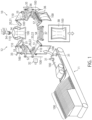
- FIG. 1 is a perspective view showing a general structure of a bagging and packaging machine 10 in which sealing apparatuses 35, 36 are incorporated.
- illustration of a below-described antifouling-sheet attachment mechanism 50 is omitted.
- a bagging and packaging machine 10 comprises a conveyor magazine 11 and a pouch processing apparatus 12.
- a plurality of pouches 100 are stored in a stacked manner in the conveyor magazine 11.
- Each pouch 100 stored in the conveyor magazine 11 is an empty pouch.
- a pouch mouth 110 is closed, with opposed sidewalls forming the pouch mouth 110 being in contact with each other.
- the pouches 100 stored in the conveyor magazine 11 are held one by one by means of a pouch taking-out unit 31 formed of an adhesive disc, and are delivered from the pouch taking-out unit 31 to respective holding units 22 of the pouch processing apparatus 12.
- the pouch processing apparatus 12 comprises: a transport mechanism 20 that transports a pouch 100 in a standing posture, along a predetermined track; and a plurality of processing units (in the example shown in Fig. 1 , a first station S1 to an eighth station S8) that process a pouch 100 transported by the transport mechanism 20.
- the transport mechanism 20 comprises: a transport table 21 that is intermittently rotated about an axis; and a plurality of holding units 22 each for holding a pouch 100, the holding units 22 being mounted equidistantly on an outer circumferential part of the transport table 21.
- the transport table 21 is shown by two-dot chain lines in order to facilitate understanding of other structures.
- Each holding unit 22 includes a pair of right and left gripping units 23a, 23b. Side parts of each pouch 100, which are positioned opposite to each other through a pouch mouth 110, are respectively held by the gripping units 23a, 23b.
- the pouch 100 is held and transported by the holding unit 22, such that the pouch 100 takes a standing posture. Particularly in the illustrated example, each pouch 100 is held and transported in a suspended state by the holding unit 22.
- the "standing posture” herein means a posture of the pouch 100 in which the sidewall parts forming the pouch 100 extend substantially along the vertical direction.
- Each holding unit 22 is intermittently moved along a transport direction (rotation direction) D1 together with the transport table 21, and is intermittently stopped at the first station S1 to the eighth station S8.
- the pouch 100 is repeatedly moved and stopped along the predetermined track so as to be transported.
- the number of holding units 22 corresponds to the number of stations S1 to S8.
- the bagging and packaging machine 10 of Fig. 1 is equipped with the eight holding units 22.
- a pouch 100 is delivered by the pouch taking-out unit 31 from the conveyor magazine 12 to the holding unit 22 (empty-bag supplying step).
- a production date, an expiration date and so on are printed on a surface of the pouch 100 by a printing apparatus 32 (printing step).
- the pouch mouth 110 of the pouch 100 is opened by a mouth opening means 33 (mouth opening step).
- the fourth station (filling unit) S4 a discharge outlet of a filling apparatus 34 is located inside the pouch 100 through the pouch mouth 110, and an object to be packaged 200 is filled into the pouch 100 from the filling apparatus 34 (filling step).
- the pouch mouth 110 of the pouch 100 is heat-sealed by a first sealing apparatus 35 (first pouch-mouth sealing step).
- the pouch mouth 110 of the pouch 100 is heat-sealed by a second sealing apparatus 36 (second pouch-mouth sealing step).
- the eighth station (cooling unit) S8 the heat-sealed pouch mouth 110 of the pouch 100 is cooled by a cooling apparatus 37 (sealed-portion cooling step), and the pouch 100 is released from the gripping by the holding unit 22 to fall down to a discharge chute 38.
- the pouch 100 having fallen down to the discharge chute 38 is guided by the discharge chute 38 so as to be sent to a succeeding stage.
- Fig. 2 is a perspective view showing a part of the sealing apparatus 35, 36.
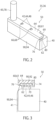
- Fig. 3 is a view in section showing a part of the sealing apparatus 35, 36.
- Fig. 4 is a perspective view separately showing a heating plate 40 of the sealing apparatus 35, 36 and an antifouling-sheet attachment mechanism 50. In Fig. 3 , only the antifouling-sheet attachment mechanism 50 of the sealing apparatus 35, 36 is shown in section.
- the sealing apparatuses 35, 36 are disposed away from each other in a radial direction of the transport table 21.
- Each sealing apparatus 35, 36 comprises a pair of heating plates 40 facing to each other, and the antifouling-sheet attachment mechanism 50 disposed correspondingly to each heating plate 40.
- a not-shown heating mechanism is disposed inside the heating plate 40.
- an electrically heated wire that is powered to generate heat can be used as the heating mechanism, for example.
- the heating plate 40 has a sealing surface that heat-seals a pouch mouth 110 of a pouch 100.
- the respective sealing surfaces 41 of the pair of heating plates 40 are surfaces that interpose therebetween a pouch mouth 110 of a pouch 100, and are disposed to face each other.
- the pair of heating plates 40 interpose therebetween a pouch mouth 110 through antifouling sheets 90 each of which is attached to the antifouling-sheet attachment mechanism 50 for covering the sealing surface 41.
- the antifouling sheet 90 is a member that prevents that a part of the pouch 100, which is melted upon sealing of the pouch mouth 100, leaks from the pouch mouth 110 so as to adhere to the heating plate 40.
- the antifouling sheet 90 is attached to the antifouling-sheet attachment mechanism 50.
- the antifouling sheet 90 is positioned with respect to the heating plate 40 so as to cover the sealing surface 41 of the heating plate 40.
- the antifouling sheet 90 is not specifically limited, and a sheet-like (film-like) member having heat resistance and antifouling property can be used.
- a sheet made of PTFE (polytetrafluoroethylene) can be used as the antifouling sheet 90, for example.
- the heating plate 40 is a linear member having a longitudinal direction.
- the longitudinal direction of the heating plate 40 is parallel to the transport direction D1 of a pouch 100 in the pouch processing apparatus 12.
- a section of the heating plate 40, which is orthogonal to the longitudinal direction thereof, has a substantially rectangular profile.
- the sealing surface 41 is pressed onto the pouch mouth 110 through the antifouling sheet 90.
- the antifouling-sheet attachment mechanism 50 is attached to another surface (upper surface in illustrated example) of a plurality of longitudinally-extending surfaces of the heating plate 40.
- an attachment part 42 for attaching the antifouling-sheet attachment mechanism 50 to the heating plate 40 is disposed on a surface of the heating plate 40, which faces the antifouling-sheet attachment mechanism 50.
- the attachment part 42 includes a plurality of projections 44.
- the attachment part 42 includes two projections 44 that are arranged side by side with a space therebetween along the longitudinal direction of the heating plate 40.
- Each projection 44 has a larger diameter part 46 positioned closer to a body part of the heating plate 40, and a smaller diameter part 48 positioned away from the body part of the heating plate 40 with respect to the larger diameter part 46, i.e., positioned oppositely to the body part of the heating plate 40 with respect to the larger diameter part 46.
- Both the larger diameter part 46 and the smaller diameter part 48 have a substantially columnar shape.
- a diameter of the larger diameter part 46 is larger than a diameter of the smaller diameter part 48.
- a central axis of the larger diameter part 46 coincides with a central axis of the smaller diameter part 48.
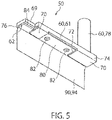
- Fig. 5 is a perspective view showing the antifouling-sheet attachment mechanism 50 seen from below.
- Fig. 6A is a perspective view showing an accommodation member 60 of the antifouling-sheet attachment mechanism 50 seen from above.
- Fig. 6B is a perspective view showing the accommodation member 60 seen from below.
- Fig. 7A is a perspective view showing an insertion member 80 of the antifouling-sheet attachment mechanism 50 seen from above.
- Fig. 7B is a perspective view showing the insertion member 80 of Fig. 7A seen from below.
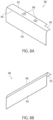
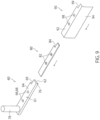
- Fig. 8A is a perspective view of an antifouling sheet 90 attached to the antifouling-sheet attachment mechanism 50 seen from above.
- Fig. 8B is a perspective view of the antifouling sheet 90 seen from below.
- the antifouling-sheet attachment mechanism 50 comprises an accommodation member 60 and an insertion member 80 inserted inside the accommodation member 60.
- the accommodation member 60 has a longitudinal direction.
- the accommodation member 60 has a groove part 62 that extends linearly along the longitudinal direction. At least a part of the insertion member 80 is disposed in the groove part 62.
- the antifouling sheet 90 is interposed to be held between the groove part 62 of the accommodation member 60 and the insertion member 80 inserted inside the accommodation member 60.
- the accommodation member 60 comprises a body part 61 and a handle part 78 attached to the body part 61.
- the body part 61 comprises a flat plate-like base part 64, a holding part 70 facing the base part 64 with a space between the holding part 70 and the base part 64, a connection part 74 that connects the base part 64 and the holding part 70, and a restriction part 76 formed to extend from the base part 64 so as to restrict movement of the insertion member 80.
- the base part 64 is a flat plate-like part having a longitudinal direction.
- the base part 64 is provided with a part to be attached 66 that is attached to a member included in the sealing apparatus 35, 36, e.g., the heating plate 40.
- the antifouling-sheet attachment mechanism 50 is attached to the heating plate 40.
- the part to be attached 66 may be attached to a member included in the sealing apparatus 35, 36, other than the heating plate 40.
- the part to be attached 66 includes a plurality of holes 68 communicated with the groove part 62.
- the part to be attached 66 includes two holes 68 that are arranged side by side with a space therebetween along the longitudinal direction of the base part 64.
- the number of the holes 68 and their positions correspond to the number of the projections 44 of the heating page 40 and their positions.
- the hole 68 may be either a through-hole or a blind hole.
- the hole 68 is formed of a through-hole.
- the hole 68 is referred to also as through-hole 68 in this specification.
- the hole 68 has a circular profile in a plan view, i.e., seen from a direction normal to a plate plane of the base part 64.
- a size (diameter) of the hole 68 is larger than the size (diameter) of the smaller diameter part 48 of the projection 44 of the heating plate 40, and is smaller than the size (diameter) of the larger diameter part 46. From the viewpoint of preventing displacement between the antifouling-sheet attachment mechanism 50 and the heating plate 40 attached thereto, a difference between the size of the hole 68 and the size of the smaller diameter part 48 is preferably small.
- the base part 64 has a cutout 69 in a corner thereof. The cutout 64 is disposed such that the base part 64 is not in contact with a wiring extending from the upper surface of the heating plate 40.
- the wiring is a wiring for powering the heating mechanism disposed inside the heating plate 40, for example.
- the holding part 70 is a member that prevents falling down of the insertion member 80 from the groove part 62.
- the holding part 70 is disposed to face the base part 64 with a space between the holding part 70 and the base part 64. Thus, the holding part 70 at least partly covers the groove part 62.
- the holding part 70 is formed to have a flat plate-like shape. A plate plane of the holding part 70 is parallel to the plate plane of the base part 64.
- the holding part 70 is provided with a cutout or a through-hole corresponding to the part to be attached 66 of the base part 64. The cutout or the through-hole is disposed such that the projection 44 of the heating plate 40, which is to be attached to the part to be attached 66 of the base part 64, can pass therethrough.
- the cutout or the through-hole is disposed to include an area that is overlapped with the part to be attached 66 (hole 68) along the direction normal to the plate plane of the base part 64 (plate plane of holding part 70).
- the one cutout or the one through-hole may either be disposed to include an area overlapped with one hole 68 included in the part to be attached 66, or be disposed to include a plurality of areas overlapped with the respective holes 68 included in the part to be attached 66.
- the one cutout or the one through-hole may be disposed to include all the area overlapped with the respective holes 68 included in the part to be attached 66.
- the holding part 70 is provided with a cutout 72 corresponding to the part to be attached 66.
- the cutout 72 is disposed to include an area overlapped with the two holes 68 of the part to be attached 66.
- connection part 74 is a member that connects the base part 64 and the holding part 70.
- the connection part 74 extends from the base part 64 parallel to the direction normal to the plate plane of the base part 64.
- connection part 74 extends in the direction perpendicular to the plate planes of the base part 64 and the holding part 70.
- the connection part 74 is disposed at least correspondingly to a part where the holding part 70 is disposed.
- the restriction part 76 is a member that restricts movement of the insertion member 80 in a direction crossing the direction (longitudinal direction) in which the groove part 62 extends, in particular, in a direction orthogonal to the direction in which the groove part 62 extends. More specifically, the restriction part 76 restricts the movement of the insertion member 80 in the direction orthogonal to the direction in which the groove part 62 extends, and in the direction that is parallel to the plate plane of the base part 64. Thus, the insertion member 80 inserted in the accommodation member 60 can be stably held. In the illustrated example, the restriction part 76 extends from the base part 64 parallel to the direction normal to the plate plane of the base part 64.
- the restriction part 76 extends in the direction perpendicular to the plate plane of the base part 64.
- the restriction part 76 extends in the longitudinal direction of the base part 64 over all the length of the base part 64.
- the restriction part 76 may be disposed partly along the longitudinal direction of the base part 64.
- the movement of the insertion member 80 inserted in the accommodation member 60 in the direction orthogonal to the direction in which the groove part 62 extends and in the direction that is parallel to the plate plane of the base part 64 can be restricted by the connection part 74 and the restriction part 76.
- the groove part 62 is formed by a space surrounded by the base part 64, the connection part 74 and the restriction part 76.
- a section of the groove part 62 which is orthogonal to the longitudinal direction of the body part 61, has a substantially rectangular profile.
- the groove part 62 has the same sectional shape along the longitudinal direction of the body part 61.
- a material constituting the body part 61 is not specifically limited as long as it has heat resistance.
- a metal material such as a stainless material, or a resin material such as PTFE can be used as a material constituting the body part 61.
- the base part 64, the connection part 74 and the restriction part 76 may be firstly formed of an integral member, and then the holding part 70 formed to have a plate-like shape may be connected to the connection part 74 by welding or the like.
- the handle part 78 is a part which is gripped by an operator for handling the antifouling-sheet attachment mechanism 50, when the antifouling-sheet attachment mechanism 50 is attached to or detached from the heating plate 40.
- the handle part 78 is fixed to the base part 64 of the body part 61 by a fastening means such as a bolt.
- a material constituting the handle part 78 may be different from a material constituting the body part 61.
- the handle part 78 is preferably formed of a material having a low heat transfer coefficient.
- the body part 61 may be formed of a metal material, while the handle part 78 may be formed of a resin material or a rubber material.
- the insertion member 80 is a member at least a part of which is disposed in the groove part 62 of the accommodation member 60 so as to hold the antifouling sheet 90 that is interposed between the groove part 62 and the insertion member 80 (between the base part 64 of the accommodation member 60 and the insertion member 80).
- the insertion member 80 in this embodiment has a longitudinal direction, and is formed to have a flat plate shape as a whole.
- the longitudinal direction of the insertion member 80 is parallel to the direction in which the groove part extends.
- a section of the insertion member 80, which is orthogonal to the longitudinal direction thereof, has a substantially rectangular profile.
- the insertion member 80 has the same sectional shape along its longitudinal direction. Thus, the insertion member 80 can be inserted along this longitudinal direction into the groove part 62 of the accommodation member 60.
- the insertion member 80 is provided with through-holes 82 at positions corresponding to the holes 68 of the base part 64, when the insertion member 80 is inserted in the groove part 62 of the accommodation member 60.
- Each through-hole 82 has a circular profile in a plan view, i.e., seen from a direction normal to a plate plane of the insertion member 80.
- a size (diameter) of the through-hole 82 is larger than the size (diameter) of the smaller diameter part 48 of the projection 44 of the heating plate 40, and is smaller than the size (diameter) of the larger diameter part 46.
- the insertion member 80 has a cutout 84 in a corner thereof corresponding to the cutout 69 of the accommodation member 60. Similarly to the cutout 69, the cutout 84 is disposed such that the insertion member 80 is not in contact with a wring extending from the upper surface of the heating plate 40.
- the antifouling sheet 90 has a part to be held 92 that is held between the groove part 62 of the accommodation member 60 and the insertion member 80, and a hanging part 94 hanging from the part to be held 92.
- the part to be held 92 and the hanging part 94 are structured as an integral member.
- a fold line 96 is formed between the part to be held 92 and the hanging pat 94.
- the antifouling sheet 90 may not necessarily have the fold line 96.
- the hanging part 94 of the antifouling sheet 90 is disposed to cover the sealing surface 41, and is positioned between the heating plate 40 (sealing surface 41) and a pouch mouth 110 of a pouch 100.
- the part to be held 92 is provided with through-holes 98 at positions corresponding to the holes 68 of the base part 64 and the through-holes 82 of the insertion member 80, when the part to be held 92 is held between the groove part 62 of the accommodation member 60 and the insertion member 80.
- Each through-hole 98 has a circular profile in a plan view of the part to be held 92.
- a size (diameter) of the through-hole 98 is larger than the size (diameter) of the smaller diameter part 48 of the heating plate 40, and is smaller than the size (diameter) of the larger diameter part 46.
- the part to be held 92 has a cutout 99 in a corner thereof corresponding to the cutout 69 of the accommodation member 60.
- the cutout 99 is disposed such that the antifouling sheet 90 is not in contact with a wiring extending from the upper surface of the heating plate 40.
- the part to be held 92 of the antifouling sheet 90 is overlapped with the insertion member 80 such that the part to be held 92 is positioned on the insertion member 80.
- the antifouling sheet 90 is held between the groove part 62 and the insertion member 80, namely, between the base part 64 of the accommodation member 60 and the insertion member 80.
- the positions of the through-holes 68 of the accommodation member 60, the through-holes 98 of the part to be held 92 of the antifouling sheet 90, and the through-holes 82 of the insertion member 80 are coincident to one another.
- a fold line 96 is formed in the antifouling sheet 90 at a corner of the groove part 62 where the base part 64 and the restriction part 76 are connected to each other.
- the antifouling sheet 90 when the antifouling sheet 90 is attached to or detached from the antifouling-sheet attachment mechanism 50, it is not necessary to use a component such as an attachment bolt. That is to say, it is not necessary to use a tool such as a driver for loosing or fastening an attachment bolt.
- a tool such as a driver for loosing or fastening an attachment bolt.
- the antifouling-sheet attachment mechanism 50 to which the antifouling sheet 90 is attached When the antifouling-sheet attachment mechanism 50 to which the antifouling sheet 90 is attached is attached to the heating plate 40, an operator places the antifouling-sheet attachment mechanism 50 on the heating plate 40, while gripping the handle part 78 of the accommodation member 60, such that the smaller diameter part 48 of the projection 44 of the heating plate 40 passes sequentially through the cutout 72, the through-hole 82 and the through-hole 98 so as to be inserted through the through-hole 68 of the base part 64 of the accommodation member 60.
- the sealing apparatus 35, 36 of the present invention comprises the heating plate 40 having the sealing surface 41 that heat-seals a pouch mouth 110 of a pouch 100, and the antifouling-sheet attachment mechanism 50 to which the antifouling sheet 90 for covering the sealing surface 41 is attached, wherein the antifouling-sheet attachment mechanism 50 comprises: the accommodation member 60 having the groove part 62; and the insertion member 80 having a longitudinal direction that is parallel to the direction in which the groove part 62 extends, at least a part of the insertion member 80 being positioned in the groove part; and wherein the antifouling sheet 90 is held between the groove part 62 and the insertion member 80.
- the bagging and packaging machine 10 of the present invention comprises the aforementioned sealing apparatus 35, 36.
- the sealing apparatus 35, 36 and the bagging and packaging machine 10 when the antifouling sheet 90 is attached to or detached from the antifouling-sheet attachment mechanism 50, it is not necessary to use a component such as an attachment bolt. That is to say, it is not necessary to use a tool such as a driver for loosing or fastening an attachment bolt.
- a component such as an attachment bolt. That is to say, it is not necessary to use a tool such as a driver for loosing or fastening an attachment bolt.
- attachment/detachment of the antifouling sheet 90 to/from the antifouling-sheet attachment mechanism 50 can be easily performed in a short period of time. Namely, the antifouling sheets 90 can be easily replaced in the sealing apparatus 35, 36.
- the accommodation member 60 has the holding part 70 that prevents falling down of the insertion member 80 from the groove part 62.
- the accommodation member 60 has the part to be attached 66 that is attached to another member included in the sealing apparatus 35, 36.
- the antifouling-sheet attachment mechanism 50 can be stably attached to another member, such as the heating plate 40, included in the sealing apparatus 35, 36.
- the holding part 70 has the cutout or the through-hole corresponding to the part to be attached 66.
- the holding part 70 can prevent that attachment of the antifouling-sheet attachment mechanism 50 to another member, such as the heating plate 40, included in the sealing apparatus 35, 36, is disturbed.
- the part to be attached 66 has the hole 68 communicated with the groove part 62.
- the hole 68 is the through-hole 68.
- the part to be attached 66 can be formed as a simple hole (through-hole) 68, so that the part to be attached 66 can be formed by an easy step.
- the accommodation member 60 has the restriction part 76 that restricts movement of the insertion member 80 in the direction crossing the direction in which the groove part 62 extends.
- the insertion member 80 inserted in the accommodation member 60 can be stably held.
- the accommodation member 60 has the handle part 78 that can be gripped by an operator.
- an operator can manually attach/detach the antifouling-sheet attachment mechanism 50 to/from the heating plate 40, without directly touching the body part 61 of the accommodation member 60, which may have a high temperature because of heat transmitted thereto from the heating plate 40.
- safety in attachment/detachment of the antifouling-sheet attachment mechanism 50 to/from the heating plate 40 can be improved.
- the antifouling-sheet attachment mechanism 50 may either be attached to both the first sealing apparatus 35 and the second sealing apparatus 36, or be attached to only one of the first sealing apparatus 35 and the second sealing apparatus 36.
Landscapes
- Engineering & Computer Science (AREA)
- Mechanical Engineering (AREA)
- Physics & Mathematics (AREA)
- Thermal Sciences (AREA)
- Package Closures (AREA)
- Containers And Plastic Fillers For Packaging (AREA)
Applications Claiming Priority (1)
| Application Number | Priority Date | Filing Date | Title |
|---|---|---|---|
| JP2018166285A JP7086796B2 (ja) | 2018-09-05 | 2018-09-05 | シール装置及び袋詰め包装機 |
Publications (2)
| Publication Number | Publication Date |
|---|---|
| EP3620294A1 EP3620294A1 (en) | 2020-03-11 |
| EP3620294B1 true EP3620294B1 (en) | 2023-04-05 |
Family
ID=67840935
Family Applications (1)
| Application Number | Title | Priority Date | Filing Date |
|---|---|---|---|
| EP19194814.0A Active EP3620294B1 (en) | 2018-09-05 | 2019-09-02 | Sealing apparatus and bagging and packaging machine |
Country Status (3)
| Country | Link |
|---|---|
| EP (1) | EP3620294B1 (ja) |
| JP (1) | JP7086796B2 (ja) |
| ES (1) | ES2943495T3 (ja) |
Family Cites Families (6)
| Publication number | Priority date | Publication date | Assignee | Title |
|---|---|---|---|---|
| US3830681A (en) * | 1972-11-08 | 1974-08-20 | Fmc Corp | Package sealing in steam atmosphere |
| JPS5969115U (ja) * | 1982-10-29 | 1984-05-10 | 株式会社寺岡精工 | ヒ−トシ−ル装置のヒ−タ−カバ−取付構造 |
| JPH061210U (ja) * | 1992-06-17 | 1994-01-11 | 東洋自動機株式会社 | 自動包装機用インパルスヒータ |
| JP3455527B2 (ja) * | 2001-08-06 | 2003-10-14 | 富士インパルス株式会社 | ヒートシーラー |
| KR101068633B1 (ko) * | 2011-06-17 | 2011-09-30 | 주식회사리팩 | 실링바 및 쿨링바의 테프론 테잎 홀더 |
| DE102015010433B4 (de) * | 2015-08-11 | 2021-04-15 | Michatek K.S. | Schweißbalken für Vakuumschublade sowie Vakuumschublade |
-
2018
- 2018-09-05 JP JP2018166285A patent/JP7086796B2/ja active Active
-
2019
- 2019-09-02 EP EP19194814.0A patent/EP3620294B1/en active Active
- 2019-09-02 ES ES19194814T patent/ES2943495T3/es active Active
Also Published As
| Publication number | Publication date |
|---|---|
| ES2943495T3 (es) | 2023-06-13 |
| EP3620294A1 (en) | 2020-03-11 |
| JP7086796B2 (ja) | 2022-06-20 |
| JP2020037442A (ja) | 2020-03-12 |
Similar Documents
| Publication | Publication Date | Title |
|---|---|---|
| US8381497B2 (en) | Method and packaging machine for packaging products | |
| EP2147774B1 (en) | Vertical - type bag packaging method and apparatus | |
| US20160122057A1 (en) | Packaging Machine | |
| CN103662204A (zh) | 带有管口的袋的制造方法及装置 | |
| KR20190006391A (ko) | Iot 기반의 로터리형 자동 포장시스템 | |
| JP2011079581A (ja) | 製袋包装装置 | |
| US20190344912A1 (en) | Packaging machine | |
| US10577141B2 (en) | Method for forming easily separable portion in packaging film, package bag having easily separable portion, and filling-packing machine | |
| EP3620294B1 (en) | Sealing apparatus and bagging and packaging machine | |
| JP7238919B2 (ja) | チャック付き包装袋の製造方法 | |
| JP6742766B2 (ja) | スパウト装着装置 | |
| JP2013116748A (ja) | 無菌充填包装機および無菌充填包装方法 | |
| JP6850480B2 (ja) | 深絞り包装機用シール装置 | |
| KR101707887B1 (ko) | 방향제 시트가 부착된 포장지 제조장치 및 제조방법 | |
| JP2020029268A (ja) | シール装置 | |
| JPS6239427A (ja) | 静電シ−ル装置 | |
| JP3498859B2 (ja) | 多連式カップ容器の製造装置 | |
| CN115135486B (zh) | 用于密封包装物的密封元件和用于密封包装物的设备 | |
| US12103240B2 (en) | Bonding method and bonding device | |
| JP3526603B2 (ja) | 多連式カップ容器の製造装置 | |
| CN116963968A (zh) | 装制品的外袋、供袋装置及供给方法 | |
| JP7577030B2 (ja) | 処理システム | |
| JP2007210614A (ja) | 袋体供給装置及び自動包装装置 | |
| JP3501507B2 (ja) | 多連式カップ容器の製造装置 | |
| JPH1158284A (ja) | 把持装置 |
Legal Events
| Date | Code | Title | Description |
|---|---|---|---|
| PUAI | Public reference made under article 153(3) epc to a published international application that has entered the european phase |
Free format text: ORIGINAL CODE: 0009012 |
|
| STAA | Information on the status of an ep patent application or granted ep patent |
Free format text: STATUS: THE APPLICATION HAS BEEN PUBLISHED |
|
| AK | Designated contracting states |
Kind code of ref document: A1 Designated state(s): AL AT BE BG CH CY CZ DE DK EE ES FI FR GB GR HR HU IE IS IT LI LT LU LV MC MK MT NL NO PL PT RO RS SE SI SK SM TR |
|
| AX | Request for extension of the european patent |
Extension state: BA ME |
|
| STAA | Information on the status of an ep patent application or granted ep patent |
Free format text: STATUS: REQUEST FOR EXAMINATION WAS MADE |
|
| 17P | Request for examination filed |
Effective date: 20200911 |
|
| RBV | Designated contracting states (corrected) |
Designated state(s): AL AT BE BG CH CY CZ DE DK EE ES FI FR GB GR HR HU IE IS IT LI LT LU LV MC MK MT NL NO PL PT RO RS SE SI SK SM TR |
|
| GRAP | Despatch of communication of intention to grant a patent |
Free format text: ORIGINAL CODE: EPIDOSNIGR1 |
|
| STAA | Information on the status of an ep patent application or granted ep patent |
Free format text: STATUS: GRANT OF PATENT IS INTENDED |
|
| INTG | Intention to grant announced |
Effective date: 20221108 |
|
| GRAS | Grant fee paid |
Free format text: ORIGINAL CODE: EPIDOSNIGR3 |
|
| GRAA | (expected) grant |
Free format text: ORIGINAL CODE: 0009210 |
|
| STAA | Information on the status of an ep patent application or granted ep patent |
Free format text: STATUS: THE PATENT HAS BEEN GRANTED |
|
| AK | Designated contracting states |
Kind code of ref document: B1 Designated state(s): AL AT BE BG CH CY CZ DE DK EE ES FI FR GB GR HR HU IE IS IT LI LT LU LV MC MK MT NL NO PL PT RO RS SE SI SK SM TR |
|
| REG | Reference to a national code |
Ref country code: GB Ref legal event code: FG4D |
|
| REG | Reference to a national code |
Ref country code: DE Ref legal event code: R096 Ref document number: 602019027115 Country of ref document: DE |
|
| REG | Reference to a national code |
Ref country code: CH Ref legal event code: EP |
|
| REG | Reference to a national code |
Ref country code: AT Ref legal event code: REF Ref document number: 1557915 Country of ref document: AT Kind code of ref document: T Effective date: 20230415 |
|
| REG | Reference to a national code |
Ref country code: IE Ref legal event code: FG4D |
|
| REG | Reference to a national code |
Ref country code: ES Ref legal event code: FG2A Ref document number: 2943495 Country of ref document: ES Kind code of ref document: T3 Effective date: 20230613 |
|
| REG | Reference to a national code |
Ref country code: LT Ref legal event code: MG9D |
|
| REG | Reference to a national code |
Ref country code: NL Ref legal event code: MP Effective date: 20230405 |
|
| REG | Reference to a national code |
Ref country code: AT Ref legal event code: MK05 Ref document number: 1557915 Country of ref document: AT Kind code of ref document: T Effective date: 20230405 |
|
| PG25 | Lapsed in a contracting state [announced via postgrant information from national office to epo] |
Ref country code: NL Free format text: LAPSE BECAUSE OF FAILURE TO SUBMIT A TRANSLATION OF THE DESCRIPTION OR TO PAY THE FEE WITHIN THE PRESCRIBED TIME-LIMIT Effective date: 20230405 |
|
| PG25 | Lapsed in a contracting state [announced via postgrant information from national office to epo] |
Ref country code: SE Free format text: LAPSE BECAUSE OF FAILURE TO SUBMIT A TRANSLATION OF THE DESCRIPTION OR TO PAY THE FEE WITHIN THE PRESCRIBED TIME-LIMIT Effective date: 20230405 Ref country code: PT Free format text: LAPSE BECAUSE OF FAILURE TO SUBMIT A TRANSLATION OF THE DESCRIPTION OR TO PAY THE FEE WITHIN THE PRESCRIBED TIME-LIMIT Effective date: 20230807 Ref country code: NO Free format text: LAPSE BECAUSE OF FAILURE TO SUBMIT A TRANSLATION OF THE DESCRIPTION OR TO PAY THE FEE WITHIN THE PRESCRIBED TIME-LIMIT Effective date: 20230705 Ref country code: AT Free format text: LAPSE BECAUSE OF FAILURE TO SUBMIT A TRANSLATION OF THE DESCRIPTION OR TO PAY THE FEE WITHIN THE PRESCRIBED TIME-LIMIT Effective date: 20230405 |
|
| PG25 | Lapsed in a contracting state [announced via postgrant information from national office to epo] |
Ref country code: RS Free format text: LAPSE BECAUSE OF FAILURE TO SUBMIT A TRANSLATION OF THE DESCRIPTION OR TO PAY THE FEE WITHIN THE PRESCRIBED TIME-LIMIT Effective date: 20230405 Ref country code: PL Free format text: LAPSE BECAUSE OF FAILURE TO SUBMIT A TRANSLATION OF THE DESCRIPTION OR TO PAY THE FEE WITHIN THE PRESCRIBED TIME-LIMIT Effective date: 20230405 Ref country code: LV Free format text: LAPSE BECAUSE OF FAILURE TO SUBMIT A TRANSLATION OF THE DESCRIPTION OR TO PAY THE FEE WITHIN THE PRESCRIBED TIME-LIMIT Effective date: 20230405 Ref country code: LT Free format text: LAPSE BECAUSE OF FAILURE TO SUBMIT A TRANSLATION OF THE DESCRIPTION OR TO PAY THE FEE WITHIN THE PRESCRIBED TIME-LIMIT Effective date: 20230405 Ref country code: IS Free format text: LAPSE BECAUSE OF FAILURE TO SUBMIT A TRANSLATION OF THE DESCRIPTION OR TO PAY THE FEE WITHIN THE PRESCRIBED TIME-LIMIT Effective date: 20230805 Ref country code: HR Free format text: LAPSE BECAUSE OF FAILURE TO SUBMIT A TRANSLATION OF THE DESCRIPTION OR TO PAY THE FEE WITHIN THE PRESCRIBED TIME-LIMIT Effective date: 20230405 Ref country code: GR Free format text: LAPSE BECAUSE OF FAILURE TO SUBMIT A TRANSLATION OF THE DESCRIPTION OR TO PAY THE FEE WITHIN THE PRESCRIBED TIME-LIMIT Effective date: 20230706 Ref country code: AL Free format text: LAPSE BECAUSE OF FAILURE TO SUBMIT A TRANSLATION OF THE DESCRIPTION OR TO PAY THE FEE WITHIN THE PRESCRIBED TIME-LIMIT Effective date: 20230405 |
|
| PG25 | Lapsed in a contracting state [announced via postgrant information from national office to epo] |
Ref country code: FI Free format text: LAPSE BECAUSE OF FAILURE TO SUBMIT A TRANSLATION OF THE DESCRIPTION OR TO PAY THE FEE WITHIN THE PRESCRIBED TIME-LIMIT Effective date: 20230405 |
|
| REG | Reference to a national code |
Ref country code: DE Ref legal event code: R097 Ref document number: 602019027115 Country of ref document: DE |
|
| PG25 | Lapsed in a contracting state [announced via postgrant information from national office to epo] |
Ref country code: SK Free format text: LAPSE BECAUSE OF FAILURE TO SUBMIT A TRANSLATION OF THE DESCRIPTION OR TO PAY THE FEE WITHIN THE PRESCRIBED TIME-LIMIT Effective date: 20230405 |
|
| PG25 | Lapsed in a contracting state [announced via postgrant information from national office to epo] |
Ref country code: SM Free format text: LAPSE BECAUSE OF FAILURE TO SUBMIT A TRANSLATION OF THE DESCRIPTION OR TO PAY THE FEE WITHIN THE PRESCRIBED TIME-LIMIT Effective date: 20230405 Ref country code: SK Free format text: LAPSE BECAUSE OF FAILURE TO SUBMIT A TRANSLATION OF THE DESCRIPTION OR TO PAY THE FEE WITHIN THE PRESCRIBED TIME-LIMIT Effective date: 20230405 Ref country code: RO Free format text: LAPSE BECAUSE OF FAILURE TO SUBMIT A TRANSLATION OF THE DESCRIPTION OR TO PAY THE FEE WITHIN THE PRESCRIBED TIME-LIMIT Effective date: 20230405 Ref country code: EE Free format text: LAPSE BECAUSE OF FAILURE TO SUBMIT A TRANSLATION OF THE DESCRIPTION OR TO PAY THE FEE WITHIN THE PRESCRIBED TIME-LIMIT Effective date: 20230405 Ref country code: DK Free format text: LAPSE BECAUSE OF FAILURE TO SUBMIT A TRANSLATION OF THE DESCRIPTION OR TO PAY THE FEE WITHIN THE PRESCRIBED TIME-LIMIT Effective date: 20230405 Ref country code: CZ Free format text: LAPSE BECAUSE OF FAILURE TO SUBMIT A TRANSLATION OF THE DESCRIPTION OR TO PAY THE FEE WITHIN THE PRESCRIBED TIME-LIMIT Effective date: 20230405 |
|
| PLBE | No opposition filed within time limit |
Free format text: ORIGINAL CODE: 0009261 |
|
| STAA | Information on the status of an ep patent application or granted ep patent |
Free format text: STATUS: NO OPPOSITION FILED WITHIN TIME LIMIT |
|
| 26N | No opposition filed |
Effective date: 20240108 |
|
| REG | Reference to a national code |
Ref country code: CH Ref legal event code: PL |
|
| PG25 | Lapsed in a contracting state [announced via postgrant information from national office to epo] |
Ref country code: SI Free format text: LAPSE BECAUSE OF FAILURE TO SUBMIT A TRANSLATION OF THE DESCRIPTION OR TO PAY THE FEE WITHIN THE PRESCRIBED TIME-LIMIT Effective date: 20230405 |
|
| PG25 | Lapsed in a contracting state [announced via postgrant information from national office to epo] |
Ref country code: LU Free format text: LAPSE BECAUSE OF NON-PAYMENT OF DUE FEES Effective date: 20230902 |
|
| REG | Reference to a national code |
Ref country code: BE Ref legal event code: MM Effective date: 20230930 |
|
| PG25 | Lapsed in a contracting state [announced via postgrant information from national office to epo] |
Ref country code: SI Free format text: LAPSE BECAUSE OF FAILURE TO SUBMIT A TRANSLATION OF THE DESCRIPTION OR TO PAY THE FEE WITHIN THE PRESCRIBED TIME-LIMIT Effective date: 20230405 Ref country code: LU Free format text: LAPSE BECAUSE OF NON-PAYMENT OF DUE FEES Effective date: 20230902 Ref country code: MC Free format text: LAPSE BECAUSE OF FAILURE TO SUBMIT A TRANSLATION OF THE DESCRIPTION OR TO PAY THE FEE WITHIN THE PRESCRIBED TIME-LIMIT Effective date: 20230405 |
|
| REG | Reference to a national code |
Ref country code: IE Ref legal event code: MM4A |
|
| PG25 | Lapsed in a contracting state [announced via postgrant information from national office to epo] |
Ref country code: IE Free format text: LAPSE BECAUSE OF NON-PAYMENT OF DUE FEES Effective date: 20230902 |
|
| PG25 | Lapsed in a contracting state [announced via postgrant information from national office to epo] |
Ref country code: CH Free format text: LAPSE BECAUSE OF NON-PAYMENT OF DUE FEES Effective date: 20230930 |
|
| PG25 | Lapsed in a contracting state [announced via postgrant information from national office to epo] |
Ref country code: IE Free format text: LAPSE BECAUSE OF NON-PAYMENT OF DUE FEES Effective date: 20230902 Ref country code: CH Free format text: LAPSE BECAUSE OF NON-PAYMENT OF DUE FEES Effective date: 20230930 |
|
| PG25 | Lapsed in a contracting state [announced via postgrant information from national office to epo] |
Ref country code: BE Free format text: LAPSE BECAUSE OF NON-PAYMENT OF DUE FEES Effective date: 20230930 |
|
| PGFP | Annual fee paid to national office [announced via postgrant information from national office to epo] |
Ref country code: IT Payment date: 20240924 Year of fee payment: 6 |
|
| PG25 | Lapsed in a contracting state [announced via postgrant information from national office to epo] |
Ref country code: BG Free format text: LAPSE BECAUSE OF FAILURE TO SUBMIT A TRANSLATION OF THE DESCRIPTION OR TO PAY THE FEE WITHIN THE PRESCRIBED TIME-LIMIT Effective date: 20230405 |
|
| PG25 | Lapsed in a contracting state [announced via postgrant information from national office to epo] |
Ref country code: BG Free format text: LAPSE BECAUSE OF FAILURE TO SUBMIT A TRANSLATION OF THE DESCRIPTION OR TO PAY THE FEE WITHIN THE PRESCRIBED TIME-LIMIT Effective date: 20230405 |
|
| PGFP | Annual fee paid to national office [announced via postgrant information from national office to epo] |
Ref country code: ES Payment date: 20241028 Year of fee payment: 6 |
|
| PG25 | Lapsed in a contracting state [announced via postgrant information from national office to epo] |
Ref country code: CY Free format text: LAPSE BECAUSE OF FAILURE TO SUBMIT A TRANSLATION OF THE DESCRIPTION OR TO PAY THE FEE WITHIN THE PRESCRIBED TIME-LIMIT; INVALID AB INITIO Effective date: 20190902 |
|
| PG25 | Lapsed in a contracting state [announced via postgrant information from national office to epo] |
Ref country code: HU Free format text: LAPSE BECAUSE OF FAILURE TO SUBMIT A TRANSLATION OF THE DESCRIPTION OR TO PAY THE FEE WITHIN THE PRESCRIBED TIME-LIMIT; INVALID AB INITIO Effective date: 20190902 |
|
| PGFP | Annual fee paid to national office [announced via postgrant information from national office to epo] |
Ref country code: DE Payment date: 20250919 Year of fee payment: 7 |
|
| PGFP | Annual fee paid to national office [announced via postgrant information from national office to epo] |
Ref country code: GB Payment date: 20250919 Year of fee payment: 7 |
|
| PGFP | Annual fee paid to national office [announced via postgrant information from national office to epo] |
Ref country code: FR Payment date: 20250922 Year of fee payment: 7 |