EP3604570A1 - Verfahren zur lithiumrückgewinnung - Google Patents
Verfahren zur lithiumrückgewinnung Download PDFInfo
- Publication number
- EP3604570A1 EP3604570A1 EP18778276.8A EP18778276A EP3604570A1 EP 3604570 A1 EP3604570 A1 EP 3604570A1 EP 18778276 A EP18778276 A EP 18778276A EP 3604570 A1 EP3604570 A1 EP 3604570A1
- Authority
- EP
- European Patent Office
- Prior art keywords
- lithium
- extraction process
- solvent
- solution
- extraction
- Prior art date
- Legal status (The legal status is an assumption and is not a legal conclusion. Google has not performed a legal analysis and makes no representation as to the accuracy of the status listed.)
- Granted
Links
Images


Classifications
-
- C—CHEMISTRY; METALLURGY
- C22—METALLURGY; FERROUS OR NON-FERROUS ALLOYS; TREATMENT OF ALLOYS OR NON-FERROUS METALS
- C22B—PRODUCTION AND REFINING OF METALS; PRETREATMENT OF RAW MATERIALS
- C22B23/00—Obtaining nickel or cobalt
-
- C—CHEMISTRY; METALLURGY
- C22—METALLURGY; FERROUS OR NON-FERROUS ALLOYS; TREATMENT OF ALLOYS OR NON-FERROUS METALS
- C22B—PRODUCTION AND REFINING OF METALS; PRETREATMENT OF RAW MATERIALS
- C22B23/00—Obtaining nickel or cobalt
- C22B23/04—Obtaining nickel or cobalt by wet processes
- C22B23/0453—Treatment or purification of solutions, e.g. obtained by leaching
-
- C—CHEMISTRY; METALLURGY
- C22—METALLURGY; FERROUS OR NON-FERROUS ALLOYS; TREATMENT OF ALLOYS OR NON-FERROUS METALS
- C22B—PRODUCTION AND REFINING OF METALS; PRETREATMENT OF RAW MATERIALS
- C22B26/00—Obtaining alkali, alkaline earth metals or magnesium
- C22B26/10—Obtaining alkali metals
- C22B26/12—Obtaining lithium
-
- C—CHEMISTRY; METALLURGY
- C22—METALLURGY; FERROUS OR NON-FERROUS ALLOYS; TREATMENT OF ALLOYS OR NON-FERROUS METALS
- C22B—PRODUCTION AND REFINING OF METALS; PRETREATMENT OF RAW MATERIALS
- C22B3/00—Extraction of metal compounds from ores or concentrates by wet processes
- C22B3/20—Treatment or purification of solutions, e.g. obtained by leaching
- C22B3/26—Treatment or purification of solutions, e.g. obtained by leaching by liquid-liquid extraction using organic compounds
- C22B3/38—Treatment or purification of solutions, e.g. obtained by leaching by liquid-liquid extraction using organic compounds containing phosphorus
- C22B3/384—Pentavalent phosphorus oxyacids, esters thereof
- C22B3/3844—Phosphonic acid, e.g. H2P(O)(OH)2
-
- C—CHEMISTRY; METALLURGY
- C22—METALLURGY; FERROUS OR NON-FERROUS ALLOYS; TREATMENT OF ALLOYS OR NON-FERROUS METALS
- C22B—PRODUCTION AND REFINING OF METALS; PRETREATMENT OF RAW MATERIALS
- C22B3/00—Extraction of metal compounds from ores or concentrates by wet processes
- C22B3/20—Treatment or purification of solutions, e.g. obtained by leaching
- C22B3/26—Treatment or purification of solutions, e.g. obtained by leaching by liquid-liquid extraction using organic compounds
- C22B3/38—Treatment or purification of solutions, e.g. obtained by leaching by liquid-liquid extraction using organic compounds containing phosphorus
- C22B3/384—Pentavalent phosphorus oxyacids, esters thereof
- C22B3/3846—Phosphoric acid, e.g. (O)P(OH)3
-
- C—CHEMISTRY; METALLURGY
- C22—METALLURGY; FERROUS OR NON-FERROUS ALLOYS; TREATMENT OF ALLOYS OR NON-FERROUS METALS
- C22B—PRODUCTION AND REFINING OF METALS; PRETREATMENT OF RAW MATERIALS
- C22B3/00—Extraction of metal compounds from ores or concentrates by wet processes
- C22B3/20—Treatment or purification of solutions, e.g. obtained by leaching
- C22B3/44—Treatment or purification of solutions, e.g. obtained by leaching by chemical processes
-
- C—CHEMISTRY; METALLURGY
- C22—METALLURGY; FERROUS OR NON-FERROUS ALLOYS; TREATMENT OF ALLOYS OR NON-FERROUS METALS
- C22B—PRODUCTION AND REFINING OF METALS; PRETREATMENT OF RAW MATERIALS
- C22B7/00—Working up raw materials other than ores, e.g. scrap, to produce non-ferrous metals and compounds thereof; Methods of a general interest or applied to the winning of more than two metals
-
- C—CHEMISTRY; METALLURGY
- C22—METALLURGY; FERROUS OR NON-FERROUS ALLOYS; TREATMENT OF ALLOYS OR NON-FERROUS METALS
- C22B—PRODUCTION AND REFINING OF METALS; PRETREATMENT OF RAW MATERIALS
- C22B7/00—Working up raw materials other than ores, e.g. scrap, to produce non-ferrous metals and compounds thereof; Methods of a general interest or applied to the winning of more than two metals
- C22B7/006—Wet processes
-
- C—CHEMISTRY; METALLURGY
- C22—METALLURGY; FERROUS OR NON-FERROUS ALLOYS; TREATMENT OF ALLOYS OR NON-FERROUS METALS
- C22B—PRODUCTION AND REFINING OF METALS; PRETREATMENT OF RAW MATERIALS
- C22B47/00—Obtaining manganese
-
- Y—GENERAL TAGGING OF NEW TECHNOLOGICAL DEVELOPMENTS; GENERAL TAGGING OF CROSS-SECTIONAL TECHNOLOGIES SPANNING OVER SEVERAL SECTIONS OF THE IPC; TECHNICAL SUBJECTS COVERED BY FORMER USPC CROSS-REFERENCE ART COLLECTIONS [XRACs] AND DIGESTS
- Y02—TECHNOLOGIES OR APPLICATIONS FOR MITIGATION OR ADAPTATION AGAINST CLIMATE CHANGE
- Y02P—CLIMATE CHANGE MITIGATION TECHNOLOGIES IN THE PRODUCTION OR PROCESSING OF GOODS
- Y02P10/00—Technologies related to metal processing
- Y02P10/20—Recycling
-
- Y—GENERAL TAGGING OF NEW TECHNOLOGICAL DEVELOPMENTS; GENERAL TAGGING OF CROSS-SECTIONAL TECHNOLOGIES SPANNING OVER SEVERAL SECTIONS OF THE IPC; TECHNICAL SUBJECTS COVERED BY FORMER USPC CROSS-REFERENCE ART COLLECTIONS [XRACs] AND DIGESTS
- Y02—TECHNOLOGIES OR APPLICATIONS FOR MITIGATION OR ADAPTATION AGAINST CLIMATE CHANGE
- Y02W—CLIMATE CHANGE MITIGATION TECHNOLOGIES RELATED TO WASTEWATER TREATMENT OR WASTE MANAGEMENT
- Y02W30/00—Technologies for solid waste management
- Y02W30/50—Reuse, recycling or recovery technologies
- Y02W30/84—Recycling of batteries or fuel cells
Definitions
- the present invention relates to a method for recovering lithium by separating sodium from a lithium-containing solution containing lithium ions and sodium ions, and in particular, proposes a technique capable of providing high purity lithium when recovering metals from lithium ion battery scrap.
- the lithium ion battery scrap is typically calcined to remove harmful electrolytes and then subjected to crushing and sieving in this order.
- battery powder obtained under a sieve for the sieving is leached by adding it to a leaching solution, whereby lithium, nickel, cobalt, manganese, iron, copper, aluminum and the like which can be contained therein are dissolved in the solution.
- iron, copper, aluminum, and the like are removed sequentially or simultaneously among the respective metal elements dissolved in the leached solution to recover valuable metals such as cobalt, manganese and nickel.
- the leached solution is subjected to multiple stages of solvent extraction or neutralization according to the metals to be separated, and further, each solution obtained at each stage is subjected to stripping, electrolysis, carbonation or other treatments. Accordingly, a lithium-containing solution containing lithium ions is obtained.
- the lithium-containing solution thus obtained is generally subjected to carbonation by adding a carbonate salt or blowing a carbon dioxide gas to recover a lithium ion contained in the lithium-containing solution as lithium carbonate.
- Patent Document 1 discloses that a lithium ion is recovered as solid lithium carbonate by adjusting a pH of an aqueous solution containing lithium ions to pH 4 to 10 depending on acidic solvent extracting agent used for extraction of lithium ions, bringing the aqueous solution into contact with the acidic solvent extracting agent to extract lithium ions, and then bringing the solvent extracting agent into contact with an aqueous solution having a pH of 3.0 or less to strip lithium ions, repeating the above stripping operations using the resulting aqueous lithium ion solution to concentrate the lithium ions, and mixing the resulting high-concentration lithium ion aqueous solution with a water-soluble carbonate while maintaining the high-concentration lithium ion aqueous solution at 50 °C or higher.
- Patent Document 1 Japanese Patent No. 4581553 B
- the lithium-containing solution as described above may contain an increased amount of sodium ions due to, for example, the addition of sodium hydroxide for the purpose of adjusting the pH.
- sodium will become contained in lithium carbonate. Therefore, it may cause a problem that there are large burdens related to purification of lithium carbonate in order to obtain lithium carbonate containing lithium with high quality.
- sodium sulfate may be precipitated to cause process troubles such as piping blockage.
- An object of the present invention is to provide a method for recovering lithium, which can effectively recover high purity lithium from a lithium-containing solution containing lithium ions and sodium ions.
- a lithium-containing solution containing lithium ions and sodium ions is continuously subjected to a predetermined number of solvent extractions, and the solvent extractions are carried out such that a flow of a solvent and a flow of a solution are in opposite directions to each other, whereby the sodium ions are effectively separated.
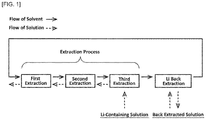
- a method for recovering lithium comprises separating sodium from a lithium-containing solution containing lithium ions and sodium ions to recover lithium, wherein the method comprises a solvent extraction step including: at least three-stage extraction process having a first extraction process, a second extraction process, and a third extraction process; and a lithium back extraction stage of back-extracting the lithium ions from a solvent that have undergone the at least three-stage extraction process; and wherein, in the extraction process, the solvent undergoes the first extraction process, the second extraction process, and the third extraction process in this order, and a solution as the lithium-containing solution undergoes the respective processes in opposite order to the order of the solvent.
- the at least three stage extraction process comprises extracting the lithium ions and the sodium ions in the solution into the solvent, in each of the extraction processes excluding a final extraction process of the first extraction process to the final extraction process, and also back-extracting the sodium ions in the solvent into the solution in the final extraction process.
- a pH of a final extraction process in the at least three stage extraction process is from 3.5 to 4.5. It is also preferable that in the method for recovering lithium according to this invention, a solvent after back-extracting the lithium ions in the lithium back extraction process is used as the solvent in the first extraction process.
- a pH of the first extraction process is from 6.0 to 6.5, and a pH of the extraction process excluding a final extraction process of the second extraction process to the final extraction process is from 5.5 to 6.0.
- the lithium-containing solution can have a pH of from 2.0 to 7.0.
- a molar ratio of a sodium concentration to a lithium concentration in the lithium-containing solution is preferably from 2 to 100.
- the method for recovering lithium according to this invention further comprises a nickel separation step of separating nickel from a solution containing lithium and nickel prior to the solvent extraction step, and the lithium-containing solution is obtained in the nickel separation step.
- nickel can be separated by solvent extraction, and a carboxylic acid-based extracting agent can be used for the solvent extraction.
- the lithium-containing solution may further contain nickel ions
- a back-extracted solution obtained in the lithium back-extraction process may contain lithium ions and nickel ions.
- the method further comprises, after the solvent extraction process, a neutralization step of neutralizing the back-extracted solution to remove nickel, and after the neutralization step, a carbonation step of obtaining lithium carbonate from a neutralized solution.
- the lithium-containing solution is preferably obtained by processing lithium ion battery scrap.
- the processing to the lithium ion battery scrap can comprise a leaching step of leaching the lithium ion battery scrap and a recovery step of recovering metals dissolved in the resulting leached solution by solvent extraction.
- the solvent undergoes the first extraction process, the second extraction process, and the third extraction process in this order in the extraction process, and a solution as the lithium-containing solution undergoes the respective processes in opposite order to the order of the solvent, whereby after the extraction processes, the lithium ions are effectively extracted into the solvent, while the sodium ions are effectively removed from the solvent.
- the lithium ions are effectively extracted into the solvent, while the sodium ions are effectively removed from the solvent.
- the lithium recovery method is a method for separating lithium from a lithium-containing solution containing lithium ions and sodium ions to recover lithium.
- the method has a solvent extraction step which includes: a first extraction process, a second extraction process, and a third extraction process; and a lithium back extraction process of back-extracting the lithium ions from a solvent after the third extraction process.
- the solvent undergoes the first extraction process, the second extraction process, the third extraction process, and the lithium back extraction process in this order, and a solution as the lithium-containing solution undergoes the third extraction process, the second extraction process, and the first extraction process in this order.
- the lithium-containing solution herein contains at least lithium ions and sodium ions.
- the lithium-containing solution is subjected to the solvent extraction step.
- a lithium concentration in the lithium-containing solution is, for example, from 0.5 g/L to 10.0 g/L, typically from 1.0 g/L to 7.0 g/L, and a sodium concentration is, for example, from 1.0 g/L to 50.0 g/L, typically from 20.0 g/L to 40.0 g/L.
- a molar ratio of the sodium concentration to the lithium concentration in the lithium-containing solution is, for example, from 2 to 100, and more effectively 10 or more. This embodiment can be applied to the lithium-containing solution containing sodium ions at this level.
- the lithium-containing solution may further contain from 10 mg/L to 500 mg/L, typically 20 mg/L to 100 mg/L of nickel, for example when nickel remains without being separated in the previous nickel separation step. Thus, even if it contains nickel, the nickel can be effectively recovered from a back-extracted solution obtained in the solvent extraction step, as will be described later.
- the lithium-containing solution may further contain cobalt, aluminum, calcium and the like in the total amount of 1.0 g/L or less.
- the solvent extraction step includes an extraction process having: a first extraction process, a second extraction process, and a third extraction process; and a lithium back extraction process.
- the first extraction process, the second extraction process and the third extraction process the lithium ions contained in the lithium-containing solution are extracted into the solvent, but the sodium ions can remain in the solution, and the lithium ions are back-extracted from the solvent in the lithium back extraction process to obtain a back-extracted solution in which the lithium ions are contained and the sodium ions have been removed.
- the third extraction process corresponds to a final extraction process immediately before the lithium back extraction process.
- the solvent used in the solvent extraction step can be, for example, a phosphonate ester extracting agent (PC-88A), a phosphate ester extracting agent (D2EHPA), or the like. These produce an effect of capable of effectively separating sodium.
- PC-88A phosphonate ester extracting agent
- D2EHPA phosphate ester extracting agent
- the solvent after the first extraction process is used as a solvent for the second extraction process
- the solvent after the second extraction process is used as a solvent for the third extraction process.
- the lithium-containing solution is firstly used in the third extraction process, and the solution after the third extraction process is used as a solution in the second extraction process, and the solution after the second extraction process is used as a solution in the first extraction process.
- the solvent extraction is carried out using an unused new solvent or a solvent after back-extracting lithium in the lithium back extraction process as shown in the figure, and a solution after sequentially undergoing the third extraction process and the second extraction process.
- the purpose herein is to extract the lithium ions and sodium ions in the solution into a solvent.
- a pH of the first extraction process is preferably from 6.0 to 6.5. If the pH at this time is too high, sodium may be excessively extracted. On the other hand, if the pH is too low, there is a concern that lithium may be insufficiently extracted. Therefore, the pH of the first extraction process is more preferably from 6.1 to 6.3.
- the solvent extraction is carried out using the solvent after the first extraction process and the solution after the third extraction process.
- a pH of the second extraction process is preferably equal to or lower than that of the first extraction process, particularly preferably from 5.5 to 6.0. If the pH in the second extraction process is too high, sodium may be excessively extracted. If the pH is too low, lithium may be insufficiently extracted. From this point of view, the pH of the second extraction process is more preferably from 5.7 to 5.9.
- the solvent extraction is carried out using the solvent after sequentially undergoing the first extraction process and the second extraction process, and the lithium-containing solution that has not been used in the solvent extraction process.
- the sodium ions contained in the solvent transfer into the solution to be back-extracted, and the lithium ions in the lithium-containing solution are extracted into the solvent.
- a pH of the third extraction process is preferably equal to or less than that of the second extraction process, and preferably from 3.5 to 4.5. If the pH in the third extraction process is too high, the back extraction of sodium may be insufficient. On the other hand, if the pH in the third extraction process is too low, lithium may also be back-extracted. Therefore, the pH of the third extraction process is more preferably from 4.0 to 4.2.
- the sodium extracted once will be removed from the solvent, so that the lithium ions are surely contained in the solvent after the third extraction process, and the sodium ions can also be effectively removed from the solvent to separate lithium ions and sodium ions in the lithium-containing solution effectively.
- a solution aqueous phase
- a solvent organic phase
- a temperature during extraction is preferably from a normal temperature (about 15 to 25 °C) to 60 °C or less, and preferably from 35 to 45 °C for reasons of an extraction rate, phase separation and evaporation of the organic solvent.
- the mixed organic phase and aqueous phase are then separated according to a difference in specific gravity by means of a settler.
- An O/A ratio (a volume ratio of the organic phase to the aqueous phase) is generally from 0.1 to 10 in view of the operation with the mixer settler, and more preferably from 1 to 5, although it depending on the contents of the metals to be extracted.
- the solvent obtained through the third extraction process can be mixed with a back extracting solution such as sulfuric acid or hydrochloric acid, and stirred by a mixer or the like at a speed of 200 to 500 rpm, for example for 5 to 60 minutes.
- Sulfuric acid can be preferably used as the back extracting solution.
- An acid concentration of the back extracting solution is preferably adjusted to 0.05 to 200 g/l (pH: -0.6 to 3.0), more preferably 1.5 to 15 g/l (pH: 0.5 to 1.5), in order to effectively back-extract the lithium ions in the solvent.
- a temperature of the back extraction can be from the normal temperature to 60 °C, and preferably from 35 to 45 °C, for reasons of a back extraction rate, phase separation, and evaporation of the organic solvent.
- the back-extracted solution obtained in the lithium back extraction process contains a higher concentration of lithium ions, but has removed substantially all sodium ions.
- a lithium concentration in the back-extracted solution is preferably from 5.0 g/L to 30.0 g/L, more preferably from 10.0 g/L to 20.0 g/L.
- a sodium concentration in the back-extracted solution is preferably 60.0 g/L or less, more preferably 40.0 g/L or less. This enables high purity lithium carbonate to be obtained in a carbonation step as described later.
- the back-extracted solution can be repeatedly used as a back-extracting solution in the lithium back extraction process, after recovering lithium contained therein.
- the extraction process requires at least three stages of the first extraction process, the second extraction process, and the third extraction process.
- the extraction process may be performed in four or more stages.
- the solvent will undergo the respective stages in order from the first extraction process, while the solution will undergo the respective stages in order from the extraction process finally subjected before the lithium back extraction process (that is, in opposite order to the order of the solvent).
- a pH of the extraction processes excluding the final extraction process of the second extraction process to the final extraction process is from 5.5 to 6.0, particularly from 5.7 to 5.9.
- the pH of the second extraction process and the third extraction process among the second extraction process, the third extraction process, and the fourth extraction process, excluding the fourth extraction process as the final stage is preferably from 5.5 to 6.0, more preferably from 5.7 to 5.9.
- the lithium ions and sodium ions in the solution are extracted into the solvent in each of the first extraction process to the third extraction process excluding the fourth extraction process as the final stage, and in the fourth extraction process, the lithium ions in the solution are extracted into the solvent and the sodium ions in the solvent are back-extracted into the solution.
- nickel ions When nickel ions are contained in the lithium-containing solution, the nickel ions are extracted and back-extracted together with the lithium ions in the solvent extraction step, and thus are contained in the back-extracted solution.
- a neutralization step can be carried out.
- the nickel ions contained in the lithium-containing solution are concentrated together with the lithium ions in the solvent extraction step, so that a nickel concentration in the back-extracted solution is, for example, from 200 mg/L to 5000 mg/L, typically from 500 mg/L to 3000 mg/L.
- the neutralization step can be omitted.
- an alkali is added to the acidic back-extracted solution to neutralize the back-extracted solution and recover nickel as a solid.
- alkali in this case include sodium hydroxide, calcium hydroxide and the like.
- a pH of the back-extracted solution obtained in the lithium back extraction process as described above is from 0.5 to 1.5, for example.
- a pH is preferably adjusted to 10 to 13 by adding the alkali to the back-extracted solution.
- the solution temperature in the neutralization step can be the normal temperature, and the solution can be stirred at a predetermined speed and time after the addition of the alkali. This enables a nickel concentration in the back-extracted solution to be decreased to about 10 mg/L or less.
- a neutralized solution obtained by removing nickel in the neutralization step may be subjected to a carbonation step to recover lithium contained in the neutralized solution.
- the lithium ions in the neutralized solution are recovered as lithium carbonate by adding a carbonate salt to or blowing a carbon dioxide gas into the neutralized solution.
- the solution is maintained, for example at a solution temperature in a range of from 20 °C to 50 °C for a certain period of time, with optionally stirring.
- the carbonate salt added to the neutralized solution include sodium carbonate, ammonium carbonate and the like, preferably sodium carbonate in the terms of a recovery rate.
- An amount of the carbonate salt added can be, for example, from 1.0 to 1.7 times, preferably from 1.2 to 1.5 times the Li molar amount.
- the amount of the carbon dioxide gas added can be, for example, from 1.0 to 1.7 times, preferably from 1.2 to 1.5 times the Li molar amount.
- the carbonate salt in the form of solid is preferably added to the neutralized solution, without dissolving the carbonate in water or the like. This is because when the carbonate salt is dissolved and added as a solution, the solution increase a solution amount, so that an amount of lithium carbonate dissolved is increased, which causes loss of lithium.
- a pH of the neutralized solution during carbonation is preferably relatively high such as 10 to 13. If the carbonate salt is added in a state where the pH is lower, it will be lost as a carbon dioxide gas, so there is a concern that a reaction efficiency may be reduced.
- the pH of the neutralized solution can be adjusted to the above range.
- Lithium carbonate thus obtained has high purity without containing sodium by removing sodium in the solvent extraction step as described above.
- the lithium quality of lithium carbonate is preferably 17% or more, more preferably 18% or more.
- lithium carbonate can be purified to obtain higher quality lithium carbonate. The purification can be carried out by a generally known method.
- This invention can be applied to various lithium-containing solutions as long as they contain lithium ions.
- this invention is preferably applied to lithium-containing solutions obtained by processing lithium ion battery scrap that has been used in mobile phones and other various electronic devices and discarded due to expired battery product life, production defects or other reasons.
- the lithium ion battery scrap is subjected to a calcination treatment and a chemical treatment as needed, and the lithium ion battery scrap is crushed and sieved to obtain battery powder, and an acidic leaching is then carried out to obtain a leached solution in which battery components have been dissolved, as shown in FIG. 3 .
- copper that can be contained in the lithium ion battery scrap can be removed by solid-liquid separation after leaching without dissolving copper.
- the leached solution is subjected to a recovery step including solvent extractions at multiple stages to sequentially separate iron, aluminum, manganese, cobalt and nickel, thereby providing a lithium-containing solution.
- the lithium-containing solution thus obtained may contain nickel when nickel is not completely separated in the nickel separation step by solvent extraction as the previous step. Further, when sodium hydroxide is added to adjust the pH, the above lithium-containing solution contains sodium ions.
- the first extraction process to the third extraction process and the Li back extraction process were carried out.
- the pH of the first extraction process was 6.0
- the pH of the second extraction process was 5.8, and the pH of the third extraction process was 4.0.
- the extracting solution lithium-containing solution
- the Li concentration of was 1.5 g/L and the Na concentration was 45 g/L.
- the back-extracted solution was prepared such that the Li concentration was 12.2 g/L and the Na concentration was 47.3 g/L.
- the Na/Li molar ratio of the extracting solution was 9.09
- the Na/Li molar ratio of the back-extracted solution was 1.173.
- the ratio of the Na concentration to the Li concentration was about 0.13, indicating that the concentration of Na could be sufficiently reduced.
- the first extraction process to the third extraction process and the Li back extraction process were carried out.
- the pH of the first extraction process was 6.0
- the pH of the second extraction process was 5.9
- the pH of the third extraction process was 4.8.
- the lithium concentration was 1.1 g/L and the Na concentration was 36 g/L.
- the back-extracted solution was prepared such that the Li concentration was 8.5 g/L and the Na concentration was 46.0 g/L.
- the Na/Li molar ratio of the extracting solution was 9.90, the Na/Li molar ratio of the back-extracted solution was 1.62.
- the ratio of the Na concentration to the Li concentration was about 0.16, indicating that the Na concentration was not decreased as compared with Example 1.
Landscapes
- Chemical & Material Sciences (AREA)
- Engineering & Computer Science (AREA)
- Materials Engineering (AREA)
- Manufacturing & Machinery (AREA)
- Organic Chemistry (AREA)
- Metallurgy (AREA)
- Mechanical Engineering (AREA)
- Environmental & Geological Engineering (AREA)
- Geology (AREA)
- General Life Sciences & Earth Sciences (AREA)
- Life Sciences & Earth Sciences (AREA)
- Geochemistry & Mineralogy (AREA)
- Chemical Kinetics & Catalysis (AREA)
- General Chemical & Material Sciences (AREA)
- Manufacture And Refinement Of Metals (AREA)
- Secondary Cells (AREA)
- Extraction Or Liquid Replacement (AREA)
Applications Claiming Priority (2)
| Application Number | Priority Date | Filing Date | Title |
|---|---|---|---|
| JP2017068967A JP6599396B2 (ja) | 2017-03-30 | 2017-03-30 | リチウム回収方法 |
| PCT/JP2018/013029 WO2018181608A1 (ja) | 2017-03-30 | 2018-03-28 | リチウム回収方法 |
Publications (4)
| Publication Number | Publication Date |
|---|---|
| EP3604570A1 true EP3604570A1 (de) | 2020-02-05 |
| EP3604570A4 EP3604570A4 (de) | 2020-12-09 |
| EP3604570B1 EP3604570B1 (de) | 2023-09-27 |
| EP3604570C0 EP3604570C0 (de) | 2023-09-27 |
Family
ID=63676357
Family Applications (1)
| Application Number | Title | Priority Date | Filing Date |
|---|---|---|---|
| EP18778276.8A Active EP3604570B1 (de) | 2017-03-30 | 2018-03-28 | Verfahren zur lithiumrückgewinnung |
Country Status (8)
| Country | Link |
|---|---|
| US (1) | US11434545B2 (de) |
| EP (1) | EP3604570B1 (de) |
| JP (1) | JP6599396B2 (de) |
| KR (1) | KR102282701B1 (de) |
| CN (1) | CN110494576B (de) |
| CA (1) | CA3058314C (de) |
| TW (1) | TWI669402B (de) |
| WO (1) | WO2018181608A1 (de) |
Families Citing this family (7)
| Publication number | Priority date | Publication date | Assignee | Title |
|---|---|---|---|---|
| CN113825848A (zh) | 2019-03-29 | 2021-12-21 | 锂业美洲公司 | 从沉积粘土中提取锂的方法 |
| KR102932456B1 (ko) * | 2020-06-18 | 2026-02-27 | 에스케이이노베이션 주식회사 | 리튬 이차 전지의 활성 금속 회수 방법 |
| CN114196827A (zh) * | 2020-09-18 | 2022-03-18 | 苏州博萃循环科技有限公司 | 一种镍和锂的分离方法及其应用 |
| KR102330454B1 (ko) * | 2021-02-17 | 2021-11-24 | (주)새빗켐 | 용매추출법을 이용한 폐리튬 이차전지로부터 고순도 탄산리튬 회수방법 |
| KR102551138B1 (ko) * | 2021-07-19 | 2023-07-04 | 코스모화학 주식회사 | 리튬을 함유하는 여액으로부터 리튬화합물을 회수하는 방법 |
| CN113493871A (zh) * | 2021-09-08 | 2021-10-12 | 金驰能源材料有限公司 | 一种解决p507钴萃取系统中镍镁萃取过萃的方法 |
| WO2024181818A1 (ko) * | 2023-03-02 | 2024-09-06 | 서강대학교산학협력단 | 리튬 함유 재료로부터 리튬을 추출하는 방법 |
Family Cites Families (17)
| Publication number | Priority date | Publication date | Assignee | Title |
|---|---|---|---|---|
| US3707577A (en) * | 1971-03-08 | 1972-12-26 | Exxon Research Engineering Co | Separation of aromatics |
| JP4581553B2 (ja) | 2004-08-20 | 2010-11-17 | 住友金属鉱山株式会社 | リチウムの回収方法 |
| JP4892925B2 (ja) * | 2005-10-25 | 2012-03-07 | 住友金属鉱山株式会社 | リチウムイオン電池からの有価金属回収方法 |
| JP4865745B2 (ja) * | 2008-02-13 | 2012-02-01 | Jx日鉱日石金属株式会社 | Co,Ni,Mn含有リチウム電池滓からの有価金属回収方法 |
| JP5138640B2 (ja) * | 2009-07-06 | 2013-02-06 | Jx日鉱日石金属株式会社 | リチウムイオン2次電池回収物からの炭酸リチウムの製造方法 |
| JP5014394B2 (ja) * | 2009-09-29 | 2012-08-29 | Jx日鉱日石金属株式会社 | ニッケルとリチウムの分離回収方法 |
| CN102002595B (zh) * | 2010-12-24 | 2013-04-24 | 佛山市邦普循环科技有限公司 | 一种废旧电池中锂的回收方法 |
| JP5857572B2 (ja) | 2011-09-16 | 2016-02-10 | 住友金属鉱山株式会社 | 有価金属回収方法 |
| US10522884B2 (en) * | 2012-04-04 | 2019-12-31 | Worcester Polytechnic Institute | Method and apparatus for recycling lithium-ion batteries |
| CN103384002B (zh) * | 2012-05-04 | 2017-07-07 | 湖南科飞特高新技术有限公司 | 一种利用镍钴渣制备电子三元材料前驱体的方法 |
| JP5898021B2 (ja) | 2012-09-11 | 2016-04-06 | 株式会社日立製作所 | リチウムイオン電池の再資源化方法、およびその装置 |
| JP5706457B2 (ja) * | 2013-02-27 | 2015-04-22 | Jx日鉱日石金属株式会社 | 金属混合溶液からの金属の分離回収方法 |
| JP2016060926A (ja) * | 2014-09-16 | 2016-04-25 | ソルベイ日華株式会社 | 金属の分離方法 |
| CN104388677A (zh) * | 2014-12-02 | 2015-03-04 | 中国科学院青海盐湖研究所 | 一种锂萃取体系再生的方法 |
| CN105483382B (zh) | 2015-12-04 | 2017-06-23 | 清华大学 | 含镍钴锰的废电池材料浸出液的分离回收方法 |
| CN105742744B (zh) * | 2016-03-03 | 2017-10-31 | 中南大学 | 一种从废旧锂离子电池回收过程产生的含锂废液中提取锂的方法 |
| CN106521159B (zh) * | 2016-10-11 | 2017-12-15 | 天津科技大学 | 基于含Fe(III)的萃取体系萃取卤水中锂及回收利用Fe(III)的方法 |
-
2017
- 2017-03-30 JP JP2017068967A patent/JP6599396B2/ja active Active
-
2018
- 2018-03-28 EP EP18778276.8A patent/EP3604570B1/de active Active
- 2018-03-28 CN CN201880022555.2A patent/CN110494576B/zh active Active
- 2018-03-28 KR KR1020197031233A patent/KR102282701B1/ko active Active
- 2018-03-28 CA CA3058314A patent/CA3058314C/en active Active
- 2018-03-28 WO PCT/JP2018/013029 patent/WO2018181608A1/ja not_active Ceased
- 2018-03-28 TW TW107110741A patent/TWI669402B/zh active
- 2018-03-28 US US16/499,170 patent/US11434545B2/en active Active
Also Published As
| Publication number | Publication date |
|---|---|
| EP3604570B1 (de) | 2023-09-27 |
| TWI669402B (zh) | 2019-08-21 |
| CN110494576B (zh) | 2022-06-03 |
| US20210108285A1 (en) | 2021-04-15 |
| JP2018168456A (ja) | 2018-11-01 |
| WO2018181608A1 (ja) | 2018-10-04 |
| CN110494576A (zh) | 2019-11-22 |
| TW201840858A (zh) | 2018-11-16 |
| EP3604570C0 (de) | 2023-09-27 |
| JP6599396B2 (ja) | 2019-10-30 |
| CA3058314C (en) | 2022-08-16 |
| US11434545B2 (en) | 2022-09-06 |
| EP3604570A4 (de) | 2020-12-09 |
| KR102282701B1 (ko) | 2021-07-28 |
| CA3058314A1 (en) | 2018-10-04 |
| KR20190132444A (ko) | 2019-11-27 |
Similar Documents
| Publication | Publication Date | Title |
|---|---|---|
| US11434545B2 (en) | Lithium recovery method | |
| US20230304130A1 (en) | Method for recovering lithium from lithium ion battery scrap | |
| EP3604567B1 (de) | Verfahren zur behandlung von schrott von lithium-ionen-batterien | |
| US12534776B2 (en) | Method for producing mixed metal solution and method for producing mixed metal salt | |
| JP6946223B2 (ja) | リチウム回収方法 | |
| US12522514B2 (en) | Method for producing mixed metal salt | |
| JP2013139593A (ja) | 金属混合溶液中の金属の分離方法 | |
| JP2020045576A (ja) | リチウム回収方法 | |
| JP5902601B2 (ja) | 金属混合溶液中の金属の分離方法 | |
| EP4339158A2 (de) | Verfahren zur rückgewinnung von metallen aus lithium-ionen-batterieabfällen | |
| CA3173753C (en) | Method for producing mixed metal salt | |
| WO2024202908A1 (en) | Method for recovering metals |
Legal Events
| Date | Code | Title | Description |
|---|---|---|---|
| STAA | Information on the status of an ep patent application or granted ep patent |
Free format text: STATUS: THE INTERNATIONAL PUBLICATION HAS BEEN MADE |
|
| PUAI | Public reference made under article 153(3) epc to a published international application that has entered the european phase |
Free format text: ORIGINAL CODE: 0009012 |
|
| STAA | Information on the status of an ep patent application or granted ep patent |
Free format text: STATUS: REQUEST FOR EXAMINATION WAS MADE |
|
| 17P | Request for examination filed |
Effective date: 20191009 |
|
| AK | Designated contracting states |
Kind code of ref document: A1 Designated state(s): AL AT BE BG CH CY CZ DE DK EE ES FI FR GB GR HR HU IE IS IT LI LT LU LV MC MK MT NL NO PL PT RO RS SE SI SK SM TR |
|
| AX | Request for extension of the european patent |
Extension state: BA ME |
|
| DAV | Request for validation of the european patent (deleted) | ||
| DAX | Request for extension of the european patent (deleted) | ||
| A4 | Supplementary search report drawn up and despatched |
Effective date: 20201109 |
|
| RIC1 | Information provided on ipc code assigned before grant |
Ipc: C22B 7/00 20060101ALI20201103BHEP Ipc: C22B 3/44 20060101ALI20201103BHEP Ipc: C22B 3/26 20060101ALI20201103BHEP Ipc: C22B 26/12 20060101AFI20201103BHEP Ipc: C22B 23/00 20060101ALI20201103BHEP Ipc: C22B 47/00 20060101ALI20201103BHEP Ipc: C22B 3/32 20060101ALI20201103BHEP |
|
| RIC1 | Information provided on ipc code assigned before grant |
Ipc: C22B 3/38 20060101ALI20230314BHEP Ipc: C22B 47/00 20060101ALI20230314BHEP Ipc: C22B 23/00 20060101ALI20230314BHEP Ipc: C22B 7/00 20060101ALI20230314BHEP Ipc: C22B 3/44 20060101ALI20230314BHEP Ipc: C22B 3/26 20060101ALI20230314BHEP Ipc: C22B 26/12 20060101AFI20230314BHEP |
|
| GRAP | Despatch of communication of intention to grant a patent |
Free format text: ORIGINAL CODE: EPIDOSNIGR1 |
|
| STAA | Information on the status of an ep patent application or granted ep patent |
Free format text: STATUS: GRANT OF PATENT IS INTENDED |
|
| INTG | Intention to grant announced |
Effective date: 20230424 |
|
| GRAS | Grant fee paid |
Free format text: ORIGINAL CODE: EPIDOSNIGR3 |
|
| GRAA | (expected) grant |
Free format text: ORIGINAL CODE: 0009210 |
|
| STAA | Information on the status of an ep patent application or granted ep patent |
Free format text: STATUS: THE PATENT HAS BEEN GRANTED |
|
| AK | Designated contracting states |
Kind code of ref document: B1 Designated state(s): AL AT BE BG CH CY CZ DE DK EE ES FI FR GB GR HR HU IE IS IT LI LT LU LV MC MK MT NL NO PL PT RO RS SE SI SK SM TR |
|
| RAP3 | Party data changed (applicant data changed or rights of an application transferred) |
Owner name: JX NIPPON MINING & METALS CORPORATION |
|
| REG | Reference to a national code |
Ref country code: GB Ref legal event code: FG4D |
|
| REG | Reference to a national code |
Ref country code: CH Ref legal event code: EP |
|
| REG | Reference to a national code |
Ref country code: DE Ref legal event code: R096 Ref document number: 602018058338 Country of ref document: DE |
|
| REG | Reference to a national code |
Ref country code: IE Ref legal event code: FG4D |
|
| U01 | Request for unitary effect filed |
Effective date: 20231003 |
|
| U07 | Unitary effect registered |
Designated state(s): AT BE BG DE DK EE FI FR IT LT LU LV MT NL PT SE SI Effective date: 20231012 |
|
| PG25 | Lapsed in a contracting state [announced via postgrant information from national office to epo] |
Ref country code: GR Free format text: LAPSE BECAUSE OF FAILURE TO SUBMIT A TRANSLATION OF THE DESCRIPTION OR TO PAY THE FEE WITHIN THE PRESCRIBED TIME-LIMIT Effective date: 20231228 |
|
| PG25 | Lapsed in a contracting state [announced via postgrant information from national office to epo] |
Ref country code: RS Free format text: LAPSE BECAUSE OF FAILURE TO SUBMIT A TRANSLATION OF THE DESCRIPTION OR TO PAY THE FEE WITHIN THE PRESCRIBED TIME-LIMIT Effective date: 20230927 Ref country code: NO Free format text: LAPSE BECAUSE OF FAILURE TO SUBMIT A TRANSLATION OF THE DESCRIPTION OR TO PAY THE FEE WITHIN THE PRESCRIBED TIME-LIMIT Effective date: 20231227 Ref country code: GR Free format text: LAPSE BECAUSE OF FAILURE TO SUBMIT A TRANSLATION OF THE DESCRIPTION OR TO PAY THE FEE WITHIN THE PRESCRIBED TIME-LIMIT Effective date: 20231228 |
|
| U20 | Renewal fee for the european patent with unitary effect paid |
Year of fee payment: 7 Effective date: 20240207 |
|
| PG25 | Lapsed in a contracting state [announced via postgrant information from national office to epo] |
Ref country code: IS Free format text: LAPSE BECAUSE OF FAILURE TO SUBMIT A TRANSLATION OF THE DESCRIPTION OR TO PAY THE FEE WITHIN THE PRESCRIBED TIME-LIMIT Effective date: 20240127 |
|
| PG25 | Lapsed in a contracting state [announced via postgrant information from national office to epo] |
Ref country code: ES Free format text: LAPSE BECAUSE OF FAILURE TO SUBMIT A TRANSLATION OF THE DESCRIPTION OR TO PAY THE FEE WITHIN THE PRESCRIBED TIME-LIMIT Effective date: 20230927 |
|
| PG25 | Lapsed in a contracting state [announced via postgrant information from national office to epo] |
Ref country code: SM Free format text: LAPSE BECAUSE OF FAILURE TO SUBMIT A TRANSLATION OF THE DESCRIPTION OR TO PAY THE FEE WITHIN THE PRESCRIBED TIME-LIMIT Effective date: 20230927 Ref country code: RO Free format text: LAPSE BECAUSE OF FAILURE TO SUBMIT A TRANSLATION OF THE DESCRIPTION OR TO PAY THE FEE WITHIN THE PRESCRIBED TIME-LIMIT Effective date: 20230927 Ref country code: IS Free format text: LAPSE BECAUSE OF FAILURE TO SUBMIT A TRANSLATION OF THE DESCRIPTION OR TO PAY THE FEE WITHIN THE PRESCRIBED TIME-LIMIT Effective date: 20240127 Ref country code: ES Free format text: LAPSE BECAUSE OF FAILURE TO SUBMIT A TRANSLATION OF THE DESCRIPTION OR TO PAY THE FEE WITHIN THE PRESCRIBED TIME-LIMIT Effective date: 20230927 Ref country code: CZ Free format text: LAPSE BECAUSE OF FAILURE TO SUBMIT A TRANSLATION OF THE DESCRIPTION OR TO PAY THE FEE WITHIN THE PRESCRIBED TIME-LIMIT Effective date: 20230927 Ref country code: SK Free format text: LAPSE BECAUSE OF FAILURE TO SUBMIT A TRANSLATION OF THE DESCRIPTION OR TO PAY THE FEE WITHIN THE PRESCRIBED TIME-LIMIT Effective date: 20230927 |
|
| PG25 | Lapsed in a contracting state [announced via postgrant information from national office to epo] |
Ref country code: PL Free format text: LAPSE BECAUSE OF FAILURE TO SUBMIT A TRANSLATION OF THE DESCRIPTION OR TO PAY THE FEE WITHIN THE PRESCRIBED TIME-LIMIT Effective date: 20230927 |
|
| REG | Reference to a national code |
Ref country code: DE Ref legal event code: R097 Ref document number: 602018058338 Country of ref document: DE |
|
| PLBE | No opposition filed within time limit |
Free format text: ORIGINAL CODE: 0009261 |
|
| STAA | Information on the status of an ep patent application or granted ep patent |
Free format text: STATUS: NO OPPOSITION FILED WITHIN TIME LIMIT |
|
| 26N | No opposition filed |
Effective date: 20240628 |
|
| REG | Reference to a national code |
Ref country code: GB Ref legal event code: 732E Free format text: REGISTERED BETWEEN 20240822 AND 20240828 |
|
| U1K | Transfer of rights of the unitary patent after the registration of the unitary effect |
Owner name: JX METALS CIRCULAR SOLUTIONS CO., LTD; JP |
|
| REG | Reference to a national code |
Ref country code: CH Ref legal event code: PL |
|
| PG25 | Lapsed in a contracting state [announced via postgrant information from national office to epo] |
Ref country code: MC Free format text: LAPSE BECAUSE OF FAILURE TO SUBMIT A TRANSLATION OF THE DESCRIPTION OR TO PAY THE FEE WITHIN THE PRESCRIBED TIME-LIMIT Effective date: 20230927 |
|
| PG25 | Lapsed in a contracting state [announced via postgrant information from national office to epo] |
Ref country code: MC Free format text: LAPSE BECAUSE OF FAILURE TO SUBMIT A TRANSLATION OF THE DESCRIPTION OR TO PAY THE FEE WITHIN THE PRESCRIBED TIME-LIMIT Effective date: 20230927 |
|
| U1H | Name or address of the proprietor changed after the registration of the unitary effect |
Owner name: JX METALS CIRCULAR SOLUTIONS CO., LTD.; JP |
|
| PG25 | Lapsed in a contracting state [announced via postgrant information from national office to epo] |
Ref country code: IE Free format text: LAPSE BECAUSE OF NON-PAYMENT OF DUE FEES Effective date: 20240328 |
|
| PG25 | Lapsed in a contracting state [announced via postgrant information from national office to epo] |
Ref country code: IE Free format text: LAPSE BECAUSE OF NON-PAYMENT OF DUE FEES Effective date: 20240328 Ref country code: CH Free format text: LAPSE BECAUSE OF NON-PAYMENT OF DUE FEES Effective date: 20240331 |
|
| U20 | Renewal fee for the european patent with unitary effect paid |
Year of fee payment: 8 Effective date: 20250205 |
|
| PG25 | Lapsed in a contracting state [announced via postgrant information from national office to epo] |
Ref country code: HR Free format text: LAPSE BECAUSE OF FAILURE TO SUBMIT A TRANSLATION OF THE DESCRIPTION OR TO PAY THE FEE WITHIN THE PRESCRIBED TIME-LIMIT Effective date: 20230927 |
|
| PG25 | Lapsed in a contracting state [announced via postgrant information from national office to epo] |
Ref country code: CY Free format text: LAPSE BECAUSE OF FAILURE TO SUBMIT A TRANSLATION OF THE DESCRIPTION OR TO PAY THE FEE WITHIN THE PRESCRIBED TIME-LIMIT; INVALID AB INITIO Effective date: 20180328 |
|
| PG25 | Lapsed in a contracting state [announced via postgrant information from national office to epo] |
Ref country code: HU Free format text: LAPSE BECAUSE OF FAILURE TO SUBMIT A TRANSLATION OF THE DESCRIPTION OR TO PAY THE FEE WITHIN THE PRESCRIBED TIME-LIMIT; INVALID AB INITIO Effective date: 20180328 |
|
| PG25 | Lapsed in a contracting state [announced via postgrant information from national office to epo] |
Ref country code: TR Free format text: LAPSE BECAUSE OF FAILURE TO SUBMIT A TRANSLATION OF THE DESCRIPTION OR TO PAY THE FEE WITHIN THE PRESCRIBED TIME-LIMIT Effective date: 20230927 |
|
| U20 | Renewal fee for the european patent with unitary effect paid |
Year of fee payment: 9 Effective date: 20260209 |
|
| PGFP | Annual fee paid to national office [announced via postgrant information from national office to epo] |
Ref country code: GB Payment date: 20260209 Year of fee payment: 9 |