EP3559922B1 - Set aus sitz- oder liegemöbel und einem autonomen haushaltsgerät - Google Patents
Set aus sitz- oder liegemöbel und einem autonomen haushaltsgerät Download PDFInfo
- Publication number
- EP3559922B1 EP3559922B1 EP17811493.0A EP17811493A EP3559922B1 EP 3559922 B1 EP3559922 B1 EP 3559922B1 EP 17811493 A EP17811493 A EP 17811493A EP 3559922 B1 EP3559922 B1 EP 3559922B1
- Authority
- EP
- European Patent Office
- Prior art keywords
- unit
- household appliance
- assistance
- autonomous
- medication
- Prior art date
- Legal status (The legal status is an assumption and is not a legal conclusion. Google has not performed a legal analysis and makes no representation as to the accuracy of the status listed.)
- Active
Links
Images



Classifications
-
- G—PHYSICS
- G08—SIGNALLING
- G08B—SIGNALLING SYSTEMS, e.g. PERSONAL CALLING SYSTEMS; ORDER TELEGRAPHS; ALARM SYSTEMS
- G08B21/00—Alarms responsive to a single specified undesired or abnormal condition and not otherwise provided for
- G08B21/02—Alarms for ensuring the safety of persons
- G08B21/04—Alarms for ensuring the safety of persons responsive to non-activity, e.g. of elderly persons
- G08B21/0438—Sensor means for detecting
- G08B21/0469—Presence detectors to detect unsafe condition, e.g. infrared sensor, microphone
-
- A—HUMAN NECESSITIES
- A47—FURNITURE; DOMESTIC ARTICLES OR APPLIANCES; COFFEE MILLS; SPICE MILLS; SUCTION CLEANERS IN GENERAL
- A47C—CHAIRS; SOFAS; BEDS
- A47C7/00—Parts, details, or accessories of chairs or stools
- A47C7/50—Supports for the feet or the legs
- A47C7/506—Supports for the feet or the legs of adjustable type
- A47C7/5066—Supports for the feet or the legs of adjustable type by rotation
-
- A—HUMAN NECESSITIES
- A47—FURNITURE; DOMESTIC ARTICLES OR APPLIANCES; COFFEE MILLS; SPICE MILLS; SUCTION CLEANERS IN GENERAL
- A47C—CHAIRS; SOFAS; BEDS
- A47C7/00—Parts, details, or accessories of chairs or stools
- A47C7/62—Accessories for chairs
- A47C7/72—Adaptations for incorporating lamps, radio sets, bars, telephones, ventilation, heating or cooling arrangements or the like
-
- A—HUMAN NECESSITIES
- A47—FURNITURE; DOMESTIC ARTICLES OR APPLIANCES; COFFEE MILLS; SPICE MILLS; SUCTION CLEANERS IN GENERAL
- A47C—CHAIRS; SOFAS; BEDS
- A47C7/00—Parts, details, or accessories of chairs or stools
- A47C7/62—Accessories for chairs
- A47C7/72—Adaptations for incorporating lamps, radio sets, bars, telephones, ventilation, heating or cooling arrangements or the like
- A47C7/723—Adaptations for incorporating lamps, radio sets, bars, telephones, ventilation, heating or cooling arrangements or the like with display screens
-
- A—HUMAN NECESSITIES
- A47—FURNITURE; DOMESTIC ARTICLES OR APPLIANCES; COFFEE MILLS; SPICE MILLS; SUCTION CLEANERS IN GENERAL
- A47C—CHAIRS; SOFAS; BEDS
- A47C7/00—Parts, details, or accessories of chairs or stools
- A47C7/62—Accessories for chairs
- A47C7/72—Adaptations for incorporating lamps, radio sets, bars, telephones, ventilation, heating or cooling arrangements or the like
- A47C7/727—Adaptations for incorporating lamps, radio sets, bars, telephones, ventilation, heating or cooling arrangements or the like with speakers
-
- A—HUMAN NECESSITIES
- A47—FURNITURE; DOMESTIC ARTICLES OR APPLIANCES; COFFEE MILLS; SPICE MILLS; SUCTION CLEANERS IN GENERAL
- A47C—CHAIRS; SOFAS; BEDS
- A47C7/00—Parts, details, or accessories of chairs or stools
- A47C7/62—Accessories for chairs
- A47C7/72—Adaptations for incorporating lamps, radio sets, bars, telephones, ventilation, heating or cooling arrangements or the like
- A47C7/74—Adaptations for incorporating lamps, radio sets, bars, telephones, ventilation, heating or cooling arrangements or the like for ventilation, heating or cooling
- A47C7/742—Adaptations for incorporating lamps, radio sets, bars, telephones, ventilation, heating or cooling arrangements or the like for ventilation, heating or cooling for ventilating or cooling
-
- A—HUMAN NECESSITIES
- A47—FURNITURE; DOMESTIC ARTICLES OR APPLIANCES; COFFEE MILLS; SPICE MILLS; SUCTION CLEANERS IN GENERAL
- A47C—CHAIRS; SOFAS; BEDS
- A47C7/00—Parts, details, or accessories of chairs or stools
- A47C7/62—Accessories for chairs
- A47C7/72—Adaptations for incorporating lamps, radio sets, bars, telephones, ventilation, heating or cooling arrangements or the like
- A47C7/74—Adaptations for incorporating lamps, radio sets, bars, telephones, ventilation, heating or cooling arrangements or the like for ventilation, heating or cooling
- A47C7/748—Adaptations for incorporating lamps, radio sets, bars, telephones, ventilation, heating or cooling arrangements or the like for ventilation, heating or cooling for heating
-
- A—HUMAN NECESSITIES
- A47—FURNITURE; DOMESTIC ARTICLES OR APPLIANCES; COFFEE MILLS; SPICE MILLS; SUCTION CLEANERS IN GENERAL
- A47L—DOMESTIC WASHING OR CLEANING; SUCTION CLEANERS IN GENERAL
- A47L1/00—Cleaning windows
- A47L1/02—Power-driven machines or devices
-
- A—HUMAN NECESSITIES
- A47—FURNITURE; DOMESTIC ARTICLES OR APPLIANCES; COFFEE MILLS; SPICE MILLS; SUCTION CLEANERS IN GENERAL
- A47L—DOMESTIC WASHING OR CLEANING; SUCTION CLEANERS IN GENERAL
- A47L11/00—Machines for cleaning floors, carpets, furniture, walls, or wall coverings
- A47L11/40—Parts or details of machines not provided for in groups A47L11/02 - A47L11/38, or not restricted to one of these groups, e.g. handles, arrangements of switches, skirts, buffers, levers
- A47L11/4011—Regulation of the cleaning machine by electric means; Control systems and remote control systems therefor
-
- A—HUMAN NECESSITIES
- A47—FURNITURE; DOMESTIC ARTICLES OR APPLIANCES; COFFEE MILLS; SPICE MILLS; SUCTION CLEANERS IN GENERAL
- A47L—DOMESTIC WASHING OR CLEANING; SUCTION CLEANERS IN GENERAL
- A47L7/00—Suction cleaners adapted for additional purposes; Tables with suction openings for cleaning purposes; Containers for cleaning articles by suction; Suction cleaners adapted to cleaning of brushes; Suction cleaners adapted to taking-up liquids
- A47L7/0085—Suction cleaners adapted for additional purposes; Tables with suction openings for cleaning purposes; Containers for cleaning articles by suction; Suction cleaners adapted to cleaning of brushes; Suction cleaners adapted to taking-up liquids adapted for special purposes not related to cleaning
-
- A—HUMAN NECESSITIES
- A47—FURNITURE; DOMESTIC ARTICLES OR APPLIANCES; COFFEE MILLS; SPICE MILLS; SUCTION CLEANERS IN GENERAL
- A47L—DOMESTIC WASHING OR CLEANING; SUCTION CLEANERS IN GENERAL
- A47L9/00—Details or accessories of suction cleaners, e.g. mechanical means for controlling the suction or for effecting pulsating action; Storing devices specially adapted to suction cleaners or parts thereof; Carrying-vehicles specially adapted for suction cleaners
- A47L9/009—Carrying-vehicles; Arrangements of trollies or wheels; Means for avoiding mechanical obstacles
-
- A—HUMAN NECESSITIES
- A47—FURNITURE; DOMESTIC ARTICLES OR APPLIANCES; COFFEE MILLS; SPICE MILLS; SUCTION CLEANERS IN GENERAL
- A47L—DOMESTIC WASHING OR CLEANING; SUCTION CLEANERS IN GENERAL
- A47L9/00—Details or accessories of suction cleaners, e.g. mechanical means for controlling the suction or for effecting pulsating action; Storing devices specially adapted to suction cleaners or parts thereof; Carrying-vehicles specially adapted for suction cleaners
- A47L9/10—Filters; Dust separators; Dust removal; Automatic exchange of filters
- A47L9/12—Dry filters
- A47L9/122—Dry filters flat
-
- A—HUMAN NECESSITIES
- A47—FURNITURE; DOMESTIC ARTICLES OR APPLIANCES; COFFEE MILLS; SPICE MILLS; SUCTION CLEANERS IN GENERAL
- A47L—DOMESTIC WASHING OR CLEANING; SUCTION CLEANERS IN GENERAL
- A47L9/00—Details or accessories of suction cleaners, e.g. mechanical means for controlling the suction or for effecting pulsating action; Storing devices specially adapted to suction cleaners or parts thereof; Carrying-vehicles specially adapted for suction cleaners
- A47L9/10—Filters; Dust separators; Dust removal; Automatic exchange of filters
- A47L9/19—Means for monitoring filtering operation
-
- A—HUMAN NECESSITIES
- A47—FURNITURE; DOMESTIC ARTICLES OR APPLIANCES; COFFEE MILLS; SPICE MILLS; SUCTION CLEANERS IN GENERAL
- A47L—DOMESTIC WASHING OR CLEANING; SUCTION CLEANERS IN GENERAL
- A47L9/00—Details or accessories of suction cleaners, e.g. mechanical means for controlling the suction or for effecting pulsating action; Storing devices specially adapted to suction cleaners or parts thereof; Carrying-vehicles specially adapted for suction cleaners
- A47L9/28—Installation of the electric equipment, e.g. adaptation or attachment to the suction cleaner; Controlling suction cleaners by electric means
- A47L9/2805—Parameters or conditions being sensed
-
- A—HUMAN NECESSITIES
- A47—FURNITURE; DOMESTIC ARTICLES OR APPLIANCES; COFFEE MILLS; SPICE MILLS; SUCTION CLEANERS IN GENERAL
- A47L—DOMESTIC WASHING OR CLEANING; SUCTION CLEANERS IN GENERAL
- A47L9/00—Details or accessories of suction cleaners, e.g. mechanical means for controlling the suction or for effecting pulsating action; Storing devices specially adapted to suction cleaners or parts thereof; Carrying-vehicles specially adapted for suction cleaners
- A47L9/28—Installation of the electric equipment, e.g. adaptation or attachment to the suction cleaner; Controlling suction cleaners by electric means
- A47L9/2836—Installation of the electric equipment, e.g. adaptation or attachment to the suction cleaner; Controlling suction cleaners by electric means characterised by the parts which are controlled
-
- A—HUMAN NECESSITIES
- A47—FURNITURE; DOMESTIC ARTICLES OR APPLIANCES; COFFEE MILLS; SPICE MILLS; SUCTION CLEANERS IN GENERAL
- A47L—DOMESTIC WASHING OR CLEANING; SUCTION CLEANERS IN GENERAL
- A47L9/00—Details or accessories of suction cleaners, e.g. mechanical means for controlling the suction or for effecting pulsating action; Storing devices specially adapted to suction cleaners or parts thereof; Carrying-vehicles specially adapted for suction cleaners
- A47L9/28—Installation of the electric equipment, e.g. adaptation or attachment to the suction cleaner; Controlling suction cleaners by electric means
- A47L9/2894—Details related to signal transmission in suction cleaners
-
- A—HUMAN NECESSITIES
- A61—MEDICAL OR VETERINARY SCIENCE; HYGIENE
- A61B—DIAGNOSIS; SURGERY; IDENTIFICATION
- A61B5/00—Measuring for diagnostic purposes; Identification of persons
- A61B5/103—Measuring devices for testing the shape, pattern, colour, size or movement of the body or parts thereof, for diagnostic purposes
- A61B5/11—Measuring movement of the entire body or parts thereof, e.g. head or hand tremor or mobility of a limb
- A61B5/1116—Determining posture transitions
- A61B5/1117—Fall detection
-
- A—HUMAN NECESSITIES
- A61—MEDICAL OR VETERINARY SCIENCE; HYGIENE
- A61B—DIAGNOSIS; SURGERY; IDENTIFICATION
- A61B5/00—Measuring for diagnostic purposes; Identification of persons
- A61B5/68—Arrangements of detecting, measuring or recording means, e.g. sensors, in relation to patient
- A61B5/6887—Arrangements of detecting, measuring or recording means, e.g. sensors, in relation to patient mounted on external non-worn devices, e.g. non-medical devices
-
- A—HUMAN NECESSITIES
- A61—MEDICAL OR VETERINARY SCIENCE; HYGIENE
- A61F—FILTERS IMPLANTABLE INTO BLOOD VESSELS; PROSTHESES; DEVICES PROVIDING PATENCY TO, OR PREVENTING COLLAPSING OF, TUBULAR STRUCTURES OF THE BODY, e.g. STENTS; ORTHOPAEDIC, NURSING OR CONTRACEPTIVE DEVICES; FOMENTATION; TREATMENT OR PROTECTION OF EYES OR EARS; BANDAGES, DRESSINGS OR ABSORBENT PADS; FIRST-AID KITS
- A61F4/00—Methods or devices enabling patients or disabled persons to operate an apparatus or a device not forming part of the body
-
- A—HUMAN NECESSITIES
- A61—MEDICAL OR VETERINARY SCIENCE; HYGIENE
- A61G—TRANSPORT, PERSONAL CONVEYANCES OR ACCOMMODATION SPECIALLY ADAPTED FOR PATIENTS OR DISABLED PERSONS; OPERATING TABLES OR CHAIRS; CHAIRS FOR DENTISTRY; FUNERAL DEVICES
- A61G5/00—Chairs or personal conveyances specially adapted for patients or disabled persons, e.g. wheelchairs
-
- B—PERFORMING OPERATIONS; TRANSPORTING
- B01—PHYSICAL OR CHEMICAL PROCESSES OR APPARATUS IN GENERAL
- B01F—MIXING, e.g. DISSOLVING, EMULSIFYING OR DISPERSING
- B01F27/00—Mixers with rotary stirring devices in fixed receptacles; Kneaders
- B01F27/80—Mixers with rotary stirring devices in fixed receptacles; Kneaders with stirrers rotating about a substantially vertical axis
-
- B—PERFORMING OPERATIONS; TRANSPORTING
- B01—PHYSICAL OR CHEMICAL PROCESSES OR APPARATUS IN GENERAL
- B01F—MIXING, e.g. DISSOLVING, EMULSIFYING OR DISPERSING
- B01F33/00—Other mixers; Mixing plants; Combinations of mixers
- B01F33/80—Mixing plants; Combinations of mixers
- B01F33/84—Mixing plants with mixing receptacles receiving material dispensed from several component receptacles, e.g. paint tins
- B01F33/844—Mixing plants with mixing receptacles receiving material dispensed from several component receptacles, e.g. paint tins with means for customizing the mixture on the point of sale, e.g. by sensing, receiving or analysing information about the characteristics of the mixture to be made
- B01F33/8442—Mixing plants with mixing receptacles receiving material dispensed from several component receptacles, e.g. paint tins with means for customizing the mixture on the point of sale, e.g. by sensing, receiving or analysing information about the characteristics of the mixture to be made using a computer for controlling information and converting it in a formula and a set of operation instructions, e.g. on the point of sale
-
- B—PERFORMING OPERATIONS; TRANSPORTING
- B01—PHYSICAL OR CHEMICAL PROCESSES OR APPARATUS IN GENERAL
- B01F—MIXING, e.g. DISSOLVING, EMULSIFYING OR DISPERSING
- B01F33/00—Other mixers; Mixing plants; Combinations of mixers
- B01F33/80—Mixing plants; Combinations of mixers
- B01F33/84—Mixing plants with mixing receptacles receiving material dispensed from several component receptacles, e.g. paint tins
- B01F33/846—Mixing plants with mixing receptacles receiving material dispensed from several component receptacles, e.g. paint tins using stored recipes for determining the composition of the mixture to be produced, i.e. for determining the amounts of the basic components to be dispensed from the component receptacles
-
- G—PHYSICS
- G05—CONTROLLING; REGULATING
- G05D—SYSTEMS FOR CONTROLLING OR REGULATING NON-ELECTRIC VARIABLES
- G05D1/00—Control of position, course, altitude or attitude of land, water, air or space vehicles, e.g. using automatic pilots
- G05D1/0011—Control of position, course, altitude or attitude of land, water, air or space vehicles, e.g. using automatic pilots associated with a remote control arrangement
-
- G—PHYSICS
- G05—CONTROLLING; REGULATING
- G05D—SYSTEMS FOR CONTROLLING OR REGULATING NON-ELECTRIC VARIABLES
- G05D1/00—Control of position, course, altitude or attitude of land, water, air or space vehicles, e.g. using automatic pilots
- G05D1/02—Control of position or course in two dimensions
- G05D1/021—Control of position or course in two dimensions specially adapted to land vehicles
- G05D1/0231—Control of position or course in two dimensions specially adapted to land vehicles using optical position detecting means
- G05D1/0246—Control of position or course in two dimensions specially adapted to land vehicles using optical position detecting means using a video camera in combination with image processing means
-
- G—PHYSICS
- G08—SIGNALLING
- G08B—SIGNALLING SYSTEMS, e.g. PERSONAL CALLING SYSTEMS; ORDER TELEGRAPHS; ALARM SYSTEMS
- G08B21/00—Alarms responsive to a single specified undesired or abnormal condition and not otherwise provided for
- G08B21/02—Alarms for ensuring the safety of persons
- G08B21/04—Alarms for ensuring the safety of persons responsive to non-activity, e.g. of elderly persons
- G08B21/0407—Alarms for ensuring the safety of persons responsive to non-activity, e.g. of elderly persons based on behaviour analysis
- G08B21/043—Alarms for ensuring the safety of persons responsive to non-activity, e.g. of elderly persons based on behaviour analysis detecting an emergency event, e.g. a fall
-
- G—PHYSICS
- G08—SIGNALLING
- G08B—SIGNALLING SYSTEMS, e.g. PERSONAL CALLING SYSTEMS; ORDER TELEGRAPHS; ALARM SYSTEMS
- G08B21/00—Alarms responsive to a single specified undesired or abnormal condition and not otherwise provided for
- G08B21/02—Alarms for ensuring the safety of persons
- G08B21/04—Alarms for ensuring the safety of persons responsive to non-activity, e.g. of elderly persons
- G08B21/0438—Sensor means for detecting
- G08B21/0461—Sensor means for detecting integrated or attached to an item closely associated with the person but not worn by the person, e.g. chair, walking stick, bed sensor
-
- G—PHYSICS
- G08—SIGNALLING
- G08B—SIGNALLING SYSTEMS, e.g. PERSONAL CALLING SYSTEMS; ORDER TELEGRAPHS; ALARM SYSTEMS
- G08B21/00—Alarms responsive to a single specified undesired or abnormal condition and not otherwise provided for
- G08B21/02—Alarms for ensuring the safety of persons
- G08B21/04—Alarms for ensuring the safety of persons responsive to non-activity, e.g. of elderly persons
- G08B21/0438—Sensor means for detecting
- G08B21/0476—Cameras to detect unsafe condition, e.g. video cameras
-
- G—PHYSICS
- G08—SIGNALLING
- G08B—SIGNALLING SYSTEMS, e.g. PERSONAL CALLING SYSTEMS; ORDER TELEGRAPHS; ALARM SYSTEMS
- G08B25/00—Alarm systems in which the location of the alarm condition is signalled to a central station, e.g. fire or police telegraphic systems
- G08B25/01—Alarm systems in which the location of the alarm condition is signalled to a central station, e.g. fire or police telegraphic systems characterised by the transmission medium
- G08B25/016—Personal emergency signalling and security systems
-
- A—HUMAN NECESSITIES
- A47—FURNITURE; DOMESTIC ARTICLES OR APPLIANCES; COFFEE MILLS; SPICE MILLS; SUCTION CLEANERS IN GENERAL
- A47C—CHAIRS; SOFAS; BEDS
- A47C7/00—Parts, details, or accessories of chairs or stools
- A47C7/62—Accessories for chairs
- A47C7/68—Arm-rest tables ; or back-rest tables
- A47C7/70—Arm-rest tables ; or back-rest tables of foldable type
-
- A—HUMAN NECESSITIES
- A47—FURNITURE; DOMESTIC ARTICLES OR APPLIANCES; COFFEE MILLS; SPICE MILLS; SUCTION CLEANERS IN GENERAL
- A47L—DOMESTIC WASHING OR CLEANING; SUCTION CLEANERS IN GENERAL
- A47L2201/00—Robotic cleaning machines, i.e. with automatic control of the travelling movement or the cleaning operation
-
- A—HUMAN NECESSITIES
- A47—FURNITURE; DOMESTIC ARTICLES OR APPLIANCES; COFFEE MILLS; SPICE MILLS; SUCTION CLEANERS IN GENERAL
- A47L—DOMESTIC WASHING OR CLEANING; SUCTION CLEANERS IN GENERAL
- A47L2201/00—Robotic cleaning machines, i.e. with automatic control of the travelling movement or the cleaning operation
- A47L2201/04—Automatic control of the travelling movement; Automatic obstacle detection
-
- A—HUMAN NECESSITIES
- A61—MEDICAL OR VETERINARY SCIENCE; HYGIENE
- A61B—DIAGNOSIS; SURGERY; IDENTIFICATION
- A61B2505/00—Evaluating, monitoring or diagnosing in the context of a particular type of medical care
- A61B2505/07—Home care
-
- A—HUMAN NECESSITIES
- A61—MEDICAL OR VETERINARY SCIENCE; HYGIENE
- A61B—DIAGNOSIS; SURGERY; IDENTIFICATION
- A61B5/00—Measuring for diagnostic purposes; Identification of persons
- A61B5/0002—Remote monitoring of patients using telemetry, e.g. transmission of vital signals via a communication network
- A61B5/0015—Remote monitoring of patients using telemetry, e.g. transmission of vital signals via a communication network characterised by features of the telemetry system
- A61B5/0022—Monitoring a patient using a global network, e.g. telephone networks, internet
-
- A—HUMAN NECESSITIES
- A61—MEDICAL OR VETERINARY SCIENCE; HYGIENE
- A61B—DIAGNOSIS; SURGERY; IDENTIFICATION
- A61B5/00—Measuring for diagnostic purposes; Identification of persons
- A61B5/02—Detecting, measuring or recording for evaluating the cardiovascular system, e.g. pulse, heart rate, blood pressure or blood flow
- A61B5/0205—Simultaneously evaluating both cardiovascular conditions and different types of body conditions, e.g. heart and respiratory condition
- A61B5/02055—Simultaneously evaluating both cardiovascular condition and temperature
-
- A—HUMAN NECESSITIES
- A61—MEDICAL OR VETERINARY SCIENCE; HYGIENE
- A61B—DIAGNOSIS; SURGERY; IDENTIFICATION
- A61B5/00—Measuring for diagnostic purposes; Identification of persons
- A61B5/103—Measuring devices for testing the shape, pattern, colour, size or movement of the body or parts thereof, for diagnostic purposes
- A61B5/11—Measuring movement of the entire body or parts thereof, e.g. head or hand tremor or mobility of a limb
- A61B5/1126—Measuring movement of the entire body or parts thereof, e.g. head or hand tremor or mobility of a limb using a particular sensing technique
-
- A—HUMAN NECESSITIES
- A61—MEDICAL OR VETERINARY SCIENCE; HYGIENE
- A61B—DIAGNOSIS; SURGERY; IDENTIFICATION
- A61B5/00—Measuring for diagnostic purposes; Identification of persons
- A61B5/68—Arrangements of detecting, measuring or recording means, e.g. sensors, in relation to patient
- A61B5/6801—Arrangements of detecting, measuring or recording means, e.g. sensors, in relation to patient specially adapted to be attached to or worn on the body surface
- A61B5/6802—Sensor mounted on worn items
- A61B5/6803—Head-worn items, e.g. helmets, masks, headphones or goggles
-
- A—HUMAN NECESSITIES
- A61—MEDICAL OR VETERINARY SCIENCE; HYGIENE
- A61B—DIAGNOSIS; SURGERY; IDENTIFICATION
- A61B5/00—Measuring for diagnostic purposes; Identification of persons
- A61B5/68—Arrangements of detecting, measuring or recording means, e.g. sensors, in relation to patient
- A61B5/6887—Arrangements of detecting, measuring or recording means, e.g. sensors, in relation to patient mounted on external non-worn devices, e.g. non-medical devices
- A61B5/6891—Furniture
-
- A—HUMAN NECESSITIES
- A61—MEDICAL OR VETERINARY SCIENCE; HYGIENE
- A61B—DIAGNOSIS; SURGERY; IDENTIFICATION
- A61B5/00—Measuring for diagnostic purposes; Identification of persons
- A61B5/74—Details of notification to user or communication with user or patient; User input means
- A61B5/7465—Arrangements for interactive communication between patient and care services, e.g. by using a telephone network
- A61B5/747—Arrangements for interactive communication between patient and care services, e.g. by using a telephone network in case of emergency, i.e. alerting emergency services
Definitions
- the invention relates to a set of a piece of seating or reclining furniture for a person to be cared for and an autonomous household appliance, wherein the seating or reclining furniture is equipped with a service unit arranged on the seating or reclining furniture in a pivotable, movable and/or telescopic manner and the service unit has a monitor and an input unit.
- the autonomous household appliance is in the form of a floor cleaning robot or lawnmower robot with a platform that has means of movement, environmental sensors for detecting properties of the environment of the autonomous household appliance and a control unit, wherein the environmental sensors are connected to the control unit and the control unit is set up for the autonomous movement of the household appliance by controlling the means of movement depending on the detected environmental properties and for constantly traveling through an area to carry out its actual household activity.
- Such autonomous household appliances are well known as vacuum robots for cleaning floors in buildings or robotic lawnmowers for autonomously mowing lawns. They are equipped with suitable sensors, such as touch sensors, inductive boundary line sensors, ultrasonic sensors, optical sensors or positioning sensors, so that they can detect and avoid obstacles, including steps and depressions, and have worked on a contiguous area at least once over a longer period of time.
- suitable sensors such as touch sensors, inductive boundary line sensors, ultrasonic sensors, optical sensors or positioning sensors, so that they can detect and avoid obstacles, including steps and depressions, and have worked on a contiguous area at least once over a longer period of time.
- EN 10 2011 053 990 A1 describes, for example, an electric food processor in which recipes are stored for recall.
- DE 20 2006 004 282 U1 A drug dispenser for the dispensing of medication is described, which has a release mechanism for dispensing medication triggered by the function switch.
- EN 10 2015 100 224 A1 discloses an implantable drug delivery system that must be surgically inserted into a cavity in the body.
- US 2016/0058245 A1 shows a device that is intended exclusively for the preparation of energy drinks with nutritional supplements, but not for the administration of medication.
- EP 0 753 160 B1 describes a method and a device for obstacle detection for such an autonomous device. At least one microphone is provided to detect obstacles using acoustic methods.
- US 2005/0154265 A1 describes a robot that serves as an interface between a doctor or nurse and a patient to record and pass on requests using voice recognition.
- US 5,553,609 A describes a patient monitoring system with video cameras, microphones and loudspeakers connected to a monitoring center.
- US 5,802,494 A discloses a corresponding patient monitoring system, which additionally has specialized care robots for patient support.
- US 2006/0176182 A1 shows a dog-like robot with a camera that is specially designed to monitor the health and safety of people.
- US 2013/0245827 A1 discloses a remote-controlled monitoring system with a mobile monitoring device that monitors an area within a predetermined spatial zone and issues an alarm if, for example, a small child crosses this zone. In monitoring mode, the device positions itself within the area of the predetermined boundary.
- EN 10 2011 087 589 A1 describes a modular assistance system for a person, which has at least one mobile unit that can be optionally equipped with exchangeable functional modules for supplying the person, with measuring modules, with a cleaning module that can be remotely controlled by the person, etc.
- WO 2008/057618 A2 describes an ergonomically designed chair with a holder on which a computer screen is arranged.
- CN 106 037 326 A reveals a multifunctional chair designed for wireless communication with integrated speakers and microphone.
- US 2014/091604 A1 discloses a cockpit seat for an aircraft with a control unit movably arranged on the cockpit seat in the form of a tablet computer with a touch-sensitive screen (touch-screen tablet), which is designed to communicate with control units of the aircraft.
- the generic autonomous household appliance is used as a platform in addition to the actual household activity to detect a person's need for assistance depending on environmental properties that can be detected with environmental sensors of the autonomous household appliance.
- the autonomous household appliance then has a communication unit that is set up to establish a communication connection with a remotely located service unit.
- the communication unit can be set up for wireless radio communication with a radio transmitter unit or a transceiver.
- the communication unit can also be set up for wired data exchange with the service unit, e.g. by the autonomous household appliance coming into contact with a docking station to enable the data temporarily stored in the autonomous household appliance to be read out.
- the docking station can preferably be a charging station for the autonomous household appliance. This can ensure that data exchange is secure against eavesdropping and tampering. In the case of wireless communication, this can be ensured by encrypted and/or certified data transmission.
- the household appliance is a floor cleaning robot or a lawn mower robot that has a floor cleaning or lawn mowing unit.
- a floor cleaning robot can be, for example, a vacuum cleaner, a surface mopping robot or a combination of these.
- a surface mopping robot can be, for example, a floor mopping robot or even a window cleaning robot.
- the autonomous household appliance constantly travels around the assigned area and, in addition to the actual household activities, also monitors a person's need for assistance with the help of environmental sensors.
- the detection of a person's need for assistance can be carried out using a personal assistance unit set up for this purpose, which is integrated into the autonomous assistance device, for example, by means of a modular attachment to the device and is set up to wirelessly transmit a request for assistance via the communication unit in the event of a detected need for assistance.
- the detection of the need for assistance can also be carried out by the remote service unit designed as a personal assistance unit based on the environmental sensor data received wirelessly by the autonomous household appliance.
- the autonomous household appliance thus acts by detecting of environmental characteristics in the detection of the need for assistance, which is ultimately carried out by the remote service unit.
- the autonomous household appliance can move independently in a room area with its environmental sensors and, on request, for example when a call for help is detected, drive to the person in need of help and verify and report the need for help.
- the room area i.e. the area in which the autonomous household appliance carries out its actual household activity autonomously, is determined by obstacle or boundary detection. It is assigned by positioning the household area and can be delimited by boundary markings.
- the personal assistance unit is not noticeable, so that the person being cared for does not feel completely monitored and observed, and anyone outside can see that nursing aids are necessary due to health restrictions.
- Household appliances that were already in use before the need for care began can continue to be used as a platform and are therefore accepted.
- the communication unit and a unit for detecting environmental properties or combining environmental sensor data already available in the platform for forwarding by the communication unit, possibly with a previous (pre-)evaluation, can then be attached to the platform as an additional module.
- a plug-on module, a clip-on module or similar is suitable for this.
- the seating or reclining furniture which carries the remotely arranged service unit for simple and rapid interaction with the person who regularly uses this piece of furniture as the main focal point of their life.
- the service unit has a monitor and an input unit and is set up for wireless communication with the autonomous household appliance.
- a charging station for docking and charging the autonomous household appliance with electrical energy is arranged in the foot area of the seating or reclining furniture.
- the seating or reclining furniture (armchair, chair or nursing bed) thus not only forms the main focal point of the person being cared for, but also the center for the autonomous household appliance used for care.
- the charging station in the foot area of this piece of furniture, it is positioned in a way that is not conspicuous for the person being cared for and visitors and can be parked ready for use in an area of the room where the signs of need for assistance to be detected are most likely to occur.
- the routes for environmental detection using the environmental sensors are thus optimally shortened.
- the charging station can also be designed as a docking station for establishing a wired data connection with the communication unit of the autonomous household appliance.
- the charging station and the autonomous household appliance have electrical contacts that come into contact with each other when the autonomous household appliance is connected to the charging station. This ensures a much more secure data exchange than wireless communication.
- the autonomous household appliance can have a camera that is set up with the communication unit to transmit images of the surroundings to the service unit.
- This camera can be used, for example, to transmit more detailed image information to nursing and support staff if a need for assistance is detected.
- the camera can also be used as an environmental sensor to verify a detected need for assistance if necessary or to identify it based on the recorded images by comparing patterns or images.
- the autonomous household appliance can be designed to be remotely controlled using the remotely located service unit or a command application connected to it. This allows nursing staff to carry out remote monitoring trips without having to visit and enter the home of the person being cared for, without the person being disturbed by such a care visit.
- the person being cared for can also contact a carer in this way and receive help quickly and efficiently, with the intensity of the remote-controlled care and contact being controllable. This enables monitoring without the physical presence of nursing staff.
- the camera can be remotely aligned and/or focused.
- the camera can have actuators to change the pan angle, pitch angle and/or zoom ratio. It is therefore conceivable that commands entered by a remote service unit can pan the camera when a need for assistance is detected in order to determine the situation in the vicinity of the person in need of assistance and to coordinate an aid operation on this basis.
- the household appliance can have at least one microphone for recording sound signals.
- the personal assistance unit can then be set up using recorded sound signals for controlled movement towards the sound source and/or for detecting the need for assistance based on a comparison of recorded sound signals with predefined sound patterns.
- the person requiring care can send a call for help to the autonomous household appliance.
- the autonomous household appliance is then able to To verify the need for assistance and, for example, to establish communication between remotely available assistance personnel via the remote service unit and the person in need of assistance using a microphone and camera.
- At least one environmental sensor of the household appliance can be set up to detect properties of elements that can be collected from the environment using the floor cleaning or lawn mowing unit. For example, it is possible to use gas sensors, chemical sensors or optical sensors to detect whether medication, alcohol, blood, urine or other body excrement has been collected using the household appliance. The detection of such properties is then an indication of a need for assistance. For example, the discovery of alcohol is a sign of the spilling of liquid medication, which is usually prepared on an alcohol basis, and thus an indication of the risk of improper medication intake.
- the environmental sensors and the downstream detection routines are preferably designed to detect pharmaceutical agents using typical drug carriers or pharmaceutical excipients. These can be fillers (e.g.
- lactose cellulose, starch, sucrose, paraffin, hard fat, polyethylene glycol, polyethylene oxides
- solvents or humectants e.g. water, ethanol, isopropanol
- emulsifiers e.g. cetylstearyl alcohol, glycerol monostearate, lecithin, fatty acid esters of sorbitan, polyoxyethylene sorbitan (polysorbates), polyoxyethylene, polyoxyethylene fatty alcohol ethers
- solubilizers or wetting agents e.g. polyethylene glycols, polyethylene oxides, polysorbates
- buffers e.g.
- sodium dihydrogen phosphate, sodium hydrogen carbonate, calcium hydrogen phosphate, trometamol), thickeners and binding agents e.g. starches, guar gum, xanthan gum, alginate, carrageenan, pectin, tragacanth, polyacrylic acids, polyvinylpyrrolidone; highly dispersed silicon dioxide, substituted Cellulose ethers (methylcellulose, ethylcellulose, hydroxypropylcellulose, hydroxypropylmethylcellulose, carboxymethylcellulose), coating agents (e.g. sucrose, gelatin, gelatin polysuccinate, polyacrylates, ethylcellulose, methylcellulose), disintegrants and disintegrants (e.g. B.
- binding agents e.g. starches, guar gum, xanthan gum, alginate, carrageenan, pectin, tragacanth, polyacrylic acids, polyvinylpyrrolidone; highly dispersed silicon dioxide, substituted Cellulose ethers (methyl
- starches, croscarmellose, sodium hydrogen carbonate in combination with citric acid lubricants and release agents
- lubricants and release agents e.g. polyethylene glycols, polyethylene oxides, talc, magnesium stearate
- flow regulators e.g. highly dispersed silicon dioxide
- antioxidants e.g. butylhydroxytoluene, all- rac - ⁇ -tocopherol
- preservatives e.g. PHB esters, benzalkonium chloride, benzyl alcohol, thiomersal
- sweeteners and flavor correctors e.g. sucrose, sorbitol, sweeteners such as saccharin sodium and cyclamate; flavors
- absorption accelerators e.g. dimethyl sulfoxide
- Environmental sensors can be integrated into the bristles or cloths of a floor cleaning unit, for example.
- a floor cleaning unit is not just a unit suitable for cleaning a horizontal surface.
- a glass or wall cleaning function for vertical surfaces is also conceivable, for example, whereby such a household appliance is useful for patient monitoring due to the possible angle of view from above, for example when a nursing bed is next to a window.
- Such characteristics can be inferred, for example, when predefined threshold values are exceeded. It is also conceivable that there could be a correlation with other recorded characteristics or that a need for assistance could be identified if such occurrences occur frequently over a period of time. It is helpful to log such events for nursing documentation purposes so that it can be printed out as a nursing diary or to have an open interface so that a connection to a nursing provider's nursing documentation is possible.
- An autonomous household appliance designed as a vacuum robot can have a transparent collection container with a coarse filter unit that is connected to the floor cleaning unit and is suitable for collecting medication lying on the floor. This makes it possible to quickly determine by visual inspection whether medication has collected in the collection container, which could indicate that the medication has not been taken correctly and therefore that assistance is needed.
- the personal assistance unit can be set up to activate an assistance unit that includes at least one camera and a microphone. Activation occurs when a need for assistance is detected by at least one tactile sensor, gas sensor, light sensor and/or sound level sensor.
- predefined threshold values can be used as a criterion for activation.
- a tactile sensor can be used to determine whether a person is lying on the ground.
- Gas sensors can be used to detect unusual compositions in the ambient air, such as a lack of oxygen or an increased urine content. A reduced lack of oxygen in the Ambient air shows that the person being cared for is no longer able to ensure regular ventilation on their own. An increased concentration of urine in the air is a sign that, for example, there is incontinence or that diapers need to be changed.
- the personal assistance unit can be set up with at least one interface for connecting personal vital data sensors and for evaluating and/or transmitting sensor data recorded with the personal vital data sensors via the communication unit to a remote service unit.
- the personal assistance unit coupled to the autonomous household appliance can also be coupled to additional devices, preferably wirelessly, with which personal vital data is recorded.
- additional devices preferably wirelessly, with which personal vital data is recorded.
- These can be, for example, cars or, for example, pulse and heart rhythm measuring devices worn on the wrist or chest, blood glucose meters, body temperature measuring devices and the like.
- the data transmission is preferably wireless via suitable radio communication interfaces.
- a correlation can also be made with the environmental properties that are recorded using the environmental sensors of the autonomous household appliance. This can improve the quality of the detection of the need for assistance.
- the service unit of the seating or reclining furniture can be used to set different levels of sensitivity for the autonomous household appliance depending on the time of day or the behavior patterns of the person being cared for. For example, the service unit can put the autonomous household appliance on high alert for the time period when medication is scheduled to be taken, so that the autonomous household appliance will search the area around the seating or reclining furniture and other areas of the room associated with the medication intake for dropped medication during this time period.
- the detection threshold of the autonomous household appliance can also be changed for time periods in which care events take place.
- the personal assistance unit can be designed to wirelessly open door locking units if a need for assistance is detected. To do this, the personal assistance unit can be enabled by suitable parameterization to unlock wireless door locks using a wireless communication unit, thus allowing assistants access to rooms that would otherwise be locked from the outside. This is useful, for example, for sanitary rooms that would otherwise be locked from the inside.
- the autonomous household appliance can also have a warning unit for issuing optical and/or acoustic warning signals when a person approaches the appliance as detected by the at least one environmental sensor. This reduces the risk of the people requiring care accidentally stepping on the autonomous household appliance and falling.
- the warning device can, for example, be set up in such a way that the optical and/or acoustic signal becomes clearer the closer the environmental sensors come to people and animals.
- the service unit is preferably integrated into a movable armrest or a movable shelf (e.g. table) of the seating or reclining furniture.
- the armrest or shelf can be moved by the seated user, for example by swiveling or bending it, into a position in which the user can easily see the screen of the service unit integrated in the armrest or shelf and, in the case of a touch-sensitive screen (touch screen), can also operate it.
- the armrest therefore offers both a support surface for the arms and a holder for the service unit, in particular for the monitor of the service unit, in order to bring the movably mounted service unit into the user's field of vision and control. This arrangement is particularly advantageous for visually impaired people, as the positioning on the armrest is also optimal within sight and close to the eyes.
- the integration of the service unit into an armrest or shelf i.e. the integral installation in the armrest or shelf, has the advantage that the service unit is inconspicuous compared to the attachment to a stand that is decoupled from the armrest or shelf.
- a service unit mounted on a stand can also be dismantled and moved more easily, whereas the service unit integrated into the armrest or shelf remains there in any case and is therefore reliably available.
- the technology required for monitoring and caring for people is thus integrated into an existing (possibly mobile) seating or reclining furniture and is reliably available at the person's center of life.
- the seating and reclining furniture has a cup holder that is linked to sensors for monitoring the patient's drink consumption from the container that can be positioned in the cup holder.
- the service unit can be set up to issue a reminder, for example via a loudspeaker, if insufficient drink is consumed.
- the cup holder can have a thermal element for keeping the container in the cup holder or its contents warm and/or cool.
- At least one microphone and/or loudspeaker is built into the seating or reclining furniture and connected to the service unit.
- the seating and reclining furniture can also have vital data sensors integrated into it.
- the seating and reclining furniture can be stationary. But it can also be mobile, i.e. movable. It is best if the seating or reclining furniture has castors that can be locked or retracted in order to be able to switch between a mobile, movable state and a safe, stationary state.
- the seating and reclining furniture with its service unit forms the central point in which the other care aids, such as the autonomous household appliance and the household appliance set up for administering medication, are brought together and networked with one another.
- the other care aids such as the autonomous household appliance and the household appliance set up for administering medication
- it forms a data bridge and central logistics unit, so to speak, for example to control the intake of medication with the help of the household appliance as a medication alarm clock and to monitor the intake of medication with the help of the mobile autonomous household appliance.
- the service unit of the seating or reclining furniture can communicate with the household appliance in order to control the administration of medication or at least retrieve information about the addition of medication to food in order to monitor the correct intake of medication on this basis by controlling or querying the autonomous household appliance and/or other vital data sensors and, if necessary, to recognize a need for assistance in the event of deviations from specified environmental and/or vital data.
- the communication between the service unit of the seating or reclining furniture and the autonomous household appliance enables the person's surroundings to be monitored as needed, so that the mobility of the autonomous household appliance can be used to follow the daily routine of the person being cared for and to discreetly monitor them for any need for assistance.
- Vital data sensors can trigger further monitoring by the service unit and the care aids networked with it.
- the intercommunication of the care aids allows valid information on the person's need for assistance to be derived that goes beyond the individual data of the autonomous household appliance or the household device. For example, based on sensed data from the household appliance, which is set up to add medication to food, a monitoring trip can be triggered by the autonomous household appliance in order to obtain further information on the need for assistance.
- the autonomous household appliance can be controlled by the service unit in order to detect environmental characteristics with adapted sensitivity, with which the need for assistance of the person being cared for can be detected even more reliably and, if necessary, validated.
- the household appliance designed to administer medication can be a household appliance designed to prepare foodstuffs with a container that has a dosing unit that is connected to the container.
- the household appliance designed to administer medication is intended and suitable for providing foodstuffs to the user independently of the administration of medication and is therefore fundamentally different from the US 2016/0058245 A1 known devices that are designed exclusively for the preparation of energy drinks with nutritional supplements.
- the dosing unit has a dosing container for holding medication.
- a control unit is provided to control the dosing unit, which is set up to add medication from the dosing container to the food in the container in a predetermined manner depending on the preparation of the food.
- a household appliance that the patient regularly uses on a daily basis is used, whereby the medication to be administered is mixed into the food during the usual preparation process. This means that the medication is administered automatically together with the food preparation and consumption, without the need for separate devices or equipment for dispensing medication.
- This combination of the dosing unit for admixing medication with a household appliance is suitable for one-person households, such as those regularly found in senior care.
- the dosing unit can be attached to the household appliance as a separate part or integrated into the household appliance.
- the household appliance designed to administer medication preferably has a stirring unit in the container, which can then be used to mix the dosed medication into the food.
- the household appliance designed to administer medication can have a heating and/or cooling unit coupled to the container. This allows the food to be prepared to be heated for cooking or cooled. With the help of this heating and/or cooling unit, a suitable temperature for dosing food and in particular medication can be set by suitable control via the control unit.
- the dosing container can have several separate medication intake areas. The dosing unit is designed for the controlled addition of selected medication from the medication intake areas. This makes it possible to implement a more complex medication prescription as needed, in which different medications are prepared in the individual medication intake areas and mixed as needed at the desired time or with suitable foods.
- the dosing unit can have a grinder for crushing medications that are in solid form. In this way, tablets or capsules can be crushed and mixed into the food in this prepared form.
- the medication is already dosed in packaging that is individually put together for the patient.
- This at least one package is then fed to the dosing unit, which, depending on the specified time of intake for a medication, opens an appropriately provided individual package or packaging section and doses it into a foodstuff.
- Such packaging can be, for example, a blister pack that provides individually packaged medication in blister sections depending on the time of day.
- a blister strip can then be moved through the dosing unit with conveyor elements in order to bring a blister section into the engagement area of a dosing unit, depending on the time of day, which opens the blister section and brings the liquid, viscous or solid contents from the blister section into the container.
- the blister section can be rinsed if necessary.
- a grinding unit is arranged between the blister section and the container in order to grind the medication before dosing.
- the medication is provided in individual capsules depending on the time of day, which are then opened by the dosing unit to dose the medication contained therein.
- These separate capsules can also be arranged like a blister strip on a common carrier.
- the medication is stored individually and portioned in blister sections in a sterile manner and can be dosed by the dosing unit. can be dosed as needed according to a medication schedule individually specified for the patient.
- the dosing unit can be designed to introduce dosing liquid into the dosing vessel in order to dissolve the medication to be dosed into the vessel, which is located in the dosing vessel, in the dosing liquid and/or to mix it with the dosing liquid, in order to then introduce this dosing liquid into the food in the vessel.
- a medication that is provided in liquid form in the dosing vessel can in this way be rinsed out of the dosing vessel with the help of the dosing liquid and mixed into the food with the dosing liquid.
- the dosing liquid itself can also be the food to be prepared in the vessel.
- the dosing unit can be connected to a lid of the container or arranged on the lid of the container. It is therefore possible to use a commercially available household appliance whose lid is replaced with a lid equipped with a dosing container and dosing device.
- the dosing unit can be implemented at least partially by an electronic control unit of the household appliance.
- a separate electronic dosing unit is built into the lid of the device, for example, with which the drug admixture can be controlled as required. This can be time- and event-controlled. For example, sensors in the lid of the container can be used to detect that the household appliance is in operation. Depending on the time of day, a pre-programmed drug admixture can then be started in this operating state if necessary.
- a data interface is available for reading in prescription data, which includes administration times, time intervals, amounts and/or contents of medication to be administered.
- the control unit is then set up to dose the medication depending on the prescription data read in via the data interface.
- a data interface can be used as a connector to a data storage card (e.g. SD card), as a radio data transmission unit in the short range, e.g. via WLAN or Bluetooth, or in the long range via mobile radio communication, as a reading unit for a transponder (RFID) and/or as an optical data code reader (e.g. for OCR or barcode).
- RFID transponder
- OCR optical data code reader
- Blister packaging or other medication packaging can also be provided with coded information, such as OCR codes, barcodes or RFID.
- coded information such as OCR codes, barcodes or RFID.
- the household appliance has a blister information reading unit set up to read this information in order to ensure that only the personal medication approved for the household appliance is dosed into the food at the appropriate dosing times, which may be stored in conjunction with the blister sections.
- such information can be used as a control parameter for the subsequent treatment of the medication, for example by crushing it.
- an identity check and a comparison with the identity information on the blister pack is possible.
- Such a personal comparison can also be combined with an additional identity sensor on the household appliance.
- the household appliance can have a fingerprint sensor to capture the fingerprints of the person using the household appliance, in order to then only dispense the individual medication if it matches the released personal data.
- an identity check by radio data comparison with a so-called smart watch or an RFID transponder of a person near the household appliance is also conceivable.
- the provision and administration of medication can be simplified by providing medication in blistered units that are individually put together for each person. This avoids individual packs of different medications in different pack sizes, which are often only partially used.
- the household appliance set up to administer medication can be a kettle, a cooking machine, a tea machine, a coffee machine, a kitchen machine, a soda maker or similar.
- the medication addition can be saved together with the information about the prepared food and can be accessed as a data set for care documentation. In this way, it is possible to track the amount of fluid, energy, fats, proteins and carbohydrates, vitamins and the like that the patient has consumed and at what times and intervals medication was added and then obviously taken.
- the household appliance set up to administer medication is set up to receive current vital data of the person to be treated, for example from the person's vital data sensors (e.g. smart watch).
- vital data can be, for example, blood pressure, pulse and pulse rhythm, oxygen saturation and body water content.
- the dosing unit can then be set up to regulate the administration of medication within a predetermined tolerance range depending on such received vital data.
- the household appliance set up to administer medication can have an alarm unit to send an alarm message to a nursing service and/or relatives if food is not removed from the household appliance after preparation, e.g. as an emergency call.
- the household appliance can also be set up to log the administration of medication and transmit it online to medical staff, possibly together with the patient's vital data received from vital data sensors. It is also conceivable that the household appliance is set up to allow the attending physician to change the medication plan remotely via a data interface. Additional security routines should be implemented for this, such as certificate routines, to ensure that interventions and changes to the dosage can only be carried out by authorized persons.
- routines can be implemented in conjunction with a computer program with program code means designed to evaluate the data on environmental properties and, where applicable, vital data and to detect the need for assistance on the basis of these data when the computer program is executed on a data processing unit.
- FIG. 1 shows a sketch of an autonomous household appliance 1 with a remotely arranged service unit 2.
- the autonomous household appliance 1 is, for example, a vacuum robot with a platform 3 that is designed for autonomous movement.
- the platform 3 has means of locomotion 4, for example in the form of wheels driven by electric motors, as well as environmental sensors 5a, 5b for detecting obstacles.
- environmental sensors 5a can be, for example, ultrasonic distance sensors or tactile sensors 5b with buttons that move when an obstacle is touched, optical sensors such as, for example, reflection light barriers, magnetic field sensors or the like.
- the platform 3 has a tracking unit for determining the position of the platform 3, such as, for example, a satellite navigation receiver or an in-house tracking system.
- control unit 6 which in turn is designed to control the means of transport 4 depending on detected obstacles or distances.
- the autonomous household appliance 1 preferably also has a camera 5c as an environmental sensor for taking pictures of the environment.
- This camera 5c can be permanently connected to the platform 3.
- the camera 5c can be pivoted and/or rotated as indicated by the arrow.
- a 380° camera can also be used to be able to observe the entire solid angle range of the environment of the platform 3.
- the autonomous household appliance 1 further has a communication unit 7 which is used to wirelessly establish a communication connection with the remotely arranged service unit 2.
- the evaluation of the data from the environmental sensors to detect a person's need for assistance can be carried out by a computing unit of the autonomous household appliance 1.
- the control unit 6 can be suitably programmed, for example, or an additional personal assistance unit 8 can be connected to the platform 3 as an additional module.
- the evaluation of the data from the environmental sensors 5a, 5b, 5c takes place centrally in the remotely located service unit 2 after wireless transmission, which is then set up to detect a person's need for assistance depending on the environmental properties, e.g. through suitable programming.
- the autonomous household appliance 1 can further have at least one loudspeaker 9 and at least one microphone 10 in order to establish a voice communication connection with the person to be cared for. This voice communication connection can then be implemented wirelessly via the communication unit 7 with the remotely arranged service unit 2.
- the activation of the personal assistance unit 8 and in particular the camera 5c and the microphone 10 can be carried out in a time-controlled manner at fixed monitoring intervals or at predetermined monitoring times.
- the personal assistance unit 8 is activated remotely via the service unit 2 if care personnel want to determine whether the person being cared for is in need of assistance without visiting the person being cared for.
- the autonomous household appliance 1 can also have handle elements 11 that are coupled to a vital data measuring unit integrated, for example, in the control unit 6 or the personal assistance unit 8. If a person now touches these handle elements 11, statements can be made about the water and fat content, for example through electrical impedance measurements. It is also possible to integrate an optical finger pulse unit for measuring pulse and oxygen saturation values. This is achieved by reflection measurement in two wavelength ranges (red and infrared light) using commercially available reflection light barriers designed for this purpose, which can be easily integrated into the handle elements 11.
- the autonomous household appliance 1 also has a floor cleaning unit, for example with rotating bristles 12 or cloths.
- this part of the floor cleaning unit also has integrated environmental sensors.
- sensors can be integrated into the bristles 12 or cloths.
- the platform has a unit for moistening the bristles 12 or cloths with a detection liquid for certain substances to be detected, such as alcohol, urine, blood or similar. This can then be done by optical sensors, such as photodiodes or phototransistors in certain wavelength ranges or a color camera. This can then be used to easily check whether the substance to be monitored has been found in the vicinity of the autonomous household appliance 1 by the detection liquid turning and changing its color.
- the platform 3 is designed as a vacuum robot, then it is recommended that a preferably transparent collecting container 13 is present to collect particles sucked up from the floor.
- the collecting container 13 then has a coarse filter 14a to let through larger particles such as tablets in particular, and a downstream fine filter 14b.
- the tablets relevant for detecting a potential need for assistance which the person being cared for has not taken properly but has lost on the floor, then collect in the collecting container 13 and are available there to detect the need for assistance.
- an optical sensor or a camera can be coupled to the collecting container 13, for example, to detect the presence of tablets and the like.
- Additional environmental sensors such as alcohol detectors, urine detectors and the like, can also be installed in the collecting container 13 in order to detect properties characteristic of a need for assistance based on the absorbed substances.
- FIG. 2 shows a piece of seating furniture 15 for a person requiring care.
- This can be a comfortable wing chair, but also a nursing bed or something similar.
- the seating furniture 15 now has a charging station 16 in its foot area, to which the autonomous household appliance 1 can dock in order to recharge its energy storage. This can be done, for example, by electrically charging the batteries of the autonomous household appliance 1.
- the transfer of solid or liquid fuels is also conceivable.
- the autonomous household appliance 1 is parked in a less conspicuous position, which is the usual center of life of the person to be cared for. This shortens the travel distances to the areas of the room that are prioritized for monitoring the need for assistance.
- the monitoring frequency for this area of the room is increased because the autonomous household appliance 1 can regularly check the area around the seating furniture 15 due to its spatial proximity.
- the person to be cared for regularly takes medication in this area and if medication is lost near the seating furniture 15, it can be recognized that there is a risk of insufficient medication being taken and thus a need for assistance.
- Medication on the floor can be detected, for example, via the collecting container 13 for tablets or similar and by alcohol sensors for liquid medication.
- the seating furniture 15 is also designed as a command center for the person to be cared for and for this purpose has a service unit 2 arranged on the seating furniture 15 that can be pivoted, moved and/or telescoped.
- This service unit 2 can be, for example, a tablet computer with a monitor and an input unit.
- This service unit 2 can, for example, be arranged on a pivoting armrest that can be folded down or moved in such a way that the service unit 2 can be easily operated by the person sitting on the seating furniture 15.
- Loudspeakers 18 and a microphone 19 can also be integrated into the seating furniture 15. In this way, hands-free talking can be established via a communication connection with caregivers who are not in the room.
- a foldable footrest 20 may be provided which covers and protects the charging station 16 and the autonomous household appliance 1 located therein.
- the service unit 2 can also be set up to control the lights in the apartment of the person being cared for.
- the service unit 2 preferably works together with the autonomous household appliance 1, which uses motion sensors to detect movement by the person being cared for and then controls the light depending on the lighting conditions detected by the light sensors or the time of day in order to guide the person being cared for safely through the apartment. It is advantageous if the autonomous household appliance 1 is activated when the person moves and, if necessary, guides the person by driving forward and using light signals.
- the autonomous household appliance 1 can, for example, be suitably programmed to be parked at the care bed at night and, when the person being cared for is detected as getting up, to automatically switch on the light in the room by remote control and, optionally, in this night-time situation, to use light signals to guide the person being cared for, for example, to the washrooms and then back to the care bed.
- the autonomous household appliance 1 can be programmed so that it always uses the light function to guide people to the washrooms between 6 and 8 a.m. and then to the kitchen, because the person in need of care takes their medication there.
- This recorded routine can be (re-)activated later via the system, so that the system can automatically initiate the execution (e.g. using a signal or alarm function) if the person forgets such routine actions in a gradual process, e.g. due to dementia.
- the autonomous household appliance 1 is thus set up for activity and inactivity detection with a reminder function.
- the autonomous household appliance 1 can also be set up to travel around the area at predetermined time intervals and check whether the person being cared for is in a state requiring assistance. Monitoring trips can also be set at risk times. Such risk times can be time periods in which medication is to be administered. For example, a household appliance that is set up to add medication to food can be linked to the autonomous household appliance in order to initiate a monitoring trip by the autonomous household appliance in the area of the other household appliance in connection with the addition of medication to a food and to monitor whether food containing the medication has not fallen on the floor or been spilled or has been consumed correctly.
- a logic can be stored so that deviations from the routine (e.g. the daily routine of the person being cared for) can be indicators that a situation exists in which support is needed and thus a call for help function - as a "memory function" - is activated.
- the monitoring sensors provided for this purpose which may interfere with privacy, such as the camera 5c and the microphone 10, are then activated. This can be done by opening the personal assistance unit 8.
- the seating or reclining furniture 15 handles for measuring vital data , such as in particular heart/circulatory data of the person to be cared for.
- vital data sensors can thus also be easily integrated into the seating or reclining furniture 15 and connected to the service unit 2.
- the autonomous household appliance 1 is set up to carry out a predefined background function after a help or emergency call function has been triggered and a communication connection has been established.
- a predefined background function For example, the playback of pre-programmed or preset videos or music can be triggered as soon as a call for help has been activated in order to defuse stressful situations for the person being cared for. Many people panic if they fall, for example. The waiting time then seems endless and can cause additional stress. Since humor and music relax and create a distraction from the acute event, the background function makes it possible to mentally shorten the waiting time and reduce further stressful situations.
- At least one sensor for fall detection is integrated into this headgear.
- This can be, for example, an acceleration sensor, a magnetic field sensor, an altitude sensor, a pressure sensor or a combination of such sensors.
- a radio data transmission unit and a control unit are then also integrated into the headgear.
- a location sensor for position detection, a charging function, a microphone, a camera and even heat sensors can be integrated.
- an emergency and call for help function can be activated automatically. It is also conceivable that the emergency and call for help function can be activated by voice commands. With the help of the radio data transmission unit, voice and, if necessary, image communication can be established with the person in such an emergency or help situation. The location data, a photo or video and vital data can then be transmitted to an emergency call center or to predetermined relatives via the technical assistance system.
- the help system is automatically activated and an automatic image transfer to the specified person can take place.
- the sensors integrated into the headgear can be used to determine whether vital signs are within the specified range. This can be used to detect dizziness or tiredness, for example.
- the headgear's control unit can also be used to automatically regulate ventilation in the event of excessive heat, reduce the supply of air and, if necessary, heat in the event of excessive cold, regulate the influence of wind and rain protection.
- the sensors can also be used to measure the prevailing weather conditions (temperature, heat, water/precipitation or snow, etc.). Such headgear can be used by people who do not require care, for example when riding, skiing, riding a motorcycle, paragliding, water sports, riding an e-bike, etc.
- the sensors check, when activated, whether the headgear falls to the ground or whether a defined fall speed is measured in order to switch to a call for help/emergency mode in the "standby status".
- This monitoring function can be activated, for example, using a chin strap that is equipped with a switch. When the chin strap is closed, the circuit is closed and the monitoring function is activated.
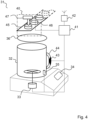
- FIG 3 shows a sketch of a household appliance 31 designed for dispensing medication and for preparing food.
- the household appliance 31 has at least one vessel 32 with a stirring unit 33, which is intended for mixing the food contained in the vessel 32.
- the household appliance 31 in the example is a kitchen machine in which recipes are selected via an operating unit 34 and the step-by-step preparation of food takes place by dosing and stirring with the stirring unit 33 and, if necessary, by heating and cooling with a heating and/or cooling unit 35.
- the vessel 32 has a lid 36 that can be placed on the vessel 32. In the exemplary embodiment shown, the lid 36 is connected to a dosing vessel 37.
- the dosing vessel 37 can, for example, be firmly connected to the lid 36 and/or coupled to the lid 36 and thus to the vessel 32 in the placed state via a hose system.
- the dosing vessel 37 can have several medication receiving areas 38a, 38b, each of which can be connected to an opening in the lid 36 and thus to the vessel 32 via a dosing valve 39a, 39b.
- the dosing valves 39a, 39b are part of the dosing unit 40 in order to dose medication in solid or liquid form into the vessel 32 as required, which is prepared for admixture in the dosing vessel 37.
- a control unit 41 is provided, which controls the medication with the dosing valves 39a, 39b or dosing flaps. or similar, to mix the medication in the vessel 32 according to predetermined rules in a time- and quantity-controlled manner during the preparation of the food.
- the program for dosing the medication can be fed to the control unit 41 via the input unit 34 or via another data interface.
- a data interface can be, for example, a slot with connectors for receiving and contacting a data storage card (SD card or similar), a radio data transmission unit 42 for radio data communication, an RFID reader for reading data from a radio transponder or an optical sensor for reading prescription data, for example via a barcode or OCR code or similar.
- the radio data transmission unit 42 is set up together with the control unit 41 to also send an alarm message to a remote care emergency call center or a relative if it is detected that the automatically prepared food was not removed at the specified times.
- the removal of the food can be sensed by detecting the removal of the container 32 from the platform of the household appliance 31 or at least the removal of the lid 36, e.g. with the help of a button.
- the household appliance 31 can have at least one sensor 43 for recording vital data of the person operating the household appliance 31.
- a vital data sensor 43 can be arranged on the handle 44 of the vessel 32 in order to optically record the pulse rate and possibly the oxygen saturation of the patient using a finger pulse sensor and/or to record other vital data, such as the water content or similar, using an impedance measurement when grasping the vessel 32 on the handle 44.
- the control unit 41 can also be set up, for example by suitable programming, to adapt the medication administration depending on the vital data supplied to the control unit 41.
- These vital data can be transmitted, for example, via the radio data transmission unit 42 from other vital data sensors to the household appliance 31.
- Such vital data sensors can be, for example, a personal scale, a fitness bracelet of the patient and the like, which communicate wirelessly with the household appliance 31, for example using the Bluetooth or WLAN communication standard.
- Vital data monitoring is very useful when providing care. It can reduce the amount of personal care required and enable an independent daily routine.
- a rollator For example, many older people use a rollator to reduce the risk of falling. It is helpful if devices that support mobility, such as a rollator, wheelchair, e-bike or similar, also have vital data sensors, a data transmission unit, a location sensor, a light control, a charging function, a microphone and a camera.
- a fall can be detected with the help of the vital data sensor and a call for help can be sent to an emergency call center via the radio data transmission unit.
- the emergency and call for help function can also be activated via the microphone using voice commands, for example.
- An emergency or call for help can also be triggered automatically when certain predefined indicator features have been recognized.
- a loudspeaker and the camera voice and visual communication can be established from the emergency call center to the person.
- a mobile phone function can be integrated into the auxiliary device.
- Vital data sensors are used to monitor vital signs, such as dizziness or fatigue.
- Optical sensors and/or impedance sensors can be installed on the handles to detect pulse data, oxygen saturation levels and other cardiac and circulatory information of the patient.
- the assistive device is then set up to put the emergency and help call system into an activation mode through the mechanical movements and contact with the handles by the user's hands. If, for example, a rollator falls to the ground in this activation mode, hits an object or tilts at an excessive angle and then the hands lose contact with the rollator, a help call and emergency mode is activated from this "stand-by status".
- the first step is to establish communication via a radio data channel with a nearby mobile device or with a remote emergency call center.
- the auxiliary device can have a battery to supply electrical energy.
- the kinetic energy of the auxiliary device is used, for example, with the help of generators integrated into the wheel hub to recharge the batteries during use. It is also conceivable, however, that other elements for generating electrical energy, such as solar cells, are used to provide the energy required to charge the batteries.
- Such an aid can then be combined with the household appliance 31 in order to ensure that the household appliance 31 is controlled as required, for example with the aid of the radio data transmission unit 42.
- FIG 4 shows a sketch of the household appliance 31 from Figure 3 with a dosing unit 40 set up for admixing medication from blister packs 45.
- the medication is already dosed in medication doses and provided in packaging individually put together for the patient.
- This blister pack 45 is then fed to the dosing unit 40 which, depending on the predetermined time of intake for a medication, opens a blister section 46 provided for this purpose and doses it into a foodstuff.
- the blister pack 45 e.g. blister strip
- the blister pack 45 is moved by the dosing unit 40 with conveyor elements in order to bring a blister section 46, depending on the time of day, into the engagement area of a blister opening unit 47 which opens the blister section 46 in order to bring the liquid, viscous or solid contents from the blister section 46 into the container 32.
- the blister section 46 can simply be opened mechanically, with the medication falling from the blister section 46 into the container 32 by gravity.
- the medication can also be additionally conveyed out of the blister section 46 using a plunger. It is also conceivable that the blister section 46 is rinsed to remove the medication and introduce it into the vessel 32.
- a grinding unit can be arranged between the blister section 46 and the vessel 32 in order to grind the medication if necessary before dosing.
- individual capsules can also be provided.
- the capsules are then opened by the dosing unit 40 depending on the time of day in order to dose the medication contained therein.
- These separate capsules can also be arranged like a blister strip on a common carrier for improved handling.
- the medication is stored individually and in portions in a different type of blister pack 45 in a sterile manner and can be dosed by the dosing unit 40 as required according to a medication schedule individually specified for the patient.
- the dosing unit 40 may have a cooling unit to properly store the medication provided in the blister packs 45 at any required temperature.
- the blister pack 45 only needs to be placed into the dosing unit 40 by nursing staff at longer intervals, which then automatically and reliably provides it to the patient according to a predetermined medication plan. A complex and error-prone manual compilation and provision of the medication is no longer necessary. This means that the nursing effort can be significantly reduced and care can be made safer without the intervention of medical specialists.
- FIG. 5 shows a sketch of the system consisting of seating furniture 15, autonomous household appliance 1 and household appliance 31 for food supply with the addition of medication.
- the other care aids such as in particular the autonomous household appliance 1 and the household appliance 31 set up for administering medication
- it forms a data bridge and central logistics unit, so to speak, for example to control the intake of medication with the help of the household appliance 31 as a medication alarm clock and to monitor the intake of medication with the help of the mobile autonomous household appliance 1.
- the service unit 2 of the seating furniture 15 can communicate with the household appliance 31 in order to control the administration of medication or at least to retrieve information about the addition of medication to food in order to monitor the correct intake of medication on this basis by controlling or querying the autonomous household appliance 1 and/or other vital data sensors and, if necessary, to recognize a need for assistance in the event of deviations from specified environmental and/or vital data.
- the communication of the service unit 2 of the seating furniture 15 with the autonomous household appliance 1 enables the person's surroundings to be monitored as needed in order to be able to follow the daily routine of the person to be cared for through the mobility of the autonomous household appliance 1 and to monitor this person unobtrusively with regard to any need for assistance.
Landscapes
- Engineering & Computer Science (AREA)
- Health & Medical Sciences (AREA)
- Physics & Mathematics (AREA)
- General Health & Medical Sciences (AREA)
- Life Sciences & Earth Sciences (AREA)
- Mechanical Engineering (AREA)
- General Physics & Mathematics (AREA)
- Emergency Management (AREA)
- Business, Economics & Management (AREA)
- Gerontology & Geriatric Medicine (AREA)
- Public Health (AREA)
- Veterinary Medicine (AREA)
- Animal Behavior & Ethology (AREA)
- Chemical & Material Sciences (AREA)
- Heart & Thoracic Surgery (AREA)
- Biomedical Technology (AREA)
- Chemical Kinetics & Catalysis (AREA)
- Remote Sensing (AREA)
- Biophysics (AREA)
- Pathology (AREA)
- Radar, Positioning & Navigation (AREA)
- Aviation & Aerospace Engineering (AREA)
- Medical Informatics (AREA)
- Molecular Biology (AREA)
- Surgery (AREA)
- Automation & Control Theory (AREA)
- Multimedia (AREA)
- Human Computer Interaction (AREA)
- Psychiatry (AREA)
- Vascular Medicine (AREA)
- Computer Security & Cryptography (AREA)
- Oral & Maxillofacial Surgery (AREA)
- General Engineering & Computer Science (AREA)
- Analytical Chemistry (AREA)
- Dentistry (AREA)
- Physiology (AREA)
- Social Psychology (AREA)
- Psychology (AREA)
- Computer Vision & Pattern Recognition (AREA)
- Electromagnetism (AREA)
Description
- Die Erfindung betrifft ein Set aus einem Sitz- oder Liegemöbel für eine zu betreuende Person und einem autonomen Haushaltsgerät, wobei das Sitz- oder Liegemöbel mit einer schwenkbar, verschiebbar und/oder teleskopierbar an dem Sitz- oder Liegemöbel angeordneten Serviceeinheit ausgestattet ist und die Serviceeinheit einen Monitor und eine Eingabeeinheit hat. Das autonome Haushaltsgerät ist in Form eines Bodenreinigungsroboters oder Rasenmähroboters mit einer Plattform, die Fortbewegungsmittel, Umgebungssensoren zur Detektion von Eigenschaften der Umgebung des autonomen Haushaltsgerätes und eine Steuerungseinheit hat, wobei die Umgebungssensoren mit der Steuerungseinheit verbunden sind und die Steuerungseinheit zur autonomen Fortbewegung des Haushaltsgerätes durch Ansteuerung der Fortbewegungsmittel in Abhängigkeit von den detektierten Umgebungseigenschaften und zum ständigen Abfahren eines Gebietes zur Ausführung seiner eigentlichen Haushaltstätigkeit eingerichtet ist.
- Solche autonomen Haushaltsgeräte sind an sich als Saugroboter zur Bodenreinigung in Gebäuden oder Mährobotern zum autonomen Mähen von Rasenflächen hinreichend bekannt. Sie sind durch geeignete Sensoren, wie Tastsensoren, induktive Grenzliniensensoren, Ultraschallsensoren, optische Sensoren oder Ortungssensoren so eingerichtet, dass sie Hindernisse einschließlich von Stufen und Vertiefungen erkenn und umfahren und über eine längere Zeit eine zusammenhängende Fläche mindestens einmal bearbeitet haben.
-
DE 10 2011 053 990 A1 beschreibt beispielsweise eine elektrische Küchenmaschine, in der Rezepte zum Aufruf abgespeichert sind. - Bei der Patientenversorgung besteht ein Bedarf, um die ärztlich verordnete Eingabe von Medikamenten im Tagesablauf sicherzustellen und zu überwachen. Hierzu ist in
DE 20 2006 004 282 U1 ein Arzneimittelspender für die Zuteilung von Medikamenten beschrieben, der einen vom Funktionsschalter ausgelösten Entriegelungsmechanismus zur Medikamentenausgabe hat. -
DE 20 2012 000 410 U1 beschreibt ein System für die geriatrische Notfall- und Vitalparameterkommunikation zur Kontrolle der Medikamenteneinnahme eines Patienten, das als tragbares Gerät ausgestaltet ist. -
DE 10 2015 100 224 A1 offenbart ein implantierbares Medikamentenapplikationssystem, das operativ in einen Hohlraum des Körpers eingesetzt werden muss. -
US 2016/0058245 A1 zeigt ein Gerät, das ausschließlich zur Zubereitung von Energiedrinks mit Nahrungsergänzungsmitteln vorgesehen ist, nicht aber zur Medikamentengabe. -
EP 0 753 160 B1 beschreibt ein Verfahren und ein Gerät zur Hinderniserkennung für ein solches autonomes Gerät. Dabei ist mindestens ein Mikrofon vorgesehen, um mit akustischen Methoden Hindernisse zu erkennen. - Zur Überwachung von hilfsbedürftigen Personen sind zudem im Gebäude installierte oder von der zu betreuenden Person am Körper zu tragende mobile Not- und Hilferufsysteme bekannt. Damit soll Menschen, die z. B. aufgrund von Herzkreislaufstörungen, Spastiken, Tremor und Demenz eingeschränkt sind, ein eigenständiges Leben in der eigenen Wohnung ermöglicht werden. Ein solches Notsystem ist beispielsweise in
DE 195 17 037 A1 beschrieben. -
US 2015/0273697 A1 undUS 2005/0216126 A1 offenbaren autonome Serviceroboter, die zur Unterstützung von zu versorgenden Personen speziell ausgestaltet sind und hierzu eine sehr robuste Plattform haben. -
US 2005/0154265 A1 beschreibt einen Roboter, der als Schnittstelle zwischen einem Arzt oder einer Pflegekraft und einem Patienten dient, um mit Spracherkennung Wünsche aufzunehmen und weiterzugeben. -
US 5,553,609 A beschreibt ein Patientenüberwachungssystem mit Videokameras, Mikrofonen und Lautsprechern, die mit einer Überwachungszentrale verbunden sind. -
US 5,802,494 A offenbart ein entsprechendes Patientenmonitorsystem, das zusätzlich spezialisierte Pflegeroboter zur Patientenunterstützung aufweist. -
US 2006/0176182 A1 zeigt einen hundeartigen Roboter mit einer Kamera, der zur Überwachung des Gesundheitszustandes und der Sicherheit von Personen speziell ausgestaltet ist. - In
US 2016/0166577 A1 sind fliegende Drohnen zur Überwachung beschrieben. -
US 2013/0245827 A1 offenbart ein ferngesteuertes Überwachungssystem mit einem fahrbaren Überwachungsgerät, das ein Gebiet innerhalb einer vorgegebenen räumlichen Zone überwacht und eine Alarmmeldung abgibt, wenn z. B. ein Kleinkind diese Zone überschreitet. Im Überwachungsmodus positioniert sich das Gerät im Bereich der vorgegebenen Grenze.DE 10 2011 087 589 A1 beschreibt ein modulares Assistenzsystem für eine Person, das mindesten eine mobile Einheit hat, die wahlweise mit austauschbaren Funktionsmodulen zur Versorgung der Person, mit Messmodulen, mit von der Person fernsteuerbarem Reinigungsmodul usw. ausgerüstet werden kann. - Ein Problem tragbarer Not- und Hilfseinrichtungen, die z. B. wie eine Armbanduhr von der zu betreuenden Person mitgeführt werden müssen, besteht in der Akzeptanz. Die betreuende Person muss für die Sicherstellung der Funktionalität gewährleisten, dass sie die Notrufeinheit auch mitführt. Die Festinstallation von Notrufanlagen in Gebäuden ist aufwendig und bedarf ebenfalls der Akzeptanz.
-
WO 2008/057618 A2 beschreibt einen ergonomisch ausgebildeten Sessel mit einer Halterung, an der ein Bildschirm eines Computers angeordnet ist. -
CN 106 037 326 A offenbart einen zur drahtlosen Kommunikation ausgebildeten Multifunktionssessel mit integrierten Lautsprechern und Mikrophon. -
US 2014/091604 A1 offenbart einen Cockpitsitz für ein Flugzeug mit einer beweglich an dem Cockpitsitz angeordneten Steuereinheit in Form eines Tabletcomputers mit berührungsempfindlichem Bildschirm (Touch-Screen-Tablet), der zur Kommunikation mit Steuereinheiten des Flugzeugs ausgebildet ist. - Die Veröffentlichung ""COMPUTER-IN-AN-ARMCHAIR", IBM TECHNICAL DISCLOSURE BULLETIN, INTERNATIONAL BUSINESS MACHINES CORP. (THORNWOOD), US, Bd. 32, Nr. 9B, 1. Februar 1990, Seiten 305-307" beschreibt einen Sessel für eine zu betreuende Person mit integriertem PC.
- Ausgehend hiervon ist es daher Aufgabe der vorliegenden Erfindung, eine zuverlässige und möglichst einfache sowie kaum wahrnehmbare Hilfseinrichtung für bedürftige Personen zu schaffen.
- Die Aufgabe wird mit dem Set mit den Merkmalen des Anspruchs 1 gelöst. Vorteilhafte Ausführungsformen sind in den Unteransprüchen beschrieben.
- Es wird vorgeschlagen, ein Sitz- oder Liegemöbel als Ladestation für ein autonomes Haushaltsgerät zu nutzen.
- Dabei wird das gattungsgemäße autonome Haushaltsgerät als Plattform ergänzend zur eigentlichen Haushaltstätigkeit zur Erkennung der Hilfsbedürftigkeit einer Person in Abhängigkeit von Umgebungseigenschaften genutzt, die mit Umgebungssensoren des autonomen Haushaltsgeräts erfassbar sind. Das autonome Haushaltsgerät hat dann eine Kommunikationseinheit, die zum Aufbau einer Kommunikationsverbindung mit einer entfernt angeordneten Serviceeinheit eingerichtet ist. Die Kommunikationseinheit kann zur drahtlosen Funkkommunikation mit einer Funksendeeinheit oder einem Tranceiver eingerichtet sein. Optional hierzu oder ergänzend zur drahtlosen Kommunikation kann die Kommunikationseinheit auch zum drahtgebundenen Datenaustausch mit der Serviceeinheit eingerichtet sein, z. B. indem das autonome Haushaltsgerät in Kontakt mit einer Dockingstation tritt, um ein Auslesen der in dem autonomen Haushaltsgerät zwischengespeicherten Daten zu ermöglichen. Die Dockingstation kann bevorzugt eine Ladestation für das autonome Haushaltsgerät sein. Damit kann ein abhör- und manipulationsgesicherter Datenaustausch sichergestellt werden. Bei der drahtlosen Kommunikation kann dies durch verschlüsselte und/oder zertifizierte Datenübertragung gewährleistet werden.
- Das Haushaltsgerät ist ein Bodenreinigungsroboter oder ein Mähroboter, der eine Bodenreinigungs- oder Rasenmäheinheit hat. Ein solcher Bodenreinigungsroboter kann beispielsweise ein Staubsauger, ein Flächenwischroboter oder eine Kombination hiervon sein. Ein solcher Flächenwischroboter kann beispielsweise ein Bodenwischroboter oder sogar ein Fensterreinigungsroboter sein.
- Das autonome Haushaltsgerät fährt, wie bei Saugrobotern oder Mährobotern üblich, ständig das zugewiesene Gebiet ab und überwacht dabei ergänzend zur eigentlichen Haushaltstätigkeit noch mithilfe der Umgebungssensoren die Hilfsbedürftigkeit einer Person.
- Die Erkennung der Hilfsbedürftigkeit einer Person kann mit einer hierzu eingerichteten Personenhilfseinheit erfolgen, die z. B. durch modularen Anbau an das autonome Hilfsgerät in dieses integriert und zur drahtlosen Übermittlung einer Hilfeanforderung über die Kommunikationseinheit im Falle einer erkannten Hilfebedürftigkeit eingerichtet ist. Alternativ kann die Erkennung der Hilfsbedürftigkeit auch durch die als Personenhilfseinheit ausgebildete entfernte Serviceeinheit anhand der von dem autonomen Haushaltsgerät drahtlos empfangenen Umgebungssensordaten erfolgen. Das autonome Haushaltsgerät wirkt somit durch Detektion von Umgebungseigenschaften bei der letztendlich durch die entfernte Serviceeinheit durchgeführte Erkennung der Hilfsbedürftigkeit mit.
- Mithilfe der autonom bewegbaren Plattform kann sich das autonome Haushaltsgerät mit seinen Umgebungssensoren in einem Raumbereich selbstständig bewegen und auf Anforderung z. B. bei einem erkannten Hilferuf zu der hilfsbedürftigen Person fahren und die Hilfsbedürftigkeit verifizieren und melden. Der Raumbereich, d. h. das Gebiet, in dem das autonome Haushaltsgerät seine eigentliche Haushaltstätigkeit selbstfahrend ausführt, ist durch die Hindernis- oder Grenzerkennung festgelegt. Er wird durch die Positionierung des Haushaltsgebietes zugewiesen und kann durch Grenzmarkierungen eingegrenzt werden.
- Die Personenhilfseinheit fällt dabei nicht auf, so dass sich die zu betreuende Person nicht völlig überwacht und beobachtet fühlt und jeder Außenstehende erkennt, dass aufgrund von gesundheitlichen Einschränkungen Pflegehilfsmittel notwendig sind. Bereits vor Beginn der Pflegebedürftigkeit genutzte Haushaltsgeräte können als Plattform weitergenutzt werden und werden hierdurch akzeptiert. Die Kommunikationseinheit und eine Einheit zur Detektion von Umwelteigenschaften oder Zusammenführung bereits in der Plattform vorhandener Umweltsensordaten zur Weiterleitung durch die Kommunikationseinheit ggf. mit einer vorherigen (Vor-)Auswertung kann dann an der Plattform als Zusatzmodul befestigt werden. Hierzu bietet sich ein Aufsteckmodul, ein Anclipsmodul oder ähnliches an.
- Dies wird durch das Sitz- oder Liegemöbel erreicht, das die entfernt angeordnete Serviceeinheit zur einfachen und raschen Interaktion mit der dieses Möbelstück regelmäßig als Hauptlebensmittelpunkt nutzenden Person trägt. Die Serviceeinheit hat hierzu einen Monitor und eine Eingabeeinheit und ist zur drahtlosen Kommunikation mit dem autonomen Haushaltsgerät eingerichtet. Im Fußbereich des Sitz- oder Liegemöbels ist eine Ladestation zur Andockung und Aufladung des autonomen Haushaltsgerätes mit elektrischer Energie angeordnet. Damit bildet das Sitz- oder Liegemöbel (Sessel, Stuhl oder Pflegebett) nicht nur den Hauptlebensmittelpunkt der zu betreuenden Person, sondern auch die Zentrale für das zur Betreuung genutzte autonome Haushaltsgerät. Durch die erfindungsgemäße Anordnung der Ladestation im Fußbereich dieses Möbelstücks ist es für die zu betreuende Person und Besucher wenig auffällig positioniert und in einem Raumbereich betriebsbereit parkbar, an der die zu detektierenden Anzeichen für eine Hilfsbedürftigkeit mit der größten Wahrscheinlichkeit auftreten. Die Wege zur Umgebungsdetektion mit Hilfe der Umgebungssensoren sind damit optimal verkürzt.
- Die Ladestation kann gleichzeitig als Dockingstation zum Aufbau einer drahtgebundenen Datenverbindung mit der Kommunikationseinheit des autonomen Haushaltsgerätes ausgebildet sein. Hierzu haben die Ladestation und das autonome Haushaltsgerät elektrische Kontakte, die beim Ankoppeln des autonomen Haushaltsgerätes an die Ladestation in Kontakt miteinander treten. Damit kann ein im Vergleich zur drahtlosen Kommunikation wesentlich abgesicherter Datenaustausch gewährleistet werden.
- Das autonome Haushaltsgerät kann eine Kamera haben, die mit der Kommunikationseinheit zur Übertragung von Umgebungsbildern an die Serviceeinheit eingerichtet ist. Mithilfe dieser Kamera kann z. B. bei erkannter Hilfsbedürftigkeit eine detailliertere Bildinformation an Pflege- und Hilfskräfte übermittelt werden. Die Kamera kann auch als Umgebungssensor genutzt werden, um bei Bedarf eine erkannte Hilfsbedürftigkeit zu verifizieren oder anhand der aufgenommenen Bilder durch Muster- oder Bildervergleich zu erkennen.
- Das autonome Haushaltsgerät kann mit Hilfe der entfernt angeordneten Serviceeinheit oder von einer damit vernetzten Kommandoapplikation fernsteuerbar ausgebildet sein. Damit lassen sich ferngesteuerte Überwachungsfahrten durch Pflegepersonal durchführen, ohne dass die Wohnung der zu betreuenden Person besucht und betreten werden muss und die Person durch einen solchen Betreuungsbesuch ggf. gestört wird. Die zu betreuende Person kann auf diese Weise auch in Kontakt zu einer Pflegeperson aufnehmen und auf schnelle und effiziente Weise Hilfe erhalten, wobei die Intensität der ferngesteuerten Pflege und Kontaktaufnahme steuerbar ist. Es wird somit eine Überwachung ohne physische Anwesenheit von Pflegepersonal ermöglicht.
- Die Kamera kann dabei ferngesteuert ausrichtbar und/oder fokussierbar sein. Hierzu kann die Kamera Aktoren zur Änderung des Schwenkwinkels, Nickwinkels und/oder des Zoomverhältnisses haben. Damit ist es denkbar, dass Befehle, die von einer entfernten Serviceeinheit eingegeben werden, die Kamera bei erkannter Hilfsbedürftigkeit verschwenkt wird, um die Lage in der Umgebung der hilfsbedürftigen Person zu ermitteln und auf dieser Grundlage einen Hilfseinsatz zu koordinieren.
- Das Haushaltsgerät kann mindestens ein Mikrofon zur Erfassung von Schallsignalen haben. Die Personenhilfseinheit kann dann mittels erfasster Schallsignale zur gesteuerten Fortbewegung zu der Schallquelle hin und/oder zur Erkennung von der Hilfsbedürftigkeit in Abhängigkeit eines Vergleichs erfasster Schallsignale mit vordefinierten Schallmustern eingerichtet sein. Mithilfe des Mikrofons gelingt es, dass die zu betreuende Person einen Hilferuf an das autonome Haushaltsgerät absetzt. Das autonome Haushaltsgerät ist dann in der Lage, die Hilfsbedürftigkeit zu verifizieren und z. B. mittels Mikrofons und Kamera eine Kommunikation zwischen entfernt verfügbaren Hilfspersonal über die entfernte Serviceeinheit mit der hilfsbedürftigen Person aufzubauen. Dabei ist zur akustischen Kommunikation vorteilhaft auch noch mindestens einen Lautsprecher in dem autonomen Haushaltsgerät integriert, um eine bidirektionale Audio-Kommunikationsverbindung zwischen der hilfsbedürftigen Person und der entfernten Serviceeinheit zu ermöglichen.
- Mindestens ein Umgebungssensor des Haushaltsgerätes kann zur Detektion von Eigenschaften von mit der Bodenreinigungs- oder Rasenmäheinheit aus der Umgebung aufsammelbaren Elementen eingerichtet sein. So ist es beispielsweise möglich mithilfe von Gassensoren, chemischen Sensoren oder optischen Sensoren zu erkennen, ob Medikamente, Alkohol, Blut, Urin oder andere Körperexkremente mithilfe des Haushaltsgerätes aufgefangen wurden. Das Erkennen solcher Eigenschaften ist dann ein Hinweis für eine Hilfsbedürftigkeit. So ist das Auffinden von Alkohol ein Zeichen für das Verschütten von flüssigen Medikamenten, die in der Regel auf Alkoholbasis zubereitet sind, und damit ein Hinweis auf die Gefahr einer vorschriftswidrigen Medikamenteneinnahme. Bevorzugt sind die Umgebungssensoren und die nachgelagerten Detektionsroutinen ausgebildet, um pharmazeutische Mittel anhand typischer Arzneiträgerstoffe oder pharmazeutischer Hilfsstoffe zu erkennen. Dies können Füllstoffe (z. B. Lactose, Cellulose, Stärke, Saccharose, Paraffin, Hartfett, Polyethylenglykoel, Polyethylenoxide), Lösungs- oder Befeuchtungsmittel (z. B. Wasser, Ethanol, Isopropanol), Emulgatoren (z. B. Cetylstearylalkohol, Gylcerolmonostearat, Lecithin, Fettsäureester des Sorbitans, des Polyoxyethylensorbitans (Polysorbate), des Polyoxyethylens, Polyoxyethylenfettalkoholether), Lösungsvermittler oder Netzmittel (z. B. Polyethylenglykole, Polyethylenoxide, Polysorbate), Puffer (z. B. Natriumdihydrogenphosphat, Natriumhydrogencarbonat, Calciumhydrogenphosphat, Trometamol), Verdickungs- und Bindemittel (z. B. Stärken, Guaran, Xanthan, Alginat, Carrageen, Pektin, Traganth, Polyacrylsäuren, Polyvinylpyrrolidon; hochdisperses Siliciumdioxid, substituierte Celluloseether (Methylcellulose, Ethylcellulose, Hydroxypropylcellulose, Hydroxypropylmethylcellulose, Carboxymethylcellulose), Umhüllungsmittel (z. B. Saccharose, Gelatine, Gelatinepolysuccinat, Polyacrylate, Ethylcellulose, Methylcellulose), Zerfallsbeschleuniger und Sprengmittel (z. B. Stärken, Croscarmellose, Natriumhydrogencarbonat in Kombination mit Citronensäure), Gleit- und Schmiermittel und Fromtrennmittel (z. B. Polyethylenglykole, Polyethylenoxide, Talkum, Magnesiumstearat), Fließregulierungsmittel (z. B. hochdisperses Siliciumdioxid), Antioxidantien (z. B. Butylhydroxytoluol, all-rac-α-Tocopherol), Konservierungsstoffe (z. B. PHB-Ester, Benzalkoniumchlorid, Benzylalkohol, Thiomersal), Süßungsmittel und Geschmackskorrigientien (z. B. Saccharose, Sorbit, Süßstoffe wie etwa Saccharin-Natrium und Cyclamat; Aromen) oder Resorptionsbeschleuniger (z. B. Dimethylsulfoxid) sein.
- Umgebungssensoren können beispielsweise in Borsten oder Lappen einer Bodenreinigungseinheit integriert sein. Unter einer Bodenreinigungseinheit wird nicht nur eine zur Reinigung einer horizontalen Ebene geeignete Einheit verstanden. Denkbar ist auch z. B. eine Glasoder Wandreinigungsfunktion für vertikale Ebenen, wobei ein solches Haushaltsgerät zur Patientenüberwachung aufgrund des möglichen Blickwinkels schräg von oben nützlich ist, wenn z. B. ein Pflegebett neben einem Fenster steht.
- Denkbar ist in Verbindung mit einer Bodenreinigungseinheit die Nutzung von Nachweisflüssigkeiten, mit denen die Borsten oder Lappen manuelle oder automatisch getränkt werden. Durch Integration optischer Sensoren in der Nähe der Borsten oder Lappen kann dann die Einfärbung der Borsten oder Lappen untersucht und anhand charakteristischer Farbwerte oder Farbspektren auf Umgebungseigenschaften geschlossen werden.
- Auf solche Eigenschaften kann beispielsweise beim Überschreiten vorgegebener Schwellwerte geschlossen werden. Denkbar ist auch eine Korrelation mit anderen erfassten Eigenschaften oder eine Erkennung von Hilfsbedarf bei über einen Zeitraum auftretender Häufung solcher Vorkommnisse. Dabei ist es hilfreich, zur Pflegedokumentation solche Ereignisse zu protokollieren, um es als Pflegetagebuch ausdrucken zu können oder eine offene Schnittstelle zu haben, so dass eine Anbindung an eine Pflegedokumentation eines Pflegeanbieters möglich ist.
- Ein als Saugroboter ausgestaltetes autonomes Haushaltsgerät kann einen transparenten Auffangbehälter mit einer Grobfiltereinheit haben, die mit der Bodenreinigungseinheit verbunden und zum Auffangen von auf dem Boden liegenden Medikamenten geeignet ist. Damit gelingt es durch Sichtprüfung schnell festzustellen, ob sich im Auffangbehälter Medikamente gesammelt haben, die auf eine nicht ordnungsgemäße Medikamenteneinnahme und damit einer Hilfsbedürftigkeit schließen lassen.
- Die Personenhilfseinheit kann zur Aktivierung einer Hilfeeinheit eingerichtet sein, die mindestens eine Kamera und ein Mikrofon umfasst. Die Aktivierung erfolgt, wenn mittels mindestens eines tastenden Sensors, Gassensors, Lichtsensors und/oder Schallpegelsensors eine Hilfsbedürftigkeit erkannt wurde. Auch hier können beispielsweise vordefinierte Schwellwerte als Kriterium zur Aktivierung herangezogen werden. So kann mithilfe eines tastenden Sensors beispielsweise festgestellt werden, ob eine Person am Boden liegt. Mithilfe von Gassensoren lassen sich auffällige Zusammensetzungen der Umgebungsluft, wie beispielsweise Sauerstoffmangel oder ein erhöhter Uringehalt feststellen. Ein reduzierter Sauerstoffmangel in der Umgebungsluft zeigt, dass die zu betreuende Person nicht mehr in der Lage ist, selbsttätig für eine regelmäßige Lüftung zu sorgen. Eine erhöhte Urinkonzentration in der Luft ist ein Zeichen, dass beispielsweise Inkontinenz vorliegt oder Windel gewechselt werden müssen.
- Die Personenhilfseinheit kann mindestens eine Schnittstelle zur Anbindung von Personen-Vitaldatensensoren und zur Auswertung und/der zur Übertragung von mit den Personen-Vitaldatensensoren erfassten Sensordaten über die Kommunikationseinheit an eine entfernte Serviceeinheit eingerichtet sein. Dies hat den Vorteil, dass die mit dem autonomen Haushaltsgerät gekoppelte Personenhilfseinheit weiterhin an zusätzliche Geräte vorzugweise drahtlos ankoppelbar ist, mit den Personen-Vitaldaten aufgenommen werden. Dabei kann es sich beispielsweise um Personenwagen oder z. B. am Handgelenk oder um den Brustumfang zu tragende Puls- und Herzrhythmusmessgeräte, Blutzuckermessgeräte, Körpertemperaturmessgeräte und ähnliches handeln. Die Datenübertragung erfolgt dabei vorzugsweise drahtlos über geeignete Funkkommunikationsschnittstellen. Mithilfe dieser Personen-Vitaldatensensoren kann zudem noch eine Korrelation mit den Umgebungseigenschaften vorgenommen werden, die mithilfe der Umgebungssensoren des autonomen Haushaltsgeräts erfasst werden. Damit kann die Qualität der Erkennung der Hilfsbedürftigkeit verbessert werden.
- Mit der Serviceeinheit des Sitz- oder Liegemöbels können je nach Tageszeit oder Verhaltensmustern der zu betreuenden Person unterschiedliche Stufen der Sensibilität des autonomen Haushaltsgerätes vorgegeben werden. So kann die Serviceeinheit das autonome Haushaltsgerät beispielsweise für den Zeitbereich einer geplanten Medikamenteneinnahme in erhöhte Alarmbereitschaft versetzen, so dass das autonome Haushaltsgerät in diesem Zeitbereich verstärkt die Umgebung des Sitz- und Liegemöbels und andere mit der Medikamenteneinnahme zusammenhängende Raumbereiche nach heruntergefallenen Medikamenten absucht. Die Erkennungsschwelle des autonomen Haushaltsgerätes kann für Zeitbereiche, in denen Pflegeereignisse stattfinden, auch geändert werden.
- Die Personenhilfseinheit kann zur drahtlosen Öffnung von Türschließeinheiten ausgebildet sein, wenn eine Hilfsbedürftigkeit erkannt würde. Hierzu kann die Personenhilfseinheit durch eine geeignete Parametrierung ermöglicht werden, um mithilfe einer Funk-Kommunikationseinheit Funktürschlösser zu entriegeln, um somit Hilfspersonen den Zutritt zu den ansonsten von außen geschlossenen Räumen zu ermöglichen. Dies ist z. B. für ansonsten von innen abschließbare Sanitärräume hilfreich.
- Das autonome Haushaltsgerät kann weiterhin eine Warneinheit zur Ausgabe von optischen und/oder akustischen Warnsignalen bei mittels des mindestens einen Umgebungssensors erfasster Annährung einer Person an das Gerät haben. Damit wird die Gefahr reduziert, dass die pflegedürftigen Personen versehentlich auf das autonome Haushaltsgerät treten und stürzen. Die Warneinrichtung kann beispielsweise so eingerichtet sein, dass das optische und/oder akustische Signal umso deutlicher wird, je näher die Umgebungssensoren an Menschen und Tiere kommen.
- Die Serviceeinheit ist bevorzugt in eine bewegbare Armlehne oder eine bewegbare Ablage (z. B. Tisch) des Sitz- oder Liegemöbels integriert. Die Armlehne oder Ablage kann dabei vom sitzenden Benutzer beispielsweise durch Verschwenken oder Verbiegen in eine Position gebracht werden, in welcher der Benutzer den Bildschirm der in der Armlehne oder der Ablage integrierten Serviceeinheit gut erfassen und im Falle eines berührungsempfindlichen Bildschirms (Touch-Screen) auch bedienen kann. Die Armlehne bietet damit zugleich eine Auflagefläche für die Arme und eine Aufnahme für die Serviceeinheit, insbesondere für den Monitor der Serviceeinheit, um die dort beweglich aufgenommene Serviceeinheit in das Gesichts- und Bedienfeld des Benutzers zu bringen. Diese Anordnung bietet vor allem bei sehbeeinträchtigten Personen einen Vorteil, da die Positionierung an der Armlehne auch optimal in Sicht- und Augennähe ist.
- Die Integration der Serviceeinheit in eine Armlehne oder Ablage, d. h. den integralen Einbau in die Armlehne oder Ablage, hat im Vergleich zu dem Anbau an einem von der Armlehne oder Ablage entkoppelten Stativ den Vorteil, dass die Serviceeinheit unscheinbar ist. Eine an einem Stativ montierte Serviceeinheit kann auch leichter abgebaut und verlegt werden, wohingegen die in die Armlehne oder Ablage integrierte Serviceeinheit dort in jedem Falle verbleibt und damit zuverlässig verfügbar ist. Die zur Personenüberwachung und Pflege benötigte Technik wird auf diese Weise in ein vorhandenes (ggf. mobiles) Sitz- oder Liegemöbel integriert und steht am Lebensmittelpunkt der Person zuverlässig zur Verfügung.
- Vorteilhaft ist es, wenn das Sitz- und Liegemöbel einen Getränkehalter hat, der mit Sensoren zur Überwachung des Getränkekonsums des Patienten aus dem im Getränkehalter positionierbaren Gefäß gekoppelt ist. Damit kann die Serviceeinheit eingerichtet sein, bei unzureichender Getränkeaufnahme eine Erinnerung bspw. über einen Lautsprecher auszugeben. Der Getränkehalter kann ein thermisches Element zur Warmhaltung und/oder Kühlung des im Getränkehalter angeordneten Gefäßes bzw. seines Inhalts haben.
- Es ist weiterhin vorteilhaft, wenn mindestens ein Mikrofon und/oder Lautsprecher in das Sitzoder Liegemöbel eingebaut und mit der Serviceeinheit verbunden ist. Das Sitz- und Liegemöbel kann zudem darin integrierte Vitaldatensensoren haben.
- Das Sitz- und Liegemöbel kann stationär sein. Es kann aber auch mobil, d. h. verfahrbar sein. Hierzu bietet sich an, wenn das Sitz- oder Liegemöbel Rollen hat, die arretierbar oder versenkbar sind, um zwischen einem mobilen verfahrbaren Zustand und einem sicheren stationären Zustand wechseln zu können.
- Das Sitz- und Liegemöbel mit seiner Serviceeinheit bildet die Zentrale, in der die weiteren Pflegehilfsmittel, wie insbesondere das autonome Haushaltsgerät und das zur Medikamentengabe eingerichtete Haushaltsgerät, zusammengeführt und miteinander vernetzt werden. Es bildet hierfür sozusagen eine Datenbrücke und zentrale Logistikeinheit, um beispielsweise als Medikamentenwecker die Medikamenteneinnahme mit Hilfe des Haushaltsgerätes zu steuern und mit Hilfe des mobilen autonomen Haushaltsgerätes die Medikamenteneinnahme zu überwachen. Die Serviceeinheit des Sitz- oder Liegemöbels kann mit dem Haushaltsgerät kommunizieren, um die Medikamentengabe zu steuern oder zumindest Informationen über Medikamentenbeimischung in Lebensmittel abzurufen, um auf dieser Grundlage durch Ansteuerung oder Abfrage des autonomen Haushaltsgerätes und/oder weiterer Vitaldatensensoren die korrekte Medikamenteneinnahme zu überwachen und ggf. bei Abweichungen von vorgegebenen Umgebungs- und/oder Vitaldaten eine Hilfebedürftigkeit zu erkennen. Die Kommunikation der Serviceeinheit des Sitz- oder Liegemöbels mit dem autonomen Haushaltsgerät ermöglicht bedarfsgerechte Überwachungen der Umgebung der Person, um durch die Mobilität des autonomen Haushaltsgerätes dem Tagesablauf der zu betreuenden Person folgen zu können und diese im Hinblick auf eine etwaige Hilfebedürftigkeit unauffällig zu überwachen. Dabei können Vitaldatensensoren eine weitere Überwachung durch die Serviceeinheit und der damit vernetzten Pflegehilfsmittel auslösen. Durch die Interkommunikation der Pflegehilfsmittel lassen sich valide Informationen zur Hilfebedürftigkeit der Person ableiten, die über die einzelnen Daten des autonomen Haushaltsgerätes oder des Haushaltsgerätes hinausgehen. So kann aufgrund von sensierten Daten des Haushaltsgerätes, das zur Beimischung von Medikamenten in Lebensmitteln eingerichtet ist, eine Überwachungsfahrt durch das autonome Haushaltsgerät ausgelöst werden, um damit weitere Informationen zur Hilfebedürftigkeit zu erhalten.
- Denkbar ist auch die weitere Vernetzung mit anderen Pflegehilfsmitteln, wie beispielsweise mit Vitaldatensensoren von Toiletten, Geschirr, Besteck oder ähnlichem, die zur Detektion von Zuständen der zu betreuenden Person eingerichtet sind und/oder mit Sensoren an Küchengeräten, wie Kühlschränken (z. B. zur Ermittlung der Haltbarkeit von Lebensmitteln oder deren Entnahme), welche ebenfalls Indikatoren zur Hilfsbedürftigkeit liefern. Durch die Gesamtschau dieser Indikatoren gelingt es insbesondere mit Hilfe des mobilen autonomen Haushaltsgerätes, die aus der Zusammenschau der Daten gewonnenen Informationen zur Hilfebedürftigkeit zu verifizieren, Zusammenhänge zu evaluieren und Ursachen zu erkennen.
- Das autonome Haushaltsgerät kann auf diese Weise durch die Serviceeinheit angesteuert werden, um mit adaptierter Sensibilität Umgebungseigenschaften zu erfassen, mit denen eine Hilfebedürftigkeit der zu betreuenden Person noch sicherer erkannt und ggf. validiert werden kann.
- Das zur Medikamentengabe eingerichtete Haushaltsgerät kann ein zur Zubereitung von Lebensmitteln mit einem Gefäß ausgebildetes Haushaltsgerät sein, das eine Dosiereinheit hat, die mit dem Gefäß verbunden ist. Das zur Medikamentengabe ausgebildete Haushaltsgerät ist vorgesehen und geeignet, auch unabhängig von der Medikamentengabe ein Lebensmittel für den Benutzer bereitzustellen und unterscheidet sich damit elementar von aus der
US 2016/0058245 A1 bekannten Geräten, die ausschließlich zur Zubereitung von Energiedrinks mit Nahrungsergänzungsmitteln ausgebildet sind. - Die Dosiereinheit hat ein Dosiergefäß zur Aufnahme von Medikamenten. Eine Steuerungseinheit ist zur Ansteuerung der Dosiereinheit vorgesehen, die zur vorgegebenen Beimischung von Medikamenten aus dem Dosiergefäß zu dem im Gefäß befindlichen Lebensmittel in Abhängigkeit von der Zubereitung eines Lebensmittels eingerichtet ist.
- Für die kontrollierte Medikamentengabe wird ein vom Patient im Tagesablauf regelmäßig genutztes Haushaltsgerät verwendet, wobei die zu verabreichenden Medikamente bei der üblichen Zubereitung des Lebensmittels diesem beigemischt werden, damit erfolgt die Medikamentenabgabe automatisierbar zusammen mit der Lebensmittelzubereitung und Lebensmitteleinnahme, ohne dass gesonderte Geräte oder Vorrichtungen zur Medikamentenzuteilung erforderlich sind. Diese Kombination der Dosiereinheit zur Medikamentenbeimischung mit einem Haushaltsgerät eignet sich für Ein-Personen-Haushalte, wie sie regelmäßig bei der Seniorenpflege anzutreffen sind. Die Dosiereinheit kann als separates Teil auf das Haushaltsgerät aufsetzbar oder in das Haushaltsgerät integriert sein.
- Das zur Medikamentengabe eingerichtete Haushaltsgerät hat vorzugsweise eine Rühreinheit in dem Gefäß, die dann zur Vermischung des eindosierten Medikaments in das Lebensmittel gleich mitbenutzt werden kann.
- Das zur Medikamentengabe eingerichtete Haushaltsgerät kann eine mit dem Gefäß gekoppelte Heiz- und/oder Kühleinheit haben. Damit kann das zuzubereitende Lebensmittel zum Garen erhitzt oder abgekühlt werden. Mit Hilfe dieser Heiz- und/oder Kühleinheit kann durch geeignete Ansteuerung über die Steuerungseinheit eine für das Eindosieren von Lebensmitteln und insbesondere von Medikamenten günstige Temperatur eingestellt werden. Das Dosiergefäß kann mehrere voneinander getrennte Medikamentenaufnahmebereiche haben. Die Dosiereinheit ist zur gesteuerten Beimischung ausgewählter Medikamente aus den Medikamentenaufnahmebereichen eingerichtet. Damit ist es möglich, eine komplexere Medikamentenverordnung bedarfsgerecht umzusetzen, bei der verschiedene Medikamente in den einzelnen Medikamentenaufnahmebereichen vorbereitet und jeweils bedarfsgerecht zur gewünschten Zeit oder zu passenden Lebensmitteln beigemischt werden.
- Die Dosiereinheit kann ein Mahlwerk zur Zerkleinerung von Medikamenten haben, die in fester Form vorliegen. Auf diese Weise können Tabletten oder Kapseln zerkleinert und derart aufbereitet in das Lebensmittel eingemischt werden.
- Besonders vorteilhaft ist es, wenn die Medikamente bereits in Medikamentengaben dosiert in individuell für den Patienten zusammengestellte Verpackungen bereitgestellt werden. Diese mindestens eine Verpackung wird dann der Dosiereinheit zugeführt, die in Abhängigkeit von der vorgegebenen Einnahmezeit für ein Medikament eine entsprechend hierzu bereitgestellte Einzelverpackung oder einen Verpackungsabschnitt öffnet und in ein Lebensmittel eindosiert. Eine solche Verpackung kann beispielsweise ein Blister sein, der in Blisterabschnitten individuell eingepackte Medikamente tageszeitabhängig bereitstellt. Ein Blisterstreifen kann dann durch die Dosiereinheit mit Förderelementen bewegt werden, um je nach Tageszeit einen Blisterabschnitt in den Eingriffsbereich einer Eindosiereinheit zu bringen, welche den Blisterabschnitt öffnet und den flüssigen, zähflüssigen oder festen Inhalt aus dem Blisterabschnitt in das Gefäß zu bringen. Hierzu kann der Blisterabschnitt ggf. durchspült werden. Denkbar ist auch, dass eine Mahleinheit zwischen dem Blisterabschnitt und dem Gefäß angeordnet ist, um das Medikament vor der Eindosierung zu zermahlen.
- Denkbar ist aber auch, dass die Medikamente tageszeitabhängig ist einzelnen Kapseln bereitgestellt werden, die dann von der Dosiereinheit zum Eindosieren der darin enthaltenen Medikamente geöffnet werden. Diese separaten Kapseln können auch wie ein Blisterstreifen an einem gemeinsamen Träger angeordnet sein. Auch hier sind die Medikamente individuelle und portioniert in Blisterabschnitten in steriler Weise gelagert und können von der Dosiereinheit bedarfsweise gemäß einem für den Patienten individuell vorgegebenen Medikamenten-Zeitplan eindosiert werden.
- Die Dosiereinheit kann alternativ oder zusätzlich hierzu zum Einleiten von Dosierflüssigkeit in das Dosiergefäß ausgebildet sein, um das in das Gefäß einzudosierende Medikament, das sich im Dosiergefäß befindet, in der Dosierflüssigkeit aufzulösen und/oder mit der Dosierflüssigkeit zu vermischen, um dann diese Dosierflüssigkeit in das Lebensmittel im Gefäß einzubringen. Ein Medikament, das in Flüssigform im Dosiergefäß bereitgestellt wird, kann auf diese Weise mit Hilfe der Dosierflüssigkeit aus dem Dosiergefäß herausgespült und mit der Dosierflüssigkeit in das Lebensmittel eingemischt werden. Die Dosierflüssigkeit selbst kann aber auch schon das im Gefäß zuzubereitende Lebensmittel sein.
- Wenn als Dosierflüssigkeit Wasser genutzt wird, dann hat dies den Vorteil, dass das Dosiergefäß beim Eindosieren des Dokuments gespült wird.
- Die Dosiereinheit kann mit einem Deckel des Gefäßes verbunden oder an dem Deckel des Gefäßes angeordnet sein. So ist es möglich, ein handelsübliches Haushaltsgerät zu nutzen, dessen Deckel gegen einen mit Dosiergefäß und Dosiereinrichtung versehenen Deckel ausgetauscht wird. Die Dosiereinheit kann dabei mindestens teilweise durch eine elektronische Steuerungseinheit des Haushaltsgerätes realisiert werden. Denkbar ist aber auch, dass z. B. in dem Deckel des Gerätes eine separate elektronische Dosiereinheit eingebaut ist, mit der die Medikamentenbeimischung bedarfsgerecht gesteuert werden kann. Dies kann zeit- und ereignisgesteuert sein. So kann beispielsweise mit Hilfe von Sensoren im Deckel des Gefäßes erkannt werden, dass das Haushaltsgerät im Betrieb ist. In Abhängigkeit von der Uhrzeit kann in diesem Betriebszustand dann ggf. eine vorprogrammierte Medikamentenbeimischung gestartet werden.
- Vorteilhaft ist es, wenn eine Datenschnittstelle zum Einlesen von Rezeptdaten vorhanden ist, die Verabreichungszeiten, Zeitintervalle, Mengen und/oder Inhalte von zu verabreichenden Medikamenten umfassen. Die Steuereinheit ist dann zum Eindosieren der Medikamente in Abhängigkeit von den über die Datenschnittstelle eingelesenen Rezeptdaten eingerichtet. Eine solche Datenschnittstelle kann als Verbindungsstecker zu einer Datenspeicherkarte (z. B. SD-Karte), als Funkdatenübertragungseinheit im Nahbereich z. B. über WLAN oder Bluetooth oder im Fernbereich über Mobilfunkkommunikation, als Leseeinheit für einen Transponder (RFID) und/oder als optischer Datencodeleser (z. B. für OCR- oder Barcode) haben. Mit Hilfe einer solchen Datenschnittstelle ist es sehr einfach möglich, die Rezeptdaten zuverlässig von einem in elektronischer Form oder in Papierform vorliegenden Rezept auf die Dosiereinheit des Haushaltsgerätes zu übertragen. Am einfachsten ist es dabei, wenn die Medikamentenbeimischung als optisch lesbarer Code bereits im Rezept abgelegt ist, wobei diese Rezeptinformation zur Beimischung der Medikamente und zur Ansteuerung des Haushaltsgerätes dann nur noch über die Datenschnittstelle an das Haushaltsgerät übertragen werden müssen. Damit können Fehlereinflüsse reduziert werden.
- Auch eine Blisterverpackung oder sonstige Medikamentenverpackung kann mit codierter Information, wie beispielsweise OCR-Codes, Barcodes oder RFID versehen werden. Das Haushaltsgerät hat eine zum Auslesen dieser Information eingerichtete Blisterinformations-Ausleseeinheit, um auf diese Weise sicherzustellen, dass nur das für das Haushaltsgerät freigegebene personenindividuelle Medikament zu den ggf. mit den Blisterabschnitten zusammenhängend abgelegten Zeitinformationen passenden Dosierungszeiten in das Lebensmittel eindosiert wird. Zudem kann eine solche Information als Steuerungsparameter für die Nachbehandlung des Medikamentes beispielsweise durch Zerkleinern genutzt werden.
- Zudem ist eine Identitätsprüfung und ein Abgleich mit der Identitätsinformation an der Blisterverpackung möglich. Ein solcher Personenabgleich kann auch mit einem zusätzlichen Identitätssensor an dem Haushaltsgerät kombiniert werden. So kann das Haushaltsgerät einen Fingerprintsensor zur Erfassung der Fingerabdrücke der das Haushaltsgerät nutzenden Person haben, um dann nur bei Übereinstimmung mit freigegebenen Personendaten das personenindividuelle Medikament einzudosieren. Denkbar ist in diesem Zusammenhang auch eine Identitätsprüfung durch Funkdatenabgleich mit einer sogenannten Smart-Watch oder eines RFID-Transponders einer in der Nähe des Haushaltsgerätes befindlichen Person.
- Die Medikamentenbereitstellung und Einnahme kann durch die Bereitstellung der Medikamente in personenindividuell zusammengestellten verblisterten Einheiten vereinfacht werden. Einzelpackungen verschiedener Medikamente in unterschiedlichen Packungsgrößen werden vermieden, die oftmals nur zum Teil aufgebraucht werden.
- Das zur Medikamentengabe eingerichtete Haushaltsgerät kann ein Wasserkocher, ein Garautomat, ein Teeautomat, ein Kaffeeautomat, ein Küchenautomat, ein Wassersprudler oder ähnliches sein. Damit werden bereits vorhandene und täglich vom Patienten genutzte Haushaltsgeräte verwendet, um eine vorgegebene Medikamentengabe durch Beimischung bei der Lebensmittelzubereitung sicherzustellen, ohne dass der Patient die Medikamente bewusst zu vorgegebenen Zeiten einnehmen muss. Damit kann sichergestellt werden, dass auch pflegebedürftige und insbesondere demente Patienten ohne übermäßigen Betreuungsaufwand ihren Medikamentenplan einhalten.
- Die Medikamentenbeimischung kann zusammen mit den Informationen über das zubereitete Lebensmittel abgespeichert werden und als Datensatz zur Pflegedokumentation abrufbar sein. Auf diese Weise kann nachverfolgt werden, welche Flüssigkeitsmenge, welche Energiemenge, welche Mengen an Fetten, Eiweißen und Kohlenhydraten sowie Vitaminen und dergleichen der Patient eingenommen hat und zu welchen Zeiten und Zeitabständen Medikamente beigemischt und dann offensichtlich eingenommen wurden.
- Vorteilhaft ist, wenn das zur Medikamentengabe eingerichtete Haushaltsgerät zum Empfang von aktuellen Vitaldaten der zu behandelnden Person beispielsweise von Vitaldatensensoren der Person (z. B. Smart-Watch) eingerichtet ist. Solche Vitaldaten können beispielsweise der Blutdruck, der Puls und Pulsrhythmus, die Sauerstoffsättigung und der Körperwassergehalt sein. Die Dosiereinheit kann dann eingerichtet sein, um die Medikamentengabe in einem vorgegebenen Toleranzbereich in Abhängigkeit von solchen empfangenen Vitaldaten zu regeln.
- Das zur Medikamentengabe eingerichtete Haushaltsgerät kann eine Alarmeinheit haben, um bei einem Ausbleiben der Lebensmittelentnahme aus dem Haushaltsgerät nach Zubereitung eine Alarmmeldung z. B. als Pflegenotruf an einen Pflegedienst und/oder an Angehörige abzusetzen. Zudem kann das Haushaltsgerät eingerichtet sein, um die Medikamentengabe zu protokollieren und online ggf. zusammen mit von Vitaldatensensoren empfangenen Vitaldaten des Patienten an medizinisches Personal zu übertragen. Denkbar ist auch, dass das Haushaltsgerät eingerichtet ist, den Medikamentenplan ferngesteuert über eine Datenschnittstelle durch den behandelnden Arzt zu ändern. Hierzu sollten zusätzliche Sicherheitsroutinen implementiert sein, wie bspw. Zertifikatsroutinen, um sicherzustellen, dass Eingriffe und Änderungen der Dosierung nur durch befugte Personen vorgenommen werden können.
- Diese Routinen können in Verbindung mit einem Computerprogramm mit Programmcodemitteln realisiert werden, die zur Auswertung der Daten zu Umgebungseigenschaften und ggf. Vitaldaten und Erkennung der Hilfebedürftigkeit anhand dieser Daten ausgebildet sind, wenn das Computerprogramm auf einer Datenverarbeitungseinheit ausgeführt wird.
- Die Erfindung wird nachfolgend anhand eines Ausführungsbeispiels näher erläutert. Es zeigen:
- Figur 1 -
- Skizze eines autonomen Haushaltsgerätes mit entfernt angeordneter Serviceeinheit;
- Figur 2 -
- Skizze eines Sitzmöbels mit integrierter Serviceeinheit und Ladestation für ein autonomes Haushaltsgerät;
- Figur 3 -
- Skizze eines Haushaltsgerätes mit Dosiereinheit zur Beimischung von Medikamenten;
- Figur 4 -
- Skizze des Haushaltsgerätes aus
Figur 3 mit zur Beimischung von Medikamenten aus Blisterverpackungen eingerichteten Dosiereinheit; - Figur 5 -
- Skizze des Systems aus Sitzmöbel, autonomen Haushaltsgerät und Haushaltsgerät zur Lebensmittelversorgung unter Medikamentenbeimischung.
-
Figur 1 zeigt eine Skizze eines autonomen Haushaltsgerätes 1 mit einer entfernt angeordneten Serviceeinheit 2. Das autonome Haushaltsgerät 1 ist bspw. ein Saugroboter mit einer Plattform 3, die zur autonomen Bewegung ausgebildet ist. Hierzu hat die Plattform 3 Fortbewegungsmittel 4 bspw. in Form von mit Elektromotoren angetriebenen Rädern sowie Umgebungssensoren 5a, 5b zur Erkennung von Hindernissen. Solche Umgebungssensoren 5a können bspw. Ultraschall-Abstandssensoren oder taktile Sensoren 5b mit bei Berührung eines Hindernisses bewegbaren Tastern, optische Sensoren, wie bspw. Reflexionslichtschranken, Magnetfeldsensoren oder ähnliches sein. Denkbar ist auch, dass die Plattform 3 eine Ortungseinheit zur Positionsbestimmung der Plattform 3, wie bspw. ein Satellitennavigationsempfänger oder ein Inhouse-Ortungssystem hat. - Diese Umgebungssensoren 5a, 5b sind mit einer Steuerungseinheit 6 verbunden, die ihrerseits zur Ansteuerung der Fortbewegungsmittel 4 in Abhängigkeit von erkannten Hindernissen oder Wegstrecken eingerichtet ist.
- Ein solches autonomes Haushaltsgerät 1 ist nun derart weitergebildet, dass es zur Erkennung der Hilfebedürftigkeit einer Person in Abhängigkeit der mit den Umgebungssensoren 5a, 5b, 5c detektierten Umgebungseigenschaften eingerichtet ist. Hierzu hat das autonome Haushaltsgerät 1 vorzugsweise weiterhin eine Kamera 5c als Umgebungssensor zur Aufnahme von Bildern der Umgebung. Diese Kamera 5c kann fest mit der Plattform 3 verbunden sein. Vorteilhaft ist aber, wenn die Kamera 5c wie durch den Pfeil angezeichnet verschwenkbar und/oder verdrehbar ist. Alternativ hierzu kann aber auch eine 380°-Kamera eingesetzt werden, um den gesamten Raumwinkelbereich der Umgebung der Plattform 3 beobachten zu können.
- Das autonome Haushaltsgerät 1 hat weiterhin eine Kommunikationseinheit 7, die zum drahtlosen Aufbau einer Kommunikationsverbindung mit der entfernt angeordneten Serviceeinheit 2 hat.
- Die Auswertung der Daten der Umgebungssensoren zur Erkennung einer Hilfsbedürftigkeit einer Person kann durch eine Recheneinheit des autonomen Haushaltsgerätes 1 erfolgen. Hierzu kann bspw. die Steuerungseinheit 6 geeignet programmiert sein oder eine zusätzliche Personenhilfseinheit 8 als Zusatzmodul mit der Plattform 3 verbunden werden. Denkbar ist aber auch, dass die Auswertung der Daten der Umgebungssensoren 5a, 5b, 5c nach drahtloser Übertragung zentral in der entfernt angeordneten Serviceeinheit 2 erfolgt, die dann zur Erkennung der Hilfebedürftigkeit einer Person in Abhängigkeit der Umgebungseigenschaften z. B. durch geeignete Programmierung eingerichtet ist.
- Das autonome Haushaltsgerät 1 kann weiterhin mindestens einen Lautsprecher 9 und mindestens ein Mikrofon 10 haben, um eine Sprachkommunikationsverbindung zu der zu betreuenden Person aufzubauen. Diese Sprachkommunikationsverbindung kann dann drahtlos über die Kommunikationseinheit 7 mit der entfernt angeordneten Serviceeinheit 2 realisiert werden.
- Die Aktivierung der Personenhilfseinheit 8 und insbesondere der Kamera 5c und des Mikrofons 10 kann zeitgesteuert in festgelegten Überwachungsintervallen oder zu vorgegebenen Überwachungszeiten erfolgen. Denkbar ist aber auch, dass die Personenhilfseinheit 8 ferngesteuert über die Serviceeinheit 2 aktiviert wird, wenn Betreuungspersonal ohne Besuch der zu betreuenden Person feststellen möchte, ob eine Hilfebedürftigkeit der zu betreuenden Person vorliegt.
- Das autonome Haushaltsgerät 1 kann zudem Griffelemente 11 haben, die mit einer z. B. in der Steuereinheit 6 oder der Personenhilfseinheit 8 integrierten Vitaldatenmesseinheit gekoppelt sind. Wenn nun eine Person diese Griffelemente 11 berührt, dann können bspw. durch elektrische Impedanzmessungen Aussagen über den Wasser- und Fettgehalt getroffen werden. Möglich ist aber auch die Integration einer optischen Fingerpulseinheit zur Messung von Puls- und Sauerstoffsättigungswerten. Dies gelingt durch Reflexionsmessung in zwei Wellenlängenbereichen (Rot- und Infrarot-Licht) mittels hierzu ausgebildeter handelsüblicher Reflexionslichtschranken für diesen Zweck, die einfach in die Griffelemente 11 integriert werden können.
- Das autonome Haushaltsgerät 1 hat zudem eine Bodenreinigungseinheit bspw. mit rotierbaren Borsten 12 oder Lappen.
- Denkbar ist nun, dass auch dieser Teil der Bodenreinigungseinheit integrierte Umweltsensoren hat. So können bspw. Sensoren in die Borsten 12 oder Lappen integriert werden. Denkbar ist dabei, dass in der Plattform eine Einheit zur Befeuchtung der Borsten 12 oder Lappen mit einer Nachweisflüssigkeit für bestimmte zu detektierende Stoffe hat, wie bspw. Alkohol, Urin, Blut oder ähnlichem. Es kann dann durch optische Sensoren, wie bspw. in bestimmten Wellenlängenbereichen befindliche Fotodioden oder Fototransistoren oder eine Farbkamera sein. Damit kann dann auf einfache Weise geprüft werden, ob der zu überwachende Stoff in der Umgebung des autonomen Haushaltsgerätes 1 gefunden wurde, indem die Nachweisflüssigkeit umschlägt und seine Farbe ändert.
- Denkbar ist aber auch, dass in die Borsten 12 oder Lappen elektronische Sensoren integriert werden, wobei dann eine Verdrahtung zur Steuerungseinheit 6 oder der Personenhilfseinheit 8 vorgenommen wird oder diese Umgebungssensoren drahtlos bspw. mittels UWB ausgelesen werden.
- Wenn die Plattform 3 als Saugroboter ausgebildet ist, dann empfiehlt es sich, dass ein vorzugsweise transparenter Auffangbehälter 13 vorhanden ist, um vom Boden abgesaugte Partikel aufzufangen. Der Auffangbehälter 13 hat dann einen Grobfilter 14a, um größere Teilchen wie insbesondere Tabletten durchzulassen, und einen nachgeschalteten Feinfilter 14b. Die für die Erkennung einer potentiellen Hilfebedürftigkeit relevanten Tabletten, die die zu betreuende Person nicht ordnungsgemäß eingenommen, sondern auf dem Boden verloren hat, sammeln sich dann in dem Auffangbehälter 13 und sind dort zur Erkennung der Hilfebedürftigkeit verfügbar. Hierzu kann bspw. ein optischer Sensor oder eine Kamera mit dem Auffangbehälter 13 gekoppelt sein, um das Vorliegen von Tabletten und dergleichen zu detektieren.
- In den Auffangbehälter 13 können auch noch weitere Umweltsensoren, wie bspw. Alkoholdetektoren, Urindetektoren und dergleichen eingebaut sein, um anhand der aufgesaugten Stoffe für eine Hilfebedürftigkeit charakteristische Eigenschaften zu detektieren.
-
Figur 2 zeigt ein Sitzmöbel 15 für eine zu betreuende Person. Hierbei kann es sich um einen bequemen Ohrensessel handeln, aber auch um ein Pflegebett oder ähnliches. Das Sitzmöbel 15 hat nun in seinem Fußbereich eine Ladestation 16, an das das autonome Haushaltsgerät 1 andocken kann, um seine Energiespeicher nachzuladen. Dies kann bspw. durch elektrische Ladung von Akkumulatoren des autonomen Haushaltsgerätes 1 sein. Denkbar ist aber auch die Übergabe von Fest- oder Flüssigkraftstoffen. - Dadurch, dass die Ladestation 16 im Fußbereich des Sitzmöbels 15 angeordnet ist, wird das autonome Haushaltsgerät 1 in einer wenig auffälligen Position geparkt, die den üblichen Lebensmittelpunkt der zu betreuenden Person bildet. Damit werden die Fahrwege zu den für die Überwachung der Hilfebedürftigkeit vorrangigen Raumbereichen verkürzt. Die Überwachungsfrequenz für diesen Raumbereich ist erhöht, da das autonome Haushaltsgerät 1 die Umgebung des Sitzmöbels 15 regelmäßig aufgrund der räumlichen Nähe überprüfen kann. In diesem Bereich werden aber von der zu betreuenden Person regelmäßig die Medikamente eingenommen und durch verlorene Medikamente in der Nähe des Sitzmöbels 15 kann erkannt werden, dass die Gefahr einer unzureichenden Medikamenteneinnahme und damit eine Hilfebedürftigkeit besteht. Medikamente am Boden können bspw. über den Auffangbehälter 13 für Tabletten oder ähnliches und durch Alkoholsensoren für Flüssigmedikamente erkannt werden.
- Das Sitzmöbel 15 ist zudem als Kommandozentrale für die zu betreuende Person ausgerichtet und hat hierzu eine schwenkbar, verschiebbar und/oder teleskopierbar an dem Sitzmöbel 15 angeordnete Serviceeinheit 2. Diese Serviceeinheit 2 kann bspw. ein Tablet-Computer mit einem Monitor und einer Eingabeeinheit sein. Diese Serviceeinheit 2 kann bspw. an einer verschwenkbaren Armlehne angeordnet sein, die umklappbar oder so bewegbar ist, dass die Serviceeinheit 2 von der auf dem Sitzmöbel 15 sitzenden Person gut bedient werden kann.
- In das Sitzmöbel 15 können zudem Lautsprecher 18 und ein Mikrofon 19 integriert werden. Auf diese Weise kann ein Freisprechen über eine Kommunikationsverbindung mit nicht im Raum befindlichen Betreuungspersonen hergestellt werden.
- Zur Bequemlichkeit kann eine klappbare Fußstütze 20 vorhanden sein, welche die Ladestation 16 und das darin befindliche autonome Haushaltsgerät 1 verdeckt und schützt.
- Die Serviceeinheit 2 kann auch zur Lichtsteuerung der Wohnung der zu betreuenden Person eingerichtet sein. Vorzugsweise wirkt die Serviceeinheit 2 dabei mit dem autonomen Haushaltsgerät 1 zusammen, der durch Bewegungssensoren eine Bewegung der zu betreuenden Person erkennt und dann das Licht je nach den mittels Lichtsensoren erkannten Lichtverhältnissen oder nach der Tageszeit steuert, um die zu betreuende Person sicher durch die Wohnung zu leiten. Dabei ist es vorteilhaft, wenn das autonome Haushaltsgerät 1 bei einer Bewegung der Person aktiviert wird und die Person gegebenenfalls noch durch Voranfahren und Lichtsignale führt. Hierzu kann das autonome Haushaltsgerät 1 bspw. geeignet programmiert sein, um bei Nacht am Pflegebett geparkt zu werden und bei einem erkannten Aufstehen der zu betreuenden Person automatisch ferngesteuert das Licht in dem Raum anschaltet und optional in dieser Nachtsituation durch Lichtsignale die zu betreuende Person z. B. zu den Waschräumen führt und anschließend wieder zum Pflegebett zurückleitet.
- So kann das autonome Haushaltsgerät 1 beispielsweise so programmiert sein, dass es mit der Lichtfunktion immer zwischen 6 bis 8 Uhr zu den Waschräumen leitet und anschließend in die Küche, da der Pflegebedürftige dort seine Medikamente nimmt. Diese erfasste Routine kann über das System später (re-)aktiviert werden, so dass das System von sich aus den Anstoß zur Durchführung (z. B. mittels Signal- oder Weckfunktion) dafür geben kann, wenn die Person in einem schleichenden Prozess, z. B. aufgrund einer Demenz, solche Routinehandlungen vergisst. Das autonome Haushaltsgerät 1 ist auf diese Weise zur Aktivitäts- und Inaktivitätserkennung mit Erinnerungsfunktion eingerichtet.
- Dies ist durch situationsabhängige Programmierung von Betreuungsroutinen für ein autonomes Haushaltsgerät 1 relativ einfach realisierbar, da das autonome Haushaltsgerät 1 ohnehin eine selbstfahrende Plattform 3 hat.
- Das autonome Haushaltsgerät 1 kann zudem eingerichtet sein, um in vorgegebenen Zeitintervallen die Umgebung abzufahren und zu überprüfen, ob sich die zu betreuende Person in einem hilfsbedürftigen Zustand befindet. Hierbei können auch Überwachungsfahrten zu Risikozeiten vorgegeben sein. Solche Risikozeiten können Zeitbereiche sein, in denen eine Medikamentengabe vorgesehen ist. So kann z. B. ein Haushaltsgerät, das zur Beimischung von Medikamenten in Lebensmittel eingerichtet ist, mit dem autonomen Haushaltsgerät gekoppelt sein, um in Zusammenhang mit der Beimischung von Medikamenten in ein Lebensmittel eine Überwachungsfahrt des autonomen Haushaltsgerätes im Raumbereich des anderen Haushaltsgerätes zu veranlassen und zu überwachen, ob Lebensmittel mit dem Medikament nicht auf den Boden gefallen oder verschüttet ist bzw. korrekt konsumiert wurde.
- Durch eine tägliche Erfassung und Protokollierung der Aktivitäten durch das autonome Haushaltsgerät 1 kann eine Logik abgespeichert werden, so dass Abweichungen von der Routine (z. B. des Tagesablaufes der zu betreuenden Person) Indikatoren dafür sein können, dass eine Situation besteht in der Unterstützungsbedarf gegeben ist und damit eine Hilferuffunktion - als "Memoryfunktion" - aktiviert wird.
- Für diese Überwachung werden dann die hierzu vorgesehenen und in die Privatsphäre gegebenenfalls eingreifenden Überwachungssensoren, wie die Kamera 5c und das Mikrofon 10 aktiviert. Dies kann durch Aufklappen der Personenhilfseinheit 8 erfolgen.
- Vorteilhaft ist es weiterhin, wenn nicht nur das autonome Haushaltsgerät 1, sondern auch oder alternativ hierzu das Sitz- oder Liegemöbel 15 Handgriffe zur Messung von Vitaldaten hat, wie insbesondere Herz-/Kreislaufdaten der zu betreuenden Person. Solche Vitaldatensensoren können somit auch einfach in das Sitz- oder Liegemöbel 15 integriert und mit der Serviceeinheit 2 verbunden werden.
- Denkbar ist es, wenn das autonome Haushaltsgerät 1 zur Ausführung einer vorgegebenen Hintergrundfunktion nach Auslösung einer Hilfe- oder Notruffunktion und Herstellung einer Kommunikationsverbindung eingerichtet ist. So kann z. B. das Abspielen vorprogrammierter oder voreingestellter Videos oder Musik ausgelöst werden, sobald ein Hilferuf aktiviert wurde, um so Stress-Situationen für die zu betreuende Person zu entschärfen. Viele Personen bekommen Panik, wenn sie z. B. stürzen. Die Wartezeit erscheint danach endlos und kann zusätzlichen Stress auslösen. Da Humor und Musik entspannt und eine Ablenkung zum Akutereignis schafft, ist es mit der Hintergrundfunktion möglich, die Wartezeit mental zu verkürzen und weitere Stress-Situation zu verringern.
- Als technisches Assistenzsystem können aber auch andere Gegenstände genutzt werden, die von Menschen im täglichen Leben üblicherweise genutzt werden.
- So ist es denkbar, einen Helm oder einen Hut mit Sensoren zur Sturzerkennung auszurüsten. Auch hier ist in diese Kopfbedeckung mindestens ein Sensor zur Sturzerkennung integriert. Dies kann beispielsweise ein Beschleunigungssensor, ein Magnetfeldsensor, ein Höhenmesssensor, ein Drucksensor oder eine Kombination solcher Sensoren sein. In die Kopfbedeckung sind dann auch noch eine Funkdatenübertragungseinheit und eine Steuereinheit integriert. Auch hier können wieder ein Ortungssensor zur Positionserkennung, eine Ladefunktion, ein Mikrofon, eine Kamera, aber auch Wärmesensoren integriert werden.
- Wenn nun durch diese Sensoren ein Sturz der die Kopfbedeckung tragenden Person oder ein Hilfebedarf erkannt wird, kann eine Not- und Hilferuffunktion automatisch aktiviert werden. Denkbar ist auch, dass die Not- und Hilferuffunktion durch Sprachkommandos aktiviert werden. Mit Hilfe der Funkdatenübertragungseinheit kann in einem solchen Not- oder Hilfefall eine Sprach- und ggf. eine Bildkommunikation zu der Person hergestellt werden. Es können dann die Standortdaten, ein Foto oder Video und Vitaldaten über das technische Assistenzsystem an eine Notrufzentrale oder an vorbestimmte Angehörige übermittelt werden.
- Sollte die Person nicht mehr vollständig kommunizieren, findet eine automatische Aktivierung des Hilfesystems statt, wobei eine automatische Bildübertragung an die vorgegebene Person erfolgen kann.
- Mit Hilfe der in die Kopfbedeckung integrierten Sensoren kann beispielsweise ermittelt werden, ob die Vitalwerte sich im vorgegebenen Wertebereich bewegen. Auf diese Weise kann beispielsweise Schwindel oder Müdigkeit erkannt werden.
- Die Steuerungseinheit der Kopfbedeckung kann zudem genutzt werden, um eine automatische Regelung der Ventilation bei übermäßiger Wärme, eine Zuluftreduzierung und ggf. Wärmezufuhr bei übermäßiger Kälte, den Windeinfluss und Regenschutz zur regeln. Mit Hilfe der Sensoren kann auch gemessen werden, welche Witterungsverhältnisse (Temperatur, Wärme, Wasser/Niederschlag oder Schnee etc.) herrschen. Eine solche Kopfbedeckung kann beispielweise beim Reiten, Ski fahren, Motorrad fahren, Paragleiten, Wassersport, E-Bike fahren etc. auch von Personen genutzt werden, die keine Pflegebetreuung benötigen. Dabei wird mit den Sensoren im aktivierten Zustand überprüft, ob die Kopfbedeckung auf den Boden fällt oder ob eine definierte Sturzgeschwindigkeit gemessen wird, um im "Standby-Status" in einen Hilferuf-/Notfallmodus umzuschalten.
- Die Aktivierung dieser Überwachungsfunktion kann beispielsweise mit Hilfe eines Kinngurtes erfolgen, der mit einem Schalter ausgerüstet ist. Beim Schließen des Kinngurtes wird der Schaltkreis geschlossen und die Überwachungsfunktion aktiviert.
-
Figur 3 lässt eine Skizze eines zur Medikamentengabe eingerichteten Haushaltsgerätes 31 erkennen, das zur Zubereitung von Lebensmitteln ausgebildet ist. Hierzu hat das Haushaltsgerät 31 mindestens ein Gefäß 32 mit einer Rühreinheit 33, die zum Vermischen von den im Gefäß 32 enthaltenen Lebensmitteln vorgesehen ist. Das Haushaltsgerät 31 ist in dem Beispiel ein Küchenautomat, bei dem über eine Bedieneinheit 34 Rezepte ausgewählt und die schrittweise Zubereitung von Lebensmittel durch Eindosieren und Verrühren mit der Rühreinheit 33 und ggf. mit Erhitzen und Abkühlen mit einer Heiz- und/oder Kühleinheit 35 erfolgt. Das Gefäß 32 hat einen Deckel 36, der auf das Gefäß 32 aufsetzbar ist. In dem dargestellten Ausführungsbeispiel ist der Deckel 36 mit einem Dosiergefäß 37 verbunden. Das Dosiergefäß 37 kann beispielsweise fest mit dem Deckel 36 verbunden und/oder über ein Schlauchsystem mit dem Deckel 36 und damit mit dem Gefäß 32 im aufgesetzten Zustand gekoppelt sein. Das Dosiergefäß 37 kann mehrere Medikamentenaufnahmebereiche 38a, 38b haben, die jeweils über ein Dosierventil 39a, 39b mit einer Öffnung im Deckel 36 und damit mit dem Gefäß 32 verbindbar sind. Die Dosierventile 39a, 39b sind Teil der Dosiereinheit 40, um Medikamente in fester oder flüssiger Form bedarfsweise in das Gefäß 32 einzudosieren, die in dem Dosiergefäß 37 zur Beimischung vorbereitet sind. Hierzu ist eine Steuerungseinheit 41 vorgesehen, welche die Medikamente mit den Dosierventile 39a, 39b oder Dosierklappen oder ähnliches ansteuert, die Medikamente nach vorgegebenen Regeln zeit- und mengengesteuert bei der Zubereitung des Lebensmittels in dem Gefäß 32 beizumischen. - Das Programm zum Eindosieren der Medikamente kann der Steuereinheit 41 über die Eingabeeinheit 34 oder über eine andere Datenschnittstelle zugeführt werden. Eine solche Datenschnittstelle kann beispielsweise als Schacht mit Steckverbindern zur Aufnahme und Kontaktierung einer Datenspeicherkarte (SD-Karte oder ähnliches), eine Funkdatenübertragungseinheit 42 zur Datenfunkkommunikation, ein RFID-Leser zum Einlesen von Daten aus einem Funktransponder oder ein optischer Sensor zum Einlesen von Rezeptdaten beispielsweise über einen Barcode oder OCR-Code oder ähnliches sein.
- In dem dargestellten Ausführungsbeispiel ist die Funkdatenübertragungseinheit 42 zusammen mit der Steuerungseinheit 41 eingerichtet, um auch eine Alarmmeldung an eine entfernte Pflegenotrufzentrale oder einen Angehörigen abzusetzen, wenn erkannt wurde, dass das automatisch zubereitete Lebensmittel nicht zu vorgegebenen Zeiten entnommen wurde. Die Entnahme des Lebensmittels kann sensiert werden, indem eine Entnahme des Gefäßes 32 aus der Plattform des Haushaltsgeräts 31 oder zumindest die Entnahme des Deckels 36 z. B. mit Hilfe eines Tasters erkannt wird.
- Weiterhin kann das Haushaltsgerät 31 mindestens einen Sensor 43 zur Erfassung von Vitaldaten der das Haushaltsgerät 31 bedienenden Person haben. So kann ein Vitaldatensensor 43 an dem Griff 44 des Gefäßes 32 angeordnet sein, um beispielsweise optisch mit einem Fingerpulssensor die Pulsrate und ggf. die Sauerstoffsättigung des Patienten und/oder mit einer Impedanzmessung beim Ergreifen des Gefäßes 32 an dem Griff 44 andere Vitaldaten, wie beispielsweise den Wassergehalt oder ähnliches zu erfassen.
- Die Steuereinheit 41 kann auch beispielsweise durch geeignete Programmierung eingerichtet sein, um in Abhängigkeit von der Steuereinheit 41 zugeführten Vitaldaten die Medikamentengabe anzupassen. Diese Vitaldaten können beispielsweise über die Funkdatenübertragungseinheit 42 von anderen Vitaldatensensoren an das Haushaltsgerät 31 übermittelt werden. Solche Vitaldatensensoren können beispielsweise eine Personenwaage, ein Fitness-Armband des Patienten und dergleichen sein, die drahtlos beispielsweise mit dem Bluetoothoder WLAN-Kommunikationsstandard mit dem Haushaltsgerät 31 kommunizieren.
- Bei der Pflege ist die Vitaldatenüberwachung sehr nützlich. Damit kann der persönliche Betreuungsaufwand reduziert und ein eigenständiger Tagesablauf ermöglicht werden.
- Es ist daher vorteilhaft, wenn technische Assistenzsysteme in bestehenden Not- und Hilferufsysteme eingebunden werden.
- So bedienen sich viele ältere Menschen z. B. deshalb eines Rollators, um das Risiko eines Sturzes zu reduzieren. Hilfreich ist es, wenn auch solche Geräte zur Unterstützung der Fortbewegung, wie ein Rollator, ein Rollstuhl, ein E-Bike oder ähnliches Vitaldatensensoren, eine Datenübertragungseinheit, einen Ortungssensor, eine Lichtsteuerung, eine Ladefunktion, ein Mikrofon und eine Kamera haben. Damit kann mit Hilfe des Vitaldatensensors ein Sturz erkannt und über die Funkdatenübertragungseinheit ein Hilferuf an eine Hausnotrufzentrale abgesetzt werden. Die Not- und Hilferuffunktion kann beispielsweise auch über das Mikrofon durch Sprachkommandos aktiviert werden. Ein Not- bzw. Hilferuf kann auch automatisch ausgelöst werden, wenn bestimmte vorgegebene Indikatormerkmale erkannt wurden. Mit Hilfe der Funkdatenübertragungseinheit und des Mikrofons, eines Lautsprechers und der Kamera kann eine Sprach- und Sichtkommunikation von der Notrufzentrale zur Person hergestellt werden. So kann beispielsweise eine Mobiltelefonfunktion in das Hilfsgerät integriert werden.
- Mit den Vitaldatensensoren werden die Vitalwerte überwacht, wie beispielsweise Schwindel oder Müdigkeit. Hierzu können an den Griffen optische Sensoren und/oder Impedanzsensoren eingebaut sein, um Pulsdaten, Sauerstoffsättigungswerte und sonstige Herz- und Kreislaufinformationen des Patienten zu detektieren.
- Das Hilfsgerät ist dann eingerichtet, um durch die mechanischen Bewegungen und den Kontakt mit den Griffen durch die Hände des Benutzers das Not- und Hilferufsystem in einen Aktivierungsmodus zu setzen. Wenn beispielsweise ein Rollator in diesem Aktivierungsmodus auf den Boden fällt, auf einen Gegenstand trifft oder in einen übermäßigen Neigungswinkel gerät und dann im Anschluss die Hände den Kontakt zum Rollator verlieren, wird aus diesem "Stand-by-Status" heraus ein Hilferuf- und Notfallmodus aktiviert. In diesem Notfallmodus findet im ersten Schritt eine Herstellung der Kommunikation über einen Funkdatenkanal mit einem in der Nähe befindlichen Mobilfunkgerät oder mit einer entfernten Notrufzentrale statt.
- Das Hilfsgerät kann einen Akkumulator zur Versorgung mit elektrischer Energie haben. Die Bewegungsenergie des Hilfsmittels wird beispielsweise mit Hilfe von in die Radnabe integrierten Generatoren genutzt, um die Akkumulatoren während des Gebrauchs wieder aufzuladen. Denkbar ist aber auch, dass andere Elemente zur Gewinnung elektrischer Energie, wie beispielsweise Solarzellen, genutzt werden, um die zum Aufladen der Akkumulatoren benötigte Energie bereitzustellen.
- Ein solches Hilfsmittel kann dann mit dem Haushaltsgerät 31 kombiniert werden, um die bedarfsgerechte Ansteuerung des Haushaltgerätes 31 beispielsweise mit Hilfe der Funkdatenübertragungseinheit 42 sicherzustellen.
-
Figur 4 zeigt eine Skizze des Haushaltsgerätes 31 ausFigur 3 mit zur Beimischung von Medikamenten aus Blisterverpackungen 45 eingerichteten Dosiereinheit 40. Die Medikamente werden bereits in Medikamentengaben dosiert in individuell für den Patienten zusammengestellte Verpackungen bereitgestellt. Diese Blisterverpackung 45 wird dann der Dosiereinheit 40 zugeführt, die in Abhängigkeit von der vorgegebenen Einnahmezeit für ein Medikament einen entsprechend hierzu bereitgestellten Blisterabschnitt 46 öffnet und in ein Lebensmittel eindosiert. Die Blisterverpackung 45 (z. B. Blisterstreifen) wird durch die Dosiereinheit 40 mit Förderelementen bewegt, um je nach Tageszeit einen Blisterabschnitt 46 in den Eingriffsbereich einer Blisteröffnungseinheit 47 zu bringen, welche den Blisterabschnitt 46 öffnet, um den flüssigen, zähflüssigen oder festen Inhalt aus dem Blisterabschnitt 46 in das Gefäß 32 zu bringen. Der Blisterabschnitt 46 kann einfach nur mechanisch geöffnet werden, wobei das Medikament aus dem Blisterabschnitt 46 durch Schwerkraft in das Gefäß 32 fällt. Das Medikament kann auch zusätzlich mit einem Stößel aus dem Blisterabschnitt 46 herausbefördert werden. Denkbar ist auch, dass der Blisterabschnitt 46 zur Entnahme des Medikamentes und Einleiten in das Gefäß 32 durchspült wird. Zwischen dem Blisterabschnitt 46 und dem Gefäß 32 kann eine Mahleinheit angeordnet sein, um das Medikament bedarfsweise vor der Eindosierung zu zermahlen. - Anstelle der dargestellten Blisterverpackung 46 in der Art von Blisterstreifen können aber auch einzelne Kapseln bereitgestellt werden. Die Kapseln werden dann tageszeitabhängig von der Dosiereinheit 40 zum Eindosieren der darin enthaltenen Medikamente geöffnet. Diese separaten Kapseln können zur verbesserten Handhabung auch wie ein Blisterstreifen an einem gemeinsamen Träger angeordnet sein. Auch hier sind die Medikamente individuelle und portioniert in eine andere Art von Blisterverpackung 45 in steriler Weise gelagert und können von der Dosiereinheit 40 bedarfsweise gemäß einem für den Patienten individuell vorgegebenen Medikamenten-Zeitplan eindosiert werden.
- Die Dosiereinheit 40 kann eine Kühleinheit haben, um die in den Blisterverpackungen 45 bereitgestellten Medikamente bei einer ggf. erforderlichen Temperatur ordnungsgemäß zu lagern.
- Die Blisterverpackung 45 muss lediglich in größeren Zeitabschnitten von Pflegepersonal in die Dosiereinheit 40 eingelegt werden, welche diese dann automatisiert und zuverlässig gemäß einem vorgegebenen Medikamentenplan dem Patienten bereitstellt. Eine aufwendige und fehleranfällige manuelle Zusammenstellung und Bereitstellung der Medikamente ist nicht mehr erforderlich. Damit kann der Pflegeaufwand erheblich reduziert und die Pflege ohne Zwischenschaltung von medizinischen Fachpersonal sicherer gestaltet werden.
-
Figur 5 zeigt eine Skizze des Systems aus Sitzmöbel 15, autonomen Haushaltsgerät 1 und Haushaltsgerät 31 zur Lebensmittelversorgung unter Medikamentenbeimischung. Das Sitzmöbel 15 bildet als Lebensmittelpunkt mit seiner Serviceeinheit 2 eine Zentrale, in denen die weiteren Pflegehilfsmittel, wie insbesondere das autonome Haushaltsgerät 1 und das zur Medikamentengabe eingerichtete Haushaltsgerät 31 zusammengeführt und miteinander vernetzt werden. Es bildet hierfür sozusagen eine Datenbrücke und zentrale Logistikeinheit, um beispielsweise als Medikamentenwecker die Medikamenteneinnahme mit Hilfe des Haushaltsgerätes 31 zu steuern und mit Hilfe des mobilen autonomen Haushaltsgerätes 1 die Medikamenteneinnahme zu überwachen. Die Serviceeinheit 2 des Sitzmöbels 15 kann mit dem Haushaltsgerät 31 kommunizieren, um die Medikamentengabe zu steuern oder zumindest Informationen über Medikamentenbeimischung in Lebensmittel abzurufen, um auf dieser Grundlage durch Ansteuerung oder Abfrage des autonomen Haushaltsgerätes 1 und/oder weiterer Vitaldatensensoren die korrekte Medikamenteneinnahme zu überwachen und ggf. bei Abweichungen von vorgegebenen Umgebungs- und/oder Vitaldaten eine Hilfebedürftigkeit zu erkennen. Die Kommunikation der Serviceeinheit 2 des Sitzmöbels 15 mit dem autonomen Haushaltsgerät 1 ermöglicht bedarfsgerechte Überwachungen der Umgebung der Person, um durch die Mobilität des autonomen Haushaltsgerätes 1 dem Tagesablauf der zu betreuenden Person folgen zu können und diese im Hinblick auf eine etwaige Hilfebedürftigkeit unauffällig zu überwachen.
Claims (16)
- Set aus Sitz- oder Liegemöbel (15) für eine zu betreuende Person und einem autonomen Haushaltsgerät, wobei das Sitz- oder Liegemöbel (15) mit einer schwenkbar, verschiebbar und/oder teleskopierbar an dem Sitz- oder Liegemöbel angeordneten Serviceeinheit (2) ausgestattet ist, wobei die Serviceeinheit (2) einen Monitor und eine Eingabeeinheit hat, dadurch gekennzeichnet, dass die Serviceeinheit (2) zur Kommunikation mit dem autonomen Haushaltsgerät (1) eingerichtet ist, wobei im Fußbereich des Sitz- oder Liegemöbels eine Ladestation (16) zur Andockung und Aufladung des autonomen Haushaltsgerätes (1) mit Energie angeordnet ist, und wobei das autonome Haushaltsgerät (1) in Form eines Bodenreinigungsroboters oder Rasenmähroboters mit einer Plattform (3) ist, die Fortbewegungsmittel (4), Umgebungssensoren (5a, 5b, 5c) zur Detektion von Eigenschaften der Umgebung des autonomen Haushaltsgerätes (1) und eine Steuerungseinheit (6) hat, wobei die Umgebungssensoren (5a, 5b, 5c) mit der Steuerungseinheit (6) verbunden sind und die Steuerungseinheit (6) zur autonomen Fortbewegung des Haushaltsgerätes (1) durch Ansteuerung der Fortbewegungsmittel (4) in Abhängigkeit von den detektierten Umgebungseigenschaften und zum ständigen Abfahren eines Gebietes zur Ausführung seiner eigentlichen Haushaltstätigkeit eingerichtet ist, wobei- das autonome Haushaltsgerät (1) eine Kommunikationseinheit (7) zum Aufbau einer Kommunikationsverbindung mit einer entfernt angeordneten Serviceeinheit (2) hat, und- das autonome Haushaltsgerät (1) ergänzend zur eigentlichen Haushaltstätigkeit zur Erkennung der Hilfebedürftigkeit einer Person in Abhängigkeit der Umgebungseigenschaften eingerichtet ist.
- Set nach Anspruch 1, dadurch gekennzeichnet, dass die Serviceeinheit (2) in eine bewegbare Armlehne (17) oder eine bewegbare Ablage des Sitz- oder Liegemöbels integriert ist.
- Set nach Anspruch 1 oder 2, dadurch gekennzeichnet, dass mindestens ein Mikrofon (19) und/oder Lautsprecher (18) in das Sitz- oder Liegemöbel (15) eingebaut und mit der Serviceeinheit (2) verbunden ist.
- Set nach einem der Ansprüche 1 bis 3,
dadurch gekennzeichnet, dass das autonome Haushaltsgerät (1) mindestens einen Umgebungssensor aufweist, der zur Detektion von Eigenschaften von mit der Bodenreinigungs- oder Rasenmäheinheit aus der Umgebung auffangbaren Elementen ausgebildet ist. - Set nach einem der Ansprüche 1 bis 4, dadurch gekennzeichnet, dass eine zur Erkennung der Hilfebedürftigkeit einer Person in Abhängigkeit der Umgebungseigenschaften eingerichtete Personenhilfseinheit (8) in das autonome Haushaltsgerät (1) integriert ist, und dass die Personenhilfseinheit (8) zur drahtlosen Übermittlung einer Hilfeanforderung über die Kommunikationseinheit im Falle einer erkannten Hilfebedürftigkeit eingerichtet ist.
- Set nach einem der Ansprüche 1 bis 4, dadurch gekennzeichnet, dass die Serviceeinheit (2) als zur Erkennung der Hilfebedürftigkeit einer Person in Abhängigkeit der über die Kommunikationseinheit empfangbaren Umgebungseigenschaften eingerichtete Personenhilfseinheit (8) ausgebildet ist.
- Set nach einem der Ansprüche 1 bis 6, dadurch gekennzeichnet, dass das autonome Haushaltsgerät (1) mindestens ein Mikrofon (10) zur Erfassung von Schallsignalen hat und die Personenhilfseinheit (8) mittels erfasster Schallsignale zur kommandogesteuerten Fortbewegung zur Schallquelle hin und/oder zur Erkennung der Hilfebedürftigkeit in Abhängigkeit eines Vergleichs erfasster Schallsignale mit vordefinierten Schallmustern eingerichtet ist.
- Set nach einem der Ansprüche 1 bis 7, wobei das autonome Haushaltsgerät (1) ein Bodenreinigungsroboter ist, gekennzeichnet durch einen Auffangbehälter (13) mit einer Grobfiltereinheit (14a), die mit der Bodenreinigungseinheit verbunden und zum Auffangen von auf dem Boden liegenden Medikamenten geeignet ist.
- Set nach einem der Ansprüche 1 bis 8, dadurch gekennzeichnet, dass die Personenhilfseinheit (8) zur Aktivierung einer Hilfeeinheit, die mindestens eine Kamera (5c) und ein Mikrofon (10) umfasst, eingerichtet ist, wenn mittels mindestens eines tastenden Sensors, Gassensors, Lichtsensors und/oder Schallpegelsensors eine Hilfebedürftigkeit erkannt wurde.
- Set nach einem der Ansprüche 1 bis 9, dadurch gekennzeichnet, dass mindestens einer der Umgebungssensoren zur Erkennung von Blut, Urin, Alkohol oder Erbrochenem ausgebildet ist.
- Set nach einem der Ansprüche 1 bis 10, dadurch gekennzeichnet, dass mindestens einer der Umgebungssensoren zur Ermittlung von Raumluftparametern und die Personenhilfseinheit zur Erkennung einer Hilfsbedürftigkeit bei Unterschreiten einer vordefinierten Sauerstoffkonzentration und/oder Erkennung von Uringehalt eingerichtet ist.
- Set nach einem der Ansprüche 1 bis 11, dadurch gekennzeichnet, dass mindestens ein Umgebungssensor in Borsten (12) oder Lappen einer Bodenreinigungseinheit des autonomen Haushaltsgerätes (1) integriert ist.
- Set nach einem der Ansprüche 1 bis 12, dadurch gekennzeichnet, dass das autonome Haushaltsgerät (1) mindestens eine Schnittstelle zur Anbindung von Personen-Vitaldatensensoren hat und zur Auswertung und/oder Übertragung von mit den Personen-Vitaldatensensoren erfassten Sensordaten über die Kommunikationseinheit an eine entfernte Serviceeinheit (2) eingerichtet ist.
- Set nach einem der Ansprüche 1 bis 13, das weiterhin ein Haushaltsgerät (31) zur Zubereitung von Lebensmitteln mit einem Gefäß (32), insbesondere in Form eines Wasserkochers, eines Garautomaten, eines Teeautomaten, eines Kaffeeautomaten, eines Küchenautomaten oder eines Wassersprudlers, aufweist, wobei die Serviceeinheit (2) des Sitz- oder Liegemöbels (15) zur Kommunikation mit dem Haushaltsgerät (31) ausgebildet ist, dadurch gekennzeichnet, dass eine Dosiereinheit (40) mit dem Gefäß (32) verbunden ist, wobei die Dosiereinheit (40) ein Dosiergefäß (37) zur Aufnahme von Medikamenten hat, und wobei eine Steuerungseinheit (41) zur Ansteuerung der Dosiereinheit (40) vorgesehen ist, die zur vorgegebenen Beimischung von Medikamenten aus dem Dosiergefäß (40) zu dem im Gefäß (32) befindlichen Lebensmittel in Abhängigkeit von der Zubereitung eines Lebensmittels eingerichtet ist.
- Set nach Anspruch 14, dadurch gekennzeichnet, dass das Dosiergefäß (37) mehrere voneinander getrennte Medikamentenaufnahmebereiche (38a, 38b) hat, und dass die Dosiereinheit (40) zur gesteuerten Beimischung ausgewählter Medikamente aus den Medikamentenaufnahmebereichen (38a, 38b) eingerichtet ist.
- Set nach einem der Ansprüche 14 oder 15, dadurch gekennzeichnet, dass die Dosiereinheit (40) zur Aufnahme von Blisterverpackungen (45) und zur Eindosierung von in den Blisterverpackungen (45) patientenindividuell und tageszeitabhängig verpackten Medikamenten durch Öffnung der Blisterverpackung (45) und Entnahme und Einleitung der darin enthaltenen Medikamente in das Gefäß (32) ausgebildet ist.
Applications Claiming Priority (3)
| Application Number | Priority Date | Filing Date | Title |
|---|---|---|---|
| DE102016125199.2A DE102016125199B4 (de) | 2016-12-21 | 2016-12-21 | Autonomes Haushaltsgerät und Sitz- oder Liegemöbel hierzu |
| DE102017104846.4A DE102017104846B4 (de) | 2017-03-08 | 2017-03-08 | Haushaltsgerät |
| PCT/EP2017/080231 WO2018114209A2 (de) | 2016-12-21 | 2017-11-23 | Autonomes haushaltsgerät und sitz- oder liegemöbel hierzu sowie haushaltsgerät |
Publications (3)
| Publication Number | Publication Date |
|---|---|
| EP3559922A2 EP3559922A2 (de) | 2019-10-30 |
| EP3559922B1 true EP3559922B1 (de) | 2024-07-17 |
| EP3559922C0 EP3559922C0 (de) | 2024-07-17 |
Family
ID=62624768
Family Applications (1)
| Application Number | Title | Priority Date | Filing Date |
|---|---|---|---|
| EP17811493.0A Active EP3559922B1 (de) | 2016-12-21 | 2017-11-23 | Set aus sitz- oder liegemöbel und einem autonomen haushaltsgerät |
Country Status (4)
| Country | Link |
|---|---|
| US (1) | US11406235B2 (de) |
| EP (1) | EP3559922B1 (de) |
| CA (1) | CA3086063A1 (de) |
| WO (1) | WO2018114209A2 (de) |
Families Citing this family (19)
| Publication number | Priority date | Publication date | Assignee | Title |
|---|---|---|---|---|
| EP3559922B1 (de) * | 2016-12-21 | 2024-07-17 | Service-Konzepte MM AG | Set aus sitz- oder liegemöbel und einem autonomen haushaltsgerät |
| US20200022335A1 (en) * | 2018-07-18 | 2020-01-23 | Yuan Qing Wu | Dog's play partner AI dog |
| DE102019122790B4 (de) * | 2018-08-24 | 2021-03-25 | Nvidia Corp. | Robotersteuerungssystem |
| US11833681B2 (en) * | 2018-08-24 | 2023-12-05 | Nvidia Corporation | Robotic control system |
| CN109523742B (zh) * | 2018-12-06 | 2020-11-27 | 河南工程学院 | 一种煤矿井下安全生产环境检测装置 |
| CN113226143A (zh) * | 2018-12-18 | 2021-08-06 | 特里纳米克斯股份有限公司 | 自主家用电器 |
| ES2964140T3 (es) * | 2019-01-31 | 2024-04-04 | Vorwerk Co Interholding | Electrodoméstico de funcionamiento con batería y estación de carga de batería |
| CN110313870A (zh) * | 2019-05-24 | 2019-10-11 | 黄淮学院 | 一种人工智能机器人 |
| US11324375B2 (en) * | 2019-07-25 | 2022-05-10 | Jeffrey L. Koebrick | Automated floor maintenance system |
| CN110833322B (zh) * | 2019-11-21 | 2020-12-08 | 华南农业大学 | 一种茶艺机器人及其控制方法 |
| US11612251B2 (en) | 2020-01-31 | 2023-03-28 | Abbyson Living, Llc | Control panel for furniture and home entertainment system |
| USD956817S1 (en) | 2020-01-31 | 2022-07-05 | Abbyson Living, Llc | Furniture controller |
| US11779116B2 (en) | 2020-01-31 | 2023-10-10 | Abbyson Living Llc | Control panel for furniture and home entertainment system |
| DE102020213933A1 (de) * | 2020-11-05 | 2022-05-05 | Siemens Schweiz Ag | Regel- und Steuergerät ohne integrierte Einrichtung zum Bedienen und/oder Beobachten |
| WO2022176424A1 (ja) * | 2021-02-16 | 2022-08-25 | 日本電気株式会社 | 作業種類識別装置、制御方法、及び非一時的なコンピュータ可読媒体 |
| CN113148166B (zh) * | 2021-06-03 | 2022-12-27 | 中国人民解放军陆军军医大学士官学校 | 一种无人机伤员转运吊舱 |
| US20230249357A1 (en) * | 2022-02-08 | 2023-08-10 | Continental Automotive Systems, Inc. | Handicap accessibility assistance device |
| CN117064255A (zh) * | 2022-05-10 | 2023-11-17 | 神顶科技(南京)有限公司 | 扫地机器人和扫地机器人识别跌倒的方法 |
| CN116616647A (zh) * | 2023-05-19 | 2023-08-22 | 美智纵横科技有限责任公司 | 电器设备 |
Citations (1)
| Publication number | Priority date | Publication date | Assignee | Title |
|---|---|---|---|---|
| US20160058245A1 (en) * | 2014-09-02 | 2016-03-03 | Icon Health & Fitness, Inc. | Dispensing Nutrients |
Family Cites Families (40)
| Publication number | Priority date | Publication date | Assignee | Title |
|---|---|---|---|---|
| JP2921936B2 (ja) | 1990-07-13 | 1999-07-19 | 株式会社東芝 | 画像監視装置 |
| SE502834C2 (sv) | 1994-03-29 | 1996-01-29 | Electrolux Ab | Förfarande och anordning för avkänning av hinder vid självgående anordning |
| US6002994A (en) | 1994-09-09 | 1999-12-14 | Lane; Stephen S. | Method of user monitoring of physiological and non-physiological measurements |
| US5553609A (en) | 1995-02-09 | 1996-09-10 | Visiting Nurse Service, Inc. | Intelligent remote visual monitoring system for home health care service |
| DE19517037A1 (de) | 1995-05-10 | 1996-11-14 | Telenot Electronic Gmbh | Funk-Alarmanlage |
| DE19614916A1 (de) | 1996-04-16 | 1997-11-06 | Detlef Raupach | Fahrroboter für die automatische Behandlung von Bodenflächen |
| WO2004075135A1 (ja) | 2003-02-19 | 2004-09-02 | Matsushita Electric Industrial Co., Ltd. | 監視電子機器システム、監視方法、プログラムおよび、記録媒体 |
| US20040262867A1 (en) * | 2003-02-24 | 2004-12-30 | Rubbermaid Commercial Products Llc | Medical cart, medication module, height adjustment mechanism, and method of medication transport |
| US20050154265A1 (en) * | 2004-01-12 | 2005-07-14 | Miro Xavier A. | Intelligent nurse robot |
| US8091735B2 (en) * | 2004-02-13 | 2012-01-10 | Intelligent Coffee Company, Llc | Liquid dispensing system |
| FR2866739A1 (fr) * | 2004-02-23 | 2005-08-26 | France Telecom | Procede et dispositif de maintien securise d'au moins une personne evoluant dans un environnement predetermine |
| US10227063B2 (en) * | 2004-02-26 | 2019-03-12 | Geelux Holdings, Ltd. | Method and apparatus for biological evaluation |
| ATE524783T1 (de) * | 2004-03-27 | 2011-09-15 | Harvey Koselka | Autonomer persönlicher dienstroboter |
| DE202006004282U1 (de) | 2006-03-17 | 2006-05-18 | Sick Ag | Arzneimittelspender |
| GB0620620D0 (en) * | 2006-10-17 | 2006-11-29 | Imp Innovations Ltd | Pervasive sensing |
| WO2008057618A2 (en) * | 2006-11-06 | 2008-05-15 | Andrei Smirnov | Monitor support apparatus |
| EP2086377A1 (de) * | 2006-11-14 | 2009-08-12 | Koninklijke Philips Electronics N.V. | Kalibrierungsanordnung für eine vorrichtung zur herstellung eines getränks aus wasser und instantprodukt dafür |
| EP1946684B1 (de) * | 2007-01-19 | 2012-02-22 | Nestec S.A. | Autonome Speise- und Getränkeausgabemaschine |
| WO2009132317A1 (en) * | 2008-04-24 | 2009-10-29 | Evolution Robotics | Application of localization, positioning & navigation systems for robotic enabled mobile products |
| US8961695B2 (en) * | 2008-04-24 | 2015-02-24 | Irobot Corporation | Mobile robot for cleaning |
| US20130100268A1 (en) | 2008-05-27 | 2013-04-25 | University Health Network | Emergency detection and response system and method |
| CN102341724B (zh) * | 2009-03-02 | 2013-09-11 | 迪瓦西公司 | 卫生监测和管理系统和方法 |
| US20150223705A1 (en) * | 2010-03-12 | 2015-08-13 | Rajendra Padma Sadhu | Multi-functional user wearable portable device |
| KR101483541B1 (ko) * | 2010-07-15 | 2015-01-19 | 삼성전자주식회사 | 로봇청소기, 메인터넌스 스테이션 그리고 이들을 가지는 청소시스템 |
| US9208287B2 (en) * | 2011-01-10 | 2015-12-08 | Videokall, Inc. | System and method for remote tele-health services |
| DE102011053990A1 (de) | 2011-09-27 | 2013-03-28 | Vorwerk & Co. Interholding Gmbh | Verfahren zur benutzerdefinierten Freischaltung einer elektrischen Küchenmaschine sowie elektrisch betriebene Küchenmaschine |
| DE102011087589B4 (de) * | 2011-11-03 | 2016-04-21 | Siemens Aktiengesellschaft | Modulare Assistenzsysteme |
| DE202012000410U1 (de) | 2012-01-18 | 2012-02-29 | Michael Friebe | System für die geriatrische Notfall- und Vitalparameterkommunikation insbesondere der Kontrolle von Medikamenteneinnahme eines Patienten |
| AU2013226166B2 (en) | 2012-02-28 | 2018-03-08 | Gudpod Corp. | A nutraceutical compounding system and method therefore |
| KR101970962B1 (ko) | 2012-03-19 | 2019-04-22 | 삼성전자주식회사 | 아기 감시 방법 및 장치 |
| RU2635121C2 (ru) * | 2012-04-05 | 2017-11-09 | Нестек С.А. | Устройство и способ для обеспечения дозированных количеств ингредиента, в частности, для специально приготавливаемой пищи для младенцев |
| FR2996209B1 (fr) * | 2012-10-03 | 2014-10-31 | Airbus Operations Sas | Ensemble pour cockpit d'aeronef, cockpit d'aeronef equipe d'un tel ensemble et aeronef |
| KR102058918B1 (ko) | 2012-12-14 | 2019-12-26 | 삼성전자주식회사 | 홈 모니터링 방법 및 장치 |
| US20150273697A1 (en) | 2014-03-27 | 2015-10-01 | Fatemah A.J.A. Abdullah | Robot for medical assistance |
| US11576543B2 (en) * | 2014-07-18 | 2023-02-14 | Ali Ebrahimi Afrouzi | Robotic vacuum with rotating cleaning apparatus |
| DE102015100224A1 (de) | 2015-01-09 | 2016-07-14 | Aesculap Ag | Implantierbares Medikamentenapplikationssystem |
| US9494936B2 (en) | 2015-03-12 | 2016-11-15 | Alarm.Com Incorporated | Robotic assistance in security monitoring |
| DE102015107598A1 (de) | 2015-05-13 | 2016-11-17 | Vorwerk & Co. Interholding Gmbh | Verfahren zum Betrieb eines selbsttätig verfahrbaren Reinigungsgerätes |
| CN106037326A (zh) * | 2016-06-28 | 2016-10-26 | 讯雷远大科技(深圳)有限公司 | 多功能椅 |
| EP3559922B1 (de) * | 2016-12-21 | 2024-07-17 | Service-Konzepte MM AG | Set aus sitz- oder liegemöbel und einem autonomen haushaltsgerät |
-
2017
- 2017-11-23 EP EP17811493.0A patent/EP3559922B1/de active Active
- 2017-11-23 US US16/472,667 patent/US11406235B2/en active Active
- 2017-11-23 WO PCT/EP2017/080231 patent/WO2018114209A2/de not_active Ceased
- 2017-11-23 CA CA3086063A patent/CA3086063A1/en not_active Abandoned
Patent Citations (1)
| Publication number | Priority date | Publication date | Assignee | Title |
|---|---|---|---|---|
| US20160058245A1 (en) * | 2014-09-02 | 2016-03-03 | Icon Health & Fitness, Inc. | Dispensing Nutrients |
Also Published As
| Publication number | Publication date |
|---|---|
| US20190365170A1 (en) | 2019-12-05 |
| US11406235B2 (en) | 2022-08-09 |
| WO2018114209A3 (de) | 2018-08-30 |
| EP3559922A2 (de) | 2019-10-30 |
| WO2018114209A2 (de) | 2018-06-28 |
| CA3086063A1 (en) | 2018-06-28 |
| EP3559922C0 (de) | 2024-07-17 |
Similar Documents
| Publication | Publication Date | Title |
|---|---|---|
| WO2018114209A2 (de) | Autonomes haushaltsgerät und sitz- oder liegemöbel hierzu sowie haushaltsgerät | |
| US11491300B2 (en) | Robot-connected IoT-based sleep-caring system | |
| US12040088B2 (en) | Method and apparatus for determining user information | |
| DE60016842T2 (de) | Hausgebundenes Überwachungssystem für den Gesundheitszustand | |
| US10121070B2 (en) | Video monitoring system | |
| CN103927847B (zh) | 一种智能养老看护系统 | |
| DE102012202614B4 (de) | Häusliche Hilfsvorrichtung | |
| US20160314258A1 (en) | Method and system for determining whether a patient has moved or been moved sufficiently to prevent patient bedsores | |
| CN208080735U (zh) | 一种智能药箱 | |
| CN204819530U (zh) | 仿生家政服务机器人 | |
| CN106200568A (zh) | 远程监控系统 | |
| CN109077704A (zh) | 一种婴幼儿看护识别方法及系统 | |
| CN113911199B (zh) | 一种针对婴儿湿疹的婴儿车 | |
| CN107440698A (zh) | 一种分布式病房监护系统 | |
| DE102016125199B4 (de) | Autonomes Haushaltsgerät und Sitz- oder Liegemöbel hierzu | |
| CN114419843A (zh) | 一种老年人居家陪护及健康监护智能机器人 | |
| CN204976639U (zh) | 家政服务机器人 | |
| CN115482910B (zh) | 一种心衰患者饮水控制系统及方法 | |
| CN113112752A (zh) | 一种智慧型居家养老智能看护系统及方法 | |
| CN109077873B (zh) | 具有记录、分析与处理功能的智能护理系统 | |
| DE202019005756U1 (de) | Überwachungseinrichtung, Sensoreinrichtung, sowie System zum Überwachen einer Person | |
| CN211432928U (zh) | 监护系统 | |
| CN105472020A (zh) | 远程控制交互面板病床系统 | |
| CN211023626U (zh) | 一种护理床 | |
| TWI902598B (zh) | 具智能監測與自動辨識之霧化裝置 |
Legal Events
| Date | Code | Title | Description |
|---|---|---|---|
| STAA | Information on the status of an ep patent application or granted ep patent |
Free format text: STATUS: UNKNOWN |
|
| STAA | Information on the status of an ep patent application or granted ep patent |
Free format text: STATUS: THE INTERNATIONAL PUBLICATION HAS BEEN MADE |
|
| PUAI | Public reference made under article 153(3) epc to a published international application that has entered the european phase |
Free format text: ORIGINAL CODE: 0009012 |
|
| STAA | Information on the status of an ep patent application or granted ep patent |
Free format text: STATUS: REQUEST FOR EXAMINATION WAS MADE |
|
| 17P | Request for examination filed |
Effective date: 20190620 |
|
| AK | Designated contracting states |
Kind code of ref document: A2 Designated state(s): AL AT BE BG CH CY CZ DE DK EE ES FI FR GB GR HR HU IE IS IT LI LT LU LV MC MK MT NL NO PL PT RO RS SE SI SK SM TR |
|
| AX | Request for extension of the european patent |
Extension state: BA ME |
|
| DAV | Request for validation of the european patent (deleted) | ||
| DAX | Request for extension of the european patent (deleted) | ||
| STAA | Information on the status of an ep patent application or granted ep patent |
Free format text: STATUS: EXAMINATION IS IN PROGRESS |
|
| 17Q | First examination report despatched |
Effective date: 20220518 |
|
| REG | Reference to a national code |
Ref country code: DE Ref country code: DE Ref legal event code: R079 Ref document number: 502017016275 Country of ref document: DE Free format text: PREVIOUS MAIN CLASS: G08B0021040000 Ipc: A47C0007700000 |
|
| GRAP | Despatch of communication of intention to grant a patent |
Free format text: ORIGINAL CODE: EPIDOSNIGR1 |
|
| STAA | Information on the status of an ep patent application or granted ep patent |
Free format text: STATUS: GRANT OF PATENT IS INTENDED |
|
| RIC1 | Information provided on ipc code assigned before grant |
Ipc: A61F 4/00 20060101ALI20240227BHEP Ipc: B01F 33/84 20220101ALI20240227BHEP Ipc: B01F 27/80 20220101ALI20240227BHEP Ipc: G05D 1/00 20060101ALI20240227BHEP Ipc: A61B 5/0205 20060101ALI20240227BHEP Ipc: A47C 7/50 20060101ALI20240227BHEP Ipc: A61G 5/00 20060101ALI20240227BHEP Ipc: A47C 7/72 20060101ALI20240227BHEP Ipc: A47L 11/40 20060101ALI20240227BHEP Ipc: A61B 5/00 20060101ALI20240227BHEP Ipc: A61B 5/11 20060101ALI20240227BHEP Ipc: G08B 25/01 20060101ALI20240227BHEP Ipc: G08B 21/04 20060101ALI20240227BHEP Ipc: A47L 9/28 20060101ALI20240227BHEP Ipc: A47L 9/19 20060101ALI20240227BHEP Ipc: A47L 9/12 20060101ALI20240227BHEP Ipc: A47L 7/00 20060101ALI20240227BHEP Ipc: A47L 1/02 20060101ALI20240227BHEP Ipc: A47C 7/74 20060101ALI20240227BHEP Ipc: A47C 7/70 20060101AFI20240227BHEP |
|
| INTG | Intention to grant announced |
Effective date: 20240313 |
|
| GRAS | Grant fee paid |
Free format text: ORIGINAL CODE: EPIDOSNIGR3 |
|
| GRAA | (expected) grant |
Free format text: ORIGINAL CODE: 0009210 |
|
| STAA | Information on the status of an ep patent application or granted ep patent |
Free format text: STATUS: THE PATENT HAS BEEN GRANTED |
|
| AK | Designated contracting states |
Kind code of ref document: B1 Designated state(s): AL AT BE BG CH CY CZ DE DK EE ES FI FR GB GR HR HU IE IS IT LI LT LU LV MC MK MT NL NO PL PT RO RS SE SI SK SM TR |
|
| REG | Reference to a national code |
Ref country code: CH Ref legal event code: EP |
|
| REG | Reference to a national code |
Ref country code: DE Ref legal event code: R096 Ref document number: 502017016275 Country of ref document: DE |
|
| REG | Reference to a national code |
Ref country code: IE Ref legal event code: FG4D Free format text: LANGUAGE OF EP DOCUMENT: GERMAN |
|
| U01 | Request for unitary effect filed |
Effective date: 20240816 |
|
| U07 | Unitary effect registered |
Designated state(s): AT BE BG DE DK EE FI FR IT LT LU LV MT NL PT SE SI Effective date: 20240827 |
|
| U20 | Renewal fee for the european patent with unitary effect paid |
Year of fee payment: 8 Effective date: 20241125 |
|
| PG25 | Lapsed in a contracting state [announced via postgrant information from national office to epo] |
Ref country code: NO Free format text: LAPSE BECAUSE OF FAILURE TO SUBMIT A TRANSLATION OF THE DESCRIPTION OR TO PAY THE FEE WITHIN THE PRESCRIBED TIME-LIMIT Effective date: 20241017 |
|
| PG25 | Lapsed in a contracting state [announced via postgrant information from national office to epo] |
Ref country code: GR Free format text: LAPSE BECAUSE OF FAILURE TO SUBMIT A TRANSLATION OF THE DESCRIPTION OR TO PAY THE FEE WITHIN THE PRESCRIBED TIME-LIMIT Effective date: 20241018 Ref country code: PL Free format text: LAPSE BECAUSE OF FAILURE TO SUBMIT A TRANSLATION OF THE DESCRIPTION OR TO PAY THE FEE WITHIN THE PRESCRIBED TIME-LIMIT Effective date: 20240717 |
|
| PG25 | Lapsed in a contracting state [announced via postgrant information from national office to epo] |
Ref country code: IS Free format text: LAPSE BECAUSE OF FAILURE TO SUBMIT A TRANSLATION OF THE DESCRIPTION OR TO PAY THE FEE WITHIN THE PRESCRIBED TIME-LIMIT Effective date: 20241117 |
|
| PG25 | Lapsed in a contracting state [announced via postgrant information from national office to epo] |
Ref country code: HR Free format text: LAPSE BECAUSE OF FAILURE TO SUBMIT A TRANSLATION OF THE DESCRIPTION OR TO PAY THE FEE WITHIN THE PRESCRIBED TIME-LIMIT Effective date: 20240717 |
|
| PG25 | Lapsed in a contracting state [announced via postgrant information from national office to epo] |
Ref country code: ES Free format text: LAPSE BECAUSE OF FAILURE TO SUBMIT A TRANSLATION OF THE DESCRIPTION OR TO PAY THE FEE WITHIN THE PRESCRIBED TIME-LIMIT Effective date: 20240717 Ref country code: RS Free format text: LAPSE BECAUSE OF FAILURE TO SUBMIT A TRANSLATION OF THE DESCRIPTION OR TO PAY THE FEE WITHIN THE PRESCRIBED TIME-LIMIT Effective date: 20241017 |
|
| PG25 | Lapsed in a contracting state [announced via postgrant information from national office to epo] |
Ref country code: RS Free format text: LAPSE BECAUSE OF FAILURE TO SUBMIT A TRANSLATION OF THE DESCRIPTION OR TO PAY THE FEE WITHIN THE PRESCRIBED TIME-LIMIT Effective date: 20241017 Ref country code: PL Free format text: LAPSE BECAUSE OF FAILURE TO SUBMIT A TRANSLATION OF THE DESCRIPTION OR TO PAY THE FEE WITHIN THE PRESCRIBED TIME-LIMIT Effective date: 20240717 Ref country code: NO Free format text: LAPSE BECAUSE OF FAILURE TO SUBMIT A TRANSLATION OF THE DESCRIPTION OR TO PAY THE FEE WITHIN THE PRESCRIBED TIME-LIMIT Effective date: 20241017 Ref country code: IS Free format text: LAPSE BECAUSE OF FAILURE TO SUBMIT A TRANSLATION OF THE DESCRIPTION OR TO PAY THE FEE WITHIN THE PRESCRIBED TIME-LIMIT Effective date: 20241117 Ref country code: HR Free format text: LAPSE BECAUSE OF FAILURE TO SUBMIT A TRANSLATION OF THE DESCRIPTION OR TO PAY THE FEE WITHIN THE PRESCRIBED TIME-LIMIT Effective date: 20240717 Ref country code: GR Free format text: LAPSE BECAUSE OF FAILURE TO SUBMIT A TRANSLATION OF THE DESCRIPTION OR TO PAY THE FEE WITHIN THE PRESCRIBED TIME-LIMIT Effective date: 20241018 Ref country code: ES Free format text: LAPSE BECAUSE OF FAILURE TO SUBMIT A TRANSLATION OF THE DESCRIPTION OR TO PAY THE FEE WITHIN THE PRESCRIBED TIME-LIMIT Effective date: 20240717 |
|
| PG25 | Lapsed in a contracting state [announced via postgrant information from national office to epo] |
Ref country code: SM Free format text: LAPSE BECAUSE OF FAILURE TO SUBMIT A TRANSLATION OF THE DESCRIPTION OR TO PAY THE FEE WITHIN THE PRESCRIBED TIME-LIMIT Effective date: 20240717 |
|
| PG25 | Lapsed in a contracting state [announced via postgrant information from national office to epo] |
Ref country code: CZ Free format text: LAPSE BECAUSE OF FAILURE TO SUBMIT A TRANSLATION OF THE DESCRIPTION OR TO PAY THE FEE WITHIN THE PRESCRIBED TIME-LIMIT Effective date: 20240717 |
|
| PG25 | Lapsed in a contracting state [announced via postgrant information from national office to epo] |
Ref country code: SK Free format text: LAPSE BECAUSE OF FAILURE TO SUBMIT A TRANSLATION OF THE DESCRIPTION OR TO PAY THE FEE WITHIN THE PRESCRIBED TIME-LIMIT Effective date: 20240717 |
|
| PLBE | No opposition filed within time limit |
Free format text: ORIGINAL CODE: 0009261 |
|
| STAA | Information on the status of an ep patent application or granted ep patent |
Free format text: STATUS: NO OPPOSITION FILED WITHIN TIME LIMIT |
|
| 26N | No opposition filed |
Effective date: 20250422 |
|
| REG | Reference to a national code |
Ref country code: CH Ref legal event code: PL |
|
| PG25 | Lapsed in a contracting state [announced via postgrant information from national office to epo] |
Ref country code: MC Free format text: LAPSE BECAUSE OF FAILURE TO SUBMIT A TRANSLATION OF THE DESCRIPTION OR TO PAY THE FEE WITHIN THE PRESCRIBED TIME-LIMIT Effective date: 20240717 |
|
| REG | Reference to a national code |
Ref country code: CH Ref legal event code: PL |
|
| GBPC | Gb: european patent ceased through non-payment of renewal fee |
Effective date: 20241123 |
|
| PG25 | Lapsed in a contracting state [announced via postgrant information from national office to epo] |
Ref country code: CH Free format text: LAPSE BECAUSE OF NON-PAYMENT OF DUE FEES Effective date: 20241130 |
|
| PG25 | Lapsed in a contracting state [announced via postgrant information from national office to epo] |
Ref country code: GB Free format text: LAPSE BECAUSE OF NON-PAYMENT OF DUE FEES Effective date: 20241123 |
|
| PG25 | Lapsed in a contracting state [announced via postgrant information from national office to epo] |
Ref country code: IE Free format text: LAPSE BECAUSE OF NON-PAYMENT OF DUE FEES Effective date: 20241123 |
|
| PG25 | Lapsed in a contracting state [announced via postgrant information from national office to epo] |
Ref country code: RO Free format text: LAPSE BECAUSE OF FAILURE TO SUBMIT A TRANSLATION OF THE DESCRIPTION OR TO PAY THE FEE WITHIN THE PRESCRIBED TIME-LIMIT Effective date: 20240717 |
|
| U20 | Renewal fee for the european patent with unitary effect paid |
Year of fee payment: 9 Effective date: 20251127 |
|
| PG25 | Lapsed in a contracting state [announced via postgrant information from national office to epo] |
Ref country code: HU Free format text: LAPSE BECAUSE OF FAILURE TO SUBMIT A TRANSLATION OF THE DESCRIPTION OR TO PAY THE FEE WITHIN THE PRESCRIBED TIME-LIMIT; INVALID AB INITIO Effective date: 20171123 |
|
| PG25 | Lapsed in a contracting state [announced via postgrant information from national office to epo] |
Ref country code: CY Free format text: LAPSE BECAUSE OF FAILURE TO SUBMIT A TRANSLATION OF THE DESCRIPTION OR TO PAY THE FEE WITHIN THE PRESCRIBED TIME-LIMIT; INVALID AB INITIO Effective date: 20171123 |
|
| PG25 | Lapsed in a contracting state [announced via postgrant information from national office to epo] |
Ref country code: TR Free format text: LAPSE BECAUSE OF FAILURE TO SUBMIT A TRANSLATION OF THE DESCRIPTION OR TO PAY THE FEE WITHIN THE PRESCRIBED TIME-LIMIT Effective date: 20240717 |