EP3551949B1 - Kältegerät mit verteilten elektrischen einrichtungen - Google Patents
Kältegerät mit verteilten elektrischen einrichtungen Download PDFInfo
- Publication number
- EP3551949B1 EP3551949B1 EP17807813.5A EP17807813A EP3551949B1 EP 3551949 B1 EP3551949 B1 EP 3551949B1 EP 17807813 A EP17807813 A EP 17807813A EP 3551949 B1 EP3551949 B1 EP 3551949B1
- Authority
- EP
- European Patent Office
- Prior art keywords
- refrigeration appliance
- appliance according
- cable harness
- contacts
- plug connector
- Prior art date
- Legal status (The legal status is an assumption and is not a legal conclusion. Google has not performed a legal analysis and makes no representation as to the accuracy of the status listed.)
- Active
Links
Images


Classifications
-
- F—MECHANICAL ENGINEERING; LIGHTING; HEATING; WEAPONS; BLASTING
- F25—REFRIGERATION OR COOLING; COMBINED HEATING AND REFRIGERATION SYSTEMS; HEAT PUMP SYSTEMS; MANUFACTURE OR STORAGE OF ICE; LIQUEFACTION SOLIDIFICATION OF GASES
- F25D—REFRIGERATORS; COLD ROOMS; ICE-BOXES; COOLING OR FREEZING APPARATUS NOT OTHERWISE PROVIDED FOR
- F25D29/00—Arrangement or mounting of control or safety devices
- F25D29/005—Mounting of control devices
-
- F—MECHANICAL ENGINEERING; LIGHTING; HEATING; WEAPONS; BLASTING
- F25—REFRIGERATION OR COOLING; COMBINED HEATING AND REFRIGERATION SYSTEMS; HEAT PUMP SYSTEMS; MANUFACTURE OR STORAGE OF ICE; LIQUEFACTION SOLIDIFICATION OF GASES
- F25D—REFRIGERATORS; COLD ROOMS; ICE-BOXES; COOLING OR FREEZING APPARATUS NOT OTHERWISE PROVIDED FOR
- F25D23/00—General constructional features
-
- H—ELECTRICITY
- H01—ELECTRIC ELEMENTS
- H01R—ELECTRICALLY-CONDUCTIVE CONNECTIONS; STRUCTURAL ASSOCIATIONS OF A PLURALITY OF MUTUALLY-INSULATED ELECTRICAL CONNECTING ELEMENTS; COUPLING DEVICES; CURRENT COLLECTORS
- H01R13/00—Details of coupling devices of the kinds covered by groups H01R12/70 or H01R24/00 - H01R33/00
- H01R13/46—Bases; Cases
-
- F—MECHANICAL ENGINEERING; LIGHTING; HEATING; WEAPONS; BLASTING
- F25—REFRIGERATION OR COOLING; COMBINED HEATING AND REFRIGERATION SYSTEMS; HEAT PUMP SYSTEMS; MANUFACTURE OR STORAGE OF ICE; LIQUEFACTION SOLIDIFICATION OF GASES
- F25D—REFRIGERATORS; COLD ROOMS; ICE-BOXES; COOLING OR FREEZING APPARATUS NOT OTHERWISE PROVIDED FOR
- F25D23/00—General constructional features
- F25D23/06—Walls
- F25D23/065—Details
- F25D23/066—Liners
-
- F—MECHANICAL ENGINEERING; LIGHTING; HEATING; WEAPONS; BLASTING
- F25—REFRIGERATION OR COOLING; COMBINED HEATING AND REFRIGERATION SYSTEMS; HEAT PUMP SYSTEMS; MANUFACTURE OR STORAGE OF ICE; LIQUEFACTION SOLIDIFICATION OF GASES
- F25D—REFRIGERATORS; COLD ROOMS; ICE-BOXES; COOLING OR FREEZING APPARATUS NOT OTHERWISE PROVIDED FOR
- F25D2400/00—General features of, or devices for refrigerators, cold rooms, ice-boxes, or for cooling or freezing apparatus not covered by any other subclass
- F25D2400/40—Refrigerating devices characterised by electrical wiring
-
- H—ELECTRICITY
- H01—ELECTRIC ELEMENTS
- H01B—CABLES; CONDUCTORS; INSULATORS; SELECTION OF MATERIALS FOR THEIR CONDUCTIVE, INSULATING OR DIELECTRIC PROPERTIES
- H01B7/00—Insulated conductors or cables characterised by their form
- H01B7/0045—Cable-harnesses
-
- H—ELECTRICITY
- H01—ELECTRIC ELEMENTS
- H01R—ELECTRICALLY-CONDUCTIVE CONNECTIONS; STRUCTURAL ASSOCIATIONS OF A PLURALITY OF MUTUALLY-INSULATED ELECTRICAL CONNECTING ELEMENTS; COUPLING DEVICES; CURRENT COLLECTORS
- H01R12/00—Structural associations of a plurality of mutually-insulated electrical connecting elements, specially adapted for printed circuits, e.g. printed circuit boards [PCB], flat or ribbon cables, or like generally planar structures, e.g. terminal strips, terminal blocks; Coupling devices specially adapted for printed circuits, flat or ribbon cables, or like generally planar structures; Terminals specially adapted for contact with, or insertion into, printed circuits, flat or ribbon cables, or like generally planar structures
- H01R12/70—Coupling devices
- H01R12/71—Coupling devices for rigid printing circuits or like structures
- H01R12/72—Coupling devices for rigid printing circuits or like structures coupling with the edge of the rigid printed circuits or like structures
- H01R12/721—Coupling devices for rigid printing circuits or like structures coupling with the edge of the rigid printed circuits or like structures cooperating directly with the edge of the rigid printed circuits
-
- H—ELECTRICITY
- H01—ELECTRIC ELEMENTS
- H01R—ELECTRICALLY-CONDUCTIVE CONNECTIONS; STRUCTURAL ASSOCIATIONS OF A PLURALITY OF MUTUALLY-INSULATED ELECTRICAL CONNECTING ELEMENTS; COUPLING DEVICES; CURRENT COLLECTORS
- H01R13/00—Details of coupling devices of the kinds covered by groups H01R12/70 or H01R24/00 - H01R33/00
- H01R13/62—Means for facilitating engagement or disengagement of coupling parts or for holding them in engagement
-
- H—ELECTRICITY
- H01—ELECTRIC ELEMENTS
- H01R—ELECTRICALLY-CONDUCTIVE CONNECTIONS; STRUCTURAL ASSOCIATIONS OF A PLURALITY OF MUTUALLY-INSULATED ELECTRICAL CONNECTING ELEMENTS; COUPLING DEVICES; CURRENT COLLECTORS
- H01R31/00—Coupling parts supported only by co-operation with counterpart
- H01R31/06—Intermediate parts for linking two coupling parts, e.g. adapter
-
- H—ELECTRICITY
- H05—ELECTRIC TECHNIQUES NOT OTHERWISE PROVIDED FOR
- H05K—PRINTED CIRCUITS; CASINGS OR CONSTRUCTIONAL DETAILS OF ELECTRIC APPARATUS; MANUFACTURE OF ASSEMBLAGES OF ELECTRICAL COMPONENTS
- H05K1/00—Printed circuits
- H05K1/02—Details
- H05K1/0286—Programmable, customizable or modifiable circuits
- H05K1/0292—Programmable, customizable or modifiable circuits having a modifiable lay-out, i.e. adapted for engineering changes or repair
-
- H—ELECTRICITY
- H05—ELECTRIC TECHNIQUES NOT OTHERWISE PROVIDED FOR
- H05K—PRINTED CIRCUITS; CASINGS OR CONSTRUCTIONAL DETAILS OF ELECTRIC APPARATUS; MANUFACTURE OF ASSEMBLAGES OF ELECTRICAL COMPONENTS
- H05K1/00—Printed circuits
- H05K1/02—Details
- H05K1/11—Printed elements for providing electric connections to or between printed circuits
- H05K1/117—Pads along the edge of rigid circuit boards, e.g. for pluggable connectors
Definitions
- the present invention relates to a refrigeration appliance with a plurality of spatially spaced electrical devices, in particular distributed at different locations in an appliance housing.
- EP 1 167 902 A2 describes such an electrical device in which connecting cables for the individual electrical devices are plugged into a central distribution box. The cabling of such a device involves a considerable amount of work, as the appropriate cable must be selected for each electrical device, laid individually and connected to the distribution box and electrical device. For this reason, it has become common practice in many areas to use device-specific pre-assembled cable harnesses in order to supply electrical devices distributed in an electrical device with electrical energy and/or to transmit signals between the electrical devices.
- connection points of a wiring harness are conventionally populated with connectors of different types, each of which only mates with the complementary connectors of the electrical devices for which they are intended.
- a disadvantage of the wiring harness arises from the fact that the electrical devices to be installed in a given location on the device housing can vary from one device to another. For example, electrical devices that are functionally identical and are obtained from different sources and can be used optionally in the manufacture of the same model of electrical device can differ in the electrical connections they require. If different models of electrical device are manufactured based on the same device housing, the electrical devices to be installed in a given location on the device housing can vary from model to model. In both cases, the connector of the wiring harness placed at this installation location must have the connections required in each case. The consequence of this is that many different models of the wiring harness must be manufactured and kept on hand in order to select the right wiring harness for each individual electrical device to be manufactured, taking into account the electrical equipment to be installed in it. This variety of models increases the cost of the wiring harnesses and increases the effort and probability of errors when assembling the electrical devices.
- wires that extend between more than two connection points.
- Such wires can be implemented as Y-junctions, where at least two wire sections are connected to one another at a branch of the wiring harness, but implementing such branches is complex and expensive.
- Another way to form such a wire is to connect two wire sections to the same contact of a connector at a connection point of the wiring harness, but this increases the space required by the contacts and makes the connectors bulky.
- the object of the invention is to provide a refrigeration appliance in which, despite a complex structure with electrical devices distributed over different installation locations and despite the possibility that the electrical devices of an installation location can vary from one appliance to the next, the variety of models of the required cable harnesses can be reduced.
- the object is achieved in that, in a refrigeration appliance with a plurality of electrical devices arranged distributed in a device housing and a cable harness supplying the electrical devices, at least one first connection point of the cable harness has a connector on the cable harness side and those electrical devices which are supplied via the first connection point are connected to the harness-side connector are connected via a device-side connector and an adapter plugged into both connectors, the adapter having a conductor that connects at least two contacts of the device-side connector to one another.
- An adaptation to the electrical devices to be connected at the individual installation locations can be done by inserting the adapter between the cable harness-side connector and the electrical devices at at least one of these installation locations. Since the adaptation to the existing ones at the installation site electrical devices via the adapter, the wiring harness-side connector can be the same regardless of the devices to be installed. This significantly reduces the model variety of the wiring harness.
- the adapter according to the invention has a conductor which connects at least two contacts of the device-side plug connector to one another.
- a conductor can be implemented, in particular on a circuit board, with significantly less effort than within the cable harness and thus contributes to simplifying its structure.
- the adapter can be implemented as a circuit board in a particularly simple and space-saving manner; the connectors can then be edge connectors that are plugged onto contacts on the edges of the circuit board.
- connection between two contacts on the circuit board is formed by a conductor track on the circuit board, but it can also run via a component soldered to the circuit board.
- the contacts connected in this way can be one contact on the wiring harness side and one contact on the device side, but it can also be two contacts on the wiring harness side or two contacts on the device side.
- the use of a soldered component is particularly advantageous if or during assembly of the refrigeration appliance, the adapter must be adapted to the electrical equipment to be supplied via it.
- the conductor may be unconnected to the wire harness-side connector to realize series connection of electrical devices; For a parallel connection, a conductor is required that is also connected to the connector on the wiring harness side.
- a heater and a temperature fuse that monitors the function of the heater can be connected in series via such a series connection, so that a response of the temperature fuse can stop a current flow via the heater.
- a cable harness In order to transmit a signal or a supply voltage between more than two connection points, a cable harness must conventionally have a branched structure that is complex to manufacture. This effort can be reduced according to the invention in that the adapter has a conductor that connects at least two contacts of the cable harness-side connector to one another. The cable harness can then have a first line that extends from a first of the two contacts of the cable harness-side connector to a second connection point and a second line that extends from the second of the two contacts to a third connection point.
- the harness-side connector may comprise a single contact carrier to which all of the connector's contacts are attached. This minimizes the number of components to be handled when installing the harness and enables efficient assembly.
- the electrical equipment supplied by the first connection point should be housed in a first of these compartments; separate connection points can be provided for further compartments.
- the wiring harness can be embedded in an insulating material layer of the device housing.
- the first connection point may comprise a connection housing which houses the connectors and the circuit board of the connection point.
- connection housing of the first connection point is conveniently mounted on a wall of the first compartment, i.e. the compartment in which the electrical equipment supplied by that connection point is located.
- the wall can have an opening.
- the capsule can have a core region which receives the plug connectors and the adapter and engages in the opening and a flange which extends around the core region and rests against the wall around the opening.
- This flange should also conveniently separate the cable passages on the cable harness side and the device side of the capsule from each other.
- Fig.1 shows a schematic representation of an arrangement with a cable harness 1 and adapters 2, 3 according to the invention.
- the cable harness 1 has a central and several peripheral connection points 4, 5, 6, 7,... with cable harness-side connectors 8 and a plurality of lines 9 which are led out to a contact 10 of the connector 8 at each connection point 4, 5, 6, 7,...
- a control unit of a refrigeration appliance can be connected to the central connection point 4, which supplies electrical devices at various locations in the refrigeration appliance with operating energy and control information via the cable harness 1 or receives information from them.
- electrical devices arranged in a freezer compartment of the refrigeration appliance can be connected to the cable harness 1 via the connection point 5, while electrical devices in a normal refrigerator compartment are connected via the connection point 6.
- Further connection points 7,... can be as required, provision may be made for electrical equipment in additional compartments, for a user interface, etc.
- the lines 9 of the cable harness 1 are branch-free, i.e. each line 9 connects exactly two contacts 10 of two plug connectors 8, one of them at the central connection point 4.
- the contacts 10 at the central connection point 4 are correspondingly numerous.
- the plug connectors 8 of the peripheral connection points 5, 6, 7 can differ from one another.
- the electrical devices connected to each peripheral connection point can differ from one device to another and in particular have different plugs.
- an adapter 2, 3 specific to this connection point is provided at each peripheral connection point 5, 6, 7.
- the plug connector 8 can be divided into several contact carriers, each of which only includes a part of the contacts 10 of the plug connector 8, and each individually with the adapter 2, 3 can be plugged in.
- a structure in which all contacts 10 are combined in a single contact carrier is preferred.
- the adapters 2, 3 are preferably designed as printed circuit boards 11, and the connector 8 or the contact carriers of which it is composed are edge connectors which are plugged onto edges 13 of these printed circuit boards 11 provided with contact pads 12.
- each contact 10 of the edge connectors does not have to be opposite a contact pad 12 of the adapter 2, 3; as a rule, contact pads 12 are only assigned to those contacts 10 which are actually used by the devices supplied via the relevant adapter 2 or 3.
- a device-side connector 14 is also designed as an edge connector, which is preferably connected to an edge 15 of the Adapter 2 or 3 is plugged on.
- the plug connector 14 can, like the cable harness-side plug connector 8, comprise a single contact carrier in which cables from various electrical devices come together; however, it can also be expedient here if each electrical device is connected to its own contact carrier and these can be plugged individually onto separate sections 15 1 , 15 2 of the edge 15.
- contact pads 16 1 , 16 2 at the edge sections 15 1 , 15 2 can be connected to the contact pad 12 1 via a branching conductor track 17.
- Implementing such a branch on the circuit board 11 is significantly simpler and more cost-effective than branching a single line within the cable harness.
- the branching of conductor tracks 17 on the circuit board 11 of the adapter 2 enables, for example, a parallel supply of an electrical device whose contact carrier is plugged onto the edge section 15 1 and an electrical device with a contact carrier plugged onto the edge section 15 2 , in that both are connected to the supply voltage via the contact pads 16 1 , 16 2 and to ground via contact pads 16 3 , 16 4 .
- the adapter 3 has a conductor track 18 which connects contact pads 16 2 , 16 3 to one another on separate sections 15 1 , 15 2 of the edge 15 on the device side, but which has no connection to a contact pad on the edge 13 facing the cable harness 1.
- a conductor track 18 enables the series connection of two electrical devices supplied via the same adapter 3, such as a door opening switch and an interior lighting of the refrigeration device or a defrost heater and a temperature fuse, which, because a switch in it opens when a limit temperature is exceeded, the current flow through Defrost heating can end.
- Fig. 2 shows a wiring harness 1 and adapter 2, 3 according to a second embodiment of the invention.
- the large number of contacts 10 at the central connection point 4 of the wiring harness 1 Fig. 1 is reduced here by not having several lines 9 carrying the same signal or the same supply voltage from the central Connection point 4 runs to various peripheral connection points, but rather such a line 9 runs from the connection point 4 first to a contact 19 of the connection point 5, the contact 19 via a conductor track 21 or 22 of the adapter 2 mounted at the connection point 5 with a second contact 20 of the Connection point 5 is connected and another line 9 extends from the contact to connection point 6.
- Fig. 1 and 2 indicated by a partly dashed line of the conductor tracks 17, 21, 22, it may be necessary for the conductor tracks of the adapters 2, 3 to cross each other without being galvanically connected.
- Such conductor tracks can be structured on different sides of the circuit boards 11; They can also be designed as bridges mounted, for example soldered, on the circuit board 11.
- bridges enables in particular the integration of rarely installed accessories into the refrigeration device, as an existing adapter can be made suitable for such accessories by adding the bridges.
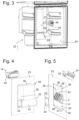
- Fig.3 shows a perspective view of an inner container 23 of a lower chamber 44 in a combination refrigerator.
- An inner container of an upper chamber is shown in fragmentary form.
- a bulge 25 is formed on a side wall 24 of the inner container 23; at the bottom of the bulge an opening 26 is cut into the outer wall through which parts of a connection point such as the connection point 5 of Fig.1 or 2 can be seen.
- electrical devices such as a temperature sensor or interior lighting can be accommodated in the recess 25.
- a channel 27 runs from the recess 25 to a rear wall 28 of the inner container.
- cables from electrical devices in the evaporator chamber such as a fan, an evaporator temperature sensor, a defrost heater, etc., run via the channel 27.
- Fig.4 shows the bottom of the recess in a view from the outside.
- the opening 26 is covered by a connection housing 29.
- the connection housing 29 comprises a main part 30, which is locked to the inner container 23 in a manner described in more detail below and on its side facing away from the inner container, adjacent to a rear wall 32, a Fig.4 dashed, elongated opening 31 and a cover 33 which closes the opening 31 and together with the main part defines a lateral cable outlet 34.
- the cable outlet 34 is in Fig.4 shown empty; in practice, before the cover 33 is mounted on the main part 30 in the position shown, a harness-side connector 8 is introduced into the main part 30 through the opening 31, and the cable outlet 34 is sealed with foam by a branch of the harness 1 extending from the connector 8 and a seal surrounding the branch in order to prevent foam from penetrating into the connection housing 29 or even the inner container 23 when a heat-insulating foam layer is applied to the outside of the inner container 23 in the usual manner.
- Fig.5 shows the connection housing 29 mounted in the opening 26 in a view from the inside.
- the adapter 2 plugged into the connector 8 projects diagonally through the opening 26.
- its upper and lower edges 36, 37 are hidden behind two webs 38 projecting upwards and downwards from the main part 30.
- the edges 36, 37 are exposed.
- connection housing 29 is mounted in the opening 26 by passing the webs 38 with their left end first through the wide section of the opening 26 from the outside and then sliding the main part 30 against the inner container 23 until the webs 38 have completely passed through the opening 26 and a locking projection 39 formed on the right end of the webs 38 locks into place on the right edge of the opening 26.
- the webs 38 can be inserted at their ends first into the opening 26 as shown in Fig. 6 shown, be provided with insertion aids 40, which extend the webs 38 similarly to the tips of skis and, after being installed in the opening 26, protrude obliquely from the inner container 23.
- Fig. 6 is also the in Fig. 5 Connectors 14 on the device side, which are still shown separately, are plugged onto the adapter 2.
- the assembly 41 consisting of adapter 2 and plug connectors 8, 14 is pivoted into the connection housing 29 so that, as in Fig. 7 shown, the adapter 2 is essentially one assumes a vertical orientation and the connector 14 also disappears completely in the connection housing 29 and only the (in Fig. 7 (not shown) cables extending from it to the electrical devices mounted in the inner container extend through the opening 26.
- the connector 14 can be provided with two lateral projections 42, and the connection housing 29 has two forks 43 which project from its rear wall 32 adjacent to its right and left edges towards the opening 26 and from which in Fig.5 and Fig.7 only the tip of a prong is visible at any one time.
- the distance between the forks 43 and the underside of the connection housing supporting the connector 8 is selected such that the projections 42 can only engage between the prongs of the forks 43 if the connectors 8, 14 and the adapter 2 are correctly plugged together.
- the distance between the prongs is selected such that they clamp a projection 42 inserted between them at least with friction; they can also be undercut to enable a positive engagement of the projection 42. Insertion bevels on the tips of the prongs make it easier to insert the projections 42.
Landscapes
- Engineering & Computer Science (AREA)
- Chemical & Material Sciences (AREA)
- Combustion & Propulsion (AREA)
- Physics & Mathematics (AREA)
- Mechanical Engineering (AREA)
- Thermal Sciences (AREA)
- General Engineering & Computer Science (AREA)
- Connector Housings Or Holding Contact Members (AREA)
- Coupling Device And Connection With Printed Circuit (AREA)
Description
- Die vorliegende Erfindung betrifft ein Kältegerät mit mehreren örtlich beabstandeten, insbesondere an verschiedenen Orten eines Gerätegehäuses verteilten elektrischen Einrichtungen.
EP 1 167 902 A2 beschreibt ein solches Elektrogerät, bei dem Anschlusskabel der einzelnen elektrischen Einrichtungen an einer zentralen Verteilerbox angesteckt sind. Die Verkabelung eines solchen Geräts ist mit erheblichem Arbeitsaufwand verbunden, da für jede elektrische Einrichtung das jeweils passende Kabel ausgesucht und einzeln verlegt und an Verteilerbox und elektrische Einrichtung angeschlossen werden muss. Deswegen hat es sich auf vielen Gebieten eingebürgert, gerätespezifisch vorkonfektionierte Kabelbäume zu verwenden, um in einem Elektrogerät verteilte elektrischen Einrichtungen mit elektrischer Energie zu versorgen und/oder Signale zwischen den elektrischen Einrichtungen zu übermitteln. - Die diversen elektrischen Einrichtungen eines solchen Elektrogeräts können vielen verschiedenen Typen angehören, und die Leitungen des Kabelbaums, mit denen eine elektrische Einrichtung verbunden werden muss, sind je nach Typ der Einrichtung unterschiedlich. Um sicherzustellen, dass jede elektrische Einrichtung korrekt angeschlossen wird, sind die Anschlussstellen eines Kabelbaums herkömmlicherweise mit Steckern unterschiedlicher Typen bestückt, die jeweils nur mit den komplementären Steckern derjenigen elektrischen Einrichtungen zusammenpassen, für die sie vorgesehen sind.
- Ein Nachteil des Kabelbaums ergibt sich aus der Tatsache, dass die an einem gegebenen Ort des Gerätegehäuses einzubauenden elektrischen Einrichtungen von einem Gerät zum anderen variieren können. So können an sich funktionsgleiche elektrische Einrichtungen, die aus unterschiedlichen Quellen bezogen werden und wahlweise bei der Fertigung desselben Modells von Elektrogerät verwendet werden können, sich in den von ihnen benötigten elektrischen Anschlüssen unterscheiden. Wenn aufbauend auf einem gleichen Gerätegehäuse verschiedene Modelle des Elektrogeräts gefertigt werden, können die an einem gegebenen Ort des Gerätegehäuses einzubauenden elektrischen Einrichtungen von Modell zu Modell unterschiedlich sein. In beiden Fällen muss der an diesem Einbauort platzierte Stecker des Kabelbaums die jeweils benötigten Anschlüsse aufweisen. Die Folge daraus ist, dass viele verschiedene Modelle des Kabelbaums gefertigt und bereitgehalten werden müssen, um für jedes einzelne zu fertigende Elektrogerät unter Berücksichtigung der darin zu montierenden elektrischen Einrichtungen den jeweils passenden Kabelbaum auszuwählen. Diese Modellvielfalt steigert die Kosten der Kabelbäume und erhöht den Aufwand und die Wahrscheinlichkeit von Fehlern bei der Montage der Elektrogeräte.
- In vielen Kabelbäumen werden Leitungen benötigt, die sich zwischen mehr als zwei Anschlussstellen erstrecken. Solche Leitungen können als Y-Verzweigungen realisiert werden, bei denen wenigstens zwei Leitungsabschnitte an einer Verzweigung des Kabelbaums miteinander verbunden sind, doch die Realisierung solcher Verzweigungen ist aufwendig und kostspielig. Eine andere Möglichkeit, eine solche Leitung zu bilden, ist, zwei Leitungsabschnitte mit einem gleichen Kontakt eines Steckverbinders an einer Anschlussstelle des Kabelbaums zu verbinden, doch dies erhöht den Platzbedarf der Kontakte und macht die Steckverbinder sperrig.
- Beispielsweise aus der
JP 2003 065658 A - Weiter ist aus der
JP H08 205265 A - Aufgabe der Erfindung ist, ein Kältegerät zu schaffen, bei dem trotz eines komplexen Aufbaus mit über verschiedene Einbauorte verteilten elektrischen Einrichtungen und trotz der Möglichkeit, dass die elektrischen Einrichtungen eines Einbauorts von einem Gerät zum nächsten variieren können, die Modellvielfalt der benötigten Kabelbäume reduziert werden kann.
- Die Aufgabe wird gelöst, indem bei einem Kältegerät mit mehreren in einem Gerätegehäuse verteilt angeordneten elektrischen Einrichtungen und einem die elektrischen Einrichtungen versorgenden Kabelbaum wenigstens eine erste Anschlussstelle des Kabelbaums einen kabelbaumseitigen Steckverbinder aufweist und diejenigen elektrischen Einrichtungen, die über die erste Anschlussstelle versorgt sind, mit dem kabelbaumseitigen Steckverbinder über einen einrichtungsseitigen Steckverbinder und einen mit beiden Steckverbindern zusammengesteckten Adapter verbunden sind, wobei der Adapter einen Leiter aufweist, der wenigstens zwei Kontakte des einrichtungsseitigen Steckverbinders miteinander verbindet.
- Eine Anpassung an die an den einzelnen Einbauorten anzuschließenden elektrischen Einrichtungen kann dadurch erfolgen, dass an wenigstens einem dieser Einbauorte der Adapter zwischen den kabelbaumseitigen Steckverbinder und die elektrischen Einrichtungen eingefügt wird. Da die Anpassung an die am Einbauort vorhandenen elektrischen Einrichtungen über den Adapter erfolgt, kann der kabelbaumseitige Steckverbinder unabhängig von den einzubauenden Einrichtungen derselbe sein. Dies verringert erheblich die Modellvielfalt des Kabelbaums.
- Um an denselben Steckverbinder angeschlossene elektrische Einrichtungen auch untereinander zu verbinden, weist der Adapter erfindungsgemäß einen Leiter auf, der wenigstens zwei Kontakte des einrichtungsseitigen Steckverbinders miteinander verbindet. Ein solcher Leiter ist insbesondere auf einer Leiterplatte mit wesentlich geringerem Aufwand realisierbar als innerhalb des Kabelbaums und trägt damit zur Vereinfachung von dessen Aufbau bei.
- Wenn an mehreren Anschlussstellen des Kabelbaums solche Adapter verwendet werden, kann ein einziges Modell von Kabelbaum für alle auf einem gleichen Gerätegehäuse basierenden Gerätemodelle genügen. Dies vereinfacht erheblich die Fertigung, da beim Einbau des Kabelbaums in einem Gerätegehäuse noch nicht feststehen muss, welche elektrischen Einrichtungen an den Einbauorten montiert werden.
- Der Adapter ist besonders einfach und platzsparend als Leiterplatte realisierbar; die Steckverbinder können dann Randsteckverbinder sein, die auf Kontakte an den Rändern der Leiterplatte aufgesteckt werden.
- Im einfachsten Fall ist die Verbindung zwischen zwei Kontakten der Leiterplatte durch eine Leiterbahn der Leiterplatte gebildet, er kann aber auch über ein an der Leiterplatte angelötetes Bauteil verlaufen. Die solcherart verbundenen Kontakte können ein kabelbaumseitiger und ein einrichtungsseitiger Kontakt sein, es kann sich aber auch um zwei kabelbaumseitige oder zwei einrichtungsseitige Kontakte handeln. Die Verwendung eines angelöteten Bauteils ist insbesondere dann vorteilhaft, wenn noch unmittelbar vor oder während des Zusammenbaus des Kältegeräts eine Anpassung des Adapters an die über ihn zu versorgenden elektrischen Einrichtungen vorgenommen werden muss.
- Der Leiter kann mit dem kabelbaumseitigen Steckverbinder unverbunden sein, um eine Reihenschaltung von elektrischen Einrichtungen zu realisieren; für eine Parallelschaltung wird ein Leiter benötigt, der auch mit dem kabelbaumseitigen Steckverbinder verbunden ist.
- Über eine solche Reihenschaltung können insbesondere eine Heizung und eine die Funktion der Heizung überwachende Temperatursicherung in Reihe verbunden werden, so dass ein Ansprechen der Temperatursicherung einen Stromfluss über die Heizung beenden kann.
- Um ein Signal oder eine Versorgungsspannung zwischen mehr als zwei Anschlussstellen zu übertragen, muss ein Kabelbaum herkömmlicherweise eine verzweigte Struktur aufweisen, die aufwendig zu fertigen ist. Dieser Aufwand kann erfindungsgemäß reduziert werden, indem der Adapter einen Leiter aufweist, der wenigstens zwei Kontakte des kabelbaumseitigen Steckverbinders miteinander verbindet. Im Kabelbaum können dann eine erste Leitung, die sich von einem ersten der zwei Kontakte des kabelbaumseitigen Steckverbinders zu einer zweiten Anschlussstelle erstreckt, und eine zweite Leitung vorgesehen sein, die sich vom zweiten der zwei Kontakte zu einer dritten Anschlussstelle erstreckt.
- Der kabelbaumseitige Steckverbinder kann jeweils einen einzigen Kontaktträger umfassen, an dem sämtliche Kontakte des Steckverbinders befestigt sind. Dies minimiert die Zahl der beim Einbau des Kabelbaums zu handhabenden Komponenten und ermöglicht eine effiziente Montage.
- Es kann aber auch sinnvoll sein, die Kontakte des kabelbaumseitigen Steckverbinders auf jeweils mehrere Kontaktträger zu verteilen, die jeweils einzeln mit dem Adapter zusammengesteckt werden können. Dies erhöht zwar die Zahl der für die Montage erforderlichen Handgriffe, verringert aber dafür die erforderlichen Steckkräfte.
- Wenn das Gerätegehäuse des Kältegeräts in mehrere Kammern unterteilt ist, sollten die von der ersten Anschlussstelle versorgten elektrischen Einrichtungen in einer ersten dieser Kammern untergebracht sein, für weitere Kammern können jeweils eigene Anschlussstellen vorgesehen sein.
- Der Kabelbaum kann in eine Isolationsmaterialschicht des Gerätegehäuses eingebettet sein.
- Zum Schutz ihrer Kontakte kann die erste Anschlussstelle ein Anschlussgehäuse umfassen, in dem die Steckverbinder und die Leiterplatte der Anschlussstelle untergebracht sind.
- Bei einem in Kammern gegliederten Gerätegehäuse ist das Anschlussgehäuse der ersten Anschlussstelle zweckmäßigerweise an einer Wand der ersten Kammer montiert, d.h. der Kammer, in der sich die von dieser Anschlussstelle versorgten elektrischen Einrichtungen befinden.
- Um die Einbauposition der Kapsel vorzugeben, kann die Wand eine Öffnung aufweisen.
- Diese sollte durch die Kapsel dicht verschlossen sein, insbesondere um, wenn an einer Außenseite der Wand Isolationsmaterial ausgebracht wird, dessen Durchtritt ins Innere der Kammer zu verhindern.
- Um eine solche Abdichtung zu erleichtern, kann die Kapsel einen die Steckverbinder und den Adapter aufnehmenden und in die Öffnung eingreifenden Kernbereich und einen sich um den Kernbereich erstreckenden, rings um die Öffnung an der Wand anliegenden Flansch aufweisen.
- Dieser Flansch sollte zweckmäßigerweise auch kabelbaumseitige und einrichtungsseitige Leitungsdurchlässe der Kapsel voneinander trennen.
- Weitere Merkmale und Vorteile der Erfindung ergeben sich aus der nachfolgenden Beschreibung von Ausführungsbeispielen unter Bezugnahme auf die beigefügten Figuren.
- Es zeigen:
- Fig. 1
- eine schematische Ansicht eines Kabelbaums mit Adaptern gemäß einer ersten Ausgestaltung der Erfindung;
- Fig. 2
- eine schematische Ansicht eines Kabelbaums mit Adaptern gemäß einer zweiten Ausgestaltung der Erfindung;
- Fig. 3
- eine Ansicht eines Innenbehälters eines Kältegeräts mit einer Anschlussstelle für den Kabelbaum;
- Fig. 4
- eine Außenansicht der Anschlussstelle;
- Fig. 5
- eine Innenansicht der Anschlussstelle, bei der ein einrichtungsseitiger Steckverbinder vom Adapter und dem kabelbaumseitigen Steckverbinder getrennt ist;
- Fig. 6
- die Anschlussstelle der
Fig. 5 mit auf den Adapter aufgestecktem kabelbaumseitigen Steckverbinder; und - Fig. 7
- die Anschlussstelle mit im Anschlussgehäuse versenkten Steckverbindern.
-
Fig. 1 zeigt eine schematische Darstellung einer Anordnung mit einem Kabelbaum 1 und Adaptern 2, 3 gemäß der Erfindung. Der Kabelbaum 1 hat eine zentrale und mehrere periphere Anschlussstellen 4, 5, 6, 7,... mit kabelbaumseitigen Steckverbindern 8 und eine Vielzahl von Leitungen 9, die an jeder Anschlussstelle 4, 5, 6, 7,... auf einen Kontakt 10 des Steckverbinders 8 herausgeführt sind. - An der zentralen Anschlussstelle 4 kann z.B. eine Steuereinheit eines Kältegeräts angeschlossen sein, die über den Kabelbaum 1 elektrische Einrichtungen an diversen Orten des Kältegeräts mit Betriebsenergie und Steuerinformationen versorgt oder Informationen von diesen empfängt. Über die Anschlussstelle 5 können z.B. elektrische Einrichtungen, die in einem Gefrierfach des Kältegeräts angeordnet sind, mit dem Kabelbaum 1 verbunden sein, während elektrische Einrichtungen eines Normalkühlfachs über die Anschlussstelle 6 angeschlossen sind. Weitere Anschlussstellen 7,... können je nach Bedarf für elektrische Einrichtungen in weiteren Fächern, für eine Benutzerschnittstelle etc. vorgesehen sein.
- Die Leitungen 9 des Kabelbaums 1 sind verzweigungsfrei, d.h. jede Leitung 9 verbindet genau zwei Kontakte 10 von zwei Steckverbindern 8, einer davon an der zentralen Anschlussstelle 4. Dementsprechend zahlreich sind die Kontakte 10 an der zentralen Anschlussstelle 4.
- Da die angeschlossenen elektrischen Einrichtungen von einer peripheren Anschlussstelle 5, 6, 7 zur anderen variieren, können die Steckverbinder 8 der peripheren Anschlussstellen 5, 6, 7 sich voneinander unterscheiden. Außerdem können sich die an jeder peripheren Anschlussstelle angeschlossenen elektrischen Einrichtungen von einem Gerät zum andern unterscheiden und insbesondere unterschiedliche Stecker aufweisen. Um diese mit den Steckverbindern 8 verbinden zu können, ist an jeder peripheren Anschlussstelle 5, 6, 7 ein jeweils für diese Anschlussstelle spezifischer Adapter 2, 3 vorgesehen.
- Um die für das Zusammenstecken von kabelbaumseitigem Steckverbinder 8 und Adapter 2, 3 erforderlichen Steckkräfte zu begrenzen, kann der Steckverbinder 8 in mehrere Kontaktträger unterteilt sein, von denen jeder nur einen Teil der Kontakte 10 des Steckverbinders 8 umfasst, und die jeweils einzeln mit dem Adapter 2, 3 steckverbunden werden können. Der schnelleren Montage wegen bevorzugt ist ein Aufbau, bei dem alle Kontakte 10 in einem einzigen Kontaktträger zusammengefasst sind.
- Die Adapter 2, 3 sind vorzugsweise als Leiterplatten 11 ausgebildet, und der Steckverbinder 8 oder die Kontaktträger, aus denen er sich zusammensetzt, sind Randsteckverbinder, die auf mit Kontaktpads 12 versehene Ränder 13 dieser Leiterplatten 11 aufgesteckt werden. Dabei muss nicht jedem Kontakt 10 der Randsteckverbinder ein Kontaktpad 12 des Adapters 2, 3 gegenüberliegen; in der Regel sind nur denjenigen Kontakten 10 Kontaktpads 12 zugeordnet, die von den über den betreffenden Adapter 2 oder 3 versorgten Einrichtungen tatsächlich genutzt werden.
- Ein einrichtungsseitiger Steckverbinder 14 ist ebenfalls als Randsteckverbinder ausgebildet, der vorzugsweise auf einen dem Rand 13 gegenüberliegenden Rand 15 des Adapters 2 oder 3 aufgesteckt ist. Der Steckverbinder 14 kann wie der kabelbaumseitige Steckverbinder 8 einen einzigen Kontaktträger umfassen, in dem Kabel verschiedener elektrischer Einrichtungen zusammentreffen; hier kann es aber auch zweckmäßig sein, wenn jede elektrische Einrichtung jeweils mit einem eigenen Kontaktträger verbunden ist und diese einzeln auf getrennte Abschnitte 151, 152 des Rands 15 aufgesteckt werden können.
- Um z.B. eine Versorgungsspannung, die dem Adapter 2 an einem einzigen Kontaktpad 121 zugeführt wird, an zwei elektrische Einrichtungen weiterzuleiten, können Kontaktpads 161, 162 an den Randabschnitten 151, 152 über eine sich verzweigende Leiterbahn 17 mit dem Kontaktpad 121 verbunden sein. Eine solche Verzweigung auf der Leiterplatte 11 zu realisieren ist wesentlich einfacher und kostengünstiger, als eine einzelne Leitung innerhalb des Kabelbaums zu verzweigen.
- Die Verzeigung von Leiterbahnen 17 auf der Leiterplatte 11 des Adapters 2 ermöglicht z.B. eine parallele Versorgung einer elektrischen Einrichtung, deren Kontaktträger auf den Randabschnitt 151 aufgesteckt ist, und einer elektrischen Einrichtung mit auf den Randabschnitt 152 aufgestecktem Kontaktträger, indem beide über die Kontaktpads 161, 162 mit der Versorgungsspannung und über Kontaktpads 163, 164 mit Masse verbunden sind.
- Der Adapter 3 weist eine Leiterbahn 18 auf, die Kontaktpads 162, 163 an getrennten Abschnitten 151, 152 des einrichtungsseitigen Rands 15 miteinander verbindet, die aber keine Verbindung zu einem Kontaktpad am dem Kabelbaum 1 zugewandten Rand 13 aufweist. Eine solche Leiterbahn 18 ermöglicht die Hintereinanderschaltung von zwei über denselben Adapter 3 versorgten elektrischen Einrichtungen wie etwa einem Türöffnungsschalter und einer Innenbeleuchtung des Kältegeräts oder einer Abtauheizung und einer Temperatursicherung, die dadurch, dass in ihr ein Schalter bei Überschreitung einer Grenztemperatur öffnet, den Stromfluss durch die Abtauheizung beenden kann.
-
Fig. 2 zeigt einen Kabelbaum 1 und Adapter 2, 3 gemäß einer zweiten Ausgestaltung der Erfindung. Die große Zahl von Kontakten 10 an der zentralen Anschlussstelle 4 des Kabelbaums 1 derFig. 1 ist hier reduziert, indem nicht mehrere ein gleiches Signal oder eine gleiche Versorgungsspannung führende Leitungen 9 von der zentralen Anschlussstelle 4 zu verschiedenen peripheren Anschlussstellen verlaufen, sondern eine solche Leitung 9 von der Anschlussstelle 4 zunächst zu einem Kontakt 19 der Anschlussstelle 5 verläuft, der Kontakt 19 über eine Leiterbahn 21 oder 22 des an der Anschlussstelle 5 montierten Adapters 2 mit einem zweiten Kontakt 20 der Anschlussstelle 5 verbunden ist und eine weitere Leitung 9 sich vom Kontakt zur Anschlussstelle 6 erstreckt. - Wie in
Fig. 1 und 2 durch einen z.T. gestrichelten Verlauf der Leiterbahnen 17, 21, 22 angedeutet, kann es notwendig sein, dass Leiterbahnen der Adapter 2, 3 einander kreuzen, ohne galvanisch verbunden zu sein. Solche Leiterbahnen können auf verschiedenen Seiten der Leiterplatten 11 strukturiert sein; sie können auch als auf der Leiterplatte 11 montierte, z.B. aufgelötete Brücken ausgebildet sein. Die Verwendung von Brücken ermöglicht insbesondere die Integration von selten eingebautem Zubehör in das Kältegerät, da durch Hinzufügen der Brücken ein vorhandener Adapter für solches Zubehör passend gemacht werden kann. -
Fig. 3 zeigt eine perspektivische Ansicht eines Innenbehälters 23 einer unteren Kammer 44 in einem Kombinations-Kältegerät. Ein Innenbehälter einer oberen Kammer ist bruchstückweise dargestellt. An einer Seitenwand 24 des Innenbehälters 23 ist eine Ausbuchtung 25 geformt; am Boden der Ausbuchtung ist in die Außenwand eine Öffnung 26 geschnitten, durch die Teile einer Anschlussstelle wie etwa der Anschlussstelle 5 ausFig.1 oder 2 zu sehen sind. In der Ausbuchtung 25 finden beim fertig montierten Kältegerät elektrische Einrichtungen wie etwa ein Temperatursensor oder eine Innenraumbeleuchtung Platz. Eine Rinne 27 verläuft von der Ausbuchtung 25 auf eine Rückwand 28 des Innenbehälters zu. Wenn beim fertigen Kältegerät das Innere des Innenbehälters in ein Lagerfach und eine Verdampferkammer unterteilt sind, verlaufen über die Rinne 27 Kabel von elektrischen Einrichtungen der Verdampferkammer wie etwa eines Lüfters, eines Verdampfertemperatursensors, einer Abtauheizung etc. -
Fig. 4 zeigt in einer Ansicht von außen den Boden der Ausbuchtung. Die Öffnung 26 ist durch ein Anschlussgehäuse 29 verdeckt. Das Anschlussgehäuse 29 umfasst ein Hauptteil 30, das in später noch genauer beschriebener Weise am Innenbehälter 23 verrastet ist und an seiner vom Innenbehälter abgewandten Seite, angrenzend an eine Rückwand 32, eine inFig. 4 gestrichelt eingezeichnete, langgestreckte Öffnung 31 aufweist, und einen Deckel 33, der die Öffnung 31 verschließt und zusammen mit dem Hauptteil einen seitlichen Kabelauslass 34 begrenzt. Der Kabelauslass 34 ist inFig. 4 leer gezeigt; in der Praxis wird, bevor der Deckel 33 in der gezeigten Stellung am Hauptteil 30 montiert wird, ein kabelbaumseitiger Steckverbinder 8 durch die Öffnung 31 in den Hauptteil 30 eingeführt, und der Kabelauslass 34 ist durch einen von dem Steckverbinder 8 ausgehenden Ast des Kabelbaums 1 und eine den Ast umgebende Dichtung schaumdicht verschlossen, um zu verhindern, dass Schaum in das Anschlussgehäuse 29 oder gar den Innenbehälter 23 eindringt, wenn in fachüblicher Weise eine wärmedämmende Schaumstoffschicht an den Außenseiten des Innenbehälters 23 angebracht wird. -
Fig. 5 zeigt das in der Öffnung 26 montierte Anschlussgehäuse 29 in einer Ansicht von innen. Eine mit dem Innenbehälter 23 bündige vordere Wand 35 des Hauptteils 30 verdeckt zu einem großen Teil den Steckverbinder 8. Der in den Steckverbinder 8 eingesteckte Adapter 2 ragt schräg durch die Öffnung 26 hindurch. In einem linken Abschnitt der Öffnung 26 sind deren oberer und unterer Rand 36, 37 hinter zwei vom Hauptteil 30 nach oben und unten abstehenden Stegen 38 verborgen. In einem schmalen, rechten Abschnitt der Öffnung 26 liegen die Ränder 36, 37 frei. Das Anschlussgehäuse 29 wird in der Öffnung 26 montiert, indem von außen kommend die Stege 38 mit ihrem linken Ende voran durch den breiten Abschnitt der Öffnung 26 hindurchgeführt und dann das Hauptteil 30 am Innenbehälter 23 anliegend verschoben wird, bis die Stege 38 die Öffnung 26 komplett passiert haben und ein am rechten Ende der Stege 38 angeformter Rastvorsprung 39 am rechten Rand der Öffnung 26 einrastet. - Um das Einführen der Stege 38 in die Öffnung 26 zu erleichtern, können die Stege 38 an ihren zuerst in die Öffnung 26 einzuführenden Enden wie in
Fig. 6 gezeigt, mit Einführhilfen 40 versehen sein, die die Stege 38 ähnlich den Spitzen von Skiern verlängern und nach Anbringung in der Öffnung 26 schräg vom Innenbehälter 23 abstehen. - In
Fig. 6 ist ferner der inFig. 5 noch getrennt dargestellte einrichtungsseitige Steckverbinder 14 auf den Adapter 2 aufgesteckt. Im nächsten Schritt wird die Baugruppe 41 aus Adapter 2 und Steckverbindern 8, 14 in das Anschlussgehäuse 29 hineingeschwenkt, so dass, wie inFig. 7 gezeigt, der Adapter 2 eine im wesentlichen vertikale Orientierung einnimmt und auch der Steckverbinder 14 vollständig im Anschlussgehäuse 29 verschwindet und nur noch die (inFig. 7 nicht darstellten) Kabel, die sich von ihm zu den im Innenbehälter montierten elektrischen Einrichtungen erstrecken, sich durch die Öffnung 26 erstrecken. - Um einerseits die Baugruppe 41 in der Stellung der
Fig. 7 zu fixieren und andererseits sicherzustellen, dass die Baugruppe 41 nur dann in die Stellung derFig. 7 geschwenkt werden kann, wenn die Steckverbinder 8, 14 und der Adapter 2 weit genug zusammengesteckt sind, um eine sichere elektrische Kontaktierung zu gewährleisten, kann der Steckverbinder 14 mit zwei seitlichen Vorsprüngen 42 versehen sein, und das Anschlussgehäuse 29 weist zwei Gabeln 43 auf, die von seiner Rückwand 32 benachbart zu deren rechtem und linkem Rand zur Öffnung 26 hin vorspringen und von denen inFig. 5 undFig. 7 jeweils nur die Spitze eines Zinkens zu sehen ist. Der Abstand der Gabeln 43 von einer den Steckverbinder 8 abstützenden Unterseite des Anschlussgehäuses ist so gewählt, dass die Vorsprünge 42 nur dann zwischen die Zinken der Gabeln 43 einrücken können, wenn die Steckverbinder 8, 14 und der Adapter 2 korrekt zusammengesteckt sind. Der Abstand zwischen den Zinken ist so gewählt, dass sie einen zwischen sie eingeführten Vorsprung 42 zumindest reibschlüssig klemmen; sie können auch hinterschnitten sein, um einen formschlüssigen Eingriff des Vorsprungs 42 zu ermöglichen. Einführschrägen an den Spitzen der Zinken erleichtern das Einführen der Vorsprünge 42. -
- 1
- Kabelbaum
- 2
- Adapter
- 3
- Adapter
- 4
- Anschlussstelle
- 5
- Anschlussstelle
- 6
- Anschlussstelle
- 7
- Anschlussstelle
- 8
- kabelbaumseitiger Steckverbinder
- 9
- Leitung
- 10
- Kontakt
- 11
- Leiterplatte
- 12
- Kontaktpad
- 13
- Rand
- 14
- einrichtungsseitiger Steckverbinder
- 15
- Rand
- 16
- Kontaktpad
- 17
- Leiterbahn
- 18
- Leiterbahn
- 19
- Kontakt
- 20
- Kontakt
- 21
- Leiterbahn
- 22
- Leiterbahn
- 23
- Innenbehälter
- 24
- Seitenwand
- 25
- Ausbuchtung
- 26
- Öffnung
- 27
- Rinne
- 28
- Rückwand
- 29
- Anschlussgehäuse
- 30
- Hauptteil
- 31
- Öffnung
- 32
- Rückwand
- 33
- Deckel
- 34
- Kabelauslass
- 35
- vordere Wand
- 36
- oberer Rand
- 37
- unterer Rand
- 38
- Steg
- 39
- Rastvorsprung
- 40
- Einführhilfe
- 41
- Baugruppe
- 42
- Vorsprung
- 43
- Gabel
- 44
- Kammer
Claims (16)
- Kältegerät mit mehreren in einem Gerätegehäuse verteilt angeordneten elektrischen Einrichtungen und einem die elektrischen Einrichtungen versorgenden Kabelbaum (1), wobei wenigstens eine erste Anschlussstelle (5) des Kabelbaums (1) einen kabelbaumseitigen Steckverbinder (8) aufweist und diejenigen elektrischen Einrichtungen, die über die erste Anschlussstelle (5) versorgt sind, mit dem kabelbaumseitigen Steckverbinder (8) über einen einrichtungsseitigen Steckverbinder (14) und einen mit beiden Steckverbindern (8, 14) zusammengesteckten Adapter (2, 3) verbunden sind, dadurch gekennzeichnet, dass der Adapter (2, 3) einen Leiter (18) aufweist, der wenigstens zwei Kontakte des einrichtungsseitigen Steckverbinders miteinander verbindet.
- Kältegerät nach Anspruch 1, dadurch gekennzeichnet, dass die Steckverbinder Randsteckverbinder sind und der Adapter (2, 3) eine Leiterplatte ist, deren Ränder Kontakte tragen, auf die die Randsteckverbinder aufgesteckt sind.
- Kältegerät nach Anspruch 2, dadurch gekennzeichnet, dass unter den Kontakten des Adapters (2, 3) wenigstens zwei Kontakte (19, 20) über ein an der Leiterplatte angelötetes Bauteil verbunden sind.
- Kältegerät nach einem der vorhergehenden Ansprüche, dadurch gekennzeichnet, dass der Leiter (18) mit dem kabelbaumseitigen Steckverbinder unverbunden ist.
- Kältegerät nach einem der Ansprüche 1 bis 4, dadurch gekennzeichnet, dass der Leiter mit dem kabelbaumseitigen Steckverbinder verbunden ist.
- Kältegerät nach einem der vorhergehenden Ansprüche, dadurch gekennzeichnet, dass der Adapter (2, 3) einen Leiter (21, 22) aufweist, der wenigstens zwei Kontakte des kabelbaumseitigen Steckverbinders (8) miteinander verbindet.
- Kältegerät nach Anspruch 6, dadurch gekennzeichnet, dass der Kabelbaum eine erste Leitung (9), die sich von einem ersten der zwei Kontakte des kabelbaumseitigen Steckverbinders (8) zu einer zweiten Anschlussstelle (4) erstreckt, und eine zweite Leitung (9) aufweist, die sich vom zweiten der zwei Kontakte zu einer dritten Anschlussstelle (6) erstreckt.
- Kältegerät nach einem der Ansprüche 1 bis 7, dadurch gekennzeichnet, dass der kabelbaumseitige Steckverbinder (8) jeweils einen einzigen Kontaktträger umfasst, an dem sämtliche Kontakte des Steckverbinders befestigt sind.
- Kältegerät nach einem der Ansprüche 1 bis 7, dadurch gekennzeichnet, dass die Kontakte des kabelbaumseitigen Steckverbinders auf jeweils mehrere Kontaktträger verteilt sind.
- Kältegerät nach einem der vorhergehenden Ansprüche, dadurch gekennzeichnet, dass das Gerätegehäuse in mehrere Kammern unterteilt ist und dass die von der ersten Anschlussstelle (5) versorgten elektrischen Einrichtungen in einer ersten (44) dieser Kammern untergebracht sind.
- Kältegerät nach einem der vorhergehenden Ansprüche, dadurch gekennzeichnet, dass der Kabelbaum in eine Isolationsmaterialschicht des Gerätegehäuses eingebettet ist.
- Kältegerät nach einem der vorhergehenden Ansprüche, dadurch gekennzeichnet, dass die erste Anschlussstelle (5) ein Anschlussgehäuse (29) umfasst, in dem die Steckverbinder (8, 14) und die Leiterplatte (11) der Anschlussstelle (5) untergebracht sind.
- Kältegerät nach Anspruch 10 und Anspruch 12, dadurch gekennzeichnet, dass das Anschlussgehäuse (29) der ersten Anschlussstelle (5) an einer Wand (24) der ersten Kammer (44) montiert ist.
- Kältegerät nach Anspruch 13, dadurch gekennzeichnet, dass das Anschlussgehäuse (29) eine Öffnung (26) der Wand (24) ausfüllt.
- Kältegerät nach Anspruch 13 oder 14, dadurch gekennzeichnet, dass das Anschlussgehäuse (29) in die Öffnung (26) durch Verschieben in einer zur Oberfläche der Wand (24) parallelen Richtung einfügbar ist und zwei Randstege (38) aufweist, die durch einen quer zur Richtung der Verschiebung breiten Abschnitt der Öffnung (26) durchführbar sind und im montierten Zustand an der Wand beiderseits eines schmalen Abschnitts der Öffnung (26) anliegen.
- Kältegerät nach Anspruch 15, dadurch gekennzeichnet, dass das Anschlussgehäuse (29) zur Kammer (44) hin offen ist und die Steckverbinder (8, 14) und der Adapter (2, 3) zwischen einer Stellung, in der sie im Anschlussgehäuse (29) aufgenommen sind, und einer Stellung schwenkbar sind, in der wenigstens der einrichtungsseitige Steckverbinder (14) aus dem Anschlussgehäuse (29) in die Kammer (44) vorspringt.
Applications Claiming Priority (2)
| Application Number | Priority Date | Filing Date | Title |
|---|---|---|---|
| DE102016224705.0A DE102016224705A1 (de) | 2016-12-12 | 2016-12-12 | Elektrogerät mit verteilten elektrischen Einrichtungen |
| PCT/EP2017/080399 WO2018108491A1 (de) | 2016-12-12 | 2017-11-24 | Elektrogerät mit verteilten elektrischen einrichtungen |
Publications (2)
| Publication Number | Publication Date |
|---|---|
| EP3551949A1 EP3551949A1 (de) | 2019-10-16 |
| EP3551949B1 true EP3551949B1 (de) | 2024-04-03 |
Family
ID=60515372
Family Applications (1)
| Application Number | Title | Priority Date | Filing Date |
|---|---|---|---|
| EP17807813.5A Active EP3551949B1 (de) | 2016-12-12 | 2017-11-24 | Kältegerät mit verteilten elektrischen einrichtungen |
Country Status (6)
| Country | Link |
|---|---|
| US (2) | US11555649B2 (de) |
| EP (1) | EP3551949B1 (de) |
| CN (1) | CN110050166B (de) |
| DE (1) | DE102016224705A1 (de) |
| PL (1) | PL3551949T3 (de) |
| WO (1) | WO2018108491A1 (de) |
Families Citing this family (4)
| Publication number | Priority date | Publication date | Assignee | Title |
|---|---|---|---|---|
| DE102016224705A1 (de) * | 2016-12-12 | 2018-06-14 | BSH Hausgeräte GmbH | Elektrogerät mit verteilten elektrischen Einrichtungen |
| DE102017127031A1 (de) * | 2017-11-16 | 2019-05-16 | Liebherr-Hausgeräte Ochsenhausen GmbH | Kühl- und/oder Gerfriergerät |
| CN113068301B (zh) * | 2021-03-17 | 2022-10-28 | 深圳乔合里科技股份有限公司 | 内置pcb板的整车线束及其控制电路 |
| DE102022128842A1 (de) * | 2022-09-05 | 2024-03-07 | Liebherr-Hausgeräte Marica EOOD | Kühl- und/oder Gefriergerät |
Family Cites Families (48)
| Publication number | Priority date | Publication date | Assignee | Title |
|---|---|---|---|---|
| US2441643A (en) * | 1946-05-13 | 1948-05-18 | Mickler Stanislaus Albert | Protective electrical outlet receptacle |
| US3179852A (en) * | 1961-11-24 | 1965-04-20 | Gen Motors Corp | Refrigeration relay box and condenser assembly |
| US3281558A (en) * | 1964-03-16 | 1966-10-25 | Mcdonnell Aircraft Corp | Multiple circuit protector device |
| US3509356A (en) * | 1967-12-15 | 1970-04-28 | Peebles David M | Selective circuit connector |
| FR2111985B1 (de) | 1972-02-23 | 1974-07-05 | Emerjy | |
| US4006959A (en) * | 1974-11-04 | 1977-02-08 | Amp Incorporated | Intrinsic certification assembly technique for wiring components into an electrical apparatus |
| US4218110A (en) * | 1979-04-04 | 1980-08-19 | The United States Of America As Represented By The Secretary Of The Navy | Connector-to-connector adaptor |
| JPS5940653B2 (ja) * | 1979-06-04 | 1984-10-02 | 日産自動車株式会社 | □/車両用計器盤の結線構造□/ |
| JPS6089669A (ja) | 1983-10-19 | 1985-05-20 | 三洋電機株式会社 | 冷蔵庫の断熱箱体製造方法 |
| US4543800A (en) * | 1984-02-16 | 1985-10-01 | White Consolidated Industries, Inc. | Refrigerator door hinge |
| FR2593085B1 (fr) * | 1986-01-23 | 1990-10-26 | Hauville Francois | Table de laboratoire. |
| JPS63158774A (ja) * | 1986-09-30 | 1988-07-01 | ファオツィ ベクヒート | 電気機械における電気的な接続部を電気的に結合するための結合装置 |
| US4950169A (en) * | 1989-03-13 | 1990-08-21 | Pc Industries, Inc. | Universal cable connector for electronic devices |
| US4986762A (en) * | 1989-08-15 | 1991-01-22 | Minnesota Mining And Manufacturing Company | Termination module for use in an array of modules |
| US5348485A (en) * | 1993-04-12 | 1994-09-20 | Electronic Retailing Systems Int'l Inc. | Electronic price display system with vertical rail |
| JP3006398B2 (ja) * | 1993-05-05 | 2000-02-07 | インターナショナル・ビジネス・マシーンズ・コーポレイション | ケーブル・アセンブリ |
| US5626479A (en) * | 1993-07-16 | 1997-05-06 | Hughes; Michael T. | Unified connector interface adapter |
| KR0130883Y1 (ko) * | 1994-02-02 | 1998-12-15 | 김광호 | 컴퓨터의 하드 디스크 드라이버 착탈장치 |
| JPH08205265A (ja) | 1994-11-25 | 1996-08-09 | Sharp Corp | 機器内配線コントロールシステム |
| JP3404224B2 (ja) | 1996-08-07 | 2003-05-06 | 松下冷機株式会社 | 冷蔵庫の温度調節装置 |
| US6028267A (en) * | 1997-04-15 | 2000-02-22 | Byrne; Norman R. | Rotatable power center system |
| US5984716A (en) * | 1997-06-09 | 1999-11-16 | Progressive Components International Corporation | Electrical connection system for mold components and a plastic injection molding press |
| US6159041A (en) * | 1999-03-01 | 2000-12-12 | The Whitaker Corporation | Electrical connector assembly for panel mounting |
| US6397609B1 (en) * | 1999-08-20 | 2002-06-04 | Denso Corporation | Vehicle air-conditioning system with arrangement of electrical member |
| JP3855143B2 (ja) | 1999-10-14 | 2006-12-06 | 三菱電機株式会社 | 冷蔵庫 |
| IT250075Y1 (it) | 2000-06-20 | 2003-07-07 | Whirlpool Co | Centralina raggruppatrice di componenti elettronici per frigoriferi congelatori e simili apparecchi |
| JP2003065658A (ja) | 2001-08-27 | 2003-03-05 | Toshiba Corp | 冷蔵庫のプリント回路板接続構造 |
| US6500025B1 (en) * | 2002-03-13 | 2002-12-31 | Honeywell International Inc. | Universal cable assembly for both parallel and serial component connections |
| DE10221898B4 (de) | 2002-05-16 | 2005-01-27 | BSH Bosch und Siemens Hausgeräte GmbH | Kältegerät mit beheizbarem Innenraum |
| US6737582B2 (en) * | 2002-08-02 | 2004-05-18 | Seiko Epson Corporation | Power connector |
| US7404298B2 (en) * | 2003-03-10 | 2008-07-29 | Lg Electronics Inc. | Refrigerator |
| US20040248462A1 (en) * | 2003-06-06 | 2004-12-09 | Dyer Jonathan T. | Modular wiring harness and power cord for vending machines |
| US6933452B2 (en) * | 2003-08-27 | 2005-08-23 | Edward Liu | Terminal connection device for speaker |
| DE102004019349A1 (de) | 2003-12-23 | 2005-07-28 | BSH Bosch und Siemens Hausgeräte GmbH | Anschlusseinrichtung zum Herstellen einer elektrischen Verbindung zwischen einem Netzkabel und einem Kabelbaum |
| DE602004031785D1 (de) * | 2004-11-19 | 2011-04-21 | Uponor Innovation Ab | Verfahren und vorrichtung zur steuerung eines netzwerks bei hvac- und anderen anwendungen |
| US7410361B2 (en) * | 2006-10-13 | 2008-08-12 | Sound Sources Technology | Terminal for selectively coupling loads in parallel or in series |
| KR100758990B1 (ko) * | 2006-11-13 | 2007-09-17 | 삼성광주전자 주식회사 | 냉장고 |
| US8360802B2 (en) * | 2009-11-12 | 2013-01-29 | Whirlpool Corporation | Adjustable connector system for connection to a modular appliance |
| US8299656B2 (en) * | 2008-03-12 | 2012-10-30 | Whirlpool Corporation | Feature module connection system |
| US20080164758A1 (en) | 2007-01-04 | 2008-07-10 | Mccoy Richard A | Electrical accessory charging compartment for a cabinet and retrofit components therefor |
| JP4934446B2 (ja) * | 2007-01-31 | 2012-05-16 | 三洋電機株式会社 | 冷却貯蔵庫 |
| WO2009114697A1 (en) * | 2008-03-12 | 2009-09-17 | Whirlpool Corporation | Refrigerator with module receiving conduits |
| JP5320243B2 (ja) | 2009-09-29 | 2013-10-23 | 矢崎総業株式会社 | 基板用コネクタの実装構造 |
| US8860328B2 (en) * | 2011-12-29 | 2014-10-14 | National Christmas Products | Method and apparatus for controlling a multi-colored LED light string |
| DE102013209747A1 (de) | 2013-05-27 | 2014-11-27 | BSH Bosch und Siemens Hausgeräte GmbH | Kältegerät mit einem Elektronikgehäuse |
| KR101944361B1 (ko) | 2014-01-06 | 2019-02-01 | 삼성전자주식회사 | 커넥터 및 이를 포함하는 냉장고 |
| DE102014118597A1 (de) | 2014-12-15 | 2016-06-16 | Dr. Hahn Gmbh & Co. Kg | Verfahren und Vorrichtung zur Übertragung von elektrischer Leistung und/oder von Signalen zwischen einer Wand und einem gegenüber dieser Wand schwenkbaren Flügel |
| DE102016224705A1 (de) * | 2016-12-12 | 2018-06-14 | BSH Hausgeräte GmbH | Elektrogerät mit verteilten elektrischen Einrichtungen |
-
2016
- 2016-12-12 DE DE102016224705.0A patent/DE102016224705A1/de active Pending
-
2017
- 2017-11-24 WO PCT/EP2017/080399 patent/WO2018108491A1/de not_active Ceased
- 2017-11-24 EP EP17807813.5A patent/EP3551949B1/de active Active
- 2017-11-24 US US16/468,915 patent/US11555649B2/en active Active
- 2017-11-24 CN CN201780075696.6A patent/CN110050166B/zh active Active
- 2017-11-24 PL PL17807813.5T patent/PL3551949T3/pl unknown
-
2022
- 2022-10-27 US US17/974,739 patent/US20230048164A1/en not_active Abandoned
Also Published As
| Publication number | Publication date |
|---|---|
| WO2018108491A1 (de) | 2018-06-21 |
| US11555649B2 (en) | 2023-01-17 |
| DE102016224705A1 (de) | 2018-06-14 |
| US20200080770A1 (en) | 2020-03-12 |
| CN110050166A (zh) | 2019-07-23 |
| EP3551949A1 (de) | 2019-10-16 |
| PL3551949T3 (pl) | 2024-07-22 |
| US20230048164A1 (en) | 2023-02-16 |
| CN110050166B (zh) | 2023-10-13 |
Similar Documents
| Publication | Publication Date | Title |
|---|---|---|
| DE69219791T2 (de) | Modulare auswechselbare Energieverteilungsvorrichtung | |
| DE3004372C2 (de) | ||
| DE69211833T2 (de) | Installationseinrichtung für Netzanschluss | |
| EP0710064B1 (de) | Feldbusanschlussmodul | |
| DE69503112T2 (de) | Ein Bauelement für eine Schaltung und eine Anschlussdose | |
| DE60214707T2 (de) | Kabelbaumherstellungsverfahren | |
| DE19612575C2 (de) | Vorrichtung zur lösbaren Befestigung von Geräten und zu deren elektrischem Anschließen | |
| EP2946644A1 (de) | Anordnung mit einem modul und einer elektronikanordnung | |
| DE3912210A1 (de) | Elektrisches verteilergehaeuse und verfahren zu dessen herstellung | |
| EP0613210A2 (de) | Einrichtung für einen Aktor | |
| DE212016000059U1 (de) | An einer Schiene anbringbares Steuersystem mit verbesserter Anbringung | |
| DE29606772U1 (de) | Vorrichtung zum elektrischen Anschluß von Kühlgerätebauteilen | |
| WO2018108491A1 (de) | Elektrogerät mit verteilten elektrischen einrichtungen | |
| DE4412968C2 (de) | Elektrischer Verbindungskasten | |
| EP2497169A2 (de) | Montageanordnung für elektrische geräte | |
| DE19714868C2 (de) | Busfähige elektrische Koppeleinheit | |
| DE4409183C2 (de) | Einrichtung zum elektrischen Anschluß einer zentralen Steuerschaltungsplatte | |
| DE29505272U1 (de) | Sensor-Aktor-Verteiler | |
| DE102012012087B4 (de) | Elektrischer Steckverbinder | |
| EP4309248A1 (de) | Verteilungssystem für ein bordnetz sowie versorgungsstrang für ein solches verteilungssystem | |
| DE8115274U1 (de) | Vorrichtung zum Herstellen einer elektrischen Steckverbindung | |
| DE19741221B4 (de) | Sicherungskasten | |
| EP2034568B1 (de) | Datentechnik-Anschlussdose | |
| DE69607136T2 (de) | Schalttafel und Anschlusseinrichtung für elektrische Installationen mit modularen Einrichtungen | |
| DE69508213T2 (de) | Zentralisierter Verbindungsblock für eine Heizungs- und/oder Klimaanlage eines Kraftfahrzeuges |
Legal Events
| Date | Code | Title | Description |
|---|---|---|---|
| STAA | Information on the status of an ep patent application or granted ep patent |
Free format text: STATUS: UNKNOWN |
|
| STAA | Information on the status of an ep patent application or granted ep patent |
Free format text: STATUS: THE INTERNATIONAL PUBLICATION HAS BEEN MADE |
|
| PUAI | Public reference made under article 153(3) epc to a published international application that has entered the european phase |
Free format text: ORIGINAL CODE: 0009012 |
|
| STAA | Information on the status of an ep patent application or granted ep patent |
Free format text: STATUS: REQUEST FOR EXAMINATION WAS MADE |
|
| 17P | Request for examination filed |
Effective date: 20190712 |
|
| AK | Designated contracting states |
Kind code of ref document: A1 Designated state(s): AL AT BE BG CH CY CZ DE DK EE ES FI FR GB GR HR HU IE IS IT LI LT LU LV MC MK MT NL NO PL PT RO RS SE SI SK SM TR |
|
| AX | Request for extension of the european patent |
Extension state: BA ME |
|
| RIN1 | Information on inventor provided before grant (corrected) |
Inventor name: XIAO, XIANG Inventor name: WIEDENMANN, MATTHIAS Inventor name: KRAUSS, HARALD Inventor name: WERTS, THOMAS |
|
| DAV | Request for validation of the european patent (deleted) | ||
| DAX | Request for extension of the european patent (deleted) | ||
| STAA | Information on the status of an ep patent application or granted ep patent |
Free format text: STATUS: EXAMINATION IS IN PROGRESS |
|
| 17Q | First examination report despatched |
Effective date: 20220228 |
|
| GRAP | Despatch of communication of intention to grant a patent |
Free format text: ORIGINAL CODE: EPIDOSNIGR1 |
|
| STAA | Information on the status of an ep patent application or granted ep patent |
Free format text: STATUS: GRANT OF PATENT IS INTENDED |
|
| INTG | Intention to grant announced |
Effective date: 20230929 |
|
| GRAJ | Information related to disapproval of communication of intention to grant by the applicant or resumption of examination proceedings by the epo deleted |
Free format text: ORIGINAL CODE: EPIDOSDIGR1 |
|
| STAA | Information on the status of an ep patent application or granted ep patent |
Free format text: STATUS: EXAMINATION IS IN PROGRESS |
|
| GRAP | Despatch of communication of intention to grant a patent |
Free format text: ORIGINAL CODE: EPIDOSNIGR1 |
|
| STAA | Information on the status of an ep patent application or granted ep patent |
Free format text: STATUS: GRANT OF PATENT IS INTENDED |
|
| INTC | Intention to grant announced (deleted) | ||
| GRAS | Grant fee paid |
Free format text: ORIGINAL CODE: EPIDOSNIGR3 |
|
| GRAA | (expected) grant |
Free format text: ORIGINAL CODE: 0009210 |
|
| STAA | Information on the status of an ep patent application or granted ep patent |
Free format text: STATUS: THE PATENT HAS BEEN GRANTED |
|
| INTG | Intention to grant announced |
Effective date: 20240207 |
|
| AK | Designated contracting states |
Kind code of ref document: B1 Designated state(s): AL AT BE BG CH CY CZ DE DK EE ES FI FR GB GR HR HU IE IS IT LI LT LU LV MC MK MT NL NO PL PT RO RS SE SI SK SM TR |
|
| REG | Reference to a national code |
Ref country code: GB Ref legal event code: FG4D Free format text: NOT ENGLISH |
|
| REG | Reference to a national code |
Ref country code: CH Ref legal event code: EP |
|
| REG | Reference to a national code |
Ref country code: IE Ref legal event code: FG4D Free format text: LANGUAGE OF EP DOCUMENT: GERMAN |
|
| REG | Reference to a national code |
Ref country code: DE Ref legal event code: R096 Ref document number: 502017015997 Country of ref document: DE |
|
| REG | Reference to a national code |
Ref country code: LT Ref legal event code: MG9D |
|
| REG | Reference to a national code |
Ref country code: NL Ref legal event code: MP Effective date: 20240403 |
|
| PG25 | Lapsed in a contracting state [announced via postgrant information from national office to epo] |
Ref country code: NL Free format text: LAPSE BECAUSE OF FAILURE TO SUBMIT A TRANSLATION OF THE DESCRIPTION OR TO PAY THE FEE WITHIN THE PRESCRIBED TIME-LIMIT Effective date: 20240403 |
|
| PG25 | Lapsed in a contracting state [announced via postgrant information from national office to epo] |
Ref country code: NL Free format text: LAPSE BECAUSE OF FAILURE TO SUBMIT A TRANSLATION OF THE DESCRIPTION OR TO PAY THE FEE WITHIN THE PRESCRIBED TIME-LIMIT Effective date: 20240403 |
|
| PG25 | Lapsed in a contracting state [announced via postgrant information from national office to epo] |
Ref country code: IS Free format text: LAPSE BECAUSE OF FAILURE TO SUBMIT A TRANSLATION OF THE DESCRIPTION OR TO PAY THE FEE WITHIN THE PRESCRIBED TIME-LIMIT Effective date: 20240803 |
|
| PG25 | Lapsed in a contracting state [announced via postgrant information from national office to epo] |
Ref country code: BG Free format text: LAPSE BECAUSE OF FAILURE TO SUBMIT A TRANSLATION OF THE DESCRIPTION OR TO PAY THE FEE WITHIN THE PRESCRIBED TIME-LIMIT Effective date: 20240403 |
|
| PG25 | Lapsed in a contracting state [announced via postgrant information from national office to epo] |
Ref country code: FI Free format text: LAPSE BECAUSE OF FAILURE TO SUBMIT A TRANSLATION OF THE DESCRIPTION OR TO PAY THE FEE WITHIN THE PRESCRIBED TIME-LIMIT Effective date: 20240403 Ref country code: HR Free format text: LAPSE BECAUSE OF FAILURE TO SUBMIT A TRANSLATION OF THE DESCRIPTION OR TO PAY THE FEE WITHIN THE PRESCRIBED TIME-LIMIT Effective date: 20240403 |
|
| PG25 | Lapsed in a contracting state [announced via postgrant information from national office to epo] |
Ref country code: GR Free format text: LAPSE BECAUSE OF FAILURE TO SUBMIT A TRANSLATION OF THE DESCRIPTION OR TO PAY THE FEE WITHIN THE PRESCRIBED TIME-LIMIT Effective date: 20240704 |
|
| PG25 | Lapsed in a contracting state [announced via postgrant information from national office to epo] |
Ref country code: PT Free format text: LAPSE BECAUSE OF FAILURE TO SUBMIT A TRANSLATION OF THE DESCRIPTION OR TO PAY THE FEE WITHIN THE PRESCRIBED TIME-LIMIT Effective date: 20240805 |
|
| PG25 | Lapsed in a contracting state [announced via postgrant information from national office to epo] |
Ref country code: ES Free format text: LAPSE BECAUSE OF FAILURE TO SUBMIT A TRANSLATION OF THE DESCRIPTION OR TO PAY THE FEE WITHIN THE PRESCRIBED TIME-LIMIT Effective date: 20240403 |
|
| PG25 | Lapsed in a contracting state [announced via postgrant information from national office to epo] |
Ref country code: CZ Free format text: LAPSE BECAUSE OF FAILURE TO SUBMIT A TRANSLATION OF THE DESCRIPTION OR TO PAY THE FEE WITHIN THE PRESCRIBED TIME-LIMIT Effective date: 20240403 |
|
| PG25 | Lapsed in a contracting state [announced via postgrant information from national office to epo] |
Ref country code: LV Free format text: LAPSE BECAUSE OF FAILURE TO SUBMIT A TRANSLATION OF THE DESCRIPTION OR TO PAY THE FEE WITHIN THE PRESCRIBED TIME-LIMIT Effective date: 20240403 |
|
| PG25 | Lapsed in a contracting state [announced via postgrant information from national office to epo] |
Ref country code: PT Free format text: LAPSE BECAUSE OF FAILURE TO SUBMIT A TRANSLATION OF THE DESCRIPTION OR TO PAY THE FEE WITHIN THE PRESCRIBED TIME-LIMIT Effective date: 20240805 Ref country code: NO Free format text: LAPSE BECAUSE OF FAILURE TO SUBMIT A TRANSLATION OF THE DESCRIPTION OR TO PAY THE FEE WITHIN THE PRESCRIBED TIME-LIMIT Effective date: 20240703 Ref country code: LV Free format text: LAPSE BECAUSE OF FAILURE TO SUBMIT A TRANSLATION OF THE DESCRIPTION OR TO PAY THE FEE WITHIN THE PRESCRIBED TIME-LIMIT Effective date: 20240403 Ref country code: IS Free format text: LAPSE BECAUSE OF FAILURE TO SUBMIT A TRANSLATION OF THE DESCRIPTION OR TO PAY THE FEE WITHIN THE PRESCRIBED TIME-LIMIT Effective date: 20240803 Ref country code: HR Free format text: LAPSE BECAUSE OF FAILURE TO SUBMIT A TRANSLATION OF THE DESCRIPTION OR TO PAY THE FEE WITHIN THE PRESCRIBED TIME-LIMIT Effective date: 20240403 Ref country code: GR Free format text: LAPSE BECAUSE OF FAILURE TO SUBMIT A TRANSLATION OF THE DESCRIPTION OR TO PAY THE FEE WITHIN THE PRESCRIBED TIME-LIMIT Effective date: 20240704 Ref country code: FI Free format text: LAPSE BECAUSE OF FAILURE TO SUBMIT A TRANSLATION OF THE DESCRIPTION OR TO PAY THE FEE WITHIN THE PRESCRIBED TIME-LIMIT Effective date: 20240403 Ref country code: ES Free format text: LAPSE BECAUSE OF FAILURE TO SUBMIT A TRANSLATION OF THE DESCRIPTION OR TO PAY THE FEE WITHIN THE PRESCRIBED TIME-LIMIT Effective date: 20240403 Ref country code: CZ Free format text: LAPSE BECAUSE OF FAILURE TO SUBMIT A TRANSLATION OF THE DESCRIPTION OR TO PAY THE FEE WITHIN THE PRESCRIBED TIME-LIMIT Effective date: 20240403 Ref country code: BG Free format text: LAPSE BECAUSE OF FAILURE TO SUBMIT A TRANSLATION OF THE DESCRIPTION OR TO PAY THE FEE WITHIN THE PRESCRIBED TIME-LIMIT Effective date: 20240403 Ref country code: RS Free format text: LAPSE BECAUSE OF FAILURE TO SUBMIT A TRANSLATION OF THE DESCRIPTION OR TO PAY THE FEE WITHIN THE PRESCRIBED TIME-LIMIT Effective date: 20240703 |
|
| REG | Reference to a national code |
Ref country code: DE Ref legal event code: R097 Ref document number: 502017015997 Country of ref document: DE |
|
| PG25 | Lapsed in a contracting state [announced via postgrant information from national office to epo] |
Ref country code: DK Free format text: LAPSE BECAUSE OF FAILURE TO SUBMIT A TRANSLATION OF THE DESCRIPTION OR TO PAY THE FEE WITHIN THE PRESCRIBED TIME-LIMIT Effective date: 20240403 |
|
| PG25 | Lapsed in a contracting state [announced via postgrant information from national office to epo] |
Ref country code: EE Free format text: LAPSE BECAUSE OF FAILURE TO SUBMIT A TRANSLATION OF THE DESCRIPTION OR TO PAY THE FEE WITHIN THE PRESCRIBED TIME-LIMIT Effective date: 20240403 |
|
| PG25 | Lapsed in a contracting state [announced via postgrant information from national office to epo] |
Ref country code: RO Free format text: LAPSE BECAUSE OF FAILURE TO SUBMIT A TRANSLATION OF THE DESCRIPTION OR TO PAY THE FEE WITHIN THE PRESCRIBED TIME-LIMIT Effective date: 20240403 Ref country code: SK Free format text: LAPSE BECAUSE OF FAILURE TO SUBMIT A TRANSLATION OF THE DESCRIPTION OR TO PAY THE FEE WITHIN THE PRESCRIBED TIME-LIMIT Effective date: 20240403 |
|
| PG25 | Lapsed in a contracting state [announced via postgrant information from national office to epo] |
Ref country code: SM Free format text: LAPSE BECAUSE OF FAILURE TO SUBMIT A TRANSLATION OF THE DESCRIPTION OR TO PAY THE FEE WITHIN THE PRESCRIBED TIME-LIMIT Effective date: 20240403 |
|
| PG25 | Lapsed in a contracting state [announced via postgrant information from national office to epo] |
Ref country code: SM Free format text: LAPSE BECAUSE OF FAILURE TO SUBMIT A TRANSLATION OF THE DESCRIPTION OR TO PAY THE FEE WITHIN THE PRESCRIBED TIME-LIMIT Effective date: 20240403 Ref country code: SK Free format text: LAPSE BECAUSE OF FAILURE TO SUBMIT A TRANSLATION OF THE DESCRIPTION OR TO PAY THE FEE WITHIN THE PRESCRIBED TIME-LIMIT Effective date: 20240403 Ref country code: RO Free format text: LAPSE BECAUSE OF FAILURE TO SUBMIT A TRANSLATION OF THE DESCRIPTION OR TO PAY THE FEE WITHIN THE PRESCRIBED TIME-LIMIT Effective date: 20240403 Ref country code: EE Free format text: LAPSE BECAUSE OF FAILURE TO SUBMIT A TRANSLATION OF THE DESCRIPTION OR TO PAY THE FEE WITHIN THE PRESCRIBED TIME-LIMIT Effective date: 20240403 Ref country code: DK Free format text: LAPSE BECAUSE OF FAILURE TO SUBMIT A TRANSLATION OF THE DESCRIPTION OR TO PAY THE FEE WITHIN THE PRESCRIBED TIME-LIMIT Effective date: 20240403 |
|
| PLBE | No opposition filed within time limit |
Free format text: ORIGINAL CODE: 0009261 |
|
| STAA | Information on the status of an ep patent application or granted ep patent |
Free format text: STATUS: NO OPPOSITION FILED WITHIN TIME LIMIT |
|
| 26N | No opposition filed |
Effective date: 20250106 |
|
| PG25 | Lapsed in a contracting state [announced via postgrant information from national office to epo] |
Ref country code: SI Free format text: LAPSE BECAUSE OF FAILURE TO SUBMIT A TRANSLATION OF THE DESCRIPTION OR TO PAY THE FEE WITHIN THE PRESCRIBED TIME-LIMIT Effective date: 20240403 |
|
| REG | Reference to a national code |
Ref country code: CH Ref legal event code: PL |
|
| PG25 | Lapsed in a contracting state [announced via postgrant information from national office to epo] |
Ref country code: MC Free format text: LAPSE BECAUSE OF FAILURE TO SUBMIT A TRANSLATION OF THE DESCRIPTION OR TO PAY THE FEE WITHIN THE PRESCRIBED TIME-LIMIT Effective date: 20240403 |
|
| PG25 | Lapsed in a contracting state [announced via postgrant information from national office to epo] |
Ref country code: LU Free format text: LAPSE BECAUSE OF NON-PAYMENT OF DUE FEES Effective date: 20241124 |
|
| REG | Reference to a national code |
Ref country code: CH Ref legal event code: PL |
|
| GBPC | Gb: european patent ceased through non-payment of renewal fee |
Effective date: 20241124 |
|
| PG25 | Lapsed in a contracting state [announced via postgrant information from national office to epo] |
Ref country code: CH Free format text: LAPSE BECAUSE OF NON-PAYMENT OF DUE FEES Effective date: 20241130 |
|
| REG | Reference to a national code |
Ref country code: BE Ref legal event code: MM Effective date: 20241130 |
|
| PG25 | Lapsed in a contracting state [announced via postgrant information from national office to epo] |
Ref country code: SE Free format text: LAPSE BECAUSE OF FAILURE TO SUBMIT A TRANSLATION OF THE DESCRIPTION OR TO PAY THE FEE WITHIN THE PRESCRIBED TIME-LIMIT Effective date: 20240403 |
|
| PG25 | Lapsed in a contracting state [announced via postgrant information from national office to epo] |
Ref country code: BE Free format text: LAPSE BECAUSE OF NON-PAYMENT OF DUE FEES Effective date: 20241130 Ref country code: GB Free format text: LAPSE BECAUSE OF NON-PAYMENT OF DUE FEES Effective date: 20241124 |
|
| PG25 | Lapsed in a contracting state [announced via postgrant information from national office to epo] |
Ref country code: FR Free format text: LAPSE BECAUSE OF NON-PAYMENT OF DUE FEES Effective date: 20241130 |
|
| PG25 | Lapsed in a contracting state [announced via postgrant information from national office to epo] |
Ref country code: IE Free format text: LAPSE BECAUSE OF NON-PAYMENT OF DUE FEES Effective date: 20241124 |
|
| PGFP | Annual fee paid to national office [announced via postgrant information from national office to epo] |
Ref country code: DE Payment date: 20251130 Year of fee payment: 9 |
|
| PG25 | Lapsed in a contracting state [announced via postgrant information from national office to epo] |
Ref country code: AT Free format text: LAPSE BECAUSE OF NON-PAYMENT OF DUE FEES Effective date: 20241124 |
|
| REG | Reference to a national code |
Ref country code: AT Ref legal event code: MM01 Ref document number: 1672749 Country of ref document: AT Kind code of ref document: T Effective date: 20241124 |
|
| PGFP | Annual fee paid to national office [announced via postgrant information from national office to epo] |
Ref country code: TR Payment date: 20251118 Year of fee payment: 9 |
|
| PGFP | Annual fee paid to national office [announced via postgrant information from national office to epo] |
Ref country code: PL Payment date: 20251113 Year of fee payment: 9 |
|
| PG25 | Lapsed in a contracting state [announced via postgrant information from national office to epo] |
Ref country code: IT Free format text: LAPSE BECAUSE OF FAILURE TO SUBMIT A TRANSLATION OF THE DESCRIPTION OR TO PAY THE FEE WITHIN THE PRESCRIBED TIME-LIMIT Effective date: 20240403 |
|
| PG25 | Lapsed in a contracting state [announced via postgrant information from national office to epo] |
Ref country code: HU Free format text: LAPSE BECAUSE OF FAILURE TO SUBMIT A TRANSLATION OF THE DESCRIPTION OR TO PAY THE FEE WITHIN THE PRESCRIBED TIME-LIMIT; INVALID AB INITIO Effective date: 20171124 |
|
| PG25 | Lapsed in a contracting state [announced via postgrant information from national office to epo] |
Ref country code: CY Free format text: LAPSE BECAUSE OF FAILURE TO SUBMIT A TRANSLATION OF THE DESCRIPTION OR TO PAY THE FEE WITHIN THE PRESCRIBED TIME-LIMIT; INVALID AB INITIO Effective date: 20171124 |