EP3530697A1 - Poly(phenylenether)-harzzusammensetzung - Google Patents
Poly(phenylenether)-harzzusammensetzung Download PDFInfo
- Publication number
- EP3530697A1 EP3530697A1 EP17864820.0A EP17864820A EP3530697A1 EP 3530697 A1 EP3530697 A1 EP 3530697A1 EP 17864820 A EP17864820 A EP 17864820A EP 3530697 A1 EP3530697 A1 EP 3530697A1
- Authority
- EP
- European Patent Office
- Prior art keywords
- mass
- polyphenylene ether
- resin composition
- ether resin
- heat release
- Prior art date
- Legal status (The legal status is an assumption and is not a legal conclusion. Google has not performed a legal analysis and makes no representation as to the accuracy of the status listed.)
- Withdrawn
Links
- 239000011342 resin composition Substances 0.000 title claims abstract description 122
- -1 Poly(phenylene ether) Polymers 0.000 title claims abstract description 99
- 229920001955 polyphenylene ether Polymers 0.000 claims abstract description 127
- 239000002253 acid Substances 0.000 claims abstract description 41
- 229910052783 alkali metal Inorganic materials 0.000 claims abstract description 35
- 239000003063 flame retardant Substances 0.000 claims abstract description 21
- 125000003118 aryl group Chemical group 0.000 claims abstract description 19
- RNFJDJUURJAICM-UHFFFAOYSA-N 2,2,4,4,6,6-hexaphenoxy-1,3,5-triaza-2$l^{5},4$l^{5},6$l^{5}-triphosphacyclohexa-1,3,5-triene Chemical compound N=1P(OC=2C=CC=CC=2)(OC=2C=CC=CC=2)=NP(OC=2C=CC=CC=2)(OC=2C=CC=CC=2)=NP=1(OC=1C=CC=CC=1)OC1=CC=CC=C1 RNFJDJUURJAICM-UHFFFAOYSA-N 0.000 claims abstract description 18
- 229910019142 PO4 Inorganic materials 0.000 claims abstract description 18
- NBIIXXVUZAFLBC-UHFFFAOYSA-K phosphate Chemical compound [O-]P([O-])([O-])=O NBIIXXVUZAFLBC-UHFFFAOYSA-K 0.000 claims abstract description 17
- 239000010452 phosphate Substances 0.000 claims abstract description 17
- PPBRXRYQALVLMV-UHFFFAOYSA-N Styrene Chemical compound C=CC1=CC=CC=C1 PPBRXRYQALVLMV-UHFFFAOYSA-N 0.000 claims description 65
- 229920005989 resin Polymers 0.000 claims description 36
- 239000011347 resin Substances 0.000 claims description 36
- 125000003277 amino group Chemical group 0.000 claims description 33
- 229920001296 polysiloxane Polymers 0.000 claims description 31
- 238000005259 measurement Methods 0.000 claims description 30
- 238000011156 evaluation Methods 0.000 claims description 21
- 150000008065 acid anhydrides Chemical class 0.000 claims description 7
- 150000001732 carboxylic acid derivatives Chemical class 0.000 claims description 7
- 239000004205 dimethyl polysiloxane Substances 0.000 claims description 4
- 229920000435 poly(dimethylsiloxane) Polymers 0.000 claims description 4
- LVTHXRLARFLXNR-UHFFFAOYSA-M potassium;1,1,2,2,3,3,4,4,4-nonafluorobutane-1-sulfonate Chemical compound [K+].[O-]S(=O)(=O)C(F)(F)C(F)(F)C(F)(F)C(F)(F)F LVTHXRLARFLXNR-UHFFFAOYSA-M 0.000 claims description 4
- 239000000779 smoke Substances 0.000 abstract description 41
- 238000004519 manufacturing process Methods 0.000 abstract description 29
- 238000002485 combustion reaction Methods 0.000 abstract description 22
- 230000004888 barrier function Effects 0.000 abstract description 6
- 230000000694 effects Effects 0.000 description 20
- 230000015572 biosynthetic process Effects 0.000 description 18
- 238000004898 kneading Methods 0.000 description 17
- 229920001577 copolymer Polymers 0.000 description 16
- 238000007493 shaping process Methods 0.000 description 15
- 235000021317 phosphate Nutrition 0.000 description 14
- HIXDQWDOVZUNNA-UHFFFAOYSA-N 2-(3,4-dimethoxyphenyl)-5-hydroxy-7-methoxychromen-4-one Chemical compound C=1C(OC)=CC(O)=C(C(C=2)=O)C=1OC=2C1=CC=C(OC)C(OC)=C1 HIXDQWDOVZUNNA-UHFFFAOYSA-N 0.000 description 13
- RTZKZFJDLAIYFH-UHFFFAOYSA-N ether Substances CCOCC RTZKZFJDLAIYFH-UHFFFAOYSA-N 0.000 description 13
- 239000000203 mixture Substances 0.000 description 13
- 229920005669 high impact polystyrene Polymers 0.000 description 9
- 239000004797 high-impact polystyrene Substances 0.000 description 9
- 239000002994 raw material Substances 0.000 description 9
- QQOMQLYQAXGHSU-UHFFFAOYSA-N 2,3,6-Trimethylphenol Chemical compound CC1=CC=C(C)C(O)=C1C QQOMQLYQAXGHSU-UHFFFAOYSA-N 0.000 description 8
- NXXYKOUNUYWIHA-UHFFFAOYSA-N 2,6-Dimethylphenol Chemical compound CC1=CC=CC(C)=C1O NXXYKOUNUYWIHA-UHFFFAOYSA-N 0.000 description 8
- 230000001965 increasing effect Effects 0.000 description 7
- 238000000034 method Methods 0.000 description 7
- 230000002829 reductive effect Effects 0.000 description 7
- KRKNYBCHXYNGOX-UHFFFAOYSA-N citric acid Chemical compound OC(=O)CC(O)(C(O)=O)CC(O)=O KRKNYBCHXYNGOX-UHFFFAOYSA-N 0.000 description 6
- 238000004040 coloring Methods 0.000 description 6
- 230000000052 comparative effect Effects 0.000 description 6
- 239000003607 modifier Substances 0.000 description 6
- 125000001997 phenyl group Chemical group [H]C1=C([H])C([H])=C(*)C([H])=C1[H] 0.000 description 6
- 239000000126 substance Substances 0.000 description 6
- 229920002725 thermoplastic elastomer Polymers 0.000 description 6
- OKTJSMMVPCPJKN-UHFFFAOYSA-N Carbon Chemical compound [C] OKTJSMMVPCPJKN-UHFFFAOYSA-N 0.000 description 5
- 238000006243 chemical reaction Methods 0.000 description 5
- 239000003795 chemical substances by application Substances 0.000 description 5
- 150000001875 compounds Chemical class 0.000 description 5
- 230000002708 enhancing effect Effects 0.000 description 5
- 239000007788 liquid Substances 0.000 description 5
- FPYJFEHAWHCUMM-UHFFFAOYSA-N maleic anhydride Chemical compound O=C1OC(=O)C=C1 FPYJFEHAWHCUMM-UHFFFAOYSA-N 0.000 description 5
- 229920000642 polymer Polymers 0.000 description 5
- 239000000843 powder Substances 0.000 description 5
- KAKZBPTYRLMSJV-UHFFFAOYSA-N Butadiene Chemical compound C=CC=C KAKZBPTYRLMSJV-UHFFFAOYSA-N 0.000 description 4
- HEDRZPFGACZZDS-UHFFFAOYSA-N Chloroform Chemical compound ClC(Cl)Cl HEDRZPFGACZZDS-UHFFFAOYSA-N 0.000 description 4
- RRHGJUQNOFWUDK-UHFFFAOYSA-N Isoprene Chemical compound CC(=C)C=C RRHGJUQNOFWUDK-UHFFFAOYSA-N 0.000 description 4
- ZLMJMSJWJFRBEC-UHFFFAOYSA-N Potassium Chemical compound [K] ZLMJMSJWJFRBEC-UHFFFAOYSA-N 0.000 description 4
- XLOMVQKBTHCTTD-UHFFFAOYSA-N Zinc monoxide Chemical compound [Zn]=O XLOMVQKBTHCTTD-UHFFFAOYSA-N 0.000 description 4
- 229910052799 carbon Inorganic materials 0.000 description 4
- 238000001125 extrusion Methods 0.000 description 4
- 125000000524 functional group Chemical group 0.000 description 4
- 239000007789 gas Substances 0.000 description 4
- 125000004435 hydrogen atom Chemical group [H]* 0.000 description 4
- 238000002347 injection Methods 0.000 description 4
- 239000007924 injection Substances 0.000 description 4
- 238000001746 injection moulding Methods 0.000 description 4
- 239000011256 inorganic filler Substances 0.000 description 4
- 229910003475 inorganic filler Inorganic materials 0.000 description 4
- QWVGKYWNOKOFNN-UHFFFAOYSA-N o-cresol Chemical compound CC1=CC=CC=C1O QWVGKYWNOKOFNN-UHFFFAOYSA-N 0.000 description 4
- 239000008188 pellet Substances 0.000 description 4
- 229910052700 potassium Inorganic materials 0.000 description 4
- 239000011591 potassium Substances 0.000 description 4
- 230000009467 reduction Effects 0.000 description 4
- 230000001988 toxicity Effects 0.000 description 4
- 231100000419 toxicity Toxicity 0.000 description 4
- 229920002633 Kraton (polymer) Polymers 0.000 description 3
- 229920001400 block copolymer Polymers 0.000 description 3
- 230000007547 defect Effects 0.000 description 3
- 229920003244 diene elastomer Polymers 0.000 description 3
- 235000013870 dimethyl polysiloxane Nutrition 0.000 description 3
- 229920001971 elastomer Polymers 0.000 description 3
- 125000001033 ether group Chemical group 0.000 description 3
- 229920001519 homopolymer Polymers 0.000 description 3
- 239000000463 material Substances 0.000 description 3
- 238000005191 phase separation Methods 0.000 description 3
- JOXIMZWYDAKGHI-UHFFFAOYSA-N toluene-4-sulfonic acid Chemical compound CC1=CC=C(S(O)(=O)=O)C=C1 JOXIMZWYDAKGHI-UHFFFAOYSA-N 0.000 description 3
- OMIHGPLIXGGMJB-UHFFFAOYSA-N 7-oxabicyclo[4.1.0]hepta-1,3,5-triene Chemical group C1=CC=C2OC2=C1 OMIHGPLIXGGMJB-UHFFFAOYSA-N 0.000 description 2
- IISBACLAFKSPIT-UHFFFAOYSA-N Bisphenol A Natural products C=1C=C(O)C=CC=1C(C)(C)C1=CC=C(O)C=C1 IISBACLAFKSPIT-UHFFFAOYSA-N 0.000 description 2
- VTYYLEPIZMXCLO-UHFFFAOYSA-L Calcium carbonate Chemical compound [Ca+2].[O-]C([O-])=O VTYYLEPIZMXCLO-UHFFFAOYSA-L 0.000 description 2
- DGAQECJNVWCQMB-PUAWFVPOSA-M Ilexoside XXIX Chemical compound C[C@@H]1CC[C@@]2(CC[C@@]3(C(=CC[C@H]4[C@]3(CC[C@@H]5[C@@]4(CC[C@@H](C5(C)C)OS(=O)(=O)[O-])C)C)[C@@H]2[C@]1(C)O)C)C(=O)O[C@H]6[C@@H]([C@H]([C@@H]([C@H](O6)CO)O)O)O.[Na+] DGAQECJNVWCQMB-PUAWFVPOSA-M 0.000 description 2
- 239000004721 Polyphenylene oxide Substances 0.000 description 2
- 239000004793 Polystyrene Substances 0.000 description 2
- 229910020447 SiO2/2 Inorganic materials 0.000 description 2
- VYPSYNLAJGMNEJ-UHFFFAOYSA-N Silicium dioxide Chemical compound O=[Si]=O VYPSYNLAJGMNEJ-UHFFFAOYSA-N 0.000 description 2
- BQCADISMDOOEFD-UHFFFAOYSA-N Silver Chemical compound [Ag] BQCADISMDOOEFD-UHFFFAOYSA-N 0.000 description 2
- 229920004482 WACKER® Polymers 0.000 description 2
- 125000002252 acyl group Chemical group 0.000 description 2
- 239000003513 alkali Substances 0.000 description 2
- 150000001340 alkali metals Chemical class 0.000 description 2
- 125000003545 alkoxy group Chemical group 0.000 description 2
- 125000000217 alkyl group Chemical group 0.000 description 2
- OSGAYBCDTDRGGQ-UHFFFAOYSA-L calcium sulfate Chemical compound [Ca+2].[O-]S([O-])(=O)=O OSGAYBCDTDRGGQ-UHFFFAOYSA-L 0.000 description 2
- 239000006229 carbon black Substances 0.000 description 2
- 230000008859 change Effects 0.000 description 2
- 239000003086 colorant Substances 0.000 description 2
- 239000000806 elastomer Substances 0.000 description 2
- 238000005227 gel permeation chromatography Methods 0.000 description 2
- 239000011521 glass Substances 0.000 description 2
- 239000003365 glass fiber Substances 0.000 description 2
- 239000012760 heat stabilizer Substances 0.000 description 2
- 229920001684 low density polyethylene Polymers 0.000 description 2
- 239000004702 low-density polyethylene Substances 0.000 description 2
- 230000005012 migration Effects 0.000 description 2
- 238000013508 migration Methods 0.000 description 2
- 238000002156 mixing Methods 0.000 description 2
- 239000000178 monomer Substances 0.000 description 2
- NRNCYVBFPDDJNE-UHFFFAOYSA-N pemoline Chemical compound O1C(N)=NC(=O)C1C1=CC=CC=C1 NRNCYVBFPDDJNE-UHFFFAOYSA-N 0.000 description 2
- 230000000704 physical effect Effects 0.000 description 2
- 229920005672 polyolefin resin Polymers 0.000 description 2
- 229920002223 polystyrene Polymers 0.000 description 2
- 238000012545 processing Methods 0.000 description 2
- 230000001737 promoting effect Effects 0.000 description 2
- 229910052709 silver Inorganic materials 0.000 description 2
- 239000004332 silver Substances 0.000 description 2
- 229910052708 sodium Inorganic materials 0.000 description 2
- 239000011734 sodium Substances 0.000 description 2
- 239000000243 solution Substances 0.000 description 2
- 238000012360 testing method Methods 0.000 description 2
- 239000011787 zinc oxide Substances 0.000 description 2
- 229910052984 zinc sulfide Inorganic materials 0.000 description 2
- GBZVNKQWXLVYNG-UHFFFAOYSA-N (3-phosphonooxyphenyl) dihydrogen phosphate Chemical compound OP(O)(=O)OC1=CC=CC(OP(O)(O)=O)=C1 GBZVNKQWXLVYNG-UHFFFAOYSA-N 0.000 description 1
- OEVVKKAVYQFQNV-UHFFFAOYSA-N 1-ethenyl-2,4-dimethylbenzene Chemical compound CC1=CC=C(C=C)C(C)=C1 OEVVKKAVYQFQNV-UHFFFAOYSA-N 0.000 description 1
- QEDJMOONZLUIMC-UHFFFAOYSA-N 1-tert-butyl-4-ethenylbenzene Chemical compound CC(C)(C)C1=CC=C(C=C)C=C1 QEDJMOONZLUIMC-UHFFFAOYSA-N 0.000 description 1
- SBYMUDUGTIKLCR-UHFFFAOYSA-N 2-chloroethenylbenzene Chemical compound ClC=CC1=CC=CC=C1 SBYMUDUGTIKLCR-UHFFFAOYSA-N 0.000 description 1
- LIAWCKFOFPPVGF-UHFFFAOYSA-N 2-ethyladamantane Chemical compound C1C(C2)CC3CC1C(CC)C2C3 LIAWCKFOFPPVGF-UHFFFAOYSA-N 0.000 description 1
- DDTHMESPCBONDT-UHFFFAOYSA-N 4-(4-oxocyclohexa-2,5-dien-1-ylidene)cyclohexa-2,5-dien-1-one Chemical compound C1=CC(=O)C=CC1=C1C=CC(=O)C=C1 DDTHMESPCBONDT-UHFFFAOYSA-N 0.000 description 1
- JLBJTVDPSNHSKJ-UHFFFAOYSA-N 4-Methylstyrene Chemical compound CC1=CC=C(C=C)C=C1 JLBJTVDPSNHSKJ-UHFFFAOYSA-N 0.000 description 1
- NLHHRLWOUZZQLW-UHFFFAOYSA-N Acrylonitrile Chemical compound C=CC#N NLHHRLWOUZZQLW-UHFFFAOYSA-N 0.000 description 1
- WKBOTKDWSSQWDR-UHFFFAOYSA-N Bromine atom Chemical compound [Br] WKBOTKDWSSQWDR-UHFFFAOYSA-N 0.000 description 1
- 229920000049 Carbon (fiber) Polymers 0.000 description 1
- BVKZGUZCCUSVTD-UHFFFAOYSA-L Carbonate Chemical compound [O-]C([O-])=O BVKZGUZCCUSVTD-UHFFFAOYSA-L 0.000 description 1
- VGGSQFUCUMXWEO-UHFFFAOYSA-N Ethene Chemical compound C=C VGGSQFUCUMXWEO-UHFFFAOYSA-N 0.000 description 1
- 244000043261 Hevea brasiliensis Species 0.000 description 1
- VVQNEPGJFQJSBK-UHFFFAOYSA-N Methyl methacrylate Chemical compound COC(=O)C(C)=C VVQNEPGJFQJSBK-UHFFFAOYSA-N 0.000 description 1
- GYCMBHHDWRMZGG-UHFFFAOYSA-N Methylacrylonitrile Chemical compound CC(=C)C#N GYCMBHHDWRMZGG-UHFFFAOYSA-N 0.000 description 1
- DFPAKSUCGFBDDF-UHFFFAOYSA-N Nicotinamide Chemical group NC(=O)C1=CC=CN=C1 DFPAKSUCGFBDDF-UHFFFAOYSA-N 0.000 description 1
- 229920001207 Noryl Polymers 0.000 description 1
- OMAUDOHANTVOPG-UHFFFAOYSA-N P(=O)(O)(O)O.C1(=CC=CC=C1)O.C1(=CC=CC=C1)O.C1(O)=CC=C(O)C=C1 Chemical compound P(=O)(O)(O)O.C1(=CC=CC=C1)O.C1(=CC=CC=C1)O.C1(O)=CC=C(O)C=C1 OMAUDOHANTVOPG-UHFFFAOYSA-N 0.000 description 1
- 239000005062 Polybutadiene Substances 0.000 description 1
- 229910020388 SiO1/2 Inorganic materials 0.000 description 1
- 229910020485 SiO4/2 Inorganic materials 0.000 description 1
- YSMRWXYRXBRSND-UHFFFAOYSA-N TOTP Chemical compound CC1=CC=CC=C1OP(=O)(OC=1C(=CC=CC=1)C)OC1=CC=CC=C1C YSMRWXYRXBRSND-UHFFFAOYSA-N 0.000 description 1
- 239000005083 Zinc sulfide Substances 0.000 description 1
- BQPNUOYXSVUVMY-UHFFFAOYSA-N [4-[2-(4-diphenoxyphosphoryloxyphenyl)propan-2-yl]phenyl] diphenyl phosphate Chemical compound C=1C=C(OP(=O)(OC=2C=CC=CC=2)OC=2C=CC=CC=2)C=CC=1C(C)(C)C(C=C1)=CC=C1OP(=O)(OC=1C=CC=CC=1)OC1=CC=CC=C1 BQPNUOYXSVUVMY-UHFFFAOYSA-N 0.000 description 1
- 239000006096 absorbing agent Substances 0.000 description 1
- 125000004018 acid anhydride group Chemical group 0.000 description 1
- 150000007513 acids Chemical class 0.000 description 1
- 230000009471 action Effects 0.000 description 1
- 239000000654 additive Substances 0.000 description 1
- 230000000996 additive effect Effects 0.000 description 1
- 230000002411 adverse Effects 0.000 description 1
- 150000001336 alkenes Chemical class 0.000 description 1
- XYLMUPLGERFSHI-UHFFFAOYSA-N alpha-Methylstyrene Chemical compound CC(=C)C1=CC=CC=C1 XYLMUPLGERFSHI-UHFFFAOYSA-N 0.000 description 1
- PNEYBMLMFCGWSK-UHFFFAOYSA-N aluminium oxide Inorganic materials [O-2].[O-2].[O-2].[Al+3].[Al+3] PNEYBMLMFCGWSK-UHFFFAOYSA-N 0.000 description 1
- 150000001412 amines Chemical class 0.000 description 1
- 230000003466 anti-cipated effect Effects 0.000 description 1
- 239000003963 antioxidant agent Substances 0.000 description 1
- 125000004104 aryloxy group Chemical group 0.000 description 1
- 239000011324 bead Substances 0.000 description 1
- SRSXLGNVWSONIS-UHFFFAOYSA-N benzenesulfonic acid Chemical compound OS(=O)(=O)C1=CC=CC=C1 SRSXLGNVWSONIS-UHFFFAOYSA-N 0.000 description 1
- 229940092714 benzenesulfonic acid Drugs 0.000 description 1
- 238000009529 body temperature measurement Methods 0.000 description 1
- GDTBXPJZTBHREO-UHFFFAOYSA-N bromine Substances BrBr GDTBXPJZTBHREO-UHFFFAOYSA-N 0.000 description 1
- 229910052794 bromium Inorganic materials 0.000 description 1
- 238000012662 bulk polymerization Methods 0.000 description 1
- MPMBRWOOISTHJV-UHFFFAOYSA-N but-1-enylbenzene Chemical compound CCC=CC1=CC=CC=C1 MPMBRWOOISTHJV-UHFFFAOYSA-N 0.000 description 1
- FACXGONDLDSNOE-UHFFFAOYSA-N buta-1,3-diene;styrene Chemical class C=CC=C.C=CC1=CC=CC=C1.C=CC1=CC=CC=C1 FACXGONDLDSNOE-UHFFFAOYSA-N 0.000 description 1
- 229910000019 calcium carbonate Inorganic materials 0.000 description 1
- 239000004917 carbon fiber Substances 0.000 description 1
- 238000003763 carbonization Methods 0.000 description 1
- 125000003178 carboxy group Chemical group [H]OC(*)=O 0.000 description 1
- 229910001919 chlorite Inorganic materials 0.000 description 1
- 229910052619 chlorite group Inorganic materials 0.000 description 1
- YACLQRRMGMJLJV-UHFFFAOYSA-N chloroprene Chemical compound ClC(=C)C=C YACLQRRMGMJLJV-UHFFFAOYSA-N 0.000 description 1
- QBWCMBCROVPCKQ-UHFFFAOYSA-N chlorous acid Chemical compound OCl=O QBWCMBCROVPCKQ-UHFFFAOYSA-N 0.000 description 1
- 239000000567 combustion gas Substances 0.000 description 1
- 238000013329 compounding Methods 0.000 description 1
- 238000000748 compression moulding Methods 0.000 description 1
- 238000001816 cooling Methods 0.000 description 1
- 239000011258 core-shell material Substances 0.000 description 1
- 230000001186 cumulative effect Effects 0.000 description 1
- 238000007872 degassing Methods 0.000 description 1
- 229920000359 diblock copolymer Polymers 0.000 description 1
- 238000002845 discoloration Methods 0.000 description 1
- 238000009826 distribution Methods 0.000 description 1
- 238000007720 emulsion polymerization reaction Methods 0.000 description 1
- 125000003700 epoxy group Chemical group 0.000 description 1
- SUPCQIBBMFXVTL-UHFFFAOYSA-N ethyl 2-methylprop-2-enoate Chemical compound CCOC(=O)C(C)=C SUPCQIBBMFXVTL-UHFFFAOYSA-N 0.000 description 1
- 239000012530 fluid Substances 0.000 description 1
- 238000010528 free radical solution polymerization reaction Methods 0.000 description 1
- 229920000578 graft copolymer Polymers 0.000 description 1
- 239000010439 graphite Substances 0.000 description 1
- 229910002804 graphite Inorganic materials 0.000 description 1
- 125000005843 halogen group Chemical group 0.000 description 1
- 125000002887 hydroxy group Chemical group [H]O* 0.000 description 1
- NOKUWSXLHXMAOM-UHFFFAOYSA-N hydroxy(phenyl)silicon Chemical class O[Si]C1=CC=CC=C1 NOKUWSXLHXMAOM-UHFFFAOYSA-N 0.000 description 1
- 125000005462 imide group Chemical group 0.000 description 1
- 239000004615 ingredient Substances 0.000 description 1
- 230000002401 inhibitory effect Effects 0.000 description 1
- 238000011835 investigation Methods 0.000 description 1
- 238000011031 large-scale manufacturing process Methods 0.000 description 1
- 238000000691 measurement method Methods 0.000 description 1
- 239000000155 melt Substances 0.000 description 1
- 238000002844 melting Methods 0.000 description 1
- 230000008018 melting Effects 0.000 description 1
- 125000005397 methacrylic acid ester group Chemical group 0.000 description 1
- VNWKTOKETHGBQD-UHFFFAOYSA-N methane Chemical compound C VNWKTOKETHGBQD-UHFFFAOYSA-N 0.000 description 1
- 125000002496 methyl group Chemical group [H]C([H])([H])* 0.000 description 1
- LAQFLZHBVPULPL-UHFFFAOYSA-N methyl(phenyl)silicon Chemical compound C[Si]C1=CC=CC=C1 LAQFLZHBVPULPL-UHFFFAOYSA-N 0.000 description 1
- 239000010445 mica Substances 0.000 description 1
- 229910052618 mica group Inorganic materials 0.000 description 1
- 230000004048 modification Effects 0.000 description 1
- 238000012986 modification Methods 0.000 description 1
- PSZYNBSKGUBXEH-UHFFFAOYSA-N naphthalene-1-sulfonic acid Chemical compound C1=CC=C2C(S(=O)(=O)O)=CC=CC2=C1 PSZYNBSKGUBXEH-UHFFFAOYSA-N 0.000 description 1
- 229920003052 natural elastomer Polymers 0.000 description 1
- 229920001194 natural rubber Polymers 0.000 description 1
- JRZJOMJEPLMPRA-UHFFFAOYSA-N olefin Natural products CCCCCCCC=C JRZJOMJEPLMPRA-UHFFFAOYSA-N 0.000 description 1
- 150000007524 organic acids Chemical class 0.000 description 1
- 125000000962 organic group Chemical group 0.000 description 1
- 125000002092 orthoester group Chemical group 0.000 description 1
- 230000036284 oxygen consumption Effects 0.000 description 1
- 239000013500 performance material Substances 0.000 description 1
- 239000003348 petrochemical agent Substances 0.000 description 1
- CMPQUABWPXYYSH-UHFFFAOYSA-N phenyl phosphate Chemical compound OP(O)(=O)OC1=CC=CC=C1 CMPQUABWPXYYSH-UHFFFAOYSA-N 0.000 description 1
- 229920003023 plastic Polymers 0.000 description 1
- 239000004033 plastic Substances 0.000 description 1
- 229920002285 poly(styrene-co-acrylonitrile) Polymers 0.000 description 1
- 229920006122 polyamide resin Polymers 0.000 description 1
- 229920002857 polybutadiene Polymers 0.000 description 1
- 229920005668 polycarbonate resin Polymers 0.000 description 1
- 239000004431 polycarbonate resin Substances 0.000 description 1
- 229920001225 polyester resin Polymers 0.000 description 1
- 239000004645 polyester resin Substances 0.000 description 1
- 229920000570 polyether Polymers 0.000 description 1
- 238000006116 polymerization reaction Methods 0.000 description 1
- 229920013636 polyphenyl ether polymer Polymers 0.000 description 1
- HGJYOHAIVZXUML-UHFFFAOYSA-M potassium;3-(benzenesulfonyl)benzenesulfonate Chemical compound [K+].[O-]S(=O)(=O)C1=CC=CC(S(=O)(=O)C=2C=CC=CC=2)=C1 HGJYOHAIVZXUML-UHFFFAOYSA-M 0.000 description 1
- 238000002360 preparation method Methods 0.000 description 1
- 150000003141 primary amines Chemical class 0.000 description 1
- 230000008569 process Effects 0.000 description 1
- 238000010298 pulverizing process Methods 0.000 description 1
- 239000011369 resultant mixture Substances 0.000 description 1
- 229920002631 room-temperature vulcanizate silicone Polymers 0.000 description 1
- 125000000467 secondary amino group Chemical class [H]N([*:1])[*:2] 0.000 description 1
- 239000000377 silicon dioxide Substances 0.000 description 1
- 239000004945 silicone rubber Substances 0.000 description 1
- 239000007787 solid Substances 0.000 description 1
- 239000002904 solvent Substances 0.000 description 1
- 239000003381 stabilizer Substances 0.000 description 1
- 229920000468 styrene butadiene styrene block copolymer Polymers 0.000 description 1
- 229920001935 styrene-ethylene-butadiene-styrene Polymers 0.000 description 1
- 125000001424 substituent group Chemical group 0.000 description 1
- 238000010557 suspension polymerization reaction Methods 0.000 description 1
- 239000000454 talc Substances 0.000 description 1
- 229910052623 talc Inorganic materials 0.000 description 1
- 230000002123 temporal effect Effects 0.000 description 1
- 238000005979 thermal decomposition reaction Methods 0.000 description 1
- 229920000428 triblock copolymer Polymers 0.000 description 1
- XZZNDPSIHUTMOC-UHFFFAOYSA-N triphenyl phosphate Chemical compound C=1C=CC=CC=1OP(OC=1C=CC=CC=1)(=O)OC1=CC=CC=C1 XZZNDPSIHUTMOC-UHFFFAOYSA-N 0.000 description 1
- KOWVWXQNQNCRRS-UHFFFAOYSA-N tris(2,4-dimethylphenyl) phosphate Chemical compound CC1=CC(C)=CC=C1OP(=O)(OC=1C(=CC(C)=CC=1)C)OC1=CC=C(C)C=C1C KOWVWXQNQNCRRS-UHFFFAOYSA-N 0.000 description 1
- 238000011144 upstream manufacturing Methods 0.000 description 1
- 238000007666 vacuum forming Methods 0.000 description 1
- 229920002554 vinyl polymer Polymers 0.000 description 1
- 238000005303 weighing Methods 0.000 description 1
- DRDVZXDWVBGGMH-UHFFFAOYSA-N zinc;sulfide Chemical compound [S-2].[Zn+2] DRDVZXDWVBGGMH-UHFFFAOYSA-N 0.000 description 1
Images
Classifications
-
- C—CHEMISTRY; METALLURGY
- C08—ORGANIC MACROMOLECULAR COMPOUNDS; THEIR PREPARATION OR CHEMICAL WORKING-UP; COMPOSITIONS BASED THEREON
- C08L—COMPOSITIONS OF MACROMOLECULAR COMPOUNDS
- C08L71/00—Compositions of polyethers obtained by reactions forming an ether link in the main chain; Compositions of derivatives of such polymers
- C08L71/08—Polyethers derived from hydroxy compounds or from their metallic derivatives
- C08L71/10—Polyethers derived from hydroxy compounds or from their metallic derivatives from phenols
- C08L71/12—Polyphenylene oxides
-
- C—CHEMISTRY; METALLURGY
- C08—ORGANIC MACROMOLECULAR COMPOUNDS; THEIR PREPARATION OR CHEMICAL WORKING-UP; COMPOSITIONS BASED THEREON
- C08L—COMPOSITIONS OF MACROMOLECULAR COMPOUNDS
- C08L71/00—Compositions of polyethers obtained by reactions forming an ether link in the main chain; Compositions of derivatives of such polymers
- C08L71/08—Polyethers derived from hydroxy compounds or from their metallic derivatives
- C08L71/10—Polyethers derived from hydroxy compounds or from their metallic derivatives from phenols
- C08L71/12—Polyphenylene oxides
- C08L71/126—Polyphenylene oxides modified by chemical after-treatment
-
- C—CHEMISTRY; METALLURGY
- C08—ORGANIC MACROMOLECULAR COMPOUNDS; THEIR PREPARATION OR CHEMICAL WORKING-UP; COMPOSITIONS BASED THEREON
- C08G—MACROMOLECULAR COMPOUNDS OBTAINED OTHERWISE THAN BY REACTIONS ONLY INVOLVING UNSATURATED CARBON-TO-CARBON BONDS
- C08G77/00—Macromolecular compounds obtained by reactions forming a linkage containing silicon with or without sulfur, nitrogen, oxygen or carbon in the main chain of the macromolecule
- C08G77/04—Polysiloxanes
- C08G77/22—Polysiloxanes containing silicon bound to organic groups containing atoms other than carbon, hydrogen and oxygen
- C08G77/26—Polysiloxanes containing silicon bound to organic groups containing atoms other than carbon, hydrogen and oxygen nitrogen-containing groups
-
- C—CHEMISTRY; METALLURGY
- C08—ORGANIC MACROMOLECULAR COMPOUNDS; THEIR PREPARATION OR CHEMICAL WORKING-UP; COMPOSITIONS BASED THEREON
- C08J—WORKING-UP; GENERAL PROCESSES OF COMPOUNDING; AFTER-TREATMENT NOT COVERED BY SUBCLASSES C08B, C08C, C08F, C08G or C08H
- C08J5/00—Manufacture of articles or shaped materials containing macromolecular substances
-
- C—CHEMISTRY; METALLURGY
- C08—ORGANIC MACROMOLECULAR COMPOUNDS; THEIR PREPARATION OR CHEMICAL WORKING-UP; COMPOSITIONS BASED THEREON
- C08K—Use of inorganic or non-macromolecular organic substances as compounding ingredients
- C08K5/00—Use of organic ingredients
- C08K5/36—Sulfur-, selenium-, or tellurium-containing compounds
- C08K5/41—Compounds containing sulfur bound to oxygen
- C08K5/42—Sulfonic acids; Derivatives thereof
-
- C—CHEMISTRY; METALLURGY
- C08—ORGANIC MACROMOLECULAR COMPOUNDS; THEIR PREPARATION OR CHEMICAL WORKING-UP; COMPOSITIONS BASED THEREON
- C08K—Use of inorganic or non-macromolecular organic substances as compounding ingredients
- C08K5/00—Use of organic ingredients
- C08K5/49—Phosphorus-containing compounds
- C08K5/51—Phosphorus bound to oxygen
- C08K5/52—Phosphorus bound to oxygen only
- C08K5/521—Esters of phosphoric acids, e.g. of H3PO4
- C08K5/523—Esters of phosphoric acids, e.g. of H3PO4 with hydroxyaryl compounds
-
- C—CHEMISTRY; METALLURGY
- C08—ORGANIC MACROMOLECULAR COMPOUNDS; THEIR PREPARATION OR CHEMICAL WORKING-UP; COMPOSITIONS BASED THEREON
- C08L—COMPOSITIONS OF MACROMOLECULAR COMPOUNDS
- C08L25/00—Compositions of, homopolymers or copolymers of compounds having one or more unsaturated aliphatic radicals, each having only one carbon-to-carbon double bond, and at least one being terminated by an aromatic carbocyclic ring; Compositions of derivatives of such polymers
- C08L25/02—Homopolymers or copolymers of hydrocarbons
- C08L25/04—Homopolymers or copolymers of styrene
-
- C—CHEMISTRY; METALLURGY
- C08—ORGANIC MACROMOLECULAR COMPOUNDS; THEIR PREPARATION OR CHEMICAL WORKING-UP; COMPOSITIONS BASED THEREON
- C08L—COMPOSITIONS OF MACROMOLECULAR COMPOUNDS
- C08L71/00—Compositions of polyethers obtained by reactions forming an ether link in the main chain; Compositions of derivatives of such polymers
- C08L71/08—Polyethers derived from hydroxy compounds or from their metallic derivatives
- C08L71/10—Polyethers derived from hydroxy compounds or from their metallic derivatives from phenols
- C08L71/12—Polyphenylene oxides
- C08L71/123—Polyphenylene oxides not modified by chemical after-treatment
-
- C—CHEMISTRY; METALLURGY
- C08—ORGANIC MACROMOLECULAR COMPOUNDS; THEIR PREPARATION OR CHEMICAL WORKING-UP; COMPOSITIONS BASED THEREON
- C08L—COMPOSITIONS OF MACROMOLECULAR COMPOUNDS
- C08L83/00—Compositions of macromolecular compounds obtained by reactions forming in the main chain of the macromolecule a linkage containing silicon with or without sulfur, nitrogen, oxygen or carbon only; Compositions of derivatives of such polymers
- C08L83/04—Polysiloxanes
- C08L83/08—Polysiloxanes containing silicon bound to organic groups containing atoms other than carbon, hydrogen and oxygen
-
- C—CHEMISTRY; METALLURGY
- C08—ORGANIC MACROMOLECULAR COMPOUNDS; THEIR PREPARATION OR CHEMICAL WORKING-UP; COMPOSITIONS BASED THEREON
- C08K—Use of inorganic or non-macromolecular organic substances as compounding ingredients
- C08K5/00—Use of organic ingredients
- C08K5/0008—Organic ingredients according to more than one of the "one dot" groups of C08K5/01 - C08K5/59
- C08K5/0066—Flame-proofing or flame-retarding additives
-
- C—CHEMISTRY; METALLURGY
- C08—ORGANIC MACROMOLECULAR COMPOUNDS; THEIR PREPARATION OR CHEMICAL WORKING-UP; COMPOSITIONS BASED THEREON
- C08L—COMPOSITIONS OF MACROMOLECULAR COMPOUNDS
- C08L2201/00—Properties
- C08L2201/02—Flame or fire retardant/resistant
-
- C—CHEMISTRY; METALLURGY
- C08—ORGANIC MACROMOLECULAR COMPOUNDS; THEIR PREPARATION OR CHEMICAL WORKING-UP; COMPOSITIONS BASED THEREON
- C08L—COMPOSITIONS OF MACROMOLECULAR COMPOUNDS
- C08L2205/00—Polymer mixtures characterised by other features
- C08L2205/03—Polymer mixtures characterised by other features containing three or more polymers in a blend
Definitions
- the present disclosure relates to a polyphenylene ether resin composition.
- Polyphenylene ether resin compositions are resin materials that excel in terms of light weight, heat resistance, mechanical properties, shaping processability, acid/alkali resistance, dimensional stability, electrical characteristics, and so forth, and that are widely used, for example, in consumer electronics and office automation (OA), office equipment, information devices, and the automotive industry.
- OA consumer electronics and office automation
- polyphenylene ether resin compositions in which a polyphenylene ether and a styrene resin are compounded in a freely selected ratio depending on the levels of heat resistance and shaping fluidity that are required and in which elastomer components, additive components such as flame retardants and heat stabilizers, and so forth are additionally compounded as necessary are widely used as polyphenylene ether resin compositions.
- polyphenylene ether resin compositions obtained through combination of a polyphenylene ether with any of a variety of resins other than a styrene resin for example, a polyamide resin, a polyolefin resin, a PPS resin, a polyester resin, or a polycarbonate resin
- NPL 1 provides an explanation relating to a resin material for which smoke production during combustion is reduced by enhancing char formation characteristics of a polyphenylene ether resin.
- PTL 1 discloses a technique for reducing smoke production during combustion in relation to a polyphenylene ether resin composition containing a polyphenylene ether, a poly(alkenyl aromatic compound), an organophosphate flame retardant, a polysiloxane including a specific functional group unit, and also an organic acid.
- citric acid which provides a greatest low smoke production effect
- problems arise in terms that coloring of the resin is hindered by the color tone of the resin having significantly increased redness, and also in terms that an effect of reducing the heat release rate of the composition is unstable and a dramatic increase in the heat release rate often occurs.
- PTL 2 discloses the flame retardance of a copolymer composition obtained through melt extrusion of a functionalized polyphenylene ether and an organic amine-functionalized organopolysiloxane, and also describes an effect of low smoke production.
- the reductive effect with respect to heat release and smoke production of this composition is inadequate from a practical viewpoint.
- PTL 3 discloses a resin composition containing a polyphenylene ether, a carboxylic acid anhydride-modified product of a hydrogenated block copolymer, and a non-halogenic flame retardant compound.
- a resin composition containing a polyphenylene ether, a carboxylic acid anhydride-modified product of a hydrogenated block copolymer, and a non-halogenic flame retardant compound.
- the effect in relation to providing this composition with low smoke production is inadequate.
- PTL 4 discloses a resin composition containing a polyphenylene ether, a carboxylic acid anhydride-modified product of a hydrogenated block copolymer, a functional group-containing polysiloxane, and an aromatic phosphate flame retardant.
- a resin composition containing a polyphenylene ether, a carboxylic acid anhydride-modified product of a hydrogenated block copolymer, a functional group-containing polysiloxane, and an aromatic phosphate flame retardant.
- the low smoke production effect of this composition is inadequate.
- PTL 5 discloses a concept of forming "expanding char" and reducing smoke production in a blend of a polyphenylene ether and a phenylsiloxane fluid.
- this composition is inadequate, and also in terms of lack of shaping properties because the fluidity of molten resin is poor and external appearance defects are easily formed in shaped articles.
- PTL 6 discloses a polyphenylene ether resin containing methyl phenyl silicone having a phenyl group content within a specific range. However, further enhancement is desirable in terms of the effect in relation to smoke production.
- NPL 1 Sunada, "Low smoke production Noryl resin having excellent anti-FST characteristics", Japan Plastics, February 2008, vol. 59 (2), p. 51-57
- An objective of the present disclosure is to provide a highly flame-retarded polyphenylene ether resin composition that, even when ignited, efficiently forms bulky porous char serving as a combustion barrier layer and, as a result, can reduce heat release and smoke production during combustion, and that is also easily colorable.
- a polyphenylene ether resin composition contains a specific amount of a polyphenylene ether (A), an organosulfonic acid and/or organosulfonic acid alkali metal salt (C), and an aromatic phosphate flame retardant (D), and the maximum heat release rate (HRR (max)) thereof as measured in accordance with ISO 5660-1 using a cone calorimeter is not more than a specific value, or when a polyphenylene ether resin composition contains a specific amount of a polyphenylene ether (A), a specific amount of an organosulfonic acid and/or organosulfonic acid alkali metal salt (C), a specific amount of an aromatic phosphate flame retardant (D), and, optionally, a styrene resin (B), it is possible to obtain a polyphenylene ether resin composition that has an excellent or good low smoke production effect and that is easily colorable. In this manner, the inventor completed the
- a PPE resin composition of a present embodiment is preferably a resin composition that efficiently forms bulky porous char during combustion, has a low flaming heat release rate and low smoke production, and, at the same time, solves the issue of resin composition discoloring.
- the present disclosure provides the following.
- the present disclosure can provide a highly flame-retarded polyphenylene ether resin composition that, even when ignited, efficiently forms bulky porous char serving as a combustion barrier layer and, as a result, can reduce heat release and smoke production during combustion, and that is also easily colorable.
- a polyphenylene ether resin composition of the present embodiment (also referred to as a "PPE resin composition" in the present description) contains: a polyphenylene ether (A); an organosulfonic acid and/or organosulfonic acid alkali metal salt (C); and an aromatic phosphate flame retardant (D), wherein 50 mass% or more of the polyphenylene ether (A) is contained per 100 mass% of the polyphenylene ether resin composition, and the polyphenylene ether resin composition has a maximum heat release rate (HRR (max)) of 250 kW/m 2 or less as measured in accordance with ISO 5660-1 using a cone calorimeter, or the polyphenylene ether resin composition of the present embodiment contains, per 100 mass% of the PPE resin composition: 50 mass% to 90 mass% of a polyphenylene ether (A); 0 mass% to 40 mass% of a styrene resin (B); 0.01 mass% to 5 mass% of an organosulfonic acid
- the polyphenylene ether resin composition of the present embodiment may optionally further contain an amino group-containing modified polysiloxane (E), a modifier (F), other components, and so forth.
- E amino group-containing modified polysiloxane
- F modifier
- the polyphenylene ether resin composition of the present embodiment can be obtained through melt-kneading of these components using a melt kneader or the like, a representative example of which is a twin screw extruder.
- a melt kneader or the like a representative example of which is a twin screw extruder.
- Various melt-kneading methods can be adopted as the kneading method.
- ingredients such as components (A) to (F) may be kneaded simultaneously, or kneading may be performed after preparing a blend of a plurality of the components in advance for use as a raw material.
- the polyphenylene ether (A) (also referred to as "component (A)" in the present description) is preferably a homopolymer or a copolymer that includes a repeating unit represented by the following general formula (1) and/or (2).
- R 1 , R 2 , R 3 , R 4 , R 5 , and R 6 are each, independently of one another, a monovalent residue selected from the group consisting of an alkyl group having a carbon number of 1 to 4, an aryl group having a carbon number of 6 to 12, a halogen atom, and a hydrogen atom.
- R 1 and R 2 are both hydrogen atoms
- R 3 and R 4 are both hydrogen atoms are excluded.
- the carbon number of the alkyl group is preferably 1 to 3
- the carbon number of the aryl group is preferably 6 to 8
- a hydrogen atom is preferable among the monovalent residues listed above.
- the number of repeating units represented by general formula (1) and/or (2) that are included in the polyphenylene ether (A) is not specifically limited since it varies depending on the molecular weight distribution of the polyphenylene ether (A).
- polystyrene resin examples include, but are not limited to, poly(2,6-dimethyl-1,4-phenylene) ether, poly(2-methyl-6-ethyl-1,4-phenylene) ether, poly(2,6-diethyl-1,4-phenylene) ether, poly(2-ethyl-6-n-propyl-1,4-phenylene) ether, poly(2,6-di-n-propyl-1,4-phenylene) ether, poly(2-methyl-6-n-butyl-1,4-phenylene) ether, poly(2-ethyl-6-isopropyl-1,4-phenylene) ether, poly(2-methyl-6-chloroethyl-1,4-phenylene) ether, poly(2-methyl-6-hydroxyethyl-1,4-phenylene) ether, and poly(2-methyl-6-chloroethyl-1,4-phenylene) ether
- copolymers that may be used as the polyphenylene ether (A) include, but are not limited to, copolymers composed mainly of a polyphenylene ether structure such as a copolymer of 2,6-dimethylphenol and 2,3,6-trimethylphenol, a copolymer of 2,6-dimethylphenol and o-cresol, and a copolymer of 2,3,6-trimethylphenol and o-cresol.
- a copolymer of 2,6-dimethylphenol and 2,3,6-trimethylphenol is preferable from a viewpoint of ease of raw material acquisition and processability, and a copolymer of 90 mass% to 70 mass% of 2,6-dimethylphenol and 10 mass% to 30 mass% of 2,3,6-trimethylphenol is more preferable from a viewpoint of enhancement of physical properties.
- the polyphenylene ether (A) may be one type used individually or two or more types used in combination.
- the polyphenylene ether (A) may include various phenylene ether units other than those represented by general formulae (1) and (2) to the extent that the effects disclosed herein are not lost and heat resistance of the polyphenylene ether (A) is not excessively reduced.
- phenylene ether units other than those represented by general formulae (1) and (2) include, but are not limited to, a 2-(dialkylaminomethyl)-6-methylphenylene ether unit and a 2-(N-alkyl-N-phenylaminomethyl)-6-methylphenylene ether unit such as described in JP H01-297428 A or JP S63-301222 A , for example.
- a repeating unit derived from diphenoquinone or the like may be bonded in the polyphenylene ether main chain of the polyphenylene ether (A) in a small amount.
- the polyphenylene ether (A) may include a functionalized polyphenylene ether obtained through reaction (modification) of some or all of the constitutional units of the polyphenylene ether with a functionalizing agent, or may be a functionalized polyphenylene ether.
- the functionalizing agent may be an acyl group-containing compound, for example, and may be a compound that includes an acyl group (for example, a carboxyl group, an acid anhydride group, an acid amide group, an imide group, or a group derived from a carboxylic acid ammonium salt) and at least one selected from the group of functional groups consisting of an amine, an orthoester group, and a hydroxy group.
- the functionalized polyphenylene ether is preferably a functionalized polyphenylene ether obtained through melt-kneading of a mixture of a polyphenylene ether and an unsaturated carboxylic acid or acid anhydride, and is more preferably a maleic anhydride-modified polyphenylene ether obtained through melt-kneading of a mixture of a polyphenylene ether and maleic anhydride.
- the maleic anhydride-modified polyphenylene ether can be obtained by, for example, feeding 0.1 parts by mass to 5 parts by mass of maleic anhydride per 100 parts by mass of the polyphenylene ether into a twin screw extruder, and performing melt-kneading at a temperature of 270°C to 335°C.
- the PPE resin composition of the present embodiment preferably further contains a subsequently described amino group-containing modified polysiloxane (E). This is because a maleic anhydride unit in the maleic anhydride-modified polyphenylene ether and an amino group unit in the amino group-containing modified polysiloxane are thought to react with one another during melt-kneading.
- a ratio (Mw/Mn value) of weight-average molecular weight Mw and number-average molecular weight Mn of the polyphenylene ether (A) is preferably 1.0 or more from a viewpoint of shaping processability of the PPE resin composition, is preferably 5.5 or less from a viewpoint of mechanical properties of the PPE resin composition, and is more preferably 1.5 to 4.5, and even more preferably 2.0 to 4.5.
- the weight-average molecular weight Mw and the number-average molecular weight Mn can be obtained from polystyrene-equivalent molecular weights through measurement by gel permeation chromatography (GPC).
- the reduced viscosity of the polyphenylene ether (A) is preferably 0.25 dL/g or more from a viewpoint of adequate mechanical properties, is preferably 0.65 dL/g or less from a viewpoint of shaping processability, and is more preferably 0.27 dL/g to 0.63 dL/g, even more preferably 0.30 dL/g to 0.55 dL/g, and particularly preferably 0.33 dL/g to 0.42 dL/g.
- the reduced viscosity can be measured by an Ubbelohde-type viscometer at a temperature of 30°C using a 0.5 g/dL chloroform solution.
- the content of component (A) in the PPE resin composition of the present embodiment is 50 mass% or more relative to the total amount of the polyphenylene ether resin composition in order to cause sufficient char formation during combustion and achieve reduction of the flaming heat release rate and low smoke production, is preferably 90 mass% or less relative to the total amount of the polyphenylene ether resin composition from a viewpoint of ease of shaping processing, and is more preferably 50 mass% to 80 mass%, even more preferably 55 mass% to 78 mass%, further preferably 60 mass% to 75 mass%, and particularly preferably 65 mass% to 73 mass%.
- the styrene resin (B) (also referred to as “component (B)" in the present description) is a polymer obtained through polymerization of a monomer component including a styrene compound in the presence or absence of a rubbery polymer.
- the monomer component may further include a compound that is copolymerizable with the styrene compound.
- Component (B) may be one type used individually or two or more types used in combination.
- the styrene resin (B) may include more than 60 mass% of constitutional units derived from the styrene compound per 100 mass% of the styrene resin (B), and may preferably include 70 mass% or more of such constitutional units.
- styrene compound examples include, but are not limited to, styrene, ⁇ -methylstyrene, 2,4-dimethylstyrene, monochlorostyrene, p-methylstyrene, p-tert-butylstyrene, and ethylstyrene.
- styrene is preferable from a viewpoint of practicality of raw material.
- Examples of the compound that is copolymerizable with the styrene compound include, but are not limited to, methacrylic acid esters such as methyl methacrylate and ethyl methacrylate; unsaturated nitrile compounds such as acrylonitrile and methacrylonitrile; and acid anhydrides such as maleic anhydride.
- HIPS high impact polystyrene
- GPPS general purpose polystyrene
- AS styrene-acrylonitrile copolymer
- B styrene resin
- styrene resin as a single component as the styrene resin (B).
- HIPS styrene resin
- rubber-modified polystyrene including 70 mass% to 99 mass% of constitutional units derived from a styrene compound and 1 mass% to 30 mass% of constitutional units derived from a diene rubber can preferably be used as the HIPS.
- the diene rubber included in the HIPS may, for example, be a homopolymer of a conjugated diene compound such as butadiene, isoprene, or chloroprene, a copolymer of a conjugated diene compound and an unsaturated nitrile compound or aromatic vinyl compound, or natural rubber, and may be one type or two or more types used in combination.
- polybutadiene and butadiene-styrene copolymer are particularly preferable as the diene rubber included in the HIPS.
- the HIPS may, for example, be obtained by a method such as emulsion polymerization, suspension polymerization, bulk polymerization, solution polymerization, or a combination thereof.
- the content of component (B) in the PPE resin composition of the present embodiment relative to the total amount of the PPE resin composition is preferably 0 mass% to 40 mass%, more preferably 5 mass% to 35 mass%, even more preferably 10 mass% to 30 mass%, and particularly preferably 15 mass% to 20 mass%.
- the styrene resin (B) is used in the resin composition of the present embodiment from a viewpoint of enhancing shaping fluidity and impact resistance.
- the content of the styrene resin (B) is 40 mass% or less in order to achieve reduction of flaming heat release rate and low smoke production because char is not sufficiently formed during combustion if the content of the styrene resin (B) is more than 40 mass%.
- the organosulfonic acid and/or organosulfonic acid alkali metal salt (C) (also referred to as “component (C)" in the present description) used in the PPE resin composition of the present embodiment has an effect of causing the polyphenylene ether resin composition to more efficiently form char during combustion.
- Component (C) may be one type used individually or two or more types used in combination.
- the PPE resin composition of the present embodiment forms char that serves as a strong and bulky barrier inhibiting combustion in measurement of the heat release rate using a cone calorimeter (measured in accordance with ISO 5660-1), the heat release rate is consequently restricted to a low level, and smoke production is suppressed. It is presumed that the presence of component (C) causes formation of char having high expansibility, increases degassing reaction during combustion, and promotes carbonization reaction of the polyphenylene ether resin composition.
- component (C) in the PPE resin composition of the present embodiment is advantageous in terms that unnecessary coloring can be avoided in production of the polyphenylene ether resin composition by melt-kneading and in terms that the compounding working environment can be improved due to little volatile content being generated.
- organosulfonic acids that may be used include aromatic sulfonic acids such as benzenesulfonic acid, paratoluenesulfonic acid, naphthalenesulfonic acid, and alkylbenzenesulfonic acid.
- organosulfonic acid alkali metal salts that may be used include aromatic sulfonic acid alkali metal salts and perfluoroalkane sulfonic acid alkali metal salts.
- Specific examples include alkali metal salts of diphenylsulfone-3-sulfonic acid, alkali metal salts of diphenylsulfone-3,3'-disulfonic acid, and alkali metal salts of diphenylsulfone-3,4'-disulfonic acid.
- the alkali metal is preferably sodium or potassium, and is more preferably potassium.
- preferable perfluoroalkane sulfonic acid alkali metal salts include perfluoromethanesulfonic acid alkali metal salts, perfluoroethanesulfonic acid alkali metal salts, perfluoropropanesulfonic acid alkali metal salts, perfluorobutanesulfonic acid alkali metal salts, perfluoromethylbutanesulfonic acid alkali metal salts, perfluorohexanesulfonic acid alkali metal salts, perfluoroheptanesulfonic acid alkali metal salts, and perfluorooctanesulfonic acid alkali metal salts.
- the alkali metal is preferably sodium or potassium, and is more preferably potassium. In particular, potassium perfluorobutanesulfonate can suitably be used.
- the content of component (C) in the PPE resin composition of the present embodiment relative to the total amount of the PPE resin composition is preferably 0.01 mass% to 5 mass%, more preferably 0.03 mass% to 3 mass%, even more preferably 0.05 mass% to 1 mass%, further preferably 0.05 mass% to 0.8 mass%, and particularly preferably 0.05 mass% to 0.5 mass%.
- the aromatic phosphate flame retardant (D) (also referred to as “component (D)" in the present description) is a non-bromine-containing flame retardant.
- Component (D) has an effect of causing the PPE resin composition to form char during combustion.
- Component (D) also has functions of increasing thermal stability and further increasing melt fluidity of the PPE resin composition.
- Component (D) may be one type used individually or two or more types used in combination.
- aromatic phosphate flame retardants that may suitably be used include, but are not limited to, triphenyl-substituted type aromatic phosphates such as triphenyl phosphate, tricresyl phosphate, trixylenyl phosphate, cresyl diphenyl phosphate, xylenyl diphenyl phosphate, dixylenyl phenyl phosphate, hydroquinone bisphenol phosphate, resorcinol bisphosphate, and bisphenol A bisphosphate. Of these examples, bisphenol A bisphosphate is more suitable.
- the content of component (D) in the PPE resin composition of the present embodiment relative to the total amount of the PPE resin composition is preferably 5 mass% to 25 mass%, more preferably 8 mass% to 20 mass%, even more preferably 10 mass% to 17 mass%, and particularly preferably 11 mass% to 15 mass%.
- the content of component (D) is preferably 5 mass% or more in order to impart the desired flame retardance and is preferably 25 mass% or less from a viewpoint of maintaining the heat deformation temperature of the PPE resin composition.
- component (E) migrates toward the surface of the molten resin from the solid inner part due to low surface free energy of polysiloxane, and polyphenylene ether, of which charring is occurring, is simultaneously pushed toward the surface, which contributes to promoting the formation of strong and bulky char.
- Component (E) is preferably a modified polysiloxane including an aminoalkyl substituent that includes at least one primary or secondary amine. Moreover, component (E) is preferably an amino group-containing modified polydimethylsiloxane.
- the amino group unit of component (E) also has an effect of increasing dispersibility of component (E) in polyphenylene ether resin, for example.
- the amino group in component (E) is preferably an -NH 2 group, a 3-[(2-aminoethyl)amino]propyl group, or the like.
- Component (E) may contain other functional substituents such as a phenyl group, an alkoxy group, an aryloxy group, a polyether group, a (meth)acryl group, and an epoxy group as necessary.
- affinity with polyphenylene ether resin generally tends to improve with increasing phenyl group content, and in some cases surface appearance of a shaped product may be improved.
- the effect of char formation also tends to decrease in this situation because viscosity increases and surface migration tends to decrease. Accordingly, the phenyl group content is preferably optimized in consideration of the balance of char formation function and shaped product surface appearance.
- Alkoxy group-containing polysiloxanes are commonly used in room temperature vulcanizing (RTV) silicone rubber compositions, but can also be used in the present embodiment.
- Component (E) may include an M unit (R 3 SiO 1/2 ), a D unit (R 2 SiO 2/2 ), a T unit (RSiO 3/2 ), and/or a Q unit (SiO 4/2 ) in the structure thereof (R is an organic group such as a methyl group, a phenyl group, or a reactive functional group).
- the kinematic viscosity of component (E) at 25 °C is preferably 10 mm 2 /s to 300 mm 2 /s, more preferably 10 mm 2 /s to 200 mm 2 /s, even more preferably 10 mm 2 /s to 150 mm 2 /s, particularly preferably 10 mm 2 /s to 100 mm 2 /s, and most preferably 10 mm 2 /s to 70 mm 2 /s.
- the kinematic viscosity can be measured in accordance with JIS K 2283.
- component (E) When the kinematic viscosity of component (E) is more than 300 mm 2 /s, this tends to result in noticeable phase separation, easier formation of silver streaks and depressions in a shaped product, and loss of shaped article external appearance. Moreover, when the kinematic viscosity of component (E) is less than 10 mm 2 /s, component (E) tends to become volatile content during melt-kneading and also during shaping processing, the working environment deteriorates, component (E) may become a cause of loss of shaped product external appearance, and the effect of promoting char formation during combustion tends to become inadequate.
- An amino group equivalent of component (E) is preferably 0.1 mmol/g to 2 mmol/g, more preferably 0.2 mmol/g to 1.8 mmol/g, and even more preferably 0.3 mmol/g to 1.5 mmol/g.
- component (E) When the amino group equivalent of component (E) is less than 0.1 mmol/g, this tends to result in strong phase separation of component (E) in the PPE resin composition and easier formation of external appearance defects in a shaped product. On the other hand, when the amino group equivalent of component (E) is more than 2 mmol/g, this tends to have adverse effects in the PPE resin composition such as causing a displeasing odor or unnecessary coloring.
- the amino group equivalent can be measured in accordance with JIS K 7237.
- the content of component (E) in the PPE resin composition of the present embodiment relative to the total amount of the PPE resin composition is preferably 0.1 mass% to 5.0 mass%, more preferably 0.3 mass% to 5.0 mass%, even more preferably 0.5 mass% to 5.0 mass%, and particularly preferably 1.0 mass% to 5.0 mass%.
- the content of component (E) is preferably 0.1 mass% or more in order to bring about the effect of char formation.
- the use of more than 5 mass% of component (E) tends to cause strong phase separation, noticeable formation of silver streaks in shaping of the PPE resin composition, and loss of shaped article external appearance.
- Component (E) is preferably used in combination with a functionalized polyphenylene ether that has been functionalized by an unsaturated carboxylic acid or an acid anhydride as the polyphenylene ether (A). It is presumed that in this situation, a grafted copolymer is obtained through reaction of an amino group unit of component (E) with an acid anhydride unit that has been introduced into the polyphenylene ether, which enables even better dispersibility of component (E) and reduction of external appearance defects formed when the resin composition is used to obtain a shaped product.
- component (A) and component (E) may be melt-kneaded in advance in order to produce a copolymer through a grafting reaction thereof, and then this copolymer may be used as a raw material for the PPE resin composition of the present embodiment.
- modifiers (F) may be further used as necessary in the PPE resin composition of the present embodiment with the aim of, for example, enhancing impact resistance, enhancing fluidity in shaping, and enhancing releasability from a mold.
- modifiers (F) examples include polymeric materials and the like that display rubbery elasticity (entropic elasticity) such as a styrene thermoplastic elastomer, a core-shell graft copolymer, and an olefin elastomer, and also polyolefin resins and the like.
- rubbery elasticity entropic elasticity
- the content of constitutional units derived from a styrene compound in the styrene thermoplastic elastomer per 100 mass% of the styrene thermoplastic elastomer may be 60 mass% or less, preferably 50 mass% or less, and more preferably 40 mass% or less.
- styrene thermoplastic elastomer refers to an AB (diblock) copolymer of an alkenyl aromatic compound polymer block (preferably a styrene block) (A) and a diene compound polymer block (preferably a butadiene block or isoprene block) (B), an ABA (triblock) copolymer of such polymer blocks, or a hydrogenated or partially hydrogenated block copolymer of such an AB copolymer or ABA copolymer.
- the content of the diene compound polymer block per 100 mass% of the entire styrene thermoplastic elastomer is 40 mass% or more, preferably 50 mass% or more, and more preferably 60 mass% or more.
- the content of modifier (F) in terms of each component relative to the total amount of the PPE resin composition is preferably 0.5 mass% to 15 mass%, more preferably 0.8 mass% to 10 mass%, and even more preferably 1 mass% to 5 mass%.
- the resin composition of the present embodiment may contain other components such as stabilizers (for example, antioxidants, ultraviolet absorbers, and heat stabilizers), coloring agents, and release agents in a proportion of 0.001 mass% to 3 mass% relative to the total amount of the PPE resin composition.
- stabilizers for example, antioxidants, ultraviolet absorbers, and heat stabilizers
- coloring agents for example, coloring agents, and release agents in a proportion of 0.001 mass% to 3 mass% relative to the total amount of the PPE resin composition.
- the content of these other components is preferably 0.001 mass% to 2 mass%, and more preferably 0.1 mass% to 1 mass%.
- Inorganic fillers may also be used in the PPE resin composition of the present embodiment.
- inorganic fillers examples include glass fiber, glass flake, milled glass fiber, glass beads, calcium sulfate, calcium carbonate, alumina carbonate, silica, mica, talc, chlorite, carbon fiber, carbon black, and graphite.
- the amount of inorganic filler that is used is preferably 40 mass% or less relative to the total amount of the PPE resin composition.
- the resin composition of the present embodiment can be produced by melt-kneading component (A), component (C), component (D), and, as necessary, component (B), component (E), component (F), and other components.
- the apparatus and various conditions used in production of the resin composition of the present embodiment are not limited to the following, it is preferable that the resin composition is produced using an extruder, with a twin screw extruder, in particular, being suitable from a viewpoint of production efficiency for stable large-scale production of the PPE resin composition.
- the screw diameter of the twin screw extruder is preferably 25 mm to 90 mm, and more preferably 40 mm to 70 mm.
- melt-kneading is performed with an extruder cylinder temperature setting of 260°C to 330°C, a screw speed of 150 rpm to 450 rpm, and an extrusion rate of 40 kg/h to 250 kg/h.
- component (A), component (B), component (C), component (E), component (F), and/or other components (excluding inorganic fillers) are fed from the top (upstream side) of the extruder, component (D) is fed in a specific amount by a metering pump (for example, a gear pump) via a liquid addition nozzle at a middle stage or downstream side of the extruder, and kneading is performed.
- a metering pump for example, a gear pump
- the maximum heat release rate (HRR (max)) of the PPE resin composition of the present embodiment as measured in accordance with ISO 5660-1 using a cone calorimeter is preferably 250 kW/m 2 or less, more preferably 230 kW/m 2 or less, even more preferably 200 kW/m 2 or less, and particularly preferably 180 kW/m 2 or less.
- Measurement of the maximum heat release rate (HRR (max)) using the cone calorimeter is carried out with a radiant heat of 50 kW/m 2 , a distance between a lower edge of a cone heater and an upper surface of a plate specimen for evaluation of 25 mm, and using a plate specimen for evaluation obtained by arranging two 90 mm (L) ⁇ 50 mm (W) ⁇ 2.5 mm (t) plates formed from the PPE resin composition in parallel.
- the time from the start of measurement until the maximum heat release rate is reached is preferably 40 s to 300 s, and more preferably 120 s to 250 s.
- total heat release from the start of measurement to 3 minutes after the start of measurement is preferably 10 MJ/m 2 to 30 MJ/m 2 , and more preferably 15 MJ/m 2 to 25 MJ/m 2 .
- the PPE resin composition of the present embodiment is shaped.
- methods such as injection molding, extrusion molding, vacuum forming, and pressure forming can suitably be used, with injection molding, in particular, being preferable from a viewpoint of shaped article external appearance characteristics and mass producibility.
- a shaped product of the present embodiment may be formed from the PPE resin composition of the present embodiment set forth above.
- the shaped product of the present embodiment preferably contains, per 100 mass% of the shaped product: 50 mass% to 90 mass% of a polyphenylene ether (A); 0 mass% to 40 mass% of a styrene resin (B); 0.01 mass% to 5 mass% of an organosulfonic acid and/or organosulfonic acid alkali metal salt (C); 5 mass% to 25 mass% of an aromatic phosphate flame retardant (D); and 0.1 mass% to 5 mass% of an amino group-containing modified polysiloxane (E).
- A polyphenylene ether
- B 0 mass% to 40 mass% of a styrene resin
- C an organosulfonic acid and/or organosulfonic acid alkali metal salt
- D aromatic phosphate flame retardant
- E amino group-containing modified polysiloxane
- the maximum heat release rate (HRR (max)) of the shaped product of the present embodiment as measured in accordance with ISO 5660-1 using a cone calorimeter is preferably 250 kW/m 2 or less, more preferably 230 kW/m 2 or less, even more preferably 200 kW/m 2 or less, and particularly preferably 180 kW/m 2 or less.
- Measurement of the maximum heat release rate (HRR (max)) using the cone calorimeter is carried out with a radiant heat of 50 kW/m 2 , a distance between a lower edge of a cone heater and an upper surface of a plate specimen for evaluation of 25 mm, and using a plate specimen for evaluation obtained by arranging two 90 mm (L) ⁇ 50 mm (W) ⁇ 2.5 mm (t) shaped products in parallel.
- the specimen In a case in which a specimen for measurement of the maximum heat release rate (HRR (max)) using the cone calorimeter is to be obtained from a shaped article, the specimen can be obtained by pulverizing the shaped article and then using a technique such as injection molding or compression molding.
- Resin composition pellets produced in each example or comparative example were dried using a 90°C hot-air dryer for 1 hour.
- An injection molding machine (IS-80EPN produced by Toshiba Machine Co., Ltd.) was used to shape the dried resin composition with settings of a cylinder temperature of 280°C, a mold temperature of 90°C, an injection pressure (gauge pressure) of 70 MPa, an injection rate (panel setting value) of 80%, and an injection time/cooling time of 10 s/30 s to obtain a 90 mm (L) ⁇ 50 mm (W) ⁇ 2.5 mm (t) plate.
- a cone calorimeter C3 (produced by Toyo Seiki Seisaku-Sho, Ltd.) was used to evaluate temporal change in heat release rate and smoke density, etc., for the resin composition produced in each example or comparative example.
- Measurement was carried out in accordance with ISO 5660-1 and with a radiant heat of 50 kW/m 2 and a distance between a lower edge of a cone heater and an upper surface of a plate specimen for evaluation of 25 mm.
- the measurement time was 20 minutes at most and was shortened in some cases so long as the required measurement values could be obtained.
- the specimen shape in ISO 5660-1 is a 100 mm ⁇ 100 mm plate
- a plate specimen for evaluation obtained by arranging two 90 mm (L) ⁇ 50 mm (W) ⁇ 2.5 mm (t) plates formed from the resin composition in parallel such that the 90 mm sides of the two plates faced each another and such that the two plates did not overlap with each other was used in the present examples.
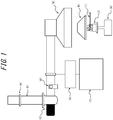
- FIG. 1 is a schematic view illustrating the cone calorimeter used in evaluation.
- a plate specimen for evaluation is set in a sample holder (j) and is heated with radiant heat of 50 kW/m 2 by a cone heater (h).
- the distance between a lower edge of the cone heater and an upper surface of the plate specimen for evaluation is 25 mm.
- Combustion gas is guided into an exhaust pipe via a smoke collection hood (g).
- the heat release rate (HRR) (units: kW/m 2 ) is calculated from oxygen consumption in a gas analyzer (f) via a gas sampler (e).
- Smoke density (units: 1/m) is measured by a laser smoke density meter (D).
- the change in mass of the specimen is measured by a load cell (k).
- T180 A cumulative value for heat release (T180) (MJ/m 2 ) was measured for the prepared specimen from the start of measurement using the cone calorimeter until 3 minutes after the start of measurement.
- the start of measurement of the T180 was taken to be the time of ignition of the specimen.
- the T180 indicates heat release during the initial 3 minutes and the value thereof is smaller when there is more formation of char that effectively serves as a combustion barrier layer.
- the cone calorimeter was used to measure a maximum value HRR (max) (kW/m 2 ) of the heat release rate during a measurement time of 20 minutes and the time (s) until the maximum heat release rate was reached for the prepared specimen.
- a maximum value for smoke density (units: 1/m) was measured using the laser smoke density meter of the cone calorimeter and was judged using the following categories.
- Post-melt-kneading coloring of the resin composition produced in each example or comparative example was inspected by eye.
- a polyphenylene ether resin composition composed of component (A), component (B), and component (D) displays an amber-like hue, whereas there is progression of yellow discoloring and red discoloring when component (C), component (E), and other components are also compounded. Progression of this discoloring was judged by the following standard.
- HIPS High impact polystyrene pellets
- CT60® High impact polystyrene
- D-1 Bisphenol A bis(diphenyl phosphate) (BDP) viscous liquid (product name: CR741® (CR741 is a registered trademark in Japan, other countries, or both), produced by Daihachi Chemical Industry Co., Ltd.)
- the resin compositions were obtained through melt-kneading under conditions of an extruder cylinder temperature setting of 300°C, a screw speed of 200 rpm, an extrusion rate of 20 kg/hr, and a vent degree of vacuum of 8 kPa.
- Various shaped products obtained through shaping using the polyphenylene ether resin composition of the present embodiment have excellent flame retardance and, even when ignited, efficiently form bulky porous char (carbonized product) serving as a combustion barrier layer and, as a result, can reduce heat release and smoke production during combustion.
- the polyphenylene ether resin composition thereof is easily colorable and has excellent shaping processability in formation of various shaped articles. Consequently, it is possible to meet requirements in relation to fire safety performance such as fire spread, ignitability, heat release, smoke production, and toxicity that are demanded for resin manufactured goods used in transportation such as railway vehicles, aircraft, and ships and also for use in public buildings.
- the polyphenylene ether resin composition of the present embodiment also has excellent shaping processability in formation of various shaped articles.
- the polyphenylene ether resin composition of the present embodiment efficiently forms bulky porous char during combustion and can reduce the flaming heat release rate and smoke production, and it is anticipated that the polyphenylene ether resin composition of the present embodiment may be used in resin manufactured goods used in public buildings and resin manufactured goods used in transportation such as railway vehicles, aircraft, and ships, for which reduction of flaming heat release, smoke density, and smoke toxicity during fire are demanded.
- polyphenylene ether resin composition can be widely used, for example, in consumer electronics and office automation (OA), office equipment, information devices, and the automotive industry, where flame retardance is required, due to also excelling in terms of light weight, heat resistance, mechanical properties, shaping processability, acid/alkali resistance, dimensional stability, electrical characteristics, and so forth.
- OA consumer electronics and office automation
- office equipment information devices
- automotive industry where flame retardance is required, due to also excelling in terms of light weight, heat resistance, mechanical properties, shaping processability, acid/alkali resistance, dimensional stability, electrical characteristics, and so forth.
Landscapes
- Chemical & Material Sciences (AREA)
- Health & Medical Sciences (AREA)
- Chemical Kinetics & Catalysis (AREA)
- Medicinal Chemistry (AREA)
- Polymers & Plastics (AREA)
- Organic Chemistry (AREA)
- General Chemical & Material Sciences (AREA)
- Engineering & Computer Science (AREA)
- Manufacturing & Machinery (AREA)
- Materials Engineering (AREA)
- Compositions Of Macromolecular Compounds (AREA)
Applications Claiming Priority (2)
| Application Number | Priority Date | Filing Date | Title |
|---|---|---|---|
| JP2016208123 | 2016-10-24 | ||
| PCT/JP2017/037189 WO2018079311A1 (ja) | 2016-10-24 | 2017-10-13 | ポリフェニレンエーテル系樹脂組成物 |
Publications (2)
| Publication Number | Publication Date |
|---|---|
| EP3530697A1 true EP3530697A1 (de) | 2019-08-28 |
| EP3530697A4 EP3530697A4 (de) | 2019-11-06 |
Family
ID=62024129
Family Applications (1)
| Application Number | Title | Priority Date | Filing Date |
|---|---|---|---|
| EP17864820.0A Withdrawn EP3530697A4 (de) | 2016-10-24 | 2017-10-13 | Poly(phenylenether)-harzzusammensetzung |
Country Status (5)
| Country | Link |
|---|---|
| US (1) | US20190309162A1 (de) |
| EP (1) | EP3530697A4 (de) |
| JP (1) | JPWO2018079311A1 (de) |
| CN (1) | CN109715730A (de) |
| WO (1) | WO2018079311A1 (de) |
Family Cites Families (12)
| Publication number | Priority date | Publication date | Assignee | Title |
|---|---|---|---|---|
| NL8204180A (nl) * | 1982-10-29 | 1984-05-16 | Gen Electric | Polymeer-mengsel, daaruit gevormde voorwerpen. |
| JPH08165423A (ja) * | 1994-12-14 | 1996-06-25 | Nippon G Ii Plast Kk | ポリフェニレンエーテル系樹脂組成物 |
| JP2000297209A (ja) * | 1999-02-08 | 2000-10-24 | Asahi Chem Ind Co Ltd | 珪素含有ポリフェニレンエーテル系組成物 |
| JP4502227B2 (ja) * | 1999-10-06 | 2010-07-14 | 旭化成ケミカルズ株式会社 | 帯電防止ポリフェニレンエーテル樹脂組成物 |
| JP2003049077A (ja) * | 2001-08-03 | 2003-02-21 | Asahi Kasei Corp | 充填材含有難燃樹脂組成物および製法 |
| JP4451649B2 (ja) * | 2002-12-19 | 2010-04-14 | 三洋化成工業株式会社 | 帯電防止性樹脂組成物 |
| WO2006098214A1 (ja) * | 2005-03-14 | 2006-09-21 | Adeka Corporation | 帯電防止剤組成物 |
| WO2006117933A1 (ja) * | 2005-04-26 | 2006-11-09 | Kureha Corporation | 制電性樹脂組成物および制電性樹脂容器作製用キット |
| JP5167277B2 (ja) * | 2007-01-10 | 2013-03-21 | サビック・イノベーティブ・プラスチックス・アイピー・ベスローテン・フェンノートシャップ | 低い煙密度のポリ(アリーレンエーテル)組成物、方法、及び物品 |
| JP2008185945A (ja) * | 2007-01-31 | 2008-08-14 | Canon Inc | 電子写真用シームレスベルト及び電子写真画像形成装置 |
| JP6851852B2 (ja) * | 2016-03-28 | 2021-03-31 | 旭化成株式会社 | ポリフェニレンエーテル系樹脂組成物 |
| CN107236279B (zh) * | 2016-03-28 | 2020-05-05 | 旭化成株式会社 | 聚苯醚系树脂组合物 |
-
2017
- 2017-10-13 EP EP17864820.0A patent/EP3530697A4/de not_active Withdrawn
- 2017-10-13 US US16/344,460 patent/US20190309162A1/en not_active Abandoned
- 2017-10-13 JP JP2018547566A patent/JPWO2018079311A1/ja active Pending
- 2017-10-13 WO PCT/JP2017/037189 patent/WO2018079311A1/ja not_active Ceased
- 2017-10-13 CN CN201780054337.2A patent/CN109715730A/zh not_active Withdrawn
Also Published As
| Publication number | Publication date |
|---|---|
| JPWO2018079311A1 (ja) | 2019-04-04 |
| EP3530697A4 (de) | 2019-11-06 |
| CN109715730A (zh) | 2019-05-03 |
| US20190309162A1 (en) | 2019-10-10 |
| WO2018079311A1 (ja) | 2018-05-03 |
Similar Documents
| Publication | Publication Date | Title |
|---|---|---|
| JP5965543B2 (ja) | 難燃性熱可塑性組成物、その製造方法およびそれを含む物品 | |
| EP0767204B1 (de) | Flammhemmende Kunstharz-Zusammensetzung | |
| CN101423621B (zh) | 阻燃的可膨胀的聚(芳撑醚)/聚苯乙烯组合物和其制备方法 | |
| CN107849294B (zh) | 聚(苯醚)组合物和制品 | |
| CN102775757B (zh) | 低烟气密度聚(亚芳基醚)组合物,方法,和制品 | |
| US7750067B2 (en) | Black-colored poly(arylene ether)polystyrene compositions, articles, and methods | |
| CN115315460B (zh) | 聚(亚苯基醚)组合物、其制备方法及由其制造的制品 | |
| CN101885908B (zh) | 聚(亚芳基醚)组合物 | |
| JP2002541290A (ja) | 有機ホスフェート含有ポリフェニレンエーテル樹脂コンセントレート | |
| JP2010189517A (ja) | ポリフェニレンエーテル系樹脂組成物、ポリフェニレンエーテル系樹脂組成物の製造方法、ポリフェニレンエーテル系樹脂組成物の成形体 | |
| JP2002526587A (ja) | 難燃性ポリフェニレンエーテル組成物 | |
| JP5388882B2 (ja) | 樹脂組成物及びこれを用いた成形体 | |
| JP5558146B2 (ja) | 樹脂組成物 | |
| JP5461298B2 (ja) | ポリフェニレンエーテル系樹脂組成物の製造方法及びこれを用いた成形体 | |
| JP2015127357A (ja) | 難燃性樹脂組成物 | |
| US20190309162A1 (en) | Polyphenylene ether resin composition | |
| JP2000510899A (ja) | 耐しずく化性が改善した難燃性の熱可塑性成形材料 | |
| WO2023037172A1 (en) | Poly(phenylene ether)-based composition and article | |
| JP2018070671A (ja) | 発熱速度が抑制されるポリフェニレンエーテル系樹脂組成物 | |
| JP6043617B2 (ja) | スチレン系難燃性樹脂組成物およびそれからなる成形体 | |
| JP2018070670A (ja) | ポリフェニレンエーテル系樹脂組成物 | |
| JP2017155196A (ja) | 樹脂組成物及びその発泡成形体 | |
| JP2025071677A (ja) | 樹脂組成物、ペレット、および、成形品 | |
| JP2015189910A (ja) | 樹脂組成物、成形体、太陽電池モジュール部品、コネクター及び接続箱 |
Legal Events
| Date | Code | Title | Description |
|---|---|---|---|
| STAA | Information on the status of an ep patent application or granted ep patent |
Free format text: STATUS: THE INTERNATIONAL PUBLICATION HAS BEEN MADE |
|
| PUAI | Public reference made under article 153(3) epc to a published international application that has entered the european phase |
Free format text: ORIGINAL CODE: 0009012 |
|
| STAA | Information on the status of an ep patent application or granted ep patent |
Free format text: STATUS: REQUEST FOR EXAMINATION WAS MADE |
|
| 17P | Request for examination filed |
Effective date: 20190524 |
|
| AK | Designated contracting states |
Kind code of ref document: A1 Designated state(s): AL AT BE BG CH CY CZ DE DK EE ES FI FR GB GR HR HU IE IS IT LI LT LU LV MC MK MT NL NO PL PT RO RS SE SI SK SM TR |
|
| AX | Request for extension of the european patent |
Extension state: BA ME |
|
| STAA | Information on the status of an ep patent application or granted ep patent |
Free format text: STATUS: EXAMINATION IS IN PROGRESS |
|
| A4 | Supplementary search report drawn up and despatched |
Effective date: 20191007 |
|
| RIC1 | Information provided on ipc code assigned before grant |
Ipc: C08K 5/523 20060101ALI20190930BHEP Ipc: C08L 25/04 20060101ALI20190930BHEP Ipc: C08L 71/12 20060101AFI20190930BHEP Ipc: C08J 5/00 20060101ALI20190930BHEP Ipc: C08K 5/42 20060101ALI20190930BHEP Ipc: C08K 5/00 20060101ALI20190930BHEP |
|
| 17Q | First examination report despatched |
Effective date: 20191028 |
|
| STAA | Information on the status of an ep patent application or granted ep patent |
Free format text: STATUS: THE APPLICATION HAS BEEN WITHDRAWN |
|
| DAV | Request for validation of the european patent (deleted) | ||
| DAX | Request for extension of the european patent (deleted) | ||
| 18W | Application withdrawn |
Effective date: 20200102 |