EP3512828B1 - Process for the production of glycolic acid - Google Patents
Process for the production of glycolic acid Download PDFInfo
- Publication number
- EP3512828B1 EP3512828B1 EP17771848.3A EP17771848A EP3512828B1 EP 3512828 B1 EP3512828 B1 EP 3512828B1 EP 17771848 A EP17771848 A EP 17771848A EP 3512828 B1 EP3512828 B1 EP 3512828B1
- Authority
- EP
- European Patent Office
- Prior art keywords
- bara
- reactor
- acid
- product stream
- process according
- Prior art date
- Legal status (The legal status is an assumption and is not a legal conclusion. Google has not performed a legal analysis and makes no representation as to the accuracy of the status listed.)
- Active
Links
Images

Classifications
-
- C—CHEMISTRY; METALLURGY
- C07—ORGANIC CHEMISTRY
- C07C—ACYCLIC OR CARBOCYCLIC COMPOUNDS
- C07C51/00—Preparation of carboxylic acids or their salts, halides or anhydrides
- C07C51/10—Preparation of carboxylic acids or their salts, halides or anhydrides by reaction with carbon monoxide
- C07C51/145—Preparation of carboxylic acids or their salts, halides or anhydrides by reaction with carbon monoxide with simultaneous oxidation
-
- C—CHEMISTRY; METALLURGY
- C07—ORGANIC CHEMISTRY
- C07C—ACYCLIC OR CARBOCYCLIC COMPOUNDS
- C07C51/00—Preparation of carboxylic acids or their salts, halides or anhydrides
- C07C51/09—Preparation of carboxylic acids or their salts, halides or anhydrides from carboxylic acid esters or lactones
-
- C—CHEMISTRY; METALLURGY
- C07—ORGANIC CHEMISTRY
- C07C—ACYCLIC OR CARBOCYCLIC COMPOUNDS
- C07C51/00—Preparation of carboxylic acids or their salts, halides or anhydrides
- C07C51/10—Preparation of carboxylic acids or their salts, halides or anhydrides by reaction with carbon monoxide
- C07C51/12—Preparation of carboxylic acids or their salts, halides or anhydrides by reaction with carbon monoxide on an oxygen-containing group in organic compounds, e.g. alcohols
-
- C—CHEMISTRY; METALLURGY
- C07—ORGANIC CHEMISTRY
- C07C—ACYCLIC OR CARBOCYCLIC COMPOUNDS
- C07C51/00—Preparation of carboxylic acids or their salts, halides or anhydrides
- C07C51/42—Separation; Purification; Stabilisation; Use of additives
-
- C—CHEMISTRY; METALLURGY
- C07—ORGANIC CHEMISTRY
- C07C—ACYCLIC OR CARBOCYCLIC COMPOUNDS
- C07C59/00—Compounds having carboxyl groups bound to acyclic carbon atoms and containing any of the groups OH, O—metal, —CHO, keto, ether, groups, groups, or groups
- C07C59/01—Saturated compounds having only one carboxyl group and containing hydroxy or O-metal groups
- C07C59/06—Glycolic acid
-
- C—CHEMISTRY; METALLURGY
- C07—ORGANIC CHEMISTRY
- C07C—ACYCLIC OR CARBOCYCLIC COMPOUNDS
- C07C67/00—Preparation of carboxylic acid esters
- C07C67/08—Preparation of carboxylic acid esters by reacting carboxylic acids or symmetrical anhydrides with the hydroxy or O-metal group of organic compounds
-
- C—CHEMISTRY; METALLURGY
- C07—ORGANIC CHEMISTRY
- C07C—ACYCLIC OR CARBOCYCLIC COMPOUNDS
- C07C67/00—Preparation of carboxylic acid esters
- C07C67/48—Separation; Purification; Stabilisation; Use of additives
- C07C67/52—Separation; Purification; Stabilisation; Use of additives by change in the physical state, e.g. crystallisation
- C07C67/54—Separation; Purification; Stabilisation; Use of additives by change in the physical state, e.g. crystallisation by distillation
-
- C—CHEMISTRY; METALLURGY
- C07—ORGANIC CHEMISTRY
- C07C—ACYCLIC OR CARBOCYCLIC COMPOUNDS
- C07C69/00—Esters of carboxylic acids; Esters of carbonic or haloformic acids
- C07C69/66—Esters of carboxylic acids having esterified carboxylic groups bound to acyclic carbon atoms and having any of the groups OH, O—metal, —CHO, keto, ether, acyloxy, groups, groups, or in the acid moiety
- C07C69/67—Esters of carboxylic acids having esterified carboxylic groups bound to acyclic carbon atoms and having any of the groups OH, O—metal, —CHO, keto, ether, acyloxy, groups, groups, or in the acid moiety of saturated acids
- C07C69/675—Esters of carboxylic acids having esterified carboxylic groups bound to acyclic carbon atoms and having any of the groups OH, O—metal, —CHO, keto, ether, acyloxy, groups, groups, or in the acid moiety of saturated acids of saturated hydroxy-carboxylic acids
-
- Y—GENERAL TAGGING OF NEW TECHNOLOGICAL DEVELOPMENTS; GENERAL TAGGING OF CROSS-SECTIONAL TECHNOLOGIES SPANNING OVER SEVERAL SECTIONS OF THE IPC; TECHNICAL SUBJECTS COVERED BY FORMER USPC CROSS-REFERENCE ART COLLECTIONS [XRACs] AND DIGESTS
- Y02—TECHNOLOGIES OR APPLICATIONS FOR MITIGATION OR ADAPTATION AGAINST CLIMATE CHANGE
- Y02P—CLIMATE CHANGE MITIGATION TECHNOLOGIES IN THE PRODUCTION OR PROCESSING OF GOODS
- Y02P20/00—Technologies relating to chemical industry
- Y02P20/10—Process efficiency
Definitions
- the present invention relates to a process for the production of a hydroxy acid, more particularly glycolic acid, or derivatives thereof. More particularly, the present invention relates to a process for the production of a hydroxy acid, such as glycolic acid, or derivatives thereof having a purity which is at least about 70%.
- the reaction to form glycolic acid by the carbonylation of formaldehyde with carbon monoxide using strong acid catalysts is well known.
- the basic process was first disclosed by DuPont in US2152852 .
- the process was for the preparation of glycolic acid in the liquid phase by reacting formaldehyde, water and carbon monoxide in the presence of a homogeneous acid catalyst at temperatures between 50 and 350°C and at a pressure between 5 and 1500 atma (between 0.5 and 152 MPa).
- Sulphuric acid, hydrochloric acid, phosphoric acid, boron fluoride, formic acid and glycolic acid are described as suitable catalysts.
- the process for producing ethylene glycol was commercialised and operated by DuPont until the late 1960's when this route to ethylene glycol became uncompetitive.
- the plant was then operated for the production of glycolic acid in which sulphuric acid was used as catalyst at a temperature of 200°C and at a pressure of from 400 to 700 bar.
- GB1595231 describes a process for the reaction of formaldehyde or one of its linear or cyclic polymers with carbon monoxide in the presence of an alcohol to obtain a glycolic acid using a sulphonic acid catalyst.
- a problem with in situ esterification is that the system is inefficient since there is excessive by-product formation. For example where the alcohol is methanol, methoxyacetic acid is formed.
- US4140866 looks at the problems associated with removing the sulfuric acid catalyst from glycolic acid produced by formaldehyde carbonylation.
- the proposed solution is to first treat the reaction mixture with an alkali metal hydroxide to form the dissolved sulfate salt and this is then precipitated on esterification of the glycolic acid with ethylene dioxide and removal of water.
- a widely adopted strategy for overcoming the problems associated with separating homogeneous catalysts from reaction mixtures is to replace the homogeneous catalysts with heterogeneous catalysts that can easily be mechanically separated.
- Several solid acid materials have been suggested as suitable catalysts for use in formaldehyde carbonylation reactions. These include sulfonic acid ion exchange resins, aluminosilicate zeolites, polyoxometalate salts and alkyl sulfonic acid polysiloxanes.
- solid insoluble particulate acidic catalysts having a hydrogen ion exchange capacity in excess of 0.1 milliequivalents per gram was first described in GB1499245 .
- Sulfonic acid based ion exchange resins, acid clays and zeolites are listed as suitable catalysts for formaldehyde carbonylation. These include sulfonic acid ion exchange resins, aluminosilicate zeolites, polyoxometalate salts and alkyl sulfonic acid polysiloxanes.
- KR19950013078B1 relates to a process for producing glycolic acid in which formaldehyde and carbon monoxide are reacted in the presence of water or water-methanol mixture using a heterogeneous solid catalyst, which is polymeric strong acid catalyst ion-exchanged by 5-40 wt% with monovalent metal of Group IB in a water-soluble inert solvent.
- Dioxane is used as a water-soluble inert solvent.
- a process for continuously manufacturing methyl glycolate from formaldehyde, carbon oxide and methanol is described in KR19950009480B1 in which a flow reactor filled with a polymeric strong acid catalyst is used. Reactant mixture of formaldehyde, water and inert solvent and carbon monoxide is supplied to the upper part of the reactor, and methanol is supplied to the lower part. In the upper part of the reactor, glycolic acid is produced via acid catalysis. In the lower part of the reactor, methyl glycolate is prepared from methanol and formed glycolic acid. The pressure of carbon monoxide is 500 to 6,000 psig (3.5 to 41 MPa gauge) and the temperature is 80 to 200°C. The suggested selectivity for this one-step procedure is relatively high.
- KR0124821B1 relates to separating methylglycolate from an acidic solution.
- the reaction solution formed by a carbonylation reaction and an esterification reaction contains methyl glycolate, dioxane, water, methanol and hydrogen ion.
- This reaction solution is sent to a neutralization reactor and is neutralized by the addition of alkali to give a salt.
- the reaction solution containing salt is distilled to separate methanol, water and dioxane from methyl glycolate, salt and dioxane.
- the methanol separated from dioxane is recirculated to the carbonylation reactor.
- the solution which separated from the lower part of the distillation tower contains methyl glycolate, salt and dioxane. This is sent to a solid-liquid separator to separate the methyl glycolate from the solvent.
- a further process for the production of methyl glycolate is described in KR19950011114B1 .
- formaldehyde is reacted with carbon monoxide to make a glycolic acid.
- the glycolic acid is then reacted with methanol to make a methyl glycolate.
- Residual formaldehyde is then reacted with methanol to make methylal.
- the methyl glycolate and methylal are then separated by distillation.
- the methylal is reacted with a Fe-Mo catalyst to return it to formaldehyde which is then recovered and concentrated before being recycled.
- heteropolyacids as homogeneous catalysts for the condensation of formaldehyde and methyl formate.
- glycolic acid is formed by hydrolysis of polyglycolide made from formaldehyde and carbon monoxide in the presence of a solid heteropoly acid.
- WO2009/140787 , WO2009/140788 and WO2009/140850 relate to processes using insoluble polyoxometalate compounds. These compounds either have specific acid properties or are encapsulated within zeolite cages, as solid acid catalysts, to produce glycolic acid from carbon monoxide and formaldehyde.
- the metal salts are prone to leaching of the metal component, which will reduce the number of active acid sites.
- acid leaching will impact both the zeolite substrate and the salts themselves.
- US2004/0138409 discloses a method of producing a diol derivative, comprising a step of obtaining an [alpha]-hydroxycarboxylic acid ester by reacting (i) one or more 1,2-diols or (ii) a 1,2-diol and a primary alcohol as starting material(s) with oxygen in the presence of a catalyst comprising metal loaded on a carrier.
- the method may further comprise a step of hydrolysing the obtained [alpha]-hydroxycarboxylic acid ester to obtain an [alpha]-hydroxycarboxylic acid.
- US4824997 discloses a method of carbonylation of formaldehyde. A method for preparation of an alkyl glycolate by esterification of the carbonylation reaction mixture is also disclosed.
- the various approaches to trying to solve the problems associated with the reaction can be summarised into two categories.
- the first relates to the investigation of homogeneous catalyst systems which operate at lower pressure and lower acid concentration than has previously been achievable.
- the second relates to the investigation of heterogeneous solid acid catalysts as these benefit from easier separation of the catalyst and reduced reactor corrosion.
- the solid catalysts proposed to date have also proved to have a number of shortcomings and have not been adopted commercially. These catalysts generally lack the thermal and chemical stability required to withstand the severe reaction conditions.
- aluminosilicate zeolites are not stable under highly acidic conditions, as the aluminium is leached from the structure causing it to collapse. This results in loss of activity and eventually complete disintegration of the catalyst ( Pan et al, 1994, Studies in Surface Science and Catalysis ). With a view to avoid this problem, it is proposed in EP0114657 that the reaction should be operated such that the amount of acid formed is limited, but this reduces the efficiency of the reactor and exacerbates separation problems.
- substituted organopolysiloxane compounds such as Deloxan ASP 1/9, QuadraSil - SA and Silicycle (SCX-2), and alkyl sulfonic acid polysiloxanes, can be used but these have been found to quickly lose catalytic performance at effective process conditions. This has been attributed to the loss of the tethered organic acid groups due to hydrolysis.
- the catalyst disclosed therein comprises a homogeneous acid catalyst component and a porous solid component.
- WO 2016/162662 An alternative improved process for the production of glycolic acid is described in WO 2016/162662 .
- This process relates to the discovery that when the reaction is carried out in the presence of a small quantity of an homogeneous alkyl silyl sulfonic acid, that the reduction in activity of the silica material can be recovered or avoided. In some situations an enhanced activity can be achieved.
- WO 2016/162662 relates to a process for the production of glycolic acid or derivatives thereof from formaldehyde comprising reacting formaldehyde with carbon monoxide and water in the presence of a silica catalyst, wherein from about 200 to about 1000 ppm of an alkyl silyl sulfonic acid is supplied to the reaction.
- glycolic acid obtained by the carbonylation of formaldehyde in water in the presence of an acid catalyst, contains glycolic acid dimers and/or oligomers formed by ester-forming dehydrocondensation of glycolic acid.
- Diglycolic acid may also be present.
- catalyst residues will generally be present.
- any polyacids formed may be removed by hydrolysis achieved by dilution of 70% glycolic acid with water to about 20% or less and refluxing. This rate of hydrolysis may be improved by the addition of alkali. Whilst this dilution procedure can be used to convert the glycolic acid dimer to the monomer, there will still be other impurities present.
- this loss of a sulphur species in the carbonylation reaction may offer advantages in catalysing a subsequent esterification reaction.
- the sulfur species can be recovered from the esterification reactor and recycled to the carbonylation reactor.
- Forming an ester provides a product which can more readily be separated from impurities since the problems associated with separating the acid do not apply to the ester and thus separation from impurities can be more readily achieved.
- the desired products may be esters
- the desired product may be readily achieved.
- the desired product is the acid, which may be glycolic acid
- the separated and hence purified ester can readily be hydrolysed to the acid to provide an acid having the desired level of purity.
- the conversion of the alkylglycolate to glycolic acid is preferably carried out in a hydrolysis reactor.
- step (e) comprises: (e)(i) separating the sulfur species from the second product stream and recycling it to the carbonylation reactor in step (a) to form a sulphur depleted second product stream; and (e)(ii) separating the alkylglycolate from the sulphur depleted second product stream in the distillation zone.
- the formation of the alkylglycolate ester from the glycolic acid in the present invention enables distillation to be carried out to separate the ester from the impurities such that effective separation can be achieved without the drawbacks associated with separating glycolic acid from the impurities.
- the ability to form dimers or oligomers during distillation is removed.
- the sulfur species can be readily separated from the ester and returned to the carbonylation reactor and as such the use of the sulfur species in the esterification does not represent a loss to the system. Returning the sulfur species to the first carbonylation reactor enables the activity of the catalyst used therein to be maintained or even enhanced.
- step (a) Since alcohols and carboxylic acids are not present in step (a), the problems associated with by-product formation during the carbonylation step are avoided.
- reaction of the formaldehyde with carbon monoxide and water in step (a) may be carried out by any suitable means.
- the water may be present in any suitable amount.
- the water may be used in an amount from the stoichiometric requirement to a molar ratio of about 4:1 water: formaldehyde.
- the water may additionally act as a solvent for the carbonylation reaction. Where water is used as a solvent, it will generally be used in an amount in excess of the ratio detailed above.
- the water may be provided to the carbonylation reaction zone separately or alternatively it may be supplied in the formaldehyde feed and/or with another solvent.
- the water may be present in the amount which is sufficient for the reaction and a separate solvent may be used.
- a solvent it may be the glycolic acid formed in the reaction or it may be a separate solvent.
- Suitable separate solvents include carboxylic acids or sulphones.
- Suitable solvents include propionic acid or a sulphone. 2,3,4,5-tetrahydrothiophene-1,1-dioxide may be a suitable sulphone.
- the formaldehyde may be supplied as a solution in water or it may be generated in-situ within the carbonylation reaction zone.
- paraformaldehyde may be used as a reactant.
- Paraformaldehyde is a polymer of formaldehyde, which reverts to monomeric formaldehyde in the presence of polar molecules, such as water or alcohol solvents.
- the carbon monoxide may be a pure source of carbon monoxide, optionally comprising small quantities of impurities such as one or more of light alkanes, carbon dioxide or hydrogen.
- the carbon monoxide source can be a component of a gaseous mixture, for example synthesis gas (syngas), which is a mixture of hydrogen and carbon monoxide.
- the catalyst may be homogeneous or heterogeneous. Where the catalyst is a heterogeneous catalyst, the sulfur species present in the first product stream may be a sulfur species formed by decomposition of the catalyst.
- the sulfur catalyst may be sulphuric acid.
- an acidic polysiloxane catalyst may be used.
- Suitable catalysts include those detailed in EP1360222 , EP1786850 , WO2006/013080 , WO2007/090676 and US2010/0290962 .
- Substituted organopolysiloxane compounds such as Deloxan ASP 1/9, QuadraSil - SA and Silicycle (SCX-2), and alkyl sulfonic acid polysiloxanes, can be used.
- the polysiloxane catalyst may be used alone or in combination with other compounds which may themselves serve as catalysts for the carbonylation reaction or which may be present to assist in stabilizing the polysiloxane catalyst.
- sulphuric acid may additionally be used as a co-catalyst.
- the catalyst may be the catalyst system described in WO2016/162663 .
- the catalyst system may comprise a homogeneous acid catalyst component and a porous solid component.
- Any suitable homogeneous acid catalyst may be used in this system as a component of the catalyst system.
- suitable homogeneous acid catalyst examples include sulfuric acid, triflic acid, sulfonic acids such as methylsulfonic acid, ethanesulfonic acid, p-toluenesulfonic acid, and perfluorooctanesulfonic acid and phosphorous based acids such as phosphonic acid and ethylphosphonic acid.
- compositions modified with groups to enhance interaction with the solid component may be used. Examples include trihydroxysilylpropane sulfonic acid, alkyl phosphonic acid, and trihydroxysilylethylsulfonic acid. In another arrangement, formic acid may be used.
- Any suitable solid component may be used in the catalyst system provided that it is porous and stable to the reaction environment.
- Any suitable pore size can be used. In one arrangement it may have a surface area of from about 250 to about 900 m 2 /g. A surface area of from about 400 to about 750 m 2 /g or from about 500 to about 600 m 2 /g may be used.
- the catalyst system may have a pore volume of from about 0.2 to 1.2 cc/g. In one arrangement, a pore volume of from about 0.5 to about 1.0 cc/g may be used.
- the solid component may be selected to have some catalytic activity in the absence of the homogeneous component, the combined catalytic effect of the solid component and the homogeneous catalyst surprisingly will be greater than that expected from the components individually.
- the solid component may be unfunctionalised.
- unfunctionalised we mean that the surface has not been specifically modified to add active catalytic moieties to the surface.
- the unfunctionalised solid component may have hydroxyl groups located on the surface thereof.
- the solid component may be a functionalised material.
- functionalised we mean that the material has been modified to have enhanced activity.
- the functionalization may be to add alkyl sulfonic acid groups, hydroxyl groups or both alkyl sulfonic acid groups and hydroxyl groups on the surface of the material, in the pores of the solid component or on both the surface and in the pores.
- suitable solid components include silicas, activated carbons, ordered mesoporous carbon, nanoporous carbons, some titanias and zirconias.
- the silicas may be those from the Johnson Matthey QuadraSil range including SA, TA, AP or MP or QuadraSil PHI available from Sigma Aldrich.
- Other suitable supports include synthesised ordered mesoporous (or nanoporous) carbons having ordered silica frameworks such as MCM-41, MCM-48, SBA-51, KIT-6, and IITM-56 as templates.
- any suitable amount of homogeneous acid catalyst component may be present in the catalyst system. In one arrangement it may be from: about 10 ppm to about 25 wt%; from about 50 ppm to about 20 wt%; from about 1 wt% to about 15 wt%; or from about 2 wt% to about 10 wt%.
- the ppm in the solution is ppm weight of acid.
- An alternative catalyst system which may be used is the catalyst described in WO2016/162662 .
- the reaction is carried out in the presence of a silica catalyst, and from about 200 to about 5000 ppm of an alkyl silyl sulfonic acid.
- Any suitable silica catalyst may be used in this catalyst system. It may be non-porous or porous. In one arrangement where the catalyst is porous, it may have a surface area of from about 250 to about 500 m 2 /g and a pore volume of from about 0.2 to 1.2 cc/g. A pore volume of from about 0.5 to about 1.0 cc/g may be used. As supplied to the reactor it may be functionalised or unfunctionalised. Examples of suitable silicas include those from the Johnson Matthey QuadraSil range including SA, TA, AP or MP or QuadraSil PHI available from Sigma Aldrich.
- the solid component may be unfunctionalised.
- unfunctionalised we mean that the surface has not been specifically modified to add active catalytic moieties to the surface.
- the solid component may be a functionalised material.
- 'functionalised we mean that the material has been modified to have enhanced activity.
- the functionalization may be to add alkyl silyl sulfonic acid groups, hydroxyl groups or both alkyl silyl sulfonic acid groups and hydroxyl groups on the surface of the material.
- Any suitable alkyl silyl sulfonic acid may be used in this catalyst system.
- Suitable acids include trihydroxysilylalkyl sulfonic acid, such as trihydroxysilylpropyl sulfonic acid, or trihydroxysilylethyl sulfonic acid.
- the alkyl silyl sulfonic acid may be fresh alkyl silyl sulfonic acid or its addition may be achieved by recycling a portion of the product stream recovered from the reactor which will include alkyl silyl sulfonic acid.
- the carbonylation reactor will typically be operated at a temperature in the range of from about 50°C to about 400°C, for example in the range of from about 100°C to about 250°C.
- the reactor will typically be operated at a pressure in the range of from about 1 to about 1000 bara (about 0.1 to about 100MPa), such as in the range of from 10 to 200 bara (about 0.1 to about 20MPa).
- the carbonylation reaction may be carried out in any suitable manner. In one arrangement it may be conducted in a continuous flow configuration in which carbon monoxide, water, formaldehyde, and optional solvent, either pre-mixed or separately, are introduced to the carbonylation reactor to a fixed bed or slurry reactor containing the acidic polysiloxane catalyst such that the glycolic acid produced can be continuously withdrawn from the reactor.
- the reaction can take place in single or multiple reactors which may be of different types.
- the reactors may be arranged in series or in parallel.
- One or more feedstocks may be added at a single point or sequentially as the reaction progresses.
- the reaction can be conducted batch-wise. This involves suspending and stirring the catalyst in a liquid reaction composition comprising solvent and formaldehyde, with carbon monoxide being fed into the reactor under pressure. The resulting product composition can then be periodically removed from the reactor as the first product stream.
- the glycolic acid formed will be removed from the carbonylation reactor in the first product stream.
- This first product stream may then be treated to separate one or more, so-called, 'lights'.
- 'Lights' are compounds which have a boiling point that is lower than that of the glycolic acid. These lights may include one or more of solvent, unreacted formaldehyde, and unreacted carbon monoxide.
- the first product stream may be passed to a lights separation zone.
- Other impurities such as alkyl formate, for example methyl formate, and dialkoxymethane, such as dimethoxymethane which is also known as methylal, may be removed by this separation.
- the first product stream will additionally also comprise the sulfur species together with one or more, so-called, 'heavies'. These are compounds which have a boiling point that is higher than that of glycolic acid. Any dimers and oligomers of glycolic acid which may form in the carbonylation reactor will be included in these heavies.
- a stream recovered after esterification may be recycled to the carbonylation reactor. Whilst this recycle will generally substantially comprise the sulfur species, it may also include a small quantity of the glycolic acid ester, and/or heavies formed in the carbonylation reactor and their reaction products, if any, which may be formed in the esterification reactor. The ester and any esterification reaction products will then be removed from the carbonylation reactor in the first product stream and form part of the heavies.
- the separation of the lights may be carried out by any suitable means, but the lights separation zone will generally be a flash column. Since it is only the light components which are being separated, the temperatures of the lights separation zone can be kept sufficiently low that the disadvantages associated with distilling glycolic acid discussed above do not occur.
- the light separation zone will be operated at any suitable temperature which achieves the result.
- the light separation zone may be operated at a reboiler temperature of about 140°C to about 160°C or at about 150°C and an overhead temperature of about 75°C to about 85°C or at about 80°C and a pressure of about 1.8 bara to about 2.2 bara or at about 2 bara. At these conditions, significant loss of water in the overheads can be avoided.
- the first product stream may be fed to any suitable position in the lights separation zone. Where the lights separation zone comprises a flash column, the first product stream may be fed to the top section of the flash column.
- a low boiling point alkanol such as methanol
- the alkanol may be supplied to the lights separation zone to facilitate separation.
- the alkanol may be used from battery limit. This may be fed to any suitable position in the lights separation zone. Where the lights separation zone comprises a flash column, the alkanol will generally be fed to the bottom section of the column.
- the prime function of this column is to separate unreacted formaldehyde and by-product formic acid from the first product stream.
- the alkanol such as methanol
- reacts with the formaldehyde to form dialkoxymethane, such as dimethoxymethane
- formic acid reacts with the alkanol, such as methanol, to form alkyl formate, such as methyl formate.
- the lights are removed overhead from the lights separation zone and may comprise alkyl formate, alkanol and dialkyloxymethane.
- the overhead from the lights separation zone may comprise mainly methyl formate, methanol and dialkyloxymethane. Whilst the lights separation zone is operated to prevent significant loss of water in the overheads, some water may still be present in the overhead steam. This overhead stream may therefore be passed to a water separation zone, which is generally a water separation column in which water present is separated as a bottom product.
- Overheads from the water separation column will generally comprise alkyl formate, alkanol and dialkoxymethane.
- the alkanol is methanol the overhead will comprise methyl formate, methanol and dimethoxymethane.
- the overheads from the water separation column may be fed to a formaldehyde separation column. In this column the alkyl formate, alkanol and dialkoxymethane are separated overhead while alkanol is recovered in the bottoms.
- the overhead stream will generally be fed as a feed stream to a formaldehyde plant in which the formaldehyde is produced while the bottoms alkanol stream may be used as the alkanol feed to the esterification reactor where alkanol is used for the esterification.
- the overhead stream may be treated such that one or both of the alkyl formate and dialkoxymethane may be separated and recovered.
- the lights separation zone will therefore generally contain sufficient stages to prevent loss of methyl glycolate overhead.
- a lights-depleted first product stream is recovered from the light separation zone. This recovery may occur at any suitable position in the lights separation zone but it will generally be taken from at or near the bottom, particularly where the lights separation zone is a flash column.
- the first product stream, or where the first product stream is passed through the lights separation zone the lights-depleted first product stream, is passed to an esterification reactor where it is reacted such that a glycolic acid ester is formed.
- the stream fed to the esterification reactor will be contacted with an alkanol to effect esterification.
- Any suitable alkanol may be used for the esterification.
- Suitable alkanols include methanol, ethanol, propanol or butanol. However, generally methanol will be used.
- the stream fed to the esterification reactor will be contacted with a diol.
- Any suitable diol may be used for the esterification.
- One suitable diol is ethylene glycol.
- the alkanol or diol provided to the esterification reactor will generally be provided in sufficient amount, in molar terms, to substantially completely esterify the glycolic acid to form alkyl glycolate.
- sufficient alkanol or diol may be provided to additionally esterify any formic acid which may have been present in the first product stream and which is not removed in the lights separation zone.
- Further sufficient alkanol or diol will generally be provided to react with any residual formaldehyde which may be present in the feed to the esterification reactor to form dialkoxymethane.
- the esterification may be carried out in any suitable reactor. However, generally a plug flow reactor is used although a stirred tank reactor or a reaction column may be used. This esterification is catalysed by the sulfur species recovered in the first product stream. It will be understood that water is also produced in the esterification reaction.
- the esterification may be carried out at any suitable temperature and pressure. In one arrangement the reaction will occur at a temperature of from about 90°C to about 150°C, from 110°C to 140°C, from about 100°C to about 140°C, from about 115°C to about 130°C or from about 120°C to about 125°C.
- the esterification reactor may be operated at a pressure of from about 3 bara to about 7 bara, or from about 4 bara to about 6 bara and may be about 5 bara.
- the second product stream will generally comprise the alkyl glycolate, other esters, glycolic acid and water in addition to the sulfur species and other impurities.
- the second product stream will also include any unreacted esterification agent.
- esterification is carried out with an alkanol
- the second product stream will include alkanol.
- the second product stream will include diol.
- the second product stream will then be treated to remove the sulfur species.
- the sulfur species may be separated at the same time as the alkyl glycolate is separated. In an alternative arrangement, the sulfur species may be removed before the sulfur species depleted second product stream is treated to recover the alkyl glycolate.
- the sulfur species separation means is an esterification flash drum.
- the esterification flash drum may be operated at any suitable conditions.
- the flash drum will be operated at just above atmospheric pressure. For example, it may be operated at a temperature of from about 140°C to about 160°C, or from about 145°C to about 155°C or at about 150°C and at a pressure of about 1.5 to about 2.0 bara or at about 1.7 bara to about 1.8 bara.
- the sulfur species will generally be recovered from at, or near, the base of the esterification flash drum and recycled to the carbonylation reactor.
- the stream recovered from the base of the esterification flash drum may comprise some heavy glycolate species.
- This sulfur species stream may be passed to a recycle column.
- the purpose of the recycle column is to prevent alkanol, such as methanol, as alkyl glycolate being recycled to the carbonylation reactor.
- water may be added near to the bottom of the recycle column.
- the purpose of the water is to hydrolyse any alkyl glycolate to alkanol and glycolic acid and to prevent the glycolic acid from oligomerizing and becoming viscous or solid. Any glycolic acid separated in the recycle column may be recovered.
- An overhead stream from the recycle column which will comprise mainly alkanol, such as methanol, may be returned to the water separation column where present.
- a bottoms stream from the recycle column which will comprise some glycolic acid, water and the sulfur species may be recycled to the reactor in which carbonylation occurs.
- the second product stream, or where the sulfur species has been removed the sulfur-depleted second product stream, is passed to the ester distillation column.
- the distillation may be carried out at any suitable temperature and pressure. However, it will be understood that temperatures which are higher than those which can be used for distillation of glycolic acid may be used. In one arrangement a reactive vacuum distillation at about 0.2 bara to about 0.4 bara, or at about 0.3 bara may be used. In this arrangement the overhead temperature may be about 60°C to about 65°C or about 62°C and the bottoms temperature may be about 130°C to about 140°C or about 134°C to about 135°C. In the ester distillation column the second product stream is separated.
- the desired alkyl glycolate such as methyl glycolate
- the desired alkyl glycolate may be recovered as a side draw from at or near the bottom of the ester distillation column.
- Heavy impurities which have a higher boiling point than the alkyl glycolate, such as dialkyl diglycolate, will generally be removed from at or near the bottom of the ester distillation columns provided that it is below the position of the side draw to remove the alkyl glycolate.
- Light impurities, which have a lower boiling point than the alkyl glycolate such as water, alkanol and other light by-products, will generally be removed from at or near the top of the ester distillation column.
- the alkyl glycolate may be recovered as product for use or for subsequent conversion to glycolic acid, it may be converted to the glycolic acid by being passed to a hydrolysis reactor. Any suitable hydrolysis reactor may be used. Generally the alkyl glycolate will be contacted with water to affect hydrolysis. The water will generally be fed as a separate stream. Once the hydrolysis has been carried out the glycolic acid will generally be separated from the water and the alkanol which will be formed.
- the hydrolysis reactor may be a reactive distillation column.
- the glycolic acid may be recovered as a bottoms product and water and alkanol may be removed as a lights overhead stream.
- the lights overhead stream may be recycled to upstream processing.
- a reactive distillation column may be operated at any suitable conditions.
- the column will be operated at a pressure of about 1.0 bara to about 1.5 bara, or at about 1.2 bara.
- the overhead temperature may be about 75°C to about 85°C or about 79°C to about 80°C and the bottoms temperature may be about 130°C to about 140°C or about 134°C to about 135°C.
- a catalyst may be required where the hydrolysis is carried out in a reactive distillation column.
- the glycolic acid may act as catalyst.
- an additional catalyst may be used.
- a catalyst it may be a homogeneous catalyst such as sulphuric acid or it may be a suitable solid catalyst which will be located on the trays within the column. If a homogeneous catalyst is used it will need to be removed from the glycolic acid product.
- the hydrolysis reactor may be carried out by ion exchange reactor. Any suitable apparatus or ion exchange material may be used.
- the glycolic acid may have the desired level of purity of about 70% by weight.
- the glycolic acid recovered from the hydrolysis reactor may be further purified for example by being passed through an ion exchange purification system to remove any residual sulphuric acid. Where the hydrolysis is carried out by ion exchange this further purification step may not be required.
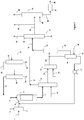
- formaldehyde such as 55wt% aqueous formaldehyde
- a mixing tank 2 where it is mixed with the sulfur catalyst added in line 3.
- the mixed formaldehyde is passed in line 4 to the carbonylation reactor 5 where it is reacted with carbon monoxide which is supplied to the reactor in line 6.
- the first product stream is recovered in line 7.
- This stream will comprise glycolic acid, sulfur species and impurities which may be selected from methyl formate, formic acid, methylal, methanol and formaldehyde. It is passed to a lights separation zone 8 where lights which may include methyl formate, methylal, methanol and formaldehyde will be removed in line 9. Methanol may be added in line 10 to facilitate separation.
- a stream including the glycolic acid is taken at or near the bottom in line 11. This will generally be removed below the position of the methanol feed.
- the stream is then passed to the esterification reactor 12 where it is contacted with methanol added in line 13.
- the esterification reactor may be a plug flow reactor.
- a second product stream comprising the methyl glycolate, the sulfur species and impurities is recovered from the reactor in line 14 and passed to the esterification flash drum 15 where the sulfur species are separated.
- the sulfur species is recovered in line 16.
- the pump 17 facilitates the return of the sulfur species and any heavy recycle may be returned to the carbonylation reactor 5.
- the heavy recycle may be fed directly to the reactor or it may be fed into line 4.
- the methyl glycolate is recovered in second product stream in line 18.
- This stream will also include water, and impurities.
- This stream is fed to the ester separation column 19 where light impurities such as water, methanol and light by-products are removed as column overheads 20 and heavy impurities such as dimethyl diglycolate are recovered in line 21.
- the methyl glycolate may be recovered as a side draw in line 22. This will generally be taken below the point at which feed is added. Where the desired product is glycolic acid, the recovered methyl glycolate may be passed to hydrolysis reactor 23. Methyl glycolate may optionally be taken as an off-take in line 24. Water is supplied to the hydrolysis reactor 23 in line 25. It may also be necessary to add catalyst to the hydrolysis reactor 23. Where this is a heterogeneous catalyst it will be provided on trays within the reactor 23. Where it is a homogeneous catalyst it may be added into line 22 before the methyl glycolate is supplied to the hydrolysis reactor.
- the glycolic acid is removed from the hydrolysis reactor 23 in line 26 where it may optionally be passed through an ion exchange purifier 27 before being recovered in line 28.
- Methanol and water is recovered from the hydrolysis reactor as an overhead in line 29.
- the hydrolysis reactor is replaced with an ion exchange system.
- FIG. 2 An alternative arrangement is illustrated in Figure 2 . Much of this arrangement is the same as in Figure 1 .
- the stream recovered from the bottom of the esterification flash drum 15 is passed in line 30 to a recycle column 31. Water may be added to the recycle column in line 38.
- the bottom stream from the recycle column 31 is fed in line 16 to the carbonylation reactor 5.
- the overheads from the recycle column 31 are passed in line 32 to the water separation column 33.
- the overhead stream 9 from the lights separation zone 8 may also be passed to the water separation column 33. It may be supplied separately or may be combined with stream 32 before being passed to the water separation column 33. Water is removed from the bottom of the water separation column in line 34.
- the overheads from the water separation column are passed in line 35 to the formaldehyde separation column 36. Methanol is recovered in line 38. The overhead will generally be recovered in line 37 and sent to the formaldehyde plant
- the simulation platform Aspen Plus V8.8 was used to simulate the esterification and hydrolysis columns.
- the physical properties used in the simulation were sourced using a combination of Aspen plus databanks, and property estimation methods
- ester separation and hydrolysis columns which are reactive distillation columns, used the following conditions: Ester Separation Column Hydrolysis Column Column Top P (bara) 0.3 1.2 Column Top T (°C) 61.9 79.2 Column Base T (°C) 133.8 134.0
- the reactions included in the simulation are primarily esterification of glycolic acid (GA), methoxyacetic acid (MAA), diglycolic acid (DGA) with methanol, plus hydrolysis of the resulting esters, namely methyl glycolate (MG), methylmethoxyacetate (MMA), methyl diglycolate (M-DG) and dimethyl digylcolate (M-DG-M).
- the esterification reaction was catalysed by H 2 SO 4 .
- the stream compositions derived in the simulation are set out in the Table below.
- the stream numbers correspond to the streams indicated in Figure 1 .
- Composition wt% 18 20 21 22 Catalyst Supplied to line 22 25 29 26 28 Lights 0.271 0.492 0 0 0 0 0 0 0 0 0 Water 25.415 46.626 0 0 7.0 100.0 15.508 25.005 25.161 GA 0.926 0 13.25 0.507 0 0 0 73.999 74.46 MeOH 25.056 46.013 0 0 0 0 84.387 0.007 0.007 DGA 0 0 0 0 0 0 0.208 0.21 MG 43.921 0.1 76.852 99.077 0 0 0.104 0.052 0.052 MAA 0.165 0 2.276 0.095 0 0 0 0.109 0.11 MMA 3.703 6.77 0.001 0.034 0 0 0.001 0 0 M-DG
- the lights constitute of formaldehyde, formic acid, methyl formate and methylal.
- the rate of methyl glycolate hydrolysis is enhanced by the addition of a homogeneous catalyst (H 2 SO 4 ) in the feed to the hydrolysis reactor. This could also be achieved via heterogeneous catalysis and/or by operating the column at a higher pressure.
- a homogeneous catalyst H 2 SO 4
- catalyst is required in a number of parts in the flowsheet. Where a homogeneous catalyst, such as sulphuric acid, is used, the catalyst will pass through the flowsheet and so the same catalyst can be used. However, a separate catalyst will generally be required for the final hydrolysis of the product.
- a homogeneous catalyst such as sulphuric acid
Landscapes
- Chemical & Material Sciences (AREA)
- Organic Chemistry (AREA)
- Engineering & Computer Science (AREA)
- Oil, Petroleum & Natural Gas (AREA)
- Chemical Kinetics & Catalysis (AREA)
- Crystallography & Structural Chemistry (AREA)
- Organic Low-Molecular-Weight Compounds And Preparation Thereof (AREA)
- Low-Molecular Organic Synthesis Reactions Using Catalysts (AREA)
Applications Claiming Priority (2)
| Application Number | Priority Date | Filing Date | Title |
|---|---|---|---|
| GBGB1615762.0A GB201615762D0 (en) | 2016-09-16 | 2016-09-16 | Process |
| PCT/GB2017/052740 WO2018051115A1 (en) | 2016-09-16 | 2017-09-15 | Process for the production of glycolic acid |
Publications (2)
| Publication Number | Publication Date |
|---|---|
| EP3512828A1 EP3512828A1 (en) | 2019-07-24 |
| EP3512828B1 true EP3512828B1 (en) | 2020-11-11 |
Family
ID=57288828
Family Applications (1)
| Application Number | Title | Priority Date | Filing Date |
|---|---|---|---|
| EP17771848.3A Active EP3512828B1 (en) | 2016-09-16 | 2017-09-15 | Process for the production of glycolic acid |
Country Status (11)
| Country | Link |
|---|---|
| US (2) | US10640443B2 (enExample) |
| EP (1) | EP3512828B1 (enExample) |
| JP (1) | JP6953518B2 (enExample) |
| KR (1) | KR102449054B1 (enExample) |
| CN (1) | CN109715596B (enExample) |
| AU (1) | AU2017327999B2 (enExample) |
| BR (1) | BR112019005028B1 (enExample) |
| EA (1) | EA036428B1 (enExample) |
| GB (2) | GB201615762D0 (enExample) |
| WO (1) | WO2018051115A1 (enExample) |
| ZA (1) | ZA201901641B (enExample) |
Families Citing this family (9)
| Publication number | Priority date | Publication date | Assignee | Title |
|---|---|---|---|---|
| CA3116451C (en) * | 2018-10-29 | 2023-05-23 | Pujing Chemical Industry Co., Ltd | Glycolide production with low solid residue |
| EP3953320A4 (en) * | 2019-06-27 | 2022-12-14 | Rhodia Operations | PROCESS FOR PRODUCTION OF GLYCOLIC ACID |
| CN112521265B (zh) * | 2020-12-09 | 2022-08-09 | 浙江联盛化学股份有限公司 | 一种连续化生产乙醇酸的方法 |
| WO2022165662A1 (zh) * | 2021-02-03 | 2022-08-11 | 中国科学院大连化学物理研究所 | 甲氧基乙酸甲酯和甲氧基乙酸水解制取乙醇酸和乙醇酸甲酯的方法 |
| CN114853605B (zh) * | 2021-02-03 | 2024-03-19 | 中国科学院大连化学物理研究所 | 甲氧基乙酸甲酯和甲氧基乙酸水解制取乙醇酸和乙醇酸甲酯的方法 |
| CN113952906A (zh) * | 2021-10-27 | 2022-01-21 | 南京延长反应技术研究院有限公司 | 一种制备羟基乙酸的微界面反应装置及方法 |
| CN114057564B (zh) * | 2021-12-09 | 2023-10-03 | 上海卓笙环保科技有限公司 | 一种基于碳酸体系作为无痕催化剂水解乙醇酸酯的方法 |
| GB202201979D0 (en) | 2022-02-15 | 2022-03-30 | Johnson Matthey Plc | Process |
| CN115160122A (zh) * | 2022-08-26 | 2022-10-11 | 东华工程科技股份有限公司 | 一种乙醇酸甲酯水解制乙醇酸的新工艺 |
Family Cites Families (45)
| Publication number | Priority date | Publication date | Assignee | Title |
|---|---|---|---|---|
| US2152852A (en) | 1936-12-31 | 1939-04-04 | Du Pont | Process for manufacture of glycolic acid |
| US2285444A (en) | 1940-06-14 | 1942-06-09 | American Automatic Typewriter | Link connection for automatic typewriters |
| US2443482A (en) | 1946-08-06 | 1948-06-15 | Du Pont | Continuous glycolic acid process |
| US3859349A (en) * | 1973-02-15 | 1975-01-07 | Du Pont | Purification of hydroxyacetic acid |
| US3911003A (en) | 1974-06-19 | 1975-10-07 | Chevron Res | Process for the production of glycolic acid and oxydiacetic acid |
| US4016208A (en) | 1974-06-19 | 1977-04-05 | Chevron Research Company | Acid production |
| IT1017804B (it) | 1974-08-01 | 1977-08-10 | Montedison Spa | Procedimento per la preparazione di acido glicolico e suoi polimeri |
| CA1077517A (en) | 1975-04-23 | 1980-05-13 | Ppg Industries, Inc. | Process for the preparation of hydroxy-carboxylic acids and derivatives |
| US4087470A (en) | 1976-06-23 | 1978-05-02 | Chevron Research Company | Process for the production of ethylene glycol |
| DE2652072A1 (de) | 1976-11-15 | 1978-05-24 | Hoechst Ag | Verfahren zur herstellung von glykolsaeureestern |
| US4188494A (en) | 1977-04-25 | 1980-02-12 | Chevron Research Company | Hydrogen fluoride removal from glycolic acid |
| US4136112A (en) | 1977-06-24 | 1979-01-23 | Chevron Research Company | Process for preparing glycolic acid from formaldehyde using acetic acid |
| US4140866A (en) | 1978-03-30 | 1979-02-20 | Ppg Industries, Inc. | Preparation of sulfate free glycolic acid ester |
| JPS5673042A (en) | 1979-11-20 | 1981-06-17 | Mitsubishi Gas Chem Co Inc | Preparation of glycolic acid |
| US4431997A (en) | 1981-02-18 | 1984-02-14 | Motorola Inc. | Compound element for image element antennas |
| DE3133353C2 (de) | 1981-08-22 | 1985-07-18 | Chemische Werke Hüls AG, 4370 Marl | Verfahren zur Herstellung von Glykolsäure oder ihrer Ester |
| US4431486A (en) | 1982-04-12 | 1984-02-14 | E. I. Du Pont De Nemours And Company | Azeotropic distillation of hydroxyacetic acid |
| JPS59139341A (ja) | 1983-01-20 | 1984-08-10 | Mitsubishi Gas Chem Co Inc | ヒドロキシカルボン酸誘導体の製造方法 |
| JPS60260538A (ja) * | 1984-06-07 | 1985-12-23 | Agency Of Ind Science & Technol | グリコ−ル酸エステルの製造法 |
| US4824997A (en) * | 1988-01-25 | 1989-04-25 | Monsanto Company | Method for preparation of alkyl glycolates |
| KR950011114B1 (ko) | 1991-07-19 | 1995-09-28 | 포항종합제철주식회사 | 메틸글리콜레이트의 제조공정 |
| KR950013078B1 (ko) | 1992-10-28 | 1995-10-24 | 포항종합제철주식회사 | 글리콜산 및 글리콜산 에스테르의 제조방법 |
| JP2503178B2 (ja) | 1993-01-29 | 1996-06-05 | 日揮株式会社 | グリコ―ル酸、グリコ―ル酸エステルまたはポリグリコリドの製造方法 |
| KR0124821B1 (ko) | 1993-12-24 | 1997-12-01 | 조말수 | 산성 반응 용액중의 메틸글리콜레이트 분리방법 |
| CN1075142C (zh) | 1994-04-19 | 2001-11-21 | 日本化药株式会社 | 分散染料组合物及用该组合物对疏水性纤维材料进行染色的方法 |
| KR0155273B1 (ko) | 1995-05-24 | 1998-12-15 | 김광호 | 대역 통과 필터 기능을 겸비한 위상 변위 장치 및 그 방법 |
| JPH11335319A (ja) * | 1998-05-19 | 1999-12-07 | Nippon Shokubai Co Ltd | α−ヒドロキシカルボン酸の製造方法 |
| US6376723B2 (en) | 1999-12-29 | 2002-04-23 | Shell Oil Company | Process for the carbonylation of formaldehyde |
| GB0100470D0 (en) | 2001-01-09 | 2001-02-21 | Queen Mary & Westfield College | Organopolysiloxanes containing phosphonic groups, methods for the production and use thereof |
| JP2004043682A (ja) * | 2002-07-12 | 2004-02-12 | Nippon Shokubai Co Ltd | ポリグリコール酸の製造方法 |
| JP3772238B2 (ja) * | 2002-07-12 | 2006-05-10 | 株式会社日本触媒 | α−ヒドロキシカルボン酸の製造方法 |
| US7005536B2 (en) | 2002-07-12 | 2006-02-28 | Nippon Shokubai Co., Ltd. | Method for producing diol derivatives |
| JP4195934B2 (ja) * | 2004-03-01 | 2008-12-17 | 独立行政法人産業技術総合研究所 | イオン性液体を用いたグリコール酸およびそのエステルの製造方法 |
| DE602005011308D1 (de) | 2004-08-04 | 2009-01-08 | Phosphonics Ltd | Substituierte organopolysiloxane und ihre verwendung |
| GB0417344D0 (en) | 2004-08-04 | 2004-09-08 | Phosphonics Ltd | Substituted organopolysiloxanes and use thereof |
| GB0602811D0 (en) | 2006-02-10 | 2006-03-22 | Phosphonics Ltd | Substituted Organopolysiloxanes And Use Thereof |
| GB0720579D0 (en) | 2007-10-20 | 2007-11-28 | Phosphonics Ltd | Functionalised materials and uses thereof |
| WO2009140850A1 (en) | 2008-05-20 | 2009-11-26 | Dalian Institute Of Chemical Physics, Chinese Academy Of Sciences | Process for production of glycolic acid |
| WO2009140787A1 (en) | 2008-05-20 | 2009-11-26 | Dalian Institute Of Chemical Physics, Chinese Academy Of Sciences | Process for production of glycolic acid |
| US8765999B2 (en) * | 2012-03-27 | 2014-07-01 | Eastman Chemical Company | Hydrocarboxylation of formaldehyde in the presence of a higher order carboxylic acid and a homogeneous catalyst |
| EP2831040A1 (en) * | 2012-03-27 | 2015-02-04 | Eastman Chemical Company | Process for recovering and recycling an acid catalyst |
| US9040748B2 (en) * | 2012-06-08 | 2015-05-26 | Eastman Chemical Company | Hydrocarboxylation of aqueous formaldehyde using a dehydrating recycle stream to decrease water concentration |
| CN103833548A (zh) * | 2012-11-20 | 2014-06-04 | 中国科学院兰州化学物理研究所 | 一种乙醇酸甲酯的制备方法 |
| GB201505977D0 (en) | 2015-04-08 | 2015-05-20 | Johnson Matthey Davy Technologies Ltd | Catalyst system and process |
| GB201505981D0 (en) | 2015-04-08 | 2015-05-20 | Johnson Matthey Davy Technologies Ltd | Process |
-
2016
- 2016-09-16 GB GBGB1615762.0A patent/GB201615762D0/en not_active Ceased
-
2017
- 2017-09-15 EA EA201990731A patent/EA036428B1/ru not_active IP Right Cessation
- 2017-09-15 JP JP2019514823A patent/JP6953518B2/ja active Active
- 2017-09-15 CN CN201780056765.9A patent/CN109715596B/zh active Active
- 2017-09-15 KR KR1020197010429A patent/KR102449054B1/ko active Active
- 2017-09-15 WO PCT/GB2017/052740 patent/WO2018051115A1/en not_active Ceased
- 2017-09-15 EP EP17771848.3A patent/EP3512828B1/en active Active
- 2017-09-15 BR BR112019005028-0A patent/BR112019005028B1/pt active IP Right Grant
- 2017-09-15 US US16/332,853 patent/US10640443B2/en active Active
- 2017-09-15 AU AU2017327999A patent/AU2017327999B2/en active Active
- 2017-09-15 GB GB1714877.6A patent/GB2559641B/en active Active
-
2019
- 2019-03-15 ZA ZA2019/01641A patent/ZA201901641B/en unknown
-
2020
- 2020-04-03 US US16/839,971 patent/US11053186B2/en active Active
Non-Patent Citations (1)
| Title |
|---|
| None * |
Also Published As
| Publication number | Publication date |
|---|---|
| WO2018051115A1 (en) | 2018-03-22 |
| GB201615762D0 (en) | 2016-11-02 |
| US20190248724A1 (en) | 2019-08-15 |
| ZA201901641B (en) | 2021-06-30 |
| KR102449054B1 (ko) | 2022-09-30 |
| CN109715596B (zh) | 2022-05-17 |
| BR112019005028A2 (pt) | 2019-06-18 |
| GB2559641A (en) | 2018-08-15 |
| EP3512828A1 (en) | 2019-07-24 |
| EA201990731A1 (ru) | 2019-08-30 |
| AU2017327999A1 (en) | 2019-03-21 |
| JP2019529422A (ja) | 2019-10-17 |
| GB201714877D0 (en) | 2017-11-01 |
| KR20190047019A (ko) | 2019-05-07 |
| US11053186B2 (en) | 2021-07-06 |
| JP6953518B2 (ja) | 2021-10-27 |
| CN109715596A (zh) | 2019-05-03 |
| US20200239395A1 (en) | 2020-07-30 |
| AU2017327999B2 (en) | 2020-11-26 |
| US10640443B2 (en) | 2020-05-05 |
| EA036428B1 (ru) | 2020-11-10 |
| BR112019005028B1 (pt) | 2022-12-13 |
| GB2559641B (en) | 2019-12-04 |
Similar Documents
| Publication | Publication Date | Title |
|---|---|---|
| EP3512828B1 (en) | Process for the production of glycolic acid | |
| GB2567032B (en) | Purification process for ethylene glycol via sequential distillation | |
| US10335774B2 (en) | Carbonylation process and catalyst system therefor | |
| GB2542869B (en) | Process for the production of glycolic acid in the presence of a silica catalyst |
Legal Events
| Date | Code | Title | Description |
|---|---|---|---|
| STAA | Information on the status of an ep patent application or granted ep patent |
Free format text: STATUS: UNKNOWN |
|
| STAA | Information on the status of an ep patent application or granted ep patent |
Free format text: STATUS: THE INTERNATIONAL PUBLICATION HAS BEEN MADE |
|
| PUAI | Public reference made under article 153(3) epc to a published international application that has entered the european phase |
Free format text: ORIGINAL CODE: 0009012 |
|
| STAA | Information on the status of an ep patent application or granted ep patent |
Free format text: STATUS: REQUEST FOR EXAMINATION WAS MADE |
|
| 17P | Request for examination filed |
Effective date: 20190415 |
|
| AK | Designated contracting states |
Kind code of ref document: A1 Designated state(s): AL AT BE BG CH CY CZ DE DK EE ES FI FR GB GR HR HU IE IS IT LI LT LU LV MC MK MT NL NO PL PT RO RS SE SI SK SM TR |
|
| AX | Request for extension of the european patent |
Extension state: BA ME |
|
| DAV | Request for validation of the european patent (deleted) | ||
| DAX | Request for extension of the european patent (deleted) | ||
| GRAP | Despatch of communication of intention to grant a patent |
Free format text: ORIGINAL CODE: EPIDOSNIGR1 |
|
| STAA | Information on the status of an ep patent application or granted ep patent |
Free format text: STATUS: GRANT OF PATENT IS INTENDED |
|
| INTG | Intention to grant announced |
Effective date: 20200624 |
|
| GRAS | Grant fee paid |
Free format text: ORIGINAL CODE: EPIDOSNIGR3 |
|
| GRAA | (expected) grant |
Free format text: ORIGINAL CODE: 0009210 |
|
| STAA | Information on the status of an ep patent application or granted ep patent |
Free format text: STATUS: THE PATENT HAS BEEN GRANTED |
|
| AK | Designated contracting states |
Kind code of ref document: B1 Designated state(s): AL AT BE BG CH CY CZ DE DK EE ES FI FR GB GR HR HU IE IS IT LI LT LU LV MC MK MT NL NO PL PT RO RS SE SI SK SM TR |
|
| REG | Reference to a national code |
Ref country code: GB Ref legal event code: FG4D |
|
| REG | Reference to a national code |
Ref country code: CH Ref legal event code: EP |
|
| REG | Reference to a national code |
Ref country code: AT Ref legal event code: REF Ref document number: 1333327 Country of ref document: AT Kind code of ref document: T Effective date: 20201115 |
|
| REG | Reference to a national code |
Ref country code: DE Ref legal event code: R096 Ref document number: 602017027434 Country of ref document: DE |
|
| REG | Reference to a national code |
Ref country code: IE Ref legal event code: FG4D |
|
| REG | Reference to a national code |
Ref country code: NL Ref legal event code: FP |
|
| REG | Reference to a national code |
Ref country code: FI Ref legal event code: FGE |
|
| REG | Reference to a national code |
Ref country code: AT Ref legal event code: MK05 Ref document number: 1333327 Country of ref document: AT Kind code of ref document: T Effective date: 20201111 |
|
| PG25 | Lapsed in a contracting state [announced via postgrant information from national office to epo] |
Ref country code: RS Free format text: LAPSE BECAUSE OF FAILURE TO SUBMIT A TRANSLATION OF THE DESCRIPTION OR TO PAY THE FEE WITHIN THE PRESCRIBED TIME-LIMIT Effective date: 20201111 Ref country code: PT Free format text: LAPSE BECAUSE OF FAILURE TO SUBMIT A TRANSLATION OF THE DESCRIPTION OR TO PAY THE FEE WITHIN THE PRESCRIBED TIME-LIMIT Effective date: 20210311 Ref country code: NO Free format text: LAPSE BECAUSE OF FAILURE TO SUBMIT A TRANSLATION OF THE DESCRIPTION OR TO PAY THE FEE WITHIN THE PRESCRIBED TIME-LIMIT Effective date: 20210211 Ref country code: GR Free format text: LAPSE BECAUSE OF FAILURE TO SUBMIT A TRANSLATION OF THE DESCRIPTION OR TO PAY THE FEE WITHIN THE PRESCRIBED TIME-LIMIT Effective date: 20210212 |
|
| PG25 | Lapsed in a contracting state [announced via postgrant information from national office to epo] |
Ref country code: BG Free format text: LAPSE BECAUSE OF FAILURE TO SUBMIT A TRANSLATION OF THE DESCRIPTION OR TO PAY THE FEE WITHIN THE PRESCRIBED TIME-LIMIT Effective date: 20210211 Ref country code: SE Free format text: LAPSE BECAUSE OF FAILURE TO SUBMIT A TRANSLATION OF THE DESCRIPTION OR TO PAY THE FEE WITHIN THE PRESCRIBED TIME-LIMIT Effective date: 20201111 Ref country code: LV Free format text: LAPSE BECAUSE OF FAILURE TO SUBMIT A TRANSLATION OF THE DESCRIPTION OR TO PAY THE FEE WITHIN THE PRESCRIBED TIME-LIMIT Effective date: 20201111 Ref country code: IS Free format text: LAPSE BECAUSE OF FAILURE TO SUBMIT A TRANSLATION OF THE DESCRIPTION OR TO PAY THE FEE WITHIN THE PRESCRIBED TIME-LIMIT Effective date: 20210311 Ref country code: PL Free format text: LAPSE BECAUSE OF FAILURE TO SUBMIT A TRANSLATION OF THE DESCRIPTION OR TO PAY THE FEE WITHIN THE PRESCRIBED TIME-LIMIT Effective date: 20201111 Ref country code: AT Free format text: LAPSE BECAUSE OF FAILURE TO SUBMIT A TRANSLATION OF THE DESCRIPTION OR TO PAY THE FEE WITHIN THE PRESCRIBED TIME-LIMIT Effective date: 20201111 |
|
| REG | Reference to a national code |
Ref country code: LT Ref legal event code: MG9D |
|
| PG25 | Lapsed in a contracting state [announced via postgrant information from national office to epo] |
Ref country code: HR Free format text: LAPSE BECAUSE OF FAILURE TO SUBMIT A TRANSLATION OF THE DESCRIPTION OR TO PAY THE FEE WITHIN THE PRESCRIBED TIME-LIMIT Effective date: 20201111 |
|
| PG25 | Lapsed in a contracting state [announced via postgrant information from national office to epo] |
Ref country code: SM Free format text: LAPSE BECAUSE OF FAILURE TO SUBMIT A TRANSLATION OF THE DESCRIPTION OR TO PAY THE FEE WITHIN THE PRESCRIBED TIME-LIMIT Effective date: 20201111 Ref country code: LT Free format text: LAPSE BECAUSE OF FAILURE TO SUBMIT A TRANSLATION OF THE DESCRIPTION OR TO PAY THE FEE WITHIN THE PRESCRIBED TIME-LIMIT Effective date: 20201111 Ref country code: CZ Free format text: LAPSE BECAUSE OF FAILURE TO SUBMIT A TRANSLATION OF THE DESCRIPTION OR TO PAY THE FEE WITHIN THE PRESCRIBED TIME-LIMIT Effective date: 20201111 Ref country code: EE Free format text: LAPSE BECAUSE OF FAILURE TO SUBMIT A TRANSLATION OF THE DESCRIPTION OR TO PAY THE FEE WITHIN THE PRESCRIBED TIME-LIMIT Effective date: 20201111 Ref country code: SK Free format text: LAPSE BECAUSE OF FAILURE TO SUBMIT A TRANSLATION OF THE DESCRIPTION OR TO PAY THE FEE WITHIN THE PRESCRIBED TIME-LIMIT Effective date: 20201111 Ref country code: RO Free format text: LAPSE BECAUSE OF FAILURE TO SUBMIT A TRANSLATION OF THE DESCRIPTION OR TO PAY THE FEE WITHIN THE PRESCRIBED TIME-LIMIT Effective date: 20201111 |
|
| REG | Reference to a national code |
Ref country code: DE Ref legal event code: R097 Ref document number: 602017027434 Country of ref document: DE |
|
| PG25 | Lapsed in a contracting state [announced via postgrant information from national office to epo] |
Ref country code: DK Free format text: LAPSE BECAUSE OF FAILURE TO SUBMIT A TRANSLATION OF THE DESCRIPTION OR TO PAY THE FEE WITHIN THE PRESCRIBED TIME-LIMIT Effective date: 20201111 |
|
| PLBE | No opposition filed within time limit |
Free format text: ORIGINAL CODE: 0009261 |
|
| STAA | Information on the status of an ep patent application or granted ep patent |
Free format text: STATUS: NO OPPOSITION FILED WITHIN TIME LIMIT |
|
| 26N | No opposition filed |
Effective date: 20210812 |
|
| PG25 | Lapsed in a contracting state [announced via postgrant information from national office to epo] |
Ref country code: AL Free format text: LAPSE BECAUSE OF FAILURE TO SUBMIT A TRANSLATION OF THE DESCRIPTION OR TO PAY THE FEE WITHIN THE PRESCRIBED TIME-LIMIT Effective date: 20201111 Ref country code: IT Free format text: LAPSE BECAUSE OF FAILURE TO SUBMIT A TRANSLATION OF THE DESCRIPTION OR TO PAY THE FEE WITHIN THE PRESCRIBED TIME-LIMIT Effective date: 20201111 |
|
| PG25 | Lapsed in a contracting state [announced via postgrant information from national office to epo] |
Ref country code: SI Free format text: LAPSE BECAUSE OF FAILURE TO SUBMIT A TRANSLATION OF THE DESCRIPTION OR TO PAY THE FEE WITHIN THE PRESCRIBED TIME-LIMIT Effective date: 20201111 |
|
| PG25 | Lapsed in a contracting state [announced via postgrant information from national office to epo] |
Ref country code: ES Free format text: LAPSE BECAUSE OF FAILURE TO SUBMIT A TRANSLATION OF THE DESCRIPTION OR TO PAY THE FEE WITHIN THE PRESCRIBED TIME-LIMIT Effective date: 20201111 |
|
| REG | Reference to a national code |
Ref country code: CH Ref legal event code: PL |
|
| PG25 | Lapsed in a contracting state [announced via postgrant information from national office to epo] |
Ref country code: IS Free format text: LAPSE BECAUSE OF FAILURE TO SUBMIT A TRANSLATION OF THE DESCRIPTION OR TO PAY THE FEE WITHIN THE PRESCRIBED TIME-LIMIT Effective date: 20210311 Ref country code: MC Free format text: LAPSE BECAUSE OF FAILURE TO SUBMIT A TRANSLATION OF THE DESCRIPTION OR TO PAY THE FEE WITHIN THE PRESCRIBED TIME-LIMIT Effective date: 20201111 |
|
| PG25 | Lapsed in a contracting state [announced via postgrant information from national office to epo] |
Ref country code: LU Free format text: LAPSE BECAUSE OF NON-PAYMENT OF DUE FEES Effective date: 20210915 Ref country code: IE Free format text: LAPSE BECAUSE OF NON-PAYMENT OF DUE FEES Effective date: 20210915 |
|
| PG25 | Lapsed in a contracting state [announced via postgrant information from national office to epo] |
Ref country code: LI Free format text: LAPSE BECAUSE OF NON-PAYMENT OF DUE FEES Effective date: 20210930 Ref country code: CH Free format text: LAPSE BECAUSE OF NON-PAYMENT OF DUE FEES Effective date: 20210930 |
|
| PG25 | Lapsed in a contracting state [announced via postgrant information from national office to epo] |
Ref country code: CY Free format text: LAPSE BECAUSE OF FAILURE TO SUBMIT A TRANSLATION OF THE DESCRIPTION OR TO PAY THE FEE WITHIN THE PRESCRIBED TIME-LIMIT Effective date: 20201111 |
|
| P01 | Opt-out of the competence of the unified patent court (upc) registered |
Effective date: 20230526 |
|
| PG25 | Lapsed in a contracting state [announced via postgrant information from national office to epo] |
Ref country code: HU Free format text: LAPSE BECAUSE OF FAILURE TO SUBMIT A TRANSLATION OF THE DESCRIPTION OR TO PAY THE FEE WITHIN THE PRESCRIBED TIME-LIMIT; INVALID AB INITIO Effective date: 20170915 |
|
| PG25 | Lapsed in a contracting state [announced via postgrant information from national office to epo] |
Ref country code: MK Free format text: LAPSE BECAUSE OF FAILURE TO SUBMIT A TRANSLATION OF THE DESCRIPTION OR TO PAY THE FEE WITHIN THE PRESCRIBED TIME-LIMIT Effective date: 20201111 |
|
| PG25 | Lapsed in a contracting state [announced via postgrant information from national office to epo] |
Ref country code: MT Free format text: LAPSE BECAUSE OF FAILURE TO SUBMIT A TRANSLATION OF THE DESCRIPTION OR TO PAY THE FEE WITHIN THE PRESCRIBED TIME-LIMIT Effective date: 20201111 |
|
| PGFP | Annual fee paid to national office [announced via postgrant information from national office to epo] |
Ref country code: NL Payment date: 20250820 Year of fee payment: 9 |
|
| PGFP | Annual fee paid to national office [announced via postgrant information from national office to epo] |
Ref country code: FI Payment date: 20250820 Year of fee payment: 9 |
|
| PGFP | Annual fee paid to national office [announced via postgrant information from national office to epo] |
Ref country code: DE Payment date: 20250820 Year of fee payment: 9 |
|
| PGFP | Annual fee paid to national office [announced via postgrant information from national office to epo] |
Ref country code: BE Payment date: 20250820 Year of fee payment: 9 Ref country code: GB Payment date: 20250822 Year of fee payment: 9 |
|
| PGFP | Annual fee paid to national office [announced via postgrant information from national office to epo] |
Ref country code: FR Payment date: 20250820 Year of fee payment: 9 |
|
| PG25 | Lapsed in a contracting state [announced via postgrant information from national office to epo] |
Ref country code: TR Free format text: LAPSE BECAUSE OF FAILURE TO SUBMIT A TRANSLATION OF THE DESCRIPTION OR TO PAY THE FEE WITHIN THE PRESCRIBED TIME-LIMIT Effective date: 20201111 |