EP3489291B1 - Herstellungsverfahren für poröse polyimidfolie und mit diesem verfahren hergestellte poröse polyimidfolie - Google Patents
Herstellungsverfahren für poröse polyimidfolie und mit diesem verfahren hergestellte poröse polyimidfolie Download PDFInfo
- Publication number
- EP3489291B1 EP3489291B1 EP17834358.8A EP17834358A EP3489291B1 EP 3489291 B1 EP3489291 B1 EP 3489291B1 EP 17834358 A EP17834358 A EP 17834358A EP 3489291 B1 EP3489291 B1 EP 3489291B1
- Authority
- EP
- European Patent Office
- Prior art keywords
- film
- polyimide film
- poly
- porous polyimide
- amic acid
- Prior art date
- Legal status (The legal status is an assumption and is not a legal conclusion. Google has not performed a legal analysis and makes no representation as to the accuracy of the status listed.)
- Active
Links
Images


Classifications
-
- C—CHEMISTRY; METALLURGY
- C08—ORGANIC MACROMOLECULAR COMPOUNDS; THEIR PREPARATION OR CHEMICAL WORKING-UP; COMPOSITIONS BASED THEREON
- C08J—WORKING-UP; GENERAL PROCESSES OF COMPOUNDING; AFTER-TREATMENT NOT COVERED BY SUBCLASSES C08B, C08C, C08F, C08G or C08H
- C08J9/00—Working-up of macromolecular substances to porous or cellular articles or materials; After-treatment thereof
- C08J9/28—Working-up of macromolecular substances to porous or cellular articles or materials; After-treatment thereof by elimination of a liquid phase from a macromolecular composition or article, e.g. drying of coagulum
-
- C—CHEMISTRY; METALLURGY
- C08—ORGANIC MACROMOLECULAR COMPOUNDS; THEIR PREPARATION OR CHEMICAL WORKING-UP; COMPOSITIONS BASED THEREON
- C08G—MACROMOLECULAR COMPOUNDS OBTAINED OTHERWISE THAN BY REACTIONS ONLY INVOLVING UNSATURATED CARBON-TO-CARBON BONDS
- C08G73/00—Macromolecular compounds obtained by reactions forming a linkage containing nitrogen with or without oxygen or carbon in the main chain of the macromolecule, not provided for in groups C08G12/00 - C08G71/00
- C08G73/06—Polycondensates having nitrogen-containing heterocyclic rings in the main chain of the macromolecule
- C08G73/10—Polyimides; Polyester-imides; Polyamide-imides; Polyamide acids or similar polyimide precursors
- C08G73/1003—Preparatory processes
- C08G73/1007—Preparatory processes from tetracarboxylic acids or derivatives and diamines
-
- C—CHEMISTRY; METALLURGY
- C08—ORGANIC MACROMOLECULAR COMPOUNDS; THEIR PREPARATION OR CHEMICAL WORKING-UP; COMPOSITIONS BASED THEREON
- C08G—MACROMOLECULAR COMPOUNDS OBTAINED OTHERWISE THAN BY REACTIONS ONLY INVOLVING UNSATURATED CARBON-TO-CARBON BONDS
- C08G73/00—Macromolecular compounds obtained by reactions forming a linkage containing nitrogen with or without oxygen or carbon in the main chain of the macromolecule, not provided for in groups C08G12/00 - C08G71/00
- C08G73/06—Polycondensates having nitrogen-containing heterocyclic rings in the main chain of the macromolecule
- C08G73/10—Polyimides; Polyester-imides; Polyamide-imides; Polyamide acids or similar polyimide precursors
-
- C—CHEMISTRY; METALLURGY
- C08—ORGANIC MACROMOLECULAR COMPOUNDS; THEIR PREPARATION OR CHEMICAL WORKING-UP; COMPOSITIONS BASED THEREON
- C08G—MACROMOLECULAR COMPOUNDS OBTAINED OTHERWISE THAN BY REACTIONS ONLY INVOLVING UNSATURATED CARBON-TO-CARBON BONDS
- C08G73/00—Macromolecular compounds obtained by reactions forming a linkage containing nitrogen with or without oxygen or carbon in the main chain of the macromolecule, not provided for in groups C08G12/00 - C08G71/00
- C08G73/06—Polycondensates having nitrogen-containing heterocyclic rings in the main chain of the macromolecule
- C08G73/10—Polyimides; Polyester-imides; Polyamide-imides; Polyamide acids or similar polyimide precursors
- C08G73/1003—Preparatory processes
- C08G73/1007—Preparatory processes from tetracarboxylic acids or derivatives and diamines
- C08G73/1028—Preparatory processes from tetracarboxylic acids or derivatives and diamines characterised by the process itself, e.g. steps, continuous
- C08G73/1032—Preparatory processes from tetracarboxylic acids or derivatives and diamines characterised by the process itself, e.g. steps, continuous characterised by the solvent(s) used
-
- C—CHEMISTRY; METALLURGY
- C08—ORGANIC MACROMOLECULAR COMPOUNDS; THEIR PREPARATION OR CHEMICAL WORKING-UP; COMPOSITIONS BASED THEREON
- C08G—MACROMOLECULAR COMPOUNDS OBTAINED OTHERWISE THAN BY REACTIONS ONLY INVOLVING UNSATURATED CARBON-TO-CARBON BONDS
- C08G73/00—Macromolecular compounds obtained by reactions forming a linkage containing nitrogen with or without oxygen or carbon in the main chain of the macromolecule, not provided for in groups C08G12/00 - C08G71/00
- C08G73/06—Polycondensates having nitrogen-containing heterocyclic rings in the main chain of the macromolecule
- C08G73/10—Polyimides; Polyester-imides; Polyamide-imides; Polyamide acids or similar polyimide precursors
- C08G73/1067—Wholly aromatic polyimides, i.e. having both tetracarboxylic and diamino moieties aromatically bound
-
- C—CHEMISTRY; METALLURGY
- C08—ORGANIC MACROMOLECULAR COMPOUNDS; THEIR PREPARATION OR CHEMICAL WORKING-UP; COMPOSITIONS BASED THEREON
- C08G—MACROMOLECULAR COMPOUNDS OBTAINED OTHERWISE THAN BY REACTIONS ONLY INVOLVING UNSATURATED CARBON-TO-CARBON BONDS
- C08G73/00—Macromolecular compounds obtained by reactions forming a linkage containing nitrogen with or without oxygen or carbon in the main chain of the macromolecule, not provided for in groups C08G12/00 - C08G71/00
- C08G73/06—Polycondensates having nitrogen-containing heterocyclic rings in the main chain of the macromolecule
- C08G73/10—Polyimides; Polyester-imides; Polyamide-imides; Polyamide acids or similar polyimide precursors
- C08G73/1085—Polyimides with diamino moieties or tetracarboxylic segments containing heterocyclic moieties
-
- C—CHEMISTRY; METALLURGY
- C08—ORGANIC MACROMOLECULAR COMPOUNDS; THEIR PREPARATION OR CHEMICAL WORKING-UP; COMPOSITIONS BASED THEREON
- C08J—WORKING-UP; GENERAL PROCESSES OF COMPOUNDING; AFTER-TREATMENT NOT COVERED BY SUBCLASSES C08B, C08C, C08F, C08G or C08H
- C08J5/00—Manufacture of articles or shaped materials containing macromolecular substances
- C08J5/18—Manufacture of films or sheets
-
- C—CHEMISTRY; METALLURGY
- C08—ORGANIC MACROMOLECULAR COMPOUNDS; THEIR PREPARATION OR CHEMICAL WORKING-UP; COMPOSITIONS BASED THEREON
- C08J—WORKING-UP; GENERAL PROCESSES OF COMPOUNDING; AFTER-TREATMENT NOT COVERED BY SUBCLASSES C08B, C08C, C08F, C08G or C08H
- C08J7/00—Chemical treatment or coating of shaped articles made of macromolecular substances
- C08J7/12—Chemical modification
- C08J7/123—Treatment by wave energy or particle radiation
-
- C—CHEMISTRY; METALLURGY
- C08—ORGANIC MACROMOLECULAR COMPOUNDS; THEIR PREPARATION OR CHEMICAL WORKING-UP; COMPOSITIONS BASED THEREON
- C08J—WORKING-UP; GENERAL PROCESSES OF COMPOUNDING; AFTER-TREATMENT NOT COVERED BY SUBCLASSES C08B, C08C, C08F, C08G or C08H
- C08J9/00—Working-up of macromolecular substances to porous or cellular articles or materials; After-treatment thereof
- C08J9/36—After-treatment
-
- C—CHEMISTRY; METALLURGY
- C08—ORGANIC MACROMOLECULAR COMPOUNDS; THEIR PREPARATION OR CHEMICAL WORKING-UP; COMPOSITIONS BASED THEREON
- C08J—WORKING-UP; GENERAL PROCESSES OF COMPOUNDING; AFTER-TREATMENT NOT COVERED BY SUBCLASSES C08B, C08C, C08F, C08G or C08H
- C08J2201/00—Foams characterised by the foaming process
- C08J2201/04—Foams characterised by the foaming process characterised by the elimination of a liquid or solid component, e.g. precipitation, leaching out, evaporation
-
- C—CHEMISTRY; METALLURGY
- C08—ORGANIC MACROMOLECULAR COMPOUNDS; THEIR PREPARATION OR CHEMICAL WORKING-UP; COMPOSITIONS BASED THEREON
- C08J—WORKING-UP; GENERAL PROCESSES OF COMPOUNDING; AFTER-TREATMENT NOT COVERED BY SUBCLASSES C08B, C08C, C08F, C08G or C08H
- C08J2201/00—Foams characterised by the foaming process
- C08J2201/04—Foams characterised by the foaming process characterised by the elimination of a liquid or solid component, e.g. precipitation, leaching out, evaporation
- C08J2201/054—Precipitating the polymer by adding a non-solvent or a different solvent
- C08J2201/0542—Precipitating the polymer by adding a non-solvent or a different solvent from an organic solvent-based polymer composition
- C08J2201/0544—Precipitating the polymer by adding a non-solvent or a different solvent from an organic solvent-based polymer composition the non-solvent being aqueous
-
- C—CHEMISTRY; METALLURGY
- C08—ORGANIC MACROMOLECULAR COMPOUNDS; THEIR PREPARATION OR CHEMICAL WORKING-UP; COMPOSITIONS BASED THEREON
- C08J—WORKING-UP; GENERAL PROCESSES OF COMPOUNDING; AFTER-TREATMENT NOT COVERED BY SUBCLASSES C08B, C08C, C08F, C08G or C08H
- C08J2205/00—Foams characterised by their properties
- C08J2205/04—Foams characterised by their properties characterised by the foam pores
- C08J2205/044—Micropores, i.e. average diameter being between 0,1 micrometer and 0,1 millimeter
-
- C—CHEMISTRY; METALLURGY
- C08—ORGANIC MACROMOLECULAR COMPOUNDS; THEIR PREPARATION OR CHEMICAL WORKING-UP; COMPOSITIONS BASED THEREON
- C08J—WORKING-UP; GENERAL PROCESSES OF COMPOUNDING; AFTER-TREATMENT NOT COVERED BY SUBCLASSES C08B, C08C, C08F, C08G or C08H
- C08J2379/00—Characterised by the use of macromolecular compounds obtained by reactions forming in the main chain of the macromolecule a linkage containing nitrogen with or without oxygen, or carbon only, not provided for in groups C08J2361/00 - C08J2377/00
- C08J2379/04—Polycondensates having nitrogen-containing heterocyclic rings in the main chain; Polyhydrazides; Polyamide acids or similar polyimide precursors
- C08J2379/08—Polyimides; Polyester-imides; Polyamide-imides; Polyamide acids or similar polyimide precursors
-
- Y—GENERAL TAGGING OF NEW TECHNOLOGICAL DEVELOPMENTS; GENERAL TAGGING OF CROSS-SECTIONAL TECHNOLOGIES SPANNING OVER SEVERAL SECTIONS OF THE IPC; TECHNICAL SUBJECTS COVERED BY FORMER USPC CROSS-REFERENCE ART COLLECTIONS [XRACs] AND DIGESTS
- Y02—TECHNOLOGIES OR APPLICATIONS FOR MITIGATION OR ADAPTATION AGAINST CLIMATE CHANGE
- Y02E—REDUCTION OF GREENHOUSE GAS [GHG] EMISSIONS, RELATED TO ENERGY GENERATION, TRANSMISSION OR DISTRIBUTION
- Y02E60/00—Enabling technologies; Technologies with a potential or indirect contribution to GHG emissions mitigation
- Y02E60/10—Energy storage using batteries
Definitions
- the present invention relates to a method for producing a porous polyimide film, and a porous polyimide film produced using the method.
- a desired porous polyimide film is produced from a composition containing a poly(amic acid) (A) constituted with a tetracarboxylic acid unit and a diamine unit, and an organic compound (B) having a polar group such as benzoic acid.
- A poly(amic acid)
- B organic compound having a polar group such as benzoic acid.
- a desired porous polyimide film is produced from a composition containing a poly(amic acid) (A) constituted with a tetracarboxylic acid unit and a diamine unit, and an organic compound (B) having a polar group such as benzoic acid or a polymer (C) having a polar group in the side chain, such as polyacrylonitrile.
- An object of the present invention is to provide a method for producing more easily and efficiently a porous polyimide film having high air permeability and macrovoids inside, without adding an organic compound having a polar group, or a polymer having a polar group, either of which was indispensable in the production of a porous polyimide film according to PTL 1 and 2.
- the present invention relates to a method for producing a porous polyimide film as detailed in the appended claims.
- production method A of the present invention The method as detailed in claims 1-4 is referred to as the "production method A of the present invention” hereinbelow.
- production method B of the present invention The method as detailed in claim 5 is referred to as the “production method B of the present invention” hereinbelow. Both of them are also referred to as the "production method of the present invention”.
- a porous polyimide film produced by the method of the present invention has advantages, such as:
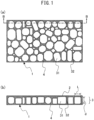
- FIG. 1(a) is a sectional plan view of a preferred embodiment of a porous polyimide film of the present invention
- FIG. 1(b) is a sectional view along the line B-B in FIG. 1(a)
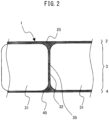
- FIG. 2 is an enlarged sectional side view of a preferred embodiment of a porous polyimide film of the present invention.
- the porous polyimide film 1 of the present invention is a three-layer structure porous polyimide film having two surface layers 2 and 4 (surface layers (a) and (b)), and a macrovoid layer 3 sandwiched between the surface layers 2 and 4.
- each of the surface layers 2 and 4 is 0.1 to 50 ⁇ m, preferably 0.5 to 10 ⁇ m from the viewpoint of the strength of the polyimide film, more preferably 1 to 9 ⁇ m, further preferably 2 to 8 ⁇ m, and especially preferably 2 to 7 ⁇ m. From the viewpoint of using the polyimide film as a material for various flat films, it is preferable that the thicknesses of the surface layers 2 and 4 are substantially the same.
- the surface layers 2 and 4 have a plurality of fine pores 25 and 45 respectively.
- the average pore diameter of the fine pores in at least one surface layer is more than 5 ⁇ m and 200 ⁇ m or less, preferably 5.5 to 200 ⁇ m, more preferably 7 to 200 ⁇ m, further preferably from 10 to 200 ⁇ m, and especially preferably from 10 to 100 ⁇ m.
- the average pore diameter of the fine pores in the other surface layer is 0.01 to 200 ⁇ m, preferably 1 to 200 ⁇ m, more preferably 5.5 to 200 ⁇ m, further preferably 10 to 100 ⁇ m, and especially preferably 15 to 70 ⁇ m. It is preferable that each of the surface layers 2 and 4 has a plurality of fine pores which average pore diameter is over 5 ⁇ m but not greater than 200 ⁇ m.
- the surface opening ratio of one of the surface layers 2 and 4 is 10% or more, preferably 15% or more, and more preferably 20% or more, and the surface opening ratio of the other surface opening ratio is 5% or more, preferably 10% or more, and more preferably 20% or more. Such surface opening ratios are advantageous for improving the mass transfer between the outside of a porous polyimide film and the macrovoids.
- the maximum pore diameter of the fine pores 25 and 45 is preferably 500 ⁇ m or less, more preferably 0.1 to 500 ⁇ m, and further preferably 0.1 to 200 ⁇ m.
- the fine pores 25 and 45 communicate with the macrovoids 31.
- a polyimide film of the present invention is excellent in permeability of a material such as a gas.
- a polyimide film of the present invention since the average pore diameter of the fine pores formed on the surface of the film is small, and only a material having a predetermined size can be passed through, a polyimide film of the present invention has a filtering function. Further, since the average pore diameter of the fine pores formed on the film surface is small, the film surface of a polyimide film of the present invention is excellent in smoothness.
- a macrovoid layer 3 has a plurality of macrovoids 31 and a partition wall 32 separating adjacent macrovoids 31.
- a macrovoid 31 is a space surrounded by the partition walls 32 and the surface layers 2 and 4, and the average pore diameter in the film plane direction is 10 to 500 ⁇ m, preferably 10 to 100 ⁇ m, and more preferably 10 to 80 ⁇ m.
- a cross section of the macrovoid layer 3 cut parallel to the film plane direction is schematically depicted in FIG. 1(a) , which has a honeycomb structure or a structure similar thereto, and a plurality of macrovoids having a predetermined pore diameter are present side by side separated by the partition walls.
- a polyimide film of the present invention has a so-called "honeycomb sandwich structure".
- a "honeycomb structure” means herein merely a structure in which a large number of individually divided cell spaces are densely packed, and not limited to a structure in which the cross section of cell spaces are accurately hexagonal.
- a polyimide film of the present invention has a large space and the porosity is high. Therefore, when it is used, for example, as an insulating substrate, the dielectric constant may be lowered, and when the voids are filled with a material, its filling amount may be increased.
- the thickness of the partition wall 32 separating the adjacent macrovoids 31 from each other is 0.1 to 50 ⁇ m, preferably 1 to 15 ⁇ m from the viewpoints of the strength of the polyimide film 1 and the mutual communication capacity between the adjacent macrovoids 31, more preferably 2 to 12 ⁇ m, further preferably 3 to 10 ⁇ m, and especially preferably 4 to 8 ⁇ m.
- the thicknesses of the partition walls 32 and the surface layers 2 and 4 are preferably substantially the same.
- a polyimide film of the present invention has a plurality of partition walls, and at least one partition wall has one or plural pores 35.
- the average pore diameter of the pores 35 is not particularly limited, but is preferably 0.01 to 100 ⁇ m, more preferably 0.01 to 50 ⁇ m, further preferably 0.01 to 20 ⁇ m, still further preferably 0.01 to 10 ⁇ m, and especially preferably 0.02 to 2 ⁇ m.
- a polyimide film of the present invention has communicating macrovoids, filling with a material or transfer thereof in the film plane direction is easy, and therefore it is excellent in permeability of a material.
- the average pore diameter of fine pores formed in the partition walls is small, it is possible to trap the material in the macrovoid.
- the partition walls 32 are bonded to the surface layers 2 and 4.
- the partition wall 32 plays a role of separating adjacent macrovoids 31 from each other, and also serves as a support portion for supporting the surface layers 2 and 4. Therefore, a polyimide film of the present invention is resistant to compressive stress in the thickness direction of the film despite the high porosity, and has high dimensional stability.
- the partition walls 32 and the surface layers 2 and 4 are configured in a ladder shape.
- the partition walls 32 are formed in a substantially vertical direction with respect to the film plane direction at substantially regular intervals, and are bonded to the surface layers 2 and 4.
- the cross-sectional area of macrovoids having an average pore diameter in the film plane direction of 10 to 500 ⁇ m is preferably 50% or more with respect to the cross-sectional area of the film, more preferably 60% or more, further preferably 70% or more, and especially preferably 75% or more, and preferably 98% or less, more preferably 95% or less, further preferably 90% or less, and especially preferably 85% or less.
- the number percentage of the macrovoids satisfying such L/d range is preferably 60% or more, more preferably 70% or more, and further preferably 75 to 100%.
- the length (d) in the film thickness direction of a macrovoid means the maximum length of macrovoids in the film thickness direction
- the length (L) in the film plane direction of a macrovoid means the maximum length of macrovoids in the film plane direction.
- the total film thickness of a polyimide film of the present invention is 5 to 500 ⁇ m, and from the viewpoint of mechanical strength preferably 10 ⁇ m or more, more preferably 20 ⁇ m or more, and further preferably 25 ⁇ m or more, and preferably 300 ⁇ m or less, more preferably 100 ⁇ m or less, further preferably 50 ⁇ m or less, and especially preferably 40 ⁇ m or less.
- the porosity of a polyimide film of the present invention is 60 to 95%, and from the viewpoints of permeability of a material, mechanical strength, and retention of the film structure, it is preferably 70 to 92%, more preferably 71 to 85%, and further preferably 71 to 80%.
- the Gurley value of a polyimide film of the present invention is preferably 20 sec/100 cc or less, more preferably 10 sec/100 cc or less, further preferably 5 sec/100 cc or less, still further preferably 2 sec/100 cc or less, and especially preferably 0.5 sec/100 cc or less.
- the lower limit value is not particularly restricted, but is preferably not less than the measurement limit.
- the Gurley value can be measured according to JIS P8117.
- a polyimide film of the present invention is extremely superior in air permeability.
- the change rate of the film thickness of a polyimide film of the present invention through application of a compression stress of 0.5 MPa at 250°C for 15 min is preferably 5% or less, more preferably 3% or less, and further preferably 0 to 1%.
- the dimensional stability in terms of dimensional change in the film plane direction according to ASTM D1204 at 200°C for 2 hours is preferably within ⁇ 1%, more preferably within ⁇ 0.8%, and further preferably within ⁇ 0.5%.
- a polyimide film of the present invention has preferably a glass transition temperature of 240°C or higher, or does not have a clear transition temperature at 300°C or higher.
- a porous polyimide film of the present invention is a porous polyimide film containing as a main component a polyimide obtained from a tetracarboxylic dianhydride and a diamine, and is preferably a porous polyimide film consisting of a polyimide obtained from a tetracarboxylic dianhydride and a diamine.
- the tetracarboxylic dianhydride may be any tetracarboxylic dianhydride, selected as appropriate according to the properties desired.
- tetracarboxylic dianhydrides include biphenyltetracarboxylic dianhydrides such as pyromellitic dianhydride, 3,3',4,4'-biphenyltetracarboxylic dianhydride (s-BPDA) and 2,3,3',4'-biphenyltetracarboxylic dianhydride (a-BPDA), oxydiphthalic dianhydride, diphenylsulfone-3,4,3',4'-tetracarboxylic dianhydride, bis(3,4-dicarboxyphenyl)sulfide dianhydride, 2,2-bis(3,4-dicarboxyphenyl)-1,1,1,3,3,3-hexafluoropropane dianhydride, 2,3,3',4'-benzophenonet
- At least one type of aromatic tetracarboxylic dianhydride selected from the group consisting of biphenyltetracarboxylic dianhydride and pyromellitic dianhydride.
- aromatic tetracarboxylic dianhydride there may be suitably used 3,3',4,4'-biphenyltetracarboxylic dianhydride.
- diamine any diamine may be used.
- diamines include the following:
- the diamine used may be appropriately selected according to the properties desired.
- aromatic diamine compounds with 3,3'-diaminodiphenyl ether, 3,4'-diaminodiphenyl ether, 4,4'-diaminodiphenyl ether, paraphenylenediamine, 1,3-bis(3-aminophenyl)benzene, 1,3-bis(4-aminophenyl)benzene, 1,4-bis(3-aminophenyl)benzene, 1,4-bis(4-aminophenyl)benzene, 1,3-bis(4-aminophenoxy)benzene and 1,4-bis(3-aminophenoxy)benzene being preferred for use.
- Particularly preferred is at least one type of diamine selected from the group consisting of benzenediamines, diaminodiphenyl ethers and bis(aminophenoxy)phenyl.
- the porous polyimide film is preferably formed from a polyimide obtained by combination of a tetracarboxylic dianhydride and a diamine, having a glass transition temperature of 240°C or higher, or without a distinct transition point at 300°C or higher.
- the porous polyimide film of the present invention is preferably a porous polyimide film comprising one of the following aromatic polyimides:
- a porous polyimide film of the present invention is excellent in permeability of a material such as a gas, and therefore may be suitably used for applications such as a gas filter, a liquid filter, and a ventilation part.
- a porous polyimide film of the present invention may be used even in a service temperature range of 250°C or higher.
- a protective film for an acoustic part such as a microphone of a mobile phone, and even when it is thermally affected in soldering, it will not be destroyed.
- It can also be used as a heat resistant filter.
- the heretofore used heat resistant filter made of an aramid nonwoven fabric is thermally deteriorated by use and the binder contained therein may be carbonized to become a source of dust, but a heat resistant filter using a porous polyimide film of the present invention does not cause such a problem. It may also be used for a dustproof heat resistant filter for a hot air circulation line in a car body painting booth.
- a poly(amic acid) is a polyimide precursor constituted with a tetracarboxylic acid unit and a diamine unit, or a partially imidized polyimide precursor therefrom.
- a poly(amic acid) may be obtained by polymerizing a tetracarboxylic dianhydride, and a diamine. By thermal imidization or chemical imidization of a poly(amic acid) it may be converted to a polyimide through ring closure.
- a poly(amic acid) used in the present invention is preferably produced by thermal imidization.
- the imidization rate is preferably about 80% or more, more preferably 85% or more, further preferably 90% or more, and still further preferably 95% or more.
- a poly(amic acid) used in the method for producing a porous polyimide film of the present invention is obtained preferably from at least one kind of tetracarboxylic dianhydride selected from the group consisting of biphenyltetracarboxylic dianhydride, and pyromellitic dianhydride, and at least one kind of diamine selected from the group consisting of benzenediamine, diaminodiphenyl ether, and bis(aminophenoxy)phenyl.
- An arbitrary organic polar solvent may be used as a solvent for polymerizing a poly(amic acid), and examples of a usable organic polar solvent may include p -chlorophenol, o- chlorophenol, N -methyl-2-pyrrolidone (NMP), pyridine, N,N -dimethylacetamide (DMAc), N,N- dimethylformamide, dimethyl sulfoxide, tetramethylurea, phenol, and cresol.
- NMP N- methyl-2-pyrrolidone
- DMAc N,N- dimethylacetamide
- a poly(amic acid) may be produced by an arbitrary method using a tetracarboxylic dianhydride, a diamine, the organic polar solvent, etc.
- a poly(amic acid) solution may be prepared by reacting a tetracarboxylic dianhydride and a diamine quasi equimolarly preferably at a temperature of about 100°C or less, more preferably 80°C or less, further preferably 0 to 60°C, and especially preferably 20 to 60°C, and preferably for about 0.2 hours or more, and more preferably 0.3 to 60 hours.
- an optional molecular weight adjusting component may be added to the reaction solution with a purpose for adjusting the molecular weight.
- the limiting viscosity number of a poly(amic acid) used in the production method A of the present invention is 1.0 to 3.0, preferably 1.3 to 2.8, and more preferably 1.4 to 2.6.
- the film may be broken due to insufficient mechanical strength or the like in the production process of the film, which is not preferable.
- shrinkage of the film may be so intense in the thermal imidization step to cause breakage, which is also not preferable.
- a porous polyimide film of the present invention may be favorably produced.
- there is a causal relationship between the polymer molecular weight and the limiting viscosity number there is a causal relationship between the polymer molecular weight and the limiting viscosity number, and as the polymer molecular weight increases, the limiting viscosity number rises.
- a poly(amic acid) in which an amic acid is partially imidized may be also used insofar as the present invention is not adversely affected.
- a poly(amic acid) solution is composed of 3 to 60% by mass of a poly(amic acid) and 40 to 97% by mass of an organic polar solvent.
- the content of a poly(amic acid) is less than 3% by mass, the film strength decreases when a porous polyimide film is produced, and when it exceeds 60% by mass, the permeability of a material of a porous polyimide film decreases.
- the content of a poly(amic acid) in a poly(amic acid) solution is preferably 4 to 40% by mass, more preferably 5 to 20% by mass, and further preferably 6 to 10% by mass.
- a poly(amic acid) solution may be a solution obtained by polymerizing a tetracarboxylic dianhydride and a diamine in the presence of an organic polar solvent, or may be a solution obtained by dissolving a poly(amic acid) in an organic polar solvent.
- the solution viscosity of a poly(amic acid) solution is preferably 10 to 10,000 poise (1 to 1,000 Pa ⁇ s), more preferably 100 to 3,000 poise (10 to 300 Pa ⁇ s), further preferably 200 to 2,000 poise (20 to 200 Pa s), and especially preferably 300 to 1,000 poise (30 to 100 Pa s) from the viewpoints of ease of casting and film strength.
- a poly(amic acid) solution is cast into the film-like shape.
- a poly(amic acid) solution is used as a dope solution and the poly(amic acid) solution is cast onto a glass sheet, a stainless steel sheet, or the like using a blade, a T-die, or the like into the film-like shape.
- a poly(amic acid) solution may be intermittently or continuously cast on a movable continuous belt or drum into the film-like shape to produce continuously short pieces or a long piece of a cast sheet.
- the belt or drum insofar as it is not affected by a poly(amic acid) solution or a coagulating solution, and for example the belt or the drum may be made of a metal such as stainless steel, or a resin such as polytetrafluoroethylene.
- a poly(amic acid) solution formed into the film-like shape through a T-die may be directly immersed into a coagulating bath. Further, either or both sides of the cast sheet may be brought into contact with a gas (air, inert gas, etc .) containing water vapor or the like.
- the cast sheet is immersed in or brought into contact with a coagulating solvent containing water as an essential component to precipitate a poly(amic acid) to make it porous thereby forming a porous film.
- a coagulating solvent containing water as an essential component to precipitate a poly(amic acid) to make it porous thereby forming a porous film.
- the obtained porous film of a poly(amic acid) may be washed and/or dried according to need.
- the coagulating solvent containing water as an essential component is preferably water, or a mixed liquid containing water in a range of 5% by mass or more and less than 100% by mass and an organic polar solvent in a range of more than 0% by mass to not more than 95% by mass. It is more preferable to use a coagulating solvent containing water and an organic polar solvent from the viewpoints of safety from fire, etc., production cost, and securance of the homogeneity of a film to be obtained.
- an organic polar solvent which may be contained in a coagulating solvent include an alcohol such as ethanol and methanol, and acetone which are a poor solvent of a poly(amic acid).
- a good solvent of a poly(amic acid) may be added to the extent that the polymer can be precipitated.
- NMP N- methyl-2-pyrrolidone
- DMAc N- dimethylacetamide
- N, N- dimethylformamide may be added.
- a coagulating solvent is a mixture liquid of water and an organic polar solvent
- the content of water in the coagulating solvent as 100% by mass is preferably 5% by mass or more and less than 100% by mass, more preferably 20% by mass or more and less than 100% by mass, further preferably 30 to 95% by mass, and especially preferably 45 to 90% by mass.
- the content of an organic polar solvent in the coagulating solvent as 100% by mass is preferably more than 0% by mass and not more than 95% by mass, more preferably more than 0% by mass and not more than 80% by mass, further preferably 5 to 70% by mass, and especially preferably 10 to 55% by mass.
- the temperature of a coagulating solvent may be appropriately selected and used according to the purpose, for example, preferably in a range of -30 to 70°C, more preferably 0 to 60°C, and further preferably 10 to 50°C.
- the obtained porous film of a poly(amic acid) is thermally treated for imidization to produce a porous polyimide film.
- the thermal imidization treatment is performed such that the shrinkage ratio after the treatment each in the longitudinal direction (length direction) and the transverse direction of the film is suppressed to 8% or less, and preferably 5% or less, respectively.
- the thermal treatment may be performed, for example, by fixing a porous film of a poly(amic acid) to a support using a pin, a chuck, pinch rolls, or the like, and heating it in the atmosphere.
- reaction conditions should be appropriately selected with respect to the heating temperature in the range of, for example, 280 to 600°C, and preferably 300 to 550°C, and with respect to the heating time in the range of 1 to 120 min, preferably 2 to 120 min, more preferably 3 to 90 min, and further preferably 5 to 30 min.
- the temperature rising rate in a temperature range of 200°C or higher is 25°C/min or more, and preferably 50°C/min or more.
- the upper limit value of the temperature rising rate when the upper limit value of the temperature rising rate is established, it is 50 to 500°C/min, preferably 50 to 400°C/min, more preferably 70 to 300°C/min, and further preferably 120 to 200°C/min.
- the porosity, film thickness, average pore diameter in the surface, maximum pore diameter, average pore diameter at the central portion, and the like of a porous polyimide film of the present invention may be appropriately designed by selecting appropriately the type of polymer used, the polymer concentration, viscosity, organic solution, etc. of a polymer solution, the coagulation conditions (kind of solvent substitution rate adjusting layer, temperature, coagulating solvent, etc .) , and the like.
- the porous polyimide film obtained in the above imidization step may be subjected to a surface treatment, such as a corona discharge treatment, a plasma discharge treatment including a low temperature plasma discharge, and an atmospheric pressure plasma discharge, and a chemical etching, on at least one side of the film according to the purpose.
- a surface treatment such as a corona discharge treatment, a plasma discharge treatment including a low temperature plasma discharge, and an atmospheric pressure plasma discharge, and a chemical etching, on at least one side of the film according to the purpose.
- the surface layers (a) and/or (b) may be used after machining. These treatments may be carried out according to a method well known to those skilled in the art. It is preferable to apply a plasma discharge treatment to at least one side of a porous polyimide film in order to improve the surface opening diameter, surface opening ratio, and hydrophilicity.
- step (1) of the production method B of the present invention may be carried out in the same manner as the step (1) of the production method of the present invention described in the above 2.
- the obtained porous film of a poly(amic acid) is thermally treated for imidization to produce a porous polyimide film.
- the thermal imidization treatment is performed such that the shrinkage ratio after the treatment each in the longitudinal direction (length direction) and the transverse direction of the film is suppressed to preferably 40% or less, and more preferably 30% or less, respectively.
- the thermal treatment may be performed, for example, by fixing a porous film of a poly(amic acid) to a support using a pin, a chuck, pinch rolls, or the like, and heating it in the atmosphere.
- reaction conditions should be appropriately selected with respect to the heating temperature in the range of, for example, 280 to 600°C, and preferably 300 to 550°C, and with respect to the heating time in the range of 1 to 120 min, preferably 2 to 120 min, more preferably 3 to 90 min, and further preferably 5 to 30 min.
- the temperature rising rate in the thermal imidization treatment in a temperature range of 200°C or higher is, although not particularly limited, for example, 1°C/min or more, preferably 5°C/min or more, 10°C/min or more, 15°C/min or more, 20°C/min or more, or 25°C/min or more, and more preferably 50°C/min or more.
- the upper limit value of the temperature rising rate when the upper limit value of the temperature rising rate is established, it is for example 1 to 500°C/min, preferably 5 to 400°C/ min, more preferably 5 to 300°C/min, and further preferably 5 to 200°C/min.
- the porosity, film thickness, average pore diameter in the surface, maximum pore diameter, average pore diameter at the central portion, and the like of a porous polyimide film of the present invention may be appropriately designed by selecting appropriately the type of polymer used, the polymer concentration, viscosity, organic solution, etc., of a polymer solution, the coagulation conditions (kind of solvent substitution rate adjusting layer, temperature, coagulating solvent, etc .) , and the like.
- the porous polyimide film obtained in the above imidization step is subjected to a surface treatment, such as a corona discharge treatment, and a plasma discharge treatment including a low temperature plasma discharge, and an atmospheric pressure plasma discharge, on at least one side of the film.
- a plasma discharge treatment may be carried out according to a method well known to those skilled in the art.
- an organic compound having a polar group, or a polymer having a polar group is used for producing a desired porous polyimide film. They promote the penetration of water into a film-like shape cast sheet of a poly(amic acid) solution composition, and assist in the formation of macrovoids in the polyimide film. Meanwhile, by the production method of the present invention, a desired porous film type polyimide film may be produced without using a material promoting the penetration of water into a film-like shape cast sheet, but by controlling the molecular weight of the poly(amic acid) in a poly(amic acid) solution within a certain range to suppress film shrinkage in the thermal imidization step.
- a film thickness was measured with a contact type thickness meter.
- Gurley value the number of seconds required for 100 cc of air to pass through a film under a pressure of 0.879 g/m 2 .
- a measurement of dimensional stability was performed at 200°C for 2 hours according to ASTM D 1204.
- the average pore diameter was found by measuring the pore area with respect to each of 200 or more openings in a scanning electron micrograph of the surface of the porous film, and by calculating the average pore diameter from the average value of the pore areas according to the following Equation (1) assuming that the shape of pores was a perfect circle.
- Average Pore Diameter 2 ⁇ S a / ⁇ ⁇ 0.5
- a dynamic viscoelasticity was measured in the tensile mode under the conditions of frequency of 10 Hz, strain of 2%, and in a nitrogen gas atmosphere, and a temperature at which the loss tangent exhibited the maximum value in its temperature variance profile was regarded as the transition temperature.
- the solution viscosity was measured with an E type rotational viscometer. The measurement procedure is shown below.
- a limiting viscosity number is synonymous with an intrinsic viscosity, and is a limit value of the reduced viscosity at infinite dilution of the polymer (Reduced viscosity: the ratio ⁇ r /c of increase in relative viscosity ⁇ r to the mass concentration c of the polymer), or of the inherent viscosity (Inherent viscosity: the ratio of the natural log of the relative viscosity to the mass concentration c of the polymer).
- the limiting viscosity number was used as an index of a molecular weight because a poly(amic acid) is an unstable substance in the air, and it is difficult to determine a molecular weight by a means such as GPC.
- NMP N -methyl-2-pyrrolidone
- the limiting viscosity number was determined by the following measuring procedure.
- the shrinkage ratio at the time of imidization was measured by the following procedure.
- the dope in the flask was filtrated with a pressure filter (Filter paper No. 60 for viscous liquid, produced by Advantec Toyo Kaisha, Ltd.,) to yield a poly(amic acid) solution composition A.
- the solution composition A was a viscous liquid with a viscosity of 300 poise.
- the limiting viscosity number was 1.4.
- a poly(amic acid) solution composition B was obtained in the same manner as in Reference Example 1 except that the molar ratio of acid anhydride/diamine was changed to 0.995 and the polymer concentration to 7% by mass.
- the solution composition B was a viscous liquid with a viscosity of 400 poise.
- the limiting viscosity number was 2.5.
- a poly(amic acid) solution composition C was obtained in the same manner as in Reference Example 1 except that the molar ratio of acid anhydride/diamine was changed to 0.999.
- the solution composition C was a viscous liquid with a viscosity of 950 poise.
- the limiting viscosity number was 3.2.
- the poly(amic acid) solution composition A prepared in Preparation Example 1 was coated on a substrate, which is a square of side 20 cm, and made of stainless steel having a mirror polished surface, by casting uniformly using a desktop automatic coater at room temperature to a thickness in a range of about 100 to 200 ⁇ m. After being left standing in the air at a temperature of 23°C and a humidity of 40% for 90 sec, the entire substrate was then dipped into a coagulating bath (80 parts by mass of water, and 20 parts by mass of NMP, room temperature). After dipping it was left to stand there still for 8 min, so as to deposit a poly(amic acid) film on the substrate.
- a coagulating bath 80 parts by mass of water, and 20 parts by mass of NMP, room temperature
- the substrate was taken out from the bath, and the poly(amic acid) film deposited on the substrate was peeled off, and then immersed in pure water for 3 min to obtain a poly(amic acid) film.
- the poly(amic acid) film was dried in the air at a temperature of 23°C and a humidity of 40%, and then stuck to a 10 cm-square pin tenter and the four sides were fixed.
- the fixed film was placed in an electric furnace for a heat treatment with such a temperature profile, that the temperature was raised to 150°C at a temperature rising rate of about 10°C/min, then further raised to the maximum temperature set forth in Table 1 at a temperature rising rate set forth in Table 1, and kept there for 3 min to obtain a porous polyimide film.
- the glass transition temperature of a porous polyimide film was about 280°C, and the dimensional stability in terms of dimensional change at 200°C was within 1%.
- the rate of film thickness change through application of compressive stress of 0.5 MPa at 250°C for 15 min was 1% or less.
- Example 2 The same operation as in Example 1 was carried out except that the poly(amic acid) solution composition B was used instead of the poly(amic acid) solution composition A.
- the heat treatment conditions were in accordance with Table 2.
- the film thickness, the porosity, and the Gurley value of the obtained porous polyimide film are presented in Table 2.
- the shrinkage ratio at the time of the thermal imidization was 7% or less in any cases.
- the glass transition temperature of a porous polyimide film was about 280°C, and the dimensional stability in terms of dimensional change at 200°C was within 1%.
- the rate of film thickness change through application of compressive stress of 0.5 MPa at 250°C for 15 min was 1% or less.
- the surface opening ratio, the surface opening diameter, and the average pore diameter of the macrovoids in the planar direction in Examples 1, 2 and 5 are presented in Table 3.
- Table 3 Surface layer (a) Surface layer (b) Average pore diameter of macrovoids in planar direction [ ⁇ m] Average surface opening ratio [%] Average surface opening diameter [ ⁇ m] Average surface opening ratio [%] Average surface opening diameter [ ⁇ m] Example 1 16 8 13 6 28 Example 2 25 16 35 26 36 Example 5 21 14 33 42 42
- Example 2 The same operation as in Example 1 was carried out except that the poly(amic acid) solution composition C was used instead of the poly(amic acid) solution composition A.
- the heat treatment conditions were in accordance with Table 4. As a result, shrinkage of the film was severe in the thermal imidization step, and cracks appeared in the film from the sides clamped, and the film was broken. As a result of SEM observation of the broken film, it was confirmed that the surface opening ratio was 10% or less.
- Example 2 The same operation as in Example 1 was carried out except that the film was stuck to the pin sheet at the time of thermal imidization with a slack of 10%, to obtain a porous polyimide film.
- the surface opening ratio was 10% or less in either surface.
- the contact angle with respect to water was 70 degrees or more.
- the results are presented in Table 5.
- the shrinkage ratio in the thermal imidization was not less than 9% in either case.
- a porous polyimide of the present invention is excellent in permeability of a material such as a gas, and therefore may be suitably used for applications such as a gas filter, a liquid filter, and a ventilation part. By the method of the present invention, such porous polyimide may be easily and efficiently produced.
Landscapes
- Chemical & Material Sciences (AREA)
- Health & Medical Sciences (AREA)
- Chemical Kinetics & Catalysis (AREA)
- Medicinal Chemistry (AREA)
- Polymers & Plastics (AREA)
- Organic Chemistry (AREA)
- Engineering & Computer Science (AREA)
- Materials Engineering (AREA)
- Manufacturing & Machinery (AREA)
- General Chemical & Material Sciences (AREA)
- Manufacture Of Porous Articles, And Recovery And Treatment Of Waste Products (AREA)
- Laminated Bodies (AREA)
Claims (5)
- Verfahren zur Herstellung einer porösen Polyimidfolie, umfassend die Schritte:(1) Gießen einer Polyamidsäurelösung bestehend aus 3 bis 60 Massen% einer Polyamidsäure mit einer Grenzenviskositätszahl, bestimmt nach dem Messverfahren gemäß der Beschreibung, von 1,0 bis 3,0, wobei die Polyamidsäure aus Tetracarbonsäureeinheiten und Diamineinheiten besteht, und 40 bis 97 Massen% eines organischen polaren Lösungsmittels in eine folienartige Form, und Eintauchen oder Inkontaktbringen mit einem koagulierenden Lösungsmittel umfassend Wasser als wesentliche Komponente, um eine poröse Folie aus Polyamidsäure herzustellen; und(2) Imidisieren der in Schritt (1) erhaltenen porösen Folie aus einer Polyamidsäure durch Wärmebehandlung, wobei jede der Schrumpfraten, bestimmt nach dem Messverfahren gemäß der Beschreibung, in der Längsrichtung und in der Querrichtung der Folie nach der Wärmebehandlung auf 8% oder niedriger reduziert ist, und wobei die Rate des Temperaturanstiegs im Temperaturbereich von 200 °C oder höher bei der Wärmebehandlung 25 °C/min oder höher ist,wobei die poröse Polyimidfolie eine poröse Polyimidfolie mit einer dreilagigen Struktur ist mit zwei Oberflächenlagen (a) und (b), und einer Makrovoid-Lage zwischen den Oberflächenlagen (a) und (b),wobei die Makrovoid-Lage Begrenzungswände hat, die an die Oberflächenlagen (a) und (b) gebunden sind, und eine Vielzahl von Makrovoids, die durch die Begrenzungswände und die Oberflächenlagen (a) und (b) umgeben sind und einen mittleren Porendurchmesser, bestimmt nach dem Messverfahren gemäß der Beschreibung, in der Ebenenrichtung der Folie von 10 bis 500 µm aufweisen,wobei die Begrenzungswände der Makrovoid-Lage eine Dicke von 0,1 µm bis 50 µm aufweisen,wobei mindestens eine Begrenzungswand eine oder mehrere Poren aufweist, die mit angrenzenden Makrovoids in Verbindung stehen,wobei jede der Oberflächenlagen (a) und (b) eine Dicke von 0,1 µm bis 50 µm aufweist,wobei mindestens eine der Oberflächenlagen (a) und (b) eine Vielzahl von kleinen Poren aufweist mit einem mittleren Porendurchmesser, bestimmt nach dem Messverfahren gemäß der Beschreibung, von mehr als 5 µm und nicht mehr als 200 µm, während die andere eine Vielzahl von feinen Poren aufweist mit einem Porendurchmesser, bestimmt nach dem Messverfahren gemäß der Beschreibung, von 0,01 µm bis 200 µm;wobei die Oberflächenöffnungsrate mindestens einer der Oberflächenlagen nicht weniger als 10% beträgt, während diejenige der anderen Oberflächenlage nicht weniger als 5% beträgt;wobei die feinen Poren in den Oberflächenlagen (a) und (b) mit den Makrovoids in Verbindung stehen; undwobei die poröse Polyimidfolie eine gesamte Foliendicke von 5 µm bis 500 µm aufweist, der Gurley-Wert, bestimmt nach dem Messverfahren gemäß Absatz [0075] der Beschreibung, nicht mehr als 20 sec/100 cc beträgt, und die Porosität von 60% bis 95% beträgt.
- Verfahren zur Herstellung einer porösen Polyimidfolie nach Anspruch 1, wobei die Polyamidsäure mindestens ein Tetracarbonsäure-Dianhydrid umfasst, welches ausgewählt ist aus der Gruppe bestehend aus Biphenyltetracarbonsäure-Dianhydrid und und Pyromellitsäure-Dianhydrid; und mindestens ein Diamin, welches ausgewählt ist aus der Gruppe bestehend aus Phenylendiamin, Diaminodiphenylether und Bis(aminophenoxy)phenyl.
- Verfahren zur Herstellung einer porösen Polyimidfolie nach Anspruch 1 oder 2, wobei das koagulierende Lösungsmittel, welches Wasser als wesentliche Komponente umfasst, Wasser ist, oder eine gemischte Lösung aus 5 Massen% oder mehr und weniger als 100 Massen% Wasser, und mehr als 0 Massen% bis 95 Massen% oder weniger eines organischen polaren Lösungsmittels.
- Verfahren zur Herstellung einer porösen Polyimidfolie nach einem der Ansprüche 1 bis 3, ferner umfassend den Schritt einer Plasmabehandlung mindestens einer Oberfläche der in Schritt (2) erhaltenen porösen Polyimidfolie.
- Verfahren zur Herstellung einer porösen Polyimidfolie, umfassend die Schritte:(1) Gießen einer Polyamidsäurelösung bestehend aus 3 bis 60 Massen% einer Polyamidsäure mit einer Grenzviskositätszahl, bestimmt nach dem Messverfahren gemäß der Beschreibung, von 1,0 bis 3,0, wobei die Polyamidsäure aus Tetracarbonsäureeinheiten und Diamineinheit besteht, und 40 bis 97 Massen% eines organen polaren Lösungsmittels in eine folienartige Form, und Eintauchen oder Inkontaktbringen mit einem koagulierenden Lösungsmittel umfassend Wasser als wesentliche Komponente, um eine poröse Folie aus Polyamidsäure herzustellen;(2) Imidisieren der in Schritt (1) erhaltenen porösen Folie aus einer Polyamidsäure durch Wärmebehandlung, und(3) Unterziehen mindestens einer Oberfläche der in Schritt (2) erhaltenen porösen Polyimidfolie einer Plasmabehandlung,wobei die poröse Polyimidfolie eine poröse Polyimidfolie mit einer dreilagigen Struktur ist mit zwei Oberflächenlagen (a) und (b), und einer Makrovoid-Lage zwischen den Oberflächenlagen (a) und (b),wobei die Makrovoid-Lage Begrenzungswände hat, die an die Oberflächenlagen (a) und (b) gebunden sind, und eine Vielzahl von Makrovoids, die durch die Begrenzungswände und die Oberflächenlagen (a) und (b) umgeben sind und einen mittleren Porendurchmesser, bestimmt nach dem Messverfahren gemäß der Beschreibung, in der Ebenenrichtung der Folie von 10 bis 500 µm aufweisen,wobei die Begrenzungswände der Makrovoid-Lage eine Dicke von 0,1 µm bis 50 µm aufweisen,wobei mindestens eine Begrenzungswand eine oder mehrere Poren aufweist, die mit angrenzenden Makrovoids in Verbindung stehen,wobei jede der Oberflächenlagen (a) und (b) eine Dicke von 0,1 µm bis 50 µm aufweist,wobei mindestens eine der Oberflächenlagen (a) und (b) eine Vielzahl von kleinen Poren aufweist mit einem mittleren Porendurchmesser, bestimmt nach dem Messverfahren gemäß der Beschreibung, von mehr als 5 µm und nicht mehr als 200 µm, während die andere eine Vielzahl von feinen Poren aufweist mit einem Porendurchmesser, bestimmt nach dem Messverfahren gemäß der Beschreibung, von 0,01 µm bis 200 µm;wobei die Oberflächenöffnungsrate mindestens einer der Oberflächenlagen nicht weniger als 10% beträgt, während diejenige der anderen Oberflächenlage nicht weniger als 5% beträgt;wobei die feinen Poren in den Oberflächenlagen (a) und (b) mit den Makrovoids in Verbindung stehen; undwobei die poröse Polyimidfolie eine gesamte Foliendicke von 5 µm bis 500 µm aufweist, der Gurley-Wert, bestimmt nach dem Messverfahren gemäß Absatz [0075] der Beschreibung, nicht mehr als 20 sec/100 cc beträgt, und die Porosität von 60% bis 95% beträgt.
Applications Claiming Priority (2)
| Application Number | Priority Date | Filing Date | Title |
|---|---|---|---|
| JP2016145811 | 2016-07-25 | ||
| PCT/JP2017/026935 WO2018021356A1 (ja) | 2016-07-25 | 2017-07-25 | 多孔質ポリイミド膜の製造方法、及び当該方法で製造される多孔質ポリイミド膜 |
Publications (3)
| Publication Number | Publication Date |
|---|---|
| EP3489291A1 EP3489291A1 (de) | 2019-05-29 |
| EP3489291A4 EP3489291A4 (de) | 2020-03-04 |
| EP3489291B1 true EP3489291B1 (de) | 2024-04-03 |
Family
ID=61015983
Family Applications (1)
| Application Number | Title | Priority Date | Filing Date |
|---|---|---|---|
| EP17834358.8A Active EP3489291B1 (de) | 2016-07-25 | 2017-07-25 | Herstellungsverfahren für poröse polyimidfolie und mit diesem verfahren hergestellte poröse polyimidfolie |
Country Status (8)
| Country | Link |
|---|---|
| US (1) | US10968328B2 (de) |
| EP (1) | EP3489291B1 (de) |
| JP (1) | JP6750679B2 (de) |
| KR (1) | KR102189214B1 (de) |
| CN (1) | CN109563300B (de) |
| CA (1) | CA3031920C (de) |
| SG (1) | SG11201900719UA (de) |
| WO (1) | WO2018021356A1 (de) |
Families Citing this family (8)
| Publication number | Priority date | Publication date | Assignee | Title |
|---|---|---|---|---|
| JP7314524B2 (ja) * | 2019-02-14 | 2023-07-26 | 富士フイルムビジネスイノベーション株式会社 | 多孔質ポリイミド膜、リチウムイオン二次電池用セパレータ、リチウムイオン二次電池、及び全固体電池 |
| JP7326785B2 (ja) * | 2019-03-14 | 2023-08-16 | Ube株式会社 | 多孔質ポリイミド膜及びその製造方法 |
| KR20200132203A (ko) | 2019-05-16 | 2020-11-25 | 최유경 | 폴리이미드 필름, 이의 제조방법 및 이를 포함하는 연성인쇄회로기판 |
| CN112111219B (zh) * | 2019-06-20 | 2023-04-14 | 东京应化工业株式会社 | 清漆组合物、聚酰亚胺多孔质膜的前体膜及其制造方法、以及聚酰亚胺多孔质膜的制造方法 |
| KR102306950B1 (ko) | 2021-02-05 | 2021-09-29 | 최유경 | 폴리이미드 필름, 이의 제조방법 및 이를 포함하는 연성인쇄회로기판 |
| CN114316348B (zh) * | 2021-12-01 | 2023-03-24 | 中国科学院化学研究所 | 一种长碳链聚酰胺多孔膜及其制备方法 |
| KR102935919B1 (ko) | 2022-11-30 | 2026-03-10 | (주)선진제약 | 세포 이식용 나노필름 및 이의 제조방법 |
| CN118005921A (zh) * | 2024-02-03 | 2024-05-10 | 大连理工大学盘锦产业技术研究院 | 一种可用于柔性显示的高透明聚酰亚胺膜材料及其制备方法 |
Family Cites Families (13)
| Publication number | Priority date | Publication date | Assignee | Title |
|---|---|---|---|---|
| JPS57209608A (en) | 1981-06-22 | 1982-12-23 | Ube Ind Ltd | Preparation of composite polyimide separation film |
| JP2001205058A (ja) * | 2000-01-21 | 2001-07-31 | Korea Inst Of Science & Technology | 非対称性ポリイミド分離膜の製造方法 |
| US6565962B2 (en) * | 2001-07-23 | 2003-05-20 | Ube Industries, Ltd. | Polyimide porous film |
| JP4752993B2 (ja) * | 2001-09-10 | 2011-08-17 | 日産化学工業株式会社 | ポリイミド多孔質膜およびその製造法 |
| JP2004359860A (ja) * | 2003-06-05 | 2004-12-24 | Ube Ind Ltd | 微細貫通パスを有するポリイミド多孔質膜及びその製造方法 |
| JP2005038687A (ja) * | 2003-07-14 | 2005-02-10 | Nitto Denko Corp | 高誘電体シート、その製造方法、配線回路基板およびその製造方法 |
| JP5223532B2 (ja) | 2008-08-08 | 2013-06-26 | 株式会社Ihi | 水柱観測装置及び水柱観測方法 |
| US8420211B2 (en) | 2008-10-02 | 2013-04-16 | Ube Industries, Ltd. | Porous polyimide membrane and process for production of same |
| JP2011001434A (ja) * | 2009-06-17 | 2011-01-06 | Ube Industries Ltd | ポリイミド多孔質体の製造方法、及びポリイミド多孔質体 |
| CN102575028B (zh) * | 2009-10-09 | 2015-06-17 | 宇部兴产株式会社 | 着色聚酰亚胺成型体及其制造方法 |
| JP2011125988A (ja) | 2009-12-21 | 2011-06-30 | Disco Abrasive Syst Ltd | 研削装置 |
| JP5577804B2 (ja) | 2010-04-07 | 2014-08-27 | 宇部興産株式会社 | 多孔質ポリイミド膜及びその製造方法 |
| KR101814225B1 (ko) * | 2010-04-07 | 2018-01-02 | 우베 고산 가부시키가이샤 | 다공질 폴리이미드막 및 그의 제조 방법 |
-
2017
- 2017-07-25 US US16/320,415 patent/US10968328B2/en active Active
- 2017-07-25 SG SG11201900719UA patent/SG11201900719UA/en unknown
- 2017-07-25 CA CA3031920A patent/CA3031920C/en active Active
- 2017-07-25 WO PCT/JP2017/026935 patent/WO2018021356A1/ja not_active Ceased
- 2017-07-25 JP JP2018530317A patent/JP6750679B2/ja active Active
- 2017-07-25 KR KR1020197002090A patent/KR102189214B1/ko active Active
- 2017-07-25 EP EP17834358.8A patent/EP3489291B1/de active Active
- 2017-07-25 CN CN201780045792.6A patent/CN109563300B/zh active Active
Also Published As
| Publication number | Publication date |
|---|---|
| EP3489291A4 (de) | 2020-03-04 |
| US10968328B2 (en) | 2021-04-06 |
| JP6750679B2 (ja) | 2020-09-02 |
| JPWO2018021356A1 (ja) | 2019-05-16 |
| EP3489291A1 (de) | 2019-05-29 |
| CA3031920A1 (en) | 2018-02-01 |
| WO2018021356A1 (ja) | 2018-02-01 |
| CN109563300A (zh) | 2019-04-02 |
| US20190263997A1 (en) | 2019-08-29 |
| CN109563300B (zh) | 2021-07-16 |
| KR102189214B1 (ko) | 2020-12-09 |
| CA3031920C (en) | 2021-04-13 |
| KR20190029607A (ko) | 2019-03-20 |
| SG11201900719UA (en) | 2019-02-27 |
Similar Documents
| Publication | Publication Date | Title |
|---|---|---|
| EP3489291B1 (de) | Herstellungsverfahren für poröse polyimidfolie und mit diesem verfahren hergestellte poröse polyimidfolie | |
| KR101814225B1 (ko) | 다공질 폴리이미드막 및 그의 제조 방법 | |
| KR101680391B1 (ko) | 다공질 폴리이미드막 및 그의 제조 방법 | |
| JP5577804B2 (ja) | 多孔質ポリイミド膜及びその製造方法 | |
| JP5577803B2 (ja) | 多孔質ポリイミド膜及びその製造方法 | |
| JP5720574B2 (ja) | 着色ポリイミド成形体及びその製造方法 | |
| JP2011001434A (ja) | ポリイミド多孔質体の製造方法、及びポリイミド多孔質体 | |
| JP7326785B2 (ja) | 多孔質ポリイミド膜及びその製造方法 | |
| JP2014231572A (ja) | 高分子多孔質膜 |
Legal Events
| Date | Code | Title | Description |
|---|---|---|---|
| STAA | Information on the status of an ep patent application or granted ep patent |
Free format text: STATUS: THE INTERNATIONAL PUBLICATION HAS BEEN MADE |
|
| PUAI | Public reference made under article 153(3) epc to a published international application that has entered the european phase |
Free format text: ORIGINAL CODE: 0009012 |
|
| STAA | Information on the status of an ep patent application or granted ep patent |
Free format text: STATUS: REQUEST FOR EXAMINATION WAS MADE |
|
| 17P | Request for examination filed |
Effective date: 20190211 |
|
| AK | Designated contracting states |
Kind code of ref document: A1 Designated state(s): AL AT BE BG CH CY CZ DE DK EE ES FI FR GB GR HR HU IE IS IT LI LT LU LV MC MK MT NL NO PL PT RO RS SE SI SK SM TR |
|
| AX | Request for extension of the european patent |
Extension state: BA ME |
|
| DAV | Request for validation of the european patent (deleted) | ||
| DAX | Request for extension of the european patent (deleted) | ||
| A4 | Supplementary search report drawn up and despatched |
Effective date: 20200203 |
|
| RIC1 | Information provided on ipc code assigned before grant |
Ipc: C08J 9/28 20060101AFI20200128BHEP Ipc: C08G 73/10 20060101ALI20200128BHEP |
|
| STAA | Information on the status of an ep patent application or granted ep patent |
Free format text: STATUS: EXAMINATION IS IN PROGRESS |
|
| 17Q | First examination report despatched |
Effective date: 20201103 |
|
| RAP3 | Party data changed (applicant data changed or rights of an application transferred) |
Owner name: UBE CORPORATION |
|
| GRAP | Despatch of communication of intention to grant a patent |
Free format text: ORIGINAL CODE: EPIDOSNIGR1 |
|
| STAA | Information on the status of an ep patent application or granted ep patent |
Free format text: STATUS: GRANT OF PATENT IS INTENDED |
|
| INTG | Intention to grant announced |
Effective date: 20231020 |
|
| GRAS | Grant fee paid |
Free format text: ORIGINAL CODE: EPIDOSNIGR3 |
|
| GRAA | (expected) grant |
Free format text: ORIGINAL CODE: 0009210 |
|
| STAA | Information on the status of an ep patent application or granted ep patent |
Free format text: STATUS: THE PATENT HAS BEEN GRANTED |
|
| P01 | Opt-out of the competence of the unified patent court (upc) registered |
Effective date: 20240126 |
|
| AK | Designated contracting states |
Kind code of ref document: B1 Designated state(s): AL AT BE BG CH CY CZ DE DK EE ES FI FR GB GR HR HU IE IS IT LI LT LU LV MC MK MT NL NO PL PT RO RS SE SI SK SM TR |
|
| REG | Reference to a national code |
Ref country code: GB Ref legal event code: FG4D |
|
| REG | Reference to a national code |
Ref country code: CH Ref legal event code: EP |
|
| REG | Reference to a national code |
Ref country code: DE Ref legal event code: R096 Ref document number: 602017080673 Country of ref document: DE |
|
| REG | Reference to a national code |
Ref country code: IE Ref legal event code: FG4D |
|
| REG | Reference to a national code |
Ref country code: LT Ref legal event code: MG9D |
|
| REG | Reference to a national code |
Ref country code: NL Ref legal event code: MP Effective date: 20240403 |
|
| REG | Reference to a national code |
Ref country code: AT Ref legal event code: MK05 Ref document number: 1672287 Country of ref document: AT Kind code of ref document: T Effective date: 20240403 |
|
| PG25 | Lapsed in a contracting state [announced via postgrant information from national office to epo] |
Ref country code: NL Free format text: LAPSE BECAUSE OF FAILURE TO SUBMIT A TRANSLATION OF THE DESCRIPTION OR TO PAY THE FEE WITHIN THE PRESCRIBED TIME-LIMIT Effective date: 20240403 |
|
| PG25 | Lapsed in a contracting state [announced via postgrant information from national office to epo] |
Ref country code: NL Free format text: LAPSE BECAUSE OF FAILURE TO SUBMIT A TRANSLATION OF THE DESCRIPTION OR TO PAY THE FEE WITHIN THE PRESCRIBED TIME-LIMIT Effective date: 20240403 |
|
| PG25 | Lapsed in a contracting state [announced via postgrant information from national office to epo] |
Ref country code: IS Free format text: LAPSE BECAUSE OF FAILURE TO SUBMIT A TRANSLATION OF THE DESCRIPTION OR TO PAY THE FEE WITHIN THE PRESCRIBED TIME-LIMIT Effective date: 20240803 |
|
| PG25 | Lapsed in a contracting state [announced via postgrant information from national office to epo] |
Ref country code: BG Free format text: LAPSE BECAUSE OF FAILURE TO SUBMIT A TRANSLATION OF THE DESCRIPTION OR TO PAY THE FEE WITHIN THE PRESCRIBED TIME-LIMIT Effective date: 20240403 |
|
| PG25 | Lapsed in a contracting state [announced via postgrant information from national office to epo] |
Ref country code: FI Free format text: LAPSE BECAUSE OF FAILURE TO SUBMIT A TRANSLATION OF THE DESCRIPTION OR TO PAY THE FEE WITHIN THE PRESCRIBED TIME-LIMIT Effective date: 20240403 Ref country code: HR Free format text: LAPSE BECAUSE OF FAILURE TO SUBMIT A TRANSLATION OF THE DESCRIPTION OR TO PAY THE FEE WITHIN THE PRESCRIBED TIME-LIMIT Effective date: 20240403 |
|
| PG25 | Lapsed in a contracting state [announced via postgrant information from national office to epo] |
Ref country code: GR Free format text: LAPSE BECAUSE OF FAILURE TO SUBMIT A TRANSLATION OF THE DESCRIPTION OR TO PAY THE FEE WITHIN THE PRESCRIBED TIME-LIMIT Effective date: 20240704 |
|
| PG25 | Lapsed in a contracting state [announced via postgrant information from national office to epo] |
Ref country code: PT Free format text: LAPSE BECAUSE OF FAILURE TO SUBMIT A TRANSLATION OF THE DESCRIPTION OR TO PAY THE FEE WITHIN THE PRESCRIBED TIME-LIMIT Effective date: 20240805 |
|
| PG25 | Lapsed in a contracting state [announced via postgrant information from national office to epo] |
Ref country code: ES Free format text: LAPSE BECAUSE OF FAILURE TO SUBMIT A TRANSLATION OF THE DESCRIPTION OR TO PAY THE FEE WITHIN THE PRESCRIBED TIME-LIMIT Effective date: 20240403 |
|
| PG25 | Lapsed in a contracting state [announced via postgrant information from national office to epo] |
Ref country code: CZ Free format text: LAPSE BECAUSE OF FAILURE TO SUBMIT A TRANSLATION OF THE DESCRIPTION OR TO PAY THE FEE WITHIN THE PRESCRIBED TIME-LIMIT Effective date: 20240403 |
|
| PG25 | Lapsed in a contracting state [announced via postgrant information from national office to epo] |
Ref country code: AT Free format text: LAPSE BECAUSE OF FAILURE TO SUBMIT A TRANSLATION OF THE DESCRIPTION OR TO PAY THE FEE WITHIN THE PRESCRIBED TIME-LIMIT Effective date: 20240403 |
|
| PG25 | Lapsed in a contracting state [announced via postgrant information from national office to epo] |
Ref country code: PL Free format text: LAPSE BECAUSE OF FAILURE TO SUBMIT A TRANSLATION OF THE DESCRIPTION OR TO PAY THE FEE WITHIN THE PRESCRIBED TIME-LIMIT Effective date: 20240403 |
|
| PG25 | Lapsed in a contracting state [announced via postgrant information from national office to epo] |
Ref country code: LV Free format text: LAPSE BECAUSE OF FAILURE TO SUBMIT A TRANSLATION OF THE DESCRIPTION OR TO PAY THE FEE WITHIN THE PRESCRIBED TIME-LIMIT Effective date: 20240403 |
|
| PG25 | Lapsed in a contracting state [announced via postgrant information from national office to epo] |
Ref country code: PT Free format text: LAPSE BECAUSE OF FAILURE TO SUBMIT A TRANSLATION OF THE DESCRIPTION OR TO PAY THE FEE WITHIN THE PRESCRIBED TIME-LIMIT Effective date: 20240805 Ref country code: PL Free format text: LAPSE BECAUSE OF FAILURE TO SUBMIT A TRANSLATION OF THE DESCRIPTION OR TO PAY THE FEE WITHIN THE PRESCRIBED TIME-LIMIT Effective date: 20240403 Ref country code: NO Free format text: LAPSE BECAUSE OF FAILURE TO SUBMIT A TRANSLATION OF THE DESCRIPTION OR TO PAY THE FEE WITHIN THE PRESCRIBED TIME-LIMIT Effective date: 20240703 Ref country code: LV Free format text: LAPSE BECAUSE OF FAILURE TO SUBMIT A TRANSLATION OF THE DESCRIPTION OR TO PAY THE FEE WITHIN THE PRESCRIBED TIME-LIMIT Effective date: 20240403 Ref country code: IS Free format text: LAPSE BECAUSE OF FAILURE TO SUBMIT A TRANSLATION OF THE DESCRIPTION OR TO PAY THE FEE WITHIN THE PRESCRIBED TIME-LIMIT Effective date: 20240803 Ref country code: HR Free format text: LAPSE BECAUSE OF FAILURE TO SUBMIT A TRANSLATION OF THE DESCRIPTION OR TO PAY THE FEE WITHIN THE PRESCRIBED TIME-LIMIT Effective date: 20240403 Ref country code: GR Free format text: LAPSE BECAUSE OF FAILURE TO SUBMIT A TRANSLATION OF THE DESCRIPTION OR TO PAY THE FEE WITHIN THE PRESCRIBED TIME-LIMIT Effective date: 20240704 Ref country code: FI Free format text: LAPSE BECAUSE OF FAILURE TO SUBMIT A TRANSLATION OF THE DESCRIPTION OR TO PAY THE FEE WITHIN THE PRESCRIBED TIME-LIMIT Effective date: 20240403 Ref country code: ES Free format text: LAPSE BECAUSE OF FAILURE TO SUBMIT A TRANSLATION OF THE DESCRIPTION OR TO PAY THE FEE WITHIN THE PRESCRIBED TIME-LIMIT Effective date: 20240403 Ref country code: CZ Free format text: LAPSE BECAUSE OF FAILURE TO SUBMIT A TRANSLATION OF THE DESCRIPTION OR TO PAY THE FEE WITHIN THE PRESCRIBED TIME-LIMIT Effective date: 20240403 Ref country code: BG Free format text: LAPSE BECAUSE OF FAILURE TO SUBMIT A TRANSLATION OF THE DESCRIPTION OR TO PAY THE FEE WITHIN THE PRESCRIBED TIME-LIMIT Effective date: 20240403 Ref country code: AT Free format text: LAPSE BECAUSE OF FAILURE TO SUBMIT A TRANSLATION OF THE DESCRIPTION OR TO PAY THE FEE WITHIN THE PRESCRIBED TIME-LIMIT Effective date: 20240403 Ref country code: RS Free format text: LAPSE BECAUSE OF FAILURE TO SUBMIT A TRANSLATION OF THE DESCRIPTION OR TO PAY THE FEE WITHIN THE PRESCRIBED TIME-LIMIT Effective date: 20240703 |
|
| REG | Reference to a national code |
Ref country code: DE Ref legal event code: R097 Ref document number: 602017080673 Country of ref document: DE |
|
| PG25 | Lapsed in a contracting state [announced via postgrant information from national office to epo] |
Ref country code: DK Free format text: LAPSE BECAUSE OF FAILURE TO SUBMIT A TRANSLATION OF THE DESCRIPTION OR TO PAY THE FEE WITHIN THE PRESCRIBED TIME-LIMIT Effective date: 20240403 |
|
| PG25 | Lapsed in a contracting state [announced via postgrant information from national office to epo] |
Ref country code: EE Free format text: LAPSE BECAUSE OF FAILURE TO SUBMIT A TRANSLATION OF THE DESCRIPTION OR TO PAY THE FEE WITHIN THE PRESCRIBED TIME-LIMIT Effective date: 20240403 |
|
| PG25 | Lapsed in a contracting state [announced via postgrant information from national office to epo] |
Ref country code: RO Free format text: LAPSE BECAUSE OF FAILURE TO SUBMIT A TRANSLATION OF THE DESCRIPTION OR TO PAY THE FEE WITHIN THE PRESCRIBED TIME-LIMIT Effective date: 20240403 Ref country code: SK Free format text: LAPSE BECAUSE OF FAILURE TO SUBMIT A TRANSLATION OF THE DESCRIPTION OR TO PAY THE FEE WITHIN THE PRESCRIBED TIME-LIMIT Effective date: 20240403 |
|
| PG25 | Lapsed in a contracting state [announced via postgrant information from national office to epo] |
Ref country code: SM Free format text: LAPSE BECAUSE OF FAILURE TO SUBMIT A TRANSLATION OF THE DESCRIPTION OR TO PAY THE FEE WITHIN THE PRESCRIBED TIME-LIMIT Effective date: 20240403 |
|
| PG25 | Lapsed in a contracting state [announced via postgrant information from national office to epo] |
Ref country code: SM Free format text: LAPSE BECAUSE OF FAILURE TO SUBMIT A TRANSLATION OF THE DESCRIPTION OR TO PAY THE FEE WITHIN THE PRESCRIBED TIME-LIMIT Effective date: 20240403 Ref country code: SK Free format text: LAPSE BECAUSE OF FAILURE TO SUBMIT A TRANSLATION OF THE DESCRIPTION OR TO PAY THE FEE WITHIN THE PRESCRIBED TIME-LIMIT Effective date: 20240403 Ref country code: RO Free format text: LAPSE BECAUSE OF FAILURE TO SUBMIT A TRANSLATION OF THE DESCRIPTION OR TO PAY THE FEE WITHIN THE PRESCRIBED TIME-LIMIT Effective date: 20240403 Ref country code: EE Free format text: LAPSE BECAUSE OF FAILURE TO SUBMIT A TRANSLATION OF THE DESCRIPTION OR TO PAY THE FEE WITHIN THE PRESCRIBED TIME-LIMIT Effective date: 20240403 Ref country code: DK Free format text: LAPSE BECAUSE OF FAILURE TO SUBMIT A TRANSLATION OF THE DESCRIPTION OR TO PAY THE FEE WITHIN THE PRESCRIBED TIME-LIMIT Effective date: 20240403 |
|
| PG25 | Lapsed in a contracting state [announced via postgrant information from national office to epo] |
Ref country code: MC Free format text: LAPSE BECAUSE OF FAILURE TO SUBMIT A TRANSLATION OF THE DESCRIPTION OR TO PAY THE FEE WITHIN THE PRESCRIBED TIME-LIMIT Effective date: 20240403 |
|
| PLBE | No opposition filed within time limit |
Free format text: ORIGINAL CODE: 0009261 |
|
| STAA | Information on the status of an ep patent application or granted ep patent |
Free format text: STATUS: NO OPPOSITION FILED WITHIN TIME LIMIT |
|
| REG | Reference to a national code |
Ref country code: CH Ref legal event code: PL |
|
| 26N | No opposition filed |
Effective date: 20250106 |
|
| PG25 | Lapsed in a contracting state [announced via postgrant information from national office to epo] |
Ref country code: LU Free format text: LAPSE BECAUSE OF NON-PAYMENT OF DUE FEES Effective date: 20240725 |
|
| PG25 | Lapsed in a contracting state [announced via postgrant information from national office to epo] |
Ref country code: LU Free format text: LAPSE BECAUSE OF NON-PAYMENT OF DUE FEES Effective date: 20240725 |
|
| PG25 | Lapsed in a contracting state [announced via postgrant information from national office to epo] |
Ref country code: SI Free format text: LAPSE BECAUSE OF FAILURE TO SUBMIT A TRANSLATION OF THE DESCRIPTION OR TO PAY THE FEE WITHIN THE PRESCRIBED TIME-LIMIT Effective date: 20240403 Ref country code: CH Free format text: LAPSE BECAUSE OF NON-PAYMENT OF DUE FEES Effective date: 20240731 Ref country code: BE Free format text: LAPSE BECAUSE OF NON-PAYMENT OF DUE FEES Effective date: 20240731 |
|
| REG | Reference to a national code |
Ref country code: BE Ref legal event code: MM Effective date: 20240731 |
|
| PGFP | Annual fee paid to national office [announced via postgrant information from national office to epo] |
Ref country code: GB Payment date: 20250605 Year of fee payment: 9 |
|
| PGFP | Annual fee paid to national office [announced via postgrant information from national office to epo] |
Ref country code: FR Payment date: 20250610 Year of fee payment: 9 |
|
| PG25 | Lapsed in a contracting state [announced via postgrant information from national office to epo] |
Ref country code: IE Free format text: LAPSE BECAUSE OF NON-PAYMENT OF DUE FEES Effective date: 20240725 |
|
| PG25 | Lapsed in a contracting state [announced via postgrant information from national office to epo] |
Ref country code: SE Free format text: LAPSE BECAUSE OF FAILURE TO SUBMIT A TRANSLATION OF THE DESCRIPTION OR TO PAY THE FEE WITHIN THE PRESCRIBED TIME-LIMIT Effective date: 20240403 |
|
| PGFP | Annual fee paid to national office [announced via postgrant information from national office to epo] |
Ref country code: DE Payment date: 20250528 Year of fee payment: 9 |
|
| PG25 | Lapsed in a contracting state [announced via postgrant information from national office to epo] |
Ref country code: IT Free format text: LAPSE BECAUSE OF FAILURE TO SUBMIT A TRANSLATION OF THE DESCRIPTION OR TO PAY THE FEE WITHIN THE PRESCRIBED TIME-LIMIT Effective date: 20240403 Ref country code: CY Free format text: LAPSE BECAUSE OF FAILURE TO SUBMIT A TRANSLATION OF THE DESCRIPTION OR TO PAY THE FEE WITHIN THE PRESCRIBED TIME-LIMIT; INVALID AB INITIO Effective date: 20170725 |
|
| PG25 | Lapsed in a contracting state [announced via postgrant information from national office to epo] |
Ref country code: HU Free format text: LAPSE BECAUSE OF FAILURE TO SUBMIT A TRANSLATION OF THE DESCRIPTION OR TO PAY THE FEE WITHIN THE PRESCRIBED TIME-LIMIT; INVALID AB INITIO Effective date: 20170725 |