EP3445883B1 - A high temperature iron-chromium-aluminium alloy tube, a method of manufacturing the tube and a use of the tube as radiant tube - Google Patents
A high temperature iron-chromium-aluminium alloy tube, a method of manufacturing the tube and a use of the tube as radiant tube Download PDFInfo
- Publication number
- EP3445883B1 EP3445883B1 EP16795054.2A EP16795054A EP3445883B1 EP 3445883 B1 EP3445883 B1 EP 3445883B1 EP 16795054 A EP16795054 A EP 16795054A EP 3445883 B1 EP3445883 B1 EP 3445883B1
- Authority
- EP
- European Patent Office
- Prior art keywords
- tube
- high temperature
- chromium
- aluminium alloy
- temperature iron
- Prior art date
- Legal status (The legal status is an assumption and is not a legal conclusion. Google has not performed a legal analysis and makes no representation as to the accuracy of the status listed.)
- Active
Links
Images


Classifications
-
- B—PERFORMING OPERATIONS; TRANSPORTING
- B23—MACHINE TOOLS; METAL-WORKING NOT OTHERWISE PROVIDED FOR
- B23P—METAL-WORKING NOT OTHERWISE PROVIDED FOR; COMBINED OPERATIONS; UNIVERSAL MACHINE TOOLS
- B23P15/00—Making specific metal objects by operations not covered by a single other subclass or a group in this subclass
-
- B—PERFORMING OPERATIONS; TRANSPORTING
- B21—MECHANICAL METAL-WORKING WITHOUT ESSENTIALLY REMOVING MATERIAL; PUNCHING METAL
- B21C—MANUFACTURE OF METAL SHEETS, WIRE, RODS, TUBES, PROFILES OR LIKE SEMI-MANUFACTURED PRODUCTS OTHERWISE THAN BY ROLLING; AUXILIARY OPERATIONS USED IN CONNECTION WITH METAL-WORKING WITHOUT ESSENTIALLY REMOVING MATERIAL
- B21C37/00—Manufacture of metal sheets, rods, wire, tubes, profiles or like semi-manufactured products, not otherwise provided for; Manufacture of tubes of special shape
- B21C37/06—Manufacture of metal sheets, rods, wire, tubes, profiles or like semi-manufactured products, not otherwise provided for; Manufacture of tubes of special shape of tubes or metal hoses; Combined procedures for making tubes, e.g. for making multi-wall tubes
- B21C37/12—Making tubes or metal hoses with helically arranged seams
-
- B—PERFORMING OPERATIONS; TRANSPORTING
- B21—MECHANICAL METAL-WORKING WITHOUT ESSENTIALLY REMOVING MATERIAL; PUNCHING METAL
- B21C—MANUFACTURE OF METAL SHEETS, WIRE, RODS, TUBES, PROFILES OR LIKE SEMI-MANUFACTURED PRODUCTS OTHERWISE THAN BY ROLLING; AUXILIARY OPERATIONS USED IN CONNECTION WITH METAL-WORKING WITHOUT ESSENTIALLY REMOVING MATERIAL
- B21C37/00—Manufacture of metal sheets, rods, wire, tubes, profiles or like semi-manufactured products, not otherwise provided for; Manufacture of tubes of special shape
- B21C37/06—Manufacture of metal sheets, rods, wire, tubes, profiles or like semi-manufactured products, not otherwise provided for; Manufacture of tubes of special shape of tubes or metal hoses; Combined procedures for making tubes, e.g. for making multi-wall tubes
- B21C37/12—Making tubes or metal hoses with helically arranged seams
- B21C37/122—Making tubes or metal hoses with helically arranged seams with welded or soldered seams
-
- B—PERFORMING OPERATIONS; TRANSPORTING
- B21—MECHANICAL METAL-WORKING WITHOUT ESSENTIALLY REMOVING MATERIAL; PUNCHING METAL
- B21C—MANUFACTURE OF METAL SHEETS, WIRE, RODS, TUBES, PROFILES OR LIKE SEMI-MANUFACTURED PRODUCTS OTHERWISE THAN BY ROLLING; AUXILIARY OPERATIONS USED IN CONNECTION WITH METAL-WORKING WITHOUT ESSENTIALLY REMOVING MATERIAL
- B21C37/00—Manufacture of metal sheets, rods, wire, tubes, profiles or like semi-manufactured products, not otherwise provided for; Manufacture of tubes of special shape
- B21C37/06—Manufacture of metal sheets, rods, wire, tubes, profiles or like semi-manufactured products, not otherwise provided for; Manufacture of tubes of special shape of tubes or metal hoses; Combined procedures for making tubes, e.g. for making multi-wall tubes
- B21C37/08—Making tubes with welded or soldered seams
-
- B—PERFORMING OPERATIONS; TRANSPORTING
- B23—MACHINE TOOLS; METAL-WORKING NOT OTHERWISE PROVIDED FOR
- B23K—SOLDERING OR UNSOLDERING; WELDING; CLADDING OR PLATING BY SOLDERING OR WELDING; CUTTING BY APPLYING HEAT LOCALLY, e.g. FLAME CUTTING; WORKING BY LASER BEAM
- B23K26/00—Working by laser beam, e.g. welding, cutting or boring
- B23K26/20—Bonding
- B23K26/21—Bonding by welding
- B23K26/24—Seam welding
- B23K26/30—Seam welding of three-dimensional seams
- B23K26/302—Seam welding of three-dimensional seams of helicoidal seams
-
- B—PERFORMING OPERATIONS; TRANSPORTING
- B23—MACHINE TOOLS; METAL-WORKING NOT OTHERWISE PROVIDED FOR
- B23K—SOLDERING OR UNSOLDERING; WELDING; CLADDING OR PLATING BY SOLDERING OR WELDING; CUTTING BY APPLYING HEAT LOCALLY, e.g. FLAME CUTTING; WORKING BY LASER BEAM
- B23K9/00—Arc welding or cutting
- B23K9/02—Seam welding; Backing means; Inserts
- B23K9/032—Seam welding; Backing means; Inserts for three-dimensional seams
-
- B—PERFORMING OPERATIONS; TRANSPORTING
- B23—MACHINE TOOLS; METAL-WORKING NOT OTHERWISE PROVIDED FOR
- B23K—SOLDERING OR UNSOLDERING; WELDING; CLADDING OR PLATING BY SOLDERING OR WELDING; CUTTING BY APPLYING HEAT LOCALLY, e.g. FLAME CUTTING; WORKING BY LASER BEAM
- B23K9/00—Arc welding or cutting
- B23K9/02—Seam welding; Backing means; Inserts
- B23K9/032—Seam welding; Backing means; Inserts for three-dimensional seams
- B23K9/0325—Seam welding; Backing means; Inserts for three-dimensional seams helicoidal seams
-
- C—CHEMISTRY; METALLURGY
- C21—METALLURGY OF IRON
- C21D—MODIFYING THE PHYSICAL STRUCTURE OF FERROUS METALS; GENERAL DEVICES FOR HEAT TREATMENT OF FERROUS OR NON-FERROUS METALS OR ALLOYS; MAKING METAL MALLEABLE, e.g. BY DECARBURISATION OR TEMPERING
- C21D1/00—General methods or devices for heat treatment, e.g. annealing, hardening, quenching or tempering
- C21D1/26—Methods of annealing
- C21D1/30—Stress-relieving
-
- C—CHEMISTRY; METALLURGY
- C21—METALLURGY OF IRON
- C21D—MODIFYING THE PHYSICAL STRUCTURE OF FERROUS METALS; GENERAL DEVICES FOR HEAT TREATMENT OF FERROUS OR NON-FERROUS METALS OR ALLOYS; MAKING METAL MALLEABLE, e.g. BY DECARBURISATION OR TEMPERING
- C21D8/00—Modifying the physical properties by deformation combined with, or followed by, heat treatment
- C21D8/10—Modifying the physical properties by deformation combined with, or followed by, heat treatment during manufacturing of tubular bodies
- C21D8/105—Modifying the physical properties by deformation combined with, or followed by, heat treatment during manufacturing of tubular bodies of ferrous alloys
-
- C—CHEMISTRY; METALLURGY
- C21—METALLURGY OF IRON
- C21D—MODIFYING THE PHYSICAL STRUCTURE OF FERROUS METALS; GENERAL DEVICES FOR HEAT TREATMENT OF FERROUS OR NON-FERROUS METALS OR ALLOYS; MAKING METAL MALLEABLE, e.g. BY DECARBURISATION OR TEMPERING
- C21D9/00—Heat treatment, e.g. annealing, hardening, quenching or tempering, adapted for particular articles; Furnaces therefor
- C21D9/08—Heat treatment, e.g. annealing, hardening, quenching or tempering, adapted for particular articles; Furnaces therefor for tubular bodies or pipes
-
- C—CHEMISTRY; METALLURGY
- C21—METALLURGY OF IRON
- C21D—MODIFYING THE PHYSICAL STRUCTURE OF FERROUS METALS; GENERAL DEVICES FOR HEAT TREATMENT OF FERROUS OR NON-FERROUS METALS OR ALLOYS; MAKING METAL MALLEABLE, e.g. BY DECARBURISATION OR TEMPERING
- C21D9/00—Heat treatment, e.g. annealing, hardening, quenching or tempering, adapted for particular articles; Furnaces therefor
- C21D9/50—Heat treatment, e.g. annealing, hardening, quenching or tempering, adapted for particular articles; Furnaces therefor for welded joints
-
- C—CHEMISTRY; METALLURGY
- C22—METALLURGY; FERROUS OR NON-FERROUS ALLOYS; TREATMENT OF ALLOYS OR NON-FERROUS METALS
- C22C—ALLOYS
- C22C38/00—Ferrous alloys, e.g. steel alloys
-
- C—CHEMISTRY; METALLURGY
- C22—METALLURGY; FERROUS OR NON-FERROUS ALLOYS; TREATMENT OF ALLOYS OR NON-FERROUS METALS
- C22C—ALLOYS
- C22C38/00—Ferrous alloys, e.g. steel alloys
- C22C38/001—Ferrous alloys, e.g. steel alloys containing N
-
- C—CHEMISTRY; METALLURGY
- C22—METALLURGY; FERROUS OR NON-FERROUS ALLOYS; TREATMENT OF ALLOYS OR NON-FERROUS METALS
- C22C—ALLOYS
- C22C38/00—Ferrous alloys, e.g. steel alloys
- C22C38/002—Ferrous alloys, e.g. steel alloys containing In, Mg, or other elements not provided for in one single group C22C38/001 - C22C38/60
-
- C—CHEMISTRY; METALLURGY
- C22—METALLURGY; FERROUS OR NON-FERROUS ALLOYS; TREATMENT OF ALLOYS OR NON-FERROUS METALS
- C22C—ALLOYS
- C22C38/00—Ferrous alloys, e.g. steel alloys
- C22C38/005—Ferrous alloys, e.g. steel alloys containing rare earths, i.e. Sc, Y, Lanthanides
-
- C—CHEMISTRY; METALLURGY
- C22—METALLURGY; FERROUS OR NON-FERROUS ALLOYS; TREATMENT OF ALLOYS OR NON-FERROUS METALS
- C22C—ALLOYS
- C22C38/00—Ferrous alloys, e.g. steel alloys
- C22C38/02—Ferrous alloys, e.g. steel alloys containing silicon
-
- C—CHEMISTRY; METALLURGY
- C22—METALLURGY; FERROUS OR NON-FERROUS ALLOYS; TREATMENT OF ALLOYS OR NON-FERROUS METALS
- C22C—ALLOYS
- C22C38/00—Ferrous alloys, e.g. steel alloys
- C22C38/04—Ferrous alloys, e.g. steel alloys containing manganese
-
- C—CHEMISTRY; METALLURGY
- C22—METALLURGY; FERROUS OR NON-FERROUS ALLOYS; TREATMENT OF ALLOYS OR NON-FERROUS METALS
- C22C—ALLOYS
- C22C38/00—Ferrous alloys, e.g. steel alloys
- C22C38/06—Ferrous alloys, e.g. steel alloys containing aluminium
-
- C—CHEMISTRY; METALLURGY
- C22—METALLURGY; FERROUS OR NON-FERROUS ALLOYS; TREATMENT OF ALLOYS OR NON-FERROUS METALS
- C22C—ALLOYS
- C22C38/00—Ferrous alloys, e.g. steel alloys
- C22C38/18—Ferrous alloys, e.g. steel alloys containing chromium
- C22C38/22—Ferrous alloys, e.g. steel alloys containing chromium with molybdenum or tungsten
-
- C—CHEMISTRY; METALLURGY
- C22—METALLURGY; FERROUS OR NON-FERROUS ALLOYS; TREATMENT OF ALLOYS OR NON-FERROUS METALS
- C22C—ALLOYS
- C22C38/00—Ferrous alloys, e.g. steel alloys
- C22C38/18—Ferrous alloys, e.g. steel alloys containing chromium
- C22C38/24—Ferrous alloys, e.g. steel alloys containing chromium with vanadium
-
- C—CHEMISTRY; METALLURGY
- C22—METALLURGY; FERROUS OR NON-FERROUS ALLOYS; TREATMENT OF ALLOYS OR NON-FERROUS METALS
- C22C—ALLOYS
- C22C38/00—Ferrous alloys, e.g. steel alloys
- C22C38/18—Ferrous alloys, e.g. steel alloys containing chromium
- C22C38/26—Ferrous alloys, e.g. steel alloys containing chromium with niobium or tantalum
-
- C—CHEMISTRY; METALLURGY
- C22—METALLURGY; FERROUS OR NON-FERROUS ALLOYS; TREATMENT OF ALLOYS OR NON-FERROUS METALS
- C22C—ALLOYS
- C22C38/00—Ferrous alloys, e.g. steel alloys
- C22C38/18—Ferrous alloys, e.g. steel alloys containing chromium
- C22C38/28—Ferrous alloys, e.g. steel alloys containing chromium with titanium or zirconium
-
- C—CHEMISTRY; METALLURGY
- C22—METALLURGY; FERROUS OR NON-FERROUS ALLOYS; TREATMENT OF ALLOYS OR NON-FERROUS METALS
- C22C—ALLOYS
- C22C38/00—Ferrous alloys, e.g. steel alloys
- C22C38/18—Ferrous alloys, e.g. steel alloys containing chromium
- C22C38/32—Ferrous alloys, e.g. steel alloys containing chromium with boron
-
- F—MECHANICAL ENGINEERING; LIGHTING; HEATING; WEAPONS; BLASTING
- F16—ENGINEERING ELEMENTS AND UNITS; GENERAL MEASURES FOR PRODUCING AND MAINTAINING EFFECTIVE FUNCTIONING OF MACHINES OR INSTALLATIONS; THERMAL INSULATION IN GENERAL
- F16S—CONSTRUCTIONAL ELEMENTS IN GENERAL; STRUCTURES BUILT-UP FROM SUCH ELEMENTS, IN GENERAL
- F16S3/00—Elongated members, e.g. profiled members; Assemblies thereof; Gratings or grilles
-
- B—PERFORMING OPERATIONS; TRANSPORTING
- B23—MACHINE TOOLS; METAL-WORKING NOT OTHERWISE PROVIDED FOR
- B23K—SOLDERING OR UNSOLDERING; WELDING; CLADDING OR PLATING BY SOLDERING OR WELDING; CUTTING BY APPLYING HEAT LOCALLY, e.g. FLAME CUTTING; WORKING BY LASER BEAM
- B23K2101/00—Articles made by soldering, welding or cutting
- B23K2101/04—Tubular or hollow articles
- B23K2101/06—Tubes
-
- B—PERFORMING OPERATIONS; TRANSPORTING
- B23—MACHINE TOOLS; METAL-WORKING NOT OTHERWISE PROVIDED FOR
- B23K—SOLDERING OR UNSOLDERING; WELDING; CLADDING OR PLATING BY SOLDERING OR WELDING; CUTTING BY APPLYING HEAT LOCALLY, e.g. FLAME CUTTING; WORKING BY LASER BEAM
- B23K2103/00—Materials to be soldered, welded or cut
- B23K2103/02—Iron or ferrous alloys
-
- B—PERFORMING OPERATIONS; TRANSPORTING
- B23—MACHINE TOOLS; METAL-WORKING NOT OTHERWISE PROVIDED FOR
- B23P—METAL-WORKING NOT OTHERWISE PROVIDED FOR; COMBINED OPERATIONS; UNIVERSAL MACHINE TOOLS
- B23P2700/00—Indexing scheme relating to the articles being treated, e.g. manufactured, repaired, assembled, connected or other operations covered in the subgroups
- B23P2700/09—Heat pipes
Definitions
- the present invention relates to a high temperature iron-chromium-aluminium alloy tube according to the preamble of claim 1 and to a method of manufacturing such a tube according to the preamble of the independent method claim.
- the present invention relates to said tube for use in heating applications and/or heating devices, such as a radiant tube, a muffle tube, a thermocouple protection tube, a retort tube, a furnace tube, etc.
- tubes of a material having high temperature resistance, high corrosion resistance and good thermal shock properties include e.g. ceramic tubes, silicon carbide tubes and nickel-chromium (NiCr) alloy-based tubes.
- NiCr nickel-chromium
- tubes made from iron-chromium-aluminium (FeCrAl) alloys offer several advantages compared to other tube materials, including an oxidation life and maximum working temperature that exceed by far those of most other materials, such as chromia forming alloys.
- FeCrAl alloys are the commercially available alloys sold under the trademarks Kanthal ® APM and Kanthal ® APMT and Kanthal ® AF.
- FeCrAl alloy tubes can be manufactured as seamless tubes by means of extrusion and as such provide excellent performance and service life in comparison with most other metallic high temperature tube alternatives, in particular under carburising conditions.
- the manufacturing process of such seamless tubes is relatively expensive and complicated and the resulting seamless tubes are therefore costly in comparison to other tubes used in the field.
- the welded high-temperature FeCrAl alloy tube according to the invention is suitable for use in heating applications, e.g. for use as a radiant tube in an electric heating device having a heating element in the form of a heating wire, as a muffle tube, a thermocouple protection tube, a retort tube, a furnace tube, etc.
- the high-temperature FeCrAl alloy tube as defined in claim 1 has a constant inner diameter or an almost constant inner diameter (d) along a longitudinal axis.
- inner diameter of the high-temperature FeCrAl alloy tube differs less than 10% from one end to the other end of the high-temperature FeCrAI tube.
- the tube has as defined in claim 1 a wall thickness of 0.5-4.5% of an inner diameter of the high-temperature FeCrAl alloy tube.
- the wall thickness may be thinner than, or of the same order as, the wall thickness of a corresponding extruded high-temperature FeCrAl alloy tube, which is normally around 5% of the inner diameter of the tube.
- the high-temperature FeCrAl alloy tube can thereby be used to replace an extruded seamless tube and achieve similar results.
- This thickness is thinner than the wall thickness of an extruded tube.
- the relatively thin tube walls will bind less thermal energy compared to thicker tube walls and thereby enable quicker heating of the tube and smaller thermal losses. This thin wall thickness is therefore advantageous for heating applications.
- a wall thickness of 2 mm can e.g. be achieved.
- the tube has a wall thickness of 0.5-3.5% of an inner diameter of the tube.
- the tube has a helical welded seam extending at a helix angle of 1 to 89° with respect to the longitudinal axis of the tube as defined in claim 1.
- increasing the helix angle means that a larger diameter of the high-temperature FeCrAl alloy tube can be achieved for the same width of the strip used to produce the tube.
- the helical welded seam extends at a helix angle of 25-75° with respect to the longitudinal axis of the high-temperature FeCrAl alloy tube.
- the helical welded seam extends at a helix angle of 40-70° with respect to the longitudinal axis of the tube.
- This is a typical helix angle interval for tubes having diameters between 70 mm and 500 mm, produced from strip having a width of between 160 mm and 540 mm.
- tubes wherein the helical welded seam extends at a helix angle within the interval 47-54° can e.g. be produced, with outer diameters within the range 93-108 mm.
- the high temperature iron-chromium-aluminium alloy of the inventive tube as defined hereinabove or hereinafter consists of:
- This alloy has excellent oxidation and corrosion resistance.
- the alloy may consist of other intentionally added alloying elements may be selected from Y, Zr, Hf, Ta, Th, Ti, Si, Mn, B, Sc, Ce, La, W, Nb, V, C, N, O, P and S, of which some elements may also be present in the form of normally occurring impurities.
- suitable alloys are iron-chromium-aluminium alloy sold under the trademarks Kanthal ® APM and Kanthal ® APMT and Kanthal ® AF.
- Chromium will promote the formation of the Al 2 O 3 layer on the high temperature FeCrAl alloy tube through the so-called third element effect, i.e. by formation of chromium oxide in the transient oxidation stage. Chromium shall be present in the alloy in an amount of at least 9 wt.%. However, too high amounts of Cr will promote the formation of intermetallic phases in the tube, therefore the highest amount of Cr is 25 wt.%. Thus, the amount of Cr is 9 to 25 wt.%. According to further embodiments, depending on application, the content of Cr is from 11 to 17 wt.% or 5 to 15 wt.% or 20.5 to 25 wt.% or 20.5 to 24 wt.%.
- Aluminum is an important element in the high temperature alloy as aluminum, when exposed to oxygen at high temperature, will form the dense and thin oxide Al 2 O 3 , which will protect the underlying alloy surface from further oxidation.
- the amount of aluminum should be at least 2.5 wt.% to ensure that the Al 2 O 3 layer is formed and that sufficient aluminum is present to heal the Al 2 O 3 layer when damaged.
- aluminum has a negative impact on the formability of the alloy and the amount of aluminum should not exceed 8 wt.% in the alloy as defined hereinabove or hereinafter.
- the content of aluminum is 2.5 to 8 wt.%, such as 3 - 7 wt.%, such as 3 - 5 wt.%, such as 4 to 6 wt.%, such as 5 to 7 wt.%.
- unavoidable impurities are the balance.
- unavoidable impurities' is meant elements which are not added by purpose and which does not have any influence on the properties of the alloy.
- the high temperature FeCrAl alloy also consist of the following elements:
- Molybdenum has positive effects on the hot-strength of the high temperature FeCrAl alloy in an amount up to 4.0 wt.%. According to embodiments the content of Mo may be from 1.0 to 4.0 wt.%.
- Silicon may be present as an impurity or it may be added to the high temperature FeCrAl alloy. If it is an impurity, the amount may not be more than 0.7 wt.%. If added purposely, the amounts is - 0.70 wt.%;
- Manganese may be present in the high temperature FeCrAl alloy in amount of from 0 to 0.4 wt.%.
- Carbon may be included in the high temperature FeCrAl alloy to increase strength by precipitation hardening. Carbon may also be present as an unavoidable impurity resulting from the production process. To achieve sufficient strength in the alloy, carbon should be present in an amount of at least 0.01 wt.%. At too high levels, carbon may result in difficulties to form the material and a negative effect on the corrosion resistance, the maximum amount of carbon is therefore 0.1 wt.%.
- the FeCrAl alloy consist of such 0.01 to 0.8 wt.% C,
- Scandium, Cerium, and Lanthanum are interchangeable elements and may be added individually or in combination in a total amount of up to 0.2 wt.% to improve oxidation properties, self-healing of the Al 2 O 3 layer or the adhesion between the alloy and the Al 2 O 3 layer.
- Oxygen may exist in the high temperature FeCrAl alloy as an impurity resulting from the production process in amounts up to 0.02 wt.%, Oxygen may be deliberately added to achieve a precipitation hardening effect.
- the high temperature FeCrAl alloy then comprises up to 0.1 wt.% oxygen.
- Nitrogen may be included in the high temperature FeCrAl alloy to increase strength by precipitation hardening. Nitrogen may also be present as an unavoidable impurity resulting from the production process. At too high levels, nitrogen may result in difficulties to form the material and may have a negative effect on the corrosion resistance. Therefore, the maximum amount of nitrogen is 0.1 wt.% in the FeCrAl alloy as defined hereinabove or hereinafter. To achieve sufficient precipitation hardening in melt metallurgy, nitrogen should be at least 0.001 wt.%, examples of suitable ranges of nitrogen is for example 0.001 - 0.1 wt.%, such as 0.01 - 0.6 wt.%.
- the reactive elements are highly reactive with carbon, nitrogen and oxygen.
- Titanium (Ti), Zirconium (Zr), Niobium (Nb), Vanadium (V), Hafnium (Hf), Tantalum (Ta), Yttrium (Y) and Thorium (Th) are reactive elements in the sense that they have high affinity to carbon, thus being strong carbide formers. These elements may be added in order to improve the oxidation properties of the high temperature FeCrAl alloy by balancing the diffusion of metal ions and oxygen, which will govern the kinetics of the oxide growth process.
- the maximum amounts of respective reactive element will depend mainly on tendency of the element to form adverse intermetallic phases. Hence, the maximum amount of titanium is 1.7 wt.% in the alloy as defined hereinabove or hereinafter, such as 0.02 -1.7 wt.%, such as 0-0.10 wt.%.
- the maximum amount of zirconium and niobium is 0.8 wt.% in.
- Example of amounts of zirconium is 0 to 0.4 wt.%, such as of from 0.1 to 0.3 wt.%.
- Examples of amounts of niobium may be of from 0 - 0.4 wt.%, suchas 0.1 to 0.3 wt.%.
- Yttrium may be added in an amount up to 2.2 wt.%, such as of from 0.01 to 0.60 wt.%, such as 0.05 to 0.60 wt.% in order to improve the adherence of the Al 2 O 3 layer.
- the addition of yttrium must be balance with the amount of other carbide former elements present in the high temperature FeCrAl alloy.
- the maximum amount of vanadium is 0.1 wt.%; Hafnium, tantalum and thorium are interchangeable elements and may be added to in up to 1 wt.%
- the high temperature iron-chromium-aluminium alloy consist of one or more elements selected from:
- the high temperature iron-chromium-aluminium alloy additionally consists of one or more elements selected from:
- Tubes according to this embodiment will have good form stability at high temperature and the alloys will form a non-scaling surface oxide providing good protection in most high temperature environments including oxidising, sulphurous and carburising environments. The surface oxide will also provide excellent protection against deposits of carbon, ash, etc. Tubes according to this embodiment will also exhibit superior resistance to e.g. thermal shock, sagging and distortion, due to a superior hot strength and creep rupture strength in comparison with other known FeCrAl alloys. In particular, this is the case for FeCrAl alloys according to this embodiment produced by powder metallurgy.
- the present disclosure relates to said high temperature FeCrAI tube for use in heating applications and/or heating devices, such as a radiant tube, a muffle tube, a thermocouple protection tube, a retort tube, a furnace tube, etc.
- the present disclosure relates to a straight tube which is to be vertically installed.
- the present invention relates to a method of manufacturing a high temperature iron-chromium-aluminium alloy tube as initially defined, wherein said method comprises the steps of:
- the inner diameter (d) of the high temperature iron-chromium-aluminium alloy tube is constant or almost constant along a longitudinal axis.
- a welded seam in the form of a butt joint weld is formed, extending at a helix angle around the high temperature iron-chromium-aluminium alloy tube and along its full length.
- an annealing to relieve stresses is optionally carried out and the tube is thereafter cut into final length.
- the method of manufacturing is cost efficient and produces a high temperature FeCrAl alloy tube with properties that are in at least some aspects comparable to those of a corresponding extruded seamless tube, in particular with regard to corrosion and oxidation resistance and load bearing for applications in which the tube is to be vertically mounted, i.e. with its longitudinal axis is extending in a vertical direction.
- Using continuous strip as a starting material for producing the high temperature FeCrAl alloy tube enables production of a large range of final dimensions.
- a high temperature iron-chromium-aluminium alloy tube according to any one of the above described embodiments can be manufactured using the proposed method of manufacturing.
- the method enables formation of tubes with thinner walls in comparison with extruded tubes with similar diameter.
- the proposed method will also enable high temperature iron-chromium-aluminium alloy tube with larger diameter to be manufactured in comparison with extruded tubes.
- the welding process is selected from a fusion welding process or a solid state joining process. Both fusion welding processes and solid state joining processes are suitable for creating a strong and reliable welded seam.
- the welding process may be carried out using a welding electrode positioned radially outside of the formed tube.
- the welding may also be carried out from inside of the formed tube, or from both the outside and the inside. Carrying out the welding from outside of the formed tube is an easy and efficient way of obtaining a welded joint of sufficient depth for thin-walled strips, i.e. for wall thicknesses of less than approximately 5 mm. For larger wall thicknesses, welding from both the inside and the outside of the tube may be necessary in order to obtain a sufficiently strong welded joint.
- the welding process is selected from one of a tungsten inert gas welding process, a metal inert gas welding process (MIG), a laser welding process, and a plasma arc welding process.
- tungsten inert gas welding TAG or GTAW
- GTAW tungsten inert gas welding
- a shielding gas is used during the welding process, which shielding gas is an inert gas.
- the inert gas protects the material from forming aluminium nitrides, and also oxides, along the welded seam. Nitrides and oxides formed during welding may otherwise impair the oxidation resistance of the tube, and thereby also its desirable properties for high temperature applications.
- the shielding gas consists of Ar (argon), He (helium), or a mixture thereof.
- no filler material is used in the welding process.
- a filler material comprising an iron-chromium-aluminium alloy is used in the welding process.
- the method may further comprise a step of preheating the continuously strip prior to forming the tube. Preheating up to e.g. 100°C or less makes the strip easier to deform into a tube and is particularly suitable for smaller dimensions, such as for tube with inner diameters of less than 100 mm.
- the preheating can be achieved using e.g. a furnace, induction heating means, a heat gun, or similar.
- the method further comprises the step of annealing the high temperature iron-chromium-aluminium alloy tube subsequently to the welding process.
- the annealing may relieve stress in the welded tube and thereby contribute to cracking prevention.
- the annealing is a stress relieving annealing performed in-line in a tube forming apparatus in which the tube is also wound and welded. The tube is heated to a temperature of 850-875°C and is thereafter allowed to cool before being cut into final length.
- a high temperature iron-chromium-aluminium (FeCrAl) alloy tube 1 is schematically shown in fig. 1-3 .
- the tube 1 is in the form of a circular cylinder extending along a longitudinal axis C.
- the high temperature iron-chromium-aluminium alloy tube 1 is formed with a helical welded seam 2 extending around and along the tube at a helix angle a.
- the helix angle ⁇ is 54°.
- the shown tube 1 has an outer diameter D of 108 mm, a length L and a wall thickness t of 2 mm, thus having an inner diameter d of 104 mm.
- the inner diameter d is constant along the longitudinal axis C.
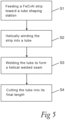
- the tube 1 is formed from a continuous strip 3 of high temperature FeCrAl alloy using spiral welding, as schematically illustrated in fig. 4 and in the flow chart in fig. 5 .
- a continuous strip 3 of the high temperature FeCrAl alloy having a width w, is fed in a feeding direction X toward a tube shaping station 4, which is here in the form of three shaping rolls 5.
- the shaping rolls 5 are arranged with their axes of rotation at an angle with respect to the feeding direction X of the strip 3.
- a third step S3 the abutting long edges 6, 7 are continuously joined together in a welding process directly when the tube is formed, whereby the welded tube 1 comprising the helical welded seam 2 is obtained.
- the welding process is in the shown embodiment carried out using a welding electrode 8 positioned radially outside of the formed tube 1.
- the welded seam 2 is created with a welding root on an inside of the formed tube 1.
- the welding may be carried out using e.g. tungsten inert gas (TIG) welding, metal inert gas welding, laser welding, or plasma arc welding.
- TOG tungsten inert gas
- metal inert gas welding metal inert gas welding
- laser welding or plasma arc welding.
- a shielding gas during the welding process an inert gas such as Ar and/or He is used.
- a root gas consisting of Ar and/or He may be used to protect the root during welding.
- a fourth step S4 the tube 1 is cut into its final length L.
- the strip 3 may be preheated up to a temperature of 100°C or less before being wound into a tube 1.
- the formed tube 1 may furthermore be annealed after welding, before or after cutting the tube 1 into its final length L. During the annealing process, the tube 1 is heated to a temperature of 850-875°C and is thereafter allowed to cool.
- a tube 1 as described with reference to fig. 1-3 above was produced from a strip having a width w of 200 mm and a thickness t of 2 mm.
- the chemical composition of the strip is shown in table 1.
- the welding process performed was a TIG process without filler material and with a gas mixture of 70% Ar and 30% He, which was used as both a root gas and a shielding gas.
- the welding was carried out from outside of the formed tube 1. No support was used on the inside of the tube 1 during welding.
- the welded high temperature FeCrAl alloy tube 1 was cut into a final length L of 3 m using an angle grinder, without annealing prior to cutting. After cutting into test specimens (tubes) of final length and cooling of the welded seam 2, one of the test specimens 1 was annealed for 1 h at 875°C.
- the welded seam 2 had a good appearance directly after welding, on the inside of the tube 1 as well as on the outside.
- the welded seam 2 was concave on the outside and convex on the inside.
- Cross sections across the welded seam 2 were visually inspected using light optical microscopy after etching and polishing. No defects were found during the inspection.
- the hardness HV10 was investigated across the welded seam 2 and was found to be between 220 and 265 HV across the welded seam, with the highest value in the base material next to the welded seam.
- test specimens Two other test specimens were pre-oxidised at 1050°C for 8h and were thereafter tested in a furnace, mounted vertically with 80 mm diameter cartridge heating elements (26 kW at 200 V voltage) mounted inside the tubes.
- test specimens were subjected to a continuous cycling for one week according to the following scheme:
- test specimen was put at the bottom of the furnace to study whether the weight of the test specimen would result in any deformation during exposure, i.e. a simplified sag test. This test specimen showed no tendency to be distorted during the 18 days exposure.
Landscapes
- Chemical & Material Sciences (AREA)
- Engineering & Computer Science (AREA)
- Mechanical Engineering (AREA)
- Organic Chemistry (AREA)
- Metallurgy (AREA)
- Materials Engineering (AREA)
- Physics & Mathematics (AREA)
- Crystallography & Structural Chemistry (AREA)
- Thermal Sciences (AREA)
- Plasma & Fusion (AREA)
- Optics & Photonics (AREA)
- Manufacturing & Machinery (AREA)
- General Engineering & Computer Science (AREA)
- Health & Medical Sciences (AREA)
- Child & Adolescent Psychology (AREA)
- Heat Treatment Of Articles (AREA)
- Butt Welding And Welding Of Specific Article (AREA)
- Arc Welding In General (AREA)
- Rigid Pipes And Flexible Pipes (AREA)
- Bending Of Plates, Rods, And Pipes (AREA)
Applications Claiming Priority (2)
| Application Number | Priority Date | Filing Date | Title |
|---|---|---|---|
| EP16166659 | 2016-04-22 | ||
| PCT/EP2016/077544 WO2017182111A1 (en) | 2016-04-22 | 2016-11-14 | A tube and a method of manufacturing a tube |
Publications (3)
| Publication Number | Publication Date |
|---|---|
| EP3445883A1 EP3445883A1 (en) | 2019-02-27 |
| EP3445883C0 EP3445883C0 (en) | 2024-10-02 |
| EP3445883B1 true EP3445883B1 (en) | 2024-10-02 |
Family
ID=55967028
Family Applications (1)
| Application Number | Title | Priority Date | Filing Date |
|---|---|---|---|
| EP16795054.2A Active EP3445883B1 (en) | 2016-04-22 | 2016-11-14 | A high temperature iron-chromium-aluminium alloy tube, a method of manufacturing the tube and a use of the tube as radiant tube |
Country Status (13)
| Country | Link |
|---|---|
| US (3) | US11446722B2 (pl) |
| EP (1) | EP3445883B1 (pl) |
| JP (1) | JP6909806B2 (pl) |
| KR (2) | KR20240011234A (pl) |
| CN (2) | CN119035991A (pl) |
| AU (3) | AU2016403428A1 (pl) |
| BR (1) | BR112018071651B1 (pl) |
| CA (1) | CA3020413A1 (pl) |
| ES (1) | ES2989841T3 (pl) |
| PL (1) | PL3445883T3 (pl) |
| RU (1) | RU2732395C2 (pl) |
| SG (1) | SG11201808855UA (pl) |
| WO (1) | WO2017182111A1 (pl) |
Families Citing this family (13)
| Publication number | Priority date | Publication date | Assignee | Title |
|---|---|---|---|---|
| US11577292B2 (en) * | 2017-01-06 | 2023-02-14 | Keystone Tower Systems, Inc. | Tube stiffening |
| CN109737735B (zh) * | 2018-12-26 | 2021-01-01 | 合肥恒力装备有限公司 | 一种粉体材料高温锻烧回转炉炉管的制作方法 |
| DE102019211936A1 (de) * | 2019-02-01 | 2020-08-06 | Sms Group Gmbh | Schraubennahtrohr sowie Verfahren zur Herstellung eines Schraubennahtrohrs |
| CN109719156B (zh) * | 2019-03-06 | 2020-09-25 | 马鞍山欧格萨斯机械科技有限公司 | 一种高效钢带管生产方法 |
| CN110026448B (zh) * | 2019-04-30 | 2021-08-03 | 西安理工大学 | 一体成型的螺旋加劲肋钢管及成型方法 |
| EP3980374A4 (en) * | 2019-06-05 | 2024-07-31 | Birla Carbon U.S.A., Inc. | HIGH TEMPERATURE CARBON BLACK AIR PREHEATER |
| CN111440993B (zh) * | 2019-12-12 | 2021-06-18 | 广东省钢铁研究所 | 一种铁铬铝合金棒材及其制备方法 |
| CN111250561B (zh) * | 2020-01-27 | 2021-09-24 | 浙江联丰冷却塔有限公司 | 一种冷却塔布水管自动化加工设备 |
| KR102483274B1 (ko) * | 2020-06-05 | 2023-01-02 | 엄지은 | 다층관 압출용 빌렛 및 이를 이용한 다층관의 제조 방법 |
| CN112275832B (zh) * | 2020-09-22 | 2022-08-05 | 盐城仕博机械制造有限公司 | 一种螺旋风管机 |
| CN113784469A (zh) * | 2021-03-05 | 2021-12-10 | 泰州市泰然装备有限公司 | 一种用于高温电热辐射螺旋外管材料及制备方法 |
| CN113714321B (zh) * | 2021-07-28 | 2022-10-25 | 西安交通大学 | 一种难熔和稀贵金属管材及其制备方法 |
| CN115780969A (zh) * | 2022-11-17 | 2023-03-14 | 西安西材三川智能制造有限公司 | 一种铁铬铝合金管道氩弧焊焊接工艺 |
Family Cites Families (23)
| Publication number | Priority date | Publication date | Assignee | Title |
|---|---|---|---|---|
| DE1452226A1 (de) * | 1965-11-03 | 1969-01-23 | Benteler Werke Ag | Stahlrohr-Herstellung |
| JPS5328014B2 (pl) * | 1973-05-21 | 1978-08-11 | ||
| JPS5278612A (en) | 1975-10-29 | 1977-07-02 | Nippon Steel Corp | Austenite-based heat-resistant steel capable of forming film of a#o# a t high temperatures in oxidizing atmosphere |
| US4204862A (en) | 1975-10-29 | 1980-05-27 | Nippon Steel Corporation | Austenitic heat-resistant steel which forms Al2 O3 film in high-temperature oxidizing atmosphere |
| JPS5914532B2 (ja) | 1976-08-27 | 1984-04-05 | 松下電器産業株式会社 | 合金磁石 |
| SU780923A1 (ru) * | 1978-07-17 | 1980-11-23 | Предприятие П/Я А-1147 | Способ изготовлени высокопрочных тонкостенных спиральношовных труб |
| CN1093758A (zh) | 1993-04-16 | 1994-10-19 | 山东工业大学 | 铸造1300—1350℃铁基耐热钢及熔铸工艺 |
| JP3397092B2 (ja) * | 1996-09-11 | 2003-04-14 | 住友金属工業株式会社 | 熱間加工性に優れるAl含有オーステナイト系ステンレス鋼 |
| SE9702909L (sv) | 1997-08-12 | 1998-10-19 | Sandvik Ab | Användning av en ferritisk Fe-Cr-Al-legering vid framställning av kompoundrör, samt kompoundrör och användning av röret |
| SE0000002L (sv) | 2000-01-01 | 2000-12-11 | Sandvik Ab | Förfarande för tillverkning av ett FeCrAl-material och ett sådant marerial |
| JP2002363704A (ja) | 2001-06-12 | 2002-12-18 | Nippon Steel Corp | 母材および溶接熱影響部の靭性に優れた耐食鋼 |
| JP2008100261A (ja) | 2006-10-19 | 2008-05-01 | Jfe Steel Kk | リブ付きスパイラル鋼管の製造方法 |
| EP2031080B1 (de) | 2007-08-30 | 2012-06-27 | Alstom Technology Ltd | Hochtemperaturlegierung |
| CN100547103C (zh) | 2007-12-10 | 2009-10-07 | 华油钢管有限公司 | 一种高强度x80钢螺旋焊管制造方法 |
| FR2930463B1 (fr) * | 2008-04-25 | 2010-09-03 | Faurecia Sys Echappement | Dispositif de fabrication d'un tube helicoidal et procede associe |
| DE102009031576A1 (de) | 2008-07-23 | 2010-03-25 | V&M Deutschland Gmbh | Stahllegierung für einen ferritischen Stahl mit ausgezeichneter Zeitstandfestigkeit und Oxidationsbeständigkeit bei erhöhten Einsatztemperaturen |
| JP5321493B2 (ja) | 2010-02-12 | 2013-10-23 | 新日鐵住金株式会社 | スパイラル鋼管の製造方法およびスパイラル鋼管 |
| JP2012115890A (ja) * | 2010-12-03 | 2012-06-21 | Nippon Steel Corp | 長手方向異径断面スパイラル鋼管、その製造方法及びその製造装置 |
| CN102162064A (zh) * | 2011-05-08 | 2011-08-24 | 山西太钢不锈钢股份有限公司 | 一种铁铬铝合金及其钢卷 |
| CN102330034B (zh) * | 2011-09-30 | 2013-04-24 | 中国石油集团渤海石油装备制造有限公司 | 一种酸性腐蚀环境用x65ms钢级螺旋焊管及其制造方法 |
| CN103192234B (zh) * | 2013-04-01 | 2015-07-15 | 宝鸡石油钢管有限责任公司 | 一种螺旋成型抗大变形埋弧焊管及其制造方法 |
| WO2014204388A1 (en) * | 2013-06-18 | 2014-12-24 | Sandvik Intellectual Property Ab | Filler for the welding of materials for high-temperature applications |
| CN103484788B (zh) * | 2013-08-31 | 2016-05-04 | 宝鸡石油钢管有限责任公司 | 一种耐硫化氢腐蚀的高强度x80ms螺旋埋弧焊管及其制造方法 |
-
2016
- 2016-11-14 PL PL16795054.2T patent/PL3445883T3/pl unknown
- 2016-11-14 AU AU2016403428A patent/AU2016403428A1/en not_active Abandoned
- 2016-11-14 CA CA3020413A patent/CA3020413A1/en active Pending
- 2016-11-14 KR KR1020247000746A patent/KR20240011234A/ko not_active Ceased
- 2016-11-14 WO PCT/EP2016/077544 patent/WO2017182111A1/en not_active Ceased
- 2016-11-14 CN CN202411246030.0A patent/CN119035991A/zh active Pending
- 2016-11-14 US US16/093,679 patent/US11446722B2/en active Active
- 2016-11-14 ES ES16795054T patent/ES2989841T3/es active Active
- 2016-11-14 KR KR1020187033452A patent/KR20180133506A/ko not_active Ceased
- 2016-11-14 RU RU2018140820A patent/RU2732395C2/ru active
- 2016-11-14 JP JP2018555151A patent/JP6909806B2/ja active Active
- 2016-11-14 BR BR112018071651-0A patent/BR112018071651B1/pt active IP Right Grant
- 2016-11-14 CN CN201680084721.2A patent/CN109072369A/zh active Pending
- 2016-11-14 EP EP16795054.2A patent/EP3445883B1/en active Active
- 2016-11-14 SG SG11201808855UA patent/SG11201808855UA/en unknown
-
2022
- 2022-07-08 US US17/860,859 patent/US11602780B2/en active Active
- 2022-10-21 AU AU2022256223A patent/AU2022256223A1/en active Pending
- 2022-10-21 AU AU2022100194A patent/AU2022100194A4/en not_active Expired
-
2023
- 2023-02-08 US US18/107,055 patent/US12053811B2/en active Active
Also Published As
| Publication number | Publication date |
|---|---|
| RU2732395C2 (ru) | 2020-09-16 |
| US11446722B2 (en) | 2022-09-20 |
| AU2022100194A4 (en) | 2024-07-11 |
| AU2022256223A2 (en) | 2023-12-21 |
| BR112018071651A2 (pt) | 2019-02-19 |
| EP3445883C0 (en) | 2024-10-02 |
| PL3445883T3 (pl) | 2025-01-07 |
| WO2017182111A1 (en) | 2017-10-26 |
| JP2019518608A (ja) | 2019-07-04 |
| AU2022256223A1 (en) | 2022-11-24 |
| RU2018140820A (ru) | 2020-05-22 |
| KR20240011234A (ko) | 2024-01-25 |
| US12053811B2 (en) | 2024-08-06 |
| US20220339688A1 (en) | 2022-10-27 |
| ES2989841T3 (es) | 2024-11-27 |
| BR112018071651B1 (pt) | 2024-04-30 |
| KR20180133506A (ko) | 2018-12-14 |
| RU2018140820A3 (pl) | 2020-05-22 |
| CN109072369A (zh) | 2018-12-21 |
| AU2016403428A1 (en) | 2018-11-01 |
| US11602780B2 (en) | 2023-03-14 |
| US20190070650A1 (en) | 2019-03-07 |
| SG11201808855UA (en) | 2018-11-29 |
| JP6909806B2 (ja) | 2021-07-28 |
| CA3020413A1 (en) | 2017-10-26 |
| CN119035991A (zh) | 2024-11-29 |
| US20230182187A1 (en) | 2023-06-15 |
| EP3445883A1 (en) | 2019-02-27 |
Similar Documents
| Publication | Publication Date | Title |
|---|---|---|
| US12053811B2 (en) | Tube and a method of manufacturing a tube | |
| KR101544260B1 (ko) | Ni기 합금 용접 금속, 대상 전극 및 용접 방법 | |
| EP2196551B1 (en) | Use of low-thermal-expansion nickel-based superalloy for a boiler component, according boiler component and method for its production | |
| EP3086899B1 (en) | Precipitation strengthened nickel based welding material for fusion welding of superalloys | |
| KR101809360B1 (ko) | Ni기 내열합금 용접 조인트의 제조 방법 및 그것을 이용하여 얻어지는 용접 조인트 | |
| EP3318651B1 (en) | Austenitic heat-resistant alloy and welded joint | |
| JP4761993B2 (ja) | スピニング加工用フェライト系ステンレス鋼溶接管の製造法 | |
| JP6309576B2 (ja) | アルミナバリア層を有するエチレン製造用反応管 | |
| JP5381677B2 (ja) | 溶接ワイヤの製造方法 | |
| KR101642901B1 (ko) | 덧붙임용 용접재료, 교정롤, 가이드롤, 반송롤 및 앤빌 | |
| EP3445884B1 (en) | Ferritic alloy | |
| JP5355919B2 (ja) | オーステナイト系高Ni鋼材同士の溶接接合部構造及び溶接接合方法 | |
| JP3872637B2 (ja) | 高強度α+β型チタン合金管およびその製造方法 | |
| EP3317044B1 (en) | A method of joining a fecral alloy with a fenicr alloy using a filler metal by welding | |
| CN116615293B (zh) | 用于制造管线管道的镍基合金 | |
| JP7469635B2 (ja) | Fe基合金管および溶接継手 | |
| JP7469636B2 (ja) | ステンレス鋼管および溶接継手 |
Legal Events
| Date | Code | Title | Description |
|---|---|---|---|
| STAA | Information on the status of an ep patent application or granted ep patent |
Free format text: STATUS: UNKNOWN |
|
| STAA | Information on the status of an ep patent application or granted ep patent |
Free format text: STATUS: THE INTERNATIONAL PUBLICATION HAS BEEN MADE |
|
| PUAI | Public reference made under article 153(3) epc to a published international application that has entered the european phase |
Free format text: ORIGINAL CODE: 0009012 |
|
| STAA | Information on the status of an ep patent application or granted ep patent |
Free format text: STATUS: REQUEST FOR EXAMINATION WAS MADE |
|
| 17P | Request for examination filed |
Effective date: 20181122 |
|
| AK | Designated contracting states |
Kind code of ref document: A1 Designated state(s): AL AT BE BG CH CY CZ DE DK EE ES FI FR GB GR HR HU IE IS IT LI LT LU LV MC MK MT NL NO PL PT RO RS SE SI SK SM TR |
|
| AX | Request for extension of the european patent |
Extension state: BA ME |
|
| DAV | Request for validation of the european patent (deleted) | ||
| DAX | Request for extension of the european patent (deleted) | ||
| STAA | Information on the status of an ep patent application or granted ep patent |
Free format text: STATUS: EXAMINATION IS IN PROGRESS |
|
| 17Q | First examination report despatched |
Effective date: 20191211 |
|
| RAP1 | Party data changed (applicant data changed or rights of an application transferred) |
Owner name: KANTHAL AB |
|
| GRAP | Despatch of communication of intention to grant a patent |
Free format text: ORIGINAL CODE: EPIDOSNIGR1 |
|
| STAA | Information on the status of an ep patent application or granted ep patent |
Free format text: STATUS: GRANT OF PATENT IS INTENDED |
|
| RIC1 | Information provided on ipc code assigned before grant |
Ipc: B23K 103/02 20060101ALN20240411BHEP Ipc: B23K 101/06 20060101ALN20240411BHEP Ipc: C21D 8/10 20060101ALI20240411BHEP Ipc: B23K 26/302 20140101ALI20240411BHEP Ipc: B23K 9/032 20060101ALI20240411BHEP Ipc: C22C 38/32 20060101ALI20240411BHEP Ipc: C22C 38/28 20060101ALI20240411BHEP Ipc: C22C 38/24 20060101ALI20240411BHEP Ipc: C22C 38/22 20060101ALI20240411BHEP Ipc: C22C 38/06 20060101ALI20240411BHEP Ipc: C22C 38/04 20060101ALI20240411BHEP Ipc: C21D 9/08 20060101ALI20240411BHEP Ipc: B21C 37/12 20060101ALI20240411BHEP Ipc: C22C 38/00 20060101AFI20240411BHEP |
|
| INTG | Intention to grant announced |
Effective date: 20240425 |
|
| GRAS | Grant fee paid |
Free format text: ORIGINAL CODE: EPIDOSNIGR3 |
|
| GRAA | (expected) grant |
Free format text: ORIGINAL CODE: 0009210 |
|
| STAA | Information on the status of an ep patent application or granted ep patent |
Free format text: STATUS: THE PATENT HAS BEEN GRANTED |
|
| AK | Designated contracting states |
Kind code of ref document: B1 Designated state(s): AL AT BE BG CH CY CZ DE DK EE ES FI FR GB GR HR HU IE IS IT LI LT LU LV MC MK MT NL NO PL PT RO RS SE SI SK SM TR |
|
| REG | Reference to a national code |
Ref country code: GB Ref legal event code: FG4D |
|
| REG | Reference to a national code |
Ref country code: CH Ref legal event code: EP |
|
| REG | Reference to a national code |
Ref country code: IE Ref legal event code: FG4D |
|
| REG | Reference to a national code |
Ref country code: DE Ref legal event code: R096 Ref document number: 602016089666 Country of ref document: DE |
|
| REG | Reference to a national code |
Ref country code: ES Ref legal event code: FG2A Ref document number: 2989841 Country of ref document: ES Kind code of ref document: T3 Effective date: 20241127 |
|
| U01 | Request for unitary effect filed |
Effective date: 20241031 |
|
| U07 | Unitary effect registered |
Designated state(s): AT BE BG DE DK EE FI FR IT LT LU LV MT NL PT RO SE SI Effective date: 20241108 |
|
| U20 | Renewal fee for the european patent with unitary effect paid |
Year of fee payment: 9 Effective date: 20241111 |
|
| PGFP | Annual fee paid to national office [announced via postgrant information from national office to epo] |
Ref country code: PL Payment date: 20241021 Year of fee payment: 9 |
|
| PGFP | Annual fee paid to national office [announced via postgrant information from national office to epo] |
Ref country code: GB Payment date: 20241003 Year of fee payment: 9 |
|
| PGFP | Annual fee paid to national office [announced via postgrant information from national office to epo] |
Ref country code: ES Payment date: 20241210 Year of fee payment: 9 |
|
| PG25 | Lapsed in a contracting state [announced via postgrant information from national office to epo] |
Ref country code: IS Free format text: LAPSE BECAUSE OF FAILURE TO SUBMIT A TRANSLATION OF THE DESCRIPTION OR TO PAY THE FEE WITHIN THE PRESCRIBED TIME-LIMIT Effective date: 20250202 Ref country code: HR Free format text: LAPSE BECAUSE OF FAILURE TO SUBMIT A TRANSLATION OF THE DESCRIPTION OR TO PAY THE FEE WITHIN THE PRESCRIBED TIME-LIMIT Effective date: 20241002 |
|
| PG25 | Lapsed in a contracting state [announced via postgrant information from national office to epo] |
Ref country code: NO Free format text: LAPSE BECAUSE OF FAILURE TO SUBMIT A TRANSLATION OF THE DESCRIPTION OR TO PAY THE FEE WITHIN THE PRESCRIBED TIME-LIMIT Effective date: 20250102 |
|
| PG25 | Lapsed in a contracting state [announced via postgrant information from national office to epo] |
Ref country code: GR Free format text: LAPSE BECAUSE OF FAILURE TO SUBMIT A TRANSLATION OF THE DESCRIPTION OR TO PAY THE FEE WITHIN THE PRESCRIBED TIME-LIMIT Effective date: 20250103 |
|
| PGFP | Annual fee paid to national office [announced via postgrant information from national office to epo] |
Ref country code: CZ Payment date: 20241025 Year of fee payment: 9 |
|
| PG25 | Lapsed in a contracting state [announced via postgrant information from national office to epo] |
Ref country code: RS Free format text: LAPSE BECAUSE OF FAILURE TO SUBMIT A TRANSLATION OF THE DESCRIPTION OR TO PAY THE FEE WITHIN THE PRESCRIBED TIME-LIMIT Effective date: 20250102 |
|
| REG | Reference to a national code |
Ref country code: CH Ref legal event code: PL |
|
| PG25 | Lapsed in a contracting state [announced via postgrant information from national office to epo] |
Ref country code: SM Free format text: LAPSE BECAUSE OF FAILURE TO SUBMIT A TRANSLATION OF THE DESCRIPTION OR TO PAY THE FEE WITHIN THE PRESCRIBED TIME-LIMIT Effective date: 20241002 |
|
| PG25 | Lapsed in a contracting state [announced via postgrant information from national office to epo] |
Ref country code: MC Free format text: LAPSE BECAUSE OF FAILURE TO SUBMIT A TRANSLATION OF THE DESCRIPTION OR TO PAY THE FEE WITHIN THE PRESCRIBED TIME-LIMIT Effective date: 20241002 |
|
| REG | Reference to a national code |
Ref country code: CH Ref legal event code: PL |
|
| PG25 | Lapsed in a contracting state [announced via postgrant information from national office to epo] |
Ref country code: CH Free format text: LAPSE BECAUSE OF NON-PAYMENT OF DUE FEES Effective date: 20241130 |
|
| PG25 | Lapsed in a contracting state [announced via postgrant information from national office to epo] |
Ref country code: SK Free format text: LAPSE BECAUSE OF FAILURE TO SUBMIT A TRANSLATION OF THE DESCRIPTION OR TO PAY THE FEE WITHIN THE PRESCRIBED TIME-LIMIT Effective date: 20241002 |
|
| PLBE | No opposition filed within time limit |
Free format text: ORIGINAL CODE: 0009261 |
|
| STAA | Information on the status of an ep patent application or granted ep patent |
Free format text: STATUS: NO OPPOSITION FILED WITHIN TIME LIMIT |
|
| 26N | No opposition filed |
Effective date: 20250703 |
|
| PG25 | Lapsed in a contracting state [announced via postgrant information from national office to epo] |
Ref country code: IE Free format text: LAPSE BECAUSE OF NON-PAYMENT OF DUE FEES Effective date: 20241114 |
|
| U20 | Renewal fee for the european patent with unitary effect paid |
Year of fee payment: 10 Effective date: 20251008 |