EP3445833B1 - Schaumhaftungsförderung - Google Patents
Schaumhaftungsförderung Download PDFInfo
- Publication number
- EP3445833B1 EP3445833B1 EP17796711.4A EP17796711A EP3445833B1 EP 3445833 B1 EP3445833 B1 EP 3445833B1 EP 17796711 A EP17796711 A EP 17796711A EP 3445833 B1 EP3445833 B1 EP 3445833B1
- Authority
- EP
- European Patent Office
- Prior art keywords
- tpe
- foam
- skin
- skin layer
- layer
- Prior art date
- Legal status (The legal status is an assumption and is not a legal conclusion. Google has not performed a legal analysis and makes no representation as to the accuracy of the status listed.)
- Active
Links
Images
Classifications
-
- B—PERFORMING OPERATIONS; TRANSPORTING
- B32—LAYERED PRODUCTS
- B32B—LAYERED PRODUCTS, i.e. PRODUCTS BUILT-UP OF STRATA OF FLAT OR NON-FLAT, e.g. CELLULAR OR HONEYCOMB, FORM
- B32B5/00—Layered products characterised by the non- homogeneity or physical structure, i.e. comprising a fibrous, filamentary, particulate or foam layer; Layered products characterised by having a layer differing constitutionally or physically in different parts
- B32B5/18—Layered products characterised by the non- homogeneity or physical structure, i.e. comprising a fibrous, filamentary, particulate or foam layer; Layered products characterised by having a layer differing constitutionally or physically in different parts characterised by features of a layer of foamed material
-
- B—PERFORMING OPERATIONS; TRANSPORTING
- B32—LAYERED PRODUCTS
- B32B—LAYERED PRODUCTS, i.e. PRODUCTS BUILT-UP OF STRATA OF FLAT OR NON-FLAT, e.g. CELLULAR OR HONEYCOMB, FORM
- B32B27/00—Layered products comprising a layer of synthetic resin
- B32B27/06—Layered products comprising a layer of synthetic resin as the main or only constituent of a layer, which is next to another layer of the same or of a different material
- B32B27/065—Layered products comprising a layer of synthetic resin as the main or only constituent of a layer, which is next to another layer of the same or of a different material of foam
-
- B—PERFORMING OPERATIONS; TRANSPORTING
- B32—LAYERED PRODUCTS
- B32B—LAYERED PRODUCTS, i.e. PRODUCTS BUILT-UP OF STRATA OF FLAT OR NON-FLAT, e.g. CELLULAR OR HONEYCOMB, FORM
- B32B27/00—Layered products comprising a layer of synthetic resin
- B32B27/18—Layered products comprising a layer of synthetic resin characterised by the use of special additives
-
- B—PERFORMING OPERATIONS; TRANSPORTING
- B32—LAYERED PRODUCTS
- B32B—LAYERED PRODUCTS, i.e. PRODUCTS BUILT-UP OF STRATA OF FLAT OR NON-FLAT, e.g. CELLULAR OR HONEYCOMB, FORM
- B32B27/00—Layered products comprising a layer of synthetic resin
- B32B27/30—Layered products comprising a layer of synthetic resin comprising vinyl (co)polymers; comprising acrylic (co)polymers
- B32B27/302—Layered products comprising a layer of synthetic resin comprising vinyl (co)polymers; comprising acrylic (co)polymers comprising aromatic vinyl (co)polymers, e.g. styrenic (co)polymers
-
- B—PERFORMING OPERATIONS; TRANSPORTING
- B32—LAYERED PRODUCTS
- B32B—LAYERED PRODUCTS, i.e. PRODUCTS BUILT-UP OF STRATA OF FLAT OR NON-FLAT, e.g. CELLULAR OR HONEYCOMB, FORM
- B32B27/00—Layered products comprising a layer of synthetic resin
- B32B27/32—Layered products comprising a layer of synthetic resin comprising polyolefins
-
- B—PERFORMING OPERATIONS; TRANSPORTING
- B32—LAYERED PRODUCTS
- B32B—LAYERED PRODUCTS, i.e. PRODUCTS BUILT-UP OF STRATA OF FLAT OR NON-FLAT, e.g. CELLULAR OR HONEYCOMB, FORM
- B32B27/00—Layered products comprising a layer of synthetic resin
- B32B27/36—Layered products comprising a layer of synthetic resin comprising polyesters
-
- B—PERFORMING OPERATIONS; TRANSPORTING
- B32—LAYERED PRODUCTS
- B32B—LAYERED PRODUCTS, i.e. PRODUCTS BUILT-UP OF STRATA OF FLAT OR NON-FLAT, e.g. CELLULAR OR HONEYCOMB, FORM
- B32B27/00—Layered products comprising a layer of synthetic resin
- B32B27/40—Layered products comprising a layer of synthetic resin comprising polyurethanes
-
- C—CHEMISTRY; METALLURGY
- C08—ORGANIC MACROMOLECULAR COMPOUNDS; THEIR PREPARATION OR CHEMICAL WORKING-UP; COMPOSITIONS BASED THEREON
- C08G—MACROMOLECULAR COMPOUNDS OBTAINED OTHERWISE THAN BY REACTIONS ONLY INVOLVING UNSATURATED CARBON-TO-CARBON BONDS
- C08G18/00—Polymeric products of isocyanates or isothiocyanates
- C08G18/06—Polymeric products of isocyanates or isothiocyanates with compounds having active hydrogen
- C08G18/28—Polymeric products of isocyanates or isothiocyanates with compounds having active hydrogen characterised by the compounds used containing active hydrogen
- C08G18/40—High-molecular-weight compounds
- C08G18/42—Polycondensates having carboxylic or carbonic ester groups in the main chain
-
- C—CHEMISTRY; METALLURGY
- C08—ORGANIC MACROMOLECULAR COMPOUNDS; THEIR PREPARATION OR CHEMICAL WORKING-UP; COMPOSITIONS BASED THEREON
- C08G—MACROMOLECULAR COMPOUNDS OBTAINED OTHERWISE THAN BY REACTIONS ONLY INVOLVING UNSATURATED CARBON-TO-CARBON BONDS
- C08G18/00—Polymeric products of isocyanates or isothiocyanates
- C08G18/06—Polymeric products of isocyanates or isothiocyanates with compounds having active hydrogen
- C08G18/28—Polymeric products of isocyanates or isothiocyanates with compounds having active hydrogen characterised by the compounds used containing active hydrogen
- C08G18/40—High-molecular-weight compounds
- C08G18/48—Polyethers
-
- C—CHEMISTRY; METALLURGY
- C08—ORGANIC MACROMOLECULAR COMPOUNDS; THEIR PREPARATION OR CHEMICAL WORKING-UP; COMPOSITIONS BASED THEREON
- C08J—WORKING-UP; GENERAL PROCESSES OF COMPOUNDING; AFTER-TREATMENT NOT COVERED BY SUBCLASSES C08B, C08C, C08F, C08G or C08H
- C08J3/00—Processes of treating or compounding macromolecular substances
- C08J3/12—Powdering or granulating
- C08J3/128—Polymer particles coated by inorganic and non-macromolecular organic compounds
-
- C—CHEMISTRY; METALLURGY
- C08—ORGANIC MACROMOLECULAR COMPOUNDS; THEIR PREPARATION OR CHEMICAL WORKING-UP; COMPOSITIONS BASED THEREON
- C08J—WORKING-UP; GENERAL PROCESSES OF COMPOUNDING; AFTER-TREATMENT NOT COVERED BY SUBCLASSES C08B, C08C, C08F, C08G or C08H
- C08J5/00—Manufacture of articles or shaped materials containing macromolecular substances
- C08J5/12—Bonding of a preformed macromolecular material to the same or other solid material such as metal, glass, leather, e.g. using adhesives
- C08J5/124—Bonding of a preformed macromolecular material to the same or other solid material such as metal, glass, leather, e.g. using adhesives using adhesives based on a macromolecular component
-
- C—CHEMISTRY; METALLURGY
- C08—ORGANIC MACROMOLECULAR COMPOUNDS; THEIR PREPARATION OR CHEMICAL WORKING-UP; COMPOSITIONS BASED THEREON
- C08K—Use of inorganic or non-macromolecular organic substances as compounding ingredients
- C08K5/00—Use of organic ingredients
- C08K5/16—Nitrogen-containing compounds
- C08K5/17—Amines; Quaternary ammonium compounds
-
- C—CHEMISTRY; METALLURGY
- C08—ORGANIC MACROMOLECULAR COMPOUNDS; THEIR PREPARATION OR CHEMICAL WORKING-UP; COMPOSITIONS BASED THEREON
- C08K—Use of inorganic or non-macromolecular organic substances as compounding ingredients
- C08K5/00—Use of organic ingredients
- C08K5/54—Silicon-containing compounds
- C08K5/541—Silicon-containing compounds containing oxygen
- C08K5/5415—Silicon-containing compounds containing oxygen containing at least one Si—O bond
- C08K5/5419—Silicon-containing compounds containing oxygen containing at least one Si—O bond containing at least one Si—C bond
-
- C—CHEMISTRY; METALLURGY
- C09—DYES; PAINTS; POLISHES; NATURAL RESINS; ADHESIVES; COMPOSITIONS NOT OTHERWISE PROVIDED FOR; APPLICATIONS OF MATERIALS NOT OTHERWISE PROVIDED FOR
- C09J—ADHESIVES; NON-MECHANICAL ASPECTS OF ADHESIVE PROCESSES IN GENERAL; ADHESIVE PROCESSES NOT PROVIDED FOR ELSEWHERE; USE OF MATERIALS AS ADHESIVES
- C09J175/00—Adhesives based on polyureas or polyurethanes; Adhesives based on derivatives of such polymers
- C09J175/04—Polyurethanes
-
- C—CHEMISTRY; METALLURGY
- C09—DYES; PAINTS; POLISHES; NATURAL RESINS; ADHESIVES; COMPOSITIONS NOT OTHERWISE PROVIDED FOR; APPLICATIONS OF MATERIALS NOT OTHERWISE PROVIDED FOR
- C09J—ADHESIVES; NON-MECHANICAL ASPECTS OF ADHESIVE PROCESSES IN GENERAL; ADHESIVE PROCESSES NOT PROVIDED FOR ELSEWHERE; USE OF MATERIALS AS ADHESIVES
- C09J5/00—Adhesive processes in general; Adhesive processes not provided for elsewhere, e.g. relating to primers
- C09J5/02—Adhesive processes in general; Adhesive processes not provided for elsewhere, e.g. relating to primers involving pretreatment of the surfaces to be joined
-
- B—PERFORMING OPERATIONS; TRANSPORTING
- B32—LAYERED PRODUCTS
- B32B—LAYERED PRODUCTS, i.e. PRODUCTS BUILT-UP OF STRATA OF FLAT OR NON-FLAT, e.g. CELLULAR OR HONEYCOMB, FORM
- B32B2250/00—Layers arrangement
- B32B2250/02—2 layers
-
- B—PERFORMING OPERATIONS; TRANSPORTING
- B32—LAYERED PRODUCTS
- B32B—LAYERED PRODUCTS, i.e. PRODUCTS BUILT-UP OF STRATA OF FLAT OR NON-FLAT, e.g. CELLULAR OR HONEYCOMB, FORM
- B32B2266/00—Composition of foam
- B32B2266/02—Organic
- B32B2266/0214—Materials belonging to B32B27/00
- B32B2266/0278—Polyurethane
-
- B—PERFORMING OPERATIONS; TRANSPORTING
- B32—LAYERED PRODUCTS
- B32B—LAYERED PRODUCTS, i.e. PRODUCTS BUILT-UP OF STRATA OF FLAT OR NON-FLAT, e.g. CELLULAR OR HONEYCOMB, FORM
- B32B2270/00—Resin or rubber layer containing a blend of at least two different polymers
-
- B—PERFORMING OPERATIONS; TRANSPORTING
- B32—LAYERED PRODUCTS
- B32B—LAYERED PRODUCTS, i.e. PRODUCTS BUILT-UP OF STRATA OF FLAT OR NON-FLAT, e.g. CELLULAR OR HONEYCOMB, FORM
- B32B2274/00—Thermoplastic elastomer material
-
- B—PERFORMING OPERATIONS; TRANSPORTING
- B32—LAYERED PRODUCTS
- B32B—LAYERED PRODUCTS, i.e. PRODUCTS BUILT-UP OF STRATA OF FLAT OR NON-FLAT, e.g. CELLULAR OR HONEYCOMB, FORM
- B32B2451/00—Decorative or ornamental articles
-
- B—PERFORMING OPERATIONS; TRANSPORTING
- B32—LAYERED PRODUCTS
- B32B—LAYERED PRODUCTS, i.e. PRODUCTS BUILT-UP OF STRATA OF FLAT OR NON-FLAT, e.g. CELLULAR OR HONEYCOMB, FORM
- B32B2605/00—Vehicles
- B32B2605/003—Interior finishings
-
- C—CHEMISTRY; METALLURGY
- C08—ORGANIC MACROMOLECULAR COMPOUNDS; THEIR PREPARATION OR CHEMICAL WORKING-UP; COMPOSITIONS BASED THEREON
- C08G—MACROMOLECULAR COMPOUNDS OBTAINED OTHERWISE THAN BY REACTIONS ONLY INVOLVING UNSATURATED CARBON-TO-CARBON BONDS
- C08G2101/00—Manufacture of cellular products
-
- C—CHEMISTRY; METALLURGY
- C08—ORGANIC MACROMOLECULAR COMPOUNDS; THEIR PREPARATION OR CHEMICAL WORKING-UP; COMPOSITIONS BASED THEREON
- C08G—MACROMOLECULAR COMPOUNDS OBTAINED OTHERWISE THAN BY REACTIONS ONLY INVOLVING UNSATURATED CARBON-TO-CARBON BONDS
- C08G2110/00—Foam properties
- C08G2110/0041—Foam properties having specified density
- C08G2110/0066—≥ 150kg/m3
-
- C—CHEMISTRY; METALLURGY
- C08—ORGANIC MACROMOLECULAR COMPOUNDS; THEIR PREPARATION OR CHEMICAL WORKING-UP; COMPOSITIONS BASED THEREON
- C08G—MACROMOLECULAR COMPOUNDS OBTAINED OTHERWISE THAN BY REACTIONS ONLY INVOLVING UNSATURATED CARBON-TO-CARBON BONDS
- C08G2140/00—Compositions for moulding powders
-
- C—CHEMISTRY; METALLURGY
- C09—DYES; PAINTS; POLISHES; NATURAL RESINS; ADHESIVES; COMPOSITIONS NOT OTHERWISE PROVIDED FOR; APPLICATIONS OF MATERIALS NOT OTHERWISE PROVIDED FOR
- C09J—ADHESIVES; NON-MECHANICAL ASPECTS OF ADHESIVE PROCESSES IN GENERAL; ADHESIVE PROCESSES NOT PROVIDED FOR ELSEWHERE; USE OF MATERIALS AS ADHESIVES
- C09J2400/00—Presence of inorganic and organic materials
- C09J2400/20—Presence of organic materials
- C09J2400/24—Presence of a foam
- C09J2400/243—Presence of a foam in the substrate
-
- C—CHEMISTRY; METALLURGY
- C09—DYES; PAINTS; POLISHES; NATURAL RESINS; ADHESIVES; COMPOSITIONS NOT OTHERWISE PROVIDED FOR; APPLICATIONS OF MATERIALS NOT OTHERWISE PROVIDED FOR
- C09J—ADHESIVES; NON-MECHANICAL ASPECTS OF ADHESIVE PROCESSES IN GENERAL; ADHESIVE PROCESSES NOT PROVIDED FOR ELSEWHERE; USE OF MATERIALS AS ADHESIVES
- C09J2421/00—Presence of unspecified rubber
- C09J2421/006—Presence of unspecified rubber in the substrate
-
- C—CHEMISTRY; METALLURGY
- C09—DYES; PAINTS; POLISHES; NATURAL RESINS; ADHESIVES; COMPOSITIONS NOT OTHERWISE PROVIDED FOR; APPLICATIONS OF MATERIALS NOT OTHERWISE PROVIDED FOR
- C09J—ADHESIVES; NON-MECHANICAL ASPECTS OF ADHESIVE PROCESSES IN GENERAL; ADHESIVE PROCESSES NOT PROVIDED FOR ELSEWHERE; USE OF MATERIALS AS ADHESIVES
- C09J2421/00—Presence of unspecified rubber
- C09J2421/008—Presence of unspecified rubber in the pretreated surface to be joined
Definitions
- the present disclosure relates to the field of chemistry.
- the present disclosure relates to the field of skin materials and improvements in the adhesion of foam to skin materials.
- Vehicular interior trim parts are typically manufactured with an exterior decorative skin layer that is backed with a layer of foam, and in particular, polyurethane type foam.
- the skin material may be a thermoplastic elastomer (TPE) type material.
- TPE thermoplastic elastomer
- the bond between the foam layer and the skin layer may be capable of enduring environmental temperature extremes, including large changes in temperature over a relatively short period of time.
- TPE-skinned composite comprising the steps of:
- the present disclosure further provides a TPE-skinned composite comprising a skin layer comprising:
- Groups of elements of the table are indicated using the numbering scheme indicated in the version of the periodic table of elements published in Chemical and Engineering News, 63(5), 27, 1985 . In some instances a group of elements may be indicated using a common name assigned to the group.
- the general structure or name presented is also intended to encompass all structural isomers, conformational isomers, and stereoisomers that may arise from a particular set of substituents, unless indicated otherwise. Additionally, the reference to a general structure or name encompasses all enantiomers, diastereomers, and other optical isomers whether in enantiomeric or racemic forms, as well as mixtures of stereoisomers, as the context permits or requires.
- any general formula or name presented also encompasses all conformational isomers, regio-isomers, and stereoisomers that may arise from a particular set of substituents.
- the normal rules of organic nomenclature will prevail.
- a chemical "group” is described according to how that group is formally derived from a reference or "parent" compound, for example, by the number of hydrogen atoms formally removed from the parent compound to generate the group.
- hydrocarbon whenever used in this specification and claims refers to a compound containing only carbon and hydrogen.
- polymer refers to polymer chain which is formed by, and corresponds to, the indicated monomer.
- weight percent refers to herein to the weight percent of a component of a composition based upon the total weight of the composition. Weight percent may be abbreviated as "wt. %.”
- ASTM refers to the American Section of the International Association for Testing Materials.
- ASTM D 6862 is entitled "Standard Test Method for 90 Degree Peel Resistance of Adhesives .”
- the term "ASTM D 6862" as used herein refers to the standard test method for determining the resistance-to-peel strength of a bond between one rigid adherend and one flexible adherend when tested at an angle of approximately 90 degrees under specified conditions of preparation and testing.
- the resistance-to-peel strength also referred to herein as pull force
- This test method was published in 2011 and revised in 2016, the contents of which are incorporated herein by reference in their entirety. For the referenced ASTM standards, visit the ASTM website, www.astm.org, or contact ASTM Customer Service at service@astm.org.
- the pull force was alternatively measured using the Chatillon Force Gauge.
- a TPE skin sample was removed from the foam by cutting a 2-inch wide strip through the TPE skin and into the foam. At the upper edge of the TPE skin, the strip was peeled by an operator ("by hand") to provide a piece of the TPE skin to which a Chatillon Force Gauge was attached. The TPE skin was then pulled at an uncontrolled rate from the foam. The removal force was measured at 1 inch increments through a 5 inch pull. The adhesion force as well as the type of adhesion/cohesion through the pull was documented.
- ASTM D 1895 is entitled "Standard Test Methods for Apparent Density, Bulk Factor, and Pourability of Plastic Materials .”
- ASTM D 1895 refers to the standard test method for determining the apparent density, bulk factor, and where applicable, the pourability of plastic materials such as molding powders, from fine powders and granules to large flakes and cut fibers. This test method is equivalent to the ISO 60 Method as described below. This test method was published in 1996 and revised in 2010, the contents of which are incorporated herein in their entirety. For the references ASTM standards, visit the ASTM website provided immediately above.
- ASTM D 1921-12 is entitled "The Standard Test Method for Particle Size (Sieve Analysis) of Plastic Materials .”
- the term "ASTM D 1921-12" as used herein refers to the standard test method for determining the particle size distribution of a material. The process typically separates fine particles from the more course particles by passing the material through a number of sieves of different mesh sizes. This allows the mass fraction of particles within each size range to be measured and cumulative distribution constructed. This test method was published in 1996 and revised in 2012, the contents of which are incorporated herein in their entirety.
- ISO 60 is entitled "Plastics -Determination of apparent density of material that can be poured from a specified funnel.”
- ISO 60 refers to the standard test method for determining the apparent density of a molding powder or a granular material. The sample is poured through a specified funnel into a measuring cylinder of 100 cubic centimeter capacity, the excess is removed with a straightedge and the mass of the contents is determined by weighing the resulting sample. This test method was published in 1976 and revised in 1977, the contents of which are incorporated herein by reference in their entirety. For the referenced ISO standards, visit the ISO website, www.iso.org.
- ISO 37 is entitled "Rubber, vulcanized or thermoplastic - Determination of tensile stress-strain properties".
- the term "ISO 37" as used herein refers to the standard test method for determining the tensile strength and elongation of a TPE material when measured using a Type 1 Die Specimen and a test rate of 500 mm/min. This test method was revised in 2011, the contents of which are incorporated herein by reference in their entirety. For the referenced ISO standards, visit the ISO website, www.iso.org.
- ASTM D412 is entitled "Standard Test Methods for Vulcanized Rubber and Thermoplastic Elastomers - Tension ".
- the term "ASTM D412" as used herein refers to the standard test method for determining the tensile strength and elongation of a TPE material when measured using a Type C Die Specimen and a test rate of 500 mm/min. This test method was revised in 2016, the contents of which are incorporated herein by reference in their entirety. For the reference ASTM standards, visit the ASTM website, www.astm.org.
- Tg refers to the glass transition temperature of the TPE material which is the temperature that the material exhibits a transition from a glassy material to a rubbery material.
- Tg as referred to herein is measured as the peak temperature of the tangent delta curve (ratio of storage modulus to loss modulus) when measured by Dynamic Mechanical Analysis at a frequency between 1 to 11 Hertz and a temperature ramp rate of 2 degrees Celsius per minute.
- thermoplastic material suitable for use in the present disclosure is a thermoplastic elastomer (TPE) further comprising an adhesive promoting agent (APA).
- TPE thermoplastic elastomer
- APA adhesive promoting agent
- the APA may include a diethanol amine amide (DEAA) and/or a silane type compound.
- the silane type compound may be an organo-silane compound such as, but not limited to, aminoethylaminopropylmethyldimethoxysilane.
- the composition disclosed herein includes a mixture of DEAA and TPE.
- DEAA DEAA
- TPE TPE
- the addition of DEAA to a TPE material to form a skin layer increases the adhesion of the TPE skin layer to an underlying foam such that the failure mode changes from adhesive failure when DEAA is not present to cohesive failure in the presence of DEAA.
- the pull force required toseparate the TPE skin layer and the foam correlates to the percent cohesive failure as described below.
- the foam, or foam layer, or foam surface, as used herein, refers to a cellular type material that may include open cells and/or closed cell type structure.
- the DEAA has the general formula: where R is a hydrocarbyl group, an alkyl group, an alkene group or combinations thereof.
- hydrocarbyl group is used herein in accordance with the definition specified by IUPAC: a univalent group formed by removing a hydrogen atom from a hydrocarbon.
- the hydrocarbon chain has 6 to 18 carbon atoms. Accordingly, R may have the structure -(CH 2 ) 5 CH 3 up to -(CH 2 ) 17 CH 3 including isometric variations.
- TPEs of the present disclosure may include, but not limited to, a thermoplastic polyolefin formulation (TPE-O), styrenic block copolymer formulation (TPE-S), polyester or copolyester formulation (TPE-E), thermoplastic vulcanizate (TPE-V), or polyurethane (TPE-U) or a mixture of one or more thermoplastic elastomer formulations.
- TPE-O thermoplastic polyolefin formulation
- TPE-S styrenic block copolymer formulation
- TPE-E polyester or copolyester formulation
- TPE-V thermoplastic vulcanizate
- TPE-U polyurethane
- the TPE-S may include, but is not limited to, styrene-butadiene copolymers (SBC), styrene-ethylene-butadiene styrene copolymers (SEBS), or mixtures thereof.
- SBC styrene-butadiene
- Such materials typically indicate glass transition temperatures (Tg) that are below room temperature (25 °C) and which are capable of at least 50% elongation, alternatively 100% elongation as measured according to ISO 37, and having a tensile strength in the range of at least 4 MPa, alternatively in the range of from 4 MPa to 20 MPa, alternatively of from 4 MPa to 15 MPa, alternatively in the range of from 4 MPa to 8 MPa, preferably in the range of from 4 MPa to 6 MPa, as measured according to ASTM D412.
- Tg glass transition temperatures
- the TPE materials disclosed herein have a tensile strength in the range of at least 3998 kPa (580 psi), alternatively in the range of from 3998 kPa to 19995 kPa (580 psi to 2900 psi), alternatively in the range of from 3998 kPa to 8067 kPa (580 psi to 1170 psi), preferably in the range of from 3998 kPa to 15003 kPa (580 psi to 2176 psi), and most preferably in the range of from 3998 kPa to 6067 kPa (580 psi to 880 psi).
- TPE-O may include polypropylene, polyethylene, polyalphaolefins and copolymers thereof and/or mixtures thereof. In another aspect, TPE-O may also include mixtures of polyolefin, polyolefin copolymers, uncrosslinked EPDM rubber, and/or styrenic block copolymers.
- TPE-V may include polypropylene and EPDM rubber where the EPDM rubber is cross-linked, or dynamically vulcanized wherein due to the presence of heat and/or shearing, and optionally in the presence of a cross-linking promoter, cross-linking is developed during the compounding step.
- the TPE-S may include styrenic block copolymer, selectively hydrogenated styrenic block copolymer, polyolefin and/or processing oil.
- the styrenic block copolymer or the selectively hydrogenated styrenic block copolymer is an organic polymer containing mono alkenyl arene end blocks (A) and a midblock (B) of a polymerized diene monomer or a polymerized mono alkenyl arene and a polymerized conjugated diene in which the mono alkenyl arene and conjugated diene are arranged in a controlled distribution.
- the description of the styrenic block copolymers and selectively hydrogenated styrenic block copolymers may be found in U.S. Publication No. 2012/0070665 and U.S. Patent No. 7,169,848 .
- the polyolefin may be polypropylene, polyethylene, poly-1-butene or polymethylpentene, and any copolymers thereof and/or mixtures thereof.
- the processing oils may include, but are not limited to, paraffinic oil or other petroleum derived oils, vegetable and animal oil and their derivatives, naphthenic oil, and the like.
- the TPE-S is a selectively hydrogenated block copolymer having the general configuration A-B-A, (A-B)n, (A-B-A)n, (A-B-A)nX, (A-B)nX or mixtures thereof, where n is an integer from 2 to about 30, alternatively 2 to about 15 or alternatively 2 to 6 and X is coupling agent residue.
- the selectively hydrogenated styrenic block copolymer may have a total polystyrene content greater than 10 wt. %.
- the selectively hydrogenated block copolymer may be carried out via any of the suitable selective hydrogenation processes known in the art.
- selective hydrogenation may be accomplished using methods such as those described in, for example, U.S. Patent No. 3,670,054 and U.S. Patent No. 3,700,633 .
- selective hydrogenation may be carried out under such conditions such that at least 90 %, preferably at least 95 %, and more preferably at least 98 % of the conjugated diene double bonds have been reduced, and between 0 % and 10 % of the arene double bonds have been reduced.
- a composition of the type disclosed herein is prepared by contacting an APA with a TPE material where the TPE material is present in an amount in the range of greater than or equal to 90 wt. %, preferably greater than or equal to 95 wt. %, and where the APA is present in the range of 0.5 wt. % to 10.0 wt. %, alternatively in the range of 0.5 to 5.0 wt. % based upon the total weight of composition.
- the TPE material may optionally include additional additives such as scratch resistance improving agents, agents to modify the surface feel, grip and/or frictional characteristics, thermal stabilizers, antioxidants, UV stabilizers, hindered amine light stabilizers, fillers, and/or pigments.
- additional additives such as scratch resistance improving agents, agents to modify the surface feel, grip and/or frictional characteristics, thermal stabilizers, antioxidants, UV stabilizers, hindered amine light stabilizers, fillers, and/or pigments.
- the TPE and the APA are combined to form a mixture which is subsequently extruded to form pellet material.
- the TPE is formed into a pellet material and subsequently mixed with an APA.
- the TPE is formed into a pellet material with or without an APA and then cryo-ground into a powder which is then combined with one or more APAs.
- extruded pellets e.g., TPE and APA or TPE alone
- TPE and APA or TPE alone have a diameter of from 2 mm to 3 mm and a bulk density in the range of from 320 kg/m 3 to 481 kb/m 3 (20.0 lbs/ft 3 to 30.0), alternatively from 384 kg/m 3 to 417 kb/m 3 (24.0 lbs/ft 3 to 26.0 lbs/ft 3 as measured in accordance with ISO 60.
- the extruded pellets may be subsequently cryo-ground (cooling and reducing particle size) to an average particle size distribution, also referred to as D50 (particle size distribution median), of from 200 ⁇ m to 1600 ⁇ m, alternatively from 200 ⁇ m to 500 ⁇ m or alternatively from 200 ⁇ m to 300 ⁇ m, where the average particle size distribution is measured according to ASTM D 1921-12.
- D50 particle size distribution median
- cryo-ground powder also referred to herein as powder or powder material
- a partitioning agent may include without limitation zinc oxide, boron nitride, calcium carbonate, silica, talc, aluminum oxide, silicon carbide, magnesium stearate, calcium stearate, milled polyolefin powders or mixtures thereof.
- the partitioning agent may be applied in an amount of less than or equal to 5.0 % by weight based on the total weight of the pellet or powder material, alternatively less than 3.0 % by weight or alternatively less than 2.0 % by weight.
- the partitioning agent may therefore be present in the range of 0.1 % by weight up to 5.0 % by weight.
- the powder so produced containing said partitioning agent may be characterized by a funnel flow of from 20 seconds to 50 seconds, alternatively from 25 seconds to 40 seconds or alternatively from 25.0 to 35.0 seconds as measured by ASTM D1895-03.
- Funnel flow serves as a characterization of the handling properties of a finely divided plastic material. Particularly it is a measure of the readiness with which such materials will flow through hoppers and feed tubes and deliver uniform weights of material.
- the method disclosed herein may further comprise combining, along with the DEAA, a silane type compound, alternatively, an organo-silane compound, also referred to herein as an organo-silane, containing amino functionality (-NH 2 or -NH- groups) having a molecular weight (MW) of less than or equal to 1000 g/mol, or alternatively, a MW of less than or equal to about 500 g/mol, to further improve the adhesion of the foam layer to a TPE skin layer.
- a silane type compound alternatively, an organo-silane compound, also referred to herein as an organo-silane, containing amino functionality (-NH 2 or -NH- groups) having a molecular weight (MW) of less than or equal to 1000 g/mol, or alternatively, a MW of less than or equal to about 500 g/mol
- organo-silane compound may be understood as a compound containing carbon-silicon bonds and wherein the silicon may also be bonded to alkyl ether functionality, such as - OR, where R is a hydrocarbyl group, an alkyl group, an alkene group or combinations thereof.
- R has up to 6 carbon atoms, such as -OCH 3 or -O(CH 2 ) n CH3 wherein n is any integer from 1 to 5,including isomertric variations.
- the MW of the silane may be in the range of from 50 g/mol to 300 g/mol or alternatively in the range of from 150 g/mol to 250 g/mol.
- the silane compound may also be included in a composition comprising a TPE and DEAA in an amount ranging from about 0.05 wt.% to about 5.0 wt. %. More specifically, the method may further comprise combining a TPE/DEAA mixture with aminoethylaminopropylmethyldimethoxysilane (C 8 H 22 N 2 O 2 Si), having the following structure:
- the present disclosure further provides an article prepared from the mixture of a TPE and an APA, both of the type disclosed herein.
- the mixture may be melted to form a skin, a skin layer or a TPE skin or a TPE layer or a TPE skin layer.
- the process used to melt and form the TPE into said skin includes slush or rotational molding process, and is contemplated to include injection molding, extrusion, or calendaring.
- the fuse temperature for the slush or rotational molding process may be between 220 and 240 °C.
- the materials disclosed herein are used in a process for the preparation of a skinned composite material used, for example, in the manufacture of vehicle components.
- the process may comprise taking a mixture formed from a TPE and an APA to a mold where the mold is heated to, and kept at, a first temperature of from about 180 °C to 240 °C during the fusion and gelling of the mixture, such that the mixture applied adheres by fusion to the mold.
- the TPE skin may alternatively be flame treated to produce a flame treated TPE skin.
- flame treated refers to the flaming of the skin surface with an oxygen/natural gas blend.
- the flame may be a hydrocarbon based flame such as propane, and the like.
- the luminous zone of the flame front which may be at a temperature in the range of 1700-1900 °C is passed over the surface of the TPE skin for a period in the range of 5-15 sec seconds. This is then followed by forming a foam against a surface of the flame treated TPE skin.
- the foam may be a polyurethane foam, also referred to herein as the polyurethane foam layer.
- the polyurethane foam layer may be produced by curing a polyurethane reaction mixture which includes: (a) one or more polyether polyols or polyester polyols containing end groups that are reactive with isocyanates, such as -OH groups; (b) one or more polyisocyanates and the like; and/or (c) at least one blowing agent.
- the polyurethane so formed maybe crosslinked by incorporation of a trifunctional reagent, such as a trifunctional polyisocyanate, or by increasing the index, which is the number of isocyanate groups relative to the number of isocyanate reactive groups (e.g., -OH groups).
- additional suitable crosslinking agents may include, but are not limited to, hydroxyl or amine type compounds that include a hydroxyl or amine functionality of greater than 2.
- a method for forming a skinned composite comprises placing a polyurethane-foaming reaction mixture against a TPE skin layer, where the skin layer contains 0.5 - 5.0 % by weight of diethanolamine-amide (DEAA) of the following structure: wherein R is a saturated or unusaturated hydrocarbon chain containing between 6 to 18 carbons, a hydrocarbyl group, an alkyl group, an alkene group or combinations thereof.
- the polyurethane-foaming reaction mixture is allowed to fully polymerize and undergo crosslinking if desired and expand to form a foam structure where the foam then adheres to the skin to provide a polyurethane-skin bond.
- the polyurethane foam as described herein may have a thickness in the range of from 3.0 mm to 10.0 mm, preferably from 3.0 mm to 8.0 mm and a density in the range of from 0.1 kgf/L to 0.2 kgf/L (7.0 pcf to 13.0 pcf), preferably from 0.1 kgf/L to 0.2 kgf/L (8.0 pcf - 11.0 pcf).
- the attached TPE skin layer alternatively may have a thickness in the range of from 0.5 mm to 1.5 mm, preferably from 0.7 to 1.5mm, and more preferably from 0.9 mm to 1.2 mm.
- the polyurethane-skin (or foam-skin) bond indicates cohesive type failure upon application of a pull force to the skin layer.
- the adhesion between the said foam and the TPE skin may be evaluated by measuring the pull force required for the removal of the skin from the foam, and visually observing whether an adhesive or a cohesive type failure has occurred.
- the TPE skin is a flame treated TPE skin.
- the skinned composite comprising the TPE skin and the polyurethane foam, is evaluated for adhesion and cohesive failure between the skin and the foam.
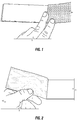
- Cohesive failure is assessed by visual observation of the skin surface that was in contact with the foam after removing the skin from the foam. Cohesive failure is rated when the skin surface has the visual appearance as shown in Figure 1 where a layer of foam remains attached to a skin layer surface indicating a break in foam the foam layer, and not in the foam-skin bond.
- TPE skin that does not include an APA, and in particular that does not include DEAA and/or does not include DEAA in combination with a silane type compound, demonstrates adhesive type failure indicating a failure in the foam-skin bond as shown in Figure 2 where the TPE skin is substantially free of any foam residue.
- the use of the APA herein is such that the polymer forming the foam and skin layer indicate at least 50%, preferably at least 90%, more preferably 90-100% cohesive failure, and more preferably 100% cohesive failure.
- the pull force for the cohesive failure of greater than 50% may fall in the range of 10.0 Newtons to 25.0 Newtons, preferably 15.0 Newtons to 25.0 Newtons as measured using a Chatillon Force Gauge to pull a 2.0-inch skin sample from the foam at uncontrolled rate where the maximum load is determined. Such pull force may vary up to 55%. For example, for an observed pull force of 18 Newtons, the variation may be +/- 8 Newtons, or 44.4%.
- cohesive type failure refers to the observation of a residue of foam on the skin layer as it is removed.
- the addition of a silane type compound to the TPE/DEAA mixture during the preparation of the skin layer significantly reduces variability in the pull force.
- the pull force for cohesive failure of at least 50 %, alternatively for cohesive failure of at least 90%, or alternatively for cohesive failure of 100% may fall in the range of 175 Newtons/meter to 250 Newtons/meter, as measured according to ASTM D6862 on a 2.0-inch skin sample using an Instron Tensile Tester at the rate of 300mm/sec and a 90 degree peel angle.
- the combination of DEAA and an organo-silane compound, the pull force is relatively consistent and may vary by not more than 2.0%. For example, if the pull force is measured to be 230 Newtons/meter, such pull force may vary +/- 3 Newtons/meter (1.3%). Accordingly, the desired variability in the pull force may be in the range of less than 10%, preferably less than 5%.
- the skinned composite disclosed herein includes a foam layer, preferably a polyurethane foam layer, and a TPE skin layer bonded to the polyurethane foam layer, wherein the TPE skin layer contains: (a) 0.5 - 5.0 % by weight of APA, alternatively DEAA as described herein; or alternatively (b) a mixture of DEAA at 0.5-5.0 % by weight in combination with 0.05-5.0 % by weight of an organo-silane compound containing amino functionality (-NH 2 or -NH-groups) having a molecular weight of less than or equal to 1000 g/mol, preferably less than 500 g/mol.
- an organo-silane compound containing amino functionality -NH 2 or -NH-groups
- the foam-skin composite as described herein may have particular utility in a number of vehicle type applications, and in particular, interior automotive trim applications. This may include instrument panels and consoles, airbag deployment doors, vehicular door components, headliner and overhead systems, and even flooring systems.
- TPE skins were produced by combining the TPE material formulations with DEAA to produce DEAA/TPE mixtures, where DEAA was present at a level of 2.0% by weight. The mixtures were then used in powder box molding and resulted in the formation of TPE skin layers.
- the TPE skin layers had a thickness in the range of 0.5 mm to 2.5 mm.
- the force required to remove the TPE skin layers from the nickel surface of the casting box tooling was in the range of 2.0 to 4.7 Newtons as measured using the Chatillon Force Gauge as described above.
- the casting time for the TPE skin layers ranged from 6.0 to 14.0 seconds.
- the time for fusion of the TPE skin layers ranged from 1.0 to 2.0 minutes.
- the TPE skin layers were then flame treated by flaming the at least one of the TPE skin layer surfaces with an oxygen/natural gas blend. Similarly, the luminous zone of the flame front which was at a temperature in the range of 1700-1900 °C was passed over one of the surfaces of the TPE skin layers for a period in the range of 5-15 sec seconds. This was then followed by forming a polyurethane foam layer onto the flame treated surface of each of the flame treated TPE skin layers.
- the polyurethane foam layer was formed by curing a polyurethane reaction mixture which included: (a) one or more polyether polyols or polyester polyols containing end groups that are reactive with isocyanates, such as -OH groups; (b) one or more polyisocyanates; (c) at least one blowing agent.
- the polyurethane was crosslinked by incorporation of a trifunctional reagent, such as a trifunctional polyisocyanate, or by increasing the index, which is the number of isocyanate groups relative to the number of isocyanate reactive groups (e.g., -OH groups).
- the polyurethane foam layer had a thickness in the range of 3.0 mm - 8.0 mm and a density in the range of 0.1 kgf/L to 0.2 kgf/L (8.0 pcf - 11.0 pcf).
- the attached TPE skin layers alternatively had a thickness in the range of 0.9 mm-1.2 mm.
- the pull force for removal of the TPE skin layers was then evaluated using Chatillon Force Guage on a 2-inch sample. It is noted that in the case of the TPE resins that contained the DEAA, the pull force to remove the TPE skin layer from the foam was 19.6 Newtons, and the failure mode was 100% cohesive type failure. By contrast, the TPE skin layers that did not include the DEAA additive indicated an adhesive type failure, or ⁇ 100% cohesive type failure, with a pull force of less than 5.0 Newtons.
- a cryo-ground TPE powder having a particle size distribution of D50 of 200 ⁇ m to 300 ⁇ m was combined with DEAA as described above.
- the TPE/DEAA mixture was then combined with the aminoethylaminopropylmethyldimethoxysilane by mixing the mixture in a ribbon blender.
- Such ribbon blended mixture was then combined with an amount of a suitable partitioning agent.
- the final product, a powder mixture contained the following ingredients at the indicated weight percents: 96.0 wt. % of TPE, 2.0 wt. % of DEAA, 0.1 wt. % of aminoethylaminopropylmethyldimethoxysilane and 1.9 wt. % of the partitioning agent.
- the powder mixture was then slush molded into skins and foamed in place to provide polyurethane foam adhered to the TPE skins.
- Evaluation of the adhesion characteristics indicated a pull force for at least 50% cohesive failure to remove the skin in the range of 175 Newtons/meter to 250 Newtons/meter, where the pull force was measured according to ASTM D 6862 utilizing an Instron Tensile Tester to pull a 2.0 inch sample from the foam at the rate of 300 mm/sec, where the force was reported in Newtons/meter.
Landscapes
- Chemical & Material Sciences (AREA)
- Organic Chemistry (AREA)
- Health & Medical Sciences (AREA)
- Chemical Kinetics & Catalysis (AREA)
- Medicinal Chemistry (AREA)
- Polymers & Plastics (AREA)
- Materials Engineering (AREA)
- Engineering & Computer Science (AREA)
- Manufacturing & Machinery (AREA)
- Inorganic Chemistry (AREA)
- Laminated Bodies (AREA)
- Adhesive Tapes (AREA)
- Adhesives Or Adhesive Processes (AREA)
- Compositions Of Macromolecular Compounds (AREA)
Claims (15)
- Verfahren zum Ausbilden eines Verbundstoffs mit einer Haut aus TPE, umfassend:a) Ausbilden einer Hautschicht, die mindestens eine Oberfläche aufweist, umfassend:(i) ein thermoplastisches Elastomer;(ii) einen Klebstoffverstärker;b) Bereitstellen einer Schaumschicht auf der Oberfläche der Hautschicht, um den Verbundstoff mit einer Haut aus TPE auszubilden,
wobei der Klebstoffverstärker ein Diethanolaminamid (diethanol amine amide-DEAA) umfasst, das die folgende Struktur aufweist:
- Verfahren nach Anspruch 1, wobei die Hautschicht und die Schaumschicht eine Schaum-Haut-Bindung ausbilden, wobei die Schaum-Haut-Bindung einen Kohäsionsbruch von mindestens 50 % demonstriert und wobei die Zugkraft für den Kohäsionsbruch in dem Bereich von 175 Newton/Meter bis 250 Newton/Meter gemessen gemäß ASTM D 6862 ist.
- Verfahren nach Anspruch 1, wobei die Hautschicht den Klebstoffverstärker in einer Menge von 0,5 Gew.-% bis 10 Gew.-% und das thermoplastische Elastomer in einer Menge von gleich oder größer als 90 Gew.-%. basierend auf dem Gesamtgewicht der Zusammensetzung umfasst.
- Verfahren nach Anspruch 1, wobei die Hautschicht eine Dicke von 0,5 mm bis 2,5 mm aufweist.
- Verfahren nach Anspruch 1, wobei die Schaumschicht eine Dicke in dem Bereich von 3,0 mm bis 8,0 mm aufweist.
- Verfahren nach Anspruch 1, wobei die Hautschicht ferner eine Organosilanverbindung umfasst, die eine Aminofunktionalität (-NH2 oder -NH-Gruppen) enthält, und die Organosilanverbindung ein Molekulargewicht (molecular weight- MW) von weniger als oder gleich 1000 g/mol 1 aufweist.
- Verfahren nach Anspruch 1, wobei das thermoplastische Elastomer mindestens eine Glasübergangstemperatur unter 25 °C, eine Bruchdehnung von mindestens 50 %, wie gemäß ISO 37 gemessen, und eine Zugfestigkeit von mindestens 4 MPa, wie gemäß ASTM D412 gemessen, aufweist.
- Verfahren nach einem der Ansprüche 1-7, ferner umfassend ein Behandeln der Hautschicht durch Beflammen der mindestens einen Oberfläche, um eine flammenbehandelte Hautschicht zu erzeugen.
- Verfahren nach einem der Ansprüche 1-7, wobei Schritt a) durch ein beliebiges aus Spritzgießen, Extrudieren und Kalandrieren ausgeführt wird.
- Verfahren nach einem der Ansprüche 1-7, wobei vor Schritt a)i) das thermoplastische Elastomer und der Klebstoffverstärker gemischt und extrudiert werden, um vor dem Ausbilden der Hautschicht Pellets auszubilden; oderii) das thermoplastische Elastomer extrudiert und zu Pellets ausgebildet und dann mit dem Klebstoffverstärker kombiniert wird.
- Verfahren nach Anspruch 10, wobei die Pellets kryogemahlen sind, um ein kryogemahlenes Pulver auszubilden, das eine durchschnittliche Partikelgrößenverteilung von 200 µm bis 1600 µm aufweist, und wobei das kryogemahlene Pulver mit einer Organosilanverbindung kombiniert wird, um ein silanbeschichtetes Pulver auszubilden, wobei die Organosilanverbindung eine oder mehrere Kohlenstoff-Silizium-Bindungen enthält und ein Molekulargewicht von weniger als oder gleich 1000 g/mol aufweist.
- Erzeugnis, umfassend den Verbundstoff mit der Haut aus TPE, ausgebildet durch das Verfahren nach einem der Ansprüche 1-7.
- Verbundstoff mit der Haut aus TPE, umfassend eine Hautschicht und eine Schaumschicht, wobei die Hautschicht umfasst:ein thermoplastisches Elastomer, das in einer Menge von größer als oder gleich 90 Gew.-% vorliegt;einen Klebstoffverstärker, der in einer Menge von 0,5 Gew.-% bis 10 Gew.-% basierend auf dem Gesamtgewicht der Hautschicht vorliegt, wobei der Klebstoffverstärker DEAA ist; undoptional eine Organosilanverbindung in einer Menge von 0,05 Gew.-% bis 5 Gew.-% basierend auf dem Gesamtgewicht der Hautschicht, wobei die Organosilanverbindung die Aminofunktionalität (-NH2 oder -NH-Gruppen) enthält und die Organosilanverbindung ein Molekulargewicht (MW) von weniger als oder gleich 1000 g/mol aufweist und wobei die Hautschicht und die Schaumschicht eine Schaum-Haut-Bindung ausbilden; undwobei die Schaum-Haut-Bindung einen Kohäsionsbruch von mindestens 50 % demonstriert und wobei die Zugkraft für den Kohäsionsbruch in dem Bereich von 175 Newton/Meter bis 250 Newton/Meter gemessen gemäß ASTM D 6862 ist.
- Verbundstoff mit der Haut aus TPE nach Anspruch 13, wobei das thermoplastische Elastomer mindestens eine Glasübergangstemperatur unter 25 °C aufweist, eine Bruchdehnung von mindestens 50 %, wie gemäß ISO 37 gemessen, aufweist und eine Zugfestigkeit von mindestens 4 MPa, wie gemäß ASTM D412 gemessen, aufweist.
- Erzeugnis, umfassend den Verbundstoff mit der Haut aus TPE nach einem der Ansprüche 13-14.
Applications Claiming Priority (4)
| Application Number | Priority Date | Filing Date | Title |
|---|---|---|---|
| US201662333657P | 2016-05-09 | 2016-05-09 | |
| US201662334044P | 2016-05-10 | 2016-05-10 | |
| US201762466715P | 2017-03-03 | 2017-03-03 | |
| PCT/US2017/031809 WO2017196882A1 (en) | 2016-05-09 | 2017-05-09 | Foam adhesion promotion |
Publications (4)
| Publication Number | Publication Date |
|---|---|
| EP3445833A1 EP3445833A1 (de) | 2019-02-27 |
| EP3445833A4 EP3445833A4 (de) | 2019-10-23 |
| EP3445833B1 true EP3445833B1 (de) | 2021-04-14 |
| EP3445833B8 EP3445833B8 (de) | 2021-05-26 |
Family
ID=60242803
Family Applications (1)
| Application Number | Title | Priority Date | Filing Date |
|---|---|---|---|
| EP17796711.4A Active EP3445833B8 (de) | 2016-05-09 | 2017-05-09 | Schaumhaftungsförderung |
Country Status (8)
| Country | Link |
|---|---|
| US (1) | US10307983B2 (de) |
| EP (1) | EP3445833B8 (de) |
| JP (1) | JP6948348B2 (de) |
| KR (1) | KR102361853B1 (de) |
| CN (1) | CN109476976B (de) |
| ES (1) | ES2875724T3 (de) |
| TW (1) | TWI642703B (de) |
| WO (1) | WO2017196882A1 (de) |
Families Citing this family (2)
| Publication number | Priority date | Publication date | Assignee | Title |
|---|---|---|---|---|
| CN111116959A (zh) * | 2019-12-18 | 2020-05-08 | 南通普力马弹性体技术有限公司 | 搪塑/注塑热塑性弹性体表皮、塑料件 |
| CN112226069B (zh) * | 2020-09-22 | 2021-10-15 | 东莞市雄林新材料科技股份有限公司 | 一种贴合硅胶的tpu复合材料及其制备方法 |
Family Cites Families (24)
| Publication number | Priority date | Publication date | Assignee | Title |
|---|---|---|---|---|
| US3670054A (en) | 1969-10-29 | 1972-06-13 | Shell Oil Co | Block copolymers having reduced solvent sensitivity |
| US3700633A (en) | 1971-05-05 | 1972-10-24 | Shell Oil Co | Selectively hydrogenated block copolymers |
| DE3932025A1 (de) * | 1989-09-26 | 1991-04-04 | Wacker Chemie Gmbh | Waessrige dispersionen von organopolysiloxanen |
| JPH03179017A (ja) * | 1989-12-07 | 1991-08-05 | Mitsui Toatsu Chem Inc | 半硬質ポリウレタンフォームの製造法 |
| US5362572A (en) * | 1990-12-21 | 1994-11-08 | Mitsui Petrochemical Industries, Ltd. | Two-layer thermoplastic elastomer sheet |
| JP3169478B2 (ja) * | 1993-06-10 | 2001-05-28 | 積水化学工業株式会社 | 被覆用シートおよびその製造方法 |
| JP3377313B2 (ja) * | 1993-12-20 | 2003-02-17 | 住友化学工業株式会社 | 複合発泡成形体、それを用いる多層成形体及びそれらの製造方法 |
| DE19752552A1 (de) * | 1997-11-27 | 1999-06-02 | Hoechst Schering Agrevo Gmbh | Tensidsysteme für flüssige wässrige Zubereitungen |
| DE19858270A1 (de) * | 1998-12-17 | 2000-06-21 | Ticona Gmbh | Verbundkörper aus technischen Thermoplasten und Polyurethan-Elastomeren unter Verwendung eines Haftvermittlers |
| US6987142B2 (en) | 2002-02-07 | 2006-01-17 | Kraton Polymers U.S. Llc | Adhesives and sealants from controlled distribution block copolymers |
| JP4184178B2 (ja) * | 2002-07-09 | 2008-11-19 | 株式会社クラレ | 熱可塑性重合体組成物 |
| JP3983228B2 (ja) * | 2004-03-26 | 2007-09-26 | セメダイン株式会社 | 1液型硬化性組成物 |
| US20070276094A1 (en) * | 2004-11-05 | 2007-11-29 | Srimannarayana Kakarala | Thermoplastic polyolefin compositions having improved adhesion to polymer foams and/or coatings and methods of making and using the same |
| KR20080055908A (ko) * | 2005-09-12 | 2008-06-19 | 다우 글로벌 테크놀로지스 인크. | 에틸렌/알파-올레핀 조성물로부터 제조된 자동차 부품 |
| FR2896508B1 (fr) * | 2006-01-23 | 2008-06-20 | Arkema Sa | Promoteur d'adhesion destine a etre applique sur un substrat en polymere thermoplastique elastomere et procedes de traitement de surface et d'assemblage par collage correspondant |
| JP5060074B2 (ja) | 2006-05-11 | 2012-10-31 | 東レ・ダウコーニング株式会社 | 接着促進剤、硬化性オルガノポリシロキサン組成物、および半導体装置 |
| US20080182074A1 (en) | 2007-01-31 | 2008-07-31 | Eastman Chemical Company | Rigid pvc melt bonded thermoplastic elastomer composites |
| JP2009114321A (ja) * | 2007-11-06 | 2009-05-28 | Toyo Tire & Rubber Co Ltd | 硬質ポリウレタンフォーム用ポリオール組成物及び硬質ポリウレタンフォームの製造方法 |
| JP2011000765A (ja) * | 2009-06-17 | 2011-01-06 | Toyota Boshoku Corp | 車両用内装材 |
| EP2295237A1 (de) * | 2009-09-14 | 2011-03-16 | Bayer MaterialScience AG | Verfahren zur Herstellung eines Schaumstoff-Verbundelements mittels einer Haftvermittlerdispersion |
| CN102428143B (zh) | 2010-01-29 | 2015-05-20 | 美国科通聚合物有限公司 | 用于冷凝模塑的热熔性组合物 |
| US20150197046A1 (en) * | 2014-01-16 | 2015-07-16 | Ford Global Technologies, Llc | Vehicle interior part and method of making the same |
| CN206124333U (zh) * | 2016-10-13 | 2017-04-26 | 惠州赛力珑新材料有限公司 | 安全健康环保硅墙面装饰材料 |
| US11225047B2 (en) * | 2017-03-15 | 2022-01-18 | International Automotive Components Group North America, Inc. | Skin-foam-substrate structure via induction heating |
-
2017
- 2017-05-09 US US15/590,727 patent/US10307983B2/en active Active
- 2017-05-09 TW TW106115383A patent/TWI642703B/zh active
- 2017-05-09 ES ES17796711T patent/ES2875724T3/es active Active
- 2017-05-09 CN CN201780028168.5A patent/CN109476976B/zh active Active
- 2017-05-09 EP EP17796711.4A patent/EP3445833B8/de active Active
- 2017-05-09 JP JP2018559968A patent/JP6948348B2/ja active Active
- 2017-05-09 KR KR1020187035308A patent/KR102361853B1/ko active Active
- 2017-05-09 WO PCT/US2017/031809 patent/WO2017196882A1/en not_active Ceased
Non-Patent Citations (1)
| Title |
|---|
| None * |
Also Published As
| Publication number | Publication date |
|---|---|
| WO2017196882A1 (en) | 2017-11-16 |
| JP2019517939A (ja) | 2019-06-27 |
| US10307983B2 (en) | 2019-06-04 |
| KR20190028652A (ko) | 2019-03-19 |
| JP6948348B2 (ja) | 2021-10-13 |
| US20170320288A1 (en) | 2017-11-09 |
| TW201805344A (zh) | 2018-02-16 |
| KR102361853B1 (ko) | 2022-02-11 |
| CN109476976A (zh) | 2019-03-15 |
| EP3445833A1 (de) | 2019-02-27 |
| EP3445833A4 (de) | 2019-10-23 |
| TWI642703B (zh) | 2018-12-01 |
| EP3445833B8 (de) | 2021-05-26 |
| CN109476976B (zh) | 2020-07-07 |
| ES2875724T3 (es) | 2021-11-11 |
Similar Documents
| Publication | Publication Date | Title |
|---|---|---|
| KR101523418B1 (ko) | 폴리프로필렌계 수지 발포 입자 및 발포 입자 성형체 | |
| KR100916981B1 (ko) | 폴리프로필렌계 수지 발포 입자 및 이를 사용한 형내 성형체 | |
| KR101951068B1 (ko) | 발포성 조성물, 발포체 및 이의 물품 | |
| KR100695546B1 (ko) | 저포깅성 열가소성 엘라스토머 조성물 및 이 조성물의제조방법 및 용도 | |
| US11434341B2 (en) | Resin sheet and adhesive-layer-having resin sheet | |
| KR100577876B1 (ko) | 분말 성형용 열가소성 탄성중합체 조성물, 분말 및 이의 성형품 | |
| WO1997043337A1 (en) | Powdery thermoplastic elastomer composition and articles obtained by molding same | |
| CN107108955A (zh) | 可后固化橡胶类压敏粘合剂 | |
| US10307983B2 (en) | Foam adhesion promotion | |
| WO2002064673A1 (en) | Oil extended 1, 2-polybutadiene and method of manufacturing the polybutadiene, and composition and formed product thereof | |
| WO2014148297A1 (ja) | 発泡積層体 | |
| KR19990083310A (ko) | 열가소성엘라스토머조성물,이조성물의분말및성형체 | |
| JP4287048B2 (ja) | 熱溶融性エラストマー組成物 | |
| EP3853016B1 (de) | Verbindungsverfahren zur befestigung eines ethylenbasierten polymerschaums mit vulkanisiertem kautschuk | |
| EP3476563A1 (de) | Verbundener körper und verfahren zur herstellung davon | |
| EP3732237B1 (de) | Olefinmultiblockcopolymer/silikonkautschuk/klebrigmacher-zusammensetzungen und schaumstoffe | |
| JP2001226542A (ja) | スラッシュ成形用熱可塑性エラストマー組成物及びこれを用いた複合表皮 | |
| JP2000204207A (ja) | 粉末スラッシュ成形用熱可塑性エラストマ―組成物および粉末スラッシュ成形材料 | |
| JP2004292786A (ja) | ポリプロピレン系樹脂組成物並びに自動車内装用インストルメントパネル表皮材とその製造方法 | |
| WO2014148298A1 (ja) | 発泡積層体 | |
| CN115612195A (zh) | 热塑性弹性体组合物 | |
| JP2019517939A5 (de) | ||
| WO2009003114A1 (en) | Thermoplastic polyolefin compositions having improved adhesion to polymer foams and/or coatings and methods of making and using the same | |
| JP7713061B2 (ja) | 樹脂発泡シート及びその製造方法 | |
| JP3210898B2 (ja) | 粉末スラッシュ成形表皮付き成形体 |
Legal Events
| Date | Code | Title | Description |
|---|---|---|---|
| STAA | Information on the status of an ep patent application or granted ep patent |
Free format text: STATUS: THE INTERNATIONAL PUBLICATION HAS BEEN MADE |
|
| PUAI | Public reference made under article 153(3) epc to a published international application that has entered the european phase |
Free format text: ORIGINAL CODE: 0009012 |
|
| STAA | Information on the status of an ep patent application or granted ep patent |
Free format text: STATUS: REQUEST FOR EXAMINATION WAS MADE |
|
| 17P | Request for examination filed |
Effective date: 20181123 |
|
| AK | Designated contracting states |
Kind code of ref document: A1 Designated state(s): AL AT BE BG CH CY CZ DE DK EE ES FI FR GB GR HR HU IE IS IT LI LT LU LV MC MK MT NL NO PL PT RO RS SE SI SK SM TR |
|
| AX | Request for extension of the european patent |
Extension state: BA ME |
|
| DAV | Request for validation of the european patent (deleted) | ||
| DAX | Request for extension of the european patent (deleted) | ||
| A4 | Supplementary search report drawn up and despatched |
Effective date: 20190920 |
|
| RIC1 | Information provided on ipc code assigned before grant |
Ipc: B32B 27/36 20060101ALI20190916BHEP Ipc: C09J 123/28 20060101ALI20190916BHEP Ipc: B32B 27/06 20060101ALI20190916BHEP Ipc: B32B 27/30 20060101ALI20190916BHEP Ipc: C09J 175/14 20060101AFI20190916BHEP Ipc: B32B 5/18 20060101ALI20190916BHEP Ipc: B32B 27/18 20060101ALI20190916BHEP Ipc: B32B 27/40 20060101ALI20190916BHEP Ipc: B32B 27/32 20060101ALI20190916BHEP |
|
| RIC1 | Information provided on ipc code assigned before grant |
Ipc: B32B 5/18 20060101ALI20200831BHEP Ipc: C08J 5/12 20060101ALI20200831BHEP Ipc: B32B 27/40 20060101ALI20200831BHEP Ipc: C08G 18/48 20060101ALI20200831BHEP Ipc: B32B 27/18 20060101ALI20200831BHEP Ipc: B32B 27/36 20060101ALI20200831BHEP Ipc: B32B 27/32 20060101ALI20200831BHEP Ipc: C08G 101/00 20060101ALI20200831BHEP Ipc: B32B 27/30 20060101ALI20200831BHEP Ipc: C09J 175/14 20060101AFI20200831BHEP Ipc: B32B 27/06 20060101ALI20200831BHEP Ipc: C09J 123/28 20060101ALI20200831BHEP Ipc: C08G 18/42 20060101ALI20200831BHEP Ipc: C09J 5/02 20060101ALI20200831BHEP |
|
| GRAP | Despatch of communication of intention to grant a patent |
Free format text: ORIGINAL CODE: EPIDOSNIGR1 |
|
| STAA | Information on the status of an ep patent application or granted ep patent |
Free format text: STATUS: GRANT OF PATENT IS INTENDED |
|
| INTG | Intention to grant announced |
Effective date: 20201104 |
|
| GRAS | Grant fee paid |
Free format text: ORIGINAL CODE: EPIDOSNIGR3 |
|
| GRAA | (expected) grant |
Free format text: ORIGINAL CODE: 0009210 |
|
| STAA | Information on the status of an ep patent application or granted ep patent |
Free format text: STATUS: THE PATENT HAS BEEN GRANTED |
|
| AK | Designated contracting states |
Kind code of ref document: B1 Designated state(s): AL AT BE BG CH CY CZ DE DK EE ES FI FR GB GR HR HU IE IS IT LI LT LU LV MC MK MT NL NO PL PT RO RS SE SI SK SM TR |
|
| REG | Reference to a national code |
Ref country code: GB Ref legal event code: FG4D |
|
| REG | Reference to a national code |
Ref country code: CH Ref legal event code: EP |
|
| REG | Reference to a national code |
Ref country code: CH Ref legal event code: PK Free format text: BERICHTIGUNG B8 |
|
| REG | Reference to a national code |
Ref country code: DE Ref legal event code: R081 Ref document number: 602017036765 Country of ref document: DE Owner name: KRATON POLYMERS U.S. LLC, HOUSTON, US Free format text: FORMER OWNERS: INTERNATIONAL AUTOMOTIVE COMPONENTS GROUP NORTH AMERICA, INC., SOUTHFIELD, MI, US; KRATON POLYMERS U.S. LLC, HOUSTON, TX, US Ref country code: DE Ref legal event code: R082 Ref document number: 602017036765 Country of ref document: DE Representative=s name: HENKEL & PARTNER MBB PATENTANWALTSKANZLEI, REC, DE |
|
| REG | Reference to a national code |
Ref country code: DE Ref legal event code: R096 Ref document number: 602017036765 Country of ref document: DE |
|
| REG | Reference to a national code |
Ref country code: IE Ref legal event code: FG4D |
|
| REG | Reference to a national code |
Ref country code: AT Ref legal event code: REF Ref document number: 1382374 Country of ref document: AT Kind code of ref document: T Effective date: 20210515 |
|
| RAP2 | Party data changed (patent owner data changed or rights of a patent transferred) |
Owner name: KRATON POLYMERS U.S. LLC |
|
| REG | Reference to a national code |
Ref country code: NL Ref legal event code: FP |
|
| REG | Reference to a national code |
Ref country code: GB Ref legal event code: 732E Free format text: REGISTERED BETWEEN 20210701 AND 20210707 |
|
| REG | Reference to a national code |
Ref country code: LT Ref legal event code: MG9D |
|
| REG | Reference to a national code |
Ref country code: AT Ref legal event code: MK05 Ref document number: 1382374 Country of ref document: AT Kind code of ref document: T Effective date: 20210414 |
|
| PG25 | Lapsed in a contracting state [announced via postgrant information from national office to epo] |
Ref country code: AT Free format text: LAPSE BECAUSE OF FAILURE TO SUBMIT A TRANSLATION OF THE DESCRIPTION OR TO PAY THE FEE WITHIN THE PRESCRIBED TIME-LIMIT Effective date: 20210414 Ref country code: BG Free format text: LAPSE BECAUSE OF FAILURE TO SUBMIT A TRANSLATION OF THE DESCRIPTION OR TO PAY THE FEE WITHIN THE PRESCRIBED TIME-LIMIT Effective date: 20210714 Ref country code: HR Free format text: LAPSE BECAUSE OF FAILURE TO SUBMIT A TRANSLATION OF THE DESCRIPTION OR TO PAY THE FEE WITHIN THE PRESCRIBED TIME-LIMIT Effective date: 20210414 Ref country code: FI Free format text: LAPSE BECAUSE OF FAILURE TO SUBMIT A TRANSLATION OF THE DESCRIPTION OR TO PAY THE FEE WITHIN THE PRESCRIBED TIME-LIMIT Effective date: 20210414 Ref country code: LT Free format text: LAPSE BECAUSE OF FAILURE TO SUBMIT A TRANSLATION OF THE DESCRIPTION OR TO PAY THE FEE WITHIN THE PRESCRIBED TIME-LIMIT Effective date: 20210414 |
|
| REG | Reference to a national code |
Ref country code: ES Ref legal event code: FG2A Ref document number: 2875724 Country of ref document: ES Kind code of ref document: T3 Effective date: 20211111 |
|
| PG25 | Lapsed in a contracting state [announced via postgrant information from national office to epo] |
Ref country code: RS Free format text: LAPSE BECAUSE OF FAILURE TO SUBMIT A TRANSLATION OF THE DESCRIPTION OR TO PAY THE FEE WITHIN THE PRESCRIBED TIME-LIMIT Effective date: 20210414 Ref country code: SE Free format text: LAPSE BECAUSE OF FAILURE TO SUBMIT A TRANSLATION OF THE DESCRIPTION OR TO PAY THE FEE WITHIN THE PRESCRIBED TIME-LIMIT Effective date: 20210414 Ref country code: PL Free format text: LAPSE BECAUSE OF FAILURE TO SUBMIT A TRANSLATION OF THE DESCRIPTION OR TO PAY THE FEE WITHIN THE PRESCRIBED TIME-LIMIT Effective date: 20210414 Ref country code: NO Free format text: LAPSE BECAUSE OF FAILURE TO SUBMIT A TRANSLATION OF THE DESCRIPTION OR TO PAY THE FEE WITHIN THE PRESCRIBED TIME-LIMIT Effective date: 20210714 Ref country code: PT Free format text: LAPSE BECAUSE OF FAILURE TO SUBMIT A TRANSLATION OF THE DESCRIPTION OR TO PAY THE FEE WITHIN THE PRESCRIBED TIME-LIMIT Effective date: 20210816 Ref country code: LV Free format text: LAPSE BECAUSE OF FAILURE TO SUBMIT A TRANSLATION OF THE DESCRIPTION OR TO PAY THE FEE WITHIN THE PRESCRIBED TIME-LIMIT Effective date: 20210414 Ref country code: GR Free format text: LAPSE BECAUSE OF FAILURE TO SUBMIT A TRANSLATION OF THE DESCRIPTION OR TO PAY THE FEE WITHIN THE PRESCRIBED TIME-LIMIT Effective date: 20210715 Ref country code: IS Free format text: LAPSE BECAUSE OF FAILURE TO SUBMIT A TRANSLATION OF THE DESCRIPTION OR TO PAY THE FEE WITHIN THE PRESCRIBED TIME-LIMIT Effective date: 20210814 |
|
| REG | Reference to a national code |
Ref country code: CH Ref legal event code: PL |
|
| REG | Reference to a national code |
Ref country code: DE Ref legal event code: R097 Ref document number: 602017036765 Country of ref document: DE |
|
| PG25 | Lapsed in a contracting state [announced via postgrant information from national office to epo] |
Ref country code: SK Free format text: LAPSE BECAUSE OF FAILURE TO SUBMIT A TRANSLATION OF THE DESCRIPTION OR TO PAY THE FEE WITHIN THE PRESCRIBED TIME-LIMIT Effective date: 20210414 Ref country code: SM Free format text: LAPSE BECAUSE OF FAILURE TO SUBMIT A TRANSLATION OF THE DESCRIPTION OR TO PAY THE FEE WITHIN THE PRESCRIBED TIME-LIMIT Effective date: 20210414 Ref country code: RO Free format text: LAPSE BECAUSE OF FAILURE TO SUBMIT A TRANSLATION OF THE DESCRIPTION OR TO PAY THE FEE WITHIN THE PRESCRIBED TIME-LIMIT Effective date: 20210414 Ref country code: EE Free format text: LAPSE BECAUSE OF FAILURE TO SUBMIT A TRANSLATION OF THE DESCRIPTION OR TO PAY THE FEE WITHIN THE PRESCRIBED TIME-LIMIT Effective date: 20210414 Ref country code: CH Free format text: LAPSE BECAUSE OF NON-PAYMENT OF DUE FEES Effective date: 20210531 Ref country code: DK Free format text: LAPSE BECAUSE OF FAILURE TO SUBMIT A TRANSLATION OF THE DESCRIPTION OR TO PAY THE FEE WITHIN THE PRESCRIBED TIME-LIMIT Effective date: 20210414 Ref country code: CZ Free format text: LAPSE BECAUSE OF FAILURE TO SUBMIT A TRANSLATION OF THE DESCRIPTION OR TO PAY THE FEE WITHIN THE PRESCRIBED TIME-LIMIT Effective date: 20210414 Ref country code: LI Free format text: LAPSE BECAUSE OF NON-PAYMENT OF DUE FEES Effective date: 20210531 Ref country code: LU Free format text: LAPSE BECAUSE OF NON-PAYMENT OF DUE FEES Effective date: 20210509 Ref country code: MC Free format text: LAPSE BECAUSE OF FAILURE TO SUBMIT A TRANSLATION OF THE DESCRIPTION OR TO PAY THE FEE WITHIN THE PRESCRIBED TIME-LIMIT Effective date: 20210414 |
|
| REG | Reference to a national code |
Ref country code: BE Ref legal event code: MM Effective date: 20210531 |
|
| PLBE | No opposition filed within time limit |
Free format text: ORIGINAL CODE: 0009261 |
|
| STAA | Information on the status of an ep patent application or granted ep patent |
Free format text: STATUS: NO OPPOSITION FILED WITHIN TIME LIMIT |
|
| 26N | No opposition filed |
Effective date: 20220117 |
|
| PG25 | Lapsed in a contracting state [announced via postgrant information from national office to epo] |
Ref country code: IE Free format text: LAPSE BECAUSE OF NON-PAYMENT OF DUE FEES Effective date: 20210509 |
|
| PG25 | Lapsed in a contracting state [announced via postgrant information from national office to epo] |
Ref country code: IS Free format text: LAPSE BECAUSE OF FAILURE TO SUBMIT A TRANSLATION OF THE DESCRIPTION OR TO PAY THE FEE WITHIN THE PRESCRIBED TIME-LIMIT Effective date: 20210814 Ref country code: AL Free format text: LAPSE BECAUSE OF FAILURE TO SUBMIT A TRANSLATION OF THE DESCRIPTION OR TO PAY THE FEE WITHIN THE PRESCRIBED TIME-LIMIT Effective date: 20210414 |
|
| PG25 | Lapsed in a contracting state [announced via postgrant information from national office to epo] |
Ref country code: BE Free format text: LAPSE BECAUSE OF NON-PAYMENT OF DUE FEES Effective date: 20210531 |
|
| PGFP | Annual fee paid to national office [announced via postgrant information from national office to epo] |
Ref country code: IT Payment date: 20220524 Year of fee payment: 6 |
|
| REG | Reference to a national code |
Ref country code: NL Ref legal event code: RC Free format text: DETAILS LICENCE OR PLEDGE: RIGHT OF PLEDGE, ESTABLISHED Name of requester: GOLDMAN SACHS BANK USA Effective date: 20230118 |
|
| PG25 | Lapsed in a contracting state [announced via postgrant information from national office to epo] |
Ref country code: CY Free format text: LAPSE BECAUSE OF FAILURE TO SUBMIT A TRANSLATION OF THE DESCRIPTION OR TO PAY THE FEE WITHIN THE PRESCRIBED TIME-LIMIT Effective date: 20210414 |
|
| PG25 | Lapsed in a contracting state [announced via postgrant information from national office to epo] |
Ref country code: HU Free format text: LAPSE BECAUSE OF FAILURE TO SUBMIT A TRANSLATION OF THE DESCRIPTION OR TO PAY THE FEE WITHIN THE PRESCRIBED TIME-LIMIT; INVALID AB INITIO Effective date: 20170509 |
|
| PG25 | Lapsed in a contracting state [announced via postgrant information from national office to epo] |
Ref country code: MK Free format text: LAPSE BECAUSE OF FAILURE TO SUBMIT A TRANSLATION OF THE DESCRIPTION OR TO PAY THE FEE WITHIN THE PRESCRIBED TIME-LIMIT Effective date: 20210414 Ref country code: IT Free format text: LAPSE BECAUSE OF NON-PAYMENT OF DUE FEES Effective date: 20230509 |
|
| PG25 | Lapsed in a contracting state [announced via postgrant information from national office to epo] |
Ref country code: MT Free format text: LAPSE BECAUSE OF FAILURE TO SUBMIT A TRANSLATION OF THE DESCRIPTION OR TO PAY THE FEE WITHIN THE PRESCRIBED TIME-LIMIT Effective date: 20210414 |
|
| PGFP | Annual fee paid to national office [announced via postgrant information from national office to epo] |
Ref country code: NL Payment date: 20250521 Year of fee payment: 9 |
|
| PGFP | Annual fee paid to national office [announced via postgrant information from national office to epo] |
Ref country code: DE Payment date: 20250521 Year of fee payment: 9 |
|
| PGFP | Annual fee paid to national office [announced via postgrant information from national office to epo] |
Ref country code: GB Payment date: 20250527 Year of fee payment: 9 |
|
| PGFP | Annual fee paid to national office [announced via postgrant information from national office to epo] |
Ref country code: FR Payment date: 20250528 Year of fee payment: 9 |
|
| PGFP | Annual fee paid to national office [announced via postgrant information from national office to epo] |
Ref country code: ES Payment date: 20250630 Year of fee payment: 9 |
|
| PG25 | Lapsed in a contracting state [announced via postgrant information from national office to epo] |
Ref country code: TR Free format text: LAPSE BECAUSE OF FAILURE TO SUBMIT A TRANSLATION OF THE DESCRIPTION OR TO PAY THE FEE WITHIN THE PRESCRIBED TIME-LIMIT Effective date: 20210414 |