EP3441276A1 - Verbundenes transportnetzwerksystem - Google Patents
Verbundenes transportnetzwerksystem Download PDFInfo
- Publication number
- EP3441276A1 EP3441276A1 EP17778622.5A EP17778622A EP3441276A1 EP 3441276 A1 EP3441276 A1 EP 3441276A1 EP 17778622 A EP17778622 A EP 17778622A EP 3441276 A1 EP3441276 A1 EP 3441276A1
- Authority
- EP
- European Patent Office
- Prior art keywords
- annular
- run
- systems
- main transportation
- speed
- Prior art date
- Legal status (The legal status is an assumption and is not a legal conclusion. Google has not performed a legal analysis and makes no representation as to the accuracy of the status listed.)
- Granted
Links
Images


Classifications
-
- B—PERFORMING OPERATIONS; TRANSPORTING
- B61—RAILWAYS
- B61B—RAILWAY SYSTEMS; EQUIPMENT THEREFOR NOT OTHERWISE PROVIDED FOR
- B61B1/00—General arrangement of stations, platforms, or sidings; Railway networks; Rail vehicle marshalling systems
-
- B—PERFORMING OPERATIONS; TRANSPORTING
- B61—RAILWAYS
- B61B—RAILWAY SYSTEMS; EQUIPMENT THEREFOR NOT OTHERWISE PROVIDED FOR
- B61B13/00—Other railway systems
- B61B13/12—Systems with propulsion devices between or alongside the rails, e.g. pneumatic systems
- B61B13/127—Systems with propulsion devices between or alongside the rails, e.g. pneumatic systems the propulsion device consisting of stationary driving wheels
-
- B—PERFORMING OPERATIONS; TRANSPORTING
- B61—RAILWAYS
- B61B—RAILWAY SYSTEMS; EQUIPMENT THEREFOR NOT OTHERWISE PROVIDED FOR
- B61B1/00—General arrangement of stations, platforms, or sidings; Railway networks; Rail vehicle marshalling systems
- B61B1/02—General arrangement of stations and platforms including protection devices for the passengers
-
- Y—GENERAL TAGGING OF NEW TECHNOLOGICAL DEVELOPMENTS; GENERAL TAGGING OF CROSS-SECTIONAL TECHNOLOGIES SPANNING OVER SEVERAL SECTIONS OF THE IPC; TECHNICAL SUBJECTS COVERED BY FORMER USPC CROSS-REFERENCE ART COLLECTIONS [XRACs] AND DIGESTS
- Y02—TECHNOLOGIES OR APPLICATIONS FOR MITIGATION OR ADAPTATION AGAINST CLIMATE CHANGE
- Y02T—CLIMATE CHANGE MITIGATION TECHNOLOGIES RELATED TO TRANSPORTATION
- Y02T30/00—Transportation of goods or passengers via railways, e.g. energy recovery or reducing air resistance
Definitions
- the invention relates to a connected transportation network system, and belongs to the field of transportation equipment and control engineering.
- buses are usually configured with high-power engines and power devices with large-capacity fuel tanks, such that buses need to consume a lot of driving power when running to bear the power devices. Therefore, no matter how the energy saving technologies are improved on buses, about 70% of kinetic energy of transportation needs to be used on the bus weight; a process of slow down, stop, start up and speed up is required at each bus stop, leading to energy waste undoubtedly. Besides, since buses are very large, additional lanes are required, thus occupying the area of roads, indirectly leading to traffic jam, and increasing energy waste of other vehicles in the traffic jam.
- the rail traffic systems have problems that the power engines are very heavy, and about 50% of kinetic energy of transportation needs to be consumed in the weight of the power engines in practical use; the process of stop and start up is also necessary at each stop, thus wasting the kinetic energy of transportation, increasing the energy consumption, and indirectly leading to environmental pollution especially in countries dominated by thermal power.
- the embodiment of the invention provides a connected transportation network system which can reduce energy waste in the transportation process.
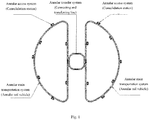
- a connected transportation network system constructed in a way of enclosed annular transportation (see Fig. 2 ): the system comprises an annular main transportation system, an annular transfer system and an annular access system (consolidation stations);
- the annular main transportation system (annular rail vehicle systems): in the current embodiment, the system comprises east, south, west, north and central loops to complete running task required by passengers; the east, south, west and north loops run counterclockwise (opposite to the central loops), and are composed of annular-carriage trains, T-shaped rails and train driving devices;
- the annular transfer system (connecting and transferring lines), comprising five transfer stations in the current embodiment, i.e., four triangular loops (a south-east connecting and transferring line, a north-east connecting and transferring line, a north-west connecting and transferring line and a south-west connecting and transferring line) and a square loop (central loop).
- the four triangular transferring lines run counterclockwise, while the central loop runs clockwise; all the loops are composed of annular-carriage trains, T-shaped rails and train driving devices; the sides of the transfer system close to the main transportation system run in the same direction and at the same speed as the main transportation system tangentially;
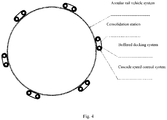
- the annular access system (consolidation stations): in the current embodiment, the system is composed of 50 consolidation stations (or more/less); the consolidation stations comprise annular perpetually-moving buffered docking systems and cascade speed control systems; the consolidation stations are distributed on each rail loop; the annular perpetually-moving buffered vehicles are annular-carriage vehicles running on the buffered docking systems; the buffered docking systems are quasi-oblong; the sides of the buffered docking systems close to the main transportation system run in the same direction and at the same speed as the main transportation system tangentially; the cascade speed control systems are composed of multiple-grade concentric annular perpetually-running speed-control belts used for cascade speed control; the annular perpetually-running belts at all the grades run concentrically and unidirectionally at differential speeds (varying in cascade); the speeds at different grades vary in cascade, the grades closer to the buffered docking vehicles run at higher speed, the grades further away from the buffered docking vehicles run at lower speed, and the last
- the buffered docking vehicles are used to dock with the annular-carriage trains on the main transportation system perpetually running, load passengers and/or articles to the annular-carriage trains, and/or receive passengers and/or articles unloaded from the annular-carriage trains;
- the annular-carriage trains are used to load passengers and/or articles, the T-shaped rails are used to support the annular-carriage trains, and the train driving devices are used to provide traction power to the annular-carriage trains;
- the annular-carriage trains run perpetually on the T-shaped rails by being trailed by the train driving devices;
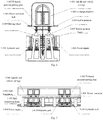
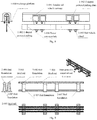
- annular-carriage trains are composed of exchange platforms (1-000), rail vehicle carriages (1-001), T-shaped powered pulling plates (1-002), rail vehicle wheels (1-003) and power conveyor belts (1-004);
- the T-shaped rails are composed of steel rails (2-005), rail foundations (2-006) and rail foundation frames (2-007);
- the train driving devices are composed of power engines (3-008), driving wheels (3-009), hydraulic jacks (3-010) and power engine foundation frames (3-011);
- the power engines (3-008) are positioned on the power engine foundation frames (3-011); the hydraulic jacks (3-010) contact the chassis of the driving wheels (3-009) and apply vertical pressure to the latter;
- the train driving devices are used to provide traction power to the annular rail vehicles, and are composed of power engines (3-009), driving wheels (3-010), hydraulic jacks (3-011) and power engine foundation frames (3-011);
- the power engines (3-008) are positioned on the power engine foundation frames (3-011);
- the driving wheels (3-009) of the power engines (3-008) are sufficiently jacked with the power conveyor belts (1-004);
- the driving wheels (3-009) drive the power conveyor belts (1-004) and the T-shaped powered pulling plates (1-002), and drive the annular-carriage trains to run on the rails.
- the annular-carriage trains of the main transportation system carry most of the transportation volume at constant high speed
- the train driving devices can be distributed on the annular rails of the main transportation system as per the specific design requirements, so that the train driving devices keep static and drive the annular-carriage trains of the main transportation system to run perpetually at high speed, passengers get on and off the vehicles through the access system (consolidation stations), and transfer through the transfer system.
- the entire transportation process is completed through coordination of the three systems.
- the connected traffic network system has simple structure.
- the connected traffic network system is divided into the main transportation system, the access system (consolidation stations) and the transfer system, wherein the main transportation system is the main body for completing urban transportation, the consolidation stations realize passengers getting on and getting off the vehicles during perpetual running of the main transportation system, and the transfer system assist the passengers to transfer in the main transportation system; all the systems run perpetually, the annular belts at all the grades of the cascade speed control systems of the consolidation stations run perpetually and steadily at differential speeds, so that the passengers can get on and off the main transportation system in a self-help way, and all the systems are docked and connected with each other seamlessly.
- the train driving devices of the scheme of the embodiment are statically distributed on the annular rails of the main transportation system, thus solving the problem that most of the current traffic and transportation tools consume the kinetic energy of transportation for the vehicle weight, especially the power devices; in the scheme of the embodiment, the annular-carriage trains can keep running perpetually at high speed, thus avoiding the problem of energy waste due to the process of slow down, stop, start up and speed up of the most of the current traffic and transportation tools at each stop; in the scheme of the embodiment, the entire transportation process is completed through coordination of the three systems, the systems run steadily and independently, thus solving traffic jam and reducing the overall energy consumption of urban traffic.
- the expression “comprise” in the specification of the invention means that the characters, integrals, steps, operations, elements and/or components exist, but it shall not be excluded that one or more other characters, integrals, steps, operations, elements, components and/or combinations of them exist or are added. It shall be understood that when an element is expressed as being “connected” or “coupled” to another element, the former can be connected or coupled to the latter directly, or via intermediate elements. Besides, “connection” or “coupling” used herein can contain wireless connection or coupling. Expression “and/or” used herein contain combination of any part or all of the one or more listed correlated items.
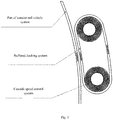
- the embodiment of the invention provides a connected transportation network system, as shown in Figs. 1-5 , composed of a main transportation system (or “annular main transportation system”), a transfer system (or “annular transfer system”) and an access system (or “annular access system”, including consolidation stations).
- a main transportation system or “annular main transportation system”
- a transfer system or “annular transfer system”
- an access system or “annular access system”, including consolidation stations.
- the main transportation system comprises east, south, west, north and central loops, wherein the east, south, west and north loops respectively run counterclockwise, the central loop runs clockwise, and the east, south, west and north loops and the central loop are respectively composed of annular-carriage trains, T-shaped rails and train driving devices.
- the main transportation system in the current embodiment comprises east, south, west, north and central loops to complete running task required by passengers; the east, south, west and north loops run counterclockwise (opposite to the central loops which run clockwise).
- the transfer system is composed of five transfer stations comprising four triangular loops, a south-east connecting and transferring line (or "a south-east section of a connecting and transferring line"), a north-east connecting and transferring line (or “a north-east section of a connecting and transferring line”), a north-west connecting and transferring line (or “a north-west section of a connecting and transferring line”) and a south-west connecting and transferring line (or "a south-west section of a connecting and transferring line”), as well as a square central loop, wherein the sides of the transfer system close to the main transportation system are used as passenger transfer sections and run in the same direction and at the same speed as the main transportation system tangentially, and the south-east connecting and transferring line, the north-east connecting and transferring line, the north-west connecting and transferring line, the south-west connecting and transferring line and the central loop are respectively composed of annular-carriage trains, T-shaped rails and train driving devices; as shown in Fig.
- the transfer system comprises five transfer stations, i.e., four triangular loops and one square loop (central loop).
- the four triangular transferring lines run counterclockwise, while the central loop runs clockwise; all the loops are composed of annular-carriage trains, T-shaped rails and train driving devices; the sides (used as passenger transfer sections) of the transfer system close to the main transportation system run in the same direction and at the same speed as the main transportation system tangentially.
- the access system is composed of designated number of consolidation stations comprising buffered docking systems and cascade speed control systems;
- the buffered docking systems are quasi-oblong, the sides of the buffered docking systems close to the main transportation system run in the same direction and at the same speed as the main transportation system tangentially, and are used as parts for exchanging passengers between the access system and the main transportation system;
- the cascade speed control systems are composed of multiple-grade concentric annular rubber belts running at constant speed, wherein the rubber belts closer to buffered docking vehicles run at higher speed, the rubber belts further away from buffered docking vehicles run at lower speed, the grades running at the lowest speed runs at a speed close to or lower than the normal walking speed, and the semicircular sections of the outermost annular belts close to the buffered docking systems run in the same direction and at the same speed as the buffered docking systems tangentially; As shown in Figs.
- the access system in the embodiment can be composed of 50 consolidation stations (or more/less) which are distributed on the annular main transportation lines;
- the annular perpetually-moving buffer vehicles have the same structures as the main transportation system;
- the perpetual running belts of the cascade speed control systems closer to buffered docking vehicles run at higher speed, the perpetual running belts further away from buffered docking vehicles run at lower speed, the last grades run at a speed close to or lower than the normal human walking speed;
- the semicircular sections of the outermost annular belts of the cascade speed control systems close to the buffered docking systems are used as transfer sections for passengers to go in and out of the buffered docking systems, and run in the same direction and at the same speed as the buffered docking systems tangentially with small distances; the passengers enter the buffered docking systems by changing the speed through the cascade speed control systems.
- the buffered docking systems are composed of annular perpetually-moving buffer vehicles, T-shaped rails and train driving devices, the sides of the annular-carriage trains of the buffered docking systems close to the main transportation system are used as transfer sections for passengers to go in and out of the main transportation system, and run in the same direction and at the same speed as the main transportation system tangentially with small distances.
- the annular perpetually-moving buffer vehicles have the same structures as the annular-carriage trains of the main transportation system, are used to dock with the annular-carriage trains of the main transportation system, load passengers and/or articles to the annular-carriage trains, and/or receive passengers and/or articles unloaded from the annular-carriage trains.
- the annular-carriage trains are used to load passengers and/or articles
- the T-shaped rails are used to support the annular-carriage trains
- the train driving devices are used to provide traction power to the annular-carriage trains, so that the annular-carriage trains run perpetually on the T-shaped rails by being trailed by the train driving devices.
- the structures of the buffered docking systems of the main transportation system, the transfer system and the consolidation stations can be designed as annular rail vehicles, i.e., static vehicles are used as the train driving devices driving the trains to make annular movements on the rails;
- the buffered docking systems of the main transportation system, the transfer system and the consolidation stations can be designed as enclosed annular rail vehicle systems, and the train driving devices are distributed on the annular rails of the main transportation system as per the specific design requirements, wherein, the cross sections of the annular rails are design to be T-shaped. Therefore, the train driving devices are static and do not consume kinetic energy compared to the existing technology.
- the annular-carriage trains run perpetually on the enclosed annular rails by being driven by the train driving devices.
- the consolidation stations comprise buffered docking systems (i.e., annular perpetually-moving buffer vehicles) and cascade speed control systems; the consolidation stations are distributed on each rail loop; the annular perpetually-moving buffered vehicles are annular-carriage vehicles running on the rails of the buffered docking systems; the buffered docking systems are quasi-oblong; the sides of the buffered docking systems close to the main transportation system run in the same direction and at the same speed as the main transportation system tangentially, so that the sides are used as transfer points where the passengers go in or out of the main transportation system, and seamless exchange of the passengers between the main transportation system and the consolidation stations is realized in the dynamic process; the cascade speed control systems are composed of multiple-grade concentric annular speed-control rails used for cascade speed control.
- the buffered docking systems are transfer and buffer stations for passengers to go from the main transportation system to the cascade speed control systems
- the cascade speed control systems can be composed of a plurality of perpetually-moving concentric annular consolidation belts which run perpetually at constant speeds varying in cascade from the inside to the outside; the passengers can get on the vehicles in a self-help way (speed up in a self-help way) and get off the vehicles in a self-help way (slow down in a self-help way) through the cascade speed control systems, so that the passengers can go in and out of the dynamic annular-carriage trains of the main transportation system in a self-help way through speed control and buffering of the consolidation stations.
- the buffered docking systems can be annular enclosed transportation lines, and can be designed in the same way as the annular rail vehicles of the main transportation system;
- the running speed of the buffered docking systems is the same as the rated running speed of the trains of the main transportation system, and the same as the outermost annular perpetually-moving consolidation belts of the cascade speed control systems;
- Shapes of the buffered docking systems the exchange parts of the annular perpetually-moving buffer vehicles with the annular rail vehicles of the main transportation system are tangent to each other in a quasi-linear way, and the passenger exchange parts of the docked buffering systems with the outermost annular perpetually-moving consolidation belts of the cascade speed control systems are quasi-circular; the length of the passenger exchange parts of the outermost annular perpetually-moving consolidation belts of the cascade speed control systems: the sum of the two tangent parts of the passenger exchange parts is as long as the passenger exchange parts of the annular rail vehicles, to balance the incoming and outgoing amount.
- the cascade speed control systems are composed of a plurality of grades of concentric annular perpetually-moving consolidation belts in such structure: the cascade speed control systems are composed of a plurality of annular perpetually-moving consolidation belts arranged concentrically and closely at equal intervals, each annular perpetually-moving consolidation belt run independently at differential speeds, and corresponds to a gradually different speed; specifically, grade number and size of the cascade speed control systems: the cascade speed control systems are composed of a plurality of annular perpetually-moving consolidation belts arranged concentrically and closely at equal intervals, the number of the consolidation belts is dependent on the speed variation required, all the speed changes are the same, and the larger absolute speed change value means more grades.
- the width and running radius of the consolidation belts are determined as actually needed; the annular perpetually-moving consolidation belts run independently but with interrelation, and the edge distance of every two adjacent consolidation belts is controlled within a small range (e.g., 10-15mm, to guarantee the passengers' walking safety).
- the annular perpetually-moving consolidation belts run independently but with interrelation; the innermost belts run at the lowest speed, each outer grade runs at a speed which is one level higher than the inner grade, the edge distance of every two adjacent consolidation belts is controlled within a small range, the annular perpetually-moving consolidation belts run at different speeds, the innermost belts run at the lowest speed, and the outer belts run at higher speed; according to the walking speed of ordinary people, every two adjacent consolidation belts run with a speed difference of 0.8m/sec, equivalent to 2.88km/hr.
- the plurality of grades of annular perpetually-moving consolidation belts run concentrically and unidirectionally at differential speeds, thus realizing cascade speed changes; the innermost annular perpetually-moving consolidation belts run at the lowest speed (below 2.88km/hr), and the outermost annular perpetually-moving consolidation belts run at the highest speed, which is the same as the speed of the buffered docking systems and the annular rail vehicles.
- each annular perpetually-moving consolidation belt at least comprises a consolidation belt (equivalent to the carriage of the annular perpetually-moving buffer vehicle), a rail and a power system, wherein the consolidation belt runs at the annular rail at constant speed, can be designed as a rubber belt, and is circular shaped; the rail runs in the same path of the consolidation belt; dependent on the design, the power system can be implemented in various ways, the high speed part can be designed by referencing the rail design of the annular perpetually-moving buffer vehicle, and the low speed part can be designed in various ways (e.g., the motor, gear and rack driving modes or other driving modes).
- the annular perpetually-moving buffer vehicles of the consolidation stations run perpetually in the same direction and at the same speed as the annular rail vehicles, to realize dynamic (equal-speed) passenger exchange with the annular rail vehicles, so that the annular rail vehicles of the main transportation system can run normally, without being started up or stopped when the passengers get on or off.
- the annular consolidation belts run perpetually at differential speeds, the passengers walk in a self-help way to realize speed changes, i.e., the speed is increased when the passengers get on the vehicles, and reduced when the passengers get off the vehicles.
- the scheme can improve the transportation efficiency of urban traffic by 5-10 times, thus solving the problem of energy waste due to the process of slow down, stop, start up and speed up of the most of the current traffic and transportation tools at each stop.
- motor vehicles on the road systems are dispersive presently, each individual vehicle run independently and is influenced by various factors when running, like getting on/off, red or green traffic lights, route changing, peak hours, cross roads.
- Each individual vehicle wants to achieve high efficiency, leading to severe traffic jam, and finally low overall transportation efficiency, high pollution, high energy consumption and many traffic accidents.
- the whole transportation process is completed through coordination of the three types of systems.
- the systems run independently and perpetually, and can be connected to each other.
- the passengers can arrive at any position in the entire traffic network.
- the start, stop and speed changes of the entire system are uniform, and the speed is changed under centralized control, thus solving the traffic jam problem, reducing urban traffic energy consumption and improving the urban traffic efficiency.
- the main transportation system, the transfer system and the buffered docking systems of the consolidation stations can be the annular rail vehicle systems as shown in Fig. 3 .
- the annular-carriage trains are composed of exchange platforms (1-000), rail vehicle carriages (1-001), T-shaped powered pulling plates (1-002), rail vehicle wheels (1-003) and power conveyor belts (1-004);
- the T-shaped rails are composed of steel rails (2-005), rail foundations (2-006) and rail foundation frames (2-007);
- the train driving devices are used to provide traction power, and are composed of power engines (3-008), driving wheels (3-009), hydraulic jacks (3-010) and power engine foundation frames (3-011); the power engines (3-008) are positioned on the power engine foundation frames (3-011); the hydraulic jacks (3-010) contact the chassis of the driving wheels (3-009) and apply vertical pressure to the latter, and the driving wheels (3-009) of the power engines (3-008) are sufficiently jacked with the power conveyor belts (1-004).
- the train driving devices are used to provide traction power to the annular rail vehicles.
- the driving wheels (3-009) drive the power conveyor belts (1-004) and the T-shaped powered pulling plates (1-002), and drive the annular-carriage trains to run on the rails.
- the train driving devices are uniformly distributed at each point on the annular lines, and are static relative to the perpetually running vehicles.
- the driving power is provided to the annular rail vehicles by adjusting the friction force between the driving wheels (3-009) and the power conveyor belts (1-004).
- the trains can be started up or stopped by adjusting the power engines (3-008) through frequency conversion. Therefore, the power systems can be separated from the perpetually running trains and remain static without consuming any kinetic energy.
- the annular rail vehicles run perpetually, the main transportation system are not started up or stopped when the passengers get on or off, and the passengers get on and off the vehicles through the access system (consolidation stations).
- the overall transportation volume of the system can also be adjusted by adjusting the speed at which the annular-carriage trains are driven by the train driving devices.
- the access system comprises inner systems and outer systems, wherein the inner systems are positioned on the inner loops of the main transportation system, and the outer systems are positioned on the outer loops of the main transportation system.
- Each grade of the cascade speed control system of each consolidation station runs in the same direction as the corresponding buffered docking system.
- the system comprises the main transportation system, the annular perpetually-moving buffer vehicle systems in the access system and the transfer system, which are all composed of annular-carriage trains, annular T-shaped rails and a plurality of train driving devices, wherein the cascade speed control systems in the access system are composed of annular (rubber) belts, rails and power parts.
- the annular belts run on the respective rails at constant speed in an enclosed loop way.
- the power parts can be implemented in various ways, the high speed parts can be designed by referencing the annular rail vehicles of the main transportation system, and the low speed parts can be designed in various ways (e.g., the motor, gear and rack driving mode or other driving modes).
- the main transportation system, the transfer system and the access system are connected with each other, have enclosed annular structures and run perpetually.
- the passengers can go in or out of the main transportation system in a self-help way through the access system (consolidation stations), and can transfer among all the running lines in the main transportation system in a self-help way through the transfer system (transferring and connecting stations).
- the buffered docking systems of the main transportation system, the transfer system and the access system run at the same speed, the speeds at different grades of the cascade speed control systems of the access system (consolidation stations) vary in cascade, the grades closer to the buffered docking vehicles run at higher speed, the grades further away from the buffered docking vehicles run at lower speed, and the last grade runs at a speed near or lower than human walking speed.
- each subsystem in the connected transportation network system is annular, runs perpetually, and connected with the adjacent subsystem, and the exchanging and connecting parts of the subsystems run in the same direction tangentially, with a mutual distance of 10-15mm.
- Connection method of the entire traffic network system the annular belts of the cascade speed control systems run at speeds varying in cascade, and the speed difference is controlled within ordinary people's walking speed, so as to ensure that the passengers go to all the annular belts of the cascade speed control systems; other subsystems (except the cascade speed control systems) run at the same speed and in the same direction, so as to ensure that the passengers go to any position in the entire traffic network system in a self-help way due to the interconnection.
- the embodiment provides a preferred structure of the connected traffic network system as shown in Fig. 1 , wherein the main transportation system comprises at least five annular main transportation lines (annular rail vehicle systems); the transfer system comprises at least four triangular loop shaped connecting and transferring line and a central loop shaped connecting and transferring line, wherein the connecting and transferring lines have annular structures in certain shapes, all the sides of the connecting and transferring lines run at the same speed in the same direction as all the lines of the main transportation system tangentially, so that the passengers can transfer to other annular perpetually-running lines in a self-help way via the exchange platforms of the connecting and transferring lines; the annular main transportation lines of the main transportation system are connected to each other via the connecting and transferring lines.
- the annular access system (consolidation stations) is arranged on the annular main transportation lines, so that the passengers can go in and out of the connected traffic network system in a self-help way, and all the annular main transportation lines, al the transferring lines and all the consolidation stations are connected to each other.
- Annular transfer system The passengers can transfer from one loop to the other three loops (three options) North-east connecting loop All the loops run counterclockwise at the same speed in the same direction as the tangent sections of the annular transportation lines to connect all the annular transportation lines (central, east, south, west and north loops) and realize interconnection of the annular transportation lines.
- the passengers can transfer from one loop to the other four loops (four options) Central loop
- the loop runs clockwise at the same speed in the same direction as the tangent sections of the annular transportation lines, being able to connect to the east, west, south and north loops and having a central buffering function.
- 1 Square loop Annular access system Consolidation stations
- Annular buffered transferring vehicles Used as buffers between the annular trains and the cascade speed control systems
- a plurality Rectangular loop Cascade speed control consolidation belts Used for incoming and outgoing passengers to realize self-help speed changes through the system Concentric round loops Table 1
- the structure comprises 5 transportation lines in the main transportation system, the central, north, south, west and east loops; a certain number of consolidation stations distributed in the whole connected traffic network system; 5 transferring lines, north-east, south-east, south-west and north-west connecting loops and a central loop.
- the 5 transferring lines realize interconnection of the 5 main transportation lines.
- the shapes and locations of the transferring lines are shown in Fig. 2 .
- the three sides run in the same direction at the same speed as three main transportation lines tangentially, each side is parallel to each main transportation line, and the mutual distance is controlled within a small range, to guarantee the passengers' access safety on the transferring lines and the main transportation lines.
- the central loop shaped transferring line is quadrilateral loop shaped, runs in the same direction at the same speed as the annular perpetually-running transportation lines to connect to the east, west, south and north annular loops; the four sides thereof run in the same direction at the same speed as the four main transportation lines tangentially, each side is parallel to each main transportation line, and the mutual distance is controlled within a small range, to guarantee the passengers' access safety on the transferring lines and the main transportation lines; since being at the center of the system, the line also has a central buffering function.
- the detailed running method of the connected traffic network system shown in Fig. 2 the main transportation lines and the transferring lines are adjusted to run steadily at rated constant speed according to the transportation volume; the annular perpetually-moving buffer vehicles of the consolidation stations run at the same speed as the main transportation system; the cascade speed control systems of the consolidation stations select the number of grades to be started up of the multi-grade annular perpetually-moving consolidation belts according to the system speed, and automatically adjust the speeds of the consolidation belts.
- the connected traffic network system provided by the embodiment of the invention has simple structure.
- the connected traffic network system is divided into the main transportation system, the access system (consolidation stations) and the transfer system, wherein the main transportation system is the main body for completing urban transportation, the consolidation stations realize passengers getting on and getting off the vehicles during perpetual running of the main transportation system, and the transfer system assist the passengers to transfer in the main transportation system; all the systems run perpetually, the annular belts at all the grades of the cascade speed control systems of the consolidation stations run perpetually and steadily at differential speeds, so that the passengers can get on and off the main transportation system in a self-help way, and all the systems are docked and connected with each other seamlessly.
- the systems run steadily and independently from each other, and the entire transportation process is completed through coordination of the three systems.
- the train driving devices are statically distributed on the annular rails of the main transportation system, thus solving the problem that most of the current traffic and transportation tools consume the kinetic energy of transportation for the vehicle weight, especially the power devices.
- the annular rail vehicle systems run on the planned routes, the annular-carriage trains can run perpetually at high speed without stopping during transportation, and the speed of the annular-carriage trains is controllable, thus the overall traffic flow is controllable.
- the annular-carriage trains of the main transportation system carry most of the transportation volume at constant high speed
- the train driving devices can be distributed on the annular rails of the main transportation system as per the specific design requirements, so that the train driving devices keep static and drive the annular-carriage trains of the main transportation system to run perpetually at high speed, passengers get on and off the vehicles through the access system (consolidation stations), and transfer through the transfer system.
- the entire transportation process is completed through coordination of the three systems.
- the connected traffic network system provided by the embodiment has simple structure.
- the connected traffic network system is divided into the main transportation system, the access system (consolidation stations) and the transfer system, wherein the main transportation system is the main body for completing urban transportation, the consolidation stations realize passengers getting on and getting off the vehicles during perpetual running of the main transportation system, and the transfer system assist the passengers to transfer in the main transportation system; all the systems run perpetually, the annular belts at all the grades of the cascade speed control systems of the consolidation stations run perpetually and steadily at differential speeds, so that the passengers can get on and off the main transportation system in a self-help way, and all the systems are docked and connected with each other seamlessly.
- the main transportation system is the main body for completing urban transportation
- the consolidation stations realize passengers getting on and getting off the vehicles during perpetual running of the main transportation system
- the transfer system assist the passengers to transfer in the main transportation system
- all the systems run perpetually, the annular belts at all the grades of the cascade speed control systems of the consolidation stations run perpetually and steadily at differential speeds, so that the passengers can get on and off the main
- the train driving devices of the scheme of the embodiment are statically distributed on the annular rails of the main transportation system, thus solving the problem that most of the current traffic and transportation tools consume the kinetic energy of transportation for the vehicle weight, especially the power devices; in the scheme of the embodiment, the annular-carriage trains can keep running perpetually at high speed, thus avoiding the problem of energy waste due to the process of slow down, stop, start up and speed up of the most of the current traffic and transportation tools at each stop; in the scheme of the embodiment, the entire transportation process is completed through coordination of the three systems, the systems run steadily and independently, thus solving traffic jam and reducing the overall energy consumption of urban traffic.
Landscapes
- Engineering & Computer Science (AREA)
- Transportation (AREA)
- Mechanical Engineering (AREA)
- Chemical & Material Sciences (AREA)
- Combustion & Propulsion (AREA)
- Train Traffic Observation, Control, And Security (AREA)
Applications Claiming Priority (3)
| Application Number | Priority Date | Filing Date | Title |
|---|---|---|---|
| CN201620293606 | 2016-04-08 | ||
| CN201610218801 | 2016-04-08 | ||
| PCT/CN2017/079069 WO2017173958A1 (zh) | 2016-04-08 | 2017-03-31 | 一种交通互联网络系统 |
Publications (3)
| Publication Number | Publication Date |
|---|---|
| EP3441276A1 true EP3441276A1 (de) | 2019-02-13 |
| EP3441276A4 EP3441276A4 (de) | 2019-11-27 |
| EP3441276B1 EP3441276B1 (de) | 2021-10-13 |
Family
ID=60000900
Family Applications (1)
| Application Number | Title | Priority Date | Filing Date |
|---|---|---|---|
| EP17778622.5A Not-in-force EP3441276B1 (de) | 2016-04-08 | 2017-03-31 | Verbundenes transportnetzwerksystem |
Country Status (4)
| Country | Link |
|---|---|
| US (1) | US10946876B2 (de) |
| EP (1) | EP3441276B1 (de) |
| JP (1) | JP6650070B2 (de) |
| WO (1) | WO2017173958A1 (de) |
Families Citing this family (2)
| Publication number | Priority date | Publication date | Assignee | Title |
|---|---|---|---|---|
| CN110304077A (zh) * | 2019-07-31 | 2019-10-08 | 温金龙 | 小型智能化立体交通轨道 |
| EP4055576A4 (de) * | 2019-11-27 | 2022-11-23 | Hu, Xiayong | Einwegschleifenmosaik für höhere transportkapazität und sicherheit |
Family Cites Families (24)
| Publication number | Priority date | Publication date | Assignee | Title |
|---|---|---|---|---|
| US1515251A (en) * | 1924-06-11 | 1924-11-11 | John F Goode | Street-traffic system |
| US1748309A (en) * | 1928-01-30 | 1930-02-25 | James M Rose | Elevated railroad |
| US2657642A (en) * | 1948-11-27 | 1953-11-03 | Henry A Babcock | Passenger transit system |
| US3482529A (en) * | 1968-02-05 | 1969-12-09 | Donald K Paul | Transportation system |
| JPS5314806B1 (de) * | 1969-10-21 | 1978-05-20 | ||
| US3675584A (en) * | 1970-06-01 | 1972-07-11 | Alden Self Transit Syst | Transportation system |
| JPS6023243Y2 (ja) * | 1975-02-13 | 1985-07-10 | 株式会社東芝 | 動くプラツトホ−ム用定点表示装置 |
| JPS56122679U (de) * | 1980-02-21 | 1981-09-18 | ||
| JPH0411550A (ja) * | 1990-04-27 | 1992-01-16 | Toshiba Corp | 軌道系交通機関の路線設定方法 |
| CN1110234A (zh) | 1994-04-10 | 1995-10-18 | 张百利 | 站台列车与客运列车同步运行式火车站 |
| US5445081A (en) * | 1994-04-13 | 1995-08-29 | Yantrak, Llc | Transit system employing a traction belt |
| CN1789051A (zh) * | 2004-12-15 | 2006-06-21 | 张国成 | 一种城市3环地铁线 |
| CN101654106A (zh) * | 2008-08-22 | 2010-02-24 | 戴苏才 | A(b)c组合轨系与应用模式 |
| WO2009049471A1 (en) * | 2007-09-17 | 2009-04-23 | Sucai Dai | A loop combination railway system |
| CN101435178B (zh) * | 2009-01-07 | 2012-10-31 | 田耕 | 扭环线型的城市轨道交通线路 |
| US20100307368A1 (en) * | 2009-06-08 | 2010-12-09 | Parsley Joseph L | Motion connection parallel transit |
| CN101628583B (zh) * | 2009-08-18 | 2011-03-30 | 王弘 | 高速全自动全闭合轨道列车公共交通网络化系统 |
| ES2344827B1 (es) | 2010-03-30 | 2011-06-28 | Idelfonso Pablo Metro De Madrid, S.A. | Metodo y sistema de transporte metropolitano. |
| CN102248959A (zh) * | 2010-05-17 | 2011-11-23 | 戴苏才 | 递转岔道与循环线/网 |
| CN102774384B (zh) | 2012-07-31 | 2016-01-06 | 黄灿军 | 一种轨道列车双线并行的运行方法 |
| CN203511638U (zh) | 2013-09-27 | 2014-04-02 | 天津掌金互动科技有限公司 | 恒速环绕传输系统 |
| CN103465913A (zh) * | 2013-09-27 | 2013-12-25 | 天津掌金互动科技有限公司 | 恒速环绕传输网 |
| CN206141538U (zh) | 2016-04-08 | 2017-05-03 | 张晓华 | 一种交通互联网络系统 |
| CN106143500B (zh) | 2016-04-08 | 2018-10-23 | 张晓华 | 一种交通互联网络系统 |
-
2017
- 2017-03-31 EP EP17778622.5A patent/EP3441276B1/de not_active Not-in-force
- 2017-03-31 JP JP2019503612A patent/JP6650070B2/ja not_active Expired - Fee Related
- 2017-03-31 US US16/087,648 patent/US10946876B2/en not_active Expired - Fee Related
- 2017-03-31 WO PCT/CN2017/079069 patent/WO2017173958A1/zh not_active Ceased
Also Published As
| Publication number | Publication date |
|---|---|
| US10946876B2 (en) | 2021-03-16 |
| JP6650070B2 (ja) | 2020-02-19 |
| US20190106124A1 (en) | 2019-04-11 |
| JP2019513630A (ja) | 2019-05-30 |
| EP3441276B1 (de) | 2021-10-13 |
| WO2017173958A1 (zh) | 2017-10-12 |
| EP3441276A4 (de) | 2019-11-27 |
Similar Documents
| Publication | Publication Date | Title |
|---|---|---|
| CN201980227U (zh) | 智能型高运量运输轨道系统 | |
| RU2696396C2 (ru) | Рельсовая система безостановочной перевозки с высокой транспортирующей способностью | |
| CN103171563A (zh) | 一种轨道式快速交通运载系统及其运载方法 | |
| WO2019037691A1 (zh) | 一种导轮轨道车辆及轨道 | |
| CN103693045A (zh) | 一种高架式城市交通系统 | |
| WO2019037692A1 (zh) | 一种导轮轨道车辆及轨道 | |
| CN107310563A (zh) | 一种轨道交通车辆转向架的牵引电机拆卸方法 | |
| CN102275538B (zh) | 磁悬浮车辆的专用运输车 | |
| CN106274916A (zh) | 快速空中轨道运输系统 | |
| CN102454141A (zh) | 综合功能高效环保混钢结构立体道路 | |
| EP3441276B1 (de) | Verbundenes transportnetzwerksystem | |
| CN203332111U (zh) | 复线高架快速轻轨交通系统及其构成的交通网络 | |
| CN202966295U (zh) | 空轨吊挂电车 | |
| CN206141538U (zh) | 一种交通互联网络系统 | |
| CN103523026A (zh) | 城市空中轨道交通立体网络系统 | |
| CN103738342B (zh) | 独立驱动型索道交通系统 | |
| CN109826063B (zh) | 一种双向、多车道、多层有轨高速公路系统及其工作方法 | |
| CN102211586A (zh) | 斜拉桥式空中电气化铁路环城公交车 | |
| CN110182228A (zh) | 一种具有双排式电磁减重机构的悬挂式单轨列车系统 | |
| JP2003048415A (ja) | 鉄道レールと道路を両走する貨物輸送車を有する貨物輸送体 | |
| CN204323511U (zh) | 立交桥式公交车 | |
| CN203681537U (zh) | 独立驱动型索道交通系统 | |
| CN209410051U (zh) | 一种悬挂式物流单轨交通结构 | |
| Suppes et al. | GEFT scheduling to maximize value of current infrastructure and upside potential | |
| CN102463994A (zh) | 一种双层双向路轨兼容绿色公交系统 |
Legal Events
| Date | Code | Title | Description |
|---|---|---|---|
| STAA | Information on the status of an ep patent application or granted ep patent |
Free format text: STATUS: THE INTERNATIONAL PUBLICATION HAS BEEN MADE |
|
| PUAI | Public reference made under article 153(3) epc to a published international application that has entered the european phase |
Free format text: ORIGINAL CODE: 0009012 |
|
| STAA | Information on the status of an ep patent application or granted ep patent |
Free format text: STATUS: REQUEST FOR EXAMINATION WAS MADE |
|
| 17P | Request for examination filed |
Effective date: 20181031 |
|
| AK | Designated contracting states |
Kind code of ref document: A1 Designated state(s): AL AT BE BG CH CY CZ DE DK EE ES FI FR GB GR HR HU IE IS IT LI LT LU LV MC MK MT NL NO PL PT RO RS SE SI SK SM TR |
|
| AX | Request for extension of the european patent |
Extension state: BA ME |
|
| DAV | Request for validation of the european patent (deleted) | ||
| DAX | Request for extension of the european patent (deleted) | ||
| A4 | Supplementary search report drawn up and despatched |
Effective date: 20191024 |
|
| RIC1 | Information provided on ipc code assigned before grant |
Ipc: B61B 1/00 20060101AFI20191018BHEP |
|
| GRAP | Despatch of communication of intention to grant a patent |
Free format text: ORIGINAL CODE: EPIDOSNIGR1 |
|
| STAA | Information on the status of an ep patent application or granted ep patent |
Free format text: STATUS: GRANT OF PATENT IS INTENDED |
|
| INTG | Intention to grant announced |
Effective date: 20210517 |
|
| GRAS | Grant fee paid |
Free format text: ORIGINAL CODE: EPIDOSNIGR3 |
|
| GRAA | (expected) grant |
Free format text: ORIGINAL CODE: 0009210 |
|
| STAA | Information on the status of an ep patent application or granted ep patent |
Free format text: STATUS: THE PATENT HAS BEEN GRANTED |
|
| AK | Designated contracting states |
Kind code of ref document: B1 Designated state(s): AL AT BE BG CH CY CZ DE DK EE ES FI FR GB GR HR HU IE IS IT LI LT LU LV MC MK MT NL NO PL PT RO RS SE SI SK SM TR |
|
| REG | Reference to a national code |
Ref country code: GB Ref legal event code: FG4D |
|
| REG | Reference to a national code |
Ref country code: CH Ref legal event code: EP |
|
| REG | Reference to a national code |
Ref country code: DE Ref legal event code: R096 Ref document number: 602017047626 Country of ref document: DE |
|
| REG | Reference to a national code |
Ref country code: IE Ref legal event code: FG4D |
|
| REG | Reference to a national code |
Ref country code: AT Ref legal event code: REF Ref document number: 1437992 Country of ref document: AT Kind code of ref document: T Effective date: 20211115 |
|
| REG | Reference to a national code |
Ref country code: LT Ref legal event code: MG9D |
|
| REG | Reference to a national code |
Ref country code: NL Ref legal event code: MP Effective date: 20211013 |
|
| REG | Reference to a national code |
Ref country code: AT Ref legal event code: MK05 Ref document number: 1437992 Country of ref document: AT Kind code of ref document: T Effective date: 20211013 |
|
| PG25 | Lapsed in a contracting state [announced via postgrant information from national office to epo] |
Ref country code: RS Free format text: LAPSE BECAUSE OF FAILURE TO SUBMIT A TRANSLATION OF THE DESCRIPTION OR TO PAY THE FEE WITHIN THE PRESCRIBED TIME-LIMIT Effective date: 20211013 Ref country code: LT Free format text: LAPSE BECAUSE OF FAILURE TO SUBMIT A TRANSLATION OF THE DESCRIPTION OR TO PAY THE FEE WITHIN THE PRESCRIBED TIME-LIMIT Effective date: 20211013 Ref country code: FI Free format text: LAPSE BECAUSE OF FAILURE TO SUBMIT A TRANSLATION OF THE DESCRIPTION OR TO PAY THE FEE WITHIN THE PRESCRIBED TIME-LIMIT Effective date: 20211013 Ref country code: BG Free format text: LAPSE BECAUSE OF FAILURE TO SUBMIT A TRANSLATION OF THE DESCRIPTION OR TO PAY THE FEE WITHIN THE PRESCRIBED TIME-LIMIT Effective date: 20220113 Ref country code: AT Free format text: LAPSE BECAUSE OF FAILURE TO SUBMIT A TRANSLATION OF THE DESCRIPTION OR TO PAY THE FEE WITHIN THE PRESCRIBED TIME-LIMIT Effective date: 20211013 |
|
| PG25 | Lapsed in a contracting state [announced via postgrant information from national office to epo] |
Ref country code: IS Free format text: LAPSE BECAUSE OF FAILURE TO SUBMIT A TRANSLATION OF THE DESCRIPTION OR TO PAY THE FEE WITHIN THE PRESCRIBED TIME-LIMIT Effective date: 20220213 Ref country code: SE Free format text: LAPSE BECAUSE OF FAILURE TO SUBMIT A TRANSLATION OF THE DESCRIPTION OR TO PAY THE FEE WITHIN THE PRESCRIBED TIME-LIMIT Effective date: 20211013 Ref country code: PT Free format text: LAPSE BECAUSE OF FAILURE TO SUBMIT A TRANSLATION OF THE DESCRIPTION OR TO PAY THE FEE WITHIN THE PRESCRIBED TIME-LIMIT Effective date: 20220214 Ref country code: PL Free format text: LAPSE BECAUSE OF FAILURE TO SUBMIT A TRANSLATION OF THE DESCRIPTION OR TO PAY THE FEE WITHIN THE PRESCRIBED TIME-LIMIT Effective date: 20211013 Ref country code: NO Free format text: LAPSE BECAUSE OF FAILURE TO SUBMIT A TRANSLATION OF THE DESCRIPTION OR TO PAY THE FEE WITHIN THE PRESCRIBED TIME-LIMIT Effective date: 20220113 Ref country code: NL Free format text: LAPSE BECAUSE OF FAILURE TO SUBMIT A TRANSLATION OF THE DESCRIPTION OR TO PAY THE FEE WITHIN THE PRESCRIBED TIME-LIMIT Effective date: 20211013 Ref country code: LV Free format text: LAPSE BECAUSE OF FAILURE TO SUBMIT A TRANSLATION OF THE DESCRIPTION OR TO PAY THE FEE WITHIN THE PRESCRIBED TIME-LIMIT Effective date: 20211013 Ref country code: HR Free format text: LAPSE BECAUSE OF FAILURE TO SUBMIT A TRANSLATION OF THE DESCRIPTION OR TO PAY THE FEE WITHIN THE PRESCRIBED TIME-LIMIT Effective date: 20211013 Ref country code: GR Free format text: LAPSE BECAUSE OF FAILURE TO SUBMIT A TRANSLATION OF THE DESCRIPTION OR TO PAY THE FEE WITHIN THE PRESCRIBED TIME-LIMIT Effective date: 20220114 Ref country code: ES Free format text: LAPSE BECAUSE OF FAILURE TO SUBMIT A TRANSLATION OF THE DESCRIPTION OR TO PAY THE FEE WITHIN THE PRESCRIBED TIME-LIMIT Effective date: 20211013 |
|
| REG | Reference to a national code |
Ref country code: DE Ref legal event code: R097 Ref document number: 602017047626 Country of ref document: DE |
|
| PG25 | Lapsed in a contracting state [announced via postgrant information from national office to epo] |
Ref country code: SM Free format text: LAPSE BECAUSE OF FAILURE TO SUBMIT A TRANSLATION OF THE DESCRIPTION OR TO PAY THE FEE WITHIN THE PRESCRIBED TIME-LIMIT Effective date: 20211013 Ref country code: SK Free format text: LAPSE BECAUSE OF FAILURE TO SUBMIT A TRANSLATION OF THE DESCRIPTION OR TO PAY THE FEE WITHIN THE PRESCRIBED TIME-LIMIT Effective date: 20211013 Ref country code: RO Free format text: LAPSE BECAUSE OF FAILURE TO SUBMIT A TRANSLATION OF THE DESCRIPTION OR TO PAY THE FEE WITHIN THE PRESCRIBED TIME-LIMIT Effective date: 20211013 Ref country code: EE Free format text: LAPSE BECAUSE OF FAILURE TO SUBMIT A TRANSLATION OF THE DESCRIPTION OR TO PAY THE FEE WITHIN THE PRESCRIBED TIME-LIMIT Effective date: 20211013 Ref country code: DK Free format text: LAPSE BECAUSE OF FAILURE TO SUBMIT A TRANSLATION OF THE DESCRIPTION OR TO PAY THE FEE WITHIN THE PRESCRIBED TIME-LIMIT Effective date: 20211013 Ref country code: CZ Free format text: LAPSE BECAUSE OF FAILURE TO SUBMIT A TRANSLATION OF THE DESCRIPTION OR TO PAY THE FEE WITHIN THE PRESCRIBED TIME-LIMIT Effective date: 20211013 |
|
| PLBE | No opposition filed within time limit |
Free format text: ORIGINAL CODE: 0009261 |
|
| STAA | Information on the status of an ep patent application or granted ep patent |
Free format text: STATUS: NO OPPOSITION FILED WITHIN TIME LIMIT |
|
| 26N | No opposition filed |
Effective date: 20220714 |
|
| REG | Reference to a national code |
Ref country code: DE Ref legal event code: R119 Ref document number: 602017047626 Country of ref document: DE |
|
| PG25 | Lapsed in a contracting state [announced via postgrant information from national office to epo] |
Ref country code: MC Free format text: LAPSE BECAUSE OF FAILURE TO SUBMIT A TRANSLATION OF THE DESCRIPTION OR TO PAY THE FEE WITHIN THE PRESCRIBED TIME-LIMIT Effective date: 20211013 Ref country code: AL Free format text: LAPSE BECAUSE OF FAILURE TO SUBMIT A TRANSLATION OF THE DESCRIPTION OR TO PAY THE FEE WITHIN THE PRESCRIBED TIME-LIMIT Effective date: 20211013 |
|
| REG | Reference to a national code |
Ref country code: CH Ref legal event code: PL |
|
| GBPC | Gb: european patent ceased through non-payment of renewal fee |
Effective date: 20220331 |
|
| PG25 | Lapsed in a contracting state [announced via postgrant information from national office to epo] |
Ref country code: SI Free format text: LAPSE BECAUSE OF FAILURE TO SUBMIT A TRANSLATION OF THE DESCRIPTION OR TO PAY THE FEE WITHIN THE PRESCRIBED TIME-LIMIT Effective date: 20211013 |
|
| REG | Reference to a national code |
Ref country code: BE Ref legal event code: MM Effective date: 20220331 |
|
| PG25 | Lapsed in a contracting state [announced via postgrant information from national office to epo] |
Ref country code: LU Free format text: LAPSE BECAUSE OF NON-PAYMENT OF DUE FEES Effective date: 20220331 Ref country code: LI Free format text: LAPSE BECAUSE OF NON-PAYMENT OF DUE FEES Effective date: 20220331 Ref country code: IE Free format text: LAPSE BECAUSE OF NON-PAYMENT OF DUE FEES Effective date: 20220331 Ref country code: GB Free format text: LAPSE BECAUSE OF NON-PAYMENT OF DUE FEES Effective date: 20220331 Ref country code: FR Free format text: LAPSE BECAUSE OF NON-PAYMENT OF DUE FEES Effective date: 20220331 Ref country code: DE Free format text: LAPSE BECAUSE OF NON-PAYMENT OF DUE FEES Effective date: 20221001 Ref country code: CH Free format text: LAPSE BECAUSE OF NON-PAYMENT OF DUE FEES Effective date: 20220331 |
|
| PG25 | Lapsed in a contracting state [announced via postgrant information from national office to epo] |
Ref country code: BE Free format text: LAPSE BECAUSE OF NON-PAYMENT OF DUE FEES Effective date: 20220331 |
|
| PG25 | Lapsed in a contracting state [announced via postgrant information from national office to epo] |
Ref country code: IT Free format text: LAPSE BECAUSE OF FAILURE TO SUBMIT A TRANSLATION OF THE DESCRIPTION OR TO PAY THE FEE WITHIN THE PRESCRIBED TIME-LIMIT Effective date: 20211013 |
|
| PG25 | Lapsed in a contracting state [announced via postgrant information from national office to epo] |
Ref country code: HU Free format text: LAPSE BECAUSE OF FAILURE TO SUBMIT A TRANSLATION OF THE DESCRIPTION OR TO PAY THE FEE WITHIN THE PRESCRIBED TIME-LIMIT; INVALID AB INITIO Effective date: 20170331 |
|
| PG25 | Lapsed in a contracting state [announced via postgrant information from national office to epo] |
Ref country code: MK Free format text: LAPSE BECAUSE OF FAILURE TO SUBMIT A TRANSLATION OF THE DESCRIPTION OR TO PAY THE FEE WITHIN THE PRESCRIBED TIME-LIMIT Effective date: 20211013 Ref country code: CY Free format text: LAPSE BECAUSE OF FAILURE TO SUBMIT A TRANSLATION OF THE DESCRIPTION OR TO PAY THE FEE WITHIN THE PRESCRIBED TIME-LIMIT Effective date: 20211013 |
|
| PG25 | Lapsed in a contracting state [announced via postgrant information from national office to epo] |
Ref country code: TR Free format text: LAPSE BECAUSE OF FAILURE TO SUBMIT A TRANSLATION OF THE DESCRIPTION OR TO PAY THE FEE WITHIN THE PRESCRIBED TIME-LIMIT Effective date: 20211013 |
|
| PG25 | Lapsed in a contracting state [announced via postgrant information from national office to epo] |
Ref country code: MT Free format text: LAPSE BECAUSE OF FAILURE TO SUBMIT A TRANSLATION OF THE DESCRIPTION OR TO PAY THE FEE WITHIN THE PRESCRIBED TIME-LIMIT Effective date: 20211013 |