EP3437147B1 - Conductive composites - Google Patents
Conductive composites Download PDFInfo
- Publication number
- EP3437147B1 EP3437147B1 EP17772874.8A EP17772874A EP3437147B1 EP 3437147 B1 EP3437147 B1 EP 3437147B1 EP 17772874 A EP17772874 A EP 17772874A EP 3437147 B1 EP3437147 B1 EP 3437147B1
- Authority
- EP
- European Patent Office
- Prior art keywords
- metal
- active material
- coordination complex
- electrode
- substrate
- Prior art date
- Legal status (The legal status is an assumption and is not a legal conclusion. Google has not performed a legal analysis and makes no representation as to the accuracy of the status listed.)
- Active
Links
Images



Classifications
-
- H—ELECTRICITY
- H01—ELECTRIC ELEMENTS
- H01M—PROCESSES OR MEANS, e.g. BATTERIES, FOR THE DIRECT CONVERSION OF CHEMICAL ENERGY INTO ELECTRICAL ENERGY
- H01M4/00—Electrodes
- H01M4/02—Electrodes composed of, or comprising, active material
- H01M4/36—Selection of substances as active materials, active masses, active liquids
- H01M4/362—Composites
- H01M4/364—Composites as mixtures
-
- H—ELECTRICITY
- H01—ELECTRIC ELEMENTS
- H01M—PROCESSES OR MEANS, e.g. BATTERIES, FOR THE DIRECT CONVERSION OF CHEMICAL ENERGY INTO ELECTRICAL ENERGY
- H01M4/00—Electrodes
- H01M4/02—Electrodes composed of, or comprising, active material
- H01M4/36—Selection of substances as active materials, active masses, active liquids
-
- H—ELECTRICITY
- H01—ELECTRIC ELEMENTS
- H01M—PROCESSES OR MEANS, e.g. BATTERIES, FOR THE DIRECT CONVERSION OF CHEMICAL ENERGY INTO ELECTRICAL ENERGY
- H01M4/00—Electrodes
- H01M4/02—Electrodes composed of, or comprising, active material
- H01M4/36—Selection of substances as active materials, active masses, active liquids
- H01M4/38—Selection of substances as active materials, active masses, active liquids of elements or alloys
- H01M4/386—Silicon or alloys based on silicon
-
- H—ELECTRICITY
- H01—ELECTRIC ELEMENTS
- H01M—PROCESSES OR MEANS, e.g. BATTERIES, FOR THE DIRECT CONVERSION OF CHEMICAL ENERGY INTO ELECTRICAL ENERGY
- H01M4/00—Electrodes
- H01M4/02—Electrodes composed of, or comprising, active material
- H01M4/36—Selection of substances as active materials, active masses, active liquids
- H01M4/48—Selection of substances as active materials, active masses, active liquids of inorganic oxides or hydroxides
- H01M4/50—Selection of substances as active materials, active masses, active liquids of inorganic oxides or hydroxides of manganese
- H01M4/505—Selection of substances as active materials, active masses, active liquids of inorganic oxides or hydroxides of manganese of mixed oxides or hydroxides containing manganese for inserting or intercalating light metals, e.g. LiMn2O4 or LiMn2OxFy
-
- H—ELECTRICITY
- H01—ELECTRIC ELEMENTS
- H01M—PROCESSES OR MEANS, e.g. BATTERIES, FOR THE DIRECT CONVERSION OF CHEMICAL ENERGY INTO ELECTRICAL ENERGY
- H01M4/00—Electrodes
- H01M4/02—Electrodes composed of, or comprising, active material
- H01M4/36—Selection of substances as active materials, active masses, active liquids
- H01M4/48—Selection of substances as active materials, active masses, active liquids of inorganic oxides or hydroxides
- H01M4/52—Selection of substances as active materials, active masses, active liquids of inorganic oxides or hydroxides of nickel, cobalt or iron
- H01M4/525—Selection of substances as active materials, active masses, active liquids of inorganic oxides or hydroxides of nickel, cobalt or iron of mixed oxides or hydroxides containing iron, cobalt or nickel for inserting or intercalating light metals, e.g. LiNiO2, LiCoO2 or LiCoOxFy
-
- H—ELECTRICITY
- H01—ELECTRIC ELEMENTS
- H01M—PROCESSES OR MEANS, e.g. BATTERIES, FOR THE DIRECT CONVERSION OF CHEMICAL ENERGY INTO ELECTRICAL ENERGY
- H01M4/00—Electrodes
- H01M4/02—Electrodes composed of, or comprising, active material
- H01M4/36—Selection of substances as active materials, active masses, active liquids
- H01M4/58—Selection of substances as active materials, active masses, active liquids of inorganic compounds other than oxides or hydroxides, e.g. sulfides, selenides, tellurides, halogenides or LiCoFy; of polyanionic structures, e.g. phosphates, silicates or borates
- H01M4/583—Carbonaceous material, e.g. graphite-intercalation compounds or CFx
- H01M4/587—Carbonaceous material, e.g. graphite-intercalation compounds or CFx for inserting or intercalating light metals
-
- H—ELECTRICITY
- H01—ELECTRIC ELEMENTS
- H01M—PROCESSES OR MEANS, e.g. BATTERIES, FOR THE DIRECT CONVERSION OF CHEMICAL ENERGY INTO ELECTRICAL ENERGY
- H01M4/00—Electrodes
- H01M4/02—Electrodes composed of, or comprising, active material
- H01M4/62—Selection of inactive substances as ingredients for active masses, e.g. binders, fillers
-
- H—ELECTRICITY
- H01—ELECTRIC ELEMENTS
- H01M—PROCESSES OR MEANS, e.g. BATTERIES, FOR THE DIRECT CONVERSION OF CHEMICAL ENERGY INTO ELECTRICAL ENERGY
- H01M4/00—Electrodes
- H01M4/02—Electrodes composed of, or comprising, active material
- H01M4/62—Selection of inactive substances as ingredients for active masses, e.g. binders, fillers
- H01M4/624—Electric conductive fillers
-
- H—ELECTRICITY
- H01—ELECTRIC ELEMENTS
- H01M—PROCESSES OR MEANS, e.g. BATTERIES, FOR THE DIRECT CONVERSION OF CHEMICAL ENERGY INTO ELECTRICAL ENERGY
- H01M10/00—Secondary cells; Manufacture thereof
- H01M10/05—Accumulators with non-aqueous electrolyte
- H01M10/052—Li-accumulators
-
- H—ELECTRICITY
- H01—ELECTRIC ELEMENTS
- H01M—PROCESSES OR MEANS, e.g. BATTERIES, FOR THE DIRECT CONVERSION OF CHEMICAL ENERGY INTO ELECTRICAL ENERGY
- H01M10/00—Secondary cells; Manufacture thereof
- H01M10/05—Accumulators with non-aqueous electrolyte
- H01M10/052—Li-accumulators
- H01M10/0525—Rocking-chair batteries, i.e. batteries with lithium insertion or intercalation in both electrodes; Lithium-ion batteries
-
- H—ELECTRICITY
- H01—ELECTRIC ELEMENTS
- H01M—PROCESSES OR MEANS, e.g. BATTERIES, FOR THE DIRECT CONVERSION OF CHEMICAL ENERGY INTO ELECTRICAL ENERGY
- H01M4/00—Electrodes
- H01M4/02—Electrodes composed of, or comprising, active material
- H01M4/13—Electrodes for accumulators with non-aqueous electrolyte, e.g. for lithium-accumulators; Processes of manufacture thereof
-
- H—ELECTRICITY
- H01—ELECTRIC ELEMENTS
- H01M—PROCESSES OR MEANS, e.g. BATTERIES, FOR THE DIRECT CONVERSION OF CHEMICAL ENERGY INTO ELECTRICAL ENERGY
- H01M4/00—Electrodes
- H01M4/02—Electrodes composed of, or comprising, active material
- H01M4/13—Electrodes for accumulators with non-aqueous electrolyte, e.g. for lithium-accumulators; Processes of manufacture thereof
- H01M4/139—Processes of manufacture
-
- Y—GENERAL TAGGING OF NEW TECHNOLOGICAL DEVELOPMENTS; GENERAL TAGGING OF CROSS-SECTIONAL TECHNOLOGIES SPANNING OVER SEVERAL SECTIONS OF THE IPC; TECHNICAL SUBJECTS COVERED BY FORMER USPC CROSS-REFERENCE ART COLLECTIONS [XRACs] AND DIGESTS
- Y02—TECHNOLOGIES OR APPLICATIONS FOR MITIGATION OR ADAPTATION AGAINST CLIMATE CHANGE
- Y02E—REDUCTION OF GREENHOUSE GAS [GHG] EMISSIONS, RELATED TO ENERGY GENERATION, TRANSMISSION OR DISTRIBUTION
- Y02E60/00—Enabling technologies; Technologies with a potential or indirect contribution to GHG emissions mitigation
- Y02E60/10—Energy storage using batteries
Definitions
- the invention relates to the field of composite formulations and composite articles formed therefrom.
- the invention relates to forming conductively contiguous structures, methods for preparing same, and their use for preparing, maintaining and controlling conductive interfaces.
- Electron and/or ion flow between different materials is the basis of any energy storage and conversion system.
- the development of new anode and cathode materials is considered essential.
- New material compositions and doping methods, different micro- and nano-structures/shapes, and the use of surface coatings are all active research areas in the drive to provide for improved performance of the active materials employed in such energy storage and conversion systems.
- this is not the only issue to be considered when producing, for example, higher performing batteries.
- Batteries function due to electron and ion flow across interfaces formed by different materials and, at each interface, it is crucial to facilitate this flow and maintain good conductance. Maintaining such functionally effective interfaces between current collectors, such as aluminium (cathodes) and copper (anodes) and their respective active material coatings, is critical for performance and improved operational lifetime.
- an interface exists when two "phases" form a boundary, and the manner in which these two phases mix together will depend on their surface chemistry and the degree to which this interface exists per unit volume.
- particle size and distribution, shape and morphology, as well as total surface area and porosity are core determinates of mixing.
- surface chemistry of particles including the presence or absence of surface charge, density and distribution, as well as the overall hydrophobic to hydrophilic balance are another set of core parameters. Together, these factors determine the degree to which different particles will form uniformly dispersed or poorly dispersed systems. Forming homogeneous mixtures of different nano-size and micron-sized particles in different solvents, (organic as well as aqueous) is therefore far from a trivial process.
- EP3286789 describes electrodes having a metal-ligand complex within the electrode active material.
- EP1689011 discloses a cathode material obtained by compositing iron lithium phosphate with at least one metal element selected from vanadium, chromium, copper, zinc, indium and tin via a calcination process.
- WO03/085755 describes a composite precursor formulation (cathode active material) comprising one or more of sulfur, selenium or tellurium.
- WO97/49136 relates to particulate stabilised lithiated compounds which can be used as cathodic materials in lithium ion battery cells.
- US2012/156577 discloses methods for forming electrodes for water electrolysis and other electrochemical techniques.
- the present invention addresses at least some of the aforementioned shortcomings of the prior art.
- the present invention is predicated, at least in part, on the finding that particles of different surface, charge, size, hydrophobicity and other properties can be advantageously mixed to form more reliably homogeneous composite precursor formulations in the presence of certain metal-coordination complexes which results in improved properties in the subsequently formed composite material.
- One such key application is the presence of metal-coordination complexes in conductive composite active material interfaces which has a number of benefits over the use of uncoated active materials, current collectors or other material interfaces.
- the use of the metal-coordination complex as a binder or coating at conductive interfaces formed by such composite materials provide an improved adhesion layer, in terms of strength and stability, and provides for a more effective conductive interface.
- metal-coordination complexes can act to minimise aggregation of nano- and micron-size active material to thereby improve dispersity and interaction in mixtures comprising different active materials, which have different surface properties, and thus forming more dispersed and well distributed composite precursor formulations and composite materials formed therefrom.
- the disclosure (not part of the invention) resides in a composite precursor formulation comprising: (i) a first active material; (ii) a second active material; and (iii) a metal-coordination complex, wherein the first active material and the second active material have at least one surface property which is different, one from the other.
- the composite precursor formulation may further comprise a liquid carrier.
- the liquid carrier may be an aqueous or organic solvent, or mixture thereof, or the liquid carrier may be a liquid additional active material.
- the disclosure (not part of the invention) resides in a method of producing a composite precursor formulation including the steps of: (i) providing a first and a second active material, wherein the first active material and the second active material have at least one surface property which is different, one from the other; (ii) providing a metal-coordination complex; and (iii) combining the first and second active materials and the metal-coordination complex to thereby form the composite precursor formulation.
- the method may further include the step of agitating the combined mixture of first and second active materials and metal-coordination complex.
- the disclosure (not part of the invention) resides in a composite material comprising: (i) a first active material; (ii) a second active material; and (iii) a metal-coordination complex bound or otherwise associated with the first and second active materials, wherein the first active material and the second active material, prior to being formed into the composite material, have at least one surface property which is different, one from the other.
- the metal-coordination complex is associated with the first and second active materials via an intermediary agent, such as, for example, a binder.
- the method may further include the step of removing the liquid carrier.
- the disclosure (not part of the invention) resides in a method of forming a conductive interface between two or more active materials, or between at least one active material and a substrate including the steps of: (i) contacting at least one of the active materials and/or the substrate with a metal-coordination complex; and (ii) mixing the active materials or mixing or coating the substrate with the at least one active material, to thereby form the conductive interface, and wherein at least two of the active materials or one of the active materials and the substrate have at least one surface property which is different, one from the other.
- the conductive interface may be formed at least in part from the composite precursor formulation of the first aspect or the composite material of the third aspect.
- the invention resides in an electrode comprising an active material coated onto an electrode substrate and a metal-coordination complex in contact, through dative bonds, with the active material and the electrode substrate; wherein:
- the conductive interface is one which provides for the flow of electrons and/or ions therethrough.
- the conductive interface is part of an electrode or a semiconductor.
- At least two of the active materials Prior to forming the conductive interface, at least two of the active materials, have at least one surface property which is different, one from the other
- the substrate may be a separator.
- the invention resides in a method of fabricating an electrode, the method including the steps of:
- the conductive interface of the electrode may be formed at least in part from the composite precursor formulation of the first aspect or the composite material of the third aspect or the method of the fourth aspect.
- the disclosure (not part of the invention)resides in a composite precursor formulation comprising: (i) a first active material; (ii) a second active material; and (iii) a metal-coordination complex, wherein the first active material and the second active material have at least one surface property which is different, one from the other.
- composite or nanocomposite are intended to encompass any mixture of metallic, intermetallic, metalloids, carbon, ceramic and/or polymeric materials.
- dry or liquid-based mixtures are referred to herein as composite precursor formulations.
- composite precursor formulations When these formulations are converted into the final article or material they are referred to herein as composite materials or articles or conductive interfaces formed using such composite materials.
- active material may, but does not necessarily, imply an active functional role for conductivity in the final composite material and/or conductive interface comprising same. Additionally or instead, the active material may contribute to the strength, elasticity, or partitioning properties of the composite material. Alternatively, the active role of the active material may be within the composite precursor formulation only, prior to formation of the composite material. Preferably, at least one active material will contribute significantly to conductivity. In one non-limiting example, the active material may be a material such as silicon and/or graphite or other carbon particle which is a component of a conductive interface, such as an electrode. Therefore, in one embodiment, the active material (first, second or additional) may be particulate.
- homogeneous is generally intended to describe well dispersed and well distributed first and second active materials forming the composite precursor formulation.
- conductive interface is intended to encompass any arrangement of active material (first and/or second) and/or substrate wherein one material is immediately adjacent to another material. In some embodiments, the interface presents one contiguous material which is immediately adjacent to another material which may be contiguous or not. Either the active material or the substrate may be the contiguous or non-contiguous material. In certain embodiments, the conductive interface will be one which allows for or facilitates the flow of ions and/or electrons.
- active materials such as silicon, carbon, binders or mixed metal oxides, or between such active materials and the underlying current collector on which they are coated, such as copper or aluminium.
- Another example is in the formation of a semi-conductive interface between a semiconductor material and a suitable substrate.
- the first and second active materials are different, one from the other, in that at least one surface property of one is substantially different from that same surface property in the other active material.
- the surface properties which may vary between active materials may present in terms of overall surface charge, density and distribution as well as size and distribution, hydrophobicity/hydrophilicity, zeta potential and the like such that the first and second active materials do not easily disperse within each other.
- One non-limiting example is where the surface properties of one active material result in a predominantly or substantially hydrophobic surface and the other presents a predominantly or substantially hydrophilic surface.
- the first and/or second active material of the composite precursor formulation is selected from the group consisting of metals, metal oxides, ceramics, intermetallic compounds, metalloids, clays, carbon and both synthetic and biological polymers.
- silicon is a preferred metalloid.
- the first and/or second active material is selected from one or more of silicon, tin and carbon.
- the silicon may be in the form of pure silicon, its various oxides (SiO, SiO 2 , etc.), its alloys (Si-Al, Si-Sn, etc.), and composites (Si-C, Si-graphene, etc.).
- tin may also be in any one or more of its various suitable forms.
- the carbon is in the form of one or more carbon particles selected from one or more of graphite, super-P carbon, graphene, carbon nanotubes, carbon nanofibers, acetylene carbon black, and Ketjenblack (KB).
- the carbon is in the form of graphite.
- the first and/or second active material is selected from one or more of sulphur, LiFePO 4 (LFP), mixed metal oxides containing cobalt, lithium, nickel, iron and/or manganese, and carbon.
- the carbon is in the form of one or more carbon particles selected from one or more of graphite, super-P carbon, graphene, carbon nanotubes, carbon nanofibers, acetylene carbon black, and Ketjenblack (KB).
- the carbon is in the form of graphite.
- the composite precursor formulation may comprise one or more additional active materials, as is required to form the composite material, and each additional active material thereof may be selected from the same groups and materials described for the first and second active materials.
- the composite precursor formulation may further comprise a third active material, a fourth active material, a fifth active material and so on.
- the first and second active materials, and any additional active materials may be of any shape including particles, tubes, threads, nanocages, nanocomposite, nanofabrics, nanofiber, nanoflake, nanoflower, nanofoam, nanomesh, box-shaped, nanoparticle, nanopillar, nanopin film, nanoplatelet, nanoribbon, nanoring, nanorod, nanosheet, nanoshell, nanotip, quantum dot, quantum heterostructure and sculptured thin film.
- the shape or morphology of the first and second, or additional, active materials at least two thereof will have at least one surface property which is different, one from the other, such that each typically, and particularly in the absence of the metal-coordination complex, will have the tendency to aggregate with itself as opposed to forming a homogeneous composite.
- the additional active material may be selected from a polar or non-polar polymer.
- Such polar and non-polar polymers may be miscible in aqueous or organic solvent environments. It will be appreciated that with such polymers, if the molecular weight increases above a threshold value then the polymer will be a solid and, in such embodiments, the composite precursor formulation may be a dry mixture i.e. there may be no liquid carrier.
- first and second active materials may be mixed, in the presence of the metal-coordination complex, in a dry mixed environment, a fluid environment, an aqueous solvent environment, and organic solvent environment, or a mixture thereof.
- a dry mixed environment may come about, in one embodiment, when a high molecular weight polymer is present as one of the first or second active material or an additional component of the formulation.
- the mixing in a dry mixed environment may come about as one of the first or second active materials may be contacted with the metal-coordination complex in a liquid environment and this subsequently dried down.
- the first or second active material coated with the metal-coordination complex can then be dry mixed with the non-coated first or second active material. Therefore, while the metal-coordination complex itself should be applied in a liquid environment provided by a liquid carrier, it is possible for the first and second active materials to be dry mixed in the presence of the metal-coordination complex which will previously have been coated onto one or both of those active materials in a liquid environment. Such an approach is considered to be within the scope of the present disclosure.
- a fluid environment may come about, in one embodiment, when a heated liquid polymer is present as one of the first or second active material or an additional material of the formulation.
- the fluid environment may come about, in one embodiment, through the inclusion of a liquid carrier in the formulation.
- the other active material will display at least one different surface property from the liquid polymer and will tend to aggregate therein without the addition of the metal-coordination complex.
- the use of the metal-coordination complex in the formation of composite precursor formulations and composite materials formed therefrom can, in this aspect, be thought of as use of a mixing enhancer that improves homogeneity of the mixture or slurry and, additionally, may improve the desired properties of devices which require the use of the composite or nanocomposite material thereby formed.
- a mixing enhancer that improves homogeneity of the mixture or slurry and, additionally, may improve the desired properties of devices which require the use of the composite or nanocomposite material thereby formed.
- Particularly conductive composite or nanocomposite materials are mixtures of active materials used in conductive interfaces such as in electrodes, for example in batteries, and supercapacitors.
- Homogeneous slurries e.g., comprising silicon and carbon particles, with other active materials such as one or more binders, are required to make the composites which are necessary for improved performance of anodes including higher energy densities, faster charge and discharge cycles, and to provide a longer operational cycle life.
- active materials such as one or more binders
- poor homogeneity of slurries will lead to poor active composite materials and/or poor conductive interfaces and, consequently, less than optimal performance of this type of anode, and hence reduced overall performance of the battery.
- the layer of metal-coordination complex binding to the surface of the first and/or second active material particles acts to minimise aggregates and/or agglomerates between particles and encourages homogeneity within the formulation. Bridging between different active materials within the composites or nanocomposites may result from metal-coordination complex bonding to or directly associating with the different particles, or indirectly through interaction between the metal-coordination complex with a further component of the formulation, such as the bulk matrix.
- a bridging interaction may occur between the active material particles and the bulk matrix via the metal-coordination complex.
- the matrix may be a metal, ceramic or polymer that exists as a continuous phase in which first and second active material particles or fillers are embedded.
- Such matrices may have individual components which may be referred to herein as intermediary agents.
- such matrices and intermediary agents may be binders.
- a metal-coordination complex bonded to or associated with a first or second active material also includes a dative bond to an intermediary agent such as a binder moiety.
- Preferred binder moieties may be selected from carbene, a nitrogen-containing group, an oxygen-containing group, and a sulfur-containing group.
- the binder moiety is an oxygen-containing group.
- the binder moiety is selected from at least one of a carboxyl, a hydroxyl, and a carbonyl.
- the metal-coordination complex may present a surface to form a dative bond with any adjacent particle, filler, matrix or binder material and first or second active materials and bridge any one of such materials to any one or more of the others.
- the binder may be a polymer.
- preferred polymers are those comprising oxygen species selected from acrylate, carboxyl, hydroxyl, and carbonyl moieties. These groups are able to form dative bonds with metal ions.
- suitable polymers may be polyvinylidene fluoride (PVDF) or styrene butadiene rubber.
- the binder is selected from polyvinylpyrrolidone, carboxymethylcellulose, polyacrylic acid (PAA), poly(methacrylic acid), maleic anhydride copolymers including poly(ethylene and maleic anhydride) copolymers, polyvinyl alcohol, carboxymethyl chitosan, natural polysaccharide, Xanthan gum, alginate, and polyimide.
- PAA polyacrylic acid
- PAA poly(methacrylic acid)
- maleic anhydride copolymers including poly(ethylene and maleic anhydride) copolymers
- polyvinyl alcohol carboxymethyl chitosan
- natural polysaccharide Xanthan gum
- alginate alginate
- polyimide polyimide
- the binder is PAA.
- a suitable polymer is polyacrylonitrile.
- the proportions of the different components of the composites are not a limitation to formation of homogeneous composite precursor formulations.
- relatively low percentages of first and/or second active materials as nanoparticles/nanofillers can be added to the bulk matrix.
- one, two, three or more different types of active material may comprise the bulk of the composite precursor formulation.
- complementary binders may be a relatively low percentage of the composite.
- binders are not required in the formation of metal-coordination complex mediated composites.
- the terms 'particle' or 'particulate' are generally intended to encompass a range of different shaped materials.
- the particle may be of any shape, such as but not limited to, spheres, cylinders, rods, wires, tubes.
- the particles may be porous or nonporous.
- the particles of the first and/or second active materials are nano- or micron-sized.
- nano-sized is intended to encompass a number average particle diameter of from about 1 nm to about 1000nm.
- micron-sized is intended to encompass a number average particle diameter of from about 1 ⁇ m (1000 nm) to about 50 ⁇ m (50,000nm).
- the particles of the first and/or second active materials are nanoshaped particulate materials such as nanoparticles, carbon, silicon or other nanotubes, graphene sheets, silicon, carbon and other nanocomposites, nanorods, nanowires, nano arrays, nano core-shell structures and other hollow nano-structures.
- the particle is substantially spherical in shape but according to the shape, it can be appreciated that distribution of such nano-size materials within composites and precursor formulations will vary given some constant mixing conditions. With smaller and smaller particles, the ratio of surface/volume increases affecting interfacial properties and aggregation behavior.
- the particles of the first and/or second active materials have a number average particle diameter of at least 10 nm. More preferably, the particles have a number average particle diameter of at least 30 nm. Even more preferably, the particles have a number average particle diameter of at least 50 nm. Most preferably, the particles have a number average particle diameter of at least 70 nm.
- the particles first and/or second active materials have a number average particle diameter of up to 50,000 nm. More preferably, the particles have a number average particle diameter of up to 10,000 nm. Even more preferably, the particles have a number average particle diameter of up to 5000 nm. Most preferably, the particles have a number average particle diameter of up to 3000 nm.
- the particles have a number average diameter that has a lower range selected from any one of about 1, 10, 30, 50, or 70 nm; and an upper range that is selected from any one of about 50,000, 10,000, 5000, or 3000 nm. Most preferably, the number average diameter is within the range of 100nm to 5,000nm according to the desired improvements.
- composite precursor formulations and composite materials are contemplated other than those in which the first and/or second active materials are provided as a solid particulate.
- the active materials may have a porous or fibrous structure.
- the surface of the active material is at least partially coated by the metal-coordination complex.
- the surface of the first and/or second active materials exhibits nano-structured or nano-patterned features.
- the term 'nano-patterned' is intended to encompass features that are in the size range of 1 to 1000nm.
- the surface of these nano-structure or nano-patterned features are at least partially coated with the metal-coordination complex.
- the composite precursor formulation may further comprise a liquid carrier.
- the liquid carrier may be an aqueous or organic solvent, or mixture thereof, or the liquid carrier may be a liquid additional active material.
- the liquid carrier is an aqueous or organic solvent-based liquid carrier.
- the nature of the liquid carrier is not particularly limiting on the scope of the present disclosure as a wide array of liquid solvents will be appropriate for different active materials.
- liquid (at room temperature) ketones, alcohols, aldehydes, halogenated solvents and ethers may be appropriate.
- an alcohol or aqueous/alcohol liquid carrier is preferred.
- alcohols as may be appropriate include methanol, ethanol, and isopropanol.
- the layer of the metal-coordination complex which forms on or around the first and/or second active materials, acts to improve the dispersion and distribution of the various materials and optional other components of the composite precursor formulation during mixing.
- this mixing forms a dative bond with functional groups that can act as a ligand on the surfaces of the first and/or second active materials.
- the metal-coordination complex coating changes the surface chemistry of the first and/or second active materials, such as presence or absence of surface charge, density and distribution, and overall hydrophobic and hydrophilic balance, so as to minimize any interfacial differences between the two.
- Improving the dispersion and distribution of the first and/or second active materials within composite precursor formulations and so within the composite material thereby formed, is shown herein to give enhancements, in one embodiment, in battery performance such as providing higher energy densities, faster charge and discharge cycles, and providing a longer cycle life. It will be appreciated, however, that the disclosure is not limited only to use in forming composite material for electrodes but rather has more general applicability in encouraging the formation of homogeneous conductive composite precursor formulations comprising a wide range of first and/or second active materials which are of differing character such that they otherwise do not naturally form a homogeneous mixture.
- a coordinating ligand can be made available on the metal-coordination complex which can be a conductive hydrophobic ligand (R-X), where X coordinates to the metal ion and so where X may be any electron-donating group that is able to form a co-ordination bond with the metal ion.
- R-X conductive hydrophobic ligand
- R is required to be a hydrophobic group that is preferably also potentially conductive and any conjugated polymers, short chain versions of such polymers, or polyconjugated small molecules can act as hydrophobic ligands for binding the metal-coordination complex to the hydrophobic surface, wherein the hydrophobic/conductive ligand binds to the hydrophobic surface by non-covalent and non-coordinative interactions, and the residual metal co-ordination sites are available to present a coordination layer to bind the conductive material.
- these short chain versions of such polymers or small molecules can act as conductive interfaces between the metal-coordination complex and the conductive material.
- polymers examples include polyacetylenes, polypyrroles, polyanilines, poly(p-phenylene vinylene), poly(alkylthiophenes), poly(3,4-ethyylenedioxythiophene), polycarbazoles, polyindols, polyazepines, polyfluorenes, polyphenylenes, polypyrenes, polyazulenes, polynaphthalenes and their copolymers. Small molecule precursors of these polymers and copolymers, and shorter oligomeric unit (di-, tri-, tetra-, penta-, hexa-, hepta-, octamer, etc) are preferred.
- the first and second active materials are materials which can combine to form a conductive composite material, such as a material suitable for forming a conductive interface such as, by way of example, an electrode.
- the disclosure (not part of the invention) resides in a method of producing a composite precursor formulation including the steps of: (i) providing a first and a second active material, wherein the first active material and the second active material have at least one surface property which is different, one from the other; (ii) providing a metal-coordination complex; and (iii) combining the first and second active materials and the metal-coordination complex to thereby form the composite precursor formulation.
- the first and second active materials and the metal-coordination complex may be dry mixed, as previously described.
- the method includes the step of combining the first and second active materials and the metal-coordination complex in a liquid carrier.
- the liquid carrier may be as previously described for the first aspect.
- the method may further include the step of agitating the combined mixture of first and second active materials and metal-coordination complex.
- the agitating may be shaking, mechanical mixing, rotating, stirring, centrifuging and the like.
- first and second active materials may be added to the liquid carrier in any order and either none, one or both may be present in the liquid carrier when the metal-coordination complex is added thereto. That is, so long as the first and second active materials come into contact with the metal-coordination complex while in the liquid carrier then a suitable homogeneous composite precursor formulation may result, whatever the order of addition.
- the metal-coordination complex is applied to the particles of the first and/or second active materials prior to any aggregation, in which case at least a portion of the surfaces of the particles of the first and/or second active materials are coated with the metal-coordination complex.
- the particles are encapsulated by the metal-coordination complex.
- the metal-coordination complex may be introduced after mixing and aggregation of at least some of the particles of one of the first and/or second active materials.
- at least a portion of the surfaces of the other particles of the first and/or second active materials are coated with the metal-coordination complex.
- the other particles are encapsulated by the metal-coordination complex.
- the disclosure (not part of the invention) resides in a composite material comprising: (i) a first active material; (ii) a second active material; and (iii) a metal-coordination complex bound or otherwise associated with the first and second active materials, wherein the first active material and the second active material, prior to being formed into the composite material, have at least one surface property which is different, one from the other.
- the metal-coordination complex is associated with the first and second active materials via an intermediary agent, such as, for example, a binder.
- the composite material of the third aspect may be formed, at least in part, from the composite precursor formulation of the first aspect.
- the composite precursor formulation can be used to form one or both of an anode or a cathode electrode, and may be formed from one or more active materials, such as those previously described for the first aspect, that are typically used for either.
- the composite material in this embodiment, will therefore be a component of the electrode, such as the coating on the charge collecting substrate.
- anode or cathode the use of a metal-coordination complex improves the homogeneity of the electrode material, which is believed to result in improved performance and batch reproducibility of the battery and other energy storage devices using such nanocomposites.
- the disclosure (not part of the invention) resides in a method of forming a conductive interface between two or more active materials, or between at least one active material and a substrate including the steps of: (i) contacting at least one of the active materials and/or the substrate with a metal-coordination complex; and (ii) mixing active materials or mixing or coating the substrate with the at least one active material, to thereby form the conductive interface, and wherein at least two of the active materials or one of the active materials and the substrate have at least one surface property which is different, one from the other.
- the invention resides in an electrode comprising an active material coated onto an electrode substrate and a metal-coordination complex in contact, through dative bonds, with the active material and the electrode substrate; wherein:
- the method of the fourth aspect may result from use of the composite precursor formulation of the first aspect. That is, when the method forms a conductive interface from at least two active materials then those active materials will have surface properties which differ, one from the other, as described for the first aspect. When the method of the fourth aspect employs one active material and a substrate then the active material will preferably have at least one surface property which differs from that of the substrate (the substrate may therefore be considered to be a particular class of active material in this aspect).
- the conductive interface when the conductive interface is formed by the method of the fourth aspect it may be formed from or comprise the composite material of the third aspect. That is, the conductive interface may comprise the first and second active materials (one of which is, in this aspect, the substrate) which, with the metal-coordination complex, form the composite material. In this embodiment, the composite material is conductive to thereby form the conductive interface.
- the conductive interface is one which provides for the flow of electrons and/or ions therethrough.
- the conductive interface is part of an electrode or a semiconductor.
- the conductive interface that is formed is stronger and/or maintains excellent conductivity in use compared with identical interfaces formed without inclusion of the metal-coordination complex.
- the metal-coordination complex includes a metal ion having one or more co-ordination sites occupied by a ligand, and one or more co-ordination sites available for binding to the active material and/or substrate of the conductive interface.
- the metal-coordination complex is coated onto the active material such that the metal-coordination complex includes at least one ligand datively bonded to the metal ion of the complex and the metal ion has a dative bond to the surface of the active material.
- the metal-coordination complex can form a dative bond to a further component of the conductive interface.
- Such further components may include a current collector, a further active material or a binder material.
- the metal-coordination complex will be capable of forming a dative bond with such material surfaces to form a conductive adhesion interface. While some materials, such as metals and plastics, are thought not to have the potential to form dative bonds, they will commonly have oxygen species on their surface as a consequence of being in an oxygen containing atmosphere.
- the substrate may be a separator.
- the separator may be constructed of polypropylene or other materials such as are in common usage to separate electrodes.
- an additional substrate may be present and may, in one embodiment, be a further separator such as are known in current batteries.
- the separator may comprise nonwoven fibers, polymers, polymer films and naturally occurring substances.
- the separator may be selected from the group consisting of cotton, nylon, polyesters, glass, polyethylene, polypropylene, polytetrafluoroethylene, PVC, rubber, asbestos and wood.
- a coating of metal-coordination complex around the particles of the active material acts to maintain a conductive interface, when coated onto a charge collector electrode substrate to form an electrode, despite the strain imposed on the system as a result of cyclic intercalation of electrolyte such as, for example, small charge carrying ions including lithium which are typically used in electrochemical cells. That is, the metal-coordination complex coating acts to mitigate the stresses and strains associated with the expansion and contraction of the active material by effectively bridging the surface of the material to the current collector and minimising or preventing deterioration and breakup of the contact between the materials. This unexpected effect can provide for a long cycle life for active materials having higher energy densities, faster charge and discharge cycles.
- Such coatings of active materials have not been previously used to form stronger adhesion layers at their interface with other materials, when forming a conductive interface, which is a particularly desirable requirement if changes in the physical dimensions of the active material are likely to occur, such as cyclical swelling and shrinking.
- conductive metals such as aluminium, copper and silver can oxidise readily at their surface and an oxidized layer will lead to poorer conductivity.
- conductive polymers such as polyacetylenes, polypyrroles, polyanilines, etc., do not easily form binding interactions due to a lack of suitable functionalities.
- a strong binding interface formed when employing a metal-coordination complex that can consistently maintain conductance is desirable in many applications requiring a pre-determined electron and/or ion flow.
- the substrate may be mixed with the active material.
- the metal-coordination complex may have been applied to or contacted with either or both of the substrate and active material.
- the substrate may be polypropylene fibres to form a separator. These may be contacted with the metal-coordination complex prior to being mixed or otherwise contacted with an active material.
- the particles of the active material are at least partially coated by the metal-coordination complex.
- the particles of the active material are substantially fully coated with the metal-coordination complex. It is not critical whether one or the other of the active material or the substrate forming the conductive interface is initially coated with the metal-coordination complex, or that the interface is formed prior to application of the metal-coordination complex. As discussed previously, a dative bond of the metal-coordination complex is enhancing the stability of the interface and this can be formed in a number of ways.
- the active material(s) and/or the substrate are contacted with the metal-coordination complex prior to the active material(s) being mixed or the active material being coated onto the substrate. While the metal-coordination complex may be contacted with the active material and/or the substrate following coating of the active material onto the substrate, it is preferred that the active material and/or the substrate, particularly the active material, are contacted with the metal-coordination complex prior to coating of the active material onto the substrate.
- the conductive interface may comprise a conductive material and a non-conductive material comprising a porous or fibrous structure to thereby allow ion or electron transfer in an electrolyte.
- Either the active material or the substrate may be formed from such conductive materials or non-conductive materials.
- the active materials and substrates comprising 1, 2, 3 or more layers maybe in any shape (films, strips, etc.) and thickness as required by the application as long as at least one interface is stabilised by dative bonds of a metal-coordination complex, in the manner described above.
- the metal-coordination complex can be coated or applied onto the active material to form a thin film on the surface of that active material.
- the film may be formed as a monolayer. However, thicker films can also be prepared if required. Depending on the formulations used, the thickness of these coatings may be increased. This may be achieved by forming a thicker layer of the metal-coordination complex, such as to form a lattice of the metal-coordination complex on the surface of the active material, and/or by applying further coating layers, such as additional metal-coordination complexes, polymer, or binders to form a multi-layered laminate structure on the surface of the active material.
- the additional coating layers may be useful in changing the overall coating properties.
- the properties of the active material and the structure comprising the conductive interface can be tuned by controlling the thickness of the layer of the metal-coordination complex.
- the layer of the metal-coordination complex formed on either the active material(s) or the substrate is less than about 250 nm thick, preferably less than about 100 nm, more preferably less than about 50 nm, even more preferably less than about 20 nm, still even more preferably less than about 10 nm, and most preferably less than about 5 nm.
- the metal-coordination complex can coordinate to any electron-donating groups on the surface of, preferably, the active material(s) to bind the metal-coordination complex to the active material(s). Accordingly, at least one active material includes a surface having electron-donating groups, and the metal ions of the metal-coordination complex layer are bound via a dative bond to these electron-donating groups of the active material, as will be described herein.
- the active material is in the form of a population of particles.
- This population may be processed to form a slurry, which may include binders, and which is subsequently applied to a contiguous substrate surface such as copper, aluminium or another conductive or semi-conductive substrate.
- the active material or substrate may be non-conductive, as discussed, but its structure (for example, its porosity) allows electron and/or ion diffusion.
- the metal-coordination complex may be mixed in with the active material slurry and binder and so forms a coating or layer around the active material particles with bonds available thereto and additionally to the binder and, following coating onto the substrate, the substrate surface.
- the electrode may be an anode or a cathode and may be formed from materials (forming the active material and substrate) that are typically used for either.
- the active material includes a surface, typically the surface presented by particles thereof, and the metal ion of the metal-coordination complex is able to form a dative bond with that surface.
- the surface of the active material comprises a nitrogen, oxygen, sulfur, hydroxyl, or carboxylic acid species having a lone pair of electrons for forming the dative bond.
- the surface includes an oxygen species. Oxygen species are preferred as generally, the surface of the active material can be easily oxidised to include an oxide layer, if required, or may functionally be considered an oxide.
- the surface of the active material is an oxide or partially oxidised surface.
- the substrate may be selected from the group consisting of metals, intermetallic compounds, metalloids, porous polymers and conductive polymers.
- the substrate is selected from the group consisting of aluminium, copper, silver, gold, platinum, iron, zinc, nickel, and their alloys or conductive polymers or any other conductive material.
- Suitable conductive polymers may include polyacetylenes, polypyrroles, polyanilines, poly(p-phenylene vinylene), poly(alkylthiophenes), poly(3,4-ethyylenedioxythiophene), polycarbazoles, polyindols, polyazepines, polyfluorenes, polyphenylenes, polypyrenes, polyazulenes, polynaphthalenes and their copolymers.
- the substrate is copper when the electrode is an anode, and is aluminium when the electrode is a cathode.
- the active material(s) may be formed from any suitable semiconductor material comprising two or more elements.
- at least one of the elements is a group III element selected from the group consisting of indium, aluminium and gallium and another may be a group V element selected from the group consisting of nitrogen, phosphorus, arsenic and antimony.
- the active material is a group III nitride, group III arsenide, group III arsenide nitride or group III arsenide-phosphide.
- each active material is selected from the group consisting of gallium nitride, indium gallium nitride, aluminium indium gallium nitride, indium aluminium nitride, aluminium gallium nitride, indium gallium arsenide, indium gallium arsenide nitride, aluminium indium gallium arsenide nitride indium gallium phosphide, indium gallium arsenide phosphide, indium arsenide phosphide, indium arsenide phosphide, indium aluminium arsenide, indium aluminium gallium arsenide, titanium nitride, tantalum nitride, titanium oxide, tantalum oxide, silicon nitride, silicon dioxide, crystalline and amorphous silicon doped with boron, phosphorous and arsenic, and copper, aluminium, gold, silver and its alloys.
- Substrates suitable for a semiconductor arrangement may include sapphire, zinc, glass and other silicon based substrates. Where several semiconductor chips are stacked together to form one combined system, active materials on a substrate, in turn, can become the substrate for the next incoming active material.
- conductive (which term explicitly includes semiconductor interfaces) interfaces of the disclosure comprising the metal-ligand complex as previously described may include but are not limited to (i) use as an adhesion layer between the chip backside (for example materials such as aluminium, copper, aluminium copper, gold or bare crystalline and amorphous silicon, GaN, GaAs) and PVC foil; (ii) as a conductive material between two actives (for example two or more semiconductor chips i.e. chip on chip assembly); and (iii) as an adhesion promoter between a ceramic or copper substrate and a semiconductor backside.
- the chip backside for example materials such as aluminium, copper, aluminium copper, gold or bare crystalline and amorphous silicon, GaN, GaAs
- PVC foil for example materials such as aluminium, copper, aluminium copper, gold or bare crystalline and amorphous silicon, GaN, GaAs
- PVC foil for example materials such as aluminium, copper, aluminium copper, gold or bare crystalline and amorph
- the substrate when the active material comprises both silicon nanopowder and a conductive carbon black then the substrate may optionally not be copper foil.
- the active material further comprises a binder and when the active material comprises both silicon nanopowder and a conductive carbon black and the substrate is a copper foil, then the binder is not be Poly(acrylic acid) (PAA).
- PAA Poly(acrylic acid)
- neither the first nor the second active material is a metalloid.
- the metal-coordination complex used as a component of a conductive interface provides certain advantages in operation and in particular to improve adhesion of active materials or of the interface to the underlying substrate.
- the conductive interfaces formed in accordance with the fourth aspect may: (i) improve physical adhesion or binding of the active materials to each other and to the underlying substrate; (ii) improve or increase ionic and electrical conductivity at the conductive interface; (iii) improve or maintain the stability of the active material; (iv) decrease the solubility of certain electrode materials; (v) increase the cycle life of batteries, and (vi) reduce overall battery waste.
- Silicon anodes including the metal-coordination complex can be produced in a variety of ways.
- three components are employed: (i) silicon particles, (ii) carbon/graphite particles, and (iii) a binder such as polyacrylic acid (PAA). Slurries are then bound to current collectors.
- the metal-coordination complex can be added to the silicon particles to form an activated silicon material which may then be combined with carbon particles and PAA. Alternatively, or additionally the carbon particles may be coated with the metal-coordination complexes and then combined with the silicon particles and PAA.
- the metal-coordination complex may be added to the binder to form a metal-ligand-binder complex that is then combined with the silicon and carbon particles.
- the metal-coordination complex may be added directly to, and mixed with a pre-existing mixture of the silicon particles, carbon particles, and PAA.
- the silicon particles and carbon particles and/or binders may all be coated with the metal-coordination complex, and, optionally, metal-coordination complexes of differing nature can be used according to the particular active material being coated.
- the current collector itself may be pre-activated with one or more metal-coordination complexes.
- the ability of the metal-coordination complex to form dative bonds with adjacent atoms give rise to a stabilised structure with an ability to form and reform those bonds within a dynamic chemical environment.
- Both the anode and the cathode electrodes allow lithium ions to move in and out of the interiors of the active particles that constitute those electrodes.
- ions move into the electrode.
- extraction or deintercalation
- ions move out of the electrode.
- the same benefits apply to the active material and current collector conductive interface to prevent delamination of active material off the current collector. Consequently, the fourth aspect provides for a conductive interface which may be used to form an electrode of higher stability and longer life. Further, the metal-coordination complex encourages electrons to move freely.
- metal-coordination complex coatings are not restricted to anodes.
- the same challenges around maintaining a good conductive interface are faced with cathodes and the benefits described above, of the use of a metal-coordination complex, also allow for more effective performance of cathodes.
- the metal ion of the metal-coordination complex is selected from the group consisting of chromium, ruthenium, iron, cobalt, aluminium, zirconium and rhodium.
- the metal ion is chromium.
- the metal ion may be present in any applicable oxidation state.
- chromium is known to have the following oxidation states of I, II, III, IV, V, or VI.
- the metal ion is a chromium ion
- it is preferred that the chromium has an oxidation state of III.
- the metal ion may be associated with a counter-ion, such as an anion selected from the group consisting of chloride, acetate, bromide, nitrate, perchlorate, alum, fluoride, formate, tetrafluoroborate, hexafluorophosphate and sulphate, which can be co-ordinating or non-coordinating (weakly coordinating).
- a counter-ion such as an anion selected from the group consisting of chloride, acetate, bromide, nitrate, perchlorate, alum, fluoride, formate, tetrafluoroborate, hexafluorophosphate and sulphate, which can be co-ordinating or non-coordinating (weakly coordinating).
- the counter-ion is a non-coordinating anion.
- the counter-ion is a coordinating anion.
- mixtures of different metal ions may be used, for example, to form a plurality of different metal-coordination complexes.
- at least one metal ion is chromium.
- Metals are known to form a range of metal-coordination complexes.
- Preferred ligands for forming the metal-coordination complex are those that include nitrogen, oxygen, or sulfur as dative bond forming groups. More preferably, the dative bond forming groups are oxygen or nitrogen. Even more preferably, the dative bond forming group is an oxygen-containing group. Still even more preferably, the oxygen-containing group is selected from the group consisting of oxides, hydroxides, water, sulphates, phosphates, or carboxylates.
- the metal-coordination complex can also be further stabilised by crosslinking the metal ions of individual complexes with each other to form larger oligomeric metal-coordination complexes.
- the metal-coordination complex is an oligomeric metal-coordination complex.
- the oligomeric metal-coordination complex is a chromium (III) oligomeric metal-coordination complex.
- the metal-coordination complex comprises, as a ligand, a bridging compound that is datively bonded to at least two metal ions. Preferably, this results in the formation of the oligomeric metal-coordination complex.
- mixtures of different ligands may be used to form the metal-coordination complex or complexes.
- the different ligands may have different functions, for example, to form a plurality of different metal-coordination complexes, to bridge between metal-coordination complexes, to cross-link metal ions, or to provide a surface for forming a dative bond with various components of the composite.
- the metal-coordination complex is an oxo-bridged chromium(III) complex.
- This complex may optionally be further oligomerised with one or more bridging couplings such as carboxylic acids, sulphates, phosphates and other multi-dentate ligands.
- the metal-coordination complex will be discussed below, in terms of available variations in the synthetic approach and the potential for differences thereby achieved in the final product.
- the metal-coordination complexes can be formed by providing conditions for forming electron donating groups for bridging or otherwise linking or bonding two or more metal ions. This can be done by providing a pH below pH 7 such as below pH 6 or below pH 5, preferably between about 1.5 to 7, or about 2 to 7, or about 3 to 7 or about 4 to 7, or about 1.5 to 6, or about 2 to 6, or about 3 to 6 or about 4 to 6 to the composition formed from the contact of the metal-coordination complexes with the surface of the active material.
- a pH below pH 7 such as below pH 6 or below pH 5, preferably between about 1.5 to 7, or about 2 to 7, or about 3 to 7 or about 4 to 7, or about 1.5 to 6, or about 2 to 6, or about 3 to 6 or about 4 to 6 to the composition formed from the contact of the metal-coordination complexes with the surface of the active material.
- chromium salts such as chromium chloride, chromium nitrate, chromium sulphate, chromium perchlorates, may be used to form the metal-coordination complex.
- These salts are mixed with an alkaline solution, such as potassium hydroxide, lithium hydroxide, sodium bicarbonate, sodium sulphite and ammonia to form different metal-coordination complexes.
- Organic reagents that can act as bases such as ethylene diamine, bis(3-aminopropyl)diethylamine, pyridine, imidazoles, can also be used.
- the size and structure of the metal-coordination complex can vary with pH, temperature, solvents and other conditions.
- the metal salts and reaction environment by changing the metal salts and reaction environment, it is possible to modulate the binding of the metal-coordination complex to oxides (such as silica) and other solid substrates, and to present a coordination layer to bind differing active materials within a formulation which would otherwise not disperse homogeneously. While individual coordination interactions between the metal-coordination complex and a given active material are relatively weak, the multiplicity of coordination forces leads to a very strong interaction. Individually, each coordination interaction is likely to break as a result of a local stressor at some point. However, it is most unlikely that a local stressor will break all or even the majority of the plurality of coordination bonds. Therefore, on relaxation or removal of the stressor, the broken bonds can reform.
- oxides such as silica
- Oligomeric metal-coordination complexes can be pre-formed and applied to the liquid carrier, or formed in-situ in the presence of the active materials.
- the ligands are able to form multiple dative bonds with multiple metal ions, to effectively bridge or cross-link the metal ions. That is, the ligand may form dative bonds with two or more metal ions, thereby linking one metal ion to another metal ion.
- Exemplary oxo-bridged chromium structures are provided below:
- At least one of the water or hydroxyl groups on each of the metal-coordination complexes is replaced by a dative bond with the surface of the active material. This is illustrated below wherein "X" represents the dative bond to the surface of the active material.
- each chromium ion may form a dative bond with the surface of the active material or substrate.
- water and/or hydroxyl groups may be replaced by a dative bond with an additional component of the formulation, such as a further active material or binder.
- the invention resides in a method of fabricating an electrode, the method including the steps of (i) providing an electrode substrate and an active material; wherein the electrode substrate is a current collector substrate selected from the group consisting of aluminium, copper, silver and gold; and the active material is a first and/or second active material, wherein the first and second active material is independently selected from the group consisting of: metals, metal oxides, ceramics, intermetallic compounds, metalloids, carbon, silicon, including its oxides, alloys, and composites, and mixed metal oxides; (ii) contacting one or both of the electrode substrate and the active material with a metal-coordination complex; wherein the metal ion of the metal-coordination complex is selected from the group consisting of chromium, ruthenium, iron, cobalt, aluminium, zirconium, and rhodium ions; and (iii) coating the electrode substrate with the active material, to thereby form the electrode; wherein the metal-coordination complex is in contact, through
- the step of fabricating the electrode includes casting the electrode from a composite precursor formulation comprising the active material and metal-coordination complex.
- the precursor formulation comprising the active material may be formed as described in any one or more embodiments of the first and second aspects.
- the electrode may be formed at least in part from the composite precursor formulation of the first aspect or the composite material of the third aspect or the method of the fourth aspect.
- the materials and approaches may be as described previously for any of those aspects.
- chromium perchlorate hexahydrate (45.9 g) was dissolved into 480 mL of purified water and mixed thoroughly until all solid dissolved. Similarly, 8 mL of ethylene diamine solution was added to 490 mL of purified water. The solutions were combined and stirred overnight at room temperature, and then left to equilibrate to a pH of approximately 4.5.
- chromium chloride hexahydrate (26.6 gm) was dissolved into 500mL into purified water and mixed thoroughly until all solid dissolved. The pH was adjusted slowly to pH 4.5 (or some other target pH) with 1M NaOH or LiOH.
- chromium chloride hexahydrate (26.6 g) was dissolved into 480 mL of purified water and mixed thoroughly until all solid dissolved. Similarly, 8 mL of ethylene diamine solution (or other amounts) was added to 490 mL of purified water. The solutions were combined and stirred overnight at room temperature, and then left to equilibrate to a pH of approximately 3.8 (or other pH could be chosen if desired).
- chromium perchlorate 45.8 g was dissolved into 150 mL of isopropanol and mixed thoroughly until all solid dissolved.
- 2-naphtholic acid 5.6 g was suspended in 100 mL of isopropanol and finally pulverised potassium hydroxide (6.17 g) was slowly added with vigorous stirring. After forming a suspension, add drop wise the chromium perchlorate solution with stirring and then bring resultant mixture to reflux and maintain for at least 60 mins. The reaction when cooled forms a dark green coordination complex of chromic salt with 2-naphtholic acid.
- other conjugated acids having conductive potential can be incorporated into metal-coordination complexes by the above method.
- metal-coordination complex examples using Solutions 1 to 3 were diluted in water while examples such as in Solution 4 were dissolved in isopropanol/water (1:1).
- the current collectors were left to stand in the various metal-coordination complex solutions for 1 hr, washed with either water or isopropanol/water (1:1), and either dried for 1 hr or overnight in a desiccant cabinet prior to further treatment.
- the metal-coordination complex coated current collectors were then left to stand in polymers, particles or other components comprising active materials.
- polymers such as polyacrylic acd (PAA)
- PAA polyacrylic acd
- a 1% solution of PAA in water was prepared and current collectors submerged in solution for 1 hr. After washing extensively with water, these modified current collectors were dried in air for at least 1 hr, and compared to those not treated with metal-coordination complex binders.
- a 50 mM (final concentration) metal-coordination complex solution was used.
- Silicon (Si) powder (1-3 ⁇ m in size) was purchased from US Research Nanomaterials, USA.
- a 20% w/w silicon slurry was prepared by ball-milling the 1-3 ⁇ m silicon powder with the metal-coordination complex solution in an alumina jar.
- a 20% w/w silicon slurry was prepared by ball-milling the 1-3 ⁇ m silicon powder with ddH 2 O in an alumina jar.
- Metal-coordination complex-coated and non-coated silicon nanoparticles were mixed with TIMCAL Graphite & Super P Conductive Carbon Black, purchased from MTI Corporation, USA and Poly(acrylic acid) (PAA) average M w 450,000D, purchased from Sigma-Aldrich, USA.
- the silicon nanoparticles (with or without metal-coordination complex) were mixed with a mass of Super P Carbon equal to the dry weight of silicon nanoparticles.
- the slurry was diluted to 12.5% w/w solid content by adding ddH 2 O.
- the alumina jars were placed in a ball-mill and run at 450 rpm for 56 hours.
- SEM Scanning Electron Microscopy
- EDS Energy Dispersive X-ray Spectroscopy
- Example 4 Composite of high-capacity LiNiCoMnO2 particles and Carbon Particles
- LiNiCoMnO2 High-capacity lithium metal oxide particles
- LiNiCoMnO2 slurry was prepared by adding 100 mM metal-coordination complex solution to the dry lithium metal oxide particles. The slurry was mixed overnight at 550 rpm using a magnetic stirrer. The overnight slurry was transferred into centrifuge tubes and centrifuged at 4,000 g for 10 minutes to separate the solids from the solution. 90% of supernatant was removed from the starting volume and was replaced with ddH 2 O at pH 4.5.
- the pellet was resuspended using physical agitation and bath sonication on high for 10 minutes. This wash step was repeated and following the second centrifugation step the supernatant was removed from the solution and replaced by 10% v/v isopropanol in ddH 2 O to achieve a 10% w/w solid content slurry. The slurry was bath sonicated for another 10 minutes to fully disperse the particles.
- Lithium Metal Oxide particles prepared as described above, as well as untreated Lithium Metal Oxide particles were mixed with TIMCAL Super C45 Conductive Carbon Black, purchased from MTI Corporation, USA and Poly(acrylic acid) (PAA) average M w 450,000D, purchased from Sigma-Aldrich, USA.
- the Lithium Metal Oxide particles (with or without metal-coordination complex) were transferred into a 250 mL Erlenmeyer flask with magnetic stirrer bar.
- Super C45 Carbon in a ratio to dry weight of Lithium Metal Oxide of 7:85 was added to achieve a 10% w/w solid content slurry.
- the slurry flask was placed on a magnetic stirrer and mixed overnight at 550 rpm.
- a 5%w/v Poly(acrylic acid) (PAA) average M w 450,000D in ddH 2 O solution was added to the slurry in a ratio of 8:7 to Super C45 Carbon and give a solid content of 8.5% w/w.
- the slurry was allowed to mix overnight at 550rpm.
- the slurry has a ratio of LiNiCoMnO2 : Super-C45 : PAA of 85:7:8 (wt%).
- the amounts of Si, Super-C45 and PAA can be adjusted to give different ratios comprising the slurries.
- the slurries were thickened in an oven at 90°C until a final solids content of around 15% w/w was reached.
- SEM Scanning Electron Microscopy
- EDS Energy Dispersive X-ray Spectroscopy
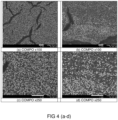
- the slurry prepared with the metal-coordination complex showed a more homogeneous distribution of the particles (LiNiCoMnO2 appears brighter than Carbon on backscatter images due to its higher atomic mass) with the white LiNiCoMnO2 evenly distributed ( FIG 4a and FIG 4c ) in a repeatable pattern that is not replicated in the slurry prepared without the metal-coordination complex ( FIG 4b and FIG 4d ).
- Silicon (Si) nanopowder (100 nm in size) was purchased from MTI Corporation, USA.
- a 20% w/v silicon nanoparticle slurry was prepared by mixing the dry silicon nanopowder with a pH 4.3 7.5% isopropanol solution in ddH 2 O. The slurry was placed under vacuum for 5 minutes before 100 mM metal-coordination complex solution was added.
- the flask was heated to 40°C and the slurry was mixed at 400 rpm for 5 minutes by a mechanical overhead mixer. After mixing, the solution was vacuumed for another 10 minutes.
- the slurry was further allowed to mix at 40°C at 400 rpm overnight.
- the slurry was centrifuged at 10,000 g for 10 minutes to separate the solids from the solution.
- 70% of supernatant was removed from the starting volume and was replaced with ddH 2 O at pH 4.3.
- the pellet was resuspended using physical agitation and bath sonication for 10 minutes.
- This wash step was repeated and following a third centrifugation step the supernatant was removed from the solution.
- ddH 2 O at pH 4.3 was added to the slurry until a 20% w/v solid content was reached.
- the slurry was bath sonicated for another 10 minutes to fully disperse the particles.
- Various concentrations of metal-coordination complex solutions combined with no or various number of wash steps can be used to coat the Si nanoparticles.
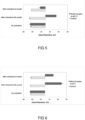
- Silicon nanoparticles as described above were either coated with metal coordination complexes or treated with ddH 2 O (Control) using probe sonication. After centrifuging at 10000 rpm for 10 mins, the supernatant was removed and particles were re-dispersed with ddH 2 O using probe sonication. This wash step was repeated total of 3 times and metal-coordination complex activated and non-activated particles were measured for size and zeta potential using a zeta sizer.
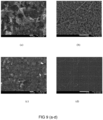
- FIG 5 and FIG 6 show the zeta potential data of silicon nanoparticles treated with two metal-coordination complex formulations, formed at pH 3.7 and pH 5.0, respectively.
- Si particles have a negative zeta potential as would be expected from the presence of electronegative Si-OH groups.
- Metal-coordination complexes are electropositive and in effectively coating electronegative particles can form a net electropositive particle. The stability of these particles under rigorous washing can be seen between FIGs 5 and 6 .
- Metal-coordination complexes adjusted to pH 5.0 generate a stable electropositive Si nanoparticle with the potential to coordinate to other particles or binders.
- pH 3.7 there is still metal-coordination complex on the silicon nanoparticle as shown by the decrease in electronegativity of the silicon nanoparticle.
- Metal-coordination complex-coated silicon nanoparticles as prepared above as well as untreated silicon nanoparticles were mixed with TIMCAL Graphite & Super P Conductive Carbon Black, purchased from MTI Corporation, USA and Poly(acrylic acid) (PAA) average M w 450,000D, purchased from Sigma-Aldrich, USA.
- the silicon nanoparticles (with or without metal-coordination complex) were transferred into a side arm flask with magnetic stirrer bar.
- a mass of Super P Carbon equal to the dry weight of silicon nanoparticles was also transferred into the same flask.
- the slurry was diluted to 15% w/v solid content by adding 15% isopropanol in ddH 2 O.
- the slurry flask was placed on a heated stirrer and mixed at 40°C at 400rpm for 5 minutes. The flask was placed under vacuum and continued mixing for another 5 minutes. The vacuum apparatus was removed and the slurry was left to mix for another hour. 450kDa poly(acrylic acid) equivalent to half the mass of Super P Carbon was weighed out and added to the slurry. The slurry was allowed to mix overnight at 40°C at 400rpm. This gave a slurry with a ratio of Si : Super-P : PAA at 40:40:20 (wt%). The amounts of Si, Super-P and PAA can be adjusted to give different ratios comprising the slurries.
- Metal-coordination complex-coated silicon nanoparticles (100nm), and a battery slurry with a ratio of Si : Super-P : PAA of 40:40:20 (wt%) were prepared as outlined in Example 5.
- the amounts of Si, Super-P and PAA can be adjusted to give different formulations of slurries
- Si slurries were cast onto copper (Cu) foil which was used as the current collector to form a Si electrode (reference electrode).
- the Si electrode was then dried under vacuum, calendered and cut for coin cell assembly.
- the analogous Si electrode with uncoated Si as the active material was also fabricated and used as a control which had similar mass loadings (2.22-2.37 mg/cm 2 ) as the metal-coordination complex coated Si electrode.
- the C rates were based on the mass of Si particles in the electrodes.
- the voltage range for charge/discharge tests was 0.005-1.50 V vs. Li.
- the charge/discharge tests were conducted on Neware multi-channel battery testers controlled by a computer. Three replicate cells were made and tested for each condition.
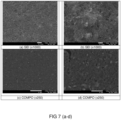
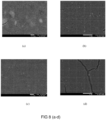
- FIG 8 shows the secondary electron images (SEI) and backscatter images (COMPO) respectively for the Si (100 nm) electrode tapes, with (c and d) and without (a and b) metal-ligand complex, after casting slurries onto Cu-foil substrate.
- SEI secondary electron images
- COMPO backscatter images
- FIG 9 shows the differences in surface morphology and electrode structure, with (c and d) and without (a and b) metal-coordination complex, for the electrode samples after hundreds of deep charge/discharge cycles. It can be seen that the electrode structure of the metal-coordination complex sample is better maintained, while the control sample shows more fragmentation and pulverisation of the particles. This indicates the advantages which flow both from the improved homogeneity of the composite precursor formulation and from the inclusion of the metal-coordination complex in the final composite material thereby formed.
- FIG 10 shows cross-sections for the metal-coordination complex (b) and control samples (a) after repetitive charge/discharge cycles.
- the electrode structure and integrity of the metal-coordination complex sample is significantly better maintained.
- the copper foil (top) has delaminated from the silicon active materials in the control sample while the electrode incorporating metal-coordination complex has the copper foil still binding to the silicon active materials.
- the metal-coordination complex incorporated cells (b) remain intact while those without metal-coordination complex (a) show significant cracking and ease of removal from the copper foil.
- FIG 12 (a), (b), (c) and (d) are SEM images of (a) 100x, (c) 250x, SEI mode of a dismantled electrode formed with metal-coordination complex and (b) 100x, (d) 250x SEI mode of a dismantled electrode formed in a similar manner but without metal-coordination complex.
- the images on samples with metal-coordination complex display a hair-like structure corresponding to the battery separator made of fibres of polypropylene/polyethylene. In contrast, little or no separator fibres were observed when metal-coordination complex was not used. This indicates there is strong binding between the active material and the separator in the presence of the metal-coordination complex.
- Example 7 Fabrication and testing of LiNiCoMnO2 cathode with & without metal-complex in coin cells
- Metal-coordination complex coated lithium metal oxide slurries were prepared as outlined in Example 4, and sent for electrode fabrication and coin cell assembly.
- the slurries were cast with a mass loading of 13 mg/cm2 onto Aluminum (Al) foil which was used as the current collector to form LiNiCoMnO 2 electrodes.
- Each LiNiCoMnO 2 electrode was then dried under vacuum, calendered and cut for coin cell assembly.
- the C rates were based on the mass of Si particles in the electrodes.
- the voltage range for charge/discharge tests was 2.5-4.2 V vs. Li.
- the charge/discharge tests were conducted on Neware multi-channel battery testers controlled by a computer. Three replicate cells were made and tested for each condition.
- LiNiCoMnO2 cathode electrodes were removed and analysed using Scanning Electron Microscopy (SEM) imaging and Energy Dispersive X-ray Spectroscopy (EDS) as described in Example 6.
- SEM Scanning Electron Microscopy
- EDS Energy Dispersive X-ray Spectroscopy
- the metal-coordination complex incorporated cells (a) remain intact with residual separator material (white patches) while the control without metal-coordination complex (b) cracked and the majority of material simply dropped off the aluminium foil.
- FIG 14 (a) and (b) are SEM images of LiNiCoMnO 2 materials at 100x SEI mode of a dismantled electrode formed with (a) and without (b) metal-coordination complex.
- the uncoated fragments After leaving the wafers to cool to RT, they were tilted whereupon it was observed the uncoated fragments immediately slid off the bottom wafer i.e. the temperature treatment alone did not result in any interface binding. The metal-ligand coated fragments did not slide off until the bottom wafer was tilted to almost 90°. Considering the metal-coordination complex forms only nanometre thin films, the difference in binding strength compared to uncoated controls to hold these wafers is significant and, it is believed, can be improved with more intimate incorporation of the metal-coordination complex into the films and interfaces.
Landscapes
- Chemical & Material Sciences (AREA)
- Chemical Kinetics & Catalysis (AREA)
- Electrochemistry (AREA)
- General Chemical & Material Sciences (AREA)
- Composite Materials (AREA)
- Inorganic Chemistry (AREA)
- Engineering & Computer Science (AREA)
- Manufacturing & Machinery (AREA)
- Materials Engineering (AREA)
- Battery Electrode And Active Subsutance (AREA)
- Conductive Materials (AREA)
- Inorganic Compounds Of Heavy Metals (AREA)
- Silicon Compounds (AREA)
- Electric Double-Layer Capacitors Or The Like (AREA)
- Cell Electrode Carriers And Collectors (AREA)
- Cosmetics (AREA)
- Powder Metallurgy (AREA)
- Prevention Of Electric Corrosion (AREA)
Applications Claiming Priority (3)
| Application Number | Priority Date | Filing Date | Title |
|---|---|---|---|
| AU2016901142A AU2016901142A0 (en) | 2016-03-29 | Interface binding | |
| AU2016901140A AU2016901140A0 (en) | 2016-03-29 | Composites | |
| PCT/AU2017/050269 WO2017165916A1 (en) | 2016-03-29 | 2017-03-29 | Conductive composites |
Publications (4)
| Publication Number | Publication Date |
|---|---|
| EP3437147A1 EP3437147A1 (en) | 2019-02-06 |
| EP3437147A4 EP3437147A4 (en) | 2019-12-04 |
| EP3437147C0 EP3437147C0 (en) | 2025-05-14 |
| EP3437147B1 true EP3437147B1 (en) | 2025-05-14 |
Family
ID=59962335
Family Applications (1)
| Application Number | Title | Priority Date | Filing Date |
|---|---|---|---|
| EP17772874.8A Active EP3437147B1 (en) | 2016-03-29 | 2017-03-29 | Conductive composites |
Country Status (13)
| Country | Link |
|---|---|
| US (1) | US10930925B2 (enExample) |
| EP (1) | EP3437147B1 (enExample) |
| JP (1) | JP7105194B2 (enExample) |
| KR (1) | KR102455017B1 (enExample) |
| CN (1) | CN109196693B (enExample) |
| AU (1) | AU2017243872B2 (enExample) |
| HU (1) | HUE072726T2 (enExample) |
| IL (1) | IL261974B (enExample) |
| MX (1) | MX2018011847A (enExample) |
| MY (1) | MY196230A (enExample) |
| PL (1) | PL3437147T3 (enExample) |
| SG (2) | SG11201808296RA (enExample) |
| WO (1) | WO2017165916A1 (enExample) |
Families Citing this family (4)
| Publication number | Priority date | Publication date | Assignee | Title |
|---|---|---|---|---|
| US20170333886A1 (en) * | 2016-05-05 | 2017-11-23 | University Of North Texas | Metal-inorganic frameworks |
| KR102150999B1 (ko) * | 2018-12-20 | 2020-09-02 | 광주과학기술원 | 인시츄(in-situ) 중합된 전도성 고분자층을 함유하는 리튬-칼코겐 이차전지의 제조방법 및 이로부터 제조된 리튬-칼코겐 이차전지 |
| JP2023522129A (ja) * | 2020-04-08 | 2023-05-26 | アンテオ エナジー テクノロジー プロプライエタリー リミテッド | 硬化導電性結合剤材料、その使用及びその形成方法 |
| WO2021203169A1 (en) * | 2020-04-08 | 2021-10-14 | Anteo Energy Technology Pty Ltd | Composite particle and method of forming same |
Citations (2)
| Publication number | Priority date | Publication date | Assignee | Title |
|---|---|---|---|---|
| US20120156577A1 (en) * | 2010-08-20 | 2012-06-21 | Massachusetts Institute Of Technology | Methods for forming electrodes for water electrolysis and other electrochemical techniques |
| EP3286789B1 (en) * | 2015-04-20 | 2021-11-03 | Anteo Technologies Pty Ltd. | A composition |
Family Cites Families (19)
| Publication number | Priority date | Publication date | Assignee | Title |
|---|---|---|---|---|
| US5324457A (en) * | 1989-10-02 | 1994-06-28 | Board Of Regents, The University Of Tx System | Devices and methods for generating electrogenerated chemiluminescence |
| CN1224537A (zh) * | 1996-06-14 | 1999-07-28 | 联合米尼埃尔股份有限公司 | 可充电电池的电极材料及其制备方法 |
| US6881520B1 (en) | 1996-06-14 | 2005-04-19 | N.V. Umicore S.A. | Electrode material for rechargeable batteries and process for the preparation thereof |
| US6322744B1 (en) * | 1999-02-17 | 2001-11-27 | Valence Technology, Inc. | Lithium manganese oxide-based active material |
| JP2002164084A (ja) * | 2000-11-27 | 2002-06-07 | Matsushita Electric Ind Co Ltd | リチウム電池およびその製造方法 |
| JP4135348B2 (ja) * | 2001-10-03 | 2008-08-20 | 株式会社ジーエス・ユアサコーポレーション | 非水電解質電池 |
| JP4077646B2 (ja) | 2002-04-05 | 2008-04-16 | メルク株式会社 | 非水電解質二次電池用正極活物質及びその製造方法 |
| JP4656653B2 (ja) * | 2003-10-27 | 2011-03-23 | 三井造船株式会社 | 二次電池用正極材料、二次電池用正極材料の製造方法、および二次電池 |
| WO2006002472A1 (en) * | 2004-07-02 | 2006-01-12 | Bio-Layer Pty Ltd | Use of metal complexes |
| KR100846477B1 (ko) * | 2005-01-21 | 2008-07-17 | 삼성에스디아이 주식회사 | 탄소-금속 복합재료 및 그의 제조방법 |
| JP5468723B2 (ja) * | 2006-12-19 | 2014-04-09 | Necエナジーデバイス株式会社 | 非水電解質二次電池用負極およびそれを用いた非水電解質二次電池 |
| EP2180539A1 (en) * | 2008-10-21 | 2010-04-28 | Commissariat à l'Energie Atomique | Novel materials and their use for the electrocatalytic evolution or uptake of H2 |
| JP5347522B2 (ja) * | 2009-01-20 | 2013-11-20 | Tdk株式会社 | 活物質及び電極の製造方法、活物質及び電極 |
| JP5360485B2 (ja) * | 2009-09-16 | 2013-12-04 | 株式会社豊田自動織機 | リチウムイオン二次電池用負極及びその製造方法 |
| JP5675113B2 (ja) * | 2010-01-06 | 2015-02-25 | 三洋電機株式会社 | 非水電解質二次電池及び非水電解質二次電池用正極 |
| KR101309157B1 (ko) * | 2011-02-16 | 2013-09-17 | 삼성에스디아이 주식회사 | 리튬 이차 전지용 전해액 및 이를 포함하는 리튬 이차 전지 |
| CN103999267B (zh) * | 2011-12-14 | 2017-09-01 | 尤米科尔公司 | 用于锂离子电池的带正电荷的硅 |
| US20170077503A1 (en) * | 2014-03-05 | 2017-03-16 | A123 Systems, LLC | Multivalent metal salts for lithium ion cells having oxygen containing electrode active materials |
| PL3343677T3 (pl) * | 2016-06-02 | 2023-10-30 | Lg Energy Solution, Ltd. | Materiał aktywny katody, zawierająca go katoda i zawierająca go litowa bateria akumulatorowa |
-
2017
- 2017-03-29 KR KR1020187031168A patent/KR102455017B1/ko active Active
- 2017-03-29 HU HUE17772874A patent/HUE072726T2/hu unknown
- 2017-03-29 PL PL17772874.8T patent/PL3437147T3/pl unknown
- 2017-03-29 CN CN201780033147.2A patent/CN109196693B/zh active Active
- 2017-03-29 AU AU2017243872A patent/AU2017243872B2/en active Active
- 2017-03-29 JP JP2018551253A patent/JP7105194B2/ja active Active
- 2017-03-29 US US16/089,594 patent/US10930925B2/en active Active
- 2017-03-29 SG SG11201808296RA patent/SG11201808296RA/en unknown
- 2017-03-29 SG SG10202007600TA patent/SG10202007600TA/en unknown
- 2017-03-29 EP EP17772874.8A patent/EP3437147B1/en active Active
- 2017-03-29 MX MX2018011847A patent/MX2018011847A/es unknown
- 2017-03-29 MY MYPI2018001623A patent/MY196230A/en unknown
- 2017-03-29 WO PCT/AU2017/050269 patent/WO2017165916A1/en not_active Ceased
-
2018
- 2018-09-26 IL IL261974A patent/IL261974B/en unknown
Patent Citations (2)
| Publication number | Priority date | Publication date | Assignee | Title |
|---|---|---|---|---|
| US20120156577A1 (en) * | 2010-08-20 | 2012-06-21 | Massachusetts Institute Of Technology | Methods for forming electrodes for water electrolysis and other electrochemical techniques |
| EP3286789B1 (en) * | 2015-04-20 | 2021-11-03 | Anteo Technologies Pty Ltd. | A composition |
Also Published As
| Publication number | Publication date |
|---|---|
| EP3437147C0 (en) | 2025-05-14 |
| CN109196693B (zh) | 2022-06-10 |
| JP2019512856A (ja) | 2019-05-16 |
| SG11201808296RA (en) | 2018-10-30 |
| KR102455017B1 (ko) | 2022-10-14 |
| EP3437147A1 (en) | 2019-02-06 |
| IL261974B (en) | 2021-12-01 |
| HUE072726T2 (hu) | 2025-12-28 |
| KR20180128469A (ko) | 2018-12-03 |
| PL3437147T3 (pl) | 2025-09-15 |
| MX2018011847A (es) | 2019-02-07 |
| AU2017243872B2 (en) | 2023-01-19 |
| SG10202007600TA (en) | 2020-09-29 |
| JP7105194B2 (ja) | 2022-07-22 |
| MY196230A (en) | 2023-03-24 |
| BR112018069589A2 (pt) | 2019-01-22 |
| US10930925B2 (en) | 2021-02-23 |
| CN109196693A (zh) | 2019-01-11 |
| AU2017243872A1 (en) | 2018-10-11 |
| WO2017165916A1 (en) | 2017-10-05 |
| US20190109325A1 (en) | 2019-04-11 |
| IL261974A (en) | 2018-10-31 |
| EP3437147A4 (en) | 2019-12-04 |
Similar Documents
| Publication | Publication Date | Title |
|---|---|---|
| EP3286789B1 (en) | A composition | |
| JP2010219048A (ja) | 開放多孔質電気伝導性ナノ複合材料 | |
| WO2013085498A1 (en) | Carbon nanotube based pastes | |
| AU2017243872B2 (en) | Conductive composites | |
| US20220190324A1 (en) | Nanoparticles having polythionate cores | |
| US20240170672A1 (en) | Curable binder formulation | |
| US20230170468A1 (en) | Cured conductive binder material, uses thereof and methods of forming same | |
| Wei et al. | Directionally assembled MoS2 with significantly expanded interlayer spacing: a superior anode material for high-rate lithium-ion batteries | |
| Hu et al. | Water-Soluble Polymer Assists Multisize Three-Dimensional Microspheres as a High-Performance Si Anode for Lithium-Ion Batteries | |
| Santhoshkumar et al. | Potential core-shell anode material for rechargeable lithium-ion batteries: Encapsulation of titanium oxide nanostructure in conductive polymer | |
| HK1260061B (en) | Conductive composites | |
| HK1260061A1 (en) | Conductive composites | |
| BR112018069589B1 (pt) | Método de fabricação de um eletrodo e eletrodo | |
| KR20260043227A (ko) | 전극 제조 방법, 이에 의해 제조된 전극, 및 이를 포함하는 리튬 이차 전지 | |
| EP4497163A2 (en) | Lithium sulfur battery electrode process | |
| BR112017022513B1 (pt) | Eletrodo, célula eletroquímica e método para a fabricação de um eletrodo | |
| HK1242475A1 (en) | A composition | |
| HK1242475B (en) | A composition |
Legal Events
| Date | Code | Title | Description |
|---|---|---|---|
| STAA | Information on the status of an ep patent application or granted ep patent |
Free format text: STATUS: THE INTERNATIONAL PUBLICATION HAS BEEN MADE |
|
| PUAI | Public reference made under article 153(3) epc to a published international application that has entered the european phase |
Free format text: ORIGINAL CODE: 0009012 |
|
| STAA | Information on the status of an ep patent application or granted ep patent |
Free format text: STATUS: REQUEST FOR EXAMINATION WAS MADE |
|
| 17P | Request for examination filed |
Effective date: 20181008 |
|
| AK | Designated contracting states |
Kind code of ref document: A1 Designated state(s): AL AT BE BG CH CY CZ DE DK EE ES FI FR GB GR HR HU IE IS IT LI LT LU LV MC MK MT NL NO PL PT RO RS SE SI SK SM TR |
|
| AX | Request for extension of the european patent |
Extension state: BA ME |
|
| DAV | Request for validation of the european patent (deleted) | ||
| DAX | Request for extension of the european patent (deleted) | ||
| A4 | Supplementary search report drawn up and despatched |
Effective date: 20191104 |
|
| RIC1 | Information provided on ipc code assigned before grant |
Ipc: H01M 4/62 20060101ALI20191028BHEP Ipc: H01M 4/38 20060101ALI20191028BHEP Ipc: H01M 10/0525 20100101ALN20191028BHEP Ipc: H01M 4/36 20060101AFI20191028BHEP |
|
| STAA | Information on the status of an ep patent application or granted ep patent |
Free format text: STATUS: EXAMINATION IS IN PROGRESS |
|
| 17Q | First examination report despatched |
Effective date: 20201008 |
|
| RAP1 | Party data changed (applicant data changed or rights of an application transferred) |
Owner name: ANTEO ENERGY TECHNOLOGY PTY LTD. |
|
| GRAP | Despatch of communication of intention to grant a patent |
Free format text: ORIGINAL CODE: EPIDOSNIGR1 |
|
| STAA | Information on the status of an ep patent application or granted ep patent |
Free format text: STATUS: GRANT OF PATENT IS INTENDED |
|
| RIC1 | Information provided on ipc code assigned before grant |
Ipc: H01M 10/0525 20100101ALN20241111BHEP Ipc: H01M 4/62 20060101ALI20241111BHEP Ipc: H01M 4/38 20060101ALI20241111BHEP Ipc: H01M 4/36 20060101AFI20241111BHEP |
|
| INTG | Intention to grant announced |
Effective date: 20241204 |
|
| GRAS | Grant fee paid |
Free format text: ORIGINAL CODE: EPIDOSNIGR3 |
|
| GRAA | (expected) grant |
Free format text: ORIGINAL CODE: 0009210 |
|
| STAA | Information on the status of an ep patent application or granted ep patent |
Free format text: STATUS: THE PATENT HAS BEEN GRANTED |
|
| AK | Designated contracting states |
Kind code of ref document: B1 Designated state(s): AL AT BE BG CH CY CZ DE DK EE ES FI FR GB GR HR HU IE IS IT LI LT LU LV MC MK MT NL NO PL PT RO RS SE SI SK SM TR |
|
| REG | Reference to a national code |
Ref country code: GB Ref legal event code: FG4D |
|
| REG | Reference to a national code |
Ref country code: CH Ref legal event code: EP |
|
| REG | Reference to a national code |
Ref country code: DE Ref legal event code: R096 Ref document number: 602017089464 Country of ref document: DE |
|
| REG | Reference to a national code |
Ref country code: IE Ref legal event code: FG4D |
|
| U01 | Request for unitary effect filed |
Effective date: 20250611 |
|
| U07 | Unitary effect registered |
Designated state(s): AT BE BG DE DK EE FI FR IT LT LU LV MT NL PT RO SE SI Effective date: 20250617 |
|
| PG25 | Lapsed in a contracting state [announced via postgrant information from national office to epo] |
Ref country code: ES Free format text: LAPSE BECAUSE OF FAILURE TO SUBMIT A TRANSLATION OF THE DESCRIPTION OR TO PAY THE FEE WITHIN THE PRESCRIBED TIME-LIMIT Effective date: 20250514 |
|
| PG25 | Lapsed in a contracting state [announced via postgrant information from national office to epo] |
Ref country code: NO Free format text: LAPSE BECAUSE OF FAILURE TO SUBMIT A TRANSLATION OF THE DESCRIPTION OR TO PAY THE FEE WITHIN THE PRESCRIBED TIME-LIMIT Effective date: 20250814 Ref country code: GR Free format text: LAPSE BECAUSE OF FAILURE TO SUBMIT A TRANSLATION OF THE DESCRIPTION OR TO PAY THE FEE WITHIN THE PRESCRIBED TIME-LIMIT Effective date: 20250815 |
|
| PG25 | Lapsed in a contracting state [announced via postgrant information from national office to epo] |
Ref country code: HR Free format text: LAPSE BECAUSE OF FAILURE TO SUBMIT A TRANSLATION OF THE DESCRIPTION OR TO PAY THE FEE WITHIN THE PRESCRIBED TIME-LIMIT Effective date: 20250514 |
|
| PG25 | Lapsed in a contracting state [announced via postgrant information from national office to epo] |
Ref country code: RS Free format text: LAPSE BECAUSE OF FAILURE TO SUBMIT A TRANSLATION OF THE DESCRIPTION OR TO PAY THE FEE WITHIN THE PRESCRIBED TIME-LIMIT Effective date: 20250814 |
|
| PG25 | Lapsed in a contracting state [announced via postgrant information from national office to epo] |
Ref country code: IS Free format text: LAPSE BECAUSE OF FAILURE TO SUBMIT A TRANSLATION OF THE DESCRIPTION OR TO PAY THE FEE WITHIN THE PRESCRIBED TIME-LIMIT Effective date: 20250914 |
|
| REG | Reference to a national code |
Ref country code: HU Ref legal event code: AG4A Ref document number: E072726 Country of ref document: HU |
|
| PG25 | Lapsed in a contracting state [announced via postgrant information from national office to epo] |
Ref country code: SM Free format text: LAPSE BECAUSE OF FAILURE TO SUBMIT A TRANSLATION OF THE DESCRIPTION OR TO PAY THE FEE WITHIN THE PRESCRIBED TIME-LIMIT Effective date: 20250514 |
|
| PG25 | Lapsed in a contracting state [announced via postgrant information from national office to epo] |
Ref country code: CZ Free format text: LAPSE BECAUSE OF FAILURE TO SUBMIT A TRANSLATION OF THE DESCRIPTION OR TO PAY THE FEE WITHIN THE PRESCRIBED TIME-LIMIT Effective date: 20250514 |
|
| PG25 | Lapsed in a contracting state [announced via postgrant information from national office to epo] |
Ref country code: SK Free format text: LAPSE BECAUSE OF FAILURE TO SUBMIT A TRANSLATION OF THE DESCRIPTION OR TO PAY THE FEE WITHIN THE PRESCRIBED TIME-LIMIT Effective date: 20250514 |
|
| PLBE | No opposition filed within time limit |
Free format text: ORIGINAL CODE: 0009261 |
|
| STAA | Information on the status of an ep patent application or granted ep patent |
Free format text: STATUS: NO OPPOSITION FILED WITHIN TIME LIMIT |
|
| REG | Reference to a national code |
Ref country code: CH Ref legal event code: L10 Free format text: ST27 STATUS EVENT CODE: U-0-0-L10-L00 (AS PROVIDED BY THE NATIONAL OFFICE) Effective date: 20260325 |
|
| U20 | Renewal fee for the european patent with unitary effect paid |
Year of fee payment: 10 Effective date: 20260223 |
|
| PGFP | Annual fee paid to national office [announced via postgrant information from national office to epo] |
Ref country code: HU Payment date: 20260320 Year of fee payment: 10 |
|
| 26N | No opposition filed |
Effective date: 20260217 |
|
| PGFP | Annual fee paid to national office [announced via postgrant information from national office to epo] |
Ref country code: PL Payment date: 20260323 Year of fee payment: 10 |