EP3424913B1 - 2,3-epoxidsuccinyl-derivat, herstellungsverfahren dafür und verwendung davon - Google Patents
2,3-epoxidsuccinyl-derivat, herstellungsverfahren dafür und verwendung davon Download PDFInfo
- Publication number
- EP3424913B1 EP3424913B1 EP17759268.0A EP17759268A EP3424913B1 EP 3424913 B1 EP3424913 B1 EP 3424913B1 EP 17759268 A EP17759268 A EP 17759268A EP 3424913 B1 EP3424913 B1 EP 3424913B1
- Authority
- EP
- European Patent Office
- Prior art keywords
- compound
- solvate
- racemate
- pharmaceutically acceptable
- acceptable salt
- Prior art date
- Legal status (The legal status is an assumption and is not a legal conclusion. Google has not performed a legal analysis and makes no representation as to the accuracy of the status listed.)
- Active
Links
Classifications
-
- C—CHEMISTRY; METALLURGY
- C07—ORGANIC CHEMISTRY
- C07D—HETEROCYCLIC COMPOUNDS
- C07D303/00—Compounds containing three-membered rings having one oxygen atom as the only ring hetero atom
- C07D303/02—Compounds containing oxirane rings
- C07D303/48—Compounds containing oxirane rings with hetero atoms or with carbon atoms having three bonds to hetero atoms with at the most one bond to halogen, directly attached to ring carbon atoms, e.g. ester or nitrile radicals
-
- A—HUMAN NECESSITIES
- A61—MEDICAL OR VETERINARY SCIENCE; HYGIENE
- A61K—PREPARATIONS FOR MEDICAL, DENTAL OR TOILETRY PURPOSES
- A61K31/00—Medicinal preparations containing organic active ingredients
- A61K31/33—Heterocyclic compounds
- A61K31/335—Heterocyclic compounds having oxygen as the only ring hetero atom, e.g. fungichromin
- A61K31/336—Heterocyclic compounds having oxygen as the only ring hetero atom, e.g. fungichromin having three-membered rings, e.g. oxirane, fumagillin
-
- A—HUMAN NECESSITIES
- A61—MEDICAL OR VETERINARY SCIENCE; HYGIENE
- A61K—PREPARATIONS FOR MEDICAL, DENTAL OR TOILETRY PURPOSES
- A61K31/00—Medicinal preparations containing organic active ingredients
- A61K31/33—Heterocyclic compounds
- A61K31/395—Heterocyclic compounds having nitrogen as a ring hetero atom, e.g. guanethidine or rifamycins
- A61K31/40—Heterocyclic compounds having nitrogen as a ring hetero atom, e.g. guanethidine or rifamycins having five-membered rings with one nitrogen as the only ring hetero atom, e.g. sulpiride, succinimide, tolmetin, buflomedil
- A61K31/4025—Heterocyclic compounds having nitrogen as a ring hetero atom, e.g. guanethidine or rifamycins having five-membered rings with one nitrogen as the only ring hetero atom, e.g. sulpiride, succinimide, tolmetin, buflomedil not condensed and containing further heterocyclic rings, e.g. cromakalim
-
- A—HUMAN NECESSITIES
- A61—MEDICAL OR VETERINARY SCIENCE; HYGIENE
- A61K—PREPARATIONS FOR MEDICAL, DENTAL OR TOILETRY PURPOSES
- A61K31/00—Medicinal preparations containing organic active ingredients
- A61K31/33—Heterocyclic compounds
- A61K31/395—Heterocyclic compounds having nitrogen as a ring hetero atom, e.g. guanethidine or rifamycins
- A61K31/41—Heterocyclic compounds having nitrogen as a ring hetero atom, e.g. guanethidine or rifamycins having five-membered rings with two or more ring hetero atoms, at least one of which being nitrogen, e.g. tetrazole
- A61K31/425—Thiazoles
- A61K31/427—Thiazoles not condensed and containing further heterocyclic rings
-
- A—HUMAN NECESSITIES
- A61—MEDICAL OR VETERINARY SCIENCE; HYGIENE
- A61K—PREPARATIONS FOR MEDICAL, DENTAL OR TOILETRY PURPOSES
- A61K31/00—Medicinal preparations containing organic active ingredients
- A61K31/33—Heterocyclic compounds
- A61K31/395—Heterocyclic compounds having nitrogen as a ring hetero atom, e.g. guanethidine or rifamycins
- A61K31/435—Heterocyclic compounds having nitrogen as a ring hetero atom, e.g. guanethidine or rifamycins having six-membered rings with one nitrogen as the only ring hetero atom
- A61K31/44—Non condensed pyridines; Hydrogenated derivatives thereof
- A61K31/445—Non condensed piperidines, e.g. piperocaine
- A61K31/4523—Non condensed piperidines, e.g. piperocaine containing further heterocyclic ring systems
-
- A—HUMAN NECESSITIES
- A61—MEDICAL OR VETERINARY SCIENCE; HYGIENE
- A61K—PREPARATIONS FOR MEDICAL, DENTAL OR TOILETRY PURPOSES
- A61K31/00—Medicinal preparations containing organic active ingredients
- A61K31/33—Heterocyclic compounds
- A61K31/395—Heterocyclic compounds having nitrogen as a ring hetero atom, e.g. guanethidine or rifamycins
- A61K31/535—Heterocyclic compounds having nitrogen as a ring hetero atom, e.g. guanethidine or rifamycins having six-membered rings with at least one nitrogen and one oxygen as the ring hetero atoms, e.g. 1,2-oxazines
- A61K31/5375—1,4-Oxazines, e.g. morpholine
- A61K31/5377—1,4-Oxazines, e.g. morpholine not condensed and containing further heterocyclic rings, e.g. timolol
-
- A—HUMAN NECESSITIES
- A61—MEDICAL OR VETERINARY SCIENCE; HYGIENE
- A61K—PREPARATIONS FOR MEDICAL, DENTAL OR TOILETRY PURPOSES
- A61K31/00—Medicinal preparations containing organic active ingredients
- A61K31/33—Heterocyclic compounds
- A61K31/395—Heterocyclic compounds having nitrogen as a ring hetero atom, e.g. guanethidine or rifamycins
- A61K31/54—Heterocyclic compounds having nitrogen as a ring hetero atom, e.g. guanethidine or rifamycins having six-membered rings with at least one nitrogen and one sulfur as the ring hetero atoms, e.g. sulthiame
- A61K31/541—Non-condensed thiazines containing further heterocyclic rings
-
- A—HUMAN NECESSITIES
- A61—MEDICAL OR VETERINARY SCIENCE; HYGIENE
- A61P—SPECIFIC THERAPEUTIC ACTIVITY OF CHEMICAL COMPOUNDS OR MEDICINAL PREPARATIONS
- A61P19/00—Drugs for skeletal disorders
-
- A—HUMAN NECESSITIES
- A61—MEDICAL OR VETERINARY SCIENCE; HYGIENE
- A61P—SPECIFIC THERAPEUTIC ACTIVITY OF CHEMICAL COMPOUNDS OR MEDICINAL PREPARATIONS
- A61P35/00—Antineoplastic agents
-
- A—HUMAN NECESSITIES
- A61—MEDICAL OR VETERINARY SCIENCE; HYGIENE
- A61P—SPECIFIC THERAPEUTIC ACTIVITY OF CHEMICAL COMPOUNDS OR MEDICINAL PREPARATIONS
- A61P37/00—Drugs for immunological or allergic disorders
- A61P37/02—Immunomodulators
-
- C—CHEMISTRY; METALLURGY
- C07—ORGANIC CHEMISTRY
- C07D—HETEROCYCLIC COMPOUNDS
- C07D301/00—Preparation of oxiranes
-
- C—CHEMISTRY; METALLURGY
- C07—ORGANIC CHEMISTRY
- C07D—HETEROCYCLIC COMPOUNDS
- C07D301/00—Preparation of oxiranes
- C07D301/27—Condensation of epihalohydrins or halohydrins with compounds containing active hydrogen atoms
-
- C—CHEMISTRY; METALLURGY
- C07—ORGANIC CHEMISTRY
- C07D—HETEROCYCLIC COMPOUNDS
- C07D405/00—Heterocyclic compounds containing both one or more hetero rings having oxygen atoms as the only ring hetero atoms, and one or more rings having nitrogen as the only ring hetero atom
- C07D405/02—Heterocyclic compounds containing both one or more hetero rings having oxygen atoms as the only ring hetero atoms, and one or more rings having nitrogen as the only ring hetero atom containing two hetero rings
- C07D405/12—Heterocyclic compounds containing both one or more hetero rings having oxygen atoms as the only ring hetero atoms, and one or more rings having nitrogen as the only ring hetero atom containing two hetero rings linked by a chain containing hetero atoms as chain links
-
- C—CHEMISTRY; METALLURGY
- C07—ORGANIC CHEMISTRY
- C07D—HETEROCYCLIC COMPOUNDS
- C07D417/00—Heterocyclic compounds containing two or more hetero rings, at least one ring having nitrogen and sulfur atoms as the only ring hetero atoms, not provided for by group C07D415/00
- C07D417/02—Heterocyclic compounds containing two or more hetero rings, at least one ring having nitrogen and sulfur atoms as the only ring hetero atoms, not provided for by group C07D415/00 containing two hetero rings
- C07D417/12—Heterocyclic compounds containing two or more hetero rings, at least one ring having nitrogen and sulfur atoms as the only ring hetero atoms, not provided for by group C07D415/00 containing two hetero rings linked by a chain containing hetero atoms as chain links
Definitions
- the present invention belongs to medical field, in particular, relates to a 2,3-epoxy succinyl derivative compound according to Formula (1), a pharmaceutical composition containing said compound and the compound for use as a cathepsin inhibitor, for the treatment of tumor, osteoporosis, Ebola virus infection, rheumatoid arthritis and osteoarthritis, an autoimmune disease or a degenerative disease.
- Proteases are the major participants in the proteolysis in human body, and can be classified into serine proteases, cysteine proteases, aspartyl proteases, threonine proteases, metalloproteinases, etc. depending on proteolytic mechanism. Current studies mainly focus on cysteine proteases wherein papain-like cysteine proteases are the largest subfamily. Papain-like cysteine proteases in mammals belong to cathepsins.
- Cathepsins most members of which are present in lysosomes, can be activated in an acidic environment, and include most of the cysteine proteases, and a small number of aspartic proteases (Cathepsin D, E) and serine proteases (Cathepsin A, G). Depending on substrate specificity, cathepsins can also be classified into endopeptidases (Cathepsin B, F, H, K, L, S, V), exopeptidases (Cathepsin B, C, H, X), amino-peptidases (Cathepsin C, H) and carboxypeptidases (Cathepsin B, X).
- endopeptidases Cathepsin B, F, H, K, L, S, V
- exopeptidases Cathepsin B, C, H, X
- amino-peptidases Cathepsin C, H
- carboxypeptidases Cathepsin B, X
- Cathepsins in human body mainly include Cathepsin B, C, F, H, K, L, O, S, V, W and X, which are closely related to a variety of physiological and pathological processes in human body.
- Cathepsins are highly conservative in sequence, and their steric structure consists of two domains (i.e. L (Left) domain and R (Right) domain) that are almost the same size, and between the two domains, there is a V-shaped active site cleft, in which the active residues, such as Cys25 in the L domain and His159 and Asn175 in the R domain, are exposed.
- Cathepsin B which is one of the most studied enzyme among all cysteine proteases, is widely present in a variety of tissues in mammals, and is the first lysosomal protease that was found to be associated with breast cancer. In addition, Cathepsin B is also closely associated with the development and progression of a variety of human tumors. Tumor cells can secrete Cathepsin B. This secretory Cathepsin B cannot be uptaken by lysosomes due to the lack of a recognition marker for mannose-6-phosphate receptor, and therefore is generally present in the form of proenzyme in endochylema and extracellular region.
- tumor cells can acidify their surrounding environment, they can activate the proenzyme to form active Cathepsin B.
- the activated Cathepsin B can not only participate in the degradation of extracellular matrix components, but also activate the proteolysis cascade reaction, finally resulting in the generation of a substance capable of degrading a variety of extracellular matrix components.
- the activity of Cathepsin B secreted by tumor cells is not influenced, and is even enhanced in neutral and alkaline environments.
- Cathepsin B the expression level and/or activity of Cathepsin B was found to be increased in a variety of human and animal tumors such as gastric cancer, bladder cancer, colon cancer, neuroglioma, and melanoma. It was reported that in the tissues of malignant tumor such as cervical cancer, lung cancer, breast cancer, and prostate cancer, the expression and activity of Cathepsin B was 2 times or even 3 to 9 times higher than that of the adjacent normal tissues, and it was believed that an increase in the activity and concentration of Cathepsin B was a risk factor for tumor invasion, metastasis, and poor prognosis in patients with transitional cell carcinoma.
- Osteoporosis relates to a metabolic imbalance between bone resorption and bone formation, and is a disease developed when bone resorption exceeds bone formation. Osteoporosis is a common disease or a frequently-occurring disease found in old people, especially menopausal and postmenopausal women.
- osteoclasts are first attached to the bone surface so as to form a relatively sealed microenvironment for bone resorption, secrete protons and proteases, dissolve bone minerals, and then degrade bone matrix, resulting in bone void formation.
- Cathepsin K plays a major role.
- Cathepsin K is selectively and abundantly expressed in osteoclasts, and its physiological substrate is the type I collagen with a content of 95% in the organic bone matrix.
- Cathepsin K can also degrade osteopontin and osteonectin in bone matrix, and is a cysteine protease that is expressed in the highest level in osteoclasts and has the strongest osteolytic activity, and its ability of degrading bone collagen is much higher than that of other matrix metalloproteinases.
- Cathepsin K is a key enzyme during bone resorption, and is also a hotspot in osteoporosis research in recent years.
- Cathepsin L is also present in the resorption microenvironment formed by osteoclasts, and has a strong collagen-dissolving ability and is also directly involved in the degradation of bone matrix.
- Cathepsin B and S exhibit bone-resorption ability in vivo and in vitro, and are also associated with the development of osteoporosis.
- Rheumatoid arthritis is a chronic systemic autoimmune disease characterized by inflammation of synovial membrane of joint. Continuous recurrence of synovitis can lead to destruction of cartilage and bone in joint, joint dysfunction, and even disability.
- Osteoarthritis is a common disease causing joint pain, resulted from non-inflammatory lesions in movable joints due to the degeneration of articular cartilage and the formation of new bone on the surface and edge of joint.
- Cartilage contains two main components, one of which is type II collagen that can form a 3-D fiber network structure to make the tissue extensible, and the other of which is aggrecan that ensures the tenacity of cartilage, excessive degradation of either of the two protein components will lead to the cartilage destruction in joint.
- Cathepsin K may be the main participant in cartilage destruction in RA and OA.
- Cathepsin B and Cathepsin L were expressed in high levels in synovial membrane and synovial fluid of joints in RA patients, all the cathepsins appeared in the inflammatory joint could hydrolyze aggrecan, and Cathepsin B could also play an indirect role by participating in the proteolytic cascade reaction in the joint and activating matrix metalloproteinase precursor.
- Ebola virus infection is closely associated with the type I membrane-fusion protein GP encoded by a viral gene.
- the membrane-fusion protein GP consists of two subunits, GP1 and GP2.
- An Ebola virus particle has an enveloped helical nucleocapsid.
- An enveloped virus cannot replicate its pathogenic gene unless the envelope protein is fused with a host cell membrane or endosomal membrane.
- Cathepsin L can promote the invasion and metastasis of tumor by catalyzing the degradation of matrix membrane.
- Cathepsin L has been found to be highly expressed in various cancers such as kidney cancer, testicular cancer, breast cancer, ovarian cancer, colon cancer, bladder cancer and thyroid cancer.
- Cathepsin S also plays an important role in the pathogenesis of degenerative diseases and autoimmune diseases and is involved in the antigen presentation modulated by major histocompatibility complex class II molecules, and its overexpression is closely associated with tumor growth, angiogenesis, and metastasis.
- EP 0 655 447 A1 and WO 95/32954 A1 disclose epoxysuccinic acid derivatives as inhibitors for cathepsin L and B and prophylactic and therapeutic agents for bone diseases such as osteoporosis.
- EP 0 838 460 A1 discloses piperazine derivatives with cysteine protease inhibitory activity, inter alia, cathepsin L inhibitory activity and the use of such compounds for diseases associated with the activity of such proteases.
- WO 2008/042480 mentions epoxide inhibitors of cysteine proteases and their use as therapeutic agents for treating or preventing immune-related diseases, inflammatory diseases, tissue-modelling diseases, cancer or infectious diseases.
- the purpose of the present invention is to synthesize new cathepsin inhibitors for the treatment of a disease such as tumor, osteoporosis, arthritis, Ebola virus infection, rheumatoid arthritis, osteoarthritis, an autoimmune disease or a degenerative disease.
- a disease such as tumor, osteoporosis, arthritis, Ebola virus infection, rheumatoid arthritis, osteoarthritis, an autoimmune disease or a degenerative disease.
- the present invention has obtained a series of structurally novel derivatives having an epoxysuccinic acid structure, which have high inhibitory activity and/or selectivity against cathepsin (especially Cathepsin B).
- the present invention is accomplished based on the discovery above and is defined by the appended claims.
- the present invention relates to a compound represented by Formula (1), a racemate or an optical isomer thereof, a solvate thereof, or a pharmaceutically acceptable salt thereof, wherein,
- R 1 represents a hydrogen atom, C 1 -C 10 linear or branched alkyl, C 3 -C 10 cycloalkyl, C 2 -C 10 linear or branched alkenyl or C 2 -C 10 linear or branched alkynyl; preferably, R 1 represents a hydrogen atom, C 1 -C 6 linear or branched alkyl; preferably, R 1 represents C 1 -C 4 linear or branched alkyl, e.g. methyl or ethyl.
- R 1 represents a hydrogen atom.
- R 1 represents C 1 -C 10 linear or branched alkyl.
- R 1 represents C 3 -C 10 cycloalkyl.
- R 1 represents C 2 -C 10 linear or branched alkenyl.
- R 1 represents C 2 -C 10 linear or branched alkynyl.
- R 1 represents C 1 -C 6 linear or branched alkyl.
- R 1 represents C 1 -C 4 linear or branched alkyl.
- R 1 represents ethyl
- R 1 represents methyl
- R 1 represents propyl
- R 1 represents isopropyl
- R 1 represents n-butyl
- R 1 represents isobutyl
- R 1 represents tert-butyl
- R 1 represents n-pentyl
- R 1 represents isopentyl
- R 1 represents neopentyl
- R 1 represents isopentyl
- R 1 represents 1-methylbutyl
- R 1 represents 1-ethylpropyl.
- R 1 represents 1,2-dimethylpropyl
- R 1 represents 2-methylbutyl
- R 2 represents a hydrogen atom, C 1 -C 6 linear or branched alkyl; preferably, R 2 represents C 1 -C 4 linear or branched alkyl, e.g. methyl, ethyl or benzyl.
- R 2 represents a hydrogen atom.
- R 2 represents C 1 -C 10 linear or branched alkyl.
- R 2 represents C 3 -C 10 cycloalkyl.
- R 2 represents C 2 -C 10 linear or branched alkenyl.
- R 2 represents C 2 -C 10 linear or branched alkynyl.
- R 2 represents C 1 -C 4 linear or branched alkyl.
- R 2 represents ethyl
- R 2 represents methyl
- R 2 represents propyl
- R 2 represents isopropyl
- R 2 represents n-butyl
- R 2 represents isobutyl
- R 2 represents tert-butyl
- R 2 represents n-pentyl
- R 2 represents isopentyl
- R 2 represents neopentyl
- R 2 represents isopentyl
- R 2 represents 1-methylbutyl
- R 2 represents 1-ethylpropyl.
- R 2 represents 1,2-dimethylpropyl
- R 2 represents 2-methylbutyl
- R 2 represents benzyl
- R 2 represents phenylethyl
- R 2 represents phenylpropyl
- R 2 represents phenylbutyl
- R 2 is optionally substituted with one or more halogen.
- R 2 is optionally substituted with one or more amino groups.
- R 2 is optionally substituted with one or more cyano groups.
- R 2 is optionally substituted with one or more trifluoromethyl groups.
- R 2 is optionally substituted with one or more hydroxyl groups.
- R 2 is optionally substituted with one or more nitro groups.
- R 2 is optionally substituted with one or more C 1 -C 10 alkyl groups.
- R 2 is optionally substituted with one or more C 1 -C 10 alkoxy groups.
- R 2 is optionally substituted with one or more C 1 -C 10 alkylthio groups.
- R 3 represents a hydrogen atom and R 4 represents C 1 -C 6 linear or branched alkyl, benzyl, phenylethyl, phenylpropyl, 4-methoxyphenylethyl, 3-fluorophenylethyl or 4-phenylbutyl; or, R 3 and R 4 , together with the N atom to which they are linked, form 3-methylpiperidine, 2-ethylpiperidine, 3,5-dimethylpiperidine, 4-phenylpiperidine or tetrahydropyrrole.
- R 3 represents a hydrogen atom
- R 4 represents methyl, ethyl, n-propyl, isopropyl, n-butyl, sec-butyl, tert-butyl, isobutyl, n-pentyl, 3-methyl-butyl, 2-methyl-butyl, 1-methyl-butyl, 2,2-dimethyl-propyl, 1,1-dimethyl-propyl, 1,2-dimethyl-propyl, 1-ethyl-propyl, n-hexyl, 1-methyl-n-pentyl, 2-methyl-pentyl, 3-methyl-pentyl, 4-methyl-pentyl, 1,1-dimethyl-butyl, 2,2-dimethyl-butyl, 3,3-dimethyl-butyl, 1,2-dimethyl
- R 3 represents a hydrogen atom
- R 4 represents C 1 -C 6 linear or branched alkyl
- R 3 represents a hydrogen atom
- R 4 represents methyl
- R 3 represents a hydrogen atom
- R 4 represents ethyl
- R 3 represents a hydrogen atom
- R 4 represents n-propyl
- R 3 represents a hydrogen atom
- R 4 represents isopropyl
- R 3 represents a hydrogen atom
- R 4 represents n-butyl
- R 3 represents a hydrogen atom
- R 4 represents sec-butyl
- R 3 represents a hydrogen atom
- R 4 represents tert-butyl
- R 3 represents a hydrogen atom
- R 4 represents isobutyl
- R 3 represents a hydrogen atom
- R 4 represents n-pentyl
- R 3 represents a hydrogen atom
- R 4 represents 3-methyl-butyl
- R 3 represents a hydrogen atom
- R 4 represents 2-methyl-butyl
- R 3 represents a hydrogen atom
- R 4 represents 1-methyl-butyl
- R 3 represents a hydrogen atom
- R 4 represents 2,2-dimethyl-propyl
- R 3 represents a hydrogen atom
- R 4 represents 1,1-dimethyl-propyl
- R 3 represents a hydrogen atom
- R 4 represents 1,2-dimethyl-propyl
- R 3 represents a hydrogen atom
- R 4 represents 1-ethyl-propyl
- R 3 represents a hydrogen atom
- R 4 represents n-hexyl
- R 3 represents a hydrogen atom
- R 4 represents 1-methyl-n-pentyl
- R 3 represents a hydrogen atom
- R 4 represents 2-methyl-pentyl
- R 3 represents a hydrogen atom
- R 4 represents 3-methyl-pentyl
- R 3 represents a hydrogen atom
- R 4 represents 4-methyl-pentyl
- R 3 represents a hydrogen atom
- R 4 represents 1,1-dimethyl-butyl
- R 3 represents a hydrogen atom
- R 4 represents 2,2-dimethyl-butyl
- R 3 represents a hydrogen atom
- R 4 represents 3,3-dimethyl-butyl
- R 3 represents a hydrogen atom
- R 4 represents 1,2-dimethyl-butyl
- R 3 represents a hydrogen atom
- R 4 represents 1,3-dimethyl-butyl
- R 3 represents a hydrogen atom
- R 4 represents 2,3-dimethyl-butyl
- R 3 represents a hydrogen atom
- R 4 represents 1-ethyl-butyl
- R 3 represents a hydrogen atom
- R 4 represents 2-ethyl-butyl
- R 3 represents a hydrogen atom
- R 4 represents 1,2,2-trimethyl-propyl
- R 3 represents a hydrogen atom
- R 4 represents 1,1,2-trimethyl-propyl
- R 3 represents a hydrogen atom
- R 4 represents benzyl
- R 3 represents a hydrogen atom
- R 4 represents phenylethyl
- R 3 represents a hydrogen atom
- R 4 represents phenylpropyl
- R 3 represents a hydrogen atom
- R 4 represents 4-methoxyphenylethyl
- R 3 represents a hydrogen atom
- R 4 represents 3-fluorophenylethyl
- R 3 represents a hydrogen atom
- R 4 represents 4-phenylbutyl
- X is -O-.
- n is an integer from 0 to 5, preferably 1 to 3, and more preferably 1 or 2.
- n 0.
- n 1 in the compound represented by Formula (1), a racemate or an optical isomer thereof, a solvate thereof, or a pharmaceutically acceptable salt thereof, n is 1.
- n 2 in the compound represented by Formula (1), a racemate or an optical isomer thereof, a solvate thereof, or a pharmaceutically acceptable salt thereof, n is 2.
- n 3
- R 3 represents a hydrogen atom
- R 4 represent methyl, ethyl, n-propyl, isopropyl, n-butyl, sec-butyl, tert-butyl, isobutyl, n-pentyl, 3-methyl-butyl, 2-methyl-butyl, 1-methyl-butyl, 2,2-dimethyl-propyl, 1,1-dimethyl-propyl, 1,2-dimethyl-propyl, 1-ethyl-propyl, n-hexyl, 1-methyl-n-pentyl, 2-methyl-pentyl, 3-methyl-pentyl, 4-methyl-pentyl, 1,1-dimethyl-butyl, 2,2-dimethyl-butyl, 3,3-dimethyl-butyl, 1,2-dimethyl
- the present invention relates to a method for preparing the compound represented by Formula (1), a racemate or an optical isomer thereof, a solvate thereof, or a pharmaceutically acceptable salt thereof according to the present invention, comprising the following steps:
- Compound A can be prepared by chiral separation of (+/-)-trans-epoxysuccinic acid and arginine.
- the esterification reaction in the step (1), can be carried out in the presence of sulphuric acid.
- potassium hydroxide is used as a base in the selective hydrolysis.
- DCC, HOBt, EDCI, HATU, HBTU, TBTU or PyBOP, and the like can be used as a condensation agent, and TEA, DIPEA, and the like can be used as a base.
- the present invention relates to a pharmaceutical composition, comprising the compound of Formula (1), a racemate or an optical isomer thereof, a solvate thereof, or a pharmaceutically acceptable salt thereof according to the first aspect of the present invention, and optionally one or more pharmaceutically acceptable carriers or excipients.
- the compound of Formula (1), a racemate or an optical isomer thereof, a solvate thereof, or a pharmaceutically acceptable salt thereof according to the first aspect of the present invention, or the pharmaceutical composition according to the third aspect of the present invention are cathepsin inhibitors.
- the cathepsin is selected from the group consisting of Cathepsin B, C, F, H, K, L, O, S, V, W and X, preferably, the cathepsin is selected from the group consisting of Cathepsin B, K, L and S.
- the cathepsin is selected from the group consisting of Cathepsin B, C, F, H, K, L, O, S, V, W and X, preferably, the cathepsin is selected from the group consisting of Cathepsin B, K, L and S.
- the present invention further relates to the compound of Formula (1), a racemate or an optical isomer thereof, a solvate thereof, or a pharmaceutically acceptable salt thereof according to the first aspect of the present invention, or the pharmaceutical composition according to the third aspect of the present invention, for use in treatment, prevention or adjuvant treatment of tumor.
- the tumor is selected from the group consisting of kidney cancer, lymphoma, lung cancer, liver cancer, gastric cancer, testicular cancer, non-small cell lung cancer, breast cancer, ovarian cancer, colon cancer, bladder cancer and thyroid cancer.
- the present invention further relates to the compound of Formula (1), a racemate or an optical isomer thereof, a solvate thereof, or a pharmaceutically acceptable salt thereof according to the first aspect of the present invention, or the pharmaceutical composition according to the third aspect of the present invention, for use in prevention and/or treatment of osteoporosis, Ebola virus infection, rheumatoid arthritis, osteoarthritis, an autoimmune disease or a degenerative disease.
- the autoimmune disease is selected from the group consisting of chronic lymphatic thyroiditis, hyperthyroidism, insulin-dependent diabetes mellitus, myasthenia gravis, chronic ulcerative colitis, pernicious anemia complicated with chronic atrophic gastritis, pulmonary hemorrhagic nephritis syndrome, pemphigoid, primary biliary cirrhosis and multiple cerebrospinal sclerosis.
- the degenerative disease is selected from the group consisting of cardiovascular disease (e.g. hypertensive heart disease, cardiomyopathy, myocardial infarction, valvular heart disease), cerebral dysfunction (such as Alzheimer's disease and Down syndrome), and cataracta, etc.
- cardiovascular disease e.g. hypertensive heart disease, cardiomyopathy, myocardial infarction, valvular heart disease
- cerebral dysfunction such as Alzheimer's disease and Down syndrome
- cataracta etc.
- the subject in which a disease is prevented or treated is a mammal, such as a bovine, an equine, a caprid, a suidae, a canine, a feline, a rodent and a primate; wherein, the particularly preferred subject is a human.
- C 1 -C 10 linear or branched alkyl refers to a linear or branched alkyl having 1-10 carbon atoms, for example, C 1- C 6 linear or branched alkyl, C 1- C 4 linear or branched alkyl.
- Particular examples include, but are not limited to methyl, ethyl, propyl, isopropyl, n-butyl, sec-butyl, tert-butyl, isobutyl, n-pentyl, 3-methyl-butyl, 2-methyl-butyl, 1-methyl-butyl, 2,2-dimethyl-propyl, 1,1-dimethyl-propyl, 1,2-dimethyl-propyl, 1-ethyl-propyl, n-hexyl, 1-methyl-n-pentyl, 2-methyl-pentyl, 3-methyl-pentyl, 4-methyl-pentyl, 1,1-dimethyl-butyl, 2,2-dimethyl-butyl, 3,3-dimethyl-butyl, 1,2-dimethyl-butyl, 1,3-dimethyl-butyl, 2,3-dimethyl-butyl, 1-ethyl-butyl, 2-ethyl-butyl, 1,2,2-
- C 1 -C 10 alkoxy refers to a group having a structure of "C 1 -C 10 alkyl-O-", for example, C 1- C 6 alkoxy, and C 1- C 4 alkoxy, wherein C 1 -C 10 alkyl has the same meanings as the "C 1- C 10 linear or branched alkyl" as described above.
- Particular examples include, but are not limited to methoxy, ethoxy, propoxy, isopropoxy, n-butoxy, sec-butoxy, tert-butoxy, isobutoxy, pentoxy, 2-pentoxy, 3-pentoxy, isopentoxy, neopentoxy, sec-pentoxy, hexyloxy, 2-hexyloxy, 3-hexyloxy, etc.
- C 1 -C 10 alkylthio can be understood in a similar way as “C 1 -C 10 alkoxy", except that the oxygen atom is replaced by a sulfur atom, for example, C 1- C 6 alkylthio, and C 1- C 4 alkylthio.
- Particular examples include, but are not limited to methylthio, ethylthio, propylthio, isopropylthio, etc.
- C 3 -C 10 cycloalkyl refers to a saturated carbon ring group having 3-10 carbon atoms.
- the cycloalkyl may be a monocycle or a polycyclic fused system, and may be fused to an aromatic ring, for example, C 3 -C 8 cycloalkyl, C 5 -C 8 cycloalkyl, C 5 -C 7 cycloalkyl, C 5 -C 6 cycloalkyl, etc.
- Particular examples include, but are not limited to cyclopropyl, cyclobutyl, cyclopentyl, cyclohexyl, etc.
- C 3 -C 10 cycloalkoxy refers to a group having a structure of "C 3 -C 10 cycloalkyl-O-", wherein C 3 -C 10 cycloalkyl has the same meanings as the C 3 -C 10 cycloalkyl described above, for example, C 3 -C 8 cycloalkoxy, C 5 -C 8 cycloalkoxy, C 5 -C 7 cycloalkoxy, C 5 -C 6 cycloalkoxy, etc.
- Particular examples include, but are not limited to cyclopropoxy, cyclobutoxy, cyclopentoxy, cyclohexyloxy, etc.
- C 3 -C 10 cycloalkylthio can be understood in a similar way as C 3 -C 10 cycloalkoxy, except that the oxygen atom is replaced by a sulfur atom, for example, C 3 -C 8 cycloalkylthio, C 5 -C 8 cycloalkylthio, C 5 -C 7 cycloalkylthio, C 5 -C 6 cycloalkylthio, etc.
- Particular examples include, but are not limited to cyclopropylthio, cyclobutylthio, cyclopentylthio, cyclohexylthio, etc.
- C 2 -C 10 linear or branched alkenyl refers to a linear or branched hydrocarbon group having 2-10 carbon atoms and at least one carbon-carbon double bond, for example, C 2 -C 8 linear or branched alkenyl, C 2 -C 6 linear or branched alkenyl, C 2 -C 4 linear or branched alkenyl.
- Particular examples include, but are not limited to vinyl, propenyl, butenyl, pentenyl, hexenyl, etc.
- C 2 -C 10 linear or branched alkynyl refers to a linear or branched hydrocarbon group having 2-10 carbon atoms and at least one carbon-carbon triple bond, for example, C 2 -C 8 linear or branched alkynyl, C 2 -C 6 linear or branched alkynyl, C 2 -C 4 linear or branched alkynyl. Particular examples include, but are not limited to ethynyl, propynyl, butynyl, pentynyl, etc.
- halogen refers to fluorine, chlorine, bromine and iodine.
- aryl refers to an aromatic carbon ring group that is a monocycle (e.g. phenyl), a polycycle (e.g. naphthyl), or a fused ring (1, 2, 3, 4-tetrahydronaphthyl) having at least one aromatic ring, and is optionally substituted with one or more substituents selected from the group consisting of halogen, amino, cyano, trifluoromethyl, hydroxyl, nitro, C 1 -C 10 alkyl, C 1 -C 10 alkoxy, C 1 -C 10 alkylthio, aryl and heteroaryl.
- Particular examples include, but are not limited to phenyl, naphthyl, anthryl, phenanthryl, fluorenyl, indenyl, acenaphthenyl, 2-fluorophenyl, 3-fluorophenyl, 4-fluorophenyl, 2-methylphenyl, 3-methylphenyl, 4-methylphenyl, 2-methoxyphenyl, 3-methoxyphenyl, 4-methoxyphenyl, biphenylyl, etc.
- arylalkyl refers to an alkyl as defined above, which is substituted with one or more aryl groups as defined above, for example, aryl-C 1 -C 6 alkyl, aryl-C 1 -C 4 alkyl. Particular examples include, but are not limited to benzyl, phenylethyl, phenylpropyl, phenylbutyl, etc.
- heterocyclyl or “heterocycle” refers to a 3-10 membered monocycle or polycycle containing from at least one to at most four heteroatoms selected from the group consisting of N, O and S, which can be classified into an aliphatic heterocyclyl and an aromatic heterocyclyl, provided that the ring of the group does not contain two adjacent O or S atoms, preferably a 3-8 membered (e.g. 3 membered, 4 membered, 5 membered, 6 membered, 7 membered, 8 membered) aliphatic heterocyclyl or aromatic heterocyclyl.
- a 3-8 membered e.g. 3 membered, 4 membered, 5 membered, 6 membered, 7 membered, 8 membered
- the heterocyclyl can also be substituted with one or more substituents selected from the group consisting of halogen, amino, cyano, trifluoromethyl, hydroxyl, nitro, C 1 -C 10 alkyl, C 1 -C 6 haloalkyl, C 2 -C 6 alkenyl, C 2 -C 6 alkynyl, C 1 -C 6 alkylamino, di(C 1 -C 6 alkyl)amino, C 1 -C 10 alkoxy, C 1 -C 6 haloalkoxy, C 1 -C 10 alkylthio, aryl and heteroaryl.
- substituents selected from the group consisting of halogen, amino, cyano, trifluoromethyl, hydroxyl, nitro, C 1 -C 10 alkyl, C 1 -C 6 haloalkyl, C 2 -C 6 alkenyl, C 2 -C 6 alkynyl, C 1 -C 6 alkyla
- Particular examples include, but are not limited to oxiranyl, oxocyclobutyl, pyrrolidinyl, tetrahydrofuranyl, dihydrofuryl, tetrahydrothienyl, pyrrolyl, furyl, thienyl, imidazolyl, oxazolyl, thiazolyl, piperidinyl, tetrahydropyranyl, morpholinyl, thiomorpholinyl, piperazinyl, pyridyl, pyranyl, pyrazinyl, pyrimidinyl, triazinyl, 2-methylpiperidinyl, 3-methylpiperidinyl, 4-methylpiperidinyl, 2-ethylpiperidinyl, 3-ethylpiperidinyl, 4-ethylpiperidinyl, 3,5-dimethylpiperidinyl, 2-phenylpiperidinyl, 3-phenylpiperidinyl, 3-phenyl
- the term "benzofused-heterocyclyl” refers to a group formed by fusing a benzene ring with a heterocyclic compound, for example, benzofuran, indole, benzothiophene, benzoxazole, benzimidazole, benzothiazole, benzooxadiazole, benzotriazole, benzothiadiazole, quinoline, benzotetrahydrofuran, benzotetrahydropyrrole, benzotetrahydropyran, benzopiperidine, benzodioxane, phthalimide, or benzopiperazine, etc.
- a heterocyclic compound for example, benzofuran, indole, benzothiophene, benzoxazole, benzimidazole, benzothiazole, benzooxadiazole, benzotriazole, benzothiadiazole, quinoline, benzotetrahydrofuran, benzotetrahydro
- oxy refers to , which can form a carbonyl group on the carbon atom of a heterocycle or is present in an enol form, for example, form a structure such as pyrrolidone, morpholinone, and pyridin-2-one.
- ester group refers to a substituent having a structure of -COOR, wherein R represents alkyl, for example, etc.
- the term “more” includes two, three, four, or five, etc.
- optical isomer includes all the possible optical isomers (such as enantiomers and diastereomers) of the compound of Formula (1) according to the present invention, for example, the R and S configurations of an asymmetric center.
- the compound of Formula (1) or a pharmaceutically acceptable salt thereof according to the present invention may further form a solvate, such as a hydrate and an alcoholate.
- a solvate form formed from a pharmaceutically acceptable solvent such as water and ethanol, is equivalent to a non-solvate form.
- Said compound may also be a prodrug or a form that can release the active ingredient after metabolism in vivo. It is a well-known technique for a person skilled in the art to select and prepare a suitable prodrug derivative.
- an effective amount refers to an amount that is sufficient to achieve the desired preventive and/or therapeutic effect, for example, an amount that achieves the prevention or alleviation of the symptoms associated with a disease to be treated.
- treatment/treating refers to a therapeutic treatment and a prophylactic treatment, for the purpose of preventing or delaying (alleviating) the state or condition of a disease to be treated. If a subject received a therapeutic amount of a compound, or an isomer, a solvate or a pharmaceutically acceptable salt thereof, or a pharmaceutical composition thereof according to the invention described herein, and one or more indications and symptoms of the subject could be observed and/or be determined to be reduced or improved, the subject is successfully "treated”. It should also be understood that the prevention or treatment of the state or condition of the disease includes not only complete prevention or treatment, but also incomplete prevention or treatment which, however, achieves some biologically or medically related results.
- an autoimmune disease refers to a disease caused by autoimmune tissue destruction resulted from an immune response to an autoantigen in an organism, specifically refers to a disease associated with increased expression or activity of cathepsin, for example, chronic lymphatic thyroiditis, hyperthyroidism, insulin-dependent diabetes mellitus, myasthenia gravis, chronic ulcerative colitis, pernicious anemia complicated with chronic atrophic gastritis, pulmonary hemorrhagic nephritis syndrome, pemphigoid, primary biliary cirrhosis, and multiple cerebrospinal sclerosis.
- cathepsin for example, chronic lymphatic thyroiditis, hyperthyroidism, insulin-dependent diabetes mellitus, myasthenia gravis, chronic ulcerative colitis, pernicious anemia complicated with chronic atrophic gastritis, pulmonary hemorrhagic nephritis syndrome, pemphigoid, primary biliary cirrhosis, and multiple
- a degenerative disease refers to a degenerative disease developed from an aging-induced disease, which is promoted by extensive damage to DNA, proteins, and other macromolecules due to the production of oxidation by-products during metabolism in human, including cancer, cardiovascular disease (e.g. hypertensive heart disease, cardiomyopathy, myocardial infarction, valvular heart disease), aging immune system, cerebral dysfunction (such as Alzheimer's disease and Down syndrome), cataracta, etc.
- cardiovascular disease e.g. hypertensive heart disease, cardiomyopathy, myocardial infarction, valvular heart disease
- cerebral dysfunction such as Alzheimer's disease and Down syndrome
- cataracta etc.
- a pharmaceutical composition means that it comprises one or more compounds, racemates or optical isomers thereof, solvates thereof, or pharmaceutically acceptable salts thereof as described herein, and pharmaceutically acceptable carriers or excipients.
- the purpose of a pharmaceutical composition is to promote the administration to an organism, and facilitate the absorption of active ingredients, so as to exert biological activity.
- the carriers described here include, but are not limited to, an ion exchanger, aluminum oxide, aluminum stearate, lecithin, serum protein such as human serum albumin, a buffer substance such as phosphate, glycerol, sorbic acid, potassium sorbate, a partial glyceride mixture of saturated plant fatty acid, water, a salt, or an electrolyte, such as protamine sulfate, disodium hydrogen phosphate, potassium hydrogen phosphate, sodium chloride, zinc salt, colloid silica, magnesium trisilicate, polyvinylpyrrolidone, cellulose substance, polyethylene glycol, carboxymethyl cellulose sodium, polyacrylic ester, beewax, and lanolin.
- an ion exchanger aluminum oxide, aluminum stearate, lecithin
- serum protein such as human serum albumin
- a buffer substance such as phosphate, glycerol, sorbic acid, potassium sorbate, a partial glyceride mixture of saturated
- the excipient used herein refers to an additive other than a main drug in a pharmaceutical formulation, which is stable in property, is not incompatible with the main drug, does not result in side effects, does not affect the therapeutic effect, is not easily deformed, cracked, moldy, and worm-damaged at room temperature, is not harmful to human body, has no physiological action, does not react with the main drug chemically or physically, does not influence the determination of the content of the main drug, and so on.
- the excipient can be, for example, a binding agent, a filler, a disintegrating agent, and a lubricant in a tablet; alcohol, vinegar, medicine juice, and the like in a pill of traditional Chinese medicine; a base material in a semi-solid formulation such as ointment and cream; and a preservative, an antioxidant, a flavoring agents, an aromatic, a co-solvent, an emulsifier, a solubilizer, an osmotic pressure regulator, a coloring agent, and the like in a liquid formulation.
- the compound, a racemate or an optical isomer thereof, a solvate thereof, or a pharmaceutically acceptable salt thereof according to the present invention, or a pharmaceutical composition thereof can be administered by the following routes: parenteral, topical, intravenous, oral, subcutaneous, intraarterial, intradermal, percutaneous, rectal, intracranial, intraperitoneal, intranasal, and intramuscular route, or as an inhalant.
- the composition may be administered in combination with an additional agent that at least has a certain effect on the treatment of various diseases.
- the compound, a racemate or an optical isomer thereof, a solvate thereof, or a pharmaceutically acceptable salt thereof according to the present invention, or a pharmaceutical composition thereof may be prepared in any suitable dosage form depending on administration route.
- the compound according to the present invention may be prepared in the form of any orally acceptable formulation, including, but not limited to a tablet, a capsule, an aqueous solution, or an aqueous suspension.
- the carriers for use in a tablet generally include lactose and maize starch.
- a lubricant such as magnesium stearate can also be added.
- Diluents for use in a capsule generally include lactose and dry maize starch.
- An aqueous suspension is generally obtained by mixing an active ingredient with a suitable emulsifier and a suitable suspending agent.
- a sweetening agent, a flavoring agent or a coloring agent may be added to the above-mentioned forms of oral formulations.
- the compound according to the present invention may be prepared in a suitable form of an ointment, a lotion or a cream, wherein the active ingredient is suspended or dissolved in one or more carriers.
- the carriers for use in an ointment preparation include, but are not limited to: mineral oil, liquid paraffin, white vaseline, propylene glycol, polyethylene oxide, polypropylene oxide, emulsion wax and water; carriers for use in a lotion or a cream include, but are not limited to: mineral oil, sorbitan monostearate, Tween 60, hexadecylester wax, hexadecane aromatic alcohol, 2-octyl dodecanol, benzyl alcohol and water.
- the compound according to the present invention may be administered in a form of a sterile formulation for injection, including a sterile injection water, an oil suspension or a sterile injection solution.
- a sterile formulation for injection including a sterile injection water, an oil suspension or a sterile injection solution.
- the carriers and solvents for use therein include water, Ringer's solution, and isotonic sodium chloride solution.
- a sterile fixed oil can also be used as a solvent or a suspension medium, such as monoglyceride or diglyceride.
- the pharmaceutical formulation according to the present invention includes any pharmaceutically applicable formulation, such as an oral formulation, and a parenteral formulation.
- an effective amount of the composition according to the present invention which is sufficient to achieve a prophylactic or therapeutic effect, is from about 0.001 mg/kg body weight/day to about 10,000 mg/kg body weight/day. Under suitable conditions, the dose is from about 0.01 mg/kg body weight/day to about 1000 mg/kg body weight/day.
- the dose can range from about 0.01 to 1000 mg/kg body weight of a host every day, every two days, or every three days, more usually from 0.1 to 500 mg/kg body weight of a host.
- An exemplary therapeutic regimen is to administer once every two days, every week or every month.
- the agent is generally administered for several times, and the interval between single doses can be daily, weekly, monthly, or yearly.
- the agent may be administered in the form of a sustained-release formulation, and in this case, low-frequency administration is required. Dose and frequency are varied depending on the half-life of an agent in a subject, and can also be varied depending on whether it is a prophylactic treatment or a therapeutic treatment.
- a relatively low dose is administered at a relatively low-frequency interval for a long term.
- the present invention provides a class of epoxysuccinic acid derivatives, which have high inhibitory activity and/or selectively against cathepsin, especially Cathepsin B, can be used in the treatment of multiple diseases associated with cathepsin, for example, osteoporosis, rheumatoid arthritis and osteoarthritis that are associated with Cathepsin K, Ebola virus infection, and a degenerative disease and an autoimmune disease that are associated with Cathepsin L, S, especially Cathepsin B-related tumor diseases, such as gastric cancer, cervical cancer, lung cancer, breast cancer, prostate cancer, bladder cancer, colon cancer, neuroglioma, and melanoma.
- diseases associated with cathepsin for example, osteoporosis, rheumatoid arthritis and osteoarthritis that are associated with Cathepsin K, Ebola virus infection, and a degenerative disease and an autoimmune disease that are associated with Cathepsin L, S, especially Cathepsin B
- (+/-)-trans-epoxysuccinic acid (178 g, 1.35 mol) was dissolved in methanol (2600 ml). L-arginine (234.9 g, 1.35 mol) was added to water (650 ml), and dissolved under heating. The resultant solution was then added dropwise to a solution of (+/-)-trans-epoxysuccinic acid in methanol under stirring, and finally a lot of undissolved substance appeared. After the addition, the resultant mixture was stirred overnight at room temperature. The precipitate was obtained by suction filtration, and washed with a mixed solvent (1000 ml) of methanol/water (4: 1), to obtain a crude product (201.2 g). The crude product was recrystallized with methanol/water (2: 1) (about 3000 ml) to obtain (+)-trans-epoxysuccinic acid (170.2g, yield: 82.5%).
- (+/-)-trans-epoxysuccinic acid (107.1 g, 0.35 mol) was suspended in ethanol (1050 ml), and stirred, and then 95% concentrated sulphuric acid (102.9 g, 1.05 mol) was added dropwise. After the addition, the resultant mixture was stirred and refluxed for 4.5 h. After the reaction was finished, the solvent of the mixture was removed by rotary evaporation. Ice water (200 ml) was added to the residue in the bottle, and the resultant solution was extracted with ethyl acetate for three times (300 ml*3).
- the ester phases extracted were combined, washed with saturated sodium bicarbonate aqueous solution (200 ml*2) and then with saturated saline solution (200*2), dried with anhydrous magnesium sulfate, subjected to suction filtration, and evaporated to dryness by rotary evaporation, to obtain a crude product.
- the crude product was purified by a chromatographic column to obtain a pure product, as colorless oily liquid (50.4 g, yield: 76.6%).
- n-Pentylamine and Intermediate 3 were used as raw materials, and operations were performed as they were in Example 1, to get Compound 2, as white needle-like powder.
- Hexylamine and Intermediate 3 were used as raw materials, and operations were performed as they were in Example 1, to get Compound 5, as white needle-like powder.
- Isobutylamine and Intermediate 3 were used as raw materials, and operations were performed as they were in Example 1, to get Compound 9, as white needle-like powder.
- Tetrahydropyrrole and Intermediate 3 were used as raw materials, and operations were performed as they were in Example 1, to get Compound 11, as white needle-like powder.
- Morpholine and Intermediate 3 were used as raw materials, and operations were performed as they were in Example 1, to get Compound 12, as colorless needle-like powder.
- Neopentylamine and Intermediate 3 were used as raw materials, and operations were performed as they were in Example 1, to get Compound 30, as yellow needle-like powder.
- Tetrahydrothiazole and Intermediate 3 were used as raw materials, and operations were performed as they were in Example 1, to get Compound 38, as white solid.
- Neopentylamine and Intermediate 4 were used as raw materials, and operations were performed as they were in Example 25, to get Compound 15, as yellow oil.
- Hexylamine and Intermediate 4 were used as raw materials, and operations were performed as they were in Example 25, to get Compound 18, as yellow solid.
- Tetrahydropyrrole and Intermediate 4 were used as raw materials, and operations were performed as they were in Example 25, to get Compound 22, as yellow oil.
- Morpholine and Intermediate 4 were used as raw materials, and operations were performed as they were in Example 25, to get Compound 25, as white solid.
- Tetrahydrothiazole and Intermediate 4 were used as raw materials, and operations were performed as they were in Example 25, to get Compound 47, as colorless oil.
- Isopentylamine and Intermediate 4 were used as raw materials, and operations were performed as they were in Example 25, to get Compound 51, as white oil.
- Pentylamine and Intermediate 4 were used as raw materials, and operations were performed as they were in Example 25, to get Compound 52, as white oil.
- the activity of cathepsin inhibitors could be evaluated by the following methods.
- test compounds were the compounds prepared in the above Examples, the positive compound FF-FMK was provided in the Kit, and the positive compounds zxy-37 (E64d) and zxy-60 (CA-074) were purchased from Selleck Company.
- Cathepsin K enzyme solution Cathepsin K enzyme (40 ⁇ l) and Cathepsin K reagent (80 ⁇ l) were added to Cathepsin K buffer (3.88 ml), and were mixed well, to prepare Cathepsin K enzyme solution with a volume of 4 ml, which was placed on ice for further use.
- the positive control drugs were zxy-37 (E64d) and zxy-60 (CA-074), respectively.
- Cathepsin K substrate solution (160 ⁇ l) was added to Cathepsin K buffer (3.44 ml), and mixed homogeneously, to prepare Cathepsin K substrate solution with a volume of 3.6 ml, which was placed on ice for further use.
- Cathepsin K enzyme solution (prepared in Item 1.1.1) was added to a 384-well plate (ProxiPlate-384 Plus, Perkinelmer) at 10 ⁇ l/well, and centrifuged at 1000 rpm for 1 min; the compound solution (prepared in Item 1.1.2) was then added at 2 ⁇ l/well, and centrifuged at 1000 rpm for 1 min, and every concentration was repeated in two wells; the plate was placed in a 25 °C incubator for 15 min; Cathepsin K substrate solution was then added at 8 ⁇ l/well, and centrifuged at 1000 rpm for Imin; and finally, the fluorescence signal was read in Enspire, wherein the exciting light was at a wavelength of 400 nm, the emitting light was at a wavelength of 505 nm, and continuous reading was performed at 37 °C for 120 min.
- test compounds were prepared in the Examples above, the positive compounds FF-FMK, F-F-FMK, FF-FMK and Z-FF-FMK were provided in the Kits, and the positive compounds zxy-37 (E64d) and zxy-60 (CA-074) were purchased form Selleck Company.
- Cathepsin K enzyme 23 ⁇ l
- Cathepsin K reagent 46 ⁇ l
- Cathepsin K buffer 2231 ⁇ l
- Cathepsin K enzyme solution with a volume of 2.3 ml, which was placed on ice for further use.
- Cathepsin B enzyme 23 ⁇ l
- Cathepsin B reagent 46 ⁇ l
- Cathepsin B buffer 2231 ⁇ l
- Cathepsin B enzyme solution with a volume of 2.3 ml, which was placed on ice for further use.
- Cathepsin L reagent 3 ⁇ l was added to Cathepsin L enzyme (3 ⁇ l), mixed well, and on standing for 1 h, to get 1 mU/ ⁇ l Cathepsin L enzyme solution.
- Cathepsin L buffer 24 ⁇ l was added to 1 mU/ ⁇ l cathepsin L enzyme solution (6 ⁇ l), to get 0.2 mU/ ⁇ l Cathepsin L enzyme solution.
- Cathepsin S enzyme 46 ⁇ l was added to Cathepsin S buffer (2254 ⁇ l), and mixed well, to prepare Cathepsin S enzyme solution with a volume of 2.3 ml, which was placed on ice for further use.
- Cathepsin K substrate (90 ⁇ l) was added to Cathepsin K buffer (1710 ⁇ l), and mixed well, to prepare Cathepsin K substrate solution with a volume of 1.8 ml, which was placed on ice for further use.
- Cathepsin B substrate (90 ⁇ l) was added to Cathepsin B buffer (1710 ⁇ l), and mixed well, to prepare Cathepsin B substrate solution with a volume of 1.8 ml, which was placed on ice for further use.
- Cathepsin L substrate (45 ⁇ l) was added to Cathepsin L buffer (1755 ⁇ l), and mixed well, to prepare Cathepsin L substrate solution with a volume of 1.8 ml, which was placed on ice for further use.
- Cathepsin S substrate (90 ⁇ l) was added to Cathepsin S buffer (1710 ⁇ l), and mixed well, to prepare Cathepsin S substrate solution with a volume of 1.8 ml, which was placed on ice for further use.
- the cathepsin solution (prepared in Item 2.1.1) was added to a 384-well plate (ProxiPlate-384 Plus, Perkinelmer) at 10 ⁇ l/well, and centrifuged at 1000 rpm for Imin; the compound solution (prepared in Item 2.1.2) was then added at 2 ⁇ l/well, and every concentration was repeated in two wells; the final concentrations of the test compounds were 100, 33.3, 11.1, 3.7, 1.23, 0.41, 0.14, 0.046, 0.015, 0.005 and 0 ⁇ M, respectively, wherein the final concentration of DMSO was 1%; after centrifugation at 1000 rpm for 1 min, the plate was put in a 25 °C incubator for 15 min; the cathepsin substrate solution was then added at 8 ⁇ l/well, and centrifuged at 1000 rpm for 1 min; and finally, the fluorescence signal was read in Enspire, wherein the exciting light was at a wavelength of
- the IC 50 for each compound was obtained by means of fitting by software GraphPad Prism 5.0.
Landscapes
- Health & Medical Sciences (AREA)
- Chemical & Material Sciences (AREA)
- Organic Chemistry (AREA)
- Veterinary Medicine (AREA)
- Animal Behavior & Ethology (AREA)
- Public Health (AREA)
- General Health & Medical Sciences (AREA)
- Life Sciences & Earth Sciences (AREA)
- Medicinal Chemistry (AREA)
- Pharmacology & Pharmacy (AREA)
- Epidemiology (AREA)
- Nuclear Medicine, Radiotherapy & Molecular Imaging (AREA)
- General Chemical & Material Sciences (AREA)
- Chemical Kinetics & Catalysis (AREA)
- Bioinformatics & Cheminformatics (AREA)
- Engineering & Computer Science (AREA)
- Immunology (AREA)
- Physical Education & Sports Medicine (AREA)
- Pharmaceuticals Containing Other Organic And Inorganic Compounds (AREA)
- Epoxy Compounds (AREA)
- Plural Heterocyclic Compounds (AREA)
Claims (12)
- Eine Verbindung gemäß Formel (1), ein Razemat oder ein optisches Isomer davon, ein Solvat davon oder ein pharmazeutisch akzeptables Salz davon
 R1 ein Wasserstoffatom, C1-C10 lineares oder verzweigtes Alkyl, C3-C10 Cycloalkyl, C2-C10 lineares oder verzweigtes Alkenyl, C2-C10 lineares oder verzweigtes Alkinyl darstellt;R2 ein Wasserstoffatom, C1-C10 lineares oder verzweigtes Alkyl, C3-C10 Cycloalkyl, C2-C10 lineares oder verzweigtes Alkenyl, C2-C10 lineares oder verzweigtes Alkinyl, Benzyl, Phenylethyl, Phenylpropyl oder Phenylbutyl darstellt, wobei optional R2 mit einem oder mehreren Substituenten ausgewählt aus der Gruppe bestehend aus Halogen, Amino, Cyano, Trifluormethyl, Hydroxyl, Nitro, C1-C10 Alkyl, C1-C10Alkoxy und C1-C10 Alkylthio substituiert ist;X -O- darstellt;n eine ganze Zahl von 0 bis 5, vorzugsweise von 1 bis 3 ist;R3 ein Wasserstoffatom darstellt und R4 C1-C6 lineares oder verzweigtes Alkyl, Benzyl, Phenylethyl, Phenylpropyl, 4-Metoxyphenylethyl, 3-Fluorphenylethyl oder 4-Phenylbutyl darstellt; oderR3 und R4, zusammen mit dem N-Atom, an welches sie gebunden sind, 3-Methylpiperidin, 2-Ethylpiperidin, 3,5-Dimethylpiperidin, 4-Phenylpiperdidin oder Tetrahydropyrrol bilden.
 - Die Verbindung gemäß Formel (1), ein Razemat oder ein optisches Isomer davon, ein Solvat davon oder ein pharmazeutisch akzeptables Salz davon gemäß Anspruch 1,
worin
R3 ein Wasserstoffatom darstellt und R4 Methyl, Ethyl, n-Propyl, Isopropyl, n-Butyl, sec-Butyl, tert-Butyl, Isobutyl, n-Pentyl, 3-Methyl-Butyl, 2-Methyl-Butyl, 1-Methyl-Butyl, 2,2-Dimethyl-Propyl, 1,1- Dimethyl-Propyl, 1,2-Dimethyl-Propyl, 1-Ethyl-Propyl, n-Hexyl, 1-Methyl-n-Pentyl, 2-Methyl-Pentyl, 3-Methyl-Pentyl, 4-Methyl-Pentyl, 1,1-Dimethyl-Butyl, 2,2-Dimethyl-Butyl, 3,3-Dimethyl-Butyl, 1,2-Dimethyl-Butyl, 1,3-Dimethyl-Butyl, 2,3-Dimethyl-Butyl, 1-Ethyl-Butyl, 2-Ethyl-Butyl, 1,2,2-Trimethyl-Propyl oder 1,1,2-Trimethyl-Propyl darstellt. - Die Verbindung gemäß Formel (1), ein Razemat oder ein optisches Isomer davon, ein Solvat davon oder ein pharmazeutisch oder physiologisch akzeptables Salz davon gemäß Anspruch 1,wobei R1 ein Wasserstoffatom oder C1-C6 lineares oder verzweigtes Alkyl darstellt;R2 ein Wasserstoffatom, C1-C6 lineares oder verzweigtes Alkyl, Benzyl, Phenylethyl, Phenylpropyl oder Phenylbutyl darstellt;X -O- ist;n 1 oder 2 ist.
- Die Verbindung gemäß Formel (1), ein Razemat oder ein optisches Isomer davon, ein Solvat davon oder ein pharmazeutisch akzeptables Salz davon gemäß Anspruch 1,
worinR1 C1-4 Alkyl darstellt;R2 C1-C4 Alkyl, Benzyl, Phenylethyl, Phenylpropyl oder Phenylbutyl darstellt;X -O- ist;n 1 oder 2 ist. - Die Verbindung gemäß Formel (1), ein Razemat oder ein optisches Isomer davon, ein Solvat davon oder ein pharmazeutisch akzeptables Salz davon gemäß einem der Ansprüche 1 bis 4,
worin R1 Methyl oder Ethyl ist. - Die Verbindung gemäß Formel (1), ein Razemat oder ein optisches Isomer davon, ein Solvat davon oder ein pharmazeutisch akzeptables Salz davon gemäß einem der Ansprüche 1 bis 4,
worin R2 Methyl, Ethyl oder Benzyl ist. - Die Verbindung gemäß Formel (1), ein Razemat oder ein optisches Isomer davon, ein Solvat davon oder ein pharmazeutisch akzeptables Salz davon gemäß einem der Ansprüche 1 bis 4,
worin n 1 oder 2 ist. - Eine dargestellte Verbindung, ein Razemat oder ein optisches Isomer davon, ein Solvat davon oder ein pharmazeutisch akzeptables Salz davon, worin die Verbindung ausgewählt ist aus der Gruppe bestehend aus





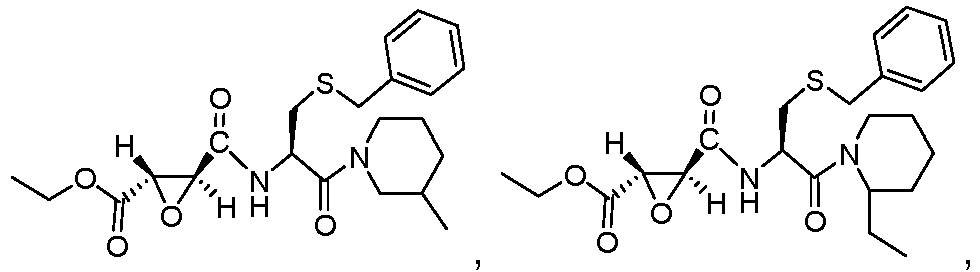

- Ein Verfahren zur Herstellung der Verbindung gemäß (1), ein Razemat oder ein optisches Isomer hiervon, ein Solvat hiervon oder ein pharmazeutisch akzeptables Salz hiervon gemäß einem der Ansprüche 1 bis 8, umfassend die folgenden Schritte:
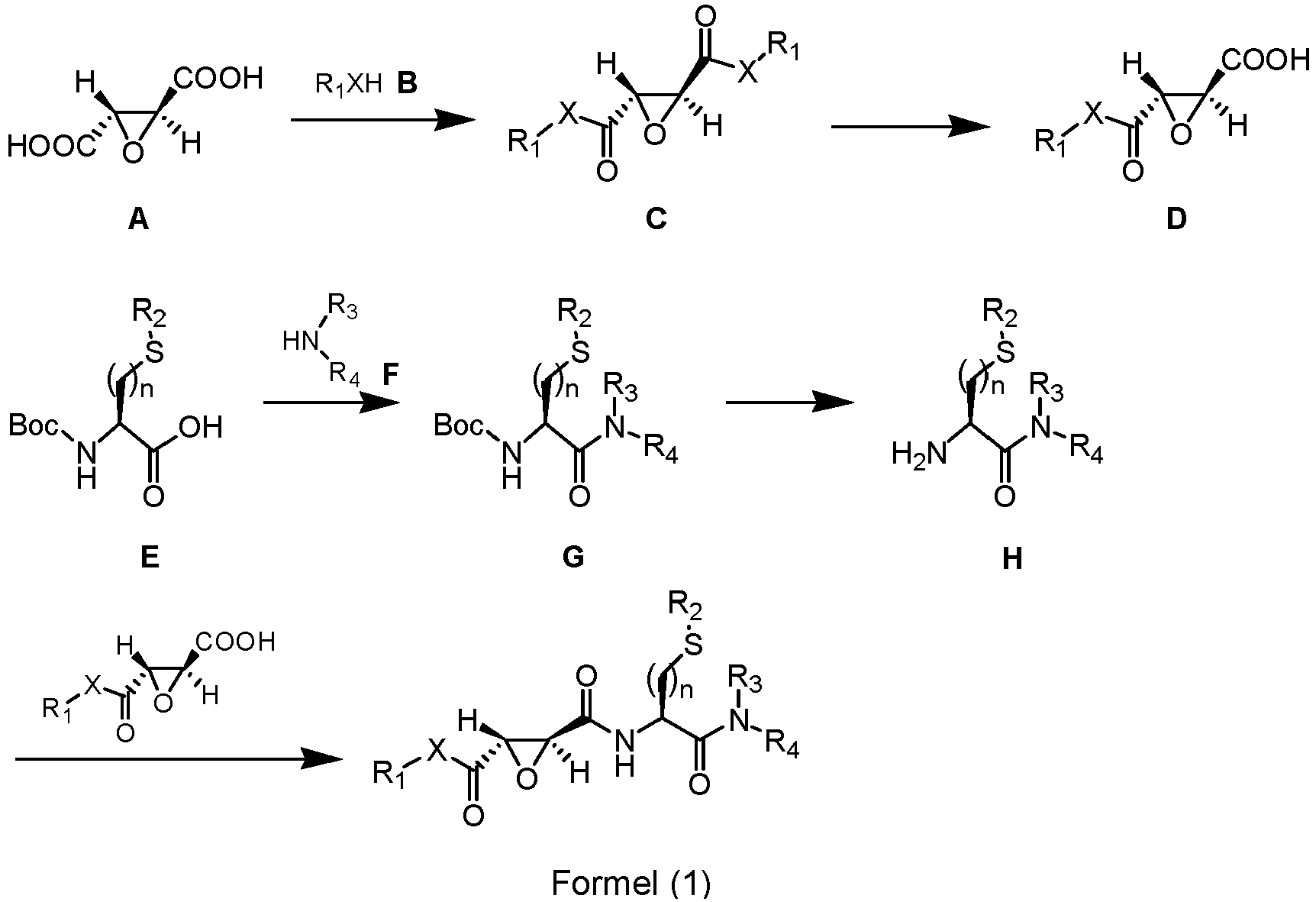 (1) Verbindung A und Verbindung B werden einer Veresterungs- oder Amidierungsreaktion unterworfen, um Verbindung C herzustellen;(2) Verbindung C wird einer selektiven Hydrolyse unterworfen zur Herstellung von Verbindung D;(3) Verbindung E und Verbindung F werden einer Kondensation unterworfen unter Erzeugung von Verbindung G;(4) die Amino-Schutzgruppe wird von Verbindung G entfernt unter Bildung von Verbindung (H); und(5) Verbindung H und die Verbindung D, welche in Schritt (2) erhalten wurde, werden einer Kondensation unterworfen unter Herstellung einer Verbindung gemäß Formel (1),
worin n, X, R1, R2, R3 und R4 dieselben Bedeutungen wie in Anspruch 1 definiert aufweisen. - Eine pharmazeutische Zusammensetzung umfassend die Verbindung gemäß Formel (1), ein Razemat oder ein optisches Isomer hiervon, ein Solvat hiervon oder ein pharmazeutisch akzeptables Salz hiervon gemäß einem der Ansprüche 1 bis 8, und optional ein oder mehrere pharmazeutisch annehmbare Träger oder Hilfsstoffe.
- Die Verbindung gemäß Formel (1), ein Razemat oder ein optisches Isomer hiervon, ein Solvat hiervon oder ein pharmazeutisch akzeptables Salz hiervon gemäß einem der Ansprüche 1 bis 8,oder die pharmazeutische Zusammensetzung gemäß Anspruch 10,zur Verwendung bei der Behandlung, Vorbeugung oder unterstützenden Behandlung von Tumoren, wobei bevorzugt der Tumor ausgewählt ist aus der Gruppe bestehend aus Nierenkarzinom, Lymphom, Lungenkarzinom, Leberkarzinom, Magenkarzinom, Hodenkarzinom, Nicht-kleinzelligem Lungenkarzinom, Brustkarzinom, Eierstockkarzinom, Darmkarzinom, Blasenkarzinom und Schilddrüsenkarzinom.
- Die Verbindung, welche durch Formel (1) dargestellt wird, ein Razemat oder ein optisches Isomer hiervon, ein Solvat hiervon oder ein pharmazeutisch akzeptables Salz hiervon gemäß einem der Ansprüche 1 bis 8,oder die pharmazeutische Zusammensetzung gemäß Anspruch 10,zur Verwendung bei der Vorbeugung und/oder Behandlung von Osteoporose, Ebola-Virus-Infektion, rheumatoider Arthritis, Osteoarthritis, einer Autoimmunerkrankung oder einer degenerativen Erkrankung, wobei bevorzugt die Autoimmunerkrankung ausgewählt ist aus der Gruppe bestehend aus chronischer lymphatischer Schilddrüsenentzündung, Schilddrüsenüberfunktion, insulinabhängigem Diabetes Mellitus, Myasthenia gravis, chronischer Colitis ulcerosa, perniziöser Anämie mit Komplikation von atrophischer Gastritis, , pulmonalem hämorrhagischem Nephritis-Syndrom, Pemphigoid, primärer biliärer Leberzirrhose and multipler zerebrospinaler Sklerose,wobei bevorzugt die degenerative Erkrankung ausgewählt ist aus der Gruppe bestehend aus Herz-Kreislauf-Erkrankungen (zum Beispiel Bluthochdruck-Herzerkrankungen, Kardiomyopathie, Myokardinfarkt, Herzklappenerkrankungen), zerebraler Dysfunktion (wie zum Beispiel Alzheimer-Krankheit und Down-Syndrom), und Katarakt.
Applications Claiming Priority (2)
| Application Number | Priority Date | Filing Date | Title |
|---|---|---|---|
| CN201610119872.9A CN107151236B (zh) | 2016-03-03 | 2016-03-03 | 一种2,3-环氧丁二酰衍生物及其制备方法和用途 |
| PCT/CN2017/075453 WO2017148417A1 (zh) | 2016-03-03 | 2017-03-02 | 一种2,3-环氧丁二酰衍生物及其制备方法和用途 |
Publications (3)
| Publication Number | Publication Date |
|---|---|
| EP3424913A1 EP3424913A1 (de) | 2019-01-09 |
| EP3424913A4 EP3424913A4 (de) | 2019-08-07 |
| EP3424913B1 true EP3424913B1 (de) | 2023-04-05 |
Family
ID=59743518
Family Applications (1)
| Application Number | Title | Priority Date | Filing Date |
|---|---|---|---|
| EP17759268.0A Active EP3424913B1 (de) | 2016-03-03 | 2017-03-02 | 2,3-epoxidsuccinyl-derivat, herstellungsverfahren dafür und verwendung davon |
Country Status (5)
| Country | Link |
|---|---|
| US (1) | US10647690B2 (de) |
| EP (1) | EP3424913B1 (de) |
| JP (1) | JP6929866B2 (de) |
| CN (1) | CN107151236B (de) |
| WO (1) | WO2017148417A1 (de) |
Families Citing this family (5)
| Publication number | Priority date | Publication date | Assignee | Title |
|---|---|---|---|---|
| CN107936088B (zh) * | 2017-12-13 | 2020-10-30 | 上海交通大学医学院附属仁济医院 | 一种天冬酰胺内肽酶小分子抑制剂及其用途 |
| CN113387909B (zh) * | 2020-03-13 | 2023-11-14 | 中国人民解放军军事科学院军事医学研究院 | 2,3-环氧丁二酰衍生物的医药用途 |
| WO2023272571A1 (zh) * | 2021-06-30 | 2023-01-05 | 中国人民解放军军事科学院军事医学研究院 | 2,3-环氧丁二酰衍生物的医药用途 |
| CN115895752B (zh) * | 2021-09-30 | 2025-02-11 | 中国石油化工股份有限公司 | 一种抗磨添加剂、其制备方法及在油品中的应用 |
| CN116650495B (zh) * | 2021-12-10 | 2024-04-19 | 中南大学湘雅医院 | 芳香族化合物作为神经丛素蛋白-b2的激活剂以及在制备治疗骨质疏松症药物中的应用 |
Family Cites Families (8)
| Publication number | Priority date | Publication date | Assignee | Title |
|---|---|---|---|---|
| GB1595168A (en) * | 1977-03-03 | 1981-08-12 | Taisho Pharmaceutical Co Ltd | Expoxysuccinic acid derivatives |
| US5556853A (en) * | 1993-10-29 | 1996-09-17 | Takeda Chemical Industries, Ltd. | Epoxysuccinic acid derivatives |
| JPH08104683A (ja) * | 1993-10-29 | 1996-04-23 | Takeda Chem Ind Ltd | エポキシコハク酸誘導体 |
| JPH08104684A (ja) * | 1994-05-31 | 1996-04-23 | Takeda Chem Ind Ltd | エポキシコハク酸関連化合物 |
| EP0763029A1 (de) * | 1994-05-31 | 1997-03-19 | Takeda Chemical Industries, Ltd. | Epoxybernsteinsäurederivate, ihre herstellung und verwendung |
| WO1997003060A1 (en) * | 1995-07-13 | 1997-01-30 | Senju Pharmaceutical Co., Ltd. | Piperazine derivatives and use of the same |
| JP3338452B2 (ja) * | 1995-12-12 | 2002-10-28 | 大鵬薬品工業株式会社 | エポキシコハク酸アミド誘導体又はその塩及びこれを含有する医薬 |
| CN101808634A (zh) | 2006-06-13 | 2010-08-18 | 利兰·斯坦福青年大学托管委员会 | 半胱氨酸蛋白酶的环氧化物抑制剂 |
-
2016
- 2016-03-03 CN CN201610119872.9A patent/CN107151236B/zh not_active Expired - Fee Related
-
2017
- 2017-03-02 EP EP17759268.0A patent/EP3424913B1/de active Active
- 2017-03-02 WO PCT/CN2017/075453 patent/WO2017148417A1/zh not_active Ceased
- 2017-03-02 US US16/081,204 patent/US10647690B2/en active Active
- 2017-03-02 JP JP2018545989A patent/JP6929866B2/ja active Active
Also Published As
| Publication number | Publication date |
|---|---|
| WO2017148417A1 (zh) | 2017-09-08 |
| JP2019510755A (ja) | 2019-04-18 |
| CN107151236A (zh) | 2017-09-12 |
| JP6929866B2 (ja) | 2021-09-01 |
| US20190062290A1 (en) | 2019-02-28 |
| EP3424913A1 (de) | 2019-01-09 |
| US10647690B2 (en) | 2020-05-12 |
| CN107151236B (zh) | 2021-04-30 |
| EP3424913A4 (de) | 2019-08-07 |
Similar Documents
| Publication | Publication Date | Title |
|---|---|---|
| US10647690B2 (en) | 2,3-epoxy succinyl derivative, preparation method and use thereof | |
| US20240350643A1 (en) | Protein degradation agent | |
| CN120757571A (zh) | Kras g12c突变蛋白嘧啶并噻喃二酮类抑制剂的制备及其应用 | |
| WO2016014522A1 (en) | Inhibitors of deubiquitinating proteases | |
| EP3495354A1 (de) | Ido1-inhibitor sowie herstellungsverfahren und anwendung davon | |
| EP2903979B1 (de) | Neuartige verbindungen, deren herstellung und verwendung | |
| KR20150132146A (ko) | 헤모글로빈 조정을 위한 화합물 및 이의 용도 | |
| EA023804B1 (ru) | Оксабициклогептаны, их получение и применение | |
| US8946249B2 (en) | Compound, certain novel forms thereof, pharmaceutical compositions thereof and methods for preparation and use | |
| WO2010054575A1 (zh) | 苊并杂环类化合物、其环糊精包合物和环糊精配结物以及它们在制备BH3类似物Bcl-2家族蛋白抑制剂中的应用 | |
| CN112592331A (zh) | 一种奥司他韦protac化合物及其制备方法与在抗流感病毒药物中的应用 | |
| EP4288419A1 (de) | 1,3,4-oxadiazolthiocarbonylverbindungen als histondeacetylase-6-hemmer und pharmazeutische zusammensetzung damit | |
| JP2021526156A (ja) | ジメチルホスフィンオキシド化合物 | |
| WO2023088493A1 (zh) | 一种呋喃并吡啶酮类化合物及其应用 | |
| CN112457365B (zh) | 一类靶向蛋白质水解通路的功能分子及其制备和应用 | |
| CZ20031520A3 (cs) | Laktamové sloučeniny a jejich farmaceutické použití | |
| JP7853957B2 (ja) | ピラゾールボロン酸化合物、それを含有する医薬組成物、及びそれらの使用 | |
| EP3277662A1 (de) | Schwefelwasserstoffvorläufer und konjugate davon | |
| CN108069954B (zh) | 含no供体的喹唑啉酮化合物 | |
| Ranjbari et al. | Dibenzoxanthene-β-lactam hybrids as potential antioxidant and anticancer agents: Synthesis, biological evaluation, and docking study | |
| CN115353508B (zh) | 5-吡啶-1h-吲唑类化合物、药物组合物和应用 | |
| WO2018086242A1 (zh) | pH敏感的轴向取代硅酞菁配合物及其制备方法和在医药上的应用 | |
| CN114478509B (zh) | 五元杂环取代的苯甲酰胺类化合物及其制备方法与应用 | |
| WO2024086814A2 (en) | Cyclin inhibitors | |
| KR101096427B1 (ko) | 신규한 4-아릴-4-옥소부탄산 아미드 유도체 또는 이의 약학적으로 허용가능한 염, 이의 제조방법 및 이를 유효성분으로 함유하는 약학적 조성물 |
Legal Events
| Date | Code | Title | Description |
|---|---|---|---|
| STAA | Information on the status of an ep patent application or granted ep patent |
Free format text: STATUS: THE INTERNATIONAL PUBLICATION HAS BEEN MADE |
|
| PUAI | Public reference made under article 153(3) epc to a published international application that has entered the european phase |
Free format text: ORIGINAL CODE: 0009012 |
|
| STAA | Information on the status of an ep patent application or granted ep patent |
Free format text: STATUS: REQUEST FOR EXAMINATION WAS MADE |
|
| 17P | Request for examination filed |
Effective date: 20180917 |
|
| AK | Designated contracting states |
Kind code of ref document: A1 Designated state(s): AL AT BE BG CH CY CZ DE DK EE ES FI FR GB GR HR HU IE IS IT LI LT LU LV MC MK MT NL NO PL PT RO RS SE SI SK SM TR |
|
| AX | Request for extension of the european patent |
Extension state: BA ME |
|
| DAV | Request for validation of the european patent (deleted) | ||
| DAX | Request for extension of the european patent (deleted) | ||
| A4 | Supplementary search report drawn up and despatched |
Effective date: 20190709 |
|
| RIC1 | Information provided on ipc code assigned before grant |
Ipc: C07D 405/12 20060101ALI20190703BHEP Ipc: A61K 31/4523 20060101ALI20190703BHEP Ipc: A61K 31/5377 20060101ALI20190703BHEP Ipc: A61P 37/02 20060101ALI20190703BHEP Ipc: A61P 35/00 20060101ALI20190703BHEP Ipc: A61K 31/336 20060101ALI20190703BHEP Ipc: A61P 19/00 20060101ALI20190703BHEP Ipc: C07D 417/12 20060101ALI20190703BHEP Ipc: C07D 303/48 20060101AFI20190703BHEP Ipc: A61K 31/541 20060101ALI20190703BHEP Ipc: A61K 31/427 20060101ALI20190703BHEP Ipc: A61K 31/4025 20060101ALI20190703BHEP |
|
| STAA | Information on the status of an ep patent application or granted ep patent |
Free format text: STATUS: EXAMINATION IS IN PROGRESS |
|
| 17Q | First examination report despatched |
Effective date: 20210330 |
|
| GRAP | Despatch of communication of intention to grant a patent |
Free format text: ORIGINAL CODE: EPIDOSNIGR1 |
|
| STAA | Information on the status of an ep patent application or granted ep patent |
Free format text: STATUS: GRANT OF PATENT IS INTENDED |
|
| INTG | Intention to grant announced |
Effective date: 20220930 |
|
| GRAS | Grant fee paid |
Free format text: ORIGINAL CODE: EPIDOSNIGR3 |
|
| GRAA | (expected) grant |
Free format text: ORIGINAL CODE: 0009210 |
|
| STAA | Information on the status of an ep patent application or granted ep patent |
Free format text: STATUS: THE PATENT HAS BEEN GRANTED |
|
| AK | Designated contracting states |
Kind code of ref document: B1 Designated state(s): AL AT BE BG CH CY CZ DE DK EE ES FI FR GB GR HR HU IE IS IT LI LT LU LV MC MK MT NL NO PL PT RO RS SE SI SK SM TR |
|
| REG | Reference to a national code |
Ref country code: GB Ref legal event code: FG4D |
|
| REG | Reference to a national code |
Ref country code: DE Ref legal event code: R096 Ref document number: 602017067461 Country of ref document: DE |
|
| REG | Reference to a national code |
Ref country code: CH Ref legal event code: EP |
|
| REG | Reference to a national code |
Ref country code: AT Ref legal event code: REF Ref document number: 1558180 Country of ref document: AT Kind code of ref document: T Effective date: 20230415 |
|
| REG | Reference to a national code |
Ref country code: IE Ref legal event code: FG4D |
|
| REG | Reference to a national code |
Ref country code: LT Ref legal event code: MG9D |
|
| REG | Reference to a national code |
Ref country code: NL Ref legal event code: MP Effective date: 20230405 |
|
| REG | Reference to a national code |
Ref country code: AT Ref legal event code: MK05 Ref document number: 1558180 Country of ref document: AT Kind code of ref document: T Effective date: 20230405 |
|
| PG25 | Lapsed in a contracting state [announced via postgrant information from national office to epo] |
Ref country code: NL Free format text: LAPSE BECAUSE OF FAILURE TO SUBMIT A TRANSLATION OF THE DESCRIPTION OR TO PAY THE FEE WITHIN THE PRESCRIBED TIME-LIMIT Effective date: 20230405 |
|
| PG25 | Lapsed in a contracting state [announced via postgrant information from national office to epo] |
Ref country code: SE Free format text: LAPSE BECAUSE OF FAILURE TO SUBMIT A TRANSLATION OF THE DESCRIPTION OR TO PAY THE FEE WITHIN THE PRESCRIBED TIME-LIMIT Effective date: 20230405 Ref country code: PT Free format text: LAPSE BECAUSE OF FAILURE TO SUBMIT A TRANSLATION OF THE DESCRIPTION OR TO PAY THE FEE WITHIN THE PRESCRIBED TIME-LIMIT Effective date: 20230807 Ref country code: NO Free format text: LAPSE BECAUSE OF FAILURE TO SUBMIT A TRANSLATION OF THE DESCRIPTION OR TO PAY THE FEE WITHIN THE PRESCRIBED TIME-LIMIT Effective date: 20230705 Ref country code: ES Free format text: LAPSE BECAUSE OF FAILURE TO SUBMIT A TRANSLATION OF THE DESCRIPTION OR TO PAY THE FEE WITHIN THE PRESCRIBED TIME-LIMIT Effective date: 20230405 Ref country code: AT Free format text: LAPSE BECAUSE OF FAILURE TO SUBMIT A TRANSLATION OF THE DESCRIPTION OR TO PAY THE FEE WITHIN THE PRESCRIBED TIME-LIMIT Effective date: 20230405 |
|
| PG25 | Lapsed in a contracting state [announced via postgrant information from national office to epo] |
Ref country code: RS Free format text: LAPSE BECAUSE OF FAILURE TO SUBMIT A TRANSLATION OF THE DESCRIPTION OR TO PAY THE FEE WITHIN THE PRESCRIBED TIME-LIMIT Effective date: 20230405 Ref country code: PL Free format text: LAPSE BECAUSE OF FAILURE TO SUBMIT A TRANSLATION OF THE DESCRIPTION OR TO PAY THE FEE WITHIN THE PRESCRIBED TIME-LIMIT Effective date: 20230405 Ref country code: LV Free format text: LAPSE BECAUSE OF FAILURE TO SUBMIT A TRANSLATION OF THE DESCRIPTION OR TO PAY THE FEE WITHIN THE PRESCRIBED TIME-LIMIT Effective date: 20230405 Ref country code: LT Free format text: LAPSE BECAUSE OF FAILURE TO SUBMIT A TRANSLATION OF THE DESCRIPTION OR TO PAY THE FEE WITHIN THE PRESCRIBED TIME-LIMIT Effective date: 20230405 Ref country code: IS Free format text: LAPSE BECAUSE OF FAILURE TO SUBMIT A TRANSLATION OF THE DESCRIPTION OR TO PAY THE FEE WITHIN THE PRESCRIBED TIME-LIMIT Effective date: 20230805 Ref country code: HR Free format text: LAPSE BECAUSE OF FAILURE TO SUBMIT A TRANSLATION OF THE DESCRIPTION OR TO PAY THE FEE WITHIN THE PRESCRIBED TIME-LIMIT Effective date: 20230405 Ref country code: GR Free format text: LAPSE BECAUSE OF FAILURE TO SUBMIT A TRANSLATION OF THE DESCRIPTION OR TO PAY THE FEE WITHIN THE PRESCRIBED TIME-LIMIT Effective date: 20230706 Ref country code: AL Free format text: LAPSE BECAUSE OF FAILURE TO SUBMIT A TRANSLATION OF THE DESCRIPTION OR TO PAY THE FEE WITHIN THE PRESCRIBED TIME-LIMIT Effective date: 20230405 |
|
| PG25 | Lapsed in a contracting state [announced via postgrant information from national office to epo] |
Ref country code: FI Free format text: LAPSE BECAUSE OF FAILURE TO SUBMIT A TRANSLATION OF THE DESCRIPTION OR TO PAY THE FEE WITHIN THE PRESCRIBED TIME-LIMIT Effective date: 20230405 |
|
| REG | Reference to a national code |
Ref country code: DE Ref legal event code: R097 Ref document number: 602017067461 Country of ref document: DE |
|
| PG25 | Lapsed in a contracting state [announced via postgrant information from national office to epo] |
Ref country code: SK Free format text: LAPSE BECAUSE OF FAILURE TO SUBMIT A TRANSLATION OF THE DESCRIPTION OR TO PAY THE FEE WITHIN THE PRESCRIBED TIME-LIMIT Effective date: 20230405 |
|
| PG25 | Lapsed in a contracting state [announced via postgrant information from national office to epo] |
Ref country code: SM Free format text: LAPSE BECAUSE OF FAILURE TO SUBMIT A TRANSLATION OF THE DESCRIPTION OR TO PAY THE FEE WITHIN THE PRESCRIBED TIME-LIMIT Effective date: 20230405 Ref country code: SK Free format text: LAPSE BECAUSE OF FAILURE TO SUBMIT A TRANSLATION OF THE DESCRIPTION OR TO PAY THE FEE WITHIN THE PRESCRIBED TIME-LIMIT Effective date: 20230405 Ref country code: RO Free format text: LAPSE BECAUSE OF FAILURE TO SUBMIT A TRANSLATION OF THE DESCRIPTION OR TO PAY THE FEE WITHIN THE PRESCRIBED TIME-LIMIT Effective date: 20230405 Ref country code: EE Free format text: LAPSE BECAUSE OF FAILURE TO SUBMIT A TRANSLATION OF THE DESCRIPTION OR TO PAY THE FEE WITHIN THE PRESCRIBED TIME-LIMIT Effective date: 20230405 Ref country code: DK Free format text: LAPSE BECAUSE OF FAILURE TO SUBMIT A TRANSLATION OF THE DESCRIPTION OR TO PAY THE FEE WITHIN THE PRESCRIBED TIME-LIMIT Effective date: 20230405 Ref country code: CZ Free format text: LAPSE BECAUSE OF FAILURE TO SUBMIT A TRANSLATION OF THE DESCRIPTION OR TO PAY THE FEE WITHIN THE PRESCRIBED TIME-LIMIT Effective date: 20230405 |
|
| PLBE | No opposition filed within time limit |
Free format text: ORIGINAL CODE: 0009261 |
|
| STAA | Information on the status of an ep patent application or granted ep patent |
Free format text: STATUS: NO OPPOSITION FILED WITHIN TIME LIMIT |
|
| 26N | No opposition filed |
Effective date: 20240108 |
|
| PG25 | Lapsed in a contracting state [announced via postgrant information from national office to epo] |
Ref country code: SI Free format text: LAPSE BECAUSE OF FAILURE TO SUBMIT A TRANSLATION OF THE DESCRIPTION OR TO PAY THE FEE WITHIN THE PRESCRIBED TIME-LIMIT Effective date: 20230405 |
|
| PG25 | Lapsed in a contracting state [announced via postgrant information from national office to epo] |
Ref country code: SI Free format text: LAPSE BECAUSE OF FAILURE TO SUBMIT A TRANSLATION OF THE DESCRIPTION OR TO PAY THE FEE WITHIN THE PRESCRIBED TIME-LIMIT Effective date: 20230405 Ref country code: IT Free format text: LAPSE BECAUSE OF FAILURE TO SUBMIT A TRANSLATION OF THE DESCRIPTION OR TO PAY THE FEE WITHIN THE PRESCRIBED TIME-LIMIT Effective date: 20230405 |
|
| REG | Reference to a national code |
Ref country code: CH Ref legal event code: PL |
|
| PG25 | Lapsed in a contracting state [announced via postgrant information from national office to epo] |
Ref country code: BG Free format text: LAPSE BECAUSE OF FAILURE TO SUBMIT A TRANSLATION OF THE DESCRIPTION OR TO PAY THE FEE WITHIN THE PRESCRIBED TIME-LIMIT Effective date: 20230405 |
|
| PG25 | Lapsed in a contracting state [announced via postgrant information from national office to epo] |
Ref country code: LU Free format text: LAPSE BECAUSE OF NON-PAYMENT OF DUE FEES Effective date: 20240302 |
|
| PG25 | Lapsed in a contracting state [announced via postgrant information from national office to epo] |
Ref country code: MC Free format text: LAPSE BECAUSE OF FAILURE TO SUBMIT A TRANSLATION OF THE DESCRIPTION OR TO PAY THE FEE WITHIN THE PRESCRIBED TIME-LIMIT Effective date: 20230405 |
|
| PG25 | Lapsed in a contracting state [announced via postgrant information from national office to epo] |
Ref country code: MC Free format text: LAPSE BECAUSE OF FAILURE TO SUBMIT A TRANSLATION OF THE DESCRIPTION OR TO PAY THE FEE WITHIN THE PRESCRIBED TIME-LIMIT Effective date: 20230405 Ref country code: LU Free format text: LAPSE BECAUSE OF NON-PAYMENT OF DUE FEES Effective date: 20240302 Ref country code: BG Free format text: LAPSE BECAUSE OF FAILURE TO SUBMIT A TRANSLATION OF THE DESCRIPTION OR TO PAY THE FEE WITHIN THE PRESCRIBED TIME-LIMIT Effective date: 20230405 |
|
| REG | Reference to a national code |
Ref country code: BE Ref legal event code: MM Effective date: 20240331 |
|
| PG25 | Lapsed in a contracting state [announced via postgrant information from national office to epo] |
Ref country code: BE Free format text: LAPSE BECAUSE OF NON-PAYMENT OF DUE FEES Effective date: 20240331 |
|
| PG25 | Lapsed in a contracting state [announced via postgrant information from national office to epo] |
Ref country code: IE Free format text: LAPSE BECAUSE OF NON-PAYMENT OF DUE FEES Effective date: 20240302 |
|
| PG25 | Lapsed in a contracting state [announced via postgrant information from national office to epo] |
Ref country code: IE Free format text: LAPSE BECAUSE OF NON-PAYMENT OF DUE FEES Effective date: 20240302 Ref country code: BE Free format text: LAPSE BECAUSE OF NON-PAYMENT OF DUE FEES Effective date: 20240331 Ref country code: CH Free format text: LAPSE BECAUSE OF NON-PAYMENT OF DUE FEES Effective date: 20240331 |
|
| PG25 | Lapsed in a contracting state [announced via postgrant information from national office to epo] |
Ref country code: CY Free format text: LAPSE BECAUSE OF FAILURE TO SUBMIT A TRANSLATION OF THE DESCRIPTION OR TO PAY THE FEE WITHIN THE PRESCRIBED TIME-LIMIT; INVALID AB INITIO Effective date: 20170302 |
|
| PG25 | Lapsed in a contracting state [announced via postgrant information from national office to epo] |
Ref country code: HU Free format text: LAPSE BECAUSE OF FAILURE TO SUBMIT A TRANSLATION OF THE DESCRIPTION OR TO PAY THE FEE WITHIN THE PRESCRIBED TIME-LIMIT; INVALID AB INITIO Effective date: 20170302 |
|
| PG25 | Lapsed in a contracting state [announced via postgrant information from national office to epo] |
Ref country code: TR Free format text: LAPSE BECAUSE OF FAILURE TO SUBMIT A TRANSLATION OF THE DESCRIPTION OR TO PAY THE FEE WITHIN THE PRESCRIBED TIME-LIMIT Effective date: 20230405 |
|
| PGFP | Annual fee paid to national office [announced via postgrant information from national office to epo] |
Ref country code: GB Payment date: 20260219 Year of fee payment: 10 |
|
| PGFP | Annual fee paid to national office [announced via postgrant information from national office to epo] |
Ref country code: DE Payment date: 20260218 Year of fee payment: 10 |
|
| PGFP | Annual fee paid to national office [announced via postgrant information from national office to epo] |
Ref country code: FR Payment date: 20260223 Year of fee payment: 10 |