EP3414367B1 - A phosphorus doped silicon single crystal - Google Patents
A phosphorus doped silicon single crystal Download PDFInfo
- Publication number
- EP3414367B1 EP3414367B1 EP17703166.3A EP17703166A EP3414367B1 EP 3414367 B1 EP3414367 B1 EP 3414367B1 EP 17703166 A EP17703166 A EP 17703166A EP 3414367 B1 EP3414367 B1 EP 3414367B1
- Authority
- EP
- European Patent Office
- Prior art keywords
- single crystal
- silicon single
- doped silicon
- ntd
- resistivity
- Prior art date
- Legal status (The legal status is an assumption and is not a legal conclusion. Google has not performed a legal analysis and makes no representation as to the accuracy of the status listed.)
- Active
Links
Images

Classifications
-
- C—CHEMISTRY; METALLURGY
- C30—CRYSTAL GROWTH
- C30B—SINGLE-CRYSTAL GROWTH; UNIDIRECTIONAL SOLIDIFICATION OF EUTECTIC MATERIAL OR UNIDIRECTIONAL DEMIXING OF EUTECTOID MATERIAL; REFINING BY ZONE-MELTING OF MATERIAL; PRODUCTION OF A HOMOGENEOUS POLYCRYSTALLINE MATERIAL WITH DEFINED STRUCTURE; SINGLE CRYSTALS OR HOMOGENEOUS POLYCRYSTALLINE MATERIAL WITH DEFINED STRUCTURE; AFTER-TREATMENT OF SINGLE CRYSTALS OR A HOMOGENEOUS POLYCRYSTALLINE MATERIAL WITH DEFINED STRUCTURE; APPARATUS THEREFOR
- C30B29/00—Single crystals or homogeneous polycrystalline material with defined structure characterised by the material or by their shape
- C30B29/02—Elements
- C30B29/06—Silicon
-
- C—CHEMISTRY; METALLURGY
- C30—CRYSTAL GROWTH
- C30B—SINGLE-CRYSTAL GROWTH; UNIDIRECTIONAL SOLIDIFICATION OF EUTECTIC MATERIAL OR UNIDIRECTIONAL DEMIXING OF EUTECTOID MATERIAL; REFINING BY ZONE-MELTING OF MATERIAL; PRODUCTION OF A HOMOGENEOUS POLYCRYSTALLINE MATERIAL WITH DEFINED STRUCTURE; SINGLE CRYSTALS OR HOMOGENEOUS POLYCRYSTALLINE MATERIAL WITH DEFINED STRUCTURE; AFTER-TREATMENT OF SINGLE CRYSTALS OR A HOMOGENEOUS POLYCRYSTALLINE MATERIAL WITH DEFINED STRUCTURE; APPARATUS THEREFOR
- C30B31/00—Diffusion or doping processes for single crystals or homogeneous polycrystalline material with defined structure; Apparatus therefor
- C30B31/06—Diffusion or doping processes for single crystals or homogeneous polycrystalline material with defined structure; Apparatus therefor by contacting with diffusion material in the gaseous state
- C30B31/08—Diffusion or doping processes for single crystals or homogeneous polycrystalline material with defined structure; Apparatus therefor by contacting with diffusion material in the gaseous state the diffusion materials being a compound of the elements to be diffused
-
- C—CHEMISTRY; METALLURGY
- C30—CRYSTAL GROWTH
- C30B—SINGLE-CRYSTAL GROWTH; UNIDIRECTIONAL SOLIDIFICATION OF EUTECTIC MATERIAL OR UNIDIRECTIONAL DEMIXING OF EUTECTOID MATERIAL; REFINING BY ZONE-MELTING OF MATERIAL; PRODUCTION OF A HOMOGENEOUS POLYCRYSTALLINE MATERIAL WITH DEFINED STRUCTURE; SINGLE CRYSTALS OR HOMOGENEOUS POLYCRYSTALLINE MATERIAL WITH DEFINED STRUCTURE; AFTER-TREATMENT OF SINGLE CRYSTALS OR A HOMOGENEOUS POLYCRYSTALLINE MATERIAL WITH DEFINED STRUCTURE; APPARATUS THEREFOR
- C30B31/00—Diffusion or doping processes for single crystals or homogeneous polycrystalline material with defined structure; Apparatus therefor
- C30B31/20—Doping by irradiation with electromagnetic waves or by particle radiation
-
- H—ELECTRICITY
- H10—SEMICONDUCTOR DEVICES; ELECTRIC SOLID-STATE DEVICES NOT OTHERWISE PROVIDED FOR
- H10D—INORGANIC ELECTRIC SEMICONDUCTOR DEVICES
- H10D62/00—Semiconductor bodies, or regions thereof, of devices having potential barriers
- H10D62/60—Impurity distributions or concentrations
-
- H—ELECTRICITY
- H10—SEMICONDUCTOR DEVICES; ELECTRIC SOLID-STATE DEVICES NOT OTHERWISE PROVIDED FOR
- H10P—GENERIC PROCESSES OR APPARATUS FOR THE MANUFACTURE OR TREATMENT OF DEVICES COVERED BY CLASS H10
- H10P34/00—Irradiation with electromagnetic or particle radiation of wafers, substrates or parts of devices
- H10P34/20—Irradiation with electromagnetic or particle radiation of wafers, substrates or parts of devices for inducing a nuclear reaction transmuting chemical elements
-
- H—ELECTRICITY
- H10—SEMICONDUCTOR DEVICES; ELECTRIC SOLID-STATE DEVICES NOT OTHERWISE PROVIDED FOR
- H10P—GENERIC PROCESSES OR APPARATUS FOR THE MANUFACTURE OR TREATMENT OF DEVICES COVERED BY CLASS H10
- H10P95/00—Generic processes or apparatus for manufacture or treatments not covered by the other groups of this subclass
- H10P95/90—Thermal treatments, e.g. annealing or sintering
Definitions
- the present invention relates to phosphorus doped silicon single crystals, a method of producing a phosphorus doped silicon single crystal, a plurality of wafers and a silicon wafer.
- the phosphorus doped silicon single crystal has a dopant density allowing that wafers having improved radial resistivity variation (RRV) values are cut from the phosphorus doped silicon single crystal.
- the silicon wafers of the invention are particularly suited for use in high power electronics.
- Single crystal rods of semiconductor materials are typically produced using one of two general methods, the Czochralski (CZ) method or the float-zone (FZ) method. Both of these are well-known and rely upon the formation of a single crystal during resolidification of molten material. Silicon single crystals are used as a starting material for preparation of silicon wafers, which are cut from the silicon single crystal.
- CZ Czochralski
- FZ float-zone
- the silicon wafer can be described with, and may need a specific value of the resistivity, which is expressed in e.g. ⁇ cm or corresponding units.
- the value of q is 1.602 ⁇ 10 -19 C, and the typical value of ⁇ m , e.g. at room temperature, is 1450 cm 2 /s.
- the dopant atoms employed in silicon will normally be phosphorus and/or boron the resistivity of silicon may be controlled by controlling the amount of phosphorus and boron atoms in the silicon.
- Dopant atoms may be applied to the silicon material during production of the silicon single crystal. For example, phosphorus and boron may be applied by exposing the molten silicon to gaseous phosphine (PH 3 ) or diboran (B 2 H 6 ), respectively, so that the respective atoms are included in the silicon upon the resolidification. This process is generally known as gas doping. It is noted that other gases may be applied, but phosphine and diboran are the most commonly used in industry.
- silicon atoms in solid silicon can be converted to phosphorus atoms by irradiating the material with neutrons.
- the isotope 30 Si when the isotope 30 Si is irradiated with neutrons it will be transmuted to the isotope 31 Si, which decays, with a half life of 2.6 h, to the stable phosphorus isotope 31 P.
- Natural silicon has about 3% 30 Si, and irradiation with neutrons can therefore be used to increase the density of phosphorus donor atoms in silicon. This process is known as neutron transmutation doping (NTD).
- NTD neutron transmutation doping
- D K 1 1 ⁇ NTD ⁇ 1 ⁇ i
- K 1 is a material constant for a given neutron spectrum
- ⁇ NTD and ⁇ i are the resistivities after NTD irradiation and the initial resistivity, i.e. before neutron irradiation, respectively.
- the resistivity of a silicon wafer may vary across the surface of the silicon wafer, both due to stochastic variation and also due to systematic variations caused by the procedure used to include the doping atoms in the silicon.
- the quality of a wafer, and thereby also of a single crystal from which the wafer is cut, can be described by the resistivity distribution of the material where a homogenous resistivity throughout the cross-section of the single crystal equals high quality.
- RRV ⁇ max ⁇ ⁇ min ⁇ min 100 ⁇ %
- ⁇ max is the highest resistivity
- ⁇ min is the lowest resistivity recorded for a wafer.
- NTD treatment is generally considered to provide the best distribution of phosphorus donor atoms commonly yielding RRV values of about 5-7% or less.
- the neutron irradiation will not be even through the cross-section of the diameter, due to absorption of the neutrons penetrating the silicon ingot.
- the RRV value is a combined value for a silicon wafer (including both stochastic and systematic variation) but any systematic variation across the surface of the wafer is likely not visible in the RRV value.
- NTD and gas doping both have systematic variations in the distribution of phosphorus atoms in the silicon single crystal.
- a NTD process is performed in a nuclear reactor designed to irradiate a crystal of a length of e.g. up to about 600 mm.
- the reactor includes a neutron source and is typically designed to provide the crystal with neutrons from a slit, which is parallel to the axis of the crystal so that a transverse plane in the crystal can be considered to be exposed to a point shaped source of neutron irradiation.
- NTD Neuron Transmutation Doped
- the crystal is rotated in the reactor during exposure to the irradiation in order to ensure an even distribution of neutron flux.
- silicon has a decay length of about 19 cm, and therefore for crystals of large diameters, e.g. above 150 mm, the edge of the crystal will be exposed to a larger fluence than the centre of the crystal, thereby resulting in an uneven distribution of phosphorus donor atoms.
- NTD treated silicon wafers of 200 mm diameter are available from Topsil GlobalWafers A/S as evident from the company's website.
- DE 102004034372 discloses a process for the manufacture of a silicon single crystal where gas doping is employed in a FZ step to provide a first electrical resistance of the single crystal followed by a neutron irradiation treatment to provide a second electrical resistance.
- the object of DE 102004034372 is to provide a method for producing a silicon single crystal, where the dispersion of electrical resistance in a plane is low, at a low cost and high productivity, even if the electrical resistance is low.
- the Examples of DE 102004034372 disclose the FZ manufacture of silicon single crystals with diameters of 125 mm where gas doping using phosphine provides first resistances of 25 to 65 ⁇ cm and where subsequent NTD treatment provides the target resistances of 15 ⁇ cm or 17 ⁇ cm.
- RRV values down to 1.8% are reported for the process for 125 mm wafers.
- the neutron irradiation in DE 102004034372 can be performed in a light water reactor or a heavy water reactor, and since the single crystal is rotated it is considered uniformly irradiated.
- the present invention relates to a phosphorus doped silicon single crystal having a diameter in the range of 175 mm to 225 mm and an axial length in the range of 50 mm to 1000 mm, an oxygen content below 2 ⁇ 10 16 cm -3 , the phosphorus doped silicon single crystal in a transverse plane having a density of dopant atoms providing a target resistivity ( ⁇ NTD ) in the range of 55 ⁇ cm to 2000 ⁇ cm for a wafer cut from the phosphorus doped silicon ingot, wherein a RRV value of 2% or less as determined according to the SEMI standard SEMI MF81 is obtained for at least 75% of wafers cut from the phosphorus doped silicon single crystal when the resistivity is measured after annealing the silicon at a temperature in the range of 800°C to 1300°C.
- the invention relates to a phosphorus doped silicon single crystal having a diameter of at least 175 mm and an axial length in the range of 50 mm to 600 mm.
- the phosphorus doped silicon single crystal in a transverse plane has a density of dopant atoms providing a target resistivity ( ⁇ NTD ) in the range of 55 ⁇ cm to 2000 ⁇ cm for a wafer cut from the phosphorus doped silicon ingot, wherein 5 or more resistivity values, in particular 9 or 10 measurements according to the SEMI standard SEMI MF81, recorded across the surface of the silicon wafer after annealing provide an average resistivity ⁇ av and the normalised average resistivity defined as ⁇ av / ⁇ NTD is in the range of 0.95 to 1.05, when the resistivity is measured after annealing the silicon at a temperature in the range of 800°C to 1300°C.
- the deviation from ⁇ NTD should be calculated for at least 10 wafers, and it is preferred that the normalised average resistivity, ⁇ av / ⁇ NTD , in the range of 0.95 to 1.05 is observed for at least 10 wafers, e.g. at least 20 wafers or more preferably all wafers cut from a silicon single crystal.
- the normalised average resistivity, ⁇ av / ⁇ NTD may also be classified relative to the number of wafers cut from a silicon single crystal.
- the normalised average resistivity, ⁇ av / ⁇ NTD is in the range of 0.95 to 1.05, e.g. 0.96 to 1.04, for at least 75%, e.g. at least 80%, at least 90% or at least 95%, of the wafers cut from a silicon single crystal.
- the upper limit of the RRV that the specified percentage of wafers is below may also be referred to as the "upper specific limit” (USL), in particular when 95% of the wafers are below this limit.
- USL upper specific limit
- the USL of the phosphorus doped silicon single crystal will typically be 4% or lower, e.g. 3% or lower, or 2% or lower.
- Both the RRV and ⁇ av / ⁇ NTD for a plurality of wafers cut from a phosphorous doped silicon single crystal of the invention may also be described in terms of the standard deviation observed from the respective value for the plurality of wafers.
- the average RRV value plus three standard deviations may be set as the USL and for ⁇ av / ⁇ NTD the USL may also be three standard deviations above 0% (i.e. from the target resistivity); likewise a "lower specific limit" (LSL) exists for ⁇ av / ⁇ NTD , which may be three standard deviations below 0%.
- LSL lower specific limit
- the plurality of wafers thus has an USL of 4% for the RRV (corresponding to the average RRV value plus three standard deviations), e.g. 3%, but the majority of the wafers will have RRV values below 1.8%, or even below 1.5%.
- the plurality of wafers as an USL of 5%, e.g. 4%, for the normalised average resistivity, ⁇ av / ⁇ NTD , which thus corresponds to three standard deviations, and a LSL of -5%, e.g. -4%, corresponding to minus three standard deviations, so that ⁇ av / ⁇ NTD is in the range of 0.95 to 1.05, e.g. 0.96 to 1.04.
- the phosphorus doped silicon single crystals have a diameter in the range of 175 mm to 225 mm. Also disclosed is that the diameter of the phosphorus doped silicon single crystal is in the range of 275 mm to 325 mm. In specific embodiments the phosphorus doped silicon single crystals have a diameter in the range of 175 mm to 225 mm and an oxygen content below 2 ⁇ 10 16 cm -3 . Also disclosed are phosphorus doped silicon single crystals having a diameter above 250 mm, e.g. in the range of 275 mm to 325 mm, and an oxygen content below 2 ⁇ 10 16 cm -3 .
- phosphorus doped silicon single crystals having a diameter in the range of 275 mm to 325 mm and an oxygen content above 10 17 cm -3 .
- the phosphorus doped silicon single crystals can have any crystal orientation, e.g. ⁇ 100> or ⁇ 111>.
- the invention in another aspect relates to a plurality of wafers cut from the phosphorus doped silicon single crystal.
- each of the wafers of the plurality has a RRV value below 2%, such as at or below 1.8% or at or below 1.5%.
- the plurality of wafers has an USL for the RRV of 4%.
- the term "plurality" in the context of the invention is at least 2 but preferably at least 3, at least 4, at least 5, at least 6, at least 7, at least 8, at least 9, at least 10, at least 20, at least 30, at least 40, at least 50, at least 100 etc.
- the wafers of the plurality of wafers will have a normalised average resistivity, ⁇ av / ⁇ NTD , in the range of 0.95 to 1.05 when the average resistivity ⁇ av is calculated from 5 or more, e.g. 9 or 10, resistivity values recorded across the surface of the wafers.
- the resistivities may be obtained according to the SEMI standard MF81, although other procedures may also be employed.
- each of the wafers of the plurality of wafers has a normalised average resistivity, ⁇ av / ⁇ NTD , in the range of 0.96 to 1.04, such as 0.97 to 1.03.
- the USL and the LSL when defined as explained above, may be ⁇ 5%, or ⁇ 4%, or ⁇ 3%, respectively.
- the plurality of wafers may also have been subjected to an annealing step at a temperature in the range of 800°C to 1300°C.
- the wafers of the plurality of wafers will generally have a thickness in the range of 100 ⁇ m to 2000 ⁇ m, such as 500 ⁇ m to 1000 ⁇ m, 1200 ⁇ m to 1800 ⁇ m, or 200 ⁇ m to 500 ⁇ m.
- a typical silicon single crystal of the invention will yield at least 50 wafers.
- a wafer cut from the phosphorus doped silicon single crystal may also have been subjected to an annealing step at a temperature in the range of 800°C to 1300°C.
- the wafer will generally have a thickness in the range of 100 ⁇ m to 2000 ⁇ m, such as 500 ⁇ m to 1000 ⁇ m, 1200 ⁇ m to 1800 ⁇ m, or such as 200 ⁇ m to 500 ⁇ m.
- Exemplary wafer thicknesses are about 700 ⁇ m and about 1400 ⁇ m.
- n NTD,e and n NTD,c are the phosphorus donor densities at the edge and the centre after irradiation, respectively, and n i,e and n i,c are the initial phosphorus donor densities at the edge and the centre, respectively.
- the present inventors have further found that for a gas based doping process, in particular for a gas based doping float-zone (FZ) process, the distribution of the dopant atoms, e.g. the phosphorus donor atoms, will also be constant with respect to the density of phosphorus donor atoms introduced into the centre of the single crystal formed during resolidification compared to the density of phosphorus donor atoms at another location, e.g. near the edge of the resolidified silicon single crystal.
- FZ gas based doping float-zone
- n i denotes phosphorus donor densities obtained in the gas doping process, so that n i,c and n i,e are the phosphorus donor densities at the centre and at the edge of the silicon single crystal
- n i,AVG is the average value. Since the gas doping process is performed before the NTD treatment the i will also refer to the "initial" value for the NTD process.
- the constants K 2 and K 3 can be determined for a specific reactor and a specific gas doping process, respectively.
- the values n i,c and n NTD,c may be recorded in a region comprising the centre but are not limited to the exact centre of the silicon single crystal, and likewise the values n i,e and n NTD,e may be recorded at a specified distance from the centre, as long as data collected for a number of silicon wafers are collected in the same way for all wafers included in the determination of K 2 and K 3 .
- n i , c and n NTD,c may be recorded at a distance from the centre to 10% of the radius of the single crystal.
- n i,e and n NTD,e may be recorded at a distance from the centre e.g. from 80% to 100% of the radius of the single crystal. It is contemplated that the constant K 3 is relevant for both FZ type processes and also for Czochralski (CZ) type processes.
- the present inventors have now surprisingly found that when gas doping and NTD are combined to produce a silicon single crystal of a large diameter, e.g. above 150 mm, in particular in the range of 175 mm to 350 mm, the constants K 2 and K 3 can be used to calculate the resistivity needed in the gas doping process, ⁇ i , expressed as an initial resistivity or pre-irradiation resistivity with respect to the NTD process step from the desired target resistivity, ⁇ NTD , and that determining the resistivities needed in the gas doping process using this relation will result in a more even distribution of phosphorus atoms in the irradiated silicon single crystal, which can be seen as a RRV value (as determined according to the SEMI standard SEMI MF81) at or below 1.8% for silicon wafers cut from the irradiated silicon single crystal, or which can be seen as an RRV value of 3% or less is obtained for at least 75% of wafers cut from the phosphorus doped silicon single crystal
- the relation between the constants K 2 and K 3 is most appropriately used when the target resistivity ( ⁇ NTD ) is in the range of 5 ⁇ cm to 2000 ⁇ cm.
- the radial shape of the resistivity profile of the gas based process step i.e. as expressed with the constant K 3
- the NTD step i.e. as expressed with the constant K 2
- the RRV value will typically be below 6% for all wafers cut from the phosphorus doped silicon single crystal.
- wafers can be cut from the phosphorus doped silicon single crystal, which have RRV values at or below 1.7%, or at or below 1.6%, or at or below 1.5%, or at or below 1.4%, or at or below 1.3%, or at or below 1.2%, or at or below 1.1%, or at or below 1.0%.
- a phosphorus doped silicon single crystal thus prepared allows that at least 75% of wafers cut from the phosphorus doped silicon single crystal will have a RRV value at or below 3%, e.g.
- the normalised average resistivity, ⁇ av / ⁇ NTD is in the range of 0.95 to 1.05 for a significant proportion, e.g. at least 75%, at least 95% and up to 100% of the wafers cut from a silicon single crystal.
- the resistivity, ⁇ i will generally be provided as a single value for the silicon ingot produced, despite it that the resistivity may vary across the cross-section(s) of the silicon ingot produced.
- the steps required for obtaining a selected resistivity, ⁇ i , in a gas based doping process is well-known to the skilled person.
- the above relation is found to be particularly relevant for a phosphorus doped silicon single crystal having high target resistivities, e.g. at or above 100 ⁇ cm, and in a preferred embodiment the phosphorus doped silicon single crystal has a target resistivity in the range of 100 ⁇ cm to 1200 ⁇ cm.
- the present invention especially provides better control of the distribution of phosphorus atoms when the target resistivity is at or above 100 ⁇ cm.
- the relation between the resistivity ⁇ i (the pre-irradiation resistivity) and the target resistivity ⁇ NTD can generally be considered linear for a specific gas doping process coupled with a specific NTD process, and the ratio of the relation will typically be in range of 1/6 to 1/3.
- target resistivity ⁇ NTD is about 100 ⁇ cm the pre-irradiation resistivity ⁇ i may be in the range 300 ⁇ cm to 600 ⁇ cm
- the pre-irradiation resistivity ⁇ i may be in the range 3000 ⁇ cm to 6000 ⁇ cm.
- the invention in another aspect relates to a method of producing a phosphorus doped silicon single crystal having a predetermined target resistivity ( ⁇ NTD ) in the range of 5 ⁇ cm to 2000 ⁇ cm, which target resistivity is measurable after annealing a wafer cut from the phosphorus doped silicon single crystal, the method comprising the steps of:
- Equation (8) the constants take account of the radial variation of the radial distribution of the dopant atoms obtained in the NTD treatment and the gas doping process, respectively.
- the present inventors have surprisingly found that the constants, when used in Equation (8), allow planning of the NTD treatment based on a specific gas doping process, or vice versa, which is described using its constant K 3 , so that a consistently lower RRV, expressed with the RRV value, is obtained for wafers cut from the silicon single crystal produced according to the invention than can be obtained using either of the gas doping or the NTD treatment alone.
- the method of the invention allows that lower RRV values are obtained than is afforded by NTD treatment without gas doping, e.g. the RRV values will always be below 6%.
- the RRV values will typically be below 4%, e.g. for at least 95%, such as for 100%, of the wafers cut from the phosphorus doped silicon single crystal.
- a RRV value of 3% is obtained, e.g. for at least 75%, e.g. at least 90%, of the wafers cut from the phosphorus doped silicon single crystal.
- the method further provides a phosphorus doped silicon single crystal from which the resistivity values recorded for wafers, e.g. at least 75% of the wafers, cut from the silicon single crystal after annealing have an average resistivity ⁇ av and a normalised average resistivity defined as ⁇ av / ⁇ NTD in the range of 0.95 to 1.05, such as in the range of 0.96 to 1.04, for example when the resistivities are recorded according to the SEMI standard SEMI MF81.
- the crucible free process may be any process in which a silicon single crystal is prepared from a silicon material, e.g. a polycrystalline silicon, where the silicon material is not molten in a crucible.
- a preferred crucible free process is a FZ method.
- the silicon material may also be molten in a crucible, and any appropriate method may be used.
- a silicon single crystal produced in a CZ process using gas doping may have a different distribution profile compared to a silicon single crystal produced using gas doping in a FZ process.
- the difference in radial distribution profiles will be reflected in the constant K 3 , which is used in Equation (8) and the combined process will be carried out accordingly so that a consistently lower RRV is obtained than is available by either gas doping or NTD treatment alone.
- a CZ process will typically provide an axial variation in the distribution of dopant atoms.
- a CZ pre-irradiation ingot is divided into subsections and subsequently neutron irradiating each subsection separately in order to achieve a desired target resistivity for the subsection.
- a CZ crystal may be prepared with 2 to 6, e.g. 3 or 4, sections of a predefined resistivity, and in an embodiment of the method of the invention the CZ crystal is cut into the subsections of predefined resistivity before exposing each subsection to NTD treatment in order to obtain different target resistivities for the subsections.
- Each subsection thus produced will have an even axial, as well as an even transverse, distribution of phosphorus dopant atoms.
- the subsections may have a length in the range of 50 mm to 1000 mm, e.g. 50 mm to 600 mm, or the subsections may be shorter.
- Gas doping processes are well-known to the skilled person, and it is within his skills to prepare a silicon ingot having a desired pre-irradiation resistivity ( ⁇ i ).
- the gas doping may be performed with any phosphorus containing gaseous species that can be used in a gas doping process.
- the gas doping may be performed using phosphine (PH 3 ).
- the fluence required to obtain ⁇ NTD can be calculated from Equation (2). It is within the knowledge of the skilled person to device a set-up of a NTD reactor and determine K 2 for the NTD reactor.
- the method of the invention may further comprise the step of determining the constant K 2 for a NTD reactor.
- the method may also comprise the step of determining the constant K 3 , e.g. for a specific gas based doping process.
- the constants K 2 and K 3 are relevant for specific process types, and they will therefore be determined with some uncertainty, e.g. expressed as a standard deviation.
- the RRV values may be predicted from the above equations.
- K 2 was determined to be 4.280 ⁇ 10 -6 cm 2 and K 3 was determined to be 0.10 (so that the ratio for this specific combination is 0.165).
- K 2 and K 3 are used to predict the RRV of a 200 mm wafer including three standard deviations in the calculation the RRV value for the wafer will be below 3%, e.g. at or below 2%, or at or below 1.8%, which demonstrates the utility of the relation expressed in Equation (8).
- RRV values below 2%, e.g. below 1.8% were demonstrated experimentally as explained below.
- the phosphorus doped silicon single crystals of the invention e.g. a phosphorus doped silicon single crystal prepared according to the method of the invention, are typically described by the RRV value obtained for a wafer cut from the phosphorus doped silicon single crystal but the phosphorus doped silicon single crystal may also be described using the normalised average resistivity, ⁇ av / ⁇ NTD , defined above.
- the RRV value, and also the ⁇ av / ⁇ NTD reflect the distribution of phosphorus donor atoms introduced into the silicon during the processing so that the phosphorus doped silicon single crystal may also be described with the distribution of phosphorus donor atoms, in particular the distribution of phosphorus donor atoms in a transverse plane of the phosphorus doped silicon single crystal. Any method may be used to measure the distribution of phosphorus atoms in the phosphorus doped silicon single crystal. In order to estimate the distribution of phosphorus donor atoms a wafer may be cut from the phosphorus doped silicon single crystal, and the wafer may then be exposed to annealing conditions before recording resistivity values.
- the step of annealing a silicon wafer cut from the phosphorus doped silicon single crystal will be performed according to the standard methods in the field, as known to the skilled person, e.g. by exposing the silicon wafer to a temperature in the range of 800°C to 1300°C. Annealing of a silicon wafer will remove defects created in the silicon material by the neutron irradiation.
- An embodiment of the method further comprises the step of cutting a wafer from the phosphorus doped silicon single crystal and optionally also annealing the wafer at a temperature in the range of 800°C to 1300°C.
- the distribution of phosphorus atoms in the phosphorus doped silicon single crystal may be determined using any appropriate method, and it is not necessary to cut a wafer from the phosphorus doped silicon single crystal; it is also not necessary to anneal it in order to estimate the distribution of phosphorus atoms by recording resistivities across the surface of the wafer.
- the variation of RRV values obtained from silicon wafers prepared according to prior art methods typically allow that single outlier wafers are identified, which have even very low RRV values, e.g. less than 3%.
- the phosphorus doped silicon single crystal of the invention advantageously has a more even distribution of phosphorus atoms also in the axial direction of the phosphorus doped silicon single crystal.
- the phosphorus doped silicon single crystal allows that a RRV value of 2% or less, is obtained for at least 75% of the wafers cut from the phosphorus doped silicon single crystal.
- the phosphorus doped silicon single crystal allows that a RRV value of 4% or less is obtained for at least 95%, e.g.
- the RRV value of 3% may be obtained for at least 80%, or at least 90%, and up to 100% of the wafers cut from the phosphorus doped silicon single crystal.
- 10 or more wafers e.g. 20 or more wafers or 30 or more wafers, are cut from the phosphorus doped silicon single crystal.
- the phosphorus doped silicon single crystal provides that a RRV value below 4% may be obtained for all of the wafers cut from the phosphorus doped silicon single crystal and that according to the present invention a RRV value below 2% is provided for at least 75% of the wafers cut from the phosphorus doped silicon single crystal.
- a RRV value of 2% or less is obtained for at least 80%, or at least 90%, or at least 95%, or at least 98%, and up to 100% of the wafers cut from the phosphorus doped silicon single crystal.
- a RRV value of 1.8% or less is obtained for at least 30% of the wafers cut from the phosphorus doped silicon single crystal, such as at least 40%, at least 50%, or at least 60%, or at least 70%, or at least 80%, or at least 90%, or at least 95%, or at least 98%, and up to 100% of the wafers cut from the phosphorus doped silicon single crystal.
- a phosphorus doped silicon single crystal of the invention prepared in a FZ process to have a diameter of 200 mm and a target resistivity of 131 ⁇ cm was cut into 98 wafers, which were labelled with serial numbers for traceability.
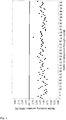
- the wafers were analysed for RRV values according to the SEMI standard SEMI MF81, and all wafers had RRV values below 1.8%.
- the RRV values are depicted in Figure 1 .
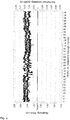
- Deviations from the target resistivity, expressed as the normalised resistivities ⁇ / ⁇ NTD are depicted in Figure 2 .
- 100% of the wafers had RRV values below 1.8%, 99% had RRV values below 1.5%, 97% had RRV values below 1.4%, and 92% had RRV values below 1.3%.
- silicon single crystals were prepared with target resistivities of 55 ⁇ cm and 740 ⁇ cm, and all wafers cut from these silicon single crystals had RRV values below 1.8% (see Figure 3 and Figure 5 , respectively). Furthermore, the wafers had normalised average resistivity values, ⁇ av / ⁇ NTD , within the range of 0.96 to 1.04, and for target resistivities of 55 ⁇ cm and 740 ⁇ cm within 0.98 to 1.02 (see Figure 4 ).
- the method of the invention advantageously allows a more even distribution of phosphorus donor atoms in the phosphorus doped silicon single crystal, in particular in a transverse plane of the phosphorus doped silicon single crystal but also along the axial dimension of the phosphorus doped silicon single crystal.
- the more even distribution of phosphorus atoms can be classified by any appropriate means, and as an alternative to calculating the RRV value the quality of a silicon wafer, i.e. as reflected by the even distribution of phosphorus donor atoms in a transverse plane, may also be estimated by taking into consideration all the measurement points recorded for the RRV calculations.
- the SEMI MF81 standard at present includes obtaining 9 resistivity measurements at specified locations, and instead of using only the highest and the lowest values recorded, as done in the calculation of the RRV, an average value, ⁇ av , can be calculated from the obtained data points. Likewise, a standard deviation may also be calculated from the obtained data points. The average value, ⁇ av , and also the standard deviation, may be normalised to the target resistivity, ⁇ NTD .
- the silicon wafer after annealing has a normalised average resistivity defined as ⁇ av / ⁇ NTD in the range of 0.95 to 1.05, e.g.
- the resistivity measurements included in the calculations of the average value, ⁇ av may be obtained from any pattern of measurements distributed over the surface of the wafer, although in general at least 5 measurements are needed to estimate the average value, ⁇ av , of the resistivity.
- the resistivity of a wafer is measured at the centre of the wafer (1 or 2 measurements), and 4 measurements distributed along, e.g. evenly distributed along, a circle having a radius of 50% of the radius of the wafer and 4 measurements distributed along, e.g.
- a circle having a radius of 95% to 100% of the radius of the wafer for example at a distance of 6 mm from the edge of the wafer (when 1 measurement is obtained for the centre of the wafer, 4 measurements are obtained at half the radius and 4 measurements are obtained at 6.0 mm from the edge of the wafer the measurements comply with the SEMI MF81 standard) are recorded, and an average value, ⁇ av , is calculated from the 9 or 10 measurements together with a standard deviation.
- the data in the Figures demonstrate an extremely low wafer-to-wafer variation.
- the average of the average values, ⁇ av for the population of wafers obtained from a single phosphorus doped silicon single crystal will typically also be low, e.g. ⁇ 1% from the average of the ⁇ av 's (data not shown).
- This extremely low wafer-to-wafer variation is also reflected in the ⁇ av / ⁇ NTD and it documents that a ⁇ av / ⁇ NTD in the range of 0.95 to 1.05 is obtained, in particular for all wafers cut from the silicon single crystals.
- the data is presented as measured resistivity values compared to the target resistivity of 131 ⁇ cm, ⁇ / ⁇ NTD . The resistivity values of all wafers are within 5% from the target resistivity.
- an USL as well as a "lower specification limit” may also be defined for the normalised average ⁇ av / ⁇ NTD , which USL and LSL take into account the stochastic variation of the resistivity values recorded for the wafers and the USL may be set to be the ⁇ NTD plus three standard deviations and the LSL may be set to the ⁇ NTD minus three standard deviations, where the standard deviations are for all wafers included in the measurements. Other limits for the USL and LSL may be five standard deviations.
- the plot in Figure 2 shows, for each wafer, the resistivity measurements made according to the SEMI MF81 standard, and the plots in Figure 4 represent the same data as in Figure 2 shown as a box plot with an USL and a LSL, which, at ⁇ 5%, are within plus or minus three standard deviations, respectively.
- Figure 4 also shows box plots for phosphorus doped silicon single crystals with target resistivities, ⁇ NTD , of 55 ⁇ cm and 740 ⁇ cm. It is evident that the present invention provides a phosphorus doped silicon single crystal from which wafers can be cut, which phosphorus doped silicon single crystal provides an USL of plus 5%, e.g. plus 3%, for the RRV values for wafers cut from the silicon single crystal.
- a measurement may be made to represent a central region of the wafer corresponding to a distance from the centre to 25% of the radius of the wafer, and two or more resistivity values may be recorded for a region of the wafer corresponding to a distance from 25% of the radius of the silicon wafer to 75% of the radius of the silicon wafer, and two or more resistivity values may be recorded at a distance from 75% of the radius of the silicon wafer to 100% of the radius of the silicon wafer.
- the phosphorus doped silicon single crystal has a distribution of phosphorus donor atoms allowing a wafer, or a plurality of wafers, to be cut from the phosphorus doped silicon single crystal, which wafer, or a plurality of wafers, after annealing at a temperature in the range of 800°C to 1300°C has a RRV value of 1.8% or less, and also a normalised average resistivity defined as ⁇ av / ⁇ NTD in the range of 0.95 to 1.05.
- the invention relates to a phosphorus doped silicon single crystal having a diameter of at least 175 mm and an axial length in the range of 50 mm to 600 mm, the phosphorus doped silicon single crystal in a transverse plane having a density of dopant atoms providing a target resistivity ( ⁇ NTD ) in the range of 55 ⁇ cm to 2000 ⁇ cm for a wafer, or a plurality of wafers, cut from the phosphorus doped silicon ingot, which target resistivity is measurable after annealing the silicon at a temperature in the range of 800°C to 1300°C, wherein the silicon wafer, or the plurality of silicon wafers, after annealing has, or have, a normalised average resistivity defined as ⁇ av / ⁇ NTD in the range of 0.95 to 1.05 when 5 or more, e.g.
- resistivity values are recorded across the surface of the wafer, e.g. according to the SEMI standard SEMI MF81 or as outlined above.
- the RRV value will generally be below 2% for the wafers, e.g. at or below 1.8%.
- the silicon ingot is prepared in a FZ process, and the diameter of the silicon ingot, and thereby also of the phosphorus doped silicon single crystal, is in the range of 175 mm to 225 mm.
- the invention is not limited with respect to the diameter of the silicon single crystal, and the relation expressed in Equation (8) is relevant also for silicon single crystals with diameters larger than 225 mm, e.g. 275 mm or larger, or at 350 mm or larger.
- An appropriate process for the manufacture of such a silicon ingot is described in WO 2008/125104 ; in particular the section from p. 4, line 9 to p. 5, line 25, e.g. p. 4, line 14-23, and p. 4, line 34 to p.
- line 5 discloses important parameters for the FZ manufacture of silicon single crystals with diameters in the range of 175 mm to 225 mm. Another method of producing a large diameter silicon single crystal is disclosed in DK 177854 (also published as US 2003/024469 ). When the silicon ingot is prepared in a FZ process the oxygen content will generally be low, e.g. less than 2 ⁇ 10 16 cm -3 .
- the silicon ingot is prepared in a CZ process.
- Appropriate processes for the manufacture of silicon ingots in CZ processes are described in EP 2824222 and US 2015/240380 .
- the diameter of the phosphorus doped silicon single crystal may be in the range of 275 mm to 475 mm.
- a CZ process may provide a silicon ingot with a diameter in the range of 275 mm to 325 mm. Silicon ingots prepared in a CZ process can generally be recognised from the oxygen content, which is typically above 10 17 cm -3 .
- Equation (8) is not considered limited with respect to the diameter of the phosphorus doped silicon single crystal, and it is also contemplated that Equation (8) applies for diameters larger than 450 mm.
- the diameter is determined by the method of manufacture of the silicon ingot.
- the silicon ingot is prepared in a FZ process to have a diameter in the range of 175 mm to 225 mm, and in another embodiment the silicon ingot is prepared in a FZ process to have a diameter in the range of 275 mm to 325 mm.
- the silicon ingot is prepared in a CZ process to have a diameter in the range of 275 mm to 325 mm, or in the range of 375 mm to 425 mm, or in the range of 425 mm to 475 mm.
- the invention relates to a phosphorus doped silicon single crystal obtainable in the method of the invention.
- the phosphorus doped silicon single crystals of the aspects described above are obtainable in the method of the invention.
- the invention relates to a wafer cut from a phosphorus doped silicon single crystal obtainable in the method of the invention.
- the invention relates to a plurality of wafers cut from a phosphorus doped silicon single crystal obtainable in the method of the invention.
- a silicon wafer and a further embodiment of the invention relates to a plurality of wafers, having a diameter in the range of 175 mm to 225 mm, a thickness in the range of 100 ⁇ m to 1500 ⁇ m, a resistivity in the range of 55 ⁇ cm to 2000 ⁇ cm, a RRV value below 2% e.g. at 1.8% or less, and an oxygen content below 2 ⁇ 10 16 cm -3 ; the silicon wafer(s) has/have a normalised average resistivity defined as ⁇ av / ⁇ NTD in the range of 0.95 to 1.05, e.g. in the range of 0.96 to 1.04.
- a silicon wafer or a plurality of wafers, having a diameter in the range of 275 mm to 325 mm, a resistivity in the range of 5 ⁇ cm to 2000 ⁇ cm, a RRV value of 2% or less, and an oxygen content above 10 17 cm -3 ; the silicon wafer(s) has/have a normalised average resistivity defined as ⁇ av / ⁇ NTD in the range of 0.95 to 1.05, e.g. in the range of 0.96 to 1.04.
- the present invention relates to phosphorus doped silicon single crystals, a plurality of wafers cut from the phosphorus doped silicon single crystal and a method of producing a phosphorus doped silicon single crystal.
- the "phosphorus doped silicon single crystal” is a silicon single crystal, which has been doped with phosphorus to control the phosphorus density in the crystal and thereby the resistivity.
- the phosphorus doped silicon single crystal is exposed to neutron irradiation in a neutron transmutation doping (NTD) process.
- NTD neutron transmutation doping
- the phosphorus doped silicon single crystal may also be referred to as a neutron irradiated silicon single crystal, however, the phosphorus doped silicon single crystal may be produced using any doping process providing the phosphorus doped silicon single crystal of the invention.
- the phosphorus doped silicon single crystal may be prepared from any silicon single crystal, and in the context of the invention, especially in the context of the method of the invention, the silicon single crystal before neutron irradiation may also be referred to as a "silicon ingot" or to a "a gas doped silicon single crystal”; in general a silicon ingot and a gas doped silicon single crystal are thus also considered to be silicon single crystals.
- the gas doped silicon single crystal, or silicon ingot will be cut into a length appropriate for the NTD apparatus. The length will typically be in the range of 50 mm to 600 mm, however, it is also contemplated that a NTD apparatus may be designed for longer silicon single crystals or shorter silicon single crystals.
- the phosphorus doped silicon single crystal may have an axial length in the range of 20 mm to 1000 mm.
- the phosphorus doped silicon single crystal, and also the silicon ingot, will typically be round and have a diameter.
- the term "diameter" may be used in the context of the silicon single crystal, whether irradiated or not, or a wafer cut from the phosphorus doped silicon single crystal.
- the wafer will normally be cut at an angle perpendicular to the length of the phosphorus doped silicon single crystal, i.e. perpendicular to the axial dimension of the phosphorus doped silicon single crystal.
- the wafer will represent a plane in the phosphorus doped silicon single crystal, which plane is transverse to the axial dimension of the phosphorus doped silicon single crystal.
- the diameter may also be referred to as a transverse diameter.
- the phosphorus doped silicon single crystal is used to prepare wafers for use in the field of electronics. Since the wafer is cut from a silicon single crystal the wafer will be a silicon wafer, and in the context of the invention the two terms can be used interchangeably. Thus, a "wafer” is considered to be a "silicon wafer” even though it may not explicitly be referred to as a silicon wafer. A wafer may be supplied to a user in any form appropriate. Thus, the wafer may be supplied as cut from the phosphorus doped silicon single crystal, or it may be subjected to any further processing, e.g. a high temperature annealing or any polishing or etching or the like as desirable.
- any further processing e.g. a high temperature annealing or any polishing or etching or the like as desirable.
- a wafer will have a resistivity, which can be measured after annealing as described above.
- the phosphorus doped silicon single crystal has a "target resistivity” that is abbreviated " ⁇ NTD " regardless of how the phosphorus doped silicon single crystal has been prepared.
- the target resistivity, ⁇ NTD will be a single value for the phosphorus doped silicon single crystal and wafers cut from the phosphorus doped silicon single crystal.
- the actual resistivity of the wafer will vary over the surface of the wafer and the wafer will have an average resistivity " ⁇ av ", which is calculated based on at least 5 resistivity values recorded across the surface of the silicon wafer, in particular 9 resistivity values recorded according to the SEMI standard SEMI MF81.
- the ratio between the target resistivity and the average resistivity, ⁇ av / ⁇ NTD is, in the context of the invention, referred to as "the normalised average resistivity”.
- the ratio of a single resistivity measurement may also be normalised to the target resistivity and in this case it can be referred to as " ⁇ / ⁇ NTD ".
- the resistivity of the silicon material can be controlled by including dopant atoms into the silicon.
- dopant atoms will be phosphorus, and in the context of the invention phosphorus atoms may also be referred to as "donor atoms".
- donor atoms it is also contemplated that the density of boron atoms may be controlled.
- the application employs the unit “cm -3 " for concentrations and densities of atoms, and in the context of the invention it is understood that the unit cm -3 refers to atoms ⁇ cm -3 .
- a phosphorus doped silicon single crystal with a target resistivity ( ⁇ NTD ) of 131 ⁇ cm and a target diameter of 200 mm was produced in the method of the invention.
- a silicon single crystal was initially prepared in a float zone (FZ) process as described in WO 2008/125104 . Specifically, a silicon single crystal having a diameter of 201 mm was pulled from a polycrystalline rod, with a ⁇ 100> orientation of the crystal seed using FZ principles.
- a static magnetic flux density of 0.01 T was applied to the molten zone in a direction essentially parallel to the growth direction of the crystal, and the rotation of the crystal was alternated between clockwise and counter-clockwise rotations of 4 and 6 seconds durations, respectively, at rotational rates of 12 rpm.
- Equation (8) The change in direction of rotation lasted a maximum of 0.3 s.
- the movement rate of the rod was 2.8 mm/min.
- the gas doped silicon single crystal was irradiated with neutrons to decrease the resistivity to the target resistivity ( ⁇ NTD ), and the required fluence was calculated from Equation (8) using values of the constants K 1 , K 2 and K 3 as determined above: K 1 was 2.612 ⁇ 10 19 ⁇ cm -1 , K 2 was 4.280 ⁇ 10 -6 cm 2 , and K 3 was 0.10.
- the resulting phosphorus doped silicon single crystal was cut into 98 wafers, which were provided with serial numbers using laser labelling.
- Phosphorus doped silicon single crystals with target resistivities ( ⁇ NTD ) of 55 ⁇ cm and 740 ⁇ cm and target diameters of 200 mm were produced in the method of the invention and as outlined in Example 1.
- Figure 3 shows box plots of resistivities for wafers cut from the prepared phosphorus doped silicon single crystals, and box plots of the deviations from target resistivities for the wafers are shown in Figure 4 .
- the box plots show the median observation and the "bottom” and the "lid” of the boxes represent the 25% and 75% quantiles, and the extremes in the plots represent the 5% and 95% quantiles.
- the sample size was 56 wafers, and for the silicon single crystal with ⁇ NTD of 740 ⁇ cm the sample size was 13 wafers.
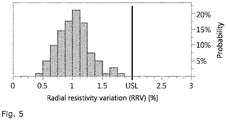
- FIG. 5 A plot of the distribution of RRV values for the wafers analysed in Examples 1 and 2 is shown in Figure 5 .
- the data in Figure 5 is seen to be normal distributed, which is generally considered relevant for phosphorus doped silicon single crystals.
- the distribution had a mean RRV of 1.02, and the standard deviation was 0.26 so that the value of 1.8% corresponded to the average plus three standard deviations.
Landscapes
- Chemical & Material Sciences (AREA)
- Engineering & Computer Science (AREA)
- Crystallography & Structural Chemistry (AREA)
- Materials Engineering (AREA)
- Metallurgy (AREA)
- Organic Chemistry (AREA)
- Physics & Mathematics (AREA)
- Electromagnetism (AREA)
- Crystals, And After-Treatments Of Crystals (AREA)
Applications Claiming Priority (2)
| Application Number | Priority Date | Filing Date | Title |
|---|---|---|---|
| EP16154695 | 2016-02-08 | ||
| PCT/EP2017/052754 WO2017137438A1 (en) | 2016-02-08 | 2017-02-08 | A phosphorus doped silicon single crystal |
Publications (2)
| Publication Number | Publication Date |
|---|---|
| EP3414367A1 EP3414367A1 (en) | 2018-12-19 |
| EP3414367B1 true EP3414367B1 (en) | 2020-02-26 |
Family
ID=55411172
Family Applications (1)
| Application Number | Title | Priority Date | Filing Date |
|---|---|---|---|
| EP17703166.3A Active EP3414367B1 (en) | 2016-02-08 | 2017-02-08 | A phosphorus doped silicon single crystal |
Country Status (5)
| Country | Link |
|---|---|
| EP (1) | EP3414367B1 (https=) |
| JP (1) | JP6808757B2 (https=) |
| CN (1) | CN108699724B (https=) |
| DK (1) | DK3414367T3 (https=) |
| WO (1) | WO2017137438A1 (https=) |
Families Citing this family (10)
| Publication number | Priority date | Publication date | Assignee | Title |
|---|---|---|---|---|
| US10468148B2 (en) | 2017-04-24 | 2019-11-05 | Infineon Technologies Ag | Apparatus and method for neutron transmutation doping of semiconductor wafers |
| JP7010179B2 (ja) * | 2018-09-03 | 2022-01-26 | 株式会社Sumco | 単結晶の製造方法及び装置及びシリコン単結晶インゴット |
| US11739437B2 (en) * | 2018-12-27 | 2023-08-29 | Globalwafers Co., Ltd. | Resistivity stabilization measurement of fat neck slabs for high resistivity and ultra-high resistivity single crystal silicon ingot growth |
| CN111341838B (zh) * | 2020-03-09 | 2021-05-07 | 华东师范大学 | 硅同位素Si-30在抗中高能中子辐射半导体材料或半导体器件的应用 |
| CA3175051A1 (en) * | 2020-03-12 | 2021-09-16 | Umicore | Heavily doped n-type germanium |
| JP7342845B2 (ja) * | 2020-11-25 | 2023-09-12 | 株式会社Sumco | シリコン単結晶の製造方法 |
| CN114990693A (zh) * | 2022-04-02 | 2022-09-02 | 天津中环领先材料技术有限公司 | 一种ntd单晶硅退火工艺 |
| EP4350055A1 (de) * | 2022-10-06 | 2024-04-10 | Siltronic AG | Verfahren zur herstellung eines einkristalls aus silizium und halbleiterscheibe aus einkristallinem silizium |
| CN118422319A (zh) * | 2024-05-27 | 2024-08-02 | 宁夏中欣晶圆半导体科技有限公司 | 高电阻率单晶材料的制备方法 |
| CN121675078A (zh) * | 2024-08-23 | 2026-03-17 | 隆基绿能科技股份有限公司 | 一种光伏单晶硅片和包含其的太阳能电池 |
Family Cites Families (14)
| Publication number | Priority date | Publication date | Assignee | Title |
|---|---|---|---|---|
| US5904767A (en) * | 1996-08-29 | 1999-05-18 | Industrial Technology Research Institute | Neutron transmutation doping of silicon single crystals |
| DE19738732A1 (de) * | 1997-09-04 | 1999-03-18 | Wacker Siltronic Halbleitermat | Neutronendotierte Siliciumscheiben |
| DE10137856B4 (de) | 2001-08-02 | 2007-12-13 | Siltronic Ag | Durch tiegelloses Zonenziehen hergestellter Einkristall aus Silicium |
| JP2005012090A (ja) * | 2003-06-20 | 2005-01-13 | Toshiba Corp | 半導体ウェーハの製造方法及び半導体装置の製造方法 |
| JP2005035816A (ja) | 2003-07-17 | 2005-02-10 | Shin Etsu Handotai Co Ltd | シリコン単結晶製造方法及びシリコン単結晶 |
| CN1325701C (zh) * | 2006-04-26 | 2007-07-11 | 天津市环欧半导体材料技术有限公司 | 气相预掺杂和中子辐照掺杂组合的区熔硅单晶的生产方法 |
| CN101680108A (zh) | 2007-04-13 | 2010-03-24 | Topsil半导体材料股份公司 | 生产单晶的方法和设备 |
| JP2008308383A (ja) * | 2007-06-18 | 2008-12-25 | Covalent Materials Corp | シリコン単結晶の製造方法 |
| JP5283543B2 (ja) * | 2009-03-09 | 2013-09-04 | 株式会社Sumco | シリコン単結晶の育成方法 |
| JP5201077B2 (ja) * | 2009-05-15 | 2013-06-05 | 株式会社Sumco | シリコンウェーハの製造方法 |
| JP5194146B2 (ja) * | 2010-12-28 | 2013-05-08 | ジルトロニック アクチエンゲゼルシャフト | シリコン単結晶の製造方法、シリコン単結晶、およびウエハ |
| CN102534752A (zh) * | 2012-03-08 | 2012-07-04 | 天津市环欧半导体材料技术有限公司 | 一种制造区熔硅单晶的直拉区熔气掺法 |
| JP5880353B2 (ja) | 2012-08-28 | 2016-03-09 | 信越半導体株式会社 | シリコン単結晶の育成方法 |
| JP5921498B2 (ja) | 2013-07-12 | 2016-05-24 | グローバルウェーハズ・ジャパン株式会社 | シリコン単結晶の製造方法 |
-
2017
- 2017-02-08 WO PCT/EP2017/052754 patent/WO2017137438A1/en not_active Ceased
- 2017-02-08 EP EP17703166.3A patent/EP3414367B1/en active Active
- 2017-02-08 JP JP2018560252A patent/JP6808757B2/ja active Active
- 2017-02-08 DK DK17703166.3T patent/DK3414367T3/da active
- 2017-02-08 CN CN201780010459.1A patent/CN108699724B/zh active Active
Non-Patent Citations (1)
| Title |
|---|
| None * |
Also Published As
| Publication number | Publication date |
|---|---|
| JP2019504817A (ja) | 2019-02-21 |
| WO2017137438A1 (en) | 2017-08-17 |
| CN108699724A (zh) | 2018-10-23 |
| DK3414367T3 (da) | 2020-05-25 |
| CN108699724B (zh) | 2021-05-04 |
| JP6808757B2 (ja) | 2021-01-06 |
| EP3414367A1 (en) | 2018-12-19 |
Similar Documents
| Publication | Publication Date | Title |
|---|---|---|
| EP3414367B1 (en) | A phosphorus doped silicon single crystal | |
| TWI539041B (zh) | 單晶矽半導體晶圓及其製造方法 | |
| TWI404836B (zh) | 控制由單晶矽在卓式成長過程側向表面產生的聚集點缺陷及氧團簇的形成 | |
| JP4942606B2 (ja) | シリコンウェハおよびその作製方法 | |
| US6702892B2 (en) | Production device for high-quality silicon single crystals | |
| US9938639B2 (en) | Method for forming a doped silicon ingot of uniform resistivity | |
| JP5201077B2 (ja) | シリコンウェーハの製造方法 | |
| EP2607526B1 (en) | Method of manufacturing a silicon single crystal substrate | |
| EP2226412B1 (en) | Method for growing silicon single crystal and method for producing silicon wafer | |
| EP1551058B1 (en) | Annealed wafer manufacturing method | |
| DE112013001054T5 (de) | Verfahren zum Herstellen eines Silizium-Einkristall-Wafers | |
| JP2019504817A5 (https=) | ||
| CN106471164A (zh) | β-Ga2O3系单晶衬底 | |
| Bromiley et al. | Grain boundary diffusion of titanium in polycrystalline quartz and its implications for titanium in quartz (TitaniQ) geothermobarometry | |
| KR20170021286A (ko) | 다결정 실리콘 봉의 표면 온도의 산출 방법 및 제어 방법, 다결정 실리콘 봉의 제조 방법, 다결정 실리콘 봉, 및 다결정 실리콘 괴 | |
| US20140271436A1 (en) | Rare Earth Oxyorthosilicate Scintillation Crystals | |
| JP2016013957A (ja) | 点欠陥濃度計算方法、Grown−in欠陥計算方法、Grown−in欠陥面内分布計算方法及びこれらを用いたシリコン単結晶製造方法 | |
| KR20220052993A (ko) | 점 결함 시뮬레이터, 점 결함 시뮬레이션 프로그램, 점 결함 시뮬레이션 방법, 실리콘 단결정의 제조 방법 및 단결정 인상 장치 | |
| JP6565810B2 (ja) | 中性子照射シリコン単結晶の製造方法 | |
| KR101721211B1 (ko) | 단결정 실리콘 웨이퍼 분석 방법 및 이 방법에 의해 제조된 웨이퍼 | |
| JP6260485B2 (ja) | エピタキシャルシリコンウェーハの製造方法 | |
| JP2014148448A (ja) | シリコン単結晶ウエーハおよびその評価方法ならびにシリコン単結晶棒の製造方法 | |
| Verezub et al. | Theoretical and experimental study of the formation of grown-in and as-grown microdefects in dislocation-free silicon single crystals grown by the Czochralski method | |
| Börner et al. | Large-depth defect profiling in GaAs wafers after saw cutting | |
| Varlachev et al. | Technology for Silicon NTD Using Pool-Type Research Reactors |
Legal Events
| Date | Code | Title | Description |
|---|---|---|---|
| STAA | Information on the status of an ep patent application or granted ep patent |
Free format text: STATUS: UNKNOWN |
|
| STAA | Information on the status of an ep patent application or granted ep patent |
Free format text: STATUS: THE INTERNATIONAL PUBLICATION HAS BEEN MADE |
|
| PUAI | Public reference made under article 153(3) epc to a published international application that has entered the european phase |
Free format text: ORIGINAL CODE: 0009012 |
|
| STAA | Information on the status of an ep patent application or granted ep patent |
Free format text: STATUS: REQUEST FOR EXAMINATION WAS MADE |
|
| 17P | Request for examination filed |
Effective date: 20180820 |
|
| AK | Designated contracting states |
Kind code of ref document: A1 Designated state(s): AL AT BE BG CH CY CZ DE DK EE ES FI FR GB GR HR HU IE IS IT LI LT LU LV MC MK MT NL NO PL PT RO RS SE SI SK SM TR |
|
| AX | Request for extension of the european patent |
Extension state: BA ME |
|
| DAV | Request for validation of the european patent (deleted) | ||
| DAX | Request for extension of the european patent (deleted) | ||
| REG | Reference to a national code |
Ref country code: DE Ref legal event code: R079 Ref document number: 602017012268 Country of ref document: DE Free format text: PREVIOUS MAIN CLASS: C30B0029060000 Ipc: H01L0021324000 |
|
| RIC1 | Information provided on ipc code assigned before grant |
Ipc: H01L 29/36 20060101ALI20190808BHEP Ipc: C30B 31/20 20060101ALI20190808BHEP Ipc: H01L 21/324 20060101AFI20190808BHEP Ipc: C30B 29/06 20060101ALI20190808BHEP Ipc: C30B 31/08 20060101ALI20190808BHEP Ipc: H01L 21/261 20060101ALI20190808BHEP |
|
| GRAP | Despatch of communication of intention to grant a patent |
Free format text: ORIGINAL CODE: EPIDOSNIGR1 |
|
| STAA | Information on the status of an ep patent application or granted ep patent |
Free format text: STATUS: GRANT OF PATENT IS INTENDED |
|
| INTG | Intention to grant announced |
Effective date: 20190917 |
|
| GRAS | Grant fee paid |
Free format text: ORIGINAL CODE: EPIDOSNIGR3 |
|
| GRAA | (expected) grant |
Free format text: ORIGINAL CODE: 0009210 |
|
| STAA | Information on the status of an ep patent application or granted ep patent |
Free format text: STATUS: THE PATENT HAS BEEN GRANTED |
|
| AK | Designated contracting states |
Kind code of ref document: B1 Designated state(s): AL AT BE BG CH CY CZ DE DK EE ES FI FR GB GR HR HU IE IS IT LI LT LU LV MC MK MT NL NO PL PT RO RS SE SI SK SM TR |
|
| REG | Reference to a national code |
Ref country code: GB Ref legal event code: FG4D |
|
| REG | Reference to a national code |
Ref country code: CH Ref legal event code: EP |
|
| REG | Reference to a national code |
Ref country code: AT Ref legal event code: REF Ref document number: 1238666 Country of ref document: AT Kind code of ref document: T Effective date: 20200315 |
|
| REG | Reference to a national code |
Ref country code: IE Ref legal event code: FG4D |
|
| REG | Reference to a national code |
Ref country code: DE Ref legal event code: R096 Ref document number: 602017012268 Country of ref document: DE |
|
| REG | Reference to a national code |
Ref country code: DK Ref legal event code: T3 Effective date: 20200520 |
|
| PG25 | Lapsed in a contracting state [announced via postgrant information from national office to epo] |
Ref country code: NO Free format text: LAPSE BECAUSE OF FAILURE TO SUBMIT A TRANSLATION OF THE DESCRIPTION OR TO PAY THE FEE WITHIN THE PRESCRIBED TIME-LIMIT Effective date: 20200526 Ref country code: RS Free format text: LAPSE BECAUSE OF FAILURE TO SUBMIT A TRANSLATION OF THE DESCRIPTION OR TO PAY THE FEE WITHIN THE PRESCRIBED TIME-LIMIT Effective date: 20200226 Ref country code: FI Free format text: LAPSE BECAUSE OF FAILURE TO SUBMIT A TRANSLATION OF THE DESCRIPTION OR TO PAY THE FEE WITHIN THE PRESCRIBED TIME-LIMIT Effective date: 20200226 |
|
| REG | Reference to a national code |
Ref country code: NL Ref legal event code: MP Effective date: 20200226 |
|
| REG | Reference to a national code |
Ref country code: LT Ref legal event code: MG4D |
|
| PG25 | Lapsed in a contracting state [announced via postgrant information from national office to epo] |
Ref country code: HR Free format text: LAPSE BECAUSE OF FAILURE TO SUBMIT A TRANSLATION OF THE DESCRIPTION OR TO PAY THE FEE WITHIN THE PRESCRIBED TIME-LIMIT Effective date: 20200226 Ref country code: GR Free format text: LAPSE BECAUSE OF FAILURE TO SUBMIT A TRANSLATION OF THE DESCRIPTION OR TO PAY THE FEE WITHIN THE PRESCRIBED TIME-LIMIT Effective date: 20200527 Ref country code: LV Free format text: LAPSE BECAUSE OF FAILURE TO SUBMIT A TRANSLATION OF THE DESCRIPTION OR TO PAY THE FEE WITHIN THE PRESCRIBED TIME-LIMIT Effective date: 20200226 Ref country code: SE Free format text: LAPSE BECAUSE OF FAILURE TO SUBMIT A TRANSLATION OF THE DESCRIPTION OR TO PAY THE FEE WITHIN THE PRESCRIBED TIME-LIMIT Effective date: 20200226 Ref country code: BG Free format text: LAPSE BECAUSE OF FAILURE TO SUBMIT A TRANSLATION OF THE DESCRIPTION OR TO PAY THE FEE WITHIN THE PRESCRIBED TIME-LIMIT Effective date: 20200526 Ref country code: IS Free format text: LAPSE BECAUSE OF FAILURE TO SUBMIT A TRANSLATION OF THE DESCRIPTION OR TO PAY THE FEE WITHIN THE PRESCRIBED TIME-LIMIT Effective date: 20200626 |
|
| PG25 | Lapsed in a contracting state [announced via postgrant information from national office to epo] |
Ref country code: NL Free format text: LAPSE BECAUSE OF FAILURE TO SUBMIT A TRANSLATION OF THE DESCRIPTION OR TO PAY THE FEE WITHIN THE PRESCRIBED TIME-LIMIT Effective date: 20200226 |
|
| PG25 | Lapsed in a contracting state [announced via postgrant information from national office to epo] |
Ref country code: CZ Free format text: LAPSE BECAUSE OF FAILURE TO SUBMIT A TRANSLATION OF THE DESCRIPTION OR TO PAY THE FEE WITHIN THE PRESCRIBED TIME-LIMIT Effective date: 20200226 Ref country code: ES Free format text: LAPSE BECAUSE OF FAILURE TO SUBMIT A TRANSLATION OF THE DESCRIPTION OR TO PAY THE FEE WITHIN THE PRESCRIBED TIME-LIMIT Effective date: 20200226 Ref country code: LT Free format text: LAPSE BECAUSE OF FAILURE TO SUBMIT A TRANSLATION OF THE DESCRIPTION OR TO PAY THE FEE WITHIN THE PRESCRIBED TIME-LIMIT Effective date: 20200226 Ref country code: SM Free format text: LAPSE BECAUSE OF FAILURE TO SUBMIT A TRANSLATION OF THE DESCRIPTION OR TO PAY THE FEE WITHIN THE PRESCRIBED TIME-LIMIT Effective date: 20200226 Ref country code: SK Free format text: LAPSE BECAUSE OF FAILURE TO SUBMIT A TRANSLATION OF THE DESCRIPTION OR TO PAY THE FEE WITHIN THE PRESCRIBED TIME-LIMIT Effective date: 20200226 Ref country code: RO Free format text: LAPSE BECAUSE OF FAILURE TO SUBMIT A TRANSLATION OF THE DESCRIPTION OR TO PAY THE FEE WITHIN THE PRESCRIBED TIME-LIMIT Effective date: 20200226 Ref country code: EE Free format text: LAPSE BECAUSE OF FAILURE TO SUBMIT A TRANSLATION OF THE DESCRIPTION OR TO PAY THE FEE WITHIN THE PRESCRIBED TIME-LIMIT Effective date: 20200226 Ref country code: PT Free format text: LAPSE BECAUSE OF FAILURE TO SUBMIT A TRANSLATION OF THE DESCRIPTION OR TO PAY THE FEE WITHIN THE PRESCRIBED TIME-LIMIT Effective date: 20200719 |
|
| REG | Reference to a national code |
Ref country code: AT Ref legal event code: UEP Ref document number: 1238666 Country of ref document: AT Kind code of ref document: T Effective date: 20200226 |
|
| REG | Reference to a national code |
Ref country code: DE Ref legal event code: R097 Ref document number: 602017012268 Country of ref document: DE |
|
| PLBE | No opposition filed within time limit |
Free format text: ORIGINAL CODE: 0009261 |
|
| STAA | Information on the status of an ep patent application or granted ep patent |
Free format text: STATUS: NO OPPOSITION FILED WITHIN TIME LIMIT |
|
| PG25 | Lapsed in a contracting state [announced via postgrant information from national office to epo] |
Ref country code: IT Free format text: LAPSE BECAUSE OF FAILURE TO SUBMIT A TRANSLATION OF THE DESCRIPTION OR TO PAY THE FEE WITHIN THE PRESCRIBED TIME-LIMIT Effective date: 20200226 |
|
| 26N | No opposition filed |
Effective date: 20201127 |
|
| PG25 | Lapsed in a contracting state [announced via postgrant information from national office to epo] |
Ref country code: PL Free format text: LAPSE BECAUSE OF FAILURE TO SUBMIT A TRANSLATION OF THE DESCRIPTION OR TO PAY THE FEE WITHIN THE PRESCRIBED TIME-LIMIT Effective date: 20200226 Ref country code: SI Free format text: LAPSE BECAUSE OF FAILURE TO SUBMIT A TRANSLATION OF THE DESCRIPTION OR TO PAY THE FEE WITHIN THE PRESCRIBED TIME-LIMIT Effective date: 20200226 |
|
| PG25 | Lapsed in a contracting state [announced via postgrant information from national office to epo] |
Ref country code: MC Free format text: LAPSE BECAUSE OF FAILURE TO SUBMIT A TRANSLATION OF THE DESCRIPTION OR TO PAY THE FEE WITHIN THE PRESCRIBED TIME-LIMIT Effective date: 20200226 |
|
| REG | Reference to a national code |
Ref country code: BE Ref legal event code: MM Effective date: 20210228 |
|
| PG25 | Lapsed in a contracting state [announced via postgrant information from national office to epo] |
Ref country code: LU Free format text: LAPSE BECAUSE OF NON-PAYMENT OF DUE FEES Effective date: 20210208 |
|
| PG25 | Lapsed in a contracting state [announced via postgrant information from national office to epo] |
Ref country code: FR Free format text: LAPSE BECAUSE OF NON-PAYMENT OF DUE FEES Effective date: 20210228 Ref country code: IE Free format text: LAPSE BECAUSE OF NON-PAYMENT OF DUE FEES Effective date: 20210208 |
|
| PG25 | Lapsed in a contracting state [announced via postgrant information from national office to epo] |
Ref country code: BE Free format text: LAPSE BECAUSE OF NON-PAYMENT OF DUE FEES Effective date: 20210228 |
|
| PG25 | Lapsed in a contracting state [announced via postgrant information from national office to epo] |
Ref country code: CY Free format text: LAPSE BECAUSE OF FAILURE TO SUBMIT A TRANSLATION OF THE DESCRIPTION OR TO PAY THE FEE WITHIN THE PRESCRIBED TIME-LIMIT Effective date: 20200226 |
|
| PG25 | Lapsed in a contracting state [announced via postgrant information from national office to epo] |
Ref country code: HU Free format text: LAPSE BECAUSE OF FAILURE TO SUBMIT A TRANSLATION OF THE DESCRIPTION OR TO PAY THE FEE WITHIN THE PRESCRIBED TIME-LIMIT; INVALID AB INITIO Effective date: 20170208 |
|
| PG25 | Lapsed in a contracting state [announced via postgrant information from national office to epo] |
Ref country code: MK Free format text: LAPSE BECAUSE OF FAILURE TO SUBMIT A TRANSLATION OF THE DESCRIPTION OR TO PAY THE FEE WITHIN THE PRESCRIBED TIME-LIMIT Effective date: 20200226 |
|
| PG25 | Lapsed in a contracting state [announced via postgrant information from national office to epo] |
Ref country code: MT Free format text: LAPSE BECAUSE OF FAILURE TO SUBMIT A TRANSLATION OF THE DESCRIPTION OR TO PAY THE FEE WITHIN THE PRESCRIBED TIME-LIMIT Effective date: 20200226 |
|
| REG | Reference to a national code |
Ref country code: DE Ref legal event code: R079 Ref document number: 602017012268 Country of ref document: DE Free format text: PREVIOUS MAIN CLASS: H01L0021324000 Ipc: H10P0095900000 |
|
| PG25 | Lapsed in a contracting state [announced via postgrant information from national office to epo] |
Ref country code: TR Free format text: LAPSE BECAUSE OF FAILURE TO SUBMIT A TRANSLATION OF THE DESCRIPTION OR TO PAY THE FEE WITHIN THE PRESCRIBED TIME-LIMIT Effective date: 20200226 |
|
| REG | Reference to a national code |
Ref country code: CH Ref legal event code: U11 Free format text: ST27 STATUS EVENT CODE: U-0-0-U10-U11 (AS PROVIDED BY THE NATIONAL OFFICE) Effective date: 20260301 |
|
| PGFP | Annual fee paid to national office [announced via postgrant information from national office to epo] |
Ref country code: GB Payment date: 20260218 Year of fee payment: 10 |
|
| PGFP | Annual fee paid to national office [announced via postgrant information from national office to epo] |
Ref country code: DE Payment date: 20260218 Year of fee payment: 10 Ref country code: DK Payment date: 20260218 Year of fee payment: 10 |
|
| PGFP | Annual fee paid to national office [announced via postgrant information from national office to epo] |
Ref country code: AT Payment date: 20260219 Year of fee payment: 10 |
|
| PGFP | Annual fee paid to national office [announced via postgrant information from national office to epo] |
Ref country code: CH Payment date: 20260301 Year of fee payment: 10 |