EP3398474B1 - Automatische haarwaschvorrichtung - Google Patents
Automatische haarwaschvorrichtung Download PDFInfo
- Publication number
- EP3398474B1 EP3398474B1 EP16881741.9A EP16881741A EP3398474B1 EP 3398474 B1 EP3398474 B1 EP 3398474B1 EP 16881741 A EP16881741 A EP 16881741A EP 3398474 B1 EP3398474 B1 EP 3398474B1
- Authority
- EP
- European Patent Office
- Prior art keywords
- contacts
- head
- contact
- hair
- cover member
- Prior art date
- Legal status (The legal status is an assumption and is not a legal conclusion. Google has not performed a legal analysis and makes no representation as to the accuracy of the status listed.)
- Active
Links
Images


Classifications
-
- A—HUMAN NECESSITIES
- A45—HAND OR TRAVELLING ARTICLES
- A45D—HAIRDRESSING OR SHAVING EQUIPMENT; EQUIPMENT FOR COSMETICS OR COSMETIC TREATMENTS, e.g. FOR MANICURING OR PEDICURING
- A45D19/00—Devices for washing the hair or the scalp; Similar devices for colouring the hair
- A45D19/14—Closed washing devices, e.g. washing caps
-
- A—HUMAN NECESSITIES
- A45—HAND OR TRAVELLING ARTICLES
- A45D—HAIRDRESSING OR SHAVING EQUIPMENT; EQUIPMENT FOR COSMETICS OR COSMETIC TREATMENTS, e.g. FOR MANICURING OR PEDICURING
- A45D19/00—Devices for washing the hair or the scalp; Similar devices for colouring the hair
-
- A—HUMAN NECESSITIES
- A45—HAND OR TRAVELLING ARTICLES
- A45D—HAIRDRESSING OR SHAVING EQUIPMENT; EQUIPMENT FOR COSMETICS OR COSMETIC TREATMENTS, e.g. FOR MANICURING OR PEDICURING
- A45D19/00—Devices for washing the hair or the scalp; Similar devices for colouring the hair
- A45D19/06—Devices for washing the hair or the scalp; Similar devices for colouring the hair in the form of bowls or similar open containers
-
- A—HUMAN NECESSITIES
- A45—HAND OR TRAVELLING ARTICLES
- A45D—HAIRDRESSING OR SHAVING EQUIPMENT; EQUIPMENT FOR COSMETICS OR COSMETIC TREATMENTS, e.g. FOR MANICURING OR PEDICURING
- A45D19/00—Devices for washing the hair or the scalp; Similar devices for colouring the hair
- A45D19/06—Devices for washing the hair or the scalp; Similar devices for colouring the hair in the form of bowls or similar open containers
- A45D19/08—Adaptations of wash-basins
- A45D19/10—Backward lavabos
-
- A—HUMAN NECESSITIES
- A61—MEDICAL OR VETERINARY SCIENCE; HYGIENE
- A61H—PHYSICAL THERAPY APPARATUS, e.g. DEVICES FOR LOCATING OR STIMULATING REFLEX POINTS IN THE BODY; ARTIFICIAL RESPIRATION; MASSAGE; BATHING DEVICES FOR SPECIAL THERAPEUTIC OR HYGIENIC PURPOSES OR SPECIFIC PARTS OF THE BODY
- A61H33/00—Bathing devices for special therapeutic or hygienic purposes
-
- A—HUMAN NECESSITIES
- A61—MEDICAL OR VETERINARY SCIENCE; HYGIENE
- A61H—PHYSICAL THERAPY APPARATUS, e.g. DEVICES FOR LOCATING OR STIMULATING REFLEX POINTS IN THE BODY; ARTIFICIAL RESPIRATION; MASSAGE; BATHING DEVICES FOR SPECIAL THERAPEUTIC OR HYGIENIC PURPOSES OR SPECIFIC PARTS OF THE BODY
- A61H35/00—Baths for specific parts of the body
- A61H35/008—Baths for specific parts of the body for the head
-
- A—HUMAN NECESSITIES
- A61—MEDICAL OR VETERINARY SCIENCE; HYGIENE
- A61H—PHYSICAL THERAPY APPARATUS, e.g. DEVICES FOR LOCATING OR STIMULATING REFLEX POINTS IN THE BODY; ARTIFICIAL RESPIRATION; MASSAGE; BATHING DEVICES FOR SPECIAL THERAPEUTIC OR HYGIENIC PURPOSES OR SPECIFIC PARTS OF THE BODY
- A61H2205/00—Devices for specific parts of the body
- A61H2205/02—Head
- A61H2205/021—Scalp
-
- A—HUMAN NECESSITIES
- A61—MEDICAL OR VETERINARY SCIENCE; HYGIENE
- A61H—PHYSICAL THERAPY APPARATUS, e.g. DEVICES FOR LOCATING OR STIMULATING REFLEX POINTS IN THE BODY; ARTIFICIAL RESPIRATION; MASSAGE; BATHING DEVICES FOR SPECIAL THERAPEUTIC OR HYGIENIC PURPOSES OR SPECIFIC PARTS OF THE BODY
- A61H7/00—Devices for suction-kneading massage; Devices for massaging the skin by rubbing or brushing not otherwise provided for
- A61H7/007—Kneading
Definitions
- the present invention relates to an automatic hair washing device.
- an employee In barber shops, hair salons, caregiving homes, hospitals, and other facilities, heretofore, an employee often washes the hair of a person whose hair is to be washed, such as a customer or a person who needs care.
- the employee rests the head of a person whose hair is to be washed, on a washbasin with his/her face up or down, wets the hair with a shower running, and puts a detergent such as a shampoo on the hair, thereby washing the hair.
- the hair washing produces an effect of massaging a scalp since the scalp is scrubbed by human fingers in addition to hair. Therefore, the hair washing makes a person whose hair is to be washed feel comfortable.
- the hair washing involves many processes such as wetting hair, washing the hair with a shampoo, rinsing the shampoo from the hair, and drying the hair, and therefore requires times and efforts to some extent.
- the employee washes the hair of a person whose hair is to be washed so as not to make him/her feel uncomfortable, and such a situation becomes a large burden on the employee. For this reason, devices to achieve an automatic hair washing operation have been required in not only caregiving homes and hospitals, but also barber shops and hair salons.
- Patent Documents 1 and 2 each disclose a device configured to spray cold or hot water and a detergent onto a scalp and hair through nozzles, thereby washing the hair.
- a device enables a certain degree of hair washing operation by moving the nozzles for spraying water and adjusting a pressure and amount of water to be sprayed.
- this device merely sprays liquids onto a human head, and therefore the hair washing operation by this device is significantly difficult from hair washing by human hand in terms of a sensation on, for example, a scalp. Consequently, a person whose hair is to be washed does not feel comfortable unlike the hair washing by human hand. In other words, the hair washing operation by this device occasionally makes the person feel unpleasant.
- Patent Documents 3 to 6 each disclose a device configured to stimulate a scalp by physical contact with the scalp.
- Patent Documents 3 to 5 each disclose a device including a protruding member to come into contact with a scalp and to scrub the scalp.
- Patent Document 6 discloses a device including a rod-shaped member, like a human finger, to be pressed against a scalp by a spring. According to this device, the rod-shaped member has a leading end configured to come into contact with the scalp and to scrub the scalp.
- a protrusion is merely provided on a surface of a bag-shaped member. It is therefore possible to bring the protrusion into contact with a scalp in such a manner that the surface of the bag becomes deformable in accordance with the shape of a head; however, it is difficult to bring the protrusion into contact with the scalp by an appropriate force.
- a sensor is provided for measuring a contact pressure, and a force to press a protrusion against a scalp is adjusted based on a result of the measurement. Therefore, the protrusion can be brought into contact with the scalp by an appropriate force.
- a large number of sensors and a mechanism of adjusting forces to press protrusions against a scalp are required for bringing each protrusion into contact with the scalp by an appropriate force. This makes a device structure considerably complicated.
- the spring brings the rod-shaped member into contact with a scalp. Therefore, the technique disclosed in Patent Document 6 can achieve a hair washing operation like hair washing by human hand to some extent. According to the technique disclosed in Patent Document 6, however, the spring is merely provided to cause the movement of the rod-shaped member to follow the scalp, and no consideration is taken into account as to how a contact state of the rod-shaped member with the scalp is appropriately adjusted. In addition, Patent Document 6 has neither description nor suggestion as to how to make the contact state of the rod-shaped member with the scalp approach a sensation of hair washing by human hand.
- the present invention provides an automatic hair washing device configured to achieve a hair washing operation like hair washing by human hand.
- a first aspect of the invention provides an automatic hair washing device according to claim 1.
- a second aspect of the invention provides the automatic hair washing device according to the first aspect of the invention, wherein the contacts are disposed such that axes thereof extend orthogonal to the inner face of the inner wall of the cover member.
- a third aspect of the invention provides the automatic hair washing device according to the first or second aspect of the invention, wherein the accommodation space is divided into a plurality of spaces, and the fluid pressure adjustment part is configured to adjust pressures of fluids to be supplied to the respective spaces divided.
- a fourth aspect of the invention provides the automatic hair washing device according to the first, second, or third aspect of the invention, further including a spring member to energize each contact toward the head holding space, wherein the spring member has an energizing force adjusted to be weaker than a force of the fluid supplied into the accommodation space, the force energizing the contacts toward the head holding space.
- a fifth aspect of the invention provides the automatic hair washing device according to the first, second, or third aspect of the invention, further including a spring member to pull each contact toward the accommodation space.
- a sixth aspect of the invention provides an automatic hair washing device according to claim 6.
- a seventh aspect of the invention provides the automatic hair washing device according to any of the first to sixth aspects of the invention, wherein each of the contacts includes a contact portion with which the human head is in contact, the contact portion being configured to be detachable.
- An eighth aspect of the invention provides the automatic hair washing device according to any of the first to seventh aspects of the invention, further including a head holding member disposed on the inner face of the inner wall of the cover member.
- a ninth aspect of the invention provides the automatic hair washing device according to any of the first to eighth aspects of the invention, further including a neck holding part to hold a human neck and a portion around the human neck.
- the cover member is moved along a human head with the human head placed in the head holding space, so that a scalp is scrubbed by the contacts.
- the contacts being in contact with the human head apply approximately constant forces to the human head.
- a contact state of the contacts with the human head is accordingly kept appropriate with ease even when contact positions of the contacts with the human head are displaced by the movement of the cover member.
- the contacts when the fluid such as a liquid or a gas is supplied into the accommodation space, the pressure of the fluid is applied to each contact.
- the contacts are thus pushed toward the head holding space.
- a force which is applied to the leading end of each contact causes each contact to move toward the accommodation space with ease.
- the contacts When the human head is placed in the head holding space, the contacts accordingly come into contact with the human head in a state in which the force applied from the human head to the contacts is balanced with the force applied from the fluid in the accommodation space to the contacts at the respective positions of the human head.
- the cover member is moved along the human head in this state, the scalp is scrubbed by the contacts.
- the contacts come into contact with the human head in the balanced state at the respective positions even when the contact positions with the human head are displaced by the movement of the cover member.
- adjusting the pressure of the fluid to be supplied to each space enables adjustment of the contact state of the contacts with the human head in accordance with the position of the human head.
- each of the contacts, to which the pressure of the fluid is not applied protrudes in the head holding space by an appropriate amount.
- each of the contacts retracts from the head holding space with the pressure of the fluid not applied to the accommodation space.
- the cover member is moved along the human head with the human head placed in the head holding space, so that the scalp is scrubbed by the contacts.
- the spring members are appropriately disposed in the respective contacts. The contacts being in contact with the human head therefore apply approximately fixed forces to the human head. The contact state of the contacts with the human head is thus kept appropriate with ease even when the contact positions of the contacts with the human head are displaced by the movement of the cover member.
- exchanging the contact portions enables adjustment of the contact state of the contacts with the human head in accordance with positions coming into contact with a human head and the preference of a person whose hair is to be washed.
- the human head is placed in the head holding space at an appropriate position relative to the inner face of the cover member and the respective contacts.
- the neck holding part holds the human head in a stable posture to minimize a burden to be put on a person whose hair is to be washed.
- An automatic hair washing device is a device configured to automatically wash human hair and has a feature in that the automatic hair washing device achieves a hair washing operation like hair washing by human hand.
- the automatic hair washing device is usable for any person irrespective of a hair length and is configured to wash both the long hair and the short hair.
- the automatic hair washing device according to the present invention is also usable in any facility.
- the automatic hair washing device is usable in typical hair salons and barber shops and is also usable in medical facilities and caregiving homes.
- the use of the automatic hair washing device in medical facilities and caregiving homes reduces a burden on a person who is dedicated to medical work or caregiving work.
- the use of the automatic hair washing device gives an opportunity to frequently wash the hair of a person who needs medical practice or care, which leads to an improvement in quality of life of such a person.
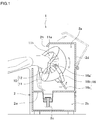
- the automatic hair washing device 1 includes a main body casing 2.
- the main body casing 2 is divided into a washing space 2a where a washing part 10 is disposed, and a drain space 2b where a drain pipe 2c and the like are disposed.
- the washing space 2a and the drain space 2b are separated from each other by a separation wall 2w to which one end of the drain pipe 2c is connected.
- the other end of the drain pipe 2c is disposed outside the main body casing 2.
- the drain pipe 2c drains, for example, water used in the washing space 2a from the automatic hair washing device 1 to the outside.
- the main body casing 2 has on its upper side an opening 2h through which the washing space 2a communicates with the outside.
- the opening 2h allows the head of a person whose hair is to be washed, to be placed in the washing space 2a and has such a size that the head passes through the opening 2h.
- the main body casing 2 may also have on its upper side a lid member 2d that is openable and closable.
- a lid member 2d that is openable and closable.
- the lid member 2d reduces an opening area of the opening 2h, which easily prevents water and a washing liquid from being scattered outside the automatic hair washing device 1 through the opening 2h.
- the washing part 10 is disposed in the washing space 2a of the main body casing 2.
- the washing part 10 includes a cover member 11, a plurality of contacts 12 disposed on an inner face of the cover member 11, and energization means 20.
- the washing part 10 also includes washing liquid supply parts 15 to spray water and a washing liquid onto the head and hair of a person whose hair is to be washed, a swing mechanism 16 to move the cover member 11, and a control part to control operations of the washing liquid supply parts 15, swing mechanism 16, and energization means 20.
- the cover member 11 has the inner face 11a recessed from the opening 2h of the main body casing 2.
- the cover member 11 also has a head holding space 11h corresponding to a portion surrounded with the inner face 11a and having such a size that a human head is placeable. It is assumed herein that the inner face 11a of the cover member 11 is formed in a substantially semispherical shape. In this case, when the inner face 11a is set to have a radius of curvature of approximately 80 to 250 mm, almost all of human heads are placeable in the head holding space 11h. Moreover, a clearance is defined between a surface of a human head and the inner face 11a of the cover member 11.
- the contacts 12 are disposed on the inner face 11a of the cover member 11.
- Each of the contacts 12 is formed of a rod-shaped member whose leading end has a substantially spherical shape and is disposed such that the leading end comes into contact with a human head placed in the head holding space 11h.
- the contacts 12 are mounted to the inner face 11a of the cover member 11 in an axially movable manner. The details thereof will be described later.
- the energization means 20 is configured to energize the contacts 12 toward the respective leading ends.
- the energization means 20 has a function of adjusting an energizing force to be applied to the contacts 12 such that the contacts 12 apply approximately constant forces to a human head even when the swing mechanism 16 swings the cover member 11 to displace contact positions of the contacts 12 with the human head as will be described in detail later. Since the energization means 20 energizes the contacts 12 as described above, the leading ends of the contacts 12 come into contact with the human head by the constant forces when the human head is placed in the head holding space 11h of the cover member 11. The configuration of the energization means 20 will be described in detail later.
- the washing part 10 includes the washing liquid supply parts 15 each having a function of spraying water and a washing liquid onto the head and hair of a person whose hair is to be washed.
- each of the washing liquid supply parts 15 includes a water nozzle to eject the water and a liquid nozzle to eject a washing liquid. The water ejected from the water nozzle and a washing liquid ejected from the liquid nozzle are thus sprayed onto the head and the hair.
- the washing part 10 also includes the swing mechanism 16 to swing the cover member 11.
- the swing mechanism 16 includes a pair of swing shafts 16a, 16a connected to an outer face of the cover member 11.
- the swing shafts 16a, 16a are connected to a swing frame 16b so as to be rotatable coaxially about their center axes.
- the swing frame 16b is coupled to an inner face of the washing space 2a of the main body casing 2 through a swing shaft 16c.
- the swing shaft 16c is connected to the inner face of the washing space 2a so as to be rotatable about its center axis.
- the pair of swing shafts 16a, 16a and the swing shaft 16c are disposed to swing the cover member 11 in a direction along the inner face 11a when both or one of the pair of swing shafts 16a, 16a and the swing shaft 16c rotate or rotates.
- the pair of swing shafts 16a, 16a and the swing shaft 16c are disposed to move the cover member 11 in all directions along a human head in the head holding space 11h.
- the pair of swing shafts 16a, 16a and the swing shaft 16c are disposed such that the inner face 11a of the cover member 11 has a center of curvature at a position where lines of the center axes of the swing shafts 16a, 16a cross a line of the center axis of the swing shaft 16c.
- the rotation of the pair of swing shafts 16a, 16a about the center axes and the rotation of the swing shaft 16c about the center axis are controlled by, for example, an electric motor or pneumatic cylinder whose operation is controlled by the control part.
- the washing part 10 also includes the control part to control the operations of the energization means 20, swing mechanism 16, and washing liquid supply parts 15.
- the control part has a function of adjusting an energizing force to be applied from the energization means 20 to the contacts 12 such that the contacts 12 of the energization means 20 apply approximately constant forces to a human head.
- the control part also has a function of controlling, for example, timings at which the washing liquid supply parts 15 and the swing mechanism 16 operate, in order that the washing part 10 appropriately washes and rinses hair.
- the control part has a function of detecting a state of water flowing through the drain pipe 2c, thereby controlling an amount of water and a washing liquid supplied from the washing liquid supply parts 15 and stopping the supply of the water and washing liquid.
- the control part also has a function of controlling an amount of operation by the swing mechanism 16, that is, an amount of movement of the cover member 11. It is of course that the control part may include a built-in timer to be used for controlling the operations of the washing liquid supply parts 15 and swing mechanism 16.
- the automatic hair washing device 1 having the structure described above washes hair while scrubbing a scalp by the contacts 12 and brushing the hair with the contacts 12.
- the head of a person whose hair is to be washed is put in the washing space 2a with the lid member 2d opened or through the opening 2h in the main body casing 2, and then is placed in the head holding space 11h of the cover member 11 in the washing part 10.
- the head is thus brought into contact with the leading ends of the contacts 12.
- the energization means 20 energizes the contacts 12 toward the respective leading ends.
- the contacts 12 therefore come into contact with the head while receiving a certain degree of force.
- each of the contacts 12 is formed of a rod-shaped member, the contacts 12 run through hair like human fingers and a comb. The hair, even when being long, is disentangled by the contacts 12 while being wet.
- each of the washing liquid supply parts 15 supplies a washing liquid with the swing mechanism 16 operated.
- the hair is thus washed with the washing liquid.
- both the scalp and the hair are washed while the scalp is scrubbed by the contacts 12 and the hair is brushed with the contacts 12.
- the automatic hair washing device 1 appropriately and entirely washes long hair since the contacts 12 brush the long hair in washing the long hair.
- each of the washing liquid supply parts 15 supplies water with the swing mechanism 16 operated.
- the washed hair is thus rinsed.
- the contacts 12 run through the hair like human fingers and a comb, the hair is rinsed while being disentangled by the contacts 12.
- the rinsing is efficiently performed with a smaller amount of water as compared with rinsing to be performed by merely spraying water onto hair.
- this configuration enables effective rinsing.
- the automatic hair washing device 1 appropriately and entirely rinses the long hair since the contacts 12 brush the long hair in rinsing the long hair.
- the contacts 12 and energization means 20 are configured as will be described below to make forces to be applied from the contacts 12 to a human head approximately constant.
- the configurations of the contacts 12 and energization means 20 are described below.
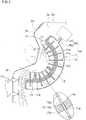
- the cover member 11 has an accommodation space 11c defined therein and formed in a hollow shape.
- the accommodation space 11c has a structure in that a fluid is retainable. More specifically, the cover member 11 has a structure in that a fluid such as air is not leaked to the outside except portions corresponding to through-holes 11g to be described later. In addition, the cover member 11 also has a structure in that a pressure in the accommodation space 11c is kept at a predetermined level.
- the accommodation space 11c of the cover member 11 communicates with a fluid pressure adjustment part 21 via a pipe 20c.
- the fluid pressure adjustment part 21 has a function of maintaining the pressure in the accommodation space 11c at a fixed level.
- the fluid pressure adjustment part 21 may be an apparatus including a compressor, an air tank, and the like to supply to the accommodation space 11c a compressive fluid such as air adjusted at a certain pressure, and a discharge valve and the like to discharge the fluid from the accommodation space 11c.
- the fluid pressure adjustment part 21 operates based on a command from the control part. The command is obtained by analyzing the pressure in the accommodation space 11c. The pressure is detected by, for example, a sensor.
- the cover member 11 includes an inner wall 11w formed to separate the accommodation space 11c from the head holding space 11h.
- the inner wall 11w has a plurality of through-holes 11g.
- the through-holes 11g are formed such that center axes thereof are approximately parallel with a normal direction of the inner face 11a of the cover member 11 at positions where the through-holes 11g are formed.
- the contacts 12 are respectively inserted into the through-holes 11g.
- each of the contacts 12 includes a shaft portion 12c, a contact portion 12a disposed on a front end of the shaft portion, and a stopper plate 12p disposed on a rear end of the shaft portion 12c.
- the shaft portions 12c are formed of rod-shaped members which are analogous in sectional shape to the through-holes 11g.
- the shaft portions 12c are slightly smaller in sectional area than the through-holes 11g.
- the contact portions 12a are configured to come into contact with a human head and each have a leading end formed in a substantially spherical shape.
- the stopper plates 12p have outer diameters larger than inner diameters of the through-holes 11g.
- Each stopper plate 12p has a rear end face which may be formed in any shape.
- each shaft portion 12c has a proximal end edge which may be formed in any shape.
- the rear end face of each stopper plate 12p that is, the proximal end edge of each shaft portion 12c may be formed in a planar shape orthogonal to a center axis of the corresponding shaft portion 12c or may be formed in a spherical shape.
- the spherical shape brings about an advantage that each of the stopper plates 12p easily receives a pressure of the fluid even when being brought into contact with an inside face of the cover member 11, that is, even when being bottomed.
- the contacts 12 each having the structure described above are respectively inserted into the through-holes 11g.
- the contacts 12 are thus respectively held by the through-holes 11g so as to be axially movable.
- the pressure of the fluid in the accommodation space 11c is applied to the contacts 12 to energize the contacts 12 such that the contacts 12 protrude from the inner face 11a of the cover member 11. At this time, the contacts 12 receive a constant pressure irrespective of their positions. In addition, the contacts 12 protrude by an approximately constant force as long as the shaft portions 12c are equal in sectional area to one another.
- the force to protrude the contacts 12 is made constant irrespective of an amount of protrusion of each contact 12 as long as the pressure of the fluid in the accommodation space 11c is fixed.
- the reason therefor is as follows. That is, the force to protrude the contacts 12 is determined from the sectional area of each shaft portion 12c and the pressure of the fluid, and the sectional area of each shaft portion 12c does not change although the amount of protrusion of each contact 12 changes.
- the compressive fluid such as air is supplied into the accommodation space 11c, and the pressure of the fluid in the accommodation space 11c is adjusted appropriately.
- the contacts 12 move toward the accommodation space 11c with ease.
- the contacts 12 accordingly come into contact with a human head placed in the head holding space 11h, in a state in which the forces applied from the human head are balanced with the force applied from the fluid in the accommodation space 11c at the respective positions of the human head.
- the swing mechanism 16 moves the cover member 11.
- the contact positions of the contacts 12 with the human head are thus displaced. At some of the contact positions, the human head moves away from the inner face 11a of the cover member 11. At the other contact positions, the human head moves closer to the inner face 11a of the cover member 11.
- the pressure of the fluid causes the contacts 12 to protrude so as to follow the movement of the human head. The pressure of the fluid thus maintains the contact state of the contacts 12 with the human head and also keeps constant the forces applied from the contacts 12 to the human head.
- the contacts 12 are pushed into the accommodation space 11c so as to follow the movement of the human head.
- the contacts 12 receive the constant fluid pressure and therefore apply the fixed forces to the human head.
- the contacts 12 come into contact with the human head in the state in which the forces applied from the human head are always balanced with the force applied from the fluid in the accommodation space 11c. In other words, even when the movement of the cover member 11 by the swing mechanism 16 causes displacement of the contact positions of the contacts 12 with the human head, the contact state of the contacts 12 with the head is maintained, and the forces to be applied to the human head are made constant.
- the contacts 12 thus enable a hair washing operation as in a situation in which, in washing hair by human hand, fingers scrub a scalp while disentangling the hair.
- the pressure of the fluid supplied into the accommodation space 11c may be set at any value so long as to move the contacts 12 as described above.
- the pressure in the accommodation space 11c may be adjusted by a person whose hair is to be washed. Even when the contacts 12 apply the same force to a head, a sensation to be given by the same force differs for each person. In other words, persons feel strong or weak as to the same force to be applied from the contacts 12 to their heads.
- the forces to be applied from the contacts 12 to a human head change depending on the pressure of the fluid supplied into the accommodation space 11c.
- the control part is provided with a pressure adjustment knob.
- An employee or a person whose hair is to be washed manipulates the pressure adjustment knob, thereby adjusting the pressures in the accommodation space 11c.
- the accommodation space 11c may be divided into a plurality of spaces such that a fluid is supplied to each of the divided spaces.
- This configuration enables a hair washing operation that makes a person more comfortable since forces to be applied from the contacts 12 to the head are adjustable for each position of the head.
- the control part is provided with pressure adjustment knobs to adjust pressures in the respective spaces. An employee or a person whose hair is to be washed manipulates the pressure adjustment knobs, thereby adjusting the pressures in the respective spaces.
- the contacts 12 are provided to be movable relative to the through-holes 11g.
- the contacts 12 are provided to be smoothly movable relative to the through-holes 11g.
- no fluid or a considerably small amount of fluid is leaked out from the accommodation space 11c through clearances between the contacts 12 and the through-holes 11g.
- a seal member is disposed in each through-hole 11g.
- the seal member is made of plastic, is formed in a cylindrical shape, and is disposed on an inner face of each through-hole 11g.
- each shaft portion 12c is brought into surface contact with an inner face of the seal member with the shaft portion 12c of each contact 12 inserted into the corresponding through-hole 11g.
- the contacts 12 are configured to protrude only by the pressure of the fluid in the accommodation space 11c.
- a spring member may be provided to energize each contact 12 toward the head holding space 11h.
- the spring members protrude the contacts 12 toward the head holding space 11h by an appropriate amount even when no fluid pressure is applied to the contacts 12.
- This configuration brings about an advantage that motive power for energization by the fluid is reduced.
- the spring members are adjusted such that the forces of the spring members to energize the contacts 12 toward the head holding space 11h are weaker than the force of the fluid to energize the contacts 12 toward the head holding space 11h. With this configuration, the forces applied from the contacts 12 to the human head are maintained as in the configuration that the spring members are not provided.
- a spring member may be provided between the stopper plate 12p of each contact 12 and the inside face of the cover member 11 to pull the corresponding contact 12 toward the accommodation space 11c.
- the spring members retract the contacts 12 into the accommodation space 11c to which the fluid pressure is not applied.
- the contact portion 12a to come into contact with a human head may be configured to be detachable.
- the contact portions 12a which are exchangeable bring about an advantage that a contact state of the contacts 12 with a human head is adjustable in accordance with positions coming into contact with a human head and the preference of a person whose hair is to be washed, without exchanging the contacts 12.
- each contact 12 that is, the contact portion 12a is configured to have a smaller curvature.
- the leading end with a smaller curvature causes a person whose hair is to be washed to feel as a receiving stronger force as compared with the leading end with a larger curvature even when the energization means 20 applies the same energizing force to the respective contacts 12.
- the leading end of each contact 12, that is, the contact portion 12a is configured to have a larger curvature.
- the leading end with a larger curvature causes a person whose hair is to be washed to feel as receiving a weaker force as compared with the leading end with a smaller curvature even when the energization means 20 applies the same energizing force to the respective contacts 12. Accordingly, the contacts 12 change a sensation on the head of a person depending on contact positions with the head even when the energization means 20 applies the same energizing force to the contacts 12.
- any number of contacts 12 may be disposed on the inner face 11a of the cover member 11.
- the number of contacts 12 may be about 18 to 200 in total such that about 18 to 200 contacts are brought into contact with the head of a person whose hair is to be washed.
- the contacts 12 may be disposed at any positions on the inner face 11a of the cover member 11 at the same intervals, that is, in certain density.
- the number of contacts 12 may be changed in accordance with positions coming into contact with a scalp.
- the cover member 11 may be swung by any configuration in addition to the configuration described above as long as the inner face 11a of the cover member 11 is movable along a scalp.
- the inner face 11a of the cover member 11 may be formed in any shape in addition to the substantially semispherical shape as long as a human head is placeable in the head holding space 11h.
- the inner face 11a of the cover member 11 may be formed in an elliptical shape or an oblong shape as seen in sectional view.
- a human head is placed in the head holding space 11h does not mean that a human head is entirely placed, but means that a human head excluding a face portion is entirely or partly placed as illustrated in Figs. 1 and 2 .
- the phrase "a human head is placed in the head holding space 11h” used herein refers to a case where a range from a forehead and its vicinity to the nape and its vicinity of a neck is placed or a case where a range from the top to back of a head is almost entirely placed.
- a position of a human head relative to the inner face 11a changes in accordance with a posture of a person whose head is put in the washing space 2a and a position of the head in the washing space 2a.
- a contact state of the contacts 12 with a human head changes .
- the energization means 20 adjusts an energizing force to energize the contacts 12 such that the contacts 12 apply approximately constant forces to the human head as described above.
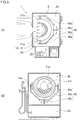
- the automatic hair washing device 1 is therefore desirably provided with head holding members 13 to place a human head at a position where the functions described above are exerted with reliability in the head holding space 11h of the cover member 11.
- each of the head holding members 13 is formed of a bar-shaped or block-shaped member and is disposed on the inner face 11a of the cover member 11.
- the head holding members 13 thus place a human head in the head holding space 11h at an appropriate position from the inner face 11a of the cover member 11.
- the human head is held while being separated by a length of each head holding member 13, that is, a length from the faces with which the human head is in contact to the inner face 11a.
- the head holding members 13 thus secure a satisfactory amount of movement of each contact 12 and therefore cause the contacts 12 to apply approximately constant forces to the human head when the cover member 11 is swung.
- the number of head holding members 13 is not particularly limited, but may be three or more, only one, or only two.
- the number of head holding members 13 is desirably three such that a human head is rested in a stable posture.
- the head holding members 13 may be fixed to the inner face 11a of the cover member 11 or may be provided to extend from the inner face 11a of the cover member 11.
- Each of the head holding members 13 may have any configuration in addition to the configurations described above as long as a human head is placeable at an appropriate position relative to the inner face 11a of the cover member 11 and the respective contacts 12.
- each of the head holding members 13 may be formed of a bar-shaped or block-shaped member and may be disposed on the member in which the opening 2h is formed, that is, on the main body casing 2.
- the drain pipe 2c is disposed in the drain space 2b; however, the drain pipe 2c is not necessarily disposed in the drain space 2b.
- the drain pipe 2c is not necessarily disposed in the drain space 2b.
- the other end of the drain pipe 2c is disposed outside the main body casing 2 without passing the drain space 2b.
- the opening 2h in the main body casing 2 may be formed in any size as long as a human head is insertable into the head holding space 11h therethrough.
- the opening 2h preferably has a size allowing a human head to pass therethrough and preventing water and a washing liquid used by the washing part 10 from scattered outside the automatic hair washing device 1 to some extent.
- the automatic hair washing device 1 may be provided with, for example, a hood 2f to cover the opening 2h of the main body casing 2 in terms of the purpose of preventing water and a washing liquid from scattered outside the automatic hair washing device 1 through the opening 2h in the main body casing 2.
- the size of the opening 2h is changeable in accordance with the head size and physique of a person whose hair is to be washed.
- an attachment e.g., the hood 2f detachable from the opening 2h enables changes in width and length of the opening 2h in accordance with, for example, the head size of a person whose hair is to be washed.
- the automatic hair washing device 1 may also be provided with a neck holding part to be disposed in the opening 2h or in the vicinity (including both inside and outside the washing space 2a) of the opening 2h to hold the neck and its vicinity of a person whose hair is to be washed.
- a cushion may be disposed on a lower end portion of the opening 2h so that the neck of the person is rest on the cushion during a hair washing operation.
- the neck holding part keeps the head of the person in a stable posture, which facilitates the hair washing operation using the washing part 10.
- the neck holding part makes the person have no tension on his/her neck and therefore reduces a burden on the person during the hair washing operation.
- Each of the washing liquid supply parts 15 may have any configuration as long as a water nozzle and a liquid nozzle respectively eject and spray water and a washing liquid onto the head and hair of a person.
- each of the washing liquid supply parts 15 may be configured as follows.
- a water nozzle and a liquid nozzle are respectively connected to a water supply and a washing liquid supply via a water feed tube and a liquid feed tube.
- the supply of water and a washing liquid from the water supply and the washing liquid supply and the stop of the supply are controllable based on signals from the control part.
- the commands from the control part cause the water supply and the washing liquid supply to respectively supply water and a washing liquid to the water nozzle and the liquid nozzle.
- the water nozzle and the liquid nozzle in each washing liquid supply part 15 thus respectively supply the water and the washing liquid to the head and hair of a person.
- the water supply and the washing liquid supply may have any configuration as long as the supply of water and a washing liquid and the stop of the supply are controllable based on signals from the control part.
- each of the water supply and the washing liquid supply may include a valve opened and closed based on signals from the control part, and a liquid feed part to supply pressurized water and a pressurized washing liquid in accordance with signals from the control part.
- the water supply may be configured to include, as the liquid feed part, a supply pipe communicating with a water pipe, and a valve disposed on the liquid feed part.
- the washing liquid supply may be configured to include, as the liquid feed part, a supply pipe communicating with a pipe of an external washing liquid supply device, and a valve disposed on the liquid feed part and connected to a liquid feed tube.
- the water nozzle and the liquid nozzle may be placed at any location so long as to spray water and a washing liquid onto the head and hair of a person.
- the washing liquid supply parts 15 are disposed on an end of the cover member 11 as illustrated in Fig. 2 , thereby supplying appropriate amounts of water and a washing liquid to the hair with ease.
- the washing liquid supply parts 15 are disposed in the inner face of the washing space 2a, thereby supplying appropriate amounts of water and a washing liquid to the long hair with ease.
- the washing part 10 includes the energization means to energize the contacts 12 toward the head holding space 11h by use of a fluid pressure.
- the energization means may be springs 35 to energize contacts 32 toward a head holding space 11h.
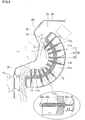
- Fig. 6 illustrates a configuration in which the springs 35 respectively apply energizing forces to the contacts 32.
- a cover member 11 illustrated in Fig. 6 is substantially equal in configuration to the cover member 11 described above; therefore, the description thereof will not be given here.
- Each of the contacts 32 illustrated in Fig. 6 is formed of a one end-closed tubular member of which a leading end is closed and which is formed in a hollow shape.
- the springs 35 are respectively disposed in the contacts 32.
- the springs 35 are disposed to contract coaxially or approximately coaxially with axes of the contacts 32.
- Each of the springs 35 has a proximal end protruding from a proximal end of the corresponding contact 32.
- the proximal ends of the springs 35 are fixed to an inside face of an accommodation space 11c of the cover member 11, that is, an inside face opposing an inner wall 11w of the cover member 11.
- the springs 35 are adjusted to apply energizing forces that do not almost change while a human head pushes the contacts 32 inward. More specifically, the springs 35 are adjusted such that forces to be applied from the contacts 32 to the human head do not almost change even when contact positions of the contacts 32 with the human head are displaced by movement of the cover member 11. As in the case of energizing the contacts by use of a fluid pressure, thus, the contacts 32 are brought into contact with the human head in the balanced state at the respective positions even when the contact positions with the human head are displaced by the movement of the cover member 11.
- L1 represents a length of each spring 35 mounted to the inside face of the accommodation space 11c
- L2 represents a maximum stroke of each contact 32.
- the springs 35 are mounted such that a force to be applied to the human head when each spring 35 contracts by an amount corresponding to the maximum stroke L2, that is, when each contact 32 protrudes in a minimum amount (i.e., an energizing force to be applied from each spring 35 to the corresponding contact 32) is approximately equal to a force to be applied to the human head in the state in which each spring 35 has the length L1.
- the energizing force does not almost change irrespective of the change in stroke of each contact 32.
- the contacts 32 are therefore brought into contact with the human head in the balanced state at the respective positions even when the contact positions with the human head are displaced by the movement of the cover member 11.
- An automatic hair washing device is applicable to a device to be used for washing the hair of a customer in a hair salon or a barber shop and a device to be used for washing the hair of a person who needs care in a caregiving home or a medical facility.
Landscapes
- Health & Medical Sciences (AREA)
- Public Health (AREA)
- Pain & Pain Management (AREA)
- Epidemiology (AREA)
- Physical Education & Sports Medicine (AREA)
- Rehabilitation Therapy (AREA)
- Life Sciences & Earth Sciences (AREA)
- Animal Behavior & Ethology (AREA)
- General Health & Medical Sciences (AREA)
- Veterinary Medicine (AREA)
- Otolaryngology (AREA)
- Cleaning And Drying Hair (AREA)
- Devices For Medical Bathing And Washing (AREA)
Claims (9)
- Automatische Haarwaschvorrichtung (1), mit
einem Waschteil (10), mit:einer Abdeckung (11) mit einem Kopfhaltebereich (11h), in dem ein menschlicher Kopf platziert wird;einer Mehrzahl von Kontaktelementen (12), von denen jedes als ein stabförmiges Element ausgebildet und an einer Innenfläche (11a) der Abdeckung (11) axial verschiebbar angeordnet ist;eine Treibeinrichtung (20) zum Treiben der Kontaktelemente (12) hin zum Kopfhaltebereich (11h), undWaschflüssigkeitszufuhrteile (15) zum Sprühen von Wasser und Waschmittel auf den Kopf und die Haare einer Person, deren Haar gewaschen werden soll,wobei
das Waschteil (10) so angeordnet ist, dass die Abdeckung (11) entlang des menschlichen Kopfs verschiebbar ist,
die Treibeinrichtung (20) aufweist:einen Aufnahmebereich (11c), in dem eine Flüssigkeit zurückgehalten werden kann, wobei der Aufnahmebereich (11c) in einer Hohlform ausgebildet und durch eine Innenwand der Abdeckung (11w) vom Kopfhaltebereich (11h) getrennt ist; undein Flüssigkeitsdruckeinstellteil (20) zum Einstellen eines Drucks der im Aufnahmebereich (11c) aufgenommenen Flüssigkeit auf ein vorherbestimmtes Niveau, unddas Flüssigkeitsdruckeinstellteil (20) konfiguriert ist, den Druck der im Aufnahmebereich (11c) aufgenommenen Flüssigkeit auf einen Druck zum Treiben der Kontaktelemente (12) hin zur Kopfhaltebereich (11h) dergestalt einzustellen, dass die in Kontakt mit dem menschlichen Kopf stehenden Kontaktelemente (12) ungefähr konstante Kräfte auf den menschlichen Kopf ausüben, auch wenn die Kontaktelemente (12) verschoben werden. - Automatische Haarwaschvorrichtung (1) nach Anspruch 1, wobei
die Kontaktelemente (12) so angeordnet sind, dass ihre Achsen senkrecht zur Innenfläche (11a) der Innenwand (11w) der Abdeckung (11) verlaufen. - Automatische Haarwaschvorrichtung (1) nach Anspruch 1 oder 2, wobei
der Aufnahmebereich (11c) in eine Mehrzahl von Bereichen unterteilt ist, und
das Flüssigkeitsdruckeinstellteil (20) konfiguriert ist, Drücke von Flüssigkeiten einzustellen, die in die unterteilten Bereiche zugeführt werden sollen. - Automatische Haarwaschvorrichtung (1) nach einem der Ansprüche 1, 2, oder 3, die des Weiteren aufweist
ein Federelement zum Treiben jedes Kontaktelements (12) hin zum Kopfhaltebereich (11h),
wobei
das Federelement eine Treibkraft aufweist, die schwächer als eine Kraft der in den Aufnahmebereich (11c) zugeführten Flüssigkeit eingestellt ist, wobei die Kraft die Kontaktelemente hin zum Kopfhaltebereich (11h) treibt. - Automatische Haarwaschvorrichtung (1) nach einem der Ansprüche 1, 2, oder 3, die weiterhin aufweist
ein Federelement zum Ziehen jedes Kontakts hin zum Aufnahmebereich (11c). - Automatische Haarwaschvorrichtung (1), mit
einem Waschteil (10), mit:einer Abdeckung (11) mit einem Kopfhaltebereich (11h), in dem ein menschlicher Kopf platziert wird;einer Mehrzahl von Kontaktelementen (32), von denen jedes als ein stabförmiges Element ausgebildet und an einer Innenfläche (11a) der Abdeckung (11) axial verschiebbar angeordnet ist und aus dieser herausragt; undeine Treibeinrichtung (35) zum Treiben der Kontaktelemente (32) hin zum Kopfhaltebereich (11h), undWaschflüssigkeitszufuhrteile (15) zum Sprühen von Wasser und Waschmittel auf den Kopf und das Haar einer Person, deren Haar gewaschen werden soll,wobei
das Waschteil (10) so angeordnet ist, dass die Abdeckung (11) entlang des menschlichen Kopfs verschiebbar ist,
jedes Kontaktelement (32) als ein einseitig geschlossenes Rohrelement mit einem mit dem menschlichen Kopf in Kontakt stehenden geschlossenen Ende ausgebildet ist, wobei das einseitig geschlossene Rohrelement in einer Hohlform ausgebildet und so angeordnet ist, dass seine Achse senkrecht zur Innenfläche (11a) einer Innenwand (11w) der Abdeckung (11) verläuft,
die Treibeinrichtung (35) ein Federelement (35) aufweist, das im Inneren jedes Kontaktelements (32) angeordnet ist, um das entsprechende Kontaktelement (32) hin zum Kopfhaltebereich (11h) vorzuspannen, und
das Federelement (35) so eingestellt ist, dass eine Treibkraft, die auf das entsprechende Kontaktelement (32) ausgeübt werden soll, wenn es in einem minimalen Maß vorsteht, ungefähr gleich einer Treibkraft wird, die auf das entsprechende Kontaktelement ausgeübt werden soll, wenn es in einem maximalen Maße vorsteht. - Automatische Haarwaschvorrichtung (1) nach einem der Ansprüche 1 bis 6, wobei
jedes Kontaktelement (12, 32) einen Kontaktabschnitt (12a, 32a) aufweist, mit dem der menschliche Kopf in Kontakt ist, wobei der Kontaktabschnitt (12a, 32a) abnehmbar konfiguriert ist. - Automatische Haarwaschvorrichtung (1) nach einem der Ansprüche 1 bis 7, die des Weiteren aufweist
ein Kopfhalteelement (13), das an der Innenfläche (11a) der Innenwand (11w) der Abdeckung (11) angeordnet ist. - Automatische Haarwaschvorrichtung (1) nach einem der Ansprüche 1 bis 8, die weiterhin aufweist
ein Nackenhalteteil zum Halten eines menschlichen Nackens und einen Abschnitt um den menschlichen Nacken herum.
Applications Claiming Priority (2)
| Application Number | Priority Date | Filing Date | Title |
|---|---|---|---|
| JP2015257598A JP6041973B1 (ja) | 2015-12-29 | 2015-12-29 | 自動洗髪機 |
| PCT/JP2016/088791 WO2017115766A1 (ja) | 2015-12-29 | 2016-12-26 | 自動洗髪機 |
Publications (3)
| Publication Number | Publication Date |
|---|---|
| EP3398474A1 EP3398474A1 (de) | 2018-11-07 |
| EP3398474A4 EP3398474A4 (de) | 2019-02-27 |
| EP3398474B1 true EP3398474B1 (de) | 2019-10-23 |
Family
ID=57543790
Family Applications (1)
| Application Number | Title | Priority Date | Filing Date |
|---|---|---|---|
| EP16881741.9A Active EP3398474B1 (de) | 2015-12-29 | 2016-12-26 | Automatische haarwaschvorrichtung |
Country Status (5)
| Country | Link |
|---|---|
| US (2) | US10238198B2 (de) |
| EP (1) | EP3398474B1 (de) |
| JP (1) | JP6041973B1 (de) |
| CN (1) | CN107847027B (de) |
| WO (1) | WO2017115766A1 (de) |
Families Citing this family (6)
| Publication number | Priority date | Publication date | Assignee | Title |
|---|---|---|---|---|
| CN110800069B (zh) | 2017-06-16 | 2022-06-10 | 住友电气工业株式会社 | 绝缘电线 |
| CN109380850A (zh) * | 2017-08-04 | 2019-02-26 | 南宁市黑晶信息技术有限公司 | 一种便捷式洗头装置 |
| CN109431045B (zh) * | 2018-12-08 | 2022-04-22 | 余姚市恒正金属制品有限公司 | 腿部自适应伸缩系统 |
| CN109527760A (zh) * | 2018-12-13 | 2019-03-29 | 苟斌 | 一种自动洗头装置 |
| CN111420148B (zh) * | 2020-04-03 | 2022-03-01 | 中国人民解放军陆军军医大学第一附属医院 | 毛发种植用清洗装置 |
| CN114711526B (zh) * | 2022-03-28 | 2024-07-09 | 深圳市易智美科技有限公司 | 一种基于物联网云服务的智能头部洗护系统 |
Family Cites Families (28)
| Publication number | Priority date | Publication date | Assignee | Title |
|---|---|---|---|---|
| US2856918A (en) * | 1956-07-05 | 1958-10-21 | Lillian C Kingery | Hair and scalp treating apparatus |
| JPS4823297B1 (de) * | 1970-08-17 | 1973-07-12 | ||
| JPS5951504U (ja) * | 1982-09-30 | 1984-04-05 | オ−ジ−技研株式会社 | 可動の洗髪ケ−シングを有する洗髪機 |
| JPS61100302U (de) | 1984-12-03 | 1986-06-26 | ||
| US4769861A (en) * | 1987-08-06 | 1988-09-13 | Chang Yu Lung | Automatic hair-washing machine |
| US5014371A (en) * | 1989-08-24 | 1991-05-14 | Salon Care Services, Inc. | Portable salon unit |
| US5025514A (en) * | 1990-04-05 | 1991-06-25 | Iht, Inc. | Pressure means for automatic hair and scalp treatment apparatus |
| US5075908A (en) * | 1991-02-04 | 1991-12-31 | Newman Valerie Y | Hair rinse device |
| JPH04327803A (ja) * | 1991-04-26 | 1992-11-17 | Masami Takahashi | 自動頭髪シャンプー装置 |
| JPH0775566B2 (ja) | 1992-02-27 | 1995-08-16 | 三洋電機株式会社 | 自動洗髪機 |
| JPH06113918A (ja) | 1992-10-02 | 1994-04-26 | Toto Ltd | 自動洗髪機 |
| JP3101502B2 (ja) * | 1994-09-30 | 2000-10-23 | 三洋電機株式会社 | 自動洗髪機 |
| US5528776A (en) * | 1995-01-11 | 1996-06-25 | Carmichael; Jacqueline | Portable pump operated washing basin |
| JP3133690B2 (ja) * | 1997-01-29 | 2001-02-13 | 三洋電機株式会社 | 自動洗髪機 |
| JP2000139549A (ja) * | 1998-11-10 | 2000-05-23 | Ohiro Seisakusho:Kk | 自動洗髪機 |
| JP2000139550A (ja) * | 1998-11-10 | 2000-05-23 | Ohiro Seisakusho:Kk | 自動洗髪機 |
| JP2000139548A (ja) * | 1998-11-10 | 2000-05-23 | Ohiro Seisakusho:Kk | 自動洗髪機 |
| JP3439358B2 (ja) * | 1998-11-27 | 2003-08-25 | 株式会社大廣製作所 | 自動洗髪機 |
| JP2000350614A (ja) * | 1999-06-11 | 2000-12-19 | Ohiro Seisakusho:Kk | 洗髪機 |
| JP4289748B2 (ja) | 1999-11-30 | 2009-07-01 | リコーエレメックス株式会社 | 自動頭部洗浄装置 |
| JP2004016582A (ja) * | 2002-06-18 | 2004-01-22 | Ukima Kagaku Kenkyusho:Kk | 密閉型洗髪器及び洗髪装置 |
| US7171704B2 (en) * | 2003-02-04 | 2007-02-06 | Johnson Ernest L | Automatic hair washing device |
| KR20110008151U (ko) * | 2010-02-11 | 2011-08-18 | 이승찬 | 벽부착형 자동세발기 |
| US9089195B2 (en) * | 2010-08-18 | 2015-07-28 | Panasonic Intellectual Property Management Co., Ltd. | Automatic hair washing apparatus |
| JP5793703B2 (ja) * | 2011-09-30 | 2015-10-14 | パナソニックIpマネジメント株式会社 | 自動頭部ケア装置及び自動頭部ケア方法 |
| US20140373265A1 (en) * | 2011-10-03 | 2014-12-25 | Panasonic Corporation | Automatic head care system and automatic head care method |
| CN103796546A (zh) * | 2011-10-04 | 2014-05-14 | 松下电器产业株式会社 | 自动头部护理方法以及自动头部护理系统 |
| CN103960857B (zh) * | 2014-05-21 | 2017-01-25 | 李思萍 | 自动洗头机 |
-
2015
- 2015-12-29 JP JP2015257598A patent/JP6041973B1/ja active Active
-
2016
- 2016-12-26 US US15/750,437 patent/US10238198B2/en active Active
- 2016-12-26 EP EP16881741.9A patent/EP3398474B1/de active Active
- 2016-12-26 CN CN201680043988.7A patent/CN107847027B/zh active Active
- 2016-12-26 WO PCT/JP2016/088791 patent/WO2017115766A1/ja not_active Ceased
-
2019
- 2019-02-11 US US16/272,648 patent/US10791813B2/en active Active
Non-Patent Citations (1)
| Title |
|---|
| None * |
Also Published As
| Publication number | Publication date |
|---|---|
| CN107847027A (zh) | 2018-03-27 |
| HK1252061A1 (zh) | 2019-05-10 |
| US10791813B2 (en) | 2020-10-06 |
| JP6041973B1 (ja) | 2016-12-14 |
| EP3398474A4 (de) | 2019-02-27 |
| WO2017115766A1 (ja) | 2017-07-06 |
| US20180255900A1 (en) | 2018-09-13 |
| JP2017119040A (ja) | 2017-07-06 |
| CN107847027B (zh) | 2022-02-25 |
| US10238198B2 (en) | 2019-03-26 |
| EP3398474A1 (de) | 2018-11-07 |
| US20190166968A1 (en) | 2019-06-06 |
Similar Documents
| Publication | Publication Date | Title |
|---|---|---|
| US10791813B2 (en) | Automatic hair washing device | |
| EP2941163B1 (de) | Hautreiniger | |
| JP5502208B2 (ja) | 自動ヘッドケアシステムの制御方法および自動洗髪システムの制御方法、自動ヘッドケアシステム | |
| US9462867B2 (en) | Automatic washing and shampooing hair machine | |
| JP5501466B2 (ja) | 自動ヘッドケア装置および自動頭部洗浄装置 | |
| US20110120487A1 (en) | Hair treatment methods and kits | |
| JPWO2012023278A1 (ja) | 自動洗髪装置 | |
| CN203934800U (zh) | 自动洗头机 | |
| CN109431046A (zh) | 一种智能洗头机 | |
| KR200427986Y1 (ko) | 피부 맛사지기 | |
| CN108903205B (zh) | 化妆品涂抹装置及其使用方法 | |
| KR101935730B1 (ko) | 마사지 마스크 | |
| KR101391236B1 (ko) | 마사지 겸용 화장도포장치 | |
| JPH10277125A (ja) | 美・理容装置 | |
| KR100837441B1 (ko) | 헤어 관리 머신 | |
| KR101634903B1 (ko) | 얼굴 마사지장치 | |
| HK1252061B (en) | Automatic hair washing device | |
| KR102460029B1 (ko) | 초음파 세척을 이용한 무인 자동 세발 장치 | |
| KR20220059659A (ko) | 헤어 스타일러 | |
| KR100359982B1 (ko) | 두발 세척기 | |
| JP2006181039A (ja) | 頭部支持具 | |
| JP2004073375A (ja) | 洗髪装置 | |
| WO2005094626A1 (en) | Hair washing device with a scratching unit | |
| KR200170797Y1 (ko) | 두발 세척기 | |
| KR20110119212A (ko) | 한 손으로 머리 감는 샤워기 |
Legal Events
| Date | Code | Title | Description |
|---|---|---|---|
| STAA | Information on the status of an ep patent application or granted ep patent |
Free format text: STATUS: THE INTERNATIONAL PUBLICATION HAS BEEN MADE |
|
| PUAI | Public reference made under article 153(3) epc to a published international application that has entered the european phase |
Free format text: ORIGINAL CODE: 0009012 |
|
| STAA | Information on the status of an ep patent application or granted ep patent |
Free format text: STATUS: REQUEST FOR EXAMINATION WAS MADE |
|
| 17P | Request for examination filed |
Effective date: 20180130 |
|
| AK | Designated contracting states |
Kind code of ref document: A1 Designated state(s): AL AT BE BG CH CY CZ DE DK EE ES FI FR GB GR HR HU IE IS IT LI LT LU LV MC MK MT NL NO PL PT RO RS SE SI SK SM TR |
|
| AX | Request for extension of the european patent |
Extension state: BA ME |
|
| A4 | Supplementary search report drawn up and despatched |
Effective date: 20190128 |
|
| RIC1 | Information provided on ipc code assigned before grant |
Ipc: A61H 33/00 20060101ALI20190122BHEP Ipc: A45D 19/06 20060101ALI20190122BHEP Ipc: A45D 19/00 20060101ALI20190122BHEP Ipc: A45D 19/14 20060101AFI20190122BHEP |
|
| DAV | Request for validation of the european patent (deleted) | ||
| DAX | Request for extension of the european patent (deleted) | ||
| GRAP | Despatch of communication of intention to grant a patent |
Free format text: ORIGINAL CODE: EPIDOSNIGR1 |
|
| STAA | Information on the status of an ep patent application or granted ep patent |
Free format text: STATUS: GRANT OF PATENT IS INTENDED |
|
| RIC1 | Information provided on ipc code assigned before grant |
Ipc: A61H 33/00 20060101ALI20190402BHEP Ipc: A45D 19/06 20060101ALI20190402BHEP Ipc: A45D 19/14 20060101AFI20190402BHEP Ipc: A45D 19/00 20060101ALI20190402BHEP |
|
| INTG | Intention to grant announced |
Effective date: 20190507 |
|
| GRAS | Grant fee paid |
Free format text: ORIGINAL CODE: EPIDOSNIGR3 |
|
| GRAA | (expected) grant |
Free format text: ORIGINAL CODE: 0009210 |
|
| STAA | Information on the status of an ep patent application or granted ep patent |
Free format text: STATUS: THE PATENT HAS BEEN GRANTED |
|
| AK | Designated contracting states |
Kind code of ref document: B1 Designated state(s): AL AT BE BG CH CY CZ DE DK EE ES FI FR GB GR HR HU IE IS IT LI LT LU LV MC MK MT NL NO PL PT RO RS SE SI SK SM TR |
|
| REG | Reference to a national code |
Ref country code: GB Ref legal event code: FG4D |
|
| REG | Reference to a national code |
Ref country code: CH Ref legal event code: EP |
|
| REG | Reference to a national code |
Ref country code: IE Ref legal event code: FG4D |
|
| REG | Reference to a national code |
Ref country code: DE Ref legal event code: R096 Ref document number: 602016023141 Country of ref document: DE |
|
| REG | Reference to a national code |
Ref country code: AT Ref legal event code: REF Ref document number: 1192690 Country of ref document: AT Kind code of ref document: T Effective date: 20191115 |
|
| REG | Reference to a national code |
Ref country code: DE Ref legal event code: R081 Ref document number: 602016023141 Country of ref document: DE Owner name: SERIX CO., LTD., KITA-GUN, JP Free format text: FORMER OWNER: SERIX CO., LTD., YOKKAICHI, MIE, JP Ref country code: DE Ref legal event code: R082 Ref document number: 602016023141 Country of ref document: DE Representative=s name: WINTER, BRANDL, FUERNISS, HUEBNER, ROESS, KAIS, DE Ref country code: DE Ref legal event code: R082 Ref document number: 602016023141 Country of ref document: DE Representative=s name: WINTER, BRANDL - PARTNERSCHAFT MBB, PATENTANWA, DE |
|
| REG | Reference to a national code |
Ref country code: NL Ref legal event code: FP |
|
| REG | Reference to a national code |
Ref country code: LT Ref legal event code: MG4D |
|
| PG25 | Lapsed in a contracting state [announced via postgrant information from national office to epo] |
Ref country code: PT Free format text: LAPSE BECAUSE OF FAILURE TO SUBMIT A TRANSLATION OF THE DESCRIPTION OR TO PAY THE FEE WITHIN THE PRESCRIBED TIME-LIMIT Effective date: 20200224 Ref country code: FI Free format text: LAPSE BECAUSE OF FAILURE TO SUBMIT A TRANSLATION OF THE DESCRIPTION OR TO PAY THE FEE WITHIN THE PRESCRIBED TIME-LIMIT Effective date: 20191023 Ref country code: BG Free format text: LAPSE BECAUSE OF FAILURE TO SUBMIT A TRANSLATION OF THE DESCRIPTION OR TO PAY THE FEE WITHIN THE PRESCRIBED TIME-LIMIT Effective date: 20200123 Ref country code: SE Free format text: LAPSE BECAUSE OF FAILURE TO SUBMIT A TRANSLATION OF THE DESCRIPTION OR TO PAY THE FEE WITHIN THE PRESCRIBED TIME-LIMIT Effective date: 20191023 Ref country code: LV Free format text: LAPSE BECAUSE OF FAILURE TO SUBMIT A TRANSLATION OF THE DESCRIPTION OR TO PAY THE FEE WITHIN THE PRESCRIBED TIME-LIMIT Effective date: 20191023 Ref country code: NO Free format text: LAPSE BECAUSE OF FAILURE TO SUBMIT A TRANSLATION OF THE DESCRIPTION OR TO PAY THE FEE WITHIN THE PRESCRIBED TIME-LIMIT Effective date: 20200123 Ref country code: LT Free format text: LAPSE BECAUSE OF FAILURE TO SUBMIT A TRANSLATION OF THE DESCRIPTION OR TO PAY THE FEE WITHIN THE PRESCRIBED TIME-LIMIT Effective date: 20191023 Ref country code: GR Free format text: LAPSE BECAUSE OF FAILURE TO SUBMIT A TRANSLATION OF THE DESCRIPTION OR TO PAY THE FEE WITHIN THE PRESCRIBED TIME-LIMIT Effective date: 20200124 Ref country code: PL Free format text: LAPSE BECAUSE OF FAILURE TO SUBMIT A TRANSLATION OF THE DESCRIPTION OR TO PAY THE FEE WITHIN THE PRESCRIBED TIME-LIMIT Effective date: 20191023 |
|
| PG25 | Lapsed in a contracting state [announced via postgrant information from national office to epo] |
Ref country code: HR Free format text: LAPSE BECAUSE OF FAILURE TO SUBMIT A TRANSLATION OF THE DESCRIPTION OR TO PAY THE FEE WITHIN THE PRESCRIBED TIME-LIMIT Effective date: 20191023 Ref country code: IS Free format text: LAPSE BECAUSE OF FAILURE TO SUBMIT A TRANSLATION OF THE DESCRIPTION OR TO PAY THE FEE WITHIN THE PRESCRIBED TIME-LIMIT Effective date: 20200224 Ref country code: RS Free format text: LAPSE BECAUSE OF FAILURE TO SUBMIT A TRANSLATION OF THE DESCRIPTION OR TO PAY THE FEE WITHIN THE PRESCRIBED TIME-LIMIT Effective date: 20191023 |
|
| PG25 | Lapsed in a contracting state [announced via postgrant information from national office to epo] |
Ref country code: AL Free format text: LAPSE BECAUSE OF FAILURE TO SUBMIT A TRANSLATION OF THE DESCRIPTION OR TO PAY THE FEE WITHIN THE PRESCRIBED TIME-LIMIT Effective date: 20191023 |
|
| REG | Reference to a national code |
Ref country code: DE Ref legal event code: R097 Ref document number: 602016023141 Country of ref document: DE |
|
| PG2D | Information on lapse in contracting state deleted |
Ref country code: IS |
|
| PG25 | Lapsed in a contracting state [announced via postgrant information from national office to epo] |
Ref country code: DK Free format text: LAPSE BECAUSE OF FAILURE TO SUBMIT A TRANSLATION OF THE DESCRIPTION OR TO PAY THE FEE WITHIN THE PRESCRIBED TIME-LIMIT Effective date: 20191023 Ref country code: EE Free format text: LAPSE BECAUSE OF FAILURE TO SUBMIT A TRANSLATION OF THE DESCRIPTION OR TO PAY THE FEE WITHIN THE PRESCRIBED TIME-LIMIT Effective date: 20191023 Ref country code: ES Free format text: LAPSE BECAUSE OF FAILURE TO SUBMIT A TRANSLATION OF THE DESCRIPTION OR TO PAY THE FEE WITHIN THE PRESCRIBED TIME-LIMIT Effective date: 20191023 Ref country code: RO Free format text: LAPSE BECAUSE OF FAILURE TO SUBMIT A TRANSLATION OF THE DESCRIPTION OR TO PAY THE FEE WITHIN THE PRESCRIBED TIME-LIMIT Effective date: 20191023 Ref country code: CZ Free format text: LAPSE BECAUSE OF FAILURE TO SUBMIT A TRANSLATION OF THE DESCRIPTION OR TO PAY THE FEE WITHIN THE PRESCRIBED TIME-LIMIT Effective date: 20191023 Ref country code: IS Free format text: LAPSE BECAUSE OF FAILURE TO SUBMIT A TRANSLATION OF THE DESCRIPTION OR TO PAY THE FEE WITHIN THE PRESCRIBED TIME-LIMIT Effective date: 20200223 |
|
| REG | Reference to a national code |
Ref country code: CH Ref legal event code: PL |
|
| REG | Reference to a national code |
Ref country code: AT Ref legal event code: MK05 Ref document number: 1192690 Country of ref document: AT Kind code of ref document: T Effective date: 20191023 |
|
| REG | Reference to a national code |
Ref country code: BE Ref legal event code: MM Effective date: 20191231 |
|
| PLBE | No opposition filed within time limit |
Free format text: ORIGINAL CODE: 0009261 |
|
| STAA | Information on the status of an ep patent application or granted ep patent |
Free format text: STATUS: NO OPPOSITION FILED WITHIN TIME LIMIT |
|
| PG25 | Lapsed in a contracting state [announced via postgrant information from national office to epo] |
Ref country code: MC Free format text: LAPSE BECAUSE OF FAILURE TO SUBMIT A TRANSLATION OF THE DESCRIPTION OR TO PAY THE FEE WITHIN THE PRESCRIBED TIME-LIMIT Effective date: 20191023 Ref country code: SK Free format text: LAPSE BECAUSE OF FAILURE TO SUBMIT A TRANSLATION OF THE DESCRIPTION OR TO PAY THE FEE WITHIN THE PRESCRIBED TIME-LIMIT Effective date: 20191023 Ref country code: IT Free format text: LAPSE BECAUSE OF FAILURE TO SUBMIT A TRANSLATION OF THE DESCRIPTION OR TO PAY THE FEE WITHIN THE PRESCRIBED TIME-LIMIT Effective date: 20191023 Ref country code: SM Free format text: LAPSE BECAUSE OF FAILURE TO SUBMIT A TRANSLATION OF THE DESCRIPTION OR TO PAY THE FEE WITHIN THE PRESCRIBED TIME-LIMIT Effective date: 20191023 |
|
| 26N | No opposition filed |
Effective date: 20200724 |
|
| PG25 | Lapsed in a contracting state [announced via postgrant information from national office to epo] |
Ref country code: LU Free format text: LAPSE BECAUSE OF NON-PAYMENT OF DUE FEES Effective date: 20191226 Ref country code: IE Free format text: LAPSE BECAUSE OF NON-PAYMENT OF DUE FEES Effective date: 20191226 |
|
| PG25 | Lapsed in a contracting state [announced via postgrant information from national office to epo] |
Ref country code: LI Free format text: LAPSE BECAUSE OF NON-PAYMENT OF DUE FEES Effective date: 20191231 Ref country code: AT Free format text: LAPSE BECAUSE OF FAILURE TO SUBMIT A TRANSLATION OF THE DESCRIPTION OR TO PAY THE FEE WITHIN THE PRESCRIBED TIME-LIMIT Effective date: 20191023 Ref country code: SI Free format text: LAPSE BECAUSE OF FAILURE TO SUBMIT A TRANSLATION OF THE DESCRIPTION OR TO PAY THE FEE WITHIN THE PRESCRIBED TIME-LIMIT Effective date: 20191023 Ref country code: CH Free format text: LAPSE BECAUSE OF NON-PAYMENT OF DUE FEES Effective date: 20191231 Ref country code: BE Free format text: LAPSE BECAUSE OF NON-PAYMENT OF DUE FEES Effective date: 20191231 |
|
| PG25 | Lapsed in a contracting state [announced via postgrant information from national office to epo] |
Ref country code: CY Free format text: LAPSE BECAUSE OF FAILURE TO SUBMIT A TRANSLATION OF THE DESCRIPTION OR TO PAY THE FEE WITHIN THE PRESCRIBED TIME-LIMIT Effective date: 20191023 |
|
| PG25 | Lapsed in a contracting state [announced via postgrant information from national office to epo] |
Ref country code: HU Free format text: LAPSE BECAUSE OF FAILURE TO SUBMIT A TRANSLATION OF THE DESCRIPTION OR TO PAY THE FEE WITHIN THE PRESCRIBED TIME-LIMIT; INVALID AB INITIO Effective date: 20161226 Ref country code: MT Free format text: LAPSE BECAUSE OF FAILURE TO SUBMIT A TRANSLATION OF THE DESCRIPTION OR TO PAY THE FEE WITHIN THE PRESCRIBED TIME-LIMIT Effective date: 20191023 |
|
| PG25 | Lapsed in a contracting state [announced via postgrant information from national office to epo] |
Ref country code: TR Free format text: LAPSE BECAUSE OF FAILURE TO SUBMIT A TRANSLATION OF THE DESCRIPTION OR TO PAY THE FEE WITHIN THE PRESCRIBED TIME-LIMIT Effective date: 20191023 |
|
| PG25 | Lapsed in a contracting state [announced via postgrant information from national office to epo] |
Ref country code: MK Free format text: LAPSE BECAUSE OF FAILURE TO SUBMIT A TRANSLATION OF THE DESCRIPTION OR TO PAY THE FEE WITHIN THE PRESCRIBED TIME-LIMIT Effective date: 20191023 |
|
| PGFP | Annual fee paid to national office [announced via postgrant information from national office to epo] |
Ref country code: DE Payment date: 20251204 Year of fee payment: 10 |
|
| PGFP | Annual fee paid to national office [announced via postgrant information from national office to epo] |
Ref country code: GB Payment date: 20251218 Year of fee payment: 10 |
|
| PGFP | Annual fee paid to national office [announced via postgrant information from national office to epo] |
Ref country code: FR Payment date: 20251217 Year of fee payment: 10 Ref country code: NL Payment date: 20251217 Year of fee payment: 10 |