EP3365075B1 - Respirator mask with voice transmittal feature - Google Patents
Respirator mask with voice transmittal feature Download PDFInfo
- Publication number
- EP3365075B1 EP3365075B1 EP16858218.7A EP16858218A EP3365075B1 EP 3365075 B1 EP3365075 B1 EP 3365075B1 EP 16858218 A EP16858218 A EP 16858218A EP 3365075 B1 EP3365075 B1 EP 3365075B1
- Authority
- EP
- European Patent Office
- Prior art keywords
- membrane
- mask
- user
- voice transmittal
- frame
- Prior art date
- Legal status (The legal status is an assumption and is not a legal conclusion. Google has not performed a legal analysis and makes no representation as to the accuracy of the status listed.)
- Active
Links
Images



Classifications
-
- A—HUMAN NECESSITIES
- A62—LIFE-SAVING; FIRE-FIGHTING
- A62B—DEVICES, APPARATUS OR METHODS FOR LIFE-SAVING
- A62B18/00—Breathing masks or helmets, e.g. affording protection against chemical agents or for use at high altitudes or incorporating a pump or compressor for reducing the inhalation effort
- A62B18/08—Component parts for gas-masks or gas-helmets, e.g. windows, straps, speech transmitters, signal-devices
-
- A—HUMAN NECESSITIES
- A62—LIFE-SAVING; FIRE-FIGHTING
- A62B—DEVICES, APPARATUS OR METHODS FOR LIFE-SAVING
- A62B18/00—Breathing masks or helmets, e.g. affording protection against chemical agents or for use at high altitudes or incorporating a pump or compressor for reducing the inhalation effort
- A62B18/04—Gas helmets
-
- A—HUMAN NECESSITIES
- A62—LIFE-SAVING; FIRE-FIGHTING
- A62B—DEVICES, APPARATUS OR METHODS FOR LIFE-SAVING
- A62B23/00—Filters for breathing-protection purposes
- A62B23/02—Filters for breathing-protection purposes for respirators
- A62B23/025—Filters for breathing-protection purposes for respirators the filter having substantially the shape of a mask
-
- F—MECHANICAL ENGINEERING; LIGHTING; HEATING; WEAPONS; BLASTING
- F16—ENGINEERING ELEMENTS AND UNITS; GENERAL MEASURES FOR PRODUCING AND MAINTAINING EFFECTIVE FUNCTIONING OF MACHINES OR INSTALLATIONS; THERMAL INSULATION IN GENERAL
- F16J—PISTONS; CYLINDERS; SEALINGS
- F16J3/00—Diaphragms; Bellows; Bellows pistons
- F16J3/02—Diaphragms
-
- H—ELECTRICITY
- H04—ELECTRIC COMMUNICATION TECHNIQUE
- H04R—LOUDSPEAKERS, MICROPHONES, GRAMOPHONE PICK-UPS OR LIKE ACOUSTIC ELECTROMECHANICAL TRANSDUCERS; ELECTRIC HEARING AIDS; PUBLIC ADDRESS SYSTEMS
- H04R1/00—Details of transducers, loudspeakers or microphones
- H04R1/08—Mouthpieces; Microphones; Attachments therefor
-
- A—HUMAN NECESSITIES
- A62—LIFE-SAVING; FIRE-FIGHTING
- A62B—DEVICES, APPARATUS OR METHODS FOR LIFE-SAVING
- A62B18/00—Breathing masks or helmets, e.g. affording protection against chemical agents or for use at high altitudes or incorporating a pump or compressor for reducing the inhalation effort
- A62B18/02—Masks
- A62B18/025—Halfmasks
-
- H—ELECTRICITY
- H04—ELECTRIC COMMUNICATION TECHNIQUE
- H04R—LOUDSPEAKERS, MICROPHONES, GRAMOPHONE PICK-UPS OR LIKE ACOUSTIC ELECTROMECHANICAL TRANSDUCERS; ELECTRIC HEARING AIDS; PUBLIC ADDRESS SYSTEMS
- H04R1/00—Details of transducers, loudspeakers or microphones
- H04R1/02—Casings; Cabinets ; Supports therefor; Mountings therein
- H04R1/028—Casings; Cabinets ; Supports therefor; Mountings therein associated with devices performing functions other than acoustics, e.g. electric candles
-
- H—ELECTRICITY
- H04—ELECTRIC COMMUNICATION TECHNIQUE
- H04R—LOUDSPEAKERS, MICROPHONES, GRAMOPHONE PICK-UPS OR LIKE ACOUSTIC ELECTROMECHANICAL TRANSDUCERS; ELECTRIC HEARING AIDS; PUBLIC ADDRESS SYSTEMS
- H04R2201/00—Details of transducers, loudspeakers or microphones covered by H04R1/00 but not provided for in any of its subgroups
- H04R2201/02—Details casings, cabinets or mounting therein for transducers covered by H04R1/02 but not provided for in any of its subgroups
- H04R2201/023—Transducers incorporated in garment, rucksacks or the like
Definitions
- respirator masks for respiratory protection relate generally to respirator masks for respiratory protection.
- Respirator masks are used in environments where individuals are exposed to hazardous materials, such as gases, vapors, aerosols (such as dusts, mists, and/or biological agents), and/or the like. Respirator masks come in a large variety of types and sizes, ranging from cheaper, disposable masks to higher cost, reusable masks that include replaceable filtration cartridges. Some respirator masks, such as half mask respirators, cover the mouth and nose of the user but do not cover the user's eyes, while other respirator masks, such as full face mask respirators, cover the user's eyes in addition to the user's mouth and nose.
- respirator masks tend to render the speech of the wearer unintelligible, thereby making communication between users difficult. For example, because the respirator mask covers the user's mouth, the body of the respirator mask obstructs the free travel of sound waves from the user's mouth and thereby impairs speech intelligibility. Such speech intelligibility may occur when a user wearing the respirator mask speaks to another person who is not wearing a mask, and/or may occur when two users wearing respirator masks speak with each other. In some circumstances, a user may choose not to wear a respirator mask because of speech intelligibility, which may result in injury to the user's respiratory system.
- the invention advantageously provides a respirator mask that includes a passive voice transmittal feature as defined in claim 1.
- the respirator mask provides respiratory protection while also allowing for the transmission of intelligible speech from a user.
- the respiratory mask includes a body defining an interior space of the mask and including a first surface and a second surface opposite the first surface, the first surface defining the interior space, and a passive voice transmittal feature contiguous with the body.
- the passive voice transmittal feature is a membrane.
- the membrane has a first surface, a second surface, and a first thickness extending between the membrane first surface and the membrane second surface, the body having a second thickness at at least one location proximate the membrane, the second thickness extending between the body first surface and the body second surface, the first thickness being less than the second thickness.
- the membrane first surface is contiguous with the body first surface and the membrane second surface is contiguous with the body second surface.
- the membrane has a perimeter, the body further including at least one portion that is adjacent at least a portion of the membrane perimeter, the at least one portion of the body having the second thickness.
- the passive voice transmittal feature is integrally formed with a single, unitary construction with the body.
- the body further includes an upper segment and a lower segment, the lower segment including the passive voice transmittal feature.
- the upper segment is configured to receive a nose of a user and the lower segment is configured to receive a mouth of the user.
- the passive voice transmittal feature is located proximate a user's mouth when the user is wearing the mask.
- the voice transmittal membrane is and the body are composed of substantially the same material.
- the passive voice transmittal feature includes a membrane and a frame coupled to the membrane, the frame being coupled to the body.
- the frame is removably coupled to the body.
- the body further includes an opening extending between the body first surface and the body second surface, the opening being configured to receive and retain the frame.
- the frame is fixedly coupled to the body.
- the membrane has a perimeter, the frame being coupled to the perimeter of the membrane.
- the passive voice transmittal feature includes a membrane and a frame that is integrally formed with a single, unitary construction with the body, the frame being coupled to the membrane perimeter.
- relational terms such as “first,” “second,” “top” and “bottom,” and the like, may be used solely to distinguish one entity or element from another entity or element without necessarily requiring or implying any physical or logical relationship or order between such entities or elements.
- the terminology used herein is for the purpose of describing particular embodiments only and is not intended to be limiting of the concepts described herein.
- the singular forms “a”, “an” and “the” are intended to include the plural forms as well, unless the context clearly indicates otherwise.
- FIG. 1 is a front view of an embodiment of the respirator mask 10, which is configured to be worn by a user in environments where the user is exposed to hazardous materials, such as, but not limited to, gases, vapors, aerosols (for example, dusts, mists, and/or biological agents), and/or the like.
- the mask 10 includes a body 12 that is sized and configured to cover the nose and mouth of the user. As shown herein, the mask 10 does not cover the user's eyes.
- the illustrated embodiment of the mask described herein is an oronasal half mask 10.
- the mask 10 is not limited to the body 12 shown in the figures. Rather, the mask 10 may be any other type of respiratory mask, such as, but not limited to, a full face respiratory mask and/or the like. In some embodiments, the mask 10 is a disposable respirator mask.
- the body 12 of the mask 10 includes an interior surface 16 and an exterior surface 18 opposite the interior surface 16.
- the body 12 includes a nose area 20 (sometimes referred to as an "upper portion” of the mask body 12) and a mouth area 22 (sometimes referred to as a "lower portion” of the mask body 12).
- the nose area 20 is sized and configured to receive the nose of the user therein such that the nose area 20 covers at least a portion of the user's nose.
- the nose area 20 covers the nose and portions of the upper cheeks of the user.
- the mouth area 22 of the mask 10 is sized and configured to cover the user's mouth.
- the mouth area 22 covers the mouth, at least a portion of the chin, and portions of the lower cheeks of the user.
- the body 12 of the mask 10 includes a sealing area 24 that is configured to seal against the user's face to thereby seal the mask 10 to the user's face.
- the sealing area 24 of the body 12 is defined by one or more flexible lips 26 (as shown in Figure 2 ).
- the sealing area 24 additionally or alternatively may include any other structure, such as, but not limited to, a gasket, a cushion, and/or the like.
- the one or more lips 26 are integrally formed with a single, unitary construction with the remainder of the body 12.
- the lip(s) 26 and/or other structure of the sealing area 24 may be a discrete component that is attached, either removably or fixedly, to the mask body 12.
- the sealing area 24 is defined by a portion of a filtering structure (not shown) of the mask body 12, as is common in many disposable respirator masks wherein the body of the mask is fabricated from a filter material.
- the structure of the sealing area 24 includes a reusable discrete molded member that is attached to the mask body 12 (not shown).
- the body 12 of the mask 10 includes one or more openings 28.
- Each opening 28 is configured to receive one or more an attachable components (not shown), such as a replaceable filter cartridge, a valve, a breathing gas hose, and/or a speech module.
- the body 12 may include any number of the openings 28 depending on the particular application of the mask 10 and the number of attachable components that are used.
- the interior surface 16 of the body 12 has a concave shape such that the interior surface 16 defines an interior space 30 of the body 12 that is sized and configured to receive therein at least a portion of a user's face, such as the user's nose and mouth. While the mask 10 is worn by the user, the user's nose and mouth are received into the interior space 30 such that a plenum is defined between the interior surface 16 of the body 12 and the portion of the user's face received by the mask 10. So, the interior space 30 may be referred to herein as the plenum when the user is wearing the mask 10.
- the plenum holds breathable gas, such as atmospheric air and/or containerized air, that has been, for example, filtered by the mask 10 (such as by using one or more filter cartridges, using the body 12 of the mask 10, and/or the like) and/or supplied by a hose connected to the mask 10 (not shown).
- breathable gas such as atmospheric air and/or containerized air
- the mask 10 optionally includes a harness that is configured to hold the mask body 12 on the user's face and thereby hold the mask 10 in position over the user's nose and mouth.
- the harness includes a plurality of straps (not shown) that are attached to the mask body 12 and are configured to secure the mask 10 to the user's head.
- the mask body 12 may include one or more attachment elements 31 to which the harness may be coupled.
- the harness additionally or alternatively may include any other structure.
- the harness may be reusable.
- the harness is disposable.
- the harness is optionally composed of materials that are relatively easy to sterilize with relatively common sterilization methods.
- the mask body 12 may be composed of any suitable material(s).
- the mask body 12 may be composed of one or more materials that provide the body 12 with at least some flexibility.
- suitable materials but are not limited to, thermosets, thermoplastics, elastomers, thermoplastic elastomers, filtering structures and/or filter materials, cushioning and/or dampening materials, shape memory materials, and/or the like.
- some or an approximate entirety of the mask body 12 is fabricated from one or more filter materials such that at least a portion of the body 12 has a filtering structure.
- the voice transmittal feature 32 is configured to passively enhance the intelligibility of the speech of a user wearing the mask 10.
- the voice transmittal feature 32 is configured to increase the ability of a listener to understand the speech of a user wearing the mask 10.
- the passive voice transmittal feature 32 thereby enhances communication between a user wearing the mask 10 and a listener.
- the passive voice transmittal feature 32 includes a voice transmittal membrane 34 that is configured to vibrate in response to sound waves generated by the user wearing the mask 10.
- the vibration of the voice transmittal membrane 34 transmits the sound waves from the mask interior space 30, that is, from the plenum defined between the user's face and the interior surface 16, to outside the mask body 12, that is, to the ambient or external environment of the user wearing the mask 10.
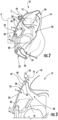
- FIG. 3 shows an enlarged view of the bounded portion A of FIG. 2 . As shown in FIGS.
- the interior surface 36 of the voice transmittal membrane 34 is continuous (i.e., contiguous) with the interior surface 36 of the mask body 12 and the exterior surface 38 is continuous (i.e., contiguous) with the exterior surface 18 of the mask body 12, even though thicknesses T and T 1 are different.
- the voice transmittal membrane 34 thereby passively transmits a user's speech from inside the plenum of the mask body 12 to the ambient environment of the user wearing the mask 10.
- the voice transmittal membrane 34 may be thinner than one or more other segments of the mask body 12 that are adjacent or proximal to the voice transmittal membrane 34.
- the one or more segments 40 may be immediately adjacent to the voice transmittal membrane 34.
- the voice transmittal membrane 34 is thinner as compared to the segments 40 of the mask body 12 that surround the voice transmittal membrane 34.
- the surrounding segments 40 border the voice transmittal membrane 34 along substantially the entirety of the perimeter of the voice transmittal membrane 34.
- the voice transmittal membrane 34 has a thickness T that is less than a thickness T 1 of the surrounding segments 40 of the mask body 12, as is shown in FIGS. 2 and 3 .
- the body 12 may include a transition area between the membrane 34 and the segments 40, in which the thickness of the body 12 increases from the thickness T of the voice transmittal membrane 34 and the thickness T 1 of the segments 40.
- the thicker surrounding segments 40 add strength and structural integrity to the mask body 12. Moreover, the rigidity provided by the thicker surrounding segments 40 may enable and/or facilitate transmission of speech from the plenum of the mask body 12 through the voice transmittal membrane 34. For example, the rigidity provided by the thicker surrounding segments 40 may enable and/or facilitate vibration of the voice transmittal membrane 34 in response to sound waves generated by the user wearing the mask 10.
- the voice transmittal membrane 34 may have any thickness T and may have a uniform thickness T or a non-uniform thickness.
- the surrounding segments 40 may have any thickness T 1 , provided that thickness T 1 is greater than thickness T.
- substantially the entirety of the perimeter of the voice transmittal membrane 34 is surrounded by surrounding segments 40 that are thicker than the voice transmittal membrane 34.
- any amount of the perimeter of the voice transmittal membrane 34 may be surrounded by thicker segments of the mask body 12.
- at least a portion of the surrounding segments 40 may have a thickness T 1 that is greater than a thickness T of at least a portion of the voice transmittal membrane 34.
- the voice transmittal membrane 34 is thinner than a majority and/or a remainder of the mask body 12. Accordingly, the voice transmittal membrane 34 is more flexible than the mask body 12, even if the voice transmittal membrane 34 and the mask body 12 are composed of the same material.
- the passive voice transmittal feature 32 is located along the nose area 20 of the mask body 12, as is shown in FIGS. 1-3 .
- the voice transmittal membrane 34 extends along the nose area 20 of the body 12.
- the passive voice transmittal feature 32 is not limited to this location.
- the passive voice transmittal feature 32 additionally or alternatively may be located at any other location along the mask body 12, such as, but not limited to, the mouth area 22.
- the voice transmittal membrane 34 may be composed of any suitable material(s) that enable the voice transmittal membrane 34 to function as described and/or illustrated herein.
- suitable materials include, but are not limited to, thermosets, thermoplastics, elastomers, thermoplastic elastomers, filtering structures and/or filter materials, cushioning and/or dampening materials, shape memory materials, and/or the like.
- the voice transmittal membrane 34 is composed of substantially the same material(s) as the mask body 12. However, it will be understood that in other examples the voice transmittal membrane 34 may be composed of one or more materials that are different than the material(s) from which the mask body 12 is composed.
- the voice transmittal membrane 34 is fabricated from one or more filter materials (such as in embodiments wherein the mask body 12 is fabricated from a filter material).
- the various design parameters of the mask 10 such as, but not limited to, the material(s) of the mask body 12, the material(s) of the voice transmittal membrane 34, the thickness T, the thickness(es) T 1 , the thickness T of the voice transmittal membrane 34 relative to the value of the thickness T 1 of each surrounding segment 40, the number of surrounding segments 40 that are provided as thicker than the voice transmittal membrane 34, the amount of the perimeter of the voice transmittal membrane 34 that is surrounded by thicker segments of the body 12, the geometry of the voice transmittal membrane 34, the dimensions of the voice transmittal membrane 34, the location of the voice transmittal membrane 34, the orientation of the voice transmittal membrane 34, and/or the like, may be selected to enable the voice transmittal membrane 34 to function as described and/or illustrated herein, that is, to transmit a user's speech from inside the plenum of the mask body 12 to the ambient environment of the user wearing the mask 10 with less distortion such that a listener can better understand the speech of a user wearing the mask 10.
- the passive voice transmittal feature 32 may transmit a user's speech from inside the plenum of the mask body 12 to the ambient environment of the user wearing the mask 10 with less distortion than known respirator masks 10.
- the passive voice transmittal feature 32 thus is configured to increase the ability of a listener to understand the speech of a user wearing the mask 10 and thereby enhance communication between the user and a listener.
- the voice transmittal membrane 34 is a passive device and therefore the amplitude of the user's speech is not enhanced or increased by the passive voice transmittal feature 32.
- the voice transmittal feature 32 is an active voice transmittal feature 32 that includes an active audio capture and/or transmission device that includes or is connected to a power source to increase the amplitude of the user's speech.
- the mask 10 is not precluded from also including a microphone or other amplifier.
- the voice transmittal membrane 34 shown in FIGS. 1-3 is integrally formed with a single, unitary construction with the mask body 12, regardless of whether the voice transmittal membrane 34 is composed of the same material(s) as the mask body 12.
- the single, unitary construction of the voice transmittal membrane 34 with the mask body 12 may allow the passive voice transmittal feature 32 and/or the mask 10 to be less expensive, less prone to failure, and/or the like than respirator masks that include discrete mechanical voice-transmission devices that are mounted or to the mask.
- the voice transmittal membrane 34 is a discrete component that is attached to the mask body 12.
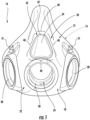
- FIG. 4 is a front view of a preferred embodiment of a respirator mask 110.
- the components disclosed in the example shown in FIGS. 1-3 are at least substantially the same as the corresponding components shown in FIGS. 4-7 that are designated with the same numbers in the one hundred series.
- the mask body 12 shown in FIGS. 1-3 is at least substantially the same as the mask body 112 shown in FIGS. 4-7 , except for any distinguishing features disclosed herein (such as an opening in the mask body to receive a removably attached voice transmittal element, as described in more detail below).
- any distinguishing features disclosed herein such as an opening in the mask body to receive a removably attached voice transmittal element, as described in more detail below.
- the mask body 112 includes an interior surface 116 and an exterior surface 118 opposite the interior surface 116.
- the body 112 includes a nose area 120 (sometimes referred to as an "upper portion” of the mask body 112) and a mouth area 122 (sometimes referred to as a "lower portion” of the mask body 12).
- the nose area 120 is sized and configured to receive the nose of the user therein such that the nose area 120 covers at least a portion of the user's nose.
- the nose area 120 covers the nose and portions of the upper cheeks of the user.
- the mouth area 122 of the mask 110 is sized and configured to cover the user's mouth.
- the mouth area 122 covers the mouth, at least a portion of the chin, and portions of the lower cheeks of the user.
- the mask body includes a sealing area that is similar to the sealing area 24 of the example shown in FIGS. 1-3 in that it is configured to seal against the user's face to thereby seal the mask 110 to the user's face.
- the body 112 of the mask 110 includes one or more openings 128.
- Each opening 128 is configured to receive one or more an attachable components (not shown), such as a replaceable filter cartridge, a valve, a breathing gas hose, and/or a speech module.
- the body 112 may include any number of the openings 128 depending on the particular application of the mask 10 and the number of attachable components that are used.
- the interior surface 116 of the mask body 112 has a concave shape such that the interior surface 116 defines an interior space 130 of the body 112 that is sized and configured to receive therein at least a portion of the user's face, such as the user's nose and mouth. While the mask 110 is worn by the user, the user's nose and mouth are received into the interior space 130 such that a plenum is defined between the interior surface 116 of the body 112 and the portion of the user's face received by the mask 10. So, the interior space 130 may be referred to herein as the plenum when the user is wearing the mask 110.
- the mask 110 optionally includes a harness that is configured to hold the mask body 12 on the user's face and thereby hold the mask 10 in position over the user's nose and mouth.
- the harness includes a plurality of straps (not shown) that are attached to the mask body 112 and are configured to secure the mask 110 to the user's head.
- the mask body01 12 may include one or more attachment elements 131 to which the harness may be coupled.
- the harness additionally or alternatively may include any other structure.
- the harness may be reusable.
- the harness is disposable.
- the harness is optionally composed of materials that are relatively easy to sterilize with relatively common sterilization methods.
- the mask body 112 may be composed of any suitable material(s).
- the mask body 112 may be composed of one or more materials that provide the body 12 with at least some flexibility.
- suitable materials but are not limited to, thermosets, thermoplastics, elastomers, thermoplastic elastomers, filtering structures and/or filter materials, cushioning and/or dampening materials, shape memory materials, and/or the like.
- some or an approximate entirety of the mask body 112 is fabricated from one or more filter materials such that at least a portion of the body 112 has a filtering structure.
- the respiratory mask 110 includes a passive voice transmittal feature 132 that is configured to enhance the intelligibility of the speech of a user wearing the mask 110.
- the passive voice transmittal feature 132 of the embodiment shown in FIGS. 4 and 5 is configured to increase the ability of a listener to understand the speech of a user wearing the mask 110.
- the passive voice transmittal feature 132 thereby enhances communication between a user wearing the mask 110 and a listener.
- the passive voice transmittal feature 132 shown in FIGS. 4 and 5 is not integrally formed with a single, unitary construction with the mask body 112, and instead includes a frame 133 and a voice transmittal membrane 134.
- the voice transmittal membrane 134 is configured to vibrate in response to sound waves generated by the user wearing the mask 110.
- the vibration of the voice transmittal membrane 134 transmits the sound waves from the mask interior space 130, that is, from the plenum defined between the user's face and the interior surface 116, to outside the mask body 112, that is, to the ambient or external environment of the user wearing the mask 110.
- the sound waves generated by the user's speech within the plenum of the mask body 112 impact the voice transmittal membrane 134 along the interior surface 116 of the mask body 112 and, in particular, the interior surface 136 of the voice transmittal membrane 134.
- the impact of the sound waves with the voice transmittal membrane 134 vibrates the voice transmittal membrane 134 such that the sound waves are reproduced by the vibrating membrane 134 along an exterior surface 118 of the mask body 112 and, in particular, the exterior surface 138 of the voice transmittal membrane 134.
- the interior surface 136 of the passive voice transmittal membrane 134 and the frame 133 are continuous (i.e., contiguous) with the interior surface 136 of the mask body 112 and the exterior surface 138 and the frame 133 are continuous (i.e., contiguous) with the exterior surface 118 of the mask body 112, even though the thicknesses of the voice transmittal membrane 134, frame 133, and mask body 112 are different.
- the voice transmittal membrane 134 thereby transmits a user's speech from inside the plenum of the mask body 112 to the ambient environment of the user wearing the mask 110.
- the passive voice transmittal feature 132 includes the voice transmittal membrane 134 and a frame 133.
- the frame 133 is coupled to the mask body 112 such that the frame 133 is secured by the mask body 112, while the voice transmittal membrane 134 is coupled to and secured by the frame 133, as is shown in FIGS. 4 and 5 .
- the frame 133 may be clamped or crimped around the outer edges of the voice transmittal membrane 134 to secure the membrane 134.
- the frame 133 is integrally formed with a single, unitary construction with the mask body 112 and the voice transmittal membrane 134 is removably or fixedly coupled to the frame 133.
- the voice transmittal membrane 134 is integrally formed with a single, unitary construction with the frame 133.
- the frame 133 in which the frame 133 is removably coupled to the mask body 112, the frame 133 includes a perimeter 142 that extends around the outer edge of the frame 133.
- the perimeter 142 has a convex shape in cross section.
- the portion of the mask body 112 that engages with the frame 133 has a perimeter 144 having a corresponding concave shape in cross section.
- the mask body 112 includes an opening 146 that is sized and configured to accept the frame 133 and retain the frame 133 within the mask body 112.
- the convex perimeter 142 of the frame 133 may be snapped into or otherwise coupled to the concave perimeter 144 of the opening 146 in the mask body 112.
- the coupling may fluid tight so a gas within the plenum of the mask does not escape through the opening 146 when the user is wearing the mask 110.
- the frame perimeter 142 may have a concave shape in cross section and the perimeter 144 of the opening 146 may have a corresponding convex shape in cross section that, when the frame 133 is in the opening 146, is capable of retaining the frame within the mask body 112.
- the rigidity of the frame 133 and/or the thickness of the mask body 112 relative to the voice transmittal membrane 134 may enable and/or facilitate operation of the voice transmittal membrane 134 to transmit speech from the plenum of the mask body 112 to the ambient or external environment.
- the rigidity of the frame 133 and/or the thickness of the mask body 112 relative to the voice transmittal membrane 134 may enable and/or facilitate vibration of the voice transmittal membrane 134 in response to sound waves generated by the user wearing the mask 110.
- the passive voice transmittal feature 132 is located along a nose area 120 of the mask body 112, as is shown in FIG. 4 .
- the passive voice transmittal feature 132 is not limited to this location.
- the passive voice transmittal feature 132 additionally or alternatively may be located at any other location along the mask body 112, such as, but not limited to, a mouth area 122.
- the voice transmittal membrane 134 and the frame 133 may each be composed of any suitable material(s) that enable the voice transmittal membrane 34 to function as described and/or illustrated herein.
- suitable materials include, but are not limited to, thermosets, thermoplastics, elastomers, thermoplastic elastomers, filtering structures and/or filter materials, cushioning and/or dampening materials, shape memory materials, and/or the like.
- the voice transmittal membrane 134 is composed of substantially the same material(s) as the mask body 112, whereas the frame 133 is composed of a different, more rigid material.
- the mask body 112 and the voice transmittal membrane 134 may each be composed of a first material having a first durometer and the frame may be composed of a second material having a second durometer that is greater than the first durometer.
- the voice transmittal membrane 134 may be composed of a material that is different than the material from which the mask body 112 is composed, provided that the voice transmittal membrane 134 is composed of a material having a durometer that is less than that of the material from which the frame 133 is composed.
- the various design parameters of the mask 110 such as, but not limited to, the material(s) of the mask body 112, the rigidity of the frame 133, the material(s) of the voice transmittal membrane 134 and/or the frame 133, the thickness of the voice transmittal membrane 134, the thickness(es) of the mask body 112, the thickness of the voice transmittal membrane 134 relative to the thickness(es) of the mask body 112, the geometry of the voice transmittal membrane 134, the dimensions of the voice transmittal membrane 134, the location of the voice transmittal membrane 134, the orientation of the voice transmittal membrane 134, and/or the like, may be selected to enable the voice transmittal membrane 134 to function as described and/or illustrated herein, that is, to transmit a user's speech from inside the plenum of the mask body 112 to the ambient environment of the user wearing the mask 110 with less distortion such that a listener can better understand the speech of a user wearing the mask 110.
- the voice passive transmittal feature 132 may transmit a user's speech from inside the plenum of the mask body 112 to the ambient environment of the user wearing the mask 110 with less distortion than known respirator masks 110.
- the passive voice transmittal feature 132 thus is configured to increase the ability of a listener to understand the speech of a user wearing the mask 110 and thereby enhance communication between the user and a listener.
- the voice transmittal membrane 134 is a passive device and therefore the amplitude of the user's speech is not enhanced or increased by the passive voice transmittal feature 132.
- the passive voice transmittal feature 132 may include an active device that includes or is connected to a power source to increase the amplitude of the user's speech.
- the mask 110 may also include a microphone or other amplifier.
- a respirator mask that includes a passive voice transmittal feature.
- the respirator mask provides respiratory protection while also allowing for the transmission of intelligible speech from a user.
- the respiratory mask includes a body (12)(112) defining an interior space (30)(130) of the mask (10)(110) and including a first surface (16)(116) and a second surface (18)(118) opposite the first surface (16)(116), the first surface (16)(116) defining the interior space (30)(130), and a passive voice transmittal feature (32)(132) contiguous with the body (12)(112).
- the passive voice transmittal feature (32)(132) is a membrane (34)(134), the membrane (34)(134) having a first surface (36)(136), a second surface (38)(138), and a first thickness (T) extending between the membrane first surface (36)(136) and the membrane second surface (38)(138), the body (12)(112) having a second thickness (T 1 ) at at least one location proximate the membrane (34)(134), the second thickness (T 1 ) extending between the body first surface (16)(116) and the body second surface (18)(118), the first thickness (T) being less than the second thickness (T 1 ).
- the membrane first surface (36)(136) is contiguous with the body first surface (16)(116) and the membrane second surface (38)(138) is contiguous with the body second surface (18)(118).
- the membrane (34)(134) has a perimeter, the body (12)(112) further including at least one portion (40) that is adjacent at least a portion of the membrane perimeter, the at least one portion of the body (12)(112) having the second thickness (T 1 ).
- the passive voice transmittal feature (32) is integrally formed with a single, unitary construction with the body (12)(112).
- the body (12)(112) further includes an upper segment (20)(120) and a lower segment (22)(122), the lower segment (22)(122) including the passive voice transmittal feature (32)(132).
- the upper segment (20)(120) is configured to receive a nose of a user and the lower segment (22)(122) is configured to receive a mouth of the user.
- the passive voice transmittal feature (32)(132) is located proximate a user's mouth when the user is wearing the mask (10)(110).
- the voice transmittal membrane (34)(134) is and the body (12)(112) are composed of substantially the same material.
- the passive voice transmittal feature (132) includes a membrane (134) and a frame (133) coupled to the membrane (134), the frame (133) being coupled to the body (112).
- the frame (133) is removably coupled to the body (112).
- the body (112) further includes an opening (146) extending between the body first surface (116) and the body second surface (118), the opening (146) being configured to receive and retain the frame (133).
- the frame (133) is fixedly coupled to the body (112).
- the membrane (134) has a perimeter, the frame (133) being coupled to the perimeter of the membrane (134).
- the passive voice transmittal feature (132) includes a membrane (134) and a frame (133) that is integrally formed with a single, unitary construction with the body (112), the frame (133) being coupled to the membrane perimeter.
Landscapes
- Health & Medical Sciences (AREA)
- General Health & Medical Sciences (AREA)
- Business, Economics & Management (AREA)
- Emergency Management (AREA)
- Pulmonology (AREA)
- Engineering & Computer Science (AREA)
- General Engineering & Computer Science (AREA)
- Physics & Mathematics (AREA)
- Acoustics & Sound (AREA)
- Signal Processing (AREA)
- Mechanical Engineering (AREA)
- Respiratory Apparatuses And Protective Means (AREA)
- Details Of Audible-Bandwidth Transducers (AREA)
- Life Sciences & Earth Sciences (AREA)
- Zoology (AREA)
Applications Claiming Priority (2)
| Application Number | Priority Date | Filing Date | Title |
|---|---|---|---|
| US201562244917P | 2015-10-22 | 2015-10-22 | |
| PCT/US2016/057921 WO2017070352A1 (en) | 2015-10-22 | 2016-10-20 | Respirator mask with voice transmittal feature |
Publications (3)
| Publication Number | Publication Date |
|---|---|
| EP3365075A1 EP3365075A1 (en) | 2018-08-29 |
| EP3365075A4 EP3365075A4 (en) | 2019-05-15 |
| EP3365075B1 true EP3365075B1 (en) | 2024-12-11 |
Family
ID=58558246
Family Applications (1)
| Application Number | Title | Priority Date | Filing Date |
|---|---|---|---|
| EP16858218.7A Active EP3365075B1 (en) | 2015-10-22 | 2016-10-20 | Respirator mask with voice transmittal feature |
Country Status (7)
| Country | Link |
|---|---|
| US (1) | US11273334B2 (enExample) |
| EP (1) | EP3365075B1 (enExample) |
| JP (2) | JP2018531104A (enExample) |
| KR (1) | KR102749643B1 (enExample) |
| CN (1) | CN108367182A (enExample) |
| AU (1) | AU2016342193B2 (enExample) |
| WO (1) | WO2017070352A1 (enExample) |
Families Citing this family (16)
| Publication number | Priority date | Publication date | Assignee | Title |
|---|---|---|---|---|
| US11878124B2 (en) | 2017-11-09 | 2024-01-23 | Fisher & Paykel Healthcare Limited | Patient interface and a speech valve therefor |
| US20220193469A1 (en) * | 2018-04-18 | 2022-06-23 | Orindi Ventures, LLC | Face mask for regulating heat and humidity |
| CA3165531A1 (en) * | 2020-01-20 | 2021-07-29 | Richard Devin SZASZ | Tactical respirator mask |
| KR200494337Y1 (ko) | 2020-05-28 | 2021-09-16 | 양경호 | 마스크용 음성 전달장치 |
| US20210393997A1 (en) * | 2020-06-19 | 2021-12-23 | Msa Technology, Llc | Respirator mask with exhalation filter |
| KR200496018Y1 (ko) | 2020-07-08 | 2022-10-14 | 양경호 | 마스크용 음성 전달장치 |
| USD958966S1 (en) * | 2020-07-21 | 2022-07-26 | Desprez, Llc | Face mask |
| KR200496058Y1 (ko) | 2020-07-28 | 2022-10-24 | 양경호 | 마스크용 음성 전달장치 |
| KR102234853B1 (ko) | 2020-09-16 | 2021-04-01 | 양경호 | 마스크용 음성 전달장치 |
| US20230310909A1 (en) * | 2020-08-14 | 2023-10-05 | Cafe24 Corp. | 3d printing-based face mask |
| CN116133724B (zh) * | 2020-08-14 | 2026-07-21 | 咖啡24株式会社 | 基于3d打印的脸部形状口罩 |
| KR20220046314A (ko) | 2020-10-07 | 2022-04-14 | 주식회사퓨먼 | 피보나치 수열을 이용하여 음성 전달 기능을 강화한 안면 마스크 |
| KR102487561B1 (ko) | 2021-02-16 | 2023-01-12 | 주식회사 이보 | 마스크용 음성 전달장치 |
| USD1001271S1 (en) * | 2021-03-18 | 2023-10-10 | Tecmen Electronics Co., Ltd | Respirator |
| EP4384284A4 (en) * | 2021-08-13 | 2025-06-11 | The University of Melbourne | FACE MASK |
| KR20230108105A (ko) | 2022-01-10 | 2023-07-18 | 주식회사 이보 | 마스크용 발광형 음성 전달장치 |
Family Cites Families (24)
| Publication number | Priority date | Publication date | Assignee | Title |
|---|---|---|---|---|
| US3124130A (en) * | 1964-03-10 | Respirator with speaking diaphragm | ||
| US1762695A (en) * | 1924-05-14 | 1930-06-10 | Monro Randolph | Gas mask |
| US2164330A (en) * | 1937-07-10 | 1939-07-04 | Sidney H Katz | Fully molded gas mask facepiece |
| US2738788A (en) * | 1952-04-08 | 1956-03-20 | Willson Products Inc | Respirator with speaking diaphragm |
| US3602219A (en) * | 1969-03-05 | 1971-08-31 | Draegerwerk Ag | Respirator having sound diaphragm protective cavity |
| DE3374173D1 (en) | 1982-08-18 | 1987-12-03 | Avon Ind Polymers | Respirator speech transmitter |
| JPS59156356A (ja) * | 1983-02-25 | 1984-09-05 | 株式会社 笠井仏檀工芸 | 作業用マスク |
| AT378652B (de) * | 1983-12-27 | 1985-09-10 | Akg Akustische Kino Geraete | Anordnung zur sprachuebertragung aus einer atemschutzmaske |
| JPH0680660B2 (ja) | 1984-01-23 | 1994-10-12 | 沖電気工業株式会社 | 半導体装置の製造方法 |
| JPS60153145U (ja) * | 1984-03-22 | 1985-10-12 | 笠井 武 | 作業用マスク |
| JPS6148747A (ja) | 1984-08-16 | 1986-03-10 | Canon Inc | 粒子解析装置 |
| JPS6148747U (enExample) * | 1984-09-03 | 1986-04-01 | ||
| FI96171C (fi) * | 1992-03-02 | 1996-05-27 | Kemira Oy | Suojanaamari |
| US5385141A (en) | 1992-04-16 | 1995-01-31 | Siebe North, Inc. | Speech diaphragm and exhalation valve |
| US5895537A (en) | 1997-10-09 | 1999-04-20 | Campbell; Richard G. | Sonic welded gas mask and process |
| JP3012845B1 (ja) * | 1998-12-15 | 2000-02-28 | 興研株式会社 | 伝声機能付きマスク |
| JP3234196B2 (ja) * | 1998-12-28 | 2001-12-04 | 興研株式会社 | 面体取り付け用伝声器 |
| CN2667838Y (zh) * | 2003-10-27 | 2004-12-29 | 北京三方杰科技有限公司 | 防毒面具电声通话器 |
| JP2010537721A (ja) | 2007-08-31 | 2010-12-09 | スリーエム イノベイティブ プロパティズ カンパニー | 成形された熱硬化性エラストマー要素を有する一体型レスピレータ |
| RU2429034C1 (ru) | 2007-08-31 | 2011-09-20 | 3М Инновейтив Пропертиз Компани | Лицевая маска респиратора с термоотвержденным эластомерным лицевым уплотнением |
| US20120260920A1 (en) | 2011-04-15 | 2012-10-18 | 3M Innovative Properties Company | Face mask having welded thermoplastic mask body |
| JP5759032B2 (ja) * | 2013-02-15 | 2015-08-05 | 興研株式会社 | 伝声器 |
| CN204293714U (zh) * | 2014-12-12 | 2015-04-29 | 湖北华强科技有限责任公司 | 一种便于通话防毒面具 |
| JP3234196U (ja) | 2021-07-16 | 2021-09-24 | 株式会社富士山静養園 | コルゲート管コテージ及び係止部材 |
-
2016
- 2016-10-20 WO PCT/US2016/057921 patent/WO2017070352A1/en not_active Ceased
- 2016-10-20 KR KR1020187014231A patent/KR102749643B1/ko active Active
- 2016-10-20 EP EP16858218.7A patent/EP3365075B1/en active Active
- 2016-10-20 AU AU2016342193A patent/AU2016342193B2/en not_active Ceased
- 2016-10-20 US US15/769,846 patent/US11273334B2/en active Active
- 2016-10-20 JP JP2018520473A patent/JP2018531104A/ja active Pending
- 2016-10-20 CN CN201680062087.2A patent/CN108367182A/zh active Pending
-
2021
- 2021-06-16 JP JP2021100434A patent/JP7426001B2/ja active Active
Also Published As
| Publication number | Publication date |
|---|---|
| JP2021164659A (ja) | 2021-10-14 |
| AU2016342193A1 (en) | 2018-05-10 |
| WO2017070352A1 (en) | 2017-04-27 |
| US11273334B2 (en) | 2022-03-15 |
| JP2018531104A (ja) | 2018-10-25 |
| KR20180115670A (ko) | 2018-10-23 |
| JP7426001B2 (ja) | 2024-02-01 |
| CN108367182A (zh) | 2018-08-03 |
| EP3365075A1 (en) | 2018-08-29 |
| US20180311516A1 (en) | 2018-11-01 |
| AU2016342193B2 (en) | 2019-08-22 |
| KR102749643B1 (ko) | 2025-01-02 |
| EP3365075A4 (en) | 2019-05-15 |
Similar Documents
| Publication | Publication Date | Title |
|---|---|---|
| US11273334B2 (en) | Respirator mask with voice transmittal feature | |
| JP2018531104A6 (ja) | 音声伝達機能を備えた呼吸用マスク | |
| ES2292748T3 (es) | Valvula de respirador. | |
| CA2456216C (en) | Respirator | |
| CA2988933C (en) | Face mask assembly | |
| US11266861B2 (en) | Face mask assembly | |
| US11123581B1 (en) | Anti-contagion mask | |
| KR102325079B1 (ko) | 다목적용 방진 마스크 | |
| US20210298387A1 (en) | Protective mask accessories | |
| US20210393997A1 (en) | Respirator mask with exhalation filter | |
| US20230356010A1 (en) | Head encapsulation unit | |
| US20230142434A1 (en) | Face mask apparatus with secondary filter | |
| US20190151687A1 (en) | Face seal for respirator mask | |
| KR20120000306A (ko) | 방독면용 음성전달 모듈 | |
| CN103041523B (zh) | 呼吸保护面罩 | |
| KR20200117929A (ko) | 비말 유입을 차단할 수 있는 위생 마스크 | |
| EP3965900B1 (en) | Facepiece chin retention feature | |
| US11957938B1 (en) | Hydration providing mask apparatus | |
| KR20130115534A (ko) | 의사소통이 용이한 밀폐 마스크 |
Legal Events
| Date | Code | Title | Description |
|---|---|---|---|
| STAA | Information on the status of an ep patent application or granted ep patent |
Free format text: STATUS: THE INTERNATIONAL PUBLICATION HAS BEEN MADE |
|
| PUAI | Public reference made under article 153(3) epc to a published international application that has entered the european phase |
Free format text: ORIGINAL CODE: 0009012 |
|
| STAA | Information on the status of an ep patent application or granted ep patent |
Free format text: STATUS: REQUEST FOR EXAMINATION WAS MADE |
|
| 17P | Request for examination filed |
Effective date: 20180503 |
|
| AK | Designated contracting states |
Kind code of ref document: A1 Designated state(s): AL AT BE BG CH CY CZ DE DK EE ES FI FR GB GR HR HU IE IS IT LI LT LU LV MC MK MT NL NO PL PT RO RS SE SI SK SM TR |
|
| AX | Request for extension of the european patent |
Extension state: BA ME |
|
| DAV | Request for validation of the european patent (deleted) | ||
| DAX | Request for extension of the european patent (deleted) | ||
| A4 | Supplementary search report drawn up and despatched |
Effective date: 20190416 |
|
| RIC1 | Information provided on ipc code assigned before grant |
Ipc: A62B 18/08 20060101AFI20190410BHEP Ipc: H04R 1/08 20060101ALI20190410BHEP Ipc: A62B 18/02 20060101ALI20190410BHEP |
|
| STAA | Information on the status of an ep patent application or granted ep patent |
Free format text: STATUS: EXAMINATION IS IN PROGRESS |
|
| 17Q | First examination report despatched |
Effective date: 20221027 |
|
| GRAP | Despatch of communication of intention to grant a patent |
Free format text: ORIGINAL CODE: EPIDOSNIGR1 |
|
| STAA | Information on the status of an ep patent application or granted ep patent |
Free format text: STATUS: GRANT OF PATENT IS INTENDED |
|
| INTG | Intention to grant announced |
Effective date: 20240709 |
|
| GRAS | Grant fee paid |
Free format text: ORIGINAL CODE: EPIDOSNIGR3 |
|
| GRAA | (expected) grant |
Free format text: ORIGINAL CODE: 0009210 |
|
| STAA | Information on the status of an ep patent application or granted ep patent |
Free format text: STATUS: THE PATENT HAS BEEN GRANTED |
|
| P01 | Opt-out of the competence of the unified patent court (upc) registered |
Free format text: CASE NUMBER: APP_53636/2024 Effective date: 20240926 |
|
| AK | Designated contracting states |
Kind code of ref document: B1 Designated state(s): AL AT BE BG CH CY CZ DE DK EE ES FI FR GB GR HR HU IE IS IT LI LT LU LV MC MK MT NL NO PL PT RO RS SE SI SK SM TR |
|
| REG | Reference to a national code |
Ref country code: GB Ref legal event code: FG4D |
|
| REG | Reference to a national code |
Ref country code: CH Ref legal event code: EP |
|
| REG | Reference to a national code |
Ref country code: IE Ref legal event code: FG4D |
|
| REG | Reference to a national code |
Ref country code: DE Ref legal event code: R096 Ref document number: 602016090619 Country of ref document: DE |
|
| REG | Reference to a national code |
Ref country code: LT Ref legal event code: MG9D |
|
| PG25 | Lapsed in a contracting state [announced via postgrant information from national office to epo] |
Ref country code: HR Free format text: LAPSE BECAUSE OF FAILURE TO SUBMIT A TRANSLATION OF THE DESCRIPTION OR TO PAY THE FEE WITHIN THE PRESCRIBED TIME-LIMIT Effective date: 20241211 |
|
| PG25 | Lapsed in a contracting state [announced via postgrant information from national office to epo] |
Ref country code: FI Free format text: LAPSE BECAUSE OF FAILURE TO SUBMIT A TRANSLATION OF THE DESCRIPTION OR TO PAY THE FEE WITHIN THE PRESCRIBED TIME-LIMIT Effective date: 20241211 |
|
| PG25 | Lapsed in a contracting state [announced via postgrant information from national office to epo] |
Ref country code: BG Free format text: LAPSE BECAUSE OF FAILURE TO SUBMIT A TRANSLATION OF THE DESCRIPTION OR TO PAY THE FEE WITHIN THE PRESCRIBED TIME-LIMIT Effective date: 20241211 |
|
| REG | Reference to a national code |
Ref country code: NL Ref legal event code: MP Effective date: 20241211 |
|
| PG25 | Lapsed in a contracting state [announced via postgrant information from national office to epo] |
Ref country code: ES Free format text: LAPSE BECAUSE OF FAILURE TO SUBMIT A TRANSLATION OF THE DESCRIPTION OR TO PAY THE FEE WITHIN THE PRESCRIBED TIME-LIMIT Effective date: 20241211 |
|
| PG25 | Lapsed in a contracting state [announced via postgrant information from national office to epo] |
Ref country code: NO Free format text: LAPSE BECAUSE OF FAILURE TO SUBMIT A TRANSLATION OF THE DESCRIPTION OR TO PAY THE FEE WITHIN THE PRESCRIBED TIME-LIMIT Effective date: 20250311 |
|
| PG25 | Lapsed in a contracting state [announced via postgrant information from national office to epo] |
Ref country code: LV Free format text: LAPSE BECAUSE OF FAILURE TO SUBMIT A TRANSLATION OF THE DESCRIPTION OR TO PAY THE FEE WITHIN THE PRESCRIBED TIME-LIMIT Effective date: 20241211 Ref country code: GR Free format text: LAPSE BECAUSE OF FAILURE TO SUBMIT A TRANSLATION OF THE DESCRIPTION OR TO PAY THE FEE WITHIN THE PRESCRIBED TIME-LIMIT Effective date: 20250312 |
|
| PG25 | Lapsed in a contracting state [announced via postgrant information from national office to epo] |
Ref country code: RS Free format text: LAPSE BECAUSE OF FAILURE TO SUBMIT A TRANSLATION OF THE DESCRIPTION OR TO PAY THE FEE WITHIN THE PRESCRIBED TIME-LIMIT Effective date: 20250311 |
|
| PG25 | Lapsed in a contracting state [announced via postgrant information from national office to epo] |
Ref country code: NL Free format text: LAPSE BECAUSE OF FAILURE TO SUBMIT A TRANSLATION OF THE DESCRIPTION OR TO PAY THE FEE WITHIN THE PRESCRIBED TIME-LIMIT Effective date: 20241211 |
|
| REG | Reference to a national code |
Ref country code: AT Ref legal event code: MK05 Ref document number: 1749941 Country of ref document: AT Kind code of ref document: T Effective date: 20241211 |
|
| PG25 | Lapsed in a contracting state [announced via postgrant information from national office to epo] |
Ref country code: SM Free format text: LAPSE BECAUSE OF FAILURE TO SUBMIT A TRANSLATION OF THE DESCRIPTION OR TO PAY THE FEE WITHIN THE PRESCRIBED TIME-LIMIT Effective date: 20241211 |
|
| PG25 | Lapsed in a contracting state [announced via postgrant information from national office to epo] |
Ref country code: PL Free format text: LAPSE BECAUSE OF FAILURE TO SUBMIT A TRANSLATION OF THE DESCRIPTION OR TO PAY THE FEE WITHIN THE PRESCRIBED TIME-LIMIT Effective date: 20241211 |
|
| PG25 | Lapsed in a contracting state [announced via postgrant information from national office to epo] |
Ref country code: IS Free format text: LAPSE BECAUSE OF FAILURE TO SUBMIT A TRANSLATION OF THE DESCRIPTION OR TO PAY THE FEE WITHIN THE PRESCRIBED TIME-LIMIT Effective date: 20250411 |
|
| PG25 | Lapsed in a contracting state [announced via postgrant information from national office to epo] |
Ref country code: PT Free format text: LAPSE BECAUSE OF FAILURE TO SUBMIT A TRANSLATION OF THE DESCRIPTION OR TO PAY THE FEE WITHIN THE PRESCRIBED TIME-LIMIT Effective date: 20250411 |
|
| PG25 | Lapsed in a contracting state [announced via postgrant information from national office to epo] |
Ref country code: EE Free format text: LAPSE BECAUSE OF FAILURE TO SUBMIT A TRANSLATION OF THE DESCRIPTION OR TO PAY THE FEE WITHIN THE PRESCRIBED TIME-LIMIT Effective date: 20241211 |
|
| PG25 | Lapsed in a contracting state [announced via postgrant information from national office to epo] |
Ref country code: RO Free format text: LAPSE BECAUSE OF FAILURE TO SUBMIT A TRANSLATION OF THE DESCRIPTION OR TO PAY THE FEE WITHIN THE PRESCRIBED TIME-LIMIT Effective date: 20241211 Ref country code: AT Free format text: LAPSE BECAUSE OF FAILURE TO SUBMIT A TRANSLATION OF THE DESCRIPTION OR TO PAY THE FEE WITHIN THE PRESCRIBED TIME-LIMIT Effective date: 20241211 |
|
| PG25 | Lapsed in a contracting state [announced via postgrant information from national office to epo] |
Ref country code: SK Free format text: LAPSE BECAUSE OF FAILURE TO SUBMIT A TRANSLATION OF THE DESCRIPTION OR TO PAY THE FEE WITHIN THE PRESCRIBED TIME-LIMIT Effective date: 20241211 |
|
| PG25 | Lapsed in a contracting state [announced via postgrant information from national office to epo] |
Ref country code: CZ Free format text: LAPSE BECAUSE OF FAILURE TO SUBMIT A TRANSLATION OF THE DESCRIPTION OR TO PAY THE FEE WITHIN THE PRESCRIBED TIME-LIMIT Effective date: 20241211 |
|
| PG25 | Lapsed in a contracting state [announced via postgrant information from national office to epo] |
Ref country code: IT Free format text: LAPSE BECAUSE OF FAILURE TO SUBMIT A TRANSLATION OF THE DESCRIPTION OR TO PAY THE FEE WITHIN THE PRESCRIBED TIME-LIMIT Effective date: 20241211 |
|
| PG25 | Lapsed in a contracting state [announced via postgrant information from national office to epo] |
Ref country code: SE Free format text: LAPSE BECAUSE OF FAILURE TO SUBMIT A TRANSLATION OF THE DESCRIPTION OR TO PAY THE FEE WITHIN THE PRESCRIBED TIME-LIMIT Effective date: 20241211 |
|
| REG | Reference to a national code |
Ref country code: DE Ref legal event code: R097 Ref document number: 602016090619 Country of ref document: DE |
|
| PG25 | Lapsed in a contracting state [announced via postgrant information from national office to epo] |
Ref country code: DK Free format text: LAPSE BECAUSE OF FAILURE TO SUBMIT A TRANSLATION OF THE DESCRIPTION OR TO PAY THE FEE WITHIN THE PRESCRIBED TIME-LIMIT Effective date: 20241211 |
|
| PLBE | No opposition filed within time limit |
Free format text: ORIGINAL CODE: 0009261 |
|
| STAA | Information on the status of an ep patent application or granted ep patent |
Free format text: STATUS: NO OPPOSITION FILED WITHIN TIME LIMIT |
|
| REG | Reference to a national code |
Ref country code: CH Ref legal event code: L10 Free format text: ST27 STATUS EVENT CODE: U-0-0-L10-L00 (AS PROVIDED BY THE NATIONAL OFFICE) Effective date: 20251022 |
|
| 26N | No opposition filed |
Effective date: 20250912 |
|
| PGFP | Annual fee paid to national office [announced via postgrant information from national office to epo] |
Ref country code: DE Payment date: 20250923 Year of fee payment: 10 |
|
| REG | Reference to a national code |
Ref country code: CH Ref legal event code: H13 Free format text: ST27 STATUS EVENT CODE: U-0-0-H10-H13 (AS PROVIDED BY THE NATIONAL OFFICE) Effective date: 20260527 |
|
| PG25 | Lapsed in a contracting state [announced via postgrant information from national office to epo] |
Ref country code: LU Free format text: LAPSE BECAUSE OF NON-PAYMENT OF DUE FEES Effective date: 20251020 |
|
| REG | Reference to a national code |
Ref country code: BE Ref legal event code: MM Effective date: 20251031 |
|
| GBPC | Gb: european patent ceased through non-payment of renewal fee |
Effective date: 20251020 |
|
| PG25 | Lapsed in a contracting state [announced via postgrant information from national office to epo] |
Ref country code: LT Free format text: LAPSE BECAUSE OF FAILURE TO SUBMIT A TRANSLATION OF THE DESCRIPTION OR TO PAY THE FEE WITHIN THE PRESCRIBED TIME-LIMIT Effective date: 20241211 |
|
| PG25 | Lapsed in a contracting state [announced via postgrant information from national office to epo] |
Ref country code: MC Free format text: LAPSE BECAUSE OF FAILURE TO SUBMIT A TRANSLATION OF THE DESCRIPTION OR TO PAY THE FEE WITHIN THE PRESCRIBED TIME-LIMIT Effective date: 20241211 |
|
| PG25 | Lapsed in a contracting state [announced via postgrant information from national office to epo] |
Ref country code: GB Free format text: LAPSE BECAUSE OF NON-PAYMENT OF DUE FEES Effective date: 20251020 |
|
| PG25 | Lapsed in a contracting state [announced via postgrant information from national office to epo] |
Ref country code: BE Free format text: LAPSE BECAUSE OF NON-PAYMENT OF DUE FEES Effective date: 20251031 Ref country code: CH Free format text: LAPSE BECAUSE OF NON-PAYMENT OF DUE FEES Effective date: 20251031 |
|
| PG25 | Lapsed in a contracting state [announced via postgrant information from national office to epo] |
Ref country code: FR Free format text: LAPSE BECAUSE OF NON-PAYMENT OF DUE FEES Effective date: 20251031 |