EP3342900A1 - Zusammensetzung zur reinigung sowie verhinderung von ablagerungen in beschichtungsdüsen für lösungsprozessierbare metalloxid-präkursoren - Google Patents
Zusammensetzung zur reinigung sowie verhinderung von ablagerungen in beschichtungsdüsen für lösungsprozessierbare metalloxid-präkursoren Download PDFInfo
- Publication number
- EP3342900A1 EP3342900A1 EP16206963.7A EP16206963A EP3342900A1 EP 3342900 A1 EP3342900 A1 EP 3342900A1 EP 16206963 A EP16206963 A EP 16206963A EP 3342900 A1 EP3342900 A1 EP 3342900A1
- Authority
- EP
- European Patent Office
- Prior art keywords
- metal
- alkoxides
- combinations
- acetylacetone
- coating
- Prior art date
- Legal status (The legal status is an assumption and is not a legal conclusion. Google has not performed a legal analysis and makes no representation as to the accuracy of the status listed.)
- Withdrawn
Links
- 238000000576 coating method Methods 0.000 title claims abstract description 37
- 239000011248 coating agent Substances 0.000 title claims abstract description 21
- 238000000034 method Methods 0.000 title claims description 21
- 239000000203 mixture Substances 0.000 title description 4
- 239000012702 metal oxide precursor Substances 0.000 title description 3
- 238000004140 cleaning Methods 0.000 title 1
- 230000005764 inhibitory process Effects 0.000 title 1
- 229910052751 metal Inorganic materials 0.000 claims abstract description 45
- 239000002184 metal Substances 0.000 claims abstract description 45
- YRKCREAYFQTBPV-UHFFFAOYSA-N acetylacetone Chemical compound CC(=O)CC(C)=O YRKCREAYFQTBPV-UHFFFAOYSA-N 0.000 claims abstract description 34
- 239000002904 solvent Substances 0.000 claims abstract description 27
- 150000004703 alkoxides Chemical class 0.000 claims abstract description 22
- -1 oxo alkoxides Chemical class 0.000 claims abstract description 21
- 238000004090 dissolution Methods 0.000 claims abstract description 4
- 230000002265 prevention Effects 0.000 claims abstract description 4
- 230000008021 deposition Effects 0.000 claims abstract description 3
- JMXKSZRRTHPKDL-UHFFFAOYSA-N titanium ethoxide Chemical compound [Ti+4].CC[O-].CC[O-].CC[O-].CC[O-] JMXKSZRRTHPKDL-UHFFFAOYSA-N 0.000 claims description 10
- YXFVVABEGXRONW-UHFFFAOYSA-N Toluene Chemical compound CC1=CC=CC=C1 YXFVVABEGXRONW-UHFFFAOYSA-N 0.000 claims description 6
- GYHNNYVSQQEPJS-UHFFFAOYSA-N Gallium Chemical compound [Ga] GYHNNYVSQQEPJS-UHFFFAOYSA-N 0.000 claims description 5
- ATJFFYVFTNAWJD-UHFFFAOYSA-N Tin Chemical compound [Sn] ATJFFYVFTNAWJD-UHFFFAOYSA-N 0.000 claims description 5
- RTAQQCXQSZGOHL-UHFFFAOYSA-N Titanium Chemical compound [Ti] RTAQQCXQSZGOHL-UHFFFAOYSA-N 0.000 claims description 5
- HCHKCACWOHOZIP-UHFFFAOYSA-N Zinc Chemical compound [Zn] HCHKCACWOHOZIP-UHFFFAOYSA-N 0.000 claims description 5
- 229910052782 aluminium Inorganic materials 0.000 claims description 5
- XAGFODPZIPBFFR-UHFFFAOYSA-N aluminium Chemical compound [Al] XAGFODPZIPBFFR-UHFFFAOYSA-N 0.000 claims description 5
- SMZOGRDCAXLAAR-UHFFFAOYSA-N aluminium isopropoxide Chemical compound [Al+3].CC(C)[O-].CC(C)[O-].CC(C)[O-] SMZOGRDCAXLAAR-UHFFFAOYSA-N 0.000 claims description 5
- BFIMXCBKRLYJQO-UHFFFAOYSA-N ethanolate;hafnium(4+) Chemical compound [Hf+4].CC[O-].CC[O-].CC[O-].CC[O-] BFIMXCBKRLYJQO-UHFFFAOYSA-N 0.000 claims description 5
- 229910052733 gallium Inorganic materials 0.000 claims description 5
- 229910052735 hafnium Inorganic materials 0.000 claims description 5
- VBJZVLUMGGDVMO-UHFFFAOYSA-N hafnium atom Chemical compound [Hf] VBJZVLUMGGDVMO-UHFFFAOYSA-N 0.000 claims description 5
- 229910052738 indium Inorganic materials 0.000 claims description 5
- APFVFJFRJDLVQX-UHFFFAOYSA-N indium atom Chemical compound [In] APFVFJFRJDLVQX-UHFFFAOYSA-N 0.000 claims description 5
- PYLIDHFYDYRZSC-UHFFFAOYSA-N propan-2-olate;yttrium(3+) Chemical compound [Y+3].CC(C)[O-].CC(C)[O-].CC(C)[O-] PYLIDHFYDYRZSC-UHFFFAOYSA-N 0.000 claims description 5
- 229910052718 tin Inorganic materials 0.000 claims description 5
- 229910052719 titanium Inorganic materials 0.000 claims description 5
- 239000010936 titanium Substances 0.000 claims description 5
- 229910052727 yttrium Inorganic materials 0.000 claims description 5
- VWQVUPCCIRVNHF-UHFFFAOYSA-N yttrium atom Chemical compound [Y] VWQVUPCCIRVNHF-UHFFFAOYSA-N 0.000 claims description 5
- 229910052725 zinc Inorganic materials 0.000 claims description 5
- 239000011701 zinc Substances 0.000 claims description 5
- ARXJGSRGQADJSQ-UHFFFAOYSA-N 1-methoxypropan-2-ol Chemical compound COCC(C)O ARXJGSRGQADJSQ-UHFFFAOYSA-N 0.000 claims description 4
- LFQSCWFLJHTTHZ-UHFFFAOYSA-N Ethanol Chemical compound CCO LFQSCWFLJHTTHZ-UHFFFAOYSA-N 0.000 claims description 4
- 125000000217 alkyl group Chemical group 0.000 claims description 4
- 150000001298 alcohols Chemical class 0.000 claims description 3
- 125000001033 ether group Chemical group 0.000 claims description 3
- LYCAIKOWRPUZTN-UHFFFAOYSA-N ethylene glycol Natural products OCCO LYCAIKOWRPUZTN-UHFFFAOYSA-N 0.000 claims description 3
- WGCNASOHLSPBMP-UHFFFAOYSA-N hydroxyacetaldehyde Natural products OCC=O WGCNASOHLSPBMP-UHFFFAOYSA-N 0.000 claims description 3
- LZCLXQDLBQLTDK-UHFFFAOYSA-N lactic acid ethyl ester Natural products CCOC(=O)C(C)O LZCLXQDLBQLTDK-UHFFFAOYSA-N 0.000 claims description 3
- 150000002739 metals Chemical class 0.000 claims description 3
- DKPFZGUDAPQIHT-UHFFFAOYSA-N Butyl acetate Natural products CCCCOC(C)=O DKPFZGUDAPQIHT-UHFFFAOYSA-N 0.000 claims description 2
- 150000002148 esters Chemical class 0.000 claims description 2
- 229940116333 ethyl lactate Drugs 0.000 claims description 2
- FUZZWVXGSFPDMH-UHFFFAOYSA-N hexanoic acid Chemical compound CCCCCC(O)=O FUZZWVXGSFPDMH-UHFFFAOYSA-N 0.000 claims description 2
- JLGLQAWTXXGVEM-UHFFFAOYSA-N triethylene glycol monomethyl ether Chemical compound COCCOCCOCCO JLGLQAWTXXGVEM-UHFFFAOYSA-N 0.000 claims description 2
- 239000012530 fluid Substances 0.000 description 10
- 239000000758 substrate Substances 0.000 description 6
- 239000010410 layer Substances 0.000 description 5
- 238000006243 chemical reaction Methods 0.000 description 3
- 238000000151 deposition Methods 0.000 description 3
- 239000007787 solid Substances 0.000 description 3
- 239000002243 precursor Substances 0.000 description 2
- HBBGRARXTFLTSG-UHFFFAOYSA-N Lithium ion Chemical compound [Li+] HBBGRARXTFLTSG-UHFFFAOYSA-N 0.000 description 1
- 239000001089 [(2R)-oxolan-2-yl]methanol Substances 0.000 description 1
- 150000001242 acetic acid derivatives Chemical class 0.000 description 1
- 239000003795 chemical substances by application Substances 0.000 description 1
- 238000010668 complexation reaction Methods 0.000 description 1
- 238000001035 drying Methods 0.000 description 1
- 239000004744 fabric Substances 0.000 description 1
- 239000011888 foil Substances 0.000 description 1
- 238000009472 formulation Methods 0.000 description 1
- 239000000446 fuel Substances 0.000 description 1
- 239000011521 glass Substances 0.000 description 1
- 230000003993 interaction Effects 0.000 description 1
- 150000003903 lactic acid esters Chemical class 0.000 description 1
- 239000002346 layers by function Substances 0.000 description 1
- 239000007788 liquid Substances 0.000 description 1
- 229910001416 lithium ion Inorganic materials 0.000 description 1
- 238000004519 manufacturing process Methods 0.000 description 1
- 239000000463 material Substances 0.000 description 1
- 229940127554 medical product Drugs 0.000 description 1
- 150000002902 organometallic compounds Chemical class 0.000 description 1
- 125000002524 organometallic group Chemical group 0.000 description 1
- 239000000123 paper Substances 0.000 description 1
- 230000002093 peripheral effect Effects 0.000 description 1
- 238000007764 slot die coating Methods 0.000 description 1
- 229910001220 stainless steel Inorganic materials 0.000 description 1
- 239000010935 stainless steel Substances 0.000 description 1
- 238000003756 stirring Methods 0.000 description 1
- BSYVTEYKTMYBMK-UHFFFAOYSA-N tetrahydrofurfuryl alcohol Chemical compound OCC1CCCO1 BSYVTEYKTMYBMK-UHFFFAOYSA-N 0.000 description 1
- 235000012431 wafers Nutrition 0.000 description 1
Images

Classifications
-
- C—CHEMISTRY; METALLURGY
- C23—COATING METALLIC MATERIAL; COATING MATERIAL WITH METALLIC MATERIAL; CHEMICAL SURFACE TREATMENT; DIFFUSION TREATMENT OF METALLIC MATERIAL; COATING BY VACUUM EVAPORATION, BY SPUTTERING, BY ION IMPLANTATION OR BY CHEMICAL VAPOUR DEPOSITION, IN GENERAL; INHIBITING CORROSION OF METALLIC MATERIAL OR INCRUSTATION IN GENERAL
- C23C—COATING METALLIC MATERIAL; COATING MATERIAL WITH METALLIC MATERIAL; SURFACE TREATMENT OF METALLIC MATERIAL BY DIFFUSION INTO THE SURFACE, BY CHEMICAL CONVERSION OR SUBSTITUTION; COATING BY VACUUM EVAPORATION, BY SPUTTERING, BY ION IMPLANTATION OR BY CHEMICAL VAPOUR DEPOSITION, IN GENERAL
- C23C18/00—Chemical coating by decomposition of either liquid compounds or solutions of the coating forming compounds, without leaving reaction products of surface material in the coating; Contact plating
- C23C18/02—Chemical coating by decomposition of either liquid compounds or solutions of the coating forming compounds, without leaving reaction products of surface material in the coating; Contact plating by thermal decomposition
- C23C18/12—Chemical coating by decomposition of either liquid compounds or solutions of the coating forming compounds, without leaving reaction products of surface material in the coating; Contact plating by thermal decomposition characterised by the deposition of inorganic material other than metallic material
- C23C18/1204—Chemical coating by decomposition of either liquid compounds or solutions of the coating forming compounds, without leaving reaction products of surface material in the coating; Contact plating by thermal decomposition characterised by the deposition of inorganic material other than metallic material inorganic material, e.g. non-oxide and non-metallic such as sulfides, nitrides based compounds
- C23C18/1208—Oxides, e.g. ceramics
- C23C18/1216—Metal oxides
-
- C—CHEMISTRY; METALLURGY
- C23—COATING METALLIC MATERIAL; COATING MATERIAL WITH METALLIC MATERIAL; CHEMICAL SURFACE TREATMENT; DIFFUSION TREATMENT OF METALLIC MATERIAL; COATING BY VACUUM EVAPORATION, BY SPUTTERING, BY ION IMPLANTATION OR BY CHEMICAL VAPOUR DEPOSITION, IN GENERAL; INHIBITING CORROSION OF METALLIC MATERIAL OR INCRUSTATION IN GENERAL
- C23C—COATING METALLIC MATERIAL; COATING MATERIAL WITH METALLIC MATERIAL; SURFACE TREATMENT OF METALLIC MATERIAL BY DIFFUSION INTO THE SURFACE, BY CHEMICAL CONVERSION OR SUBSTITUTION; COATING BY VACUUM EVAPORATION, BY SPUTTERING, BY ION IMPLANTATION OR BY CHEMICAL VAPOUR DEPOSITION, IN GENERAL
- C23C18/00—Chemical coating by decomposition of either liquid compounds or solutions of the coating forming compounds, without leaving reaction products of surface material in the coating; Contact plating
- C23C18/02—Chemical coating by decomposition of either liquid compounds or solutions of the coating forming compounds, without leaving reaction products of surface material in the coating; Contact plating by thermal decomposition
- C23C18/12—Chemical coating by decomposition of either liquid compounds or solutions of the coating forming compounds, without leaving reaction products of surface material in the coating; Contact plating by thermal decomposition characterised by the deposition of inorganic material other than metallic material
- C23C18/125—Process of deposition of the inorganic material
- C23C18/1254—Sol or sol-gel processing
-
- B—PERFORMING OPERATIONS; TRANSPORTING
- B05—SPRAYING OR ATOMISING IN GENERAL; APPLYING FLUENT MATERIALS TO SURFACES, IN GENERAL
- B05D—PROCESSES FOR APPLYING FLUENT MATERIALS TO SURFACES, IN GENERAL
- B05D1/00—Processes for applying liquids or other fluent materials
- B05D1/26—Processes for applying liquids or other fluent materials performed by applying the liquid or other fluent material from an outlet device in contact with, or almost in contact with, the surface
-
- B—PERFORMING OPERATIONS; TRANSPORTING
- B05—SPRAYING OR ATOMISING IN GENERAL; APPLYING FLUENT MATERIALS TO SURFACES, IN GENERAL
- B05D—PROCESSES FOR APPLYING FLUENT MATERIALS TO SURFACES, IN GENERAL
- B05D2401/00—Form of the coating product, e.g. solution, water dispersion, powders or the like
- B05D2401/10—Organic solvent
Definitions
- the present invention relates to a nozzle coating method for depositing metal alkoxides and / or metal oxo alkoxides, wherein the nozzle is immersed in a solvent before and / or after the coating process.
- the present invention also relates to the use of a solvent for the prevention of deposits by metal alkoxides and / or metal oxo alkoxides in coating nozzles. It also relates to the use of a solvent for the dissolution of deposits by metal alkoxides and / or metal oxo alkoxides in coating nozzles.
- Slot die coating is a coating technique used to apply thin layers of liquid to web-like substrates (paper, foil, fabrics, etc.) or piece goods (glass, metal plates, etc.).
- substrates in the coating industry especially for those with functional layers (photovoltaics, medical products, wafers, lithium-ion batteries, fuel cells, etc.)
- the accuracy of the layer thicknesses to be applied is of essential importance. Uncontrollable layer thickness variations due to changes in production conditions or changes in fluid properties are not acceptable for a variety of coatings.
- defect-free coatings of substrates not only require reliable and easy-to-use processes and application tools, such as the nozzles, but also make special demands on the coating fluids used, eg. B. their freedom from bubbles.
- controlled stirring processes are required to ensure consistent properties of the applied coating fluids for defect-free layers on substrates.
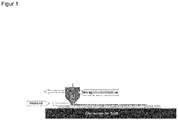
- the fluid supply to the coating tools used must be pulsation-free in order to produce flawless films on substrates. It is thus the reproducible, controlled interaction of all the products and peripheral processes of a coating process that must be mastered to achieve film layers on high quality substrates, as in US Pat FIG. 1 shown.
- Coating fluids are solutions of one or more solids in a solvent. Between the individual coating operations, the nozzle is immersed in a trough with a solvent to prevent drying of the solid contained in the coating fluid.
- the composition of the solvent in the tub corresponds to the composition of the solvent in the coating fluid, or only the component is involved in the tub submitted the highest volume fraction in the solvent of the coating fluid.
- the process of this process is schematic in FIG. 2 shown.
- Coating fluids containing metal oxide precursors may tend to sol-gel reaction. It is mainly in the interior of the nozzle, which is usually made of stainless steel, deposits of the solid on the die lips. The deposits do not re-dissolve during the coating process and can not be removed by rinsing with the solvent of the coating fluid.
- Metal oxide precursors which tend to sol-gel in solution are organometallic compounds such as metal alkoxides and metal oxo alkoxides.
- the object of the present invention was therefore to provide a nozzle coating method for depositing metal alkoxides and / or metal oxo alkoxides, which overcomes the disadvantages of the prior art.
- a nozzle coating method for the deposition of metal alkoxides and / or metal oxo-alkoxides characterized in that the nozzle before and / or after the coating process in a solvent containing at least 25 wt .-% acetylacetone is immersed ,
- acetylacetone prevents the sol-gel reaction by chelating the organometallic precursor, or makes deposits that have become soluble again by complexation.
- the inventive method is not limited to a particular nozzle shape, but is suitable for all geometries and types of slot dies, such as slot dies.
- the solvent contains at least 30, 35, 40, 45, 50, 55, 60, 65, 70, 75, 80, 85, 90 or 95 wt .-% acetylacetone.
- the solvent contains 100% by weight of acetylacetone, i. the solvent consists of acetylacetone.
- the metal is selected from the group consisting of indium, zinc, tin, gallium, aluminum, titanium, hafnium, yttrium or combinations thereof.
- the inventive method z.
- metal alkoxides titanium (IV) ethoxide, aluminum (III) isopropoxide, hafnium (IV) ethoxide, yttrium (III) isopropoxide or combinations thereof.
- the deposited metal alkoxide and / or metal oxo alkoxide, as described above, is dissolved in a solvent selected from the group consisting of glycol ethers having a, such as. For example, 1-methoxy-2-propanol, or more ether groups, such as.
- a solvent selected from the group consisting of glycol ethers having a, such as. For example, 1-methoxy-2-propanol, or more ether groups, such as.
- ether groups such as.
- triethylene glycol monomethyl ether alcohols, such as. For example, ethanol, tetrahydrofurfuryl alcohol, esters, such as.
- lactates or acetates in particular ethyl lactate, butyl acetate, aromatics, such as. Toluene, or combinations thereof.
- the present invention also relates to the use of a solvent containing at least 25 wt .-% acetylacetone for the prevention of deposits by metal alkoxides and / or metal oxo alkoxides in coating nozzles. It also relates to the use of a solvent containing at least 25 wt .-% acetylacetone for the dissolution of deposits by metal alkoxides and / or metal oxo alkoxides in coating nozzles.
- the metal alkoxides and / or metal oxo alkoxides in the two uses of the invention metals selected from the group consisting of indium, zinc, tin, gallium, aluminum, titanium, hafnium, yttrium or combinations thereof, on.
- the two uses according to the invention as metal alkoxides preferably comprise titanium (IV) ethoxide, aluminum (III) isopropoxide, hafnium (IV) ethoxide, yttrium (III) isopropoxide or combinations thereof.
- the present invention is further illustrated by the following example.
- the commercially available product iXsenic S ® from Evonik Industries AG is a metal-organic precursor for use in a nozzle coating process, which can undergo a sol-gel reaction. With air humidity, the product reacts irreversibly, thus changing chemically. The material crystallizes out in the nozzle. There it accumulates until it comes to a blockage of the nozzle.
- nozzle If the nozzle is immersed before and / or after the coating process in a solvent containing at least 25 wt .-% acetylacetone, no clogging of the nozzle is observed. Existing deposits dissolve again.
Landscapes
- Chemical & Material Sciences (AREA)
- Engineering & Computer Science (AREA)
- Chemical Kinetics & Catalysis (AREA)
- Physics & Mathematics (AREA)
- Thermal Sciences (AREA)
- General Chemical & Material Sciences (AREA)
- Inorganic Chemistry (AREA)
- Materials Engineering (AREA)
- Mechanical Engineering (AREA)
- Metallurgy (AREA)
- Organic Chemistry (AREA)
- Dispersion Chemistry (AREA)
- Ceramic Engineering (AREA)
- Chemically Coating (AREA)
- Paints Or Removers (AREA)
Abstract
Die vorliegende Erfindung betrifft ein Düsen-Beschichtungsverfahren zur Abscheidung von Metall-Alkoxiden und/oder Metall-Oxo-Alkoxiden, dadurch gekennzeichnet, dass die Düse vor und/oder nach dem Beschichtungsverfahren in ein Lösungsmittel enthaltend mindestens 25 Gew.-% Acetylaceton eingetaucht wird.
Die vorliegende Erfindung betrifft auch die Verwendung eines Lösungsmittels enthaltend mindestens 25 Gew.-% Acetylaceton zur Prävention von Ablagerungen durch Metall-Alkoxide und/oder Metall-Oxo-Alkoxide in Beschichtungsdüsen. Sie betrifft ebenfalls die Verwendung eines Lösungsmittels enthaltend mindestens 25 Gew.-% Acetylaceton zur Auflösung von Ablagerungen durch Metall-Alkoxide und/oder Metall-Oxo-Alkoxide in Beschichtungsdüsen.
Description
- Die vorliegende Erfindung betrifft ein Düsen-Beschichtungsverfahren zur Abscheidung von Metall-Alkoxiden und/oder Metall-Oxo-Alkoxiden, wobei die Düse vor und/oder nach dem Beschichtungsverfahren in ein Lösungsmittel eingetaucht wird.
- Die vorliegende Erfindung betrifft auch die Verwendung eines Lösungsmittels zur Prävention von Ablagerungen durch Metall-Alkoxide und/oder Metall-Oxo-Alkoxide in Beschichtungsdüsen. Sie betrifft ebenfalls die Verwendung eines Lösungsmittels zur Auflösung von Ablagerungen durch Metall-Alkoxide und/oder Metall-Oxo-Alkoxide in Beschichtungsdüsen.
- Die Schlitzdüsen-Beschichtung (englisch: slot die) ist eine Beschichtungstechnik, um dünne Flüssigkeitsschichten auf bahnförmige Substrate (Papier, Folie, Stoffe etc.) oder Stückgüter (Glas, Metallplatten etc.) aufzutragen. Für einige Substrate in der Beschichtungsindustrie, vor allem für solche mit Funktionsschichten (Fotovoltaik, medizinische Produkte, Wafer, Lithium-Ionen-Batterien, Brennstoffzellen etc.), ist die Genauigkeit der aufzutragenden Schichtdicken von essentieller Bedeutung. Unkontrollierbare Schichtdickenvariationen, bedingt durch Änderungen der Produktionsbedingungen oder durch Änderungen der Fluideigenschaften, sind hierbei für eine Vielzahl von Beschichtungen nicht vertretbar.
- Fehlerfreie Beschichtungen von Substraten erfordern aber nicht nur verlässlich arbeitende und leicht bedienbare Prozesse und Auftragswerkzeuge, wie beispielsweise die Düsen, sondern stellen darüber hinaus auch besondere Anforderungen an die eingesetzten Beschichtungsfluide, z. B. deren Blasenfreiheit. Oftmals sind kontrollierte Rührprozesse erforderlich, um konstante Eigenschaften der angesetzten Beschichtungsfluide für fehlerfreie Schichten auf Substraten sicherzustellen. Hinzu kommt, dass die Fluidzuführung zu den eingesetzten Beschichtungswerkzeugen pulsationsfrei erfolgen muss, um fehlerfreie Filme auf Substraten zu erzeugen. Es ist somit das reproduzierbare, kontrollierte Zusammenwirken aller Produkte und peripheren Prozesse eines Beschichtungsvorgangs, die beherrscht werden müssen, um Filmschichten auf Substraten mit hoher Qualität zu erreichen, wie in
Figur 1 dargestellt. - Beschichtungsfluide sind Lösungen eines oder mehrerer Feststoffe in einem Lösungsmittel. Zwischen den einzelnen Beschichtungsvorgängen wird die Düse in eine Wanne mit einem Lösungsmittel eingetaucht, um eine Trocknung des im Beschichtungsfluid enthaltenen Feststoffs zu vermeiden. Dabei entspricht die Zusammensetzung des Lösungsmittels in der Wanne der Zusammensetzung des Lösungsmittels in dem Beschichtungsfluid, oder es wird in der Wanne lediglich die Komponente mit dem höchsten Volumenanteil in dem Lösungsmittel des Beschichtungsfluids vorgelegt. Der Ablauf dieses Prozesses ist schematisch in
Figur 2 dargestellt.
Beschichtungsfluide enthaltend Metalloxid-Präkursoren können zur Sol-Gel Reaktion neigen. Dabei kommt es vor allem im Inneren der Düse, welche in der Regel aus Edelstahl gefertigt ist, zu Ablagerungen des Feststoffs an den Düsenlippen. Die Ablagerungen lösen sich im Verlauf des Beschichtungsverfahrens nicht wieder auf und können auch durch Spülen mit dem Lösungsmittel des Beschichtungsfluids nicht entfernt werden. Metalloxid-Präkursoren, welche in Lösung zur Sol-Gel Reaktion neigen, sind metallorganische Verbindungen, wie Metall-Alkoxide und Metall-Oxo-Alkoxide. - Aufgabe der vorliegenden Erfindung war es daher, ein Düsen-Beschichtungsverfahren zur Abscheidung von Metall-Alkoxiden und/oder Metall-Oxo-Alkoxiden bereitzustellen, welches die genannten Nachteile des Standes der Technik überwindet.
- Diese Aufgabe wird erfindungsgemäß gelöst durch ein Düsen-Beschichtungsverfahren zur Abscheidung von Metall-Alkoxiden und/oder Metall-Oxo-Alkoxiden dadurch gekennzeichnet, dass die Düse vor und/oder nach dem Beschichtungsverfahren in ein Lösungsmittel enthaltend mindestens 25 Gew.-% Acetylaceton eingetaucht wird.
- Überraschenderweise wurde gefunden, dass sich an den Düsenlippen keine Ablagerungen bilden, wenn die Düse vor und/oder nach dem Beschichtungsverfahren in ein Lösungsmittel enthaltend mindestens 25 Gew.-% Acetylaceton eingetaucht wird. Dabei kann die Formulierung in der Düse unverändert bleiben. Bereits vorhandene Ablagerungen werden wieder aufgelöst.
- Es wird angenommen, dass Acetylaceton die Sol-Gel Reaktion durch Chelatisierung des metallorganischen Präkursors verhindert, bzw. entstandene Ablagerungen durch Komplexierung wieder löslich macht.
- Das erfindungsgemäße Verfahren ist nicht auf eine bestimmte Düsenform beschränkt, sondern eignet sich für sämtliche Geometrien und Typen von Schlitzdüsen, wie beispielsweise Breitschlitzdüsen.
- In einer vorteilhaften Ausgestaltung des erfindungsgemäßen Verfahrens enthält das Lösungsmittel mindestens 30, 35, 40, 45, 50, 55, 60, 65, 70, 75, 80, 85, 90 oder 95 Gew.-% Acetylaceton. In einer besonders vorteilhaften Ausgestaltung des erfindungsgemäßen Verfahrens enthält das Lösungsmittel 100 Gew.-% Acetylaceton, d.h. das Lösungsmittel besteht aus Acetylaceton.
- In einer weiteren vorteilhaften Ausgestaltung des erfindungsgemäßen Verfahrens ist das Metall ausgewählt aus der Gruppe bestehend aus Indium, Zink, Zinn, Gallium, Aluminium, Titan, Hafnium, Yttrium oder Kombinationen hiervon.
- Bevorzugt weist das erfindungsgemäße Verfahren z. B. als Metall-Alkoxide Titan(IV)-ethoxid, Aluminium(III)-isopropoxid, Hafnium(IV)-ethoxid, Yttrium(III)-isopropoxid oder Kombinationen hiervon auf.
- Ebenfalls bevorzugt weist das erfindungsgemäße Verfahren [In6(µ6-O)(µ2-OR)12Cl6]2- mit R = C1-10-Alkylrest, besonders bevorzugt mit R = C2-4-Alkylrest, auf.
- Es ist erfindungsgemäß bevorzugt, dass das abzuscheidende Metall-Alkoxid und/oder Metall-Oxo-Alkoxid, wie zuvor beschrieben, gelöst ist in einem Lösungsmittel ausgewählt aus der Gruppe bestehend aus Glykolethern mit einer, wie z. B. 1-Methoxy-2-propanol, oder mehreren Ethergruppen, wie z. B. Triethylenglycolmonomethylether, Alkoholen,wie z. B. Ethanol, Tetrahydrofurfurylalkohol, Estern, wie z. B. Lactaten oder Acetaten, insbesondere Ethyllactat, Butylacetat, Aromaten, wie z. B. Toluol, oder Kombinationen hiervon.
- Die vorliegende Erfindung betrifft auch die Verwendung eines Lösungsmittels enthaltend mindestens 25 Gew.-% Acetylaceton zur Prävention von Ablagerungen durch Metall-Alkoxide und/oder Metall-Oxo-Alkoxide in Beschichtungsdüsen. Sie betrifft ebenfalls die Verwendung eines Lösungsmittels enthaltend mindestens 25 Gew.-% Acetylaceton zur Auflösung von Ablagerungen durch Metall-Alkoxide und/oder Metall-Oxo-Alkoxide in Beschichtungsdüsen.
- Vorteilhafterweise weisen die Metall-Alkoxide und/oder Metall-Oxo-Alkoxide in den beiden erfindungsgemäßen Verwendungen Metalle ausgewählt aus der Gruppe bestehend aus Indium, Zink, Zinn, Gallium, Aluminium, Titan, Hafnium, Yttrium oder Kombinationen hiervon, auf. Bevorzugt weisen die beiden erfindungsgemäßen Verwendungen als Metall-Alkoxide Titan(IV)-ethoxid, Aluminium(III)-isopropoxid, Hafnium(IV)-ethoxid, Yttrium(III)-isopropoxid oder Kombinationen hiervon auf.
Ebenfalls bevorzugt weisen die beiden erfindungsgemäßen Verwendungen [In6(µ6-O)(µ2-OR)12Cl6]2-mit R = C1-10-Alkylrest, besonders bevorzugt mit R = C2-4-Alkylrest, auf. - Die vorliegende Erfindung wird durch folgendes Beispiel näher erläutert.
- Bei dem kommerziell erhältlichen Produkt iXsenic S® der Evonik Industries AG handelt es sich um eine metall-organische Vorstufe zur Verwendung in einem Düsen-Beschichtungsverfahren, welche eine Sol-Gel Reaktion eingehen kann. Mit Luftfeuchtigkeit reagiert das Produkt irreversibel, verändert sich somit chemisch. Dabei kristallisiert das Material in der Düse aus. Dort akkumuliert es sich, bis es zu einer Verstopfung der Düse kommt.
- Wird die Düse vor und/oder nach dem Beschichtungsverfahren in ein Lösungsmittel enthaltend mindestens 25 Gew.-% Acetylaceton eingetaucht, ist kein Verstopfen der Düse zu beobachten. Bereits vorhandene Ablagerungen lösen sich wieder auf.
Claims (15)
- Düsen-Beschichtungsverfahren zur Abscheidung von Metall-Alkoxiden und/oder Metall-Oxo-Alkoxiden, dadurch gekennzeichnet, dass die Düse vor und/oder nach dem Beschichtungsverfahren in ein Lösungsmittel enthaltend mindestens 25 Gew.-% Acetylaceton eingetaucht wird.
- Verfahren nach Anspruch 1, dadurch gekennzeichnet, dass die Düse ausgewählt ist unter Schlitzdüsen, vorzugsweise eine Breitschlitzdüse ist.
- Verfahren nach Anspruch 1 oder 2, dadurch gekennzeichnet, dass das Lösungsmittel mindestens 30, 35, 40, 45, 50, 55, 60, 65, 70, 75, 80, 85, 90 oder 95 Gew.-% Acetylaceton enthält.
- Verfahren nach Anspruch 1 oder 2, dadurch gekennzeichnet, dass das Lösungsmittel aus Acetylaceton besteht.
- Verfahren nach einem der Ansprüche 1 bis 4, dadurch gekennzeichnet, dass das Metall ausgewählt ist aus der Gruppe bestehend aus Indium, Zink, Zinn, Gallium, Aluminium, Titan, Hafnium, Yttrium oder Kombinationen hiervon.
- Verfahren nach Anspruche 5, dadurch gekennzeichnet, dass das Metall-Alkoxid ausgewählt ist aus der Gruppe bestehend aus Titan(IV)-ethoxid, Aluminium(III)-isopropoxid, Hafnium(IV)-ethoxid, Yttrium(III)-isopropoxid oder Kombinationen hiervon.
- Verfahren nach Anspruch 5, dadurch gekennzeichnet, dass es [In6(µ6-O)(µ2-OR)12Cl6]2- mit R = C1-10-Alkylrest, besonders bevorzugt mit R = C2-4-Alkylrest, aufweist.
- Verfahren nach einem der Ansprüche 1 bis 7, dadurch gekennzeichnet, dass das Metall-Alkoxid und/oder Metall-Oxo-Alkoxid gelöst ist in einem Lösungsmittel ausgewählt aus der Gruppe bestehend aus Glykolethern mit einer oder mehreren Ethergruppen, Alkoholen, Estern, Aromaten oder Kombinationen hiervon.
- Verfahren nach Anspruch 8, dadurch gekennzeichnet, dass die Glykolether mit einer oder mehreren Ethergruppen 1-Methoxy-2-propanol oder Triethylenglycolmonomethylether aufweisen, die Alkohole Ethanol, oder Tetrahydrofurfurylalkohol aufweisen, die Ester Ethyllactat oder Butylacetat aufweisen, die Aromaten Toluol aufweisen oder Kombinationen hiervon.
- Verwendung eines Lösungsmittels enthaltend mindestens 25 Gew.-% Acetylaceton zur Prävention von Ablagerungen durch Metall-Alkoxide und/oder Metall-Oxo-Alkoxide in Beschichtungsdüsen, dadurch gekennzeichnet, dass die Metalle ausgewählt sind aus der Gruppe bestehend aus Indium, Zink, Zinn, Gallium, Aluminium, Titan, Hafnium, Yttrium oder Kombinationen hiervon.
- Verwendung nach Anspruch 10, dadurch gekennzeichnet, dass sie als Metall-Alkoxide Titan(IV)-ethoxid, Aluminium(III)-isopropoxid, Hafnium(IV)-ethoxid, Yttrium(III)-isopropoxid oder Kombinationen hiervon aufweist.
- Verwendung nach Anspruch 10, dadurch gekennzeichnet, dass es [In6(µ6-O)(µ2-OR)12Cl6]2-mit R = C1-10-Alkylrest, besonders bevorzugt mit R = C2-4-Alkylrest, aufweist.
- Verwendung eines Lösungsmittels enthaltend mindestens 25 Gew.-% Acetylaceton zur Auflösung von Ablagerungen durch Metall-Alkoxide und/oder Metall-Oxo-Alkoxide in Beschichtungsdüsen, dadurch gekennzeichnet, dass die Metalle ausgewählt sind aus der Gruppe bestehend aus Indium, Zink, Zinn, Gallium, Aluminium, Titan, Hafnium, Yttrium oder Kombinationen hiervon.
- Verwendung nach Anspruch 13, dadurch gekennzeichnet, dass sie als Metall-Alkoxide Titan(IV)-ethoxid, Aluminium(III)-isopropoxid, Hafnium(IV)-ethoxid, Yttrium(III)-isopropoxid oder Kombinationen hiervon aufweist.
- Verwendung nach Anspruch 13, dadurch gekennzeichnet, dass es [In6(µ6-O)(µ2-OR)12Cl6]2-mit R = C1-10-Alkylrest, besonders bevorzugt mit R = C2-4-Alkylrest, aufweist.
Priority Applications (3)
| Application Number | Priority Date | Filing Date | Title |
|---|---|---|---|
| EP16206963.7A EP3342900A1 (de) | 2016-12-27 | 2016-12-27 | Zusammensetzung zur reinigung sowie verhinderung von ablagerungen in beschichtungsdüsen für lösungsprozessierbare metalloxid-präkursoren |
| PCT/EP2017/084174 WO2018122110A1 (de) | 2016-12-27 | 2017-12-21 | Zusammensetzung zur reinigung sowie verhinderung von ablagerungen in beschichtungsdüsen für lösungsprozessierbare metalloxid-präkursoren |
| TW106145268A TW201842177A (zh) | 2016-12-27 | 2017-12-22 | 用於清潔並防止可溶性金屬氧化物前驅物之塗佈噴嘴中的沉積物的組成物 |
Applications Claiming Priority (1)
| Application Number | Priority Date | Filing Date | Title |
|---|---|---|---|
| EP16206963.7A EP3342900A1 (de) | 2016-12-27 | 2016-12-27 | Zusammensetzung zur reinigung sowie verhinderung von ablagerungen in beschichtungsdüsen für lösungsprozessierbare metalloxid-präkursoren |
Publications (1)
| Publication Number | Publication Date |
|---|---|
| EP3342900A1 true EP3342900A1 (de) | 2018-07-04 |
Family
ID=57777444
Family Applications (1)
| Application Number | Title | Priority Date | Filing Date |
|---|---|---|---|
| EP16206963.7A Withdrawn EP3342900A1 (de) | 2016-12-27 | 2016-12-27 | Zusammensetzung zur reinigung sowie verhinderung von ablagerungen in beschichtungsdüsen für lösungsprozessierbare metalloxid-präkursoren |
Country Status (3)
| Country | Link |
|---|---|
| EP (1) | EP3342900A1 (de) |
| TW (1) | TW201842177A (de) |
| WO (1) | WO2018122110A1 (de) |
Families Citing this family (1)
| Publication number | Priority date | Publication date | Assignee | Title |
|---|---|---|---|---|
| CN109576089A (zh) * | 2018-12-31 | 2019-04-05 | 广东新球清洗科技股份有限公司 | Pcb板超声碳氢清洗剂及其使用方法 |
Citations (4)
| Publication number | Priority date | Publication date | Assignee | Title |
|---|---|---|---|---|
| JPH07282653A (ja) * | 1994-04-04 | 1995-10-27 | Mitsubishi Materials Corp | 透明導電膜の製造方法 |
| JP2011083695A (ja) * | 2009-10-15 | 2011-04-28 | Ricoh Co Ltd | インクジェット式画像形成装置 |
| WO2013186082A2 (de) * | 2012-06-13 | 2013-12-19 | Evonik Industries Ag | Verfahren zur herstellung indiumoxid-haltiger schichten |
| US20160052013A1 (en) * | 2013-03-29 | 2016-02-25 | Ricoh Company, Ltd | Curtain coating machine and curtain coating method |
-
2016
- 2016-12-27 EP EP16206963.7A patent/EP3342900A1/de not_active Withdrawn
-
2017
- 2017-12-21 WO PCT/EP2017/084174 patent/WO2018122110A1/de not_active Ceased
- 2017-12-22 TW TW106145268A patent/TW201842177A/zh unknown
Patent Citations (4)
| Publication number | Priority date | Publication date | Assignee | Title |
|---|---|---|---|---|
| JPH07282653A (ja) * | 1994-04-04 | 1995-10-27 | Mitsubishi Materials Corp | 透明導電膜の製造方法 |
| JP2011083695A (ja) * | 2009-10-15 | 2011-04-28 | Ricoh Co Ltd | インクジェット式画像形成装置 |
| WO2013186082A2 (de) * | 2012-06-13 | 2013-12-19 | Evonik Industries Ag | Verfahren zur herstellung indiumoxid-haltiger schichten |
| US20160052013A1 (en) * | 2013-03-29 | 2016-02-25 | Ricoh Company, Ltd | Curtain coating machine and curtain coating method |
Also Published As
| Publication number | Publication date |
|---|---|
| TW201842177A (zh) | 2018-12-01 |
| WO2018122110A1 (de) | 2018-07-05 |
Similar Documents
| Publication | Publication Date | Title |
|---|---|---|
| DE3882088T2 (de) | Schmiermittel und Oberflächenkonditionierer für geformte Metalloberflächen. | |
| DE69403339T2 (de) | Zusammensetzung und verfahren zur behandlung von phosphatierten metalloberflächen | |
| DE2711431C2 (de) | Verfahren zur Oberflächenbehandlung von Metallen | |
| WO2011067094A1 (de) | Mehrstufiges vorbehandlungsverfahren für metallische bauteile mit zink- und eisenoberflächen | |
| EP1837091B1 (de) | Verfahren zur Herstellung einer Aluminiumfolie mit einer funktionalen Direktbeschichtung | |
| EP2931936B1 (de) | Verfahren zur behandlung der oberfläche eines metallischen substrats | |
| DE2910262A1 (de) | Verfahren zum beschichten von glasoberflaechen mit einem waermereflektierenden titanoxidfilm | |
| EP3342900A1 (de) | Zusammensetzung zur reinigung sowie verhinderung von ablagerungen in beschichtungsdüsen für lösungsprozessierbare metalloxid-präkursoren | |
| DE1229218B (de) | Verfahren zur Herstellung von UEberzugsmitteln auf Polyaethylenbasis | |
| DE1955002B2 (de) | Verfahren zur aufbringung von zinkphosphatumwandlungsueberzuegen auf metalloberflaechen | |
| DE2621587C2 (de) | Verfahren zur Herstellung von mit einem Titanoxidfilm überzogenem Glas | |
| DE2313525A1 (de) | Nahrungsmittelabloesungsueberzug | |
| EP1084992A1 (de) | Verfahren zur Abscheidung von Zirkonoxid-Schichten unter Verwendung von löslichen Pulvern | |
| US12006445B2 (en) | Anti-rust composition for metal surface and a method of anti-rust treatment on metal surface | |
| DE3404949C1 (de) | Wasserloesliche Zirkonsaeureester | |
| DE2941105C2 (de) | Verwendung einer Polysiloxanzusammensetzung zum Beschichten von Glasgegenständen, insbesondere zum Abdecken von Kratzern auf Glasflaschen | |
| DE1169063B (de) | Mittel zum Abbeizen von Anstrichfarben | |
| DE3147398C1 (de) | Verfahren zur Herstellung von durchsichtigen harten Überzügen aus mit Zinn dotiertem Indiumoxid | |
| DE60221015T2 (de) | Behälter oder deckel aus thermoplastischem material und verfahren zu seiner behandlung | |
| DE703032C (de) | Verfahren zur Verbesserung der Haftung nichtmetallischer UEberzuege auf Metallunterlagen | |
| CH652420A5 (en) | Composition for the deposition of metal-oxide film coatings | |
| EP2725119A1 (de) | Zusammensetzung für die lokale Applikation von chemischen Konversionsschichten | |
| EP4689226A1 (de) | Zusammensetzung für die korrosionsschützende vorbehandlung und reinigung von metalloberflächen in einem verfahrensschritt | |
| DE102011107448A1 (de) | Dicke keramische Beschichtung | |
| AT241490B (de) | Wässeriges Ätzbad für Klischees und Konzentrat zu dessen Herstellung |
Legal Events
| Date | Code | Title | Description |
|---|---|---|---|
| PUAI | Public reference made under article 153(3) epc to a published international application that has entered the european phase |
Free format text: ORIGINAL CODE: 0009012 |
|
| AK | Designated contracting states |
Kind code of ref document: A1 Designated state(s): AL AT BE BG CH CY CZ DE DK EE ES FI FR GB GR HR HU IE IS IT LI LT LU LV MC MK MT NL NO PL PT RO RS SE SI SK SM TR |
|
| AX | Request for extension of the european patent |
Extension state: BA ME |
|
| STAA | Information on the status of an ep patent application or granted ep patent |
Free format text: STATUS: THE APPLICATION IS DEEMED TO BE WITHDRAWN |
|
| 18D | Application deemed to be withdrawn |
Effective date: 20190105 |