EP3339392A1 - Composition adhesive et son utilisation dans l'electronique - Google Patents
Composition adhesive et son utilisation dans l'electronique Download PDFInfo
- Publication number
- EP3339392A1 EP3339392A1 EP17206864.5A EP17206864A EP3339392A1 EP 3339392 A1 EP3339392 A1 EP 3339392A1 EP 17206864 A EP17206864 A EP 17206864A EP 3339392 A1 EP3339392 A1 EP 3339392A1
- Authority
- EP
- European Patent Office
- Prior art keywords
- adhesive composition
- preceramic polymer
- adhesive
- polymer
- advantageously
- Prior art date
- Legal status (The legal status is an assumption and is not a legal conclusion. Google has not performed a legal analysis and makes no representation as to the accuracy of the status listed.)
- Granted
Links
Images

Classifications
-
- C—CHEMISTRY; METALLURGY
- C08—ORGANIC MACROMOLECULAR COMPOUNDS; THEIR PREPARATION OR CHEMICAL WORKING-UP; COMPOSITIONS BASED THEREON
- C08K—Use of inorganic or non-macromolecular organic substances as compounding ingredients
- C08K3/00—Use of inorganic substances as compounding ingredients
- C08K3/01—Use of inorganic substances as compounding ingredients characterized by their specific function
- C08K3/013—Fillers, pigments or reinforcing additives
-
- C—CHEMISTRY; METALLURGY
- C09—DYES; PAINTS; POLISHES; NATURAL RESINS; ADHESIVES; COMPOSITIONS NOT OTHERWISE PROVIDED FOR; APPLICATIONS OF MATERIALS NOT OTHERWISE PROVIDED FOR
- C09J—ADHESIVES; NON-MECHANICAL ASPECTS OF ADHESIVE PROCESSES IN GENERAL; ADHESIVE PROCESSES NOT PROVIDED FOR ELSEWHERE; USE OF MATERIALS AS ADHESIVES
- C09J11/00—Features of adhesives not provided for in group C09J9/00, e.g. additives
- C09J11/02—Non-macromolecular additives
- C09J11/04—Non-macromolecular additives inorganic
-
- C—CHEMISTRY; METALLURGY
- C09—DYES; PAINTS; POLISHES; NATURAL RESINS; ADHESIVES; COMPOSITIONS NOT OTHERWISE PROVIDED FOR; APPLICATIONS OF MATERIALS NOT OTHERWISE PROVIDED FOR
- C09J—ADHESIVES; NON-MECHANICAL ASPECTS OF ADHESIVE PROCESSES IN GENERAL; ADHESIVE PROCESSES NOT PROVIDED FOR ELSEWHERE; USE OF MATERIALS AS ADHESIVES
- C09J183/00—Adhesives based on macromolecular compounds obtained by reactions forming in the main chain of the macromolecule a linkage containing silicon, with or without sulfur, nitrogen, oxygen, or carbon only; Adhesives based on derivatives of such polymers
- C09J183/04—Polysiloxanes
-
- C—CHEMISTRY; METALLURGY
- C08—ORGANIC MACROMOLECULAR COMPOUNDS; THEIR PREPARATION OR CHEMICAL WORKING-UP; COMPOSITIONS BASED THEREON
- C08K—Use of inorganic or non-macromolecular organic substances as compounding ingredients
- C08K3/00—Use of inorganic substances as compounding ingredients
- C08K3/18—Oxygen-containing compounds, e.g. metal carbonyls
- C08K3/20—Oxides; Hydroxides
- C08K3/22—Oxides; Hydroxides of metals
- C08K2003/2227—Oxides; Hydroxides of metals of aluminium
-
- C—CHEMISTRY; METALLURGY
- C08—ORGANIC MACROMOLECULAR COMPOUNDS; THEIR PREPARATION OR CHEMICAL WORKING-UP; COMPOSITIONS BASED THEREON
- C08K—Use of inorganic or non-macromolecular organic substances as compounding ingredients
- C08K3/00—Use of inorganic substances as compounding ingredients
- C08K3/28—Nitrogen-containing compounds
- C08K2003/282—Binary compounds of nitrogen with aluminium
-
- C—CHEMISTRY; METALLURGY
- C08—ORGANIC MACROMOLECULAR COMPOUNDS; THEIR PREPARATION OR CHEMICAL WORKING-UP; COMPOSITIONS BASED THEREON
- C08K—Use of inorganic or non-macromolecular organic substances as compounding ingredients
- C08K3/00—Use of inorganic substances as compounding ingredients
- C08K3/38—Boron-containing compounds
- C08K2003/382—Boron-containing compounds and nitrogen
-
- C—CHEMISTRY; METALLURGY
- C08—ORGANIC MACROMOLECULAR COMPOUNDS; THEIR PREPARATION OR CHEMICAL WORKING-UP; COMPOSITIONS BASED THEREON
- C08K—Use of inorganic or non-macromolecular organic substances as compounding ingredients
- C08K3/00—Use of inorganic substances as compounding ingredients
- C08K3/38—Boron-containing compounds
- C08K2003/382—Boron-containing compounds and nitrogen
- C08K2003/385—Binary compounds of nitrogen with boron
-
- C—CHEMISTRY; METALLURGY
- C08—ORGANIC MACROMOLECULAR COMPOUNDS; THEIR PREPARATION OR CHEMICAL WORKING-UP; COMPOSITIONS BASED THEREON
- C08K—Use of inorganic or non-macromolecular organic substances as compounding ingredients
- C08K2201/00—Specific properties of additives
- C08K2201/011—Nanostructured additives
-
- C—CHEMISTRY; METALLURGY
- C08—ORGANIC MACROMOLECULAR COMPOUNDS; THEIR PREPARATION OR CHEMICAL WORKING-UP; COMPOSITIONS BASED THEREON
- C08K—Use of inorganic or non-macromolecular organic substances as compounding ingredients
- C08K2201/00—Specific properties of additives
- C08K2201/014—Additives containing two or more different additives of the same subgroup in C08K
-
- C—CHEMISTRY; METALLURGY
- C08—ORGANIC MACROMOLECULAR COMPOUNDS; THEIR PREPARATION OR CHEMICAL WORKING-UP; COMPOSITIONS BASED THEREON
- C08K—Use of inorganic or non-macromolecular organic substances as compounding ingredients
- C08K3/00—Use of inorganic substances as compounding ingredients
- C08K3/28—Nitrogen-containing compounds
-
- C—CHEMISTRY; METALLURGY
- C08—ORGANIC MACROMOLECULAR COMPOUNDS; THEIR PREPARATION OR CHEMICAL WORKING-UP; COMPOSITIONS BASED THEREON
- C08K—Use of inorganic or non-macromolecular organic substances as compounding ingredients
- C08K9/00—Use of pretreated ingredients
-
- H—ELECTRICITY
- H10—SEMICONDUCTOR DEVICES; ELECTRIC SOLID-STATE DEVICES NOT OTHERWISE PROVIDED FOR
- H10P—GENERIC PROCESSES OR APPARATUS FOR THE MANUFACTURE OR TREATMENT OF DEVICES COVERED BY CLASS H10
- H10P72/00—Handling or holding of wafers, substrates or devices during manufacture or treatment thereof
- H10P72/70—Handling or holding of wafers, substrates or devices during manufacture or treatment thereof for supporting or gripping
- H10P72/74—Handling or holding of wafers, substrates or devices during manufacture or treatment thereof for supporting or gripping using temporarily an auxiliary support
- H10P72/7426—Handling or holding of wafers, substrates or devices during manufacture or treatment thereof for supporting or gripping using temporarily an auxiliary support used as a support during build up manufacturing of active devices
-
- H—ELECTRICITY
- H10—SEMICONDUCTOR DEVICES; ELECTRIC SOLID-STATE DEVICES NOT OTHERWISE PROVIDED FOR
- H10P—GENERIC PROCESSES OR APPARATUS FOR THE MANUFACTURE OR TREATMENT OF DEVICES COVERED BY CLASS H10
- H10P72/00—Handling or holding of wafers, substrates or devices during manufacture or treatment thereof
- H10P72/70—Handling or holding of wafers, substrates or devices during manufacture or treatment thereof for supporting or gripping
- H10P72/74—Handling or holding of wafers, substrates or devices during manufacture or treatment thereof for supporting or gripping using temporarily an auxiliary support
- H10P72/7432—Handling or holding of wafers, substrates or devices during manufacture or treatment thereof for supporting or gripping using temporarily an auxiliary support used in a transfer process involving transfer directly from an origin substrate to a target substrate without use of an intermediate handle substrate
-
- H—ELECTRICITY
- H10—SEMICONDUCTOR DEVICES; ELECTRIC SOLID-STATE DEVICES NOT OTHERWISE PROVIDED FOR
- H10P—GENERIC PROCESSES OR APPARATUS FOR THE MANUFACTURE OR TREATMENT OF DEVICES COVERED BY CLASS H10
- H10P72/00—Handling or holding of wafers, substrates or devices during manufacture or treatment thereof
- H10P72/70—Handling or holding of wafers, substrates or devices during manufacture or treatment thereof for supporting or gripping
- H10P72/74—Handling or holding of wafers, substrates or devices during manufacture or treatment thereof for supporting or gripping using temporarily an auxiliary support
- H10P72/7434—Handling or holding of wafers, substrates or devices during manufacture or treatment thereof for supporting or gripping using temporarily an auxiliary support used in a transfer process involving at least two transfer steps, i.e. including an intermediate handle substrate
Definitions
- the present invention relates to a thermally conductive and electronically insulating adhesive composition.
- the field of use of the present invention relates in particular to microelectronics and more particularly to layer transfer processes.
- microelectronic devices may require an adhesive that can be used over a wide temperature range.
- this type of adhesive has specific properties in terms of thermal conduction and / or electrical insulation.
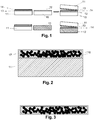
- the manufacture of a microelectronic device may comprise the manufacture of one or more layers (14) on an initial substrate (11), then the transfer on a final substrate (12) optionally resting on a substrate carrier (15). ) by means of an adhesive (13) ( figure 1 ).
- the presence of an adhesive may be necessary to ensure the transfer between the initial substrate and the final substrate.
- the polymeric adhesives used are acrylics, urethanes, silicones, polyimides or epoxies because they have the required thermal and / or electrical properties.
- documents US 2013/0221479 and US 2012/0086100 describe the use of an acrylic-based or polyimide-based thermoplastic adhesive for bonding a sapphire-type substrate to an electronic device.
- Composite adhesives have also been developed.
- the document US 2014/0252566 describes a mixture containing a polymeric adhesive and fillers as well as its use in the manufacture of a semiconductor.
- the adhesive may be polyamide, ABS (acrylonitrile butadiene styrene), PEEK (polyetheretherketone), polysulfone or an epoxy resin.
- This adhesive comprises charges of aluminum nitride in an epoxy matrix or polyvinylidene fluoride.
- these adhesives In addition to the resistance to temperatures compatible with the manufacture of a microelectronic device, these adhesives must also have a satisfactory thermal conductivity.
- the Applicant has developed an adhesive composition having the properties suitable for use in microelectronics, whether in terms of stability over a wide range of temperatures, heat conduction or electrical insulation.
- the present invention relates to an adhesive composition whose properties allow its use in the manufacture of microelectronic devices.
- it has a thermal conductivity advantageously of at least 2 W / m.K.
- the preceramic polymer has a temperature resistance advantageously greater than 350 ° C., which makes it possible to transform it at a high ceramic temperature.
- the adhesive composition according to the invention has a thermal stability beyond 250 ° C.
- the silicone-polyimide resins do not correspond to the adhesive composition according to the invention or to preceramic polymers.
- the adhesive composition has a low coefficient of thermal expansion at the temperature of use, advantageously less than 20 ppm / ° C. at 250 ° C., more advantageously of the order of 10 ppm / ° C. at 250 ° C. .
- the coefficient of thermal expansion no longer evolves after a treatment at 250 ° C, especially after tens of hours at 250 ° C, for example after 168 hours at 250 ° C.
- a thermal stabilization can be obtained above 250 ° C.
- the silicones of the prior art generally degrade at 250 ° C. or more and have a coefficient of thermal expansion which can vary from 30 to 300 ppm / ° C.
- this adhesive composition is deposited on a substrate before being dried, and optionally heat-treated. This results in an adhesive layer which therefore corresponds to the adhesive composition which has been dried and optionally heat treated.
- the adhesive composition comprises at least one preceramic polymer, advantageously based on silicon. It is a polymer constituting a precursor of ceramics, for example SiO 2 in the case of a preceramic polymer based on silicon.
- a preceramic polymer is capable of becoming all or part of a ceramic when subjected to heat treatment. Depending on the desired ceramic, this heat treatment can be performed under air or not.
- the preceramic polymer is chosen from the group comprising polysiloxanes, polysilsesquioxanes, polycarbosiloxanes, polyborosilanes, polyborosiloxanes, polysilazanes, polysilsesquiazanes, polyborosilazanes, polycarbosilanes, polysilylcarbodiimides, and polysilsesquicarbodiimides.
- the preceramic polymer is a polysiloxane, advantageously a polysiloxane comprising one or more siloxane repeating units, in which the silicon atom is covalently bonded to the groups R 1 and R 2 according to the following formula (I):
- R 1 and R 2 advantageously represent, independently of one another, a hydrogen atom, or an alkyl group, or an aromatic group, provided that at least one of the R 1 and R 2 groups represent an alkyl group.
- R 1 and R 2 may each represent an alkyl group, advantageously the same alkyl group.
- the alkyl group (s) of the siloxane unit according to formula (I) comprise 1 to 4 carbon atoms.
- These are advantageously groups selected from the group consisting of methyl, ethyl, propyl, isopropyl, n- butyl, isobutyl and tert- butyl; the methyl group being particularly preferred.
- R 1 and R 2 advantageously represent a methyl group.
- the aromatic group or groups of the siloxane unit according to formula (I) comprise 6 to 9 carbon atoms. These are advantageously phenyl, benzyl, o- tolyl, m- tolyl, p- tolyl, o -xylyl and mesityl groups; the phenyl group being particularly preferred.
- the preceramic polymer may comprise other types of siloxane repeating units.
- the siloxane repeating unit (s) according to formula (I) represents (advantageously) more than 50% by weight of the mass of the preceramic polymer.
- the preceramic polymer may also be an organic / inorganic compound containing both the basic structure of the desired ceramic and an organic peripheral environment with different functionalities.
- the preceramic polymer is advantageously crosslinkable.
- a silicon-based preceramic polymer is capable of forming silica SiO 2 when it is subjected to a heat treatment, possibly in the presence of oxygen.
- Silres® MK preceramic polymer marketed by Wacker. This polymer has a high silica-forming ability (about 82% by weight based on the total mass of solid polymer remaining after complete oxidation).
- the preceramic polymer is advantageously soluble in many organic solvents, such as aromatic solvents, ester solvents, or ketone solvents.
- the preceramic polymer represents 15 to 50% by weight relative to the total weight of the adhesive composition, more preferably 25 to 35% by weight.
- the adhesive composition according to the invention also comprises one or more types of inorganic fillers.
- fillers are thermally conductive and electrically insulating.
- the Applicant considers that the presence of inorganic fillers makes it possible to increase the thickness of the deposited adhesive layer by increasing the viscosity of the composition. It also makes it possible to prevent the risk of cracking during a possible thermal treatment of the adhesive composition. Finally, the presence of the charges makes it possible to obtain a percolating network and thus to control the thermal conductivity, that is to say the thermal conduction properties of the adhesive composition.
- the charges may in particular be in the form of spheres, son, rods, and combinations thereof.
- the size of the charges is generally between a few nanometers and several tens of micrometers. It usually depends on the desired adhesive layer thickness (deposited adhesive composition). In other words, the size of the charges is advantageously proportional to the thickness of the deposited adhesive composition layer. Also, in order to optimize the density of the adhesive composition, a compact stack of charges is desirable. For this, it is advantageous to use a mixture of charges of different sizes, for example a mixture of 3 charge sizes.
- the charges can be functionalized.
- This particular embodiment makes it possible to improve the homogeneity of the adhesive composition. More particularly, functionalization of the fillers makes it possible to improve their wettability in the adhesive composition. Better wettability is reflected in particular by the elimination of any gas bubbles (for example air) around the charges.
- the fillers may in particular be functionalized with compounds chosen from APTES (3-aminopropyltriethoxysilane), glymo ((3-glycidyloxypropyl) trimethoxysilane), or any type of silane compatible with the filler and the preceramic polymer.
- APTES 3-aminopropyltriethoxysilane
- glymo ((3-glycidyloxypropyl) trimethoxysilane)
- silane compatible with the filler and the preceramic polymer.
- Functionalization of the fillers with APTES or GLYMO is particularly suitable for a silicon-based preceramic polymer, for example a polysiloxane.
- the fillers advantageously represent between 60% vol (volume percentage) and 80% vol, relative to the total volume of the preceramic polymer and fillers, more advantageously between 65 and 80% vol, and even more advantageously between 65 and 75% vol.
- a less than 60% vol. Charge amount decreases the thermal conductivity of the adhesive composition due to the increase in the amount of thermal non-conductive preceramic polymer.
- a quantity of charges greater than 80% vol decreases the adhesive properties of the adhesive composition, the fillers not being fully coated by the adhesive composition.
- an excessively large amount of charges with respect to the adhesive composition causes the formation of pores, and therefore a reduction in the thermal conductivity related to the presence of gas bubbles (for example air) in the composition. adhesive.
- the fillers represent 52 to 75% by weight relative to the total mass of the adhesive composition, more preferably 58 to 75% by weight.
- the mass ratio between the preceramic polymer and the inorganic fillers is advantageously between 1: 4 and 1:11, more preferably 1: 5 to 1:11 by weight.
- the adhesive composition comprises at least one organic solvent.
- This solvent is advantageously an aprotic polar solvent, for example an organic solvent chosen from the group comprising ketones, esters, ethers, aromatic solvents (such as aromatic hydrocarbons), halogenated solvents (such as chloroform) and them.
- the solvent may also be an alkane, for example hexane, especially when the preceramic polymer is a polysiloxane.
- the organic solvent is preferably 15 to 35% by weight based on the weight of the adhesive composition, more preferably 15 to 30% by weight.
- the adhesive composition also comprises a coupling agent.
- This coupling agent makes it possible to facilitate the crosslinking of the preceramic polymer, the bonding between the substrate and the adhesive layer (resulting from the deposition of the adhesive composition), to reduce the viscosity of the adhesive. suspension, and improve the quality of the dispersion of inorganic fillers.
- the coupling agent may be chosen from the group comprising (3-glycidyloxypropyl) trimethoxysilane (commercial reference Dynasylan® GLYMO), N- (2-aminoethyl) -3-aminopropyltrimethoxysilane, and 3-methacryloxypropyl trimethoxysilane. These compounds are particularly suitable when the preceramic polymer is a polysiloxane.
- the coupling agent when present, can represent 0.1 to 2% by weight relative to the total mass of the preceramic polymer.
- the adhesive composition may comprise other additives.
- the adhesive composition advantageously comprises a crosslinking catalyst of the preceramic polymer.
- This catalyst makes it possible to lower the crosslinking temperature of the preceramic polymer.
- It may be chosen from metal salts, for example salts of platinum, tin, aluminum or ziconium; organostannous compounds; peroxide compounds; and amine compounds. These compounds are particularly suitable for crosslinking a preceramic polymer of the polysiloxane type.
- the crosslinking catalyst may especially be chosen from the group comprising triethanolamine, tetrabutylammonium acetate, aluminum acetylacetonate, ziconium acetylacetonate, and platinum acetylacetonate.
- the crosslinking catalyst may represent 0 to 2% by weight relative to the mass of preceramic polymer.
- the adhesive composition is generally deposited on a substrate.
- the present invention also relates to a method of preparing an adhesive layer by depositing the adhesive composition on a substrate.
- the present invention also relates to the adhesive layer resulting from the deposition of the adhesive composition, its drying and its possible heat treatment.
- the heat treatment may allow the crosslinking and / or ceramization of the preceramic polymer.
- the drying can be carried out by heat treatment also causing the crosslinking and / or ceramization of the preceramic polymer.
- the drying makes it possible to eliminate the organic solvent while the heat treatment, advantageously under air, allows the crosslinking in all or part and / or the ceramization in all or part of the preceramic polymer.
- the adhesive layer may consist of the dried adhesive composition. It may comprise at least one crosslinked and / or ceramized preceramic polymer.
- the crosslinking of the preceramic polymer and its ceramization may be partial or, preferably, total.
- the mass ratio between the polymer ceramic or the crosslinked preceramic polymer and the inorganic fillers is advantageously between 1: 4 and 1:11, more preferably 1: 5 to 1:11 by weight.
- the adhesive composition comprises an organic solvent and therefore has a liquid character, it can be deposited by any liquid deposition technique, which deposition techniques will be chosen depending on the desired adhesive layer thickness.
- the composition can be deposited by squeegee.
- This technique is particularly suitable for deposition on a flat surface, for example on a wafer-type semiconductor substrate, and for obtaining a deposit whose thickness can reach 300 ⁇ m.
- This technique can also make it possible to form a layer of self-supporting adhesive composition.
- the adhesive composition may also be deposited by spraying (known under the name “spray coating "). This technique is particularly suitable for producing a deposit whose thickness is between 15 and 20 microns.
- Other embodiments include depositing the adhesive composition by printing, in particular by screen printing, or by spin coating.
- the process of the invention may comprise a step of preparation of the composition defined above, this preparation step consisting, in a conventional manner, in bringing into contact the various ingredients constituting the composition and in the mix until a homogeneous mixture is obtained.
- the method of the invention comprises a heat treatment step of drying said composition.
- the drying consists of the removal of the organic solvent (s) by evaporation, thus leaving only one layer consisting of a composite material comprising a preceramic polymer, one or more types of inorganic fillers with thermal conductor and electrical insulator properties. and, optionally, at least one additive such as a coupling agent and / or a crosslinking catalyst.
- the drying may consist in allowing the composition thus deposited to dry in the open air or to apply heating at a temperature and for a time appropriate to cause the evaporation of the organic solvent (s).
- the treatment chosen depends on the nature of the organic solvent (s) used and their respective evaporation temperatures.
- the method according to the invention may comprise a heat treatment step of cross-linking and / or ceramizing the preceramic polymer.
- the crosslinking makes it possible to increase the cohesion and the mechanical strength of the adhesive layer. It also improves its adhesion to the substrate, which may in particular be silicon. It is thus possible to use the adhesive composition in layer transfer processes currently used in the field of microelectronics. This also improves the thermal conductivity of the system.
- the adhesive composition is preferably crosslinked at a temperature of less than or equal to 200 ° C. As already indicated, the presence of a crosslinking catalyst makes it possible to lower this temperature.
- the crosslinking can be carried out in an oven so that the heat distribution is uniform.
- thermopress in order to compress hot to improve the cohesion of the adhesive layer and thus increase the thermal conductivity.
- thermopress also makes it possible to improve the surface state of the adhesive composition by lowering its roughness.
- the process may be finalized by a step of ceramizing the preceramic polymer, for example SiO 2 when the preceramic polymer is based on silicon.
- This ceramization step is advantageously carried out after or simultaneously with a crosslinking step. This specificity of the preceramic polymer makes it possible to encompass all the thermal budgets resulting from the microelectronics processes.
- the present invention also relates to an adhesive layer prepared from the adhesive composition described above; an adhesive support consisting of a substrate and this adhesive layer; and the use of this adhesive layer and adhesive support in the field of microelectronics, especially in a layer transfer process.
- the substrate on which the adhesive composition is deposited may be silicon or silica, for example.
- Percentages by volume are expressed with respect to the total volume of the adhesive composition with the exception of the organic solvent.
- the inorganic fillers used are electrical thermal and insulating conductive fillers with different particle sizes.
- the adhesive composition is homogenized so as to distribute the inorganic fillers (18) within the preceramic polymer (17) ( Figures 2 and 3 ). It is then deposited by doctoring on a substrate (11) made of silicon or silica ( figure 2 ). It can also be used alone, that is to say without substrate ( figure 3 ).
- Deposition without substrate makes it possible to produce samples for the measurement of the thermal conductivity. It also makes it possible to produce a substrate in adhesive composition, without support.
- An adhesive layer is obtained after evaporation of the solvent. It is crosslinked, for example by heat treatment at 200 ° C. for 30 minutes ( figure 4 ).
- Table 1 Examples of embodiments of the adhesive composition according to the invention.
- C5 mixture of charges
- P1 Silres®MK Polysiloxane from Wacker The volume percentages are expressed relative to the total volume of the adhesive composition with the exception of the organic solvent.
- the adhesive composition according to Example 2 was heat-treated at 350 ° C for 30 minutes.
- the layers obtained by deposition of the adhesive compositions according to Examples 1 to 10 were tested after heat treatment at 350 ° C. for 30 minutes in an oven under air ( figure 5 ). At the end of this heat treatment, no crack is observed on the layers.
- Tests were also carried out at 350 ° C., after crosslinking at 150 ° C. In this case, the deposits also appear without cracks.
- the bonding force on a silicon substrate was measured after these heat treatments. It is of the order of 7 to 8 MPa, which is equivalent to or even higher than conventional epoxy adhesives.
Landscapes
- Chemical & Material Sciences (AREA)
- Organic Chemistry (AREA)
- Chemical Kinetics & Catalysis (AREA)
- Inorganic Chemistry (AREA)
- Health & Medical Sciences (AREA)
- Medicinal Chemistry (AREA)
- Polymers & Plastics (AREA)
- Adhesives Or Adhesive Processes (AREA)
- Adhesive Tapes (AREA)
- Die Bonding (AREA)
Abstract
Description
- La présente invention concerne une composition adhésive thermiquement conductrice et électroniquement isolante.
- Le domaine d'utilisation de la présente invention concerne notamment la micro électronique et plus particulièrement les procédés de transfert de couches.
- En raison des procédés mis en oeuvre, la fabrication de dispositifs micro électroniques peut nécessiter un adhésif utilisable sur une grande plage de températures. En outre, il est préférable que ce type d'adhésif présente des propriétés spécifiques en termes de conduction thermique et/ou d'isolation électrique.
- Plus particulièrement, la fabrication d'un dispositif micro électronique peut comprendre la fabrication d'une ou plusieurs couches (14) sur un substrat initial (11), puis le transfert sur un substrat final (12) reposant éventuellement sur un porte substrat (15), et ce au moyen d'un adhésif (13) (
figure 1 ). - Il est ainsi possible de réaliser une architecture complexe sur un substrat pouvant résister aux conditions de fabrication avant de transférer cette architecture sur un substrat plus fragile.
- La présence d'un adhésif peut s'avérer nécessaire pour assurer le transfert entre le substrat initial et le substrat final.
- De manière générale, les adhésifs polymériques utilisés sont des acryliques, des uréthanes, des silicones, des polyimides ou des époxys car ils présentent les propriétés thermiques et/ou électriques requises.
- A titre d'exemple, les documents
US 2013/0221479 etUS 2012/0086100 décrivent l'utilisation d'un adhésif thermoplastique à base acrylique ou polyimide pour lier un substrat de type saphir sur un dispositif électronique. - Des adhésifs composites ont également été développés. Par exemple, le document
US 2014/0252566 décrit un mélange contenant un adhésif polymérique et des charges ainsi que son utilisation dans la fabrication d'un semi-conducteur. L'adhésif peut être de type polyamide, ABS (acrylonitrile butadiène styrène), PEEK (polyétheréthercétone), polysulfone ou une résine époxy. - Un autre type d'adhésif composite a été décrit par Xu et al. (Composites : Part A applied science and manufacturing, 2001, 32(12), pages 1749-1757). Cet adhésif comprend des charges de nitrure d'aluminium dans une matrice époxy ou poly(fluorure de vinylidène).
- Quand bien même les adhésifs existants peuvent s'avérer satisfaisants, leur température d'utilisation n'est pas optimale. En outre, certains d'entre eux se présentent sous la forme de granulés, rendant leur mise en oeuvre fastidieuse dans le domaine de la microélectronique.
- En effet, les températures utilisées pour fabriquer des dispositifs microélectroniques peuvent s'avérer incompatibles avec certains adhésifs en raison de leur dégradation ou de leur décomposition à haute température, ce qui limite leur utilisation. La température d'utilisation des adhésifs conventionnellement utilisés est la suivante :
- acryliques : -65 à 125°C,
- uréthanes : -40 à 125°C,
- silicones : -50 à 300°C,
- polyimides : -140 à 225°C (-260 à 400°C pour le Kapton®),
- époxys:-55 à 200°C.
- Outre la résistance à des températures compatibles avec la fabrication d'un dispositif microélectronique, ces adhésifs doivent également présenter une conductivité thermique satisfaisante.
- Le Demandeur a mis au point une composition adhésive présentant les propriétés adéquates pour une utilisation dans la microélectronique, que ce soit en termes de stabilité sur une grande plage de températures, de conduction thermique ou d'isolation électrique.
- La présente invention concerne une composition adhésive dont les propriétés permettent son utilisation dans la fabrication de dispositifs microélectroniques.
- Il s'agit d'une composition adhésive conductrice thermique, isolante électrique, réticulable à basse température et pouvant être utilisée à une température de 350°C ou plus, alors que les colles conventionnelles se dégradent ou se décomposent à ces températures. En outre, elle présente une conductivité thermique avantageusement d'au moins 2 W/m.K.
- Plus précisément, la présente invention concerne une composition adhésive comprenant :
- au moins un polymère précéramique, avantageusement à base de silicium,
- un ou plusieurs types de charges inorganiques thermiquement conductrices et électriquement isolantes,
- au moins un solvant organique.
- Le polymère précéramique présente une tenue en température avantageusement supérieure à 350°C, ce qui permet de le transformer à haute température en céramique. Ainsi, avantageusement, la composition adhésive selon l'invention présente une stabilité thermique au-delà de 250°C.
- La tenue en température des silicones étant nettement inférieure à 350°C, les résines de type silicone-polyimide ne correspondent pas à la composition adhésive selon l'invention ni à des polymères précéramiques.
- De manière avantageuse, la composition adhésive présente un coefficient de dilatation thermique faible à la température d'utilisation, avantageusement moins de 20 ppm/°C à 250°C, plus avantageusement de l'ordre de 10 ppm/°C à 250°C. En outre, et également de manière avantageuse, le coefficient de dilatation thermique n'évolue plus après un traitement à 250°C, notamment après des dizaines d'heures à 250°C, par exemple après 168 heures à 250°C. Ainsi, une stabilisation thermique peut être obtenue au-delà de 250°C. Au contraire, les silicones de l'art antérieur se dégradent généralement à 250°C ou plus et présentent un coefficient de dilatation thermique qui peut varier de 30 à 300 ppm/°C.
- Dans la pratique, cette composition adhésive est déposée sur un substrat avant d'être séchée, et éventuellement traitée thermiquement. Il en résulte une couche adhésive qui correspond donc à la composition adhésive qui a été séchée et éventuellement traitée thermiquement.
- Conformément à l'invention, la composition adhésive comprend au moins un polymère précéramique, avantageusement à base de silicium. Il s'agit d'un polymère constituant un précurseur de céramique, par exemple SiO2 dans le cas d'un polymère précéramique à base de silicium.
- En d'autres termes, un polymère précéramique est susceptible de se transformer en tout ou partie en une céramique lorsqu'il est soumis à un traitement thermique. En fonction de la céramique désirée, ce traitement thermique peut être réalisé sous air ou non.
- De manière avantageuse, le polymère précéramique est choisi dans le groupe comprenant les polysiloxanes, les polysilsesquioxanes, les polycarbosiloxanes, les polyborosilanes, les polyborosiloxanes, les polysilazanes, les polysilsesquiazanes, les polyborosilazanes, les polycarbosilanes, les polysilylcarbodiimides, et les polysilsesquicarbodiimides.
- De manière préférentielle, le polymère précéramique est un polysiloxane, avantageusement un polysiloxane comprenant un ou plusieurs motifs répétitifs siloxanes, dans lesquels l'atome de silicium est lié de manière covalente aux groupes R1 et R2 selon la formule (I) suivante :

- Dans la formule (I), R1 et R2 représentent avantageusement, et indépendamment l'un de l'autre, un atome d'hydrogène, ou un groupe alkyle, ou un groupe aromatique, à condition que l'un au moins des groupes R1 et R2 représente un groupe alkyle.
- Selon un mode de réalisation particulier de l'invention, R1 et R2 peuvent représenter, tous les deux, un groupe alkyle, avantageusement le même groupe alkyle.
- Selon un autre mode de réalisation particulier, le polymère précéramique peut être un polysiloxane de formule -(SiR1R2-X)- avec X = O, C, B ou N (C, B et N étant généralement substitués).
- De manière avantageuse, le ou les groupes alkyles du motif siloxane selon la formule (I) comprennent 1 à 4 atomes de carbone. Il s'agit avantageusement de groupements choisis dans le groupe comprenant méthyle, éthyle, propyle, isopropyle, n-butyle, isobutyle et tert-butyle ; le groupe méthyle étant particulièrement préféré. Aussi, R1 et R2 représentent avantageusement un groupe méthyle.
- De manière avantageuse, le ou les groupes aromatiques du motif siloxane selon la formule (I) comprennent 6 à 9 atomes de carbone. Il s'agit avantageusement des groupes phényle, benzyle, o-tolyle, m-tolyle, p-tolyle, o-xylyle et mésityle ; le groupe phényle étant particulièrement préféré.
- Outre le ou les motifs répétitifs siloxanes selon la formule (I), le polymère précéramique peut comprendre d'autres types de motifs répétitifs siloxanes. Dans ce cas, le ou les motifs répétitifs siloxanes selon la formule (I) représente(nt) avantageusement plus de 50% en masse de la masse du polymère précéramique.
Le polymère précéramique peut également être un composé organique/inorganique contenant aussi bien la structure de base de la céramique désirée qu'un environnement périphérique organique offrant différentes fonctionnalités. - En outre, le polymère précéramique est avantageusement réticulable.
De manière générale, un polymère précéramique à base de silicium est susceptible de former de la silice SiO2 lorsqu'il est soumis à un traitement thermique, éventuellement en présence d'oxygène. - Ainsi, le polymère précéramique peut comprendre un motif répétitif de formule (I), avec préférentiellement R1=R2=CH3, et présenter une capacité à former, après céramisation (oxydation complète) au moins 80% en masse de silice SiO2 par rapport à la masse totale du polymère solide subsistant après l'oxydation complète.
- Il peut notamment s'agir du polymère précéramique Silres® MK commercialisé par la société Wacker. Ce polymère présente une aptitude élevée de formation de silice (environ 82% en masse par rapport à la masse totale du polymère solide subsistant après l'oxydation complète).
- En outre, le polymère précéramique est avantageusement soluble dans de nombreux solvants organiques, tels que des solvants aromatiques, des solvants esters, ou des solvants cétones.
- De manière avantageuse, le polymère précéramique représente 15 à 50% en masse par rapport à la masse totale de la composition adhésive, plus avantageusement 25 à 35% en masse.
- Comme déjà indiqué, la composition adhésive selon l'invention comprend également un ou plusieurs types de charges inorganiques.
- Les charges inorganiques (ci-après « les charges ») sont thermiquement conductrices et électriquement isolantes.
- Il peut notamment s'agir de charges choisies dans le groupe comprenant AlN ; Al2O3 ; hBN (nitrure de bore hexagonal) ; nitrure de silicium ; les céramiques à base de silicium, aluminium, oxygène et azote par exemple le sialon ; et BeO.
- Sans être lié à une quelconque théorie, le Demandeur considère que la présence de charges inorganiques permet d'augmenter l'épaisseur de la couche adhésive déposée grâce à une augmentation de la viscosité de la composition. Elle permet, en outre, de prévenir les risques de fissuration lors d'un éventuel traitement thermique de la composition adhésive. Finalement, la présence des charges permet d'obtenir un réseau percolant et ainsi de contrôler la conductivité thermique c'est-à-dire les propriétés de conduction thermique de la composition adhésive.
- Ainsi, il est possible de moduler les propriétés de la composition adhésive en fonction de la nature et/ou de la quantité de charges. Ces propriétés peuvent également être modulées par la présence de charges de formes différentes et/ou de tailles différentes et/ou par la fonctionnalisation des charges.
- Les charges peuvent notamment se présenter sous la forme de sphères, de fils, de bâtonnets, et leurs combinaisons.
- La taille des charges est généralement comprise entre quelques nanomètres et plusieurs dizaines de micromètres. Elle dépend généralement de l'épaisseur de couche adhésive souhaitée (composition adhésive déposée). En d'autres termes, la taille des charges est avantageusement proportionnelle à l'épaisseur de la couche de composition adhésive déposée. Aussi, afin d'optimiser la densité de la composition adhésive, un empilement compact de charges est souhaitable. Pour cela, il est avantageux d'utiliser un mélange des charges de différentes tailles, par exemple un mélange de 3 tailles de charges.
- Comme déjà indiqué, les charges peuvent être fonctionnalisées. Ce mode de réalisation particulier permet d'améliorer l'homogénéité de la composition adhésive. Plus particulièrement, la fonctionnalisation des charges permet d'améliorer leur mouillabilité dans la composition adhésive. Une meilleure mouillabilité se traduit notamment par l'élimination d'éventuelles bulles de gaz (par exemple de l'air) autour des charges.
- Les charges peuvent notamment être fonctionnalisées avec des composés choisis parmi l'APTES (3-aminopropyltriéthoxysilane), le glymo ((3-glycidyloxypropyl) triméthoxysilane), ou tout type de silanes compatible avec la charge et le polymère précéramique.
- La fonctionnalisation des charges avec l'APTES ou le GLYMO est particulièrement adaptée pour un polymère précéramique à base de silicium, par exemple un polysiloxane.
- Les charges représentent avantageusement entre 60%vol (pourcentage volumique) et 80%vol, par rapport au volume total du polymère précéramique et des charges, plus avantageusement entre 65 et 80%vol, et encore plus avantageusement entre 65 et 75%vol.
- Une quantité de charges inférieure à 60%vol diminue la conductivité thermique de la composition adhésive en raison de l'augmentation de la quantité de polymère précéramique non conducteur thermique. En revanche, une quantité de charges supérieure à 80%vol diminue les propriétés adhésives de la composition adhésive, les charges n'étant pas intégralement enrobées par la composition adhésive. D'autre part, une quantité trop importante de charges par rapport à la composition adhésive engendre la formation de pores, et donc une diminution de la conductivité thermique liée à la présence de bulles de gaz (par exemple de l'air) dans la composition adhésive.
- De manière avantageuse, les charges représentent 52 à 75% en masse par rapport à la masse totale de la composition adhésive, plus avantageusement 58 à 75% en masse.
- Le rapport massique entre le polymère précéramique et les charges inorganiques est avantageusement compris entre 1:4 et 1:11, plus avantageusement 1:5 à 1:11 en masse.
- Enfin, la composition adhésive comprend au moins un solvant organique. Ce solvant est avantageusement un solvant polaire aprotique, par exemple un solvant organique choisi dans le groupe comprenant les cétones, les esters, les éthers, les solvants aromatiques (comme les hydrocarbures aromatiques), les solvants halogénés (comme le chloroforme) et les mélanges de ceux-ci. Le solvant peut également être un alcane, par exemple l'hexane, notamment lorsque le polymère précéramique est un polysiloxane.
- Plus spécifiquement, la composition peut comprendre, comme solvant organique :
- un solvant de type hydrocarbure aromatique, avantageusement le xylène, ou
- un solvant cétonique spécifique, avantageusement la butan-2-one (également connue sous l'appellation méthyléthylcétone) ; ou
- un mélange d'éther monométhylique de propylène glycol, d'acétate de 2-méthoxy-1-méthyléthyle, d'alcanes et de composés aromatiques, par exemple un solvant référencé sous la marque Diestone ®.
- Le solvant organique représente avantageusement 15 à 35% en masse par rapport à la masse de la composition adhésive, plus avantageusement 15 à 30% en masse.
- De manière avantageuse, la composition adhésive comprend également un agent de couplage Cet agent de couplage permet de faciliter la réticulation du polymère précéramique, la liaison entre le substrat et la couche adhésive (résultant du dépôt de la composition adhésive), de réduire la viscosité de la suspension, et d'améliorer la qualité de la dispersion des charges inorganiques.
- L'agent de couplage peut être choisi dans le groupe comprenant le (3-glycidyloxypropyl) triméthoxysilane (référence commerciale Dynasylan® GLYMO), le N-(2-aminoéthyl)-3-aminopropyltriméthoxysilane, et le 3-méthacryloxypropyl triméthoxysilane. Ces composés sont particulièrement adaptés lorsque le polymère précéramique est un polysiloxane.
- L'agent de couplage, lorsqu'il est présent, peut représenter 0,1 à 2% en masse par rapport à la masse totale du polymère précéramique.
- En fonction de la nature de l'éventuel traitement thermique qu'elle subit après avoir été déposée, la composition adhésive peut comprendre d'autres additifs.
- En effet, lorsque, l'étape de séchage est suivie par une étape de réticulation du polymère précéramique, la composition adhésive comprend avantageusement un catalyseur de réticulation du polymère précéramique.
- Ce catalyseur permet d'abaisser la température de réticulation du polymère précéramique. Il peut être choisi parmi les sels métalliques, par exemple des sels de platine, d'étain, d'aluminium ou de ziconium ; les composés organostanneux ; les composés peroxydes ; et les composés amines. Ces composés sont particulièrement adaptés pour réticuler un polymère précéramique de type polysiloxane.
- Le catalyseur de réticulation peut notamment être choisi dans le groupe comprenant la triéthanolamine, l'acétate de tétrabutylammonium, l'acétylacétonate d'aluminium, l'acétylacétonate de ziconium, et l'acétylacétonate de platine.
- Le catalyseur de réticulation peut représenter 0 à 2% en masse par rapport à la masse de polymère précéramique.
Comme déjà indiquée, lors de son utilisation, la composition adhésive est généralement déposée sur un substrat. - Aussi, la présente invention concerne également un procédé de préparation d'une couche adhésive par dépôt de la composition adhésive sur un substrat.
- La présente invention concerne également la couche adhésive résultant du dépôt de la composition adhésive, son séchage et son éventuel traitement thermique. Le traitement thermique peut permettre la réticulation et/ou la céramisation du polymère précéramique. Le séchage (élimination du solvant organique) peut être réalisé par traitement thermique entrainant également la réticulation et/ou la céramisation du polymère précéramique.
- Le séchage permet d'éliminer le solvant organique alors que le traitement thermique, avantageusement sous air, permet la réticulation en tout ou partie et/ou la céramisation en tout ou partie du polymère précéramique.
- Ainsi, la couche adhésive peut être constituée de la composition adhésive séchée. Elle peut comprendre au moins un polymère précéramique réticulé et/ou céramisé. La réticulation du polymère précéramique et sa céramisation peuvent être partielles ou, préférentiellement, totales.
- La couche adhésive comprend avantageusement :
- un polymère précéramique céramisé et des charges inorganiques thermiquement conductrices et électriquement isolantes, ou
- un polymère précéramique réticulé et des charges inorganiques thermiquement conductrices et électriquement isolantes.
- un polymère précéramique réticulé et céramisé et des charges inorganiques thermiquement conductrices et électriquement isolantes.
- Le rapport massique entre la céramique polymère ou le polymère précéramique réticulé et les charges inorganique est avantageusement compris entre 1:4 et 1:11, plus avantageusement 1:5 à 1:11 en masse.
- La présence des charges lors de la réticulation et/ou la céramisation du polymère précéramique permet d'obtenir une couche adhésive homogène dans laquelle les charges sont réparties au sein du polymère ou de la céramique.
Comme la composition adhésive comprend un solvant organique et, de ce fait présente un caractère liquide, elle peut être déposée par toutes techniques de dépôt par voie liquide, lesquelles techniques de dépôt seront choisies en fonction de l'épaisseur de couche adhésive souhaitée. - Ainsi, la composition peut être déposée par étalement à la racle. Cette technique est particulièrement adaptée pour un dépôt sur une surface plane, par exemple sur un substrat semi-conducteur de type wafer, et pour l'obtention d'un dépôt dont l'épaisseur peut atteindre 300 µm. Cette technique peut également permettre de former une couche de composition adhésive autosupportée.
- La composition adhésive peut également être déposée par pulvérisation (connue sous l'appellation anglo-saxonne « spray coating »). Cette technique est particulièrement adaptée pour réaliser un dépôt dont l'épaisseur est comprise entre 15 et 20 µm.
- D'autres modes de réalisation consistent à déposer la composition adhésive par impression, notamment par sérigraphie, ou par enduction par centrifugation (« spin coating »).
- L'homme du métier saura adapter la technique de dépôt en fonction de l'épaisseur souhaitée, mais aussi en fonction de la géométrie du substrat à recouvrir.
- Préalablement à l'étape de dépôt, le procédé de l'invention peut comprendre une étape de préparation de la composition définie ci-dessus, cette étape de préparation consistant, classiquement, à mettre en contact les différents ingrédients constitutifs de la composition et à les mélanger jusqu'à obtenir un mélange homogène.
- Après l'étape de dépôt, le procédé de l'invention comprend une étape de traitement thermique consistant à sécher ladite composition.
- Le séchage consiste en l'élimination du ou des solvants organiques par évaporation, ne laissant ainsi subsister qu'une couche consistant en un matériau composite comprenant un polymère précéramique, un ou plusieurs types de charges inorganiques à propriétés de conducteur thermique et d'isolant électrique et, éventuellement, au moins un additif tel qu'un agent de couplage et/ou un catalyseur de réticulation.
- Pour sa mise en oeuvre, le séchage peut consister à laisser la composition ainsi déposée sécher à l'air libre ou encore à appliquer un chauffage à une température et pendant une durée appropriées pour entraîner l'évaporation du ou des solvants organiques. Le traitement choisi dépend de la nature du ou des solvants organiques utilisés et de leurs températures d'évaporation respectives.
- Comme déjà indiqué, après l'étape de séchage, le procédé selon l'invention peut comprendre une étape de traitement thermique consistant à réticuler et/ou à céramiser le polymère précéramique.
- La réticulation se matérialise par la création de ponts chimiques entre les chaînes macromoléculaires du polymère précéramique. Cela se traduit par une augmentation de liaisons intermoléculaires, de type -Si-X- dans cas d'un polymère précéramique à base de silicium (X = Si, O, C, N ou B), au sein de la couche adhésive et ainsi par un durcissement de celle-ci. En outre, la réticulation permet d'augmenter la cohésion et la résistance mécanique de la couche adhésive. Elle permet également d'améliorer son adhérence au substrat qui peut notamment être en silicium. Il est ainsi possible d'utiliser la composition adhésive dans des procédés de transfert de couches couramment mis en oeuvre dans le domaine de la microélectronique. Cela permet aussi d'améliorer la conductivité thermique du système.
- La composition adhésive est préférablement réticulée à une température inférieure ou égale à 200°C. Comme déjà indiqué, la présence d'un catalyseur de réticulation permet d'abaisser cette température.
- De manière générale, la réticulation peut être réalisée dans un four pour que la répartition de chaleur soit uniforme.
- Elle peut également être réalisée au moyen d'une thermopresse afin de compresser à chaud pour améliorer la cohésion de la couche adhésive et donc augmenter la conductivité thermique. L'utilisation d'une thermopresse permet aussi d'améliorer l'état de surface de la composition adhésive en abaissant sa rugosité.
- Selon un mode de réalisation particulier, le procédé peut être finalisé par une étape de céramisation du polymère précéramique, par exemple en SiO2 lorsque le polymère précéramique est à base de silicium. Cette étape de céramisation est avantageusement réalisée après ou simultanément à une étape de réticulation. Cette spécificité du polymère précéramique permet d'englober tous les budgets thermiques issus des procédés de microélectronique.
- La présente invention concerne également une couche adhésive préparée à partir de la composition adhésive décrite ci-avant ; un support adhésif constitué d'un substrat et de cette couche adhésive ; et l'utilisation de cette couche adhésive et de ce support adhésif dans le domaine de la microélectronique, notamment dans un procédé de transfert de couche.
- Le substrat sur lequel est déposée la composition adhésive peut être en silicium ou en silice par exemple.
- Comme déjà indiqué, l'homme du métier saura adapter la technique de dépôt en fonction de l'épaisseur souhaitée, mais aussi en fonction de la géométrie du substrat à recouvrir.
- En outre, il saura ajuster la quantité de solvant pour faciliter la mise en forme de la composition adhésive selon l'invention.
- L'invention et les avantages qui en découlent ressortiront mieux des figures et exemples suivants donnés afin d'illustrer l'invention et non de manière limitative.
-
- La
figure 1 illustre deux procédés conventionnels de transfert de couches entre deux substrats. - La
figure 2 illustre un support adhésif obtenu après le dépôt de la composition adhésive selon l'invention sur un substrat en silicium ou en silice. - La
figure 3 illustre un support adhésif obtenu après le dépôt de la composition adhésive selon l'invention. - La
figure 4 représente des photographies de couches obtenues après le dépôt de la composition adhésive selon l'invention sur un substrat en silicium ou en silice après réticulation à 200°C. - La
figure 5 représente des photographies de couches obtenues après dépôt de la composition adhésive selon l'invention sur un substrat en silicium ou en silice après un traitement thermique à 350°C pendant 30 minutes. - La
figure 6 illustre la conductivité thermique en fonction de la quantité de charges pour des compositions adhésives selon l'invention. - La
figure 7 correspond à l'agrandissement d'une partie de lafigure 6 . - Plusieurs exemples de compositions adhésives selon l'invention ont été préparés. Pour cela, les composants suivants sont mélangés avant l'application de la composition adhésive sur un substrat :
- 15 à 30%vol d'un polysiloxane à fort taux de conversion en silice (référence Silres®MK de chez Wacker) ;
- 60 à 85%vol d'une ou plusieurs charges inorganiques ;
- un solvant de type xylène.
- Les pourcentages volumiques sont exprimés par rapport au volume total de la composition adhésive à l'exception du solvant organique.
- Les charges inorganiques utilisées sont des charges conductrices thermiques et isolantes électriques avec des granulométries différentes.
- La composition adhésive est homogénéisée de manière à répartir les charges inorganiques (18) au sein du polymère précéramique (17) (
figures 2 et 3 ). Elle est ensuite déposée par étalement à la racle sur un substrat (11) en silicium ou en silice (figure 2 ). Elle peut également être utilisée seule, c'est-à-dire sans substrat (figure 3 ). - Le dépôt sans substrat permet de réaliser des échantillons pour la mesure de la conductivité thermique. Il permet également de réaliser un substrat en composition adhésive, sans support.
- Une couche adhésive est obtenue après évaporation du solvant. Il est réticulé, par exemple par traitement thermique à 200°C pendant 30 minutes (
figure 4 ).Tableau 1 : exemples de réalisation de la composition adhésive selon l'invention. Exemple 1 2 3 4 5 6 7 8 9 10 Charges (%vol) C1 (60) C1 (60) C2 (60) C2 (60) C1 (70) C1 (85) C3 (60) C3 (80) C4 (85) C5 (85) Polymère (%vol) P1 (40) P1 (40) P1 (40) P1 (40) P1 (30) P1 (15) P1 (40) P1 (20) P1 (15) P1 (15) C1 : charges d'AlN (d50 = 0.125nm)
C2 : charges fonctionnalisées d'AlN (d50 = 0.125 µm
C3 : charges d'AlN (1/ d50 = 0.7-11 µm; 2/ d50 = 2-4.5nm : 3/ d50 = 0. 8-2µm)
C4 : mélange de charges d'AlN (d50 = 7.5µm) et de charges nanométriques d'AlN
C5 : mélange de charges C1 + C4
P1 : polysiloxane Silres®MK de chez Wacker - La composition adhésive selon l'exemple 2 a subi un traitement thermique à 350°C pendant 30 minutes.
- Les
figures 6 et 7 illustrent la conductivité thermique de ces compositions adhésives. - Les couches obtenues par dépôt des compositions adhésives selon les exemples 1 à 10 ont été testées après un traitement thermique à 350°C pendant 30 minutes dans un four sous air (
figure 5 ). A l'issue de ce traitement thermique, aucune fissure n'est observée sur les couches. - Des tests ont aussi été réalisés à 450°C, après une réticulation à 200°C. Dans ce cas, les dépôts apparaissent également sans fissures.
- Des tests ont également été réalisés à 350°C, après une réticulation à 150°C. Dans ce cas, les dépôts apparaissent également sans fissures.
- Aucune dégradation n'est observée à l'issue ces différents traitements thermiques.
- En outre, la force de collage sur un substrat en silicium a été mesurée après ces traitements thermiques. Elle est de l'ordre de 7 à 8 MPa, ce qui est équivalent, voire supérieur aux colles époxy conventionnelles.
- Les
figures 6 et 7 montrent que la conductivité thermique des couches obtenues par dépôt des compositions adhésives selon les exemples 1 à 10 peut être contrôlée en fonction des paramètres suivants : - la fonctionnalisation des charges qui améliore la mouillabilité des charges dans la composition adhésive,
- un traitement thermique de la composition adhésive à une température supérieure à la température de réticulation qui permet de densifier le réseau et favorise la percolation,
- la granulométrie des charges,
- la quantité de charges.
Claims (10)
- Composition adhésive comprenant un polymère, des charges inorganiques, et au moins un solvant organique, dans laquelle :- le polymère est au moins un polymère précéramique, avantageusement à base de silicium,- les charges comprennent un ou plusieurs types de charges inorganiques thermiquement conductrices et électriquement isolantes.
- Composition adhésive selon la revendication 1, caractérisée en ce que le polymère précéramique est choisi dans le groupe comprenant les polysiloxanes, les polysilsesquioxanes, les polycarbosiloxanes, les polyborosilanes, les polyborosiloxanes, les polysilazanes, les polysilsesquiazanes, les polyborosilazanes, les polycarbosilanes, les polysilylcarbodiimides, et les polysilsesquicarbodiimides.
- Composition adhésive selon la revendication 1 ou 2, caractérisée en ce que le polymère précéramique représente 15 à 50% en masse, par rapport à la masse totale de la composition adhésive.
- Composition adhésive selon l'une des revendications 1 à 3, caractérisée en ce que les charges inorganiques sont choisies dans le groupe comprenant AlN ; Al2O3 ; hBN ; nitrure de silicium ; les céramiques à base de silicium, aluminium, oxygène et azote ; et BeO.
- Composition adhésive selon l'une des revendications 1 à 4, caractérisée en ce que la composition adhésive présente des charges inorganiques de tailles différentes et/ou de formes différentes.
- Composition adhésive selon l'une des revendications 1 à 5, caractérisée en ce que les charges inorganiques représentent 60 à 80% en volume, par rapport au volume total de la composition adhésive.
- Composition adhésive selon l'une des revendications 1 à 5, caractérisée en ce que la composition adhésive présente un rapport massique entre le polymère précéramique et les charges inorganique compris entre 1:4 et 1:11, avantageusement 1:5 à 1:11 en masse.
- Couche adhésive constituée de la composition adhésive, séchée, selon l'une des revendications 1 à 7.
- Couche adhésive selon la revendication 8, caractérisée en ce qu'elle comprend au moins un polymère précéramique réticulé et/ou céramisé.
- Utilisation de la couche adhésive selon la revendication 8 ou 9 dans le domaine de la microélectronique, dans un procédé de transfert de couche.
Applications Claiming Priority (1)
| Application Number | Priority Date | Filing Date | Title |
|---|---|---|---|
| FR1662808A FR3060601B1 (fr) | 2016-12-20 | 2016-12-20 | Composition adhesive et son utilisation dans l'electronique |
Publications (2)
| Publication Number | Publication Date |
|---|---|
| EP3339392A1 true EP3339392A1 (fr) | 2018-06-27 |
| EP3339392B1 EP3339392B1 (fr) | 2019-12-11 |
Family
ID=58054332
Family Applications (1)
| Application Number | Title | Priority Date | Filing Date |
|---|---|---|---|
| EP17206864.5A Active EP3339392B1 (fr) | 2016-12-20 | 2017-12-13 | Composition adhesive et son utilisation dans l'electronique |
Country Status (6)
| Country | Link |
|---|---|
| US (1) | US20180171185A1 (fr) |
| EP (1) | EP3339392B1 (fr) |
| JP (1) | JP7050479B2 (fr) |
| CN (1) | CN108203576A (fr) |
| ES (1) | ES2763133T3 (fr) |
| FR (1) | FR3060601B1 (fr) |
Cited By (1)
| Publication number | Priority date | Publication date | Assignee | Title |
|---|---|---|---|---|
| CN108794042A (zh) * | 2018-07-13 | 2018-11-13 | 航天材料及工艺研究所 | 一种用于多孔陶瓷的粘结剂及其制备方法和使用方法 |
Families Citing this family (6)
| Publication number | Priority date | Publication date | Assignee | Title |
|---|---|---|---|---|
| CN110003847A (zh) * | 2019-04-12 | 2019-07-12 | 苏州赛力菲陶纤有限公司 | 一种自愈合高温粘结剂及其制备方法 |
| JP7317577B2 (ja) * | 2019-06-04 | 2023-07-31 | リンテック株式会社 | 粘着性放熱シート |
| TWI833063B (zh) * | 2021-01-27 | 2024-02-21 | 大陸商河南烯力新材料科技有限公司 | 導熱結構與電子裝置 |
| CN116981751A (zh) * | 2021-03-30 | 2023-10-31 | 琳得科株式会社 | 粘接糊料、粘接糊料的使用方法和半导体装置的制造方法 |
| FR3122035B1 (fr) * | 2021-04-16 | 2023-04-21 | Commissariat Energie Atomique | Structure composite, destinée à une co-intégration planaire de composants électroniques de fonctions différentes |
| KR102930141B1 (ko) | 2023-04-24 | 2026-02-25 | 한국광기술원 | 내전압성이 개선된 절연막 조성물 및 그를 이용한 절연금속기판의 제조 방법 |
Citations (8)
| Publication number | Priority date | Publication date | Assignee | Title |
|---|---|---|---|---|
| FR2455074A1 (fr) * | 1979-04-26 | 1980-11-21 | Dow Corning | Compositions adhesives ceramifiables a base de silicones |
| EP1014452A1 (fr) * | 1998-02-25 | 2000-06-28 | Seiko Epson Corporation | Procede servant a detacher un composant a couche mince, procede servant a transferer un composant a couche mince, composant a couche mince, substrat a matrice active et affichage a cristaux liquides |
| WO2009003029A2 (fr) * | 2007-06-25 | 2008-12-31 | Brewer Science Inc. | Compositions de soudage temporaire par rotation à haute température |
| JP2010248348A (ja) * | 2009-04-14 | 2010-11-04 | Shin-Etsu Chemical Co Ltd | 熱伝導性接着剤 |
| US20110031519A1 (en) * | 2009-08-10 | 2011-02-10 | Sony Corporation | Semiconductor light emitting device and method for manufacturing the same |
| CN102153955A (zh) * | 2010-11-23 | 2011-08-17 | 广东工业大学 | 一种使用玻璃纤维网作为支撑结构的导热贴片的制备方法 |
| US20120086100A1 (en) | 2010-10-06 | 2012-04-12 | International Business Machines Corporation | Cmos structure and method of manufacture |
| US20140252566A1 (en) | 2013-03-06 | 2014-09-11 | Rf Micro Devices, Inc. | Silicon-on-dual plastic (sodp) technology and methods of manufacturing the same |
Family Cites Families (15)
| Publication number | Priority date | Publication date | Assignee | Title |
|---|---|---|---|---|
| JPS5971362A (ja) * | 1982-10-15 | 1984-04-23 | Toagosei Chem Ind Co Ltd | 硬化用組成物 |
| FR2584080B1 (fr) * | 1985-06-26 | 1987-12-31 | Rhone Poulenc Rech | Procede de traitement thermique d'un polysilazane contenant des groupes sih et des groupes si-n- |
| JPH03119087A (ja) * | 1989-09-30 | 1991-05-21 | Tonen Corp | セラミックス及び/又は金属接着剤と用途 |
| US5516596A (en) * | 1994-12-19 | 1996-05-14 | Dow Corning Corporation | Method of forming a composite, article and composition |
| EP0764704B1 (fr) * | 1995-09-25 | 2000-03-08 | Dow Corning Corporation | Utilisation de polymères précéramiques comme adhésifs pour l'électronique |
| JP2004140380A (ja) | 1996-08-27 | 2004-05-13 | Seiko Epson Corp | 薄膜デバイスの転写方法、及びデバイスの製造方法 |
| FR2823599B1 (fr) | 2001-04-13 | 2004-12-17 | Commissariat Energie Atomique | Substrat demomtable a tenue mecanique controlee et procede de realisation |
| US20050049350A1 (en) * | 2003-08-25 | 2005-03-03 | Sandeep Tonapi | Thin bond-line silicone adhesive composition and method for preparing the same |
| JP4974452B2 (ja) | 2003-10-28 | 2012-07-11 | 株式会社半導体エネルギー研究所 | 半導体装置の作製方法 |
| US20070219312A1 (en) * | 2006-03-17 | 2007-09-20 | Jennifer Lynn David | Silicone adhesive composition and method for preparing the same |
| CN101654778A (zh) * | 2008-08-21 | 2010-02-24 | 北京盘天新技术有限公司 | 一种由聚合物先驱体制备绝缘导热陶瓷涂层的方法 |
| JP5562574B2 (ja) * | 2009-04-14 | 2014-07-30 | 信越化学工業株式会社 | 熱伝導性接着剤 |
| CN104194717B (zh) * | 2014-09-24 | 2015-12-09 | 中国人民解放军国防科学技术大学 | 一种耐高温陶瓷先驱体粘结剂的制备方法 |
| CN104232017B (zh) * | 2014-09-24 | 2016-01-27 | 中国人民解放军国防科学技术大学 | 一种可室温固化的陶瓷先驱体粘结剂的制备方法 |
| CN105778504B (zh) * | 2014-12-25 | 2019-11-12 | 广东生益科技股份有限公司 | 一种陶瓷化硅树脂组合物及使用它的预浸料与层压板 |
-
2016
- 2016-12-20 FR FR1662808A patent/FR3060601B1/fr not_active Expired - Fee Related
-
2017
- 2017-12-13 ES ES17206864T patent/ES2763133T3/es active Active
- 2017-12-13 EP EP17206864.5A patent/EP3339392B1/fr active Active
- 2017-12-15 US US15/844,053 patent/US20180171185A1/en not_active Abandoned
- 2017-12-18 JP JP2017241582A patent/JP7050479B2/ja active Active
- 2017-12-19 CN CN201711378193.4A patent/CN108203576A/zh active Pending
Patent Citations (9)
| Publication number | Priority date | Publication date | Assignee | Title |
|---|---|---|---|---|
| FR2455074A1 (fr) * | 1979-04-26 | 1980-11-21 | Dow Corning | Compositions adhesives ceramifiables a base de silicones |
| EP1014452A1 (fr) * | 1998-02-25 | 2000-06-28 | Seiko Epson Corporation | Procede servant a detacher un composant a couche mince, procede servant a transferer un composant a couche mince, composant a couche mince, substrat a matrice active et affichage a cristaux liquides |
| WO2009003029A2 (fr) * | 2007-06-25 | 2008-12-31 | Brewer Science Inc. | Compositions de soudage temporaire par rotation à haute température |
| JP2010248348A (ja) * | 2009-04-14 | 2010-11-04 | Shin-Etsu Chemical Co Ltd | 熱伝導性接着剤 |
| US20110031519A1 (en) * | 2009-08-10 | 2011-02-10 | Sony Corporation | Semiconductor light emitting device and method for manufacturing the same |
| US20120086100A1 (en) | 2010-10-06 | 2012-04-12 | International Business Machines Corporation | Cmos structure and method of manufacture |
| US20130221479A1 (en) | 2010-10-06 | 2013-08-29 | International Business Machines Corporation | Cmos structure and method of manufacture |
| CN102153955A (zh) * | 2010-11-23 | 2011-08-17 | 广东工业大学 | 一种使用玻璃纤维网作为支撑结构的导热贴片的制备方法 |
| US20140252566A1 (en) | 2013-03-06 | 2014-09-11 | Rf Micro Devices, Inc. | Silicon-on-dual plastic (sodp) technology and methods of manufacturing the same |
Non-Patent Citations (1)
| Title |
|---|
| XU ET AL., COMPOSITES : PART A APPLIED SCIENCE AND MANUFACTURING, vol. 32, no. 12, 2001, pages 1749 - 1757 |
Cited By (2)
| Publication number | Priority date | Publication date | Assignee | Title |
|---|---|---|---|---|
| CN108794042A (zh) * | 2018-07-13 | 2018-11-13 | 航天材料及工艺研究所 | 一种用于多孔陶瓷的粘结剂及其制备方法和使用方法 |
| CN108794042B (zh) * | 2018-07-13 | 2020-11-10 | 航天材料及工艺研究所 | 一种用于多孔陶瓷的粘结剂及其制备方法和使用方法 |
Also Published As
| Publication number | Publication date |
|---|---|
| FR3060601B1 (fr) | 2018-12-07 |
| JP2018100401A (ja) | 2018-06-28 |
| ES2763133T3 (es) | 2020-05-27 |
| US20180171185A1 (en) | 2018-06-21 |
| FR3060601A1 (fr) | 2018-06-22 |
| EP3339392B1 (fr) | 2019-12-11 |
| JP7050479B2 (ja) | 2022-04-08 |
| CN108203576A (zh) | 2018-06-26 |
Similar Documents
| Publication | Publication Date | Title |
|---|---|---|
| EP3339392B1 (fr) | Composition adhesive et son utilisation dans l'electronique | |
| US6143360A (en) | Method for making nanoporous silicone resins from alkylydridosiloxane resins | |
| DE10196026B4 (de) | Überzugs-Zusammensetzung, dünner Film, zur Verwendung des dünnen Films und Verfahren zur Herstellung eines dünnen porösen Kieselsäure-Films | |
| EP1095958B1 (fr) | Compositions solubles de résine à base de silicone | |
| US6197913B1 (en) | Method for making microporous silicone resins with narrow pore-size distributions | |
| US20020132496A1 (en) | Ultra low-k dielectric materials | |
| CN1355858A (zh) | 由聚合物的分解获得的低介电纳米孔材料 | |
| KR20060066087A (ko) | 코팅 조성물 및 이를 사용하여 제조한 저유전 실리카질재료 | |
| JPH1070121A (ja) | 半導体基板上に薄膜ナノ多孔質アエロゲルを形成するための低揮発性溶剤基の方法 | |
| CN106558483B (zh) | 制造二氧化硅层的方法、二氧化硅层以及电子装置 | |
| EP4324020A1 (fr) | Procédé de fabrication d'une structure multicouche | |
| JP7264107B2 (ja) | 絶縁放熱シートの製造方法 | |
| CN105111933A (zh) | 一种丝滑感有机硅离型剂 | |
| FR3060599A1 (fr) | Revetement de protection thermique et/ou de resistance au feu d'une piece mecanique et procedes d'application | |
| EP3817037B1 (fr) | Procédé de transfert d'une couche mince à l'aide d'un polymère précéramique chargé | |
| WO2016083224A1 (fr) | Encapsulation de composants electroniques dans des materiaux polymeres | |
| KR100683428B1 (ko) | 용액 용해도와 안정성이 우수한 실리콘 수지 조성물 | |
| KR20230075832A (ko) | 내구성이 우수한 소수성 세라믹 코팅 조성물 및 이의 제조방법 | |
| EP1138654A1 (fr) | Fabrication d'une couche ceramique pour l'utilisation optique et procédé de leur application sur surfaces de carbure de silicium renforcé par fibres de carbone | |
| CN119751065B (zh) | 一种基于相分离树脂涂层衍生碳的石墨表面封孔的方法 | |
| EP0407289B1 (fr) | Procédé d'obtention d'un produit électriquement isolant | |
| FR2958653A1 (fr) | Revetement blanc antistatique a base silylee | |
| KR100485288B1 (ko) | 나노다공성에어로겔용저휘발성용매기재의전구체 | |
| KR102255103B1 (ko) | 실리카 막 제조방법, 실리카 막 및 전자소자 | |
| Daniels et al. | Effect of Curing Strategies on Porosity in Silanemodified Silica Colloidal Coatings |
Legal Events
| Date | Code | Title | Description |
|---|---|---|---|
| PUAI | Public reference made under article 153(3) epc to a published international application that has entered the european phase |
Free format text: ORIGINAL CODE: 0009012 |
|
| STAA | Information on the status of an ep patent application or granted ep patent |
Free format text: STATUS: THE APPLICATION HAS BEEN PUBLISHED |
|
| AK | Designated contracting states |
Kind code of ref document: A1 Designated state(s): AL AT BE BG CH CY CZ DE DK EE ES FI FR GB GR HR HU IE IS IT LI LT LU LV MC MK MT NL NO PL PT RO RS SE SI SK SM TR |
|
| AX | Request for extension of the european patent |
Extension state: BA ME |
|
| STAA | Information on the status of an ep patent application or granted ep patent |
Free format text: STATUS: REQUEST FOR EXAMINATION WAS MADE |
|
| STAA | Information on the status of an ep patent application or granted ep patent |
Free format text: STATUS: EXAMINATION IS IN PROGRESS |
|
| 17P | Request for examination filed |
Effective date: 20181214 |
|
| RBV | Designated contracting states (corrected) |
Designated state(s): AL AT BE BG CH CY CZ DE DK EE ES FI FR GB GR HR HU IE IS IT LI LT LU LV MC MK MT NL NO PL PT RO RS SE SI SK SM TR |
|
| 17Q | First examination report despatched |
Effective date: 20190117 |
|
| GRAP | Despatch of communication of intention to grant a patent |
Free format text: ORIGINAL CODE: EPIDOSNIGR1 |
|
| STAA | Information on the status of an ep patent application or granted ep patent |
Free format text: STATUS: GRANT OF PATENT IS INTENDED |
|
| INTG | Intention to grant announced |
Effective date: 20190628 |
|
| GRAS | Grant fee paid |
Free format text: ORIGINAL CODE: EPIDOSNIGR3 |
|
| GRAA | (expected) grant |
Free format text: ORIGINAL CODE: 0009210 |
|
| STAA | Information on the status of an ep patent application or granted ep patent |
Free format text: STATUS: THE PATENT HAS BEEN GRANTED |
|
| AK | Designated contracting states |
Kind code of ref document: B1 Designated state(s): AL AT BE BG CH CY CZ DE DK EE ES FI FR GB GR HR HU IE IS IT LI LT LU LV MC MK MT NL NO PL PT RO RS SE SI SK SM TR |
|
| REG | Reference to a national code |
Ref country code: GB Ref legal event code: FG4D Free format text: NOT ENGLISH |
|
| REG | Reference to a national code |
Ref country code: CH Ref legal event code: EP |
|
| REG | Reference to a national code |
Ref country code: AT Ref legal event code: REF Ref document number: 1212164 Country of ref document: AT Kind code of ref document: T Effective date: 20191215 |
|
| REG | Reference to a national code |
Ref country code: DE Ref legal event code: R096 Ref document number: 602017009579 Country of ref document: DE |
|
| REG | Reference to a national code |
Ref country code: IE Ref legal event code: FG4D Free format text: LANGUAGE OF EP DOCUMENT: FRENCH |
|
| REG | Reference to a national code |
Ref country code: NL Ref legal event code: FP |
|
| REG | Reference to a national code |
Ref country code: LT Ref legal event code: MG4D |
|
| PG25 | Lapsed in a contracting state [announced via postgrant information from national office to epo] |
Ref country code: FI Free format text: LAPSE BECAUSE OF FAILURE TO SUBMIT A TRANSLATION OF THE DESCRIPTION OR TO PAY THE FEE WITHIN THE PRESCRIBED TIME-LIMIT Effective date: 20191211 Ref country code: GR Free format text: LAPSE BECAUSE OF FAILURE TO SUBMIT A TRANSLATION OF THE DESCRIPTION OR TO PAY THE FEE WITHIN THE PRESCRIBED TIME-LIMIT Effective date: 20200312 Ref country code: NO Free format text: LAPSE BECAUSE OF FAILURE TO SUBMIT A TRANSLATION OF THE DESCRIPTION OR TO PAY THE FEE WITHIN THE PRESCRIBED TIME-LIMIT Effective date: 20200311 Ref country code: BG Free format text: LAPSE BECAUSE OF FAILURE TO SUBMIT A TRANSLATION OF THE DESCRIPTION OR TO PAY THE FEE WITHIN THE PRESCRIBED TIME-LIMIT Effective date: 20200311 Ref country code: LV Free format text: LAPSE BECAUSE OF FAILURE TO SUBMIT A TRANSLATION OF THE DESCRIPTION OR TO PAY THE FEE WITHIN THE PRESCRIBED TIME-LIMIT Effective date: 20191211 Ref country code: SE Free format text: LAPSE BECAUSE OF FAILURE TO SUBMIT A TRANSLATION OF THE DESCRIPTION OR TO PAY THE FEE WITHIN THE PRESCRIBED TIME-LIMIT Effective date: 20191211 Ref country code: LT Free format text: LAPSE BECAUSE OF FAILURE TO SUBMIT A TRANSLATION OF THE DESCRIPTION OR TO PAY THE FEE WITHIN THE PRESCRIBED TIME-LIMIT Effective date: 20191211 |
|
| REG | Reference to a national code |
Ref country code: ES Ref legal event code: FG2A Ref document number: 2763133 Country of ref document: ES Kind code of ref document: T3 Effective date: 20200527 |
|
| PG25 | Lapsed in a contracting state [announced via postgrant information from national office to epo] |
Ref country code: RS Free format text: LAPSE BECAUSE OF FAILURE TO SUBMIT A TRANSLATION OF THE DESCRIPTION OR TO PAY THE FEE WITHIN THE PRESCRIBED TIME-LIMIT Effective date: 20191211 Ref country code: HR Free format text: LAPSE BECAUSE OF FAILURE TO SUBMIT A TRANSLATION OF THE DESCRIPTION OR TO PAY THE FEE WITHIN THE PRESCRIBED TIME-LIMIT Effective date: 20191211 |
|
| PG25 | Lapsed in a contracting state [announced via postgrant information from national office to epo] |
Ref country code: AL Free format text: LAPSE BECAUSE OF FAILURE TO SUBMIT A TRANSLATION OF THE DESCRIPTION OR TO PAY THE FEE WITHIN THE PRESCRIBED TIME-LIMIT Effective date: 20191211 |
|
| PG25 | Lapsed in a contracting state [announced via postgrant information from national office to epo] |
Ref country code: PT Free format text: LAPSE BECAUSE OF FAILURE TO SUBMIT A TRANSLATION OF THE DESCRIPTION OR TO PAY THE FEE WITHIN THE PRESCRIBED TIME-LIMIT Effective date: 20200506 Ref country code: EE Free format text: LAPSE BECAUSE OF FAILURE TO SUBMIT A TRANSLATION OF THE DESCRIPTION OR TO PAY THE FEE WITHIN THE PRESCRIBED TIME-LIMIT Effective date: 20191211 Ref country code: CZ Free format text: LAPSE BECAUSE OF FAILURE TO SUBMIT A TRANSLATION OF THE DESCRIPTION OR TO PAY THE FEE WITHIN THE PRESCRIBED TIME-LIMIT Effective date: 20191211 Ref country code: RO Free format text: LAPSE BECAUSE OF FAILURE TO SUBMIT A TRANSLATION OF THE DESCRIPTION OR TO PAY THE FEE WITHIN THE PRESCRIBED TIME-LIMIT Effective date: 20191211 |
|
| PG25 | Lapsed in a contracting state [announced via postgrant information from national office to epo] |
Ref country code: SM Free format text: LAPSE BECAUSE OF FAILURE TO SUBMIT A TRANSLATION OF THE DESCRIPTION OR TO PAY THE FEE WITHIN THE PRESCRIBED TIME-LIMIT Effective date: 20191211 Ref country code: IS Free format text: LAPSE BECAUSE OF FAILURE TO SUBMIT A TRANSLATION OF THE DESCRIPTION OR TO PAY THE FEE WITHIN THE PRESCRIBED TIME-LIMIT Effective date: 20200411 Ref country code: SK Free format text: LAPSE BECAUSE OF FAILURE TO SUBMIT A TRANSLATION OF THE DESCRIPTION OR TO PAY THE FEE WITHIN THE PRESCRIBED TIME-LIMIT Effective date: 20191211 |
|
| REG | Reference to a national code |
Ref country code: DE Ref legal event code: R097 Ref document number: 602017009579 Country of ref document: DE |
|
| PG25 | Lapsed in a contracting state [announced via postgrant information from national office to epo] |
Ref country code: MC Free format text: LAPSE BECAUSE OF FAILURE TO SUBMIT A TRANSLATION OF THE DESCRIPTION OR TO PAY THE FEE WITHIN THE PRESCRIBED TIME-LIMIT Effective date: 20191211 |
|
| REG | Reference to a national code |
Ref country code: AT Ref legal event code: MK05 Ref document number: 1212164 Country of ref document: AT Kind code of ref document: T Effective date: 20191211 |
|
| PLBE | No opposition filed within time limit |
Free format text: ORIGINAL CODE: 0009261 |
|
| STAA | Information on the status of an ep patent application or granted ep patent |
Free format text: STATUS: NO OPPOSITION FILED WITHIN TIME LIMIT |
|
| PG25 | Lapsed in a contracting state [announced via postgrant information from national office to epo] |
Ref country code: DK Free format text: LAPSE BECAUSE OF FAILURE TO SUBMIT A TRANSLATION OF THE DESCRIPTION OR TO PAY THE FEE WITHIN THE PRESCRIBED TIME-LIMIT Effective date: 20191211 Ref country code: IE Free format text: LAPSE BECAUSE OF NON-PAYMENT OF DUE FEES Effective date: 20191213 Ref country code: LU Free format text: LAPSE BECAUSE OF NON-PAYMENT OF DUE FEES Effective date: 20191213 |
|
| 26N | No opposition filed |
Effective date: 20200914 |
|
| PG25 | Lapsed in a contracting state [announced via postgrant information from national office to epo] |
Ref country code: AT Free format text: LAPSE BECAUSE OF FAILURE TO SUBMIT A TRANSLATION OF THE DESCRIPTION OR TO PAY THE FEE WITHIN THE PRESCRIBED TIME-LIMIT Effective date: 20191211 Ref country code: SI Free format text: LAPSE BECAUSE OF FAILURE TO SUBMIT A TRANSLATION OF THE DESCRIPTION OR TO PAY THE FEE WITHIN THE PRESCRIBED TIME-LIMIT Effective date: 20191211 |
|
| PG25 | Lapsed in a contracting state [announced via postgrant information from national office to epo] |
Ref country code: PL Free format text: LAPSE BECAUSE OF FAILURE TO SUBMIT A TRANSLATION OF THE DESCRIPTION OR TO PAY THE FEE WITHIN THE PRESCRIBED TIME-LIMIT Effective date: 20191211 |
|
| PG25 | Lapsed in a contracting state [announced via postgrant information from national office to epo] |
Ref country code: CY Free format text: LAPSE BECAUSE OF FAILURE TO SUBMIT A TRANSLATION OF THE DESCRIPTION OR TO PAY THE FEE WITHIN THE PRESCRIBED TIME-LIMIT Effective date: 20191211 |
|
| PG25 | Lapsed in a contracting state [announced via postgrant information from national office to epo] |
Ref country code: MT Free format text: LAPSE BECAUSE OF FAILURE TO SUBMIT A TRANSLATION OF THE DESCRIPTION OR TO PAY THE FEE WITHIN THE PRESCRIBED TIME-LIMIT Effective date: 20191211 Ref country code: HU Free format text: LAPSE BECAUSE OF FAILURE TO SUBMIT A TRANSLATION OF THE DESCRIPTION OR TO PAY THE FEE WITHIN THE PRESCRIBED TIME-LIMIT; INVALID AB INITIO Effective date: 20171213 |
|
| REG | Reference to a national code |
Ref country code: CH Ref legal event code: PL |
|
| PG25 | Lapsed in a contracting state [announced via postgrant information from national office to epo] |
Ref country code: CH Free format text: LAPSE BECAUSE OF NON-PAYMENT OF DUE FEES Effective date: 20201231 Ref country code: LI Free format text: LAPSE BECAUSE OF NON-PAYMENT OF DUE FEES Effective date: 20201231 |
|
| PG25 | Lapsed in a contracting state [announced via postgrant information from national office to epo] |
Ref country code: TR Free format text: LAPSE BECAUSE OF FAILURE TO SUBMIT A TRANSLATION OF THE DESCRIPTION OR TO PAY THE FEE WITHIN THE PRESCRIBED TIME-LIMIT Effective date: 20191211 |
|
| PG25 | Lapsed in a contracting state [announced via postgrant information from national office to epo] |
Ref country code: MK Free format text: LAPSE BECAUSE OF FAILURE TO SUBMIT A TRANSLATION OF THE DESCRIPTION OR TO PAY THE FEE WITHIN THE PRESCRIBED TIME-LIMIT Effective date: 20191211 |
|
| PGFP | Annual fee paid to national office [announced via postgrant information from national office to epo] |
Ref country code: GB Payment date: 20241227 Year of fee payment: 8 |
|
| PGFP | Annual fee paid to national office [announced via postgrant information from national office to epo] |
Ref country code: ES Payment date: 20250117 Year of fee payment: 8 |
|
| PGFP | Annual fee paid to national office [announced via postgrant information from national office to epo] |
Ref country code: FR Payment date: 20251222 Year of fee payment: 9 Ref country code: NL Payment date: 20251223 Year of fee payment: 9 |
|
| PGFP | Annual fee paid to national office [announced via postgrant information from national office to epo] |
Ref country code: BE Payment date: 20251224 Year of fee payment: 9 |
|
| REG | Reference to a national code |
Ref country code: DE Ref legal event code: R082 Ref document number: 602017009579 Country of ref document: DE Representative=s name: VUILLERMOZ, BRUNO, FR |
|
| PGFP | Annual fee paid to national office [announced via postgrant information from national office to epo] |
Ref country code: DE Payment date: 20251222 Year of fee payment: 9 |
|
| PGFP | Annual fee paid to national office [announced via postgrant information from national office to epo] |
Ref country code: IT Payment date: 20251231 Year of fee payment: 9 |