EP3280745B1 - Initiators for the copolymerisation of diene monomers and vinyl aromatic monomers - Google Patents
Initiators for the copolymerisation of diene monomers and vinyl aromatic monomers Download PDFInfo
- Publication number
- EP3280745B1 EP3280745B1 EP16718262.5A EP16718262A EP3280745B1 EP 3280745 B1 EP3280745 B1 EP 3280745B1 EP 16718262 A EP16718262 A EP 16718262A EP 3280745 B1 EP3280745 B1 EP 3280745B1
- Authority
- EP
- European Patent Office
- Prior art keywords
- copolymer
- groups
- rubber
- carbon atoms
- component
- Prior art date
- Legal status (The legal status is an assumption and is not a legal conclusion. Google has not performed a legal analysis and makes no representation as to the accuracy of the status listed.)
- Active
Links
- 0 CC(*)(**)N(C)C Chemical compound CC(*)(**)N(C)C 0.000 description 11
Images
Classifications
-
- B—PERFORMING OPERATIONS; TRANSPORTING
- B60—VEHICLES IN GENERAL
- B60C—VEHICLE TYRES; TYRE INFLATION; TYRE CHANGING; CONNECTING VALVES TO INFLATABLE ELASTIC BODIES IN GENERAL; DEVICES OR ARRANGEMENTS RELATED TO TYRES
- B60C1/00—Tyres characterised by the chemical composition or the physical arrangement or mixture of the composition
- B60C1/0016—Compositions of the tread
-
- C—CHEMISTRY; METALLURGY
- C08—ORGANIC MACROMOLECULAR COMPOUNDS; THEIR PREPARATION OR CHEMICAL WORKING-UP; COMPOSITIONS BASED THEREON
- C08C—TREATMENT OR CHEMICAL MODIFICATION OF RUBBERS
- C08C19/00—Chemical modification of rubber
- C08C19/22—Incorporating nitrogen atoms into the molecule
-
- C—CHEMISTRY; METALLURGY
- C08—ORGANIC MACROMOLECULAR COMPOUNDS; THEIR PREPARATION OR CHEMICAL WORKING-UP; COMPOSITIONS BASED THEREON
- C08C—TREATMENT OR CHEMICAL MODIFICATION OF RUBBERS
- C08C19/00—Chemical modification of rubber
- C08C19/25—Incorporating silicon atoms into the molecule
-
- C—CHEMISTRY; METALLURGY
- C08—ORGANIC MACROMOLECULAR COMPOUNDS; THEIR PREPARATION OR CHEMICAL WORKING-UP; COMPOSITIONS BASED THEREON
- C08C—TREATMENT OR CHEMICAL MODIFICATION OF RUBBERS
- C08C19/00—Chemical modification of rubber
- C08C19/30—Addition of a reagent which reacts with a hetero atom or a group containing hetero atoms of the macromolecule
- C08C19/42—Addition of a reagent which reacts with a hetero atom or a group containing hetero atoms of the macromolecule reacting with metals or metal-containing groups
- C08C19/44—Addition of a reagent which reacts with a hetero atom or a group containing hetero atoms of the macromolecule reacting with metals or metal-containing groups of polymers containing metal atoms exclusively at one or both ends of the skeleton
-
- C—CHEMISTRY; METALLURGY
- C08—ORGANIC MACROMOLECULAR COMPOUNDS; THEIR PREPARATION OR CHEMICAL WORKING-UP; COMPOSITIONS BASED THEREON
- C08F—MACROMOLECULAR COMPOUNDS OBTAINED BY REACTIONS ONLY INVOLVING CARBON-TO-CARBON UNSATURATED BONDS
- C08F2/00—Processes of polymerisation
- C08F2/60—Polymerisation by the diene synthesis
-
- C—CHEMISTRY; METALLURGY
- C08—ORGANIC MACROMOLECULAR COMPOUNDS; THEIR PREPARATION OR CHEMICAL WORKING-UP; COMPOSITIONS BASED THEREON
- C08F—MACROMOLECULAR COMPOUNDS OBTAINED BY REACTIONS ONLY INVOLVING CARBON-TO-CARBON UNSATURATED BONDS
- C08F236/00—Copolymers of compounds having one or more unsaturated aliphatic radicals, at least one having two or more carbon-to-carbon double bonds
- C08F236/02—Copolymers of compounds having one or more unsaturated aliphatic radicals, at least one having two or more carbon-to-carbon double bonds the radical having only two carbon-to-carbon double bonds
- C08F236/04—Copolymers of compounds having one or more unsaturated aliphatic radicals, at least one having two or more carbon-to-carbon double bonds the radical having only two carbon-to-carbon double bonds conjugated
- C08F236/10—Copolymers of compounds having one or more unsaturated aliphatic radicals, at least one having two or more carbon-to-carbon double bonds the radical having only two carbon-to-carbon double bonds conjugated with vinyl-aromatic monomers
-
- C—CHEMISTRY; METALLURGY
- C08—ORGANIC MACROMOLECULAR COMPOUNDS; THEIR PREPARATION OR CHEMICAL WORKING-UP; COMPOSITIONS BASED THEREON
- C08F—MACROMOLECULAR COMPOUNDS OBTAINED BY REACTIONS ONLY INVOLVING CARBON-TO-CARBON UNSATURATED BONDS
- C08F297/00—Macromolecular compounds obtained by successively polymerising different monomer systems using a catalyst of the ionic or coordination type without deactivating the intermediate polymer
- C08F297/02—Macromolecular compounds obtained by successively polymerising different monomer systems using a catalyst of the ionic or coordination type without deactivating the intermediate polymer using a catalyst of the anionic type
-
- C—CHEMISTRY; METALLURGY
- C08—ORGANIC MACROMOLECULAR COMPOUNDS; THEIR PREPARATION OR CHEMICAL WORKING-UP; COMPOSITIONS BASED THEREON
- C08F—MACROMOLECULAR COMPOUNDS OBTAINED BY REACTIONS ONLY INVOLVING CARBON-TO-CARBON UNSATURATED BONDS
- C08F36/00—Homopolymers and copolymers of compounds having one or more unsaturated aliphatic radicals, at least one having two or more carbon-to-carbon double bonds
- C08F36/02—Homopolymers and copolymers of compounds having one or more unsaturated aliphatic radicals, at least one having two or more carbon-to-carbon double bonds the radical having only two carbon-to-carbon double bonds
- C08F36/04—Homopolymers and copolymers of compounds having one or more unsaturated aliphatic radicals, at least one having two or more carbon-to-carbon double bonds the radical having only two carbon-to-carbon double bonds conjugated
- C08F36/14—Homopolymers and copolymers of compounds having one or more unsaturated aliphatic radicals, at least one having two or more carbon-to-carbon double bonds the radical having only two carbon-to-carbon double bonds conjugated containing elements other than carbon and hydrogen
-
- C—CHEMISTRY; METALLURGY
- C08—ORGANIC MACROMOLECULAR COMPOUNDS; THEIR PREPARATION OR CHEMICAL WORKING-UP; COMPOSITIONS BASED THEREON
- C08F—MACROMOLECULAR COMPOUNDS OBTAINED BY REACTIONS ONLY INVOLVING CARBON-TO-CARBON UNSATURATED BONDS
- C08F8/00—Chemical modification by after-treatment
- C08F8/42—Introducing metal atoms or metal-containing groups
-
- C—CHEMISTRY; METALLURGY
- C08—ORGANIC MACROMOLECULAR COMPOUNDS; THEIR PREPARATION OR CHEMICAL WORKING-UP; COMPOSITIONS BASED THEREON
- C08K—Use of inorganic or non-macromolecular organic substances as compounding ingredients
- C08K3/00—Use of inorganic substances as compounding ingredients
- C08K3/02—Elements
- C08K3/04—Carbon
-
- C—CHEMISTRY; METALLURGY
- C08—ORGANIC MACROMOLECULAR COMPOUNDS; THEIR PREPARATION OR CHEMICAL WORKING-UP; COMPOSITIONS BASED THEREON
- C08K—Use of inorganic or non-macromolecular organic substances as compounding ingredients
- C08K3/00—Use of inorganic substances as compounding ingredients
- C08K3/34—Silicon-containing compounds
- C08K3/36—Silica
-
- C—CHEMISTRY; METALLURGY
- C08—ORGANIC MACROMOLECULAR COMPOUNDS; THEIR PREPARATION OR CHEMICAL WORKING-UP; COMPOSITIONS BASED THEREON
- C08K—Use of inorganic or non-macromolecular organic substances as compounding ingredients
- C08K5/00—Use of organic ingredients
- C08K5/0008—Organic ingredients according to more than one of the "one dot" groups of C08K5/01 - C08K5/59
- C08K5/0025—Crosslinking or vulcanising agents; including accelerators
-
- C—CHEMISTRY; METALLURGY
- C08—ORGANIC MACROMOLECULAR COMPOUNDS; THEIR PREPARATION OR CHEMICAL WORKING-UP; COMPOSITIONS BASED THEREON
- C08K—Use of inorganic or non-macromolecular organic substances as compounding ingredients
- C08K5/00—Use of organic ingredients
- C08K5/04—Oxygen-containing compounds
- C08K5/09—Carboxylic acids; Metal salts thereof; Anhydrides thereof
-
- C—CHEMISTRY; METALLURGY
- C08—ORGANIC MACROMOLECULAR COMPOUNDS; THEIR PREPARATION OR CHEMICAL WORKING-UP; COMPOSITIONS BASED THEREON
- C08L—COMPOSITIONS OF MACROMOLECULAR COMPOUNDS
- C08L15/00—Compositions of rubber derivatives
-
- C—CHEMISTRY; METALLURGY
- C08—ORGANIC MACROMOLECULAR COMPOUNDS; THEIR PREPARATION OR CHEMICAL WORKING-UP; COMPOSITIONS BASED THEREON
- C08L—COMPOSITIONS OF MACROMOLECULAR COMPOUNDS
- C08L9/00—Compositions of homopolymers or copolymers of conjugated diene hydrocarbons
-
- C—CHEMISTRY; METALLURGY
- C08—ORGANIC MACROMOLECULAR COMPOUNDS; THEIR PREPARATION OR CHEMICAL WORKING-UP; COMPOSITIONS BASED THEREON
- C08L—COMPOSITIONS OF MACROMOLECULAR COMPOUNDS
- C08L9/00—Compositions of homopolymers or copolymers of conjugated diene hydrocarbons
- C08L9/06—Copolymers with styrene
-
- C—CHEMISTRY; METALLURGY
- C08—ORGANIC MACROMOLECULAR COMPOUNDS; THEIR PREPARATION OR CHEMICAL WORKING-UP; COMPOSITIONS BASED THEREON
- C08F—MACROMOLECULAR COMPOUNDS OBTAINED BY REACTIONS ONLY INVOLVING CARBON-TO-CARBON UNSATURATED BONDS
- C08F2810/00—Chemical modification of a polymer
- C08F2810/20—Chemical modification of a polymer leading to a crosslinking, either explicitly or inherently
-
- C—CHEMISTRY; METALLURGY
- C08—ORGANIC MACROMOLECULAR COMPOUNDS; THEIR PREPARATION OR CHEMICAL WORKING-UP; COMPOSITIONS BASED THEREON
- C08K—Use of inorganic or non-macromolecular organic substances as compounding ingredients
- C08K3/00—Use of inorganic substances as compounding ingredients
- C08K3/02—Elements
- C08K3/06—Sulfur
-
- C—CHEMISTRY; METALLURGY
- C08—ORGANIC MACROMOLECULAR COMPOUNDS; THEIR PREPARATION OR CHEMICAL WORKING-UP; COMPOSITIONS BASED THEREON
- C08K—Use of inorganic or non-macromolecular organic substances as compounding ingredients
- C08K3/00—Use of inorganic substances as compounding ingredients
- C08K3/18—Oxygen-containing compounds, e.g. metal carbonyls
- C08K3/20—Oxides; Hydroxides
- C08K3/22—Oxides; Hydroxides of metals
-
- C—CHEMISTRY; METALLURGY
- C08—ORGANIC MACROMOLECULAR COMPOUNDS; THEIR PREPARATION OR CHEMICAL WORKING-UP; COMPOSITIONS BASED THEREON
- C08K—Use of inorganic or non-macromolecular organic substances as compounding ingredients
- C08K5/00—Use of organic ingredients
- C08K5/16—Nitrogen-containing compounds
- C08K5/17—Amines; Quaternary ammonium compounds
- C08K5/18—Amines; Quaternary ammonium compounds with aromatically bound amino groups
-
- C—CHEMISTRY; METALLURGY
- C08—ORGANIC MACROMOLECULAR COMPOUNDS; THEIR PREPARATION OR CHEMICAL WORKING-UP; COMPOSITIONS BASED THEREON
- C08K—Use of inorganic or non-macromolecular organic substances as compounding ingredients
- C08K5/00—Use of organic ingredients
- C08K5/16—Nitrogen-containing compounds
- C08K5/29—Compounds containing one or more carbon-to-nitrogen double bonds
- C08K5/31—Guanidine; Derivatives thereof
-
- C—CHEMISTRY; METALLURGY
- C08—ORGANIC MACROMOLECULAR COMPOUNDS; THEIR PREPARATION OR CHEMICAL WORKING-UP; COMPOSITIONS BASED THEREON
- C08K—Use of inorganic or non-macromolecular organic substances as compounding ingredients
- C08K5/00—Use of organic ingredients
- C08K5/36—Sulfur-, selenium-, or tellurium-containing compounds
- C08K5/45—Heterocyclic compounds having sulfur in the ring
- C08K5/46—Heterocyclic compounds having sulfur in the ring with oxygen or nitrogen in the ring
- C08K5/47—Thiazoles
-
- C—CHEMISTRY; METALLURGY
- C08—ORGANIC MACROMOLECULAR COMPOUNDS; THEIR PREPARATION OR CHEMICAL WORKING-UP; COMPOSITIONS BASED THEREON
- C08K—Use of inorganic or non-macromolecular organic substances as compounding ingredients
- C08K5/00—Use of organic ingredients
- C08K5/54—Silicon-containing compounds
- C08K5/548—Silicon-containing compounds containing sulfur
-
- C—CHEMISTRY; METALLURGY
- C08—ORGANIC MACROMOLECULAR COMPOUNDS; THEIR PREPARATION OR CHEMICAL WORKING-UP; COMPOSITIONS BASED THEREON
- C08L—COMPOSITIONS OF MACROMOLECULAR COMPOUNDS
- C08L2312/00—Crosslinking
- C08L2312/08—Crosslinking by silane
-
- Y—GENERAL TAGGING OF NEW TECHNOLOGICAL DEVELOPMENTS; GENERAL TAGGING OF CROSS-SECTIONAL TECHNOLOGIES SPANNING OVER SEVERAL SECTIONS OF THE IPC; TECHNICAL SUBJECTS COVERED BY FORMER USPC CROSS-REFERENCE ART COLLECTIONS [XRACs] AND DIGESTS
- Y02—TECHNOLOGIES OR APPLICATIONS FOR MITIGATION OR ADAPTATION AGAINST CLIMATE CHANGE
- Y02E—REDUCTION OF GREENHOUSE GAS [GHG] EMISSIONS, RELATED TO ENERGY GENERATION, TRANSMISSION OR DISTRIBUTION
- Y02E60/00—Enabling technologies; Technologies with a potential or indirect contribution to GHG emissions mitigation
- Y02E60/10—Energy storage using batteries
Definitions
- the invention relates to the use of an alkali metal salt derivative of a specific vinyl aromatic monomer, as an initiator for the copolymerisation of i) one or more conjugated diene monomers and ii) one or more vinyl aromatic monomers. Furthermore, the invention relates to a process for the preparation of a copolymer component comprising coupled copolymer and terminally modified copolymer, and to the copolymer component. Also, the invention relates to a method for preparing a rubber, and to the rubber. Moreover, the invention relates to a rubber composition comprising the rubber. Finally, the invention relates to a tire component comprising the rubber, and to a tire comprising the tire component.
- filler in rubber compounds should be well dispersed throughout the rubber, in order to improve various physical properties.
- Such polymers can be functionalized with various compounds, such as amines and silanes, to attain a improved interaction with filler and a better dispersion of the filler throughout the rubbery polymers.
- fillers such as carbon black and silica
- EP 2 196 326 A1 discloses a process for the copolymerization of amine monomer and conjugated diolefin monomer, and that polymers can be terminated with a terminating agent having a hydrolyzable group.
- amine monomer is vinylbenzylpyrrolidine.
- initiation systems include anionic initiators, such as alkyl lithium compounds.
- EP 2 772 515 A1 teaches a rubber composition comprising a conjugated diene polymer and a silica.
- the polymer is obtained by polymerizing a monomer component including (i) conjugated diene compound and (ii) silicon-containing vinyl compound, in the presence of a polymerization initiator.
- the teaching of this document allows one to obtain elastomers with functional groups that are able to interact with the filler, but these features are achieved by use of additional organosilicon comonomer which is located in the polymer main chain and may deteriorate the processability of rubber. Also, there is no possibility to control weak interactions between rubber and filler, since the amine initiators contain only one amino group.
- US 2010/116404 A1 teaches the synthesis of functionalized elastomer derived from styrene, 1,3-butadiene, and an amine-substituted styrene.
- the functionalized elastomer is used, in admixture with diene-based elastomer, and in further admixture with polyketone short fiber.
- US 6,627,722 B2 discloses a polymer containing units of a vinyl aromatic monomer (ring-substituted with one or two alkyleniminealkyl groups) that can be polymerized into rubbery polymers having low hysteresis and good compatibility with fillers, such as carbon black and silica.
- EP 2 182 028 A1 teaches modified butadiene rubber having a vinyl content of 35% by weight or less and having, in a main chain, a nitrogen-containing styrene derivative which provides improving rolling resistance performance.
- the N -functionalized styrene derivatives are based on divinylbenzenes.
- US 2011/0275756 A1 teaches the synthesis of functionalized SSBR containing amine-substituted styrene and nitrogen-containing silicon-organic groups on the polymer chain end.
- US 5,550,203 B teaches anionic initiators for use in polymerizing olefin-containing monomers.
- the initiators are derived from amines.
- the present invention provides copolymer elastomers of dienes with strictly designed micro- and macrostructure and with precisely selected location, type and amount of functional groups in the polymer chain.
- the copolymers prepared according to the present invention contain two types of functional groups, which performs a balance between strong and weak interactions between polymer and filler (in particular silica and/or carbon black) .
- a first type of functional group which is chemically bound and incorporated into the polymer chain is a tertiary amine group which provides weak interactions between polymer and fillers (such as silica and/or carbon black). Weak interactions, such as for example hydrogen bonds formed between silica particles and tertiary amino-group from polymer chain, contribute to higher tan ⁇ at 0°C, which corresponds to enhanced wet traction when these types of polymers are used in tread parts of tires.
- a second type of functional group may be an alkoxysilyl group (SiOR) and may be chemically bound and incorporated at a terminus of the polymer chain; this allows for the formation of strong intermolecular bonds between polymer and silica. Strong interactions significantly improve (tan ⁇ at 60°C) which relates to rolling resistance and hysteresis loss, i.e. the failure of a property that has been changed by an external agent to return to its original value when the cause of the change is removed.
- SiOR alkoxysilyl group
- the vulcanizable copolymer components of the invention are based on functionalized polymers, and articles prepared therefrom exhibit multiple advantages as compared to the articles based on non-functionalized polymers, particularly with regard to reduced hysteresis at similar or improved wet traction. Furthermore, the modification of the polymer with a combination of functional groups of both types provides far better reduction of hysteresis of vulcanizates in comparison with vulcanizates prepared from non-functionalized compounds or those containing only one type of functional group.
- the present invention allows for the preparation of functionalized polymers with controlled micro- and macrostructure and with precisely controlled location of functional groups of a given type. Furthermore, the present invention gives copolymer components comprising fractions Q and T, both being functionalized via various patterns.
- the content of fraction Q, indicated as x may range from 0.01 - to 100 weight percent
- the content of fraction T, indicated as y expressed as 100-x weight percent, may range from 99.99 - to 0.01 weight percent.
- the overall content of both fractions typically sums up to about 100 weight percent.
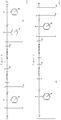
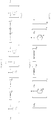
- F 1 represents the monomer of formula (A), containing a functional group capable of forming weak interactions with filler.
- F 1 can be located at the alpha and/or the omega end of the copolymer;
- F 2 represents the same monomer as F 1 , or a different one, and also contains functional group capable of weak interactions, similar or different than in F 1 .
- F 2 is located more in the centre of the copolymer.
- F 3 represents the terminal modifying agent as used for the functionalization of the omega terminus of the polymer and typically contains alkoxysilyl groups responsible for strong interactions.
- n indicates the number of repeating units of F 1 , and preferably ranges from 1 to 20 repeating units
- m indicates the number of repeating units of F 2 , and preferably ranges from 1 to 20 repeating units
- p represents the number of polymer chains covalently bound to F 3 (derived from the terminal modifying agent), preferably being in a range of from 0 and 10.
- J represents the organic residue of the organometallic compound used to prepare the initiator of the invention and may e.g. be an alkyl group, aryl group, phenyl group, protected amine or protected hydroxyl group.
- X represents the moiety derived from the coupling agent reacted with the nucleophilic end of the copolymer, the coupling agent typically having general formula X 1 n Y p X 2 m (E).
- the invention relates to the use of the alkali metal salt derivative as defined above, as an initiator for the copolymerization of i) one or more conjugated diene monomers and ii) one or more vinyl aromatic monomers.
- the invention in a second aspect, relates to a process for the preparation of a copolymer component comprising a coupled copolymer and a terminally modified copolymer.
- the invention in a third aspect, relates to a copolymer component comprising coupled copolymer and terminally modified copolymer.
- the invention relates to a method for preparing a rubber comprising vulcanizing the copolymer component according to the third aspect.
- the invention relates to the rubber as obtainable with the method according to the fourth aspect.
- the invention relates to a rubber composition comprising the rubber according to the fifth aspect.
- the invention relates to a tire component comprising the rubber composition according to the sixth aspect.
- the invention relates to a tire comprising the tire component according to the seventh aspect.
- the invention relates to the use of an alkali metal salt derivative of a vinyl aromatic monomer having general formula (A) wherein
- the alkali metal is selected from lithium, sodium, and potassium, and is preferably lithium.
- the alkali metal typically becomes part of the alkali metal salt derivative of the invention by reaction of an organometallic compound with the vinyl aromatic compound of formula (A).
- the alkali metal salt derivative is typically prepared by reaction of one or more organometallic compounds with one or more monomers having general formula (A).
- the time of reaction between organometallic compound and monomer of formula (A) is preferably from 1 to 60 min, more preferably from 1 to 20 min and most preferably from 1 to 10 min.
- the organometallic compound may be an organometallic lithium compound, organic sodium compound, or organic potassium compound:
- the mole ratio of organometallic compound to monomer of formula (I) is preferably in a range of from 0.05:1 to 1:1, more preferably in a range of from 0.1:1 to 1:1, most preferably in a range of from 0.2:1 to 1:1.
- the organometallic compound is an organometallic lithium compound, preferably selected from n-butyllithium, sec-butyllithium, and tert-butyllithium.
- R is preferably a group of formula (B), and
- the compound of formula (A) is N- vinylbenzylpyrrolidine, in particular the N -vinylbenzylpyrrolidine is N -(3-vinylbenzyl)pyrrolidine or N -(4-vinylbenzyl)pyrrolidine, and more preferably the mixture of N -(3-vinylbenzyl)pyrrolidine and N -(4-vinylbenzyl)pyrrolidine.
- the alkali metal salt derivative is of formula (D) wherein
- the alkali metal salt derivative according to the invention acts as a functionalizing agent allowing modification of the ⁇ -terminal of the copolymer.
- the number of repeating units of functionalized monomer of formula (A) can be controlled and adjusted to the particular needs of the specific application.
- the derivative is according to the first aspect used as an initiator for the copolymerization of i) one or more conjugated diene monomers and ii) one or more vinyl aromatic monomers.
- the copolymer comprises, in addition to units derived from the monomer of formula (A), units derived from one or more conjugated diene monomers.
- Any anionically polymerizable conjugated diolefin may be used.
- Conjugated diolefin monomers containing from 4 to 8 carbon atoms are generally preferred.
- Vinyl-substituted aromatic monomers can also be copolymerized with one or more diene monomers into rubbery polymers, for example styrene-butadiene rubber (SBR).
- SBR styrene-butadiene rubber
- conjugated diene monomers that can be copolymerized according to the invention include 1,3-butadiene, isoprene, 1,3-pentadiene, 2,3-dimethyl-1,3-butadiene, 2-methyl-1,3-pentadiene, 2,3-dimethyl-1,3-pentadiene, 2-phenyl-1,3-butadiene, and 4,5-diethyl-1,3-octadiene.
- Preferred conjugated dienes are 1,3-butadiene and isoprene, in particular 1,3-butadiene.
- the copolymer of the present invention further comprises one or more vinyl aromatic monomers.
- vinyl aromatic monomers that can be utilized in the synthesis of rubbery polymers include styrene, 1-vinylnapthalene, 3-methylstyrene, 3,5-diethylstyrene, 4-propylstyrene, 2,4,6-trimethylstyrene, 4-dodecylstyrene, 3-methyl-5-n-hexylstyrene, 4-phenylstyrene, 2-ethyl-4-benzyl-styrene, 3,5-diphenylstyrene, 2,3,4,5-tetraethylstyrene, 3-ethyl-1-vinylnapthalene, 6-isopropyl-1-vinylnapthalene, 6-cyclohexyl-1-vinylnapthalene, 7-dodecyl-2-vinylnapthalen
- the invention relates to the preparation of a copolymer component comprising coupled copolymer and terminally modified copolymer, the process comprising:
- step b) is the addition of the initiator component to the monomer component, to initiate anionic copolymerization.
- the copolymer is typically prepared by forming a solution of the one or more anionically copolymerizable monomers i) and ii) above in a solvent, and initiating the copolymerization of the monomers with the alkali metal derivative as described above.
- the solvents used in such solution polymerizations will normally contain from about 4 to about 10 carbon atoms per molecule and will be liquids under the conditions of the polymerization.
- organic solvents include pentane, isooctane, cyclohexane, n-hexane, benzene, toluene, xylene, ethylbenzene, tetrahydrofuran, and the like, alone or in admixture.
- Copolymers of the invention typically comprise from about 99.99 to 30 percent by weight of diene units and from 0.01 to 70 percent by weight of vinyl aromatic monomer units.
- Copolymers described by this invention typically have 1,2-microstructure contents in a range of from 5% to 100%, preferably from 10% to 90% and most preferably from 20% to 80%, based upon the diene content.
- an internal modifier may optionally be added to the polymerization, with the usage between 0 to 90 or more equivalents per equivalent of lithium.
- the amount depends upon the type of internal modifier and the amount of vinyl desired, the level of styrene employed and the temperature of the polymerization.
- the polymerization process of this invention is normally conducted in the presence of polar internal modifiers, such as tertiary amines, alcoholates or alkyltetrahydrofurfuryl ethers.
- Some representative examples of specific internal polar modifiers that can be used include methyltetrahydrofurfuryl ether, ethyltetrahydrofurfuryl ether, propyltetrahydrofurfuryl ether, butyltetrahydrofurfuryl ether, hexyltetrahydrofurfuryl ether, octyltetrahydrofurfuryl ether, dodecyltetrahydrofurfuryl ether, diethyl ether, di-n-propyl ether, diisopropyl ether, di-n-butyl ether, tetrahydrofuran, dioxane, ethylene glycol dimethyl ether, ethylene glycol diethyl ether, diethylene glycol dimethyl ether, diethylene glycol diethyl ether, triethylene glycol dimethyl ether, trimethylamine, triethylamine, N,N,N',N'-tetramethylethylene
- a potassium or sodium compound may be added in step b), preferably together with the polymerization initiator, when it is intended to increase the reactivity of the polymerization initiator or when it is intended to arrange the vinyl aromatic monomer at random in the copolymer obtained, or to allow the obtained copolymer to contain the vinyl aromatic monomer as a single chain.
- potassium or sodium compound added together with the polymerization initiator there can be used, for example: alkoxides and phenoxides, typified by isopropoxide, tert-butoxide, tert-amyloxide, n-heptaoxide, benzyloxide, phenoxide and mentholate; potassium or sodium salts of organic sulfonic acids such as dodecylbenzensulfonic acid, tetradecylbenzenesulfonic acid, hexadecylbenzenesulfonic acid, and octadecylbenzenesulfonic acid.
- alkoxides and phenoxides typified by isopropoxide, tert-butoxide, tert-amyloxide, n-heptaoxide, benzyloxide, phenoxide and mentholate
- potassium or sodium salts of organic sulfonic acids such as dodecy
- the potassium or sodium compound is preferably added in an amount of 0.005 to 0.5 mol per mol equivalent polymerization initiator.
- the amount is less than 0.005 mol, the addition effect of the potassium compound (the increase in the reactivity of polymerization initiator and the randomization or single chain addition of aromatic vinyl compound) may not appear.
- the amount is more than 0.5 mol, there may be a reduction in polymerization activity and a striking reduction in productivity and, moreover, there may be a reduction in the internal modification efficiency in this primary modification reaction.
- the copolymer can be made in a batch process, or in a continuous process by continuously charging the monomers i) and ii) into a polymerization zone.
- the initiator of the invention is preferably added (step b)).
- the resultant reaction mixture is typically agitated, to sustain homogenization of temperature and of all reagents in polymer solution.
- the reaction is typically carried out under anhydrous, anaerobic conditions. Reaction can be carried out for about 0.1 to 24 hours, depending on the temperature, molecular weight of desired product and modifier used.
- steps d), e) and f) should be performed, depending on the desired structure of the product.
- step c) After the polymerization of monomers in step c) is finished, functionalization of the omega terminal of the copolymer is performed, according to steps e) and f).
- step d) addition of functionalized monomer to living polymer solution resulting from step c) is performed. It is preferable to use one of the functionalized monomers of general formula (I). Addition of functionalized monomer according to step d) should most preferably be performed at conditions that are similar to the polymerization conditions in step c).
- n1 is an integer of from 0 to 20
- n2 is an integer of from 0 to 10,000
- n3 is an integer of from 0 to 10,000
- n4 is an integer of from 0 to 20
- Coupling in step e) is preferably done by addition of the selected coupling agent to the copolymer system resulting from step d).
- the addition is at conditions similar or close to the polymerization conditions described for step c).
- the fraction of copolymer chains being coupled can vary between 0.01 (nearly no coupling) to 99.99% (nearly all chains subjected to coupling), which is achieved by the controlled addition of coupling agent, in the amount required to bond the desired fraction of the copolymer chains.
- the exact amount of coupling agent is calculated based on its theoretical functionality and required coupling fraction.
- coupling agents having a functionality of two but it should be noted that this invention does not put any restriction on the functionality of the coupling agent. However, it is preferable to use a coupling agent having a functionality ranging from 1 to 8.
- n1 is an integer of from 0 to 20
- n2 is an integer of from 0 to 10,000
- n3 is an integer of from 0 to 10,000
- n4 is an integer of from 0 to 20
- R 1 and R 2 represent the functional groups described previously
- p1 is an integer which describes the functionality of the coupling agent
- X represents the residue of the coupling agent.
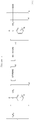
- the resulting copolymer can be described as follows (see formula (VII) in Figure 3 ).
- step f the terminal modifying agent responsible for formation of strong interactions with fillers such as silica or carbon black is added to the copolymer solution, providing the final copolymer described earlier as 'Fraction T'.
- terminal modifying agent reacts with any remaining living polymer chains which were not reacted earlier with coupling agent, as described in step e) above.
- any compound containing at least one atom selected from the group consisting of nitrogen, oxygen and silicon, and being reactive toward a living polymer chain, can be used as terminal modifying agent.
- the terminal modifying group containing at least one atom selected from the group consisting of nitrogen, oxygen and silicon include: an amino group, an amide group, an alkoxysilyl group, an isocyanato group, an imino group, an imidazole group, an urea group, an ether group, a carbonyl group, a carboxyl group, a hydroxyl group, a nitrile group, a pyridyl group.
- terminal modifying agents include:
- the amount of terminal modifying agent to be used depends on its functionality (i.e. number of groups being able to form bonds with living polymer chains) and the amount of living polymer chains. It is well known that in case of terminal modifying agents bearing a functionality greater than 1, exact control of the amount of coupling agent used allows to further influence copolymer properties and i.e. introduce additional coupling.
- Preferred amounts of terminal modifying agent are in a range of from 0.001 to 50 mol per 1 mol of living chain ends, more preferably is to use range from 0.5 mol to 10 mol per 1 mol of living chain ends.
- step f After the addition of terminal modifying agent in step f), antioxidants, and/or alcohols for stopping polymerization reaction may be added, if necessary (step g).
- n1 is an integer of from 0 to 20
- n2 is an integer of from 0 to 10,000
- n3 is an integer of from 0 to 10,000
- n4 is an integer of from 0 to 20, and where n2+n3 >0
- R1, R2, R3, R4 represent functional groups described above (see step a)
- p2 describes the functionality of the terminal modifying agent and can vary from 1 to 9
- F represents the residue of the terminal modifying agent.
- the invention relates to a copolymer component comprising coupled copolymer I) and terminally modified copolymer II).
- the coupled copolymer I) is obtained by a process comprising
- the terminally modified copolymer II) is being obtained by a process comprising
- the copolymer is obtained by the process according to the second aspect.
- the copolymer component comprises
- copolymer component wherein the coupled copolymer has 1 to 11 terminal groups based on the vinyl aromatic monomer having general formula (A), preferably 1 to 5.
- the coupling agent is preferably of general formula (E): X 1 n Y p X 2 m (E), wherein
- the coupling agent is a silicon halide coupling agent
- the silicon halide coupling agent is preferably selected from silicon tetrachloride, silicon tetrabromide, silicon tetrafluoride, silicon tetraiodide, hexachlorodisilane, hexabromodisilane, hexafluorodisilane, hexaiododisilane, octachlorotrisilane, octabromotrisilane, octafluorotrisilane, octaiodotrisilane, hexachlorodisiloxane, 2,2,4,4,6,6-hexachloro-2,4,6-trisilaheptane, 1,2,3,4,5,6-hexakis[2-(methyldichlorosilyl)ethyl]benzene, and alkyl silicon halides of general formula (G) R 5 n
- a copolymer component wherein the terminal modified copolymer has 1 to 11 terminal groups based on the vinyl aromatic monomer having general formula (I), at the terminus other than the terminus modified with the terminal modified agent.
- copolymer component wherein the terminal modifying agent comprises alkoxysilyl groups.
- the invention relates to a method for preparing a rubber comprising vulcanizing the copolymer component according to the third aspect.
- the invention relates to a rubber as obtainable according to the method of the fourth aspect.
- the invention relates to a rubber composition comprising x) the rubber according to the fifth aspect.
- the rubber composition further comprises y) a filler component comprising one or more fillers.
- the filler is preferably selected from silica and carbon black. It is prererred that the y) filler component comprises silica and carbon black.
- the rubber composition comprises
- the rubber component may further comprise one or more further rubbers, and the further rubber is preferably selected from natural rubber, synthetic isoprene rubber, butadiene rubber, styrene-butadiene rubber, ethylene- ⁇ -olefin copolymer rubber, ethylene- ⁇ -olefin-diene copolymer rubber, acrylonitrilebutadiene copolymer rubber, chloroprene rubber, and halogenated butyl rubber.
- the further rubber is preferably selected from natural rubber, synthetic isoprene rubber, butadiene rubber, styrene-butadiene rubber, ethylene- ⁇ -olefin copolymer rubber, ethylene- ⁇ -olefin-diene copolymer rubber, acrylonitrilebutadiene copolymer rubber, chloroprene rubber, and halogenated butyl rubber.
- the invention relates to a tire component comprising the rubber composition according to the sixth aspect.
- the invention relates to a tire comprising the tire component according to the seventh aspect.
- cyclohexane 820 g were added to the inerted two liter reactor, followed by addition of 31 grams of styrene and 117 grams of 1,3-butadiene. The inhibitors from the styrene and the 1,3-butadiene were removed. 2.21 mmoles of tetramethylethylenediamine (TMEDA) were then added, to provide random incorporation of styrene monomer and to increase the vinyl content of the butadiene units. The solution inside the reactor was heated to 60°C and was continuously stirred during the whole process. When the desired temperature had been reached, 0.045 mmoles of n-butyllithium were added to perform quenching of residual impurities.
- TEDA tetramethylethylenediamine
- n-butyllithium 0.845 mmoles of n-butyllithium were added to initiate the polymerization process.
- the reaction was carried out as an isothermic process for 60 minutes.
- 0.0525 mmoles of silicontetrachloride were then added to the polymer solution as a coupling agent. Coupling was performed for 5 minutes.
- the reaction was terminated using 1 mmol of nitrogen-purged isopropyl alcohol and was then rapidly stabilized by addition of 2-methyl-4,6-bis(octylsulfanylmethyl)phenol in an amount of 1.0 phr polymer.
- the polymer solution was then treated with ethanol, and precipitation of polymer occurred.
- the final product was dried overnight in a vacuum oven.
- cyclohexane 820 g of cyclohexane were added to the inerted two liter reactor, followed by the addition of 31 grams of styrene and 117 grams of 1,3-butadiene. The inhibitors from the styrene and the 1,3-butadiene were removed. 4.45 mmoles of tetramethylethylenediamine (TMEDA) were then added as a styrene randomizer and to increase the vinyl content of the units derived from butadiene monomer. The solution inside the reactor was heated to 60°C and was continuously stirred during the whole process. Upon reaching this temperature, 0.067 mmoles of n-buthyllithium were added to the reactor, to quench residual impurities.
- TEDA tetramethylethylenediamine
- the reaction was terminated using 1 mmol of nitrogen-purged isopropyl alcohol and rapidly stabilized by the addition of 2-methyl-4,6-bis(octylsulfanylmethyl)phenol at 1.0 phr polymer.
- the polymer solution was treated with ethanol, and precipitation of polymer occurred.
- the final product was dried overnight in a vacuum oven.
- a rubber composition (vulcanized) was prepared using a polymer obtained in each of Examples, and was measured for the following test items
- Tyre predictors (tan ⁇ at 60°C, tan ⁇ at 0°C, tan ⁇ at -10°C)
- DMA 450+ MetraviB dynamic mechanical analyzer
- Table 1 shows the characterization results for the three samples synthesized for this study.
- Table 1 shows the characterization results for the three samples synthesized for this study.
- Table 1. Example M n [g/mol] M w [g/mol] M w /M n Vinyl content [%] 1 Styrene content [%] Mooney Tg [°C] 1 (reference) 190,000 339,000 1.79 60.73 20.41 50.5 -24.1 2 230,000 373,000 1.62 62.96 21.86 51.6 -22.1 3 222,000 367,000 1.65 62.67 21.67 49.3 -23.3 1 Based on 1,3-butadiene content
- SSBR 3 according to the invention imparts to the corresponding rubber composition 3 reinforcement properties which are superior to those obtained with the control SSBR 1 and with the other SBR 2 according to the invention.
- the tyre predictors of rubber composition 3 according to the invention are improved relative to those of the control rubber composition 1 and of the other rubber composition 2 according to the invention. Moreover, said tyre predictors are improved for rubber composition 2 according to the invention relative to the control rubber composition 1.
Landscapes
- Chemical & Material Sciences (AREA)
- Health & Medical Sciences (AREA)
- Chemical Kinetics & Catalysis (AREA)
- Medicinal Chemistry (AREA)
- Polymers & Plastics (AREA)
- Organic Chemistry (AREA)
- General Chemical & Material Sciences (AREA)
- Engineering & Computer Science (AREA)
- Mechanical Engineering (AREA)
- Inorganic Chemistry (AREA)
- Addition Polymer Or Copolymer, Post-Treatments, Or Chemical Modifications (AREA)
- Compositions Of Macromolecular Compounds (AREA)
- Tires In General (AREA)
- Polymerization Catalysts (AREA)
Priority Applications (2)
| Application Number | Priority Date | Filing Date | Title |
|---|---|---|---|
| RS20190312A RS58418B1 (sr) | 2015-04-10 | 2016-04-08 | Inicijatori kopolimerizacije dienskih monomera i vinil-aromatičnih monomera |
| PL16718262T PL3280745T3 (pl) | 2015-04-10 | 2016-04-08 | Inicjatory do kopolimeryzacji monomerów dienowych i monomerów winyloaromatycznych |
Applications Claiming Priority (2)
| Application Number | Priority Date | Filing Date | Title |
|---|---|---|---|
| EP15461524 | 2015-04-10 | ||
| PCT/EP2016/057757 WO2016162482A1 (en) | 2015-04-10 | 2016-04-08 | Initiators for the copolymerisation of diene monomers and vinyl aromatic monomers |
Publications (2)
| Publication Number | Publication Date |
|---|---|
| EP3280745A1 EP3280745A1 (en) | 2018-02-14 |
| EP3280745B1 true EP3280745B1 (en) | 2018-12-12 |
Family
ID=52875658
Family Applications (1)
| Application Number | Title | Priority Date | Filing Date |
|---|---|---|---|
| EP16718262.5A Active EP3280745B1 (en) | 2015-04-10 | 2016-04-08 | Initiators for the copolymerisation of diene monomers and vinyl aromatic monomers |
Country Status (21)
| Country | Link |
|---|---|
| US (1) | US10584187B2 (enExample) |
| EP (1) | EP3280745B1 (enExample) |
| JP (1) | JP6789236B2 (enExample) |
| KR (2) | KR102745901B1 (enExample) |
| CN (1) | CN107743498B (enExample) |
| AU (1) | AU2016244362A1 (enExample) |
| BR (1) | BR112017021222A2 (enExample) |
| CA (1) | CA2981121A1 (enExample) |
| DK (1) | DK3280745T3 (enExample) |
| EA (1) | EA201792253A1 (enExample) |
| ES (1) | ES2714394T3 (enExample) |
| HU (1) | HUE041621T2 (enExample) |
| IL (1) | IL254884A0 (enExample) |
| MX (1) | MX377123B (enExample) |
| PL (1) | PL3280745T3 (enExample) |
| RS (1) | RS58418B1 (enExample) |
| SG (1) | SG11201708115VA (enExample) |
| TN (1) | TN2017000433A1 (enExample) |
| TR (1) | TR201902990T4 (enExample) |
| WO (1) | WO2016162482A1 (enExample) |
| ZA (1) | ZA201707596B (enExample) |
Families Citing this family (19)
| Publication number | Priority date | Publication date | Assignee | Title |
|---|---|---|---|---|
| EA036381B1 (ru) | 2015-04-10 | 2020-11-02 | Синтос С.А. | [бис(тригидрокарбилсилил)аминосилил]-функционализованный стирол и способ его получения |
| MX2018009323A (es) | 2016-10-06 | 2018-11-09 | Synthos Sa | Estireno funcionalizado con [bis(trihidrocarbilsilil)aminosililo] y un metodo para su preparacion. |
| HK1256871B (en) | 2016-10-06 | 2020-06-05 | Synthos Dwory 7 Spolka Z Ograniczona Odpowiedzialnoscia Spolka Jawna | Elastomeric copolymers based on [bis(trihydrocarbylsilyl)aminosilyl]-functionalized styrene and their use in the preparation of rubbers |
| WO2019066279A1 (ko) * | 2017-09-29 | 2019-04-04 | 주식회사 엘지화학 | 양 말단 변성 공액디엔계 중합체 및 이의 제조방법 |
| KR102102986B1 (ko) * | 2017-09-29 | 2020-04-21 | 주식회사 엘지화학 | 양 말단 변성 공액디엔계 중합체 및 이의 제조방법 |
| KR102179487B1 (ko) | 2017-12-05 | 2020-11-16 | 주식회사 엘지화학 | 변성 공액디엔계 중합체 및 이를 포함하는 고무 조성물 |
| KR101926619B1 (ko) | 2018-03-29 | 2018-12-11 | 금호석유화학 주식회사 | 기능성 단량체를 포함하는 공중합체 및 그 제조방법 |
| CA3094894A1 (en) | 2018-04-11 | 2019-10-17 | Synthos S.A. | Mixtures of aminosilyl-functionalized styrenes, their preparation and their use in the production of elastomeric copolymers |
| EP3911525B1 (en) | 2019-01-24 | 2023-03-08 | Synthos S.A. | Bissilylamino-functionalized conjugated dienes, their preparation and their use in the production of rubbers |
| EP3950747B1 (en) * | 2019-09-11 | 2023-08-09 | Lg Chem, Ltd. | Modified conjugated diene-based polymer and rubber composition including the same |
| KR102748773B1 (ko) * | 2019-09-11 | 2025-01-02 | 주식회사 엘지화학 | 변성 공액디엔계 중합체, 이의 제조방법 및 이를 포함하는 고무 조성물 |
| JP7280972B2 (ja) * | 2019-09-11 | 2023-05-24 | エルジー・ケム・リミテッド | 変性共役ジエン系重合体、その製造方法、およびそれを含むゴム組成物 |
| JP7337434B2 (ja) | 2019-09-11 | 2023-09-04 | エルジー・ケム・リミテッド | 変性共役ジエン系重合体、およびそれを含むゴム組成物 |
| KR102910987B1 (ko) * | 2020-09-10 | 2026-01-12 | 주식회사 엘지화학 | 변성 공액디엔계 중합체, 이의 제조방법 및 이를 포함하는 고무 조성물 |
| KR102889654B1 (ko) * | 2020-09-10 | 2025-11-21 | 주식회사 엘지화학 | 변성 공액디엔계 중합체, 이의 제조방법 및 이를 포함하는 고무 조성물 |
| KR102533014B1 (ko) | 2019-09-11 | 2023-05-17 | 주식회사 엘지화학 | 변성 공액디엔계 중합체, 이의 제조방법 및 이를 포함하는 고무 조성물 |
| TWI915319B (zh) | 2019-09-11 | 2026-02-21 | 南韓商Lg化學股份有限公司 | 改質之共軛二烯系聚合物、其製備方法及包含彼之橡膠組成物 |
| CN111793179A (zh) * | 2020-07-20 | 2020-10-20 | 彤程化学(中国)有限公司 | 一种毛刷状多官能化橡胶聚合物及其制备和应用 |
| CN117377529A (zh) * | 2021-04-01 | 2024-01-09 | 西索斯公司 | 催化剂体系在从乙醇两段法生产1,3-丁二烯中的用途 |
Family Cites Families (44)
| Publication number | Priority date | Publication date | Assignee | Title |
|---|---|---|---|---|
| CH415623A (de) | 1960-11-11 | 1966-06-30 | Monsanto Co | Verfahren zur Herstellung von Stickstoff-Silicium-Verbindungen |
| US3109871A (en) | 1960-12-27 | 1963-11-05 | Phillips Petroleum Co | Production and curing of polyfunctional terminally reactive polymers |
| US4196154A (en) | 1977-10-11 | 1980-04-01 | The Dow Chemical Company | Soluble multifunctional lithium containing initiator |
| JPS58154742A (ja) * | 1982-03-09 | 1983-09-14 | Japan Synthetic Rubber Co Ltd | ジエン系ゴム組成物 |
| JPS63118343A (ja) * | 1986-11-07 | 1988-05-23 | Japan Synthetic Rubber Co Ltd | 共役ジエン系ゴム組成物 |
| JPH0778151B2 (ja) | 1987-07-17 | 1995-08-23 | 日本合成ゴム株式会社 | ゴム組成物 |
| DE3729144A1 (de) | 1987-09-01 | 1989-03-09 | Basf Ag | Bifunktionelle alkaliverbindungen, verfahren zu ihrer herstellung und verwendung als polymerisationsinitiatoren |
| US4935471A (en) | 1987-10-15 | 1990-06-19 | The Goodyear Tire & Rubber Company | Capped polydienes |
| US5329005A (en) | 1992-10-02 | 1994-07-12 | Bridgestone Corporation | Soluble anionic polymerization initiators and preparation thereof |
| JP3378313B2 (ja) | 1993-09-10 | 2003-02-17 | 株式会社ブリヂストン | ゴム組成物 |
| US5567815A (en) * | 1994-07-18 | 1996-10-22 | Bridgestone Corporation | Teritary amine containing antonic initiators used in preparing polymers and process for the preparation thereof |
| EP0693505B1 (en) * | 1994-07-18 | 1999-05-06 | Bridgestone Corporation | Elastomers and products having reduced hysteresis and process for the preparation thereof |
| US5527753A (en) | 1994-12-13 | 1996-06-18 | Fmc Corporation | Functionalized amine initiators for anionic polymerization |
| JP3641868B2 (ja) | 1996-02-23 | 2005-04-27 | Jsr株式会社 | ジオレフィン系(共)重合体の製造方法 |
| KR100285229B1 (ko) * | 1999-03-03 | 2001-03-15 | 조충환 | 용액 중합 스티렌-부타디엔 고무 및 부타디엔 고무의 제조방법 |
| US6627722B2 (en) | 2000-12-05 | 2003-09-30 | Stephan Rodewald | Functionalized elastomers |
| US6627721B1 (en) | 2002-09-19 | 2003-09-30 | The Goodyear Tire & Rubber Company | Functionalized elastomers |
| US6515087B2 (en) | 2000-12-14 | 2003-02-04 | The Goodyear Tire & Rubber Company | Synthesis of elastomers having low hysteresis |
| JP2004059781A (ja) | 2002-07-30 | 2004-02-26 | Jsr Corp | ブロック共重合体及び該共重合体を含有するアスファルト組成物 |
| US6693160B1 (en) * | 2002-08-16 | 2004-02-17 | The Goodyear Tire & Rubber Company | Functionalized monomers for synthesis of rubbery polymers |
| US6825306B2 (en) | 2002-08-16 | 2004-11-30 | The Goodyear Tire & Rubber Company | Functionalized monomers for synthesis of rubbery polymers |
| US6933358B2 (en) | 2002-08-16 | 2005-08-23 | The Goodyear Tire & Rubber Company | Functionalized monomers for synthesis of rubbery polymers |
| US6753447B2 (en) | 2002-08-16 | 2004-06-22 | The Goodyear Tire & Rubber Company | Functionalized monomers for synthesis of rubbery polymers |
| EP1400543B1 (en) * | 2002-09-19 | 2009-11-11 | The Goodyear Tire & Rubber Company | Functionalized elastomers |
| JP4302547B2 (ja) | 2004-02-18 | 2009-07-29 | 株式会社ブリヂストン | 変性天然ゴムラテックス、変性天然ゴム及びそれらの製造方法 |
| CN101001917B (zh) | 2004-08-10 | 2010-10-27 | Jsr株式会社 | 树脂组合物及其模制品 |
| BRPI0604797A (pt) | 2005-11-30 | 2007-10-09 | Goodyear Tire & Rubber | polìmeros de borracha funcionalizados |
| US20090326157A1 (en) | 2006-12-15 | 2009-12-31 | Sumitomo Chemical Company, Limited | Ethylene-propylene copolymer, and polypropylene resin composition comprising the same |
| CN102083889B (zh) | 2008-04-30 | 2014-08-13 | 株式会社普利司通 | 改性共轭二烯系共聚物的制造方法、通过该方法获得的改性共轭二烯系共聚物、橡胶组合物和轮胎 |
| CN101724184B (zh) * | 2008-10-29 | 2013-05-01 | 住友橡胶工业株式会社 | 橡胶组合物及轮胎 |
| US20100116404A1 (en) | 2008-11-11 | 2010-05-13 | Annette Lechtenboehmer | Tire with component containing polyketone short fiber and functionalized elastomer |
| US20100152364A1 (en) * | 2008-12-12 | 2010-06-17 | The Goodyear Tire & Rubber Company | Polymers, rubber compositions, and tires |
| JP5324384B2 (ja) * | 2009-10-05 | 2013-10-23 | 住友ゴム工業株式会社 | 重合体、タイヤ用ゴム組成物及び空気入りタイヤ |
| US20110124771A1 (en) | 2009-11-20 | 2011-05-26 | Paul Harry Sandstrom | Pneumatic tire |
| CN102933613B (zh) | 2009-12-21 | 2015-03-11 | 斯泰隆欧洲有限责任公司 | 改性聚合物组合物 |
| JP2011252137A (ja) | 2010-05-06 | 2011-12-15 | Sumitomo Chemical Co Ltd | 共役ジエン系重合体、共役ジエン系重合体組成物、及び、共役ジエン系重合体の製造方法 |
| DE102011109827A1 (de) | 2010-08-11 | 2012-02-16 | Sumitomo Chemical Company, Ltd. | Polymer auf Basis von konjugiertem Dien, Polymerzusammensetzung auf Basis von konjugiertem Dien und Verfahren zur Herstellung von Polymer auf Basis von konjugiertem Dien |
| ES2530075T3 (es) * | 2010-12-30 | 2015-02-26 | Bridgestone Corporation | Iniciadores de aminosilano y polímeros funcionalizados preparados a partir de los mismos |
| EA201490496A1 (ru) * | 2011-08-26 | 2014-08-29 | Асахи Касеи Кемикалз Корпорейшн | Способ получения модифицированных полимеров сопряженных диенов, модифицированные полимеры сопряженных диенов, композиции модифицированных полимеров сопряженных диенов, композиции каучука и автомобильные шины |
| CN103917588B (zh) | 2011-11-24 | 2016-02-17 | 住友橡胶工业株式会社 | 橡胶组合物以及充气轮胎 |
| EA036381B1 (ru) | 2015-04-10 | 2020-11-02 | Синтос С.А. | [бис(тригидрокарбилсилил)аминосилил]-функционализованный стирол и способ его получения |
| WO2016162528A1 (en) | 2015-04-10 | 2016-10-13 | Synthos S.A. | Elastomeric copolymers based on [bis(trihydrocarbylsilyl)aminosilyl]-functionalized styrene and their use in the preparation of rubbers |
| HK1256871B (en) | 2016-10-06 | 2020-06-05 | Synthos Dwory 7 Spolka Z Ograniczona Odpowiedzialnoscia Spolka Jawna | Elastomeric copolymers based on [bis(trihydrocarbylsilyl)aminosilyl]-functionalized styrene and their use in the preparation of rubbers |
| MX2018009323A (es) | 2016-10-06 | 2018-11-09 | Synthos Sa | Estireno funcionalizado con [bis(trihidrocarbilsilil)aminosililo] y un metodo para su preparacion. |
-
2016
- 2016-04-08 JP JP2017552919A patent/JP6789236B2/ja active Active
- 2016-04-08 TR TR2019/02990T patent/TR201902990T4/tr unknown
- 2016-04-08 EP EP16718262.5A patent/EP3280745B1/en active Active
- 2016-04-08 KR KR1020177032699A patent/KR102745901B1/ko active Active
- 2016-04-08 SG SG11201708115VA patent/SG11201708115VA/en unknown
- 2016-04-08 DK DK16718262.5T patent/DK3280745T3/en active
- 2016-04-08 CA CA2981121A patent/CA2981121A1/en not_active Abandoned
- 2016-04-08 MX MX2017013010A patent/MX377123B/es active IP Right Grant
- 2016-04-08 KR KR1020247028635A patent/KR20240134234A/ko active Pending
- 2016-04-08 US US15/565,360 patent/US10584187B2/en active Active
- 2016-04-08 RS RS20190312A patent/RS58418B1/sr unknown
- 2016-04-08 BR BR112017021222A patent/BR112017021222A2/pt active Search and Examination
- 2016-04-08 HU HUE16718262A patent/HUE041621T2/hu unknown
- 2016-04-08 TN TNP/2017/000433A patent/TN2017000433A1/en unknown
- 2016-04-08 PL PL16718262T patent/PL3280745T3/pl unknown
- 2016-04-08 ES ES16718262T patent/ES2714394T3/es active Active
- 2016-04-08 WO PCT/EP2016/057757 patent/WO2016162482A1/en not_active Ceased
- 2016-04-08 AU AU2016244362A patent/AU2016244362A1/en not_active Abandoned
- 2016-04-08 EA EA201792253A patent/EA201792253A1/ru unknown
- 2016-04-08 CN CN201680034048.1A patent/CN107743498B/zh active Active
-
2017
- 2017-10-03 IL IL254884A patent/IL254884A0/en unknown
- 2017-11-09 ZA ZA2017/07596A patent/ZA201707596B/en unknown
Non-Patent Citations (1)
| Title |
|---|
| None * |
Also Published As
| Publication number | Publication date |
|---|---|
| CN107743498A (zh) | 2018-02-27 |
| MX2017013010A (es) | 2018-04-24 |
| TN2017000433A1 (en) | 2019-04-12 |
| BR112017021222A2 (pt) | 2018-07-03 |
| WO2016162482A1 (en) | 2016-10-13 |
| CA2981121A1 (en) | 2016-10-13 |
| DK3280745T3 (en) | 2019-03-25 |
| PL3280745T3 (pl) | 2019-07-31 |
| KR102745901B1 (ko) | 2024-12-23 |
| TR201902990T4 (tr) | 2019-03-21 |
| AU2016244362A1 (en) | 2017-11-02 |
| MX377123B (es) | 2025-03-07 |
| KR20240134234A (ko) | 2024-09-06 |
| SG11201708115VA (en) | 2017-11-29 |
| US10584187B2 (en) | 2020-03-10 |
| CN107743498B (zh) | 2020-04-28 |
| ZA201707596B (en) | 2018-11-28 |
| HUE041621T2 (hu) | 2019-05-28 |
| JP2018513896A (ja) | 2018-05-31 |
| ES2714394T3 (es) | 2019-05-28 |
| KR20180002683A (ko) | 2018-01-08 |
| EP3280745A1 (en) | 2018-02-14 |
| JP6789236B2 (ja) | 2020-11-25 |
| RS58418B1 (sr) | 2019-04-30 |
| IL254884A0 (en) | 2017-12-31 |
| US20180072821A1 (en) | 2018-03-15 |
| EA201792253A1 (ru) | 2018-02-28 |
Similar Documents
| Publication | Publication Date | Title |
|---|---|---|
| US10584187B2 (en) | Initiators for the copolymerisation of diene monomers and vinyl aromatic monomers | |
| KR101972633B1 (ko) | 실란 설파이드 변형된 탄성체 중합체 | |
| EP3280766B1 (en) | Elastomeric copolymers based on [bis(trihydrocarbylsilyl)aminosilyl]-functionalized styrene and their use in the preparation of rubbers | |
| KR101328380B1 (ko) | 실란-술피드 사슬 말단 변형된 엘라스토머 중합체 | |
| EP3341424B1 (en) | Elastomeric copolymers based on [bis(trihydrocarbylsilyl)aminosilyl]-functionalized styrene and their use in the preparation of rubbers | |
| CN104718224A (zh) | 氨基硅烷改性的聚合物 | |
| HK1256871A1 (en) | Elastomeric copolymers based on [bis(trihydrocarbylsilyl)aminosilyl]-functionalized styrene and their use in the preparation of rubbers | |
| CN114933676B (zh) | 多官能乙烯基芳香族共聚物及其制法、共轭二烯系共聚物及其组合物、交联物、轮胎构件 | |
| CN108026222A (zh) | 聚合物化合物、使用其制备改性共轭二烯类聚合物的方法以及改性共轭二烯类聚合物 | |
| EP3133093A1 (en) | Elastomeric polymer | |
| JP6480490B2 (ja) | シランスルフィド変性エラストマーポリマー | |
| US10294314B2 (en) | Functionalized elastomeric polymer compositions, their preparation methods and crosslinked rubber compositions thereof |
Legal Events
| Date | Code | Title | Description |
|---|---|---|---|
| STAA | Information on the status of an ep patent application or granted ep patent |
Free format text: STATUS: THE INTERNATIONAL PUBLICATION HAS BEEN MADE |
|
| PUAI | Public reference made under article 153(3) epc to a published international application that has entered the european phase |
Free format text: ORIGINAL CODE: 0009012 |
|
| STAA | Information on the status of an ep patent application or granted ep patent |
Free format text: STATUS: REQUEST FOR EXAMINATION WAS MADE |
|
| 17P | Request for examination filed |
Effective date: 20171103 |
|
| AK | Designated contracting states |
Kind code of ref document: A1 Designated state(s): AL AT BE BG CH CY CZ DE DK EE ES FI FR GB GR HR HU IE IS IT LI LT LU LV MC MK MT NL NO PL PT RO RS SE SI SK SM TR |
|
| AX | Request for extension of the european patent |
Extension state: BA ME |
|
| GRAP | Despatch of communication of intention to grant a patent |
Free format text: ORIGINAL CODE: EPIDOSNIGR1 |
|
| STAA | Information on the status of an ep patent application or granted ep patent |
Free format text: STATUS: GRANT OF PATENT IS INTENDED |
|
| RAV | Requested validation state of the european patent: fee paid |
Extension state: MA Effective date: 20171108 |
|
| RAX | Requested extension states of the european patent have changed |
Extension state: BA Payment date: 20171108 |
|
| INTG | Intention to grant announced |
Effective date: 20180704 |
|
| GRAS | Grant fee paid |
Free format text: ORIGINAL CODE: EPIDOSNIGR3 |
|
| GRAA | (expected) grant |
Free format text: ORIGINAL CODE: 0009210 |
|
| STAA | Information on the status of an ep patent application or granted ep patent |
Free format text: STATUS: THE PATENT HAS BEEN GRANTED |
|
| AK | Designated contracting states |
Kind code of ref document: B1 Designated state(s): AL AT BE BG CH CY CZ DE DK EE ES FI FR GB GR HR HU IE IS IT LI LT LU LV MC MK MT NL NO PL PT RO RS SE SI SK SM TR |
|
| AX | Request for extension of the european patent |
Extension state: BA |
|
| REG | Reference to a national code |
Ref country code: GB Ref legal event code: FG4D |
|
| REG | Reference to a national code |
Ref country code: CH Ref legal event code: NV Representative=s name: RENTSCH PARTNER AG, CH Ref country code: CH Ref legal event code: EP |
|
| REG | Reference to a national code |
Ref country code: AT Ref legal event code: REF Ref document number: 1075874 Country of ref document: AT Kind code of ref document: T Effective date: 20181215 |
|
| REG | Reference to a national code |
Ref country code: DE Ref legal event code: R096 Ref document number: 602016008229 Country of ref document: DE |
|
| REG | Reference to a national code |
Ref country code: IE Ref legal event code: FG4D |
|
| REG | Reference to a national code |
Ref country code: NL Ref legal event code: FP |
|
| REG | Reference to a national code |
Ref country code: DK Ref legal event code: T3 Effective date: 20190318 |
|
| REG | Reference to a national code |
Ref country code: SE Ref legal event code: TRGR |
|
| REG | Reference to a national code |
Ref country code: LT Ref legal event code: MG4D |
|
| PG25 | Lapsed in a contracting state [announced via postgrant information from national office to epo] |
Ref country code: LT Free format text: LAPSE BECAUSE OF FAILURE TO SUBMIT A TRANSLATION OF THE DESCRIPTION OR TO PAY THE FEE WITHIN THE PRESCRIBED TIME-LIMIT Effective date: 20181212 Ref country code: HR Free format text: LAPSE BECAUSE OF FAILURE TO SUBMIT A TRANSLATION OF THE DESCRIPTION OR TO PAY THE FEE WITHIN THE PRESCRIBED TIME-LIMIT Effective date: 20181212 Ref country code: LV Free format text: LAPSE BECAUSE OF FAILURE TO SUBMIT A TRANSLATION OF THE DESCRIPTION OR TO PAY THE FEE WITHIN THE PRESCRIBED TIME-LIMIT Effective date: 20181212 |
|
| REG | Reference to a national code |
Ref country code: NO Ref legal event code: T2 Effective date: 20181212 |
|
| REG | Reference to a national code |
Ref country code: ES Ref legal event code: FG2A Ref document number: 2714394 Country of ref document: ES Kind code of ref document: T3 Effective date: 20190528 Ref country code: HU Ref legal event code: AG4A Ref document number: E041621 Country of ref document: HU |
|
| PG25 | Lapsed in a contracting state [announced via postgrant information from national office to epo] |
Ref country code: AL Free format text: LAPSE BECAUSE OF FAILURE TO SUBMIT A TRANSLATION OF THE DESCRIPTION OR TO PAY THE FEE WITHIN THE PRESCRIBED TIME-LIMIT Effective date: 20181212 Ref country code: GR Free format text: LAPSE BECAUSE OF FAILURE TO SUBMIT A TRANSLATION OF THE DESCRIPTION OR TO PAY THE FEE WITHIN THE PRESCRIBED TIME-LIMIT Effective date: 20190313 |
|
| REG | Reference to a national code |
Ref country code: SK Ref legal event code: T3 Ref document number: E 30305 Country of ref document: SK |
|
| PG25 | Lapsed in a contracting state [announced via postgrant information from national office to epo] |
Ref country code: PT Free format text: LAPSE BECAUSE OF FAILURE TO SUBMIT A TRANSLATION OF THE DESCRIPTION OR TO PAY THE FEE WITHIN THE PRESCRIBED TIME-LIMIT Effective date: 20190412 |
|
| PG25 | Lapsed in a contracting state [announced via postgrant information from national office to epo] |
Ref country code: SM Free format text: LAPSE BECAUSE OF FAILURE TO SUBMIT A TRANSLATION OF THE DESCRIPTION OR TO PAY THE FEE WITHIN THE PRESCRIBED TIME-LIMIT Effective date: 20181212 Ref country code: EE Free format text: LAPSE BECAUSE OF FAILURE TO SUBMIT A TRANSLATION OF THE DESCRIPTION OR TO PAY THE FEE WITHIN THE PRESCRIBED TIME-LIMIT Effective date: 20181212 Ref country code: RO Free format text: LAPSE BECAUSE OF FAILURE TO SUBMIT A TRANSLATION OF THE DESCRIPTION OR TO PAY THE FEE WITHIN THE PRESCRIBED TIME-LIMIT Effective date: 20181212 Ref country code: IS Free format text: LAPSE BECAUSE OF FAILURE TO SUBMIT A TRANSLATION OF THE DESCRIPTION OR TO PAY THE FEE WITHIN THE PRESCRIBED TIME-LIMIT Effective date: 20190412 |
|
| REG | Reference to a national code |
Ref country code: DE Ref legal event code: R097 Ref document number: 602016008229 Country of ref document: DE |
|
| PLBE | No opposition filed within time limit |
Free format text: ORIGINAL CODE: 0009261 |
|
| STAA | Information on the status of an ep patent application or granted ep patent |
Free format text: STATUS: NO OPPOSITION FILED WITHIN TIME LIMIT |
|
| 26N | No opposition filed |
Effective date: 20190913 |
|
| PG25 | Lapsed in a contracting state [announced via postgrant information from national office to epo] |
Ref country code: LU Free format text: LAPSE BECAUSE OF NON-PAYMENT OF DUE FEES Effective date: 20190408 Ref country code: MC Free format text: LAPSE BECAUSE OF FAILURE TO SUBMIT A TRANSLATION OF THE DESCRIPTION OR TO PAY THE FEE WITHIN THE PRESCRIBED TIME-LIMIT Effective date: 20181212 |
|
| REG | Reference to a national code |
Ref country code: AT Ref legal event code: UEP Ref document number: 1075874 Country of ref document: AT Kind code of ref document: T Effective date: 20181212 |
|
| VS25 | Lapsed in a validation state [announced via postgrant information from nat. office to epo] |
Ref country code: MA Free format text: LAPSE BECAUSE OF FAILURE TO SUBMIT A TRANSLATION OF THE DESCRIPTION OR TO PAY THE FEE WITHIN THE PRESCRIBED TIME-LIMIT Effective date: 20181212 |
|
| PGFP | Annual fee paid to national office [announced via postgrant information from national office to epo] |
Ref country code: CZ Payment date: 20200325 Year of fee payment: 5 |
|
| PGFP | Annual fee paid to national office [announced via postgrant information from national office to epo] |
Ref country code: CH Payment date: 20200423 Year of fee payment: 5 Ref country code: ES Payment date: 20200516 Year of fee payment: 5 Ref country code: FI Payment date: 20200417 Year of fee payment: 5 Ref country code: NL Payment date: 20200420 Year of fee payment: 5 Ref country code: DK Payment date: 20200423 Year of fee payment: 5 Ref country code: NO Payment date: 20200423 Year of fee payment: 5 Ref country code: IE Payment date: 20200423 Year of fee payment: 5 |
|
| PGFP | Annual fee paid to national office [announced via postgrant information from national office to epo] |
Ref country code: SK Payment date: 20200401 Year of fee payment: 5 Ref country code: BE Payment date: 20200420 Year of fee payment: 5 Ref country code: HU Payment date: 20200406 Year of fee payment: 5 Ref country code: BG Payment date: 20200427 Year of fee payment: 5 Ref country code: SE Payment date: 20200423 Year of fee payment: 5 |
|
| PG25 | Lapsed in a contracting state [announced via postgrant information from national office to epo] |
Ref country code: CY Free format text: LAPSE BECAUSE OF FAILURE TO SUBMIT A TRANSLATION OF THE DESCRIPTION OR TO PAY THE FEE WITHIN THE PRESCRIBED TIME-LIMIT Effective date: 20181212 |
|
| PG25 | Lapsed in a contracting state [announced via postgrant information from national office to epo] |
Ref country code: MT Free format text: LAPSE BECAUSE OF FAILURE TO SUBMIT A TRANSLATION OF THE DESCRIPTION OR TO PAY THE FEE WITHIN THE PRESCRIBED TIME-LIMIT Effective date: 20181212 |
|
| PG25 | Lapsed in a contracting state [announced via postgrant information from national office to epo] |
Ref country code: SI Free format text: LAPSE BECAUSE OF FAILURE TO SUBMIT A TRANSLATION OF THE DESCRIPTION OR TO PAY THE FEE WITHIN THE PRESCRIBED TIME-LIMIT Effective date: 20181212 |
|
| REG | Reference to a national code |
Ref country code: FI Ref legal event code: MAE |
|
| REG | Reference to a national code |
Ref country code: DK Ref legal event code: EBP Effective date: 20210430 |
|
| REG | Reference to a national code |
Ref country code: NO Ref legal event code: MMEP |
|
| REG | Reference to a national code |
Ref country code: SE Ref legal event code: EUG |
|
| REG | Reference to a national code |
Ref country code: NL Ref legal event code: MM Effective date: 20210501 |
|
| REG | Reference to a national code |
Ref country code: SK Ref legal event code: MM4A Ref document number: E 30305 Country of ref document: SK Effective date: 20210408 |
|
| REG | Reference to a national code |
Ref country code: BE Ref legal event code: MM Effective date: 20210430 |
|
| PG25 | Lapsed in a contracting state [announced via postgrant information from national office to epo] |
Ref country code: CZ Free format text: LAPSE BECAUSE OF NON-PAYMENT OF DUE FEES Effective date: 20210408 Ref country code: SK Free format text: LAPSE BECAUSE OF NON-PAYMENT OF DUE FEES Effective date: 20210408 Ref country code: SE Free format text: LAPSE BECAUSE OF NON-PAYMENT OF DUE FEES Effective date: 20210409 Ref country code: HU Free format text: LAPSE BECAUSE OF NON-PAYMENT OF DUE FEES Effective date: 20210409 Ref country code: FI Free format text: LAPSE BECAUSE OF NON-PAYMENT OF DUE FEES Effective date: 20210408 Ref country code: NO Free format text: LAPSE BECAUSE OF NON-PAYMENT OF DUE FEES Effective date: 20210430 Ref country code: LI Free format text: LAPSE BECAUSE OF NON-PAYMENT OF DUE FEES Effective date: 20210430 Ref country code: BG Free format text: LAPSE BECAUSE OF NON-PAYMENT OF DUE FEES Effective date: 20211031 Ref country code: CH Free format text: LAPSE BECAUSE OF NON-PAYMENT OF DUE FEES Effective date: 20210430 |
|
| PG25 | Lapsed in a contracting state [announced via postgrant information from national office to epo] |
Ref country code: NL Free format text: LAPSE BECAUSE OF NON-PAYMENT OF DUE FEES Effective date: 20210501 |
|
| PG25 | Lapsed in a contracting state [announced via postgrant information from national office to epo] |
Ref country code: IE Free format text: LAPSE BECAUSE OF NON-PAYMENT OF DUE FEES Effective date: 20210408 Ref country code: DK Free format text: LAPSE BECAUSE OF NON-PAYMENT OF DUE FEES Effective date: 20210430 |
|
| PGFP | Annual fee paid to national office [announced via postgrant information from national office to epo] |
Ref country code: RS Payment date: 20220323 Year of fee payment: 7 |
|
| PG25 | Lapsed in a contracting state [announced via postgrant information from national office to epo] |
Ref country code: MK Free format text: LAPSE BECAUSE OF FAILURE TO SUBMIT A TRANSLATION OF THE DESCRIPTION OR TO PAY THE FEE WITHIN THE PRESCRIBED TIME-LIMIT Effective date: 20181212 |
|
| REG | Reference to a national code |
Ref country code: ES Ref legal event code: FD2A Effective date: 20220630 |
|
| PG25 | Lapsed in a contracting state [announced via postgrant information from national office to epo] |
Ref country code: ES Free format text: LAPSE BECAUSE OF NON-PAYMENT OF DUE FEES Effective date: 20210409 Ref country code: BE Free format text: LAPSE BECAUSE OF NON-PAYMENT OF DUE FEES Effective date: 20210430 |
|
| REG | Reference to a national code |
Ref country code: DE Ref legal event code: R082 Ref document number: 602016008229 Country of ref document: DE Representative=s name: HOFFMANN - EITLE PATENT- UND RECHTSANWAELTE PA, DE Ref country code: DE Ref legal event code: R082 Ref document number: 602016008229 Country of ref document: DE Representative=s name: HOFFMANN EITLE PATENT- UND RECHTSANWAELTE PART, DE |
|
| PG25 | Lapsed in a contracting state [announced via postgrant information from national office to epo] |
Ref country code: RS Free format text: LAPSE BECAUSE OF NON-PAYMENT OF DUE FEES Effective date: 20230408 |
|
| PGFP | Annual fee paid to national office [announced via postgrant information from national office to epo] |
Ref country code: GB Payment date: 20260324 Year of fee payment: 11 |
|
| PGFP | Annual fee paid to national office [announced via postgrant information from national office to epo] |
Ref country code: PL Payment date: 20260331 Year of fee payment: 11 |
|
| PGFP | Annual fee paid to national office [announced via postgrant information from national office to epo] |
Ref country code: IT Payment date: 20260430 Year of fee payment: 11 |
|
| PGFP | Annual fee paid to national office [announced via postgrant information from national office to epo] |
Ref country code: DE Payment date: 20260420 Year of fee payment: 11 |
|
| PGFP | Annual fee paid to national office [announced via postgrant information from national office to epo] |
Ref country code: AT Payment date: 20260420 Year of fee payment: 11 |
|
| PGFP | Annual fee paid to national office [announced via postgrant information from national office to epo] |
Ref country code: TR Payment date: 20260407 Year of fee payment: 11 |
|
| PGFP | Annual fee paid to national office [announced via postgrant information from national office to epo] |
Ref country code: FR Payment date: 20260422 Year of fee payment: 11 |