EP3237652B1 - Verfahren zur herstellung von anisotropen zinkphosphat-partikeln und zink-metall-mischphosphatpartikeln und ihre verwendung - Google Patents
Verfahren zur herstellung von anisotropen zinkphosphat-partikeln und zink-metall-mischphosphatpartikeln und ihre verwendung Download PDFInfo
- Publication number
- EP3237652B1 EP3237652B1 EP15817198.3A EP15817198A EP3237652B1 EP 3237652 B1 EP3237652 B1 EP 3237652B1 EP 15817198 A EP15817198 A EP 15817198A EP 3237652 B1 EP3237652 B1 EP 3237652B1
- Authority
- EP
- European Patent Office
- Prior art keywords
- zinc
- particles
- acid
- phosphate
- compound
- Prior art date
- Legal status (The legal status is an assumption and is not a legal conclusion. Google has not performed a legal analysis and makes no representation as to the accuracy of the status listed.)
- Active
Links
Images






Classifications
-
- C—CHEMISTRY; METALLURGY
- C01—INORGANIC CHEMISTRY
- C01B—NON-METALLIC ELEMENTS; COMPOUNDS THEREOF; METALLOIDS OR COMPOUNDS THEREOF NOT COVERED BY SUBCLASS C01C
- C01B25/00—Phosphorus; Compounds thereof
- C01B25/16—Oxyacids of phosphorus; Salts thereof
- C01B25/26—Phosphates
- C01B25/37—Phosphates of heavy metals
-
- C—CHEMISTRY; METALLURGY
- C01—INORGANIC CHEMISTRY
- C01B—NON-METALLIC ELEMENTS; COMPOUNDS THEREOF; METALLOIDS OR COMPOUNDS THEREOF NOT COVERED BY SUBCLASS C01C
- C01B25/00—Phosphorus; Compounds thereof
- C01B25/16—Oxyacids of phosphorus; Salts thereof
- C01B25/26—Phosphates
- C01B25/45—Phosphates containing plural metal, or metal and ammonium
-
- C—CHEMISTRY; METALLURGY
- C04—CEMENTS; CONCRETE; ARTIFICIAL STONE; CERAMICS; REFRACTORIES
- C04B—LIME, MAGNESIA; SLAG; CEMENTS; COMPOSITIONS THEREOF, e.g. MORTARS, CONCRETE OR LIKE BUILDING MATERIALS; ARTIFICIAL STONE; CERAMICS; REFRACTORIES; TREATMENT OF NATURAL STONE
- C04B22/00—Use of inorganic materials as active ingredients for mortars, concrete or artificial stone, e.g. accelerators or shrinkage compensating agents
- C04B22/08—Acids or salts thereof
- C04B22/16—Acids or salts thereof containing phosphorus in the anion, e.g. phosphates
-
- C—CHEMISTRY; METALLURGY
- C09—DYES; PAINTS; POLISHES; NATURAL RESINS; ADHESIVES; COMPOSITIONS NOT OTHERWISE PROVIDED FOR; APPLICATIONS OF MATERIALS NOT OTHERWISE PROVIDED FOR
- C09D—COATING COMPOSITIONS, e.g. PAINTS, VARNISHES OR LACQUERS; FILLING PASTES; CHEMICAL PAINT OR INK REMOVERS; INKS; CORRECTING FLUIDS; WOODSTAINS; PASTES OR SOLIDS FOR COLOURING OR PRINTING; USE OF MATERIALS THEREFOR
- C09D163/00—Coating compositions based on epoxy resins; Coating compositions based on derivatives of epoxy resins
-
- C—CHEMISTRY; METALLURGY
- C09—DYES; PAINTS; POLISHES; NATURAL RESINS; ADHESIVES; COMPOSITIONS NOT OTHERWISE PROVIDED FOR; APPLICATIONS OF MATERIALS NOT OTHERWISE PROVIDED FOR
- C09D—COATING COMPOSITIONS, e.g. PAINTS, VARNISHES OR LACQUERS; FILLING PASTES; CHEMICAL PAINT OR INK REMOVERS; INKS; CORRECTING FLUIDS; WOODSTAINS; PASTES OR SOLIDS FOR COLOURING OR PRINTING; USE OF MATERIALS THEREFOR
- C09D5/00—Coating compositions, e.g. paints, varnishes or lacquers, characterised by their physical nature or the effects produced; Filling pastes
- C09D5/08—Anti-corrosive paints
- C09D5/082—Anti-corrosive paints characterised by the anti-corrosive pigment
- C09D5/084—Inorganic compounds
-
- C—CHEMISTRY; METALLURGY
- C09—DYES; PAINTS; POLISHES; NATURAL RESINS; ADHESIVES; COMPOSITIONS NOT OTHERWISE PROVIDED FOR; APPLICATIONS OF MATERIALS NOT OTHERWISE PROVIDED FOR
- C09K—MATERIALS FOR MISCELLANEOUS APPLICATIONS, NOT PROVIDED FOR ELSEWHERE
- C09K15/00—Anti-oxidant compositions; Compositions inhibiting chemical change
- C09K15/02—Anti-oxidant compositions; Compositions inhibiting chemical change containing inorganic compounds
-
- C—CHEMISTRY; METALLURGY
- C01—INORGANIC CHEMISTRY
- C01P—INDEXING SCHEME RELATING TO STRUCTURAL AND PHYSICAL ASPECTS OF SOLID INORGANIC COMPOUNDS
- C01P2004/00—Particle morphology
- C01P2004/30—Particle morphology extending in three dimensions
- C01P2004/39—Particle morphology extending in three dimensions parallelepiped-like
-
- C—CHEMISTRY; METALLURGY
- C04—CEMENTS; CONCRETE; ARTIFICIAL STONE; CERAMICS; REFRACTORIES
- C04B—LIME, MAGNESIA; SLAG; CEMENTS; COMPOSITIONS THEREOF, e.g. MORTARS, CONCRETE OR LIKE BUILDING MATERIALS; ARTIFICIAL STONE; CERAMICS; REFRACTORIES; TREATMENT OF NATURAL STONE
- C04B2111/00—Mortars, concrete or artificial stone or mixtures to prepare them, characterised by specific function, property or use
- C04B2111/00474—Uses not provided for elsewhere in C04B2111/00
- C04B2111/00836—Uses not provided for elsewhere in C04B2111/00 for medical or dental applications
-
- C—CHEMISTRY; METALLURGY
- C08—ORGANIC MACROMOLECULAR COMPOUNDS; THEIR PREPARATION OR CHEMICAL WORKING-UP; COMPOSITIONS BASED THEREON
- C08K—Use of inorganic or non-macromolecular organic substances as compounding ingredients
- C08K3/00—Use of inorganic substances as compounding ingredients
- C08K3/32—Phosphorus-containing compounds
- C08K2003/321—Phosphates
- C08K2003/328—Phosphates of heavy metals
-
- C—CHEMISTRY; METALLURGY
- C08—ORGANIC MACROMOLECULAR COMPOUNDS; THEIR PREPARATION OR CHEMICAL WORKING-UP; COMPOSITIONS BASED THEREON
- C08K—Use of inorganic or non-macromolecular organic substances as compounding ingredients
- C08K3/00—Use of inorganic substances as compounding ingredients
- C08K3/32—Phosphorus-containing compounds
Definitions
- the invention relates to a process for producing anisotropic platelet-shaped zinc phosphate particles and zinc-metal mixed phosphate particles.
- Zinc phosphates in the disperse phase are widely used in the field of corrosion protection, especially for low-alloy steels.
- Zinc-metal mixed phosphates are used in microscale form as pigment additives in paints. They usually have a broad particle size distribution and are inconsistent in terms of their particle shape and their agglomeration state. Due to the dimensions of the agglomerates in the micrometer range, they cannot, for example, be dispersed in clear coats while maintaining optical transparency.
- dispersion in organic paints is made more difficult by the hydrophilicity of the zinc phosphate surface, which requires a specific surface modification adapted to the binder, which in turn must be carried out in an additional process step.
- Zinc-metal mixed phosphates are also used as aqueous dispersions for the pretreatment of steel substrates with three-dimensional surfaces using dip coating processes. This includes the direct use of the phosphates as anti-corrosive primers using electroless deposition processes and their use as an additive in electrocoating paints. Zinc phosphates are also used as cements in dental technology.
- DE3046697 A1 claims metal oxide, phosphate, molybdate and chromate anti-corrosive pigments containing zinc, aluminium, iron, alkaline earth metal, chromium, lead or titanium as metal component, which in aqueous solution at 70-80 °C treated with phthalic acid or phthalic anhydride.
- DE3605526A1 [Heubach ] appropriate anti-corrosive pigments and their use as well as DE3731737A1 [Heubach ] those based on alkaline earth hydrogen phosphate, especially with magnesium or strontium. All of the particle types mentioned have a broad particle size distribution with an average particle size in the micrometer range. The smaller fraction of the particles has a size distribution that extends into the submicrometer range. The particles are misshapen to spherical.
- US 5030285 [Colores Hispania ] describes spherical zinc phosphate / iron phosphate particles as a corrosion-inhibiting pigment produced via a sulfate route at pH 7 / 80 °C with a particle size between 0.5 ⁇ m and 5 ⁇ m.
- the degree of crystallinity of the zinc phosphate contained is 10-70%.
- the amorphous portion contains iron phosphate in a molar ratio Zn:Fe of 1:0.001 to 1:0.3.
- US 5137567 [Colores Hispania ] describes spherical zinc phosphate dihydrate and tetrahydrate as a corrosion-inhibiting pigment, which contains 0.5% to 6% zinc oxide as a minor component.
- the synthesis is carried out starting from zinc oxide at pH 7 by adding ammonium chloride-buffered phosphoric acid.
- EP0896641B1 / DE 69706161 T2 [PPG ] claims an aqueous, acidic composition for forming a coating containing zinc phosphate and tungsten on a metal carrier, containing not only zinc and phosphate ions and tungsten but also an accelerator selected from a group consisting of an oxime, mixtures of an oxime with hydroxylamine sulfate and, if appropriate, fluoride, manganese, calcium or magnesium ions.
- the coating composition is suitable Due to their design they are preferred for the protection of aluminium substrates.
- US 4153479 [Oxy Metal Industries ] describes an aqueous, acidic, oxidizing agent and alkali metal-free zinc phosphate solution based on phosphoric acid and zinc oxide, hydroxide or carbonate, containing tartaric acid or citric acid and their salts and optionally nickel. All necessary components are mixed simultaneously in a reaction vessel. At pH values between 3.5 and 4.7, the solution produces a microcrystalline zinc phosphate coating on iron and steel after wet-chemical application.
- Lubkowski et al. describe the production of zinc phosphate nanomaterials starting from zinc nitrate, di-ammonium phosphate and citric acid.
- the solution is concentrated at elevated temperature until a gel is formed, which is then calcined.
- zinc phosphate is obtained in the form of hopeite.
- the crystallite sizes of the particles formed are calculated from the X-ray spectra to be 40-130 nm. Electron micrographs, which could provide information on the particle morphology, are not shown.
- Yuan et al. describe the production of platelet-shaped hopeite particles from zinc oxide and phosphoric acid at pH 6-8 and a temperature of 70 °C.
- the particles are lamellar microcrystalline and have an orthorhombic and monoclinic crystal structure. According to electron microscopy, they have a block-shaped, granular morphology with an average particle size of 10 ⁇ m.
- McCurdy et al. describe the metathesis synthesis of ⁇ -hopeite at room temperature by grinding zinc chloride with various phosphorus compounds such as Na 3 PO 4 , Na 2 HPO 4 , NaH 2 PO 4 and K 2 HPO 4 and subsequent washing with water and then with acetone.
- the X-ray spectra after grinding show first the crystal structure of NaCl and after the washing process that of ⁇ -hopeite which forms spontaneously.
- the electron micrographs show platelet-shaped particles with a high aspect ratio, especially when using Na 3 PO 4 as the phosphorus compound.
- JP2000-154010A describes the production of non-platelet-shaped zinc phosphate particles that are as uniform as possible.
- JP-H05-239376A describes the production of zinc phosphate particles with organophosphorus chelate compounds to produce spherical particles.
- the object of the present invention is to provide a process for producing zinc phosphate and zinc-metal mixed phosphate particles from cost-effective starting compounds, the particle shape of which can be specifically adjusted anisotropically and, if necessary, can be completely dispersed to primary particle size.
- the Zn 2+ ions in this composition are bound by the chelating agent complexed. Due to the presence of the chelate complexing agent and the concentration-controlled reaction rate of the nucleation and precipitation reaction, only a few nuclei are formed, which continue to grow with a time delay and anisotropically depending on the concentration of the complexing agent.
- the separation of the particles can, for example, involve isolating the particles. This can be done, for example, by filtration, centrifugation and/or sedimentation. The particles can also be washed. However, the separation can also involve further processing as a suspension without isolating the particles.
- the particles are isolated in a final step. This means separating the particles from the reaction solution. This can be done, for example, by centrifugation and/or sedimentation. The particles can then be taken up again as a dispersion or dried.
- the particles produced have a platelet-shaped particle morphology with an aspect ratio > 2, particularly preferably > 3.
- An aspect ratio is understood to be the ratio of length to thickness (L/D). Platelet-shaped particles have this ratio in two particle dimensions (L/D, B/D, Figure 24 ).
- the aspect ratio preferably refers to on the average length and thickness of a particle.
- the data can be determined using SEM.
- the dimensions of the particles are preferably determined by recording the dimensions of 20 individual particles using SEM images of a random section.
- the particles have a size of at least 1 ⁇ m in at least two dimensions. This can be determined by evaluation using SEM.
- the dimensions of the particles are preferably determined by recording the dimensions of 20 individual particles using SEM images of a random section.
- the particles have one dimension with an extension of at least 2 ⁇ m (measured with SEM) and one dimension with an extension of at least 1 ⁇ m.
- the dimensions of the particles are preferably determined by recording the dimensions of 20 individual particles using SEM images of a random section.
- the maximum size of the particles is 100 ⁇ m, particularly preferably 50 ⁇ m.
- the dimensions of the particles are preferably determined by recording the dimensions of 20 individual particles using SEM images of a random section.
- At least 30% (of the particles detected), preferably at least 60%, in particular at least 70%, at least 80% of the particles, particularly preferably all of the individual particles detected fall under at least one of the above-preferred embodiments of the invention with respect to aspect ratio and/or dimension.
- the at least one solvent is preferably selected from water and aliphatic or aromatic alcohols with at least one OH group.
- the aliphatic or aromatic alcohols are miscible with water, whereby this is understood to mean the production of at least a 10% by weight solution in water.
- the composition preferably has only one liquid phase.
- the at least one solvent is water and/or at least one aliphatic or aromatic alcohol, particularly preferably water and/or at least one aliphatic alcohol having at least one hydroxyl group.
- Preferred aliphatic alcohols having at least one hydroxyl group are C 1 -C 8 alcohols such as methanol, ethanol, 1-propanol, isopropanol, 1-butanol, 2-butanol, propylene glycol, glycerin, diols having 2 to 12 carbon atoms such as ethylene glycol, propylene glycol, butylene glycol, pentanediol, hexamethylene glycol, octanediol, neopentyl glycol, cyclohexanedimethanol, diethylene glycol, triethylene glycol, dipropylene glycol, or polyols having 2 to 12 carbon atoms, monoethers of diols, such as ethylene glycol or propylene glycol, with C 1 -C 6 alcohols, such as isopropoxyethanol.
- C 1 -C 8 alcohols such as methanol, ethanol, 1-propanol, isopropanol,
- a mixture of water and at least one of the aforementioned alcohols can also be present. It is preferably a mixture with a liquid phase, i.e. the water and the at least one alcohol are miscible with one another.
- it is water, at least one of the aforementioned alcohols or a mixture of water and at least one of the aforementioned alcohols.
- the ratio of water to alcohol is from 100:0 to 0:100, preferably from 100:0 to 60:40 (in wt. %), particularly preferably from 100:0 to 70:30 (wt. %), where 100:0 means that only water and 0:100 means that only alcohol was used as solvent.
- the solvent is selected such that at least the at least one zinc compound and the at least one chelating agent are dissolved therein.
- the phosphate particles can then be precipitated from such a solution.
- the composition comprises at least one phosphate compound.
- This is preferably phosphoric acid and/or a salt of phosphoric acid.
- This can be phosphate, dihydrogen phosphate and/or hydrogen phosphate.
- Particularly preferred phosphate compounds are Na 3 PO 4 , Na 2 HPO 4 , NaH 2 PO 4 , (NH 4 ) 3 PO 4 , (NH 4 ) 2 HPO 4 , (NH 4 )H 2 PO 4 and/or H 3 PO 4 .
- the content of the at least one phosphate compound is preferably more than 0.5% by weight based on PO 4 3- .
- An aqueous composition is understood to mean a composition with a proportion of at least 70% by weight based on the solvent.
- the phosphate content is preferably more than 1% by weight, particularly preferably more than 2% by weight.
- the content can be up to 40% by weight, preferably up to 30% by weight.
- the content can be lower due to lower solubility.
- a chelating agent is understood to mean a compound which can form a complex with the at least two oxygen-containing groups to form a metal ion, preferably Zn 2+ ion.
- the at least two oxygen-containing groups are selected from the group comprising carboxylic acid groups, carboxylic anhydride groups, ether groups, ester groups, keto groups and hydroxyl groups.
- the chelate complexing agent is an organic acid with a pKa value ⁇ 6.
- the chelate complexing agent comprises at least one carboxylic acid group or vinylogous carboxylic acid group.
- the second oxygen-containing group is connected to the first oxygen-containing group via a maximum of 10 bonds.
- the at least one chelate complexing agent can contain further oxygen-containing groups or other groups.
- the at least one chelating agent is selected from the group comprising ⁇ -hydroxycarboxylic acids, citric acid, malic acid, tartaric acid, ascorbic acid, mandelic acid, glyoxalic acid, malonic acid, lactic acid, acetic acid, fumaric acid, maleic acid, gluconic acid, phthalic acid and adipic acid. It can be present as a free acid or as an anion.
- the at least one chelating agent has a molecular weight of less than 500 g/mol, preferably less than 300 g/mol.
- Particularly preferred chelating agents are citric acid, malic acid, tartaric acid, malonic acid, maleic acid, ascorbic acid and phthalic acid or salts thereof, which may be used alone or in combination.
- the composition also comprises a zinc compound.
- a zinc salt particularly preferably selected from the group comprising zinc nitrate, zinc nitrite, zinc chloride, zinc bromide, zinc iodide, zinc sulfate, and zinc salts of monomeric or polymeric organic acids, such as zinc acetate, zinc acetylacetonate, zinc benzoate, zinc formate, zinc lactate, zinc citrate, zinc tartrate, zinc ascorbate.
- the acid can also be the at least one chelating agent. Mixtures of zinc compounds can also be used.
- the ratio of chelating agent (CS) and zinc compound is preferably at least 0.1/1, preferably at least 0.5/1.
- the ratio is 0.1/1 to 2.0/1, preferably 0.33/1 to 1.6/1 (CS/Zn ratio in mol based on Zn 2+ ), in particular 0.5/1 to 1.5/1.
- the molar proportion of this metal compound is added to the proportion of the zinc compound when calculating the ratio.
- the CS/(Zn + metal compound) ratio is then calculated, which must meet the aforementioned conditions.
- the composition can also contain at least one other metal compound if zinc metal phosphates are to be produced.
- This other metal compound is not a zinc compound. This is preferably done by adding corresponding salts of the other metal compounds.
- other metal ions are manganese, magnesium, calcium, strontium, iron, cerium, aluminum, nickel or cobalt. These metal ions can be added as salts, such as acetates, nitrates or chlorides.
- the molar ratio between the at least one zinc compound and the at least one further metal compound is preferably from 1/0 to 1/3 (based on the respective zinc or metal ions), preferably from 1/0 to 1/2, where 1/0 means that the composition does not comprise any further metal compound.
- the molar ratio of the amount of the at least one zinc compound based on Zn ions and the added amount of the at least one phosphate compound based on P is 0.8 to 1.8, preferably 1 to 1.7. If another metal compound is also present, the molar proportion of this metal compound is added to the proportion of the zinc compound when calculating the ratio. The ratio (Zn + metal compound)/P is then calculated, which must meet the aforementioned conditions.
- the pH of the composition before starting the process is less than or equal to 3.5, preferably less than or equal to 3. This applies in particular to compositions with a proportion of water in the solvent of at least 70% by weight.
- the temperature of the composition during the formation of the particles is less than 50 °C, preferably less than 40 °C, particularly preferably less than 30 °C.
- the temperature can be between 5 °C and 50 °C, preferably between 10 °C and 40 °C, particularly preferably between 15 °C and 30 °C. Due to the low Temperature promotes the formation of crystalline particles.
- the composition can be mixed, e.g. stirred.
- the formation of the particles can be influenced by the duration of the precipitation process. It may be necessary to separate the particles after at least 30 minutes, preferably at least 1 hour. Depending on the conditions, the formation of the particles takes at least 10 hours, in particular at least 15 hours, particularly preferably at least 20 hours. It may be necessary to mix the composition during this process, e.g. by stirring.
- the zinc compound content is preferably above 0.5% by weight based on Zn 2+ .
- An aqueous composition is understood to mean a composition with a proportion of at least 70% by weight based on the solvent.
- the Zn content is preferably above 1% by weight, particularly preferably above 2% by weight. Independently of this, the content can be up to 40% by weight, preferably up to 30% by weight. A content between 0.5% by weight and 40% by weight, in particular 2% by weight and 30% by weight, is particularly preferred.
- the method can also include the step of adjusting the solids content of the composition to a specific value, e.g. 0.5 to 20% by weight, before or during the formation of the particles. This can be done, for example, by adding solvent.
- a specific value e.g. 0.5 to 20% by weight
- solvent e
- the particles obtained can optionally be washed. This can be done, for example, by centrifuging once or several times, removing the supernatant and adding water.
- the synthesis produces particles with an orthorhombic crystal structure as well as a number of other by-products (including residues of the zinc compound, the phosphate compound, soluble zinc carboxylate complexes, etc.).
- the water-soluble secondary components are separated from the water-insoluble particles, preferably with an orthorhombic crystal structure.
- the separation of the water-soluble secondary components is almost complete after the first centrifugation step, as the results of the elemental analysis show.
- the aspect ratio of the anisotropic particles depends on the chelate complexing agent/Zn ratio. The centrifugation and washing process no longer changes the anisotropic particle shape and the aspect ratio of the anisotropic particles once they have been formed (see also Figure 16 ).
- the particles can then be dried, preferably at temperatures below 150 °C, preferably below 100 °C, most preferably below 50 °C, in particular below 40 °C or below 35 °C. Vacuum can also be used.
- the process according to the invention allows the production of the particles with inexpensive starting materials and under simple conditions.
- the composition according to the invention is free of accelerators such as nitrites, chlorates, bromates. These are used in particular in compositions for producing phosphate layers on surfaces.
- composition according to the invention is not applied to any surface.
- the particles form in the composition itself.
- the composition is obtained from at least two compositions.
- a composition comprising at least one phosphate compound and a further composition comprising at least one zinc compound and at least one chelate complexing agent with at least two oxygen-containing groups are prepared.
- the composition with the at least one phosphate compound is then added to the composition comprising the at least one zinc compound and at least one chelate complexing agent.
- the composition according to the invention is thereby formed.
- the addition can be made all at once or dropwise.
- the temperature of all compositions of the process upon addition is below 50 °C, preferably 10 °C to 40 °C.
- the composition comprising at least one phosphate compound is preferably a solution of the at least one phosphate compound.
- this is phosphoric acid and/or an alkali salt of phosphoric acid.
- This can be phosphate, dihydrogen phosphate and/or hydrogen phosphate.
- Particularly preferred phosphate compounds are Na 3 PO 4 , Na 2 HPO 4 , NaH 2 PO 4 and/or H 3 PO 4 .
- the content of the at least one phosphate compound in this composition based on PO 4 3- is preferably between 0.5 and 90 wt.%. In the case of an aqueous composition, the content is preferably between 1 wt.% and 90 wt.%.
- the content of the at least one zinc compound based on Zn 2+ in the other composition is preferably between 0.5 wt.% and 30 wt.%, preferably between 1 wt.% and 25 wt.% or between 1 wt.% and 15 wt.%.
- metal compounds are added, they are dissolved in the composition comprising the at least one zinc compound. Their proportions based on the respective metal ions count as part of the proportions of the zinc compound.
- the molar ratios between Zn and the chelating agent correspond to the ratios in the composition according to the invention.
- the zinc phosphate particles and zinc-metal mixed phosphate particles produced are suitable for all common applications for zinc phosphates or zinc-metal mixed phosphates. They can be used, for example, as anti-corrosive pigments, for example in varnishes and paints.
- the particles produced are characterized by the fact that they are completely redispersible and can therefore be used particularly in varnishes and paints.
- Anisotropic or platelet-shaped particles can align themselves parallel to the coated surface, particularly in coating compositions. This allows such coatings to have a high diffusion barrier. This is not possible with spherical particles from the state of the art.
- the coatings produced on the surface require surface treatment and are often only suitable for certain surfaces. For example, they often have to be heated to form the phosphate layer or contain aggressive ingredients (oxidizing agents, acids, etc.).
- the particles produced can also be introduced into a composite material comprising a polymer.
- they can be introduced into all common polymers produced by polycondensation, polyaddition, radical polymerization, ionic polymerization and copolymerization to produce polymer composites.
- polymers examples include polyurethanes, polycarbonate, polyamide, polyacrylates, polyacrylic acid, polymethyl methacrylate (PMMA), polyesters, polyolefins, rubber, polysiloxanes, ethylene-vinyl alcohol copolymer (EVOH), polylactides, polystyrene, polyethylene oxide (PEO), polyphenylene oxide (PPO), polyacrylonitrile (PAN), polyepoxides, polyamideimides, polyimides, epoxy-phenol resins, epoxy-phenoxy resins.
- the introduction into polymers can be carried out using common techniques such as extrusion, kneading, rotor-stator processes (Dispermat, Ultra-Turrax, etc.), grinding processes (ball mill, etc.) or jet dispersion and depends on the viscosity of the polymers.
- range specifications always include all - not mentioned - intermediate values and all conceivable subintervals.
- Table 1 shows the elemental analysis (CHNS) of Example 2 (Zn acetate and H 3 PO 4 as starting compounds; Zn/P 1.5, CS/Zn 1/1, H 3 PO 4 (85 wt%)).
- Table 2 shows the elemental analysis (CHNS) of Example 6 (Zn nitrate and Na 2 HPO 4 as starting compounds; Zn/P 1, CS/Zn 0.8/1, Na 2 HPO 4 (10 wt%)).
- Table 3 shows dimensions and aspect ratios (AR) for zinc phosphate particles according to the invention produced in the presence of different chelating agents (CS).
- the dimensions of the particles were determined using SEM.
- the signal of the secondary electrons was used to generate the image (acceleration voltage 10 kV, pressure 100 Pa).
- the images shown represent a relief contrast.
- the length of the longer longitudinal axis (L) was set in relation to the respective thickness (D) ( Figure 24 ).
- the mean aspect ratios and the corresponding standard deviations were determined from 20 aspect ratios of individual particles.
- the maximum aspect ratio given is the largest of the aspect ratios determined when determining the aspect ratio of an individual particle.
- a composition comprising at least one zinc compound and at least one chelating agent is prepared (100).
- a composition comprising at least one phosphate compound (105) is shown.
- the composition (105) is added to the composition (100). This forms the first nuclei for the particles according to the invention.
- the particles are then separated off, optionally isolated (130). This can be done by sedimentation and/or centrifugation, which can also be carried out multiple times, e.g. 1 to 5 times.
- the particles obtained can also be dried.
- Figure 15 shows how the aspect ratio of the particles can be controlled. With increasing proportion of chelating agent, the aspect ratio increases.
- Figure 17 shows that platelet-shaped particles can also be produced using other chelating agents.
- Example 18 With manganese (Examples 18 to 20) no platelet-shaped particles are obtained. No orthorhombic structures are formed either. The particles obtained are either round ( Figure 20 ) or needle-shaped ( Figure 21 ).
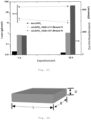
- Figure 23 shows the improvement of corrosion protection by the particles according to the invention.
- Example 3 (comparative example without chelating agent):
- Example 3a (comparative example without chelating agent):
- Example 4 (comparative example without chelating agent):
- the zinc manganese phosphate precipitate was centrifuged, washed three times with deionized water, centrifuged again in between (4000 rpm, 30 min at 18 °C) and then dried under vacuum at 30 °C for 24 h.
- the zinc manganese phosphate precipitate was centrifuged, washed three times with deionized water, centrifuged again in between (4000 rpm, 30 min at 18 °C) and then dried under vacuum for 24 h at 30 °C.
- Example 18 (Comparative example without chelating agent)
Landscapes
- Chemical & Material Sciences (AREA)
- Organic Chemistry (AREA)
- Inorganic Chemistry (AREA)
- Engineering & Computer Science (AREA)
- Materials Engineering (AREA)
- Life Sciences & Earth Sciences (AREA)
- Wood Science & Technology (AREA)
- Ceramic Engineering (AREA)
- Structural Engineering (AREA)
- Pharmaceuticals Containing Other Organic And Inorganic Compounds (AREA)
- Inorganic Compounds Of Heavy Metals (AREA)
- Cosmetics (AREA)
- Dental Preparations (AREA)
- Compositions Of Macromolecular Compounds (AREA)
- Pigments, Carbon Blacks, Or Wood Stains (AREA)
- Chemical Treatment Of Metals (AREA)
Description
- Die Erfindung betrifft ein Verfahren zur Herstellung von anisotropen plättchenförmigen Zinkphosphat-Partikeln und Zink-Metall-Mischphosphatpartikeln.
- Zinkphosphate in disperser Phase finden breite Anwendung im Bereich des Korrosionsschutzes, insbesondere für niedrig legierte Stähle. Zink-Metall-Mischphosphate werden zum einen in mikroskaliger Form als pigmentförmige Additive in Lacken verwendet. Sie besitzen zumeist eine breite Partikelgrößenverteilung und sind uneinheitlich bezüglich ihrer Partikelform sowie ihres Agglomerationszustandes. Aufgrund der Dimensionen der vorhandenen Agglomerate im Mikrometerbereich lassen sie sich beispielsweise nicht unter Erhalt der optischen Transparenz in Klarlacken dispergieren. Zusätzlich wird die Dispergierung in organischen Lacken durch die Hydrophilie der Zink-Phosphat-Oberfläche erschwert, welche eine an das Bindemittel angepasste spezifische Oberflächenmodifizierung erforderlich macht, die wiederum in einem zusätzlichen Prozessschritt erfolgen muss. Zum anderen werden Zink-Metall-Mischphosphate weiterhin als wässrige Dispersionen zur Vorbehandlung von Stahlsubstraten mit dreidimensionaler Oberfläche über Tauchbeschichtungsverfahren eingesetzt. Darunter fallen der direkte Einsatz der Phosphate als Korrosionsschutz-Primer über stromlose Abscheidungsverfahren und ihre Verwendung als Additiv in Elektrotauchlacken. Weiterhin werden Zinkphosphate als Zemente in der Dentaltechnik eingesetzt.
-
DE1815112 [Hoechst ] beschreibt einen Phosphathärter in pigmenthaltigen, alkali-silikat-basierten Anstrichfarben enthaltend Zink-, Eisen-, Blei-, Magnesiumphosphate und Mischungen derselben beinhaltend einem nachgeschalteten Temperprozess bei 550-900 °C. Die Zusammensetzungen besitzen ein Phosphoroxid:Eisenoxid-Verhältnis von 1:1-3:1. Bei den angegebenen Temperaturen lässt sich ein Zusammensintern der Primärpartikel nicht verhindern, so dass die erhaltenen Partikel stark agglomeriert vorliegen und nicht mehr vollständig redispergierbar sind. Sie sind damit für optische Anwendungen nicht geeignet. -
DE2842150 [Hoechst ] beansprucht ein Verfahren zur Herstellung fein verteilter Zinkphosphate ausgehend von Zinkoxid und Phosphorsäure in äquimolarem Verhältnis unter Einwirkung von Ultraschall (10-100 kHz, 1-50 kW/m3) in Wasser und anschließender Sprühtrocknung. Der letzte Schritt beinhaltet das Problem der Partikelagglomeration. Der Begriff "feinverteilt" wird definiert über eine Partikelgröße < 25 µm. Eine spezielle Oberflächenmodifizierung der Teilchen wird nicht vorgenommen. -
DE3046697 A1 [Heubach ] beansprucht Metalloxid, -phosphat, - molybdat sowie -chromat-Korrosionsschutzpigmente enthaltend Zink, Aluminium, Eisen, Erdalkalimetall, Chrom, Blei oder Titan als Metallkomponente, welche in wässriger Lösung bei 70-80 °C mit Phthalsäure bzw. Phthalsäureanhydrid behandelt werden. In ähnlicher Weise umfassenDE3605526A1 [Heubach ] entsprechende Korrosionsschutzpigmente und deren Verwendung sowieDE3731737A1 [Heubach ] solche auf Basis von Erdalkalihydrogenphosphat, insbesondere mit Magnesium bzw. Strontium. Alle genannten Partikelsorten besitzen eine breite Partikelgrößenverteilung mit einer mittleren Partikelgröße im Mikrometerbereich. Die kleinere Fraktion der Partikel reicht mit der Größenverteilung bis in den Submikrometerbereich. Die Partikel sind unförmig bis kugelförmig. -
US 5030285 [Colores Hispania ] beschreibt sphärische Zinkphosphat- / Eisenphosphat-Partikel als korrosions-inhibierendes Pigment hergestellt über eine Sulfatroute bei pH 7 / 80 °C mit einer Partikelgröße zwischen 0,5 µm und 5 µm. Der Kristallinitätsgrad des enthaltenen Zinkphosphats beträgt 10-70 %. Der amorphe Anteil enthält Eisenphosphat im Molverhältnis Zn:Fe 1:0,001 bis 1:0,3. -
US 5137567 [Colores Hispania ] beschreibt sphärisches Zinkphosphat-Dihydrat sowie - Tetrahydrat als korrosions-inhibierendes Pigment, welches 0,5 % bis 6 % Zinkoxid als Nebenbestandteil enthält. Die Synthese erfolgt ausgehend von Zinkoxid bei pH 7 durch Zugabe von Ammonium-chlorid-gepufferter Phosphorsäure. -
EP 0896641 B1 /DE 69706161 T2 [PPG ] beansprucht eine wässrige, saure Zusammensetzung zur Ausbildung einer Zinkphosphat und Wolfram enthaltenden Beschichtung auf einem Metallträger, enthaltend neben Zink- und Phosphationen sowie Wolfram auch einen Beschleuniger, ausgewählt aus einer aus einem Oxim, aus Mischungen eines Oxims mit Hydroxylaminsulfat bestehenden Gruppe sowie zusätzlich gegebenenfalls Fluorid-, Mangan-, Calcium- bzw. Magnesium-Ionen. Die Beschichtungszusammensetzung eignet sich aufgrund ihrer Ausführung bevorzugt zum Schutz von Aluminiumsubstraten. -
US 4153479 [Oxy Metal Industries ] beschreibt eine wässrige saure, Oxidationsmittel- und Alkalimetall-freie Zinkphosphat-Lösung ausgehend von Phosphorsäure und Zinkoxid, -hydroxid oder -carbonat, enthaltend Weinsäure oder Zitronensäure sowie deren Salze und gegebenenfalls Nickel. Alle notwendigen Komponenten werden in einem Reaktionsgefäß gleichzeitig gemischt. Bei pH-Werten zwischen 3,5 und 4,7 produziert die Lösung nach nasschemischem Auftrag eine mikrokristalline Zinkphosphatbeschichtung auf Eisen und Stahl. - Lubkowski et al. beschreiben die Herstellung von Zinkphosphat Nanomaterialien ausgehend von Zinknitrat, Di-Ammoniumphosphat und Zitronensäure. Die Lösung wird bei erhöhter Temperatur konzentriert, bis ein Gel entsteht, welches dann kalziniert wird. In einem zweistufigen Temperaturprozess mit einer Endtemperatur im Kalzinierungsschritt von 300 °C wird Zinkphosphat in Form von Hopeit erhalten. Die Kristallitgrößen der gebildeten Partikel werden aus den Röntgenspektren mit 40-130 nm berechnet. Elektronenmikroskopische Aufnahmen, die Hinweise auf die Partikel-Morphologie geben könnten, werden nicht gezeigt.
- Yuan et al. beschreiben die Herstellung plättchenförmiger Hopeit Partikel aus Zinkoxid und Phosphorsäure bei pH 6-8 und einer Temperatur von 70 °C. Die Partikel sind lamellar mikrokristallin aufgebaut und von orthorhombischer sowie monokliner Kristallstruktur. Sie besitzen laut Elektronenmikroskopie eine blockförmige, granulare Morphologie bei einer mittleren Partikelgröße von 10 µm.
- McCurdy et al. beschreiben die Metathese Synthese von α-Hopeit bei Raumtemperatur durch Mörsern von Zinkchlorid mit verschiedenen Phosphorverbindungen wie Na3PO4, Na2HPO4, NaH2PO4 und K2HPO4 und nachfolgendes Waschen mit Wasser und anschließend mit Aceton. Die Röntgenspektren nach dem Mörsern zeigen zunächst die Kristallstruktur von NaCl und nach dem Waschprozess diejenige von α-Hopeit welcher sich spontan bildet. Die elektronenmikroskopischen Aufnahmen zeigen plättchenförmige Partikel mit hohem Aspektverhältnis, insbesondere bei Verwendung von Na3PO4 als Phosphorverbindung.
-
JP 2000-154010A -
JP H05-239376A - Aufgabe der vorliegenden Erfindung ist die Bereitstellung von einem Verfahren zur Herstellung Zinkphosphat- sowie Zink-Metall-Mischphosphat-Partikeln aus kostengünstigen Ausgangsverbindungen, die in ihrer Partikelform gezielt anisotrop einstellbar, und falls erforderlich, vollständig auf Primärteilchengröße dispergierbar sind.
- Diese Aufgabe wird durch die Erfindungen mit den Merkmalen der unabhängigen Ansprüche gelöst. Vorteilhafte Weiterbildungen der Erfindungen sind in den Unteransprüchen gekennzeichnet. Der Wortlaut sämtlicher Ansprüche wird hiermit durch Bezugnahme zum Inhalt dieser Beschreibung gemacht. Die Erfindungen umfassen auch alle sinnvollen und insbesondere alle erwähnten Kombinationen von unabhängigen und/oder abhängigen Ansprüchen.
- Die Aufgabe wird durch ein Verfahren zur Herstellung von anisotropen plättchenförmigen Zink-Phosphat-Partikeln oder anisotropen plättchenförmigen Zink-Metall-Mischphosphat-Partikeln gelöst, umfassend die folgenden Schritte:
- a) Herstellen einer Zusammensetzung umfassend mindestens eine Phosphatverbindung; mindestens eine Zinkverbindung und mindestens einen Chelatkomplexbildner mit mindestens zwei sauerstoffhaltigen Gruppen, ausgewählt aus der Gruppe umfassend Karbonsäuregruppen, Karbonsäureanhydridgruppen, Ethergruppen, Estergruppen, Ketogruppen und Hydroxylgruppen, und mindestens ein Lösungsmittel,
- b) Bildung von anisotropen Zink-Phosphat-Partikeln oder Zink-Metall-Mischphosphat-Partikeln;
- c) Abtrennung der erhaltenen plättchenförmigen Partikel, wobei die Bildung der Partikel für mindestens 10 Stunden erfolgt, wobei die Partikel in mindestens zwei Dimensionen eine Ausdehnung von mindestens 1 µm aufweisen, und die Partikel ein Aspektverhältnis von > 2 von Länge zu Dicke aufweisen und die maximale Ausdehnung der Partikel bei 100 µm liegt.
- Im Folgenden werden einzelne Verfahrensschritte näher beschrieben. Die Schritte müssen nicht notwendigerweise in der angegebenen Reihenfolge durchgeführt werden, und das zu schildernde Verfahren kann auch weitere, nicht genannte Schritte aufweisen.
- Durch die Herstellung einer Zusammensetzung aus der mindestens einen Zinkverbindung und mindestens einem Chelatkomplexbildner mit mindestens zwei sauerstoffhaltigen Gruppen werden die Zn2+-Ionen in dieser Zusammensetzung durch den Chelatkomplexbildner komplexiert. Durch die Anwesenheit des Chelatkomplexbildners und die konzentrationsgesteuerte Reaktionsgeschwindigkeit der Nukleations- und Fällungsreaktion bilden sich nur wenige Nuklei, die in Abhängigkeit von der Konzentration des Komplexbildners zeitlich verzögert und anisotrop weiterwachsen. Die Kombination von mangelkonzentrationsgesteuerter Zinkphosphat-Fällungskinetik und gleichzeitiger Komplexierung von Zn2+-Ionen mittels eines Chelatkomplexbildners mit mindestens zwei sauerstoffhaltigen Gruppen führt überraschenderweise zu dünnen, kristallinen Partikeln bevorzugt mit orthorhombischer Kristallstruktur (Zn3(PO4)2 * 4 H2O) und plättchenförmiger Morphologie sowie hohem Aspektverhältnis.
- Die Abtrennung der Partikel kann beispielsweise eine Isolation der Partikel umfassen. Dies kann beispielsweise durch Filtration, Zentrifugation und/oder Sedimentation geschehen. Die Partikel können auch noch gewaschen werden. Das Abtrennen kann aber auch eine Weiterverarbeitung als Suspension beinhalten, ohne dass die Partikel isoliert werden.
- In einer Ausführungsform der Erfindung werden die Partikel in einem letzten Schritt isoliert. Darunter wird die Abtrennung der Partikel von der Reaktionslösung verstanden. Dies kann beispielsweise durch Zentrifugation und/oder Sedimentation geschehen. Die Partikel können danach als Dispersion wieder aufgenommen werden oder auch getrocknet werden.
- Die hergestellten Partikel weisen eine plättchenförmige Partikelmorphologie auf, mit einem Aspektverhältnis > 2, besonders bevorzugt >3. Unter einem Aspektverhältnis wird das Verhältnis von Länge zu Dicke (L/D) verstanden. Plättchenförmige Partikel weisen dieses Verhältnis in zwei Partikeldimensionen auf (L/D, B/D,
Figur 24 ). Dabei bezieht sich das Aspektverhältnis bevorzugt auf die mittlere Länge und Dicke eines Teilchens. Die Daten können mit REM ermittelt werden. Bevorzugt werden die Dimensionen der Partikel dadurch ermittelt, dass durch REM-Aufnahmen eines zufälligen Ausschnitts die Ausmaße von 20 Einzelpartikeln erfasst werden. - Die Partikel weisen in mindestens zwei Dimensionen eine Ausdehnung von mindestens 1 µm auf. Dies lässt sich durch Auswertung mittels REM bestimmen. Bevorzugt werden die Dimensionen der Partikel dadurch ermittelt, dass durch REM-Aufnahmen eines zufälligen Ausschnitts die Ausmaße von 20 Einzelpartikeln erfasst werden.
- In einer Ausführungsform haben die Partikel eine Dimension mit einer Ausdehnung von mindestens 2 µm (gemessen mit REM) und eine Dimension mit einer Ausdehnung von mindestens 1 µm. Bevorzugt werden die Dimensionen der Partikel dadurch ermittelt, dass durch REM-Aufnahmen eines zufälligen Ausschnitts die Ausmaße von 20 Einzelpartikeln erfasst werden.
- Die maximale Ausdehnung der Partikel liegt bei 100 µm, besonders bevorzugt bei 50 µm. Bevorzugt werden die Dimensionen der Partikel dadurch ermittelt, dass durch REM-Aufnahmen eines zufälligen Ausschnitts die Ausmaße von 20 Einzelpartikeln erfasst werden.
- Bevorzugt fallen mindestens 30 % (der erfassten Partikel), bevorzugt mindestens 60 %, insbesondere mindestens 70 %, mindestens 80 % der Partikel, besonders bevorzugt alle erfassten Einzelpartikel unter mindestens eine der vorstehend bevorzugten Ausführungsformen der Erfindung in Bezug auf Aspektverhältnis und/oder Ausdehnung.
- Das mindestens eine Lösungsmittel ist bevorzugt ausgewählt aus Wasser und aliphatischen oder aromatischen Alkoholen mit mindestens einer OH-Gruppe. Dabei sind die aliphatischen oder aromatischen Alkohole mit Wasser mischbar, wobei darunter die Herstellung einer mindestens 10 Gew.-%-Lösung in Wasser verstanden wird. Die Zusammensetzung weist bevorzugt nur eine flüssige Phase auf.
- In einer bevorzugten Ausführungsform der Erfindung ist das mindestens eine Lösungsmittel Wasser und/oder mindestens ein aliphatischer oder aromatischer Alkohol, besonders bevorzugt Wasser und/oder mindestens ein aliphatischer Alkohol mit mindestens einer Hydroxylgruppe.
- Bevorzugte aliphatische Alkohole mit mindestens einer Hydroxylgruppe sind C1-C8-Alkohole wie Methanol, Ethanol, 1-Propanol, Isopropanol, 1-Butanol, 2-Butanol, Propylenglykol, Glycerin, Diole mit 2 bis 12 Kohlenstoffatomen wie Ethylenglykol, Propylenglykol, Butylenglykol, Pentandiol, Hexamethylenglykol, Octandiol, Neopentylglykol, Cyclohexandimethanol, Diethylenglykol, Triethylenglykol, Dipropylenglykol, oder Polyole mit 2 bis 12 Kohlenstoffatomen, Monoether von Diolen, wie Ethylenglycol oder Propylenglycol, mit C1-C6-Alkoholen, wie Isopropoxyethanol.
- Es kann auch ein Gemisch von Wasser und mindestens einem vorgenannten Alkohol vorliegen. Bevorzugt handelt es sich um ein Gemisch mit einer flüssigen Phase, d.h. das Wasser und der mindestens eine Alkohol sind miteinander mischbar.
- In einer bevorzugten Ausführungsform handelt es sich um Wasser, um mindestens einen der vorgenannten Alkohole oder um ein Gemisch aus Wasser und mindestens einem der vorgenannten Alkohole. Das Verhältnis von Wasser zu Alkohol liegt von 100:0 bis 0:100, bevorzugt von 100:0 bis 60:40 (in Gew.-%), besonders bevorzugt von 100:0 bis 70:30 (Gew.-%), wobei 100:0 bedeutet, dass nur Wasser und 0:100 bedeutet, dass nur Alkohol als Lösungsmittel verwendet wurde.
- Bevorzugt ist das Lösungsmittel so gewählt, dass mindestens die mindestens eine Zinkverbindung und der mindestens eine Chelatkomplexbildner darin gelöst vorliegen. Aus einer solchen Lösung können dann die Phosphatpartikel ausgefällt werden.
- Die Zusammensetzung umfasst mindestens eine Phosphatverbindung. Bevorzugt handelt es sich um Phosphorsäure und/oder ein Salz der Phosphorsäure. Es kann sich dabei um Phosphat, Dihydrogenphosphat und/oder Hydrogenphosphat handeln. Bevorzugt sind Phosphorsäure sowie Phosphate, Dihydrogenphosphate und/oder Hydrogenphosphate von Alkalimetallen oder Ammoniumionen, bevorzugt von Ammonium, Lithium, Natrium und/oder Kalium. Besonders bevorzugt ist als Phosphatverbindung Na3PO4, Na2HPO4, NaH2PO4, (NH4)3PO4, (NH4)2HPO4, (NH4)H2PO4 und/oder H3PO4.
- Der Gehalt an der mindestens einen Phosphatverbindung liegt im Fall einer wässrigen Zusammensetzung bevorzugt bei über 0,5 Gew.-% bezogen auf PO4 3-. Dabei wird unter einer wässrigen Zusammensetzung eine Zusammensetzung verstanden, mit einem Anteil von mindestens 70 Gew.-% bezogen auf das Lösungsmittel. Bevorzugt liegt der Gehalt an Phosphat bei über 1 Gew.-%, besonders bevorzugt über 2 Gew.-%. Der Gehalt kann davon unabhängig bis zu 40 Gew.-%, bevorzugt bis zu 30 Gew.-% betragen. Besonders bevorzugt ist ein Gehalt zwischen 0,5 Gew.-% und 40 Gew.-%, insbesondere 2 Gew.-% und 30 Gew.-%. Bei nichtwässrigen Zusammensetzungen kann der Gehalt aufgrund geringerer Löslichkeit niedriger sein.
- Unter einem Chelatkomplexbildner wird eine Verbindung verstanden, welche mit den mindestens zwei sauerstoffhaltigen Gruppen einen Komplex zu einem Metallion, bevorzugt Zn2+-Ion, aufbauen kann. Dabei sind die mindestens zwei sauerstoffhaltigen Gruppen ausgewählt aus der Gruppe umfassend Karbonsäuregruppen, Karbonsäureanhydridgruppen, Ethergruppen, Estergruppen, Ketogruppen und Hydroxylgruppen.
- In einer bevorzugten Ausführungsform der Erfindung ist der Chelatkomplexbildner eine organische Säure mit einem pKs-Wert <6. Bevorzugt umfasst der Chelatkomplexbildner mindestens eine Karbonsäuregruppe oder vinyloge Karbonsäuregruppe.
- In einer weiteren bevorzugten Ausführungsform der Erfindung ist die zweite sauerstoffhaltige Gruppe über maximal 10 Bindungen mit der ersten sauerstoffhaltigen Gruppe verbunden. Der mindestens eine Chelatkomplexbildner kann noch weitere sauerstoffhaltige Gruppen oder andere Gruppen enthalten.
- In einer bevorzugten Ausführungsform der Erfindung ist der mindestens eine Chelatkomplexbildner ausgewählt aus der Gruppe umfassend α-Hydroxycarbonsäuren, Zitronensäure, Äpfelsäure, Weinsäure, Ascorbinsäure, Mandelsäure, Glyoxalsäure, Malonsäure, Milchsäure, Essigsäure, Fumarsäure, Maleinsäure, Gluconsäure, Phthalsäure und Adipinsäure. Er kann als freie Säure oder auch als Anion vorliegen.
- Bevorzugt weist der mindestens eine Chelatkomplexbildner eine Molmasse von unter 500 g/mol auf, bevorzugt unter 300 g/mol.
- Besonders bevorzugte Chelatkomplexbildner sind Zitronensäure, Äpfelsäure, Weinsäure, Malonsäure, Maleinsäure, Ascorbinsäure und Phthalsäure oder Salze davon, welche einzeln oder in Kombination verwendet werden können.
- Die Zusammensetzung umfasst außerdem eine Zinkverbindung. Bevorzugt handelt es sich dabei um ein Zinksalz, besonders bevorzugt ausgewählt aus der Gruppe umfassend Zinknitrat, Zinknitrit, Zinkchlorid, Zinkbromid, Zinkiodid, Zinksulfat, und Zinksalze monomerer oder polymerer organischer Säuren, wie Zinkacetat, Zinkacetylacetonat, Zinkbenzoat, Zinkformiat, Zinklactat, Zinkcitrat, Zinktartrat, Zinkascorbat. Bei der Säure kann es sich auch um den mindestens einen Chelatkomplexbildner handelt. Es können auch Gemische von Zinkverbindungen verwendet werden.
- Bezogen auf die molaren Verhältnisse liegt das Verhältnis von Chelatkomplexbildner (CS) und Zinkverbindung bevorzugt bei mindestens 0,1/1, bevorzugt bei mindestens 0,5/1. In einer Ausführungsform der Erfindung liegt das Verhältnis bei 0,1/1 bis 2,0/1, bevorzugt bei 0,33/1 bis 1,6/1 (Verhältnis CS/Zn in mol bezogen auf Zn2+), insbesondere bei 0,5/1 bis 1,5/1. Wenn zusätzlich eine weitere Metallverbindung anwesend ist, so wird der molare Anteil dieser Metallverbindung bei der Berechnung des Verhältnisses zum Anteil der Zinkverbindung addiert. Es wird dann das Verhältnis CS/(Zn + Metallverbindung) berechnet, welches die vorgenannten Bedingungen erfüllen muss.
- Die Zusammensetzung kann auch noch mindestens eine weitere Metallverbindung enthalten, falls Zink-Metall-Phosphate hergestellt werden sollen. Diese weitere Metallverbindung ist keine Zinkverbindung. Bevorzugt geschieht dies durch Zugabe entsprechender Salze der weiteren Metallverbindungen. Beispiele für weitere Metallionen sind Mangan, Magnesium, Calcium, Strontium, Eisen, Cer, Aluminium, Nickel oder Kobalt. Diese Metallionen können als Salze, wie beispielsweise als Acetate, Nitrate oder Chloride, zugegeben werden.
- Das molare Verhältnis zwischen der mindestens einen Zinkverbindung und der mindestens einen weiteren Metallverbindung liegt bevorzugt bei 1/0 bis 1/3 (bezogen auf die jeweiligen Zink- bzw. Metallionen), bevorzugt von 1/0 bis 1/2, wobei 1/0 bedeutet, dass die Zusammensetzung keine weitere Metallverbindung umfasst.
- In einer bevorzugten Ausführungsform der Erfindung beträgt das molare Verhältnis der Menge der mindestens einen Zinkverbindung bezogen auf Zn-Ionen und der zugegebenen Menge der mindestens einen Phosphatverbindung bezogen auf P (Zn/P in mol) 0,8 bis 1,8, bevorzugt 1 bis 1,7. Wenn zusätzlich eine weitere Metallverbindung anwesend ist, so wird der molare Anteil dieser Metallverbindung bei der Berechnung des Verhältnisses zum Anteil der Zinkverbindung addiert. Es wird dann das Verhältnis (Zn + Metallverbindung)/P berechnet, welches die vorgenannten Bedingungen erfüllen muss.
- In einer bevorzugten Ausführungsform der Erfindung liegt der pH-Wert der Zusammensetzung vor Beginn des Verfahrens bei kleiner gleich 3,5, bevorzugt bei kleiner gleich 3. Dies gilt insbesondere für Zusammensetzungen mit einem Anteil an Wasser am Lösungsmittel von mindestens 70 Gew.-%.
- In einer bevorzugten Ausführungsform der Erfindung beträgt die Temperatur der Zusammensetzung bei der Bildung der Partikel weniger als 50 °C, bevorzugt weniger als 40 °C, besonders bevorzugt weniger als 30 °C. Die Temperatur kann dabei zwischen 5 °C und 50 °C, bevorzugt zwischen 10 °C und 40 °C betragen, besonders bevorzugt zwischen 15 °C und 30 °C. Durch die niedrige Temperatur wird die Bildung von kristallinen Partikeln begünstigt.
- Zur Bildung der Partikel kann die Zusammensetzung durchmischt, z. B. gerührt werden.
- Die Bildung der Partikel kann durch Dauer des Ausfällprozesses beeinflusst werden. Es kann erforderlich sein die Partikel erst nach mindestens 30 Minuten, bevorzugt mindestens 1 Stunde abzutrennen. Abhängig von den Bedingungen dauert die Bildung der Partikel mindestens 10 Stunden, insbesondere mindestens 15 Stunden, besonders bevorzugt mindestens 20 Stunden. Es kann erforderlich sein, die Zusammensetzung dabei zu durchmischen, z. B. zu rühren.
- Der Gehalt an Zinkverbindung liegt im Fall einer wässrigen Zusammensetzung bevorzugt bei über 0,5 Gew.-% bezogen auf Zn2+. Dabei wird unter einer wässrigen Zusammensetzung eine Zusammensetzung verstanden, mit einem Anteil von mindestens 70 Gew.-% bezogen auf das Lösungsmittel. Bevorzugt liegt der Gehalt an Zn bei über 1 Gew.-%, besonders bevorzugt über 2 Gew.-%. Der Gehalt kann davon unabhängig bis zu 40 Gew.-%, bevorzugt bis zu 30 Gew.-% betragen. Besonders bevorzugt ist ein Gehalt zwischen 0,5 Gew.-% und 40 Gew.-%, insbesondere 2 Gew.-% und 30 Gew.-%.
- Das Verfahren kann außerdem noch den Schritt enthalten, dass vor oder während der Bildung der Partikel der Feststoffgehalt der Zusammensetzung auf einen bestimmten Wert eingestellt wird, z. B. 0,5 bis 20 Gew.-%. Dies kann beispielsweise durch Zugabe von Lösungsmittel geschehen. Bevorzugt wird mindestens ein Lösungsmittel zugegeben, besonders bevorzugt Wasser.
- In einem nächsten Schritt können die erhaltenen Partikel optional gewaschen werden. Dies kann beispielsweise durch einmaliges oder mehrfaches Zentrifugieren, entfernen des Überstands und Zugabe von Wasser geschehen.
- Unter den angegebenen Bedingungen werden im Rahmen der Synthese sowohl Partikel mit orthorhombischer Kristallstruktur, als auch eine Reihe weiterer Nebenprodukte (u.a. Reste der Zinkverbindung, der Phosphatverbindung, lösliche Zink-Carboxylat-Komplexe etc.) erhalten. Im anschließenden Zentrifugations- und Waschprozess werden die wasserlöslichen Nebenbestandteile von den wasserunlöslichen Partikeln bevorzugt mit orthorhombischer Kristallstruktur abgetrennt. Die Abtrennung der wasserlöslichen Nebenbestandteile gelingt, wie die Ergebnisse der Elementaranalyse zeigen, bereits nach dem ersten Zentrifugationsschritt praktisch vollständig. Das Aspektverhältnis der anisotropen Partikel ist dabei von dem Chelatkomplexbildner/Zn-Verhältnis abhängig. Der Zentrifugations- und Waschprozess ändert die einmal gebildete anisotrope Partikelform und das Aspektverhältnis der anisotropen Partikel nicht mehr (siehe auch
Figur 16 ). - Die Partikel können danach getrocknet werden, bevorzugt bei Temperaturen von unter 150 °C, bevorzugt unter 100 °C, ganz besonders bevorzugt unter 50 °C, insbesondere unter 40 °C oder unter 35 °C. Dabei kann auch Vakuum verwendet werden.
- Es findet bevorzugt keine Kalzinierung statt.
- Das erfindungsgemäße Verfahren erlaubt die Herstellung der Partikel mit günstigen Ausgangsstoffen und unter einfachen Bedingungen.
- In einer weiteren Ausführungsform der Erfindung ist die erfindungsgemäße Zusammensetzung frei von Beschleunigern, wie Nitriten, Chloraten, Bromaten. Diese werden insbesondere in Zusammensetzungen zum Erzeugen von Phosphatschichten auf Oberflächen verwendet.
- Die erfindungsgemäße Zusammensetzung wird auf keine Oberfläche aufgetragen. Die Partikel bilden sich in der Zusammensetzung selbst.
- In einer Ausführungsform der Erfindung wird die Zusammensetzung aus mindestens zwei Zusammensetzungen erhalten. Dazu werden eine Zusammensetzung umfassend mindestens eine Phosphatverbindung und eine weitere Zusammensetzung umfassend mindestens eine Zinkverbindung und mindestens einen Chelatkomplexbildner mit mindestens zwei sauerstoffhaltigen Gruppen hergestellt. Danach wird die Zusammensetzung mit der mindestens einen Phosphatverbindung zu der Zusammensetzung umfassend die mindestens eine Zinkverbindung und mindestens einen Chelatkomplexbildner gegeben. Dabei bildet sich die erfindungsgemäße Zusammensetzung.
- Die Zugabe kann auf einmal oder tropfenweise erfolgen. In einer weiteren Ausführungsform der Erfindung beträgt die Temperatur aller Zusammensetzungen des Verfahrens bei Zugabe unter 50 °C, bevorzugt 10 °C bis 40 °C.
- Die Zusammensetzung umfassend mindestens eine Phosphatverbindung ist bevorzugt eine Lösung der mindestens einen Phosphatverbindung. Bevorzugt handelt es sich um Phosphorsäure und/oder ein Alkalisalz der Phosphorsäure. Es kann sich dabei um Phosphat, Dihydrogenphosphat und/oder Hydrogenphosphat handeln. Bevorzugt sind Phosphorsäure sowie Phosphate, Dihydrogenphosphate und/oder Hydrogenphosphate von Lithium, Natrium und/oder Kalium. Besonders bevorzugt ist als Phosphatverbindung Na3PO4, Na2HPO4, NaH2PO4 und/oder H3PO4.
- Der Gehalt an der mindestens einen Phosphatverbindung in dieser Zusammensetzung bezogen auf PO4 3- liegt dabei bevorzugt zwischen 0,5 und 90 Gew.-%. Im Fall einer wässrigen Zusammensetzung liegt der Gehalt bevorzugt zwischen 1 Gew.-% und 90 Gew.-%.
- Der Gehalt an der mindestens einen Zinkverbindung bezogen auf Zn2+ in der anderen Zusammensetzung liegt bevorzugt zwischen 0,5 Gew.-% und 30 Gew.-%, bevorzugt zwischen 1 Gew.-% und 25 Gew.-% oder zwischen 1 Gew.-% und 15 Gew.-%.
- Falls noch andere Metallverbindungen hinzugegeben werden, so werden diese in der Zusammensetzung umfassend die mindestens eine Zinkverbindung gelöst. Deren Anteile bezogen auf die jeweiligen Metallionen zählen als Teil der Anteile an der Zinkverbindung.
- Die molaren Verhältnisse zwischen Zn und dem Chelatkomplexbildner entsprechen den Verhältnissen in der erfindungsgemäßen Zusammensetzung.
- Die hergestellten Zinkphosphat-Partikel und Zink-Metall-Mischphosphat-Partikel eignen sich für alle üblichen Einsatzgebiete für Zinkphosphate oder Zink-Metall-Mischphosphate. Sie können beispielsweise als Korrosionsschutzpigmente eingesetzt werden, beispielsweise in Lacken und Farben.
- Die hergestellten Partikel zeichnen sich dadurch aus, dass sie vollständig redispergierbar sind und daher gerade in Lacken und Farben einsetzbar sind.
- Anisotrope, bzw. plättchenförmige, Partikel können sich insbesondere in Beschichtungszusammensetzungen parallel zur beschichteten Oberfläche ausrichten. Dadurch können solche Beschichtungen eine hohe Diffusionsbarriere aufweisen. Dies ist bei kugelförmigen Teilchen aus dem Stand der Technik nicht möglich. Die auf der Oberfläche erzeugten Beschichtungen erfordern eine Behandlung der Oberfläche und sind häufig nur für bestimmte Oberflächen geeignet. So müssen sie häufig erhitzt werden, um die Phosphatschicht zu bilden oder enthalten aggressive Inhaltsstoffe (Oxidationsmittel, Säuren, etc.).
- Die hergestellten Partikel können auch in ein Verbundmaterial, welches ein Polymer umfasst, eingebracht werden. Sie können insbesondere zur Herstellung von Polymerkompositen in alle gängigen Polymere eingebracht werden, die durch Polykondensation, Polyaddition, radikalische Polymerisation, ionische Polymerisation und Copolymerisation hergestellt wurden. Beispiele für derartige Polymere sind Polyurethane, Polycarbonat, Polyamid, Polyacrylate, Polyacrylsäure, Polymethylmethacrylat (PMMA), Polyester, Polyolefine, Kautschuk, Polysiloxane, EthylenVinylalkohol-Copolymer (EVOH), Polylactide, Polystyrol, Polyethylenoxid (PEO), Polyphenylenoxid (PPO), Polyacrylnitril (PAN), Polyepoxide, Polyamidimide, Polyimide, Epoxy-PhenolHarze, Epoxy-Phenoxy-Harze.
- Das Einbringen in Polymere kann mittels gängiger Techniken wie bspw. Extrusion, Knetverfahren, Rotor-Stator-Verfahren (Dispermat, Ultra-Turrax, etc.), Mahlverfahren (Kugelmühle etc.) oder Strahldispergierung erfolgen und hängt von der Viskosität der Polymeren ab.
- Weitere Einzelheiten und Merkmale ergeben sich aus der nachfolgenden Beschreibung von bevorzugten Ausführungsbeispielen in Verbindung mit den Unteransprüchen. Hierbei können die jeweiligen Merkmale für sich alleine oder zu mehreren in Kombination miteinander verwirklicht sein. Die Möglichkeiten, die Aufgabe zu lösen, sind nicht auf die Ausführungsbeispiele beschränkt.
- So umfassen beispielsweise Bereichsangaben stets alle - nicht genannten - Zwischenwerte und alle denkbaren Teilintervalle.
- Die Figuren zeigen Ergebnisse und Messungen zu den Ausführungsbeispielen. Alle Verhältnisangaben in den Figurenbeschreibungen sind molare Verhältnisse. Im Einzelnen zeigt:
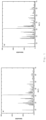
- Fig. 1
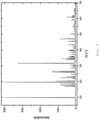
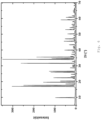
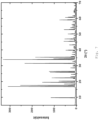
- a): Diffraktogramm von Vergleichsbeispiel 3: Zn/P = 1,5 ohne Zitronensäure als Chelatkomplexbildner (CS) CS/Zn 0/1, H3PO4 (85 Gew. %), 4x zentrifugiert, Diffraktogramm b): Beispiel 2: Zn/P = 1,5 mit Zitronensäure als Chelatkomplexbildner (CS) CS/Zn 1/1, H3PO4 (85 Gew.-%), 4x zentrifugiert (XRD-Spektrum Hopeit Zn3(PO4)2 * 4H2O);
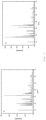
- Fig. 2
- Abhängigkeit von Zentrifugationsbedingungen, Diffraktogramme a) Beispiel 2: Zn/P = 1,5; CS/Zn 1/1, H3PO4 (85 Gew.-%), 1x zentrifugiert, Diffraktogramm; b) Beispiel 2: Zn/P = 1,5 CS/Zn 1/1, H3PO4 (85 Gew.-%), 2x zentrifugiert, (XRD-Spektrum Hopeit Zn3(PO4)2 * 4 H2O);
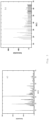
- Fig. 3
- a) Diffraktogramm von Beispiel 2a: CS/Zn 1/1, H3PO4 (30 Gew.-%), 4x zentrifugiert; Partikelgröße: groß: 2-3 µm; klein 0,2-0,4 µm (XRD-Spektrum Hopeit Zn3(PO4)2 * 4 H2O); b) Vergleichsdiffraktogramm für Hopeit
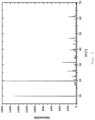
- Fig. 4
- Diffraktogramm von Beispiel 4: Zn/P = 1, CS/Zn = 0/1, 4x zentrifugiert;
- Fig. 5
- Diffraktogramm von Beispiel 5: Zn/P = 1, CS/Zn = 0,1/1, 4x zentrifugiert;
- Fig. 6
- Diffraktogramm von Beispiel 6: Zn/P = 1, CS/Zn = 0,8/1, 1x zentrifugiert;
- Fig. 7
- Diffraktogramm von Beispiel 6: Zn/P = 1, CS/Zn = 0,8/1, 2x zentrifugiert;
- Fig. 8
- Diffraktogramm von Beispiel 6: Zn/P = 1, CS/Zn = 0,8/1, 4x zentrifugiert;
- Fig. 9
- Schematische Darstellung des erfindungsgemäßen Verfahrens;
- Fig. 10
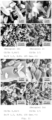
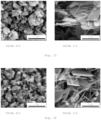
- REM-Aufnahmen der erhaltenen Partikel von Beispiel 3, 3a, 2 und 2a; Einfluss ohne Chelatkomplexbildner (unförmige Partikel) und mit Chelatkomplexbildner (plättchenförmige Partikel)
- Fig. 11
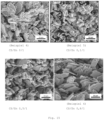
- REM Aufnahmen der erhaltenen Partikel mit dem Verhältnis Zn/P 1,5 sowie CS/Zn 0,66/1 und 1/1 in verschiedenen Auflösungen mit jeweils unterschiedlich konzentrierter Phosphorsäure H3PO4 (oben: 85 Gew.-% Beispiele 1b, 2; unten: 30 Gew.-% Beispiel 2a);
- Fig. 12
- REM Aufnahmen verschiedener Verhältnisse von CS/Zn und Zn/P bei Veränderung der Konzentration der Phosphorsäure (Zn-Verbindung Zn-Acetat mit Zitronensäure als CS) ;
- Fig. 13
- REM Aufnahmen der erhaltenen Partikel mit CS/Zn 0/1 und CS/Zn 1/1 bei Zn/P 1,5, H3PO4 (85 Gew.-%) bei tropfenweiser Zugabe der Phosphatlösung in die Zinkacetat/CS-Lösung (CS: Zitronensäure);
- Fig. 14
- REM Aufnahmen der erhaltenen Partikel mit CS/Zn 0/1 und CS/Zn 1/1 bei Zn/P 1,5 H3PO4 (85 Gew.-%) bei einmaliger Zugabe der Phosphatlösung in die Zinkacetat/CS-Lösung (Zitronensäure); Vergleich zu
Fig. 13 , Partikelform unabhängig von Zugabeweise; - Fig. 15
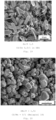
- REM Aufnahmen der erhaltenen Partikel von Beispiel 4, 5 und 6 mit Zn-Nitrat und Na2HPO4 als Ausgangsverbindungen; Zn/P 1, Na2HPO4 (10 Gew.-%), 4x zentrifugiert, zunehmendes CS/Zn-Verhältnis;
- Fig. 16
- REM Aufnahmen von Beispiel 6: Zn/P 1, CS/Zn 0,8/1, Na2HPO4 (10 Gew.-%), die Partikel wurden unterschiedlich oft zentrifugiert;
- Fig. 17
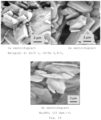
- REM Aufnahmen zu Versuchen zum Einfluss verschiedener Typen von Chelatkomplexbildnern; Zn/P 1, CS/Zn 0,8/1, Na2HPO4 (10 Gew.-%): Morphologie in Abhängigkeit vom Typ Komplexbildner, Äpfelsäure entspricht Beispiel 17;
- Fig. 18
- REM Aufnahmen von Beispiel 7, 8 und 9; Zn/P 1, CS/Zn 0,5/1, Na2HPO4 (10 Gew.-%), DEG/H2O 0,25 bis 16,9 (in Gew.-%), Zugabe der Phosphatlösung in Zinknitrat/CS-Lösung;
- Fig. 19
- REM-Aufnahmen von Zusammensetzungen Zn/P 1,5 mit CS/Zn 0,5/1, Na2HPO4 (1 Gew.-%), in DEG/H2O 1/0, einmalige Zugabe der Phosphatlösung in Zinknitrat/CS-Lösung;
- Fig. 20
- Manganphosphat-Partikel aus Manganacetat-tetra-hydrat und 85 %-iger H3PO4 (Mn/P = 1,5) ohne Chelatkomplexbildner (CS), CS/Mn = 0/1, (Beispiel 18: Vergleichsbeispiel ohne Chelatkomplexbildner);
- Fig. 21
- Manganphosphat-Partikel aus Manganacetat-tetra-hydrat und 85 %-iger H3PO4 (Mn/P = 1,5) mit Zitronensäure als Chelatkomplexbildner (CS), CS/Mn = 1/1, (Beispiel 20);
- Fig. 22
- Lichtmikrokopische Aufnahmen von Kompositen aus Epoxidharzmatrix mit 2 Gew.-% Zinkphosphat-Partikeln aus Beispiel 2 (Aufsicht) beschichtet auf Glas, a) thermisch härtendes Epoxidharz-Zinkphosphat-Komposit (Beispiel 21), b) UV-härtendes Epoxidharz-Zinkphosphat-Komposit (Beispiel 22);
- Fig. 23
- Einfluss der Partikel aus Beispiel 2 auf das Korrosionsverhalten einer Normalstahloberfläche, Korrosionsstrom Icorr aus Potentialmessungen und Durchtrittswiderstand aus elektrochemischen Impedanzmessungen, Stahl: ST1203, Medium: 3,5 % NaCl in Wasser, T = 23 °C, 0,75 Gew.-% erfindungsgemäße Partikel aus Beispiel 2 dispergiert im Medium; Die Säulen bedeuten: 1. Säule kein ZnPO4, 2. Säule mit ZnPO4, CS/Zn 0,1/1 (Beispiel 5); 3. Säule mit ZnPO4 CS/Zn 0,8/1 (Beispiel 6));
- Fig. 24
- Schematische Darstellung der Dimensionen eines plättchenförmigen Partikels.
- Tabelle 1 zeigt die Elementaranalyse (CHNS) von Beispiel 2 (Zn-Acetat und H3PO4 als Ausgangsverbindungen; Zn/P 1,5, CS/Zn 1/1, H3PO4 (85 Gew.-%).
- Tabelle 2 zeigt die Elementaranalyse (CHNS) von Beispiel 6 (Zn-Nitrat und Na2HPO4 als Ausgangsverbindungen; Zn/P 1, CS/Zn 0,8/1, Na2HPO4 (10 Gew.-%).
- Tabelle 3 zeigt Dimensionen und Aspektverhältnisse (AR) für erfindungsgemäße Zinkphosphat-Partikel hergestellt in Gegenwart unterschiedlicher Chelatkomplexbildner (CS). Die Dimensionen der Partikel wurden mittels REM ermittelt. Zur Bilderzeugung wurde das Signal der Sekundärelektronen herangezogen (Beschleunigungsspannung 10 kV, Druck 100 Pa). Die gezeigten Aufnahmen stellen einen Reliefkontrast dar. Zur Ermittlung der Aspektverhältnisse von Einzelpartikeln wurde jeweils die Länge der längeren Längsachse (L) ins Verhältnis zur jeweiligen Dicke (D) gesetzt (
Figur 24 ). Die mittleren Aspektverhältnisse und die zugehörigen Standardabweichungen wurden aus 20 Aspektverhältnissen von Einzelpartikeln ermittelt. Das angegebene maximale Aspektverhältnis ist das größte der im Rahmen der Bestimmung des Aspektverhältnisses eines Einzelpartikels ermittelten Aspektverhätnisse. - Die Figuren zeigen einige besondere Vorteile des erfindungsgemäßen Verfahrens.
- In
Figur 9 ist eine Ausführungsform des erfindungsgemäßen Verfahrens dargestellt. Zuerst wird eine Zusammensetzung umfassend mindestens eine Zinkverbindung und mindestens einen Chelatkomplexbildner hergestellt (100). Außerdem wir eine Zusammensetzung umfassend mindestens eine Phosphatverbindung (105) gezeigt. In einem nächsten Schritt (110) wird die Zusammensetzung (105) zu der Zusammensetzung (100) gegeben. Dabei bilden sich die ersten Nuclei für die erfindungsgemäßen Partikel. Optional kann es erforderlich sein, zur Kristallisation die Zusammensetzung 1 Stunde bis 72 Stunden zu rühren und/oder ruhen zu lassen (120), bevorzugt mindestens 20 Stunden. Danach werden die Partikel abgetrennt, optional isoliert (130) Dies kann durch Sedimentation und/oder Zentrifugation, welche auch mehrfach, z. B. 1- bis 5-fach durchgeführt wird, erfolgen. Die erhaltenen Partikel können auch getrocknet werden. - In
Figur 10 ist der Einfluss des Chelatkomplexbildners deutlich zu erkennen. Die Plättchen bilden sich nur bei Anwesenheit des Chelatkomplexbildners. - Die
Figuren 11 ,12 ,13 und 14 zeigen ebenfalls den Einfluss des Chelatkomplexbildners. -
Figur 15 zeigt, wie sich das Aspektverhältnis der Partikel steuern lässt. Mit zunehmendem Anteil an Chelatkomplexbildner nimmt das Aspektverhältnis zu. -
Figur 17 zeigt, dass auch mit anderen Chelatkomplexbildnern plättchenförmige Partikel hergestellt werden können. - Es ist auch möglich, die Partikel aus nicht-wässrigen Lösungen zu erhalten, wie es in
Figur 19 gezeigt wird. - Mit Mangan (Beispiele 18 bis 20) werden keine plättchenförmigen Partikel erhalten. Es bilden sich auch keine orthorhombischen Strukturen. Die erhaltenen Partikel sind entweder rund (
Figur 20 ) oder nadelförmig (Figur 21 ). - XRD-Messungen wurden mittels Pulver-Diffraktometer D8-Advance (Bruker-AXS) durchgeführt (40 kV; 30 mA; CuKα = 1,54178 Ä, Divergenzblende: 0,1°, Detektor: Lynxeye, Detektorspalt 3 mm, Meßbereich :2,8°-150° (2θ), Schrittgröße: 0,02° (2θ), Meßzeit/Schritt: 1 s).
-
Figur 23 zeigt die Verbesserung des Korrosionsschutzes durch die erfindungsgemäßen Partikel. - 3,29 g (15 mmol) Zinkacetat-di-hydrat wurde in 9,87 g de-ionisiertem Wasser gelöst (25 Gew.-%) und 0,480 g (2,5 mmol) Zitronensäure, gelöst in 1,44 g de-ionisiertem Wasser (25 Gew.- %), unter Rühren (ca. 500 U/min) zugegeben. Anschließend wurde die Mischung für 1 h weiter gerührt. Nachfolgend wurde 1,15 g H3PO4 (85 %) bei 23 °C unter Rühren (ca. 750 U/min) kontinuierlich tropfenweise zugegeben und die erhaltene Mischung für 24 h bei 600 U/min weiter gerührt. Das Zinkphosphat-Präzipitat wurde abzentrifugiert, dreimal mit de-ionisiertem Wasser gewaschen, zwischendurch jeweils erneut zentrifugiert (4000 U/min, 30 min bei 18 °C) und anschließend 24 h bei 30 °C unter Vakuum getrocknet.
- 3,29 g (15 mmol) Zinkacetat-di-hydrat wurde in 9,87 g de-ionisiertem Wasser gelöst (25 Gew.-%) und 0,95 g (4,95 mmol) Zitronensäure, gelöst in 2,85 g de-ionisiertem Wasser (25 Gew.- %), unter Rühren (ca. 500 U/min) zugegeben. Anschließend wurde für 1 h weiter gerührt. Nachfolgend wurde 1,15 g H3PO4 (85 %) bei 23 °C unter Rühren (ca. 750 U/min) kontinuierlich tropfenweise zugegeben. Erst nach 24 h bildete sich das Zinkphosphat-Präzipitat, welches noch weitere 24 h bei 600 U/min gerührt wurde. Das Zinkphosphat-Präzipitat wurde abzentrifugiert, dreimal mit de-ionisiertem Wasser gewaschen, zwischendurch jeweils erneut zentrifugiert (4000 U/min, 30 min bei 18 °C) und anschließend 24 h bei 30 °C unter Vakuum getrocknet.
- 3,29 g (15 mmol) Zinkacetat-di-hydrat wurde in 9,87 g de-ionisiertem Wasser gelöst (25 Gew.-%) und 1,90 g (9,9 mmol) Zitronensäure, gelöst in 5,71 g de-ionisiertem Wasser (25 Gew.- %), unter Rühren (ca. 500 U/min) zugegeben. Anschließend wurde für 1 h weiter gerührt. Nachfolgend wurde 1,15 g H3PO4 (85 %) bei Raumtemperatur unter Rühren (ca. 750 U/min) kontinuierlich tropfenweise zugegeben. Erst nach 24 h bildete sich das Zinkphosphat-Präzipitat, welches noch weitere 24 h bei 600 U/min gerührt wurde. Das Zinkphosphat-Präzipitat wurde abzentrifugiert, dreimal mit de-ionisiertem Wasser gewaschen, zwischendurch jeweils erneut zentrifugiert (4000 U/min, 30 min bei 18 °C) und anschließend 24 h bei 30 °C unter Vakuum getrocknet.
- 3,29 g (15 mmol) Zinkacetat-di-hydrat wurde in 9,87 g de-ionisiertem Wasser gelöst (25 Gew.-%) und 2,88 g (15 mmol) Zitronensäure, gelöst in 8,64 g de-ionisiertem Wasser (25 Gew.-%), unter Rühren (ca. 500 U/min) zugegeben. Anschließend wurde für 1 h weiter gerührt. Nachfolgend wurde 1,15 g H3PO4 (85 %) bei 23 °C unter Rühren (ca. 750 U/min) kontinuierlich tropfenweise zugegeben. Erst nach 24 h bildete sich das Zinkphosphat-Präzipitat, welches noch weitere 24 h bei 600 U/min gerührt wurde. Das Zinkphosphat-Präzipitat wurde abzentrifugiert, dreimal mit de-ionisiertem Wasser gewaschen, zwischendurch jeweils erneut zentrifugiert (4000 U/min, 30 min bei 18 °C) und anschließend 24 h bei 30 °C unter Vakuum getrocknet.
- 3,29 g (15 mmol) Zinkacetat-di-hydrat wurde in 9,87 g de-ionisiertem Wasser gelöst (25 Gew.-%) und 2,88 g (15 mmol) Zitronensäure, gelöst in 8,64 g de-ionisiertem Wasser (25 Gew.-%), unter Rühren (ca. 500 U/min) zugegeben. Anschließend wurde für 1 h weiter gerührt. Nachfolgend wurde 3,27 g H3PO4 (30 %) unter Rühren (ca. 750 U/min) bei 23 °C kontinuierlich tropfenweise zugegeben. Erst nach 24 h bildete sich das Zinkphosphat-Präzipitat, welches noch weitere 24 h bei 600 U/min gerührt wurde. Das Zinkphosphat-Präzipitat wurde abzentrifugiert, dreimal mit de-ionisiertem Wasser gewaschen, zwischendurch jeweils erneut zentrifugiert (4000 U/min, 30 min bei 18 °C) und anschließend 24 h bei 30 °C unter Vakuum getrocknet.
- 3,29 g (15 mmol) Zinkacetat-di-hydrat wurde in 9,87 g de-ionisiertem Wasser gelöst (25 Gew.-%) und 1,15 g H3PO4 (85 %) unter Rühren (ca. 750 U/min) kontinuierlich tropfenweise zugegeben (23 °C). Es bildete sich das Zinkphosphat-Präzipitat und die erhaltene Mischung wurde für 24 h bei 600 U/min weiter gerührt. Das Zinkphosphat-Präzipitat wurde abzentrifugiert, dreimal mit de-ionisiertem Wasser gewaschen, zwischendurch jeweils erneut zentrifugiert (4000 U/min, 30 min bei 18 °C) und anschließend 24 h bei 30 °C unter Vakuum getrocknet.
- 3,29 g (15 mmol) Zinkacetat-di-hydrat wurde in 9,87 g de-ionisiertem Wasser gelöst (25 Gew.-%) und 3,27 g H3PO4 (30 %) unter Rühren (ca. 750 U/min) kontinuierlich tropfenweise zugegeben (Raumtemperatur). Es bildet sich das Zinkphosphat Präzipitat und die Mischung wurde für 24 h bei 600 U/min weiter gerührt. Das Zinkphosphat-Präzipitat wurde abzentrifugiert, dreimal mit de-ionisiertem Wasser gewaschen, zwischendurch jeweils erneut zentrifugiert (4000 U/min, 30 min bei 18 °C) und anschließend 24 h bei 30 °C unter Vakuum getrocknet.
- 2,97 g Zinknitrat-hexahydrat (0,01 mol) wurden in 8,91 g de-ionisiertem Wasser gelöst und für 1 h gerührt. Parallel wurden 1,42 g Na2HPO4 (0,01 mol) in 12,8 g de-ionisiertem Wasser gelöst und in die Zinknitrat-hexahydrat Lösung eingetropft und für 24 h weitergerührt. Das Zinkphosphat-Präzipitat wurde abzentrifugiert, dreimal mit de-ionisiertem Wasser gewaschen, zwischendurch jeweils erneut zentrifugiert (4000 U/min, 30 min bei 18 °C) und anschließend 24 h bei 30 °C unter Vakuum getrocknet.
- 2,97 g Zinknitrat-hexahydrat (0,01 mol) und 0,19 g Zitronensäure (0,001 mol) wurden in 9,48 g de-ionisiertem Wasser gelöst und für 1 h gerührt. Parallel wurden 1,42 g Na2HPO4 (0,01 mol) in 12,8 g de-ionisiertem Wasser gelöst und in die Zinknitrat-hexahydrat Lösung eingetropft. Das Zinkphosphat-Präzipitat wurde abzentrifugiert, dreimal mit de-ionisiertem Wasser gewaschen, zwischendurch jeweils erneut zentrifugiert (4000 U/min, 30 min bei 18 °C) und anschließend 24 h bei 30 °C unter Vakuum getrocknet.
- 2,97 g Zinknitrat-hexahydrat (0,01 mol) und 1,5 g (0,008 mol) Zitronensäure wurden in 13,5 g de-ionisiertem Wasser gelöst und für 1 h gerührt. Parallel werden 1,42 g Na2HPO4 (0,01 mol) in 12,8 g de-ionisiertem Wasser gelöst und in die Zinknitrat-hexahydrat Lösung eingetropft. Das Zinkphosphat-Präzipitat wurde abzentrifugiert, dreimal mit de-ionisiertem Wasser gewaschen, zwischendurch jeweils erneut zentrifugiert (4000 U/min, 30 min bei 18 °C) und anschließend 24 h bei 30 °C unter Vakuum getrocknet.
- 2,97 g Zinknitrat-hexahydrat (0,01 mol) und 0,96 g (0,005 mol) Zitronensäure wurden in 10,6 ml Diethylenglykol (11,9 g) gelöst und für 1 h gerührt. Parallel werden 1,42 g Na2HPO4 (0,01 mol) in einer de-ionisiertem Wasser (12,8 g) / Diethylenglykol (DEG, 33,5 g)-Mischung gelöst, für 1 h gerührt und auf einmal in die Zinknitrat-hexahydrat Lösung zugegeben. Auf diese Zusammensetzung bezieht sich das Gewichtsverhältnis DEG/H2O. Die erhaltene Partikel enthaltende Mischung wurde für 24 h weitergerührt. Das Zinkphosphat-Präzipitat wurde abzentrifugiert, dreimal mit de-ionisiertem Wasser gewaschen, zwischendurch jeweils erneut zentrifugiert (4000 U/min, 30 min bei 18 °C) und anschließend 24 h bei 30 °C unter Vakuum getrocknet.
- 2,97 g Zinknitrat-hexahydrat (0,01 mol) und 0,96 g (0,005 mol) Zitronensäure wurden in 10,6 ml Diethylenglykol gelöst und für 1 h gerührt. Parallel werden 1,42 g Na2HPO4 (0,01 mol) in einer de-ionisiertem Wasser (3,25 g) / Diethylenglykol (43 g)-Mischung gelöst, für 1 h gerührt und auf einmal in die Zinknitrat-hexahydrat Lösung zugegeben und für 24 h weitergerührt. Das Zinkphosphat-Präzipitat wurde abzentrifugiert, dreimal mit de-ionisiertem Wasser gewaschen, zwischendurch jeweils erneut zentrifugiert (400 U/min, 30 min bei 18 °C) und anschließend 24 h bei 30 °C unter Vakuum getrocknet.
- 2,97 g Zinknitrat-hexahydrat (0,01 mol) und 0,96 g (0,005 mol) Zitronensäure wurden in 10,6 ml Diethylenglykol gelöst und für 1 h gerührt. Parallel werden 1,42 g Na2HPO4 (0,01 mol) in de-ionisiertem Wasser (46,23 g) gelöst, für 1 h gerührt und auf einmal in die Zinknitrat-hexahydrat Lösung zugegeben und für 24 h weitergerührt. Das Zinkphosphat-Präzipitat wurde abzentrifugiert, dreimal mit de-ionisiertem Wasser gewaschen, zwischendurch jeweils erneut zentrifugiert (4000 U/min, 30 min bei 18 °C) und anschließend 24 h bei 30 °C unter Vakuum getrocknet.
- 4,56 g Zinknitrat-hexahydrat (0,016 mol) und 1,6 g (0,008 mol) Zitronensäure wurden in 17,6 ml Diethylenglykol gelöst und für 1 h gerührt. Parallel werden 1,42 g Na2HPO4 (0,01 mol) in Diethylenglykol (125,8 ml) für 1 h gerührt und auf einmal in die Zinknitrat-hexahydrat Lösung zugegeben und für 24 h weitergerührt. Das Zinkphosphat-Präzipitat wurde abzentrifugiert, dreimal mit de-ionisiertem Wasser gewaschen, zwischendurch jeweils erneut zentrifugiert (4000 U/min, 30 min bei 18 °C) und anschließend 24 h bei 30 °C unter Vakuum getrocknet.
- 3,29 g (15 mmol) Zinkacetat-di-hydrat wurde in 9,87 g de-ionisiertem Wasser gelöst (25 Gew.-%) und 2,01 g (15 mmol) Äpfelsäure, gelöst in 6,03 g de-ionisiertem Wasser (25 Gew.-%), unter Rühren (ca. 500 U/min) zugegeben. Anschließend wurde für 1 h weiter gerührt. Nachfolgend wurde 1,15 g H3PO4 (85 %) unter Rühren (ca. 750 U/min) bei 23 °C kontinuierlich tropfenweise zugegeben. Erst nach ca. 2 min bildete sich das Zinkphosphat-Präzipitat, welches noch weitere 24 h bei 600 U/min gerührt wurde. Das Zinkphosphat-Präzipitat wurde abzentrifugiert, dreimal mit de-ionisiertem Wasser gewaschen, zwischendurch jeweils erneut zentrifugiert (4000 U/min, 30 min bei 18 °C) und anschließend 24 h bei 30 °C unter Vakuum getrocknet.
- 3,29 g (15 mmol) Zinkacetat-di-hydrat wurde in 9,87 g de-ionisiertem Wasser gelöst (25 Gew.-%) und 3,01 g (22,5 mmol) Äpfelsäure, gelöst in 9,06 g de-ionisiertem Wasser (25 Gew.-%), unter Rühren (ca. 500 U/min) zugegeben. Anschließend wurde für 1 h weiter gerührt. Nachfolgend wurde 1,15 g H3PO4 (85 %) unter Rühren (ca. 750 U/min) bei 23 °C kontinuierlich tropfenweise zugegeben. Erst nach ca. 10 min bildete sich das Zinkphosphat-Präzipitat, welches noch weitere 24 h bei 600 U/min gerührt wurde. Das Zinkphosphat-Präzipitat wurde abzentrifugiert, dreimal mit de-ionisiertem Wasser gewaschen, zwischendurch jeweils erneut zentrifugiert (4000 U/min, 30 min bei 18 °C) und anschließend 24 h bei 30 °C unter Vakuum getrocknet.
- 2,19 g (10 mmol) Zinkacetat di-hydrat wurde in 6,57 g de-ionisiertem Wasser gelöst (25 Gew.-%) und 1,23 g (5 mmol) Manganacetat tetra-hydrat, gelöst in 3,69 g de-ionisiertem Wasser (25 Gew.-%), unter Rühren (ca. 300 U/min) zugegeben. Anschließend wurde 1,15 g H3PO4 (85 %) bei 23 °C unter Rühren (ca. 1000 U/min) kontinuierlich tropfenweise zugegeben. Es bildete sich das Zink-Manganphosphat-Präzipitat und die erhaltene Mischung wurde für 24 h bei 600 U/min weiter gerührt. Das Zink-Manganphosphat-Präzipitat wurde abzentrifugiert, dreimal mit de-ionisiertem Wasser gewaschen, zwischendurch jeweils erneut zentrifugiert (4000 U/min, 30 min bei 18 °C) und anschließend 24 h bei 30 °C unter Vakuum getrocknet.
- 1,097 g (5 mmol) Zinkacetat di-hydrat wurde in 3,30 g de-ionisiertem Wasser gelöst (25 Gew.-%) und 2,45 g (10 mmol) Manganacetat tetra-hydrat, gelöst in 7,35 g de-ionisiertem Wasser (25 Gew.-%), unter Rühren (ca. 300 U/min) zugegeben. In diese Mischung wurde 1,15 g H3PO4 (85 %) bei 23 °C unter Rühren (ca. 1000 U/min) kontinuierlich tropfenweise zugegeben. Es bildete sich das Zink-Manganphosphat-Präzipitat und die erhaltene Mischung wurde für 24 h bei 600 U/min weiter gerührt. Das Zink-Manganphosphat-Präzipitat wurde abzentrifugiert, dreimal mit de-ionisiertem Wasser gewaschen, zwischendurch jeweils erneut zentrifugiert (4000 U/min, 30 min bei 18 °C) und anschließend 24 h bei 30 °C unter Vakuum getrocknet.
- 2,19 g (10 mmol) Zinkacetat di-hydrat wurde in 6,57 g de-ionisiertem Wasser gelöst (25 Gew.-%) und 1,23 g (5 mmol) Manganacetat tetra-hydrat, gelöst in 3,69 g de-ionisiertem Wasser (25 Gew.-%), unter Rühren (ca. 300 U/min) zugegeben. In diese beiden Mischung wurde 2,88 g (15 mmol) Zitronensäure mono-hydrat, gelöst in 8,64 g Wasser (25 Gew.-%) unter Magnet-Rühren (ca. 500 U/min) zugegeben. Anschließend wurde für 1 h weitergerührt. Nachfolgend wurde 1,15 g H3PO4 (85 %) bei 23 °C unter Rühren (ca. 750 U/min) kontinuierlich tropfenweise zugegeben. Erst nach ca. 20 h bildete sich das Zink-Manganphosphat Präzipitat, welches noch weitere 24 h bei 600 U/min gerührt wurde. Das Zink-Manganphosphat-Präzipitat wurde abzentrifugiert, dreimal mit de-ionisiertem Wasser gewaschen und zwischendurch jeweils erneut zentrifugiert (4000 U/min, 30 min bei 18 °C) und anschließend 24 h bei 30 °C unter Vakuum getrocknet.
- 1,097 g (5 mmol) Zinkacetat di-hydrat wurde in 3,3 g de-ionisiertem Wasser gelöst (25 Gew.-%) und 2,45 g (10 mmol) Manganacetat tetra-hydrat, gelöst in 7,35 g de-ionisiertem Wasser (25 Gew.-%), unter Rühren (ca. 300 U/min) zugegeben. In diese beiden Mischung wurde 2,88 g (15 mmol) Zitronensäure mono-hydrat, gelöst in 8,64 g Wasser (25 Gew.-%) unter Magnet-Rühren (ca. 500 U/min) zugegeben. Anschließend wurde für 1 h weitergerührt. Nachfolgend wurde 1,15 g H3PO4 (85 %) bei 23 °C unter Rühren (ca. 750 U/min) kontinuierlich tropfenweise zugegeben. Erst nach ca. 20 h bildete sich das Zink-Manganphosphat Präzipitat, welches noch weitere 24 h bei 600 U/min gerührt wurde. Das Zink-Manganphosphat-Präzipitat wurde abzentrifugiert, dreimal mit de-ionisiertem Wasser gewaschen, zwischendurch jeweils erneut zentrifugiert (4000 U/min, 30 min bei 18 °C) und anschließend 24 h bei 30 °C unter Vakuum getrocknet.
- 2,97 g Zinknitrat-hexahydrat (0,01 mol) und 1,07 g (0,008 mol) Äpfelsäure wurden in 12,1 g de-ionisiertem Wasser gelöst und für 1 h gerührt. Parallel werden 1,42 g Na2HPO4 (0,01 mol) in 12,8 g de-ionisiertem Wasser gelöst und in die Zinknitrat-hexahydrat Lösung unter Rühren (ca. 750 U/min) eingetropft und für 24 h bei 600 U/min weiter gerührt. Das Zinkphosphat-Präzipitat wurde abzentrifugiert, dreimal mit de-ionisiertem Wasser gewaschen und zwischendurch jeweils erneut zentrifugiert (4000 U/min, 30 min bei 18 °C) und anschließend 24 h bei 30°C unter Vakuum getrocknet.
- 3,68 g (15 mmol) Manganacetat-tetra-hydrat wurde in 9,87 g de-ionisiertem Wasser gelöst (25 Gew.-%) und 1,15 g H3PO4 (85 %) unter Rühren (ca. 1000 U/min) kontinuierlich tropfenweise zugegeben (23 °C). Es bildete sich das Manganphosphat-Präzipitat. Die erhaltene Mischung wurde für 24 h bei 600 U/min weiter gerührt. Das Manganphosphat-Präzipitat wurde abzentrifugiert, dreimal mit de-ionisiertem Wasser gewaschen und zwischendurch jeweils erneut zentrifugiert (4000 U/min, 30 min bei 18 °C) und anschließend 24 h bei 30 °C unter Vakuum getrocknet.
- 3,68 g (15 mmol) Manganacetat-di-hydrat wurde in 9,87 g de-ionisiertem Wasser gelöst (25 Gew.-%) und 0,480 g (2,5 mmol) Zitronensäure mono-hydrat, gelöst in 1,44 g de-ionisiertem Wasser (25 Gew.-%), unter Rühren (ca. 500 U/min) zugegeben. Anschließend wurde für 1 h weiter gerührt. Nach 1 h wurde 1,15 g H3PO4 (85 %) unter Rühren (ca. 1000 U/min) bei 23 °C kontinuierlich tropfenweise zugegeben. Es bildete sich das Manganphosphat-Präzipitat. Die erhaltene Mischung wurde für 24 h bei 600 U/min weiter gerührt. Das Manganphosphat-Präzipitat wurde abzentrifugiert, dreimal mit de-ionisiertem Wasser gewaschen und zwischendurch jeweils erneut zentrifugiert (4000 U/min, 30 min bei 18 °C) und anschließend 24 h bei 30 °C unter Vakuum getrocknet.
- 3,68 g (15 mmol) Manganacetat-tetra-hydrat wurde in 11,04 g de-ionisiertem Wasser gelöst (25 Gew.-%) und 2,88 g (15 mmol) Zitronensäure mono-hydrat, gelöst in 8,64 g de-ionisiertem Wasser (25 Gew.-%), unter Rühren (ca. 500 U/min) zugegeben. Anschließend wurde für 30 min weiter gerührt. Nach 1 h wurde 1,15 g H3PO4 (85 %) unter Rühren (ca. 1000 U/min) bei 23 °C kontinuierlich tropfenweise zugegeben. Erst nach ca. 8 h bildete sich das Manganphosphat-Präzipitat, welches noch weitere 24 h bei 600 U/min gerührt wurde. Das Manganphosphat-Präzipitat wurde abzentrifugiert, dreimal mit de-ionisiertem Wasser gewaschen und zwischendurch jeweils erneut zentrifugiert (4000 U/min, 30 min bei 18 °C) und anschließend 24 h bei 30 °C unter Vakuum getrocknet.
- 3,6 g Bis-Phenol-A-Epoxidharz (Beckopox EP307, Cytec) wurde in 9,6 g Butylacetat gelöst und mit 1,69 g Phenolharzlösung (Phenodur PR722 / 53BG / B, Cytec) versetzt. Anschließend wurden 0,1 g Zinkphosphat-Partikel aus Beispiel 2 unter Rühren zugegeben. Die erhaltene Mischung wurde für 2 h weitergerührt, durch Tauchbeschichtung auf Glasobjektträger aufgebracht und bei 200°C für 30 min thermisch gehärtet. Es bildete sich eine transluzente Beschichtung.
- 2,47 g cyloaliphatisches Epoxidharz (Araldit-CY -179, Huntsman) und 2,47 g Bis-Phenol-A-Epoxyharz (Beckopox EP128, Cytec) wurden mit 1,30 g Trimethylol propane oxetane als Reaktivverdünner gemischt. Anschließend wurden 0,1 g Zinkphosphat-Partikel aus Beispiel 2 unter Rühren zugegeben. Die erhaltene Mischung wurde für 2 h weitergerührt, mit 0,13 g UV-6974 (Cyracure Photoinitiator, Dow) versetzt, durch Tauchbeschichtung auf Glasobjektträger aufgebracht und anschließend UV-gehärtet (UV-Härtungsstand Fa. Beltron, 2 Lampen, ½ Leistung, 2 m/min). Es bildete sich eine transluzente Beschichtung.
Tabelle 1 Probe C / % H / % N / % 1x zentrifugiert ≤ 0,3 2,13 - 2x zentrifugiert ≤ 0,2 1,72 - 4x zentrifugiert ≤ 0,3 1,70 - Tabelle 2 Probe C / % H / % N / % 1x zentrifugiert ≤ 0,8 1,81 <_ 0,4 2x zentrifugiert ≤ 0,2 1,77 <_ 0,1 4x zentrifugiert ≤ 0,2 1,73 <_ 0,1 Tabelle 3: L: mittlere Längenverteilung der langen Längsachse der Plättchen, D: mittlere Dickenverteilung der Plättchen, AV= mittleres Aspektverhältnis aus 20 Bestimmungen von Aspektverhältnissen von Einzelpartikeln ermittelt aus REM, AVmax= maximales Aspektverhältnis aus Einzelpartikel-Bestimmung. CS L / µm D / µm AV AVmax Maleinsäure 11,81 ± 4,07 1,46 ± 0,50 8,39 ± 2,07 9,98 Äpfelsäure 11,36 ± 4,77 0,76 ± 0,24 16,32 ± 7,67 28,29 Zitronensäure 14,18 ± 5,09 0,91 ± 0,32 17,80 ± 10,58 34,33 Ascorbinsäure 9,09 ± 4,17 1,36 ± 0,32 6,77 ± 2,73 9,97 -
- Yuan et al. Applied Mechanics and Materials, 2012, 236-237, 105-108.
- McCurdy et al. Materials Research Bulletin 2008, 43, 1836-1841. Lubkowski et al. Rev.Adv.Mater.Sci. 2007, 14, 46-48.
-
DE2842150 -
DE3046697 A1 -
US 4153479 -
EP 0896641 B1 -
DE 69706161 T2 -
US 5137567 -
US 5030285 -
DE1815112
Claims (11)
- Verfahren zur Herstellung von anisotropen plättchenförmigen Zink-Phosphat-Partikeln oder anisotropen plättchenförmigen Zink-Metall-Mischphosphat-Partikeln umfassend folgende Schritte:a) Herstellen einer Zusammensetzung umfassend mindestens eine Phosphatverbindung; mindestens eine Zinkverbindung und mindestens einen Chelatkomplexbildner mit mindestens zwei sauerstoffhaltigen Gruppen, ausgewählt aus der Gruppe umfassend Karbonsäuregruppen, Karbonsäureanhydridgruppen, Ethergruppen, Estergruppen, Ketogruppen und Hydroxylgruppen, und mindestens ein Lösungsmittel,b) Bildung von anisotropen Zink-Phosphat-Partikeln oder Zink-Metall-Mischphosphat-Partikeln;c) Abtrennung der erhaltenen plättchenförmigen Partikel, wobei die Bildung der Partikel für mindestens 10 Stunden erfolgt, wobei die Partikel in mindestens zwei Dimensionen eine Ausdehnung von mindestens 1 µm aufweisen, und die Partikel ein Aspektverhältnis von > 2 von Länge zu Dicke aufweisen und die maximale Ausdehnung der Partikel bei 100 µm liegt.
- Verfahren nach Anspruch 1, dadurch gekennzeichnet, dass Schritt b) bei einer Temperatur von unter 50 °C erfolgt.
- Verfahren nach einem der Ansprüche 1 oder 2, dadurch gekennzeichnet, dass es sich um eine wäßrige Zusammensetzung handelt und der Gehalt an Zn bei über 0,5 Gew.-% bezogen auf Zn2+ liegt.
- Verfahren nach einem der Ansprüche 1 bis 3, dadurch gekennzeichnet, dass die Zusammensetzung einen pH-Wert von unter 3,5 aufweist.
- Verfahren nach einem der Ansprüche 1 bis 4, dadurch gekennzeichnet, dass
die mindestens eine Phosphorverbindung Phosphorsäure und/oder ein Alkalisalz der Phosphorsäure ist. - Verfahren nach einem der Ansprüche 1 bis 5, dadurch gekennzeichnet, dass
die mindestens eine Zinkverbindung ein Zinksalz ist. - Verfahren nach einem der Ansprüche 1 bis 6, dadurch gekennzeichnet, dass
der mindestens eine Chelatkomplexbildner eine organische Karbonsäure mit einem pKs-Wert < 6 ist. - Verfahren nach einem der Ansprüche 1 bis 7, dadurch gekennzeichnet, dass
der mindestens eine Chelatkomplexbildner ausgewählt ist aus der Gruppe umfassend α-Hydroxycarbonsäuren, Zitronensäure, Äpfelsäure, Weinsäure, Ascorbinsäure, Mandelsäure, Glyoxalsäure, Malonsäure, Milchsäure, Essigsäure, Fumarsäure, Maleinsäure, Gluconsäure, Phthalsäure und Adipinsäure. - Verfahren nach einem der Ansprüche 1 bis 8, dadurch gekennzeichnet, dass
die Zusammensetzung umfassend mindestens eine Zinkverbindung zusätzlich mindestens eine weitere Metallverbindung umfasst. - Verfahren nach Anspruch 9, dadurch gekennzeichnet, dass
die mindestens eine weitere Metallverbindung ausgewählt ist aus Verbindungen von Mangan, Magnesium, Calcium, Strontium, Eisen, Cer, Aluminium, Nickel oder Kobalt. - Verfahren nach einem der Ansprüche 1 bis 10, dadurch gekennzeichnet, dass
das molare Verhältnis von dem mindestens einen Chelatkomplexbildner (CS) und der mindestens einen Zinkverbindung und optional der weiteren Metallverbindung bei 0,33/1 bis 1,6/1 liegt.
Applications Claiming Priority (2)
| Application Number | Priority Date | Filing Date | Title |
|---|---|---|---|
| DE102014119472.1A DE102014119472A1 (de) | 2014-12-22 | 2014-12-22 | Verfahren zur Herstellung von anisotropen Zinkphosphat-Partikeln und Zink-Metall-Mischphosphatpartikeln und ihre Verwendung |
| PCT/EP2015/079960 WO2016102265A1 (de) | 2014-12-22 | 2015-12-16 | Verfahren zur herstellung von anisotropen zinkphosphat-partikeln und zink-metall-mischphosphatpartikeln und ihre verwendung |
Publications (2)
| Publication Number | Publication Date |
|---|---|
| EP3237652A1 EP3237652A1 (de) | 2017-11-01 |
| EP3237652B1 true EP3237652B1 (de) | 2024-06-26 |
Family
ID=55027723
Family Applications (1)
| Application Number | Title | Priority Date | Filing Date |
|---|---|---|---|
| EP15817198.3A Active EP3237652B1 (de) | 2014-12-22 | 2015-12-16 | Verfahren zur herstellung von anisotropen zinkphosphat-partikeln und zink-metall-mischphosphatpartikeln und ihre verwendung |
Country Status (8)
| Country | Link |
|---|---|
| US (1) | US10774223B2 (de) |
| EP (1) | EP3237652B1 (de) |
| JP (1) | JP7240809B2 (de) |
| KR (1) | KR102557377B1 (de) |
| CA (1) | CA2971502C (de) |
| DE (1) | DE102014119472A1 (de) |
| ES (1) | ES2993329T3 (de) |
| WO (1) | WO2016102265A1 (de) |
Families Citing this family (5)
| Publication number | Priority date | Publication date | Assignee | Title |
|---|---|---|---|---|
| CN107840793B (zh) * | 2017-10-26 | 2021-04-20 | 北京科技大学 | 一种异形单分散草酸锌粉体的制备方法 |
| CN108715442B (zh) * | 2018-08-01 | 2021-11-12 | 广西零到壹科技有限责任公司 | 机械活化连续反应制备高纯磷酸锌的设备及其应用 |
| KR102207356B1 (ko) * | 2018-11-15 | 2021-01-22 | 김영량 | 화학적 방법에 의한 판상형 인산아연 미립자 제조방법 |
| CN112340720B (zh) * | 2019-08-06 | 2023-05-16 | 湖南师范大学 | 基于掺杂型磷酸锌锰结构的锌离子电池正极材料及其合成方法 |
| CN115893344B (zh) * | 2021-08-11 | 2024-07-16 | 南京铜锌源环保科技有限公司 | 从含锌矿物制备磷酸锌的方法 |
Family Cites Families (20)
| Publication number | Priority date | Publication date | Assignee | Title |
|---|---|---|---|---|
| DE154490C (de) | ||||
| GB866377A (en) * | 1958-11-28 | 1961-04-26 | Pyrene Co Ltd | Improvements relating to the production of phosphate coatings on metals |
| DE1815112C3 (de) | 1968-12-17 | 1979-04-12 | Hoechst Ag, 6000 Frankfurt | Verwendung von getemperten Phosphaten in alkalisUikatgebundenen Anstrichmitteln |
| GB1348136A (en) * | 1970-11-06 | 1974-03-13 | May & Baker Ltd | Zinc and manganese pigments |
| JPS5239376A (en) * | 1975-09-25 | 1977-03-26 | Hitachi Ltd | Process for production of silicon nitride membrane |
| JPS5343043A (en) | 1976-10-01 | 1978-04-18 | Nippon Packaging Kk | Solution for forming conversion coating of zinc phosphate |
| DE2842150A1 (de) | 1978-09-28 | 1980-04-10 | Hoechst Ag | Verfahren zur herstellung von feinverteiltem zinkphosphat |
| DE3046697A1 (de) | 1980-12-11 | 1982-07-15 | Goslarer Farbenwerke Dr. Hans Heubach GmbH & Co KG, 3394 Langelsheim | Korrosionsschutzpigmente sowie ihre verwendung in anstrichmitteln |
| DE3605526A1 (de) | 1986-02-20 | 1987-08-27 | Heubach Hans Dr Gmbh Co Kg | Neue korrosionsschutzpigmente und ihre herstellung und anwendung |
| ES2004805A6 (es) | 1987-08-14 | 1989-02-01 | Colores Hispania | Procedimiento para fabricar un pigmento anticorrosivo. |
| DE3731737A1 (de) | 1987-09-21 | 1989-03-30 | Heubach Hans Dr Gmbh Co Kg | Korrosionsschutzpigmente auf der basis von erdalkalihydrogenphosphaten |
| ES2006347A6 (es) | 1988-03-03 | 1989-04-16 | Colores Hispania | Pigmento anticorrosivo y procedimiento para su obtencion. |
| JP3261538B2 (ja) * | 1991-04-09 | 2002-03-04 | 太平化学産業株式会社 | 亜鉛系リン酸複塩防錆顔料、その製造方法、及び、それを含有する防錆塗料 |
| JP3131492B2 (ja) * | 1992-02-27 | 2001-01-31 | 日本化学工業株式会社 | 白色防錆顔料組成物の製造方法 |
| US5653790A (en) | 1994-11-23 | 1997-08-05 | Ppg Industries, Inc. | Zinc phosphate tungsten-containing coating compositions using accelerators |
| JPH1036107A (ja) * | 1996-07-22 | 1998-02-10 | Taihei Kagaku Sangyo Kk | 針状りん酸亜鉛カルシウムナトリウム結晶、及び、 その製造方法 |
| JP2000154010A (ja) * | 1998-11-18 | 2000-06-06 | Fuji Chem Ind Co Ltd | 微粒子リン酸亜鉛及びその製法並びにそれを用いた防錆顔料 |
| US20060113005A1 (en) * | 2004-11-30 | 2006-06-01 | Honda Motor Co., Ltd | Method for surface treatment of aluminum alloy |
| EP1988189B1 (de) * | 2006-02-20 | 2014-03-12 | Nippon Steel & Sumitomo Metal Corporation | Verfahren zur herstellung feuerverzinkter stahlbleche mit zinkphosphatüberzug |
| DE102008000600B4 (de) | 2008-03-11 | 2010-05-12 | Chemetall Gmbh | Verfahren zur Beschichtung von metallischen Oberflächen mit einem Passivierungsmittel, das Passivierungsmittel, die hiermit erzeugte Beschichtung und ihre Verwendung |
-
2014
- 2014-12-22 DE DE102014119472.1A patent/DE102014119472A1/de not_active Withdrawn
-
2015
- 2015-12-16 JP JP2017533237A patent/JP7240809B2/ja active Active
- 2015-12-16 CA CA2971502A patent/CA2971502C/en active Active
- 2015-12-16 WO PCT/EP2015/079960 patent/WO2016102265A1/de not_active Ceased
- 2015-12-16 EP EP15817198.3A patent/EP3237652B1/de active Active
- 2015-12-16 KR KR1020177020323A patent/KR102557377B1/ko active Active
- 2015-12-16 US US15/535,739 patent/US10774223B2/en active Active
- 2015-12-16 ES ES15817198T patent/ES2993329T3/es active Active
Also Published As
| Publication number | Publication date |
|---|---|
| KR102557377B1 (ko) | 2023-07-18 |
| CA2971502C (en) | 2023-01-17 |
| KR20170106342A (ko) | 2017-09-20 |
| WO2016102265A1 (de) | 2016-06-30 |
| JP7240809B2 (ja) | 2023-03-16 |
| JP2018507153A (ja) | 2018-03-15 |
| DE102014119472A1 (de) | 2016-06-23 |
| US20170349764A1 (en) | 2017-12-07 |
| ES2993329T3 (en) | 2024-12-27 |
| US10774223B2 (en) | 2020-09-15 |
| CA2971502A1 (en) | 2016-06-30 |
| EP3237652A1 (de) | 2017-11-01 |
Similar Documents
| Publication | Publication Date | Title |
|---|---|---|
| EP2229344B1 (de) | Verfahren zur herstellung von lithiumeisenphosphat oder gemischten lithiumeisenübergangsmetallphosphaten | |
| EP2141124B1 (de) | Verfahren zur Herstellung von grob- und/oder nanoskaligen, gecoateten, desagglomerierten Magnesiumhydroxidpartikeln | |
| EP1756234B1 (de) | Wässrige beschichtungszusammensetzung mit korrosionsstabilen dünnen deckenden aluminiumpigmenten, verfahren zu deren herstellung und verwendung derselben | |
| EP0072437B1 (de) | Verfahren zur Herstellung feinteiliger Ferritpulver | |
| DE69515634T2 (de) | Umweltfreundliche Beschichtungszusammensetzungen | |
| EP2768910B1 (de) | Verfahren zur herstellung einer korrosionsschutzbeschichtung | |
| EP2358826B1 (de) | Selbstabscheidende wässrige, partikuläre zusammensetzung enthaltend pigment-bindemittel-partikel | |
| EP1468053B1 (de) | Coil-coating-lacke, enthaltend eine korrosionshemmende mischung | |
| DE102014119472A1 (de) | Verfahren zur Herstellung von anisotropen Zinkphosphat-Partikeln und Zink-Metall-Mischphosphatpartikeln und ihre Verwendung | |
| DE2434173A1 (de) | Verfahren zum aufbringen eines ueberzugs aus einem metallphosphatkomplex auf ein festes teilchenfoermiges substrat und das dabei erhaltene produkt | |
| EP1989263A1 (de) | Bariumsulfat | |
| EP2430120B1 (de) | Effektwasserbasislacke mit verbesserten optischen eigenschaften | |
| EP3315563B1 (de) | Korrosionsschutzpigment und seine verwendung | |
| EP2658931B1 (de) | Verfahren zur herstellung von nanoskaligen, primär gecoateten hydrotalcit und hydrotalcit | |
| DE102005025719A1 (de) | Verfahren zum Erzeugen einer Dispersion von desagglomeriertem Bariumsulfat in Kunststoffen oder Kunststoffvorstufen | |
| EP0031428B1 (de) | Verfahren zur Herstellung feindisperser, schwerlöslicher Salze von Sauerstoffsäuren des Phosphors | |
| WO2006018180A2 (de) | Strontiumcarbonat-dispersion und daraus erhältliches redispergierbares pulver | |
| DE102009003082A1 (de) | Anionische Netzmittel zur Stabilisierung selbstabscheidender Zusammensetzungen enthaltend oxidische Pigmente | |
| EP3131987B1 (de) | Zusammensetzung auf basis von schichtförmigen hydroxiden und polyestern, verfahren zur herstellung der zusammensetzung und dessen verwendung | |
| EP4073177B1 (de) | Phosphathaltiges korrosionsschutzpigment | |
| DE10327365B4 (de) | Gegenstand mit einer Korrosionsschutzschicht und dessen Verwendung | |
| WO2019211473A1 (de) | Kolloidale dispersionen zur herstellung von beschichtungen mit blickwinkelabhäniger helligkeit und deren verwendung | |
| WO2010130309A1 (de) | Wässrige zubereitungen mit flüssigkristallinen eigenschaften | |
| WO2012126750A2 (de) | Pigmenthaltige lackdispersionen sowie w/o emulsionen als präkursor für die bereitstellung der lackdispersionen | |
| DE202019104416U1 (de) | Farb- und Füllstoffpasten unter Verwendung anorganischer Partikel als Spacer |
Legal Events
| Date | Code | Title | Description |
|---|---|---|---|
| STAA | Information on the status of an ep patent application or granted ep patent |
Free format text: STATUS: THE INTERNATIONAL PUBLICATION HAS BEEN MADE |
|
| PUAI | Public reference made under article 153(3) epc to a published international application that has entered the european phase |
Free format text: ORIGINAL CODE: 0009012 |
|
| STAA | Information on the status of an ep patent application or granted ep patent |
Free format text: STATUS: REQUEST FOR EXAMINATION WAS MADE |
|
| 17P | Request for examination filed |
Effective date: 20170630 |
|
| AK | Designated contracting states |
Kind code of ref document: A1 Designated state(s): AL AT BE BG CH CY CZ DE DK EE ES FI FR GB GR HR HU IE IS IT LI LT LU LV MC MK MT NL NO PL PT RO RS SE SI SK SM TR |
|
| AX | Request for extension of the european patent |
Extension state: BA ME |
|
| DAV | Request for validation of the european patent (deleted) | ||
| DAX | Request for extension of the european patent (deleted) | ||
| STAA | Information on the status of an ep patent application or granted ep patent |
Free format text: STATUS: EXAMINATION IS IN PROGRESS |
|
| 17Q | First examination report despatched |
Effective date: 20190906 |
|
| REG | Reference to a national code |
Ref country code: DE Ref legal event code: R079 Ipc: C01B0025370000 Ref country code: DE Ref legal event code: R079 Ref document number: 502015016880 Country of ref document: DE Free format text: PREVIOUS MAIN CLASS: C23C0022360000 Ipc: C01B0025370000 |
|
| GRAP | Despatch of communication of intention to grant a patent |
Free format text: ORIGINAL CODE: EPIDOSNIGR1 |
|
| STAA | Information on the status of an ep patent application or granted ep patent |
Free format text: STATUS: GRANT OF PATENT IS INTENDED |
|
| RIC1 | Information provided on ipc code assigned before grant |
Ipc: C01B 25/45 20060101ALI20240111BHEP Ipc: C01B 25/37 20060101AFI20240111BHEP |
|
| INTG | Intention to grant announced |
Effective date: 20240126 |
|
| GRAS | Grant fee paid |
Free format text: ORIGINAL CODE: EPIDOSNIGR3 |
|
| GRAA | (expected) grant |
Free format text: ORIGINAL CODE: 0009210 |
|
| STAA | Information on the status of an ep patent application or granted ep patent |
Free format text: STATUS: THE PATENT HAS BEEN GRANTED |
|
| P01 | Opt-out of the competence of the unified patent court (upc) registered |
Effective date: 20240507 |
|
| AK | Designated contracting states |
Kind code of ref document: B1 Designated state(s): AL AT BE BG CH CY CZ DE DK EE ES FI FR GB GR HR HU IE IS IT LI LT LU LV MC MK MT NL NO PL PT RO RS SE SI SK SM TR |
|
| RAP3 | Party data changed (applicant data changed or rights of an application transferred) |
Owner name: INM - LEIBNIZ-INSTITUT FUER NEUE MATERIALIEN GEMEINNUETZIGE GMBH |
|
| REG | Reference to a national code |
Ref country code: GB Ref legal event code: FG4D Free format text: NOT ENGLISH |
|
| REG | Reference to a national code |
Ref country code: CH Ref legal event code: EP |
|
| REG | Reference to a national code |
Ref country code: DE Ref legal event code: R096 Ref document number: 502015016880 Country of ref document: DE |
|
| PG25 | Lapsed in a contracting state [announced via postgrant information from national office to epo] |
Ref country code: BG Free format text: LAPSE BECAUSE OF FAILURE TO SUBMIT A TRANSLATION OF THE DESCRIPTION OR TO PAY THE FEE WITHIN THE PRESCRIBED TIME-LIMIT Effective date: 20240626 |
|
| PG25 | Lapsed in a contracting state [announced via postgrant information from national office to epo] |
Ref country code: HR Free format text: LAPSE BECAUSE OF FAILURE TO SUBMIT A TRANSLATION OF THE DESCRIPTION OR TO PAY THE FEE WITHIN THE PRESCRIBED TIME-LIMIT Effective date: 20240626 Ref country code: FI Free format text: LAPSE BECAUSE OF FAILURE TO SUBMIT A TRANSLATION OF THE DESCRIPTION OR TO PAY THE FEE WITHIN THE PRESCRIBED TIME-LIMIT Effective date: 20240626 |
|
| REG | Reference to a national code |
Ref country code: LT Ref legal event code: MG9D |
|
| PG25 | Lapsed in a contracting state [announced via postgrant information from national office to epo] |
Ref country code: GR Free format text: LAPSE BECAUSE OF FAILURE TO SUBMIT A TRANSLATION OF THE DESCRIPTION OR TO PAY THE FEE WITHIN THE PRESCRIBED TIME-LIMIT Effective date: 20240927 |
|
| PG25 | Lapsed in a contracting state [announced via postgrant information from national office to epo] |
Ref country code: LV Free format text: LAPSE BECAUSE OF FAILURE TO SUBMIT A TRANSLATION OF THE DESCRIPTION OR TO PAY THE FEE WITHIN THE PRESCRIBED TIME-LIMIT Effective date: 20240626 |
|
| REG | Reference to a national code |
Ref country code: NL Ref legal event code: MP Effective date: 20240626 |
|
| PG25 | Lapsed in a contracting state [announced via postgrant information from national office to epo] |
Ref country code: NO Free format text: LAPSE BECAUSE OF FAILURE TO SUBMIT A TRANSLATION OF THE DESCRIPTION OR TO PAY THE FEE WITHIN THE PRESCRIBED TIME-LIMIT Effective date: 20240926 Ref country code: LV Free format text: LAPSE BECAUSE OF FAILURE TO SUBMIT A TRANSLATION OF THE DESCRIPTION OR TO PAY THE FEE WITHIN THE PRESCRIBED TIME-LIMIT Effective date: 20240626 Ref country code: HR Free format text: LAPSE BECAUSE OF FAILURE TO SUBMIT A TRANSLATION OF THE DESCRIPTION OR TO PAY THE FEE WITHIN THE PRESCRIBED TIME-LIMIT Effective date: 20240626 Ref country code: GR Free format text: LAPSE BECAUSE OF FAILURE TO SUBMIT A TRANSLATION OF THE DESCRIPTION OR TO PAY THE FEE WITHIN THE PRESCRIBED TIME-LIMIT Effective date: 20240927 Ref country code: FI Free format text: LAPSE BECAUSE OF FAILURE TO SUBMIT A TRANSLATION OF THE DESCRIPTION OR TO PAY THE FEE WITHIN THE PRESCRIBED TIME-LIMIT Effective date: 20240626 Ref country code: BG Free format text: LAPSE BECAUSE OF FAILURE TO SUBMIT A TRANSLATION OF THE DESCRIPTION OR TO PAY THE FEE WITHIN THE PRESCRIBED TIME-LIMIT Effective date: 20240626 Ref country code: RS Free format text: LAPSE BECAUSE OF FAILURE TO SUBMIT A TRANSLATION OF THE DESCRIPTION OR TO PAY THE FEE WITHIN THE PRESCRIBED TIME-LIMIT Effective date: 20240926 |
|
| PG25 | Lapsed in a contracting state [announced via postgrant information from national office to epo] |
Ref country code: NL Free format text: LAPSE BECAUSE OF FAILURE TO SUBMIT A TRANSLATION OF THE DESCRIPTION OR TO PAY THE FEE WITHIN THE PRESCRIBED TIME-LIMIT Effective date: 20240626 |
|
| PG25 | Lapsed in a contracting state [announced via postgrant information from national office to epo] |
Ref country code: NL Free format text: LAPSE BECAUSE OF FAILURE TO SUBMIT A TRANSLATION OF THE DESCRIPTION OR TO PAY THE FEE WITHIN THE PRESCRIBED TIME-LIMIT Effective date: 20240626 |
|
| PG25 | Lapsed in a contracting state [announced via postgrant information from national office to epo] |
Ref country code: PT Free format text: LAPSE BECAUSE OF FAILURE TO SUBMIT A TRANSLATION OF THE DESCRIPTION OR TO PAY THE FEE WITHIN THE PRESCRIBED TIME-LIMIT Effective date: 20241028 |
|
| REG | Reference to a national code |
Ref country code: ES Ref legal event code: FG2A Ref document number: 2993329 Country of ref document: ES Kind code of ref document: T3 Effective date: 20241227 |
|
| PG25 | Lapsed in a contracting state [announced via postgrant information from national office to epo] |
Ref country code: PT Free format text: LAPSE BECAUSE OF FAILURE TO SUBMIT A TRANSLATION OF THE DESCRIPTION OR TO PAY THE FEE WITHIN THE PRESCRIBED TIME-LIMIT Effective date: 20241028 |
|
| PG25 | Lapsed in a contracting state [announced via postgrant information from national office to epo] |
Ref country code: PL Free format text: LAPSE BECAUSE OF FAILURE TO SUBMIT A TRANSLATION OF THE DESCRIPTION OR TO PAY THE FEE WITHIN THE PRESCRIBED TIME-LIMIT Effective date: 20240626 |
|
| PG25 | Lapsed in a contracting state [announced via postgrant information from national office to epo] |
Ref country code: EE Free format text: LAPSE BECAUSE OF FAILURE TO SUBMIT A TRANSLATION OF THE DESCRIPTION OR TO PAY THE FEE WITHIN THE PRESCRIBED TIME-LIMIT Effective date: 20240626 |
|
| PG25 | Lapsed in a contracting state [announced via postgrant information from national office to epo] |
Ref country code: IS Free format text: LAPSE BECAUSE OF FAILURE TO SUBMIT A TRANSLATION OF THE DESCRIPTION OR TO PAY THE FEE WITHIN THE PRESCRIBED TIME-LIMIT Effective date: 20241026 |
|
| PG25 | Lapsed in a contracting state [announced via postgrant information from national office to epo] |
Ref country code: CZ Free format text: LAPSE BECAUSE OF FAILURE TO SUBMIT A TRANSLATION OF THE DESCRIPTION OR TO PAY THE FEE WITHIN THE PRESCRIBED TIME-LIMIT Effective date: 20240626 |
|
| PG25 | Lapsed in a contracting state [announced via postgrant information from national office to epo] |
Ref country code: SK Free format text: LAPSE BECAUSE OF FAILURE TO SUBMIT A TRANSLATION OF THE DESCRIPTION OR TO PAY THE FEE WITHIN THE PRESCRIBED TIME-LIMIT Effective date: 20240626 Ref country code: RO Free format text: LAPSE BECAUSE OF FAILURE TO SUBMIT A TRANSLATION OF THE DESCRIPTION OR TO PAY THE FEE WITHIN THE PRESCRIBED TIME-LIMIT Effective date: 20240626 |
|
| PG25 | Lapsed in a contracting state [announced via postgrant information from national office to epo] |
Ref country code: SM Free format text: LAPSE BECAUSE OF FAILURE TO SUBMIT A TRANSLATION OF THE DESCRIPTION OR TO PAY THE FEE WITHIN THE PRESCRIBED TIME-LIMIT Effective date: 20240626 |
|
| PG25 | Lapsed in a contracting state [announced via postgrant information from national office to epo] |
Ref country code: SM Free format text: LAPSE BECAUSE OF FAILURE TO SUBMIT A TRANSLATION OF THE DESCRIPTION OR TO PAY THE FEE WITHIN THE PRESCRIBED TIME-LIMIT Effective date: 20240626 Ref country code: SK Free format text: LAPSE BECAUSE OF FAILURE TO SUBMIT A TRANSLATION OF THE DESCRIPTION OR TO PAY THE FEE WITHIN THE PRESCRIBED TIME-LIMIT Effective date: 20240626 Ref country code: RO Free format text: LAPSE BECAUSE OF FAILURE TO SUBMIT A TRANSLATION OF THE DESCRIPTION OR TO PAY THE FEE WITHIN THE PRESCRIBED TIME-LIMIT Effective date: 20240626 Ref country code: PL Free format text: LAPSE BECAUSE OF FAILURE TO SUBMIT A TRANSLATION OF THE DESCRIPTION OR TO PAY THE FEE WITHIN THE PRESCRIBED TIME-LIMIT Effective date: 20240626 Ref country code: IS Free format text: LAPSE BECAUSE OF FAILURE TO SUBMIT A TRANSLATION OF THE DESCRIPTION OR TO PAY THE FEE WITHIN THE PRESCRIBED TIME-LIMIT Effective date: 20241026 Ref country code: EE Free format text: LAPSE BECAUSE OF FAILURE TO SUBMIT A TRANSLATION OF THE DESCRIPTION OR TO PAY THE FEE WITHIN THE PRESCRIBED TIME-LIMIT Effective date: 20240626 Ref country code: CZ Free format text: LAPSE BECAUSE OF FAILURE TO SUBMIT A TRANSLATION OF THE DESCRIPTION OR TO PAY THE FEE WITHIN THE PRESCRIBED TIME-LIMIT Effective date: 20240626 |
|
| REG | Reference to a national code |
Ref country code: DE Ref legal event code: R097 Ref document number: 502015016880 Country of ref document: DE |
|
| PG25 | Lapsed in a contracting state [announced via postgrant information from national office to epo] |
Ref country code: DK Free format text: LAPSE BECAUSE OF FAILURE TO SUBMIT A TRANSLATION OF THE DESCRIPTION OR TO PAY THE FEE WITHIN THE PRESCRIBED TIME-LIMIT Effective date: 20240626 |
|
| PLBE | No opposition filed within time limit |
Free format text: ORIGINAL CODE: 0009261 |
|
| STAA | Information on the status of an ep patent application or granted ep patent |
Free format text: STATUS: NO OPPOSITION FILED WITHIN TIME LIMIT |
|
| 26N | No opposition filed |
Effective date: 20250327 |
|
| PG25 | Lapsed in a contracting state [announced via postgrant information from national office to epo] |
Ref country code: MC Free format text: LAPSE BECAUSE OF FAILURE TO SUBMIT A TRANSLATION OF THE DESCRIPTION OR TO PAY THE FEE WITHIN THE PRESCRIBED TIME-LIMIT Effective date: 20240626 |
|
| REG | Reference to a national code |
Ref country code: CH Ref legal event code: PL |
|
| PG25 | Lapsed in a contracting state [announced via postgrant information from national office to epo] |
Ref country code: LU Free format text: LAPSE BECAUSE OF NON-PAYMENT OF DUE FEES Effective date: 20241216 |
|
| GBPC | Gb: european patent ceased through non-payment of renewal fee |
Effective date: 20241216 |
|
| PG25 | Lapsed in a contracting state [announced via postgrant information from national office to epo] |
Ref country code: SE Free format text: LAPSE BECAUSE OF FAILURE TO SUBMIT A TRANSLATION OF THE DESCRIPTION OR TO PAY THE FEE WITHIN THE PRESCRIBED TIME-LIMIT Effective date: 20240626 |
|
| PG25 | Lapsed in a contracting state [announced via postgrant information from national office to epo] |
Ref country code: GB Free format text: LAPSE BECAUSE OF NON-PAYMENT OF DUE FEES Effective date: 20241216 |
|
| PG25 | Lapsed in a contracting state [announced via postgrant information from national office to epo] |
Ref country code: CH Free format text: LAPSE BECAUSE OF NON-PAYMENT OF DUE FEES Effective date: 20241231 |
|
| PG25 | Lapsed in a contracting state [announced via postgrant information from national office to epo] |
Ref country code: IE Free format text: LAPSE BECAUSE OF NON-PAYMENT OF DUE FEES Effective date: 20241216 |
|
| PGFP | Annual fee paid to national office [announced via postgrant information from national office to epo] |
Ref country code: FR Payment date: 20251218 Year of fee payment: 11 |
|
| PGFP | Annual fee paid to national office [announced via postgrant information from national office to epo] |
Ref country code: BE Payment date: 20251223 Year of fee payment: 11 |
|
| REG | Reference to a national code |
Ref country code: AT Ref legal event code: MM01 Ref document number: 1697572 Country of ref document: AT Kind code of ref document: T Effective date: 20241216 |
|
| PGFP | Annual fee paid to national office [announced via postgrant information from national office to epo] |
Ref country code: ES Payment date: 20260119 Year of fee payment: 11 |
|
| PGFP | Annual fee paid to national office [announced via postgrant information from national office to epo] |
Ref country code: DE Payment date: 20251222 Year of fee payment: 11 |
|
| PG25 | Lapsed in a contracting state [announced via postgrant information from national office to epo] |
Ref country code: AT Free format text: LAPSE BECAUSE OF NON-PAYMENT OF DUE FEES Effective date: 20241216 |
|
| PGFP | Annual fee paid to national office [announced via postgrant information from national office to epo] |
Ref country code: IT Payment date: 20251231 Year of fee payment: 11 |
|
| PG25 | Lapsed in a contracting state [announced via postgrant information from national office to epo] |
Ref country code: CY Free format text: LAPSE BECAUSE OF FAILURE TO SUBMIT A TRANSLATION OF THE DESCRIPTION OR TO PAY THE FEE WITHIN THE PRESCRIBED TIME-LIMIT Effective date: 20240626 |