EP3199233B1 - Herstellungsverfahren einer festphasenextraktionssäule enthaltend graphen oder mofizierter graphen - Google Patents
Herstellungsverfahren einer festphasenextraktionssäule enthaltend graphen oder mofizierter graphen Download PDFInfo
- Publication number
- EP3199233B1 EP3199233B1 EP14902885.4A EP14902885A EP3199233B1 EP 3199233 B1 EP3199233 B1 EP 3199233B1 EP 14902885 A EP14902885 A EP 14902885A EP 3199233 B1 EP3199233 B1 EP 3199233B1
- Authority
- EP
- European Patent Office
- Prior art keywords
- graphene
- solid phase
- phase extraction
- column
- extraction agent
- Prior art date
- Legal status (The legal status is an assumption and is not a legal conclusion. Google has not performed a legal analysis and makes no representation as to the accuracy of the status listed.)
- Active
Links
Images





Classifications
-
- B—PERFORMING OPERATIONS; TRANSPORTING
- B01—PHYSICAL OR CHEMICAL PROCESSES OR APPARATUS IN GENERAL
- B01J—CHEMICAL OR PHYSICAL PROCESSES, e.g. CATALYSIS OR COLLOID CHEMISTRY; THEIR RELEVANT APPARATUS
- B01J20/00—Solid sorbent compositions or filter aid compositions; Sorbents for chromatography; Processes for preparing, regenerating or reactivating thereof
- B01J20/281—Sorbents specially adapted for preparative, analytical or investigative chromatography
- B01J20/286—Phases chemically bonded to a substrate, e.g. to silica or to polymers
-
- B—PERFORMING OPERATIONS; TRANSPORTING
- B01—PHYSICAL OR CHEMICAL PROCESSES OR APPARATUS IN GENERAL
- B01D—SEPARATION
- B01D15/00—Separating processes involving the treatment of liquids with solid sorbents; Apparatus therefor
- B01D15/08—Selective adsorption, e.g. chromatography
-
- B—PERFORMING OPERATIONS; TRANSPORTING
- B01—PHYSICAL OR CHEMICAL PROCESSES OR APPARATUS IN GENERAL
- B01D—SEPARATION
- B01D15/00—Separating processes involving the treatment of liquids with solid sorbents; Apparatus therefor
- B01D15/08—Selective adsorption, e.g. chromatography
- B01D15/10—Selective adsorption, e.g. chromatography characterised by constructional or operational features
- B01D15/20—Selective adsorption, e.g. chromatography characterised by constructional or operational features relating to the conditioning of the sorbent material
-
- B—PERFORMING OPERATIONS; TRANSPORTING
- B01—PHYSICAL OR CHEMICAL PROCESSES OR APPARATUS IN GENERAL
- B01D—SEPARATION
- B01D15/00—Separating processes involving the treatment of liquids with solid sorbents; Apparatus therefor
- B01D15/08—Selective adsorption, e.g. chromatography
- B01D15/10—Selective adsorption, e.g. chromatography characterised by constructional or operational features
- B01D15/20—Selective adsorption, e.g. chromatography characterised by constructional or operational features relating to the conditioning of the sorbent material
- B01D15/206—Packing or coating
-
- B—PERFORMING OPERATIONS; TRANSPORTING
- B01—PHYSICAL OR CHEMICAL PROCESSES OR APPARATUS IN GENERAL
- B01D—SEPARATION
- B01D15/00—Separating processes involving the treatment of liquids with solid sorbents; Apparatus therefor
- B01D15/08—Selective adsorption, e.g. chromatography
- B01D15/10—Selective adsorption, e.g. chromatography characterised by constructional or operational features
- B01D15/22—Selective adsorption, e.g. chromatography characterised by constructional or operational features relating to the construction of the column
-
- B—PERFORMING OPERATIONS; TRANSPORTING
- B01—PHYSICAL OR CHEMICAL PROCESSES OR APPARATUS IN GENERAL
- B01J—CHEMICAL OR PHYSICAL PROCESSES, e.g. CATALYSIS OR COLLOID CHEMISTRY; THEIR RELEVANT APPARATUS
- B01J20/00—Solid sorbent compositions or filter aid compositions; Sorbents for chromatography; Processes for preparing, regenerating or reactivating thereof
- B01J20/02—Solid sorbent compositions or filter aid compositions; Sorbents for chromatography; Processes for preparing, regenerating or reactivating thereof comprising inorganic material
- B01J20/20—Solid sorbent compositions or filter aid compositions; Sorbents for chromatography; Processes for preparing, regenerating or reactivating thereof comprising inorganic material comprising free carbon; comprising carbon obtained by carbonising processes
-
- C—CHEMISTRY; METALLURGY
- C01—INORGANIC CHEMISTRY
- C01B—NON-METALLIC ELEMENTS; COMPOUNDS THEREOF; METALLOIDS OR COMPOUNDS THEREOF NOT COVERED BY SUBCLASS C01C
- C01B32/00—Carbon; Compounds thereof
- C01B32/15—Nano-sized carbon materials
- C01B32/182—Graphene
- C01B32/194—After-treatment
-
- G—PHYSICS
- G01—MEASURING; TESTING
- G01N—INVESTIGATING OR ANALYSING MATERIALS BY DETERMINING THEIR CHEMICAL OR PHYSICAL PROPERTIES
- G01N1/00—Sampling; Preparing specimens for investigation
- G01N1/28—Preparing specimens for investigation including physical details of (bio-)chemical methods covered elsewhere, e.g. G01N33/50, C12Q
- G01N1/40—Concentrating samples
- G01N1/405—Concentrating samples by adsorption or absorption
-
- G—PHYSICS
- G01—MEASURING; TESTING
- G01N—INVESTIGATING OR ANALYSING MATERIALS BY DETERMINING THEIR CHEMICAL OR PHYSICAL PROPERTIES
- G01N30/00—Investigating or analysing materials by separation into components using adsorption, absorption or similar phenomena or using ion-exchange, e.g. chromatography or field flow fractionation
- G01N30/02—Column chromatography
- G01N30/60—Construction of the column
-
- B—PERFORMING OPERATIONS; TRANSPORTING
- B01—PHYSICAL OR CHEMICAL PROCESSES OR APPARATUS IN GENERAL
- B01J—CHEMICAL OR PHYSICAL PROCESSES, e.g. CATALYSIS OR COLLOID CHEMISTRY; THEIR RELEVANT APPARATUS
- B01J2220/00—Aspects relating to sorbent materials
- B01J2220/50—Aspects relating to the use of sorbent or filter aid materials
- B01J2220/58—Use in a single column
Definitions
- the present invention relates to a technical filed of the solid phase extraction, particularly relating to a solid phase extraction column, preparation method therefor, and pre-processing method of chemical sample based on solid phase extraction column.
- the most common problem is that the components of the sample are usually too complex, and cannot be directly analyzed by chromatographic analysis, or have a bad result via the direct analysis. Therefore, it is necessary for the chemical sample to be preprocessed to separate the object to be tested, and then to be chromatographically analyzed.
- the most commonly used chemical sample preprocessing technology is a solid phase extraction (SPE) technology. That is, adsorption and extraction is realized by the affinity between a specific constituent of the components and a solid phase extraction agent, so as to achieve separation of the specific constituent. Therefore, a selection of the solid phase extraction agent is very important.
- the polarity, the specific functional groups, the surface pore size distribution, specific surface area, etc. of the solid phase extraction agent directly determine the extraction efficiency and selectivity of the whole SPE process.
- the solid phase extraction is generally organic or inorganic materials, such as carbon eighteen (i.e. silica gel modified by long chain alkyl), graphitized carbon black, polystyrene microspheres, etc.
- carbon eighteen i.e. silica gel modified by long chain alkyl
- graphitized carbon black i.e. silica gel modified by long chain alkyl
- polystyrene microspheres etc.
- the traditional solid phase extraction agent has disadvantages of a high filling density, a large usage amount, a big waste during the analysis process, and a high cost, etc.
- the serious problem is that, adsorption degree of a micro constituent in the sample onto the solid phase extraction is high, because of the large usage amount of the traditional solid phase extraction agent. As a result, the data of the micro constituent cannot be detected in the subsequent detection, or the real value cannot be detected, so as to cause a data distortion.
- a solid phase extraction column includes a separation column and a solid phase extraction agent filled within the separation column.
- the solid phase extraction agent is graphene or modified graphene.
- the graphene is single-layer graphene or multi-layer graphene, and the modified graphene is selected from at least one of aminated graphene, carbonylated graphene, cyanided graphene, nitro-graphene, boric acid graphene, phosphorylated graphene, hydroxy graphene, thiol graphene, methylated graphene, allylated graphene, trifluoro methylated graphene, dodecylated graphene, octadecyl graphene, fluorinated graphene, brominated graphene, chlorinated graphene and iodinated graphene.
- the separation column includes a hollow polypropylene plastic column and two porous alumina sieve plates, which are removably arranged inside the polypropylene plastic column.
- the solid phase extraction agent is filled between the two porous alumina sieve plates.
- a preparation method of the solid phase extraction column includes the following steps: Selecting one solid phase extraction agent from a plurality of solid phase extraction agents to be selected.
- the solid phase extraction agents to be selected are graphene or modified graphene.
- the graphene is single-layer graphene or multi-layer graphene; the modified graphene is selected from at least one of aminated graphene, carbonylated graphene, cyanided graphene, nitro-graphene, boric acid graphene, phosphorylated graphene, hydroxy graphene, thiol graphene, methylated graphene, allylated graphene, trifluoro methylated graphene, dodecylated graphene, octadecyl graphene, fluorinated graphene, brominated graphene, chlorinated graphene and iodinated graphene.
- the selected solid phase extraction agent is loaded into the separation column.
- the separation column filled with the selected solid phase extraction agent is vibrated for 3 min on a shaking table, and the solid phase extraction agent is compacted to obtain the solid phase extraction column.
- the specific method of selecting one from the plurality of solid phase extraction agents to be selected includes: The various solid phase extraction agents to be selected are respectively prepared to form a plurality of dispersive liquids of each solid phase extraction agent, and a pure product of target components detected in a sample to be tested is prepared to form a plurality of dispersive liquids of the target components.
- the plurality of dispersive liquids of each solid phase extraction agent is mixed with the plurality of dispersive liquids of the target components to obtain a plurality of mixtures. Then each of the mixtures is ultrasonic dispersed. A solid phase extraction agent in the mixture with the lowest sedimentation level is selected after the mixtures settle.
- the plurality of solid phase extraction agents to be selected are graphene or modified graphene.
- the graphene is single-layer graphene or multi-layer graphene; the modified graphene is selected from at least one of aminated graphene, carbonylated graphene, cyanided graphene, nitro-graphene, boric acid graphene, phosphorylated graphene, hydroxy graphene, thiol graphene, methylated graphene, allylated graphene, trifluoro methylated graphene, dodecylated graphene, octadecyl graphene, fluorinated graphene, brominated graphene, chlorinated graphene and iodinated graphene.
- Also disclosed herein is a pre-processing method of chemical sample based on solid phase extraction column including the following steps:
- an activating agent is loaded into the solid phase extraction column, wherein the volume of the activating agent is 1/8-1 times the volume of the separation column.
- the activating agent is selected from at least one of methanol, ethanol, isopropanol, acetonitrile, ethyl acetate, trichloromethane, dichloromethane, carbon tetrachloride, ethyl ether, methylbenzene, benzene, cyclohexane, petroleum ether, hexane, pentane, hydrochloric acid solution with a mass fraction of 37% and sodium hydroxide solution with a mass fraction of 40%.
- the volume of the chemical sample to be pre-processed is 1/8-1 times the volume of the separation column.
- the volume of the eluting reagent is 1/8-1 times the volume of the separation column.
- the eluting reagent is selected from at least one of methanol, ethanol, isopropanol, acetonitrile, ethyl acetate, trichloromethane, dichloromethane, carbon tetrachloride, ethyl ether, methylbenzene, benzene, cyclohexane, petroleum ether, hexane, pentane, hydrochloric acid solution with a mass fraction of 37% and sodium hydroxide solution with a mass fraction of 40%.
- the volume of the eluent is 1/8-1/2 of the volume of the separation column.
- the eluent is selected from at least one of methanol, ethanol, isopropanol, acetonitrile, ethyl acetate, trichloromethane, dichloromethane, carbon tetrachloride, ethyl ether, methylbenzene, benzene, cyclohexane, petroleum ether, hexane, and pentane.
- the pre-processing method also includes the steps of processing the eluting solution.
- the specific steps of processing the eluting solution are provided: The eluting solution is blow-dried with nitrogen to obtain a dried product, then the dried product is solved in a constant volume of the eluent.
- the solid phase extraction column uses graphene or modified graphene as the solid-phase extraction agent, making good use of selective adsorption properties of the graphene and the modified graphene (i.e. the functionalized graphene).
- the graphene and differently functionalized graphene material have different selectivity for different elements, polarities and the structures.
- the chemical samples are pre-processed by means of the solid phase extraction column to effectively stabilize various components of the system under test. And various components are sectionally dissociated from the graphene or modified graphene according to the differences of the affinity degree, so as to realize the efficient separation effects to avoid the data distortion problem, caused by the target components in the subsequent detection being unable to be detected or the real value being unable to be detected.
- the solid phase extraction column of one embodiment includes separation column 10 and solid phase extraction agent 20 filled within separation column 10.
- Separation column 10 includes hollow column 101 and two porous sieve plates 102 removably arranged inside hollow column 101 (the holes of porous sieve plates 102 not shown in figure 1 ). Solid phase extraction agent 20 is filled between two porous sieve plates 102.
- hollow column 101 is a polypropylene plastic column and porous sieve plates 102 are porous alumina plates.
- hollow column 101 is not limited to the polypropylene plastic column, and also can be a column made of other materials, such as a polypropylene column.
- Porous sieve plates 102 are not limited to the porous alumina plates either, and also can be a porous sieve plate made of other materials, such as a porous polypropylene sieve plate, a porous fiberglass sieve plate etc.
- Column cap 103 is provided at one end of hollow column 101.
- Column cap 103 is cylindrical and provided with an opening at each end.
- Column cap 103 is connected to porous sieve plates 102.
- Solid phase extraction agent 20 is graphene or modified graphene.
- Graphene or modified graphene itself can work as a carrier and an adsorbent, and can be filled in separation column 10 without other carriers or a crosslinking agent, which makes the preparation of the solid phase extraction column easy and have low preparation cost.
- the target components can be captured effectively by simply using the graphene or modified graphene as the solid phase extraction agent, without combining with other types of solid phase extraction agents, such as silica gel modified by long chain alkyl, graphitized carbon black, or polystyrene microspheres, etc., which can effectively avoid the data distortion problem caused by over dosage of the traditional solid phase extraction agent, such as silica gel modified by long chain alkyl, graphitized carbon black, or polystyrene microspheres, etc., leading to a high adsorption degree of a micro constituent in the sample.
- solid phase extraction agents such as silica gel modified by long chain alkyl, graphitized carbon black, or polystyrene microspheres, etc.
- the density of the graphene is extremely low, and the specific surface area of the graphene is high. Also, the chemical properties of the graphene are stable. Compared with the traditional solid phase extraction agents, such as a silica based solid phase extraction agent, the use of the graphene can greatly reduce the amount of extraction agent and be no longer sensitive to the Ph value of the sample, and thus can effectively expand the scope of its application and achieve the excellent separation effects. Moreover, the graphene has good adsorption properties to nonpolar molecules, especially for molecules with an aromatic ring through ⁇ - ⁇ interactions, to further separate other nonpolar molecules.
- the graphene is single-layer graphene or multi-layer graphene.
- the modified graphene is selected from at least one of aminated graphene, carbonylated graphene, cyanided graphene, nitro-graphene, boric acid graphene, phosphorylated graphene, hydroxy graphene, thiol graphene, methylated graphene, allylated graphene, trifluoro methylated graphene, dodecylated graphene, octadecyl graphene, fluorinated graphene, brominated graphene, chlorinated graphene and iodinated graphene.
- the modified graphene is referred to as the functionalized graphene.
- the aminated graphene is referred to as introducing the amino into the graphene
- the carbonylated graphene is referred to as introducing the carboxyl into the graphene
- the fluorinated graphene is referred to as introducing the fluorine atoms into the graphene.
- the functionalized graphene has selective adsorption properties, and different functionalized graphene materials have different selectivity to different elements, polarities, and structures.
- the different functionalized graphene is used as an adsorbent according to different target molecules to obtain a better separation effect.
- the aminated graphene can provide a strong hydrogen bond, so that the polar molecules with protons can be adsorbed via the hydrogen bond, while the nonpolar molecule is hard to be adsorbed.
- a modified graphene is selected as the solid phase extraction agent.
- at least two types of target components in a sample at least two types can be selected as the solid phase extraction agents according to the properties of the two types of target components.
- the different graphene materials can be selected according to the polarities and group structures of the two components.
- the graphene or the modified graphene is used as the solid phase extraction agent, utilizing strong adsorption effects between the graphene or the modified graphene and the target component to be detected, so that the solid phase extraction column has a adhesion capacity for certain target component to be detected, while the solid phase extraction column has no adsorption capacity to detected non-target components.
- trace or small amounts of the target component to be detected in the sample can be effectively captured, and the detection of the specific content of the target component can be obtained in the subsequent chromatographic analysis.
- the data distortion problem caused by the data being unable to be detected during the subsequent detection or the real value being unable to be detected, is avoided.
- the density of the graphene or the modified graphene is low, and thus can effectively reduce the dosage of the graphene or the modified graphene in the solid phase extraction column. Hence, not only the micro component of the system to be tested can be detected, but also the waste of the solid phase extraction agent can be reduced, which is beneficial to save costs.
- a preparation method of the solid phase extraction column in one embodiment is used to prepare the solid phase extraction column described above.
- the preparation method of the solid phase extraction column includes the following steps 110-120.
- Step 110 selecting one from a plurality of solid phase extraction agents to be selected.
- the solid phase extraction agent to be selected is graphene or modified grapheme, wherein the graphene is single-layer graphene or multi-layer graphene.
- the modified graphene is selected from at least one of aminated graphene, carbonylated graphene, cyanided graphene, nitro-graphene, boric acid graphene, phosphorylated graphene, hydroxy graphene, thiol graphene, methylated graphene, allylated graphene, trifluoro methylated graphene, dodecylated graphene, octadecyl graphene, fluorinated graphene, brominated graphene, chlorinated graphene and iodinated graphene.
- Sedimentation experiment includes the following steps:
- the plurality of solid phase extraction agents to be selected are prepared to form a plurality of dispersive liquids corresponding to the solid phase extraction agents respectively, and a pure product of the target component detected in a sample to be tested is prepared to form a plurality of dispersive liquids of the target components.
- the plurality of dispersive liquids of the solid phase extraction agents are mixed with the plurality of dispersive liquids of the target components to obtain a plurality of mixtures. Each of the mixture is ultrasonic dispersed, and then a solid phase extraction agent in the mixture with the lowest sedimentation level is selected.
- the graphene or the modified grapheme in the mixture with the lowest sedimentation level has a good adsorption property to the target component, therefore, the solid phase extraction agent in the mixture with the lowest sedimentation level is selected.
- the deionized water is preferably selected as solvents for both the dispersive liquid of the solid phase extraction agent and the dispersive liquid of the target component.
- a plurality of solid phase extraction agents to be selected are prepared to form a plurality of dispersive liquids of the solid phase extraction agents respectively, at a concentration of 0.1mg/mL-0.5mg/mL. Then a pure product of the target components detected in a sample to be tested, combined with the above solvent, is prepared to form a series of dispersive liquids of the target component at a concentration of 0.5mg/mL-5mg/mL, with 0.5mg/mL as a gradient.
- the plurality of dispersive liquids of the solid phase extraction agents are mixed with a series of dispersive liquids of the target components at a volume ratio in a proportion of 1:1, so as to obtain a plurality of mixtures. 1mL-5mL of each mixture is taken to be ultrasonically dispersed. A solid phase extraction agent in the mixture with the lowest sedimentation level is selected after the mixtures settle.
- a sedimentation method of the mixture is to conduct static sedimentation for 30min ⁇ 60min or to conduct centrifugal sedimentation at a rotation rate of 3000r/min ⁇ 4000r/min for 0.5min ⁇ 2min.
- the adsorption intensity between the graphene or the modified graphene and the target component to be detected is determined, and the relationship between the selected graphene or the modified graphene and the target component to be detected also can be quickly and easily determined, which is beneficial for the selective adsorption of the target component and vacuum reliability of the subsequent chromatographic analysis data.
- the graphene or modified graphene is selected according to an approximate polarity of the target component to be detected.
- the polarity of the molecule is higher, the polarity of the selected graphene or modified graphene should be higher to have a strong adsorption effect to the target component.
- Step 120 The selected solid phase extraction agent is loaded into separation column 10, and separation column 10 filled with the selected solid phase extraction agent is vibrated for 3 min on a shaking table, and then the solid phase extraction agent is compacted to obtain the solid phase extraction column.
- the solid phase extraction agent is loosely loaded into separation column 10.
- a volume of the solid phase extraction agent is 1/5-1/8 of a volume of separation column 10.
- one porous sieve plate 102 is loaded into separation column 10 to seal one end of separation column 10, and then the solid phase extraction agent is loaded.
- the other porous sieve plate 102 is then forced into separation column 10 to seal the other end of separation column 10.
- Separation column 10 filled with the solid phase extraction agent is then vibrated on shaking table for 3 min. After that, porous sieve plate 102 is gently pressed to compact the solid phase extraction agent to obtain the solid phase extraction column.
- the preparation method of the solid phase extraction column is simple and the preparation is convenient.
- a pre-processing method of the chemical sample based on solid phase extraction in one embodiment includes the following step 210 to step 240.
- Step 210 the solid phase extraction column described above is activated.
- An activating agent is loaded into the solid phase extraction column.
- the goal of the activation is to moisten the solid phase extraction agent to adsorb the target component.
- the volume of the activating agent is 1/8-1 times the volume of separation column 10.
- a flow rate of the activating agent is 0.5mL/min-2mL/min.
- the activating agent is selected from at least one of deionized water, methanol, ethanol, isopropanol, acetonitrile, ethyl acetate, trichloromethane, dichloromethane, carbon tetrachloride, ethyl ether, methylbenzene, benzene, cyclohexane, petroleum ether, hexane, pentane, hydrochloric acid solution with a mass fraction of 37% and sodium hydroxide solution with a mass fraction of 40%.
- the activating agent is selected from at least one of methanol, ethyl acetate, ethanol, acetonitrile, trichloromethane, dichloromethane, petroleum ether, hydrochloric acid solution with a mass fraction of 37% and sodium hydroxide solution with a mass fraction of 40%.
- the graphene or modified graphene is used as the solid phase extraction agent.
- the graphene or modified graphene is not sensitive to pH value, and the pH value of the activating agent within a range of 0-14 is applicable.
- Step 220 A chemical sample to be pre-processed is injected into the activated solid phase extraction column.
- a target component is contained in the chemical sample to be pre-processed. If the chemical sample to be processed is a solution, the sample is loaded directly. If the chemical sample to be processed is solid, the chemical sample should be prepared to form a solution first and then the sample is loaded.
- the selected solvent is a solvent which can dissolve the target component.
- the chemical sample to be processed is put into separation column 10, so that the chemical sample to be processed flows slowly through the solid phase extraction agent and thus is loaded.
- a volume of the eluent is 1/8-1 times the volume of separation column 10.
- a flow rate of the eluent is 0.1mL/min-1mL/min.
- Step 230 The solid phase extraction column is eluted by an eluting reagent.
- the target component is adsorbed by the solid phase extraction agent.
- the solid phase extraction column is eluted by the eluting reagent to remove the impurities that are not adsorbed by the solid phase extraction agent. After eluting, the effluent produced during eluting is discarded.
- a volume of the eluting reagent is 1/8-1 times the volume of separation column 10.
- a flow rate of the eluting reagent is 0.1mL/min-1mL/min.
- the polarity of the eluting reagent is opposite to that of the solvent of the chemical sample to be pre-processed.
- the eluting reagent is selected from at least one of deionized water, methanol, ethanol, isopropanol, acetonitrile, ethyl acetate, trichloromethane, dichloromethane, carbon tetrachloride, ethyl ether, methylbenzene, benzene, cyclohexane, petroleum ether, hexane, pentane, sodium carbonate solution with a mass fraction of 10%, hydrochloric acid with a mass fraction of 37% and sodium hydroxide solution with a mass fraction of 40%.
- the eluting reagent is selected from at least one of deionized water, sodium carbonate solution with a mass fraction of 10%, methanol, ethyl acetate, ethanol, acetonitrile, trichloromethane, dichloromethane, petroleum ether, hydrochloric acid solution with a mass fraction of 37% and sodium hydroxide solution with a mass fraction of 40%.
- Step 240 The solid phase extraction column is eluted by an eluent to obtain an eluted solution.
- the solid phase extraction column is eluted by the eluent to separate the target component adsorbed to the solid phase extraction column.
- the eluent is injected into separation column 10, making the eluent slowly flow into the solid phase extraction agent, so as to desorb the target component to obtain the eluted solution.
- the obtained eluted solution can be used for chromatographic analysis.
- a volume of the eluent is 1/8-1/2 of a volume of separation column 10.
- a flow rate of the eluent is 0.1mL/min-1mL/min.
- a volume of separation column 10 described above is referred to as a volume of hollow column 101.
- the eluted solution is blow-dried by nitrogen, then a constant volume of the dried product is solved in 1mL ⁇ 10mL of eluent. After solving, the solution is sent into a subsequent detective device (e.g. liquid chromatograph, etc.) for analysis.
- a subsequent detective device e.g. liquid chromatograph, etc.
- the solvent above is selected from at least one of deionized water, methanol, ethanol, isopropanol, acetonitrile, ethyl acetate, trichloromethane, dichloromethane, carbon tetrachloride, ethyl ether, methylbenzene, benzene, cyclohexane, petroleum ether, hexane, pentane.
- the organic solvent is selected from at least one of methanol, ethyl acetate, ethanol, acetonitrile, trichloromethane, dichloromethane, petroleum ether.
- the solid phase extraction column has a adhesion capacity for a certain target component, while the solid phase extraction column has no adsorption capacity to non-target component.
- the graphene or the modified graphene is used as the solid phase extraction agent to effectively reduce the dosage of the solid phase extraction agent, so that the waste and the cost in the analysis process are reduced.
- the dodecylated graphene is obtained by modifying the graphene, using dodecylphenyl diazonium salt as an alkylation reagent.
- the carbonylated graphene is obtained by modifying the graphene, through conducting a hydrolysis for a carbonylation after reacting with diazoformate.
- the aminated graphene is obtained by modifying the graphene, using azidation-reduction reported in Krabbenborg S, Naber W J M, Velders A H, Reinhoudt D N, Wiel W G. Chem-Eur J., 2009, 15:8235-8240 to conduct amination.
- the hydroxy graphene is obtained by modifying the graphene, using a method of a selective reduction-oxidation of the graphene by sodium borohydride to conduct hydroxylation .
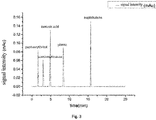
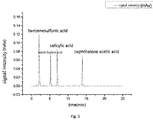
- the solid phase extraction column using multi-layer graphene as a solid phase extraction agent, can be used to selectively capture and dissociate the above target components very well, and remove an impurity of methyl red in a better way.
- the solid phase extraction column using the hydroxy graphene as a solid phase extraction agent, can be used to selectively capture and dissociate the above target components very well, and remove the impurity of janus green B in a better way.
- the solid phase extraction column using the aminated graphene as the solid phase extraction agent, can be used to selectively capture and dissociate the above target components very well, and remove the impurity of xylene cyanol FF in a better way.
- the solid phase extraction column using the dodecylated graphene as the solid phase extraction agent, can be used to selectively capture and dissociate the above target components very well, and remove the congo red in a better way.
Landscapes
- Chemical & Material Sciences (AREA)
- Analytical Chemistry (AREA)
- Chemical Kinetics & Catalysis (AREA)
- Organic Chemistry (AREA)
- Inorganic Chemistry (AREA)
- Health & Medical Sciences (AREA)
- Physics & Mathematics (AREA)
- General Physics & Mathematics (AREA)
- Immunology (AREA)
- Pathology (AREA)
- Life Sciences & Earth Sciences (AREA)
- Biochemistry (AREA)
- General Health & Medical Sciences (AREA)
- Engineering & Computer Science (AREA)
- Materials Engineering (AREA)
- Nanotechnology (AREA)
- Treatment Of Liquids With Adsorbents In General (AREA)
- Extraction Or Liquid Replacement (AREA)
- Sampling And Sample Adjustment (AREA)
Claims (1)
- Herstellungsverfahren für eine Festphasen-Extraktionssäule, umfassend:Auswählen von einem Festphasen-Extraktionsmittel aus einer Vielzahl von Festphasen-Extraktionsmitteln, die ausgewählt werden sollen, wobei das auszuwählende Festphasen-Extraktionsmittel Graphen oder modifiziertes Graphen ist, das Graphen einschichtiges Graphen oder mehrschichtiges Graphen ist, das modifizierte Graphen wird aus mindestens einem Element aus aminiertem Graphen, carbonyliertem Graphen, cyaniertem Graphen, Nitro-Graphen, Borsäure-Graphen, phosphoryliertem Graphen, Hydroxy-Graphen, Thiol-Graphen, methyliertem Graphen, allyliertem Graphen, trifluor-methyliertem Graphen, dodecyliertem Graphen, Octadecyl-Graphen, fluoriertem Graphen, bromiertem Graphen, chloriertem Graphen und iodiertem Graphen ausgewählt;Laden eines ausgewählten Festphasen-Extraktionsmittels in die Trennsäule, die Trennsäule, die mit dem ausgewählten Festphasen-Extraktionsmittel gefüllt ist, über 3 Minuten in einem Rütteltisch zum Vibrieren bringen, und Verdichten des Festphasen-Extraktionsmittels, um die Festphasen-Extraktionssäule zu erhalten; wobei ein spezifisches Verfahren zum Auswählen von einem Festphasen-Extraktionsmittel aus der Vielzahl von auszuwählenden Festphasen-Extraktionsmitteln umfasst:Herstellen der Vielzahl von auszuwählenden Festphasen-Extraktionsmitteln, um jeweils eine Vielzahl von dispergierenden Flüssigkeiten des Festphasen-Extraktionsmittels zu bilden;Herstellen eines reinen Produktes der Zielkomponente, die in einer zu testenden Probe festgestellt wird, um eine Vielzahl von dispergierenden Flüssigkeiten der Zielkomponente zu bilden;Mischen der Vielzahl von dispergierenden Flüssigkeiten des Festphasen-Extraktionsmittels mit der Vielzahl von dispergierenden Flüssigkeiten der Zielkomponente, um eine Vielzahl von Mischungen zu erhalten;Dispergieren jeder der Mischungen mittels Ultraschall;Auswählen eines Festphasen-Extraktionsmittels in einer Mischung mit einem niedrigsten Sedimentationsgrad, nachdem sich die Mischungen gesetzt haben;das auszuwählende Festphasen-Extraktionsmittel ist Graphen oder modifiziertes Graphen; das Graphen ist einschichtiges Graphen oder mehrschichtiges Graphen; und das modifizierte Graphen wird aus mindestens einem Element aus aminiertem Graphen, carbonyliertem Graphen, cyaniertem Graphen, Nitro-Graphen, Borsäure-Graphen, phosphoryliertem Graphen, Hydroxy-Graphen, Thiol-Graphen, methyliertem Graphen, allyliertem Graphen, trifluor-methyliertem Graphen, dodecyliertem Graphen, Octadecyl-Graphen, fluoriertem Graphen, bromiertem Graphen, chloriertem Graphen und iodiertem Graphen ausgewählt.
Applications Claiming Priority (1)
| Application Number | Priority Date | Filing Date | Title |
|---|---|---|---|
| PCT/CN2014/087391 WO2016045032A1 (zh) | 2014-09-25 | 2014-09-25 | 固相萃取柱、其制备方法及基于固相萃取柱的化学样品前处理方法 |
Publications (3)
| Publication Number | Publication Date |
|---|---|
| EP3199233A1 EP3199233A1 (de) | 2017-08-02 |
| EP3199233A4 EP3199233A4 (de) | 2017-09-20 |
| EP3199233B1 true EP3199233B1 (de) | 2018-12-05 |
Family
ID=55580080
Family Applications (1)
| Application Number | Title | Priority Date | Filing Date |
|---|---|---|---|
| EP14902885.4A Active EP3199233B1 (de) | 2014-09-25 | 2014-09-25 | Herstellungsverfahren einer festphasenextraktionssäule enthaltend graphen oder mofizierter graphen |
Country Status (4)
| Country | Link |
|---|---|
| US (1) | US20170225149A1 (de) |
| EP (1) | EP3199233B1 (de) |
| JP (1) | JP6513191B2 (de) |
| WO (1) | WO2016045032A1 (de) |
Cited By (1)
| Publication number | Priority date | Publication date | Assignee | Title |
|---|---|---|---|---|
| CN107261558A (zh) * | 2017-06-07 | 2017-10-20 | 电子科技大学 | 一种基于石墨烯类与氧化锌双层膜固定相的色谱柱及其固定相的制备方法 |
Families Citing this family (25)
| Publication number | Priority date | Publication date | Assignee | Title |
|---|---|---|---|---|
| CA3138653C (en) * | 2014-10-01 | 2023-11-07 | Graphene Laboratories Inc. | Method for preparation and separation of atomic layer thickness platelets from graphite or other layered materials |
| CN106092717A (zh) * | 2016-05-26 | 2016-11-09 | 苏州佰锐生物科技有限公司 | 一种新型固相萃取剂对牛血清白蛋白同步富集脱盐的方法 |
| CN106422417A (zh) * | 2016-11-23 | 2017-02-22 | 百奥森(江苏)食品安全科技有限公司 | 一种新型可负压抽吸的固相萃取柱 |
| CN107537181A (zh) * | 2017-10-24 | 2018-01-05 | 湖州展舒生物科技有限公司 | 分离纯化系统 |
| CN107961559A (zh) * | 2017-10-24 | 2018-04-27 | 湖州展舒生物科技有限公司 | 一种分离纯化系统 |
| CN108444805B (zh) * | 2018-02-13 | 2020-10-02 | 广州聚佰生物科技有限公司 | 一种用于农药残留速测前处理的净化片 |
| CN108499549B (zh) * | 2018-03-30 | 2021-12-14 | 广州质量监督检测研究院 | 用于富集全氟化合物的固相微萃取头及其制备方法 |
| CN108760425B (zh) * | 2018-05-30 | 2022-01-04 | 重庆第二师范学院 | 一种氧化石墨烯基前处理装置及其在食品检测中的应用 |
| CN109331502B (zh) * | 2018-11-07 | 2024-01-23 | 湖北文理学院 | 一种泡沫镍基三维石墨烯搅拌棒 |
| CN111617514A (zh) * | 2019-02-27 | 2020-09-04 | 中国水产科学研究院 | 一种上样体积可调的固相萃取柱 |
| CN110215738B (zh) * | 2019-07-15 | 2021-07-20 | 大连医科大学 | 一种石墨烯聚合物亲水前处理材料的制备方法 |
| CN111307997B (zh) * | 2020-04-01 | 2024-06-28 | 上海市农业科学院 | 用于全氟化合物检测的前处理快速净化柱及其制作方法和应用 |
| CN112577921A (zh) * | 2020-12-17 | 2021-03-30 | 中国石油化工股份有限公司 | 硝酸烷基酯的检测方法 |
| CN114685416B (zh) * | 2020-12-30 | 2023-10-27 | 云南汉盟制药有限公司 | 一种大麻素的分离方法 |
| CN113030361B (zh) * | 2021-03-10 | 2024-04-19 | 薛伟锋 | 基于UHPLC-MS/MS技术的固相萃取柱处理水相PPCPs的代谢组学分析方法 |
| CN113049348A (zh) * | 2021-03-15 | 2021-06-29 | 深圳市易瑞生物技术股份有限公司 | 溶剂置换的磁性固相萃取方法 |
| CN113668245B (zh) * | 2021-08-19 | 2023-02-24 | 南京市产品质量监督检验院 | 一种聚苯乙烯-羟基化多壁碳纳米管-聚吡咯复合纳米纤维的制备方法及其应用 |
| CN113848277B (zh) * | 2021-09-27 | 2023-12-29 | 北京市食品安全监控和风险评估中心(北京市食品检验所) | 一种从植物源性食品提取去甲乌药碱和曲托喹酚的前处理方法 |
| CN114088797B (zh) * | 2021-11-09 | 2024-06-11 | 中国石油大学(北京) | 一种石油油品中芳香烃类化合物的磺化方法和分析方法 |
| CN114280197A (zh) * | 2021-12-29 | 2022-04-05 | 安徽环球药业股份有限公司 | 一种吗啡固相萃取柱的洗涤方法 |
| CN114733495B (zh) * | 2022-04-08 | 2023-09-12 | 华北水利水电大学 | 一种用于回收Au(III)的无溶剂萃取剂的制备方法及应用 |
| CN115616114A (zh) * | 2022-11-03 | 2023-01-17 | 桂林理工大学 | 一种固体介质中磺胺类抗生素分离富集与测定的方法 |
| CN118256271B (zh) * | 2022-12-28 | 2026-03-13 | 中国石油天然气股份有限公司 | 一种从石油中分离单环芳烃的方法 |
| CN116735751B (zh) * | 2023-06-28 | 2023-12-22 | 上海集成电路材料研究院有限公司 | 一种光刻胶中氰离子的测定方法 |
| CN119437854B (zh) * | 2025-01-13 | 2025-07-04 | 中国林业科学研究院生态保护与修复研究所 | 一种水中磷形态的快速提取与检测方法 |
Family Cites Families (8)
| Publication number | Priority date | Publication date | Assignee | Title |
|---|---|---|---|---|
| JPH0317561U (de) * | 1989-06-30 | 1991-02-21 | ||
| AUPN694895A0 (en) * | 1995-12-01 | 1996-01-04 | Macquarie Research Limited | Desalting and purification of oligosaccharides and their derivatives |
| JP3436853B2 (ja) * | 1996-12-27 | 2003-08-18 | 有限会社シマムラテック | 除去カラムに用いる充填剤の製造方法 |
| WO2011106685A1 (en) * | 2010-02-26 | 2011-09-01 | Brigham Young University | Gas phase approach to in-situ/ex-situ functionalization of porous graphitic carbon via radical-generated molecules |
| WO2012159051A2 (en) * | 2011-05-19 | 2012-11-22 | Research Foundation Of The City University Of New York | Chemically modified graphene |
| CN103833019A (zh) * | 2012-11-23 | 2014-06-04 | 海洋王照明科技股份有限公司 | 石墨烯及其制备方法 |
| CN103638693B (zh) * | 2013-10-23 | 2015-08-19 | 大连理工大学 | 一种管内固相微萃取柱的制备方法 |
| CN103728394B (zh) * | 2014-01-15 | 2015-08-12 | 中华人民共和国苏州出入境检验检疫局 | 一种基于石墨烯固相萃取的日化用品抗菌剂检测方法 |
-
2014
- 2014-09-25 EP EP14902885.4A patent/EP3199233B1/de active Active
- 2014-09-25 US US15/514,532 patent/US20170225149A1/en not_active Abandoned
- 2014-09-25 JP JP2017516454A patent/JP6513191B2/ja active Active
- 2014-09-25 WO PCT/CN2014/087391 patent/WO2016045032A1/zh not_active Ceased
Non-Patent Citations (1)
| Title |
|---|
| None * |
Cited By (1)
| Publication number | Priority date | Publication date | Assignee | Title |
|---|---|---|---|---|
| CN107261558A (zh) * | 2017-06-07 | 2017-10-20 | 电子科技大学 | 一种基于石墨烯类与氧化锌双层膜固定相的色谱柱及其固定相的制备方法 |
Also Published As
| Publication number | Publication date |
|---|---|
| US20170225149A1 (en) | 2017-08-10 |
| WO2016045032A1 (zh) | 2016-03-31 |
| JP6513191B2 (ja) | 2019-05-15 |
| JP2017528726A (ja) | 2017-09-28 |
| EP3199233A1 (de) | 2017-08-02 |
| EP3199233A4 (de) | 2017-09-20 |
Similar Documents
| Publication | Publication Date | Title |
|---|---|---|
| EP3199233A1 (de) | Festphasenextraktionssäule, herstellungsverfahren dafür und chemisches probenvorverarbeitungsverfahren auf der basis einer festphasenextraktionssäule | |
| CN104258598B (zh) | 固相萃取柱、其制备方法及基于固相萃取柱的化学样品前处理方法 | |
| Yan et al. | Ionic liquid molecularly imprinted polymers for application in pipette-tip solid-phase extraction coupled with gas chromatography for rapid screening of dicofol in celery | |
| Zhou et al. | Exploration of coordination polymer as sorbent for flow injection solid-phase extraction on-line coupled with high-performance liquid chromatography for determination of polycyclic aromatic hydrocarbons in environmental materials | |
| Yan et al. | Molecularly imprinted solid-phase extraction coupled to liquid chromatography for determination of Sudan dyes in preserved beancurds | |
| Özer et al. | Dummy molecularly imprinted microbeads as solid-phase extraction material for selective determination of phthalate esters in water | |
| CN103920470B (zh) | 一种磁性腐殖酸及其制备方法和应用 | |
| Zhou et al. | Preparation, evaluation and application of molecularly imprinted solid-phase microextraction monolith for selective extraction of pirimicarb in tomato and pear | |
| Zuo et al. | Preparation of malathion MIP-SPE and its application in environmental analysis | |
| Niessner et al. | Multiresidue screening methods for the determination of pesticides in plant materials | |
| Yuan et al. | Ultrasound-assisted dispersive-filter extraction coupled with high-performance liquid chromatography: A rapid miniaturized method for the determination of phenylurea pesticides in vegetables and fruits | |
| CN102680591A (zh) | 依托碳纳米管改性技术实现快速检测痕量多氯联苯的方法 | |
| Li et al. | Preparation of COF-coated nickel foam adsorbents for dispersive solid-phase extraction of 16 polycyclic aromatic hydrocarbons from Chinese herbal medicines | |
| CN107589198A (zh) | 一种测定水中16种多环芳烃的方法 | |
| CN106932516A (zh) | 基于固相萃取采样柱的原位超声洗脱装置及超声洗脱方法 | |
| Wang et al. | Miniaturized extraction and determination of swelling agents in fruits and vegetables based on deep eutectic solvent-molecularly imprinted hydrophilic resin | |
| Fan et al. | On-line selective solid-phase extraction of 4-nitrophenol with β-cyclodextrin bonded silica | |
| Ma et al. | Preparation of molecularly imprinted polymer monolith with an analogue of thiamphenicol and application to selective solid-phase microextraction | |
| CN107179367B (zh) | 一种用于毒素检测的固相萃取串联柱及制备方法 | |
| Ghorbani et al. | Comprehensive review of sample preparation strategies for phthalate ester analysis in various real samples | |
| Fan et al. | Covalent organic framework modified nickel foam adsorbents for dispersive micro-solid phase extraction of polycyclic aromatic hydrocarbons from Chinese herbal medicines | |
| Li et al. | Selective determination of trace thiamphenicol in milk and honey by molecularly imprinted polymer monolith microextraction and high‐performance liquid chromatography | |
| CN109675536B (zh) | 一种基于氧化石墨烯分散酸性硅胶填料、制备方法及应用 | |
| Qiao et al. | Molecularly imprinted microspheres as SPE sorbent for selective extraction of four Sudan dyes in catsup products | |
| CN105910871A (zh) | 一种固态介质中多种有机污染物的前处理方法 |
Legal Events
| Date | Code | Title | Description |
|---|---|---|---|
| STAA | Information on the status of an ep patent application or granted ep patent |
Free format text: STATUS: THE INTERNATIONAL PUBLICATION HAS BEEN MADE |
|
| PUAI | Public reference made under article 153(3) epc to a published international application that has entered the european phase |
Free format text: ORIGINAL CODE: 0009012 |
|
| STAA | Information on the status of an ep patent application or granted ep patent |
Free format text: STATUS: REQUEST FOR EXAMINATION WAS MADE |
|
| 17P | Request for examination filed |
Effective date: 20170425 |
|
| AK | Designated contracting states |
Kind code of ref document: A1 Designated state(s): AL AT BE BG CH CY CZ DE DK EE ES FI FR GB GR HR HU IE IS IT LI LT LU LV MC MK MT NL NO PL PT RO RS SE SI SK SM TR |
|
| AX | Request for extension of the european patent |
Extension state: BA ME |
|
| A4 | Supplementary search report drawn up and despatched |
Effective date: 20170823 |
|
| RIC1 | Information provided on ipc code assigned before grant |
Ipc: B01J 20/22 20060101ALI20170817BHEP Ipc: G01N 1/40 20060101ALI20170817BHEP Ipc: B01J 20/281 20060101ALI20170817BHEP Ipc: B01J 20/02 20060101AFI20170817BHEP Ipc: B01D 15/08 20060101ALI20170817BHEP Ipc: G01N 30/60 20060101ALI20170817BHEP Ipc: B01D 15/20 20060101ALI20170817BHEP |
|
| DAX | Request for extension of the european patent (deleted) | ||
| GRAP | Despatch of communication of intention to grant a patent |
Free format text: ORIGINAL CODE: EPIDOSNIGR1 |
|
| STAA | Information on the status of an ep patent application or granted ep patent |
Free format text: STATUS: GRANT OF PATENT IS INTENDED |
|
| RIC1 | Information provided on ipc code assigned before grant |
Ipc: B01J 20/22 20060101ALI20180627BHEP Ipc: B01J 20/02 20060101AFI20180627BHEP Ipc: G01N 30/60 20060101ALI20180627BHEP Ipc: B01J 20/281 20060101ALI20180627BHEP Ipc: G01N 1/40 20060101ALI20180627BHEP Ipc: B01D 15/20 20060101ALI20180627BHEP Ipc: B01D 15/08 20060101ALI20180627BHEP |
|
| INTG | Intention to grant announced |
Effective date: 20180731 |
|
| GRAS | Grant fee paid |
Free format text: ORIGINAL CODE: EPIDOSNIGR3 |
|
| GRAA | (expected) grant |
Free format text: ORIGINAL CODE: 0009210 |
|
| GRAA | (expected) grant |
Free format text: ORIGINAL CODE: 0009210 |
|
| STAA | Information on the status of an ep patent application or granted ep patent |
Free format text: STATUS: THE PATENT HAS BEEN GRANTED |
|
| AK | Designated contracting states |
Kind code of ref document: B1 Designated state(s): AL AT BE BG CH CY CZ DE DK EE ES FI FR GB GR HR HU IE IS IT LI LT LU LV MC MK MT NL NO PL PT RO RS SE SI SK SM TR |
|
| REG | Reference to a national code |
Ref country code: GB Ref legal event code: FG4D |
|
| REG | Reference to a national code |
Ref country code: CH Ref legal event code: EP |
|
| REG | Reference to a national code |
Ref country code: AT Ref legal event code: REF Ref document number: 1072372 Country of ref document: AT Kind code of ref document: T Effective date: 20181215 |
|
| REG | Reference to a national code |
Ref country code: IE Ref legal event code: FG4D |
|
| REG | Reference to a national code |
Ref country code: DE Ref legal event code: R096 Ref document number: 602014037682 Country of ref document: DE |
|
| REG | Reference to a national code |
Ref country code: NL Ref legal event code: MP Effective date: 20181205 |
|
| REG | Reference to a national code |
Ref country code: AT Ref legal event code: MK05 Ref document number: 1072372 Country of ref document: AT Kind code of ref document: T Effective date: 20181205 |
|
| REG | Reference to a national code |
Ref country code: LT Ref legal event code: MG4D |
|
| PG25 | Lapsed in a contracting state [announced via postgrant information from national office to epo] |
Ref country code: NO Free format text: LAPSE BECAUSE OF FAILURE TO SUBMIT A TRANSLATION OF THE DESCRIPTION OR TO PAY THE FEE WITHIN THE PRESCRIBED TIME-LIMIT Effective date: 20190305 Ref country code: HR Free format text: LAPSE BECAUSE OF FAILURE TO SUBMIT A TRANSLATION OF THE DESCRIPTION OR TO PAY THE FEE WITHIN THE PRESCRIBED TIME-LIMIT Effective date: 20181205 Ref country code: LT Free format text: LAPSE BECAUSE OF FAILURE TO SUBMIT A TRANSLATION OF THE DESCRIPTION OR TO PAY THE FEE WITHIN THE PRESCRIBED TIME-LIMIT Effective date: 20181205 Ref country code: AT Free format text: LAPSE BECAUSE OF FAILURE TO SUBMIT A TRANSLATION OF THE DESCRIPTION OR TO PAY THE FEE WITHIN THE PRESCRIBED TIME-LIMIT Effective date: 20181205 Ref country code: BG Free format text: LAPSE BECAUSE OF FAILURE TO SUBMIT A TRANSLATION OF THE DESCRIPTION OR TO PAY THE FEE WITHIN THE PRESCRIBED TIME-LIMIT Effective date: 20190305 Ref country code: FI Free format text: LAPSE BECAUSE OF FAILURE TO SUBMIT A TRANSLATION OF THE DESCRIPTION OR TO PAY THE FEE WITHIN THE PRESCRIBED TIME-LIMIT Effective date: 20181205 Ref country code: LV Free format text: LAPSE BECAUSE OF FAILURE TO SUBMIT A TRANSLATION OF THE DESCRIPTION OR TO PAY THE FEE WITHIN THE PRESCRIBED TIME-LIMIT Effective date: 20181205 |
|
| PG25 | Lapsed in a contracting state [announced via postgrant information from national office to epo] |
Ref country code: AL Free format text: LAPSE BECAUSE OF FAILURE TO SUBMIT A TRANSLATION OF THE DESCRIPTION OR TO PAY THE FEE WITHIN THE PRESCRIBED TIME-LIMIT Effective date: 20181205 Ref country code: SE Free format text: LAPSE BECAUSE OF FAILURE TO SUBMIT A TRANSLATION OF THE DESCRIPTION OR TO PAY THE FEE WITHIN THE PRESCRIBED TIME-LIMIT Effective date: 20181205 Ref country code: RS Free format text: LAPSE BECAUSE OF FAILURE TO SUBMIT A TRANSLATION OF THE DESCRIPTION OR TO PAY THE FEE WITHIN THE PRESCRIBED TIME-LIMIT Effective date: 20181205 Ref country code: GR Free format text: LAPSE BECAUSE OF FAILURE TO SUBMIT A TRANSLATION OF THE DESCRIPTION OR TO PAY THE FEE WITHIN THE PRESCRIBED TIME-LIMIT Effective date: 20190306 |
|
| PG25 | Lapsed in a contracting state [announced via postgrant information from national office to epo] |
Ref country code: NL Free format text: LAPSE BECAUSE OF FAILURE TO SUBMIT A TRANSLATION OF THE DESCRIPTION OR TO PAY THE FEE WITHIN THE PRESCRIBED TIME-LIMIT Effective date: 20181205 |
|
| PG25 | Lapsed in a contracting state [announced via postgrant information from national office to epo] |
Ref country code: PT Free format text: LAPSE BECAUSE OF FAILURE TO SUBMIT A TRANSLATION OF THE DESCRIPTION OR TO PAY THE FEE WITHIN THE PRESCRIBED TIME-LIMIT Effective date: 20190405 Ref country code: CZ Free format text: LAPSE BECAUSE OF FAILURE TO SUBMIT A TRANSLATION OF THE DESCRIPTION OR TO PAY THE FEE WITHIN THE PRESCRIBED TIME-LIMIT Effective date: 20181205 Ref country code: ES Free format text: LAPSE BECAUSE OF FAILURE TO SUBMIT A TRANSLATION OF THE DESCRIPTION OR TO PAY THE FEE WITHIN THE PRESCRIBED TIME-LIMIT Effective date: 20181205 Ref country code: PL Free format text: LAPSE BECAUSE OF FAILURE TO SUBMIT A TRANSLATION OF THE DESCRIPTION OR TO PAY THE FEE WITHIN THE PRESCRIBED TIME-LIMIT Effective date: 20181205 Ref country code: IT Free format text: LAPSE BECAUSE OF FAILURE TO SUBMIT A TRANSLATION OF THE DESCRIPTION OR TO PAY THE FEE WITHIN THE PRESCRIBED TIME-LIMIT Effective date: 20181205 |
|
| PG25 | Lapsed in a contracting state [announced via postgrant information from national office to epo] |
Ref country code: SM Free format text: LAPSE BECAUSE OF FAILURE TO SUBMIT A TRANSLATION OF THE DESCRIPTION OR TO PAY THE FEE WITHIN THE PRESCRIBED TIME-LIMIT Effective date: 20181205 Ref country code: EE Free format text: LAPSE BECAUSE OF FAILURE TO SUBMIT A TRANSLATION OF THE DESCRIPTION OR TO PAY THE FEE WITHIN THE PRESCRIBED TIME-LIMIT Effective date: 20181205 Ref country code: RO Free format text: LAPSE BECAUSE OF FAILURE TO SUBMIT A TRANSLATION OF THE DESCRIPTION OR TO PAY THE FEE WITHIN THE PRESCRIBED TIME-LIMIT Effective date: 20181205 Ref country code: IS Free format text: LAPSE BECAUSE OF FAILURE TO SUBMIT A TRANSLATION OF THE DESCRIPTION OR TO PAY THE FEE WITHIN THE PRESCRIBED TIME-LIMIT Effective date: 20190405 Ref country code: SK Free format text: LAPSE BECAUSE OF FAILURE TO SUBMIT A TRANSLATION OF THE DESCRIPTION OR TO PAY THE FEE WITHIN THE PRESCRIBED TIME-LIMIT Effective date: 20181205 |
|
| REG | Reference to a national code |
Ref country code: DE Ref legal event code: R097 Ref document number: 602014037682 Country of ref document: DE |
|
| PLBE | No opposition filed within time limit |
Free format text: ORIGINAL CODE: 0009261 |
|
| STAA | Information on the status of an ep patent application or granted ep patent |
Free format text: STATUS: NO OPPOSITION FILED WITHIN TIME LIMIT |
|
| PG25 | Lapsed in a contracting state [announced via postgrant information from national office to epo] |
Ref country code: DK Free format text: LAPSE BECAUSE OF FAILURE TO SUBMIT A TRANSLATION OF THE DESCRIPTION OR TO PAY THE FEE WITHIN THE PRESCRIBED TIME-LIMIT Effective date: 20181205 Ref country code: SI Free format text: LAPSE BECAUSE OF FAILURE TO SUBMIT A TRANSLATION OF THE DESCRIPTION OR TO PAY THE FEE WITHIN THE PRESCRIBED TIME-LIMIT Effective date: 20181205 |
|
| 26N | No opposition filed |
Effective date: 20190906 |
|
| PG25 | Lapsed in a contracting state [announced via postgrant information from national office to epo] |
Ref country code: TR Free format text: LAPSE BECAUSE OF FAILURE TO SUBMIT A TRANSLATION OF THE DESCRIPTION OR TO PAY THE FEE WITHIN THE PRESCRIBED TIME-LIMIT Effective date: 20181205 |
|
| PG25 | Lapsed in a contracting state [announced via postgrant information from national office to epo] |
Ref country code: MC Free format text: LAPSE BECAUSE OF FAILURE TO SUBMIT A TRANSLATION OF THE DESCRIPTION OR TO PAY THE FEE WITHIN THE PRESCRIBED TIME-LIMIT Effective date: 20181205 |
|
| REG | Reference to a national code |
Ref country code: CH Ref legal event code: PL |
|
| PG25 | Lapsed in a contracting state [announced via postgrant information from national office to epo] |
Ref country code: IE Free format text: LAPSE BECAUSE OF NON-PAYMENT OF DUE FEES Effective date: 20190925 Ref country code: LU Free format text: LAPSE BECAUSE OF NON-PAYMENT OF DUE FEES Effective date: 20190925 Ref country code: CH Free format text: LAPSE BECAUSE OF NON-PAYMENT OF DUE FEES Effective date: 20190930 Ref country code: LI Free format text: LAPSE BECAUSE OF NON-PAYMENT OF DUE FEES Effective date: 20190930 |
|
| REG | Reference to a national code |
Ref country code: BE Ref legal event code: MM Effective date: 20190930 |
|
| PG25 | Lapsed in a contracting state [announced via postgrant information from national office to epo] |
Ref country code: BE Free format text: LAPSE BECAUSE OF NON-PAYMENT OF DUE FEES Effective date: 20190930 |
|
| PG25 | Lapsed in a contracting state [announced via postgrant information from national office to epo] |
Ref country code: FR Free format text: LAPSE BECAUSE OF NON-PAYMENT OF DUE FEES Effective date: 20190930 |
|
| PG25 | Lapsed in a contracting state [announced via postgrant information from national office to epo] |
Ref country code: CY Free format text: LAPSE BECAUSE OF FAILURE TO SUBMIT A TRANSLATION OF THE DESCRIPTION OR TO PAY THE FEE WITHIN THE PRESCRIBED TIME-LIMIT Effective date: 20181205 |
|
| REG | Reference to a national code |
Ref country code: DE Ref legal event code: R082 Ref document number: 602014037682 Country of ref document: DE Representative=s name: KARAKATSANIS, GEORGIOS, DR., DE Ref country code: DE Ref legal event code: R082 Ref document number: 602014037682 Country of ref document: DE Representative=s name: KARAKATSANIS, GEORGIOS, DIPL.-PHYS.UNIV. DR.RE, DE Ref country code: DE Ref legal event code: R081 Ref document number: 602014037682 Country of ref document: DE Owner name: SINOPHENE NOVEL MATERIALS, CN Free format text: FORMER OWNER: SHENZHEN CANTONNET ENERGY SERVICES CO., LTD., SHENZHEN, GUANGDONG, CN |
|
| PG25 | Lapsed in a contracting state [announced via postgrant information from national office to epo] |
Ref country code: MT Free format text: LAPSE BECAUSE OF FAILURE TO SUBMIT A TRANSLATION OF THE DESCRIPTION OR TO PAY THE FEE WITHIN THE PRESCRIBED TIME-LIMIT Effective date: 20181205 Ref country code: HU Free format text: LAPSE BECAUSE OF FAILURE TO SUBMIT A TRANSLATION OF THE DESCRIPTION OR TO PAY THE FEE WITHIN THE PRESCRIBED TIME-LIMIT; INVALID AB INITIO Effective date: 20140925 |
|
| REG | Reference to a national code |
Ref country code: GB Ref legal event code: 732E Free format text: REGISTERED BETWEEN 20210722 AND 20210728 |
|
| PG25 | Lapsed in a contracting state [announced via postgrant information from national office to epo] |
Ref country code: MK Free format text: LAPSE BECAUSE OF FAILURE TO SUBMIT A TRANSLATION OF THE DESCRIPTION OR TO PAY THE FEE WITHIN THE PRESCRIBED TIME-LIMIT Effective date: 20181205 |
|
| PGFP | Annual fee paid to national office [announced via postgrant information from national office to epo] |
Ref country code: DE Payment date: 20250821 Year of fee payment: 12 |
|
| PGFP | Annual fee paid to national office [announced via postgrant information from national office to epo] |
Ref country code: GB Payment date: 20250805 Year of fee payment: 12 |
|
| REG | Reference to a national code |
Ref country code: DE Ref legal event code: R081 Ref document number: 602014037682 Country of ref document: DE Owner name: HUNAN YUANCHANG NEW MATERIAL TECHNOLOGY CO., L, CN Free format text: FORMER OWNER: SINOPHENE NOVEL MATERIALS, SHENZHEN, CN Ref country code: DE Ref legal event code: R082 Ref document number: 602014037682 Country of ref document: DE Representative=s name: LIESEGANG & ROESSEL RECHTSANWALTS GMBH & CO. K, DE |
|
| REG | Reference to a national code |
Ref country code: GB Ref legal event code: 732E Free format text: REGISTERED BETWEEN 20260108 AND 20260114 |