EP3174375B1 - Komplexe folie zum absorbieren/löschen und abschirmen von elektromagnetischen wellen sowie hochgradigem wärmeableiten von einer elektronischen vorrichtung und herstellungsverfahren dafür - Google Patents
Komplexe folie zum absorbieren/löschen und abschirmen von elektromagnetischen wellen sowie hochgradigem wärmeableiten von einer elektronischen vorrichtung und herstellungsverfahren dafür Download PDFInfo
- Publication number
- EP3174375B1 EP3174375B1 EP16798613.2A EP16798613A EP3174375B1 EP 3174375 B1 EP3174375 B1 EP 3174375B1 EP 16798613 A EP16798613 A EP 16798613A EP 3174375 B1 EP3174375 B1 EP 3174375B1
- Authority
- EP
- European Patent Office
- Prior art keywords
- sheet
- graphite
- porous metal
- premolded
- pores
- Prior art date
- Legal status (The legal status is an assumption and is not a legal conclusion. Google has not performed a legal analysis and makes no representation as to the accuracy of the status listed.)
- Not-in-force
Links
Images




Classifications
-
- B—PERFORMING OPERATIONS; TRANSPORTING
- B32—LAYERED PRODUCTS
- B32B—LAYERED PRODUCTS, i.e. PRODUCTS BUILT-UP OF STRATA OF FLAT OR NON-FLAT, e.g. CELLULAR OR HONEYCOMB, FORM
- B32B9/00—Layered products comprising a layer of a particular substance not covered by groups B32B11/00 - B32B29/00
- B32B9/04—Layered products comprising a layer of a particular substance not covered by groups B32B11/00 - B32B29/00 comprising such particular substance as the main or only constituent of a layer, which is next to another layer of the same or of a different material
- B32B9/041—Layered products comprising a layer of a particular substance not covered by groups B32B11/00 - B32B29/00 comprising such particular substance as the main or only constituent of a layer, which is next to another layer of the same or of a different material of metal
-
- H—ELECTRICITY
- H05—ELECTRIC TECHNIQUES NOT OTHERWISE PROVIDED FOR
- H05K—PRINTED CIRCUITS; CASINGS OR CONSTRUCTIONAL DETAILS OF ELECTRIC APPARATUS; MANUFACTURE OF ASSEMBLAGES OF ELECTRICAL COMPONENTS
- H05K7/00—Constructional details common to different types of electric apparatus
- H05K7/20—Modifications to facilitate cooling, ventilating, or heating
-
- B—PERFORMING OPERATIONS; TRANSPORTING
- B32—LAYERED PRODUCTS
- B32B—LAYERED PRODUCTS, i.e. PRODUCTS BUILT-UP OF STRATA OF FLAT OR NON-FLAT, e.g. CELLULAR OR HONEYCOMB, FORM
- B32B15/00—Layered products comprising a layer of metal
- B32B15/02—Layer formed of wires, e.g. mesh
-
- B—PERFORMING OPERATIONS; TRANSPORTING
- B32—LAYERED PRODUCTS
- B32B—LAYERED PRODUCTS, i.e. PRODUCTS BUILT-UP OF STRATA OF FLAT OR NON-FLAT, e.g. CELLULAR OR HONEYCOMB, FORM
- B32B15/00—Layered products comprising a layer of metal
- B32B15/04—Layered products comprising a layer of metal comprising metal as the main or only constituent of a layer, which is next to another layer of the same or of a different material
- B32B15/043—Layered products comprising a layer of metal comprising metal as the main or only constituent of a layer, which is next to another layer of the same or of a different material of metal
-
- B—PERFORMING OPERATIONS; TRANSPORTING
- B32—LAYERED PRODUCTS
- B32B—LAYERED PRODUCTS, i.e. PRODUCTS BUILT-UP OF STRATA OF FLAT OR NON-FLAT, e.g. CELLULAR OR HONEYCOMB, FORM
- B32B15/00—Layered products comprising a layer of metal
- B32B15/04—Layered products comprising a layer of metal comprising metal as the main or only constituent of a layer, which is next to another layer of the same or of a different material
- B32B15/08—Layered products comprising a layer of metal comprising metal as the main or only constituent of a layer, which is next to another layer of the same or of a different material of synthetic resin
-
- B—PERFORMING OPERATIONS; TRANSPORTING
- B32—LAYERED PRODUCTS
- B32B—LAYERED PRODUCTS, i.e. PRODUCTS BUILT-UP OF STRATA OF FLAT OR NON-FLAT, e.g. CELLULAR OR HONEYCOMB, FORM
- B32B15/00—Layered products comprising a layer of metal
- B32B15/16—Layered products comprising a layer of metal next to a particulate layer
-
- B—PERFORMING OPERATIONS; TRANSPORTING
- B32—LAYERED PRODUCTS
- B32B—LAYERED PRODUCTS, i.e. PRODUCTS BUILT-UP OF STRATA OF FLAT OR NON-FLAT, e.g. CELLULAR OR HONEYCOMB, FORM
- B32B15/00—Layered products comprising a layer of metal
- B32B15/20—Layered products comprising a layer of metal comprising aluminium or copper
-
- B—PERFORMING OPERATIONS; TRANSPORTING
- B32—LAYERED PRODUCTS
- B32B—LAYERED PRODUCTS, i.e. PRODUCTS BUILT-UP OF STRATA OF FLAT OR NON-FLAT, e.g. CELLULAR OR HONEYCOMB, FORM
- B32B27/00—Layered products comprising a layer of synthetic resin
- B32B27/06—Layered products comprising a layer of synthetic resin as the main or only constituent of a layer, which is next to another layer of the same or of a different material
-
- B—PERFORMING OPERATIONS; TRANSPORTING
- B32—LAYERED PRODUCTS
- B32B—LAYERED PRODUCTS, i.e. PRODUCTS BUILT-UP OF STRATA OF FLAT OR NON-FLAT, e.g. CELLULAR OR HONEYCOMB, FORM
- B32B27/00—Layered products comprising a layer of synthetic resin
- B32B27/14—Layered products comprising a layer of synthetic resin next to a particulate layer
-
- B—PERFORMING OPERATIONS; TRANSPORTING
- B32—LAYERED PRODUCTS
- B32B—LAYERED PRODUCTS, i.e. PRODUCTS BUILT-UP OF STRATA OF FLAT OR NON-FLAT, e.g. CELLULAR OR HONEYCOMB, FORM
- B32B37/00—Methods or apparatus for laminating, e.g. by curing or by ultrasonic bonding
- B32B37/10—Methods or apparatus for laminating, e.g. by curing or by ultrasonic bonding characterised by the pressing technique, e.g. using action of vacuum or fluid pressure
-
- B—PERFORMING OPERATIONS; TRANSPORTING
- B32—LAYERED PRODUCTS
- B32B—LAYERED PRODUCTS, i.e. PRODUCTS BUILT-UP OF STRATA OF FLAT OR NON-FLAT, e.g. CELLULAR OR HONEYCOMB, FORM
- B32B37/00—Methods or apparatus for laminating, e.g. by curing or by ultrasonic bonding
- B32B37/14—Methods or apparatus for laminating, e.g. by curing or by ultrasonic bonding characterised by the properties of the layers
- B32B37/16—Methods or apparatus for laminating, e.g. by curing or by ultrasonic bonding characterised by the properties of the layers with all layers existing as coherent layers before laminating
- B32B37/18—Methods or apparatus for laminating, e.g. by curing or by ultrasonic bonding characterised by the properties of the layers with all layers existing as coherent layers before laminating involving the assembly of discrete sheets or panels only
-
- B—PERFORMING OPERATIONS; TRANSPORTING
- B32—LAYERED PRODUCTS
- B32B—LAYERED PRODUCTS, i.e. PRODUCTS BUILT-UP OF STRATA OF FLAT OR NON-FLAT, e.g. CELLULAR OR HONEYCOMB, FORM
- B32B5/00—Layered products characterised by the non- homogeneity or physical structure, i.e. comprising a fibrous, filamentary, particulate or foam layer; Layered products characterised by having a layer differing constitutionally or physically in different parts
- B32B5/02—Layered products characterised by the non- homogeneity or physical structure, i.e. comprising a fibrous, filamentary, particulate or foam layer; Layered products characterised by having a layer differing constitutionally or physically in different parts characterised by structural features of a fibrous or filamentary layer
- B32B5/024—Woven fabric
-
- B—PERFORMING OPERATIONS; TRANSPORTING
- B32—LAYERED PRODUCTS
- B32B—LAYERED PRODUCTS, i.e. PRODUCTS BUILT-UP OF STRATA OF FLAT OR NON-FLAT, e.g. CELLULAR OR HONEYCOMB, FORM
- B32B5/00—Layered products characterised by the non- homogeneity or physical structure, i.e. comprising a fibrous, filamentary, particulate or foam layer; Layered products characterised by having a layer differing constitutionally or physically in different parts
- B32B5/02—Layered products characterised by the non- homogeneity or physical structure, i.e. comprising a fibrous, filamentary, particulate or foam layer; Layered products characterised by having a layer differing constitutionally or physically in different parts characterised by structural features of a fibrous or filamentary layer
- B32B5/028—Net structure, e.g. spaced apart filaments bonded at the crossing points
-
- B—PERFORMING OPERATIONS; TRANSPORTING
- B32—LAYERED PRODUCTS
- B32B—LAYERED PRODUCTS, i.e. PRODUCTS BUILT-UP OF STRATA OF FLAT OR NON-FLAT, e.g. CELLULAR OR HONEYCOMB, FORM
- B32B7/00—Layered products characterised by the relation between layers; Layered products characterised by the relative orientation of features between layers, or by the relative values of a measurable parameter between layers, i.e. products comprising layers having different physical, chemical or physicochemical properties; Layered products characterised by the interconnection of layers
- B32B7/04—Interconnection of layers
-
- B—PERFORMING OPERATIONS; TRANSPORTING
- B32—LAYERED PRODUCTS
- B32B—LAYERED PRODUCTS, i.e. PRODUCTS BUILT-UP OF STRATA OF FLAT OR NON-FLAT, e.g. CELLULAR OR HONEYCOMB, FORM
- B32B9/00—Layered products comprising a layer of a particular substance not covered by groups B32B11/00 - B32B29/00
-
- B—PERFORMING OPERATIONS; TRANSPORTING
- B32—LAYERED PRODUCTS
- B32B—LAYERED PRODUCTS, i.e. PRODUCTS BUILT-UP OF STRATA OF FLAT OR NON-FLAT, e.g. CELLULAR OR HONEYCOMB, FORM
- B32B9/00—Layered products comprising a layer of a particular substance not covered by groups B32B11/00 - B32B29/00
- B32B9/005—Layered products comprising a layer of a particular substance not covered by groups B32B11/00 - B32B29/00 comprising one layer of ceramic material, e.g. porcelain, ceramic tile
- B32B9/007—Layered products comprising a layer of a particular substance not covered by groups B32B11/00 - B32B29/00 comprising one layer of ceramic material, e.g. porcelain, ceramic tile comprising carbon, e.g. graphite, composite carbon
-
- B—PERFORMING OPERATIONS; TRANSPORTING
- B32—LAYERED PRODUCTS
- B32B—LAYERED PRODUCTS, i.e. PRODUCTS BUILT-UP OF STRATA OF FLAT OR NON-FLAT, e.g. CELLULAR OR HONEYCOMB, FORM
- B32B9/00—Layered products comprising a layer of a particular substance not covered by groups B32B11/00 - B32B29/00
- B32B9/04—Layered products comprising a layer of a particular substance not covered by groups B32B11/00 - B32B29/00 comprising such particular substance as the main or only constituent of a layer, which is next to another layer of the same or of a different material
- B32B9/047—Layered products comprising a layer of a particular substance not covered by groups B32B11/00 - B32B29/00 comprising such particular substance as the main or only constituent of a layer, which is next to another layer of the same or of a different material made of fibres or filaments
-
- B—PERFORMING OPERATIONS; TRANSPORTING
- B32—LAYERED PRODUCTS
- B32B—LAYERED PRODUCTS, i.e. PRODUCTS BUILT-UP OF STRATA OF FLAT OR NON-FLAT, e.g. CELLULAR OR HONEYCOMB, FORM
- B32B9/00—Layered products comprising a layer of a particular substance not covered by groups B32B11/00 - B32B29/00
- B32B9/04—Layered products comprising a layer of a particular substance not covered by groups B32B11/00 - B32B29/00 comprising such particular substance as the main or only constituent of a layer, which is next to another layer of the same or of a different material
- B32B9/048—Layered products comprising a layer of a particular substance not covered by groups B32B11/00 - B32B29/00 comprising such particular substance as the main or only constituent of a layer, which is next to another layer of the same or of a different material made of particles
-
- C—CHEMISTRY; METALLURGY
- C25—ELECTROLYTIC OR ELECTROPHORETIC PROCESSES; APPARATUS THEREFOR
- C25D—PROCESSES FOR THE ELECTROLYTIC OR ELECTROPHORETIC PRODUCTION OF COATINGS; ELECTROFORMING; APPARATUS THEREFOR
- C25D1/00—Electroforming
- C25D1/08—Perforated or foraminous objects, e.g. sieves
-
- C—CHEMISTRY; METALLURGY
- C25—ELECTROLYTIC OR ELECTROPHORETIC PROCESSES; APPARATUS THEREFOR
- C25D—PROCESSES FOR THE ELECTROLYTIC OR ELECTROPHORETIC PRODUCTION OF COATINGS; ELECTROFORMING; APPARATUS THEREFOR
- C25D1/00—Electroforming
- C25D1/20—Separation of the formed objects from the electrodes with no destruction of said electrodes
-
- D—TEXTILES; PAPER
- D03—WEAVING
- D03D—WOVEN FABRICS; METHODS OF WEAVING; LOOMS
- D03D1/00—Woven fabrics designed to make specified articles
- D03D1/0035—Protective fabrics
- D03D1/0058—Electromagnetic radiation resistant
-
- D—TEXTILES; PAPER
- D03—WEAVING
- D03D—WOVEN FABRICS; METHODS OF WEAVING; LOOMS
- D03D9/00—Open-work fabrics
-
- H—ELECTRICITY
- H05—ELECTRIC TECHNIQUES NOT OTHERWISE PROVIDED FOR
- H05K—PRINTED CIRCUITS; CASINGS OR CONSTRUCTIONAL DETAILS OF ELECTRIC APPARATUS; MANUFACTURE OF ASSEMBLAGES OF ELECTRICAL COMPONENTS
- H05K7/00—Constructional details common to different types of electric apparatus
- H05K7/20—Modifications to facilitate cooling, ventilating, or heating
- H05K7/2039—Modifications to facilitate cooling, ventilating, or heating characterised by the heat transfer by conduction from the heat generating element to a dissipating body
-
- H—ELECTRICITY
- H05—ELECTRIC TECHNIQUES NOT OTHERWISE PROVIDED FOR
- H05K—PRINTED CIRCUITS; CASINGS OR CONSTRUCTIONAL DETAILS OF ELECTRIC APPARATUS; MANUFACTURE OF ASSEMBLAGES OF ELECTRICAL COMPONENTS
- H05K7/00—Constructional details common to different types of electric apparatus
- H05K7/20—Modifications to facilitate cooling, ventilating, or heating
- H05K7/2039—Modifications to facilitate cooling, ventilating, or heating characterised by the heat transfer by conduction from the heat generating element to a dissipating body
- H05K7/20436—Inner thermal coupling elements in heat dissipating housings, e.g. protrusions or depressions integrally formed in the housing
- H05K7/20445—Inner thermal coupling elements in heat dissipating housings, e.g. protrusions or depressions integrally formed in the housing the coupling element being an additional piece, e.g. thermal standoff
- H05K7/20472—Sheet interfaces
-
- H—ELECTRICITY
- H05—ELECTRIC TECHNIQUES NOT OTHERWISE PROVIDED FOR
- H05K—PRINTED CIRCUITS; CASINGS OR CONSTRUCTIONAL DETAILS OF ELECTRIC APPARATUS; MANUFACTURE OF ASSEMBLAGES OF ELECTRICAL COMPONENTS
- H05K9/00—Screening of apparatus or components against electric or magnetic fields
-
- H—ELECTRICITY
- H05—ELECTRIC TECHNIQUES NOT OTHERWISE PROVIDED FOR
- H05K—PRINTED CIRCUITS; CASINGS OR CONSTRUCTIONAL DETAILS OF ELECTRIC APPARATUS; MANUFACTURE OF ASSEMBLAGES OF ELECTRICAL COMPONENTS
- H05K9/00—Screening of apparatus or components against electric or magnetic fields
- H05K9/0073—Shielding materials
- H05K9/0081—Electromagnetic shielding materials, e.g. EMI, RFI shielding
-
- H—ELECTRICITY
- H05—ELECTRIC TECHNIQUES NOT OTHERWISE PROVIDED FOR
- H05K—PRINTED CIRCUITS; CASINGS OR CONSTRUCTIONAL DETAILS OF ELECTRIC APPARATUS; MANUFACTURE OF ASSEMBLAGES OF ELECTRICAL COMPONENTS
- H05K9/00—Screening of apparatus or components against electric or magnetic fields
- H05K9/0073—Shielding materials
- H05K9/0081—Electromagnetic shielding materials, e.g. EMI, RFI shielding
- H05K9/0084—Electromagnetic shielding materials, e.g. EMI, RFI shielding comprising a single continuous metallic layer on an electrically insulating supporting structure, e.g. metal foil, film, plating coating, electro-deposition, vapour-deposition
-
- H—ELECTRICITY
- H05—ELECTRIC TECHNIQUES NOT OTHERWISE PROVIDED FOR
- H05K—PRINTED CIRCUITS; CASINGS OR CONSTRUCTIONAL DETAILS OF ELECTRIC APPARATUS; MANUFACTURE OF ASSEMBLAGES OF ELECTRICAL COMPONENTS
- H05K9/00—Screening of apparatus or components against electric or magnetic fields
- H05K9/0073—Shielding materials
- H05K9/0081—Electromagnetic shielding materials, e.g. EMI, RFI shielding
- H05K9/0086—Electromagnetic shielding materials, e.g. EMI, RFI shielding comprising a single discontinuous metallic layer on an electrically insulating supporting structure, e.g. metal grid, perforated metal foil, film, aggregated flakes, sintering
-
- H—ELECTRICITY
- H05—ELECTRIC TECHNIQUES NOT OTHERWISE PROVIDED FOR
- H05K—PRINTED CIRCUITS; CASINGS OR CONSTRUCTIONAL DETAILS OF ELECTRIC APPARATUS; MANUFACTURE OF ASSEMBLAGES OF ELECTRICAL COMPONENTS
- H05K9/00—Screening of apparatus or components against electric or magnetic fields
- H05K9/0073—Shielding materials
- H05K9/0081—Electromagnetic shielding materials, e.g. EMI, RFI shielding
- H05K9/0088—Electromagnetic shielding materials, e.g. EMI, RFI shielding comprising a plurality of shielding layers; combining different shielding material structure
-
- H—ELECTRICITY
- H10—SEMICONDUCTOR DEVICES; ELECTRIC SOLID-STATE DEVICES NOT OTHERWISE PROVIDED FOR
- H10W—GENERIC PACKAGES, INTERCONNECTIONS, CONNECTORS OR OTHER CONSTRUCTIONAL DETAILS OF DEVICES COVERED BY CLASS H10
- H10W40/00—Arrangements for thermal protection or thermal control
- H10W40/20—Arrangements for cooling
- H10W40/25—Arrangements for cooling characterised by their materials
-
- H—ELECTRICITY
- H10—SEMICONDUCTOR DEVICES; ELECTRIC SOLID-STATE DEVICES NOT OTHERWISE PROVIDED FOR
- H10W—GENERIC PACKAGES, INTERCONNECTIONS, CONNECTORS OR OTHER CONSTRUCTIONAL DETAILS OF DEVICES COVERED BY CLASS H10
- H10W40/00—Arrangements for thermal protection or thermal control
- H10W40/20—Arrangements for cooling
- H10W40/25—Arrangements for cooling characterised by their materials
- H10W40/257—Arrangements for cooling characterised by their materials having a heterogeneous or anisotropic structure, e.g. powder or fibres in a matrix, wire mesh or porous structures
-
- H—ELECTRICITY
- H10—SEMICONDUCTOR DEVICES; ELECTRIC SOLID-STATE DEVICES NOT OTHERWISE PROVIDED FOR
- H10W—GENERIC PACKAGES, INTERCONNECTIONS, CONNECTORS OR OTHER CONSTRUCTIONAL DETAILS OF DEVICES COVERED BY CLASS H10
- H10W42/00—Arrangements for protection of devices
- H10W42/20—Arrangements for protection of devices protecting against electromagnetic or particle radiation, e.g. light, X-rays, gamma-rays or electrons
-
- B—PERFORMING OPERATIONS; TRANSPORTING
- B22—CASTING; POWDER METALLURGY
- B22F—WORKING METALLIC POWDER; MANUFACTURE OF ARTICLES FROM METALLIC POWDER; MAKING METALLIC POWDER; APPARATUS OR DEVICES SPECIALLY ADAPTED FOR METALLIC POWDER
- B22F3/00—Manufacture of workpieces or articles from metallic powder characterised by the manner of compacting or sintering; Apparatus specially adapted therefor ; Presses and furnaces
- B22F3/10—Sintering only
- B22F3/11—Making porous workpieces or articles
-
- B—PERFORMING OPERATIONS; TRANSPORTING
- B32—LAYERED PRODUCTS
- B32B—LAYERED PRODUCTS, i.e. PRODUCTS BUILT-UP OF STRATA OF FLAT OR NON-FLAT, e.g. CELLULAR OR HONEYCOMB, FORM
- B32B2250/00—Layers arrangement
- B32B2250/03—3 layers
-
- B—PERFORMING OPERATIONS; TRANSPORTING
- B32—LAYERED PRODUCTS
- B32B—LAYERED PRODUCTS, i.e. PRODUCTS BUILT-UP OF STRATA OF FLAT OR NON-FLAT, e.g. CELLULAR OR HONEYCOMB, FORM
- B32B2250/00—Layers arrangement
- B32B2250/04—4 layers
-
- B—PERFORMING OPERATIONS; TRANSPORTING
- B32—LAYERED PRODUCTS
- B32B—LAYERED PRODUCTS, i.e. PRODUCTS BUILT-UP OF STRATA OF FLAT OR NON-FLAT, e.g. CELLULAR OR HONEYCOMB, FORM
- B32B2255/00—Coating on the layer surface
- B32B2255/06—Coating on the layer surface on metal layer
-
- B—PERFORMING OPERATIONS; TRANSPORTING
- B32—LAYERED PRODUCTS
- B32B—LAYERED PRODUCTS, i.e. PRODUCTS BUILT-UP OF STRATA OF FLAT OR NON-FLAT, e.g. CELLULAR OR HONEYCOMB, FORM
- B32B2255/00—Coating on the layer surface
- B32B2255/26—Polymeric coating
-
- B—PERFORMING OPERATIONS; TRANSPORTING
- B32—LAYERED PRODUCTS
- B32B—LAYERED PRODUCTS, i.e. PRODUCTS BUILT-UP OF STRATA OF FLAT OR NON-FLAT, e.g. CELLULAR OR HONEYCOMB, FORM
- B32B2260/00—Layered product comprising an impregnated, embedded, or bonded layer wherein the layer comprises an impregnation, embedding, or binder material
- B32B2260/02—Composition of the impregnated, bonded or embedded layer
-
- B—PERFORMING OPERATIONS; TRANSPORTING
- B32—LAYERED PRODUCTS
- B32B—LAYERED PRODUCTS, i.e. PRODUCTS BUILT-UP OF STRATA OF FLAT OR NON-FLAT, e.g. CELLULAR OR HONEYCOMB, FORM
- B32B2260/00—Layered product comprising an impregnated, embedded, or bonded layer wherein the layer comprises an impregnation, embedding, or binder material
- B32B2260/02—Composition of the impregnated, bonded or embedded layer
- B32B2260/021—Fibrous or filamentary layer
-
- B—PERFORMING OPERATIONS; TRANSPORTING
- B32—LAYERED PRODUCTS
- B32B—LAYERED PRODUCTS, i.e. PRODUCTS BUILT-UP OF STRATA OF FLAT OR NON-FLAT, e.g. CELLULAR OR HONEYCOMB, FORM
- B32B2260/00—Layered product comprising an impregnated, embedded, or bonded layer wherein the layer comprises an impregnation, embedding, or binder material
- B32B2260/04—Impregnation, embedding, or binder material
-
- B—PERFORMING OPERATIONS; TRANSPORTING
- B32—LAYERED PRODUCTS
- B32B—LAYERED PRODUCTS, i.e. PRODUCTS BUILT-UP OF STRATA OF FLAT OR NON-FLAT, e.g. CELLULAR OR HONEYCOMB, FORM
- B32B2260/00—Layered product comprising an impregnated, embedded, or bonded layer wherein the layer comprises an impregnation, embedding, or binder material
- B32B2260/04—Impregnation, embedding, or binder material
- B32B2260/046—Synthetic resin
-
- B—PERFORMING OPERATIONS; TRANSPORTING
- B32—LAYERED PRODUCTS
- B32B—LAYERED PRODUCTS, i.e. PRODUCTS BUILT-UP OF STRATA OF FLAT OR NON-FLAT, e.g. CELLULAR OR HONEYCOMB, FORM
- B32B2262/00—Composition or structural features of fibres which form a fibrous or filamentary layer or are present as additives
- B32B2262/10—Inorganic fibres
- B32B2262/103—Metal fibres
-
- B—PERFORMING OPERATIONS; TRANSPORTING
- B32—LAYERED PRODUCTS
- B32B—LAYERED PRODUCTS, i.e. PRODUCTS BUILT-UP OF STRATA OF FLAT OR NON-FLAT, e.g. CELLULAR OR HONEYCOMB, FORM
- B32B2264/00—Composition or properties of particles which form a particulate layer or are present as additives
- B32B2264/10—Inorganic particles
- B32B2264/105—Metal
-
- B—PERFORMING OPERATIONS; TRANSPORTING
- B32—LAYERED PRODUCTS
- B32B—LAYERED PRODUCTS, i.e. PRODUCTS BUILT-UP OF STRATA OF FLAT OR NON-FLAT, e.g. CELLULAR OR HONEYCOMB, FORM
- B32B2264/00—Composition or properties of particles which form a particulate layer or are present as additives
- B32B2264/10—Inorganic particles
- B32B2264/107—Ceramic
- B32B2264/108—Carbon, e.g. graphite particles
-
- B—PERFORMING OPERATIONS; TRANSPORTING
- B32—LAYERED PRODUCTS
- B32B—LAYERED PRODUCTS, i.e. PRODUCTS BUILT-UP OF STRATA OF FLAT OR NON-FLAT, e.g. CELLULAR OR HONEYCOMB, FORM
- B32B2305/00—Condition, form or state of the layers or laminate
- B32B2305/02—Cellular or porous
- B32B2305/026—Porous
-
- B—PERFORMING OPERATIONS; TRANSPORTING
- B32—LAYERED PRODUCTS
- B32B—LAYERED PRODUCTS, i.e. PRODUCTS BUILT-UP OF STRATA OF FLAT OR NON-FLAT, e.g. CELLULAR OR HONEYCOMB, FORM
- B32B2305/00—Condition, form or state of the layers or laminate
- B32B2305/10—Fibres of continuous length
- B32B2305/18—Fabrics, textiles
- B32B2305/188—Woven fabrics
-
- B—PERFORMING OPERATIONS; TRANSPORTING
- B32—LAYERED PRODUCTS
- B32B—LAYERED PRODUCTS, i.e. PRODUCTS BUILT-UP OF STRATA OF FLAT OR NON-FLAT, e.g. CELLULAR OR HONEYCOMB, FORM
- B32B2305/00—Condition, form or state of the layers or laminate
- B32B2305/38—Meshes, lattices or nets
-
- B—PERFORMING OPERATIONS; TRANSPORTING
- B32—LAYERED PRODUCTS
- B32B—LAYERED PRODUCTS, i.e. PRODUCTS BUILT-UP OF STRATA OF FLAT OR NON-FLAT, e.g. CELLULAR OR HONEYCOMB, FORM
- B32B2305/00—Condition, form or state of the layers or laminate
- B32B2305/80—Sintered
-
- B—PERFORMING OPERATIONS; TRANSPORTING
- B32—LAYERED PRODUCTS
- B32B—LAYERED PRODUCTS, i.e. PRODUCTS BUILT-UP OF STRATA OF FLAT OR NON-FLAT, e.g. CELLULAR OR HONEYCOMB, FORM
- B32B2307/00—Properties of the layers or laminate
- B32B2307/20—Properties of the layers or laminate having particular electrical or magnetic properties, e.g. piezoelectric
- B32B2307/212—Electromagnetic interference shielding
-
- B—PERFORMING OPERATIONS; TRANSPORTING
- B32—LAYERED PRODUCTS
- B32B—LAYERED PRODUCTS, i.e. PRODUCTS BUILT-UP OF STRATA OF FLAT OR NON-FLAT, e.g. CELLULAR OR HONEYCOMB, FORM
- B32B2307/00—Properties of the layers or laminate
- B32B2307/30—Properties of the layers or laminate having particular thermal properties
- B32B2307/302—Conductive
-
- B—PERFORMING OPERATIONS; TRANSPORTING
- B32—LAYERED PRODUCTS
- B32B—LAYERED PRODUCTS, i.e. PRODUCTS BUILT-UP OF STRATA OF FLAT OR NON-FLAT, e.g. CELLULAR OR HONEYCOMB, FORM
- B32B2307/00—Properties of the layers or laminate
- B32B2307/50—Properties of the layers or laminate having particular mechanical properties
- B32B2307/51—Elastic
-
- B—PERFORMING OPERATIONS; TRANSPORTING
- B32—LAYERED PRODUCTS
- B32B—LAYERED PRODUCTS, i.e. PRODUCTS BUILT-UP OF STRATA OF FLAT OR NON-FLAT, e.g. CELLULAR OR HONEYCOMB, FORM
- B32B2307/00—Properties of the layers or laminate
- B32B2307/70—Other properties
- B32B2307/704—Crystalline
-
- B—PERFORMING OPERATIONS; TRANSPORTING
- B32—LAYERED PRODUCTS
- B32B—LAYERED PRODUCTS, i.e. PRODUCTS BUILT-UP OF STRATA OF FLAT OR NON-FLAT, e.g. CELLULAR OR HONEYCOMB, FORM
- B32B2307/00—Properties of the layers or laminate
- B32B2307/70—Other properties
- B32B2307/72—Density
-
- B—PERFORMING OPERATIONS; TRANSPORTING
- B32—LAYERED PRODUCTS
- B32B—LAYERED PRODUCTS, i.e. PRODUCTS BUILT-UP OF STRATA OF FLAT OR NON-FLAT, e.g. CELLULAR OR HONEYCOMB, FORM
- B32B2307/00—Properties of the layers or laminate
- B32B2307/70—Other properties
- B32B2307/732—Dimensional properties
-
- B—PERFORMING OPERATIONS; TRANSPORTING
- B32—LAYERED PRODUCTS
- B32B—LAYERED PRODUCTS, i.e. PRODUCTS BUILT-UP OF STRATA OF FLAT OR NON-FLAT, e.g. CELLULAR OR HONEYCOMB, FORM
- B32B2311/00—Metals, their alloys or their compounds
- B32B2311/24—Aluminium
-
- B—PERFORMING OPERATIONS; TRANSPORTING
- B32—LAYERED PRODUCTS
- B32B—LAYERED PRODUCTS, i.e. PRODUCTS BUILT-UP OF STRATA OF FLAT OR NON-FLAT, e.g. CELLULAR OR HONEYCOMB, FORM
- B32B2313/00—Elements other than metals
- B32B2313/04—Carbon
-
- B—PERFORMING OPERATIONS; TRANSPORTING
- B32—LAYERED PRODUCTS
- B32B—LAYERED PRODUCTS, i.e. PRODUCTS BUILT-UP OF STRATA OF FLAT OR NON-FLAT, e.g. CELLULAR OR HONEYCOMB, FORM
- B32B2457/00—Electrical equipment
-
- B—PERFORMING OPERATIONS; TRANSPORTING
- B32—LAYERED PRODUCTS
- B32B—LAYERED PRODUCTS, i.e. PRODUCTS BUILT-UP OF STRATA OF FLAT OR NON-FLAT, e.g. CELLULAR OR HONEYCOMB, FORM
- B32B2457/00—Electrical equipment
- B32B2457/20—Displays, e.g. liquid crystal displays, plasma displays
-
- B—PERFORMING OPERATIONS; TRANSPORTING
- B32—LAYERED PRODUCTS
- B32B—LAYERED PRODUCTS, i.e. PRODUCTS BUILT-UP OF STRATA OF FLAT OR NON-FLAT, e.g. CELLULAR OR HONEYCOMB, FORM
- B32B2457/00—Electrical equipment
- B32B2457/20—Displays, e.g. liquid crystal displays, plasma displays
- B32B2457/206—Organic displays, e.g. OLED
-
- D—TEXTILES; PAPER
- D10—INDEXING SCHEME ASSOCIATED WITH SUBLASSES OF SECTION D, RELATING TO TEXTILES
- D10B—INDEXING SCHEME ASSOCIATED WITH SUBLASSES OF SECTION D, RELATING TO TEXTILES
- D10B2101/00—Inorganic fibres
- D10B2101/20—Metallic fibres
-
- D—TEXTILES; PAPER
- D10—INDEXING SCHEME ASSOCIATED WITH SUBLASSES OF SECTION D, RELATING TO TEXTILES
- D10B—INDEXING SCHEME ASSOCIATED WITH SUBLASSES OF SECTION D, RELATING TO TEXTILES
- D10B2401/00—Physical properties
- D10B2401/04—Heat-responsive characteristics
Definitions
- the present invention relates to a fused sheet for being applied to electronic equipment such as a mobile phone, an OLED TV and a LED to allow stable electromagnetic wave absorption/extinction and shielding, and also to secure an excellent heat dissipation property of the electronic equipment, and a method of manufacturing the same.
- the present invention relates to a fused sheet for electromagnetic wave absorption/extinction and shielding, and for electronic equipment high heat dissipation, for securing economical and highly efficient electromagnetic absorption/extinction, and a heat dissipation property, by press molding a graphite substrate to prepare a premolded graphite sheet having an incomplete state of crystal structure, and adhering and pressing a porous metal sheet having pores formed by sintering, electrolysis casting or the like to one surface of the graphite sheet to be integrally combined and molded.
- electromagnetic waves refer to a phenomenon in which electromagnetic fields having a periodically changing intensity are propagated through a space, and not only the frequency and wavelength but also the electromagnetic properties thereof are varied.
- electromagnetic waves are used in various fields and uses such as various electric/electronic equipment or communication devices.
- the influence of these electromagnetic waves on a human body may be recognized from various symptoms of which the cause was proved to be electromagnetic waves, such as a thermal effect by microwaves used in a microwave oven, a mobile phone or the like, or a VDT (video display terminal) syndrome which refers to a symptom such as a headache and a visual impairment caused by harmful electromagnetic waves emitted from a computer, a monitor or the like, and further, numerous research results such as an increased cancer incidence of residents near transmission lines, and brain tumor occurrence of mobile phone long-term users have been reported.
- electromagnetic waves may have harmfulness to a human body, and also may be a cause of device failure even to electric/electronic equipment itself by disturbing other electromagnetic waves by electromagnetic interference (EMI).
- EMI electromagnetic interference
- the electric/electronic equipment is miniaturized and integrated, there is always a possibility of failure and malfunction by not only external electromagnetic waves but also self-generated electromagnetic waves.
- a conductive metal plate (so called, shield can) is attached to a case or main circuit of electric/electronic equipment to form electromagnetic wave shielding means in the form of a metal plate, or an electromagnetic interface (EMI) shielding paint which is an electromagnetic wave shielding paint is applied thereon or dry plating such as vacuum deposition or sputtering is used to shield unnecessary electromagnetic waves.
- EMI electromagnetic interface
- the remaining portion except a display panel may be shielded, but the shielded electromagnetic waves may be emitted through the display panel.
- the temperature of the chip is greatly raised so that the maximum temperature is above 80 °C when it is operated in a full mode. Since a slim digital device such as a mobile phone does not have enough room to mount a heat sink thereon, it is most effective to lower an average temperature by using a heat diffuser to spread the temperature of a hot spot throughout the entire space. Therefore, technical development for manufacturing a sheet form having a high thermal conductivity in a horizontal direction, while being flexible and having excellent adhesiveness like conventional adhesive films is needed. As confirmed therefrom, technical development for effective electromagnetic wave absorption/extinction and shielding due to the higher performance of electronic equipment is urgently needed.
- Korean Patent Registration No. 10-0755014 suggests a graphite heat dissipation sheet having a thermally conductive adhesive applied thereon, in which claim 5 recites a graphite heat dissipation sheet having a thermally conductive adhesive applied thereon, including a graphite heat dissipation sheet formed in a sheet form having a thickness of 0.5 to 60 mm; a thermally conductive adhesive applied on one side of the graphite heat dissipation sheet, formed by stirring a silicone adhesive obtained by reacting 25 to 45 wt% of polydimethylsiloxane and 20 to 30 wt% of a silicone resin under an alkali catalyst, with 25 to 55 wt% of a thermally conductive filler; release paper attached on the thermally conductive adhesive; and a thermally conductive adhesive applied on the other side of the graphite heat dissipation sheet
- the graphite heat dissipation sheet having a thermally conductive adhesive applied thereon according to the conventional art, having the constitution as described above is easily adhered to a display product, and also has improved thermal conductivity by applying a thermally conductive adhesive prepared by mixing polydimethylsiloxane and a silicone resin with a thermally conductive filler on one side of the graphite heat dissipation sheet, and further applying a copolymer coating solution formed by methyl methacrylate-trialkoxysilane on the other side of the graphite heat dissipation sheet, thereby preventing graphite powder from flying.
- a thermally conductive adhesive prepared by mixing polydimethylsiloxane and a silicone resin with a thermally conductive filler
- the graphite heat dissipation sheet having a thermally conductive adhesive applied thereon maintains its shape by forming an adhesive layer and a copolymer coating solution on the outer surface of the graphite layer formed of a sheet prepared by solidifying natural or artificial graphite powder, and has a problem in that the graphite layer easily cracks or has damage by bending deformation or external force, so that heat dissipation performance is deteriorated. Therefore, as the durability of the graphite layer in a state of solidified powder is significantly sensitive to external impact, considerable care is needed to be taken in handling in the course of manufacturing, transportation and storage, and also considerable care should be taken when being attached to electronic equipment, and in particular, mass production in a large area is difficult.
- a display device that has a display panel, a conductive shielding film disposed on a surface of the display panel, and a flexible circuit unit connected to another surface of the display panel and configured to provide a driving signal to the display panel.
- the shielding film has at least one protrusion disposed adjacent the flexible circuit unit.
- the shielding film may comprise a graphite layer on a metal layer.
- the present invention has been made in an effort to provide a fused sheet for electromagnetic wave absorption/extinction and shielding, and for electronic equipment high heat dissipation having advantage of press molding a graphite substrate on one surface of a porous metal sheet formed of a porous metal having excellent thermal conductivity as a base substrate, so that a premolded graphite sheet having an incomplete state of crystal structure is stacked, and in this state, pressing the sheet with high pressure using pressing equipment such as a press or roller, thereby strongly impregnating a portion of the graphite substrate into the pores of the porous metal sheet to be combined, so as to be combined into a physically firmly integrated state without using conventional adhesive resin, binder ash or the like.
- the present invention has been made in an effort to provide a fused sheet for electromagnetic wave absorption/extinction and shielding, and for electronic equipment high heat dissipation, based on a technical theory that fine pores of a porous metal sheet absorb electromagnetic waves to convert and extinct thermal energy through diffused reflection.
- the present invention has been made in an effort to provide a fused sheet for electromagnetic wave absorption/extinction and shielding, and for electronic equipment high heat dissipation, and a method of manufacturing the same having advantage of integrally attaching a composition or organic/inorganic-based resin including graphite or aluminum-based metal on a surface of a porous metal sheet having pores formed thereon, thereby enabling molding into a porous thin film sheet form having elasticity and durability to be applied to various electronic equipment, and suppressing damage such as cracks due to external force, which leads to a higher product value to the applied product, and production of a large area sheet such as a large display.
- An example embodiment of the present invention provides a fused sheet for electromagnetic wave absorption/extinction and shielding, including: a premolded graphite sheet prepared by molding a graphite substrate into a sheet form having a density in a range of 0.1-1.5 g/cm 3 and an incomplete state of crystal structure; and a porous metal sheet having a plurality of pores connected to upper and lower surfaces of the porous metal sheet, wherein the premolded graphite sheet is stacked on one surface of the porous metal sheet, and press molded to be integrally attached and combined, so as to have a density of 1.6 g/cm 3 - 6.0 g/cm 3 .
- the porous metal sheet may have a pore size of 0.01 mm - 0.5 mm, and in the fused sheet for high dissipation, the porous metal sheet may have a plurality of pores having a size of 0.001 mm - 0.05 mm.
- the premolded graphite sheet may be prepared by compression molding graphite or graphite powder, using a graphite composition of any one of more of organic-, inorganic- and ceramic-based materials with graphite, or molding any one of mixtures a heat dissipation resin of any one or more of organic-, inorganic- and ceramic-based materials with graphite.
- the porous metal sheet may be a sintered sheet prepared by heating and sintering copper-, tin-, zinc-, aluminum- or stainless-based metal powder having a particle size of 1 ⁇ m - 200 ⁇ m at a temperature lower than a melting temperature by 10-30%, and pressing the metal powder.
- the porous metal sheet may be a metal electrolysis cast sheet prepared by immersing a molding frame formed of a resin vaporized or liquefied at a high temperature in an electrolysis casting solution to be current applied, and then electrodepositing a metal to form an electrodeposited layer, and heating this molding frame to remove the resin.
- the porous metal sheet may be a sheet member prepared by forming pores on a thin plate formed of a copper-, tin-, zinc-, aluminum- or stainless-based metal material by a punching, laser or etching method, in which based on one surface to which the premolded graphite sheet is attached, the pores include a curved portion forming a curved shape with the surface and an inclined portion where a diameter is gradually decreased from this curved portion to an interior, so that the crystal structure of the premolded graphite sheet is not broken in a state that the premolded graphite sheet is attached by press molding.
- the porous metal sheet may be a net sheet prepared by weaving weft wires and warp wires formed of a metal material having a circular section so as to be intercrossed to each other.
- a heat dissipation film layer formed of metal and organic/inorganic-based resin, which is integrally attached on the other surface of the porous metal sheet to which the graphite sheet is not attached, by pressing, application or impregnation, and a portion of which is impregnated through the pores formed on the surface of the porous metal sheet into the graphite sheet on the opposite surface of the porous metal sheet, and bound thereto, is further included, in which the heat dissipation film layer is formed by stacking any one or more of an insulating material formed by coating an insulation resin composition of any one or more of PVC, PC, urethane, silicone, ABS and UV, an adherend formed by applying a resin having an adhesive component, an adhesive material formed by attaching a double-sided tape, and a metal thin plate formed by attaching a thin plate of aluminum or aluminum alloy.
- Another embodiment of the present invention provides a method of manufacturing a fused sheet for electromagnetic wave absorption/extinction and shielding according to the preferred first exemplary embodiment of the present invention, including: preparing a premolded graphite sheet by molding a graphite substrate into a sheet form having a density in a range of 0.1 g/cm 3 - 1.5 g/cm 3 and an incomplete state of crystal structure; performing molding into a porous metal sheet by heating copper-, tin-, zinc-, aluminum- or stainless-based metal powder having a melting temperature of 300 °C - 1800 °C and a particle size of 1 ⁇ m - 200 ⁇ m under a condition of a temperature atmosphere lower than the melting temperature by 10-30% for 10 to 300 minutes to obtain a porous sintered body having pores having a size of 0.05 mm - 3.0 mm; and forming a fused sheet having a density in a range of 1.6 g/cm 3 - 6.0 g/cm 3 , and pores having a particle
- Yet another embodiment of the present invention provides a method of manufacturing a fused sheet for electromagnetic wave absorption/extinction and shielding according to the preferred second exemplary embodiment of the present invention, including: preparing a premolded graphite sheet by molding a graphite substrate into a sheet form having a density in a range of 0.1 g/cm 3 - 1.5 g/cm 3 and an incomplete state of crystal structure; performing molding into a porous metal sheet by applying a current flow solution on an outer surface of a plate-shaped molding frame formed of a resin vaporized or liquefied at high temperature to form a current flow layer, immersing the current flow layer in an electrolysis casting solution to be current applied, electrodepositing a metal to form an electrodeposited layer, and then heating the molding frame to remove the resin; performing molding into a porous metal sheet by pressing the premolded porous metal sheet 1 to 10 times, so as to have a thickness of 0.01 mm - 50 mm; and forming a fused sheet having a density in a range of 1.6
- Yet another embodiment of the present invention provides a method of manufacturing a fused sheet for electromagnetic wave absorption/extinction and shielding according to the preferred third exemplary embodiment of the present invention, including: preparing a premolded graphite sheet by molding a graphite substrate into a sheet form having a density in a range of 0.1 g/cm 3 - 1.5 g/cm 3 and an incomplete state of crystal structure; performing molding into a porous metal sheet by forming pores on a thin plate formed of a copper-, tin-, zinc-, aluminum- or stainless-based metal material by a punching, laser or etching method to obtain a sheet member, in which based on one surface to which the premolded graphite sheet is attached, the pores include a curved portion forming a curved shape with the surface and an inclined portion where a diameter is gradually decreased from this curved portion to an interior, so that the crystal structure of the premolded graphite sheet is not broken in a state that the premolded graphite sheet is attached by press molding; and forming
- Yet another embodiment of the present invention provides a method of manufacturing a fused sheet for electromagnetic wave absorption/extinction and shielding according to the preferred fourth exemplary embodiment of the present invention, including: preparing a premolded graphite sheet by molding a graphite substrate into a sheet form having a density in a range of 0.1 g/cm 3 - 1.5 g/cm 3 and an incomplete state of crystal structure; performing molding into a net-shaped porous metal sheet by weaving weft wires and warp wires formed of a metal material having a circular section so as to be intercrossed to each other, thereby forming pores between the weft wires and the warp wires; and forming a fused sheet having a density in a range of 1.6 g/cm 3 - 6.0 g/cm 3 , and pores having a particle size of 0.01 mm - 0.5 mm by stacking the premolded graphite sheet on one surface of the porous metal sheet and performing press molding so that the graphite crystals forming
- Yet another embodiment of the present invention provides a method of manufacturing a fused sheet for electronic equipment high heat dissipation according to the preferred first exemplary embodiment of the present invention, including: preparing a premolded graphite sheet by molding a graphite substrate into a sheet form having a density in a range of 0.1 g/cm 3 - 1.5 g/cm 3 and an incomplete state of crystal structure; performing molding into a porous metal sheet by heating copper-, tin-, zinc-, aluminum- or stainless-based metal powder having a melting temperature of 300 °C - 1800 °C and a particle size of 1 ⁇ m - 200 ⁇ m under a condition of a temperature atmosphere lower than the melting temperature by 10-30% for 10 to 300 minutes to obtain a porous sintered body having pores having a size of 0.001 mm - 3.0 mm; and forming a fused sheet having a density in a range of 1.6 g/cm 3 - 6.0 g/cm 3 , and pores having
- Yet another embodiment of the present invention provides a method of manufacturing a fused sheet for electronic equipment high heat dissipation according to the preferred second exemplary embodiment of the present invention, including: preparing a premolded graphite sheet by molding a graphite substrate into a sheet form having a density in a range of 0.1 g/cm 3 - 1.5 g/cm 3 and an incomplete state of crystal structure; performing molding into a premolded porous metal sheet by applying a current flow solution on an outer surface of a plate-shaped molding frame formed of a resin vaporized or liquefied at high temperature to form a current flow layer, immersing the current flow layer in an electrolysis casting solution to be current applied, electrodepositing a metal to form an electrodeposited layer, and then heating the molding frame to remove the resin; performing molding into a porous metal sheet by pressing the premolded porous metal sheet 1 to 10 times, so as to have a thickness of 0.01 mm - 50 mm; and forming a fused sheet having a density in a range of
- Yet another embodiment of the present invention provides a method of manufacturing a fused sheet for electronic equipment high heat dissipation according to the preferred third exemplary embodiment of the present invention, including: preparing a premolded graphite sheet by molding a graphite substrate into a sheet form having a density in a range of 0.1 g/cm 3 - 1.5 g/cm 3 and an incomplete state of crystal structure; performing molding into a porous metal sheet by forming pores on a thin plate formed of a copper-, tin-, zinc-, aluminum- or stainless-based metal material by a punching, laser or etching method to obtain a sheet member, in which based on one surface to which the premolded graphite sheet is attached, the pores include a curved portion forming a curved shape with the surface and an inclined portion where a diameter is gradually decreased from this curved portion to an interior, so that the crystal structure of the premolded graphite sheet is not broken in a state that the premolded graphite sheet is attached by press molding; and forming
- Yet another embodiment of the present invention provides a method of manufacturing a fused sheet for electronic equipment high heat dissipation according to the preferred fourth exemplary embodiment of the present invention, including: preparing a premolded graphite sheet by molding a graphite substrate into a sheet form having a density in a range of 0.1 g/cm 3 - 1.5 g/cm 3 and an incomplete state of crystal structure; performing molding into a net-shaped porous metal sheet by weaving weft wires and warp wires formed of a metal material having a circular section so as to be intercrossed to each other, thereby forming pores between the weft wires and the warp wires; and forming a fused sheet having a density in a range of 1.6 g/cm 3 - 6.0 g/cm 3 , and pores having a particle size of 0.001 mm - 0.05 mm by stacking the premolded graphite sheet on one surface of the porous metal sheet and performing press molding so that the graphite crystals
- the method of manufacturing a fused sheet for electronic wave absorption/extinction and shielding, and for electronic equipment high heat dissipation may further include: performing molding into an amorphous metal sheet by heating the porous metal sheet at 500 °C - 600 °C for 10 - 40 minutes to be amorphized, subsequently to the molding of the porous metal sheet; and attaching the premolded graphite sheet to the amorphous metal sheet and performing compression molding.
- the method of manufacturing a fused sheet for electronic wave absorption/extinction and shielding, and for electronic equipment high heat dissipation may further include any one of forming a heat dissipation film layer formed of an organic/inorganic-based resin, by integrally attaching the heat dissipation film layer on the other surface of the porous metal sheet on which the premolded graphite sheet is not attached, by pressing, application or impregnation, so that a portion of the heat dissipation film layer is impregnated through the pores formed on the surface of the porous metal sheet into the graphite sheet on the opposite surface of the porous metal sheet, and produces integral binding force; and forming a heat dissipation film layer provided as a thin plate formed of aluminum or aluminum alloy, by integrally attaching the heat dissipation film layer on the other surface of the porous metal sheet on which the premolded graphite sheet is not attached, by pressing, application or impregnation, so that a portion of the
- the fused sheet for electronic wave absorption/extinction and shielding, and the fused sheet for electronic equipment high heat dissipation according to the present invention may be physically firmly and certainly integrated without using an additional adhesive resin or a binder material, by stacking a premolded graphite substrate having an incomplete state of crystal structure on a porous metal sheet formed of a porous metal as a base substrate and performing pressing with high pressure, to be physically integrally combined with each other, thereby directly attaching and connecting the graphite substrate to the porous metal sheet, and thus, may secure excellent absorption/extinction performance and shielding performance, from which an effect of guaranteeing g highly efficient electromagnetic wave absorption/extinction and shielding following higher performance of electronic equipment may be expected, and also, in the case of being applied to a high heat dissipation electronic equipment, heat dissipation performance to efficiently diffuse heat transferred from a heat source may be secured, and thus, an effect of guaranteeing high heat dissipation performance following higher performance of electronic equipment may be expected.
- the premolded graphite sheet having an incomplete state of crystal structure is arranged in a stacked form on the surface of the porous metal sheet which is a porous metal substrate having pores which are micropores formed thereon, and pressed with high pressure using pressing equipment such as a press or roller, thereby physically certainly integrating the premolded graphite sheet and the porous metal sheet without using a conventional adhesive resin, a binder material or the like.
- the manufacturing process is simple, thereby allowing economical supply due to mass production, and particularly, the graphite substrate is impregnated into the pores on the surface of the porous metal sheet by pressing force to maintain a firmly combined state, and thus, separation of the graphite substrate, or partial release of the graphite substrate by external force may be stably inhibited, thereby providing improved durability.
- the fused sheet for electromagnetic absorption/extinction and shielding and the fused sheet for electronic equipment high heat dissipation, and the method of manufacturing the same according to the present invention, a composition based on an organic-, inorganic- or ceramic-based material or graphite resin or a thin plate formed of aluminum or aluminum alloy is formed on the other surface of the porous metal sheet to which the graphite sheet is not attached in a stacked form, to be integrated, thereby increasing elasticity and durability, and thus, it is possible to apply the fused sheet to various electronic equipment, and also to produce a large area sheet.
- the manufacturing process is simple, thereby allowing economical supply due to mass production, and particularly, the graphite substrate is impregnated into the pores on the surface of the porous metal sheet by pressing force to maintain a firmly combined state, and thus, separation of the graphite substrate, or partial release of the graphite substrate by external force may be stably inhibited, thereby providing improved durability
- the fused sheet for electromagnetic absorption/extinction and shielding, and the fused sheet for electronic equipment high heat dissipation may secure excellent electromagnetic absorption/extinction and shielding performance by stacking liquid heat dissipation resins such as an organic-, inorganic- or ceramic-based material or graphite, or a thin plate formed of aluminum/aluminum alloy on the other surface of the porous metal sheet to which the graphite sheet is not attached, to be integrated.
- liquid heat dissipation resins such as an organic-, inorganic- or ceramic-based material or graphite, or a thin plate formed of aluminum/aluminum alloy on the other surface of the porous metal sheet to which the graphite sheet is not attached, to be integrated.
- the porous metal sheet of the present invention is molded by a metal material, it has good durability to cracks, breakage and the like by external force or bending deformation, and since the pores are impregnated with a liquid heat dissipation resin including graphite, the porous metal sheet may be molded into a porous thin film sheet form having elasticity and durability, thereby being applied to various electronic equipment, and also producing a large area sheet. Therefore, the product to which the sheet is applied may secure optimal performance, resulting in a higher value of the product.
- both of the fused sheet for electromagnetic wave absorption/extinction and shielding and the fused sheet for electronic equipment high heat dissipation of the present invention have the same constitutions and are manufactured by the same method, but there is a functional difference by the fact that the pore size is different from each other.
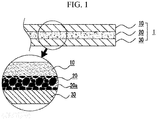
- FIG. 1 is a cross-sectional view illustrating the constitution of the fused sheet for electromagnetic wave absorption/extinction and shielding, and for electronic equipment high heat dissipation, in which in the case of the fused sheet for electromagnetic wave absorption/extinction and shielding, a premolded graphite sheet 10 prepared by molding a graphite substrate into a sheet form having a density in a range of 0.1 - 1.5 g/cm 3 and an incomplete state of crystal structure, is attached to one surface of a porous metal sheet 20 having a plurality of pores having a size of 0.01 mm - 0.5 mm, to be integrally press molded, and a heat dissipation film layer 30 is formed on the outer surface; and in the case of the fused sheet for electronic equipment high heat dissipation, a premolded graphite sheet 10 prepared by molding a graphite substrate into a sheet form having a density in a range of 0.1 - 1.5 g/cm 3 and an incomplete state of crystal structure, is attached to one surface
- the present invention relates to a fused sheet for electromagnetic wave absorption/extinction and shielding, and a fused sheet for electronic equipment high heat dissipation, both of which is formed by the same constitutions and the same manufacturing process, but they are distinguished from each other depending on the size of the pores formed on the fused sheet prepared by integrally pressing the porous metal sheet and the graphite sheet.
- the fused sheet for electromagnetic wave absorption/extinction and shielding has the electromagnetic wave absorption/extinction and shielding property by integrally press molding the graphite sheet on the porous metal sheet having a pore size of 0.01 mm - 0.5 mm; and the fused sheet for electronic equipment high heat dissipation is attached to electronic equipment to have the high heat dissipation property by integrally press molding the graphite sheet on the porous metal sheet having a pore size of 0.001 mm - 3.0 mm, so as to finally have pores having a size of 0.001 mm - 0.05 mm.
- FIG. 2 is a drawing schematically illustrating a porous metal sheet provided as a sintered sheet according to a first exemplary embodiment, in the fused sheet for electromagnetic wave absorption/extinction and shielding, and for electronic equipment high heat dissipation according to the present invention.
- a porous metal sheet provided as a sintered sheet 21, prepared by sintering copper-, tin-, zinc-, aluminum- or stainless-based metal powder having a particle size of 1 ⁇ m - 200 ⁇ m by heating at a temperature lower than a melting temperature by 10-30%, which is then pressed, is illustrated, wherein the sintered sheet 21 is obtained by heating copper-, tin-, zinc-, aluminum- or stainless-based metal powder having a melting temperature of 300 °C - 1800 °C and a particle size of 1 ⁇ m - 200 ⁇ m under a condition of a temperature atmosphere lower than the melting temperature by 10-30% for 10 - 300 minutes, and the fused sheet for electronic equipment high heat dissipation is formed so as to have pores 20a of 0.05 mm - 3.0 mm, and the fused sheet for electronic equipment high heat dissipation is formed so as to have pores 20a of 0.001 mm - 3.0 mm.
- FIG. 3 is a drawing schematically illustrating the porous metal sheet provided as a metal electrolysis cast sheet according to a second exemplary embodiment, in the fused sheet for electromagnetic wave absorption/extinction and shielding, and for electronic equipment high heat dissipation according to the present invention, and in describing the drawing based on the fused sheet for electromagnetic wave absorption/extinction and shielding, a porous metal sheet provided as a metal electrolysis cast sheet 22 in a sheet form having a thickness of 0.01 mm - 50 mm, by immersing a plate-shaped molding frame formed of a resin vaporized or liquefied at a high temperature in an electrolysis casting solution to be current applied, so that a metal is electrodeposited to form an electrodeposited layer, and heating the molding frame having this electrodeposited layer to remove the resin, thereby forming pores 20a, and if necessary, performing pressing 1 to 10 or more times, is illustrated in the drawing.
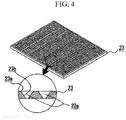
- FIG. 4 is a drawing schematically illustrating a porous metal sheet provided as a thin plate sheet according to a third exemplary embodiment, in the fused sheet for electromagnetic wave absorption/extinction and shielding, and for electronic equipment high heat dissipation according to the present invention.
- a porous metal sheet which is a metal thin plate sheet 23 prepared by forming pores on a thin plate formed of a copper-, tin-, zinc-, aluminum- or stainless-based metal material by a punching, laser or etching method to obtain a sheet member, in which based on one surface to which the premolded graphite sheet is attached, the pores include a curved portion forming a curved shape with the surface and an inclined portion where a diameter is gradually decreased from this curved portion to an interior, so that the crystal structure of the premolded graphite sheet is not broken in a state that the premolded graphite sheet is attached by press molding, is illustrated in the drawing.
- a porous metal sheet which is a metal thin plate sheet 23 prepared by forming pores having a size of 0.001 mm - 3.0 mm on a thin plate formed of a copper-, tin-, zinc-, aluminum- or stainless-based metal material by a punching, laser or etching method to obtain a sheet member, in which based on one surface to which the premolded graphite sheet is attached, the pores include a curved portion forming a curved shape with the surface and an inclined portion where a diameter is gradually decreased from this curved portion to an interior, so that the crystal structure of the premolded graphite sheet is not broken in a state that the premolded graphite sheet is attached by press molding, is illustrated in the drawing.
- FIG. 5 is a drawing schematically describing a porous metal sheet provided as a net sheet 24 according to a fourth exemplary embodiment, in the fused sheet for electromagnetic wave absorption/extinction and shielding, and for electronic equipment high heat dissipation according to the present invention.
- a porous metal sheet which is a net sheet 24 having pores 20a formed by weaving warp wires 24a and weft wires 24b formed of metal wire materials having a circular section so as to be intercrossed to each other, thereby forming pores between the weft wires and the warp wires is illustrated in the drawing, and in the present invention, it may be possible to weave the warp wires 24a and the weft wires 24b in a net shape by twisting two or more strands, in addition to using a single metal wire material.
- a porous metal sheet which is a net sheet 24 having pores 20a formed by weaving warp wires 24a and weft wires 24b formed of metal wire materials having a circular section so as to be intercrossed to each other, thereby forming pores having a size of 0.001 mm - 3.0 mm between the weft wires and the warp wires is illustrated in the drawing, and in the present invention, it may be possible to weave the warp wires 24a and the weft wires 24b in a net shape by twisting two or more strands, in addition to using a single metal wire material.
- FIG. 6 is a cross-sectional view for illustrating an application example of the fused sheet for electromagnetic wave absorption/extinction and shielding, and for electronic equipment high heat dissipation according to the present invention.
- the fused sheet for electromagnetic wave absorption/extinction and shielding prepared by stacking a premolded graphite sheet formed of a graphite substrate having an incomplete state of crystal structure on one surface of a porous metal sheet 20 formed of a porous metal having excellent thermal conductivity as a base substrate, and in this state, performing pressing with high pressure using pressing equipment such as a press or roller, so that a portion of the premolded graphite sheet is penetrated and impregnated into the inside of the porous metal sheet 20, forming a heat dissipation film layer 30 formed of any one or more of an insulating material formed by coating an insulation resin composition of any one or more of PVC, PC, urethane, silicone, ABS and UV, an adherend formed by applying a resin having an adhesive component, an adhesive material formed by attaching a double-sided tape, and a metal thin plate formed by pressing and attaching a thin plate formed of aluminum or aluminum alloy, on the
- the fused sheet for electronic equipment high heat dissipation prepared by stacking a premolded graphite sheet formed of a graphite substrate having an incomplete state of crystal structure on one surface of a porous metal sheet 20 formed of a porous metal having excellent thermal conductivity as a base substrate, and in this state, performing pressing with high pressure using pressing equipment such as a press or roller, so that a portion of the premolded graphite shee is penetrated and impregnated into the inside of the porous metal sheet 20, forming a heat dissipation film layer 30 formed of any one or more of an insulating material formed by coating an insulation resin composition of any one or more of PVC, PC, urethane, silicone, ABS and UV, an adherend formed by applying a resin having an adhesive component, an adhesive material formed by attaching a double-sided tape, and a metal thin plate formed by pressing and attaching a thin plate formed of aluminum or
- FIG. 7 is an exemplary drawing for describing the properties of the fused sheet for electromagnetic wave absorption/extinction and shielding, and for electronic equipment high heat dissipation according to the present invention.
- the fused sheet for electromagnetic wave absorption/extinction and shielding including a porous metal sheet 20 provided as a thin plate formed by sintering, metal electrolysis casting, punching or the like, or a net form formed by weaving wires; a premolded graphite sheet 10 which is integrally attached by press molding so that a portion of the crystal particles is impregnated into the pores on the surface side of the porous metal sheet 20, formed on the upper surface of the porous metal sheet 20; a heat dissipation film layer 30 formed of any one of an
- the fused sheet for electronic equipment high heat dissipation including a porous metal sheet 20 provided as a thin plate formed by sintering, metal electrolysis casting, punching or the like, or a net form formed by weaving wires; a premolded graphite sheet 10 which is integrally attached by press molding so that a portion of the crystal particles is impregnated into the pores on the surface side of the porous metal sheet 20, formed on the upper surface of the porous metal sheet 20; a heat dissipation film layer 30 formed of any
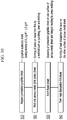
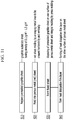
- FIGS. 8 to 11 are block diagrams for describing the method of manufacturing a fused sheet for electromagnetic wave absorption/extinction and shielding, and for electronic equipment high heat dissipation according to the present invention.
- FIG. 8 represents a method of manufacturing a fused sheet for electromagnetic wave absorption/extinction and shielding, and for electronic equipment high heat dissipation, using a porous metal sheet prepared by preparing a premolded graphite sheet 10 formed of a graphite substrate having an incomplete state of crystal structure, disposing the premolded graphite sheet on one surface of the porous metal sheet 20 obtained by molding metal powder through a sintering process, and then performing pressing to be integrally attached, in which a process of forming a heat dissipation film layer 30 on the other surface of the porous metal sheet 20 for contacting a heat source is illustrated, and the heat dissipation film layer 30 may be formed on the fused sheet formed by press molding the premolded graphite sheet 10 and the porous metal sheet 20, or by stacking the premolded graphite sheet 10, the porous metal sheet 20, and the heat dissipation layer 30, and then performing integral press molding.
- FIG. 9 illustrates a process of forming a diffused sheet by preparing a premolded graphite sheet 10 formed of a graphite substrate, having a density in a range of 0.1 g/cm 3 - 1.5 g/cm 3 and an incomplete state of crystal structure, and a porous metal sheet 20 prepared by applying a current flow solution on the outer surface of a plate-shaped molding frame formed by molding a resin vaporized or liquefied at a high temperature to form a current flow layer, which is then immersed in an electrolysis casting solution to be current applied to electrodeposit a metal, and heating the molding frame to remove the resin, respectively; and stacking them and attaching to each other integrally through press molding to form the fused sheet, in which the fused sheet has a heat dissipation film layer 30 for contacting a heat source on the other surface of the porous metal sheet to which the premolded graphite sheet 10 is not attached.
- the heat dissipation layer 30 may be formed on the fused sheet formed by press molding the premolded graphite sheet 10 and the porous metal sheet 20, or the premolded graphite sheet 10, the porous metal sheet 20, and the heat dissipation layer 30 are stacked and press molded integrally.
- FIG. 10 includes a premolded graphite sheet formed of a graphite substrate having a density of 0.1 g/cm 3 - 1.5 g/cm 3 and an incomplete state of crystal structure, and a porous metal sheet 20 formed of a thin plate, prepared by perforating the thin plate of a metal material to form pores, the pore 20a including a curved portion 23a forming a gentle curved surface with the surface and an inclined portion 23b extending from this curved portion 23a, in which the porous metal sheet may be formed so that the crystal structure of the graphite substrate is not broken by the gentle curved portion 23a having the pores 20a in the course of integrally attaching the premolded graphite sheet in a state of being stacked on one surface by press molding, and impregnation density is increased by the inclined portion 23b.
- FIG. 11 includes a premolded graphite sheet formed of a graphite substrate having a density of 0.1 g/cm 3 - 1.5 g/cm 3 and an incomplete state of crystal structure, and a porous metal sheet 20 formed of a network sheet 24 prepared by weaving warp wires 24a and weft wires 24b having a circular or oval section into a net form to be intercrossed to each other, in which as the wire having a circular section is used, the crystal structure of the graphite substrate is not broken, and impregnated into the network forming the pores 20a to be integrally attached, in the course of press molding the porous metal sheet 20 integrally with the premolded graphite sheet 10, thereby forming the fused sheet.
- the fused sheet for electromagnetic wave absorption/extinction and shielding and fused sheet for electronic equipment high heat dissipation according to the present invention will be described, in which first, the fused sheet for electromagnetic wave absorption/extinction and shielding, and then the fused sheet for electronic equipment high heat dissipation will be described.
- the fused sheet for electromagnetic wave absorption/extinction and shielding 1 mainly includes a porous metal sheet 20 formed of a metal material having pores 15, in which a curved surface is formed without an edge so that the graphite crystal structure is not broken in the pressing process; a premolded graphite sheet 10 provided by being stacked on one surface of the porous metal sheet 20, in which the premolded graphite sheet is formed by molding a graphite substrate into a sheet form to have a density in a range of 0.1 - 1.5 g/cm 3 and an incomplete state of crystal structure, and being integrally attached by a pressing process; and a heat dissipation film layer 30 formed of a metal and organic/iniorganic-based resin, provided by being stacked on the other surface of the porous metal sheet 20, which is integrally attached by pressing, application or impregnation, and a portion of which is impregnated through the pores formed on the surface of the porous metal sheet 20 into the premolded graphite sheet 10 on the opposite surface of the
- the present invention as described above may be manufactured by two main methods depending on the physical properties of the heat dissipation film layer 30.
- the heat dissipation film layer 30 is provided as a resin-based material
- the premolded graphite sheet 10 is stacked one surface of the porous metal sheet 20 having a plurality of pores 20a formed thereon, and integrated by press molding, and then a resin-based composition forming the heat dissipation film layer 30 is integrally attached on the other surface of the porous metal sheet 20 by a method of application, spray, impregnation or the like.
- the premolded graphite sheet 10 and the heat dissipation film layer 30 are stacked one surface and the other surface of the porous metal sheet 20, respectively, and press molded at the same time, to be integrated.
- the premolded graphite sheet 10 is prepared by premolding the graphite substrate into a sheet form, wherein the graphite substrate may be provided by compression molding graphite or graphite powder which occurs naturally as one of carbon isotopes or is artificially prepared, using a graphite composition of any one or more of organic-, inorganic- and ceramic-based materials with graphite, or molding any one of mixtures of a heat dissipation resin of any one or more of organic-, inorganic- and ceramic-based materials with graphite.
- This premolded graphite sheet 10 is a sheet form into which the metal thin plate sheet 23 is molded, and has a density in a range of 0.1-1.5 g/cm 3 , so that the crystal structure is not completely bonded, and has an incomplete state. This is for densely compressing the crystal structure by press molding, in a state of being stacked on one surface of the porous metal sheet 20 as described below.
- the premolded graphite sheet 10 has a dense tissue state, that is, a density of 1.6 g/cm 3 or more, the crystal structure will be broken after an integral press process in a state that the premolded graphite sheet is stacked the porous metal sheet 20 as described below, and consequently, the thermal conductivity and the thermal diffusion in a plane direction of the graphite sheet will be deteriorated.
- the porous metal sheet 20 is a sheet material having a thickness of 0.01 - 50 mm, and prepared by forming pores 20a composed of fine holes or gaps connected to upper and lower surfaces, in which the pores 20a is evenly distributed, and have a size of 0.01 mm - 3.0 mm connected to upper and lower surfaces. It is preferred that this porous metal sheet 20 is provided as a metal material having good thermal conductivity and elasticity to external force, and in the case that the metal has pores formed thereon, it has an absorption/dissipation function to electromagnetic waves, and particularly, as the pores are small, excellent shielding performance in a low frequency band may be secured.
- the present invention suggests that the pores 20a connected to upper and lower surface of the porous metal sheet 20 have a size of 0.01 mm - 3.0 mm. This is because in the case that the pores 20a have a size less than 0.01 mm, the impregnation rate of the graphite substrate as a high performance electromagnetic wave shielding agent is too lowered due to micropores, resulting in also lowering the electromagnetic wave shielding performance, and in the case that the pores 20a have a size above 3 mm, the graphite substrate is impregnated and does not maintain a firmly binding state, and may be released or separated from the porous metal sheet 20.
- the porous metal sheet 20 has the pores 20a having the size of 0.01 mm - 3 mm, more preferably, 0.05 mm - 1.0 mm.
- This porous metal sheet 20 may be various forms of metal sheets as long as it is provided as a metal sheet material having the pores 20a composed of fine holes or gaps, however, the pores 20a contacting the premolded graphite sheet 10 should be formed to entirely have a round shape without an edge, that is a gentle curved surface, so that in the course of pressing the premolded graphite sheet 10 stacked on one surface thereof, the crystal structure of the premolded graphite sheet 10 is not broken.
- the porous metal sheet 20 of the present invention is provided as a sintered sheet 21 manufactured by a sintering process, a metal electrolysis cast sheet 22 manufactured by a metal electrolysis casting method, a metal thin plate sheet 23 manufactured by perforating a metal thin plate, or a net sheet 24 manufactured by weaving wire into a net form, and hereinafter, various methods of manufacturing the porous metal sheet 20 will be described briefly.
- a sintered sheet 21 is a sheet material molded by heating metal powder having a particle size of 1 ⁇ m - 200 ⁇ m at a temperature lower than a melting temperature to perform sintering so that the powder is not completely melted and connected to each other, and pressing the powder, as shown in FIG. 2 .
- the sintered sheet 21 is manufactured into a sheet form by preparing copper-, tin-, zinc-, aluminum- or stainless-based metal powder such as copper having a size of around 1 ⁇ m - 200 ⁇ m and a melting temperature of 300 °C - 1800 °C, heating the metal powder at a temperature lower than the melting temperature by about 10% - 30% for 10 - 300 minutes to be sintered, and then performing press molding into a sheet form with a pressure of 30 MPa - 300 MPa 1 to dozens of times using pressing equipment such as a press or roller, thereby having a thickness of 0.01 - 50 mm, and a plurality of pores 20a formed thereon having a size of 0.01 mm - 3.0 mm, connected to upper and lower surfaces.
- the metal electrolysis sheet 22 is provided by immersing a plate-shaped molding frame formed of a resin vaporized or liquefied at a high temperature to electrodeposit a metal to form an electrodeposited layer, and heating the molding frame having the electrodeposited layer formed thereon to remove the resin to form the pores 20a, and if necessary, pressing 1 to 10 or more times, into a sheet form having a thickness of 0.01 mm - 50 mm, as shown in FIG. 3 .
- the metal thin plate sheet 23 is a sheet member prepared by forming pores on a thin plate formed of a copper-, tin-, zinc-, aluminum- or stainless-based metal material by a punching, laser or etching method, in which based on one surface to which the premolded graphite sheet is attached, the pores include a curved portion forming a curved shape with the surface and an inclined portion where a diameter is gradually decreased from this curved portion to an interior, so that the crystal structure of the premolded graphite sheet is not broken in a state that the premolded graphite sheet is attached by press molding, as shown in FIG. 4 .
- the net sheet 24 is a porous metal sheet having pores 20a formed by weaving warp wires 24a and weft wires 24b formed of metal wire materials having a circular section so as to be intercrossed to each other, thereby forming pores between the weft wires and the warp wires, as illustrated, and in the present invention, it may be possible to weave the warp wires 24a and the weft wires 24b in a net shape by twisting two or more strands, in addition to using a single metal wire material, as shown in FIG. 5 .
- the thickness of the porous metal sheet 20 manufactured by various manufacturing methods as such may be adjusted by repeating pressing 1 or several times using pressing equipment such as a press or roller.
- the heat dissipation film layer 30 is provided as metal and organic/inorganic-based resin, which is stacked on the opposite surface to the surface of the porous metal sheet 20 on which the premolded graphite sheet 10 stacked, and integrally attached by pressing, coating, impregnation or the like, and a portion of which is impregnated through the pores formed on the surface of the porous metal sheet 20 into the graphite sheet 10 on the opposite side, thereby forming binding force.
- This heat dissipation film layer 30 is integrally attached on the porous metal sheet 20, and may be formed of any one or more of an insulating material formed by coating an insulation resin composition of any one or more of PVC, PC, urethane, silicone, ABS and UV, an adherend formed by applying a resin having an adhesive component, an adhesive material formed by attaching a double-sided tape, and a metal thin plate formed by attaching soft aluminum or aluminum, a portion of which is impregnated into the pores 20a on the surface of the porous metal sheet 20 by press bonding to the porous metal sheet 20 while having a good heat dissipation property, and it is also possible to form a plurality of layers.
- the heat dissipation film layer 30 of the present invention is stacked on the lower surface of the porous metal sheet 20 on which a heat source (not shown) is disposed, as shown in FIG. 1 , wherein the heat dissipation film layer 30 may be provided as a single layer of a resin-based insulating material, adherend, adhesive material or aluminum thin plate.
- the heat dissipation film layer 30 formed of a resin-based or aluminum thin plate is stacked on the lower surface of the porous metal sheet 20 on which a heat source is disposed, and an insulating layer 40 formed by coating an insulation resin composition of any one or more of PVC, PC, urethane, silicone, ABS and UV is formed on the lower surface of the heat dissipation film layer to form a muli-layered structure, shown in FIGS. 6 and 7 .
- the method of manufacturing a fused sheet for electromagnetic wave absorption/extinction and shielding mainly includes preparing a premolded graphite sheet (s10), molding a porous metal sheet formed of a sintered sheet 21 (s20), forming a fused sheet (s30), and forming a heat dissipation thin layer (s40).
- a premolded graphite sheet (s10) graphite or graphite powder which is a graphite substrate is compression molded, or a graphite substrate formed of a graphite composition of any one or more of organic-, inorganic- and ceramic-based materials with graphite, or a mixture of a heat dissipation resin of any one or more of organic-, inorganic- and ceramic-based materials with graphite is prepared, and premolded into a sheet form having a density in a range of 0.1 g/cm 3 - 1.5 g/cm 3 and an incomplete state of crystal structure. Since the premolding method at this time may be carried out in various ways, detailed description thereof will be omitted.
- a porous metal sheet (s20)
- copper-, tin-, zinc-, aluminum- or stainless-based metal powder having a melting temperature of 300 °C - 1800 °C is prepared first, wherein the metal powder has a particle size of 1 ⁇ m - 200 ⁇ m.
- the thus-prepared metal powder is filled into a mold providing a molding space for molding a thin film material of a thin plate, and heated at a temperature lower than the melting temperature by 10%-30% depending on the melting properties of the metal power materials 10 - 300 minutes to be sintered, thereby manufacturing a sintered sheet 21.
- This sintered sheet 21 forms uniform pores 20a by stably fusing the interface of the metal powder with each other.
- the premolded graphite sheet 10 is stacked on one surface of the porous metal sheet 20 and pressed, thereby impregnating the graphite crystals forming the graphite sheet into the pores on the surface of the porous metal sheet to be integrally combined, so as to have a density in a range of 1.6 g/cm 3 - 6.0 g/cm 3 , and a pore size of 0.01 mm - 0.5 mm.
- pressing is performed to the porous metal sheet 20 which is the sintered sheet 21 and the premolded graphite sheet 10 stacked on one surface thereof at a pressure of 30 MPa - 300 MPa 1-20 times, using pressing equipment, thereby resulting in a fused sheet having a thickness of 0.01 mm - 50 mm.
- various pressing equipment may be used, and in the present invention, a press machine or a rolling mill in a roller pressing manner is suggested, and the pressing may be repeated about 1-20 times depending on the requirements of the product and the performance of the pressing equipment.
- the fused sheet which is press molded by the press machine or the rolling mill in a roller pressing manner is pressed so that the upper and lower surfaces become flat, and as the sintering density is increased under a pressing process, the combining force between metal powder is increased, resulting in creased durability and elasticity.
- the process may be carried out at a room temperature, but it is preferred that the process is carried out at a temperature lower than the sintering temperature of the metal powder by 40% or less.
- the heat dissipation film layer is stacked on the other surface of the porous metal sheet 20, that is, the opposite surface on which the premolded graphite sheet 10 is not attached.
- This heat dissipation film layer 30 is stacked on the other surface of the porous metal sheet 20, and in this state, integrally attached by pressing, coating or impregnation, and as the heat dissipation film layer, a thin plate formed of organic/inorganic-based resin or aluminum or aluminum alloy, a portion of which is impregnated into the pores formed on the surface of the porous metal sheet to be attached on the graphite sheet on the opposite side, thereby producing integral bonding force, is used.
- the heat dissipation film layer a composition of any one or more of organic-, inorganic- and ceramic-based materials, a graphite composition of this composition with some of graphite, or a thin plate formed of soft aluminum or aluminum alloy may be used, and the heat dissipation film layer may be integrated into the porous metal sheet by a coating, impregnation, spray or press method, depending on the physical properties of the materials to be used.
- the heat dissipation film layer 30 is formed on the fused sheet prepared by first pressing the porous metal sheet 20 which is the sintered sheet 21, and the premolded graphite sheet 10 to each other to be integrally combined, however, the present invention is not limited thereto, and it is also possible to stack the porous metal sheet 20 which is the sintered sheet 21, the premolded graphite sheet 10, and the heat dissipation film layer 30 to be integrated by the pressing process.
- the method of manufacturing a fused sheet for electromagnetic wave absorption/extinction and shielding mainly includes preparing a premolded graphite sheet (s11), molding a porous metal sheet formed of an electrolysis cast sheet 22 (s21), forming a fused sheet (s31), and forming a heat dissipation thin layer (s41).
- the step of preparing a premolded graphite (s11) is substantially the same as the constitution of the first exemplary embodiment as described above. That is, graphite or graphite powder which is a graphite substrate is compression molded, or a graphite substrate formed of a graphite composition of any one or more of organic-, inorganic- and ceramic-based materials with graphite, or a mixture of a heat dissipation resin of any one or more of organic-, inorganic- and ceramic-based materials with graphite is prepared, and premolded into a sheet form having a density in a range of 0.1 g/cm 3 - 1.5 g/cm 3 and an incomplete state of crystal structure. Since the premolding method at this time may be carried out in various ways, detailed description thereof will be omitted.
- a premolded porous metal sheet is molded by a metal electrolysis cast method, and then pressed several times by a pressing process to complete the porous metal sheet. That is, further describing the step of molding the porous metal sheet in the present exemplary embodiment, a current flow solution is applied first on the outer surface of a plate-shaped molding frame formed of a resin vaporized or liquefied at a high temperature to form a current flow layer, and the molding frame having the current flow layer formed thereon is immersed in an electrolysis casting solution. Then, the molding frame having the current flow layer immersed in the electrolysis casting solution is current applied to electrodeposit the metal, thereby forming an electrodeposited layer.
- the molding frame having the electrodeposited layer formed thereon is taken out of the electrolysis cast, and heated to a predetermined temperature, the molding frame formed of a resin is melted to be removed, resulting in completing the premolded porous metal sheet composed of the electrodeposited layer having pores. Thereafter, the premolded porous metal sheet is pressed about 1 to 10 times using pressing equipment such as a roller or press, so as to have a thickness of 0.01 mm - 50 mm, thereby completing the molding of the porous metal sheet.
- the premolded graphite sheet 10 is stacked on one surface of the porous metal sheet 20 prepared by the electrolysis casting method and pressed, thereby impregnating the graphite crystals forming the graphite sheet into the pores on the surface of the porous metal sheet to be integrally combined, so as to have a density in a range of 1.6 g/cm 3 - 6.0 g/cm 3 , and a pore size of 0.01 mm - 0.5 mm.
- pressing is performed to the porous metal sheet 20 which is the electrolysis cast sheet 22 and the premolded graphite sheet 10 stacked on one surface thereof at a pressure of 30 MPa - 300 MPa 1 to 20 times, using pressing equipment, thereby resulting in a fused sheet having a thickness of 0.01 mm - 50 mm.
- various pressing equipment may be used, and in the present invention, a press machine or a rolling mill in a roller pressing manner is suggested, and the pressing may be repeated about 1 to 20 times depending on the requirements of the product and the performance of the pressing equipment.
- the fused sheet which is press molded by the press machine or the rolling mill in a roller pressing manner is pressed so that the upper and lower surfaces become flat, and as the sintering density is increased under a pressing process, the combining force between metal powder is increased, resulting in creased durability and elasticity.
- the process may be carried out at a room temperature, but it is preferred that the process is carried out at a temperature lower than the sintering temperature of the metal powder by 40% or less.
- the heat dissipation film layer is stacked on the other surface of the porous metal sheet 20, that is, the opposite surface on which the premolded graphite sheet 10 is not attached.
- This heat dissipation film layer 30 is stacked on the other surface of the porous metal sheet 20, and in this state, integrally attached by pressing, coating or impregnation, and as the heat dissipation film layer, a thin plate formed of organic/inorganic-based resin or aluminum or aluminum alloy, a portion of which is impregnated into the pores formed on the surface of the porous metal sheet to be attached on the graphite sheet on the opposite side, thereby producing integral bonding force, is used.
- the heat dissipation film layer a composition of any one or more of organic-, inorganic- and ceramic-based materials, a graphite composition of this composition with some of graphite, or a thin plate formed of soft aluminum or aluminum alloy may be used, and the heat dissipation film layer is integrated into the porous metal sheet by a coating, impregnation, spray or press method, depending on the physical properties of the materials to be used.
- the heat dissipation film layer 30 is formed on the fused sheet prepared by first pressing the porous metal sheet 20 which is the electrolysis cast sheet 22, and the premolded graphite sheet 10 to each other to be integrally combined, however, the present invention is not limited thereto, and it is also possible to stack the porous metal sheet 20 which is the electrolysis cast sheet 22, the premolded graphite sheet 10, and the heat dissipation film layer 30 to be integrated by the pressing process.
- the method of manufacturing a fused sheet for electromagnetic wave absorption/extinction and shielding mainly includes preparing a premolded graphite sheet (s12), molding a porous metal sheet formed of a metal thin plate sheet 23 (s22), forming a fused sheet (s32), and forming a heat dissipation thin layer (s42).
- a premolded graphite sheet (s12) graphite or graphite powder which is a substrate is compression molded, or a graphite substrate formed of a graphite composition of any one or more of organic-, inorganic- and ceramic-based materials with graphite, or a mixture of a heat dissipation resin of any one or more of organic-, inorganic- and ceramic-based materials with graphite is prepared, and premolded into a sheet form having a density in a range of 0.1 g/cm 3 - 1.5 g/cm 3 and an incomplete state of crystal structure. Since the premolding method at this time may be carried out in various ways, detailed description thereof will be omitted.
- a metal thin plate sheet 23 formed by perforating the metal thin plate is used, wherein the metal thin plate sheet 23 is a sheet material having pores on the thin plate formed of a copper, tin, zinc, aluminum or stainless-based metal material, using a puncing, laser, etching method.
- the pores 25 which are holes formed on the metal thin plate sheet 23 should be provided so that the crystal structure is not broken in a state that the premolded graphite sheet 10 is attached by press molding.
- the a curved portion 23a based on one surface to which the premolded graphite sheet 10 is attached, the a curved portion 23a forming a curved shape with the surface and an inclined portion 23b where a diameter is gradually decreased from this curved portion 23a to the inside of the holes are formed.
- vaious forms of metal thin plate sheet may be used, as long as it is provided as a sheet material formed of a metal thin plate having the pores 20a composed of fine holes or gaps, however, the pores 20a contacting the premolded graphite sheet 10, and the surfaces connected to these pores 25 should be formed to entirely have a round shape without an edge, that is a gentle curved surface, so that in the course of pressing the premolded graphite sheet 10 stacked on one surface thereof, the crystal structure of the premolded graphite sheet 10 is not broken.
- the premolded graphite sheet 10 is stacked on one surface of the porous metal sheet 20 provided as the metal thin plate sheet 23 and pressed, thereby impregnating the graphite crystals forming the graphite sheet into the pores on the surface of the porous metal sheet to be integrally combined, so as to have a density in a range of 1.6 g/cm 3 - 6.0 g/cm 3 , and a pore size of 0.01 mm - 0.5 mm.
- pressing is performed to the porous metal sheet 20 which is the metal thin plate sheet 23 and the premolded graphite sheet 10 stacked on one surface thereof at a pressure of 30 MPa - 300 MPa 1 to 20 times, using pressing equipment, thereby resulting in a fused sheet having a thickness of 0.01 mm - 50 mm.
- various pressing equipment may be used, and in the present invention, a press machine or a rolling mill in a roller pressing manner is suggested, and the pressing may be repeated about 1 to 20 times depending on the requirements of the product and the performance of the pressing equipment.
- the fused sheet which is press molded by the press machine or the rolling mill in a roller pressing manner is pressed so that the upper and lower surfaces become flat, and as the sintering density is increased under a pressing process, the combining force between metal powder is increased, resulting in creased durability and elasticity.
- the process may be carried out at a room temperature, but it is preferred that the process is carried out at a temperature lower than the sintering temperature of the metal powder by 40% or less.
- the heat dissipation film layer is stacked on the other surface of the porous metal sheet 20, that is, the opposite surface on which the premolded graphite sheet 10 is not attached.
- This heat dissipation film layer 30 is stacked on the other surface of the porous metal sheet 20, and in this state, integrally attached by pressing, coating or impregnation, and as the heat dissipation film layer, a thin plate formed of organic/inorganic-based resin or aluminum or aluminum alloy, a portion of which is impregnated into the pores formed on the surface of the porous metal sheet to be attached on the graphite sheet on the opposite side, thereby producing integral bonding force, is used.
- the heat dissipation film layer a composition of any one or more of organic-, inorganic- and ceramic-based materials, a graphite composition of this composition with some of graphite, or a thin plate formed of soft aluminum or aluminum alloy may be used, and the heat dissipation film layer is integrated into the porous metal sheet 20 by a coating, impregnation, spray or press method, depending on the physical properties of the materials to be used.
- the heat dissipation film layer 30 is formed on the fused sheet prepared by first pressing the porous metal sheet 20 which is the metal thin plate sheet 23, and the premolded graphite sheet 10 to each other to be integrally combined, however, the present invention is not limited thereto, and it is also possible to stack the porous metal sheet 20 which is the metal thin plate sheet 23, the premolded graphite sheet 10, and the heat dissipation film layer 30 to be integrated by the pressing process.
- the method of manufacturing a fused sheet for electromagnetic wave absorption/extinction and shielding mainly includes preparing a premolded graphite sheet (s13), molding a porous metal sheet formed of a metal thin plate sheet 23 (s23), forming a fused sheet (s33), and forming a heat dissipation thin layer (s43)
- a premolded graphite sheet (s13) graphite or graphite powder which is a substrate is compression molded, or a graphite substrate formed of a graphite composition of any one or more of organic-, inorganic- and ceramic-based materials with graphite, or a mixture of a heat dissipation resin of any one or more of organic-, inorganic- and ceramic-based materials with graphite is prepared, and premolded into a sheet form having a density in a range of 0.1 g/cm 3 - 1.5 g/cm 3 and an incomplete state of crystal structure. Since the premolding method at this time may be carried out in various ways, detailed description thereof will be omitted.
- a net sheet 24 in a net form prepared by weaving warp wires 24a and weft wires 24b having a circular section formed of a metal material to be intercrossed, thereby forming pores between the warp wire 24a and the weft wire 24b, is used.
- the premolded graphite sheet 10 is stacked on one surface of the porous metal sheet 20 provided as the net sheet 24 and pressed, thereby impregnating the graphite crystals forming the graphite sheet into the pores on the surface of the porous metal sheet to be integrally combined, so as to have a density in a range of 1.6 g/cm 3 - 6.0 g/cm 3 , and a pore size of 0.01 mm - 0.5 mm.
- pressing is performed to the porous metal sheet 20 which is the net sheet 24 and the premolded graphite sheet 10 stacked on one surface thereof at a pressure of 30 MPa - 300 MPa 1 to 20 times, using pressing equipment, thereby resulting in a fused sheet having a thickness of 0.01 mm - 50 mm.
- various pressing equipment may be used, and in the present invention, a press machine or a rolling mill in a roller pressing manner is suggested, and the pressing may be repeated about 1 to 20 times depending on the requirements of the product and the performance of the pressing equipment.
- the fused sheet which is press molded by the press machine or the rolling mill in a roller pressing manner is pressed so that the upper and lower surfaces become flat, and as the sintering density is increased under a pressing process, the combining force between metal powder is increased, resulting in creased durability and elasticity.
- the process may be carried out at a room temperature, but it is preferred that the process is carried out at a temperature lower than the sintering temperature of the metal powder by 40% or less.
- the heat dissipation film layer is stacked on the other surface of the porous metal sheet 20, that is, the opposite surface on which the premolded graphite sheet 10 is not attached.
- This heat dissipation film layer 30 is stacked on the other surface of the porous metal sheet 20, and in this state, integrally attached by pressing, coating or impregnation, and as the heat dissipation film layer, a thin plate formed of organic/inorganic-based resin or aluminum or aluminum alloy, a portion of which is impregnated into the pores formed on the surface of the porous metal sheet to be attached on the graphite sheet on the opposite side, thereby producing integral bonding force, is used.
- thermoplastic-based materials a composition of any one or more of organic-, inorganic- and ceramic-based materials, a graphite composition of this composition with some of graphite, or a thin plate formed of soft aluminum or aluminum alloy may be used, and the heat dissipation film layer may be integrated into the porous metal sheet 20 by a coating, impregnation, spray or press method, depending on the physical properties of the materials to be used.
- the heat dissipation film layer 30 is formed on the fused sheet prepared by first pressing the porous metal sheet 20 which is the net sheet 24, and the premolded graphite sheet 10 to each other to be integrally combined, however, the present invention is not limited thereto, and it is also possible to stack the porous metal sheet 20 which is the net sheet 24, the premolded graphite sheet 10, and the heat dissipation film layer 30 to be integrated by the pressing process.
- the method of manufacturing a fused sheet for electromagnetic wave absorption/extinction and shielding to which the porous metal sheet 20 prepared by the various preparation methods as described above is applied has a simple manufacturing process, thereby allowing economical production through mass production.
- the graphite crystals forming the graphite sheet 10 are impregnated into the premolded pores 25 to maintain firm bonding force, and aiming at improved performance of electromagnetic wave absorption/extinction and shielding, and also, the heat dissipation film layer 30 formed on the other surface of the porous metal sheet 20 opposite to the premolded graphite sheet 10 is physically firmly integrated, as the components thereof are impregnated through the pores 25 into the premolded graphite sheet 10.
- the fused sheet for electronic equipment high heat dissipation 1 mainly includes a porous metal sheet 20 formed of a metal material having pores 15, in which a curved surface is formed without an edge so that the graphite crystal structure is not broken in the pressing process; a premolded graphite sheet 10 provided by being stacked on one surface of the porous metal sheet 20, in which the premolded graphite sheet is formed by molding a graphite substrate into a sheet form to have a density in a range of 0.1 - 1.5 g/cm 3 and an incomplete state of crystal structure, and being integrally attached by a pressing process; and optionally, a heat dissipation film layer 30 formed of a metal and organic/iniorganic-based resin, provided by being stacked on the other surface of the porous metal sheet 20, which is integrally attached by pressing, application or impregnation, and a portion of which is impregnated through the pores formed on the surface of the porous metal sheet 20 into the premolded graphite sheet 10 on the opposite
- the porous metal sheet 20 has a characteristic of forming a plurality of pores having a size of 0.001 mm - 0.05 mm connected to the upper and lower surfaces by being integrally attached to and combined with the preformed graphite sheet, so as to have a density of 1.6 g/cm 3 - 6.0 g/cm 3 .
- the present invention as described above may be manufactured by two main methods depending on the physical properties of the heat dissipation film layer 30.
- the heat dissipation film layer 30 is provided as a resin-based material
- the premolded graphite sheet 10 is stacked one surface of the porous metal sheet 20 having a plurality of pores 20a formed thereon, and integrated by press molding, and then a resin-based composition forming the heat dissipation film layer 30 is integrally attached on the other surface of the porous metal sheet 20 by a method of application, spray, impregnation or the like.
- the premolded graphite sheet 10 and the heat dissipation film layer 30 are stacked one surface and the other surface of the porous metal sheet 20, respectively, and press molded at the same time, to be integrated.
- the premolded graphite sheet 10 is substantially the same as the constotiution of the fused sheet for electromagnetic wave absorption/extinction and shielding as described above, and thus, detailed description is omitted.
- the porous metal sheet 20 is a sheet material having a thickness of 0.01 - 50 mm, and prepared by forming pores 20a composed of fine holes or gaps connected to upper and lower surfaces, in which the pores 20a is evenly distributed, and have a size of 0.001 mm - 3.0 mm connected to upper and lower surfaces. It is preferred that this porous metal sheet 20 is provided as a metal material having good thermal conductivity and elasticity to external force, and in the case that the metal has pores formed thereon, it has an absorption/dissipation function to electromagnetic waves, and particularly, as the pores are small, excellent shielding performance in a low frequency band mya be secured. Thus, the present invention suggests that the pores 20a connected to upper and lower surface of the porous metal sheet 20 have a size of 0.01 mm - 3.0 mm
- the porous metal sheet 20 has the pores 20a having the size of 0.001 mm - 3 mm.
- vaious forms of metal sheet may be used, as long as it is provided as a sheet material having the pores 20a composed of fine holes or gaps, however, the pores 20a contacting the premolded graphite sheet 10 should be formed to entirely have a round shape without an edge, that is a gentle curved surface, so that in the course of pressing the premolded graphite sheet 10 stacked on one surface thereof, the crystal structure of the premolded graphite sheet 10 is not broken.
- the porous metal sheet 20 of the present invention is provided as a sintered sheet 21 manufactured by a sintering process, a metal electrolysis cast sheet 22 manufactured by a metal electrolysis casting method, a metal thin plate sheet 23 manufactured by perforating a metal thin plate, or a net sheet 24 manufactured by weaving wire into a net form, and hereinafter, various methods of manufacturing the porous metal sheet 20 will be described briefly.
- a sintered sheet 21 is a sheet material molded by heating metal powder having a particle size of 1 ⁇ m - 200 ⁇ m at a temperature lower than a melting temperature to perform sintering so that the powder is not completely melted and connected to each other, and pressing the powder, as shown in FIG. 2 .
- the sintered sheet 21 is manufactured into a sheet form by preparing copper-, tin-, zinc-, aluminum- or stainless-based metal powder such as copper having a size of around 1 ⁇ m - 200 ⁇ m and a melting temperature of 300 °C - 1800 °C, heating the metal powder at a temperature lower than the melting temperature by about 10% - 30% for 10 - 300 minutes to be sintered, and then performing press molding into a sheet form with a pressure of 30 MPa - 300 MPa 1 to dozens of times using pressing equipment such as a press or roller, thereby having a thickness of 0.01 - 50 mm, and a plurality of pores formed thereon having a size of 0.001 mm - 3.0 mm, connected to upper and lower surfaces.
- copper-, tin-, zinc-, aluminum- or stainless-based metal powder such as copper having a size of around 1 ⁇ m - 200 ⁇ m and a melting temperature of 300 °C - 1800 °C
- the metal electrolysis sheet 22 is provided by immersing a plate-shaped molding frame formed of a resin vaporized or liquefied at a high temperature to electrodeposit a metal to form an electrodeposited layer, and heating the molding frame having the electrodeposited layer formed thereon to remove the resin to form the pores 20a having a size of 0.001 mm - 3.0 mm, and if necessary, pressing 1 to 10 or more times, into a sheet form having a thickness of 0.01 mm - 50 mm, as shown in FIG. 3 .
- the metal thin plate sheet 23 is a sheet member prepared by forming pores having a size of 0.001 mm - 3.0 mm on a thin plate formed of a copper-, tin-, zinc-, aluminum- or stainless-based metal material by a punching, laser or etching method, in which based on one surface to which the premolded graphite sheet is attached, the pores include a curved portion forming a curved shape with the surface and an inclined portion where a diameter is gradually decreased from this curved portion to an interior, so that the crystal structure of the premolded graphite sheet is not broken in a state that the premolded graphite sheet is attached by press molding, as shown in FIG. 4 .
- the net sheet 24 is a porous metal sheet having pores 20a formed by weaving warp wires 24a and weft wires 24b formed of metal wire materials having a circular section so as to be intercrossed to each other, thereby forming pores 20a having a size of 0.001 mm - 3.0 mm between the weft wires and the warp wires, as illustrated, and in the present invention, it may be possible to weave the warp wires 24a and the weft wires 24b in a net shape by twisting two or more strands, in addition to using a single metal wire material, as shown in FIG. 5 .
- the thickness and pore size of the porous metal sheet 20 manufactured by various manufacturing methods as such may be adjusted by repeating pressing 1 or several times using pressing equipment such as a press or roller.
- the heat dissipation film layer 30 is provided as metal and organic/inorganic-based resin, which is stacked on the opposite surface to the surface of the porous metal sheet 20 on which the premolded graphite sheet stacked, and integrally attached by pressing, coating, impregnation or the like, and a portion of which is impregnated through the pores formed on the surface of the porous metal sheet 20 into the graphite sheet 10 on the opposite side, thereby forming binding force.
- This heat dissipation film layer 30 is integrally attached on the porous metal sheet 20, and may be formed of any one or more of an insulating material formed by coating an insulation resin composition of any one or more of PVC, PC, urethane, silicone, ABS and UV, an adherend formed by applying a resin having an adhesive component, an adhesive material formed by attaching a double-sided tape, and a metal thin plate formed by attaching soft aluminum or aluminum, a portion of which is impregnated into the pores 20a on the surface of the porous metal sheet 20 by press bonding to the porous metal sheet 20 while having a good heat dissipation property, and it is also possible to form a plurality of layers.
- the method of manufacturing a fused sheet for electronic equipment high heat dissipation mainly includes preparing a premolded graphite sheet (s10), molding a porous metal sheet formed of a sintered sheet 21 (s20), forming a fused sheet (s30), and forming a heat dissipation thin layer (s40).
- a premolded graphite sheet (s10) graphite or graphite powder which is a graphite substrate is compression molded, or a graphite substrate formed of a graphite composition of any one or more of organic-, inorganic- and ceramic-based materials with graphite, or a mixture of a heat dissipation resin of any one or more of organic-, inorganic- and ceramic-based materials with graphite is prepared, and premolded into a sheet form having a density in a range of 0.1 g/cm 3 - 1.5 g/cm 3 and an incomplete state of crystal structure.
- a porous metal sheet (s20)
- copper-, tin-, zinc-, aluminum- or stainless-based metal powder having a melting temperature of 300 °C - 1800 °C is prepared first, wherein the metal powder has a particle size of 1 ⁇ m - 200 ⁇ m.
- the thus-prepared metal powder is filled into a mold providing a molding space for molding a thin film material of a thin plate, and heated at a temperature lower than the melting temperature by 10%-30% depending on the melting properties of the metal power materials for 10 - 300 minutes to be sintered, thereby manufacturing a sintered sheet 21.
- This sintered sheet 21 forms uniform pores 20a having a size of 0.001 mm - 3.0 mm by stably fusing the interface of the metal powder with each other.
- the premolded graphite sheet 10 is stacked on one surface of the porous metal sheet 20 and pressed, thereby impregnating the graphite crystals forming the graphite sheet into the pores on the surface of the porous metal sheet to be integrally combined, so as to have a density in a range of 1.6 g/cm 3 - 6.0 g/cm 3 , and a pore size of 0.01 mm - 0.5 mm.
- pressing is performed to the porous metal sheet 20 which is the sintered sheet 21 and the premolded graphite sheet 10 stacked on one surface thereof at a pressure of 30 MPa - 300 MPa 1 to 20 times, using pressing equipment, thereby resulting in a fused sheet having a thickness of 0.01 mm - 50 mm.
- the heat dissipation film layer is stacked on the other surface of the porous metal sheet 20, that is, the opposite surface on which the premolded graphite sheet 10 is not attached.
- This heat dissipation film layer 30 is stacked on the other surface of the porous metal sheet 20, and in this state, integrally attached by pressing, coating or impregnation, and as the heat dissipation film layer, a thin plate formed of organic/inorganic-based resin or aluminum or aluminum alloy, a portion of which is impregnated into the pores formed on the surface of the porous metal sheet to be attached on the graphite sheet on the opposite side, thereby producing integral bonding force, is used.
- the method of manufacturing a fused sheet for electronic equipment high heat dissipation mainly includes preparing a premolded graphite sheet (s11), molding a porous metal sheet formed of an electrolysis cast sheet 22 (s21), forming a fused sheet (s31), and forming a heat dissipation thin layer (s41).
- the step of preparing a premolded graphite sheet (s11) is substantially the same as the constitution of the first exemplary embodiment as described above. That is, graphite or graphite powder which is a graphite substrate is compression molded, or a graphite substrate formed of a graphite composition of any one or more of organic-, inorganic- and ceramic-based materials with graphite, or a mixture of a heat dissipation resin of any one or more of organic-, inorganic- and ceramic-based materials with graphite is prepared, and premolded into a sheet form having a density in a range of 0.1 g/cm 3 - 1.5 g/cm 3 and an incomplete state of crystal structure. Since the premolding method at this time may be carried out in various ways, detailed description thereof will be omitted.
- a premolded porous metal sheet is molded by a metal electrolysis cast method, and then pressed several times by a pressing process to complete the porous metal sheet. That is, further describing the step of molding the porous metal sheet in the present exemplary embodiment, a current flow solution is applied first on the outer surface of a plate-shaped molding frame formed of a resin vaporized or liquefied at a high temperature to form a current flow layer, and the molding frame having the current flow layer formed thereon is immersed in an electrolysis casting solution. Then, the molding frame having the current flow layer immersed in the electrolysis casting solution is current applied to electrodeposit the metal, thereby forming an electrodeposited layer.
- the molding frame having the electrodeposited layer formed thereon is taken out of the electrolysis cast, and heated to a predetermined temperature, the molding frame formed of a resin is melted to be removed, resulting in completing the premolded porous metal sheet composed of the electrodeposited layer having pores having a size of 0.001 mm - 3.0 mm.
- the premolded porous metal sheet is pressed about 1 to 10 times using pressing equipment such as a roller or press, so as to have a thickness of 0.01 mm - 50 mm, thereby completing the molding of the porous metal sheet.
- the premolded graphite sheet 10 is stacked on one surface of the porous metal sheet 20 prepared by the electrolysis casting method and pressed, thereby impregnating the graphite crystals forming the graphite sheet into the pores on the surface of the porous metal sheet to be integrally combined, so as to have a density in a range of 1.6 g/cm 3 - 6.0 g/cm 3 , and a pore size of 0.001 mm - 0.05 mm.
- pressing is performed to the porous metal sheet 20 which is the electrolysis cast sheet 22 and the premolded graphite sheet 10 stacked on one surface thereof at a pressure of 30 MPa - 300 MPa 1 to 20 times, using pressing equipment, thereby resulting in a fused sheet having a thickness of 0.01 mm - 50 mm.
- the heat dissipation film layer is stacked on the other surface of the porous metal sheet 20, that is, the opposite surface on which the premolded graphite sheet 10 is not attached.
- This heat dissipation film layer 30 is stacked on the other surface of the porous metal sheet 20, and in this state, integrally attached by pressing, coating or impregnation, and as the heat dissipation film layer, a thin plate formed of organic/inorganic-based resin or aluminum or aluminum alloy, a portion of which is impregnated into the pores formed on the surface of the porous metal sheet to be attached on the graphite sheet on the opposite side, thereby producing integral bonding force, is used.
- the method of manufacturing a fused sheet for electronic equipment high heat dissipation mainly includes preparing a premolded graphite sheet (s12), molding a porous metal sheet formed of a metal thin plate sheet 23 (s22), forming a fused sheet (s32), and forming a heat dissipation thin layer (s42).
- a premolded graphite sheet (s12) graphite or graphite powder which is a substrate is compression molded, or a graphite substrate formed of a graphite composition of any one or more of organic-, inorganic- and ceramic-based materials with graphite, or a mixture of a heat dissipation resin of any one or more of organic-, inorganic- and ceramic-based materials with graphite is prepared, and premolded into a sheet form having a density in a range of 0.1 g/cm 3 - 1.5 g/cm 3 and an incomplete state of crystal structure. Since the premolding method at this time may be carried out in various ways, detailed description thereof will be omitted.
- a metal thin plate sheet 23 formed by perforating the metal thin plate is used, wherein the metal thin plate sheet 23 is a sheet material having pores having a size of 0.001 mm - 3.0 mm on the thin plate formed of a copper, tin, zinc, aluminum or stainless-based metal material, using a puncing, laser, etching method.
- the premolded graphite sheet 10 is stacked on one surface of the porous metal sheet 20 provided as the metal thin plate sheet 23 and pressed, thereby impregnating the graphite crystals forming the graphite sheet into the pores on the surface of the porous metal sheet to be integrally combined, so as to have a density in a range of 1.6 g/cm 3 - 6.0 g/cm 3 , and a pore size of 0.001 mm - 0.05 mm.
- pressing is performed to the porous metal sheet 20 which is the metal thin plate sheet 23 and the premolded graphite sheet 10 stacked on one surface thereof at a pressure of 30 MPa - 300 MPa 1 to 20 times, using pressing equipment, thereby resulting in a fused sheet having a thickness of 0.01 mm - 50 mm.
- the heat dissipation film layer is stacked on the other surface of the porous metal sheet 20, that is, the opposite surface on which the premolded graphite sheet 10 is not attached.
- This heat dissipation film layer 30 is stacked on the other surface of the porous metal sheet 20, and in this state, integrally attached by pressing, coating or impregnation, and as the heat dissipation film layer, a thin plate formed of organic/inorganic-based resin or aluminum or aluminum alloy, a portion of which is impregnated into the pores formed on the surface of the porous metal sheet to be attached on the graphite sheet on the opposite side, thereby producing integral bonding force, is used.
- the method of manufacturing a fused sheet for electronic equipment high heat dissipation mainly includes preparing a premolded graphite sheet (s13), molding a porous metal sheet formed of a metal thin plate sheet 23 (s23), forming a fused sheet (s33), and forming a heat dissipation thin layer (s43).
- a premolded graphite sheet (s13) graphite or graphite powder which is a substrate, is compression molded, or a graphite substrate formed of a graphite composition of any one or more of organic-, inorganic- and ceramic-based materials with graphite, or a mixture of a heat dissipation resin of any one or more of organic-, inorganic- and ceramic-based materials with graphite is prepared, and premolded into a sheet form having a density in a range of 0.1 g/cm 3 - 1.5 g/cm 3 and an incomplete state of crystal structure. Since the premolding method at this time may be carried out in various ways, detailed description thereof will be omitted.
- a net sheet 24 in a net form prepared by weaving warp wires 24a and weft wires 24b having a circular section formed of a metal material to be intercrossed, thereby forming pores between the warp wire 24a and the weft wire 24b, is used.
- the premolded graphite sheet 10 is stacked on one surface of the porous metal sheet 20 provided as the net sheet 24 and pressed, thereby impregnating the graphite crystals forming the graphite sheet into the pores on the surface of the porous metal sheet to be integrally combined, so as to have a density in a range of 1.6 g/cm 3 - 6.0 g/cm 3 , and a pore size of 0.001 mm - 0.05 mm.
- pressing is performed to the porous metal sheet 20 which is the net sheet 24 and the premolded graphite sheet 10 stacked on one surface thereof at a pressure of 30 MPa - 300 MPa 1 to 20 times, using pressing equipment, thereby resulting in a fused sheet having a thickness of 0.01 mm - 50 mm.
- the heat dissipation film layer is stacked on the other surface of the porous metal sheet 20, that is, the opposite surface on which the premolded graphite sheet 10 is not attached.
- This heat dissipation film layer 30 is stacked on the other surface of the porous metal sheet 20, and in this state, integrally attached by pressing, coating or impregnation, and as the heat dissipation film layer, a thin plate formed of organic/inorganic-based resin or aluminum or aluminum alloy, a portion of which is impregnated into the pores formed on the surface of the porous metal sheet to be attached on the graphite sheet on the opposite side, thereby producing integral bonding force, is used.
- the method of manufacturing a fused sheet for electronic equipment high heat dissipation to which the porous metal sheet 20 prepared by the various preparation methods as described above is applied has a simple manufacturing process, thereby allowing economical production through mass production.
- the graphite crystals forming the graphite sheet 10 are impregnated into the premolded pores 25 of the porous metal sheet 20 to maintain firm bonding force, and thus, a problem of a reduced heat dissipation property by a heat dissipation interference phenomenon due to the use of a resin or binder material having adhesive components may be solved, thereby guaranteeing excellent heat dissipation performance.
- the heat dissipation film layer 30 formed on the other surface of the porous metal sheet 20 opposite to the premolded graphite sheet 10 is also physically firmly integrated, as the components thereof are impregnated through the pores 25 into the premolded graphite sheet 10, and thus, elasticity and durability may be increased, resulting in mass production of a large area sheet.
Landscapes
- Engineering & Computer Science (AREA)
- Physics & Mathematics (AREA)
- Microelectronics & Electronic Packaging (AREA)
- Ceramic Engineering (AREA)
- Chemical & Material Sciences (AREA)
- Electromagnetism (AREA)
- Thermal Sciences (AREA)
- Textile Engineering (AREA)
- Materials Engineering (AREA)
- Electrochemistry (AREA)
- Chemical Kinetics & Catalysis (AREA)
- Metallurgy (AREA)
- Organic Chemistry (AREA)
- Fluid Mechanics (AREA)
- Shielding Devices Or Components To Electric Or Magnetic Fields (AREA)
- Cooling Or The Like Of Semiconductors Or Solid State Devices (AREA)
- Cooling Or The Like Of Electrical Apparatus (AREA)
- Laminated Bodies (AREA)
- Carbon And Carbon Compounds (AREA)
- Health & Medical Sciences (AREA)
- Toxicology (AREA)
Claims (14)
- Eine verschmolzene Folie zum Absorbieren/Löschen und Abschirmen von elektromagnetischen Wellen, die Folgendes umfasst:eine vorgeformte Graphitfolie (10), hergestellt durch Formen eines Graphitsubstrats, das Graphit einschließt, zu einer Folienform; wobei die vorgeformte Graphitfolie eine Dichte in einem Bereich von 0,1-1,5 g/cm3 und einen lückenhaften Zustand der Kristallstruktur hat; undeine poröse Metallfolie (20) mit einer Vielzahl von Poren (20a), die feine Löcher oder Lücken einschließen und eine Größe von 0,01 mm - 0,5 mm haben, verbunden mit der oberen und der unteren Oberfläche der porösen Metallfolie, wobei die vorgeformte Graphitfolie (10) auf eine Oberfläche der porösen Metallfolie (20) geschichtet ist, durch Pressformen physikalisch daran befestigt, wobei ein Anteil von Kristallpartikeln des Graphitsubstrats, imprägniert in die Vielzahl von Poren (20a), physikalisch an der Vielzahl von Poren befestigt und mit ihnen kombiniert ist,wobei die verschmolzene Folie eine Dichte von 2,0 g/cm3 - 6,0 g/cm3 hat.
- Die verschmolzene Folie zum Absorbieren/Löschen und Abschirmen von elektromagnetischen Wellen gemäß Anspruch 1, wobei die Graphitfolie (10) hergestellt wird durch Formpressen von Graphit oder Graphitpulver unter Verwendung einer Graphitzusammensetzung eines oder mehrerer beliebiger Materialien auf organischer, anorganischer und Keramikbasis mit Graphit; oder Formen einer beliebigen der Mischungen eines Wärmeableitungsharzes eines oder mehrerer Materialien auf organischer, anorganischer und Keramikbasis mit Graphit.
- Die verschmolzene Folie zum Absorbieren/Löschen und Abschirmen von elektromagnetischen Wellen gemäß Anspruch 1, wobei die poröse Metallfolie (20), eine gesinterte Schicht, hergestellt durch Erhitzen von zu sinterndem Metallpulver auf Kupfer-, Zinn-, Zink-, Aluminium- oder rostfreier Basis mit einer Partikelgröße von 1 µm - 200 µm bei einer Temperatur, die um 10-30% niedriger ist als eine Schmelztemperatur, welches dann gepresst wird, verwendet wird.
- Die verschmolzene Folie zum Absorbieren/Löschen und Abschirmen von elektromagnetischen Wellen gemäß Anspruch 1, wobei die poröse Metallfolie (20) eine Metallelektrolyse-Gießfolie ist, hergestellt durch Eintauchen eines Formrahmens, der aus einem Harz besteht, das bei hoher Temperatur verdampft oder verflüssigt wurde, in eine Elektrolyse-Gusslösung, an die Strom angelegt werden soll, um ein Metall elektrochemisch abzuscheiden, um eine elektrochemisch hergestellte Schicht zu bilden; und Erhitzen des Formrahmens, auf dem diese elektrochemisch abgeschiedene Schicht gebildet ist, um das Harz zu entfernen.
- Die verschmolzene Folie zum Absorbieren/Löschen und Abschirmen von elektromagnetischen Wellen gemäß Anspruch 1, wobei die poröse Metallfolie (20) ein Folienglied ist, geformt durch das Formen von Poren in einer dünnen Platte, bestehend aus einem Metallmaterial auf Kupfer-, Zinn-, Zink-, Aluminium- oder rostfreier Basis durch ein Stanz-, Laser-oder Ätzverfahren, in welchem, basierend auf einer Oberfläche, an welcher die vorgeformte Graphitfolie befestigt wird, die Poren einen gekrümmten Abschnitt einschließen, der eine gekrümmte Form mit der Oberfläche bildet, und einen schrägen Abschnitt, bei dem ein Durchmesser allmählich von diesem gekrümmten Abschnitt zu einer Innenseite hin abnimmt, so dass die Kristallstruktur der vorgeformten Graphitfolie in einem Zustand, in dem die vorgeformte Graphitfolie durch Pressformen befestigt wird, nicht unterbrochen wird.
- Die verschmolzene Folie zum Absorbieren/Löschen und Abschirmen von elektromagnetischen Wellen gemäß Anspruch 1, wobei die poröse Metallfolie (20) eine Netzwerkfolie ist, geformt durch die Verkettung von Kettfäden und Schussfäden, bestehend aus einem Metallmaterial, das einen kreisförmigen zu kreuzenden Querschnitt hat.
- Die verschmolzene Folie zum Absorbieren/Löschen und Abschirmen von elektromagnetischen Wellen gemäß Anspruch 1, die weiter eine Wärmeableitungsfilmschicht (30) umfasst, bestehend aus Metall und Harz auf organischer/anorganischer Basis, die durch Pressen, Auftragen oder Imprägnieren physikalisch an der anderen Oberfläche der porösen Metallfolie (20) befestigt ist, an der die Graphitfolie nicht befestigt ist, und von der ein Teil durch die Poren, die in der Oberfläche der porösen Metallfolie (20) geformt sind, in die Graphitfolie auf der gegenüberliegenden Oberfläche der porösen Metallfolie (20) imprägniert, und daran gebunden, ist; wobei die Wärmeableitungsfilmschicht gebildet wird durch schichtförmiges Auftragen eines oder mehrerer beliebiger Isoliermaterialien, gebildet durch Beschichten mit einer Isolationsharzzusammensetzung aus einem oder mehreren von PVC, PC, Urethan, Silikon, ABS und UV, und zum Haften gebracht durch Auftragen eines Harzes mit einer haftenden Komponente, eines haftenden Materials, das gebildet wird durch Befestigen eines doppelseitigen Bandes, und einer dünnen Metallplatte, gebildet durch Befestigen einer dünnen Platte aus Aluminium oder Aluminiumlegierung.
- Eine verschmolzene Folie (1) zur hochgradigen Wärmeableitung von einer elektronischen Vorrichtung, Folgendes umfassend:eine vorgeformte Graphitfolie (10), hergestellt durch Formen eines Graphitsubstrats, das Graphit einschließt, zu einer Folienform, wobei die vorgeformte Graphitfolie eine Dichte in einem Bereich von 0,1-1,5 g/cm3 und einen lückenhaften Zustand der Kristallstruktur hat;eine poröse Metallfolie (20) mit einer Vielzahl von Poren (20a), die feine Löcher oder Lücken einschließen und eine Größe von 0,01 mm - 0,5 mm haben, verbunden mit der oberen und der unteren Oberfläche der porösen Metallfolie, wobei die vorgeformte Graphitfolie (10) auf eine Oberfläche der porösen Metallfolie (20) geschichtet ist, durch Pressformen physikalisch daran befestigt, wobei ein Anteil von Kristallpartikeln des Graphitsubstrats, imprägniert in die Vielzahl von Poren (20a), physikalisch an der Vielzahl von Poren befestigt und mit ihnen kombiniert ist; undeine Wärmeableitungsschicht (30), geformt auf der anderen Oberfläche der porösen Metallfolie (20),wobei die verschmolzene Folie eine Dichte von 2,0 g/cm3-6,0 g/cm3 hat.
- Ein Verfahren zur Herstellung einer verschmolzenen Folie (1) zum Absorbieren/Löschen und Abschirmen von elektromagnetischen Wellen, das Folgendes umfasst:das Herstellen einer vorgeformten Graphitfolie (10) durch Formen eines Graphitsubstrats zu einer Folienform mit einer Dichte in einem Bereich von 0,1 g/cm3 - 1,5 g/cm3 und einem lückenhaften Zustand der Kristallstruktur; das Formen zu einer porösen Metallfolie (20) durch Erhitzen von Metallpulver auf Kupfer-, Zinn-, Zink-, Aluminium- oder rostfreier Basis mit einer Schmelztemperatur von 300°C - 1800°C und einer Partikelgröße von 1 µm - 200 µm unter einer Bedingung einer Temperaturatmosphäre, die um 10-30% niedriger ist als die Schmelztemperatur, über 10 bis 300 Minuten, um einen porösen gesinterten Körper zu erhalten, der Poren (20a) mit einer Größe von 0,05mm - 3,0 mm hat; und das Formen einer verschmolzenen Folie (1) mit einer Dichte im Bereich von 2,0 g/cm3 - 6,0 g/cm3, und Poren (20a) mit einer Größe von 0,01 mm - 0,5 mm, durch das Auftragen der vorgeformten Graphitfolie (10) auf eine Oberfläche der porösen Metallfolie (20) und durch Pressformen, so dass die Graphitkristalle, die die Graphitfolie bilden, in die Poren (20a) in einer Oberfläche der porösen Metallfolie imprägniert werden, die physikalisch befestigt und kombiniert werden soll.
- Ein Verfahren zur Herstellung einer verschmolzenen Folie (1) zum Absorbieren/Löschen und Abschirmen von elektromagnetischen Wellen, das Folgendes umfasst: das Herstellen einer vorgeformten Graphitfolie (10) durch Formen eines Graphitsubstrats zu einer Folienform, die eine Dichte in einem Bereich von 0,1 - 1,5 g/cm3 und einen lückenhaften Zustand der Kristallstruktur hat; das Formen zu einer vorgeformten porösen Metallfolie durch Anlegen einer Stromflusslösung an einer Außenfläche eines plattenförmigen Formrahmens, bestehend aus einem Harz, das bei hoher Temperatur verdampft oder verflüssigt wurde, um eine Stromflussschicht zu bilden; das Eintauchen der Stromflussschicht in eine Elektrolyse-Gusslösung, an die Strom angelegt werden soll; das elektrochemische Abscheiden eines Metalls, um eine elektrochemisch hergestellte Schicht (22) zu bilden; und das anschließende Erhitzen des Formrahmens, um das Harz zu entfernen; das Formen zu einer porösen Metallfolie (20) durch 1- bis 10-maliges Pressen der vorgeformten porösen Metallfolie (10), um eine Dicke von 0,01 mm - 50 mm zu erhalten; und das Formen einer verschmolzenen Folie (1) mit einer Dichte in einem Bereich von 2,0g/cm3 - 6,0 g/cm3 und Poren mit einer Größe von 0,01 mm - 0,5 mm durch schichtförmiges Auftragen der vorgeformten Graphitfolie (10) auf eine Oberfläche der porösen Metallfolie (20) und Pressformen, so dass Graphitkristalle, die die Graphitfolie bilden, in die Poren (20a) in einer Oberfläche der porösen Metallfolie (20) imprägniert werden, die physikalisch verbunden und kombiniert werden soll.
- Ein Verfahren zur Herstellung einer verschmolzenen Folie (1) zum Absorbieren/Löschen und Abschirmen von elektromagnetischen Wellen, das Folgendes umfasst: das Herstellen einer vorgeformten Graphitfolie (10) durch Formen eines Graphitsubstrats zu einer Folienform mit einer Dichte im Bereich von 0,1 g/cm3 - 1,5 g/cm3 und einem lückenhaften Zustand der Kristallstruktur; das Formen zu einer porösen Metallfolie (20, 23) durch das Formen von Poren (20a) in einer dünnen Platte, die aus einem Material auf Kupfer-, Zinn-, Zink-, Aluminium- oder rostfreier Basis besteht, durch ein Stanz-, Laser- oder Ätzverfahren, um ein Folienglied zu erhalten, bei dem, basierend auf einer Oberfläche, an welcher die vorgeformte Graphitfolie befestigt wird, die Poren (20a) einen gekrümmten Abschnitt (23a) einschließen, der eine gekrümmte Form mit der Oberfläche bildet, und einen schrägen Abschnitt (23b), bei dem ein Durchmesser allmählich von diesem gekrümmten Abschnitt zu einer Innenseite hin abnimmt, so dass die Kristallstruktur der vorgeformten Graphitfolie in einem Zustand, in dem die vorgeformte Graphitfolie (10) durch Pressformen befestigt wird, nicht unterbrochen wird; und das Formen einer verschmolzenen Folie, die eine Dichte im Bereich von 2,0 g/cm3 - 6,0g/cm3 und Poren mit einer Größe von 0,01 mm - 0,5 mm hat, durch das Auftragen der vorgeformten Graphitfolie (10) auf eine Oberfläche der porösen Metallfolie und durch Pressformen, so dass die Graphitkristalle, die die Graphitfolie bilden, in die Poren (20a) in einer Oberfläche der porösen Metallfolie (20) imprägniert werden, die physikalisch verbunden und kombiniert werden soll.
- Ein Verfahren zur Herstellung einer verschmolzenen Folie (1) zum Absorbieren/Löschen und Abschirmen von elektromagnetischen Wellen, das Folgendes umfasst: das Herstellen einer vorgeformten Graphitfolie (10) durch Formen eines Graphitsubstrats zu einer Folienform mit einer Dichte im Bereich von 0,1 g/cm3 - 1,5 g/cm3 und einem lückenhaften Zustand der Kristallstruktur; das Formen zu einer netzförmigen, porösen Metallfolie (20, 24) durch die Verkettung von Schussdrähten (24b) und Kettdrähten (24a), bestehend aus einem Metallmaterial, das einen kreisförmigen miteinander zu kreuzenden Querschnitt hat, wodurch Poren (20a) zwischen den Kettdrähten und den Schussdrähten geformt werden; und das Formen einer verschmolzenen Folie (1) mit einer Dichte im Bereich von 2,0 g/cm3 - 6,0 g/cm3 und Poren (20a) mit einer Größe von 0,01 mm - 0,5 mm durch das schichtförmige Auftragen der vorgeformten Graphitfolie (10) auf eine Oberfläche der porösen Metallfolie (20, 24) und durch Pressformen, so dass die Graphitkristalle, die die Graphitfolie bilden, in die Poren (20a) in einer Oberfläche der porösen Metallfolie (20, 24) imprägniert werden, die physikalisch verbunden und kombiniert werden soll.
- Das Verfahren zur Herstellung einer verschmolzenen Folie zum Absorbieren/Löschen und Abschirmen von elektromagnetischen Wellen gemäß einem beliebigen der Ansprüche 9 bis 12, das weiter Folgendes umfasst: anschließend an das Formen der porösen Metallfolie, das Formen zu einer amorphen Metallfolie durch Erhitzen der porösen Metallfolie (20) für 10-40 Minuten bei 500°C - 600°C, um amorphisiert zu werden; und das Befestigen der vorgeformten Graphitfolie an der amorphen Metallfolie und das Durchführen von Pressformung.
- Das Verfahren zur Herstellung einer verschmolzenen Folie zum Absorbieren/Löschen und Abschirmen von elektronischen Wellen gemäß einem beliebigen der Ansprüche 9 bis 12, das weiter Folgendes umfasst:
das Formen einer Wärmeableitungsfilmschicht (30), bestehend aus einem Harz auf organischer/anorganischer Basis, durch physikalisches Befestigen der Wärmeableitungsfilmschicht an der anderen Oberfläche der porösen Metallfolie (20), an der die vorgeformte Graphitfolie (10) nicht befestigt ist, durch Pressen, Auftragen oder Imprägnieren, so dass ein Teil der Wärmeableitungsfilmschicht (30) durch die Poren, die in der Oberfläche der porösen Metallfolie geformt sind, in die Graphitfolie auf der gegenüberliegenden Oberfläche der porösen Metallfolie imprägniert wird und integrale Bindungskraft erzeugt; oder das Formen einer Wärmeableitungsfilmschicht (30), die als dünne Platte aus Aluminium oder Aluminiumlegierung bereitgestellt wird, durch physikalisches Befestigen der Wärmeableitungsfilmschicht an der anderen Oberfläche der porösen Metallfolie (20), an welcher die vorgeformte Graphitfolie nicht befestigt ist, durch Pressen, Auftragen oder Imprägnieren, so dass ein Teil der Wärmeableitungsfilmschicht in die Poren, die in einer Oberfläche der porösen Metallfolie geformt sind, imprägniert wird, um eine Bindungskraft zu erzeugen.
Applications Claiming Priority (7)
| Application Number | Priority Date | Filing Date | Title |
|---|---|---|---|
| KR20150126085 | 2015-09-07 | ||
| KR20150126086 | 2015-09-07 | ||
| KR20150147751 | 2015-10-23 | ||
| KR20150147750 | 2015-10-23 | ||
| KR1020160090511A KR101749460B1 (ko) | 2015-09-07 | 2016-07-18 | 전자파 흡수소멸 및 차폐용 융합시트 |
| KR1020160090512A KR101749461B1 (ko) | 2015-09-07 | 2016-07-18 | 전자기기용 고방열 융합시트 및 그 제조방법 |
| PCT/KR2016/009948 WO2017043831A1 (ko) | 2015-09-07 | 2016-09-06 | 전자파 흡수소멸과 차폐용 및 전자기기 고방열용 융합시트 및 그 제조방법 |
Publications (3)
| Publication Number | Publication Date |
|---|---|
| EP3174375A1 EP3174375A1 (de) | 2017-05-31 |
| EP3174375A4 EP3174375A4 (de) | 2018-04-04 |
| EP3174375B1 true EP3174375B1 (de) | 2019-06-26 |
Family
ID=58633626
Family Applications (1)
| Application Number | Title | Priority Date | Filing Date |
|---|---|---|---|
| EP16798613.2A Not-in-force EP3174375B1 (de) | 2015-09-07 | 2016-09-06 | Komplexe folie zum absorbieren/löschen und abschirmen von elektromagnetischen wellen sowie hochgradigem wärmeableiten von einer elektronischen vorrichtung und herstellungsverfahren dafür |
Country Status (5)
| Country | Link |
|---|---|
| US (1) | US11052636B2 (de) |
| EP (1) | EP3174375B1 (de) |
| JP (1) | JP6393784B2 (de) |
| CN (1) | CN108260366B (de) |
| ES (1) | ES2746161T3 (de) |
Families Citing this family (30)
| Publication number | Priority date | Publication date | Assignee | Title |
|---|---|---|---|---|
| US11081449B2 (en) * | 2016-11-11 | 2021-08-03 | Mitsubishi Electric Corporation | Semiconductor device and method for manufacturing the same and wireless communication apparatus |
| US10820455B2 (en) * | 2016-11-22 | 2020-10-27 | Samsung Display Co., Ltd. | Display device |
| US10793959B2 (en) | 2017-06-19 | 2020-10-06 | Kyung Mo Yang | Method for production of metal article of manufacture and uses thereof |
| KR101848075B1 (ko) * | 2017-08-17 | 2018-04-11 | (주)셀리턴 | 유효파장 출력 촉진을 위한 led 모듈 |
| KR102191614B1 (ko) * | 2017-09-15 | 2020-12-15 | 주식회사 엘지화학 | 복합재 |
| KR101912542B1 (ko) * | 2017-10-25 | 2019-01-14 | (주)크린앤사이언스 | 타공 금속 박판을 이용한 전자파 차폐재 및 그 제조방법 |
| CN108109975A (zh) * | 2018-01-03 | 2018-06-01 | 梧州三和新材料科技有限公司 | 一种三维泡沫金属骨架的高导热散热片及其制备方法 |
| WO2019135533A1 (ko) | 2018-01-05 | 2019-07-11 | 한국과학기술연구원 | 전자파 차폐 필름의 제조 방법 |
| CN108323143B (zh) * | 2018-03-14 | 2020-05-05 | 广州方邦电子股份有限公司 | 电磁屏蔽膜、线路板及电磁屏蔽膜的制备方法 |
| WO2020005013A1 (ko) * | 2018-06-29 | 2020-01-02 | 주식회사 엘지화학 | 전자파 차폐 필름 |
| WO2020032535A1 (ko) * | 2018-08-06 | 2020-02-13 | 주식회사 엘지화학 | 비대칭 복합재 |
| EP3629686A1 (de) | 2018-09-26 | 2020-04-01 | Siemens Aktiengesellschaft | Vorrichtung zum anpressen von bauelementen |
| CN112771634B (zh) | 2018-09-28 | 2022-12-06 | 株式会社Lg化学 | 无线充电装置和无线充电系统 |
| EP3796766B1 (de) * | 2018-09-28 | 2024-03-13 | Lg Chem, Ltd. | Verbundwerkstoff |
| WO2020067839A1 (ko) * | 2018-09-28 | 2020-04-02 | 주식회사 엘지화학 | 복합재 |
| US20200368804A1 (en) * | 2019-05-24 | 2020-11-26 | Trusval Technology Co., Ltd. | Manufacturing process for heat sink composite having heat dissipation function and manufacturing method for its finished product |
| CN114364526B (zh) * | 2019-09-12 | 2025-02-25 | 株式会社钟化 | 表层多孔性石墨片 |
| CN112492834A (zh) * | 2019-09-12 | 2021-03-12 | 河南烯力新材料科技有限公司 | 耐弯折的散热结构及其制造方法、和电子装置 |
| WO2021201876A1 (en) * | 2020-04-03 | 2021-10-07 | Hewlett-Packard Development Company, L.P. | Heat spreading substrates for a display |
| JPWO2022114236A1 (de) * | 2020-11-30 | 2022-06-02 | ||
| TWI833063B (zh) * | 2021-01-27 | 2024-02-21 | 大陸商河南烯力新材料科技有限公司 | 導熱結構與電子裝置 |
| JP7507704B2 (ja) * | 2021-02-05 | 2024-06-28 | 京セラ株式会社 | 電子機器 |
| KR20220165381A (ko) * | 2021-06-08 | 2022-12-15 | 엘지디스플레이 주식회사 | 표시 모듈 및 이를 포함하는 표시 장치 |
| CN114050420A (zh) * | 2021-11-29 | 2022-02-15 | 南京航空航天大学 | 一种散热-吸波一体的无源频率选择表面吸波器 |
| US20230180435A1 (en) * | 2021-12-08 | 2023-06-08 | Amulaire Thermal Technology, Inc. | Immersion-type porous heat dissipation structure |
| KR102878034B1 (ko) * | 2021-12-27 | 2025-10-28 | 엘지디스플레이 주식회사 | 디스플레이 장치 |
| KR20230099218A (ko) * | 2021-12-27 | 2023-07-04 | 엘지디스플레이 주식회사 | 디스플레이 장치 |
| CN114289719A (zh) * | 2021-12-31 | 2022-04-08 | 扬州洪顺电器有限公司 | 一种均压环生产工艺 |
| JP7282929B1 (ja) | 2022-01-07 | 2023-05-29 | レノボ・シンガポール・プライベート・リミテッド | 放熱構造の製造方法 |
| WO2025094958A1 (ja) * | 2023-10-31 | 2025-05-08 | 京セラ株式会社 | 配線基板および半導体デバイス |
Family Cites Families (28)
| Publication number | Priority date | Publication date | Assignee | Title |
|---|---|---|---|---|
| DE3819749A1 (de) * | 1988-06-10 | 1989-12-14 | Verband Der Sachversicherer Ev | Thermische ausloesevorrichtung fuer sprinkler fuer ortsfeste feuerloeschanlagen |
| DE3828348A1 (de) * | 1988-08-20 | 1990-02-22 | Schwaebische Huettenwerke Gmbh | Vorrichtung zur waermeuebertragung |
| DE4309700C2 (de) * | 1993-03-25 | 1995-02-23 | Sigri Great Lakes Carbon Gmbh | Verfahren zur Herstellung eines Schichtstoffes aus Metall und Graphit |
| JPH0797602A (ja) * | 1993-09-29 | 1995-04-11 | Tomoegawa Paper Co Ltd | 異種金属被覆多孔性金属繊維焼結シートおよびその製造方法 |
| US5672405A (en) * | 1996-02-26 | 1997-09-30 | Plank, Jr.; J. Lee | Metal-reinforced molded-plastic composite structures |
| US6096111A (en) * | 1998-05-19 | 2000-08-01 | Frank J. Polese | Exothermically sintered homogeneous composite and fabrication method |
| US7223312B2 (en) * | 2000-09-21 | 2007-05-29 | Integument Technologies, Inc. | Methods and materials for reducing damage from environmental electromagnetic effects |
| CN1488381A (zh) * | 2003-05-30 | 2004-04-14 | 云南省红河热带农业科学研究所 | 朝鲜蓟叶膏提取技术 |
| US6982874B2 (en) | 2003-11-25 | 2006-01-03 | Advanced Energy Technology Inc. | Thermal solution for electronic devices |
| JP2005229100A (ja) | 2004-01-13 | 2005-08-25 | Japan Matekkusu Kk | 放熱シート及びヒートシンク |
| JP2005228100A (ja) * | 2004-02-13 | 2005-08-25 | Toshiba Tec Corp | 商品販売データ処理装置、商品販売データ処理システム及びプログラム |
| US20060225874A1 (en) * | 2005-04-11 | 2006-10-12 | Shives Gary D | Sandwiched thermal article |
| JP4450765B2 (ja) | 2005-04-19 | 2010-04-14 | 日本碍子株式会社 | ヒートシンク材及びその製造方法 |
| KR20070079891A (ko) * | 2006-02-03 | 2007-08-08 | 김경일 | 방열시트 |
| CN102433105B (zh) | 2006-11-01 | 2014-07-30 | 日立化成株式会社 | 导热片、其制造方法以及使用了导热片的散热装置 |
| WO2009131913A2 (en) * | 2008-04-21 | 2009-10-29 | Honeywell International Inc. | Thermal interconnect and interface materials, methods of production and uses thereof |
| US8480783B2 (en) | 2009-07-22 | 2013-07-09 | Hitachi, Ltd. | Sintered porous metal body and a method of manufacturing the same |
| KR101181573B1 (ko) | 2010-12-27 | 2012-09-10 | 율촌화학 주식회사 | 방열 시트 |
| JP2012251210A (ja) * | 2011-06-03 | 2012-12-20 | Sumitomo Electric Ind Ltd | 金属多孔体及びそれを用いた電極材料、電池 |
| SG11201406808SA (en) * | 2012-06-01 | 2014-11-27 | Univ Singapore | Synthesis of three-dimensional graphene foam: use as supercapacitors |
| KR101280681B1 (ko) * | 2012-09-05 | 2013-07-01 | 주학식 | 이종재질의 고 기능성 박막소재 및 그 제조방법 |
| JP2014056967A (ja) * | 2012-09-13 | 2014-03-27 | Dic Corp | 導電性薄型粘着シート |
| CN102917574B (zh) * | 2012-10-24 | 2015-05-27 | 华为技术有限公司 | 导热垫、制造导热垫的方法、散热装置和电子设备 |
| US20140146477A1 (en) * | 2012-11-28 | 2014-05-29 | Illinois Tool Works Inc. | Hybrid sheet materials and methods of producing same |
| CN103963365B (zh) * | 2013-01-31 | 2017-03-01 | 莱尔德技术股份有限公司 | 导电多孔材料组件及其制造方法 |
| KR102205030B1 (ko) | 2013-12-17 | 2021-01-20 | 삼성디스플레이 주식회사 | 표시장치 |
| CN104883381B (zh) | 2014-05-27 | 2018-09-04 | 陈杰 | 分布式存储的数据存取方法及系统 |
| GB201413701D0 (en) * | 2014-08-01 | 2014-09-17 | Isis Innovation | Process |
-
2016
- 2016-09-06 JP JP2016570243A patent/JP6393784B2/ja not_active Expired - Fee Related
- 2016-09-06 CN CN201680001577.1A patent/CN108260366B/zh not_active Expired - Fee Related
- 2016-09-06 EP EP16798613.2A patent/EP3174375B1/de not_active Not-in-force
- 2016-09-06 ES ES16798613T patent/ES2746161T3/es active Active
- 2016-09-06 US US15/317,154 patent/US11052636B2/en active Active
Non-Patent Citations (1)
| Title |
|---|
| None * |
Also Published As
| Publication number | Publication date |
|---|---|
| US11052636B2 (en) | 2021-07-06 |
| JP2018501633A (ja) | 2018-01-18 |
| ES2746161T3 (es) | 2020-03-04 |
| CN108260366A (zh) | 2018-07-06 |
| EP3174375A1 (de) | 2017-05-31 |
| JP6393784B2 (ja) | 2018-09-19 |
| CN108260366B (zh) | 2020-01-14 |
| US20180162098A1 (en) | 2018-06-14 |
| EP3174375A4 (de) | 2018-04-04 |
Similar Documents
| Publication | Publication Date | Title |
|---|---|---|
| EP3174375B1 (de) | Komplexe folie zum absorbieren/löschen und abschirmen von elektromagnetischen wellen sowie hochgradigem wärmeableiten von einer elektronischen vorrichtung und herstellungsverfahren dafür | |
| KR101749461B1 (ko) | 전자기기용 고방열 융합시트 및 그 제조방법 | |
| KR101749460B1 (ko) | 전자파 흡수소멸 및 차폐용 융합시트 | |
| JP2015136940A (ja) | 伝導性弾性部材 | |
| KR101272397B1 (ko) | 열확산, 전자파 차폐 및 충격흡수 기능을 갖는 복합기능 박막시트 및 이의 제조방법 | |
| CN106921068B (zh) | 具有弹性的复合滤波器 | |
| CN1104404A (zh) | 电路元件及其制造方法 | |
| KR20170136063A (ko) | 초박형 전자파 차폐시트 및 그를 구비한 전자기기 | |
| JP6237732B2 (ja) | 電子部品モジュールの製造方法 | |
| JP2019110282A (ja) | 電磁波遮蔽フィルム、印刷回路基板の製造方法及び電磁波遮蔽フィルムの製造方法 | |
| JP2019021757A (ja) | 封止用フィルムおよび電子部品搭載基板の封止方法 | |
| JP2017059802A (ja) | 電磁波シールド用積層体、電磁波シールド積層体、電子機器およびその製造方法 | |
| KR101381127B1 (ko) | 전도성 폴리머 발포 탄성체 | |
| WO2017043831A1 (ko) | 전자파 흡수소멸과 차폐용 및 전자기기 고방열용 융합시트 및 그 제조방법 | |
| KR101361105B1 (ko) | 열전도성이 우수한 방열테이프 | |
| KR102000954B1 (ko) | 회로 모듈의 제조 방법 및 성막 장치 | |
| JP2011005775A (ja) | 積層シート及びその製造方法、加工方法 | |
| KR102690505B1 (ko) | 쉴드캔용 전자파 차폐시트, 이를 포함하는 전자파 차폐형 회로모듈 및 이를 구비하는 전자기기 | |
| US20130251977A1 (en) | Conductive polymer foam elastic member | |
| CN113939149A (zh) | 一种便携式终端用散热膜片以及散热粘合膜 | |
| KR20190001141U (ko) | 전자파 차폐막의 도전층, 전자파 차폐막 | |
| KR101831359B1 (ko) | 절연용 필러가 배치된 복합시트 및 그 제조방법 | |
| CN209462702U (zh) | 自由接地膜及线路板 | |
| KR101531630B1 (ko) | 초박막 방열필름 및 이를 포함하는 열확산 시트 | |
| JP4349270B2 (ja) | 配線基板およびその製造方法 |
Legal Events
| Date | Code | Title | Description |
|---|---|---|---|
| STAA | Information on the status of an ep patent application or granted ep patent |
Free format text: STATUS: UNKNOWN |
|
| STAA | Information on the status of an ep patent application or granted ep patent |
Free format text: STATUS: THE INTERNATIONAL PUBLICATION HAS BEEN MADE |
|
| PUAI | Public reference made under article 153(3) epc to a published international application that has entered the european phase |
Free format text: ORIGINAL CODE: 0009012 |
|
| STAA | Information on the status of an ep patent application or granted ep patent |
Free format text: STATUS: THE APPLICATION HAS BEEN PUBLISHED |
|
| AK | Designated contracting states |
Kind code of ref document: A1 Designated state(s): AL AT BE BG CH CY CZ DE DK EE ES FI FR GB GR HR HU IE IS IT LI LT LU LV MC MK MT NL NO PL PT RO RS SE SI SK SM TR |
|
| AX | Request for extension of the european patent |
Extension state: BA ME |
|
| STAA | Information on the status of an ep patent application or granted ep patent |
Free format text: STATUS: REQUEST FOR EXAMINATION WAS MADE |
|
| 17P | Request for examination filed |
Effective date: 20170614 |
|
| A4 | Supplementary search report drawn up and despatched |
Effective date: 20180305 |
|
| RIC1 | Information provided on ipc code assigned before grant |
Ipc: B32B 9/00 20060101ALI20180227BHEP Ipc: H05K 7/20 20060101AFI20180227BHEP Ipc: B32B 15/08 20060101ALI20180227BHEP Ipc: H05K 9/00 20060101ALI20180227BHEP Ipc: H01L 23/373 20060101ALI20180227BHEP |
|
| STAA | Information on the status of an ep patent application or granted ep patent |
Free format text: STATUS: EXAMINATION IS IN PROGRESS |
|
| 17Q | First examination report despatched |
Effective date: 20180829 |
|
| DAV | Request for validation of the european patent (deleted) | ||
| DAX | Request for extension of the european patent (deleted) | ||
| GRAP | Despatch of communication of intention to grant a patent |
Free format text: ORIGINAL CODE: EPIDOSNIGR1 |
|
| STAA | Information on the status of an ep patent application or granted ep patent |
Free format text: STATUS: GRANT OF PATENT IS INTENDED |
|
| INTG | Intention to grant announced |
Effective date: 20190114 |
|
| GRAS | Grant fee paid |
Free format text: ORIGINAL CODE: EPIDOSNIGR3 |
|
| GRAA | (expected) grant |
Free format text: ORIGINAL CODE: 0009210 |
|
| STAA | Information on the status of an ep patent application or granted ep patent |
Free format text: STATUS: THE PATENT HAS BEEN GRANTED |
|
| AK | Designated contracting states |
Kind code of ref document: B1 Designated state(s): AL AT BE BG CH CY CZ DE DK EE ES FI FR GB GR HR HU IE IS IT LI LT LU LV MC MK MT NL NO PL PT RO RS SE SI SK SM TR |
|
| REG | Reference to a national code |
Ref country code: GB Ref legal event code: FG4D |
|
| REG | Reference to a national code |
Ref country code: CH Ref legal event code: EP |
|
| REG | Reference to a national code |
Ref country code: AT Ref legal event code: REF Ref document number: 1149844 Country of ref document: AT Kind code of ref document: T Effective date: 20190715 |
|
| REG | Reference to a national code |
Ref country code: DE Ref legal event code: R096 Ref document number: 602016016050 Country of ref document: DE |
|
| REG | Reference to a national code |
Ref country code: IE Ref legal event code: FG4D |
|
| REG | Reference to a national code |
Ref country code: NL Ref legal event code: MP Effective date: 20190626 |
|
| PG25 | Lapsed in a contracting state [announced via postgrant information from national office to epo] |
Ref country code: NO Free format text: LAPSE BECAUSE OF FAILURE TO SUBMIT A TRANSLATION OF THE DESCRIPTION OR TO PAY THE FEE WITHIN THE PRESCRIBED TIME-LIMIT Effective date: 20190926 Ref country code: SE Free format text: LAPSE BECAUSE OF FAILURE TO SUBMIT A TRANSLATION OF THE DESCRIPTION OR TO PAY THE FEE WITHIN THE PRESCRIBED TIME-LIMIT Effective date: 20190626 Ref country code: AL Free format text: LAPSE BECAUSE OF FAILURE TO SUBMIT A TRANSLATION OF THE DESCRIPTION OR TO PAY THE FEE WITHIN THE PRESCRIBED TIME-LIMIT Effective date: 20190626 Ref country code: FI Free format text: LAPSE BECAUSE OF FAILURE TO SUBMIT A TRANSLATION OF THE DESCRIPTION OR TO PAY THE FEE WITHIN THE PRESCRIBED TIME-LIMIT Effective date: 20190626 Ref country code: LT Free format text: LAPSE BECAUSE OF FAILURE TO SUBMIT A TRANSLATION OF THE DESCRIPTION OR TO PAY THE FEE WITHIN THE PRESCRIBED TIME-LIMIT Effective date: 20190626 Ref country code: HR Free format text: LAPSE BECAUSE OF FAILURE TO SUBMIT A TRANSLATION OF THE DESCRIPTION OR TO PAY THE FEE WITHIN THE PRESCRIBED TIME-LIMIT Effective date: 20190626 |
|
| REG | Reference to a national code |
Ref country code: LT Ref legal event code: MG4D |
|
| PG25 | Lapsed in a contracting state [announced via postgrant information from national office to epo] |
Ref country code: LV Free format text: LAPSE BECAUSE OF FAILURE TO SUBMIT A TRANSLATION OF THE DESCRIPTION OR TO PAY THE FEE WITHIN THE PRESCRIBED TIME-LIMIT Effective date: 20190626 Ref country code: RS Free format text: LAPSE BECAUSE OF FAILURE TO SUBMIT A TRANSLATION OF THE DESCRIPTION OR TO PAY THE FEE WITHIN THE PRESCRIBED TIME-LIMIT Effective date: 20190626 Ref country code: BG Free format text: LAPSE BECAUSE OF FAILURE TO SUBMIT A TRANSLATION OF THE DESCRIPTION OR TO PAY THE FEE WITHIN THE PRESCRIBED TIME-LIMIT Effective date: 20190926 Ref country code: GR Free format text: LAPSE BECAUSE OF FAILURE TO SUBMIT A TRANSLATION OF THE DESCRIPTION OR TO PAY THE FEE WITHIN THE PRESCRIBED TIME-LIMIT Effective date: 20190927 |
|
| REG | Reference to a national code |
Ref country code: AT Ref legal event code: MK05 Ref document number: 1149844 Country of ref document: AT Kind code of ref document: T Effective date: 20190626 |
|
| PG25 | Lapsed in a contracting state [announced via postgrant information from national office to epo] |
Ref country code: CZ Free format text: LAPSE BECAUSE OF FAILURE TO SUBMIT A TRANSLATION OF THE DESCRIPTION OR TO PAY THE FEE WITHIN THE PRESCRIBED TIME-LIMIT Effective date: 20190626 Ref country code: RO Free format text: LAPSE BECAUSE OF FAILURE TO SUBMIT A TRANSLATION OF THE DESCRIPTION OR TO PAY THE FEE WITHIN THE PRESCRIBED TIME-LIMIT Effective date: 20190626 Ref country code: AT Free format text: LAPSE BECAUSE OF FAILURE TO SUBMIT A TRANSLATION OF THE DESCRIPTION OR TO PAY THE FEE WITHIN THE PRESCRIBED TIME-LIMIT Effective date: 20190626 Ref country code: EE Free format text: LAPSE BECAUSE OF FAILURE TO SUBMIT A TRANSLATION OF THE DESCRIPTION OR TO PAY THE FEE WITHIN THE PRESCRIBED TIME-LIMIT Effective date: 20190626 Ref country code: NL Free format text: LAPSE BECAUSE OF FAILURE TO SUBMIT A TRANSLATION OF THE DESCRIPTION OR TO PAY THE FEE WITHIN THE PRESCRIBED TIME-LIMIT Effective date: 20190626 Ref country code: SK Free format text: LAPSE BECAUSE OF FAILURE TO SUBMIT A TRANSLATION OF THE DESCRIPTION OR TO PAY THE FEE WITHIN THE PRESCRIBED TIME-LIMIT Effective date: 20190626 Ref country code: PT Free format text: LAPSE BECAUSE OF FAILURE TO SUBMIT A TRANSLATION OF THE DESCRIPTION OR TO PAY THE FEE WITHIN THE PRESCRIBED TIME-LIMIT Effective date: 20191028 |
|
| PG25 | Lapsed in a contracting state [announced via postgrant information from national office to epo] |
Ref country code: IT Free format text: LAPSE BECAUSE OF FAILURE TO SUBMIT A TRANSLATION OF THE DESCRIPTION OR TO PAY THE FEE WITHIN THE PRESCRIBED TIME-LIMIT Effective date: 20190626 Ref country code: IS Free format text: LAPSE BECAUSE OF FAILURE TO SUBMIT A TRANSLATION OF THE DESCRIPTION OR TO PAY THE FEE WITHIN THE PRESCRIBED TIME-LIMIT Effective date: 20191026 Ref country code: SM Free format text: LAPSE BECAUSE OF FAILURE TO SUBMIT A TRANSLATION OF THE DESCRIPTION OR TO PAY THE FEE WITHIN THE PRESCRIBED TIME-LIMIT Effective date: 20190626 |
|
| REG | Reference to a national code |
Ref country code: ES Ref legal event code: FG2A Ref document number: 2746161 Country of ref document: ES Kind code of ref document: T3 Effective date: 20200304 |
|
| PG25 | Lapsed in a contracting state [announced via postgrant information from national office to epo] |
Ref country code: TR Free format text: LAPSE BECAUSE OF FAILURE TO SUBMIT A TRANSLATION OF THE DESCRIPTION OR TO PAY THE FEE WITHIN THE PRESCRIBED TIME-LIMIT Effective date: 20190626 |
|
| PG25 | Lapsed in a contracting state [announced via postgrant information from national office to epo] |
Ref country code: DK Free format text: LAPSE BECAUSE OF FAILURE TO SUBMIT A TRANSLATION OF THE DESCRIPTION OR TO PAY THE FEE WITHIN THE PRESCRIBED TIME-LIMIT Effective date: 20190626 Ref country code: PL Free format text: LAPSE BECAUSE OF FAILURE TO SUBMIT A TRANSLATION OF THE DESCRIPTION OR TO PAY THE FEE WITHIN THE PRESCRIBED TIME-LIMIT Effective date: 20190626 |
|
| PG25 | Lapsed in a contracting state [announced via postgrant information from national office to epo] |
Ref country code: IS Free format text: LAPSE BECAUSE OF FAILURE TO SUBMIT A TRANSLATION OF THE DESCRIPTION OR TO PAY THE FEE WITHIN THE PRESCRIBED TIME-LIMIT Effective date: 20200320 Ref country code: MC Free format text: LAPSE BECAUSE OF FAILURE TO SUBMIT A TRANSLATION OF THE DESCRIPTION OR TO PAY THE FEE WITHIN THE PRESCRIBED TIME-LIMIT Effective date: 20190626 |
|
| REG | Reference to a national code |
Ref country code: CH Ref legal event code: PL |
|
| REG | Reference to a national code |
Ref country code: DE Ref legal event code: R097 Ref document number: 602016016050 Country of ref document: DE |
|
| PLBE | No opposition filed within time limit |
Free format text: ORIGINAL CODE: 0009261 |
|
| STAA | Information on the status of an ep patent application or granted ep patent |
Free format text: STATUS: NO OPPOSITION FILED WITHIN TIME LIMIT |
|
| PG2D | Information on lapse in contracting state deleted |
Ref country code: IS |
|
| PG25 | Lapsed in a contracting state [announced via postgrant information from national office to epo] |
Ref country code: LI Free format text: LAPSE BECAUSE OF NON-PAYMENT OF DUE FEES Effective date: 20190930 Ref country code: IE Free format text: LAPSE BECAUSE OF NON-PAYMENT OF DUE FEES Effective date: 20190906 Ref country code: CH Free format text: LAPSE BECAUSE OF NON-PAYMENT OF DUE FEES Effective date: 20190930 Ref country code: LU Free format text: LAPSE BECAUSE OF NON-PAYMENT OF DUE FEES Effective date: 20190906 |
|
| 26N | No opposition filed |
Effective date: 20200603 |
|
| REG | Reference to a national code |
Ref country code: BE Ref legal event code: MM Effective date: 20190930 |
|
| PG25 | Lapsed in a contracting state [announced via postgrant information from national office to epo] |
Ref country code: BE Free format text: LAPSE BECAUSE OF NON-PAYMENT OF DUE FEES Effective date: 20190930 Ref country code: SI Free format text: LAPSE BECAUSE OF FAILURE TO SUBMIT A TRANSLATION OF THE DESCRIPTION OR TO PAY THE FEE WITHIN THE PRESCRIBED TIME-LIMIT Effective date: 20190626 |
|
| PGFP | Annual fee paid to national office [announced via postgrant information from national office to epo] |
Ref country code: DE Payment date: 20200901 Year of fee payment: 5 Ref country code: FR Payment date: 20200914 Year of fee payment: 5 Ref country code: GB Payment date: 20200902 Year of fee payment: 5 |
|
| PGFP | Annual fee paid to national office [announced via postgrant information from national office to epo] |
Ref country code: ES Payment date: 20201015 Year of fee payment: 5 |
|
| PG25 | Lapsed in a contracting state [announced via postgrant information from national office to epo] |
Ref country code: CY Free format text: LAPSE BECAUSE OF FAILURE TO SUBMIT A TRANSLATION OF THE DESCRIPTION OR TO PAY THE FEE WITHIN THE PRESCRIBED TIME-LIMIT Effective date: 20190626 |
|
| PG25 | Lapsed in a contracting state [announced via postgrant information from national office to epo] |
Ref country code: HU Free format text: LAPSE BECAUSE OF FAILURE TO SUBMIT A TRANSLATION OF THE DESCRIPTION OR TO PAY THE FEE WITHIN THE PRESCRIBED TIME-LIMIT; INVALID AB INITIO Effective date: 20160906 Ref country code: MT Free format text: LAPSE BECAUSE OF FAILURE TO SUBMIT A TRANSLATION OF THE DESCRIPTION OR TO PAY THE FEE WITHIN THE PRESCRIBED TIME-LIMIT Effective date: 20190626 |
|
| REG | Reference to a national code |
Ref country code: DE Ref legal event code: R119 Ref document number: 602016016050 Country of ref document: DE |
|
| GBPC | Gb: european patent ceased through non-payment of renewal fee |
Effective date: 20210906 |
|
| PG25 | Lapsed in a contracting state [announced via postgrant information from national office to epo] |
Ref country code: MK Free format text: LAPSE BECAUSE OF FAILURE TO SUBMIT A TRANSLATION OF THE DESCRIPTION OR TO PAY THE FEE WITHIN THE PRESCRIBED TIME-LIMIT Effective date: 20190626 |
|
| PG25 | Lapsed in a contracting state [announced via postgrant information from national office to epo] |
Ref country code: GB Free format text: LAPSE BECAUSE OF NON-PAYMENT OF DUE FEES Effective date: 20210906 Ref country code: FR Free format text: LAPSE BECAUSE OF NON-PAYMENT OF DUE FEES Effective date: 20210930 Ref country code: DE Free format text: LAPSE BECAUSE OF NON-PAYMENT OF DUE FEES Effective date: 20220401 |
|
| REG | Reference to a national code |
Ref country code: ES Ref legal event code: FD2A Effective date: 20221026 |
|
| PG25 | Lapsed in a contracting state [announced via postgrant information from national office to epo] |
Ref country code: ES Free format text: LAPSE BECAUSE OF NON-PAYMENT OF DUE FEES Effective date: 20210907 |