EP3161237B1 - Vitrage isolant doté d'un écarteur et procede de production d'un tel vitrage et utilisation d'un tel vitrage isolant comme vitrage pour un bâtiment - Google Patents
Vitrage isolant doté d'un écarteur et procede de production d'un tel vitrage et utilisation d'un tel vitrage isolant comme vitrage pour un bâtiment Download PDFInfo
- Publication number
- EP3161237B1 EP3161237B1 EP15729202.0A EP15729202A EP3161237B1 EP 3161237 B1 EP3161237 B1 EP 3161237B1 EP 15729202 A EP15729202 A EP 15729202A EP 3161237 B1 EP3161237 B1 EP 3161237B1
- Authority
- EP
- European Patent Office
- Prior art keywords
- pane
- plastic profile
- main member
- glazing
- sealing means
- Prior art date
- Legal status (The legal status is an assumption and is not a legal conclusion. Google has not performed a legal analysis and makes no representation as to the accuracy of the status listed.)
- Not-in-force
Links
- 125000006850 spacer group Chemical group 0.000 title claims description 60
- 238000004519 manufacturing process Methods 0.000 title claims description 17
- 229920003023 plastic Polymers 0.000 claims description 97
- 239000004033 plastic Substances 0.000 claims description 97
- 238000007789 sealing Methods 0.000 claims description 33
- 239000002274 desiccant Substances 0.000 claims description 31
- 239000003566 sealing material Substances 0.000 claims description 16
- 230000001070 adhesive effect Effects 0.000 claims description 14
- 239000000463 material Substances 0.000 claims description 14
- 239000004417 polycarbonate Substances 0.000 claims description 11
- 229920000515 polycarbonate Polymers 0.000 claims description 11
- 239000000853 adhesive Substances 0.000 claims description 10
- -1 polyethylene Polymers 0.000 claims description 9
- 229920002379 silicone rubber Polymers 0.000 claims description 8
- 239000004945 silicone rubber Substances 0.000 claims description 8
- 229920005549 butyl rubber Polymers 0.000 claims description 7
- 239000000203 mixture Substances 0.000 claims description 7
- 229920001707 polybutylene terephthalate Polymers 0.000 claims description 6
- 229920000139 polyethylene terephthalate Polymers 0.000 claims description 6
- 239000005020 polyethylene terephthalate Substances 0.000 claims description 6
- 229920002367 Polyisobutene Polymers 0.000 claims description 5
- VYPSYNLAJGMNEJ-UHFFFAOYSA-N Silicium dioxide Chemical compound O=[Si]=O VYPSYNLAJGMNEJ-UHFFFAOYSA-N 0.000 claims description 5
- 239000004676 acrylonitrile butadiene styrene Substances 0.000 claims description 5
- OKTJSMMVPCPJKN-UHFFFAOYSA-N Carbon Chemical compound [C] OKTJSMMVPCPJKN-UHFFFAOYSA-N 0.000 claims description 4
- 239000004698 Polyethylene Substances 0.000 claims description 4
- 239000004743 Polypropylene Substances 0.000 claims description 4
- 229920001577 copolymer Polymers 0.000 claims description 4
- 239000002808 molecular sieve Substances 0.000 claims description 4
- 229920000573 polyethylene Polymers 0.000 claims description 4
- 229920000642 polymer Polymers 0.000 claims description 4
- 229920001155 polypropylene Polymers 0.000 claims description 4
- 229920002635 polyurethane Polymers 0.000 claims description 4
- 239000004814 polyurethane Substances 0.000 claims description 4
- URGAHOPLAPQHLN-UHFFFAOYSA-N sodium aluminosilicate Chemical compound [Na+].[Al+3].[O-][Si]([O-])=O.[O-][Si]([O-])=O URGAHOPLAPQHLN-UHFFFAOYSA-N 0.000 claims description 4
- 239000004831 Hot glue Substances 0.000 claims description 3
- XECAHXYUAAWDEL-UHFFFAOYSA-N acrylonitrile butadiene styrene Chemical compound C=CC=C.C=CC#N.C=CC1=CC=CC=C1 XECAHXYUAAWDEL-UHFFFAOYSA-N 0.000 claims description 3
- 229920000122 acrylonitrile butadiene styrene Polymers 0.000 claims description 3
- 150000008116 organic polysulfides Chemical class 0.000 claims description 3
- 229920003229 poly(methyl methacrylate) Polymers 0.000 claims description 3
- 229920001296 polysiloxane Polymers 0.000 claims description 3
- 239000004952 Polyamide Substances 0.000 claims description 2
- 239000005062 Polybutadiene Substances 0.000 claims description 2
- 239000004793 Polystyrene Substances 0.000 claims description 2
- 235000012216 bentonite Nutrition 0.000 claims description 2
- 239000000499 gel Substances 0.000 claims description 2
- 229920000058 polyacrylate Polymers 0.000 claims description 2
- 229920002647 polyamide Polymers 0.000 claims description 2
- 229920002857 polybutadiene Polymers 0.000 claims description 2
- 229920000728 polyester Polymers 0.000 claims description 2
- 229920005554 polynitrile Polymers 0.000 claims description 2
- 229920006124 polyolefin elastomer Polymers 0.000 claims description 2
- 229920002223 polystyrene Polymers 0.000 claims description 2
- 150000004760 silicates Chemical class 0.000 claims description 2
- 239000000377 silicon dioxide Substances 0.000 claims description 2
- 239000003707 silyl modified polymer Substances 0.000 claims description 2
- 239000011145 styrene acrylonitrile resin Substances 0.000 claims description 2
- 239000010457 zeolite Substances 0.000 claims description 2
- 229920006942 ABS/PC Polymers 0.000 claims 1
- UXVMQQNJUSDDNG-UHFFFAOYSA-L Calcium chloride Chemical compound [Cl-].[Cl-].[Ca+2] UXVMQQNJUSDDNG-UHFFFAOYSA-L 0.000 claims 1
- 239000007832 Na2SO4 Substances 0.000 claims 1
- PMZURENOXWZQFD-UHFFFAOYSA-L Sodium Sulfate Chemical compound [Na+].[Na+].[O-]S([O-])(=O)=O PMZURENOXWZQFD-UHFFFAOYSA-L 0.000 claims 1
- 229920001893 acrylonitrile styrene Polymers 0.000 claims 1
- 239000001110 calcium chloride Substances 0.000 claims 1
- 229910001628 calcium chloride Inorganic materials 0.000 claims 1
- 238000001035 drying Methods 0.000 claims 1
- 150000002978 peroxides Chemical class 0.000 claims 1
- SCUZVMOVTVSBLE-UHFFFAOYSA-N prop-2-enenitrile;styrene Chemical compound C=CC#N.C=CC1=CC=CC=C1 SCUZVMOVTVSBLE-UHFFFAOYSA-N 0.000 claims 1
- 229910052938 sodium sulfate Inorganic materials 0.000 claims 1
- 239000000565 sealant Substances 0.000 description 50
- 239000011521 glass Substances 0.000 description 9
- 238000001125 extrusion Methods 0.000 description 8
- 239000007789 gas Substances 0.000 description 8
- 238000000034 method Methods 0.000 description 8
- 125000000484 butyl group Chemical group [H]C([*])([H])C([H])([H])C([H])([H])C([H])([H])[H] 0.000 description 7
- 238000009434 installation Methods 0.000 description 6
- XKRFYHLGVUSROY-UHFFFAOYSA-N Argon Chemical compound [Ar] XKRFYHLGVUSROY-UHFFFAOYSA-N 0.000 description 4
- 239000011159 matrix material Substances 0.000 description 4
- 238000010521 absorption reaction Methods 0.000 description 3
- 238000010276 construction Methods 0.000 description 3
- 238000010586 diagram Methods 0.000 description 3
- 238000002360 preparation method Methods 0.000 description 3
- 229920001169 thermoplastic Polymers 0.000 description 3
- 239000004416 thermosoftening plastic Substances 0.000 description 3
- CURLTUGMZLYLDI-UHFFFAOYSA-N Carbon dioxide Chemical compound O=C=O CURLTUGMZLYLDI-UHFFFAOYSA-N 0.000 description 2
- 239000002390 adhesive tape Substances 0.000 description 2
- 229910052786 argon Inorganic materials 0.000 description 2
- 230000001413 cellular effect Effects 0.000 description 2
- 239000002131 composite material Substances 0.000 description 2
- 239000004567 concrete Substances 0.000 description 2
- 238000009833 condensation Methods 0.000 description 2
- 230000005494 condensation Effects 0.000 description 2
- 238000004132 cross linking Methods 0.000 description 2
- 230000000694 effects Effects 0.000 description 2
- 238000011049 filling Methods 0.000 description 2
- 239000011261 inert gas Substances 0.000 description 2
- 239000012815 thermoplastic material Substances 0.000 description 2
- NIXOWILDQLNWCW-UHFFFAOYSA-N acrylic acid group Chemical group C(C=C)(=O)O NIXOWILDQLNWCW-UHFFFAOYSA-N 0.000 description 1
- 239000003522 acrylic cement Substances 0.000 description 1
- 238000004378 air conditioning Methods 0.000 description 1
- XAGFODPZIPBFFR-UHFFFAOYSA-N aluminium Chemical compound [Al] XAGFODPZIPBFFR-UHFFFAOYSA-N 0.000 description 1
- 229910052782 aluminium Inorganic materials 0.000 description 1
- 230000004888 barrier function Effects 0.000 description 1
- 230000015572 biosynthetic process Effects 0.000 description 1
- 239000005388 borosilicate glass Substances 0.000 description 1
- 238000009435 building construction Methods 0.000 description 1
- 239000004566 building material Substances 0.000 description 1
- 229910002092 carbon dioxide Inorganic materials 0.000 description 1
- 239000001569 carbon dioxide Substances 0.000 description 1
- 239000000470 constituent Substances 0.000 description 1
- 238000005520 cutting process Methods 0.000 description 1
- 230000001419 dependent effect Effects 0.000 description 1
- 230000007613 environmental effect Effects 0.000 description 1
- 239000006260 foam Substances 0.000 description 1
- 239000011888 foil Substances 0.000 description 1
- 239000003365 glass fiber Substances 0.000 description 1
- 238000010438 heat treatment Methods 0.000 description 1
- 238000009413 insulation Methods 0.000 description 1
- 229910052743 krypton Inorganic materials 0.000 description 1
- DNNSSWSSYDEUBZ-UHFFFAOYSA-N krypton atom Chemical compound [Kr] DNNSSWSSYDEUBZ-UHFFFAOYSA-N 0.000 description 1
- 238000002372 labelling Methods 0.000 description 1
- 238000012423 maintenance Methods 0.000 description 1
- 229910052756 noble gas Inorganic materials 0.000 description 1
- 230000002093 peripheral effect Effects 0.000 description 1
- 239000004926 polymethyl methacrylate Substances 0.000 description 1
- 229920001021 polysulfide Polymers 0.000 description 1
- 239000005077 polysulfide Substances 0.000 description 1
- 150000008117 polysulfides Polymers 0.000 description 1
- 238000003825 pressing Methods 0.000 description 1
- 230000001681 protective effect Effects 0.000 description 1
- 239000002994 raw material Substances 0.000 description 1
- 230000000630 rising effect Effects 0.000 description 1
- 239000005361 soda-lime glass Substances 0.000 description 1
- 239000004575 stone Substances 0.000 description 1
- 229920000638 styrene acrylonitrile Polymers 0.000 description 1
- 239000000758 substrate Substances 0.000 description 1
- 238000005406 washing Methods 0.000 description 1
- XLYOFNOQVPJJNP-UHFFFAOYSA-N water Substances O XLYOFNOQVPJJNP-UHFFFAOYSA-N 0.000 description 1
Images

Classifications
-
- E—FIXED CONSTRUCTIONS
- E06—DOORS, WINDOWS, SHUTTERS, OR ROLLER BLINDS IN GENERAL; LADDERS
- E06B—FIXED OR MOVABLE CLOSURES FOR OPENINGS IN BUILDINGS, VEHICLES, FENCES OR LIKE ENCLOSURES IN GENERAL, e.g. DOORS, WINDOWS, BLINDS, GATES
- E06B3/00—Window sashes, door leaves, or like elements for closing wall or like openings; Layout of fixed or moving closures, e.g. windows in wall or like openings; Features of rigidly-mounted outer frames relating to the mounting of wing frames
- E06B3/66—Units comprising two or more parallel glass or like panes permanently secured together
- E06B3/663—Elements for spacing panes
- E06B3/66309—Section members positioned at the edges of the glazing unit
- E06B3/66328—Section members positioned at the edges of the glazing unit of rubber, plastics or similar materials
-
- E—FIXED CONSTRUCTIONS
- E06—DOORS, WINDOWS, SHUTTERS, OR ROLLER BLINDS IN GENERAL; LADDERS
- E06B—FIXED OR MOVABLE CLOSURES FOR OPENINGS IN BUILDINGS, VEHICLES, FENCES OR LIKE ENCLOSURES IN GENERAL, e.g. DOORS, WINDOWS, BLINDS, GATES
- E06B3/00—Window sashes, door leaves, or like elements for closing wall or like openings; Layout of fixed or moving closures, e.g. windows in wall or like openings; Features of rigidly-mounted outer frames relating to the mounting of wing frames
- E06B3/66—Units comprising two or more parallel glass or like panes permanently secured together
- E06B3/663—Elements for spacing panes
- E06B3/66309—Section members positioned at the edges of the glazing unit
- E06B3/66366—Section members positioned at the edges of the glazing unit specially adapted for units comprising more than two panes or for attaching intermediate sheets
-
- E—FIXED CONSTRUCTIONS
- E06—DOORS, WINDOWS, SHUTTERS, OR ROLLER BLINDS IN GENERAL; LADDERS
- E06B—FIXED OR MOVABLE CLOSURES FOR OPENINGS IN BUILDINGS, VEHICLES, FENCES OR LIKE ENCLOSURES IN GENERAL, e.g. DOORS, WINDOWS, BLINDS, GATES
- E06B3/00—Window sashes, door leaves, or like elements for closing wall or like openings; Layout of fixed or moving closures, e.g. windows in wall or like openings; Features of rigidly-mounted outer frames relating to the mounting of wing frames
- E06B3/66—Units comprising two or more parallel glass or like panes permanently secured together
- E06B3/673—Assembling the units
- E06B3/67326—Assembling spacer elements with the panes
-
- E—FIXED CONSTRUCTIONS
- E06—DOORS, WINDOWS, SHUTTERS, OR ROLLER BLINDS IN GENERAL; LADDERS
- E06B—FIXED OR MOVABLE CLOSURES FOR OPENINGS IN BUILDINGS, VEHICLES, FENCES OR LIKE ENCLOSURES IN GENERAL, e.g. DOORS, WINDOWS, BLINDS, GATES
- E06B3/00—Window sashes, door leaves, or like elements for closing wall or like openings; Layout of fixed or moving closures, e.g. windows in wall or like openings; Features of rigidly-mounted outer frames relating to the mounting of wing frames
- E06B3/66—Units comprising two or more parallel glass or like panes permanently secured together
- E06B3/673—Assembling the units
- E06B3/67326—Assembling spacer elements with the panes
- E06B3/6733—Assembling spacer elements with the panes by applying, e.g. extruding, a ribbon of hardenable material on or between the panes
-
- E—FIXED CONSTRUCTIONS
- E06—DOORS, WINDOWS, SHUTTERS, OR ROLLER BLINDS IN GENERAL; LADDERS
- E06B—FIXED OR MOVABLE CLOSURES FOR OPENINGS IN BUILDINGS, VEHICLES, FENCES OR LIKE ENCLOSURES IN GENERAL, e.g. DOORS, WINDOWS, BLINDS, GATES
- E06B3/00—Window sashes, door leaves, or like elements for closing wall or like openings; Layout of fixed or moving closures, e.g. windows in wall or like openings; Features of rigidly-mounted outer frames relating to the mounting of wing frames
- E06B3/66—Units comprising two or more parallel glass or like panes permanently secured together
- E06B3/663—Elements for spacing panes
- E06B3/66309—Section members positioned at the edges of the glazing unit
- E06B3/66361—Section members positioned at the edges of the glazing unit with special structural provisions for holding drying agents, e.g. packed in special containers
-
- Y—GENERAL TAGGING OF NEW TECHNOLOGICAL DEVELOPMENTS; GENERAL TAGGING OF CROSS-SECTIONAL TECHNOLOGIES SPANNING OVER SEVERAL SECTIONS OF THE IPC; TECHNICAL SUBJECTS COVERED BY FORMER USPC CROSS-REFERENCE ART COLLECTIONS [XRACs] AND DIGESTS
- Y02—TECHNOLOGIES OR APPLICATIONS FOR MITIGATION OR ADAPTATION AGAINST CLIMATE CHANGE
- Y02B—CLIMATE CHANGE MITIGATION TECHNOLOGIES RELATED TO BUILDINGS, e.g. HOUSING, HOUSE APPLIANCES OR RELATED END-USER APPLICATIONS
- Y02B80/00—Architectural or constructional elements improving the thermal performance of buildings
- Y02B80/22—Glazing, e.g. vaccum glazing
Definitions
- the invention relates to a glazing with a spacer, method for their preparation and their use.
- thermal conductivity of glass is about a factor of 2 to 3 lower than that of concrete or similar building materials.
- slices are in most cases much thinner than comparable elements made of stone or concrete, buildings often lose the largest proportion of heat through the exterior glazing. This effect is particularly evident in skyscrapers with partial or complete glass facades.
- the additional costs for heating and air conditioning systems make up a not inconsiderable part of the maintenance costs of a building.
- lower carbon dioxide emissions are required as part of stricter construction regulations.
- An important solution for this is insulating glazing, which is indispensable in building construction, especially in the context of ever faster rising raw material prices and stricter environmental protection regulations.
- Insulating glazings consisting of two or more panes.
- Insulating glazings are made of at least two panes, which are connected to each other via at least one circumferential spacer.
- interior space between the two panes is air or gas filled, but in any case free of moisture. Too high a content of moisture in the interior of the glazing leads to the condensation of water droplets in the space between the panes, especially at cold outside temperatures, which must be avoided at all costs.
- spacers containing a desiccant may be used to hold the residual moisture remaining in the system after installation.
- Spacers made of different materials are known. Spacers made of high thermal conductivity materials such as aluminum have the disadvantage that at low outside temperatures they cause the disc edge to cool down considerably, which may degrade the thermal insulation and lead to the formation of condensation on the inside of the pane.
- Spacers made of materials with lower thermal conductivity are therefore preferred (so-called "warm-edge” systems).
- Spacers made of polymeric materials have these improved heat-insulating properties.
- dimensionally stable plastic profiles are known which contain desiccants or desiccant-filled matrix in cavities or recesses. Often these spacers consisting of several components must be assembled in several individual stages of the process, which makes the production expensive.
- One way to simplify production is to coextrude the individual components and thus save production steps.
- thermoplastic materials for the production of spacers is known, which are either produced as a prefabricated profile and then fixed between the disks, or are extruded directly onto the disk.
- the disc contact surfaces of the spacer must be provided with an adhesive in a separate production step.
- the material properties must be precisely matched to prevent detachment of the spacer from the disc.
- TPS spacers made of sealing materials such as polyisobutylene and butyl rubber are known to be used in the desiccant matrix contain a step for filling hollow bodies in dimensionally stable spacers deleted. In addition, no separate sealant or adhesive is needed in these spacers, since the spacer itself already consists of a corresponding sealing material. These spacers can be applied directly to the pane. To produce insulating glass with more than two panes, two strips of sealing material can be injected simultaneously on two sides of a middle pane of the same height to meet the stringent requirements of triple glazing installation.
- DE 25 55 384 C3 discloses an intermediate layer of a plastic material incorporating desiccant, wherein the intermediate layer contains desiccant throughout the cross section.
- the intermediate layer thus serves as a spacer and sealant.
- the desiccant contained reduces the adhesive effect of the sealant and can cause the layer to detach over time and migrate into the visible region of the interpane space (so-called garland effect).
- garland effect can be modified with reactive groups that result in improved adhesion to the glass substrate.
- EP 2 420 536 A1 discloses a sealant consisting of a primary sealant and a secondary sealant, wherein the primary sealant contains a polymer modified with specific reactive groups and the secondary sealant is a silicone-based sealant.
- EP 0 261 923 A2 discloses a multi-pane glazing with a spacer made of a moisture-permeable foam with an integrated desiccant.
- the spacer is fixed using suitable adhesives, which requires an additional process step.
- an additional coated film is preferably applied to the spacer.
- FR 2205620 A1 shows a spacer, in which the difference is to claim 1, that an adhesive tape between a plastic profile and a base body is arranged.
- the object of the present invention is to provide an insulating glazing, which does not have the disadvantages mentioned and in particular is visually appealing, and to provide an economical method for producing such insulating glazing.
- the insulating glazing according to the invention comprises at least a first pane, a second pane, an inner pane space, an outer pane space and a spacer.
- the spacer comprises at least one glazing cavity surface, a first wafer contact surface and a second wafer contact surface, at least one plastic profile, a primary sealant and a body, the body being made of a sealing material including a dry material.
- the plastic profile is arranged on the glazing interior surface and separates the outer pane space from the inner pane space.
- the plastic profile defines the distance between the adjacent discs. Since the plastic profile can be made without bumps, its use has advantages over spacers made exclusively of thermoplastic materials.
- the plastic profile is designed visually appealing and can be labeled, for example, for the purpose of product identification.
- the body of sealing material with desiccant is located in the outer space between the panes immediately adjacent to the plastic profile.
- the sealing material is an adhesive sealant, ie it has adhesive properties in addition to sealing properties and can bond two glass panes. Due to these properties, the base body can also permanently fix the plastic profile in position. It also contains the desiccant to bind any existing moisture in the inner space between the panes.
- the primary sealing means is disposed in the outer space between the panes, which of the circumferential spacer and the discs enclosed glazing interior sealed against gas exchange and moisture ingress.
- the first disc contact surface and the second disc contact surface represent the sides of the spacer at which after installation of the spacer, the outer
- first disc and second disc abut an insulating glazing.
- the first disc contact surface and the second disc contact surface are parallel to each other.
- the glazing interior surface is defined as the surface of the spacer which, after installation of the spacer, faces the interior of the glazing in insulating glazing.
- the plastic profile is arranged on the glazing interior surface.
- the insulating glazing comprises a third pane disposed between the first pane and the second pane, a glazing interior surface comprising a first glazing interior surface and a second glazing interior surface.
- the first glazing interior surface is arranged between the first and the third pane
- the second glazing interior surface is arranged between the third and the second pane.
- the plastic profile is in this case divided into two and comprises a first plastic profile on the first glazing interior surface between the first pane and the third pane and a second plastic profile on the second glazing interior space between the third pane and the second pane.
- the main body is arranged in the outer space between the disc between the first and the second disc and the third disc protrudes into the main body between the first and the second plastic profile.
- the third disc preferably does not protrude into the primary sealant.
- the primary sealing means in the outer space between the panes is arranged adjacent to the base body and to the pane contact surfaces between the base body and outer panes (first and second panes).
- the base body is surrounded on three sides by primary sealing means and bounded by the plastic profile of the inner space between the panes, ie the first and second pane contact surfaces comprise the plastic profile and the primary sealing means, but not the base body.
- the primary sealant has better adhesive properties than the material of the base body, the in addition to the sealing material also contains desiccant. The arrangement of the primary sealant in addition to the disc contact surfaces, the tightness and stability of the arrangement are improved.
- the main body and the primary sealant are made in one piece, preferably co-extruded.
- the co-extrusion creates a particularly strong bond between the individual components without the use of additional adhesives.
- a secondary sealing means which fills the outer pane clearance in its entire width between the first pane and the second pane, is provided in the outer space between the panes adjacent to the primary sealing means.
- This secondary sealant causes a bonding of the first and the second disc and thus ensures sufficient mechanical stability of the insulating glazing.
- the secondary sealant preferably contains a polymer or silane-modified polymer, particularly preferably organic polysulfides, silicones, room-temperature-crosslinking silicone rubber, high-temperature-crosslinking silicone rubber, peroxidically crosslinked silicone rubber and / or addition-crosslinked silicone rubber, polyurethanes and / or butyl rubber. Such materials have a very good adhesion to glass, so that the secondary sealant is mainly the bonding of the discs and contributes to the mechanical stability of the glazing.
- this third pane protrudes only in part into the base body, that is to say the third pane does not divide the base body into two individual base bodies.
- the disk protrudes over a distance of 20% to 80%, particularly preferably 30% to 60%, of the total height of the main body into the main body and therefore does not come into contact with the primary sealant. This arrangement improves the seal with respect to an arrangement in which the third disc extends over the entire height of the base body.
- this third pane projects into the main body over the entire length of the base body.
- the third disc extends through the body, the primary sealant and the secondary sealant.
- the plastic profile on the glazing interior surface at least one opening, preferably a plurality of openings, which allow the gas and moisture exchange between the main body and the inner space between the panes. This allows the absorption of moisture by the desiccant contained in the body.
- the main body preferably contains a sealing material from the group of hotmelt adhesives, preferably from the butyl-based hotmelt adhesives, preferably butyl rubber and / or polyisobutylene and a desiccant, preferably silica gels, molecular sieves, CaCl 2 , Na 2 SO 4 , activated carbon , Silicates, bentonites, zeolites and / or mixtures thereof.
- a sealing material from the group of hotmelt adhesives, preferably from the butyl-based hotmelt adhesives, preferably butyl rubber and / or polyisobutylene and a desiccant, preferably silica gels, molecular sieves, CaCl 2 , Na 2 SO 4 , activated carbon , Silicates, bentonites, zeolites and / or mixtures thereof.
- TPS thermoplastic spacer applications
- the plastic profile preferably contains polyethylene (PE), polycarbonates (PC), polypropylene (PP), polystyrene, polybutadiene, polynitriles, polyesters, polyurethanes, polymethylmethacrylates, polyacrylates, polyamides, polyethylene terephthalate (PET), polybutylene terephthalate (PBT), acrylonitrile-butadiene-styrene (ABS), acrylic ester-styrene-acrylonitrile (ASA), acrylonitrile-butadiene-styrene / polycarbonate (ABS / PC), styrene-acrylonitrile (SAN), PET / PC, PBT / PC and / or copolymers or mixtures thereof.
- the plastic profile may optionally also contain other constituents, such as glass fibers.
- the space between the panes of the insulating glazing is preferably filled with an inert gas, preferably with a noble gas, preferably argon or krypton, which reduce the heat transfer value in the space between the panes.
- the first pane and / or the second pane contain glass and / or polymers, preferably quartz glass, borosilicate glass, soda lime glass, polymethyl methacrylate and / or mixtures thereof. Further discs extending beyond the second disc also include these materials.
- the discs have a thickness of 1 mm to 50 mm, preferably 3 mm to 16 mm, particularly preferably 3 mm to 10 mm, wherein the discs may also have different thicknesses. A variation of the thicknesses of the discs improves the soundproofing (asymmetric construction).
- the invention further comprises a method for producing an insulating glazing according to claim 1 comprising two panes.
- a spacer is provided by co-extruding a base body containing a desiccant sealant and a primary sealant onto a plastic profile.
- This finished spacer is mounted between two panes by attaching a first pane to a first pane contact surface and a second pane to a second pane contact surface.
- the spacer is arranged so that the plastic profile on the glazed interior surface, i. pointing to the inner space between the panes.
- the produced disc assembly of first and second disc and spacer is pressed, whereby a stable adhesive bond is produced.
- the same insulating glazing may be made containing two slices by co-extruding the base body and primary sealant directly onto the first pane and at the same time placing the plastic profile so as to include the glazed interior surface in the assembled glazing.
- the first disc contact surface of the spacer abuts the first disc after this step.
- a second disc is attached to a second disc contact surface and the disc assembly of the two discs and the spacer therebetween pressed plastic profile, body and primary sealant, whereby a stable adhesive bond is generated.
- first a first plastic profile between a first disc and a third disc is arranged and arranged a second plastic profile at the same height between the third disc and a second disc.
- This can be done, for example, by a third disc between a first plastic profile and a second plastic profile is used, wherein the plastic profiles using an adhesive, such as acrylic adhesive tape, can be fixed on the third disc at the same height.
- the first disc is then mounted adjacent to the first plastic profile and the second disc is mounted adjacent to the second plastic profile.
- a primary sealant and a base body containing a desiccant coextruded in the outer space between the panes On the two-part plastic profile containing the first and second plastic profile in the following step, a primary sealant and a base body containing a desiccant coextruded in the outer space between the panes.
- the part of the third disc, which projects into the outer space between the panes, is preferably enclosed by the base body.
- a base body comprising a desiccant is co-extruded around a third disc together with a primary sealant.
- a first plastic profile on a first glazing interior surface and a second Plastic profile on a second glazing interior surface arranged so that the plastic profile is directly adjacent to the body.
- an extrusion nozzle which is moved along the edge of the third disk can be combined with an application device which simultaneously attaches the plastic profile to the third disk.
- the plastic profile is semi-flexible and is provided as a roll product.
- the application speed of the plastic profile is variable and can be adapted to corners or curves to the extrusion speed.
- the profile can be bent at the curves or corners of the disc.
- interruptions of the plastic profile may be introduced by means of a cutting device. Since the main body of sealing material and the primary sealant are circumferentially mounted, such interruptions of the plastic profile do not create problems in sealing the disc assembly.
- the prepared third disc can now be processed on a conventional double-glazing system known in the art. In this case, a disc assembly of a first disc, a second disc and the prepared third disc is pressed with spacers. The costly installation of additional system components or a loss of time in a multi-pass a system, as in the assembly of several individual spacers according to the prior art, can thus be avoided. This is particularly advantageous in terms of productivity gain and cost reduction.
- the inner space between the panes of the pane arrangement is preferably filled with a protective gas.
- the invention further comprises the use of an insulating glazing according to the invention as building interior glazing, building exterior glazing and / or facade glazing.
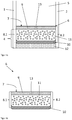
- FIGS. 1a and 1b show a schematic representation of the edge region of an insulating glazing according to the invention in cross section.
- a circumferential spacer 6 is mounted, which consists of a plastic profile 9, a base body 11 and a primary sealing means 10.
- the main body 11 contains a sealing material with desiccant, such as butyl with molecular sieve.
- the desiccant is indicated in the figure by circles.
- the inner pane space 5 adjacent to the glazing interior surface 7 of the spacer 6 is defined as the space defined by the panes 1, 2.
- the plastic profile 9 separates the inner pane space 5 from the outer space between the panes 4.
- the plastic profile 9 contains openings 13 on the glazing interior space 7 in order to establish a connection between the inner pane space 5 and the base 11 in order to allow the gas exchange and the absorption of moisture by the To allow desiccant.
- a primary sealing means 10 is attached to the base body 11, which may consist of the same material as the base body 11.
- Adjacent to the primary sealant 10 is a secondary sealant 12, such as an organic polysulfide, disposed in the outer space between the panes 4, which serves to bond the two panes 1,2 and increases the mechanical stability of the panes.
- the first disc contact surface 8.1 and the second Disk contact surface 8.2 are formed by the plastic profile 9, the base body 11 and the primary sealant 10.
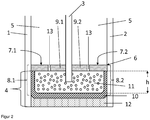
- the first plastic profile 9.1 and the second plastic profile 9.2 contain openings 13 on the glazing interior surfaces 7.1 and 7.2.
- the main body 11 contains butyl as a sealant and a molecular sieve as a desiccant.
- the primary sealant 10 containing pure butyl is disposed adjacent to the body 11, with the primary sealant 10 forming part of the first disk contact surface 8.1 and the second disk contact surface 8.2, thus enclosing the body 11 on three sides.
- the bonding of the discs 1 and 2 is improved because pure butyl has better adhesive properties compared to butyl containing desiccant, which contributes to an improved sealing of the system.
- polysulfide 12 is disposed adjacent to the primary sealing means 10 as a secondary sealing means 12 between the first pane 1 and the second pane 2.
- the secondary sealant 12 ensures the bonding of the first disc 1 and the second disc 2 and contributes to the mechanical stability of the entire insulating glazing.
- FIG. 3 shows a possible embodiment of the insulating glazing according to the invention.
- the structure corresponds in its basic features to the in FIG. 2 shown scheme.
- the third disc 3 protrudes over the entire height h of the main body 11 into the main body 11.
- the main body 11 is thus divided into two and adjacent in the outer space between the disc 4 between the first disc 1 and third disc 3 to the first plastic profile 9.1 and between the third disc 3 and second disc 2 to the second plastic profile 9.2.
- a primary sealing means 10 and a secondary one Sealant 12 is arranged in the outer space between the panes 4, adjacent to the main body 11, there is a primary sealing means 10 and a secondary one Sealant 12 is arranged.
- the third disc 3 protrudes through the main body 11 and through the primary sealant 10 and the secondary sealant 12.
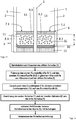
- FIG. 4 shows a flow diagram of a method for producing an insulating glazing comprising three slices.
- two plastic profiles 9.1 and 9.2 are fastened at the same height to the third disc 3.
- the attachment can for example be done by means of a double-sided adhesive tape, which is attached to the sides of the plastic profiles 9.1 and 9.2.
- main body 11 and primary sealing means 10 on the plastic profile 9 comprising 9.1 and 9.2, so that the third disc 3 projects into the base body 11 and the third disc 3 with a peripheral spacer 6 made of plastic profiles (9.1, 9.2), Base body 11 and primary sealant 10 is provided.
- This preassembled component can now be processed on a conventional double-glazing installation known to the person skilled in the art, the two outer windows 1 and 2 being attached to the window contact surfaces 8.1 and 8.2 of the spacer 6.
- the inner space between the panes 5 can be filled with inert gas.
- the disc assembly of first disc 1, second disc 2, third disc 3 and spacer 6 is pressed.
- FIG. 5 shows a flow diagram of an alternative method for producing an insulating glazing comprising three slices.
- this is arranged between the first disc 1 and second disc 2.
- the first plastic profile 9.1 is fixed and between the third disc 3 and the second disc 2, the second plastic profile 9.2 is fixed.
- the main body 11 is co-extruded with the primary sealing means 10 on the plastic profile comprising the first plastic profile 9.1 and the second plastic profile 9.2 in the outer space between the panes 4.
Landscapes
- Engineering & Computer Science (AREA)
- Civil Engineering (AREA)
- Structural Engineering (AREA)
- Securing Of Glass Panes Or The Like (AREA)
- Joining Of Glass To Other Materials (AREA)
Claims (15)
- Vitrage isolant comprenant au moins une première vitre (1), une deuxième vitre (2), un espace extérieur (4) entre les vitres et, un espace intérieur (5) entre les vitres et un écarteur (6) avec une surface intérieure de vitrage (7), une première surface de contact de vitrage (8.1) et une deuxième surface de contact de vitrage (8.2), un profil en plastique (9), un joint d'étanchéité primaire (10) et un corps de base (11) contenant au moins un matériau d'étanchéité contenant un agent déshydratant, où- le profil en plastique (9) sépare l'espace extérieur (4) de l'espace intérieure (5),- le corps de base (11) est disposé dans l'espace extérieur (4) immédiatement adjacent au profil en plastique (9) et le dispositif d'étanchéité primaire (10) est arrangé dans l'espace extérieur (4) immédiatement adjacent au corps de base (11).
- Vitrage isolant selon la revendication 1, comprenant au moins une troisième vitre (3) disposée entre la première vitre (1) et la deuxième vitre (2), où la surface intérieure de vitrage (7) comprend au moins une première surface intérieure de vitrage (7.1) et une deuxième surface intérieure de vitrage (7.2),- le profil en plastique (9) comprend un premier profil en plastique (9.1) sur la première surface intérieure de vitrage (7.1) entre la première vitre (1) et la troisième vitre (3) et un deuxième profil de plastique (9.2) sur la deuxième surface intérieure de vitrage (7.2) entre la troisième vitre (3) et la deuxième vitre (2),- le corps de base (11) est disposé entre la première vitre (1) et la deuxième vitre (2 et- la troisième vitre (3) pénètre le corps de base (11) entre le premier profil en plastique (9.1) et le deuxième profil en plastique (9.2).
- Vitrage isolant selon l'une des revendications 1 ou 2, où- la première surface de contact du verre (8,1) et la deuxième surface de contact du verre (8.2) comprend le profil en plastique (9) et le joint d'étanchéité primaire (10) et- le joint d'étanchéité primaire (10) entoure le corps de base (11) sur trois bords.
- Vitrage isolant selon l'une des revendications 1 à 3, où le profil en plastique (9) présente au moins une ouverture (13), de préférence plusieurs ouvertures (13), qui permettent l'échange de gaz et d'humidité entre le corps de base (11) et l'espace intérieure (5).
- Vitrage isolant selon l'une des revendications 1 à 4, où un joint d'étanchéité secondaire (12) est disposé entre la première (1) et la deuxième vitre (2) dans l'espace extérieur (4) entre les vitres contigu au joint d'étanchéité (10) primaire, qui comprend de préférence un polymère ou un polymère modifié par un silane, de manière particulièrement préférée des polysulfures organiques, des silicones, des caoutchoucs de silicone réticulés à température ambiante, des caoutchoucs de silicone réticulés à haute température, des caoutchoucs de silicone réticulés aux peroxydes et/ou des caoutchoucs de silicone réticulés par addition, des polyuréthanes et/ou des caoutchoucs au butyle.
- Vitrage isolant selon l'une des revendications 2 à 5, où la troisième vitre (3) ne pénètre qu'une partie du corps de base (11), de préférence sur entre 20% et 80%, de manière particulièrement préférée entre 30% et 60% de la hauteur totale du corps de base (11).
- Vitrage isolant selon une des revendications 2 à 5, où la troisième vitre (3) pénètre le corps de base (11) sur toute sa hauteur, et/ou la troisième vitre (3) passe à travers le joint d'étanchéité primaire (10).
- Vitrage isolant selon la revendication 7, où la troisième vitre passe à travers le joint d'étanchéité secondaire (12).
- Vitrage isolant selon l'une des revendications 1 à 8, où le corps de base (11) contient au moins un produit d'étanchéité, de préférence un adhésif thermofusible, du polyisobutylène et/ou du caoutchouc au butyle et un déshydratant, de préférence des gels de silice, des tamis moléculaires, du CaCl2, du Na2SO4, du charbon actif, des silicates, des bentonites, des zéolites ou des mélanges de ceux-ci.
- Vitrage isolant selon l'une des revendications 1 à 9, où le profil de plastique (9) contient du polyéthylène (PE), du polycarbonate (PC), du polypropylène (PP), du polystyrène, du polybutadiène, des polynitriles, du polyester, du polyuréthane, du polyméthacrylate, des polyacrylates, des polyamides, du poly(téréphtalate d'éthylène) (PET), du poly(téréphtalate de butylène) (PBT), de l'acrylonitrile-butadiène-styrène (ABS), de l'acrylonitrile-styrène-acrylate (ASA), de l'acrylonitrile-butadiène styrène/polycarbonate (ABS/PC), du styrène-acrylonitrile (SAN), du PET/PC, du PBT/PC et/ou des copolymères, ou des mélanges de ceux-ci.
- Vitrage isolant selon l'une des revendications 1 à 10, où le joint d'étanchéité (10) primaire contient du caoutchouc au butyle, du polyisobutylène, du caoutchouc au polyoléfine, des copolymères et/ou des mélanges de ceux-ci.
- Procédure de fabrication d'un vitrage isolant selon la revendication 1 contenant une première vitre (1) et une deuxième vitre (2), où au moinsa) un écarteur (6) est fournie, par la co-extrusion sur un profil en plastique (9) d'un corps de base (11) contenant un matériau d'étanchéité contenant un agent déshydratant et un produit d'étanchéité primaire (10),b) une première vitre (1) est fixée sur une première surface de contact de vitrage (8.1) de l'écarteur (6) et une deuxième vitre (2) sur une deuxième surface de contact de vitrage (8.2) afin de disposer le profil en plastique (9) sur la surface intérieure de vitrage (7) etc) l'arrangement de vitres composé des vitres (1, 2) et l'écarteur (6) est pressé ensemble, afin de produire un joint adhésif stable.
- Procédure de fabrication d'un vitrage isolant selon au moins l'une des revendications 2 à 11, où au moinsa) un premier profil en plastique (9.1) est disposé entre une première vitre (1) et une troisième vitre (3), et un deuxième profil en plastique (9.2) est disposé au même niveau entre la troisième vitre (3) et une deuxième vitre (2),b) un joint d'étanchéité primaire (10) et un corps de base (11) contenant un matériau d'étanchéité avec un agent déshydratant sont co-extrudés sur le profil en plastique (9), comprenant le premier profil en plastique (9.1) et le deuxième profil en plastique (9.2), dans l'espace extérieur (4) entre les vitres.
- Procédure de fabrication d'un vitrage isolant selon l'une des revendications 2 à 11, où au moinsa) un corps de base (11) comprenant un agent déshydratant est co-extrudé autour d'au moins une troisième vitre (3) avec un joint d'étanchéité primaire (10), et en même temps au moins un premier profil en plastique (9.1) est attaché sur une première surface intérieure de vitrage (7.1) et un deuxième profil en plastique (9.2) sur une deuxième surface intérieure de vitrage (7.2) directement avoisinant le corps de base (11),b) une première vitre (1) et une deuxième vitre (2) est attachée sur les surfaces de contact de vitrage (8.1, 8.2) de l'écarteur (6) comprenant profil en plastique (9), corps de base (11) joint et d'étanchéité (10) primaire, etc) l'arrangement de vitres composé au moins de la première vitre (1), la deuxième vitre (2), la troisième vitre (3) et l'écarteur (6) est pressé ensemble, afin de produire un joint adhésif stable.
- Utilisation d'un vitrage isolant selon l'une des revendications 1 à 11 comme vitrage d'intérieur dans le bâtiment, vitrage d'extérieur dans le bâtiment et/ou vitrage de façade.
Priority Applications (1)
| Application Number | Priority Date | Filing Date | Title |
|---|---|---|---|
| PL15729202T PL3161237T3 (pl) | 2014-06-27 | 2015-06-19 | Oszklenie zespolone z elementem dystansowym i sposób wytwarzania takiego oszklenia oraz jego zastosowanie jako oszklenia budynku |
Applications Claiming Priority (2)
| Application Number | Priority Date | Filing Date | Title |
|---|---|---|---|
| EP14174745 | 2014-06-27 | ||
| PCT/EP2015/063814 WO2015197488A1 (fr) | 2014-06-27 | 2015-06-19 | Vitrage isolant comprenant un intercalaire, son procédé de fabrication et son utilisation comme vitrage de bâtiment |
Publications (2)
| Publication Number | Publication Date |
|---|---|
| EP3161237A1 EP3161237A1 (fr) | 2017-05-03 |
| EP3161237B1 true EP3161237B1 (fr) | 2018-07-25 |
Family
ID=51162444
Family Applications (1)
| Application Number | Title | Priority Date | Filing Date |
|---|---|---|---|
| EP15729202.0A Not-in-force EP3161237B1 (fr) | 2014-06-27 | 2015-06-19 | Vitrage isolant doté d'un écarteur et procede de production d'un tel vitrage et utilisation d'un tel vitrage isolant comme vitrage pour un bâtiment |
Country Status (5)
| Country | Link |
|---|---|
| US (1) | US10344525B2 (fr) |
| EP (1) | EP3161237B1 (fr) |
| PL (1) | PL3161237T3 (fr) |
| TR (1) | TR201815606T4 (fr) |
| WO (1) | WO2015197488A1 (fr) |
Families Citing this family (6)
| Publication number | Priority date | Publication date | Assignee | Title |
|---|---|---|---|---|
| EP3080376A1 (fr) | 2013-12-12 | 2016-10-19 | Saint-Gobain Glass France | Entretoises pour vitrages isolants comportant un profilé d'étanchéité extrudé |
| WO2015086457A2 (fr) | 2013-12-12 | 2015-06-18 | Saint-Gobain Glass France | Vitrage isolant à étanchéité améliorée |
| EP3161238A1 (fr) | 2014-06-27 | 2017-05-03 | Saint-Gobain Glass France | Vitrage isolant présentant un espaceur, et procédé de production |
| WO2016139180A1 (fr) | 2015-03-02 | 2016-09-09 | Saint-Gobain Glass France | Ecarteur renforcé par des fibres de verre pour un vitrage isolant |
| WO2017207193A1 (fr) | 2016-05-31 | 2017-12-07 | Saint-Gobain Glass France | Vitrage isolant doté d'une fonction anti-effraction améliorée et d'un profilé de logement en u |
| FR3076249A1 (fr) * | 2017-12-29 | 2019-07-05 | Saint-Gobain Glass France | Procede et installation de fabrication d'un vitrage multiple |
Family Cites Families (133)
| Publication number | Priority date | Publication date | Assignee | Title |
|---|---|---|---|---|
| US2094381A (en) | 1932-06-06 | 1937-09-28 | Owens Illinois Glass Co | Double glazing |
| US2303897A (en) * | 1941-05-28 | 1942-12-01 | Pittsburgh Plate Glass Co | Multiple glazed unit |
| US2834999A (en) * | 1955-11-17 | 1958-05-20 | Coldstream Refrigerator Mfg Lt | Sealed multiple glazed unit |
| US3168089A (en) | 1963-09-24 | 1965-02-02 | Mills Prod Inc | Oven door window unit |
| GB1203999A (en) | 1967-11-03 | 1970-09-03 | Holset Engineering Co | Torsional vibration damper |
| BE789292Q (fr) | 1970-12-22 | 1973-01-15 | Coal Industry Patents Ltd | Compositions de matieres plastiques et leur procede d'application pour rendre des joints etanches |
| FR2205620B1 (fr) | 1972-11-07 | 1979-10-19 | Delog Detag Flachglas Ag | |
| US4109431A (en) | 1974-03-25 | 1978-08-29 | Ppg Industries, Inc. | Sealing and spacing unit for multiple glazed windows |
| FR2294314A1 (fr) | 1974-12-11 | 1976-07-09 | Saint Gobain | Intercalaire pour vitrages multiples |
| US3998680A (en) | 1975-10-28 | 1976-12-21 | Flint Theodore R | Method of fabricating insulating glass units |
| US4080482A (en) | 1975-11-11 | 1978-03-21 | D. C. Glass Limited | Spacer for glass sealed unit and interlock member therefor |
| US5173800A (en) | 1975-12-29 | 1992-12-22 | King William J | Light control with color enhancement |
| GB1589878A (en) | 1976-11-26 | 1981-05-20 | Bfg Glassgroup | Method of manufacturing a hollow panel |
| US4479988A (en) | 1981-07-02 | 1984-10-30 | Reddiplex Limited | Spacer bar for double glazing |
| FR2508873A1 (fr) | 1981-07-06 | 1983-01-07 | Rhone Poulenc Films | Procede d'emballage de materiaux sensibles a l'oxygene et/ou a la vapeur d'eau |
| DE3143541A1 (de) | 1981-11-03 | 1983-05-19 | LSG-Lärmschutz-Gesellscchaft mbH, 4600 Dortmund | "mehrscheibenfenster" |
| US4658552A (en) | 1982-04-26 | 1987-04-21 | Mulford Cass E | Vented exterior building wall and roof structures |
| DE3302659A1 (de) | 1983-01-27 | 1984-08-02 | Reichstadt, Hans Udo, 5628 Heiligenhaus | Abstandhalteprofil fuer mehrscheiben-isolierglas |
| GB8405607D0 (en) | 1984-03-02 | 1984-04-04 | Camvac Holdings Ltd | Plastics film laminate |
| GB2162228B (en) * | 1984-07-25 | 1987-07-15 | Sanden Corp | Double-glazed window for a refrigerator |
| US4613530A (en) | 1984-11-01 | 1986-09-23 | Southwall Technologies, Inc. | Multiple pane glass unit with electrically conductive transparent film for use as radiation shield |
| US4799745A (en) | 1986-06-30 | 1989-01-24 | Southwall Technologies, Inc. | Heat reflecting composite films and glazing products containing the same |
| US5071206A (en) | 1986-06-30 | 1991-12-10 | Southwall Technologies Inc. | Color-corrected heat-reflecting composite films and glazing products containing the same |
| CA1285177C (fr) | 1986-09-22 | 1991-06-25 | Michael Glover | Element vitre a panneaux scelles multiples |
| US5007217A (en) | 1986-09-22 | 1991-04-16 | Lauren Manufacturing Company | Multiple pane sealed glazing unit |
| GB2210899B (en) | 1987-10-12 | 1992-04-29 | Bowater Packaging Ltd | High barrier metallised film |
| US5290611A (en) | 1989-06-14 | 1994-03-01 | Taylor Donald M | Insulative spacer/seal system |
| US5302425A (en) | 1989-06-14 | 1994-04-12 | Taylor Donald M | Ribbon type spacer/seal system |
| US5079054A (en) | 1989-07-03 | 1992-01-07 | Ominiglass Ltd. | Moisture impermeable spacer for a sealed window unit |
| EP0430889A3 (en) | 1989-11-30 | 1991-12-18 | Glas Troesch Ag St. Gallen | Multiple insulating glazing |
| DE4024697A1 (de) | 1990-08-03 | 1992-02-06 | L M D Labor Fuer Molekulares D | Gas- und wasserdichtes mehrscheiben-isolierglas |
| US5675944A (en) | 1990-09-04 | 1997-10-14 | P.P.G. Industries, Inc. | Low thermal conducting spacer assembly for an insulating glazing unit and method of making same |
| DE4032192C2 (de) | 1990-10-08 | 1994-05-26 | Michael Kising | Vorrichtung zum Erhitzen eines ultraschallbetriebenen Löt- oder Schweißkopfes |
| US5209034A (en) | 1990-12-18 | 1993-05-11 | Tremco, Inc. | Prevention of fogging and discoloration of multi-pane windows |
| DE9103448U1 (de) | 1991-03-20 | 1992-07-16 | Helmut Lingemann GmbH & Co, 5600 Wuppertal | Abstandhalter für ein Mehrscheiben-Isolierglas |
| US5773135A (en) | 1991-04-22 | 1998-06-30 | Lafond; Luc | Insulated assembly incorporating a thermoplastic barrier member |
| US5759665A (en) | 1991-04-22 | 1998-06-02 | Lafond; Luc | Insulated assembly incorporating a thermoplastic barrier member |
| US6528131B1 (en) | 1991-04-22 | 2003-03-04 | Luc Lafond | Insulated assembly incorporating a thermoplastic barrier member |
| US5270092A (en) | 1991-08-08 | 1993-12-14 | The Regents, University Of California | Gas filled panel insulation |
| US5313762A (en) | 1991-12-26 | 1994-05-24 | Bayomikas Limited | Insulating spacer for creating a thermally insulating bridge |
| US5439716A (en) | 1992-03-19 | 1995-08-08 | Cardinal Ig Company | Multiple pane insulating glass unit with insulative spacer |
| US5512341A (en) | 1992-05-18 | 1996-04-30 | Crane Plastics Company Limited Partnership | Metal-polymer composite insulative spacer for glass members and insulative window containing same |
| DE59306331D1 (de) | 1992-12-10 | 1997-06-05 | Thermix Gmbh Isolationssysteme | Abstandhalter |
| US5424111A (en) | 1993-01-29 | 1995-06-13 | Farbstein; Malcolm N. | Thermally broken insulating glass spacer with desiccant |
| DE4304788C2 (de) | 1993-02-17 | 1996-05-15 | Ver Glaswerke Gmbh | Verfahren zur Herstellung einer Leiterstruktur mit sich kreuzenden elektrischen Leitern auf der Oberfläche einer Glasscheibe |
| DE9408764U1 (de) | 1994-05-28 | 1995-10-05 | Thermix GmbH Isolationssysteme für Verglasungen, 88361 Altshausen | Abstandhalter |
| DE4432402C2 (de) | 1994-08-30 | 1998-07-02 | Ersa Loettechnik Gmbh | Schwall-Lötdüse zum flußmittelfreien Löten |
| US5962090A (en) | 1995-09-12 | 1999-10-05 | Saint-Gobain Vitrage Suisse Ag | Spacer for an insulating glazing assembly |
| DE19533685A1 (de) | 1995-09-12 | 1997-03-13 | Hans Trautz | Abstandhalter für Mehrscheiben-Isolierverglasung |
| JPH09175843A (ja) | 1995-12-27 | 1997-07-08 | Asahi Glass Co Ltd | 複層ガラスおよびそれに用いるスペーサ |
| DE19602455A1 (de) | 1996-01-24 | 1997-07-31 | Andreas Jakob | Innenleiste für gasgefüllte Mehrscheibenisolierverglasungen |
| US6231999B1 (en) | 1996-06-21 | 2001-05-15 | Cardinal Ig Company | Heat temperable transparent coated glass article |
| DE19625845A1 (de) | 1996-06-27 | 1998-01-02 | Flachglas Ag | Isolierglaseinheit |
| US6002521A (en) * | 1996-11-14 | 1999-12-14 | Thinking Lightly, Inc. | Light dispersive insulated glazing unit |
| ES2210346T5 (es) | 1996-12-20 | 2009-11-11 | Saint-Gobain Glass France | Separador para acristalado aislante de varias lunas. |
| ES2166522T3 (es) | 1997-05-01 | 2002-04-16 | Saint Gobain Vitrage Suisse Ag | Procedimiento para la fabricacion de regletas de perfil hueco dobladas. |
| US6351923B1 (en) | 1997-07-22 | 2002-03-05 | Wallace H. Peterson | Spacer for insulated windows having a lengthened thermal path |
| AU9734898A (en) | 1997-09-25 | 1999-04-12 | Technoform Caprano + Brunnhofer Ohg | Profiled spacer for insulation glazing assembly |
| JPH11189439A (ja) | 1997-12-26 | 1999-07-13 | Central Glass Co Ltd | 複層ガラスおよびその製造方法 |
| US6115989A (en) | 1998-01-30 | 2000-09-12 | Ppg Industries Ohio, Inc. | Multi-sheet glazing unit and method of making same |
| DE19805348A1 (de) | 1998-02-11 | 1999-08-12 | Caprano & Brunnhofer | Abstandhalterprofil für Isolierscheibeneinheit |
| DE19807454A1 (de) | 1998-02-21 | 1999-08-26 | Ensinger | Abstandhalter |
| US6391400B1 (en) | 1998-04-08 | 2002-05-21 | Thomas A. Russell | Thermal control films suitable for use in glazing |
| DE29807418U1 (de) | 1998-04-27 | 1999-06-24 | Flachglas AG, 90766 Fürth | Abstandhalterprofil für Isolierscheibeneinheit |
| CA2269110A1 (fr) | 1998-04-27 | 1999-10-27 | Flachglas Aktiengesellschaft | Profil d'espacement d'une unite a double vitrage |
| DE19829151C1 (de) | 1998-06-30 | 2000-02-10 | Sekurit Saint Gobain Deutsch | Verfahren zum elektrischen Kontaktieren einer leitfähigen Dünnschicht auf einer Glasscheibe |
| US6266940B1 (en) * | 1998-07-31 | 2001-07-31 | Edgetech I.G., Inc. | Insert for glazing unit |
| US6250245B1 (en) | 1998-09-22 | 2001-06-26 | Mangia Onda Co., Llc | M-shaped boat hull |
| DE19927683C1 (de) | 1999-06-17 | 2001-01-25 | Sekurit Saint Gobain Deutsch | Sonnen- und Wärmestrahlen reflektierende Verbundglasscheibe |
| CN100352783C (zh) | 1999-09-01 | 2007-12-05 | Prc-迪索托国际公司 | 带结构主密封剂体系的绝热玻璃装置 |
| FR2799005B1 (fr) | 1999-09-23 | 2003-01-17 | Saint Gobain Vitrage | Vitrage muni d'un empilement de couches minces agissant sur le rayonnement solaire |
| DE10025321A1 (de) | 2000-05-22 | 2002-01-10 | Wolff Walsrode Ag | Folienlaminate als Hochbarrierefolien und deren Verwendung in Vakuumisolierpaneelen |
| US20090301637A1 (en) | 2000-09-27 | 2009-12-10 | Gerhard Reichert | Spacer assembly for insulating glazing unit and method for assembling an insulating glazing unit |
| US6613404B2 (en) | 2001-05-29 | 2003-09-02 | Terry S. Johnson | Suppressing heat flux in insulating glass structures |
| CA2397159A1 (fr) | 2001-08-09 | 2003-02-09 | Edgetech I.G., Inc. | Separateur d'isolation de vitrages et methode de fabrication |
| NL1020627C2 (nl) | 2002-05-21 | 2003-11-24 | Otb Group Bv | Werkwijze en tabstation voor het aanbrengen van tabs op een zonnecel alsmede een werkwijze en inrichting voor het vervaardigen van een zonnepaneel. |
| HUE030710T2 (en) | 2002-07-03 | 2017-06-28 | Quanex Ig Systems Inc | Spacer and window strip elements for insulating polishing units |
| CA2507108C (fr) | 2002-11-13 | 2010-05-11 | Visionwall International, Inc. | Fenetre ecoenergetique |
| CN1176565C (zh) | 2002-11-25 | 2004-11-17 | 清华大学 | 一种有机电致发光器件的封装层及其制备方法和应用 |
| US20040256978A1 (en) | 2003-05-27 | 2004-12-23 | Gang Yu | Array comprising organic electronic devices with a black lattice and process for forming the same |
| US7950194B2 (en) | 2003-06-23 | 2011-05-31 | Ppg Industries Ohio, Inc. | Plastic spacer stock, plastic spacer frame and multi-sheet unit, and method of making same |
| US7997037B2 (en) | 2003-06-23 | 2011-08-16 | Ppg Industries Ohio, Inc. | Integrated window sash with groove for desiccant material |
| US7739851B2 (en) | 2003-06-23 | 2010-06-22 | Ppg Industries Ohio, Inc. | Plastic spacer stock, plastic spacer frame and multi-sheet unit, and method of making same |
| US6989188B2 (en) | 2003-11-07 | 2006-01-24 | Technoform Caprano Und Brunnhofer Gmbh & Co. Kd | Spacer profiles for double glazings |
| DE10356216A1 (de) | 2003-12-02 | 2005-07-14 | Usd Formteiltechnik Gmbh | Isolierglaseinheit |
| US7144619B2 (en) | 2004-02-03 | 2006-12-05 | Naik Praful Ramchandra | Metallized packaging films |
| JP5167639B2 (ja) | 2004-05-07 | 2013-03-21 | 旭硝子株式会社 | 単層シール型複層透明体 |
| DE102004028839A1 (de) | 2004-06-16 | 2005-12-29 | Wipak Walsrode Gmbh & Co. Kg | Folienlaminat mit wenigstens einer Diffusionssperrschicht und deren Verwendung bei Vakuumisolationspaneelen |
| DE102004028756A1 (de) | 2004-06-16 | 2005-12-29 | Wipak Walsrode Gmbh & Co. Kg | Folienlaminat mit wenigstens einer Diffusionssperrschicht und deren Verwendung bei Vakuumisolationspaneelen im Baubereich |
| EP2116689B2 (fr) | 2004-09-09 | 2020-08-19 | Technoform Glass Insulation Holding GmbH | Profilé d'espaceur pour cadre d'espaceur pour une unité de fenêtre isolante et unité de fenêtre isolante. |
| US7685782B2 (en) | 2004-12-10 | 2010-03-30 | Newell Operating Company | Muntin clip |
| ES2311927T5 (es) | 2005-07-21 | 2014-09-08 | Bayer Pharma Aktiengesellschaft | Proceso para la producción de 3-oxo-pregn-4-en-21,17-carbolactonas por la oxidación sin metales de 17-(3-hidroxipropil)-3,17-dihidroxiandrostanos |
| DE102005039707B4 (de) | 2005-08-23 | 2009-12-03 | Saint-Gobain Glass Deutschland Gmbh | Thermisch hoch belastbares Low-E-Schichtsystem für transparente Substrate, insbesondere für Glasscheiben |
| FR2898123B1 (fr) | 2006-03-06 | 2008-12-05 | Saint Gobain | Substrat muni d'un empilement a proprietes thermiques |
| US8015766B2 (en) | 2006-05-01 | 2011-09-13 | Dirtt Enviromental Solutions, Ltd. | Movable walls for on-site construction |
| GB0610634D0 (en) | 2006-05-30 | 2006-07-05 | Dow Corning | Insulating glass unit |
| JP4529956B2 (ja) | 2006-07-13 | 2010-08-25 | 旭硝子株式会社 | 複層ガラス用スペーサ、複層ガラス、および複層ガラス用スペーサの製造方法 |
| EP1892365A1 (fr) | 2006-08-25 | 2008-02-27 | Prowerb St. Gallen AG | Procédé pour la manufacture des vitrages isolants ansi qu un dispositif pour appliquer une pièce d ecartement sur une vitre |
| US20080053037A1 (en) | 2006-08-29 | 2008-03-06 | Gallagher Raymond G | System and method for reducing heat transfer from a warm side to a cold side along an edge of an insulated glazing unit |
| WO2009029089A1 (fr) | 2007-08-24 | 2009-03-05 | Weather Shield Mfg., Inc. | Fenêtres, portes et ensembles vitrages correspondants |
| DE102007045104A1 (de) | 2007-09-20 | 2009-04-02 | Kömmerling Chemische Fabrik GmbH | Dichtungsmasse zur Herstellung von Zwei- oder Mehrscheiben-Isolierglas oder Solarmodulen |
| WO2009064915A1 (fr) | 2007-11-13 | 2009-05-22 | Infinite Edge Technologies, Llc | Écarteur pour fenêtre renforcé |
| US20090139165A1 (en) | 2007-12-04 | 2009-06-04 | Intigral, Inc. | Insulating glass unit |
| EA023301B1 (ru) | 2008-02-15 | 2016-05-31 | Агк Гласс Юроп | Панель остекления |
| DE102008033249A1 (de) | 2008-07-15 | 2010-01-21 | Gssg Holding Gmbh & Co. Kg | Isolierglasscheibe |
| ES2371790T3 (es) | 2008-09-26 | 2012-01-10 | Camvac Limited | Revestimientos curados por radiación. |
| DE102008052318A1 (de) | 2008-10-20 | 2010-04-22 | Helmut Lingemann Gmbh & Co | Hohlprofil, insbesondere Abstandhalterrohr für eine Isolierverglasung, sowie Vorrichtung und Verfahren zur Herstellung des Hohlprofils |
| DE102009006062A1 (de) | 2009-01-24 | 2010-07-29 | Saint-Gobain Sekurit Deutschland Gmbh & Co. Kg | Infrarotstrahlung abschirmendes, für sichtbares Licht transparentes Laminat mit einem für Infrarotstrahlung durchlässigen optischen Fenster, Verfahren zu seiner Herstellung und seiner Verwendung |
| GB0902551D0 (en) | 2009-02-16 | 2009-04-01 | Thermoseal Group Ltd | Glazing |
| EP2417319B1 (fr) * | 2009-04-07 | 2018-07-04 | LISEC Austria GmbH | Un procédé pour fabriquer un vitrage multiple |
| DE102009002823A1 (de) | 2009-05-05 | 2010-11-18 | Komax Holding Ag | Solarzelle, diese Solarzelle umfassendes Solarmodul sowie Verfahren zu deren Herstellung und zur Herstellung einer Kontaktfolie |
| DE102009027297A1 (de) | 2009-06-29 | 2010-12-30 | Geze Gmbh | Flügel einer Tür, eines Fensters oder dergleichen sowie Verfahren zur Herstellung des Flügels |
| DE102009057156A1 (de) | 2009-12-05 | 2011-06-09 | Seele Holding Gmbh & Co. Kg | Isolierglasscheibe |
| PL2526247T3 (pl) | 2010-01-20 | 2017-01-31 | Technoform Glass Insulation Holding Gmbh | Klamra zespolenia brzegowego jednostki szyby zespolonej, zespolenie brzegowe jednostki szyby zespolonej, jednostka szyby zespolonej z klamrą zespolenia brzegowego |
| DE102010006127A1 (de) | 2010-01-29 | 2011-08-04 | Technoform Glass Insulation Holding GmbH, 34277 | Abstandshalterprofil mit Verstärkungsschicht |
| DE102010000520A1 (de) | 2010-02-23 | 2011-08-25 | SCHOTT Solar AG, 55122 | Verfahren und Vorrichtung zum Aufbringen von Lot auf ein Werkstück |
| DE102010010432B3 (de) | 2010-02-26 | 2011-11-17 | Aerogas Gmbh | Abstandhalter zur Beabstandung von Glasscheiben |
| WO2012095266A1 (fr) | 2011-01-15 | 2012-07-19 | Seele Holding Gmbh & Co. Kg | Intercalaire pour vitrages isolants |
| EP3020908B1 (fr) | 2011-04-13 | 2018-06-06 | ALU-PRO srl | Ecarteur de verres d'une fenêtre multi-vitrage |
| DE102011051024A1 (de) | 2011-05-17 | 2012-11-22 | Schott Solar Ag | Verfahren zum stoffschlüssigen Verbinden von Elementen |
| EP2584135A3 (fr) | 2011-10-17 | 2017-01-04 | VKR Holding A/S | Unité de verre isolant |
| EP2998498A1 (fr) | 2012-01-13 | 2016-03-23 | Saint-Gobain Glass France | Pièce intercalaire pour vitrages isolants |
| ITBO20120078A1 (it) | 2012-02-20 | 2013-08-21 | Al7 Meipa S R L | Elemento distanziale per vetrate isolanti |
| DE102012105960A1 (de) | 2012-07-04 | 2014-01-09 | Ensinger Gmbh | Abstandhalter fuer Isolierglasscheiben |
| US20140272207A1 (en) * | 2013-03-15 | 2014-09-18 | Micropore, Inc. | Adsorbent For Use As A Window Desiccant |
| PL3008269T3 (pl) | 2013-06-14 | 2017-10-31 | Saint Gobain | Element dystansowy dla oszkleń potrójnych |
| EP3008270A1 (fr) | 2013-06-14 | 2016-04-20 | Saint-Gobain Glass France | Écarteur pour triples vitrages isolants |
| AU2014327719B2 (en) | 2013-09-30 | 2016-11-24 | Saint-Gobain Glass France | Spacer for insulating glazing units |
| WO2015086457A2 (fr) | 2013-12-12 | 2015-06-18 | Saint-Gobain Glass France | Vitrage isolant à étanchéité améliorée |
| EP3080376A1 (fr) | 2013-12-12 | 2016-10-19 | Saint-Gobain Glass France | Entretoises pour vitrages isolants comportant un profilé d'étanchéité extrudé |
| EP3161238A1 (fr) | 2014-06-27 | 2017-05-03 | Saint-Gobain Glass France | Vitrage isolant présentant un espaceur, et procédé de production |
| PL3198101T3 (pl) | 2014-09-25 | 2019-01-31 | Saint-Gobain Glass France | Przekładka do oszklenia izolacyjnego |
| WO2016139180A1 (fr) | 2015-03-02 | 2016-09-09 | Saint-Gobain Glass France | Ecarteur renforcé par des fibres de verre pour un vitrage isolant |
-
2015
- 2015-06-19 WO PCT/EP2015/063814 patent/WO2015197488A1/fr not_active Ceased
- 2015-06-19 EP EP15729202.0A patent/EP3161237B1/fr not_active Not-in-force
- 2015-06-19 PL PL15729202T patent/PL3161237T3/pl unknown
- 2015-06-19 TR TR2018/15606T patent/TR201815606T4/tr unknown
- 2015-06-19 US US15/321,161 patent/US10344525B2/en not_active Expired - Fee Related
Non-Patent Citations (1)
| Title |
|---|
| None * |
Also Published As
| Publication number | Publication date |
|---|---|
| TR201815606T4 (tr) | 2018-11-21 |
| PL3161237T3 (pl) | 2018-12-31 |
| EP3161237A1 (fr) | 2017-05-03 |
| US20170145734A1 (en) | 2017-05-25 |
| WO2015197488A1 (fr) | 2015-12-30 |
| US10344525B2 (en) | 2019-07-09 |
Similar Documents
| Publication | Publication Date | Title |
|---|---|---|
| EP3421709B1 (fr) | Entretoise pour vitrages isolants | |
| EP3161238A1 (fr) | Vitrage isolant présentant un espaceur, et procédé de production | |
| EP3023569B1 (fr) | Ecarteur pour ecarter les verres d'une fenetre multi-vitrage | |
| EP3080377B1 (fr) | Vitrage isolant à étanchéité améliorée | |
| EP3230544B1 (fr) | Entretoise pour vitrages isolants | |
| WO2015086459A1 (fr) | Entretoises pour vitrages isolants comportant un profilé d'étanchéité extrudé | |
| WO2014198431A1 (fr) | Écarteur pour triples vitrages isolants | |
| EP3230546B1 (fr) | Entretoise pour vitrages isolants | |
| EP3008269B1 (fr) | Entretoise pour vitrages à triple isolation | |
| EP3161237A1 (fr) | Vitrage isolant comprenant un intercalaire, son procédé de fabrication et son utilisation comme vitrage de bâtiment | |
| EP3230545A1 (fr) | Entretoise pour vitrages isolants | |
| EP3529445A1 (fr) | Vitrage isolant, notamment triple vitrage isolant, et procédé de fabrication d'un vitrage isolant | |
| WO2019174914A1 (fr) | Plaque d'adaptation pour un vitrage isolant | |
| EP3049603B1 (fr) | Entretoise d'écartement des vitres d'une fenêtre à vitrage multiple, fenêtre à vitrage multiple, film pare-vapeur pour une entretoise, procédé de fabrication d'un film pare-vapeur, ainsi que procédé de fabrication d'une entretoise | |
| EP3284891A1 (fr) | Entretoise pour vitrages isolants avec longerons latéraux profilés | |
| EP3999709B1 (fr) | Écarteur pour unités de verre isolant | |
| EP3362630A1 (fr) | Élément de raccordement servant à raccorder deux baguettes profilées creuses | |
| EP3464771B1 (fr) | Vitrage isolant a haute resistance a la rupture et profile de reception en forme de u | |
| DE202020005895U1 (de) | Isolierverglasung mit verbesserter Positionierung des Abstandhalters | |
| WO2019174913A1 (fr) | Écarteur pour des vitrages isolants |
Legal Events
| Date | Code | Title | Description |
|---|---|---|---|
| STAA | Information on the status of an ep patent application or granted ep patent |
Free format text: STATUS: THE INTERNATIONAL PUBLICATION HAS BEEN MADE |
|
| PUAI | Public reference made under article 153(3) epc to a published international application that has entered the european phase |
Free format text: ORIGINAL CODE: 0009012 |
|
| STAA | Information on the status of an ep patent application or granted ep patent |
Free format text: STATUS: REQUEST FOR EXAMINATION WAS MADE |
|
| 17P | Request for examination filed |
Effective date: 20170112 |
|
| AK | Designated contracting states |
Kind code of ref document: A1 Designated state(s): AL AT BE BG CH CY CZ DE DK EE ES FI FR GB GR HR HU IE IS IT LI LT LU LV MC MK MT NL NO PL PT RO RS SE SI SK SM TR |
|
| AX | Request for extension of the european patent |
Extension state: BA ME |
|
| DAV | Request for validation of the european patent (deleted) | ||
| DAX | Request for extension of the european patent (deleted) | ||
| RIC1 | Information provided on ipc code assigned before grant |
Ipc: E06B 3/663 20060101AFI20171129BHEP Ipc: E06B 3/673 20060101ALI20171129BHEP |
|
| GRAP | Despatch of communication of intention to grant a patent |
Free format text: ORIGINAL CODE: EPIDOSNIGR1 |
|
| STAA | Information on the status of an ep patent application or granted ep patent |
Free format text: STATUS: GRANT OF PATENT IS INTENDED |
|
| INTG | Intention to grant announced |
Effective date: 20180119 |
|
| GRAS | Grant fee paid |
Free format text: ORIGINAL CODE: EPIDOSNIGR3 |
|
| GRAA | (expected) grant |
Free format text: ORIGINAL CODE: 0009210 |
|
| STAA | Information on the status of an ep patent application or granted ep patent |
Free format text: STATUS: THE PATENT HAS BEEN GRANTED |
|
| AK | Designated contracting states |
Kind code of ref document: B1 Designated state(s): AL AT BE BG CH CY CZ DE DK EE ES FI FR GB GR HR HU IE IS IT LI LT LU LV MC MK MT NL NO PL PT RO RS SE SI SK SM TR |
|
| REG | Reference to a national code |
Ref country code: GB Ref legal event code: FG4D Free format text: NOT ENGLISH |
|
| REG | Reference to a national code |
Ref country code: CH Ref legal event code: EP |
|
| REG | Reference to a national code |
Ref country code: AT Ref legal event code: REF Ref document number: 1021947 Country of ref document: AT Kind code of ref document: T Effective date: 20180815 |
|
| REG | Reference to a national code |
Ref country code: IE Ref legal event code: FG4D Free format text: LANGUAGE OF EP DOCUMENT: GERMAN |
|
| REG | Reference to a national code |
Ref country code: DE Ref legal event code: R096 Ref document number: 502015005232 Country of ref document: DE |
|
| REG | Reference to a national code |
Ref country code: CH Ref legal event code: NV Representative=s name: KIRKER AND CIE S.A., CH |
|
| REG | Reference to a national code |
Ref country code: RO Ref legal event code: EPE |
|
| REG | Reference to a national code |
Ref country code: NL Ref legal event code: FP |
|
| REG | Reference to a national code |
Ref country code: LT Ref legal event code: MG4D |
|
| PG25 | Lapsed in a contracting state [announced via postgrant information from national office to epo] |
Ref country code: FI Free format text: LAPSE BECAUSE OF FAILURE TO SUBMIT A TRANSLATION OF THE DESCRIPTION OR TO PAY THE FEE WITHIN THE PRESCRIBED TIME-LIMIT Effective date: 20180725 Ref country code: LT Free format text: LAPSE BECAUSE OF FAILURE TO SUBMIT A TRANSLATION OF THE DESCRIPTION OR TO PAY THE FEE WITHIN THE PRESCRIBED TIME-LIMIT Effective date: 20180725 Ref country code: BG Free format text: LAPSE BECAUSE OF FAILURE TO SUBMIT A TRANSLATION OF THE DESCRIPTION OR TO PAY THE FEE WITHIN THE PRESCRIBED TIME-LIMIT Effective date: 20181025 Ref country code: NO Free format text: LAPSE BECAUSE OF FAILURE TO SUBMIT A TRANSLATION OF THE DESCRIPTION OR TO PAY THE FEE WITHIN THE PRESCRIBED TIME-LIMIT Effective date: 20181025 Ref country code: GR Free format text: LAPSE BECAUSE OF FAILURE TO SUBMIT A TRANSLATION OF THE DESCRIPTION OR TO PAY THE FEE WITHIN THE PRESCRIBED TIME-LIMIT Effective date: 20181026 Ref country code: RS Free format text: LAPSE BECAUSE OF FAILURE TO SUBMIT A TRANSLATION OF THE DESCRIPTION OR TO PAY THE FEE WITHIN THE PRESCRIBED TIME-LIMIT Effective date: 20180725 Ref country code: IS Free format text: LAPSE BECAUSE OF FAILURE TO SUBMIT A TRANSLATION OF THE DESCRIPTION OR TO PAY THE FEE WITHIN THE PRESCRIBED TIME-LIMIT Effective date: 20181125 Ref country code: SE Free format text: LAPSE BECAUSE OF FAILURE TO SUBMIT A TRANSLATION OF THE DESCRIPTION OR TO PAY THE FEE WITHIN THE PRESCRIBED TIME-LIMIT Effective date: 20180725 |
|
| PG25 | Lapsed in a contracting state [announced via postgrant information from national office to epo] |
Ref country code: AL Free format text: LAPSE BECAUSE OF FAILURE TO SUBMIT A TRANSLATION OF THE DESCRIPTION OR TO PAY THE FEE WITHIN THE PRESCRIBED TIME-LIMIT Effective date: 20180725 Ref country code: HR Free format text: LAPSE BECAUSE OF FAILURE TO SUBMIT A TRANSLATION OF THE DESCRIPTION OR TO PAY THE FEE WITHIN THE PRESCRIBED TIME-LIMIT Effective date: 20180725 Ref country code: LV Free format text: LAPSE BECAUSE OF FAILURE TO SUBMIT A TRANSLATION OF THE DESCRIPTION OR TO PAY THE FEE WITHIN THE PRESCRIBED TIME-LIMIT Effective date: 20180725 |
|
| REG | Reference to a national code |
Ref country code: DE Ref legal event code: R097 Ref document number: 502015005232 Country of ref document: DE |
|
| PG25 | Lapsed in a contracting state [announced via postgrant information from national office to epo] |
Ref country code: EE Free format text: LAPSE BECAUSE OF FAILURE TO SUBMIT A TRANSLATION OF THE DESCRIPTION OR TO PAY THE FEE WITHIN THE PRESCRIBED TIME-LIMIT Effective date: 20180725 Ref country code: ES Free format text: LAPSE BECAUSE OF FAILURE TO SUBMIT A TRANSLATION OF THE DESCRIPTION OR TO PAY THE FEE WITHIN THE PRESCRIBED TIME-LIMIT Effective date: 20180725 |
|
| PG25 | Lapsed in a contracting state [announced via postgrant information from national office to epo] |
Ref country code: DK Free format text: LAPSE BECAUSE OF FAILURE TO SUBMIT A TRANSLATION OF THE DESCRIPTION OR TO PAY THE FEE WITHIN THE PRESCRIBED TIME-LIMIT Effective date: 20180725 Ref country code: SK Free format text: LAPSE BECAUSE OF FAILURE TO SUBMIT A TRANSLATION OF THE DESCRIPTION OR TO PAY THE FEE WITHIN THE PRESCRIBED TIME-LIMIT Effective date: 20180725 Ref country code: SM Free format text: LAPSE BECAUSE OF FAILURE TO SUBMIT A TRANSLATION OF THE DESCRIPTION OR TO PAY THE FEE WITHIN THE PRESCRIBED TIME-LIMIT Effective date: 20180725 |
|
| PLBE | No opposition filed within time limit |
Free format text: ORIGINAL CODE: 0009261 |
|
| STAA | Information on the status of an ep patent application or granted ep patent |
Free format text: STATUS: NO OPPOSITION FILED WITHIN TIME LIMIT |
|
| 26N | No opposition filed |
Effective date: 20190426 |
|
| PGFP | Annual fee paid to national office [announced via postgrant information from national office to epo] |
Ref country code: CZ Payment date: 20190530 Year of fee payment: 5 Ref country code: NL Payment date: 20190612 Year of fee payment: 5 Ref country code: DE Payment date: 20190604 Year of fee payment: 5 Ref country code: PL Payment date: 20190515 Year of fee payment: 5 Ref country code: IT Payment date: 20190620 Year of fee payment: 5 |
|
| PG25 | Lapsed in a contracting state [announced via postgrant information from national office to epo] |
Ref country code: SI Free format text: LAPSE BECAUSE OF FAILURE TO SUBMIT A TRANSLATION OF THE DESCRIPTION OR TO PAY THE FEE WITHIN THE PRESCRIBED TIME-LIMIT Effective date: 20180725 |
|
| PGFP | Annual fee paid to national office [announced via postgrant information from national office to epo] |
Ref country code: RO Payment date: 20190527 Year of fee payment: 5 Ref country code: TR Payment date: 20190614 Year of fee payment: 5 Ref country code: FR Payment date: 20190510 Year of fee payment: 5 |
|
| PGFP | Annual fee paid to national office [announced via postgrant information from national office to epo] |
Ref country code: CH Payment date: 20190614 Year of fee payment: 5 |
|
| PGFP | Annual fee paid to national office [announced via postgrant information from national office to epo] |
Ref country code: GB Payment date: 20190619 Year of fee payment: 5 |
|
| PG25 | Lapsed in a contracting state [announced via postgrant information from national office to epo] |
Ref country code: MC Free format text: LAPSE BECAUSE OF FAILURE TO SUBMIT A TRANSLATION OF THE DESCRIPTION OR TO PAY THE FEE WITHIN THE PRESCRIBED TIME-LIMIT Effective date: 20180725 |
|
| REG | Reference to a national code |
Ref country code: BE Ref legal event code: MM Effective date: 20190630 |
|
| PG25 | Lapsed in a contracting state [announced via postgrant information from national office to epo] |
Ref country code: IE Free format text: LAPSE BECAUSE OF NON-PAYMENT OF DUE FEES Effective date: 20190619 |
|
| PG25 | Lapsed in a contracting state [announced via postgrant information from national office to epo] |
Ref country code: LU Free format text: LAPSE BECAUSE OF NON-PAYMENT OF DUE FEES Effective date: 20190619 Ref country code: BE Free format text: LAPSE BECAUSE OF NON-PAYMENT OF DUE FEES Effective date: 20190630 |
|
| PG25 | Lapsed in a contracting state [announced via postgrant information from national office to epo] |
Ref country code: PT Free format text: LAPSE BECAUSE OF FAILURE TO SUBMIT A TRANSLATION OF THE DESCRIPTION OR TO PAY THE FEE WITHIN THE PRESCRIBED TIME-LIMIT Effective date: 20181125 |
|
| REG | Reference to a national code |
Ref country code: DE Ref legal event code: R119 Ref document number: 502015005232 Country of ref document: DE |
|
| PG25 | Lapsed in a contracting state [announced via postgrant information from national office to epo] |
Ref country code: RO Free format text: LAPSE BECAUSE OF NON-PAYMENT OF DUE FEES Effective date: 20200619 Ref country code: CZ Free format text: LAPSE BECAUSE OF NON-PAYMENT OF DUE FEES Effective date: 20200619 |
|
| REG | Reference to a national code |
Ref country code: CH Ref legal event code: PL |
|
| REG | Reference to a national code |
Ref country code: NL Ref legal event code: MM Effective date: 20200701 |
|
| GBPC | Gb: european patent ceased through non-payment of renewal fee |
Effective date: 20200619 |
|
| PG25 | Lapsed in a contracting state [announced via postgrant information from national office to epo] |
Ref country code: GB Free format text: LAPSE BECAUSE OF NON-PAYMENT OF DUE FEES Effective date: 20200619 Ref country code: CH Free format text: LAPSE BECAUSE OF NON-PAYMENT OF DUE FEES Effective date: 20200630 Ref country code: FR Free format text: LAPSE BECAUSE OF NON-PAYMENT OF DUE FEES Effective date: 20200630 Ref country code: NL Free format text: LAPSE BECAUSE OF NON-PAYMENT OF DUE FEES Effective date: 20200701 Ref country code: LI Free format text: LAPSE BECAUSE OF NON-PAYMENT OF DUE FEES Effective date: 20200630 |
|
| PG25 | Lapsed in a contracting state [announced via postgrant information from national office to epo] |
Ref country code: DE Free format text: LAPSE BECAUSE OF NON-PAYMENT OF DUE FEES Effective date: 20210101 Ref country code: CY Free format text: LAPSE BECAUSE OF FAILURE TO SUBMIT A TRANSLATION OF THE DESCRIPTION OR TO PAY THE FEE WITHIN THE PRESCRIBED TIME-LIMIT Effective date: 20180725 |
|
| PG25 | Lapsed in a contracting state [announced via postgrant information from national office to epo] |
Ref country code: HU Free format text: LAPSE BECAUSE OF FAILURE TO SUBMIT A TRANSLATION OF THE DESCRIPTION OR TO PAY THE FEE WITHIN THE PRESCRIBED TIME-LIMIT; INVALID AB INITIO Effective date: 20150619 Ref country code: MT Free format text: LAPSE BECAUSE OF FAILURE TO SUBMIT A TRANSLATION OF THE DESCRIPTION OR TO PAY THE FEE WITHIN THE PRESCRIBED TIME-LIMIT Effective date: 20180725 |
|
| REG | Reference to a national code |
Ref country code: AT Ref legal event code: MM01 Ref document number: 1021947 Country of ref document: AT Kind code of ref document: T Effective date: 20200619 |
|
| PG25 | Lapsed in a contracting state [announced via postgrant information from national office to epo] |
Ref country code: IT Free format text: LAPSE BECAUSE OF NON-PAYMENT OF DUE FEES Effective date: 20200619 Ref country code: AT Free format text: LAPSE BECAUSE OF NON-PAYMENT OF DUE FEES Effective date: 20200619 |
|
| PG25 | Lapsed in a contracting state [announced via postgrant information from national office to epo] |
Ref country code: TR Free format text: LAPSE BECAUSE OF NON-PAYMENT OF DUE FEES Effective date: 20200619 Ref country code: MK Free format text: LAPSE BECAUSE OF FAILURE TO SUBMIT A TRANSLATION OF THE DESCRIPTION OR TO PAY THE FEE WITHIN THE PRESCRIBED TIME-LIMIT Effective date: 20180725 |
|
| PG25 | Lapsed in a contracting state [announced via postgrant information from national office to epo] |
Ref country code: PL Free format text: LAPSE BECAUSE OF NON-PAYMENT OF DUE FEES Effective date: 20200619 |