EP3150120A1 - Orthopädisches interface - Google Patents
Orthopädisches interface Download PDFInfo
- Publication number
- EP3150120A1 EP3150120A1 EP16195115.7A EP16195115A EP3150120A1 EP 3150120 A1 EP3150120 A1 EP 3150120A1 EP 16195115 A EP16195115 A EP 16195115A EP 3150120 A1 EP3150120 A1 EP 3150120A1
- Authority
- EP
- European Patent Office
- Prior art keywords
- textile
- orthopedic
- coating
- interface
- interface according
- Prior art date
- Legal status (The legal status is an assumption and is not a legal conclusion. Google has not performed a legal analysis and makes no representation as to the accuracy of the status listed.)
- Granted
Links
Images


Classifications
-
- A—HUMAN NECESSITIES
- A61—MEDICAL OR VETERINARY SCIENCE; HYGIENE
- A61F—FILTERS IMPLANTABLE INTO BLOOD VESSELS; PROSTHESES; DEVICES PROVIDING PATENCY TO, OR PREVENTING COLLAPSING OF, TUBULAR STRUCTURES OF THE BODY, e.g. STENTS; ORTHOPAEDIC, NURSING OR CONTRACEPTIVE DEVICES; FOMENTATION; TREATMENT OR PROTECTION OF EYES OR EARS; BANDAGES, DRESSINGS OR ABSORBENT PADS; FIRST-AID KITS
- A61F2/00—Filters implantable into blood vessels; Prostheses, i.e. artificial substitutes or replacements for parts of the body; Appliances for connecting them with the body; Devices providing patency to, or preventing collapsing of, tubular structures of the body, e.g. stents
- A61F2/50—Prostheses not implantable in the body
- A61F2/78—Means for protecting prostheses or for attaching them to the body, e.g. bandages, harnesses, straps, or stockings for the limb stump
- A61F2/80—Sockets, e.g. of suction type
-
- A—HUMAN NECESSITIES
- A61—MEDICAL OR VETERINARY SCIENCE; HYGIENE
- A61B—DIAGNOSIS; SURGERY; IDENTIFICATION
- A61B5/00—Measuring for diagnostic purposes; Identification of persons
- A61B5/68—Arrangements of detecting, measuring or recording means, e.g. sensors, in relation to patient
- A61B5/6801—Arrangements of detecting, measuring or recording means, e.g. sensors, in relation to patient specially adapted to be attached to or worn on the body surface
- A61B5/6802—Sensor mounted on worn items
- A61B5/6804—Garments; Clothes
-
- A—HUMAN NECESSITIES
- A61—MEDICAL OR VETERINARY SCIENCE; HYGIENE
- A61F—FILTERS IMPLANTABLE INTO BLOOD VESSELS; PROSTHESES; DEVICES PROVIDING PATENCY TO, OR PREVENTING COLLAPSING OF, TUBULAR STRUCTURES OF THE BODY, e.g. STENTS; ORTHOPAEDIC, NURSING OR CONTRACEPTIVE DEVICES; FOMENTATION; TREATMENT OR PROTECTION OF EYES OR EARS; BANDAGES, DRESSINGS OR ABSORBENT PADS; FIRST-AID KITS
- A61F2/00—Filters implantable into blood vessels; Prostheses, i.e. artificial substitutes or replacements for parts of the body; Appliances for connecting them with the body; Devices providing patency to, or preventing collapsing of, tubular structures of the body, e.g. stents
- A61F2/50—Prostheses not implantable in the body
- A61F2/68—Operating or control means
- A61F2/70—Operating or control means electrical
-
- A—HUMAN NECESSITIES
- A61—MEDICAL OR VETERINARY SCIENCE; HYGIENE
- A61F—FILTERS IMPLANTABLE INTO BLOOD VESSELS; PROSTHESES; DEVICES PROVIDING PATENCY TO, OR PREVENTING COLLAPSING OF, TUBULAR STRUCTURES OF THE BODY, e.g. STENTS; ORTHOPAEDIC, NURSING OR CONTRACEPTIVE DEVICES; FOMENTATION; TREATMENT OR PROTECTION OF EYES OR EARS; BANDAGES, DRESSINGS OR ABSORBENT PADS; FIRST-AID KITS
- A61F2/00—Filters implantable into blood vessels; Prostheses, i.e. artificial substitutes or replacements for parts of the body; Appliances for connecting them with the body; Devices providing patency to, or preventing collapsing of, tubular structures of the body, e.g. stents
- A61F2/50—Prostheses not implantable in the body
- A61F2/68—Operating or control means
- A61F2/70—Operating or control means electrical
- A61F2/72—Bioelectric control, e.g. myoelectric
-
- A—HUMAN NECESSITIES
- A61—MEDICAL OR VETERINARY SCIENCE; HYGIENE
- A61F—FILTERS IMPLANTABLE INTO BLOOD VESSELS; PROSTHESES; DEVICES PROVIDING PATENCY TO, OR PREVENTING COLLAPSING OF, TUBULAR STRUCTURES OF THE BODY, e.g. STENTS; ORTHOPAEDIC, NURSING OR CONTRACEPTIVE DEVICES; FOMENTATION; TREATMENT OR PROTECTION OF EYES OR EARS; BANDAGES, DRESSINGS OR ABSORBENT PADS; FIRST-AID KITS
- A61F2/00—Filters implantable into blood vessels; Prostheses, i.e. artificial substitutes or replacements for parts of the body; Appliances for connecting them with the body; Devices providing patency to, or preventing collapsing of, tubular structures of the body, e.g. stents
- A61F2/50—Prostheses not implantable in the body
- A61F2/78—Means for protecting prostheses or for attaching them to the body, e.g. bandages, harnesses, straps, or stockings for the limb stump
- A61F2/7812—Interface cushioning members placed between the limb stump and the socket, e.g. bandages or stockings for the limb stump
-
- A—HUMAN NECESSITIES
- A61—MEDICAL OR VETERINARY SCIENCE; HYGIENE
- A61N—ELECTROTHERAPY; MAGNETOTHERAPY; RADIATION THERAPY; ULTRASOUND THERAPY
- A61N1/00—Electrotherapy; Circuits therefor
- A61N1/02—Details
- A61N1/04—Electrodes
- A61N1/0404—Electrodes for external use
- A61N1/0408—Use-related aspects
- A61N1/0452—Specially adapted for transcutaneous muscle stimulation [TMS]
-
- A—HUMAN NECESSITIES
- A61—MEDICAL OR VETERINARY SCIENCE; HYGIENE
- A61N—ELECTROTHERAPY; MAGNETOTHERAPY; RADIATION THERAPY; ULTRASOUND THERAPY
- A61N1/00—Electrotherapy; Circuits therefor
- A61N1/02—Details
- A61N1/04—Electrodes
- A61N1/0404—Electrodes for external use
- A61N1/0408—Use-related aspects
- A61N1/0456—Specially adapted for transcutaneous electrical nerve stimulation [TENS]
-
- A—HUMAN NECESSITIES
- A61—MEDICAL OR VETERINARY SCIENCE; HYGIENE
- A61N—ELECTROTHERAPY; MAGNETOTHERAPY; RADIATION THERAPY; ULTRASOUND THERAPY
- A61N1/00—Electrotherapy; Circuits therefor
- A61N1/02—Details
- A61N1/04—Electrodes
- A61N1/0404—Electrodes for external use
- A61N1/0472—Structure-related aspects
-
- A—HUMAN NECESSITIES
- A61—MEDICAL OR VETERINARY SCIENCE; HYGIENE
- A61N—ELECTROTHERAPY; MAGNETOTHERAPY; RADIATION THERAPY; ULTRASOUND THERAPY
- A61N1/00—Electrotherapy; Circuits therefor
- A61N1/02—Details
- A61N1/04—Electrodes
- A61N1/0404—Electrodes for external use
- A61N1/0472—Structure-related aspects
- A61N1/0484—Garment electrodes worn by the patient
-
- D—TEXTILES; PAPER
- D04—BRAIDING; LACE-MAKING; KNITTING; TRIMMINGS; NON-WOVEN FABRICS
- D04B—KNITTING
- D04B1/00—Weft knitting processes for the production of fabrics or articles not dependent on the use of particular machines; Fabrics or articles defined by such processes
- D04B1/22—Weft knitting processes for the production of fabrics or articles not dependent on the use of particular machines; Fabrics or articles defined by such processes specially adapted for knitting goods of particular configuration
- D04B1/24—Weft knitting processes for the production of fabrics or articles not dependent on the use of particular machines; Fabrics or articles defined by such processes specially adapted for knitting goods of particular configuration wearing apparel
- D04B1/26—Weft knitting processes for the production of fabrics or articles not dependent on the use of particular machines; Fabrics or articles defined by such processes specially adapted for knitting goods of particular configuration wearing apparel stockings
- D04B1/265—Surgical stockings
-
- A—HUMAN NECESSITIES
- A61—MEDICAL OR VETERINARY SCIENCE; HYGIENE
- A61F—FILTERS IMPLANTABLE INTO BLOOD VESSELS; PROSTHESES; DEVICES PROVIDING PATENCY TO, OR PREVENTING COLLAPSING OF, TUBULAR STRUCTURES OF THE BODY, e.g. STENTS; ORTHOPAEDIC, NURSING OR CONTRACEPTIVE DEVICES; FOMENTATION; TREATMENT OR PROTECTION OF EYES OR EARS; BANDAGES, DRESSINGS OR ABSORBENT PADS; FIRST-AID KITS
- A61F2/00—Filters implantable into blood vessels; Prostheses, i.e. artificial substitutes or replacements for parts of the body; Appliances for connecting them with the body; Devices providing patency to, or preventing collapsing of, tubular structures of the body, e.g. stents
- A61F2/0077—Special surfaces of prostheses, e.g. for improving ingrowth
-
- A—HUMAN NECESSITIES
- A61—MEDICAL OR VETERINARY SCIENCE; HYGIENE
- A61F—FILTERS IMPLANTABLE INTO BLOOD VESSELS; PROSTHESES; DEVICES PROVIDING PATENCY TO, OR PREVENTING COLLAPSING OF, TUBULAR STRUCTURES OF THE BODY, e.g. STENTS; ORTHOPAEDIC, NURSING OR CONTRACEPTIVE DEVICES; FOMENTATION; TREATMENT OR PROTECTION OF EYES OR EARS; BANDAGES, DRESSINGS OR ABSORBENT PADS; FIRST-AID KITS
- A61F2/00—Filters implantable into blood vessels; Prostheses, i.e. artificial substitutes or replacements for parts of the body; Appliances for connecting them with the body; Devices providing patency to, or preventing collapsing of, tubular structures of the body, e.g. stents
- A61F2/02—Prostheses implantable into the body
- A61F2/30—Joints
- A61F2002/30001—Additional features of subject-matter classified in A61F2/28, A61F2/30 and subgroups thereof
- A61F2002/30003—Material related properties of the prosthesis or of a coating on the prosthesis
- A61F2002/30004—Material related properties of the prosthesis or of a coating on the prosthesis the prosthesis being made from materials having different values of a given property at different locations within the same prosthesis
- A61F2002/30024—Material related properties of the prosthesis or of a coating on the prosthesis the prosthesis being made from materials having different values of a given property at different locations within the same prosthesis differing in coefficient of friction
-
- A—HUMAN NECESSITIES
- A61—MEDICAL OR VETERINARY SCIENCE; HYGIENE
- A61F—FILTERS IMPLANTABLE INTO BLOOD VESSELS; PROSTHESES; DEVICES PROVIDING PATENCY TO, OR PREVENTING COLLAPSING OF, TUBULAR STRUCTURES OF THE BODY, e.g. STENTS; ORTHOPAEDIC, NURSING OR CONTRACEPTIVE DEVICES; FOMENTATION; TREATMENT OR PROTECTION OF EYES OR EARS; BANDAGES, DRESSINGS OR ABSORBENT PADS; FIRST-AID KITS
- A61F2/00—Filters implantable into blood vessels; Prostheses, i.e. artificial substitutes or replacements for parts of the body; Appliances for connecting them with the body; Devices providing patency to, or preventing collapsing of, tubular structures of the body, e.g. stents
- A61F2/02—Prostheses implantable into the body
- A61F2/30—Joints
- A61F2002/30001—Additional features of subject-matter classified in A61F2/28, A61F2/30 and subgroups thereof
- A61F2002/30003—Material related properties of the prosthesis or of a coating on the prosthesis
- A61F2002/3006—Properties of materials and coating materials
- A61F2002/30069—Properties of materials and coating materials elastomeric
- A61F2002/3007—Coating or prosthesis-covering structure made of elastic material, e.g. of elastomer
-
- A—HUMAN NECESSITIES
- A61—MEDICAL OR VETERINARY SCIENCE; HYGIENE
- A61F—FILTERS IMPLANTABLE INTO BLOOD VESSELS; PROSTHESES; DEVICES PROVIDING PATENCY TO, OR PREVENTING COLLAPSING OF, TUBULAR STRUCTURES OF THE BODY, e.g. STENTS; ORTHOPAEDIC, NURSING OR CONTRACEPTIVE DEVICES; FOMENTATION; TREATMENT OR PROTECTION OF EYES OR EARS; BANDAGES, DRESSINGS OR ABSORBENT PADS; FIRST-AID KITS
- A61F2/00—Filters implantable into blood vessels; Prostheses, i.e. artificial substitutes or replacements for parts of the body; Appliances for connecting them with the body; Devices providing patency to, or preventing collapsing of, tubular structures of the body, e.g. stents
- A61F2/50—Prostheses not implantable in the body
- A61F2002/501—Prostheses not implantable in the body having an inflatable pocket filled with fluid, i.e. liquid or gas
-
- A—HUMAN NECESSITIES
- A61—MEDICAL OR VETERINARY SCIENCE; HYGIENE
- A61F—FILTERS IMPLANTABLE INTO BLOOD VESSELS; PROSTHESES; DEVICES PROVIDING PATENCY TO, OR PREVENTING COLLAPSING OF, TUBULAR STRUCTURES OF THE BODY, e.g. STENTS; ORTHOPAEDIC, NURSING OR CONTRACEPTIVE DEVICES; FOMENTATION; TREATMENT OR PROTECTION OF EYES OR EARS; BANDAGES, DRESSINGS OR ABSORBENT PADS; FIRST-AID KITS
- A61F2/00—Filters implantable into blood vessels; Prostheses, i.e. artificial substitutes or replacements for parts of the body; Appliances for connecting them with the body; Devices providing patency to, or preventing collapsing of, tubular structures of the body, e.g. stents
- A61F2/50—Prostheses not implantable in the body
- A61F2/68—Operating or control means
- A61F2/70—Operating or control means electrical
- A61F2002/705—Electromagnetic data transfer
-
- A—HUMAN NECESSITIES
- A61—MEDICAL OR VETERINARY SCIENCE; HYGIENE
- A61F—FILTERS IMPLANTABLE INTO BLOOD VESSELS; PROSTHESES; DEVICES PROVIDING PATENCY TO, OR PREVENTING COLLAPSING OF, TUBULAR STRUCTURES OF THE BODY, e.g. STENTS; ORTHOPAEDIC, NURSING OR CONTRACEPTIVE DEVICES; FOMENTATION; TREATMENT OR PROTECTION OF EYES OR EARS; BANDAGES, DRESSINGS OR ABSORBENT PADS; FIRST-AID KITS
- A61F2/00—Filters implantable into blood vessels; Prostheses, i.e. artificial substitutes or replacements for parts of the body; Appliances for connecting them with the body; Devices providing patency to, or preventing collapsing of, tubular structures of the body, e.g. stents
- A61F2/50—Prostheses not implantable in the body
- A61F2/78—Means for protecting prostheses or for attaching them to the body, e.g. bandages, harnesses, straps, or stockings for the limb stump
- A61F2002/7806—Means for protecting prostheses or for attaching them to the body, e.g. bandages, harnesses, straps, or stockings for the limb stump using adhesive means
-
- A—HUMAN NECESSITIES
- A61—MEDICAL OR VETERINARY SCIENCE; HYGIENE
- A61F—FILTERS IMPLANTABLE INTO BLOOD VESSELS; PROSTHESES; DEVICES PROVIDING PATENCY TO, OR PREVENTING COLLAPSING OF, TUBULAR STRUCTURES OF THE BODY, e.g. STENTS; ORTHOPAEDIC, NURSING OR CONTRACEPTIVE DEVICES; FOMENTATION; TREATMENT OR PROTECTION OF EYES OR EARS; BANDAGES, DRESSINGS OR ABSORBENT PADS; FIRST-AID KITS
- A61F2250/00—Special features of prostheses classified in groups A61F2/00 - A61F2/26 or A61F2/82 or A61F9/00 or A61F11/00 or subgroups thereof
- A61F2250/0014—Special features of prostheses classified in groups A61F2/00 - A61F2/26 or A61F2/82 or A61F9/00 or A61F11/00 or subgroups thereof having different values of a given property or geometrical feature, e.g. mechanical property or material property, at different locations within the same prosthesis
- A61F2250/0021—Special features of prostheses classified in groups A61F2/00 - A61F2/26 or A61F2/82 or A61F9/00 or A61F11/00 or subgroups thereof having different values of a given property or geometrical feature, e.g. mechanical property or material property, at different locations within the same prosthesis differing in coefficient of friction
-
- A—HUMAN NECESSITIES
- A61—MEDICAL OR VETERINARY SCIENCE; HYGIENE
- A61F—FILTERS IMPLANTABLE INTO BLOOD VESSELS; PROSTHESES; DEVICES PROVIDING PATENCY TO, OR PREVENTING COLLAPSING OF, TUBULAR STRUCTURES OF THE BODY, e.g. STENTS; ORTHOPAEDIC, NURSING OR CONTRACEPTIVE DEVICES; FOMENTATION; TREATMENT OR PROTECTION OF EYES OR EARS; BANDAGES, DRESSINGS OR ABSORBENT PADS; FIRST-AID KITS
- A61F2310/00—Prostheses classified in A61F2/28 or A61F2/30 - A61F2/44 being constructed from or coated with a particular material
- A61F2310/00389—The prosthesis being coated or covered with a particular material
- A61F2310/00395—Coating or prosthesis-covering structure made of metals or of alloys
- A61F2310/00419—Other metals
- A61F2310/0052—Coating made of silver or Ag-based alloys
-
- D—TEXTILES; PAPER
- D10—INDEXING SCHEME ASSOCIATED WITH SUBLASSES OF SECTION D, RELATING TO TEXTILES
- D10B—INDEXING SCHEME ASSOCIATED WITH SUBLASSES OF SECTION D, RELATING TO TEXTILES
- D10B2403/00—Details of fabric structure established in the fabric forming process
- D10B2403/02—Cross-sectional features
- D10B2403/021—Lofty fabric with equidistantly spaced front and back plies, e.g. spacer fabrics
Definitions
- the invention relates to an orthopedic interface with a flat 3D textile with an upper side and a lower side, which are mutually spaced by support threads and connected to each other, wherein the bottom of the 3D textile is designed to rest on the skin of an interface user, and a system from an orthopedic interface and an orthotic or prosthetic device.
- a physiological cuff for application to a human limb that is stretched when worn and conformed to the body shape. Under a certain pressure, the applied cuff compresses the muscular tissue, it being provided that the cuff consists of a spacer fabric with elastic threads. By applying the cuff an increased blood flow of the muscular tissue is effected at rest. The cuff serves to improve the wearer's fitness and not as an orthopedic interface.
- liners of silicone or a copolymer which are carried over an amputation stump to produce a cushioned and airtight coupling between a prosthesis exterior and an amputation stump.
- polyurethane liners are known which are worn directly on the skin of the interface user.
- the object of the present invention is to provide an orthopedic interface and a system of interface and an orthotic or prosthetic device, with which an improved load capacity and a higher level of comfort can be provided.
- the orthopedic interface according to the invention having a flat 3D textile with a top side and a bottom side, which are held and connected to one another via support threads and in which the underside of the 3D textile is designed to rest on the skin of an interface user, provides the surface or side of the underside associated with the skin is at least partially provided with an adhesive coating which thus adheres to the skin in order to ensure the assignment of the orthopedic interface to the body part, for example an amputation stump or a limb to be assisted with an orthosis.
- the 3D textile provides increased wearing comfort as punctual pressure forces are distributed.
- 3D textiles are breathable and allow a natural fluid exchange through the skin.
- the coating may be designed to be electrically conductive in order to stimulate the skin surface, derive potentials or to forward signals, for example on the outside of the 3D textile.
- the signal line may e.g. lead to sensors or evaluation devices.
- a variant of the invention provides that additionally or alternatively electrodes are mounted on the inside of the interface or incorporated in the 3D textile to derive muscle or nerve signals or to stimulate muscles and nerves.
- the electrodes can be applied in a variety of ways, e.g. be embroidered, sewn, glued or welded.
- the outside of the orthopedic interface that is to say the surface of the upper side, is at least partially provided with a coating which promotes increased adhesion to the orthopedic interface.
- the coating or the coatings may consist of silicone, polyurethane or a copolymer, which provides improved adhesion on the one hand to the skin and on the other hand to other orthopedic components such as orthoses or prostheses.
- the coating or the coatings can be applied in spaced-apart areas on the respective surfaces of the upper and / or lower sides, for example in strip form, punctiform, annular or in other planar configurations. It is also possible that only in particularly stressed areas of the orthopedic interface, a corresponding coating is applied to the surfaces, while in less stressed areas no coating is present. This increases comfort and improves the heat and moisture exchange from the skin through the interface into the environment. Alternatively, it is provided that the coating or the coatings are applied over the entire surface to ensure maximum retention of the interface. To maintain a moisture exchange, the coating may be moisture permeable.
- the coating materials are to be selected accordingly, for example in the form of polyurethane or a copolymer.
- the processed threads of the 3D textile may also be coated on their own to meet special textile requirements.
- the coatings may provide improved skin compatibility or improved moisture wicking to further enhance the comfort of the interface.
- the coating of the threads or of the interface may be soaked or offset with an antibacterial agent; it is also envisaged that silver threads are woven or spun in the underside or the 3D textile in order to improve skin compatibility. Also, the 3D textile or the coating or the coatings can be vapor-deposited with silver or offset with silver ions.
- a structure may be present on the upper side, ie on the outside of the orthopedic interface in the insertion direction of the interface has a lower resistance than contrary to the insertion direction.
- the structure may be formed or applied as a flysheet over which a coupling to an orthopedic assembly, such as an outer shaft or an orthotic retainer, may be made.
- an orthopedic assembly such as an outer shaft or an orthotic retainer
- the textile or the structure or coating is inclined in such a way oriented in one direction that a sliding into the receiving device for the extremity is facilitated, slipping out can be effectively prevented.
- the holder is released, for example, bent or unfolded.
- the orthopedic interface may be designed as a liner to rest on an amputation stump, it is also possible that it is designed as a flexible shaft or as a flexible shaft portion and receiving means for orthotic or prosthetic components.
- this is preferably anatomically preformed, it may also have an open cross section and on closure devices, such as Velcro or the like, applied.
- the 3D textile is preferably formed as a spacer fabric or as a spacer knit.
- the spacer fabric preferably has an upper textile on the upper side and a so-called lower textile on the underside, that is to say the side which is assigned to the skin of the user of the interface.
- the upper and lower fabrics form the conclusion of the spacer knitted fabric and the contact surfaces to the orthosis or prosthesis on the one hand and the skin on the other.
- the system according to the invention provides an interface as described above, as well as an orthotic or prosthesis device coupled thereto, which can be fixed via coupling means to the upper textile or the outer side of the interface.
- the orthotic or prosthetic device may have a substantially dimensionally stable receptacle with an inside coating, wherein the coating of an adhesive material, such as silicone, polyurethane or Copolymer or other coating, such as Velcro elements or a velor can be designed to realize a coupling of the dimensionally stable recording with the interface.
- a structure of the receptacle may be provided on the side associated with the interface, which has a low insertion resistance and a high resistance against the insertion direction.
- the structure can be constructed from suitably oriented positive-locking elements or the like.
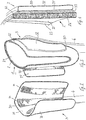
- FIG. 1 3 is a perspective schematic representation of an orthopedic interface 1 in the form of a so-called liner, which is anatomically preformed to be applied to an amputation stump.
- the orthopedic interface 1 consists of a 3D textile, in the form of a spacer fabric 2, which consists of an underside of the skin of the user facing underside 21 of a lower textile and a skin facing upper fabric on the top 22, between which support threads 24 are arranged keep the upper and lower fabrics 22, 21 spaced from each other and connect with each other. If no upper textiles are present in the 3D textile, the respective upper and lower sides are provided with the reference numerals 22, 21, the upper and lower textiles 22, 21 thus correspond to the upper and lower sides.
- the interface 1 can be made from a blank by sewing. It is also possible to connect the blank in other ways, for example by gluing or welding.
- an adhesive coating 23 On the inside of the interface 1 areas with an adhesive coating 23 are applied, which adhere to the skin of the interface user, for example on an amputation stump.
- These coatings 23 may be linear, punctiform, circular or angular.
- the entire inner side of the liner that is to say the surface of the lower textile 21, is provided with a coating 23.
- an area-only coating there is improved moisture transport from the user's skin into the environment, so that increased wearing comfort is realized, whereas a full-surface coating 23 results in improved adhesion due to the increased adhesive surface area.
- silicone coatings, polyurethane coatings or coatings of a copolymer come into question as the coating 23, but in principle other coatings are also provided and possible which bring about an improved adhesion of the lower textile 21 and thus of the 3D textile 1 to the skin surface.
- a coating 23 may likewise be arranged on the upper textile 22, that is to say on the outside of the liner or the orthopedic interface.
- This coating may also be made of an adhesive material with the outside of the liner or interface 1 provided with a coating selected for an orthopedic component, such as a prosthetic socket or orthotic retainer, disposed therearound. Again, it is envisaged that an improved adhesion of the spacer fabric 2 is ensured on the externally applied component.
- form-fitting acting elements such as velvet or velcro areas can be arranged or formed on the upper fabric 22.
- the interface 1 may also have an open cross-section, also a partially closed and partially open cross-section can be realized. It is also possible that locking devices are arranged on the interface 1, with which an opening and closing to facilitate the on and off is possible.
- a holder 3 of a prosthesis with a connecting leg 4 which connects the holder 3 with a hinge device.
- the holder 3 has a tubular, curved receiving part 30 with an open cross-section of an elastic, stable plastic, with an outer side 32 and an inner side 31.
- coating areas 33 are formed, either of an adhesive material or consist of a velor. It is also possible to provide a plurality of coatings 33 of different types. In principle, the entire inner side 31 of the holder 3 can also be provided with a coating.
- alternative structures may be present on the inside of the holder 3, which provide a lower resistance in the insertion direction of the interface as opposed to the insertion direction, for example, correspondingly shaped positive-locking elements, which engage in correspondingly shaped structures in the interface.
- the holder 3 is shown with the connecting leg 4 in cooperation with the orthopedic interface 1.
- the coating 33 of the holder 3 is designed as a velor and formed in an orientation that the orthopedic interface 1, which is designed as a liner for an amputation stump, can be inserted from above.
- the line of the velvet 33 is oriented inclined downwards, so that the orthopedic interface 1 can easily slide into the holder 3, slipping out, however, is not possible or difficult.
- the open cross-section of the support 3 may be bridged by straps or tensioning means to provide radial compression and stability.
- the partially open structure of the orthopedic interface 1 can also be bridged by locking devices.
- FIG. 4 is shown in an enlarged detail representation of the interaction of the holder 3 with the spacer fabric 2 of the orthopedic interface 1.
- an adhesive coating 23 for example of copolymer or silicone is applied.
- the coating 23 is applied oriented in the longitudinal direction and allows a stable assignment of the skin surface to the interface 1.
- an air cushion and an elastic padding are provided.
- the orthopedic interface 1 can also be used as a flexible shaft or flexible shaft part, also a corresponding inner coating for stockings or other supporting functions between a body part and an external device or a garment or a functional unit can be provided to a uniform and large-scale pressure distribution on the Provide body part with precise assignment and a high wearing comfort.
- FIG. 5 a variant of the invention is shown in which the orthopedic interface 1 is shown in a partial sectional view.
- the structure of the 3D textile 2 corresponds to that of FIGS. 1 . 3 and 4 , the optional coatings on the inside or outside 21, 22 are not shown.
- two electrodes 5 are arranged, which can transmit data via electrical connection means 6 to an evaluation unit, not shown. Also it is possible to make a wireless data transmission from the electrodes 5.
- the electrodes 5 are arranged on the inner side 21 of the spacer knitted fabric 2 and can be sewn, glued, welded or otherwise attached thereto. Surface potentials are derived via these electrodes 5 so that a prosthesis activation can take place, for example, via myoelectric signals.
- the electrodes 5 can be integrated within the spacer fabric 2 so that only the contact surfaces of the electrodes 5 with the skin surface protrude beyond the inside 21 of the 3D textile 2.
- a passage of the electrical connection means 6 can be effected by recesses within the 3D textile 2, which is designed, for example, as a spacer knit or spacer knit.
- a window can be cut out of the spacer fabric or spacer fabric 2 for fastening the electrodes and the electrode can be inserted into the window.
Landscapes
- Health & Medical Sciences (AREA)
- Life Sciences & Earth Sciences (AREA)
- Engineering & Computer Science (AREA)
- Veterinary Medicine (AREA)
- Biomedical Technology (AREA)
- Animal Behavior & Ethology (AREA)
- General Health & Medical Sciences (AREA)
- Public Health (AREA)
- Heart & Thoracic Surgery (AREA)
- Oral & Maxillofacial Surgery (AREA)
- Vascular Medicine (AREA)
- Cardiology (AREA)
- Transplantation (AREA)
- Radiology & Medical Imaging (AREA)
- Nuclear Medicine, Radiotherapy & Molecular Imaging (AREA)
- Physics & Mathematics (AREA)
- Textile Engineering (AREA)
- Biophysics (AREA)
- Pathology (AREA)
- Medical Informatics (AREA)
- Molecular Biology (AREA)
- Surgery (AREA)
- Prostheses (AREA)
- Orthopedics, Nursing, And Contraception (AREA)
- Professional, Industrial, Or Sporting Protective Garments (AREA)
Abstract
Description
- Die Erfindung betrifft ein orthopädisches Interface mit einem flächigen 3D-Textil mit einer Oberseite und einer Unterseite, die über Stützfäden zueinander beabstandet gehalten und miteinander verbunden sind, wobei die Unterseite des 3D-Textils zur Auflage auf der Haut eines Interfacenutzers ausgebildet ist, sowie ein System aus einem orthopädischen Interface und einer Orthesen- oder Protheseneinrichtung.
- Aus der
DE 102 19 814 B4 ist eine physiologische Manschette zum Anlegen an eine menschliche Extremität bekannt, die im Tragezustand gedehnt und der Körperform angepasst ist. Unter einem bestimmten Druck komprimiert die angelegte Manschette das muskuläre Gewebe, wobei vorgesehen ist, dass die Manschette aus einem Abstandsgewirk mit elastischen Fäden besteht. Durch Anlegen der Manschette wird eine erhöhte Durchblutung des muskulären Gewebes im Ruhezustand bewirkt. Die Manschette dient zur Verbesserung der Fitness des Trägers und nicht als orthopädisches Interface. - Weiterhin sind aus dem Stand der Technik so genannte Liner aus Silikon oder einem Copolymer bekannt, die über einem Amputationsstumpf getragen werden, um eine gepolsterte und luftdichte Kopplung zwischen einem Prothesenaußenschaft und einem Amputationsstumpf herzustellen. Ebenfalls sind Liner aus Polyurethan bekannt, die unmittelbar auf der Haut des Interfacenutzers getragen werden.
- Aufgabe der vorliegenden Erfindung ist es, ein orthopädisches Interface sowie ein System aus Interface und einer Orthesen- oder Protheseneinrichtung bereitzustellen, mit denen eine verbesserte Tragfähigkeit und ein höherer Tragekomfort bereitgestellt werden können.
- Erfindungsgemäß wird diese Aufgabe durch ein orthopädisches Interface mit den Merkmalen des Anspruchs 1 und durch ein System mit den Merkmalen des Anspruchs 13 gelöst. Vorteilhafte Ausgestaltungen und Weiterbildungen der Erfindungen sind in den Unteransprüchen aufgeführt.
- Das erfindungsgemäße orthopädische Interface mit einem flächigen 3D-Textil mit einer Oberseite und einer Unterseite, die über Stützfäden zueinander beabstandet gehalten und miteinander verbunden sind und bei dem die Unterseite des 3D-Textils zur Auflage auf der Haut eines Interfacenutzers ausgebildet ist, sieht vor, dass die der Haut zugeordnete Oberfläche oder Seite der Unterseite zumindest teilweise mit einer haftenden, also auf der Haut haftenden Beschichtung versehen ist, um die Zuordnung des orthopädischen Interfaces zu dem Körperteil, beispielsweise einem Amputationsstumpf oder einer mit einer Orthese zu unterstützenden Extremität, zu gewährleisten. Durch das 3D-Textil wird ein erhöhter Tragekomfort bereitgestellt, da punktuelle Druckkräfte verteilt werden. Weiterhin sind 3D-Textilien atmungsaktiv und lassen einen natürlichen Flüssigkeitsaustausch über die Haut zu. Ebenfalls kann die Beschichtung elektrisch leitfähig ausgebildet sein, um die Hautoberfläche zu stimulieren, Potentiale abzuleiten oder um Signale, beispielsweise an der Außenseite des 3D-Textils, weiterzuleiten. Die Signalleitung kann z.B. zu Sensoren oder Auswerteeinrichtungen führen. Eine Variante der Erfindung sieht vor, dass zusätzlich oder alternativ Elektroden auf der Innenseite des Interfaces angebracht oder in dem 3D-Textil eingearbeitet sind, um Muskel- oder Nervensignale abzuleiten oder Muskeln und Nerven zu stimulieren. Die Elektroden können auf verschiedene Arten und Weisen aufgebracht werden, z.B. aufgestickt, aufgenäht, aufgeklebt oder aufgeschweißt werden.
- Ebenfalls ist es vorgesehen, dass die Außenseite des orthopädischen Interfaces, also die Oberfläche der Oberseite, zumindest teilweise mit einer Beschichtung versehen ist, die eine erhöhte Haftung an dem orthopädischen Interface begünstigt. Beispielsweise kann die Beschichtung bzw. können die Beschichtungen aus Silikon, Polyurethan oder einem Copolymer bestehen, wodurch eine verbesserte Haftung einerseits auf der Haut und andererseits an weiteren orthopädischen Komponenten wie Orthesen oder Prothesen gegeben ist.
- Die Beschichtung oder die Beschichtungen können in zueinander beabstandeten Bereichen auf den jeweiligen Oberflächen der Ober- und/oder Unterseiten aufgebracht werden, beispielsweise in Streifenform, punktförmig, ringförmig oder auch in anderen flächigen Ausgestaltungen. Ebenfalls ist es möglich, dass nur in besonders beanspruchten Bereichen des orthopädischen Interfaces eine entsprechende Beschichtung auf den Oberflächen aufgebracht ist, während in weniger beanspruchten Bereichen keine Beschichtung vorhanden ist. Dies erhöht den Tragekomfort und verbessert den Wärme- und Feuchtigkeitsaustausch von der Haut durch das Interface in die Umgebung. Alternativ ist es vorgesehen, dass die Beschichtung bzw. die Beschichtungen vollflächig aufgebracht sind, um einen maximalen Halt des Interfaces zu gewährleisten. Zur Beibehaltung eines Feuchtigkeitsaustausches kann die Beschichtung feuchtigkeitsdurchlässig sein. Dazu sind die Beschichtungsmaterialien entsprechend zu wählen, beispielsweise in Gestalt von Polyurethan oder einem Copolymer. Ebenfalls können großflächige Beschichtungsbereiche mit Perforationen versehen sein, um einen Luft- und Wasserdurchtritt zu ermöglichen. Selbst bei einer vollflächigen Beschichtung ist es möglich, dass ein Gas- und Feuchtigkeitsaustausch stattfindet, da sich beispielsweise dünne Silikonbeschichtungen als atmungsaktiv herausgestellt haben. Durch die zwischen der Oberseite und der Unterseite befindliche Luftschicht in dem 3D-Textil ist eine zusätzliche Wärmeisolierung gegeben.
- Die verarbeiteten Fäden des 3D-Textils können für sich ebenfalls beschichtet sein, um spezielle Anforderungen an das Textil zu erfüllen. Die Beschichtungen können eine verbesserte Hautverträglichkeit oder einen verbesserten Feuchtigkeitstransport bewirken, um so den Tragekomfort des Interfaces weiter zu erhöhen.
- Zur Verbesserung der Hautverträglichkeit kann die Beschichtung der Fäden oder des Interfaces mit einem antibakteriellen Mittel getränkt oder versetzt sein, ebenfalls ist es vorgesehen, dass Silberfäden in der Unterseite oder dem 3D-Textil eingewebt oder eingesponnen sind, um die Hautverträglichkeit zu verbessern. Auch kann das 3D-Textil oder die Beschichtung oder können die Beschichtungen mit Silber bedampft oder mit Silberionen versetzt ausgebildet sein.
- Statt oder in Ergänzung zu einer haftenden Beschichtung kann auf der Oberseite, also auf der Außenseite des orthopädischen Interfaces, eine Struktur vorhanden sein, die in Einführrichtung des Interfaces einen geringeren Widerstand als entgegen der Einführrichtung aufweist. Die Struktur kann als ein Strichvelours ausgebildet oder aufgebracht sein, über das eine Kopplung zu einer orthopädischen Baueinheit, beispielsweise einem Außenschaft oder einer Orthesenhalterung, hergestellt werden kann. Dazu ist das Textil oder die Struktur bzw. Beschichtung dergestalt in einer Richtung orientiert geneigt, dass ein Hineingleiten in die Aufnahmeeinrichtung für die Extremität erleichtert wird, ein Herausrutschen jedoch wirksam verhindert werden kann. Zum Lösen der Kopplung zwischen dem Interface und der orthopädischen Baueinheit wird dann die Halterung gelöst, beispielsweise aufgebogen oder aufgeklappt.
- Das orthopädische Interface kann als Liner zur Anlage an einen Amputationsstumpf ausgebildet sein, ebenfalls ist es möglich, dass es als flexibler Schaft oder als ein flexibles Schaftteil ausgebildet ist und Aufnahmeeinrichtungen für orthetische oder prothetische Komponenten aufweist.
- Zur Erleichterung des Anlegens des orthopädischen Interfaces ist dieses bevorzugt anatomisch vorgeformt, ebenfalls kann es einen offenen Querschnitt aufweisen und über Verschlusseinrichtungen, wie Klettverschlüsse oder dergleichen, angelegt werden.
- Das 3D-Textil ist bevorzugt als ein Abstandsgewirk oder als ein Abstandsgestrick ausgebildet. Das Abstandsgewirk weist auf der Oberseite bevorzugt ein Obertextil und auf der Unterseite, also derjenigen Seite, die der Haut des Interfacenutzers zugeordnet ist, ein sogenanntes Untertextil auf. Die Ober- und Untertextilien bilden den Abschluss des Abstandsgewirkes und die Kontaktflächen zu der Orthese oder Prothese einerseits und der Haut andererseits.
- Das erfindungsgemäße System sieht ein Interface, wie es voranstehend beschrieben wurde, sowie eine damit gekoppelte Orthesen- oder Protheseneinrichtung vor, die über Kopplungsmittel an dem Obertextil bzw. der Außenseite des Interfaces festgelegt werden kann. Die Orthesen- oder Protheseneinrichtung kann eine im Wesentlichen form-stabile Aufnahme mit einer innenseitigen Beschichtung aufweisen, wobei die Beschichtung aus einem haftenden Material, beispielsweise Silikon, Polyurethan oder Copolymer oder einer anderen Beschichtung, beispielsweise Klettverschlusselementen oder einem Strichvelours, ausgebildet sein kann, um eine Koppelung der form-stabilen Aufnahme mit dem Interface zu realisieren. Alternativ oder ergänzend kann eine Struktur der Aufnahme auf der dem Interface zugeordneten Seite vorgesehen sein, die einen geringen Einführwiderstand und einen hohen Widerstand entgegen der Einführrichtung aufweist. Die Struktur kann aus entsprechend orientierten Formschlusselemente oder dergleichen aufgebaut sein.
- Nachfolgend werden Ausführungsbeispiele der Erfindung anhand der beigefügten Figuren näher erläutert. Es zeigen:
- Figur 1 -
- eine perspektivische Darstellung eines Interfaces in Linergestalt;
- Figur 2 -
- eine perspektivische Teilansicht einer Protheseneinrichtung;
- Figur 3 -
- eine Protheseneinrichtung gemäß
Figur 2 mit Interface; - Figur 4 -
- eine vergrößerte Schnittdarstellung durch ein Interface und eine Aufnahme; sowie
- Figur 5 -
- eine teilgeschnittene Variante mit Elektroden.
- In der
Figur 1 ist in einer perspektivischen schematischen Darstellung ein orthopädisches Interface 1 in Gestalt eines sogenannten Liners dargestellt, der anatomisch vorgeformt ist, um an einem Amputationsstumpf angelegt zu werden. Das orthopädische Interface 1 besteht aus einem 3D-Textil, vorliegend in Gestalt eines Abstandsgewirkes 2, das eine der Haut des Interfacenutzers zugewandte Unterseite 21 aus einem Untertextil und einem der Haut abgewandten Obertextil auf der Oberseite 22 besteht, zwischen denen Stützfäden 24 angeordnet sind, die die Ober- und Untertextilien 22, 21 beabstandet zueinander halten und miteinander verbinden. Sofern keine Obertextilien in dem 3D-Textil vorhanden sind, werden die jeweiligen Ober- und Unterseiten mit den Bezugszeichen 22, 21 versehen, die Ober- und Untertextilien 22, 21 entsprechen somit den Ober- und Unterseiten. Zwischen den Ober- und Untertextilien 22, 21 bildet sich durch die Stützfäden 24 ein gut durchlüfteter Zwischenraum aus. Andere 3D-Textilen, beispielsweise Abstandsgestricke, auch ohne Unter- und Obertextilien oder nur mit einem Unter- oder Obertextil, können ebenfalls eingesetzt werden. Das Interface 1 kann aus einem Zuschnitt durch Vernähen hergestellt werden. Ebenfalls ist es möglich, den Zuschnitt auf andere Art und Weise zu verbinden, beispielsweise durch Verkleben oder Verschweißen. - Auf der Innenseite des Interfaces 1 sind Bereiche mit einer haftenden Beschichtung 23 aufgebracht, die auf der Haut des Interfacenutzers, zum Beispiels auf einem Amputationsstumpf, anhaften. Diese Beschichtungen 23 können linienförmig, punktförmig, kreisförmig oder eckig ausgebildet sein. Grundsätzlich ist es ebenfalls möglich, dass die gesamte Innenseite des Liners, also die Oberfläche des Untertextils 21 mit einer Beschichtung 23 versehen ist. Bei einer nur bereichsweisen Beschichtung ist ein verbesserter Feuchtigkeitstransport von der Haut des Nutzers in die Umgebung gegeben, so dass ein erhöhter Tragekomfort realisiert wird, eine vollflächige Beschichtung 23 hat dagegen eine verbesserte Haftung aufgrund der vergrößerten Haftfläche zur Folge.
- Als Beschichtung 23 kommen insbesondere Silikonbeschichtungen, Polyurethanbeschichtungen oder Beschichtungen aus einem Copolymer in Frage, grundsätzlich sind jedoch auch andere Beschichtungen vorgesehen und möglich, die ein verbessertes Anhaften des Untertextils 21 und damit der 3D- Textils 1 an der Hautoberfläche bewirken.
- An dem Obertextil 22, also an der Außenseite des Liners bzw. des orthopädischen Interfaces, kann ebenfalls eine Beschichtung 23 angeordnet sein. Diese Beschichtung kann ebenfalls aus einem haftenden Material bestehen, wobei die Außenseite des Liners oder des Interfaces 1 mit einer Beschichtung versehen ist, die zu einem darum angeordneten orthopädischen Bauteil, beispielsweise einem Prothesenschaft oder einer Orthesenhalterung ausgewählt ist. Auch hier ist es vorgesehen, dass eine verbesserte Anhaftung des Abstandsgewirkes 2 an dem außen anliegenden Bauteil gewährleistet ist. Auch können formschlüssig wirkende Elemente wie Strichvelours oder Klettverschlussbereiche an dem Obertextil 22 angeordnet oder ausgebildet sein.
- Statt eines geschlossenen Querschnittes, wie er in der
Figur 1 dargestellt ist, kann das Interface 1 auch einen offenen Querschnitt aufweisen, ebenfalls kann ein teilweise geschlossener und teilweise offener Querschnitt realisiert sein. Ebenfalls ist es möglich, dass Verschlusseinrichtungen an dem Interface 1 angeordnet sind, mit denen ein Öffnen und Schließen zur Erleichterung des An- und Ablegens möglich ist. - In der
Figur 2 ist eine Halterung 3 einer Prothese mit einem Verbindungsschenkel 4 gezeigt, die die Halterung 3 mit einer Gelenkeinrichtung verbindet. Die Halterung 3 weist ein rohrartiges, gekrümmtes Aufnahmeteil 30 mit einem offenen Querschnitt aus einem elastischen, stabilen Kunststoff auf, mit einer Außenseite 32 und einer Innenseite 31. Auf der Innenseite 31 der Halterung 3 sind Beschichtungsbereiche 33 ausgebildet, die entweder aus einem haftenden Material oder aus einem Strichvelours bestehen. Ebenfalls ist es möglich, mehrere Beschichtungen 33 unterschiedlicher Art vorzusehen. Grundsätzlich kann auch die komplette Innenseite 31 der Halterung 3 mit einer Beschichtung versehen sein. Auch können alternative Strukturen auf der Innenseite der Halterung 3 vorhanden sein, die in Einführrichtung des Interfaces einen geringeren Widerstand als entgegen der Einführrichtung bereitstellen, beispielsweise entsprechend geformte Formschlusselemente, die in korrespondierend geformte Strukturen in dem Interface eingreifen. - In der
Figur 3 ist die Halterung 3 mit dem Verbindungsschenkel 4 in Zusammenwirkung mit dem orthopädischen Interface 1 dargestellt. In der dargestellten Ausführungsform ist die Beschichtung 33 der Halterung 3 als Strichvelours ausgeführt und in einer Orientierung ausgebildet, dass das orthopädische Interface 1, das als Liner für einen Amputationsstumpf ausgebildet ist, von oben eingeführt werden kann. Der Strich des Strichvelours 33 ist dabei nach unten geneigt orientiert, so dass das orthopädische Interface 1 leicht in die Halterung 3 hineingleiten kann, ein Herausrutschen jedoch nicht möglich ist bzw. erschwert wird. Zum Lösen des orthopädischen Interfaces 1 von der Halterung 3 wird diese aufgebogen. Der offene Querschnitt der Halterung 3 kann durch Riemen oder Spannmittel überbrückt werden, um eine radiale Kompression und Stabilität bereitzustellen. Der teiloffene Aufbau des orthopädischen Interfaces 1 kann ebenfalls durch Verschlusseinrichtungen überbrückt werden. - In der
Figur 4 ist in einer vergrößerten Detaildarstellung das Zusammenwirken der Halterung 3 mit dem Abstandsgewirk 2 des orthopädischen Interfaces 1 dargestellt. Auf der Innenseite des orthopädischen Interfaces 1, also auf dem Untertextil 21, ist eine haftende Beschichtung 23, beispielsweise aus Copolymer oder Silikon aufgebracht. Die Beschichtung 23 ist in Längserstreckung orientiert aufgebracht und ermöglicht eine stabile Zuordnung der Hautoberfläche zu dem Interface 1. Über die Stützfäden 24 werden ein Luftpolster und eine elastische Abpolsterung bereitgestellt. Auf der Außenseite des Interfaces 1, also an dem Obertextil 22, ist keine Beschichtung vorgesehen, vielmehr wird eine Kopplung mit der Halterung 3 über den Strichvelours 33 realisiert, der so orientiert ist, dass ein Einführen des orthopädischen Interfaces 1 von oben nach unten ermöglicht ist, ein Herausziehen in Richtung nach oben jedoch erschwert oder unmöglich gemacht wird. - Das orthopädische Interface 1 kann auch als flexibler Schaft oder flexibles Schaftteil eingesetzt werden, ebenfalls kann eine entsprechende Innenbeschichtung für Strümpfe oder andere abstützende Funktionen zwischen einem Körperteil und einer externen Einrichtung oder einem Bekleidungsstück oder einer Funktionseinheit vorgesehen sein, um eine gleichmäßige und großflächige Druckverteilung auf das Körperteil bei präzisier Zuordnung und einem hohen Tragekomfort bereitstellen zu können.
- Es hat sich überraschend gezeigt, dass trotz der Luftschicht zwischen der Oberseite und der Unterseite eine gute Koppelung der orthopädischen Einrichtung wie Orthese oder Prothese und dem Interfacenutzer erreicht werden kann, was vorher nicht für möglich gehalten wurde. Auch ein 3D-Textil ohne haftende Beschichtung auf der der Haut zugewandten Seite kann als orthopädisches Interface eingesetzt werden und weist einen überraschend hohen Tragekomfort bei gleichzeitiger Tragsicherheit auf.
- In der
Figur 5 ist eine Variante der Erfindung gezeigt, bei der das orthopädische Interface 1 in einer Teilschnittdarstellung gezeigt ist. Der Aufbau des 3D-Textils 2 entspricht dem derFiguren 1 ,3 und 4 , die gegebenenfalls vorhandenen Beschichtungen auf der Innen- oder Außenseite 21, 22 sind nicht dargestellt. Innerhalb des orthopädischen Interfaces sind zwei Elektroden 5 angeordnet, die über elektrische Anschlussmittel 6 Daten an eine nicht dargestellte Auswerteeinheit übermitteln können. Ebenfalls ist es möglich, eine kabellose Datenübertragung von den Elektroden 5 vorzunehmen. Die Elektroden 5 sind auf der Innenseite 21 des Abstandsgewirkes 2 angeordnet und können dort aufgenäht, aufgeklebt, aufgeschweißt oder anderweitig daran befestigt sein. Über diese Elektroden 5 werden Oberflächenpotentiale abgeleitet, so dass beispielsweise über myoelektrische Signale eine Prothesenansteuerung erfolgen kann. Ebenfalls ist es möglich, dass die Elektroden 5 innerhalb des Abstandsgewirkes 2 integriert sind, so dass nur die Kontaktflächen der Elektroden 5 mit der Hautoberfläche über die Innenseite 21 des 3D-Textils 2 hinausstehen. Eine Durchführung der elektrischen Anschlussmittel 6 kann durch Ausnehmungen innerhalb des 3D-Textils 2, das z.B. als Abstandsgewirk oder Abstandsgestrick ausgebildet ist, erfolgen. Ebenfalls kann zur Befestigung der Elektroden ein Fenster aus dem Abstandsgewirk oder Abstandsgestrick 2 herausgeschnitten und die Elektrode in das Fenster eingesetzt werden.
Claims (14)
- Orthopädisches Interface mit einem flächigen 3D-Textil mit einer Oberseite (22) und einer Unterseite (21), die über Stützfäden zueinander beabstandet gehalten und miteinander verbunden sind, wobei die Unterseite (21) des 3D-Textils zur Auflage auf der Haut eines Interfacenutzers ausgebildet ist, wobei die der Haut zugeordnete Oberfläche der Unterseite (21) zumindest teilweise mit einer haftenden Beschichtung (23) versehen ist, dadurch gekennzeichnet, dass die Beschichtung (23) elektrisch leitfähig ist und/oder Elektroden (5) auf der Unterseite (21) aufgebracht oder in dem 3D-Textil (2) eingearbeitet sind.
- Orthopädisches Interface nach Anspruch 1, dadurch gekennzeichnet, dass die der Haut abgewandte Oberseite (22) zumindest teilweise mit einer Beschichtung (23) versehen ist.
- Orthopädisches Interface nach Anspruch 1 oder 2, dadurch gekennzeichnet, dass die Beschichtung (23) aus Silikon, Polyurethan und/oder einem Copolymer besteht.
- Orthopädisches Interface nach einem der voranstehenden Ansprüche, dadurch gekennzeichnet, dass die Beschichtung (23) in zueinander beabstandeten Bereichen, insbesondere streifenförmig, punktförmig, ringförmig oder in anderen Formen oder vollflächig aufgebracht ist.
- Orthopädisches Interface nach einem der voranstehenden Ansprüche, dadurch gekennzeichnet, dass die Beschichtung (23) luftdurchlässig und/oder feuchtigkeitsdurchlässig ausgebildet ist.
- Orthopädisches Interface nach einem der voranstehenden Ansprüche, dadurch gekennzeichnet, dass die verarbeiteten Fäden des 3D-Textils (2) zumindest teilweise beschichtet sind.
- Orthopädisches Interface nach einem der voranstehenden Ansprüche, dadurch gekennzeichnet, dass in dem 3D-Textil (2), insbesondere in der Unterseite (21), Silberfäden eingewebt oder eingesponnen sind.
- Orthopädisches Interface nach einem der voranstehenden Ansprüche, dadurch gekennzeichnet, dass die Oberseite (22) eine Struktur aufweist, die in Einführrichtung des Interfaces (1) einen geringeren Widerstand als entgegen der Einführrichtung aufweist.
- Orthopädisches Interface nach einem der voranstehenden Ansprüche, dadurch gekennzeichnet, dass es als Liner zur Anlage an einen Amputationsstumpf ausgebildet ist.
- Orthopädisches Interface nach einem der Ansprüche 1 bis 7, dadurch gekennzeichnet, dass es als flexibler Schaft oder als flexibles Schaftteil mit Aufnahmeeinrichtungen für orthetische oder prothetische Komponenten ausgebildet ist.
- Orthopädisches Interface nach einem der voranstehenden Ansprüche, dadurch gekennzeichnet, dass das 3D-Textil als Abstandsgestrick oder Abstandsgewirk ausgebildet ist.
- Orthopädisches Interface nach einem der voranstehenden Ansprüche, dadurch gekennzeichnet, dass die Unterseite (21) als ein Untertextil und die Oberseite (22) als ein Obertextil ausgebildet ist.
- System aus einem orthopädischen Interface (1) nach einem der voranstehenden Ansprüche und einer Orthesen- oder Protheseneinrichtung (3, 4).
- System nach Anspruch 13, dadurch gekennzeichnet, dass die Prothesen- oder Ortheseneinrichtung (3, 4) eine im Wesentlichen formstabile Aufnahme (13) mit einer Struktur aufweist, die in Einführrichtung des Interfaces (1) einen geringeren Widerstand als entgegen der Einführrichtung aufweist.
Applications Claiming Priority (3)
| Application Number | Priority Date | Filing Date | Title |
|---|---|---|---|
| DE102007035409A DE102007035409B4 (de) | 2007-07-26 | 2007-07-26 | Orthopädisches Interface |
| EP08784310.8A EP2178481B1 (de) | 2007-07-26 | 2008-07-10 | Orthopädisches interface |
| PCT/DE2008/001124 WO2009015627A2 (de) | 2007-07-26 | 2008-07-10 | Orthopädisches interface |
Related Parent Applications (1)
| Application Number | Title | Priority Date | Filing Date |
|---|---|---|---|
| EP08784310.8A Division EP2178481B1 (de) | 2007-07-26 | 2008-07-10 | Orthopädisches interface |
Publications (3)
| Publication Number | Publication Date |
|---|---|
| EP3150120A1 true EP3150120A1 (de) | 2017-04-05 |
| EP3150120B1 EP3150120B1 (de) | 2018-10-03 |
| EP3150120B8 EP3150120B8 (de) | 2018-11-07 |
Family
ID=40157350
Family Applications (2)
| Application Number | Title | Priority Date | Filing Date |
|---|---|---|---|
| EP08784310.8A Active EP2178481B1 (de) | 2007-07-26 | 2008-07-10 | Orthopädisches interface |
| EP16195115.7A Active EP3150120B8 (de) | 2007-07-26 | 2008-07-10 | Orthopädisches interface |
Family Applications Before (1)
| Application Number | Title | Priority Date | Filing Date |
|---|---|---|---|
| EP08784310.8A Active EP2178481B1 (de) | 2007-07-26 | 2008-07-10 | Orthopädisches interface |
Country Status (8)
| Country | Link |
|---|---|
| US (2) | US9180027B2 (de) |
| EP (2) | EP2178481B1 (de) |
| JP (1) | JP2010534495A (de) |
| CN (1) | CN101842049B (de) |
| BR (1) | BRPI0813546A2 (de) |
| DE (2) | DE102007035409B4 (de) |
| RU (1) | RU2472430C2 (de) |
| WO (1) | WO2009015627A2 (de) |
Cited By (1)
| Publication number | Priority date | Publication date | Assignee | Title |
|---|---|---|---|---|
| US11285026B2 (en) | 2007-08-02 | 2022-03-29 | Ossur Hf | Liner for prosthetic and orthopedic systems |
Families Citing this family (38)
| Publication number | Priority date | Publication date | Assignee | Title |
|---|---|---|---|---|
| US10842653B2 (en) | 2007-09-19 | 2020-11-24 | Ability Dynamics, Llc | Vacuum system for a prosthetic foot |
| JP4521787B1 (ja) * | 2009-02-24 | 2010-08-11 | 金三郎 中島 | 義足のソケット部 |
| JP5493143B2 (ja) * | 2009-05-22 | 2014-05-14 | 国立大学法人 筑波大学 | 装着補助具 |
| DE102009051441B4 (de) * | 2009-10-30 | 2017-11-23 | Otto Bock Healthcare Gmbh | Kunstgliedhülle und Verfahren zu deren Herstellung |
| JP4964285B2 (ja) * | 2009-11-05 | 2012-06-27 | 耕太 堀江 | 義肢 |
| DE102010005462A1 (de) | 2010-01-20 | 2011-07-21 | Otto Bock HealthCare GmbH, 37115 | Liner |
| DE202010005472U1 (de) | 2010-05-21 | 2010-09-02 | BITS Zwickau Büromat IT-Systeme GmbH | Prothesen- oder Orthesensystem |
| DE102011015502B3 (de) | 2011-03-25 | 2012-09-20 | Otto Bock Healthcare Gmbh | Prothesensystem |
| WO2012142627A2 (en) * | 2011-04-14 | 2012-10-18 | The Ohio Willow Wood Company | Prosthetic socket sealing system and method |
| DE102011108136B4 (de) * | 2011-07-20 | 2018-07-19 | Otto Bock Healthcare Gmbh | Einrichtung mit einer zum engen Umschließen eines Körperteils ausgebildeten Wandung |
| US9155634B2 (en) | 2011-08-16 | 2015-10-13 | Rehabilitation Institute Of Chicago | Systems and methods of myoelectric prosthesis control |
| DE102011120661A1 (de) | 2011-11-30 | 2013-06-06 | Otto Bock Healthcare Gmbh | Prothesenkosmetik |
| FR2985270B1 (fr) | 2011-12-29 | 2014-10-31 | Sofradim Production | Tricot avec bandes sans picots |
| FR2985271B1 (fr) * | 2011-12-29 | 2014-01-24 | Sofradim Production | Tricot a picots |
| FR2985169B1 (fr) * | 2011-12-29 | 2014-12-05 | Sofradim Production | Tricot avec zones sans picots |
| US9486333B2 (en) * | 2012-04-17 | 2016-11-08 | Florida State University Research Foundation, Inc. | Prosthetic socket apparatus and systems |
| US9033073B2 (en) * | 2012-05-09 | 2015-05-19 | Ninfa Garcia | Prosthetic aid |
| US8979944B2 (en) * | 2012-11-28 | 2015-03-17 | Alps South, LLC | Method apparatus of a liner interface with neural receptors |
| DE102013010371B4 (de) * | 2013-06-21 | 2015-02-05 | Medi Gmbh & Co. Kg | Anordnung zum Überziehen über einen Gliedmaßenstumpf zur Fixierung eines Prothesenschafts |
| WO2015013560A1 (en) * | 2013-07-26 | 2015-01-29 | Clemson University | Prosthetic limb having an adjustable socket |
| JP2016016220A (ja) * | 2014-07-10 | 2016-02-01 | 株式会社松本義肢製作所 | 筋電制御装置用電極アダプタ |
| DE102014011034B4 (de) | 2014-07-23 | 2016-06-23 | Uniprox GmbH & Co. KG | Perforierter Liner |
| GB2528985B (en) * | 2014-08-08 | 2020-09-30 | Univ Nottingham Trent | Prosthetic sleeve |
| WO2017035294A1 (en) | 2015-08-25 | 2017-03-02 | Ossur Iceland Ehf | Prosthetic system |
| JP6017722B1 (ja) * | 2016-04-25 | 2016-11-02 | ベイシック株式会社 | パッド、パッドの製造方法、及び、パッドの使用方法 |
| DE102016108046B4 (de) * | 2016-04-29 | 2017-11-30 | Otto Bock Healthcare Products Gmbh | Prothesenschaftsystem sowie Prothesenschaft und Liner |
| JP6815195B2 (ja) * | 2016-12-27 | 2021-01-20 | 日本光電工業株式会社 | 装着テープ及びパルスフォトメトリ用プローブ |
| DE102017103463B4 (de) | 2017-02-21 | 2018-09-06 | WarmUp Wellness GmbH | Verwendung eines textilen Schutzüberzuges |
| WO2019079143A1 (en) | 2017-10-20 | 2019-04-25 | Ossur Iceland Ehf | HEAT AND TRANSPIRATION MANAGEMENT SYSTEM |
| DE102017126463A1 (de) * | 2017-11-10 | 2019-05-16 | Ottobock Se & Co. Kgaa | Orthopädietechnische Einrichtung |
| DE102017130685A1 (de) * | 2017-12-20 | 2019-06-27 | Ottobock Se & Co. Kgaa | Einrichtung |
| CN108451676B (zh) * | 2018-02-02 | 2019-11-26 | 西安交通大学 | 一种具有自适应性的3d打印柔性接受腔 |
| WO2019162518A1 (en) * | 2018-02-26 | 2019-08-29 | T&W Engineering A/S | Electrode for detecting bioelectrical signals |
| US11298249B2 (en) | 2018-06-07 | 2022-04-12 | Ossur Iceland Ehf | Prosthetic interface |
| FR3083548B1 (fr) * | 2018-07-05 | 2020-06-12 | Thuasne | Article de compression a enfilage / desenfilage facilite |
| DE102018131550A1 (de) * | 2018-12-10 | 2020-06-10 | Ottobock Se & Co. Kgaa | Orthopädietechnische Einrichtung |
| US20230255803A1 (en) * | 2019-10-05 | 2023-08-17 | Stumpworx Llc | Prosthetic devices, systems including the same, and related methods |
| IT202000022933A1 (it) | 2020-09-29 | 2022-03-29 | Bionit Labs S R L | Sistema integrato per la rilevazione ed elaborazione di segnali elettromiografici |
Citations (7)
| Publication number | Priority date | Publication date | Assignee | Title |
|---|---|---|---|---|
| US5413611A (en) * | 1992-07-21 | 1995-05-09 | Mcp Services, Inc. | Computerized electronic prosthesis apparatus and method |
| US5443525A (en) * | 1994-06-27 | 1995-08-22 | Laghi; Aldo A. | Conductive patch for control of prosthetic limbs |
| US6499320B1 (en) * | 2001-04-03 | 2002-12-31 | Frederick S. Bernhardt | Garment having antimicrobial properties and its associated method of manufacture |
| DE10219814B4 (de) | 2003-05-31 | 2004-11-25 | Technische Universität Dresden | Physiologische Manschette |
| WO2005052235A1 (en) * | 2003-11-25 | 2005-06-09 | Tytex A/S | A soft, cushioning ans stiffening spacer fabric |
| US20060089725A1 (en) * | 2002-06-04 | 2006-04-27 | Medi Bayreuth Weihermuller & Voigtmann Gmbh & Co.Kg | Liner |
| WO2007051122A2 (en) * | 2005-10-26 | 2007-05-03 | Bsn Medical, Inc. | Water resistant undercast liner |
Family Cites Families (42)
| Publication number | Priority date | Publication date | Assignee | Title |
|---|---|---|---|---|
| US4183985A (en) * | 1978-01-05 | 1980-01-15 | National Distillers And Chemical Corporation | Process of producing a nonwoven needled napped fabric having superior resistance to pilling and shedding |
| US4357714A (en) * | 1980-05-02 | 1982-11-09 | Mitsuru Ito | Fabric articles and the manufacture thereof |
| US4474573A (en) * | 1982-02-24 | 1984-10-02 | Detty Garnett E | Knee sleeve |
| US4554693A (en) * | 1983-12-19 | 1985-11-26 | American Fast Print Limited | Mattress, box springs fabric |
| US4653473A (en) * | 1984-04-20 | 1987-03-31 | Kempe Frieder K | Method and article for pain reduction using radiation-shielding textile |
| US4635626A (en) * | 1984-11-16 | 1987-01-13 | Max Lerman | Prosthetic stockings |
| US5007937A (en) * | 1988-03-31 | 1991-04-16 | New York University Medical Center | Structure for enhanced retention of artificial limbs and method of fabrication |
| AU5098790A (en) * | 1989-02-15 | 1990-09-05 | Finex Handels-Gmbh | Textile fabric shielding electromagnetic radiation, and clothing made thereof |
| JPH0359107A (ja) | 1989-07-25 | 1991-03-14 | Nok Corp | 多孔質磁性中空糸の製造法および液体の磁気処理方法 |
| JP2818223B2 (ja) * | 1989-10-26 | 1998-10-30 | アルケア株式会社 | 医療用伸縮布 |
| US5047891A (en) * | 1990-07-18 | 1991-09-10 | Idsi Products Of Georgia | Surge arrester core |
| US5102727A (en) * | 1991-06-17 | 1992-04-07 | Milliken Research Corporation | Electrically conductive textile fabric having conductivity gradient |
| JPH087847Y2 (ja) * | 1992-05-30 | 1996-03-06 | 和仁 福本 | 大腿部用免荷装具 |
| NL9300661A (nl) * | 1993-04-19 | 1994-11-16 | K G S Diamind Holding B V | Schuurvoorwerp omvattende een niet-geweven vezelmateriaal en een werkwijze voor het vervaardigen van een dergelijk schuurvoorwerp. |
| US5480455A (en) * | 1993-08-25 | 1996-01-02 | W. L. Gore & Associates, Inc. | Lining material for use with prosthetics and similar devices and method for making and using same |
| EP0752839B1 (de) * | 1994-03-30 | 1998-05-20 | Smith & Nephew plc | Medizinische artikel |
| US5728167A (en) * | 1995-01-11 | 1998-03-17 | Lohmann; Klaus H. | Prosthetic sock for reducing movement between residual limb and prosthesis |
| DE19531070A1 (de) * | 1995-08-23 | 1997-02-27 | Ihle Strumpf Gmbh | Verfahren zur Herstellung eines Stumpfstrumpfes oder eines Stumpfschützers und nach dem Verfahren hergestellter Stumpfstrumpf oder Stumpfschützer |
| DE19531707A1 (de) | 1995-08-30 | 1997-03-06 | Degussa | Verfahren zur Reinigung von Gasen |
| JP3059107B2 (ja) | 1996-08-26 | 2000-07-04 | クツワ工業株式会社 | ペンシルホルダー |
| US6381482B1 (en) * | 1998-05-13 | 2002-04-30 | Georgia Tech Research Corp. | Fabric or garment with integrated flexible information infrastructure |
| US6139513A (en) * | 1998-06-02 | 2000-10-31 | Royce Medical Company | Orthopaedic support with hardenable double knit type material |
| US6362387B1 (en) | 1998-06-15 | 2002-03-26 | Tamarack Habilitation Technologies, Inc. | Self-adhering friction reducing liner and method of use |
| JP3059107U (ja) * | 1998-11-13 | 1999-07-02 | 株式会社近畿義肢製作所 | 二重層の義肢装着用断端袋 |
| EP1052319A1 (de) * | 1999-05-03 | 2000-11-15 | Malden Mills Industries, Inc. | Dreidimensionale Verbundstoffwaren |
| EP1114630B1 (de) | 2000-01-07 | 2005-05-18 | Otto Bock HealthCare GmbH | Kniebandage |
| CN1208034C (zh) * | 2000-03-14 | 2005-06-29 | 奥苏尔公司 | 制造假体抽吸式衬套的方法 |
| US7794559B2 (en) * | 2000-03-14 | 2010-09-14 | Velcro Industries B.V. | Forming fastening projections on rigid substrates |
| US6485776B2 (en) * | 2000-03-15 | 2002-11-26 | Ossur Hf | Apparatus and process for making prosthetic suction sleeve |
| US7431738B2 (en) * | 2000-10-04 | 2008-10-07 | Dale Perkins | Attachment system for prosthesis |
| US20020183859A1 (en) | 2001-06-04 | 2002-12-05 | Houser Guy M. | Socket interface sleeve for a prosthetic device |
| DE20205706U1 (de) * | 2002-04-12 | 2002-07-04 | Otto Bock HealthCare GmbH, 37115 Duderstadt | Textilerzeugnis für die Verwendung in der Orthopädietechnik |
| CA2488733C (en) * | 2002-07-08 | 2013-09-17 | Hilmar Br. Janusson | Socket liner incorporating sensors to monitor amputee progress |
| US7025793B2 (en) | 2002-12-20 | 2006-04-11 | Ossur Hf | Suspension liner with seal |
| WO2006015599A1 (en) * | 2004-08-12 | 2006-02-16 | Tytex A/S | Tubular spacer fabric |
| US7198610B2 (en) * | 2004-12-22 | 2007-04-03 | Ossur Hf | Knee brace and method for securing the same |
| JP2008539926A (ja) * | 2005-05-09 | 2008-11-20 | ビーエスエヌ メディカル ゲーエムベーハー アンド シーオー.ケージー | 膝固定具 |
| US8585753B2 (en) * | 2006-03-04 | 2013-11-19 | John James Scanlon | Fibrillated biodegradable prosthesis |
| US7488349B2 (en) * | 2006-03-24 | 2009-02-10 | Ossur Hf | Ventilated prosthesis system |
| DE202006007460U1 (de) * | 2006-05-09 | 2007-09-13 | Otto Bock Healthcare Products Gmbh | Protheseninnenschaftsystem |
| WO2009014644A1 (en) * | 2007-07-20 | 2009-01-29 | Ossur Hf | Prosthetic or orthopedic device having feedback |
| JP2010012117A (ja) * | 2008-07-07 | 2010-01-21 | Kota Horie | 義肢 |
-
2007
- 2007-07-26 DE DE102007035409A patent/DE102007035409B4/de active Active
- 2007-07-26 DE DE202007019051U patent/DE202007019051U1/de not_active Expired - Lifetime
-
2008
- 2008-07-10 CN CN2008801006192A patent/CN101842049B/zh not_active Expired - Fee Related
- 2008-07-10 WO PCT/DE2008/001124 patent/WO2009015627A2/de not_active Ceased
- 2008-07-10 JP JP2010517265A patent/JP2010534495A/ja active Pending
- 2008-07-10 EP EP08784310.8A patent/EP2178481B1/de active Active
- 2008-07-10 BR BRPI0813546A patent/BRPI0813546A2/pt not_active IP Right Cessation
- 2008-07-10 EP EP16195115.7A patent/EP3150120B8/de active Active
- 2008-07-10 US US12/670,465 patent/US9180027B2/en active Active
- 2008-07-10 RU RU2010107064/14A patent/RU2472430C2/ru active
-
2015
- 2015-10-02 US US14/873,246 patent/US20160022442A1/en not_active Abandoned
Patent Citations (7)
| Publication number | Priority date | Publication date | Assignee | Title |
|---|---|---|---|---|
| US5413611A (en) * | 1992-07-21 | 1995-05-09 | Mcp Services, Inc. | Computerized electronic prosthesis apparatus and method |
| US5443525A (en) * | 1994-06-27 | 1995-08-22 | Laghi; Aldo A. | Conductive patch for control of prosthetic limbs |
| US6499320B1 (en) * | 2001-04-03 | 2002-12-31 | Frederick S. Bernhardt | Garment having antimicrobial properties and its associated method of manufacture |
| US20060089725A1 (en) * | 2002-06-04 | 2006-04-27 | Medi Bayreuth Weihermuller & Voigtmann Gmbh & Co.Kg | Liner |
| DE10219814B4 (de) | 2003-05-31 | 2004-11-25 | Technische Universität Dresden | Physiologische Manschette |
| WO2005052235A1 (en) * | 2003-11-25 | 2005-06-09 | Tytex A/S | A soft, cushioning ans stiffening spacer fabric |
| WO2007051122A2 (en) * | 2005-10-26 | 2007-05-03 | Bsn Medical, Inc. | Water resistant undercast liner |
Cited By (2)
| Publication number | Priority date | Publication date | Assignee | Title |
|---|---|---|---|---|
| US11285026B2 (en) | 2007-08-02 | 2022-03-29 | Ossur Hf | Liner for prosthetic and orthopedic systems |
| US11969366B2 (en) | 2007-08-02 | 2024-04-30 | Ossur Hf | Liner for prosthetic and orthopedic systems |
Also Published As
| Publication number | Publication date |
|---|---|
| EP2178481B1 (de) | 2016-11-23 |
| JP2010534495A (ja) | 2010-11-11 |
| EP3150120B1 (de) | 2018-10-03 |
| DE202007019051U1 (de) | 2010-06-24 |
| EP2178481A2 (de) | 2010-04-28 |
| DE102007035409B4 (de) | 2010-06-02 |
| US20160022442A1 (en) | 2016-01-28 |
| WO2009015627A2 (de) | 2009-02-05 |
| CN101842049A (zh) | 2010-09-22 |
| US9180027B2 (en) | 2015-11-10 |
| CN101842049B (zh) | 2013-10-30 |
| BRPI0813546A2 (pt) | 2017-05-23 |
| RU2010107064A (ru) | 2011-09-10 |
| WO2009015627A3 (de) | 2009-06-11 |
| EP3150120B8 (de) | 2018-11-07 |
| DE102007035409A1 (de) | 2009-01-29 |
| RU2472430C2 (ru) | 2013-01-20 |
| US20100318195A1 (en) | 2010-12-16 |
Similar Documents
| Publication | Publication Date | Title |
|---|---|---|
| EP3150120B1 (de) | Orthopädisches interface | |
| DE60307833T2 (de) | Pulsierende druckkammer in einer prothetischen gliedmasse | |
| EP2217180B1 (de) | Liner für vakuumschäfte und verwendung des liners | |
| DE102012017324B4 (de) | Liner für eine Prothese | |
| DE102011117801A1 (de) | Prothesenschaft | |
| DE3839377A1 (de) | Orthopaedische stuetzweste fuer personen mit unbeweglichen oder ruhiggestellten oberen koerpergliedern | |
| EP1179326B1 (de) | Handgelenkbandage | |
| DE3820098A1 (de) | Orthopaedische koerperhilfsvorrichtung | |
| EP3727215B1 (de) | Orthopädietechnische einrichtung zum stützen einer extremität eines patienten | |
| DE102012017213B3 (de) | Prothesenschaft | |
| EP2349130B1 (de) | Vorrichtung zur stabilisierung von körpersegmenten | |
| EP3886770B1 (de) | Prothesenliner | |
| DE4106883C2 (de) | Schultergelenk-Bandage | |
| DE10012984C2 (de) | Kniebandage | |
| DE102018101559B3 (de) | Bekleidungsstück zur Stimulation von Körperbereichen und Verfahren zu dessen Herstellung | |
| DE19824649A1 (de) | Gelenkbandage | |
| DE19616190B4 (de) | Brustprothese für brustamputierte Frauen | |
| DE102014115676B3 (de) | Prothesensystem | |
| DE102020113639A1 (de) | Vorrichtung zur Aufnahme eines Extremitätenstumpfes eines Patienten | |
| DE19703899C2 (de) | Stützvorrichtung für Brustkrebspatientinnen nach einer Brustoperation | |
| DE202005010949U1 (de) | Prothesen-Liner | |
| DE102012005849B4 (de) | Manschette zum Anlegen eines Stomabeutels an einen Stomaausgang | |
| CH270686A (de) | Reibungsschutz-Vorrichtung. | |
| DE202012004774U1 (de) | Manschette zum Anlegen eines Stomabeutels an einen Stomaausgang | |
| DE202010004003U1 (de) | System zur Befestigung von Kathetern am menschlichen Körper |
Legal Events
| Date | Code | Title | Description |
|---|---|---|---|
| PUAI | Public reference made under article 153(3) epc to a published international application that has entered the european phase |
Free format text: ORIGINAL CODE: 0009012 |
|
| STAA | Information on the status of an ep patent application or granted ep patent |
Free format text: STATUS: THE APPLICATION HAS BEEN PUBLISHED |
|
| AC | Divisional application: reference to earlier application |
Ref document number: 2178481 Country of ref document: EP Kind code of ref document: P |
|
| AK | Designated contracting states |
Kind code of ref document: A1 Designated state(s): AT BE BG CH CY CZ DE DK EE ES FI FR GB GR HR HU IE IS IT LI LT LU LV MC MT NL NO PL PT RO SE SI SK TR |
|
| RIN1 | Information on inventor provided before grant (corrected) |
Inventor name: KETTWIG, THOMAS Inventor name: ZARLING, SVEN Inventor name: GARUS, BERNARD Inventor name: RUESS, FELIX |
|
| STAA | Information on the status of an ep patent application or granted ep patent |
Free format text: STATUS: REQUEST FOR EXAMINATION WAS MADE |
|
| 17P | Request for examination filed |
Effective date: 20171005 |
|
| RBV | Designated contracting states (corrected) |
Designated state(s): AT BE BG CH CY CZ DE DK EE ES FI FR GB GR HR HU IE IS IT LI LT LU LV MC MT NL NO PL PT RO SE SI SK TR |
|
| GRAP | Despatch of communication of intention to grant a patent |
Free format text: ORIGINAL CODE: EPIDOSNIGR1 |
|
| STAA | Information on the status of an ep patent application or granted ep patent |
Free format text: STATUS: GRANT OF PATENT IS INTENDED |
|
| INTG | Intention to grant announced |
Effective date: 20180508 |
|
| GRAS | Grant fee paid |
Free format text: ORIGINAL CODE: EPIDOSNIGR3 |
|
| GRAA | (expected) grant |
Free format text: ORIGINAL CODE: 0009210 |
|
| STAA | Information on the status of an ep patent application or granted ep patent |
Free format text: STATUS: THE PATENT HAS BEEN GRANTED |
|
| AC | Divisional application: reference to earlier application |
Ref document number: 2178481 Country of ref document: EP Kind code of ref document: P |
|
| AK | Designated contracting states |
Kind code of ref document: B1 Designated state(s): AT BE BG CH CY CZ DE DK EE ES FI FR GB GR HR HU IE IS IT LI LT LU LV MC MT NL NO PL PT RO SE SI SK TR |
|
| REG | Reference to a national code |
Ref country code: GB Ref legal event code: FG4D Free format text: NOT ENGLISH |
|
| RAP2 | Party data changed (patent owner data changed or rights of a patent transferred) |
Owner name: OTTOBOCK SE & CO. KGAA |
|
| REG | Reference to a national code |
Ref country code: CH Ref legal event code: EP Ref country code: CH Ref legal event code: PK Free format text: BERICHTIGUNG B8 Ref country code: AT Ref legal event code: REF Ref document number: 1047740 Country of ref document: AT Kind code of ref document: T Effective date: 20181015 |
|
| REG | Reference to a national code |
Ref country code: IE Ref legal event code: FG4D Free format text: LANGUAGE OF EP DOCUMENT: GERMAN Ref country code: DE Ref legal event code: R096 Ref document number: 502008016381 Country of ref document: DE |
|
| REG | Reference to a national code |
Ref country code: DE Ref legal event code: R082 Ref document number: 502008016381 Country of ref document: DE Representative=s name: GRAMM, LINS & PARTNER PATENT- UND RECHTSANWAEL, DE |
|
| REG | Reference to a national code |
Ref country code: NL Ref legal event code: MP Effective date: 20181003 |
|
| REG | Reference to a national code |
Ref country code: LT Ref legal event code: MG4D |
|
| PG25 | Lapsed in a contracting state [announced via postgrant information from national office to epo] |
Ref country code: NL Free format text: LAPSE BECAUSE OF FAILURE TO SUBMIT A TRANSLATION OF THE DESCRIPTION OR TO PAY THE FEE WITHIN THE PRESCRIBED TIME-LIMIT Effective date: 20181003 |
|
| PG25 | Lapsed in a contracting state [announced via postgrant information from national office to epo] |
Ref country code: BG Free format text: LAPSE BECAUSE OF FAILURE TO SUBMIT A TRANSLATION OF THE DESCRIPTION OR TO PAY THE FEE WITHIN THE PRESCRIBED TIME-LIMIT Effective date: 20190103 Ref country code: FI Free format text: LAPSE BECAUSE OF FAILURE TO SUBMIT A TRANSLATION OF THE DESCRIPTION OR TO PAY THE FEE WITHIN THE PRESCRIBED TIME-LIMIT Effective date: 20181003 Ref country code: HR Free format text: LAPSE BECAUSE OF FAILURE TO SUBMIT A TRANSLATION OF THE DESCRIPTION OR TO PAY THE FEE WITHIN THE PRESCRIBED TIME-LIMIT Effective date: 20181003 Ref country code: PL Free format text: LAPSE BECAUSE OF FAILURE TO SUBMIT A TRANSLATION OF THE DESCRIPTION OR TO PAY THE FEE WITHIN THE PRESCRIBED TIME-LIMIT Effective date: 20181003 Ref country code: LT Free format text: LAPSE BECAUSE OF FAILURE TO SUBMIT A TRANSLATION OF THE DESCRIPTION OR TO PAY THE FEE WITHIN THE PRESCRIBED TIME-LIMIT Effective date: 20181003 Ref country code: NO Free format text: LAPSE BECAUSE OF FAILURE TO SUBMIT A TRANSLATION OF THE DESCRIPTION OR TO PAY THE FEE WITHIN THE PRESCRIBED TIME-LIMIT Effective date: 20190103 Ref country code: CZ Free format text: LAPSE BECAUSE OF FAILURE TO SUBMIT A TRANSLATION OF THE DESCRIPTION OR TO PAY THE FEE WITHIN THE PRESCRIBED TIME-LIMIT Effective date: 20181003 Ref country code: IS Free format text: LAPSE BECAUSE OF FAILURE TO SUBMIT A TRANSLATION OF THE DESCRIPTION OR TO PAY THE FEE WITHIN THE PRESCRIBED TIME-LIMIT Effective date: 20190203 Ref country code: ES Free format text: LAPSE BECAUSE OF FAILURE TO SUBMIT A TRANSLATION OF THE DESCRIPTION OR TO PAY THE FEE WITHIN THE PRESCRIBED TIME-LIMIT Effective date: 20181003 Ref country code: LV Free format text: LAPSE BECAUSE OF FAILURE TO SUBMIT A TRANSLATION OF THE DESCRIPTION OR TO PAY THE FEE WITHIN THE PRESCRIBED TIME-LIMIT Effective date: 20181003 |
|
| PG25 | Lapsed in a contracting state [announced via postgrant information from national office to epo] |
Ref country code: SE Free format text: LAPSE BECAUSE OF FAILURE TO SUBMIT A TRANSLATION OF THE DESCRIPTION OR TO PAY THE FEE WITHIN THE PRESCRIBED TIME-LIMIT Effective date: 20181003 Ref country code: GR Free format text: LAPSE BECAUSE OF FAILURE TO SUBMIT A TRANSLATION OF THE DESCRIPTION OR TO PAY THE FEE WITHIN THE PRESCRIBED TIME-LIMIT Effective date: 20190104 Ref country code: PT Free format text: LAPSE BECAUSE OF FAILURE TO SUBMIT A TRANSLATION OF THE DESCRIPTION OR TO PAY THE FEE WITHIN THE PRESCRIBED TIME-LIMIT Effective date: 20190203 |
|
| REG | Reference to a national code |
Ref country code: DE Ref legal event code: R097 Ref document number: 502008016381 Country of ref document: DE |
|
| PG25 | Lapsed in a contracting state [announced via postgrant information from national office to epo] |
Ref country code: DK Free format text: LAPSE BECAUSE OF FAILURE TO SUBMIT A TRANSLATION OF THE DESCRIPTION OR TO PAY THE FEE WITHIN THE PRESCRIBED TIME-LIMIT Effective date: 20181003 |
|
| PLBE | No opposition filed within time limit |
Free format text: ORIGINAL CODE: 0009261 |
|
| STAA | Information on the status of an ep patent application or granted ep patent |
Free format text: STATUS: NO OPPOSITION FILED WITHIN TIME LIMIT |
|
| REG | Reference to a national code |
Ref country code: DE Ref legal event code: R082 Ref document number: 502008016381 Country of ref document: DE Representative=s name: GRAMM, LINS & PARTNER PATENT- UND RECHTSANWAEL, DE |
|
| PG25 | Lapsed in a contracting state [announced via postgrant information from national office to epo] |
Ref country code: RO Free format text: LAPSE BECAUSE OF FAILURE TO SUBMIT A TRANSLATION OF THE DESCRIPTION OR TO PAY THE FEE WITHIN THE PRESCRIBED TIME-LIMIT Effective date: 20181003 Ref country code: SK Free format text: LAPSE BECAUSE OF FAILURE TO SUBMIT A TRANSLATION OF THE DESCRIPTION OR TO PAY THE FEE WITHIN THE PRESCRIBED TIME-LIMIT Effective date: 20181003 Ref country code: EE Free format text: LAPSE BECAUSE OF FAILURE TO SUBMIT A TRANSLATION OF THE DESCRIPTION OR TO PAY THE FEE WITHIN THE PRESCRIBED TIME-LIMIT Effective date: 20181003 |
|
| 26N | No opposition filed |
Effective date: 20190704 |
|
| PG25 | Lapsed in a contracting state [announced via postgrant information from national office to epo] |
Ref country code: SI Free format text: LAPSE BECAUSE OF FAILURE TO SUBMIT A TRANSLATION OF THE DESCRIPTION OR TO PAY THE FEE WITHIN THE PRESCRIBED TIME-LIMIT Effective date: 20181003 |
|
| PG25 | Lapsed in a contracting state [announced via postgrant information from national office to epo] |
Ref country code: MC Free format text: LAPSE BECAUSE OF FAILURE TO SUBMIT A TRANSLATION OF THE DESCRIPTION OR TO PAY THE FEE WITHIN THE PRESCRIBED TIME-LIMIT Effective date: 20181003 |
|
| REG | Reference to a national code |
Ref country code: CH Ref legal event code: PL |
|
| REG | Reference to a national code |
Ref country code: BE Ref legal event code: MM Effective date: 20190731 |
|
| PG25 | Lapsed in a contracting state [announced via postgrant information from national office to epo] |
Ref country code: BE Free format text: LAPSE BECAUSE OF NON-PAYMENT OF DUE FEES Effective date: 20190731 Ref country code: CH Free format text: LAPSE BECAUSE OF NON-PAYMENT OF DUE FEES Effective date: 20190731 Ref country code: LI Free format text: LAPSE BECAUSE OF NON-PAYMENT OF DUE FEES Effective date: 20190731 Ref country code: LU Free format text: LAPSE BECAUSE OF NON-PAYMENT OF DUE FEES Effective date: 20190710 |
|
| PG25 | Lapsed in a contracting state [announced via postgrant information from national office to epo] |
Ref country code: IE Free format text: LAPSE BECAUSE OF NON-PAYMENT OF DUE FEES Effective date: 20190710 |
|
| REG | Reference to a national code |
Ref country code: AT Ref legal event code: MM01 Ref document number: 1047740 Country of ref document: AT Kind code of ref document: T Effective date: 20190710 |
|
| REG | Reference to a national code |
Ref country code: DE Ref legal event code: R079 Ref document number: 502008016381 Country of ref document: DE Free format text: PREVIOUS MAIN CLASS: A61B0005040800 Ipc: A61B0005280000 |
|
| PG25 | Lapsed in a contracting state [announced via postgrant information from national office to epo] |
Ref country code: AT Free format text: LAPSE BECAUSE OF NON-PAYMENT OF DUE FEES Effective date: 20190710 |
|
| PG25 | Lapsed in a contracting state [announced via postgrant information from national office to epo] |
Ref country code: CY Free format text: LAPSE BECAUSE OF FAILURE TO SUBMIT A TRANSLATION OF THE DESCRIPTION OR TO PAY THE FEE WITHIN THE PRESCRIBED TIME-LIMIT Effective date: 20181003 |
|
| PG25 | Lapsed in a contracting state [announced via postgrant information from national office to epo] |
Ref country code: MT Free format text: LAPSE BECAUSE OF FAILURE TO SUBMIT A TRANSLATION OF THE DESCRIPTION OR TO PAY THE FEE WITHIN THE PRESCRIBED TIME-LIMIT Effective date: 20181003 Ref country code: HU Free format text: LAPSE BECAUSE OF FAILURE TO SUBMIT A TRANSLATION OF THE DESCRIPTION OR TO PAY THE FEE WITHIN THE PRESCRIBED TIME-LIMIT; INVALID AB INITIO Effective date: 20080710 |
|
| PGFP | Annual fee paid to national office [announced via postgrant information from national office to epo] |
Ref country code: IT Payment date: 20210730 Year of fee payment: 14 |
|
| PGFP | Annual fee paid to national office [announced via postgrant information from national office to epo] |
Ref country code: TR Payment date: 20220704 Year of fee payment: 15 Ref country code: GB Payment date: 20220725 Year of fee payment: 15 |
|
| PGFP | Annual fee paid to national office [announced via postgrant information from national office to epo] |
Ref country code: FR Payment date: 20220727 Year of fee payment: 15 |
|
| PG25 | Lapsed in a contracting state [announced via postgrant information from national office to epo] |
Ref country code: IT Free format text: LAPSE BECAUSE OF NON-PAYMENT OF DUE FEES Effective date: 20220710 |
|
| GBPC | Gb: european patent ceased through non-payment of renewal fee |
Effective date: 20230710 |
|
| PG25 | Lapsed in a contracting state [announced via postgrant information from national office to epo] |
Ref country code: GB Free format text: LAPSE BECAUSE OF NON-PAYMENT OF DUE FEES Effective date: 20230710 |
|
| PG25 | Lapsed in a contracting state [announced via postgrant information from national office to epo] |
Ref country code: FR Free format text: LAPSE BECAUSE OF NON-PAYMENT OF DUE FEES Effective date: 20230731 |
|
| PGFP | Annual fee paid to national office [announced via postgrant information from national office to epo] |
Ref country code: DE Payment date: 20250722 Year of fee payment: 18 |