EP3146545B1 - Elektrode für eine fotovoltaikbatterie - Google Patents
Elektrode für eine fotovoltaikbatterie Download PDFInfo
- Publication number
- EP3146545B1 EP3146545B1 EP15796685.4A EP15796685A EP3146545B1 EP 3146545 B1 EP3146545 B1 EP 3146545B1 EP 15796685 A EP15796685 A EP 15796685A EP 3146545 B1 EP3146545 B1 EP 3146545B1
- Authority
- EP
- European Patent Office
- Prior art keywords
- electrode
- dye
- combination
- lifepo
- cathode
- Prior art date
- Legal status (The legal status is an assumption and is not a legal conclusion. Google has not performed a legal analysis and makes no representation as to the accuracy of the status listed.)
- Active
Links
Images




Classifications
-
- H—ELECTRICITY
- H01—ELECTRIC ELEMENTS
- H01M—PROCESSES OR MEANS, e.g. BATTERIES, FOR THE DIRECT CONVERSION OF CHEMICAL ENERGY INTO ELECTRICAL ENERGY
- H01M10/00—Secondary cells; Manufacture thereof
- H01M10/42—Methods or arrangements for servicing or maintenance of secondary cells or secondary half-cells
- H01M10/46—Accumulators structurally combined with charging apparatus
- H01M10/465—Accumulators structurally combined with charging apparatus with solar battery as charging system
-
- H—ELECTRICITY
- H01—ELECTRIC ELEMENTS
- H01G—CAPACITORS; CAPACITORS, RECTIFIERS, DETECTORS, SWITCHING DEVICES, LIGHT-SENSITIVE OR TEMPERATURE-SENSITIVE DEVICES OF THE ELECTROLYTIC TYPE
- H01G9/00—Electrolytic capacitors, rectifiers, detectors, switching devices, light-sensitive or temperature-sensitive devices; Processes of their manufacture
- H01G9/20—Light-sensitive devices
- H01G9/2027—Light-sensitive devices comprising an oxide semiconductor electrode
- H01G9/2031—Light-sensitive devices comprising an oxide semiconductor electrode comprising titanium oxide, e.g. TiO2
-
- H—ELECTRICITY
- H01—ELECTRIC ELEMENTS
- H01G—CAPACITORS; CAPACITORS, RECTIFIERS, DETECTORS, SWITCHING DEVICES, LIGHT-SENSITIVE OR TEMPERATURE-SENSITIVE DEVICES OF THE ELECTROLYTIC TYPE
- H01G9/00—Electrolytic capacitors, rectifiers, detectors, switching devices, light-sensitive or temperature-sensitive devices; Processes of their manufacture
- H01G9/20—Light-sensitive devices
- H01G9/2027—Light-sensitive devices comprising an oxide semiconductor electrode
- H01G9/204—Light-sensitive devices comprising an oxide semiconductor electrode comprising zinc oxides, e.g. ZnO
-
- H—ELECTRICITY
- H01—ELECTRIC ELEMENTS
- H01G—CAPACITORS; CAPACITORS, RECTIFIERS, DETECTORS, SWITCHING DEVICES, LIGHT-SENSITIVE OR TEMPERATURE-SENSITIVE DEVICES OF THE ELECTROLYTIC TYPE
- H01G9/00—Electrolytic capacitors, rectifiers, detectors, switching devices, light-sensitive or temperature-sensitive devices; Processes of their manufacture
- H01G9/20—Light-sensitive devices
- H01G9/2059—Light-sensitive devices comprising an organic dye as the active light absorbing material, e.g. adsorbed on an electrode or dissolved in solution
-
- H—ELECTRICITY
- H01—ELECTRIC ELEMENTS
- H01M—PROCESSES OR MEANS, e.g. BATTERIES, FOR THE DIRECT CONVERSION OF CHEMICAL ENERGY INTO ELECTRICAL ENERGY
- H01M10/00—Secondary cells; Manufacture thereof
- H01M10/05—Accumulators with non-aqueous electrolyte
- H01M10/052—Li-accumulators
- H01M10/0525—Rocking-chair batteries, i.e. batteries with lithium insertion or intercalation in both electrodes; Lithium-ion batteries
-
- H—ELECTRICITY
- H01—ELECTRIC ELEMENTS
- H01M—PROCESSES OR MEANS, e.g. BATTERIES, FOR THE DIRECT CONVERSION OF CHEMICAL ENERGY INTO ELECTRICAL ENERGY
- H01M14/00—Electrochemical current or voltage generators not provided for in groups H01M6/00 - H01M12/00; Manufacture thereof
- H01M14/005—Photoelectrochemical storage cells
-
- H—ELECTRICITY
- H01—ELECTRIC ELEMENTS
- H01M—PROCESSES OR MEANS, e.g. BATTERIES, FOR THE DIRECT CONVERSION OF CHEMICAL ENERGY INTO ELECTRICAL ENERGY
- H01M4/00—Electrodes
- H01M4/02—Electrodes composed of, or comprising, active material
- H01M4/36—Selection of substances as active materials, active masses, active liquids
- H01M4/38—Selection of substances as active materials, active masses, active liquids of elements or alloys
- H01M4/381—Alkaline or alkaline earth metals elements
- H01M4/382—Lithium
-
- H—ELECTRICITY
- H01—ELECTRIC ELEMENTS
- H01M—PROCESSES OR MEANS, e.g. BATTERIES, FOR THE DIRECT CONVERSION OF CHEMICAL ENERGY INTO ELECTRICAL ENERGY
- H01M4/00—Electrodes
- H01M4/02—Electrodes composed of, or comprising, active material
- H01M4/36—Selection of substances as active materials, active masses, active liquids
- H01M4/58—Selection of substances as active materials, active masses, active liquids of inorganic compounds other than oxides or hydroxides, e.g. sulfides, selenides, tellurides, halogenides or LiCoFy; of polyanionic structures, e.g. phosphates, silicates or borates
- H01M4/5825—Oxygenated metallic salts or polyanionic structures, e.g. borates, phosphates, silicates, olivines
-
- H—ELECTRICITY
- H01—ELECTRIC ELEMENTS
- H01M—PROCESSES OR MEANS, e.g. BATTERIES, FOR THE DIRECT CONVERSION OF CHEMICAL ENERGY INTO ELECTRICAL ENERGY
- H01M4/00—Electrodes
- H01M4/02—Electrodes composed of, or comprising, active material
- H01M4/36—Selection of substances as active materials, active masses, active liquids
- H01M4/58—Selection of substances as active materials, active masses, active liquids of inorganic compounds other than oxides or hydroxides, e.g. sulfides, selenides, tellurides, halogenides or LiCoFy; of polyanionic structures, e.g. phosphates, silicates or borates
- H01M4/583—Carbonaceous material, e.g. graphite-intercalation compounds or CFx
- H01M4/587—Carbonaceous material, e.g. graphite-intercalation compounds or CFx for inserting or intercalating light metals
-
- H—ELECTRICITY
- H01—ELECTRIC ELEMENTS
- H01M—PROCESSES OR MEANS, e.g. BATTERIES, FOR THE DIRECT CONVERSION OF CHEMICAL ENERGY INTO ELECTRICAL ENERGY
- H01M4/00—Electrodes
- H01M4/02—Electrodes composed of, or comprising, active material
- H01M2004/021—Physical characteristics, e.g. porosity, surface area
-
- H—ELECTRICITY
- H01—ELECTRIC ELEMENTS
- H01M—PROCESSES OR MEANS, e.g. BATTERIES, FOR THE DIRECT CONVERSION OF CHEMICAL ENERGY INTO ELECTRICAL ENERGY
- H01M4/00—Electrodes
- H01M4/02—Electrodes composed of, or comprising, active material
- H01M4/36—Selection of substances as active materials, active masses, active liquids
- H01M4/38—Selection of substances as active materials, active masses, active liquids of elements or alloys
- H01M4/386—Silicon or alloys based on silicon
-
- H—ELECTRICITY
- H01—ELECTRIC ELEMENTS
- H01M—PROCESSES OR MEANS, e.g. BATTERIES, FOR THE DIRECT CONVERSION OF CHEMICAL ENERGY INTO ELECTRICAL ENERGY
- H01M4/00—Electrodes
- H01M4/02—Electrodes composed of, or comprising, active material
- H01M4/36—Selection of substances as active materials, active masses, active liquids
- H01M4/48—Selection of substances as active materials, active masses, active liquids of inorganic oxides or hydroxides
- H01M4/485—Selection of substances as active materials, active masses, active liquids of inorganic oxides or hydroxides of mixed oxides or hydroxides for inserting or intercalating light metals, e.g. LiTi2O4 or LiTi2OxFy
-
- H—ELECTRICITY
- H01—ELECTRIC ELEMENTS
- H01M—PROCESSES OR MEANS, e.g. BATTERIES, FOR THE DIRECT CONVERSION OF CHEMICAL ENERGY INTO ELECTRICAL ENERGY
- H01M4/00—Electrodes
- H01M4/02—Electrodes composed of, or comprising, active material
- H01M4/36—Selection of substances as active materials, active masses, active liquids
- H01M4/48—Selection of substances as active materials, active masses, active liquids of inorganic oxides or hydroxides
- H01M4/52—Selection of substances as active materials, active masses, active liquids of inorganic oxides or hydroxides of nickel, cobalt or iron
- H01M4/525—Selection of substances as active materials, active masses, active liquids of inorganic oxides or hydroxides of nickel, cobalt or iron of mixed oxides or hydroxides containing iron, cobalt or nickel for inserting or intercalating light metals, e.g. LiNiO2, LiCoO2 or LiCoOxFy
-
- H—ELECTRICITY
- H01—ELECTRIC ELEMENTS
- H01M—PROCESSES OR MEANS, e.g. BATTERIES, FOR THE DIRECT CONVERSION OF CHEMICAL ENERGY INTO ELECTRICAL ENERGY
- H01M4/00—Electrodes
- H01M4/02—Electrodes composed of, or comprising, active material
- H01M4/36—Selection of substances as active materials, active masses, active liquids
- H01M4/58—Selection of substances as active materials, active masses, active liquids of inorganic compounds other than oxides or hydroxides, e.g. sulfides, selenides, tellurides, halogenides or LiCoFy; of polyanionic structures, e.g. phosphates, silicates or borates
- H01M4/581—Chalcogenides or intercalation compounds thereof
- H01M4/5815—Sulfides
-
- Y—GENERAL TAGGING OF NEW TECHNOLOGICAL DEVELOPMENTS; GENERAL TAGGING OF CROSS-SECTIONAL TECHNOLOGIES SPANNING OVER SEVERAL SECTIONS OF THE IPC; TECHNICAL SUBJECTS COVERED BY FORMER USPC CROSS-REFERENCE ART COLLECTIONS [XRACs] AND DIGESTS
- Y02—TECHNOLOGIES OR APPLICATIONS FOR MITIGATION OR ADAPTATION AGAINST CLIMATE CHANGE
- Y02E—REDUCTION OF GREENHOUSE GAS [GHG] EMISSIONS, RELATED TO ENERGY GENERATION, TRANSMISSION OR DISTRIBUTION
- Y02E10/00—Energy generation through renewable energy sources
- Y02E10/50—Photovoltaic [PV] energy
- Y02E10/542—Dye sensitized solar cells
Definitions
- the invention generally relates to electrodes. More specifically, the invention relates to an electrode comprising a combination of an electrode material of the same type as the materials used in Li-ion batteries and of a light-sensitive dye of the same type as the dyes used in photosensitive dye solar cells (DSSC, “dye sensitized solar cell”).
- DSSC photosensitive dye solar cells
- a battery comprising an electrode according to the invention can be charged by light.
- a lithium-ion battery can be briefly described as follows: the battery consists of a cathode material (such as for example LiFePO 4 , LiCoO 2 , FeS 2 , V 2 O 5 , etc.), a lithium salt (such as LiPF 6 , LiTFSI, LiCIO 4 , LMO, Li 2 CO 3 , etc.) dissolved in a liquid solvent or a polymer, and an anode material (such as graphite, LTO, etc. ).
- the anode or cathode materials are not good electronic conductors, they can be coated with carbon and / or be deposited on metallic substrates (such as aluminum, copper, etc.) .
- the Diagram 1 relates to the operation of a Li-ion battery - the reference numeral 10 indicates the current collector of the copper cathode, the reference numeral 11 indicates the electrolyte conducting lithium ions and the reference numeral 12 indicates the collector current from the aluminum anode.
- the lithium ions are deintercaled by oxidation of the anode material and, simultaneously, the cathode material is reduced by a process of intercalation of the lithium ions in its structure. Thereafter, it is possible to charge the battery by applying an external current.
- the external circuit generates a flow of electron which goes from the cathode (which is in the reduced state) towards the anode. This causes oxidation and therefore delithiation of the cathode material, and restores the storage of lithium at the anode. In this way, it is possible to charge and discharge the battery for a thousand cycles.
- a photosensitive dye solar cell can be briefly described as follows: the system requires at least one of its faces to contain a current collector transparent to light (Diagram 2, arrow 1 ') which can be a grid metallic or a very thin metallic layer, a conductive polymer or a transparent substrate (glass or polymer) coated with a layer of transparent and conductive material like an oxide (such as FTO, ITO, ZnO doped Al, Ga and / or Si, etc.), a conductive polymer (such as PEDOT: PSS, etc.) or metallic grids.
- a current collector transparent to light (Diagram 2, arrow 1 ') which can be a grid metallic or a very thin metallic layer, a conductive polymer or a transparent substrate (glass or polymer) coated with a layer of transparent and conductive material like an oxide (such as FTO, ITO, ZnO doped Al, Ga and / or Si, etc.), a conductive polymer (such as PEDOT: PSS, etc.) or metallic grids.
- the photosensitive layer in a DSSC (Diagram 2, arrow 2 ') is composed of a layer of semiconductor material (such as TiO 2 , ZnO, SnO 2 , "core-shell", etc.).
- the layer must be as transparent as possible and be able to allow the adsorption of the photosensitive dye.
- the photosensitive dye is generally composed of organometallic molecules like dyes composed of pyridyl and ruthenium groups (such as for example the industrial dyes known under the name "N3", “black dye”, “SJW-E1", “N719 “, Etc.).
- the photosensitive dye can also be an entirely organic compound (such as “TA-St-CA”, etc.).
- the electrolyte in a DSSC cell can be a liquid, a gel or a solid, but it must, in all cases, contain a sacrificial redox couple.
- the sacrificial redox couple is the couple I 3 - / I - , but other redox couples can also be used (such as for example Br 3 - / Br, SeCN - / (SeCN) 2 , (SCN) 2 / SCN - , Co 3+ / Co 2+ , etc.).
- a catalyst (such as platinum, gold, etc.) is generally used (Diagram 2, arrow 4 ') in order to increase the speed of recombination of the sacrificial couple.
- a DSSC cell includes a current collector (Diagram 2, arrow 5 ').
- the current collector can be transparent such as that illustrated in Diagram 2, arrow 1 ', or non-transparent.
- the Figure 1 succinctly describes the operation of a DSSC cell - the reference 13 indicates a semiconductor, the reference 14 indicates a dye, the reference 15 indicates the electrolyte, the reference 16 indicates a glass-based counter electrode conductor and the digital reference the external circuit.
- the electron flow is created by the excitation of the photosensitive dye by light, and by the fact that the lowest vacant Molecular Orbital (LUMO) of the dye is more energetic than the conduction band of the semiconductor.
- LUMO Molecular Orbital
- electrons can leave the excited dye (S *) while being picked up by the semiconductor and subsequently by the current collector.
- the dye is oxidized to S + and reacts immediately with the sacrificial redox couple R / R - according to the reaction S + + R - ⁇ S + R.
- the electron arriving via the external circuit to the counter electrode is used for the recombination of the sacrificial redox couple. Since all of these reactions are governed by kinetics, the extraction of the electron from the excited dye via the semiconductor and then the current collector must be faster than the natural relaxation of the dye, in order to get this mechanism.
- a cathode electrode comprising an electrode material and a photosensitive dye, wherein the cathode material is LiFePO 4 , LiCoO 2 , FeS 2 or V 2 O 5 .
- an anode electrode comprising an electrode material and a photosensitive dye, wherein the anode material is Li 4 Ti 5 O 12 .
- the electrode can also comprise a semiconductor material.
- a battery comprising the electrode according to the invention can be charged using light.
- electrode material of the same type as the electrode materials used in Li-ion batteries refers to materials which have characteristics and properties similar to those of d materials.
- anode or cathode of Li-ion batteries ie, a material which behaves like an anode or cathode material in a Li-ion battery.
- cathode material of the same type as the cathode materials used in Li-ion batteries or to an “anode material of the same type as the materials of anode used in Li-ion batteries ”.
- the expression “light-sensitive dye of the same type as the dyes used in solar cells with photosensitive dye” or the expression “photosensitive dye” refers to dyes which have characteristics and properties similar to those of dyes in photobatteries (ie, a dye that behaves like a dye in a photobattery). More specifically, one or other of these expressions refers to a material whose molecule can absorb photons. Therefore, at least one electron of the molecule passes from its Highest Occupied Molecular Orbital (HOMO, “highest ocupied molecular energy”) to its Lowest Vacant Molecular Orbital (LUMO, “Lowest Unoccupied Molecular Orbital”).
- HOMO Highest Occupied Molecular Orbital
- LUMO Lowest Vacant Molecular Orbital
- semiconductor material designates a material which has a prohibited bandwidth not exceeding approximately 4eV.
- the inventors have designed and developed an electrode which, when mounted in a battery, allows the battery to be charged using light.
- the electrode comprises a combination of an electrode material of the same type as the materials used in Li-ion batteries and of a light-sensitive dye of the same type as the dyes used in photosensitive dye solar cells (DSSC).
- the electrode may further comprise a semiconductor material.
- the electrode according to the invention allows the battery to be charged using light, in place of an applied external current.
- the cathode electrode is obtained by combining a cathode material of the same type as the cathode materials used in Li-ion batteries and a light-sensitive dye of the same type as the dyes used in photosensitive dye solar cells.
- the combination can comprise a semiconductor material.
- the cathode material of the same type as the cathode materials used in Li-ion batteries can be an olivine type material.
- the cathode material can be LiFePO 4 , IiCoO 2 , FeS 2 or V 2 O 5 .
- the cathode material is LiFePO 4 .
- the cathode material according to the invention can be coated with carbon.
- the anode electrode is obtained by combining an anode material of the same type as the anode materials used in Li-ion batteries and a light-sensitive dye of the same type than the dyes used in photosensitive dye solar cells.
- the combination can comprise a semiconductor material.
- the anode material of the same type as the anode materials used in Li-ion batteries can be metallic lithium, graphite, silicon, or a metallic oxide such as for example Fe 2 O 3 , TiO 2 , Li 4 Ti 5 O 12 , etc.
- the anode material can be metallic lithium or graphite.
- the anode material according to the invention can be coated with carbon.
- the light sensitive dye of the same type as the dyes used in photosensitive dye solar cells (DSSC) can be N3, "black dye", SJW-E1 or N719. According to a preferred embodiment of the invention, the light-sensitive dye is N719.
- the semiconductor material can be TiO 2 , ZnO, SnO 2 or "core-shell". According to a preferred embodiment of the invention, the semiconductor material is TiO 2 .
- cathode material of the same type as the cathode materials used in Li-ion batteries
- light-sensitive dye of the same type as the dyes used in cells DSSC and semiconductor material
- the cathode material and the semiconductor material can first be mixed, and the dye added thereafter.
- the cathode material is used in the form of submicron particles or particles obtained by hydrothermal route.
- the particle size can be less than 1 micron. According to a preferred embodiment of the invention, the particle size is less than 0.1 microns.
- the semiconductor material is used in the form of nanometric powder.
- the particle size can be less than 100 nanometers. According to a preferred embodiment of the invention, the particle size is less than 30 nanometers.
- the semiconductor material can be in the form of pre-calcined powder.
- the dye used can be in liquid form, and according to one embodiment, the addition of the dye can be carried out by immersion in the liquid of a film formed by the mixture of cathode material and semiconductor material.
- the film comprises a cathode material but not a semiconductor material.
- the mixture of cathode material and semiconductor material may further comprise other agents, which may be solvents (such as for example water, N-methyl-2-pyrrolidine (such as for example NMP, etc.), binders (such as PEG, etc.), dispersants (such as Triton-X100, etc.).
- solvents such as for example water, N-methyl-2-pyrrolidine (such as for example NMP, etc.), binders (such as PEG, etc.), dispersants (such as Triton-X100, etc.).
- the electrode material (Diagram 3, arrow 2) is deposited on a transparent and conductive substrate (Diagram 3, arrow 1) which is both transparent to light and which is an electronic conductor allowing electrons to flow from or to an external circuit.
- the electrolyte (Diagram 3, arrow 3) according to this embodiment, is lithiated like those used in Li-ion batteries and does not contain sacrificial redox couple.
- the anode (Diagram 3, arrow 4) is of the same type as the anodes used in Li-ion batteries.
- the photosensitive dye Upon exposure to light, as in the case of DSSCs, the photosensitive dye is excited and may eventually be oxidized, since at least one electron of this molecule is promoted to its lowest vacant molecular orbital (LUMO) which is more energetic than the conduction strip of the semiconductor. From then on, the semiconductor sends electrons to the external circuit via the current collector.
- the previously reduced battery cathode material (called BCM, “battery cathode material”) serves as a “sacrificial redox couple” like the sacrificial redox couples used in DSSCs.
- BCM battery cathode material
- the oxidation of the reduced BCM, Li (BCM) takes place according to the following reaction: Li (BCM) + S + ⁇ Li + + (BCM) + S
- the redox couple of the dye, S + / S In order for the reaction to evolve spontaneously, it is necessary for the redox couple of the dye, S + / S to have a standard potential greater than that of the sacrificial redox couple, Li + / Li (BCM).
- the most frequently used redox couple is the I 3 - / I - pair which has a standard potential of 0.53V vs. ESH, which corresponds to 3.57V vs. Li + / Li. Consequently, all the cathode material used in a battery having a standard potential of less than 3.6V vs. Li + / Li can be oxidized when the material is combined with a photosensitive dye of the same type as the dyes used for DSSCs.
- the cathode material of the battery which is in the reduced state Li (BCM)
- BCM the cathode material of the battery which is in the reduced state
- the cathode material can oxidize to BCM and thus replace the sacrificial redox couple I - / I 3 - of the DSSCs.
- the synthesis and / or the use of specific dyes, like DSSC using the couple Co 3+ / Co 2+ can be envisaged.
- the lithium ions released by the reaction at the cathode are reduced on the anode side using the electron from the external circuit. Therefore, it is possible to obtain the oxidation of the reduced cathode material without the application of an external current.
- a wet film of this paste of 76.2 micrometers (3mils) was deposited on a glass / FTO substrate (Cytodiagnostics TEC 7, 6-8 ⁇ ) by the method called "Doctor Blade".
- the film was annealed under a stream of nitrogen according to the following procedure: a temperature ramp up to 400 ° C. in 1 hour, a level of 1 hour at 400 ° C., followed by natural cooling to room temperature .
- the film thus obtained was immersed for 24 hours in an aqueous solution containing 4 ⁇ 10 -4 M of photosensitive dye N719 in order to anchor said dye to the surface of the particles constituting the cathode.
- the samples were dried at 50 ° C under vacuum for 48 hours ( Figure 3 ).
- the DRX diffractogram for the raw photoactive assembly electrode shows the presence of tin oxide from the substrate coated with FTO, the anatase and brookite phases which come from titanium oxide and the tryphilite phase from LiFePO 4 .
- the initial presence of the heterosite FePO 4 phase is excluded because of the peak intensity mismatch.
- the photoactive electrode was mounted in three electrode configuration in a 1M solution of LiPF 6 dissolved in EC-DEC-VC as electrolyte vs. Li and using a reference of Li + / Li.
- the electrochemical properties of these electrodes were measured by cyclic voltammetry (CV, "cyclic voltametry") with a scanning speed of 0.1mV / s and a voltage range from 2.5V to 4V compared to lithium ( Figure 5 ).
- the CV ended at a potential of 2.5V.
- the CV thus obtained is representative of a film composed of submicron LFP crystals, because of its oxidation potential located at 3.46 V and its reduction potential at 3.4 V.
- a wet film of this paste of 76.2 micrometers (3mils) was deposited on a glass / FTO substrate (Cytodiagnostics TEC 7, 6-8 ⁇ ) by the method called "Doctor Blade".
- the film was annealed under a stream of nitrogen according to the following procedure: a temperature ramp up to 400 ° C in 1 hour, a level of 1 hour at 400 ° C, followed by natural cooling to room temperature .
- the film thus obtained was immersed for 24 hours in an aqueous solution containing 4 ⁇ 10 -4 M of photosensitive dye N719, in order to anchor said dye to the surface of the particles constituting the cathode.
- the samples were dried at 50 ° C under vacuum for 24 hours.
- This paste was deposited on a glass / FTO substrate (Cytodiagnostics TEC 7, 6-8 ⁇ ) by the so-called immersion withdrawal method.
- the film was annealed under a stream of nitrogen according to the following procedure: a temperature ramp up to 400 ° C. in 1 hour, a level of 1 hour at 400 ° C., followed by natural cooling to room temperature .
- the film thus obtained was immersed for 24 hours in an aqueous solution containing 4 ⁇ 10 -4 M of photosensitive dye N719 in order to anchor said dye to the surface of the particles constituting the cathode.
- the samples were dried at 50 ° C under vacuum for 24 hours.
- This paste was deposited on a glass / FTO substrate (Cytodiagnostics TEC 7, 6-8 ⁇ ) by the so-called immersion withdrawal method.
- the film was annealed under a stream of nitrogen according to the following procedure: a temperature ramp up to 400 ° C in 1 hour, a level of 1 hour at 400 ° C, followed by natural cooling to room temperature.
- the film thus obtained was immersed for 24 hours in an aqueous solution containing 4 ⁇ 10 -4 M of photosensitive dye N719 in order to anchor said dye to the surface of the particles. These samples were subsequently dried beforehand at 50 ° C under vacuum for 24 hours before use.
- the Figure 13 and the Figure 14 are, respectively, an XRD diffractogram and the micrographs in high resolution transmission electron microscopy (HRTEM) both carried out before the photo-oxidation of the film.
- HRTEM transmission electron microscopy
- the Figure 17 represents the XPS measurements carried out before (A) and after (B) photo-oxidation.
- An increase in the peak of the Fe 3+ species is observed after photo-oxidation, which is in agreement with the conversion of the triphilite phase LiFePO 4 into heterosite FePO 4 .
- This transformation of Fe 2+ from LiFePO 4 to Fe 3+ of FePO 4 can be followed by the sharp reduction of the peaks located at -709 and -723 eV which are both due to the Fe 2+ species and the increase in peaks located at -712 and -723 eV which are due to the Fe 3+ species.
- This paste was deposited on a glass / FTO substrate (Cytodiagnostics TEC 7, 6-8 ⁇ ) by the so-called immersion withdrawal method.
- the film was annealed under a stream of nitrogen according to the following procedure: a temperature ramp up to 400 ° C. in 1 hour, a level of 1 hour at 400 ° C., followed by natural cooling to room temperature .
- the film thus obtained was immersed for 24 hours in an aqueous solution containing 4 ⁇ 10 -4 M of photosensitive dye N719 in order to anchor said dye to the surface of the particles. These samples were subsequently dried beforehand at 50 ° C under vacuum for 24 hours before use.
- This paste was deposited on a glass / FTO substrate (Cytodiagnostics TEC 7, 6-8 ⁇ ) by the so-called immersion withdrawal method.
- the film was annealed under a stream of nitrogen according to the following procedure: a temperature ramp up to 400 ° C. in 1 hour, a level of 1 hour at 400 ° C., followed by natural cooling to room temperature .
- the film thus obtained was immersed for 24 hours in an aqueous solution containing 4 ⁇ 10 -4 M of photosensitive dye N719 in order to anchor said dye to the surface of the particles. These samples were subsequently dried beforehand at 50 ° C under vacuum for 24 hours before use.
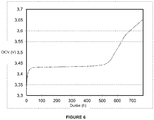
- Example 19 The film was kept in the dark during the OCV measurement. Unlike Example 2 where the system reached a potential of 4.2V in less than 1 hour, the potential reached the plateau of 3.4V without any further increase during a period of 14 days ( Figure 19 ). This example shows that despite the presence of a semiconductor used to improve the reaction of delithiation of LiFePO 4 , the presence of light is necessary to obtain this reaction.
Landscapes
- Chemical & Material Sciences (AREA)
- Engineering & Computer Science (AREA)
- Electrochemistry (AREA)
- General Chemical & Material Sciences (AREA)
- Chemical Kinetics & Catalysis (AREA)
- Power Engineering (AREA)
- Inorganic Chemistry (AREA)
- Materials Engineering (AREA)
- Microelectronics & Electronic Packaging (AREA)
- Crystallography & Structural Chemistry (AREA)
- Manufacturing & Machinery (AREA)
- Life Sciences & Earth Sciences (AREA)
- Sustainable Development (AREA)
- Sustainable Energy (AREA)
- Hybrid Cells (AREA)
- Battery Electrode And Active Subsutance (AREA)
Claims (21)
- Kathodenelektrode, umfassend ein Elektrodenmaterial und einen lichtempfindlichen Farbstoff, wobei das Kathodenmaterial LiFePO4, LiCoO2, FeS2 oder V2O5 ist.
- Anodenelektrode, umfassend ein Elektrodenmaterial und einen lichtempfindlichen Farbstoff, wobei das Anodenmaterial Li4Ti5O12 ist.
- Elektrode nach Anspruch 1 oder 2, ferner umfassend ein Halbleitermaterial.
- Elektrode nach Anspruch 1 oder 3, wobei das Kathodenmaterial LiFePO4 ist.
- Elektrode nach irgendeinem der Ansprüche 1 bis 4, wobei das Elektrodenmaterial mit Kohlenstoff beschichtet ist.
- Elektrode nach irgendeinem der Ansprüche 1 bis 5, wobei das Elektrodenmaterial aus Teilchen mit einer Größe von weniger als 1 Mikrometer (Mikron) besteht; vorzugsweise beträgt die Teilchengröße weniger als 0,1 Mikrometer (Mikron).
- Elektrode nach Anspruch 3, wobei das Halbleitermaterial Ti02, ZnO, Sn02, eine "Kern-Schale" oder eine Kombination davon ist; vorzugsweise ist das Halbleitermaterial TiO2.
- Elektrode nach Anspruch 3, wobei das Halbleitermaterial aus Teilchen mit einer Größe von weniger als 100 Nanometer besteht; vorzugsweise beträgt die Teilchengröße weniger als 30 Nanometer.
- Elektrode nach Anspruch 3, wobei das Halbleitermaterial vorkalziniert ist.
- Elektrode nach irgendeinem der Ansprüche 1 bis 4, wobei der lichtempfindliche Farbstoff N3, "schwarzer Farbstoff' ("black dye"), SJW-E1, N719, ein organischer lichtempfindlicher Farbstoff wie beispielsweise TA-St-CA ist, oder eine Kombination davon ist, vorzugsweise ist der lichtempfindliche Farbstoff N719.
- Elektrode nach irgendeinem der Ansprüche 1 bis 4, weiterhin umfassend ein Lösungsmittel, ein Dispergiermittel, ein Bindemittel, oder eine Kombination davon; vorzugsweise ist das Lösungsmittel N-Methyl-2-pyrrolidin (NMP), Wasser, Aceton, ein Alkohol wie beispielsweise Methanol, Propanol und Butanol, Dimethylformamid (DMF), Dimethylsulfoxid (DMSO), oder eine Kombination davon; vorzugsweise ist das Lösungsmittel Wasser; und/oder das Dispergiermittel ist Polyvinylidendifluorid (PVDF), ein Tensid, das nicht mit den Materialien der Elektrode reagiert, beispielsweise Triton-Xioo, ein Alkylbromidammoniumsalz wie beispielsweise Tetraethylammoniumbromid, ein Alkylbenzyldimethylammoniumhalogenid wie beispielsweise ein Bromid oder ein Chlorid von Alkylbenzyldimethylammonium, ein Glykolester wie beispielsweise Glykolstearat, ein Glycerinester, oder eine Kombination davon; vorzugsweise ist das Dispergiermittel Triton-Xioo; und/oder das Bindemittel ist Polyethylenglykol (PEG), Polyvinylidendifluorid (PVDF), Polyvinylacetat (PVA), oder eine Kombination davon; vorzugsweise ist das Bindemittel Polyethylenglykol (PEG).
- Batterie unter Verwendung einer Elektrode wie gemäß irgendeinem der Ansprüche 1 bis 11 definiert.
- Verwendung einer Elektrode, wie gemäß irgendeinem der Ansprüche 1 bis 11 definiert, zur Herstellung einer Batterie.
- Verfahren zur Herstellung einer Elektrode, umfassend die folgenden Schritte: (a) Herstellen eines Films, umfassend ein Elektrodenmaterial; und (b) Inkontaktbringen des Films mit einer Lösung, die einen lichtempfindlichen Farbstoff enthält; wobei das Elektrodenmaterial ein Kathodenmaterial oder ein Anodenmaterial ist, wobei das Kathodenmaterial LiFePO4, LiCoO2, FeS2 oder V2O5 ist, und wobei das Anodenmaterial Li4Ti5O12 ist.
- Verfahren nach Anspruch 14, ferner umfassend den folgenden vorherigen Schritt:(a1) Mischen des Elektrodenmaterials mit einem Halbleitermaterial.
- Verfahren nach Anspruch 14 oder 15, wobei Schritt (a) das Abscheiden des Elektrodenmaterials auf einem festen Substrat umfasst; vorzugsweise ist das Substrat ein Glas/FTO-Substrat; wobei vorzugsweise die Abscheidung durch ein Verfahren, bei dem eine Klinge oder Rakel aus Metall oder Kunststoff verwendet wird, oder das sogenannte "Doctor Blade"-Verfahren, durch das sogenannte Eintauch-Entnahme-Verfahren, durch ein Siebdruckverfahren, durch ein Beschichtungsverfahren durch Zentrifugation oder Spin-Coating-Verfahren, oder eine Kombination davon erfolgt; vorzugsweise erfolgt die Abscheidung durch ein Verfahren, bei dem eine Klinge oder Rakel aus Metall oder Kunststoff verwendet wird, oder durch das sogenannte "Doctor Blade"-Verfahren, oder durch das sogenannte Eintauch-Entnahme-Verfahren.
- Verfahren nach Anspruch 14 oder 15, wobei Schritt (a) das Abscheiden einer Mischung des Elektrodenmaterials und Halbleitermaterials auf einem Substrat umfasst; vorzugsweise ist das Substrat ein Glas/FTO-Substrat; wobei vorzugsweise die Abscheidung durch ein Verfahren, bei dem eine Klinge oder Rakel aus Metall oder Kunststoff verwendet wird, oder das sogenannte "Doctor Blade"-Verfahren, durch das sogenannte Eintauch-Entnahme-Verfahren, durch ein Siebdruckverfahren, durch ein Beschichtungsverfahren durch Zentrifugation oder Spin-Coating-Verfahren, oder eine Kombination davon erfolgt; vorzugsweise erfolgt die Abscheidung durch ein Verfahren, bei dem eine Klinge oder Rakel aus Metall oder Kunststoff verwendet wird, oder durch das sogenannte "Doctor Blade"-Verfahren, oder durch das sogenannte Eintauch-Entnahme-Verfahren.
- Verfahren nach Anspruch 14 oder 15, wobei Schritt (a) die Verwendung eines Lösungsmittels umfasst; und das Verfahren umfasst ferner zwischen den Schritten (a) und (b) einen Trocknungsschritt, gefolgt von einem Abkühlungsschritt; vorzugsweise wird der Trocknungsschritt bei einer Temperatur von etwa 400° C und unter einer inerten Atmosphäre, vorzugsweise unter einer Stickstoffatmosphäre, durchgeführt; und das Abkühlen erfolgt natürlich auf Raumtemperatur.
- Verfahren nach Anspruch 14 oder 15, wobei Schritt (b) das Eintauchen des Films in die Lösung umfasst, die einen lichtempfindlichen Farbstoff umfasst.
- Verfahren nach Anspruch 14 oder 15, ferner umfassend einen Trocknungsschritt nach Schritt (b), gefolgt von einem Abkühlungsschritt.
- Verfahren nach Anspruch 20, wobei der Trocknungsschritt bei einer Temperatur zwischen Raumtemperatur und 120° C und unter Vakuum oder unter einer inerten Atmosphäre durchgeführt wird; und das Abkühlen auf natürliche Weise auf Raumtemperatur durchgeführt wird.
Applications Claiming Priority (2)
| Application Number | Priority Date | Filing Date | Title |
|---|---|---|---|
| US201462000809P | 2014-05-20 | 2014-05-20 | |
| PCT/CA2015/050457 WO2015176185A1 (fr) | 2014-05-20 | 2015-05-20 | Électrode pour photobatterie |
Publications (3)
| Publication Number | Publication Date |
|---|---|
| EP3146545A1 EP3146545A1 (de) | 2017-03-29 |
| EP3146545A4 EP3146545A4 (de) | 2018-01-03 |
| EP3146545B1 true EP3146545B1 (de) | 2020-03-18 |
Family
ID=54553152
Family Applications (1)
| Application Number | Title | Priority Date | Filing Date |
|---|---|---|---|
| EP15796685.4A Active EP3146545B1 (de) | 2014-05-20 | 2015-05-20 | Elektrode für eine fotovoltaikbatterie |
Country Status (8)
| Country | Link |
|---|---|
| US (1) | US10181621B2 (de) |
| EP (1) | EP3146545B1 (de) |
| JP (1) | JP6738283B2 (de) |
| KR (1) | KR102419047B1 (de) |
| CN (2) | CN106537535A (de) |
| CA (1) | CA2948192C (de) |
| ES (1) | ES2799736T3 (de) |
| WO (1) | WO2015176185A1 (de) |
Families Citing this family (6)
| Publication number | Priority date | Publication date | Assignee | Title |
|---|---|---|---|---|
| GB201515087D0 (en) * | 2015-08-25 | 2015-10-07 | Nicoventures Holdings Ltd | Electronic vapour provision system |
| KR102013530B1 (ko) * | 2018-10-23 | 2019-08-23 | 재단법인 하이브리드 인터페이스기반 미래소재 연구단 | 염료―흑연 리튬이온 배터리용 음극재 및 그 제조방법 |
| CN110247138B (zh) * | 2019-06-19 | 2021-07-30 | 东北大学 | 一种光充电水系铝硫电池 |
| CN111200177B (zh) * | 2020-02-28 | 2021-05-04 | 南京信息工程大学 | 一种铅卤钙钛矿光驱动充电电极及其制备方法 |
| WO2026027678A1 (en) * | 2024-08-01 | 2026-02-05 | MAX-PLANCK-Gesellschaft zur Förderung der Wissenschaften e.V. | Photo-electrochemical device comprising an electron storage material, use of an electron storage material or of a device comprising it, method for photocatalytic production of a product, autophotorechargable battery, method for detecting oxygen, method for detecting light, and method for detecting an analyte |
| CN119833602A (zh) * | 2024-12-30 | 2025-04-15 | 哈尔滨工业大学 | 一种基于染料敏化的光辅助锂离子电池正极浆料及其制备方法 |
Family Cites Families (24)
| Publication number | Priority date | Publication date | Assignee | Title |
|---|---|---|---|---|
| JP2003288954A (ja) * | 2002-03-27 | 2003-10-10 | Fuji Photo Film Co Ltd | 電解質組成物および電気化学電池 |
| JP4757433B2 (ja) * | 2003-03-24 | 2011-08-24 | 独立行政法人科学技術振興機構 | 太陽電池 |
| KR20070044982A (ko) * | 2005-10-26 | 2007-05-02 | 삼성전자주식회사 | 이차전지 기능 복합형 전기변색 소자 및 그 제조방법 |
| JP4201035B2 (ja) * | 2006-09-05 | 2008-12-24 | セイコーエプソン株式会社 | 電池素子および電子機器 |
| JP2008108718A (ja) * | 2006-09-26 | 2008-05-08 | Daehan Solvay Special Chemicals Co Ltd | 太陽電池のためのフタロシアニン化合物 |
| JP5157005B2 (ja) * | 2006-12-22 | 2013-03-06 | ジオマテック株式会社 | 薄膜固体リチウムイオン二次電池用負極活物質及びこれを用いた薄膜固体リチウムイオン二次電池並びにその製造方法 |
| US7820100B2 (en) * | 2007-05-17 | 2010-10-26 | Garfield Industries, Inc. | System and method for photocatalytic oxidation air filtration using a substrate with photocatalyst particles powder coated thereon |
| CN201038243Y (zh) * | 2007-05-28 | 2008-03-19 | 树钢 | 太阳能充蓄电电池 |
| EP2296208B1 (de) | 2008-06-04 | 2017-05-10 | Toyo Ink Mfg. Co., Ltd | Zusammensetzung für eine batterie |
| WO2009150606A2 (en) * | 2008-06-09 | 2009-12-17 | Nxp B.V. | Semiconductor device comprising a solar cell, method of manufacturing a semiconductor device and apparatus comprising a semiconductor device |
| TWI388081B (zh) * | 2009-06-03 | 2013-03-01 | Eternal Chemical Co Ltd | 染料敏化太陽能電池及其製法 |
| DE102009034799A1 (de) * | 2009-07-25 | 2011-01-27 | Evonik Degussa Gmbh | Beschichtungsverfahren zur Herstellung von Elektroden für elektrische Energiespeicher |
| US8562905B2 (en) * | 2009-09-08 | 2013-10-22 | Northwestern University | Multifunctional nanocomposites of carbon nanotubes and nanoparticles formed via vacuum filtration |
| TWI443892B (zh) * | 2009-10-29 | 2014-07-01 | Ind Tech Res Inst | 製備電極的方法 |
| CN102088126B (zh) * | 2009-12-02 | 2014-07-16 | 中国科学院物理研究所 | 一种离子型光电转化与储存一体化器件 |
| JP5540930B2 (ja) * | 2010-06-23 | 2014-07-02 | ソニー株式会社 | 透明導電膜および透明導電膜の製造方法、並びに色素増感太陽電池および固体電解質電池 |
| JP2012084300A (ja) | 2010-10-08 | 2012-04-26 | Konica Minolta Business Technologies Inc | 光電変換素子および太陽電池 |
| US9882206B2 (en) | 2010-10-20 | 2018-01-30 | Council Of Scientific & Industrial Research | Cathode material and lithium ion battery therefrom |
| JP5311689B2 (ja) * | 2011-02-18 | 2013-10-09 | 東邦チタニウム株式会社 | チタン焼結多孔体およびその製造方法 |
| KR20140016298A (ko) * | 2011-02-25 | 2014-02-07 | 에꼴 뽈리떼끄닉 뻬데랄 드 로잔느 (으뻬에프엘) | 전기화학 및 광전자 소자를 위한 향상된 산화환원쌍 |
| US9490658B2 (en) | 2011-12-09 | 2016-11-08 | Nokia Technologies Oy | Apparatus and a method of manufacturing an apparatus |
| KR101338957B1 (ko) * | 2012-02-02 | 2013-12-09 | 연세대학교 산학협력단 | 염료감응형 태양전지 제조 방법 및 그 태양전지 |
| US9136408B2 (en) * | 2013-11-26 | 2015-09-15 | Hunt Energy Enterprises, Llc | Perovskite and other solar cell materials |
| FR3013901B1 (fr) * | 2013-11-28 | 2017-03-24 | Centre Nat Rech Scient | Dispositif electrochimique autophotorechargeable |
-
2015
- 2015-05-20 US US15/312,904 patent/US10181621B2/en active Active
- 2015-05-20 CA CA2948192A patent/CA2948192C/fr active Active
- 2015-05-20 KR KR1020167033288A patent/KR102419047B1/ko active Active
- 2015-05-20 CN CN201580037602.7A patent/CN106537535A/zh active Pending
- 2015-05-20 ES ES15796685T patent/ES2799736T3/es active Active
- 2015-05-20 JP JP2016568590A patent/JP6738283B2/ja active Active
- 2015-05-20 EP EP15796685.4A patent/EP3146545B1/de active Active
- 2015-05-20 CN CN202110537682.XA patent/CN113257581A/zh active Pending
- 2015-05-20 WO PCT/CA2015/050457 patent/WO2015176185A1/fr not_active Ceased
Non-Patent Citations (1)
| Title |
|---|
| None * |
Also Published As
| Publication number | Publication date |
|---|---|
| CN113257581A (zh) | 2021-08-13 |
| US20170110767A1 (en) | 2017-04-20 |
| ES2799736T3 (es) | 2020-12-21 |
| KR20170005822A (ko) | 2017-01-16 |
| WO2015176185A1 (fr) | 2015-11-26 |
| EP3146545A4 (de) | 2018-01-03 |
| KR102419047B1 (ko) | 2022-07-08 |
| US10181621B2 (en) | 2019-01-15 |
| JP6738283B2 (ja) | 2020-08-12 |
| EP3146545A1 (de) | 2017-03-29 |
| JP2017519359A (ja) | 2017-07-13 |
| CN106537535A (zh) | 2017-03-22 |
| CA2948192C (fr) | 2024-03-12 |
| CA2948192A1 (fr) | 2015-11-26 |
Similar Documents
| Publication | Publication Date | Title |
|---|---|---|
| EP3146545B1 (de) | Elektrode für eine fotovoltaikbatterie | |
| EP3341987B1 (de) | Lithium-ionen-gelbatterie | |
| EP1997169B1 (de) | Beschichtete metalloxidpartikel mit geringer auflösungsrate, herstellungsverfahren dafür und verwendung dafür in elektrochemischen systemen | |
| EP2983232B1 (de) | Lithium-akkumulator, der ein material für positive elektroden auf basis eines spezifischen kohlenstoffmaterials umfasst, das durch spezifische organische verbindungen funktionalisiert ist | |
| EP3103155B1 (de) | Spezifische lithiumbatterien mit wasserfreien elektrolyten auf der basis von sulfonverbindungen | |
| EP3414788B1 (de) | Elektrochrome elektrode für energiespeicher | |
| EP2989670A1 (de) | Positivelektrode für eine lithiumbatterie | |
| EP2396841B1 (de) | Verfahren zur herstellung einer mischung aus einer elektrodenaktiven pulververbindung und elektrisch leitende pulververbindung, daraus resultierende mischung sowie elektrode, zelle und batterie dafür | |
| WO2009112714A2 (fr) | Procede de fabrication d'une electrode a base de silicium, electrode a base de silicium et batterie au lithium comprenant une telle electrode | |
| EP3075024B1 (de) | Transparente, durch licht selbstaufladbare elektrochemische vorrichtung | |
| CA3082962C (fr) | Utilisation d'un melange de sels a titre d'additif dans une batterie au lithium gelifiee | |
| Esparza et al. | Current improvement in hybrid quantum dot sensitized solar cells by increased light-scattering with a polymer layer | |
| Dao et al. | Minimizing energy losses in perovskite solar cells using plasma-treated transparent conducting layers | |
| Ma et al. | Device optimization of CsSnI 2.95 F 0.05-based all-solid-state dye-sensitized solar cells with non-linear charge-carrier-density dependent photovoltaic behaviors | |
| Higashimoto et al. | Inorganic dye-sensitized solar cell employing In-enriched Cu–In–S ternary colloids prepared in water media | |
| FR3071362B1 (fr) | Procede de fabrication d'une electrode pour accumulateur lithium-soufre a surface active importante | |
| Kapil et al. | Bottom Passivation of Sn–Pb Perovskites Using Ethylenediamine–Phosphonic Acids for Efficient HTL-Free Solar Cells | |
| JP5167531B2 (ja) | 色素増感太陽電池の酸化物半導体電極の製造方法及び酸化物半導体電極 | |
| JP5609403B2 (ja) | 光電変換素子及び太陽電池 | |
| Sum | Materials for simultaneous energy conversion and storage | |
| EP4310957A1 (de) | Referenzelektrode auf basis von organischem material vom p-typ | |
| EP4365975A1 (de) | Herstellung eines aktiven materials für eine referenzelektrode |
Legal Events
| Date | Code | Title | Description |
|---|---|---|---|
| STAA | Information on the status of an ep patent application or granted ep patent |
Free format text: STATUS: THE INTERNATIONAL PUBLICATION HAS BEEN MADE |
|
| PUAI | Public reference made under article 153(3) epc to a published international application that has entered the european phase |
Free format text: ORIGINAL CODE: 0009012 |
|
| STAA | Information on the status of an ep patent application or granted ep patent |
Free format text: STATUS: REQUEST FOR EXAMINATION WAS MADE |
|
| 17P | Request for examination filed |
Effective date: 20161214 |
|
| AK | Designated contracting states |
Kind code of ref document: A1 Designated state(s): AL AT BE BG CH CY CZ DE DK EE ES FI FR GB GR HR HU IE IS IT LI LT LU LV MC MK MT NL NO PL PT RO RS SE SI SK SM TR |
|
| AX | Request for extension of the european patent |
Extension state: BA ME |
|
| DAV | Request for validation of the european patent (deleted) | ||
| DAX | Request for extension of the european patent (deleted) | ||
| A4 | Supplementary search report drawn up and despatched |
Effective date: 20171204 |
|
| RIC1 | Information provided on ipc code assigned before grant |
Ipc: H01G 9/042 20060101AFI20171127BHEP Ipc: H01M 10/46 20060101ALI20171127BHEP Ipc: H01M 4/525 20100101ALI20171127BHEP Ipc: H01G 9/20 20060101ALI20171127BHEP Ipc: H01M 4/587 20100101ALI20171127BHEP Ipc: H01M 10/0525 20100101ALI20171127BHEP Ipc: H01M 4/38 20060101ALI20171127BHEP Ipc: H01M 4/485 20100101ALI20171127BHEP Ipc: H01M 4/58 20100101ALI20171127BHEP Ipc: H01M 4/02 20060101ALI20171127BHEP Ipc: H01M 14/00 20060101ALI20171127BHEP |
|
| STAA | Information on the status of an ep patent application or granted ep patent |
Free format text: STATUS: EXAMINATION IS IN PROGRESS |
|
| 17Q | First examination report despatched |
Effective date: 20190206 |
|
| GRAP | Despatch of communication of intention to grant a patent |
Free format text: ORIGINAL CODE: EPIDOSNIGR1 |
|
| STAA | Information on the status of an ep patent application or granted ep patent |
Free format text: STATUS: GRANT OF PATENT IS INTENDED |
|
| INTG | Intention to grant announced |
Effective date: 20190930 |
|
| GRAS | Grant fee paid |
Free format text: ORIGINAL CODE: EPIDOSNIGR3 |
|
| GRAA | (expected) grant |
Free format text: ORIGINAL CODE: 0009210 |
|
| STAA | Information on the status of an ep patent application or granted ep patent |
Free format text: STATUS: THE PATENT HAS BEEN GRANTED |
|
| AK | Designated contracting states |
Kind code of ref document: B1 Designated state(s): AL AT BE BG CH CY CZ DE DK EE ES FI FR GB GR HR HU IE IS IT LI LT LU LV MC MK MT NL NO PL PT RO RS SE SI SK SM TR |
|
| REG | Reference to a national code |
Ref country code: GB Ref legal event code: FG4D Free format text: NOT ENGLISH |
|
| REG | Reference to a national code |
Ref country code: DE Ref legal event code: R096 Ref document number: 602015049077 Country of ref document: DE |
|
| REG | Reference to a national code |
Ref country code: AT Ref legal event code: REF Ref document number: 1246872 Country of ref document: AT Kind code of ref document: T Effective date: 20200415 Ref country code: IE Ref legal event code: FG4D Free format text: LANGUAGE OF EP DOCUMENT: FRENCH |
|
| REG | Reference to a national code |
Ref country code: SE Ref legal event code: TRGR |
|
| REG | Reference to a national code |
Ref country code: CH Ref legal event code: NV Representative=s name: ING. MARCO ZARDI C/O M. ZARDI AND CO. S.A., CH |
|
| PG25 | Lapsed in a contracting state [announced via postgrant information from national office to epo] |
Ref country code: FI Free format text: LAPSE BECAUSE OF FAILURE TO SUBMIT A TRANSLATION OF THE DESCRIPTION OR TO PAY THE FEE WITHIN THE PRESCRIBED TIME-LIMIT Effective date: 20200318 Ref country code: RS Free format text: LAPSE BECAUSE OF FAILURE TO SUBMIT A TRANSLATION OF THE DESCRIPTION OR TO PAY THE FEE WITHIN THE PRESCRIBED TIME-LIMIT Effective date: 20200318 |
|
| REG | Reference to a national code |
Ref country code: NO Ref legal event code: T2 Effective date: 20200318 |
|
| REG | Reference to a national code |
Ref country code: NL Ref legal event code: MP Effective date: 20200318 |
|
| PG25 | Lapsed in a contracting state [announced via postgrant information from national office to epo] |
Ref country code: BG Free format text: LAPSE BECAUSE OF FAILURE TO SUBMIT A TRANSLATION OF THE DESCRIPTION OR TO PAY THE FEE WITHIN THE PRESCRIBED TIME-LIMIT Effective date: 20200618 Ref country code: GR Free format text: LAPSE BECAUSE OF FAILURE TO SUBMIT A TRANSLATION OF THE DESCRIPTION OR TO PAY THE FEE WITHIN THE PRESCRIBED TIME-LIMIT Effective date: 20200619 Ref country code: LV Free format text: LAPSE BECAUSE OF FAILURE TO SUBMIT A TRANSLATION OF THE DESCRIPTION OR TO PAY THE FEE WITHIN THE PRESCRIBED TIME-LIMIT Effective date: 20200318 Ref country code: HR Free format text: LAPSE BECAUSE OF FAILURE TO SUBMIT A TRANSLATION OF THE DESCRIPTION OR TO PAY THE FEE WITHIN THE PRESCRIBED TIME-LIMIT Effective date: 20200318 |
|
| REG | Reference to a national code |
Ref country code: LT Ref legal event code: MG4D |
|
| PG25 | Lapsed in a contracting state [announced via postgrant information from national office to epo] |
Ref country code: NL Free format text: LAPSE BECAUSE OF FAILURE TO SUBMIT A TRANSLATION OF THE DESCRIPTION OR TO PAY THE FEE WITHIN THE PRESCRIBED TIME-LIMIT Effective date: 20200318 |
|
| PG25 | Lapsed in a contracting state [announced via postgrant information from national office to epo] |
Ref country code: IS Free format text: LAPSE BECAUSE OF FAILURE TO SUBMIT A TRANSLATION OF THE DESCRIPTION OR TO PAY THE FEE WITHIN THE PRESCRIBED TIME-LIMIT Effective date: 20200718 Ref country code: SK Free format text: LAPSE BECAUSE OF FAILURE TO SUBMIT A TRANSLATION OF THE DESCRIPTION OR TO PAY THE FEE WITHIN THE PRESCRIBED TIME-LIMIT Effective date: 20200318 Ref country code: RO Free format text: LAPSE BECAUSE OF FAILURE TO SUBMIT A TRANSLATION OF THE DESCRIPTION OR TO PAY THE FEE WITHIN THE PRESCRIBED TIME-LIMIT Effective date: 20200318 Ref country code: LT Free format text: LAPSE BECAUSE OF FAILURE TO SUBMIT A TRANSLATION OF THE DESCRIPTION OR TO PAY THE FEE WITHIN THE PRESCRIBED TIME-LIMIT Effective date: 20200318 Ref country code: EE Free format text: LAPSE BECAUSE OF FAILURE TO SUBMIT A TRANSLATION OF THE DESCRIPTION OR TO PAY THE FEE WITHIN THE PRESCRIBED TIME-LIMIT Effective date: 20200318 Ref country code: CZ Free format text: LAPSE BECAUSE OF FAILURE TO SUBMIT A TRANSLATION OF THE DESCRIPTION OR TO PAY THE FEE WITHIN THE PRESCRIBED TIME-LIMIT Effective date: 20200318 Ref country code: SM Free format text: LAPSE BECAUSE OF FAILURE TO SUBMIT A TRANSLATION OF THE DESCRIPTION OR TO PAY THE FEE WITHIN THE PRESCRIBED TIME-LIMIT Effective date: 20200318 Ref country code: PT Free format text: LAPSE BECAUSE OF FAILURE TO SUBMIT A TRANSLATION OF THE DESCRIPTION OR TO PAY THE FEE WITHIN THE PRESCRIBED TIME-LIMIT Effective date: 20200812 |
|
| REG | Reference to a national code |
Ref country code: AT Ref legal event code: UEP Ref document number: 1246872 Country of ref document: AT Kind code of ref document: T Effective date: 20200318 |
|
| REG | Reference to a national code |
Ref country code: ES Ref legal event code: FG2A Ref document number: 2799736 Country of ref document: ES Kind code of ref document: T3 Effective date: 20201221 Ref country code: DE Ref legal event code: R097 Ref document number: 602015049077 Country of ref document: DE |
|
| PLBE | No opposition filed within time limit |
Free format text: ORIGINAL CODE: 0009261 |
|
| STAA | Information on the status of an ep patent application or granted ep patent |
Free format text: STATUS: NO OPPOSITION FILED WITHIN TIME LIMIT |
|
| PG25 | Lapsed in a contracting state [announced via postgrant information from national office to epo] |
Ref country code: MC Free format text: LAPSE BECAUSE OF FAILURE TO SUBMIT A TRANSLATION OF THE DESCRIPTION OR TO PAY THE FEE WITHIN THE PRESCRIBED TIME-LIMIT Effective date: 20200318 Ref country code: DK Free format text: LAPSE BECAUSE OF FAILURE TO SUBMIT A TRANSLATION OF THE DESCRIPTION OR TO PAY THE FEE WITHIN THE PRESCRIBED TIME-LIMIT Effective date: 20200318 |
|
| 26N | No opposition filed |
Effective date: 20201221 |
|
| PG25 | Lapsed in a contracting state [announced via postgrant information from national office to epo] |
Ref country code: PL Free format text: LAPSE BECAUSE OF FAILURE TO SUBMIT A TRANSLATION OF THE DESCRIPTION OR TO PAY THE FEE WITHIN THE PRESCRIBED TIME-LIMIT Effective date: 20200318 |
|
| PG25 | Lapsed in a contracting state [announced via postgrant information from national office to epo] |
Ref country code: SI Free format text: LAPSE BECAUSE OF FAILURE TO SUBMIT A TRANSLATION OF THE DESCRIPTION OR TO PAY THE FEE WITHIN THE PRESCRIBED TIME-LIMIT Effective date: 20200318 |
|
| PG25 | Lapsed in a contracting state [announced via postgrant information from national office to epo] |
Ref country code: TR Free format text: LAPSE BECAUSE OF FAILURE TO SUBMIT A TRANSLATION OF THE DESCRIPTION OR TO PAY THE FEE WITHIN THE PRESCRIBED TIME-LIMIT Effective date: 20200318 Ref country code: MT Free format text: LAPSE BECAUSE OF FAILURE TO SUBMIT A TRANSLATION OF THE DESCRIPTION OR TO PAY THE FEE WITHIN THE PRESCRIBED TIME-LIMIT Effective date: 20200318 Ref country code: CY Free format text: LAPSE BECAUSE OF FAILURE TO SUBMIT A TRANSLATION OF THE DESCRIPTION OR TO PAY THE FEE WITHIN THE PRESCRIBED TIME-LIMIT Effective date: 20200318 |
|
| PG25 | Lapsed in a contracting state [announced via postgrant information from national office to epo] |
Ref country code: MK Free format text: LAPSE BECAUSE OF FAILURE TO SUBMIT A TRANSLATION OF THE DESCRIPTION OR TO PAY THE FEE WITHIN THE PRESCRIBED TIME-LIMIT Effective date: 20200318 Ref country code: AL Free format text: LAPSE BECAUSE OF FAILURE TO SUBMIT A TRANSLATION OF THE DESCRIPTION OR TO PAY THE FEE WITHIN THE PRESCRIBED TIME-LIMIT Effective date: 20200318 |
|
| P01 | Opt-out of the competence of the unified patent court (upc) registered |
Effective date: 20230522 |
|
| PGFP | Annual fee paid to national office [announced via postgrant information from national office to epo] |
Ref country code: DE Payment date: 20250529 Year of fee payment: 11 |
|
| PGFP | Annual fee paid to national office [announced via postgrant information from national office to epo] |
Ref country code: GB Payment date: 20250527 Year of fee payment: 11 Ref country code: ES Payment date: 20250602 Year of fee payment: 11 |
|
| PGFP | Annual fee paid to national office [announced via postgrant information from national office to epo] |
Ref country code: NO Payment date: 20250530 Year of fee payment: 11 |
|
| PGFP | Annual fee paid to national office [announced via postgrant information from national office to epo] |
Ref country code: LU Payment date: 20250527 Year of fee payment: 11 Ref country code: BE Payment date: 20250527 Year of fee payment: 11 Ref country code: IT Payment date: 20250521 Year of fee payment: 11 |
|
| PGFP | Annual fee paid to national office [announced via postgrant information from national office to epo] |
Ref country code: FR Payment date: 20250526 Year of fee payment: 11 |
|
| PGFP | Annual fee paid to national office [announced via postgrant information from national office to epo] |
Ref country code: CH Payment date: 20250601 Year of fee payment: 11 |
|
| PGFP | Annual fee paid to national office [announced via postgrant information from national office to epo] |
Ref country code: AT Payment date: 20250505 Year of fee payment: 11 |
|
| PGFP | Annual fee paid to national office [announced via postgrant information from national office to epo] |
Ref country code: IE Payment date: 20250527 Year of fee payment: 11 |
|
| PGFP | Annual fee paid to national office [announced via postgrant information from national office to epo] |
Ref country code: SE Payment date: 20250527 Year of fee payment: 11 |