EP3100285B1 - Harte magnetische zusammensetzungen aus feineisenoxiden und verfahren zu deren herstellung - Google Patents
Harte magnetische zusammensetzungen aus feineisenoxiden und verfahren zu deren herstellung Download PDFInfo
- Publication number
- EP3100285B1 EP3100285B1 EP15704381.1A EP15704381A EP3100285B1 EP 3100285 B1 EP3100285 B1 EP 3100285B1 EP 15704381 A EP15704381 A EP 15704381A EP 3100285 B1 EP3100285 B1 EP 3100285B1
- Authority
- EP
- European Patent Office
- Prior art keywords
- iron oxide
- hard magnetic
- magnetic material
- weight
- oxide fine
- Prior art date
- Legal status (The legal status is an assumption and is not a legal conclusion. Google has not performed a legal analysis and makes no representation as to the accuracy of the status listed.)
- Active
Links
Images






Classifications
-
- C—CHEMISTRY; METALLURGY
- C04—CEMENTS; CONCRETE; ARTIFICIAL STONE; CERAMICS; REFRACTORIES
- C04B—LIME, MAGNESIA; SLAG; CEMENTS; COMPOSITIONS THEREOF, e.g. MORTARS, CONCRETE OR LIKE BUILDING MATERIALS; ARTIFICIAL STONE; CERAMICS; REFRACTORIES; TREATMENT OF NATURAL STONE
- C04B35/00—Shaped ceramic products characterised by their composition; Ceramics compositions; Processing powders of inorganic compounds preparatory to the manufacturing of ceramic products
- C04B35/01—Shaped ceramic products characterised by their composition; Ceramics compositions; Processing powders of inorganic compounds preparatory to the manufacturing of ceramic products based on oxide ceramics
- C04B35/26—Shaped ceramic products characterised by their composition; Ceramics compositions; Processing powders of inorganic compounds preparatory to the manufacturing of ceramic products based on oxide ceramics based on ferrites
- C04B35/2608—Compositions containing one or more ferrites of the group comprising manganese, zinc, nickel, copper or cobalt and one or more ferrites of the group comprising rare earth metals, alkali metals, alkaline earth metals or lead
- C04B35/2633—Compositions containing one or more ferrites of the group comprising manganese, zinc, nickel, copper or cobalt and one or more ferrites of the group comprising rare earth metals, alkali metals, alkaline earth metals or lead containing barium, strontium or calcium
-
- H—ELECTRICITY
- H01—ELECTRIC ELEMENTS
- H01F—MAGNETS; INDUCTANCES; TRANSFORMERS; SELECTION OF MATERIALS FOR THEIR MAGNETIC PROPERTIES
- H01F1/00—Magnets or magnetic bodies characterised by the magnetic materials therefor; Selection of materials for their magnetic properties
- H01F1/01—Magnets or magnetic bodies characterised by the magnetic materials therefor; Selection of materials for their magnetic properties of inorganic materials
- H01F1/03—Magnets or magnetic bodies characterised by the magnetic materials therefor; Selection of materials for their magnetic properties of inorganic materials characterised by their coercivity
- H01F1/032—Magnets or magnetic bodies characterised by the magnetic materials therefor; Selection of materials for their magnetic properties of inorganic materials characterised by their coercivity of hard-magnetic materials
- H01F1/10—Magnets or magnetic bodies characterised by the magnetic materials therefor; Selection of materials for their magnetic properties of inorganic materials characterised by their coercivity of hard-magnetic materials non-metallic substances, e.g. ferrites, e.g. [(Ba,Sr)O(Fe2O3)6] ferrites with hexagonal structure
-
- C—CHEMISTRY; METALLURGY
- C01—INORGANIC CHEMISTRY
- C01G—COMPOUNDS CONTAINING METALS NOT COVERED BY SUBCLASSES C01D OR C01F
- C01G49/00—Compounds of iron
- C01G49/0018—Mixed oxides or hydroxides
- C01G49/0036—Mixed oxides or hydroxides containing one alkaline earth metal, magnesium or lead
-
- C—CHEMISTRY; METALLURGY
- C04—CEMENTS; CONCRETE; ARTIFICIAL STONE; CERAMICS; REFRACTORIES
- C04B—LIME, MAGNESIA; SLAG; CEMENTS; COMPOSITIONS THEREOF, e.g. MORTARS, CONCRETE OR LIKE BUILDING MATERIALS; ARTIFICIAL STONE; CERAMICS; REFRACTORIES; TREATMENT OF NATURAL STONE
- C04B35/00—Shaped ceramic products characterised by their composition; Ceramics compositions; Processing powders of inorganic compounds preparatory to the manufacturing of ceramic products
- C04B35/622—Forming processes; Processing powders of inorganic compounds preparatory to the manufacturing of ceramic products
-
- H—ELECTRICITY
- H01—ELECTRIC ELEMENTS
- H01F—MAGNETS; INDUCTANCES; TRANSFORMERS; SELECTION OF MATERIALS FOR THEIR MAGNETIC PROPERTIES
- H01F41/00—Apparatus or processes specially adapted for manufacturing or assembling magnets, inductances or transformers; Apparatus or processes specially adapted for manufacturing materials characterised by their magnetic properties
- H01F41/02—Apparatus or processes specially adapted for manufacturing or assembling magnets, inductances or transformers; Apparatus or processes specially adapted for manufacturing materials characterised by their magnetic properties for manufacturing cores, coils, or magnets
- H01F41/0253—Apparatus or processes specially adapted for manufacturing or assembling magnets, inductances or transformers; Apparatus or processes specially adapted for manufacturing materials characterised by their magnetic properties for manufacturing cores, coils, or magnets for manufacturing permanent magnets
-
- C—CHEMISTRY; METALLURGY
- C01—INORGANIC CHEMISTRY
- C01P—INDEXING SCHEME RELATING TO STRUCTURAL AND PHYSICAL ASPECTS OF SOLID INORGANIC COMPOUNDS
- C01P2002/00—Crystal-structural characteristics
- C01P2002/70—Crystal-structural characteristics defined by measured X-ray, neutron or electron diffraction data
- C01P2002/72—Crystal-structural characteristics defined by measured X-ray, neutron or electron diffraction data by d-values or two theta-values, e.g. as X-ray diagram
-
- C—CHEMISTRY; METALLURGY
- C01—INORGANIC CHEMISTRY
- C01P—INDEXING SCHEME RELATING TO STRUCTURAL AND PHYSICAL ASPECTS OF SOLID INORGANIC COMPOUNDS
- C01P2004/00—Particle morphology
- C01P2004/01—Particle morphology depicted by an image
- C01P2004/03—Particle morphology depicted by an image obtained by SEM
-
- C—CHEMISTRY; METALLURGY
- C01—INORGANIC CHEMISTRY
- C01P—INDEXING SCHEME RELATING TO STRUCTURAL AND PHYSICAL ASPECTS OF SOLID INORGANIC COMPOUNDS
- C01P2006/00—Physical properties of inorganic compounds
- C01P2006/42—Magnetic properties
-
- C—CHEMISTRY; METALLURGY
- C04—CEMENTS; CONCRETE; ARTIFICIAL STONE; CERAMICS; REFRACTORIES
- C04B—LIME, MAGNESIA; SLAG; CEMENTS; COMPOSITIONS THEREOF, e.g. MORTARS, CONCRETE OR LIKE BUILDING MATERIALS; ARTIFICIAL STONE; CERAMICS; REFRACTORIES; TREATMENT OF NATURAL STONE
- C04B2235/00—Aspects relating to ceramic starting mixtures or sintered ceramic products
- C04B2235/02—Composition of constituents of the starting material or of secondary phases of the final product
- C04B2235/30—Constituents and secondary phases not being of a fibrous nature
- C04B2235/32—Metal oxides, mixed metal oxides, or oxide-forming salts thereof, e.g. carbonates, nitrates, (oxy)hydroxides, chlorides
- C04B2235/3201—Alkali metal oxides or oxide-forming salts thereof
-
- C—CHEMISTRY; METALLURGY
- C04—CEMENTS; CONCRETE; ARTIFICIAL STONE; CERAMICS; REFRACTORIES
- C04B—LIME, MAGNESIA; SLAG; CEMENTS; COMPOSITIONS THEREOF, e.g. MORTARS, CONCRETE OR LIKE BUILDING MATERIALS; ARTIFICIAL STONE; CERAMICS; REFRACTORIES; TREATMENT OF NATURAL STONE
- C04B2235/00—Aspects relating to ceramic starting mixtures or sintered ceramic products
- C04B2235/02—Composition of constituents of the starting material or of secondary phases of the final product
- C04B2235/30—Constituents and secondary phases not being of a fibrous nature
- C04B2235/32—Metal oxides, mixed metal oxides, or oxide-forming salts thereof, e.g. carbonates, nitrates, (oxy)hydroxides, chlorides
- C04B2235/3205—Alkaline earth oxides or oxide forming salts thereof, e.g. beryllium oxide
- C04B2235/3206—Magnesium oxides or oxide-forming salts thereof
-
- C—CHEMISTRY; METALLURGY
- C04—CEMENTS; CONCRETE; ARTIFICIAL STONE; CERAMICS; REFRACTORIES
- C04B—LIME, MAGNESIA; SLAG; CEMENTS; COMPOSITIONS THEREOF, e.g. MORTARS, CONCRETE OR LIKE BUILDING MATERIALS; ARTIFICIAL STONE; CERAMICS; REFRACTORIES; TREATMENT OF NATURAL STONE
- C04B2235/00—Aspects relating to ceramic starting mixtures or sintered ceramic products
- C04B2235/02—Composition of constituents of the starting material or of secondary phases of the final product
- C04B2235/30—Constituents and secondary phases not being of a fibrous nature
- C04B2235/32—Metal oxides, mixed metal oxides, or oxide-forming salts thereof, e.g. carbonates, nitrates, (oxy)hydroxides, chlorides
- C04B2235/3205—Alkaline earth oxides or oxide forming salts thereof, e.g. beryllium oxide
- C04B2235/3208—Calcium oxide or oxide-forming salts thereof, e.g. lime
-
- C—CHEMISTRY; METALLURGY
- C04—CEMENTS; CONCRETE; ARTIFICIAL STONE; CERAMICS; REFRACTORIES
- C04B—LIME, MAGNESIA; SLAG; CEMENTS; COMPOSITIONS THEREOF, e.g. MORTARS, CONCRETE OR LIKE BUILDING MATERIALS; ARTIFICIAL STONE; CERAMICS; REFRACTORIES; TREATMENT OF NATURAL STONE
- C04B2235/00—Aspects relating to ceramic starting mixtures or sintered ceramic products
- C04B2235/02—Composition of constituents of the starting material or of secondary phases of the final product
- C04B2235/30—Constituents and secondary phases not being of a fibrous nature
- C04B2235/32—Metal oxides, mixed metal oxides, or oxide-forming salts thereof, e.g. carbonates, nitrates, (oxy)hydroxides, chlorides
- C04B2235/3217—Aluminum oxide or oxide forming salts thereof, e.g. bauxite, alpha-alumina
-
- C—CHEMISTRY; METALLURGY
- C04—CEMENTS; CONCRETE; ARTIFICIAL STONE; CERAMICS; REFRACTORIES
- C04B—LIME, MAGNESIA; SLAG; CEMENTS; COMPOSITIONS THEREOF, e.g. MORTARS, CONCRETE OR LIKE BUILDING MATERIALS; ARTIFICIAL STONE; CERAMICS; REFRACTORIES; TREATMENT OF NATURAL STONE
- C04B2235/00—Aspects relating to ceramic starting mixtures or sintered ceramic products
- C04B2235/02—Composition of constituents of the starting material or of secondary phases of the final product
- C04B2235/30—Constituents and secondary phases not being of a fibrous nature
- C04B2235/32—Metal oxides, mixed metal oxides, or oxide-forming salts thereof, e.g. carbonates, nitrates, (oxy)hydroxides, chlorides
- C04B2235/3231—Refractory metal oxides, their mixed metal oxides, or oxide-forming salts thereof
- C04B2235/3232—Titanium oxides or titanates, e.g. rutile or anatase
-
- C—CHEMISTRY; METALLURGY
- C04—CEMENTS; CONCRETE; ARTIFICIAL STONE; CERAMICS; REFRACTORIES
- C04B—LIME, MAGNESIA; SLAG; CEMENTS; COMPOSITIONS THEREOF, e.g. MORTARS, CONCRETE OR LIKE BUILDING MATERIALS; ARTIFICIAL STONE; CERAMICS; REFRACTORIES; TREATMENT OF NATURAL STONE
- C04B2235/00—Aspects relating to ceramic starting mixtures or sintered ceramic products
- C04B2235/02—Composition of constituents of the starting material or of secondary phases of the final product
- C04B2235/30—Constituents and secondary phases not being of a fibrous nature
- C04B2235/32—Metal oxides, mixed metal oxides, or oxide-forming salts thereof, e.g. carbonates, nitrates, (oxy)hydroxides, chlorides
- C04B2235/3231—Refractory metal oxides, their mixed metal oxides, or oxide-forming salts thereof
- C04B2235/3239—Vanadium oxides, vanadates or oxide forming salts thereof, e.g. magnesium vanadate
-
- C—CHEMISTRY; METALLURGY
- C04—CEMENTS; CONCRETE; ARTIFICIAL STONE; CERAMICS; REFRACTORIES
- C04B—LIME, MAGNESIA; SLAG; CEMENTS; COMPOSITIONS THEREOF, e.g. MORTARS, CONCRETE OR LIKE BUILDING MATERIALS; ARTIFICIAL STONE; CERAMICS; REFRACTORIES; TREATMENT OF NATURAL STONE
- C04B2235/00—Aspects relating to ceramic starting mixtures or sintered ceramic products
- C04B2235/02—Composition of constituents of the starting material or of secondary phases of the final product
- C04B2235/30—Constituents and secondary phases not being of a fibrous nature
- C04B2235/32—Metal oxides, mixed metal oxides, or oxide-forming salts thereof, e.g. carbonates, nitrates, (oxy)hydroxides, chlorides
- C04B2235/3231—Refractory metal oxides, their mixed metal oxides, or oxide-forming salts thereof
- C04B2235/3241—Chromium oxides, chromates, or oxide-forming salts thereof
- C04B2235/3243—Chromates or chromites, e.g. aluminum chromate, lanthanum strontium chromite
-
- C—CHEMISTRY; METALLURGY
- C04—CEMENTS; CONCRETE; ARTIFICIAL STONE; CERAMICS; REFRACTORIES
- C04B—LIME, MAGNESIA; SLAG; CEMENTS; COMPOSITIONS THEREOF, e.g. MORTARS, CONCRETE OR LIKE BUILDING MATERIALS; ARTIFICIAL STONE; CERAMICS; REFRACTORIES; TREATMENT OF NATURAL STONE
- C04B2235/00—Aspects relating to ceramic starting mixtures or sintered ceramic products
- C04B2235/02—Composition of constituents of the starting material or of secondary phases of the final product
- C04B2235/30—Constituents and secondary phases not being of a fibrous nature
- C04B2235/32—Metal oxides, mixed metal oxides, or oxide-forming salts thereof, e.g. carbonates, nitrates, (oxy)hydroxides, chlorides
- C04B2235/3262—Manganese oxides, manganates, rhenium oxides or oxide-forming salts thereof, e.g. MnO
-
- C—CHEMISTRY; METALLURGY
- C04—CEMENTS; CONCRETE; ARTIFICIAL STONE; CERAMICS; REFRACTORIES
- C04B—LIME, MAGNESIA; SLAG; CEMENTS; COMPOSITIONS THEREOF, e.g. MORTARS, CONCRETE OR LIKE BUILDING MATERIALS; ARTIFICIAL STONE; CERAMICS; REFRACTORIES; TREATMENT OF NATURAL STONE
- C04B2235/00—Aspects relating to ceramic starting mixtures or sintered ceramic products
- C04B2235/02—Composition of constituents of the starting material or of secondary phases of the final product
- C04B2235/30—Constituents and secondary phases not being of a fibrous nature
- C04B2235/34—Non-metal oxides, non-metal mixed oxides, or salts thereof that form the non-metal oxides upon heating, e.g. carbonates, nitrates, (oxy)hydroxides, chlorides
- C04B2235/3418—Silicon oxide, silicic acids or oxide forming salts thereof, e.g. silica sol, fused silica, silica fume, cristobalite, quartz or flint
-
- C—CHEMISTRY; METALLURGY
- C04—CEMENTS; CONCRETE; ARTIFICIAL STONE; CERAMICS; REFRACTORIES
- C04B—LIME, MAGNESIA; SLAG; CEMENTS; COMPOSITIONS THEREOF, e.g. MORTARS, CONCRETE OR LIKE BUILDING MATERIALS; ARTIFICIAL STONE; CERAMICS; REFRACTORIES; TREATMENT OF NATURAL STONE
- C04B2235/00—Aspects relating to ceramic starting mixtures or sintered ceramic products
- C04B2235/02—Composition of constituents of the starting material or of secondary phases of the final product
- C04B2235/30—Constituents and secondary phases not being of a fibrous nature
- C04B2235/42—Non metallic elements added as constituents or additives, e.g. sulfur, phosphor, selenium or tellurium
-
- C—CHEMISTRY; METALLURGY
- C04—CEMENTS; CONCRETE; ARTIFICIAL STONE; CERAMICS; REFRACTORIES
- C04B—LIME, MAGNESIA; SLAG; CEMENTS; COMPOSITIONS THEREOF, e.g. MORTARS, CONCRETE OR LIKE BUILDING MATERIALS; ARTIFICIAL STONE; CERAMICS; REFRACTORIES; TREATMENT OF NATURAL STONE
- C04B2235/00—Aspects relating to ceramic starting mixtures or sintered ceramic products
- C04B2235/02—Composition of constituents of the starting material or of secondary phases of the final product
- C04B2235/30—Constituents and secondary phases not being of a fibrous nature
- C04B2235/42—Non metallic elements added as constituents or additives, e.g. sulfur, phosphor, selenium or tellurium
- C04B2235/422—Carbon
-
- C—CHEMISTRY; METALLURGY
- C04—CEMENTS; CONCRETE; ARTIFICIAL STONE; CERAMICS; REFRACTORIES
- C04B—LIME, MAGNESIA; SLAG; CEMENTS; COMPOSITIONS THEREOF, e.g. MORTARS, CONCRETE OR LIKE BUILDING MATERIALS; ARTIFICIAL STONE; CERAMICS; REFRACTORIES; TREATMENT OF NATURAL STONE
- C04B2235/00—Aspects relating to ceramic starting mixtures or sintered ceramic products
- C04B2235/02—Composition of constituents of the starting material or of secondary phases of the final product
- C04B2235/30—Constituents and secondary phases not being of a fibrous nature
- C04B2235/44—Metal salt constituents or additives chosen for the nature of the anions, e.g. hydrides or acetylacetonate
- C04B2235/444—Halide containing anions, e.g. bromide, iodate, chlorite
-
- C—CHEMISTRY; METALLURGY
- C04—CEMENTS; CONCRETE; ARTIFICIAL STONE; CERAMICS; REFRACTORIES
- C04B—LIME, MAGNESIA; SLAG; CEMENTS; COMPOSITIONS THEREOF, e.g. MORTARS, CONCRETE OR LIKE BUILDING MATERIALS; ARTIFICIAL STONE; CERAMICS; REFRACTORIES; TREATMENT OF NATURAL STONE
- C04B2235/00—Aspects relating to ceramic starting mixtures or sintered ceramic products
- C04B2235/02—Composition of constituents of the starting material or of secondary phases of the final product
- C04B2235/30—Constituents and secondary phases not being of a fibrous nature
- C04B2235/44—Metal salt constituents or additives chosen for the nature of the anions, e.g. hydrides or acetylacetonate
- C04B2235/447—Phosphates or phosphites, e.g. orthophosphate or hypophosphite
Definitions
- the present invention relates to a method for making a hard magnetic material from iron oxide fines, the hard magnetic material having a general formula M Fe x O y , the method comprising: providing an iron oxide fine; providing a metal carbonate of a general formula M x (CO 3 ) y ; mixing the iron oxide fine and the metal carbonate to form a mixture; and calcining the mixture of the iron oxide fine and the metal carbonate; wherein M is a divalent metal ion.
- Hard ferrites are magnetic ceramics which retain permanent magnetism and find application in both electronic and non-electronic sectors.
- ferrite magnets have the largest usage in terms of tonnage in energy-related applications, which is attributed to their low price.
- a permanent magnet is the best choice because it provides a constant field without the continuous expenditure of electric power and without generation of heat.
- Strontium hexaferrite (SrFe 12 O 19 , Sr-ferrite) is one well-known material for permanent magnets. It is a hard magnet with high coercivity, and can be used as permanent magnets, recording media, telecommunication, as well as in microwave components, higher-frequency components, and magneto-optical devices.
- JPH03123004 (A ) discloses a method for manufacturing a Sr ferrite magnet starting from mill scale with a quantity of Fe 2 O 3 being 98.0% or higher. After the iron oxide is mixed and calcined together with an Sr oxide or carbonate for 1 hour, the calcined material is pulverized, molded in a magnetic field and sintered at 1250 for 1 hour.
- CN1450022 (A ) discloses a method for directly producing anisotropic permanent magnetic ferrite by utilizing the mixture of oxide of iron and strontium salt or barium salt including the following steps: mixing the iron oxide composite obtained by mixing oxide of iron and strontium salt or barium salt and strontium ferrite or barium ferrite prefire material according to a certain proportion, making powder, magnetizing-forming and sintering at 1153 °C for 1.5 hours so as to obtain an anisotropic permanent magnetic ferrite product.
- FR2089928 (A5 ) is concerned with the improvement of ferrites, and discloses a method of obtaining a permanent magnet from such ferrites.
- Ferric oxide derived as fined dust from the treatment of "Hammersley" iron ore is mixed with barium carbonate, the iron oxide having a purity of app. 81.6 %. The mixture is presintered and subsequently sintered at 1200 °C for 1.5 hours.
- the invention relates to a method as defined in the claims for making a hard magnetic material of a general formula M Fe x O y , the method comprising: a) providing an iron oxide fine; b) providing a metal carbonate of a general formula M x (CO 3 ) y ; or providing a metal oxide of general formula M x O y ; c) mixing the iron oxide fine and the metal carbonate or the iron oxide fine and the metal oxide to form a mixture; d) calcining the mixture of the iron oxide fine and the metal carbonate; wherein M is a divalent metal ion.
- an iron oxide fine includes mixtures of two or more iron oxide fines.
- Ranges can be expressed herein as from one particular value, and/or to another particular value. When such a range is expressed, another aspect includes from the one particular value and/or to the other particular value. Similarly, when values are expressed as approximations, by use of the antecedent 'about,' it will be understood that the particular value forms another aspect. It will be further understood that the endpoints of each of the ranges are significant both in relation to the other endpoint, and independently of the other endpoint. It is also understood that there are a number of values disclosed herein, and that each value is also herein disclosed as "about” that particular value in addition to the value itself. For example, if the value "10" is disclosed, then “about 10" is also disclosed. It is also understood that each unit between two particular units are also disclosed. For example, if 10 and 15 are disclosed, then 11, 12, 13, and 14 are also disclosed.
- the terms “about” and “at or about” mean that the amount or value in question can be the value designated some other value approximately or about the same. It is generally understood, as used herein, that it is the nominal value indicated ⁇ 10% variation unless otherwise indicated or inferred. The term is intended to convey that similar values promote equivalent results or effects recited in the claims. That is, it is understood that amounts, sizes, formulations, parameters, and other quantities and characteristics are not and need not be exact, but can be approximate and/or larger or smaller, as desired, reflecting tolerances, conversion factors, rounding off, measurement error and the like, and other factors known to those of skill in the art.
- an amount, size, formulation, parameter or other quantity or characteristic is “about” or “approximate” whether or not expressly stated to be such. It is understood that where "about” is used before a quantitative value, the parameter also includes the specific quantitative value itself, unless specifically stated otherwise.
- the terms "optional” or “optionally” means that the subsequently described event or circumstance can or cannot occur, and that the description includes instances where said event or circumstance occurs and instances where it does not.
- compositions of the invention Disclosed are the components to be used to prepare the compositions of the invention as well as the compositions themselves to be used within the methods disclosed herein.
- these and other materials are disclosed herein, and it is understood that when combinations, subsets, interactions, groups, etc. of these materials are disclosed that while specific reference of each various individual and collective combinations and permutation of these compounds cannot be explicitly disclosed, each is specifically contemplated and described herein. For example, if a particular compound is disclosed and discussed and a number of modifications that can be made to a number of molecules including the compounds are discussed, specifically contemplated is each and every combination and permutation of the compound and the modifications that are possible unless specifically indicated to the contrary.
- X and Y are present at a weight ratio of 2:5, and are present in such ratio regardless of whether additional components are contained in the compound.
- a weight percent ("wt %") of a component is based on the total weight of the formulation or composition in which the component is included. For example if a particular element or component in a composition or article is said to have 8% by weight, it is understood that this percentage is relative to a total compositional percentage of 100% by weight.
- the term or phrase "effective,” “effective amount,” or “conditions effective to” refers to such amount or condition that is capable of performing the function or property for which an effective amount is expressed. As will be pointed out below, the exact amount or particular condition required will vary from one aspect to another, depending on recognized variables such as the materials employed and the processing conditions observed. Thus, it is not always possible to specify an exact “effective amount” or “condition effective to.” However, it should be understood that an appropriate effective amount will be readily determined by one of ordinary skill in the art using only routine experimentation.
- compositions disclosed herein have certain functions. Disclosed herein are certain structural requirements for performing the disclosed functions, and it is understood that there are a variety of structures that can perform the same function that are related to the disclosed structures, and that these structures will typically achieve the same result.
- the present disclosure relates, in one aspect, to a method for making a hard magnetic material.
- the hard magnetic material has a general formula M Fe x O y .
- the disclosure provides a method for making a hard magnetic material of a general formula M Fe x O y , the method comprising: a) providing an iron oxide fine; b) providing a metal carbonate of a general formula M x (CO 3 ) y ; or providing a metal oxide of general formula MxOy; c) mixing the iron oxide fine and the metal carbonate or the iron oxide fine and the metal oxide to form a mixture; d) calcining the mixture of the iron oxide fine and the metal carbonate; wherein M is a divalent metal ion.
- the iron oxide fine is provided as a by-product of an iron processing or iron making process.
- the iron oxide fine is iron oxide fine produced from iron ore pellets used in the iron making process in Saudi Iron and Steel Company (HADEED).
- the iron oxide comprises hematite (Fe 2 O 3 ; iron (III) oxide), magnetite (Fe 3 O 4 ; triiron tetroxide), limonite (FeO(OH)•n(H 2 O); hydrated iron (III) oxide hydroxide), siderite (FeCO 3 ; iron (II) carbonate), iron pyrite (FeS 2 ; iron (II) disulfide), goethite (FeO(OH); iron (III) oxide hydroxide), or combinations thereof.
- the iron oxide fine comprises iron in an amount ranging from 63.0 % by weight to 67.5 % by weight, based on the total weight of the iron oxide fine, including exemplary values of 63 % by weight, 64 % by weight, 65 % by weight, 66 % by weight, and 67 % by weight.
- the iron oxide fine can comprise iron in a range derived from any two of the above listed exemplary values.
- the iron oxide fine can comprise iron in an amount ranging from 64 % by weight to 66.0 % by weight, based on the total weight of the iron oxide fine.
- the iron oxide fine comprises iron in an amount ranging from 63.0 % by weight to 67.0 % by weight, based on the total weight of the iron oxide fine.
- the iron oxide fine comprises iron oxide (Fe 2 O 3 ) in an amount ranging from greater than 90 % by weight to 96% by weight, based on the total weight of the iron oxide fine, including exemplary values of 91 % by weight, 92 % by weight, 93 % by weight, 94 % by weight, and 95 % by weight.
- the iron oxide fine can comprise iron oxide in a range derived from any two of the above listed exemplary values.
- the iron oxide fine can comprise iron oxide (Fe 2 O 3 ) in an amount ranging from 92 % by weight to 94.0 % by weight, based on the total weight of the iron oxide fine.
- the iron oxide fine comprises iron oxide (Fe 2 O 3 ) in an amount ranging from 90 % by weight to 96% by weight, based on the total weight of the iron oxide fine.
- the iron oxide fine comprises silicon oxide in an amount ranging from greater than 0 % by weight to 3.0 % by weight, based on the total weight of the iron oxide fine, including exemplary values of 1.0 % by weight and 2.0 % by weight.
- the iron oxide fine can comprise silicon oxide in a range derived from any two of the above listed exemplary values.
- the iron oxide fine comprises calcium oxide in an amount ranging from greater than 0 % by weight to 2.5 % by weight, based on the total weight of the iron oxide fine, including exemplary values of 1.0 % by weight, 1.5 % by weight, and 2.0 % by weight.
- the iron oxide fine can comprise calcium oxide in a range derived from any two of the above listed exemplary values.
- the iron oxide fine comprises magnesium oxide in an amount ranging from greater than 0 % by weight to about 1.0 % by weight, based on the total weight of the iron oxide fine, including exemplary values of 0.2 % by weight, 0.4 % by weight. 0.6 % by weight, and 0.8 % by weight.
- the iron oxide fine can comprise a range derived from any two of the above listed exemplary values.
- the iron oxide fine comprises aluminum oxide in an amount ranging from greater than 0 % by weight to about 1.0 % by weight, based on the total weight of the iron oxide fine, including exemplary values of 0.2 % by weight, 0.4 % by weight. 0.6 % by weight, and 0.8 % by weight.
- the oxide fine can comprise a range derived from any two of the above listed exemplary values.
- the iron oxide fine comprises sulfur in an amount ranging from greater than 0 % by weight to 0.03 % by weight, based on the total weight of the iron oxide fine, including exemplary values of 0.01 % by weight and 0.02 % by weight.
- the method comprises providing a metal oxide of a general formula M x O y .
- the method comprises providing a metal carbonate of a general formula M x (CO 3 ) y .
- the metal M is a divalent metal ion.
- M is strontium.
- the metal carbonate is SrCO 3 .
- the metal oxide is SrO.
- the metal oxide or carbonate is provided in at least a stoichiometric amount relative to the amount of the iron oxide fine.
- the x values and y values will depend on the metal chosen. For example, in one aspect, when the metal is strontium, x is 1 and y is 1.
- the hard magnetic material comprises iron in an amount ranging from 58.0 % by weight to 63.0 % by weight, based on the total weight of the hard magnetic material, including exemplary values of 61.0 % by weight, 62.0% by weight, and 63.0 % by weight.
- the hard magnetic material can comprise iron in a range derived from any two of the above listed exemplary values.
- the hard magnetic material can comprise iron in an amount ranging from 60 % by weight to 63.0 % by weight, based on the total weight of the hard magnetic material.
- the hard magnetic material comprises iron oxide (Fe 2 O 3 ) in an amount ranging from greater than 83% by weight to 90.0 % by weight, based on the total weight of the hard magnetic material, including exemplary values of 84.0 % by weight, 85.0 % by weight, 86 % by weight, 87 % by weight, 88 % by weight, and 89 % by weight.
- the hard magnetic material can comprise iron oxide (Fe 2 O 3 ) in a range derived from any two of the above listed exemplary values.
- the hard magnetic material can comprise iron oxide (Fe 2 O 3 ) in an amount ranging from 83 % by weight to 90.0 % by weight, based on the total weight of the hard magnetic material.
- the hard magnetic material comprises iron oxide (Fe 2 O 3 ) in an amount ranging from 84 % by weight to 90% by weight, based on the total weight of the hard magnetic material.
- the hard magnetic material comprises SrO in an amount ranging from greater than 3 % by weight to 10 % by weight, based on the total weight of hard magnetic material, including exemplary values of 4 % by weight, 5 % by weight, 6 % by weight, 7 % by weight, 8 % by weight 9 % by weight, and 10 % by weight.
- the hard magnetic material can comprise SrO in a range derived from any two of the above listed exemplary values.
- the hard magnetic material can comprise SrO in an amount ranging from 6 % by weight to 9 % by weight, based on the total weight of the hard magnetic material.
- the hard magnetic material comprises SrO in an amount ranging from 4 % by weight to 9% by weight, based on the total weight of the hard magnetic material.
- the hard magnetic material is a hard ferrite.
- the hard ferrite is a hexagonal ferrite.
- the hard magnetic material is hexagonal ferrite; M is strontium; and Fe x O y is Fe 12 O 19 .
- the hard magnetic material comprises from greater than 3 wt % to about 10 wt % SrO and from greater than 83 wt% to about 90 wt% Fe 2 O 3 .
- the metal oxide/iron oxide ratio can be any desired ratio.
- the metal oxide/iron oxide ratio is a stoichiometric ratio.
- the metal oxide/iron oxide ratio is at least about 1:5, including exemplary ratios of 1:6, 1:7, 1:8, 1:9, 1:10, 1:11, 1:12, 1:13, and 1:14.
- the metal oxide/iron oxide ratio can be in a range derived from any two of the above listed exemplary values.
- the metal oxide/iron oxide ratio is from about 1:10 to about 1:12.
- Sr/Fe mixing ratio is a stoichiometric ratio.
- the Sr/Fe ratio is at least about 1:5, including exemplary ratios of 1:6, 1:7, 1:8, 1:9, 1:10, 1:11, 1:12, 1:13, and 1:14.
- the Sr/Fe ratio can be in a range derived from any two of the above listed exemplary values. For example, in one aspect, the Sr/Fe ratio is from about 1:10 to about 1:12.
- SrO and Fe 2 O 3 is provided in a Sr/Fe ratio of at least about 1:5, including exemplary ratios of 1:6, 1:7, 1:8, 1:9, 1:10, 1::11, 1:12, 1:13, and 1:14.
- the Sr/Fe ratio can be in a range derived from any two of the above listed exemplary values.
- the Sr/Fe ratio is from about 1:10 to about 1:12.
- the hard magnetic material has improved properties in physical, mechanical, chemical, and metallurgical properties.
- the hard magnetic material has an intrinsic coercivity (i H c ) of at least 100 kA/m, including exemplary values of 110, 120, 130, 150, 170, 180, 190, 200, 210, 220, 230,250, 270, 280, 300, 320, 350, 370, 380,400,420, 430, 450, 470,480, 500, 520, 530, and 540 kA/m.
- the hard magnetic material can have an intrinsic coercivity ( i H c ) in a range derived from any two of the above listed exemplary values.
- the hard magnetic material has an intrinsic coercivity ( i H c ) in the range of from 100 to 550 kA/m. In a further aspect, the hard magnetic material has an intrinsic coercivity ( i H c ) in the range of from 200 to 550 kA/m. In a yet further aspect, the hard magnetic material has an intrinsic coercivity ( i H c ) in the range of from 100 to 500 kA/m.
- the hard magnetic material has a saturation magnetization (Ms) of at least about 50 Am 2 /kg, including exemplary values of about 60, 70, 80, 90, 100, 110, 120, 130, 140, 150, 160, 170, 180, and 190 Am 2 /kg.
- the hard magnetic material can have a saturation magnetization (Ms) in a range derived from any two of the above listed exemplary values.
- the hard magnetic material can have a saturation magnetization (Ms) in the range of about 50 to about 100 Am 2 /kg.
- the hard magnetic material can have a saturation magnetization (Ms) in the range of about 50 to about 150 Am 2 /kg.
- the stored energy in the hard magnetic material of the present invention can be referred to as the magnet performance or energy product ( BH ).
- the energy product value ( BH ) is typically measured in units of megagauss-oersteds (MGOe). 1 MGOe corresponds to 7.96 kJ/m 3 .
- the hard magnetic material has an energy product value ( BH ) at 300 K of at least about 7.96 kJ/m 3 (1.0 MGOe,) including exemplary values of about 7.96, 8.75, 9.55, 10.35, 11.14, 11.94, 12.73, 13.53, 14.32, 15.12, 15.92, 16.71, 18.30, 19.10, 19.89, 20.69, 21.49, 22.28, 23.08, and 23.87 kJ/m3 (1.1, 1.2, 1.3, 1.4, 1.5, 1.6, 1.7, 1.8, 1.9, 2.0, 2.1, 2.3, 2.4, 2.5, 2.6, 2.7, 2.8, 2.9, and 3.0 MGOe)
- the hard magnetic material can have an energy product value (BH) at 300 K in a range derived from any two of the above listed exemplary values.
- the hard magnetic material can have an energy product value (BH) at 300 K of from at least about 7.96 to about 19.89 kJ/m 3 , or from 15.92 to about 19.89 kJ/m 3 (1.0 to about 2.5 MGOe, or from about 2.0 to about 2.5 MGOe.)
- the hard magnetic material can have an energy product value ( BH ) at 300 K of about 18.30 kJ/m 3 (2.3
- the hard magnetic material has an energy product value MGOe).
- the hard magnetic material can have an energy product value ( BH ) at 4.2 K in a range derived from any two of the above listed exemplary values.
- the hard magnetic material can have an energy product value ( BH ) at 4.2 K of from at least about 7.96 to about 19.89 kJ/m 3 , or from 15.92 to about 19.89 kJ/m 3 (1.0 to about 2.5 MGOe, or from about 2.0 to about 2.5 MGOe.)
- the hard magnetic material can have an energy product value ( BH ) at 4.2 K of about 18.30 kJ/m 3 (2.3 MGOe).
- the disclosed hard magnetic material can optionally comprise a balance amount of one or more additive materials ordinarily incorporated in composite iron compositions of this type, with the proviso that the additives are selected so as to not significantly adversely affect the desired properties of the hard magnetic material.
- Combinations of additives can be used. Such additives can be mixed at a suitable time during the mixing of the components for forming the hard magnetic materials.
- the hard magnetic material of the present invention can be manufactured by various methods.
- the hard magnetic material of the present invention can be blended with the aforementioned ingredients by a variety of methods involving admixing of the ingredients with any additional additives desired in the formulation.
- the ingredients can be mixed using conventional methods such as with an intensive mixer, such as a R02 Eirich mixer or any other mixing equipment.
- the invention provides a method for manufacturing a hard magnetic material, the method comprising: a) providing an iron oxide fine; b) providing a metal oxide of a general formula M x O y ; c) mixing the iron oxide fine and the metal oxide to form a mixture; d) calcining the mixture of the iron oxide fine and the metal oxide; wherein M is a divalent metal ion. No crushing step is required for the iron oxide fine. No preheating step is required for the iron oxide fine.
- the invention provides a method for manufacturing a hard magnetic material, the method comprising: a) providing an iron oxide fine; b) providing a metal carbonate of a general formula M x (CO 3 ) y ; c) mixing the iron oxide fine and the metal carbonate to form a mixture; d) calcining the mixture of the iron oxide fine and the metal carbonate; wherein M is a divalent metal ion. No crushing step is required for the iron oxide fine. No preheating step is required for the iron oxide fine.
- the method comprises at least one calcining step.
- the mixture is calcined at a temperature of at least about 1000 °C.
- the hard magnetic material can be fired at a temperature in a range derived from any two of the above listed exemplary values.
- the temperature of the firing step is maintained at a temperature between about 1100 °C and about 1300 °C.
- the calcining temperature can be between about 1150 °C and about 1200 °C, although higher temperatures can be used provided that the residence time in the processing equipment is adjusted.
- the mixture is calcined for a duration of at least 4 hours, including exemplary values of 5, 6, 7, 8, 9, 10, 11, and 12 hours.
- the hard magnetic material can be calcined for a duration in a range derived from any two of the above listed exemplary values,
- the duration of the calcining step is between 4 and 12 hours.
- the method comprises at least one firing step.
- the firing step comprises heating at a heating rate of 10 ° C min -1 in air atmosphere.
- the mixture is fired at a temperature of at least about 1000 °C.
- the hard magnetic material can be fired at a temperature in a range derived from any two of the above listed exemplary values.
- the temperature of the firing step is maintained at a temperature between about 1000 °C and about 1300 °C.
- the firing temperature can be between about 1100 °C and about 1200 °C, although higher temperatures can be used provided that the residence time in the processing equipment is adjusted.
- the mixture is fired for a duration of at least about 2 hours, including exemplary values of 3, 4, 5, and 6 hours.
- the hard magnetic material can be fired for a duration in a range derived from any two of the above listed exemplary values.
- the duration of the firing step is between about 3 and about 5 hours.
- the hard magnetic material is hexagonal ferrites; M is strontium; and Fe x O y is F 12 O 19 .
- the metal oxide is SrO and iron oxide is Fe 2 O 3 , are provided in a Sr/Fe mixture ratio of about 1:12, the mixture calcined at 1000 °C for 12 hours, and the mixture is fired at 1200 °C for about 4 hours.
- the hard magnetic material is hexagonal ferrites; M is strontium; and Fe x O y is Fe 12 O 19 .
- the metal carbonate is SrCO 3 and iron oxide is Fe 2 O 3 , are provided in a Sr/Fe mixture ratio of about 1:12, the mixture calcined at 1000 °C for 12 hours, and the mixture is fired at 1200 °C for about 4 hours.
- the disclosed hard magnetic material of the present invention can be used in making articles formed from ferrite powder.
- the disclosed hard magnetic material can be formed into useful shaped articles by a variety of means such as sintering, and the like.
- articles of the present invention are selected from electronic and non-electronic applications, including, but not limited to industrial and consumer electronics, data storage, military and aerospace, medical, power generation, and telecommunications.
- the present invention pertains to permanent magnets, recording media, telecommunication devices, medical devices, microwave devices, higher-frequency devices, and magneto-optical devices comprising the disclosed hard magnetic material.
- the disclosed hard magnetic material is used as a dielectric or magnetic filler in electromagnetic attenuation materials (EAM).
- the disclosed methods can be operated or performed on an industrial scale.
- the methods disclosed herein can be configured to produce hard magnetic material on an industrial scale.
- the methods can produce batches of hard magnetic material on an industrial scale.
- the batch size can comprise any desired industrial-scale batch size.
- the batch size can optionally be at least about 1 kg, including exemplary batch sizes of at least about 10 kg, at least about 25 kg, at least about 50 kg, at least about 100 kg, at least about 250 kg, at least about 500 kg, at least about 750 kg, at least about 1,000 kg, at least about 2,500 kg, or greater.
- the batch size can optionally range from about 1 kg to about 2,500 kg, such as, for example, from about 10 kg to about 1,000 kg, from about 1,000 kg to about 2,500 kg, from about 100 kg to about 500 kg, from about 500 kg to about 1,000 kg, from about 10 kg to about 100 kg, from about 100 kg to about 250 kg, from about 500 kg to about 750 kg, or from about 750 kg to about 1,000 kg.
- the batch size can optionally be at least about 1 ton, including exemplary batch sizes of at least about 10 tons, at least about 25 tons, at least about 50 tons, at least about 100 tons, at least about 250 tons, at least about 500 tons, at least about 750 tons, at least about 1000 tons, at least about 2,500 tons, or greater.
- the batch size can optionally range from about 1 ton to about 2,500 tons, such as, for example, from about 10 tons to about 1,000 tons, from about 1,000 tons to about 2,500 tons, from about 100 tons to about 500 tons, from about 500 tons to about 1,000 tons, from about 10 tons to about 100 tons, from about 100 tons to about 250 tons, from about 500 tons to about 750 tons, or from about 750 tons to about 1,000 tons.
- the disclosed methods can be operated or performed on any desired time scale or production schedule that is commercially practicable.
- the disclosed methods can produce a quantity of at least 1 ton of hard magnetic material in a period of 1 day or less, including exemplary quantities of at least about 10 tons, 100 tons, 500 tons, or 1,000 tons, 2,500 tons, or greater within the period.
- the period of time can be 1 hour.
- the quantity of hard magnetic material produced can range from about 1 ton to about 1,000 tons, and the period of time can range from about 1 hour to about 1 year, for example, about 10 to about 1,000 tons in a period of about 1 hour to about 1 day.
- reaction conditions e.g., component concentrations, desired solvents, solvent mixtures, temperatures, pressures and other reaction ranges and conditions that can be used to optimize the product purity and yield obtained from the described process. Only routine experimentation, if any, will be required to optimize such process conditions.
- reaction conditions e.g., component concentrations, desired solvents, solvent mixtures, temperatures, pressures and other reaction ranges and conditions that can be used to optimize the product purity and yield obtained from the described process. Only routine experimentation, if any, will be required to optimize such process conditions.
- Tables 1 and 2 below show the typical analysis of iron ore materials or oxide fines that can be used to produce the disclosed hard magnetic material.
- other ingredients can include various amounts of carbon, sulfur, sodium, potassium, and/or calcium.
- Table 1.* Element Material C 0.2959 Na2O 0.041 MgO 0.859 Al2O3 0.788 SiO2 2.704 P2O5 0.057 S 0.0254 Cl 0.0055 K2O 0.0339 CaO 2.366 TiO2 0.114 V2O5 0.0794 Cr2O3 0.00177 MnO 0.0763 Fe2O3 Balance Total 100.0 * Amounts provided in terms of percent of total composition (by weight).
- hard magnetic material were prepared by in a dry-blend and mixed for a predetermined duration.
- the pre-blend was then dry-milled for a predetermined duration.
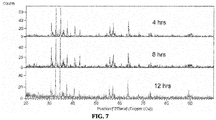
- the blended powder mixture was then calcined at about 1000 °C for 4 to 12 hours, and then re-milled in a dry atmosphere.
- the calcined, milled mixture was fired at about 1100 to 1300 °C for about 2 to 6 hours with a heating rate of 10 ° C min -1 in air atmosphere.
- the cooled mixture was characterized with X-ray diffraction analysis (XRD), X-ray fluorescence (XRF), scanning electron microscope (SEM) and vibrating sample magnetometer (VSM).
- strontium carbonate (SrCO 3 ) (99% purity, Chemical) and steelmaking by-product iron oxide were used to prepare hard magnetic material (SrFe 12 O 19 ) according to the present invention.
- the iron oxide samples were characterized using X-ray diffraction analysis (XRD), X-ray fluorescence (XRF) and scanning electron microscope (SEM).
- XRD X-ray diffraction analysis
- XRF X-ray fluorescence
- SEM scanning electron microscope
- the iron oxide (Fe 2 O 3 ) was found to have a purity of about 93%.
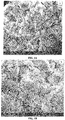
- FIGS. 1A and 1B show the SEM photos for the iron oxide used to produce the samples in this Example. As seen in the FIGS., the grain coalescence with very low micropores and many macropores took place in a dense structure.
- the M-type strontium ferrites were prepared using a conventional ceramic preparation method. Briefly, all constituents (SrCO 3 and iron oxide fine byproduct, at different Sr/Fe ratios of 1/12, 1/11 and 1/10) were pre-blended and mixed together. The mixture was first dry-milled for 6 hours, and then pre-sintered (calcination) at 1000 °C for a duration of 4, 8 or 12 hrs. The mixture was allowed to cool to room temperature, and then re-milled in a dry atmosphere for 1 hr. The re-milled mixture was then fired at 1100, 1200 or 1300 °C for a duration of 2, 4 or 6 hrs. in air atmosphere, and allowed to cool to room temperature.
- SrCO 3 and iron oxide fine byproduct at different Sr/Fe ratios of 1/12, 1/11 and 1/10
- the produced powder was then characterized using X-ray diffraction analysis (XRD), X-ray fluorescence (XRF), and scanning electron microscope (SEM).
- XRD X-ray diffraction analysis
- XRF X-ray fluorescence
- SEM scanning electron microscope
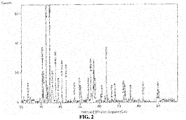
- the XRD data for fired samples after calcination at 1000 °C for 12 hrs, and then firing at 1100 °C for 2 hrs, are shown in FIG. 2 .
- strontium carbonate decomposed to SrO and the strontium ferrite phase is completely formed.
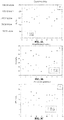
- the magnetic property data for Coercivity (He), Magnetic saturation (Ms), and Magnetic remanance (Mr) of the samples are shown in FIGS. 3A, 3B, and 3C , respectively.
- the measured magnetic values were all measured to be in a narrow range, irrespective of the different reaction and preparation conditions utilized for each sample.
- the measured magnetic values at 300 and 4.2 K are very close to each other, which also indicates excellent magnetic behavior.
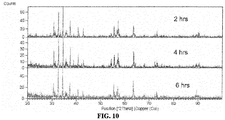
- samples were prepared using strontium carbonate and iron oxide in a 1/12 Sr/Fe ratio and then calcined at 1000 °C for 12 hrs, and then fired at 1200 °C for 2, 4, or 6 hrs.
- the XRD data for the samples are reported in FIG. 10 .
- the Sr-ferrite phase was observed to have form completely in the various samples.
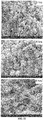
- the morphological examination for these samples are shown in FIG. 11 . As the data suggests, there was no clear change in the grain size with increasing the firing time.
- Grain shape of the synthesized strontium ferrite came very similar with uniform and homogeneous hexagonal crystalline shape.
- the energy product was observed to increase with increasing the firing time up to 4 hrs but, decreased again with increasing the reaction time to 6 hrs as shown in FIG. 12 .
- this trend is due to the formation of multi-domain and the easy movement of the domain walls, which result in domain misalignment that decreases the energy product value.
- samples were prepared using strontium carbonate and iron oxide in a 1/12 Sr/Fe ratio and then calcined at 1000 °C for 12 hrs, and then fired at 1100, 1200, or 1300 °C for 2 hrs.
- the XRD data for the samples are reported in FIG. 13 .
- the Sr-ferrite phase is successfully formed completely in the samples.
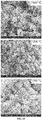
- the morphological examination for these samples are shown in FIG. 14 .
- the grain size was increased drastically as the firing temperature was increased from 1100 to 1300 °C.
- Grain shape of the synthesized strontium ferrite also exhibited more crystalline hexagonal structure with increased firing temperature.
- the energy product was seen to increase with increasing the firing temperature up to 1200 °C, but decreased with increasing the reaction temperature to 1300 °C. Again, without wishing to be bound by a particular theory, it is believed that this trend is also due to the formation of multi-domain and the easy movement of the domain walls, which result in domain misalignment that decreases the energy product value.
- the comparative energy product values for all the prepared strontium ferrite samples at various reaction conditions showed that the highest energy product value for samples measured at 300 K is about 18.30 and about 19.10 kJ/m 3 (2.3 MGOe, and about 2.4 MGOe)for samples measured at 4.2 K.
- the highest energy product values were by the sample prepared with a 1/12 Sr/Fe ratio, calcination at 1000 °C for 12 hrs, and firing at 1200 °C for 4 hrs.
- the magnetic properties can be enhanced gradually by increasing the mixing ratio (Sr/Fe) up to stoichiometric ratio, increasing the calcination time up to 12 hrs, increasing the firing time up to 4 hrs, or increasing the firing temperature up to 1200 °C.
Landscapes
- Engineering & Computer Science (AREA)
- Chemical & Material Sciences (AREA)
- Organic Chemistry (AREA)
- Power Engineering (AREA)
- Manufacturing & Machinery (AREA)
- Ceramic Engineering (AREA)
- Inorganic Chemistry (AREA)
- Life Sciences & Earth Sciences (AREA)
- General Life Sciences & Earth Sciences (AREA)
- Geology (AREA)
- Structural Engineering (AREA)
- Materials Engineering (AREA)
- Compounds Of Iron (AREA)
- Hard Magnetic Materials (AREA)
Claims (12)
- Verfahren zur Herstellung eines harten magnetischen Materials mit einer allgemeinen Formel MFexOy, wobei das Verfahren umfasst:a) Bereitstellen eines Feineisenoxids;b) Bereitstellen eines Metalloxids mit einer allgemeinen Formel M xOy oder eines Metallcarbonats mit einer allgemeinen Formel M x(CO3)y;c) Mischen des Feineisenoxids und des Metalloxids oder des Eisenoxids und des Metallcarbonats, wobei ein Gemisch gebildet wird;d) Kalzinieren des Gemisches von dem Feineisenoxid und dem Metalloxid oder dem Metallcarbonat 4 bis 12 Stunden lang;wobei M ein zweiwertiges Metallion ist, und
wobei das Verfahren dadurch gekennzeichnet ist, dass kein Zerkleinerungsschritt für das Feineisenoxid erforderlich ist und/oder kein Vorerwärmungsschritt für das Feineisenoxid erforderlich ist. - Verfahren nach Anspruch 1, wobei das Feineisenoxid als ein Nebenprodukt eines Eisenverarbeitungs- oder Eisenherstellungsverfahrens bereitgestellt wird.
- Verfahren nach Anspruch 1 oder 2, wobei das Feineisenoxid mindestens etwa 93 Gew.-% Fe2O3 umfasst.
- Verfahren nach einem der Ansprüche 1 bis 3, wobei das Metallcarbonat SrCO3 ist.
- Verfahren nach einem der Ansprüche 1 bis 4, wobei das Gemisch bei einer Temperatur von mindestens 1000 °C kalziniert wird.
- Verfahren nach einem der Ansprüche 1 bis 5, wobei M Strontium ist, wobei bevorzugt FexOy Fe12O19 ist.
- Verfahren nach einem der Ansprüche 1 bis 6, wobei das harte magnetische Material ein Hartferrit ist, wobei bevorzugt das Hartferrit ein hexagonales Ferrit ist.
- Verfahren nach einem der Ansprüche 1 bis 7, wobei das harte magnetische Material hexagonales Ferrit ist; M Strontium ist; und FexOy Fe12O19 ist.
- Verfahren nach einem der Ansprüche 1 bis 8, wobei das harte magnetische Material mehr als 0 bis 15 Gew.-% SrO und mehr als 85 bis 95 Gew.-% Fe2O3 umfasst, wobei bevorzugt das harte magnetische Material mehr als 0 bis 10 Gew.-% SrO und mehr als 83 bis 90 Gew.-% Fe2O3 umfasst.
- Verfahren nach einem der Ansprüche 1 bis 9, wobei das Metalloxid oder das Metallcarbonat in mindestens einer stöchiometrischen Menge relativ zu einer Menge des Feineisenoxids bereitgestellt wird.
- Verfahren nach einem der Ansprüche 1 bis 10, wobei das harte magnetische Material eine intrinsische Koerzivität (i HC ) von mindestens 100 kA/m aufweist, wobei bevorzugt das harte magnetische Material eine intrinsische Koerzivität (i H C) im Bereich von 100 bis 550 kA/m aufweist.
- Verfahren nach einem der Ansprüche 1 bis 11, wobei das harte magnetische Material eine Sättigungsmagnetisierung (Ms) von mindestens 50 Am2/kg aufweist, wobei bevorzugt das harte magnetische Material eine Sättigungsmagnetisierung (Ms) im Bereich von 50 bis 100 Am2/kg aufweist.
Applications Claiming Priority (3)
| Application Number | Priority Date | Filing Date | Title |
|---|---|---|---|
| US201461934586P | 2014-01-31 | 2014-01-31 | |
| US201462043701P | 2014-08-29 | 2014-08-29 | |
| PCT/IB2015/050693 WO2015114570A1 (en) | 2014-01-31 | 2015-01-29 | Hard magnetic compositions from iron oxide fines and methods for making same |
Publications (2)
| Publication Number | Publication Date |
|---|---|
| EP3100285A1 EP3100285A1 (de) | 2016-12-07 |
| EP3100285B1 true EP3100285B1 (de) | 2020-04-22 |
Family
ID=52469873
Family Applications (1)
| Application Number | Title | Priority Date | Filing Date |
|---|---|---|---|
| EP15704381.1A Active EP3100285B1 (de) | 2014-01-31 | 2015-01-29 | Harte magnetische zusammensetzungen aus feineisenoxiden und verfahren zu deren herstellung |
Country Status (4)
| Country | Link |
|---|---|
| US (1) | US10614939B2 (de) |
| EP (1) | EP3100285B1 (de) |
| CN (2) | CN114890781A (de) |
| WO (1) | WO2015114570A1 (de) |
Family Cites Families (15)
| Publication number | Priority date | Publication date | Assignee | Title |
|---|---|---|---|---|
| US3597357A (en) | 1968-03-19 | 1971-08-03 | Westinghouse Electric Corp | Method of making strontium-ferrite magnets and the products so produced |
| GB1351737A (en) | 1970-04-20 | 1974-05-01 | British Steel Corp | Ferrites |
| JPH03123004A (ja) | 1989-03-31 | 1991-05-24 | Sumitomo Special Metals Co Ltd | 高性能Srフェライト磁石の製造方法 |
| US5061412A (en) | 1989-03-31 | 1991-10-29 | Sumitomo Special Metal Co. Ltd. | Process for producing a magnet of strontium ferrite having high performance |
| DE69824362T2 (de) * | 1997-02-25 | 2005-06-16 | Tdk Corp. | Magnetisches Oxidmaterial, Ferritteilchen, gesinterter Magnet, Verbundmagnet, magnetischer Aufzeichnungsträger und Motor |
| JPH11228142A (ja) | 1998-02-18 | 1999-08-24 | Katsuhiko Yamada | フェライトの製造方法 |
| JP2002289450A (ja) * | 2001-03-28 | 2002-10-04 | Tdk Corp | フェライト焼結磁石の製造方法 |
| US6492016B1 (en) * | 2001-07-27 | 2002-12-10 | Ut-Battelle, Llc | Method for preparing spherical ferrite beads and use thereof |
| CN1179911C (zh) * | 2003-04-30 | 2004-12-15 | 武汉众兴磁业技术开发有限公司 | 烧结各向异性永磁铁氧体的生产方法 |
| CN1318349C (zh) | 2004-07-23 | 2007-05-30 | 佛山市顺德区霸菱磁电有限公司 | 铁氧体橡塑磁粉的制造方法 |
| US7465409B2 (en) * | 2004-10-05 | 2008-12-16 | Eastman Kodak Company | Hard magnetic core particles and a method of making same |
| EP1675134A3 (de) * | 2004-12-24 | 2007-01-24 | Hengdian Group EMEGC Magnetics Co Ltd | Sintermagnet und zugehöriges Herstellungsverfahren |
| CN101205138A (zh) * | 2007-03-23 | 2008-06-25 | 横店集团东磁股份有限公司 | 一种烧结永磁铁氧体料粉的制造方法 |
| CN102329128B (zh) * | 2011-06-11 | 2013-06-19 | 宜宾职业技术学院 | 一种钙永磁铁氧体及其制造方法 |
| CN102757235B (zh) | 2012-08-02 | 2014-01-01 | 武汉科技大学 | 一种永磁锶铁氧体料粉及其制备方法 |
-
2015
- 2015-01-29 EP EP15704381.1A patent/EP3100285B1/de active Active
- 2015-01-29 CN CN202210448417.9A patent/CN114890781A/zh active Pending
- 2015-01-29 US US15/112,749 patent/US10614939B2/en active Active
- 2015-01-29 WO PCT/IB2015/050693 patent/WO2015114570A1/en not_active Ceased
- 2015-01-29 CN CN201580006152.5A patent/CN105960385A/zh active Pending
Non-Patent Citations (1)
| Title |
|---|
| None * |
Also Published As
| Publication number | Publication date |
|---|---|
| CN105960385A (zh) | 2016-09-21 |
| US10614939B2 (en) | 2020-04-07 |
| CN114890781A (zh) | 2022-08-12 |
| WO2015114570A1 (en) | 2015-08-06 |
| EP3100285A1 (de) | 2016-12-07 |
| US20160343485A1 (en) | 2016-11-24 |
Similar Documents
| Publication | Publication Date | Title |
|---|---|---|
| JP4367649B2 (ja) | フェライト焼結磁石 | |
| EP2660830B1 (de) | Gesinterter ferritmagnet und herstellungsverfahren dafür | |
| KR20100063133A (ko) | 본드 자석용 페라이트 분말 및 이의 제조 방법, 및 이를 이용한 본드 자석 | |
| KR101836964B1 (ko) | 페라이트 하소체, 페라이트 소결 자석의 제조 방법 및 페라이트 소결 자석 | |
| EP1052658B1 (de) | Magnetisches ferritpulver und magnet aus dieses magnetpulvers und herstellungsverfahren | |
| EP3100285B1 (de) | Harte magnetische zusammensetzungen aus feineisenoxiden und verfahren zu deren herstellung | |
| US20160326010A1 (en) | Development of nickel ferrites and methods for preparing same using steel industry by-product iron oxide fines | |
| US20160322140A1 (en) | Development of nickel-zinc ferrites and methods for preparing same using iron-oxide byproducts of steel industry | |
| Sláma et al. | Properties of M-type barium ferrite doped by selected ions | |
| JP5499329B2 (ja) | フェライト焼結磁石及びその製造方法 | |
| JP5218716B2 (ja) | フェライト磁性材料 | |
| JP7639733B2 (ja) | フェライト仮焼体およびフェライト焼結磁石の製造方法 | |
| JP2004296514A (ja) | フェライト磁石およびその製造方法 | |
| KR102386512B1 (ko) | 하소 페라이트, 및 페라이트 소결 자석 및 그 제조 방법 | |
| González-Angeles et al. | (Ni, Zn, Sn) Ru and (Ni, Sn) Sn substituted barium ferrite prepared by mechanical alloying | |
| CN100377266C (zh) | 铁氧体磁体及其制造方法 | |
| JP7054128B2 (ja) | 磁性材料 | |
| KR20220134459A (ko) | 페라이트 가소체 및 페라이트 소결 자석의 제조 방법 | |
| JP2025537716A (ja) | フェライト磁性材料、それを含むフェライト焼結磁石及びフェライト焼結磁石の製造方法 | |
| KR20220040998A (ko) | 페라이트 가소체, 페라이트 소결 자석의 제조 방법 | |
| JP2024042334A (ja) | フェライト仮焼体、フェライト仮焼体の製造方法 | |
| JP2004296513A (ja) | フェライト磁石およびその製造方法 | |
| JP2004311517A (ja) | フェライト磁石およびその製造方法 | |
| WO2004086422A1 (ja) | フェライト磁石およびその製造方法 | |
| Pérez-Juache et al. | hexaferrite, Physica B: Physics of Condensed Matter |
Legal Events
| Date | Code | Title | Description |
|---|---|---|---|
| PUAI | Public reference made under article 153(3) epc to a published international application that has entered the european phase |
Free format text: ORIGINAL CODE: 0009012 |
|
| STAA | Information on the status of an ep patent application or granted ep patent |
Free format text: STATUS: REQUEST FOR EXAMINATION WAS MADE |
|
| 17P | Request for examination filed |
Effective date: 20160816 |
|
| AK | Designated contracting states |
Kind code of ref document: A1 Designated state(s): AL AT BE BG CH CY CZ DE DK EE ES FI FR GB GR HR HU IE IS IT LI LT LU LV MC MK MT NL NO PL PT RO RS SE SI SK SM TR |
|
| AX | Request for extension of the european patent |
Extension state: BA ME |
|
| DAX | Request for extension of the european patent (deleted) | ||
| STAA | Information on the status of an ep patent application or granted ep patent |
Free format text: STATUS: EXAMINATION IS IN PROGRESS |
|
| 17Q | First examination report despatched |
Effective date: 20190206 |
|
| GRAP | Despatch of communication of intention to grant a patent |
Free format text: ORIGINAL CODE: EPIDOSNIGR1 |
|
| STAA | Information on the status of an ep patent application or granted ep patent |
Free format text: STATUS: GRANT OF PATENT IS INTENDED |
|
| INTG | Intention to grant announced |
Effective date: 20191108 |
|
| GRAS | Grant fee paid |
Free format text: ORIGINAL CODE: EPIDOSNIGR3 |
|
| GRAA | (expected) grant |
Free format text: ORIGINAL CODE: 0009210 |
|
| STAA | Information on the status of an ep patent application or granted ep patent |
Free format text: STATUS: THE PATENT HAS BEEN GRANTED |
|
| RIN1 | Information on inventor provided before grant (corrected) |
Inventor name: AWAN, FAZAL-UR-REHMAN, M. Inventor name: SADDIK, MOHAMED BAHGAT |
|
| AK | Designated contracting states |
Kind code of ref document: B1 Designated state(s): AL AT BE BG CH CY CZ DE DK EE ES FI FR GB GR HR HU IE IS IT LI LT LU LV MC MK MT NL NO PL PT RO RS SE SI SK SM TR |
|
| REG | Reference to a national code |
Ref country code: CH Ref legal event code: EP |
|
| REG | Reference to a national code |
Ref country code: IE Ref legal event code: FG4D |
|
| REG | Reference to a national code |
Ref country code: DE Ref legal event code: R096 Ref document number: 602015051086 Country of ref document: DE |
|
| REG | Reference to a national code |
Ref country code: AT Ref legal event code: REF Ref document number: 1261208 Country of ref document: AT Kind code of ref document: T Effective date: 20200515 |
|
| REG | Reference to a national code |
Ref country code: NL Ref legal event code: FP |
|
| REG | Reference to a national code |
Ref country code: LT Ref legal event code: MG4D |
|
| PG25 | Lapsed in a contracting state [announced via postgrant information from national office to epo] |
Ref country code: FI Free format text: LAPSE BECAUSE OF FAILURE TO SUBMIT A TRANSLATION OF THE DESCRIPTION OR TO PAY THE FEE WITHIN THE PRESCRIBED TIME-LIMIT Effective date: 20200422 Ref country code: SE Free format text: LAPSE BECAUSE OF FAILURE TO SUBMIT A TRANSLATION OF THE DESCRIPTION OR TO PAY THE FEE WITHIN THE PRESCRIBED TIME-LIMIT Effective date: 20200422 Ref country code: PT Free format text: LAPSE BECAUSE OF FAILURE TO SUBMIT A TRANSLATION OF THE DESCRIPTION OR TO PAY THE FEE WITHIN THE PRESCRIBED TIME-LIMIT Effective date: 20200824 Ref country code: LT Free format text: LAPSE BECAUSE OF FAILURE TO SUBMIT A TRANSLATION OF THE DESCRIPTION OR TO PAY THE FEE WITHIN THE PRESCRIBED TIME-LIMIT Effective date: 20200422 Ref country code: NO Free format text: LAPSE BECAUSE OF FAILURE TO SUBMIT A TRANSLATION OF THE DESCRIPTION OR TO PAY THE FEE WITHIN THE PRESCRIBED TIME-LIMIT Effective date: 20200722 Ref country code: GR Free format text: LAPSE BECAUSE OF FAILURE TO SUBMIT A TRANSLATION OF THE DESCRIPTION OR TO PAY THE FEE WITHIN THE PRESCRIBED TIME-LIMIT Effective date: 20200723 Ref country code: IS Free format text: LAPSE BECAUSE OF FAILURE TO SUBMIT A TRANSLATION OF THE DESCRIPTION OR TO PAY THE FEE WITHIN THE PRESCRIBED TIME-LIMIT Effective date: 20200822 |
|
| REG | Reference to a national code |
Ref country code: AT Ref legal event code: MK05 Ref document number: 1261208 Country of ref document: AT Kind code of ref document: T Effective date: 20200422 |
|
| PG25 | Lapsed in a contracting state [announced via postgrant information from national office to epo] |
Ref country code: RS Free format text: LAPSE BECAUSE OF FAILURE TO SUBMIT A TRANSLATION OF THE DESCRIPTION OR TO PAY THE FEE WITHIN THE PRESCRIBED TIME-LIMIT Effective date: 20200422 Ref country code: LV Free format text: LAPSE BECAUSE OF FAILURE TO SUBMIT A TRANSLATION OF THE DESCRIPTION OR TO PAY THE FEE WITHIN THE PRESCRIBED TIME-LIMIT Effective date: 20200422 Ref country code: HR Free format text: LAPSE BECAUSE OF FAILURE TO SUBMIT A TRANSLATION OF THE DESCRIPTION OR TO PAY THE FEE WITHIN THE PRESCRIBED TIME-LIMIT Effective date: 20200422 Ref country code: BG Free format text: LAPSE BECAUSE OF FAILURE TO SUBMIT A TRANSLATION OF THE DESCRIPTION OR TO PAY THE FEE WITHIN THE PRESCRIBED TIME-LIMIT Effective date: 20200722 |
|
| PG25 | Lapsed in a contracting state [announced via postgrant information from national office to epo] |
Ref country code: AL Free format text: LAPSE BECAUSE OF FAILURE TO SUBMIT A TRANSLATION OF THE DESCRIPTION OR TO PAY THE FEE WITHIN THE PRESCRIBED TIME-LIMIT Effective date: 20200422 |
|
| REG | Reference to a national code |
Ref country code: DE Ref legal event code: R097 Ref document number: 602015051086 Country of ref document: DE |
|
| PG25 | Lapsed in a contracting state [announced via postgrant information from national office to epo] |
Ref country code: AT Free format text: LAPSE BECAUSE OF FAILURE TO SUBMIT A TRANSLATION OF THE DESCRIPTION OR TO PAY THE FEE WITHIN THE PRESCRIBED TIME-LIMIT Effective date: 20200422 Ref country code: SM Free format text: LAPSE BECAUSE OF FAILURE TO SUBMIT A TRANSLATION OF THE DESCRIPTION OR TO PAY THE FEE WITHIN THE PRESCRIBED TIME-LIMIT Effective date: 20200422 Ref country code: EE Free format text: LAPSE BECAUSE OF FAILURE TO SUBMIT A TRANSLATION OF THE DESCRIPTION OR TO PAY THE FEE WITHIN THE PRESCRIBED TIME-LIMIT Effective date: 20200422 Ref country code: RO Free format text: LAPSE BECAUSE OF FAILURE TO SUBMIT A TRANSLATION OF THE DESCRIPTION OR TO PAY THE FEE WITHIN THE PRESCRIBED TIME-LIMIT Effective date: 20200422 Ref country code: IT Free format text: LAPSE BECAUSE OF FAILURE TO SUBMIT A TRANSLATION OF THE DESCRIPTION OR TO PAY THE FEE WITHIN THE PRESCRIBED TIME-LIMIT Effective date: 20200422 Ref country code: CZ Free format text: LAPSE BECAUSE OF FAILURE TO SUBMIT A TRANSLATION OF THE DESCRIPTION OR TO PAY THE FEE WITHIN THE PRESCRIBED TIME-LIMIT Effective date: 20200422 Ref country code: ES Free format text: LAPSE BECAUSE OF FAILURE TO SUBMIT A TRANSLATION OF THE DESCRIPTION OR TO PAY THE FEE WITHIN THE PRESCRIBED TIME-LIMIT Effective date: 20200422 Ref country code: DK Free format text: LAPSE BECAUSE OF FAILURE TO SUBMIT A TRANSLATION OF THE DESCRIPTION OR TO PAY THE FEE WITHIN THE PRESCRIBED TIME-LIMIT Effective date: 20200422 |
|
| PG25 | Lapsed in a contracting state [announced via postgrant information from national office to epo] |
Ref country code: SK Free format text: LAPSE BECAUSE OF FAILURE TO SUBMIT A TRANSLATION OF THE DESCRIPTION OR TO PAY THE FEE WITHIN THE PRESCRIBED TIME-LIMIT Effective date: 20200422 Ref country code: PL Free format text: LAPSE BECAUSE OF FAILURE TO SUBMIT A TRANSLATION OF THE DESCRIPTION OR TO PAY THE FEE WITHIN THE PRESCRIBED TIME-LIMIT Effective date: 20200422 |
|
| PLBE | No opposition filed within time limit |
Free format text: ORIGINAL CODE: 0009261 |
|
| STAA | Information on the status of an ep patent application or granted ep patent |
Free format text: STATUS: NO OPPOSITION FILED WITHIN TIME LIMIT |
|
| 26N | No opposition filed |
Effective date: 20210125 |
|
| PG25 | Lapsed in a contracting state [announced via postgrant information from national office to epo] |
Ref country code: SI Free format text: LAPSE BECAUSE OF FAILURE TO SUBMIT A TRANSLATION OF THE DESCRIPTION OR TO PAY THE FEE WITHIN THE PRESCRIBED TIME-LIMIT Effective date: 20200422 |
|
| PG25 | Lapsed in a contracting state [announced via postgrant information from national office to epo] |
Ref country code: MC Free format text: LAPSE BECAUSE OF FAILURE TO SUBMIT A TRANSLATION OF THE DESCRIPTION OR TO PAY THE FEE WITHIN THE PRESCRIBED TIME-LIMIT Effective date: 20200422 |
|
| REG | Reference to a national code |
Ref country code: CH Ref legal event code: PL |
|
| PG25 | Lapsed in a contracting state [announced via postgrant information from national office to epo] |
Ref country code: LU Free format text: LAPSE BECAUSE OF NON-PAYMENT OF DUE FEES Effective date: 20210129 |
|
| REG | Reference to a national code |
Ref country code: BE Ref legal event code: MM Effective date: 20210131 |
|
| PG25 | Lapsed in a contracting state [announced via postgrant information from national office to epo] |
Ref country code: LI Free format text: LAPSE BECAUSE OF NON-PAYMENT OF DUE FEES Effective date: 20210131 Ref country code: CH Free format text: LAPSE BECAUSE OF NON-PAYMENT OF DUE FEES Effective date: 20210131 |
|
| PG25 | Lapsed in a contracting state [announced via postgrant information from national office to epo] |
Ref country code: IE Free format text: LAPSE BECAUSE OF NON-PAYMENT OF DUE FEES Effective date: 20210129 |
|
| PG25 | Lapsed in a contracting state [announced via postgrant information from national office to epo] |
Ref country code: BE Free format text: LAPSE BECAUSE OF NON-PAYMENT OF DUE FEES Effective date: 20210131 |
|
| PG25 | Lapsed in a contracting state [announced via postgrant information from national office to epo] |
Ref country code: HU Free format text: LAPSE BECAUSE OF FAILURE TO SUBMIT A TRANSLATION OF THE DESCRIPTION OR TO PAY THE FEE WITHIN THE PRESCRIBED TIME-LIMIT; INVALID AB INITIO Effective date: 20150129 |
|
| PG25 | Lapsed in a contracting state [announced via postgrant information from national office to epo] |
Ref country code: CY Free format text: LAPSE BECAUSE OF FAILURE TO SUBMIT A TRANSLATION OF THE DESCRIPTION OR TO PAY THE FEE WITHIN THE PRESCRIBED TIME-LIMIT Effective date: 20200422 |
|
| P01 | Opt-out of the competence of the unified patent court (upc) registered |
Effective date: 20230603 |
|
| PG25 | Lapsed in a contracting state [announced via postgrant information from national office to epo] |
Ref country code: MK Free format text: LAPSE BECAUSE OF FAILURE TO SUBMIT A TRANSLATION OF THE DESCRIPTION OR TO PAY THE FEE WITHIN THE PRESCRIBED TIME-LIMIT Effective date: 20200422 |
|
| PG25 | Lapsed in a contracting state [announced via postgrant information from national office to epo] |
Ref country code: TR Free format text: LAPSE BECAUSE OF FAILURE TO SUBMIT A TRANSLATION OF THE DESCRIPTION OR TO PAY THE FEE WITHIN THE PRESCRIBED TIME-LIMIT Effective date: 20200422 |
|
| PG25 | Lapsed in a contracting state [announced via postgrant information from national office to epo] |
Ref country code: MT Free format text: LAPSE BECAUSE OF FAILURE TO SUBMIT A TRANSLATION OF THE DESCRIPTION OR TO PAY THE FEE WITHIN THE PRESCRIBED TIME-LIMIT Effective date: 20200422 |
|
| PGFP | Annual fee paid to national office [announced via postgrant information from national office to epo] |
Ref country code: NL Payment date: 20250127 Year of fee payment: 11 |
|
| PGFP | Annual fee paid to national office [announced via postgrant information from national office to epo] |
Ref country code: DE Payment date: 20250129 Year of fee payment: 11 |
|
| PGFP | Annual fee paid to national office [announced via postgrant information from national office to epo] |
Ref country code: FR Payment date: 20250127 Year of fee payment: 11 |
|
| PGFP | Annual fee paid to national office [announced via postgrant information from national office to epo] |
Ref country code: GB Payment date: 20250127 Year of fee payment: 11 |
|
| REG | Reference to a national code |
Ref country code: DE Ref legal event code: R081 Ref document number: 602015051086 Country of ref document: DE Owner name: SAUDI IRON AND STEEL COMPANY (HADEED), SA Free format text: FORMER OWNER: SAUDI BASIC INDUSTRIES CORPORATION, RIYADH, SA |