EP3092156B1 - Gassackanordnung und verfahren zur herstellung einer gassackanordnung - Google Patents
Gassackanordnung und verfahren zur herstellung einer gassackanordnung Download PDFInfo
- Publication number
- EP3092156B1 EP3092156B1 EP15702138.7A EP15702138A EP3092156B1 EP 3092156 B1 EP3092156 B1 EP 3092156B1 EP 15702138 A EP15702138 A EP 15702138A EP 3092156 B1 EP3092156 B1 EP 3092156B1
- Authority
- EP
- European Patent Office
- Prior art keywords
- adhesive
- filling
- gas bag
- filling means
- track
- Prior art date
- Legal status (The legal status is an assumption and is not a legal conclusion. Google has not performed a legal analysis and makes no representation as to the accuracy of the status listed.)
- Active
Links
Images




Classifications
-
- B—PERFORMING OPERATIONS; TRANSPORTING
- B60—VEHICLES IN GENERAL
- B60R—VEHICLES, VEHICLE FITTINGS, OR VEHICLE PARTS, NOT OTHERWISE PROVIDED FOR
- B60R21/00—Arrangements or fittings on vehicles for protecting or preventing injuries to occupants or pedestrians in case of accidents or other traffic risks
- B60R21/02—Occupant safety arrangements or fittings, e.g. crash pads
- B60R21/16—Inflatable occupant restraints or confinements designed to inflate upon impact or impending impact, e.g. air bags
- B60R21/20—Arrangements for storing inflatable members in their non-use or deflated condition; Arrangement or mounting of air bag modules or components
- B60R21/217—Inflation fluid source retainers, e.g. reaction canisters; Connection of bags, covers, diffusers or inflation fluid sources therewith or together
-
- B—PERFORMING OPERATIONS; TRANSPORTING
- B29—WORKING OF PLASTICS; WORKING OF SUBSTANCES IN A PLASTIC STATE IN GENERAL
- B29C—SHAPING OR JOINING OF PLASTICS; SHAPING OF MATERIAL IN A PLASTIC STATE, NOT OTHERWISE PROVIDED FOR; AFTER-TREATMENT OF THE SHAPED PRODUCTS, e.g. REPAIRING
- B29C65/00—Joining or sealing of preformed parts, e.g. welding of plastics materials; Apparatus therefor
- B29C65/48—Joining or sealing of preformed parts, e.g. welding of plastics materials; Apparatus therefor using adhesives, i.e. using supplementary joining material; solvent bonding
- B29C65/52—Joining or sealing of preformed parts, e.g. welding of plastics materials; Apparatus therefor using adhesives, i.e. using supplementary joining material; solvent bonding characterised by the way of applying the adhesive
-
- B—PERFORMING OPERATIONS; TRANSPORTING
- B29—WORKING OF PLASTICS; WORKING OF SUBSTANCES IN A PLASTIC STATE IN GENERAL
- B29C—SHAPING OR JOINING OF PLASTICS; SHAPING OF MATERIAL IN A PLASTIC STATE, NOT OTHERWISE PROVIDED FOR; AFTER-TREATMENT OF THE SHAPED PRODUCTS, e.g. REPAIRING
- B29C66/00—General aspects of processes or apparatus for joining preformed parts
- B29C66/50—General aspects of joining tubular articles; General aspects of joining long products, i.e. bars or profiled elements; General aspects of joining single elements to tubular articles, hollow articles or bars; General aspects of joining several hollow-preforms to form hollow or tubular articles
- B29C66/51—Joining tubular articles, profiled elements or bars; Joining single elements to tubular articles, hollow articles or bars; Joining several hollow-preforms to form hollow or tubular articles
- B29C66/52—Joining tubular articles, bars or profiled elements
- B29C66/522—Joining tubular articles
- B29C66/5221—Joining tubular articles for forming coaxial connections, i.e. the tubular articles to be joined forming a zero angle relative to each other
-
- B—PERFORMING OPERATIONS; TRANSPORTING
- B60—VEHICLES IN GENERAL
- B60R—VEHICLES, VEHICLE FITTINGS, OR VEHICLE PARTS, NOT OTHERWISE PROVIDED FOR
- B60R21/00—Arrangements or fittings on vehicles for protecting or preventing injuries to occupants or pedestrians in case of accidents or other traffic risks
- B60R21/02—Occupant safety arrangements or fittings, e.g. crash pads
- B60R21/16—Inflatable occupant restraints or confinements designed to inflate upon impact or impending impact, e.g. air bags
- B60R21/26—Inflatable occupant restraints or confinements designed to inflate upon impact or impending impact, e.g. air bags characterised by the inflation fluid source or means to control inflation fluid flow
- B60R21/261—Inflatable occupant restraints or confinements designed to inflate upon impact or impending impact, e.g. air bags characterised by the inflation fluid source or means to control inflation fluid flow with means other than bag structure to diffuse or guide inflation fluid
-
- B—PERFORMING OPERATIONS; TRANSPORTING
- B60—VEHICLES IN GENERAL
- B60R—VEHICLES, VEHICLE FITTINGS, OR VEHICLE PARTS, NOT OTHERWISE PROVIDED FOR
- B60R21/00—Arrangements or fittings on vehicles for protecting or preventing injuries to occupants or pedestrians in case of accidents or other traffic risks
- B60R21/02—Occupant safety arrangements or fittings, e.g. crash pads
- B60R21/16—Inflatable occupant restraints or confinements designed to inflate upon impact or impending impact, e.g. air bags
- B60R21/26—Inflatable occupant restraints or confinements designed to inflate upon impact or impending impact, e.g. air bags characterised by the inflation fluid source or means to control inflation fluid flow
- B60R21/261—Inflatable occupant restraints or confinements designed to inflate upon impact or impending impact, e.g. air bags characterised by the inflation fluid source or means to control inflation fluid flow with means other than bag structure to diffuse or guide inflation fluid
- B60R21/262—Elongated tubular diffusers, e.g. curtain-type
-
- B—PERFORMING OPERATIONS; TRANSPORTING
- B29—WORKING OF PLASTICS; WORKING OF SUBSTANCES IN A PLASTIC STATE IN GENERAL
- B29L—INDEXING SCHEME ASSOCIATED WITH SUBCLASS B29C, RELATING TO PARTICULAR ARTICLES
- B29L2022/00—Hollow articles
- B29L2022/02—Inflatable articles
- B29L2022/027—Air bags
-
- B—PERFORMING OPERATIONS; TRANSPORTING
- B60—VEHICLES IN GENERAL
- B60R—VEHICLES, VEHICLE FITTINGS, OR VEHICLE PARTS, NOT OTHERWISE PROVIDED FOR
- B60R21/00—Arrangements or fittings on vehicles for protecting or preventing injuries to occupants or pedestrians in case of accidents or other traffic risks
- B60R21/02—Occupant safety arrangements or fittings, e.g. crash pads
- B60R21/16—Inflatable occupant restraints or confinements designed to inflate upon impact or impending impact, e.g. air bags
- B60R21/23—Inflatable members
- B60R21/235—Inflatable members characterised by their material
- B60R2021/23571—Inflatable members characterised by their material characterised by connections between panels
- B60R2021/2358—Bonding
-
- B—PERFORMING OPERATIONS; TRANSPORTING
- B60—VEHICLES IN GENERAL
- B60R—VEHICLES, VEHICLE FITTINGS, OR VEHICLE PARTS, NOT OTHERWISE PROVIDED FOR
- B60R21/00—Arrangements or fittings on vehicles for protecting or preventing injuries to occupants or pedestrians in case of accidents or other traffic risks
- B60R21/02—Occupant safety arrangements or fittings, e.g. crash pads
- B60R21/16—Inflatable occupant restraints or confinements designed to inflate upon impact or impending impact, e.g. air bags
- B60R21/26—Inflatable occupant restraints or confinements designed to inflate upon impact or impending impact, e.g. air bags characterised by the inflation fluid source or means to control inflation fluid flow
- B60R21/261—Inflatable occupant restraints or confinements designed to inflate upon impact or impending impact, e.g. air bags characterised by the inflation fluid source or means to control inflation fluid flow with means other than bag structure to diffuse or guide inflation fluid
- B60R2021/2612—Gas guiding means, e.g. ducts
Definitions
- the invention relates to an airbag assembly according to the preamble of patent claim 1 and a method for producing such an airbag assembly.
- the WO 2011/073445 A1 a gas bag with two by an adhesive with interconnected transitional sections, which form a sealed flow channel between two gas bag segments.
- the DE 603 09 153 describes a gas bag with a protruding into openings of the gas bag connector, with which a gas-tight connection between the openings is made.
- the present invention is accordingly an object of the invention to provide an airbag assembly that allows a gas-tight connection of a filling with a gas bag in a simple manner and with resistance to manufacturing tolerances. Furthermore, a method for producing such an airbag arrangement is to be provided.
- the solution according to the invention is characterized in that a filling agent, for example a filling hose, a filling tube or a gas generator, is elastically held in an opening of a gas bag by an elastic holding means which is arranged in the region of this opening in the gas bag.
- the holder is made by applying elastic holding forces on the filling by the holding means.
- the holding means is formed as an adhesive and may be provided in the form of an elastomer.
- an adhesive for example silicone
- the adhesive has elastic properties and due to these elastic properties is suitable for exerting holding forces on a filling agent.
- the adhesive at least partially surrounds the filling means and exerts holding forces on the filling means in the radial direction. Due to the elastic properties of the adhesive, the compound is also airtight and durable.
- the force of the enclosing adhesive surfaces on the filling means ensures a relatively high frictional force connection, so that the filling means can neither be pushed out of the connection by internal pressure nor by external pulling forces.
- the longer the portion of the filling means which the adhesive encloses the higher the bonding force between the filling agent and the adhesive.
- the gas bag can define an interior space which can be filled with gas to inflate the gas bag.
- the opening of the gas bag, in which the Behellstoff is arranged, can provide a connection of the interior of the gas bag with an outer environment of the gas bag.
- the adhesive is provided according to the invention by at least one adhesive track, which is arranged between two or more gas bag layers of the gas bag. Such an adhesive track thus connects at least two gas bag layers of the gas bag.
- the use of such adhesive traces for connecting two gas bag layers is known per se.
- the solution according to the invention makes use of the fact that such an adhesive track, taken as it is (when a corresponding opening in it is formed) or two adjacent adhesive tracks, which form an insertion channel between them, are suitable for applying elastic forces to an elongate one Applying filling, which is pushed through an adhesive trace or in a formed between two adjacent adhesive traces insertion channel.
- the diameter of the filling means is dimensioned such that when pushed through an adhesive trace or when inserted into an insertion channel, the holding or adhesive is widened and forced outwards, so that it in the radial direction holding forces on the Filling agent exercises.
- the filling agent is elastically held in a connection region of the gas bag by the holding or adhesive.
- a connection area is provided, for example, by a trunk which is substantially rectangular in the flat spread state of the gas bag, the two longitudinal edges of the trunk each having an adhesive trace, which define an insertion channel between them.
- the adhesive is, for example, silicone.
- silicone as an adhesive is advantageous because the extensibility of silicone can be very pronounced and is for example 1000% or even higher, i. H.
- the silicone material can be pulled to ten times its size until it breaks.
- other adhesives having elastic properties can also be used.
- the elastic holding forces which the holding or adhesive agent exerts on the filling means, so that the filling means is held in the opening of the gas bag, can lead to a frictional retention of the filling means in the opening.
- the holder of the filling in the opening of the gas bag can be carried out by the elastic holding forces of the holding means, without causing an adhesive bond between the filling and the airbag assembly, in particular the adhesive consists.
- the invention provides for the production of such a gas bag arrangement in two variants.
- a filling agent is pushed through an adhesive track, wherein this pushing through can take place in a direction perpendicular to the adhesive track.
- the elastic holding force is provided by an elastically deformable insertion channel, which is formed by at least one adhesive track. It is thus defined with the adhesive, a channel for the filling. Upon insertion of the filling in this channel, the adhesive is displaced and thereby exerts an elastic holding force on the filling.
- adhesive is displaced at least one adhesive track by the introduction of the filling from its original position. Due to the elastic properties of the adhesive this tries to return to its original position and thereby exerts an elastic holding force on the filling.
- one embodiment of the invention provides that the filling agent is pushed through an adhesive track.
- This can be done according to a first method method in that the filling is pushed through a located between two or more gas bag layers closed and already cured adhesive track.
- the thus displaced radially outward adhesive encloses the enclosed object and seals the compound on its elastic properties airtight and durable.
- the enclosing force on the enclosed object also ensures a high frictional connection, so that the filling means can neither be pushed nor pulled out of the connection by the internal pressure nor by external pulling forces.
- a mandrel or the like is arranged on the end face of the filling means, which simplifies the passage of the filling agent through the adhesive track.
- Such a mandrel can be removed again after finished placement of the filling, for example by pulling out the mandrel via a hollow cylinder of the filling.
- the filling agent is also pushed through an adhesive track, however, an incision in the adhesive track is made beforehand by means of a tool. Such a cut is made, for example, by a sword-like tool that provides an elongated cut in the adhesive track. After attaching the incision, the filling agent is pushed through the thereby expanding incision into the interior of the gas bag. In this method, it is thus provided to push a special tool through the already cured adhesive track before the implementation of the filling by a closed adhesive track to open them before mounting the Be Stirllffens. Through this incision, the filling agent is then pushed after removal of the tool. The resulting from the insertion of the tool circumference of the mouth opening is smaller than the circumference of the inserted filler.
- This variant is particularly suitable for the implementation of filling with comparatively large diameter, for example, diameters greater than 8 mm.
- an elastically deformable insertion channel of a precisely defined diameter for receiving the filling means is provided in a connection region of the gas bag.
- This aspect of the invention thus provides that initially an elastic insertion channel of precisely defined diameter is produced, into which then the filling agent can be introduced.
- the diameter of the channel provided is less than the diameter of the filling, so that upon insertion of the filling in the channel adhesive is forced outwards and exerts an elastic holding force on the filling.
- connection area to a lower airbag layer at least one adhesive trace applied.
- this adhesive trace or, if more adhesive traces are provided, between these (eg parallel to each other) traces of adhesive is inserted in the wet state of the adhesive, an inlay, which is typically formed flat.
- at least one upper gas bag layer of the gas bag is applied.
- the assembly can then be pressed to the desired silicone track height. Subsequently, the adhesive cures.
- the inserted inlay is now removed.
- a defined insertion channel which is formed by adhesive material of the at least one adhesive track and therefore elastic.
- the exact provision of this channel is also in the case of extremely large tolerances of the adhesive trace due to the described manufacturing process, in which the inlay is inserted into the still wet adhesive.
- the inlay is at least partially surrounded by adhesive from all sides and is removed after curing the adhesive, leaving an insertion channel formed on all sides by adhesive.
- the inlay remains in place and is not removed.
- the inlay (for example, inside hollow) is made of an elastic material, for example, the same material as the adhesive layer and completely bonds with the adhesive layer. The inlay thus provides a part of the adhesive layer.
- An embodiment of the invention provides that at least two adhesive traces of adhesive running parallel to one another are applied to the lower gas bag layer in the connection region. Between these, the inlay is then placed in the wet state of the adhesive, wherein the side faces of the inlay facing the respective adhesive tracks are wetted with the adhesive of the respective adhesive track, so that after hardening and removal of the inlay a defined insertion channel is present, regardless of any tolerances adhesive stripe.
- Beyogllffens can be done for example by means of a pneumatic piston which pushes the filling agent in a narrowed adhesive track.
- connection force and the tightness in order to increase the connection force and the tightness, additional cable ties, clamps, heat shrink tubing or the like are used in the region of the filling connection. These cause an additional holding force, which acts in addition to the holding force provided by the adhesive according to the invention. Especially with small channel widths can be dispensed with such additional connection means.
- connection force provided by the elastic displacement of the adhesive can thereby be maximized be that the channel is designed so narrow that when inserting the filling agent, the adhesive is loaded up to or beyond the strain limit beyond.
- the minimum channel opening width of the adhesive track automatically adapts to an optimized geometry.
- the joining direction is parallel to the gas bag main layers glued together by the adhesive track.
- the filling agent can be frictionally held in the opening of the gas bag by the elastic holding forces of the adhesive.
- the holder of the filling agent in the opening of the gas bag by the elastic holding forces of the adhesive can be carried out without causing an adhesive bond between the filling and the airbag assembly (in particular the adhesive) is produced.
- the formation of an adhesive bond can be prevented, for example, by the filler is brought into contact after curing of the adhesive with this.
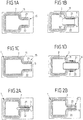
- FIGS. 1A to 1D show schematically the provision of an insertion channel of defined diameter in a filling nozzle of a gas bag and the placement of a filling agent in such an insertion channel.
- a silicone trace 2 In a first step, according to the Figure 1A applied to a flat spreading gas bag layer 11 a silicone trace 2.
- the gas bag layer 11 comprises a key-shaped connection region 15 which serves to receive and arrange a filling means.
- the silicone trace 2 forms two substantially parallel arms 21, 22, which are also referred to below as parallel silicone traces.
- the track 2 may also consist of another elastic adhesive.
- the explanation of the invention with silicone as an adhesive is insofar only to be understood as an example.
- a flat inlay 3 is inserted into the wet silicone, as in the FIG. 1B shown.
- the inlay 3 is designed such that its lateral boundary surfaces 31, 32 in the areas which run parallel to the arms 21, 22 of the silicone track 2, directly adjacent to the silicone track 2 and are wetted by the adjacent silicone, even if the silicone trace 2 with manufacturing tolerances on the airbag layer 11 is placed.
- the silicone track 2 and the inlay 3 are thus designed such that the silicone track reaches the edges 31, 32 of the inlay 3 in every tolerance case.
- an upper gas bag layer or an upper fabric blank is placed on the lower gas bag layer 11. Subsequently, the resulting assembly is pressed to the desired silicone track height.
- the upper gas bag layer is not shown separately for a better clarity of the presentation.
- the upper gas bag layer and the lower gas bag layer 11 are connected to one another along their edge region by means of the silicone track 2, which extends along the entire circumference of the gas bag 1 that has now formed.
- the inlay 3 is removed, cf. Figure 1C ,
- the resulting insertion channel 5 has exactly the opening width of the inlay 3.
- the Insertion channel 5 provides an opening of the gas bag 1, can be filled via the gas for filling the gas bag 1 in this.
- a filling means 6 defines introduced, which serves the filling of the gas bag 1 with gas.
- the filling means 6 are, for example, a hose, a pipe, a gas generator or a valve.
- the filling agent 6 is thereby inserted parallel to the fabric layers 11 through the insertion channel 5, which has a smaller diameter than the filling means 6.
- the elasticity of the silicone can be used to the insertion channel 5 and the silicone arms 21, 22 which define this in order to bias the introduced filling means 6 around and thus to realize a tight fit around the contact surface between filling agent and silicone.
- the filling means 6 is secured from the outside by means of an additional squeezing means 7 in order to increase the connection force and tightness.
- a squeezing means 7 for example a hose clamp or a cable tie, does not have to, as in the prior art, push a gap between the silicone track 21, 22 and the filling means 6. Accordingly, due to the inherent elasticity of the silicone used and the associated positive engagement of the surfaces, the required tightening force of the squeezing means 7 is reduced.
- such squeezing means 7 can also be completely dispensed with.
- a corresponding arrangement show the FIGS. 2A, 2B that otherwise the FIGS. 1B and 1C correspond.
- the holding force of the compound alone on the inherent elasticity of the expanded adhesive is large enough to achieve a sufficient bonding force between the abutting surfaces of silicone and filler.
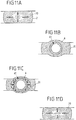
- the FIG. 3A starts from a clear gap 5, which the inlay 3 has kept clear.
- a filling 6 such as a tube or a tube
- the silicone 20 is displaced concentrically.
- the silicone 20 can primarily only dodge up and down.
- the displaced silicone 20 clamps positively around the enclosed surface 61 of the filling 6 and rears upwards and downwards together with the bonded airbag fabric to the outside. Due to the positive connection and the elasticity of the silicone, which completely conforms to the surface 61 of the filling means 6, an absolute tightness is created between the inserted filling agent 6 and the silicone 20.
- the silicone used for example, has an elongation capacity of about 1000%, ie the material can be pulled to its 10-fold extent. With this value, the optimum width of an inlay 3 can be approximately dimensioned. It should be noted that the vertical and horizontal displacement of the silicone vary within the aperture. The thinner the silicone layer is dimensioned in its vertical height, the more the load of the silicone differs from a uniform distribution. A practicable value is an average strain factor of about 5.
- FIGS. 4A, 4B show a modification in which the tightness of the compound is further improved by the fact that a region 23 between the silicon track segments 21, 22 forming the insertion channel 5 is filled with silicone, for. B. in the zone to which the outer crimping means 7 (see. FIG. 1D ) is pressed. This creates a silicone surface without interruption around the inserted filling around.
- the entire surface area 24 between the silicone track segments 21, 22 are filled with silicone.
- the silicone extends not only at the lateral edges 31, 32 of the inlay 3, but also at the top and the bottom of the inlay 3, and thus surrounds this - and after removing the inlay the inserted filler - thus completely.
- the resulting adhesion surface is increased and the connection force between the filling agent and the gas bag is further increased.
- FIGS. 6A, 6B show an embodiment in which the adhesive force, reinforced by the bias of the silicone sufficient to allow a secure gas-tight connection without squeezing.
- the geometric constellation is crucial here.
- the height of the silicone track (blade height) and the plunge depth (ie the length over which the elastic insertion channel 5 extends and bears against the filling agent) are the primary relevant parameters.
- the design of the FIGS. 6A, 6B the embodiment of FIGS. 5A, 5B However, wherein the insertion channel 5 is formed narrower and the inlay 3 accordingly has a smaller width.
- FIGS. 7A, 7B illustrated embodiment of the invention to simply leave the inserted inlay in the silicone surface.
- z For example, it may be provided that a flat tube 30 of the same material (eg, 2K silicone) is inserted, which completely bonds to the silicon of the silicone suture 2, as in FIG. 7A shown. As a result, the desired clear opening of the insertion channel remains contained and the inlay 30 is in the bond to the component of the silicone layers, as in the FIG. 7B shown. The filling means 6 is then inserted on the insertion channel formed in this way.
- 2K silicone the same material
- the airbag 1 and especially the insertion channel 3 during assembly to hold or fix accordingly.
- the blank width of the key-shaped connection region 15 can be correspondingly widened, as in FIG Figures 8A, 8B shown.
- the trunk-shaped connection region forms here Festhalter specific 151.
- the key-shaped connection region 15 is extended beyond the siliconized region, so that the protruding tabs 151 above and below the insertion opening can be used to counteract the insertion force, as in FIG Figure 9A shown. If necessary, the tabs 151 can be separated after the joining process, as indicated by the dashed line in FIG FIG. 9B indicated.
- FIGS. 10A to 10D show a schematic diagram of another embodiment of the method according to the invention. It is in accordance with Figure 10A provided between at least two gas bag layers of a gas bag 1, a silicone trace 2. Of the at least two gas bag layers of the gas bag 1 is as well as in the Figures 1A to 1D only the lower airbag layer 11 shown.
- the silicone track 2 forms a closed silicone track, which runs along the circumference of the gas bag 1 and connects the edge regions of each other.
- the manufacture of the gas bag 1 is carried out in accordance with standard.
- the filling means 6 can be pressed by means of a pneumatic piston or the like through the closed silicone track 2. Due to the large puncture forces by the closed silicone track 2, it is advantageous if the airbag 1 is fixedly mounted on a work table for mounting.
- the elasticity of the silicone ensures a light reclamping of the inserted object and a tight connection of the surfaces to each other.
- the silicone is torn in the middle and displaced concentrically to the outside. This is biased thereby causing a close fit around the contact area, i. the outer surface of the filling 6th
- FIGS. 11A to 11D explain - in the same way as the FIGS. 3A to 3D to the embodiment of Figures 1A to 1D - the physical background of the connection.
- the tightness and adhesion of the connection between the filling means on the one hand and the gas bag or silicone 20 of the silicone track 2 is achieved in that the silicone 20 is displaced from the inside to the outside.
- the expansion capacity of the silicone is for example about 1000%, ie, the material can be drawn to its tenfold extension before it breaks.
- the Figure 11A illustrates, starting from a central use of the penetration of the filling 6, a concentric displacement of the silicone 20 of the silicone track 2 by the insertion of the filling means 6.
- the silicone 20 can primarily only dodge up and down.
- FIG. 11C is in the horizontal direction, a higher resistance of the relatively widely present silicone 20 is present.
- the silicone is relatively thinner, so that the counterforce is correspondingly less strong.
- the silicone 20 is therefore stretched most on the left and right sides.
- FIGS. 12A, 12B show a modification of the embodiment of FIGS. 10A to 10D in which the insertion point in the silicone track 2 is designed like a trunk 25 in order to increase the contact surface between the silicone on the one hand and the inserted object on the other hand and thus the adhesion of the compound.
- the trunk-like silicone trace 25 is formed in a key-shaped connection region 15 of the gas bag 1 and is designed so that they superimpose the parallel track segments in each case of tolerance.
- a squeezing agent can be dispensed with.
- the holding force of the joint is high enough over the inherent elasticity of the expanded silicone 20 to achieve sufficient adhesion and impermeability of the surfaces to one another.
- the height of the silicone track 25 (blade height) and the insertion depth are the decisive parameters for the adhesion of the connection and can be adapted to the respective application.
- the applied crushing means 7 no longer has to close the existing gap in the prior art between silicone track and inserted filling gas-tight. Due to the inherent elasticity of the silicone and the positive engagement of the surfaces reduces the required tightening force of the squeezing 7th
- an embodiment of the invention provides for the use of a mandrel for a piercing work, as in FIGS FIGS. 13A, 13B is shown.
- a corresponding thorn 8 can be arranged on the front end of the filling means 6 to be introduced and facilitates the puncturing of the filling 6 by the silicone trace 2.
- the mandrel 7 can be removed again, for example by the hollow cylinder of a tubular filling 6.
- such Mandrel 8 serve to provide the most straightforward and defined penetration of the filling means 6, whereby the resulting predetermined breaking point defined more precisely and an improved quality of the arrangement is provided.
- connection region 15 gets wider edges 151, in which the gas bag can be held in place for insertion of the filling means 6, as in FIG Figure 14A is shown.
- connection region 15 is extended beyond the siliconized region, so that the protruding tabs 151 above and below the insertion opening can be used to counteract the insertion force.
- FIGS. 15A to 15D show a modification of the method, which is preferably used in particular for filling of larger diameter, in particular for filling with a diameter of more than 8 mm. It is provided that initially with the aid of a tool 9, an opening 10 is pushed into a silicone track 2 to a kind of receiving channel for the filling, z. As a gas generator to provide. The tool 9 can be designed to be sword-like. After opening the silicone seam 2, the tool 9 is pulled out again. Subsequently, the filling is pushed through the resulting, for example, slot-like opening 10 in the silicone track 2. The procedure then proceeds as in relation to the FIGS. 10A to 10D described.
- the gas generator When mounting e.g. a gas generator in an airbag, the gas generator can be firmly clamped while the airbag are pushed over it. It is also possible to fix the gas bag mouth and to push the gas generator with a pneumatic insertion aid in the gas bag.
- the rubber-like nature of the silicone allows a pushing in of gas generators with sharp edges within limits of work safety.
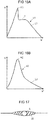
- FIGS. 16A and 16B each show a force-displacement diagram of tensile force measurements in a train to the filling 6 with captive airbag 1 in concrete application examples.
- Curves V1, V2 in the FIGS. 16A and 16B each show the course of an applied (tensile) force K, K 'against a distance traveled W, W' of a traction device.
- the traction means Upon reaching the maximum value M1, the traction means brings the filling 6 in relative movement to the adhesive 20.
- Fig. 16A is the filling 6 held by the adhesive 20 frictionally in the opening 5 of the airbag 1.
- a transition from static friction to sliding friction manifests itself in a drop in tensile force (in this case about 2/3 of the maximum M1).
- the tensile force remains substantially constant, so that the curve V1 forms a plateau P. If the contact area between the filling agent and the adhesive begins to decrease, the tensile force continues to drop (substantially linearly) in a section L1 to zero. This corresponds to the location at which the filling means 6 out of contact with the adhesive 20.
- the adhesive 20 exerts elastic holding forces on the filling means 6, it can seal off in the opening 5 in a gastight manner even after a certain displacement of the filling means 6 (eg by a few mm). A strain relief of the filling means 6 can still be provided.
- the tensile force K 'decreases during the bonding of the filling 6 without elastic holding forces ( Fig. 16B ) by destruction of the bond on reaching the Maximum value M2 decreases rapidly, in this case to about 1/3 of the maximum force M2.
- the tensile force in a section L2 drops substantially linearly.
- the curve K2 reaches a value of the tensile force K 'of about zero already after a shorter path length W'.
- a force-fit filling means 6 is therefore held more securely in the opening.
- Fig. 17 shows an opening 5 of an airbag 1 after removal of a previously adhesively bonded by means of adhesive 20 with the opening 5 filling means 6 (not shown).
- the opening 5 corresponds substantially to the diameter of the filling means 6 (in contrast to the holder with elastic holding forces, as in connection with the Fig. 3A to 3D and 11A to 11D already described).
- the adhesive 20 has already been brought into contact with the filling agent 6 for the bonding before curing.
- the adhesive 20 has therefore only placed around the filling 6, without building elastic holding forces.
- the adhesive 20 seals no longer gas-tight against the filling means 6, even if this is still (at least partially) in the opening 5.
- a broken adhesive bond can not provide strain relief.
- a pressurization of the gas bag 1 can also push out the Beglallstoff 6 from the opening of the airbag 1 in a destroyed adhesive bond.
- An application example of the gas bag arrangement according to the invention and of the method according to the invention consists in that a hose of, for example, a diameter of 6 mm is guided through a dry silicone track to fill a small airbag with a volume of about 1 liter.
- a gas generator is passed through a dry silicone track.
- z. B a standard gas bag with a volume of 36 l
- the dry silicone track according to Figures 15A-15D pierce first and then pushed in the gas generator.
- the invention is not limited in its embodiment to the embodiments shown above, which are to be understood only as examples.
- the silicone tracks may be realized in a different way and with a different shape than shown.
Landscapes
- Engineering & Computer Science (AREA)
- Mechanical Engineering (AREA)
- Physics & Mathematics (AREA)
- Fluid Mechanics (AREA)
- Air Bags (AREA)
Applications Claiming Priority (2)
| Application Number | Priority Date | Filing Date | Title |
|---|---|---|---|
| DE201410200252 DE102014200252A1 (de) | 2014-01-09 | 2014-01-09 | Gassackanordnung und Verfahren zur Herstellung einer Gassackanordnung |
| PCT/EP2015/050092 WO2015104258A1 (de) | 2014-01-09 | 2015-01-06 | Gassackanordnung und verfahren zur herstellung einer gassackanordnung |
Publications (2)
| Publication Number | Publication Date |
|---|---|
| EP3092156A1 EP3092156A1 (de) | 2016-11-16 |
| EP3092156B1 true EP3092156B1 (de) | 2019-03-13 |
Family
ID=50337202
Family Applications (1)
| Application Number | Title | Priority Date | Filing Date |
|---|---|---|---|
| EP15702138.7A Active EP3092156B1 (de) | 2014-01-09 | 2015-01-06 | Gassackanordnung und verfahren zur herstellung einer gassackanordnung |
Country Status (6)
| Country | Link |
|---|---|
| US (1) | US10259419B2 (https=) |
| EP (1) | EP3092156B1 (https=) |
| JP (1) | JP6549593B2 (https=) |
| CN (1) | CN105899409B (https=) |
| DE (1) | DE102014200252A1 (https=) |
| WO (1) | WO2015104258A1 (https=) |
Families Citing this family (2)
| Publication number | Priority date | Publication date | Assignee | Title |
|---|---|---|---|---|
| FR3093132B1 (fr) * | 2019-02-27 | 2021-02-12 | Safran Aircraft Engines | Assemblage d’une aube directrice de sortie pour turbomachine d’aéronef à l’aide d’une vessie gonflable |
| CN116512570A (zh) * | 2023-06-08 | 2023-08-01 | 金魁 | 一种微气囊体、生产微气囊体的装置及方法 |
Family Cites Families (46)
| Publication number | Priority date | Publication date | Assignee | Title |
|---|---|---|---|---|
| US4266692A (en) | 1978-08-07 | 1981-05-12 | Bausch & Lomb Incorporated | Sealed container having a deformable elongate member in the seal area |
| JPH1059104A (ja) * | 1996-08-12 | 1998-03-03 | Bridgestone Corp | エアバッグ |
| DE29622493U1 (de) | 1996-12-27 | 1997-04-24 | Trw Occupant Restraint Systems Gmbh, 73551 Alfdorf | Gassack-Modul |
| US6728667B1 (en) | 1998-10-20 | 2004-04-27 | Quickturn Design Systems, Inc. | Multiple instantiation system |
| DE19848794A1 (de) | 1997-10-22 | 1999-05-27 | Inova Gmbh Tech Entwicklungen | Airbagvorrichtung, Herstellungsverfahren für eine Airbagvorrichtung, Auslöseverfahren für eine Airbagvorrichtung und Kraftfahrzeug mit einer Airbagvorrichtung |
| DE29916177U1 (de) * | 1999-09-14 | 2000-02-24 | Takata Corp | Verbindungsaufbau zwischen einem Luftsack und einer Aufblaseinrichtung |
| JP4005321B2 (ja) * | 2001-02-05 | 2007-11-07 | トヨタ自動車株式会社 | 頭部保護エアバッグ装置 |
| DE20105734U1 (de) * | 2001-04-02 | 2001-08-30 | Trw Repa Gmbh | Gassackmodul für ein Fahrzeuginsassen-Rückhaltesystem |
| JP3726722B2 (ja) * | 2001-07-23 | 2005-12-14 | トヨタ自動車株式会社 | エアバッグ装置 |
| JP3835257B2 (ja) * | 2001-11-12 | 2006-10-18 | 豊田合成株式会社 | 頭部保護エアバッグ装置 |
| US6883827B2 (en) | 2002-05-03 | 2005-04-26 | Milliken & Company | Modular air bag cushion system |
| JP4206291B2 (ja) * | 2002-07-08 | 2009-01-07 | 本田技研工業株式会社 | サイドエアバッグ装置 |
| DE10242023B4 (de) | 2002-09-11 | 2005-08-25 | Key Safety Systems, Inc., Sterling Heights | Gassack für ein Airbagmodul |
| JP2004243976A (ja) | 2003-02-17 | 2004-09-02 | Takata Corp | 側突用エアバッグ装置 |
| GB2400354B (en) * | 2003-04-09 | 2006-01-25 | Autoliv Development Ab | Improvements in or relating to an air-bag |
| FR2855122B1 (fr) * | 2003-05-22 | 2005-08-12 | Aerazur | Dispositif d'etancheite pour l'interface entre un sac de securite gonflable et un generateur de gaz |
| KR100510709B1 (ko) * | 2003-10-17 | 2005-08-26 | 현대모비스 주식회사 | 차량의 조수석 에어백 장치 |
| JP2005178612A (ja) | 2003-12-19 | 2005-07-07 | Takata Corp | カーテンエアバッグ装置 |
| DE202004016975U1 (de) | 2004-11-01 | 2004-12-30 | Autoliv Development Ab | Airbagvorrichtung mit einem zerstörbaren Verbindungsabschnitt zwischen einem Gasgenerator und einer nichtmetallischen Gaslanze |
| CN100467313C (zh) * | 2004-11-15 | 2009-03-11 | 高田-彼得里公开股份有限公司 | 用于保护机动车辆乘坐者的气囊设备的模块组件 |
| JP4593627B2 (ja) * | 2004-11-15 | 2010-12-08 | タカタ・ペトリ アーゲー | 自動車乗員保護用エアバッグ装置のモジュールアセンブリ |
| DE102005005964A1 (de) | 2005-02-10 | 2006-08-17 | Autoliv Development Ab | Seitenairbag mit gesteuerter Öffnung einer Druckausgleichskammer |
| DE102005047703B4 (de) * | 2005-09-27 | 2015-11-12 | TAKATA Aktiengesellschaft | Gassackanordnung für ein Kraftfahrzeug |
| JP4923531B2 (ja) * | 2005-11-15 | 2012-04-25 | タカタ株式会社 | エアベルト装置 |
| JP2007137181A (ja) * | 2005-11-16 | 2007-06-07 | Takata Corp | エアベルト装置 |
| JP2007331402A (ja) * | 2006-06-12 | 2007-12-27 | Takata Corp | 側突用エアバッグ、側突用エアバッグ装置、車両用シート |
| DE102007056137B4 (de) * | 2007-11-20 | 2015-05-13 | TAKATA Aktiengesellschaft | Gassack mit einem Einfüllstutzen und Gassackanordnung mit einem Gassack und einem Gasgenerator |
| WO2009110318A1 (ja) * | 2008-03-07 | 2009-09-11 | 芦森工業株式会社 | エアバッグ装置 |
| EP2156994B1 (de) | 2008-08-18 | 2012-09-12 | Autoliv Development AB | Luftsackanordnung |
| CN103465864B (zh) * | 2008-09-30 | 2017-03-15 | Trw空气气袋系统股份有限公司 | 气体发生器、其制造方法以及带有气体发生器的模块 |
| DE102008060392B4 (de) | 2008-12-03 | 2017-08-03 | TAKATA Aktiengesellschaft | Aufblasbarer Gassack für ein Fahrzeuginsassen-Rückhaltesystem sowie Verfahren zum Herstellen eines aufblasbaren Gassacks |
| FR2941617B1 (fr) * | 2009-02-04 | 2012-06-29 | Endalis | Ballon intra-gastrique. |
| DE102009018168A1 (de) * | 2009-04-20 | 2010-11-04 | Takata-Petri Ag | Gassackmodul für ein Fahrzeuginsassen-Rückhaltesystem und Verfahren zu dessen Herstellung |
| DE102009058702A1 (de) | 2009-12-17 | 2011-07-07 | GM Global Technology Operations LLC, ( n. d. Ges. d. Staates Delaware ), Mich. | Airbaganordnung mit Schnurgasgenerator |
| DE102009055029A1 (de) * | 2009-12-18 | 2011-06-22 | Takata-Petri Ag, 63743 | Gassack für ein Personen-Schutzsystem eines Fahrzeugs und Verfahren zu dessen Herstellung |
| US8500155B2 (en) * | 2009-12-22 | 2013-08-06 | Autoliv Asp, Inc. | Inflatable airbag assembly with an integral cover |
| DE102010040119B4 (de) | 2010-09-01 | 2015-03-05 | TAKATA Aktiengesellschaft | Gassack für ein Personen-Schutzsystem eines Fahrzeugs und Verfahren zu dessen Herstellung |
| DE102011075272A1 (de) | 2010-11-04 | 2012-05-24 | Takata-Petri Ag | Vorrichtung zur Bereitstellung von Gas in einem Personen-Schutzsystem eines Fahrzeugs |
| DE102010052782A1 (de) * | 2010-11-30 | 2012-05-31 | Trw Automotive Gmbh | Fahrzeuginsassenrückhaltesystem für ein Fahrzeug und Dichtungselement |
| US8622423B1 (en) * | 2012-09-11 | 2014-01-07 | Key Safety Systems, Inc. | Airbag with heat shield |
| JP6375484B2 (ja) * | 2013-04-26 | 2018-08-22 | Joyson Safety Systems Japan株式会社 | エアバッグ装置及びエアバッグの折り畳み方法 |
| US9346430B2 (en) * | 2014-09-11 | 2016-05-24 | Autoliv Asp, Inc. | Inflatable seatbelt |
| US9925950B2 (en) * | 2015-04-11 | 2018-03-27 | Amsafe, Inc. | Active airbag vent system |
| JP6500274B2 (ja) * | 2015-09-01 | 2019-04-17 | 豊田合成株式会社 | エアバッグ |
| JP6380340B2 (ja) * | 2015-11-12 | 2018-08-29 | トヨタ自動車株式会社 | 乗員保護装置 |
| US20170225788A1 (en) * | 2016-02-08 | 2017-08-10 | Amsafe, Inc. | Multi-chamber airbags and associated methods of manufacture and use |
-
2014
- 2014-01-09 DE DE201410200252 patent/DE102014200252A1/de not_active Withdrawn
-
2015
- 2015-01-06 WO PCT/EP2015/050092 patent/WO2015104258A1/de not_active Ceased
- 2015-01-06 EP EP15702138.7A patent/EP3092156B1/de active Active
- 2015-01-06 US US15/110,345 patent/US10259419B2/en active Active
- 2015-01-06 JP JP2016544861A patent/JP6549593B2/ja active Active
- 2015-01-06 CN CN201580004066.0A patent/CN105899409B/zh active Active
Non-Patent Citations (1)
| Title |
|---|
| None * |
Also Published As
| Publication number | Publication date |
|---|---|
| WO2015104258A1 (de) | 2015-07-16 |
| JP6549593B2 (ja) | 2019-07-24 |
| JP2017503705A (ja) | 2017-02-02 |
| US10259419B2 (en) | 2019-04-16 |
| US20160332594A1 (en) | 2016-11-17 |
| DE102014200252A1 (de) | 2014-04-10 |
| CN105899409A (zh) | 2016-08-24 |
| EP3092156A1 (de) | 2016-11-16 |
| CN105899409B (zh) | 2019-06-21 |
Similar Documents
| Publication | Publication Date | Title |
|---|---|---|
| EP2899100B1 (de) | Klebeverbindung und Klebeverfahren von zwei Hohlprofilen | |
| EP2463565B1 (de) | Rohrverbindungsanordnung | |
| DE102011103367A1 (de) | Vorrichtung zum dichtenden Verschließen eines Kabelschutzrohrendes | |
| EP3550195A1 (de) | Rohranordnung eines rohrleitungssystems einer feuerlöschanlage und verfahren zum herstellen einer solchen rohranordnung | |
| WO2019121870A1 (de) | Gehäuse zum aufnehmen von batteriezellen und verfahren zu dessen herstellung | |
| DE3301016C2 (de) | Rohrverbindung | |
| DE102011086791B4 (de) | Verfahren zum Verschließen einer Bohrung eines Werkstückes und Bohrungsverschlussvorrichtung | |
| DE102009007163A1 (de) | Schlauchsystem | |
| EP3092156B1 (de) | Gassackanordnung und verfahren zur herstellung einer gassackanordnung | |
| DE202009012173U1 (de) | Vorrichtung zum Herstellen einer Verbindung zwischen zwei rohrförmigen Bauteilen | |
| EP3504448A1 (de) | Verbindungselement zum herstellen einer verbindung zwischen einem hohlprofil und einem weiteren bauteil | |
| DE102013224027B4 (de) | Durchführungsvorrichtung für Leitungen, insbesondere Hauseinführung | |
| DE102011004002A1 (de) | Verfahren zur Herstellung einer Quersiegelnaht sowie Quersiegelvorrichtung | |
| WO2011073445A1 (de) | Gassack für ein personen-schutzsystem eines fahrzeugs und verfahren zu dessen herstellung | |
| DE102007058545B4 (de) | Gassack, Verfahren zu seiner Herstellung und Gassack-Einheit | |
| DE202019101118U1 (de) | Installationsdose sowie Installationseinheit mit einer solchen Installationsdose und mit einem Installationsrohr | |
| EP2131087B1 (de) | Verfahren zur Herstellung einer Verbindung zwischen einem Wellschlauch und einem weiteren Körper | |
| DE10053556A1 (de) | Mehrlagige Dichtung und Verfahren zum Verbinden der Lagen einer solchen Dichtung | |
| DE102012022395A1 (de) | Verfahren zur Herstellung eines Kraftstoffeinfüllsystems für ein Kraftfahrzeug sowie Kraftstoffeinfüllsystem für ein Kraftfahrzeug | |
| DE102014208090A1 (de) | Entlüftungseinrichtung zum Entlüften einer, ein Fluid führenden Leitung, insbesondere für ein hydraulisches Kupplungsbetätigungssystem und ein Verfahren zum Entlüften einer, ein Fluid führenden Leitung | |
| DE102014101740B4 (de) | Verfahren zum Verbinden von Bauteilen und Verbindungselement | |
| DE102010003609B4 (de) | Gassackvorrichtung für ein Personen-Schutzsystem eines Fahrzeugs und Verfahren zu dessen Herstellung | |
| DE10212845B4 (de) | Vorrichtung zum Unterteilen von Rohrleitungen | |
| EP3792541B1 (de) | Verwendung einer dichtung zum abdichten gegen medienleitungen für eine hauseinführung, insbesondere mehrspartenhauseinführung | |
| DE102022211603A1 (de) | Dichtmittelsystem |
Legal Events
| Date | Code | Title | Description |
|---|---|---|---|
| PUAI | Public reference made under article 153(3) epc to a published international application that has entered the european phase |
Free format text: ORIGINAL CODE: 0009012 |
|
| 17P | Request for examination filed |
Effective date: 20160809 |
|
| AK | Designated contracting states |
Kind code of ref document: A1 Designated state(s): AL AT BE BG CH CY CZ DE DK EE ES FI FR GB GR HR HU IE IS IT LI LT LU LV MC MK MT NL NO PL PT RO RS SE SI SK SM TR |
|
| AX | Request for extension of the european patent |
Extension state: BA ME |
|
| DAX | Request for extension of the european patent (deleted) | ||
| STAA | Information on the status of an ep patent application or granted ep patent |
Free format text: STATUS: EXAMINATION IS IN PROGRESS |
|
| 17Q | First examination report despatched |
Effective date: 20180213 |
|
| GRAP | Despatch of communication of intention to grant a patent |
Free format text: ORIGINAL CODE: EPIDOSNIGR1 |
|
| STAA | Information on the status of an ep patent application or granted ep patent |
Free format text: STATUS: GRANT OF PATENT IS INTENDED |
|
| INTG | Intention to grant announced |
Effective date: 20180914 |
|
| RAP1 | Party data changed (applicant data changed or rights of an application transferred) |
Owner name: JOYSON SAFETY SYSTEMS GERMANY GMBH |
|
| GRAS | Grant fee paid |
Free format text: ORIGINAL CODE: EPIDOSNIGR3 |
|
| GRAA | (expected) grant |
Free format text: ORIGINAL CODE: 0009210 |
|
| STAA | Information on the status of an ep patent application or granted ep patent |
Free format text: STATUS: THE PATENT HAS BEEN GRANTED |
|
| AK | Designated contracting states |
Kind code of ref document: B1 Designated state(s): AL AT BE BG CH CY CZ DE DK EE ES FI FR GB GR HR HU IE IS IT LI LT LU LV MC MK MT NL NO PL PT RO RS SE SI SK SM TR |
|
| REG | Reference to a national code |
Ref country code: GB Ref legal event code: FG4D Free format text: NOT ENGLISH |
|
| REG | Reference to a national code |
Ref country code: CH Ref legal event code: EP Ref country code: AT Ref legal event code: REF Ref document number: 1107277 Country of ref document: AT Kind code of ref document: T Effective date: 20190315 |
|
| REG | Reference to a national code |
Ref country code: IE Ref legal event code: FG4D Free format text: LANGUAGE OF EP DOCUMENT: GERMAN |
|
| REG | Reference to a national code |
Ref country code: DE Ref legal event code: R096 Ref document number: 502015008320 Country of ref document: DE |
|
| REG | Reference to a national code |
Ref country code: NL Ref legal event code: MP Effective date: 20190313 |
|
| REG | Reference to a national code |
Ref country code: LT Ref legal event code: MG4D |
|
| PG25 | Lapsed in a contracting state [announced via postgrant information from national office to epo] |
Ref country code: SE Free format text: LAPSE BECAUSE OF FAILURE TO SUBMIT A TRANSLATION OF THE DESCRIPTION OR TO PAY THE FEE WITHIN THE PRESCRIBED TIME-LIMIT Effective date: 20190313 Ref country code: LT Free format text: LAPSE BECAUSE OF FAILURE TO SUBMIT A TRANSLATION OF THE DESCRIPTION OR TO PAY THE FEE WITHIN THE PRESCRIBED TIME-LIMIT Effective date: 20190313 Ref country code: NO Free format text: LAPSE BECAUSE OF FAILURE TO SUBMIT A TRANSLATION OF THE DESCRIPTION OR TO PAY THE FEE WITHIN THE PRESCRIBED TIME-LIMIT Effective date: 20190613 Ref country code: FI Free format text: LAPSE BECAUSE OF FAILURE TO SUBMIT A TRANSLATION OF THE DESCRIPTION OR TO PAY THE FEE WITHIN THE PRESCRIBED TIME-LIMIT Effective date: 20190313 |
|
| PG25 | Lapsed in a contracting state [announced via postgrant information from national office to epo] |
Ref country code: BG Free format text: LAPSE BECAUSE OF FAILURE TO SUBMIT A TRANSLATION OF THE DESCRIPTION OR TO PAY THE FEE WITHIN THE PRESCRIBED TIME-LIMIT Effective date: 20190613 Ref country code: NL Free format text: LAPSE BECAUSE OF FAILURE TO SUBMIT A TRANSLATION OF THE DESCRIPTION OR TO PAY THE FEE WITHIN THE PRESCRIBED TIME-LIMIT Effective date: 20190313 Ref country code: LV Free format text: LAPSE BECAUSE OF FAILURE TO SUBMIT A TRANSLATION OF THE DESCRIPTION OR TO PAY THE FEE WITHIN THE PRESCRIBED TIME-LIMIT Effective date: 20190313 Ref country code: RS Free format text: LAPSE BECAUSE OF FAILURE TO SUBMIT A TRANSLATION OF THE DESCRIPTION OR TO PAY THE FEE WITHIN THE PRESCRIBED TIME-LIMIT Effective date: 20190313 Ref country code: HR Free format text: LAPSE BECAUSE OF FAILURE TO SUBMIT A TRANSLATION OF THE DESCRIPTION OR TO PAY THE FEE WITHIN THE PRESCRIBED TIME-LIMIT Effective date: 20190313 Ref country code: GR Free format text: LAPSE BECAUSE OF FAILURE TO SUBMIT A TRANSLATION OF THE DESCRIPTION OR TO PAY THE FEE WITHIN THE PRESCRIBED TIME-LIMIT Effective date: 20190614 |
|
| PG25 | Lapsed in a contracting state [announced via postgrant information from national office to epo] |
Ref country code: IT Free format text: LAPSE BECAUSE OF FAILURE TO SUBMIT A TRANSLATION OF THE DESCRIPTION OR TO PAY THE FEE WITHIN THE PRESCRIBED TIME-LIMIT Effective date: 20190313 Ref country code: SK Free format text: LAPSE BECAUSE OF FAILURE TO SUBMIT A TRANSLATION OF THE DESCRIPTION OR TO PAY THE FEE WITHIN THE PRESCRIBED TIME-LIMIT Effective date: 20190313 Ref country code: PT Free format text: LAPSE BECAUSE OF FAILURE TO SUBMIT A TRANSLATION OF THE DESCRIPTION OR TO PAY THE FEE WITHIN THE PRESCRIBED TIME-LIMIT Effective date: 20190713 Ref country code: AL Free format text: LAPSE BECAUSE OF FAILURE TO SUBMIT A TRANSLATION OF THE DESCRIPTION OR TO PAY THE FEE WITHIN THE PRESCRIBED TIME-LIMIT Effective date: 20190313 Ref country code: EE Free format text: LAPSE BECAUSE OF FAILURE TO SUBMIT A TRANSLATION OF THE DESCRIPTION OR TO PAY THE FEE WITHIN THE PRESCRIBED TIME-LIMIT Effective date: 20190313 Ref country code: ES Free format text: LAPSE BECAUSE OF FAILURE TO SUBMIT A TRANSLATION OF THE DESCRIPTION OR TO PAY THE FEE WITHIN THE PRESCRIBED TIME-LIMIT Effective date: 20190313 Ref country code: RO Free format text: LAPSE BECAUSE OF FAILURE TO SUBMIT A TRANSLATION OF THE DESCRIPTION OR TO PAY THE FEE WITHIN THE PRESCRIBED TIME-LIMIT Effective date: 20190313 Ref country code: CZ Free format text: LAPSE BECAUSE OF FAILURE TO SUBMIT A TRANSLATION OF THE DESCRIPTION OR TO PAY THE FEE WITHIN THE PRESCRIBED TIME-LIMIT Effective date: 20190313 |
|
| PG25 | Lapsed in a contracting state [announced via postgrant information from national office to epo] |
Ref country code: SM Free format text: LAPSE BECAUSE OF FAILURE TO SUBMIT A TRANSLATION OF THE DESCRIPTION OR TO PAY THE FEE WITHIN THE PRESCRIBED TIME-LIMIT Effective date: 20190313 Ref country code: PL Free format text: LAPSE BECAUSE OF FAILURE TO SUBMIT A TRANSLATION OF THE DESCRIPTION OR TO PAY THE FEE WITHIN THE PRESCRIBED TIME-LIMIT Effective date: 20190313 |
|
| REG | Reference to a national code |
Ref country code: DE Ref legal event code: R097 Ref document number: 502015008320 Country of ref document: DE |
|
| PG25 | Lapsed in a contracting state [announced via postgrant information from national office to epo] |
Ref country code: IS Free format text: LAPSE BECAUSE OF FAILURE TO SUBMIT A TRANSLATION OF THE DESCRIPTION OR TO PAY THE FEE WITHIN THE PRESCRIBED TIME-LIMIT Effective date: 20190713 |
|
| PLBE | No opposition filed within time limit |
Free format text: ORIGINAL CODE: 0009261 |
|
| STAA | Information on the status of an ep patent application or granted ep patent |
Free format text: STATUS: NO OPPOSITION FILED WITHIN TIME LIMIT |
|
| PG25 | Lapsed in a contracting state [announced via postgrant information from national office to epo] |
Ref country code: DK Free format text: LAPSE BECAUSE OF FAILURE TO SUBMIT A TRANSLATION OF THE DESCRIPTION OR TO PAY THE FEE WITHIN THE PRESCRIBED TIME-LIMIT Effective date: 20190313 |
|
| 26N | No opposition filed |
Effective date: 20191216 |
|
| PG25 | Lapsed in a contracting state [announced via postgrant information from national office to epo] |
Ref country code: SI Free format text: LAPSE BECAUSE OF FAILURE TO SUBMIT A TRANSLATION OF THE DESCRIPTION OR TO PAY THE FEE WITHIN THE PRESCRIBED TIME-LIMIT Effective date: 20190313 |
|
| PG25 | Lapsed in a contracting state [announced via postgrant information from national office to epo] |
Ref country code: TR Free format text: LAPSE BECAUSE OF FAILURE TO SUBMIT A TRANSLATION OF THE DESCRIPTION OR TO PAY THE FEE WITHIN THE PRESCRIBED TIME-LIMIT Effective date: 20190313 |
|
| PG25 | Lapsed in a contracting state [announced via postgrant information from national office to epo] |
Ref country code: MC Free format text: LAPSE BECAUSE OF FAILURE TO SUBMIT A TRANSLATION OF THE DESCRIPTION OR TO PAY THE FEE WITHIN THE PRESCRIBED TIME-LIMIT Effective date: 20190313 |
|
| REG | Reference to a national code |
Ref country code: CH Ref legal event code: PL |
|
| GBPC | Gb: european patent ceased through non-payment of renewal fee |
Effective date: 20200106 |
|
| REG | Reference to a national code |
Ref country code: BE Ref legal event code: MM Effective date: 20200131 |
|
| PG25 | Lapsed in a contracting state [announced via postgrant information from national office to epo] |
Ref country code: FR Free format text: LAPSE BECAUSE OF NON-PAYMENT OF DUE FEES Effective date: 20200131 Ref country code: GB Free format text: LAPSE BECAUSE OF NON-PAYMENT OF DUE FEES Effective date: 20200106 Ref country code: LU Free format text: LAPSE BECAUSE OF NON-PAYMENT OF DUE FEES Effective date: 20200106 |
|
| PG25 | Lapsed in a contracting state [announced via postgrant information from national office to epo] |
Ref country code: LI Free format text: LAPSE BECAUSE OF NON-PAYMENT OF DUE FEES Effective date: 20200131 Ref country code: BE Free format text: LAPSE BECAUSE OF NON-PAYMENT OF DUE FEES Effective date: 20200131 Ref country code: CH Free format text: LAPSE BECAUSE OF NON-PAYMENT OF DUE FEES Effective date: 20200131 |
|
| PG25 | Lapsed in a contracting state [announced via postgrant information from national office to epo] |
Ref country code: IE Free format text: LAPSE BECAUSE OF NON-PAYMENT OF DUE FEES Effective date: 20200106 |
|
| REG | Reference to a national code |
Ref country code: AT Ref legal event code: MM01 Ref document number: 1107277 Country of ref document: AT Kind code of ref document: T Effective date: 20200106 |
|
| PG25 | Lapsed in a contracting state [announced via postgrant information from national office to epo] |
Ref country code: AT Free format text: LAPSE BECAUSE OF NON-PAYMENT OF DUE FEES Effective date: 20200106 |
|
| PG25 | Lapsed in a contracting state [announced via postgrant information from national office to epo] |
Ref country code: MT Free format text: LAPSE BECAUSE OF FAILURE TO SUBMIT A TRANSLATION OF THE DESCRIPTION OR TO PAY THE FEE WITHIN THE PRESCRIBED TIME-LIMIT Effective date: 20190313 Ref country code: CY Free format text: LAPSE BECAUSE OF FAILURE TO SUBMIT A TRANSLATION OF THE DESCRIPTION OR TO PAY THE FEE WITHIN THE PRESCRIBED TIME-LIMIT Effective date: 20190313 |
|
| PG25 | Lapsed in a contracting state [announced via postgrant information from national office to epo] |
Ref country code: MK Free format text: LAPSE BECAUSE OF FAILURE TO SUBMIT A TRANSLATION OF THE DESCRIPTION OR TO PAY THE FEE WITHIN THE PRESCRIBED TIME-LIMIT Effective date: 20190313 |
|
| PGFP | Annual fee paid to national office [announced via postgrant information from national office to epo] |
Ref country code: DE Payment date: 20260127 Year of fee payment: 12 |