EP3067902A2 - Composant électronique - Google Patents
Composant électronique Download PDFInfo
- Publication number
- EP3067902A2 EP3067902A2 EP16156895.1A EP16156895A EP3067902A2 EP 3067902 A2 EP3067902 A2 EP 3067902A2 EP 16156895 A EP16156895 A EP 16156895A EP 3067902 A2 EP3067902 A2 EP 3067902A2
- Authority
- EP
- European Patent Office
- Prior art keywords
- magnetic
- wound
- portions
- electronic component
- core
- Prior art date
- Legal status (The legal status is an assumption and is not a legal conclusion. Google has not performed a legal analysis and makes no representation as to the accuracy of the status listed.)
- Withdrawn
Links
Images










Classifications
-
- H—ELECTRICITY
- H01—ELECTRIC ELEMENTS
- H01F—MAGNETS; INDUCTANCES; TRANSFORMERS; SELECTION OF MATERIALS FOR THEIR MAGNETIC PROPERTIES
- H01F27/00—Details of transformers or inductances, in general
- H01F27/24—Magnetic cores
-
- H—ELECTRICITY
- H01—ELECTRIC ELEMENTS
- H01F—MAGNETS; INDUCTANCES; TRANSFORMERS; SELECTION OF MATERIALS FOR THEIR MAGNETIC PROPERTIES
- H01F17/00—Fixed inductances of the signal type
- H01F17/04—Fixed inductances of the signal type with magnetic core
- H01F17/045—Fixed inductances of the signal type with magnetic core with core of cylindric geometry and coil wound along its longitudinal axis, i.e. rod or drum core
-
- H—ELECTRICITY
- H01—ELECTRIC ELEMENTS
- H01F—MAGNETS; INDUCTANCES; TRANSFORMERS; SELECTION OF MATERIALS FOR THEIR MAGNETIC PROPERTIES
- H01F27/00—Details of transformers or inductances, in general
-
- H—ELECTRICITY
- H01—ELECTRIC ELEMENTS
- H01F—MAGNETS; INDUCTANCES; TRANSFORMERS; SELECTION OF MATERIALS FOR THEIR MAGNETIC PROPERTIES
- H01F27/00—Details of transformers or inductances, in general
- H01F27/28—Coils; Windings; Conductive connections
- H01F27/2823—Wires
-
- H—ELECTRICITY
- H01—ELECTRIC ELEMENTS
- H01F—MAGNETS; INDUCTANCES; TRANSFORMERS; SELECTION OF MATERIALS FOR THEIR MAGNETIC PROPERTIES
- H01F27/00—Details of transformers or inductances, in general
- H01F27/28—Coils; Windings; Conductive connections
- H01F27/29—Terminals; Tapping arrangements for signal inductances
-
- H—ELECTRICITY
- H01—ELECTRIC ELEMENTS
- H01F—MAGNETS; INDUCTANCES; TRANSFORMERS; SELECTION OF MATERIALS FOR THEIR MAGNETIC PROPERTIES
- H01F27/00—Details of transformers or inductances, in general
- H01F27/28—Coils; Windings; Conductive connections
- H01F27/29—Terminals; Tapping arrangements for signal inductances
- H01F27/292—Surface mounted devices
-
- H—ELECTRICITY
- H01—ELECTRIC ELEMENTS
- H01F—MAGNETS; INDUCTANCES; TRANSFORMERS; SELECTION OF MATERIALS FOR THEIR MAGNETIC PROPERTIES
- H01F27/00—Details of transformers or inductances, in general
- H01F27/28—Coils; Windings; Conductive connections
- H01F27/30—Fastening or clamping coils, windings, or parts thereof together; Fastening or mounting coils or windings on core, casing, or other support
- H01F27/306—Fastening or mounting coils or windings on core, casing or other support
-
- H—ELECTRICITY
- H01—ELECTRIC ELEMENTS
- H01F—MAGNETS; INDUCTANCES; TRANSFORMERS; SELECTION OF MATERIALS FOR THEIR MAGNETIC PROPERTIES
- H01F17/00—Fixed inductances of the signal type
- H01F17/04—Fixed inductances of the signal type with magnetic core
- H01F17/045—Fixed inductances of the signal type with magnetic core with core of cylindric geometry and coil wound along its longitudinal axis, i.e. rod or drum core
- H01F2017/046—Fixed inductances of the signal type with magnetic core with core of cylindric geometry and coil wound along its longitudinal axis, i.e. rod or drum core helical coil made of flat wire, e.g. with smaller extension of wire cross section in the direction of the longitudinal axis
Definitions
- the present invention contains subject manner related to Japanese Patent Application JP 2015-033415 filed in the Japanese Patent Office on February 23, 2015 , the entire contents of which being incorporated herein by reference.
- a winding wire is assembled onto a core and an exterior body for the winding wire and the core is mold-formed by a magnetic material.
- a winding wire formed by winding a rectangular wire into a double flat form that is, a wire which is formed into two layers by a Flatwise-Winding method
- an electrode terminal formed by a separate member in order to enable a surface mounting thereof and the exterior body is mold-formed in which the end portions of the winding wire are connected to the electrode terminal
- the abovementioned electronic component has a substantially rectangular-parallelepiped shape in which: side-surface exposed-portions are respectively positioned at a pair of opposing side surfaces of the substantially rectangular-parallelepiped shape thereof, and connecting portions (which stand upright from the bottom surface portion of the electrode terminal) are extended parallelly toward the longitudinal directions of the cross sections of the rectangular wires along another pair of side surfaces different from that pair of side surfaces, and the end portions of the rectangular wires are wound around the connecting portions thereof.
- the electrode terminals and the winding wires are connected at the connecting portions arranged along the side surfaces of the electronic component so that the width of the electronic component becomes wide.
- the connecting portions which stand upright from the bottom surface portion of the electrode terminal are extended parallelly toward the longitudinal directions of the cross sections of the rectangular wires, and the end portions of the rectangular wires are wound around the connecting portions thereof.
- the winding is carried out by a Flatwise winding method and therefore, it is possible to connect the winding wire to the electrode terminal in this manner, but in the case of a winding wire wound by an Edgewise winding method, it is difficult to connect the winding wire to the electrode terminal in this manner.
- an electrode terminal formed by a separate member is used so that the cost thereof is increased.
- the present invention was invented in view of the aforesaid problems and is addressed to obtaining an electronic component which needs less size-increase caused by connecting the winding wire made of the rectangular wire to the electrode member.
- the present invention was invented in view of the aforesaid problems and is addressed to obtaining an electronic component having an electrode member to which the winding wire of the rectangular wire wound into an Edgewise winding form is connectable.
- the present invention was invented in view of the aforesaid problem and is addressed to obtain an electronic component having a constitution in which it is possible to confirm the solder fillet visually without using an electrode member formed by a separate member.
- the present invention provides an electronic component that includes a first side-surface and a second side-surface facing the first side-surface, and further, includes: a magnetic-body core including a plate-shaped portion and a core portion which extends from the upper surface of the plate-shaped portion; a winding wire which includes a wound portion wound by a rectangular wire and two non-wound portions extending from the wound portion up to two distal ends, and of which the core portion is inserted through the wound portion; a magnetic exterior body which covers at least the wound portion and the core portion; a first electrode member including a first side-surface exposed-portion which is exposed along the first side-surface; and a second electrode member including a second side-surface exposed-portion which is exposed along the second side-surface.
- the first side-surface exposed-portion includes a first connecting portion which extends along the height direction of the first side-surface, and the first connecting portion is connected to one of the non-wound portions.
- the second side-surface exposed-portion includes a second connecting portion which extends along the height direction of the second side-surface, and the second connecting portion is connected to the other of the non-wound portions.
- the present invention further provides an electronic component that includes a first side-surface and a second side-surface facing the first side-surface, and further, includes: a magnetic-body core including a plate-shaped portion and a core portion which extends from the upper surface of the plate-shaped portion; a winding wire which includes a wound portion wound by a rectangular wire and two non-wound portions extending from the wound portion up to two distal ends, and of which the core portion is inserted through the wound portion; a magnetic exterior body having a substantially rectangular-parallelepiped shape which covers at least the wound portion and the core portion; a first electrode member including a first side-surface exposed-portion which is exposed along the first side-surface; and a second electrode member including a second side-surface exposed-portion which is exposed along the second side-surface.
- the first electrode member includes a first connecting portion extending in the height direction of the electronic component at any one corner within the four corners of the bottom surface inside the magnetic exterior body, and the first connecting portion is connected to one of the non-wound portions.
- the second electrode member includes a second connecting portion extending in the height direction of the electronic component at another corner within the four corners of the bottom surface inside the magnetic exterior body, and the second connecting portion is connected to the other of the non-wound portions.
- the present invention yet further provides an electronic component that includes a first side-surface and a second side-surface facing the first side-surface, and further, includes: a magnetic-body core including a plate-shaped portion and a core portion which extends from the upper surface of the plate-shaped portion; a winding wire which includes a wound portion wound by a rectangular wire into an Edgewise winding form and two non-wound portions extending from the wound portion up to two distal ends, of which the core portion is inserted through the wound portion; a magnetic exterior body which covers at least the wound portion and the core portion; a first electrode member including a first side-surface exposed-portion which is exposed along the first side-surface; and a second electrode member including a second side-surface exposed-portion which is exposed along the second side-surface. Then, the first electrode member is connected to one of the non-wound portions, and the second electrode member is connected to the other of the non-wound portions.
- the present invention still further provides an electronic component that includes a bottom surface, a first side-surface and a second side-surface facing the first side-surface, and further, includes: a magnetic-body core including a plate-shaped portion and a core portion which extends from the upper surface of the plate-shaped portion; a winding wire which includes a wound portion wound by a rectangular wire into an Edgewise winding form and two non-wound portions extending from the wound portion up to two distal ends, of which the core portion is inserted through the wound portion; and a magnetic exterior body which covers at least the wound portion and the core portion. Then, the two non-wound portions are respectively arranged along at least one of the bottom surface, the first side-surface and the second side-surface, and the portion arranged along the bottom surface at the two non-wound portions is an electrode.
- an electronic component having a constitution in which the winding wire of the rectangular wire is connectable to the electrode member in a space-saving manner.
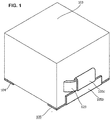
- FIG. 1 is a perspective view showing an electronic component according to an example embodiment 1 of the present invention (First-Aspect thereof).
- FIG. 2 is a perspective view showing a magnetic-body core, a winding wire and electrode terminals in an electronic component according to example embodiment 1.
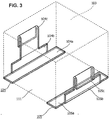
- FIG. 3 is a perspective view showing electrode members in an electronic component according to example embodiment 1 of the present invention (Second-Aspect thereof).
- the electronic component shown in FIGS. 1 and 2 is an inductor and includes a magnetic-body core 101, a winding wire 102, a magnetic exterior body 103 and electrode members 104, 105.
- the magnetic-body core 101 includes a plate-shaped portion 111 having a substantially rectangular-parallelepiped shape and a core portion 112 having a substantially cylindrical shape which extends upward from the upper surface of the plate-shaped portion 111. It should be noted that it is allowed for the plate-shaped portion 111 and the core portion 112 to be formed integrally as a T-type core or to be formed as separate bodies that are connected, for example, by an adhesive agent or through an engagement structure.
- the winding wire 102 includes a wound portion 121 formed by winding a rectangular wire in multiple layers (two layers, here) in a Flatwise winding form and two non-wound portions 122, 123 extending from the wound portion 121 up to the two distal ends thereof. As shown in FIG. 2 , the core portion 112 of the magnetic-body core 101 is inserted through the wound portion 121.
- the rectangular wire is wound into a Flatwise winding form in which the respective layers are laminated in the direction perpendicular to the winding axis.
- a Flatwise winding form is a form in which the wide-width surface of the rectangular wire becomes approximately parallel with the winding axis.
- the pullout positions of the non-wound portions 122, 123 from the wound portion 121 are set at angular positions that are approximately in the diagonal line direction of the plate-shaped portion 111 centered on the core portion 112 of the magnetic-body core 101.
- the pullout positions of the non-wound portions 122, 123 from the wound portion 121 are set at angular positions that are approximately in the diagonal line direction of the plate-shaped portion 111 centered on the core portion 112 of the magnetic-body core 101.
- the pullout positions of the non-wound portions 122, 123 from the wound portion 121 are set at the angle positions in the perpendicular directions with respect to the side surfaces of the plate-shaped portion 111 centered on the core portion 112 of the magnetic-body core 101.
- the magnetic exterior body 103 is a body obtained by molding an admixture including a magnetic material (magnetic powder-body such as ferrite, metal magnetic body or the like) and a resin by a predetermined molding method so as to cover at least the wound portion 121 and the core portion 112.
- a magnetic material magnetic powder-body such as ferrite, metal magnetic body or the like
- a resin by a predetermined molding method so as to cover at least the wound portion 121 and the core portion 112.
- the magnetic exterior body 103 is formed so as to completely cover the wound portion 121 of the winding wire 102, the core portion 112 of the magnetic-body core 101, and the upper surface and the side surfaces of the plate-shaped portion 111.
- the magnetic exterior body 103 has an outer shape of a substantially rectangular-parallelepiped. By filling and curing the admixture in the inside of a substantially rectangular-parallelepiped mold, there is formed the magnetic exterior body 103.
- the magnetic exterior body is to be formed without covering the side surfaces of the plate-shaped portion 111 of the magnetic-body core 101.
- the electrode members 104, 105 are formed by a conductive material such as copper or the like. As shown in FIG. 3 , the electrode member 104 includes an electrode portion 104a and a side-surface exposed-portion 104b which stands upright from the electrode portion 104a. The side-surface exposed-portion 104b is exposed from the magnetic exterior body 103 along one of the two opposing side surfaces of the aforesaid electronic component. In addition, the electrode member 105 includes an electrode portion 105a and a side-surface exposed-portion 105b which stands upright from the electrode portion 105a. The side-surface exposed-portion 105b is exposed from the magnetic exterior body 103 along one of the two opposing side surfaces of the aforesaid electronic component. It should be noted that also the electrode portions 104a, 105a are exposed from the magnetic exterior body 103.
- the electrode member 104 and the electrode member 105 are fixed to the magnetic-body core 101 by an adhesive agent or the like so as to let them face the two opposing side surfaces and the bottom surface of the plate-shaped portion 111 of the magnetic-body core 101.
- the side-surface exposed-portion 104b includes a connecting portion 104c extending along the height direction of the side surface thereof and the connecting portion 104c is connected to the non-wound portion 122.
- the side-surface exposed-portion 105b includes a connecting portion 105c extending along the height direction of the side surface thereof and the connecting portion 105c is connected to the non-wound portion 123.
- the distal end of the connecting portion 104c is bent approximately 180 degrees so as to wrap the distal end of the non-wound portion 122, and the connecting portion 104c and the non-wound portion 122 are mutually connected by pressure bonding, by welding (laser welding, arc welding, supersonic welding or the like and this is all the same hereinafter), by soldering and the like.
- the distal end of the connecting portion 105c is bent approximately 180 degrees so as to wrap the distal end of the non-wound portion 123, and the connecting portion 105c and the non-wound portion 123 are mutually connected by pressure bonding, by welding, by soldering or the like.
- the connecting portion 104c is connected with the non-wound portion 122 at a position higher than the connecting position between the connecting portion 105c and the non-wound portion 123.
- the connecting portions 104c, 105c extend from approximately the centers of the side-surface exposed-portions 104b, 105b, but it is allowed for them to extend from positions near either end portion, apart from the centers of the side-surface exposed-portions 104b, 105b, corresponding to the pullout positions of the non-wound portions 122, 123.
- the winding wire 102 is assembled on the core portion 112 of the magnetic-body core 101.
- the electrode members 104, 105 are fixed on the plate-shaped portion 111 of the magnetic-body core 101.
- the non-wound portions 122, 123 of the winding wire 102 are led-around to the connecting portions 104c, 105c of the electrode members 104, 105 and both non-wound portions are connected to the respective connecting portions by welding or the like. At that time, if necessary, it is allowed to cut off unnecessary portions of the non-wound portions 122, 123 or the connecting portions 104c, 105c.
- the magnetic-body core 101, the winding wire 102 and the electrode members 104, 105 which are mutually assembled are arranged in the inside of a mold, an admixture including a magnetic material and a resin is filled into the inside of the mold, and the magnetic exterior body 103 is formed by curing the admixture.
- the electrode portions 104a, 105a of the electrode members 104, 105 are soldered on the substrate and solder fillets are formed at the side-surface exposed-portions 104b, 105b.
- the winding wire 102 and the electrode terminals 104, 105 are connected on the two side surfaces on which the side-surface exposed-portions 104b, 105b exist. In this way, it is possible to narrow the width between the remaining two side surfaces on which the side-surface exposed-portions 104b, 105b do not exist. Therefore, the degree of the size-increase caused by the connection of the winding wire 102 made of the rectangular wire with the electrode members 104, 105 will become less.
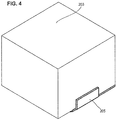
- FIG. 4 is a perspective view showing an electronic component according to the example embodiment 2 of the present invention.
- FIG. 5 is a perspective view showing a magnetic-body core in the electronic component according to example embodiment 2 of the present invention.
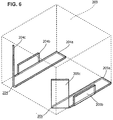
- FIG. 6 is a perspective view showing electrode members in the electronic component according to example embodiment 2 of the present invention.
- the electronic component relating to the example embodiment 2 is an inductor and includes a magnetic-body core 201, a winding wire similar to the winding wire 102 in the example embodiment 1, a magnetic exterior body 203 similar to the magnetic exterior body 103 in the example embodiment 1 and electrode members 204, 205.
- the magnetic-body core 201 includes a plate-shaped portion 211 having a substantially rectangular-parallelepiped shape and a core portion 212 having a substantially cylindrical shape which extends upward from the upper surface of the plate-shaped portion 211. It should be noted that it is allowed for the plate-shaped portion 211 and the core portion 212 to be formed integrally as a T-type core or to be formed as separate bodies which are combined to form a T-shape one , for example, by an adhesive agent or through an engagement structure.
- corner cutoff portions 211a, 211b which are cut-off at a predetermined angle (for example, by 45 degrees).
- the electrode members 204, 205 are formed by a conductive material such as copper or the like. As shown in FIGS. 4 to 6 , the electrode member 204 includes a flat-plate shaped electrode portion 204a and a flat-plate shaped side-surface exposed-portion 204b which stands upright from the electrode portion 204a. The side-surface exposed-portion 204b is exposed from the magnetic exterior body 203 along one of two opposing side surfaces of the aforesaid electronic component.
- the electrode member 205 includes a flat-plate shaped electrode portion 205a and a flat-plate shaped side-surface exposed-portion 205b which stands upright from the electrode portion 205a.
- the side-surface exposed-portion 205b is exposed from the magnetic exterior body 203 along the other of the two opposing side surfaces of the aforesaid electronic component.
- the electrode member 204 and the electrode member 205 are fixed to the magnetic-body core 201 by an adhesive agent or the like so as to face the two opposing side surfaces and the bottom surface of the plate-shaped portion 211 of the magnetic-body core 201.
- the electrode portions 204a, 205a are exposed from the magnetic exterior body 203.
- the electrode member 204 includes a connecting portion 204c separate from the side-surface exposed-portion 204b.
- the connecting portion 204c stands upright from the electrode portion 204a in the inside of the magnetic exterior body 203 at a position adjacent to any one corner of the four corners of the bottom surface of the magnetic exterior body 203, and extends in the height direction of the aforesaid electronic component.
- the connecting portion 204c extends along the abovementioned corner cutoff portions 211a.
- the electrode member 205 includes a connecting portion 205c separate from the side-surface exposed-portion 205b.
- the connecting portion 205c stands upright from the electrode portion 205a in the inside of the magnetic exterior body 203 at a position adjacent to any one corner of the four corners of the bottom surface of the magnetic exterior body 203, and extends in the height direction of the aforesaid electronic component.
- the connecting portion 205c extends along the abovementioned corner cutoff portion 211b.
- one non-wound portion of the winding wire is connected to the connecting portion 204c by pressure bonding, by welding, by soldering or the like, and the other non-wound portion of the winding wire is connected to the connecting portion 205c. Therefore, the connecting points between the winding wire and the electrode members 204, 205 are positioned in the inside of the magnetic exterior body 203 and are not exposed toward the outside.
- the electrode portions 204a, 205a of the electrode members 204, 205 are soldered on the substrate and solder fillets are formed at the side-surface exposed-portions 204b, 205b.
- the abovementioned two corner cutoff portions 211a, 211b are formed at two mutually adjacent corners, but it is allowed to employ a configuration in which (a) the two corner cutoff portions 211a, 211b are formed at two diametrically opposed corners of the plate-shaped portion 211, (b) the two electrode members 204, 205 are formed to have identical shapes in conformity with those corner cutoff portions, and (c) the non-wound portions 222, 223 are pulled out from the wound portion 221 in conformity with the two corner cutoff portions thereof and are connected to the connecting portions 204c, 205c.
- the shapes of the electrode members 204, 205 become identical and therefore, the manufacturing process of the electrode members 204, 205 will become simpler.
- the connecting portions 204, 205 are arranged at two corners, of four corners, at which the wound portion 221 of the cylindrical shaped winding wire 202 does not exist and therefore, the degree of the size-increase caused by the connection of the winding wire 202 made of the rectangular wire to the electrode members 204, 205 will become less.
- FIG. 7 is a perspective view showing an electronic component according to an example embodiment 3 of the present invention.
- FIG. 8 is a perspective view showing a magnetic-body core, a winding wire and electrode members in the electronic component according to example embodiment 3 of the present invention.
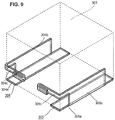
- FIG. 9 is a perspective view showing electrode members in the electronic component according to example embodiment 3 of the present invention.
- the electronic component shown in FIGS. 7 to 9 is an inductor and includes a magnetic-body core 301, a winding wire 302, a magnetic exterior body 303 similar to the magnetic exterior bodies 103, 203 in example embodiments 1, 2 and electrode members 304, 305.
- the magnetic-body core 301 includes a plate-shaped portion 311 having a substantially rectangular-parallelepiped shape and a core portion 312 having a substantially cylindrical shape which extends upward from the upper surface of the plate-shaped portion 311. It should be noted that it is allowed for the plate-shaped portion 311 and the core portion 312 to be formed integrally as a T-type core or to be formed as separate bodies which are combined together to form a T-shape one, for example, by an adhesive agent or through an engagement structure.
- the winding wire 302 includes a wound portion 321 by winding a rectangular wire into an Edgewise winding form and two non-wound portions 322, 323 extending from the wound portion 321 up to two distal ends thereof. As shown in FIG. 8 , the core portion 312 of the magnetic-body core 301 is inserted through the wound portion 321.
- the rectangular wire is wound into an Edgewise winding form so as to be laminated in a spiral shape along a winding axis.
- Edgewise winding form is a technique to apply the winding such that the wide-width surface of the rectangular wire will become approximately perpendicularly to the winding axis.
- the electrode members 304, 305 are formed by a conductive material such as copper or the like.
- the electrode member 304 includes a flat-plate shaped electrode portion 304a and a flat-plate shaped side-surface exposed-portion 304b which stands upright from the electrode portion 304a.
- the side-surface exposed-portion 304b is exposed from the magnetic exterior body 303 along one of two opposing side surfaces of the aforesaid electronic component.
- the electrode member 305 includes a flat-plate shaped electrode portion 305a and a flat-plate shaped side-surface exposed-portion 305b which stands upright from the electrode portion 305a.
- the side-surface exposed-portion 305b is exposed from the magnetic exterior body 303 along the other of the two opposing side surfaces of the aforesaid electronic component. It should be noted that also the electrode portions 304a, 305a are exposed from the magnetic exterior body 303.
- the electrode member 304 and the electrode member 305 are fixed to the magnetic-body core 301 by an adhesive agent or the like so as to let them face the two opposing side surfaces and the bottom surface of the plate-shaped portion 311 of the magnetic-body core 301.
- the side-surface exposed-portion 304b includes a connecting portion 304c extending approximately perpendicularly with respect to the height direction (that is, approximately parallelly with respect to the bottom surface) along the side surface of the magnetic exterior body 302.
- the side-surface exposed-portion 305b includes a connecting portion 305c extending approximately perpendicularly with respect to the height direction (that is, approximately parallelly with respect to the bottom surface) along the side surface of the magnetic exterior body 302.
- the connecting portions 304c, 305c are bent at the respective edges of the side surfaces and extend along a side surface different from the two side surfaces on which the side-surface exposed-portions 304b, 305b are arranged.
- the distal portion of the connecting portion 304c is connected with the non-wound portion 322 and the distal portion of the connecting portion 305c is connected with the non-wound portion 323.
- the distal end of the non-wound portion 322 is bent toward the bottom-surface direction of the aforesaid electronic component, the distal end of the connecting portion 304c is bent approximately 180 degrees so as to wrap the distal end of the non-wound portion 322, and the connecting portion 304c and the non-wound portion 322 are mutually connected by pressure bonding, by welding, by soldering and the like.
- the distal end of the non-wound portion 323 is bent toward the upper-surface direction of the aforesaid electronic component, the distal end of the connecting portion 305c is bent approximately 180 degrees so as to wrap the distal end of the non-wound portion 323, and the connecting portion 305c and the non-wound portion 323 are mutually connected by pressure bonding, by welding, by soldering and the like.
- the connecting points between the connecting portions 304c, 305c and the non-wound portions 322, 323 are exposed, but it is allowed to employ a configuration in which the connecting portions are sealed in the inside of the magnetic exterior body 303.
- the electrode portions 304a, 305a of the electrode members 304, 305 are soldered on the substrate and solder fillets are formed at the side-surface exposed-portions 304b, 305b.
- the non-wound portions 322, 323 of the winding wire 302 are extended approximately in parallel toward a side surface on which the side-surface exposed-portions 304b, 305b of the aforesaid electronic component do not exist, are bent on the side surfaces thereof and are connected to the electrode members 304, 305, so that the winding wire 302 which is a rectangular wire wound into an Edgewise winding form is connected to the electrode members 304, 305 without being twisted.
- the non-wound portions 322, 323 of the winding wire 302 are extended approximately in parallel toward a side surface and even though both the positions thereof in the height direction are different, the non-wound portions 322, 323 are connected to the electrode members 304, 305 at identical heights by bending the distal end of the non-wound portion 322 toward the downward direction and by bending the distal end of the non-wound portion 323 toward the upward direction.
- the shapes of the electrode members 304, 305 it is possible for the shapes of the electrode members 304, 305 to be symmetrical in the right and left direction and when creating the electrode members 304, 305 by bending plate-shaped members, it is possible to create the electrode members 304, 305 by two plate-shaped members having identical shapes. In this way, it is enough to design a single shape for the electrode terminals 304, 305 and therefore, it is possible to shorten the designing time.
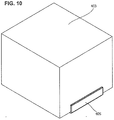
- FIG. 10 is a perspective view showing an electronic component according to an example embodiment 4 of the present invention.
- FIG. 11 is a perspective view showing a magnetic-body core, a winding wire and electrode members in the electronic component according to example embodiment 4 of the present invention.
- FIG. 12 is a perspective view showing electrode members in the electronic component according to example embodiment 4 of the present invention.
- the electronic component shown in FIGS. 10 to 12 is an inductor and includes a magnetic-body core 401, a winding wire 402, a magnetic exterior body 403 similar to the magnetic exterior bodies 103, 203, 303 in the example embodiments 1 to 3 and electrode members 404, 405.
- the magnetic-body core 401 includes a plate-shaped portion 411 having a substantially rectangular-parallelepiped shape and a core portion 412 having a substantially cylindrical shape which extends upward from the upper surface of the plate-shaped portion 411. It should be noted that it is allowed for the plate-shaped portion 411 and the core portion 412 to be formed integrally as a T-type core or to be formed as separate bodies which are combined together to form a T-shape one, for example, by an adhesive agent or through an engagement structure.
- concave portions 411a, 411b having predetermined widths and predetermined depths.
- the winding wire 402 includes a wound portion 421 by winding a rectangular wire into an Edgewise winding form and two non-wound portions 422, 423 extending from the wound portion 421 up to two distal ends thereof. As shown in FIG. 11 , the core portion 412 of the magnetic-body core 401 is inserted through the wound portion 421.
- the electrode members 404, 405 are formed by a conductive material such as copper or the like.
- the electrode member 404 includes a flat-plate shaped electrode portion 404a and a flat-plate shaped side-surface exposed-portion 404b which stands upright from the electrode portion 404a.
- the side-surface exposed-portion 404b is exposed from the magnetic exterior body 403 along one of two opposing side surfaces of the aforesaid electronic component.
- the electrode member 405 includes a flat-plate shaped electrode portion 405a and a flat-plate shaped side-surface exposed-portion 405b which stands upright from the electrode portion 405a.
- the side-surface exposed-portion 405b is exposed from the magnetic exterior body 403 along the other of the two opposing side surfaces of the aforesaid electronic component. It should be noted that also the electrode portions 404a, 405a are exposed from the magnetic exterior body 403.
- the electrode member 404 and the electrode member 405 are fixed to the magnetic-body core 401 by an adhesive agent or the like so as to let them face the two opposing side surfaces and the bottom surface of the plate-shaped portion 411 of the magnetic-body core 401.
- the side-surface exposed-portion 404b includes a connecting portion 404c extended along a pair of concave portions 411a of the plate-shaped portion 411 of the magnetic-body core 401 and the upper surface by being bent, and on the upper surface of the plate-shaped portion 411, the connecting portion 404c is connected with the non-wound portion 422.
- the side-surface exposed-portion 405b includes a connecting portion 405c extended along a pair of concave portions 411b of the plate-shaped portion 411 of the magnetic-body core 401 and the upper surface by being bent.
- the non-wound portion 423 is extended toward the direction different by approximately 180 degrees with respect to the non-wound portion 422, includes a step portion 423a and is connected to the connecting portion 405c on the upper surface of the plate-shaped portion 411.
- the step portion 423a is provided in order to arrange the distal end of the non-wound portion 423 (the portion connected to the connecting portion 405c) approximately at the same height as the height of the distal portion of the non-wound portion 422 (the portion connected to the connecting portion 404c). It should be noted that by pressure bonding, by welding, by soldering and the like, the connecting portion 404c and the non-wound portion 422 are mutually connected and the connecting portion 405c and the non-wound portion 423 are mutually connected.
- the connecting portions 404c, 405c are bent so as to go along the concave portions 411a, 411b and the upper surface of the plate-shaped portion 411 of the magnetic-body core 401 whereby the electrode members 404, 405 grasp the plate-shaped portion 411. For this reason, it is allowed not to use an adhesive agent or the like for the fixation of the magnetic-body core 401 onto the electrode members 404, 405.
- the electrode portions 404a, 405a of the electrode members 404, 405 are soldered on the substrate and solder fillets are formed at the side-surface exposed-portions 404b, 405b.
- the non-wound portions 422, 423 of the winding wire 402 are connected to the connecting portions 404c, 405c of the electrode members 404, 405 which are arranged along the upper surface of the plate-shaped portion 411 of the magnetic-body core 401 and, therefore, the winding wire 402 which is a rectangular wire wound into an Edgewise winding form is connected to the electrode members 404, 405 without being twisted.
- the connecting portions 404c, 405c are bent twice from the bottom surface to the upper surface of the plate-shaped portion 411 along the concave portions 411a, 411b of the magnetic-body core 401 and, therefore, it is difficult for the electrode members 404, 405 to drop out from the magnetic-body core 401.
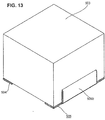
- FIG. 13 is a perspective view showing an electronic component according to an example embodiment 5 of the present invention.
- FIG. 14 is a perspective view showing a magnetic-body core, a winding wire and electrode members in the electronic component according to the example embodiment 5 of the present invention.
- FIG. 15 is a perspective view showing electrode members in the electronic component according to the example embodiment 5 of the present invention.
- the electronic component shown in FIGS. 13 to 15 is an inductor and includes a magnetic-body core 501 similar to the magnetic-body core 301 in example embodiment 3; a winding wire 502; a magnetic exterior body 503 similar to the magnetic exterior bodies 103, 203, 303, 403 in example embodiments 1 to 4; and electrode members 504, 505.
- the winding wire 502 includes a wound portion 521 wound by a rectangular wire into an Edgewise winding form and two non-wound portions 522, 523 extending from the wound portion 521 up to two distal ends thereof. As shown in FIG. 14 , the core portion 512 of the magnetic-body core 501 is inserted through the wound portion 521.
- the electrode members 504, 505 are formed by a conductive material such as copper or the like.
- the electrode member 504 includes a flat-plate shaped electrode portion 504a and a flat-plate shaped side-surface exposed-portion 504b which stands upright from the electrode portion 504a.
- the side-surface exposed-portion 504b is exposed from the magnetic exterior body 503 along one of two opposing side surfaces of the aforesaid electronic component.
- the electrode member 505 includes a flat-plate shaped electrode portion 505a and a flat-plate shaped side-surface exposed-portion 505b which stands upright from the electrode portion 505a.
- the side-surface exposed-portion 505b is exposed from the magnetic exterior body 503 along the other of the two opposing side surfaces of the aforesaid electronic component. It should be noted that also the electrode portions 504a, 505a are exposed from the magnetic exterior body 503.
- the electrode member 504 and the electrode member 505 are fixed to the magnetic-body core 501 by an adhesive agent or the like so as to face the two opposing side surfaces and the bottom surface of the plate-shaped portion 511 of the magnetic-body core 501.
- the side-surface exposed-portion 504b includes a connecting portion 504c which extends approximately parallel to the electrode portion 504a and the bottom surface of the magnetic-body core 501, and the connecting portion 504c is connected with the non-wound portion 522.
- the height of the electrode member 504 is designed to be in conformity with the position of the non-wound portion 522 in the height direction thereof and the connecting portion 504c includes two connecting protruded-portions 504c1, 504c2 which extend toward two directions by predetermined angles (for example, 45 degrees) centered on the core portion 521, respectively.
- the non-wound portion 522 is connected to either one of the two connecting protruded-portions 504c1, 504c2 depending on the number of turns of the winding wire 502 (for example, fraction such as 1/4-turn).
- the side-surface exposed-portion 505b includes a connecting portion 505c which extends approximately parallel to the electrode portion 505a and the connecting portion 505c is connected with the non-wound portion 523.
- the height of the electrode member 505 is designed to be in conformity with the position of the non-wound portion 523 in the height direction thereof and the connecting portion 505c includes two connecting protruded-portions 505c1, 505c2 which extend toward two directions by predetermined angles (for example, 45 degrees) centered on the core portion 521, respectively.
- the non-wound portion 523 is connected to either one of the two connecting protruded-portions 505c1, 505c2 depending on the number of turns of the winding wire 502 (for example, fraction such as 1/4-turn).
- the electrode portions 504a, 505a of the electrode members 504, 505 are soldered on the substrate and solder fillets are formed at the side-surface exposed-portions 504b, 505b.
- the non-wound portions 522, 523 of the winding wire 502 are connected to the connecting portions 504c, 505c of the electrode members 504, 505 which are arranged along the upper surface, on the upper surface or above the upper surface of the plate-shaped portion 511 of the magnetic-body core 501 and therefore, the winding wire 502 which is a rectangular wire wound into an Edgewise winding form is connected to the electrode members 504, 505 without being twisted.
- each of the connecting portions 504c, 505c includes two connecting protruded-portions (504c1, 504c2), (505c1, 505c2) respectively and, therefore, by selecting the connecting protruded-portions which are to be used for the connections, it is possible to fine-adjust the number of turns of the wound portion 521 (that is, the inductance thereof) by less than one turn (for example, 1/4-turn).
- FIG. 16 is a perspective view showing an electronic component according to an example embodiment 6 of the present invention (First-Aspect thereof).
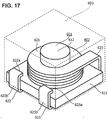
- FIG. 17 is a perspective view showing a magnetic-body core and a winding wire in the electronic component according to example embodiment 6.
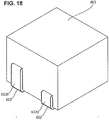
- FIG. 18 is a perspective view showing an electronic component according to example embodiment 6 (Second-Aspect thereof).
- the electronic component shown in FIGS. 16 to 18 is an inductor and includes a magnetic-body core 601, a winding wire 602 and a magnetic exterior body 603.
- the magnetic-body core 601 includes a plate-shaped portion 611 having a substantially rectangular-parallelepiped shape and a core portion 612 having a substantially cylindrical shape which extends upward from the upper surface of the plate-shaped portion 611. It should be noted that it is allowed for the plate-shaped portion 611 and the core portion 612 to be formed integrally as a T-type core or to be formed as separate bodies which are combined together to form a T-shape one, for example, by an adhesive agent or through an engagement structure.
- the winding wire 602 includes a wound portion 621 by winding a rectangular wire into an Edgewise winding form and two non-wound portions 622, 623 extending from the wound portion 621 up to two distal ends 622a, 623a thereof. As shown in FIG. 17 , the core portion 612 of the magnetic-body core 601 is inserted through the wound portion 621.
- the rectangular wire is wound into an Edgewise winding form in which the layers are laminated in a spiral shape along the winding axis.
- Both of the two non-wound portions 622, 623 are arranged approximately in parallel with each other along a first side-surface, a bottom surface (surface facing the upper surface) and a second side-surface facing the first side-surface of the plate-shaped portion 611 of the magnetic-body core 601.
- the two non-wound portions 622, 623 are formed so as to be extended in the same direction.
- the two non-wound portions 622, 623 are arranged along the bottom surface of the aforesaid electronic component and along the first side-surface and the second side-surface, respectively. Then, for the two non-wound portions 622, 623, the portions which are arranged along the bottom surface are used for the electrodes.
- the two non-wound portions 622, 623 are bent so as to go along the side surface of the aforesaid electronic component. Further, the distal ends 622a, 623a of the two non-wound portions 622, 623 are positioned in the inside of the magnetic exterior body 603 and sealed and fixed in the magnetic exterior body 603.
- side-surface exposed-portions 622b, 623b are formed by the two non-wound portions 622, 623 on the two side surfaces facing each other.
- the magnetic exterior body 603 is a body obtained by molding an admixture including a magnetic material (magnetic-powder body such as ferrite, metal magnetic body or the like) and a resin by a predetermined molding method so as to cover at least the wound portion 621 and the core portion 612.
- a magnetic material magnetic-powder body such as ferrite, metal magnetic body or the like
- a resin by a predetermined molding method so as to cover at least the wound portion 621 and the core portion 612.
- the magnetic exterior body 603 is formed so as to completely cover the wound portion 621 of the winding wire 602, the core portion 612 of the magnetic-body core 601, and the upper surface and the side surfaces of the plate-shaped portion 611.
- the magnetic exterior body 603 has an outer shape of a substantially rectangular-parallelepiped. By filling and curing the admixture in the inside of a substantially rectangular-parallelepiped mold, there is formed the magnetic exterior body 603.
- the magnetic exterior body is to be formed without covering the side surfaces of the plate-shaped portion 611 of the magnetic-body core 601.
- the winding wire 602 is assembled on the core portion 612 of the magnetic-body core 601.
- the non-wound portions 622, 623 of the winding wire 602 are led-around so as to form electrode portions which extend along the side-surface exposed-portions 622b, 623b and the bottom surface of the magnetic-body core 601. At that time, if necessary, it is allowed to cut off unnecessary portions of the non-wound portions 622, 623.
- the magnetic-body core 601 and the winding wire 602 which are mutually assembled are arranged in the inside of a mold, an admixture including a magnetic material and a resin is filled into the inside of the mold, and by curing the admixture thereof, the magnetic exterior body 603 is formed.
- the non-wound portions 622, 623 which are arranged on the bottom surface are soldered on the substrate and solder fillets are formed at the side-surface exposed-portions 622b, 623b.
- the non-wound portions 622, 623 of the winding wire 602 form the side-surface exposed-portions 622b, 623b on the two facing side surfaces of the aforesaid electronic component.
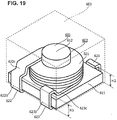
- FIG. 19 is a perspective view showing a magnetic-body core and a winding wire in an electronic component according to an example embodiment 7 of the present invention.
- the electronic component according to the example embodiment 7 of the present invention has similar constitutions as those of the electronic component according to example embodiment 6, but has different constitutions in the following aspects.
- At least one (here, both) of the non-winding wire portions 622, 623 have step portions 622c, 623c between the winding wire portion 621 and the side surface of the magnetic exterior body 603, and owing to the step portions 622c, 623c thereof, the heights H1 of the side-surface exposed-portions 622b, 623b at the same side surface of the electronic component are designed to be identical to each other.
- the heights H1 of the side-surface exposed-portions 622b, 623b at one side surface and the heights H2 of the side-surface exposed-portions 622b, 623b at the other side surface are designed to be the same.
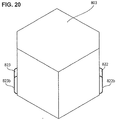
- FIG. 20 is a perspective view showing an electronic component according to an example embodiment 8 of the present invention.
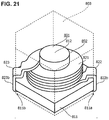
- FIG. 21 is a perspective view showing a magnetic-body core and a winding wire in the electronic component according to example embodiment 8 of the present invention (First-Aspect thereof).
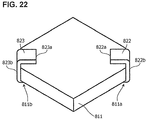
- FIG. 22 is a perspective view, from underneath, showing a magnetic-body core and a winding wire in the electronic component according to example embodiment 8 of the present invention (Second-Aspect thereof).
- the electronic component shown in FIGS. 20 to 22 is an inductor and includes a magnetic-body core 801, a winding wire 802 and a magnetic exterior body 803.
- the magnetic-body core 801 includes a plate-shaped portion 811 having a substantially rectangular-parallelepiped shape and a core portion 812 having a substantially cylindrical shape which extends upward from the upper surface of the plate-shaped portion 811. It should be noted that it is allowed for the plate-shaped portion 811 and the core portion 812 to be formed integrally as a T-type core or to be formed as separate bodies which are combined together to form a T-shape one, for example, by an adhesive agent or through an engagement structure.
- corner cutoff portions 811a, 811b which are cut-off at a predetermined angle (for example, at 45 degrees).
- the winding wire 802 includes a wound portion 821 wound by a rectangular wire into an Edgewise winding form and two non-wound portions 822, 823 extended from the wound portion 821 up to two distal ends 822a, 823a thereof. As shown in FIG. 21 , the core portion 812 of the magnetic-body core 801 is inserted through the wound portion 821.
- the rectangular wire is wound into an Edgewise winding form in which the layers are laminated in a spiral shape along the winding axis.
- the non-wound portions 822, 823 are bent toward the Edgewise directions and are pulled out toward mutually-opposite directions (directions different by approximately 180 degrees) centered on the winding axis.
- the non-wound portion 822 is arranged along the corner cutoff portion 811a as a side surface of the plate-shaped portion 811 of the magnetic-body core 801 and along the bottom surface, and the non-wound portion 823 is arranged along the corner cutoff portion 811b as a side surface of the plate-shaped portion 811 of the magnetic-body core 801 and along the bottom surface.
- the non-wound portions 822, 823 are fixed on the magnetic-body core 801, for example, by using an adhesive agent.
- the two non-wound portions 822, 823 are bent so as to go along the side surfaces (corner cutoff portions 811a, 811b) of the aforesaid electronic component.
- the portions which are arranged along the bottom surface are used as electrode portions and the portions which are arranged along the corner cutoff portions 811a, 811b are used as side-surface exposed-portions 822b, 823b.
- the magnetic exterior body 803 is a body obtained by molding an admixture including a magnetic material (magnetic-powder body such as ferrite, metal magnetic body or the like) and a resin by a predetermined molding method so as to cover at least the wound portion 621 and the core portion 612.
- a magnetic material magnetic-powder body such as ferrite, metal magnetic body or the like
- a resin by a predetermined molding method so as to cover at least the wound portion 621 and the core portion 612.
- the magnetic exterior body 803 is formed so as to completely cover the wound portion 821 of the winding wire 802, the core portion 812 of the magnetic-body core 801, and the upper surface and the side surfaces (including corner cutoff portions 811a, 811b) of the plate-shaped portion 811. Therefore, also the magnetic exterior body 803 has corner cut-off shapes in conformity with the corner cutoff portions 811a, 811b.
- the magnetic exterior body 803 is to be formed without covering the side surfaces (including corner cutoff portions 811a, 811b) of the plate-shaped portion 811 of the magnetic-body core 801.
- the non-wound portions 822, 823 are fixed on the bottom surface of the magnetic-body core 801 by an adhesive agent or the like.
- the non-wound portions 822, 823 which are arranged on the bottom surface are soldered on the substrate and solder fillets are formed at the side-surface exposed-portions 822b, 823b.
- the non-wound portions 822, 823 of the winding wire 802 extend along the facing corner cutoff portions 811a, 811b of the plate-shaped portion 811 of the magnetic-body core 801, and the side-surface exposed-portions 822b, 823b are formed at the two facing corners of the aforesaid electronic component.
- the solder fillets at the two corners of the aforesaid electronic component without using electrode members which will be formed as separate members.
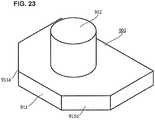
- FIG. 23 is a perspective view showing a magnetic-body core in an electronic component according to an example embodiment 9 of the present invention.
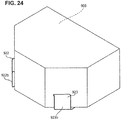
- FIG. 24 is a perspective view showing the electronic component according to example embodiment 9 of the present invention.
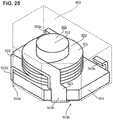
- FIG. 25 is a perspective view showing a magnetic-body core and a winding wire in the electronic component according to example embodiment 9 of the present invention (First-Aspect thereof).
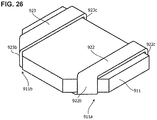
- FIG. 26 is a perspective view, from underneath, showing a magnetic-body core and a winding wire in the electronic component according to the example embodiment 9 of the present invention (Second-Aspect thereof).
- the electronic component shown in FIGS. 23 to 26 is an inductor and includes a magnetic-body core 901, a winding wire 902 and a magnetic exterior body 903.
- the magnetic-body core 901 includes a plate-shaped portion 911 having a substantially rectangular-parallelepiped shape and a core portion 912 having a substantially cylindrical shape which extends upward from the upper surface of the plate-shaped portion 911. It should be noted that it is allowed for the plate-shaped portion 911 and the core portion 912 to be formed integrally as a T-type core or to be formed as separate bodies which are combined together to form a T-shape one, for example, by an adhesive agent or through an engagement structure.
- corner cutoff portions 911a, 911b which are cut-off at a predetermined angle (for example, by 45 degrees).
- the winding wire 902 has a wound portion 921 wound by a rectangular wire into an Edgewise winding form and two non-wound portions 922, 923 extended from the wound portion 921 up to two distal ends 922a, 923a thereof. As shown in FIG. 25 , the core portion 912 of the magnetic-body core 901 is inserted through the wound portion 921.
- the rectangular wire is wound into an Edgewise winding form in which the layers are laminated in a spiral shape along the winding axis.
- the non-wound portion 922 is arranged along the corner cutoff portion 911a as a side surface of the plate-shaped portion 911 of the magnetic-body core 901 and along the bottom surface
- the non-wound portion 923 is arranged along the corner cutoff portion 911b as a side surface of the plate-shaped portion 911 of the magnetic-body core 901 and along the bottom surface.
- the non-wound portions 922, 923 are arranged approximately in parallel with each other.
- the non-wound portions 922, 923 are fixed on the magnetic-body core 901, for example, by using an adhesive agent.
- the two non-wound portions 922, 923 are bent so as to go along the side surfaces (corner cutoff portions 911a, 911b) of the aforesaid electronic component.
- the portions which are arranged along the bottom surface are used as electrode portions and the portions which are arranged along the corner cutoff portions 911a, 911b are used as side-surface exposed-portions 922b, 923b.
- the two non-wound portions 922, 923 are bent so as to go along the facing side surfaces of the aforesaid electronic component in which there exist the corner cutoff portions 911a, 911b.
- distal ends 922a, 923a of the two non-wound portions 922, 923 are positioned in the inside of the magnetic exterior body 903 and sealed in and fixed at the magnetic exterior body 903.
- the magnetic exterior body 903 is a body obtained by molding an admixture including a magnetic material (magnetic-powder body such as ferrite, metal magnetic body or the like) and a resin by a predetermined molding method so as to cover at least the wound portion 921 and the core portion 912.
- a magnetic material magnetic-powder body such as ferrite, metal magnetic body or the like
- a resin by a predetermined molding method so as to cover at least the wound portion 921 and the core portion 912.
- the magnetic exterior body 903 is formed so as to completely cover the wound portion 921 of the winding wire 902, the core portion 912 of the magnetic-body core 901, and the upper surface and the side surfaces (including corner cutoff portions 911a, 911b) of the plate-shaped portion 911.
- the magnetic exterior body 903 is to be formed without covering the side surfaces (including corner cutoff portions 911a, 911b) of the plate-shaped portion 911 of the magnetic-body core 901.
- the non-wound portions 922, 923 which are arranged on the bottom surface are soldered on the substrate and solder fillets are formed at the side-surface exposed-portions 922b, 923b and side-surface exposed-portions 922c, 923c.
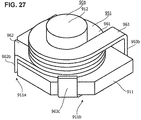
- FIG. 27 is a perspective view showing a modified example of the winding wire in the electronic component according to the example embodiment 9 of the present invention.
- the non-winding wire portions 922, 923 extend toward directions that are approximately 180 degrees different from each other, but with regard to the winding wire 951 shown in FIG. 27 , the non-wound portions 962, 963 extending from the wound portion 961 extend toward directions that are approximately 90 degrees different from each other.
- the one non-wound portion 963 is arranged so as to extend toward the bottom surface along a side surface which is different from the corner cutoff portions 911a, 911b.
- the portion extending along the side surface is exposed from the magnetic exterior body 903 and is used as a side-surface exposed-portion 963b.
- the other non-wound portion 962 is arranged similarly as the abovementioned non-winding wire portion 922 and the portion extending along the corner cutoff portion 911a is used as a side-surface exposed-portion 962b. Therefore, also in the case shown in FIG. 27 , the non-winding wire portions 962, 963 are arranged approximately in parallel with each other for the bottom surface.
- the non-wound portion 963 which is used for the side-surface exposed-portion 963b is bent at the edge between the bottom surface and the corner cutoff portion 911b of the magnetic-body core 901 and extends along the corner cutoff portion 911b, in which for the non-wound portion 963, a portion thereof which extends along the corner cutoff portion 911b is used as a side-surface exposed-portion 963c. Further, it is allowed to employ a configuration in which the distal portion of the non-wound portion 963 is bent toward the core portion 912 of the magnetic-body core 901 and the distal end of the non-wound portion 963 is sealed in and fixed at the magnetic exterior body 903.
- the non-wound portions 922, 923 of the winding wire 902 extend along the corner cutoff portions 911a, 911b of the plate-shaped portion 911 of the magnetic-body core 901, and the side-surface exposed-portions 922b, 923b are formed at the two facing corners of the aforesaid electronic component.
- the solder fillets at the two corners without using electrode members which will be formed as separate members.
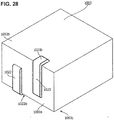
- FIG. 28 is a perspective view showing an electronic component according to an example embodiment 10 of the present invention.
- FIG. 29 is a perspective view showing a magnetic-body core and a winding wire in the electronic component according to example embodiment 10 of the present invention.
- the electronic component shown in FIGS. 28 and 29 is an inductor and includes a magnetic-body core 1001, a winding wire 1002, and a magnetic exterior body 1003.
- the magnetic-body core 1001 includes a plate-shaped portion 1011 having a substantially cylindrical shape, and a core portion 1012 having a substantially cylindrical shape which extends upward from the upper surface of the plate-shaped portion 1011. It should be noted that it is allowed for the plate-shaped portion 1011 and the core portion 1012 to be formed integrally as a T-type core, or to be formed as separate bodies which are combined together to form a T-shape one, for example, by an adhesive agent or through an engagement structure.
- the mounting face of the electronic component according to this example embodiment is selected to be a surface 1003a and the core portion 1012 of the magnetic-body core 1001 is arranged approximately in parallel with respect to the mounting face.
- the winding wire 1002 includes a wound portion 1021 wound by the rectangular wire into an Edgewise winding form, two non-wound portions 1022, 1023 from the wound portion 1021 up to two distal ends 1022a, 1023a thereof. As shown in FIG. 29 , the core portion 1012 of the magnetic-body core 1001 is inserted through the wound portion 1021.
- a rectangular wire is wound into an Edgewise winding form in which the layers are laminated in a spiral shape along the winding axis.
- the non-wound portions 1022, 1023 mutually extend approximately in parallel toward a direction perpendicular with respect to the side surface of the magnetic-body core 1001, are bent and extend along the surface 1003a (that is, the bottom surface of the aforesaid electronic component) of the magnetic exterior body 1003.
- non-wound portions 1022, 1023 are bent at the edge portions of the magnetic exterior body 1003 respectively and extend along the surfaces 1003b, 1003c (that is, side surfaces of the aforesaid electronic component). Further, the non-wound portions 1022, 1023 are bent, and the distal ends 1022a, 1023a thereof are positioned in the inside of the magnetic exterior body 1003 and are sealed in and fixed at the magnetic exterior body 1003.
- the two non-wound portions 1022, 1023 are bent so as to go along the side surface of the aforesaid electronic component.
- portions which are arranged along the bottom surface are used as electrode portions and portions which are arranged along the side surface are used as side-surface exposed-portions 1022b, 1023b.
- the magnetic exterior body 1003 is a body obtained by molding an admixture including a magnetic material (magnetic-powder body such as ferrite, metal magnetic body or the like) and a resin by a predetermined molding method so as to cover at least the wound portion 1021 and the core portion 1012.
- a magnetic material magnetic-powder body such as ferrite, metal magnetic body or the like
- a resin by a predetermined molding method so as to cover at least the wound portion 1021 and the core portion 1012.
- the magnetic exterior body 1003 is formed so as to completely cover the wound portion 1021 of the winding wire 1002, and the core portion 1012 and the plate-shaped portion 1011 of the magnetic-body core 1001.
- the non-wound portions 1022, 1023 which are arranged on the bottom surface are soldered on the substrate and solder fillets are formed at the side-surface exposed-portions 1022b, 1023b.
- the non-wound portions 1022, 1023 of the winding wire 1002 are mutually pulled out approximately in parallel toward the bottom surface (that is, the mounting face) of the aforesaid electronic component, are bent toward mutually opposite directions, are arranged along the bottom surface, are further bent, and are arranged along the side surface. Therefore, even in a case in which the core portion 1012 of the magnetic-body core 1001 is arranged approximately in parallel with the bottom surface of the aforesaid electronic component, it is possible to confirm the solder fillets on the facing two side surfaces of the aforesaid electronic component without using electrode members which will be formed as separate members.
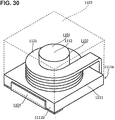
- FIG. 30 is a perspective view showing a magnetic-body core and a winding wire in an electronic component according to an example embodiment 11 of the present invention.
- FIG. 31 is a perspective view showing one example of a pseudo electrode member in FIG. 30 .
- the electronic component shown in FIG. 30 is an inductor and includes a magnetic-body core 1101, a winding wire 1102, a magnetic exterior body 1103 and a pseudo electrode member 1104.
- the magnetic-body core 1101 is the same magnetic-body core as the abovementioned magnetic-body core 601.
- the magnetic exterior body 1103 is a body obtained by molding an admixture including a magnetic material (magnetic-powder body such as ferrite, metal magnetic body or the like) and a resin by a predetermined molding method so as to cover at least the wound portion 1121 and the core portion 1112.
- a magnetic material magnetic-powder body such as ferrite, metal magnetic body or the like
- a resin by a predetermined molding method so as to cover at least the wound portion 1121 and the core portion 1112.
- the winding wire 1102 includes a wound portion 1121 wound by a rectangular wire into an Edgewise winding form and two non-wound portions from the wound portion 1121 up to two distal ends thereof.
- the core portion 1112 of the magnetic-body core 1101 is inserted through the wound portion 1121.
- Both of these two non-wound portions are arranged approximately in parallel with each other along a side surface 1111a and a bottom surface of a plate-shaped portion 1111 of the magnetic-body core 1101.
- the two non-wound portions are formed so as to be extended in the same direction. While being exposed, the two non-wound portions are extended from a magnetic exterior body 1103 along one side surface 1111a and the bottom surface of the magnetic-body core 1101, but they are not exposed from a side surface 1111b facing the side surface 1111a. Therefore, in this example embodiment, the non-wound portions of the winding wire 1102 are fixed on the bottom surface of the magnetic-body core 1101, for example, by an adhesive material.
- the non-wound portions of the winding wire 1102 are used as electrode portions and as side-surface exposed-portions for the one side surface 1111a.
- the pseudo electrode member 1104 is fixed on the magnetic-body core 1101, for example, by an adhesive agent.
- the pseudo electrode member 1104 includes a pseudo electrode portion 1141 having a flat-plate shape and a side-surface exposed-portion 1142 which is extended by being stood upright from the pseudo electrode portion 1141.
- the pseudo electrode portion 1141 and the side-surface exposed-portion 1142 are exposed from the magnetic exterior body 1103.
- the pseudo electrode portion 1141 is not connected to the winding wire 1102 electrically, but it is connected to the substrate at the time of the surface mounting. For this reason, solder fillets are formed also at the side-surface exposed-portion 1142 together with the side-surface exposed-portions formed by the non-wound portions of the winding wire 1102.
- the electronic component according to example embodiment 11 it is possible to manufacture the electronic component according to example embodiment 11 by similar procedures to those in the manufacturing method of the electronic component according to example embodiment 6. However, before forming the magnetic exterior body 1103, the pseudo electrode portion 1141 is fixed on the magnetic-body core 1101.
- the pseudo electrode member 1104 is installed on the side surface facing the side surface on which the side-surface exposed-portion is formed by the winding wire 1102.
- the magnetic-body core in the abovementioned example embodiments 1 to 11 it is allowed for the magnetic-body core in the abovementioned example embodiments 1 to 11 to employ a ferrite core or a powder-compacted core in which metal magnetic powders are compression-molded.
- magnetic powders of the powder-compacted core magnetic powders of which the main component is iron and on which silicon (Si) and chromium (Cr) are added by 1wt% to 10wt% respectively are preferable for usage because they are excellent in the aspect of the rust preventive property, the relative permeability or the like.
- the same metal magnetic-powder body as that of the corresponding magnetic-body core. It should be noted that in order to adjust the electromagnetic property, it is allowed, if necessary, to change the amount of the magnetic powders or the material to be used in the inside of the magnetic exterior body.
- a magnetic-body core attached with a winding wire is arranged in the inside of a mold, (a2) the inside of the mold is filled with a slurry-state admixture including a magnetic material and a resin and (a3) by thermally curing the slurry-state admixture filled in the inside of the mold, a magnetic exterior body is formed; a method in which: (b1) a magnetic-body core attached with a winding wire is arranged in the inside of a mold, (b2) the inside of the mold is filled with a putty-state admixture including a magnetic material and a resin, (b3) by thermally curing the putty-state admixture filled in the inside of the mold, a magnetic exterior body is formed; a method in which: (c1) a magnetic-body core attached with a winding wire is arranged in the
- the electronic component according to the aforesaid example embodiments 1 to 11 is an inductor, but it is also allowed to employ an element which includes a similar magnetic-body core, a similar winding wire and a similar magnetic exterior body or to employ an electronic component in which other elements are formed together with the magnetic-body core and the winding wire in a single package.
- Such an electronic component includes also an electronic component, such as, for example, a DC-DC converter, which includes an IC (Integrated Circuit) chip, a capacitor, a circuit board and the like.
- the elements such as a magnetic-body core on which there is assembled a winding wire formed by a rectangular wire as mentioned above, an IC chip and the like are mounted on a PCB substrate, in which they are sealed by a magnetic exterior body as mentioned above.
- the abovementioned electrode members it is possible to use the abovementioned electrode members as the terminals of the DC-DC converter.
- the core portion of the magnetic-body core is protruded upward from the most upper surface of the wound portion of the winding wire, but it is allowed to form the core portion of the magnetic-body core to be lower than the most upper surface of the wound portion of the winding wire. In addition, it is enough if the height of the core portion of magnetic-body core is set corresponding to the requested inductance value.
- a rectangular wire is used for the winding wire, but it is allowed to use a round wire if necessary.
- the winding methods of the winding wire they are not limited by the methods described in the aforesaid example embodiments 1 to 11, and it is possible, with regard to the rectangular wire, to employ methods such as Flatwise-winding, Edgewise winding and the like for the multi layers (two layers, three layers, four layers or the like) appropriately if necessary, and with regard to the round wire, it is possible to employ methods such as an alignment-winding, an alpha-winding and the like appropriately if necessary.
- the number of turns of the winding wire is determined corresponding to the inductance value or the like which is requested for the aforesaid electronic component.
- the present invention is applicable, for example, to an electronic component including a magnetic-body core and a winding wire.
Landscapes
- Engineering & Computer Science (AREA)
- Power Engineering (AREA)
- Microelectronics & Electronic Packaging (AREA)
- Coils Or Transformers For Communication (AREA)
- Coils Of Transformers For General Uses (AREA)
Priority Applications (1)
| Application Number | Priority Date | Filing Date | Title |
|---|---|---|---|
| EP17155911.5A EP3188202B1 (fr) | 2015-02-23 | 2016-02-23 | Composant électronique |
Applications Claiming Priority (1)
| Application Number | Priority Date | Filing Date | Title |
|---|---|---|---|
| JP2015033415A JP2016157751A (ja) | 2015-02-23 | 2015-02-23 | 電子部品 |
Related Child Applications (1)
| Application Number | Title | Priority Date | Filing Date |
|---|---|---|---|
| EP17155911.5A Division EP3188202B1 (fr) | 2015-02-23 | 2016-02-23 | Composant électronique |
Publications (2)
| Publication Number | Publication Date |
|---|---|
| EP3067902A2 true EP3067902A2 (fr) | 2016-09-14 |
| EP3067902A3 EP3067902A3 (fr) | 2016-10-05 |
Family
ID=55453031
Family Applications (2)
| Application Number | Title | Priority Date | Filing Date |
|---|---|---|---|
| EP17155911.5A Active EP3188202B1 (fr) | 2015-02-23 | 2016-02-23 | Composant électronique |
| EP16156895.1A Withdrawn EP3067902A3 (fr) | 2015-02-23 | 2016-02-23 | Composant électronique |
Family Applications Before (1)
| Application Number | Title | Priority Date | Filing Date |
|---|---|---|---|
| EP17155911.5A Active EP3188202B1 (fr) | 2015-02-23 | 2016-02-23 | Composant électronique |
Country Status (4)
| Country | Link |
|---|---|
| US (3) | US20160247626A1 (fr) |
| EP (2) | EP3188202B1 (fr) |
| JP (1) | JP2016157751A (fr) |
| CN (1) | CN105913998A (fr) |
Cited By (1)
| Publication number | Priority date | Publication date | Assignee | Title |
|---|---|---|---|---|
| EP3748655A1 (fr) * | 2019-06-04 | 2020-12-09 | Sumida Corporation | Bobine dinduction |
Families Citing this family (42)
| Publication number | Priority date | Publication date | Assignee | Title |
|---|---|---|---|---|
| TWI438792B (zh) * | 2011-01-04 | 2014-05-21 | Cyntec Co Ltd | 電感器 |
| KR101719916B1 (ko) * | 2015-08-18 | 2017-03-24 | 삼성전기주식회사 | 코일 전자 부품 |
| JP6759609B2 (ja) | 2016-02-04 | 2020-09-23 | Tdk株式会社 | コイル部品 |
| KR20170118430A (ko) * | 2016-04-15 | 2017-10-25 | 삼성전기주식회사 | 코일 전자부품 및 그 제조방법 |
| TWI624845B (zh) * | 2016-11-08 | 2018-05-21 | Alps Electric Co Ltd | 電感元件及其製造方法 |
| JP6885092B2 (ja) | 2017-02-15 | 2021-06-09 | スミダコーポレーション株式会社 | コイル部品の製造方法 |
| JP2018182209A (ja) * | 2017-04-19 | 2018-11-15 | 株式会社村田製作所 | コイル部品 |
| JP7075185B2 (ja) * | 2017-04-27 | 2022-05-25 | 太陽誘電株式会社 | コイル部品及び電子機器 |
| JP6869796B2 (ja) * | 2017-04-27 | 2021-05-12 | 太陽誘電株式会社 | コイル部品 |
| JP6956400B2 (ja) * | 2017-06-21 | 2021-11-02 | 国立大学法人信州大学 | 磁性被覆コイル及びこれを用いたトランス |
| JP7052238B2 (ja) * | 2017-07-18 | 2022-04-12 | Tdk株式会社 | コイル装置 |
| KR101983193B1 (ko) * | 2017-09-22 | 2019-05-28 | 삼성전기주식회사 | 코일 부품 |
| JP7103787B2 (ja) * | 2017-12-27 | 2022-07-20 | 太陽誘電株式会社 | コイル部品及び電子機器 |
| WO2019178737A1 (fr) * | 2018-03-20 | 2019-09-26 | 深圳顺络电子股份有限公司 | Élément d'inductance et procédé de fabrication |
| WO2018127252A2 (fr) * | 2018-04-19 | 2018-07-12 | 深圳顺络电子股份有限公司 | Inducteur de type assemblage et son procédé de fabrication |
| JP7132745B2 (ja) * | 2018-05-08 | 2022-09-07 | 株式会社村田製作所 | 表面実装インダクタ |
| US11424070B2 (en) * | 2018-06-19 | 2022-08-23 | Tdk Corporation | Coil component |
| CN109448970A (zh) * | 2018-11-07 | 2019-03-08 | 深圳振华富电子有限公司 | 开关电源变压器 |
| JP2020077795A (ja) * | 2018-11-08 | 2020-05-21 | 株式会社村田製作所 | 表面実装インダクタ |
| JP2020077790A (ja) * | 2018-11-08 | 2020-05-21 | 株式会社村田製作所 | 表面実装インダクタ |
| US12347603B2 (en) * | 2018-12-28 | 2025-07-01 | Texas Instruments Incorporated | Molded inductor with magnetic core having mold flow enhancing channels |
| JP7279457B2 (ja) * | 2019-03-26 | 2023-05-23 | 株式会社村田製作所 | インダクタ |
| US11855540B2 (en) * | 2019-03-26 | 2023-12-26 | Texas Instruments Incorporated | Leadframe for conductive winding |
| JP7339012B2 (ja) * | 2019-03-29 | 2023-09-05 | 太陽誘電株式会社 | コイル部品の製造方法 |
| US11501906B2 (en) * | 2019-05-23 | 2022-11-15 | Chilisin Electronics Corp. | Inductor manufacturing method |
| JP7107283B2 (ja) * | 2019-06-10 | 2022-07-27 | 株式会社村田製作所 | インダクタ |
| JP2021027203A (ja) * | 2019-08-06 | 2021-02-22 | 株式会社村田製作所 | インダクタ |
| CN111684551A (zh) * | 2020-04-21 | 2020-09-18 | 深圳顺络电子股份有限公司 | 一种电感元器件及制造方法 |
| JP7664094B2 (ja) * | 2020-07-15 | 2025-04-17 | Tdk株式会社 | コイル装置 |
| JP7495835B2 (ja) * | 2020-07-15 | 2024-06-05 | Tdk株式会社 | コイル装置 |
| CN113948294B (zh) * | 2020-07-15 | 2025-03-21 | Tdk株式会社 | 线圈装置 |
| CN113948293A (zh) * | 2020-07-15 | 2022-01-18 | Tdk株式会社 | 线圈装置 |
| DE102020215704A1 (de) * | 2020-12-11 | 2022-06-15 | Würth Elektronik eiSos Gmbh & Co. KG | Spule, Verfahren zum Herstellen einer Spule und Anordnung |
| KR20220090780A (ko) * | 2020-12-23 | 2022-06-30 | 삼성전기주식회사 | 코일 부품 |
| JP7661138B2 (ja) * | 2021-06-09 | 2025-04-14 | Tdk株式会社 | コイル装置 |
| JP2022188658A (ja) | 2021-06-09 | 2022-12-21 | Tdk株式会社 | コイル装置 |
| JP7770881B2 (ja) * | 2021-11-19 | 2025-11-17 | Tdk株式会社 | コイル装置 |
| JP2023075711A (ja) * | 2021-11-19 | 2023-05-31 | Tdk株式会社 | コイル装置 |
| US20230223184A1 (en) * | 2022-01-10 | 2023-07-13 | Cyntec Co., Ltd. | Magnetic Device and the Method to Make the Same |
| JP7825192B2 (ja) * | 2022-02-24 | 2026-03-06 | パナソニックIpマネジメント株式会社 | インダクタ |
| CN118679536A (zh) * | 2022-02-28 | 2024-09-20 | 松下知识产权经营株式会社 | 电感器 |
| TWI824673B (zh) * | 2022-08-22 | 2023-12-01 | 鴻達電能科技股份有限公司 | 低損耗之電感器及其製法 |
Citations (1)
| Publication number | Priority date | Publication date | Assignee | Title |
|---|---|---|---|---|
| US20110005064A1 (en) | 2006-08-09 | 2011-01-13 | Coilcraft, Incorporated | Method of manufacturing an electronic component |
Family Cites Families (32)
| Publication number | Priority date | Publication date | Assignee | Title |
|---|---|---|---|---|
| US3655971A (en) | 1969-08-12 | 1972-04-11 | Xerox Corp | Imaging system |
| WO1997030504A1 (fr) | 1996-02-12 | 1997-08-21 | Ciba Speciality Chemicals Holding Inc. | Procede pour la production de noyaux feuilletes et modules electromagnetiques ainsi obtenus |
| US6296699B1 (en) | 1999-01-27 | 2001-10-02 | Weihua Jin | Inorganic binders employing waste glass |
| JP2001085232A (ja) * | 1999-09-16 | 2001-03-30 | Tdk Corp | 表面実装用コモンモードチョークコイル |
| JP3670575B2 (ja) | 2000-01-12 | 2005-07-13 | Tdk株式会社 | コイル封入圧粉コアの製造方法およびコイル封入圧粉コア |
| JP2003347129A (ja) * | 2002-05-24 | 2003-12-05 | Minebea Co Ltd | 表面実装型コイル |
| JP4528058B2 (ja) * | 2004-08-20 | 2010-08-18 | アルプス電気株式会社 | コイル封入圧粉磁心 |
| JP2007157956A (ja) | 2005-12-05 | 2007-06-21 | Tamura Seisakusho Co Ltd | スイッチングトランス |
| JP4783183B2 (ja) * | 2006-03-16 | 2011-09-28 | スミダコーポレーション株式会社 | インダクタ |
| JP2007258194A (ja) * | 2006-03-20 | 2007-10-04 | Sumida Corporation | インダクタ |
| JP4184394B2 (ja) * | 2006-06-30 | 2008-11-19 | Tdk株式会社 | コイル部品及びコイル部品の製造方法 |
| TW200941515A (en) * | 2008-03-17 | 2009-10-01 | Cyntec Co Ltd | Inductor and method for making thereof |
| JP4714779B2 (ja) * | 2009-04-10 | 2011-06-29 | 東光株式会社 | 表面実装インダクタの製造方法とその表面実装インダクタ |
| JP5459120B2 (ja) | 2009-07-31 | 2014-04-02 | 住友電気工業株式会社 | リアクトル、リアクトル用部品、及びコンバータ |
| JP5167382B2 (ja) * | 2010-04-27 | 2013-03-21 | スミダコーポレーション株式会社 | コイル部品 |
| US9136050B2 (en) * | 2010-07-23 | 2015-09-15 | Cyntec Co., Ltd. | Magnetic device and method of manufacturing the same |
| JP4795489B1 (ja) * | 2011-01-21 | 2011-10-19 | 太陽誘電株式会社 | コイル部品 |
| JP3171315U (ja) * | 2011-07-25 | 2011-10-27 | スミダコーポレーション株式会社 | 磁性素子 |
| JP5786660B2 (ja) * | 2011-11-08 | 2015-09-30 | スミダコーポレーション株式会社 | 磁性部品および磁性部品の製造方法 |
| US20140286814A1 (en) * | 2011-11-18 | 2014-09-25 | Panasonic Corporation | Composite magnetic material, buried-coil magnetic element using same, and method for producing same |
| JP2013254911A (ja) | 2012-06-08 | 2013-12-19 | Sumida Corporation | 磁性素子の製造方法および磁性素子 |
| JP6135076B2 (ja) * | 2012-09-12 | 2017-05-31 | スミダコーポレーション株式会社 | 磁性コアおよび磁性部品 |
| JP6167294B2 (ja) * | 2012-10-10 | 2017-07-26 | パナソニックIpマネジメント株式会社 | コイル部品 |
| US8723629B1 (en) * | 2013-01-10 | 2014-05-13 | Cyntec Co., Ltd. | Magnetic device with high saturation current and low core loss |
| JP5874134B2 (ja) * | 2013-03-11 | 2016-03-02 | アルプス・グリーンデバイス株式会社 | インダクタンス素子 |
| US9087634B2 (en) * | 2013-03-14 | 2015-07-21 | Sumida Corporation | Method for manufacturing electronic component with coil |
| EP4358104B1 (fr) * | 2013-03-14 | 2025-09-17 | Sumida Corporation | Composant électronique et procédé de fabrication de composant électronique |
| US9576721B2 (en) | 2013-03-14 | 2017-02-21 | Sumida Corporation | Electronic component and method for manufacturing electronic component |
| JP6245263B2 (ja) * | 2013-07-08 | 2017-12-13 | 株式会社村田製作所 | コイル部品 |
| JP6259222B2 (ja) * | 2013-08-08 | 2018-01-10 | Tdk株式会社 | コイル部品 |
| US9167682B2 (en) | 2013-08-21 | 2015-10-20 | Sumida Corporation | Electronic component with coil, method for manufacturing the same and power supply module |
| CN103915236A (zh) * | 2014-04-01 | 2014-07-09 | 黄伟嫦 | 一种新型电感及其制造方法 |
-
2015
- 2015-02-23 JP JP2015033415A patent/JP2016157751A/ja active Pending
-
2016
- 2016-01-04 CN CN201610006350.8A patent/CN105913998A/zh active Pending
- 2016-02-22 US US15/049,821 patent/US20160247626A1/en not_active Abandoned
- 2016-02-23 EP EP17155911.5A patent/EP3188202B1/fr active Active
- 2016-02-23 EP EP16156895.1A patent/EP3067902A3/fr not_active Withdrawn
-
2017
- 2017-04-17 US US15/488,864 patent/US10446313B2/en active Active
-
2019
- 2019-09-03 US US16/558,938 patent/US11289262B2/en active Active
Patent Citations (1)
| Publication number | Priority date | Publication date | Assignee | Title |
|---|---|---|---|---|
| US20110005064A1 (en) | 2006-08-09 | 2011-01-13 | Coilcraft, Incorporated | Method of manufacturing an electronic component |
Cited By (2)
| Publication number | Priority date | Publication date | Assignee | Title |
|---|---|---|---|---|
| EP3748655A1 (fr) * | 2019-06-04 | 2020-12-09 | Sumida Corporation | Bobine dinduction |
| US11664145B2 (en) | 2019-06-04 | 2023-05-30 | Sumida Corporation | Inductor |
Also Published As
| Publication number | Publication date |
|---|---|
| US11289262B2 (en) | 2022-03-29 |
| US20160247626A1 (en) | 2016-08-25 |
| JP2016157751A (ja) | 2016-09-01 |
| US20170221623A1 (en) | 2017-08-03 |
| EP3188202A1 (fr) | 2017-07-05 |
| CN105913998A (zh) | 2016-08-31 |
| US10446313B2 (en) | 2019-10-15 |
| EP3067902A3 (fr) | 2016-10-05 |
| US20190392977A1 (en) | 2019-12-26 |
| EP3188202B1 (fr) | 2022-02-09 |
Similar Documents
| Publication | Publication Date | Title |
|---|---|---|
| EP3188202B1 (fr) | Composant électronique | |
| US8378777B2 (en) | Magnetic electrical device | |
| CN102460608B (zh) | 磁性部件及其制造方法 | |
| JP5557902B2 (ja) | 磁気構成要素組立体 | |
| CN104064319B (zh) | 磁性元件及其制造方法 | |
| US9859043B2 (en) | Magnetic components and methods of manufacturing the same | |
| JP7106724B2 (ja) | 巻線型のコイル部品 | |
| CN109119228B (zh) | 脉冲变压器 | |
| US20150130577A1 (en) | Insulation planar inductive device and methods of manufacture and use | |
| CN112530662A (zh) | 电感部件和电感部件的制造方法 | |
| CN113314309B (zh) | 线圈部件 | |
| CN112735733A (zh) | 用于电路板应用的超窄高电流功率电感器 | |
| KR102558332B1 (ko) | 인덕터 및 이의 제조 방법 | |
| US20240212919A1 (en) | Coil device | |
| TWI447759B (zh) | 表面安裝磁性元件總成 |
Legal Events
| Date | Code | Title | Description |
|---|---|---|---|
| PUAI | Public reference made under article 153(3) epc to a published international application that has entered the european phase |
Free format text: ORIGINAL CODE: 0009012 |
|
| PUAL | Search report despatched |
Free format text: ORIGINAL CODE: 0009013 |
|
| AK | Designated contracting states |
Kind code of ref document: A2 Designated state(s): AL AT BE BG CH CY CZ DE DK EE ES FI FR GB GR HR HU IE IS IT LI LT LU LV MC MK MT NL NO PL PT RO RS SE SI SK SM TR |
|
| AX | Request for extension of the european patent |
Extension state: BA ME |
|
| AK | Designated contracting states |
Kind code of ref document: A3 Designated state(s): AL AT BE BG CH CY CZ DE DK EE ES FI FR GB GR HR HU IE IS IT LI LT LU LV MC MK MT NL NO PL PT RO RS SE SI SK SM TR |
|
| AX | Request for extension of the european patent |
Extension state: BA ME |
|
| RIC1 | Information provided on ipc code assigned before grant |
Ipc: H01F 27/00 20060101AFI20160901BHEP |
|
| STAA | Information on the status of an ep patent application or granted ep patent |
Free format text: STATUS: THE APPLICATION HAS BEEN PUBLISHED |
|
| STAA | Information on the status of an ep patent application or granted ep patent |
Free format text: STATUS: THE APPLICATION IS DEEMED TO BE WITHDRAWN |
|
| 18D | Application deemed to be withdrawn |
Effective date: 20170406 |