EP3066071B1 - Verfahren zur herstellung von iopamidol - Google Patents
Verfahren zur herstellung von iopamidol Download PDFInfo
- Publication number
- EP3066071B1 EP3066071B1 EP14796024.9A EP14796024A EP3066071B1 EP 3066071 B1 EP3066071 B1 EP 3066071B1 EP 14796024 A EP14796024 A EP 14796024A EP 3066071 B1 EP3066071 B1 EP 3066071B1
- Authority
- EP
- European Patent Office
- Prior art keywords
- compound
- lopamidol
- group
- butyl
- process according
- Prior art date
- Legal status (The legal status is an assumption and is not a legal conclusion. Google has not performed a legal analysis and makes no representation as to the accuracy of the status listed.)
- Active
Links
Classifications
-
- C—CHEMISTRY; METALLURGY
- C07—ORGANIC CHEMISTRY
- C07C—ACYCLIC OR CARBOCYCLIC COMPOUNDS
- C07C201/00—Preparation of esters of nitric or nitrous acid or of compounds containing nitro or nitroso groups bound to a carbon skeleton
- C07C201/06—Preparation of nitro compounds
- C07C201/12—Preparation of nitro compounds by reactions not involving the formation of nitro groups
-
- C—CHEMISTRY; METALLURGY
- C07—ORGANIC CHEMISTRY
- C07C—ACYCLIC OR CARBOCYCLIC COMPOUNDS
- C07C227/00—Preparation of compounds containing amino and carboxyl groups bound to the same carbon skeleton
- C07C227/04—Formation of amino groups in compounds containing carboxyl groups
-
- C—CHEMISTRY; METALLURGY
- C07—ORGANIC CHEMISTRY
- C07C—ACYCLIC OR CARBOCYCLIC COMPOUNDS
- C07C231/00—Preparation of carboxylic acid amides
- C07C231/02—Preparation of carboxylic acid amides from carboxylic acids or from esters, anhydrides, or halides thereof by reaction with ammonia or amines
-
- C—CHEMISTRY; METALLURGY
- C07—ORGANIC CHEMISTRY
- C07C—ACYCLIC OR CARBOCYCLIC COMPOUNDS
- C07C231/00—Preparation of carboxylic acid amides
- C07C231/12—Preparation of carboxylic acid amides by reactions not involving the formation of carboxamide groups
-
- C—CHEMISTRY; METALLURGY
- C07—ORGANIC CHEMISTRY
- C07C—ACYCLIC OR CARBOCYCLIC COMPOUNDS
- C07C231/00—Preparation of carboxylic acid amides
- C07C231/14—Preparation of carboxylic acid amides by formation of carboxamide groups together with reactions not involving the carboxamide groups
-
- C—CHEMISTRY; METALLURGY
- C07—ORGANIC CHEMISTRY
- C07C—ACYCLIC OR CARBOCYCLIC COMPOUNDS
- C07C237/00—Carboxylic acid amides, the carbon skeleton of the acid part being further substituted by amino groups
- C07C237/02—Carboxylic acid amides, the carbon skeleton of the acid part being further substituted by amino groups having the carbon atoms of the carboxamide groups bound to acyclic carbon atoms of the carbon skeleton
- C07C237/04—Carboxylic acid amides, the carbon skeleton of the acid part being further substituted by amino groups having the carbon atoms of the carboxamide groups bound to acyclic carbon atoms of the carbon skeleton the carbon skeleton being acyclic and saturated
- C07C237/06—Carboxylic acid amides, the carbon skeleton of the acid part being further substituted by amino groups having the carbon atoms of the carboxamide groups bound to acyclic carbon atoms of the carbon skeleton the carbon skeleton being acyclic and saturated having the nitrogen atoms of the carboxamide groups bound to hydrogen atoms or to acyclic carbon atoms
-
- C—CHEMISTRY; METALLURGY
- C07—ORGANIC CHEMISTRY
- C07C—ACYCLIC OR CARBOCYCLIC COMPOUNDS
- C07C237/00—Carboxylic acid amides, the carbon skeleton of the acid part being further substituted by amino groups
- C07C237/28—Carboxylic acid amides, the carbon skeleton of the acid part being further substituted by amino groups having the carbon atom of at least one of the carboxamide groups bound to a carbon atom of a non-condensed six-membered aromatic ring of the carbon skeleton
- C07C237/46—Carboxylic acid amides, the carbon skeleton of the acid part being further substituted by amino groups having the carbon atom of at least one of the carboxamide groups bound to a carbon atom of a non-condensed six-membered aromatic ring of the carbon skeleton having carbon atoms of carboxamide groups, amino groups and at least three atoms of bromine or iodine, bound to carbon atoms of the same non-condensed six-membered aromatic ring
-
- C—CHEMISTRY; METALLURGY
- C07—ORGANIC CHEMISTRY
- C07F—ACYCLIC, CARBOCYCLIC OR HETEROCYCLIC COMPOUNDS CONTAINING ELEMENTS OTHER THAN CARBON, HYDROGEN, HALOGEN, OXYGEN, NITROGEN, SULFUR, SELENIUM OR TELLURIUM
- C07F5/00—Compounds containing elements of Groups 3 or 13 of the Periodic Table
- C07F5/02—Boron compounds
- C07F5/025—Boronic and borinic acid compounds
-
- C—CHEMISTRY; METALLURGY
- C07—ORGANIC CHEMISTRY
- C07F—ACYCLIC, CARBOCYCLIC OR HETEROCYCLIC COMPOUNDS CONTAINING ELEMENTS OTHER THAN CARBON, HYDROGEN, HALOGEN, OXYGEN, NITROGEN, SULFUR, SELENIUM OR TELLURIUM
- C07F5/00—Compounds containing elements of Groups 3 or 13 of the Periodic Table
- C07F5/02—Boron compounds
- C07F5/04—Esters of boric acids
-
- C—CHEMISTRY; METALLURGY
- C07—ORGANIC CHEMISTRY
- C07F—ACYCLIC, CARBOCYCLIC OR HETEROCYCLIC COMPOUNDS CONTAINING ELEMENTS OTHER THAN CARBON, HYDROGEN, HALOGEN, OXYGEN, NITROGEN, SULFUR, SELENIUM OR TELLURIUM
- C07F5/00—Compounds containing elements of Groups 3 or 13 of the Periodic Table
- C07F5/02—Boron compounds
- C07F5/05—Cyclic compounds having at least one ring containing boron but no carbon in the ring
-
- Y—GENERAL TAGGING OF NEW TECHNOLOGICAL DEVELOPMENTS; GENERAL TAGGING OF CROSS-SECTIONAL TECHNOLOGIES SPANNING OVER SEVERAL SECTIONS OF THE IPC; TECHNICAL SUBJECTS COVERED BY FORMER USPC CROSS-REFERENCE ART COLLECTIONS [XRACs] AND DIGESTS
- Y02—TECHNOLOGIES OR APPLICATIONS FOR MITIGATION OR ADAPTATION AGAINST CLIMATE CHANGE
- Y02P—CLIMATE CHANGE MITIGATION TECHNOLOGIES IN THE PRODUCTION OR PROCESSING OF GOODS
- Y02P20/00—Technologies relating to chemical industry
- Y02P20/50—Improvements relating to the production of bulk chemicals
- Y02P20/55—Design of synthesis routes, e.g. reducing the use of auxiliary or protecting groups
-
- Y—GENERAL TAGGING OF NEW TECHNOLOGICAL DEVELOPMENTS; GENERAL TAGGING OF CROSS-SECTIONAL TECHNOLOGIES SPANNING OVER SEVERAL SECTIONS OF THE IPC; TECHNICAL SUBJECTS COVERED BY FORMER USPC CROSS-REFERENCE ART COLLECTIONS [XRACs] AND DIGESTS
- Y02—TECHNOLOGIES OR APPLICATIONS FOR MITIGATION OR ADAPTATION AGAINST CLIMATE CHANGE
- Y02P—CLIMATE CHANGE MITIGATION TECHNOLOGIES IN THE PRODUCTION OR PROCESSING OF GOODS
- Y02P20/00—Technologies relating to chemical industry
- Y02P20/50—Improvements relating to the production of bulk chemicals
- Y02P20/582—Recycling of unreacted starting or intermediate materials
Definitions
- the present invention relates to the field of organic chemistry, in particular to the synthesis of iodinated contrast agents, more in particular to the use of boron oxyacids and derivatives thereof as protecting groups.
- the present invention provides also compounds useful as intermediates in the above synthesis.
- Contrast agents are substances that can alter the way in which a region is analyzed in medical imaging. In particular, they are able to change the contrast of an organ, an injury, or any other surrounding structure, to make visible such details that otherwise would be difficult to detect or appreciate.
- Contrast agents are primarily used in the radiological or in the nuclear magnetic resonance diagnostic fields. Depending on the field of application, these derivatives present structural features, such as, in the case of molecules useful as contrast agents for X-rays analysis, the presence of one or more atom with high atomic number (e.g. iodine or barium).
- molecules useful as contrast agents for X-rays analysis the presence of one or more atom with high atomic number (e.g. iodine or barium).
- lopamidol N,N'-bis[2-hydroxy-1-(hydroxymethyl)ethyl]-5-[(2S)(2-hydroxy-1-oxopropyl)amino]-2,4,6-triiodo-1,3-benzendicarboxamide) (II), whose structural formula is indicated below, is one of the numerous tri-iodinated diagnostic agents, commercially available and widely used for this purpose:
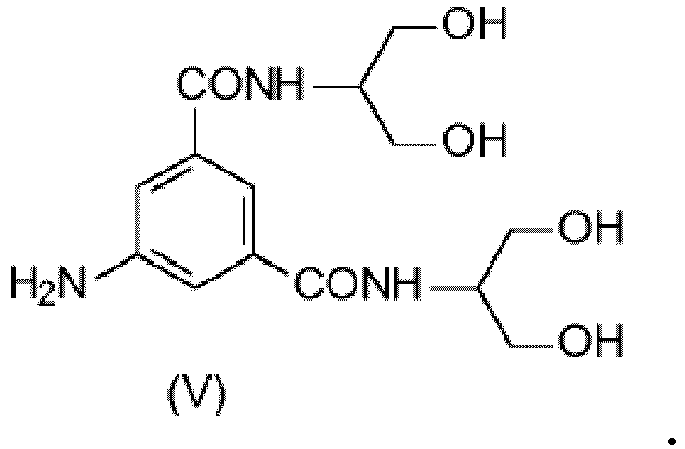
- 5-Amino- N,N' -bis[2-hydroxy-1-(hydroxymethyl)ethyl]-1,3-benzenedicarboxamide (V) is a key intermediate in the synthesis of lopamidol. As shown in Scheme 1 below where prior art synthesis has been summarized, its iodination gives the intermediate 5-Amino- N,N'- bis[2-hydroxy-1-(hydroxymethyl)ethyl]-2,4,6-triiodo-1,3-benzenedicarboxamide (IV) which may be further reacted with suitable acylating agents, such as acetic anhydride in order to protect the hydroxyl groups (as described, i.e.
- suitable acylating agents such as acetic anhydride
- Boron derivatives are known as protective agents in chemical synthesis.
- boric oxyacids in connection with iodinated contrast media is disclosed in Journal of Hazardous Materials 205-206 (2012) 10-16 (I Rustighia, I Donatia, M Ferluga, C Campa, AE Pasqua, M Rossi, S Paoletti ; Borate complexes of X-ray iodinated contrast agents: Characterization and sorption studies for their removal from aqueous media).
- the Authors show an effective use of boric oxyacids as a means for removing iodinated contrast media from wastewater.
- This adduct has a good stability at alkaline pH and is adsorbed on the ionic resin Dowex 1X4, from which it is desorbed by means of a number of desorbing agents, mainly salts.
- these protecting groups can be recovered and recycled in the process and this represents a significant advantage in terms of cost-effectiveness of the entire process and environmental awareness.
- X is OR 2 , wherein R 2 is as above defined and preferably selected from the group consisting of: ethyl, n-propyl and n-butyl.
- X is R 3 , wherein R 3 is as above defined and preferably selected from the group consisting of: butyl, isobutyl, isopentyl, n-pentyl, n-hexyl, ciclopentyl, ciclohexyl or phenyl, optionally substituted with methyl, ethyl, n -propyl, i -propyl, n- butyl, sec -butyl, t -butyl or phenyl.
- said reaction medium is an organic solvent, selected from the group consisting of N,N -dimethylformamide, N,N -dimethylacetamide, N,N -diethylacetamide, N,N- dimethylpropionamide, N-methylpyrrolidone, N-ethylpyrrolidone, tetramethylurea, N,N'- dimethylethyleneurea (DMEU), N,N '-dimethylpropyleneurea (DMPU), optionally in admixture with a water-immiscible organic solvent, herein defined co-solvent.
- organic solvent selected from the group consisting of N,N -dimethylformamide, N,N -dimethylacetamide, N,N -diethylacetamide, N,N- dimethylpropionamide, N-methylpyrrolidone, N-ethylpyrrolidone, tetramethylurea, N,N'- dimethylethyleneurea (DMEU), N,N '-
- step b) after the hydrolysis of the boron protective groups recovery of the boron-derivative can be carried out by chromatography or by solvent extraction.
- a suitable resin specific for boron removal can be used.
- a suitable resin contains diolic groups and is designed to boric or boronic acid complexation and subsequent sequestration.
- a preferred resin is the one containing N-methyl (polyhydroxyhexyl)amine functional groups also called methylglucamine.
- a commercially available example of such a resin is Amberlite® IRA743.
- other resins can be selected among the commercially available ones, for example or equivalent or analogue columns, such as Duolite ES-371, Diaion CRB 02, Dowex BSR 1, Purolite S 108 and Purolite S110. Further details are provided in the Detailed Description below. Hydrolysis of boron-containing protecting groups is made by water addition.
- recovery of the boron-derivatives is preferably carried out by solvent extraction, in particular when, according to Scheme 3 and reactant 3, R3 is butyl, phenyl or a methyl substituted phenyl (tolyl group), butyl or when a boroxine of Formula III is used and R3 has the same meaning as for reactant 3.
- boron derivative means the boron compounds which are used according to Scheme 3 above, with the starting Compound (IV) to give the Compound (I); as well as the compounds produced in the hydrolysis of the intermediate (I) and subsequent freeing the hydroxyls from the boron-containing protective groups.
- These boron derivatives can be optionally recovered in the above step c) and recycled in the process.
- the terms “boron derivative” or “boron derivatives” generally comprise boron oxyacids (such as boric acid and boronic acids), esters thereof and boroxine.
- the intermediate Compound (I), wherein X is OR 2 is obtained by reacting Compound (IV) with one of a boric acid in an R 2 OH alcohol or a borate ester B(OR 2 ) 3 , wherein R 2 is as above defined.
- the intermediate Compound (I), wherein X is R 3 is obtained by reacting the Compound (IV) with a boronic acid R 3 -B(OH) 2 , wherein R 3 is as above defined.
- this second preferred embodiment, not shown in Scheme 3, but part of the present invention is achieved by reacting the Compound (IV) with a boroxine of formula (III): wherein R 3 is as above defined.
- said process for the preparation of lopamidol (II) comprises:
- the boric acid ester can be restored for subsequent use.
- the boric acid, obtained in the final step is recovered, reacted with an R 2 -OH alcohol, wherein R 2 is as above defined, and recycled in a new process.
- said boric acid is treated with a suitable resin, such as a resin specific for boric acid, for example the commercially available AmberliteTM IRA743, being intended that the person skilled in the art can select the proper way to recover boric acid by resorting to the general common knowledge in this matter.
- a suitable resin such as a resin specific for boric acid, for example the commercially available AmberliteTM IRA743, being intended that the person skilled in the art can select the proper way to recover boric acid by resorting to the general common knowledge in this matter.
- said process for the preparation of lopamidol (II) comprises:
- the boric acid and the alcohol form the corresponding boric acid ester in situ, and the process can be carried out as in the case explained above using the boric acid ester.
- the boric acid ester is then restored for subsequent use as shown above.
- the process can be carried out in batch mode, or, conveniently, in continuous mode.
- X is R 3 , as above defined and is preferably a phenyl, a methyl substituted phenyl, a methyl or a butyl group.
- Said process comprises:
- the boronic acid can be recovered for subsequent use.
- the boronic acid, obtained in the final step is recovered with two possible approaches: by extracting with an organic water-immiscible solvent, for example 4-methyl-2-pentanone, 2-pentanone, 3-pentanone, dibutyl ether, 2-methyl-tetrahydrofurane, ciclopentylmethyl ether, methyl isopropyl ketone, methyl isopentyl ketone, ethyl acetate, butyl acetate, pentyl acetate, isopentyl acetate, isopropyl acetate, removing the solvent and recycling the recovered boronic acid in the process, or alternatively, as described above for boric or boronic acid complexation, i.e. by treating the final reaction mixture with a resin suitable for boron removal, such as those mentioned in step c) above, among which, for example, an Amberlite® IRA 743.
- the recovery process can be carried out in a batch mode, or, more conveniently, in a continuous mode.
- phenylboronic, p-tolyl boronic or n -butylboronic acids are used and recycled.
- X is R 3 , as above defined, preferably phenyl, a methyl substituted phenyl, methyl or butyl. More preferably in Compound of formula (I) R 3 is phenyl.
- the preparation of compound of formula (I) as an intermediate in the preparation of lopamidol (II) can also be carried out as disclosed in the previous embodiment, but using a boroxine of formula (III) is used instead of the boronic acid.
- Triphenylboroxine and trimethylboroxine are preferred boroxines and R 3 in compound (I) is preferably phenyl or methyl.
- phenylboronic acid or methylboronic acid are released upon hydrolysis of the hydroxyl groups, freed from the boron-containing protective moiety and the boronic acids can be restored for subsequent use, as disclosed above.
- compound of formula (I) represents a further object of the present invention as well as its use as intermediate in the synthesis of lopamidol (II).
- an acetylation step is carried out on Compound (I) preferably in a solvent selected from the group consisting of: N , N- dimethylformamide, N,N -dimethylacetamide (DMAC), N,N -diethylacetamide, N,N- dimethylpropionamide, 1-methyl-2-pyrrolidone, 1-ethyl-2-pyrrolidone, tetramethylurea, N,N'- dimethylethyleneurea (DMEU), N,N '-dimethylpropyleneurea (DMPU).
- a solvent selected from the group consisting of: N , N- dimethylformamide, N,N -dimethylacetamide (DMAC), N,N -diethylacetamide, N,N- dimethylpropionamide, 1-methyl-2-pyrrolidone, 1-ethyl-2-pyrrolidone, tetramethylurea, N,N'- dimethylethyleneurea (DMEU), N,N '-dimethyl
- N,N- dimethylacetamide is used and more preferably, N,N -dimethylacetamide has a very low water content or is anhydrous.
- the solvent may also comprise a co-solvent which is an organic solvent immiscibile in water, selected among : 4-methyl-2-pentanone, 2-pentanone, 3-pentanone, dibutyl ether, 2-methyl-tetrahydrofurane, ciclopentylmethyl ether, methyl isopropyl ketone, methyl isopentyl ketone, ethyl acetate, butyl acetate, pentyl acetate, isopentyl acetate, isopropyl acetate.
- a preferred solvent/co-solvent mixture is represented by DMAC and 4-methyl-2-pentanone, 3-pentanone or 2-pentanone.
- step a) The presence of a co-solvent in step a) is particularly preferred when the boron protective groups have to be recovered at a later time by co-solvent extraction.
- the process can be carried out starting from a suitable Compound (V).
- an object of the present invention is a process according to the following Scheme 4:
- Scheme 4 describes the synthesis of lopamidol (II) from 5-Amino- N,N'- bis[2-hydroxy-1-(hydroxymethyl)ethyl]-1,3-benzenedicarboxamide (V); X is as defined above and in the first reaction step the numbers 1; 2; 3 represent reactants in single, alternative embodiments. Not shown in the scheme, but part of the present invention is also the alternative reactant boroxine.
- the Compound (V) can also be prepared as described in WO02/44125 or WO00/029372 .
- the iodination of the aromatic ring is also carried out according to methods disclosed in the numerous literature on lopamidol synthesis, e.g. in WO96/037458 , WO2009/103666 , WO2010/121904 , WO2011/154500 and WO2011/003894 .
- Another object of the present invention is a process for the preparation of lopamidol according to the following Scheme 6:
- the present invention discloses a process for the preparation of lopamidol (II) comprising the following reaction: wherein X is OR 2 or R 3 , and wherein R 2 and R 3 are a C 1 -C 6 linear or branched alkyl, C 3 -C 6 cycloalkyl, C 6 aryl, optionally substituted with a group selected from the group consisting of methyl, ethyl, n- propyl, i -propyl, n -butyl, sec -butyl, t -butyl and phenyl, more preferably phenyl, a methyl substituted phenyl, methyl and butyl, and comprising the following steps:
- the reaction medium is preferably a reaction medium having the minimum water content compatible with the reaction, more preferably, an anhydrous reaction medium.
- the reaction medium is conveniently selected by the person of ordinary skill in the art, based on the common knowledge for this kind of reaction.
- the medium is typically an organic solvent capable of dissolving the Compound of formula (I) and not interfering with the acylating reagent (S)-2-(acetyloxy)propanoyl chloride.
- organic solvent usable in this step are inert dipolar aprotic solvents, such as for example N,N -dimethylformamide, N,N -dimethylacetamide, N,N- diethylacetamide, N,N -dimethylpropionamide, 1-methyl-2-pyrrolidone, 1-ethyl-2-pyrrolidone, tetramethylurea, N,N '-dimethylethyleneurea (DMEU), N,N '-dimethylpropyleneurea (DMPU).
- inert dipolar aprotic solvents such as for example N,N -dimethylformamide, N,N -dimethylacetamide, N,N- diethylacetamide, N,N -dimethylpropionamide, 1-methyl-2-pyrrolidone, 1-ethyl-2-pyrrolidone, tetramethylurea, N,N '-dimethylethyleneurea (DMEU), N,N '-dimethyl
- the organic solvent used in this step can be also in admixture with a co-solvent.
- co-solvents are selected among those organic and immiscibile in water, such as: 4-methyl-2-pentanone, 2-pentanone, 3-pentanone, dibutyl ether, 2-methyl-tetrahydrofurane, ciclopentylmethyl ether, methyl isopropyl ketone, methyl isopentyl ketone, ethyl acetate, butyl acetate, pentyl acetate, isopentyl acetate, isopropyl acetate.
- a preferred solvent/co-solvent mixture is represented by DMAC and 4-methyl-2-pentanone, 3-pentanone or 2-pentanone.
- step a) the stoichiometric ratio between the Compound of formula (I) and the chiral acylating agent (S)-2-(acetyloxy)propanoyl chloride is the one usually employed in the synthesis of lopamidol (see for example GB1472050 Example 1 b ). A stoichiometric excess is preferred depending on the reaction conditions.
- Humidity should be kept controlled in the reaction environment, therefore, it is preferred to carry out the reaction in an inert atmosphere, for example dry nitrogen or argon.
- the reaction temperature is typically around room temperature, even though higher or lower temperatures can be used compatibly with the stability of the reactants and the final product.
- reaction time depends on the reaction conditions: the solvent used, reactants ratio and purity, temperature.
- the person of ordinary skill in the art can find the optimal conditions by recurring to his personal knowledge and experience.
- the completion of the reaction can be detected by ordinary analytical means used in organic chemistry, for example spectrometric equipment, such as 1 H-NMR, IR; chromatographic equipment, for example TLC, HPLC, GLC.
- spectrometric equipment such as 1 H-NMR, IR
- chromatographic equipment for example TLC, HPLC, GLC.
- step b the reaction mixture resulting from step a) of the process of the present invention is transferred into an aqueous medium (step b).
- water or a diluted alkaline solution, such as a NaOH or a KOH solution
- acylation step a) is added in the same reaction vessel where acylation step a) has been performed.
- Transfer of the organic phase into a different vessel containing water can also be done.
- the amount of water volume or weight is at least the same of the organic phase, preferably higher, for example 2-3 times the volume of the organic phase, compatibly with the subsequent operations and not exceeding in dilution.
- Acetyl lopamidol protected hydroxyl groups are then freed from the boron-containing protecting groups by hydrolysis, adding water or diluted alkaline solutions, such as diluted NaOH or KOH to the acidic reaction mixture.
- the recovery of the boron-containing protective groups after their hydrolysis on the acetyloxy derivative of Compound of Formula (I) in step b) can be performed by treating the reaction mixture with an ion exchange resin, typically an anionic exchange one, preferably one specific for boron sequestration, such as a resin with diolic functions, more preferably with functions selected in the group consisting of: methylglucamine, diethanolaminomethyl preferably on a polystyrene matrix, glycidyl preferably on a methacrylate matrix, iminodipropylene glycol, amino-bis(propane cis 2,3 diol), hydroxyethylamino propylene glycol.
- an ion exchange resin typically an anionic exchange one, preferably one specific for boron sequestration, such as a resin with diolic functions, more preferably with functions selected in the group consisting of: methylglucamine, diethanolaminomethyl preferably on a polystyrene matrix
- Some resins such as those with methylglucamine functions are also commercially available and can be selected from manufacturers' catalogues, for example Resindion of Mitsubishi Chemical, Dow Chemical, etc.
- Typical example is Duolite ES-371, preferred example is AmberliteTM IRA743 by Dow Chemical Company or other suppliers.
- This embodiment applies preferably to boric acid derivatives: conveniently, the resin is loaded into a column and the phase is eluted through it.
- boron-containing protective groups are used as the boron-containing protective groups
- recovery of boron-containing protective groups is carried out by extraction with an organic solvent immiscibile in water selected from the group consisting of: 4-methyl-2-pentanone, 3-pentanone, 2-pentanone, dibutyl ether, 2-methyl-tetrahydrofurane, ciclopentylmethyl ether, methyl isopropyl ketone, methyl isopentyl ketone, ethyl acetate, butyl acetate, pentyl acetate, isopentyl acetate, isopropyl acetate.
- Preferred extraction solvents are 4-methyl-2-pentanone (MIBK), 3-pentanone or 2-pentanone
- Compound I is preferably prepared directly in a polar solvent in admixture with the water-immiscible organic solvent (co-solvent) useful for boron-containing protective groups extraction as described below.
- a preferred solvent/co-solvent mixture is represented by DMAC and 4-methyl-2-pentanone (MIBK), 3-pentanone or 2-pentanone (i.e. in a ratio comprised from 1:10 to 1:4 weight/weight).
- Compound IV The boronic acid or boroxine are added in a slight molar excess compared to the triiodobenzenecarboxamide (Compound IV).
- the suspension is admixed and heated to 90-95°C and water is preferably distilled off to complete the protection reaction. Formation of Compound I can be assessed i.e. by 1 H-NMR.
- steps a)-c) can then be carried out in a single pot, for example as follows: (S)-2-(acetyloxy) propanoyl-chloride is added to the mixture under nitrogen atmosphere and stirred for a few hours, to achieve the acetyloxy propanoyl derivative of Compound I.
- Release of the boron protecting groups by hydrolysis of the acetyloxy propanoyl derivative of Compound I is usually obtained with (water or) a diluted alkaline solution, to neutral pH (i.e. comprised from 5-8), preferably comprised from 6-7 which allows for a good selectivity in the further recovery of the boron protective group with the water-immiscible solvent.
- a diluted alkaline solution to neutral pH (i.e. comprised from 5-8), preferably comprised from 6-7 which allows for a good selectivity in the further recovery of the boron protective group with the water-immiscible solvent.
- the recovery of the boron protective group which is usually quantitative, can be carried out in batch or in a continuous mode. In both procedures the amount of organic water immiscible solvent is maintained in a ratio with the boronic acid compound comprised from 1:10 to 1:20, preferably from 1:13 to 1:16 more preferably about 1:15. In the batch procedure this amount can be added in one or more aliquots.
- the so obtained biphasic mixture comprises an aqueous phase with the acetyl-lopamidol, which is recovered for purification, followed by hydrolysis of the acetyl group to achieve lopamidol, while the the boronic acid is partitioned in the organic phase which is recovered, optionally preferably distilled to concentrate the boron-protective containing groups and recycled.
- Recycling of the boronic acid solution can be accomplished after addition of the reaction solvent of choice, i.e. DMAC (5-10% of the organic solution) and co-solvent distillation, preferably under vacuum and at a temperature below 40°C to achieve a boronic acid concentration of about 10%.
- the recycled solution can then be used indefinitely preferably by addition of a small quantity (i.e. corresponding to 5-20% of recycled boronic acid present in the organic solution) of fresh boronic acid.
- aqueous solution eluted from the column specific for sequestering the boronic acid or alternatively coming from the extraction by means of an organic solvent, and comprising N,N'- bis[2-hydroxy-1-(hydroxymethyl)ethyl]-5-[(2S)(2-acetoxy-1-oxopropyl)amino]-2,4,6-triiodo-1,3-benzendicarboxamide, also known as acetyl-lopamidol is then de-salted from organic and inorganic salts by means of ion exchange resins.
- step c) the neutral solution obtained is loaded onto a strong anionic resin, preferably a resin with trimethylamine functional groups bound to a polymeric matrix material such as Relite® 3ASFB, to release raw lopamidol, essentially as described in US 5,550,287 with the exception that lopamidol is released with a diluted aqueous solution of a strong acid, such as HCl, H 2 SO 4 , being hydrochloric acid preferred.
- lopamidol release can be effected in batch, in basic conditions, as disclosed e.g in WO97/30735 , Example 1, i.e.
- Hydrolysis of acetyl-lopamidol onto a strong anionic resin is more efficient and is therefore preferred. According to this embodiment, the process is made simpler because the purification and hydrolysis are, in practice, carried out in a single step.
- the product is further purified in a conventional manner, for example as described in more details in the Experimental Part by crystallization with 2-butanol-water to a pharmaceutical grade according to the national or European Pharmacopoeias.
- the boric acid or the derivative thereof used in the above embodiments of the process are recovered as described above and are preferably recycled in the process.
- novel Compound of formula (I) can be prepared according to the different embodiments. For example starting from Compound (IV) as detailed below, or other synthetic pathways disclosed herein.
- Compound (I) is not necessarily isolated, it can be isolated, for example after reaction with Compound (IV), as shown in the above Scheme 3 for characterization purposes, i.e by 1 H-NMR.
- Isolation of Compound (I) can be done according to conventional work-up methods, well known in the art, such as for example, extraction, precipitation, chromatographic separation.
- One exemplary way to characterize the Compound (I) is dissolving it in a suitable solvent, for example dimethylacetamide, adding a precipitation solvent, for example toluene and isolating the formed precipitate. Conveniently, the precipitate can be redissolved, for example heating the precipitation solution, and subsequent cooling.
- the obtained white solid is isolated, for example by filtration.
- the analytical characterization can be done according to well-known methods, for example elementary analysis, melting point, spectroscopy (such as NMR, IR) as better detailed in the Experimental Part.
- lopamidol (II) is prepared by starting from the above Compound of formula (IV).
- This Compound is a well-known intermediate, as it is its preparation, in the prior art syntheses of lopamidol (II), see for example WO0244125 and the references cited therein.
- this Compound (IV) is treated with boric acid or a derivative thereof to provide the Compound of formula (I), as disclosed above.
- Boric acid and its derivatives used in the present invention are well-known compounds which are commercially available or can be prepared according to literature methods.
- boric acid esters B(OR 2 ) 3 wherein R 2 is as above defined
- boronic acids R 3 -B(OH) 2 and boroxine of formula (III) wherein R 3 has the same meaning and preferred embodiments as above defined, are described together with their preparation in the general literature, such as for example Ullmann's Encyclopedia of Industrial Chemistry, VCH, last editi on; Dennis G.
- boric acid esters are prepared according to the general reaction: wherein R 2 is as above defined.
- the Compound (IV) is treated with boric acid and an R 2 OH alcohol in a reaction medium.
- the reaction medium is a solvent compatible with reaction conditions, reactants and final product.
- the reaction medium is the same organic solvent used in the reaction from Compound (I) to lopamidol (II) (step a) (see Scheme 2).
- N,N -dimethylacetamide is the solvent.
- the reaction is carried out at a temperature comprised from 60°C to 100°C or higher, for a time sufficient to completion. Check of completion of reaction, i.e.
- the Compound (IV) is directly treated with a boric acid ester B(OR 2 ) 3 in a reaction medium.
- the reaction can be carried out as for the above embodiment of boric acid and alcohol.
- Compound (I) can be either isolated for subsequent reaction or used in "one-pot" process.
- Preferred borates are selected from the group consisting of t -butyl-, n -propyl and ethyl borate. Esters with different alkyl groups can also be used.
- the reaction can be carried out as for the above embodiment of boric acid and alcohol.
- Compound (I) can be either isolated for subsequent reaction or used in "one-pot" process.
- the Compound (IV) is treated with a boronic acid anhydride, or boroxine of formula (III) above.
- Preferred boroxines are tri(phenyl)boroxine and tri(methyl)boroxine.
- the reaction can be carried out as for the above embodiment of boronic acid.
- Compound (I) can be either isolated for subsequent reaction or used in "one-pot" process.
- the reaction between the Compound (IV) and the boric acid or its derivative is carried out for a certain time and before shifting to the next step of N-acylation to lopamidol (II), it is advisable to remove part of the solvent, for example by distillation, even better by vacuum-distillation, in order to control water content, preferably until the water content is at minimum or at least very low, for example ⁇ 0.5% (determined by Karl Fischer titration).
- diol protection approach by the boron derivatives used according to the present invention can be used also for the preparation of other iodinated X-ray contrast agents, beside lopamidol such as for example lomeprol, lodixanol, loversol, lohexol, lopromide, etc..
- the present invention provides a process for the preparation of lopamidol (II) as shown in the above Scheme 4.
- 5-amino- N, N'-bis[2-hydroxy-1-(hydroxymethy)ethyl]-1,3-benzenedicarboxamide (Compound (V)) is a well-known compound and one of its preparations is disclosed for example in WO0244125 .
- this Compound is subjected to iodination of the benzene ring with a method known in the art, for example as disclosed in the same WO0244125 and references cited therein, to obtain 5-amino- N ,N'-bis[2-hydroxy-1-(hydroxymethy)ethyl]-2,4,6-triiodo-1,3-benzenedicarboxamide (Compound (IV)).
- the present invention provides a process for the preparation of lopamidol (II) as shown in the above Scheme 5.
- 5-nitro-1,3-benzenedicarboxylic acid (5-nitroisophthalic acid or 5-NIPA)
- 5-amino- N,N' -bis[2-hydroxy-1-(hydroxymethy)ethyl]-1,3-benzenedicarboxamide (V) is prepared, for example as disclosed in WO0244125 and WO0029372 .
- this Compound (V) is subjected to iodination of the benzene ring as above mentioned to obtain 5-amino- N,N'- bis[2-hydroxy-1-(hydroxymethy)ethyl]-2,4,6-triiodo-1,3-benzenedicarboxamide (Compound (IV)).
- Compound (IV) is then processed according to the present invention to lopamidol (II) through the intermediate (I).
- a "one-pot" process can be performed.
- the scheme 7 represents the synthetic pathway to lopamidol (II) from 5-NIPA according to an exemplary embodiment.
- the first part of the synthesis, from NIPA to Compound (V), is a "one-pot" synthesis, without intermediate isolation. It consists of three steps (esterification, hydrogenation, amidation), carried out in a convenient solvent, for example n -butanol in case a n -butyl ester is preferred.
- the esterification is performed in presence of a well-known esterification catalyst, for example an acid catalyst such as para-toluensulfonic acid, methansulfonic acid, sulfuric acid, preferably methanesulfonic acid.
- the hydrogenation is carried out as known by the skilled man, for example as described in EP1337505 and preferably by catalytic hydrogenation in presence of 5% Pd/C or other equivalent catalyst.
- the mixture is concentrated for the next amidation step, which is carried out essentially by two alternative methods:
- a preferred embodiment is represented by the amidation in the presence of an organic solvent and a co-solvent.
- the iodination reaction is performed on an aqueous solution containing Compound (V), synthesized following one of the two approaches mentioned above.
- the iodination procedure is done according to well-known methods, see above for related references, to give the intermediate (IV). Then the process proceeds as disclosed above according to steps a)-c).
- the present disclosure further describes a process for the recovery of boronic acids from a reaction mixture where these are used as diol protecting groups. This allows their re-use for the same purpose in a new synthesis.
- the recovery represents a more general embodiment for boronic acids recycling, because it provides quantitative yields (usually > 90%, preferably >95% and more preferably at least 99%) of these generally expensive reagents, thus representing a great economic advantage for large scale industrialization.
- the aqueous reaction mixture obtained after hydrolysis of the diol protective groups which comprises the boronic acid used for diol protection or in which a boronic acid is formed after hydrolysis (for example when a boroxine of Formula III is used for diol protection) and which optionally comprises a polar solvent such as: N,N -dimethylformamide, N,N -dimethylacetamide (DMAC), N,N -diethylacetamide, N,N -dimethylpropionamide, N-methylpyrrolidone, N-ethylpyrrolidone, tetramethylurea, N,N'- dimethylethyleneurea (DMEU), N,N '-dimethylpropyleneurea (DMPU) is added with an organic water-immiscible solvent.
- a polar solvent such as: N,N -dimethylformamide, N,N -dimethylacetamide (DMAC), N,N -diethylacetamide, N,
- the organic water-immiscible solvent is selected among: 4-methyl-2-pentanone (MIBK), 3-pentanone, 2-pentanone, dibutyl ether, 2-methyl-tetrahydrofurane, ciclopentylmethyl ether, methyl isopropyl ketone, methyl isopentyl ketone ethyl acetate, butyl acetate, pentyl acetate, isopentyl acetate, isopropyl acetate.
- MIBK 4-methyl-2-pentanone
- 3-pentanone 2-pentanone
- 2-pentanone dibutyl ether
- 2-methyl-tetrahydrofurane ciclopentylmethyl ether
- methyl isopropyl ketone methyl isopentyl ketone ethyl acetate
- butyl acetate pentyl acetate
- isopentyl acetate isopropyl acetate.
- a preferred ratio between the boronic acid and the water-immiscibile solvent (the boronic acid extraction solvent) is comprised from 1:10-1:20 (w/w) more preferably comprised from 1:13- 1:16 and even more preferably about 1:15.
- the boronic acid used as the boron-containing diol protective group, recovered according to this embodiment is preferably phenylboronic, p-tolyl boronic or butyl boronic acid, or when phenylboroxine or methylboroxine are used for diol protection, phenylboronic acid or methyl boronic acid can be recovered upon hydrolysis.
- the water immiscibile organic solvent can be further re-extracted with an aliquot of an aqueous solution with a pH comprised from 0-7, or preferably close to neutrality at a pH comprised from 6 to 7 when the recovery is carried out after hydrolysis of Compound I and according to the present invention to improve the selectivity of boronic acid recovery.
- Partitioning of the boronic acid into the organic phase for its recovery can be achieved either in batch or in a continuous mode, by optimization methods known to the skilled man.
- Example 1 Preparation of lopamidol (II) starting from Compound (IV) and using a boronic acid
- the Relite 3ASFB column was then sequentially eluted with 2 bed volumes of an aqueous acidic solution (diluted hydrochloric acid), and washed with 3-4 BV (bed volumes) of water, quantitatively recovering the substrate.
- the obtained solution was neutralized to pH 7, concentrated by vacuum distillation over 2 hours.
- the solution was loaded onto a column of Amberlite® XAD 1600 (3.6 L) (Dow Chemical Company) and eluted with 4 BV of highly diluted sodium hydroxide solution.
- the solution was loaded onto two ion exchange resin columns (cationic Dowex® C350, 4.7 L; anionic Relite® MG1/P, 2 L, Dow Chemical Company).
- the eluate was concentrated and the solid residue was crystallized from 2-butanol to afford lopamidol (II) (904 g; 1.16 mol) as a pure white solid with a yield of 82%.
- Phenylboronic acid was recovered with a > 90% yield.
- the solution was extracted with 4-methyl-2-pentanone (3 x 4 L) and the aqueous phase was loaded onto a Relite 3ASFB column for the hydrolysis, sequentially eluted with 2 bed volumes of an aqueous acidic solution (diluted hydrochloric acid), and washed with 3-4 bed volumes of water, quantitatively recovering the substrate.
- the obtained solution was neutralized to pH 7, concentrated by vacuum distillation over 2 hours.
- the solution was loaded onto a column of Amberlite® XAD 1600 (3.6 L) and eluted with 4 BV of highly diluted sodium hydroxide solution.
- the solution was loaded onto two ion exchange resin columns (cationic Dowex® C350, 4.7 L; anionic Relite® MG1/P, 2 L).
- Phenylboronic acid was recovered with a >95% yield. The solvent was distilled off and a concentrated solution is directly reemployed in the synthesis.
- Phenylboronic acid was also extracted with 3-pentanone with comparable results.
- intermediate (I) was complete (assessed by 1 H-NMR).
- the residue was cooled to 30-35°C and, under nitrogen atmosphere, (S)-2-(acetyloxy)propanoyl chloride (380 g; 2.52 mol) was slowly added.
- the mixture was stirred for 18 h at 30-35°C and under nitrogen atmosphere then diluted NaOH solution was added to neutral pH.
- Another portion of methyl isobutyl ketone (4-5 kg) was added to the biphasic mixture and phenylboronic acid was extracted.
- the aqueous phase was loaded onto two ion exchange resin columns (a cationic resin, Dowex® C350, 2 L; an anionic resin Relite® MG1/P, 2.6 L).
- lopamidol (II) was recovered by elution with 2 BV of an aqueous acidic solution (diluted hydrochloric acid), and washed with 3-4 bed volumes of water. The obtained solution was neutralized to pH 7, concentrated by vacuum distillation over 2 hours.
- the solution was loaded onto a column of Amberlite® XAD 1600 (3.6 L) and eluted with 4 BV of highly diluted sodium hydroxide solution.
- the solution was loaded onto two ion exchange resin columns (cationic Dowex® C350, 4.7 L; anionic Relite® MG1/P, 2 L). The eluate was concentrated and the solid residue was crystallized from 2-butanol to afford lopamidol (II) (992 g; 1.28 mol) as a white solid. Yield 90 %.
- PBA was extracted with three portion of methyl isobutyl ketone (3x3.2 kg).
- the aqueous phase was loaded onto two ion exchange resin columns (a cationic resin, Dowex® C350, 2 L; an anionic resin Relite® MG1/P, 2.6 L).
- the columns were eluted with water.
- the solution obtained was loaded onto Relite 3ASFB column for the hydrolysis: lopamidol (II) was recovered by elution with an aqueous acidic solution (diluted hydrochloric acid), and washed with water.
- the obtained solution was loaded onto a column of Relite® MG1/P (1.8 L), Amberlite® XAD 1600 (3.6 L) and cationic Dowex® C350 (0.2 L), and eluted with 4 BV of highly diluted sodium hydroxide solution.
- the eluate was concentrated and the solid residue was crystallized from 2-butanol to afford lopamidol (II) (1003 g; 1.29 mol) as a white solid. Yield 91 %.
- the organic phase MIBK containing phenyl boronic acid
- DMAC 0.6 kg was first added to the organic mixture and the solution was distilled under vacuum at ⁇ 40 °C concentrating the PBA, to reach a suitable concentration.
- Example 6 Preparation of lopamidol (II) starting from Compound (IV) with phenylboronic acid (PBA) in DMAC and a co-solvent. Recovery of PBA.
- the organic phase (MIBK containing phenyl boronic acid), obtained from phenylboronic acid extraction and recovered from the reaction mixture, was used to perform a synthesis of a new batch of lopamidol, essentially as described in Example 5. Briefly, DMAC (0.6 kg) was first added to the organic mixture and the solution was distilled under vacuum at ⁇ 40 °C removing 2-2.3 kg of MIBK in order to have a final amount of 3.65 Kg of MIBK.
- Example 7 Preparation of lopamidol (II) starting from Compound (IV) with phenylboronic acid (PBA) in DMAC and a co-solvent. Recovery of PBA with 2-pentanone.
- Example 8 Recovery of PBA by using diluted NaOH solution and higher solvent volumes.
- intermediate (I) was complete as assessed by 1H-NMR.
- the residue was cooled to 30-35°C and, under nitrogen atmosphere, (S)-2-(acetyloxy)propanoyl chloride (380 g; 2.52 mol) was slowly added.
- the mixture was stirred for 18 h at 30-35°C and under nitrogen atmosphere, then diluted NaOH solution was added to neutral pH.
- Another portion of methyl isobutyl ketone (4 kg) was added to the biphasic mixture and p-tolylboronic acid was extracted.
- aqueous phase was loaded onto two ion exchange resin columns (a cationic resin, Dowex® C350, 2 L; an anionic resin Relite® MG1/P, 2.6 L) and the work-up was continued as described in Example 4 to afford lopamidol (II) (992 g; 1.28 mol) as a white solid. Yield 90 %
- aqueous phase was loaded onto two ion exchange resin columns (a cationic resin, Dowex® C350, 2 L; an anionic resin Relite® MG1/P, 2.6 L) and the work-up was continued as described in Example 4 to afford lopamidol (II) (992 g; 1.28 mol) as a white solid. Yield 90 %.
- Example 11 Preparation of lopamidol (II) starting from Compound (IV) and using a boroxine
- Example 12 Preparation of lopamidol (II) starting from Compound (IV) and using a boric acid ester
- the solution was loaded onto two ion exchange resins (a cationic Amberjet® 1200, 0.9 L; an anionic Relite® MG1, 0.8 L).
- the eluate was concentrated and the solid residue was crystallized from 2-butanol to afford lopamidol (II) (159 g; 0.205 mol) as a white solid.
- Example 13 Preparation of lopamidol (II) starting from Compound (IV) and using a boric acid and alcohol
- the solution was loaded onto two ion exchange resins (a cationic Amberjet® 1200, 0.9 L; an anionic Relite® MG1, 0.8 L).
- the eluate was concentrated and the solid residue was crystallized from 2-butanol to afford lopamidol (II) (170 g; 0.218 mol) as a white solid. Yield: 77%.
- Example 14 Procedure: One pot synthesis starting from 5-nitroisophthalic acid to Compound (V).
- the diluted solution thus obtained was loaded onto a series of two columns, the first one was a weak acidic resin (carboxylic, 700 mL) to selectively recover and recycle serinol, the second one was an anionic resin (tertiary amine, 50 mL) to purify the (V) solution.
- a weak acidic resin carboxylic, 700 mL
- an anionic resin tertiary amine, 50 mL
Landscapes
- Chemical & Material Sciences (AREA)
- Organic Chemistry (AREA)
- Chemical Kinetics & Catalysis (AREA)
- Organic Low-Molecular-Weight Compounds And Preparation Thereof (AREA)
- Acyclic And Carbocyclic Compounds In Medicinal Compositions (AREA)
- Detergent Compositions (AREA)
Claims (22)
- Verfahren zur Herstellung von Iopamidol (II), welches die folgende Reaktion umfasst:

und welches die folgenden Schritte umfasst:a) die Umsetzung der Verbindung (I) mit dem Acylierungsmittel (S)-2-(Acetyloxy) propanoylchlorid in einem Reaktionsmedium unter Bereitstellung des N-(S)-2-(Acetyloxy)propanoylderivats von Verbindung (I),b) das Hydrolysieren des Zwischenprodukts aus Schritt a) mit einer wässrigen Lösung bei einem pH-Wert von 0 bis 7 durch Zugabe von Wasser oder einer verdünnten alkalischen Lösung, das Freisetzen der Hydroxylgruppen aus den borhaltigen Schutzgruppen, die Gewinnung des Acetyloxyderivats der Verbindung (II) und gegebenenfalls die Rückgewinnung des Borderivats,c) die alkalische Hydrolyse des Acetyloxyderivats der Verbindung (II) unter Wiederherstellung der (S)-2-(Hydroxy)propanoylgruppe unter Erhalt von Iopamidol (II). - Verfahren nach Anspruch 1, wobei X für OR2 steht.
- Verfahren nach Anspruch 1, wobei X für R3 steht.
- Verfahren nach einem der Ansprüche 1-3, wobei es sich bei dem Reaktionsmedium in Schritt a) um ein wasserfreies organisches Lösungsmittel handelt.
- Verfahren nach einem der Ansprüche 1-4, wobei das Reaktionsmedium in Schritt a) aus der aus N,N-Dimethylformamid, N,N-Dimethylacetamid, N,N-Diethylacetamid, N,N-Dimethylpropionamid, N-Methylpyrrolidon, N-Ethylpyrrolidon, Tetramethylharnstoff, N,N'-Dimethylethylenharnstoff (DMEU) und N,N'-Dimethylpropylenharnstoff (DMPU) bestehenden Gruppe, gegebenenfalls in einer Mischung mit einem Cosolvens, ausgewählt ist.
- Verfahren nach einem der Ansprüche 1-5, wobei die Rückgewinnung des Borderivats in Schritt b) durch Chromatographie oder durch Cosolvensextraktion erfolgt.
- Verfahren nach einem der Ansprüche 1-6, bei dem man die Verbindung der Formel (I) gemäß der folgenden Reaktion ausgehend von der Verbindung der Formel (IV) herstellt:
 die Umsetzung der Verbindung der Formel (IV) mit einer Borsäure in einem R2OH-Alkohol oder einem Boratester B(OR2)3, wobei R2 wie oben definiert ist, unter Bereitstellung der Verbindung der Formel (I), in welcher X für OR2 steht, oderdie Umsetzung der Verbindung der Formel (IV) entweder mit einer Boronsäure R3-B(OH)2 oder mit einem Boroxin der Formel (III):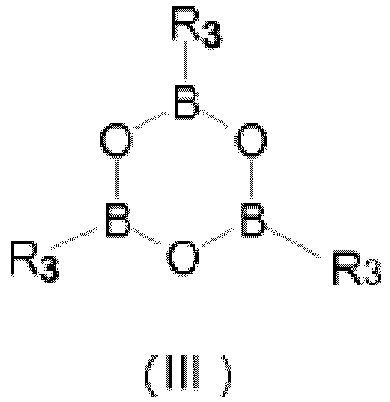
- Verfahren nach Anspruch 7, bei dem man einen Boratester B(OR2)3 verwendet.
- Verfahren nach Anspruch 8, bei dem der Boratester aus der aus Tri-n-butylburat, Tri-n-propylborat und Triethylburat bestehenden Gruppe ausgewählt ist.
- Verfahren nach Anspruch 7, bei dem man eine Boronsäure R3B(OH)2 oder ein Boroxin (III) verwendet.
- Verfahren nach Anspruch 10, bei dem die Boronsäure aus der aus Phenylboronsäure, Tolylboronsäure und Butylboronsäure bestehenden Gruppe ausgewählt ist bzw. das Boroxin (III) aus der aus Triphenylboroxin und Trimethylboroxin bestehenden Gruppe ausgewählt ist.
- Verfahren nach einem der Ansprüche 10 oder 11, bei dem man die Boronsäure durch Cosolvensextraktion rückgewinnt, wobei es sich bei dem Cosolvens um ein organisches, nicht mit Wasser mischbares Lösungsmittel ausgewählt aus der Gruppe bestehend aus 4-Methyl-2-pentanon, 2-Pentanon, 3-Pentanon, Dibutylether, 2-Methyltetrahydrofuran, Cyclopentylmethylether, Methylisopropylketon, Methylisopentylketon, Essigsäureethylester, Essigsäurebutylester, Essigsäurepentylester, Essigsäureisopentylester, Essigsäureisopropylester handelt.
- Verfahren nach einem der Ansprüche 1-11, bei dem es sich um ein Eintopfverfahren handelt.
- Verfahren nach Anspruch 7, bei dem man die Verbindung der Formel (IV) herstellt, indem man die folgende Verbindung (V) einer Iodierung unterzieht:
- Verfahren nach Anspruch 14, bei dem man die Verbindung (V) gemäß dem folgenden Reaktionsschema herstellt:
 i) man 5-Nitroisophthalsäure mit einem R1OH-Alkohol behandelt, wobei R1 für geradkettiges oder verzweigtes C1-C4-Alkyl steht, unter Bereitstellung des entsprechenden Diesters,ii) man die 5-Nitrogruppe zur entsprechenden 5-Aminogruppe reduziert, unter Bereitstellung der Verbindung (VII),iii) man den Diester mit 2-Amino-1,3-propandiol umsetzt, unter Bereitstellung der Verbindung (V).
 - Verfahren zur Herstellung von Iopamidol (II) gemäß dem folgenden Reaktionsschema:
 i) man 5-Nitroisophthalsäure (5-NIPA) mit einem R1OH-Alkohol behandelt, wobei R1 für geradkettiges oder verzweigtes C1-C4-Alkyl steht, unter Bereitstellung des Diesters (VI),ii) man die 5-Nitrogruppe reduziert, unter Bereitstellung der Verbindung (VII),iii) man den Diester mit 2-Amino-1,3-propandiol umsetzt, unter Bereitstellung des 5-Amino-N,N'-bis[2-hydroxy-1-(hydroxymethyl)ethyl]-1,3-benzoldicarbonsäureamids (V),iv) man die Verbindung (V) an den Positionen 2,4,6 iodiert, unter Bereitstellung des 5-Amino-N,N'-bis[2-hydroxy-1-(hydroxymethyl)ethyl]-2,4,6-triiod-1,3-benzoldicarbonsäureamids (IV),v) man Verbindung (IV) nach einem der Ansprüche 8-12 mit Borsäure oder einem Derivat davon behandelt, unter Bereitstellung der Verbindung der Formel (I),vi) man die Verbindung der Formel (I) nach einem der Ansprüche 1-7 oder 14 in Iopamidol (II) überführt.
 - Verfahren nach einem der Ansprüche 1-16, welches weiterhin die Aufreinigung und Isolierung von Iopamidol (II) umfasst.
- Verfahren nach Anspruch 17, wobei die Aufreinigung bis zur pharmazeutischen Güte erfolgt.
- Verbindung der Formel (I)

- Verbindung nach Anspruch 19, wobei X aus der aus Phenyl, methylsubstituiertem Phenyl, Methyl und Butyl bestehenden Gruppe ausgewählt ist.
- Verbindung nach Anspruch 20, wobei X für Phenyl steht.
- Verwendung der Verbindung der Formel (I) nach Ansprüchen 20-21 und des N-(S)-2-(Acetyloxy)propanoylderivats davon als Zwischenprodukt in der Synthese von Iopamidol (II).
Priority Applications (7)
| Application Number | Priority Date | Filing Date | Title |
|---|---|---|---|
| PL14796024T PL3066071T3 (pl) | 2013-11-05 | 2014-11-04 | Sposób otrzymywania jopamidolu |
| DK18162482.6T DK3369724T3 (da) | 2013-11-05 | 2014-11-04 | Fremgangsmåde til fremstilling af iopamidol |
| EP14796024.9A EP3066071B1 (de) | 2013-11-05 | 2014-11-04 | Verfahren zur herstellung von iopamidol |
| EP18162482.6A EP3369724B1 (de) | 2013-11-05 | 2014-11-04 | Verfahren zur herstellung von iopamidol |
| PL18162482T PL3369724T3 (pl) | 2013-11-05 | 2014-11-04 | Sposób otrzymywania jopamidolu |
| HRP20181122TT HRP20181122T1 (hr) | 2013-11-05 | 2014-11-04 | Postupak za pripremu jopamidola |
| SI201430793T SI3066071T1 (en) | 2013-11-05 | 2014-11-04 | Preparation of jopamidol |
Applications Claiming Priority (3)
| Application Number | Priority Date | Filing Date | Title |
|---|---|---|---|
| EP13191551 | 2013-11-05 | ||
| EP14796024.9A EP3066071B1 (de) | 2013-11-05 | 2014-11-04 | Verfahren zur herstellung von iopamidol |
| PCT/EP2014/073692 WO2015067601A1 (en) | 2013-11-05 | 2014-11-04 | Process for the preparation of iopamidol |
Related Child Applications (1)
| Application Number | Title | Priority Date | Filing Date |
|---|---|---|---|
| EP18162482.6A Division EP3369724B1 (de) | 2013-11-05 | 2014-11-04 | Verfahren zur herstellung von iopamidol |
Publications (2)
| Publication Number | Publication Date |
|---|---|
| EP3066071A1 EP3066071A1 (de) | 2016-09-14 |
| EP3066071B1 true EP3066071B1 (de) | 2018-04-18 |
Family
ID=49517391
Family Applications (2)
| Application Number | Title | Priority Date | Filing Date |
|---|---|---|---|
| EP14796024.9A Active EP3066071B1 (de) | 2013-11-05 | 2014-11-04 | Verfahren zur herstellung von iopamidol |
| EP18162482.6A Active EP3369724B1 (de) | 2013-11-05 | 2014-11-04 | Verfahren zur herstellung von iopamidol |
Family Applications After (1)
| Application Number | Title | Priority Date | Filing Date |
|---|---|---|---|
| EP18162482.6A Active EP3369724B1 (de) | 2013-11-05 | 2014-11-04 | Verfahren zur herstellung von iopamidol |
Country Status (22)
| Country | Link |
|---|---|
| US (3) | US9950991B2 (de) |
| EP (2) | EP3066071B1 (de) |
| JP (1) | JP6454351B2 (de) |
| KR (2) | KR102265049B1 (de) |
| CN (1) | CN105705483B (de) |
| AU (1) | AU2014345727B2 (de) |
| BR (1) | BR112016010223B1 (de) |
| CA (2) | CA3001399C (de) |
| DK (2) | DK3369724T3 (de) |
| ES (2) | ES2674279T3 (de) |
| HR (2) | HRP20181122T1 (de) |
| HU (2) | HUE053751T2 (de) |
| IL (1) | IL245457B (de) |
| LT (2) | LT3066071T (de) |
| MX (2) | MX375753B (de) |
| PL (2) | PL3066071T3 (de) |
| PT (2) | PT3066071T (de) |
| RU (1) | RU2657238C2 (de) |
| SI (2) | SI3369724T1 (de) |
| TR (1) | TR201808527T4 (de) |
| WO (1) | WO2015067601A1 (de) |
| ZA (1) | ZA201602970B (de) |
Families Citing this family (10)
| Publication number | Priority date | Publication date | Assignee | Title |
|---|---|---|---|---|
| CN106366016B (zh) * | 2015-07-22 | 2019-03-05 | 连云港润众制药有限公司 | 一种碘普罗胺的制备方法及其中间体 |
| CN106366015B (zh) * | 2015-07-22 | 2019-01-25 | 正大天晴药业集团股份有限公司 | 一种碘普罗胺的制备方法及其中间体 |
| CN118388347A (zh) | 2017-11-01 | 2024-07-26 | 梅琳塔治疗公司 | 化合物、由其形成的硼酸酯衍生物及其制备方法 |
| CN109293526A (zh) * | 2018-10-23 | 2019-02-01 | 湖北天舒药业有限公司 | 一种碘帕醇的合成及其合成中间体的制备 |
| MX2022009932A (es) * | 2020-02-14 | 2022-11-07 | Solvay | Nuevos espumantes para la recuperacion de minerales y metodos de fabricacion y uso de los mismos. |
| GB202009917D0 (en) * | 2020-06-29 | 2020-08-12 | Ge Healthcare As | Process for the preparation of iopamidol |
| US20240199530A1 (en) | 2021-03-22 | 2024-06-20 | Bracco Imaging S.P.A. | Industrial synthesis of serinol |
| CN118414325A (zh) | 2021-12-20 | 2024-07-30 | 伯拉考成像股份公司 | 制备2,4,6-三碘间苯二甲酸双酰胺的方法 |
| CN115010617B (zh) * | 2022-07-11 | 2024-06-11 | 安徽普利药业有限公司 | 一种碘帕醇的制备方法 |
| EP4534526A1 (de) | 2023-10-04 | 2025-04-09 | Bracco Imaging SPA | Optimiertes verfahren zur herstellung von iopamidol |
Family Cites Families (24)
| Publication number | Priority date | Publication date | Assignee | Title |
|---|---|---|---|---|
| CH608189A5 (de) * | 1974-12-13 | 1978-12-29 | Savac Ag | |
| IT1256162B (it) | 1992-10-27 | 1995-11-29 | Zambon Spa | Processo per la preparazione di un intermedio della sintesi organica |
| IT1274027B (it) | 1994-03-03 | 1997-07-14 | Zambon Spa | Processo per la preparazione e purificazione di mezzi di contrasto iodurati |
| IT1274676B (it) * | 1994-04-14 | 1997-07-24 | Zambon Spa | Processo per la preparazione di 5-ammino-2,2-dialchil-1,3-diossani |
| IT1282674B1 (it) | 1996-02-23 | 1998-03-31 | Bracco Spa | Processo per la purificazione di agenti contrastografici opacizzanti |
| US5763650A (en) | 1995-05-23 | 1998-06-09 | Fructamine S.P.A. | Process for the preparation of a halosubstituted aromatic acid |
| DE69606601T2 (de) | 1995-05-23 | 2000-07-06 | Fructamine S.P.A., Mozzo | Verfahren zur herstellung von dicarbonsäure-dichlorid |
| JP4012566B2 (ja) | 1995-05-23 | 2007-11-21 | ブラッコ イメージング エッセ ピ ア | ジカルボン酸二塩化物の製造方法 |
| IT1288114B1 (it) | 1996-06-13 | 1998-09-10 | Fructamine Spa | Processo per la purificazione di un intermedio |
| IT1286522B1 (it) | 1996-12-04 | 1998-07-15 | Dibra Spa | Processo per la preparazione di derivati dell'acido 5-ammino-2,4,6- triiodo-1,3-benzenedicarbossilico |
| IT1289520B1 (it) * | 1996-12-24 | 1998-10-15 | Zambon Spa | Processo per la preparazione di un intermedio utile nella sintesi di mezzi di contrasto iodurati |
| GB2331098A (en) | 1997-11-07 | 1999-05-12 | Nycomed Imaging As | An N-Alkylation process |
| IT1299202B1 (it) | 1998-05-08 | 2000-02-29 | Dibra Spa | Processo per la preparazione della s-n,n'-bis (2-idrossi-1- (idrossimetil)etil) -5-((2-idrossi-1-ossopropil)ammino)-2,4,6-triiodo |
| GB9825095D0 (en) | 1998-11-16 | 1999-01-13 | Nycomed Imaging As | Chemical process |
| US6803485B2 (en) * | 1999-02-26 | 2004-10-12 | Bracco Imaging S.P.A. | Process for the preparation of iopamidol |
| IT1319671B1 (it) | 2000-12-01 | 2003-10-23 | Bracco Spa | Processo per la preparazione di (s)-n,n'-bis(2-idrossi-1-(idrossimetil)etil)-5-((2-idrossi-1-ossopropil)ammino) |
| IT1319670B1 (it) * | 2000-12-01 | 2003-10-23 | Bracco Spa | Processo per la preparazione di 5-ammino-n,n'-bis(2-idrossi-1-(idrossimetil)etil))-1,3-benzendicarbossammide (i) e 5-ammino-n,n'- |
| AU2003269474A1 (en) | 2003-08-26 | 2005-03-10 | Biocon Limited | Process for purification of boronic acid and its derivatives |
| WO2007045011A1 (en) | 2005-10-21 | 2007-04-26 | Video Taped Transcripts Pty Ltd | A method of producing perforated retroreflective trim |
| EP2093206A1 (de) | 2008-02-20 | 2009-08-26 | BRACCO IMAGING S.p.A. | Verfahren zur Iodierung aromatischer Verbindungen |
| PL2365963T3 (pl) | 2008-11-18 | 2017-12-29 | Bracco Imaging S.P.A | Sposób przygotowywania jodowanych środków kontrastowych |
| EP2243767A1 (de) | 2009-04-21 | 2010-10-27 | Bracco Imaging S.p.A | Verfahren zur Iodierung aromatischer Verbindungen |
| DK2451994T3 (da) | 2009-07-07 | 2014-01-20 | Bracco Imaging Spa | Fremgangsmåde til fremstilling af et ioderende middel |
| EP2394984A1 (de) | 2010-06-10 | 2011-12-14 | Bracco Imaging S.p.A | Verfahren zur Iodinierung von Phenol-Derivaten |
-
2014
- 2014-11-04 PT PT147960249T patent/PT3066071T/pt unknown
- 2014-11-04 KR KR1020167014721A patent/KR102265049B1/ko active Active
- 2014-11-04 LT LTEP14796024.9T patent/LT3066071T/lt unknown
- 2014-11-04 PL PL14796024T patent/PL3066071T3/pl unknown
- 2014-11-04 CN CN201480060539.4A patent/CN105705483B/zh active Active
- 2014-11-04 EP EP14796024.9A patent/EP3066071B1/de active Active
- 2014-11-04 US US15/033,737 patent/US9950991B2/en active Active
- 2014-11-04 JP JP2016551022A patent/JP6454351B2/ja active Active
- 2014-11-04 DK DK18162482.6T patent/DK3369724T3/da active
- 2014-11-04 SI SI201431776T patent/SI3369724T1/sl unknown
- 2014-11-04 TR TR2018/08527T patent/TR201808527T4/tr unknown
- 2014-11-04 MX MX2016005829A patent/MX375753B/es active IP Right Grant
- 2014-11-04 HR HRP20181122TT patent/HRP20181122T1/hr unknown
- 2014-11-04 DK DK14796024.9T patent/DK3066071T3/en active
- 2014-11-04 PT PT181624826T patent/PT3369724T/pt unknown
- 2014-11-04 WO PCT/EP2014/073692 patent/WO2015067601A1/en not_active Ceased
- 2014-11-04 PL PL18162482T patent/PL3369724T3/pl unknown
- 2014-11-04 CA CA3001399A patent/CA3001399C/en active Active
- 2014-11-04 KR KR1020217017633A patent/KR102382351B1/ko active Active
- 2014-11-04 EP EP18162482.6A patent/EP3369724B1/de active Active
- 2014-11-04 CA CA2927706A patent/CA2927706C/en active Active
- 2014-11-04 SI SI201430793T patent/SI3066071T1/en unknown
- 2014-11-04 AU AU2014345727A patent/AU2014345727B2/en active Active
- 2014-11-04 RU RU2016122022A patent/RU2657238C2/ru active
- 2014-11-04 HU HUE18162482A patent/HUE053751T2/hu unknown
- 2014-11-04 MX MX2020010367A patent/MX380203B/es unknown
- 2014-11-04 ES ES14796024.9T patent/ES2674279T3/es active Active
- 2014-11-04 ES ES18162482T patent/ES2862349T3/es active Active
- 2014-11-04 LT LTEP18162482.6T patent/LT3369724T/lt unknown
- 2014-11-04 BR BR112016010223-1A patent/BR112016010223B1/pt active IP Right Grant
- 2014-11-04 HU HUE14796024A patent/HUE039440T2/hu unknown
-
2016
- 2016-05-03 IL IL245457A patent/IL245457B/en active IP Right Grant
- 2016-05-04 ZA ZA2016/02970A patent/ZA201602970B/en unknown
-
2018
- 2018-03-06 US US15/912,772 patent/US10377700B2/en active Active
- 2018-08-02 US US16/052,695 patent/US20190077745A1/en not_active Abandoned
-
2021
- 2021-02-25 HR HRP20210324TT patent/HRP20210324T1/hr unknown
Non-Patent Citations (1)
| Title |
|---|
| None * |
Also Published As
Similar Documents
| Publication | Publication Date | Title |
|---|---|---|
| EP3066071B1 (de) | Verfahren zur herstellung von iopamidol | |
| JP5775524B2 (ja) | イオジキサノールの調製及び精製 | |
| CN113816868B (zh) | 一种碘海醇的合成方法 | |
| EP2444390B1 (de) | Verfahren zur Herstellung von Lacosamid | |
| CN105985258B (zh) | 一种苯甲酰胺化合物的制备方法及其中间体 | |
| CZ296096B6 (cs) | Zpusob prípravy N,N´-bis[2,3-dihydroxypropyl]-5-[(hydroxyacetyl)methylamino]-2,4,6-trijod-1,3-benzendikarboxylamidu | |
| WO2017205622A1 (en) | Method of making benznidazole | |
| EP2646411B1 (de) | Herstellung eines pet-vorläufers | |
| KR101856566B1 (ko) | 4'-히드록시-4-비페닐카르복실산의 신규 제조 방법 | |
| WO2025073833A1 (en) | Optimized process for the preparation of iopamidol | |
| JP5175060B2 (ja) | イソニトリルの製造方法 | |
| CN103724257B (zh) | 一种制备2,3-二羧酸酯吡啶类化合物的方法 | |
| CN117700356A (zh) | 一种制备药物lumacaftor中间体的新方法 | |
| JPH02304053A (ja) | N―(α―アルコキシエチル)カルボン酸アミドの製造方法 | |
| JP2007302603A (ja) | 1,8−ジニトロ−2−ナフトール誘導体および1,8−ジアミノ−2−ナフトール誘導体の製造方法 | |
| JP2004307367A (ja) | クロマンカルボン酸の製造方法 |
Legal Events
| Date | Code | Title | Description |
|---|---|---|---|
| PUAI | Public reference made under article 153(3) epc to a published international application that has entered the european phase |
Free format text: ORIGINAL CODE: 0009012 |
|
| 17P | Request for examination filed |
Effective date: 20160530 |
|
| AK | Designated contracting states |
Kind code of ref document: A1 Designated state(s): AL AT BE BG CH CY CZ DE DK EE ES FI FR GB GR HR HU IE IS IT LI LT LU LV MC MK MT NL NO PL PT RO RS SE SI SK SM TR |
|
| AX | Request for extension of the european patent |
Extension state: BA ME |
|
| DAX | Request for extension of the european patent (deleted) | ||
| GRAP | Despatch of communication of intention to grant a patent |
Free format text: ORIGINAL CODE: EPIDOSNIGR1 |
|
| INTG | Intention to grant announced |
Effective date: 20171110 |
|
| RIN1 | Information on inventor provided before grant (corrected) |
Inventor name: LATTUADA, LUCIANO Inventor name: BUONSANTI, FEDERICA Inventor name: IMPERIO, DANIELA Inventor name: BATTISTINI, ELISA Inventor name: NAPOLITANO, ROBERTA |
|
| GRAS | Grant fee paid |
Free format text: ORIGINAL CODE: EPIDOSNIGR3 |
|
| GRAJ | Information related to disapproval of communication of intention to grant by the applicant or resumption of examination proceedings by the epo deleted |
Free format text: ORIGINAL CODE: EPIDOSDIGR1 |
|
| GRAL | Information related to payment of fee for publishing/printing deleted |
Free format text: ORIGINAL CODE: EPIDOSDIGR3 |
|
| GRAR | Information related to intention to grant a patent recorded |
Free format text: ORIGINAL CODE: EPIDOSNIGR71 |
|
| GRAA | (expected) grant |
Free format text: ORIGINAL CODE: 0009210 |
|
| INTC | Intention to grant announced (deleted) | ||
| AK | Designated contracting states |
Kind code of ref document: B1 Designated state(s): AL AT BE BG CH CY CZ DE DK EE ES FI FR GB GR HR HU IE IS IT LI LT LU LV MC MK MT NL NO PL PT RO RS SE SI SK SM TR |
|
| INTG | Intention to grant announced |
Effective date: 20180313 |
|
| REG | Reference to a national code |
Ref country code: GB Ref legal event code: FG4D |
|
| REG | Reference to a national code |
Ref country code: CH Ref legal event code: EP |
|
| REG | Reference to a national code |
Ref country code: AT Ref legal event code: REF Ref document number: 990288 Country of ref document: AT Kind code of ref document: T Effective date: 20180515 |
|
| REG | Reference to a national code |
Ref country code: IE Ref legal event code: FG4D |
|
| REG | Reference to a national code |
Ref country code: DE Ref legal event code: R096 Ref document number: 602014024173 Country of ref document: DE |
|
| REG | Reference to a national code |
Ref country code: PT Ref legal event code: SC4A Ref document number: 3066071 Country of ref document: PT Date of ref document: 20180625 Kind code of ref document: T Free format text: AVAILABILITY OF NATIONAL TRANSLATION Effective date: 20180619 |
|
| REG | Reference to a national code |
Ref country code: ES Ref legal event code: FG2A Ref document number: 2674279 Country of ref document: ES Kind code of ref document: T3 Effective date: 20180628 |
|
| REG | Reference to a national code |
Ref country code: HR Ref legal event code: TUEP Ref document number: P20181122 Country of ref document: HR |
|
| REG | Reference to a national code |
Ref country code: RO Ref legal event code: EPE |
|
| REG | Reference to a national code |
Ref country code: DK Ref legal event code: T3 Effective date: 20180719 |
|
| REG | Reference to a national code |
Ref country code: SE Ref legal event code: TRGR |
|
| REG | Reference to a national code |
Ref country code: NL Ref legal event code: FP |
|
| REG | Reference to a national code |
Ref country code: HR Ref legal event code: T1PR Ref document number: P20181122 Country of ref document: HR |
|
| REG | Reference to a national code |
Ref country code: NO Ref legal event code: T2 Effective date: 20180418 |
|
| REG | Reference to a national code |
Ref country code: EE Ref legal event code: FG4A Ref document number: E015906 Country of ref document: EE Effective date: 20180716 |
|
| PG25 | Lapsed in a contracting state [announced via postgrant information from national office to epo] |
Ref country code: AL Free format text: LAPSE BECAUSE OF FAILURE TO SUBMIT A TRANSLATION OF THE DESCRIPTION OR TO PAY THE FEE WITHIN THE PRESCRIBED TIME-LIMIT Effective date: 20180418 |
|
| REG | Reference to a national code |
Ref country code: SK Ref legal event code: T3 Ref document number: E 27845 Country of ref document: SK |
|
| PG25 | Lapsed in a contracting state [announced via postgrant information from national office to epo] |
Ref country code: RS Free format text: LAPSE BECAUSE OF FAILURE TO SUBMIT A TRANSLATION OF THE DESCRIPTION OR TO PAY THE FEE WITHIN THE PRESCRIBED TIME-LIMIT Effective date: 20180418 |
|
| REG | Reference to a national code |
Ref country code: HU Ref legal event code: AG4A Ref document number: E039440 Country of ref document: HU |
|
| REG | Reference to a national code |
Ref country code: DE Ref legal event code: R097 Ref document number: 602014024173 Country of ref document: DE |
|
| REG | Reference to a national code |
Ref country code: GR Ref legal event code: EP Ref document number: 20180402029 Country of ref document: GR Effective date: 20190109 |
|
| PLBE | No opposition filed within time limit |
Free format text: ORIGINAL CODE: 0009261 |
|
| STAA | Information on the status of an ep patent application or granted ep patent |
Free format text: STATUS: NO OPPOSITION FILED WITHIN TIME LIMIT |
|
| PG25 | Lapsed in a contracting state [announced via postgrant information from national office to epo] |
Ref country code: SM Free format text: LAPSE BECAUSE OF FAILURE TO SUBMIT A TRANSLATION OF THE DESCRIPTION OR TO PAY THE FEE WITHIN THE PRESCRIBED TIME-LIMIT Effective date: 20180418 |
|
| 26N | No opposition filed |
Effective date: 20190121 |
|
| PG25 | Lapsed in a contracting state [announced via postgrant information from national office to epo] |
Ref country code: MC Free format text: LAPSE BECAUSE OF FAILURE TO SUBMIT A TRANSLATION OF THE DESCRIPTION OR TO PAY THE FEE WITHIN THE PRESCRIBED TIME-LIMIT Effective date: 20180418 Ref country code: LU Free format text: LAPSE BECAUSE OF NON-PAYMENT OF DUE FEES Effective date: 20181104 |
|
| REG | Reference to a national code |
Ref country code: HR Ref legal event code: ODRP Ref document number: P20181122 Country of ref document: HR Payment date: 20191021 Year of fee payment: 6 |
|
| REG | Reference to a national code |
Ref country code: AT Ref legal event code: UEP Ref document number: 990288 Country of ref document: AT Kind code of ref document: T Effective date: 20180418 |
|
| PG25 | Lapsed in a contracting state [announced via postgrant information from national office to epo] |
Ref country code: MK Free format text: LAPSE BECAUSE OF NON-PAYMENT OF DUE FEES Effective date: 20180418 Ref country code: CY Free format text: LAPSE BECAUSE OF FAILURE TO SUBMIT A TRANSLATION OF THE DESCRIPTION OR TO PAY THE FEE WITHIN THE PRESCRIBED TIME-LIMIT Effective date: 20180418 |
|
| PG25 | Lapsed in a contracting state [announced via postgrant information from national office to epo] |
Ref country code: IS Free format text: LAPSE BECAUSE OF FAILURE TO SUBMIT A TRANSLATION OF THE DESCRIPTION OR TO PAY THE FEE WITHIN THE PRESCRIBED TIME-LIMIT Effective date: 20180818 |
|
| REG | Reference to a national code |
Ref country code: HR Ref legal event code: ODRP Ref document number: P20181122 Country of ref document: HR Payment date: 20201021 Year of fee payment: 7 |
|
| REG | Reference to a national code |
Ref country code: HR Ref legal event code: ODRP Ref document number: P20181122 Country of ref document: HR Payment date: 20211019 Year of fee payment: 8 |
|
| REG | Reference to a national code |
Ref country code: HR Ref legal event code: ODRP Ref document number: P20181122 Country of ref document: HR Payment date: 20221018 Year of fee payment: 9 |
|
| P01 | Opt-out of the competence of the unified patent court (upc) registered |
Effective date: 20230517 |
|
| REG | Reference to a national code |
Ref country code: HR Ref legal event code: ODRP Ref document number: P20181122 Country of ref document: HR Payment date: 20231019 Year of fee payment: 10 |
|
| REG | Reference to a national code |
Ref country code: HR Ref legal event code: ODRP Ref document number: P20181122 Country of ref document: HR Payment date: 20241022 Year of fee payment: 11 |
|
| PGFP | Annual fee paid to national office [announced via postgrant information from national office to epo] |
Ref country code: LT Payment date: 20241021 Year of fee payment: 11 |
|
| PGFP | Annual fee paid to national office [announced via postgrant information from national office to epo] |
Ref country code: DE Payment date: 20241127 Year of fee payment: 11 |
|
| PGFP | Annual fee paid to national office [announced via postgrant information from national office to epo] |
Ref country code: NO Payment date: 20241129 Year of fee payment: 11 |
|
| PGFP | Annual fee paid to national office [announced via postgrant information from national office to epo] |
Ref country code: DK Payment date: 20241126 Year of fee payment: 11 |
|
| PGFP | Annual fee paid to national office [announced via postgrant information from national office to epo] |
Ref country code: BE Payment date: 20241127 Year of fee payment: 11 Ref country code: PL Payment date: 20241022 Year of fee payment: 11 Ref country code: FI Payment date: 20241126 Year of fee payment: 11 Ref country code: GR Payment date: 20241127 Year of fee payment: 11 |
|
| PGFP | Annual fee paid to national office [announced via postgrant information from national office to epo] |
Ref country code: GB Payment date: 20241127 Year of fee payment: 11 |
|
| PGFP | Annual fee paid to national office [announced via postgrant information from national office to epo] |
Ref country code: BG Payment date: 20241111 Year of fee payment: 11 Ref country code: FR Payment date: 20241126 Year of fee payment: 11 |
|
| PGFP | Annual fee paid to national office [announced via postgrant information from national office to epo] |
Ref country code: LV Payment date: 20241018 Year of fee payment: 11 Ref country code: EE Payment date: 20241021 Year of fee payment: 11 |
|
| PGFP | Annual fee paid to national office [announced via postgrant information from national office to epo] |
Ref country code: AT Payment date: 20241021 Year of fee payment: 11 |
|
| PGFP | Annual fee paid to national office [announced via postgrant information from national office to epo] |
Ref country code: CZ Payment date: 20241022 Year of fee payment: 11 Ref country code: HR Payment date: 20241022 Year of fee payment: 11 Ref country code: IE Payment date: 20241127 Year of fee payment: 11 |
|
| PGFP | Annual fee paid to national office [announced via postgrant information from national office to epo] |
Ref country code: RO Payment date: 20241023 Year of fee payment: 11 Ref country code: SK Payment date: 20241018 Year of fee payment: 11 |
|
| PGFP | Annual fee paid to national office [announced via postgrant information from national office to epo] |
Ref country code: IT Payment date: 20241122 Year of fee payment: 11 Ref country code: ES Payment date: 20241202 Year of fee payment: 11 |
|
| PGFP | Annual fee paid to national office [announced via postgrant information from national office to epo] |
Ref country code: SE Payment date: 20241127 Year of fee payment: 11 |
|
| PGFP | Annual fee paid to national office [announced via postgrant information from national office to epo] |
Ref country code: CH Payment date: 20241201 Year of fee payment: 11 Ref country code: MT Payment date: 20241018 Year of fee payment: 11 |
|
| PGFP | Annual fee paid to national office [announced via postgrant information from national office to epo] |
Ref country code: TR Payment date: 20241031 Year of fee payment: 11 |
|
| PGFP | Annual fee paid to national office [announced via postgrant information from national office to epo] |
Ref country code: SI Payment date: 20241017 Year of fee payment: 11 |
|
| REG | Reference to a national code |
Ref country code: HR Ref legal event code: ODRP Ref document number: P20181122 Country of ref document: HR Payment date: 20251021 Year of fee payment: 12 |
|
| REG | Reference to a national code |
Ref country code: CH Ref legal event code: U11 Free format text: ST27 STATUS EVENT CODE: U-0-0-U10-U11 (AS PROVIDED BY THE NATIONAL OFFICE) Effective date: 20251201 |
|
| PGFP | Annual fee paid to national office [announced via postgrant information from national office to epo] |
Ref country code: PT Payment date: 20251024 Year of fee payment: 12 |
|
| PGFP | Annual fee paid to national office [announced via postgrant information from national office to epo] |
Ref country code: HU Payment date: 20251029 Year of fee payment: 12 |
|
| PGFP | Annual fee paid to national office [announced via postgrant information from national office to epo] |
Ref country code: NL Payment date: 20251126 Year of fee payment: 12 |