EP3048097B2 - Verfahren zur herstellung einer n-methylsubstituierten triacetonaminverbindung - Google Patents
Verfahren zur herstellung einer n-methylsubstituierten triacetonaminverbindung Download PDFInfo
- Publication number
- EP3048097B2 EP3048097B2 EP16152159.6A EP16152159A EP3048097B2 EP 3048097 B2 EP3048097 B2 EP 3048097B2 EP 16152159 A EP16152159 A EP 16152159A EP 3048097 B2 EP3048097 B2 EP 3048097B2
- Authority
- EP
- European Patent Office
- Prior art keywords
- group
- radical
- carbon atoms
- och
- hydrogen
- Prior art date
- Legal status (The legal status is an assumption and is not a legal conclusion. Google has not performed a legal analysis and makes no representation as to the accuracy of the status listed.)
- Active
Links
- 0 CC1(C)NC(C)(C)CC(*)C1 Chemical compound CC1(C)NC(C)(C)CC(*)C1 0.000 description 9
Classifications
-
- C—CHEMISTRY; METALLURGY
- C07—ORGANIC CHEMISTRY
- C07D—HETEROCYCLIC COMPOUNDS
- C07D401/00—Heterocyclic compounds containing two or more hetero rings, having nitrogen atoms as the only ring hetero atoms, at least one ring being a six-membered ring with only one nitrogen atom
- C07D401/14—Heterocyclic compounds containing two or more hetero rings, having nitrogen atoms as the only ring hetero atoms, at least one ring being a six-membered ring with only one nitrogen atom containing three or more hetero rings
-
- C—CHEMISTRY; METALLURGY
- C07—ORGANIC CHEMISTRY
- C07D—HETEROCYCLIC COMPOUNDS
- C07D211/00—Heterocyclic compounds containing hydrogenated pyridine rings, not condensed with other rings
- C07D211/04—Heterocyclic compounds containing hydrogenated pyridine rings, not condensed with other rings with only hydrogen or carbon atoms directly attached to the ring nitrogen atom
- C07D211/06—Heterocyclic compounds containing hydrogenated pyridine rings, not condensed with other rings with only hydrogen or carbon atoms directly attached to the ring nitrogen atom having no double bonds between ring members or between ring members and non-ring members
- C07D211/36—Heterocyclic compounds containing hydrogenated pyridine rings, not condensed with other rings with only hydrogen or carbon atoms directly attached to the ring nitrogen atom having no double bonds between ring members or between ring members and non-ring members with hetero atoms or with carbon atoms having three bonds to hetero atoms with at the most one bond to halogen, e.g. ester or nitrile radicals, directly attached to ring carbon atoms
- C07D211/40—Oxygen atoms
- C07D211/44—Oxygen atoms attached in position 4
- C07D211/46—Oxygen atoms attached in position 4 having a hydrogen atom as the second substituent in position 4
-
- C—CHEMISTRY; METALLURGY
- C07—ORGANIC CHEMISTRY
- C07D—HETEROCYCLIC COMPOUNDS
- C07D211/00—Heterocyclic compounds containing hydrogenated pyridine rings, not condensed with other rings
- C07D211/04—Heterocyclic compounds containing hydrogenated pyridine rings, not condensed with other rings with only hydrogen or carbon atoms directly attached to the ring nitrogen atom
- C07D211/06—Heterocyclic compounds containing hydrogenated pyridine rings, not condensed with other rings with only hydrogen or carbon atoms directly attached to the ring nitrogen atom having no double bonds between ring members or between ring members and non-ring members
- C07D211/36—Heterocyclic compounds containing hydrogenated pyridine rings, not condensed with other rings with only hydrogen or carbon atoms directly attached to the ring nitrogen atom having no double bonds between ring members or between ring members and non-ring members with hetero atoms or with carbon atoms having three bonds to hetero atoms with at the most one bond to halogen, e.g. ester or nitrile radicals, directly attached to ring carbon atoms
- C07D211/56—Nitrogen atoms
- C07D211/58—Nitrogen atoms attached in position 4
-
- C—CHEMISTRY; METALLURGY
- C07—ORGANIC CHEMISTRY
- C07D—HETEROCYCLIC COMPOUNDS
- C07D211/00—Heterocyclic compounds containing hydrogenated pyridine rings, not condensed with other rings
- C07D211/04—Heterocyclic compounds containing hydrogenated pyridine rings, not condensed with other rings with only hydrogen or carbon atoms directly attached to the ring nitrogen atom
- C07D211/68—Heterocyclic compounds containing hydrogenated pyridine rings, not condensed with other rings with only hydrogen or carbon atoms directly attached to the ring nitrogen atom having one double bond between ring members or between a ring member and a non-ring member
- C07D211/72—Heterocyclic compounds containing hydrogenated pyridine rings, not condensed with other rings with only hydrogen or carbon atoms directly attached to the ring nitrogen atom having one double bond between ring members or between a ring member and a non-ring member with hetero atoms or with carbon atoms having three bonds to hetero atoms, with at the most one bond to halogen, directly attached to ring carbon atoms
- C07D211/74—Oxygen atoms
-
- C—CHEMISTRY; METALLURGY
- C07—ORGANIC CHEMISTRY
- C07D—HETEROCYCLIC COMPOUNDS
- C07D413/00—Heterocyclic compounds containing two or more hetero rings, at least one ring having nitrogen and oxygen atoms as the only ring hetero atoms
- C07D413/14—Heterocyclic compounds containing two or more hetero rings, at least one ring having nitrogen and oxygen atoms as the only ring hetero atoms containing three or more hetero rings
Definitions
- TAA triacetonamine
- the present invention describes in particular a method for methylating the nitrogen in the ring, as shown for example in reaction equation ⁇ 1> (R is, for example, an alkyl radical, an alkoxy radical, an amine radical or an OH group):
- Methylated derivatives of 2,2,6,6-tetramethylpiperidine are particularly important when used as "hindered amine light stabilizers" .
- the methylation enables use even under acidic conditions.
- Commercial products which have N -methylated 2,2,6,6-tetramethylpiperidine groups are, for. B. Tinuvin ® 292 [a mixture of 1- (methyl) -8- (1,2,2,6,6-pentamethyl-4-piperidinyl) sebacate and bis - (1,2,2,6,6- pentamethyl-4-piperidinyl) sebacate] or Cyasorb ® UV-3529 ( CAS NUMBER 193098-40-7 ).
- reaction equation ⁇ 2> The disadvantage of the process shown in reaction equation ⁇ 2> is that, in addition to the methyl halide, at least one equivalent of a suitable base must be used to release the product. This also leads to the formation of the corresponding salts, which then arise as a waste product. Another problem is that selective alkylation to give the tertiary amine is generally not possible, since overalkylation to give the corresponding quaternary ammonium salt can also take place.
- the object of the present invention was therefore to provide a process for the preparation of an N -methyl-substituted triacetone amine compound which does not have the disadvantages mentioned above.
- an “unbranched or branched alkyl group” is a monovalent saturated hydrocarbon radical of the general chemical structure (a) with having.
- the chain of carbon atoms "-C w H 2w + 1 " can be linear, in which case it is an unbranched alkyl group. However, it can also have branches, in which case it is a branched alkyl group.
- w in the chemical structure (a) is an integer.
- w is selected from the range 1 to 30.
- w is selected from the range 1 to 29 in the case of a straight or branched alkyl group having 1 to 29 carbon atoms.
- w is in the case of a straight or branched alkyl group with 1 to 12 carbon atoms selected from the range 1 to 12.
- w is selected from the range 1 to 10 for a straight or branched alkyl group with 1 to 10 carbon atoms.
- w is selected from the range 1 to 10 for a straight or branched alkyl group with 1 to 8 carbon atoms Range 1 to 8.
- w is selected from the range 1 to 6 for a straight or branched alkyl group with 1 to 6 carbon atoms.
- an "unbranched or branched alkyl group having 1 to 30 carbon atoms" is particularly selected from methyl, ethyl, n- propyl, iso- propyl, n- butyl, sec- butyl, iso- butyl, tert- butyl, n - Pentyl, 1-methylbutyl, 2-methylbutyl, 3-methylbutyl, 1,1-dimethylpropyl, 1,2-dimethylpropyl, 2,2-dimethylpropyl, 1-ethylpropyl, n -hexyl, 1-methylpentyl, 2-methylpentyl, 3- Methylpentyl, 4-methylpentyl, 1,1-dimethylbutyl, 1,2-dimethylbutyl, 1,3-dimethylbutyl, 2,2-dimethylbutyl, 2,3-dimethylbutyl, 3,3-dimethylbutyl, 1-ethylbutyl,
- an "unbranched or branched alkyl group having 1 to 12 carbon atoms” is in particular selected from the group consisting of methyl, ethyl, n- propyl, iso- propyl, n- butyl, sec- butyl, iso- butyl, tert- butyl , n -pentyl, 1-methylbutyl, 2-methylbutyl, 3-methylbutyl, 1,1-dimethylpropyl, 1,2-dimethylpropyl, 2,2-dimethylpropyl, 1-ethylpropyl, n -hexyl, 1-methylpentyl, 2-methylpentyl , 3-methylpentyl, 4-methylpentyl, 1,1-dimethylbutyl, 1,2-dimethylbutyl, 1,3-dimethylbutyl, 2,2-dimethylbutyl, 2,3-dimethylbutyl, 3,3-dimethylbutyl, 1-ethyl,
- an "unbranched or branched alkyl group having 1 to 10 carbon atoms” is in particular selected from the group consisting of methyl, ethyl, n- propyl, iso- propyl, n- butyl, sec- butyl, iso- butyl, tert- butyl , n -pentyl, 1-methylbutyl, 2-methylbutyl, 3-methylbutyl, 1,1-dimethylpropyl, 1,2-dimethylpropyl, 2,2-dimethylpropyl, 1-ethylpropyl, n -hexyl, 1-methylpentyl, 2-methylpentyl , 3-methylpentyl, 4-methylpentyl, 1,1-dimethylbutyl, 1,2-dimethylbutyl, 1,3-dimethylbutyl, 2,2-dimethylbutyl, 2,3-dimethylbutyl, 3,3-dimethylbutyl, 1-ethyl,
- an "unbranched or branched alkyl group having 1 to 8 carbon atoms” is particularly selected from the group consisting of methyl, ethyl, n- propyl, iso- propyl, n- butyl, sec- butyl, iso- butyl, tert- butyl , n -pentyl, 1-methylbutyl, 2-methylbutyl, 3-methylbutyl, 1,1-dimethylpropyl, 1,2-dimethylpropyl, 2,2-dimethylpropyl, 1-ethylpropyl, n- hexyl, 1-methylpentyl, 2-methylpentyl, 3-methylpentyl, 4-methylpentyl, 1,1-dimethylbutyl, 1,2-dimethylbutyl, 1,3-dimethylbutyl, 2,2-dimethylbutyl, 2, 3-dimethylbutyl, 3,3-dimethylbutyl, 1-ethylbuty
- an "unbranched or branched alkyl group having 1 to 6 carbon atoms” is particularly selected from the group consisting of methyl, ethyl, n- propyl, iso- propyl, n- butyl, sec- butyl, iso- butyl, tert - Butyl, n -pentyl, 1-methylbutyl, 2-methylbutyl, 3-methylbutyl, 1,1-dimethylpropyl, 1,2-dimethylpropyl, 2,2-dimethylpropyl, 1-ethylpropyl, n -hexyl, 1-methylpentyl, 2- Methylpentyl, 3-methylpentyl, 4-methylpentyl, 1,1-dimethylbutyl, 1,2-dimethylbutyl, 1,3-dimethylbutyl, 2,2-dimethylbutyl, 2,3-dimethylbutyl, 3,3-dimethylbutyl, 1-ethyl, n-
- unbranched or branched alkylene group refers in the context of the invention to a divalent saturated hydrocarbon radical, which by the general chemical structure (b) with can be described.
- the chain of carbon atoms "-C x H 2x " can be linear, in which case it is an unbranched alkylene group. However, it can also have branches, in which case it is a branched alkylene group.
- x in the chemical structure (b) is an integer.
- x is selected from the range 1 to 30.
- x is selected from the range 1 to 12.
- x is selected from the range 1 to 6.
- a “divalent saturated hydrocarbon group with 3 to 30 carbon atoms, which has at least one saturated ring of 3 to 30 carbon atoms” is in particular a chemical structure (c) with where z 'is an integer between 0 and 27; where z "is an integer between 0 and 27; where z '" is an integer between 1 and 28; and at the same time it holds that z '+ z "+ z'" ⁇ 28.
- a divalent saturated hydrocarbon group of 3 to 30 carbon atoms which has at least one saturated ring of 3 to 30 carbon atoms is "a divalent saturated hydrocarbon group of 3 to 12 carbon atoms which has at least one saturated ring of 3 to 12 carbon atoms” more preferably "" divalent saturated hydrocarbon group of 3 to 6 carbon atoms which has at least one saturated ring of 3 to 6 carbon atoms ".
- a "divalent saturated hydrocarbon group with 3 to 12 carbon atoms, which has at least one saturated ring of 3 to 12 carbon atoms” has a chemical structure (c) for the purposes of the invention, where z 'is an integer between 0 and 9; where z "is an integer between 0 and 9; where z '" is an integer between 1 and 10; and at the same time it holds that z '+ z "+ z'" ⁇ 10.
- a "divalent saturated hydrocarbon group with 3 to 6 carbon atoms, which has at least one saturated ring of 3 to 6 carbon atoms” has a chemical structure (c) for the purposes of the invention, where z 'is an integer between 0 and 3; where z "is an integer between 0 and 3; where z '" is an integer between 1 and 4; and at the same time it holds that z '+ z "+ z'" ⁇ 4.
- Preferred is a "divalent saturated hydrocarbon group having 3 to 6 carbon atoms which has at least one saturated ring of 3 to 6 carbon atoms" selected from the group consisting of cyclopropylene, cyclobutylene, cyclopentylene, cyclohexylene.
- a "divalent hydrocarbon group with 6 to 30 carbon atoms, of which at least 6 carbon atoms are present in an aromatic system and the remaining carbon atoms, if present, are saturated” is in particular a “divalent hydrocarbon group with 6 to 30 carbon atoms, of which 6 , 10 or 14 carbon atoms are present in an aromatic system and the remaining carbon atoms, if any, are saturated "and more preferably selected from the group consisting of naphthylene, anthrylene, phenanthrylene and the following chemical structure (d): where y 'is an integer between 0 and 24; where y "is an integer between 0 and 24; and where at the same time it applies that y '+ y" ⁇ 24.
- y ' is an integer between 0 and 24; where y "is an integer between 0 and 24; and where at the same time it applies that y '+ y" ⁇ 24.
- an “unbranched or branched alkoxy group” is an organic radical of the chemical structure in which R ** is a straight or branched alkyl group.
- R ** is a straight or branched alkyl group having 1 to 30 carbon atoms.
- R ** is a straight or branched alkyl group having 1 to 10 carbon atoms.
- an "unbranched or branched alkoxy group with 1 to 10 carbon atoms” is particularly selected from the group consisting of methoxy, ethoxy, n- propoxy, iso- propoxy, n- butoxy, sec- butoxy, iso- butoxy, ter t -Butoxy, n -pentoxy, 1-methylbutoxy, 2-methylbutoxy, 3-methylbutoxy, 1,1-dimethylpropoxy, 1,2-dimethylpropoxy, 2,2-dimethylpropoxy, 1-ethylpropoxy, n -hexoxy, 1-methylpentoxy, 2 -Methylpentoxy, 3-methylpentoxy, 4-methylpentoxy, 1,1-dimethylbutoxy, 1,2-dimethylbutoxy, 1,3-dimethylbutoxy, 2,2-dimethylbutoxy, 2,3-dimethylbutoxy, 3,3-dimethylbutoxy, 1-ethylbutoxy , 2-ethylbutoxy, 1,1,2-trimethylpropoxy,
- an “unbranched or branched acyl group with 1 to 30 carbon atoms” is an organic radical of the chemical structure in which R * is a straight or branched alkyl radical with 1 to 29 carbon atoms.
- R * is selected from the group consisting of methyl, ethyl, n- propyl, iso- propyl, n- butyl, sec- butyl, iso- butyl, tert- butyl, n- pentyl, 1-methylbutyl, 2-methylbutyl, 3-methylbutyl, 1,1-dimethylpropyl, 1,2-dimethylpropyl, 2,2-dimethylpropyl, 1-ethylpropyl, n -hexyl, 1-methylpentyl, 2-methylpentyl, 3-methylpentyl, 4-methylpentyl, 1,1- Dimethylbutyl, 1,2-dimethylbutyl, 1,3-dimethylbutyl, 2,2-dimethylbutyl, 2,3-dimethylbutyl, 3,3-dimethylbutyl, 1-ethylbutyl, 2-ethylbutyl, 1,1,2-trimethylpropyl, 1,2, 2-trimethylpropyl,
- Formaldehyde is used in particular in the process according to the invention as a gas, as an aqueous solution or as a solid.
- formaldehyde is preferably used as an aqueous solution or as a solid (e.g. as paraformaldehyde).
- the concentration of formaldehyde in the solution is 1.0 to 37% by weight (w / w, "%" refers to the weight of the formaldehyde based on the total weight of the aqueous solution).
- w / w the concentration of formaldehyde in the solution is 1.0 to 37% by weight
- % refers to the weight of the formaldehyde based on the total weight of the aqueous solution.
- 37% by weight of formaldehyde for example, 100 g of aqueous solution contain 37 g of formaldehyde.
- Reductive conditions are to be understood as meaning the conditions under which the imine shown in reaction scheme ⁇ 1> is converted into the corresponding amine by addition of hydrogen.
- reductive conditions are established by reacting the at least one triacetonediamine compound (I) with the at least one carbonyl compound (II) in the presence of hydrogen and in the presence of a supported catalyst, the supported catalyst having at least one metal M , the metal M is selected from the group consisting of Cr, Mo, Mn, Ni, Pd, Pt, Ru, Rh; is more preferably selected from the group consisting of Cr, Ni, Pd, Pt; is most preferably selected from the group consisting of Ni, Pd.
- a supported catalyst comprising at least one metal M is essential for the process according to the invention: such supported catalysts are known to the person skilled in the art, and in particular in the EP 0 302 020 A2 described.
- “Supported catalyst, which has at least one metal M” means in particular that the metal M, which is preferably present in the elemental state, is applied to a support known to the person skilled in the art, which, for example, is selected in particular from the group consisting of activated carbon, calcium carbonate, aluminum oxide, Titanium dioxide, in particular from the group consisting of aluminum oxide, can be activated carbon.
- the proportion of metal M in the supported catalyst is not particularly restricted and is in particular in the range 0.1 to 30% by weight, preferably 1 to 10% by weight, more preferably 5% by weight.
- % By weight means the total weight of all metals M comprised by the respective supported catalyst, based on the total weight of the support comprised by the respective supported catalyst.
- the process according to the invention can be carried out without a solvent or in at least one solvent, preferably in at least one solvent.
- Suitable solvents are all solvents in which the reactants dissolve well and which also do not have a disruptive influence on the process according to the invention.
- the solvent is selected from the group consisting of aliphatic solvents, aromatic solvents, ethers, halogenated solvents, amides, thio compounds, carboxylic acids, alcohols, water;
- the solvent is preferably selected from the group consisting of aliphatic solvents, aromatic solvents, ethers, alcohols, water; more preferably the solvent is selected from the group consisting of aliphatic solvents, aromatic solvents, ethers, alcohols, water; even more preferably the solvent is selected from the group consisting of aliphatic solvents, aromatic solvents, alcohols, water.
- the solvent is particularly preferably selected from aromatic solvents (in particular Toluene), alcohols (especially methanol).
- Aliphatic solvents are in particular selected from the group consisting of pentane, hexane, heptane, octane, decane, cyclopentane, cyclohexane, methylcyclohexane, petroleum ether.
- Aromatic solvents are selected in particular from the group consisting of benzene, toluene, xylene, ethylbenzene, cumene, bromobenzene, chlorobenzene, dichlorobenzene, furan, preferably toluene.
- Ether are especially selected from the group consisting of diethyl ether, dipropyl ether, dibutyl ether, methyl tert-butyl ether, ethylene glycol monomethyl ether, ethylene glycol monoethyl ether, ethylene glycol dimethyl ether, ethylene glycol diethyl ether, diethylene glycol monomethyl ether, diethylene glycol monoethyl ether, diethylene glycol dimethyl ether, diethylene glycol diethyl ether, triethylene glycol monomethyl ether, triethylene glycol monoethyl ether, triethylene glycol dimethyl ether, triethylene glycol diethyl ether, polyethylene glycol monomethyl ether, Polyethylenglykolmonoethylether, polyethylene glycol dimethyl ether , Polyethylene glycol diethyl ether, 1,4-dioxane, 1,3-dioxane, tetrahydrofuran.
- Halogenated solvents are selected in particular from the group consisting of dichloromethane, chloroform and carbon tetrachloride.
- Amides are selected in particular from the group consisting of dimethylformamide and dimethylacetamide.
- Thio compounds are selected in particular from the group consisting of dimethyl sulfoxide and sulfolane.
- Carboxylic acids are selected in particular from the group consisting of formic acid, acetic acid, propionic acid, butanoic acid and pentanoic acid.
- Alcohols are especially selected from the group consisting of Methanol, ethanol, propanol, isopropanol , 1,2-propanediol, 1,3-propanediol, glycerine, butanol, sec- butanol, isobutanol , tert- butanol, 1,2-butanediol, 1,3-butanediol, 1,4-butanediol, 1-pentanol, 2-pentanol, 3-pentanol, tert -amyl alcohol, 1,2-pentanediol, 1,3-pentanediol, 1,4-pentanediol, 1,5-pentanediol, cyclopentanol, hexanol, Cyclohexanol, heptanol, octanol, nonanol, decanol, ethylene glycol, diethylene glycol, tri
- the method according to the invention can be carried out continuously or discontinuously, that is to say in batches.
- reaction time depends on the progress of the process and the desired conversion - usually the aim is to achieve the greatest possible conversion and the process according to the invention is continued until no more starting material conversion can be observed.
- the temperature in the process according to the invention is not restricted and is preferably in the range from 20 ° C. to 350 ° C., more preferably in the range from 50 ° C. to 300 ° C., even more preferably in the range from 50 ° C. to 250 ° C., most preferably in Range from 70 ° C to 200 ° C, more preferably 80 ° C to 140 ° C.
- the pressure in the process according to the invention is not restricted and is preferably in the range from 2 bar to 500 bar, more preferably in the range from 5 bar to 350 bar, even more preferably in the range from 15 bar to 300 bar, even more preferably 20 to 42 bar.
- the process can preferably be carried out at a temperature in the range from 20 ° C to 350 ° C, [more preferably in the range from 50 ° C to 300 ° C, even more preferably in the range from 50 ° C to 250 ° C, most preferably in the range from 70.degree. C. to 200.degree. C., more preferably at 80.degree. C.-140.degree. C.] and a pressure in the range from 2 bar to 500 bar [preferably in the range from 2 bar to 500 bar, more preferably in the range from 5 bar to 350 bar, more preferably in the range from 15 bar to 300 bar, even more preferably 20 to 42 bar].
- This method achieves the objects of the invention. It is particularly advantageous that only water is formed as a by-product in the reaction.
- the small excess of formaldehyde can either be converted into methanol by hydrogenation or separated off by distillation and, if necessary, recycled.
- the work-up of the crude product is therefore very simple: the catalyst is removed by filtration (the use of a fixed bed catalyst would also be technically conceivable, so that this step would also be omitted), then the crude product is purified by distillation. The distillation only produces methanol (can be recycled), water, the product and, if appropriate, formaldehyde (can also be recycled).
- the salts formed do not have to be separated off (generally by extraction with an additional solvent), and the salts mentioned (or their aqueous solution) do not arise as a waste stream.
- Another advantage is that the presence of tertiary amino groups is tolerated without these being converted into the quaternary ammonium salts.
- Paraformaldehyde was purchased from Sigma-Aldrich (purity 95%).
- the 37% strength by weight formalin solution used was purchased from Sigma Aldrich.
- the starting materials used in Examples E1 to E12 not according to the invention were those sold by Evonik Industries AG.
- the starting material used in example E13 according to the invention was obtained from Cytec (product name: Cyasorb 3346).
- Example E14 The educt used in Example E14 , which is not according to the invention, was purchased from Beijing Huashan Auxiliary (product name: Tinuvin 770).
- the Pd / activated carbon catalyst used was that sold by Evonik Industries AG (product name: E 196 NN / W 10%).
- Hydrogen was injected with stirring (40 bar H 2 ). Hydrogenation was carried out at a temperature of 80 to 140 ° C. and a pressure of 20 to 42 bars long until no significant uptake of hydrogen could be observed.
Landscapes
- Chemical & Material Sciences (AREA)
- Organic Chemistry (AREA)
- Organic Low-Molecular-Weight Compounds And Preparation Thereof (AREA)
- Hydrogenated Pyridines (AREA)
- Plural Heterocyclic Compounds (AREA)
- Low-Molecular Organic Synthesis Reactions Using Catalysts (AREA)
Description
- Die vorliegende Erfindung beschreibt ein Verfahren zur Herstellung einer N-methylsubstituierten Triacetonaminverbindung (Triacetonamin = "TAA"). Die vorliegende Erfindung beschreibt dabei insbesondere ein Verfahren zur Methylierung des im Ring befindlichen Stickstoffes, wie beispielsweise in der Reaktionsgleichung <1> dargestellt (R ist dabei zum Beispiel ein Alkylrest, ein Alkoxyrest, ein Aminrest oder auch eine OH-Gruppe):

- Methylierte Derivate des 2,2,6,6-Tetramethylpiperidins sind besonders in der Anwendung als "hindered amine light stabilizers" von besonderer Bedeutung. Durch die Methylierung wird eine Anwendung auch unter sauren Bedingungen ermöglicht. Kommerzielle Produkte, welche über N-methylierte 2,2,6,6-Tetramethylpiperidin-Gruppen verfügen, sind z. B. Tinuvin® 292 [eine Mischung aus 1-(Methyl)-8-(1,2,2,6,6-pentamethyl-4-piperidinyl)-sebacat und Bis-(1,2,2,6,6-pentamethyl-4-piperidinyl)-sebacat] oder Cyasorb® UV-3529 (CAS NUMBER 193098-40-7).
- Im Stand der Technik sind verschiedene Verfahren zur Methylierung von Aminen beschrieben.
- So beschreiben z. B. Kopka, I. E., et al., J. Org. Chem. 1980, 45, 4616 - 4622 und Minatti, A., et al., J. Org. Chem. 2007, 72, 9253 - 9258 die Umsetzung von Aminen mit Methylhalogeniden. Diese ist schematisch in der Reaktionsgleichung <2> dargestellt (R ist dabei ein Rest, wie er in Bezug auf die Reaktionsgleichung <1> definiert ist):

- Nachteilig an dem in Reaktionsgleichung <2> dargestellten Verfahren ist dabei, dass zur Freisetzung des Produktes neben dem Methylhalogenid mindestens ein Äquivalent einer geeigneten Base eingesetzt werden muss. Dies führt zudem zur Bildung der entsprechenden Salze, welche dann als Abfallprodukt entstehen. Problematisch ist zudem, dass eine selektive Alkylierung zum tertiären Amin im Allgemeinen nicht möglich ist, da auch eine Überalkylierung zum entsprechenden quartären Ammoniumsalz stattfinden kann.
- Ein weiteres im Stand der Technik beschriebenes Verfahren ist die Eschweiler-Clarke-Reaktion (z. B. Lutz, W. B., et al., J. Org. Chem. 1962, 27, 1695 - 1703;
EP 0 729 947 A1 ;WO 2004/072035 A1 ;WO 2005/123679 A2 ). Bei diesem Verfahren wird das Amin in Gegenwart von Ameisensäure mit Formaldehyd umgesetzt. Die Ameisensäure fungiert dabei als Reduktionsmittel und wird in CO2 überführt. Damit die Reaktion abläuft, wird zudem im Allgemeinen ein Äquivalent Base benötigt. Die Reaktion ist schematisch in der folgenden Reaktionsgleichung <3> wiedergegeben (R ist dabei ein Rest, wie er in Bezug auf die Reaktionsgleichung <1> definiert ist):
- Nachteilig ist hier die nötige Verwendung von Ameisensäure. Zudem führt die Verwendung der Base wiederum zur Generierung eines entsprechenden Abfallstromes.
- Eine weitere im Stand der Technik (z. B.
WO 2004/089913 A1 ,WO 2008/101979 A1 ) beschriebene Möglichkeit zur N-Methylierung stellt die Umsetzung mit Formaldehyd in Anwesenheit von Borhydriden dar (z. B. Natriumborhydrid). Die Reaktion ist schematisch in der folgenden Reaktionsgleichung <4> wiedergegeben (R ist dabei ein Rest, wie er in Bezug auf die Reaktionsgleichung <1> definiert ist):
- Nachteilig ist hier die nötige Verwendung der Borhydride. Bei der Aufarbeitung entstehen große Mengen an Borsäure oder Borsäurederivaten als Abfallstrom.
- Die Aufgabe der vorliegenden Erfindung bestand deshalb darin, ein Verfahren zur Herstellung einer N-methylsubstituierten Triacetonaminverbindung zur Verfügung stellen, welches die vorstehend genannten Nachteile nicht aufweist.
- Es wurde nun überraschend ein Verfahren gefunden, welches die vorbeschriebene Aufgabe löst.
- Die vorliegende Erfindung betrifft in einem ersten Aspekt ein Verfahren gemäß den folgenden Punkten 1.1 bis 1.7.
- 1.1 Verfahren zur Herstellung einer N-methylsubstituierten Triacetonaminverbindung,
dadurch gekennzeichnet, dass man mindestens eine Triacetonaminverbindung (I) mit Formaldehyd unter reduktiven Bedingungen umsetzt,
wobei die Triacetonaminverbindung (I) ausgewählt ist aus der Gruppe bestehend aus den chemischen Strukturen (I-F), (I-G), (I-H) mit


- wobei n1, n2 unabhängig voneinander jeweils eine ganze Zahl aus dem Bereich 1 bis 20 ist;
- wobei p5, p6, p7, p8, p9, p10, p11, p12, p13, p14, p15, p16, p17, p18, p19, p20 unabhängig voneinander jeweils 0 oder 1 ist;
- wobei X4 = X5 = X6 = X7 = X8 = Wasserstoff;
- wobei Y3, Y4, Y5, Y6, Y7, Y8, Y9, Y10 unabhängig voneinander jeweils ausgewählt ist aus der Gruppe bestehend aus
- unverzweigte oder verzweigte Alkylengruppe mit 1 bis 30 Kohlenstoffatomen,
- zweiwertige gesättigte Kohlenwasserstoffgruppe mit 3 bis 30 Kohlenstoffatomen, welche
mindestens einen gesättigten Ring aus 3 bis 30 Kohlenstoffatomen aufweist, - zweiwertige Kohlenwasserstoffgruppe mit 6 bis 30 Kohlenstoffatomen, von denen mindestens 6 Kohlenstoffatome in einem aromatischen System vorliegen und die übrigen Kohlenstoffatome, falls vorhanden, gesättigt sind,
- ein verbrückender Rest, der eine chemische Struktur ausgewählt aus der Gruppe bestehend aus (i), (ii) mit

- Q1, Q2 unabhängig voneinander jeweils ausgewählt aus der Gruppe bestehend aus -O-, -S-, -NH- oder -NR'- mit R' = unverzweigte oder verzweigte Alkylgruppe mit 1 bis 6 Kohlenstoffatomen sind,
- wobei a eine ganze Zahl ausgewählt aus dem Bereich 1 bis 50 ist,
- wobei b eine ganze Zahl ausgewählt aus dem Bereich 0 bis 50 ist,
- und wobei Y3 auch eine direkte Bindung sein kann, falls mindestens einer von p5 und p6 den Wert 1 aufweist,
- und wobei Y4 auch eine direkte Bindung sein kann, falls mindestens einer von p7 und p8 den Wert 1 aufweist,
- und wobei Y5 auch eine direkte Bindung sein kann, falls mindestens einer von p11 und p12 den Wert 1 aufweist,
- und wobei Y6 auch eine direkte Bindung sein kann, falls mindestens einer von p13 und p14 den Wert 1 aufweist;
- wobei die Reste R3, R4, R5, R6, R9, R10, R11, R12, R13, R14, R15, R16, R17, R18, R19, R20, R30 unabhängig voneinander jeweils ausgewählt sind aus der Gruppe bestehend aus
- Wasserstoff,
- unverzweigte oder verzweigte Alkylgruppe mit 1 bis 30 Kohlenstoffatomen, bei welcher mindestens ein Wasserstoffrest durch einen Rest ausgewählt aus der Gruppe bestehend aus -OH, -NH2, -OCH3, -OCH2CH3, -NH(CH3), -N(CH3)2, -NH(CH2CH3), -N(CH2CH3)2, -N(CH3)(CH2CH3) ersetzt sein kann,
- unverzweigte oder verzweigte Acylgruppe mit 1 bis 30 Kohlenstoffatomen, bei welcher mindestens ein Wasserstoffrest durch einen Rest ausgewählt aus der Gruppe bestehend aus -OH, -NH2, -OCH3, -OCH2CH3, -NH(CH3), -N(CH3)2, -NH(CH2CH3), -N(CH2CH3)2, -N(CH3)(CH2CH3) ersetzt sein kann,
- einem Rest, der eine chemischen Struktur ausgewählt aus der Gruppe bestehend aus (iii), (iv), (v), (vi), (vii), (viii), (ix) mit



- wobei J1, J2 unabhängig voneinander jeweils ausgewählt aus der Gruppe bestehend aus CH, N sind,
- wobei K1, K2 unabhängig voneinander jeweils ausgewählt aus der Gruppe bestehend aus -O-, -NH-, -N(CH3)-, -N(CH2CH3)-, -S-, -CH2- sind,
- wobei V1, V2, V3 unabhängig voneinander jeweils ausgewählt aus der Gruppe bestehend aus -O-, -S-, -NH-, -NR"- mit R" = unverzweigte oder verzweigte Alkylgruppe mit 1 bis 6 Kohlenstoffatomen sind,
- wobei W1, W2, W3 unabhängig voneinander jeweils ausgewählt aus der Gruppe bestehend aus H, Methyl, Ethyl sind,
- wobei c, d, e, f, g, h unabhängig voneinander jeweils eine ganze Zahl aus dem Bereich 0 bis 50 ist,
- wobei X9 = Wasserstoff,
- wobei in den chemischen Strukturen (iii), (iv), (v), (vi), (vii), (viii), (ix) mindestens ein an ein Kohlenstoffatom gebundener Wasserstoffrest durch einen Rest ausgewählt aus der Gruppe bestehend aus
- -OH, -NH2, -OCH3, -OCH2CH3, -NH(CH3), -N(CH3)2, -NH(CH2CH3), -N(CH2CH3)2, -N(CH3)(CH2CH3) ersetzt sein kann;
- wobei die Reste R7, R8 unabhängig voneinander jeweils ausgewählt sind aus der Gruppe bestehend aus
- Wasserstoff,
- unverzweigte oder verzweigte Alkylgruppe mit 1 bis 30 Kohlenstoffatomen, bei welcher mindestens ein Wasserstoffrest durch einen Rest ausgewählt aus der Gruppe bestehend aus -OH, -NH2, -OCH3, -OCH2CH3, -NH(CH3), -N(CH3)2, -NH(CH2CH3), -N(CH2CH3)2, -N(CH3)(CH2CH3) ersetzt sein kann,
- unverzweigte oder verzweigte Acylgruppe mit 1 bis 30 Kohlenstoffatomen, bei welcher mindestens ein Wasserstoffrest durch einen Rest ausgewählt aus der Gruppe bestehend aus -OH, -NH2, -OCH3, -OCH2CH3, -NH(CH3), -N(CH3)2, -NH(CH2CH3), -N(CH2CH3)2, -N(CH3)(CH2CH3) ersetzt sein kann,
- und wobei, wenn p9 = 1, -NR3R4 auch ein Rest der chemischen Struktur (x) sein kann,
- und wobei, wenn p10 = 1, -NR11R12 auch ein Rest der chemischen Struktur (x) sein kann,
- und wobei die Reste -NR5R6, -NR7R8, -NR9R10 unabhängig voneinander jeweils auch ein Rest der chemischen Struktur (x) sein können,
- wobei die chemische Struktur (x) wie folgt definiert ist:

- wobei K3 ausgewählt ist aus der Gruppe bestehend aus -O-, -S-, -NH-, -N(CH3)-, -N(CH2CH3)-, wobei K3 bevorzugt -O- ist;
- wobei die Reste R21, R22, R23, R24, R25, R26 unabhängig voneinander jeweils ausgewählt sind aus der Gruppe bestehend aus
- Wasserstoff, unverzweigte oder verzweigte Alkylgruppe mit 1 bis 30 Kohlenstoffatomen,
- einer Gruppe mit der chemischen Struktur (xi) mit

- wobei die Reste R27, R28, R29, R31, R32, R33, R34 unabhängig voneinander jeweils ausgewählt sind aus der Gruppe bestehend aus
- Wasserstoff,
- unverzweigte oder verzweigte Alkylgruppe mit 1 bis 30 Kohlenstoffatomen, bei welcher mindestens ein Wasserstoffrest durch einen Rest ausgewählt aus der Gruppe bestehend aus -OH, -NH2, -OCH3, -OCH2CH3, -NH(CH3), -N(CH3)2, -NH(CH2CH3), -N(CH2CH3)2, -N(CH3)(CH2CH3) ersetzt sein kann,
- unverzweigte oder verzweigte Acylgruppe mit 1 bis 30 Kohlenstoffatomen, bei welcher mindestens ein Wasserstoffrest durch einen Rest ausgewählt aus der Gruppe bestehend aus -OH, -NH2, -OCH3, -OCH2CH3, -NH(CH3), -N(CH3)2, -NH(CH2CH3), -N(CH2CH3)2, -N(CH3)(CH2CH3) ersetzt sein kann,
- einem Rest, der eine chemischen Struktur ausgewählt aus der Gruppe bestehend aus (xii), (xiii), (xiv), (xv), (xvi), (xvii), (xviii) mit



- wobei J3, J4 unabhängig voneinander jeweils ausgewählt aus der Gruppe bestehend aus CH, N sind,
- wobei K4, K5 unabhängig voneinander jeweils ausgewählt aus der Gruppe bestehend aus -O-, -NH-, -N(CH3)-, -N(CH2CH3)-, -S-, -CH2- sind,
- wobei V4, V5, V6 unabhängig voneinander jeweils ausgewählt aus der Gruppe bestehend aus -O-, -S-, -NH-, -NR"'- mit R'" = unverzweigte oder verzweigte Alkylgruppe mit 1 bis 6 Kohlenstoffatomen sind,
- wobei W4, W5, W6 unabhängig voneinander jeweils ausgewählt aus der Gruppe bestehend aus H, Methyl, Ethyl sind,
- wobei j, k, m, q, r, s unabhängig voneinander jeweils eine ganze Zahl aus dem Bereich 0 bis 50 ist,
- wobei X10 ausgewählt ist aus der Gruppe bestehend aus Wasserstoff, -OH, -O·, unverzweigte oder verzweigte Alkylgruppe mit 1 bis 10 Kohlenstoffatomen, unverzweigte oder verzweigte Alkoxygruppe mit 1 bis 10 Kohlenstoffatomen,
- wobei in den chemischen Strukturen (xii), (xiii), (xiv), (xv), (xvi), (xvii), (xviii) mindestens ein an ein Kohlenstoffatom gebundener Wasserstoffrest durch einen Rest ausgewählt aus der Gruppe bestehend
aus -OH, -NH2, -OCH3, -OCH2CH3, -NH(CH3), -N(CH3)2, -NH(CH2CH3), -N(CH2CH3)2, -N(CH3)(CH2CH3) ersetzt sein kann,
- und mit der Maßgabe, dass R21 und R26 für p17 = p18 = p19 = p20 = 0 unabhängig voneinander jeweils auch eine Gruppe der chemischen Struktur (xix) mit
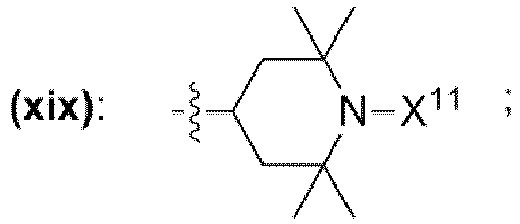
- sein können, wobei X11 ausgewählt ist aus der Gruppe bestehend aus Wasserstoff, OH, -O·, unverzweigte oder verzweigte Alkylgruppe mit 1 bis 10 Kohlenstoffatomen, unverzweigte oder verzweigte Alkoxygruppe mit 1 bis 10 Kohlenstoffatomen,
- und wobei man reduktive Bedingungen dadurch einstellt, dass man die mindestens eine Triacetonaminverbindung (I) mit Formaldehyd in Gegenwart von Wasserstoff und in Gegenwart eines Trägerkatalysators umsetzt, wobei der Trägerkatalysator mindestens ein Metall M aufweist, wobei das Metall M ausgewählt ist aus der Gruppe bestehend aus Cr, Mo, Mn, Ni, Pd, Pt, Ru, Rh.
- 1.2 Verfahren nach Punkt 1.1, wobei p5 = p6 = p7 = p8 = p11 = p12 = p13 = p14 = 0 ist und wobei p9, p10, p15, p16, p17, p18, p19, p20 unabhängig voneinander jeweils 0 oder 1 ist.
- 1.3 Verfahren nach Punkt 1.1 oder 1.2, wobei
- Y3, Y4, Y5, Y6, Y7, Y8, Y9, Y10 unabhängig voneinander jeweils ausgewählt ist aus der Gruppe bestehend aus
- unverzweigte oder verzweigte Alkylengruppe mit 1 bis 30 Kohlenstoffatomen, zweiwertige gesättigte Kohlenwasserstoffgruppe mit 3 bis 30 Kohlenstoffatomen, welche mindestens einen gesättigten Ring aus 3 bis 30 Kohlenstoffatomen aufweist.
- 1.4 Verfahren nach einem oder mehreren der Punkte 1.1 bis 1.3, wobei die Reste R3, R4, R5, R6, R9, R10, R11, R12, R13, R14, R15, R16, R17, R18, R19, R20 unabhängig voneinander jeweils ausgewählt sind aus der Gruppe bestehend aus
- Wasserstoff,
- unverzweigte oder verzweigte Alkylgruppe mit 1 bis 30 Kohlenstoffatomen, bei welcher mindestens ein Wasserstoffrest durch einen Rest ausgewählt aus der Gruppe bestehend aus -OH, -NH2, -OCH3, -OCH2CH3, -NH(CH3), -N(CH3)2, -NH(CH2CH3), -N(CH2CH3)2, -N(CH3)(CH2CH3) ersetzt sein kann,
- einem Rest, der eine chemischen Struktur (ix) mit
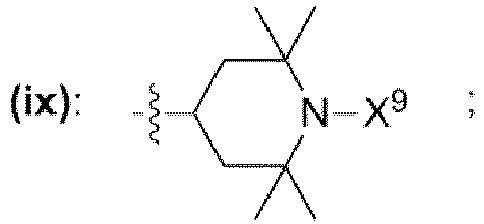
wobei X9 = Wasserstoff;
- Wasserstoff,
- unverzweigte oder verzweigte Alkylgruppe mit 1 bis 30 Kohlenstoffatomen, bei welcher mindestens ein Wasserstoffrest durch einen Rest ausgewählt aus der Gruppe bestehend aus -OH, -NH2, -OCH3, -OCH2CH3, -NH(CH3), -N(CH3)2, -NH(CH2CH3), -N(CH2CH3)2, -N(CH3)(CH2CH3) ersetzt sein kann,
und wobei, wenn p10 = 1, -NR11R12 auch ein Rest der chemischen Struktur (x) sein kann,
und wobei die Reste -NR5R6, -NR7R8, -NR9R10 unabhängig voneinander jeweils auch ein Rest der chemischen Struktur (x) sein können,
wobei die chemische Struktur (x) wie folgt definiert ist:
wobei die Reste R21, R22, R23, R24, R25, R26 unabhängig voneinander jeweils ausgewählt sind aus der Gruppe bestehend aus- Wasserstoff,
- unverzweigte oder verzweigte Alkylgruppe mit 1 bis 30 Kohlenstoffatomen,
- einer Gruppe mit der chemischen Struktur (xi) mit

- Wasserstoff,
- unverzweigte oder verzweigte Alkylgruppe mit 1 bis 30 Kohlenstoffatomen, bei welcher mindestens ein Wasserstoffrest durch einen Rest ausgewählt aus der Gruppe bestehend aus -OH, -NH2, -OCH3, -OCH2CH3, -NH(CH3), -N(CH3)2, -NH(CH2CH3), -N(CH2CH3)2, -N(CH3)(CH2CH3) ersetzt sein kann,
- einem Rest, der eine chemischen Struktur (xviii) mit

wobei X10 = Wasserstoff,

- 1.5 Verfahren nach einem oder mehreren der Punkte 1.1 bis 1.4, wobei Formaldehyd als Gas, als wässrige Lösung oder als Feststoff eingesetzt wird, bevorzugt als wässrige Lösung oder als Feststoff, noch bevorzugter als wässrigeLösung.
- 1.6 Verfahren nach einem oder mehreren der Punkte 1.1 bis 1.5, wobei man die mindestens eine Triacetonaminverbindung (I) mit Formaldehyd unter reduktiven Bedingungen in mindestens einem Lösungsmittel umsetzt, wobei das Lösungsmittel ausgewählt ist aus der Gruppe bestehend aus aliphatische Lösungsmittel, aromatische Lösungs-mittel, Ether, halogenierte Lösungsmittel, Amide, Thioverbindungen, Carbonsäuren, Alkohole, Wasser.
- 1.7 Verfahren nach einem oder mehreren der Punkte 1.1 bis 1.6, wobei man die mindestens eine Triacetonaminverbindung (I) mit Formaldehyd unter reduktiven Bedingungen bei einer Temperatur im Bereich von 20 °C bis 350 °C und einem Druck im Bereich von 2 bar bis 500 bar umsetzt.
- Die vorliegende Erfindung betrifft in einem zweiten Aspekt ein Verfahren gemäß den folgenden Punkten 2.1 bis 2.8.
- 2.1 Verfahren zur Herstellung einer N-methylsubstituierten Triacetonaminverbindung, dadurch gekennzeichnet, dass man mindestens eine Triacetonaminverbindung (I) mit Formaldehyd unter reduktiven Bedingungen umsetzt,
wobei die Triacetonaminverbindung (I) die chemische Struktur (I-F) mit
- wobei n1 eine ganze Zahl aus dem Bereich 1 bis 20 ist;
- wobei p5, p6, p7, p8, p9, p10 unabhängig voneinander jeweils 0 oder 1 ist;
- wobei Y3, Y4 unabhängig voneinander jeweils ausgewählt ist aus der Gruppe bestehend aus
- unverzweigte oder verzweigte Alkylengruppe mit 1 bis 30 Kohlenstoffatomen,
- zweiwertige gesättigte Kohlenwasserstoffgruppe mit 3 bis 30 Kohlenstoffatomen, welche
mindestens einen gesättigten Ring aus 3 bis 30 Kohlenstoffatomen aufweist, - zweiwertige Kohlenwasserstoffgruppe mit 6 bis 30 Kohlenstoffatomen, von denen mindestens 6 Kohlenstoffatome in einem aromatischen System vorliegen und die übrigen Kohlenstoffatome, falls vorhanden, gesättigt sind,
- ein verbrückender Rest, der eine chemische Struktur ausgewählt aus der Gruppe bestehend aus (i), (ii) mit

- Q1, Q2 unabhängig voneinander jeweils ausgewählt aus der Gruppe bestehend aus -O-, -S-, -NH- oder -NR'- mit R' = unverzweigte oder verzweigte Alkylgruppe mit 1 bis 6 Kohlenstoffatomen sind,
- wobei a eine ganze Zahl ausgewählt aus dem Bereich 1 bis 50 ist,
- wobei b eine ganze Zahl ausgewählt aus dem Bereich 0 bis 50 ist,
- und wobei Y3 auch eine direkte Bindung sein kann, falls mindestens einer von p5 und p6 den Wert 1 aufweist,
- und wobei Y4 auch eine direkte Bindung sein kann, falls mindestens einer von p7 und p8 den Wert 1 aufweist,
- wobei die Reste R3, R4, R5, R6, R9, R10, R11, R12 unabhängig voneinander jeweils ausgewählt sind aus der Gruppe bestehend aus
- Wasserstoff,
- unverzweigte oder verzweigte Alkylgruppe mit 1 bis 30 Kohlenstoffatomen, bei welcher mindestens ein Wasserstoffrest durch einen Rest ausgewählt aus der Gruppe bestehend aus -OH, -NH2, -OCH3, -OCH2CH3, -NH(CH3), -N(CH3)2, -NH(CH2CH3), -N(CH2CH3)2, -N(CH3)(CH2CH3) ersetzt sein kann,
- unverzweigte oder verzweigte Acylgruppe mit 1 bis 30 Kohlenstoffatomen, bei welcher mindestens ein Wasserstoffrest durch einen Rest ausgewählt aus der Gruppe bestehend aus -OH, -NH2, -OCH3, -OCH2CH3, -NH(CH3), -N(CH3)2, -NH(CH2CH3), -N(CH2CH3)2, -N(CH3)(CH2CH3) ersetzt sein kann,
- einem Rest, der eine chemischen Struktur ausgewählt aus der Gruppe bestehend aus (iii), (iv), (v), (vi), (vii), (viii), (ix) mit


- wobei J1, J2 unabhängig voneinander jeweils ausgewählt aus der Gruppe bestehend aus CH, N sind,
- wobei K1, K2 unabhängig voneinander jeweils ausgewählt aus der Gruppe bestehend aus -O-, -NH-, -N(CH3)-, -N(CH2CH3)-, -S-, -CH2- sind,
- wobei V1, V2, V3 unabhängig voneinander jeweils ausgewählt aus der Gruppe bestehend aus -O-, -S-, -NH-, -NR"- mit R" = unverzweigte oder verzweigte Alkylgruppe mit 1 bis 6 Kohlenstoffatomen sind,
- wobei W1, W2, W3 unabhängig voneinander jeweils ausgewählt aus der Gruppe bestehend aus H, Methyl, Ethyl sind,
- wobei c, d, e, f, g, h unabhängig voneinander jeweils eine ganze Zahl aus dem Bereich 0 bis 50 ist,
- wobei X9 ausgewählt ist aus der Gruppe bestehend aus Wasserstoff, -OH, -O·, unverzweigte oder verzweigte Alkylgruppe mit 1 bis 10 Kohlenstoffatomen, unverzweigte oder verzweigte Alkoxygruppe mit 1 bis 10 Kohlenstoffatomen,
- wobei in den chemischen Strukturen (iii), (iv), (v), (vi), (vii), (viii), (ix) mindestens ein an ein Kohlenstoffatom gebundener Wasserstoffrest durch einen Rest ausgewählt aus der Gruppe bestehend aus
- -OH, -NH2, -OCH3, -OCH2CH3, -NH(CH3), -N(CH3)2, -NH(CH2CH3), -N(CH2CH3)2, -N(CH3)(CH2CH3) ersetzt sein kann;
- wobei die Reste R7, R8 unabhängig voneinander jeweils ausgewählt sind aus der Gruppe bestehend aus
- Wasserstoff,
- unverzweigte oder verzweigte Alkylgruppe mit 1 bis 30 Kohlenstoffatomen, bei welcher mindestens ein Wasserstoffrest durch einen Rest ausgewählt aus der Gruppe bestehend aus -OH, -NH2, -OCH3, -OCH2CH3, -NH(CH3), -N(CH3)2, -NH(CH2CH3), -N(CH2CH3)2, -N(CH3)(CH2CH3) ersetzt sein kann,
- unverzweigte oder verzweigte Acylgruppe mit 1 bis 30 Kohlenstoffatomen, bei welcher mindestens ein Wasserstoffrest durch einen Rest ausgewählt aus der Gruppe bestehend aus -OH, -NH2, -OCH3, -OCH2CH3, -NH(CH3), -N(CH3)2, -NH(CH2CH3), -N(CH2CH3)2, -N(CH3)(CH2CH3) ersetzt sein kann,
- und wobei, wenn p9 = 1, -NR3R4 auch ein Rest der chemischen Struktur (x) sein kann,
- und wobei, wenn p10 = 1, -NR11R12 auch ein Rest der chemischen Struktur (x) sein kann,
- und wobei die Reste -NR5R6, -NR7R8, -NR9R10 unabhängig voneinander jeweils auch ein Rest der chemischen Struktur (x) sein können,
- wobei die chemische Struktur (x) wie folgt definiert ist:

- und wobei man reduktive Bedingungen dadurch einstellt, dass man die mindestens eine Triacetonaminverbindung (I) mit Formaldehyd in Gegenwart von Wasserstoff und in Gegenwart eines Trägerkatalysators umsetzt, wobei der Trägerkatalysator mindestens ein Metall M aufweist, wobei das Metall M ausgewählt ist aus der Gruppe bestehend aus Cr, Mo, Mn, Ni, Pd, Pt, Ru, Rh.
- 2.2 Verfahren nach Punkt 2.1, wobei p5 = p6 = p7 = p8 = 0 ist und wobei p9, p10 unabhängig voneinander jeweils 0 oder 1, ist; bevorzugt ist dabei p5 = p6 = p7 = p8 = 0 ist und mindestens einer von p9, p10 ist 1 (wobei logischerweise für den Fall, in dem nur einer vor p9, p10 = 1 ist, der andere von p9, p10 = 0 ist); noch bevorzugter ist p5 = p6 = p7 =p8 = 0 und p9 = p10 = 1.
- 2.3 Verfahren nach Punkt 2.1 oder 2.2, wobei Y3, Y4 unabhängig voneinander jeweils ausgewählt ist aus der Gruppe bestehend aus
- unverzweigte oder verzweigte Alkylengruppe mit 1 bis 30 Kohlenstoffatomen,
- zweiwertige gesättigte Kohlenwasserstoffgruppe mit 3 bis 30 Kohlenstoffatomen, welche mindestens einen gesättigten Ring aus 3 bis 30 Kohlenstoffatomen aufweist.
- 2.4 Verfahren nach einem oder mehreren der Punkte 2.1 bis 2.3, wobei die Reste R3, R4, R5, R6, R9, R10, R11, R12 unabhängig voneinander jeweils ausgewählt sind aus der Gruppe bestehend aus
- Wasserstoff,
- unverzweigte oder verzweigte Alkylgruppe mit 1 bis 30 Kohlenstoffatomen, bei welcher mindestens ein Wasserstoffrest durch einen Rest ausgewählt aus der Gruppe bestehend aus -OH, -NH2, -OCH3, -OCH2CH3, -NH(CH3), -N(CH3)2, -NH(CH2CH3), -N(CH2CH3)2, -N(CH3)(CH2CH3) ersetzt sein kann,
- einem Rest, der eine chemischen Struktur (ix) mit

wobei X9 = Wasserstoff;
- Wasserstoff,
- unverzweigte oder verzweigte Alkylgruppe mit 1 bis 30 Kohlenstoffatomen, bei welcher mindestens ein Wasserstoffrest durch einen Rest ausgewählt aus der Gruppe bestehend aus -OH, -NH2, -OCH3, -OCH2CH3, -NH(CH3), -N(CH3)2, -NH(CH2CH3), -N(CH2CH3)2, -N(CH3)(CH2CH3) ersetzt sein kann,
wobei die chemische Struktur (x) wie folgt definiert ist:
- 2.5 Verfahren nach einem oder mehreren der Punkte 2.1 bis 2.4, wobei die Reste R3, R4, R5, R6, R9, R10, R11, R12 unabhängig voneinander jeweils ausgewählt sind aus der Gruppe bestehend aus
- Wasserstoff,
- unverzweigte oder verzweigte Alkylgruppe mit 1 bis 12 Kohlenstoffatomen,
- einem Rest, der eine chemischen Struktur (ix) mit

wobei X9 ausgewählt ist aus der Gruppe bestehend aus Wasserstoff, -OH, -O·, unverzweigte oder verzweigte Alkylgruppe mit 1 bis 10 Kohlenstoffatomen, unverzweigte oder verzweigte Alkoxygruppe mit 1 bis 10 Kohlenstoffatomen;
- Wasserstoff,
- unverzweigte oder verzweigte Alkylgruppe mit 1 bis 12, bevorzugt 1 bis 6, Kohlenstoffatomen,

- 2.6 Verfahren nach einem oder mehreren der Punkte 2.1 bis 2.5, wobei Formaldehyd als Gas, als wässrige Lösung oder als Feststoff eingesetzt wird, bevorzugt als wässrige Lösung oder als Feststoff, noch bevorzugter als wässrigeLösung.
- 2.7 Verfahren nach einem oder mehreren der Punkte 2.1 bis 2.6, wobei man die mindestens eine Triacetonaminverbindung (I) mit Formaldehyd unter reduktiven Bedingungen in mindestens einem Lösungsmittel das Lösungsmittel ausgewählt ist aus der Gruppe bestehend aus aliphatische Lösungsmittel, aromatische Lösungsmittel, Ether, halogenierte Lösungsmittel, Amide, Thioverbindungen, Carbonsäuren, Alkohole, Wasser.
- 2.8 Verfahren nach einem oder mehreren der Punkte 2.1 bis 2.7, wobei man die mindestens eine Triacetonaminverbindung (I) mit Formaldehyd unter reduktiven Bedingungen bei einer Temperatur im Bereich von 20 °C bis 350°C und einem Druck im Bereich von 2 bar bis 500 bar umsetzt.
- Die vorliegende Erfindung betrifft in einem dritten Aspekt ein Verfahren gemäß den folgenden Punkten 3.1 bis 3.8.
- 3.1 Verfahren zur Herstellung einer N-methylsubstituierten Triacetonaminverbindung, dadurch gekennzeichnet, dass man mindestens eine Triacetonaminverbindung (I) mit Formaldehyd unter reduktiven Bedingungen umsetzt, wobei die Triacetonaminverbindung (I) die chemische Strukturen (I-G) mit
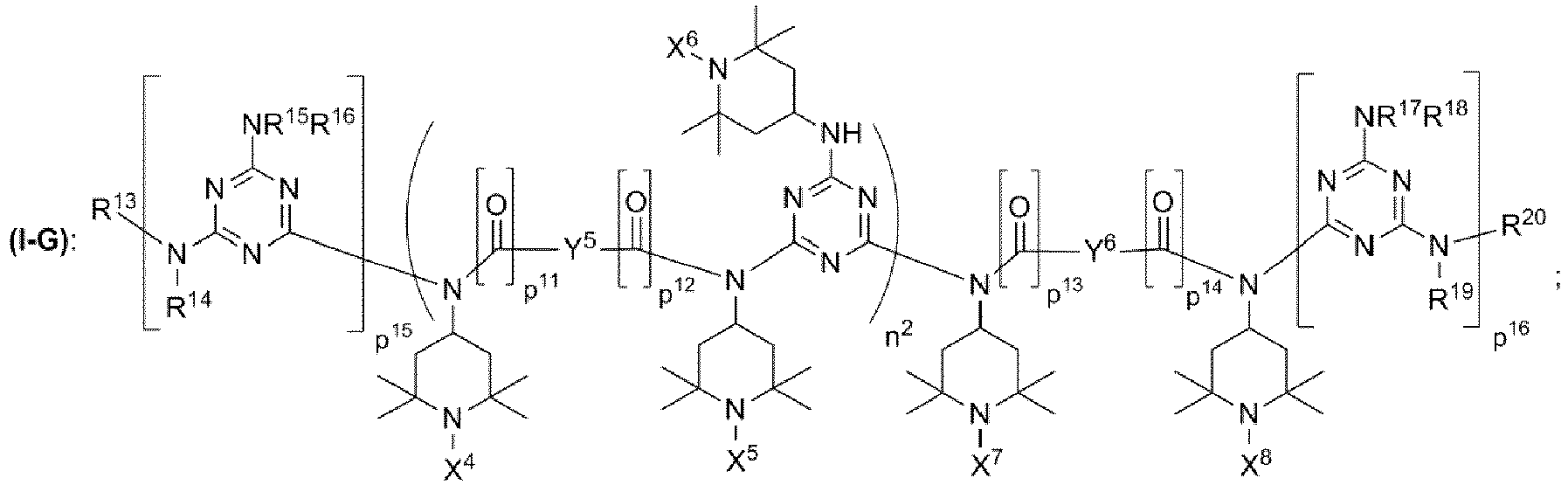
- wobei n2 eine ganze Zahl aus dem Bereich 1 bis 20 ist;
- wobei p11, p12, p13, p14, p15, p16 unabhängig voneinander jeweils 0 oder 1 ist;
- wobei X4 = X5 = X6 = X7 = X8 = Wasserstoff;
- wobei Y5, Y6 unabhängig voneinander jeweils ausgewählt ist aus der Gruppe bestehend aus
- unverzweigte oder verzweigte Alkylengruppe mit 1 bis 30 Kohlenstoffatomen,
- zweiwertige gesättigte Kohlenwasserstoffgruppe mit 3 bis 30 Kohlenstoffatomen, welche mindestens einen gesättigten Ring aus 3 bis 30 Kohlenstoffatomen aufweist,
- zweiwertige Kohlenwasserstoffgruppe mit 6 bis 30 Kohlenstoffatomen, von denen mindestens 6 Kohlenstoffatome in einem aromatischen System vorliegen und die übrigen Kohlenstoffatome, falls vorhanden, gesättigt sind,
- ein verbrückender Rest, der eine chemische Struktur ausgewählt aus der Gruppe bestehend aus (i), (ii) mit

- Q1, Q2 unabhängig voneinander jeweils ausgewählt aus der Gruppe bestehend aus -O-, -S-, -NH- oder -NR'- mit R' = unverzweigte oder verzweigte Alkylgruppe mit 1 bis 6 Kohlenstoffatomen sind,
wobei a eine ganze Zahl ausgewählt aus dem Bereich 1 bis 50 ist, - wobei b eine ganze Zahl ausgewählt aus dem Bereich 0 bis 50 ist,
- Q1, Q2 unabhängig voneinander jeweils ausgewählt aus der Gruppe bestehend aus -O-, -S-, -NH- oder -NR'- mit R' = unverzweigte oder verzweigte Alkylgruppe mit 1 bis 6 Kohlenstoffatomen sind,
- und wobei Y5 auch eine direkte Bindung sein kann, falls mindestens einer von p11 und p12 den Wert 1 aufweist,
- und wobei Y6 auch eine direkte Bindung sein kann, falls mindestens einer von p13 und p14 den Wert 1 aufweist;
- wobei die Reste R13, R14, R15, R16, R17, R18, R19, R20 unabhängig voneinander jeweils ausgewählt sind aus der Gruppe bestehend aus
- Wasserstoff,
- unverzweigte oder verzweigte Alkylgruppe mit 1 bis 30 Kohlenstoffatomen, bei welcher mindestens ein Wasserstoffrest durch einen Rest ausgewählt aus der Gruppe bestehend aus -OH, -NH2, -OCH3, -OCH2CH3, -NH(CH3), -N(CH3)2, -NH(CH2CH3), -N(CH2CH3)2, -N(CH3)(CH2CH3) ersetzt sein kann,
- unverzweigte oder verzweigte Acylgruppe mit 1 bis 30 Kohlenstoffatomen, bei welcher mindestens ein Wasserstoffrest durch einen Rest ausgewählt aus der Gruppe bestehend aus -OH, -NH2, -OCH3, -OCH2CH3, -NH(CH3), -N(CH3)2, -NH(CH2CH3), -N(CH2CH3)2, -N(CH3)(CH2CH3) ersetzt sein kann,
- einem Rest, der eine chemischen Struktur ausgewählt aus der Gruppe bestehend aus (iii), (iv), (v), (vi), (vii), (viii), (ix) mit



- wobei J1, J2 unabhängig voneinander jeweils ausgewählt aus der Gruppe bestehend aus CH, N sind,
- wobei K1, K2 unabhängig voneinander jeweils ausgewählt aus der Gruppe bestehend aus -O-, -NH-, -N(CH3)-, -N(CH2CH3)-, -S-, -CH2- sind,
- wobei V1, V2, V3 unabhängig voneinander jeweils ausgewählt aus der Gruppe bestehend aus -O-, -S-, -NH-, -NR"- mit R" = unverzweigte oder verzweigte Alkylgruppe mit 1 bis 6 Kohlenstoffatomen sind,
- wobei W1, W2, W3 unabhängig voneinander jeweils ausgewählt aus der Gruppe bestehend aus H, Methyl, Ethyl sind,
- wobei c, d, e, f, g, h unabhängig voneinander jeweils eine ganze Zahl aus dem Bereich 0 bis 50 ist,
- wobei X9 = Wasserstoff,
- wobei in den chemischen Strukturen (iii), (iv), (v), (vi), (vii), (viii), (ix) mindestens ein an ein Kohlenstoffatom gebundener Wasserstoffrest durch einen Rest ausgewählt aus der Gruppe bestehend aus
- -OH, -NH2, -OCH3, -OCH2CH3, -NH(CH3), -N(CH3)2, -NH(CH2CH3), -N(CH2CH3)2, -N(CH3)(CH2CH3) ersetzt sein kann,
- und wobei man reduktive Bedingungen dadurch einstellt, dass man die mindestens eine Triacetonaminverbindung (I) mit Formaldehyd in Gegenwart von Wasserstoff und in Gegenwart eines Trägerkatalysators umsetzt, wobei der Trägerkatalysator mindestens ein Metall M aufweist, wobei das Metall M ausgewählt ist aus der Gruppe bestehend aus Cr, Mo, Mn, Ni, Pd, Pt, Ru, Rh.
- 3.2 Verfahren nach Punkt 3.1, wobei p11 = p12 = p13 = p14 = 0 ist und wobei p15, p16 unabhängig voneinander jeweils 0 oder 1 ist.
- 3.3 Verfahren nach Punkt 3.1 oder 3.2, wobei
- Y5, Y6 unabhängig voneinander jeweils ausgewählt ist aus der Gruppe bestehend aus unverzweigte oder verzweigte Alkylengruppe mit 1 bis 30 Kohlenstoffatomen,
- zweiwertige gesättigte Kohlenwasserstoffgruppe mit 3 bis 30 Kohlenstoffatomen, welche mindestens einen gesättigten Ring aus 3 bis 30 Kohlenstoffatomen aufweist.
- 3.4 Verfahren nach einem oder mehreren der Punkte 3.1 bis 3.3, wobei die Reste R13, R14, R15, R16, R17, R18, R19, R20 unabhängig voneinander jeweils ausgewählt sind aus der Gruppe bestehend aus
- Wasserstoff,
- unverzweigte oder verzweigte Alkylgruppe mit 1 bis 30 Kohlenstoffatomen, bei welcher mindestens ein Wasserstoffrest durch einen Rest ausgewählt aus der Gruppe bestehend aus -OH, -NH2, -OCH3, -OCH2CH3, -NH(CH3), -N(CH3)2, -NH(CH2CH3), -N(CH2CH3)2, -N(CH3)(CH2CH3) ersetzt sein kann,
- einem Rest, der eine chemischen Struktur (ix) mit

wobei X9 = Wasserstoff.
- 3.5 Verfahren nach einem oder mehreren der Punkte 3.1 bis 3.4, wobei die Reste R13, R14, R15, R16, R17, R18, R19, R20 unabhängig voneinander jeweils ausgewählt sind aus der Gruppe bestehend aus
- Wasserstoff,
- unverzweigte oder verzweigte Alkylgruppe mit 1 bis 12, bevorzugt 1 bis 6, Kohlenstoffatomen,
- einem Rest, der eine chemischen Struktur (ix) mit
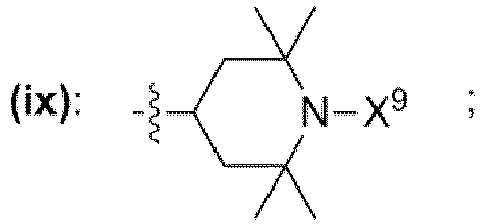
- 3.6 Verfahren nach einem oder mehreren der Punkte 3.1 bis 3.5, wobei Formaldehyd als Gas, als wässrige Lösung oder als Feststoff eingesetzt wird, bevorzugt als wässrige Lösung oder als Feststoff, noch bevorzugter als wässrige Lösung.
- 3.7 Verfahren nach einem oder mehreren der Punkte 3.1 bis 3.6, wobei man die mindestens eine Triacetonaminverbindung (I) mit Formaldehyd unter reduktiven Bedingungen in mindestens einem Lösungsmittel umsetzt, wobei das Lösungsmittel ausgewählt ist aus der Gruppe bestehend aus aliphatische Lösungsmittel, aromatische Lösungsmittel, Ether, halogenierte Lösungsmittel, Amide, Thioverbindungen, Carbonsäuren, Alkohole, Wasser.
- 3.8 Verfahren nach einem oder mehreren der Punkte 3.1 bis 3.7, wobei man die mindestens eine Triacetonaminverbindung (I) mit Formaldehyd unter reduktiven Bedingungen bei einer Temperatur im Bereich von 20 °C bis 350°C und einem Druck im Bereich von 2 bar bis 500 bar umsetzt.
- Die vorliegende Erfindung betrifft in einem vierten Aspekt ein Verfahren gemäß den folgenden Punkten 4.1 bis 4.7.
- 4.1 Verfahren zur Herstellung einer N-methylsubstituierten Triacetonaminverbindung, dadurch gekennzeichnet, dass man mindestens eine Triacetonaminverbindung (I) mit Formaldehyd unter reduktiven Bedingungen umsetzt,
wobei die Triacetonaminverbindung (I) die chemische Strukturen (I-H) mit
- wobei p17, p18, p19, p20 unabhängig voneinander jeweils 0 oder 1 ist;
- wobei Y7, Y8, Y9, Y10 unabhängig voneinander jeweils ausgewählt ist aus der Gruppe bestehend aus
- unverzweigte oder verzweigte Alkylengruppe mit 1 bis 30 Kohlenstoffatomen,
- zweiwertige gesättigte Kohlenwasserstoffgruppe mit 3 bis 30 Kohlenstoffatomen, welche mindestens einen gesättigten Ring aus 3 bis 30 Kohlenstoffatomen aufweist,
- zweiwertige Kohlenwasserstoffgruppe mit 6 bis 30 Kohlenstoffatomen, von denen mindestens 6 Kohlenstoffatome in einem aromatischen System vorliegen und die übrigen Kohlenstoffatome, falls vorhanden, gesättigt sind,
- ein verbrückender Rest, der eine chemische Struktur ausgewählt aus der Gruppe bestehend aus (i), (ii) mit

- Q1, Q2 unabhängig voneinander jeweils ausgewählt aus der Gruppe bestehend aus -O-, -S-, -NH- oder -NR'- mit R' = unverzweigte oder verzweigte Alkylgruppe mit 1 bis 6 Kohlenstoffatomen sind,
- wobei a eine ganze Zahl ausgewählt aus dem Bereich 1 bis 50 ist,
- wobei b eine ganze Zahl ausgewählt aus dem Bereich 0 bis 50 ist,
- wobei die Reste R21, R22, R23, R24, R25, R26 unabhängig voneinander jeweils ausgewählt sind aus der Gruppe bestehend aus
- Wasserstoff,
- unverzweigte oder verzweigte Alkylgruppe mit 1 bis 30 Kohlenstoffatomen,
- einer Gruppe mit der chemischen Struktur (xi) mit
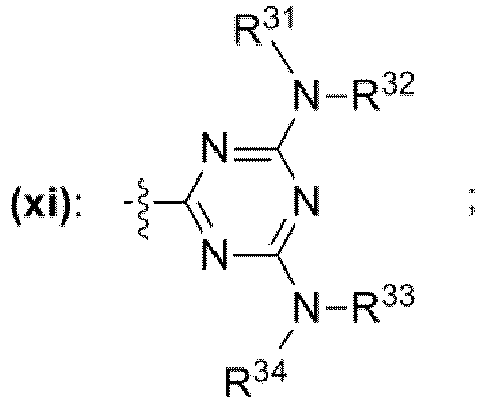
- Wasserstoff,
- unverzweigte oder verzweigte Alkylgruppe mit 1 bis 30 Kohlenstoffatomen, bei welcher mindestens ein Wasserstoffrest durch einen Rest ausgewählt aus der Gruppe bestehend aus -OH, -NH2, -OCH3, -OCH2CH3, -NH(CH3), -N(CH3)2, -NH(CH2CH3), -N(CH2CH3)2, -N(CH3)(CH2CH3) ersetzt sein kann,
- unverzweigte oder verzweigte Acylgruppe mit 1 bis 30 Kohlenstoffatomen, bei welcher mindestens ein Wasserstoffrest durch einen Rest ausgewählt aus der Gruppe bestehend aus -OH, -NH2, -OCH3, -OCH2CH3, -NH(CH3), -N(CH3)2, -NH(CH2CH3), -N(CH2CH3)2, -N(CH3)(CH2CH3) ersetzt sein kann,
- einem Rest, der eine chemischen Struktur ausgewählt aus der Gruppe bestehend aus (xii), (xiii), (xiv), (xv), (xvi), (xvii), (xviii) mit


- wobei J3, J4 unabhängig voneinander jeweils ausgewählt aus der Gruppe bestehend aus CH, N sind,
- wobei K4, K5 unabhängig voneinander jeweils ausgewählt aus der Gruppe bestehend aus -O-, -NH-, -N(CH3)-, -N(CH2CH3)-, -S-, -CH2- sind,
- wobei V4, V5, V6 unabhängig voneinander jeweils ausgewählt aus der Gruppe bestehend aus -O-, -S-, -NH-, -NR"'- mit R'" = unverzweigte oder verzweigte Alkylgruppe mit 1 bis 6 Kohlenstoffatomen sind,
- wobei W4, W5, W6 unabhängig voneinander jeweils ausgewählt aus der Gruppe bestehend aus H, Methyl, Ethyl sind,
- wobei j, k, m, q, r, s unabhängig voneinander jeweils eine ganze Zahl aus dem Bereich 0 bis 50 ist, wobei X10 = Wasserstoff,
- wobei in den chemischen Strukturen (xii), (xiii), (xiv), (xv), (xvi), (xvii), (xviii) mindestens ein an ein Kohlenstoffatom gebundener Wasserstoffrest durch einen Rest ausgewählt aus der Gruppe bestehend aus -OH, -NH2, -OCH3, -OCH2CH3, -NH(CH3), -N(CH3)2, -NH(CH2CH3), -N(CH2CH3)2, -N(CH3)(CH2CH3) ersetzt sein kann,
- und mit der Maßgabe, dass R21 und R26 für p17 = p18 = p19 = p20 = 0 unabhängig voneinander jeweils auch eine Gruppe der chemischen Struktur (xix) mit

- und wobei man reduktive Bedingungen dadurch einstellt, dass man die mindestens eine Triacetonaminverbindung (I) mit Formaldehyd in Gegenwart von Wasserstoff und in Gegenwart eines Trägerkatalysators umsetzt, wobei der Trägerkatalysator mindestens ein Metall M aufweist, wobei das Metall M ausgewählt ist aus der Gruppe bestehend aus Cr, Mo, Mn, Ni, Pd, Pt, Ru, Rh.
- 4.2 Verfahren nach Punkt 4.1, wobei
- Y7, Y8, Y9, Y10 unabhängig voneinander jeweils ausgewählt ist aus der Gruppe bestehend aus
- unverzweigte oder verzweigte Alkylengruppe mit 1 bis 30 Kohlenstoffatomen,
- zweiwertige gesättigte Kohlenwasserstoffgruppe mit 3 bis 30 Kohlenstoffatomen, welche mindestens einen gesättigten Ring aus 3 bis 30 Kohlenstoffatomen aufweist.
- 4.3 Verfahren nach einem oder mehreren der Punkte 4.1 bis 4.2, wobei die Reste R21, R22, R23, R24, R25, R26 unabhängig voneinander jeweils ausgewählt sind aus der Gruppe bestehend aus
- Wasserstoff,
- unverzweigte oder verzweigte Alkylgruppe mit 1 bis 30 Kohlenstoffatomen,
- einer Gruppe mit der chemischen Struktur (xi) mit

- Wasserstoff,
- unverzweigte oder verzweigte Alkylgruppe mit 1 bis 30 Kohlenstoffatomen, bei welcher mindestens ein Wasserstoffrest durch einen Rest ausgewählt aus der Gruppe bestehend aus -OH, -NH2, -OCH3, -OCH2CH3, -NH(CH3), -N(CH3)2, -NH(CH2CH3), -N(CH2CH3)2, -N(CH3)(CH2CH3) ersetzt sein kann,
- einem Rest, der eine chemischen Struktur (xviii) mit
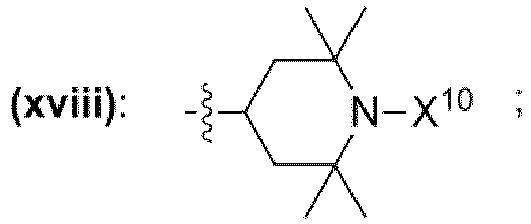
wobei X10 = Wasserstoff,

- 4.4 Verfahren nach einem oder mehreren der Punkte 4.1 bis 4.3, wobei die Reste R21, R22, R23, R24, R25, R26 unabhängig voneinander jeweils ausgewählt sind aus der Gruppe bestehend aus
- Wasserstoff,
- unverzweigte oder verzweigte Alkylgruppe mit 1 bis 12, bevorzugt 1 bis 6, Kohlenstoffatomen,
- einer Gruppe mit der chemischen Struktur (xi) mit

- Wasserstoff,
- unverzweigte oder verzweigte Alkylgruppe mit 1 bis 12, bevorzugt 1 bis 6, Kohlenstoffatomen,
- einem Rest, der eine chemischen Struktur (xviii) mit

wobei X10 = Wasserstoff,

- 4.5 Verfahren nach einem oder mehreren der Punkte 4.1 bis 4.4, wobei Formaldehyd als Gas, als wässrige Lösung oder als Feststoff eingesetzt wird, bevorzugt als wässrige Lösung oder als Feststoff, noch bevorzugter als wässrige Lösung.
- 4.6 Verfahren nach einem oder mehreren der Punkte 4.1 bis 4.5, wobei man die mindestens eine Triacetonaminverbindung (I) mit Formaldehyd unter reduktiven Bedingungen in mindestens einem Lösungsmittel umsetzt, wobei das Lösungsmittel ausgewählt ist aus der Gruppe bestehend aus aliphatische Lösungsmittel, aromatische Lösungsmittel, Ether, halogenierte Lösungsmittel, Amide, Thioverbindungen, Carbonsäuren, Alkohole, Wasser.
- 4.7 Verfahren nach einem oder mehreren der Punkte 4.1 bis 4.6, wobei man die mindestens eine Triacetonaminverbindung (I) mit Formaldehyd unter reduktiven Bedingungen bei einer Temperatur im Bereich von 20 °C bis 350°C und einem Druck im Bereich von 2 bar bis 500 bar umsetzt.
- Im Sinne der Erfindung ist eine "unverzweigte oder verzweigte Alkylgruppe" ein einwertiger gesättigter Kohlenwasserstoffrest der allgemeinen chemische Struktur (a) mit

- Die Kette an Kohlenstoffatomen "-CwH2w+1" kann dabei linear sein, dann handelt es sich um eine unverzweigte Alkylgruppe. Sie kann aber auch Verzweigungen aufweisen, dann handelt es sich um eine verzweigte Alkylgruppe.
- Dabei ist w in der chemischen Struktur (a) eine ganze Zahl. w ist bei einer unverzweigten oder verzweigten Alkylgruppe mit 1 bis 30 Kohlenstoffatomen ausgewählt aus dem Bereich 1 bis 30. w ist bei einer unverzweigten oder verzweigten Alkylgruppe mit 1 bis 29 Kohlenstoffatomen ausgewählt aus dem Bereich 1 bis 29. w ist bei einer unverzweigten oder verzweigten Alkylgruppe mit 1 bis 12 Kohlenstoffatomen ausgewählt aus dem Bereich 1 bis 12. w ist bei einer unverzweigten oder verzweigten Alkylgruppe mit 1 bis 10 Kohlenstoffatomen ausgewählt aus dem Bereich 1 bis 10. w ist bei einer unverzweigten oder verzweigten Alkylgruppe mit 1 bis 8 Kohlenstoffatomen ausgewählt aus dem Bereich 1 bis 8. w ist bei einer unverzweigten oder verzweigten Alkylgruppe mit 1 bis 6 Kohlenstoffatomen ausgewählt aus dem Bereich 1 bis 6.
- Im Sinne der Erfindung ist eine "unverzweigte oder verzweigte Alkylgruppe mit 1 bis 30 Kohlenstoffatomen" insbesondere ausgewählt aus Methyl, Ethyl, n-Propyl, iso-Propyl, n-Butyl, sec-Butyl, iso-Butyl, tert-Butyl, n-Pentyl, 1-Methylbutyl, 2-Methylbutyl, 3-Methylbutyl, 1,1-Dimethylpropyl, 1,2-Dimethylpropyl, 2,2-Dimethylpropyl, 1-Ethylpropyl, n-Hexyl, 1-Methylpentyl, 2-Methylpentyl, 3-Methylpentyl, 4-Methylpentyl, 1,1-Dimethylbutyl, 1,2-Dimethylbutyl, 1,3-Dimethylbutyl, 2,2-Dimethylbutyl, 2,3-Dimethylbutyl, 3,3-Dimethylbutyl, 1-Ethylbutyl, 2-Ethylbutyl, 1,1,2-Trimethylpropyl, 1,2,2-Trimethylpropyl, 1-Ethyl-1-methylpropyl, 1-Ethyl-2-methylpropyl, n-Heptyl, n-Octyl, n-Nonyl, n-Decyl, n-Undecyl, n-Dodecyl, n-Tridecyl, n-Tetradecyl, n-Pentadecyl, n-Hexadecyl, n-Heptadecyl, n-Octadecyl, n-Nonadecyl, n-Eicosyl, n-Heneicosyl, n-Docosyl, n-Tricosyl, n-Tetracosyl, n-Pentacosyl, n-Hexacosyl, n-Heptacosyl, n-Octocosyl, n-Nonacosyl, n-Tricontyl.
- Im Sinne der Erfindung ist eine "unverzweigte oder verzweigte Alkylgruppe mit 1 bis 12 Kohlenstoffatomen" insbesondere ausgewählt aus derGruppe bestehend aus Methyl, Ethyl, n-Propyl, iso-Propyl, n-Butyl, sec-Butyl, iso-Butyl, tert-Butyl, n-Pentyl, 1-Methylbutyl, 2-Methylbutyl, 3-Methylbutyl, 1,1-Dimethylpropyl, 1,2-Dimethylpropyl, 2,2-Dimethylpropyl, 1-Ethylpropyl, n-Hexyl, 1-Methylpentyl, 2-Methylpentyl, 3-Methylpentyl, 4-Methylpentyl, 1,1-Dimethylbutyl, 1,2-Dimethylbutyl, 1,3-Dimethylbutyl, 2,2-Dimethylbutyl, 2,3-Dimethylbutyl, 3,3-Dimethylbutyl, 1-Ethylbutyl, 2-Ethylbutyl, 1,1,2-Trimethylpropyl, 1,2,2-Trimethylpropyl, 1-Ethyl-1-methylpropyl, 1-Ethyl-2-methylpropyl, n-Heptyl, n-Octyl, n-Nonyl, n-Decyl, n-Undecyl, n-Dodecyl.
- Im Sinne der Erfindung ist eine "unverzweigte oder verzweigte Alkylgruppe mit 1 bis 10 Kohlenstoffatomen" insbesondere ausgewählt aus derGruppe bestehend aus Methyl, Ethyl, n-Propyl, iso-Propyl, n-Butyl, sec-Butyl, iso-Butyl, tert-Butyl, n-Pentyl, 1-Methylbutyl, 2-Methylbutyl, 3-Methylbutyl, 1,1-Dimethylpropyl, 1,2-Dimethylpropyl, 2,2-Dimethylpropyl, 1-Ethylpropyl, n-Hexyl, 1-Methylpentyl, 2-Methylpentyl, 3-Methylpentyl, 4-Methylpentyl, 1,1-Dimethylbutyl, 1,2-Dimethylbutyl, 1,3-Dimethylbutyl, 2,2-Dimethylbutyl, 2,3-Dimethylbutyl, 3,3-Dimethylbutyl, 1-Ethylbutyl, 2-Ethylbutyl, 1,1,2-Trimethylpropyl, 1,2,2-Trimethylpropyl, 1-Ethyl-1-methylpropyl, 1-Ethyl-2-methylpropyl, n-Heptyl, n-Octyl, n-Nonyl, n-Decyl.
- Im Sinne der Erfindung ist eine "unverzweigte oder verzweigte Alkylgruppe mit 1 bis 8 Kohlenstoffatomen" insbesondere ausgewählt aus derGruppe bestehend aus Methyl, Ethyl, n-Propyl, iso-Propyl, n-Butyl, sec-Butyl, iso-Butyl, tert-Butyl, n-Pentyl, 1-Methylbutyl, 2-Methylbutyl, 3-Methylbutyl, 1,1-Dimethylpropyl, 1,2-Dimethylpropyl, 2,2-Dimethylpropyl, 1-Ethylpropyl, n-Hexyl, 1-Methylpentyl, 2-Methylpentyl, 3-Methylpentyl, 4-Methylpentyl, 1,1-Dimethylbutyl, 1,2-Dimethylbutyl, 1,3-Dimethylbutyl, 2,2-Dimethylbutyl, 2,3-Dimethylbutyl, 3,3-Dimethylbutyl, 1-Ethylbutyl, 2-Ethylbutyl, 1,1,2-Trimethylpropyl, 1,2,2-Trimethylpropyl, 1-Ethyl-1-methylpropyl, 1-Ethyl-2-methylpropyl, n-Heptyl, n-Octyl. Im Sinne der Erfindung ist eine "unverzweigte oder verzweigte Alkylgruppe mit 1 bis 6 Kohlenstoffatomen" insbesondere ausgewählt aus der Gruppe bestehend aus Methyl, Ethyl, n-Propyl, iso-Propyl, n-Butyl, sec-Butyl, iso-Butyl, tert-Butyl, n-Pentyl, 1-Methylbutyl, 2-Methylbutyl, 3-Methylbutyl, 1,1-Dimethylpropyl, 1,2-Dimethylpropyl, 2,2-Dimethylpropyl, 1-Ethylpropyl, n-Hexyl, 1-Methylpentyl, 2-Methylpentyl, 3-Methylpentyl, 4-Methylpentyl, 1,1-Dimethylbutyl, 1,2-Dimethylbutyl, 1,3-Dimethylbutyl, 2,2-Dimethylbutyl, 2,3-Dimethylbutyl, 3,3-Dimethylbutyl, 1-Ethylbutyl, 2-Ethylbutyl, 1,1,2-Trimethylpropyl, 1,2,2-Trimethylpropyl, 1-Ethyl-1-methylpropyl, 1-Ethyl-2-methylpropyl.
- Der Begriff "unverzweigte oder verzweigte Alkylengruppe" bezeichnet im Sinne der Erfindung einen zweiwertigen gesättigten Kohlenwasserstoffrest, welcher durch die allgemeine chemische Struktur (b) mit

- x ist bei einer unverzweigten oder verzweigten Alkylengruppe mit 1 bis 30 Kohlenstoffatomen ausgewählt aus dem Bereich 1 bis 30.
- x ist bei einer unverzweigten oder verzweigten Alkylengruppe mit 1 bis 12 Kohlenstoffatomen ausgewählt aus dem Bereich 1 bis 12.
- x ist bei einer unverzweigten oder verzweigten Alkylengruppe mit 1 bis 6 Kohlenstoffatomen ausgewählt aus dem Bereich 1 bis 6.
- Im Sinne der Erfindung ist eine "zweiwertige gesättigte Kohlenwasserstoffgruppe mit 3 bis 30 Kohlenstoffatomen, welche mindestens einen gesättigten Ring aus 3 bis 30 Kohlenstoffatomen aufweist" insbesondere eine chemische Struktur (c) mit

- Insbesondere ist eine "zweiwertige gesättigte Kohlenwasserstoffgruppe mit 3 bis 30 Kohlenstoffatomen, welche mindestens einen gesättigten Ring aus 3 bis 30 Kohlenstoffatomen aufweist" eine "zweiwertige gesättigte Kohlenwasserstoffgruppe mit 3 bis 12 Kohlenstoffatomen, welche mindestens einen gesättigten Ring aus 3 bis 12 Kohlenstoffatomen aufweist", noch bevorzugter ""zweiwertige gesättigte Kohlenwasserstoffgruppe mit 3 bis 6 Kohlenstoffatomen, welche mindestens einen gesättigten Ring aus 3 bis 6 Kohlenstoffatomen aufweist".
- Eine "zweiwertige gesättigte Kohlenwasserstoffgruppe mit 3 bis 12 Kohlenstoffatomen, welche mindestens einen gesättigten Ring aus 3 bis 12 Kohlenstoffatomen aufweist" weist im Sinne der Erfindung eine chemische Struktur (c) auf, wobei z' eine ganze Zahl zwischen 0 und 9 ist; wobei z" eine ganze Zahl zwischen 0 und 9 ist; wobei z'" eine ganze Zahl zwischen 1 und 10 ist; und wobei gleichzeitig gilt, dass z' + z" + z'" ≤ 10.
- Bevorzugt ist eine "zweiwertige gesättigte Kohlenwasserstoffgruppe mit 3 bis 12 Kohlenstoffatomen, welche mindestens einen gesättigten Ring aus 3 bis 12 Kohlenstoffatomen aufweist" ausgewählt aus der Gruppe bestehend aus Cyclopropylen, Cyclobutylen, Cyclopentylen, Cyclohexylen, Cycloheptylen, Cyclooctylen, Cyclononylen, Cyclodecylen, Cycloundecylen, Cyclododecylen.
- Eine "zweiwertige gesättigte Kohlenwasserstoffgruppe mit 3 bis 6 Kohlenstoffatomen, welche mindestens einen gesättigten Ring aus 3 bis 6 Kohlenstoffatomen aufweist" weist im Sinne der Erfindung eine chemische Struktur (c) auf, wobei z' eine ganze Zahl zwischen 0 und 3 ist; wobei z" eine ganze Zahl zwischen 0 und 3 ist; wobei z'" eine ganze Zahl zwischen 1 und 4 ist; und wobei gleichzeitig gilt, dass z' + z" + z'" ≤ 4.
- Bevorzugt ist eine "zweiwertige gesättigte Kohlenwasserstoffgruppe mit 3 bis 6 Kohlenstoffatomen, welche mindestens einen gesättigten Ring aus 3 bis 6 Kohlenstoffatomen aufweist" ausgewählt aus der Gruppe bestehend aus Cyclopropylen, Cyclobutylen, Cyclopentylen, Cyclohexylen.
- Im Sinne der Erfindung ist eine "zweiwertige Kohlenwasserstoffgruppe mit 6 bis 30 Kohlenstoffatomen, von denen mindestens 6 Kohlenstoffatome in einem aromatischen System vorliegen und die übrigen Kohlenstoffatome, falls vorhanden, gesättigt sind" insbesondere eine "zweiwertige Kohlenwasserstoffgruppe mit 6 bis 30 Kohlenstoffatomen, von denen 6, 10 oder 14 Kohlenstoffatome in einem aromatischen System vorliegen und die übrigen Kohlenstoffatome, falls vorhanden, gesättigt sind" und bevorzugter ausgewählt aus der Gruppe bestehend aus Naphthylen, Anthrylen, Phenanthrylen sowie der folgenden chemischen Struktur (d):

- Noch bevorzugter handelt es sich dabei um eine "zweiwertige Kohlenwasserstoffgruppe mit 6 bis 30 Kohlenstoffatomen, von denen 6 oder 10 Kohlenstoffatome in einem aromatischen System vorliegen und die übrigen Kohlenstoffatome, falls vorhanden, gesättigt sind" und am bevozugtesten ist diese dann ausgewählt aus der Gruppe bestehend aus Naphthylen, sowie der folgenden chemischen Struktur (d):

- Im Sinne der Erfindung ist eine "unverzweigte oder verzweigte Alkoxygruppe" ein organischer Rest der chemischen Struktur
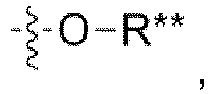
- Bei einer "unverzweigten oder verzweigten Alkoxygruppe mit 1 bis 10 Kohlenstoffatomen" ist R** eine unverzweigte oder verzweigte Alkylgruppe mit 1 bis 10 Kohlenstoffatomen.
- Im Sinne der Erfindung ist eine "unverzweigte oder verzweigte Alkoxygruppe mit 1 bis 10 Kohlenstoffatomen" insbesondere ausgewählt aus der Gruppe bestehend aus Methoxy, Ethoxy, n-Propoxy, iso-Propoxy, n-Butoxy, sec-Butoxy, iso-Butoxy, tert-Butoxy, n-Pentoxy, 1-Methylbutoxy, 2-Methylbutoxy, 3-Methylbutoxy, 1,1-Dimethylpropoxy, 1,2-Dimethylpropoxy, 2,2-Dimethylpropoxy, 1-Ethylpropoxy, n-Hexoxy, 1-Methylpentoxy, 2-Methylpentoxy, 3-Methylpentoxy, 4-Methylpentoxy, 1,1-Dimethylbutoxy, 1,2-Dimethylbutoxy, 1,3-Dimethylbutoxy, 2,2-Dimethylbutoxy, 2,3-Dimethylbutoxy, 3,3-Dimethylbutoxy, 1-Ethylbutoxy, 2-Ethylbutoxy, 1,1,2-Trimethylpropoxy, 1,2,2-Trimethylpropoxy, 1-Ethyl-1-methylpropoxy, 1-Ethyl-2-methylpropoxy, n-Heptoxy, n-Octoxy, n-Nonoxy, n-Decoxy.
- Im Sinne der Erfindung ist eine "unverzweigte oder verzweigte Acylgruppe mit 1 bis 30 Kohlenstoffatomen" ein organischer Rest der chemischen Struktur

- Insbesondere ist R* ausgewählt aus der Gruppe bestehend aus Methyl, Ethyl, n-Propyl, iso-Propyl, n-Butyl, sec-Butyl, iso-Butyl, tert-Butyl, n-Pentyl, 1-Methylbutyl, 2-Methylbutyl, 3-Methylbutyl, 1,1-Dimethylpropyl, 1,2-Dimethylpropyl, 2,2-Dimethylpropyl, 1-Ethylpropyl, n-Hexyl, 1-Methylpentyl, 2-Methylpentyl, 3-Methylpentyl, 4-Methylpentyl, 1,1-Dimethylbutyl, 1,2-Dimethylbutyl, 1,3-Dimethylbutyl, 2,2-Dimethylbutyl, 2,3-Dimethylbutyl, 3,3-Dimethylbutyl, 1-Ethylbutyl, 2-Ethylbutyl, 1,1,2-Trimethylpropyl, 1,2,2-Trimethylpropyl, 1-Ethyl-1-methylpropyl, 1-Ethyl-2-methylpropyl, n-Heptyl, n-Octyl, n-Nonyl, n-Decyl, n-Undecyl, n-Dodecyl, n-Tridecyl, n-Tetradecyl, n-Pentadecyl, n-Hexadecyl, n-Heptadecyl, n-Octadecyl, n-Nonadecyl, n-Eicosyl, n-Heneicosyl, n-Docosyl, n-Tricosyl, n-Tetracosyl, n-Pentacosyl, n-Hexacosyl, n-Heptacosyl, n-Octocosyl, n-Nonacosyl.
- "-O·" bezeichnet im Sinne der Erfindung einen radikalischen Sauerstoffrest.
- Im Sinne der Erfindung bedeutet die Formulierung "mindestens ein Wasserstoffrest durch einen Rest ausgewählt aus der Gruppe bestehend aus -OH, -NH2, -OCH3, -OCH2CH3, -NH(CH3), -N(CH3)2, -NH(CH2CH3), -NH(CH2CH3), -N(CH3)(CH2CH3) ersetzt sein kann", dass die betreffende Gruppe unsubstituiert vorliegt oder in der betreffenden Gruppe mindestens ein an ein Kohlenstoffatom gebundener Wasserstoffrest, bevorzugt 1 bis 5, noch bevorzugter 1 bis 3, am bevorzugtesten 1 bis 2 an das selbe oder unterschiedliche Kohlenstoffatom(e) gebundene(r) Wasserstoffrest(e), durch einen Rest ausgewählt aus der Gruppe bestehend aus -OH, -NH2, -OCH3, -OCH2CH3, -NH(CH3), -N(CH3)2, -NH(CH2CH3), -N(CH2CH3)2, -N(CH3)(CH2CH3) substituiert ist.
- Formaldehyd wird insbesondere im erfindungsgemäßen Verfahren als Gas, als wässrige Lösung oder als Feststoff eingesetzt werden. Bevorzugt wird Formaldehyd im erfindungsgemäßen Verfahren als wässrige Lösung oder als Feststoff (z. B. als Paraformaldehyd) eingesetzt.
- In der noch bevorzugteren Ausführungsform, in der Formaldehyd als wässrige Lösung eingesetzt wird, beträgt die Konzentration des Formaldehyds in der Lösung 1.0 bis 37 Gew.-% (w/w, "%" bezieht sich auf das Gewicht des Formaldehyds bezogen auf das Gesamtgewicht der wässrigen Lösung). Bei 37 Gew.-% an Formaldehyd enthalten zum Beispiel 100 g wässrige Lösung 37 g Formaldehyd.
- Das erfindungsgemäße Verfahren wird unter reduktiven Bedingungen durchgeführt. Unter "reduktiven Bedingungen" sind die Bedingungen zu verstehen, bei welchen das im Reaktionsschema <1> gezeigte Imin durch Wasserstoffanlagerung in das entsprechende Amin überführt wird.
- Man stellt im erfindungsgemäßen Verfahren reduktive Bedingungen dadurch ein, dass man die mindestens eine Triacetondiaminverbindung (I) mit der mindestens einen Carbonylverbindung (II) in Gegenwart von Wasserstoff und in Gegenwart eines Trägerkatalysators umsetzt, wobei der Trägerkatalysator mindestens ein Metall M aufweist, wobei das Metall M ausgewählt ist aus der Gruppe bestehend aus Cr, Mo, Mn, Ni, Pd, Pt, Ru, Rh; noch bevorzugter ausgewählt ist aus der Gruppe bestehend aus Cr, Ni, Pd, Pt; am bevorzugtesten ausgewählt ist aus der Gruppe bestehend aus Ni, Pd.
- Die Verwendung eines Trägerkatalysators aufweisend mindestens ein Metall M ist wesentlich für das erfindungsgemäße Verfahren: solche Trägerkatalysatoren sind dem Fachmann bekannt und insbesondere in der
EP 0 302 020 A2 beschrieben. - "Trägerkatalysator, wobei dieser mindestens ein Metall M aufweist" bedeutet insbesondere, dass das Metall M, welches bevorzugt im elementaren Zustand vorliegt, auf einem dem Fachmann bekannten Träger aufgebracht ist, welcher beispielsweise insbesondere ausgewählt aus der Gruppe bestehend aus Aktivkohle, Calciumcarbonat, Aluminiumoxid, Titandioxid, insbesondere aus der Gruppe bestehend aus Aluminiumoxid, Aktivkohle sein kann.
- Der Anteil an Metall M im Trägerkatalysator ist dabei nicht besonders beschränkt und liegt insbesondere im Bereich 0.1 bis 30 Gew.-%, bevorzugt 1 bis 10 Gew.-%, bevorzugter 5 Gew.-%. Dabei bedeutet Gew.-% das Gesamtgewicht aller vom jeweiligen Trägerkatalysator umfassten Metalle M bezogen auf das Gesamtgewicht des vom jeweiligen Trägerkatalysator umfassten Trägers.
- Ohne einen solchen Trägerkatalysator würde man nur unerwünschte Produkte erhalten. C. Harries beschreibt zum Beispiel auf Seiten 220 bis 222 seines Artikels "Untersuchungen über die cyclischen Acetonbasen" in Justus Liebigs Annalen der Chemie, Band 417, 1918, Seiten 107 bis 191 eine Umsetzung von 4-Amino-2,2,6,6-Tetramethylaminopiperidin mit Acetanhydrid ohne Trägerkatalysator, was zu hohen Ausbeuten an der entsprechenden, hier unerwünschten Amidverbindung führt.
- Das erfindungsgemäße Verfahren kann man lösungsmittelfrei oder auch in mindestens einem Lösungsmittel durchführen, bevorzugt in mindestens einem Lösungsmittel. Als Lösungsmittel eignen sich dabei alle Lösungsmittel, in denen sich die Reaktanden gut lösen und welche auch keinen störenden Einfluss auf das erfindungsgemäße Verfahren haben. Insbesondere ist das Lösungsmittel ausgewählt aus der Gruppe bestehend aus aliphatische Lösungsmittel, aromatische Lösungsmittel, Ether, halogenierte Lösungsmittel, Amide, Thioverbindungen, Carbonsäuren, Alkohole, Wasser; bevorzugt ist das Lösungsmittel ausgewählt aus der Gruppe bestehend aus aliphatische Lösungsmittel, aromatische Lösungsmittel, Ether, Alkohole, Wasser; bevorzugter ist das Lösungsmittel ausgewählt aus der Gruppe bestehend aus aliphatische Lösungsmittel, aromatische Lösungsmittel, Ether, Alkohole, Wasser; noch bevorzugter ist das Lösungsmittel ausgewählt aus der Gruppe bestehend aus aliphatische Lösungsmittel, aromatische Lösungsmittel, Alkohole, Wasser. Das Lösungsmittel ist besonders bevorzugt ausgewählt aus aromatischen Lösungsmittel (insbesondere Toluol), Alkohole (insbesondere Methanol).
- Aliphatische Lösungsmittel sind insbesondere ausgewählt aus der Gruppe bestehend aus Pentan, Hexan, Heptan, Octan, Decan, Cyclopentan, Cyclohexan, Methylcyclohexan, Petrolether.
- Aromatische Lösungsmittel sind insbesondere ausgewählt aus der Gruppe bestehend aus Benzol, Toluol, Xylol, Ethylbenzol, Cumol, Brombenzol, Chlorbenzol, Dichlorbenzol, Furan, bevorzugt Toluol.
- Ether sind insbesondere ausgewählt aus der Gruppe bestehend aus Diethylether, Dipropylether, Dibutylether, Methyl-tert-Butylether, Ethylenglykolmonomethylether, Ethylenglykolmonoethylether, Ethylenglykoldimethylether, Ethylenglykoldiethylether, Diethylenglykolmonomethylether, Diethylenglykolmonoethylether, Diethylenglykoldimethylether, Diethylenglykoldiethylether, Triethylenglykolmonomethylether, Triethylenglykolmonoethylether, Triethylenglykoldimethylether, Triethylenglykoldiethylether, Polyethylenglykolmonomethylether, Polyethylenglykolmonoethylether, Polyethylenglykoldimethylether, Polyethylenglykoldiethylether, 1,4-Dioxan, 1,3-Dioxan, Tetrahydrofuran.
- Halogenierte Lösungsmittel sind insbesondere ausgewählt aus der Gruppe bestehend aus Dichlormethan, Chloroform, Tetrachlormethan.
- Amide sind insbesondere ausgewählt aus der Gruppe bestehend aus Dimethylformamid, Dimethylacetamid.
- Thioverbindungen sind insbesondere ausgewählt aus der Gruppe bestehend aus Dimethylsulfoxid, Sulfolan.
- Carbonsäuren sind insbesondere ausgewählt aus der Gruppe bestehend aus Ameisensäure, Essigsäure, Propionsäure, Butansäure, Pentansäure.
- Alkohole, sind insbesondere ausgewählt aus der Gruppe bestehend aus
Methanol, Ethanol, Propanol, iso-Propanol, 1,2-Propandiol, 1,3-Propandiol, Glycerin, Butanol, sec-Butanol, iso-Butanol, tert-Butanol, 1,2-Butandiol, 1,3-Butandiol, 1,4-Butandiol, 1-Pentanol, 2-Pentanol, 3-Pentanol, tert-Amylalkohol, 1,2-Pentandiol, 1,3-Pentandiol, 1,4-Pentandiol, 1,5-Pentandiol, Cyclopentanol, Hexanol, Cyclohexanol Heptanol, Octanol, Nonanol, Decanol, Ethylenglykol, Diethylenglykol, Triethylenglykol, Polyethylenglykol, Benzylalkohol, Phenol; bevorzugt ausgewählt aus Methanol, Ethanol, n-Propanol, iso-Propanol; bevorzugt Methanol. - Das erfindungsgemäße Verfahren lässt sich kontinuierlich oder nicht kontinuierlich, also batchweise, durchführen.
- Die Reaktionszeit hängt vom Fortgang des Verfahrens und vom gewünschten Umsatz ab - üblicherweise strebt man einen größtmöglichen Umsatz an und führt das erfindungsgemäße Verfahren so lange fort, bis kein Eduktumsatz mehr beobachtet werden kann.
- Die Temperatur beim erfindungsgemäßen Verfahren ist nicht beschränkt und liegt bevorzugt im Bereich von 20 °C bis 350 °C, bevorzugter im Bereich von 50 °C bis 300 °C, noch bevorzugter im Bereich von 50 °C bis 250 °C, am bevorzugtesten im Bereich von 70 °C bis 200 °C, noch bevorzugter bei 80 °C bis 140 °C.
- Der Druck beim erfindungsgemäßen Verfahren ist nicht beschränkt und liegt bevorzugt im Bereich von 2 bar bis 500 bar, bevorzugter im Bereich von 5 bar bis 350 bar, noch bevorzugter im Bereich von 15 bar bis 300 bar, noch bevorzugter 20 bis 42 bar.
- Die obigen Temperaturbereiche und Druckbereiche können natürlich auch in Kombination vorliegen. So kann man das Verfahren bevorzugt bei einer Temperatur im Bereich von 20 °C bis 350 °C, [bevorzugter im Bereich von 50 °C bis 300 °C, noch bevorzugter im Bereich von 50 °C bis 250 °C, am bevorzugtesten im Bereich von 70 °C bis 200 °C, noch bevorzugter bei 80 °C - 140 °C] und einem Druck im Bereich von 2 bar bis 500 bar [bevorzugt im Bereich von 2 bar bis 500 bar, bevorzugter im Bereich von 5 bar bis 350 bar, noch bevorzugter im Bereich von 15 bar bis 300 bar, noch bevorzugter 20 bis 42 bar] durchführen.
- Dieses Verfahren löst die erfindungsgemäßen Aufgaben. Besonders vorteilhaft ist, dass bei der Reaktion lediglich Wasser als Nebenprodukt entsteht. Zudem kann der geringe Überschuss an Formaldehyd entweder durch Hydrierung in Methanol überführt werden oder destillativ abgetrennt und gegebenenfalls zurückgeführt werden.
Die Aufarbeitung des Rohproduktes ist daher sehr einfach: Der Katalysator wird durch Filtration entfernt (vorstellbar wäre technisch auch die Verwendung eines Festbettkatalysators, so dass auch dieser Schritt entfallen würde), anschließend wird das Rohprodukt destillativ aufgereinigt. Es fallen bei der Destillation lediglich Methanol (kann recyclelt werden), Wasser, das Produkt und gegebenenfalls Formaldehyd (kann ebenfalls recyclelt werden) an. - Im Gegensatz zu den Verfahren nach dem Stand der Technik muss also keine Abtrennung von den gebildeten Salzen erfolgen (erfolgt im Allgemeinen durch Extraktion mit einem zusätzlichen Lösungsmittel), zudem fallen die genannten Salze (bzw. deren wässrige Lösung) nicht als Abfallstrom an.
- Zusätzlich vorteilhaft ist bei dem erfindungsgemäßen Verfahren, dass zusätzlich zur Einführung der Methylgruppe am Piperidinstickstoff (N1 ) auch andere Aminogruppen simultan methyliert werden können. In diesem Fall werden also zwei oder mehr Methylgruppen simultan eingeführt.
- Ein weiterer Vorteil besteht darin, dass auch die Anwesenheit von tertiären Aminogruppen toleriert wird, ohne dass diese in die quartären Ammoniumsalze überführt werden.
- Die nachfolgenden Beispiele sollen die Erfindung näher erläutern, ohne dass die Erfindung auf diese Ausführungsformen beschränkt sein soll.
- Paraformaldehyd wurde erworben von Sigma-Aldrich (Reinheit 95 %).
- Die verwendete 37 Gew.-%-ige Formalinlösung wurde erworben von der Firma Sigma Aldrich.
- Die in den nicht erfindungsgemäßen Beispielen E1 bis E12 genutzten Edukte waren die von der Firma Evonik Industries AG vertriebenen.
- Das im erfindungsgemäßen Beispiel E13 verwendete Edukt wurde von der Firma Cytec erhalten (Produktname: Cyasorb 3346).
- Das im nicht erfindungsgemäßen Beispiel E14 verwendete Edukt wurde von derFirma Beijing Huashan Auxiliary erworben (Produktname: Tinuvin 770).
- Der verwendete Pd/ Aktivkohle - Katalysator war der von der Evonik Industries AG vertriebene (Produktname: E 196 NN/W 10 %).
- In einen 2 L - Druckautoklav wurden 1.5 mol der jeweiligen Triacetonaminverbindung ("Edukt" gemäß Tabelle 1), 3 mmol Palladium (als Pd/ Aktivkohle - Katalysator) und 400 ml Methanol gegeben. Im Anschluss wurde eine wässrige Lösung von Formaldehyd (37 Gew.-% an Formaldehyd, wobei die %-Angabe bezogen auf das Gesamtgewicht der Lösung zu verstehen ist, d.h. 100 g Lösung enthalten 37 g Formaldehyd) in der Menge gemäß Tabelle 1 hinzugefügt und der Reaktor verschlossen.
- Unter Rühren wurde Wasserstoff aufgedrückt (40 bar H2). Es wurde bei einer Temperatur von 80 bis 140 °C und einem Druck von 20 bis 42 barso lange hydriert, bis keine nennenswerte Wasserstoffaufnahme mehr zu beobachten war.
- Der Reaktor wurde danach abgekühlt und entspannt. Das Rohprodukt wurde ausgetragen, filtriert und anschließend zunächst das Lösungsmittel entfernt (80 - 120 °C, Normaldruck). Dann wurde per Gaschromatographie (= GC, Agilent 5890 bzw. 7890, FID-Detektor) die Ausbeute an Produkt und gegebenenfalls die des/ der Nebenprodukte(s) (E2, E3, E7, E9, E10) im erhaltenen Rohprodukt bestimmt (siehe Tabelle 1, Strukturen in der Spalte "Rohprodukt"). Im Falle der Beispiele E1 bis E6 wurde zusätzlich der Rückstand anschließend mittels einer Vakuumdestillation gereinigt und die Ausbeute an Hauptprodukt per GC bestimmt.
- Die Ergebnisse sind in der Tabelle 1 zusammengestellt.
- In einen 1 L-Druckautoklavwurde die in Tabelle 2 angegebene Menge der jeweiligen Triacetonaminverbindung ("Edukt" gemäß Tabelle 2), 0.2 mol.-% Pd (mol-% bezogen auf die Menge des Edukts) als Pd/ Aktivkohle - Katalysator, und 250 ml Lösungsmittel (Methanol oder Toluol) gegeben. Im Anschluss wurde Paraformaldeyhd in der Menge gemäß Tabelle 2 hinzugefügt, mit 50 ml Lösungsmittel nachgespült und der Reaktor verschlossen. Unter Rühren wurde Wasserstoff aufgedrückt (40 bar H2). Es wurde bei einer Temperatur von 80 bis 140 °C und einem Druck von 20 bis 42 bar so lange hydriert, bis keine nennenswerte Wasserstoffaufnahme mehr zu beobachten war. Der Reaktor wurde danach abgekühlt und entspannt. Das Rohprodukt wurde ausgetragen, filtriert und anschließend zunächst das Lösungsmittel entfernt (80 - 120 °C, Normaldruck). Dann wurde im Falle der Beispiele E11, E12, E14 per Gaschromatographie (= GC, Agilent 5890 bzw. 7890, FID-Detektor), im Falle des erfindungsgemäßen Beispiels E13 mittels MS-ESI die Ausbeute an Produkt im erhaltenen Rohprodukt bestimmt (siehe Tabelle 2, Strukturen in der Spalte "Rohprodukt"). Im Falle des Beispiels E11 wurde der Rückstand anschließend soweit möglich mittels einer Vakuumdestillation gereinigt.
Die Ergebnisse sind in der Tabelle 2 zusammengestellt.Tabelle 1 Beispiel Nr. Ansatz Rohprodukt inprodukt Struktur Edukt wässrige FormalinLösung (37 Gew.-% Formaldehyd) Struktur GC-Analyse GC-Analyse Ausbeute (i) Molmasse Edukt (i) eingesetzte Menge Formalin-Lsg. (37 Gew.-% Formaldehyd in Wasser) in g Flächen-% Gehalt [Flächen - %] Reinfraktion [%; bezogen auf eingesetzte Menge Edukt in mol] (ii) eingesetzte Menge Edukt in g [bzw. mol] (ii) eingesetzte Menge an Formaldehyd in mol (iii) Moläquivalente [= "Moläq.] Formaldehyd, bezogen auf Edukt E1 
(i) 267.8 g 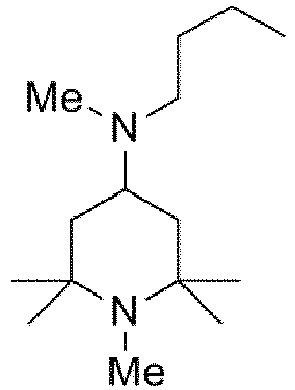
97.9 98.3 93.7 (ii) 3.30 mol (iii) 2.2 Moläq. (ii) 321.4 g [1.5 mol] E2 
(i) 133.9 g 
88.6 99.4 77.8 (ii) 1.65 mol (iii) 1.1 Moläq. (i) 212.4 g/mol 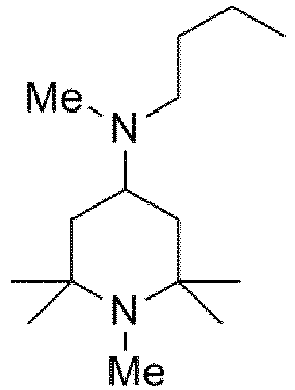
10.4 (ii) 321.4 g [1.5 mol] E3 
(i) 267.8 g 
86.8 99.7 61.8 (ii) 3.30 mol (iii) 2.2 Moläq. (i) 241.4 g/mol 
12.5 (ii) 362.1 g [1.50 mol] E4 
(i) 121.7 g 
97.6 98.8 82.2 (ii) 1.50 mol (iii) 1.0 Moläq. (ii) 365.4 g [1.51 mol] E5 
(i) 316.5 g 
97.5 99.9 72.4 (ii) 3.90 mol (iii) 2.6 Moläq (ii) 341.8 g [1.50 mol] E6 
(i) 63.3 g 
98.9 98.8 86.7 (ii) 0.78 mol (iii) 1.0 Moläq. (ii) 178.0 g [0.78 mol] E7 
(i) 401.8 g 
76.0 99.3 58.3 (ii) 4.95 mol (iii) 3.3 Moläq (i) 156.3 g/mol (ii) 238.0 g [1.5 mol] Neben produkt: 21.5 
E8 
(i) 89.3 g 
98.5 - - (ii) 1.10 mol (iii) 1.1 Moläq. (i) 157.3 g/mol (ii) 157.0 g (iii) 1.0 mol E9 
(i) 89.2 g 
80.4 - - (ii) 1.10 mol (iii) 2.2 Moläq. (i) 394.7 g/mol (ii) 198.3 g [0.5 mol] 
18.0 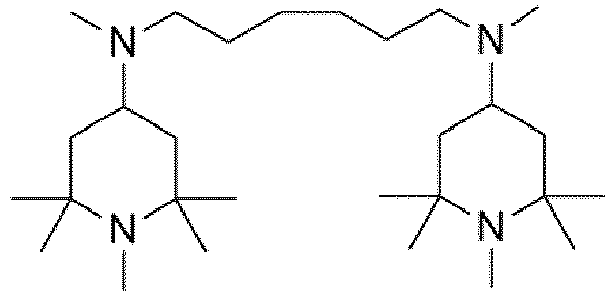
1.1 E10 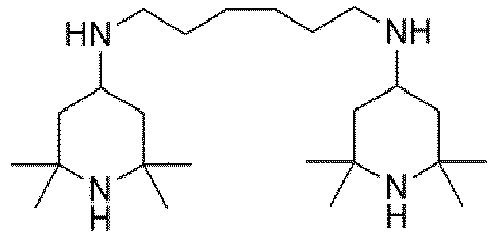
(i) 170.4 g 
90.5 - - (ii) 2.10 mol (iii) 4.2 Moläq. (i) 394.7 g/mol Nebenprodukt: 8.3 (ii) 198.3 g [0.5 mol] 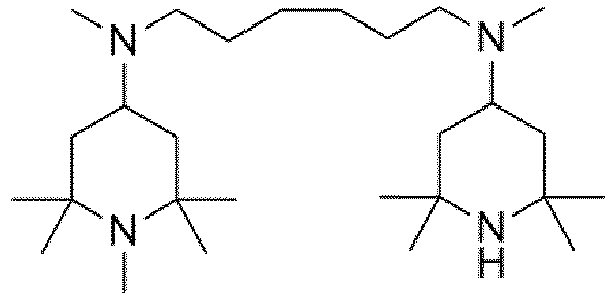
Tabelle 2 Beispiel Nr. Ansatz Rohprodukt Reinprodukt Struktur Edukt Paraformaldehyd (Reinheit 95 %) Lösungsmittel Struktur GC-Analyse GC-Analyse Ausbeute (i) Molmasse Edukt (i) eingesetzte Menge an Paraformaldehyd in g Flächen-% Gehalt [Flächen - %] Reinfraktion [%; bezogen auf eingesetzte Menge Edukt in mol] (ii) eingesetzte Menge Edukt in g [bzw. mol] (ii) eingesetzte Menge an Formaldehyd in mol (errechnet unter Berücksichtigung der Reinheit von 95 %) (iii) Moläquivalente [= "Moläq.] Formaldehyd, bezogen auf Edukt E11 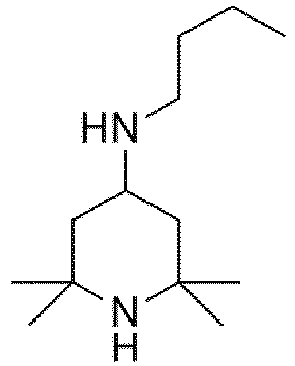
(i) 52.2 g Methanol 
97.9 98.3 93.7 (ii) 1.65 mol (iii) 2.2 Moläq. (i) 212.4 g/mol (ii) 160.9 g (iii) 0.76 mol E12 (i) 52.2 g Toluol 
99.6 (ii) 1.65 mol 
(iii) 2.2 Moläq. (ii) 160.9 g (iii) 0.76 mol E13 
(i) 20.9 g Toluol 
MS-ESI zeigt vollständige Umsetzung - 95.0 (ii) 0.66 mol (iii) 2.2 Moläq. pro Monomereinheit (ii) 167.0 g [0.3 mol Monomereinheiten] E14 
(i) 34.8 g MeOH 
94.1 - - (ii) 1.10 mol (iii) 2.2 Moläq. (i) 480.7 g/mol (ii) 241.1 g [0.50 mol]
Claims (7)
- Verfahren zur Herstellung einer N-methylsubstituierten Triacetonaminverbindung,dadurch gekennzeichnet, dass man mindestens eine Triacetonaminverbindung (I) mit Formaldehyd unter reduktiven Bedingungen umsetzt,wobei die Triacetonaminverbindung (I) ausgewählt ist aus der Gruppe bestehend aus den chemischen Strukturen (I-F), (I-G), (I-H) mit

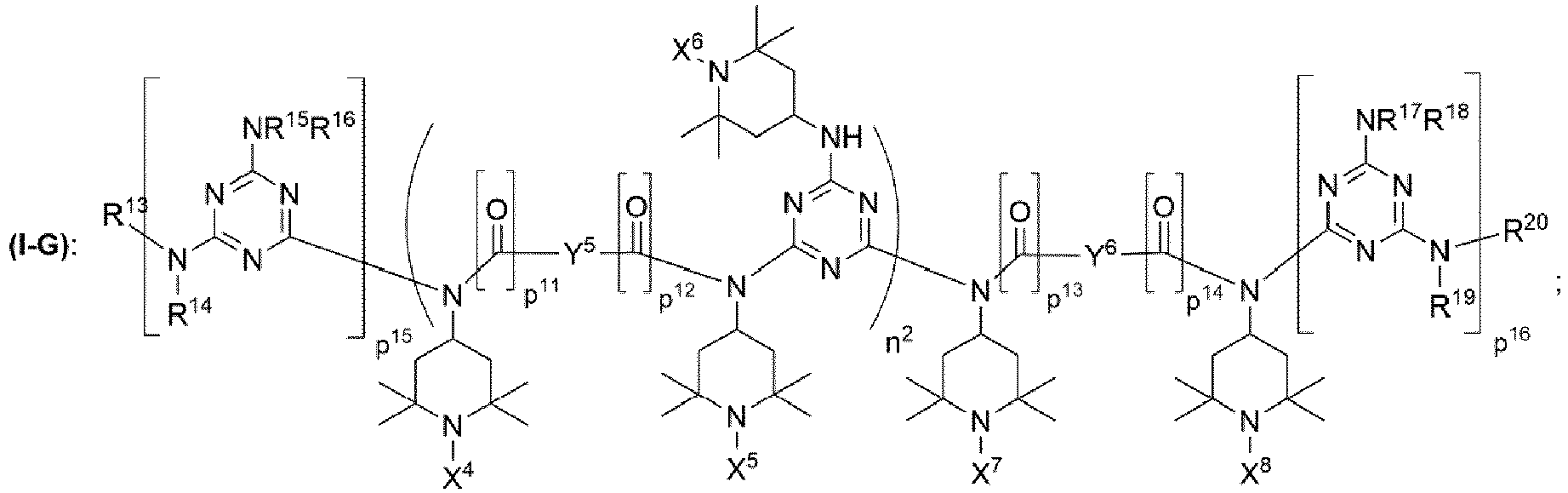
 wobei n1, n2 unabhängig voneinander jeweils eine ganze Zahl aus dem Bereich 1 bis 20 ist;wobei p5, p6, p7, p8, p9, p10, p11, p12, p13, p14, p15, p16, p17, p18, p19, p20 unabhängig voneinander jeweils 0 oder 1 ist;wobei X4 = X5 = X6 = X7 = X8 = Wasserstoff;wobei Y3, Y4, Y5, Y6, Y7, Y8, Y9, Y10 unabhängig voneinander jeweils ausgewählt ist aus der Gruppe bestehend ausunverzweigte oder verzweigte Alkylengruppe mit 1 bis 30 Kohlenstoffatomen,zweiwertige gesättigte Kohlenwasserstoffgruppe mit 3 bis 30 Kohlenstoffatomen, welche mindestens einen gesättigten Ring aus 3 bis 30 Kohlenstoffatomen aufweist,zweiwertige Kohlenwasserstoffgruppe mit 6 bis 30 Kohlenstoffatomen, von denen mindestens 6 Kohlenstoffatome in einem aromatischen System vorliegen und die übrigen Kohlenstoffatome, falls vorhanden, gesättigt sind,ein verbrückender Rest, der eine chemische Struktur ausgewählt aus der Gruppe bestehend aus (i), (ii) mit
 Q1, Q2 unabhängig voneinander jeweils ausgewählt aus der Gruppe bestehend aus -O-, -S-, -NH- oder ―NR'- mit R' = unverzweigte oder verzweigte Alkylgruppe mit 1 bis 6 Kohlenstoffatomen sind,wobei a eine ganze Zahl ausgewählt aus dem Bereich 1 bis 50 ist,wobei b eine ganze Zahl ausgewählt aus dem Bereich 0 bis 50 ist,und wobei Y3 auch eine direkte Bindung sein kann, falls mindestens einer von p5 und p6 den Wert 1 aufweist,und wobei Y4 auch eine direkte Bindung sein kann, falls mindestens einer von p7 und p8 den Wert 1 aufweist,und wobei Y5 auch eine direkte Bindung sein kann, falls mindestens einer von p11 und p12 den Wert 1 aufweist,und wobei Y6 auch eine direkte Bindung sein kann, falls mindestens einer von p13 und p14 den Wert 1 aufweist;wobei die Reste R3, R4, R5, R6, R9, R10, R11, R12, R13, R14, R15, R16, R17, R18, R19, R20 unabhängig voneinander jeweils ausgewählt sind aus der Gruppe bestehend aus Wasserstoff,unverzweigte oder verzweigte Alkylgruppe mit 1 bis 30 Kohlenstoffatomen, bei welcher mindestens ein Wasserstoffrest durch einen Rest ausgewählt aus der Gruppe bestehend aus -OH, -NH2, -OCH3, -OCH2CH3, -NH(CH3), -N(CH3)2, -NH(CH2CH3), -N(CH2CH3)2, -N(CH3)(CH2CH3) ersetzt sein kann,unverzweigte oder verzweigte Acylgruppe mit 1 bis 30 Kohlenstoffatomen, bei welcher mindestens ein Wasserstoffrest durch einen Rest ausgewählt aus der Gruppe bestehend aus -OH, -NH2, -OCH3, -OCH2CH3, -NH(CH3), -N(CH3)2, -NH(CH2CH3), -N(CH2CH3)2, -N(C H3)(CH2CH3) ersetzt sein kann,einem Rest, der eine chemischen Struktur ausgewählt aus der Gruppe bestehend aus (iii), (iv), (v), (vi), (vii), (viii), (ix) mit

 wobei J1, J2 unabhängig voneinander jeweils ausgewählt aus der Gruppe bestehend aus CH, N sind,wobei K1, K2 unabhängig voneinander jeweils ausgewählt aus der Gruppe bestehend aus -O-, -NH-, -N(CH3)-, -N(CH2CH3)-, -S-, -CH2- sind,wobei V1, V2, V3 unabhängig voneinander jeweils ausgewählt aus der Gruppe bestehend aus -O-, -S-, -NH-, -NR"- mit R" = unverzweigte oder verzweigte Alkylgruppe mit 1 bis 6 Kohlenstoffatomen sind,wobei W1, W2, W3 unabhängig voneinander jeweils ausgewählt aus der Gruppe bestehend aus H, Methyl, Ethyl sind,wobei c, d, e, f, g, h unabhängig voneinander jeweils eine ganze Zahl aus dem Bereich 0 bis 50 ist,wobei X9 = Wasserstoff,
wobei in den chemischen Strukturen (iii), (iv), (v), (vi), (vii), (viii), (ix) mindestens ein an ein Kohlenstoffatom gebundener Wasserstoffrest durch einen Rest ausgewählt aus der Gruppe bestehend aus
-OH, -NH2, -OCH3, -OCH2CH3, -NH(CH3), -N(CH3)2, -NH(CH2CH3), -N(CH2CH3)2, -N(CH3)(CH2CH3) ersetzt sein kann;wobei die Reste R7, R8 unabhängig voneinander jeweils ausgewählt sind aus der Gruppe bestehend aus
Wasserstoff,unverzweigte oder verzweigte Alkylgruppe mit 1 bis 30 Kohlenstoffatomen, bei welcher mindestens ein Wasserstoffrest durch einen Rest ausgewählt aus der Gruppe bestehend aus -OH, -NH2, -OCH3, -OCH2CH3, -NH(CH3), -N(CH3)2, -NH(CH2CH3), -N(CH2CH3)2, -N(CH3)(CH2CH3) ersetzt sein kann,unverzweigte oder verzweigte Acylgruppe mit 1 bis 30 Kohlenstoffatomen, bei welcher mindestens ein Wasserstoffrest durch einen Rest ausgewählt aus der Gruppe bestehend aus -OH, -NH2, -OCH3, -OCH2CH3, -NH(CH3), -N(CH3)2, -NH(CH2CH3), -N(CH2CH3)2, -N(CH3)(CH2CH3) ersetzt sein kann,und wobei, wenn p9 = 1, ―NR3R4 auch ein Rest der chemischen Struktur (x) sein kann,und wobei, wenn p10 = 1, ―NR11R12 auch ein Rest der chemischen Struktur (x) sein kann,und wobei die Reste ―NR5R6, ―NR7R8, ―NR9R10 unabhängig voneinander jeweils auch ein Rest der chemischen Struktur (x) sein können,wobei die chemische Struktur (x) wie folgt definiert ist: wobei K3 ausgewählt ist aus der Gruppe bestehend aus -O-, -S-, -NH-, -N(CH3)-, -N(CH2CH3)-;wobei die Reste R21, R22, R23, R24, R25, R26 unabhängig voneinander jeweils ausgewählt sind aus der Gruppe bestehend ausWasserstoff,unverzweigte oder verzweigte Alkylgruppe mit 1 bis 30 Kohlenstoffatomen, einer Gruppe mit der chemischen Struktur (xi) mitwobei die Reste R27, R28, R29, R31, R32, R33, R34 unabhängig voneinander jeweils ausgewählt sind aus der Gruppe bestehend aus
 Wasserstoff,unverzweigte oder verzweigte Alkylgruppe mit 1 bis 30 Kohlenstoffatomen, bei welcher mindestens ein Wasserstoffrest durch einen Rest ausgewählt aus der Gruppe bestehend aus -OH, -NH2, -OCH3, -OCH2CH3, -NH(CH3), -N(CH3)2, -NH(CH2CH3), -N(CH2CH3)2, -N(CH3)(CH2CH3) ersetzt sein kann,unverzweigte oder verzweigte Acylgruppe mit 1 bis 30 Kohlenstoffatomen, bei welcher mindestens ein Wasserstoffrest durch einen Rest ausgewählt aus der Gruppe bestehend aus -OH, -NH2, -OCH3, -OCH2CH3, -NH(CH3), -N(CH3)2, -NH(CH2CH3), -N(CH2CH3)2, -N(CH3)(CH2CH3) ersetzt sein kann,einem Rest, der eine chemischen Struktur ausgewählt aus der Gruppe bestehend aus (xii), (xiii), (xiv), (xv), (xvi), (xvii), (xviii) mit

 wobei J3, J4 unabhängig voneinander jeweils ausgewählt aus der Gruppe bestehend aus CH, N sind,wobei K4, K5 unabhängig voneinander jeweils ausgewählt aus der Gruppe bestehend aus -O-, -NH-, -N(CH3)-, -N(CH2CH3)-, -S-, -CH2- sind,wobei V4, V5, V6 unabhängig voneinander jeweils ausgewählt aus der Gruppe bestehend aus -O-, -S-, -NH-, -NR‴- mit R‴ = unverzweigte oder verzweigte Alkylgruppe mit 1 bis 6 Kohlenstoffatomen sind,wobei W4, W5, W6 unabhängig voneinander jeweils ausgewählt aus der Gruppe bestehend aus H, Methyl, Ethyl sind,wobei j, k, m, q, r, s unabhängig voneinander jeweils eine ganze Zahl aus dem Bereich 0 bis 50 ist,wobei X10 = Wasserstoff,wobei in den chemischen Strukturen (xii), (xiii), (xiv), (xv), (xvi), (xvii), (xviii) mindestens ein an ein Kohlenstoffatom gebundener Wasserstoffrest durch einen Rest ausgewählt aus der Gruppe bestehendaus -OH, -NH2, -OCH3, -OCH2CH3, -NH(CH3), -N(CH3)2, -NH(CH2CH3), -N(CH2CH3)2, -N(CH3)(CH2CH3) ersetzt sein kann,und mit der Maßgabe, dass R21 und R26 für p17 = p18 = p19 = p20 = 0 unabhängig voneinander jeweils auch eine Gruppe der chemischen Struktur (xix) mit
und wobei man reduktive Bedingungen dadurch einstellt, dass man die mindestens eine Triacetonaminverbindung (I) mit Formaldehyd in Gegenwart von Wasserstoff und in Gegenwart eines Trägerkatalysators umsetzt, wobei der Trägerkatalysator mindestens ein Metall M aufweist, wobei das Metall M ausgewählt ist aus der Gruppe bestehend aus Cr, Mo, Mn, Ni, Pd, Pt, Ru, Rh. - Verfahren nach Anspruch 1, wobei p5 = p6 = p7 = p8 = p11 = p12 = p13 = p14 = 0 ist und wobei p9, p10, p15, p16, p17, p18, p19, p20 unabhängig voneinander jeweils 0 oder 1 ist.
- Verfahren nach Anspruch 1 oder 2, wobei Y3, Y4, Y5, Y6, Y7, Y8, Y9, Y10 unabhängig voneinander jeweils ausgewählt ist aus der Gruppe bestehend ausunverzweigte oder verzweigte Alkylengruppe mit 1 bis 30 Kohlenstoffatomen,zweiwertige gesättigte Kohlenwasserstoffgruppe mit 3 bis 30 Kohlenstoffatomen, welche mindestens einen gesättigten Ring aus 3 bis 30 Kohlenstoffatomen aufweist.
- Verfahren nach einem oder mehreren der Ansprüche 1 bis 3, wobei die Reste R3, R4, R5, R6, R9, R10, R11, R12, R13, R14, R15, R16, R17, R18, R19, R20 unabhängig voneinander jeweils ausgewählt sind aus der Gruppe bestehend ausWasserstoff,unverzweigte oder verzweigte Alkylgruppe mit 1 bis 30 Kohlenstoffatomen, bei welcher mindestens ein Wasserstoffrest durch einen Rest ausgewählt aus der Gruppe bestehend aus -OH, -NH2, -OCH3, -OCH2CH3, -NH(CH3), -N(CH3)2, -NH(CH2CH3), -N(CH2CH3)2, -N(CH3)(CH2CH3) ersetzt sein kann,einem Rest, der eine chemischen Struktur (ix) mit

wobei X9 = Wasserstoff;
wobei die Reste R7, R8 unabhängig voneinander jeweils ausgewählt sind aus der Gruppe bestehend ausWasserstoff,unverzweigte oder verzweigte Alkylgruppe mit 1 bis 30 Kohlenstoffatomen, bei welcher mindestens ein Wasserstoffrest durch einen Rest ausgewählt aus der Gruppe bestehend aus -OH, -NH2, -OCH3, -OCH2CH3, -NH(CH3), -N(CH3)2, -NH(CH2CH3), -N(CH2CH3)2, -N(CH3)(CH2CH3) ersetzt sein kann,und wobei, wenn p9 = 1, ―NR3R4 auch ein Rest der chemischen Struktur (x) sein kann,
und wobei, wenn p10 = 1, ―NR11R12 auch ein Rest der chemischen Struktur (x) sein kann,
und wobei die Reste ―NR5R6, ―NR7R8, ―NR9R10 unabhängig voneinander jeweils auch ein Rest der chemischen Struktur (x) sein können,
wobei die chemische Struktur (x) wie folgt definiert ist:
wobei die Reste R21, R22, R23, R24, R25, R26 unabhängig voneinander jeweils ausgewählt sind aus der Gruppe bestehend ausWasserstoff,unverzweigte oder verzweigte Alkylgruppe mit 1 bis 30 Kohlenstoffatomen,einer Gruppe mit der chemischen Struktur (xi) mit Wasserstoff,unverzweigte oder verzweigte Alkylgruppe mit 1 bis 30 Kohlenstoffatomen, bei welcher mindestens ein Wasserstoffrest durch einen Rest ausgewählt aus der Gruppe bestehend aus -OH, -NH2, -OCH3, -OCH2CH3, -NH(CH3), -N(CH3)2, -NH(CH2CH3), -N(CH2CH3)2, -N(CH3)(CH2CH3) ersetzt sein kann,einem Rest, der eine chemischen Struktur (xviii) mit
wobei X10 = Wasserstoff,
und mit der Maßgabe, dass R21 und R26 für p17 = p18 = p19 = p20 = 0 unabhängig voneinander jeweils auch eine Gruppe der chemischen Struktur (xix) mit
- Verfahren nach einem oder mehreren der Ansprüche 1 bis 4, wobei Formaldehyd als Gas, als wässrige Lösung oder als Feststoff eingesetzt wird.
- Verfahren nach einem oder mehreren der Ansprüche 1 bis 5, wobei man die mindestens eine Triacetonaminverbindung (I) mit Formaldehyd unter reduktiven Bedingungen in mindestens einem Lösungsmittel umsetzt, wobei das Lösungsmittel ausgewählt ist aus der Gruppe bestehend aus aliphatische Lösungsmittel, aromatische Lösungsmittel, Ether, halogenierte Lösungsmittel, Amide, Thioverbindungen, Carbonsäuren, Alkohole, Wasser.
- Verfahren nach einem oder mehreren der Ansprüche 1 bis 6, wobei man die mindestens eine Triacetonaminverbindung (I) mit Formaldehyd unter reduktiven Bedingungen bei einer Temperatur im Bereich von 20 °C bis 350 °C und einem Druck im Bereich von 2 bar bis 500 bar umsetzt.
Priority Applications (1)
| Application Number | Priority Date | Filing Date | Title |
|---|---|---|---|
| EP16152159.6A EP3048097B2 (de) | 2015-01-22 | 2016-01-21 | Verfahren zur herstellung einer n-methylsubstituierten triacetonaminverbindung |
Applications Claiming Priority (2)
| Application Number | Priority Date | Filing Date | Title |
|---|---|---|---|
| EP15152068 | 2015-01-22 | ||
| EP16152159.6A EP3048097B2 (de) | 2015-01-22 | 2016-01-21 | Verfahren zur herstellung einer n-methylsubstituierten triacetonaminverbindung |
Publications (3)
| Publication Number | Publication Date |
|---|---|
| EP3048097A1 EP3048097A1 (de) | 2016-07-27 |
| EP3048097B1 EP3048097B1 (de) | 2019-04-24 |
| EP3048097B2 true EP3048097B2 (de) | 2021-12-01 |
Family
ID=52462792
Family Applications (1)
| Application Number | Title | Priority Date | Filing Date |
|---|---|---|---|
| EP16152159.6A Active EP3048097B2 (de) | 2015-01-22 | 2016-01-21 | Verfahren zur herstellung einer n-methylsubstituierten triacetonaminverbindung |
Country Status (8)
| Country | Link |
|---|---|
| US (1) | US9617245B2 (de) |
| EP (1) | EP3048097B2 (de) |
| JP (1) | JP6576253B2 (de) |
| KR (1) | KR20160090764A (de) |
| CN (1) | CN105820108B (de) |
| ES (1) | ES2734232T5 (de) |
| MX (1) | MX2016000701A (de) |
| TW (1) | TW201639815A (de) |
Families Citing this family (12)
| Publication number | Priority date | Publication date | Assignee | Title |
|---|---|---|---|---|
| MX374426B (es) | 2015-01-22 | 2025-03-06 | Evonik Operations Gmbh | Sintesis de compuestos de triacetonadiamina mediante procedimiento de aminacion reductora de triacetonadiamina y derivados de los mismos. |
| DE102016212378A1 (de) * | 2016-07-07 | 2018-01-11 | Evonik Degussa Gmbh | Synthese von Triacetondiaminverbindungen durch reduktive Aminierung ausgehend von Triacetondiamin und dessen Derivaten |
| DE102016212379A1 (de) | 2016-07-07 | 2018-01-11 | Evonik Degussa Gmbh | Verfahren zur Herstellung einer N-methylsubstituierten Triacetonaminverbindung |
| DE102016009904A1 (de) * | 2016-08-12 | 2018-02-15 | Friedrich-Schiller-Universität Jena | Verfahren zur Herstellung von 4-Ammonium-2,2,6,6-tetraalkylpiperidinylsalzen |
| CN109641839B (zh) * | 2016-08-29 | 2022-07-01 | 捷恩智株式会社 | 液晶组合物和液晶显示元件 |
| WO2019200478A1 (en) * | 2018-04-20 | 2019-10-24 | Exigence Technologies Inc. | Use of compounds for making products with at least one n-halamine precursor group and at least one cationic center |
| EP3663284B1 (de) | 2018-12-07 | 2021-02-03 | Evonik Operations GmbH | Verbessertes verfahren zur herstellung von triacetonamin |
| EP4077313B1 (de) * | 2019-12-16 | 2026-04-08 | Basf Se | Verfahren zur herstellung von piperidinverbindungen |
| US11731940B2 (en) | 2020-05-07 | 2023-08-22 | Evonik Operations Gmbh | Process for preparing triacetonamine |
| CN113307795A (zh) * | 2021-06-03 | 2021-08-27 | 宿迁市振兴化工有限公司 | 一种受阻胺光稳定剂119的制备方法 |
| CN114230510B (zh) * | 2021-12-13 | 2024-04-16 | 天集化工助剂(沧州)有限公司 | 一种受阻胺类化合物的共线生产工艺 |
| CN117282445B (zh) * | 2023-10-08 | 2025-11-28 | 常州大学 | 一种适用于三丙酮胺加氢还原生成四甲基哌啶醇的催化剂及其制备方法和应用 |
Citations (9)
| Publication number | Priority date | Publication date | Assignee | Title |
|---|---|---|---|---|
| US3974127A (en) † | 1973-09-17 | 1976-08-10 | E. I. Du Pont De Nemours And Company | Alkylene oxide condensates of tetramethylpiperidine alcohols or glycols |
| DE2545695A1 (de) † | 1975-10-11 | 1977-04-21 | Basf Ag | Verfahren zur herstellung von methylaminen |
| US4049647A (en) † | 1971-11-30 | 1977-09-20 | Ciba-Geigy Corporation | Bis piperidyl carboxylates |
| DE2618580A1 (de) † | 1976-04-28 | 1977-11-10 | Basf Ag | Verfahren zur herstellung von methylgruppen enthaltenden tertiaeren aminen |
| JPS559019A (en) † | 1978-07-04 | 1980-01-22 | Lion Corp | Preparation of tertiary long-chain aliphatic methylamine |
| US4316837A (en) † | 1980-09-10 | 1982-02-23 | Carstab Corporation | Polyalkylated 4-aminopiperidine derivatives as stabilizers for synthetic polymers |
| US4757144A (en) † | 1983-12-16 | 1988-07-12 | Kao Corporation | Preparing tertiary amine from formaldehyde and primary and/or secondary amine |
| EP0375333A2 (de) † | 1988-12-19 | 1990-06-27 | The Dow Chemical Company | Methode zum reduktiven Methylieren von primären Aminen |
| US6046304A (en) † | 1995-12-04 | 2000-04-04 | Ciba Specialty Chemicals Corporation | Block oligomers containing 2,2,6,6-tetramethyl-4-piperidyl groups as stabilizers for organic materials |
Family Cites Families (17)
| Publication number | Priority date | Publication date | Assignee | Title |
|---|---|---|---|---|
| SE7607114L (sv) * | 1976-06-22 | 1977-12-23 | Bofors Ab | Sett att framstella hydrokloriden av n-metylpiperidin-2-karbonsyra-2,6-xyllidid |
| DE2805821A1 (de) * | 1977-02-23 | 1978-08-31 | Ciba Geigy Ag | Neue metallsalze von hydroxybenzoesaeuren, die durch polyalkylpiperidin-liganden komplexiert sind |
| US4435572A (en) * | 1978-04-26 | 1984-03-06 | The United States Of America As Represented By The Department Of Health And Human Services | Synthesis of ethyl-4(3'-methoxyphenyl)-1-methyl piperidine-3-carboxylate |
| JPH0625109B2 (ja) * | 1985-09-04 | 1994-04-06 | 旭電化工業株式会社 | 四級アンモニウム塩化合物 |
| IT1222394B (it) | 1987-07-30 | 1990-09-05 | Ciba Geigy Spa | Processo per la preparazione di 2,2,6,6 tetrametil 4 piperidilammine |
| JPH02133620A (ja) * | 1988-11-10 | 1990-05-22 | Asahi Chem Ind Co Ltd | 高強力ポリアミド繊維の製造法 |
| IT1277329B1 (it) * | 1995-03-01 | 1997-11-10 | Ciba Geigy Spa | Procedimento per la metilazione del 2,2,6,6-tetrametil-4-piperidone (triacetonammina) |
| DK1387862T3 (en) * | 2001-05-17 | 2015-01-19 | Basf Se | Polymer WITH IMPROVED permanence AND OVERFLADEAFFINITET |
| BRPI0407482B1 (pt) | 2003-02-14 | 2014-01-07 | Composto polialquilpiperidina estabilizador de luz, sua composição e seus usos, métodos de estabilização de um material orgânico contra degradação induzida por ozona e/ou induzida por luz, dinâmica, térmica, oxidativa, e método de enxertamento do referido composto sobre um material orgânico | |
| GB0308466D0 (en) | 2003-04-11 | 2003-05-21 | Novartis Ag | Organic compounds |
| CA2570075A1 (en) | 2004-06-18 | 2005-12-29 | Neurosearch A/S | Alkyl substituted piperidine derivatives and their use as monoamine neurotransmitter re-uptake inhibitors |
| EP1787989A1 (de) | 2005-11-17 | 2007-05-23 | Degussa GmbH | Triazinverbindungen mit Aminogruppen- und Carboxygruppen-haltigen Substituenten |
| ZA200904857B (en) | 2007-02-22 | 2010-09-29 | Merck Serono Sa | Quinoxaline compounds and use thereof |
| JP4946517B2 (ja) * | 2007-03-02 | 2012-06-06 | 東ソー株式会社 | ポリウレタン樹脂製造用触媒及びそれを用いたポリウレタン樹脂の製造方法 |
| CN101768104B (zh) * | 2010-01-04 | 2012-07-25 | 南通惠康国际企业有限公司 | 一种光稳定剂癸二酸二(1,2,2,6,6-五甲基-4-哌啶基)酯的生产方法 |
| JP5555917B2 (ja) * | 2010-02-22 | 2014-07-23 | 公益財団法人名古屋産業科学研究所 | 脂肪族第一級アミンのモノメチル化方法 |
| JP2014105193A (ja) * | 2012-11-28 | 2014-06-09 | Tosoh Corp | 脂肪族第3級アミンの製造方法 |
-
2016
- 2016-01-18 MX MX2016000701A patent/MX2016000701A/es unknown
- 2016-01-19 TW TW105101568A patent/TW201639815A/zh unknown
- 2016-01-21 ES ES16152159T patent/ES2734232T5/es active Active
- 2016-01-21 KR KR1020160007428A patent/KR20160090764A/ko not_active Withdrawn
- 2016-01-21 CN CN201610039460.4A patent/CN105820108B/zh not_active Expired - Fee Related
- 2016-01-21 EP EP16152159.6A patent/EP3048097B2/de active Active
- 2016-01-22 US US15/003,978 patent/US9617245B2/en not_active Expired - Fee Related
- 2016-01-22 JP JP2016010886A patent/JP6576253B2/ja not_active Expired - Fee Related
Patent Citations (9)
| Publication number | Priority date | Publication date | Assignee | Title |
|---|---|---|---|---|
| US4049647A (en) † | 1971-11-30 | 1977-09-20 | Ciba-Geigy Corporation | Bis piperidyl carboxylates |
| US3974127A (en) † | 1973-09-17 | 1976-08-10 | E. I. Du Pont De Nemours And Company | Alkylene oxide condensates of tetramethylpiperidine alcohols or glycols |
| DE2545695A1 (de) † | 1975-10-11 | 1977-04-21 | Basf Ag | Verfahren zur herstellung von methylaminen |
| DE2618580A1 (de) † | 1976-04-28 | 1977-11-10 | Basf Ag | Verfahren zur herstellung von methylgruppen enthaltenden tertiaeren aminen |
| JPS559019A (en) † | 1978-07-04 | 1980-01-22 | Lion Corp | Preparation of tertiary long-chain aliphatic methylamine |
| US4316837A (en) † | 1980-09-10 | 1982-02-23 | Carstab Corporation | Polyalkylated 4-aminopiperidine derivatives as stabilizers for synthetic polymers |
| US4757144A (en) † | 1983-12-16 | 1988-07-12 | Kao Corporation | Preparing tertiary amine from formaldehyde and primary and/or secondary amine |
| EP0375333A2 (de) † | 1988-12-19 | 1990-06-27 | The Dow Chemical Company | Methode zum reduktiven Methylieren von primären Aminen |
| US6046304A (en) † | 1995-12-04 | 2000-04-04 | Ciba Specialty Chemicals Corporation | Block oligomers containing 2,2,6,6-tetramethyl-4-piperidyl groups as stabilizers for organic materials |
Non-Patent Citations (1)
| Title |
|---|
| HOUBEN-WEYL, METHODEN DER ORGANISCHEN CHEMIE, vol. 11, no. 1, 1957, pages 602-603, 641-647 † |
Also Published As
| Publication number | Publication date |
|---|---|
| EP3048097A1 (de) | 2016-07-27 |
| TW201639815A (zh) | 2016-11-16 |
| ES2734232T3 (es) | 2019-12-04 |
| ES2734232T5 (es) | 2022-03-31 |
| US20160214962A1 (en) | 2016-07-28 |
| EP3048097B1 (de) | 2019-04-24 |
| JP2016132672A (ja) | 2016-07-25 |
| KR20160090764A (ko) | 2016-08-01 |
| CN105820108A (zh) | 2016-08-03 |
| JP6576253B2 (ja) | 2019-09-18 |
| US9617245B2 (en) | 2017-04-11 |
| MX2016000701A (es) | 2016-11-24 |
| CN105820108B (zh) | 2020-03-20 |
Similar Documents
| Publication | Publication Date | Title |
|---|---|---|
| EP3048097B1 (de) | Verfahren zur herstellung einer n-methylsubstituierten triacetonaminverbindung | |
| EP3266770B1 (de) | Verfahren zur herstellung einer n-methylsubstituierten triacetonaminverbindung | |
| EP3048096B1 (de) | Synthese von triacetondiaminverbindungen durch reduktive aminierung ausgehend von triacetondiamin und dessen derivaten | |
| EP3266766B1 (de) | Synthese von triacetondiaminverbindungen durch reduktive aminierung ausgehend von triacetondiamin und dessen derivaten | |
| EP3660001A1 (de) | Verbessertes verfahren zur herstellung von triacetondiamin und dessen derivaten | |
| DE60104398T2 (de) | Verfahren zur herstellung von triethanolamin und nach dem verfahren erhaltenes produkt | |
| DE1234199B (de) | Verfahren zur Herstellung von Mono- oder Diaethern von Glykolen durch Hydrogenolyse von cylischen Ketalen | |
| DE112020001793T5 (de) | Herstellungsverfahren von Lactonverbindungen | |
| EP0457730B1 (de) | Verfahren zur Herstellung von Alkylydroxyanilino-triazinthioderivaten | |
| DE1795193C2 (de) | Isochinolinderivate und Verfahren zur Herstellung von N-Methylmorphinanen | |
| DE1253274B (de) | Verfahren zur Herstellung von aliphatischen Azo-Verbindungen | |
| DE1668571C3 (de) | Verfahren zur Herstellung von 2-Methyl-polycycloalkylmethylaminen | |
| DE10122758B4 (de) | Verfahren zur Herstellung von gemischten, sekundären Aminen | |
| DE2653477A1 (de) | Spiro eckige klammer auf cyclopropan- 1,2'-indolin eckige klammer zu -3'-one | |
| EP0474057B1 (de) | Verfahren zur Herstellung von N-(2-Chlor-pyridin-5-yl-methyl)-ethylendiamin | |
| DE828244C (de) | Verfahren zur Hydrierung von ª‡, ª‰-ungesaettigten Ketonen | |
| DE3020298C2 (de) | Verfahren zur Herstellung von 2,2,4,5,5-Pentamethyl-3-formyl-3-pyrrolin | |
| EP0282069A2 (de) | Bicyclische Aminkatalysatoren | |
| EP0245771B1 (de) | Verfahren zur Herstellung von Ethylenglykol | |
| DE2754113A1 (de) | Neues reduktionsverfahren | |
| DE2835848A1 (de) | Verfahren zur reinigung von aldehydhaltigen ketonen | |
| DE3532877A1 (de) | Verfahren zur herstellung von ethylenglycol | |
| DE4210311A1 (de) | Verfahren zur Herstellung von Aminen aus Azinen | |
| DE69929808T2 (de) | Verfahren zur herstellung von 2-piperidinethanol-derivaten | |
| DE1470065C3 (de) | Verfahren zur Herstellung von Chinolizinderivaten |
Legal Events
| Date | Code | Title | Description |
|---|---|---|---|
| PUAI | Public reference made under article 153(3) epc to a published international application that has entered the european phase |
Free format text: ORIGINAL CODE: 0009012 |
|
| 17P | Request for examination filed |
Effective date: 20160121 |
|
| AK | Designated contracting states |
Kind code of ref document: A1 Designated state(s): AL AT BE BG CH CY CZ DE DK EE ES FI FR GB GR HR HU IE IS IT LI LT LU LV MC MK MT NL NO PL PT RO RS SE SI SK SM TR |
|
| AX | Request for extension of the european patent |
Extension state: BA ME |
|
| GRAP | Despatch of communication of intention to grant a patent |
Free format text: ORIGINAL CODE: EPIDOSNIGR1 |
|
| STAA | Information on the status of an ep patent application or granted ep patent |
Free format text: STATUS: GRANT OF PATENT IS INTENDED |
|
| RIC1 | Information provided on ipc code assigned before grant |
Ipc: C07D 401/14 20060101ALI20190111BHEP Ipc: C07D 211/74 20060101AFI20190111BHEP Ipc: C07D 211/46 20060101ALI20190111BHEP Ipc: C07D 211/58 20060101ALI20190111BHEP |
|
| INTG | Intention to grant announced |
Effective date: 20190208 |
|
| RIN1 | Information on inventor provided before grant (corrected) |
Inventor name: NISSEN, FELIX Inventor name: KREILKAMP, GUENTER Inventor name: SCHERING, SABINE Inventor name: WILLY, BENJAMIN Inventor name: NEUMANN, MANFRED Inventor name: NIEMEYER, JOCHEN |
|
| GRAS | Grant fee paid |
Free format text: ORIGINAL CODE: EPIDOSNIGR3 |
|
| GRAA | (expected) grant |
Free format text: ORIGINAL CODE: 0009210 |
|
| STAA | Information on the status of an ep patent application or granted ep patent |
Free format text: STATUS: THE PATENT HAS BEEN GRANTED |
|
| AK | Designated contracting states |
Kind code of ref document: B1 Designated state(s): AL AT BE BG CH CY CZ DE DK EE ES FI FR GB GR HR HU IE IS IT LI LT LU LV MC MK MT NL NO PL PT RO RS SE SI SK SM TR |
|
| REG | Reference to a national code |
Ref country code: GB Ref legal event code: FG4D Free format text: NOT ENGLISH |
|
| REG | Reference to a national code |
Ref country code: CH Ref legal event code: EP |
|
| REG | Reference to a national code |
Ref country code: AT Ref legal event code: REF Ref document number: 1123972 Country of ref document: AT Kind code of ref document: T Effective date: 20190515 Ref country code: IE Ref legal event code: FG4D Free format text: LANGUAGE OF EP DOCUMENT: GERMAN |
|
| REG | Reference to a national code |
Ref country code: DE Ref legal event code: R096 Ref document number: 502016004291 Country of ref document: DE |
|
| REG | Reference to a national code |
Ref country code: NL Ref legal event code: MP Effective date: 20190424 |
|
| REG | Reference to a national code |
Ref country code: SK Ref legal event code: T3 Ref document number: E 31324 Country of ref document: SK |
|
| REG | Reference to a national code |
Ref country code: LT Ref legal event code: MG4D |
|
| PG25 | Lapsed in a contracting state [announced via postgrant information from national office to epo] |
Ref country code: NL Free format text: LAPSE BECAUSE OF FAILURE TO SUBMIT A TRANSLATION OF THE DESCRIPTION OR TO PAY THE FEE WITHIN THE PRESCRIBED TIME-LIMIT Effective date: 20190424 |
|
| PG25 | Lapsed in a contracting state [announced via postgrant information from national office to epo] |
Ref country code: FI Free format text: LAPSE BECAUSE OF FAILURE TO SUBMIT A TRANSLATION OF THE DESCRIPTION OR TO PAY THE FEE WITHIN THE PRESCRIBED TIME-LIMIT Effective date: 20190424 Ref country code: AL Free format text: LAPSE BECAUSE OF FAILURE TO SUBMIT A TRANSLATION OF THE DESCRIPTION OR TO PAY THE FEE WITHIN THE PRESCRIBED TIME-LIMIT Effective date: 20190424 Ref country code: PT Free format text: LAPSE BECAUSE OF FAILURE TO SUBMIT A TRANSLATION OF THE DESCRIPTION OR TO PAY THE FEE WITHIN THE PRESCRIBED TIME-LIMIT Effective date: 20190824 Ref country code: NO Free format text: LAPSE BECAUSE OF FAILURE TO SUBMIT A TRANSLATION OF THE DESCRIPTION OR TO PAY THE FEE WITHIN THE PRESCRIBED TIME-LIMIT Effective date: 20190724 Ref country code: LT Free format text: LAPSE BECAUSE OF FAILURE TO SUBMIT A TRANSLATION OF THE DESCRIPTION OR TO PAY THE FEE WITHIN THE PRESCRIBED TIME-LIMIT Effective date: 20190424 Ref country code: SE Free format text: LAPSE BECAUSE OF FAILURE TO SUBMIT A TRANSLATION OF THE DESCRIPTION OR TO PAY THE FEE WITHIN THE PRESCRIBED TIME-LIMIT Effective date: 20190424 Ref country code: HR Free format text: LAPSE BECAUSE OF FAILURE TO SUBMIT A TRANSLATION OF THE DESCRIPTION OR TO PAY THE FEE WITHIN THE PRESCRIBED TIME-LIMIT Effective date: 20190424 |
|
| PG25 | Lapsed in a contracting state [announced via postgrant information from national office to epo] |
Ref country code: RS Free format text: LAPSE BECAUSE OF FAILURE TO SUBMIT A TRANSLATION OF THE DESCRIPTION OR TO PAY THE FEE WITHIN THE PRESCRIBED TIME-LIMIT Effective date: 20190424 Ref country code: GR Free format text: LAPSE BECAUSE OF FAILURE TO SUBMIT A TRANSLATION OF THE DESCRIPTION OR TO PAY THE FEE WITHIN THE PRESCRIBED TIME-LIMIT Effective date: 20190725 Ref country code: LV Free format text: LAPSE BECAUSE OF FAILURE TO SUBMIT A TRANSLATION OF THE DESCRIPTION OR TO PAY THE FEE WITHIN THE PRESCRIBED TIME-LIMIT Effective date: 20190424 Ref country code: PL Free format text: LAPSE BECAUSE OF FAILURE TO SUBMIT A TRANSLATION OF THE DESCRIPTION OR TO PAY THE FEE WITHIN THE PRESCRIBED TIME-LIMIT Effective date: 20190424 Ref country code: BG Free format text: LAPSE BECAUSE OF FAILURE TO SUBMIT A TRANSLATION OF THE DESCRIPTION OR TO PAY THE FEE WITHIN THE PRESCRIBED TIME-LIMIT Effective date: 20190724 |
|
| REG | Reference to a national code |
Ref country code: ES Ref legal event code: FG2A Ref document number: 2734232 Country of ref document: ES Kind code of ref document: T3 Effective date: 20191204 |
|
| RAP2 | Party data changed (patent owner data changed or rights of a patent transferred) |
Owner name: EVONIK OPERATIONS GMBH |
|
| REG | Reference to a national code |
Ref country code: DE Ref legal event code: R081 Ref document number: 502016004291 Country of ref document: DE Owner name: EVONIK OPERATIONS GMBH, DE Free format text: FORMER OWNER: EVONIK DEGUSSA GMBH, 45128 ESSEN, DE |
|
| PG25 | Lapsed in a contracting state [announced via postgrant information from national office to epo] |
Ref country code: IS Free format text: LAPSE BECAUSE OF FAILURE TO SUBMIT A TRANSLATION OF THE DESCRIPTION OR TO PAY THE FEE WITHIN THE PRESCRIBED TIME-LIMIT Effective date: 20190824 |
|
| REG | Reference to a national code |
Ref country code: DE Ref legal event code: R026 Ref document number: 502016004291 Country of ref document: DE |
|
| PLBI | Opposition filed |
Free format text: ORIGINAL CODE: 0009260 |
|
| PG25 | Lapsed in a contracting state [announced via postgrant information from national office to epo] |
Ref country code: DK Free format text: LAPSE BECAUSE OF FAILURE TO SUBMIT A TRANSLATION OF THE DESCRIPTION OR TO PAY THE FEE WITHIN THE PRESCRIBED TIME-LIMIT Effective date: 20190424 Ref country code: CZ Free format text: LAPSE BECAUSE OF FAILURE TO SUBMIT A TRANSLATION OF THE DESCRIPTION OR TO PAY THE FEE WITHIN THE PRESCRIBED TIME-LIMIT Effective date: 20190424 Ref country code: RO Free format text: LAPSE BECAUSE OF FAILURE TO SUBMIT A TRANSLATION OF THE DESCRIPTION OR TO PAY THE FEE WITHIN THE PRESCRIBED TIME-LIMIT Effective date: 20190424 Ref country code: EE Free format text: LAPSE BECAUSE OF FAILURE TO SUBMIT A TRANSLATION OF THE DESCRIPTION OR TO PAY THE FEE WITHIN THE PRESCRIBED TIME-LIMIT Effective date: 20190424 |
|
| PLAX | Notice of opposition and request to file observation + time limit sent |
Free format text: ORIGINAL CODE: EPIDOSNOBS2 |
|
| 26 | Opposition filed |
Opponent name: BASF SE Effective date: 20200116 |
|
| PG25 | Lapsed in a contracting state [announced via postgrant information from national office to epo] |
Ref country code: SM Free format text: LAPSE BECAUSE OF FAILURE TO SUBMIT A TRANSLATION OF THE DESCRIPTION OR TO PAY THE FEE WITHIN THE PRESCRIBED TIME-LIMIT Effective date: 20190424 |
|
| PG25 | Lapsed in a contracting state [announced via postgrant information from national office to epo] |
Ref country code: TR Free format text: LAPSE BECAUSE OF FAILURE TO SUBMIT A TRANSLATION OF THE DESCRIPTION OR TO PAY THE FEE WITHIN THE PRESCRIBED TIME-LIMIT Effective date: 20190424 |
|
| PLBB | Reply of patent proprietor to notice(s) of opposition received |
Free format text: ORIGINAL CODE: EPIDOSNOBS3 |
|
| PG25 | Lapsed in a contracting state [announced via postgrant information from national office to epo] |
Ref country code: SI Free format text: LAPSE BECAUSE OF FAILURE TO SUBMIT A TRANSLATION OF THE DESCRIPTION OR TO PAY THE FEE WITHIN THE PRESCRIBED TIME-LIMIT Effective date: 20190424 |
|
| REG | Reference to a national code |
Ref country code: SK Ref legal event code: TC4A Ref document number: E 31324 Country of ref document: SK Owner name: EVONIK OPERATIONS GMBH, ESSEN, DE Effective date: 20200520 |
|
| PG25 | Lapsed in a contracting state [announced via postgrant information from national office to epo] |
Ref country code: MC Free format text: LAPSE BECAUSE OF FAILURE TO SUBMIT A TRANSLATION OF THE DESCRIPTION OR TO PAY THE FEE WITHIN THE PRESCRIBED TIME-LIMIT Effective date: 20190424 |
|
| REG | Reference to a national code |
Ref country code: BE Ref legal event code: MM Effective date: 20200131 |
|
| PG25 | Lapsed in a contracting state [announced via postgrant information from national office to epo] |
Ref country code: LU Free format text: LAPSE BECAUSE OF NON-PAYMENT OF DUE FEES Effective date: 20200121 |
|
| PG25 | Lapsed in a contracting state [announced via postgrant information from national office to epo] |
Ref country code: BE Free format text: LAPSE BECAUSE OF NON-PAYMENT OF DUE FEES Effective date: 20200131 |
|
| PG25 | Lapsed in a contracting state [announced via postgrant information from national office to epo] |
Ref country code: IE Free format text: LAPSE BECAUSE OF NON-PAYMENT OF DUE FEES Effective date: 20200121 |
|
| PLBP | Opposition withdrawn |
Free format text: ORIGINAL CODE: 0009264 |
|
| REG | Reference to a national code |
Ref country code: CH Ref legal event code: PK Free format text: BERICHTIGUNGEN |
|
| RIC2 | Information provided on ipc code assigned after grant |
Ipc: C07D 401/14 20060101AFI20210819BHEP |
|
| PUAH | Patent maintained in amended form |
Free format text: ORIGINAL CODE: 0009272 |
|
| STAA | Information on the status of an ep patent application or granted ep patent |
Free format text: STATUS: PATENT MAINTAINED AS AMENDED |
|
| 27A | Patent maintained in amended form |
Effective date: 20211201 |
|
| AK | Designated contracting states |
Kind code of ref document: B2 Designated state(s): AL AT BE BG CH CY CZ DE DK EE ES FI FR GB GR HR HU IE IS IT LI LT LU LV MC MK MT NL NO PL PT RO RS SE SI SK SM TR |
|
| REG | Reference to a national code |
Ref country code: DE Ref legal event code: R102 Ref document number: 502016004291 Country of ref document: DE |
|
| REG | Reference to a national code |
Ref country code: SK Ref legal event code: T5 Ref document number: E 31324 Country of ref document: SK |
|
| REG | Reference to a national code |
Ref country code: AT Ref legal event code: MM01 Ref document number: 1123972 Country of ref document: AT Kind code of ref document: T Effective date: 20210121 |
|
| REG | Reference to a national code |
Ref country code: ES Ref legal event code: DC2A Ref document number: 2734232 Country of ref document: ES Kind code of ref document: T5 Effective date: 20220331 |
|
| PG25 | Lapsed in a contracting state [announced via postgrant information from national office to epo] |
Ref country code: AT Free format text: LAPSE BECAUSE OF NON-PAYMENT OF DUE FEES Effective date: 20210121 |
|
| PG25 | Lapsed in a contracting state [announced via postgrant information from national office to epo] |
Ref country code: MT Free format text: LAPSE BECAUSE OF FAILURE TO SUBMIT A TRANSLATION OF THE DESCRIPTION OR TO PAY THE FEE WITHIN THE PRESCRIBED TIME-LIMIT Effective date: 20190424 Ref country code: CY Free format text: LAPSE BECAUSE OF FAILURE TO SUBMIT A TRANSLATION OF THE DESCRIPTION OR TO PAY THE FEE WITHIN THE PRESCRIBED TIME-LIMIT Effective date: 20190424 |
|
| PG25 | Lapsed in a contracting state [announced via postgrant information from national office to epo] |
Ref country code: MK Free format text: LAPSE BECAUSE OF FAILURE TO SUBMIT A TRANSLATION OF THE DESCRIPTION OR TO PAY THE FEE WITHIN THE PRESCRIBED TIME-LIMIT Effective date: 20190424 |
|
| P01 | Opt-out of the competence of the unified patent court (upc) registered |
Effective date: 20230525 |
|
| PGFP | Annual fee paid to national office [announced via postgrant information from national office to epo] |
Ref country code: SK Payment date: 20231219 Year of fee payment: 9 |
|
| PGFP | Annual fee paid to national office [announced via postgrant information from national office to epo] |
Ref country code: ES Payment date: 20240201 Year of fee payment: 9 |
|
| PGFP | Annual fee paid to national office [announced via postgrant information from national office to epo] |
Ref country code: DE Payment date: 20240201 Year of fee payment: 9 Ref country code: GB Payment date: 20240124 Year of fee payment: 9 Ref country code: CH Payment date: 20240202 Year of fee payment: 9 |
|
| PGFP | Annual fee paid to national office [announced via postgrant information from national office to epo] |
Ref country code: IT Payment date: 20240129 Year of fee payment: 9 Ref country code: FR Payment date: 20240126 Year of fee payment: 9 |
|
| REG | Reference to a national code |
Ref country code: DE Ref legal event code: R119 Ref document number: 502016004291 Country of ref document: DE |
|
| REG | Reference to a national code |
Ref country code: CH Ref legal event code: PL |
|
| REG | Reference to a national code |
Ref country code: SK Ref legal event code: MM4A Ref document number: E 31324 Country of ref document: SK Effective date: 20250121 |
|
| GBPC | Gb: european patent ceased through non-payment of renewal fee |
Effective date: 20250121 |
|
| PG25 | Lapsed in a contracting state [announced via postgrant information from national office to epo] |
Ref country code: DE Free format text: LAPSE BECAUSE OF NON-PAYMENT OF DUE FEES Effective date: 20250801 |
|
| PG25 | Lapsed in a contracting state [announced via postgrant information from national office to epo] |
Ref country code: GB Free format text: LAPSE BECAUSE OF NON-PAYMENT OF DUE FEES Effective date: 20250121 |
|
| PG25 | Lapsed in a contracting state [announced via postgrant information from national office to epo] |
Ref country code: FR Free format text: LAPSE BECAUSE OF NON-PAYMENT OF DUE FEES Effective date: 20250131 |
|
| PG25 | Lapsed in a contracting state [announced via postgrant information from national office to epo] |
Ref country code: CH Free format text: LAPSE BECAUSE OF NON-PAYMENT OF DUE FEES Effective date: 20250131 |
|
| PG25 | Lapsed in a contracting state [announced via postgrant information from national office to epo] |
Ref country code: SK Free format text: LAPSE BECAUSE OF NON-PAYMENT OF DUE FEES Effective date: 20250121 |
|
| PG25 | Lapsed in a contracting state [announced via postgrant information from national office to epo] |
Ref country code: IT Free format text: LAPSE BECAUSE OF NON-PAYMENT OF DUE FEES Effective date: 20250121 |
|
| REG | Reference to a national code |
Ref country code: ES Ref legal event code: FD2A Effective date: 20260302 |
|
| PG25 | Lapsed in a contracting state [announced via postgrant information from national office to epo] |
Ref country code: ES Free format text: LAPSE BECAUSE OF NON-PAYMENT OF DUE FEES Effective date: 20250122 |