EP2985068A1 - Katalysator-System zur Reduktion von Stickoxiden - Google Patents
Katalysator-System zur Reduktion von Stickoxiden Download PDFInfo
- Publication number
- EP2985068A1 EP2985068A1 EP14180742.0A EP14180742A EP2985068A1 EP 2985068 A1 EP2985068 A1 EP 2985068A1 EP 14180742 A EP14180742 A EP 14180742A EP 2985068 A1 EP2985068 A1 EP 2985068A1
- Authority
- EP
- European Patent Office
- Prior art keywords
- catalyst
- washcoat
- support body
- catalyst system
- palladium
- Prior art date
- Legal status (The legal status is an assumption and is not a legal conclusion. Google has not performed a legal analysis and makes no representation as to the accuracy of the status listed.)
- Withdrawn
Links
Images
Classifications
-
- B—PERFORMING OPERATIONS; TRANSPORTING
- B01—PHYSICAL OR CHEMICAL PROCESSES OR APPARATUS IN GENERAL
- B01D—SEPARATION
- B01D53/00—Separation of gases or vapours; Recovering vapours of volatile solvents from gases; Chemical or biological purification of waste gases, e.g. engine exhaust gases, smoke, fumes, flue gases, aerosols
- B01D53/34—Chemical or biological purification of waste gases
- B01D53/92—Chemical or biological purification of waste gases of engine exhaust gases
- B01D53/94—Chemical or biological purification of waste gases of engine exhaust gases by catalytic processes
- B01D53/9459—Removing one or more of nitrogen oxides, carbon monoxide, or hydrocarbons by multiple successive catalytic functions; systems with more than one different function, e.g. zone coated catalysts
- B01D53/9477—Removing one or more of nitrogen oxides, carbon monoxide, or hydrocarbons by multiple successive catalytic functions; systems with more than one different function, e.g. zone coated catalysts with catalysts positioned on separate bricks, e.g. exhaust systems
-
- F—MECHANICAL ENGINEERING; LIGHTING; HEATING; WEAPONS; BLASTING
- F01—MACHINES OR ENGINES IN GENERAL; ENGINE PLANTS IN GENERAL; STEAM ENGINES
- F01N—GAS-FLOW SILENCERS OR EXHAUST APPARATUS FOR MACHINES OR ENGINES IN GENERAL; GAS-FLOW SILENCERS OR EXHAUST APPARATUS FOR INTERNAL-COMBUSTION ENGINES
- F01N3/00—Exhaust or silencing apparatus having means for purifying, rendering innocuous, or otherwise treating exhaust
- F01N3/08—Exhaust or silencing apparatus having means for purifying, rendering innocuous, or otherwise treating exhaust for rendering innocuous
- F01N3/0807—Exhaust or silencing apparatus having means for purifying, rendering innocuous, or otherwise treating exhaust for rendering innocuous by using absorbents or adsorbents
- F01N3/0814—Exhaust or silencing apparatus having means for purifying, rendering innocuous, or otherwise treating exhaust for rendering innocuous by using absorbents or adsorbents combined with catalytic converters, e.g. NOx absorption/storage reduction catalysts
-
- B—PERFORMING OPERATIONS; TRANSPORTING
- B01—PHYSICAL OR CHEMICAL PROCESSES OR APPARATUS IN GENERAL
- B01D—SEPARATION
- B01D53/00—Separation of gases or vapours; Recovering vapours of volatile solvents from gases; Chemical or biological purification of waste gases, e.g. engine exhaust gases, smoke, fumes, flue gases, aerosols
- B01D53/34—Chemical or biological purification of waste gases
- B01D53/92—Chemical or biological purification of waste gases of engine exhaust gases
- B01D53/94—Chemical or biological purification of waste gases of engine exhaust gases by catalytic processes
- B01D53/9404—Removing only nitrogen compounds
- B01D53/9409—Nitrogen oxides
- B01D53/9413—Processes characterised by a specific catalyst
- B01D53/9418—Processes characterised by a specific catalyst for removing nitrogen oxides by selective catalytic reduction [SCR] using a reducing agent in a lean exhaust gas
-
- B—PERFORMING OPERATIONS; TRANSPORTING
- B01—PHYSICAL OR CHEMICAL PROCESSES OR APPARATUS IN GENERAL
- B01D—SEPARATION
- B01D53/00—Separation of gases or vapours; Recovering vapours of volatile solvents from gases; Chemical or biological purification of waste gases, e.g. engine exhaust gases, smoke, fumes, flue gases, aerosols
- B01D53/34—Chemical or biological purification of waste gases
- B01D53/92—Chemical or biological purification of waste gases of engine exhaust gases
- B01D53/94—Chemical or biological purification of waste gases of engine exhaust gases by catalytic processes
- B01D53/9404—Removing only nitrogen compounds
- B01D53/9409—Nitrogen oxides
- B01D53/9413—Processes characterised by a specific catalyst
- B01D53/9422—Processes characterised by a specific catalyst for removing nitrogen oxides by NOx storage or reduction by cyclic switching between lean and rich exhaust gases (LNT, NSC, NSR)
-
- B—PERFORMING OPERATIONS; TRANSPORTING
- B01—PHYSICAL OR CHEMICAL PROCESSES OR APPARATUS IN GENERAL
- B01J—CHEMICAL OR PHYSICAL PROCESSES, e.g. CATALYSIS OR COLLOID CHEMISTRY; THEIR RELEVANT APPARATUS
- B01J23/00—Catalysts comprising metals or metal oxides or hydroxides, not provided for in group B01J21/00
- B01J23/02—Catalysts comprising metals or metal oxides or hydroxides, not provided for in group B01J21/00 of the alkali- or alkaline earth metals or beryllium
-
- B—PERFORMING OPERATIONS; TRANSPORTING
- B01—PHYSICAL OR CHEMICAL PROCESSES OR APPARATUS IN GENERAL
- B01J—CHEMICAL OR PHYSICAL PROCESSES, e.g. CATALYSIS OR COLLOID CHEMISTRY; THEIR RELEVANT APPARATUS
- B01J23/00—Catalysts comprising metals or metal oxides or hydroxides, not provided for in group B01J21/00
- B01J23/10—Catalysts comprising metals or metal oxides or hydroxides, not provided for in group B01J21/00 of rare earths
-
- B—PERFORMING OPERATIONS; TRANSPORTING
- B01—PHYSICAL OR CHEMICAL PROCESSES OR APPARATUS IN GENERAL
- B01J—CHEMICAL OR PHYSICAL PROCESSES, e.g. CATALYSIS OR COLLOID CHEMISTRY; THEIR RELEVANT APPARATUS
- B01J23/00—Catalysts comprising metals or metal oxides or hydroxides, not provided for in group B01J21/00
- B01J23/38—Catalysts comprising metals or metal oxides or hydroxides, not provided for in group B01J21/00 of noble metals
- B01J23/40—Catalysts comprising metals or metal oxides or hydroxides, not provided for in group B01J21/00 of noble metals of the platinum group metals
- B01J23/44—Palladium
-
- B—PERFORMING OPERATIONS; TRANSPORTING
- B01—PHYSICAL OR CHEMICAL PROCESSES OR APPARATUS IN GENERAL
- B01J—CHEMICAL OR PHYSICAL PROCESSES, e.g. CATALYSIS OR COLLOID CHEMISTRY; THEIR RELEVANT APPARATUS
- B01J23/00—Catalysts comprising metals or metal oxides or hydroxides, not provided for in group B01J21/00
- B01J23/38—Catalysts comprising metals or metal oxides or hydroxides, not provided for in group B01J21/00 of noble metals
- B01J23/40—Catalysts comprising metals or metal oxides or hydroxides, not provided for in group B01J21/00 of noble metals of the platinum group metals
- B01J23/46—Ruthenium, rhodium, osmium or iridium
- B01J23/464—Rhodium
-
- B—PERFORMING OPERATIONS; TRANSPORTING
- B01—PHYSICAL OR CHEMICAL PROCESSES OR APPARATUS IN GENERAL
- B01J—CHEMICAL OR PHYSICAL PROCESSES, e.g. CATALYSIS OR COLLOID CHEMISTRY; THEIR RELEVANT APPARATUS
- B01J23/00—Catalysts comprising metals or metal oxides or hydroxides, not provided for in group B01J21/00
- B01J23/38—Catalysts comprising metals or metal oxides or hydroxides, not provided for in group B01J21/00 of noble metals
- B01J23/54—Catalysts comprising metals or metal oxides or hydroxides, not provided for in group B01J21/00 of noble metals combined with metals, oxides or hydroxides provided for in groups B01J23/02 - B01J23/36
- B01J23/56—Platinum group metals
- B01J23/63—Platinum group metals with rare earths or actinides
-
- B—PERFORMING OPERATIONS; TRANSPORTING
- B01—PHYSICAL OR CHEMICAL PROCESSES OR APPARATUS IN GENERAL
- B01J—CHEMICAL OR PHYSICAL PROCESSES, e.g. CATALYSIS OR COLLOID CHEMISTRY; THEIR RELEVANT APPARATUS
- B01J29/00—Catalysts comprising molecular sieves
- B01J29/04—Catalysts comprising molecular sieves having base-exchange properties, e.g. crystalline zeolites
- B01J29/06—Crystalline aluminosilicate zeolites; Isomorphous compounds thereof
- B01J29/70—Crystalline aluminosilicate zeolites; Isomorphous compounds thereof of types characterised by their specific structure not provided for in groups B01J29/08 - B01J29/65
- B01J29/72—Crystalline aluminosilicate zeolites; Isomorphous compounds thereof of types characterised by their specific structure not provided for in groups B01J29/08 - B01J29/65 containing iron group metals, noble metals or copper
- B01J29/76—Iron group metals or copper
- B01J29/763—CHA-type, e.g. Chabazite, LZ-218
-
- B—PERFORMING OPERATIONS; TRANSPORTING
- B01—PHYSICAL OR CHEMICAL PROCESSES OR APPARATUS IN GENERAL
- B01J—CHEMICAL OR PHYSICAL PROCESSES, e.g. CATALYSIS OR COLLOID CHEMISTRY; THEIR RELEVANT APPARATUS
- B01J35/00—Catalysts, in general, characterised by their form or physical properties
- B01J35/19—Catalysts containing parts with different compositions
-
- B—PERFORMING OPERATIONS; TRANSPORTING
- B01—PHYSICAL OR CHEMICAL PROCESSES OR APPARATUS IN GENERAL
- B01J—CHEMICAL OR PHYSICAL PROCESSES, e.g. CATALYSIS OR COLLOID CHEMISTRY; THEIR RELEVANT APPARATUS
- B01J35/00—Catalysts, in general, characterised by their form or physical properties
- B01J35/50—Catalysts, in general, characterised by their form or physical properties characterised by their shape or configuration
- B01J35/56—Foraminous structures having flow-through passages or channels, e.g. grids or three-dimensional [3D] monoliths
-
- B—PERFORMING OPERATIONS; TRANSPORTING
- B01—PHYSICAL OR CHEMICAL PROCESSES OR APPARATUS IN GENERAL
- B01J—CHEMICAL OR PHYSICAL PROCESSES, e.g. CATALYSIS OR COLLOID CHEMISTRY; THEIR RELEVANT APPARATUS
- B01J37/00—Processes, in general, for preparing catalysts; Processes, in general, for activation of catalysts
- B01J37/02—Impregnation, coating or precipitation
- B01J37/024—Multiple impregnation or coating
- B01J37/0244—Coatings comprising several layers
-
- B—PERFORMING OPERATIONS; TRANSPORTING
- B01—PHYSICAL OR CHEMICAL PROCESSES OR APPARATUS IN GENERAL
- B01J—CHEMICAL OR PHYSICAL PROCESSES, e.g. CATALYSIS OR COLLOID CHEMISTRY; THEIR RELEVANT APPARATUS
- B01J37/00—Processes, in general, for preparing catalysts; Processes, in general, for activation of catalysts
- B01J37/02—Impregnation, coating or precipitation
- B01J37/024—Multiple impregnation or coating
- B01J37/0246—Coatings comprising a zeolite
-
- F—MECHANICAL ENGINEERING; LIGHTING; HEATING; WEAPONS; BLASTING
- F01—MACHINES OR ENGINES IN GENERAL; ENGINE PLANTS IN GENERAL; STEAM ENGINES
- F01N—GAS-FLOW SILENCERS OR EXHAUST APPARATUS FOR MACHINES OR ENGINES IN GENERAL; GAS-FLOW SILENCERS OR EXHAUST APPARATUS FOR INTERNAL-COMBUSTION ENGINES
- F01N3/00—Exhaust or silencing apparatus having means for purifying, rendering innocuous, or otherwise treating exhaust
- F01N3/08—Exhaust or silencing apparatus having means for purifying, rendering innocuous, or otherwise treating exhaust for rendering innocuous
- F01N3/0807—Exhaust or silencing apparatus having means for purifying, rendering innocuous, or otherwise treating exhaust for rendering innocuous by using absorbents or adsorbents
- F01N3/0828—Exhaust or silencing apparatus having means for purifying, rendering innocuous, or otherwise treating exhaust for rendering innocuous by using absorbents or adsorbents characterised by the absorbed or adsorbed substances
- F01N3/0842—Nitrogen oxides
-
- F—MECHANICAL ENGINEERING; LIGHTING; HEATING; WEAPONS; BLASTING
- F01—MACHINES OR ENGINES IN GENERAL; ENGINE PLANTS IN GENERAL; STEAM ENGINES
- F01N—GAS-FLOW SILENCERS OR EXHAUST APPARATUS FOR MACHINES OR ENGINES IN GENERAL; GAS-FLOW SILENCERS OR EXHAUST APPARATUS FOR INTERNAL-COMBUSTION ENGINES
- F01N3/00—Exhaust or silencing apparatus having means for purifying, rendering innocuous, or otherwise treating exhaust
- F01N3/08—Exhaust or silencing apparatus having means for purifying, rendering innocuous, or otherwise treating exhaust for rendering innocuous
- F01N3/10—Exhaust or silencing apparatus having means for purifying, rendering innocuous, or otherwise treating exhaust for rendering innocuous by thermal or catalytic conversion of noxious components of exhaust
- F01N3/18—Exhaust or silencing apparatus having means for purifying, rendering innocuous, or otherwise treating exhaust for rendering innocuous by thermal or catalytic conversion of noxious components of exhaust characterised by methods of operation; Control
- F01N3/20—Exhaust or silencing apparatus having means for purifying, rendering innocuous, or otherwise treating exhaust for rendering innocuous by thermal or catalytic conversion of noxious components of exhaust characterised by methods of operation; Control specially adapted for catalytic conversion
- F01N3/206—Adding periodically or continuously substances to exhaust gases for promoting purification, e.g. catalytic material in liquid form, NOx reducing agents
- F01N3/2066—Selective catalytic reduction [SCR]
-
- B—PERFORMING OPERATIONS; TRANSPORTING
- B01—PHYSICAL OR CHEMICAL PROCESSES OR APPARATUS IN GENERAL
- B01D—SEPARATION
- B01D2255/00—Catalysts
- B01D2255/10—Noble metals or compounds thereof
- B01D2255/102—Platinum group metals
- B01D2255/1021—Platinum
-
- B—PERFORMING OPERATIONS; TRANSPORTING
- B01—PHYSICAL OR CHEMICAL PROCESSES OR APPARATUS IN GENERAL
- B01D—SEPARATION
- B01D2255/00—Catalysts
- B01D2255/10—Noble metals or compounds thereof
- B01D2255/102—Platinum group metals
- B01D2255/1023—Palladium
-
- B—PERFORMING OPERATIONS; TRANSPORTING
- B01—PHYSICAL OR CHEMICAL PROCESSES OR APPARATUS IN GENERAL
- B01D—SEPARATION
- B01D2255/00—Catalysts
- B01D2255/20—Metals or compounds thereof
- B01D2255/202—Alkali metals
-
- B—PERFORMING OPERATIONS; TRANSPORTING
- B01—PHYSICAL OR CHEMICAL PROCESSES OR APPARATUS IN GENERAL
- B01D—SEPARATION
- B01D2255/00—Catalysts
- B01D2255/20—Metals or compounds thereof
- B01D2255/204—Alkaline earth metals
-
- B—PERFORMING OPERATIONS; TRANSPORTING
- B01—PHYSICAL OR CHEMICAL PROCESSES OR APPARATUS IN GENERAL
- B01D—SEPARATION
- B01D2255/00—Catalysts
- B01D2255/20—Metals or compounds thereof
- B01D2255/204—Alkaline earth metals
- B01D2255/2042—Barium
-
- B—PERFORMING OPERATIONS; TRANSPORTING
- B01—PHYSICAL OR CHEMICAL PROCESSES OR APPARATUS IN GENERAL
- B01D—SEPARATION
- B01D2255/00—Catalysts
- B01D2255/20—Metals or compounds thereof
- B01D2255/204—Alkaline earth metals
- B01D2255/2047—Magnesium
-
- B—PERFORMING OPERATIONS; TRANSPORTING
- B01—PHYSICAL OR CHEMICAL PROCESSES OR APPARATUS IN GENERAL
- B01D—SEPARATION
- B01D2255/00—Catalysts
- B01D2255/20—Metals or compounds thereof
- B01D2255/206—Rare earth metals
- B01D2255/2065—Cerium
-
- B—PERFORMING OPERATIONS; TRANSPORTING
- B01—PHYSICAL OR CHEMICAL PROCESSES OR APPARATUS IN GENERAL
- B01D—SEPARATION
- B01D2255/00—Catalysts
- B01D2255/20—Metals or compounds thereof
- B01D2255/207—Transition metals
- B01D2255/20738—Iron
-
- B—PERFORMING OPERATIONS; TRANSPORTING
- B01—PHYSICAL OR CHEMICAL PROCESSES OR APPARATUS IN GENERAL
- B01D—SEPARATION
- B01D2255/00—Catalysts
- B01D2255/20—Metals or compounds thereof
- B01D2255/207—Transition metals
- B01D2255/20746—Cobalt
-
- B—PERFORMING OPERATIONS; TRANSPORTING
- B01—PHYSICAL OR CHEMICAL PROCESSES OR APPARATUS IN GENERAL
- B01D—SEPARATION
- B01D2255/00—Catalysts
- B01D2255/20—Metals or compounds thereof
- B01D2255/207—Transition metals
- B01D2255/20761—Copper
-
- B—PERFORMING OPERATIONS; TRANSPORTING
- B01—PHYSICAL OR CHEMICAL PROCESSES OR APPARATUS IN GENERAL
- B01D—SEPARATION
- B01D2255/00—Catalysts
- B01D2255/50—Zeolites
-
- B—PERFORMING OPERATIONS; TRANSPORTING
- B01—PHYSICAL OR CHEMICAL PROCESSES OR APPARATUS IN GENERAL
- B01D—SEPARATION
- B01D2255/00—Catalysts
- B01D2255/90—Physical characteristics of catalysts
- B01D2255/902—Multilayered catalyst
- B01D2255/9022—Two layers
-
- B—PERFORMING OPERATIONS; TRANSPORTING
- B01—PHYSICAL OR CHEMICAL PROCESSES OR APPARATUS IN GENERAL
- B01D—SEPARATION
- B01D2255/00—Catalysts
- B01D2255/90—Physical characteristics of catalysts
- B01D2255/91—NOx-storage component incorporated in the catalyst
-
- B—PERFORMING OPERATIONS; TRANSPORTING
- B01—PHYSICAL OR CHEMICAL PROCESSES OR APPARATUS IN GENERAL
- B01D—SEPARATION
- B01D2258/00—Sources of waste gases
- B01D2258/01—Engine exhaust gases
- B01D2258/012—Diesel engines and lean burn gasoline engines
-
- F—MECHANICAL ENGINEERING; LIGHTING; HEATING; WEAPONS; BLASTING
- F01—MACHINES OR ENGINES IN GENERAL; ENGINE PLANTS IN GENERAL; STEAM ENGINES
- F01N—GAS-FLOW SILENCERS OR EXHAUST APPARATUS FOR MACHINES OR ENGINES IN GENERAL; GAS-FLOW SILENCERS OR EXHAUST APPARATUS FOR INTERNAL-COMBUSTION ENGINES
- F01N13/00—Exhaust or silencing apparatus characterised by constructional features
- F01N13/009—Exhaust or silencing apparatus characterised by constructional features having two or more separate purifying devices arranged in series
-
- F—MECHANICAL ENGINEERING; LIGHTING; HEATING; WEAPONS; BLASTING
- F01—MACHINES OR ENGINES IN GENERAL; ENGINE PLANTS IN GENERAL; STEAM ENGINES
- F01N—GAS-FLOW SILENCERS OR EXHAUST APPARATUS FOR MACHINES OR ENGINES IN GENERAL; GAS-FLOW SILENCERS OR EXHAUST APPARATUS FOR INTERNAL-COMBUSTION ENGINES
- F01N2330/00—Structure of catalyst support or particle filter
- F01N2330/06—Ceramic, e.g. monoliths
-
- F—MECHANICAL ENGINEERING; LIGHTING; HEATING; WEAPONS; BLASTING
- F01—MACHINES OR ENGINES IN GENERAL; ENGINE PLANTS IN GENERAL; STEAM ENGINES
- F01N—GAS-FLOW SILENCERS OR EXHAUST APPARATUS FOR MACHINES OR ENGINES IN GENERAL; GAS-FLOW SILENCERS OR EXHAUST APPARATUS FOR INTERNAL-COMBUSTION ENGINES
- F01N2370/00—Selection of materials for exhaust purification
- F01N2370/02—Selection of materials for exhaust purification used in catalytic reactors
-
- F—MECHANICAL ENGINEERING; LIGHTING; HEATING; WEAPONS; BLASTING
- F01—MACHINES OR ENGINES IN GENERAL; ENGINE PLANTS IN GENERAL; STEAM ENGINES
- F01N—GAS-FLOW SILENCERS OR EXHAUST APPARATUS FOR MACHINES OR ENGINES IN GENERAL; GAS-FLOW SILENCERS OR EXHAUST APPARATUS FOR INTERNAL-COMBUSTION ENGINES
- F01N2510/00—Surface coverings
- F01N2510/06—Surface coverings for exhaust purification, e.g. catalytic reaction
- F01N2510/063—Surface coverings for exhaust purification, e.g. catalytic reaction zeolites
-
- F—MECHANICAL ENGINEERING; LIGHTING; HEATING; WEAPONS; BLASTING
- F01—MACHINES OR ENGINES IN GENERAL; ENGINE PLANTS IN GENERAL; STEAM ENGINES
- F01N—GAS-FLOW SILENCERS OR EXHAUST APPARATUS FOR MACHINES OR ENGINES IN GENERAL; GAS-FLOW SILENCERS OR EXHAUST APPARATUS FOR INTERNAL-COMBUSTION ENGINES
- F01N3/00—Exhaust or silencing apparatus having means for purifying, rendering innocuous, or otherwise treating exhaust
- F01N3/08—Exhaust or silencing apparatus having means for purifying, rendering innocuous, or otherwise treating exhaust for rendering innocuous
- F01N3/10—Exhaust or silencing apparatus having means for purifying, rendering innocuous, or otherwise treating exhaust for rendering innocuous by thermal or catalytic conversion of noxious components of exhaust
- F01N3/24—Exhaust or silencing apparatus having means for purifying, rendering innocuous, or otherwise treating exhaust for rendering innocuous by thermal or catalytic conversion of noxious components of exhaust characterised by constructional aspects of converting apparatus
- F01N3/28—Construction of catalytic reactors
- F01N3/2803—Construction of catalytic reactors characterised by structure, by material or by manufacturing of catalyst support
- F01N3/2807—Metal other than sintered metal
- F01N3/281—Metallic honeycomb monoliths made of stacked or rolled sheets, foils or plates
-
- F—MECHANICAL ENGINEERING; LIGHTING; HEATING; WEAPONS; BLASTING
- F01—MACHINES OR ENGINES IN GENERAL; ENGINE PLANTS IN GENERAL; STEAM ENGINES
- F01N—GAS-FLOW SILENCERS OR EXHAUST APPARATUS FOR MACHINES OR ENGINES IN GENERAL; GAS-FLOW SILENCERS OR EXHAUST APPARATUS FOR INTERNAL-COMBUSTION ENGINES
- F01N3/00—Exhaust or silencing apparatus having means for purifying, rendering innocuous, or otherwise treating exhaust
- F01N3/08—Exhaust or silencing apparatus having means for purifying, rendering innocuous, or otherwise treating exhaust for rendering innocuous
- F01N3/10—Exhaust or silencing apparatus having means for purifying, rendering innocuous, or otherwise treating exhaust for rendering innocuous by thermal or catalytic conversion of noxious components of exhaust
- F01N3/24—Exhaust or silencing apparatus having means for purifying, rendering innocuous, or otherwise treating exhaust for rendering innocuous by thermal or catalytic conversion of noxious components of exhaust characterised by constructional aspects of converting apparatus
- F01N3/28—Construction of catalytic reactors
- F01N3/2803—Construction of catalytic reactors characterised by structure, by material or by manufacturing of catalyst support
- F01N3/2825—Ceramics
- F01N3/2828—Ceramic multi-channel monoliths, e.g. honeycombs
-
- Y—GENERAL TAGGING OF NEW TECHNOLOGICAL DEVELOPMENTS; GENERAL TAGGING OF CROSS-SECTIONAL TECHNOLOGIES SPANNING OVER SEVERAL SECTIONS OF THE IPC; TECHNICAL SUBJECTS COVERED BY FORMER USPC CROSS-REFERENCE ART COLLECTIONS [XRACs] AND DIGESTS
- Y02—TECHNOLOGIES OR APPLICATIONS FOR MITIGATION OR ADAPTATION AGAINST CLIMATE CHANGE
- Y02A—TECHNOLOGIES FOR ADAPTATION TO CLIMATE CHANGE
- Y02A50/00—TECHNOLOGIES FOR ADAPTATION TO CLIMATE CHANGE in human health protection, e.g. against extreme weather
- Y02A50/20—Air quality improvement or preservation, e.g. vehicle emission control or emission reduction by using catalytic converters
-
- Y—GENERAL TAGGING OF NEW TECHNOLOGICAL DEVELOPMENTS; GENERAL TAGGING OF CROSS-SECTIONAL TECHNOLOGIES SPANNING OVER SEVERAL SECTIONS OF THE IPC; TECHNICAL SUBJECTS COVERED BY FORMER USPC CROSS-REFERENCE ART COLLECTIONS [XRACs] AND DIGESTS
- Y02—TECHNOLOGIES OR APPLICATIONS FOR MITIGATION OR ADAPTATION AGAINST CLIMATE CHANGE
- Y02T—CLIMATE CHANGE MITIGATION TECHNOLOGIES RELATED TO TRANSPORTATION
- Y02T10/00—Road transport of goods or passengers
- Y02T10/10—Internal combustion engine [ICE] based vehicles
- Y02T10/12—Improving ICE efficiencies
Definitions
- the present invention relates to a catalyst system for the reduction of nitrogen oxides, which is contained in the exhaust lean burned internal combustion engines.
- Exhaust gases of motor vehicles with a predominantly lean-burn internal combustion engine contain, in addition to particulate emissions, in particular the primary emissions carbon monoxide CO, hydrocarbons HC and nitrogen oxides NOx. Due to the relatively high oxygen content of up to 15% by volume, carbon monoxide and hydrocarbons can easily be rendered harmless by oxidation, but the reduction of the nitrogen oxides to nitrogen is much more difficult.
- Suitable storage materials are, in particular, oxides, carbonates or hydroxides of magnesium, calcium, strontium, barium, the alkali metals, the rare earth metals or mixtures thereof. Due to their basic properties, these compounds are capable of forming nitrates with the acidic nitrogen oxides of the exhaust gas and of storing them in this way. They are deposited to produce a large interaction surface with the exhaust gas in the highest possible dispersion on suitable carrier materials.
- nitrogen oxide storage catalysts usually contain precious metals such as platinum, palladium and / or Rhodium as catalytically active components. Their task is on the one hand to oxidize NO to NO 2 under lean conditions, as well as CO and HC to CO 2 and on the other hand during the rich operating phases in which the nitrogen oxide storage catalyst is regenerated to reduce NO 2 released to nitrogen.
- SCR Selective Catalytic Reduction
- ammonia used as the reducing agent can be made available by metering in an ammonia-decomposable compound such as urea, ammonium carbamate or ammonium formate into the exhaust gas line and subsequent hydrolysis.
- an ammonia-decomposable compound such as urea, ammonium carbamate or ammonium formate
- the catalyst system in the WO2010 / 114873 A2 used nitrogen oxide storage catalysts have two layers, the lower layer is directly on a flow monolith and, inter alia, ceria, and Containing alumina having ceria and barium oxide.
- the upper layer is on the lower layer and also contains ceria, but in a smaller amount than the lower layer. Both layers also contain the precious metals platinum and palladium, in the upper layer the ceria also carries rhodium.
- Two-layer nitric oxide storage catalysts are also described elsewhere.
- the layer located on the support body comprises one or more highly dispersed alkaline earth oxides, at least one platinum group metal, as well as at least one finely divided, oxygen-storing material.
- the platinum group metals are in close contact with all components of the first layer.
- the second layer is in direct contact with the exhaust gas and contains at least one platinum group metal, as well as at least one finely divided, oxygen-storing material. Only part of the finely divided solids of the second layer serve as a carrier for the platinum group metals.
- the catalyst is a three-way catalyst that converts the harmful exhaust gas components substantially at stoichiometric conditions, ie at the air ratio ⁇ of 1.
- a nitrogen oxide storage catalyst which comprises two superimposed catalyst layers on a carrier substrate.
- the lower layer lying directly on the carrier substrate comprises one or more noble metals, as well as one or more nitrogen oxide storage components.
- the top layer comprises one or more noble metals, as well as ceria, and is free of alkali or alkaline earth components.
- Catalyst substrates containing nitrogen oxide storage materials and having two or more layers are also known in the art WO 2012/029050 described.
- the first layer is located directly on the carrier substrate and includes platinum and / or palladium while the second layer is on the first and comprises platinum.
- Both layers also contain one or more oxygen storage materials and one or more nitric oxide storage materials comprising one or more alkali and / or alkaline earth metals.
- the total amount of alkali and alkaline earth metal in the nitrogen oxide storage materials is 0.18 to 2.5 g / in 3 , calculated as alkali metal oxide M 2 O and alkaline earth metal oxide MO.
- ceria is understood to mean ceria of commercially available quality, ie ceria with a cerium oxide content of 90 to 100% by weight.
- the term thus also includes doped cerium oxides.
- cerium oxide in the context of the present invention also means cerium mixed oxides which have a cerium content of less than 90% by weight, for example 20 to 90% by weight. or 50 to 90% by weight.
- the cerium content is not less than 20% by weight.
- cerium mixed oxides which can be used according to the invention are in particular cerium-zirconium mixed oxides and cerium-aluminum mixed oxides.
- the ratio of cerium oxide in washcoat B to cerium oxide in washcoat A, calculated in each case in g / l and based on the volume of the support body, is 1: 2 to 2.5: 1, in particular 1: 1 to 2: 1.
- cerium oxide is used in the washcoat layer B in an amount of 46 to 180 g / l, preferably of 46 to 90 g / l and particularly preferably of 46 to 70 g / l, in each case based on the volume of the support body.
- cerium oxide is used in amounts of from 14 to 95 g / l, preferably from 25 to 95 g / l and particularly preferably from 46 to 95 g / l, in each case based on the volume of the support body.
- cerium oxide is used in washcoat A in an amount of 25 to 120 g / l and in washcoat B in an amount of 50 to 180 g / l, in each case based on the volume of the support body.
- the total washcoat loading of the support body in embodiments of the present invention is 300 to 600 g / l, based on the volume of the support body.
- the loading with washcoat layer A is 150 to 500 g / l and the loading with washcoat layer B is 50 to 300 g / l, in each case based on the volume of the support body.
- the loading with washcoat layer A is 250 to 300 g / l, and with washcoat layer B 100 to 200 g / l, in each case based on the volume of the support body.
- the ratio of platinum to palladium in the washcoat layers A and B in embodiments of the present invention is, for example 2: 1 to 18: 1 or 6: 1 to 16: 1, for example 5: 1, 8: 1, 10: 1, 12: 1 or 14: 1.
- the sum of platinum and palladium, calculated in each case in g / l and based on the volume of the support body, in washcoat A and washcoat B is the same.
- washcoat A and / or washcoat B contain rhodium as another precious metal.
- Rhodium is in this case, in particular in amounts of 0.003 to 0.35 g / l, based on the volume of the support body before.
- the noble metals platinum and palladium and optionally rhodium are usually present on suitable support materials.
- High-surface-area, high-melting oxides are used as such, for example aluminum oxide, silicon dioxide, titanium dioxide, but also mixed oxides such as, for example, aluminum-silicon mixed oxides and cerium-zirconium mixed oxides.
- alumina is used as support material for the noble metals, in particular those stabilized by 1 to 6 wt .-%, in particular 4 wt .-%, lanthanum oxide.
- the noble metals platinum, palladium or rhodium are supported only on one or more of the abovementioned carrier materials and thus are not in close contact with all constituents of the respective washcoat layer.
- the noble metals platinum, palladium or rhodium are not supported on cerium oxide and are also not in close contact with cerium oxide.
- Suitable alkaline earth compounds in the washcoat A are, in particular, oxides, carbonates or hydroxides of magnesium, strontium and barium, in particular magnesium oxide, barium oxide and strontium oxide.
- Suitable alkali compounds in the washcoat A are, in particular, oxides, carbonates or hydroxides of lithium, potassium and sodium.
- the alkaline earth or alkali compound is present in amounts of 10 to 50 g / l, especially 15 to 20 g / l, calculated as alkaline earth or alkali oxide.
- the washcoat layer B is present in amounts of from 250 to 350 g / l and the washcoat layer A in amounts of from 80 to 130 g / l, with the quantity g / l in each case being based on the volume of the carrier body refers.
- all catalysts which are active in the SCR reaction of nitrogen oxides with ammonia in particular those which are known to the person skilled in the art of car exhaust gas catalysis, can be used as the SCR catalyst in the catalyst system according to the invention.
- SCR catalysts containing a small pore zeolite having a maximum ring size of eight tetrahedral atoms and a transition metal are used.
- Such SCR catalysts are, for example, in EP 2 117 707 A1 and WO2008 / 132452 described.
- Particularly preferred zeolites belong to the framework types AEI, CHA, KFI, ERI, LEV, MER or DDR and are particularly preferably exchanged with cobalt, iron, copper or mixtures of two or three of these metals.
- zeolites also includes molecular sieves, which are sometimes also referred to as "zeolite-like" compounds. Molecular sieves are preferred if they belong to one of the above types of scaffolding. Examples are silica-aluminum-phosphate zeolites known by the term SAPO and aluminum phosphate zeolites known by the term AIPO.
- Preferred zeolites or molecular sieves are furthermore those which have a SAR (silica-to-alumina) value of 2 to 100, in particular of 5 to 50.
- the zeolites or molecular sieves contain transition metal, in particular in amounts of 1 to 10 wt .-%, in particular 2 to 5 wt .-%, calculated as metal oxide, that is, for example, as Fe 2 O 3 or CuO.
- Preferred embodiments of the present invention include as SCR catalysts with copper, iron or copper and iron exchanged zeolites or molecular sieves of the chabazite type.
- Corresponding zeolites or molecular sieves are known, for example, under the designations SSZ-13, SSZ-62, SAPO-34 or AIPO-34, see, for example US 6,709,644 and US 8,617,474 ,
- the nitrogen oxide storage catalyst consists of at least two catalytically active Washcoat slaughterstock A and B on a support body.
- the application of the catalytically active Washcoat slaughtercoat slaughtercoat slaughter A and B on the support body is carried out according to the usual dip coating process or pump and suction coating method with subsequent thermal treatment (calcination and optionally reduction with forming gas or hydrogen). These methods are well known in the art.
- Suitable supporting bodies are in principle all known catalytically inert support bodies for heterogeneous catalysts. Preference is given to monolithic and monolithic flow honeycomb bodies made of ceramic and metal, as well as particle filter substrates, such as are usually used for cleaning diesel engine exhaust gases. Very particular preference is given to ceramic flow honeycomb bodies and ceramic wall flow filter substrates made of cordierite, aluminum titanate or silicon carbide.
- the SCR catalyst is preferably applied to a catalytically inert support body and that by the usual dip coating method or pump and suction coating method with subsequent thermal treatment (calcination and optionally reduction with forming gas or hydrogen).
- all known catalytically inert support bodies for heterogeneous catalysts are also suitable as supporting bodies, monolithic and monolithic flow-through honeycomb bodies of ceramic and metal, as well as particle filter substrates, as are usually used for cleaning diesel engine exhaust gases, being preferred.
- ceramic flow honeycomb bodies and ceramic wall flow filter substrates made of cordierite, aluminum titanate or silicon carbide.
- a filter for reducing particulate emissions.
- a filter is a ceramic wall flow filter substrate made of, for example, cordierite.
- the filter may also be coated with a HC / CO conversion catalyst.
- the filter does not contain OSC (Oxygen Storage Compound) material.
- nitrogen oxide storage catalyst and SCR catalyst can not only be applied to two separate catalytically inert support bodies. They can also be applied together on a single catalytically inert support body.
- the nitrogen oxide storage catalyst is coated from one end of the support body over less than its entire length, while the SCR catalyst is also coated over less than its entire length from the other end of the support body.
- the length E of the catalytically active zone comprising the nitrogen oxide storage catalyst is 20 to 70%, 40 to 60% or 45 to 50% of the total length L of the support body.
- the length Z of the catalytically active zone comprising the SCR catalyst is in embodiments of the present invention 20 to 70%, 40 to 60% or 45 to 50% of the total length L of the support body. In preferred embodiments, the lengths E and Z are both 50% of the total length L.
- the sum of the length E of the first catalytically active zone and the length Z of the second catalytically active zone can correspond exactly to the total length L. In particular, for production reasons, however, it may be smaller than the total length L in embodiments of the present invention. In these cases, a certain length of the total length L between the coated lengths E and Z is uncoated. For example, the sum of the length E of the first catalytically active zone and the length Z of the second catalytically active zone L x 0.8 to L x 0.999.
- the exhaust gas When the catalyst system according to the invention is used as intended, the exhaust gas must first flow through the nitrogen oxide storage catalyst and then through the SCR catalyst. Under this condition, it is outstandingly suitable for the conversion of NO x in exhaust gases of motor vehicles which are operated with lean-burn engines, such as diesel engines. It achieves good NOx conversion at temperatures of around 200 to 450 ° C without being adversely affected at high temperatures.
- the catalyst system according to the invention is thus suitable for Euro 6 applications.
- the exhaust gas is periodically set to lambda ⁇ 1 (rich exhaust gas).
- the change to lambda ⁇ 1 can be done within the engine by e.g. Nacheinspritzung of fuel or even by injection of reducing agent directly in front of the nitrogen oxide storage catalyst.
- Embodiments of the process according to the invention with regard to the catalyst system, including the nitrogen oxide storage catalyst and the SCR catalyst, correspond to the above descriptions.
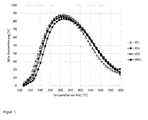
- FIG. 1 NOx conversion of the catalyst systems KS1, KS2, KS3 and VKS1 as a function of the temperature.
- step a) to d) of Example 1 are repeated, with the difference that in step a) cerium oxide in an amount of 70 g / l and in step b) ceria in an amount of 70 g / l is used.
- KS2 The catalyst system thus obtained is called KS2 below.
- step a) to d) of Example 1 are repeated, with the difference that in step a) cerium oxide in an amount of 93 g / l and in step b) cerium oxide in an amount of 47 g / l is used.
- KS3 The catalyst system thus obtained is hereinafter called KS3.
- step a) ceria in an amount of 116 g / l instead of 47 g / l and in step b) ceria in an amount of 24 g / l instead of 94 g / l is used.
- VKS1 The catalyst system thus obtained is hereinafter called VKS1.
- the nitrogen oxide storage catalysts mentioned in Table 1 or the SCR catalysts listed in Table 2 were prepared analogously to Example 1 a) or b) and combined to form the catalyst systems listed in Table 3.
- the temperature is lowered at 7.5 ° C / min from 600 ° C to 150 ° C and determines the conversion over each 90s long lean-fat cycle.
- the NOx regeneration capability at 200 ° C is important to map driving behavior in the urban area, at 450 ° C for highway driving. In order to meet the Euro 6 emission standard, it is particularly important to show a high NOx regeneration capability over this entire temperature range.
- FIG. 1 shows the thus determined NOx conversion of the catalyst systems according to the invention KS1, KS2, KS3 and the comparison system VKS1.
- the NOx conversion of the comparative catalyst system VKS1 at temperatures up to about 350 ° C is significantly worse than that of the catalyst systems according to the invention KS1 to KS3.
- the NOx conversion of VKS1 at 250 ° C is about 67%, while at KS1 to KS3 it is about 75%.
Landscapes
- Chemical & Material Sciences (AREA)
- Engineering & Computer Science (AREA)
- Chemical Kinetics & Catalysis (AREA)
- Combustion & Propulsion (AREA)
- Materials Engineering (AREA)
- Organic Chemistry (AREA)
- Health & Medical Sciences (AREA)
- Mechanical Engineering (AREA)
- General Engineering & Computer Science (AREA)
- Biomedical Technology (AREA)
- Environmental & Geological Engineering (AREA)
- Analytical Chemistry (AREA)
- General Chemical & Material Sciences (AREA)
- Oil, Petroleum & Natural Gas (AREA)
- Toxicology (AREA)
- Crystallography & Structural Chemistry (AREA)
- Catalysts (AREA)
- Exhaust Gas After Treatment (AREA)
- Exhaust Gas Treatment By Means Of Catalyst (AREA)
Abstract
Description
- Die vorliegende Erfindung betrifft ein Katalysator-System zur Reduktion von Stickoxiden, das im Abgas mager betriebener Verbrennungsmotoren enthalten ist.
- Abgase von Kraftfahrzeugen mit einem überwiegend mager betriebenen Verbrennungsmotor enthalten neben Partikelemissionen insbesondere die Primäremissionen Kohlenmonoxid CO, Kohlenwasserstoffe HC und Stickoxide NOx. Aufgrund des relativ hohen Sauerstoffgehaltes von bis zu 15 Vol.-% können Kohlenmonoxid und Kohlenwasserstoffe durch Oxidation leicht unschädlich gemacht werden, die Reduktion der Stickoxide zu Stickstoff gestaltet sich jedoch wesentlich schwieriger.
- Es ist bekannt, Stickoxide aus Abgasen in Gegenwart von Sauerstoff mittels Stickoxidspeicherkatalysatoren, für die auch die Begriffe "Lean NOx Trap" oder LNT üblich sind, unschädlich zu machen. Deren Reinigungswirkung beruht darauf, dass in einer mageren Betriebsphase des Motors die Stickoxide vom Speichermaterial des Speicherkatalysators vorwiegend in Form von Nitraten gespeichert werden und diese in einer darauf folgenden fetten Betriebsphase des Motors wieder zersetzt und die so freiwerdenden Stickoxide mit den reduzierenden Abgasanteilen am Speicherkatalysator zu Stickstoff, Kohlendioxid und Wasser umgesetzt werden. Diese Arbeitsweise ist beispielsweise in der SAE-Schrift SAE 950809 beschrieben.
- Als Speichermaterialien kommen insbesondere Oxide, Carbonate oder Hydroxide von Magnesium, Calcium, Strontium, Barium, der Alkalimetalle, der Seltenerdmetalle oder Mischungen davon in Frage. Diese Verbindungen sind aufgrund ihrer basischen Eigenschaften in der Lage, mit den sauren Stickoxiden des Abgases Nitrate zu bilden und sie auf diese Weise abzuspeichern. Sie sind zur Erzeugung einer großen Wechselwirkungsfläche mit dem Abgas in möglichst hoher Dispersion auf geeigneten Trägermaterialien abgeschieden. Stickoxid-Speicherkatalysatoren enthalten darüber hinaus in der Regel Edelmetalle wie Platin, Palladium und/oder Rhodium als katalytisch aktive Komponenten. Deren Aufgabe ist es einerseits, unter mageren Bedingungen NO zu NO2, sowie CO und HC zu CO2 zu oxidieren und andererseits während der fetten Betriebsphasen, in denen der Stickoxid-Speicherkatalysator regeneriert wird, freigesetztes NO2 zu Stickstoff zu reduzieren.
- Ein anderes bekanntes Verfahren zur Entfernung von Stickoxiden aus Abgasen in Gegenwart von Sauerstoff ist das Verfahren der selektiven katalytischen Reduktion (SCR-Verfahren) mittels Ammoniak an einem geeigneten Katalysator, dem SCR-Katalysator. Bei diesem Verfahren werden die aus dem Abgas zu entfernenden Stickoxide mit Ammoniak zu Stickstoff und Wasser umgesetzt.
- Das als Reduktionsmittel verwendete Ammoniak kann durch Eindosierung einer zu Ammoniak zersetzlichen Verbindung, wie beispielsweise Harnstoff, Ammoniumcarbamat oder Ammoniumformiat, in den Abgasstrang und anschließende Hydrolyse verfügbar gemacht werden.
- Daneben ist es bekannt, Ammoniak während einer fetten Betriebsphase des Motors an einem dem SCR-Katalysator vorgeschalteten Katalysator als Sekundäremission zu erzeugen und im SCR-Katalysator bis zum Verbrauchszeitpunkt während der mageren Betriebsphasen zwischenzuspeichern. Zur Erzeugung von Ammoniak können zum Beispiel Stickoxidspeicherkatalysatoren verwendet werden, die Stickoxide wenigstens zum Teil nicht nur bis zur Stufe des Stickstoffs, sondern auch zu Ammoniak zu reduzieren vermögen. Katalysatorsysteme, die einen anströmseitigen Stickoxidspeicherkatalysator und einen abströmseitigen SCR-Katalysator enthalten sind beispielsweise in
DE 100 11 612 A1 ,EP 0 957 242 A2 ,EP 1 0127 919 A2 EP 2 698,193 A1 ,US 7,332,135 ,WO2004/076829 A1 ,WO2005/047663 A2 undWO2010/114873 A2 beschrieben. - Die im Katalysatorsystem der
WO2010/114873 A2 verwendeten Stickoxidspeicherkatalysatoren weisen zwei Schichten auf, wobei die untere Schicht direkt auf einem Durchfluss-Monolithen liegt und u.a. Ceroxid, sowie Aluminiumoxid enthält, das Ceroxid und Bariumoxid aufweist. Die obere Schicht liegt auf der unteren Schicht und enthält ebenfalls Ceroxid, allerdings in einer geringeren Menge als die unter Schicht. Beide Schichten enthalten außerdem die Edelmetalle Platin und Palladium, in der oberen Schicht trägt das Ceroxid außerdem Rhodium. - Zweischichtige Stickoxidspeicherkatalysatoren sind auch an anderer Stelle beschrieben. Beispielsweise in der
EP 0 885 650 A2 , aus der ein Abgasreinigungskatalysator für Verbrennungsmotoren mit zwei katalytisch aktiven Schichten auf einem Tragkörper bekannt ist. Die auf dem Tragkörper befindliche Schicht umfasst ein oder mehrere hochdisperse Erdalkalioxide, mindestens ein Platingruppenmetall, sowie wenigstens ein feinteiliges, Sauerstoff speicherndes Material. Dabei stehen die Platingruppenmetalle mit allen Bestandteilen der ersten Schicht in enger Berührung. Die zweite Schicht steht mit dem Abgas in direktem Kontakt und enthält mindestens ein Platingruppenmetall, sowie wenigstens ein feinteiliges, Sauerstoff speicherndes Material. Nur ein Teil der feinteiligen Feststoffe der zweiten Schicht dient als Träger für die Platingruppenmetalle. Der Katalysator ist ein Dreiwegekatalysator, der die schädlichen Abgaskomponenten im Wesentlichen bei stöchiometrischen Bedingungen, d.h. bei der Luftzahl λ von 1 umsetzt. - Aus der
US2009/320457 ist ein Stickoxid-Speicherkatalysator bekannt, der zwei übereinander liegende Katalysatorschichten auf einem Trägersubstrat umfasst. Die untere, direkt auf dem Trägersubstrat liegende Schicht umfasst ein oder mehrere Edelmetalle, sowie ein oder mehrere Stickoxid-Speicherkomponenten. Die obere Schicht umfasst ein oder mehrere Edelmetalle, sowie Ceroxid und ist frei von Alkali- oder Erdalkalikomponenten. - Katalysatorsubstrate, die Stickoxid-Speichermaterialien enthalten und zwei oder mehr Schichten aufweisen, sind auch in der
WO 2012/029050 beschrieben. Die erste Schicht befindet sich direkt auf dem Trägersubstrat und umfasst Platin und/oder Palladium, während sich die zweite Schicht auf der ersten befindet und Platin umfasst. Beide Schichten enthalten außerdem ein oder mehrere Sauerstoffspeichermaterialien und ein oder mehrere Stickoxid-Speichermaterialien, die ein oder mehrere Alkali- und/oder Erdalkalimetalle umfassen. Die Gesamtmenge an Alkali- und Erdalkalimetall in den Stickoxid-Speichermaterialien beträgt 0,18 bis 2,5 g/in3, berechnet als Alkalimetalloxid M2O und Erdalkalimetalloxid MO. - Die vorliegende Erfindung betrifft ein Katalysatorsystem zur Reduktion von Stickoxiden, das einen Stickoxidspeicherkatalysator und einen SCR-Katalysator umfasst, wobei der Stickoxidspeicherkatalysator aus mindestens zwei katalytisch aktiven Washcoatschichten A und B auf einem Tragkörper besteht und
- die Washcoatschicht A direkt auf dem Tragkörper angeordnet ist und Ceroxid, eine Erdalkaliverbindung und/oder eine Alkaliverbindung, sowie Platin und Palladium enthält; und
- die Washcoatschicht B über der Washcoatschicht A angeordnet ist und Ceroxid, sowie Platin und Palladium enthält und frei ist von Alkali- und Erdalkaliverbindungen;
dadurch gekennzeichnet, dass - das Verhältnis von Ceroxid in Washcoatschicht B zu Ceroxid in Washcoatschicht A, gerechnet jeweils in g/l und bezogen auf das Volumen des Tragkörpers, 1:2 bis 3:1 beträgt, wobei die Summe von Ceroxid in Washcoatschicht A und Washcoatschicht B, gerechnet in g/l und bezogen auf das Volumen des Tragkörpers, 100 bis 240 g/l beträgt.
- Unter dem Begriff Ceroxid wird im Rahmen vorliegender Erfindung zum einen Ceroxid handelsüblicher Qualität verstanden, d.h. Ceroxid mit einem Ceroxid-Anteil von 90 bis 100 Gew.-%. Der Begriff umfasst somit auch dotierte Ceroxide. Zum anderen werden unter dem Begriff Ceroxid im Rahmen vorliegender Erfindung aber auch Cer-Mischoxide verstanden, die einen Cer-Anteil von weniger als 90 Gew.-%, beispielsweise 20 bis 90 Gew.-% oder 50 bis 90 Gew.-% aufweisen. Vorteilhafterweise liegt der Cer-Gehalt aber nicht unter 20 Gew-%.
- Beispiele für Cer-Mischoxide, die erfindungsgemäß verwendet werden können, sind insbesondere Cer-Zirkon-Mischoxide und Cer-Aluminium-Mischoxide.
- In Ausführungsformen der vorliegenden Erfindung beträgt das Verhältnis von Ceroxid in Washcoatschicht B zu Ceroxid in Washcoatschicht A, gerechnet jeweils in g/l und bezogen auf das Volumen des Tragkörpers, 1 : 2 bis 2,5 : 1, insbesondere 1 : 1 bis 2 : 1.
- Insbesondere wird Ceroxid in der Washcoatschicht B in einer Menge von 46 bis 180 g/l, bevorzugt von 46 bis 90 g/l und besonders bevorzugt von 46 bis 70 g/l, jeweils bezogen auf das Volumen des Tragkörpers eingesetzt. In der Washcoatschicht A wird Ceroxid in Mengen von 14 bis 95 g/l, bevorzugt von 25 bis 95 g/l und besonders bevorzugt von 46 bis 95 g/l, jeweils bezogen auf das Volumen des Tragkörpers eingesetzt.
- In weiteren Ausführungsformen wird Ceroxid in Washcoatschicht A in einer Menge von 25 bis 120 g/l und in Washcoatschicht B in einer Menge von 50 bis 180 g/l, jeweils bezogen auf das Volumen des Tragkörpers eingesetzt.
- Die Gesamt-Washcoatbeladung des Tragkörpers beträgt in Ausführungsformen der vorliegenden Erfindung 300 bis 600 g/l, bezogen auf das Volumen des Tragkörpers. Insbesondere beträgt die Beladung mit Washcoatschicht A 150 bis 500 g/l und die Beladung mit Washcoatschicht B 50 bis 300 g/l, jeweils bezogen auf das Volumen des Tragkörpers.
- In weiteren Ausführungsformen der vorliegenden Erfindung beträgt die Beladung mit Washcoatschicht A 250 bis 300g/l, und mit Washcoatschicht B 100 bis 200 g/l, jeweils bezogen auf das Volumen des Tragkörpers.
- Das Verhältnis Platin zu Palladium in den Washcoatschichten A und B beträgt in Ausführungsformen der vorliegenden Erfindung beispielsweise 2:1 bis 18:1 oder 6:1 bis 16:1, beispielsweise 5: 1, 8:1, 10:1, 12:1 oder 14:1.
- In Ausführungsformen der vorliegenden Erfindung ist die Summe von Platin und Palladium, gerechnet jeweils in g/l und bezogen auf das Volumen des Tragkörpers, in Washcoatschicht A und Washcoatschicht B gleich.
- In einer weiteren Ausführungsform der vorliegenden Erfindung beträgt das Verhältnis der Konzentrationen von Platin und Palladium in Washcoatschicht B zu Platin und Palladium in Washcoatschicht A, jeweils bezogen auf die Gesamtmasse der jeweiligen Washcoatschicht, gerechnet jeweils in g/l und bezogen auf das Volumen des Tragkörpers, 1:1 bis 1:5.
- In Ausführungsformen der vorliegenden Erfindung enthalten Washcoatschicht A und/oder Washcoatschicht B als weiteres Edelmetall Rhodium. Rhodium liegt in diesem Fall insbesondere in Mengen von 0,003 bis 0,35 g/l, bezogen auf das Volumen des Tragkörpers, vor.
- Sowohl in der Washcoatschicht A, als auch in der Washcoatschicht B liegen die Edelmetalle Platin und Palladium und gegebenenfalls Rhodium üblicherweise auf geeigneten Trägermaterialien vor. Als solche werden hochoberflächige, hochschmelzende Oxide verwendet, beispielsweise Aluminiumoxid, Siliziumdioxid, Titandioxid, aber auch Mischoxide wie beispielsweise Aluminium-Silizium-Mischoxide und Cer-Zirkon-Mischoxide. In Ausführungsformen der vorliegenden Erfindung wird als Trägermaterial für die Edelmetalle Aluminiumoxid verwendet, insbesondere solches, das durch 1 bis 6 Gew.-%, insbesondere 4 Gew.-%, Lanthanoxid stabilisiert ist.
- Es ist bevorzugt, wenn die Edelmetalle Platin, Palladium bzw. Rhodium lediglich auf einem oder mehreren der oben genannten Trägermaterialien geträgert sind und somit nicht mit allen Bestandteilen der jeweiligen Washcoatschicht in enger Berührung stehen. Insbesondere ist es bevorzugt, wenn die Edelmetalle Platin, Palladium bzw. Rhodium nicht auf Ceroxid geträgert sind und auch nicht mit Ceroxid in enger Berührung stehen.
- Als Erdalkaliverbindung in der Washcoatschicht A kommen insbesondere Oxide, Carbonate oder Hydroxide von Magnesium, Strontium und Barium in Frage, besonders Magnesiumoxid, Bariumoxid und Strontiumoxid.
- Als Alkaliverbindung in der Washcoatschicht A kommen insbesondere Oxide, Carbonate oder Hydroxide von Lithium, Kalium und Natrium in Frage.
- In Ausführungsformen der vorliegenden Erfindung liegt die Erdalkali- bzw. Alkaliverbindung in Mengen von 10 bis 50 g/l, besonders 15 bis 20 g/l, berechnet als Erdalkali- bzw. Alkalioxid, vor.
- In einer bevorzugten Ausführungsform enthält der Stickoxidspeicherkatalysator mindestens zwei katalytisch aktive Washcoatschichten auf einem Tragköper,
wobei - eine untere Washcoatschicht A
- o Ceroxid in einer Menge von 14 bis 95 g/l,
- o Platin und Palladium im Massenverhältnis von 8:1 bis 10:1, sowie
- o Magnesiumoxid und/oder Bariumoxid; enthält und
- eine obere Washcoatschicht B über der unteren Washcoatschicht A angeordnet ist und
- o keine Erdalkaliverbindung und keine Alkaliverbindung,
- o Platin und Palladium im Massenverhältnis 8:1 bis 10:1, sowie
- o Ceroxid in einer Menge von 46 bis 180 g/l
- Besonders bevorzugt ist es, wenn in der genannten Ausführungsform die Washcoatschicht B in Mengen von 250 bis 350 g/l und die Washcoatschicht A in Mengen von 80 bis 130 g/l vorliegt, wobei sich die Mengenangabe g/l jeweils auf das Volumen des Tragkörpers bezieht.
- In einer weiteren bevorzugten Ausführungsform der vorliegenden Erfindung betrifft sie ein Katalysatorsystem zur Reduktion von Stickoxiden, das einen Stickoxidspeicherkatalysator und einen SCR-Katalysator umfasst, wobei der Stickoxidspeicherkatalysator mindestens zwei katalytisch aktive Washcoatschichten auf einem Tragkörper enthält,
wobei - eine untere Washcoatschicht A
- o Ceroxid in einer Menge von 25 bis 120 g/l,
- o Platin und Palladium im Massenverhältnis von 8:1 bis 10:1, sowie
- o Magnesiumoxid und/oder Bariumoxid; enthält und
- eine obere Washcoatschicht B über der unteren Washcoatschicht A angeordnet ist und
- o keine Erdalkaliverbindung und keine Alkaliverbindung,
- o Platin und Palladium im Massenverhältnis 8:1 bis 10:1, sowie
- o Ceroxid in einer Menge von 50 bis 180 g/l
- Als SCR-Katalysator können im erfindungsgemäßen Katalysatorsystem prinzipiell alle in der SCR-Reaktion von Stickoxiden mit Ammoniak aktiven Katalysatoren verwendet werden, insbesondere solche, die dem Fachmann auf dem Gebiet der Autoabgaskatalyse als gebräuchlich bekannt sind. Dies schließt Katalysatoren vom Mischoxid-Typ ebenso ein, wie Katalysatoren auf Basis von Zeolithen, insbesondere von Übergangsmetall-ausgetauschten Zeolithen.
- In Ausführungsformen der vorliegenden Erfindung werden SCR-Katalysatoren, die einen kleinporigen Zeolithen mit einer maximalen Ringgröße von acht tetraedrischen Atomen und ein Übergangsmetall enthalten, verwendet. Solche SCR-Katalysatoren sind beispielsweise in
EP 2 117 707 A1 undWO2008/132452 beschrieben. - Besonders bevorzugte Zeolithe gehören den Gerüsttypen AEI, CHA, KFI, ERI, LEV, MER oder DDR an und sind besonders bevorzugt mit Kobalt, Eisen, Kupfer oder Mischungen aus zwei oder drei dieser Metalle ausgetauscht.
- Unter den Begriff Zeolithe fallen im Rahmen vorliegender Erfindung auch Molsiebe, die bisweilen auch als "zeolithähnliche" Verbindungen bezeichnet werden. Molsiebe sind bevorzugt, wenn sie einem der oben genannten Gerüsttypen angehören. Beispiele sind Silicaaluminiumphosphat-Zeolithe, die unter dem Begriff SAPO bekannt sind und Aluminiumphosphat-Zeolithe, die unter dem Begriff AIPO bekannt sind.
- Auch diese sind insbesondere dann bevorzugt, wenn sie mit Kobalt, Eisen, Kupfer oder Mischungen aus zwei oder drei dieser Metalle ausgetauscht sind.
- Bevorzugte Zeolithe bzw. Molsiebe sind weiterhin solche, die einen SAR (silica-to-alumina)-Wert von 2 bis 100, insbesondere von 5 bis 50, aufweisen.
- Die Zeolithe bzw. Molsiebe enthalten Übergangsmetall insbesondere in Mengen von 1 bis 10 Gew.-%, insbesondere 2 bis 5 Gew.-%, berechnet als Metalloxid, also beispielsweise als Fe2O3 oder CuO.
- Bevorzugte Ausführungsformen der vorliegenden Erfindung enthalten als SCR-Katalysatoren mit Kupfer, Eisen oder Kupfer und Eisen ausgetauschte Zeolithe oder Molsiebe vom Chabazit-Typ. Entsprechende Zeolithe oder Molsiebe sind beispielsweise unter den Bezeichnungen SSZ-13, SSZ-62, SAPO-34 oder AIPO-34 bekannt, siehe etwa
US 6,709,644 undUS 8,617,474 . - In einer besonders bevorzugten Ausführungsform der vorliegenden Erfindung betrifft sie ein Katalysatorsystem zur Reduktion von Stickoxiden, das einen Stickoxidspeicherkatalysator und einen SCR-Katalysator umfasst, wobei der Stickoxidspeicherkatalysator mindestens zwei katalytisch aktive Washcoatschichten auf einem Tragkörper enthält,
wobei - eine untere Washcoatschicht A
- o Ceroxid in einer Menge von 14 bis 95 g/l,
- o Platin und Palladium im Massenverhältnis von 8:1 bis 10:1, sowie
- o Magnesiumoxid und/oder Bariumoxid; enthält und
- eine obere Washcoatschicht B über der unteren Washcoatschicht A angeordnet ist und
- o keine Erdalkaliverbindung und keine Alkaliverbindung,
- o Platin und Palladium im Massenverhältnis 8:1 bis 10:1, sowie
- o Ceroxid in einer Menge von 46 bis 180 g/l
der SCR-Katalysator einen Zeolithen oder ein Molsieb mit Chabazit-Struktur umfasst, der Kupfer in einer Menge von 1 bis 10 Gew.-%, berechnet als CuO und bezogen auf den SCR-Katalysator, enthält.
In einer weiteren besonders bevorzugten Ausführungsform der vorliegenden Erfindung betrifft sie ein Katalysatorsystem zur Reduktion von Stickoxiden, das einen Stickoxidspeicherkatalysator und einen SCR-Katalysator umfasst, wobei der Stickoxidspeicherkatalysator mindestens zwei katalytisch aktive Washcoatschichten auf einem Tragkörper enthält,
wobei - eine untere Washcoatschicht A
- o Ceroxid in einer Menge von 25 bis 120 g/l,
- o Platin und Palladium im Massenverhältnis von 8:1 bis 10:1, sowie
- o Magnesiumoxid und/oder Bariumoxid; enthält und
- eine obere Washcoatschicht B über der unteren Washcoatschicht A angeordnet ist und
- o keine Erdalkaliverbindung und keine Alkaliverbindung,
- o Platin und Palladium im Massenverhältnis 8:1 bis 10:1, sowie
- o Ceroxid in einer Menge von 50 bis 180 g/l
der SCR-Katalysator einen Zeolithen oder ein Molsieb mit Chabazit-Struktur umfasst, der Kupfer in einer Menge von 1 bis 10 Gew.-%, berechnet als CuO und bezogen auf den SCR-Katalysator, enthält. - Im Katalysatorsystem der vorliegenden Erfindung besteht der Stickoxidspeicherkatalysator aus mindestens zwei katalytisch aktiven Washcoatschichten A und B auf einem Tragkörper. Die Aufbringung der katalytisch aktiven Washcoatschichten A und B auf den Tragkörper erfolgt nach den üblichen Tauchbeschichtungsverfahren bzw. Pump- und Saug-Beschichtungsverfahren mit sich anschließender thermischer Nachbehandlung (Kalzination und gegebenenfalls Reduktion mit Formiergas oder Wasserstoff). Diese Verfahren sind aus dem Stand der Technik hinreichend bekannt.
- Als Tragkörper eignen sich grundsätzlich alle bekannten katalytisch inerten Tragkörper für Heterogenkatalysatoren. Bevorzugt sind monolithische und monolithähnliche Durchflusswabenkörper aus Keramik und Metall, sowie Partikelfiltersubstrate, wie sie üblicherweise zur Reinigung von Dieselmotorenabgasen eingesetzt werden. Ganz besonders bevorzugt sind keramische Durchflusswabenkörper und keramische Wandflussfiltersubstrate aus Cordierit, Aluminiumtitanat oder Siliziumcarbid.
- Auch der SCR-Katalysator wird bevorzugt auf einen katalytisch inerten Tragkörper aufgebracht und zwar nach den üblichen Tauchbeschichtungsverfahren bzw. Pump- und Saug-Beschichtungsverfahren mit sich anschließender thermischer Nachbehandlung (Kalzination und gegebenenfalls Reduktion mit Formiergas oder Wasserstoff). Als Tragkörper eignen sich auch hier grundsätzlich alle bekannten katalytisch inerten Tragkörper für Heterogenkatalysatoren, wobei monolithische und monolithähnliche Durchflusswabenkörper aus Keramik und Metall, sowie Partikelfiltersubstrate, wie sie üblicherweise zur Reinigung von Dieselmotorenabgasen eingesetzt werden, bevorzugt sind. Ganz besonders bevorzugt sind keramische Durchflusswabenkörper und keramische Wandflussfiltersubstrate aus Cordierit, Aluminiumtitanat oder Siliziumcarbid.
- Zwischen dem Stickoxidspeicherkatalysator und dem SCR-Katalysator kann auch ein Filter zur Verminderung von Partikelemissionen platziert sein. Unter Filter wird dabei insbesondere ein keramisches Wandflussfiltersubstrat aus beispielsweise Cordierit verstanden. Der Filter kann auch mit einem Katalysator zum Umsatz von HC/CO beschichtet sein. In einer bevorzugten Ausführungsform enthält der Filter kein OSC-(Oxygen Storage Compound) Material.
- Im erfindungsgemäßen Katalysatorsystem können Stickoxidspeicherkatalysator und SCR-Katalysator nicht nur auf zwei getrennten katalytisch inerten Tragkörpern aufgebracht sein. Sie können auch gemeinsam auf einem einzigen katalytisch inerten Tragkörper aufgebracht sein. In diesem Fall wird zum Beispiel der Stickoxidspeicherkatalysator ausgehend von einem Ende des Tragkörpers über weniger als seine gesamte Länge beschichtet, während der SCR-Katalysator ausgehend vom anderen Ende des Tragkörpers ebenfalls über weniger als seine gesamte Länge beschichtet wird.
- In Ausführungsformen der vorliegenden Erfindung beträgt die Länge E der katalytisch aktiven Zone, die den Stickoxidspeicherkatalysator umfasst, 20 bis 70%, 40 bis 60% oder 45 bis 50% der Gesamtlänge L des Tragkörpers. Die Länge Z der katalytisch aktiven Zone, die den SCR-Katalysator umfasst, beträgt in Ausführungsformen der vorliegenden Erfindung 20 bis 70% , 40 bis 60% oder 45 bis 50% der Gesamtlänge L des Tragkörpers. In bevorzugten Ausführungsformen betragen die Längen E und Z beide 50% der Gesamtlänge L.
- Die Summe der Länge E der ersten katalytisch aktiven Zone und der Länge Z der zweiten katalytisch aktiven Zone kann genau der Gesamtlänge L entsprechen. Insbesondere aus produktionstechnischen Gründen kann sie aber in Ausführungsformen der vorliegenden Erfindung kleiner als die Gesamtlänge L sein. In diesen Fällen ist eine bestimmte Länge der Gesamtlänge L zwischen den beschichteten Längen E und Z unbeschichtet. Beispielsweise beträgt die Summe der Länge E der ersten katalytisch aktiven Zone und der Länge Z der zweiten katalytisch aktiven Zone L x 0,8 bis L x 0,999.
- Beim bestimmungsgemäßen Gebrauch des erfindungsgemäßen Katalysatorsystems muss das Abgas zuerst den Stickoxidspeicherkatalysator und danach den SCR-Katalysator durchströmen. Es eignet sich unter dieser Voraussetzung in hervorragender Weise zur Konvertierung von NOx in Abgasen von Kraftfahrzeugen, die mit mager betriebenen Motoren, etwa Dieselmotoren, betrieben werden. Es erreicht eine gute NOx-Konvertierung bei Temperaturen von circa 200 bis 450°C, ohne dass sie bei hohen Temperaturen negativ beeinflusst wird. Das erfindungsgemäße Katalysatorsystem ist somit für Euro 6 Anwendungen geeignet.
- Die vorliegende Erfindung betrifft auch ein Verfahren zur Konvertierung von NOx in Abgasen von Kraftfahrzeugen, die mit mager betriebenen Motoren, etwa Dieselmotoren, betrieben werden, das dadurch gekennzeichnet ist, dass das Abgas über ein Katalysatorsystem zur Reduktion von Stickoxiden geleitet wird, das einen Stickoxidspeicherkatalysator und einen SCR-Katalysator umfasst, wobei der Stickoxidspeicherkatalysator aus mindestens zwei katalytisch aktiven Washcoatschichten A und B auf einem Tragkörper besteht und
- die Washcoatschicht A direkt auf dem Tragkörper angeordnet ist und Ceroxid, eine Erdalkaliverbindung und/oder eine Alkaliverbindung, sowie Platin und Palladium enthält; und
- die Washcoatschicht B über der Washcoatschicht A angeordnet ist und Ceroxid, sowie Platin und Palladium enthält und frei ist von Alkali- und Erdalkaliverbindungen;
- das Verhältnis von Ceroxid in Washcoatschicht B zu Ceroxid in Washcoatschicht A, gerechnet jeweils in g/l und bezogen auf das Volumen des Tragkörpers, 1:2 bis 3:1 beträgt, wobei die Summe von Ceroxid in Washcoatschicht A und Washcoatschicht B, gerechnet in g/l und bezogen auf das Volumen des Tragkörpers, 100 bis 240 g/l beträgt; und wobei das Abgas so durch das Katalysatorsystem geleitet wird, dass es zuerst den Stickoxidspeicherkatalysator und danach den SCR-Katalysator durchströmt.
- Zur Regenerierung des Stickoxidspeicherkatalysator und um Ammoniak zu bilden, welches in der anschließenden Phase unter mageren Abgasbedingungen Stickoxide zu Stickstoff umsetzt, wird das Abgas periodisch auf lambda < 1 (fettes Abgas) gestellt. Der Wechsel zu lambda < 1 kann dabei innermotorisch durch z.B. Nacheinspritzung von Treibstoff oder aber auch durch Einspritzung von Reduktionsmittel direkt vor den Stickoxidspeicherkatalysator erfolgen.
- Ausgestaltungen des erfindungsgemäßen Verfahrens hinsichtlich des Katalysatorsystems, einschließlich des Stickoxidspeicherkatalysators und des SCR-Katalysators, entsprechen den oben stehenden Beschreibungen.
- Die Erfindung wird in den nachstehenden Beispielen und Figuren näher erläutert.
-
Figur 1 : NOx-Konvertierung der Katalysatorsysteme KS1, KS2, KS3 und VKS1 in Abhängigkeit von der Temperatur. -
- a) Zur Herstellung eines erfindungsgemäßen Katalysatorsystems wird ein wabenförmiger Keramikträger mit einer ersten Washcoatschicht A beschichtet, die Pt und Pd geträgert auf einem Lanthan-stabilisiertem Alumina, Ceroxid in einer Menge 47 g/l, sowie 17 g/l Bariumoxid und 15 g/l Magnesiumoxid enthält. Die Beladung von Pt und Pd beträgt dabei 1,77 g/l bzw. 0,177 g/l und die Gesamtbeladung der Washcoatschicht 181 g/l bezogen auf das Volumen des Keramik-Trägers.
- b) Auf die erste Washcoatschicht wird eine weitere Washcoatschicht B aufgebracht, die Pt, Pd sowie Rh geträgert auf einem Lanthan-stabilisiertem Alumina enthält. Die Beladung von Pt, Pd und Rh in dieser Washcoatschicht beträgt 1,77 g/l bzw. 0,177 g/l bzw. 0,177 g/l. Die Washcoatschicht B enthält außerdem 94 g/l Ceroxid bei einer Washcoatbeladung der Schicht B von 181 g/l.
Der so erhaltene Katalysator wird nachstehend SPK1 genannt. - c) Zur Herstellung des SCR-Katalysators wird ein wabenförmiger Keramikträger mit einem Zeolithen vom Chabazit-Typ mit einem SAR von 28 und mit Kupfer ausgetauscht beschichtet. Der Washcoat setzt sich zusammen aus 85 Gew.-% Zeolith, 3 Gew.-% CuO und 12 Gew.-% Aluminiumoxid.
Der so erhaltene Katalysator wird nachstehend SCRK1 genannt. - d) Die Katalysatoren SPK1 und SCRK1 werden zu einem Katalysatorsystem kombiniert, das nachstehend KS1 genannt wird.
- Die Schritte a) bis d) des Beispiels 1 werden wiederholt, mit dem Unterschied, dass in Schritt a) Ceroxid in einer Menge von 70 g/l und in Schritt b) Ceroxid in einer Menge von 70 g/l eingesetzt wird.
- Das so erhaltene Katalysatorsystem wird nachstehend KS2 genannt.
- Die Schritte a) bis d) des Beispiels 1 werden wiederholt, mit dem Unterschied, dass in Schritt a) Ceroxid in einer Menge von 93 g/l und in Schritt b) Ceroxid in einer Menge von 47 g/l eingesetzt wird.
- Das so erhaltene Katalysatorsystem wird nachstehend KS3 genannt.
- Die Schritte a) bis d) des Beispiels 1 werden wiederholt, mit dem Unterschied, dass in Schritt a) Ceroxid in einer Menge von 116 g/l statt 47 g/l und in Schritt b) Ceroxid in einer Menge von 24 g/l statt 94 g/l eingesetzt wird.
- Das so erhaltene Katalysatorsystem wird nachstehend VKS1 genannt.
- Zur Herstellung weiterer erfindungsgemäßer Katalysatorsysteme wurden in Analogie zu Beispiel 1 a) bzw. b) die in nachstehender Tabelle 1 genannten Stickoxidspeicherkatalysatoren bzw. die in Tabelle 2 genannten SCR-Katalysatoren hergestellt und zu den in Tabelle 3 genannten Katalysatorsystemen kombiniert.
Tabelle 1 Katalysator Ceroxid Washcoat A [g/l] Ceroxid Washcoat B [g/l] Pt : Pd-Verhältnis Schicht A Pt : Pd-Verhältnis Schicht B SPK4 100 70 10 : 1 2 : 1 SPK5 100 100 5 : 1 5 : 1 SPK6 70 100 10 : 1 5 : 1 Tabelle 2 Katalysator Zeolith Metall Metallmenge in Gew.-%, berechnet als Oxid (CuO bzw Fe2O3) SCRK2 SAPO-34 Cu 2,5 SCRK3 LEV Cu 4,0 SCRK4 KFI Fe 3,5 Tabelle 3 Katalysator Stickoxidspeicherkatalysator SCR-Katalysator KS4 SPK4 SCRK4 KS5 SPK5 SCRK2 KS6 SPK6 SCRK1 - Bestimmung der NOx-Konvertierung von KS1, KS2, KS3 und VKS1
- a) Zunächst wurden KS1, KS2, KS3 und VKS1 16h bei 800°C in hydrothermaler Atmosphäre gealtert.
- b) Die NOx-Konvertierung des erfindungsgemäßen Katalysatorsystems KS1, KS2, KS3 und des Vergleichskatalysatorsystems VKS1 in Abhängigkeit von der Temperatur vor dem Katalysator wurde in einem Modellgasreaktor im sog. NOx-Umsatztest bestimmt.
- In diesem wird synthetisches Abgas mit einer Stickstoffmonoxidkonzentration von 500ppm, jeweils 10 Vol.-% Kohlenstoffdioxid und Wasser, einer Konzentration von 50ppm eines kurzkettigen Kohlenwasserstoffgemisches (bestehend aus 33 ppm Propen und 17 ppm Propan) sowie einem Restsauerstoffgehalt von 7 Vol.-% bei einer Raumgeschwindigkeit von 50k/h in einem Modellgasreaktor über die jeweilige Katalysatorprobe geleitet, wobei die Gasmischung abwechselnd 80s lang einen Sauerstoffüberschuss enthält ("mageres" Gasgemisch mit Luftzahl λ von 1,47) währenddessen Stickoxide eingespeichert werden, und zur Regeneration der Katalysatorprobe 10s lang ein Sauerstoffdefizit aufweist ("fettes" Gasgemisch mit Luftzahl λ von 0,92; durch Zumischen von 5,5 Vol.-% Kohlenstoffmonoxid bei gleichzeitiger Absenkung des Restsauerstoffgehalts auf 1 Vol.-%).
- Dabei wird die Temperatur mit 7,5 °C/min von 600°C auf 150°C abgesenkt und der Umsatz über jeden 90s dauernden Mager- Fett-Zyklus ermittelt. Die NOx Regenerationsfähigkeit bei 200°C ist wichtig, um Fahrverhalten im städtischen Bereich abzubilden, bei 450°C für Autobahnfahrten. Um die Euro 6 Abgasnorm zu erfüllen, ist es dabei besonders wichtig über diesen gesamten Temperaturbereich eine hohe NOx-Regenerationsfähigkeit zu zeigen.
-
Figur 1 zeigt die so bestimmte NOx-Konvertierung des erfindungsgemäßen Katalysatorsysteme KS1, KS2, KS3 und des Vergleichssystems VKS1. - Es ergibt sich daraus, dass die NOx-Konvertierung des Vergleichskatalysatorsystems VKS1 bei Temperaturen bis ca. 350°C deutlich schlechter ist als die der erfindungsgemäßen Katalysatorsysteme KS1 bis KS3. So liegt beispielsweise die NOx-Konvertierung von VKS1 bei 250°C bei ca. 67%, während sie bei KS1 bis KS3 bei ca. 75% liegt.
Claims (15)
- Katalysatorsystem zur Reduktion von Stickoxiden, das einen Stickoxidspeicherkatalysator und einen SCR-Katalysator umfasst, wobei der Stickoxidspeicherkatalysator aus mindestens zwei katalytisch aktiven Washcoatschichten A und B auf einem Tragkörper besteht und- die Washcoatschicht A direkt auf dem Tragkörper angeordnet ist und Ceroxid, eine Erdalkaliverbindung und/oder eine Alkaliverbindung, sowie Platin und Palladium enthält; und- die Washcoatschicht B über der Washcoatschicht A angeordnet ist und Ceroxid, sowie Platin und Palladium enthält und frei ist von Alkali- und Erdalkaliverbindungen;dadurch gekennzeichnet, dass- das Verhältnis von Ceroxid in Washcoatschicht B zu Ceroxid in Washcoatschicht A, gerechnet jeweils in g/l und bezogen auf das Volumen des Tragkörpers, 1:2 bis 3:1 beträgt, wobei die Summe von Ceroxid in Washcoatschicht A und Washcoatschicht B, gerechnet in g/l und bezogen auf das Volumen des Tragkörpers, 100 bis 240 g/l beträgt; und
- Katalysatorsystem nach Anspruch 1, dadurch gekennzeichnet, dass die Washcoatschicht B Ceroxid in einer Menge von 46 bis 180 g/l enthält.
- Katalysatorsystem nach Anspruch 1, dadurch gekennzeichnet, dass die Washcoatschicht A Ceroxid in einer Menge von 14 bis 95 g/l enthält.
- Katalysatorsystem nach einem oder mehreren der Ansprüche 1 bis 3, dadurch gekennzeichnet, dass die Gesamt-Washcoatbeladung des Tragkörpers 300 bis 600g/l, bezogen auf das Volumen des Tragkörpers, beträgt.
- Katalysatorsystem Anspruch 4, dadurch gekennzeichnet, dass die Beladung mit Washcoatschicht A 150 bis 500 g/l und die Beladung mit Washcoatschicht B 50 bis 300 g/l, jeweils bezogen auf das Volumen des Tragkörpers, beträgt.
- Katalysatorsystem nach Anspruch 4, dadurch gekennzeichnet, dass die Beladung mit Washcoatschicht A 250 bis 300g/l und mit Washcoatschicht B 100 bis 200 g/l, jeweils bezogen auf das Volumen des Tragkörpers, beträgt.
- Katalysatorsystem nach einem oder mehreren der Ansprüche 1 bis 6, dadurch gekennzeichnet, dass das Verhältnis Platin zu Palladium 2:1 bis 18:1 beträgt.
- Katalysatorsystem nach einem oder mehreren der Ansprüche 1 bis 7, dadurch gekennzeichnet, dass die Erdalkaliverbindung in Washcoatschicht A Magnesiumoxid, Bariumoxid und/oder Strontiumoxid ist.
- Katalysatorsystem nach einem oder mehreren der Ansprüche 1 bis 8, dadurch gekennzeichnet, dass der SCR-Katalysator einen kleinporigen Zeolithen mit einer maximalen Ringgröße von acht tetraedrischen Atomen und ein Übergangsmetall enthält.
- Katalysatorsystem nach einem oder mehreren der Ansprüche 1 bis 9, dadurch gekennzeichnet, dass der SCR-Katalysator einen Zeolithen enthält, der dem Gerüsttyp AEI, CHA, KFI, ERI, LEV, MER oder DDR angehört und mit Kobalt, Eisen, Kupfer oder Mischungen aus zwei oder drei dieser Metalle ausgetauscht ist.
- Katalysatorsystem nach einem oder mehreren der Ansprüche 1 bis 10, dadurch gekennzeichnet, dass der SCR-Katalysator einen Zeolithen vom Chabazit-Typ enthält, der mit Kupfer, Eisen oder Kupfer und Eisen ausgetauscht ist.
- Katalysatorsystem nach einem oder mehreren der Ansprüche 1 bis 11, dadurch gekennzeichnet, dass der Stickoxidspeicherkatalysator- eine untere Washcoatschicht Ao Ceroxid in einer Menge von 14 bis 95 g/l,o Platin und Palladium im Massenverhältnis von 8:1 bis 10:1, sowieo Magnesiumoxid und/oder Bariumoxid; enthält und- eine obere Washcoatschicht B über der unteren Washcoatschicht A angeordnet ist undo keine Erdalkaliverbindung und keine Alkaliverbindung,o Platin und Palladium im Massenverhältnis 8:1 bis 10:1, sowieo Ceroxid in einer Menge von 46 bis 180 g/lenthält und wobei
der SCR-Katalysator einen Zeolithen oder ein Molsieb mit Chabazit-Struktur umfasst, der Kupfer in einer Menge von 1 bis 10 Gew.-%, berechnet als CuO und bezogen auf den SCR-Katalysator, enthält. - Katalysatorsystem nach einem oder mehreren der Ansprüche 1 bis 11, dadurch gekennzeichnet, dass der Stickoxidspeicherkatalysator mindestens zwei katalytisch aktive Washcoatschichten auf einem Tragkörper enthält, wobei- eine untere Washcoatschicht Ao Ceroxid in einer Menge von 25 bis 120 g/l,o Platin und Palladium im Massenverhältnis von 8:1 bis 10:1, sowieo Magnesiumoxid und/oder Bariumoxid; enthält und- eine obere Washcoatschicht B über der unteren Washcoatschicht A angeordnet ist undo keine Erdalkaliverbindung und keine Alkaliverbindung,o Platin und Palladium im Massenverhältnis 8:1 bis 10:1, sowieo Ceroxid in einer Menge von 50 bis 180 g/lenthält und wobei
der SCR-Katalysator einen Zeolithen oder ein Molsieb mit Chabazit-Struktur umfasst, der Kupfer in einer Menge von 1 bis 10 Gew.-%, berechnet als CuO und bezogen auf den SCR-Katalysator, enthält. - Katalysatorsystem nach einem oder mehreren der Ansprüche 1 bis 13, dadurch gekennzeichnet, dass Stickoxidspeicherkatalysator und SCR-Katalysator auf verschiedenen Tragkörpern angeordnet sind oder dass Stickoxidspeicherkatalysator und SCR-Katalysator auf demselben Tragkörper angeordnet sind.
- Verfahren zur Konvertierung von NOx in Abgasen von Kraftfahrzeugen, die mit mager betriebenen Motoren betrieben werden, dadurch gekennzeichnet, dass das Abgas über ein Katalysatorsystem zur Reduktion von Stickoxiden geleitet wird, das einen Stickoxidspeicherkatalysator und einen SCR-Katalysator umfasst, wobei der Stickoxidspeicherkatalysator aus mindestens zwei katalytisch aktiven Washcoatschichten A und B auf einem Tragkörper besteht und- die Washcoatschicht A direkt auf dem Tragkörper angeordnet ist und Ceroxid, eine Erdalkaliverbindung und/oder eine Alkaliverbindung, sowie Platin und Palladium enthält; und- die Washcoatschicht B über der Washcoatschicht A angeordnet ist und Ceroxid, sowie Platin und Palladium enthält und frei ist von Alkali- und Erdalkaliverbindungen;
dadurch gekennzeichnet, dass
das Verhältnis von Ceroxid in Washcoatschicht B zu Ceroxid in Washcoatschicht A, gerechnet jeweils in g/l und bezogen auf das Volumen des Tragkörpers, 1:2 bis 3:1 beträgt, wobei die Summe von Ceroxid in Washcoatschicht A und Washcoatschicht B, gerechnet in g/l und bezogen auf das Volumen des Tragkörpers, 100 bis 240 g/l beträgt; wobei das Abgas so durch das Katalysatorsystem geleitet wird, dass es zuerst den Stickoxidspeicherkatalysator und danach den SCR-Katalysator durchströmt.
Priority Applications (7)
| Application Number | Priority Date | Filing Date | Title |
|---|---|---|---|
| EP14180742.0A EP2985068A1 (de) | 2014-08-13 | 2014-08-13 | Katalysator-System zur Reduktion von Stickoxiden |
| US15/328,658 US10443463B2 (en) | 2014-08-13 | 2015-08-12 | Catalyst system for reducing nitrogen oxides |
| KR1020177006771A KR20170040352A (ko) | 2014-08-13 | 2015-08-12 | 질소 산화물을 환원시키기 위한 촉매 시스템 |
| CN201580043268.6A CN107148310A (zh) | 2014-08-13 | 2015-08-12 | 还原氮氧化物的催化体系 |
| EP15757157.1A EP3180107A1 (de) | 2014-08-13 | 2015-08-12 | Katalysator-system zur reduktion von stickoxiden |
| PCT/EP2015/068507 WO2016023928A1 (de) | 2014-08-13 | 2015-08-12 | Katalysator-system zur reduktion von stickoxiden |
| JP2017505629A JP6700250B2 (ja) | 2014-08-13 | 2015-08-12 | 窒素酸化物を低減するための触媒系 |
Applications Claiming Priority (1)
| Application Number | Priority Date | Filing Date | Title |
|---|---|---|---|
| EP14180742.0A EP2985068A1 (de) | 2014-08-13 | 2014-08-13 | Katalysator-System zur Reduktion von Stickoxiden |
Publications (1)
| Publication Number | Publication Date |
|---|---|
| EP2985068A1 true EP2985068A1 (de) | 2016-02-17 |
Family
ID=51301188
Family Applications (2)
| Application Number | Title | Priority Date | Filing Date |
|---|---|---|---|
| EP14180742.0A Withdrawn EP2985068A1 (de) | 2014-08-13 | 2014-08-13 | Katalysator-System zur Reduktion von Stickoxiden |
| EP15757157.1A Withdrawn EP3180107A1 (de) | 2014-08-13 | 2015-08-12 | Katalysator-system zur reduktion von stickoxiden |
Family Applications After (1)
| Application Number | Title | Priority Date | Filing Date |
|---|---|---|---|
| EP15757157.1A Withdrawn EP3180107A1 (de) | 2014-08-13 | 2015-08-12 | Katalysator-system zur reduktion von stickoxiden |
Country Status (6)
| Country | Link |
|---|---|
| US (1) | US10443463B2 (de) |
| EP (2) | EP2985068A1 (de) |
| JP (1) | JP6700250B2 (de) |
| KR (1) | KR20170040352A (de) |
| CN (1) | CN107148310A (de) |
| WO (1) | WO2016023928A1 (de) |
Cited By (11)
| Publication number | Priority date | Publication date | Assignee | Title |
|---|---|---|---|---|
| WO2017178576A1 (de) * | 2016-04-13 | 2017-10-19 | Umicore Ag & Co. Kg | Partikelfilter mit scr-aktiver beschichtung |
| WO2017178575A1 (de) * | 2016-04-13 | 2017-10-19 | Umicore Ag & Co. Kg | Katalysator mit scr-aktiver beschichtung |
| WO2017191111A1 (de) * | 2016-05-03 | 2017-11-09 | Umicore Ag & Co. Kg | Scr-aktiver katalysator |
| WO2018020049A1 (de) * | 2016-07-29 | 2018-02-01 | Umicore Ag & Co. Kg | Katalysator zur reduktion von stickoxiden |
| WO2018029328A1 (de) * | 2016-08-11 | 2018-02-15 | Umicore Ag & Co. Kg | Scr-aktives material |
| WO2018029329A1 (de) * | 2016-08-11 | 2018-02-15 | Umicore Ag & Co. Kg | Scr-aktives material mit erhöhter thermischer stabilität |
| WO2018069199A1 (de) * | 2016-10-10 | 2018-04-19 | Umicore Ag & Co. Kg | Katalysatoranordnung |
| GB2560943A (en) * | 2017-03-29 | 2018-10-03 | Johnson Matthey Plc | NOx adsorber catalyst |
| DE102018121503A1 (de) | 2017-09-05 | 2019-03-07 | Umicore Ag & Co. Kg | Abgasreinigung mit NO-Oxidationskatalysator und SCR-aktivem Partikelfilter |
| EP3791955A1 (de) | 2019-09-10 | 2021-03-17 | Umicore Ag & Co. Kg | Kupfer-zeolith- und kupfer/alumina-haltiges katalytisches material für die scr, abgasreinigungsverfahren mit diesem material und verfahren zur herstellung dieses materials |
| WO2021219698A1 (en) * | 2020-04-28 | 2021-11-04 | Basf Corporation | A selective catalytic reduction catalyst for the treatment of an exhaust gas |
Families Citing this family (16)
| Publication number | Priority date | Publication date | Assignee | Title |
|---|---|---|---|---|
| US10226754B2 (en) * | 2015-03-03 | 2019-03-12 | Basf Corporation | Lean NOx trap with enhanced high and low temperature performance |
| DE102016207484A1 (de) * | 2016-05-02 | 2017-11-02 | Umicore Ag & Co. Kg | Dieseloxidationskatalysator |
| EP3471877A4 (de) * | 2016-06-17 | 2020-07-29 | BASF Corporation | Palladiumdieseloxidationskatalysator |
| KR102401150B1 (ko) * | 2016-07-19 | 2022-05-25 | 우미코레 아게 운트 코 카게 | 디젤 산화 촉매 컨버터 |
| JP6408062B1 (ja) * | 2017-04-28 | 2018-10-17 | 株式会社キャタラー | 排ガス浄化用触媒 |
| KR101971638B1 (ko) * | 2017-08-28 | 2019-04-23 | 희성촉매 주식회사 | 비-백금족 NOx 트랩층을 가지는 NOx 트랩 촉매 |
| JP2020531240A (ja) * | 2017-08-31 | 2020-11-05 | ユミコア・アクチエンゲゼルシャフト・ウント・コムパニー・コマンディットゲゼルシャフトUmicore AG & Co.KG | 排気ガスを浄化するためのパラジウム/ゼオライト系受動的窒素酸化物吸着剤触媒 |
| US10898889B2 (en) | 2018-01-23 | 2021-01-26 | Umicore Ag & Co. Kg | SCR catalyst and exhaust gas cleaning system |
| US11123720B2 (en) | 2018-05-18 | 2021-09-21 | Umicore Ag & Co. Kg | Hydrocarbon trap catalyst |
| KR102563441B1 (ko) * | 2018-11-12 | 2023-08-03 | 현대자동차 주식회사 | 배출 가스 정화 장치 |
| WO2020121245A1 (en) * | 2018-12-13 | 2020-06-18 | Basf Corporation | Layered three-way conversion (twc) catalyst and method of manufacturing the catalyst |
| EP3695902B1 (de) * | 2019-02-18 | 2021-09-01 | Umicore Ag & Co. Kg | Katalysator zur reduktion von stickoxiden |
| JP6775052B2 (ja) * | 2019-03-27 | 2020-10-28 | 株式会社キャタラー | 排ガス浄化用触媒 |
| JP7195995B2 (ja) | 2019-03-27 | 2022-12-26 | 株式会社キャタラー | 排ガス浄化用触媒 |
| JP2020186690A (ja) * | 2019-05-15 | 2020-11-19 | 株式会社 Acr | システム制御方法 |
| EP3824988B1 (de) * | 2019-11-20 | 2025-03-05 | Umicore AG & Co. KG | Katalysator zur reduktion von stickoxiden |
Citations (18)
| Publication number | Priority date | Publication date | Assignee | Title |
|---|---|---|---|---|
| EP0885650A2 (de) | 1997-06-20 | 1998-12-23 | Degussa Aktiengesellschaft | Abgasreinigungskatalysator für Verbrennungsmotoren mit zwei katalytisch aktiven Schichten auf einem Tragkörper |
| EP0957242A2 (de) | 1998-05-09 | 1999-11-17 | DaimlerChrysler AG | Stickoxidemissionsmindernde Abgasreinigungsanlage |
| EP1027919A2 (de) | 1999-02-09 | 2000-08-16 | Ford Global Technologies, Inc. | Vorrichtung und Verfahren zur Behandlung von Abgasen eines Dieselmotors unter Verwendung eines Stickoxid-Absorptionmittels |
| DE10011612A1 (de) | 1999-03-11 | 2000-10-26 | Toyota Motor Co Ltd | Emissionsregelvorrichtung für einen Verbrennungsmotor |
| US20030069449A1 (en) * | 2001-08-30 | 2003-04-10 | Zones Stacey I. | Small crystallite zeolite CHA |
| WO2004076829A1 (en) | 2003-02-26 | 2004-09-10 | Umicore Ag & Co. Kg | Exhaust-gas purification system for the selective catalytic reduction of nitrogen oxides in the lean exhaust gas of internal combustion engines and method of exhaust-gas purification |
| WO2005047663A2 (en) | 2003-11-04 | 2005-05-26 | Engelhard Corporation | Emissions treatment system with nsr and scr catalysts |
| US7332135B2 (en) | 2002-10-22 | 2008-02-19 | Ford Global Technologies, Llc | Catalyst system for the reduction of NOx and NH3 emissions |
| WO2008132452A2 (en) | 2007-04-26 | 2008-11-06 | Johnson Matthey Public Limited Company | Transition metal/zeolite scr catalysts |
| EP2117707A1 (de) | 2007-02-27 | 2009-11-18 | Basf Catalysts Llc | Kupfer-cha-zeolithkatalysatoren |
| US20090320457A1 (en) | 2008-06-27 | 2009-12-31 | Wan Chung Z | NOx Adsorber Catalyst with Superior Low Temperature Performance |
| WO2010114873A2 (en) | 2009-04-03 | 2010-10-07 | Basf Catalysts Llc | Emissions treatment system with ammonia-generating and scr catalysts |
| US20110305612A1 (en) * | 2010-06-10 | 2011-12-15 | Basf Se | Nox storage catalyst with improved hydrocarbon conversion activity |
| WO2011154913A1 (en) * | 2010-06-10 | 2011-12-15 | Basf Se | Nox storage catalyst with improved hydrocarbon conversion activity |
| WO2012029050A1 (en) | 2010-09-02 | 2012-03-08 | Basf Se | Catalyst for gasoline lean burn engines with improved no oxidation activity |
| WO2013151557A1 (en) * | 2012-04-06 | 2013-10-10 | Basf Corporation | Lean noxtrap diesel oxidation catalyst with hydrocarbon storage function |
| US8617474B2 (en) | 2008-01-31 | 2013-12-31 | Basf Corporation | Systems utilizing non-zeolitic metal-containing molecular sieves having the CHA crystal structure |
| EP2698193A1 (de) | 2009-04-17 | 2014-02-19 | Johnson Matthey Public Limited Company | Abgasreinigung mit einem Katalysator enthaltend Kupfer auf einem Molekularsiebträger mit kleinen Poren |
Family Cites Families (7)
| Publication number | Priority date | Publication date | Assignee | Title |
|---|---|---|---|---|
| US5024981A (en) * | 1989-04-20 | 1991-06-18 | Engelhard Corporation | Staged metal-promoted zeolite catalysts and method for catalytic reduction of nitrogen oxides using the same |
| US4961917A (en) * | 1989-04-20 | 1990-10-09 | Engelhard Corporation | Method for reduction of nitrogen oxides with ammonia using promoted zeolite catalysts |
| DE10335785A1 (de) * | 2003-08-05 | 2005-03-10 | Umicore Ag & Co Kg | Katalysatoranordnung und Verfahren zur Reinigung des Abgases von mager betriebenen Verbrennungsmotoren |
| JP5337876B2 (ja) * | 2009-05-27 | 2013-11-06 | 株式会社キャタラー | 排ガス浄化用触媒及びその製造方法 |
| EP3103979B1 (de) * | 2010-09-13 | 2018-01-03 | Umicore AG & Co. KG | Katalysator zur entfernung von stickoxiden aus dem abgas von dieselmotoren |
| JP5938819B2 (ja) * | 2011-10-06 | 2016-06-22 | ジョンソン、マッセイ、パブリック、リミテッド、カンパニーJohnson Matthey Public Limited Company | 排気ガス処理用酸化触媒 |
| US9744529B2 (en) * | 2014-03-21 | 2017-08-29 | Basf Corporation | Integrated LNT-TWC catalyst |
-
2014
- 2014-08-13 EP EP14180742.0A patent/EP2985068A1/de not_active Withdrawn
-
2015
- 2015-08-12 KR KR1020177006771A patent/KR20170040352A/ko not_active Withdrawn
- 2015-08-12 CN CN201580043268.6A patent/CN107148310A/zh active Pending
- 2015-08-12 WO PCT/EP2015/068507 patent/WO2016023928A1/de not_active Ceased
- 2015-08-12 JP JP2017505629A patent/JP6700250B2/ja active Active
- 2015-08-12 US US15/328,658 patent/US10443463B2/en not_active Expired - Fee Related
- 2015-08-12 EP EP15757157.1A patent/EP3180107A1/de not_active Withdrawn
Patent Citations (20)
| Publication number | Priority date | Publication date | Assignee | Title |
|---|---|---|---|---|
| EP0885650A2 (de) | 1997-06-20 | 1998-12-23 | Degussa Aktiengesellschaft | Abgasreinigungskatalysator für Verbrennungsmotoren mit zwei katalytisch aktiven Schichten auf einem Tragkörper |
| EP0957242A2 (de) | 1998-05-09 | 1999-11-17 | DaimlerChrysler AG | Stickoxidemissionsmindernde Abgasreinigungsanlage |
| EP1027919A2 (de) | 1999-02-09 | 2000-08-16 | Ford Global Technologies, Inc. | Vorrichtung und Verfahren zur Behandlung von Abgasen eines Dieselmotors unter Verwendung eines Stickoxid-Absorptionmittels |
| DE10011612A1 (de) | 1999-03-11 | 2000-10-26 | Toyota Motor Co Ltd | Emissionsregelvorrichtung für einen Verbrennungsmotor |
| US20030069449A1 (en) * | 2001-08-30 | 2003-04-10 | Zones Stacey I. | Small crystallite zeolite CHA |
| US6709644B2 (en) | 2001-08-30 | 2004-03-23 | Chevron U.S.A. Inc. | Small crystallite zeolite CHA |
| US7332135B2 (en) | 2002-10-22 | 2008-02-19 | Ford Global Technologies, Llc | Catalyst system for the reduction of NOx and NH3 emissions |
| WO2004076829A1 (en) | 2003-02-26 | 2004-09-10 | Umicore Ag & Co. Kg | Exhaust-gas purification system for the selective catalytic reduction of nitrogen oxides in the lean exhaust gas of internal combustion engines and method of exhaust-gas purification |
| WO2005047663A2 (en) | 2003-11-04 | 2005-05-26 | Engelhard Corporation | Emissions treatment system with nsr and scr catalysts |
| EP2117707A1 (de) | 2007-02-27 | 2009-11-18 | Basf Catalysts Llc | Kupfer-cha-zeolithkatalysatoren |
| WO2008132452A2 (en) | 2007-04-26 | 2008-11-06 | Johnson Matthey Public Limited Company | Transition metal/zeolite scr catalysts |
| US8617474B2 (en) | 2008-01-31 | 2013-12-31 | Basf Corporation | Systems utilizing non-zeolitic metal-containing molecular sieves having the CHA crystal structure |
| US20090320457A1 (en) | 2008-06-27 | 2009-12-31 | Wan Chung Z | NOx Adsorber Catalyst with Superior Low Temperature Performance |
| WO2010114873A2 (en) | 2009-04-03 | 2010-10-07 | Basf Catalysts Llc | Emissions treatment system with ammonia-generating and scr catalysts |
| US20140047819A1 (en) * | 2009-04-03 | 2014-02-20 | Basf Se | Emissions Treatment System with Ammonia-Generating and SCR Catalysts |
| EP2698193A1 (de) | 2009-04-17 | 2014-02-19 | Johnson Matthey Public Limited Company | Abgasreinigung mit einem Katalysator enthaltend Kupfer auf einem Molekularsiebträger mit kleinen Poren |
| US20110305612A1 (en) * | 2010-06-10 | 2011-12-15 | Basf Se | Nox storage catalyst with improved hydrocarbon conversion activity |
| WO2011154913A1 (en) * | 2010-06-10 | 2011-12-15 | Basf Se | Nox storage catalyst with improved hydrocarbon conversion activity |
| WO2012029050A1 (en) | 2010-09-02 | 2012-03-08 | Basf Se | Catalyst for gasoline lean burn engines with improved no oxidation activity |
| WO2013151557A1 (en) * | 2012-04-06 | 2013-10-10 | Basf Corporation | Lean noxtrap diesel oxidation catalyst with hydrocarbon storage function |
Cited By (19)
| Publication number | Priority date | Publication date | Assignee | Title |
|---|---|---|---|---|
| CN108712927A (zh) * | 2016-04-13 | 2018-10-26 | 优美科股份公司及两合公司 | 具有scr活性涂层的催化剂 |
| WO2017178575A1 (de) * | 2016-04-13 | 2017-10-19 | Umicore Ag & Co. Kg | Katalysator mit scr-aktiver beschichtung |
| WO2017178576A1 (de) * | 2016-04-13 | 2017-10-19 | Umicore Ag & Co. Kg | Partikelfilter mit scr-aktiver beschichtung |
| WO2017191111A1 (de) * | 2016-05-03 | 2017-11-09 | Umicore Ag & Co. Kg | Scr-aktiver katalysator |
| US11014077B2 (en) | 2016-05-03 | 2021-05-25 | Umicore Ag & Co. Kg | Active SCR catalyst |
| WO2018020049A1 (de) * | 2016-07-29 | 2018-02-01 | Umicore Ag & Co. Kg | Katalysator zur reduktion von stickoxiden |
| CN109562366A (zh) * | 2016-08-11 | 2019-04-02 | 优美科股份公司及两合公司 | 具有增强的热稳定性的scr活性材料 |
| WO2018029329A1 (de) * | 2016-08-11 | 2018-02-15 | Umicore Ag & Co. Kg | Scr-aktives material mit erhöhter thermischer stabilität |
| CN109562364A (zh) * | 2016-08-11 | 2019-04-02 | 优美科股份公司及两合公司 | Scr活性材料 |
| US10799831B2 (en) | 2016-08-11 | 2020-10-13 | Umicore Ag & Co. Kg | SCR-active material |
| WO2018029328A1 (de) * | 2016-08-11 | 2018-02-15 | Umicore Ag & Co. Kg | Scr-aktives material |
| WO2018069199A1 (de) * | 2016-10-10 | 2018-04-19 | Umicore Ag & Co. Kg | Katalysatoranordnung |
| GB2560943A (en) * | 2017-03-29 | 2018-10-03 | Johnson Matthey Plc | NOx adsorber catalyst |
| WO2018178684A1 (en) * | 2017-03-29 | 2018-10-04 | Johnson Matthey Public Limited Company | ΝΟχ ADSORBER CATALYST |
| GB2562873A (en) * | 2017-03-29 | 2018-11-28 | Johnson Matthey Plc | NOx adsorber catalyst |
| GB2562873B (en) * | 2017-03-29 | 2021-03-24 | Johnson Matthey Plc | NOx adsorber catalyst |
| DE102018121503A1 (de) | 2017-09-05 | 2019-03-07 | Umicore Ag & Co. Kg | Abgasreinigung mit NO-Oxidationskatalysator und SCR-aktivem Partikelfilter |
| EP3791955A1 (de) | 2019-09-10 | 2021-03-17 | Umicore Ag & Co. Kg | Kupfer-zeolith- und kupfer/alumina-haltiges katalytisches material für die scr, abgasreinigungsverfahren mit diesem material und verfahren zur herstellung dieses materials |
| WO2021219698A1 (en) * | 2020-04-28 | 2021-11-04 | Basf Corporation | A selective catalytic reduction catalyst for the treatment of an exhaust gas |
Also Published As
| Publication number | Publication date |
|---|---|
| WO2016023928A1 (de) | 2016-02-18 |
| EP3180107A1 (de) | 2017-06-21 |
| US10443463B2 (en) | 2019-10-15 |
| JP6700250B2 (ja) | 2020-05-27 |
| JP2017524520A (ja) | 2017-08-31 |
| CN107148310A (zh) | 2017-09-08 |
| KR20170040352A (ko) | 2017-04-12 |
| US20170218809A1 (en) | 2017-08-03 |
Similar Documents
| Publication | Publication Date | Title |
|---|---|---|
| EP2985068A1 (de) | Katalysator-System zur Reduktion von Stickoxiden | |
| EP2428659B1 (de) | Katalysator zur Entfernung von Stickoxiden aus dem Abgas von Dieselmotoren | |
| EP3177400B1 (de) | Katalysator zur reduktion von stickoxiden und nox-reduktionsverfahren mittels desselben | |
| EP2335810B1 (de) | Selektive katalytische Reduktion von Stickoxiden im Abgas von Dieselmotoren | |
| EP2718011B1 (de) | Verfahren zur selektiven katalytischen reduktion von stickoxiden in abgasen von dieselmotoren | |
| WO2017134065A1 (de) | Mehrschichtiger stickoxidspeicherkatalysator mit mangan | |
| EP3296009B1 (de) | Partikelfilter mit scr-aktiver beschichtung | |
| DE102012222807A1 (de) | Abgassystem für einen mager verbrennenden Verbrennungsmotor, das einen SCR-Katalysator umfasst | |
| DE102012222806A1 (de) | Abgassystem für einen mager verbrennenden Verbrennungsmotor, das eine PGM-Komponente und einen SCR-Katalysator umfasst | |
| DE102014105736A1 (de) | Motor mit Fremdzündung und Abgassystem, das ein katalysiertes in Zonen beschichtetes Filtersubstrat umfasst | |
| EP3442687A1 (de) | Partikelfilter mit scr-aktiver beschichtung | |
| WO2018172299A1 (de) | Katalytisch aktives partikelfilter | |
| WO2014128236A1 (de) | Katalysator und verfahren zur reduktion von stickoxiden | |
| WO2012065933A1 (de) | Katalysator zur entfernung von stickoxiden aus dem abgas von dieselmotoren | |
| EP3558494A1 (de) | Scr-katalysatorvorrichtung enthaltend vanadiumoxid und eisen-haltiges molekularsieb | |
| DE102011012799A1 (de) | Katalysator zur Entfernung von Stickoxiden aus dem Abgas von Dieselmotoren | |
| EP3623047B1 (de) | Katalysator zur reduktion von stickoxiden | |
| WO2018069199A1 (de) | Katalysatoranordnung | |
| EP3695902B1 (de) | Katalysator zur reduktion von stickoxiden | |
| EP3442686A1 (de) | Katalysator mit scr-aktiver beschichtung | |
| DE102017109169A1 (de) | Abgassystem | |
| WO2022069465A1 (de) | Bismut enthaltender dieseloxidationskatalysator | |
| EP3978100A1 (de) | Bismut enthaltender gezonter dieseloxidationskatalysator |
Legal Events
| Date | Code | Title | Description |
|---|---|---|---|
| PUAI | Public reference made under article 153(3) epc to a published international application that has entered the european phase |
Free format text: ORIGINAL CODE: 0009012 |
|
| AK | Designated contracting states |
Kind code of ref document: A1 Designated state(s): AL AT BE BG CH CY CZ DE DK EE ES FI FR GB GR HR HU IE IS IT LI LT LU LV MC MK MT NL NO PL PT RO RS SE SI SK SM TR |
|
| AX | Request for extension of the european patent |
Extension state: BA ME |
|
| 17P | Request for examination filed |
Effective date: 20160817 |
|
| RBV | Designated contracting states (corrected) |
Designated state(s): AL AT BE BG CH CY CZ DE DK EE ES FI FR GB GR HR HU IE IS IT LI LT LU LV MC MK MT NL NO PL PT RO RS SE SI SK SM TR |
|
| 17Q | First examination report despatched |
Effective date: 20180924 |
|
| STAA | Information on the status of an ep patent application or granted ep patent |
Free format text: STATUS: THE APPLICATION IS DEEMED TO BE WITHDRAWN |
|
| 18D | Application deemed to be withdrawn |
Effective date: 20190405 |