EP2970522B1 - In-mold-coating von romp-polymeren - Google Patents
In-mold-coating von romp-polymeren Download PDFInfo
- Publication number
- EP2970522B1 EP2970522B1 EP14762532.1A EP14762532A EP2970522B1 EP 2970522 B1 EP2970522 B1 EP 2970522B1 EP 14762532 A EP14762532 A EP 14762532A EP 2970522 B1 EP2970522 B1 EP 2970522B1
- Authority
- EP
- European Patent Office
- Prior art keywords
- substituted
- heteroatom
- hydrocarbyl
- group
- norbornene
- Prior art date
- Legal status (The legal status is an assumption and is not a legal conclusion. Google has not performed a legal analysis and makes no representation as to the accuracy of the status listed.)
- Active
Links
Classifications
-
- C—CHEMISTRY; METALLURGY
- C08—ORGANIC MACROMOLECULAR COMPOUNDS; THEIR PREPARATION OR CHEMICAL WORKING-UP; COMPOSITIONS BASED THEREON
- C08G—MACROMOLECULAR COMPOUNDS OBTAINED OTHERWISE THAN BY REACTIONS ONLY INVOLVING UNSATURATED CARBON-TO-CARBON BONDS
- C08G61/00—Macromolecular compounds obtained by reactions forming a carbon-to-carbon link in the main chain of the macromolecule
- C08G61/02—Macromolecular compounds containing only carbon atoms in the main chain of the macromolecule, e.g. polyxylylenes
- C08G61/04—Macromolecular compounds containing only carbon atoms in the main chain of the macromolecule, e.g. polyxylylenes only aliphatic carbon atoms
- C08G61/06—Macromolecular compounds containing only carbon atoms in the main chain of the macromolecule, e.g. polyxylylenes only aliphatic carbon atoms prepared by ring-opening of carbocyclic compounds
- C08G61/08—Macromolecular compounds containing only carbon atoms in the main chain of the macromolecule, e.g. polyxylylenes only aliphatic carbon atoms prepared by ring-opening of carbocyclic compounds of carbocyclic compounds containing one or more carbon-to-carbon double bonds in the ring
-
- B—PERFORMING OPERATIONS; TRANSPORTING
- B29—WORKING OF PLASTICS; WORKING OF SUBSTANCES IN A PLASTIC STATE IN GENERAL
- B29C—SHAPING OR JOINING OF PLASTICS; SHAPING OF MATERIAL IN A PLASTIC STATE, NOT OTHERWISE PROVIDED FOR; AFTER-TREATMENT OF THE SHAPED PRODUCTS, e.g. REPAIRING
- B29C37/00—Component parts, details, accessories or auxiliary operations, not covered by group B29C33/00 or B29C35/00
- B29C37/0025—Applying surface layers, e.g. coatings, decorative layers, printed layers, to articles during shaping, e.g. in-mould printing
- B29C37/0028—In-mould coating, e.g. by introducing the coating material into the mould after forming the article
- B29C37/0032—In-mould coating, e.g. by introducing the coating material into the mould after forming the article the coating being applied upon the mould surface before introducing the moulding compound, e.g. applying a gelcoat
-
- B—PERFORMING OPERATIONS; TRANSPORTING
- B29—WORKING OF PLASTICS; WORKING OF SUBSTANCES IN A PLASTIC STATE IN GENERAL
- B29C—SHAPING OR JOINING OF PLASTICS; SHAPING OF MATERIAL IN A PLASTIC STATE, NOT OTHERWISE PROVIDED FOR; AFTER-TREATMENT OF THE SHAPED PRODUCTS, e.g. REPAIRING
- B29C41/00—Shaping by coating a mould, core or other substrate, i.e. by depositing material and stripping-off the shaped article; Apparatus therefor
- B29C41/02—Shaping by coating a mould, core or other substrate, i.e. by depositing material and stripping-off the shaped article; Apparatus therefor for making articles of definite length, i.e. discrete articles
- B29C41/22—Making multilayered or multicoloured articles
-
- C—CHEMISTRY; METALLURGY
- C08—ORGANIC MACROMOLECULAR COMPOUNDS; THEIR PREPARATION OR CHEMICAL WORKING-UP; COMPOSITIONS BASED THEREON
- C08K—Use of inorganic or non-macromolecular organic substances as compounding ingredients
- C08K5/00—Use of organic ingredients
- C08K5/04—Oxygen-containing compounds
- C08K5/05—Alcohols; Metal alcoholates
-
- C—CHEMISTRY; METALLURGY
- C08—ORGANIC MACROMOLECULAR COMPOUNDS; THEIR PREPARATION OR CHEMICAL WORKING-UP; COMPOSITIONS BASED THEREON
- C08K—Use of inorganic or non-macromolecular organic substances as compounding ingredients
- C08K5/00—Use of organic ingredients
- C08K5/04—Oxygen-containing compounds
- C08K5/05—Alcohols; Metal alcoholates
- C08K5/053—Polyhydroxylic alcohols
-
- C—CHEMISTRY; METALLURGY
- C08—ORGANIC MACROMOLECULAR COMPOUNDS; THEIR PREPARATION OR CHEMICAL WORKING-UP; COMPOSITIONS BASED THEREON
- C08K—Use of inorganic or non-macromolecular organic substances as compounding ingredients
- C08K5/00—Use of organic ingredients
- C08K5/04—Oxygen-containing compounds
- C08K5/10—Esters; Ether-esters
- C08K5/101—Esters; Ether-esters of monocarboxylic acids
-
- C—CHEMISTRY; METALLURGY
- C08—ORGANIC MACROMOLECULAR COMPOUNDS; THEIR PREPARATION OR CHEMICAL WORKING-UP; COMPOSITIONS BASED THEREON
- C08L—COMPOSITIONS OF MACROMOLECULAR COMPOUNDS
- C08L65/00—Compositions of macromolecular compounds obtained by reactions forming a carbon-to-carbon link in the main chain; Compositions of derivatives of such polymers
-
- B—PERFORMING OPERATIONS; TRANSPORTING
- B29—WORKING OF PLASTICS; WORKING OF SUBSTANCES IN A PLASTIC STATE IN GENERAL
- B29C—SHAPING OR JOINING OF PLASTICS; SHAPING OF MATERIAL IN A PLASTIC STATE, NOT OTHERWISE PROVIDED FOR; AFTER-TREATMENT OF THE SHAPED PRODUCTS, e.g. REPAIRING
- B29C41/00—Shaping by coating a mould, core or other substrate, i.e. by depositing material and stripping-off the shaped article; Apparatus therefor
-
- B—PERFORMING OPERATIONS; TRANSPORTING
- B29—WORKING OF PLASTICS; WORKING OF SUBSTANCES IN A PLASTIC STATE IN GENERAL
- B29K—INDEXING SCHEME ASSOCIATED WITH SUBCLASSES B29B, B29C OR B29D, RELATING TO MOULDING MATERIALS OR TO MATERIALS FOR MOULDS, REINFORCEMENTS, FILLERS OR PREFORMED PARTS, e.g. INSERTS
- B29K2075/00—Use of PU, i.e. polyureas or polyurethanes or derivatives thereof, as moulding material
-
- C—CHEMISTRY; METALLURGY
- C08—ORGANIC MACROMOLECULAR COMPOUNDS; THEIR PREPARATION OR CHEMICAL WORKING-UP; COMPOSITIONS BASED THEREON
- C08G—MACROMOLECULAR COMPOUNDS OBTAINED OTHERWISE THAN BY REACTIONS ONLY INVOLVING UNSATURATED CARBON-TO-CARBON BONDS
- C08G2261/00—Macromolecular compounds obtained by reactions forming a carbon-to-carbon link in the main chain of the macromolecule
- C08G2261/30—Monomer units or repeat units incorporating structural elements in the main chain
- C08G2261/33—Monomer units or repeat units incorporating structural elements in the main chain incorporating non-aromatic structural elements in the main chain
- C08G2261/332—Monomer units or repeat units incorporating structural elements in the main chain incorporating non-aromatic structural elements in the main chain containing only carbon atoms
- C08G2261/3325—Monomer units or repeat units incorporating structural elements in the main chain incorporating non-aromatic structural elements in the main chain containing only carbon atoms derived from other polycyclic systems
-
- C—CHEMISTRY; METALLURGY
- C08—ORGANIC MACROMOLECULAR COMPOUNDS; THEIR PREPARATION OR CHEMICAL WORKING-UP; COMPOSITIONS BASED THEREON
- C08G—MACROMOLECULAR COMPOUNDS OBTAINED OTHERWISE THAN BY REACTIONS ONLY INVOLVING UNSATURATED CARBON-TO-CARBON BONDS
- C08G2261/00—Macromolecular compounds obtained by reactions forming a carbon-to-carbon link in the main chain of the macromolecule
- C08G2261/40—Polymerisation processes
- C08G2261/41—Organometallic coupling reactions
- C08G2261/418—Ring opening metathesis polymerisation [ROMP]
-
- Y—GENERAL TAGGING OF NEW TECHNOLOGICAL DEVELOPMENTS; GENERAL TAGGING OF CROSS-SECTIONAL TECHNOLOGIES SPANNING OVER SEVERAL SECTIONS OF THE IPC; TECHNICAL SUBJECTS COVERED BY FORMER USPC CROSS-REFERENCE ART COLLECTIONS [XRACs] AND DIGESTS
- Y10—TECHNICAL SUBJECTS COVERED BY FORMER USPC
- Y10T—TECHNICAL SUBJECTS COVERED BY FORMER US CLASSIFICATION
- Y10T428/00—Stock material or miscellaneous articles
- Y10T428/31504—Composite [nonstructural laminate]
- Y10T428/31855—Of addition polymer from unsaturated monomers
- Y10T428/31938—Polymer of monoethylenically unsaturated hydrocarbon
Definitions
- the present invention relates to in-mold coating of a cyclic olefin polymer. More particularly, the present invention relates to methods and compositions for in-mold coating cyclic olefin polymers prepared by ring opening metathesis polymerization (ROMP) reactions and the manufacture of polymer articles via ROMP. Polymer products produced via the metathesis reactions of the invention may be utilized for a wide range of materials and composite applications. The invention has utility in the fields of polymer and material chemistry and manufacture.
- ROMP ring opening metathesis polymerization
- thermoset polymers are a technologically and commercially important processing technique.
- a liquid cyclic olefin monomer resin is combined with an olefin metathesis catalyst to form a ROMP composition, and the ROMP composition is added (e.g., poured, cast, infused, injected, etc.) into a mold.
- the ROMP composition is subjected to conditions effective to polymerize the ROMP composition and on completion the molded article is removed from the mold for any optional post cure processing that may be required.
- the liquid cyclic olefin monomer resin may optionally contain added modifiers, fillers, reinforcements, flame retardants, pigments, etc.
- ROMP derived polymers have been used to prepare a wide array of commercially important articles including without limitation any molded or shaped article for use as an aerospace component, a marine component, an automotive component, a sporting goods component, an electrical component, and industrial component, medical component, dental component, oil and gas component, or military component.
- primering and painting of ROMP polymer articles is often necessary, particularly when these molded articles are used outdoors, because of their insufficient weathering properties (e.g., oxidation and/or ozone degradation) due to the presence of ethylenic unsaturation throughout the body and surface of the ROMP polymer.
- the surface of the article may have to be sanded and wiped with a solvent (e.g., 2-propanol, soapy water, etc.) to remove any residual mold release and/or dirt on the surface as a result of manufacturing and/or handling.
- a solvent e.g., 2-propanol, soapy water, etc.
- the article is then treated with a primer treatment and/or a subsequent paint treatment.
- the second or subsequent paint treatment is often referred to as a top-coat.
- primer and/or paint e.g., a paint top-coat
- ROMP polymer articles In order to prime and paint a molded ROMP polymer article, it is typically necessary to have a paint booth or clean room to avoid unwanted airborne contaminants such as dirt, dust, oils, etc. The presence of such unwanted airborne contaminants often results in the quality of the primered and/or painted surface (e.g., top-coat paint surface) being unacceptable due to the formation of pinholes and other surface defects present in the primered and/or painted surface.
- the primering and/or painting of ROMP polymer articles typically requires skilled personnel who are experienced and knowledgeable in the art of applying primer and/or paint to polymer surfaces, resulting in additional cost being added to the final primered and/or painted ROMP polymer article.
- Epoxy paints particularly when used as a top-coat, are known to develop a chalky film on the exterior when exposed to ultraviolet light; therefore, when epoxy paint is used as the top-coat it is often recommended for use in indoor applications or applications where high gloss and/or original color retention are not required.
- epoxy based paints may be suitable for industrial applications and applications in corrosive environments.
- urethane based paints have superior performance and retention of gloss and color when exposed to ultraviolet light. Therefore, urethane based paints and/or primers are preferred over epoxy based paints and/or primers for outdoor applications.
- Acrylic paints differ from urethane paints in that acrylic paints are water based, where urethane paints are solvent based.
- acrylic based paints While the water based nature of acrylic paints makes them less toxic than urethane based paints, the drawback is that acrylic based paints being water based take significantly longer to dry (i.e., cure) than urethane paints. Therefore, the use of acrylic based paints is not particularly conducive to the molding of ROMP polymer articles, where it is advantageous to have short cycle times to reduce the cost of the finished ROMP polymer articles. Moreover, urethane paints are preferred for many applications and are the industry standard for automotive paint, where high gloss and color retention are a requirement. Therefore, it would be particularly useful and commercially important to be able to provide an in-mold coating system for use with molding ROMP polymer articles where the primer and/or paint is urethane based.
- ROMP composition is first added to a mold and subjected to conditions effective to polymerize the ROMP composition to form a ROMP polymer article.
- the mold is opened some minimal amount to create a gap between the molded article surface(s) and the mold surface(s) and a coating material is injected or poured into the gap, where the coating material flows around the molded article thereby coating the surface(s) of the ROMP polymer article.
- This method of coating a molded ROMP polymer article suffers from a number of limitations.
- One major limitation of this method is the difficulty of obtaining a uniformly coated molded article, particularly where the shape of the molded article possesses a complex geometry.
- this methodology also requires the use of a coating material having a composition containing an ethylenic unsaturated monomer, a polymerization component, a mold release agent and an organic-peroxide initiator, where the organic-peroxide initiator is required so as to effectuate adhesion between the coating material and the ROMP polymer.
- U.S. Pat. No. 5,098,750 Another method for in-mold coating of a ROMP polymer is disclosed in U.S. Pat. No. 5,098,750 .
- a polymer which is capable of forming a film on the mold surface is dissolved in a solvent, and the solvent/polymer mixture is applied to the mold surface, the mold is closed, a ROMP composition is added to the mold, and the ROMP composition is subjected to conditions effective to polymerize the ROMP composition. While this method may lead to reasonable bonding via interface blending or mechanical bonding between the polymer surface and the polymer film, the overall quality and degree of adhesion between the polymer film and the ROMP polymer over time is questionable.
- EP 0 427 101 A2 discloses a method of making an integrally molded composite article composed of a ring-opened polynorbornene matrix and a compatibilized laminate and/or core components.
- EP 0 412 525 A2 teaches a method for manufacturing a composite molded article comprising a surface film molded on a surface of a polynorbornene base material.
- US 2012/241250 A1 discloses an aerial work platform with components molded from at least one monomer having at least one norbornene functionality. " Adhesion strength of norbornene-based self-healing agents to an amine-cured epoxy” (Huang Guang Chun et al., Second International Conference on Smart Materials and Nanotechnology in Engineering 2009, in Proceedings of SPIE Vol.
- the present invention relates to methods and compositions for in-mold coating of ROMP polymer articles.
- in-mold coating adhesion compound wherein the in-mold coating adhesion compound provides for compositions and methods for in-mold coating of ROMP polymers for use with commercially available low VOC based primers and/or paints.
- the present invention provides a composition comprising at least one cyclic olefin, at least one olefin metathesis catalyst, at least one in-mold coating adhesion compound, and at least one paint, at least one primer or a combination of at least one paint and at least one primer, wherein the composition is defined by claim 3.
- the method of in-mold coating a ROMP polymer comprises, providing a paint, wherein the paint is a urethane based paint, applying the paint to a mold surface to form a painted mold surface, providing an optional primer, wherein the optional primer is a urethane based primer, applying the optional primer to the painted mold surface, contacting the painted mold surface with a resin composition comprising at least one cyclic olefin, at least one olefin metathesis catalyst, and a least one in-mold coating adhesion compound.
- the method is for in-mold coating a ROMP polymer composite
- a ROMP polymer composite comprising, providing a paint, applying the paint to a mold surface to form a painted mold surface, optionally providing an optional primer, optionally applying the optional primer to the painted mold surface, contacting the painted mold surface with a resin composition comprising at least one cyclic olefin, at least one olefin metathesis catalyst, at least one substrate material, and at least one in-mold coating adhesion compound, and subjecting the resin composition to conditions effective to polymerize the resin composition.
- the present invention provides an article of manufacture comprising an in-mold coated ROMP polymer, where the in-mold coated ROMP polymer comprises a metathesis-polymerized resin composition and an adherent coating thereon, where the metathesis-polymerized resin composition comprises at least one cyclic olefin, at least one olefin metathesis catalyst, and at least one in-mold coating adhesion compound; and the adherent coating comprises a paint, a primer, or combination thereof, wherein the article of manufacture is defined by claim 4.
- the article of manufacture comprises an in-mold coated ROMP polymer composite, where the in-mold coated ROMP polymer composite comprises a metathesis-polymerized resin composition and an adherent coating thereon, where the metathesis-polymerized resin composition comprises at least one cyclic olefin, at least one olefin metathesis catalyst, at least one substrate material, and at least one in-mold coating adhesion compound; and the adherent coating comprises a paint, a primer, or combination thereof.
- the present invention involves a use of at least one in-mold coating adhesion compound for making an in-mold coated ROMP polymer.
- the present invention involves a use of at least one in-mold coating adhesion compound for making an in-mold coated ROMP polymer composite.
- the present invention involves a use of at least one in-mold coating adhesion compound for adhering a ROMP polymer to a paint, a primer, or a combination thereof.
- the present invention involves a use of at least one in-mold coating adhesion compound for adhering a ROMP polymer composite to a paint, a primer, or a combination thereof.
- the present invention involves a use of at least one in-mold coating adhesion compound for adhering a metathesis-polymerized resin composition to a paint, a primer, or a combination thereof.
- the present invention involves a use of at least one in-mold coating adhesion compound for adhering a metathesis-polymerized resin composition to a paint, a primer, or combination thereof, where the paint, the primer, or a combination thereof is first applied to a mold surface.
- the present invention provides a use of at least one in-mold coating adhesion compound for adhering a metathesis-polymerized resin composition to a paint, a primer, or a combination thereof, where the metathesis-polymerized resin composition comprises at least one cyclic olefin, at least one olefin metathesis catalyst, and at least one in-mold coating adhesion compound, wherein the use is defined by claim 5 or claim 6.
- the composition comprises at least one cyclic olefin, at least one olefin metathesis catalyst, at least one in-mold coating adhesion compound, and at least one paint.
- the composition comprises at least one cyclic olefin, at least one olefin metathesis catalyst, at least one in-mold coating adhesion compound, and at least one primer.
- the composition comprises at least one cyclic olefin, at least one olefin metathesis catalyst, at least one in-mold coating adhesion compound, at least one paint, and optionally at least one primer.
- the composition comprises at least one cyclic olefin, at least one olefin metathesis catalyst, at least one in-mold coating adhesion compound, at least one substrate material, and at least one paint.
- the composition comprises at least one cyclic olefin, at least one olefin metathesis catalyst, at least one in-mold coating adhesion compound, at least one substrate material, and at least one primer.
- the composition comprises at least one cyclic olefin, at least one olefin metathesis catalyst, at least one in-mold coating adhesion compound, at least one substrate material, at least one paint, and optionally at least one primer.
- the method is for in-mold coating a ROMP polymer composite comprising, providing a paint, applying the paint to a mold surface to form a painted mold surface, optionally providing an optional primer, optionally applying the optional primer to the painted mold surface, contacting the painted mold surface with a substrate material, and contacting the substrate material and the painted mold surface with a resin composition, wherein the resin composition comprises at least one cyclic olefin, at least one olefin metathesis catalyst, and at least one in-mold coating adhesion compound.
- the method is for in-mold coating a ROMP polymer composite comprising, providing a paint, applying the paint to a mold surface to form a painted mold surface, contacting the painted mold surface with a tie coat, wherein the tie coat comprises a first resin composition comprising at least one cyclic olefin, at least one olefin metathesis catalyst, and at least one in-mold coating adhesion compound, contacting the tie coat with a substrate material, contacting the substrate material and the tie coat with a second resin composition, wherein the second resin composition comprises at least one cyclic olefin, at least one olefin metathesis catalyst, and optionally at least one in-mold coating adhesion compound.
- the method is for in-mold coating a ROMP polymer composite comprising, providing a paint, applying the paint to a mold surface to form a painted mold surface, optionally providing an optional primer, optionally applying the optional primer to the painted mold surface, contacting the painted mold surface with a tie coat, wherein the tie coat comprises a first resin composition comprising at least one cyclic olefin, at least one olefin metathesis catalyst, and at least one in-mold coating adhesion compound, contacting the tie coat with a substrate material, contacting the substrate material and the tie coat with a second resin composition, wherein the second resin composition comprises at least one cyclic olefin, at least one olefin metathesis catalyst, and optionally at least one in-mold coating adhesion compound.
- the article of manufacture comprises an in-mold coated ROMP polymer composite, wherein the in-mold coated ROMP polymer composite comprises a resin composition comprising at least one cyclic olefin, at least one olefin metathesis catalyst, at least one substrate material, and at least one in-mold coating adhesion compound.
- an ⁇ -olefin includes a single ⁇ -olefin as well as a combination or mixture of two or more ⁇ -olefins
- reference to "a substituent” encompasses a single substituent as well as two or more substituents, and the like.
- alkyl refers to a linear, branched, or cyclic saturated hydrocarbon group typically although not necessarily containing 1 to about 24 carbon atoms, preferably 1 to about 12 carbon atoms, such as methyl, ethyl, n-propyl, isopropyl, n-butyl, isobutyl, t-butyl, octyl, decyl, and the like, as well as cycloalkyl groups such as cyclopentyl, cyclohexyl, and the like. Generally, although again not necessarily, alkyl groups herein contain 1 to about 12 carbon atoms.
- lower alkyl refers to an alkyl group of 1 to 6 carbon atoms
- cycloalkyl refers to a cyclic alkyl group, typically having 4 to 8, preferably 5 to 7, carbon atoms.
- substituted alkyl refers to alkyl substituted with one or more substituent groups
- heteroatom-containing alkyl and “heteroalkyl” refer to alkyl in which at least one carbon atom is replaced with a heteroatom. If not otherwise indicated, the terms “alkyl” and “lower alkyl” include linear, branched, cyclic, unsubstituted, substituted, and/or heteroatom-containing alkyl and lower alkyl, respectively.
- alkylene refers to a difunctional linear, branched, or cyclic alkyl group, where "alkyl” is as defined above.
- alkenyl refers to a linear, branched, or cyclic hydrocarbon group of 2 to about 24 carbon atoms containing at least one double bond, such as ethenyl, n-propenyl, isopropenyl, n-butenyl, isobutenyl, octenyl, decenyl, tetradecenyl, hexadecenyl, eicosenyl, tetracosenyl, and the like.
- Preferred alkenyl groups herein contain 2 to about 12 carbon atoms.
- lower alkenyl refers to an alkenyl group of 2 to 6 carbon atoms
- cycloalkenyl refers to a cyclic alkenyl group, preferably having 5 to 8 carbon atoms.
- substituted alkenyl refers to alkenyl substituted with one or more substituent groups
- heteroatom-containing alkenyl and “heteroalkenyl” refer to alkenyl in which at least one carbon atom is replaced with a heteroatom. If not otherwise indicated, the terms “alkenyl” and “lower alkenyl” include linear, branched, cyclic, unsubstituted, substituted, and/or heteroatom-containing alkenyl and lower alkenyl, respectively.
- alkenylene refers to a difunctional linear, branched, or cyclic alkenyl group, where "alkenyl” is as defined above.
- alkynyl refers to a linear or branched hydrocarbon group of 2 to about 24 carbon atoms containing at least one triple bond, such as ethynyl, n-propynyl, and the like. Preferred alkynyl groups herein contain 2 to about 12 carbon atoms. The term “lower alkynyl” refers to an alkynyl group of 2 to 6 carbon atoms.
- substituted alkynyl refers to alkynyl substituted with one or more substituent groups
- heteroatom-containing alkynyl and “heteroalkynyl” refer to alkynyl in which at least one carbon atom is replaced with a heteroatom.
- alkynyl and “lower alkynyl” include linear, branched, unsubstituted, substituted, and/or heteroatom-containing alkynyl and lower alkynyl, respectively.
- alkoxy refers to an alkyl group bound through a single, terminal ether linkage; that is, an "alkoxy” group may be represented as -O-alkyl where alkyl is as defined above.
- a “lower alkoxy” group refers to an alkoxy group containing 1 to 6 carbon atoms.
- alkenyloxy and lower alkenyloxy respectively refer to an alkenyl and lower alkenyl group bound through a single, terminal ether linkage
- alkynyloxy and “lower alkynyloxy” respectively refer to an alkynyl and lower alkynyl group bound through a single, terminal ether linkage.
- aryl refers to an aromatic substituent containing a single aromatic ring or multiple aromatic rings that are fused together, directly linked, or indirectly linked (such that the different aromatic rings are bound to a common group such as a methylene or ethylene moiety).
- Preferred aryl groups contain 5 to 24 carbon atoms, and particularly preferred aryl groups contain 5 to 14 carbon atoms.
- Exemplary aryl groups contain one aromatic ring or two fused or linked aromatic rings, e.g., phenyl, naphthyl, biphenyl, diphenylether, diphenylamine, benzophenone, and the like.
- Substituted aryl refers to an aryl moiety substituted with one or more substituent groups
- heteroatom-containing aryl and “heteroaryl” refer to aryl substituents in which at least one carbon atom is replaced with a heteroatom, as will be described in further detail infra.
- aryloxy refers to an aryl group bound through a single, terminal ether linkage, wherein "aryl” is as defined above.
- An "aryloxy” group may be represented as -O-aryl where aryl is as defined above.
- Preferred aryloxy groups contain 5 to 24 carbon atoms, and particularly preferred aryloxy groups contain 5 to 14 carbon atoms.
- aryloxy groups include, without limitation, phenoxy, o-halo-phenoxy, m-halo-phenoxy, p-halo-phenoxy, o-methoxy-phenoxy, m-methoxy-phenoxy, p-methoxy-phenoxy, 2,4-dimethoxy-phenoxy, 3,4,5-trimethoxy-phenoxy, and the like.
- alkaryl refers to an aryl group with an alkyl substituent
- aralkyl refers to an alkyl group with an aryl substituent, wherein “aryl” and “alkyl” are as defined above.
- Preferred alkaryl and aralkyl groups contain 6 to 24 carbon atoms, and particularly preferred alkaryl and aralkyl groups contain 6 to 16 carbon atoms.
- Alkaryl groups include, without limitation, p-methylphenyl, 2,4-dimethylphenyl, p-cyclohexylphenyl, 2,7-dimethylnaphthyl, 7-cyclooctylnaphthyl, 3-ethyl-cyclopenta-1,4-diene, and the like.
- aralkyl groups include, without limitation, benzyl, 2-phenyl-ethyl, 3-phenyl-propyl, 4-phenyl-butyl, 5-phenyl-pentyl, 4-phenylcyclohexyl, 4-benzylcyclohexyl, 4-phenylcyclohexylmethyl, 4-benzylcyclohexylmethyl, and the like.
- alkaryloxy and aralkyloxy refer to substituents of the formula -OR wherein R is alkaryl or aralkyl, respectively, as just defined.
- acyl refers to substituents having the formula -(CO)-alkyl, -(CO)-aryl, -(CO)-aralkyl, -(CO)-alkaryl, -(CO)-alkenyl, or -(CO)-alkynyl
- acyloxy refers to substituents having the formula -O(CO)-alkyl, -O(CO)-aryl, -O(CO)-aralkyl, -O(CO)-alkaryl, -O(CO)-alkenyl, - O(CO)-alkynyl wherein "alkyl,” “aryl,” “aralkyl”, alkaryl, alkenyl, and alkynyl are as defined above.
- cyclic and ring refer to alicyclic or aromatic groups that may or may not be substituted and/or heteroatom containing, and that may be monocyclic, bicyclic, or polycyclic.
- alicyclic is used in the conventional sense to refer to an aliphatic cyclic moiety, as opposed to an aromatic cyclic moiety, and may be monocyclic, bicyclic, or polycyclic.
- halo and halogen are used in the conventional sense to refer to a chloro, bromo, fluoro, or iodo substituent.
- Hydrocarbyl refers to univalent hydrocarbyl radicals containing 1 to about 30 carbon atoms, preferably 1 to about 24 carbon atoms, most preferably 1 to about 12 carbon atoms, including linear, branched, cyclic, saturated, and unsaturated species, such as alkyl groups, alkenyl groups, alkynyl groups, aryl groups, and the like.
- lower hydrocarbyl intends a hydrocarbyl group of 1 to 6 carbon atoms, preferably 1 to 4 carbon atoms
- hydrocarbylene refers to a divalent hydrocarbyl moiety containing 1 to about 30 carbon atoms, preferably 1 to about 24 carbon atoms, most preferably 1 to about 12 carbon atoms, including linear, branched, cyclic, saturated, and unsaturated species.
- lower hydrocarbylene refers to a hydrocarbylene group of 1 to 6 carbon atoms.
- Substituted hydrocarbyl refers to hydrocarbyl substituted with one or more substituent groups
- heteroatom-containing hydrocarbyl and heterohydrocarbyl refer to hydrocarbyl in which at least one carbon atom is replaced with a heteroatom
- substituted hydrocarbylene refers to hydrocarbylene substituted with one or more substituent groups
- heteroatom-containing hydrocarbylene and heterohydrocarbylene refer to hydrocarbylene in which at least one carbon atom is replaced with a heteroatom.
- hydrocarbyl and hydrocarbylene are to be interpreted as including substituted and/or heteroatom-containing hydrocarbyl and heteratom-containing hydrocarbylene moieties, respectively.
- heteroatom-containing refers to a hydrocarbon molecule or a hydrocarbyl molecular fragment in which one or more carbon atoms is replaced with an atom other than carbon, e.g., nitrogen, oxygen, sulfur, phosphorus, or silicon, typically nitrogen, oxygen, or sulfur.
- heteroalkyl refers to an alkyl substituent that is heteroatom-containing
- heterocyclic refers to a cyclic substituent that is heteroatom-containing
- heteroaryl and “heteroaromatic” respectively refer to “aryl” and “aromatic” substituents that are heteroatom-containing, and the like.
- heterocyclic group or compound may or may not be aromatic, and further that “heterocycles” may be monocyclic, bicyclic, or polycyclic as described above with respect to the term "aryl.”
- heteroalkyl groups include without limitation alkoxyaryl, alkylsulfanyl-substituted alkyl, N-alkylated amino alkyl, and the like.
- heteroaryl substituents include without limitation pyrrolyl, pyrrolidinyl, pyridinyl, quinolinyl, indolyl, pyrimidinyl, imidazolyl, 1,2,4-triazolyl, tetrazolyl, etc.
- heteroatom-containing alicyclic groups include without limitation pyrrolidino, morpholino, piperazino, piperidino, etc.
- substituted as in “substituted hydrocarbyl,” “substituted alkyl,” “substituted aryl,” and the like, as alluded to in some of the aforementioned definitions, is meant that in the hydrocarbyl, alkyl, aryl, or other moiety, at least one hydrogen atom bound to a carbon (or other) atom is replaced with one or more non-hydrogen substituents.
- substituents include, without limitation: functional groups referred to herein as "Fn,” such as halo, hydroxyl, sulfhydryl, C 1 -C 24 alkoxy, C 2 -C 24 alkenyloxy, C 2 -C 24 alkynyloxy, C 5 -C 24 aryloxy, C 6 -C 24 aralkyloxy, C 6 -C 24 alkaryloxy, acyl (including C 2 -C 24 alkylcarbonyl (-CO-alkyl) and C 6 -C 24 arylcarbonyl (-CO-aryl)), acyloxy (-O-acyl, including C 2 -C 24 alkylcarbonyloxy (-O-CO-alkyl) and C 6 -C 24 arylcarbonyloxy (-O-CO-aryl)), C 2 -C 24 alkoxycarbonyl (-(CO)-O-alkyl), C 6 -C 24 aryloxycarbonyl (--C
- “functionalized” as in “functionalized hydrocarbyl,” “functionalized alkyl,” “functionalized olefin,” “functionalized cyclic olefin,” and the like, is meant that in the hydrocarbyl, alkyl, olefin, cyclic olefin, or other moiety, at least one hydrogen atom bound to a carbon (or other) atom is replaced with one or more functional groups such as those described hereinabove.
- the term “functional group” is meant to include any functional species that is suitable for the uses described herein. In particular, as used herein, a functional group would necessarily possess the ability to react with or bond to corresponding functional groups on a substrate surface.
- the aforementioned functional groups may, if a particular group permits, be further substituted with one or more additional functional groups or with one or more hydrocarbyl moieties such as those specifically mentioned above.
- the above-mentioned hydrocarbyl moieties may be further substituted with one or more functional groups or additional hydrocarbyl moieties as noted above.
- Optional or “optionally” means that the subsequently described circumstance may or may not occur, so that the description includes instances where the circumstance occurs and instances where it does not.
- the phrase “optionally substituted” means that a non-hydrogen substituent may or may not be present on a given atom, and, thus, the description includes structures wherein a non-hydrogen substituent is present and structures wherein a non-hydrogen substituent is not present.
- substrate material is intended to generally mean any material that the resin compositions of the invention or ROMP compositions (e.g., polymerizable compositions) of the invention may be contacted with, applied to, or have the substrate material incorporated in to the resin.
- such materials include reinforcing materials, such as filaments, fibers, rovings, mats, weaves, fabrics, knitted material, cloth or other known structures, glass fibers and fabrics, carbon fibers and fabrics, aramid fibers and fabrics, and polyolefin or other polymer fibers or fabrics.
- suitable substrate materials include metallic density modulators, microparticulate density modulators, such as microspheres, and macroparticulate density modulators, such as glass or ceramic beads.
- the term "onset of a ROMP reaction" generally refers to the increase in the viscosity of the resin composition that occurs during polymerization just prior to gelation.
- the progress of an olefin metathesis polymerization can be cheaply and conveniently monitored by measuring the increase in viscosity as the reaction proceeds from the liquid monomer state to the gelled state.
- the progress of an olefin metathesis polymerization may also be cheaply and conveniently monitored by measuring the temperature increase as the metathesis reaction proceeds from the monomer to the cured state.
- Resin compositions that may be used with the present invention disclosed herein comprise one or more cyclic olefins, wherein the cyclic olefins are selected from dicyclopentadiene; trimer and other higher order oligomers of cyclopentadiene; ethylidenenorbornene; dicyclohexadiene; norbornene; C 2 -C 12 hydrocarbyl substituted norbornenes, 5-methyl-2-norbornene; 5-ethyl-2-norbornene; 5-isobutyl-2-norbornene; 5,6-dimethyl-2-norbornene; 5-phenylnorbomene; 5-benzylnorbornene; 5-acetylnorbornene; 5-methoxycarbonylnorbornene; 5-ethyoxycarbonyl-1-norbornene; 5-methyl-5-methoxycarbonylnorbornene; 5-cyanonorbornene; 5,5,6-tri
- any of the above cyclic olefins may be used.
- Other cyclic olefins in general are described in the following.
- Cyclic olefins may be optionally substituted, optionally heteroatom-containing, mono-unsaturated, di-unsaturated, or polyunsaturated Cs to C 24 hydrocarbons that may be mono-, di-, or poly-cyclic.
- the cyclic olefin may generally be any strained or unstrained cyclic olefin, provided the cyclic olefin is able to participate in a ROMP reaction either individually or as part of a ROMP cyclic olefin composition.
- unstrained cyclic olefins such as cyclohexene are generally understood to not undergo ROMP reactions by themselves, under appropriate circumstances, such unstrained cyclic olefins may nonetheless be ROMP active.
- unstrained cyclic olefins when present as a co-monomer in a ROMP composition, unstrained cyclic olefins may be ROMP active.
- the term "unstrained cyclic olefin" is intended to refer to those unstrained cyclic olefins that may undergo a ROMP reaction under any conditions, or in any ROMP composition, provided the unstrained cyclic olefin is ROMP active.
- a cyclic olefin may be represented by the structure of formula (A) wherein J, R A1 , and R A2 are as follows:
- Mono-unsaturated cyclic olefins encompassed by structure (A) may be represented by the structure (B) wherein b is an integer generally although not necessarily in the range of 1 to 10, typically 1 to 5, R A1 and R A2 are as defined above for structure (A), and R B1 , R B2 , R B3 , R B4 , R B5 , and R B6 are independently selected from the group consisting of hydrogen, hydrocarbyl, substituted hydrocarbyl, heteroatom-containing hydrocarbyl, substituted heteroatom-containing hydrocarbyl and -(Z*) n -Fn where n, Z* and Fn are as defined previously, and wherein if any of the R B1 through R B6 moieties is substituted hydrocarbyl or substituted heteroatom-containing hydrocarbyl, the substituents may include one or more -(Z*) n -Fn groups.
- R B1 , R B2 , R B3 , R B4 , R B5 , and R B6 may be, for example, hydrogen, hydroxyl, C 1 -C 20 alkyl, C 5 -C 20 aryl, C 1 -C 20 alkoxy, C 5 -C 20 aryloxy, C 2 -C 20 alkoxycarbonyl, C 5 -C 20 aryloxycarbonyl, amino, amido, nitro, etc.
- any of the R B1 , R B2 , R B3 , R B4 , R B5 , and R B6 moieties can be linked to any of the other R B1 R B2 , R B3 , R B4 , R B5 , and R B6 moieties to provide a substituted or unsubstituted alicyclic group containing 4 to 30 ring carbon atoms or a substituted or unsubstituted aryl group containing 6 to 18 ring carbon atoms or combinations thereof and the linkage may include heteroatoms or functional groups, e.g., the linkage may include without limitation an ether, ester, thioether, amino, alkylamino, imino, or anhydride moiety.
- the alicyclic group can be monocyclic, bicyclic, or polycyclic. When unsaturated the cyclic group can contain monounsaturation or multiunsaturation. When substituted, the rings contain monosubstitution or multisubstitution wherein the substituents are independently selected from hydrogen, hydrocarbyl, substituted hydrocarbyl, heteroatom-containing hydrocarbyl, substituted heteroatom-containing hydrocarbyl, -(Z*) n -Fn where n is zero or 1, Z* and Fn are as defined previously, and functional groups (Fn) provided above.
- Examples of monounsaturated, monocyclic olefins encompassed by structure (B) include, without limitation, cyclopentene, cyclohexene, cycloheptene, cyclooctene, cyclononene, cyclodecene, cycloundecene, cyclododecene, tricyclodecene, tetracyclodecene, octacyclodecene, and cycloeicosene, and substituted versions thereof such as 1-methylcyclopentene, 1-ethylcyclopentene, 1-isopropylcyclohexene, l-chloropentene, 1-fluorocyclopentene, 4-methylcyclopentene, 4-methoxy-cyclopentene, 4-ethoxy-cyclopentene, cyclopent-3-ene-thiol, cyclopent-3-ene, 4-methylsulfanyl-cyclopentene, 3-methyl
- Monocyclic diene reactants encompassed by structure (A) may be generally represented by the structure (C) wherein c and d are independently integers in the range of 1 to about 8, typically 2 to 4, often 2 (such that the reactant is a cyclooctadiene), R A1 and R A2 are as defined above for structure (A), and R C1 , R C2 , R C3 , R C4 , R C5 , and R C6 are defined as for R B1 through R B6 .
- R C3 and R C4 be non-hydrogen substituents, in which case the second olefinic moiety is tetrasubstituted.
- Examples of monocyclic diene reactants include, without limitation, 1,3-cyclopentadiene, 1,3-cyclohexadiene, 1,4-cyclohexadiene, 5-ethyl-1,3-cyclohexadiene, 1,3-cycloheptadiene, cyclohexadiene, 1,5-cyclooctadiene, 1,3-cyclooctadiene, and substituted analogs thereof.
- Triene reactants are analogous to the diene structure (C), and will generally contain at least one methylene linkage between any two olefinic segments.
- any of the R D1 , R D2 , R D3 , and R D4 moieties can be linked to any of the other R D1 , R D2 , R D3 , and R D4 moieties to provide a substituted or unsubstituted alicyclic group containing 4 to 30 ring carbon atoms or a substituted or unsubstituted aryl group containing 6 to 18 ring carbon atoms or combinations thereof and the linkage may include heteroatoms or functional groups, e.g., the linkage may include without limitation an ether, ester, thioether, amino, alkylamino, imino, or anhydride moiety.
- the cyclic group can be monocyclic, bicyclic, or polycyclic. When unsaturated the cyclic group can contain monounsaturation or multiunsaturation. When substituted, the rings contain monosubstitution or multisubstitution wherein the substituents are independently selected from hydrogen, hydrocarbyl, substituted hydrocarbyl, heteroatom-containing hydrocarbyl, substituted heteroatom-containing hydrocarbyl, -(Z*) n -Fn where n is zero or 1, Z* and Fn are as defined previously, and functional groups (Fn) provided above.
- Cyclic olefins encompassed by structure (D) are in the norbornene family.
- norbornene means any compound that includes at least one norbornene or substituted norbornene moiety, including without limitation norbornene, substituted norbornene(s), norbornadiene, substituted norbornadiene(s), polycyclic norbornenes, and substituted polycyclic norbornene(s).
- Norbornenes within this group may be generally represented by the structure (E) wherein R A1 and R A2 are as defined above for structure (A), T is as defined above for structure (D), R E1 , R E2 , R E3 , R E4 , R E5 , R E6 , R E7 , and R E8 are as defined for R B1 through R B6 , and "a" represents a single bond or a double bond, f is generally 1 or 2, "g” is an integer from 0 to 5, and when "a” is a double bond one of R E5 , R E6 and one of R E7 , R E8 is not present.
- any of the R E5 , R E6 , R E7 , and R E8 moieties can be linked to any of the other R E5 , R E6 , R E7 , and R E8 moieties to provide a substituted or unsubstituted alicyclic group containing 4 to 30 ring carbon atoms or a substituted or unsubstituted aryl group containing 6 to 18 ring carbon atoms or combinations thereof and the linkage may include heteroatoms or functional groups, e.g., the linkage may include without limitation an ether, ester, thioether, amino, alkylamino, imino, or anhydride moiety.
- the cyclic group can be monocyclic, bicyclic, or polycyclic. When unsaturated the cyclic group can contain monounsaturation or multiunsaturation. When substituted, the rings contain monosubstitution or multisubstitution wherein the substituents are independently selected from hydrogen, hydrocarbyl, substituted hydrocarbyl, heteroatom-containing hydrocarbyl, substituted heteroatom-containing hydrocarbyl, -(Z*) n -Fn where n is zero or 1, Z* and Fn are as defined previously, and functional groups (Fn) provided above.
- Specific cyclic olefins possessing at least one norbornene moiety have the structure (F): wherein R F1 R F2 , R F3 , and R F4 , are as defined for R B1 through R B6 , and "a” represents a single bond or a double bond, “g” is an integer from 0 to 5, and when “a” is a double bond one of R F1 , R F2 and one of R F3 , R F4 is not present.
- any of the R F1 , R F2 , R F3 , and R F4 moieties can be linked to any of the other R F1 , R F2 , R F3 , and R F4 moieties to provide a substituted or unsubstituted alicyclic group containing 4 to 30 ring carbon atoms or a substituted or unsubstituted aryl group containing 6 to 18 ring carbon atoms or combinations thereof and the linkage may include heteroatoms or functional groups, e.g., the linkage may include without limitation an ether, ester, thioether, amino, alkylamino, imino, or anhydride moiety.
- the alicyclic group can be monocyclic, bicyclic, or polycyclic. When unsaturated the cyclic group can contain monounsaturation or multiunsaturation. When substituted, the rings contain monosubstitution or multisubstitution wherein the substituents are independently selected from hydrogen, hydrocarbyl, substituted hydrocarbyl, heteroatom-containing hydrocarbyl, substituted heteroatom-containing hydrocarbyl, -(Z*) n -Fn where n is zero or 1, Z* and Fn are as defined previously, and functional groups (Fn) provided above.
- norbornene adducts can be prepared by the thermal pyrolysis of dicyclopentadiene in the presence of a suitable dienophile.
- the reaction proceeds by the initial pyrolysis of dicyclopentadiene to cyclopentadiene followed by the Diels-Alder cycloaddition of cyclopentadiene and the dienophile to give the adduct shown below in Scheme 2: wherein "g" is an integer from 0 to 5, and R F1 to R F4 are as previously defined for structure (F).
- Norbornadiene and higher Diels-Alder adducts thereof similarly can be prepared by the thermal reaction of cyclopentadiene and dicyclopentadiene in the presence of an acetylenic reactant as shown below in Scheme 3: wherein "g” is an integer from 0 to 5, R F1 and R F4 are as previously defined for structure (F).
- bicyclic and polycyclic olefins thus include, without limitation, dicyclopentadiene (DCPD); trimer and other higher order oligomers of cyclopentadiene including without limitation tricyclopentadiene (cyclopentadiene trimer), cyclopentadiene tetramer, and cyclopentadiene pentamer; ethylidenenorbornene; dicyclohexadiene; norbornene; 5-methyl-2-norbornene; 5-ethyl-2-norbornene; 5-isobutyl-2-norbornene; 5,6-dimethyl-2-norbornene; 5-phenylnorbomene; 5-benzylnorbornene; 5-acetylnorbornene; 5-methoxycarbonylnorbomene; 5-ethyoxycarbonyl-1-norbornene; 5-methyl-5-methoxy-carbonylnorbornene; 5-cyanon
- bicyclic and polycyclic olefins include, without limitation, C 2 -C 12 hydrocarbyl substituted norbornenes such as 5-butyl-2-norbornene, 5-hexyl-2-norbornene, 5-octyl-2-norbornene, 5-decyl-2-norbornene, 5-dodecyl-2-norbornene, 5-vinyl-2-norbornene, 5-ethylidene-2-norbornene, 5-isopropenyl-2-norbornene, 5-propenyl-2-norbornene, and 5-butenyl-2-norbornene, and the like.
- C 2 -C 12 hydrocarbyl substituted norbornenes such as 5-butyl-2-norbornene, 5-hexyl-2-norbornene, 5-octyl-2-norbornene, 5-decyl-2-norbornene, 5-dodecyl-2
- Specific cyclic olefins include C 5 to C 24 unsaturated hydrocarbons. Also specified are C 5 to C 24 cyclic hydrocarbons that contain one or more (typically 2 to 12) heteroatoms such as O, N, S, or P. For example, crown ether cyclic olefins may include numerous O heteroatoms throughout the cycle.
- specific cyclic olefins are C 5 to C 24 hydrocarbons that contain one or more (typically 2 or 3) olefins.
- the cyclic olefin may be mono-, di-, or tri-unsaturated. Examples of cyclic olefins include without limitation cyclooctene, cyclododecene, and (c,t,t)-1,5,9-cyclododecatriene.
- the cyclic olefins may also comprise multiple (typically 2 or 3) rings.
- the cyclic olefin may be mono-, di-, or tri-cyclic.
- the rings may or may not be fused.
- Specific examples of cyclic olefins that comprise multiple rings include norbornene, dicyclopentadiene, tricyclopentadiene, and 5-ethylidene-2-norbornene.
- the cyclic olefin may also be substituted, for example, a C 5 to C 24 cyclic hydrocarbon wherein one or more (typically 2, 3, 4, or 5) of the hydrogens are replaced with non-hydrogen substituents.
- Suitable non-hydrogen substituents may be chosen from the substituents described hereinabove.
- functionalized cyclic olefins i.e., C 5 to C 24 cyclic hydrocarbons wherein one or more (typically 2, 3, 4, or 5) of the hydrogens are replaced with functional groups, are disclosed.
- Suitable functional groups may be chosen from the functional groups described hereinabove.
- a cyclic olefin functionalized with an alcohol group may be used to prepare a telechelic polymer comprising pendent alcohol groups.
- Functional groups on the cyclic olefin may be protected in cases where the functional group interferes with the metathesis catalyst, and any of the protecting groups commonly used in the art may be employed. Acceptable protecting groups may be found, for example, in Greene et al., Protective Groups in Organic Synthesis, 3rd Ed. (New York: Wiley, 1999 ).
- Examples of functionalized cyclic olefins include without limitation 2-hydroxymethyl-5-norbornene, 2-[(2-hydroxyethyl)carboxylate]-5-norbornene, cydecanol, 5-n-hexyl-2-norbornene, 5-n-butyl-2-norbornene.
- Cyclic olefins incorporating any combination of the abovementioned features are suitable for the methods disclosed herein. Additionally, cyclic olefins incorporating any combination of the abovementioned features (i.e., heteroatoms, substituents, multiple olefins, multiple rings) are disclosed herein.
- the cyclic olefins useful in the methods disclosed herein may be strained or unstrained. It will be appreciated that the amount of ring strain varies for each cyclic olefin compound, and depends upon a number of factors including the size of the ring, the presence and identity of substituents, and the presence of multiple rings. Ring strain is one factor in determining the reactivity of a molecule towards ring-opening olefin metathesis reactions. Highly strained cyclic olefins, such as certain bicyclic compounds, readily undergo ring opening reactions with olefin metathesis catalysts. Less strained cyclic olefins, such as certain unsubstituted hydrocarbon monocyclic olefins, are generally less reactive.
- ring opening reactions of relatively unstrained (and therefore relatively unreactive) cyclic olefins may become possible when performed in the presence of the olefinic compounds disclosed herein. Additionally, cyclic olefins disclosed herein may be strained or unstrained.
- the resin compositions of the present invention may comprise a plurality of cyclic olefins.
- a plurality of cyclic olefins may be used to prepare metathesis polymers from the olefinic compound.
- two cyclic olefins selected from the cyclic olefins that may be used in the invention may be employed in order to form metathesis products that incorporate both cyclic olefins..
- a plurality of cyclic olefins allows for further control over the positioning of functional groups within the products.
- the density of cross-linking points can be controlled in polymers and macromonomers prepared using the methods disclosed herein. Control over the quantity and density of substituents and functional groups also allows for control over the physical properties (e.g., melting point, tensile strength, glass transition temperature, etc.) of the products. Control over these and other properties is possible for reactions using only a single cyclic olefin, but it will be appreciated that the use of a plurality of cyclic olefins further enhances the range of possible metathesis products and polymers formed.
- More specific cyclic olefins include dicyclopentadiene; tricyclopentadiene; dicyclohexadiene; norbornene; 5-methyl-2-norbornene; 5-ethyl-2-norbornene; 5-isobutyl-2-norbornene; 5,6-dimethyl-2-norbornene; 5-phenylnorbornene; 5-benzylnorbornene; 5-acetylnorbornene; 5-methoxycarbonylnorbomene; 5-ethoxycarbonyl-1-norbornene; 5-methyl-5-methoxycarbonylnorbornene; 5-cyanonorbornene; 5,5,6-trimethyl-2-norbornene; cyclo-hexenylnorbornene; endo, exo-5,6-dimethoxynorbornene; endo, endo-5,6-dimethoxynorbornene; endo, exo-5-6-dime
- cyclic olefins include dicyclopentadiene, tricyclopentadiene, and higher order oligomers of cyclopentadiene, such as cyclopentadiene tetramer, cyclopentadiene pentamer, and the like, tetracyclododecene, norbornene, and C 2 -C 12 hydrocarbyl substituted norbornenes, such as 5-butyl-2-norbornene, 5-hexyl-2-norbornene, 5-octyl-2-norbornene, 5-decyl-2-norbornene, 5-dodecyl-2-norbornene, 5-vinyl-2-norbornene, 5-ethylidene-2-norbornene, 5-isopropenyl-2-norbornene, 5-propenyl-2-norbornene, 5-butenyl-2-norbornene, and the like.
- An olefin metathesis catalyst that may be used in the invention defined in claim 6, is preferably a Group 8 transition metal complex having the structure of formula (I) in which:
- R 1 and R 2 may have the structure -(W) n- U + Y - , in which W is selected from hydrocarbylene, substituted hydrocarbylene, heteroatom-containing hydrocarbylene, or substituted heteroatom-containing hydrocarbylene; U is a positively charged Group 15 or Group 16 element substituted with hydrogen, hydrocarbyl, substituted hydrocarbyl, heteroatom-containing hydrocarbyl, or substituted heteroatom-containing hydrocarbyl; V is a negatively charged counterion; and n is zero or 1. Furthermore, R 1 and R 2 may be taken together to form an indenylidene moiety.
- Preferred catalysts contain Ru or Os as the Group 8 transition metal, with Ru particularly preferred.
- catalysts useful in the reactions disclosed herein are described in more detail infra.
- the catalysts are described in groups, but it should be emphasized that these groups are not meant to be limiting in any way. That is, any of the catalysts useful in the invention may fit the description of more than one of the groups described herein.
- a first group of catalysts are commonly referred to as First Generation Grubbs-type catalysts, and have the structure of formula (I).
- M is a Group 8 transition metal
- m is 0, 1, or 2
- n X 1 , X 2 , L 1 , L 2 , L 3 , R 1 , and R 2 are described as follows.
- n is 0, and L 1 and L 2 are independently selected from phosphine, sulfonated phosphine, phosphite, phosphinite, phosphonite, arsine, stibine, ether, (including cyclic ethers), amine, amide, imine, sulfoxide, carboxyl, nitrosyl, pyridine, substituted pyridine, imidazole, substituted imidazole, pyrazine, substituted pyrazine and thioether.
- Exemplary ligands are trisubstituted phosphines.
- Preferred trisubstituted phosphines are of the formula PR H1 R H2 R H3 where R H1 R H2 , and R H3 are each independently substituted or unsubstituted aryl or C 1 -C 10 alkyl, particularly primary alkyl, secondary alkyl, or cycloalkyl.
- L 1 and L 2 are independently selected from the group consisting of trimethylphosphine (PMe 3 ), triethylphosphine (PEt 3 ), tri-n-butylphosphine (PBu 3 ), tri(ortho-tolyl)phosphine (P-o-tolyl 3 ), tri-tert-butylphosphine (P-tert-Bu 3 ), tricyclopentylphosphine (PCyclopentyl 3 ), tricyclohexylphosphine (PCy 3 ), triisopropylphosphine (P-i-Pr 3 ), trioctylphosphine (POct 3 ), triisobutylphosphine, (P-i-Bu 3 ), triphenylphosphine (PPh 3 ), tri(pentafluorophenyl)phosphine (P(C 6 F 5 ) 3 ), methyldiphenylphosphine (PMe
- L 1 and L 2 may be independently selected from phosphabicycloalkane (e.g., monosubstituted 9-phosphabicyclo-[3.3.1]nonane, or monosubstituted 9-phosphabicyclo[4.2.1]nonane] such as cyclohexylphoban, isopropylphoban, ethylphoban, methylphoban, butylphoban, pentylphoban and the like).
- phosphabicycloalkane e.g., monosubstituted 9-phosphabicyclo-[3.3.1]nonane, or monosubstituted 9-phosphabicyclo[4.2.1]nonane] such as cyclohexylphoban, isopropylphoban, ethylphoban, methylphoban, butylphoban, pentylphoban and the like).
- X 1 and X 2 are anionic ligands, and may be the same or different, or are linked together to form a cyclic group, typically although not necessarily a five- to eight-membered ring.
- X 1 and X 2 are each independently hydrogen, halide, or one of the following groups: C 1 -C 20 alkyl, C 5 -C 24 aryl, C 1 -C 20 alkoxy, C 5 -C 24 aryloxy, C 2 -C 20 alkoxycarbonyl, C 6 -C 24 aryloxycarbonyl, C 2 -C 24 acyl, C 2 -C 24 acyloxy, C 1 -C 20 alkylsulfonato, C 5 -C 24 arylsulfonato, C 1 -C 20 alkylsulfanyl, C 5 -C 24 arylsulfanyl, C 1 -C 20 alkylsulfinyl, NO 3 , -N
- X 1 and X 2 may be substituted with one or more moieties selected from C 1 -C 12 alkyl, C 1 -C 12 alkoxy, C 5 -C 24 aryl, and halide, which may, in turn, with the exception of halide, be further substituted with one or more groups selected from halide, C 1 -C 6 alkyl, C 1 -C 6 alkoxy, and phenyl.
- X 1 and X 2 are halide, benzoate, C 2 -C 6 acyl, C 2 -C 6 alkoxycarbonyl, C 1 -C 6 alkyl, phenoxy, C 1 -C 6 alkoxy, C 1 -C 6 alkylsulfanyl, aryl, or C 1 -C 6 alkylsulfonyl.
- X 1 and X 2 are each halide, CF 3 CO 2 , CH 3 CO 2 , CFH 2 CO 2 , (CH 3 ) 3 CO, (CF 3 ) 2 (CH 3 )CO, (CF 3 )(CH 3 ) 2 CO, PhO, MeO, EtO, tosylate, mesylate, or trifluoromethane-sulfonate.
- X 1 and X 2 are each chloride.
- R 1 and R 2 are independently selected from hydrogen, hydrocarbyl (e.g., C 1 -C 20 alkyl, C 2 -C 20 alkenyl, C 2 -C 20 alkynyl, C 5 -C 24 aryl, C 6 -C 24 alkaryl, C 6 -C 24 aralkyl, etc.), substituted hydrocarbyl (e.g., substituted C 1 -C 20 alkyl, C 2 -C 20 alkenyl, C 2 -C 20 alkynyl, C 5 -C 24 aryl, C 6 -C 24 alkaryl, C 6 -C 24 aralkyl, etc.), heteroatom-containing hydrocarbyl (e.g., heteroatom-containing C 1 -C 20 alkyl, C 2 -C 20 alkenyl, C 2 -C 20 alkynyl, C 5 -C 24 aryl, C 6 -C 24 alkaryl, C 6 -C 24 aralkyl,
- R 1 and R 2 may also be linked to form a cyclic group, which may be aliphatic or aromatic, and may contain substituents and/or heteroatoms. Generally, such a cyclic group will contain 4 to 12, preferably 5, 6, 7, or 8 ring atoms.
- R 1 is hydrogen and R 2 is selected from C 1 -C 20 alkyl, C 2 -C 20 alkenyl, and C 5 -C 24 aryl, more preferably C 1 -C 6 alkyl, C 2 -C 6 alkenyl, and C 5 -C 14 aryl. Still more preferably, R 2 is phenyl, vinyl, methyl, isopropyl, or t-butyl, optionally substituted with one or more moieties selected from C 1 -C 6 alkyl, C 1 -C 6 alkoxy, phenyl, and a functional group Fn as defined earlier herein.
- R 2 is phenyl or vinyl substituted with one or more moieties selected from methyl, ethyl, chloro, bromo, iodo, fluoro, nitro, dimethylamino, methyl, methoxy, and phenyl.
- Any two or more (typically two, three, or four) of X 1 , X 2 , L 1 , L 2 , L 3 , R 1 , and R 2 can be taken together to form a cyclic group, including bidentate or multidentate ligands, as disclosed, for example, in U.S. Patent No. 5,312,940 .
- X 1 , X 2 , L 1 , L 2 , L 3 , R 1 , and R 2 are linked to form cyclic groups, those cyclic groups may contain 4 to 12, preferably 4, 5, 6, 7, or 8 atoms, or may comprise two or three of such rings, which may be either fused or linked.
- the cyclic groups may be aliphatic or aromatic, and may be heteroatom-containing and/or substituted.
- the cyclic group may, in some cases, form a bidentate ligand or a tridentate ligand.
- bidentate ligands include, but are not limited to, bisphosphines, dialkoxides, alkyldiketonates, and aryldiketonates.
- a second group of catalysts commonly referred to as Second Generation Grubbs-type catalysts, have the structure of formula (I), wherein L 1 is a carbene ligand having the structure of formula (II) such that the complex may have the structure of formula (III)
- any two or more of X 1 , X 2 , L 1 , L 2 , L 3 , R 1 , R 2 , R 3 , R 3A , R 4 , R 4A , Q 1 , Q 2 , Q 3 , and Q 4 can be taken together to form a cyclic group, and any one or more of X 1 , X 2 , L 2 , L 3 , Q 1 , Q 2 , Q 3 , Q 4 , R 1 , R 2 , R 3 , R 3A , R 4 , and R 4A may be attached to a support.
- any two or more of X 1 , X 2 , L 1 , L 2 , L 3 , R 1 , R 2 , R 3 , R 3A , R 4 , and R 4A can also be taken to be -A-Fn, wherein "A" is a divalent hydrocarbon moiety selected from alkylene and arylalkylene, wherein the alkyl portion of the alkylene and arylalkylene groups can be linear or branched, saturated or unsaturated, cyclic or acyclic, and substituted or unsubstituted, wherein the aryl portion of the of arylalkylene can be substituted or unsubstituted, and wherein hetero atoms and/or functional groups may be present in either the aryl or the alkyl portions of the alkylene and arylalkylene groups, and Fn is a functional group, or together to form a cyclic group, and any one or more of X 1 , X 2 , L 2
- a particular class of carbene ligands having the structure of formula (II), where R 3A and R 4A are linked to form a cyclic group and at least one of X or Y is a nitrogen, or at least one of Q 3 or Q 4 is a heteroatom-containing hydrocarbylene or substituted heteroatom-containing hydrocarbylene, where at least one heteroatom is a nitrogen, are commonly referred to as N-heterocyclic carbene (NHC) ligands.
- N-heterocyclic carbene (NHC) ligands are commonly referred to as N-heterocyclic carbene (NHC) ligands.
- R 3A and R 4A are linked to form a cyclic group so that the carbene ligand has the structure of formula (IV) wherein R 3 and R 4 are as defined for the second group of catalysts above, with preferably at least one of R 3 and R 4 , and more preferably both R 3 and R 4 , being alicyclic or aromatic of one to about five rings, and optionally containing one or more heteroatoms and/or substituents.
- Q is a linker, typically a hydrocarbylene linker, including substituted hydrocarbylene, heteroatom-containing hydrocarbylene, and substituted heteroatom-containing hydrocarbylene linkers, wherein two or more substituents on adjacent atoms within Q may also be linked to form an additional cyclic structure, which may be similarly substituted to provide a fused polycyclic structure of two to about five cyclic groups.
- Q is often, although not necessarily, a two-atom linkage or a three-atom linkage.
- N-heterocyclic carbene (NHC) ligands and acyclic diaminocarbene ligands suitable as L 1 thus include, but are not limited to, the following where DIPP or DiPP is diisopropylphenyl and Mes is 2,4,6-trimethylphenyl:
- N-heterocyclic carbene (NHC) ligands and acyclic diaminocarbene ligands suitable as L 1 thus include, but are not limited to the following: wherein R W1 , R W2 , R W3 , R W4 are independently hydrogen, unsubstituted hydrocarbyl, substituted hydrocarbyl, or heteroatom containing hydrocarbyl, and where one or both of R W3 and R W4 may be in independently selected from halogen, nitro, amido, carboxyl, alkoxy, aryloxy, sulfonyl, carbonyl, thio, or nitroso groups.
- R W1 , R W2 , R W3 , R W4 are independently hydrogen, unsubstituted hydrocarbyl, substituted hydrocarbyl, or heteroatom containing hydrocarbyl, and where one or both of R W3 and R W4 may be in independently selected from halogen, nitro, amido, carboxyl, alkoxy,
- N-heterocyclic carbene (NHC) ligands suitable as L 1 are further described in U.S. Pat. Nos. 7,378,528 ; 7,652,145 ; 7,294,717 ; 6,787,620 ; 6,635,768 ; and 6,552,139 .
- thermally activated N-Heterocyclic Carbene Precursors as disclosed in U.S. Pat. No. 6,838,489 , may also be used with the present invention.
- Examples of functional groups here include without limitation carboxyl, C 1 -C 20 alkoxy, C 5 -C 24 aryloxy, C 2 -C 20 alkoxycarbonyl, C 5 -C 24 alkoxycarbonyl, C 2 -C 24 acyloxy, C 1 -C 20 alkylthio, C 5 -C 24 arylthio, C 1 -C 20 alkylsulfonyl, and C 1 -C 20 alkylsulfinyl, optionally substituted with one or more moieties selected from C 1 -C 12 alkyl, C 1 -C 12 alkoxy, C 5 -C 14 aryl, hydroxyl, sulfhydryl, formyl, and halide.
- R 11 , R 12 , R 13 , and R 14 are preferably independently selected from hydrogen, C 1 -C 12 alkyl, substituted C 1 -C 12 alkyl, C 1 -C 12 heteroalkyl, substituted C 1 -C 12 heteroalkyl, phenyl, and substituted phenyl.
- any two of R 11 , R 12 , R 13 , and R 14 may be linked together to form a substituted or unsubstituted, saturated or unsaturated ring structure, e.g., a C 4 -C 12 alicyclic group or a C 5 or C 6 aryl group, which may itself be substituted, e.g., with linked or fused alicyclic or aromatic groups, or with other substituents.
- any one or more of R 11 , R 12 , R 13 , and R 14 comprises one or more of the linkers.
- R 3 and R 4 may be unsubstituted phenyl or phenyl substituted with one or more substituents selected from C 1 -C 20 alkyl, substituted C 1 -C 20 alkyl, C 1 -C 20 heteroalkyl, substituted C 1 -C 20 heteroalkyl, C 5 -C 24 aryl, substituted C 5 -C 24 aryl, C 5 -C 24 heteroaryl, C 6 -C 24 aralkyl, C 6 -C 24 alkaryl, or halide.
- X 1 and X 2 may be halogen.
- R 3 and R 4 are aromatic, they are typically although not necessarily composed of one or two aromatic rings, which may or may not be substituted, e.g., R 3 and R 4 may be phenyl, substituted phenyl, biphenyl, substituted biphenyl, or the like.
- R 3 and R 4 are the same and are each unsubstituted phenyl or phenyl substituted with up to three substituents selected from C 1 -C 20 alkyl, substituted C 1 -C 20 alkyl, C 1 -C 20 heteroalkyl, substituted C 1 -C 20 heteroalkyl, C 5 -C 24 aryl, substituted C 5 -C 24 aryl, C 5 -C 24 heteroaryl, C 6 -C 24 aralkyl, C 6 -C 24 alkaryl, or halide.
- any substituents present are hydrogen, C 1 -C 12 alkyl, C 1 -C 12 alkoxy, C 5 -C 14 aryl, substituted C 5 -C 14 aryl, or halide.
- R 3 and R 4 are mesityl (i.e., Mes as defined herein).
- M, m, n, X 1 , X 2 , R 1 , and R 2 are as defined for the first group of catalysts, L 1 is a strongly coordinating neutral electron donor ligand such as any of those described for the first and second group of catalysts, and L 2 and L 3 are weakly coordinating neutral electron donor ligands in the form of optionally substituted heterocyclic groups.
- n is zero or 1, such that L 3 may or may not be present.
- L 2 and L 3 are optionally substituted five- or six-membered monocyclic groups containing 1 to 4, preferably 1 to 3, most preferably 1 to 2 heteroatoms, or are optionally substituted bicyclic or polycyclic structures composed of 2 to 5 such five- or six-membered monocyclic groups. If the heterocyclic group is substituted, it should not be substituted on a coordinating heteroatom, and any one cyclic moiety within a heterocyclic group will generally not be substituted with more than 3 substituents.
- examples of L 2 and L 3 include, without limitation, heterocycles containing nitrogen, sulfur, oxygen, or a mixture thereof.
- nitrogen-containing heterocycles appropriate for L 2 and L 3 include pyridine, bipyridine, pyridazine, pyrimidine, bipyridamine, pyrazine, 1,3,5-triazine, 1,2,4-triazine, 1,2,3-triazine, pyrrole, 2H-pyrrole, 3H-pyrrole, pyrazole, 2H-imidazole, 1,2,3-triazole, 1,2,4-triazole, indole, 3H-indole, 1H-isoindole, cyclopenta(b)pyridine, indazole, quinoline, bisquinoline, isoquinoline, bisisoquinoline, cinnoline, quinazoline, naphthyridine, piperidine, piperazine, pyrrolidine, pyrazolidine, quinuclidine, imidazolidine, picolylimine, purine, benzimidazole, bisimidazole, bis
- sulfur-containing heterocycles appropriate for L 2 and L 3 include thiophene, 1,2-dithiole, 1,3-dithiole, thiepin, benzo(b)thiophene, benzo(c)thiophene, thionaphthene, dibenzothiophene, 2H-thiopyran, 4H-thiopyran, and thioanthrene.
- oxygen-containing heterocycles appropriate for L 2 and L 3 include 2H-pyran, 4H-pyran, 2-pyrone, 4-pyrone, 1,2-dioxin, 1,3-dioxin, oxepin, furan, 2H-1-benzopyran, coumarin, coumarone, chromene, chroman-4-one, isochromen-1-one, isochromen-3-one, xanthene, tetrahydrofuran, 1,4-dioxan, and dibenzofuran.
- Examples of mixed heterocycles appropriate for L 2 and L 3 include isoxazole, oxazole, thiazole, isothiazole, 1,2,3-oxadiazole, 1,2,4-oxadiazole, 1,3,4-oxadiazole, 1,2,3,4-oxatriazole, 1,2,3,5-oxatriazole, 3H-1,2,3-dioxazole, 3H-1,2-oxathiole, 1,3-oxathiole, 4H-1,2-oxazine, 2H-1,3-oxazine, 1,4-oxazine, 1,2,5-oxathiazine, o-isooxazine, phenoxazine, phenothiazine, pyrano[3,4-b]pyrrole, indoxazine, benzoxazole, anthranil, and morpholine.
- L 2 and L 3 ligands are aromatic nitrogen-containing and oxygen-containing heterocycles, and particularly preferred L 2 and L 3 ligands are monocyclic N-heteroaryl ligands that are optionally substituted with 1 to 3, preferably 1 or 2, substituents.
- L 2 and L 3 ligands are pyridine and substituted pyridines, such as 3-bromopyridine, 4-bromopyridine, 3,5-dibromopyridine, 2,4,6-tribromopyridine, 2,6-dibromopyridine, 3-chloropyridine, 4-chloropyridine, 3,5-dichloropyridine, 2,4,6-trichloropyridine, 2,6-dichloropyridine, 4-iodopyridine, 3,5-diiodopyridine, 3,5-dibromo-4-methylpyridine, 3,5-dichloro-4-methylpyridine, 3,5-dimethyl-4-bromopyridine, 3,5-dimethylpyridine, 4-methylpyridine, 3,5-diisopropylpyridine, 2,4,6-trimethylpyridine, 2,4,6-triisopropylpyridine, 4-(tert-butyl)pyridine, 4-phenylpyridine, 3,5-diphenylpyridine, 3,5-dichlor
- any substituents present on L 2 and/or L 3 are selected from halo, C 1 -C 20 alkyl, substituted C 1 -C 20 alkyl, C 1 -C 20 heteroalkyl, substituted C 1 -C 20 heteroalkyl, C 5 -C 24 aryl, substituted C 5 -C 24 aryl, C 5 -C 24 heteroaryl, substituted C 5 -C 24 heteroaryl, C 6 -C 24 alkaryl, substituted C 6 -C 24 alkaryl, C 6 -C 24 heteroalkaryl, substituted C 6 -C 24 heteroalkaryl, C 6 -C 24 aralkyl, substituted C 6 -C 24 aralkyl, C 6 -C 24 heteroaralkyl, substituted C 6 -C 24 heteroaralkyl, and functional groups, with suitable functional groups including, without limitation, C 1 -C 20 alkoxy, C 5 -C 24 aryloxy, C 2 -C 20 alkylcarbon
- Preferred substituents on L 2 and L 3 include, without limitation, halo, C 1 -C 12 alkyl, substituted C 1 -C 12 alkyl, C 1 -C 12 heteroalkyl, substituted C 1 -C 12 heteroalkyl, C 5 -C 14 aryl, substituted C 5 -C 14 aryl, C 5 -C 14 heteroaryl, substituted C 5 -C 14 heteroaryl, C 6 -C 16 alkaryl, substituted C 6 -C 16 alkaryl, C 6 -C 16 heteroalkaryl, substituted C 6 -C 16 heteroalkaryl, C 6 -C 16 aralkyl, substituted C 6 -C 16 aralkyl, C 6 -C 16 heteroaralkyl, substituted C 6 -C 16 heteroaralkyl, C 1 -C 12 alkoxy, C 5 -C 14 aryloxy, C 2 -C 12 alkylcarbonyl, C 6 -C 14 arylcarbonyl
- substituents are halo, C 1 -C 6 alkyl, C 1 -C 6 haloalkyl, C 1 -C 6 alkoxy, phenyl, substituted phenyl, formyl, N,N-di(C 1 -C 6 alkyl)amino, nitro, and nitrogen heterocycles as described above (including, for example, pyrrolidine, piperidine, piperazine, pyrazine, pyrimidine, pyridine, pyridazine, etc.).
- L 2 and L 3 may also be taken together to form a bidentate or multidentate ligand containing two or more, generally two, coordinating heteroatoms such as N, O, S, or P, with preferred such ligands being diimine ligands of the Brookhart type.
- One representative bidentate ligand has the structure of formula (VI) wherein R 15 , R 16 , R 17 , and R 18 hydrocarbyl (e.g., C 1 -C 20 alkyl, C 2 -C 20 alkenyl, C 2 -C 20 alkynyl, C 5 -C 24 aryl, C 6 -C 24 alkaryl, or C 6 -C 24 aralkyl), substituted hydrocarbyl (e.g., substituted C 1 -C 20 alkyl, C 2 -C 20 alkenyl, C 2 -C 20 alkynyl, C 5 -C 24 aryl, C 6 -C 24 alkaryl, or C 6 -C 24 aralkyl), heteroatom-containing hydrocarbyl (e.g., C 1 -C 20 heteroalkyl, C 5 -C 24 heteroaryl, heteroatom-containing C 6 -C 24 aralkyl, or heteroatom-containing C 6 -C 24 alkaryl
- a bidentate ligand or a tridentate ligand examples include, but are not limited to, bisphosphines, dialkoxides, alkyldiketonates, and aryldiketonates.
- Specific examples include -P(Ph) 2 CH 2 CH 2 P(Ph) 2 -, -As(Ph) 2 CH 2 CH 2 As(Ph 2 )-, -P(Ph) 2 CH 2 CH 2 C(CF 3 ) 2 O-, binaphtholate dianions, pinacolate dianions, -P(CH 3 ) 2 (CH 2 ) 2 P(CH 3 ) 2 -, and -OC(CH 3 ) 2 (CH 3 ) 2 CO-.
- Preferred bidentate ligands are -P(Ph) 2 CH 2 CH 2 P(Ph) 2 - and -P(CH 3 ) 2 (CH 2 ) 2 P(CH 3 ) 2 -.
- Tridentate ligands include, but are not limited to, (CH 3 ) 2 NCH 2 CH 2 P(Ph)CH 2 CH 2 N(CH 3 ) 2 .
- Other preferred tridentate ligands are those in which any three of X 1 , X 2 , L 1 , L 2 , L 3 , R 1 , and R 2 (e.g., X 1 , L 1 , and L 2 ) are taken together to be cyclopentadienyl, indenyl, or fluorenyl, each optionally substituted with C 2 -C 20 alkenyl, C 2 -C 20 alkynyl, C 1 -C 20 alkyl, C 5 -C 20 aryl, C 1 -C 20 alkoxy, C 2 -C 20 alkenyloxy, C 2 -C 20 alkynyloxy, C 5 -C 20 aryloxy, C 2 -C 20 alkoxycarbonyl, C 1 -C 20 alky
- X, L 1 , and L 2 are taken together to be cyclopentadienyl or indenyl, each optionally substituted with vinyl, C 1 -C 10 alkyl, Cs-C 20 aryl, C 1 -C 10 carboxylate, C 2 -C 10 alkoxycarbonyl, C 1 -C 10 alkoxy, or C 5 -C 20 aryloxy, each optionally substituted with C 1 -C 6 alkyl, halide, C 1 -C 6 alkoxy or with a phenyl group optionally substituted with halide, C 1 -C 6 alkyl or C 1 -C 6 alkoxy.
- X, L 1 , and L 2 may be taken together to be cyclopentadienyl, optionally substituted with vinyl, hydrogen, methyl, or phenyl.
- Tetradentate ligands include, but are not limited to O 2 C(CH 2 ) 2 P(Ph)(CH 2 ) 2 P(Ph)(CH 2 ) 2 CO 2 , phthalocyanines, and porphyrins.
- Grubbs-Hoveyda metathesis-active metal carbene complexes may be described by the formula (VII) wherein,
- Examples of complexes comprising Grubbs-Hoveyda ligands suitable in the invention include: wherein, L 1 , X 1 , X 2 , and M are as described for any of the other groups of catalysts.
- Suitable chelating carbenes and carbene precursors are further described by Pederson et al. ( U.S. Pat. Nos. 7,026,495 and 6,620,955 ) and Hoveyda et al. ( U.S. Pat. No. 6,921,735 and WO 02/14376 ).
- complexes having linked ligands include those having linkages between a neutral NHC ligand and an anionic ligand, a neutral NHC ligand and an alkylidine ligand, a neutral NHC ligand and an L 2 ligand, a neutral NHC ligand and an L 3 ligand, an anionic ligand and an alkylidine ligand, and any combination thereof. While the possible structures are too numerous to list herein, some suitable structures based on formula (III) include:
- transition metal carbene complexes include, but are not limited to:
- Another group of olefin metathesis catalysts that may be used in the invention disclosed herein, is a Group 8 transition metal complex having the structure of formula (XIII):
- Group 8 transition metal complex of formula XIII is a Group 8 transition metal complex of formula (XIV):
- Group 8 transition metal complex of formula XIII is a Group 8 transition metal complex of formula (XV): wherein M, X 1 , X 2 , L 1 and L 2 are as defined above for Group 8 transition metal complex of formula XIII.
- olefin metathesis catalysts that may be used in the invention disclosed herein, is a Group 8 transition metal complex comprising a Schiff base ligand having the structure of formula (XVI):
- Group 8 transition metal complex of formula (XVI) is a Group 8 transition metal complex comprising a Schiff base ligand having the structure of formula (XVII):
- Group 8 transition metal complex of formula (XVI) is a Group 8 transition metal complex comprising a Schiff base ligand having the structure of formula (XVIII): wherein M, X 1 , L 1 , Z, R J7 , R J8 , R J9 , R J10 , and R J11 are as defined above for Group 8 transition metal complex of formula (XVI).
- Another group of olefin metathesis catalysts that may be used in the invention disclosed herein, is a Group 8 transition metal complex comprising a Schiff base ligand having the structure of formula (XIX):
- catalysts of formulas (XVI) to (XIX) may be optionally contacted with an activating compound, where at least partial cleavage of a bond between the Group 8 transition metal and at least one Schiff base ligand occurs, wherein the activating compound is either a metal or silicon compound selected from the group consisting of copper (I) halides; zinc compounds of the formula Zn(R Y1 ) 2 , wherein R Y1 is halogen, C 1 -C 7 alkyl or aryl; tin compounds represented by the formula SnR Y2 R Y3 R Y4 R Y5 wherein each of R Y2 R Y3 , R Y4 , and R Y5 is independently selected from the group consisting of halogen, C 1 -C 20 alkyl, C 3 -C 10 cycloalkyl, aryl, benzyl and C 2 -C 7 alkenyl; and silicon compounds represented by the formula SiR Y6 R Y7 R
- catalysts of formulas (XVI) to (XIX) may be optionally contacted with an activating compound where at least partial cleavage of a bond between the Group 8 transition metal and at least one Schiff base ligand occurs, wherein the activating compound is an inorganic acid such as hydrogen iodide, hydrogen bromide, hydrogen chloride, hydrogen fluoride, sulfuric acid, nitric acid, iodic acid, periodic acid, perchloric acid, HOClO, HOClO 2 , and HOIO 3 .
- an activating compound is an inorganic acid such as hydrogen iodide, hydrogen bromide, hydrogen chloride, hydrogen fluoride, sulfuric acid, nitric acid, iodic acid, periodic acid, perchloric acid, HOClO, HOClO 2 , and HOIO 3 .
- catalysts of formulas (XVI) to (XIX) may be optionally contacted with an activating compound where at least partial cleavage of a bond between the Group 8 transition metal and at least one Schiff base ligand occurs, wherein the activating compound is an organic acid such as sulfonic acids including but not limited to methanesulfonic acid, aminobenzenesulfonic acid, benzenesulfonic acid, napthalenesulfonic acid, sulfanilic acid and trifluoromethanesulfonic acid; monocarboxylic acids including but not limited to acetoacetic acid, barbituric acid, bromoacetic acid, bromobenzoic acid, chloroacetic acid, chlorobenzoic acid, chlorophenoxyacetic acid, chloropropionic acid, cis-cinnamic acid, cyanoacetic acid, cyanobutyric acid, cyanophenoxyacetic acid, cyanopropionic acid, dichloroacetic
- Non-limiting examples of catalysts that may be used to prepare supported complexes and in the reactions disclosed herein include the following, some of which for convenience are identified throughout this disclosure by reference to their molecular weight:
- Ph represents phenyl
- Cy represents cyclohexyl
- Cp represents cyclopentyl
- Me represents methyl
- Bu represents n-butyl
- t-Bu represents tert- butyl
- i- Pr represents isopropyl
- py represents pyridine (coordinated through the N atom)
- Mes represents mesityl (i.e., 2,4,6-trimethylphenyl)
- DiPP and DIPP represents 2,6-diisopropylphenyl
- MiPP represents 2-isopropylphenyl.
- catalysts useful to prepare supported complexes and in the reactions disclosed herein include the following: ruthenium (II) dichloro (3-methyl-2-butenylidene) bis(tricyclopentylphosphine) (C716); ruthenium (II) dichloro (3-methyl-2-butenylidene) bis(tricyclohexylphosphine) (C801); ruthenium (II) dichloro(phenylmethylene) bis(tricyclohexylphosphine) (C823); ruthenium (II) (1,3-bis-(2,4,6-trimethylphenyl)-2-imidazolidinylidene) dichloro (phenylmethylene) (triphenylphosphine) (C830); ruthenium (II) dichloro (phenylvinylidene) bis(tricyclohexylphosphine) (C835); ruthenium (II) dichloro (
- Still further catalysts useful in ROMP reactions, and/or in other metathesis reactions, such as ring-closing metathesis, cross metathesis, ring-opening cross metathesis, self-metathesis, ethenolysis, alkenolysis, acyclic diene metathesis polymerization, and combinations thereof, include the following structures:
- transition metal complexes used as catalysts herein can be prepared by several different methods, such as those described by Schwab et al. (1996) J. Am. Chem. Soc. 118:100-110 , Scholl et al. (1999) Org. Lett. 6:953-956 , Sanford et al. (2001) J. Am. Chem. Soc. 123:749-750 , U.S. Pat. No. 5,312,940 , and U.S. Pat. No. 5,342,909 . Also see U.S. Pat. App. Pub. No. 2003/0055262 to Grubbs et al. , WO 02/079208 , and U.S. Pat. No. 6,613,910 to Grubbs et al. . Preferred synthetic methods are described in WO 03/11455 A1 to Grubbs et al. .
- Preferred olefin metathesis catalysts are Group 8 transition metal complexes having the structure of formula (I) commonly called “First Generation Grubbs” catalysts, formula (III) commonly called “Second Generation Grubbs” catalysts, or formula (VII) commonly called “Grubbs-Hoveyda” catalysts.
- More preferred olefin metathesis catalysts have the structure of formula (I) in which:
- Suitable supports for any of the catalysts described herein may be of synthetic, semisynthetic, or naturally occurring materials, which may be organic or inorganic, e.g., polymeric, ceramic, or metallic. Attachment to the support will generally, although not necessarily, be covalent, and the covalent linkage may be direct or indirect. Indirect covalent linkages are typically, though not necessarily, through a functional group on a support surface. Ionic attachments are also suitable, including combinations of one or more anionic groups on the metal complexes coupled with supports containing cationic groups, or combinations of one or more cationic groups on the metal complexes coupled with supports containing anionic groups.
- suitable supports may be selected from silicas, silicates, aluminas, aluminum oxides, silica-aluminas, aluminosilicates, zeolites, titanias, titanium dioxide, magnetite, magnesium oxides, boron oxides, clays, zirconias, zirconium dioxide, carbon, polymers, cellulose, cellulosic polymers amylose, amylosic polymers, or a combination thereof.
- the support preferably comprises silica, a silicate, or a combination thereof.
- a support that has been treated to include functional groups, inert moieties, and/or excess ligands. Any of the functional groups described herein are suitable for incorporation on the support, and may be generally accomplished through techniques known in the art. Inert moieties may also be incorporated on the support to generally reduce the available attachment sites on the support, e.g., in order to control the placement, or amount, of a complex linked to the support.
- the metathesis catalysts that are described infra may be utilized in olefin metathesis reactions according to techniques known in the art.
- the catalyst is typically added to the resin composition as a solid, a solution, or as a suspension.
- the catalyst is suspended in a dispersing carrier such as mineral oil, paraffin oil, soybean oil, triisopropylbenzene, or any hydrophobic liquid which has a sufficiently high viscosity so as to permit effective dispersion of the catalyst, and which is sufficiently inert and which has a sufficiently high boiling point so that is does not act as a low-boiling impurity in the olefin metathesis reaction.
- catalyst loading the amount of catalyst that is used (i.e., the "catalyst loading") in the reaction is dependent upon a variety of factors such as the identity of the reactants and the reaction conditions that are employed. It is therefore understood that catalyst loading may be optimally and independently chosen for each reaction.
- Olefin metathesis catalysts used in the method, composition and article of manufacture according to the invention are selected from complexes having the structure of formula (I), wherein the definitions may be the same as disclosed above in which:
- Any epoxy or urethane based paint and/or primer may be used with the resin compositions and/or in-mold coating adhesion compounds of the invention.
- a suitable urethane based paint and/or primer Polane ® paints and/or primers available from Sherwin Williams may be used.
- the in-mold coating adhesion compound comprising a heteroatom-containing functional group and a metathesis active olefin typically contains between 2 and 20 carbons with hydroxyl, amine, thiol, phosphorus, or silane functional groups.
- In-mold coating adhesion compounds comprising a heteroatom-containing functional group and a metathesis active olefin that may be used in the present invention disclosed herein are generally compounds containing at least one heteroatom containing functional group and at least one metathesis active olefin and are of the following general structure: (O M )-(Q*) n -(X*)-H wherein O M , Q*, and X* are as follows:
- Metathesis active olefins include cyclic olefins as described herein, where such cyclic olefins may be optionally substituted, optionally heteroatom-containing, mono-unsaturated, di-unsaturated, or poly-unsaturated C 5 to C 24 hydrocarbons that may be mono-, di-, or poly-cyclic.
- the cyclic olefin may generally be any strained or unstrained cyclic olefin, provided the cyclic olefin is able to participate in a ROMP reaction either individually or as part of a ROMP cyclic olefin composition.
- Metathesis active olefins also include acyclic olefins, where such acyclic olefins may be optionally substituted, optionally heteroatom-containing, mono-unsaturated, di-unsaturated, or poly-unsaturated C 2 to C 30 hydrocarbons, typically C 2 to C 20 hydrocarbons, or more typically C 2 to C 12 hydrocarbons.
- Acyclic olefins may contain one or more terminal olefins and/or one or more internal olefins, and/or any combination of terminal olefins and/or internal olefins.
- X* is commonly oxygen, sulfur, or NR X and is most commonly oxygen, i.e., a hydroxy-substituted olefin.
- Preferred compounds comprising a heteroatom-containing functional group and a metathesis active olefin include, but are not limited to, 5-norbornene-2-methanol (NB-MeOH); 2-hydroxyethyl bicyclo[2.2.1]hept-2-ene-carboxylate (HENB); 2-hydroxyethyl acrylate (HEA); allyl alcohol; oleyl alcohol; 9-decen-1-ol; allyl alcohol, cis-13-dodecenol, and trans-9-octadecenol, and other unsaturated alcohols, norbornyl alcohol, 2-cycloocten-1-ol, 2-cyclooctadiene-1-ol, and p-vinyl phenol, and other alcohols which have an alicyclic structure
- An additional preferred compound comprising a heteroatom-containing functional group and a metathesis active olefin is 9-octadecene-1,18-diol.
- more preferred compounds comprising a heteroatom-containing functional group and a metathesis active olefin are 5-norbornene-2-methanol (NB-MeOH), 2-hydroxyethyl bicyclo[2.2.1]hept-2-ene-carboxylate (HENB), 9-octadecene-1,18-diol, or combinations thereof.
- compounds comprising a heteroatom-containing functional group and a metathesis active olefin may be added to a cyclic olefin resin composition. Any concentration of compounds comprising a heteroatom-containing functional group and a metathesis active olefin which improves the adhesion of the paint and/or primer to the ROMP polymer is sufficient for the invention.
- suitable amounts of compounds comprising a heteroatom-containing functional group and a metathesis active olefin range from 0.001-50 phr, particularly 0.05-10 phr, more particularly 0.1-10 phr, or even more particularly 0.5-4.0 phr.
- Resin compositions that may be used in the present invention disclosed herein generally comprise at least one cyclic olefin, wherein the at least one cyclic olefin is selected from dicyclopentadiene; trimer and other higher order oligomers of cyclopentadiene; ethylidenenorbornene; dicyclohexadiene; norbornene; C 2 -C 12 hydrocarbyl substituted norbornenes, 5-methyl-2-norbornene; 5-ethyl-2-norbornene; 5-isobutyl-2-norbornene; 5,6-dimethyl-2-norbornene; 5-phenylnorbornene; 5-benzylnorbornene; 5-acetylnorbornene; 5-methoxycarbonylnorbornene; 5-ethyoxycarbonyl-1-norbornene; 5-methyl-5-methoxy-carbonylnorbornene; 5-cyanonorbornene; 5,5,6
- Resin compositions of the invention may be optionally formulated with an exogenous inhibitor (e.g., trialkylphosphines, triarylphosphines, hydroperoxides).
- exogenous meaning external additive or other reactives that can be added to the resin composition, or mixed or combined with the catalyst
- indigenous meaning native or established by the components attached to the transition metal of the carbene catalysts.
- Exogenous inhibitors or "gel modification additives,” for use in the present invention and methods for their use are disclosed in U.S. Pat. No. 5,939,504 .
- 5,939,504 discloses the use of exogenous "gel modification additives" or exogenous inhibitors, such as a neutral electron donor or a neutral Lewis base, preferably trialkylphosphines and triarylphosphines.
- Trialkylphosphines and triarylphosphines for use as exogenous inhibitors include without limitation trimethylphosphine (PMe 3 ), triethylphosphine (PEt 3 ), tri-n-butylphosphine (PBu 3 ), tri(ortho-tolyl)phosphine (P-o-tolyl 3 ), tri-tert-butylphosphine (P-tert-Bu 3 ), tricyclopentylphosphine (PCyclopentyl 3 ), tricyclohexylphosphine (PCy 3 ), triisopropylphosphine (P-i-Pr 3 ), trioctylphosphine (POct 3
- Preferred trialkyl phosphines and triarylphosphines for use as exogenous inhibitors are tricyclohexylphosphine and triphenylphosphine.
- a single trialkylphosphine and/or triarylphosphine may be used or a combination of two or more different trialkylphosphines and/or triarylphosphines may be used.
- Resin compositions of the invention may be optionally formulated with adhesion promoters as described in International Pat. App. No. PCT/US2012/042850 .
- Resin compositions of the invention may be optionally formulated with a hydroperoxide gel modifier (exogenous inhibitor).
- Hydroperoxide gel modifiers for use in the present invention and methods for their use are disclosed in International Pat. App. No. PCT/US2012/042850 .
- International Pat. App. No. PCT/US2012/042850 discloses the use of exogenous hydroperoxide gel modifiers or exogenous inhibitors, such as cumene hydroperoxide.
- the hydroperoxide may be any organic hydroperoxide that is effective to delay the onset of the gel state
- the hydroperoxide is typically an alkyl, for example, C 2 -C 24 alkyl, aryl, for example, C 5 -C 24 aryl, aralkyl, or alkaryl, for example, C 6 -C 24 alkaryl, hydroperoxide, especially secondary or tertiary aliphatic or aromatic hydroperoxides.
- hydroperoxides suitable for use include tert-butyl hydroperoxide, tert-amyl hydroperoxide, cumene hydroperoxide, diisopropyl benzene hydroperoxide, (2,5-dihydroperoxy)-2,5-dimethylhexane, cyclohexyl hydroperoxide, triphenylmethyl hydroperoxide, pinane hydroperoxide (e.g., Glidox ® 500; LyondellBasell), and paramenthane hydroperoxide (e.g., Glidox ® 300; LyondellBasell).
- pinane hydroperoxide e.g., Glidox ® 500; LyondellBasell
- paramenthane hydroperoxide e.g., Glidox ® 300; LyondellBasell
- the hydroperoxides suitable for use include tert-butyl hydroperoxide and cumene hydroperoxide.
- Gel-modification additives may be added to the reaction mixture in the absence of solvent, or as organic or aqueous solutions. A single hydroperoxide compound may be used as the gel-modification additive, or a combination of two or more different hydroperoxide compounds may be used.
- Resin compositions of the invention may be optionally formulated with additives.
- Suitable additives include, but are not limited to, gel modifiers, hardness modulators, antioxidants, antiozonants, stabilizers, fillers, binders, coupling agents, thixotropes, impact modifiers, elastomers, wetting agents, wetting agents, biocides, plasticizers, pigments, flame retardants, dyes, fibers and reinforcement materials, including sized reinforcements and substrates, such as those treated with finishes, coatings, coupling agents, film formers and/or lubricants.
- the amount of additives present in the resin compositions may vary depending on the particular type of additive used.
- the concentration of the additives in the resin compositions typically ranges from, for example, 0.001-85 percent by weight, particularly, from 0.1-75 percent by weight, or even more particularly, from 2-60 percent by weight.
- Suitable impact modifiers or elastomers include without limitation natural rubber, butyl rubber, polyisoprene, polybutadiene, polyisobutylene, ethylene-propylene copolymer, styrene-butadienestyrene triblock rubber, random styrene-butadiene rubber, styrene-isoprene-styrene triblock rubber, styrene-ethylene/butylene-styrene copolymer, styrene-ethylene/propylene-styrene copolymer, ethylene-propylene-diene terpolymers, ethylene-vinyl acetate and nitrile rubbers.
- Preferred impact modifiers or elastomers are polybutadiene Diene 55AC10 (Firestone), polybutadiene Diene 55AM5 (Firestone), EPDM Royalene 301T, EPDM Buna T9650 (Bayer), styrene-ethylene/butylene-styrene copolymer Kraton G1651H, Polysar Butyl 301 (Bayer), polybutadiene Taktene 710 (Bayer), styrene-ethylene/butylene-styrene Kraton G1726M, Ethylene-Octene Engage 8150 (DuPont-Dow), styrene-butadiene Kraton D1184, EPDM Nordel 1070 (DuPont-Dow), and polyisobutylene Vistanex MML-140 (Exxon).
- Such materials are normally employed in the resin composition at levels of about 0.10 phr to 10 phr, but more preferably at levels of about 0.1 phr to 5 phr.
- Various polar impact modifiers or elastomers can also be used.
- Resin compositions of the invention may be optionally formulated with or without a crosslinker, for example, a crosslinker selected from dialkyl peroxides, diacyl peroxides, and peroxyacids.
- a crosslinker selected from dialkyl peroxides, diacyl peroxides, and peroxyacids.
- Antioxidants and antiozonants include any antioxidant or antiozonant used in the rubber or plastics industry.
- An "Index of Commercial Antioxidants and Antiozonants, Fourth Edition” is available from Goodyear Chemicals, The Goodyear Tire and Rubber Company, Akron, Ohio 44316.
- Suitable stabilizers include without limitation: 2,6-di-tert-butyl-4-methylphenol (BHT); styrenated phenol, such as Wingstay S (Goodyear); 2- and 3-tert-butyl-4-methoxyphenol; alkylated hindered phenols, such as Wingstay C (Goodyear); 4-hydroxymethyl-2,6-di-tert-butylphenol; 2,6-di-tert-butyl-4-sec-butylphenol; 2,2'-methylenebis(4-methyl-6-tert-butylphenol); 2,2'-methylenebis(4-ethyl-6-tert-butylphenol); 4,4'-methylenebis(2,6-di-tert-butylphenol); miscellaneous bisphenols, such as Cyanox ® 53 and Permanax WSO; 2,2'-ethylidenebis(4,6-di-tert-butylphenol); 2,2
- Suitable reinforcing materials include those that add to the strength or stiffness of a polymer composite when incorporated with the polymer. Reinforcing materials can be in the form of filaments, fibers, rovings, mats, weaves, fabrics, knitted material, cloth, or other known structures. Suitable reinforcement materials include glass fibers and fabrics, carbon fibers and fabrics, aramid fibers and fabrics, polyolefin fibers or fabrics (including ultrahigh molecular weight polyethylene fabrics such as those produced by Honeywell under the Spectra trade name), and polyoxazole fibers or fabrics (such as those produced by the Toyobo Corporation under the Zylon trade name).
- Reinforcing materials containing surface finishes, sizings, or coatings are particularly suitable for the described invention including Ahlstrom glass roving (R338-2400), Johns Manville glass roving (Star ROV ® -086), Owens Corning rovings (OCV 366-AG-207, R25H-X14-2400, SE1200-207, SE1500-2400, SE2350-250), PPG glass rovings (Hybon ® 2002, Hybon ® 2026), Toho Tenax ® carbon fiber tow (HTR-40), and Zoltek carbon fiber tow (Panex ® 35). Furthermore, any fabrics prepared using reinforcing materials containing surface finishes, sizings or coatings are suitable for the invention.
- glass fibers or fabrics may include without limitation A-glass, E-glass or S-glass, S-2 glass, C-glass, R-glass, ECR-glass, M-glass, D-glass, and quartz, and silica/quartz.
- Preferred glass fiber reinforcements are those with finishes formulated for use with epoxy, vinyl ester, and/or polyurethane resins.
- the reinforcements When formulated for use with a combination of these resin types, the reinforcements are sometimes described as "multi-compatible." Such reinforcements are generally treated during their manufacture with organosilane coupling agents comprising vinyl, amino, glycidoxy, or methacryloxy functional groups (or various combinations thereof) and are coated with a finish to protect the fiber surface and facilitate handling and processing (e.g., spooling and weaving). Finishes typically comprise a mixture of chemical and polymeric compounds such as film formers, surfactants, and lubricants. Especially preferred glass reinforcements are those containing some amount of amino-functionalized silane coupling agent. Especially preferred finishes are those comprising and epoxy-based and/or polyurethane-based film formers.
- Examples of preferred glass-fiber reinforcements are those based on Hybon ® 2026, 2002, and 2001 (PPG) multi-compatible rovings; Ahlstrom R338 epoxysilane-sized rovings; StarRov ® 086 (Johns Manville) soft silane sized multi-compatible rovings; OCV TM 366, SE 1200, and R25H (Owens Corning) multi-compatible rovings; OCV TM SE 1500 and 2350 (Owens Corning) epoxy-compatible rovings; and Jushi Group multi-compatible glass rovings (752 type, 396 type, 312 type, 386 type).
- Additional suitable polymer fibers and fabrics may include without limitation one or more of polyester, polyamide (for example, NYLON polamide available from E.I. DuPont, aromatic polyamide (such as KEVLAR aromatic polyamide available from E.I. DuPont, or P84 aromatic polyamide available from Lenzing Aktiengesellschaft), polyimide (for example KAPTON polyimide available from E.I. DuPont, polyethylene (for example, DYNEEMA polyethylene from Toyobo Co., Ltd.).
- polyamide for example, NYLON polamide available from E.I. DuPont, aromatic polyamide (such as KEVLAR aromatic polyamide available from E.I. DuPont, or P84 aromatic polyamide available from Lenzing Aktiengesellschaft
- polyimide for example KAPTON polyimide available from E.I. DuPont
- polyethylene for example, DYNEEMA polyethylene from Toyobo Co., Ltd.
- Additional suitable carbon fibers may include without limitation AS2C, AS4, AS4C, AS4D, AS7, IM6, IM7, IM9, and PV42/850 from Hexcel Corporation; TORAYCA T300, T300J, T400H, T600S, T700S, T700G, T800H, T800S, T1000G, M35J, M40J, M46J, M50J, M55J, M60J, M30S, M30G and M40 from Toray Industries, Inc.; HTS12K/24K, G30-500 3k/6K/12K, G30-500 12K, G30-700 12K, G30-7000 24K F402, G40-800 24K, STS 24K, HTR 40 F22 24K 1550tex from Toho Tenax, Inc.; 34-700, 34-700WD, 34-600, 34-600WD, and 34-600 unsized from Grafil Inc.; T-300, T-650/35, T-300C, and T-650/
- suitable carbon fibers may include without limitation AKSACA (A42/D011), AKSACA (A42/D012), Blue Star Starafil (10253512-90), Blue Star Starafil (10254061-130), SGL Carbon (C30 T050 1.80), SGL Carbon (C50 T024 1.82), Grafil (347R1200U), Grafil (THR 6014A), Grafil (THR 6014K), Hexcel Carbon (AS4C/EXP 12K), Mitsubishi (Pyrofil TR 50S 12L AF), Mitsubishi (Pyrofil TR 50S 12L AF), Toho Tenax (T700SC 12000-50C), Toray (T700SC 12000-90C), Zoltek (Panex 35 50K, sizing 11), Zoltek (Panex 35 50K, sizing 13).
- Additional suitable carbon fabrics may include without limitation Carbon fabrics by Vectorply (C-L 1800) and Zoltek (Panex 35 D Fabic-PX35UD0500-1220).
- suitable glass fabrics may include without limitation glass fabrics as supplied by Vectorply (E-LT 3500-10) based on PPG Hybon ® 2026; Saertex (U14EU970-01190-T2525-125000) based on PPG Hybon ® 2002; Chongqing Polycomp Internation Corp. (CPIC ® Fiberglass) (EKU 1150(0)/50-600); and Owens Corning (L1020/07A06 Xweft 200tex), and SGL Kumpers (HPT970) based on PPG Hybon ® 2002.
- suitable fillers include, for example, metallic density modulators, microparticulate density modulators, such as, for example, microspheres, and macroparticulate density modulators, such as, for example, glass or ceramic beads.
- Metallic density modulators include, but are not limited to, powdered, sintered, shaved, flaked, filed, particulated, or granulated metals, metal oxides, metal nitrides, and/or metal carbides, and the like.
- Preferred metallic density modulators include, among others, tungsten, tungsten carbide, aluminum, titanium, iron, lead, silicon oxide, aluminum oxide, boron carbide, and silicon carbide.
- Microparticulate density modulators include, but are not limited to, glass, metal, thermoplastic (either expandable or pre-expanded) or thermoset, and/or ceramic/silicate microspheres.
- Macroparticulate density modulators include, but are not limited to, glass, plastic, or ceramic beads; metal rods, chunks, pieces, or shot; hollow glass, ceramic, plastic, or metallic spheres, balls, or tubes; and the like.
- Articles may include, but are not limited to, those formed by standard manufacturing techniques including casting, centrifugal casting, pultrusion, molding, rotational molding, open molding, reaction injection molding (RIM), resin transfer molding (RTM), pouring, vacuum impregnation, surface coating, filament winding and other methods known to be useful for production of polymer articles. Molded parts include but are not limited to reaction injection molding, resin transfer molding, and vacuum assisted resin transfer molding. Furthermore, the compositions and articles of manufacture of the invention are not limited to a single polymer-surface interface but include also multilayers and laminates containing multiple polymer-surface interfaces. The invention is also suitable for manufacture of articles by the infusion of the resin into a porous material.
- porous materials include but are not limited to wood, cement, concrete, open-cell and reticulated foams and sponges, papers, cardboards, felts, ropes or braids of natural or synthetic fibers, and various sintered materials.
- other manufacturing techniques include without limitation cell casting, dip casting, continuous casting, embedding, potting, encapsulation, film casting or solvent casting, gated casting, mold casting, slush casting, extrusion, mechanical foaming, chemical foaming, physical foaming, compression molding or matched die molding, spray up, Vacuum Assisted Resin Transfer Molding (VARTM), Seeman's Composite Resin Infusion Molding Process (SCRIMP), blow molding, in mold coating, in-mold painting or injection, vacuum forming, Reinforced Reaction Injection Molding (RRIM), Structural Reaction Injection Molding (SRIM), thermal expansion transfer molding (TERM), resin injection recirculation molding (RICM), controlled atmospheric pressure resin infusion (CAPRI), hand-layup.
- VARTM Vacuum Assisted Resin
- articles of manufacture may be molded using a single mixhead or a plurality of mixheads as well as a plurality of material injection streams (e.g., two resin streams and one catalyst stream).
- the present invention also allows for the making of articles of manufacture of any configuration, weight, size, thickness, or geometric shape.
- articles of manufacture include without limitation any molded or shaped article for use as an aerospace component, a marine component, an automotive component, a sporting goods component, an electrical component, and industrial component, medical component, dental component, oil and gas component, or military component.
- an article may be a turbine component used on aircraft or general power generation.
- turbine components may include without limitation one or more of an inlet, pylon, pylon fairing, an acoustic panel, a thrust reverser panel, a fan blade, a fan containment case, a bypass duct, an aerodynamic cowl, or an airfoil component.
- an article may be a turbine blade component or may be a turbine blade.
- an article may be a wind rotor blade, tower, spar cap, or nacelle for wind turbines.
- an article may be an airframe component.
- aerospace components may include without limitation one or more of fuselage skin, wing, fairing, doors, access panel, aerodynamic control surface, or stiffener.
- an article may be an automotive component. Examples of automotive components may include without limitation one or more of body panel, fender, spoiler, truck bad, protective plate, hood, longitudinal rail, pillar, or door.
- Examples of industrial components may include without limitation one or more of risers platforms, impact protection structures for oil and gas; bridges, pipes, pressure vessels, power poles, coils, containers, tanks, liners, electrolytic cell covers, containment vessels, articles for application in corrosive environments (e.g., chlor-alkali, caustic, acidic, brine, etc.), reinforcement structures for concrete architectures and roads, or radiators.
- Examples of electrical components may include without limitation one or more wound articles, such as coils or electric motors, or insulating devices.
- an article may be an eddy-current shielding component of a magnetic resonance imaging system or shielding component for any electromagnetic radiation.
- an article may be a military component including without limitation ballistics resistant armor for personnel or vehicles, or ballistics resistant structures for protecting personnel or equipment.
- an article may be a sporting goods component including without limitation an arrow shaft, a tennis racket frame, a hockey stick, compound bow limbs, or a golf club shaft.
- oil and gas components include casing centralizers and drill string centralizers.
- the metathesis reactions disclosed herein are carried out under a dry, inert atmosphere.
- a dry, inert atmosphere may be created using any inert gas, including such gases as nitrogen and argon.
- the use of an inert atmosphere is optimal in terms of promoting catalyst activity, and reactions performed under an inert atmosphere typically are performed with relatively low catalyst loading.
- the reactions disclosed herein may also be carried out in an oxygen-containing and/or a water-containing atmosphere, and in one embodiment, the reactions are carried out under ambient conditions. The presence of oxygen or water in the reaction may, however, necessitate the use of higher catalyst loadings as compared with reactions performed under an inert atmosphere. Where the vapor pressure of the reactants allows, the reactions disclosed herein may also be carried out under reduced pressure.
- solvents that may be used in the metathesis reactions include organic, protic, or aqueous solvents, such as aromatic hydrocarbons, chlorinated hydrocarbons, ethers, aliphatic hydrocarbons, alcohols, water, or mixtures thereof.
- Example solvents include benzene, toluene, p-xylene, methylene chloride, 1,2-dichloroethane, dichlorobenzene, chlorobenzene, tetrahydrofuran, diethylether, pentane, methanol, ethanol, water, or mixtures thereof.
- the reactions disclosed herein are carried out neat, i.e., without the use of a solvent.
- the temperature at which a metathesis reaction according to methods disclosed herein is conducted can be adjusted as needed, and may be at least about -78°C, -40°C, -10°C, 0°C, 10°C, 20°C, 25°C, 35°C, 50°C, 70°C, 100°C, or 150°C, or the temperature may be in a range that has any of these values as the upper or lower bounds.
- the reactions are carried out at a temperature of at least about 35°C, and in another preferred embodiment, the reactions are carried out at a temperature of at least about 50°C.
- Dicyclopentadiene (Ultrene ® 99) (DCPD) was obtained from Cymetech Corporation.
- 5-Norbornene-2-methanol was used as received from Sigma Aldrich.
- 2-Hydroxyethyl bicyclo [2.2.1]hept-2-ene-5-carboxylate (HENB) was prepared as described in WO 2012/174502 .
- 4.7-Methano-3a,4,5,6,7,7a-hexahydro-1H-inden-5-ol (Cydecanol) was used as received from Texmark.
- Paint adhesion was determined by cross hatch testing (ASTM-D-3359). A cutter was used to cut a 7x7 grid of 3/32-inch (2.38 mm) squared on the painted surface. An adhesive tape was applied and removed and removal or damage to fewer than 3 squares was required to achieve a passing grade.
- K25 glass microspheres are available from 3M Company.
- a DCPD resin formulation was prepared by blending the modified DCPD (containing 20-25% tricyclopentadiene) with Ultrene ® 99 DCPD to achieve a tricyclopentadiene level of 3.5% and then adding 2 phr Ethanox ® 702 antioxidant and 0.06 phr of triphenylphosphine (TPP) inhibitor.
- ROMP catalyst 1,3-bis-(2,4,6-trimethylphenyl)-2-imidazolidinylidene] dichloro(benzylidene) (tricyclohexylphosphine) ruthenium(II) (C848) was mixed into the resin formulation immediately prior to molding at a monomer to catalyst ratio of 30,000: 1.
- a urethane paint formulation was prepared by mixing 15 grams of Polane ® IMC paint (Sherwin Williams F63GC51), 1 gram Polane ® B Exterior Catalyst (V66V29), 1 gram Polane ® HS Plus Warm Weather Reducer (R7K75), and 0.26 grams V70VC130 Mold Release Agent.
- a DCPD resin formulation was prepared by blending the modified DCPD (containing 20-25% tricyclopentadiene) with Ultrene ® 99 DCPD to achieve a tricyclopentadiene level of 8% and then adding 2 phr Ethanox ® 702 antioxidant, 4 phr Kraton G1651 impact modifier, 0.06 phr TPP inhibitor, and 0.05 phr carbon black pigment. This resin was further formulated with 1, 2 and 5 phr of cydecanol.
- ROMP catalyst [1,3-bis-(2,4,6-trimethylphenyl)-2-imidazolidinylidene]dichloro(3-methyl-2-butenylidene) (tricyclohexylphosphine) ruthenium(II) (C827) was mixed into the resin formulation immediately prior to molding at a monomer to catalyst ratio of 30,000: 1.
- Aluminum molds were spray coated with the paint formulation of Example 2. The molds were heated to 80°C for 10 minutes and then filled with the catalyzed DCPD resin formulations containing 1, 2 and 5 phr of cydecanol. After the resin had cured, paint adhesion was determined by cross hatch testing as described above. All of these samples failed.
- a DCPD resin formulation was prepared by blending the modified DCPD (containing 20-25% tricyclopentadiene) with Ultrene ® 99 DCPD to achieve a tricyclopentadiene level of 8% and then adding 2 phr Ethanox ® 702 antioxidant, and 4 phr Kraton G1651 impact modifier. This resin was further formulated with 0.75, 1.5 and 3 phr of HENB.
- ROMP catalyst C827 as a suspension in Renoil 51-W (Whitaker Oil Company), was mixed into the resin formulation immediately prior to molding at a monomer to catalyst ratio of 30,000:1. Aluminum molds were spray coated with the paint formulation of Example 2.
- the molds were heated to 80°C for 10 minutes and then filled with the catalyzed DCPD resin formulations containing 0.75, 1.5 and 3 phr of HENB. After the resin had cured, paint adhesion was determined by cross hatch testing as described above. All of these samples passed.
- a DCPD resin formulation was prepared by blending the modified DCPD (containing 20-25% tricyclopentadiene) with Ultrene ® 99 DCPD to achieve a tricyclopentadiene level of 8% and then adding 2 phr Ethanox ® 702 antioxidant, 4 phr Kraton G1651 impact modifier, 0.06 phr TPP inhibitor, and 0.05 phr carbon black pigment.
- ROMP catalyst C827 as a suspension in soybean oil, was mixed into the resin formulation immediately prior to molding at a monomer to catalyst ratio of 30,000:1.
- the paint formulation of Example 2 was further modified by the addition of 1 and 5 phr of 5-Norbornene-2-methanol and spray coated onto aluminum molds. The molds were held at 30°C overnight and then heated to 70°C and filled with the catalyzed DCPD resin formulation. After the resin had cured, paint adhesion was determined by cross hatch testing as described above. Both of these samples passed.
- a DCPD resin formulation is prepared by blending the modified DCPD (containing 20-25% tricyclopentadiene) with Ultrene ® 99 DCPD to achieve a tricyclopentadiene level of 8% and then adding 2 phr Ethanox ® 702 antioxidant, 0.6 phr TPP inhibitor, 1.5 phr of HENB, and K25 glass microspheres (56% by volume).
- ROMP catalyst C827 as a suspension in Renoil 51-W (Whitaker Oil Company), is mixed into the resin formulation immediately prior to molding at a monomer to catalyst ratio of 60,000:1.
- Aluminum molds are spray coated with the paint formulation of Example 2.
- the molds are filled with the catalyzed resin formulation and heated from room temperature to 75°C at a heating rate of 1°C/min, and then heated to 120°C and held at that temperature for two hours. After the resin cures, the syntactic foam is demolded and paint adhesion is determined by cross hatch testing as described above.
- a DCPD resin formulation is prepared by blending the modified DCPD (containing 20-25% tricyclopentadiene) with Ultrene ® 99 DCPD to achieve a tricyclopentadiene level of 8% and then adding 2 phr Ethanox ® 702 antioxidant, 1.5 phr of HENB, and 0.6 phr TPP inhibitor.
- ROMP catalyst C827 as a suspension in Renoil 51-W (Whitaker Oil Company), is mixed into the resin formulation immediately prior to use at a monomer to catalyst ratio of 45,000:1.
- An aluminum mold is spray coated with the paint formulation of Example 2.
- a glass composite laminate is prepared using the VARTM process.
- the laminate is constructed by cutting and arranging plies of glass fabric on the spray coated aluminum mold to achieve approximately 50% fiber volume at 1/8" thickness.
- a rigid plate is placed on top of the ply stack to ensure that pressure is applied evenly across the surface.
- an infusion inlet and outlet vent are positioned appropriately near the glass fabric.
- a sheet of vacuum bagging film and tacky tape is used to create an air-tight cover on the glass and the tubing and the bagged laminate is evacuated to a vacuum level of between 25 inches-Hg (846.6 hPa) to 28 inches-Hg (948.2 hPa).
- the catalyzed resin mixture is infused in to the glass fabric, driven by the pressure gradient between the ambient pressure and the evacuated glass fabric assembly.
- the composite laminate is heated from room temperature to 75°C at a heating rate of 1°C/min, and then the composite laminate is heated to 120°C and held at that temperature for two hours. After the resin cures, the polymer composite is debagged and paint adhesion is determined by cross hatch testing as described above.
- a DCPD resin formulation is prepared by blending the modified DCPD (containing 20-25% tricyclopentadiene) with Ultrene ® 99 DCPD to achieve a tricyclopentadiene level of 8% and then adding 2 phr Ethanox ® 702 antioxidant, 1.5 phr of HENB, and 0.6 phr TPP inhibitor.
- ROMP catalyst C827 as a suspension in Renoil 51-W (Whitaker Oil Company), is mixed into the resin formulation immediately prior to use at a monomer to catalyst ratio of 45,000:1.
- An aluminum mold is spray coated with the paint formulation of Example 2.
- a carbon composite laminate is prepared using the VARTM process.
- the laminate is constructed by cutting and arranging plies of carbon fabric on the spray coated aluminum mold to achieve approximately 50% fiber volume at 1/8" thickness.
- a rigid plate is placed on top of the ply stack to ensure that pressure is applied evenly across the surface.
- an infusion inlet and outlet vent are positioned appropriately near the carbon fabric.
- a sheet of vacuum bagging film and tacky tape is used to create an air-tight cover on the carbon fabric and the tubing and the bagged laminate is evacuated to a vacuum level of between 25 inches-Hg (846.6 hPa) to 28 inches-Hg (948.2 hPa).
- the catalyzed resin mixture is infused in to the carbon fabric, driven by the pressure gradient between the ambient pressure and the evacuated carbon fabric assembly.
- the composite laminate is heated from room temperature to 75°C at a heating rate of 1°C/min, and then the composite laminate is heated to 120°C and held at that temperature for two hours. After the resin cures, the polymer composite is debagged and paint adhesion is determined by cross hatch testing as described above.
- a first DCPD resin formulation is prepared by blending the modified DCPD (containing 20-25% tricyclopentadiene) with Ultrene ® 99 DCPD to achieve a tricyclopentadiene level of 8% and then adding 2 phr Ethanox ® 702 antioxidant, 1.5 phr of HENB, and 0.6 phr TPP inhibitor.
- ROMP catalyst C827 as a suspension in Renoil 51-W (Whitaker Oil Company), is mixed into the first resin formulation immediately prior to use at a monomer to catalyst ratio of 30,000: 1.
- An aluminum mold is spray coated with the paint formulation of Example 2. The catalyzed first resin formulation is applied to the spray coated aluminum mold, where the catalyzed first resin formulation forms a tie coat.
- a glass composite laminate is prepared using the VARTM process.
- the laminate is constructed by cutting and arranging plies of glass fabric on the tie coated surface of the aluminum mold to achieve approximately 50% fiber volume at 1/8" thickness.
- a rigid plate is placed on top of the ply stack to ensure that pressure is applied evenly across the surface.
- an infusion inlet and outlet vent are positioned appropriately near the glass fabric.
- a sheet of vacuum bagging film and tacky tape is used to create an air-tight cover on the glass and the tubing and the bagged laminate is evacuated to a vacuum level of between 25 inches-Hg (846.6 hPa) to 28 inches-Hg (948.2 hPa).
- a second DCPD resin formulation is prepared by blending the modified DCPD (containing 20-25% tricyclopentadiene) with Ultrene ® 99 DCPD to achieve a tricyclopentadiene level of 8% and then adding 2 phr Ethanox ® 702 antioxidant, and 0.6 phr TPP inhibitor.
- This second resin formulation is optionally further formulated with 1.5 phr of HENB.
- ROMP catalyst C827 as a suspension in Renoil 51-W (Whitaker Oil Company), is mixed into the second resin formulation immediately prior to use at a monomer to catalyst ratio of 30,000: 1.
- the catalyzed second resin formulation is infused in to the glass fabric, driven by the pressure gradient between the ambient pressure and the evacuated glass fabric assembly.
- the composite laminate is heated from room temperature to 75°C at a heating rate of 1°C/min, and then the composite laminate is heated to 120°C and held at that temperature for two hours. After the resin cures, the polymer composite is debagged and paint adhesion is determined by cross hatch testing as described above.
- a first DCPD resin formulation is prepared by blending the modified DCPD (containing 20-25% tricyclopentadiene) with Ultrene ® 99 DCPD to achieve a tricyclopentadiene level of 8% and then adding 2 phr Ethanox ® 702 antioxidant, 1.5 phr of HENB, and 0.6 phr TPP inhibitor.
- ROMP catalyst C827 as a suspension in Renoil 51-W (Whitaker Oil Company), is mixed into the first resin formulation immediately prior to use at a monomer to catalyst ratio of 30,000: 1.
- An aluminum mold is spray coated with the paint formulation of Example 2. The catalyzed first resin formulation is applied to the spray coated aluminum mold, where the catalyzed first resin formulation forms a tie coat.
- a carbon composite laminate is prepared using the VARTM process.
- the laminate is constructed by cutting and arranging plies of carbon fabric on the tie coated surface of the aluminum mold to achieve approximately 50% fiber volume at 1/8" thickness.
- a rigid plate is placed on top of the ply stack to ensure that pressure is applied evenly across the surface.
- an infusion inlet and outlet vent are positioned appropriately near the carbon fabric.
- a sheet of vacuum bagging film and tacky tape is used to create an air-tight cover on the carbon fabric and the tubing and the bagged laminate is evacuated to a vacuum level of between 25 inches-Hg (846.6 hPa) to 28 inches-Hg (948.2 hPa).
- a second DCPD resin formulation is prepared by blending the modified DCPD (containing 20-25% tricyclopentadiene) with Ultrene ® 99 DCPD to achieve a tricyclopentadiene level of 8% and then adding 2 phr Ethanox ® 702 antioxidant, and 0.6 phr TPP inhibitor.
- This second resin formulation is optionally further formulated with 1.5 phr of HENB.
- ROMP catalyst C827 as a suspension in Renoil 51-W (Whitaker Oil Company), is mixed into the second resin formulation immediately prior to use at a monomer to catalyst ratio of 30,000: 1.
- the catalyzed second resin formulation is infused in to the carbon fabric, driven by the pressure gradient between the ambient pressure and the evacuated carbon fabric assembly.
- the composite laminate is heated from room temperature to 75°C at a heating rate of 1°C/min, and then the composite laminate is heated to 120°C and held at that temperature for two hours. After the resin cures, the polymer composite is debagged and paint adhesion is determined by cross hatch testing as described above.
Landscapes
- Chemical & Material Sciences (AREA)
- Health & Medical Sciences (AREA)
- Chemical Kinetics & Catalysis (AREA)
- Medicinal Chemistry (AREA)
- Polymers & Plastics (AREA)
- Organic Chemistry (AREA)
- Engineering & Computer Science (AREA)
- Mechanical Engineering (AREA)
- Paints Or Removers (AREA)
- Polyoxymethylene Polymers And Polymers With Carbon-To-Carbon Bonds (AREA)
- Laminated Bodies (AREA)
Claims (6)
- Verfahren zur In-Mold-Beschichtung eines ROMP-Polymers, umfassend: Bereitstellen eines Lacks; Aufbringen des Lacks auf eine Formoberfläche, um eine lackierte Formoberfläche zu bilden; optionales Bereitstellen eines optionalen Primers; optionales Aufbringen des optionalen Primers auf die lackierte Formoberfläche; In-Kontakt-Bringen der lackierten Formoberfläche mit einer Harzzusammensetzung, umfassend mindestens ein zyklisches Olefin, mindestens einen Olefinmetathesekatalysator, bei dem es sich um einen Gruppe-8-Übergangsmetallkomplex handelt, und mindestens eine In-Mold-Beschichtungs-Haftverbindung; und Aussetzen der Harzzusammensetzung gegenüber Bedingungen, die wirksam sind, um die Harzzusammensetzung zu polymerisieren,wobei das mindestens eine cyclische Olefin ausgewählt ist aus Dicyclopentadien; Trimeren und anderen Oligomeren höherer Ordnung von Cyclopentadien; Ethylidennorbornen; Dicyclohexadien; Norbornen; C2-C12-Hydrocarbylsubstituierten Norbornenen, 5-Methyl-2-norbornen; 5-Ethyl-2-norbornen; 5-Isobutyl-2-norbornen; 5,6-Dimethyl-2-norbornen; 5-Phenylnorbornen; 5-Benzylnorbornen; 5-Acetylnorbornen; 5-Methoxycarbonylnorbornen; 5-Ethyoxycarbonyl-1-norbornen; 5-Methyl-5-methoxy-carbonylnorbornen; 5-Cyanonorbornen; 5,5,6-Trimethyl-2-norbornen; Cyclohexenylnorbornen; Endo, exo-5,6-Dimethoxynorbornen; Endo, endo-5,6-Dimethoxynorbornen; Endo, exo-5,6-Dimethoxycarbonylnorbornen; Endo, endo-5,6-Dimethoxycarbonylnorbornen; 2,3-Dimethoxynorbornen; Norbornadien; Tricycloundecen; Tetracyclododecen; 8-Methyltetracyclododecen; 8-Ethyltetracyclododecen; 8-Methoxycarbonyltetracyclododecen; 8-Methyl-8-tetracyclododecen; 8-Cyanotetracyclododecen; Pentacyclopentadecen; Pentacyclohexadecen; sowie deren Strukturisomere, Stereoisomere und Gemische davon;und wobei die mindestens eine In-Mold-Beschichtungs-Haftverbindung eine Verbindung ist, die mindestens eine ein Heteroatom enthaltende funktionelle Gruppe und mindestens ein metatheseaktives Olefin mit der Struktur umfasst:
(OM)-(Q*)n-(X*)-H
wobei,OM ein metatheseaktives Olefinfragment ist, ausgewählt aus cyclischen Olefinen oder acyclischen Olefinen;Q* eine Linkergruppe ist, ausgewählt aus Hydrocarbyl, substituiertem Hydrocarbyl, heteroatomhaltigem Hydrocarbyl, substituiertem heteroatomhaltigem Hydrocarbyl oder -(CO)-;n Null oder 1 ist; undX* ausgewählt ist aus Sauerstoff, Schwefel oder einem heteroatomhaltigen Fragment, wobei das heteroatomhaltige Fragment ausgewählt ist aus N(RX), P(RX), OP(RX), OP(RX)O, OP(ORX)O, P(=O)(RX), OP(=O)(RX), OP(=O)(RX)O, OP(=O)(ORX)O, Si(RX)2, Si(RX)2O, Si(ORX)2O oder Si(RX)(ORX)O, wobei jedes RX unabhängig ausgewählt ist aus Wasserstoff, Hydrocarbyl oder substituiertem Hydrocarbyl,wobei der mindestens eine Olefinmetathesekatalysator aus Komplexen mit der Struktur der Formel (I) ausgewählt ist M ein Übergangsmetall der Gruppe 8 ist;L2 und L3 unabhängig voneinander aus neutralen Elektronendonorliganden ausgewählt sind;n 0 oder 1 ist, so dass L3 vorhanden oder nicht vorhanden sein kann;m 0, 1 oder 2 ist;k 0 oder 1 ist;X1 und X2 unabhängig voneinander anionische Liganden sind;R1 und R2 unabhängig voneinander ausgewählt sind aus Wasserstoff, Hydrocarbyl, substituiertem Hydrocarbyl, heteroatomhaltigem Hydrocarbyl, substituiertem heteroatomhaltigem Hydrocarbyl und funktionellen Gruppen; undL1 ein Carben-Ligand mit der Struktur der Formel (II) ist
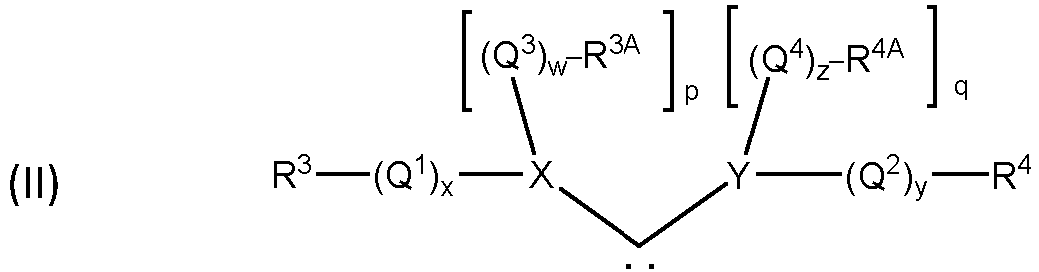 X und Y unabhängig voneinander ausgewählt sind aus C, N, O, S und P;p Null ist, wenn X O oder S ist, und p 1 ist, wenn X N oder P ist;q Null ist, wenn Y O oder S ist, und q 1 ist, wenn Y N oder P ist;Q1, Q2, Q3 und Q4 unabhängig voneinander ausgewählt sind aus Hydrocarbylen, substituiertem Hydrocarbylen, Heteroatom-enthaltendem Hydrocarbylen, substituiertem Heteroatom-enthaltendem Hydrocarbylen und -(CO)- , und wobei ferner zwei oder mehr Substituenten an benachbarten Atomen innerhalb von Q unter Bildung einer zusätzlichen cyclischen Gruppe verbunden sein können;w, x, y und z unabhängig voneinander Null oder 1 sind; undR3, R3A, R4 und R4A unabhängig voneinander ausgewählt sind aus Wasserstoff, Hydrocarbyl, substituiertem Hydrocarbyl, Heteroatom-haltigem Hydrocarbyl und substituiertem Heteroatom-haltigem Hydrocarbyl,wobei beliebige zwei oder mehr von X1, X2, L2, L3, R1, R2, R3, R3A, R4, R4A, Q1, Q2, Q3 und Q4zusammengenommen werden können, um eine cyclische Gruppe zu bilden, und wobei ferner eines oder mehrere von X1, X2, L2, L2, Q1, Q2, Q3, Q4, R1, R2, R3, R3A, R4 und R4A an einen Träger gebunden sein könnenund Komplexe der Formel (VII)
 M ein Übergangsmetall der Gruppe 8 ist;X1 und X2 anionische Liganden sind;L1 ausgewählt ist aus Phosphin, sulfoniertem Phosphin, Phosphit, Phosphinit, Phosphonit, Arsin, Stibin, Ether (einschließlich cyclischer Ether), Amin, Amid, Imin, Sulfoxid, Carboxyl, Nitrosyl, Pyridin, substituiertem Pyridin, Imidazol, substituiertem Imidazol, Pyrazin, substituiertem Pyrazin, Thioether und einem Carbenliganden mit der Struktur der Formel (II);Y ein Heteroatom ist, ausgewählt aus N, O, S und P;R5, R6, R7 und R8 jeweils unabhängig voneinander ausgewählt sind aus der Gruppe bestehend aus Wasserstoff, Halogen, Alkyl, Alkenyl, Alkinyl, Aryl, Heteroalkyl, Heteroatom-haltiges Alkenyl, Heteroalkenyl, Heteroaryl, Alkoxy, Alkenyloxy, Aryloxy, Alkoxycarbonyl, Carbonyl, Alkylamino, Alkylthio, Aminosulfonyl, Monoalkylaminosulfonyl, Dialkylaminosulfonyl, Alkylsulfonyl, Nitril, Nitro, Alkylsulfinyl, Trihalogenalkyl, Perfluoralkyl, Carbonsäure, Keton, Aldehyd, Nitrat, Cyano, Isocyanat, Hydroxyl, Ester, Ether, Amin, Imin, Amid, halogensubstituiertes Amid, Trifluoramid, Sulfid, Disulfid, Sulfonat, Carbamat, Silan, Siloxan, Phosphin, Phosphat, Borat, oder -A-Fn;"A" ein divalenter Hydrocarbylrest ist, ausgewählt aus Alkylen und Arylalkylen, wobei der Alkylteil der Alkylen- und Arylalkylengruppen linear oder verzweigt, gesättigt oder ungesättigt, cyclisch oder acyclisch und substituiert oder unsubstituiert sein kann, wobei der Arylteil des Arylalkylens substituiert oder unsubstituiert sein kann und wobei Heteroatome und/oder funktionelle Gruppen entweder in den Aryl- oder den Alkylteilen der Alkylen- und Arylalkylengruppen vorhanden sein können; undFn eine funktionelle Gruppe istn 0, 1 oder 2 ist, so dass n für die zweiwertigen Heteroatome O oder S 1 ist und n für die dreiwertigen Heteroatome N oder P 2 ist; undZ eine Gruppe ist, ausgewählt aus Wasserstoff, Alkyl, Aryl, funktionalisiertem Alkyl, funktionalisiertem Aryl, wobei die funktionelle(n) Gruppe(n) unabhängig voneinander eine oder mehrere der folgenden sein können: Alkoxy, Aryloxy, Halogen, Carbonsäure, Keton, Aldehyd, Nitrat, Cyano, Isocyanat, Hydroxyl, Ester, Ether, Amin, Imin, Amid, Trifluoramid, Sulfid, Disulfid, Carbamat, Silan, Siloxan, Phosphin, Phosphat oder Borat; Methyl, Isopropyl, sec-Butyl, t-Butyl, Neopentyl, Benzyl, Phenyl und Trimethylsilyl;wobei eine beliebige Kombination von Y, Z, R5, R6, R7und R8 zur Bildung einer oder mehrerer cyclischer Gruppen verbunden sein kann;wobei eine beliebige Kombination oder Kombinationen von X1, X2, L1, Y, Z, R5, R6, R7 und R8 mit einem Träger verbunden sein können, undwobei ferner R5, R6, R7, R8 und Z unabhängig voneinander Thioisocyanat, Cyanato oder Thiocyanato sein können.
 - Verfahren nach Anspruch 1, wobei der Lack ein Lack auf Urethanbasis ist und der optionale Primer ein Primer auf Urethanbasis ist.
- Zusammensetzung, die mindestens ein zyklisches Olefin, mindestens einen Olefinmetathesekatalysator, bei dem es sich um einen Gruppe-8-Übergangsmetallkomplex handelt, mindestens eine In-Mold-Beschichtungs-Haftverbindung und mindestens einen Lack, mindestens einen Primer oder eine Kombination aus mindestens einem Lack und mindestens einem Primer umfasst,wobei das mindestens eine cyclische Olefin ausgewählt ist aus Dicyclopentadien; Trimeren und anderen Oligomeren höherer Ordnung von Cyclopentadien; Ethylidennorbornen; Dicyclohexadien; Norbornen; C2-C12-Hydrocarbylsubstituierten Norbornenen, 5-Methyl-2-norbornen; 5-Ethyl-2-norbornen; 5-Isobutyl-2-norbornen; 5,6-Dimethyl-2-norbornen; 5-Phenylnorbornen; 5-Benzylnorbornen; 5-Acetylnorbornen; 5-Methoxycarbonylnorbornen; 5-Ethyoxycarbonyl-1-norbornen; 5-Methyl-5-methoxy-carbonylnorbornen; 5-Cyanonorbornen; 5,5,6-Trimethyl-2-norbornen; Cyclohexenylnorbornen; Endo, exo-5,6-Dimethoxynorbornen; Endo, endo-5,6-Dimethoxynorbornen; Endo, exo-5,6-Dimethoxycarbonylnorbornen; Endo, endo-5,6-Dimethoxycarbonylnorbornen; 2,3-Dimethoxynorbornen; Norbornadien; Tricycloundecen; Tetracyclododecen; 8-Methyltetracyclododecen; 8-Ethyltetracyclododecen; 8-Methoxycarbonyltetracyclododecen; 8-Methyl-8-tetracyclododecen; 8-Cyanotetracyclododecen; Pentacyclopentadecen; Pentacyclohexadecen; sowie deren Strukturisomere, Stereoisomere und Gemische davon;und wobei die mindestens eine In-Mold-Beschichtungs-Haftverbindung eine Verbindung ist, die mindestens eine ein Heteroatom enthaltende funktionelle Gruppe und mindestens ein metatheseaktives Olefin mit der Struktur umfasst:
(OM)-(Q*)n-(X*)-H
wobei,OM ein metatheseaktives Olefinfragment ist, ausgewählt aus cyclischen Olefinen oder acyclischen Olefinen;Q* eine Linkergruppe ist, ausgewählt aus Hydrocarbyl, substituiertem Hydrocarbyl, heteroatomhaltigem Hydrocarbyl, substituiertem heteroatomhaltigem Hydrocarbyl oder -(CO)-;n Null oder 1 ist; undX* ausgewählt ist aus Sauerstoff, Schwefel oder einem heteroatomhaltigen Fragment, wobei das heteroatomhaltige Fragment ausgewählt ist aus N(RX), P(RX), OP(RX), OP(RX)O, OP(ORX)O, P(=O)(RX), OP(=O)(RX), OP(=O)(RX)O, OP(=O)(ORX)O, Si(RX)2, Si(RX)2O, Si(ORX)2O oder Si(RX)(ORX)O, wobei jedes RX unabhängig ausgewählt ist aus Wasserstoff, Hydrocarbyl oder substituiertem Hydrocarbyl; undwobei der mindestens eine Olefinmetathesekatalysator aus Komplexen mit der Struktur der Formel (I) ausgewählt ist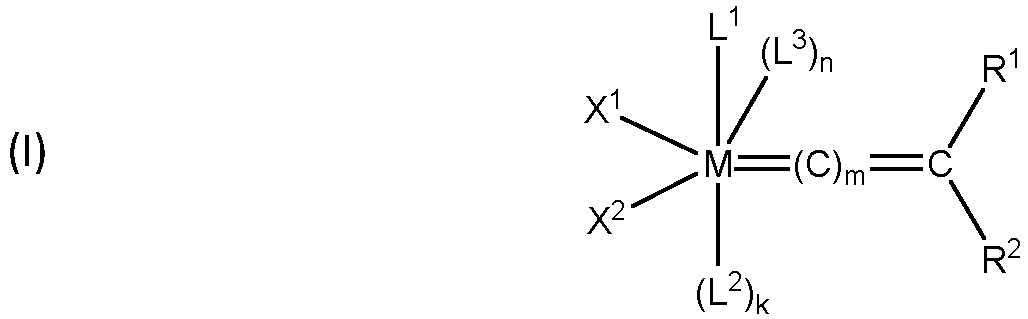 M ein Übergangsmetall der Gruppe 8 ist;L2 und L3 unabhängig voneinander aus neutralen Elektronendonorliganden ausgewählt sind;n 0 oder 1 ist, so dass L3vorhanden oder nicht vorhanden sein kann;m 0, 1 oder 2 ist;k 0 oder 1 ist;X1 und X2 unabhängig voneinander anionische Liganden sind; undR1 und R2 unabhängig voneinander ausgewählt sind aus Wasserstoff, Hydrocarbyl, substituiertem Hydrocarbyl, heteroatomhaltigem Hydrocarbyl, substituiertem heteroatomhaltigem Hydrocarbyl und funktionellen Gruppen; undL1 ein Carben-Ligand mit der Struktur der Formel (II) ist
 X und Y unabhängig voneinander ausgewählt sind aus C, N, O, S und P;p Null ist, wenn X O oder S ist, und p 1 ist, wenn X N oder P ist;q Null ist, wenn Y O oder S ist, und q 1 ist, wenn Y N oder P ist;Q1, Q2, Q3 und Q4 unabhängig voneinander ausgewählt sind aus Hydrocarbylen, substituiertem Hydrocarbylen, Heteroatom-enthaltendem Hydrocarbylen, substituiertem Heteroatom-enthaltendem Hydrocarbylen und -(CO)- , und wobei ferner zwei oder mehr Substituenten an benachbarten Atomen innerhalb von Q unter Bildung einer zusätzlichen cyclischen Gruppe verbunden sein können;w, x, y und z unabhängig voneinander Null oder 1 sind; undR3, R3A, R4 und R4A unabhängig voneinander ausgewählt sind aus Wasserstoff, Hydrocarbyl, substituiertem Hydrocarbyl, Heteroatom-haltigem Hydrocarbyl und substituiertem Heteroatom-haltigem Hydrocarbyl,wobei beliebige zwei oder mehr von X1, X2, L2, L3, R1, R2, R3, R3A, R4, R4A, Q1, Q2, Q3 und Q4 zusammengenommen werden können, um eine cyclische Gruppe zu bilden, und wobei ferner eines oder mehrere von X1, X2, L2, L3, Q1, Q2, Q3, Q4, R1, R2, R3, R3A, R4 und R4A an einen Träger gebunden sein könnenund Komplexe der Formel (VII)
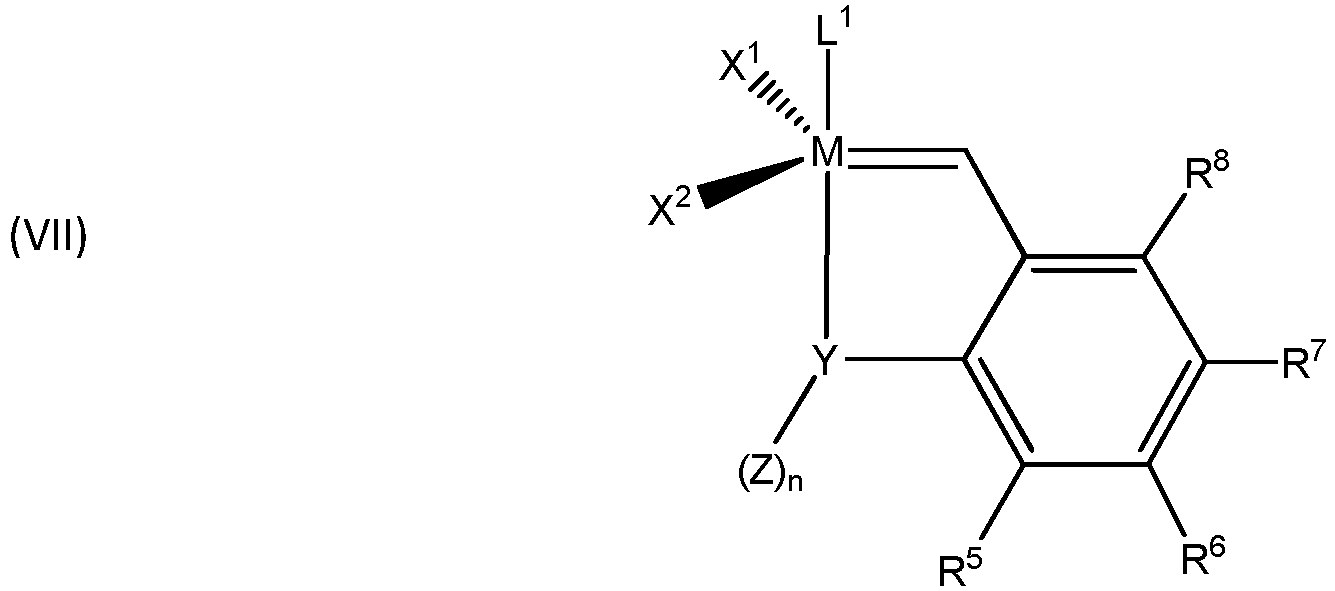 M ein Übergangsmetall der Gruppe 8 ist;X1 und X2 anionische Liganden sind;L1 ausgewählt ist aus Phosphin, sulfoniertem Phosphin, Phosphit, Phosphinit, Phosphonit, Arsin, Stibin, Ether (einschließlich cyclischer Ether), Amin, Amid, Imin, Sulfoxid, Carboxyl, Nitrosyl, Pyridin, substituiertem Pyridin, Imidazol, substituiertem Imidazol, Pyrazin, substituiertem Pyrazin, Thioether und einem Carbenliganden mit der Struktur der Formel (II);Y ein Heteroatom ist, ausgewählt aus N, O, S und P;R5, R6, R7 und R8 jeweils unabhängig voneinander ausgewählt sind aus der Gruppe bestehend aus Wasserstoff, Halogen, Alkyl, Alkenyl, Alkinyl, Aryl, Heteroalkyl, Heteroatom-haltiges Alkenyl, Heteroalkenyl, Heteroaryl, Alkoxy, Alkenyloxy, Aryloxy, Alkoxycarbonyl, Carbonyl, Alkylamino, Alkylthio, Aminosulfonyl, Monoalkylaminosulfonyl, Dialkylaminosulfonyl, Alkylsulfonyl, Nitril, Nitro, Alkylsulfinyl, Trihalogenalkyl, Perfluoralkyl, Carbonsäure, Keton, Aldehyd, Nitrat, Cyano, Isocyanat, Hydroxyl, Ester, Ether, Amin, Imin, Amid, halogensubstituiertes Amid, Trifluoramid, Sulfid, Disulfid, Sulfonat, Carbamat, Silan, Siloxan, Phosphin, Phosphat, Borat, oder -A-Fn;"A" ein divalenter Hydrocarbylrest ist, ausgewählt aus Alkylen und Arylalkylen, wobei der Alkylteil der Alkylen- und Arylalkylengruppen linear oder verzweigt, gesättigt oder ungesättigt, cyclisch oder acyclisch und substituiert oder unsubstituiert sein kann, wobei der Arylteil des Arylalkylens substituiert oder unsubstituiert sein kann und wobei Heteroatome und/oder funktionelle Gruppen entweder in den Aryl- oder den Alkylteilen der Alkylen- und Arylalkylengruppen vorhanden sein können; undFn eine funktionelle Gruppe ist; undeine beliebige Kombination von Y, Z, R5, R6, R7 und R8 zur Bildung einer oder mehrerer cyclischer Gruppen verbunden sein kann;n 0, 1 oder 2 ist, so dass n für die zweiwertigen Heteroatome O oder S 1 ist und n für die dreiwertigen Heteroatome N oder P 2 ist; undZ eine Gruppe ist, ausgewählt aus Wasserstoff, Alkyl, Aryl, funktionalisiertem Alkyl, funktionalisiertem Aryl, wobei die funktionelle(n) Gruppe(n) unabhängig voneinander eine oder mehrere der folgenden sein können: Alkoxy, Aryloxy, Halogen, Carbonsäure, Keton, Aldehyd, Nitrat, Cyano, Isocyanat, Hydroxyl, Ester, Ether, Amin, Imin, Amid, Trifluoramid, Sulfid, Disulfid, Carbamat, Silan, Siloxan, Phosphin, Phosphat oder Borat; Methyl, Isopropyl, sec-Butyl, t-Butyl, Neopentyl, Benzyl, Phenyl und Trimethylsilyl;wobei eine beliebige Kombination oder Kombinationen von X1, X2, L1, Y, Z, R5, R6, R7 und R8 mit einem Träger verbunden sein können, undwobei ferner R5, R6, R7, R8 und Z unabhängig voneinander Thioisocyanat, Cyanato oder Thiocyanato sein können.
 - Herstellungsgegenstand, umfassend ein In-Mold-beschichtetes RÖMP-Polymer, wobei das In-Mold-beschichtete ROMP-Polymer eine metathesepolymerisierte Harzzusammensetzung und eine darauf haftende Beschichtung umfasst, wobei die metathesepolymerisierte Harzzusammensetzung mindestens ein zyklisches Olefin, mindestens einen Olefinmetathesekatalysator und mindestens eine In-Mold-Beschichtungs-Haftverbindung; und die haftende Beschichtung einen Lack, einen Primer oder eine Kombination davon umfasst,wobei das mindestens eine cyclische Olefin ausgewählt ist aus Dicyclopentadien; Trimeren und anderen Oligomeren höherer Ordnung von Cyclopentadien; Ethylidennorbornen; Dicyclohexadien; Norbornen; C2-C12-Hydrocarbylsubstituierten Norbornenen, 5-Methyl-2-norbornen; 5-Ethyl-2-norbornen; 5-Isobutyl-2-norbornen; 5,6-Dimethyl-2-norbornen; 5-Phenylnorbornen; 5-Benzylnorbornen; 5-Acetylnorbornen; 5-Methoxycarbonylnorbornen; 5-Ethyoxycarbonyl-1-norbornen; 5-Methyl-5-methoxy-carbonylnorbornen; 5-Cyanonorbornen; 5,5,6-Trimethyl-2-norbornen; Cyclohexenylnorbornen; Endo, exo-5,6-Dimethoxynorbornen; Endo, endo-5,6-Dimethoxynorbornen; Endo, exo-5,6-Dimethoxycarbonylnorbornen; Endo, endo-5,6-Dimethoxycarbonylnorbornen; 2,3-Dimethoxynorbornen; Norbornadien; Tricycloundecen; Tetracyclododecen; 8-Methyltetracyclododecen; 8-Ethyltetracyclododecen; 8-Methoxycarbonyltetracyclododecen; 8-Methyl-8-tetracyclododecen; 8-Cyanotetracyclododecen; Pentacyclopentadecen; Pentacyclohexadecen; sowie deren Strukturisomere, Stereoisomere und Gemische davon;und wobei die mindestens eine In-Mold-Beschichtungs-Haftverbindung eine Verbindung ist, die eine ein Heteroatom enthaltende funktionelle Gruppe und ein metatheseaktives Olefin mit der Struktur umfasst:
(OM)-(Q*)n-(X*)-H
wobei,OM ein metatheseaktives Olefinfragment ist, ausgewählt aus cyclischen Olefinen oder acyclischen Olefinen;Q* eine Linkergruppe ist, ausgewählt aus Hydrocarbyl, substituiertem Hydrocarbyl, heteroatomhaltigem Hydrocarbyl, substituiertem heteroatomhaltigem Hydrocarbyl oder -(CO)-;n Null oder 1 ist; undX* ausgewählt ist aus Sauerstoff, Schwefel oder einem heteroatomhaltigen Fragment, wobei das heteroatomhaltige Fragment ausgewählt ist aus N(RX), P(RX), OP(RX), OP(RX)O, OP(ORX)O, P(=O)(RX), OP(=O)(RX), OP(=O)(RX)O, OP(=O)(ORX)O, Si(RX)2, Si(RX)2O, Si(ORX)2O oder Si(RX)(ORX)O, wobei jedes RX unabhängig ausgewählt ist aus Wasserstoff, Hydrocarbyl oder substituiertem Hydrocarbyl;wobei der mindestens eine Olefinmetathesekatalysator aus Komplexen mit der Struktur der Formel (I) ausgewählt ist M ein Übergangsmetall der Gruppe 8 ist;L2 und L3 unabhängig voneinander aus neutralen Elektronendonorliganden ausgewählt sind;n 0 oder 1 ist, so dass L3vorhanden oder nicht vorhanden sein kann;m 0, 1 oder 2 ist;k 0 oder 1 ist;X1 und X2 unabhängig voneinander anionische Liganden sind; undR1 und R2 unabhängig voneinander ausgewählt sind aus Wasserstoff, Hydrocarbyl, substituiertem Hydrocarbyl, heteroatomhaltigem Hydrocarbyl, substituiertem heteroatomhaltigem Hydrocarbyl und funktionellen Gruppen;L1 ein Carben-Ligand mit der Struktur der Formel (II) ist
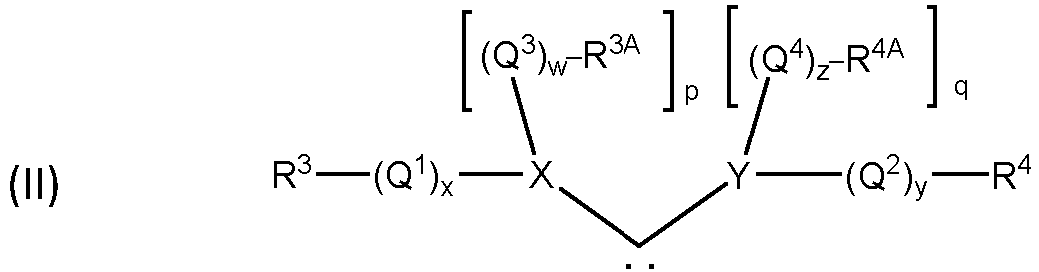 X und Y unabhängig voneinander ausgewählt sind aus C, N, O, S und P;p Null ist, wenn X O oder S ist, und p 1 ist, wenn X N oder P ist;q Null ist, wenn Y O oder S ist, und q 1 ist, wenn Y N oder P ist;Q1, Q2, Q3 und Q4 unabhängig voneinander ausgewählt sind aus Hydrocarbylen, substituiertem Hydrocarbylen, Heteroatom-enthaltendem Hydrocarbylen, substituiertem Heteroatom-enthaltendem Hydrocarbylen und -(CO)- , und wobei ferner zwei oder mehr Substituenten an benachbarten Atomen innerhalb von Q unter Bildung einer zusätzlichen cyclischen Gruppe verbunden sein können;w, x, y und z unabhängig voneinander Null oder 1 sind; undR3, R3A, R4 und R4A unabhängig voneinander ausgewählt sind aus Wasserstoff, Hydrocarbyl, substituiertem Hydrocarbyl, Heteroatom-haltigem Hydrocarbyl und substituiertem Heteroatom-haltigem Hydrocarbyl,wobei beliebige zwei oder mehr von X1, X2, L2, L3, R1, R2, R3, R3A, R4, R4A, Q1, Q2, Q3 und Q4 zusammengenommen werden können, um eine cyclische Gruppe zu bilden, und wobei ferner eines oder mehrere von X1, X2, L2, L3, Q1, Q2, Q3, Q4, R1, R2, R3, R3A, R4 und R4A an einen Träger gebunden sein könnenund Komplexe der Formel (VII)
 M ein Übergangsmetall der Gruppe 8 ist;X1 und X2 anionische Liganden sind;L1 ausgewählt ist aus Phosphin, sulfoniertem Phosphin, Phosphit, Phosphinit, Phosphonit, Arsin, Stibin, Ether (einschließlich cyclischer Ether), Amin, Amid, Imin, Sulfoxid, Carboxyl, Nitrosyl, Pyridin, substituiertem Pyridin, Imidazol, substituiertem Imidazol, Pyrazin, substituiertem Pyrazin, Thioether und einem Carbenliganden mit der Struktur der Formel (II);Y ein Heteroatom ist, ausgewählt aus N, O, S und P;R5, R6, R7 und R8 jeweils unabhängig voneinander ausgewählt sind aus der Gruppe bestehend aus Wasserstoff, Halogen, Alkyl, Alkenyl, Alkinyl, Aryl, Heteroalkyl, Heteroatom-haltiges Alkenyl, Heteroalkenyl, Heteroaryl, Alkoxy, Alkenyloxy, Aryloxy, Alkoxycarbonyl, Carbonyl, Alkylamino, Alkylthio, Aminosulfonyl, Monoalkylaminosulfonyl, Dialkylaminosulfonyl, Alkylsulfonyl, Nitril, Nitro, Alkylsulfinyl, Trihalogenalkyl, Perfluoralkyl, Carbonsäure, Keton, Aldehyd, Nitrat, Cyano, Isocyanat, Hydroxyl, Ester, Ether, Amin, Imin, Amid, halogensubstituiertes Amid, Trifluoramid, Sulfid, Disulfid, Sulfonat, Carbamat, Silan, Siloxan, Phosphin, Phosphat, Borat, oder -A-Fn;"A" ein divalenter Hydrocarbylrest ist, ausgewählt aus Alkylen und Arylalkylen, wobei der Alkylteil der Alkylen- und Arylalkylengruppen linear oder verzweigt, gesättigt oder ungesättigt, cyclisch oder acyclisch und substituiert oder unsubstituiert sein kann, wobei der Arylteil des Arylalkylens substituiert oder unsubstituiert sein kann und wobei Heteroatome und/oder funktionelle Gruppen entweder in den Aryl- oder den Alkylteilen der Alkylen- und Arylalkylengruppen vorhanden sein können; undFn eine funktionelle Gruppe ist; undeine beliebige Kombination von Y, Z, R5, R6, R7 und R8 zur Bildung einer oder mehrerer cyclischer Gruppen verbunden sein kann;n 0, 1 oder 2 ist, so dass n für die zweiwertigen Heteroatome O oder S 1 ist und n für die dreiwertigen Heteroatome N oder P 2 ist; undZ eine Gruppe ist, ausgewählt aus Wasserstoff, Alkyl, Aryl, funktionalisiertem Alkyl, funktionalisiertem Aryl, wobei die funktionelle(n) Gruppe(n) unabhängig voneinander eine oder mehrere der folgenden sein können: Alkoxy, Aryloxy, Halogen, Carbonsäure, Keton, Aldehyd, Nitrat, Cyano, Isocyanat, Hydroxyl, Ester, Ether, Amin, Imin, Amid, Trifluoramid, Sulfid, Disulfid, Carbamat, Silan, Siloxan, Phosphin, Phosphat oder Borat; Methyl, Isopropyl, sec-Butyl, t-Butyl, Neopentyl, Benzyl, Phenyl und Trimethylsilyl;wobei eine beliebige Kombination oder Kombinationen von X1, X2, L1, Y, Z, R5, R6, R7 und R8 mit einem Träger verbunden sein können, undwobei ferner R5, R6, R7, R8 und Z unabhängig voneinander Thioisocyanat, Cyanato oder Thiocyanato sein können.
 - Verwendung mindestens einer In-Mold-Beschichtungs-Haftverbindung zum Anhaften einer metathesepolymerisierten Harzzusammensetzung an einen Lack, einen Primer oder eine Kombination davon, wobei die metathesepolymerisierte Harzzusammensetzung mindestens ein cyclisches Olefin, mindestens einen Olefinmetathesekatalysator, bei dem es sich um einen Übergangsmetallkomplex der Gruppe 8 handelt, und mindestens eine In-Mold-Beschichtungs-Haftverbindung umfasst,wobei das mindestens eine cyclische Olefin ausgewählt ist aus Dicyclopentadien; Trimeren und anderen Oligomeren höherer Ordnung von Cyclopentadien; Ethylidennorbornen; Dicyclohexadien; Norbornen; C2-C12-Hydrocarbylsubstituierten Norbornenen, 5-Methyl-2-norbornen; 5-Ethyl-2-norbornen; 5-Isobutyl-2-norbornen; 5,6-Dimethyl-2-norbornen; 5-Phenylnorbornen; 5-Benzylnorbornen; 5-Acetylnorbornen; 5-Methoxycarbonylnorbornen; 5-Ethyoxycarbonyl-1-norbornen; 5-Methyl-5-methoxy-carbonylnorbornen; 5-Cyanonorbornen; 5,5,6-Trimethyl-2-norbornen; Cyclohexenylnorbornen; Endo, exo-5,6-Dimethoxynorbornen; Endo, endo-5,6-Dimethoxynorbornen; Endo, exo-5,6-Dimethoxycarbonylnorbornen; Endo, endo-5,6-Dimethoxycarbonylnorbornen; 2,3-Dimethoxynorbornen; Norbornadien; Tricycloundecen; Tetracyclododecen; 8-Methyltetracyclododecen; 8-Ethyltetracyclododecen; 8-Methoxycarbonyltetracyclododecen; 8-Methyl-8-tetracyclododecen; 8-Cyanotetracyclododecen; Pentacyclopentadecen; Pentacyclohexadecen; sowie deren Strukturisomere, Stereoisomere und Gemische davon;und wobei die mindestens eine In-Mold-Beschichtungs-Haftverbindung eine Verbindung ist, die mindestens eine ein Heteroatom enthaltende funktionelle Gruppe und mindestens ein metatheseaktives Olefin mit der Struktur umfasst:
(OM)-(Q*)n-(X*)-H
wobei,OM ein metatheseaktives Olefinfragment ist, ausgewählt aus cyclischen Olefinen oder acyclischen Olefinen;Q* eine Linkergruppe ist, ausgewählt aus Hydrocarbyl, substituiertem Hydrocarbyl, heteroatomhaltigem Hydrocarbyl, substituiertem heteroatomhaltigem Hydrocarbyl oder -(CO)-;n Null oder 1 ist; undX* ausgewählt ist aus Sauerstoff, Schwefel oder einem heteroatomhaltigen Fragment, wobei das heteroatomhaltige Fragment ausgewählt ist aus N(RX), P(RX), OP(RX), OP(RX)O, OP(ORX)O, P(=O)(RX), OP(=O)(RX), OP(=O)(RX)O, OP(=O)(ORX)O, Si(RX)2, Si(RX)2O, Si(ORX)2O oder Si(RX)(ORX)O, wobei jedes RX unabhängig ausgewählt ist aus Wasserstoff, Hydrocarbyl oder substituiertem Hydrocarbyl; undwobei der mindestens eine Olefinmetathesekatalysator aus Komplexen mit der Struktur der Formel (I) ausgewählt ist M ein Übergangsmetall der Gruppe 8 ist;L2 und L3 unabhängig voneinander aus neutralen Elektronendonorliganden ausgewählt sind;n 0 oder 1 ist, so dass L3vorhanden oder nicht vorhanden sein kann;m 0, 1 oder 2 ist;k 0 oder 1 ist;X1 und X2 unabhängig voneinander anionische Liganden sind; undR1 und R2 unabhängig voneinander ausgewählt sind aus Wasserstoff, Hydrocarbyl, substituiertem Hydrocarbyl, heteroatomhaltigem Hydrocarbyl, substituiertem heteroatomhaltigem Hydrocarbyl und funktionellen Gruppen;L1 ein Carben-Ligand mit der Struktur der Formel (II) ist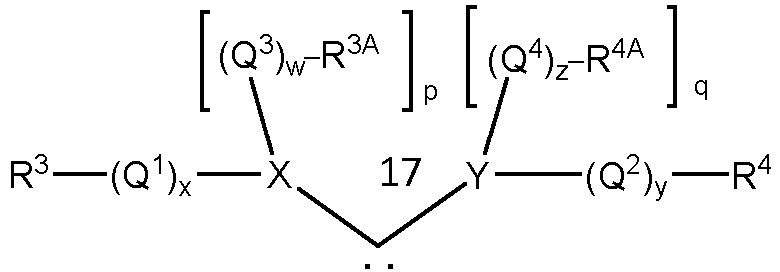
 X und Y unabhängig voneinander ausgewählt sind aus C, N, O, S und P;p Null ist, wenn X O oder S ist, und p 1 ist, wenn X N oder P ist;q Null ist, wenn Y O oder S ist, und q 1 ist, wenn Y N oder P ist;Q1, Q2, Q3 und Q4 unabhängig voneinander ausgewählt sind aus Hydrocarbylen, substituiertem Hydrocarbylen, Heteroatom-enthaltendem Hydrocarbylen, substituiertem Heteroatom-enthaltendem Hydrocarbylen und -(CO)- , und wobei ferner zwei oder mehr Substituenten an benachbarten Atomen innerhalb von Q unter Bildung einer zusätzlichen cyclischen Gruppe verbunden sein können;w, x, y und z unabhängig voneinander Null oder 1 sind; undR3, R3A, R4 und R4A unabhängig voneinander ausgewählt sind aus Wasserstoff, Hydrocarbyl, substituiertem Hydrocarbyl, Heteroatom-haltigem Hydrocarbyl und substituiertem Heteroatom-haltigem Hydrocarbyl,wobei beliebige zwei oder mehr von X1, X2, L2, L3, R1, R2, R3, R3A, R4, R4A, Q1, Q2, Q3 und Q4 zusammengenommen werden können, um eine cyclische Gruppe zu bilden, und wobei ferner eines oder mehrere von X1, X2, L2, L3, Q1, Q2, Q3, Q4, R1, R2, R3, R3A, R4 und R4A an einen Träger gebunden sein könnenund Komplexe der Formel (VII)
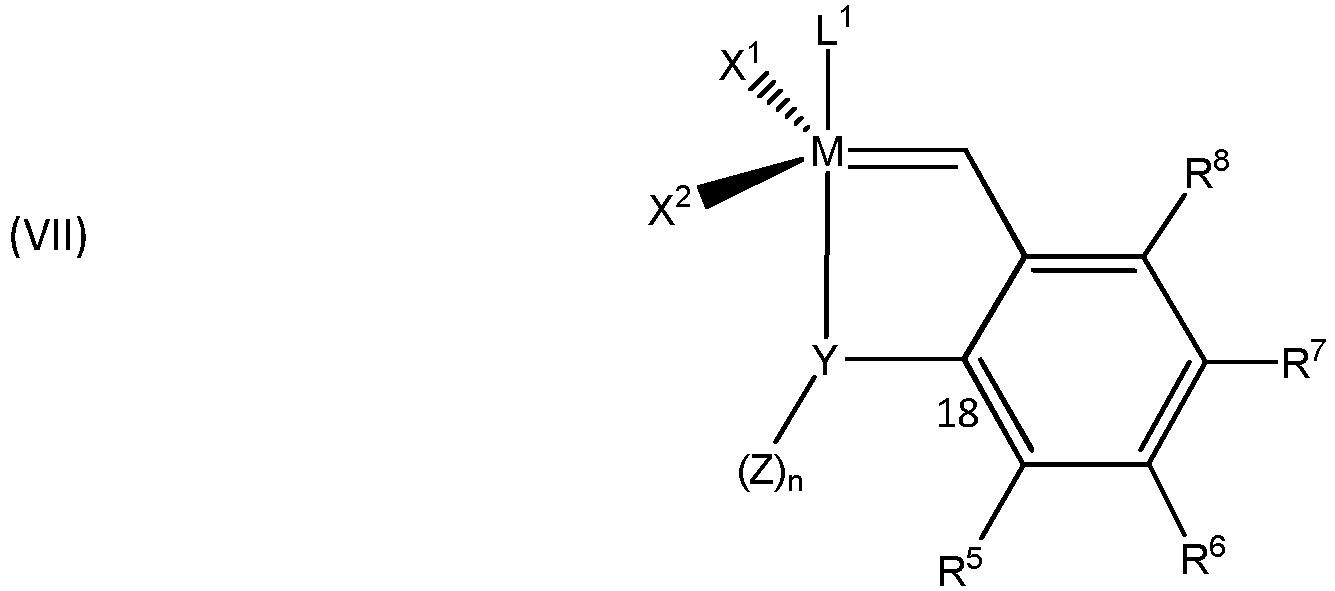 M ein Übergangsmetall der Gruppe 8 ist;X1 und X2 anionische Liganden sind;L1 ausgewählt ist aus Phosphin, sulfoniertem Phosphin, Phosphit, Phosphinit, Phosphonit, Arsin, Stibin, Ether (einschließlich cyclischer Ether), Amin, Amid, Imin, Sulfoxid, Carboxyl, Nitrosyl, Pyridin, substituiertem Pyridin, Imidazol, substituiertem Imidazol, Pyrazin, substituiertem Pyrazin, Thioether und einem Carbenliganden mit der Struktur der Formel (II);Y ein Heteroatom ist, ausgewählt aus N, O, S und P;R5, R6, R7 und R8 jeweils unabhängig voneinander ausgewählt sind aus der Gruppe bestehend aus Wasserstoff, Halogen, Alkyl, Alkenyl, Alkinyl, Aryl, Heteroalkyl, Heteroatom-haltiges Alkenyl, Heteroalkenyl, Heteroaryl, Alkoxy, Alkenyloxy, Aryloxy, Alkoxycarbonyl, Carbonyl, Alkylamino, Alkylthio, Aminosulfonyl, Monoalkylaminosulfonyl, Dialkylaminosulfonyl, Alkylsulfonyl, Nitril, Nitro, Alkylsulfinyl, Trihalogenalkyl, Perfluoralkyl, Carbonsäure, Keton, Aldehyd, Nitrat, Cyano, Isocyanat, Hydroxyl, Ester, Ether, Amin, Imin, Amid, halogensubstituiertes Amid, Trifluoramid, Sulfid, Disulfid, Sulfonat, Carbamat, Silan, Siloxan, Phosphin, Phosphat, Borat, oder -A-Fn;"A" ein divalenter Hydrocarbylrest ist, ausgewählt aus Alkylen und Arylalkylen, wobei der Alkylteil der Alkylen- und Arylalkylengruppen linear oder verzweigt, gesättigt oder ungesättigt, cyclisch oder acyclisch und substituiert oder unsubstituiert sein kann, wobei der Arylteil des Arylalkylens substituiert oder unsubstituiert sein kann und wobei Heteroatome und/oder funktionelle Gruppen entweder in den Aryl- oder den Alkylteilen der Alkylen- und Arylalkylengruppen vorhanden sein können; undFn eine funktionelle Gruppe ist; undeine beliebige Kombination von Y, Z, R5, R6, R7 und R8 zur Bildung einer oder mehrerer cyclischer Gruppen verbunden sein kann;n 0, 1 oder 2 ist, so dass n für die zweiwertigen Heteroatome O oder S 1 ist und n für die dreiwertigen Heteroatome N oder P 2 ist; undZ eine Gruppe ist, ausgewählt aus Wasserstoff, Alkyl, Aryl, funktionalisiertem Alkyl, funktionalisiertem Aryl, wobei die funktionelle(n) Gruppe(n) unabhängig voneinander eine oder mehrere der folgenden sein können: Alkoxy, Aryloxy, Halogen, Carbonsäure, Keton, Aldehyd, Nitrat, Cyano, Isocyanat, Hydroxyl, Ester, Ether, Amin, Imin, Amid, Trifluoramid, Sulfid, Disulfid, Carbamat, Silan, Siloxan, Phosphin, Phosphat oder Borat; Methyl, Isopropyl, sec-Butyl, t-Butyl, Neopentyl, Benzyl, Phenyl und Trimethylsilyl;wobei eine beliebige Kombination oder Kombinationen von X1, X2, L1, Y, Z, R5, R6, R7 und R8 mit einem Träger verbunden sein können, undwobei ferner R5, R6, R7, R8 und Z unabhängig voneinander Thioisocyanat, Cyanato oder Thiocyanato sein können.
 - Verwendung mindestens einer In-Mold-Beschichtungs-Haftverbindung zum Anhaften einer metathesepolymerisierten Harzzusammensetzung an einen Lack, einen Primer oder eine Kombination davon, wobei die metathesepolymerisierte Harzzusammensetzung mindestens ein cyclisches Olefin, mindestens einen Olefinmetathesekatalysator, bei dem es sich um einen Übergangsmetallkomplex der Gruppe 8 handelt, und mindestens eine In-Mold-Beschichtungs-Haftverbindung umfasstwobei das mindestens eine cyclische Olefin ausgewählt ist aus Dicyclopentadien; Trimeren und anderen Oligomeren höherer Ordnung von Cyclopentadien; Ethylidennorbornen; Dicyclohexadien; Norbornen; C2-C12-Hydrocarbylsubstituierten Norbornenen, 5-Methyl-2-norbornen; 5-Ethyl-2-norbornen; 5-Isobutyl-2-norbornen; 5,6-Dimethyl-2-norbornen; 5-Phenylnorbornen; 5-Benzylnorbornen; 5-Acetylnorbornen; 5-Methoxycarbonylnorbornen; 5-Ethyoxycarbonyl-1-norbornen; 5-Methyl-5-methoxy-carbonylnorbornen; 5-Cyanonorbornen; 5,5,6-Trimethyl-2-norbornen; Cyclohexenylnorbornen; Endo, exo-5,6-Dimethoxynorbornen; Endo, endo-5,6-Dimethoxynorbornen; Endo, exo-5,6-Dimethoxycarbonylnorbornen; Endo, endo-5,6-Dimethoxycarbonylnorbornen; 2,3-Dimethoxynorbornen; Norbornadien; Tricycloundecen; Tetracyclododecen; 8-Methyltetracyclododecen; 8-Ethyltetracyclododecen; 8-Methoxycarbonyltetracyclododecen; 8-Methyl-8-tetracyclododecen; 8-Cyanotetracyclododecen; Pentacyclopentadecen; Pentacyclohexadecen; sowie deren Strukturisomere, Stereoisomere und Gemische davon;und wobei die mindestens eine In-Mold-Beschichtungs-Haftverbindung eine Verbindung ist, die mindestens eine ein Heteroatom enthaltende funktionelle Gruppe und mindestens ein metatheseaktives Olefin mit der Struktur umfasst:
(OM)-(Q*)n-(X*)-H
wobei,OM ein metatheseaktives Olefinfragment ist, ausgewählt aus cyclischen Olefinen oder acyclischen Olefinen;Q* eine Linkergruppe ist, ausgewählt aus Hydrocarbyl, substituiertem Hydrocarbyl, heteroatomhaltigem Hydrocarbyl, substituiertem heteroatomhaltigem Hydrocarbyl oder -(CO)-;n Null oder 1 ist; undX* ausgewählt ist aus Sauerstoff, Schwefel oder einem heteroatomhaltigen Fragment, wobei das heteroatomhaltige Fragment ausgewählt ist aus N(RX), P(RX), OP(RX), OP(RX)O, OP(ORX)O, P(=O)(RX), OP(=O)(RX), OP(=O)(RX)O, OP(=O)(ORX)O, Si(RX)2, Si(RO)2O, Si(ORX)2O oder Si(RX)(ORX)O, wobei jedes RX unabhängig ausgewählt ist aus Wasserstoff, Hydrocarbyl oder substituiertem Hydrocarbyl,wobei der Primer und/oder Lack auf Urethanbasis ist.
Applications Claiming Priority (2)
| Application Number | Priority Date | Filing Date | Title |
|---|---|---|---|
| US201361800563P | 2013-03-15 | 2013-03-15 | |
| PCT/US2014/029130 WO2014144634A1 (en) | 2013-03-15 | 2014-03-14 | In-mold coating of romp polymers |
Publications (3)
| Publication Number | Publication Date |
|---|---|
| EP2970522A1 EP2970522A1 (de) | 2016-01-20 |
| EP2970522A4 EP2970522A4 (de) | 2016-11-16 |
| EP2970522B1 true EP2970522B1 (de) | 2025-05-21 |
Family
ID=51537746
Family Applications (1)
| Application Number | Title | Priority Date | Filing Date |
|---|---|---|---|
| EP14762532.1A Active EP2970522B1 (de) | 2013-03-15 | 2014-03-14 | In-mold-coating von romp-polymeren |
Country Status (9)
| Country | Link |
|---|---|
| US (2) | US9803046B2 (de) |
| EP (1) | EP2970522B1 (de) |
| JP (1) | JP6342985B2 (de) |
| CN (1) | CN105189573B (de) |
| AU (1) | AU2014228926B2 (de) |
| BR (1) | BR112015022516A2 (de) |
| CA (1) | CA2903574C (de) |
| MX (1) | MX2015011454A (de) |
| WO (1) | WO2014144634A1 (de) |
Families Citing this family (24)
| Publication number | Priority date | Publication date | Assignee | Title |
|---|---|---|---|---|
| US9527982B2 (en) * | 2012-12-19 | 2016-12-27 | Materia, Inc. | Storage stable adhesion promoter compositions for cyclic olefin resin compositions |
| EP2970522B1 (de) | 2013-03-15 | 2025-05-21 | Materia, Inc. | In-mold-coating von romp-polymeren |
| US9890239B2 (en) * | 2013-09-04 | 2018-02-13 | California Institute Of Technology | Functionalized linear and cyclic polyolefins |
| CN107107462A (zh) | 2014-10-21 | 2017-08-29 | 斯特拉塔西斯公司 | 使用开环易位聚合的三维喷墨印刷方法 |
| WO2016130743A1 (en) * | 2015-02-12 | 2016-08-18 | Materia, Inc. | Cyclic olefin resin compositions comprising functional elastomers |
| US10344118B2 (en) | 2015-02-14 | 2019-07-09 | Materia, Inc. | Romp polymers having improved resistance to hydrocarbon fluids |
| WO2017134672A2 (en) | 2016-02-05 | 2017-08-10 | Stratasys Ltd. | Three-dimensional inkjet printing using polyamide-forming materials |
| WO2017134674A1 (en) | 2016-02-05 | 2017-08-10 | Stratasys Ltd. | Three-dimensional inkjet printing using ring-opening metathesis polymerization |
| US11179879B2 (en) | 2016-02-07 | 2021-11-23 | Stratasys Ltd. | Three-dimensional printing combining ring-opening metathesis polymerization and free radical polymerization |
| US11118004B2 (en) | 2016-04-26 | 2021-09-14 | Stratasys Ltd. | Three-dimensional inkjet printing using ring-opening metathesis polymerization |
| US10106564B2 (en) | 2016-12-12 | 2018-10-23 | International Business Machines Corporation | Furan-containing flame retardant molecules |
| US10155907B2 (en) | 2016-12-12 | 2018-12-18 | International Business Machines Corporation | Cross-linkable flame retardant materials |
| US9822208B1 (en) | 2017-01-03 | 2017-11-21 | International Business Machines Corporation | Flame retardant materials derived from furan dicarboxylic methyl ester |
| EP3687442A4 (de) * | 2017-09-27 | 2021-07-21 | ArchForm Inc. | Herstellung von dentalgeräten |
| SG11202106051QA (en) * | 2018-12-13 | 2021-07-29 | Materia Inc | Coating compositions |
| GB201901021D0 (en) * | 2019-01-25 | 2019-03-13 | Advanced Insulation Ltd | A mixture curable to provide a material for thermally insulating a substrate useable subsea |
| PL429476A1 (pl) | 2019-04-02 | 2020-10-05 | Apeiron Synthesis Spółka Akcyjna | Nowe zastosowanie kompleksów metali posiadających ligandy organiczne do aktywacji rutenowych (pre)katalizatorów metatezy olefin |
| EP3960414B1 (de) * | 2019-04-23 | 2025-08-06 | RIMTEC Corporation | Verfahren zur herstellung eines dekorativen formartikels aus cycloolefinharz |
| CN114450346A (zh) | 2019-10-14 | 2022-05-06 | 3M创新有限公司 | 包含环状烯烃和导热填料的组合物 |
| CN114929776B (zh) | 2019-12-20 | 2025-07-15 | 3M创新有限公司 | 包含聚合物和可聚合环状烯烃的粘合剂制品、粘合剂组合物和方法 |
| WO2021202485A1 (en) * | 2020-04-01 | 2021-10-07 | 3M Innovative Properties Company | Compositions comprising romp catalyst and dispersant, cartridges, and methods |
| US12409581B2 (en) * | 2020-06-22 | 2025-09-09 | Embraer S.A. | Process for in-mold coating of composite aircraft components |
| CN119970171B (zh) * | 2025-02-11 | 2025-10-14 | 盐城市中医院 | 一种dsa引导用血管穿刺定位膜及其制备工艺 |
| CN119859370A (zh) * | 2025-03-20 | 2025-04-22 | 道生天合材料科技(上海)股份有限公司 | 一种环烯烃树脂组合物及其复合材料 |
Family Cites Families (63)
| Publication number | Priority date | Publication date | Assignee | Title |
|---|---|---|---|---|
| US4350739A (en) * | 1979-07-30 | 1982-09-21 | International Telephone And Telegraph Corporation | Molded plastic part |
| BR8004531A (pt) * | 1979-07-30 | 1981-02-03 | Itt | Processo para preparar uma peca de plastico moldada |
| US4282285A (en) * | 1979-10-24 | 1981-08-04 | International Telephone & Telegraph Corporation | Process for preparing polyurethane molded part |
| US4899005A (en) | 1987-11-19 | 1990-02-06 | The B. F. Goodrich Company | Method for preparing cycloolefin copolymers with improved heat stability |
| JP2755642B2 (ja) * | 1989-01-11 | 1998-05-20 | 帝人株式会社 | 無機材料充填重合体成型物およびその製造方法 |
| JP2866112B2 (ja) * | 1989-08-08 | 1999-03-08 | 日本ゼオン株式会社 | 複合成形品の製造法 |
| JP2959781B2 (ja) | 1989-11-02 | 1999-10-06 | 日本ゼオン株式会社 | 複合材料の製造方法 |
| US5098750A (en) | 1990-08-06 | 1992-03-24 | The B. F. Goodrich Company | Composite molded articles and method therefor |
| US5312940A (en) | 1992-04-03 | 1994-05-17 | California Institute Of Technology | Ruthenium and osmium metal carbene complexes for olefin metathesis polymerization |
| JPH06228345A (ja) | 1992-12-08 | 1994-08-16 | Sumitomo Chem Co Ltd | プロピレン系樹脂組成物成形品の表面処理方法及び塗装方法 |
| US5387750A (en) | 1993-08-27 | 1995-02-07 | The Sherwin-Williams Company | Two-component urethane in-mold coating composition |
| US5679742A (en) | 1994-01-03 | 1997-10-21 | The Sherwin-Williams Company | Hydrogenated polymers having anhydride functionality |
| US5658672A (en) | 1995-05-08 | 1997-08-19 | Gencorp Inc. | In-mold coating composition |
| US5831108A (en) | 1995-08-03 | 1998-11-03 | California Institute Of Technology | High metathesis activity ruthenium and osmium metal carbene complexes |
| US5939504A (en) | 1995-12-07 | 1999-08-17 | Advanced Polymer Technologies | Method for extending the pot life of an olefin metathesis polymerization reaction |
| US5817376A (en) | 1996-03-26 | 1998-10-06 | Minnesota Mining And Manufacturing Company | Free-radically polymerizable compositions capable of being coated by electrostatic assistance |
| US6310121B1 (en) | 1996-12-02 | 2001-10-30 | Cymetech, Llc | Polymeric composites including dicyclopentadiene and related monomers |
| US5777053A (en) | 1997-01-17 | 1998-07-07 | Gencorp Inc. | In-mold coating compositions suitable as is for an end use application |
| US6284852B1 (en) | 1997-10-30 | 2001-09-04 | California Institute Of Technology | Acid activation of ruthenium metathesis catalysts and living ROMP metathesis polymerization in water |
| US5977393A (en) | 1997-11-21 | 1999-11-02 | California Institute Of Technology | Schiff base derivatives of ruthenium and osmium olefin metathesis catalysts |
| DE19815275B4 (de) | 1998-04-06 | 2009-06-25 | Evonik Degussa Gmbh | Alkylidenkomplexe des Rutheniums mit N-heterozyklischen Carbenliganden und deren Verwendung als hochaktive, selektive Katalysatoren für die Olefin-Metathese |
| KR100739482B1 (ko) | 1998-12-09 | 2007-07-13 | 스미토모 베이클라이트 가부시키가이샤 | 제 10족 금속 착물을 사용하는 노르보르넨형 단량체의 몰드내 첨가 중합반응 |
| DE19902439A1 (de) | 1999-01-22 | 2000-08-03 | Aventis Res & Tech Gmbh & Co | Homo- und heterobimetallische Alkylidenkomplexe des Rutheniums mit N-heterocyclischen Carbenliganden und deren Anwendung als hochaktive, selektive Katalysatoren für die Olefin-Metathese |
| ATE384082T1 (de) * | 1999-02-05 | 2008-02-15 | Materia Inc | Metathese-aktive adhäsionsagenzien und verfahren zur vergrösserung der adhäsion von polymeren an oberflächen |
| AU779888B2 (en) | 1999-02-05 | 2005-02-17 | Materia, Inc. | Polyolefin compositions having variable density and methods for their production and use |
| US7329758B1 (en) | 1999-05-24 | 2008-02-12 | California Institute Of Technology | Imidazolidine-based metal carbene metathesis catalysts |
| JP4691867B2 (ja) | 1999-05-31 | 2011-06-01 | 日本ゼオン株式会社 | 環状オレフィンの開環重合体水素化物の製造方法 |
| JP2001071345A (ja) | 1999-09-03 | 2001-03-21 | Yamakyu Tokushu Glass Kogyo Kk | インモールドコーティング方法 |
| US6436476B1 (en) | 2000-02-14 | 2002-08-20 | Owens Corning Fiberglas Technology, Inc. | Polyolefin fiber-reinforced composites using a fiber coating composition compatible with romp catalysts |
| JP3943015B2 (ja) | 2000-08-10 | 2007-07-11 | トラスティーズ オブ ボストン カレッジ | リサイクル可能メタセシス触媒 |
| US6838489B2 (en) | 2001-03-23 | 2005-01-04 | Cymetech, Llc | High activity metal carbene metathesis catalysts generated using a thermally activated N-heterocyclic carbene precursor |
| US6759537B2 (en) | 2001-03-23 | 2004-07-06 | California Institute Of Technology | Hexacoordinated ruthenium or osmium metal carbene metathesis catalysts |
| WO2002079208A2 (en) | 2001-04-02 | 2002-10-10 | California Institute Of Technology | One-pot synthesis of group 8 transition metal carbene complexes useful as olefin metathesis catalysts |
| AU2002307384A1 (en) | 2001-04-16 | 2002-10-28 | California Institute Of Technology | Group 8 transition metal carbene complexes as enantioselective olefin metathesis catalysts |
| WO2003011455A1 (en) | 2001-08-01 | 2003-02-13 | California Institute Of Technology | Hexacoordinated ruthenium or osmium metal carbene metathesis catalysts |
| JP2003094454A (ja) | 2001-09-25 | 2003-04-03 | Teijin Meton Kk | ノルボルネン系架橋重合体成形物の塗装方法および塗装成形物 |
| AU2002357730A1 (en) | 2001-11-15 | 2003-06-10 | Materia, Inc. | Chelating carbene ligand precursors and their use in the synthesis of metathesis catalysts |
| CA2473029A1 (en) | 2002-01-22 | 2003-07-31 | Universiteit Gent | Ruthenium and osmium carbene complexes for use in metathesis |
| CN100413669C (zh) | 2002-08-23 | 2008-08-27 | 普瑞曼聚合物株式会社 | 模具内被覆成型体及其制造方法 |
| JP3983144B2 (ja) | 2002-09-13 | 2007-09-26 | 帝人化成株式会社 | 塗装成形物製造用金型および塗装成形物の製造方法 |
| CN1225515C (zh) | 2002-09-30 | 2005-11-02 | 罗姆和哈斯公司 | 含有交联的纳米颗粒的耐破损涂层、薄膜和制品 |
| JP2004123898A (ja) | 2002-10-02 | 2004-04-22 | Teijin Chem Ltd | 塗装成形物の製造方法 |
| JP4101049B2 (ja) | 2002-12-16 | 2008-06-11 | 帝人化成株式会社 | 塗装成形物製造用金型および塗装成形物の製造方法 |
| JP2004352857A (ja) | 2003-05-29 | 2004-12-16 | Teijin Chem Ltd | ノルボルネン系重合体発泡成形物及びその製造方法 |
| US8698117B2 (en) | 2003-07-01 | 2014-04-15 | Transitions Optical, Inc. | Indeno-fused ring compounds |
| TW200533500A (en) | 2003-11-17 | 2005-10-16 | Rimtec Corp | In mold coating method |
| JP4780912B2 (ja) | 2003-12-10 | 2011-09-28 | 日本ビー・ケミカル株式会社 | 熱可塑性プラスチック基材のインモールドコート用塗料組成物およびその用途 |
| EP1577282B1 (de) | 2004-02-26 | 2011-06-15 | Telene SAS | Metallkomplexe und deren Verwendung in der Olefinmetathese und Atom- oder Gruppenübertragungsreaktionen |
| CA2592026C (en) | 2004-12-22 | 2010-11-30 | Advantage Polymers, Llc | Thermoplastic compositions and method of use thereof for molded articles |
| WO2006070813A1 (ja) | 2004-12-28 | 2006-07-06 | Rimtec Corporation | 金型、インモールドコーティング方法及び被膜を持つ成形品 |
| WO2006118206A1 (ja) | 2005-04-28 | 2006-11-09 | Rimtec Corporation | インモールドコーティング方法 |
| GB0514612D0 (en) | 2005-07-15 | 2005-08-24 | Sasol Technology Uk Ltd | The use of a phosphorus containing ligand and a cyclic organic ligand in a metathesis catalyst |
| GB0517137D0 (en) | 2005-08-22 | 2005-09-28 | Viacatt N V | Multicoordinated metal complexes for use in metalthesis reactions |
| ATE496057T1 (de) | 2005-08-22 | 2011-02-15 | Telene Sas | Vielfachkoordinierte metal-komplexe zur verwendung in metathese-reaktionen |
| WO2007086444A1 (ja) | 2006-01-27 | 2007-08-02 | Rimtec Corporation | 成形体、そのための金型、及びこの金型を用いる成形体の製造方法 |
| WO2007125787A1 (ja) | 2006-04-27 | 2007-11-08 | Rimtec Corporation | 表面に被覆膜を有する反応射出成形体及びその製造方法 |
| JP5535217B2 (ja) | 2008-10-04 | 2014-07-02 | ユミコア・アクチエンゲゼルシャフト・ウント・コムパニー・コマンディットゲゼルシャフト | ルテニウム−インデニリデンカルベン触媒の製造方法 |
| US8716364B2 (en) | 2009-12-25 | 2014-05-06 | Rimtec Corporation | Surface-coated reinforcing material, fluid composition for reaction injection molding, and article formed by reaction injection molding |
| US9139571B2 (en) | 2010-12-16 | 2015-09-22 | Transitions Optical, Inc. | Methods of making fused ring compounds |
| US20120241250A1 (en) | 2011-03-25 | 2012-09-27 | Eakin George R | Aerial Work Platforms and Aerial Work Platform Assemblies Comprised of Polymerized Cycloolefin Monomers |
| US20140035186A1 (en) | 2011-06-09 | 2014-02-06 | Rimtec Corporation | Field joint coating material and a process for making a field joint |
| SG10201601566TA (en) * | 2011-06-17 | 2016-03-30 | Materia Inc | Adhesion Promoters And Gel-Modifiers For Olefin Metathesis Compositions |
| EP2970522B1 (de) | 2013-03-15 | 2025-05-21 | Materia, Inc. | In-mold-coating von romp-polymeren |
-
2014
- 2014-03-14 EP EP14762532.1A patent/EP2970522B1/de active Active
- 2014-03-14 CN CN201480024176.9A patent/CN105189573B/zh active Active
- 2014-03-14 US US14/213,701 patent/US9803046B2/en active Active
- 2014-03-14 US US14/774,347 patent/US20160017089A1/en not_active Abandoned
- 2014-03-14 MX MX2015011454A patent/MX2015011454A/es unknown
- 2014-03-14 BR BR112015022516A patent/BR112015022516A2/pt not_active Application Discontinuation
- 2014-03-14 JP JP2016502990A patent/JP6342985B2/ja active Active
- 2014-03-14 WO PCT/US2014/029130 patent/WO2014144634A1/en not_active Ceased
- 2014-03-14 CA CA2903574A patent/CA2903574C/en active Active
- 2014-03-14 AU AU2014228926A patent/AU2014228926B2/en active Active
Non-Patent Citations (1)
| Title |
|---|
| HUANG GUANG CHUN ET AL: "Adhesion strength of norbornene-based self-healing agents to an amine-cured epoxy", OPTOELECTRONIC SIGNAL PROCESSING FOR PHASED-ARRAY ANTENNAS IV, vol. 7493, 25 July 2009 (2009-07-25), 1000 20th St. Bellingham WA 98225-6705 USA, pages 1 - 8, XP055777051, ISSN: 0277-786X, ISBN: 978-1-5106-4277-5, DOI: 10.1117/12.840356 * |
Also Published As
| Publication number | Publication date |
|---|---|
| MX2015011454A (es) | 2016-05-31 |
| BR112015022516A2 (pt) | 2017-07-18 |
| US20160017089A1 (en) | 2016-01-21 |
| CN105189573A (zh) | 2015-12-23 |
| JP2016513751A (ja) | 2016-05-16 |
| AU2014228926B2 (en) | 2017-11-30 |
| CN105189573B (zh) | 2019-01-22 |
| US20140370318A1 (en) | 2014-12-18 |
| US9803046B2 (en) | 2017-10-31 |
| CA2903574A1 (en) | 2014-09-18 |
| EP2970522A4 (de) | 2016-11-16 |
| WO2014144634A1 (en) | 2014-09-18 |
| CA2903574C (en) | 2021-07-27 |
| JP6342985B2 (ja) | 2018-06-13 |
| AU2014228926A1 (en) | 2015-09-10 |
| EP2970522A1 (de) | 2016-01-20 |
Similar Documents
| Publication | Publication Date | Title |
|---|---|---|
| EP2970522B1 (de) | In-mold-coating von romp-polymeren | |
| EP2961778B1 (de) | Metall-carben-olefinmetathese-zusammensetzung mit zwei katalysatoren | |
| JP6718919B2 (ja) | 液体成形用組成物 | |
| US10239965B2 (en) | Cyclic olefin resin compositions comprising functional elastomers | |
| US20210403654A1 (en) | Adhesion promoter compositions for cyclic olefin resin compositions | |
| US9527982B2 (en) | Storage stable adhesion promoter compositions for cyclic olefin resin compositions | |
| US9598531B2 (en) | Olefin metathesis catalyst compositions comprising at least two metal carbene olefin metathesis catalysts |
Legal Events
| Date | Code | Title | Description |
|---|---|---|---|
| PUAI | Public reference made under article 153(3) epc to a published international application that has entered the european phase |
Free format text: ORIGINAL CODE: 0009012 |
|
| 17P | Request for examination filed |
Effective date: 20151014 |
|
| AK | Designated contracting states |
Kind code of ref document: A1 Designated state(s): AL AT BE BG CH CY CZ DE DK EE ES FI FR GB GR HR HU IE IS IT LI LT LU LV MC MK MT NL NO PL PT RO RS SE SI SK SM TR |
|
| AX | Request for extension of the european patent |
Extension state: BA ME |
|
| RIN1 | Information on inventor provided before grant (corrected) |
Inventor name: STEPHEN, ANTHONY, R. Inventor name: CRUCE, CHRISTOPHER, J. Inventor name: GIARDELLO, MICHAEL, A. Inventor name: TRIMMER, MARK, S. |
|
| DAX | Request for extension of the european patent (deleted) | ||
| A4 | Supplementary search report drawn up and despatched |
Effective date: 20161018 |
|
| RIC1 | Information provided on ipc code assigned before grant |
Ipc: B29C 37/00 20060101AFI20161012BHEP Ipc: C08F 4/80 20060101ALI20161012BHEP Ipc: C08G 61/08 20060101ALI20161012BHEP |
|
| STAA | Information on the status of an ep patent application or granted ep patent |
Free format text: STATUS: EXAMINATION IS IN PROGRESS |
|
| 17Q | First examination report despatched |
Effective date: 20210225 |
|
| P01 | Opt-out of the competence of the unified patent court (upc) registered |
Effective date: 20230420 |
|
| GRAP | Despatch of communication of intention to grant a patent |
Free format text: ORIGINAL CODE: EPIDOSNIGR1 |
|
| STAA | Information on the status of an ep patent application or granted ep patent |
Free format text: STATUS: GRANT OF PATENT IS INTENDED |
|
| RIC1 | Information provided on ipc code assigned before grant |
Ipc: B29C 41/00 20060101ALI20241127BHEP Ipc: C08L 65/00 20060101ALI20241127BHEP Ipc: B29K 75/00 20060101ALI20241127BHEP Ipc: C08G 61/08 20060101ALI20241127BHEP Ipc: C08F 4/80 20060101ALI20241127BHEP Ipc: B29C 37/00 20060101AFI20241127BHEP |
|
| INTG | Intention to grant announced |
Effective date: 20241217 |
|
| RIN1 | Information on inventor provided before grant (corrected) |
Inventor name: GIARDELLO, MICHAEL A. Inventor name: TRIMMER, MARK S. Inventor name: CRUCE, CHRISTOPHER J. Inventor name: STEPHEN, ANTHONY R. |
|
| GRAS | Grant fee paid |
Free format text: ORIGINAL CODE: EPIDOSNIGR3 |
|
| GRAA | (expected) grant |
Free format text: ORIGINAL CODE: 0009210 |
|
| STAA | Information on the status of an ep patent application or granted ep patent |
Free format text: STATUS: THE PATENT HAS BEEN GRANTED |
|
| AK | Designated contracting states |
Kind code of ref document: B1 Designated state(s): AL AT BE BG CH CY CZ DE DK EE ES FI FR GB GR HR HU IE IS IT LI LT LU LV MC MK MT NL NO PL PT RO RS SE SI SK SM TR |
|
| REG | Reference to a national code |
Ref country code: GB Ref legal event code: FG4D |
|
| REG | Reference to a national code |
Ref country code: CH Ref legal event code: EP |
|
| REG | Reference to a national code |
Ref country code: DE Ref legal event code: R096 Ref document number: 602014091955 Country of ref document: DE |
|
| REG | Reference to a national code |
Ref country code: IE Ref legal event code: FG4D |
|
| REG | Reference to a national code |
Ref country code: NL Ref legal event code: MP Effective date: 20250521 |
|
| PG25 | Lapsed in a contracting state [announced via postgrant information from national office to epo] |
Ref country code: FI Free format text: LAPSE BECAUSE OF FAILURE TO SUBMIT A TRANSLATION OF THE DESCRIPTION OR TO PAY THE FEE WITHIN THE PRESCRIBED TIME-LIMIT Effective date: 20250521 Ref country code: ES Free format text: LAPSE BECAUSE OF FAILURE TO SUBMIT A TRANSLATION OF THE DESCRIPTION OR TO PAY THE FEE WITHIN THE PRESCRIBED TIME-LIMIT Effective date: 20250521 Ref country code: PT Free format text: LAPSE BECAUSE OF FAILURE TO SUBMIT A TRANSLATION OF THE DESCRIPTION OR TO PAY THE FEE WITHIN THE PRESCRIBED TIME-LIMIT Effective date: 20250922 |
|
| REG | Reference to a national code |
Ref country code: LT Ref legal event code: MG9D |
|
| PG25 | Lapsed in a contracting state [announced via postgrant information from national office to epo] |
Ref country code: NO Free format text: LAPSE BECAUSE OF FAILURE TO SUBMIT A TRANSLATION OF THE DESCRIPTION OR TO PAY THE FEE WITHIN THE PRESCRIBED TIME-LIMIT Effective date: 20250821 Ref country code: GR Free format text: LAPSE BECAUSE OF FAILURE TO SUBMIT A TRANSLATION OF THE DESCRIPTION OR TO PAY THE FEE WITHIN THE PRESCRIBED TIME-LIMIT Effective date: 20250822 |
|
| PG25 | Lapsed in a contracting state [announced via postgrant information from national office to epo] |
Ref country code: PL Free format text: LAPSE BECAUSE OF FAILURE TO SUBMIT A TRANSLATION OF THE DESCRIPTION OR TO PAY THE FEE WITHIN THE PRESCRIBED TIME-LIMIT Effective date: 20250521 Ref country code: NL Free format text: LAPSE BECAUSE OF FAILURE TO SUBMIT A TRANSLATION OF THE DESCRIPTION OR TO PAY THE FEE WITHIN THE PRESCRIBED TIME-LIMIT Effective date: 20250521 |
|
| PG25 | Lapsed in a contracting state [announced via postgrant information from national office to epo] |
Ref country code: BG Free format text: LAPSE BECAUSE OF FAILURE TO SUBMIT A TRANSLATION OF THE DESCRIPTION OR TO PAY THE FEE WITHIN THE PRESCRIBED TIME-LIMIT Effective date: 20250521 |
|
| PG25 | Lapsed in a contracting state [announced via postgrant information from national office to epo] |
Ref country code: HR Free format text: LAPSE BECAUSE OF FAILURE TO SUBMIT A TRANSLATION OF THE DESCRIPTION OR TO PAY THE FEE WITHIN THE PRESCRIBED TIME-LIMIT Effective date: 20250521 |
|
| PG25 | Lapsed in a contracting state [announced via postgrant information from national office to epo] |
Ref country code: RS Free format text: LAPSE BECAUSE OF FAILURE TO SUBMIT A TRANSLATION OF THE DESCRIPTION OR TO PAY THE FEE WITHIN THE PRESCRIBED TIME-LIMIT Effective date: 20250821 |
|
| PG25 | Lapsed in a contracting state [announced via postgrant information from national office to epo] |
Ref country code: IS Free format text: LAPSE BECAUSE OF FAILURE TO SUBMIT A TRANSLATION OF THE DESCRIPTION OR TO PAY THE FEE WITHIN THE PRESCRIBED TIME-LIMIT Effective date: 20250921 |
|
| PG25 | Lapsed in a contracting state [announced via postgrant information from national office to epo] |
Ref country code: LV Free format text: LAPSE BECAUSE OF FAILURE TO SUBMIT A TRANSLATION OF THE DESCRIPTION OR TO PAY THE FEE WITHIN THE PRESCRIBED TIME-LIMIT Effective date: 20250521 |
|
| REG | Reference to a national code |
Ref country code: AT Ref legal event code: MK05 Ref document number: 1796405 Country of ref document: AT Kind code of ref document: T Effective date: 20250521 |
|
| PG25 | Lapsed in a contracting state [announced via postgrant information from national office to epo] |
Ref country code: DK Free format text: LAPSE BECAUSE OF FAILURE TO SUBMIT A TRANSLATION OF THE DESCRIPTION OR TO PAY THE FEE WITHIN THE PRESCRIBED TIME-LIMIT Effective date: 20250521 Ref country code: SM Free format text: LAPSE BECAUSE OF FAILURE TO SUBMIT A TRANSLATION OF THE DESCRIPTION OR TO PAY THE FEE WITHIN THE PRESCRIBED TIME-LIMIT Effective date: 20250521 Ref country code: AT Free format text: LAPSE BECAUSE OF FAILURE TO SUBMIT A TRANSLATION OF THE DESCRIPTION OR TO PAY THE FEE WITHIN THE PRESCRIBED TIME-LIMIT Effective date: 20250521 |